Cambridge A Level Physics 9702 — 2008 Oct/Nov Paper 2 · Variant 1
9702/21/O/N/08 · 8 questions · 60 marks · ≈68 min
The question paper and its mark scheme, free to read here and free to download. This is Cambridge’s own paper, exactly as it was sat.
Question paper20 pages







Mark scheme4 pages
Answers below. Sit the paper first if you are practising.
Questions as text
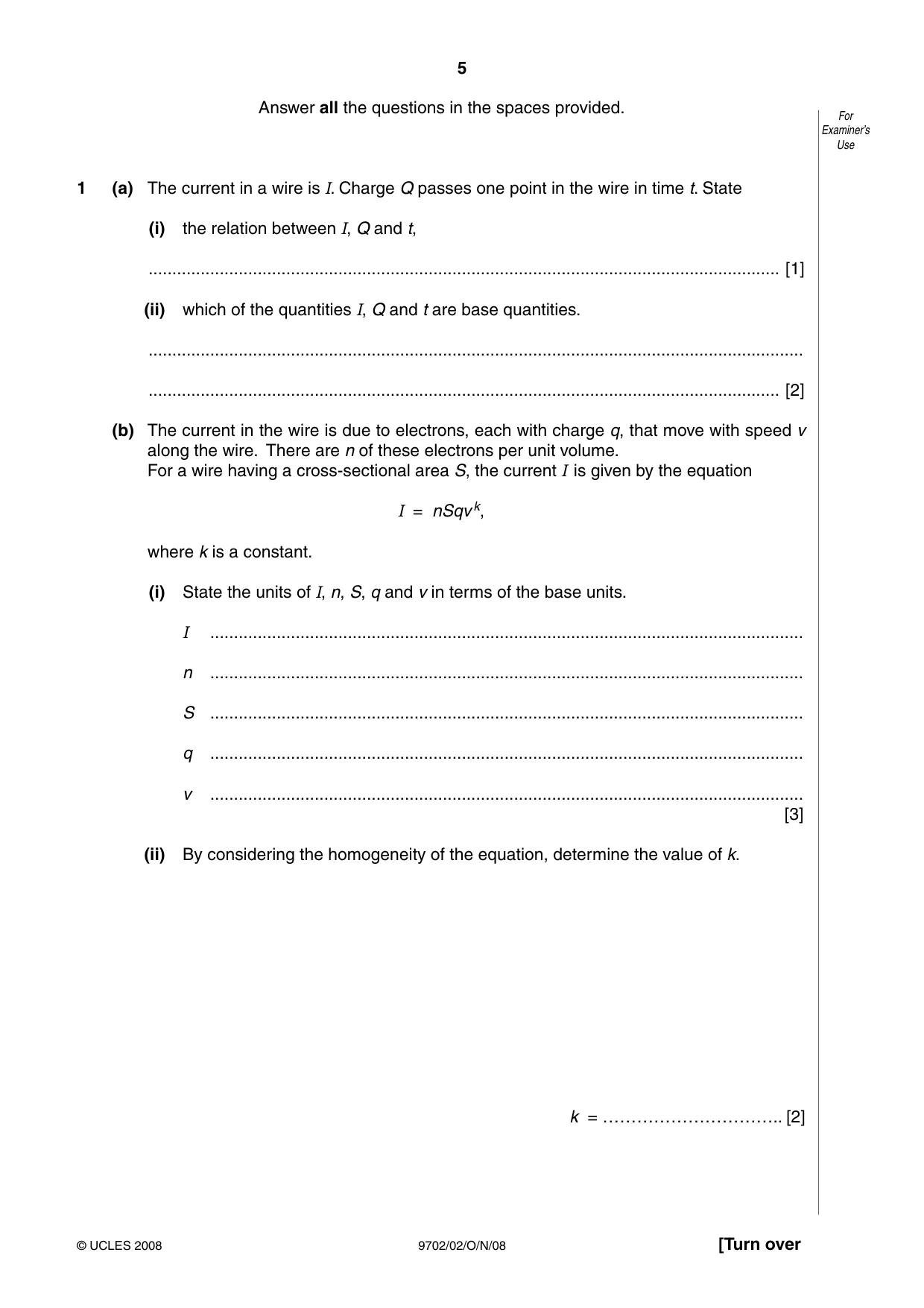
Q1 · The current in a wire is I
1 (a) The current in a wire is I. Charge Q passes one point in the wire in time t. State (i) the relation between I, Q and t, ..................................................................................................................................... [1] (ii) which of the quantities I, Q and t are base quantities. .......................................................................................................................................... ..................................................................................................................................... [2] (b) The current in the wire is due to electrons, each with charge q, that move with speed v along the wire. There are n of these electrons per unit volume. For a wire having a cross-sectional area S, the current I is given by the equation I = nSqv k, where k is a constant. (i) State the units of I, n, S, q and v in terms of the base units. I ............................................................................................................................. n ............................................................................................................................. S ............................................................................................................................. q ............................................................................................................................. v ............................................................................................................................. [3] (ii) By considering the homogeneity of the equation, determine the value of k. k = ………………………….. [2]
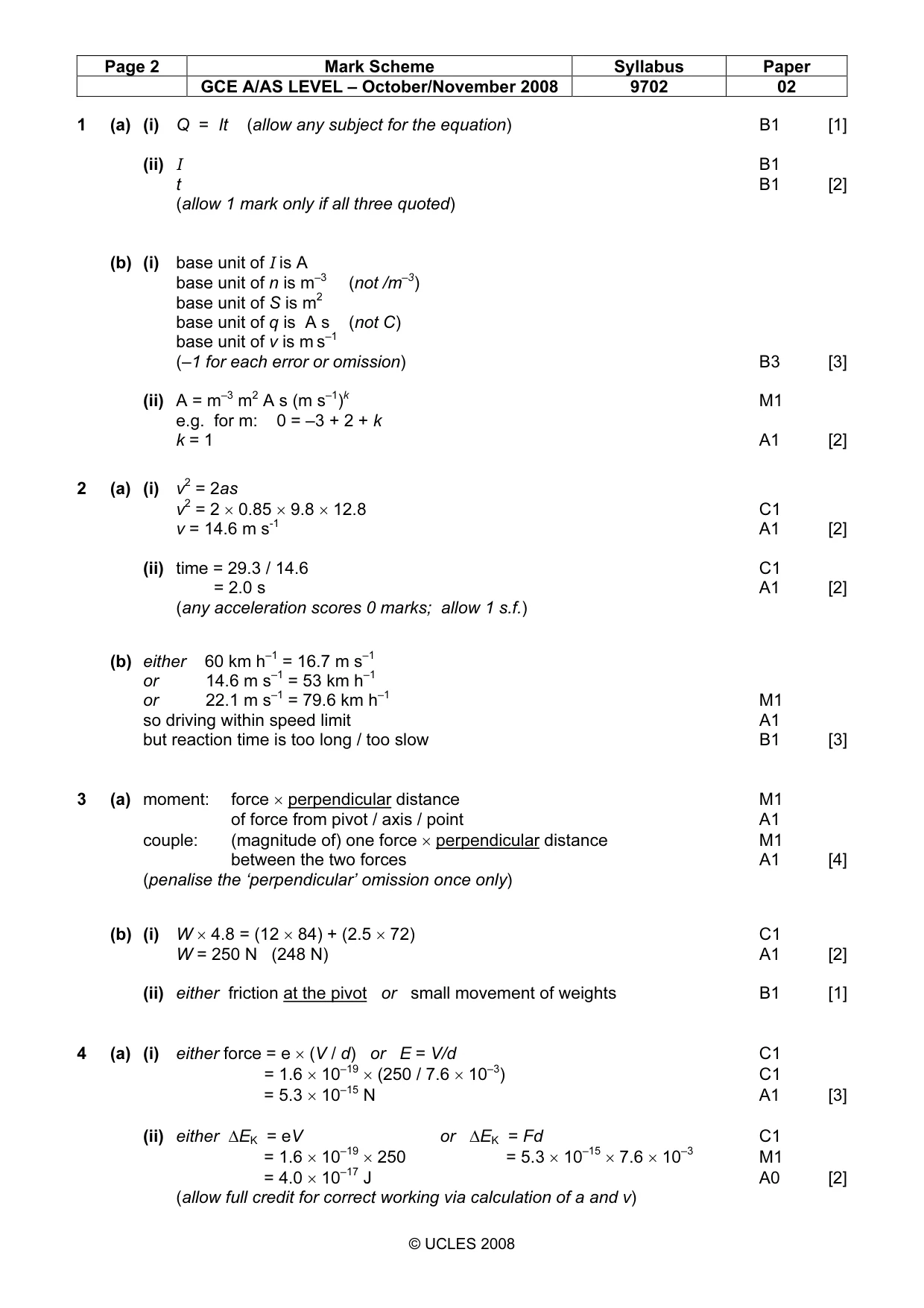
Mark scheme: 1 (a) (i) Q = It (allow any subject for the equation) B1 [1] (ii) I B1 t B1 [2] (allow 1 mark only if all three quoted) (b) (i) base unit of I is A base unit of n is m–3 (not /m–3) base unit of S is m2 base unit of q is A s (not C) base unit of v is m s–1 (–1 for each error or omission) B3 [3] (ii) A = m–3 m2 A s (m s–1)k M1 e.g. for m: 0 = –3 + 2 + k k = 1 A1 [2] 2
Q2 · A car is travelling along a straight road at speed v
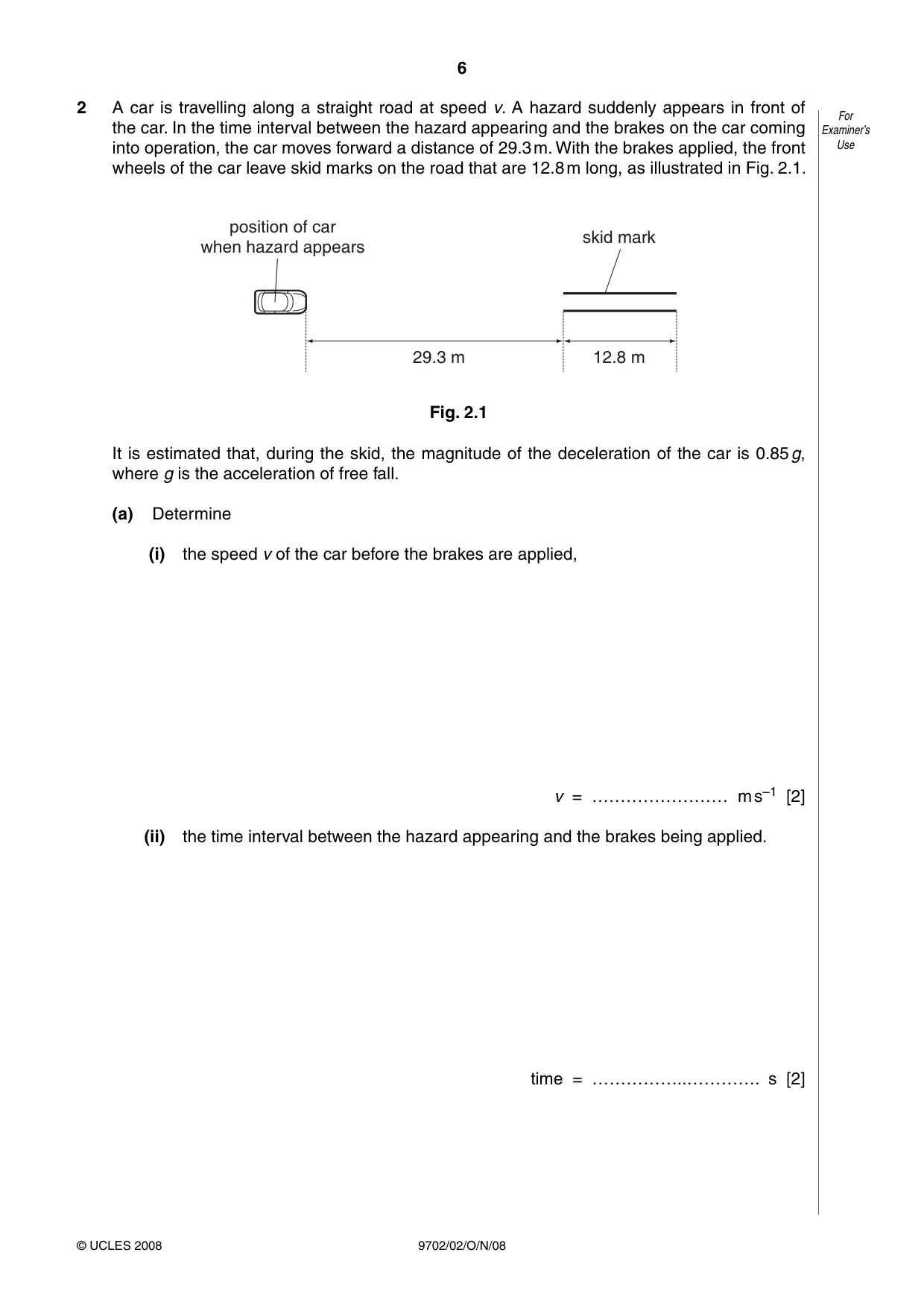
2 A car is travelling along a straight road at speed v. A hazard suddenly appears in front of For the car. In the time interval between the hazard appearing and the brakes on the car coming Examiner’s into operation, the car moves forward a distance of 29.3 m. With the brakes applied, the front Use wheels of the car leave skid marks on the road that are 12.8 m long, as illustrated in Fig. 2.1. position of car skid mark when hazard appears 29.3 m 12.8 m Fig. 2.1 It is estimated that, during the skid, the magnitude of the deceleration of the car is 0.85 g, where g is the acceleration of free fall. (a) Determine (i) the speed v of the car before the brakes are applied, v = …………………… m s–1 [2] (ii) the time interval between the hazard appearing and the brakes being applied. time = ……………..…………. s [2] (b) The legal speed limit on the road is 60 km per hour. For Use both of your answers in (a) to comment on the standard of the driving of the car. Examiner’s Use .......................................................................................................................................... .......................................................................................................................................... .......................................................................................................................................... ..................................................................................................................................... [3]
Mark scheme: 2 (a) (i) v2 = 2as v2 = 2 × 0.85 × 9.8 × 12.8 C1 v = 14.6 m s-1 A1 [2] (ii) time = 29.3 / 14.6 C1 = 2.0 s A1 [2] (any acceleration scores 0 marks; allow 1 s.f.) (b) either 60 km h–1 = 16.7 m s–1 or 14.6 m s–1 = 53 km h–1 or 22.1 m s–1 = 79.6 km h–1 M1 so driving within speed limit A1 but reaction time is too long / too slow B1 [3]
Q3 · Distinguish between the moment of a force and the torque of a couple
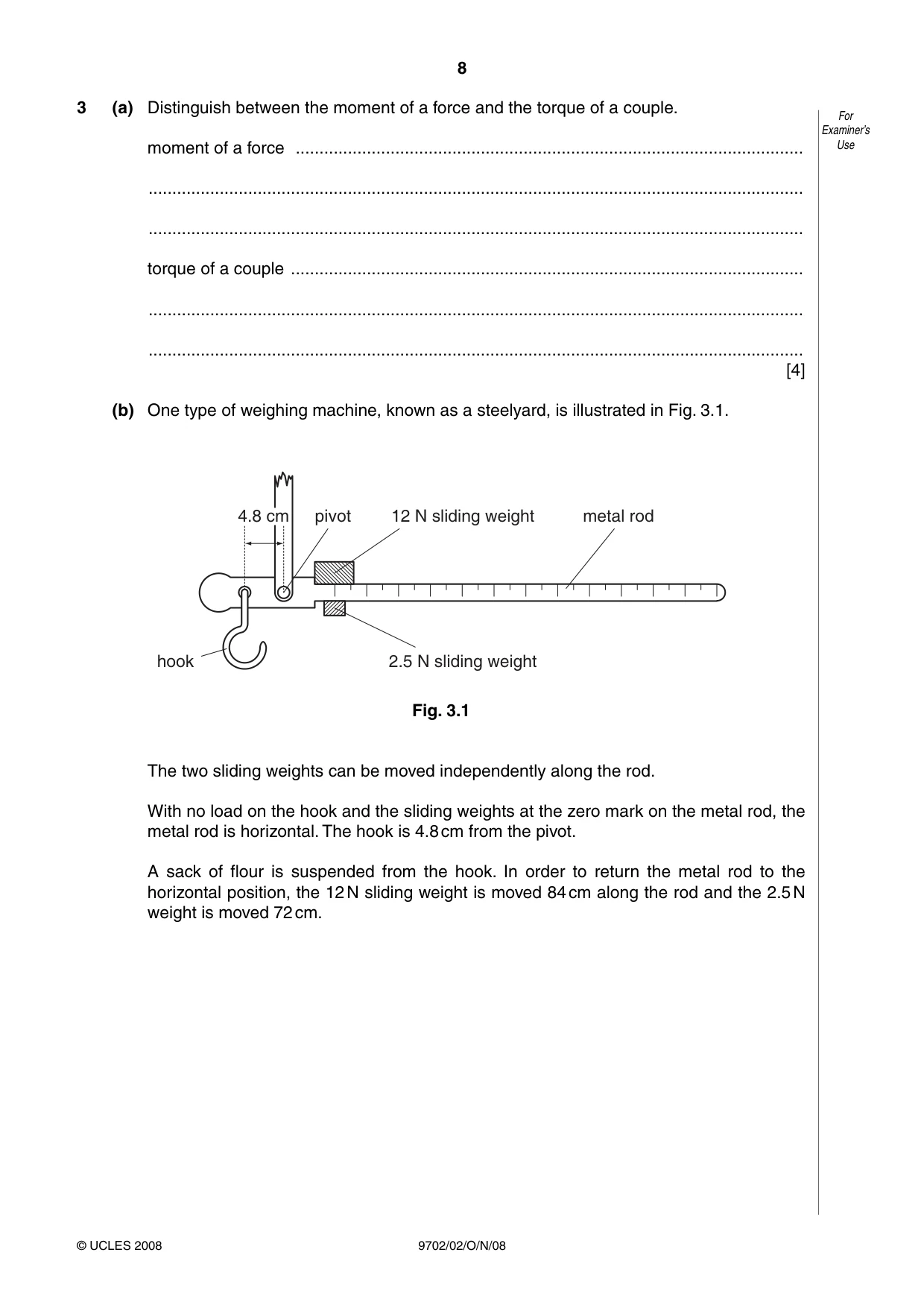
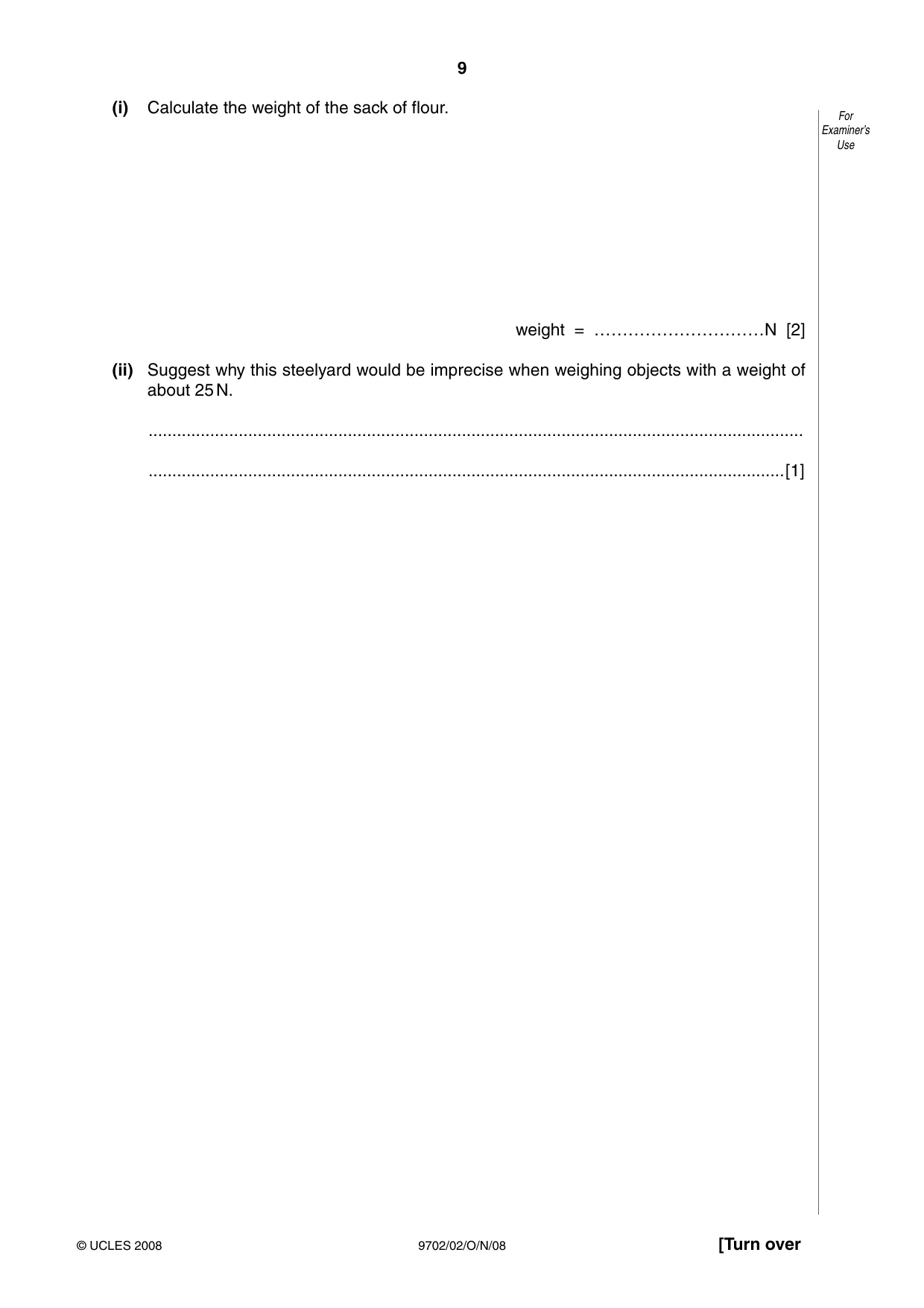
3 (a) Distinguish between the moment of a force and the torque of a couple. For Examiner’s moment of a force ........................................................................................................... Use .......................................................................................................................................... .......................................................................................................................................... torque of a couple ............................................................................................................ .......................................................................................................................................... .......................................................................................................................................... [4] (b) One type of weighing machine, known as a steelyard, is illustrated in Fig. 3.1. 4.8 cm pivot 12 N sliding weight metal rod hook 2.5 N sliding weight Fig. 3.1 The two sliding weights can be moved independently along the rod. With no load on the hook and the sliding weights at the zero mark on the metal rod, the metal rod is horizontal. The hook is 4.8 cm from the pivot. A sack of flour is suspended from the hook. In order to return the metal rod to the horizontal position, the 12 N sliding weight is moved 84 cm along the rod and the 2.5 N weight is moved 72 cm. (i) Calculate the weight of the sack of flour. For Examiner’s Use weight = …………………………N [2] (ii) Suggest why this steelyard would be imprecise when weighing objects with a weight of about 25 N. .......................................................................................................................................... ......................................................................................................................................[1]
Mark scheme: 3 (a) moment: force × perpendicular distance M1 of force from pivot / axis / point A1 couple: (magnitude of) one force × perpendicular distance M1 between the two forces A1 [4] (penalise the ‘perpendicular’ omission once only) (b) (i) W × 4.8 = (12 × 84) + (2.5 × 72) C1 W = 250 N (248 N) A1 [2] (ii) either friction at the pivot or small movement of weights B1 [1]
Q4 · Two parallel plates P and Q are separated by a distance of 7.6 mm in a vacuum
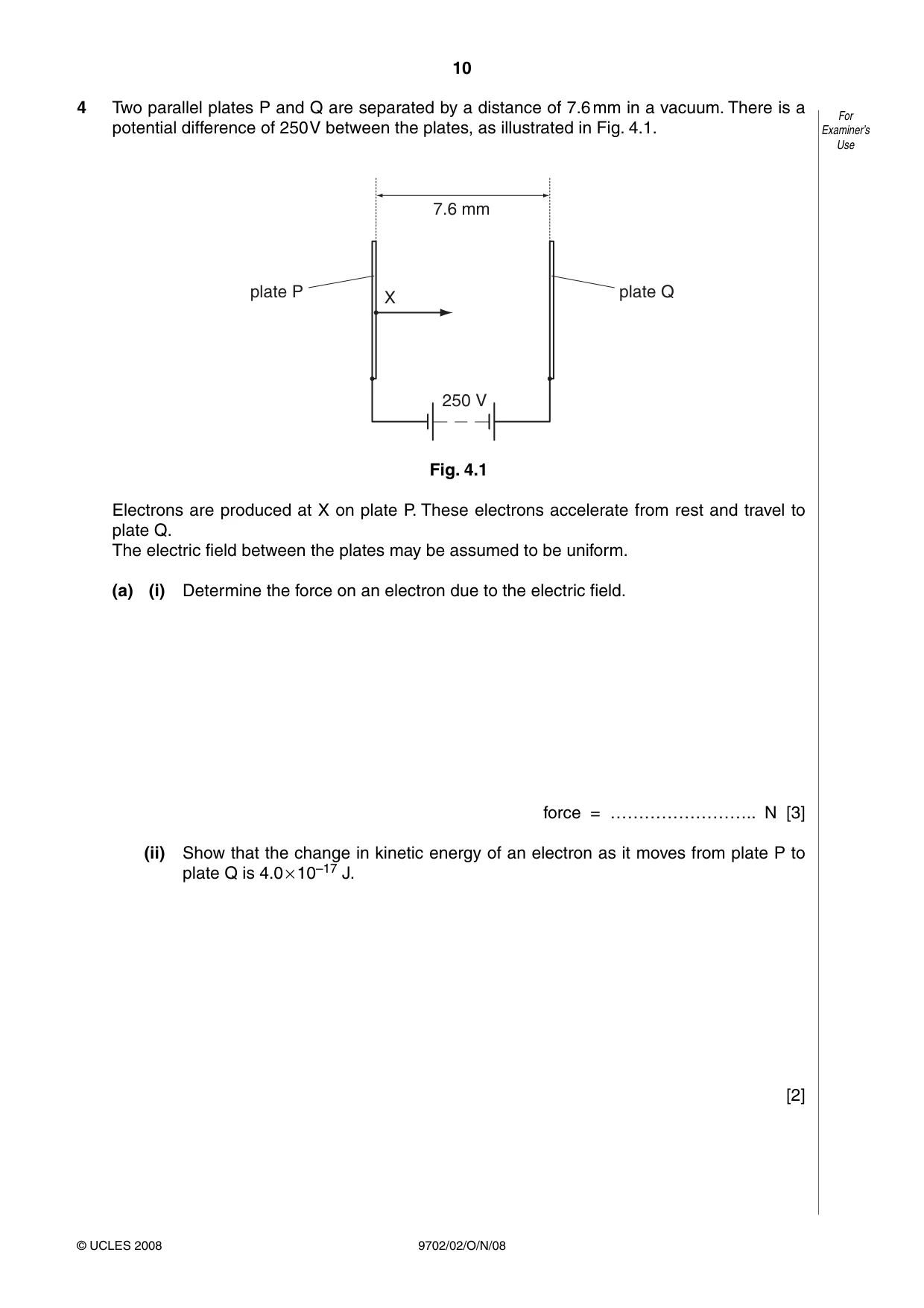
4 Two parallel plates P and Q are separated by a distance of 7.6 mm in a vacuum. There is a For potential difference of 250 V between the plates, as illustrated in Fig. 4.1. Examiner’s Use 7.6 mm plate P plate Q X 250 V Fig. 4.1 Electrons are produced at X on plate P. These electrons accelerate from rest and travel to plate Q. The electric field between the plates may be assumed to be uniform. (a) (i) Determine the force on an electron due to the electric field. force = …………………….. N [3] (ii) Show that the change in kinetic energy of an electron as it moves from plate P to plate Q is 4.0 × 10⁻¹⁷ J. [2] (iii) Determine the speed of an electron as it reaches plate Q. For Examiner’s Use speed = .......................................m s–1 [2] (b) The positions of the plates are adjusted so that the electric field between them is not uniform. The potential difference remains unchanged. State and explain the effect, if any, of this adjustment on the speed of an electron as it reaches plate Q. .......................................................................................................................................... .......................................................................................................................................... .......................................................................................................................................... ..................................................................................................................................... [3]
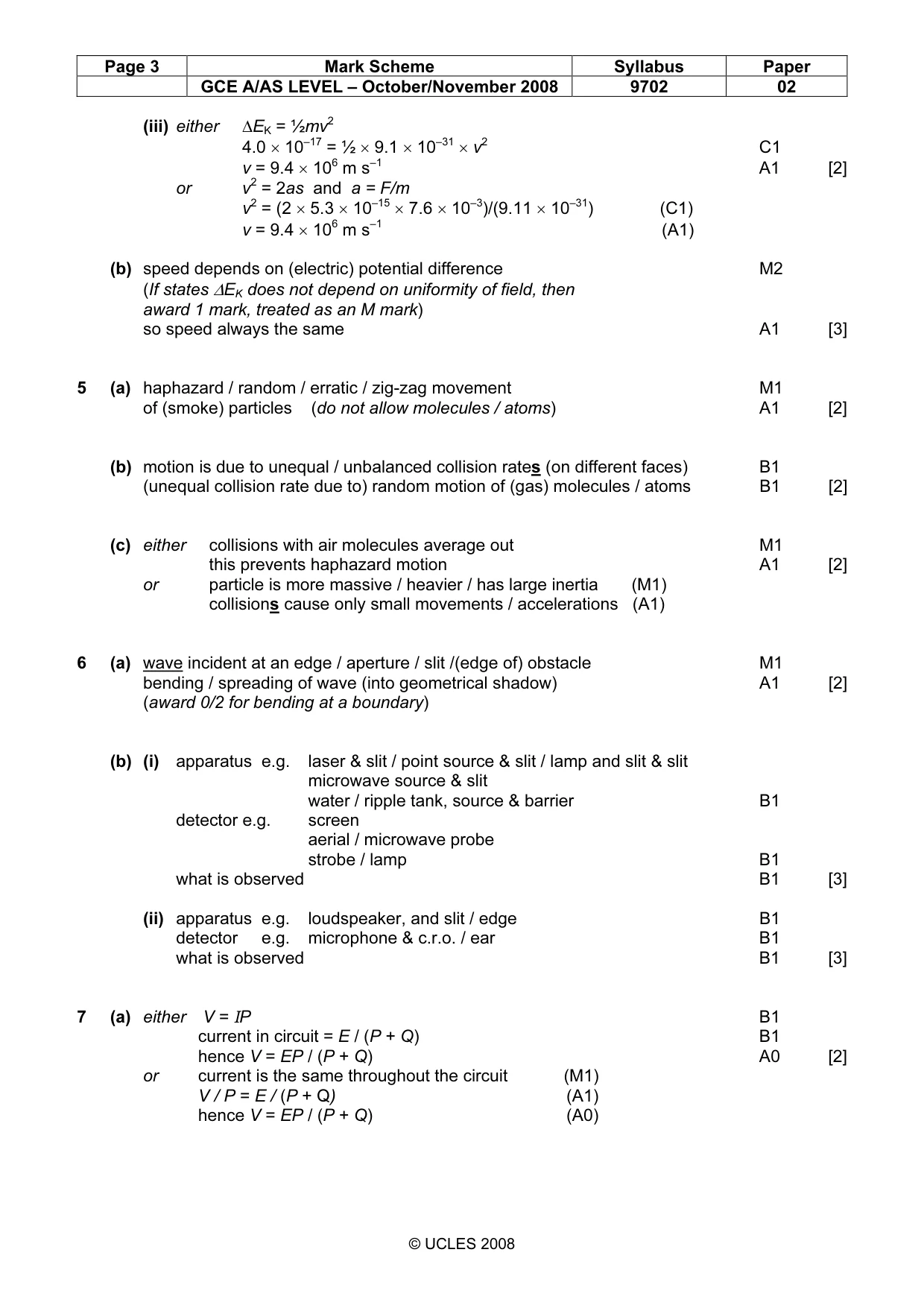
Mark scheme: 4 (a) (i) either force = e × (V / d) or E = V/d C1 = 1.6 × 10–19 × (250 / 7.6 × 10⁻³) C1 = 5.3 × 10⁻¹⁵ N A1 [3] (ii) either ∆EK = eV or ∆EK = Fd C1 = 1.6 × 10–19 × 250 = 5.3 × 10–15 × 7.6 × 10–3 M1 = 4.0 × 10⁻¹⁷ J A0 [2] (allow full credit for correct working via calculation of a and v) GCE A/AS LEVEL – October/November 2008 9702 02 (iii) either ∆EK = ½mv2 4.0 × 10–17 = ½ × 9.1 × 10⁻³¹ × v2 C1 v = 9.4 × 10⁶ m s–1 A1 [2] or v2 = 2as and a = F/m v2 = (2 × 5.3 × 10–15 × 7.6 × 10–3)/(9.11 × 10–31) (C1) v = 9.4 × 10⁶ m s–1 (A1) (b) speed depends on (electric) potential difference M2 (If states ∆EK does not depend on uniformity of field, then award 1 mark, treated as an M mark) so speed always the same A1 [3]
Q5 · Some smoke particles are viewed through a microscope, as illustrated in Fig
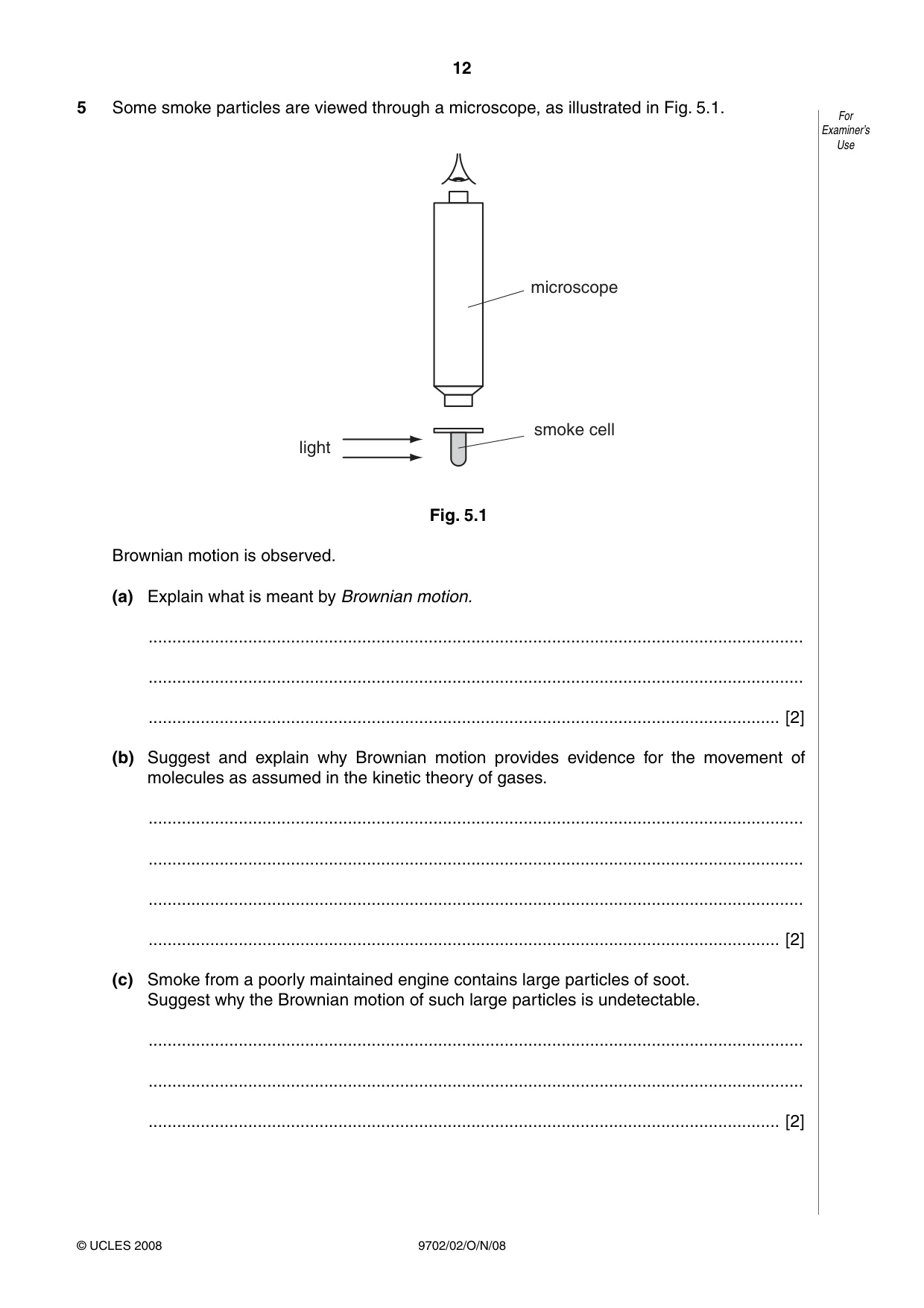
5 Some smoke particles are viewed through a microscope, as illustrated in Fig. 5.1. For Examiner’s Use microscope smoke cell light Fig. 5.1 Brownian motion is observed. (a) Explain what is meant by Brownian motion. .......................................................................................................................................... .......................................................................................................................................... ..................................................................................................................................... [2] (b) Suggest and explain why Brownian motion provides evidence for the movement of molecules as assumed in the kinetic theory of gases. .......................................................................................................................................... .......................................................................................................................................... .......................................................................................................................................... ..................................................................................................................................... [2] (c) Smoke from a poorly maintained engine contains large particles of soot. Suggest why the Brownian motion of such large particles is undetectable. .......................................................................................................................................... .......................................................................................................................................... ..................................................................................................................................... [2]
Mark scheme: 5 (a) haphazard / random / erratic / zig-zag movement M1 of (smoke) particles (do not allow molecules / atoms) A1 [2] (b) motion is due to unequal / unbalanced collision rates (on different faces) B1 (unequal collision rate due to) random motion of (gas) molecules / atoms B1 [2] (c) either collisions with air molecules average out M1 this prevents haphazard motion A1 [2] or particle is more massive / heavier / has large inertia (M1) collisions cause only small movements / accelerations (A1)
Q6 · Explain what is meant by the diffraction of a wave
6 (a) Explain what is meant by the diffraction of a wave. For Examiner’s .......................................................................................................................................... Use .......................................................................................................................................... ..................................................................................................................................... [2] (b) (i) Outline briefly an experiment that may be used to demonstrate diffraction of a transverse wave. .................................................................................................................................. .................................................................................................................................. ............................................................................................................................. [3] (ii) Suggest how your experiment in (i) may be changed to demonstrate the diffraction of a longitudinal wave. .................................................................................................................................. .................................................................................................................................. ............................................................................................................................. [3]
Mark scheme: 6 (a) wave incident at an edge / aperture / slit /(edge of) obstacle M1 bending / spreading of wave (into geometrical shadow) A1 [2] (award 0/2 for bending at a boundary) (b) (i) apparatus e.g. laser & slit / point source & slit / lamp and slit & slit microwave source & slit water / ripple tank, source & barrier B1 detector e.g. screen aerial / microwave probe strobe / lamp B1 what is observed B1 [3] (ii) apparatus e.g. loudspeaker, and slit / edge B1 detector e.g. microphone & c.r.o. / ear B1 what is observed B1 [3]
Q7 · A potential divider circuit consists of two resistors of resistances P and Q, as shown in…
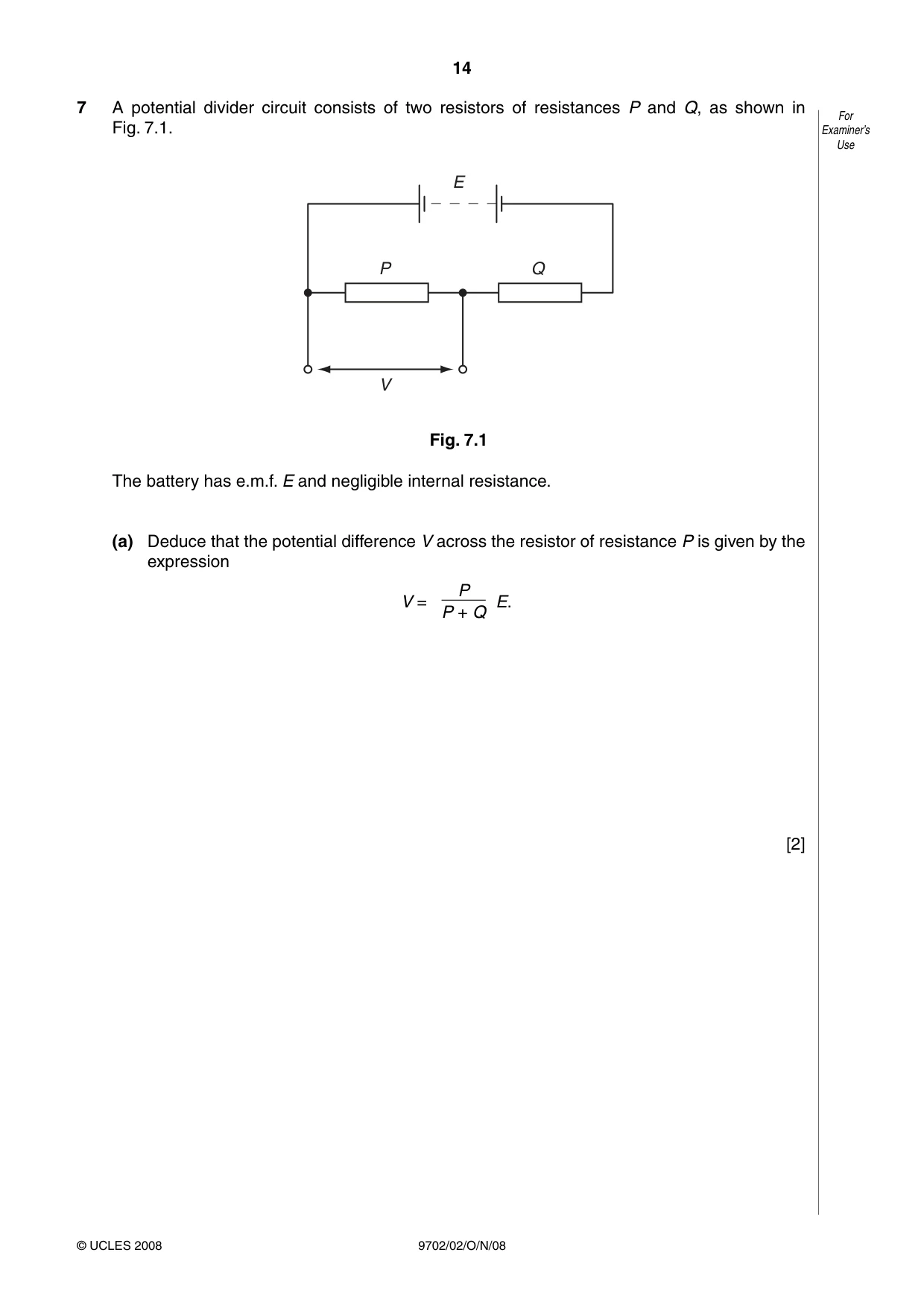
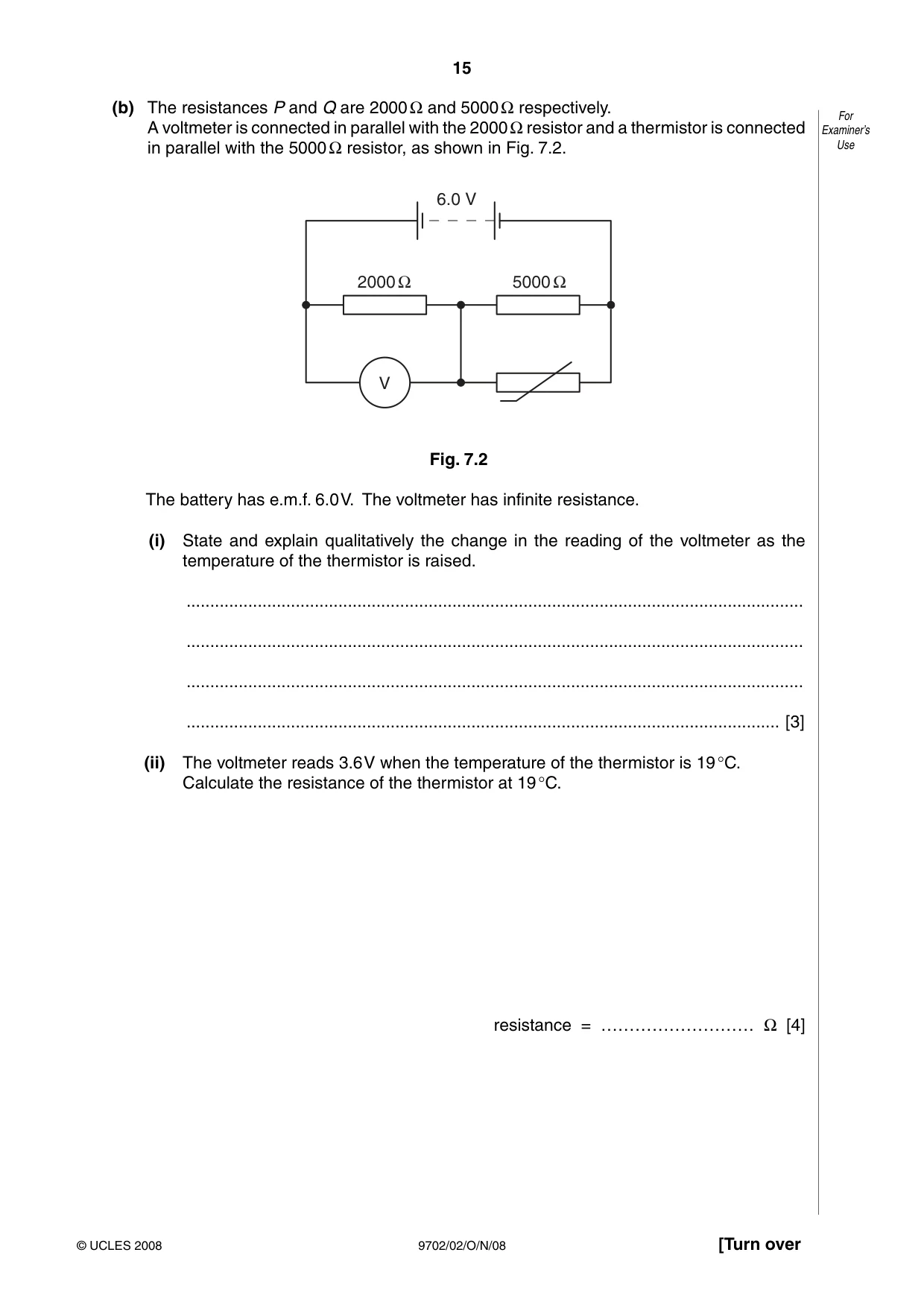
7 A potential divider circuit consists of two resistors of resistances P and Q, as shown in For Fig. 7.1. Examiner’s Use E P Q V Fig. 7.1 The battery has e.m.f. E and negligible internal resistance. (a) Deduce that the potential difference V across the resistor of resistance P is given by the expression P V = E. P + Q [2] (b) The resistances P and Q are 2000 Ω and 5000 Ω respectively. For A voltmeter is connected in parallel with the 2000 Ω resistor and a thermistor is connected Examiner’s in parallel with the 5000 Ω resistor, as shown in Fig. 7.2. Use 6.0 V 2000 Ω 5000 Ω V Fig. 7.2 The battery has e.m.f. 6.0 V. The voltmeter has infinite resistance. (i) State and explain qualitatively the change in the reading of the voltmeter as the temperature of the thermistor is raised. .................................................................................................................................. .................................................................................................................................. .................................................................................................................................. ............................................................................................................................. [3] (ii) The voltmeter reads 3.6 V when the temperature of the thermistor is 19 °C. Calculate the resistance of the thermistor at 19 °C. resistance = ……………………… Ω [4]
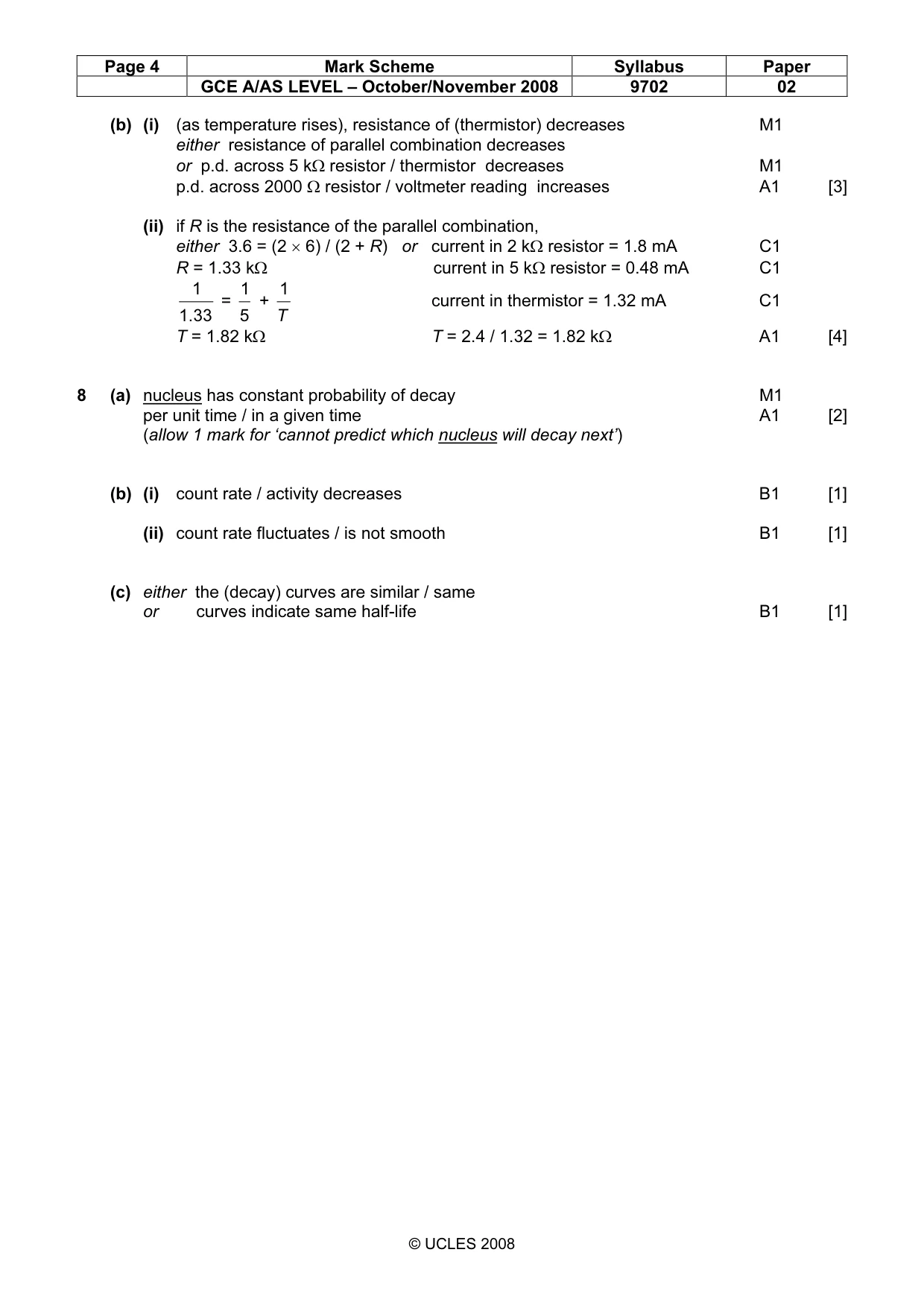
Mark scheme: 7 (a) either V = IP B1 current in circuit = E / (P + Q) B1 hence V = EP / (P + Q) A0 [2] or current is the same throughout the circuit (M1) V / P = E / (P + Q) (A1) hence V = EP / (P + Q) (A0) GCE A/AS LEVEL – October/November 2008 9702 02 (b) (i) (as temperature rises), resistance of (thermistor) decreases M1 either resistance of parallel combination decreases or p.d. across 5 kΩ resistor / thermistor decreases M1 p.d. across 2000 Ω resistor / voltmeter reading increases A1 [3] (ii) if R is the resistance of the parallel combination, either 3.6 = (2 × 6) / (2 + R) or current in 2 kΩ resistor = 1.8 mA C1 R = 1.33 kΩ current in 5 kΩ resistor = 0.48 mA C1 1 1 1 = + current in thermistor = 1.32 mA C1 1.33 5 T T = 1.82 kΩ T = 2.4 / 1.32 = 1.82 kΩ A1 [4]
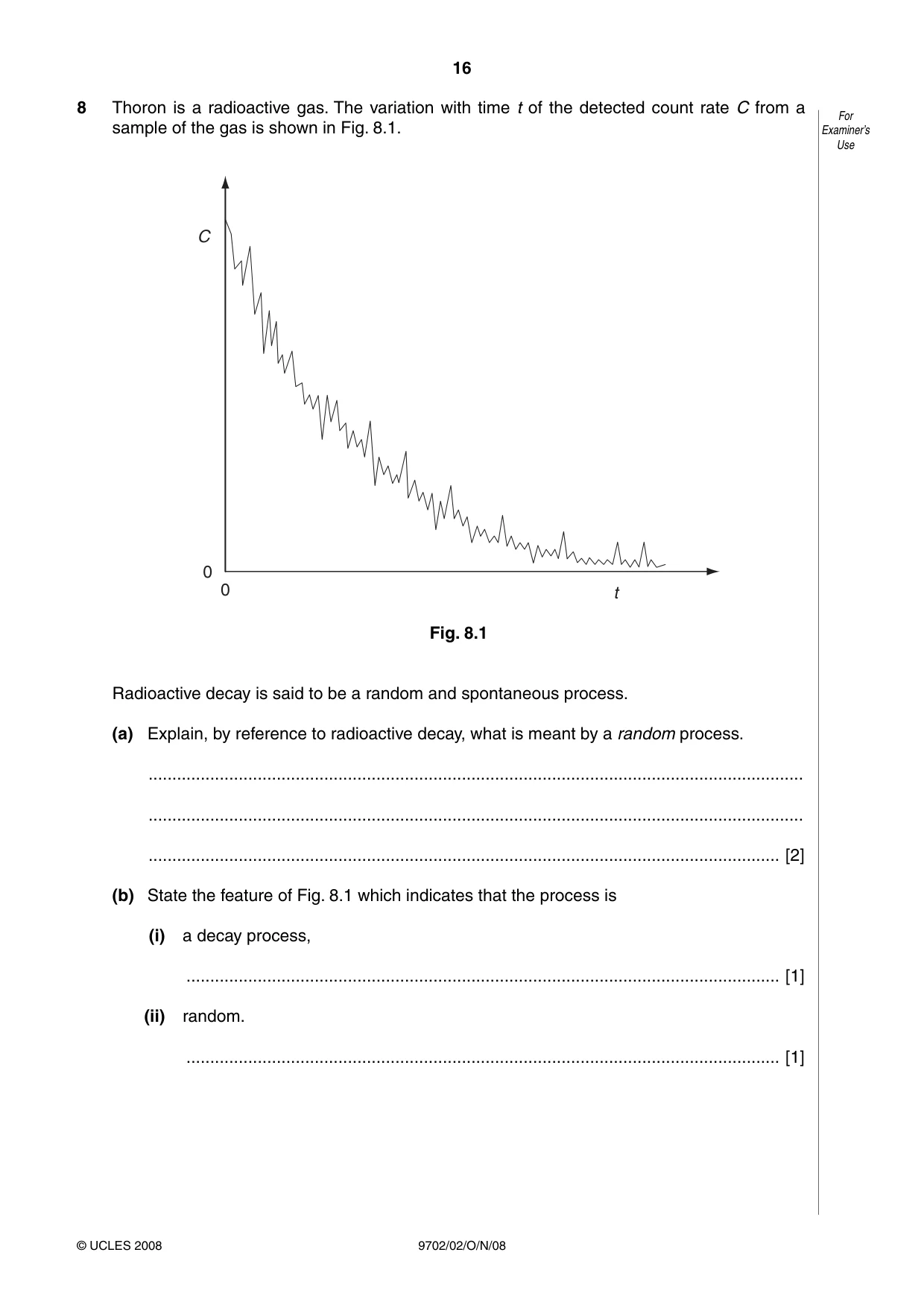
Q8 · Thoron is a radioactive gas
8 Thoron is a radioactive gas. The variation with time t of the detected count rate C from a For sample of the gas is shown in Fig. 8.1. Examiner’s Use C 0 0 t Fig. 8.1 Radioactive decay is said to be a random and spontaneous process. (a) Explain, by reference to radioactive decay, what is meant by a random process. .......................................................................................................................................... .......................................................................................................................................... ..................................................................................................................................... [2] (b) State the feature of Fig. 8.1 which indicates that the process is (i) a decay process, ............................................................................................................................. [1] (ii) random. ............................................................................................................................. [1] (c) A second similar sample of thoron is prepared but it is at a much higher temperature. For The variation with time of the count rate for this second sample is determined. Examiner’s State the feature of the decay curves for the two samples that suggests that radioactive Use decay is a spontaneous process. .......................................................................................................................................... ..................................................................................................................................... [1]
Mark scheme: 8 (a) nucleus has constant probability of decay M1 per unit time / in a given time A1 [2] (allow 1 mark for ‘cannot predict which nucleus will decay next’) (b) (i) count rate / activity decreases B1 [1] (ii) count rate fluctuates / is not smooth B1 [1] (c) either the (decay) curves are similar / same or curves indicate same half-life B1 [1]
What was in this paper
The subtopics covered by these 8 questions, and how many questions each got. Open one in a new tab to see every Cambridge question on it.