Questions as text
Q1 · Briefly describe two phenomena associated with the photoelectric effect that cannot be… 9702/42 May/June 2017
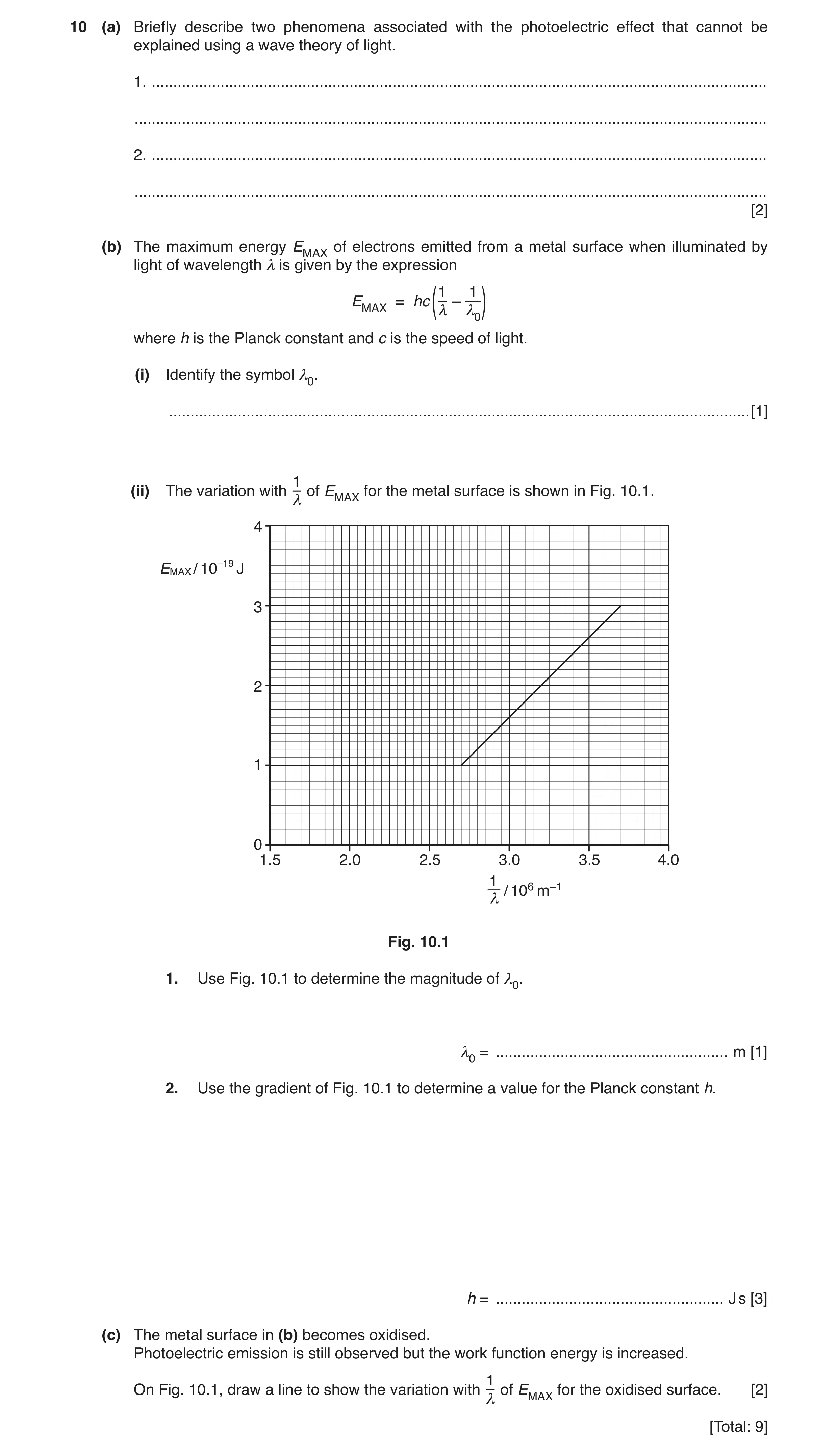
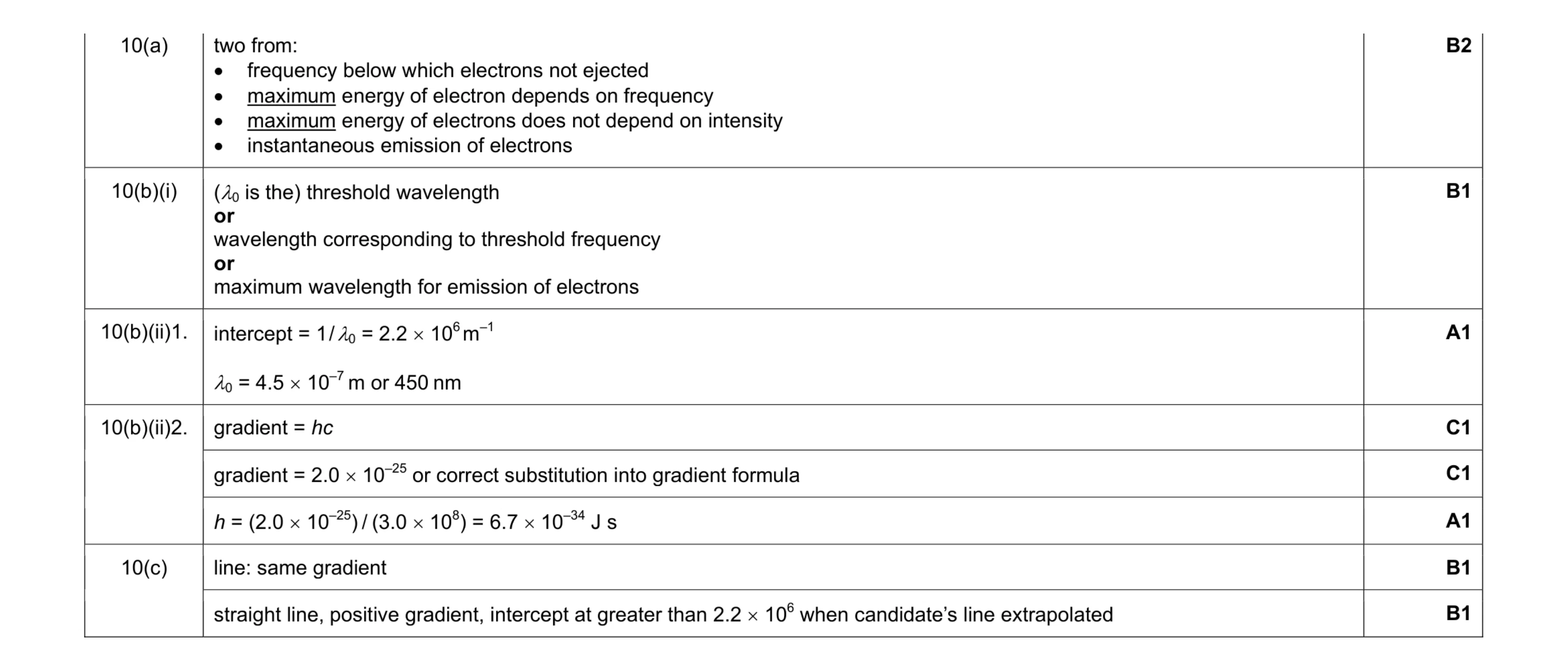
10 (a) Briefly describe two phenomena associated with the photoelectric effect that cannot be explained using a wave theory of light. 1. … … 2. … … [2] (b) The maximum energy EMAX of electrons emitted from a metal surface when illuminated by light of wavelength λ is given by the expression 1 1 EMAX = λ – hc ( λ0) where h is the Planck constant and c is the speed of light. (i) Identify the symbol λ0. … [1] 1 (ii) The variation with of EMAX for the metal surface is shown in Fig. 10.1. λ 4 EMAX / 10–19 J 3 2 1 0 1.5 2.0 2.5 3.0 3.5 4.0 1 / 106 m–1 λ Fig. 10.1 1. Use Fig. 10.1 to determine the magnitude of λ0. λ0 = … m [1] 2. Use the gradient of Fig. 10.1 to determine a value for the Planck constant h. h = … J s [3] (c) The metal surface in (b) becomes oxidised. Photoelectric emission is still observed but the work function energy is increased. 1 On Fig. 10.1, draw a line to show the variation with of EMAX for the oxidised surface. [2] λ [Total: 9]
9 marks
Mark scheme: 10(a) two from: • frequency below which electrons not ejected • maximum energy of electron depends on frequency • maximum energy of electrons does not depend on intensity • instantaneous emission of electrons B2 10(b)(i) (λ0 is the) threshold wavelength or wavelength corresponding to threshold frequency or maximum wavelength for emission of electrons B1 10(b)(ii)1. intercept = 1 / λ0 = 2.2 × 10⁶m–1 λ0 = 4.5 × 10⁻⁷ m or 450 nm A1 10(b)(ii)2. gradient = hc C1 gradient = 2.0 × 10⁻²⁵ or correct substitution into gradient formula C1 h = (2.0 × 10⁻²⁵) / (3.0 × 10⁸) = 6.7 × 10⁻³⁴ J s A1 10(c) line: same gradient B1 straight line, positive gradient, intercept at greater than 2.2 × 10⁶ when candidate’s line extrapolated B1
This question in 9702/42 May/June 2017
Q2 · A metal surface is illuminated with light of a single wavelength λ 9702/42 Oct/Nov 2017
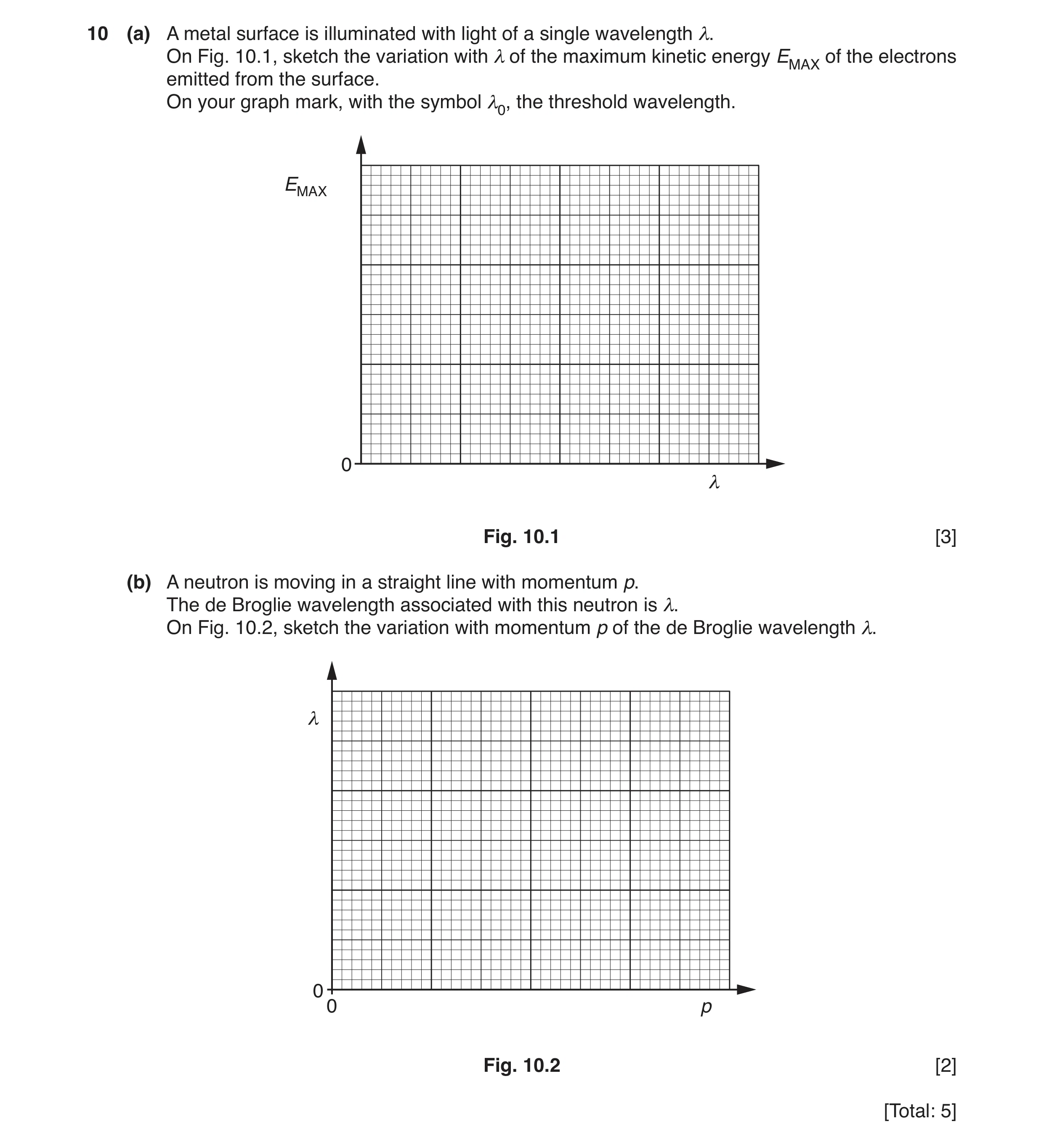
10 (a) A metal surface is illuminated with light of a single wavelength λ. On Fig. 10.1, sketch the variation with λ of the maximum kinetic energy EMAX of the electrons emitted from the surface. On your graph mark, with the symbol λ0, the threshold wavelength. EMAX 0 λ Fig. 10.1 [3] (b) A neutron is moving in a straight line with momentum p. The de Broglie wavelength associated with this neutron is λ. On Fig. 10.2, sketch the variation with momentum p of the de Broglie wavelength λ. λ 0 0 p Fig. 10.2 [2] [Total: 5]
5 marks
Mark scheme: 10(a) B1 graph line with λ always < λ0 B1 negative gradient with correct concave curvature B1 10(b) curve with negative gradient and correct concave curvature M1 not touching either axis A1
This question in 9702/42 Oct/Nov 2017
Q3 · Explain what is meant by a photon 9702/41 May/June 2018
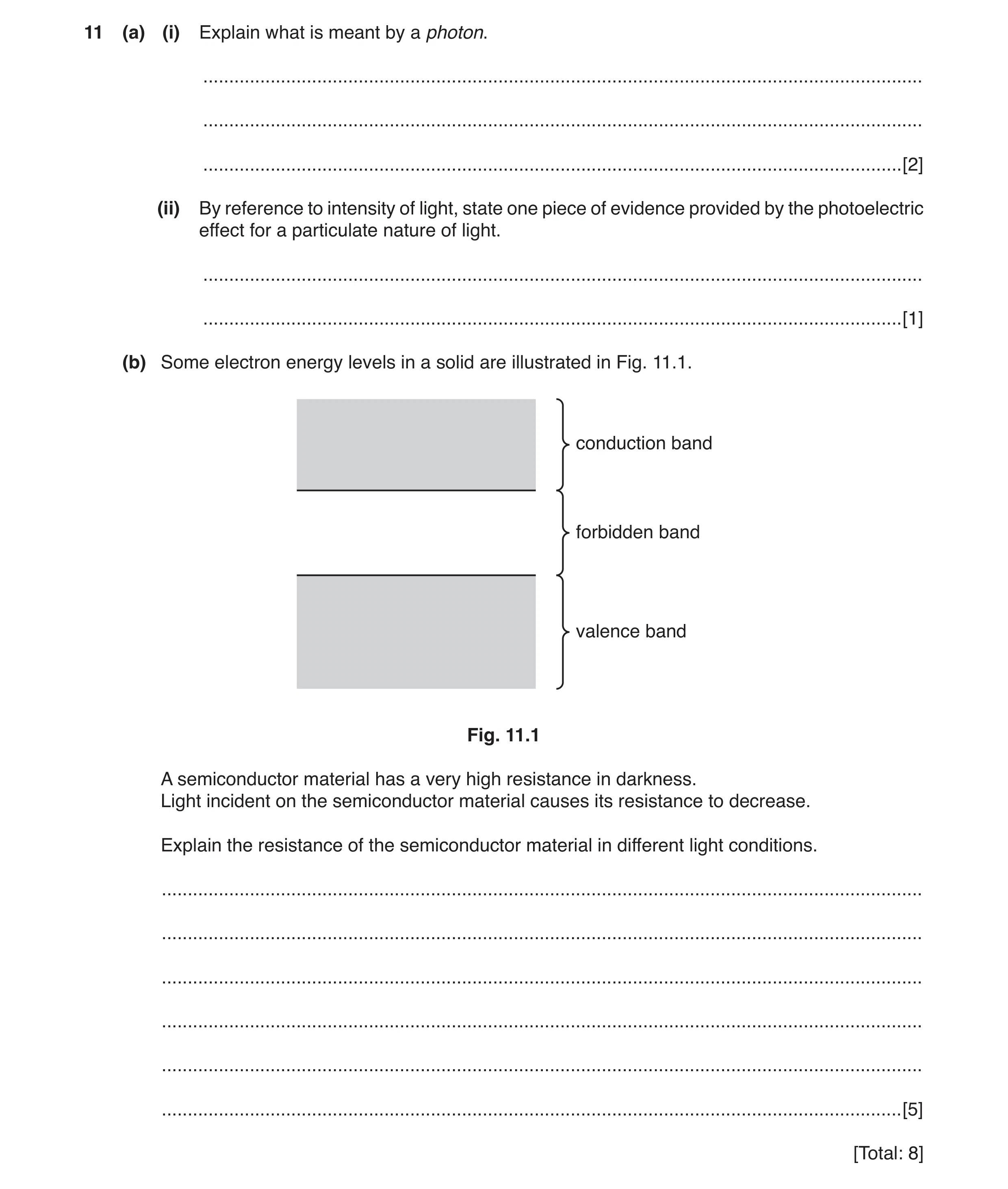
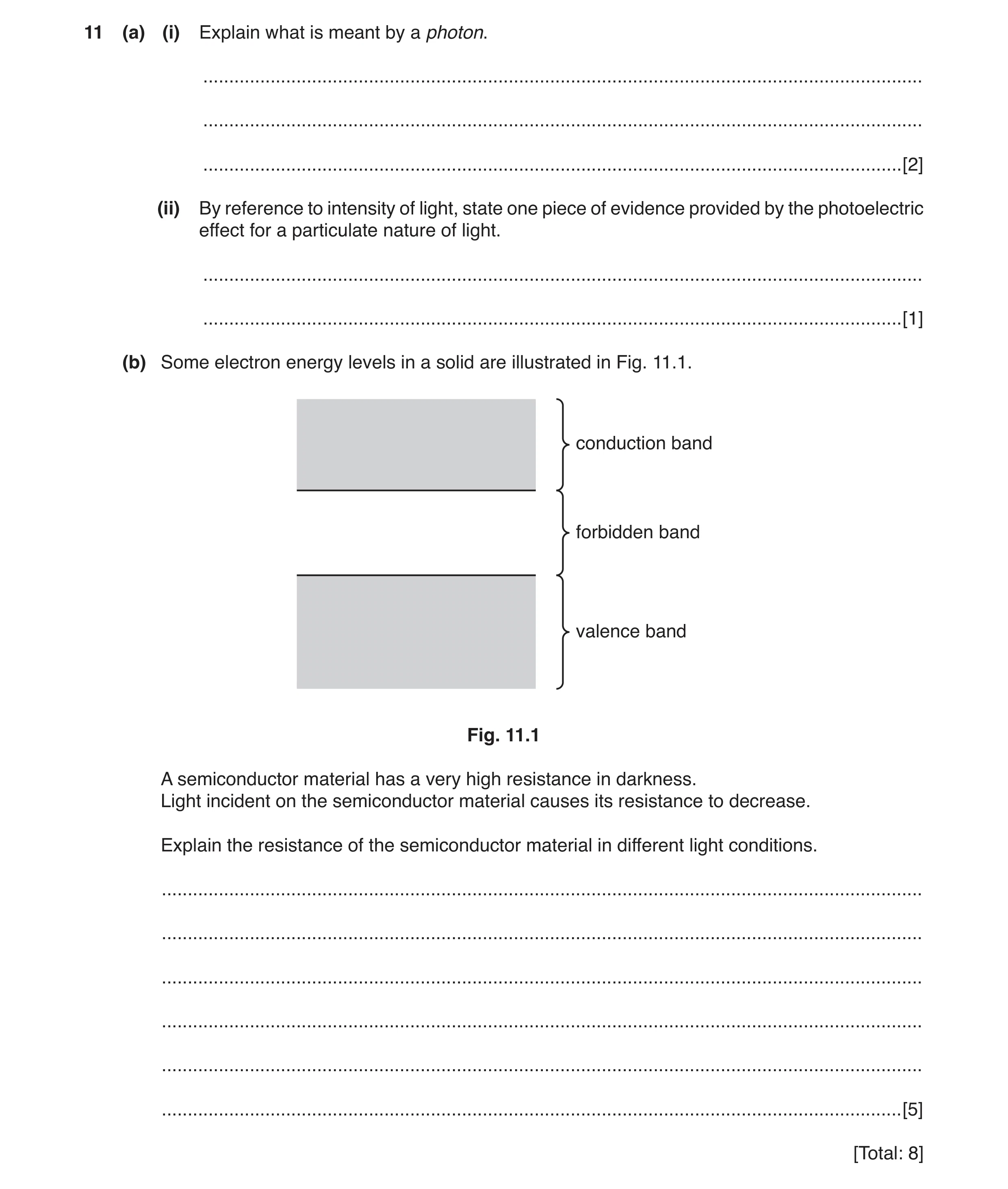
11 (a) (i) Explain what is meant by a photon. … … … [2] (ii) By reference to intensity of light, state one piece of evidence provided by the photoelectric effect for a particulate nature of light. … … [1] (b) Some electron energy levels in a solid are illustrated in Fig. 11.1. conduction band forbidden band valence band Fig. 11.1 A semiconductor material has a very high resistance in darkness. Light incident on the semiconductor material causes its resistance to decrease. Explain the resistance of the semiconductor material in different light conditions. … … … … … … [5] [Total: 8]
8 marks
Mark scheme: 11(a)(i) packet/quantum/discrete amount of energy M1 of electromagnetic radiation A1 11(a)(ii) (maximum) energy of emitted electrons is independent of intensity or no emission of electrons below the threshold frequency regardless of intensity or no emission of electrons when photon energy is less than work function (energy) regardless of intensity B1 11(b) in darkness: conduction band empty so high resistance B1 in daylight: electrons in valence band absorb photons B1 in daylight: electrons ‘jump’ to conduction band B1 this leaves holes in valence band B1 more charge carriers in daylight so resistance decreases B1
This question in 9702/41 May/June 2018
Q4 · Describe the photoelectric effect 9702/42 May/June 2018
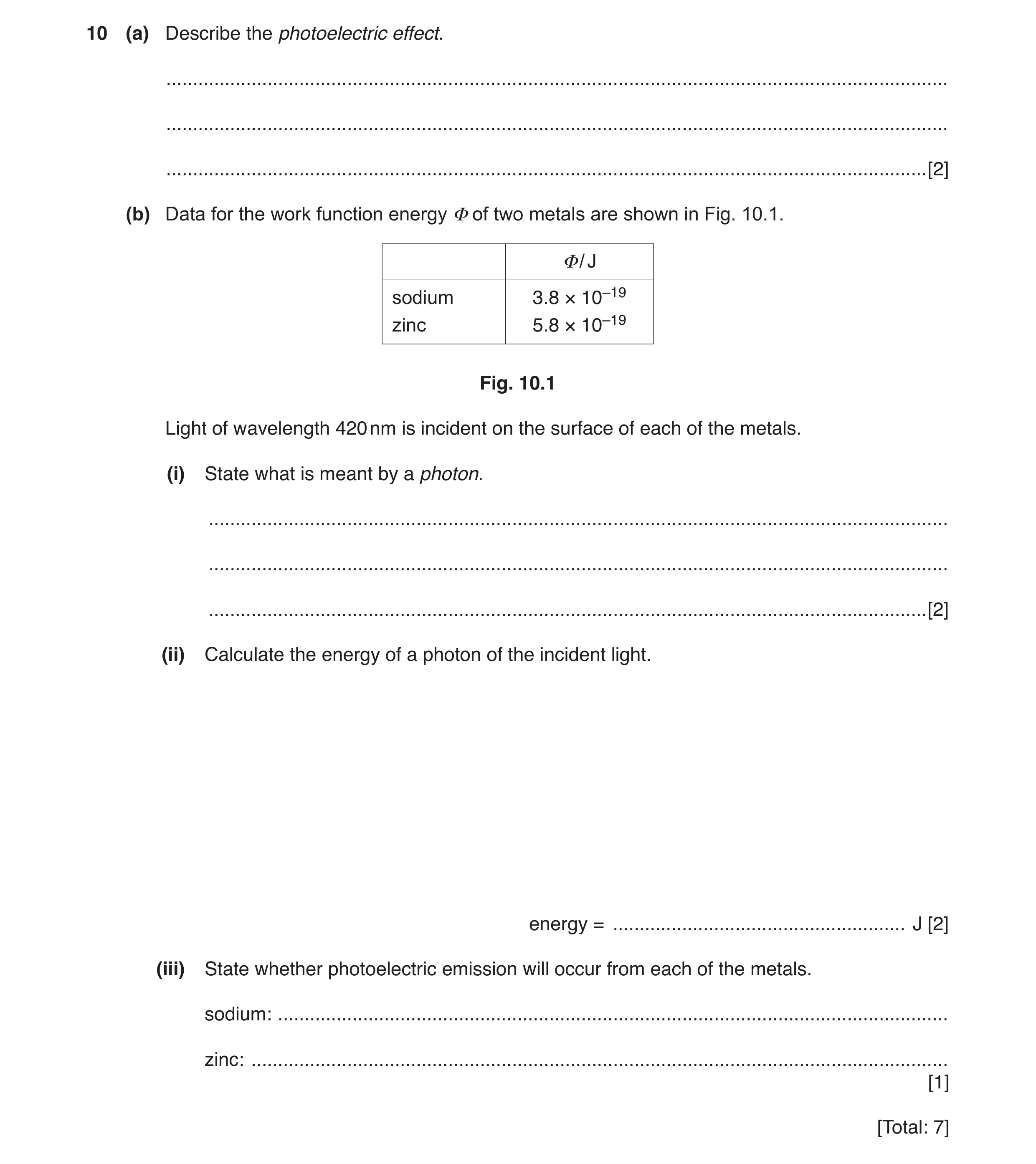
10 (a) Describe the photoelectric effect. … … … [2] (b) Data for the work function energy Φ of two metals are shown in Fig. 10.1. Φ/ J sodium 3.8 × 10⁻¹⁹ zinc 5.8 × 10⁻¹⁹ Fig. 10.1 Light of wavelength 420 nm is incident on the surface of each of the metals. (i) State what is meant by a photon. … … … [2] (ii) Calculate the energy of a photon of the incident light. energy = … J [2] (iii) State whether photoelectric emission will occur from each of the metals. sodium: … zinc: … [1] [Total: 7]
7 marks
Mark scheme: 10(a) emission of electron B1 when electromagnetic radiation incident (on surface) B1 10(b)(i) packet/quantum/discrete amount of energy M1 of electromagnetic radiation A1 10(b)(ii) E = hc / λ C1 = (6.63 × 10–34 × 3.00 × 108) / (420 × 10–9) = 4.7 × 10⁻¹⁹ J A1 10(b)(iii) sodium: yes zinc: no B1
This question in 9702/42 May/June 2018
Q5 · Explain what is meant by a photon 9702/43 May/June 2018
11 (a) (i) Explain what is meant by a photon. … … … [2] (ii) By reference to intensity of light, state one piece of evidence provided by the photoelectric effect for a particulate nature of light. … … [1] (b) Some electron energy levels in a solid are illustrated in Fig. 11.1. conduction band forbidden band valence band Fig. 11.1 A semiconductor material has a very high resistance in darkness. Light incident on the semiconductor material causes its resistance to decrease. Explain the resistance of the semiconductor material in different light conditions. … … … … … … [5] [Total: 8]
8 marks
Mark scheme: 11(a)(i) packet/quantum/discrete amount of energy M1 of electromagnetic radiation A1 11(a)(ii) (maximum) energy of emitted electrons is independent of intensity or no emission of electrons below the threshold frequency regardless of intensity or no emission of electrons when photon energy is less than work function (energy) regardless of intensity B1 11(b) in darkness: conduction band empty so high resistance B1 in daylight: electrons in valence band absorb photons B1 in daylight: electrons ‘jump’ to conduction band B1 this leaves holes in valence band B1 more charge carriers in daylight so resistance decreases B1
This question in 9702/43 May/June 2018
Q6 · State three pieces of evidence provided by the photoelectric effect for a particulate… 9702/41 May/June 2019
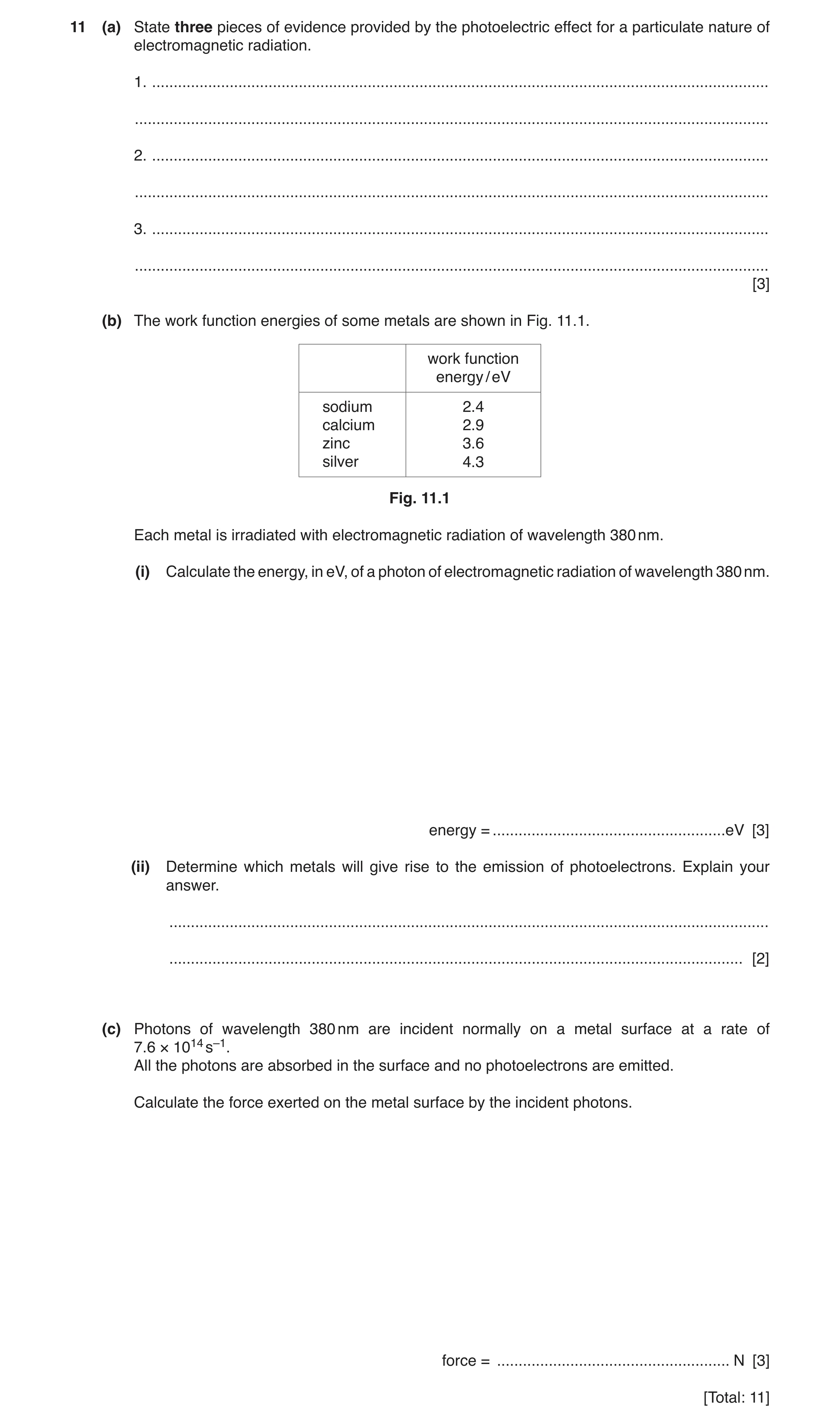
11 (a) State three pieces of evidence provided by the photoelectric effect for a particulate nature of electromagnetic radiation. 1. … … 2. … … 3. … … [3] (b) The work function energies of some metals are shown in Fig. 11.1. work function energy / eV sodium 2.4 calcium 2.9 zinc 3.6 silver 4.3 Fig. 11.1 Each metal is irradiated with electromagnetic radiation of wavelength 380 nm. (i) Calculate the energy, in eV, of a photon of electromagnetic radiation of wavelength 380 nm. energy = … eV [3] (ii) Determine which metals will give rise to the emission of photoelectrons. Explain your answer. … … [2] (c) Photons of wavelength 380 nm are incident normally on a metal surface at a rate of 7.6 × 10¹⁴ s–1. All the photons are absorbed in the surface and no photoelectrons are emitted. Calculate the force exerted on the metal surface by the incident photons. force = … N [3] [Total: 11]
11 marks
Mark scheme: 11(a) Any three points from: • (max) energy of emitted electrons depends on frequency • (max) energy of emitted electrons does not depend on intensity • rate of emission of electrons depends on intensity (at constant frequency) • existence of frequency below which no emission of electrons • instantaneous emission of electrons • increasing the frequency at constant intensity decreases the rate of emission of electrons B3 11(b)(i) photon energy = hc / λ C1 = (6.63 × 10–34 × 3.0 × 108) / (380 × 10–9) ( = 5.23 × 10⁻¹⁹ J) C1 = 3.3 eV A1 11(b)(ii) photon energy must be greater than work function (energy) B1 so sodium and calcium B1 11(c) λ = h / p C1 p = (6.63 × 10⁻³⁴) / (380 × 10–9) = 1.74 × 10⁻²⁷ N s C1 force = 1.74 × 10–27 × 7.6 × 1014 = 1.3 × 10⁻¹² N A1
This question in 9702/41 May/June 2019
Q7 · State three pieces of evidence provided by the photoelectric effect for a particulate… 9702/43 May/June 2019
11 (a) State three pieces of evidence provided by the photoelectric effect for a particulate nature of electromagnetic radiation. 1. … … 2. … … 3. … … [3] (b) The work function energies of some metals are shown in Fig. 11.1. work function energy / eV sodium 2.4 calcium 2.9 zinc 3.6 silver 4.3 Fig. 11.1 Each metal is irradiated with electromagnetic radiation of wavelength 380 nm. (i) Calculate the energy, in eV, of a photon of electromagnetic radiation of wavelength 380 nm. energy = … eV [3] (ii) Determine which metals will give rise to the emission of photoelectrons. Explain your answer. … … [2] (c) Photons of wavelength 380 nm are incident normally on a metal surface at a rate of 7.6 × 10¹⁴ s–1. All the photons are absorbed in the surface and no photoelectrons are emitted. Calculate the force exerted on the metal surface by the incident photons. force = … N [3] [Total: 11]
11 marks
Mark scheme: 11(a) Any three points from: • (max) energy of emitted electrons depends on frequency • (max) energy of emitted electrons does not depend on intensity • rate of emission of electrons depends on intensity (at constant frequency) • existence of frequency below which no emission of electrons • instantaneous emission of electrons • increasing the frequency at constant intensity decreases the rate of emission of electrons B3 11(b)(i) photon energy = hc / λ C1 = (6.63 × 10–34 × 3.0 × 108) / (380 × 10–9) ( = 5.23 × 10⁻¹⁹ J) C1 = 3.3 eV A1 11(b)(ii) photon energy must be greater than work function (energy) B1 so sodium and calcium B1 11(c) λ = h / p C1 p = (6.63 × 10⁻³⁴) / (380 × 10–9) = 1.74 × 10⁻²⁷ N s C1 force = 1.74 × 10–27 × 7.6 × 1014 = 1.3 × 10⁻¹² N A1
This question in 9702/43 May/June 2019
Q8 · With reference to the photoelectric effect, state what is meant by work function energy 9702/41 Oct/Nov 2019
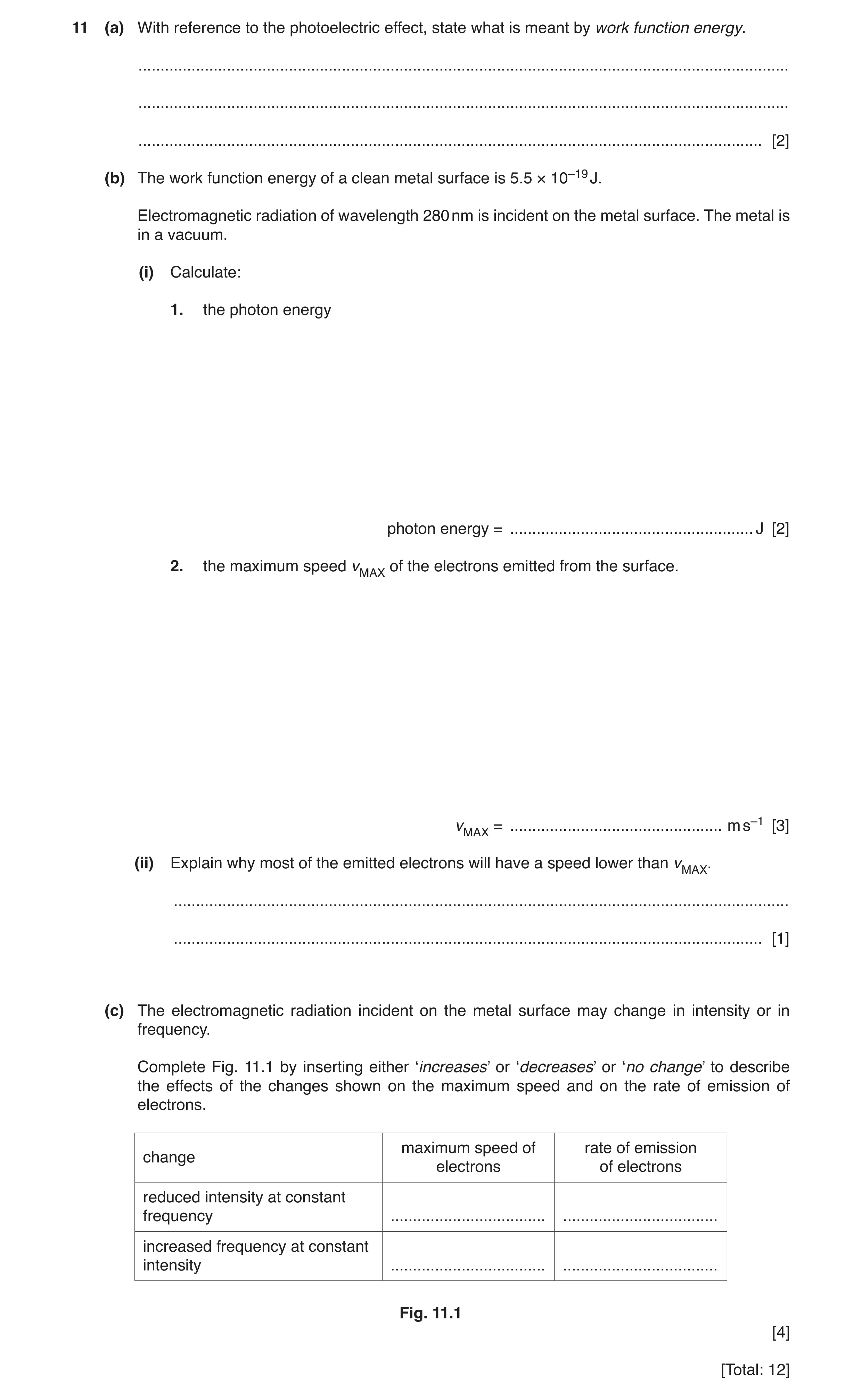
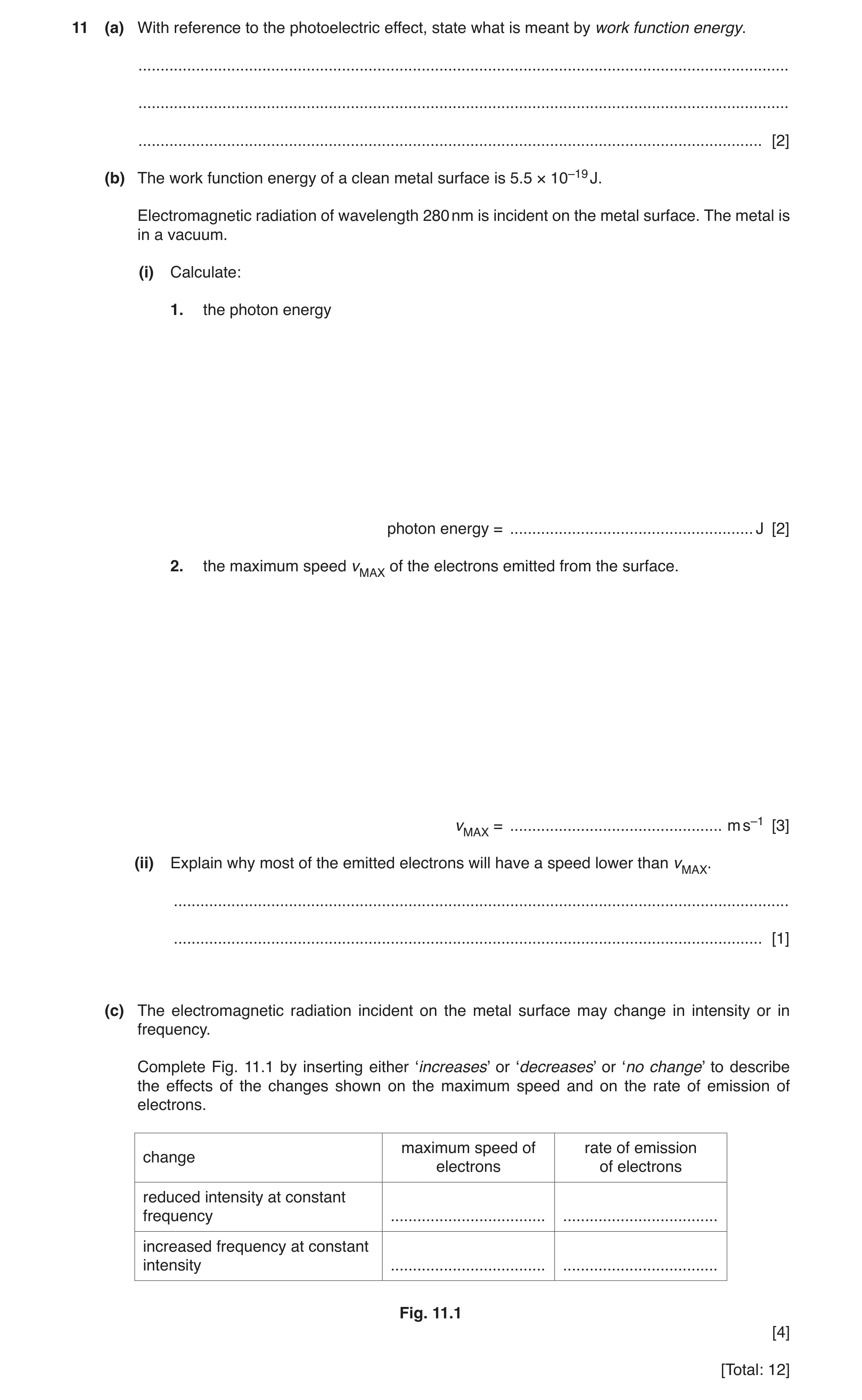
11 (a) With reference to the photoelectric effect, state what is meant by work function energy. … … … [2] (b) The work function energy of a clean metal surface is 5.5 × 10⁻¹⁹ J. Electromagnetic radiation of wavelength 280 nm is incident on the metal surface. The metal is in a vacuum. (i) Calculate: 1. the photon energy photon energy = … J [2] 2. the maximum speed vMAX of the electrons emitted from the surface. vMAX = … m s–1 [3] (ii) Explain why most of the emitted electrons will have a speed lower than vMAX. … … [1] (c) The electromagnetic radiation incident on the metal surface may change in intensity or in frequency. Complete Fig. 11.1 by inserting either ‘increases’ or ‘decreases’ or ‘no change’ to describe the effects of the changes shown on the maximum speed and on the rate of emission of electrons. maximum speed of rate of emission change electrons of electrons reduced intensity at constant frequency … … increased frequency at constant intensity … … Fig. 11.1 [4] [Total: 12]
12 marks
Mark scheme: 11(a) energy (of photon) required to remove electron M1 from a surface or reference to minimum energy or reference to zero kinetic energy A1 11(b)(i) 1. photon energy = hc / λ C1 = (6.63 × 10–34 × 3.00 × 108) / (280 × 10–9) = 7.1 × 10⁻¹⁹ J A1 2. electron energy = (7.1 – 5.5) × 10–19 J C1 ½ × 9.11 × 10–31 × v2 = (7.1 – 5.5) × 10–19 C1 v = 5.9 × 10⁵ m s–1 A1 11(b)(ii) energy is required to bring electron to the surface B1 11(c) no change decreases increases decreases B4
This question in 9702/41 Oct/Nov 2019
Q9 · With reference to the photoelectric effect, state what is meant by work function energy 9702/43 Oct/Nov 2019
11 (a) With reference to the photoelectric effect, state what is meant by work function energy. … … … [2] (b) The work function energy of a clean metal surface is 5.5 × 10⁻¹⁹ J. Electromagnetic radiation of wavelength 280 nm is incident on the metal surface. The metal is in a vacuum. (i) Calculate: 1. the photon energy photon energy = … J [2] 2. the maximum speed vMAX of the electrons emitted from the surface. vMAX = … m s–1 [3] (ii) Explain why most of the emitted electrons will have a speed lower than vMAX. … … [1] (c) The electromagnetic radiation incident on the metal surface may change in intensity or in frequency. Complete Fig. 11.1 by inserting either ‘increases’ or ‘decreases’ or ‘no change’ to describe the effects of the changes shown on the maximum speed and on the rate of emission of electrons. maximum speed of rate of emission change electrons of electrons reduced intensity at constant frequency … … increased frequency at constant intensity … … Fig. 11.1 [4] [Total: 12]
12 marks
Mark scheme: 11(a) energy (of photon) required to remove electron M1 from a surface or reference to minimum energy or reference to zero kinetic energy A1 11(b)(i) 1. photon energy = hc / λ C1 = (6.63 × 10–34 × 3.00 × 108) / (280 × 10–9) = 7.1 × 10⁻¹⁹ J A1 2. electron energy = (7.1 – 5.5) × 10–19 J C1 ½ × 9.11 × 10–31 × v2 = (7.1 – 5.5) × 10–19 C1 v = 5.9 × 10⁵ m s–1 A1 11(b)(ii) energy is required to bring electron to the surface B1 11(c) no change decreases increases decreases B4
This question in 9702/43 Oct/Nov 2019
Q10 · By reference to the photoelectric effect, explain what is meant by work function energy 9702/42 Feb/March 2020
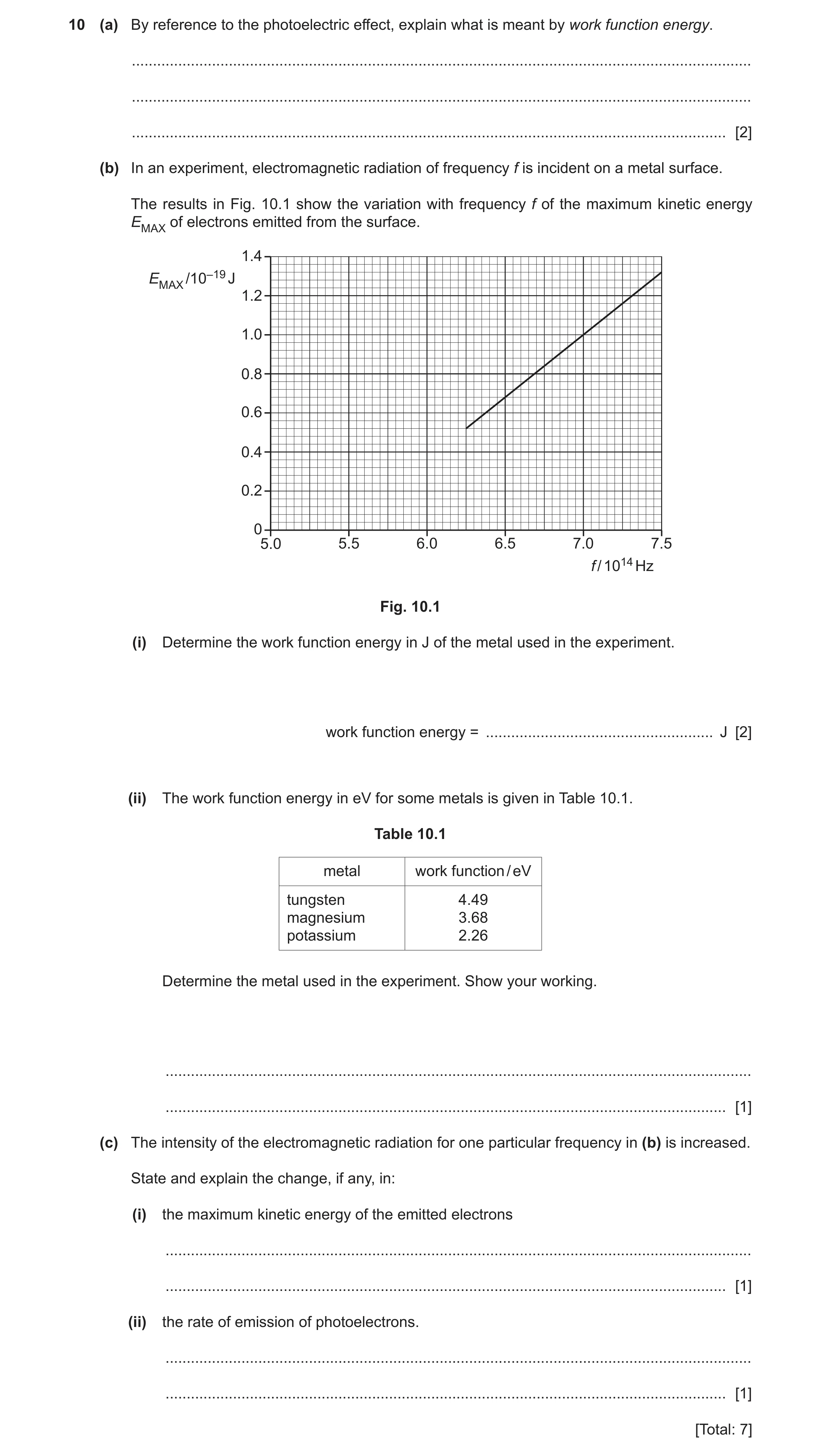
10 (a) By reference to the photoelectric effect, explain what is meant by work function energy. … … … [2] (b) In an experiment, electromagnetic radiation of frequency f is incident on a metal surface. The results in Fig. 10.1 show the variation with frequency f of the maximum kinetic energy EMAX of electrons emitted from the surface. 1.4 EMAX /10–19 J 1.2 1.0 0.8 0.6 0.4 0.2 0 5.0 5.5 6.0 6.5 7.0 7.5 f / 1014 Hz Fig. 10.1 (i) Determine the work function energy in J of the metal used in the experiment. work function energy = … J [2] (ii) The work function energy in eV for some metals is given in Table 10.1. Table 10.1 metal work function / eV tungsten 4.49 magnesium 3.68 potassium 2.26 Determine the metal used in the experiment. Show your working. … … [1] (c) The intensity of the electromagnetic radiation for one particular frequency in (b) is increased. State and explain the change, if any, in: (i) the maximum kinetic energy of the emitted electrons … … [1] (ii) the rate of emission of photoelectrons. … … [1] [Total: 7]
7 marks
Mark scheme: 10(a) energy of a photon required to remove an electron B1 either: energy to remove electron from a surface or: minimum energy to remove electron or: energy to remove electron with zero kinetic energy B1 10(b)(i) Correct read off from graph of f as 5.45 × 10¹⁴ Hz when EMAX = 0 5.45 × 1014 × 6.63 × 10–34 C1 = 3.6 × 10⁻¹⁹ J A1 10(b)(ii) 3.6 × 10⁻¹⁹ / 1.6 × 10–19 = 2.3 eV so potassium A1 10(c)(i) each photon has same energy so no change B1 10(c)(ii) more photons (per unit time) so (rate of emission) increases B1
This question in 9702/42 Feb/March 2020
Q11 · Electromagnetic radiation is incident on a metal surface 9702/42 Oct/Nov 2020
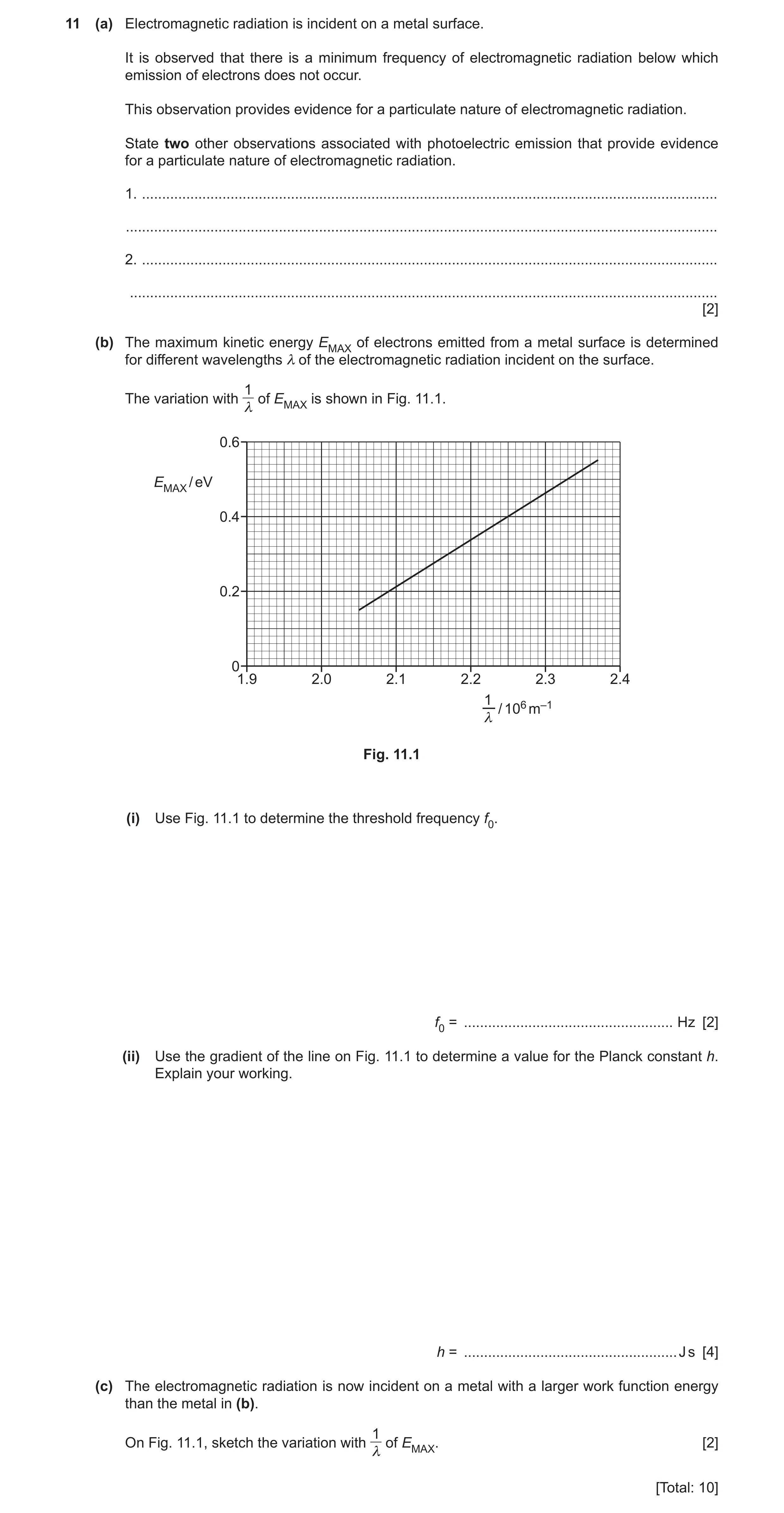
11 (a) Electromagnetic radiation is incident on a metal surface. It is observed that there is a minimum frequency of electromagnetic radiation below which emission of electrons does not occur. This observation provides evidence for a particulate nature of electromagnetic radiation. State two other observations associated with photoelectric emission that provide evidence for a particulate nature of electromagnetic radiation. 1. … … 2. … … [2] (b) The maximum kinetic energy EMAX of electrons emitted from a metal surface is determined for different wavelengths λ of the electromagnetic radiation incident on the surface. 1 The variation with of EMAX is shown in Fig. 11.1. λ 0.6 EMAX / eV 0.4 0.2 0 1.9 2.0 2.1 2.2 2.3 2.4 1 / 106 m–1 λ Fig. 11.1 (i) Use Fig. 11.1 to determine the threshold frequency f0. f0 = … Hz [2] (ii) Use the gradient of the line on Fig. 11.1 to determine a value for the Planck constant h. Explain your working. h = … J s [4] (c) The electromagnetic radiation is now incident on a metal with a larger work function energy than the metal in (b). 1 On Fig. 11.1, sketch the variation with of EMAX. [2] λ [Total: 10]
10 marks
Mark scheme: 11(a) any two points from: • (maximum) kinetic energy of electrons is independent of intensity • maximum kinetic energy of electrons depends on frequency • no time delay (between illumination and emission) B2 11(b)(i) (for EMAX = 0,) 1 / λ0 = 1.93 × 10⁶ (m–1) C1 f0 = 3.00 × 108 × 1.93 × 106 = 5.8 × 10¹⁴ Hz A1 11(b)(ii) hc / λ = Φ + EMAX C1 hc = gradient C1 gradient = e.g. [(0.40 – 0.20) × 1.60 × 10–19] / [(2.25 – 2.09) × 106] (working needed) (= 2.0 × 10⁻²⁵) M1 h = (2.0 × 10⁻²⁵) / (3.00 × 10⁸) = 6.7 × 10⁻³⁴ J s (both working and answer needed) A1 11(c) straight line with same gradient as the original B1 straight line with x-axis intercept greater than 1.93 × 10⁶ m–1 B1
This question in 9702/42 Oct/Nov 2020
Q12 · Electromagnetic radiation of a single constant frequency is incident on a metal surface 9702/41 May/June 2021
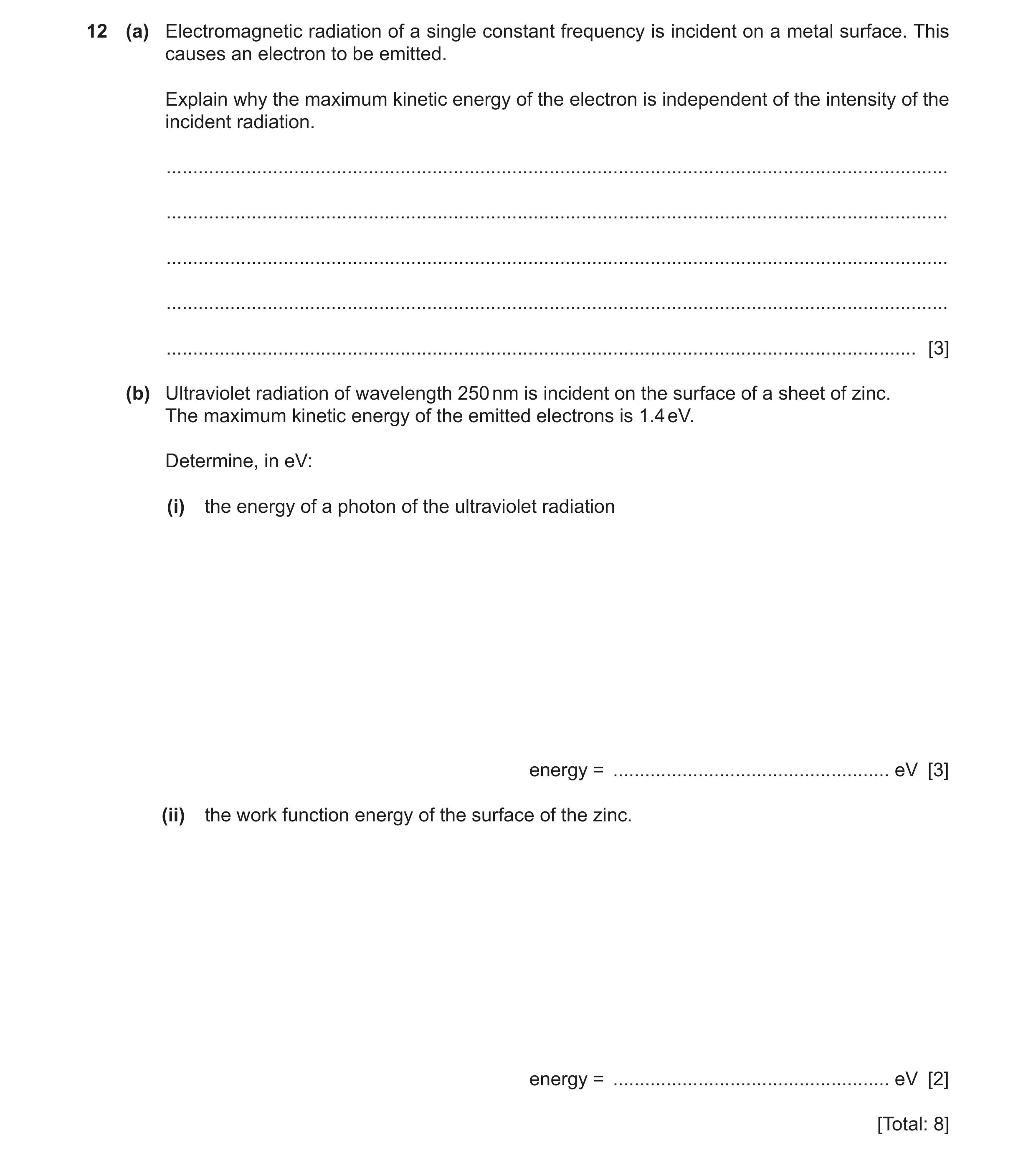
12 (a) Electromagnetic radiation of a single constant frequency is incident on a metal surface. This causes an electron to be emitted. Explain why the maximum kinetic energy of the electron is independent of the intensity of the incident radiation. … … … … … [3] (b) Ultraviolet radiation of wavelength 250 nm is incident on the surface of a sheet of zinc. The maximum kinetic energy of the emitted electrons is 1.4 eV. Determine, in eV: (i) the energy of a photon of the ultraviolet radiation energy = … eV [3] (ii) the work function energy of the surface of the zinc. energy = … eV [2] [Total: 8]
8 marks
Mark scheme: 12(a) • frequency determines energy of photon • intensity determines number of photons (per unit time) • intensity does not determine energy of a photon Any two points, 1 mark each B2 kinetic energy (of the electron) depends on the energy of one photon B1 12(b)(i) E = hc / λ or E = hf and c = fλ C1 E = (6.63 × 10–34 × 3.00 × 108) / (250 × 10–9) C1 (= 7.96 × 10⁻¹⁹ J) = 5.0 eV A1 12(b)(ii) EMAX = photon energy – work function C1 work function = 5.0 – 1.4 = 3.6 eV A1
This question in 9702/41 May/June 2021
Q13 · An isolated metal sphere of radius r is charged so that the electric potential at its… 9702/42 May/June 2021
5 (a) An isolated metal sphere of radius r is charged so that the electric potential at its surface is V0. On Fig. 5.1, sketch the variation with distance x from the centre of the sphere of the electric potential. Your graph should extend from x = 0 to x = 3r. 1.0 V0 electric potential 0.5 V0 0 0 r 2r 3r x Fig. 5.1 [3] (b) Photons having wavelength λ are incident on a metal surface. The maximum wavelength for which there is emission of electrons is λ 0. λ 0 For photons of wavelength , the maximum kinetic energy of the emitted electrons is EMAX. 2 On Fig. 5.2, sketch the variation with wavelength λ of the maximum kinetic energy for values λ 0 of wavelength between λ = and λ = λ 0. 3 3 EMAX energy 2 EMAX EMAX 0 0 λ λ λ 0 0 0 3 2 λ Fig. 5.2 [3] (c) A pure sample of a radioactive isotope contains N0 nuclei. The half-life of the isotope is T12. The product of the radioactive decay is stable. The variation with time t of the number N of nuclei of the radioactive isotope is shown in Fig. 5.3. N0 number N0 2 N 0 0 T time t Fig. 5.3 On Fig. 5.3: ● label, on the time axis, the time t = 1.0T12 and the time t = 2.0T12 ● sketch the variation with time t of the number of nuclei of the decay product for time t = 0 to time t = T. [3] [Total: 9]
9 marks
Mark scheme: 5(a) from x = 0 to x = r: horizontal line at V = 1.0V0 B1 from x = r to x = 3r: curve with negative gradient of decreasing magnitude starting at (r, 1.0V0) B1 line passing through (2r, ½V0) and (3r, ⅓V0) B1 5(b) line with negative gradient from λ = ⅓λ0 to λ = λ0 B1 line passing through (λ0, 0) B1 curve with negative gradient of decreasing magnitude passing through (½λ0, EMAX) and (⅓λ0, 2EMAX) B1 5(c) 1.0T½ shown at ½N0 and 2.0T½ shown at ¼N0 B1 line starting at (0, 0) and reaching (T, N0–N) B1 line starting at (0, 0) and reaching original curve at (1.0T½, ½N0) B1
This question in 9702/42 May/June 2021
Q14 · Electromagnetic radiation of a single constant frequency is incident on a metal surface 9702/43 May/June 2021
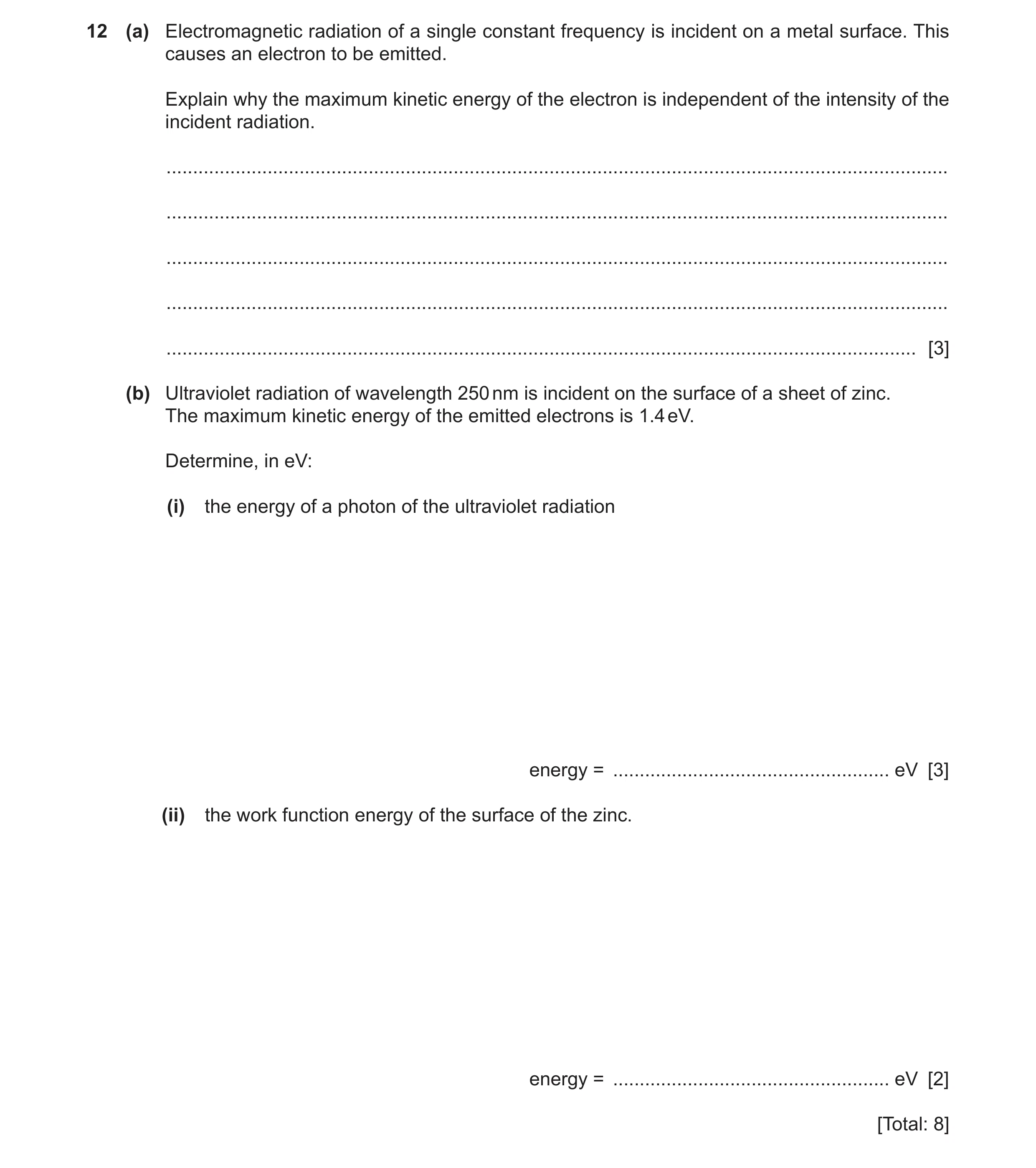
12 (a) Electromagnetic radiation of a single constant frequency is incident on a metal surface. This causes an electron to be emitted. Explain why the maximum kinetic energy of the electron is independent of the intensity of the incident radiation. … … … … … [3] (b) Ultraviolet radiation of wavelength 250 nm is incident on the surface of a sheet of zinc. The maximum kinetic energy of the emitted electrons is 1.4 eV. Determine, in eV: (i) the energy of a photon of the ultraviolet radiation energy = … eV [3] (ii) the work function energy of the surface of the zinc. energy = … eV [2] [Total: 8]
8 marks
Mark scheme: 12(a) • frequency determines energy of photon • intensity determines number of photons (per unit time) • intensity does not determine energy of a photon Any two points, 1 mark each B2 kinetic energy (of the electron) depends on the energy of one photon B1 12(b)(i) E = hc / λ or E = hf and c = fλ C1 E = (6.63 × 10–34 × 3.00 × 108) / (250 × 10–9) C1 (= 7.96 × 10⁻¹⁹ J) = 5.0 eV A1 12(b)(ii) EMAX = photon energy – work function C1 work function = 5.0 – 1.4 = 3.6 eV A1
This question in 9702/43 May/June 2021
Q15 · State an experimental phenomenon that provides evidence for: (i) the particulate nature… 9702/41 Oct/Nov 2021
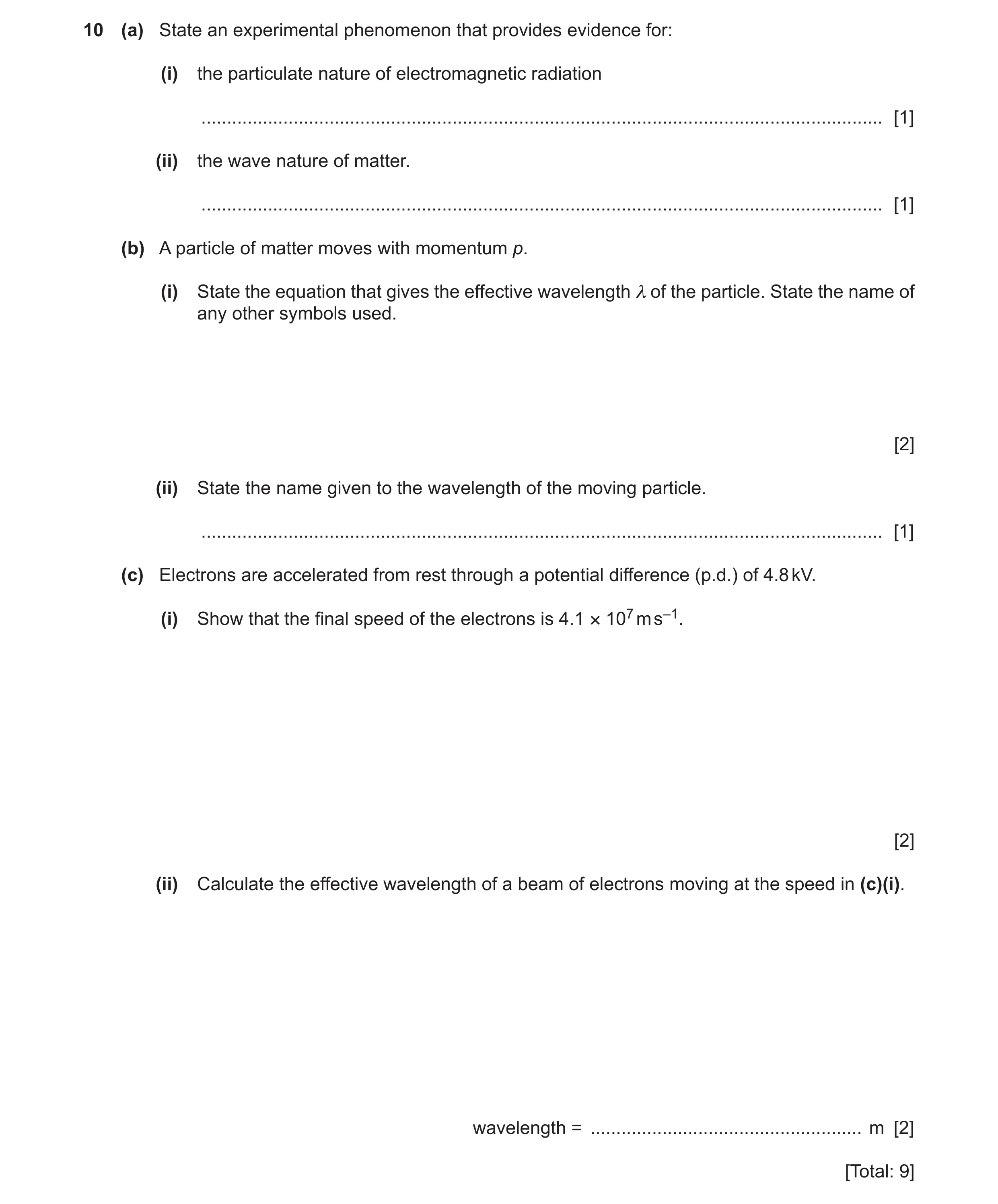
10 (a) State an experimental phenomenon that provides evidence for: (i) the particulate nature of electromagnetic radiation … [1] (ii) the wave nature of matter. … [1] (b) A particle of matter moves with momentum p. (i) State the equation that gives the effective wavelength λ of the particle. State the name of any other symbols used. [2] (ii) State the name given to the wavelength of the moving particle. … [1] (c) Electrons are accelerated from rest through a potential difference (p.d.) of 4.8 kV. (i) Show that the final speed of the electrons is 4.1 × 10⁷ m s–1. [2] (ii) Calculate the effective wavelength of a beam of electrons moving at the speed in (c)(i). wavelength = … m [2] [Total: 9]
9 marks
Mark scheme: 10(a)(i) photoelectric effect B1 10(a)(ii) electron diffraction B1 10(b)(i) λ = h / p M1 h is the Planck constant A1 10(b)(ii) de Broglie (wavelength) B1 10(c)(i) ½mv2 = eV C1 ½ × 9.11 × 10–31 × v2 = 1.60 × 10–19 × 4800 so v = 4.1 × 10⁷ m s–1 A1 10(c)(ii) λ = h / mv = 6.63 × 10⁻³⁴ / (9.11 × 10–31 × 4.1 × 107) C1 = 1.8 × 10⁻¹¹ m A1
This question in 9702/41 Oct/Nov 2021
Q16 · State what is meant by: (i) the photoelectric effect … … … [2] (ii) work function energy 9702/42 Oct/Nov 2021
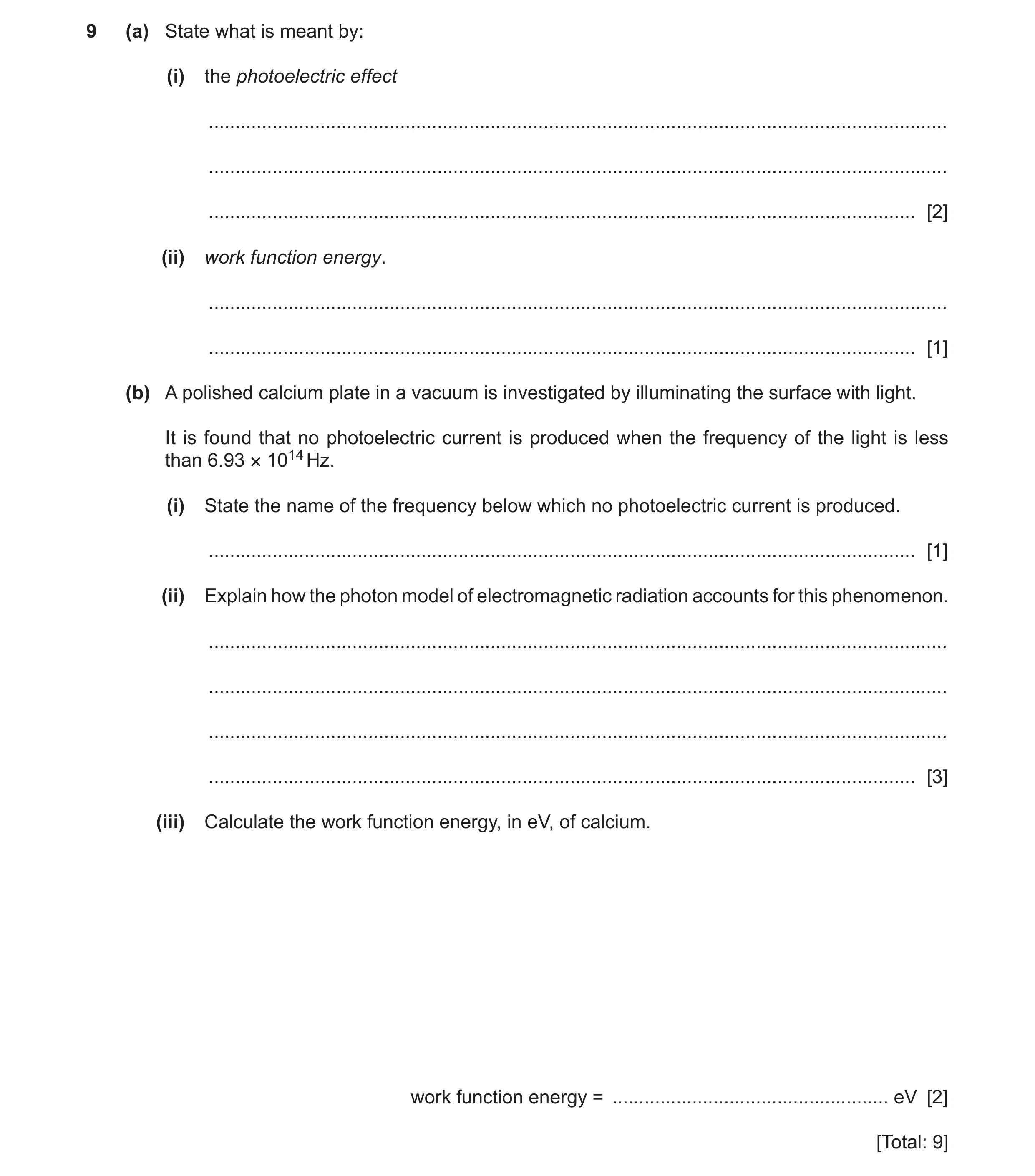
9 (a) State what is meant by: (i) the photoelectric effect … … … [2] (ii) work function energy. … … [1] (b) A polished calcium plate in a vacuum is investigated by illuminating the surface with light. It is found that no photoelectric current is produced when the frequency of the light is less than 6.93 × 10¹⁴ Hz. (i) State the name of the frequency below which no photoelectric current is produced. … [1] (ii) Explain how the photon model of electromagnetic radiation accounts for this phenomenon. … … … … [3] (iii) Calculate the work function energy, in eV, of calcium. work function energy = … eV [2] [Total: 9]
9 marks
Mark scheme: 9(a)(i) emission of electrons (from a metal surface) B1 when electromagnetic radiation is incident (on electrons) B1 9a(ii) minimum energy required for an electron to leave surface B1 9(b)(i) threshold (frequency) B1 9(b)(ii) • photons are (discrete) packets of energy • energy of photons depends on frequency (of EM radiation) • electrons can only absorb a single photon (of energy) Any two points, 1 mark each B2 emission only possible if photon energy is at least the work function B1 9(b)(iii) work function = hf0 = 6.63 × 10–34 × 6.93 × 1014 C1 = 4.59 × 10⁻¹⁹ (J) = 4.59 × 10⁻¹⁹ / 1.60 × 10⁻¹⁹ (eV) = 2.87 eV A1
This question in 9702/42 Oct/Nov 2021
Q17 · State an experimental phenomenon that provides evidence for: (i) the particulate nature… 9702/43 Oct/Nov 2021
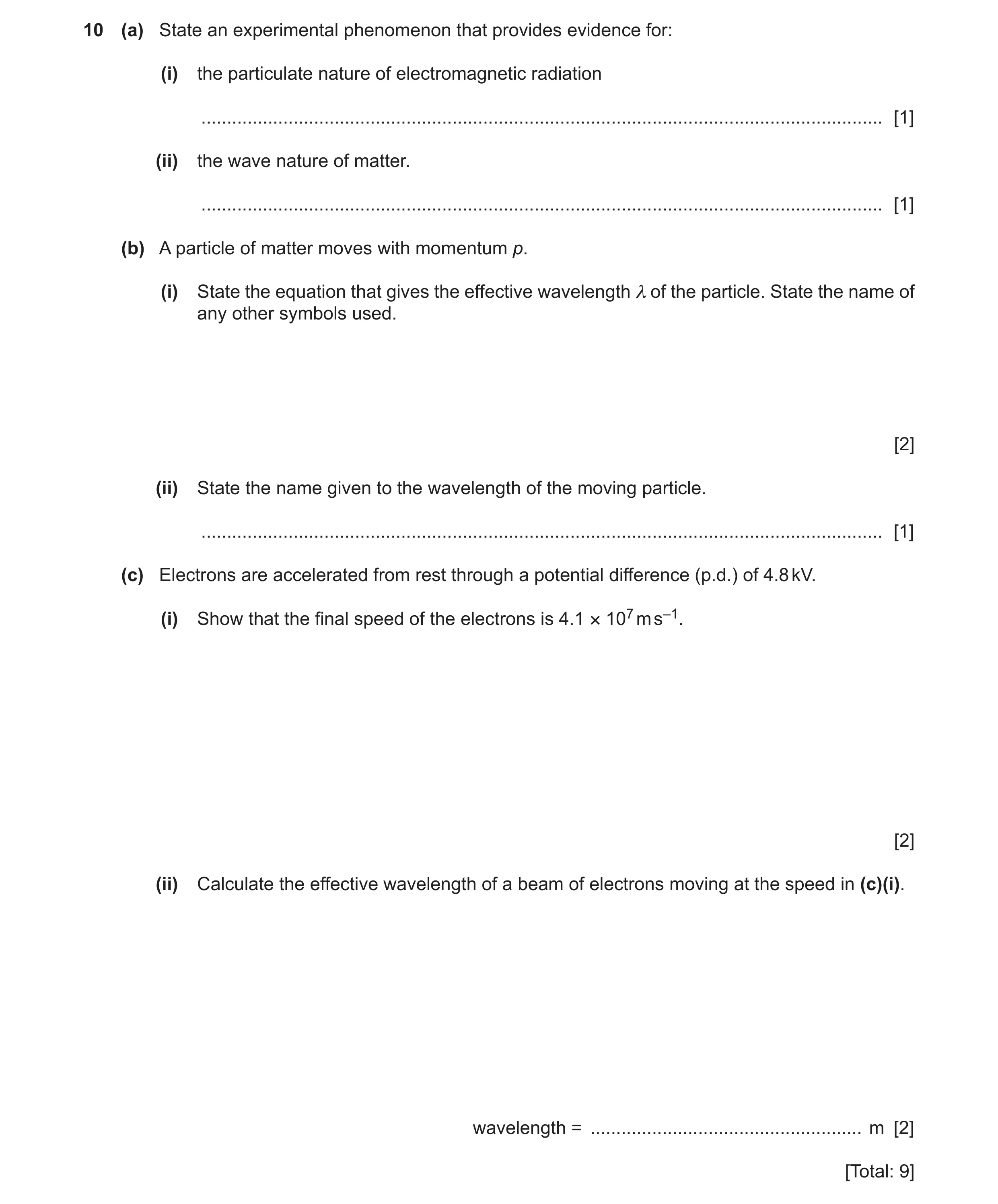
10 (a) State an experimental phenomenon that provides evidence for: (i) the particulate nature of electromagnetic radiation … [1] (ii) the wave nature of matter. … [1] (b) A particle of matter moves with momentum p. (i) State the equation that gives the effective wavelength λ of the particle. State the name of any other symbols used. [2] (ii) State the name given to the wavelength of the moving particle. … [1] (c) Electrons are accelerated from rest through a potential difference (p.d.) of 4.8 kV. (i) Show that the final speed of the electrons is 4.1 × 10⁷ m s–1. [2] (ii) Calculate the effective wavelength of a beam of electrons moving at the speed in (c)(i). wavelength = … m [2] [Total: 9]
9 marks
Mark scheme: 10(a)(i) photoelectric effect B1 10(a)(ii) electron diffraction B1 10(b)(i) λ = h / p M1 h is the Planck constant A1 10(b)(ii) de Broglie (wavelength) B1 10(c)(i) ½mv2 = eV C1 ½ × 9.11 × 10–31 × v2 = 1.60 × 10–19 × 4800 so v = 4.1 × 10⁷ m s–1 A1 10(c)(ii) λ = h / mv = 6.63 × 10⁻³⁴ / (9.11 × 10–31 × 4.1 × 107) C1 = 1.8 × 10⁻¹¹ m A1
This question in 9702/43 Oct/Nov 2021
Q18 · State what is meant by a photon 9702/41 May/June 2022
7 (a) State what is meant by a photon. … … … [2] (b) Electromagnetic radiation of a varying frequency f and constant intensity I is used to illuminate a metal surface. At certain frequencies, electrons are emitted from the surface of the metal. The variation with f of the maximum kinetic energy EMAX of the emitted electrons is shown in Fig. 7.1. 4.0 EMAX / 10–19 J 3.0 2.0 1.0 0 0 2 4 6 8 10 12 f / 1014 Hz Fig. 7.1 (i) State the name of this phenomenon. … [1] (ii) Describe three conclusions that can be drawn from the graph in Fig. 7.1. The conclusions may be qualitative or quantitative. 1 … … 2 … … 3 … … [3] (c) The experiment in (b) is repeated twice, each time making one change. State, with a reason, how the graph obtained would compare with Fig. 7.1 when: (i) a different metal is used, but keeping the intensity I of the radiation the same … … … [2] (ii) the same metal is used, but with electromagnetic radiation of intensity 2I. … … … [2] [Total: 10]
10 marks
Mark scheme: 7(a) quantum of energy M1 of electromagnetic radiation A1 7(b)(i) photoelectric effect B1 7(b)(ii) there is a frequency below which no electrons are emitted or threshold frequency = 5.4 1014 Hz work function of the metal = 3.6 10–19 J (or 2.2 eV) EMAX increases (linearly) with (increasing) frequency gradient of the line is the Planck constant or gradient of the line is 6.7 10–34 J s Any three bullet points, 1 mark each B3 7(c)(i) different threshold frequency B1 (line has) same gradient but different intercept B1 7(c)(ii) photons have same energy B1 line unchanged B1
This question in 9702/41 May/June 2022
Q19 · State one piece of experimental evidence for: (i) the particulate nature of… 9702/42 May/June 2022
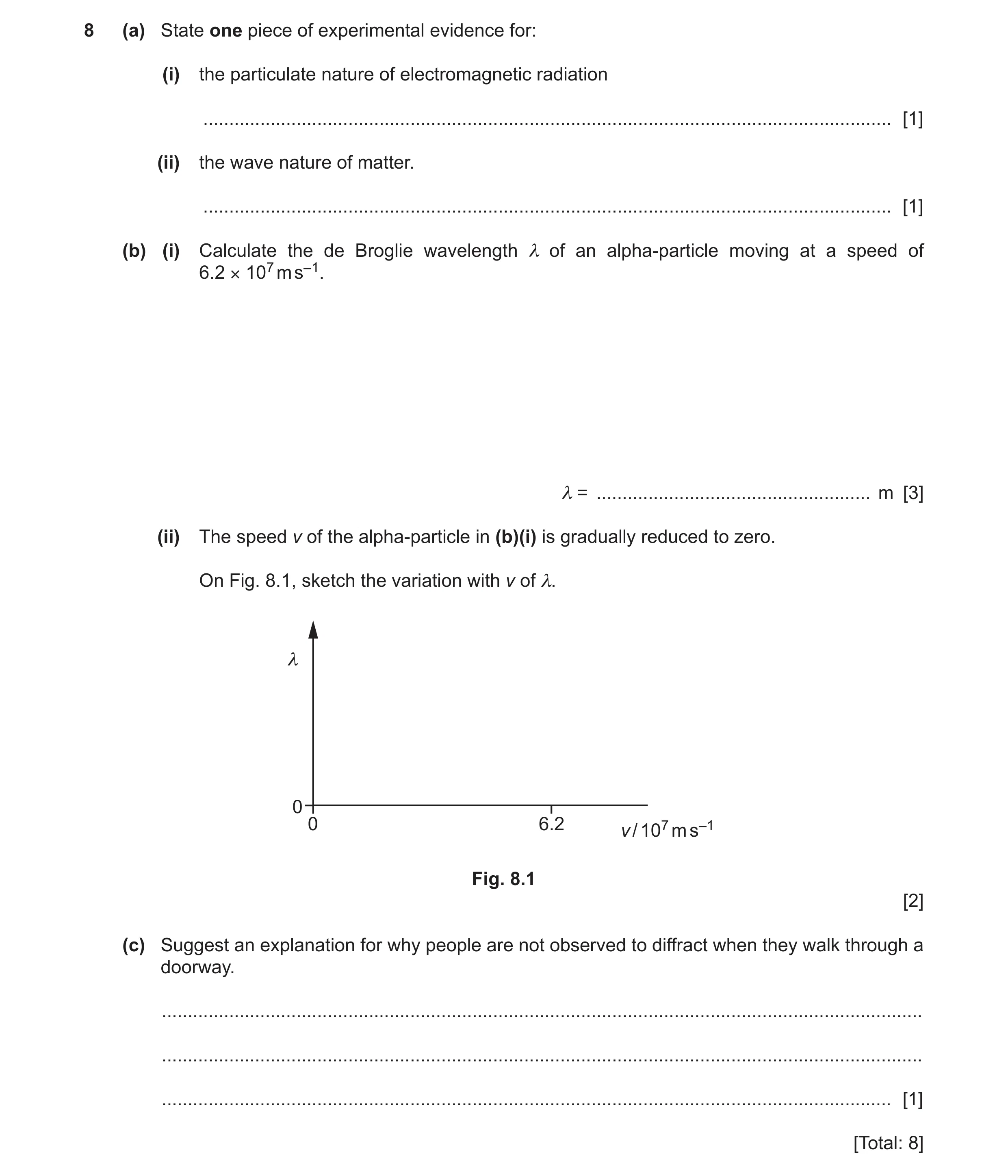
8 (a) State one piece of experimental evidence for: (i) the particulate nature of electromagnetic radiation … [1] (ii) the wave nature of matter. … [1] (b) (i) Calculate the de Broglie wavelength λ of an alpha-particle moving at a speed of 6.2 × 10⁷ m s–1. λ = … m [3] (ii) The speed v of the alpha-particle in (b)(i) is gradually reduced to zero. On Fig. 8.1, sketch the variation with v of λ. λ 0 0 6.2 v / 107 m s–1 Fig. 8.1 [2] (c) Suggest an explanation for why people are not observed to diffract when they walk through a doorway. … … … [1] [Total: 8]
8 marks
Mark scheme: 8(a)(i) photoelectric effect B1 8(a)(ii) electron diffraction B1 8(b)(i) = h / p C1 p = 4 1.66 10–27 6.2 107 ( = 4.1 10–19 N s) C1 = 6.63 10–34 / 4.1 10–19 = 1.6 10–15 m A1 8(b)(ii) line with negative gradient throughout B1 curve asymptotic to both axes with non-zero at v = 6.2 107 m s–1 B1 8(c) (de Broglie) wavelength negligible compared with width of doorway B1
This question in 9702/42 May/June 2022
Q20 · State what is meant by a photon 9702/43 May/June 2022
7 (a) State what is meant by a photon. … … … [2] (b) Electromagnetic radiation of a varying frequency f and constant intensity I is used to illuminate a metal surface. At certain frequencies, electrons are emitted from the surface of the metal. The variation with f of the maximum kinetic energy EMAX of the emitted electrons is shown in Fig. 7.1. 4.0 EMAX / 10–19 J 3.0 2.0 1.0 0 0 2 4 6 8 10 12 f / 1014 Hz Fig. 7.1 (i) State the name of this phenomenon. … [1] (ii) Describe three conclusions that can be drawn from the graph in Fig. 7.1. The conclusions may be qualitative or quantitative. 1 … … 2 … … 3 … … [3] (c) The experiment in (b) is repeated twice, each time making one change. State, with a reason, how the graph obtained would compare with Fig. 7.1 when: (i) a different metal is used, but keeping the intensity I of the radiation the same … … … [2] (ii) the same metal is used, but with electromagnetic radiation of intensity 2I. … … … [2] [Total: 10]
10 marks
Mark scheme: 7(a) quantum of energy M1 of electromagnetic radiation A1 7(b)(i) photoelectric effect B1 7(b)(ii) there is a frequency below which no electrons are emitted or threshold frequency = 5.4 1014 Hz work function of the metal = 3.6 10–19 J (or 2.2 eV) EMAX increases (linearly) with (increasing) frequency gradient of the line is the Planck constant or gradient of the line is 6.7 10–34 J s Any three bullet points, 1 mark each B3 7(c)(i) different threshold frequency B1 (line has) same gradient but different intercept B1 7(c)(ii) photons have same energy B1 line unchanged B1
This question in 9702/43 May/June 2022
Q21 · State what is meant by the work function energy of a metal 9702/41 Oct/Nov 2022
8 (a) State what is meant by the work function energy of a metal. … … … [2] (b) Ultraviolet radiation of frequency 1.36 × 10¹⁵ Hz is incident, in a vacuum, on a metal surface. The power of the radiation incident on the surface is 8.36 mW. Photoelectrons are emitted with a maximum kinetic energy of 3.09 × 10⁻¹⁹ J. (i) Determine the number of photons incident on the surface per unit time. number per unit time = … s–1 [2] (ii) Calculate the work function energy Φ of the metal. Φ = … J [2] (c) The frequency of the radiation incident on the surface in (b) is increased while the power remains constant. State and explain the effect of this change on: (i) the maximum kinetic energy of the photoelectrons … … … [2] (ii) the rate of emission of photoelectrons. … … … [2] [Total: 10]
10 marks
Mark scheme: 8(a) photon energy (to remove electron) B1 minimum energy to remove electron B1 or energy to remove electron from surface or energy to remove electron with zero kinetic energy 8(b)(i) photon energy = hf C1 number per unit time = 8.36 10–3 / (1.36 1015 6.63 10–34) A1 = 9.27 1015 s–1 8(b)(ii) hf = + EMAX C1 = (1.36 1015 6.63 10–34) – (3.09 10–19) A1 = 5.93 10–19 J 8(c)(i) greater photon energy (and same work function) M1 so maximum kinetic energy is increased A1 8(c)(ii) (greater photon energy and same power so) lower number of photons (per unit time) M1 (each electron absorbs one photon) so lower rate of emission A1
This question in 9702/41 Oct/Nov 2022
Q22 · State what is meant by the work function energy of a metal 9702/43 Oct/Nov 2022
8 (a) State what is meant by the work function energy of a metal. … … … [2] (b) Ultraviolet radiation of frequency 1.36 × 10¹⁵ Hz is incident, in a vacuum, on a metal surface. The power of the radiation incident on the surface is 8.36 mW. Photoelectrons are emitted with a maximum kinetic energy of 3.09 × 10⁻¹⁹ J. (i) Determine the number of photons incident on the surface per unit time. number per unit time = … s–1 [2] (ii) Calculate the work function energy Φ of the metal. Φ = … J [2] (c) The frequency of the radiation incident on the surface in (b) is increased while the power remains constant. State and explain the effect of this change on: (i) the maximum kinetic energy of the photoelectrons … … … [2] (ii) the rate of emission of photoelectrons. … … … [2] [Total: 10]
10 marks
Mark scheme: 8(a) photon energy (to remove electron) B1 minimum energy to remove electron B1 or energy to remove electron from surface or energy to remove electron with zero kinetic energy 8(b)(i) photon energy = hf C1 number per unit time = 8.36 10–3 / (1.36 1015 6.63 10–34) A1 = 9.27 1015 s–1 8(b)(ii) hf = + EMAX C1 = (1.36 1015 6.63 10–34) – (3.09 10–19) A1 = 5.93 10–19 J 8(c)(i) greater photon energy (and same work function) M1 so maximum kinetic energy is increased A1 8(c)(ii) (greater photon energy and same power so) lower number of photons (per unit time) M1 (each electron absorbs one photon) so lower rate of emission A1
This question in 9702/43 Oct/Nov 2022
Q23 · State what is meant by a photon 9702/42 Oct/Nov 2023
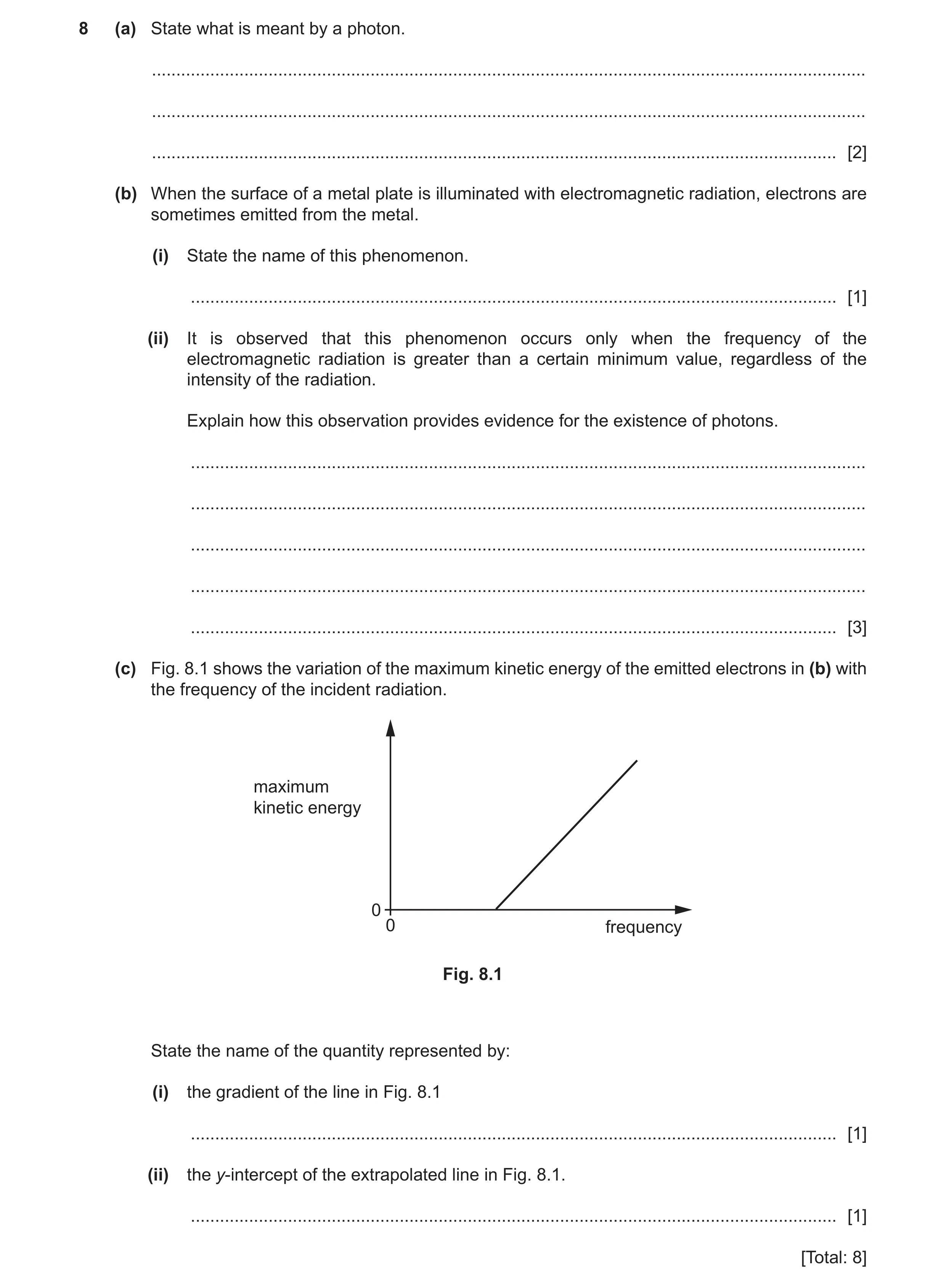
8 (a) State what is meant by a photon. … … … [2] (b) When the surface of a metal plate is illuminated with electromagnetic radiation, electrons are sometimes emitted from the metal. (i) State the name of this phenomenon. … [1] (ii) It is observed that this phenomenon occurs only when the frequency of the electromagnetic radiation is greater than a certain minimum value, regardless of the intensity of the radiation. Explain how this observation provides evidence for the existence of photons. … … … … … [3] (c) Fig. 8.1 shows the variation of the maximum kinetic energy of the emitted electrons in (b) with the frequency of the incident radiation. maximum kinetic energy 0 0 frequency Fig. 8.1 State the name of the quantity represented by: (i) the gradient of the line in Fig. 8.1 … [1] (ii) the y-intercept of the extrapolated line in Fig. 8.1. … [1] [Total: 8]
8 marks
Mark scheme: 8(a) packet / quantum of energy M1 of electromagnetic radiation A1 8(b)(i) photoelectric effect B1 8(b)(ii) • electron needs a minimum energy to escape B3 or electron emitted if energy in packet is enough • energy must be absorbed in packets that are related to frequency • intensity relates to number of packets (not to energy in packet) • electron absorbs only a single whole packet Any three points, 1 mark each 8(c)(i) Planck constant B1 8(c)(ii) – work function (energy) B1
This question in 9702/42 Oct/Nov 2023
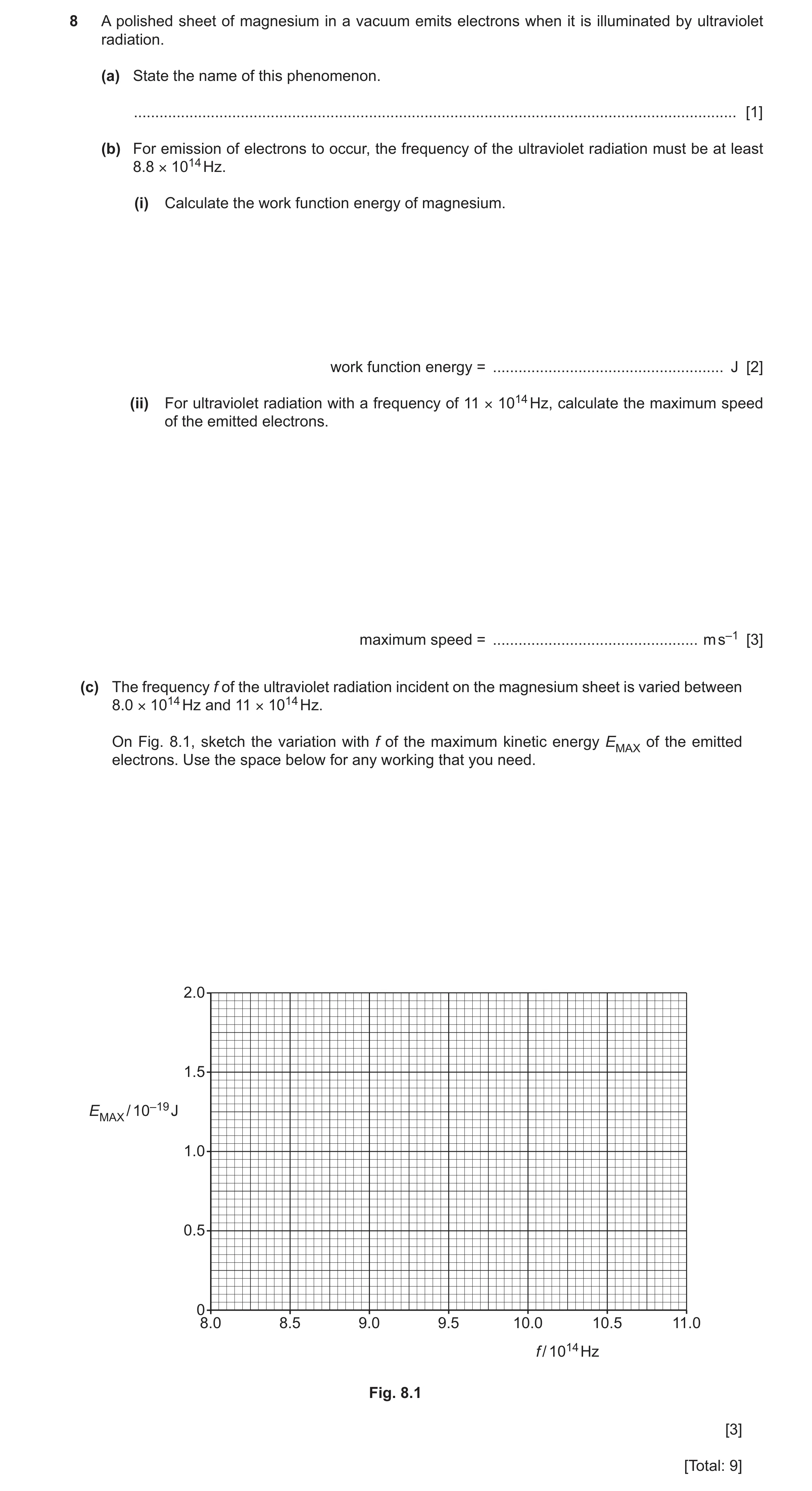
Q24 · A polished sheet of magnesium in a vacuum emits electrons when it is illuminated by… 9702/41 Oct/Nov 2024
8 A polished sheet of magnesium in a vacuum emits electrons when it is illuminated by ultraviolet radiation. (a) State the name of this phenomenon. … [1] (b) For emission of electrons to occur, the frequency of the ultraviolet radiation must be at least 8.8 × 10¹⁴ Hz. (i) Calculate the work function energy of magnesium. work function energy = … J [2] (ii) For ultraviolet radiation with a frequency of 11 × 1014 Hz, calculate the maximum speed of the emitted electrons. maximum speed = … m s–1 [3] (c) The frequency f of the ultraviolet radiation incident on the magnesium sheet is varied between 8.0 × 10¹⁴ Hz and 11 × 1014 Hz. On Fig. 8.1, sketch the variation with f of the maximum kinetic energy EMAX of the emitted electrons. Use the space below for any working that you need. 2.0 1.5 EMAX / 10–19 J 1.0 0.5 0 8.0 8.5 9.0 9.5 10.0 10.5 11.0 f / 1014 Hz Fig. 8.1 [3] [Total: 9]
9 marks
Mark scheme: 8(a) photoelectric effect B1 8(b)(i) E = hf C1 work function = 6.63 10–34 8.8 1014 A1 = 5.8 10–19 J 8(b)(ii) hf = + ½ mvMAX2 C1 6.63 10–34 11 1014 = (5.8 10–19) + (½ 9.11 10–31 vMAX2) C1 vMAX = 5.7 105 m s–1 A1 8(c) EMAX shown as zero from f = 8.0 to 8.8 and non-zero from f = 8.8 to 11 B1 all non-zero EMAX shown as a single straight line with a positive gradient B1 line passing through (11, 1.45) B1
This question in 9702/41 Oct/Nov 2024
Q25 · A polished sheet of magnesium in a vacuum emits electrons when it is illuminated by… 9702/43 Oct/Nov 2024
8 A polished sheet of magnesium in a vacuum emits electrons when it is illuminated by ultraviolet radiation. (a) State the name of this phenomenon. … [1] (b) For emission of electrons to occur, the frequency of the ultraviolet radiation must be at least 8.8 × 10¹⁴ Hz. (i) Calculate the work function energy of magnesium. work function energy = … J [2] (ii) For ultraviolet radiation with a frequency of 11 × 1014 Hz, calculate the maximum speed of the emitted electrons. maximum speed = … m s–1 [3] (c) The frequency f of the ultraviolet radiation incident on the magnesium sheet is varied between 8.0 × 10¹⁴ Hz and 11 × 1014 Hz. On Fig. 8.1, sketch the variation with f of the maximum kinetic energy EMAX of the emitted electrons. Use the space below for any working that you need. 2.0 1.5 EMAX / 10–19 J 1.0 0.5 0 8.0 8.5 9.0 9.5 10.0 10.5 11.0 f / 1014 Hz Fig. 8.1 [3] [Total: 9]
9 marks
Mark scheme: 8(a) photoelectric effect B1 8(b)(i) E = hf C1 work function = 6.63 10–34 8.8 1014 A1 = 5.8 10–19 J 8(b)(ii) hf = + ½ mvMAX2 C1 6.63 10–34 11 1014 = (5.8 10–19) + (½ 9.11 10–31 vMAX2) C1 vMAX = 5.7 105 m s–1 A1 8(c) EMAX shown as zero from f = 8.0 to 8.8 and non-zero from f = 8.8 to 11 B1 all non-zero EMAX shown as a single straight line with a positive gradient B1 line passing through (11, 1.45) B1
This question in 9702/43 Oct/Nov 2024
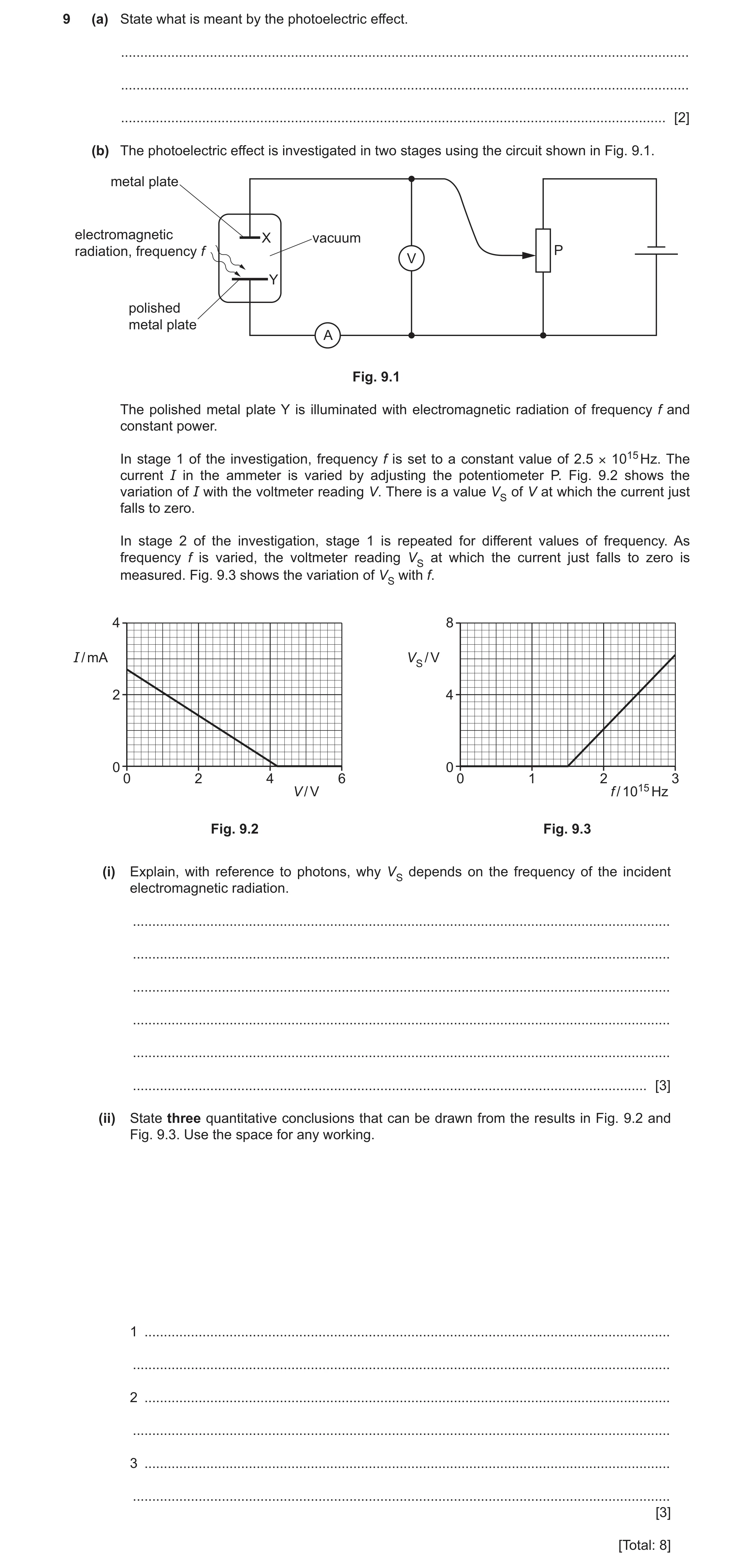
Q26 · State what is meant by the photoelectric effect 9702/42 May/June 2025
9 (a) State what is meant by the photoelectric effect. … … … [2] (b) The photoelectric effect is investigated in two stages using the circuit shown in Fig. 9.1. metal plate electromagnetic X vacuum radiation, frequency f P V Y polished metal plate A Fig. 9.1 The polished metal plate Y is illuminated with electromagnetic radiation of frequency f and constant power. In stage 1 of the investigation, frequency f is set to a constant value of 2.5 × 10¹⁵ Hz. The current I in the ammeter is varied by adjusting the potentiometer P. Fig. 9.2 shows the variation of I with the voltmeter reading V. There is a value VS of V at which the current just falls to zero. In stage 2 of the investigation, stage 1 is repeated for different values of frequency. As frequency f is varied, the voltmeter reading VS at which the current just falls to zero is measured. Fig. 9.3 shows the variation of VS with f. 4 8 I / mA VS / V 2 4 0 0 0 2 4 6 0 1 2 3 V / V f / 1015 Hz Fig. 9.2 Fig. 9.3 (i) Explain, with reference to photons, why VS depends on the frequency of the incident electromagnetic radiation. … … … … … … [3] (ii) State three quantitative conclusions that can be drawn from the results in Fig. 9.2 and Fig. 9.3. Use the space for any working. 1 … … 2 … … 3 … … [3] [Total: 8]
8 marks
Mark scheme: 9(a) emission of electrons (from a metal surface) B1 when electromagnetic radiation is incident (on surface / electrons) B1 9(b)(i) current falls to zero when applied voltage equals energy per unit charge of emitted electrons B1 energy of photon depends on frequency B1 maximum energy of electron depends on energy of photon B1 9(b)(ii) Any three points from: B3 • threshold frequency = 1.5 × 10¹⁵ Hz • threshold wavelength = 2.0 × 10⁻⁷ m • work function = 6.2 eV (or 9.9 × 10⁻¹⁹ J) • Planck constant = 6.6 × 10⁻³⁴ J s (not 6.63 × 10⁻³⁴ J s) • number per unit time (of photons / electrons) = 1.7 × 10¹⁶ s–1 (in stage 1) • power of incident radiation = 0.028 W (in stage 1)
This question in 9702/42 May/June 2025
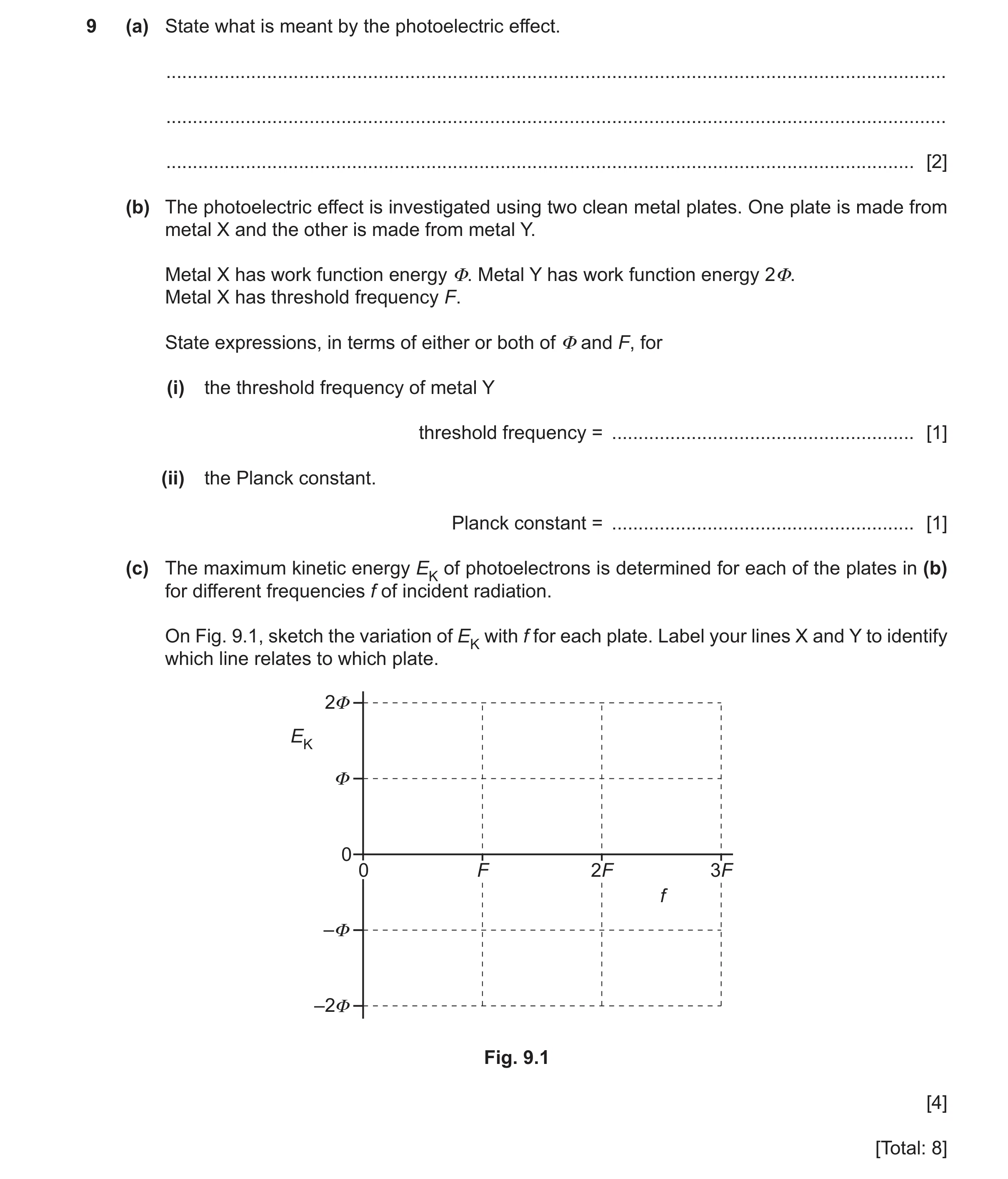
Q27 · State what is meant by the photoelectric effect 9702/44 Oct/Nov 2025
9 (a) State what is meant by the photoelectric effect. … … … [2] (b) The photoelectric effect is investigated using two clean metal plates. One plate is made from metal X and the other is made from metal Y. Metal X has work function energy Φ. Metal Y has work function energy 2Φ. Metal X has threshold frequency F. State expressions, in terms of either or both of Φ and F, for (i) the threshold frequency of metal Y threshold frequency = … [1] (ii) the Planck constant. Planck constant = … [1] (c) The maximum kinetic energy EK of photoelectrons is determined for each of the plates in (b) for different frequencies f of incident radiation. On Fig. 9.1, sketch the variation of EK with f for each plate. Label your lines X and Y to identify which line relates to which plate. 2Φ EK Φ 0 0 F 2F 3F f –Φ –2Φ Fig. 9.1 [4] [Total: 8]
8 marks
Mark scheme: 9(a) emission of electrons (from a metal surface) M1 when electromagnetic radiation is incident (on surface) A1 9(b)(i) threshold frequency = 2F A1 9(b)(ii) Planck constant = / F A1 9(c) two diagonal straight lines with positive gradient in the positive EK region only, starting at non-zero values of f B1 line labelled X passing through (F, 0) and line labelled Y passing through (2F,0) and extending to 3F or +2 B1 two diagonal straight lines with equal gradients B1 X line extrapolates back to (0, –) and Y line extrapolates back to (0, –2) B1
This question in 9702/44 Oct/Nov 2025
 2 / 34
 3 / 34
 4 / 34
 5 / 34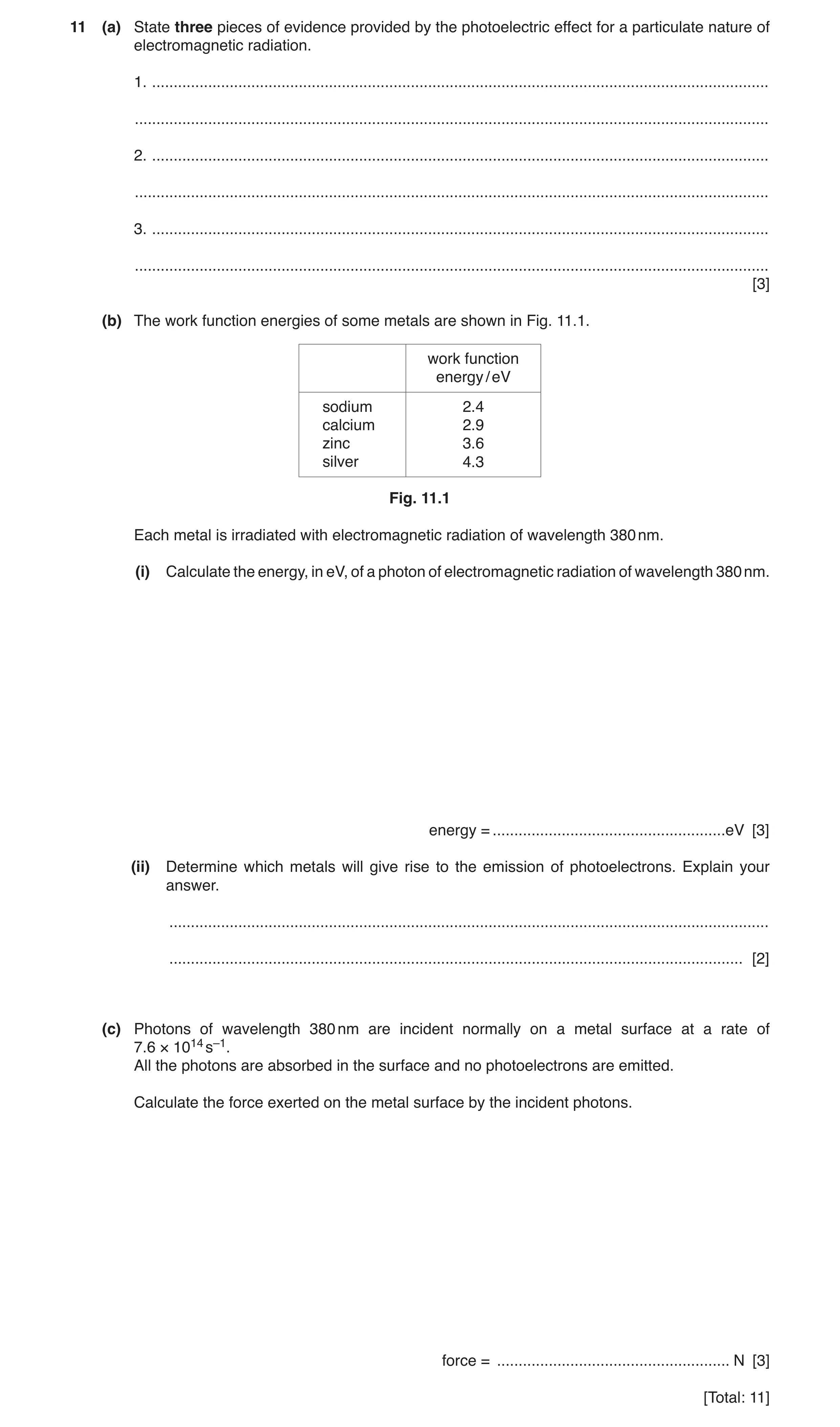
 14 / 34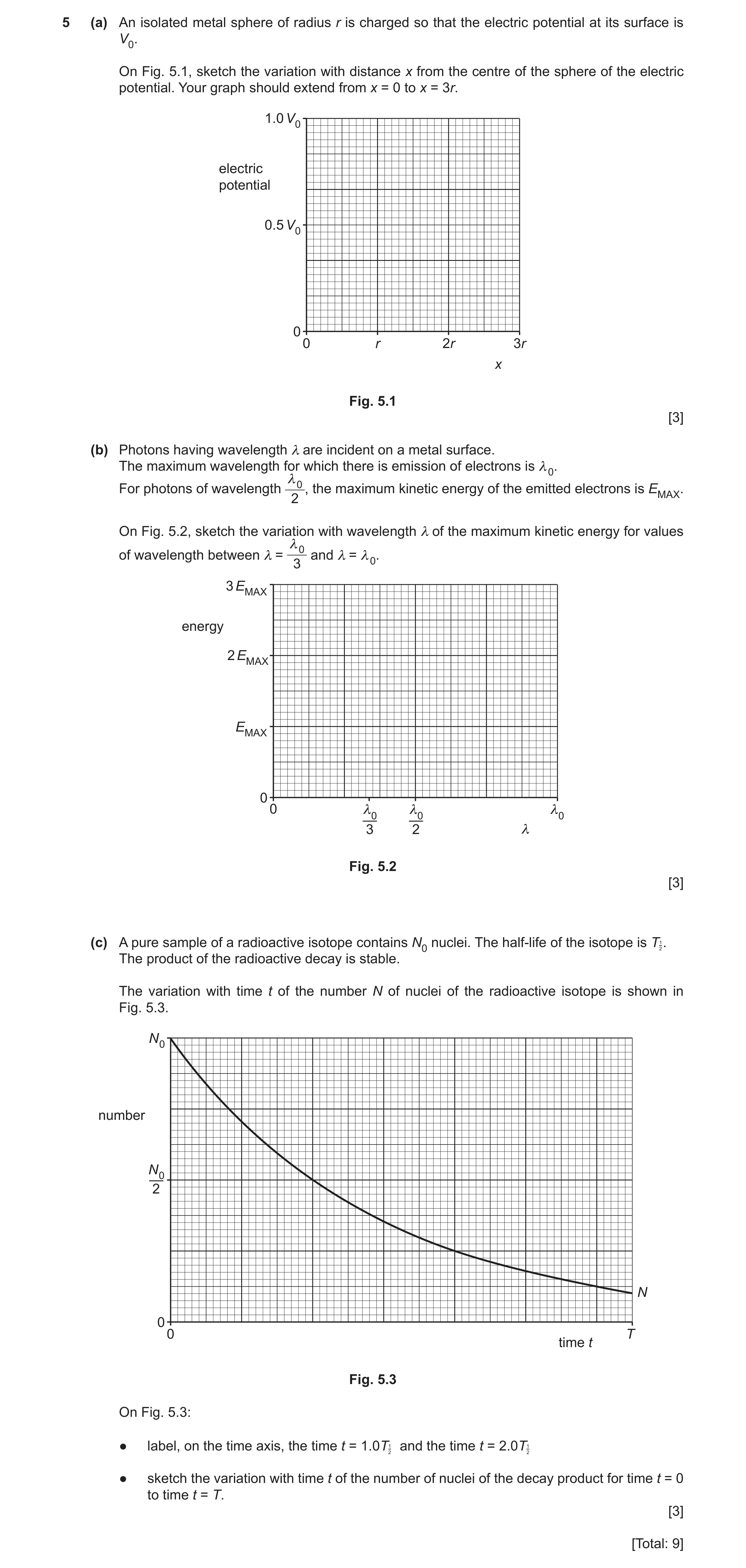
 17 / 34
 18 / 34
 19 / 34
 20 / 34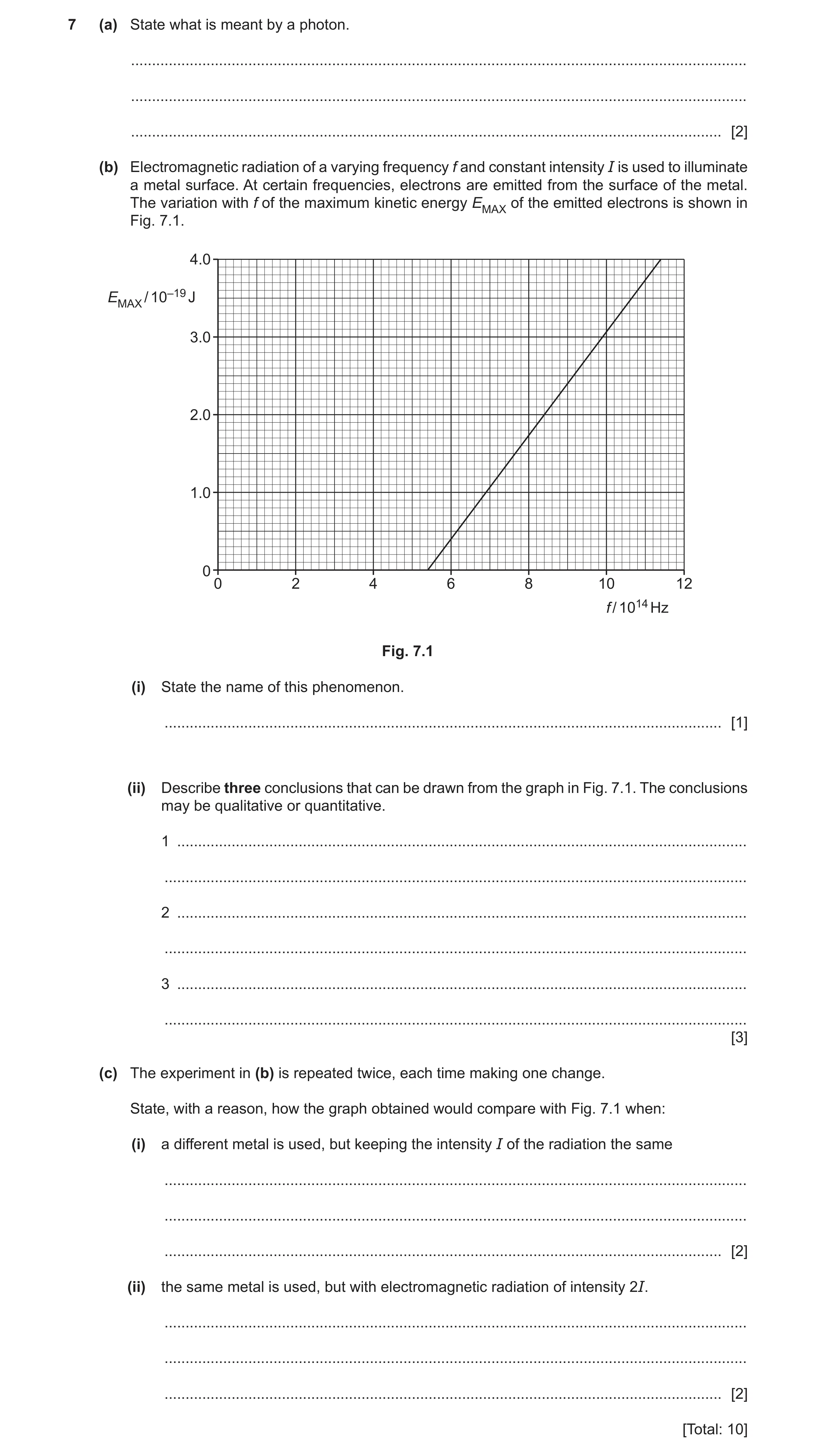
 23 / 34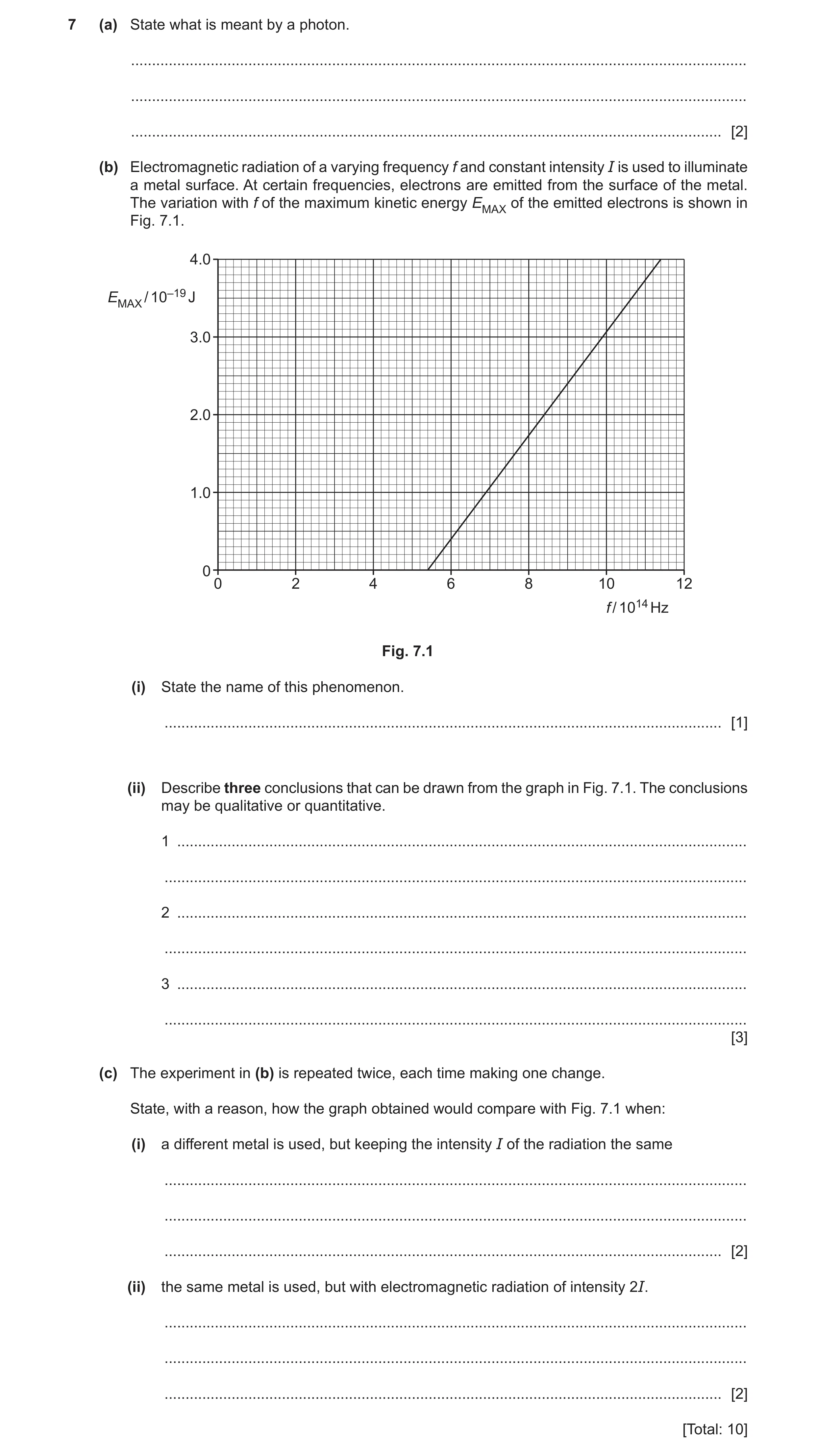
 26 / 34
 27 / 34
 28 / 34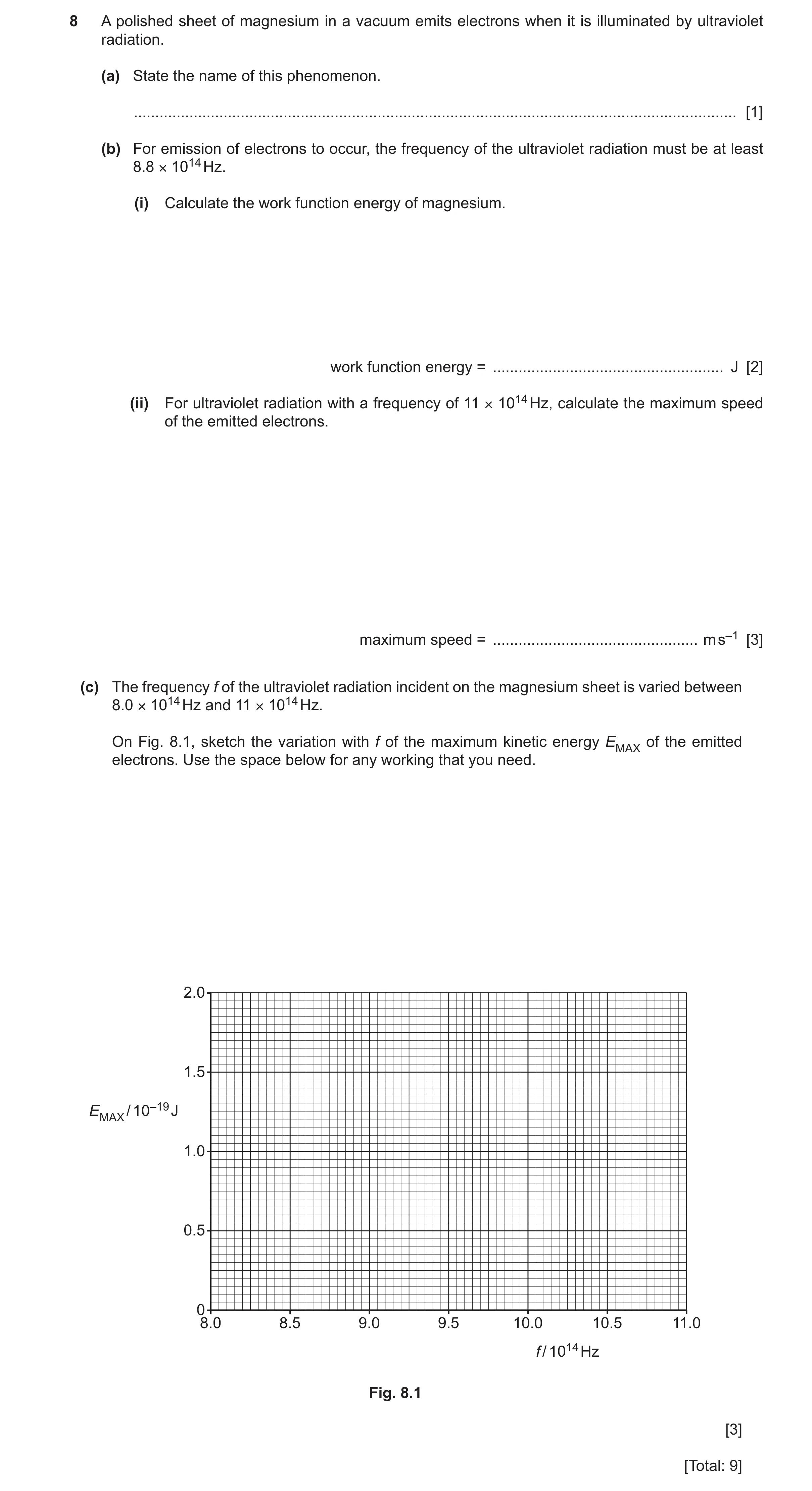
 34 / 34
 9
9 5
5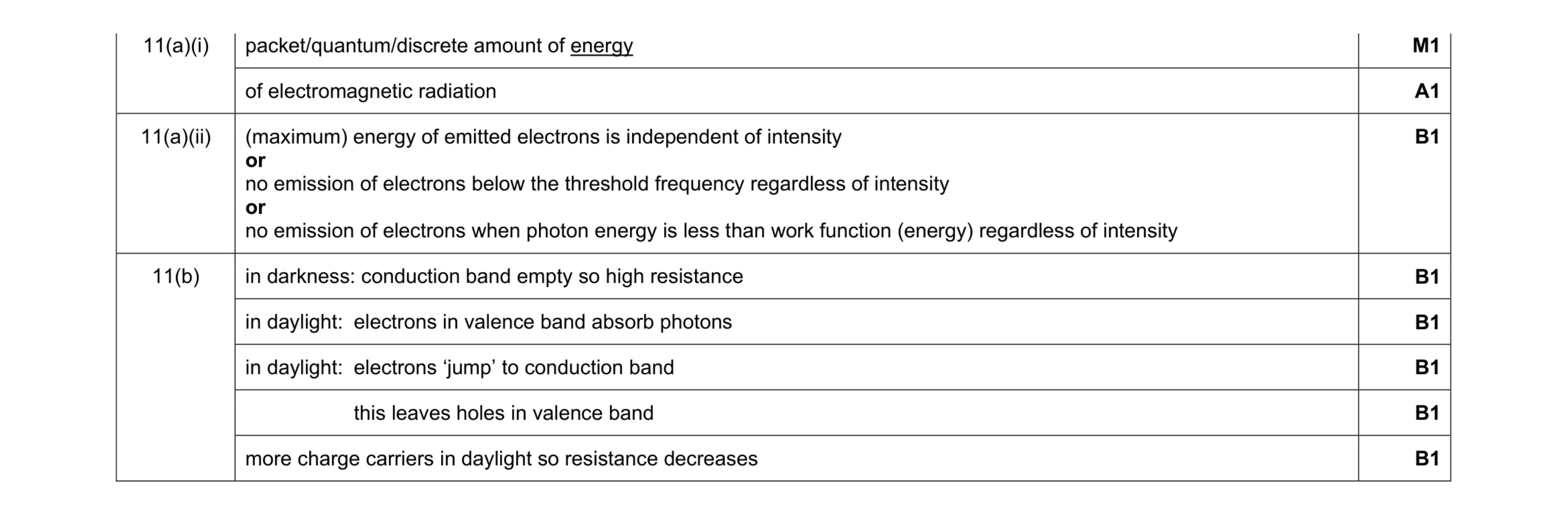 8
8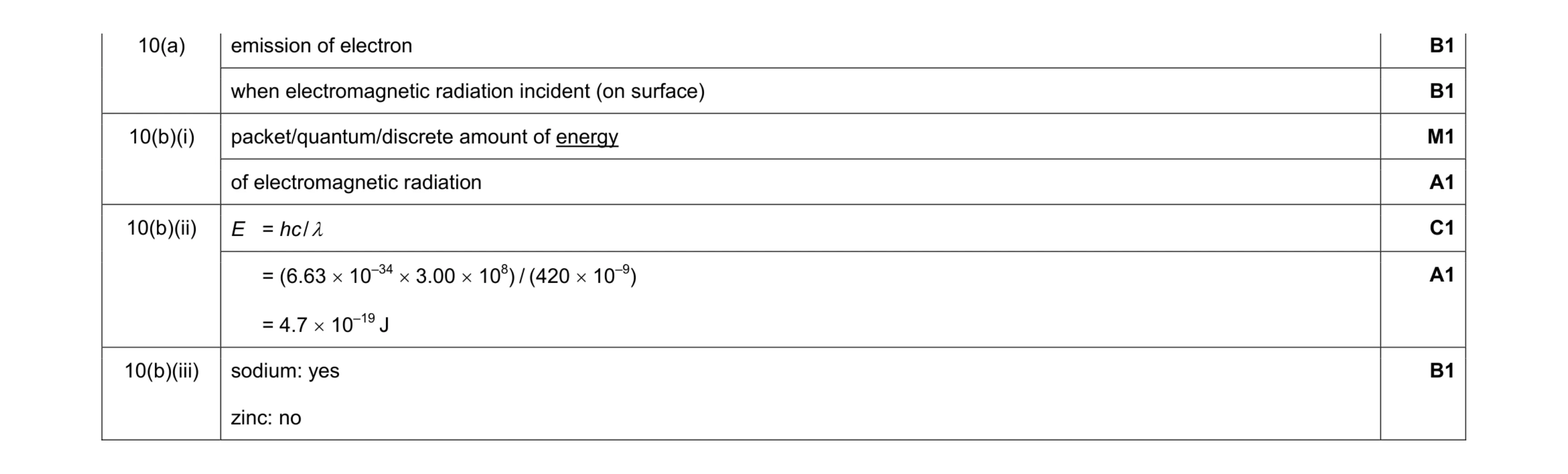 7
7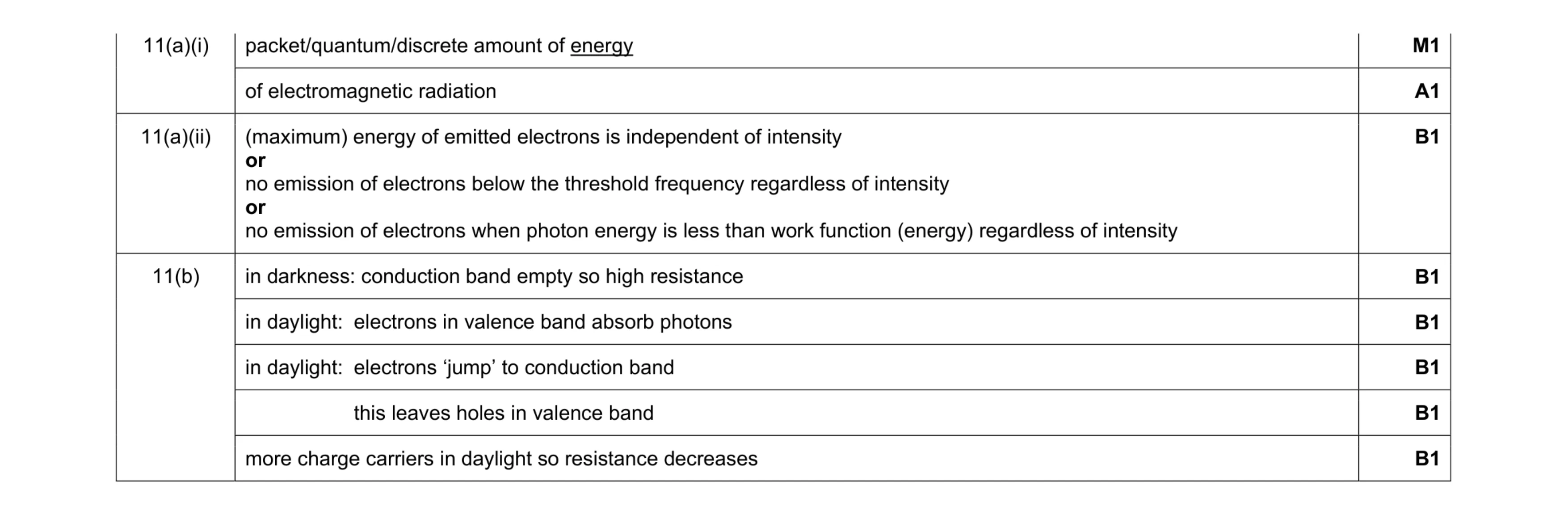 8
8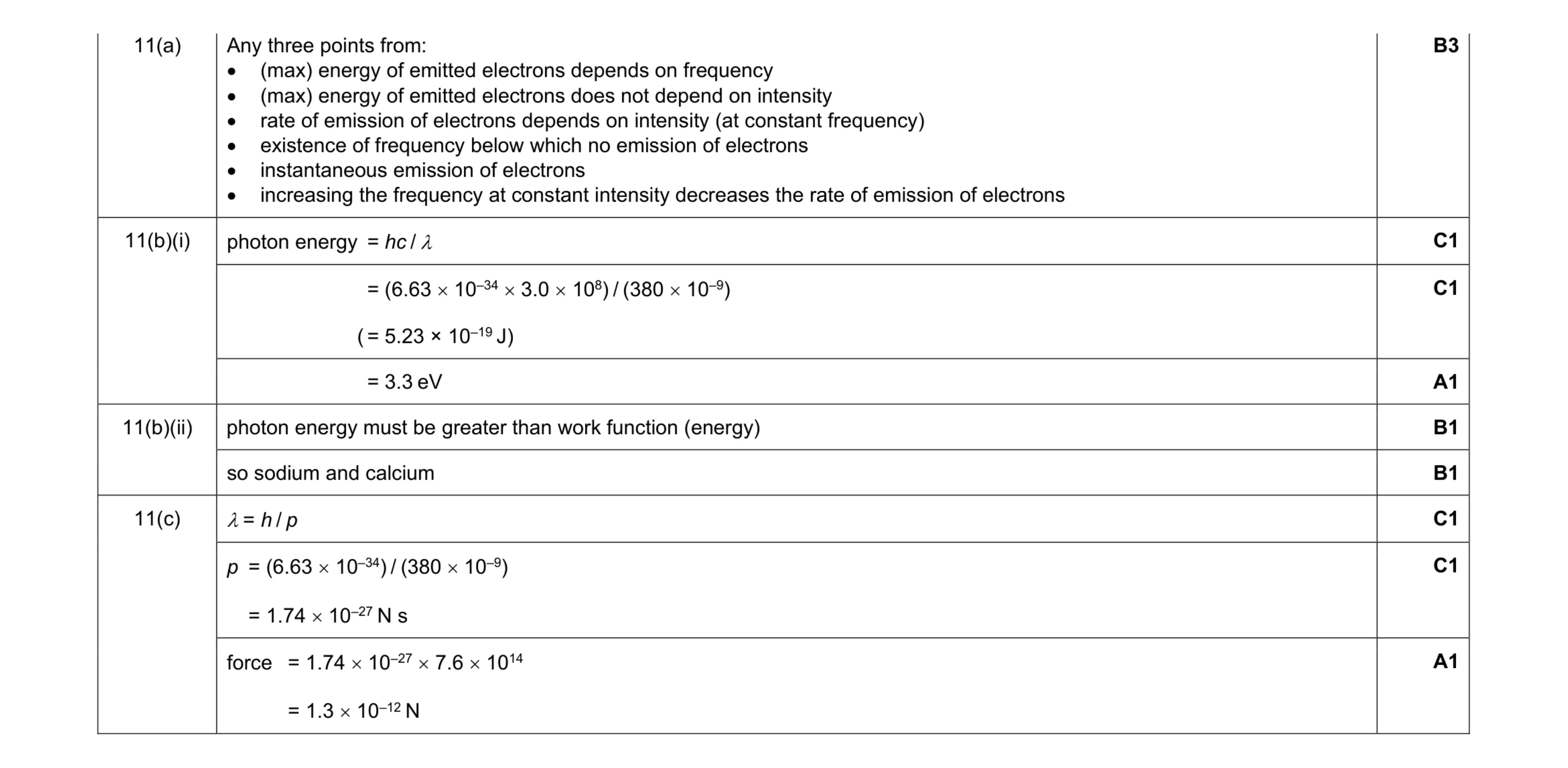 11
11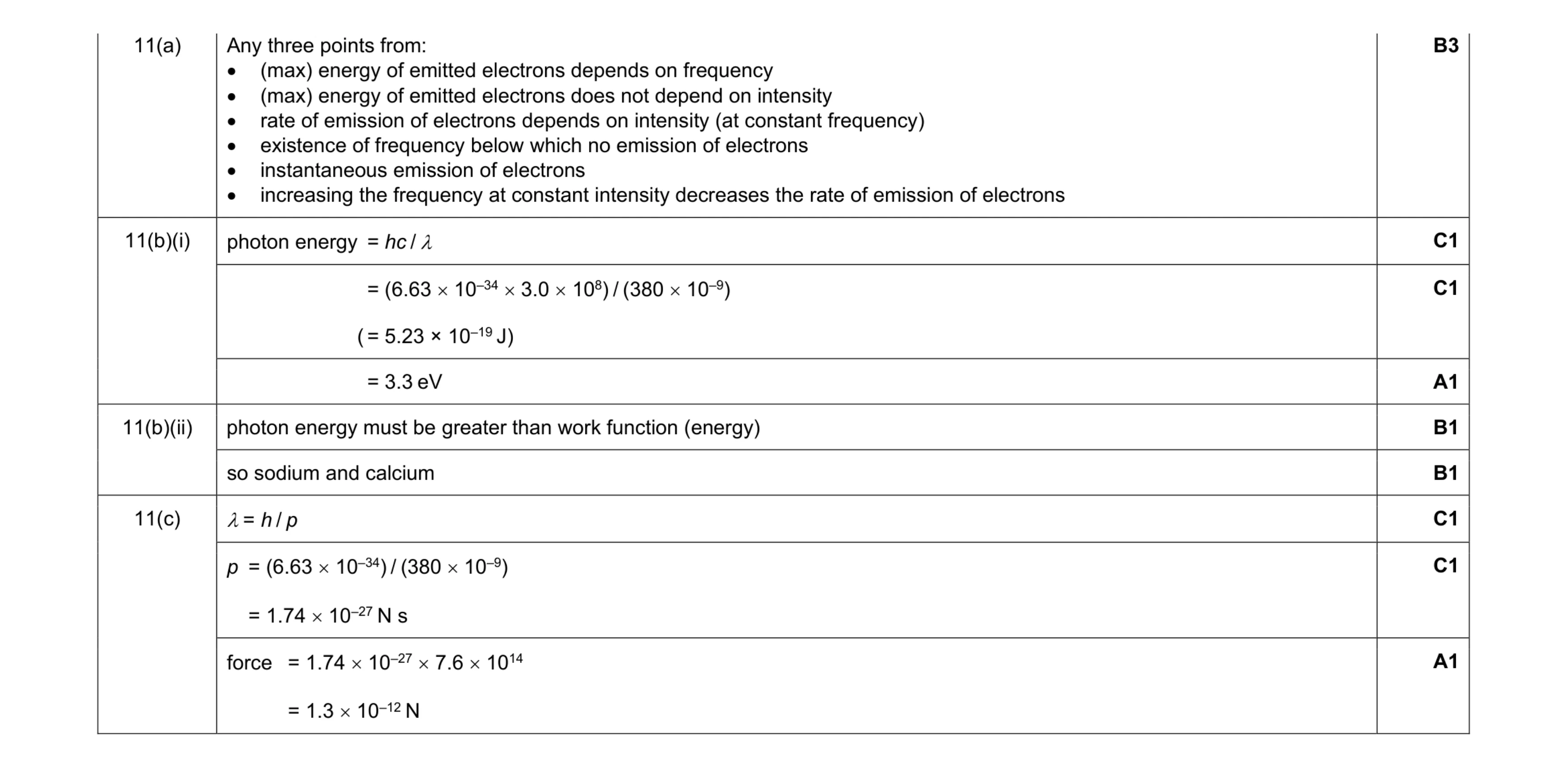 11
11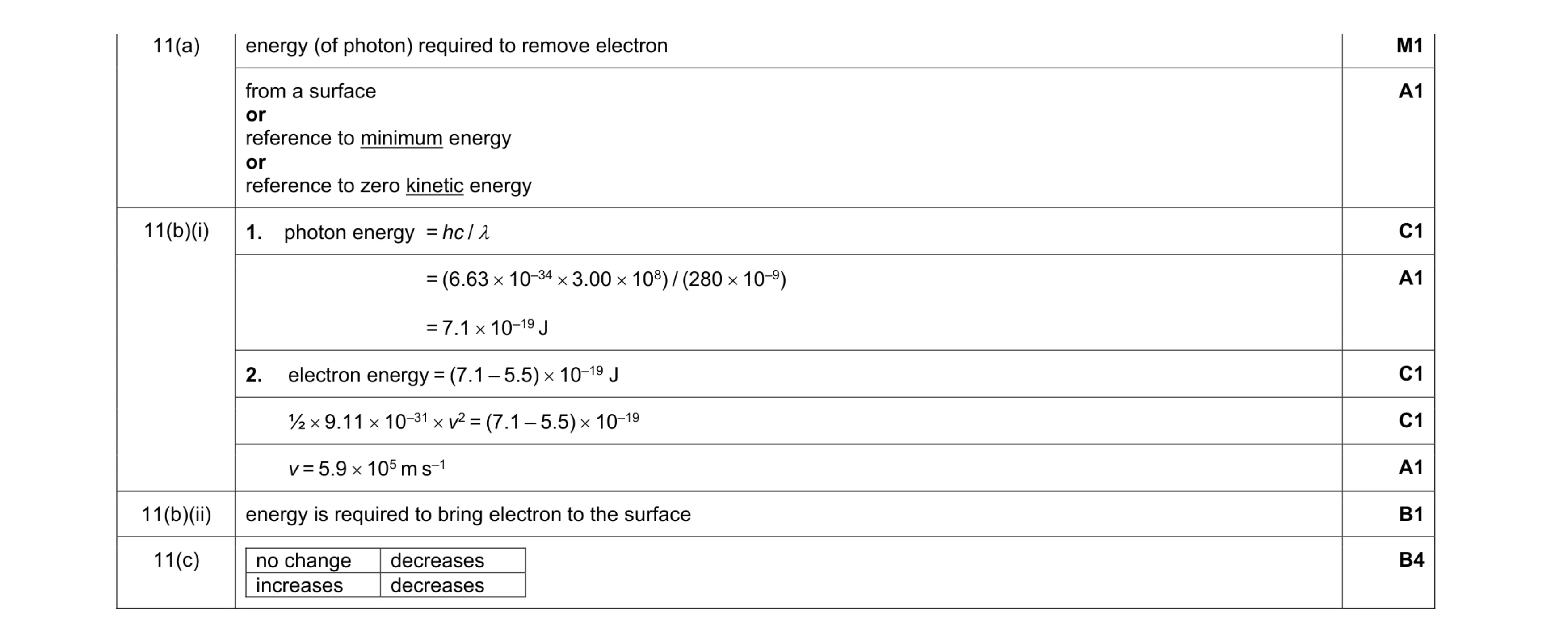 12
12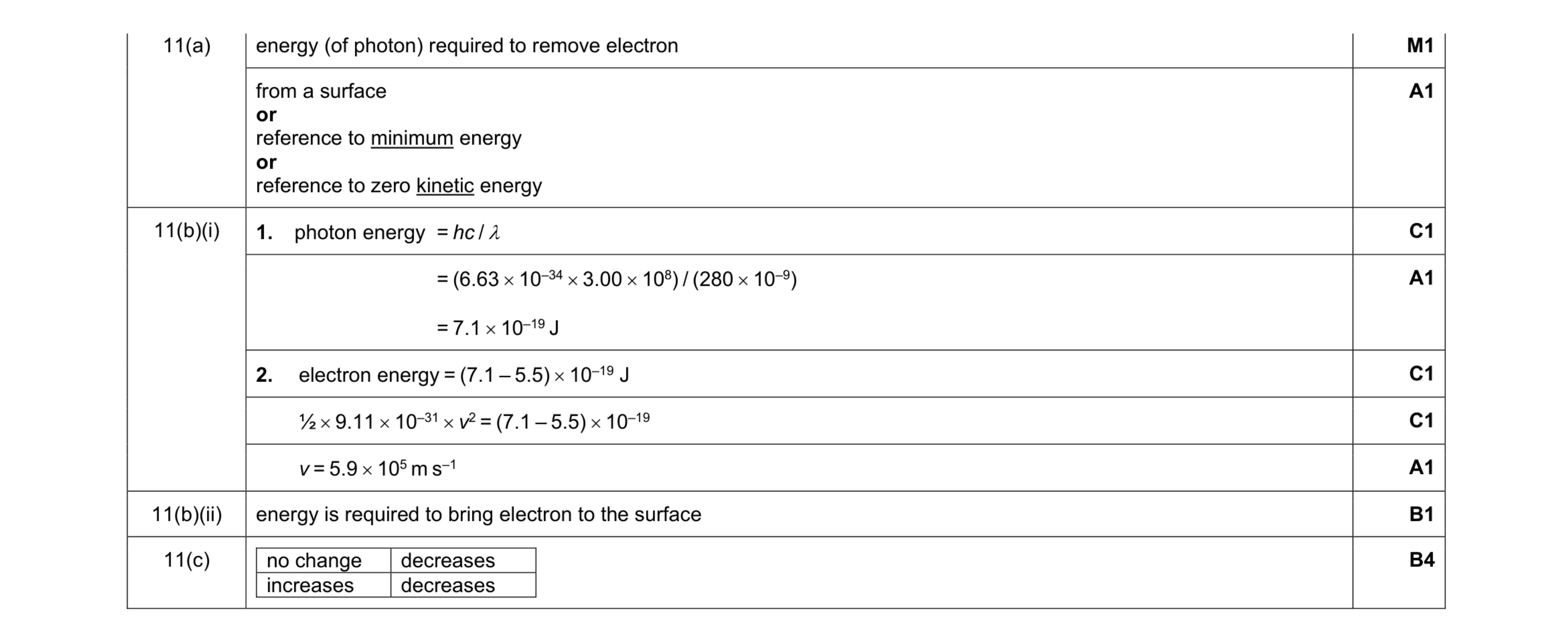 12
12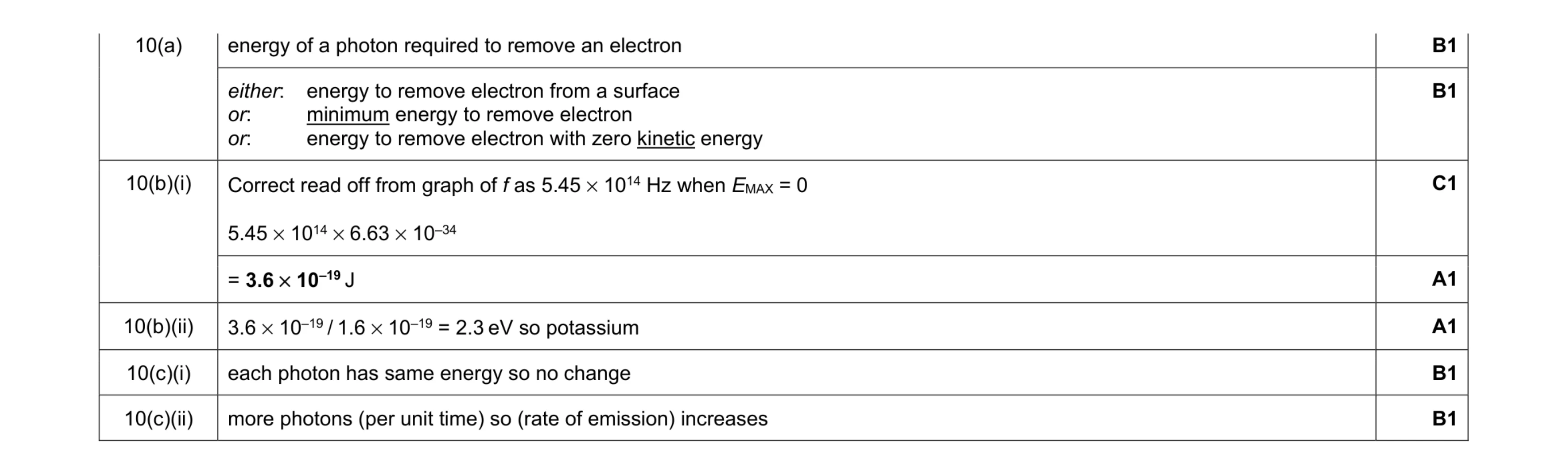 7
7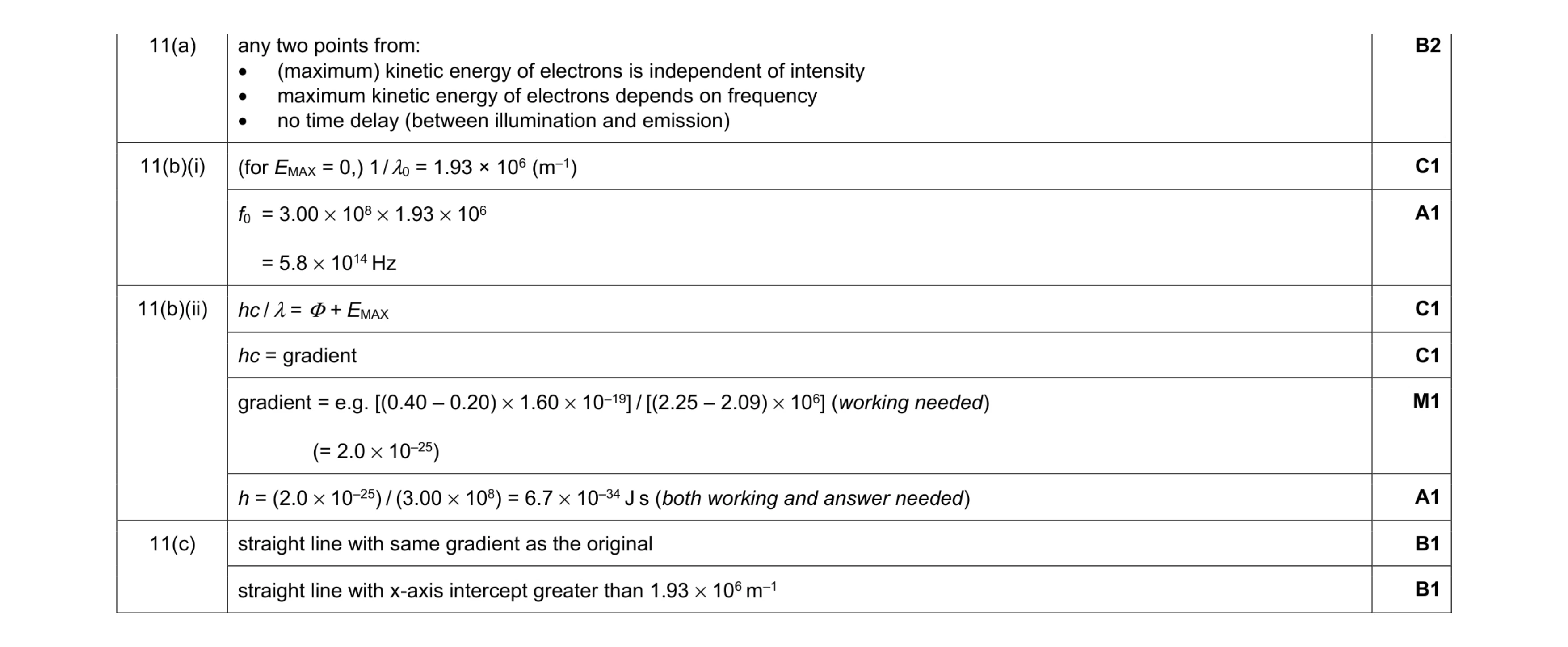 10
10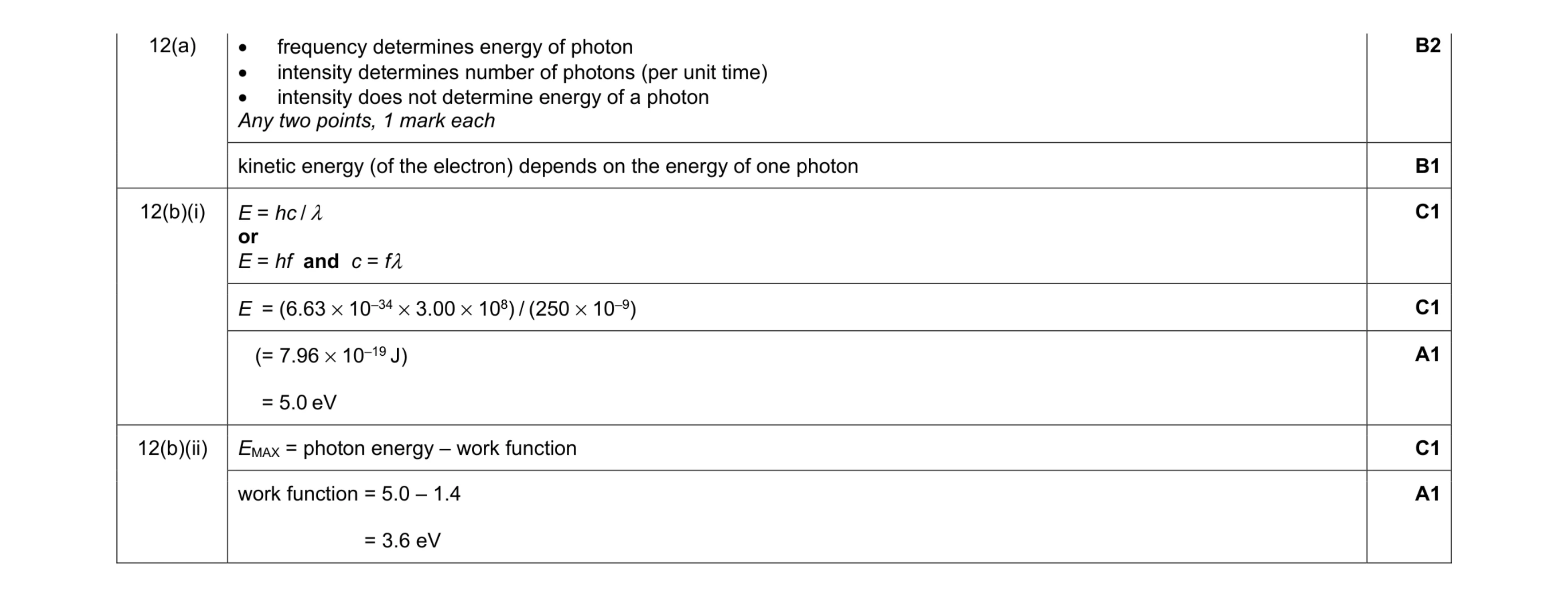 8
8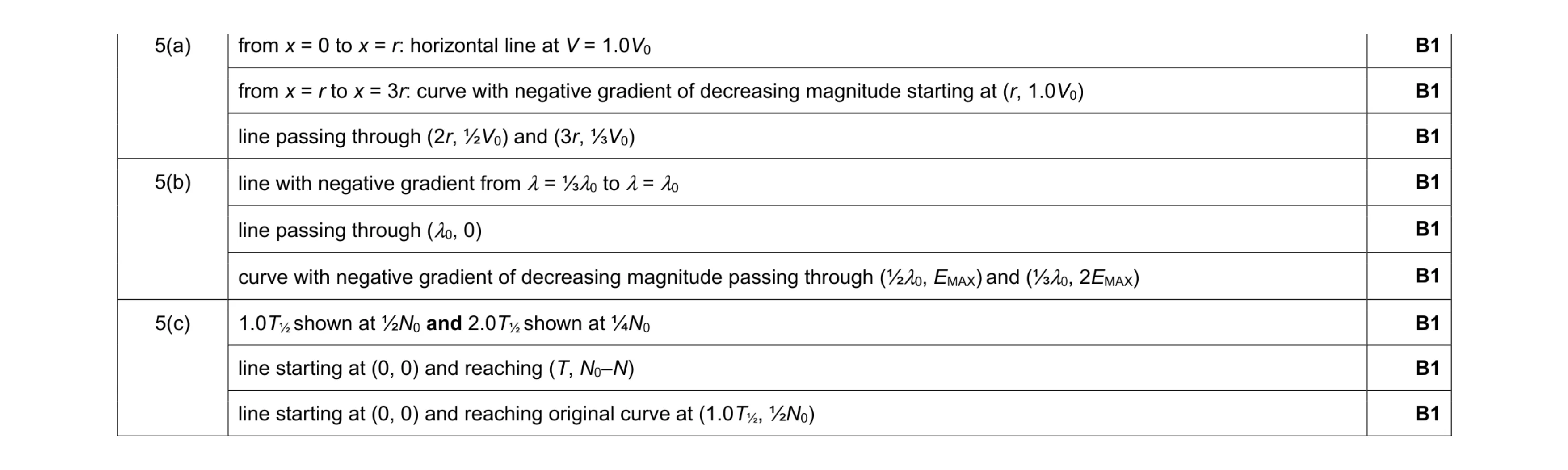 9
9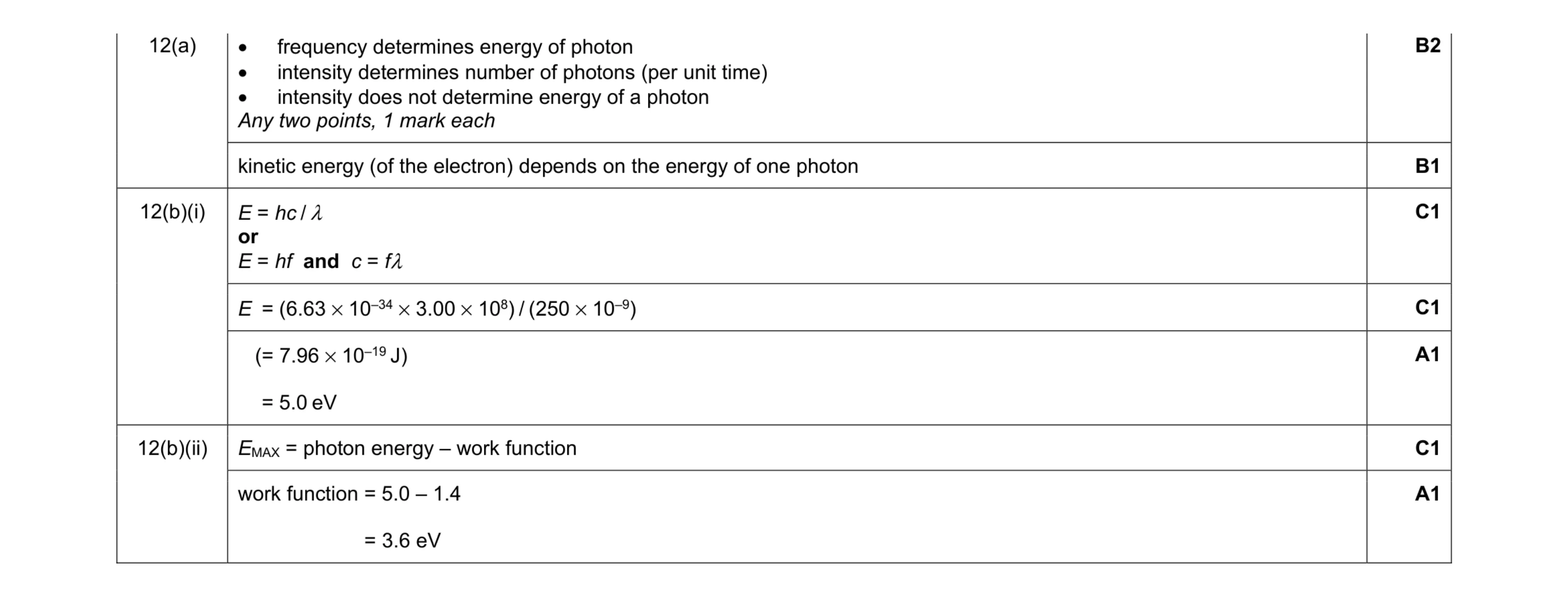 8
8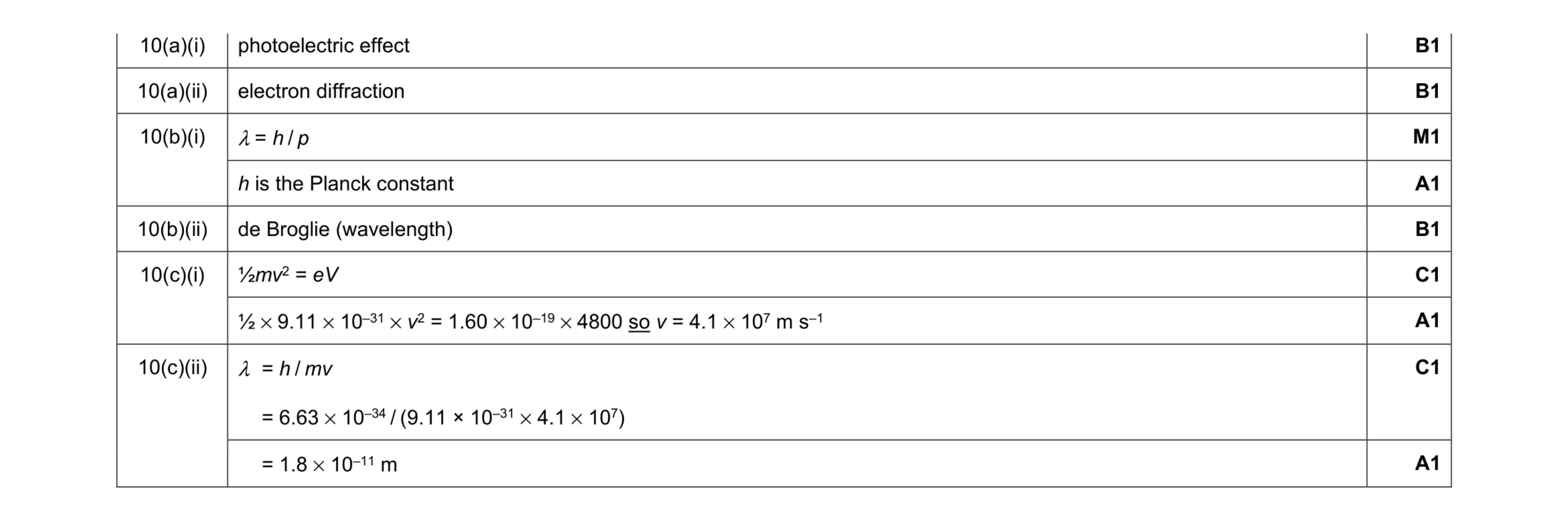 9
9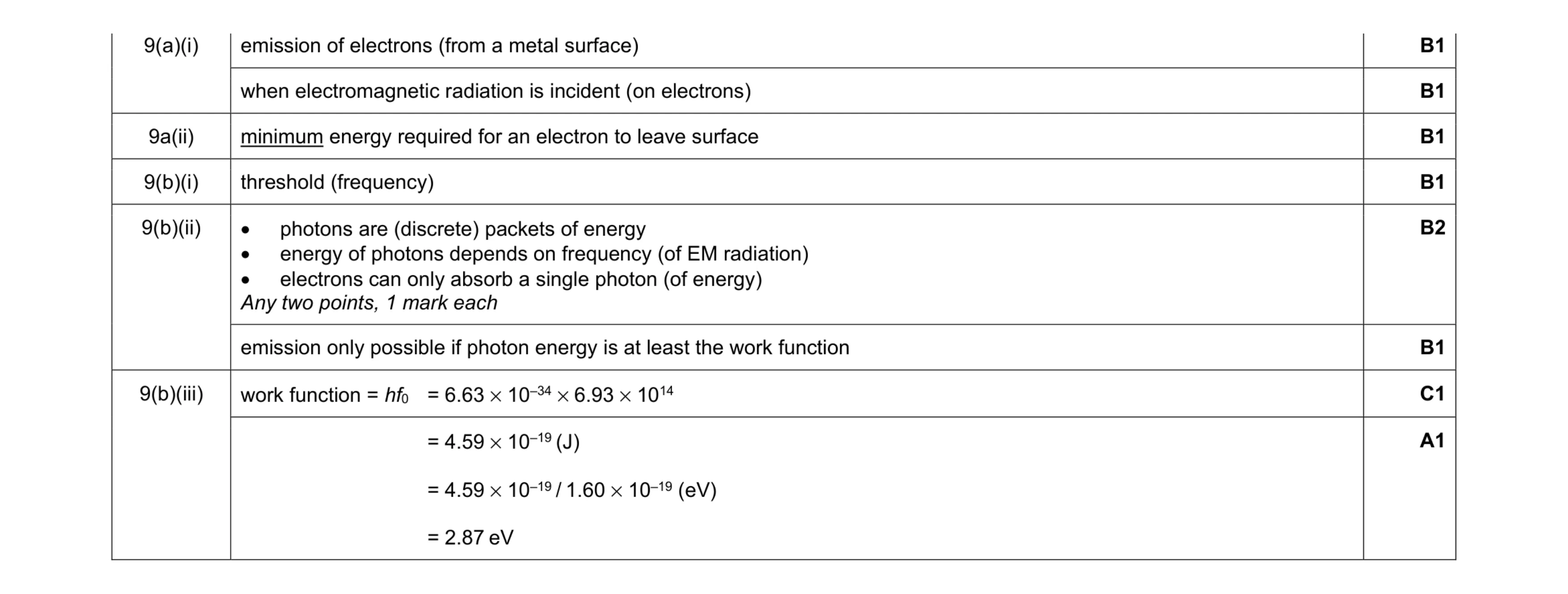 9
9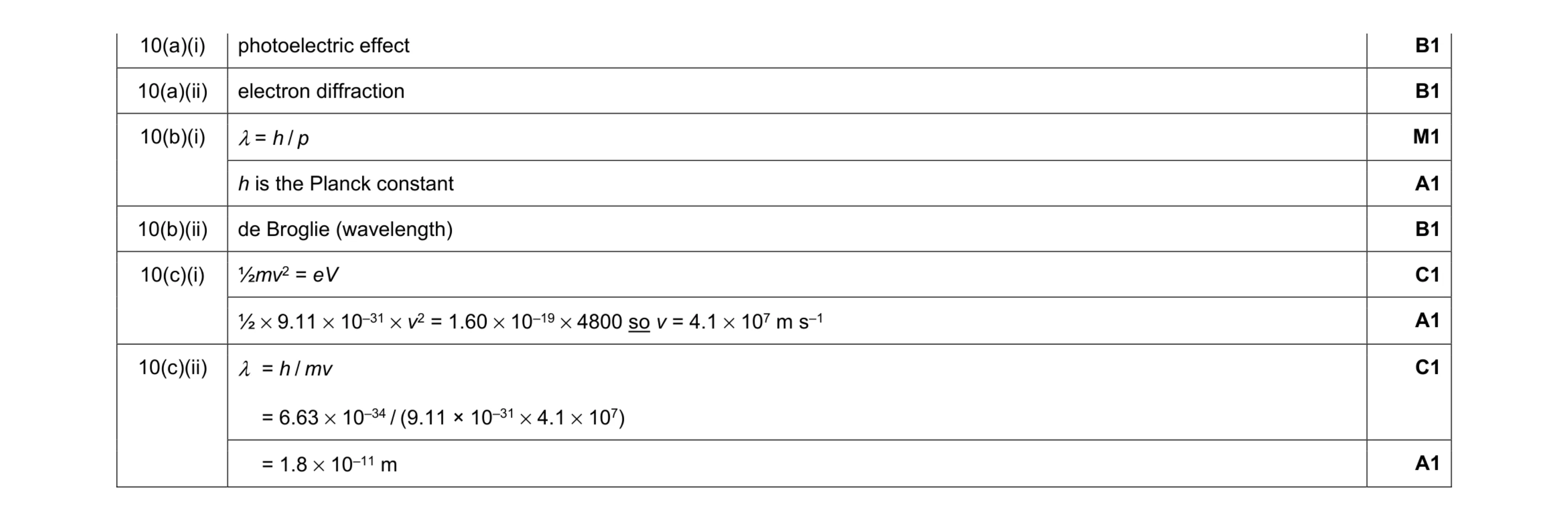 9
9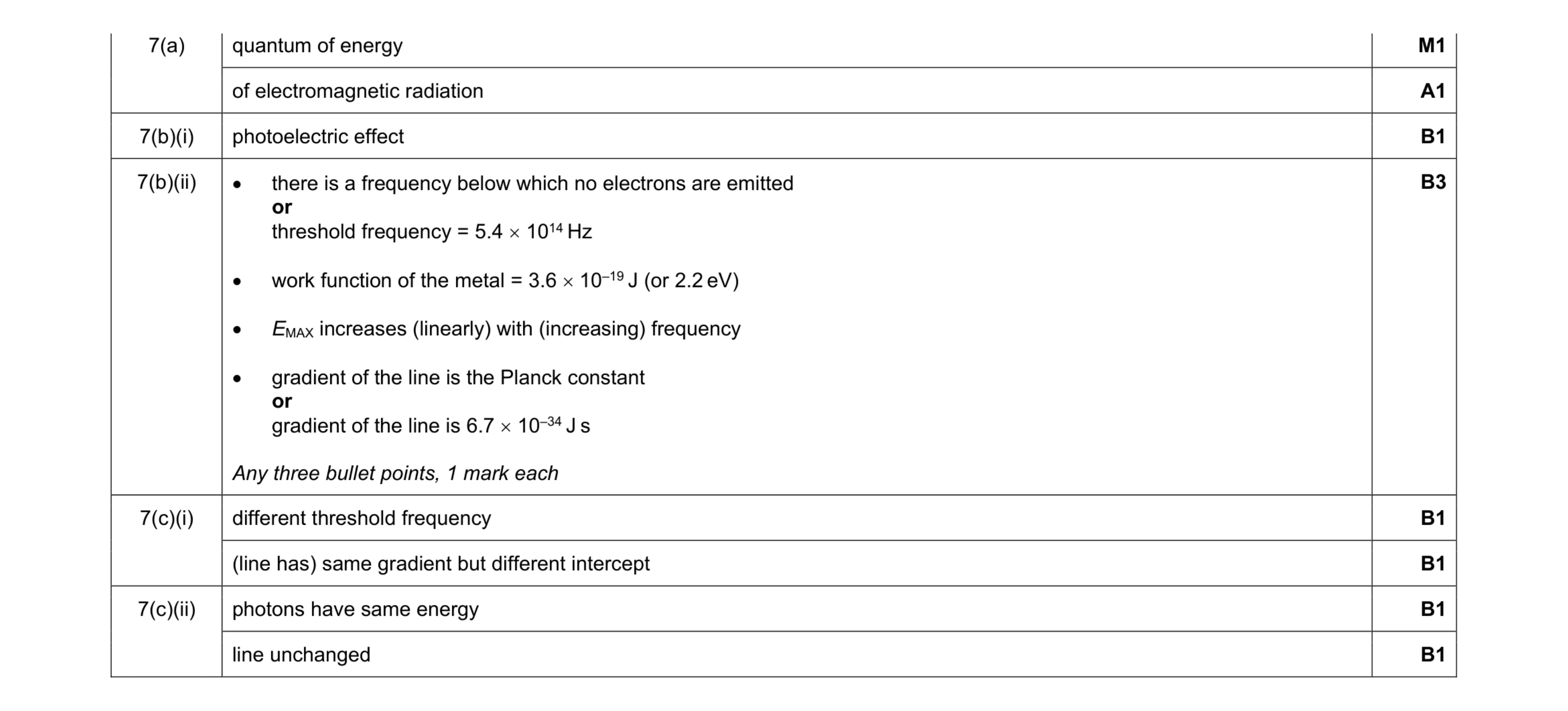 10
10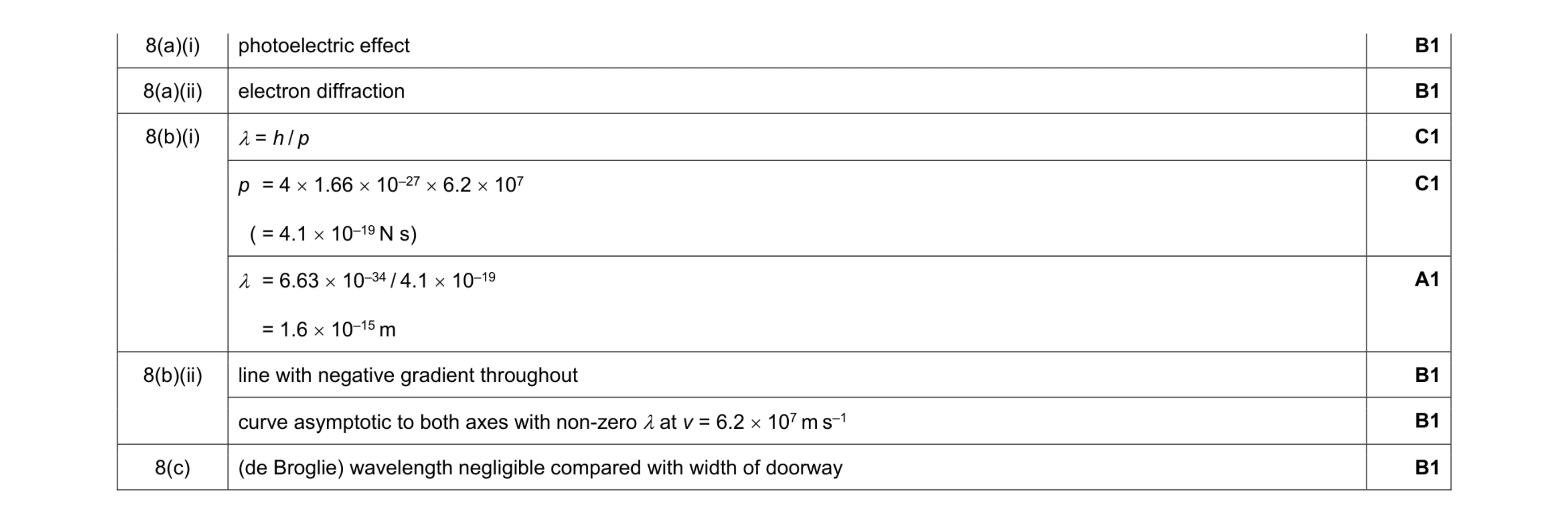 8
8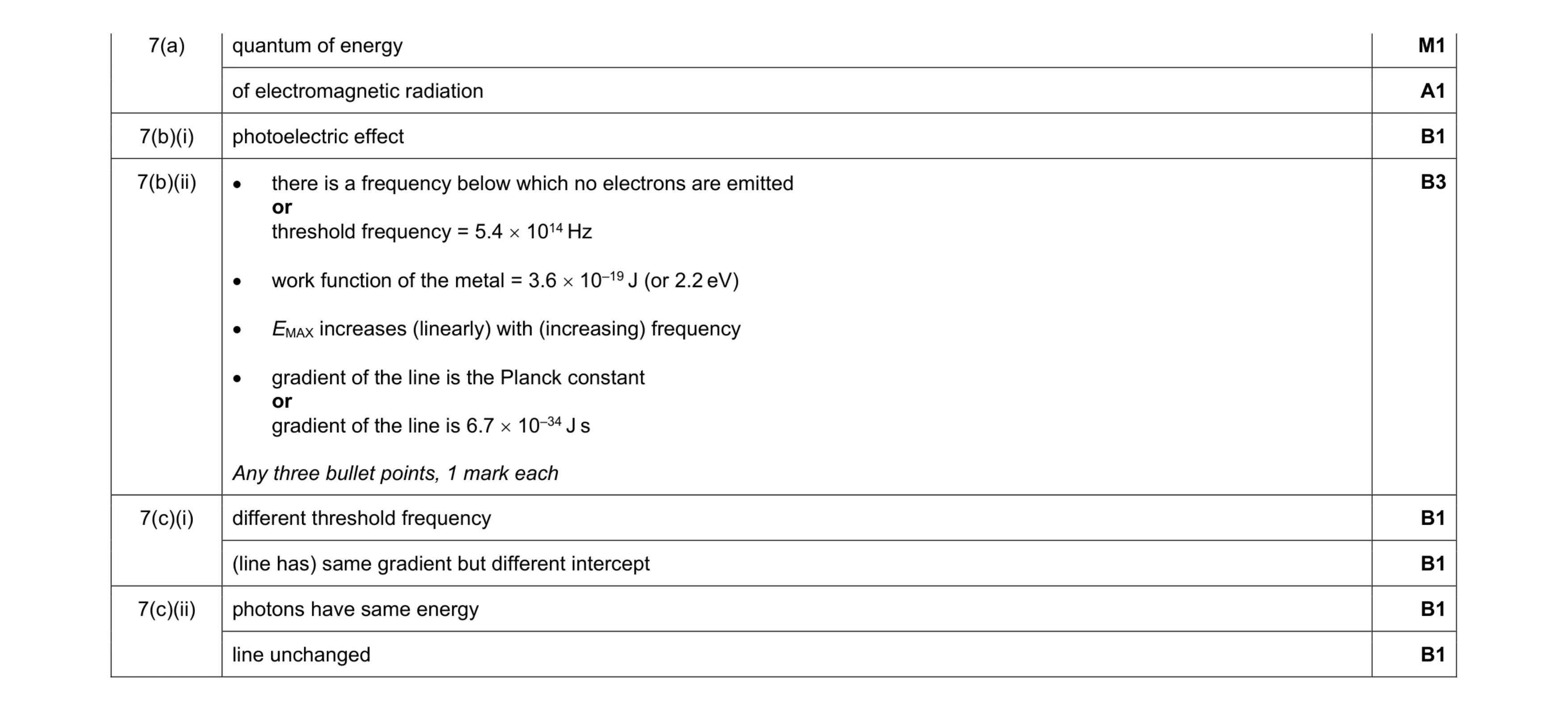 10
10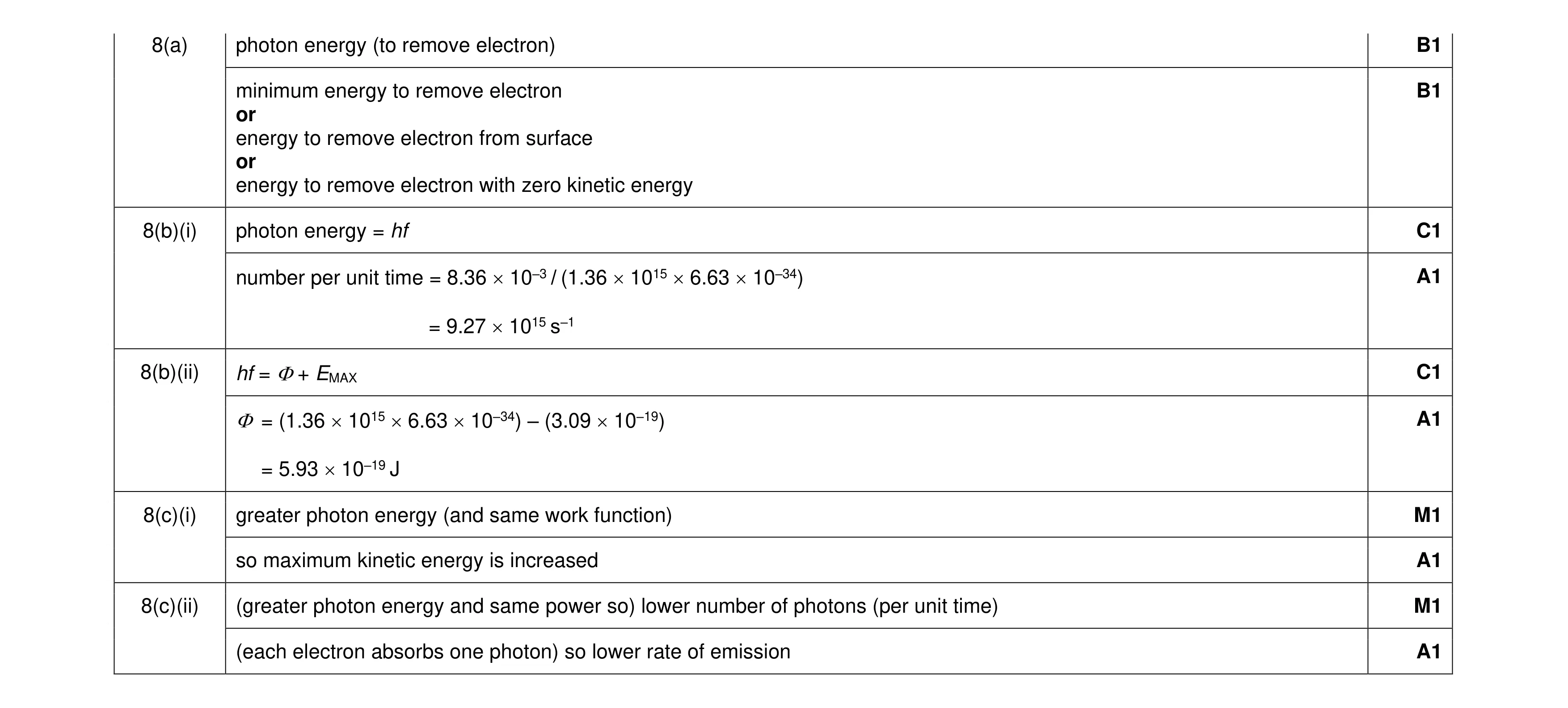 10
10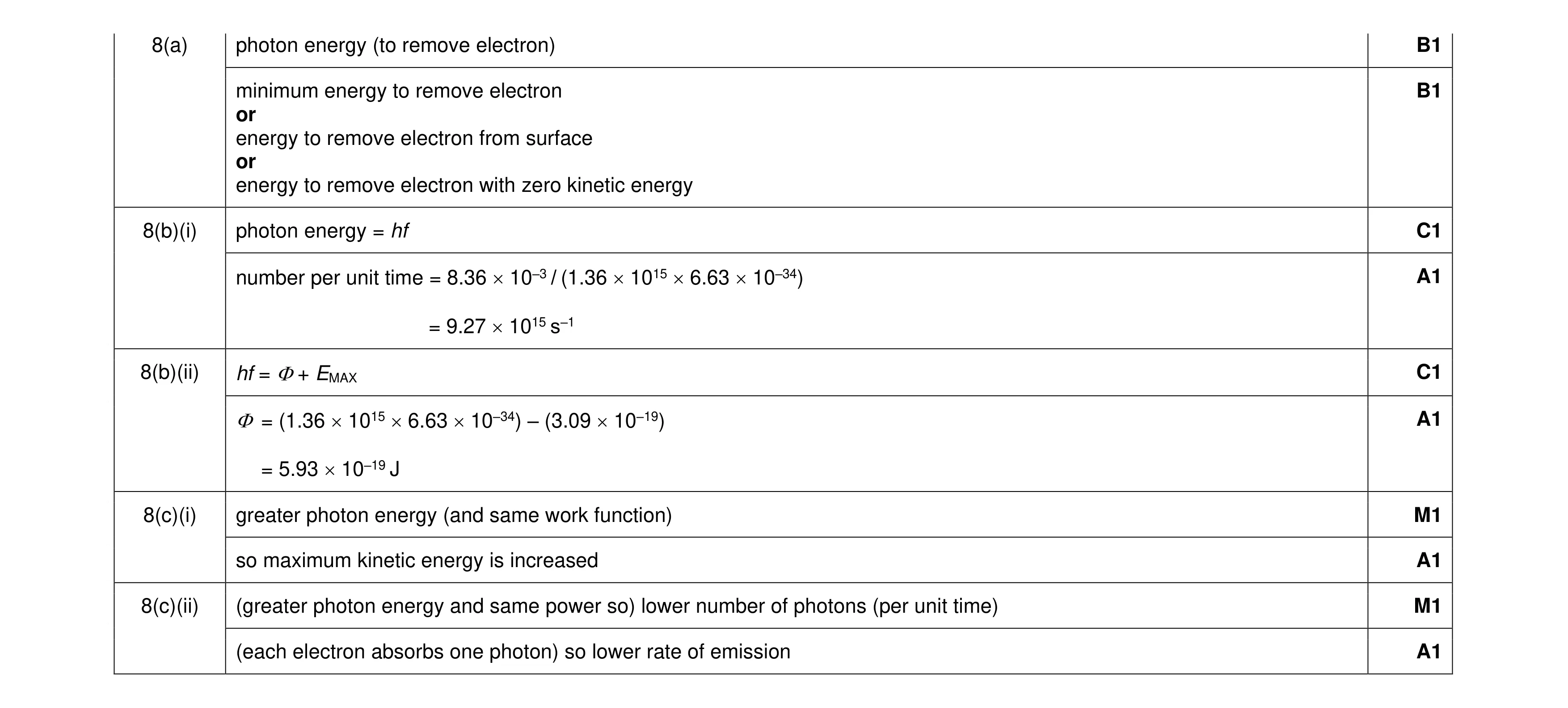 10
10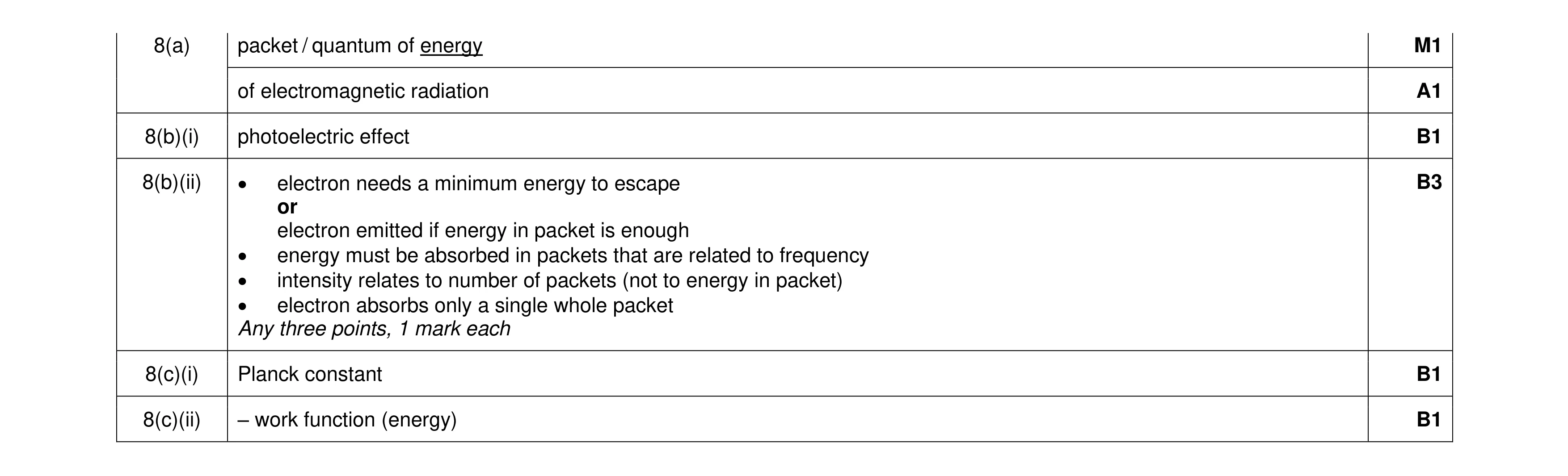 8
8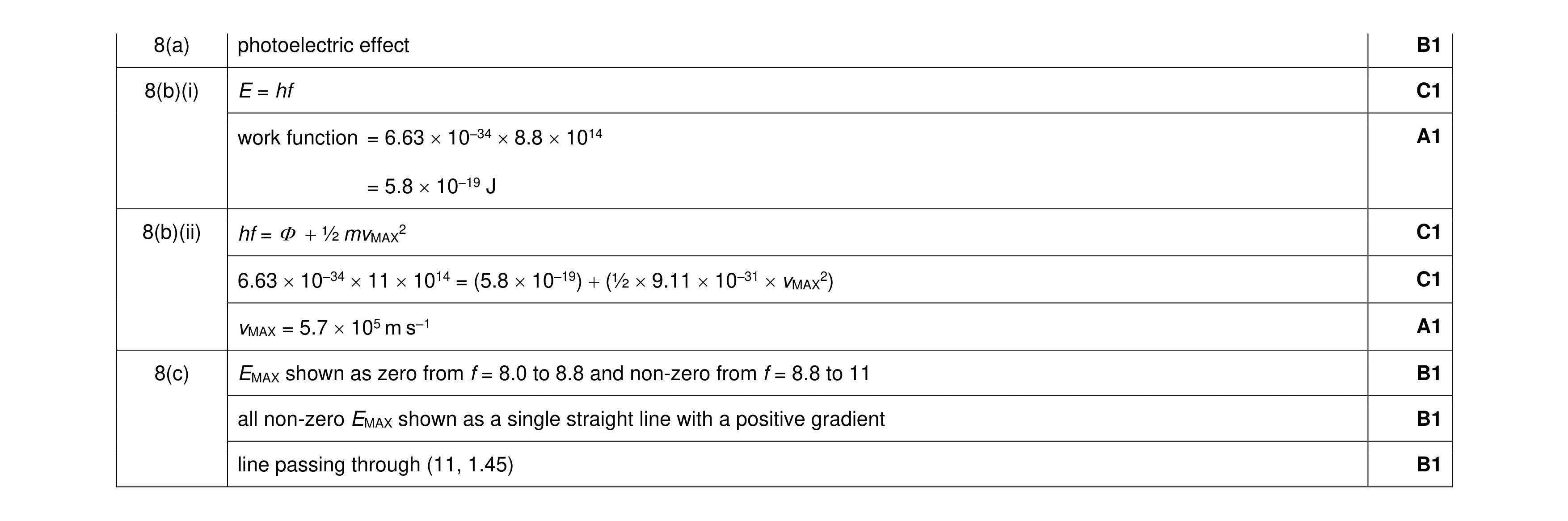 9
9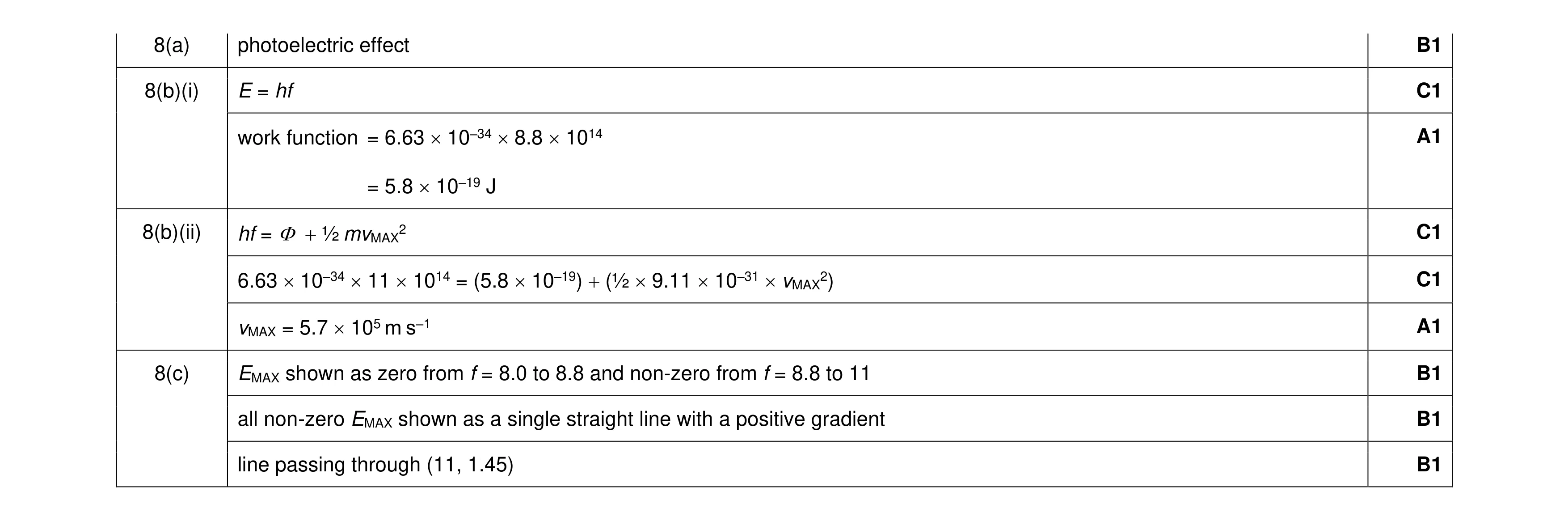 9
9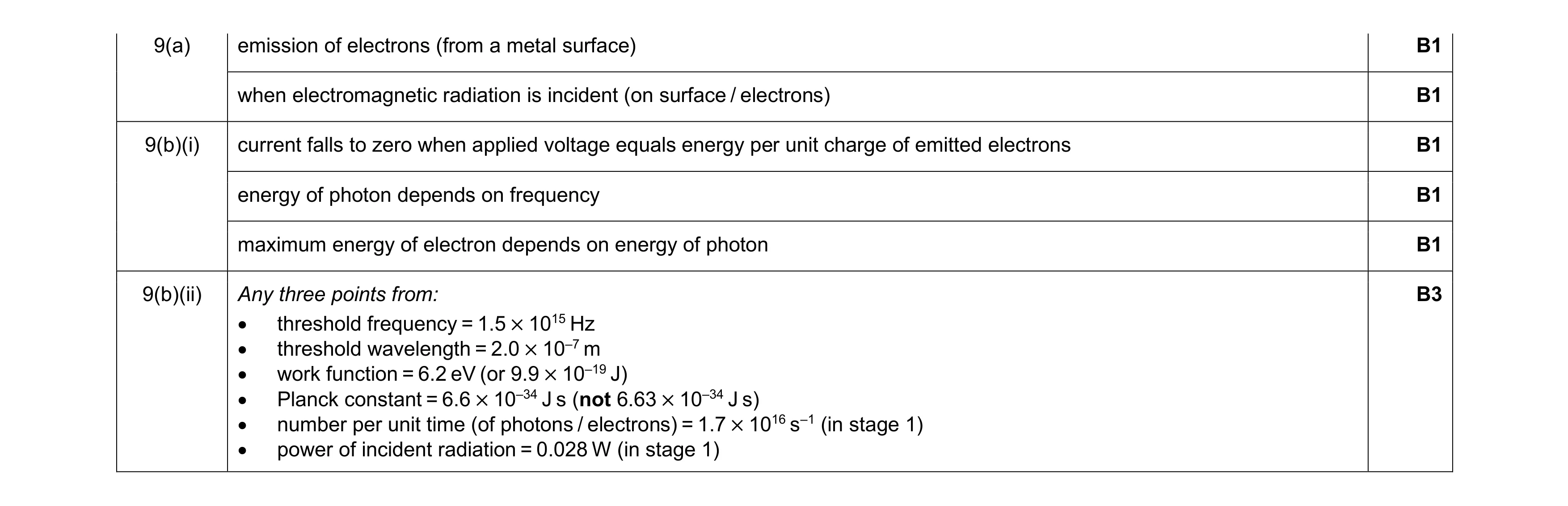 8
8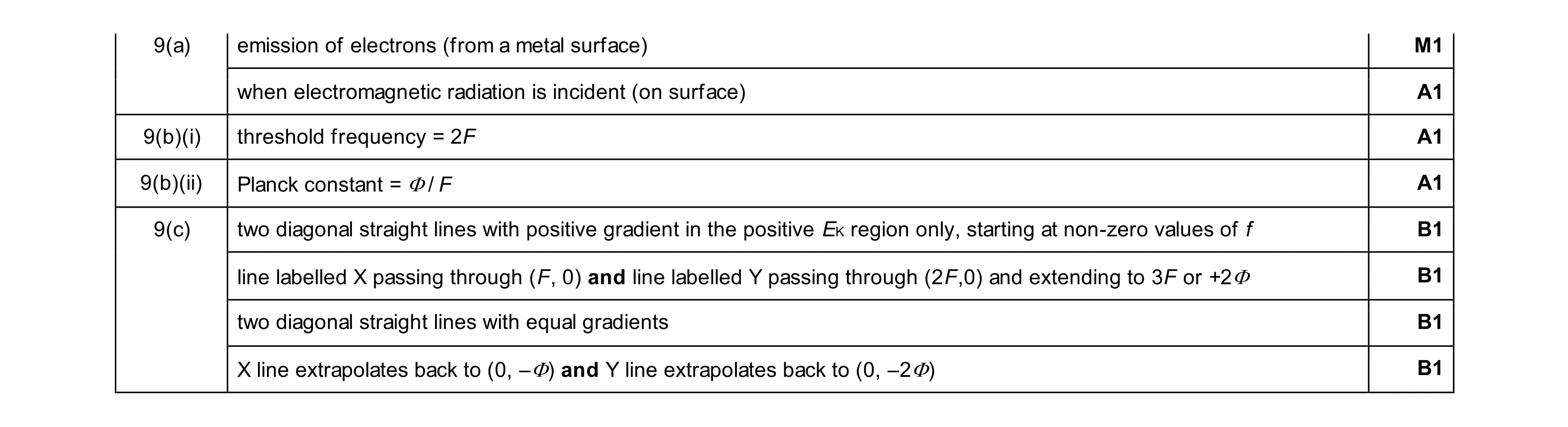 8
8