Questions as text
Q1 · Why does the pressure increase when a sealed container of gas is heated? 9702/11 Oct/Nov 2005
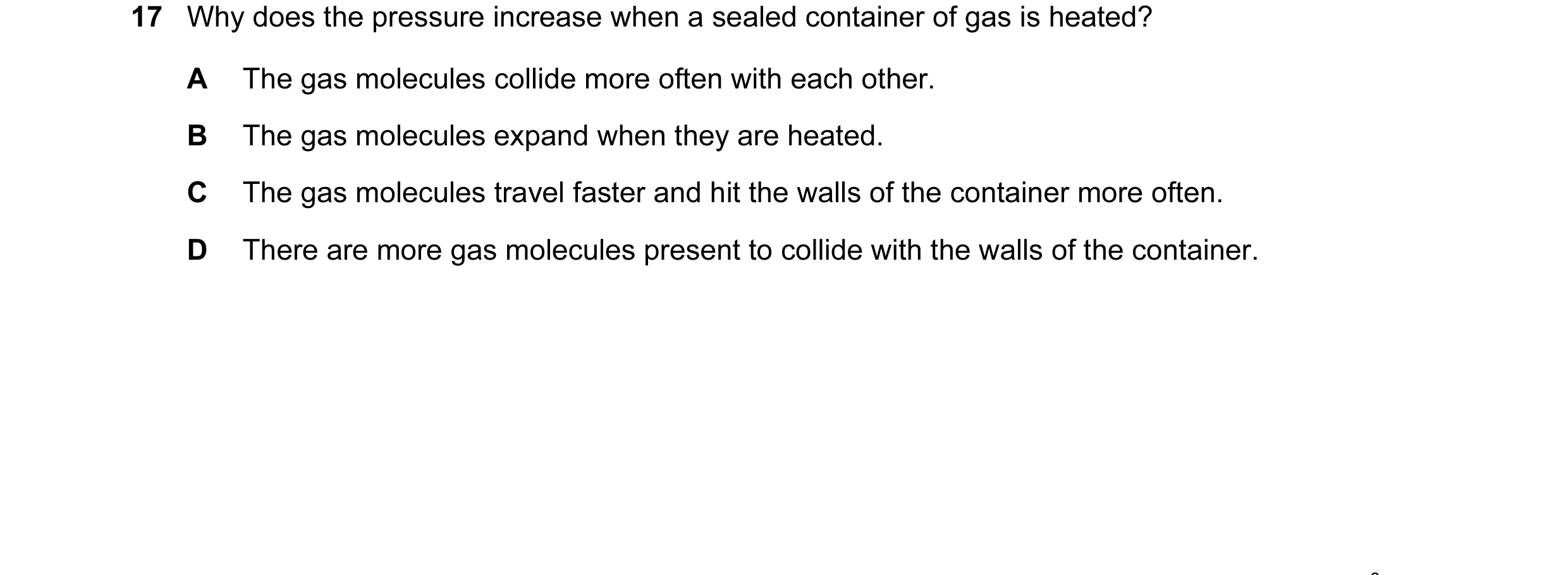
17 Why does the pressure increase when a sealed container of gas is heated? A The gas molecules collide more often with each other. B The gas molecules expand when they are heated. C The gas molecules travel faster and hit the walls of the container more often. D There are more gas molecules present to collide with the walls of the container.
1 marks
Answer: C
This question in 9702/11 Oct/Nov 2005
Q2 · Below are four short paragraphs describing the molecules in a beaker of water at 50 oC 9702/11 May/June 2006
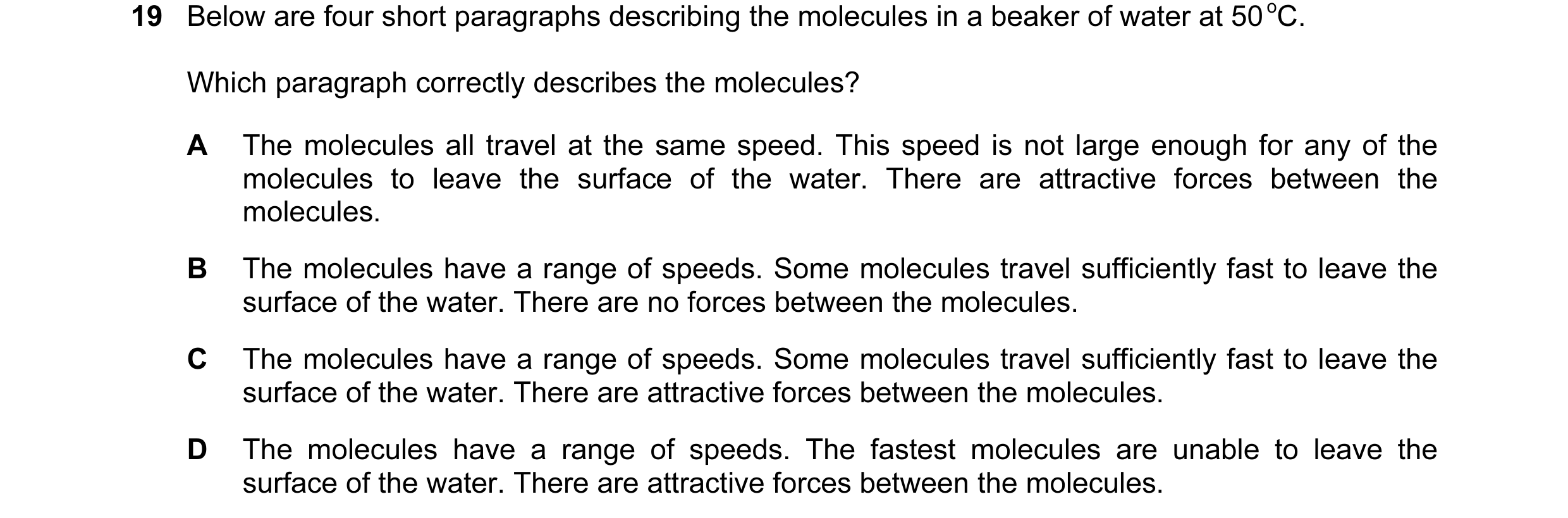
19 Below are four short paragraphs describing the molecules in a beaker of water at 50 oC. Which paragraph correctly describes the molecules? A The molecules all travel at the same speed. This speed is not large enough for any of the molecules to leave the surface of the water. There are attractive forces between the molecules. B The molecules have a range of speeds. Some molecules travel sufficiently fast to leave the surface of the water. There are no forces between the molecules. C The molecules have a range of speeds. Some molecules travel sufficiently fast to leave the surface of the water. There are attractive forces between the molecules. D The molecules have a range of speeds. The fastest molecules are unable to leave the surface of the water. There are attractive forces between the molecules.
1 marks
Answer: C
This question in 9702/11 May/June 2006
Q3 · In an experiment to demonstrate Brownian motion, smoke particles in a container are… 9702/11 May/June 2006
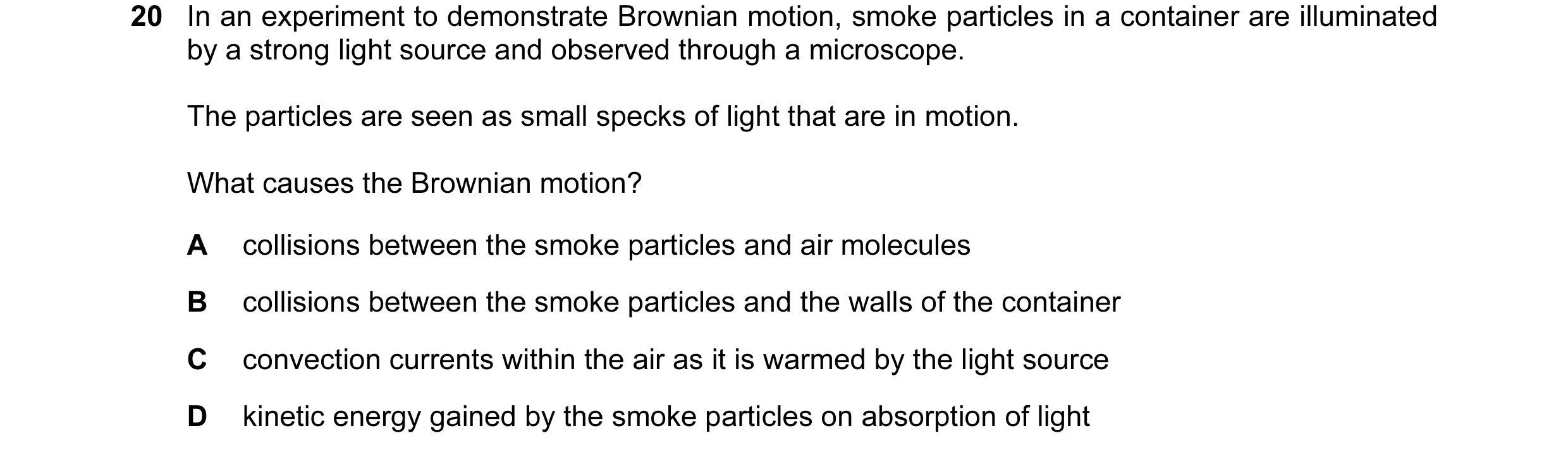
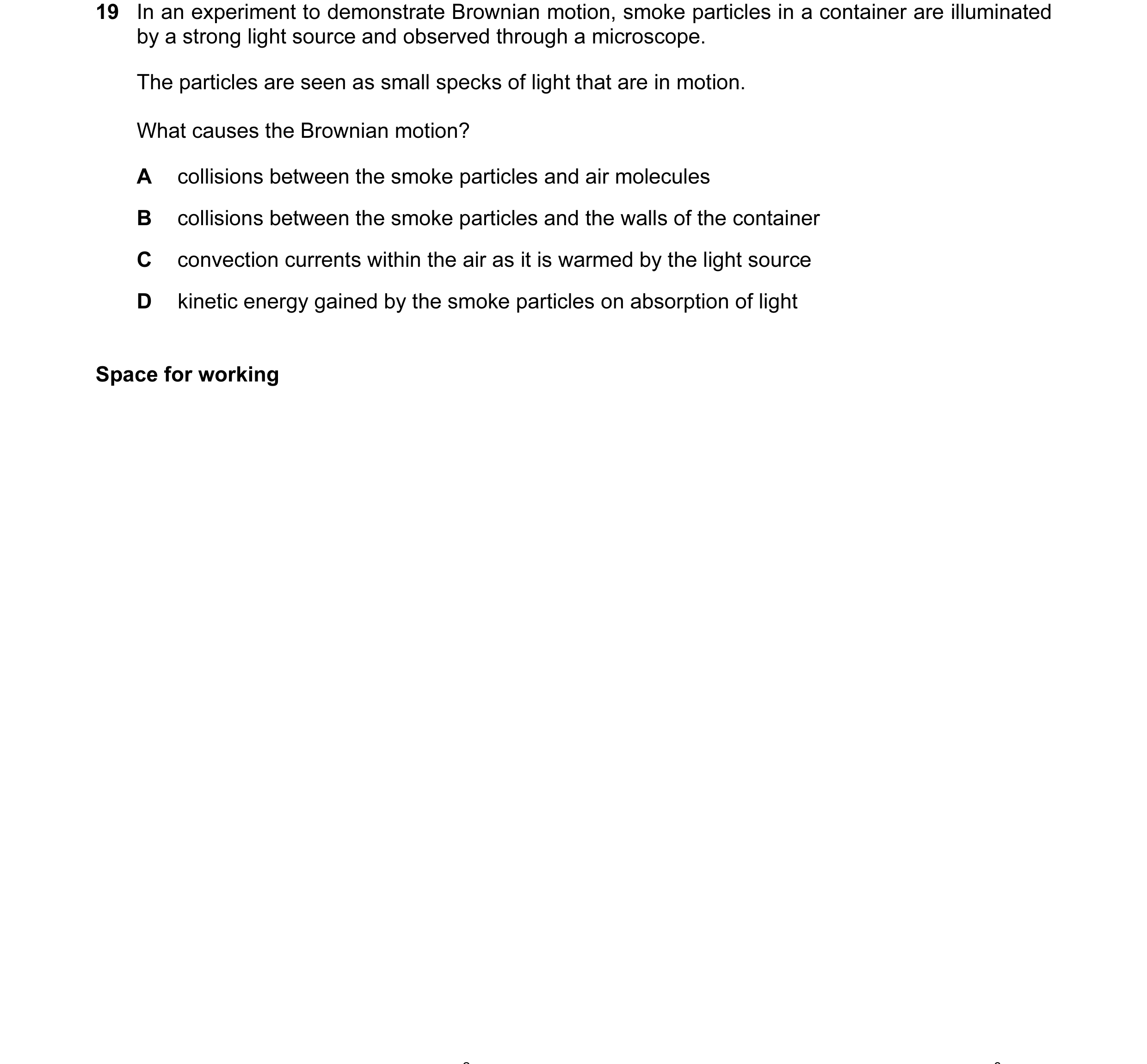
20 In an experiment to demonstrate Brownian motion, smoke particles in a container are illuminated by a strong light source and observed through a microscope. The particles are seen as small specks of light that are in motion. What causes the Brownian motion? A collisions between the smoke particles and air molecules B collisions between the smoke particles and the walls of the container C convection currents within the air as it is warmed by the light source D kinetic energy gained by the smoke particles on absorption of light
1 marks
Answer: A
This question in 9702/11 May/June 2006
Q4 · The table summarises some properties of evaporation 9702/11 Oct/Nov 2006
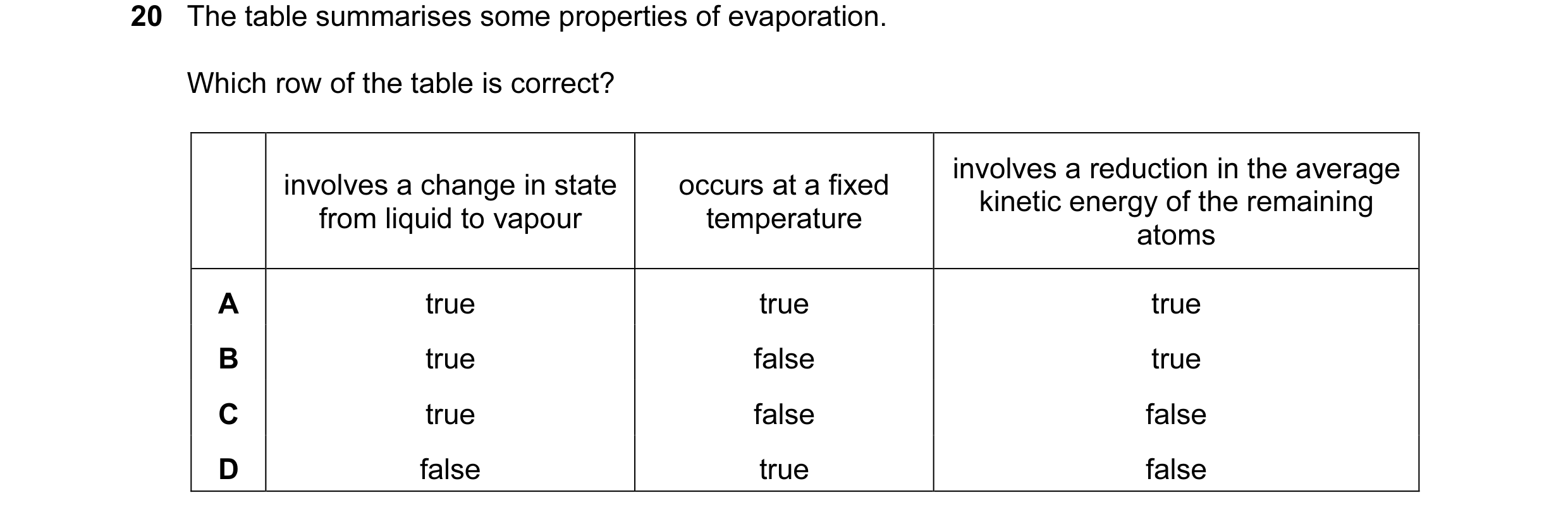
20 The table summarises some properties of evaporation. Which row of the table is correct? involves a reduction in the average involves a change in state occurs at a fixed kinetic energy of the remaining from liquid to vapour temperature atoms A true true true B true false true C true false false D false true false
1 marks
Answer: B
This question in 9702/11 Oct/Nov 2006
Q5 · Which group of statements applies only to the liquid state? 9702/11 May/June 2007
16 Which group of statements applies only to the liquid state? A B atoms separated by many atomic diameters atoms separated by many atomic diameters positions of atoms can change atoms are in fixed positions atoms vibrate atoms are in continuous, random motion C D atoms can touch each other atoms can touch each other positions of atoms can change atoms are in fixed positions some random motion of atoms some random motion of atoms
1 marks
Answer: C
This question in 9702/11 May/June 2007
Q6 · Why does an ideal gas exert pressure on its container? 9702/11 May/June 2008
20 Why does an ideal gas exert pressure on its container? A The molecules of the gas collide continually with each other. B The molecules of the gas collide continually with the walls of the container. C The molecules of the gas collide inelastically with the walls of the container. D The weight of the molecules exerts a force on the walls of the container.
1 marks
Answer: B
This question in 9702/11 May/June 2008
Q7 · Why does the pressure of a gas increase when the gas is compressed at constant… 9702/11 Oct/Nov 2008
20 Why does the pressure of a gas increase when the gas is compressed at constant temperature? A The gas molecules collide more often with each other. B The gas molecules expand under pressure. C The gas molecules hit the walls of the container more frequently. D The gas molecules travel faster.
1 marks
Answer: C
This question in 9702/11 Oct/Nov 2008
Q8 · Which row best describes how the molecules move in solids, in liquids and in gases? 9702/11 May/June 2009
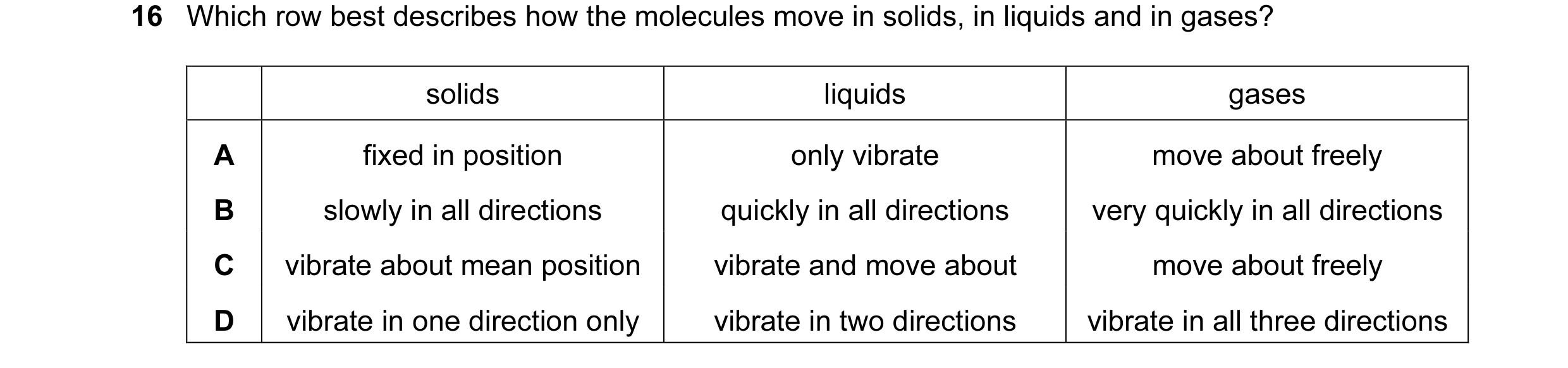
16 Which row best describes how the molecules move in solids, in liquids and in gases? solids liquids gases A fixed in position only vibrate move about freely B slowly in all directions quickly in all directions very quickly in all directions C vibrate about mean position vibrate and move about move about freely D vibrate in one direction only vibrate in two directions vibrate in all three directions
1 marks
Answer: C
This question in 9702/11 May/June 2009
Q9 · In the kinetic model of gases, what is pressure equal to? 9702/11 Oct/Nov 2009
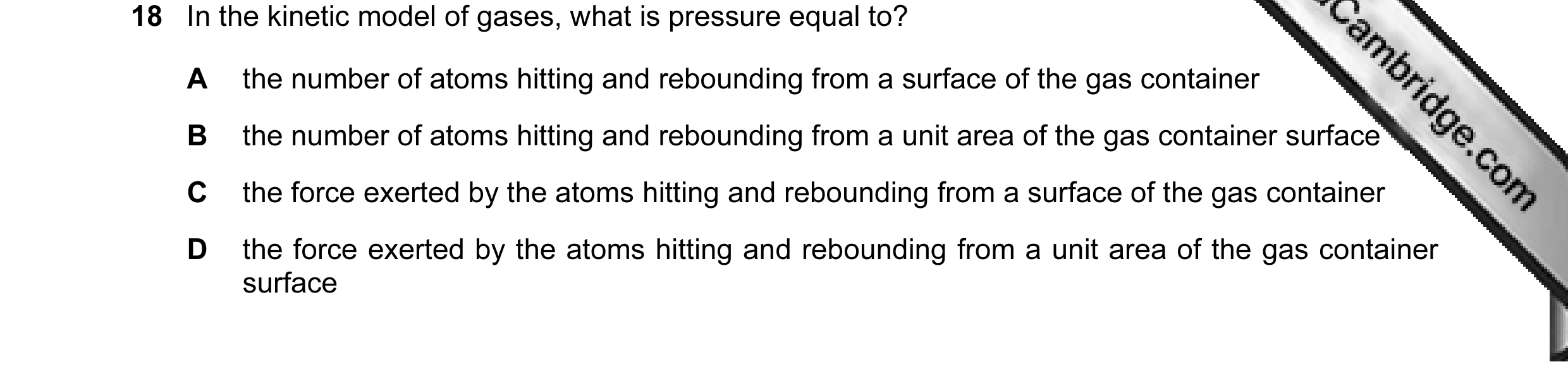
18 In the kinetic model of gases, what is pressure equal to? A the number of atoms hitting and rebounding from a surface of the gas container B the number of atoms hitting and rebounding from a unit area of the gas container surface C the force exerted by the atoms hitting and rebounding from a surface of the gas container D the force exerted by the atoms hitting and rebounding from a unit area of the gas container surface
1 marks
Answer: D
This question in 9702/11 Oct/Nov 2009
Q10 · In the kinetic model of gases, what is pressure equal to? 9702/12 Oct/Nov 2009
17 In the kinetic model of gases, what is pressure equal to? A the number of atoms hitting and rebounding from a surface of the gas container B the number of atoms hitting and rebounding from a unit area of the gas container surface C the force exerted by the atoms hitting and rebounding from a surface of the gas container D the force exerted by the atoms hitting and rebounding from a unit area of the gas container surface
1 marks
Answer: D
This question in 9702/12 Oct/Nov 2009
Q11 · Below are four short paragraphs describing the molecules in a beaker of water at 50 oC 9702/12 Oct/Nov 2010
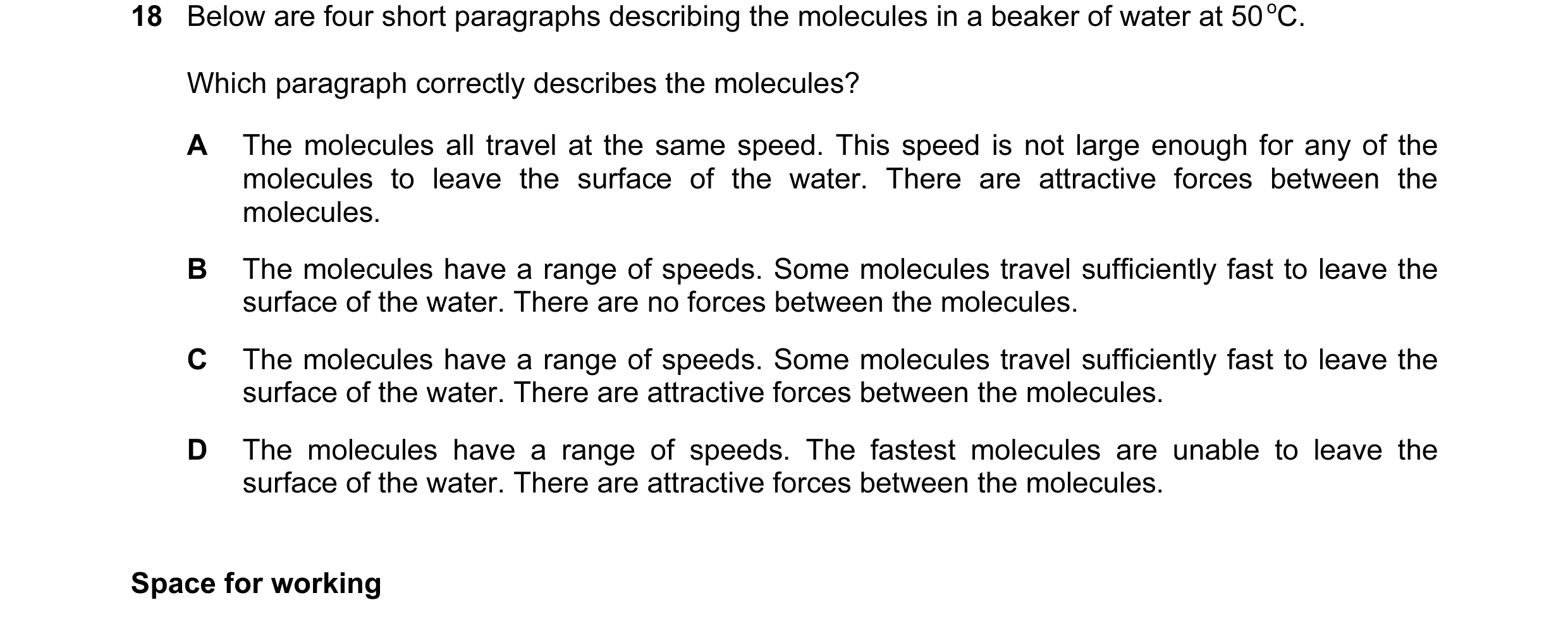
18 Below are four short paragraphs describing the molecules in a beaker of water at 50 oC. Which paragraph correctly describes the molecules? A The molecules all travel at the same speed. This speed is not large enough for any of the molecules to leave the surface of the water. There are attractive forces between the molecules. B The molecules have a range of speeds. Some molecules travel sufficiently fast to leave the surface of the water. There are no forces between the molecules. C The molecules have a range of speeds. Some molecules travel sufficiently fast to leave the surface of the water. There are attractive forces between the molecules. D The molecules have a range of speeds. The fastest molecules are unable to leave the surface of the water. There are attractive forces between the molecules. Space for working
1 marks
Answer: C
This question in 9702/12 Oct/Nov 2010
Q12 · A student writes some statements about solids, liquids and gases 9702/13 Oct/Nov 2010
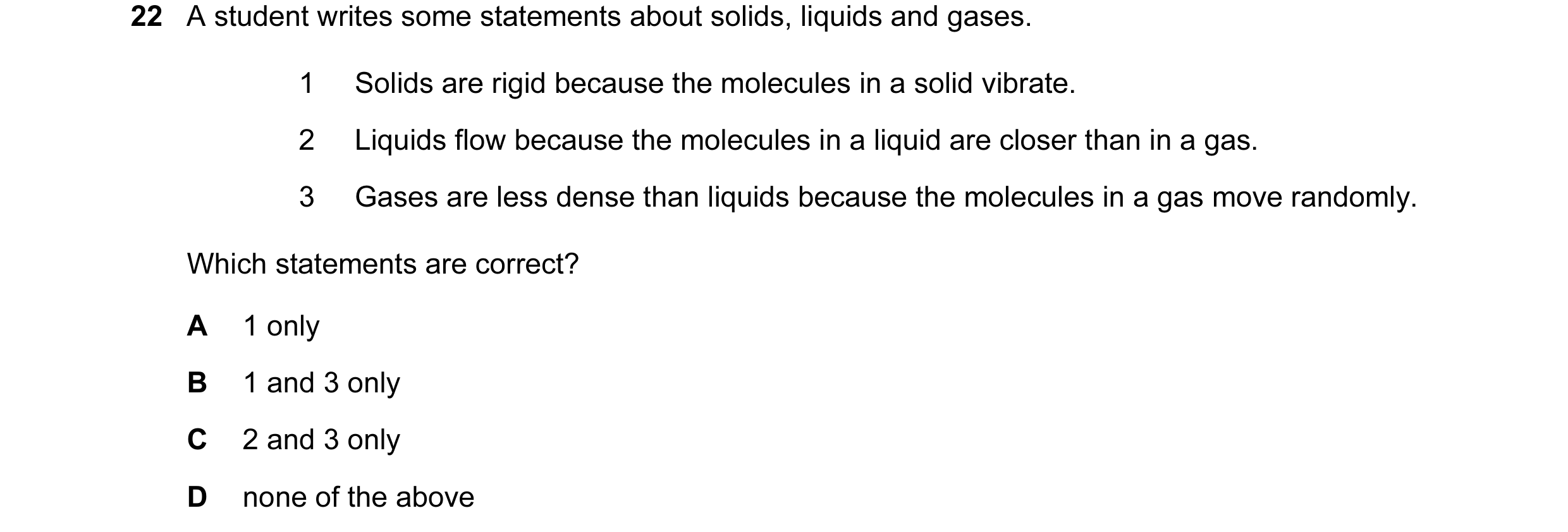
22 A student writes some statements about solids, liquids and gases. 1 Solids are rigid because the molecules in a solid vibrate. 2 Liquids flow because the molecules in a liquid are closer than in a gas. 3 Gases are less dense than liquids because the molecules in a gas move randomly. Which statements are correct? A 1 only B 1 and 3 only C 2 and 3 only D none of the above
1 marks
Answer: D
This question in 9702/13 Oct/Nov 2010
Q13 · Why does the pressure increase when a sealed container of gas is heated? 9702/11 Oct/Nov 2011
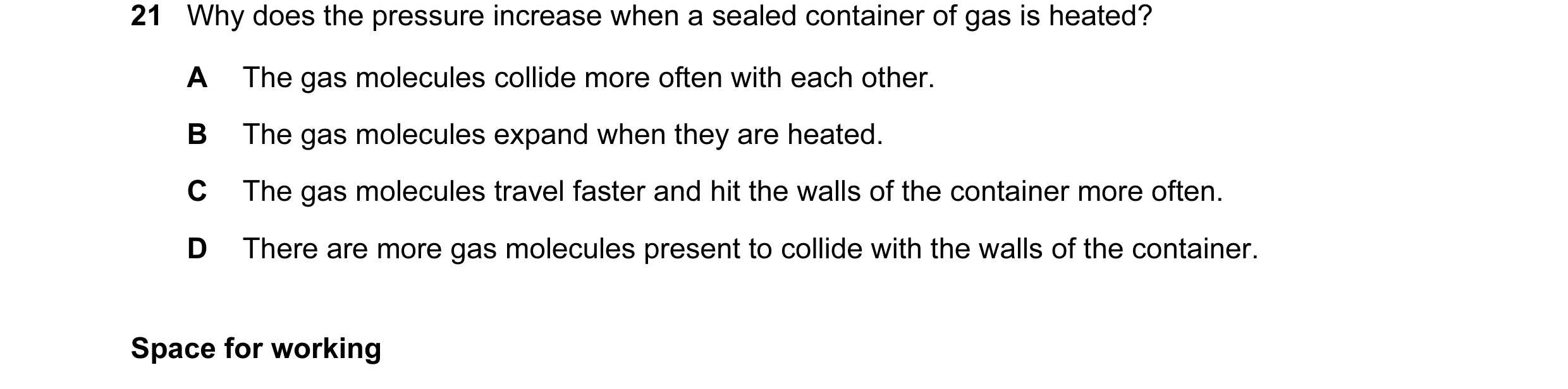
21 Why does the pressure increase when a sealed container of gas is heated? A The gas molecules collide more often with each other. B The gas molecules expand when they are heated. C The gas molecules travel faster and hit the walls of the container more often. D There are more gas molecules present to collide with the walls of the container. Space for working
1 marks
Answer: C
This question in 9702/11 Oct/Nov 2011
Q14 · Pollen grains are suspended in a liquid and are illuminated strongly 9702/11 Oct/Nov 2011
22 Pollen grains are suspended in a liquid and are illuminated strongly. When observed under a microscope they are seen to be in continuous random motion. What is the reason for this? A convection currents in the liquid B evaporation of the liquid C molecules of the liquid colliding with the pollen grains D pollen grains colliding with each other
1 marks
Answer: C
This question in 9702/11 Oct/Nov 2011
Q15 · In an experiment to demonstrate Brownian motion, smoke particles in a container are… 9702/12 Oct/Nov 2011
19 In an experiment to demonstrate Brownian motion, smoke particles in a container are illuminated by a strong light source and observed through a microscope. The particles are seen as small specks of light that are in motion. What causes the Brownian motion? A collisions between the smoke particles and air molecules B collisions between the smoke particles and the walls of the container C convection currents within the air as it is warmed by the light source D kinetic energy gained by the smoke particles on absorption of light Space for working
1 marks
Answer: A
This question in 9702/12 Oct/Nov 2011
Q16 · Pollen grains are suspended in a liquid and are illuminated strongly 9702/13 Oct/Nov 2011
23 Pollen grains are suspended in a liquid and are illuminated strongly. When observed under a microscope they are seen to be in continuous random motion. What is the reason for this? A convection currents in the liquid B evaporation of the liquid C molecules of the liquid colliding with the pollen grains D pollen grains colliding with each other
1 marks
Answer: C
This question in 9702/13 Oct/Nov 2011
Q17 · Why does the pressure increase when a sealed container of gas is heated? 9702/13 Oct/Nov 2011
24 Why does the pressure increase when a sealed container of gas is heated? A The gas molecules collide more often with each other. B The gas molecules expand when they are heated. C The gas molecules travel faster and hit the walls of the container more often. D There are more gas molecules present to collide with the walls of the container.
1 marks
Answer: C
This question in 9702/13 Oct/Nov 2011
Q18 · A mass of gas enclosed in a cylinder by a piston is heated gently 9702/12 May/June 2012
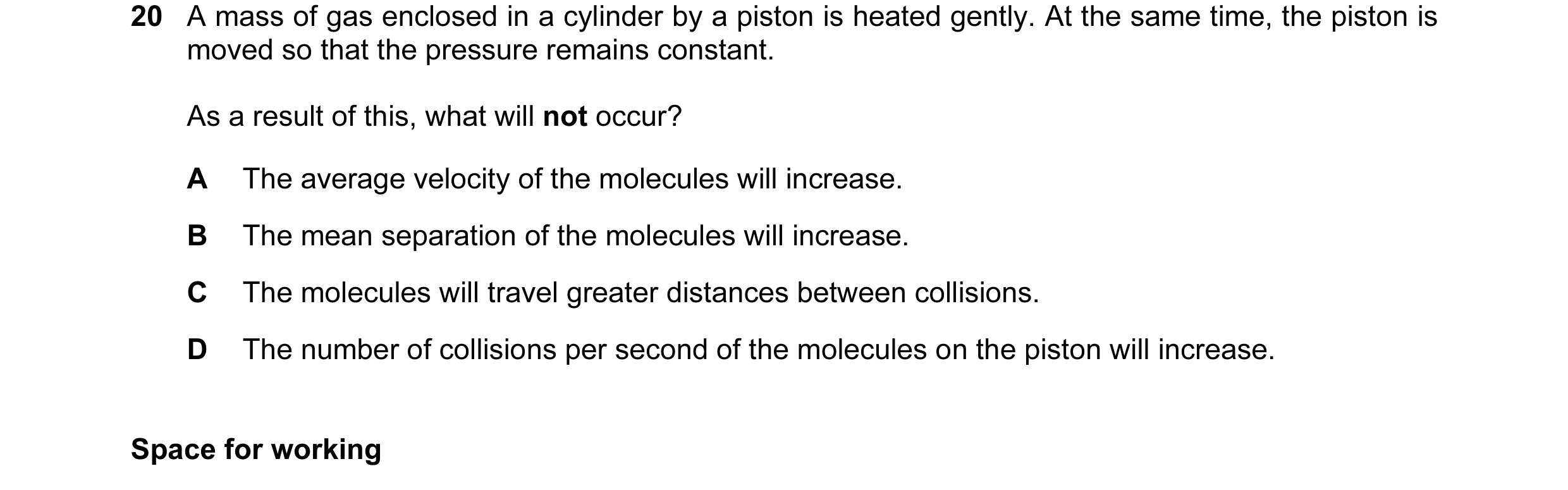
20 A mass of gas enclosed in a cylinder by a piston is heated gently. At the same time, the piston is moved so that the pressure remains constant. As a result of this, what will not occur? A The average velocity of the molecules will increase. B The mean separation of the molecules will increase. C The molecules will travel greater distances between collisions. D The number of collisions per second of the molecules on the piston will increase. Space for working
1 marks
Answer: D
This question in 9702/12 May/June 2012
Q19 · In an experiment to demonstrate Brownian motion, a transparent container is filled with… 9702/12 May/June 2012
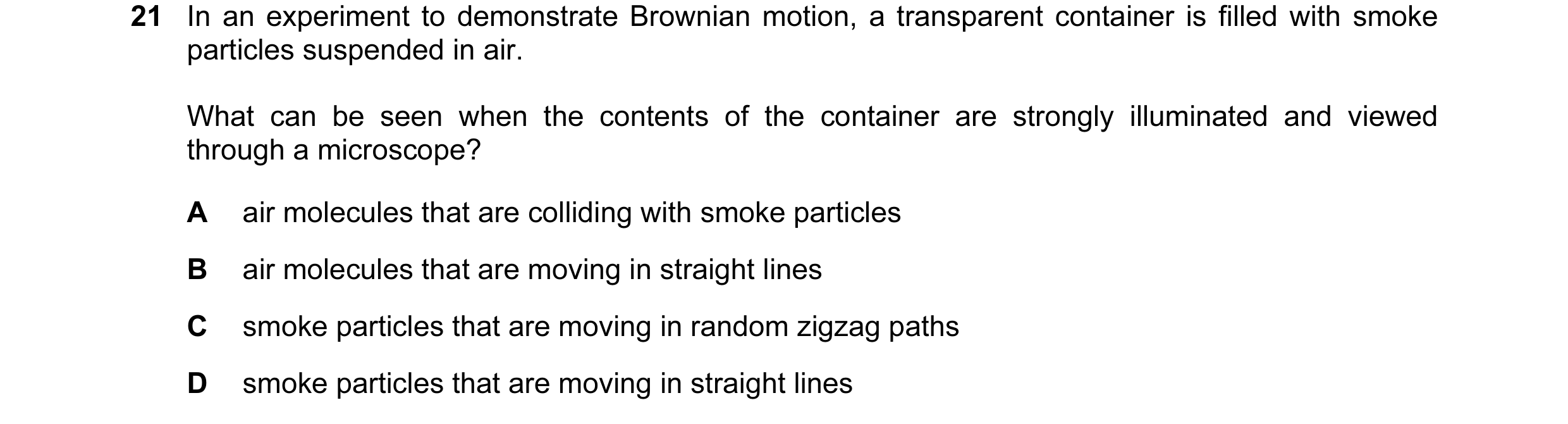
21 In an experiment to demonstrate Brownian motion, a transparent container is filled with smoke particles suspended in air. What can be seen when the contents of the container are strongly illuminated and viewed through a microscope? A air molecules that are colliding with smoke particles B air molecules that are moving in straight lines C smoke particles that are moving in random zigzag paths D smoke particles that are moving in straight lines
1 marks
Answer: C
This question in 9702/12 May/June 2012
Q20 · Which row correctly describes the spacing, ordering and motion of the molecules in water… 9702/11 Oct/Nov 2012
22 Which row correctly describes the spacing, ordering and motion of the molecules in water and in ice when both are at a temperature of 0 °C? spacing ordering motion A molecules in ice are a regular pattern of molecules in both ice closer together than molecules in both ice and water have the molecules in water and water same average speed B molecules in ice are a regular pattern of molecules in ice travel closer together than molecules in ice but not more slowly than those molecules in water in water in water C molecules in ice are a regular pattern of molecules in ice travel further apart than molecules in both ice more slowly than those molecules in water and water in water D molecules in ice are a regular pattern of molecules in both ice further apart than molecules in ice but not and water have the molecules in water in water same average speed Space for working
1 marks
Answer: D
This question in 9702/11 Oct/Nov 2012
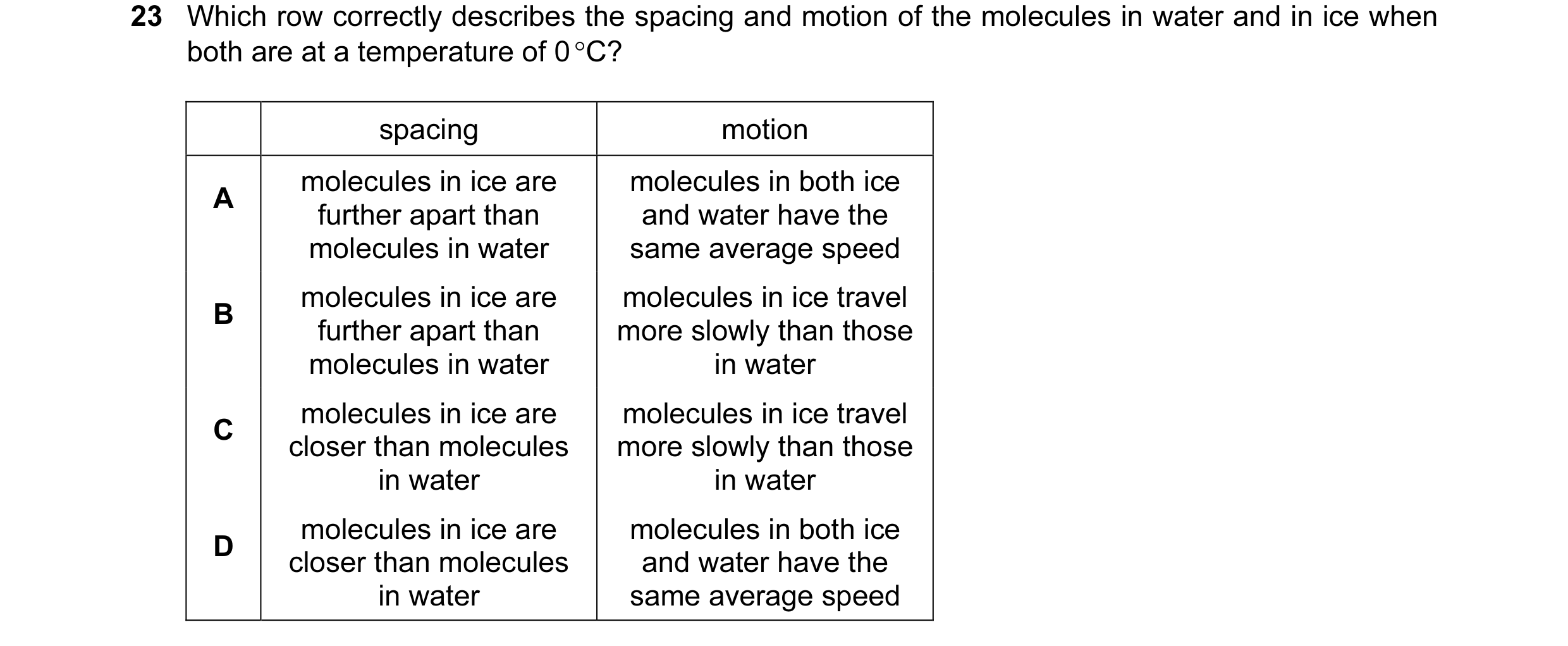
Q21 · Which row correctly describes the spacing and motion of the molecules in water and in ice… 9702/12 Oct/Nov 2012
23 Which row correctly describes the spacing and motion of the molecules in water and in ice when both are at a temperature of 0 °C? spacing motion molecules in ice are molecules in both ice A further apart than and water have the molecules in water same average speed molecules in ice are molecules in ice travel B further apart than more slowly than those molecules in water in water molecules in ice are molecules in ice travel C closer than molecules more slowly than those in water in water molecules in ice are molecules in both ice D closer than molecules and water have the in water same average speed
1 marks
Answer: A
This question in 9702/12 Oct/Nov 2012
Q22 · What leads to the conclusion that the movement of molecules is random? 9702/12 Oct/Nov 2012
25 What leads to the conclusion that the movement of molecules is random? A evaporation of water at room temperature B conduction of electricity in water C convection currents in air D motion of dust particles in air
1 marks
Answer: D
This question in 9702/12 Oct/Nov 2012
Q23 · Which row correctly describes the ordering and motion of the molecules in water and in… 9702/13 Oct/Nov 2012
22 Which row correctly describes the ordering and motion of the molecules in water and in ice when both are at a temperature of 0 °C? ordering motion A a regular pattern molecules in both ice of molecules in ice and water have the but not in water same average speed B a regular pattern molecules in ice of molecules in ice travel more slowly but not in water than those in water C a regular pattern molecules in ice of molecules in both travel more slowly ice and water than those in water D a regular pattern molecules in both ice of molecules in both and water have the ice and water same average speed
1 marks
Answer: A
This question in 9702/13 Oct/Nov 2012
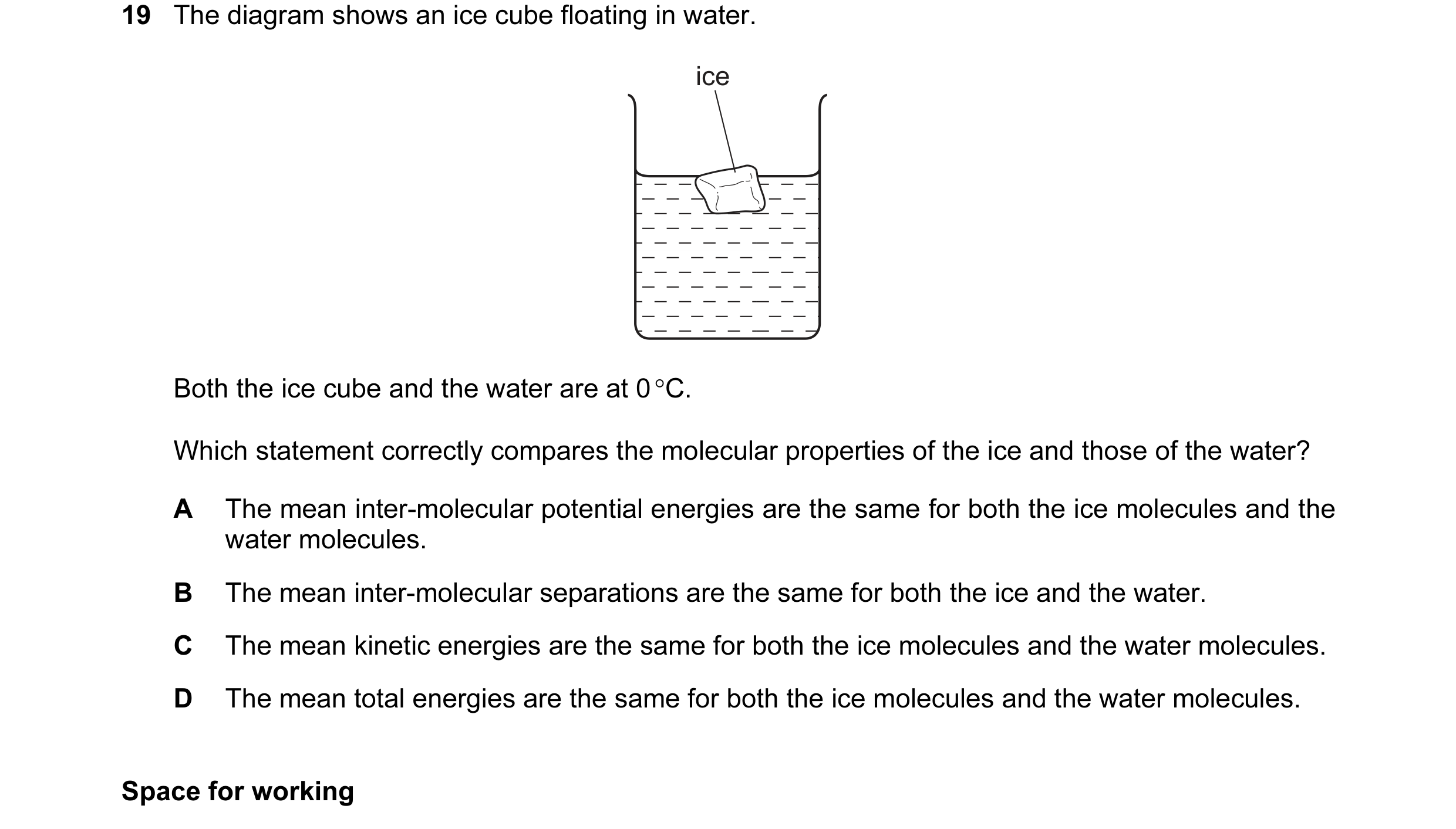
Q24 · The diagram shows an ice cube floating in water 9702/12 May/June 2013
19 The diagram shows an ice cube floating in water. ice Both the ice cube and the water are at 0 °C. Which statement correctly compares the molecular properties of the ice and those of the water? A The mean inter-molecular potential energies are the same for both the ice molecules and the water molecules. B The mean inter-molecular separations are the same for both the ice and the water. C The mean kinetic energies are the same for both the ice molecules and the water molecules. D The mean total energies are the same for both the ice molecules and the water molecules. Space for working
1 marks
Answer: C
This question in 9702/12 May/June 2013
Q25 · Ice at a temperature of 0 °C is a rare example of a solid that floats on its liquid form… 9702/13 May/June 2013
17 Ice at a temperature of 0 °C is a rare example of a solid that floats on its liquid form, in this case water, when they are both at the same temperature. What is the explanation for this? A The average speed of the molecules in the ice is greater than the average speed of the molecules in the water. B The average speed of the molecules in the water is greater than the average speed of the molecules in the ice. C The mean separation of the molecules in the ice is greater than the mean separation of the molecules in the water. D The mean separation of the molecules in the water is greater than the mean separation of the molecules in the ice. Space for working
1 marks
Answer: C
This question in 9702/13 May/June 2013
Q26 · Below are four short paragraphs describing the molecules in a beaker of water at 50 oC 9702/11 Oct/Nov 2013
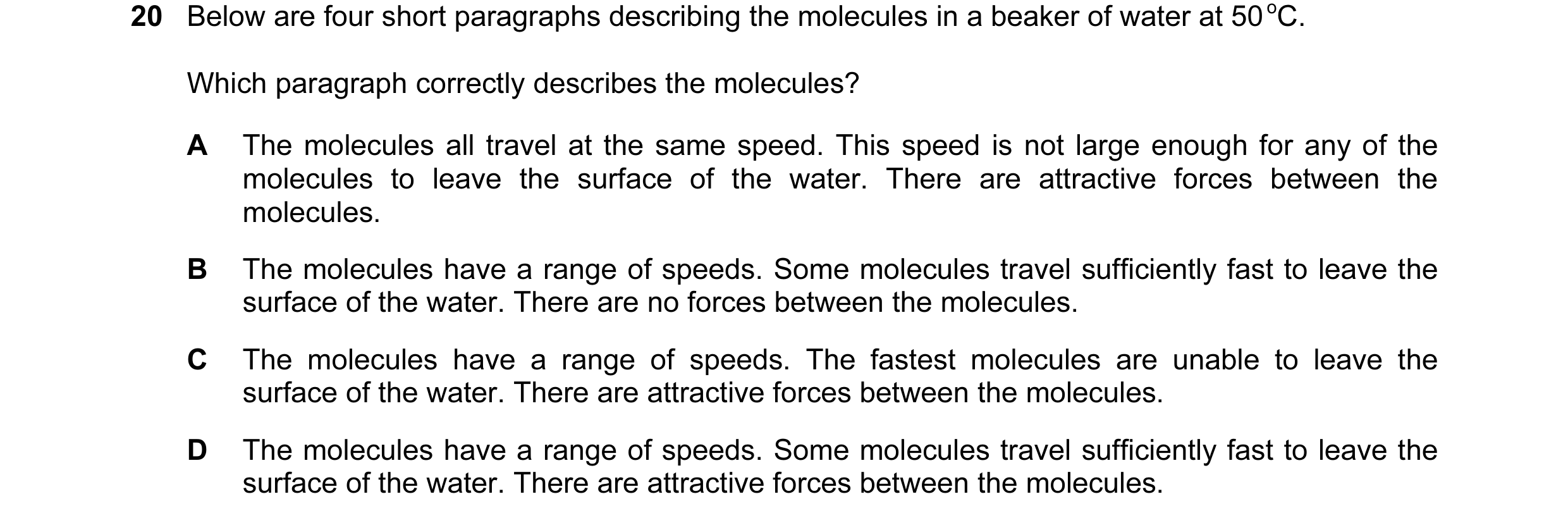
20 Below are four short paragraphs describing the molecules in a beaker of water at 50 oC. Which paragraph correctly describes the molecules? A The molecules all travel at the same speed. This speed is not large enough for any of the molecules to leave the surface of the water. There are attractive forces between the molecules. B The molecules have a range of speeds. Some molecules travel sufficiently fast to leave the surface of the water. There are no forces between the molecules. C The molecules have a range of speeds. The fastest molecules are unable to leave the surface of the water. There are attractive forces between the molecules. D The molecules have a range of speeds. Some molecules travel sufficiently fast to leave the surface of the water. There are attractive forces between the molecules.
1 marks
Answer: D
This question in 9702/11 Oct/Nov 2013
Q27 · Below are four short paragraphs describing the molecules in a beaker of water at 50 oC 9702/12 Oct/Nov 2013
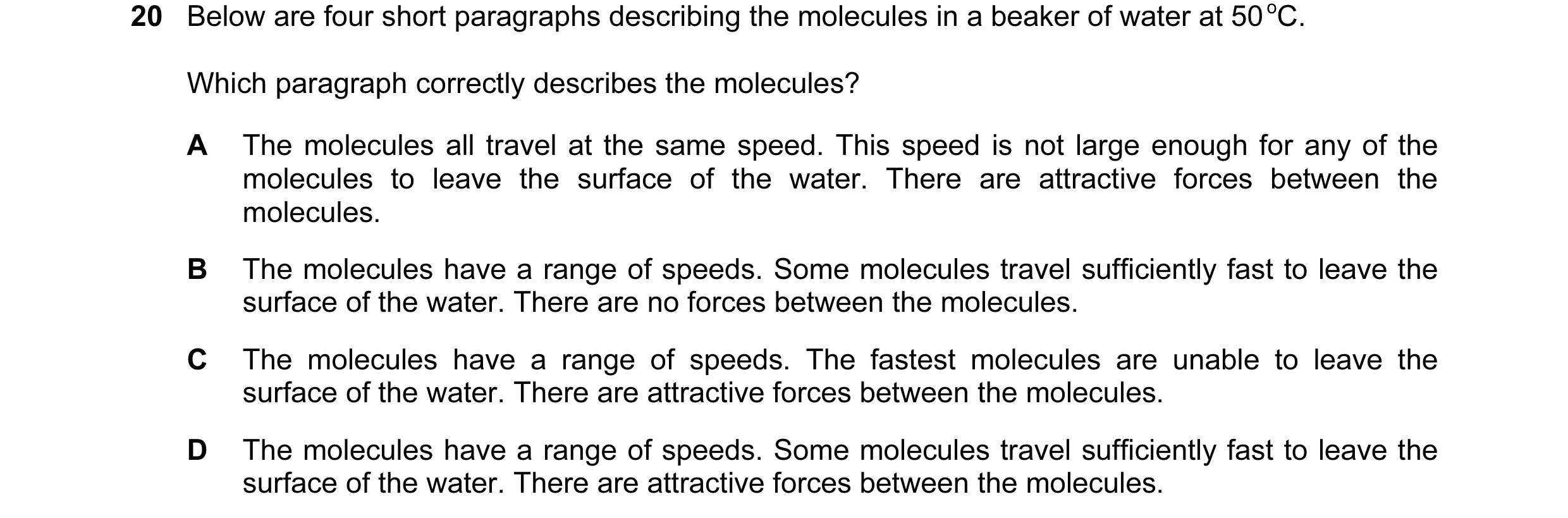
20 Below are four short paragraphs describing the molecules in a beaker of water at 50 oC. Which paragraph correctly describes the molecules? A The molecules all travel at the same speed. This speed is not large enough for any of the molecules to leave the surface of the water. There are attractive forces between the molecules. B The molecules have a range of speeds. Some molecules travel sufficiently fast to leave the surface of the water. There are no forces between the molecules. C The molecules have a range of speeds. The fastest molecules are unable to leave the surface of the water. There are attractive forces between the molecules. D The molecules have a range of speeds. Some molecules travel sufficiently fast to leave the surface of the water. There are attractive forces between the molecules.
1 marks
Answer: D
This question in 9702/12 Oct/Nov 2013
Q28 · In an experiment to demonstrate Brownian motion, a transparent container is filled with… 9702/13 Oct/Nov 2013
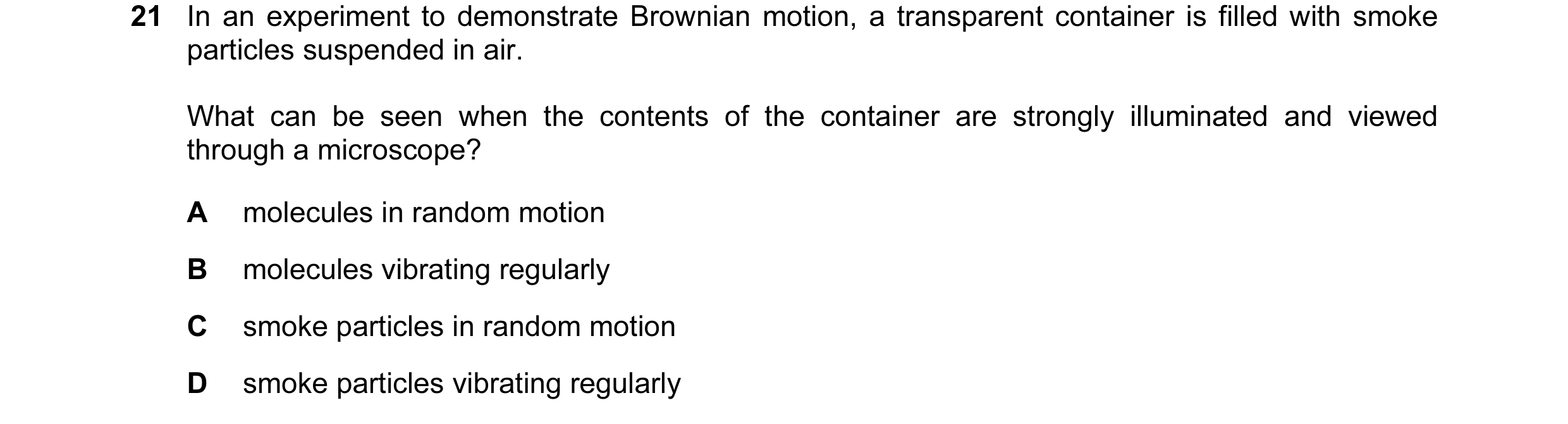
21 In an experiment to demonstrate Brownian motion, a transparent container is filled with smoke particles suspended in air. What can be seen when the contents of the container are strongly illuminated and viewed through a microscope? A molecules in random motion B molecules vibrating regularly C smoke particles in random motion D smoke particles vibrating regularly
1 marks
Answer: C
This question in 9702/13 Oct/Nov 2013
Q29 · There is one temperature, about 0.01 °C, at which water, water vapour and ice can… 9702/11 May/June 2014
18 There is one temperature, about 0.01 °C, at which water, water vapour and ice can co-exist in equilibrium. Which statement about the properties of the molecules at this temperature is correct? A Ice molecules are closer to one another than water molecules. B The mean kinetic energy of water molecules is greater than the mean kinetic energy of ice molecules. C Water vapour molecules are less massive than water molecules. D Water vapour molecules have the same mean speed as both ice and water molecules.
1 marks
Answer: D
This question in 9702/11 May/June 2014
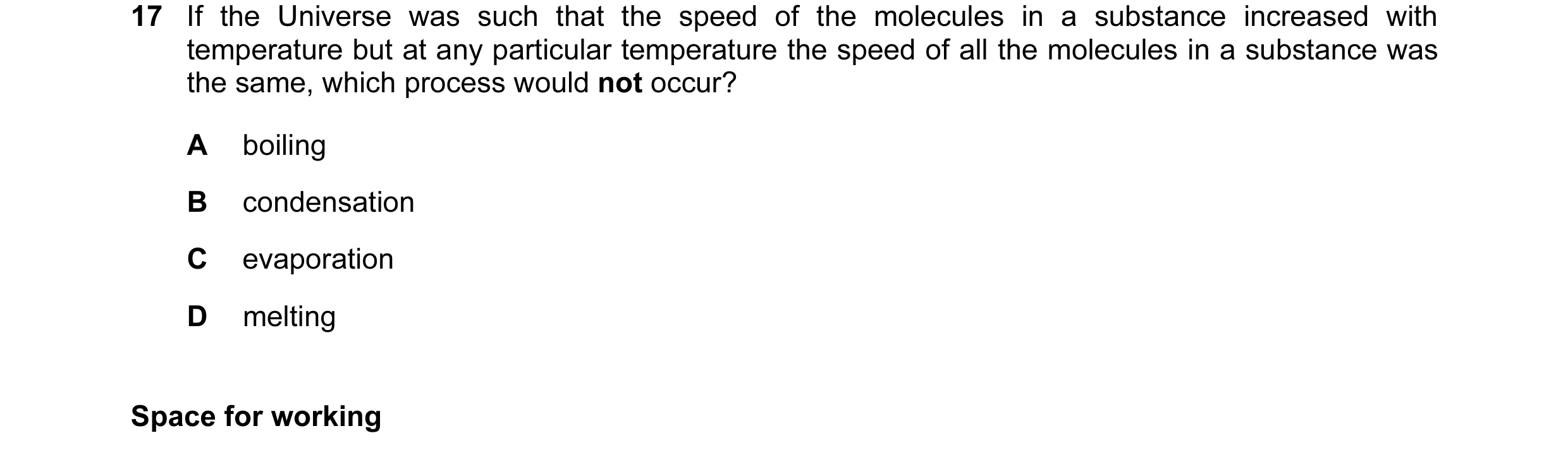
Q30 · If the Universe was such that the speed of the molecules in a substance increased with… 9702/12 May/June 2014
17 If the Universe was such that the speed of the molecules in a substance increased with temperature but at any particular temperature the speed of all the molecules in a substance was the same, which process would not occur? A boiling B condensation C evaporation D melting Space for working
1 marks
Answer: C
This question in 9702/12 May/June 2014
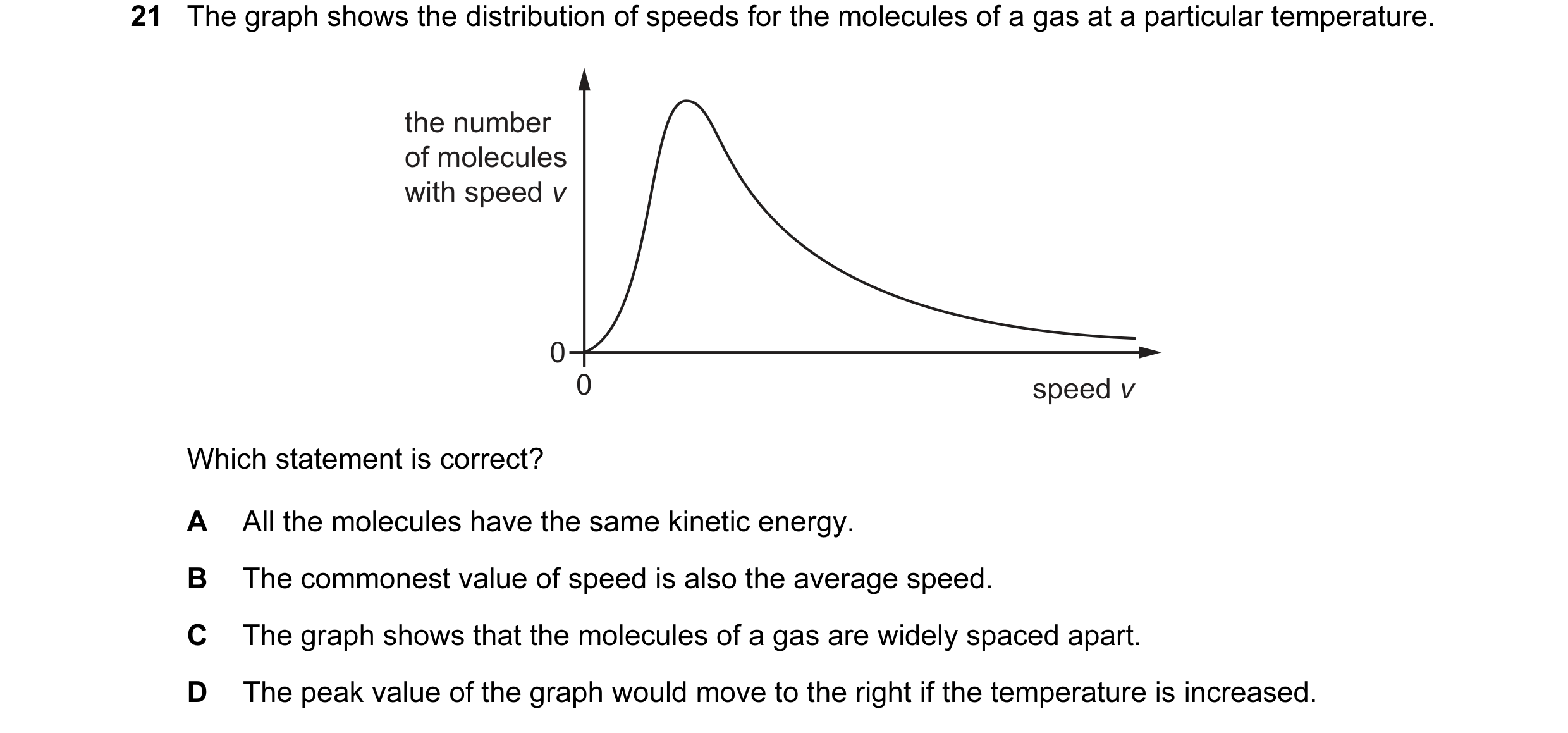
Q31 · The graph shows the distribution of speeds for the molecules of a gas at a particular… 9702/13 May/June 2014
21 The graph shows the distribution of speeds for the molecules of a gas at a particular temperature. the number of molecules with speed v 0 0 speed v Which statement is correct? A All the molecules have the same kinetic energy. B The commonest value of speed is also the average speed. C The graph shows that the molecules of a gas are widely spaced apart. D The peak value of the graph would move to the right if the temperature is increased.
1 marks
Answer: D
This question in 9702/13 May/June 2014
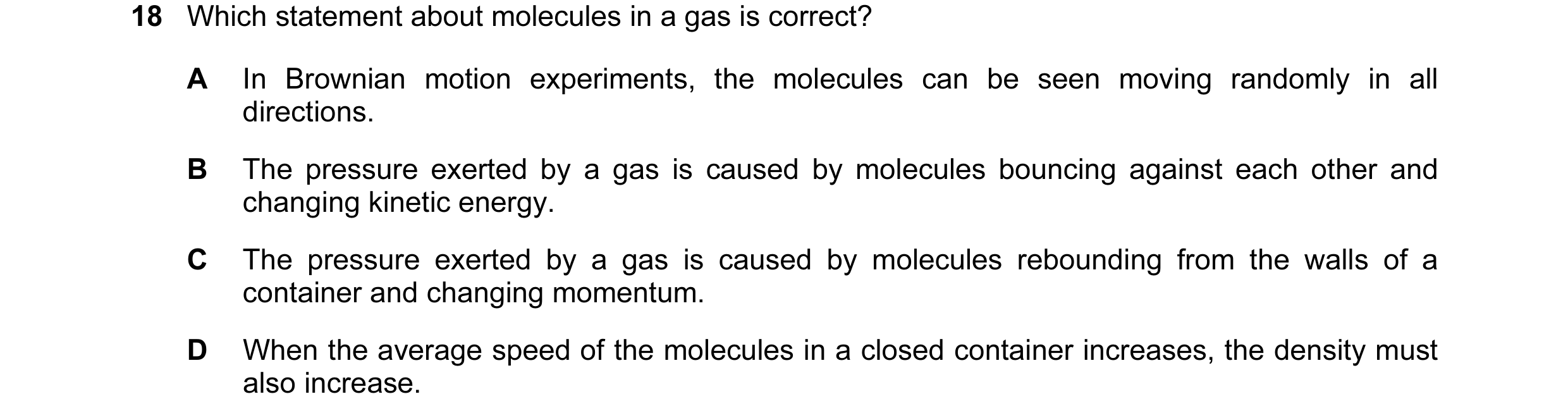
Q32 · Which statement about molecules in a gas is correct? 9702/11 Oct/Nov 2014
18 Which statement about molecules in a gas is correct? A In Brownian motion experiments, the molecules can be seen moving randomly in all directions. B The pressure exerted by a gas is caused by molecules bouncing against each other and changing kinetic energy. C The pressure exerted by a gas is caused by molecules rebounding from the walls of a container and changing momentum. D When the average speed of the molecules in a closed container increases, the density must also increase.
1 marks
Answer: C
This question in 9702/11 Oct/Nov 2014
Q33 · Which statement about molecules in a gas is correct? 9702/12 Oct/Nov 2014
18 Which statement about molecules in a gas is correct? A In Brownian motion experiments, the molecules can be seen moving randomly in all directions. B The pressure exerted by a gas is caused by molecules bouncing against each other and changing kinetic energy. C The pressure exerted by a gas is caused by molecules rebounding from the walls of a container and changing momentum. D When the average speed of the molecules in a closed container increases, the density must also increase.
1 marks
Answer: C
This question in 9702/12 Oct/Nov 2014
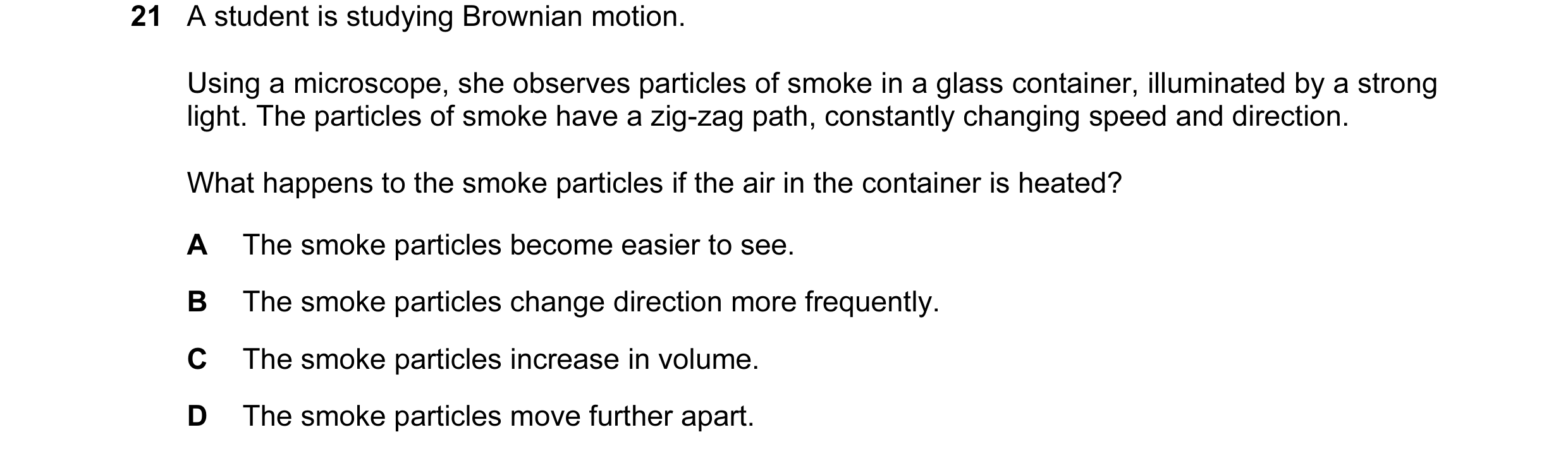
Q34 · A student is studying Brownian motion 9702/13 Oct/Nov 2014
21 A student is studying Brownian motion. Using a microscope, she observes particles of smoke in a glass container, illuminated by a strong light. The particles of smoke have a zig-zag path, constantly changing speed and direction. What happens to the smoke particles if the air in the container is heated? A The smoke particles become easier to see. B The smoke particles change direction more frequently. C The smoke particles increase in volume. D The smoke particles move further apart.
1 marks
Answer: B
This question in 9702/13 Oct/Nov 2014
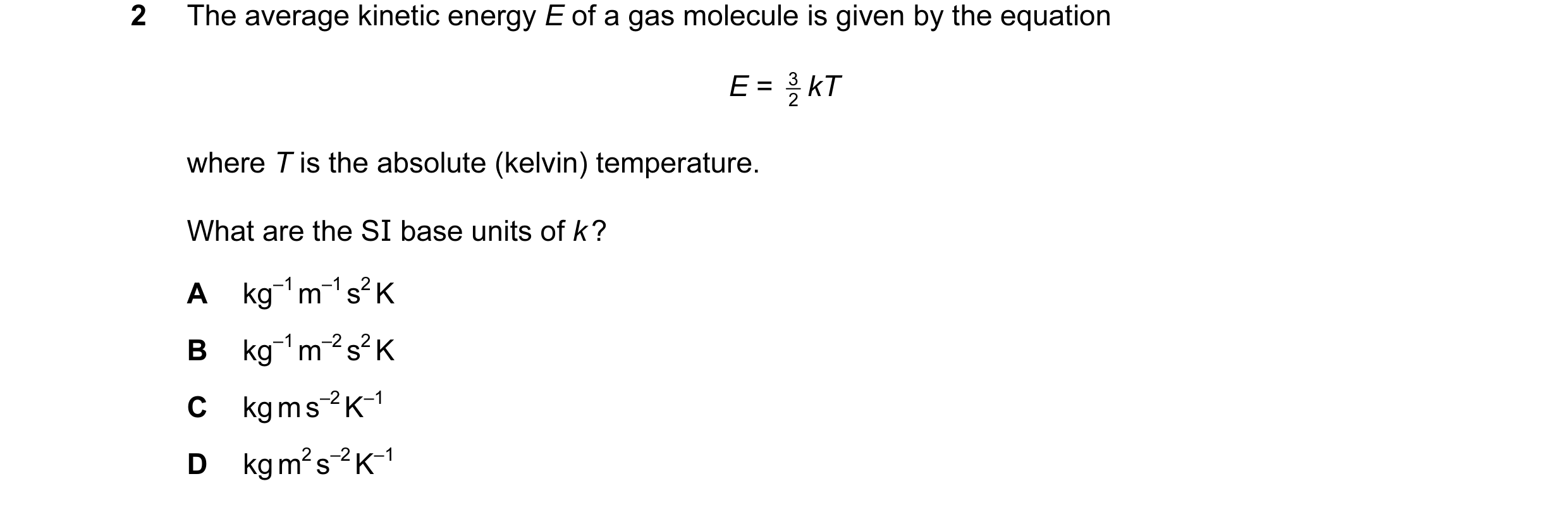
Q35 · The average kinetic energy E of a gas molecule is given by the equation E = 2 3 kT where… 9702/12 May/June 2015
2 The average kinetic energy E of a gas molecule is given by the equation E = 2 3 kT where T is the absolute (kelvin) temperature. What are the SI base units of k ? A kg–1 m–1 s2 K B kg–1 m–2 s2 K C kg m s–2 K–1 D kg m2 s–2 K–1
1 marks
Answer: D
This question in 9702/12 May/June 2015
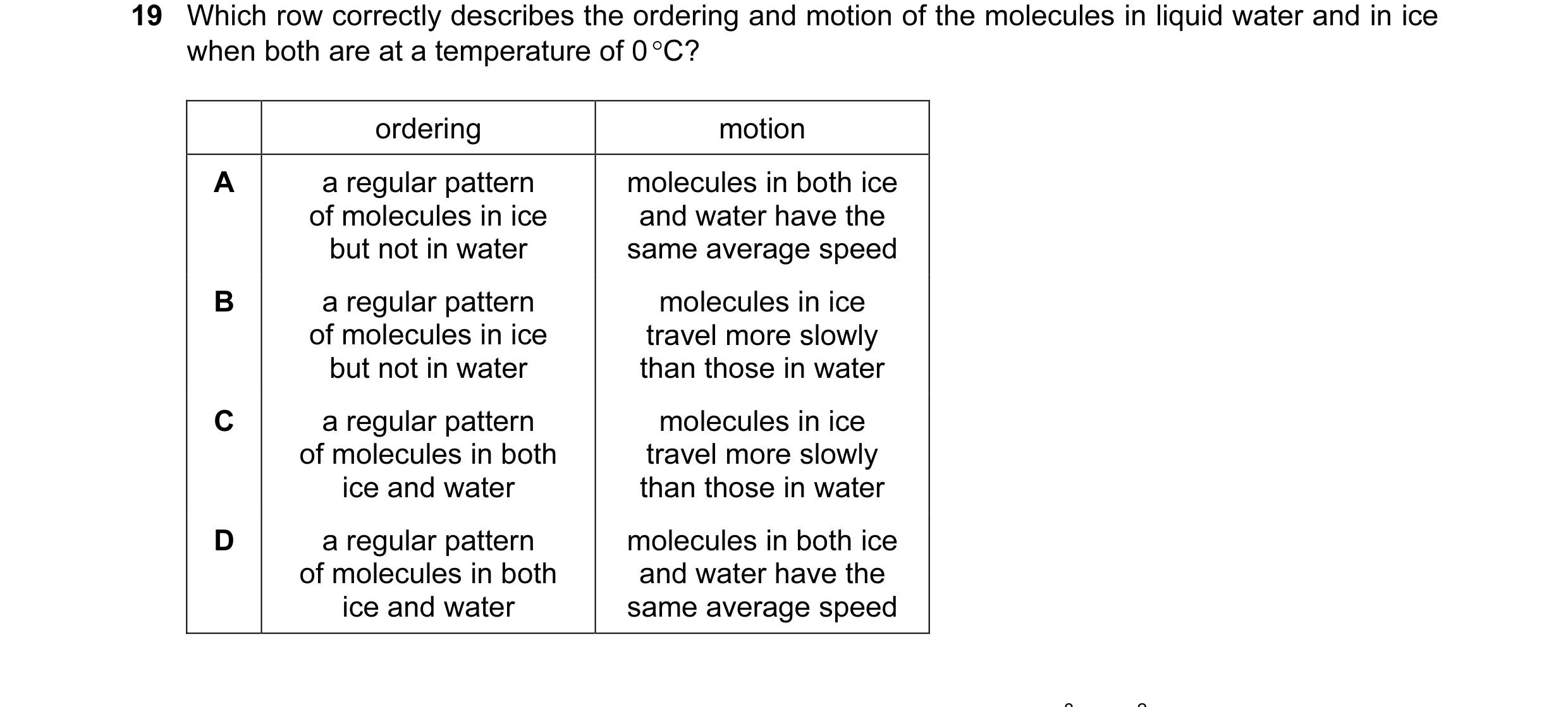
Q36 · Which row correctly describes the ordering and motion of the molecules in liquid water… 9702/12 May/June 2015
19 Which row correctly describes the ordering and motion of the molecules in liquid water and in ice when both are at a temperature of 0 °C? ordering motion A a regular pattern molecules in both ice of molecules in ice and water have the but not in water same average speed B a regular pattern molecules in ice of molecules in ice travel more slowly but not in water than those in water C a regular pattern molecules in ice of molecules in both travel more slowly ice and water than those in water D a regular pattern molecules in both ice of molecules in both and water have the ice and water same average speed
1 marks
Answer: A
This question in 9702/12 May/June 2015
Q37 · When ice melts, it contracts 9702/13 May/June 2015
20 When ice melts, it contracts. Which row is correct for ice turning into water? distance between density molecules A decreases decreases B decreases increases C increases decreases D increases increases
1 marks
Answer: B
This question in 9702/13 May/June 2015
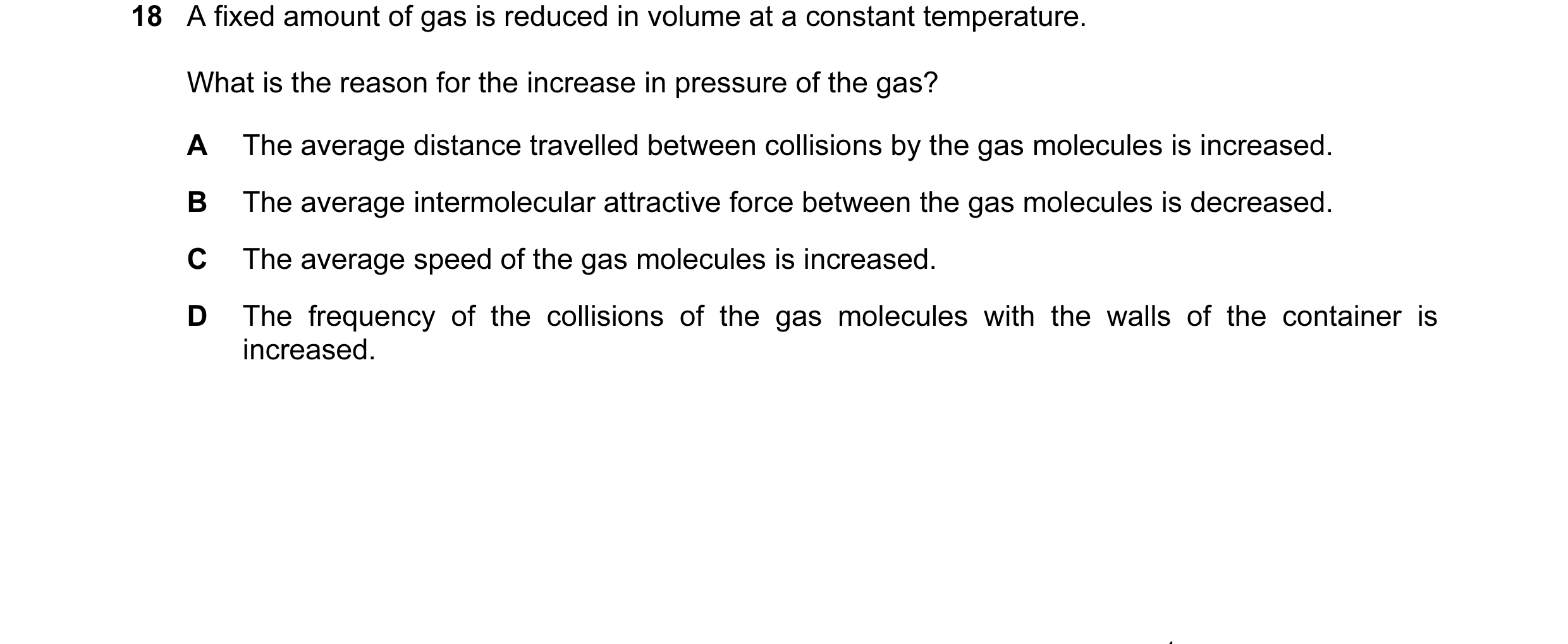
Q38 · A fixed amount of gas is reduced in volume at a constant temperature 9702/11 Oct/Nov 2015
18 A fixed amount of gas is reduced in volume at a constant temperature. What is the reason for the increase in pressure of the gas? A The average distance travelled between collisions by the gas molecules is increased. B The average intermolecular attractive force between the gas molecules is decreased. C The average speed of the gas molecules is increased. D The frequency of the collisions of the gas molecules with the walls of the container is increased.
1 marks
Answer: D
This question in 9702/11 Oct/Nov 2015
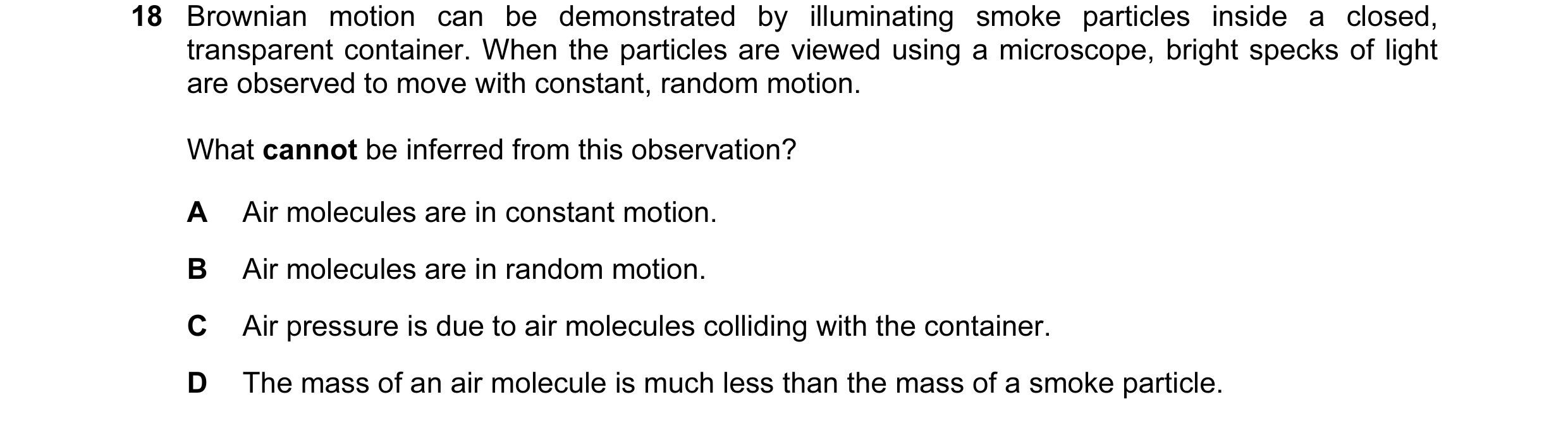
Q39 · Brownian motion can be demonstrated by illuminating smoke particles inside a closed… 9702/13 Oct/Nov 2015
18 Brownian motion can be demonstrated by illuminating smoke particles inside a closed, transparent container. When the particles are viewed using a microscope, bright specks of light are observed to move with constant, random motion. What cannot be inferred from this observation? A Air molecules are in constant motion. B Air molecules are in random motion. C Air pressure is due to air molecules colliding with the container. D The mass of an air molecule is much less than the mass of a smoke particle.
1 marks
Answer: C
This question in 9702/13 Oct/Nov 2015
 1 / 11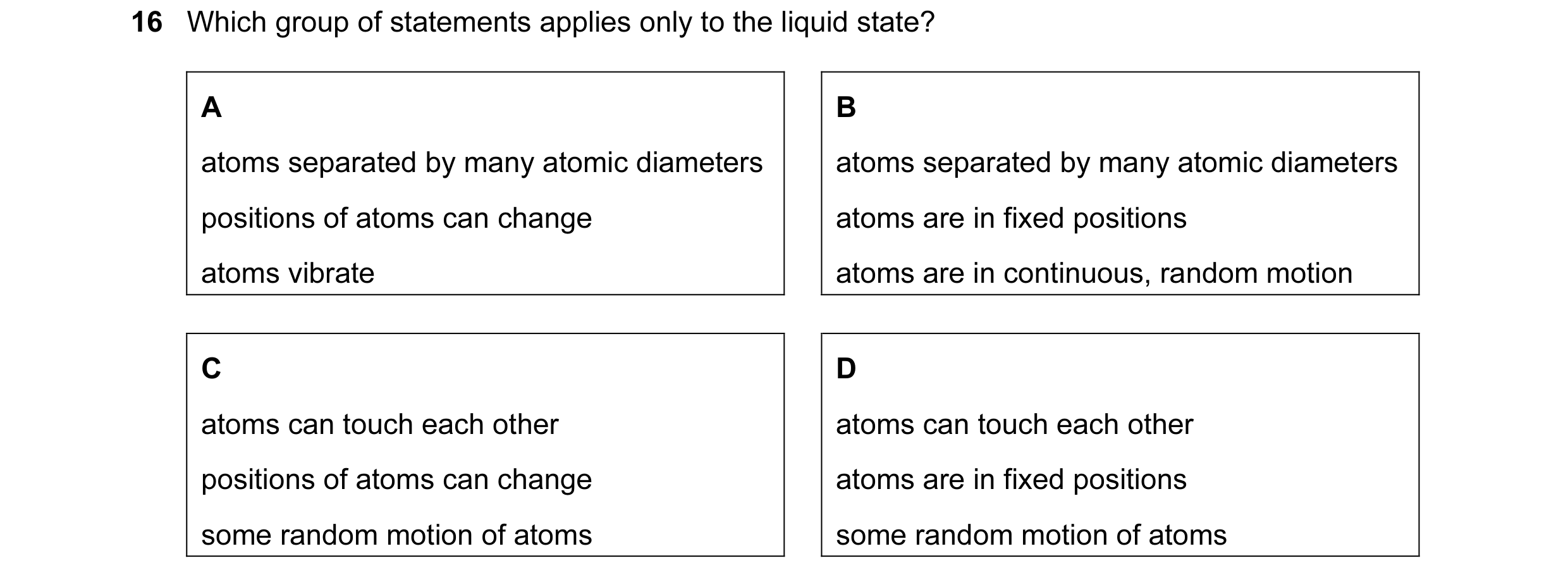


 2 / 11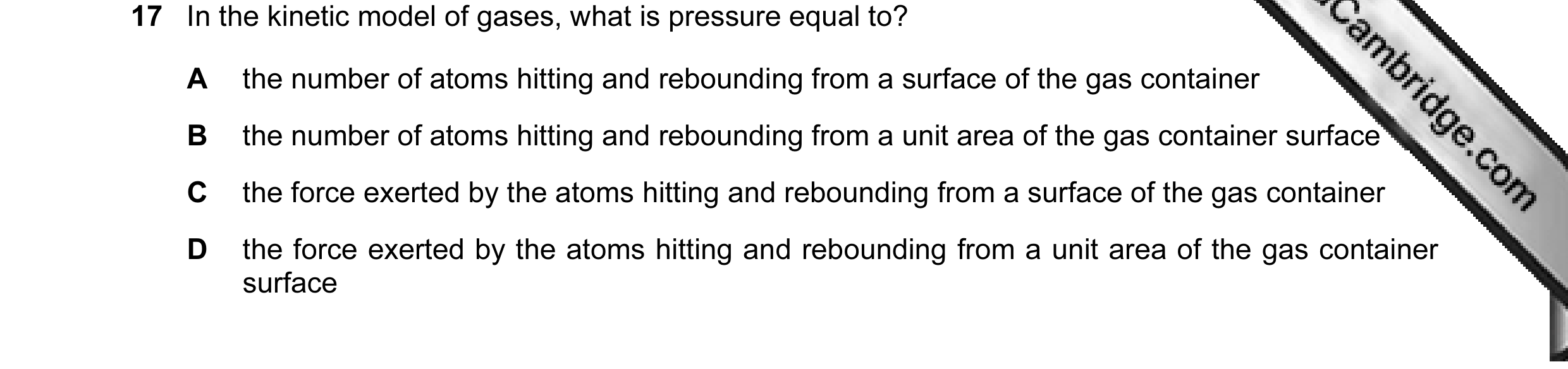
 3 / 11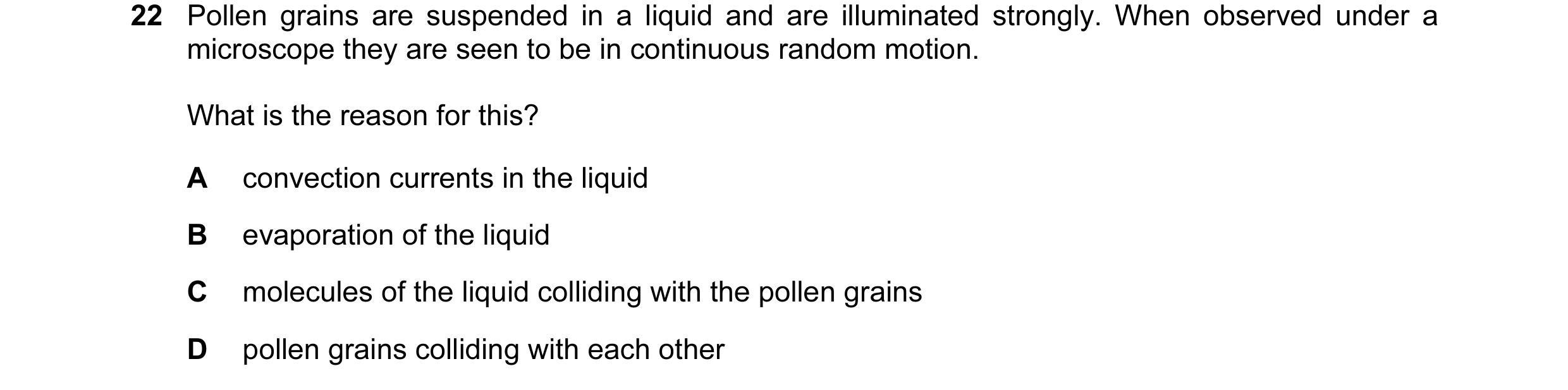
 4 / 11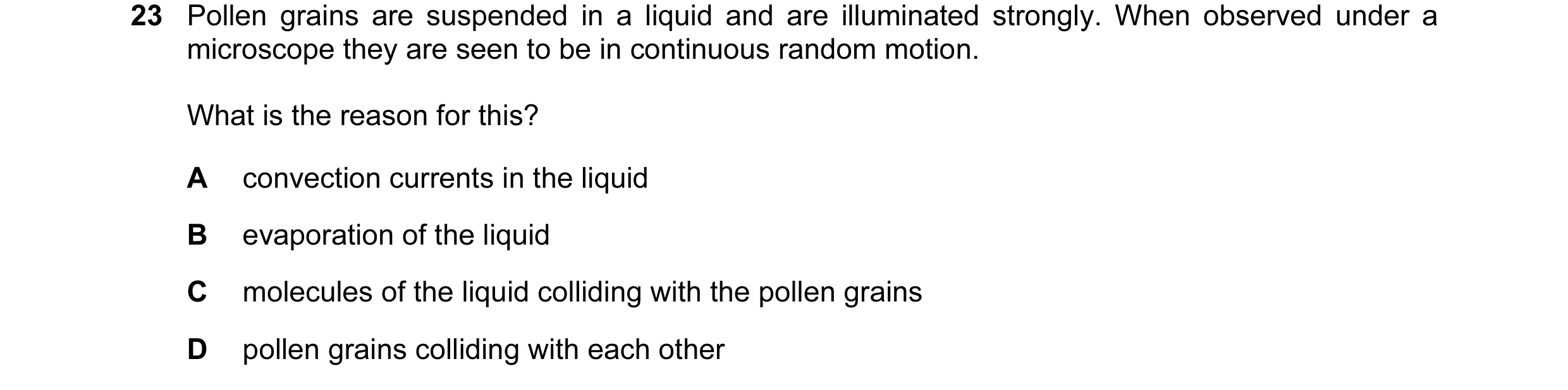

 5 / 11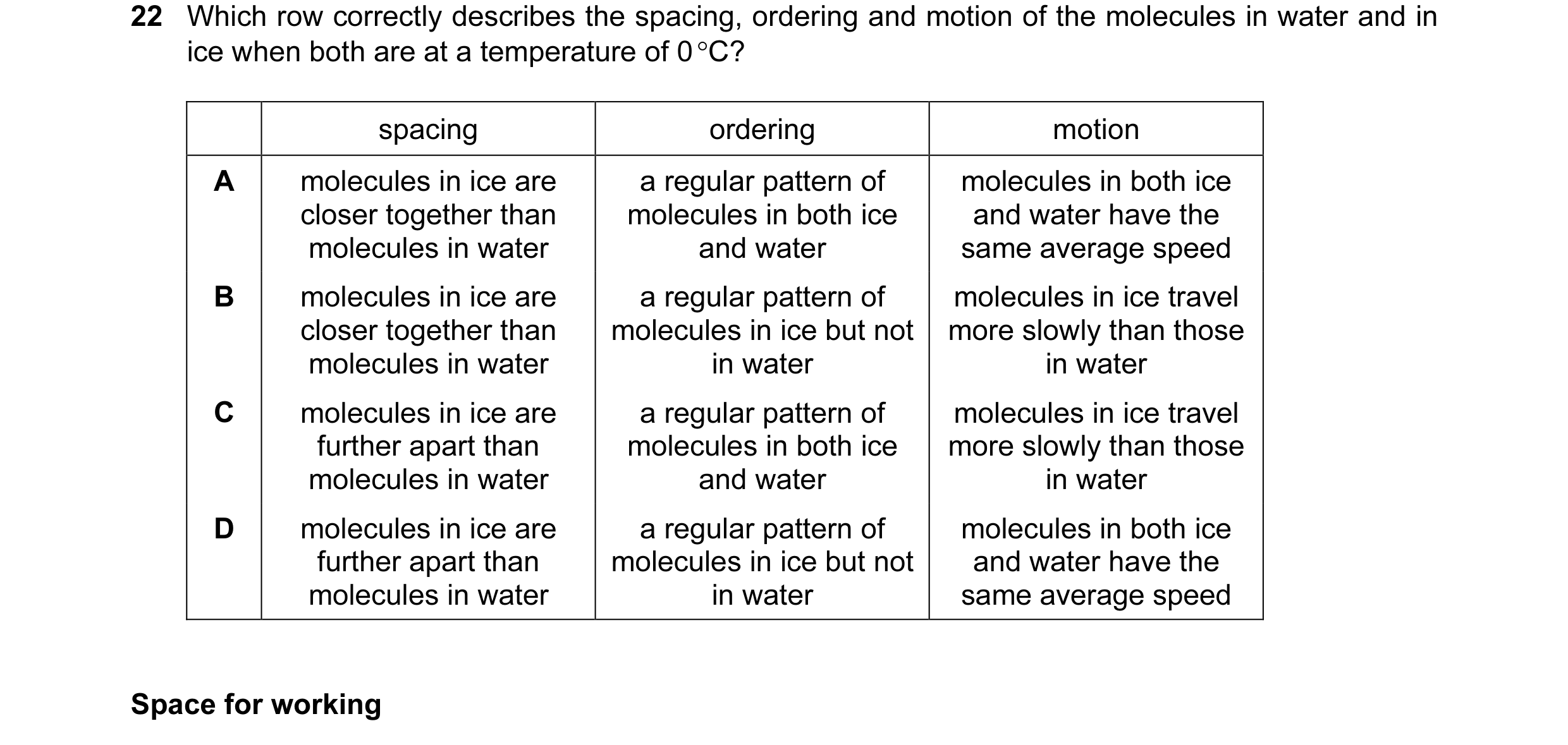
 6 / 11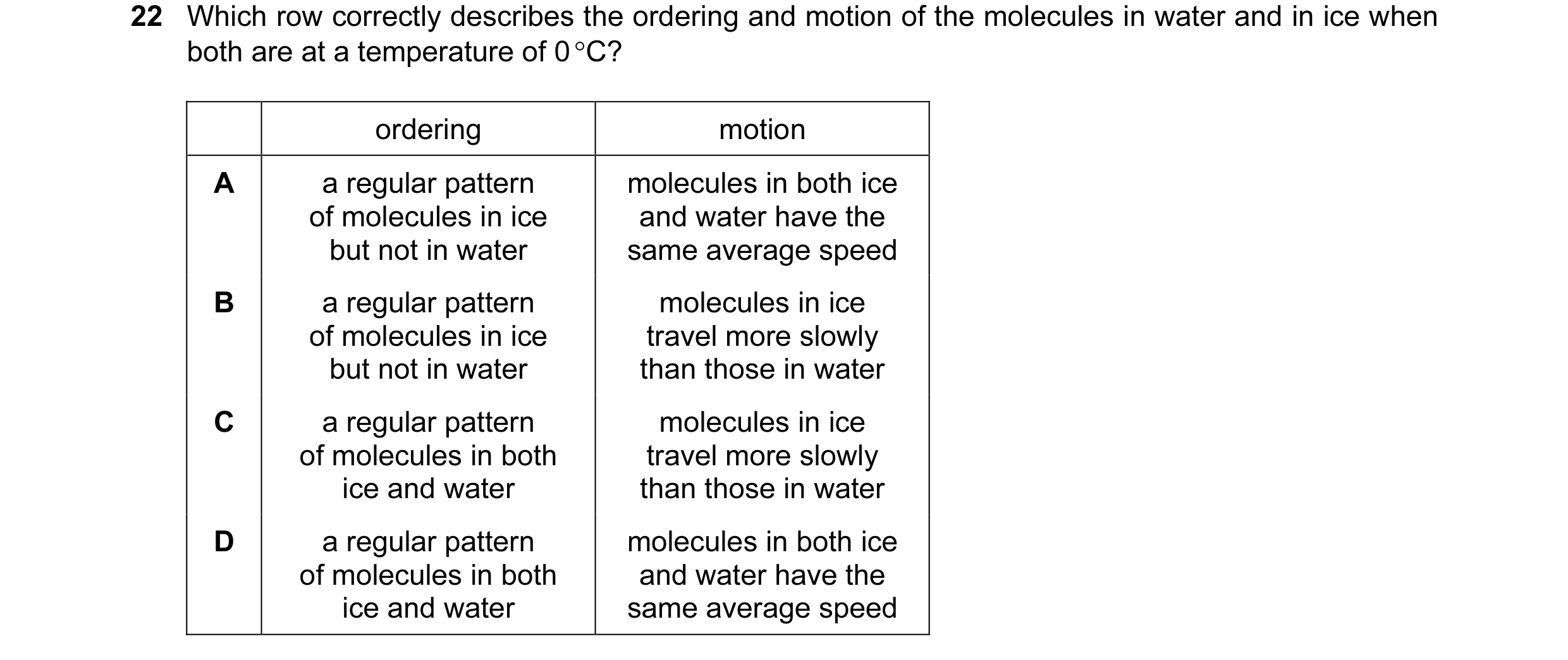
 7 / 11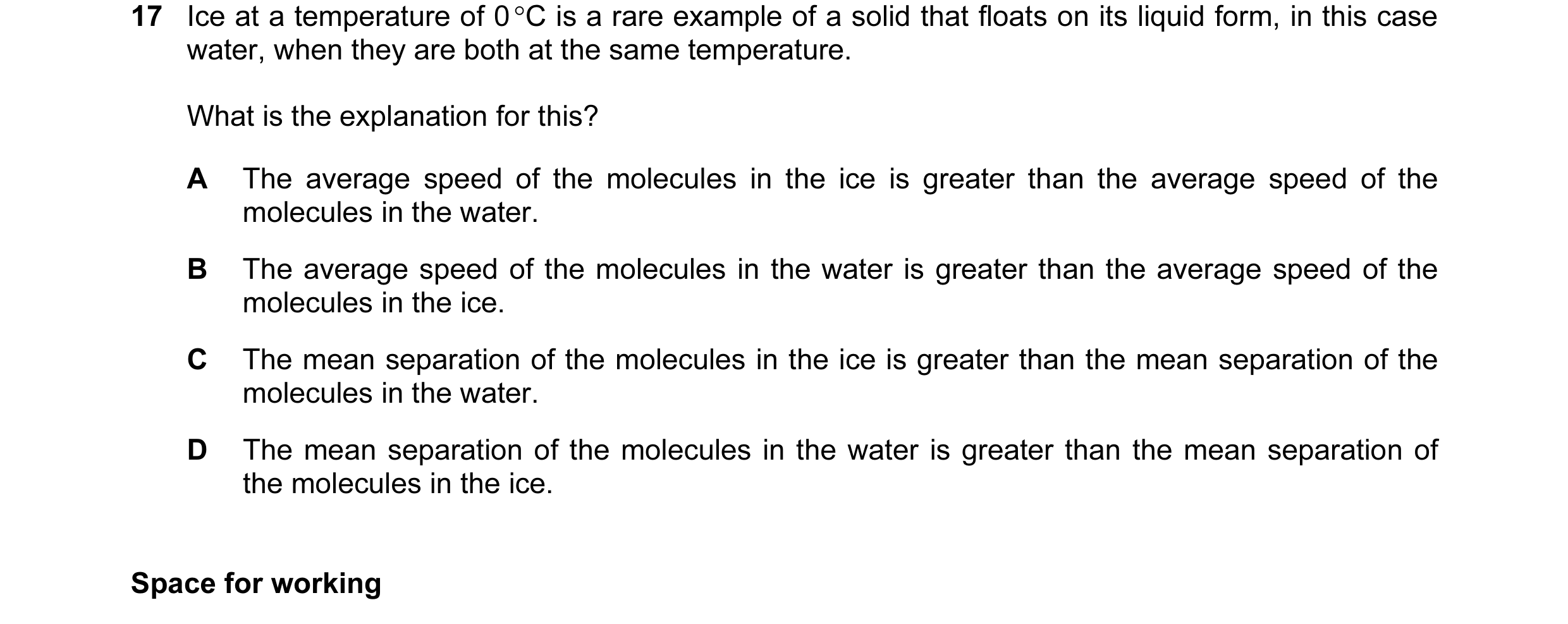
 8 / 11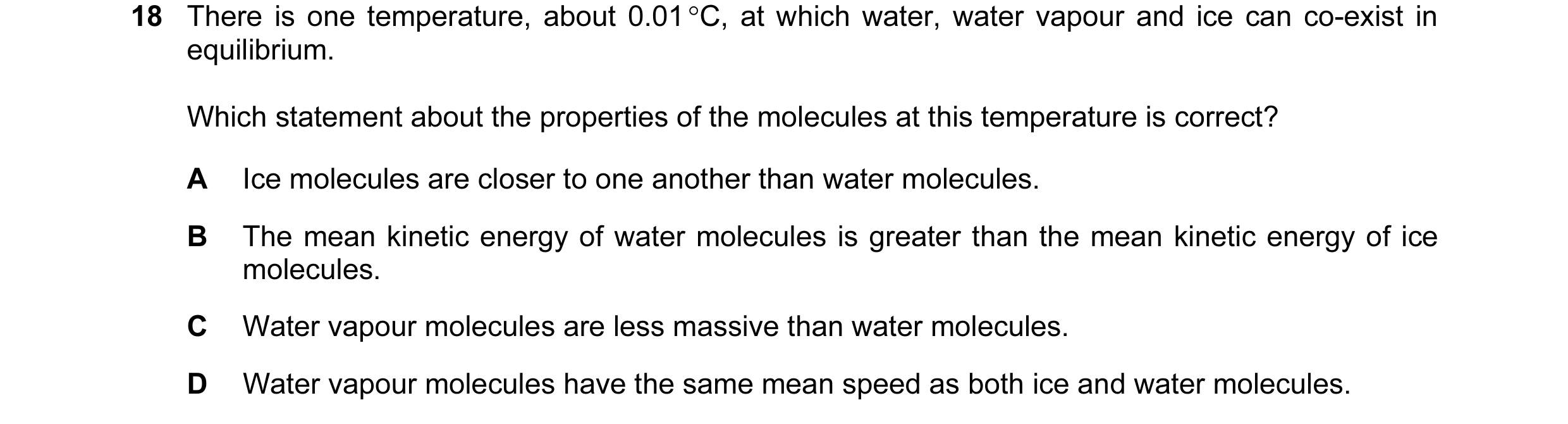
 9 / 11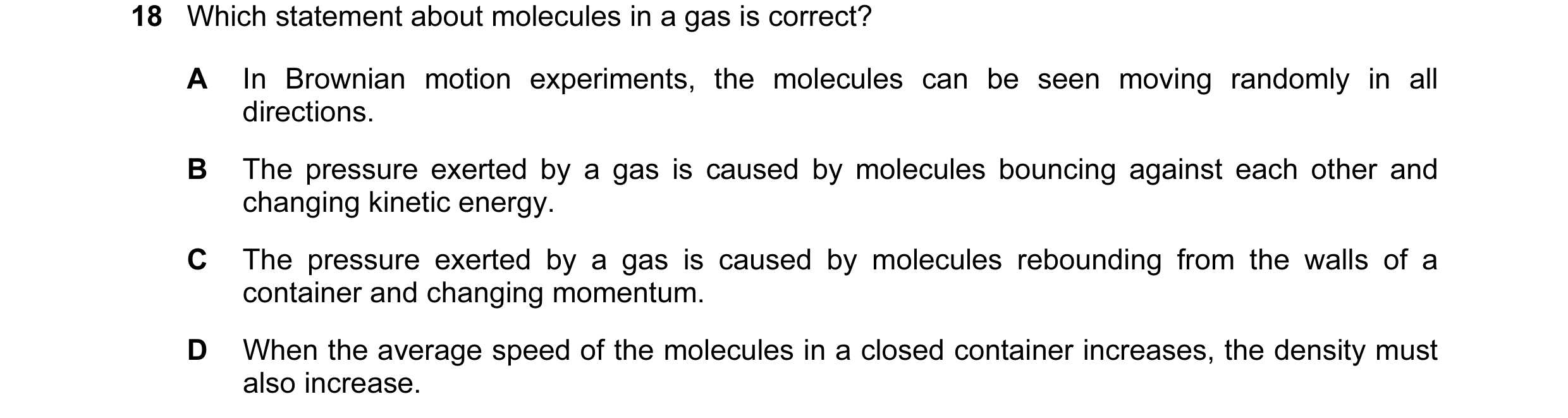
 10 / 11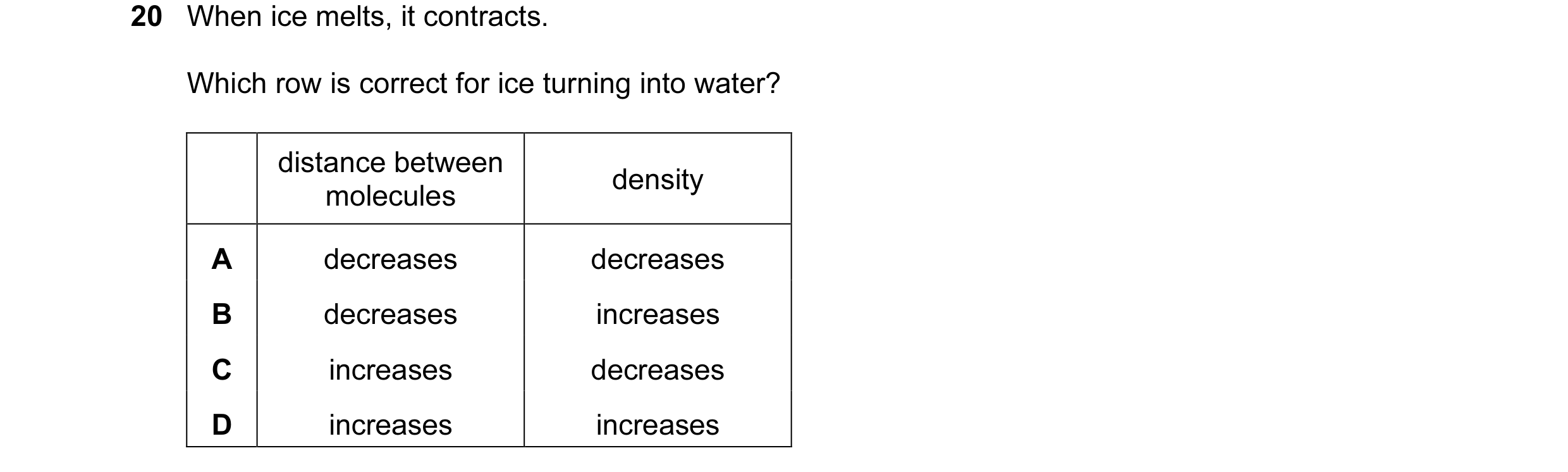
 11 / 11