Cambridge A Level Physics 9702 — 2006 Oct/Nov Paper 4 · Variant 1
9702/41/O/N/06 · 8 questions · 60 marks · ≈68 min
The question paper and its mark scheme, free to read here and free to download. This is Cambridge’s own paper, exactly as it was sat.
Question paper16 pages
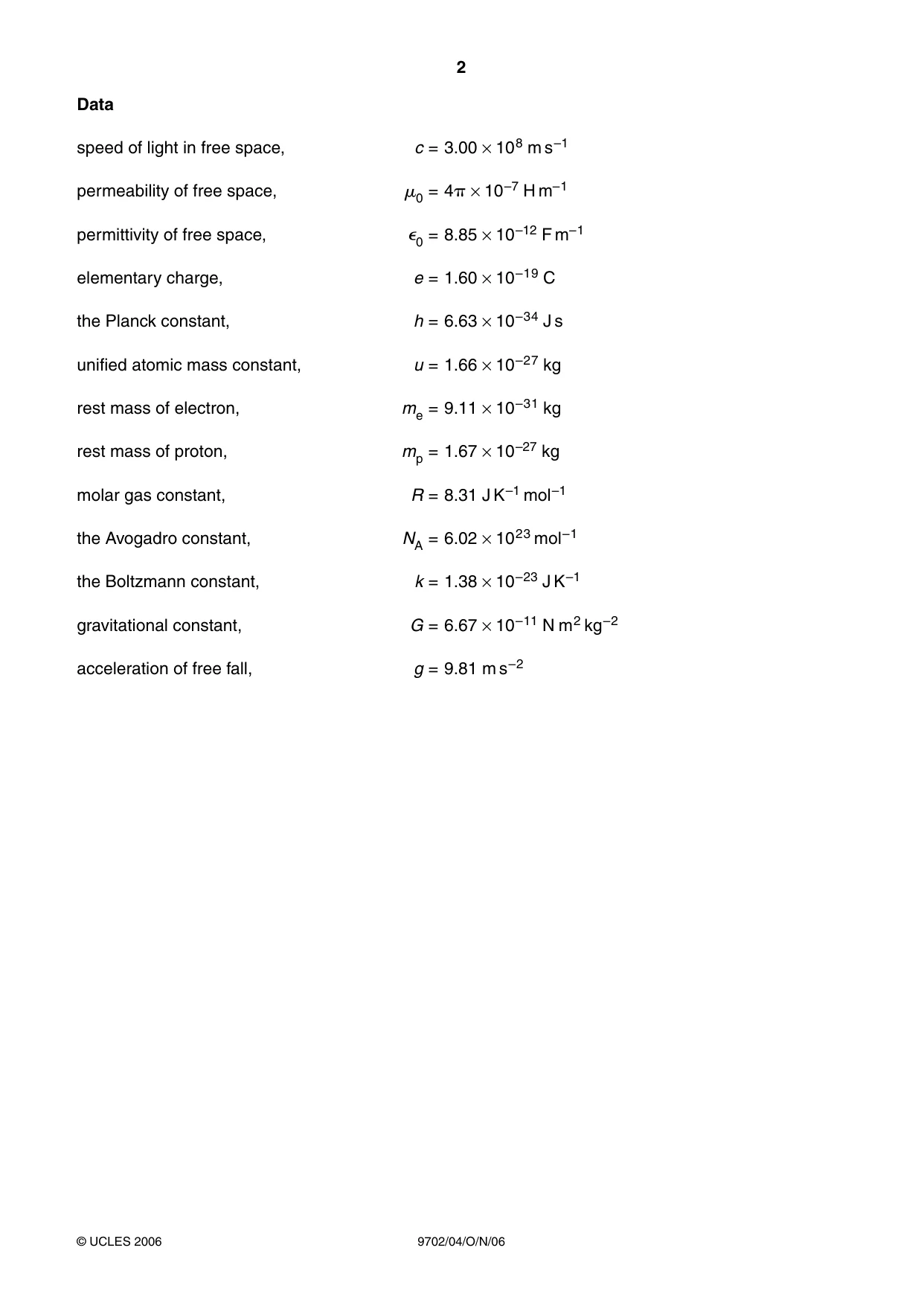
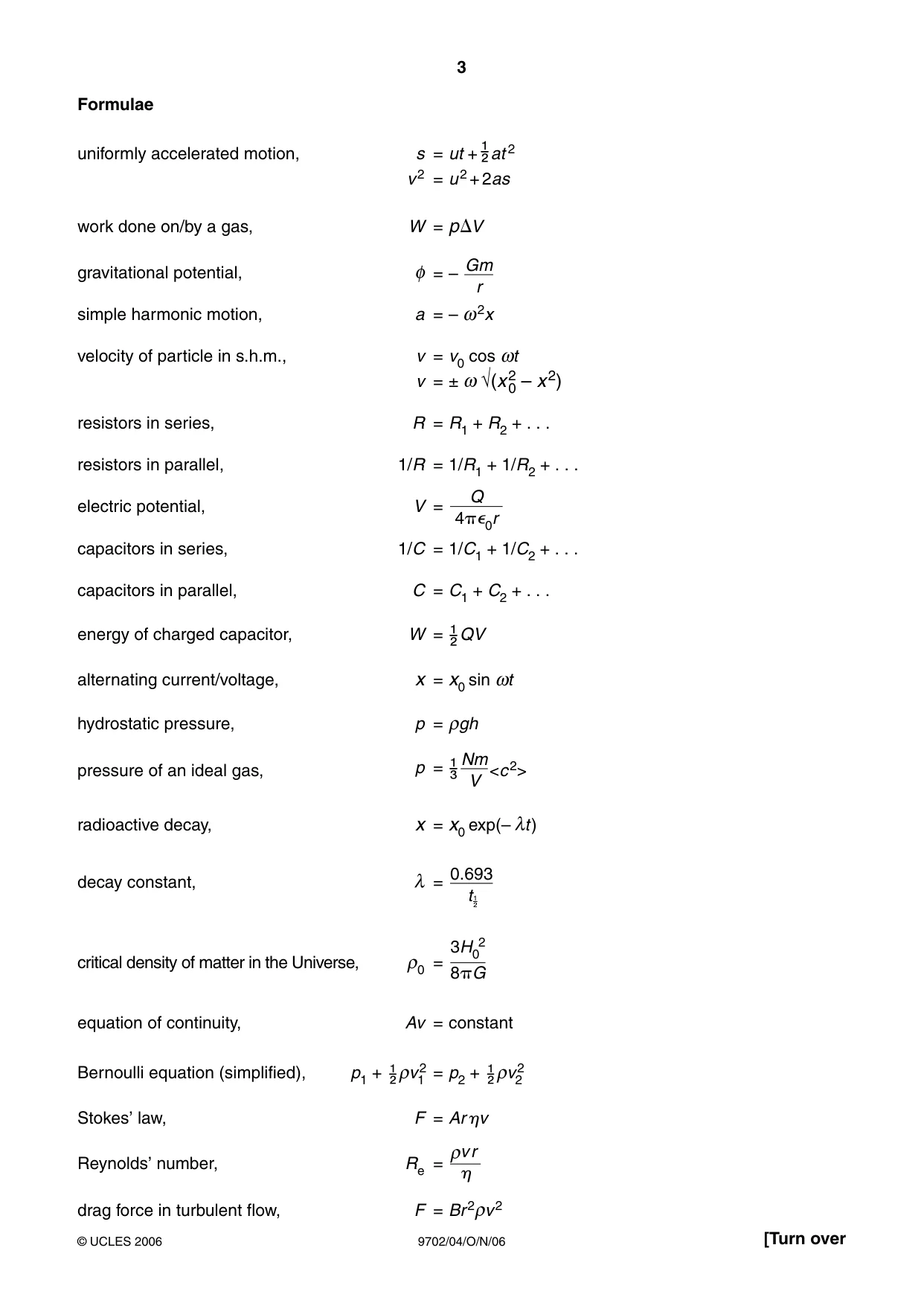


Mark scheme3 pages
Answers below. Sit the paper first if you are practising.
Questions as text
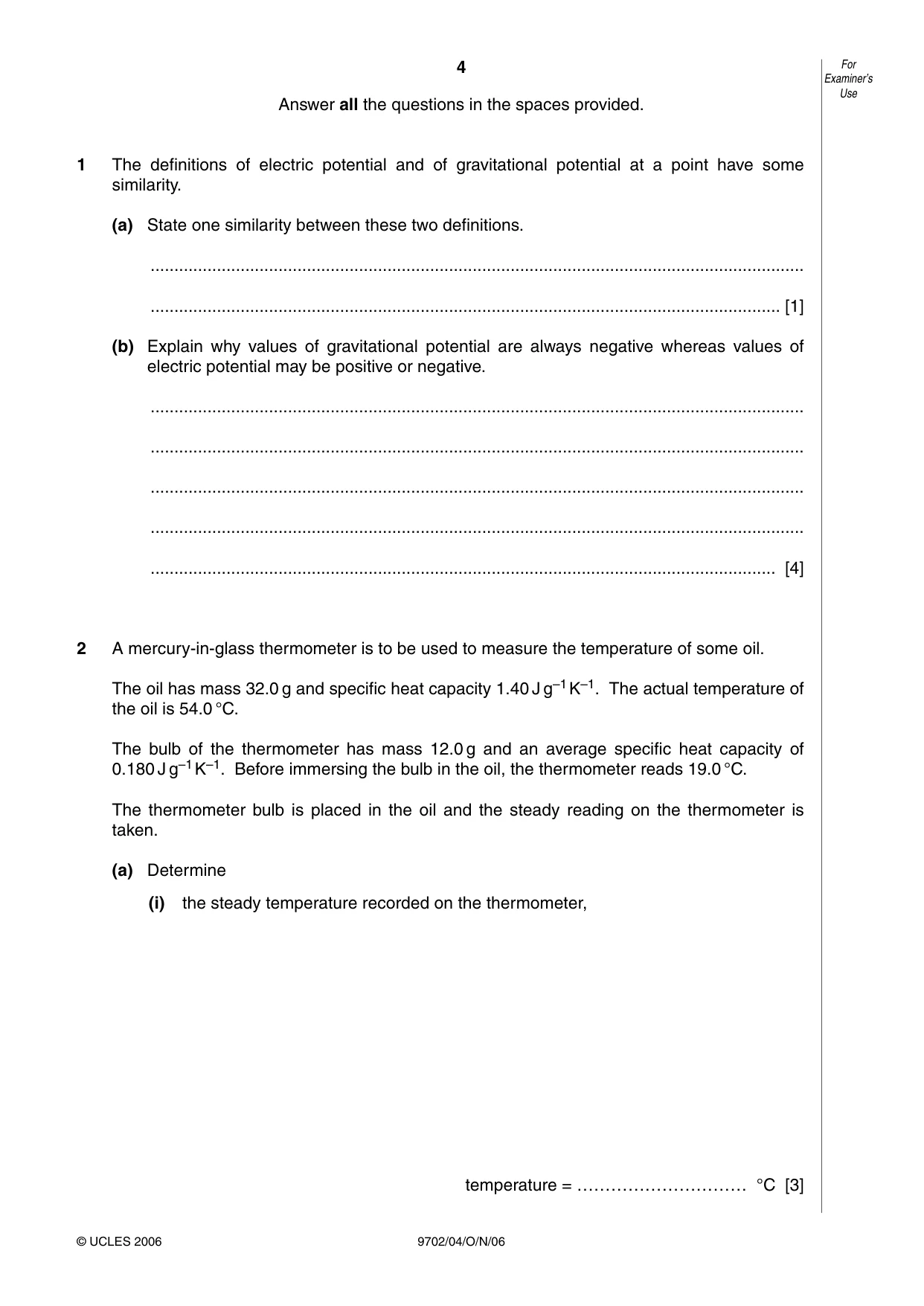
Q1 · The definitions of electric potential and of gravitational potential at a point have some…
1 The definitions of electric potential and of gravitational potential at a point have some similarity. (a) State one similarity between these two definitions. .......................................................................................................................................... ..................................................................................................................................... [1] (b) Explain why values of gravitational potential are always negative whereas values of electric potential may be positive or negative. .......................................................................................................................................... .......................................................................................................................................... .......................................................................................................................................... .......................................................................................................................................... .................................................................................................................................... [4]
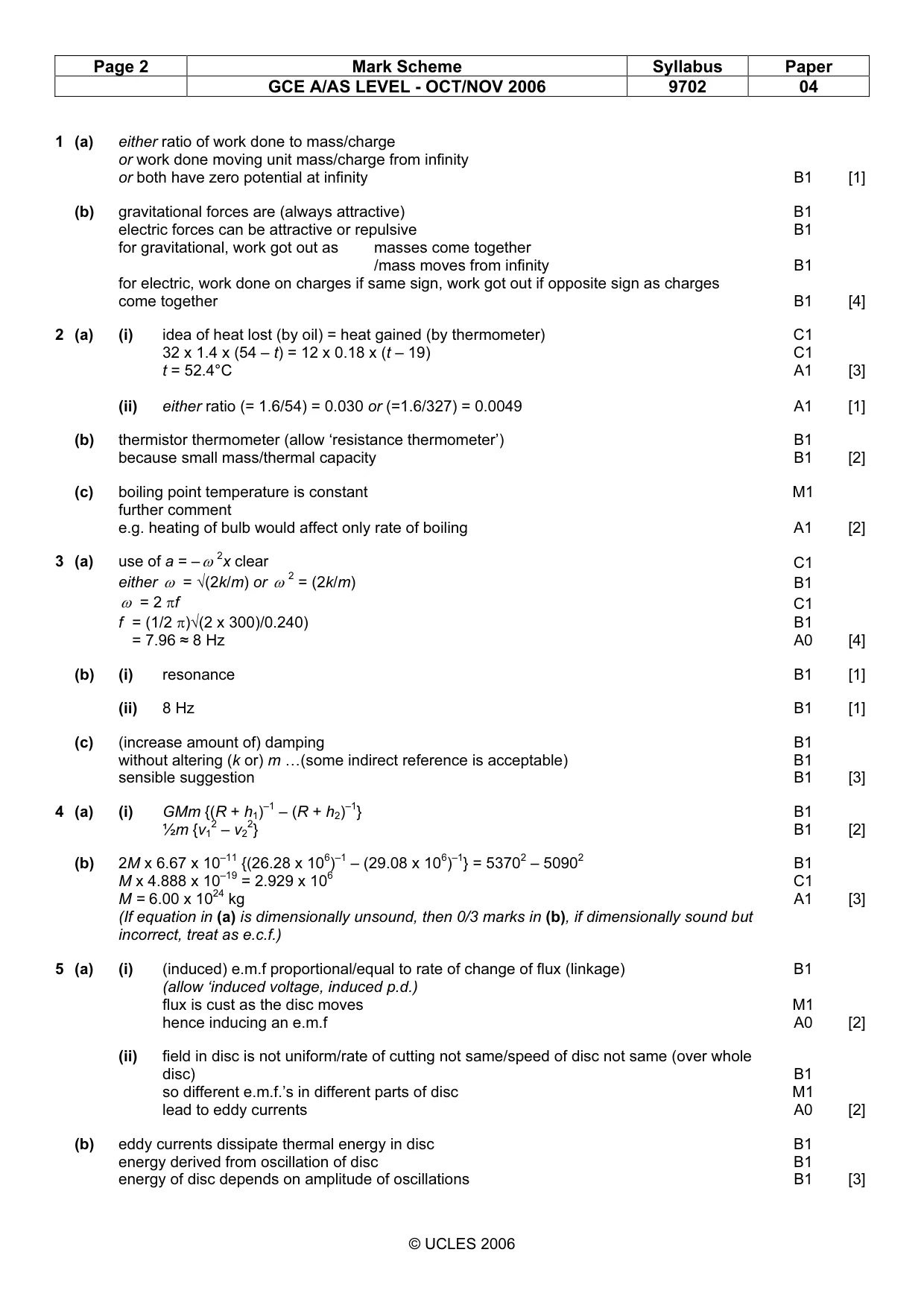
Mark scheme: 1 (a) either ratio of work done to mass/charge or work done moving unit mass/charge from infinity or both have zero potential at infinity B1 [1] (b) gravitational forces are (always attractive) B1 electric forces can be attractive or repulsive B1 for gravitational, work got out as masses come together /mass moves from infinity B1 for electric, work done on charges if same sign, work got out if opposite sign as charges come together B1 [4]
Q2 · A mercury-in-glass thermometer is to be used to measure the temperature of some oil
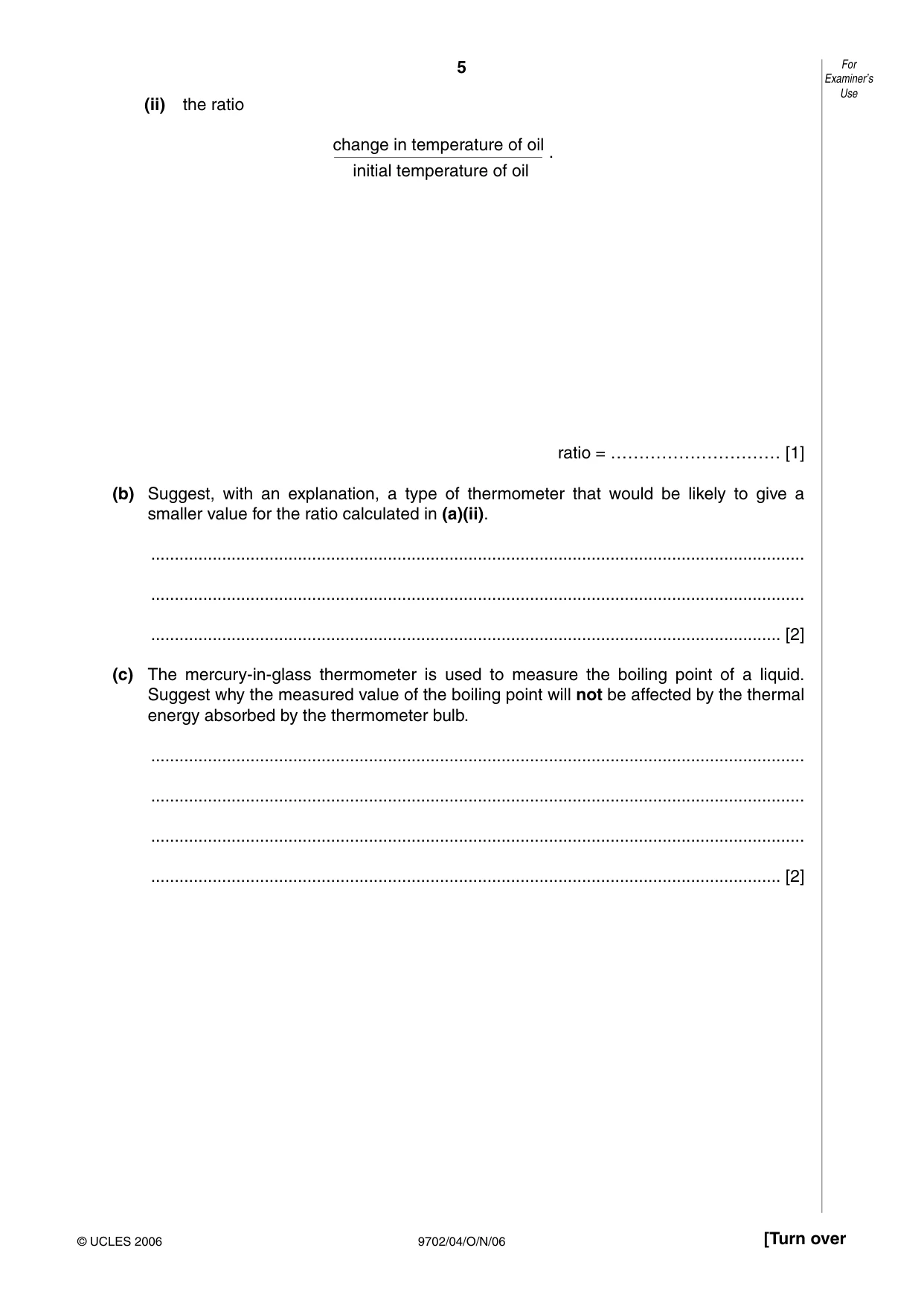
2 A mercury-in-glass thermometer is to be used to measure the temperature of some oil. The oil has mass 32.0 g and specific heat capacity 1.40 J g–1K–1. The actual temperature of the oil is 54.0 °C. The bulb of the thermometer has mass 12.0 g and an average specific heat capacity of 0.180 J g–1K–1. Before immersing the bulb in the oil, the thermometer reads 19.0 °C. The thermometer bulb is placed in the oil and the steady reading on the thermometer is taken. (a) Determine (i) the steady temperature recorded on the thermometer, temperature = ………………………… °C [3] Use (ii) the ratio change in temperature of oil . initial temperature of oil ratio = ………………………… [1] (b) Suggest, with an explanation, a type of thermometer that would be likely to give a smaller value for the ratio calculated in (a)(ii). .......................................................................................................................................... .......................................................................................................................................... ..................................................................................................................................... [2] (c) The mercury-in-glass thermometer is used to measure the boiling point of a liquid. Suggest why the measured value of the boiling point will not be affected by the thermal energy absorbed by the thermometer bulb. .......................................................................................................................................... .......................................................................................................................................... .......................................................................................................................................... ..................................................................................................................................... [2]
Mark scheme: 2 (a) (i) idea of heat lost (by oil) = heat gained (by thermometer) C1 32 x 1.4 x (54 – t) = 12 x 0.18 x (t – 19) C1 t = 52.4°C A1 [3] (ii) either ratio (= 1.6/54) = 0.030 or (=1.6/327) = 0.0049 A1 [1] (b) thermistor thermometer (allow ‘resistance thermometer’) B1 because small mass/thermal capacity B1 [2] (c) boiling point temperature is constant M1 further comment e.g. heating of bulb would affect only rate of boiling A1 [2]
More questions on Specific heat capacity and specific latent heat
Q3 · Two vertical springs, each having spring constant k, support a mass
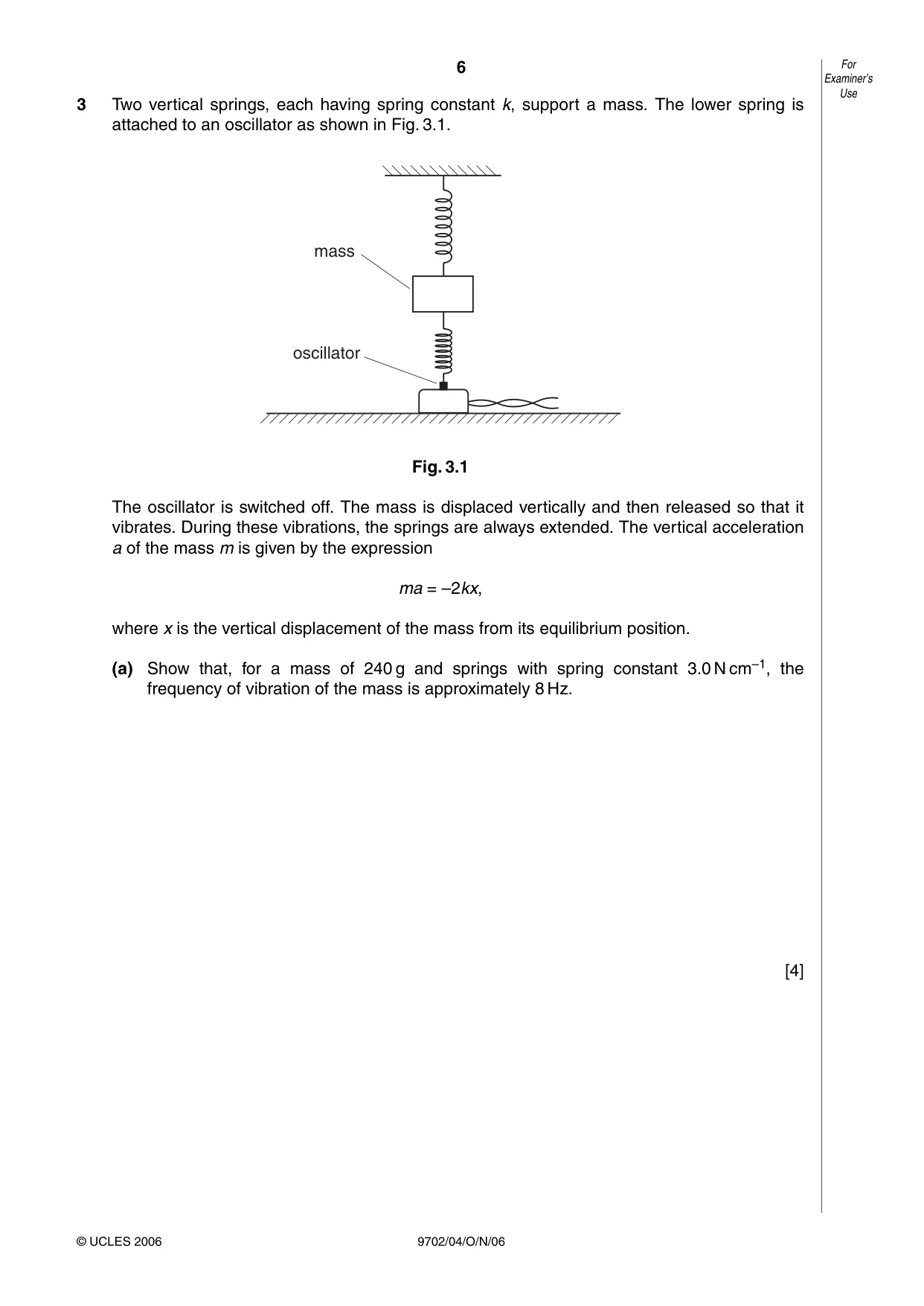
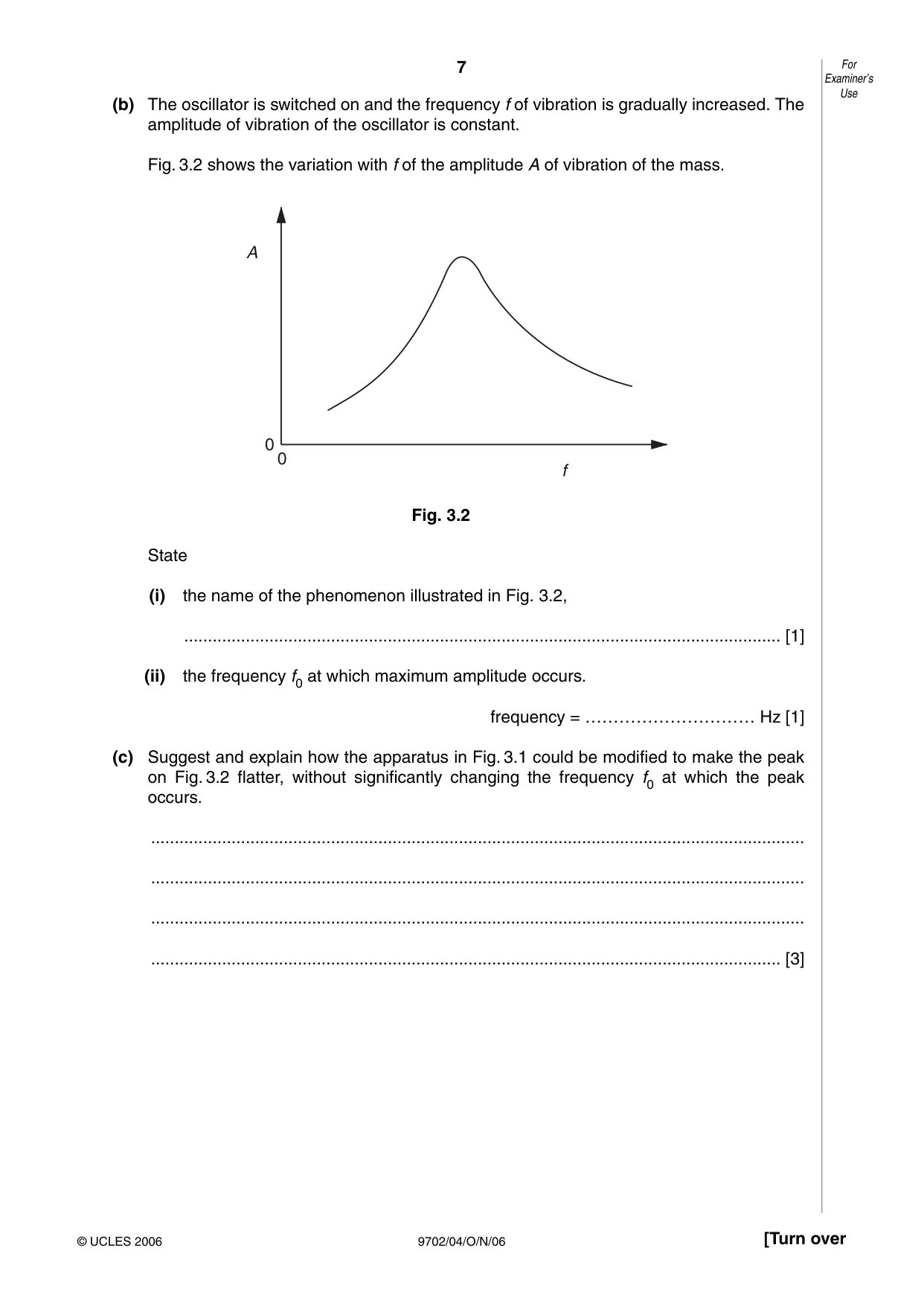
3 Two vertical springs, each having spring constant k, support a mass. The lower spring is attached to an oscillator as shown in Fig. 3.1. mass oscillator Fig. 3.1 The oscillator is switched off. The mass is displaced vertically and then released so that it vibrates. During these vibrations, the springs are always extended. The vertical acceleration a of the mass m is given by the expression ma = –2kx, where x is the vertical displacement of the mass from its equilibrium position. (a) Show that, for a mass of 240 g and springs with spring constant 3.0 N cm–1, the frequency of vibration of the mass is approximately 8 Hz. [4] Use (b) The oscillator is switched on and the frequency f of vibration is gradually increased. The amplitude of vibration of the oscillator is constant. Fig. 3.2 shows the variation with f of the amplitude A of vibration of the mass. A 0 0 f Fig. 3.2 State (i) the name of the phenomenon illustrated in Fig. 3.2, .............................................................................................................................. [1] (ii) the frequency f0 at which maximum amplitude occurs. frequency = ………………………… Hz [1] (c) Suggest and explain how the apparatus in Fig. 3.1 could be modified to make the peak on Fig. 3.2 flatter, without significantly changing the frequency f0 at which the peak occurs. .......................................................................................................................................... .......................................................................................................................................... .......................................................................................................................................... ..................................................................................................................................... [3]
Mark scheme: 3 (a) use of a = –ω 2x clear C1 either ω = √(2k/m) or ω 2 = (2k/m) B1 ω = 2 πf C1 f = (1/2 π)√(2 x 300)/0.240) B1 = 7.96 ≈ 8 Hz A0 [4] (b) (i) resonance B1 [1] (ii) 8 Hz B1 [1] (c) (increase amount of) damping B1 without altering (k or) m …(some indirect reference is acceptable) B1 sensible suggestion B1 [3]
Q4 · A rocket is launched from the surface of the Earth
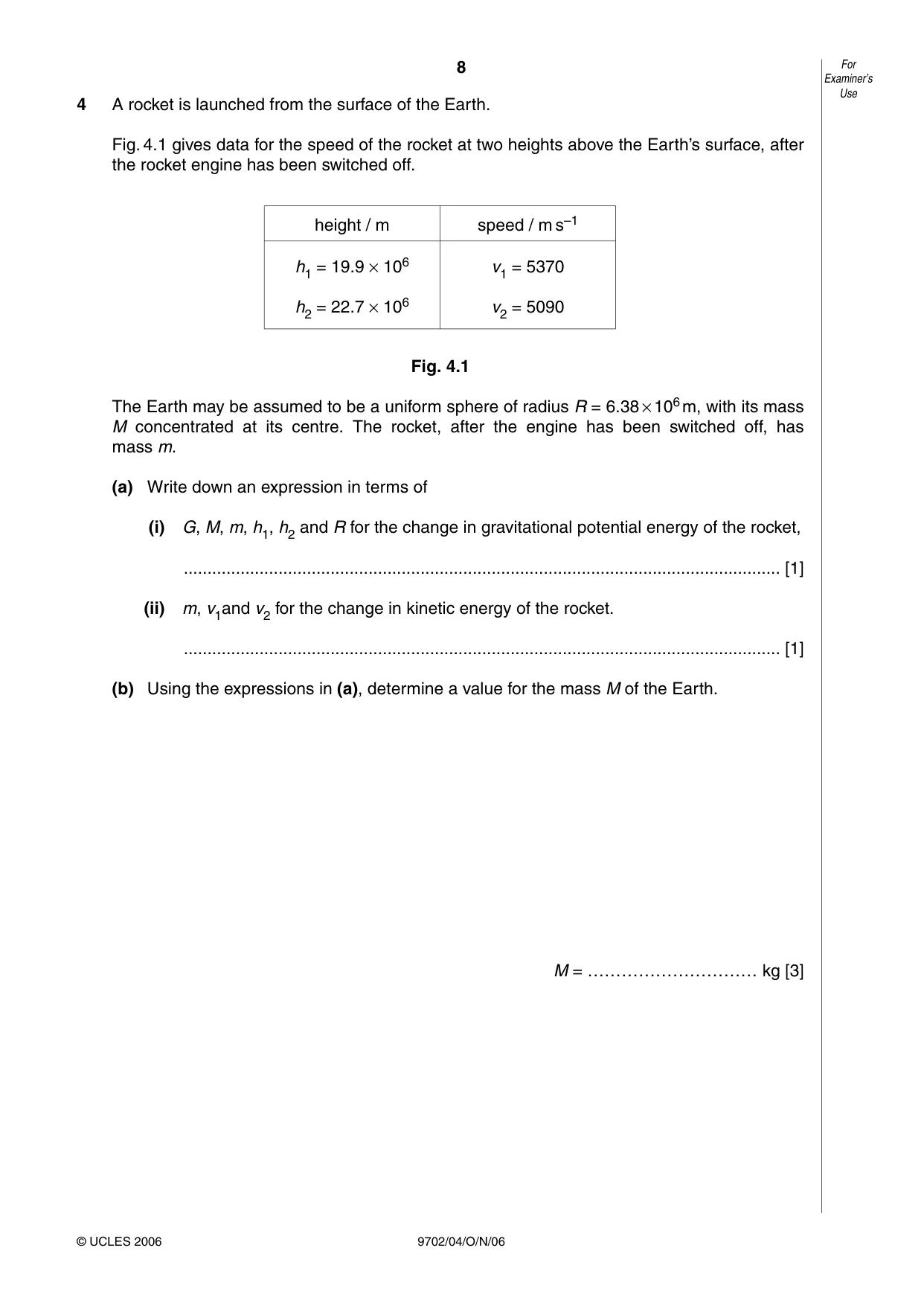
4 A rocket is launched from the surface of the Earth. Fig. 4.1 gives data for the speed of the rocket at two heights above the Earth’s surface, after the rocket engine has been switched off. height / m speed / m s–1 h1 = 19.9 × 10⁶ v1 = 5370 h2 = 22.7 × 10⁶ v2 = 5090 Fig. 4.1 The Earth may be assumed to be a uniform sphere of radius R = 6.38 ×10⁶m, with its mass M concentrated at its centre. The rocket, after the engine has been switched off, has mass m. (a) Write down an expression in terms of (i) G, M, m, h1, h2 and R for the change in gravitational potential energy of the rocket, .............................................................................................................................. [1] (ii) m, v1and v2 for the change in kinetic energy of the rocket. .............................................................................................................................. [1] (b) Using the expressions in (a), determine a value for the mass M of the Earth. M = ………………………… kg [3]
Mark scheme: 4 (a) (i) GMm {(R + h1)–1 – (R + h2)–1} B1 ½m {v12 – v2 2} B1 [2] (b) 2M x 6.67 x 10–11 {(26.28 x 10⁶)–1 – (29.08 x 10⁶)–1} = 53702 – 50902 B1 M x 4.888 x 10–19 = 2.929 x 10⁶ C1 M = 6.00 x 1024 kg A1 [3] (If equation in (a) is dimensionally unsound, then 0/3 marks in (b), if dimensionally sound but incorrect, treat as e.c.f.)
Q5 · A metal disc is swinging freely between the poles of an electromagnet, as shown in Fig
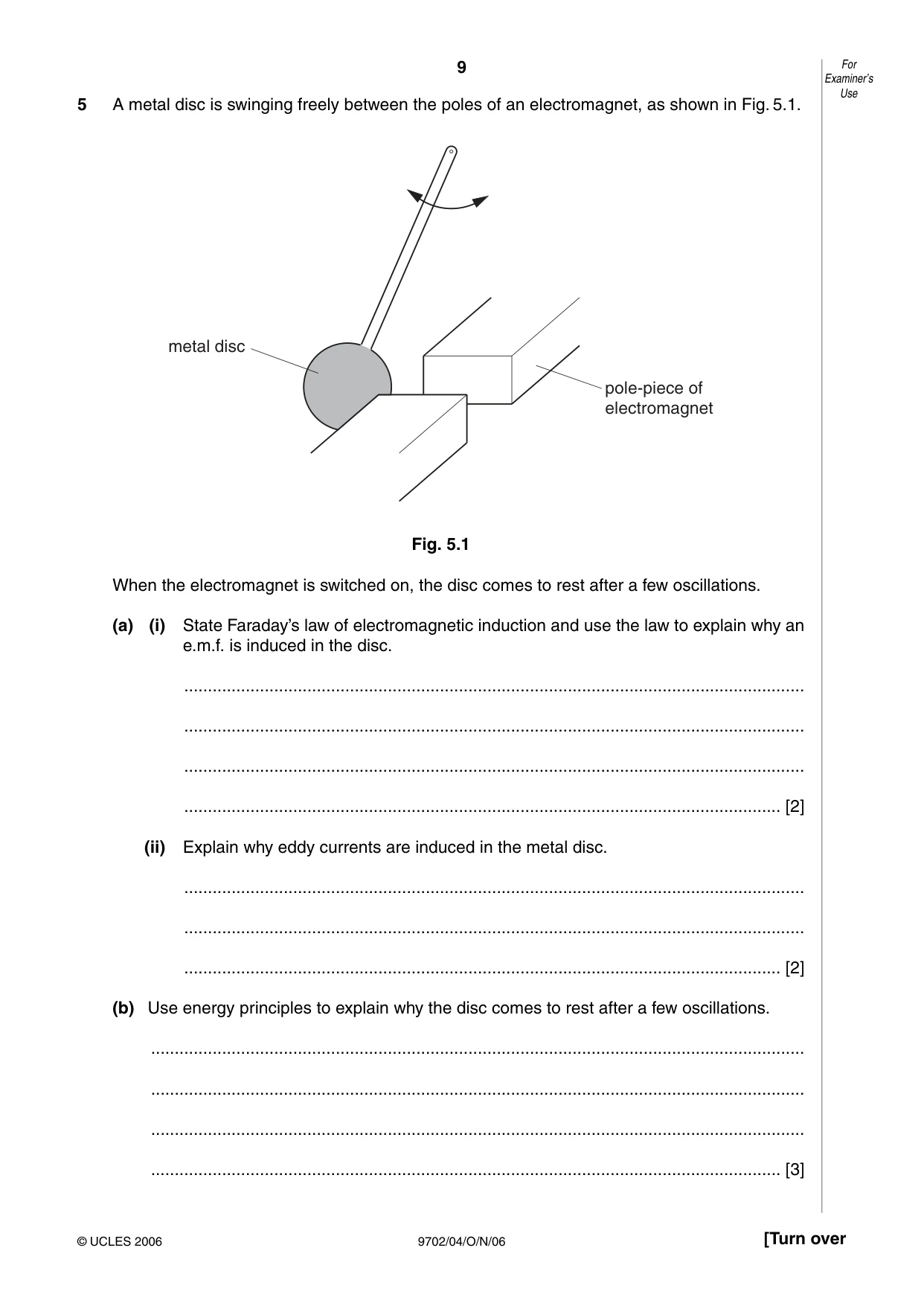
5 A metal disc is swinging freely between the poles of an electromagnet, as shown in Fig. 5.1. metal disc pole-piece of electromagnet Fig. 5.1 When the electromagnet is switched on, the disc comes to rest after a few oscillations. (a) (i) State Faraday’s law of electromagnetic induction and use the law to explain why an e.m.f. is induced in the disc. ................................................................................................................................... ................................................................................................................................... ................................................................................................................................... .............................................................................................................................. [2] (ii) Explain why eddy currents are induced in the metal disc. ................................................................................................................................... ................................................................................................................................... .............................................................................................................................. [2] (b) Use energy principles to explain why the disc comes to rest after a few oscillations. .......................................................................................................................................... .......................................................................................................................................... .......................................................................................................................................... ..................................................................................................................................... [3]
Mark scheme: 5 (a) (i) (induced) e.m.f proportional/equal to rate of change of flux (linkage) B1 (allow ‘induced voltage, induced p.d.) flux is cust as the disc moves M1 hence inducing an e.m.f A0 [2] (ii) field in disc is not uniform/rate of cutting not same/speed of disc not same (over whole disc) B1 so different e.m.f.’s in different parts of disc M1 lead to eddy currents A0 [2] (b) eddy currents dissipate thermal energy in disc B1 energy derived from oscillation of disc B1 energy of disc depends on amplitude of oscillations B1 [3] GCE A/AS LEVEL - OCT/NOV 2006 9702 04
Q6 · An alternating supply of frequency 50 Hz and having an output of 6.0 V r.m.s
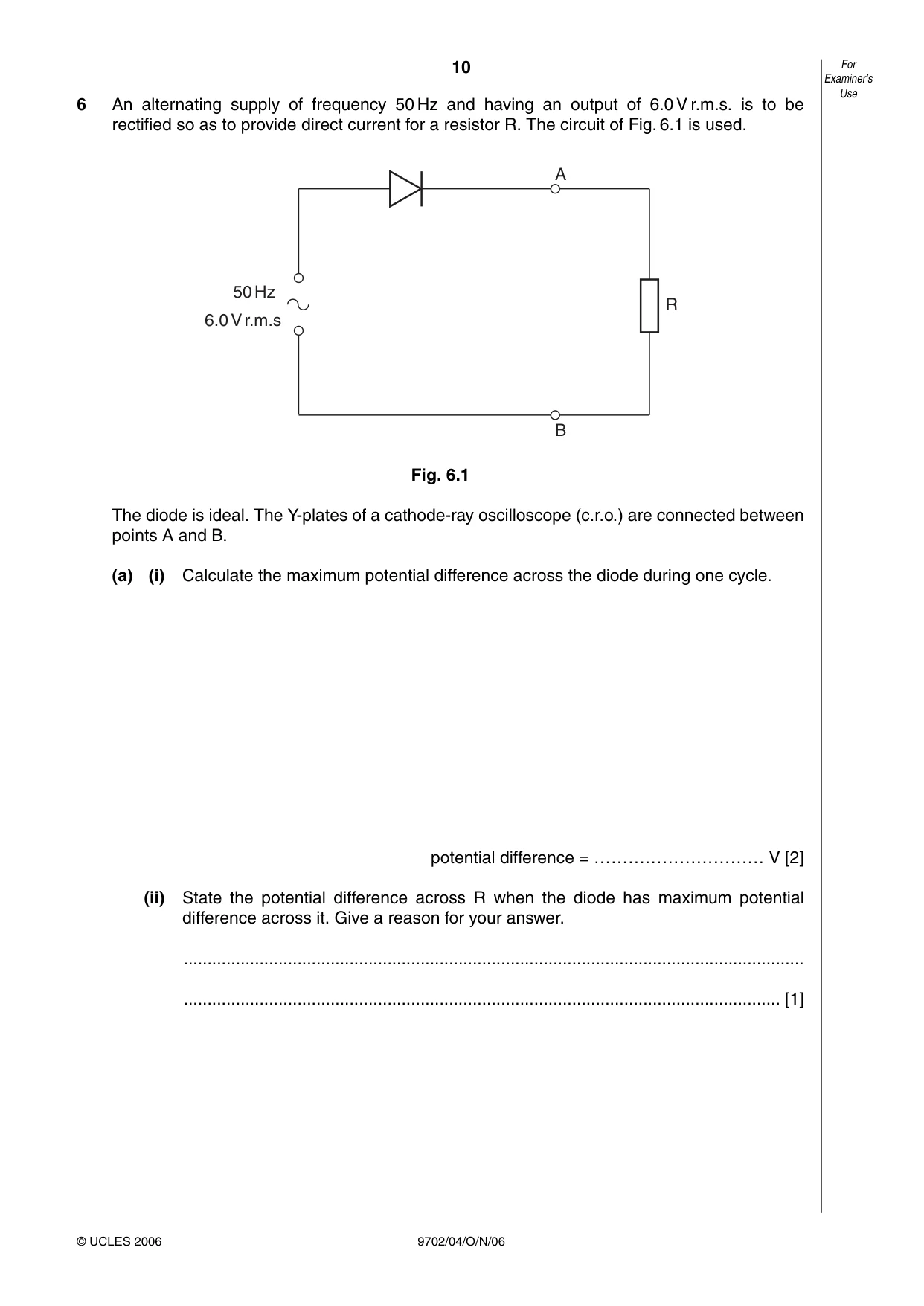
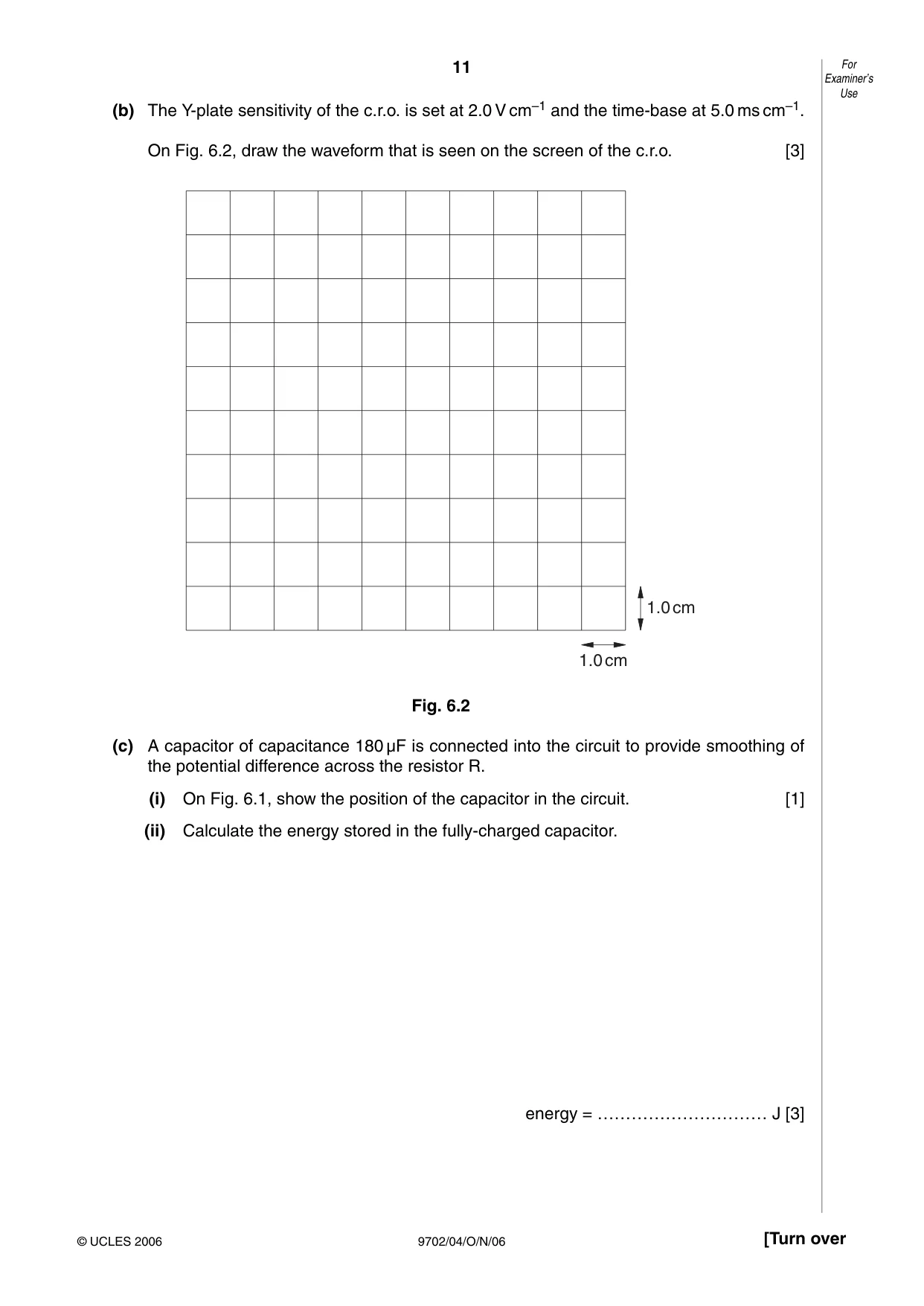
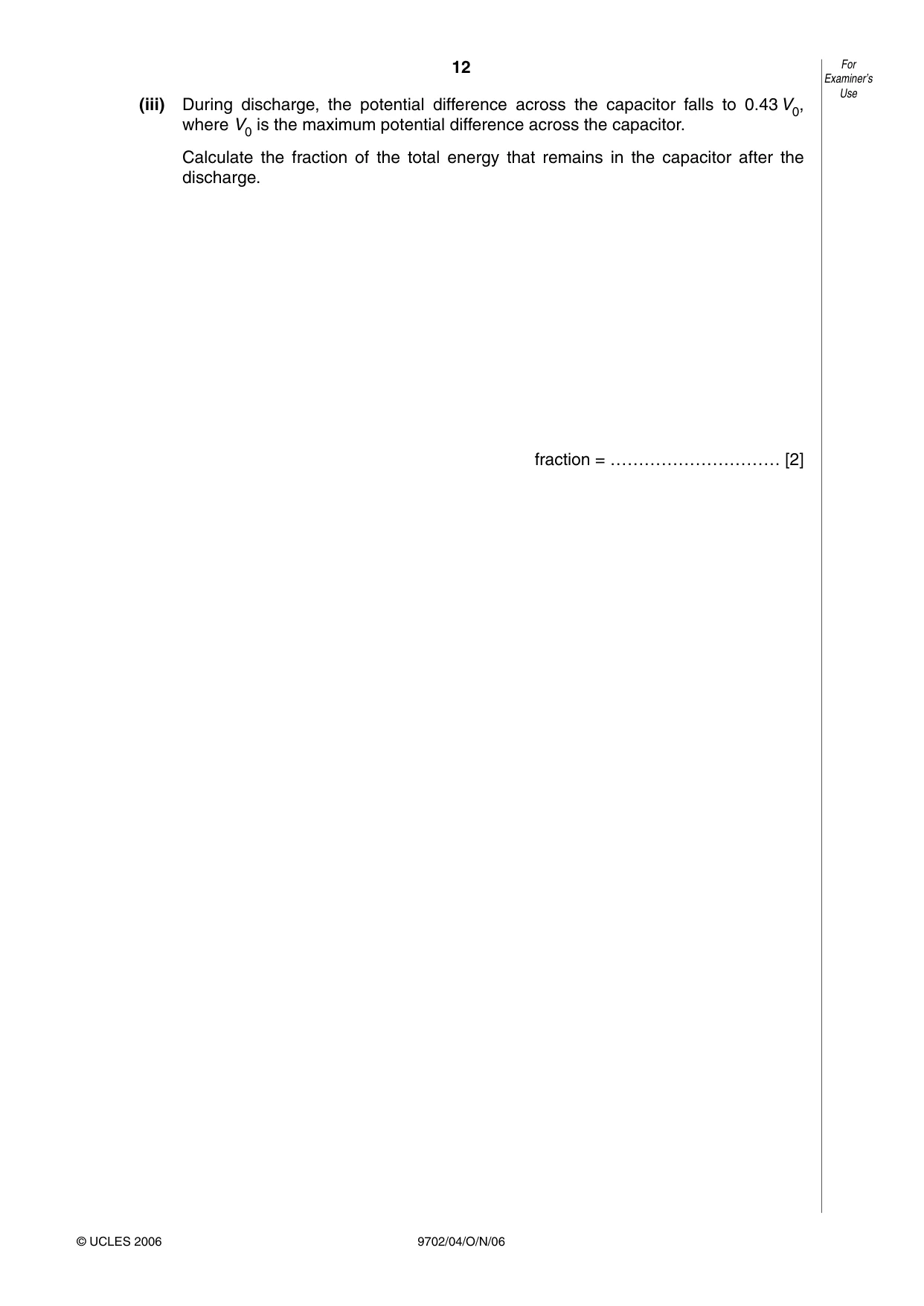
6 An alternating supply of frequency 50 Hz and having an output of 6.0 V r.m.s. is to be rectified so as to provide direct current for a resistor R. The circuit of Fig. 6.1 is used. A 50 Hz R 6.0 V r.m.s B Fig. 6.1 The diode is ideal. The Y-plates of a cathode-ray oscilloscope (c.r.o.) are connected between points A and B. (a) (i) Calculate the maximum potential difference across the diode during one cycle. potential difference = ………………………… V [2] (ii) State the potential difference across R when the diode has maximum potential difference across it. Give a reason for your answer. ................................................................................................................................... .............................................................................................................................. [1] Use (b) The Y-plate sensitivity of the c.r.o. is set at 2.0 V cm–1 and the time-base at 5.0 ms cm–1. On Fig. 6.2, draw the waveform that is seen on the screen of the c.r.o. [3] 1.0 cm 1.0 cm Fig. 6.2 (c) A capacitor of capacitance 180 µF is connected into the circuit to provide smoothing of the potential difference across the resistor R. (i) On Fig. 6.1, show the position of the capacitor in the circuit. [1] (ii) Calculate the energy stored in the fully-charged capacitor. energy = ………………………… J [3] Use (iii) During discharge, the potential difference across the capacitor falls to 0.43 V0, where V0 is the maximum potential difference across the capacitor. Calculate the fraction of the total energy that remains in the capacitor after the discharge. fraction = ………………………… [2]
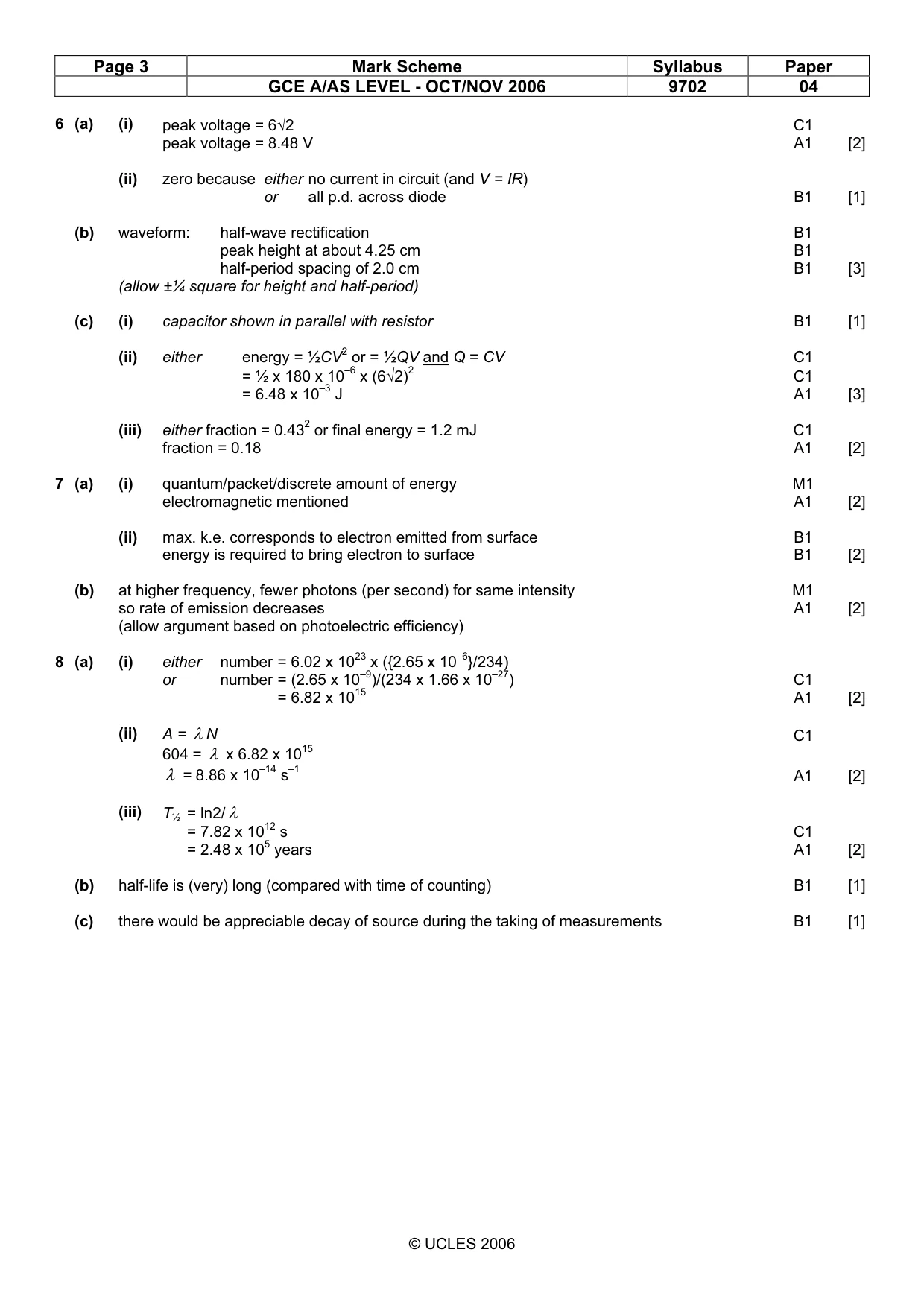
Mark scheme: 6 (a) (i) peak voltage = 6√2 C1 peak voltage = 8.48 V A1 [2] (ii) zero because either no current in circuit (and V = IR) or all p.d. across diode B1 [1] (b) waveform: half-wave rectification B1 peak height at about 4.25 cm B1 half-period spacing of 2.0 cm B1 [3] (allow ±¼ square for height and half-period) (c) (i) capacitor shown in parallel with resistor B1 [1] (ii) either energy = ½CV2 or = ½QV and Q = CV C1 = ½ x 180 x 10–6 x (6√2)2 C1 = 6.48 x 10⁻³ J A1 [3] (iii) either fraction = 0.432 or final energy = 1.2 mJ C1 fraction = 0.18 A1 [2]
Q7 · The photoelectric effect may be summarised in terms of the word equation photon energy =…
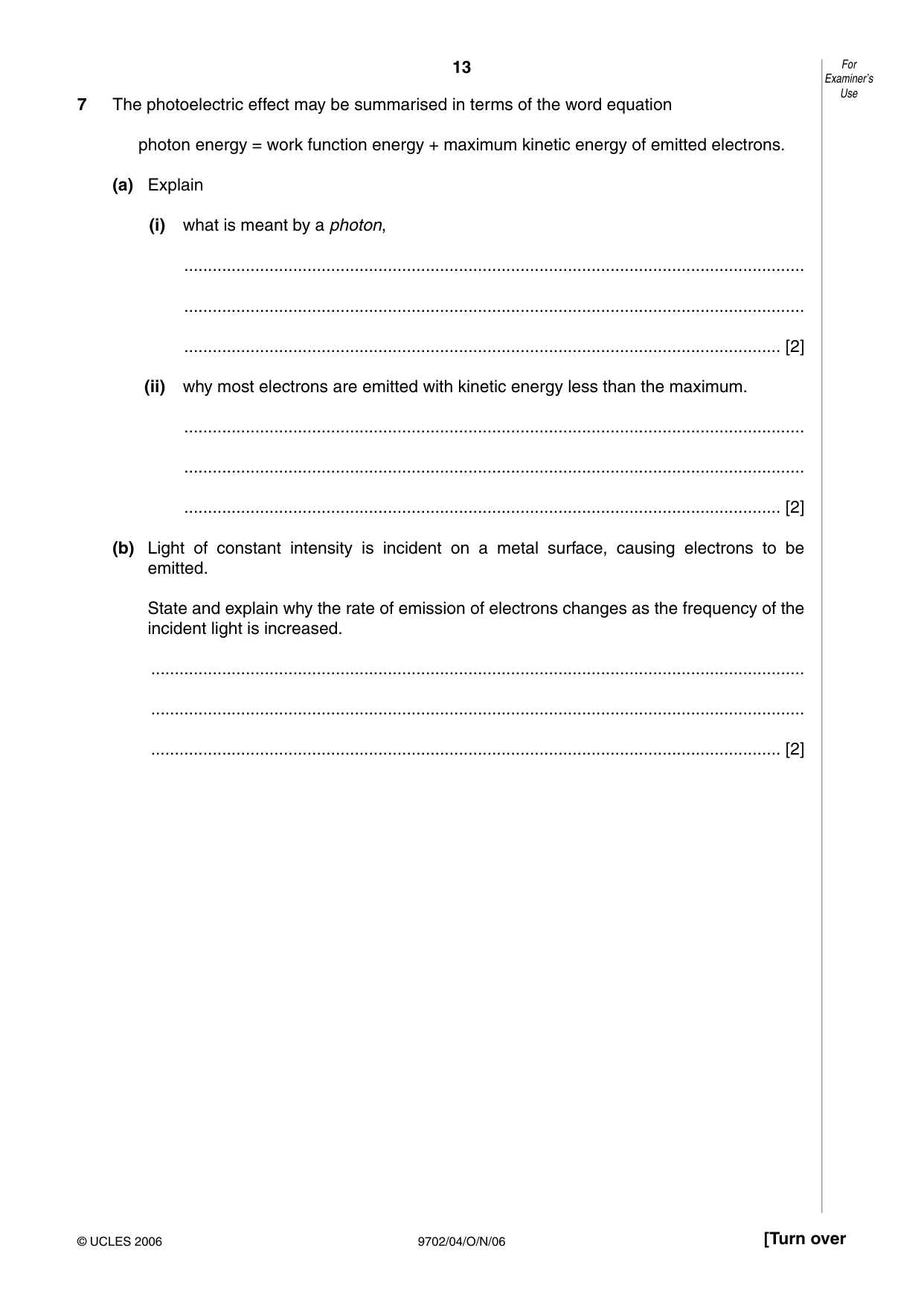
7 The photoelectric effect may be summarised in terms of the word equation photon energy = work function energy + maximum kinetic energy of emitted electrons. (a) Explain (i) what is meant by a photon, ................................................................................................................................... ................................................................................................................................... .............................................................................................................................. [2] (ii) why most electrons are emitted with kinetic energy less than the maximum. ................................................................................................................................... ................................................................................................................................... .............................................................................................................................. [2] (b) Light of constant intensity is incident on a metal surface, causing electrons to be emitted. State and explain why the rate of emission of electrons changes as the frequency of the incident light is increased. .......................................................................................................................................... .......................................................................................................................................... ..................................................................................................................................... [2]
Mark scheme: 7 (a) (i) quantum/packet/discrete amount of energy M1 electromagnetic mentioned A1 [2] (ii) max. k.e. corresponds to electron emitted from surface B1 energy is required to bring electron to surface B1 [2] (b) at higher frequency, fewer photons (per second) for same intensity M1 so rate of emission decreases A1 [2] (allow argument based on photoelectric efficiency)
Q8 · Uranium-234 is radioactive and emits α-particles at what appears to be a constant rate
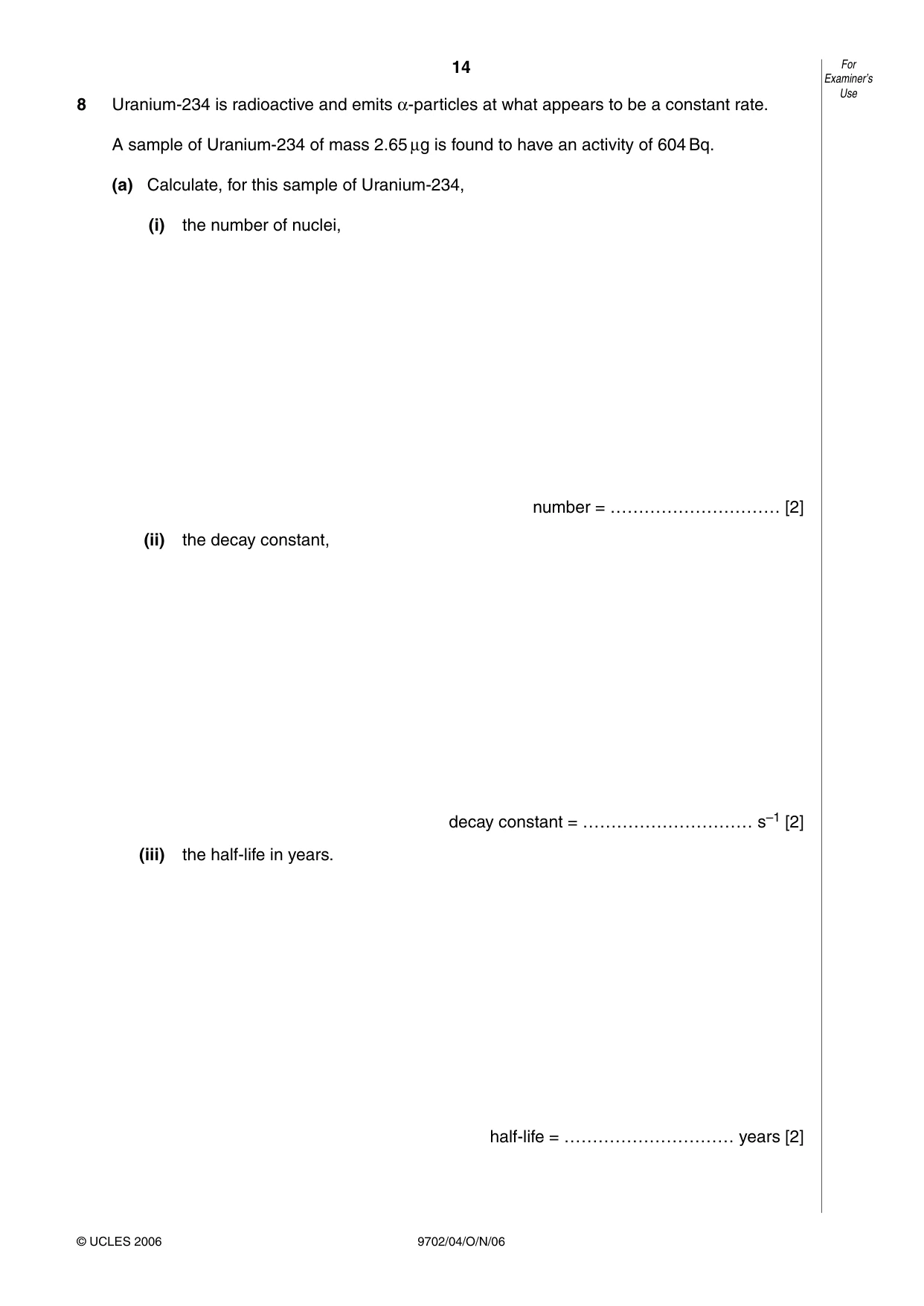
8 Uranium-234 is radioactive and emits α-particles at what appears to be a constant rate. A sample of Uranium-234 of mass 2.65 µg is found to have an activity of 604 Bq. (a) Calculate, for this sample of Uranium-234, (i) the number of nuclei, number = ………………………… [2] (ii) the decay constant, decay constant = ………………………… s–1 [2] (iii) the half-life in years. half-life = ………………………… years [2] Use (b) Suggest why the activity of the Uranium-234 appears to be constant. .......................................................................................................................................... ..................................................................................................................................... [1] (c) Suggest why a measurement of the mass and the activity of a radioactive isotope is not an accurate means of determining its half-life if the half-life is approximately one hour. .......................................................................................................................................... ..................................................................................................................................... [1]
Mark scheme: 8 (a) (i) either number = 6.02 x 10²³ x ({2.65 x 10⁻⁶}/234) or number = (2.65 x 10⁻⁹)/(234 x 1.66 x 10–27) C1 = 6.82 x 10¹⁵ A1 [2] (ii) A = λ N C1 604 = λ x 6.82 x 10¹⁵ λ = 8.86 x 10⁻¹⁴ s–1 A1 [2] (iii) T½ = ln2/ λ = 7.82 x 10¹² s C1 = 2.48 x 10⁵ years A1 [2] (b) half-life is (very) long (compared with time of counting) B1 [1] (c) there would be appreciable decay of source during the taking of measurements B1 [1]
What was in this paper
The subtopics covered by these 8 questions, and how many questions each got. Open one in a new tab to see every Cambridge question on it.
What you needed in this session
Cambridge’s own grade thresholds for 2006 Oct/Nov, Paper 4 · Variant 1. A higher threshold means an easier paper — the bar moves with how the cohort did.