Questions as text
Q1 · Explain (i) what is meant by a radian, … … … [2] (ii) why one complete revolution is… 9702/41 Oct/Nov 2007
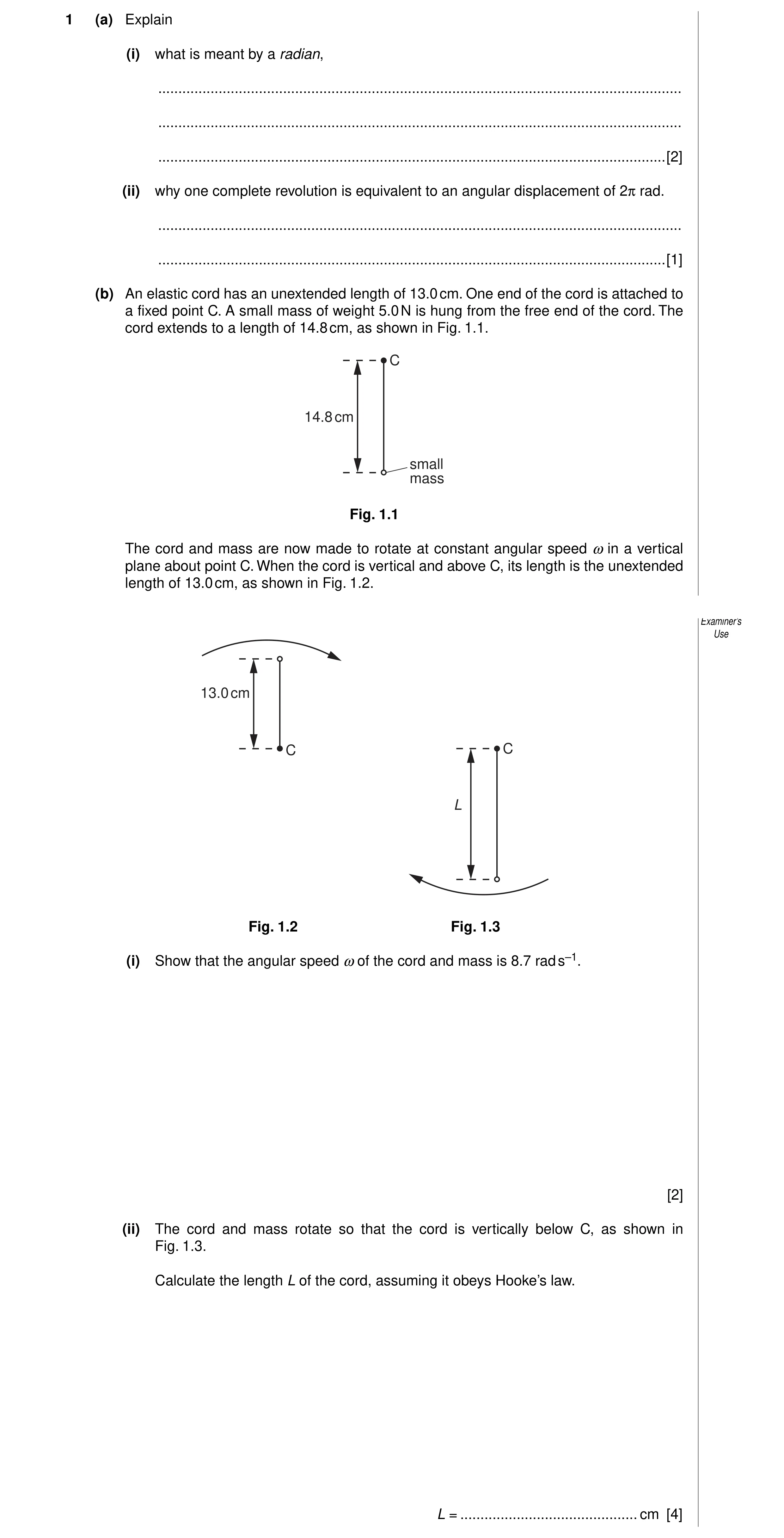
1 (a) Explain (i) what is meant by a radian, … … … [2] (ii) why one complete revolution is equivalent to an angular displacement of 2π rad. … … [1] (b) An elastic cord has an unextended length of 13.0 cm. One end of the cord is attached to a fixed point C. A small mass of weight 5.0 N is hung from the free end of the cord. The cord extends to a length of 14.8 cm, as shown in Fig. 1.1. C 14.8 cm small mass Fig. 1.1 The cord and mass are now made to rotate at constant angular speed ω in a vertical plane about point C. When the cord is vertical and above C, its length is the unextended length of 13.0 cm, as shown in Fig. 1.2. Examiner’s Use 13.0 cm C C L Fig. 1.2 Fig. 1.3 (i) Show that the angular speed ω of the cord and mass is 8.7 rad s–1. [2] (ii) The cord and mass rotate so that the cord is vertically below C, as shown in Fig. 1.3. Calculate the length L of the cord, assuming it obeys Hooke’s law. L = … cm [4]
9 marks
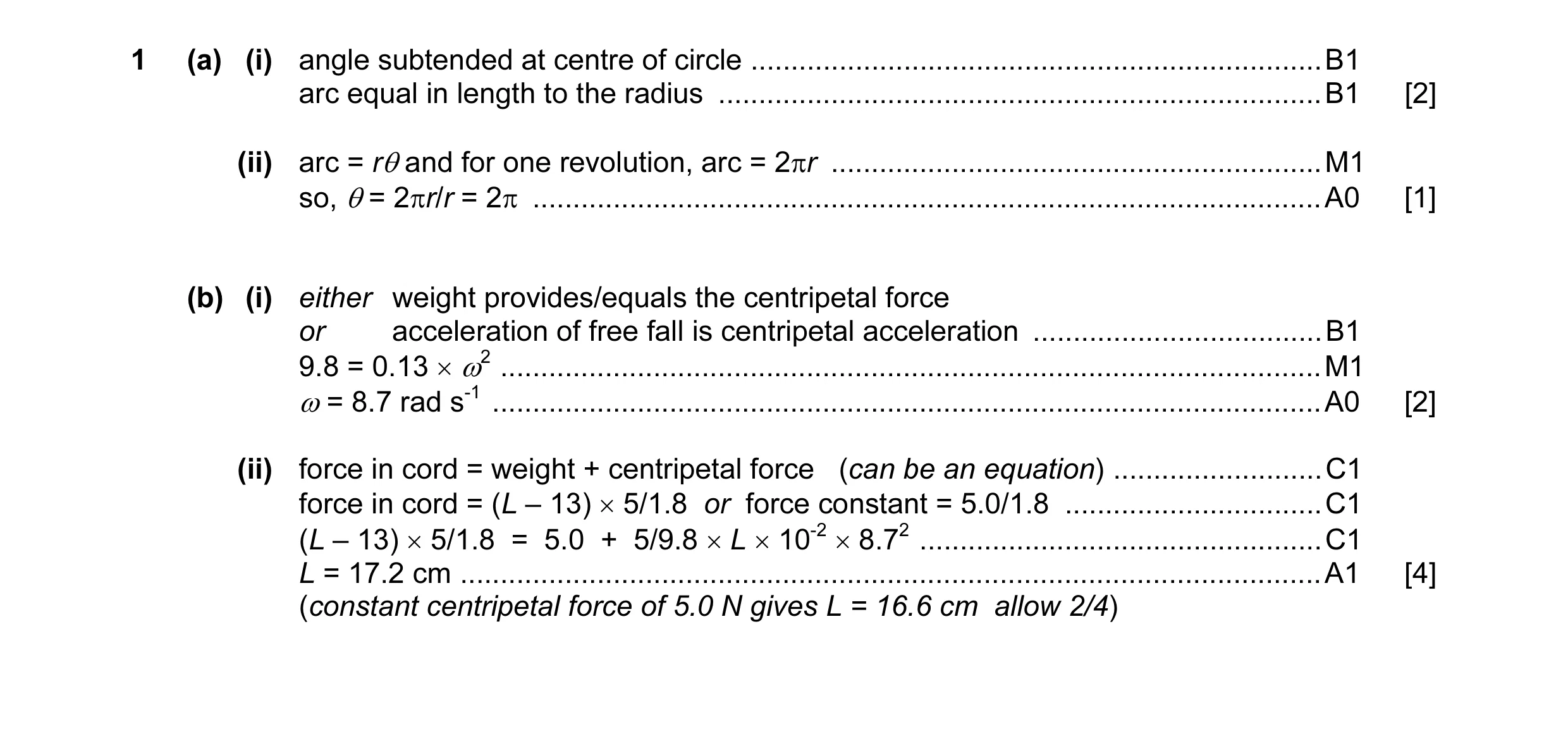
Mark scheme: 1 (a) (i) angle subtended at centre of circle … B1 arc equal in length to the radius … B1 [2] (ii) arc = rθ and for one revolution, arc = 2πr … M1 so, θ = 2πr/r = 2π … A0 [1] (b) (i) either weight provides/equals the centripetal force or acceleration of free fall is centripetal acceleration … B1 9.8 = 0.13 × ω2 … M1 ω = 8.7 rad s-1 … A0 [2] (ii) force in cord = weight + centripetal force (can be an equation) … C1 force in cord = (L – 13) × 5/1.8 or force constant = 5.0/1.8 … C1 (L – 13) × 5/1.8 = 5.0 + 5/9.8 × L × 10-2 × 8.72 … C1 L = 17.2 cm … A1 [4] (constant centripetal force of 5.0 N gives L = 16.6 cm allow 2/4)
This question in 9702/41 Oct/Nov 2007
Q2 · A vertical peg is attached to the edge of a horizontal disc of radius r, as shown in Fig 9702/41 May/June 2009
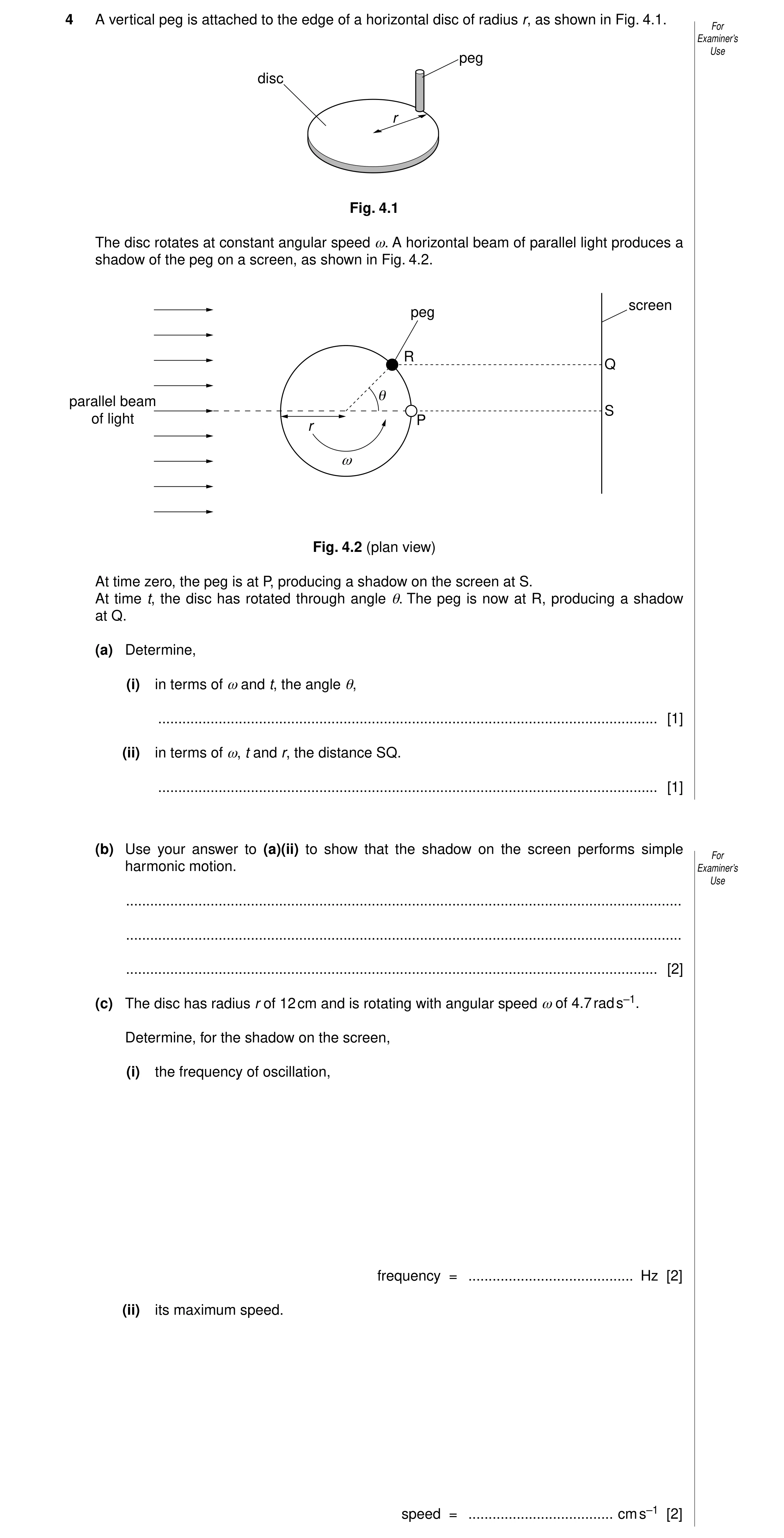
4 A vertical peg is attached to the edge of a horizontal disc of radius r, as shown in Fig. 4.1. For Examiner’s Use peg disc r Fig. 4.1 The disc rotates at constant angular speed ω. A horizontal beam of parallel light produces a shadow of the peg on a screen, as shown in Fig. 4.2. screen peg R Q θ parallel beam S of light P r ω Fig. 4.2 (plan view) At time zero, the peg is at P, producing a shadow on the screen at S. At time t, the disc has rotated through angle θ. The peg is now at R, producing a shadow at Q. (a) Determine, (i) in terms of ω and t, the angle θ, … [1] (ii) in terms of ω, t and r, the distance SQ. … [1] (b) Use your answer to (a)(ii) to show that the shadow on the screen performs simple For harmonic motion. Examiner’s Use … … … [2] (c) The disc has radius r of 12 cm and is rotating with angular speed ω of 4.7 rad s–1. Determine, for the shadow on the screen, (i) the frequency of oscillation, frequency = … Hz [2] (ii) its maximum speed. speed = … cm s–1 [2]
8 marks
Mark scheme: 4 (a) (i) (θ =) ω t (allow any subject if all terms given) B1 [1] (ii) (SQ =) r sinωt (allow any subject if all terms given) B1 [1] (b) this is the solution of the equation a = –ω2x M1 a = –ω2x is the (defining) equation of s.h.m. A1 [2] (c) (i) f = ω / 2π C1 = 4.7 / 2π = 0.75 Hz A1 [2] (ii) v = rω (r must be identified) C1 = 4.7 × 12 = 56 cm s–1 A1 [2]
This question in 9702/41 May/June 2009
Question 3 9702/41 May/June 2010
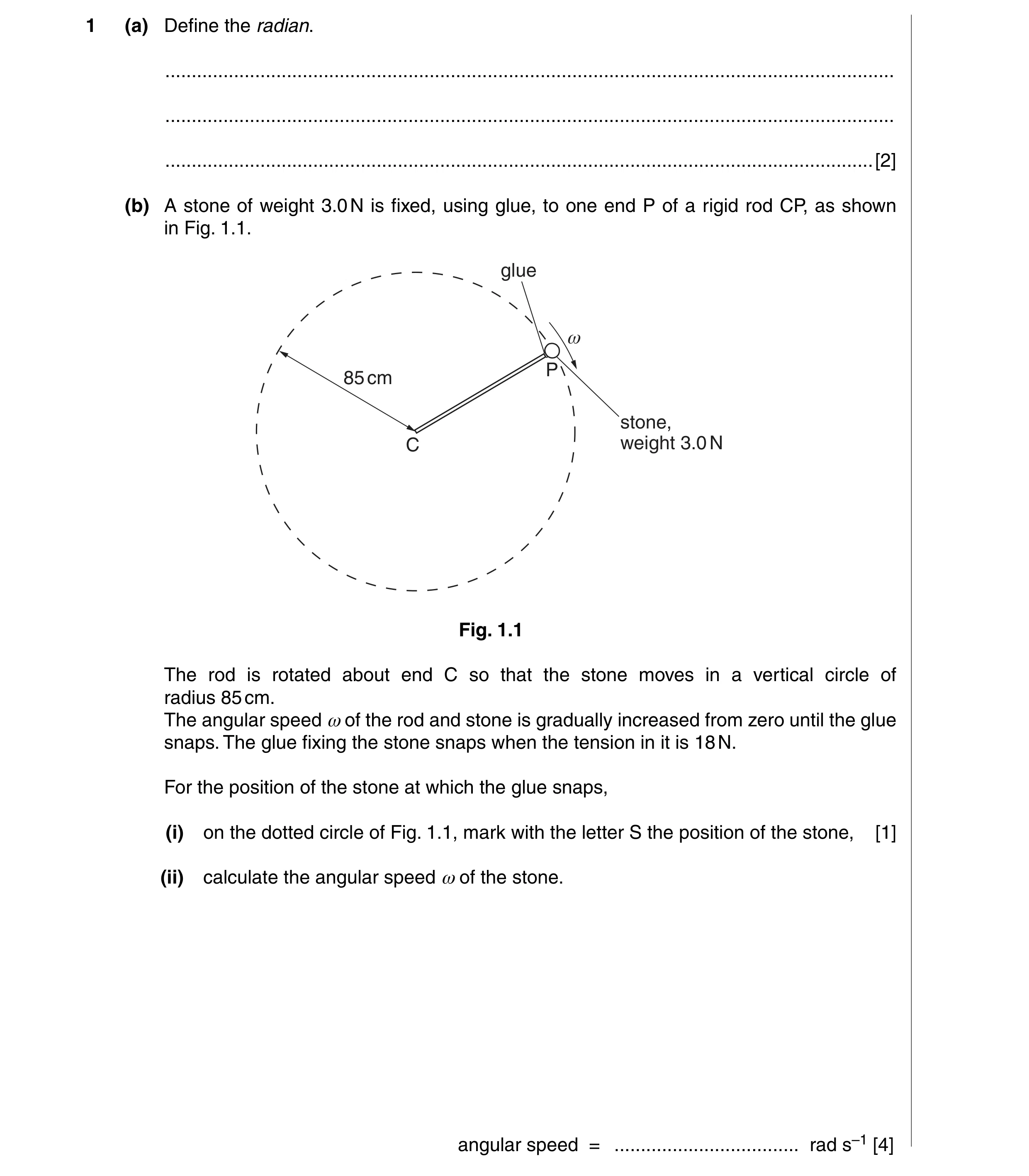
1 (a) Define the radian. … … … [2] (b) A stone of weight 3.0 N is fixed, using glue, to one end P of a rigid rod CP, as shown in Fig. 1.1. glue ω P 85 cm stone, C weight 3.0 N Fig. 1.1 The rod is rotated about end C so that the stone moves in a vertical circle of radius 85 cm. The angular speed ω of the rod and stone is gradually increased from zero until the glue snaps. The glue fixing the stone snaps when the tension in it is 18 N. For the position of the stone at which the glue snaps, (i) on the dotted circle of Fig. 1.1, mark with the letter S the position of the stone, [1] (ii) calculate the angular speed ω of the stone. angular speed = … rad s–1 [4]
7 marks
Mark scheme: 1 (a) angle (subtended) at centre of circle B1 (by) arc equal in length to radius B1 [2] (b) (i) point S shown below C B1 [1] (ii) (max) force / tension = weight + centripetal force C1 centripetal force = mrω2 C1 15 = 3.0/9.8 × 0.85 × ω2 C1 ω = 7.6 rad s–1 A1 [4]
This question in 9702/41 May/June 2010
Q4 · State the name of an electrical sensing device that will respond to changes in For… 9702/43 May/June 2010
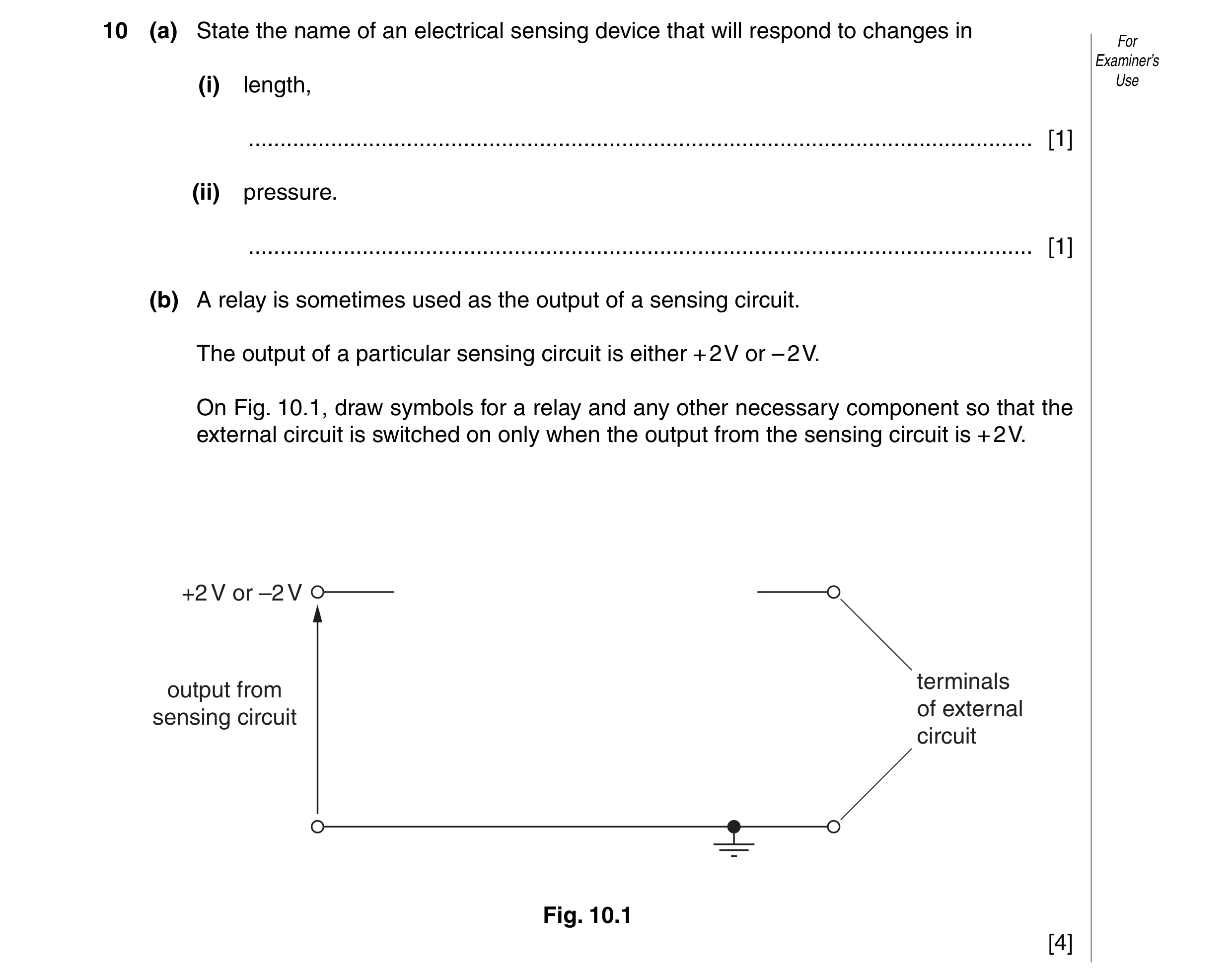
10 (a) State the name of an electrical sensing device that will respond to changes in For Examiner’s (i) length, Use … [1] (ii) pressure. … [1] (b) A relay is sometimes used as the output of a sensing circuit. The output of a particular sensing circuit is either + 2 V or – 2 V. On Fig. 10.1, draw symbols for a relay and any other necessary component so that the external circuit is switched on only when the output from the sensing circuit is + 2 V. +2 V or –2 V terminals output from of external sensing circuit circuit Fig. 10.1 [4]
6 marks
Mark scheme: 10 (a) (i) strain gauge B1 [1] (ii) piezo-electric / quartz crystal / transducer B1 [1] (b) circuit: coil of relay connected between sensing circuit output and earth B1 switch across terminals of external circuit B1 diode in series with coil with correct polarity for diode B1 second diode with correct polarity B1 [4]
This question in 9702/43 May/June 2010
Q5 · State what is meant by a field of force 9702/42 May/June 2011
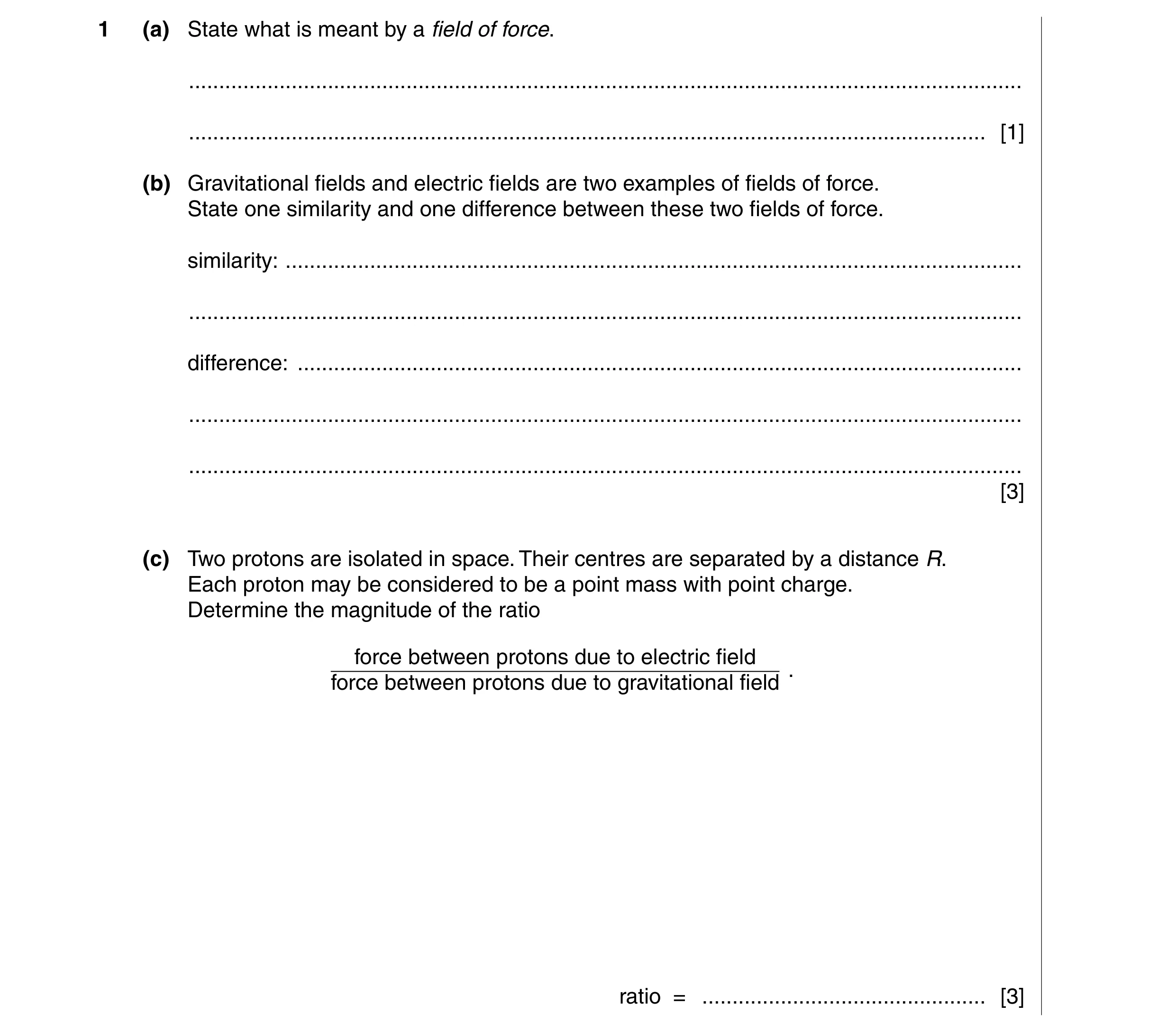
1 (a) State what is meant by a field of force. … … [1] (b) Gravitational fields and electric fields are two examples of fields of force. State one similarity and one difference between these two fields of force. similarity: … … difference: … … … [3] (c) Two protons are isolated in space. Their centres are separated by a distance R. Each proton may be considered to be a point mass with point charge. Determine the magnitude of the ratio force between protons due to electric field . force between protons due to gravitational field ratio = … [3]
7 marks
Mark scheme: 1 (a) region (of space) where a particle / body experiences a force B1 [1] (b) similarity: e.g. force ∝ 1 / r 2 potential ∝ 1 / r B1 [1] difference: e.g. gravitation force (always) attractive B1 electric force attractive or repulsive B1 [2] (c) either ratio is Q1Q2 / 4πε0m1m2G C1 = (1.6 × 10⁻¹⁹)2 / 4π × 8.85 × 10–12 × (1.67 × 10–27)2 × 6.67 × 10–11 C1 = 1.2 × 1036 A1 [3] or FE = 2.30 × 10⁻²⁸ × R –2 (C1) FG = 1.86 × 10–64 × R –2 (C1) FE / FG = 1.2 × 1036 (A1)
This question in 9702/42 May/June 2011
Q6 · The signal-to-noise ratio in an optic fibre must not fall below 24 dB 9702/42 May/June 2011
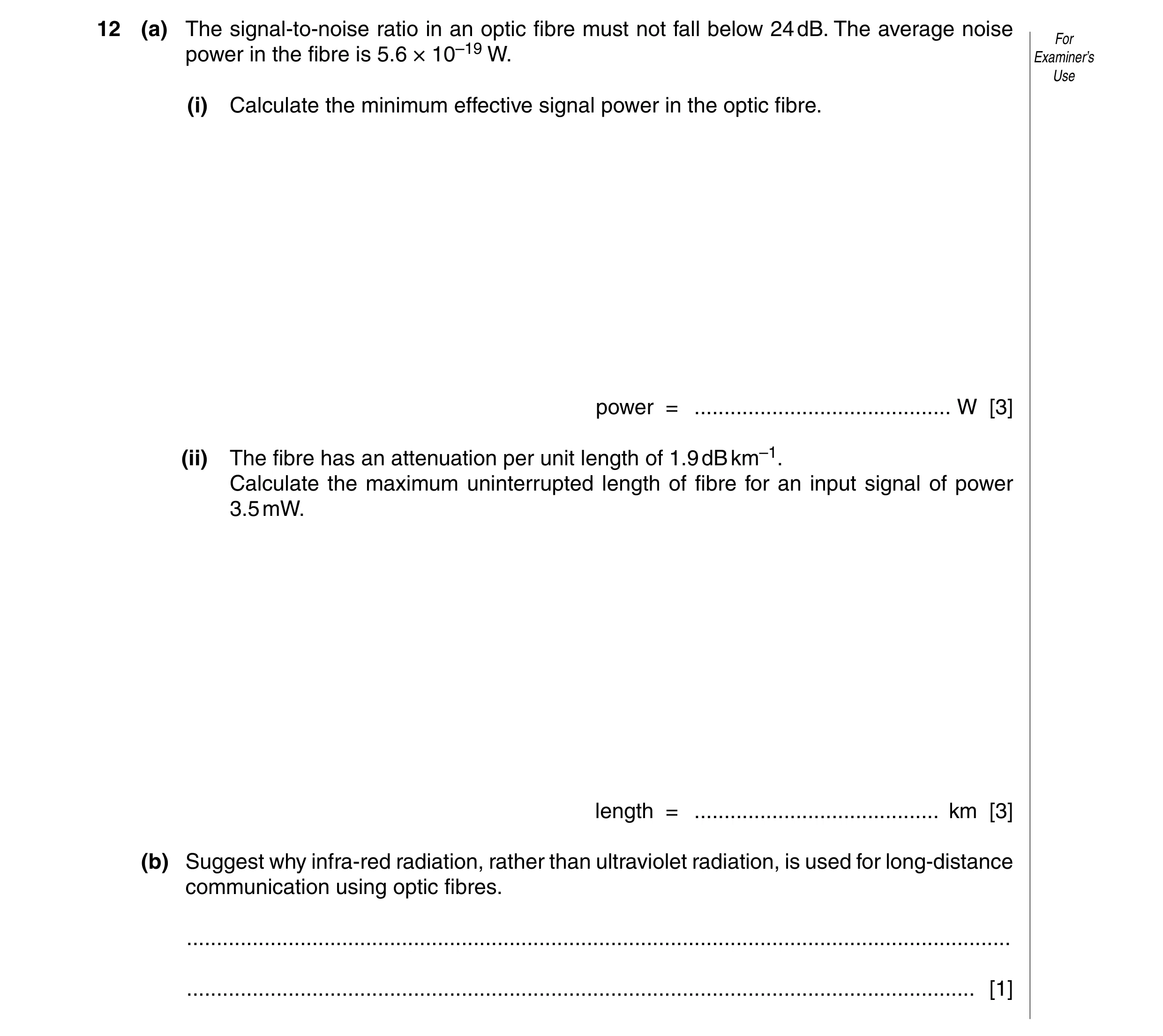
12 (a) The signal-to-noise ratio in an optic fibre must not fall below 24 dB. The average noise For power in the fibre is 5.6 × 10⁻¹⁹ W. Examiner’s Use (i) Calculate the minimum effective signal power in the optic fibre. power = … W [3] (ii) The fibre has an attenuation per unit length of 1.9 dB km–1. Calculate the maximum uninterrupted length of fibre for an input signal of power 3.5 mW. length = … km [3] (b) Suggest why infra-red radiation, rather than ultraviolet radiation, is used for long-distance communication using optic fibres. … … [1]
7 marks
Mark scheme: 12 (a) (i) ratio / dB = 10 lg(P1 / P2) C1 24 = 10 lg(P1 / {5.6 × 10⁻¹⁹}) C1 P1 = 1.4 × 10⁻¹⁶ W A1 [3] (ii) attenuation per unit length = 1 / L × 10 lg(P1 / P2) C1 1.9 = 1 / L × 10 lg({3.5 × 10⁻³}/{1.4 × 10–16}) C1 L = 1 km A1 [3] or attenuation = 10 lg({3.5 × 10⁻³}/{5.6 × 10–19}) (C1) = 158 dB attenuation along fibre = (158 – 24) (C1) L = (158 – 24) / 1.9 = 71 km (A1) (b) less attenuation (per unit length) / longer uninterrupted length of fibre B1 [1]
This question in 9702/42 May/June 2011
Q7 · The signal-to-noise ratio in an optic fibre must not fall below 24 dB 9702/43 May/June 2011
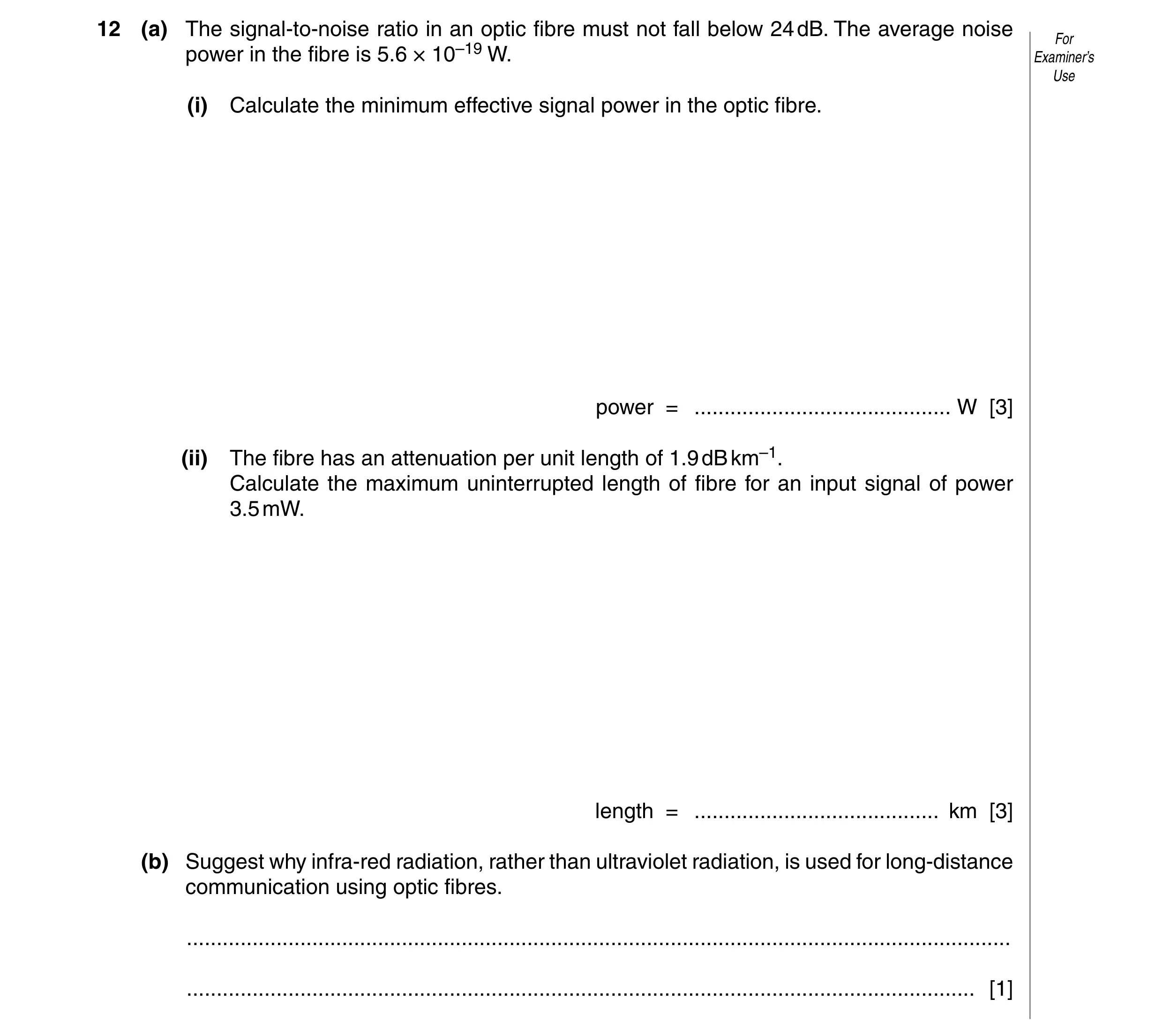
12 (a) The signal-to-noise ratio in an optic fibre must not fall below 24 dB. The average noise For power in the fibre is 5.6 × 10⁻¹⁹ W. Examiner’s Use (i) Calculate the minimum effective signal power in the optic fibre. power = … W [3] (ii) The fibre has an attenuation per unit length of 1.9 dB km–1. Calculate the maximum uninterrupted length of fibre for an input signal of power 3.5 mW. length = … km [3] (b) Suggest why infra-red radiation, rather than ultraviolet radiation, is used for long-distance communication using optic fibres. … … [1]
7 marks
Mark scheme: 12 (a) (i) ratio / dB = 10 lg(P1 / P2) C1 24 = 10 lg(P1 / {5.6 × 10⁻¹⁹}) C1 P1 = 1.4 × 10⁻¹⁶ W A1 [3] (ii) attenuation per unit length = 1 / L × 10 lg(P1 / P2) C1 1.9 = 1 / L × 10 lg({3.5 × 10⁻³}/{1.4 × 10–16}) C1 L = 1 km A1 [3] or attenuation = 10 lg({3.5 × 10⁻³}/{5.6 × 10–19}) (C1) = 158 dB attenuation along fibre = (158 – 24) (C1) L = (158 – 24) / 1.9 = 71 km (A1) (b) less attenuation (per unit length) / longer uninterrupted length of fibre B1 [1]
This question in 9702/43 May/June 2011
Q8 · Describe the main principles of the determination of the charge on an oil drop by For… 9702/42 May/June 2012
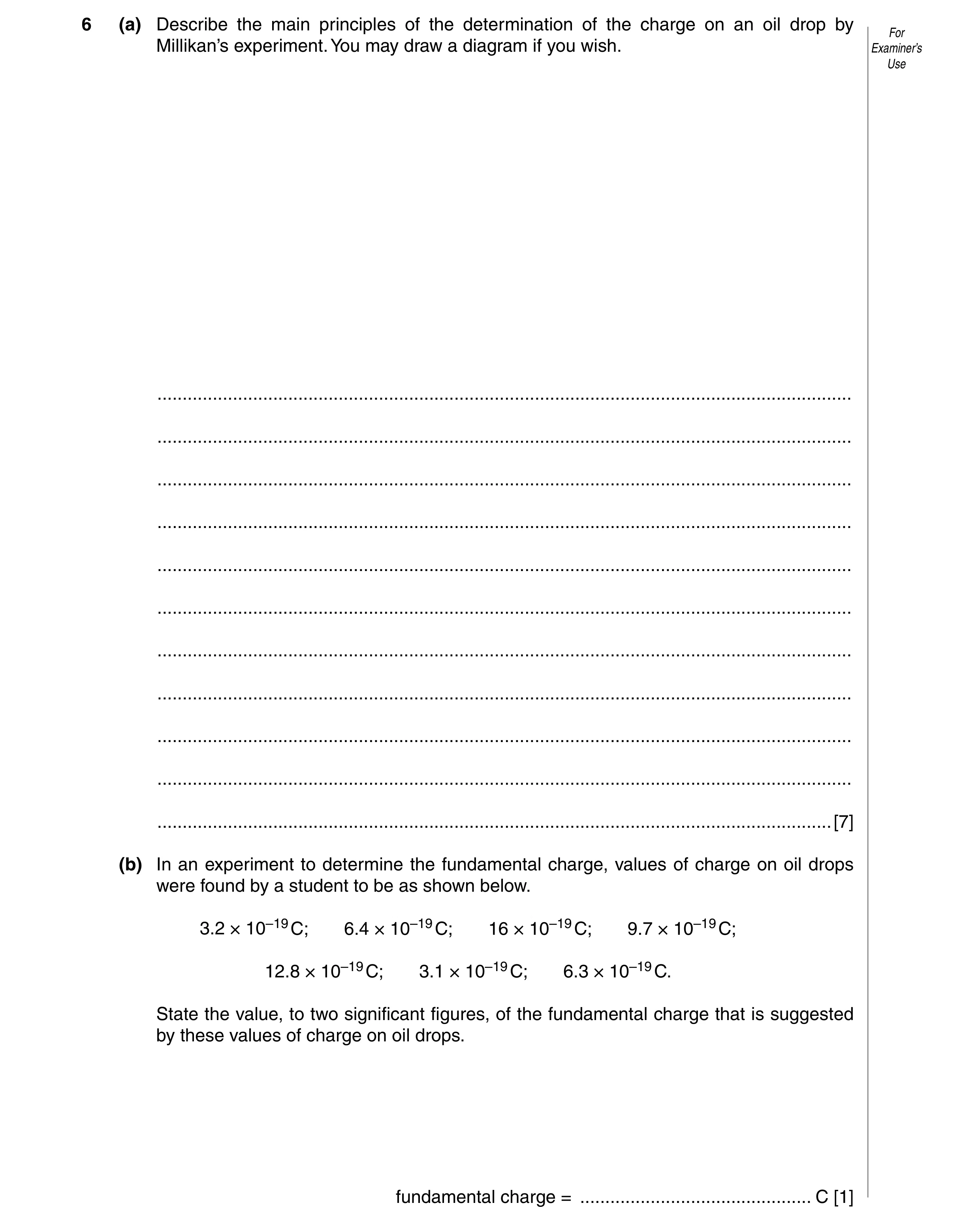
6 (a) Describe the main principles of the determination of the charge on an oil drop by For Millikan’s experiment. You may draw a diagram if you wish. Examiner’s Use … … … … … … … … … … … [7] (b) In an experiment to determine the fundamental charge, values of charge on oil drops were found by a student to be as shown below. 3.2 × 10⁻¹⁹ C; 6.4 × 10⁻¹⁹ C; 16 × 10–19 C; 9.7 × 10⁻¹⁹ C; 12.8 × 10⁻¹⁹ C; 3.1 × 10⁻¹⁹ C; 6.3 × 10⁻¹⁹ C. State the value, to two significant figures, of the fundamental charge that is suggested by these values of charge on oil drops. fundamental charge = … C [1]
8 marks
Mark scheme: 6 (a) oil drop charged by friction/beta source B1 between parallel metal plates B1 plates are horizontal (1) adjustable potential difference/field between plates B1 until oil drop is stationary B1 mg = q × V/d B1 symbols explained (1) oil drop viewed through microscope (1) m determined from terminal speed of drop (when p.d. is zero) (1) (any two extras, 1 each) B2 [7] (b) 3.2 × 10⁻¹⁹ C A1 [1]
This question in 9702/42 May/June 2012
Q9 · Suggest electrical sensing devices, one in each case, that may be used to monitor changes… 9702/41 May/June 2013
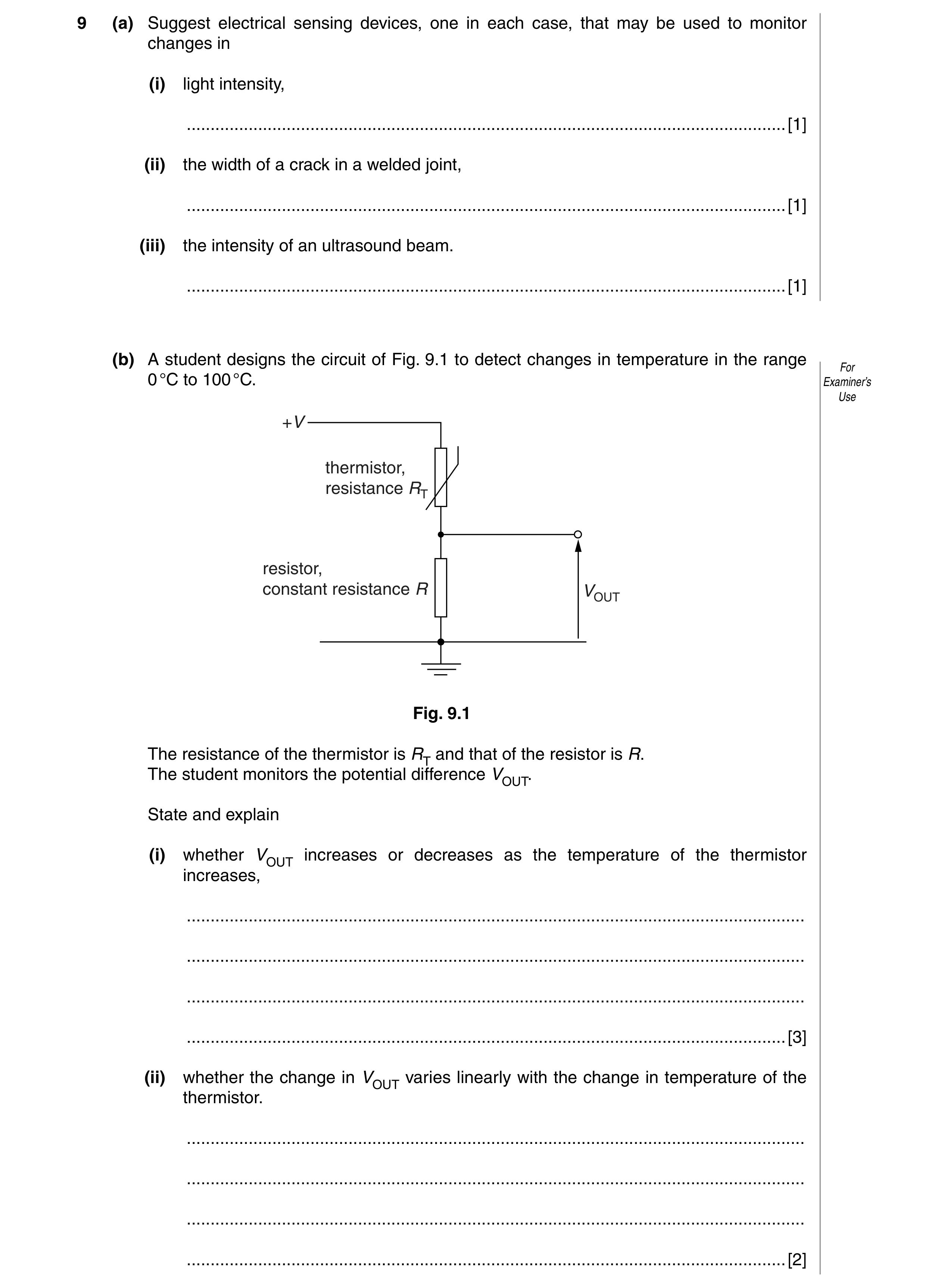
9 (a) Suggest electrical sensing devices, one in each case, that may be used to monitor changes in (i) light intensity, … [1] (ii) the width of a crack in a welded joint, … [1] (iii) the intensity of an ultrasound beam. … [1] (b) A student designs the circuit of Fig. 9.1 to detect changes in temperature in the range For 0 °C to 100 °C. Examiner’s Use +V thermistor, resistance RT resistor, constant resistance R VOUT Fig. 9.1 The resistance of the thermistor is RT and that of the resistor is R. The student monitors the potential difference VOUT. State and explain (i) whether VOUT increases or decreases as the temperature of the thermistor increases, … … … … [3] (ii) whether the change in VOUT varies linearly with the change in temperature of the thermistor. … … … … [2]
8 marks
Mark scheme: 9 (a) (i) light-dependent resistor/LDR B1 [1] (ii) strain gauge B1 [1] (iii) quartz/piezo-electric crystal B1 [1] (b) (i) resistance of thermistor decreases as temperature increses M1 etiher VOUT = V × R / (R + RT) or current increases and VOUT = I R A1 VOUT increases A1 [3] (ii) either change in RT with temperature is non-linear or VOUT is not proportional to RT/ change in VOUT with RT is non-linear M1 so change is non-linear A1 [2]
This question in 9702/41 May/June 2013
Q10 · An electronic sensor may be represented by the block diagram of Fig 9702/41 Oct/Nov 2013
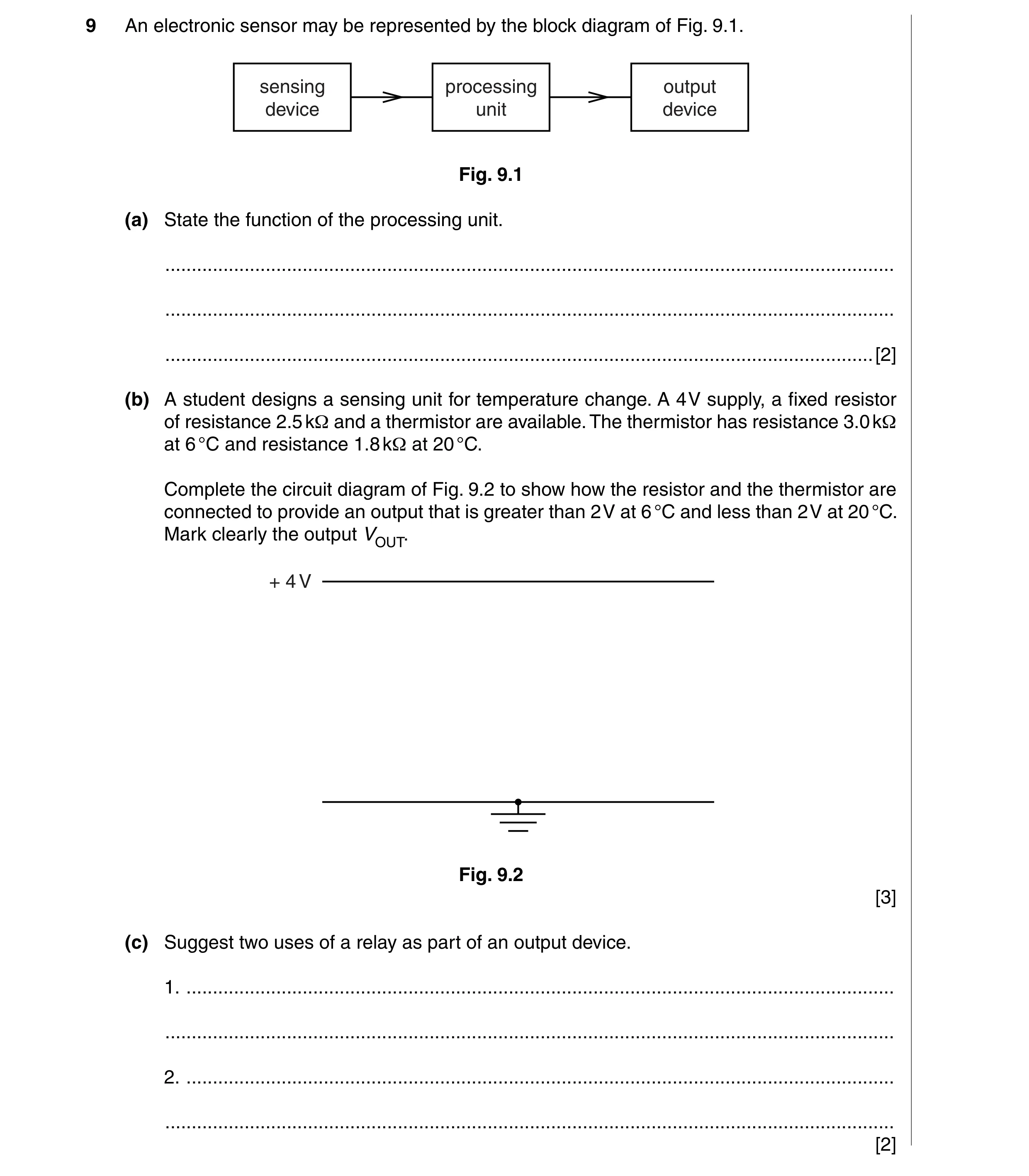
9 An electronic sensor may be represented by the block diagram of Fig. 9.1. sensing processing output device unit device Fig. 9.1 (a) State the function of the processing unit. … … … [2] (b) A student designs a sensing unit for temperature change. A 4 V supply, a fixed resistor of resistance 2.5 kΩ and a thermistor are available. The thermistor has resistance 3.0 kΩ at 6 °C and resistance 1.8 kΩ at 20 °C. Complete the circuit diagram of Fig. 9.2 to show how the resistor and the thermistor are connected to provide an output that is greater than 2 V at 6 °C and less than 2 V at 20 °C. Mark clearly the output VOUT. + 4 V Fig. 9.2 [3] (c) Suggest two uses of a relay as part of an output device. 1. … … 2. … … [2]
7 marks
Mark scheme: 9 (a) operates on / takes signal from sensing device B1 (so that) it gives an voltage output B1 [2] (b) thermistor and resistor in series between +4 V line and earth M1 VOUT shown clearly across either thermistor or resistor A1 VOUT shown clearly across thermistor A1 [3] (c) e.g. remote switching e.g. switching large current by means of a small current e.g. isolating circuit from high voltage e.g. switching high voltage by means of a small voltage/current (any two sensible suggestions, 1 each to max. 2) B2 [2]
This question in 9702/41 Oct/Nov 2013
Q11 · An electronic sensor may be represented by the block diagram of Fig 9702/42 Oct/Nov 2013
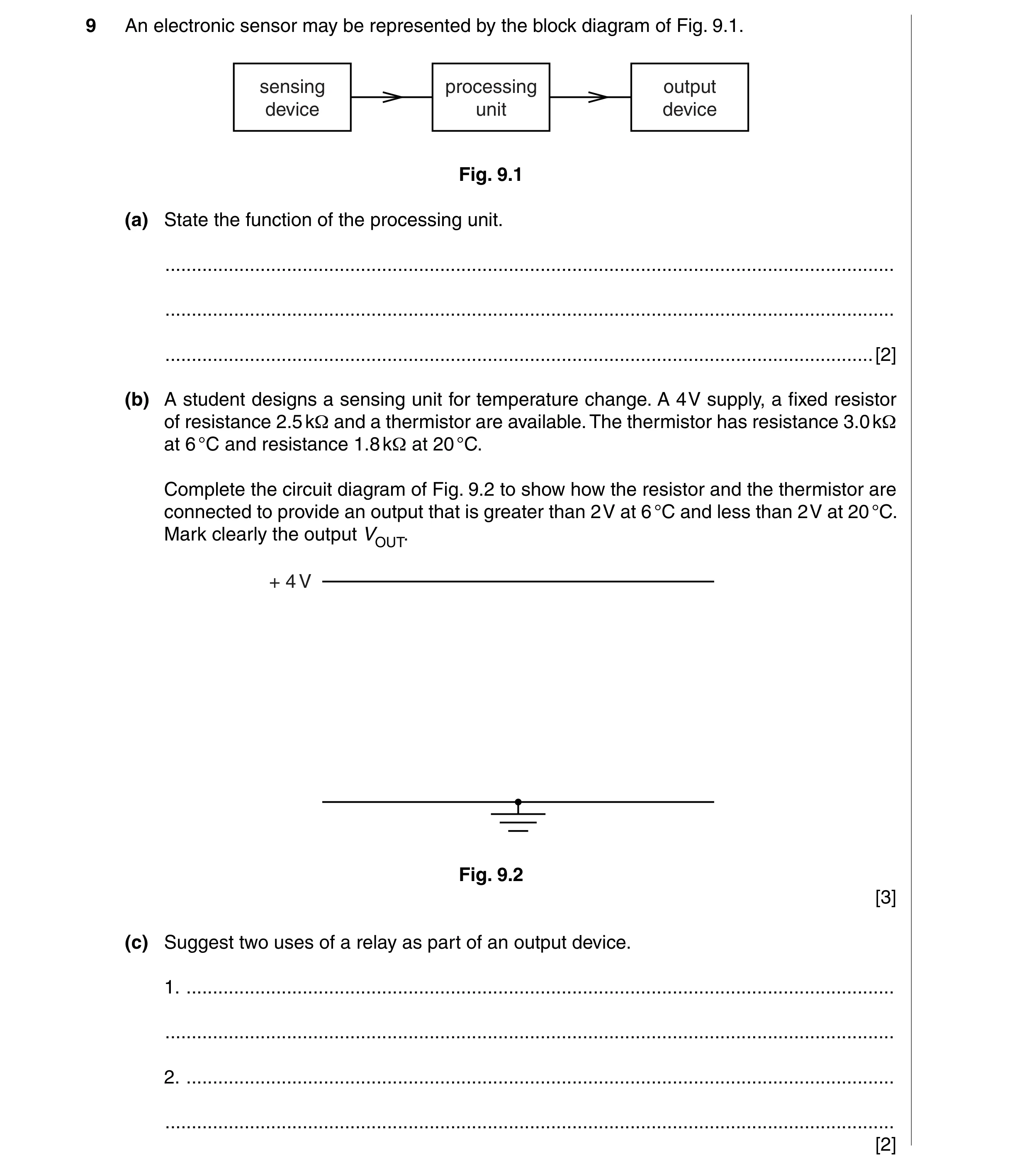
9 An electronic sensor may be represented by the block diagram of Fig. 9.1. sensing processing output device unit device Fig. 9.1 (a) State the function of the processing unit. … … … [2] (b) A student designs a sensing unit for temperature change. A 4 V supply, a fixed resistor of resistance 2.5 kΩ and a thermistor are available. The thermistor has resistance 3.0 kΩ at 6 °C and resistance 1.8 kΩ at 20 °C. Complete the circuit diagram of Fig. 9.2 to show how the resistor and the thermistor are connected to provide an output that is greater than 2 V at 6 °C and less than 2 V at 20 °C. Mark clearly the output VOUT. + 4 V Fig. 9.2 [3] (c) Suggest two uses of a relay as part of an output device. 1. … … 2. … … [2]
7 marks
Mark scheme: 9 (a) operates on / takes signal from sensing device B1 (so that) it gives an voltage output B1 [2] (b) thermistor and resistor in series between +4 V line and earth M1 VOUT shown clearly across either thermistor or resistor A1 VOUT shown clearly across thermistor A1 [3] (c) e.g. remote switching e.g. switching large current by means of a small current e.g. isolating circuit from high voltage e.g. switching high voltage by means of a small voltage/current (any two sensible suggestions, 1 each to max. 2) B2 [2]
This question in 9702/42 Oct/Nov 2013
Question 12 9702/42 May/June 2014
7 (a) Define the radian. … … … [2] (b) A telescope gives a clear view of a distant object when the angular displacement between the edges of the object is at least 9.7 × 10⁻⁶ rad. (i) The Moon is approximately 3.8 × 10⁵ km from Earth. Estimate the minimum diameter of a circular crater on the Moon’s surface that can be seen using the telescope. diameter = … km [2] (ii) Suggest why craters of the same diameter as that calculated in (i) but on the surface of Mars are not visible using this telescope. … … … [2]
6 marks
Mark scheme: 7 (a) angle subtended at the centre of a circle B1 by an arc equal in length to the radius B1 [2] (b) (i) arc R distance × angle C1 diameter R 3.8 × 105 × 9.7 × 10–6 = = = R 3.7 km A1 [2] (ii) Mars is (much) further from Earth / away (answer must be comparative) B1 angle (at telescope is much) smaller B1 [2]
This question in 9702/42 May/June 2014
Q13 · During the de-commissioning of a nuclear reactor, a mass of 2.5 × 10⁶ kg of steel is… 9702/43 Oct/Nov 2014
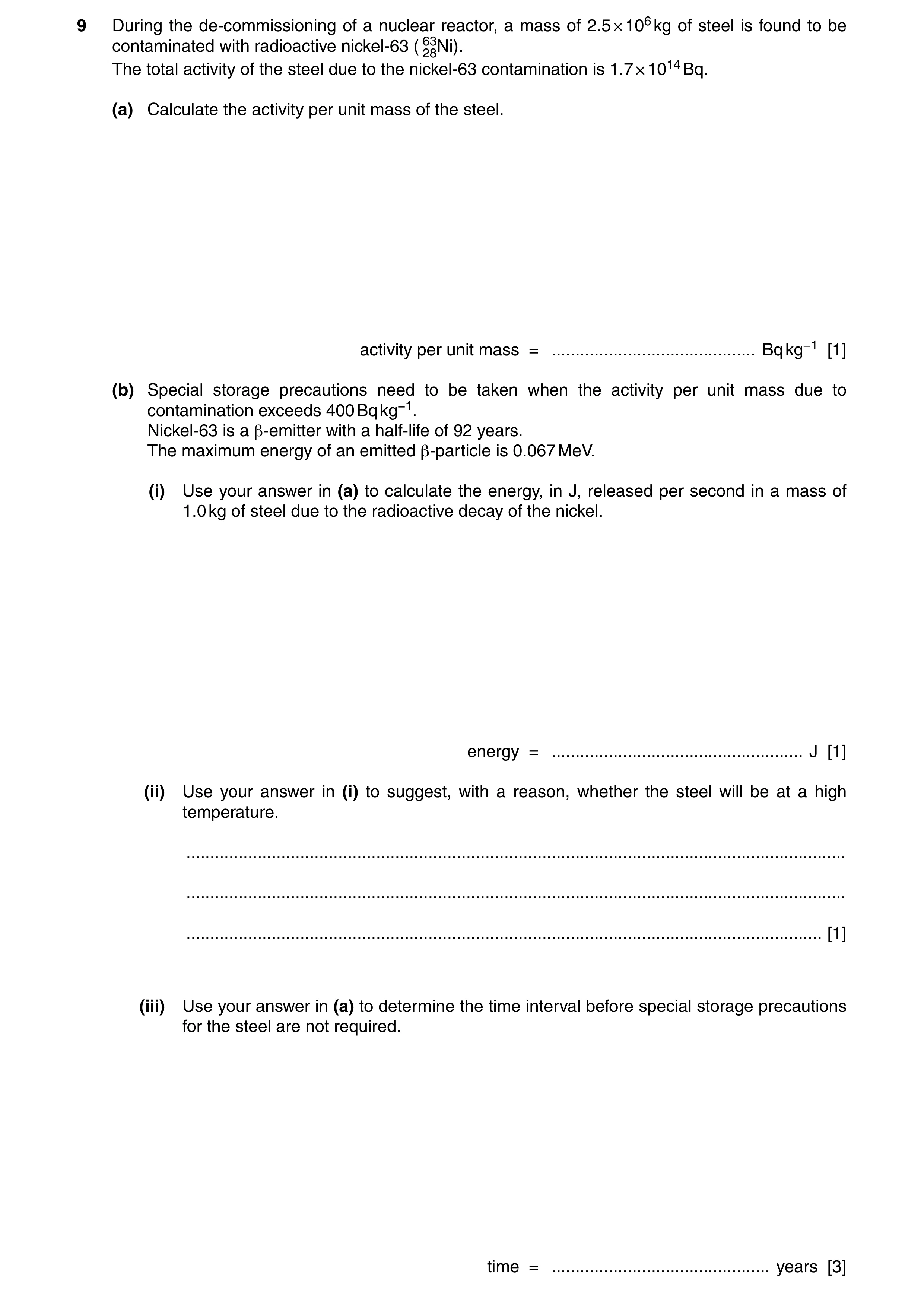
9 During the de-commissioning of a nuclear reactor, a mass of 2.5 × 10⁶ kg of steel is found to be contaminated with radioactive nickel-63 ( 6328Ni). The total activity of the steel due to the nickel-63 contamination is 1.7 × 10¹⁴ Bq. (a) Calculate the activity per unit mass of the steel. activity per unit mass = … Bq kg−1 [1] (b) Special storage precautions need to be taken when the activity per unit mass due to contamination exceeds 400 Bq kg−1. Nickel-63 is a β-emitter with a half-life of 92 years. The maximum energy of an emitted β-particle is 0.067 MeV. (i) Use your answer in (a) to calculate the energy, in J, released per second in a mass of 1.0 kg of steel due to the radioactive decay of the nickel. energy = … J [1] (ii) Use your answer in (i) to suggest, with a reason, whether the steel will be at a high temperature. … … … [1] (iii) Use your answer in (a) to determine the time interval before special storage precautions for the steel are not required. time = … years [3]
6 marks
Mark scheme: 9 (a) activity = (1.7 × 10¹⁴) / (2.5 × 10⁶) = 6.8 × 10⁷ Bq kg–1 A1 [1] (b) (i) energy released per second in 1.0 kg of steel = 6.8 × 107 × 0.067 × 1.6 × 10–13 = 7.3 × 10⁻⁷ J B1 [1] (ii) this is a very small quantity of energy so steel will not be warm B1 [1] (iii) A = A0 e–λt and λt½ = ln 2 C1 400 = (6.8 × 10⁷) exp(–[ln 2 × t] / 92) C1 t = 1600 years A1 or A = A0 / 2n (C1) n = 17.4 (C1) t = 17.4 × 92 = 1600 years (A1) [3] Section B
This question in 9702/43 Oct/Nov 2014
Q14 · The power for a space probe is to be supplied by the energy released when plutonium-236… 9702/42 May/June 2015
8 The power for a space probe is to be supplied by the energy released when plutonium-236 decays by the emission of α-particles. The α-particles, each of energy 5.75 MeV, are captured and their energy is converted into electrical energy with an efficiency of 24%. (a) Calculate (i) the energy, in joules, equal to 5.75 MeV, energy = … J [1] (ii) the number of α-particles per second required to generate 1.9 kW of electrical power. number per second = … s–1 [2] (b) Each plutonium-236 nucleus, on disintegration, produces one α-particle. Plutonium-236 has a half-life of 2.8 years. (i) Calculate the decay constant, in s–1, of plutonium-236. decay constant = … s–1 [2] (ii) Use your answers in (a)(ii) and (b)(i) to determine the mass of plutonium-236 required for the generation of 1.9 kW of electrical power. mass = … g [4] (c) The minimum electrical power required for the space probe is 0.84 kW. Calculate the time, in years, for which the sample of plutonium-236 in (b)(ii) will provide sufficient power. time = … years [2]
11 marks
Mark scheme: 8 (a) (i) energy = 5.75 × 1.6 × 10–13 = 9.2 × 10⁻¹³ J A1 [1] (ii) number = 1900 / (9.2 × 10–13 × 0.24) C1 = 8.6 × 10¹⁵ s–1 A1 [2] (b) (i) decay constant = 0.693 / (2.8 × 365 × 24 × 3600) C1 = 7.85 × 10⁻⁹ s–1 (allow 7.8 or 7.9 to 2 s.f.) A1 [2] (ii) A = λN 8.6 × 1015 = 7.85 × 10⁻⁹ × N C1 N = 1.096 × 1024 C1 mass = (1.096 × 1024 × 236) / (6.02 × 10²³) M1 = 430 g A1 [4] (c) 0.84 = 1.9 exp(–7.85 × 10⁻⁹ t) C1 t = 1.04 × 10⁸ s = 3.3 years A1 [2] Section B
This question in 9702/42 May/June 2015
Q15 · A digital signal is produced by sampling an analogue signal and passing the samples… 9702/42 Feb/March 2016
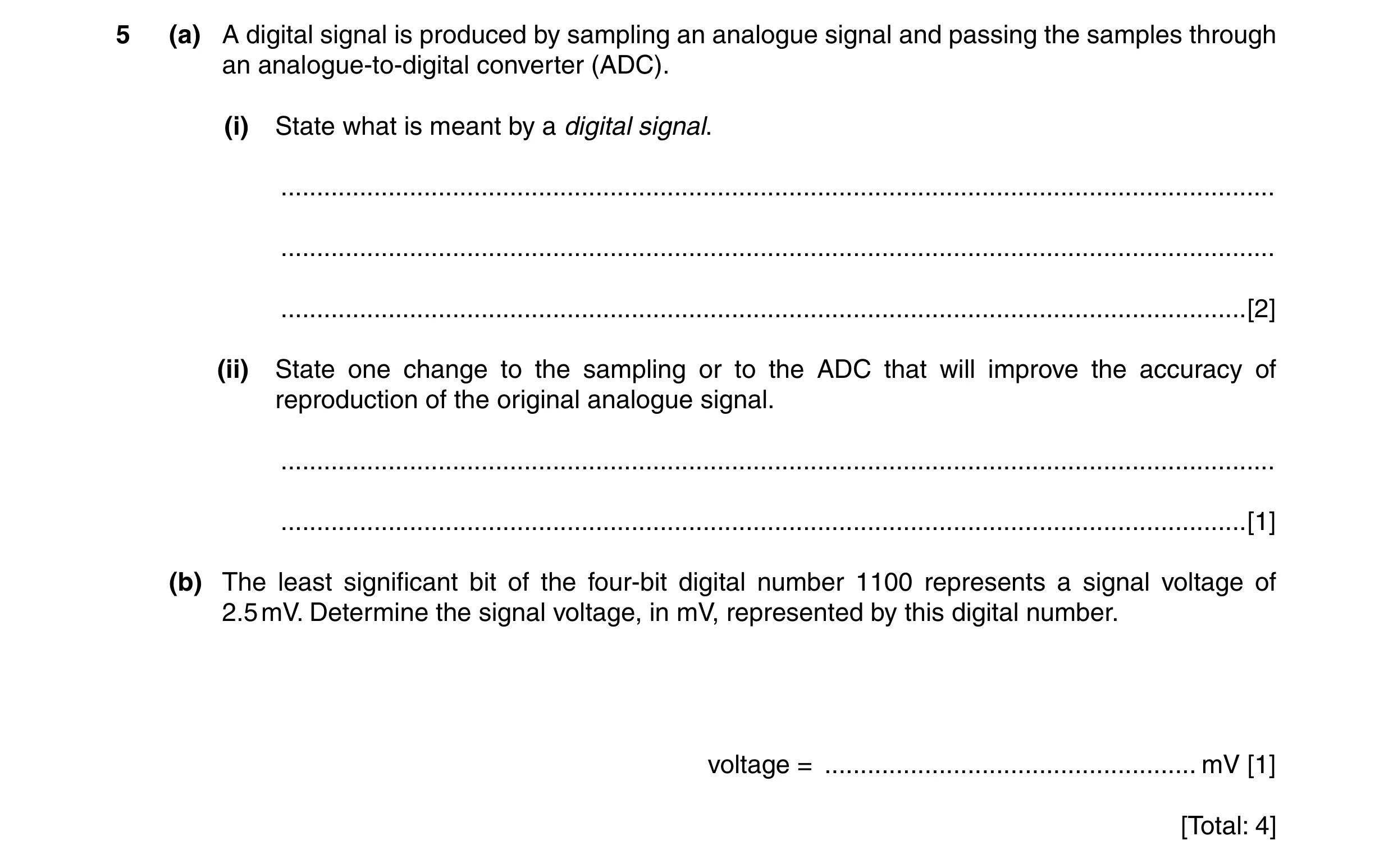
5 (a) A digital signal is produced by sampling an analogue signal and passing the samples through an analogue-to-digital converter (ADC). (i) State what is meant by a digital signal. … … … [2] (ii) State one change to the sampling or to the ADC that will improve the accuracy of reproduction of the original analogue signal. … … [1] (b) The least significant bit of the four-bit digital number 1100 represents a signal voltage of 2.5 mV. Determine the signal voltage, in mV, represented by this digital number. voltage = … mV [1] [Total: 4]
4 marks
Mark scheme: 5 (a) (i) (series of) ‘highs’ and ‘lows’ / ‘on’ and ‘off’ / 1’s and 0’s / two values M1 with no intermediate values / the values are discrete A1 [2] (ii) either use higher sampling frequency / rate or use more bits in each sample / each digital number or use more levels in each sample B1 [1] (b) voltage = 30 mV A1 [1]
This question in 9702/42 Feb/March 2016
Q16 · A thin rectangular slice of aluminium has sides of length 65 mm, 50 mm and 0.10 mm, as… 9702/41 May/June 2016
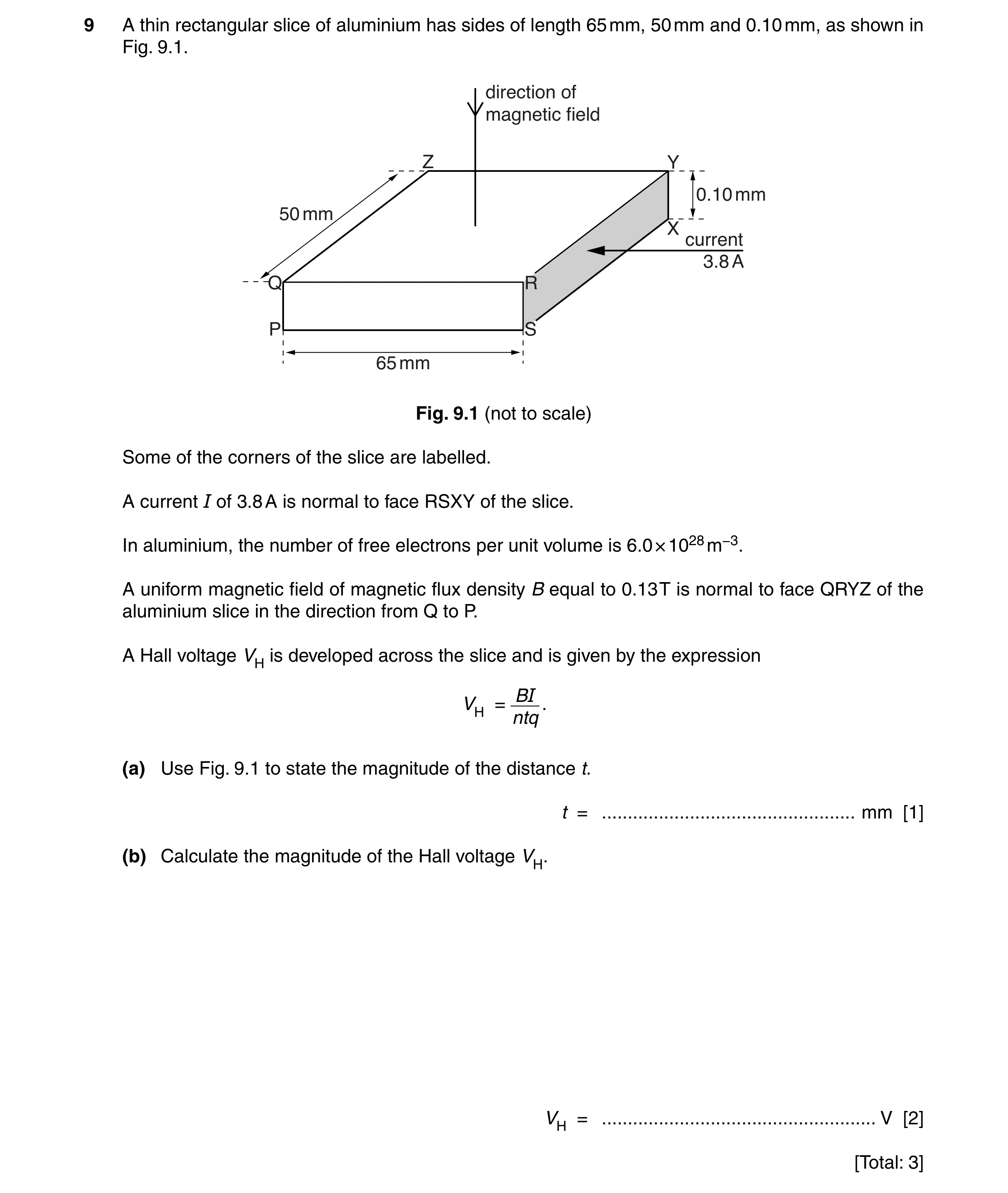
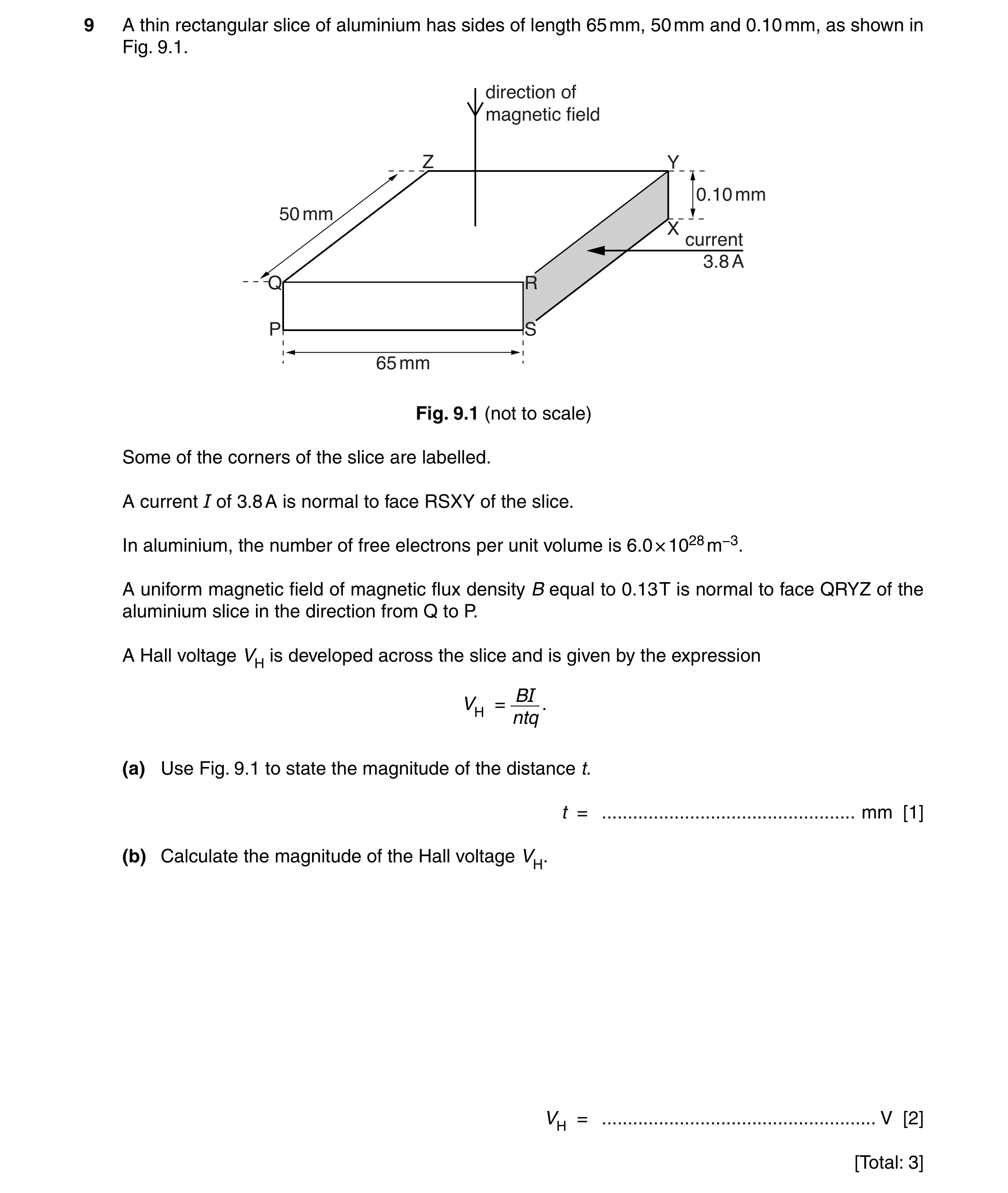
9 A thin rectangular slice of aluminium has sides of length 65 mm, 50 mm and 0.10 mm, as shown in Fig. 9.1. direction of magnetic field Z Y 0.10 mm 50 mm X current 3.8 A Q R P S 65 mm Fig. 9.1 (not to scale) Some of the corners of the slice are labelled. A current I of 3.8 A is normal to face RSXY of the slice. In aluminium, the number of free electrons per unit volume is 6.0 × 1028 m−3. A uniform magnetic field of magnetic flux density B equal to 0.13 T is normal to face QRYZ of the aluminium slice in the direction from Q to P. A Hall voltage VH is developed across the slice and is given by the expression BI VH = . ntq (a) Use Fig. 9.1 to state the magnitude of the distance t. t = … mm [1] (b) Calculate the magnitude of the Hall voltage VH. VH = … V [2] [Total: 3]
3 marks
Mark scheme: 9 (a) 0.10 mm B1 [1] (b) VH = (0.13 × 3.8) / (6.0 × 1028 × 0.10 × 10–3 × 1.60 × 10–19) C1 = 5.1 × 10⁻⁷ V A1 [2]
This question in 9702/41 May/June 2016
Q17 · A thin rectangular slice of aluminium has sides of length 65 mm, 50 mm and 0.10 mm, as… 9702/43 May/June 2016
9 A thin rectangular slice of aluminium has sides of length 65 mm, 50 mm and 0.10 mm, as shown in Fig. 9.1. direction of magnetic field Z Y 0.10 mm 50 mm X current 3.8 A Q R P S 65 mm Fig. 9.1 (not to scale) Some of the corners of the slice are labelled. A current I of 3.8 A is normal to face RSXY of the slice. In aluminium, the number of free electrons per unit volume is 6.0 × 1028 m−3. A uniform magnetic field of magnetic flux density B equal to 0.13 T is normal to face QRYZ of the aluminium slice in the direction from Q to P. A Hall voltage VH is developed across the slice and is given by the expression BI VH = . ntq (a) Use Fig. 9.1 to state the magnitude of the distance t. t = … mm [1] (b) Calculate the magnitude of the Hall voltage VH. VH = … V [2] [Total: 3]
3 marks
Mark scheme: 9 (a) 0.10 mm B1 [1] (b) VH = (0.13 × 3.8) / (6.0 × 1028 × 0.10 × 10–3 × 1.60 × 10–19) C1 = 5.1 × 10⁻⁷ V A1 [2]
This question in 9702/43 May/June 2016
 5 / 19
 6 / 19
 7 / 19
 8 / 19
 9 / 19
 10 / 19
 11 / 19
 12 / 19
 13 / 19
 14 / 19
 15 / 19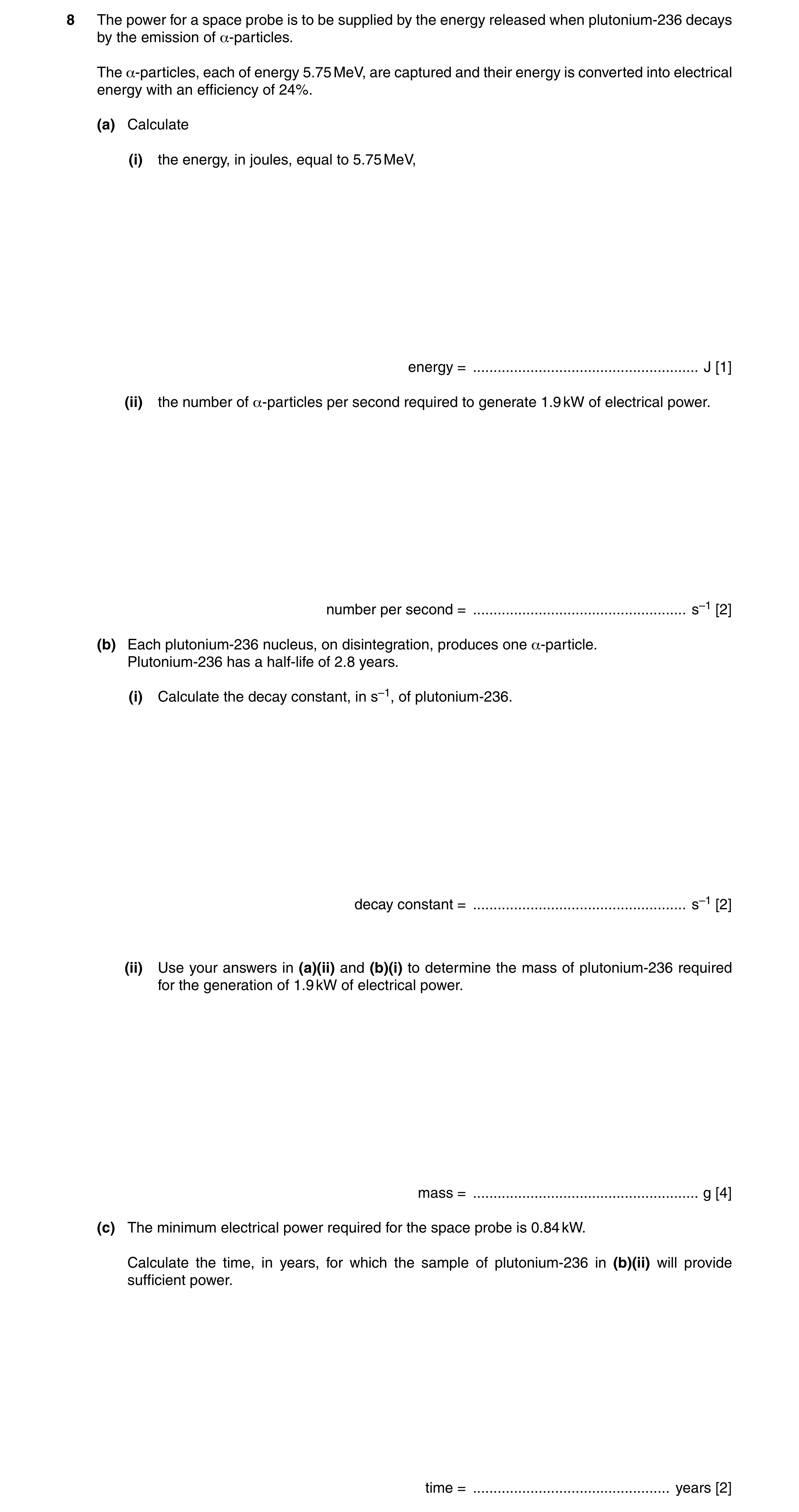
 17 / 19
 18 / 19
 19 / 19
 9
9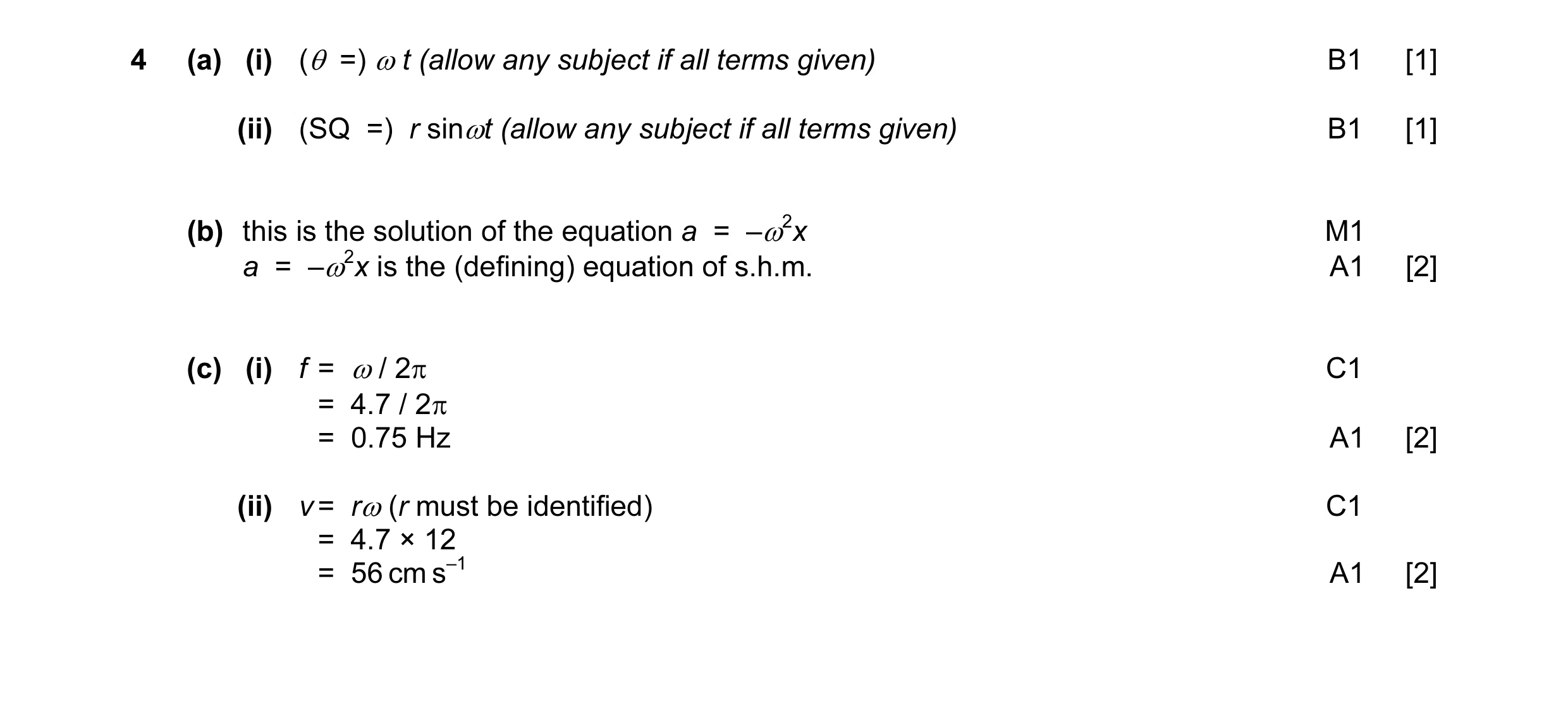 8
8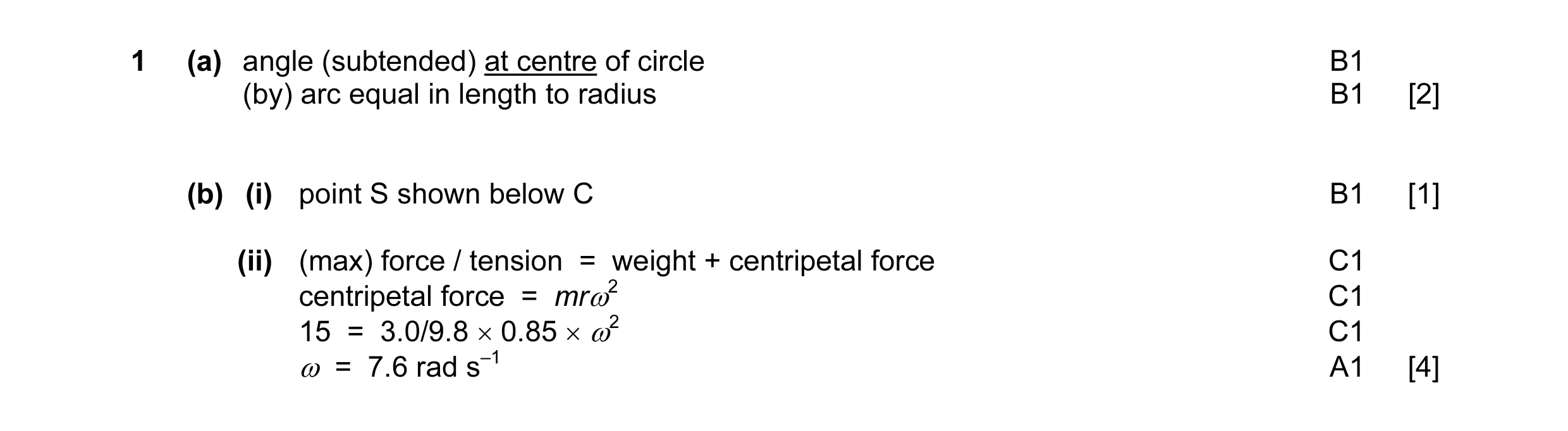 7
7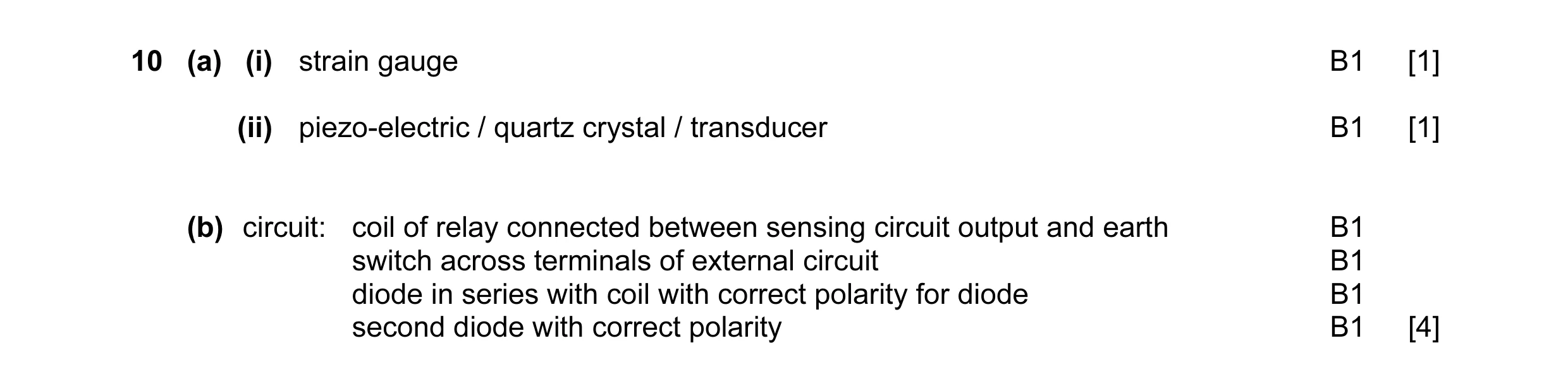 6
6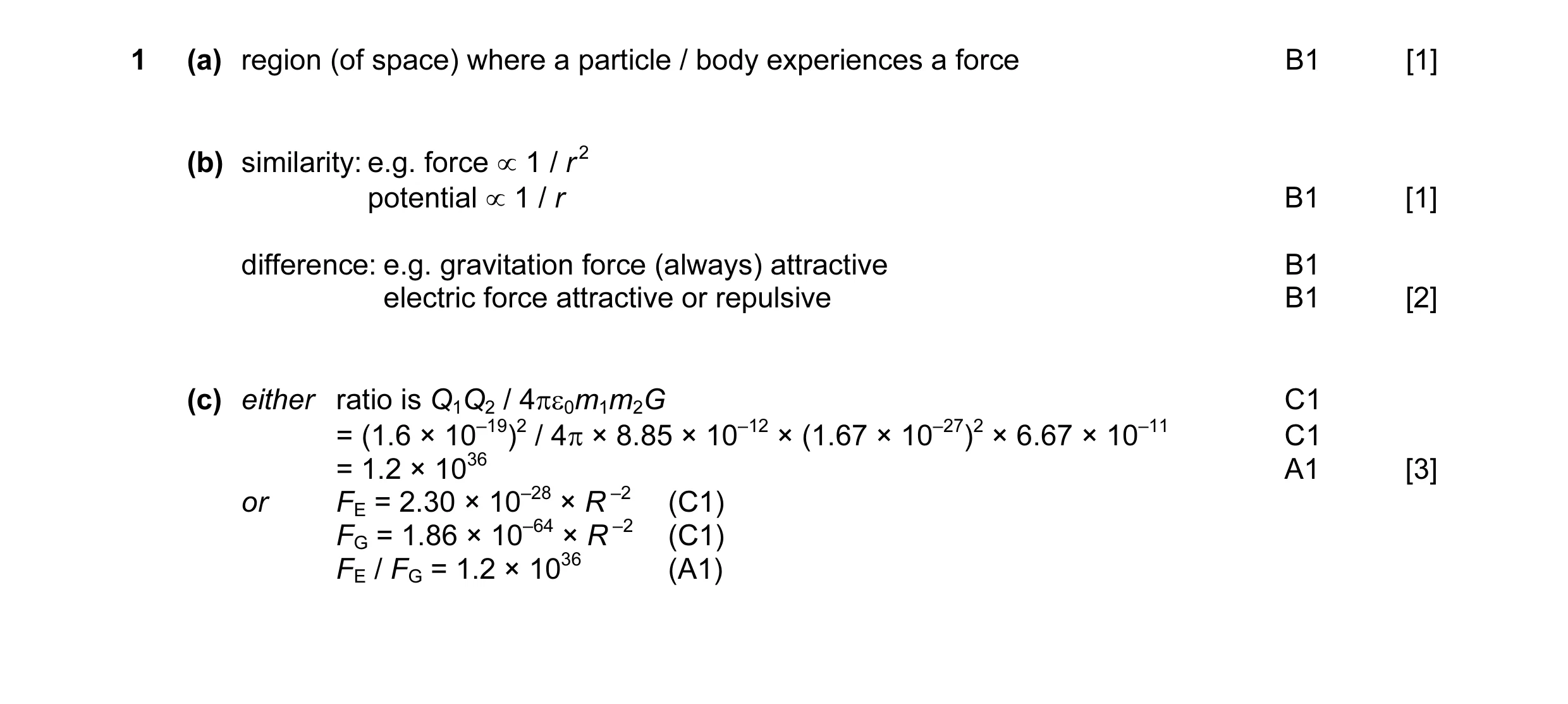 7
7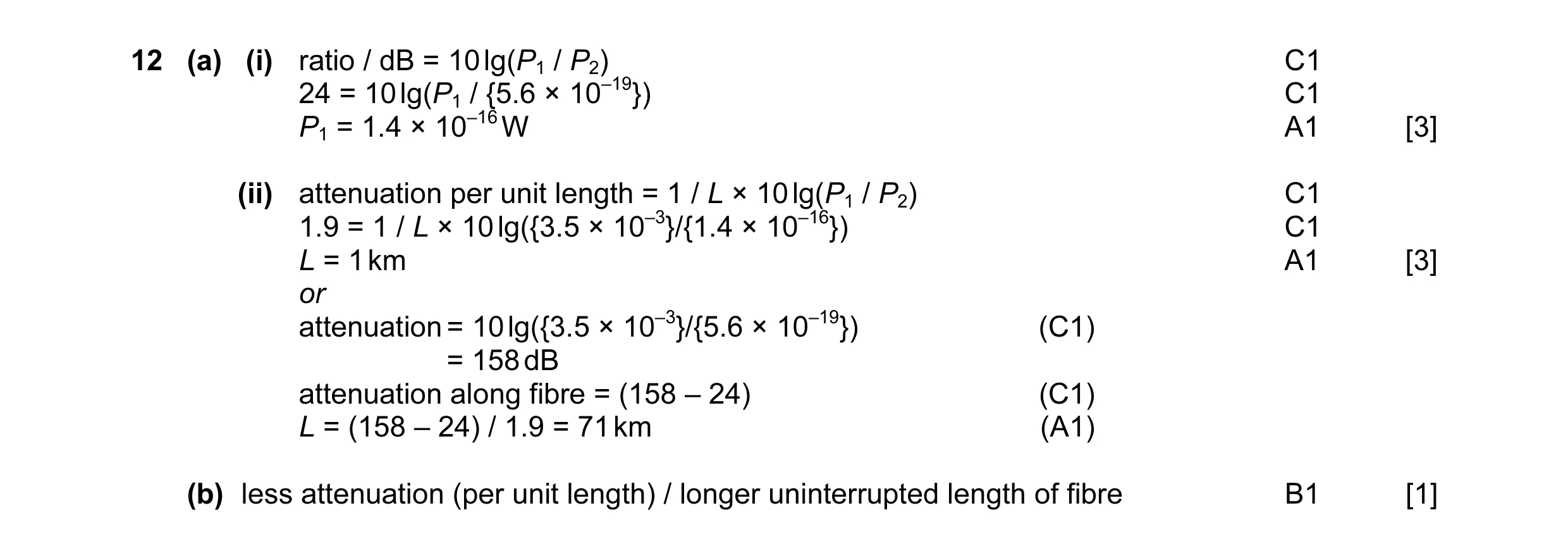 7
7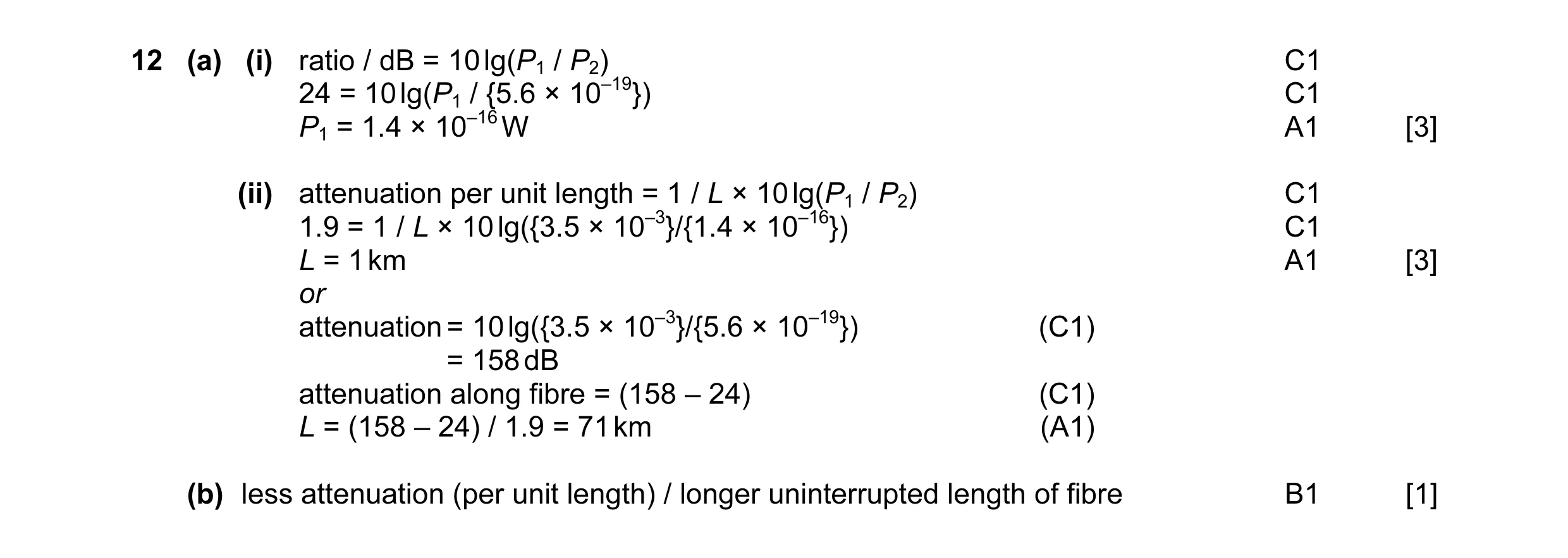 7
7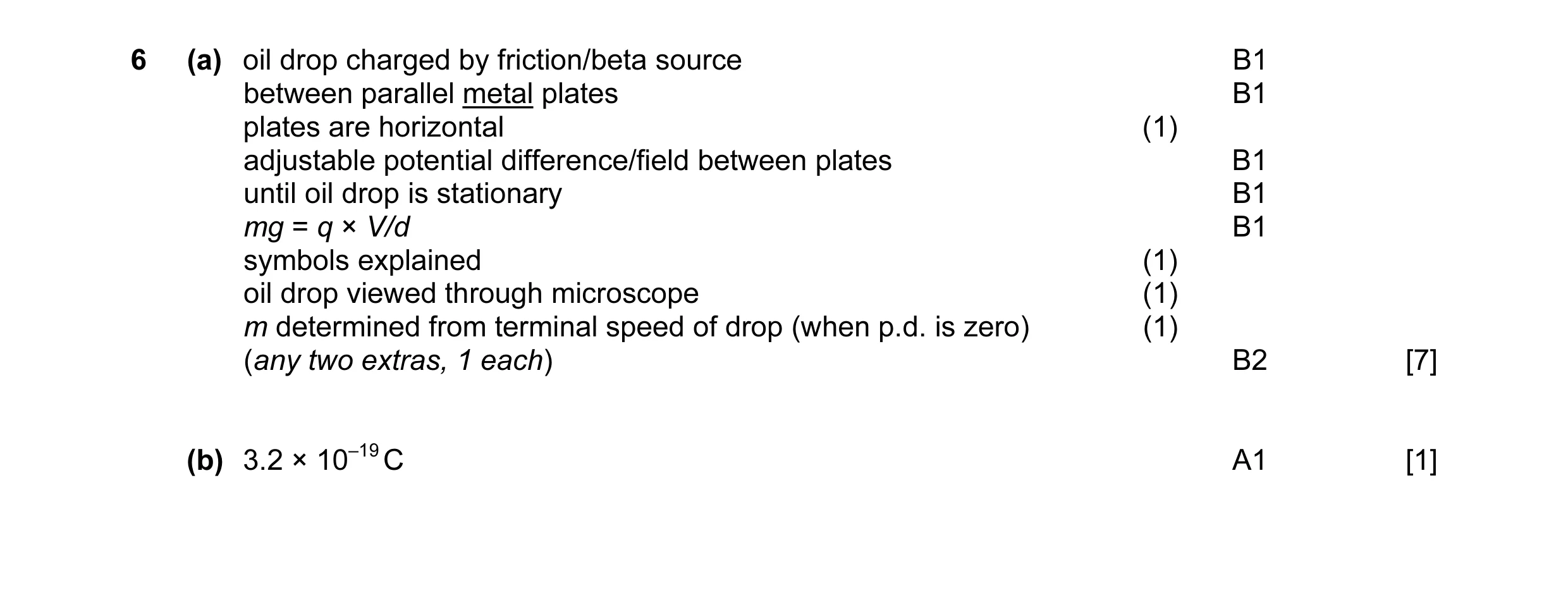 8
8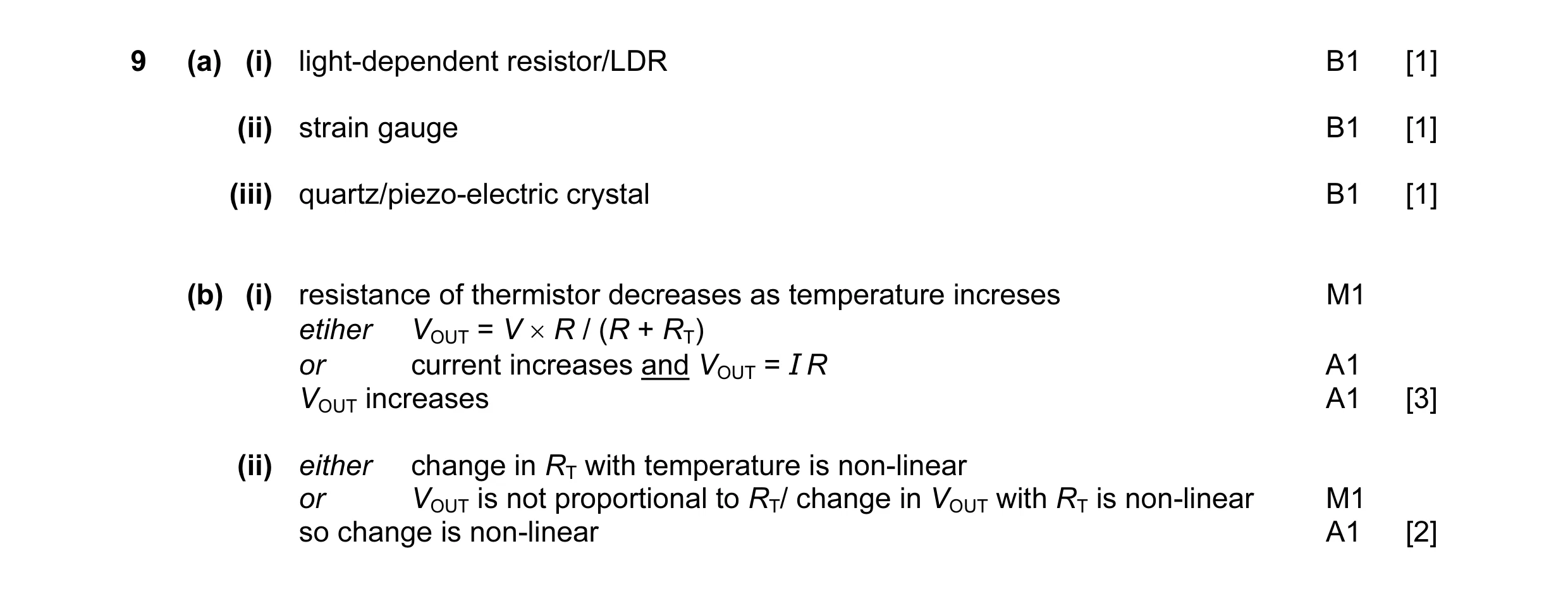 8
8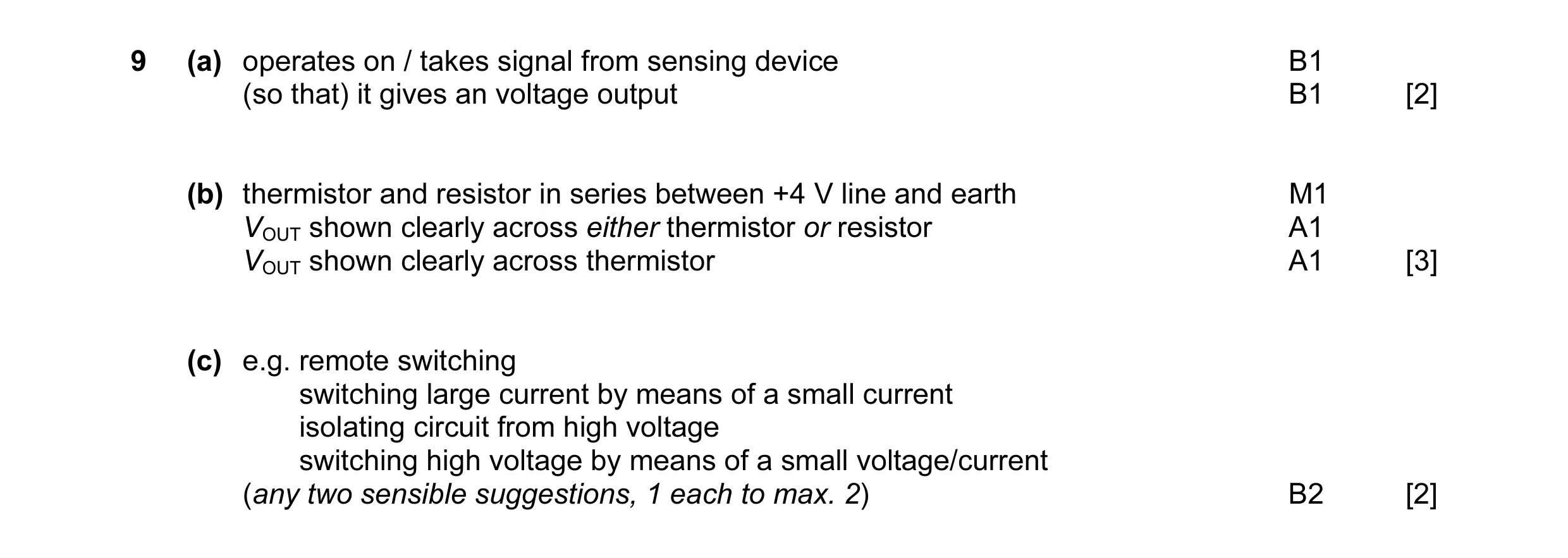 7
7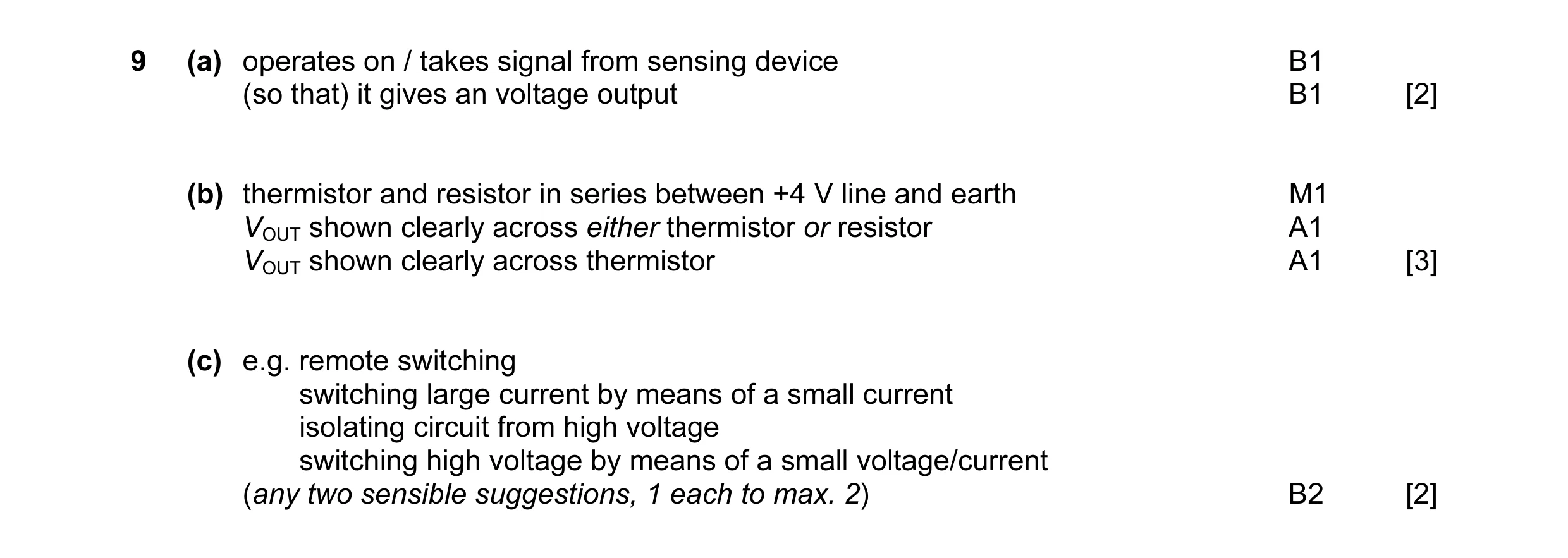 7
7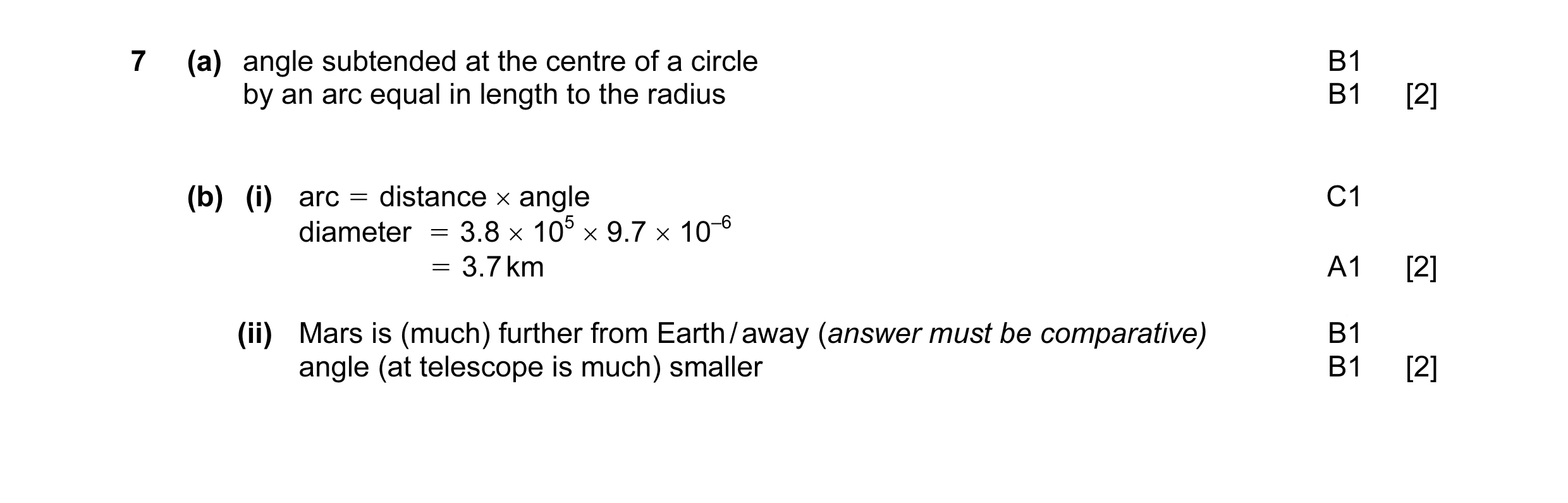 6
6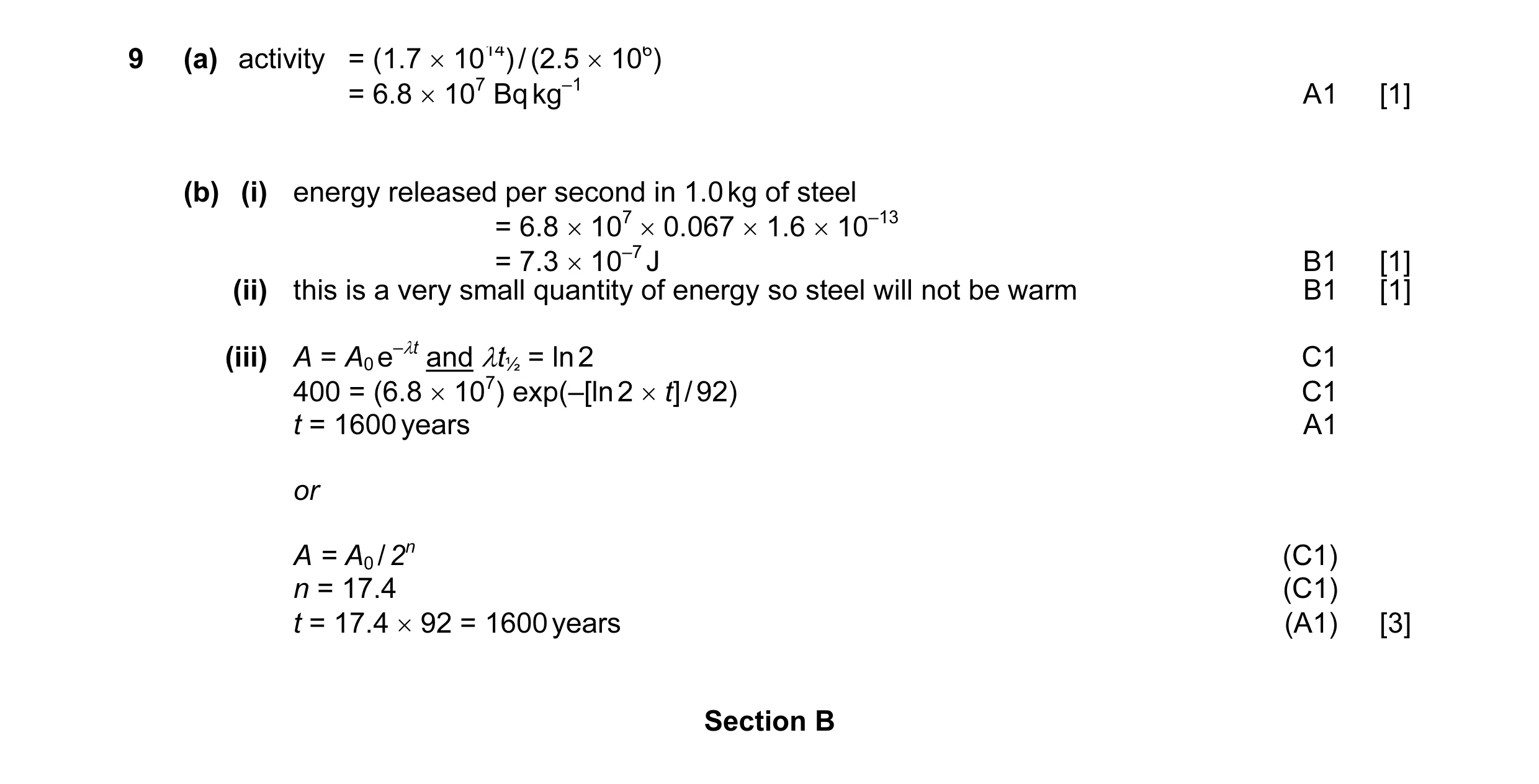 6
6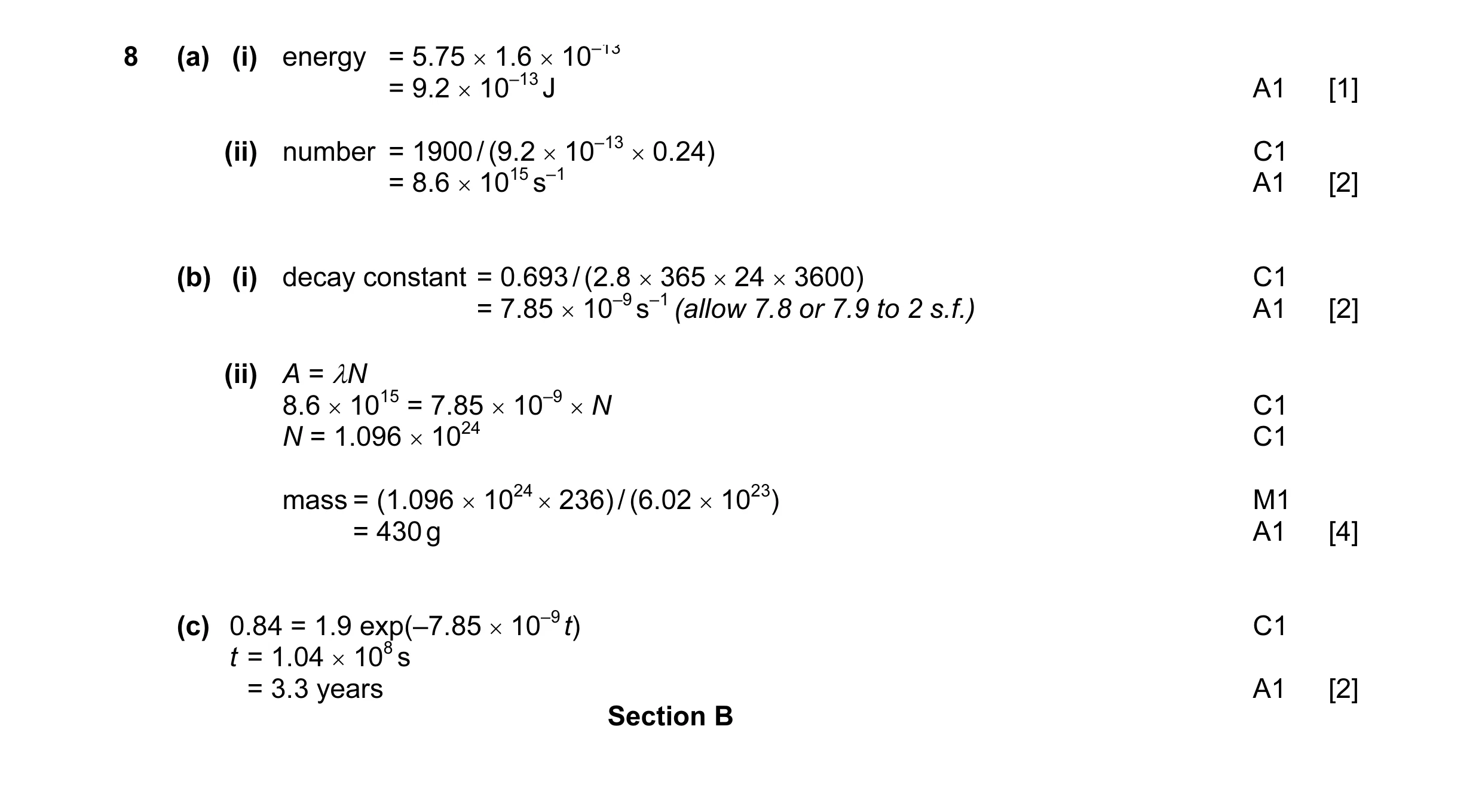 11
11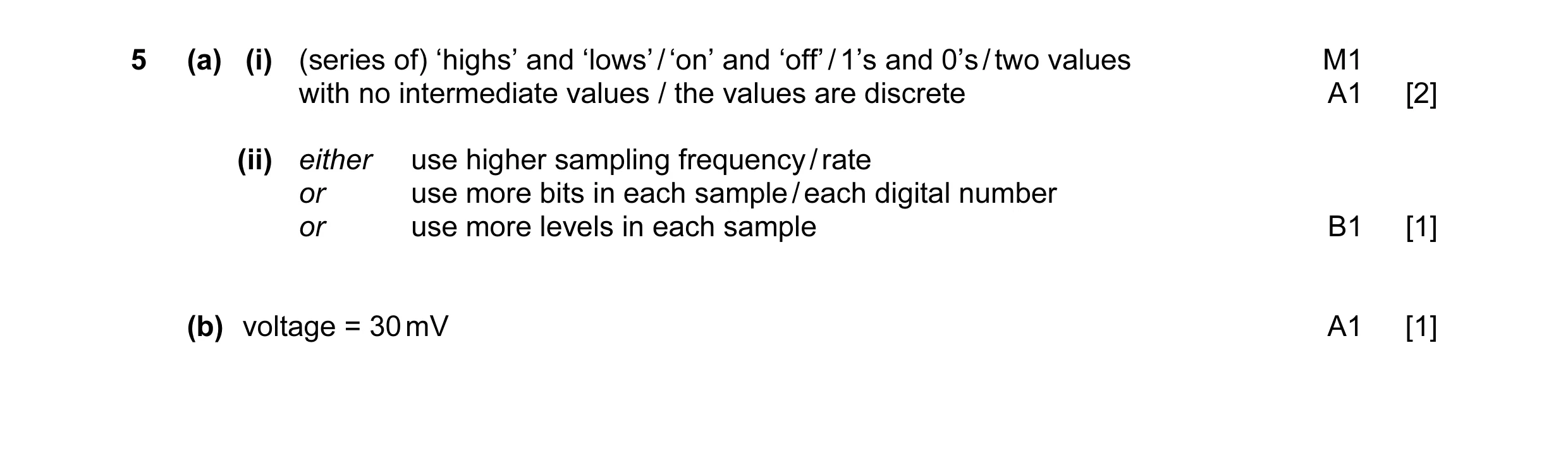 4
4 3
3 3
3