Cambridge A Level Physics 9702 — 2009 May/June Paper 4 · Variant 1
9702/41/M/J/09 · 13 questions · 100 marks · ≈113 min
The question paper and its mark scheme, free to read here and free to download. This is Cambridge’s own paper, exactly as it was sat.
Question paper24 pages



Mark scheme6 pages
Answers below. Sit the paper first if you are practising.
Questions as text
Q1 · Define gravitational field strength
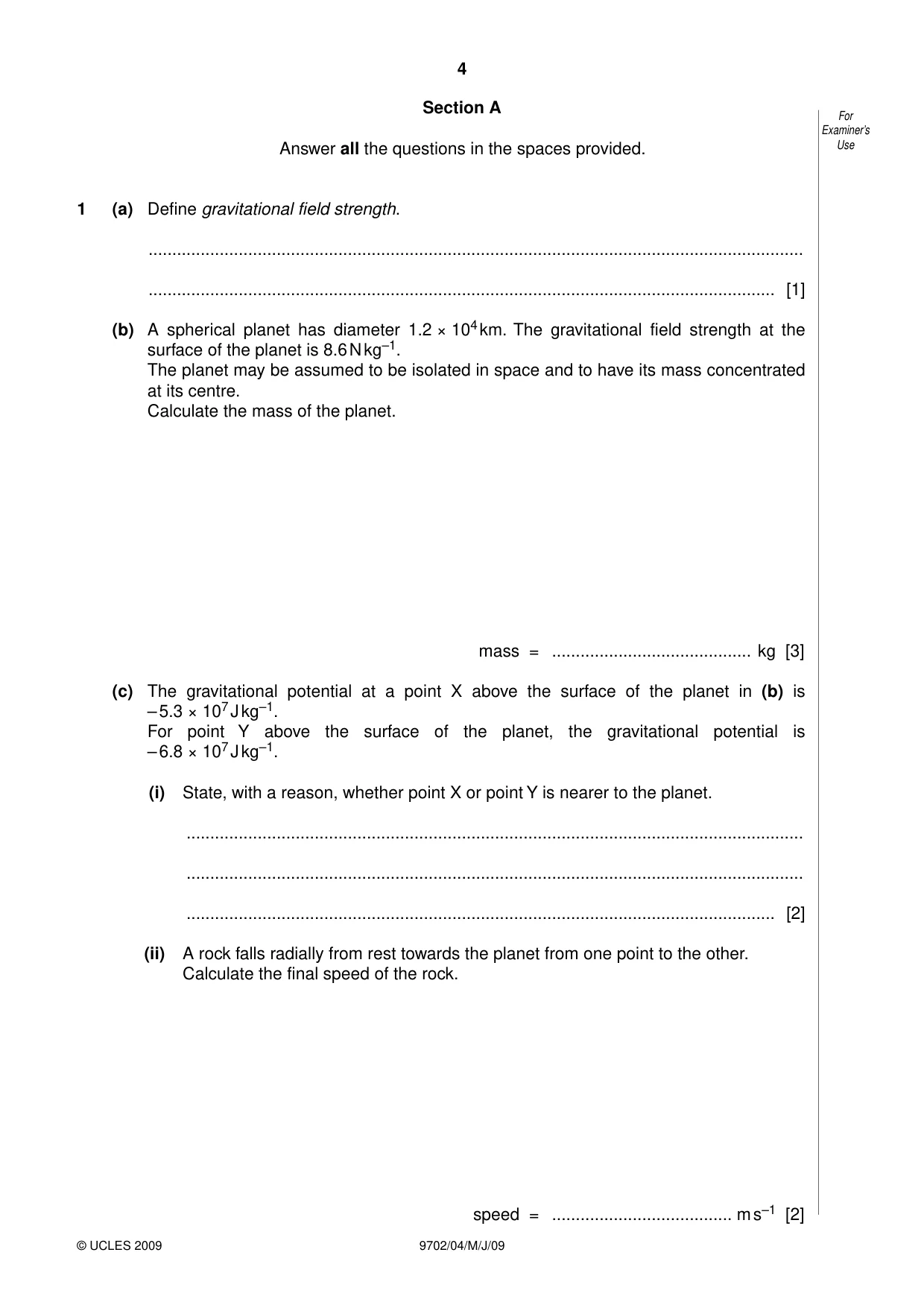
1 (a) Define gravitational field strength. .......................................................................................................................................... .................................................................................................................................... [1] (b) A spherical planet has diameter 1.2 × 10⁴ km. The gravitational field strength at the surface of the planet is 8.6 N kg–1. The planet may be assumed to be isolated in space and to have its mass concentrated at its centre. Calculate the mass of the planet. mass = .......................................... kg [3] (c) The gravitational potential at a point X above the surface of the planet in (b) is – 5.3 × 10⁷ J kg–1. For point Y above the surface of the planet, the gravitational potential is – 6.8 × 10⁷ J kg–1. (i) State, with a reason, whether point X or point Y is nearer to the planet. .................................................................................................................................. .................................................................................................................................. ............................................................................................................................ [2] (ii) A rock falls radially from rest towards the planet from one point to the other. Calculate the final speed of the rock. speed = ...................................... m s–1 [2]
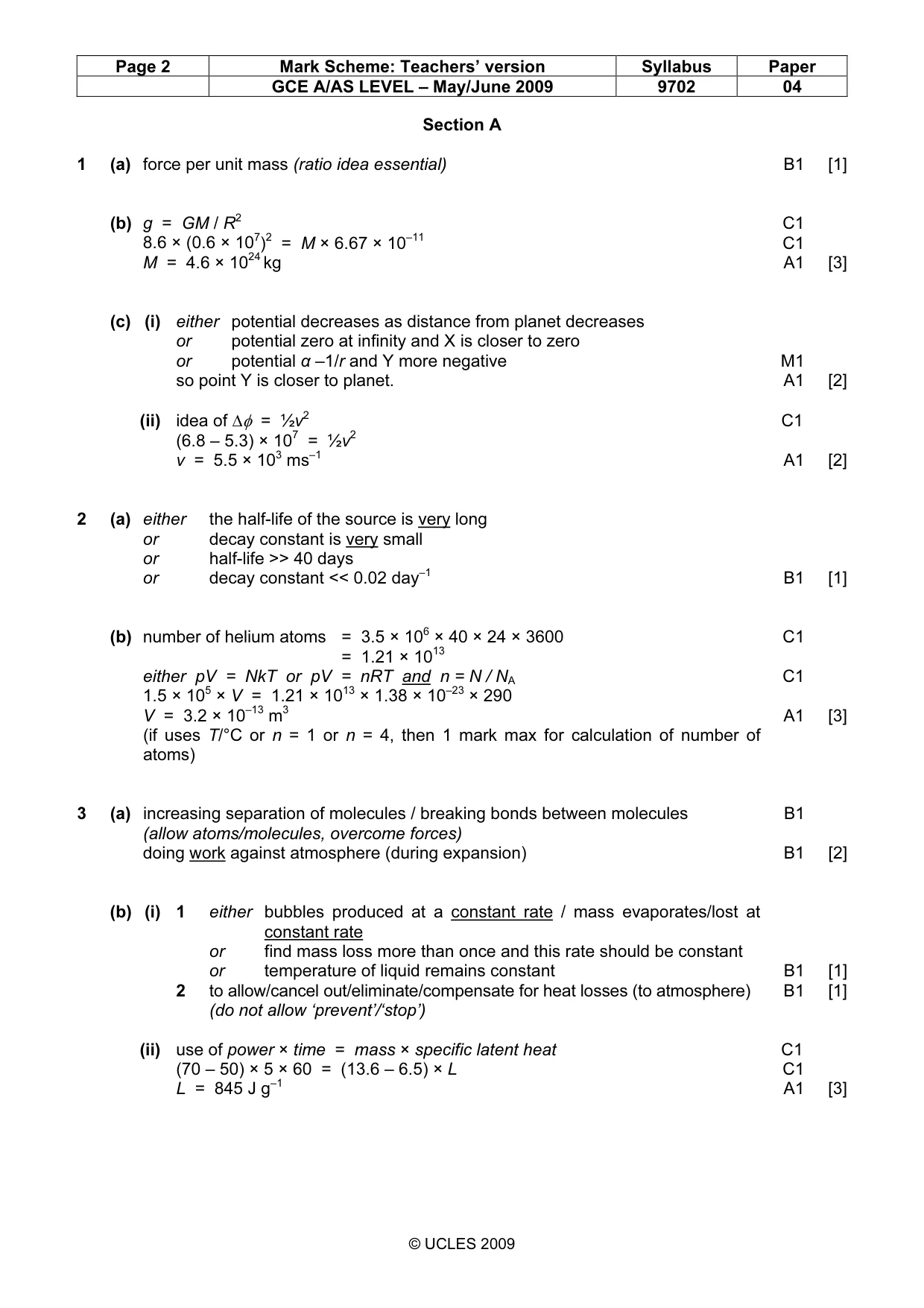
Mark scheme: 1 (a) force per unit mass (ratio idea essential) B1 [1] (b) g = GM / R2 C1 8.6 × (0.6 × 107)2 = M × 6.67 × 10⁻¹¹ C1 M = 4.6 × 1024 kg A1 [3] (c) (i) either potential decreases as distance from planet decreases or potential zero at infinity and X is closer to zero or potential α –1/r and Y more negative M1 so point Y is closer to planet. A1 [2] (ii) idea of ∆φ = ½v2 C1 (6.8 – 5.3) × 107 = ½v2 v = 5.5 × 10³ ms–1 A1 [2]
Q2 · Sources of α-particles are frequently found to contain traces of helium gas
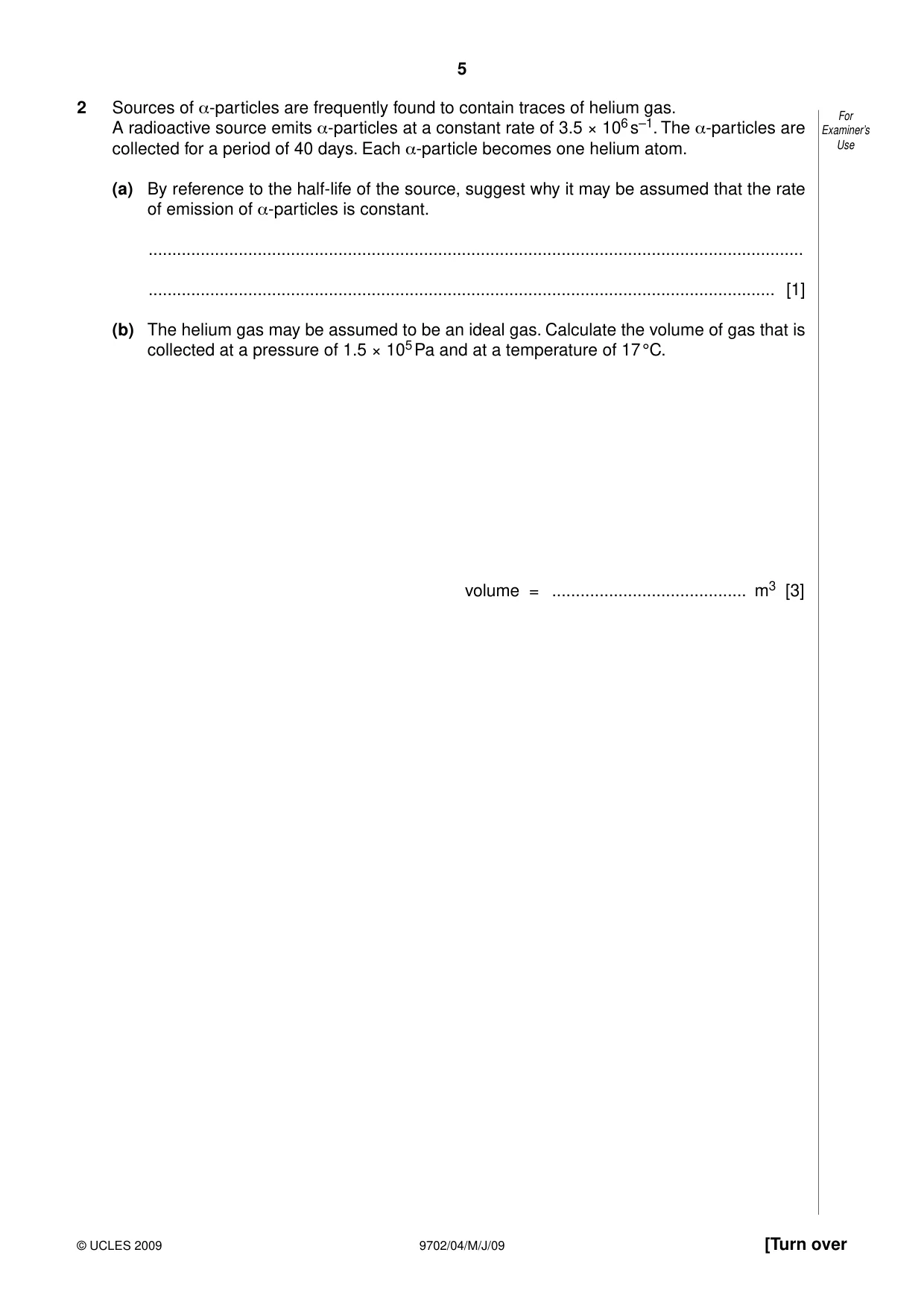
2 Sources of α-particles are frequently found to contain traces of helium gas. For A radioactive source emits α-particles at a constant rate of 3.5 × 10⁶ s–1. The α-particles are Examiner’s collected for a period of 40 days. Each α-particle becomes one helium atom. Use (a) By reference to the half-life of the source, suggest why it may be assumed that the rate of emission of α-particles is constant. .......................................................................................................................................... .................................................................................................................................... [1] (b) The helium gas may be assumed to be an ideal gas. Calculate the volume of gas that is collected at a pressure of 1.5 × 10⁵ Pa and at a temperature of 17 °C. volume = ......................................... m3 [3]
Mark scheme: 2 (a) either the half-life of the source is very long or decay constant is very small or half-life >> 40 days or decay constant << 0.02 day–1 B1 [1] (b) number of helium atoms = 3.5 × 106 × 40 × 24 × 3600 C1 = 1.21 × 10¹³ either pV = NkT or pV = nRT and n = N / NA C1 1.5 × 10⁵ × V = 1.21 × 1013 × 1.38 × 10–23 × 290 V = 3.2 × 10⁻¹³ m3 A1 [3] (if uses T/°C or n = 1 or n = 4, then 1 mark max for calculation of number of atoms)
Q3 · When a liquid is boiling, thermal energy must be supplied in order to maintain a constant…
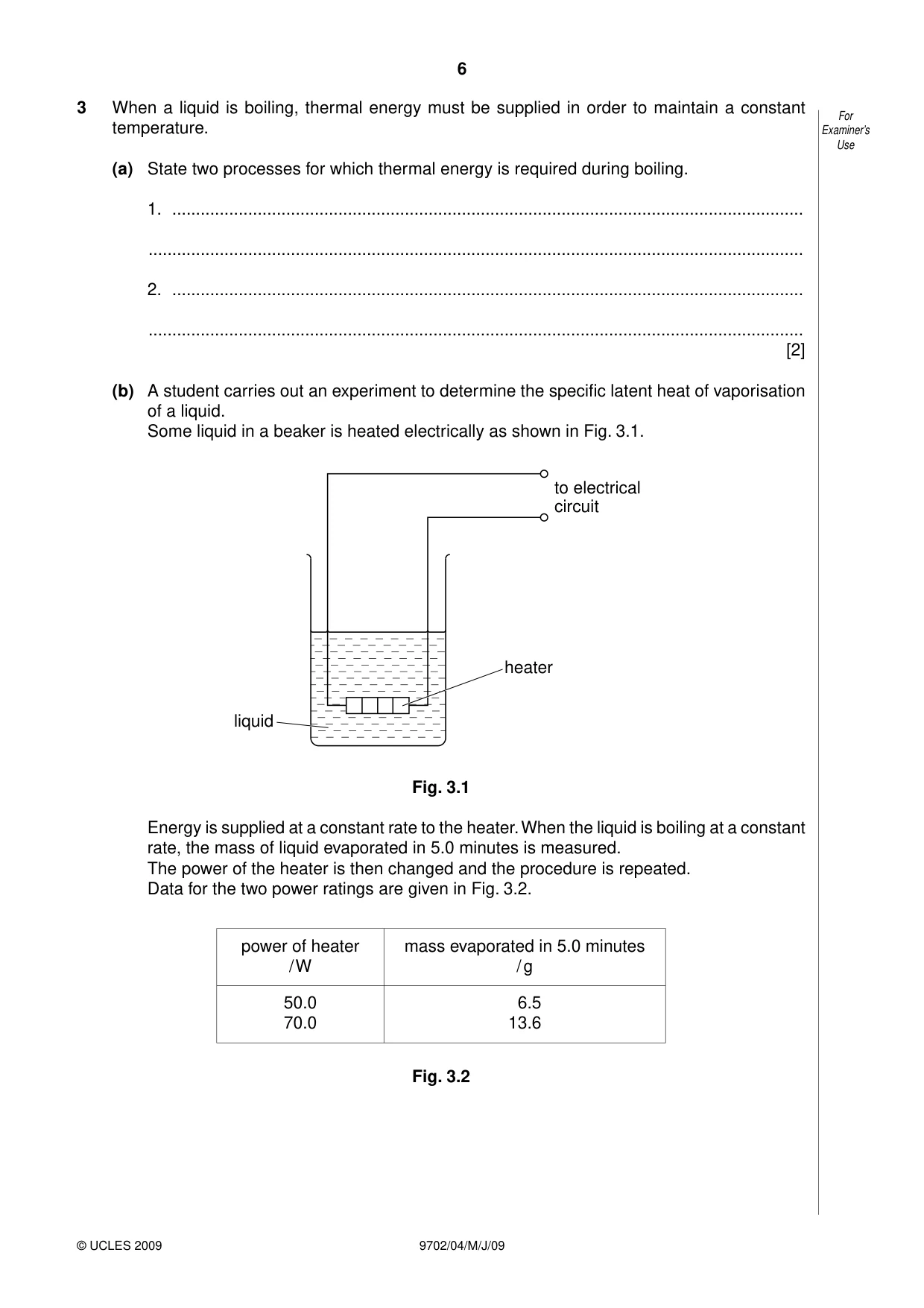
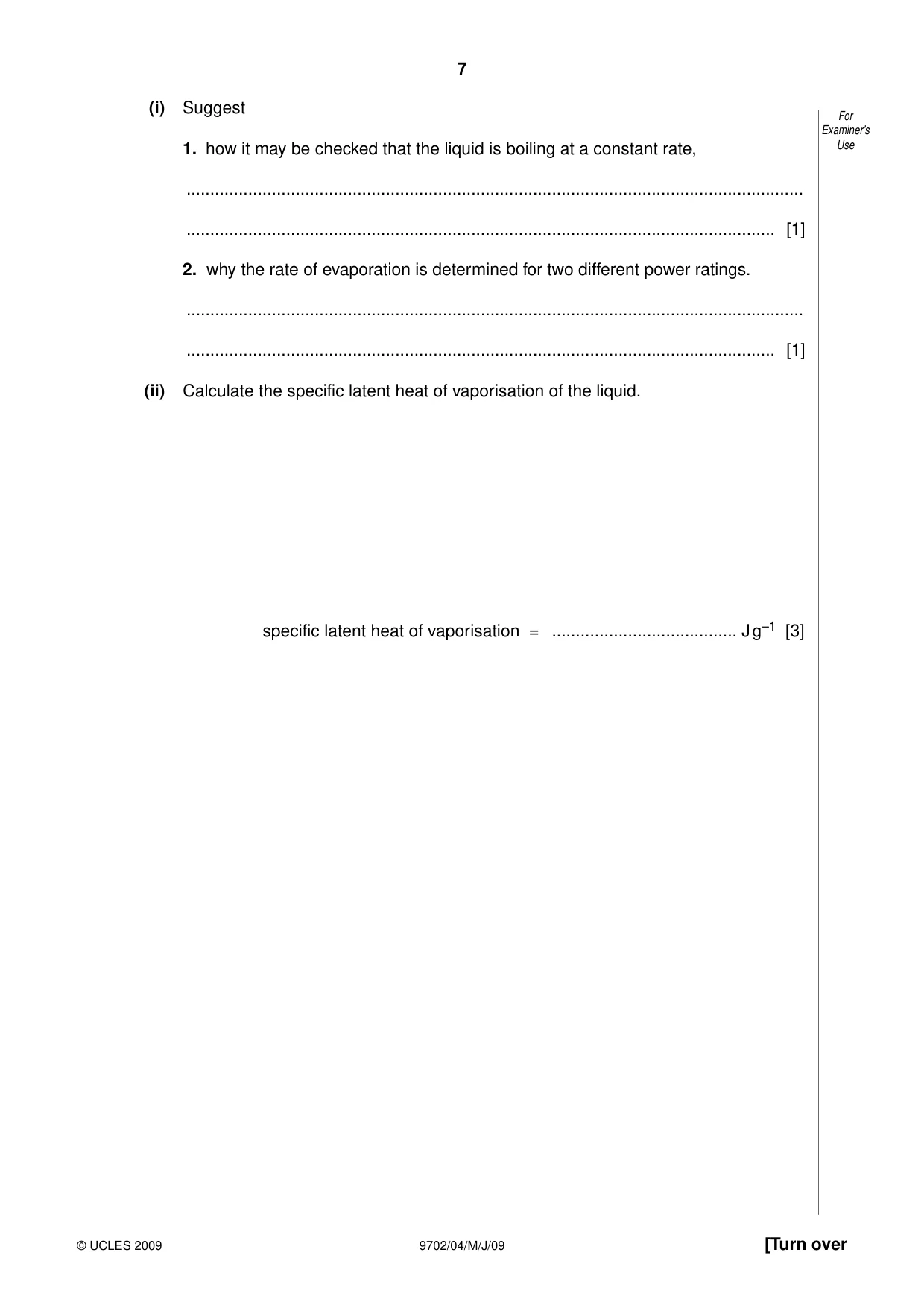
3 When a liquid is boiling, thermal energy must be supplied in order to maintain a constant For temperature. Examiner’s Use (a) State two processes for which thermal energy is required during boiling. 1. ..................................................................................................................................... .......................................................................................................................................... 2. ..................................................................................................................................... .......................................................................................................................................... [2] (b) A student carries out an experiment to determine the specific latent heat of vaporisation of a liquid. Some liquid in a beaker is heated electrically as shown in Fig. 3.1. to electrical circuit heater liquid Fig. 3.1 Energy is supplied at a constant rate to the heater. When the liquid is boiling at a constant rate, the mass of liquid evaporated in 5.0 minutes is measured. The power of the heater is then changed and the procedure is repeated. Data for the two power ratings are given in Fig. 3.2. power of heater mass evaporated in 5.0 minutes / W / g 50.0 6.5 70.0 13.6 Fig. 3.2 (i) Suggest For Examiner’s 1. how it may be checked that the liquid is boiling at a constant rate, Use .................................................................................................................................. ............................................................................................................................ [1] 2. why the rate of evaporation is determined for two different power ratings. .................................................................................................................................. ............................................................................................................................ [1] (ii) Calculate the specific latent heat of vaporisation of the liquid. specific latent heat of vaporisation = ....................................... J g–1 [3]
Mark scheme: 3 (a) increasing separation of molecules / breaking bonds between molecules B1 (allow atoms/molecules, overcome forces) doing work against atmosphere (during expansion) B1 [2] (b) (i) 1 either bubbles produced at a constant rate / mass evaporates/lost at constant rate or find mass loss more than once and this rate should be constant or temperature of liquid remains constant B1 [1] 2 to allow/cancel out/eliminate/compensate for heat losses (to atmosphere) B1 [1] (do not allow ‘prevent’/‘stop’) (ii) use of power × time = mass × specific latent heat C1 (70 – 50) × 5 × 60 = (13.6 – 6.5) × L C1 L = 845 J g–1 A1 [3] GCE A/AS LEVEL – May/June 2009 9702 04
More questions on Specific heat capacity and specific latent heat
Q4 · A vertical peg is attached to the edge of a horizontal disc of radius r, as shown in Fig
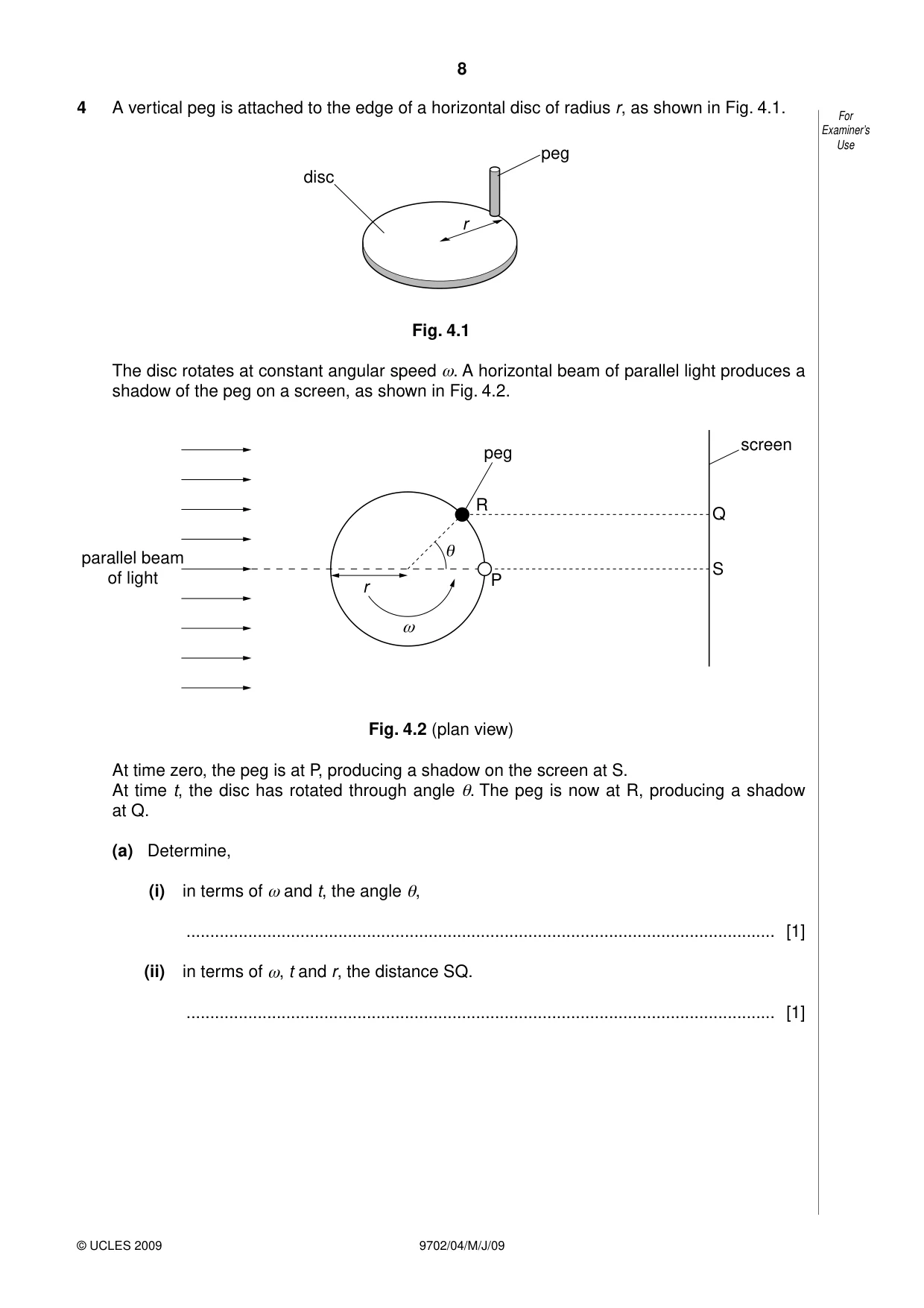
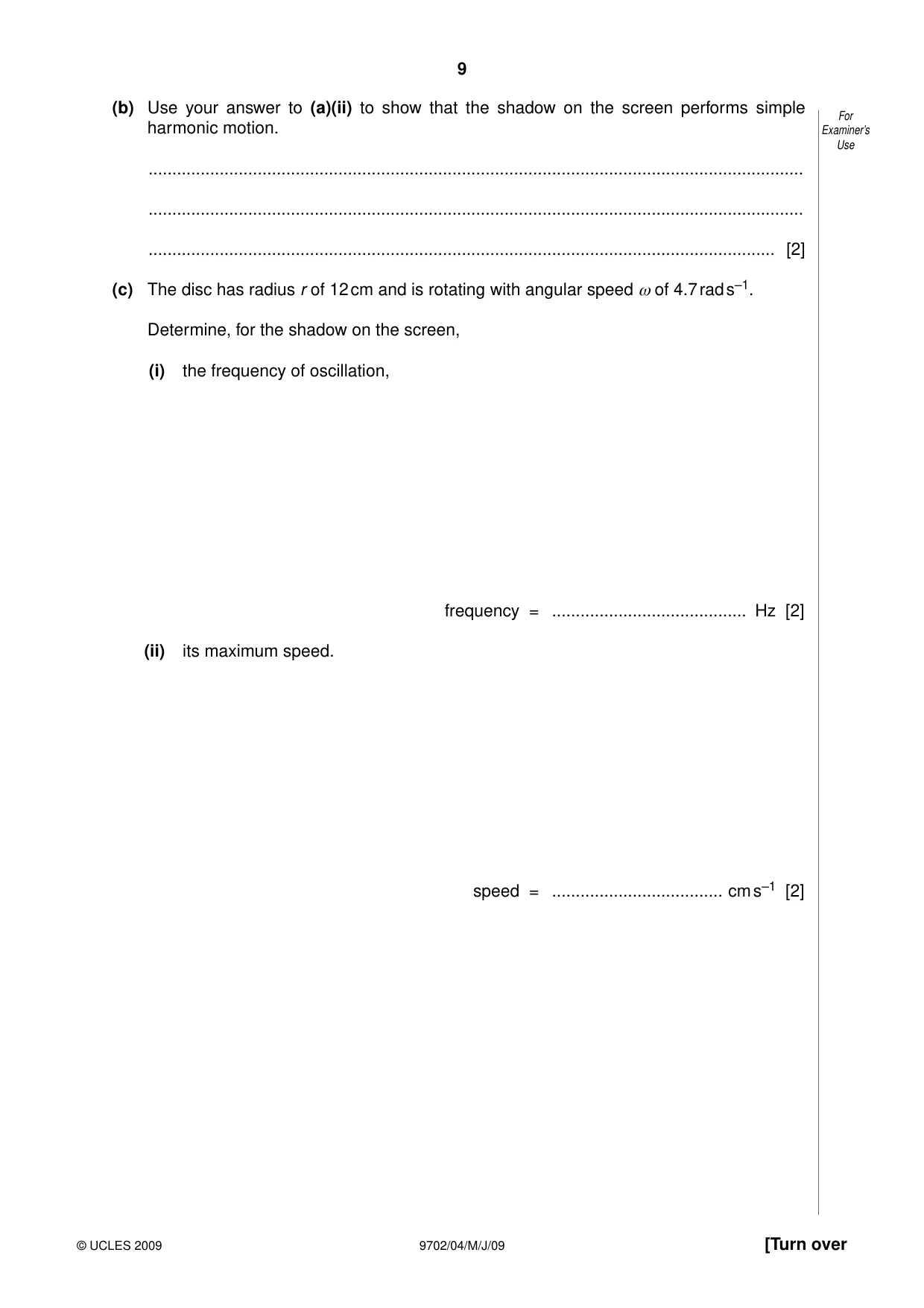
4 A vertical peg is attached to the edge of a horizontal disc of radius r, as shown in Fig. 4.1. For Examiner’s Use peg disc r Fig. 4.1 The disc rotates at constant angular speed ω. A horizontal beam of parallel light produces a shadow of the peg on a screen, as shown in Fig. 4.2. screen peg R Q θ parallel beam S of light P r ω Fig. 4.2 (plan view) At time zero, the peg is at P, producing a shadow on the screen at S. At time t, the disc has rotated through angle θ. The peg is now at R, producing a shadow at Q. (a) Determine, (i) in terms of ω and t, the angle θ, ............................................................................................................................ [1] (ii) in terms of ω, t and r, the distance SQ. ............................................................................................................................ [1] (b) Use your answer to (a)(ii) to show that the shadow on the screen performs simple For harmonic motion. Examiner’s Use .......................................................................................................................................... .......................................................................................................................................... .................................................................................................................................... [2] (c) The disc has radius r of 12 cm and is rotating with angular speed ω of 4.7 rad s–1. Determine, for the shadow on the screen, (i) the frequency of oscillation, frequency = ......................................... Hz [2] (ii) its maximum speed. speed = .................................... cm s–1 [2]
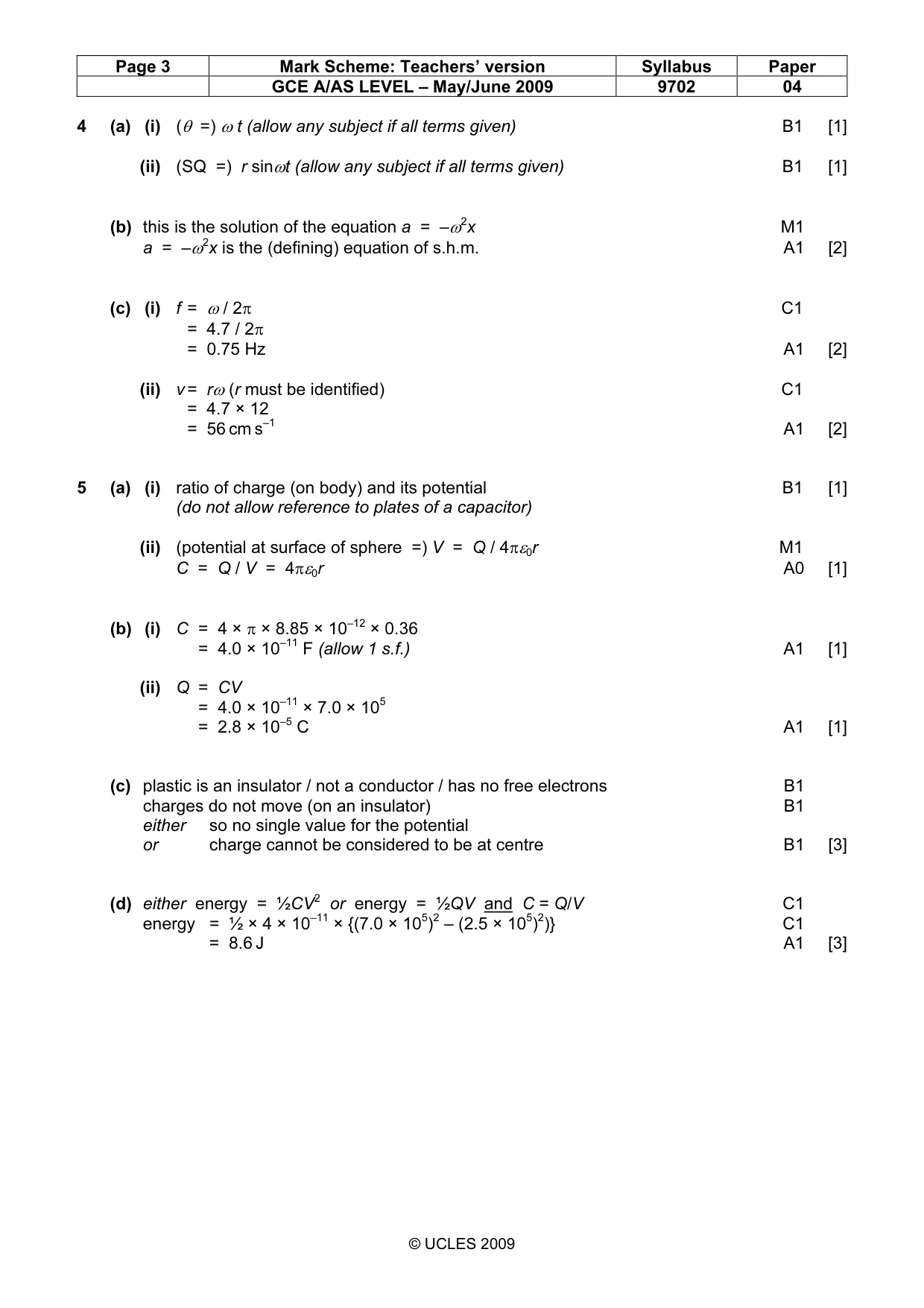
Mark scheme: 4 (a) (i) (θ =) ω t (allow any subject if all terms given) B1 [1] (ii) (SQ =) r sinωt (allow any subject if all terms given) B1 [1] (b) this is the solution of the equation a = –ω2x M1 a = –ω2x is the (defining) equation of s.h.m. A1 [2] (c) (i) f = ω / 2π C1 = 4.7 / 2π = 0.75 Hz A1 [2] (ii) v = rω (r must be identified) C1 = 4.7 × 12 = 56 cm s–1 A1 [2]
Q5 · A solid metal sphere, of radius r, is insulated from its surroundings
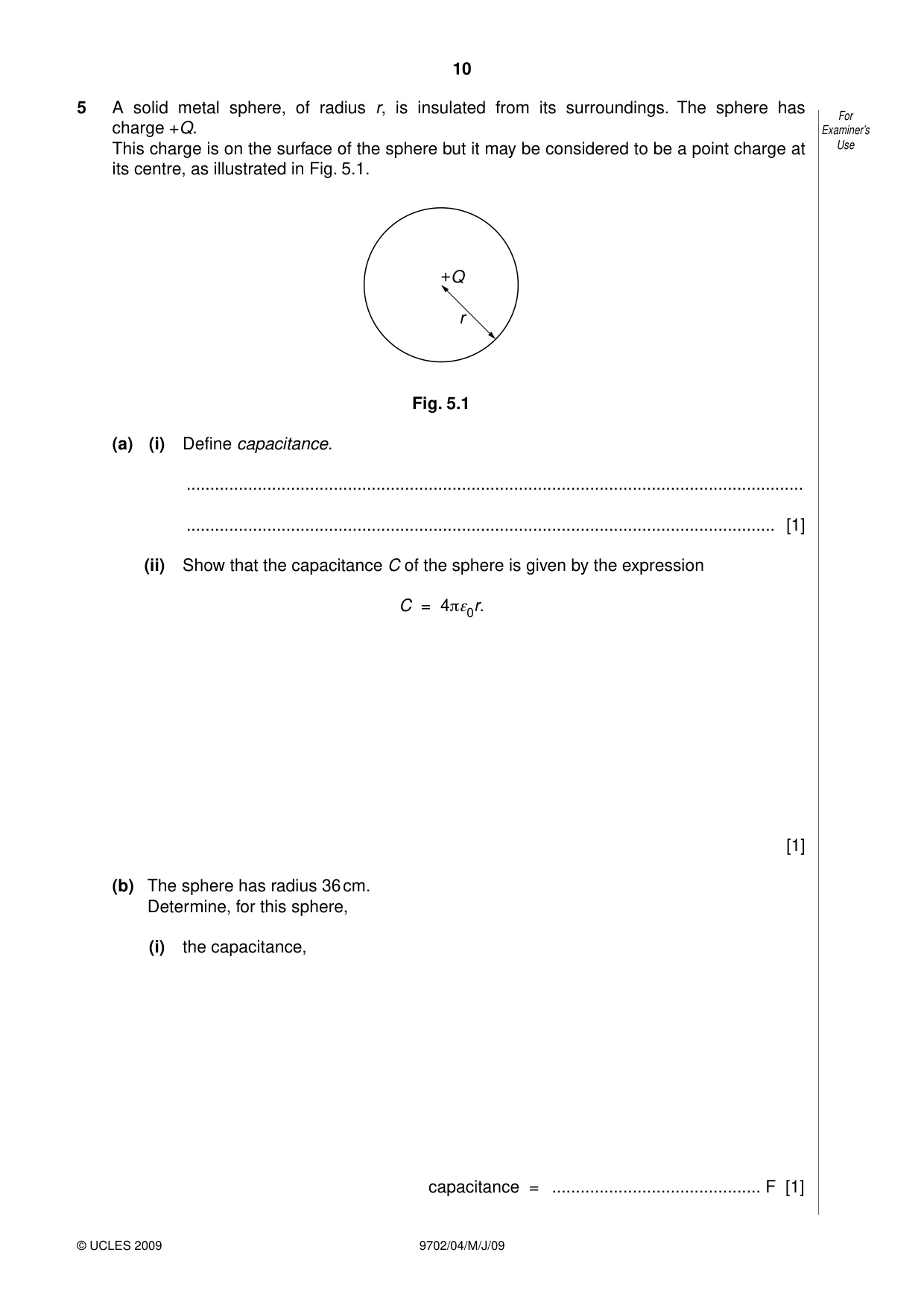
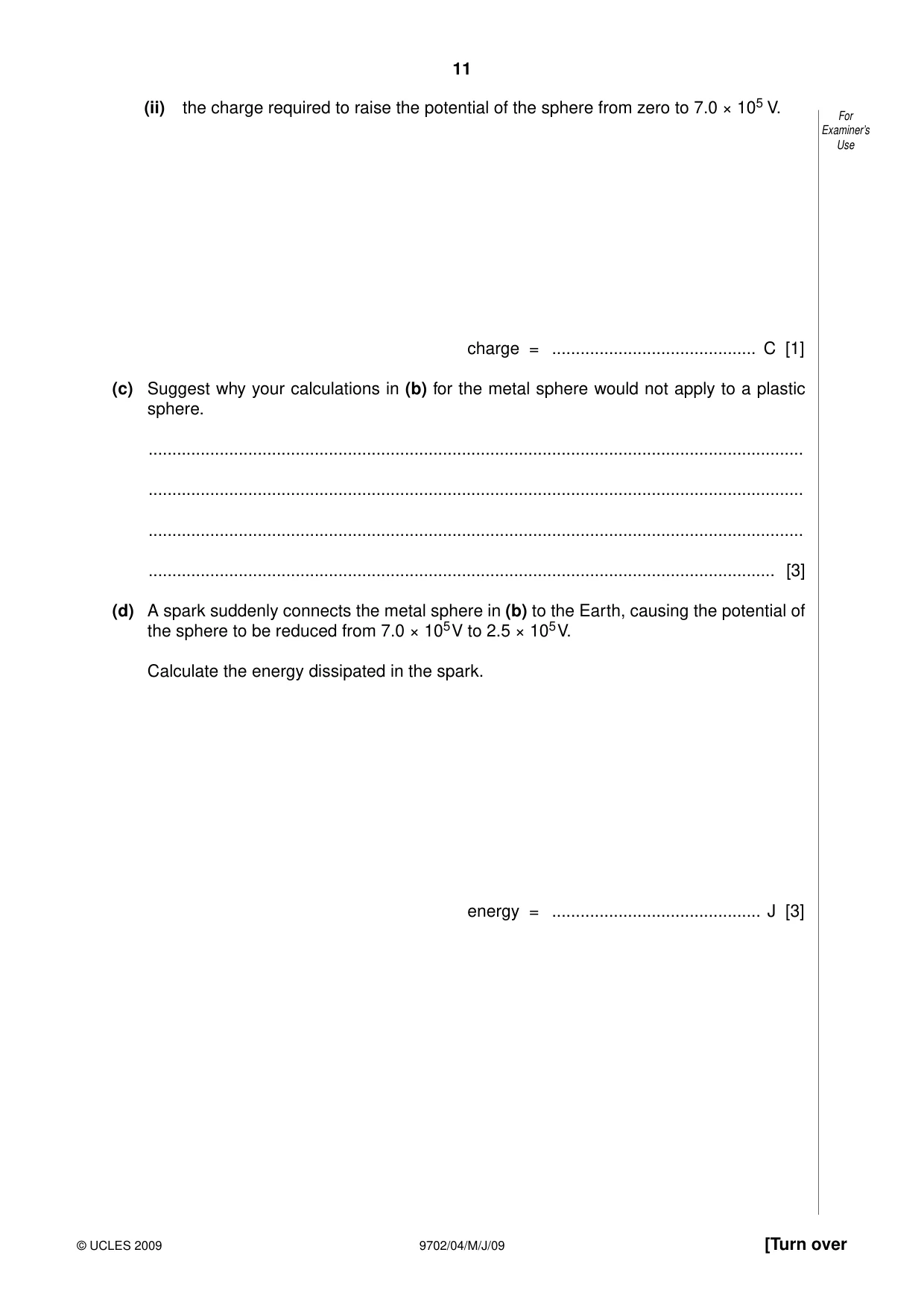
5 A solid metal sphere, of radius r, is insulated from its surroundings. The sphere has For charge +Q. Examiner’s This charge is on the surface of the sphere but it may be considered to be a point charge at Use its centre, as illustrated in Fig. 5.1. +Q r Fig. 5.1 (a) (i) Define capacitance. .................................................................................................................................. ............................................................................................................................ [1] (ii) Show that the capacitance C of the sphere is given by the expression C = 4πε0r. [1] (b) The sphere has radius 36 cm. Determine, for this sphere, (i) the capacitance, capacitance = ............................................ F [1] (ii) the charge required to raise the potential of the sphere from zero to 7.0 × 10⁵ V. For Examiner’s Use charge = ........................................... C [1] (c) Suggest why your calculations in (b) for the metal sphere would not apply to a plastic sphere. .......................................................................................................................................... .......................................................................................................................................... .......................................................................................................................................... .................................................................................................................................... [3] (d) A spark suddenly connects the metal sphere in (b) to the Earth, causing the potential of the sphere to be reduced from 7.0 × 10⁵ V to 2.5 × 10⁵ V. Calculate the energy dissipated in the spark. energy = ............................................ J [3]
Mark scheme: 5 (a) (i) ratio of charge (on body) and its potential B1 [1] (do not allow reference to plates of a capacitor) (ii) (potential at surface of sphere =) V = Q / 4πε0r M1 C = Q / V = 4πε0r A0 [1] (b) (i) C = 4 × π × 8.85 × 10–12 × 0.36 = 4.0 × 10⁻¹¹ F (allow 1 s.f.) A1 [1] (ii) Q = CV = 4.0 × 10–11 × 7.0 × 105 = 2.8 × 10⁻⁵ C A1 [1] (c) plastic is an insulator / not a conductor / has no free electrons B1 charges do not move (on an insulator) B1 either so no single value for the potential or charge cannot be considered to be at centre B1 [3] (d) either energy = ½CV2 or energy = ½QV and C = Q/V C1 energy = ½ × 4 × 10–11 × {(7.0 × 10⁵)2 – (2.5 × 10⁵)2)} C1 = 8.6 J A1 [3] GCE A/AS LEVEL – May/June 2009 9702 04
Question 6
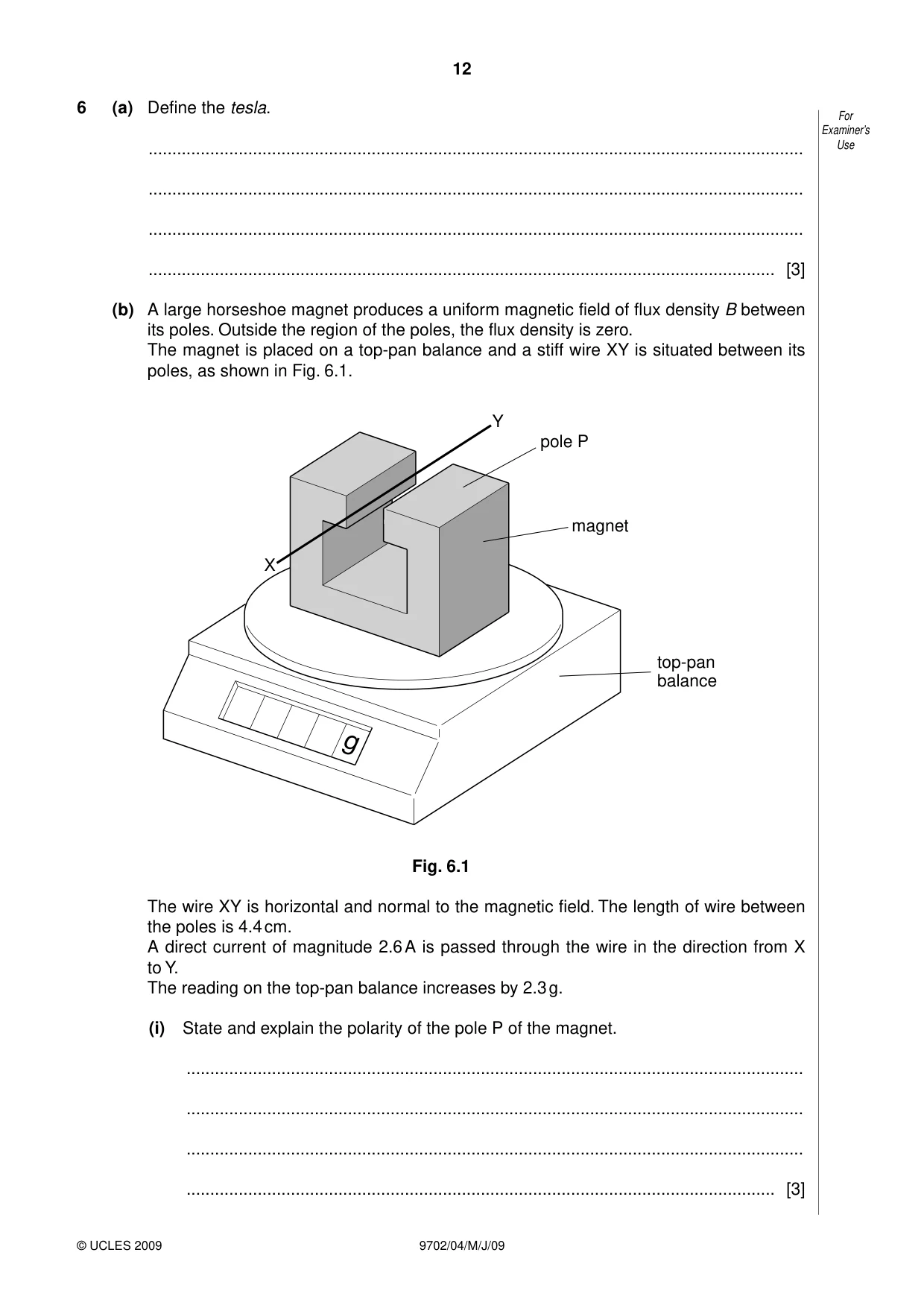
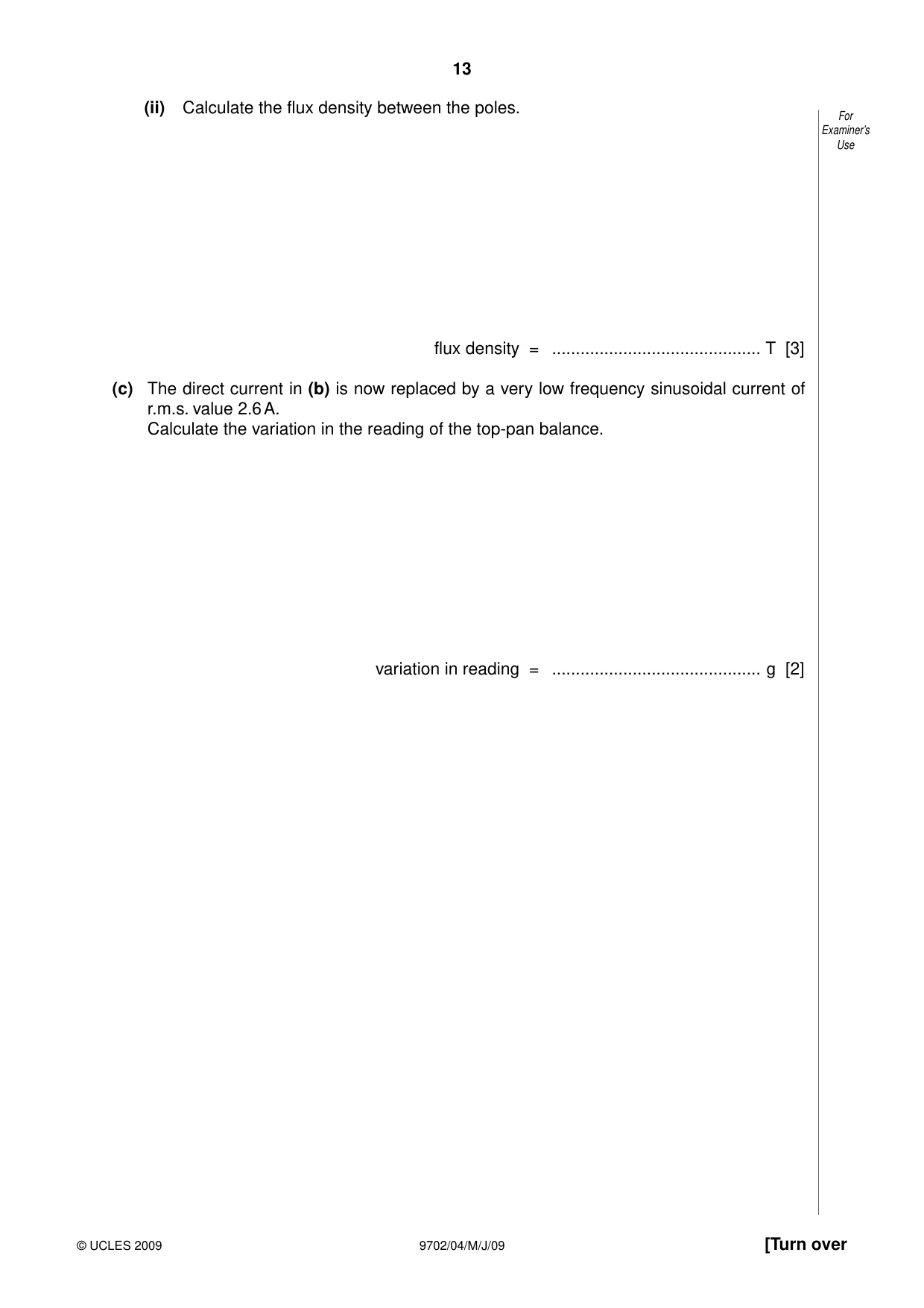
6 (a) Define the tesla. For Examiner’s .......................................................................................................................................... Use .......................................................................................................................................... .......................................................................................................................................... .................................................................................................................................... [3] (b) A large horseshoe magnet produces a uniform magnetic field of flux density B between its poles. Outside the region of the poles, the flux density is zero. The magnet is placed on a top-pan balance and a stiff wire XY is situated between its poles, as shown in Fig. 6.1. Y pole P magnet X top-pan balance Fig. 6.1 The wire XY is horizontal and normal to the magnetic field. The length of wire between the poles is 4.4 cm. A direct current of magnitude 2.6 A is passed through the wire in the direction from X to Y. The reading on the top-pan balance increases by 2.3 g. (i) State and explain the polarity of the pole P of the magnet. .................................................................................................................................. .................................................................................................................................. .................................................................................................................................. ............................................................................................................................ [3] (ii) Calculate the flux density between the poles. For Examiner’s Use flux density = ............................................ T [3] (c) The direct current in (b) is now replaced by a very low frequency sinusoidal current of r.m.s. value 2.6 A. Calculate the variation in the reading of the top-pan balance. variation in reading = ............................................ g [2]
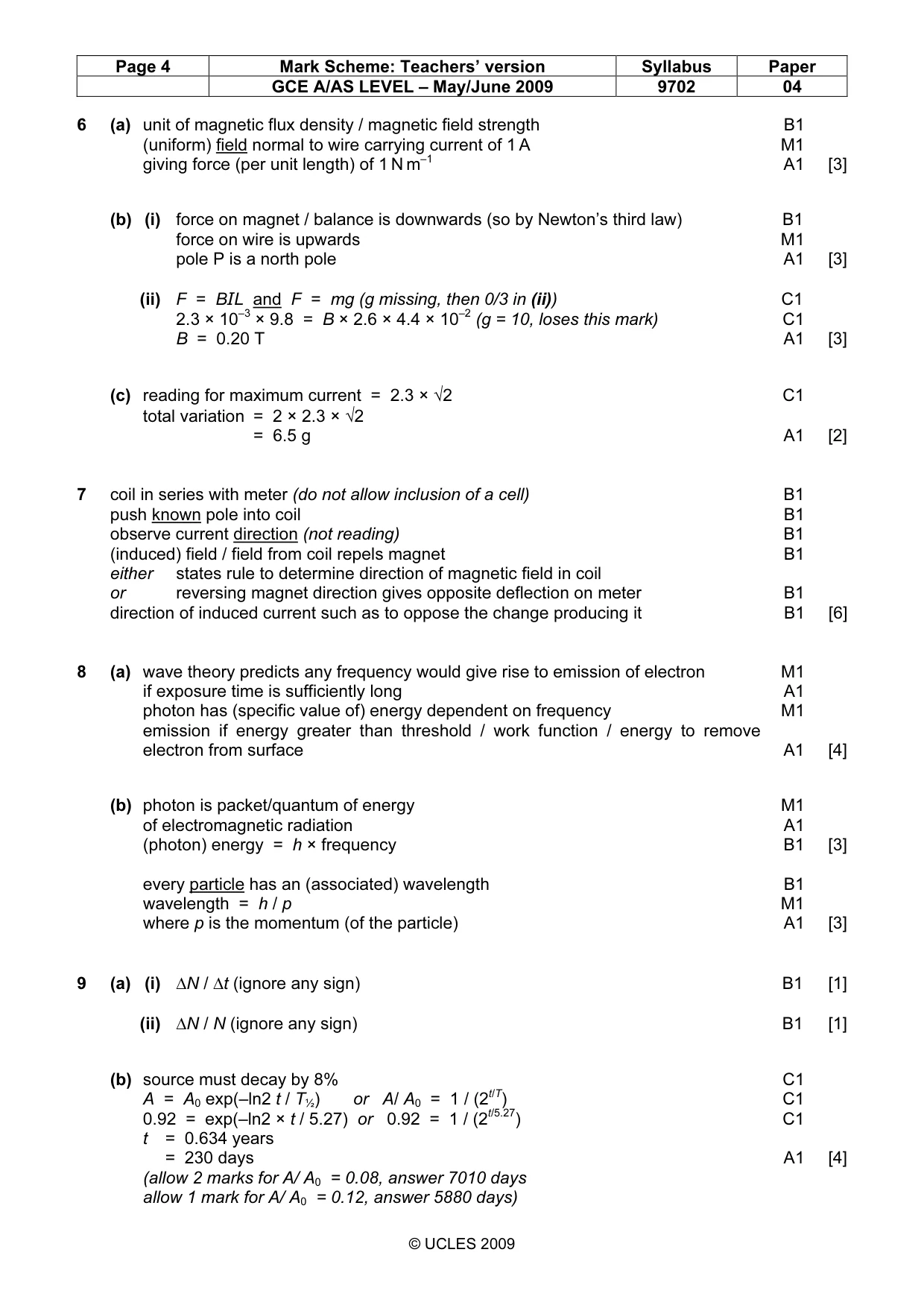
Mark scheme: 6 (a) unit of magnetic flux density / magnetic field strength B1 (uniform) field normal to wire carrying current of 1 A M1 giving force (per unit length) of 1 N m–1 A1 [3] (b) (i) force on magnet / balance is downwards (so by Newton’s third law) B1 force on wire is upwards M1 pole P is a north pole A1 [3] (ii) F = BIL and F = mg (g missing, then 0/3 in (ii)) C1 2.3 × 10–3 × 9.8 = B × 2.6 × 4.4 × 10–2 (g = 10, loses this mark) C1 B = 0.20 T A1 [3] (c) reading for maximum current = 2.3 × √2 C1 total variation = 2 × 2.3 × √2 = 6.5 g A1 [2]
Q7 · You are provided with a coil of wire, a bar magnet and a sensitive ammeter
7 You are provided with a coil of wire, a bar magnet and a sensitive ammeter. For Examiner’s Outline an experiment to verify Lenz’s law. Use ................................................................................................................................................. ................................................................................................................................................. ................................................................................................................................................. ................................................................................................................................................. ................................................................................................................................................. ................................................................................................................................................. ................................................................................................................................................. ........................................................................................................................................... [6]
Mark scheme: 7 coil in series with meter (do not allow inclusion of a cell) B1 push known pole into coil B1 observe current direction (not reading) B1 (induced) field / field from coil repels magnet B1 either states rule to determine direction of magnetic field in coil or reversing magnet direction gives opposite deflection on meter B1 direction of induced current such as to oppose the change producing it B1 [6]
Q8 · Explain why, for the photoelectric effect, the existence of a threshold frequency and a…
8 (a) Explain why, for the photoelectric effect, the existence of a threshold frequency and a For very short emission time provide evidence for the particulate nature of electromagnetic Examiner’s radiation, as opposed to a wave theory. Use .......................................................................................................................................... .......................................................................................................................................... .......................................................................................................................................... .......................................................................................................................................... .......................................................................................................................................... .................................................................................................................................... [4] (b) State and explain two relations in which the Planck constant h is the constant of proportionality. 1. ..................................................................................................................................... .......................................................................................................................................... .......................................................................................................................................... .......................................................................................................................................... 2. ..................................................................................................................................... .......................................................................................................................................... .......................................................................................................................................... .......................................................................................................................................... [6]
Mark scheme: 8 (a) wave theory predicts any frequency would give rise to emission of electron M1 if exposure time is sufficiently long A1 photon has (specific value of) energy dependent on frequency M1 emission if energy greater than threshold / work function / energy to remove electron from surface A1 [4] (b) photon is packet/quantum of energy M1 of electromagnetic radiation A1 (photon) energy = h × frequency B1 [3] every particle has an (associated) wavelength B1 wavelength = h / p M1 where p is the momentum (of the particle) A1 [3]
Q9 · A sample of a radioactive isotope contains N nuclei at time t
9 (a) A sample of a radioactive isotope contains N nuclei at time t. At time (t + Δt), it contains For (N – ΔN) nuclei of the isotope. Examiner’s Use For the period Δt, state, in terms of N, ΔN and Δt, (i) the mean activity of the sample, activity = ............................................... [1] (ii) the probability of decay of a nucleus. probability = ............................................... [1] (b) A cobalt-60 source having a half-life of 5.27 years is calibrated and found to have an activity of 3.50 × 10⁵ Bq. The uncertainty in the calibration is ±2%. Calculate the length of time, in days, after the calibration has been made, for the stated activity of 3.50 × 10⁵ Bq to have a maximum possible error of 10%. time = ...................................... days [4]
Mark scheme: 9 (a) (i) ∆N / ∆t (ignore any sign) B1 [1] (ii) ∆N / N (ignore any sign) B1 [1] (b) source must decay by 8% C1 A = A0 exp(–ln2 t / T½) or A/ A0 = 1 / (2t/T) C1 0.92 = exp(–ln2 × t / 5.27) or 0.92 = 1 / (2t/5.27) C1 t = 0.634 years = 230 days A1 [4] (allow 2 marks for A/ A0 = 0.08, answer 7010 days allow 1 mark for A/ A0 = 0.12, answer 5880 days) GCE A/AS LEVEL – May/June 2009 9702 04 Section B
Q10 · By reference to an amplifier, explain what is meant by negative feedback
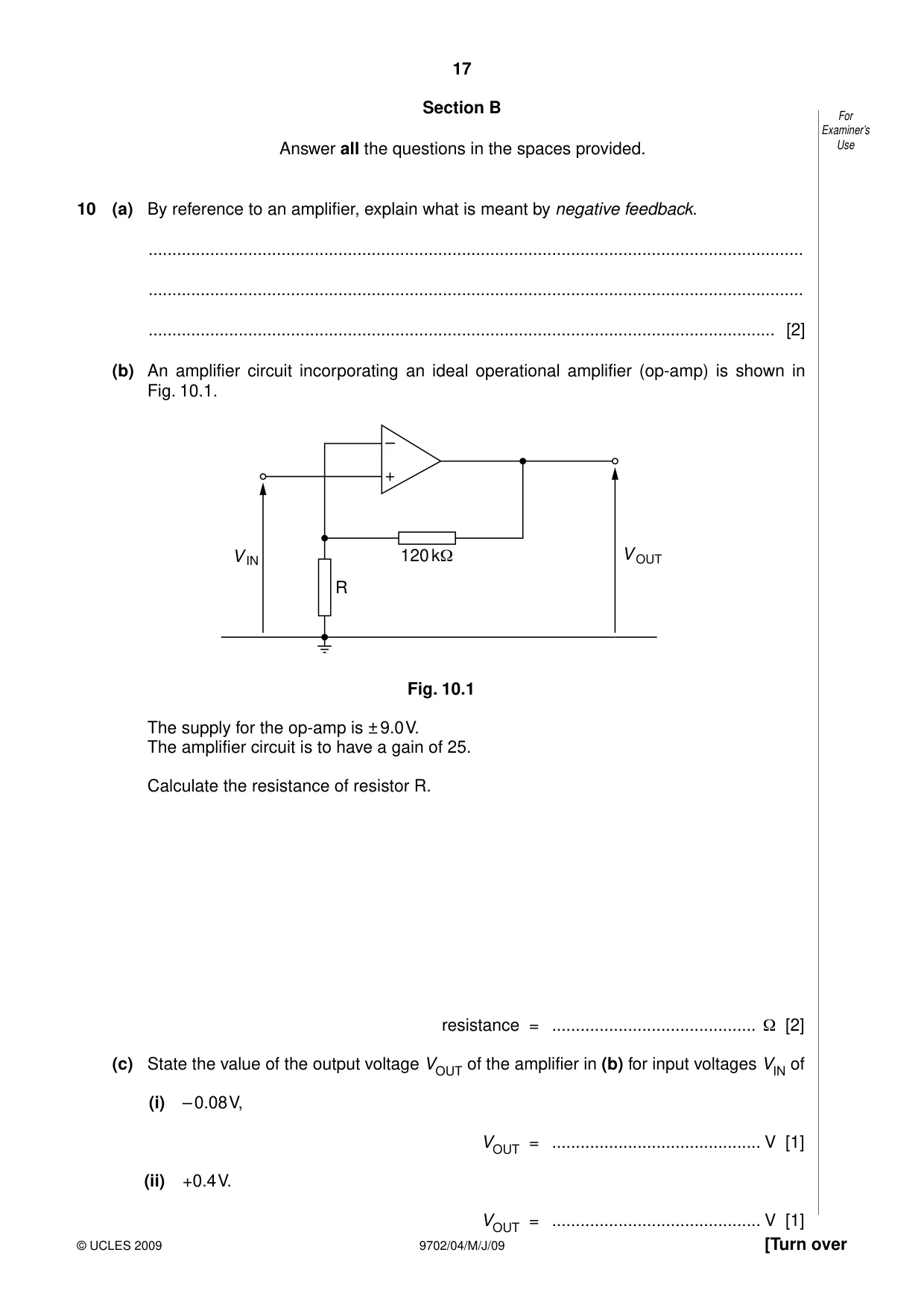
10 (a) By reference to an amplifier, explain what is meant by negative feedback. .......................................................................................................................................... .......................................................................................................................................... .................................................................................................................................... [2] (b) An amplifier circuit incorporating an ideal operational amplifier (op-amp) is shown in Fig. 10.1. – + V IN 120kΩ V OUT R Fig. 10.1 The supply for the op-amp is ± 9.0 V. The amplifier circuit is to have a gain of 25. Calculate the resistance of resistor R. resistance = ........................................... Ω [2] (c) State the value of the output voltage VOUT of the amplifier in (b) for input voltages VIN of (i) – 0.08 V, VOUT = ............................................ V [1] (ii) +0.4 V. VOUT = ............................................ V [1]
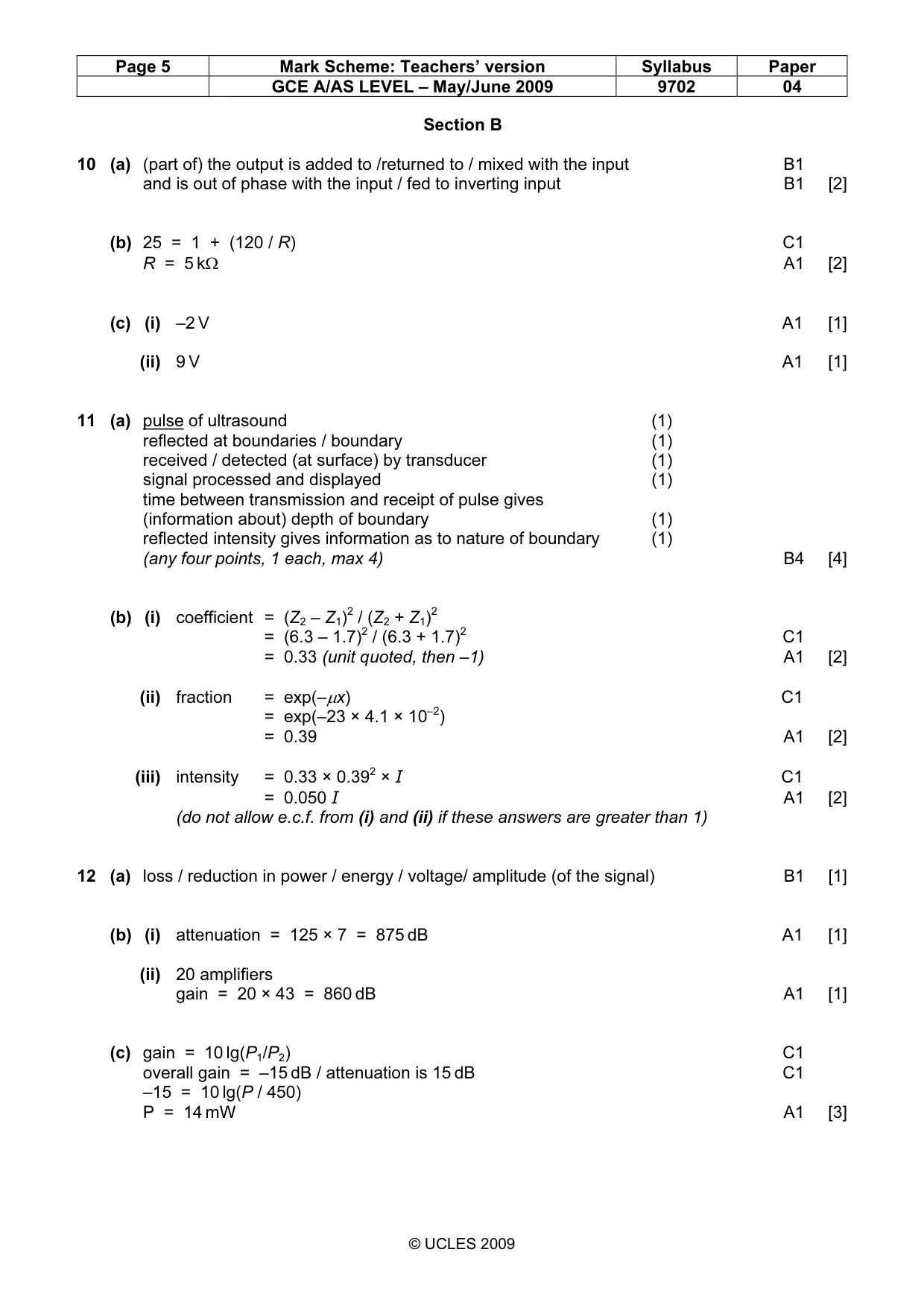
Mark scheme: 10 (a) (part of) the output is added to /returned to / mixed with the input B1 and is out of phase with the input / fed to inverting input B1 [2] (b) 25 = 1 + (120 / R) C1 R = 5 kΩ A1 [2] (c) (i) –2 V A1 [1] (ii) 9 V A1 [1]
Q11 · Explain the main principles behind the use of ultrasound to obtain diagnostic information…
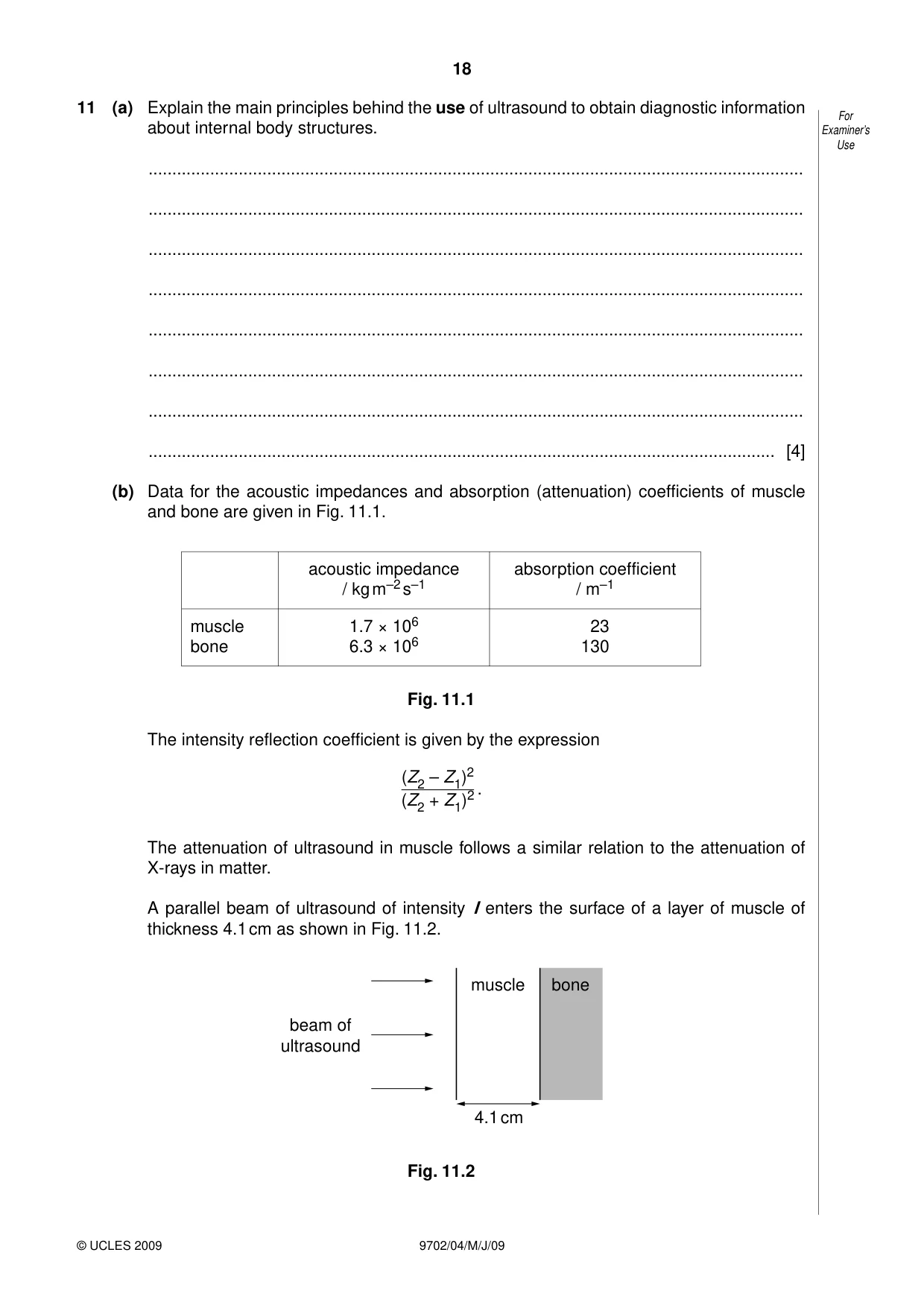
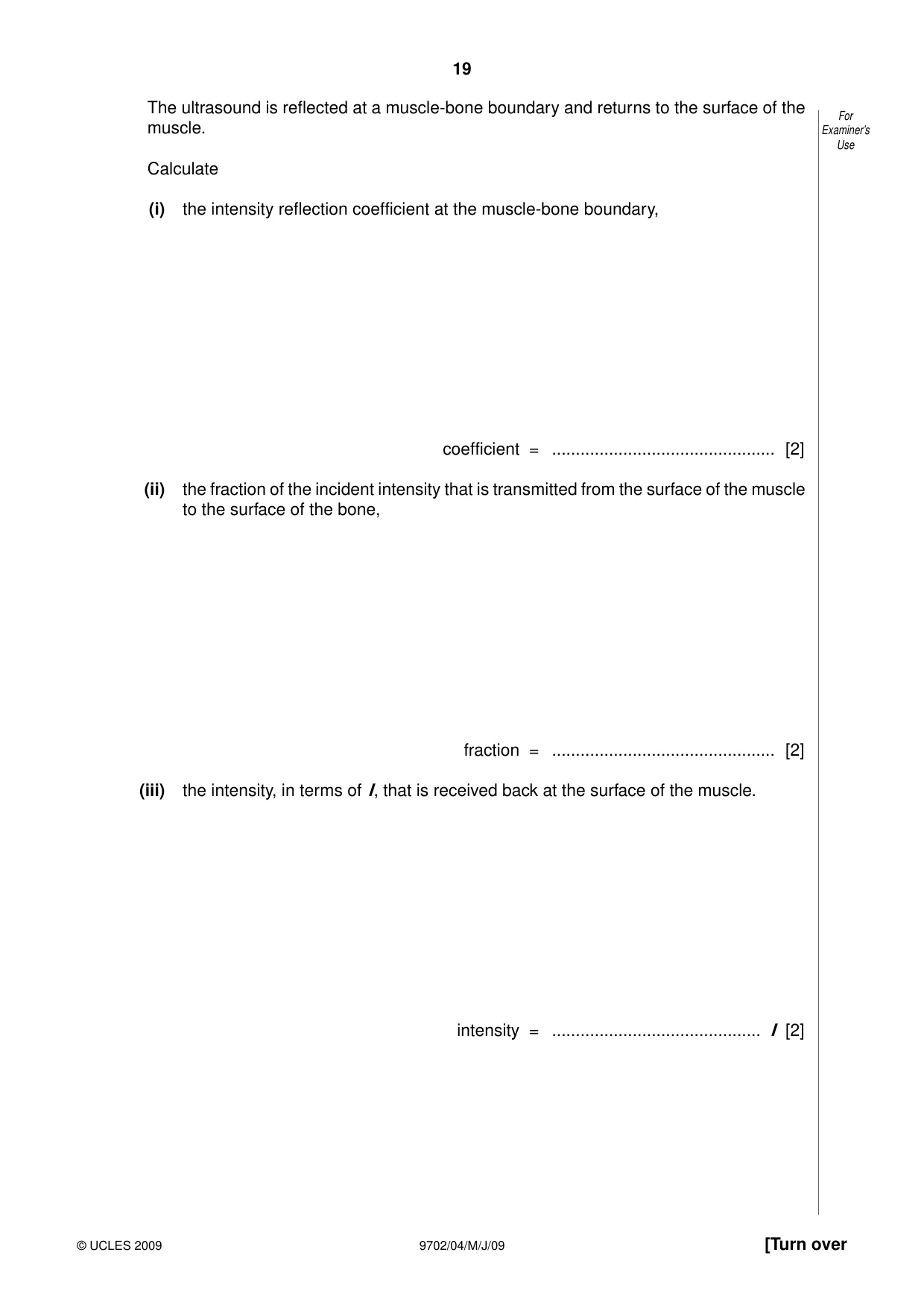
11 (a) Explain the main principles behind the use of ultrasound to obtain diagnostic information For about internal body structures. Examiner’s Use .......................................................................................................................................... .......................................................................................................................................... .......................................................................................................................................... .......................................................................................................................................... .......................................................................................................................................... .......................................................................................................................................... .......................................................................................................................................... .................................................................................................................................... [4] (b) Data for the acoustic impedances and absorption (attenuation) coefficients of muscle and bone are given in Fig. 11.1. acoustic impedance absorption coefficient / kg m–2 s–1 / m–1 muscle 1.7 × 10⁶ 23 bone 6.3 × 10⁶ 130 Fig. 11.1 The intensity reflection coefficient is given by the expression (Z2 – Z1)2 . (Z2 + Z1)2 The attenuation of ultrasound in muscle follows a similar relation to the attenuation of X-rays in matter. A parallel beam of ultrasound of intensity I enters the surface of a layer of muscle of thickness 4.1 cm as shown in Fig. 11.2. muscle bone beam of ultrasound 4.1cm Fig. 11.2 The ultrasound is reflected at a muscle-bone boundary and returns to the surface of the For muscle. Examiner’s Use Calculate (i) the intensity reflection coefficient at the muscle-bone boundary, coefficient = ............................................... [2] (ii) the fraction of the incident intensity that is transmitted from the surface of the muscle to the surface of the bone, fraction = ............................................... [2] (iii) the intensity, in terms of I, that is received back at the surface of the muscle. intensity = ............................................ I [2]
Mark scheme: 11 (a) pulse of ultrasound (1) reflected at boundaries / boundary (1) received / detected (at surface) by transducer (1) signal processed and displayed (1) time between transmission and receipt of pulse gives (information about) depth of boundary (1) reflected intensity gives information as to nature of boundary (1) (any four points, 1 each, max 4) B4 [4] (b) (i) coefficient = (Z2 – Z1)2 / (Z2 + Z1)2 = (6.3 – 1.7)2 / (6.3 + 1.7)2 C1 = 0.33 (unit quoted, then –1) A1 [2] (ii) fraction = exp(–µx) C1 = exp(–23 × 4.1 × 10–2) = 0.39 A1 [2] (iii) intensity = 0.33 × 0.392 × I C1 = 0.050 I A1 [2] (do not allow e.c.f. from (i) and (ii) if these answers are greater than 1)
Q12 · A signal is to be transmitted along a cable system of total length 125 km
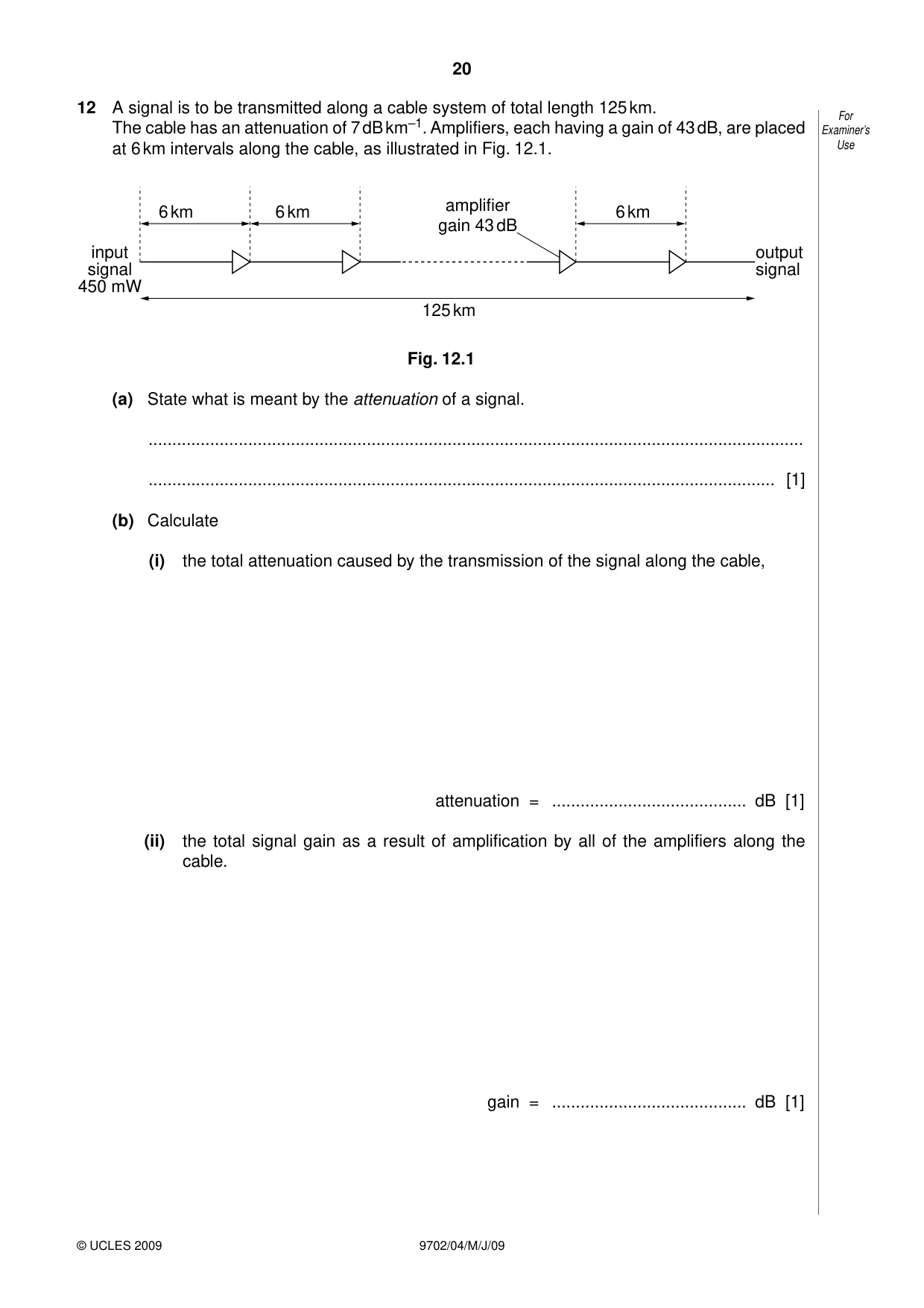
12 A signal is to be transmitted along a cable system of total length 125 km. For The cable has an attenuation of 7 dB km–1. Amplifiers, each having a gain of 43 dB, are placed Examiner’s at 6 km intervals along the cable, as illustrated in Fig. 12.1. Use amplifier 6km 6km 6km gain 43dB input output signal signal 450 mW 125km Fig. 12.1 (a) State what is meant by the attenuation of a signal. .......................................................................................................................................... .................................................................................................................................... [1] (b) Calculate (i) the total attenuation caused by the transmission of the signal along the cable, attenuation = ......................................... dB [1] (ii) the total signal gain as a result of amplification by all of the amplifiers along the cable. gain = ......................................... dB [1] (c) The input signal has a power of 450 mW. Use your answers in (b) to calculate the output For power of the signal as it leaves the cable system. Examiner’s Use power = ....................................... mW [3]
Mark scheme: 12 (a) loss / reduction in power / energy / voltage/ amplitude (of the signal) B1 [1] (b) (i) attenuation = 125 × 7 = 875 dB A1 [1] (ii) 20 amplifiers gain = 20 × 43 = 860 dB A1 [1] (c) gain = 10 lg(P1/P2) C1 overall gain = –15 dB / attenuation is 15 dB C1 –15 = 10 lg(P / 450) P = 14 mW A1 [3] GCE A/AS LEVEL – May/June 2009 9702 04
Q13 · A block diagram illustrating part of a mobile phone handset used for receiving For a…
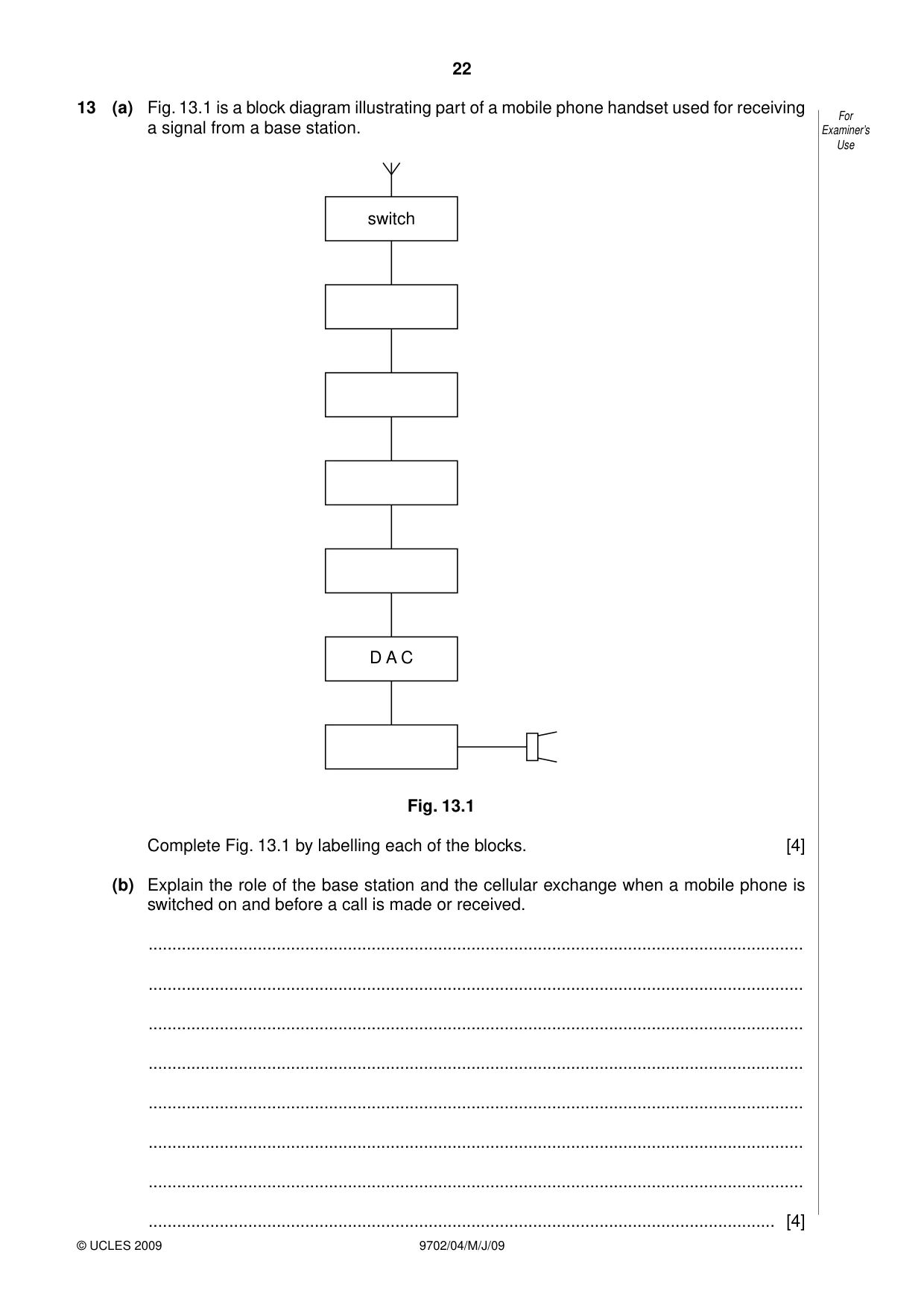
13 (a) Fig. 13.1 is a block diagram illustrating part of a mobile phone handset used for receiving For a signal from a base station. Examiner’s Use switch D A C Fig. 13.1 Complete Fig. 13.1 by labelling each of the blocks. [4] (b) Explain the role of the base station and the cellular exchange when a mobile phone is switched on and before a call is made or received. .......................................................................................................................................... .......................................................................................................................................... .......................................................................................................................................... .......................................................................................................................................... .......................................................................................................................................... .......................................................................................................................................... ..........................................................................................................................................
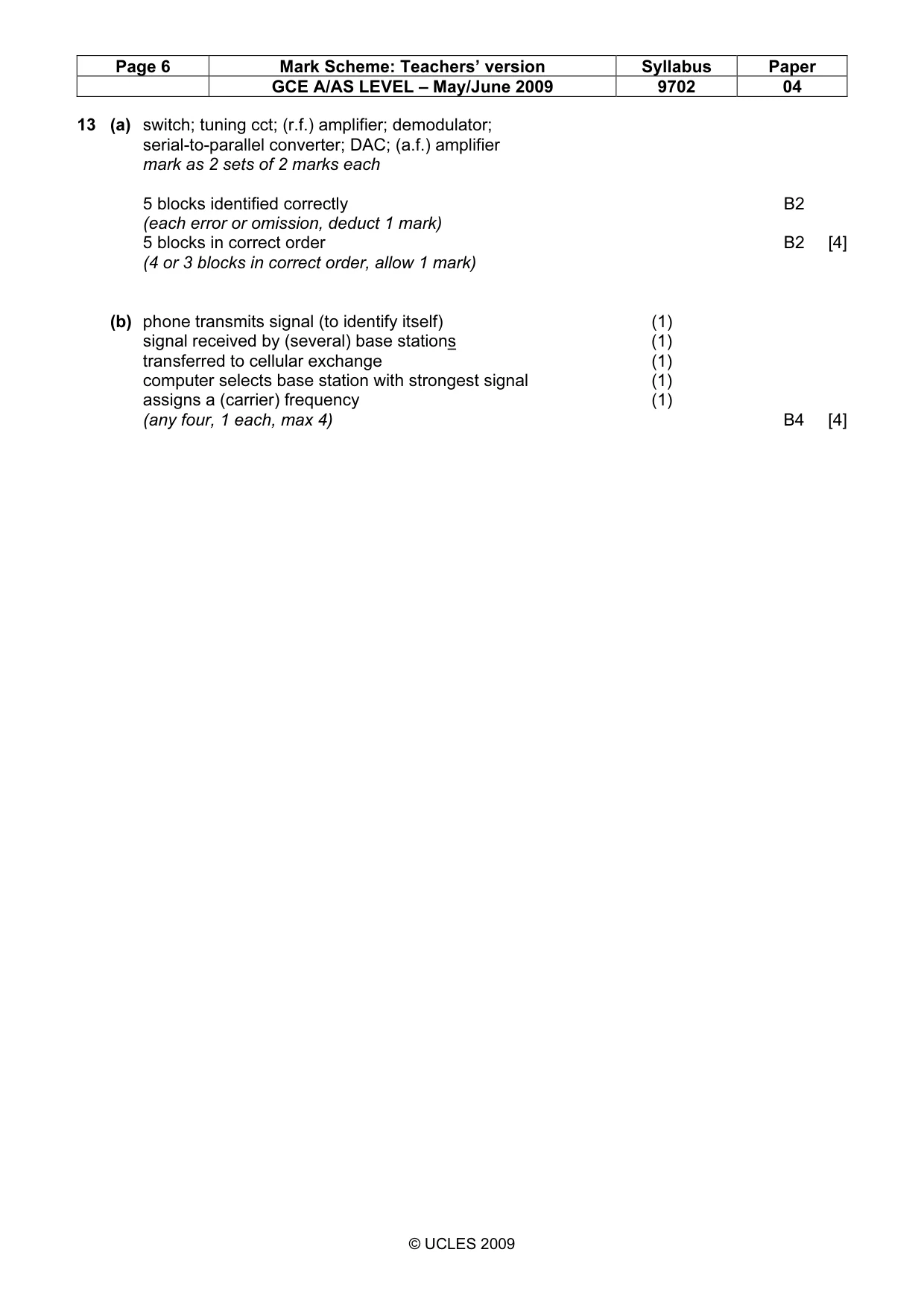
Mark scheme: 13 (a) switch; tuning cct; (r.f.) amplifier; demodulator; serial-to-parallel converter; DAC; (a.f.) amplifier mark as 2 sets of 2 marks each 5 blocks identified correctly B2 (each error or omission, deduct 1 mark) 5 blocks in correct order B2 [4] (4 or 3 blocks in correct order, allow 1 mark) (b) phone transmits signal (to identify itself) (1) signal received by (several) base stations (1) transferred to cellular exchange (1) computer selects base station with strongest signal (1) assigns a (carrier) frequency (1) (any four, 1 each, max 4) B4 [4]
What was in this paper
The subtopics covered by these 13 questions, and how many questions each got. Open one in a new tab to see every Cambridge question on it.
1Electromagnetic induction1Electromagnetic spectrum1Energy and momentum of a photon1Equation of state1Force on a current-carrying conductor1Gravitational potential1Physical quantities1Potential dividers1Production and use of ultrasound1Progressive waves1Radioactive decay1Specific heat capacity and specific latent heat1What you needed in this session
Cambridge’s own grade thresholds for 2009 May/June, Paper 4 · Variant 1. A higher threshold means an easier paper — the bar moves with how the cohort did.