Questions as text
Q1 · China and Japan, 1912–45 (a) Explain why Japan was unhappy with the outcome of the Paris… 9489/22 Feb/March 2021
9 China and Japan, 1912–45 (a) Explain why Japan was unhappy with the outcome of the Paris Peace Conference. [10] (b) How successful were Chiang Kai-shek’s attempts to re-unite China? [20]
30 marks
Mark scheme: 9(a) Explain why the Japan was unhappy with the outcome of the Paris 10 Peace Conference. Though the Japanese had not fought in Europe the Japanese Fleet had been utilised in the Mediterranean and the Japanese played a major role in the Asia sphere but: • They were not included in the discussions of the ‘Big Three’. • Though they were given German island territories and some of Germany’s concessions in China they did not get all they wanted in China. • The Japanese felt they were not treated as a modernised industrial and military power. • The Treaty of Versailles did not endorse the equality of all races and the Japanese felt they had been treated as an inferior race. Accept other valid responses. 9(b) How successful were Chiang Kai-shek’s attempts to re-unite China? 20 Responses will need to consider the developments of KMT control following the death of Sun and the rise to power of Chiang. It may include something about the internal struggle for control of the KMT but is more likely to focus on the ending of the warlord era and the Nationalist/communist conflict. Chiang used his control of the military forces to establish his leadership of KMT and remove left wing leaders. The Northern Expedition in1927 saw him gain control of much of Southern China. The Shanghai massacres broke with CCP. He completed the capture of Beijing, which gave Chiang control of most of China. Encirclement campaigns; after fifth, destroyed Jiangxi Soviet and drove out communists. Failure to deliver Sun Yat-sen’s 3 principles led to loss of support from wider population. He failed to destroy CCP – Long March. He failed to respond to Japanese invasion of Manchuria. His failure to act against Japan led to Xian Bridge incident. Constant attempt to counteract CCP growth led to failure to act effectively against Japan in 2nd Sino–Japanese War. Accept other valid responses.
This question in 9489/22 Feb/March 2021
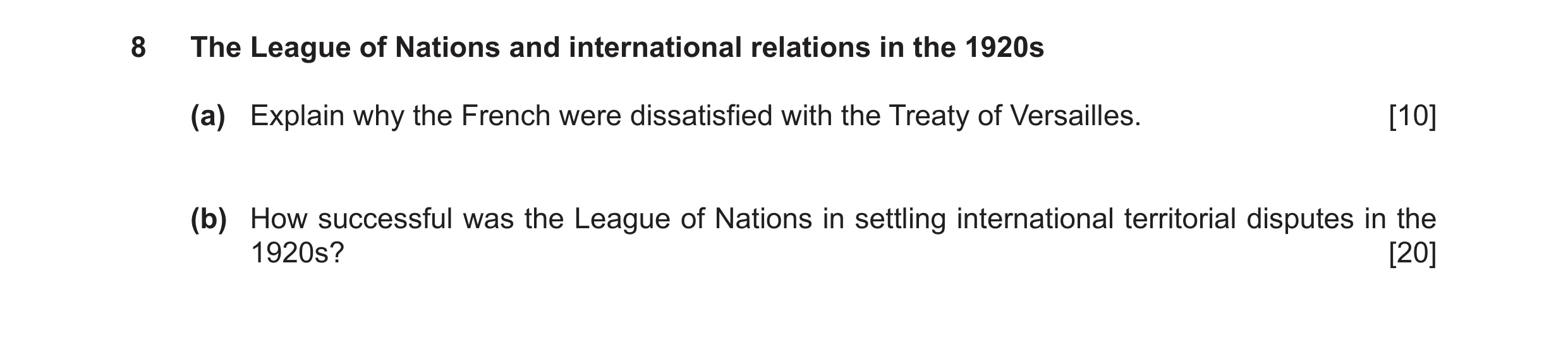
Q2 · The League of Nations and international relations in the 1920s (a) Explain why the French… 9489/23 May/June 2021
8 The League of Nations and international relations in the 1920s (a) Explain why the French were dissatisfied with the Treaty of Versailles. [10] (b) How successful was the League of Nations in settling international territorial disputes in the 1920s? [20]
30 marks
Mark scheme: 8(a) Explain why the French were dissatisfied with the Treaty of Versailles. 10 The key to this response is an understanding of French expectations at the Versailles negotiations which were based on revanche and reparation • The French wanted Germany permanently disabled, preferably broken up into smaller states; this did not happen • The French wanted key areas like the Rhineland and the Saar coalfields but though the Rhineland was demilitarised and the Saar was placed under French/British control for 15 years. this was less than expected • They did not gain full control of German colonies which were placed under League of Nations mandate • The reparation figure that was eventually agreed was less than the French wanted • Failure of USA to ratify ToV left France feeling abandoned by its allies. Accept other valid responses. 8(b) How successful was the League of Nations in settling international 20 disputes in the 1920s? The League of Nations (LoN) mediated in the Aaland islands dispute between Sweden and Finland 1920. Resolved the Upper Silesia coalfield dispute between Poland and Germany 1922. It settled the issue of Memel (1920). Settled the Greco-Bulgarian border dispute 1925.Introduced the Slavery Convention 1926. Continued to work throughout the 1920s for an international disarmament conference with a preparatory commission set up in 1925. However, the LoN could not prevent Polish seizure of Vilnius region from Lithuania 1921. Mussolini would not back down over the Corfu crisis (though not strictly a LoN issue the murdered Italians were working on behalf of the League). All attempts to agree measures for disarmament as proposed in the Versailles Settlement failed though the League did set up a preparatory commission in 1925 to move towards an international conference on this (which did meet in 1933 but was a failure). The ILO failed to get international agreement on 48 hour working week. Responses need not cover all of the above but will need to present a reasonable balance between examples of success and failure and better responses will need to make a reasoned judgement of the level of success. Accept other valid responses.
This question in 9489/23 May/June 2021
Q3 · The League of Nations and international relations in the 1920s (a) Explain why… 9489/21 Oct/Nov 2021
8 The League of Nations and international relations in the 1920s (a) Explain why reparations remained a problem throughout the 1920s. [10] (b) ‘Economic issues were the most important of the problems faced by the successor states in the 1920s.’ How far do you agree? [20]
30 marks
Mark scheme: 8(a) Explain why reparations remained a problem throughout the 1920s. 10 Responses might include some or all of the following factors: • Germany was angry at having to pay these under the War Guilt clause. This meant she never accepted the Versailles Treaty as binding. • They were imposed without Germany being able to negotiate as she not invited to Versailles. They were seen as the product of victors’ revenge – Vae victis (‘Woe to the vanquished’). • Germany claimed she was not able to pay whilst seeking to recover from a war-time economy. The resultant policies led to hyper-inflation. • They caused the Ruhr Crisis which, in turn, undermined relations amongst the war-time Allies. The invasion seemed to threaten German unity, something the French did actively seek. • The Dawes plan offered a temporary solution but this situation was dependent on the unhindered supply of American loans. • The Wall Street Crash led to the calling-in of these loans and simply revived the problem. • The Genoa conference (1922) was organised by British PM Lloyd George, to resolve issues but broke down over French refusal to compromise. Accept any other valid responses. 8(b) ‘Economic issues were the most important of the problems faced by the 20 successor states in the 1920s.’ How far do you agree? There is a division here between economic factors and other possible causes of difficulties and a requirement for comparative judgements at the highest levels. Responses need to be based on a clear understanding of what the ‘successor states’ were. Economic factors include disruption of infrastructure such as the road, railways and power supply. Structures were based on the large pre-war empires and did not fit the new smaller political units that were created. Also, industries were separated from their supplies of raw materials, power, and markets by the new national boundaries, for example, the Silesia coalfields conflict. New national boundaries created issues of tariffs and trade. Other factors, such as the application of Wilson’s 14-point, exacerbated minority population issues, especially in former Austro-Hungarian territories. Thus, Czechoslovakia had Germans, Poles, Ruthenians and Ukrainians, Slovaks and Hungarians. There were border conflicts, for example, the Polish- Russian war, the Polish-Lithuanian dispute over Vilnius and the Greco- Bulgarian border dispute. This massive redrawing of borders led to the creation a large number of European refugees. There was a lack of democratic traditions; some states quickly became autocracies, for example, Pilsudski in Poland, Hungary, etc. Only Czechoslovakia established effective democratic government. Accept any other valid responses.
This question in 9489/21 Oct/Nov 2021
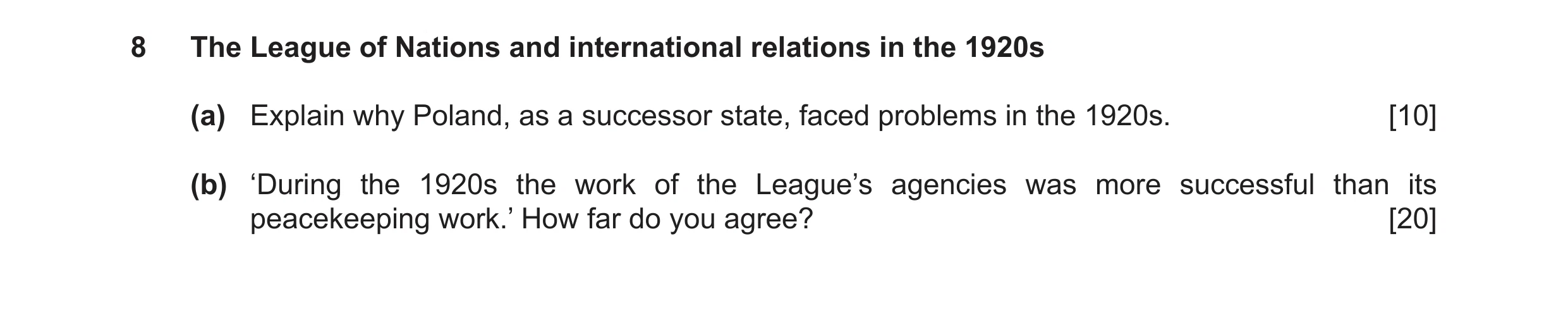
Q4 · The League of Nations and international relations in the 1920s (a) Explain why Poland, as… 9489/22 Feb/March 2022
8 The League of Nations and international relations in the 1920s (a) Explain why Poland, as a successor state, faced problems in the 1920s. [10] (b) ‘During the 1920s the work of the League’s agencies was more successful than its peacekeeping work.’ How far do you agree? [20]
30 marks
Mark scheme: 8(a) Explain why Poland, as a successor state, faced political and economic 10 problems in the 1920s. Indicative content Poland had not existed as an independent state for over 120 years and its territory had been divided between 3 empires, Russia Germany and Austria: • No tradition of democratic government and few people with relevant experience. • Range of nationalities; over one third of population was not Polish • Disputes over borders (Polish Russian War). • Lack of coherent economic and transport structure. • Silesian coalfield dispute with Germany not solved until 1923. • Political chaos led to military coup in 1926 by General Pilsudski. • Problem of Danzig. Accept any other valid responses. 8(b) ‘During the 1920s the work of the League’s agencies was more 20 successful than its peacekeeping work.’ How far do you agree? Indicative content There were successes and failures in both areas and a strong response will consider the balance of successes and failures between the different parts of the organisation. Agencies Half a million PoW’s were returned home. Provided food and shelter for Turkish refugees (1922). It approved a Slavery Convention (1926) and freed over 200 000 slaves. Worked on improving the treatment of malaria and leprosy. BUT ILO plan for 48-hour week failed to get approval. Peacekeeping The League settled Aaland islands dispute and Silesian coalfields dispute. Ended Greco-Bulgarian War. Economic experts were sent to Austria in 1923 when the government went bankrupt. BUT failed to end Polish invasion of Lithuania in 1921. Was ignored by Mussolini when it ordered him to withdraw from Corfu. Failed to make any progress towards disarmament, though planning did continue for an international conference in the 1930s. Any reasoned judgement on relative success should be rewarded appropriately. Accept any other valid responses.
This question in 9489/22 Feb/March 2022
Q5 · The League of Nations and international relations in the 1920s (a) Explain why the League… 9489/21 May/June 2022
8 The League of Nations and international relations in the 1920s (a) Explain why the League of Nations had limited success in the 1920s. [10] (b) ‘The peace settlement of 1919–20 succeeded in creating stability in Eastern Europe.’ How far do you agree with this statement? [20]
30 marks
Mark scheme: 8(a) Explain why the League of Nations had limited success in the 1920s. 10 Indicative content The answer to this question is expected to focus on the intrinsic structural weaknesses of the League: It was initially seen as a ‘club’ for the victors – the defeated powers were only slowly admitted. (Austria was allowed to join in 1920, Hungary in 1922 and Germany in 1926, but Turkey and the USSR were not admitted until the 1930s). It was an integral part of the Treaty of Versailles which increased its unpopularity with the defeated nations. USA never joined. This denied the League access to American political, economic and military influence. The League came about through American diplomacy, so its absence raised questions about the League’s legitimacy. It did not have any powers to enforce its decisions, e.g., Polish invasion of Lithuania. Mussolini/Corfu incident. All decisions had to be unanimous. If this was not achieved, then nothing could be done. Accept any other valid responses. 8(b) ‘The peace settlement of 1919–20 succeeded in creating political and 20 economic stability in Eastern Europe.’ How far do you agree with this statement? Indicative content The weight of the argument will tend to be on the disagree side but there are positives to be identified in order to create a balanced judgement. Sufficient to reach the higher levels of the mark scheme: Disagree: Issue of minorities – new borders left most states with significant minorities (e.g., in Poland around one third were non-Polish including Germans, Ukrainians, Jews and Belarussians who were increasingly hostile to perceived discrimination against them). There was a lack of democratic tradition and experienced leadership which created instability, e.g., in Poland political instability led to coup by General Pilsudski in 1926. States had previously been part of larger Empires with integrated economic structures. New boundaries created artificial economic divisions, e.g., Austria was left with limited industrial resources that led to bankruptcy in 1922 when Austrian economy was placed under League supervision. The attempt to apply Wilson’s self-determination principle led to displaced persons, refugees and fresh conflicts, e.g., Poland/Russia, Greece/Bulgaria. Agree: With some minor adjustments the boundaries created were largely stable. Some countries established sound economies and successful governments, e.g., Czechoslovakia. It resolved many pre-war issues in the Balkans with the creation of Yugoslavia. Some minor issues were solved by negotiation, e.g., Silesian Coalfields dispute was dealt with by the LoN. In the 1920s the settlement of the Danzig issue seemed to be working; it was only in the thirties that it became an increasing problem. Accept any other valid responses.
This question in 9489/21 May/June 2022
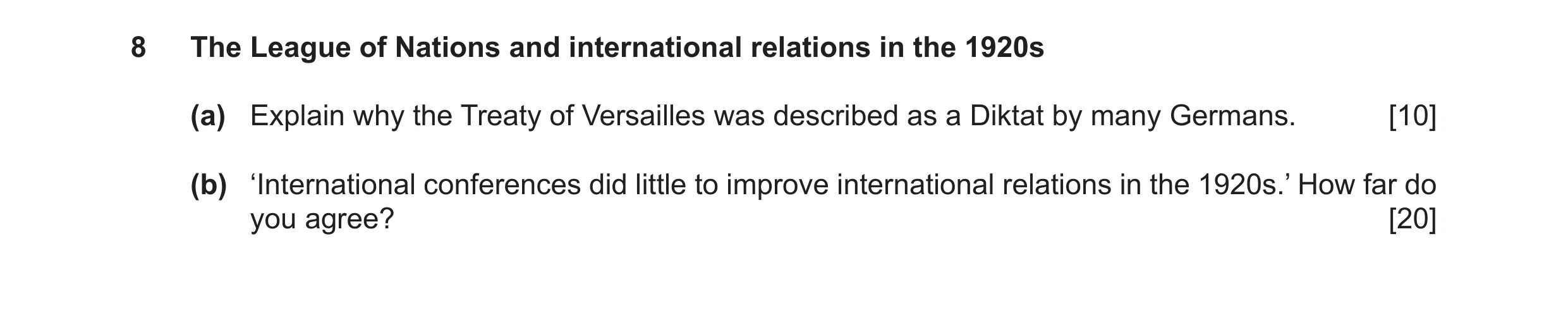
Q6 · The League of Nations and international relations in the 1920s (a) Explain why the Treaty… 9489/23 May/June 2022
8 The League of Nations and international relations in the 1920s (a) Explain why the Treaty of Versailles was described as a Diktat by many Germans. [10] (b) ‘International conferences did little to improve international relations in the 1920s.’ How far do you agree? [20]
30 marks
Mark scheme: 8(a) Explain why the Treaty of Versailles was described as a Diktat by 10 many Germans. Indicative content The reasons for German dissatisfaction with the Treaty are the basis of a good answer to this question and should be well understood by good candidates. The war guilt clause – Germans did not accept that they were responsible for the war but were forced to accept this clause as part of the Treaty. German leaders were not invited to the conference but simple called to sign the agreement that had been made between the victorious powers. Germany was the only country forced to accept limitations of its armed forces. 8(a) They were stripped of all their colonies and even some areas that were seem as traditionally part of Germany. They were forced to pay reparations. Accept any other valid responses. 8(b) ‘International conferences did little to improve international relations 20 in the 1920s.’ How far do you agree? Indicative content Candidates will be expected to consider a range of conferences in the 1920s, all of which had both positive and negative aspects, in order to reach an overall judgement. Candidates may approach this either on a conference by conference basis or on a success vs failure basis, both of which could work providing there is a valid overall judgement at the end. Washington Naval Conference: Its purpose was to prevent a possible naval race between the major powers by setting comparative size limits for their naval development. It successfully achieved agreement in the Four-, Five-, and Nine Power Agreements. However, the US used it as an excuse to scrap obsolete ships whilst completing up-to-date battleships that had already been begun. Heavy cruisers were limited in size but not in number so there was a continued race to build more of these. Japanese in particular resented the Treaty as they felt it was western plot to limit the growing power of Japan The Genoa Conference: The Conference was a suggestion of Lloyd George in an attempt to promote ‘the reconstruction of broken Europe’ to bring the Soviet Union and Germany back into the international community and resolve issues between France and Germany. The conference ended in stalemate and recrimination with the only positive results being the agreement to re-establish the gold standard as a basis for currency valuations to aid trade. The treaty of Rapallo might also be identified as an indirect positive outcome, though it was also what led to the collapse in the end. The Locarno conference: The Conference was driven by the diplomacy of Gustav Stresemann which culminated in a meeting of European foreign ministers. It confirmed the permanent western borders of Germany backed by British and Italian guarantees. It was hailed as the beginning of a new era of peace in Europe (the spirit of Locarno). BUT it did not give similar guarantees on the eastern borders of Germany and created anger and disappointment especially in Poland. Extremist groups in Germany saw it as a way of confirming the status quo of Versailles and continued to reject it. Kellogg-Briand might be included but was not really the result of an international conference. 8(b) Accept the Dawes and Young Plans as the result of international conferences with a specific purpose of dealing with reparations. Accept any other valid responses.
This question in 9489/23 May/June 2022
Q7 · The League of Nations and international relations in the 1920s (a) Explain why the Treaty… 9489/22 Oct/Nov 2022
8 The League of Nations and international relations in the 1920s (a) Explain why the Treaty of Sèvres led to conflict in Turkey. [10] (b) To what extent had Germany regained its position as a major power by 1929? [20]
30 marks
Mark scheme: 8(a) Explain why the Treaty of Sevres led to conflict in Turkey. 10 Indicative content It was far more severe than the treatment of Germany: • It involved handing over much of the Middle East to Britain and France as League of Nation Mandates and the division of Turkey itself into areas of influence for the victorious powers. • it included taking much of eastern Turkey to create an independent Armenian state • this aroused anger and a rise in nationalist agitation • It caused civil war between the Sultan’s government in Istanbul and the breakaway Turkish Grand National Assembly which was formed by Mustafa Kemal in Ankara. • There were protests against British and French rule in the mandated territories. • In 1922 the Sultanate was abolished and replaced by a republican government. • As a result the Treaty was never formally ratified and was replaced in 1922 by the Treaty of Lausanne. Accept any other valid responses. 8(b) To what extent had Germany regained its position as a major power by 20 1929? Indicative content The answer offers possibilities for a balanced consideration of Germany’s re-emergence from the humiliation of Versailles and economic collapse. Arguments for recovery: Candidates might consider the growing involvement of Germany in international negotiations. Despite the failure of the Genoa Conference the Rapallo Pact with Russia was agreed. More significant recovery stemmed from the Dawes Plan of 1924 which restored some stability to Germany’s economic position and allowed its economy to begin growing again. And Anglo–German trade negotiations led to a trade treaty in 1925. The Locarno Pact marked a big step forward and the ‘Spirit of Locarno’ which characterised international relations in the latter part of the 1920s marked German re-admission to the international community, as exemplified by its admission to the League of Nations in 1926. Germany was also a signatory of the Kellogg-Briand Pact and saw its reparations commitment stabilised by the Young Plan which demonstrated Germany’s improved international position by the end of the 1920s. Arguments against acceptance: The Ruhr invasion exemplified French mistrust of Germany which had been heightened by the Rapallo Pact. Despite improved relations in Briand/Stresemann era this remained. The Locarno agreement eased relations on Germany’s western border but there was no similar improvement on its eastern border and Poland in particular was very critical of Locarno. The harsh terms of the Treaty of Versailles remained in place, its colonies were gone and its armed forces restricted to such a level that it could probably not even defend itself if attacked. Despite the promise of Versailles, no other country showed any sign of disarming and, despite Kellogg-Briand pact there were no active talks on arms reduction. Germans still felt aggrieved and unfairly treated and the Wall Street Crash gave extremists the opportunity to capitalise on this perceived inequality. Accept any other valid responses.
This question in 9489/22 Oct/Nov 2022
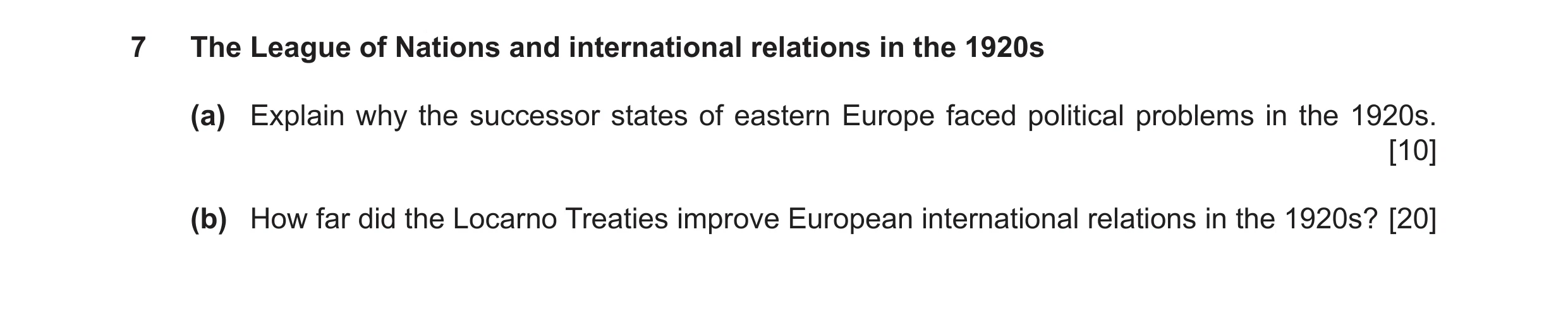
Q8 · The League of Nations and international relations in the 1920s (a) Explain why the… 9489/21 May/June 2023
7 The League of Nations and international relations in the 1920s (a) Explain why the successor states of eastern Europe faced political problems in the 1920s. [10] (b) How far did the Locarno Treaties improve European international relations in the 1920s? [20]
30 marks
Mark scheme: 7(a) Explain why the successor states of eastern Europe faced political 10 problems in the 1920s. Indicative content No history of democratic structure or of republican government. These newly defined geographic regions under newly formed governments were unaccustomed to deciding their own fate. These independent nations all tried democracy, regarded as the best system by which to introduce the principle of national self- determination to a new nation. However, in a region where democracy was unfamiliar, the system had many problems. No traditional ruling group. The politicians of Eastern Europe had been handed their orders from the governments that had dominated them. They were not used to democratic deliberation and government within a democratic framework. Indecision on many issues led to chaos and inaction on the part of many Eastern governments. Ethnic divisions. Woodrow Wilson wanted to re-draw the frontiers of eastern Europe so that all races ruled themselves. This was achieved to a certain extent, but it brought in its wake further problems. The peacemakers tried to protect minorities by putting clauses into the treaties forcing countries to treat minorities fairly. However, the Germans were not allowed self-determination. Many Germans found themselves living in Poland or Lithuania, and the German Sudetenland was made part of Czechoslovakia to give Czechoslovakia an industrial base. Anschluss with Austria was forbidden. Also, the Treaty of Neuilly in 1919 took Bulgarian areas, and gave them to Greece, Yugoslavia and Romania while the Treaty of Sèvres gave Turkish Smyrna to Greece. Like Germany, Bulgaria and Turkey were defeated powers, so they did not get self-determination. Eventually, internal conflicts stemming from new self-determination by national majorities arose from disaffected minorities who preferred the rule of neighbours. In particular, in Poland, Czechoslovakia and Yugoslavia, there were ‘enclaves’ of minority races. Economic difficulties made stable government a struggle. Hungary experienced a great deal of instability during the inter-war years. After a period of chaos, it decided on monarchy, and Hungary became, in effect, a dictatorship run by the landed aristocracy. Czechoslovakia proved the only nation in Eastern Europe able to function reasonably well as a democracy during the inter-war period. Accept any other valid responses. 7(b) How far did the Locarno Treaties improve European international 20 relations in the 1920s? Indicative content Discussion of improved international relations may consider how the main treaty between Germany, France, Belgium, Great Britain, and Italy formally recognised Germany’s revised western borders established by the Treaty of Versailles. Also, Germany, France and Belgium undertook not to attack each other with Britain and Italy acting as guarantors. In the event of aggression by any of the first three states against another, all other parties were to assist the country under attack. Germany also agreed to sign arbitration conventions with France and Belgium and arbitration treaties with Poland and Czechoslovakia, undertaking to refer future disputes to an arbitration tribunal or to the Permanent Court of International Justice. France signed further treaties with Poland and Czechoslovakia, pledging mutual assistance in the event of conflict with Germany. These essentially reaffirmed existing treaties of alliance concluded by France with Poland on 19 February 1921 and with Czechoslovakia on 25 January 1924. This agreement created the so called ‘Spirit of Locarno’ a spell of international co-operation and Germany was able to join the League of Nations as a permanent member of the Council. Stresemann and Briand were awarded the Noble Peace Prize and in 1928 the Kellogg-Briand Pact was signed. Discussion of the failure to resolve issue may include exploration of the underlying tension between Germany and France remained and re-emerged following the death of Stresemann and the economic collapse in 1929. There was still dissatisfaction in Germany which was masked by the success of the Weimar Republic in the late 1920s but re-emerged once economic difficulties returned. Eastern European states were not given the same guarantee against future aggression as the western states. Poles in particular were furious with the outcome as they felt their need for security against future German aggression had been ignored in the Treaty. This led to a deterioration in Franco-Polish relations. The guarantees attached to the Treaty did not necessarily commit the guarantor nations to military intervention. Accept any other valid responses.
This question in 9489/21 May/June 2023
Q9 · The League of Nations and international relations in the 1920s (a) Explain why the… 9489/22 May/June 2023
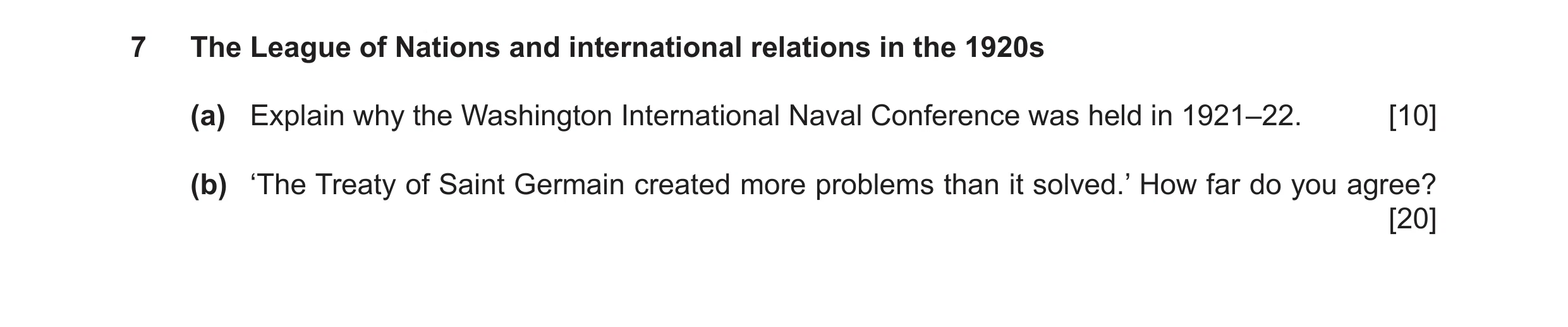
7 The League of Nations and international relations in the 1920s (a) Explain why the Washington International Naval Conference was held in 1921–22. [10] (b) ‘The Treaty of Saint Germain created more problems than it solved.’ How far do you agree? [20]
30 marks
Mark scheme: 7(a) Explain why the Washington International Naval Conference was held 10 in 1921–22. Indicative content General support for peace and disarmament after the First World War. Women’s suffrage: disarmament had strong support from women’s groups and all major protestant groups in US – a ‘vote winner’. US wanted to confirm its military position in the Pacific. US concerns about growing Japanese strength. Avoid a naval arms race like that before the First World War. Concern over Japanese moves into China – wish by western powers to maintain the Open Door Policy in trade with China. Accept any other valid responses. 7(b) ‘The Treaty of Saint Germain created more problems than it solved.’ 20 How far do you agree? Indicative content Discussion of the achievements of the Treaty might include how he treaty officially registered the breakup of the Habsburg empire, recognising the independence of Czechoslovakia, Poland, Hungary, and the Kingdom of the Serbs, Croats, and Slovenes (Yugoslavia) and ceding eastern Galicia, Trento, southern Tirol, Trieste, and Istria. Plebiscites eventually decided the fate of southern Carinthia (which went to Austria) and the town of Sopron (which went to Hungary). The Covenant of the League of Nations was integrally included in the treaty, and the union of Austria with Germany was expressly forbidden without the consent of the Council of the League. The military clauses limited Austria’s long-service volunteer army to 30 000 men and broke up the Austro-Hungarian navy, distributing it among the Allies. Although Austria was made liable for reparations, no money was ever actually paid. Discussion of the problems caused by the treaty might include how Austrian officials protested the violation of the principle of self-determination in the treaty, the placement of so many ethnic Germans under Czechoslovak and Italian rule, and the forbiddance of unity with Germany. The Austria created by the treaty was financially and militarily weak (declared bankruptcy in 1923) and therefore a chronic force of instability in Europe between the two World Wars. Just as the A–H Empire, all the successor states had significant minority populations which tended to create political instability and there was no history of democratic government. States were economically weak the integral infrastructure of the A–H Empire was broken up by new national boundaries and raw materials and manufacturing businesses were also sometimes separated by these boundaries. Accept any other valid responses.
This question in 9489/22 May/June 2023
Q10 · The League of Nations and international relations in the 1920s (a) Explain why the USA… 9489/22 Feb/March 2025
8 The League of Nations and international relations in the 1920s (a) Explain why the USA did not join the League of Nations. [10] (b) ‘The Treaty of Sèvres created more problems than it solved.’ How far do you agree? [20]
30 marks
Mark scheme: 8(a) Explain why the USA did not join the League of Nations. 10 The League of Nations was part of Woodrow Wilson’s 14 points and its acceptance was written into all the treaties that emerged from the Paris Peace Conference. • However, Wilson failed to convince his fellow Americans that this was a good idea as many felt that America should not have got involved in the war in the first place and feared that these treaties tied the US into continuing involvement in European affairs. • The Republicans who opposed Wilson’s plan, won the congressional elections on a platform of opposition to the treaties so the Senate rejected ratification of the peace treaties which also involved rejecting membership of the League. • Many Americans feared that the terms of the peace treaties contained the seeds of a future conflict and did not want the US to become entangled in that through signing the treaties and joining the League. • Some Americans also feared that the conditions of membership of the League would allow other countries to interfere in US affairs. Accept any other valid responses. 8(b) ‘The Treaty of Sèvres created more problems than it solved.’ How far do 20 you agree? The treaty appeared initially to deal with the main issues of the Middle East and gave the allies considerable control over the area and of the Straits in particular. However internal division in Turkey led to the repudiation of the treaty and ultimately to its replacement in 1922. Successes • Ended the war between the Allies and the Ottoman Empire • Removed a large section of the Empire in Asia and North Africa and theoretically created independent states in the Middle East recognising the role played by Arab leaders in the area in bringing about the defeat of the Ottoman Empire. However, it placed them under the control of the League of Nations until they could develop self-governing capacity. In practice this meant that Britain and France were granted mandates to control these areas. • Recognised British control of Egypt. • Proposed an independent state of Armenia to end the Armenian genocide which had begun in 1915/16. Problems • The treaty was signed in Sèvres by the Ottoman government but immediately repudiated by the Grand National Assembly led by Kemal Ataturk. • The signatories of the Treaty were stripped of their nationality. • Civil War broke out which ended in the final demise of the Ottoman Sultanate. • The partition of the Empire and Civil War created a substantial refugee crisis which required League of Nations intervention. • The Armenian crisis remained unresolved. • A revised Treaty had to be revised with the new Republican government at Lausanne in Switzerland in 1922 which was substantially different from the Treaty of Sèvres Accept any other valid responses.
This question in 9489/22 Feb/March 2025
Q11 · The League of Nations and international relations in the 1920s (a) Explain why Lloyd… 9489/22 May/June 2025
8 The League of Nations and international relations in the 1920s (a) Explain why Lloyd George organised the Genoa conference in 1922. [10] (b) ‘Border disputes were the biggest problem facing the successor states in the 1920s.’ How far do you agree? [20]
30 marks
Mark scheme: 8(a) Explain why Lloyd George organised the Genoa conference in 1922. 10 Indicative content • He was concerned about continuing problems stemming from the Versailles settlement especially the economic problems facing much of Europe. • He invited 30 nations to attend including Germany and Russia as he believed their inclusion was vital to improving international relations. • The biggest problem was the reparations issue. Though the reparations figure had eventually been set at £6.6 billion, the German economy was in no position to sustain payments. Lloyd George was keen to rebuild the German economy and improve relations between Germany and France in particular. • Some of the successor states were also suffering from economic disruption due to the borders that were drawn, and it was hoped that an international conference might improve the economic circumstances of Europe generally. Accept any other valid responses. 8(b) ‘Border disputes were the biggest problem facing the successor states 20 in the 1920s.’ How far do you agree? Indicative content Discussion of border disputes might consider Poland which had been removed from the map at the end of the eighteenth century, its lands divided between Russia, Prussia and Austria. Recreating Poland was in line with Wilsonian principle of self-determination but created immense problems. The war in the east had been ended by the Treaty of Brest Litovsk in which much of Poland had been handed over to Germany. When the State of Poland was recreated in 1919 the Poles expected the return of areas of the Ukraine that they had formerly held and when they got no satisfaction, they launched an attack on Russia in 1920. A bitter war followed with offensive and counter offensive but ultimately this was ended in 1921 by the Treaty of Riga which gave Poland an additional strip of land along the Russian border. At the same time Poland took the opportunity to lay claim to eastern Lithuania including the city of Vilna and despite League of Nations intervention, they refused to return it to Lithuania. Another area of dispute was Upper Silesia which had large coal reserves, and which straddled the Polish German border. This was subject to a plebiscite organised by the League in which the western part voted for Germany and the eastern section for joining Poland. The division was completed peacefully under League supervision. A third area of border conflict was around Teschen where rich coal deposits and important industries were again the main cause of dispute. Again, the League intervened splitting the area between the two countries. Neither was satisfied but both accepted the adjudication. At the end of the war Hungary invaded Czechoslovakia to try and extend its territory, while Yugoslavia became involved in border disputes with most of its neighbours in the immediate post war era. Discussion of other problems might consider the distribution of different ethnic groups throughout eastern Europe which meant that all states had significant minorities. In Poland only 18 million out of a total of 25 million were Poles. Germans formed significant and difficult minorities in Poland and Czechoslovakia. Yugoslavia suffered not just from ethnic differences but from significant religious minorities. Furthermore, the uneven distribution of economic resources led to economic weakness and collapse in some countries notably Austria and Hungary which both required rescue plans organised by the League of Nations. In terms of politics, minority problems and economic issues prevented the formation of effective democratic systems in several countries where dictatorships were eventually established as the 1920s progressed e.g. Poland, Yugoslavia, Hungary. Accept any other valid responses.
This question in 9489/22 May/June 2025
Q12 · The League of Nations and international relations in the 1920s (a) Explain why the terms… 9489/23 May/June 2025
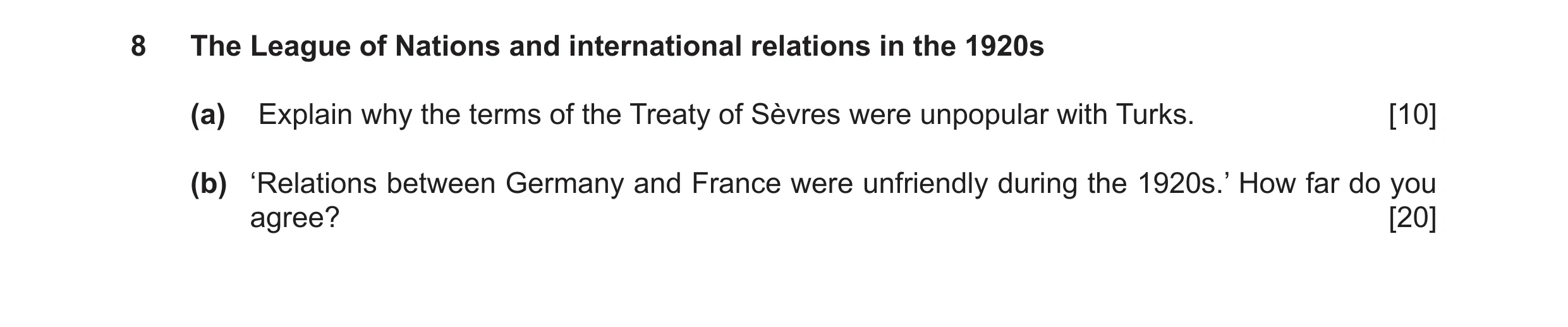
8 The League of Nations and international relations in the 1920s (a) Explain why the terms of the Treaty of Sèvres were unpopular with Turks. [10] (b) ‘Relations between Germany and France were unfriendly during the 1920s.’ How far do you agree? [20]
30 marks
Mark scheme: 8(a) Explain why the terms of the Treaty of Sèvres were unpopular with 10 Turks. Indicative content The Ottoman Empire had fought alongside Germany and was thus heavily punished in the Versailles settlement. The Treaty of Sèvres was the Treaty between the Allies and the Ottoman Sultanate, but it raised heavy opposition amongst the nationalistic Young Turks and let to Civil War. • All their middle eastern territories (Iraq, Jordan Palestine etc.) were taken from them and placed under mandate to Britain and France without any offer of a plebiscite to decide for themselves who should rule them. • Most of European Turkey was handed over to Greece and the area around Smyrna in western Anatolia was handed over to Greek Control • Large parts of Ottoman Turkey were to be subjected to plebiscites to decide whether they would remain part of the new Turkey. • The Dardanelles were placed under international control and kept open for all international traffic. • The National Assembly rejected the terms and took up arms to overturn them. • The allies took control of Turkey’s Central Bank and Government finances (Note: Turkey did not have to pay reparations). Accept any other valid responses. 8(b) ‘Relations between Germany and France were unfriendly during the 20 1920s.’ How far do you agree? Indicative content Discussion about an unfriendly relationship might consider how such a relationship, apart from the effect of the war itself, could be seen as a result of the Versailles Treaty in which Clemenceau wanted maximum punishment of Germany but had to settle for a less severe Treaty than he wanted because of the more moderate aims of Wilson and Lloyd George. This left him, and the French generally, resentful and distrustful of the Germans. The fact that the Germans were simply asked to agree to the Treaty without any input led to it being labelled a Diktat in Germany. Evidence of continuing difficulty in relations might be found in the Ruhr Crisis, the Genoa Conference and the Rapallo Pact for example. This underlying resentment of the Treaty never went away and could be argued to be a sign that relations did not really improve significantly in the 1920s. It could also be argued that Clemenceau’s attitude reflected general French mistrust and fear of a resurgent Germany and again this did not go away even if things appeared to get better. However, from the mid 1920’s onward a series of negotiations led to substantial progress in rebuilding international relations between France and Germany. This was partly due to American willingness to involve itself in the economic recovery of Europe. This was evident in the Dawes and Young Plans. One of the biggest causes of dispute between France and Germany was the continuing issue of reparations. and both these plans aimed to resolve the conflict. Dawes was a temporary solution which worked for a few years in allowing German economic recovery and Young provided a longer- term solution. Unfortunately, the Wall Street Crash brought an abrupt end to US input and left the reparations problem still unsolved and thus a cause of mistrust and resentment. The improvement was also partly due to the establishment of s strong working relationship between foreign ministers Gustav Stresemann and Aristide Briand. Their work led to the Locarno Treaties and later he Kellogg Briand Pact. However, despite the general optimism these generated they both contained significant flaws which meant their success was short-lived. Stresemann’s death in 1929 ended this mood of cooperation. Note: Detailed description of Plans, Treaties and Pacts will not be expected. Accept any other valid responses.
This question in 9489/23 May/June 2025
Q13 · The League of Nations and international relations in the 1920s (a) Explain why Poland… 9489/23 Oct/Nov 2025
8 The League of Nations and international relations in the 1920s (a) Explain why Poland faced a number of border disputes as a result of the Paris peace settlement. [10] (b) To what extent did American intervention resolve Germany’s financial problems in the 1920s? [20]
30 marks
Mark scheme: 8(a) Explain why Poland faced a number of border disputes as a result of the 10 Paris peace settlement. Indicative content From the late eighteenth century, when the state of Poland was carved up by Prussia, Russia and the Austro-Hungarian Empire the state of Poland had not existed except for a brief period as the Grand Duchy of Warsaw under Napoleon. Its recreation under the principle of national self-determination created several disputed areas on its borders. • The region of Upper Silesian was a key industrial area, that was heavily populated by both Germans and Poles so could not decide which country they should belong to. after a series of riots and disturbances the League stepped in and decide to divide the area between the two countries, a decision that was accepted by both sides. • There was a similar dispute with the Czechs over the Teschen industrial area and though the League again negotiated a settlement neither side was particularly happy with it. • Russia, having left the war in 1917, was not invited to Paris but the Treaty fixed a nominal eastern border for Poland. However, the Poles wanted more than this and went to war with Russia and were able to extent their borders in the Treaty of Riga (1921). • Another newly create state bordering Poland was Lithuania, but the Poles were not satisfied with the allocation of territory and invaded Lithuania seizing the area around Vilna. Despite League intervention the Poles refused to withdraw and held on to the disputed territory. • The Polish Corridor was created to give Poland access to the sea, but it split East Prussia form the rest of Germany and created a source of conflict. Accept any other valid responses. 8(b) To what extent did American intervention resolve Germany’s financial 20 problems in the 1920s? Indicative content Despite their refusal to sign the Treaty of Versailles and join the League of Nations it was still in America’s economic interests to have a strong and economically stable Europe. Central to all economic issues was the question if reparations, the French wanted more, and the German thought they were unfair. They were also not finally fixed until 1921 when they were set at £6.6billion. Problems arose immediately, partly because of the rising inflation in Germany and by 1922 the Germans were unable to meet the necessary payments. This resulted in French and Belgian action precipitating the Ruhr Crisis. The US response was the Dawes Plan which provided loans to Germany with which they were able to make their reparation payments which allowed France and Britain to repay their war loans to the USA. This stabilised the German economy and began a period of economic growth in Europe that lasted until 1929. However, the Dawes Plan was only a temporary fix allowing Germany to make reduced payments for 5 years, it did not resolve the issue of the size of the reparations payments or remove the underlying resentment that was caused by them. The Young Plan was intended to deal, longer term with the problems left by the Dawes Plan as Germany could still not afford eh full cost of repayment on the overall total of £6.6 billion. Young began negotiations in 1928 and by 1929 had persuaded key players that the original sum was unreasonable, and a more realistic figure was £2 billion. However, the big weakness of the plan was that it was still dependent on US loans to help the German economy. At the time of negotiation this seemed like a reasonable prospect and for the French in particular the apparent increase in stability in international relations generally and was positive outcome of these and other recent negotiations. The Wall Street Crash, however, shattered the illusion of economic stability. It meant the immediate withdrawal of all the loans which had been supporting the growth of the European economy generally. This rapidly led to falling demand, reduction of production and rising unemployment. Accept any other valid responses.
This question in 9489/23 Oct/Nov 2025
![Question 1: China and Japan, 1912–45 (a) Explain why Japan was unhappy with the outcome of the Paris Peace Conference. [10] (b) How successful were Chi…](https://img.pastlit.com/crops/1ed363be-b9e0-442c-ac52-96baff607b3a/q9.webp)
![Question 3: The League of Nations and international relations in the 1920s (a) Explain why reparations remained a problem throughout the 1920s. [10] (b…](https://img.pastlit.com/crops/63a88974-9d8b-4fde-90de-0e3bfda623dc/q8.webp)
![Question 5: The League of Nations and international relations in the 1920s (a) Explain why the League of Nations had limited success in the 1920s. [10]…](https://img.pastlit.com/crops/0632145a-fdbe-4ced-ad0e-98806fbd3a40/q8.webp)
 1 / 3
1 / 3![Question 7: The League of Nations and international relations in the 1920s (a) Explain why the Treaty of Sèvres led to conflict in Turkey. [10] (b) To …](https://img.pastlit.com/crops/124b0c92-4203-4199-9793-a06889ebec9c/q8.webp)
![Question 10: The League of Nations and international relations in the 1920s (a) Explain why the USA did not join the League of Nations. [10] (b) ‘The Tr…](https://img.pastlit.com/crops/e770a01d-6907-4b7f-a733-2f53128fb283/q8.webp)
![Question 11: The League of Nations and international relations in the 1920s (a) Explain why Lloyd George organised the Genoa conference in 1922. [10] (b…](https://img.pastlit.com/crops/f0ed21d0-0f48-4734-a6b3-a4cb32722fc7/q8.webp)
 2 / 3
2 / 3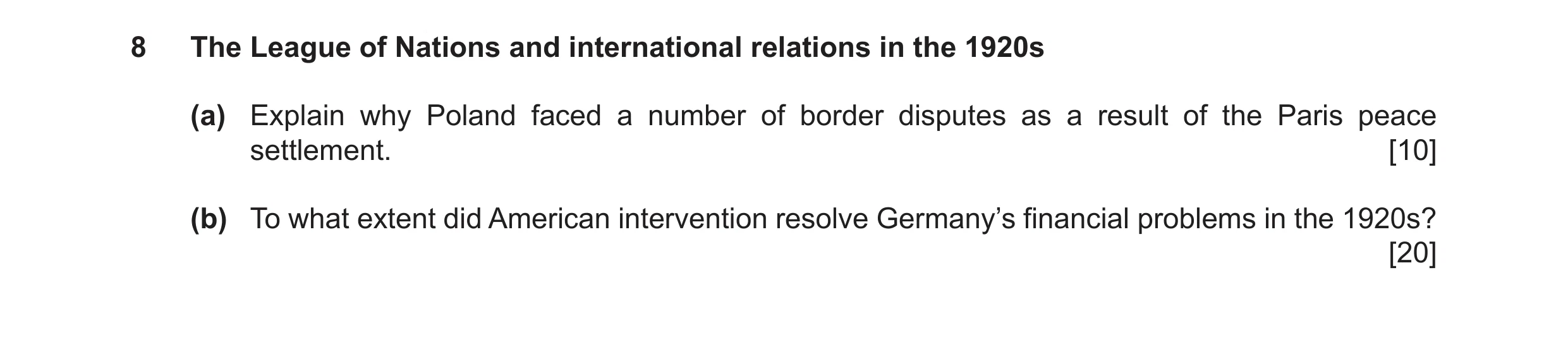 3 / 3
3 / 3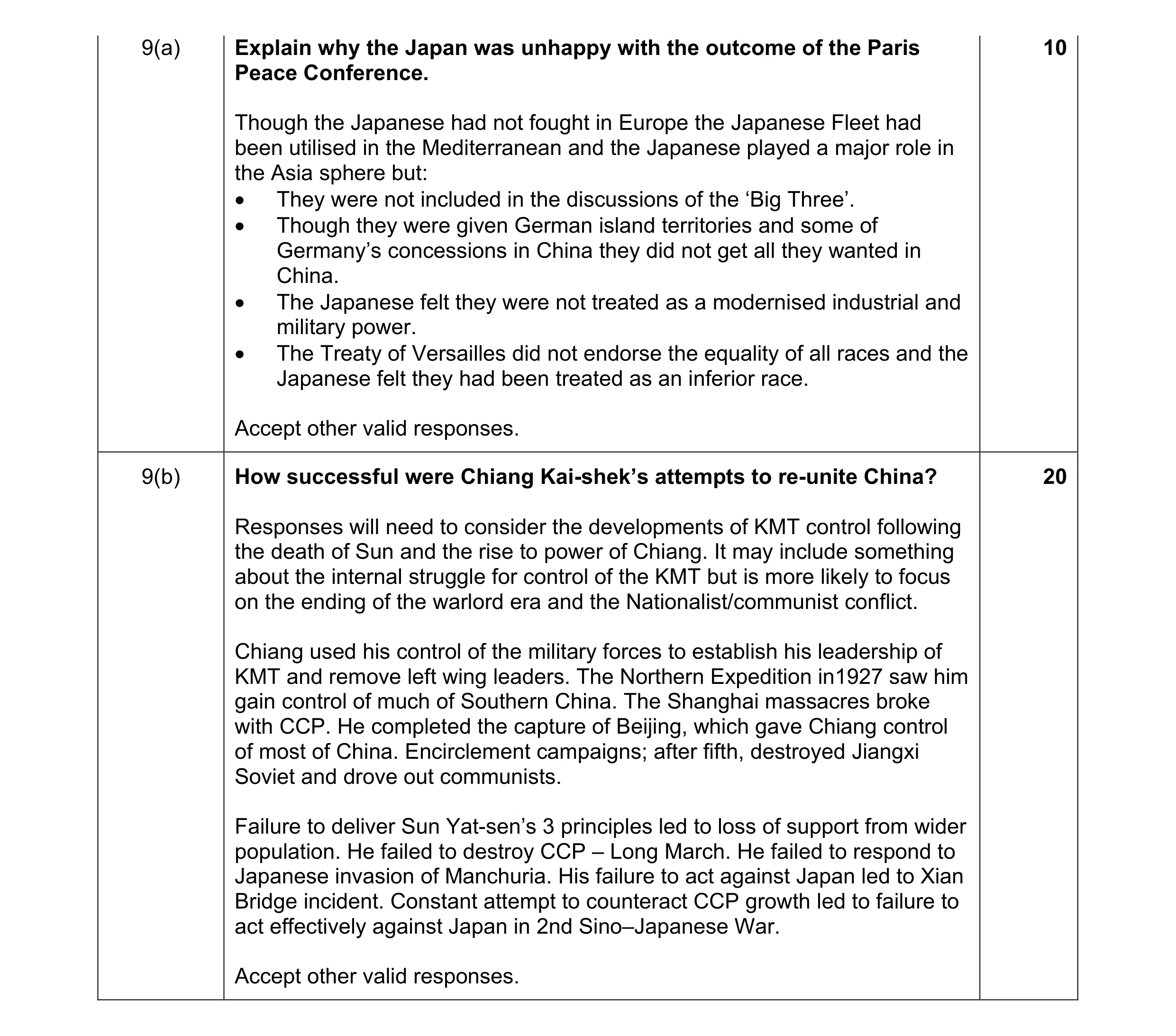 30
30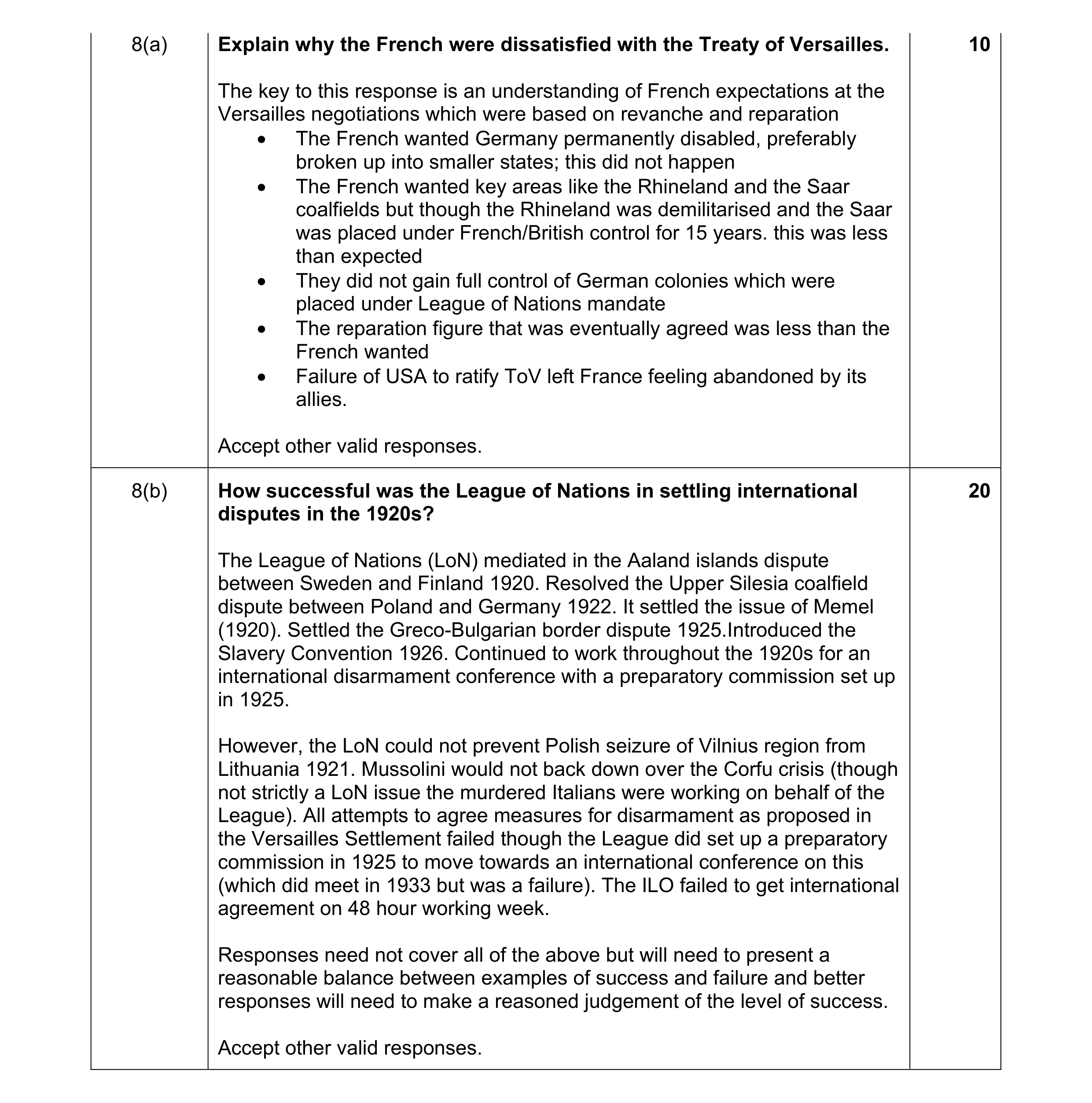 30
30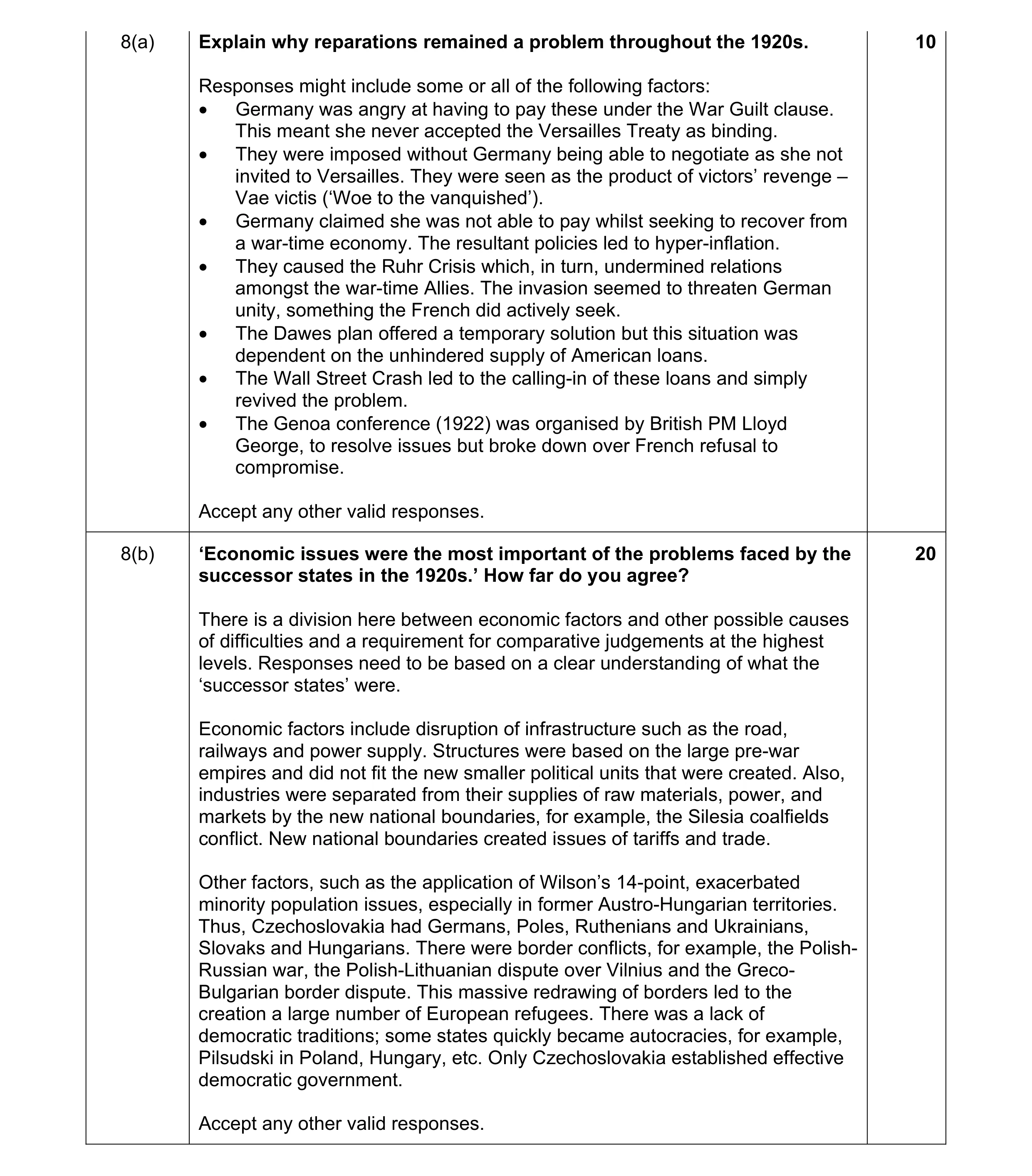 30
30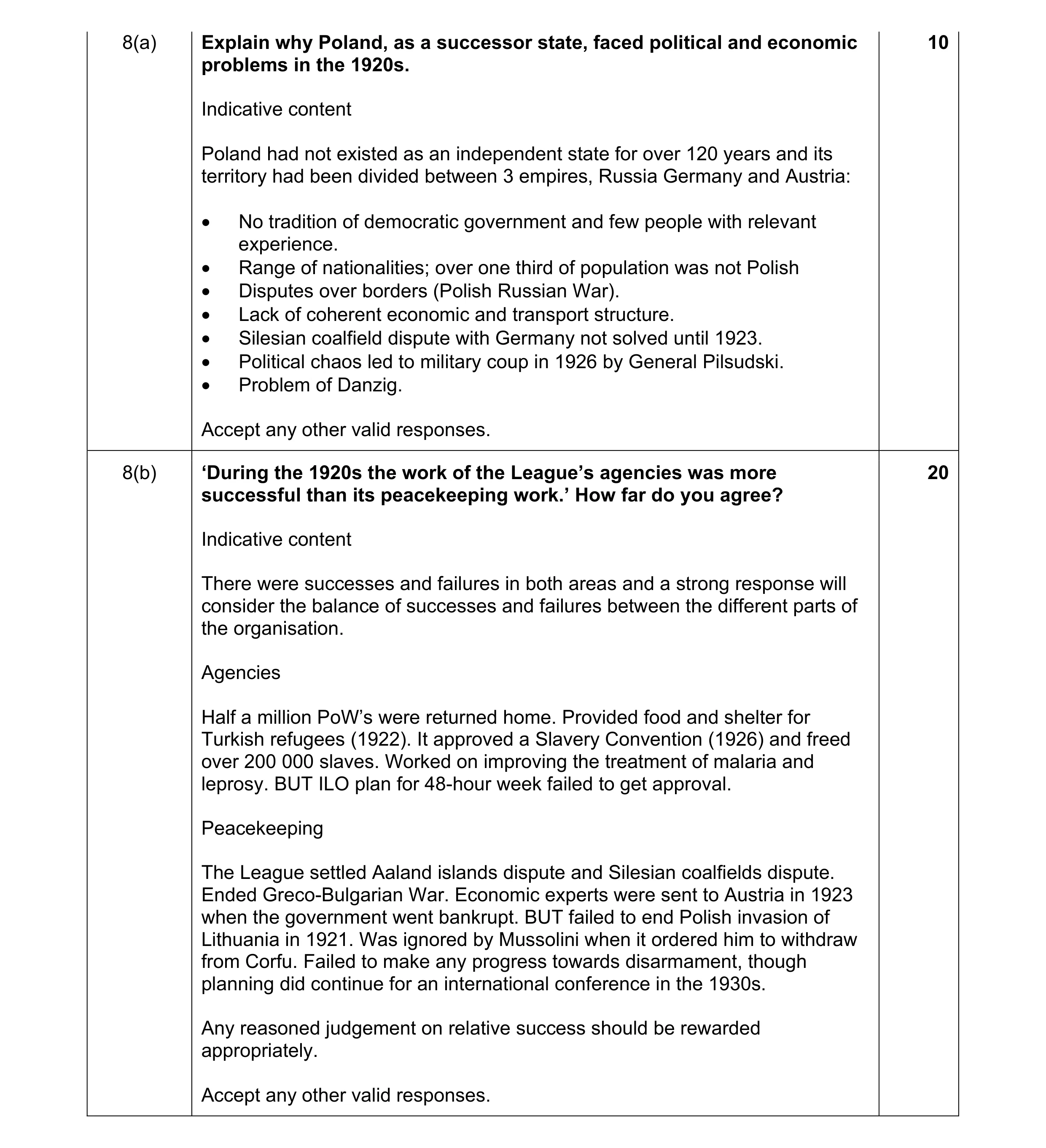 30
30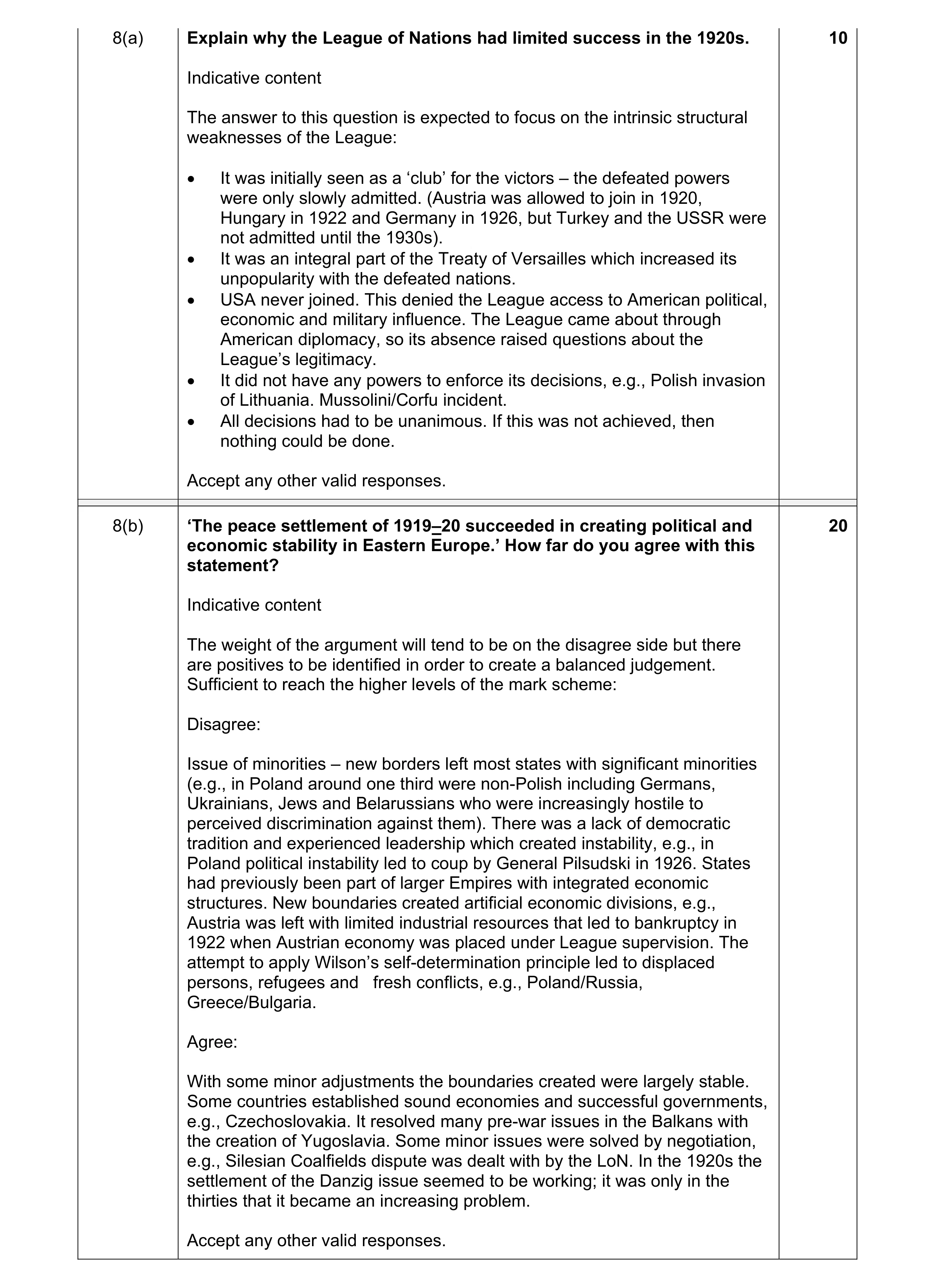 30
30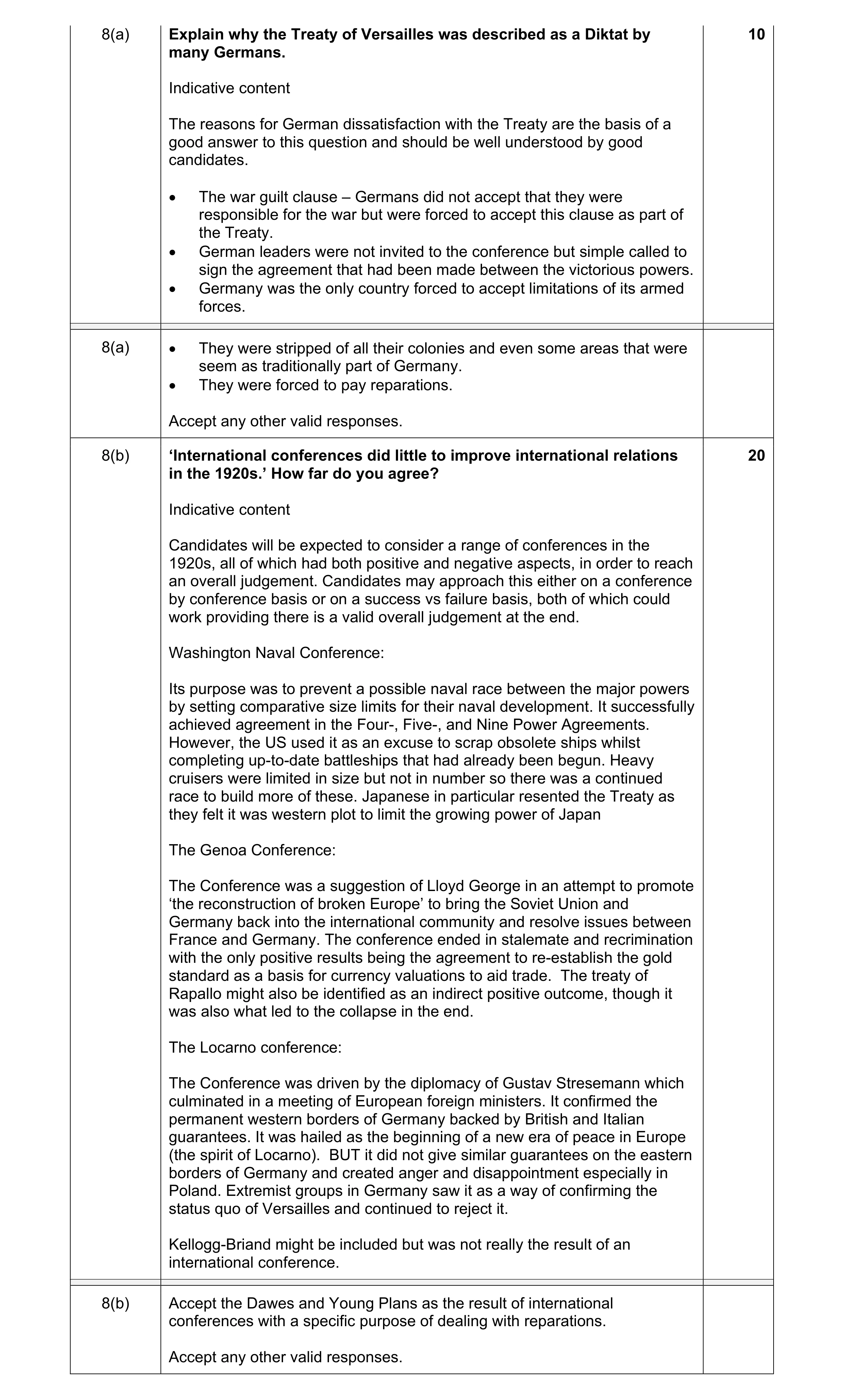 30
30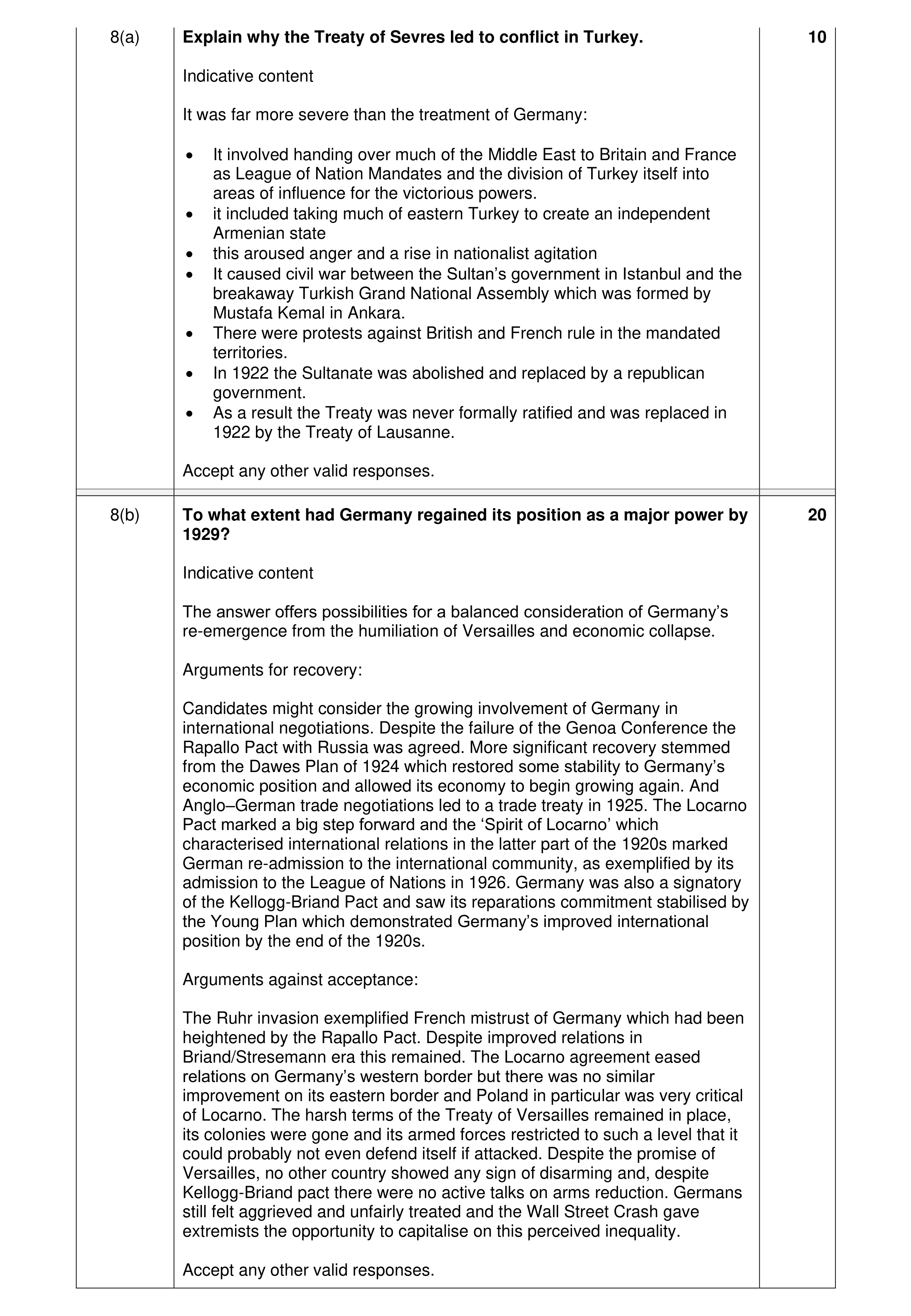 30
30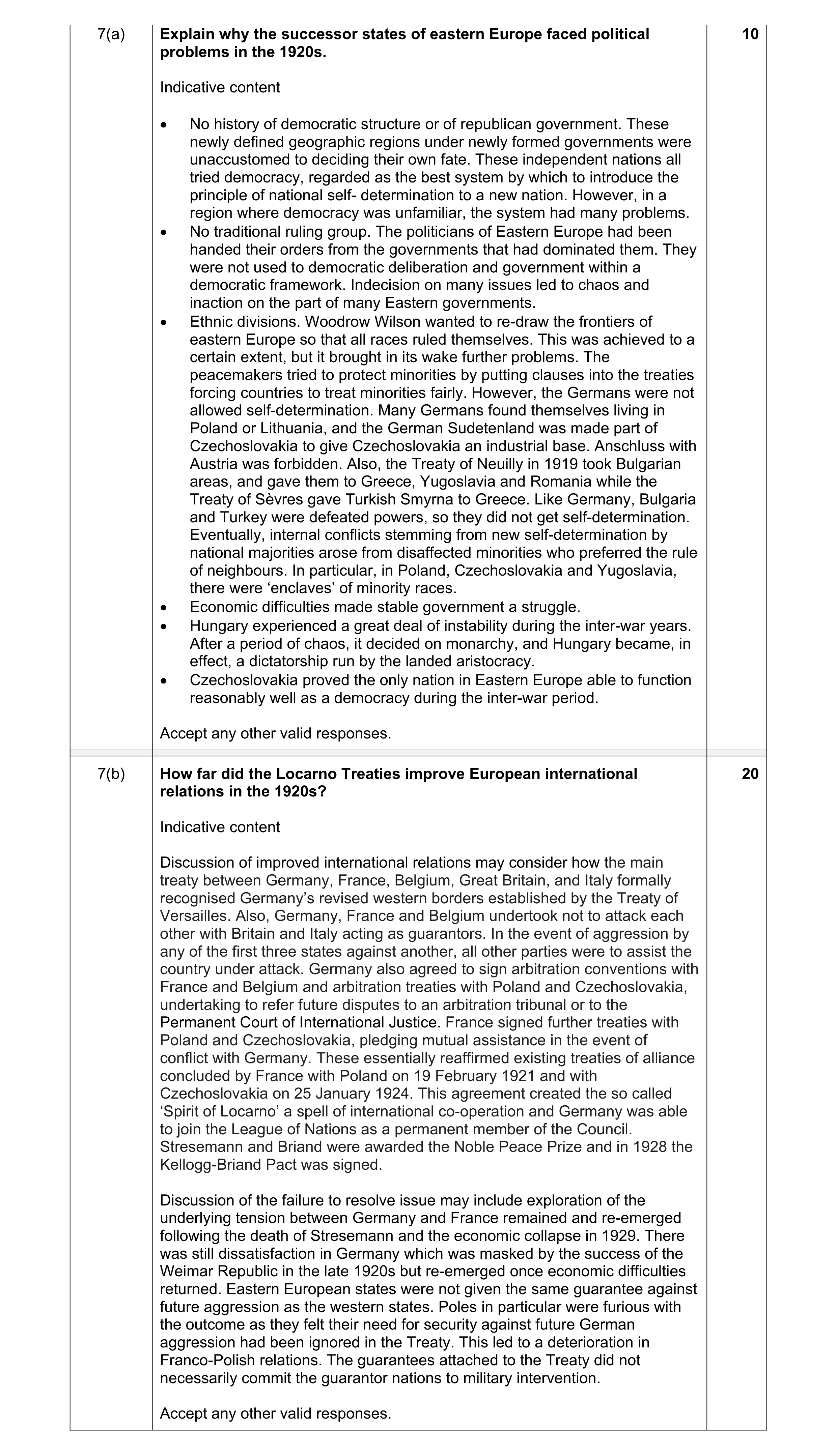 30
30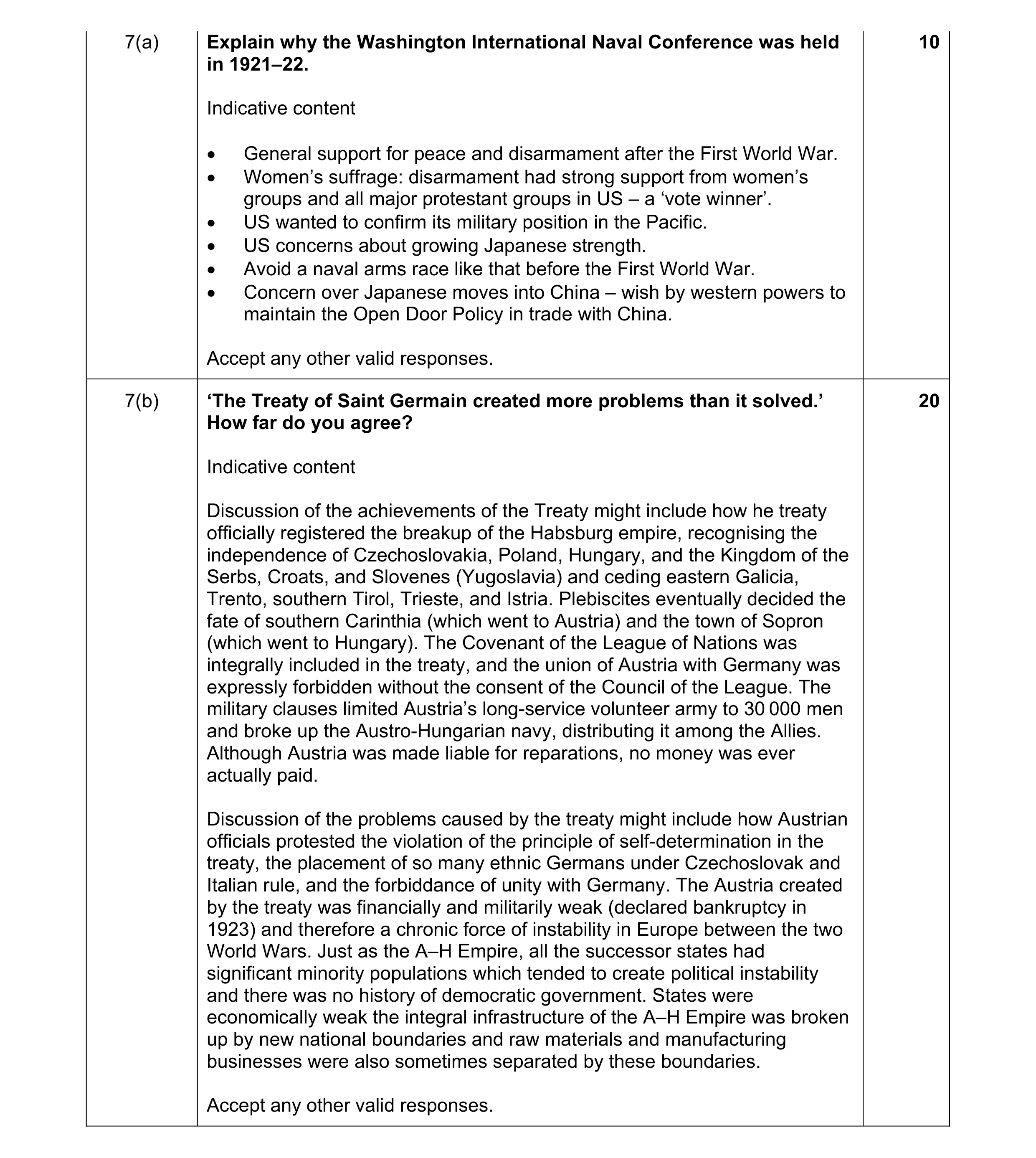 30
30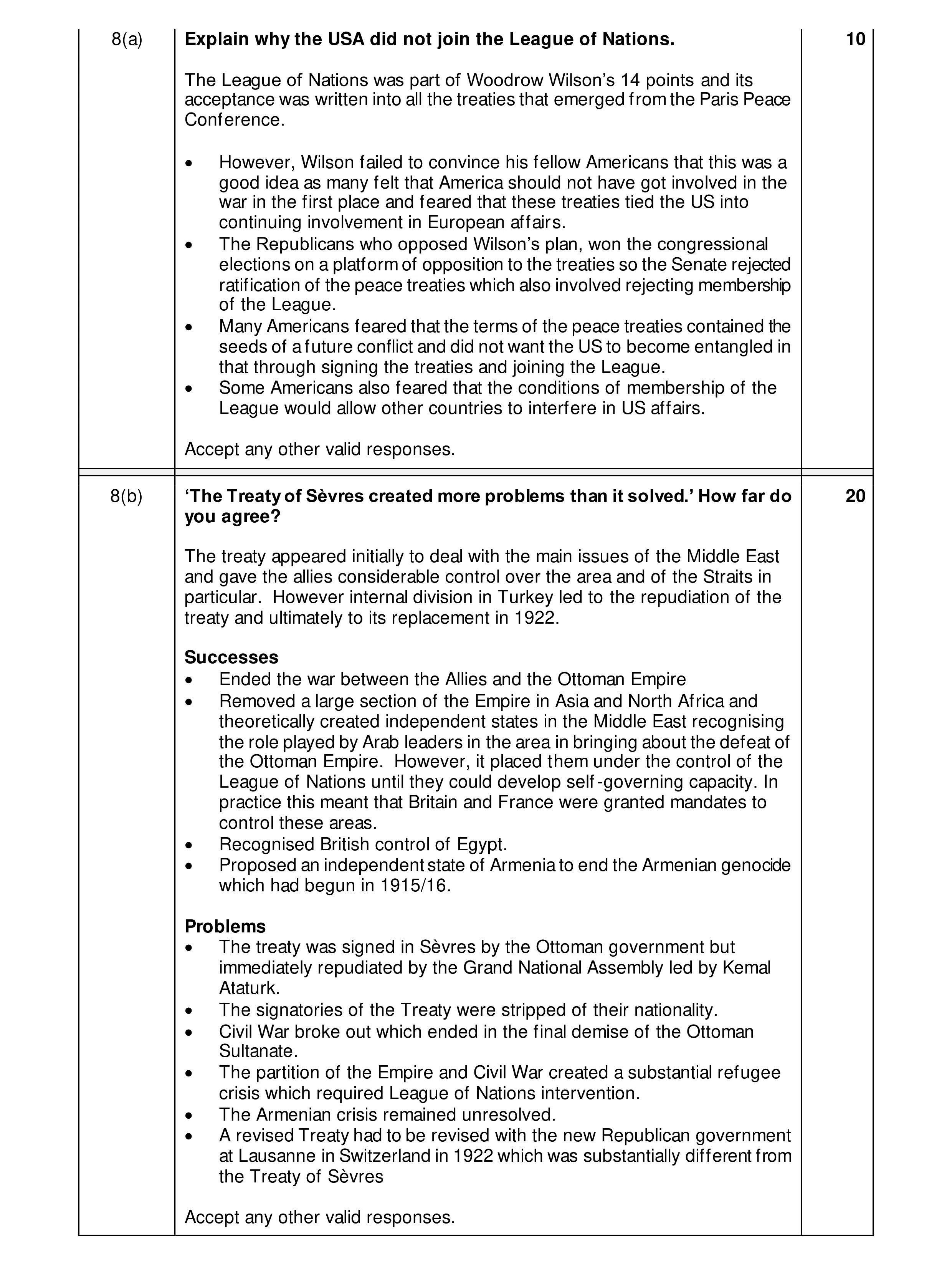 30
30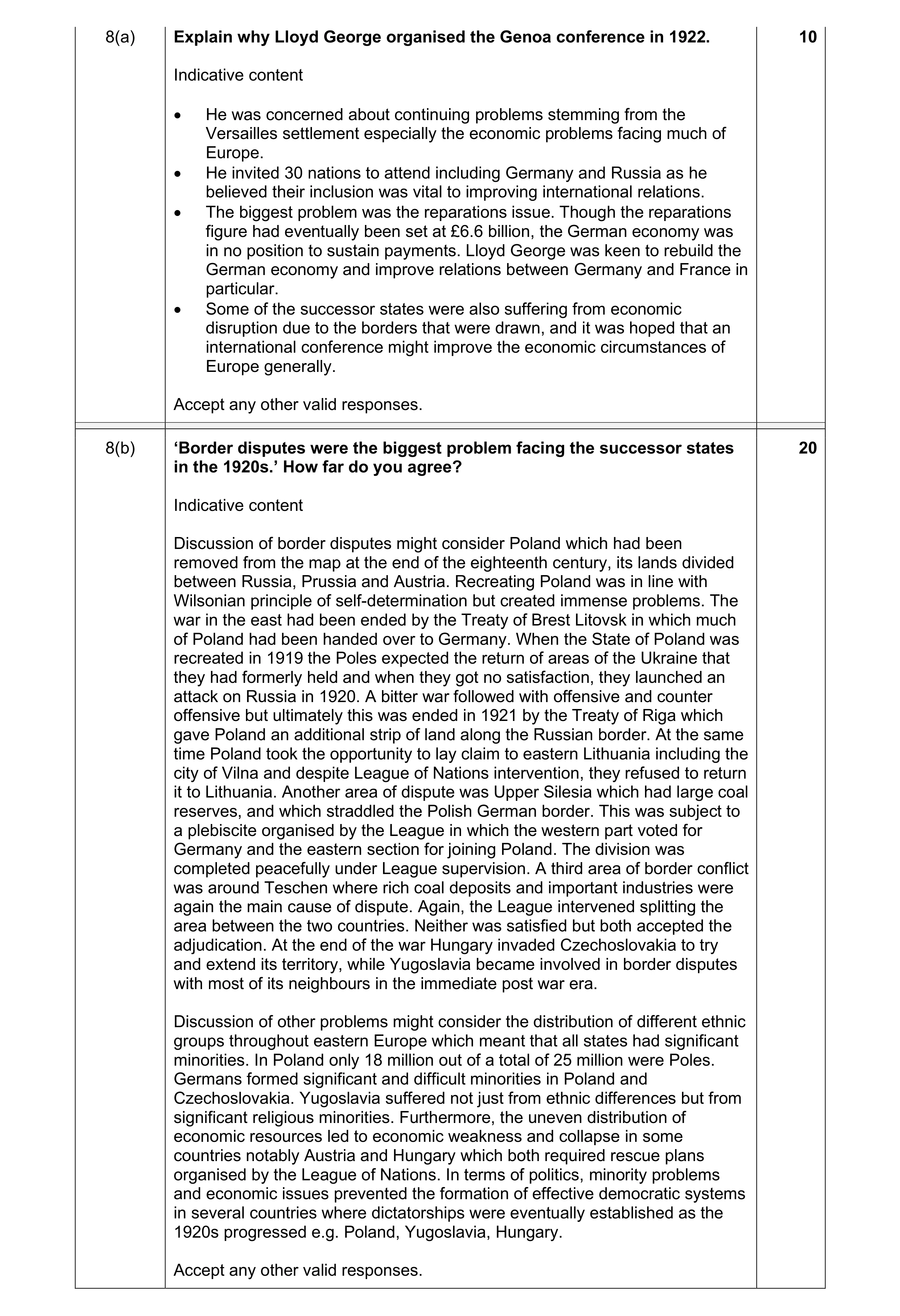 30
30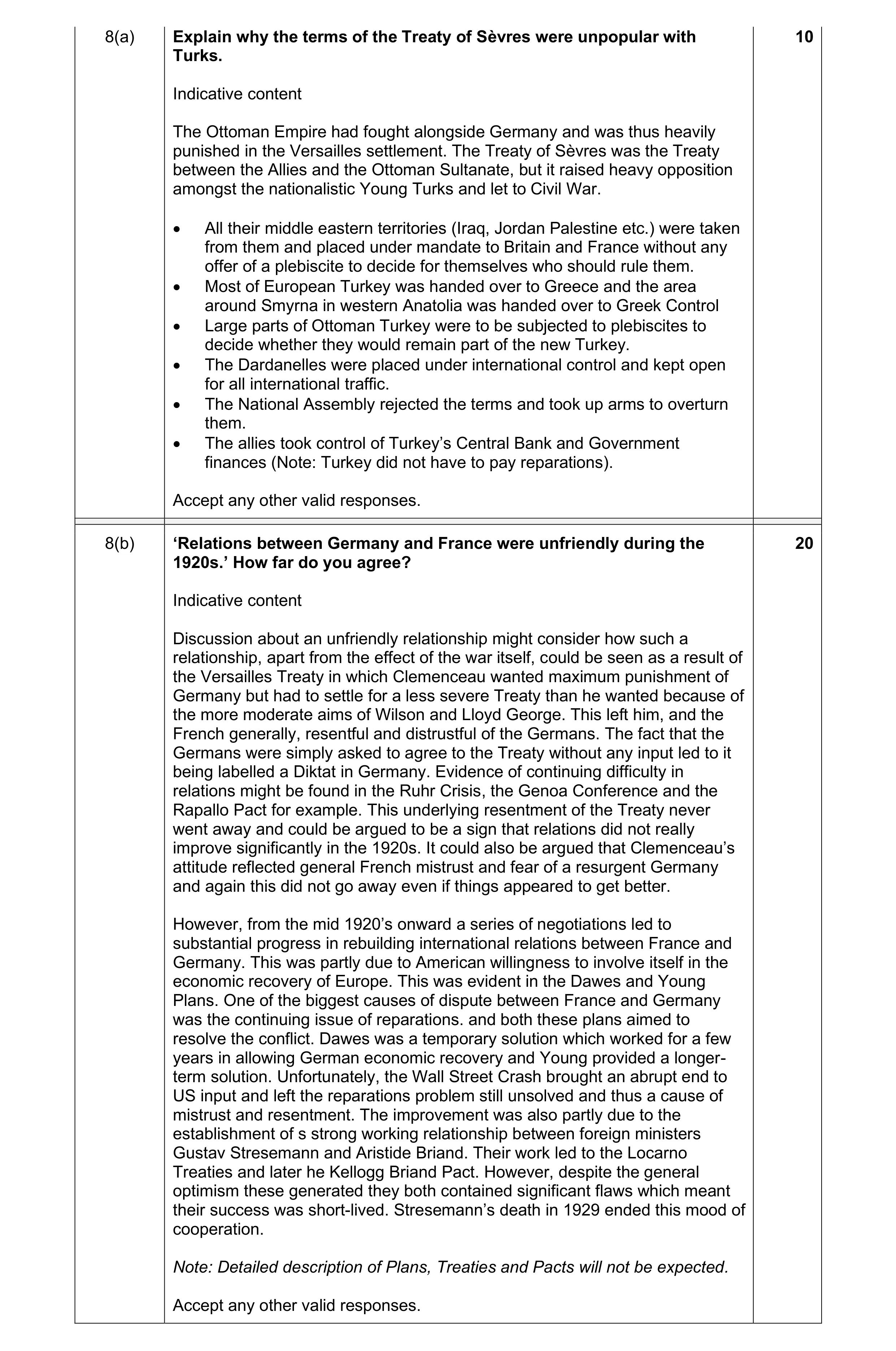 30
30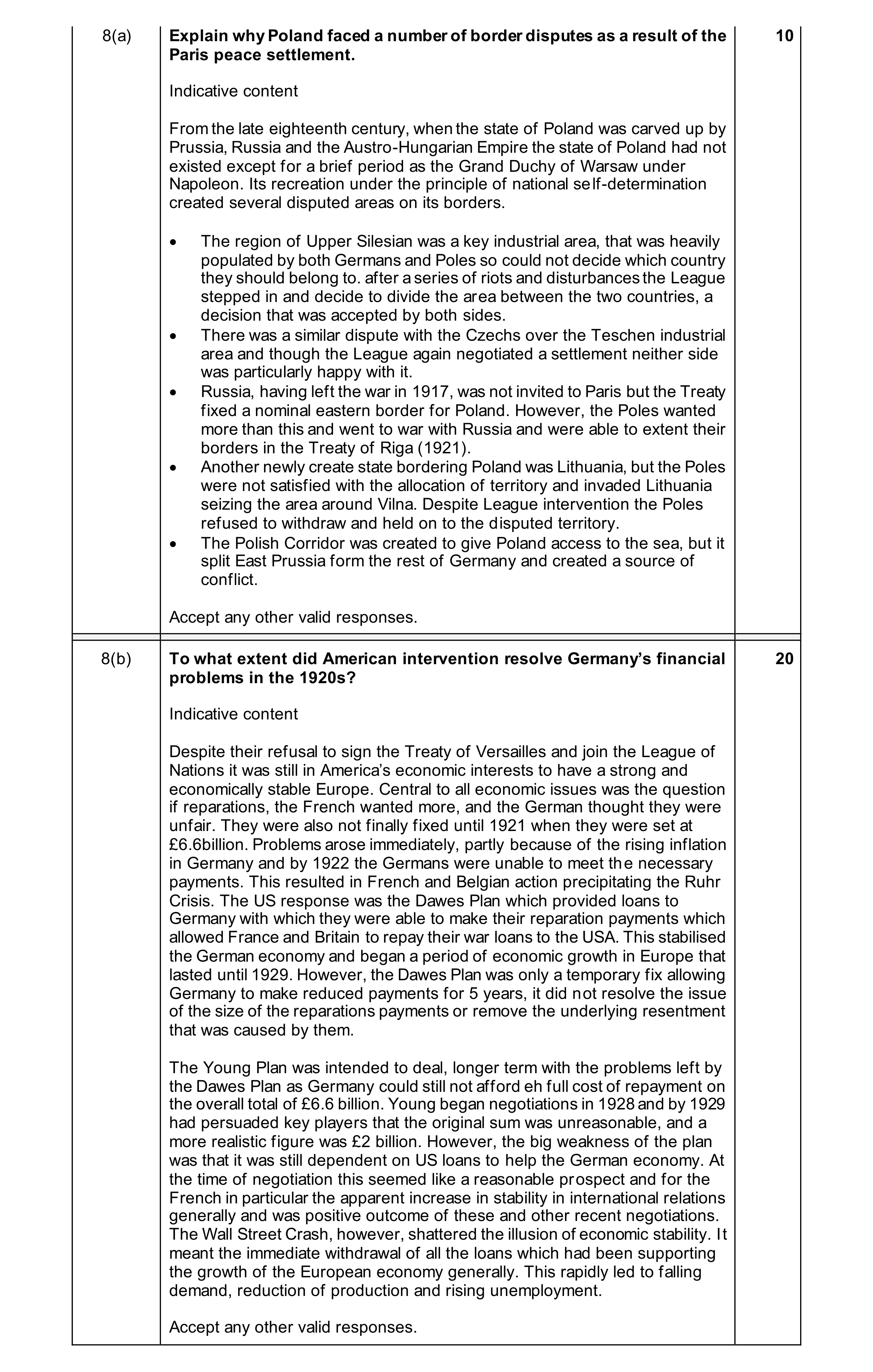 30
30