Questions as text
Q1 · Empire and the emergence of world powers, 1870–1919 (a) Explain why Cuba was the cause of… 9489/22 May/June 2021
7 Empire and the emergence of world powers, 1870–1919 (a) Explain why Cuba was the cause of conflict between Spain and the USA in 1898. [10] (b) How significant was German interference in the conflict between Britain and the Boers to British imperial policy in the late nineteenth century? [20]
30 marks
Mark scheme: 7(a) Explain why Cuba was the cause of conflict between Spain and the 10 USA in 1898. Responses will be expected to cover longer term and immediate causes of intervention and may include: • Monroe Doctrine and growing US desire to reduce European influence in the Caribbean and South America. • Revolutionary War in Cuba from 1895. • Growing public sympathy in US for rebels. • US business concerns over economic instability in the region caused by the ongoing war. • Sinking of the battleship Maine in Havana harbour. Accept any other valid responses. 7(b) How significant was German interference in the conflict between 20 Britain and the Boer in the development of British imperial policy? A clear explanation will need to demonstrate a basic understanding of all the issues raised by the Boer war to make a judgement about relative importance of factors. Important Support for Boers angered Britain because it made the task of subduing them more difficult. It made Britain increasingly suspicious of German ambitions and intentions. The Kruger telegram incited anti-German sentiment amongst the British public (jingoism). It made the government more determined to end the Boer problem. It also highlighted Britain’s isolation and vulnerability and led to a move away from isolation. Not Important The German search for ‘a place in the Sun’ (Weltpolotik) was already causing growing concern and Kruger telegram simply confirmed British suspicions. German Navy Laws had already influenced naval policy (and the introduction of the ‘Dreadnought’ class later increased competition). Commercial pressures and the role of key individuals like Cecil Rhodes drove British interests. Following Fashoda, the reduction of Anglo-French confrontation led to growing closeness culminating in Anglo-French Entente. Given the unspecified date, a reference to the First Moroccan Crisis would be appropriate. It is also possible that a few candidates may mention personal animosity between Edward VII and his nephew. Overall, the balance of the argument might be that the Boer conflict was a factor, but that change was already underway. On the other hand, it could be seen as pivotal in bringing about a shift in British Foreign Policy and ending the country’s isolation, with new alliances directed specifically against Germany. Accept any other valid responses.
This question in 9489/22 May/June 2021
Q2 · Empire and the emergence of world powers, 1870–1919 (a) Explain why the Fashoda incident… 9489/23 May/June 2021
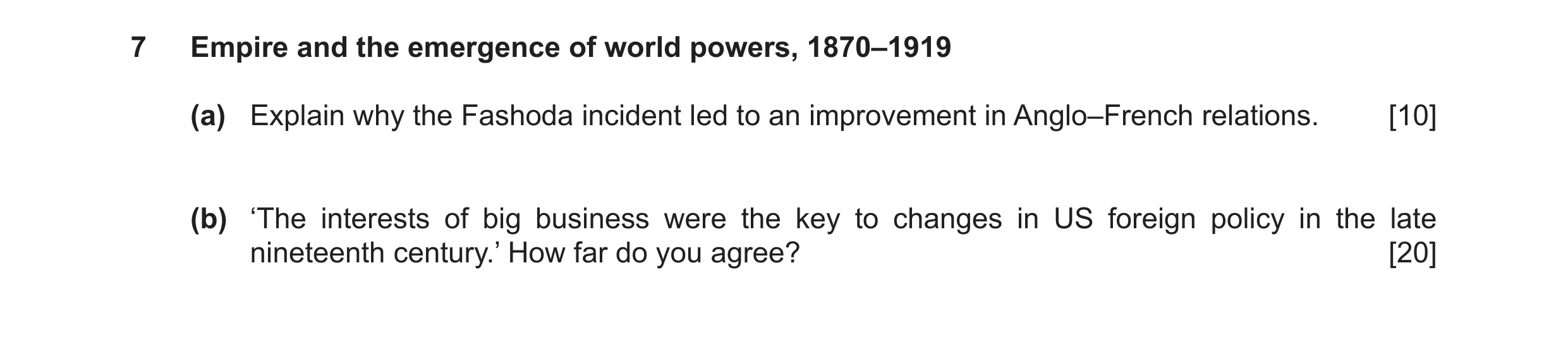
7 Empire and the emergence of world powers, 1870–1919 (a) Explain why the Fashoda incident led to an improvement in Anglo‒French relations. [10] (b) ‘The interests of big business were the key to changes in US foreign policy in the late nineteenth century.’ How far do you agree? [20]
30 marks
Mark scheme: 7(a) Explain why the Fashoda incident led to an improvement in Anglo‒ 10 French relations. It may be useful to outline the conflicting ambitions that led to the Fashoda incident if this is clearly linked to the outcomes • Led to settlement of conflict over the Sudan (which at that time included South Sudan and Uganda) a key area of Central Africa in terms of the British ambitions for a ‘Cape to Cairo’ railway and French aims for an East-West axis for the control of trade with the interior of Africa • British agreed to support French ambitions in Morocco; led to Moroccan Crises • Led to recognition that Germany was a more significant challenge to both of them • Formation of the Entente Cordiale Accept other valid responses. 7(b) ‘The interests of big business were the key to changes in US foreign 20 policy in the late nineteenth century.’ How far do you agree? There will need to be an identification of specific way in which business influenced policy and a comparison with other factors that might have played a significant role. The US economy was growing rapidly in the late nineteenth century and businessmen were always looking for new markets. The closing of the frontier made entrepreneurs look increasingly to overseas suppliers and markets to continue expanding their industries. Also, a possible threat to business interests in Cuba made intervention in the Cuban Civil War increasingly likely as business pressure on the government to act, was increased. Additionally, economic crash of early 1890s led to businesses seeking greater diversity in their markets. The change was simply an extension of ‘Manifest Destiny’ – once expansion was completed to the Pacific then the next step was into the wider world. Expansionist presidents McKinley and Theodore Roosevelt actively promoted a more expansionist policy. Policy was still in line with the Monroe Doctrine – aimed to exclude/limits European expansion in the Caribbean and South America. There was growing concern about European imperialism, esp. Scramble for Africa. The popular press played its part in in activating public opinion in support of a more expansionist policy. Decline/ collapse of Spanish Empire – US did not want anyone else replacing them. Accept other valid responses.
This question in 9489/23 May/June 2021
Q3 · Empire and the emergence of world powers, 1870–1919 (a) Explain why Japan’s military… 9489/21 May/June 2022
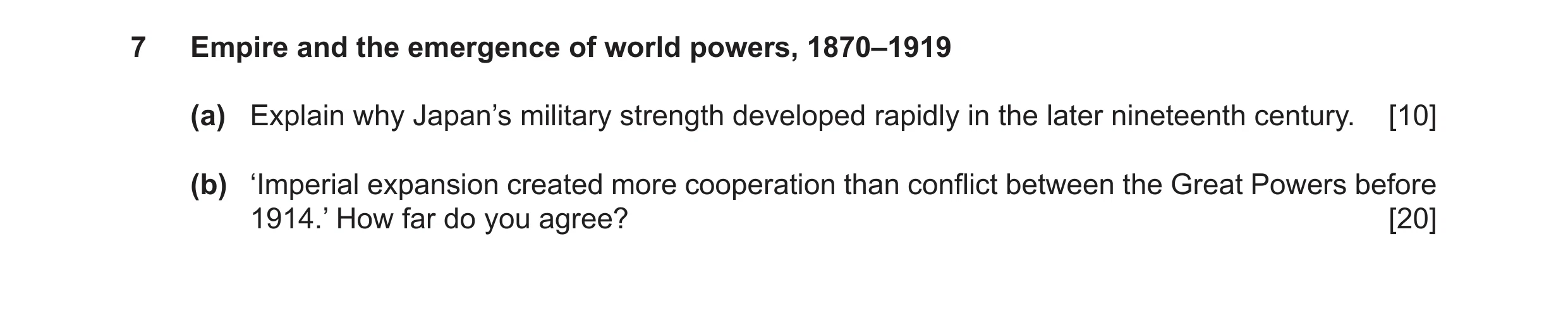
7 Empire and the emergence of world powers, 1870–1919 (a) Explain why Japan’s military strength developed rapidly in the later nineteenth century. [10] (b) ‘Imperial expansion created more cooperation than conflict between the Great Powers before 1914.’ How far do you agree? [20]
30 marks
Mark scheme: 7(a) Explain why Japan’s military strength developed rapidly in the later 10 nineteenth century. Indicative content Candidates are not expected to know specific detail of the Meiji restoration, just the changes that happened in the late 19th century that brought the Japanese military into the modern world including: Restored the emperor and centralised government, uniting the country. Led to desire to reduce influence of foreign powers by building up Japanese strength. Development of industry and technology enabled modernisation of army. Rapid development of fleet to counter overseas influences. Accept any other valid responses. 7(b) ‘Imperial expansion created more cooperation than conflict between 20 the Great Powers before 1914.’ How far do you agree? Indicative content The response to this should demonstrate a balance between conflict and cooperation with regards to overseas expansion with a reasoned judgement to conclude. Conflict: Anglo-French competition produced tension between the two throughout most of the late nineteenth century especially over Egypt and their competing plans to link territories across or down the continent culminating in confrontation at Fashoda. The British also came into conflict with Germany over German support for the Boers especially the Kaisers Kruger telegram. German under Wilhelm II set out in search for a ‘place in the sun’ which led to tension with existing colonial powers. This led to 2 Moroccan crises which also raised tensions by crystallising the two sides in the European alliance system. Cooperation: Berlin Conference and Treaty 1884–5 settled a number of issues and set out clear parameters for future claims on territory on the African continent. Despite earlier conflict the British and French reached a settlement at Fashoda which paved the way for closer cooperation and the eventual Entente Cordiale. The powers were able to cooperate in China especially in response to the Boxer rebellion. The two confrontations in Morocco were both solved by negotiation. Candidates might also refer to the Anglo Japanese Treaty of 1902 Accept any other valid responses.
This question in 9489/21 May/June 2022
Q4 · Empire and the emergence of world powers, 1870–1919 (a) Explain why the Boxer Rebellion… 9489/22 May/June 2022
7 Empire and the emergence of world powers, 1870–1919 (a) Explain why the Boxer Rebellion occurred in China between 1899 and 1901. [10] (b) To what extent was tension over South Africa between Britain and Germany a result of economic rivalry? [20]
30 marks
Mark scheme: 7(a) Explain why the Boxer Rising occurred in China between 1899 and 10 1901. Any explanations are expected to develop from the basic idea of a ‘grass roots’ rising against the effect of foreign imperialism including: Anti-Christian feeling – concern over number of missionaries and converts led to formation of secret society I Ho Chuan (Righteous Harmony Fists) Western Imperialism placed China in a series of 'unequal treaties', foreigners treated local people as inferiors Sino-Japanese war in 1894 – Japan acquired 4 treaty ports from the Chinese British control over Hong Kong during the 'scramble for concessions' Foreign devils perceived as sabotaging the Chinese people- series of Harvest failures and a mixture of droughts and floods Accept any other valid responses. 7(b) To what extent was tension over South Africa between Britain and 20 Germany a result of economic rivalry? Indicative content This requires a balanced analysis of the factors that led to a shift in the focus of British foreign policy at the turn of the century. Economic factors: following unification German economic growth was very rapid and by the 1890s Germany was the main challenge to British economic dominance. German began to challenge British economic expansion in Africa and the Far East in search of new markets and resources. Support for the Boers increased with the growing discovery of mineral deposits and especially the gold rush following the discovery of gold in the Transvaal in the 1880s. Britain also controlled the major trade routes to the east through Suez and via the Cape which was a threat to German global economic expansion. Other factors to be considered include German naval development following the Navy Laws of 1898 which challenged the British naval policy (two power standard). Kaiser Wilhelm’s ambition to win a ‘place in the sun’ was partly economic but also about international prestige. It added to the concern cause by the naval development (question of why Germany with such a small empire needed such a large fleet). Also, the settlement of outstanding imperial disputes with France enabled the development of a closer relationship between the two countries. Closer links with France also offered a solution to Germanys naval challenge. Some concern about Russian challenge in Asia might also be included. Accept any other valid responses.
This question in 9489/22 May/June 2022
Q5 · Empire and the emergence of world powers, 1870–1919 (a) Explain why Wilhelm II sent the… 9489/22 Oct/Nov 2022
7 Empire and the emergence of world powers, 1870–1919 (a) Explain why Wilhelm II sent the Kruger Telegram in 1896. [10] (b) ‘Up to 1917 the USA consistently avoided involvement in the affairs of European nations.’ How far do you agree with this statement? [20]
30 marks
Mark scheme: 7(a) Explain why Wilhelm II, sent the Kruger Telegram in 1896. 10 Indicative content On New Years’ Day 1896 the Jameson raid was launched by the British into Transvaal on the excuse of helping British miners (uitlanders) who were being discriminated against by Kruger’s Government. It was meant to trigger an Uitlander uprising but this failed to materialise and the raid failed. • The telegram was to congratulate Kruger on repelling the Raid. • The telegram was interpreted in the Transvaal as a sign of possible German support in the future. • William’s intention was to demonstrate to the British that they were diplomatically isolated. • Wilhelm wanted to win ‘a place in the sun’ and hoped for British support in this • It was an attempt to encourage Britain to become more friendly with Germany. This proved to be a diplomatic and psychological blunder. Accept any other valid responses. 7(b) ‘Up to 1917 the USA consistently avoided involvement in the affairs of 20 European nations.’ How far do you agree with this statement? Indicative content This is a question with clear alternatives from which a balanced judgement can be made. In support of the claim: The US had, from the time of the Monroe Doctrine, isolated itself from European affairs. Even following the acquisition of the remnants of the Spanish Empire the US focused on developing its Pacific, avoiding involvement in European affairs. Given that many of its citizens came from different European countries and many had migrated to avoid persecution and escape poverty there was little appetite amongst many Americans for involvement with the other world powers. When the First World War began the US immediately asserted its neutrality and President Wilson was strongly opposed to involvement. Wilson fought the 1916 election campaign on a platform of continuing neutrality and won a second term. Challenging the claim: The Progressive presidents from McKinley onwards pursued a more active overseas policy and engaged in international negotiations like the Treaty of Portsmouth (Russo-Japanese War). Roosevelt built up a modern navy and sent it on an international tour to enhance US prestige in 1907–09 (the Great White Fleet). The US increasingly got involved in situations when its growing international interest were threatened (e.g. Boxer Rising). US banks made large loans to Britain and France that were used to buy US manufactured equipment in the early years of the war and the actions of German submarines turned popular opinion increasingly against Germany with Wilson only narrowly winning the 1916 election; the Zimmermann Telegram was just the last straw. Accept any other valid responses.
This question in 9489/22 Oct/Nov 2022
Q6 · Empire and the emergence of world powers, 1870–1919 (a) Explain why the United States… 9489/22 Feb/March 2024
7 Empire and the emergence of world powers, 1870–1919 (a) Explain why the United States began an extensive modernisation of its navy in the late nineteenth century. [10] (b) ‘The Second Boer War made little difference to Britain’s relations with other European powers.’ How far do you agree? [20]
30 marks
Mark scheme: 7(a) Explain why the United States began an extensive modernisation of its 10 navy in the late nineteenth century. Indicative content The 1890s saw a significant shift of direction in US foreign policy that necessitated the refurbishment and expansion of the US navy to meet the increased need for its presence in the international sphere. • After the civil war there had been little development of the navy and many of its ships were out of date. • In 1890 Alfred Mahon published his book on ‘The Influence of Sea Power in History’. This led to increasing pressure for an increase in US naval capacity. • The Panic of 1893 led industrialists to increasingly seek expansion of overseas trade which increased the need of naval support for the growing merchant fleet. • President McKinley and his Secretary of the Navy, Theodore Roosevelt, were both expansionists and promoted naval development. • The Spanish American War of 1898 saw the acquisition of a substantial overseas empire. A modernised navy was needed in order to defend and support these territories. Accept any other valid responses. 7(b) ‘The Second Boer War made little difference to Britain’s relations with 20 other European powers.’ How far do you agree? Indicative content The Second Boer War lasted from 1899 to 1902 and saw Britain come under severe international criticism for its scorched earth tactics and use of internment camps to control the civilian population. Whilst it is clear that, in the following years, Britain had largely abandoned its policy of ‘splendid isolation’, it is possible to trace some of these changes to events and actions already in progress before the effects of the Boer War impinged on policy making. So, the key question is whether this was a turning point in international relations or was it simply a continuation of trends already set in motion. Turning point: Prior to 1900 Britain had largely avoided commitment to involvement with other powers though it had taken part in international agreements like the Treaty of Berlin. However, the weaknesses exposed by the Boer war led to a change in policy. Britain had struggled to defeat the Boers and to focus its not inconsiderable resources on a specific conflict. The attempt to recruit a bigger army had revealed serious weakness in term of fitness of its population for military service and had shown how concentration on one war left other areas of its vast empire exposed. So in 1902 the Anglo-Japanese Treaty was concluded in which they committed themselves to mutual assistance in the event of conflict in the Far East caused by Russian expansionist aims, and in 1904 the Entente Cordiale marked a significant shift towards closer links with France. Before this Britain had set itself the aim of maintaining the two-power standard in the size of its navy but the Entente eased this necessity due to the mutual support it offered. The Boer War also marked a significant deterioration of Anglo-German relations thanks to the Kruger Telegram and the overt support of the Boers offered by the Kaiser. Continuity: Though not in formal alliance with other states Britain co-operated with other powers in seeking to avoid international conflict. The Treaty of Berlin was a case in point providing a formula for the claiming of territory in Africa whilst avoiding war. This eventually saw agreement between France and Britain over the Fashoda confrontation (1898) which began a period of increased cooperation culminating in the Entente Cordiale. International co-operation also saw joint action in response to the Boxer Rising (1900). At the same time relations with Germany had begun to deteriorate once Wilhelm II came to power and especially after his dismissal of Bismarck and adoption of a more aggressive foreign policy specifically in his search for ‘a place in the sun’. This was compounded by the Navy Laws of 1898 and 1900 proposing the rapid expansion of the German navy. This made Britain very suspicious of German intentions and pushed them towards closer relations with the French who had long standing grievances with Germany and later with Russia which was France’s other major ally. Accept any other valid responses.
This question in 9489/22 Feb/March 2024
Q7 · Empire and the emergence of world powers, 1870–1919 (a) Explain why Britain developed… 9489/22 May/June 2024
7 Empire and the emergence of world powers, 1870–1919 (a) Explain why Britain developed closer diplomatic relations with France after 1898. [10] (b) To what extent was New Imperialism based on theories of racial superiority? [20]
30 marks
Mark scheme: 7(a) Explain why Britain developed closer diplomatic relations with France 10 after 1898. Indicative content A number of factors might be considered, some long-term and some more immediate. they include: The Fashoda Incident 1898 led to a settlement of imperial issues between Britain and France and led to an improvement of relations leading to the Entente Cordiale. Rise of Germany – Kaiser Wilhelm’s active search for ‘a place in the sun’ coupled with Tirpitz’s Navy Laws raised fears of German intentions and the threat to Britain’s two-power standard naval policy. An alliance with France would reduce the need for this. Effects of the Boer War – the effort it took for Britain to overcome the Boers in the War of 1899–1902 raised doubts about the possibility of having to fight a more widespread war without allies and led to a change in perspective. Since 1870 France had been isolated by Germany in Europe and was anxious to strengthen its position with new alliances. Pressures of maintaining worldwide empire. With increasing threats to its empire Britain looked for new alliances to shore up its position. An alliance or understanding with France allowed them to share naval responsibilities in the Mediterranean and North Sea/Atlantic. Accept any other valid responses. 7(b) To what extent was New Imperialism based on theories of racial 20 superiority? Indicative content In the early nineteenth century a theory was developed which claimed that there was a hierarchy of races in which white people were argued to be superior to any other groups. The publication of Darwin’s The Origin of Species seemed to justify this and became the basis of a theory known as Social Darwinism. This theory was used to justify the treatment of other races as inferior and thus to take control of the lands they owned. Consciously or not, this was in part responsible for the imposition of European style administration and laws and wherever Europeans settled they placed themselves at the head of the social hierarchy. They automatically assumed their systems and culture were superior to those of indigenous populations. For example, David Livingstone, missionary, and explorer, claimed that it was his duty to introduce Africans to three Cs: commerce, Christianity, and civilisation. On the other hand, whilst the belief in natural superiority might have underpinned the activities of European powers in the latter part of the nineteenth century, there were more immediate and practical considerations that led to the development of New Imperialism. The claim to be intent on ‘improving the lives of the local people’ was a useful justification for developing their own interests. Exploration of the interior by expeditions led by people like Livingstone and Stanley increased awareness of the potential for exploitation of the vast resources available. As the industrial revolution transformed European states the search by businesses for new resources and markets provided a significant impetus to the establishing of new colonies in Africa and Asia where large profits might be possible. Colonial expansion was also a matter of prestige when European powers were seeking to avoid conflict in Europe but still sought to establish their superiority. So, for example for France following the disaster of 1870 and for Germany with no colonial history, quick results were important, hence the ‘Scramble for Africa’. For some the moral obligation to end slavery, which was still practised in some areas of Africa, was an incentive as was the idea of basic Christian duty to spread the word of God. New imperialism was also helped by advances in medicine and technology which reduced the risk of travelling deep into more difficult environments and gave Europeans a technological advantage over indigenous populations. Accept any other valid responses.
This question in 9489/22 May/June 2024
Q8 · Empire and the emergence of world powers, 1870–1919 (a) Explain why Russia was unable to… 9489/22 Oct/Nov 2024
7 Empire and the emergence of world powers, 1870–1919 (a) Explain why Russia was unable to defeat Japan in the war of 1904–05. [10] (b) To what extent was colonial rivalry in Africa the cause of a decline in Anglo-German relations? [20]
30 marks
Mark scheme: 7(a) Explain why Russia was unable to defeat Japan in the war of 1904–05. 10 Indicative content The defeat of Russia in the war of 1904–5 was a major disaster for the Tsarist regime and marked the emergence of Japan as a significant power. Though it seemed at the time unexpected, there were significant underlying reasons why Russia was unable to defeat Japan. • Russia expected to win and was not well prepared for the strength of the Japanese forces. • Russian forces had less modern equipment. Especially their navy was out of date and dilapidated compared to the modern Japanese navy. • Russian had long lines of communication, and the trans-Siberian railway was barely started so it was not possible to move fresh troops quickly to the front after initial defeats by the surprise attack of the Japanese. • When its Pacific Fleet was destroyed in the initial engagements the only alternative Russia had was to move its Baltic fleet to the Far East. Problems with Britain compounded the problem as the fleet was banned from using the Suez Canal and when it arrived it fared no better than the Pacific Fleet and was destroyed by the superior Japanese navy at the Battle of Tsushima • The Japanese had modern weapons well-trained and committed forces and short lines of communication. Accept any other valid responses. 7(b) To what extent was colonial rivalry in Africa the cause of a decline in 20 Anglo–German relations? Indicative content From the 1890s onwards relations between the two powers became increasingly strained. Partly this was due to the growing demand from Kaiser Wilhelm for ‘a place in the sun’. This highlighted potential conflicts that were further compounded by the situation in South Africa and the Kaiser’s overt support for the Boers. It also led to other challenges by the Germans to the British overall colonial position. In support of colonial rivalry discussion might consider how following the unification of Germany in 1870 Bismarck steered Germany along a path that was more concerned with isolating France than with overseas expansion. However, by the 1880s thriving German businesses were pressing for a more expansionist policy and it was in this context that the Congress of Berlin was organised, in 1884, to draw up a set of agreed conditions for imperial expansion in Africa. However, when Wilhelm II took over the throne of Germany and quickly dismissed Bismarck, he began to express his dissatisfaction with the territories Germany had been able to secure directing his complaints particularly again the British whose control of large areas of territory and their control of the Suez Canal, which provided access to far easter markets, was a cause of great resentment. In the early 1900s this rivalry was exacerbated by the Moroccan crises and the Kaiser was deeply dissatisfied with the Algeciras Conference where everyone, but Austria supported the British and French proposals. In considering other factors discussion might include Naval rivalry. The German Naval Laws of 1898 and 1900 which set out targets to increase the German navy to put it more on a par with the British caused increased tensions. The Kaiser claimed that as a great power it was necessary to make this increase, but the British were suspicious of his motives given that Germany had nowhere near the same worldwide commitments that Britain had. Additionally, after the Fashoda Crisis was resolved peacefully in 1898, Britain and France had largely settled their colonial differences and become closer. In 1904 they signed the Entente Cordiale and in 1907 when the Germans challenged the French grip on Morocco in the hope of splitting this link as well as gaining more influence themselves, the two sides became even closer. The Kaiser’s telegram to Paul Kruger following the repelling of the Jameson Raid also created deep resentment and distrust in Britain and the Kaiser’s continued backing of the Boers in their struggle against the British in South Africa exacerbated the decline in relations. Accept any other valid responses.
This question in 9489/22 Oct/Nov 2024
Q9 · Empire and the emergence of world powers, 1870–1919 (a) Explain why the Treaty of… 9489/22 Feb/March 2025
7 Empire and the emergence of world powers, 1870–1919 (a) Explain why the Treaty of Shimonoseki led to the Triple Intervention. [10] (b) ‘The Fashoda Incident of 1898 represented a turning point in relations between France and Britain.’ How far do you agree? [20]
30 marks
Mark scheme: 7(a) Explain why the Treaty of Shimonoseki led to the Triple Intervention. 10 The Treaty ended the First Sino Japanese war and by it Japan gained control of Korea, Taiwan and Port Arthur which also gave them control over the Liaodong Peninsula. • This alarmed Russia because they were seeking control of Port Arthur in order to gain an ice-free port in the Pacific in order to expand its own trading activities and so they objected to the Treaty on the grounds that it undermined existing European interests and would create instability in China. France and Germany supported their objection. • France had only recently signed a Treaty with Russia to end its isolation within Europe and so supported its ally. • Germany hoped for Russian support for its own imperial ambitions across the globe. Therefore, the three joined forces to force Japan to surrender some of its gains, most notable Port Arthur. Outcome is not a necessary part of the answer to this question. Accept any other valid responses. 7(b) The Fashoda Incident of 1898 represented a turning point in relations 20 between France and Britain.’ How far do you agree? Before 1898 Britain and France had been in competition over African Territories. Conflict over control of Egypt and the control of the Suez Canal had worsened relations and both sought to increase their territories to link their colonies into a stronger unit. Britain followed the mission of Cecil Rhodes to link Cairo to the Cape whilst France sought to connect their West African territories with the east coast and this led to confrontation over control of the Sudan when the two forces met at Fashoda. However, while both mobilised their fleets and made threatening gestures neither was prepared to go to war over African territory and so the whole incident was resolved by negotiation. France recognised British control in Egypt and the Sudan whilst Britain agreed to accept the French presence in Morocco. This effectively ended Anglo French territorial conflict over colonial expansion in Africa and thus might be considered a turning point in their relationship. However, this did not necessarily represent a change in relations as the Treaty of Berlin had established a framework for negotiated settlement of disputes. Additionally, the French joined other European nations in condemning British actions and tactics in the Second Boer War which began in 1899. It is also possible to argue that both countries were by 1898 sharing a common concern about the growing threat of Germany and specifically of Kaiser Wilhelm’s bid for ‘a place in the sun’ which threatened both their interests. And that is what really prompted the change in relations between France and Britain. The year 1898 was a turning point because it saw the introduction of the first of the German Naval Laws aimed at rapidly increasing the size and strength of the German navy. This was a growing threat to Britain’s naval superiority which was seen as essential to maintaining the Empire. This vulnerability was further emphasised by the isolation of Britain during the Boer War and led ultimately to the signing of the Entente Cordiale in 1904. Thus whilst the year 1898 might be characterised as a turning point in relations between Britain and France it was not necessarily because of the Fashoda incident that this came about. Accept any other valid responses.
This question in 9489/22 Feb/March 2025
Q10 · Empire and the emergence of world powers, 1870–1919 (a) Explain why Roosevelt introduced… 9489/22 May/June 2025
7 Empire and the emergence of world powers, 1870–1919 (a) Explain why Roosevelt introduced the Corollary to the Monroe Doctrine in 1904. [10] (b) To what extent did the Second Boer War lead to a change in British relations with other Imperial powers? [20]
30 marks
Mark scheme: 7(a) Explain why Roosevelt introduced the Corollary to the Monroe Doctrine 10 in 1904. Indicative content • Roosevelt was re-asserting US pre-eminence in intervention in the affairs of any of the countries of the Americas. • Most of Africa had now been claimed by European powers and the US was worried they might turn their eyes towards the Americas again. • To reassert the original intention of the Monroe Doctrine which was to warn Europeans to stay out of the region. The corollary extended this by threatening armed intervention in any county in Latin America threatened by external or internal factors. In 1905 marines were sent into the Dominican Republic to protect US commercial interests. • The acquisition of remains of Spanish empire after 1898 had given the US a more direct interest in protecting its territories in the Caribbean in particular. • In 1902 the Spooner Act endorsed the purchase of the assets of the French Panama Canal company and in 1903 with US support Panama gained independence from Columbia and the US began work on the project. This also increased US concerns about the security of its interest in the Caribbean. Accept any other valid responses. 7(b) To what extent did the Second Boer War lead to a change in British 20 relations with other imperial powers? Indicative content The Second Boer War exposed weaknesses of British Empire with overstretched resources. The British army had struggled to beat colonial farmers which highlighted the military limitations of the British army. The British had been heavily criticised internationally for its tactics, especially its treatment of the civilian Boer population. This highlighted the isolation of the British and together with the other weaknesses exposed in the war, raised concerns about continuing this policy. The traditional British policy of ‘splendid isolation’ seemed increasingly untenable. Discussion of other factors influencing relations might consider the Fashoda incident, when British and French forces came close to conflict over Sudan and led to a settlement of outstanding disputes between Britain and France and an improvement in relations. It may also consider Kaiser Wilhelm’s search of ‘a place in the sun’ led to a more aggressive policy of acquisition by Germany (Weltpolitik). Wilhelm resented the fact that other countries, especially the British, had already claimed much of the ‘best’ territory in Africa and elsewhere and wanted to change this. Germany also began a programme of naval expansion with a series of naval laws beginning in 1898 which intensified with the development of the Dreadnought in 1906. Britain saw this as a challenge to their global empire’s security which depend on the two- power standard – having a navy as big as the next two largest together. In 1904 this changing relationship led to the signing of the Entente Cordiale with France which settled remaining disputes in North Africa and in which Britain supported French claims to Morocco. Kaiser Wilhelm immediately decided to test this and precipitated the First Moroccan Crisis in 1905, but rather than wrecking the Entente it brought the British and French closer together. Accept any other valid responses.
This question in 9489/22 May/June 2025
Q11 · Empire and the emergence of world powers, 1870–1919 (a) Explain why the Jameson Raid led… 9489/23 May/June 2025
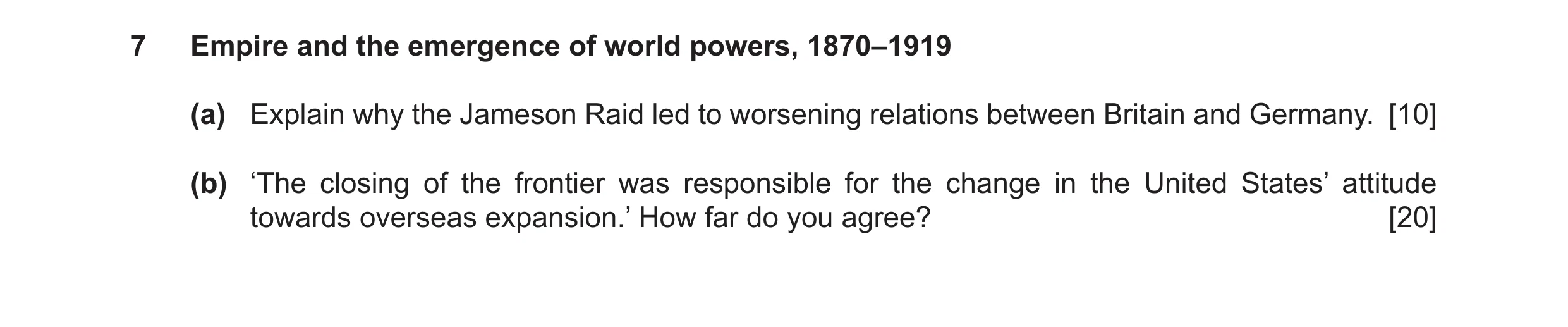
7 Empire and the emergence of world powers, 1870–1919 (a) Explain why the Jameson Raid led to worsening relations between Britain and Germany. [10] (b) ‘The closing of the frontier was responsible for the change in the United States’ attitude towards overseas expansion.’ How far do you agree? [20]
30 marks
Mark scheme: 7(a) Explain why the Jameson Raid led to worsening relations between 10 Britain and Germany. Indicative content The Jameson raid was devised by Cecil Rhodes to give the British a reason to intervene in The Boer colony of Transvaal on the excuse of coming to the aid of discontented and rebellious British settlers there. The raid went ahead, even though there was no rebellion, and was repulsed by the Boers under the leadership of Paul Kruger. • The Kaiser sent a telegram to Kruger congratulating him on his success which angered the British government who saw it as interference in their sphere of influence. • It also seemed to suggest that the Germans were prepared to send aid to the Boers if the conflict developed in a bid to replace British interests with German prominence in the Boer states. • The jingoistic British press raised substantial anti-German feeling amongst the British public. • Similarly, the German press was able to portray British aggression against a small independent state which raised the level of anti-British feeling in Germany. • Britain already had concerns about the policy of Weltpolitik and these moves seemed to confirm their worries. Accept any other valid responses. 7(b) The closing of the frontier was responsible for the change in the United 20 States’ attitude towards overseas expansion.’ How far do you agree? Indicative content In support of the closing of the frontier the census of 189 revealed that settlement had been established right across the continental USA, with states or Territories established, leaving no new land to be ‘tamed’ and no new opportunities. Because of this, Americans began to look abroad for fresh opportunities and challenges. Some Americans believed it was their duty, having overcome the native Americans, to continue spreading democracy and Christianity to what they saw as ‘less fortunate’ peoples. Industrialists realised that now that the frontier was closed, they would need to find new commercial opportunities beyond Continental America if they were to continue expanding their businesses. When considering other factors, discussion might include how industrial development in the decades following the end of the Civil war was stimulated by new sources of raw material, new developments and processes in industries, growth of railways and by rapid population growth because of immigration. However, the economic crash of 1893 highlighted the problems of relying on the internal market. The Spanish-American War of 1898 saw the USA victory over Spain and the Treaty of Paris made the US an imperial power by ceding former Spanish territories in the Caribbean and Pacific to the USA. New polices were needed regarding the governing and exploitation of these territories. The acquisition of the Philippines encouraged the development of plans for other East Asian markets, especially in China. The Yellow Press in the USA behaved in a similar way to the British in encouraging jingoistic imperialism and getting the public behind the idea of further expansion of US territories. Presidents McKinley and Roosevelt were both supporters of a more active foreign policy. Accept any other valid responses.
This question in 9489/23 May/June 2025
![Question 1: Empire and the emergence of world powers, 1870–1919 (a) Explain why Cuba was the cause of conflict between Spain and the USA in 1898. [10] …](https://img.pastlit.com/crops/6c7ef1dc-7c08-460e-b4bd-4c71c646eae8/q7.webp)
![Question 4: Empire and the emergence of world powers, 1870–1919 (a) Explain why the Boxer Rebellion occurred in China between 1899 and 1901. [10] (b) T…](https://img.pastlit.com/crops/add952c7-e96d-4797-b251-f72e907439e5/q7.webp)
![Question 5: Empire and the emergence of world powers, 1870–1919 (a) Explain why Wilhelm II sent the Kruger Telegram in 1896. [10] (b) ‘Up to 1917 the U…](https://img.pastlit.com/crops/124b0c92-4203-4199-9793-a06889ebec9c/q7.webp) 1 / 2
1 / 2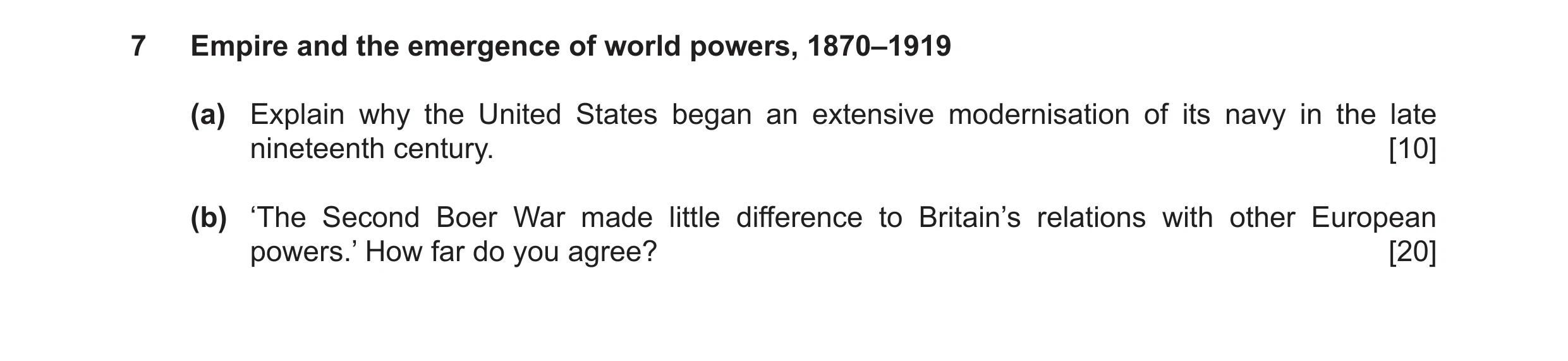

![Question 8: Empire and the emergence of world powers, 1870–1919 (a) Explain why Russia was unable to defeat Japan in the war of 1904–05. [10] (b) To wh…](https://img.pastlit.com/crops/3cd171d1-0ecf-44fa-ae60-c8f47acabfd0/q7.webp)
![Question 9: Empire and the emergence of world powers, 1870–1919 (a) Explain why the Treaty of Shimonoseki led to the Triple Intervention. [10] (b) ‘The…](https://img.pastlit.com/crops/e770a01d-6907-4b7f-a733-2f53128fb283/q7.webp)
![Question 10: Empire and the emergence of world powers, 1870–1919 (a) Explain why Roosevelt introduced the Corollary to the Monroe Doctrine in 1904. [10]…](https://img.pastlit.com/crops/f0ed21d0-0f48-4734-a6b3-a4cb32722fc7/q7.webp)
 2 / 2
2 / 2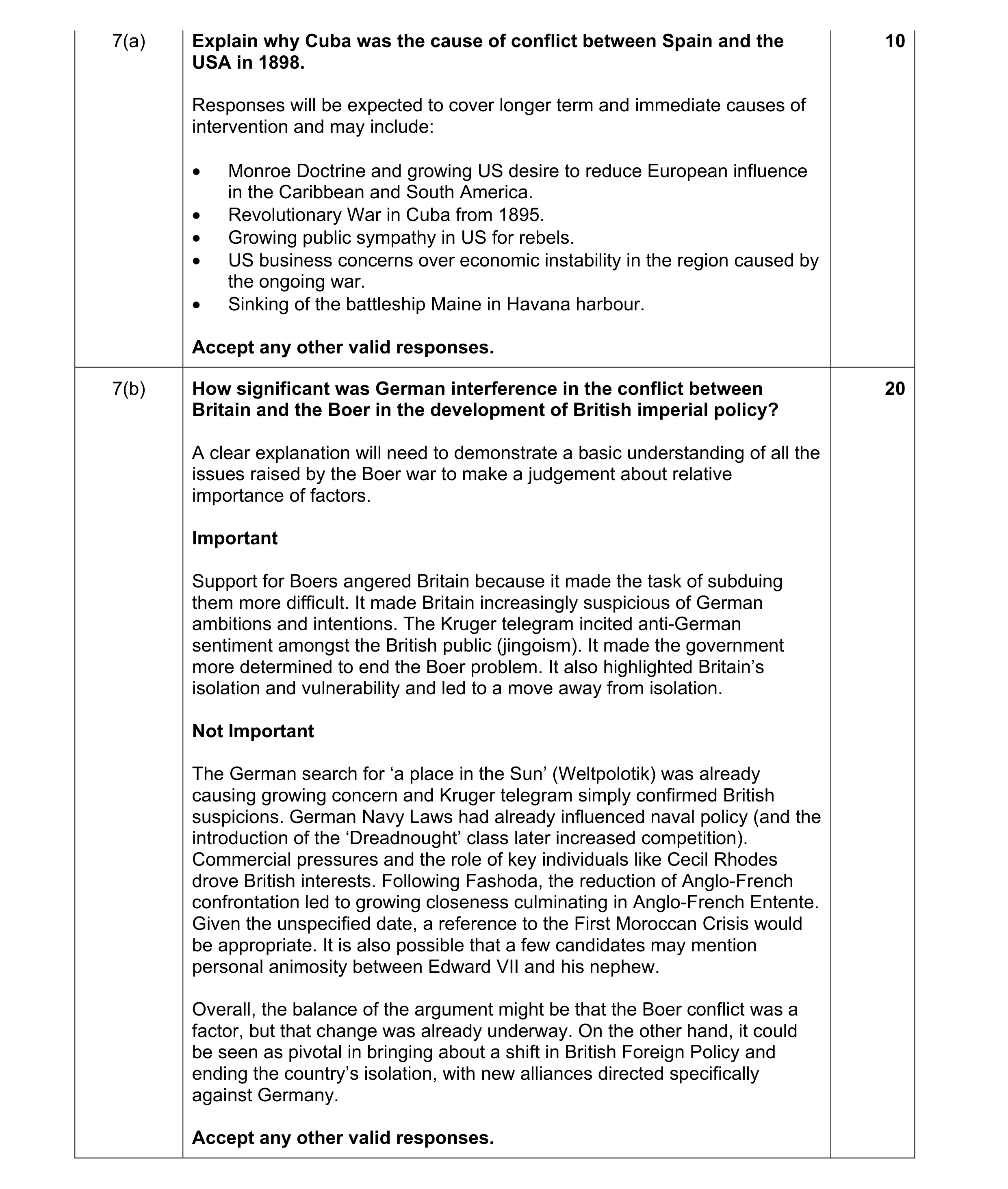 30
30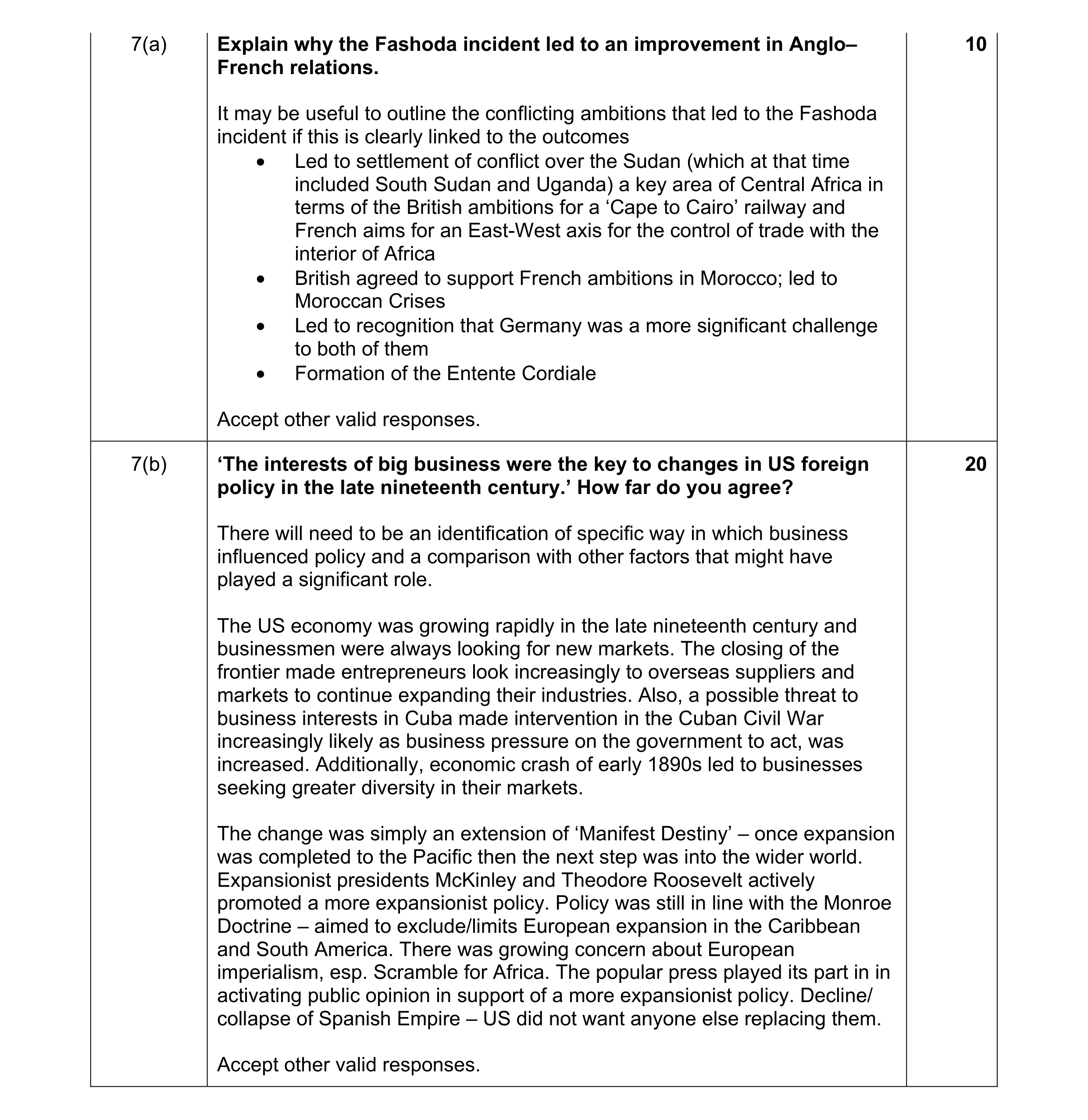 30
30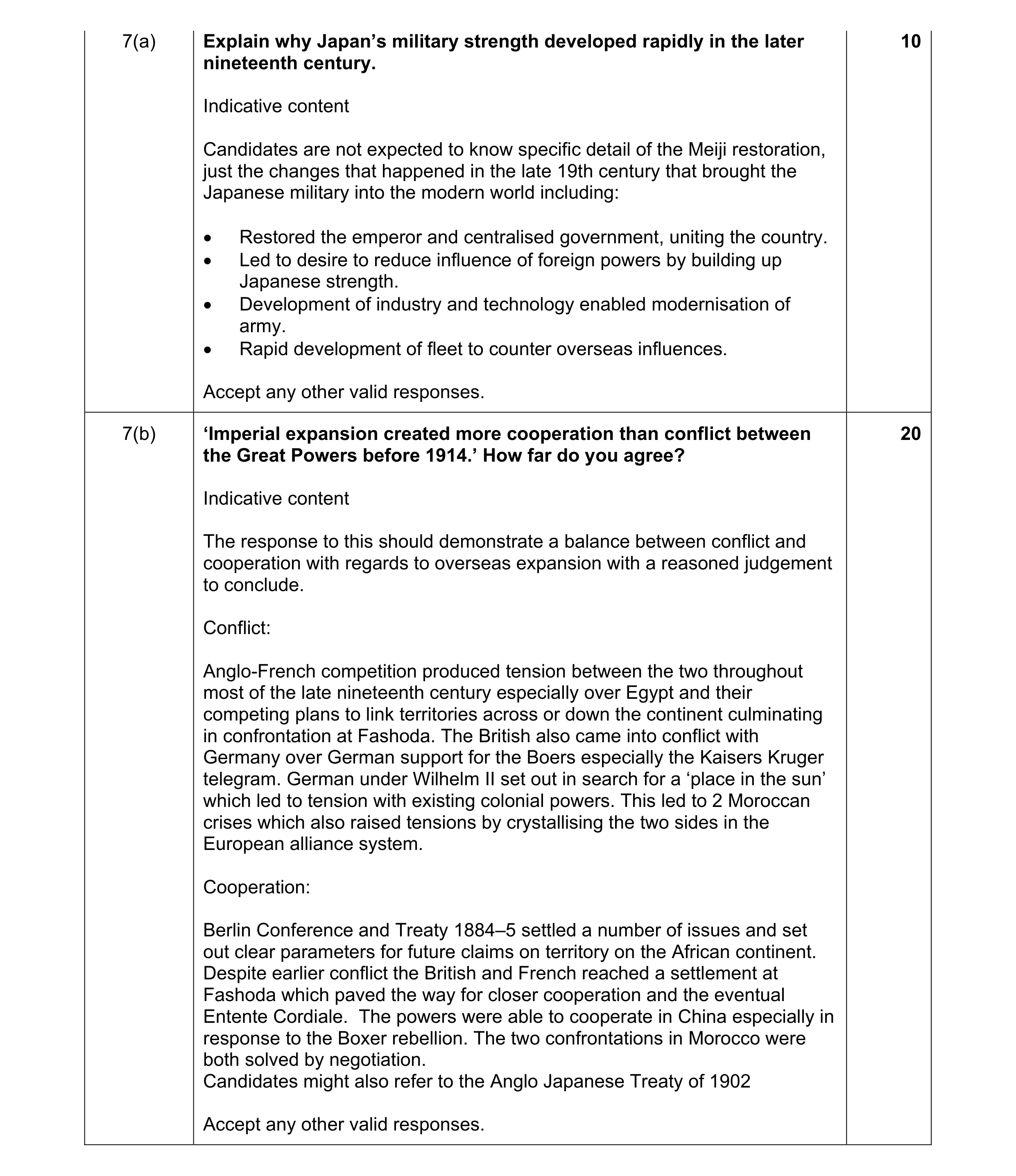 30
30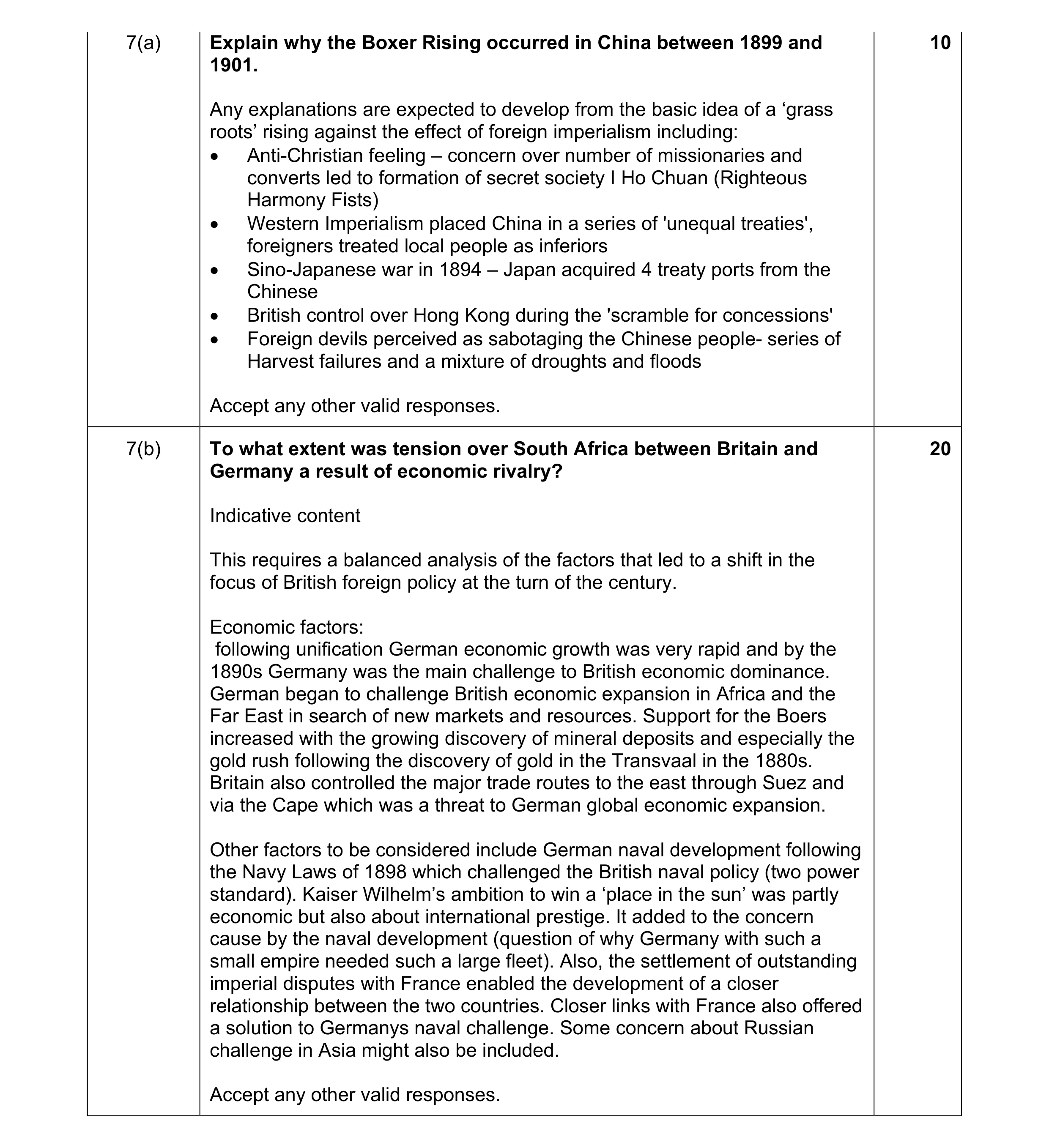 30
30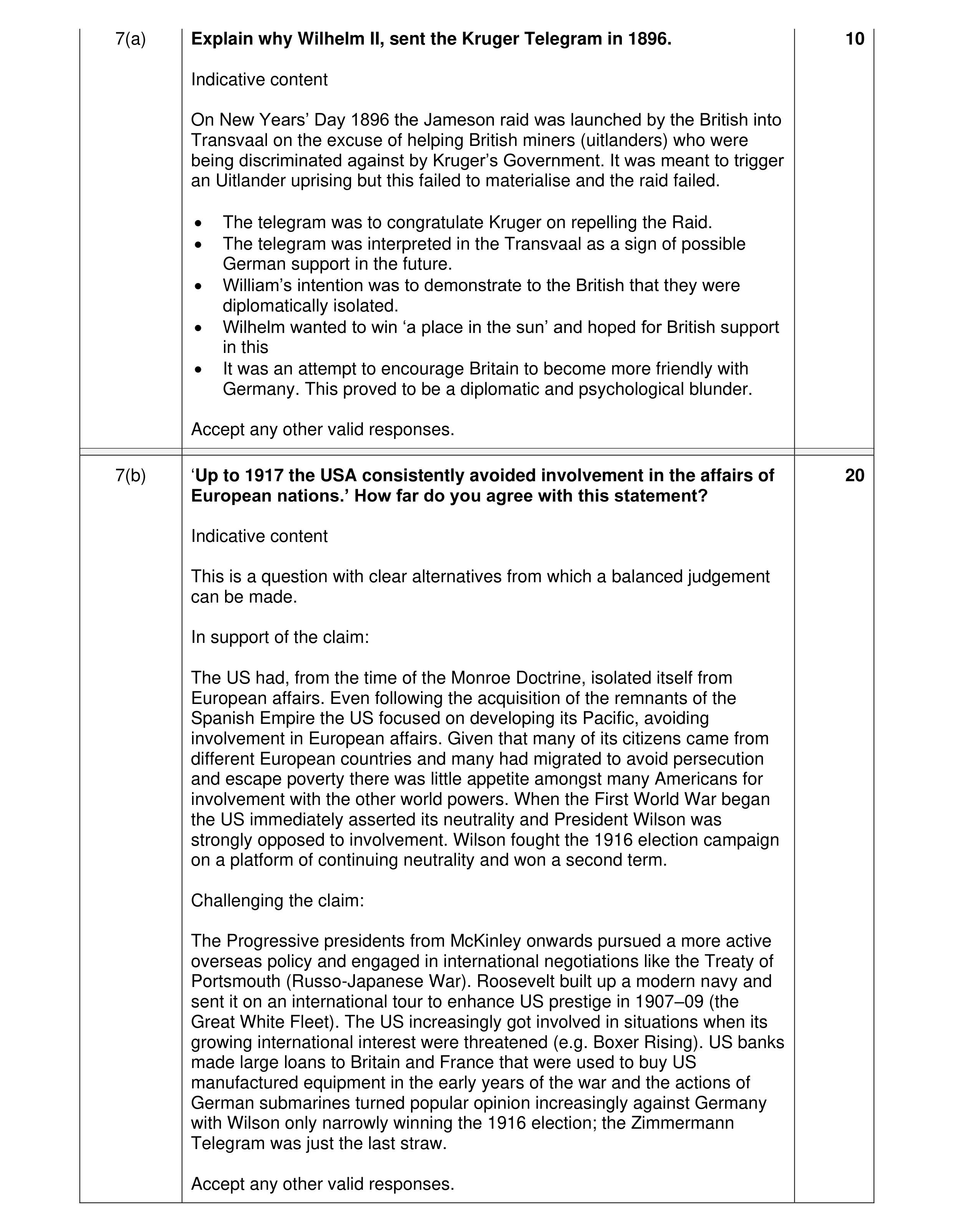 30
30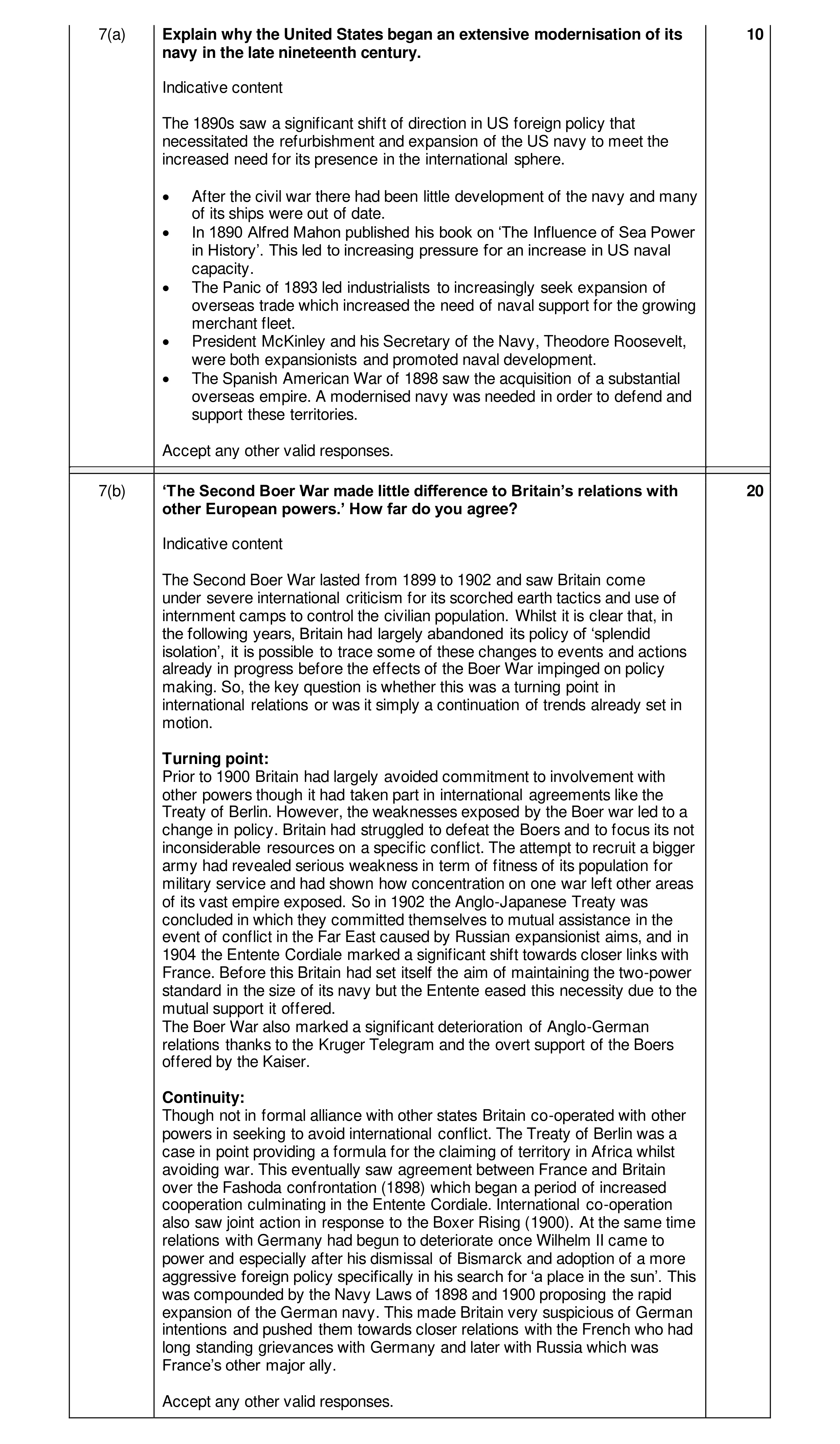 30
30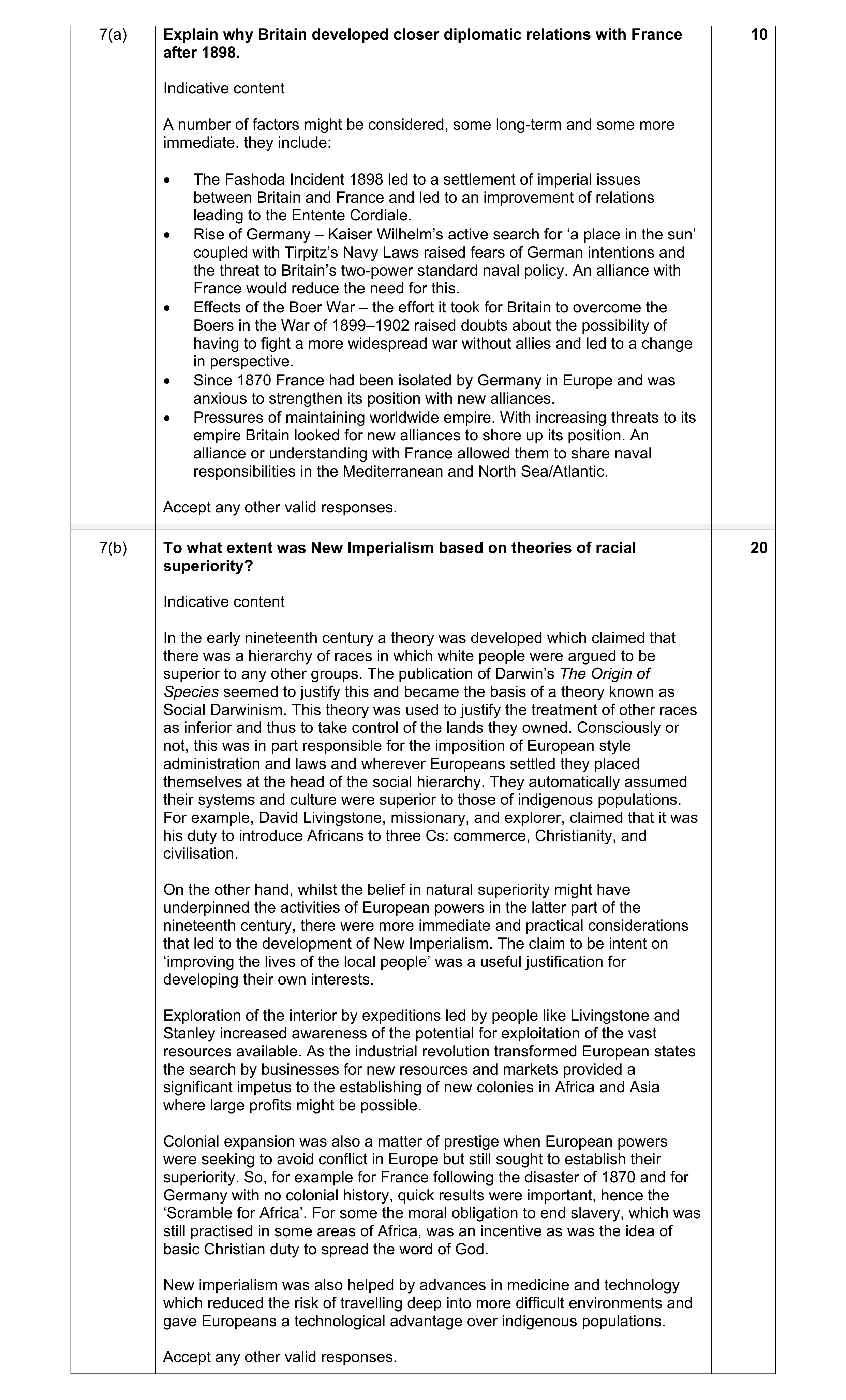 30
30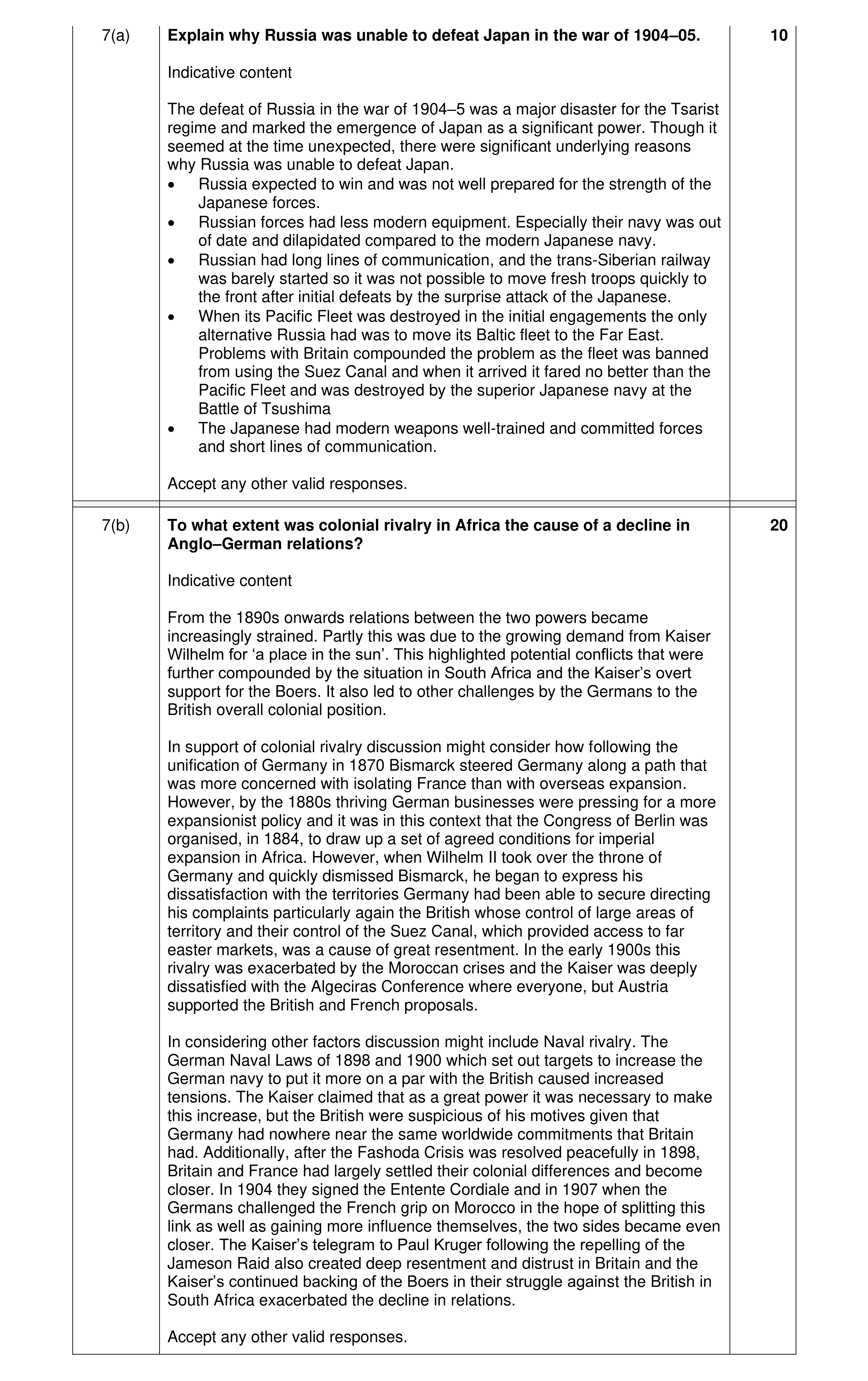 30
30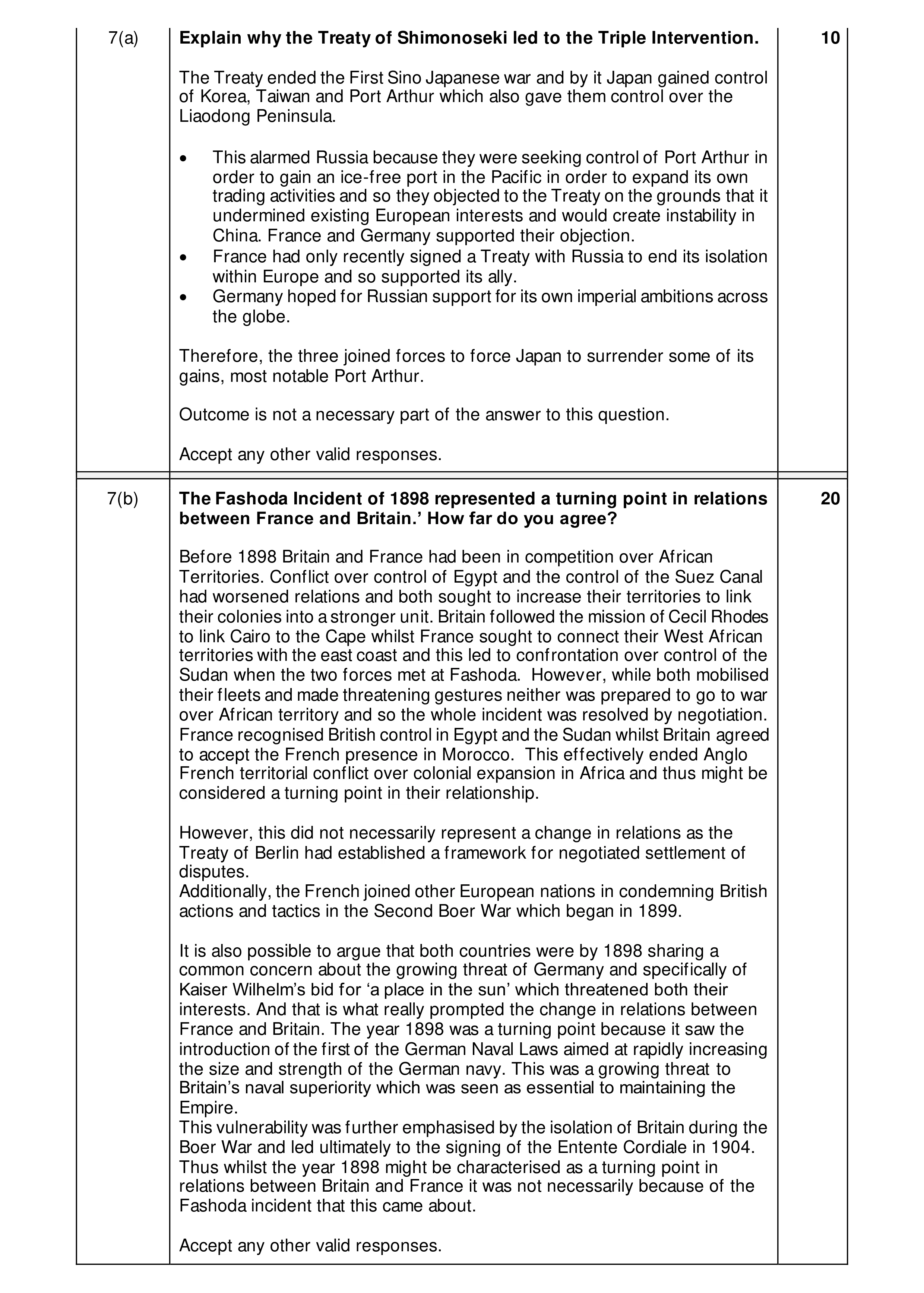 30
30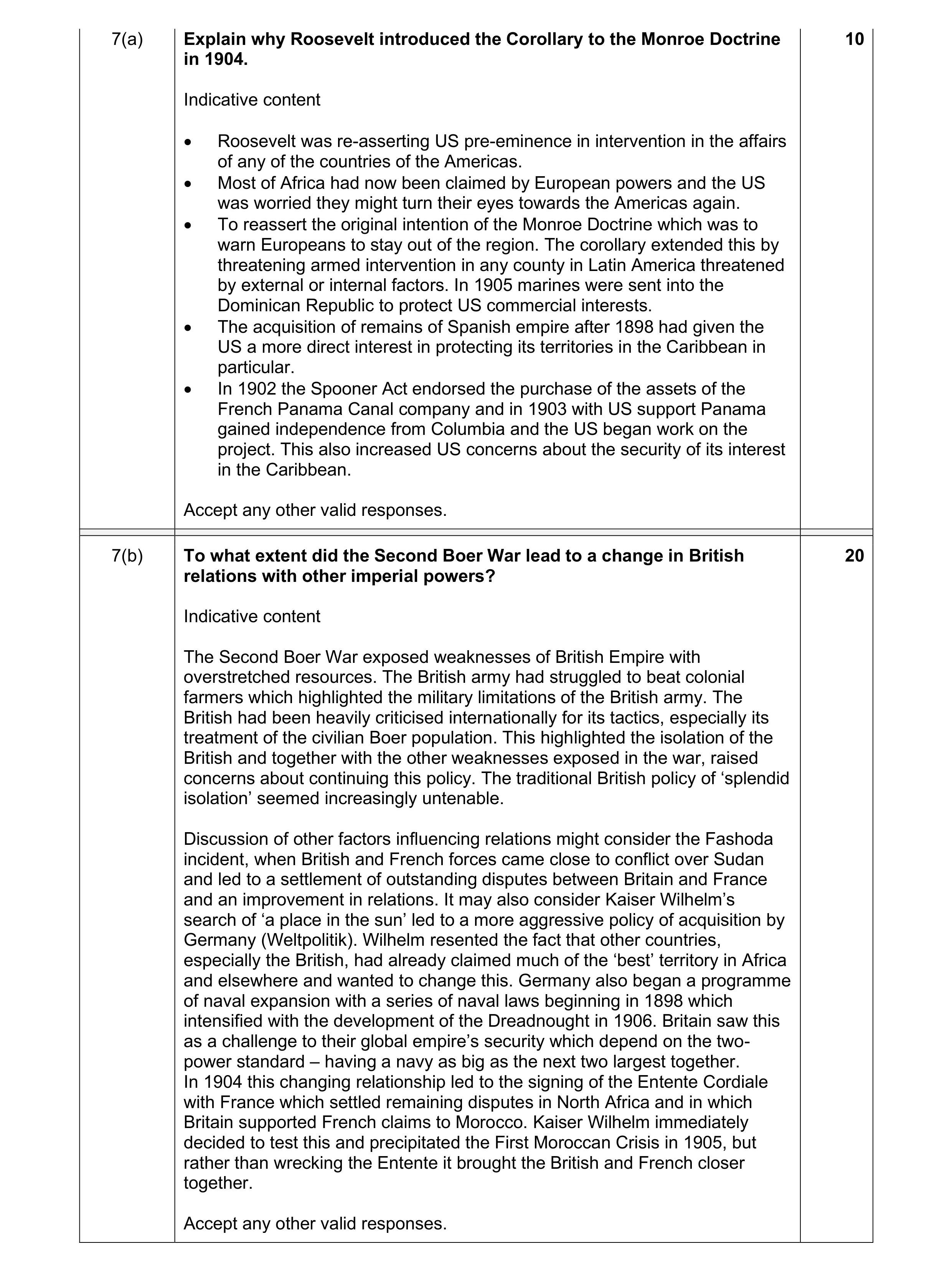 30
30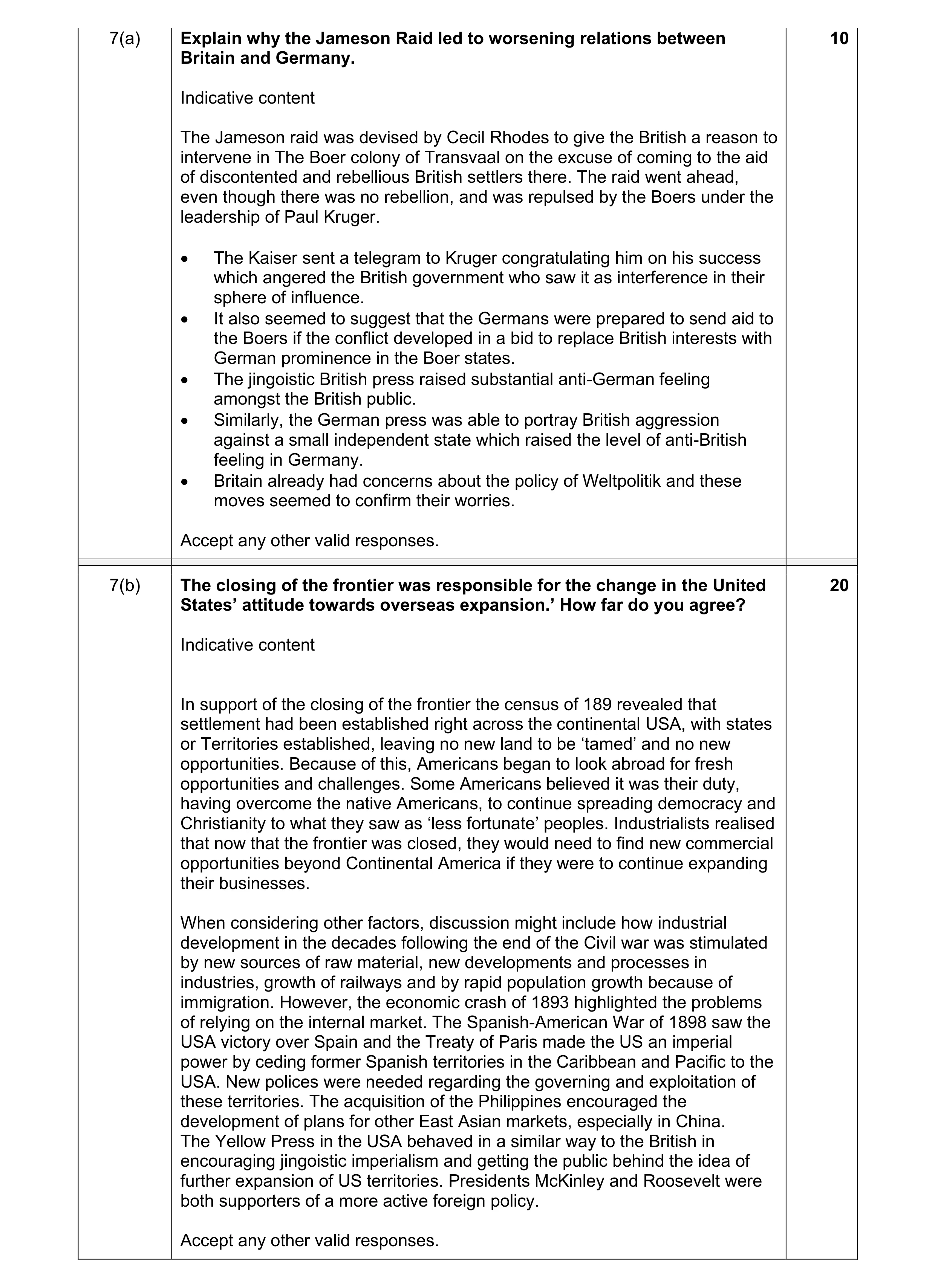 30
30