Questions as text
Q1 · Liberalism and nationalism in Germany, 1815–71 (a) Explain why the Franco–Prussian War… 9489/21 May/June 2022
3 Liberalism and nationalism in Germany, 1815–71 (a) Explain why the Franco–Prussian War broke out in 1870. [10] (b) How strong was German nationalism by 1850? [20]
30 marks
Mark scheme: 3(a) Explain why the Franco-Prussian War broke out in 1870. 10 Indicative content To some it was the final stage in Bismarck’s long-term plan to create a united Germany. The wars of 1864 and 1866 (Denmark and Austria) had increased Prussia’s standing in Europe and led to the creation of the North German Confederation. A victorious war against the French would lead to the creation of a unified Germany, which would be a dominant European power. It was due to a desire by Prussia to seek revenge. The Hohenzollern candidacy for the Spanish throne was withdrawn in July 1870. However, the French insisted it should never be renewed. This was seen as an affront to the honour of the Prussian royal family. To restore this honour Bismarck re-worked the Ems telegram which provoked France to declare war. France felt its international standing was undermined by the Prussian victories of 1864 and 1866. It wanted to assert its authority, made doubly necessary following the failure of its Mexican expedition. Napoleon III was facing domestic troubles as there were growing demands for democratic reform, and rumours were rife about an impending revolution. A victorious war against Prussia would lead to gains in the Rhineland and restore unity amongst the French nation behind a Bonapartist dynasty. Recent military reforms convinced the political and military leaderships of France that they would emerge victorious in any conflict with Prussia. Accept any other valid responses. 3(b) How strong was German nationalism by 1850? 20 Indicative content The granting of land along the Rhine in 1815 doubled Prussia’s population and increased its access to raw materials (coal/iron), which allowed for the growth of industry. This industrial growth, allied with economic growth brought about by the Zollverein after 1834, bolstered the hopes of German nationalists. A growing unity in economic affairs, why not a unity in political affairs? As German states developed economically the middle-classes grew in importance. Aware of their contribution to the economy’s development, they wanted more rights and powers. They felt that the best way to achieve these was through a unified Germany. There was an awareness of a distinct German cultural identity, as seen in the folk tales published by the Brothers Grimm and in academic studies showing the common origin of the various dialects in the German states. The 1848 revolutions led to demands, particularly amongst liberals, for a united Germany and it was argued that a new German Parliament should meet in Frankfurt. This parliament drew up a German constitution in March 1849 – German states to be united in a German Empire headed by a German Emperor. The extent of nationalism can be questioned. Despite Prussia’s undoubted economic strength, agriculture still dominated its economy, and that of the other German states. Peasants were more concerned with dealing with 3(b) issues of surviving at a subsistence level, rather than with German nationalism. The Prussian monarchy was authoritarian, not liberal – Frederick William IV refused the imperial crown in 1849 because it came from the Frankfurt Parliament and not the German Princes. German Princes were opposed to nationalism as a united Germany needed only one Prince. Austria still dominated the German states in 1850. At Olmütz the Austrians had ended Prussian plans to create a German union which excluded Austria and had Prussia at its head. The Frankfurt Parliament failed to unify the German states. It never gained the support of the lower classes and was seen as a talking-shop and any rebellions it encouraged to reject the existing order were put down. Whilst a clear cultural identity did exist, it had not, by 1850, translated into a political reality. Accept any other valid responses.
This question in 9489/21 May/June 2022
Q2 · Liberalism and nationalism in Germany, 1815–71 (a) Explain why the Zollverein was created 9489/23 May/June 2022
3 Liberalism and nationalism in Germany, 1815–71 (a) Explain why the Zollverein was created. [10] (b) ‘Prussia’s actions caused the Franco–Prussian War.’ How far do you agree? [20]
30 marks
Mark scheme: 3(a) Explain why the Zollverein was created. 10 Indicative content The way for its creation had been prepared by earlier customs unions. In the south, Bavaria and Wurttemberg, in the north, the Prussian customs union and there was a Middle German Commercial Union (MGCU). The MGCU was seen as purely anti-Prussian in nature. This lessened its economic attractiveness, and in 1831 Hesse-Cassel joined the Prussian customs union. The MGCU collapsed whilst the Prussian customs union continued to prosper. Hesse-Cassel’s membership bridged the territorial gap between the eastern and western provinces of Prussia. In 1834 Bavaria and Wurttemberg joined the Prussians The newly enlarged Prussian Customs Union, the Zollverein, was regarded as a means to achieve increased trade and prosperity by doing away with customs duties. The cost of securing tariff borders and tariff administration had cost 100% of Hesse-Cassel’s tariff income prior to 1830. The Zollverein was seen as a way to isolate Austria, and such isolation would not only be economic but lead to a weakening of Austria’s political influence within the German Confederation. This would help Prussia’s status – states which had experienced a financial advantage in the economic union with Prussia might prove amenable to a similar arrangement in a political union. Accept any other valid responses. 3(b) ‘Prussia’s actions caused the Franco-Prussian War.’ How far do you 20 agree? Indicative content In his memoirs, Bismarck saw the war as the result of his master plan to create a united Germany under Prussian leadership. The war with France was the final stage in this process of unification, begun with victories in wars against Denmark and Austria (1864 and 1866). In 1862, Bismarck had stated that ‘blood and iron’ (originally iron and blood) would decide issues, seeming to indicate that Prussia under Bismarck would use war to achieve its goals. It was Prussian machinations over the Hohenzollern candidacy for the Spanish throne through the re-working and publication of the Ems telegram that forced France into declaring war. Prussian manoeuvrings against France had been present since the Luxembourg crisis of 1867. French failure to make any territorial gains was a blow to its prestige and stocked up anti-German feelings, which were later exploited to provoke a French response for war in 1870. However, this argument can be challenged. France sought war in 1870 and was not helplessly controlled by Prussian actions. Napoleon III was facing domestic pressures in France. There was a growing demand for democratic reforms and revolution seemed likely to occur. Therefore, war would lead to gains in the Rhineland and restore unity in the country. The French felt the Prussian victories of 1864 and 1866 had diminished the international standing of France. The lack of any territorial compensation agreed to by Prussia meant that war seemed the only alternative. The failure of France’s Mexican expedition increased the pressure for war as the means to re- establish France’s standing in Europe. The military reforms of 1866 gave a sense of confidence that France had the means to achieve its aims through war. Accept any other valid responses.
This question in 9489/23 May/June 2022
Q3 · Liberalism and nationalism in Germany, 1815–71 (a) Explain why France lost the… 9489/21 Oct/Nov 2022
3 Liberalism and nationalism in Germany, 1815–71 (a) Explain why France lost the Franco–Prussian War. [10] (b) To what extent did economic issues cause the German revolutions of 1848–49? [20]
30 marks
Mark scheme: 3(a) Explain why France lost the Franco–Prussian War. 10 Indicative content • The French military leadership was over-confident, believing their army’s reorganisation in 1866 made it superior to that possessed by Prussia and other German states. • Whilst MacMahon commanded forces in Alsace and Bazaine in Lorraine there was no strategy to coordinate their actions. The forces of Prussia and other German states were organised under a unified command. • French preparations were inefficient. French troops were sent to the front from their peace-time stations without their full complement of men and equipment. Reservists gathered in depots and overflowed railway stations, hindering traffic. There were six German railways to the French frontier, but only two French railways. • Troops from the southern German states fought better than expected and allowed the number of troops that Prussia and the other German states could bring to battle to outnumber the French. At the battle of Gravelotte-St-Privat, Moltke was able to field 180 000 troops to France’s 112 000. • Bismarck had isolated France diplomatically. He published secret French overtures, dating from 1867, that France be compensated for Prussian military success in 1866 by receiving Belgium territory. This turned public opinion anti-French in Belgium and Britain. Russia had promised to fight alongside Prussia if Austria came to France’s aid. Therefore, France could call on no allies to aid her in the war. Accept any other valid responses. 3(b) To what extent did economic issues cause the German revolutions of 20 1848–49? Indicative content In the 1840s the German states were facing a widespread economic depression which caused a great deal of hardship. Between 1816 and 1848 the population in German states had risen from 24 million to 36 million. This meant some areas found it increasingly hard to sustain their populations, and many amongst the peasantry still owed feudal dues to their landowners. In areas where peasants had become tenant farmers the rents were high. This produced resentment and a desire for change. In the towns working and living conditions were poor. The number of strikes and riots multiplied in the 1830s and 1840s. It is not surprising that the revolutions were principally urban. The growth of mechanisation threatened skilled artisans as it pushed down costs and made hand-produced goods relatively expensive. The economic situation deteriorated further in 1846 with a bad harvest. A potato blight occurred which led to the erection of barricades in Berlin, the looting of shops and the storming of the Crown Prince’s palace. The increase in food prices lead to the fall in demand for other goods and caused unemployment to rise as businesses laid off workers. All this created unrest in both urban and rural areas by 1848. The primacy of economic issues can be challenged. The power in the German states lay with the princes and the nobility. However, the economic crisis seemed to show that they lacked the will to alleviate the social distress. This led to growing criticism from the middle-classes who felt that they should no longer be excluded from participation in the political process. The existence of censorship and the secret police restricted the airing of these grievances and discussion of how to tackle the issues. A sense of nationalism had developed since 1815 in the German states with the liberal wish for an end to arbitrary government and the establishment of some form of parliamentary system. It was felt that national unity would create national prosperity. In March 1848 Metternich, who since 1815 had opposed nationalism and liberalism in the German states, fell from power. This seemed to be a sign that now was the time for such ideas to flourish. The focus of the question is the German states but reference to why revolution broke out in Austria (e.g., nationalism amongst the peoples of its empire) can be rewarded. Accept any other valid responses.
This question in 9489/21 Oct/Nov 2022
Q4 · Liberalism and nationalism in Germany, 1815–71 (a) Explain why the Frankfurt Parliament… 9489/22 Oct/Nov 2022
3 Liberalism and nationalism in Germany, 1815–71 (a) Explain why the Frankfurt Parliament collapsed. [10] (b) To what extent was German unification the result of Bismarck’s actions? [20]
30 marks
Mark scheme: 3(a) Explain why the Frankfurt Parliament collapsed. 10 Indicative content • The Prussian king, Frederick-William IV, refused the imperial crown proffered by the Parliament. This meant that it did not have the substantial military and economic support of Prussia. It had no effective means to establish its ideas and policies. • The Parliament was divided. Some favoured a ‘Greater Germany’ with Catholic Austria maintaining its leadership, whilst others favoured a ‘Little Germany’ which excluded Austria in favour of the leadership of Protestant Prussia. In October 1848 it seemed the ‘Greater Germany’ option had won, but only Austria’s German lands were to be incorporated. Austria refused to accept this break up of its lands. • It was a talking shop – the ‘Parliament of Professors.’ It was dominated by the middle-classes and failed to get the support of the lower-classes. It rejected the Industrial Code put forward by the Artisans’ Congress in Frankfurt as it clashed with the Parliament’s support of economic liberalism. Therefore, the lower classes had no faith in the Parliament. • It lacked legitimacy because it had not been initiated by the German Confederation. In April 1849, the Austrian delegates were recalled followed by the Prussians in May and then by delegates from Saxony and Hanover. The Frankfurt Parliament became a rump rather than a national assembly. Accept any other valid responses. 3(b) To what extent was German unification the result of Bismarck’s 20 actions? Indicative content Bismarck felt that this certainly was the case. In his memoirs, written in the 1890s, he presented himself as a statesman whose foresaw all events, and this enabled him to achieve his goals. In 1862, shortly before coming to power, he told the British politician, and future Prime Minister, Benjamin Disraeli that he intended to deal with Denmark, Austria, and France in order to unite Germany under Prussian leadership. By 1871, Bismarck had achieved his primary goals. Berlin not Vienna was the capital of German affairs, Austria’s dominant role in German affairs was no more and the position of the Prussian king was transformed as he held the title Emperor, with the German states united under Prussian control. There can be no doubt that Bismarck was a most astute politician. He broke the impasse with liberals in the Prussian Parliament over military reforms and these reforms were vital in supplying the victories of 1864, 1866 and 1870–71. Bismarck’s handling of the intricacies of the Schleswig-Holstein dispute (regarding Denmark and then Austria) and the Ems telegram appeared to show what an arch-manipulator he was, seemingly the puppet-master who controlled affairs. However, there were other factors which led to German unification. Whilst acknowledging that Bismarck had broad aims, this does not mean he mapped out specific moves. The French responded to the Ems telegram as they did because they felt war would achieve their aims and they were confident of victory. In essence, he can be seen as a Prussian patriot rather than a German nationalist, and his loyalty lay with the Prussian king not the German people. Bismarck benefited from a fortuitous international situation. In 1862, Prussia was seen as a second-rate power in Europe. Thus, Prussia was able to enhance its position without arousing the hostility of its neighbours. Britain saw a strong Germany as a bulwark against France and Russia. German unification can be seen as the result of the wars of 1864, 1866 and 1870–71. Therefore. It was the fighting capacity of the army and the leadership of its generals which made this happen. The economic growth of the 1850s and 1860s meant Prussia was producing more steel and coal than France and Austria and had a more extensive railway network. This economic strength provided the financial means to supply the Prussian army with the military resources to challenge, successfully, Austria and France. Accept any other valid responses.
This question in 9489/22 Oct/Nov 2022
Q5 · Liberalism and nationalism in Germany, 1815–71 (a) Explain why Austria was opposed to the… 9489/23 Oct/Nov 2022
3 Liberalism and nationalism in Germany, 1815–71 (a) Explain why Austria was opposed to the development of German nationalism. [10] (b) To what extent did liberals in the Prussian Landtag present a challenge to Bismarck in the period 1862–66? [20]
30 marks
Mark scheme: 3(a) Explain why Austria was opposed to the development of German 10 nationalism. Indicative content • Nationalistic ideas which had accompanied Napoleon into Germany were seen as an existential threat to the Austrian monarchy and its empire. Thus, the Vienna settlement of 1815 restored Germany to a series of independent and sovereign states • The Austrian Chancellor, Metternich, had played an important role in Napoleon’s defeat. He was a strong ideological conservative who was determined that Austria should dominate the German states and repress nationalist ideas • The development of German nationalism might lead to the creation of a unified German state, which would be stronger and more of a threat to Austria than a collection of independent states • German nationalism might lead to the end of the Austrian Empire – German subjects of the Austrian Empire might seek to break away • German nationalism could act as an inspiration to other national groups – Hungarians, Italians, Czechs, Croats, and Serbs – and lead to their demands for independence Accept any other valid responses. 3(b) To what extent did liberals in the Prussian Landtag present a challenge 20 to Bismarck in the period 1862–66? Indicative content When Bismarck was made Minister President of Prussia in 1862, liberals in the Landtag saw this as a direct challenge to them. He was regarded as a conservative reactionary who was likely to overturn the Landtag and was opposed to their aims. Therefore, liberal antagonism towards Bismarck was present from the start. This challenge was significant as liberals presented a formidable grouping in the Landtag. By 1862 they controlled 65% of the seats, whilst the king’s supporters had only 11 deputies. In 1863 this liberal control rose to 70% of seats. There had been a constitutional crisis since 1860 over the approval of the army budget because liberals feared the budget and the accompanying army reforms would be used, as in 1848–49, against the Prussian people and not any external threat. Bismarck was made Minister President to end this crisis. He did this by saying parliamentary support for the bill was unnecessary and collected taxes and disbursed funds without any recourse to parliamentary authorisation. In May 1863, seeking to undo Bismarck’s policy towards the Polish rebellion against Russia, a motion was passed in the Landtag which demanded, effectively, the dismissal of Bismarck. Whilst the war of 1864 against Denmark had the potential to end conflict with liberals in the Landtag, through its support of German nationalism, it did present Bismarck with the challenge of avoiding placing himself at the mercy of a national-liberal movement. There was undoubted bitterness in Bismarck’s relations with liberals. In June 1865 he challenged a leading liberal politician, Virchow, to a duel. The extent of the challenge can be questioned. Bismarck was able to collect taxes and reform the army as if the liberal challenge in the Landtag did not exist. Over four years and two wars Bismarck directed Prussian affairs without constitutionally approved budgets. He had judged, correctly, that his opponents would not present the ultimate challenge – an appeal to force. This was because they had no military force. The victories of 1864 and 1866 appealed to the nationalistic element amongst liberals. In September 1866 an Indemnity Bill, introduced by Bismarck to draw a line under the long- running constitutional conflict, was passed with only seven votes against. There were other challenges which faced Bismarck. He had to threaten resignation in 1863 in order to prevent the king, William I, from meeting the German princes at Frankfurt, following an overture from the Austrian emperor who was seeking to assert Austrian influence by increasing the power of the German Confederation. Had the king gone, Bismarck would have had to resign and a second Olmütz would have occurred. Bismarck, also, could present challenges to himself. His first major speech as Minister President, ‘blood and iron’ (originally ‘iron and blood’) was regarded as misjudged and threatening and led to the royal family questioning Bismarck’s fitness to act as Minister President. Under the terms of the constitution of Prussia the Minister President was responsible to the monarch not the Landtag. Therefore, it could be argued that the royal relationship was more significant for Bismarck. Accept any other valid responses.
This question in 9489/23 Oct/Nov 2022
Q6 · Liberalism and nationalism in Germany, 1815–71 (a) Explain why the development of German… 9489/22 Feb/March 2023
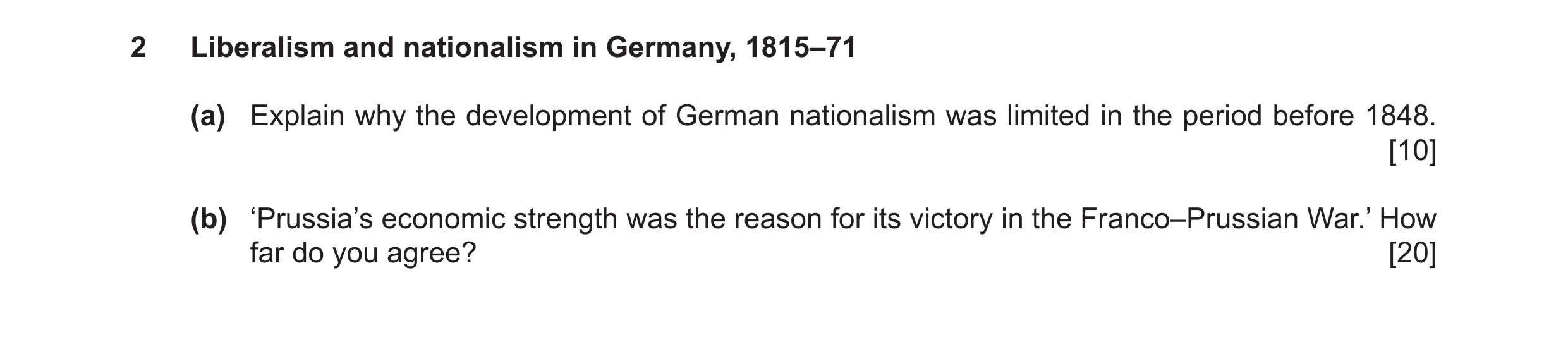
2 Liberalism and nationalism in Germany, 1815–71 (a) Explain why the development of German nationalism was limited in the period before 1848. [10] (b) ‘Prussia’s economic strength was the reason for its victory in the Franco–Prussian War.’ How far do you agree? [20]
30 marks
Mark scheme: 2(a) Explain why the development of German nationalism was limited in the 10 period before 1848. Indicative content • Austria – the most powerful of all the German states. Austrians saw nationalism as an existential threat to the Austrian Empire and so was opposed to any development of German nationalism, e.g., Carlsbad Decrees, 1819. • Religion – The Reformation still cast a long shadow over the German states. Catholics and Protestants were suspicious and mistrustful of each other. This did not bode well for cooperation in achieving a unified Germany. • Culture – the Rhineland had come under French influence as part of Napoleon’s Confederation of the Rhine and, as such, considered themselves part of Western Europe. Although now part of Prussia following the Congress of Vienna, the Rhenish saw Prussia as an alien culture from the east. Therefore, forming a common cause would be difficult. • Elite’s opposition – the German princes had appealed to nationalism to rally their peoples to fight back and expel the French. However, once this had been achieved, they had no desire to see a united Germany, for such a political entity would need one ruler only. A united German state would mean the end of the power of the princes. Future leadership, it seemed, was unlikely to come from traditional leaders. Accept any other valid responses. 2(b) ‘Prussia’s economic strength was the reason for its victory in the 20 Franco-Prussian War.’ How far do you agree? Indicative content Arguments in support of this view could be as follows. When war broke out in 1870 Prussia’s economy was strong, based on its growth in the 1850s and 1860s. It had outstripped that of France, as well as that of Austria. By the mid-1860s Prussia produced more coal and steel than France. The industrialist Alfred Krupp was able to produce high-quality armaments for Prussia from his factories in the Ruhr. By 1865 Prussia had a more extensive railway network than France and was able to use six railways which ran to the French frontier whilst France had the use of only two. This allowed Prussia to move troops and supplies quickly and in greater numbers. At the battle of Gravelotte-St-Pierre the Prussian general von Moltke was able to field 180 000 troops to France’s 112 000. This view, however, can be challenged. When war broke out Bismarck had ensured that France was isolated diplomatically. The publishing of secret French requests from 1867 to receive Belgium territory turned public opinion in Belgium and Britain anti-French. Also, Russia promised to support Prussia if Austria came to the aid of France. As a result, France had no allies to call on when war broke out. It was Bismarck’s political skill which allowed him to overcome the impasse of the 1860–62 constitutional crisis over military reforms and the military budget. This meant that Prussia had the means to reform the army and make it into an efficient fighting force. This was then used to great effect through the military ability of its generals, particularly von Moltke. This contrasts with French military leadership, which was over-confident, believing its military reforms of 1866 had made its army superior to any potential opponent. French planning in the war was flawed. Whilst MacMahon had forces in Alsace and Bezain had forces in Lorraine, there was no strategy to coordinate their actions. In contrast Prussian forces were organised under a unified command. It was the superior military organisation, leadership and fighting ability of the Prussian led forces which defeated the French army in the field and so led to Prussian victory. Accept any other valid responses.
This question in 9489/22 Feb/March 2023
Q7 · Liberalism and nationalism in Germany, 1815–71 (a) Explain why relations between Prussian… 9489/22 May/June 2023
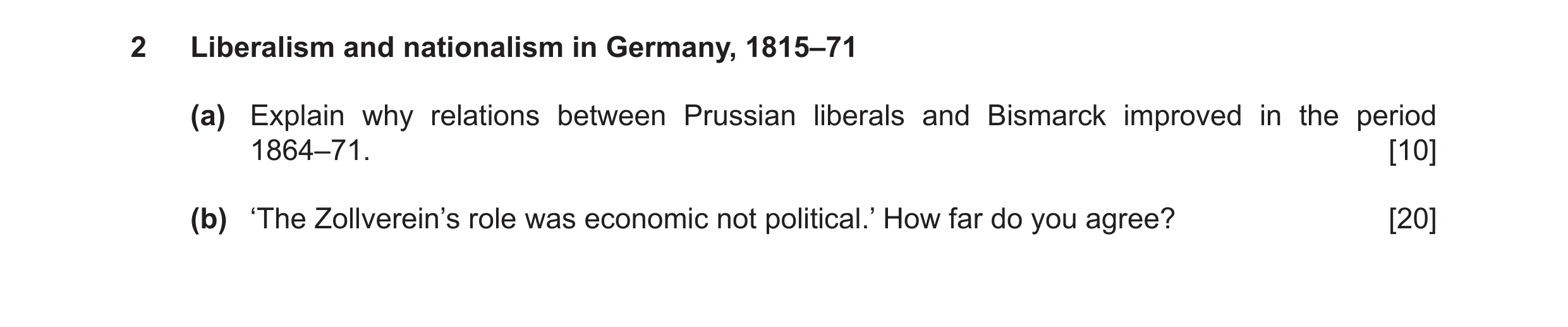
2 Liberalism and nationalism in Germany, 1815–71 (a) Explain why relations between Prussian liberals and Bismarck improved in the period 1864–71. [10] (b) ‘The Zollverein’s role was economic not political.’ How far do you agree? [20]
30 marks
Mark scheme: 2(a) Explain why relations between Prussian liberals and Bismarck 10 improved in the period 1864–1871. Indicative content Prussia was victorious in the war with Denmark (1864) over the duchies of Schleswig and Holstein. By the treaty of Vienna, the duchies were to be jointly administered by Prussia and Austria. In 1865 the Convention of Gastein ended this joint administration and Schleswig was administered by Prussia. Thus, Prussia had gained additional territory. Prussian liberals favoured German nationalism which led to some improvement in relations. The Zollverein contracts were running out in 1865. They were successfully renegotiated to Prussia’s advantage by Bismarck’s government. Thus, material considerations helped to bring some improvement in relations. In 1866 Prussia swiftly defeated Austria in what became known as the ‘Seven Weeks’ War’. Prussia received extensive land gains (Holstein, Hesse-Cassel, Hanover, Nassau, and Frankfurt). All other German states north of the river Main, including Saxony, were to be formed into the North German Confederation (NGC) under Prussian leadership. It seemed that the creation of a unified German state was moving ever closer. This did improve relations. For example, only seven votes were cast against an Indemnity Bill introduced by Bismarck. It asked parliament to grant an indemnity for any actions taken by the government, without parliament’s consent, during the previous four years. Victory over Austria meant that two thirds of all Germans, excluding German Austrians, were now part of the Prussian dominated NGC. For many liberals it appeared unification was happening, even if carried out by force, and there was some acceptance that the end justified the means. A large section of the Liberal Party formed themselves into the National Liberal Party, pledged to support Bismarck in his nationalist policy. Victory in the war with France (1870–71) led to a popular demand in the four southern German states to turn a wartime alliance into a permanent union. In November 1870 treaties were signed with these states who agreed to join the German Empire. In January 1871 the king of Prussia becoming the German Emperor. Thus, the goal of a unified Germany held by liberals had been achieved through Bismarck’s policies. Accept any other valid responses. 2(b) ‘The Zollverein’s role was economic not political.’ How far do you 20 agree? Indicative content Arguments to support this view may consider how, after 1815, the 39 states of the German Confederation managed their own economies. This created innumerable customs barriers and internal tariffs restricted trade. Therefore, to try and tackle these problems several customs unions had been formed. For example, in the north, the Prussian Customs Union (PCU), in the south the Bavarian and Württemberg and Middle German Commercial Union (MGCU). In 1831 the MGCU collapsed, and Hesse-Cassel joined the PCU, as did Bavaria and Württemberg in 1834. Hesse-Cassel was no doubt prompted by the fact that the cost of securing tariff borders and tariff administration had cost her 100% of her tariff income prior to 1830. Therefore, the enlarged PCU, the Zollverein, was a means to achieve increased trade and prosperity by abolishing customs duties. The Zollverein followed on from these previous customs unions. It was, also, aligned with the increasingly popular idea of free trade – doing away with as many internal trade barriers as possible for goods to move more freely. The Zollverein began attempting to unify both the currencies and weights and measures used by its member states. Economic considerations influenced Austria to remain outside the Zollverein. She disagreed with free trade as within her Empire she had large markets for her home-produced goods. Austria wanted high import duties to protect her industries and markets from cheap imports. If she had joined the Zollverein, then these duties would have to be reduced to the same level as the other member states. Responses challenging this view might discuss how the Zollverein was a means to help unite Prussia, in the east, with her distant Rhineland territories in the west. In this respect Hesse-Cassel membership was vital in helping to bridge the gap. In 1851 Hanover, Electoral Hesse and some lesser states joined the Zollverein, further rounding off this gap. It did have a clear political function. In 1830, before its creation, the Prussian finance minister had pointed out to his king that a free trade organization would not only bring prosperity to Prussia but isolate Austria, also. This isolation would lead to a weakening of Austria’s political influence over the other German states. Many argued that if the Zollverein, under Prussian leadership, brought economic advantages then it made sense to pursue a political union. From the 1840s the Zollverein was seen, increasingly, as a force for German unity and many northern German states saw Prussia as the natural leader of a united Germany. Accept any other valid responses.
This question in 9489/22 May/June 2023
Q8 · Liberalism and nationalism in Germany, 1815–71 (a) Explain why the Erfurt Union collapsed… 9489/23 May/June 2023
2 Liberalism and nationalism in Germany, 1815–71 (a) Explain why the Erfurt Union collapsed in 1850. [10] (b) ‘Germany was unified under Prussian leadership because of errors made by France.’ How far do you agree? [20]
30 marks
Mark scheme: 2(a) Explain why the Erfurt Union collapsed in 1850. 10 Indicative content The Erfurt Union’s goal was a united Germany under Prussian leadership. The proposed plan was far too complicated. This German Federal Reich (Empire) would exclude Austria. There would be a special relationship and a permanent union between the Reich and the Austrian Empire. This union would form a greater Germany. Austria and Prussia would be equal but there would be no central government or parliamentary assembly. This mixture of ‘small’ and ‘big’ Germany pleased neither set of adherents. The author of the plan, General von Radowitz, called a meeting of the German states at Erfurt in March 1850 to inaugurate the new Reich. Whilst 28 agreed to the Prussian dominated union, several crucial states (Bavaria and Württemberg), fearful of Prussian ambitions and of Austria’s reaction, declined. It was unacceptable to Austria who saw it as an attempt to reduce Austrian influence in Germany. Austria put forward its own plan for a ‘big’ Germany to be governed jointly by Austria, Prussia, and larger German states. This proved attractive to several of these larger states (Hanover and Saxony) who deserted Prussia. In May 1850, the Diet of the old German Confederation met in Frankfurt. An uprising in Hesse-Cassel, a member state of the Prussian Union Plan, led to its ruler requesting help from the Frankfurt Diet. Prussia mobilised and some small-scale fighting broke out, but Prussia did not feel confident in its army’s ability to win a war. At Olmütz in November 1850 Prussia agreed to abandon its union plan Accept any other valid responses. 2(b) ‘Germany was unified under Prussian leadership because of errors 20 made by France.’ How far do you agree? Indicative content Arguments to support this view could be as follows. In 1870 the French over-reacted to the Ems telegram leading them to declare war and so appear the aggressor. This united German nationalist sentiment. Napoleon III was in a position of weakness – his foreign policy adventure in Mexico had failed, and there was speculation that France faced the likelihood of a revolution to overthrow his regime. French belief in the superiority of its army, following reorganisation in 1866, was misplaced and led to her defeat in the Franco-Prussian War. This victory saw the southern German states join the German Empire and on 18 January 1871 King Wilhelm I of Prussia was proclaimed German Emperor. However, there were other factors which had equal, if not greater, significance in the creation of a unified Germany under Prussian leadership. The economic success of the Zollverein had already begun the process of building greater cooperation between the German States. The decision by Denmark’s new king, Christian IX, in November 1863 to incorporate the duchy of Schleswig provided the casus belli for Prussia and Austria to declare war on Denmark. The Danish king’s action was a clear breach of the London Protocol of 1852. Victory in the war led to Prussia controlling the duchy of Schleswig. In the war of 1866 Austria made the mistake of seeking to use the Federal Convention of the German Confederation (German Bund) to put pressure on Prussia to address the Schleswig-Holstein issue. In so doing Austria went against the treaty of Gastein (1865). This gave Prussia the pretext for its troops to enter Holstein and presented Austria as the aggressor. Prussian victory in the war led to the treaty of Prague (1866) which saw substantial territorial and population gains for her and allowed Germany north of the Main to be configured to the wishes of Prussia in the form of the North German Confederation. It finalised, also, the end of Austrian dominance in Germany. Bismarck was a most gifted politician with an acute understanding of the international scene. Thus, he saw the lessening of support for Denmark’s position over Schleswig-Holstein by Russia and France in the early 1860s as an opportunity Prussia could exploit. His diplomatic skills were seen in the fact that Austria in 1866 and France in 1870 were diplomatically isolated. His handling of the intricacies of the Schleswig-Holstein dispute (with Denmark and then Austria) and the concocting of the Ems telegram show him as the arch manipulator. Moreover, he was able to break the impasse in the Prussian parliament over the military reforms and budget, and these reforms ensured Prussian victories in 1864, 1866 and 1870–71. Therefore, for all the mistakes of other powers and Bismarck’s actions it was the army which secured success. This was supplied by the leadership of its generals and the fighting capacity of its army. In turn, it was the economic growth of the 1850s and 1860s which provided the financial means to supply the army with the military resources it needed. Accept any other valid responses.
This question in 9489/23 May/June 2023
Q9 · Liberalism and nationalism in Germany, 1815–71 (a) Explain why Prussia went to war with… 9489/21 Oct/Nov 2023
2 Liberalism and nationalism in Germany, 1815–71 (a) Explain why Prussia went to war with Denmark in 1864. [10] (b) To what extent was the development of German nationalism in the period 1815–50 brought about by cultural factors? [20]
30 marks
Mark scheme: 2(a) Explain why Prussia went to war with Denmark in 1864. 10 Indicative content • It happened because Bismarck saw an opportunity for Prussia. He hoped to annex the duchies, strengthening Prussian power in northern Germany, and enhancing his own standing within Prussia. • It was the product of Bismarck the ‘Machiavel’ – a long term plan to bring about a unified Germany under Prussian leadership. With Austria as her ally Prussia would defeat Denmark. The peace treaty would be manipulated to ensure joint Prussian and Austrian administration of the duchies. The decision of their long-term fate would cause tension which Bismarck could exploit to manoeuvre Austria into war. • It was the product of a clash of rival nationalisms, German and Danish regarding the duchies of Schleswig and Holstein, under Danish rule for 400 years. Holstein’s population was German speaking whilst North Schleswig had more Danish speakers. Danish nationalists wanted to maintain this language and culture in Schleswig. In November 1863, the new king Christian IX incorporated Schleswig into Denmark. German nationalists wanted both duchies incorporated into Germany. • It was the product of an old-fashioned dynastic dispute caused by the death of a king without male issue. In Denmark, the royal line of inheritance could pass down the female line. The two duchies followed the Salic Law which favoured the male line. In 1852 at the treaty of London it was agreed that Christian of Glucksburg, related by marriage to the Danish king’s first cousin, would succeed as ruler of Denmark and the two duchies once the present king died. In line with Salic Law the two duchies put up their own candidate, the Prince of Augustenburg. When the childless Danish king died in 1863, the government of Holstein refused to swear allegiance to Christian IX. The son of the Prince of Augustenburg now claimed both duchies, a stance supported by German nationalists. Accept any other valid responses. 2(b) To what extent was the development of German nationalism in the 20 period 1815–50 brought about by cultural factors? Indicative content Arguments to support the central role of cultural factors might take the following form. By 1815, after victory over the French, in what Germans called the ‘War of Liberation’, there was a reaction against cultural ideas linked with France. German Romanticism rather than French Rationalism flourished. Thus, the notion of a German national spirit, the volk, grew in popularity. It was something that had existed in the past but had been suppressed under Napoleon’s rule. It was given support by academic studies which acknowledged that the German states all had different dialects but stressed these all came from the same source. A common German language, therefore, existed. The popular folk tales of the Brothers Grimm were presented as being especially German in origin. In 1841 the words to what would later become the German national anthem were written by the poet Hoffmann von Fallersleben. It was a plea to the leaders of the German states to give priority to Germany as a whole – Germany above everything. Therefore, these common cultural factors were an encouragement to a distinct German identity and so raised the prospect of a unified German nation. Other factors, also, were influential. Economic factors such as industrialisation led to the development of railways which improved communications between the German states, allowing for the growth of inter-state trade. By 1836, 25 of the 39 German states had joined the Zollverein. The wealth produced by industrialisation and the Zollverein provided the means, especially in Prussia, to establish a well-equipped and efficient army. A key lesson learnt from the war with Napoleon was that being small and politically divided made the German states vulnerable to stronger powers. Therefore, they needed one another for a common defence. The nationalist feelings stirred up by the German princes to help raise armies to fight Napoleon did not end when Napoleon was defeated in 1815. In this period liberal thinkers promoted the idea of a national parliament to make laws and govern a united Germany. Although the revolutions of 1848–49 in Germany did fail the idea of a united Germany had been brought centre stage. Accept any other valid responses.
This question in 9489/21 Oct/Nov 2023
Q10 · Liberalism and nationalism in Germany, 1815–71 (a) Explain why the Carlsbad Decrees of… 9489/22 Oct/Nov 2023
2 Liberalism and nationalism in Germany, 1815–71 (a) Explain why the Carlsbad Decrees of 1819 were issued. [10] (b) ‘German nationalism caused the war fought by Denmark in 1864 against Prussia and Austria.’ How far do you agree? [20]
30 marks
Mark scheme: 2(a) Explain why the Carlsbad Decrees of 1819 were issued. 10 Indicative content • The decrees provided inspectors for universities, disbanded student societies, introduced press censorship and set up a commission to investigate, and clamp down on, so-called revolutionary movements. • The immediate cause was the murder of a reactionary writer and secret agent (Kotzebue) of the Russian Tsar by a member of a student society. • The murder seemed to confirm Metternich’s belief that student societies (Burscherschaften) promoted liberalism and nationalism in Germany. These were products of the French Revolution and, as such, a threat to the aims of preserving monarchical rule and the social dominance of the aristocracy. • Liberalism and nationalism were an existential threat to the Austrian Empire, made up as it was of several nationalities (Hungarians/Czechs/Poles/Croats). • Austria was the dominant power in the German Confederation and a growth in liberalism and nationalism would threaten this dominance. Accept any other valid responses. 2(b) ‘German nationalism caused the war fought by Denmark in 1864 against 20 Prussia and Austria.’ How far do you agree? Indicative content Arguments to support this view might be as follows. The duchies of Schleswig and Holstein had been under Danish rule for 400 years, but Holstein’s population was German speaking whilst Schleswig had more Danish speakers. German nationalists wanted the duchies incorporated into Germany. This German nationalism created tensions which had led to a war, 1848–1851, between several German states and Denmark. The issue seemed to have been settled by the London Protocol of 1852. However, in November 1863 the new Danish king incorporated Schleswig into Denmark, a clear breach of the protocol which provided Prussia and Austria with a casus belli against Denmark. The view can be challenged. It was the product of a clash of nationalisms, Danish and German. Danish nationalists wanted to maintain its language and culture in Schleswig. It was Danish nationalism in 1863 which breached the London Protocol and caused the war to happen. The war of 1864 can be seen, also, as the result of an old-fashioned dynastic dispute caused by the death of a king, Frederick VII of Denmark, without male heir. In Denmark royal succession could pass down the female line but the two duchies followed the Salic Law which favoured the male line. When Christian IX became king in 1863 the government of Holstein refused to swear allegiance and the son of the Prince of Augustenburg, a German claimant, claimed the duchies. In addition, there was an economic aspect to the war as there was a grievance at the tolls the Danes charged through the Danish Straits between the Baltic and North Sea. To avoid this Austria and Prussia intended to build the Kiel canal, but it could not be done whilst Denmark ruled Holstein. It can be argued that a change in the international situation led Bismarck to see an opportunity ripe for exploitation. By 1863 there was a decline in support for Denmark’s position over the duchies – the Crimean War had crippled Russia’s power and France was prepared to renounce Danish interests in exchange for compensation to herself elsewhere. Some argue it was the product of Bismarck’s long-term aim to increase Prussia’s power by annexing land and cementing Prussian pre-eminence in Germany by the defeat of Austria and France in future wars. This would create a unified Germany under Prussian leadership. Accept any other valid responses.
This question in 9489/22 Oct/Nov 2023
Q11 · Liberalism and nationalism in Germany, 1815–71 (a) Explain why Austria lost the war of… 9489/23 Oct/Nov 2023
2 Liberalism and nationalism in Germany, 1815–71 (a) Explain why Austria lost the war of 1866 against Prussia. [10] (b) How far were the revolutions in Germany, 1848–49, caused by nationalism? [20]
30 marks
Mark scheme: 2(a) Explain why Austria lost the war of 1866 against Prussia. 10 Indicative content • The organisational skills of the Prussian High Command meant that there was advanced planning and preparation. Thus, Prussia was able to use the railways far more efficiently than Austria in the mobilisation of its army. Only one single track railway ran from Vienna to Bohemia whereas Prussia was able to use five lines to move troops south. • The secret alliance Bismarck made with the king of Italy in April 1866 meant that Italy followed Prussia into war against Austria. As a result, the Austrian army was forced to fight on two fronts, in the north against Prussia and in the south against Austria. • General von Moltke used more daring tactics. To prevent Austrian troops moving up from the south, having defeated the Italians, and linking with their troops in the north von Moltke took the double risk of crossing into Bohemia and dividing his forces for faster movement, only concentrating them again on the eve of battle. In contrast, the Austrian High Command missed several opportunities to annihilate the separated Prussian forces. • The Prussians used their new breech-loading needle guns which had a rate of fire five times greater than anything the Austrians used. In the major battle of the war at Sadowa/Königgrätz, 3 July 1866) this proved decisive, and the Austrian army retreated in disorder. • The Austrian government realised continuing the war would result only in further defeat and might lead to the breakup of the Empire. Therefore, Austria sought an end to the fighting. Accept any other valid responses. 2(b) How far were the revolutions in Germany, 1848–49, caused by 20 nationalism? Indicative content Arguments supporting nationalism’s central role could be as follows. There had been a growing sense of nationalism in the German states since 1815, with the liberal wish for an end to arbitrary government and the establishment of some form of parliamentary system. The success of greater economic integration amongst the German states, as seen in the Zollverein, seemed to suggest national unity would enhance economic prosperity. The position set out by the Frankfurt parliament in its draft constitution for a united Germany would seem to point to nationalism as a driving force in the events of 1848– 49. Thus, the German states were to be united as a German Empire led by a German Emperor. The government would represent the populations of all the states. Nationalism was a key issue in the troubles Austria faced in its empire as its many subject peoples demanded independence. In March 1848 Metternich, who since 1815 had opposed nationalism and liberalism in the German states, fell from power. This seemed to be a sign that now was the time for such ideas to flourish. However, there were other influences behind the revolutions of 1848–49. In the 1840s the German states were facing a widespread economic depression which caused a great deal of hardship. Between 1816 and 1848 the population in German states had risen from 24 million to 36 million. This meant some areas found it increasingly hard to sustain their populations, and many amongst the peasantry still owed feudal dues to their landowners. In areas where peasants had become tenant farmers the rents were high. This produced resentment and a desire for change. In the towns working and living conditions were poor. The number of strikes and riots multiplied in the 1830s and 1840s. It is not surprising that the revolutions were principally urban. The growth of mechanisation threatened skilled artisans as it pushed down costs and made hand-produced goods relatively expensive. The economic situation deteriorated further in 1846 with a bad harvest. A potato blight occurred which led to the erection of barricades in Berlin, the looting of shops and the storming of the Crown Prince’s palace. The increase in food prices lead to the fall in demand for other goods and caused unemployment to rise as businesses laid off workers. All this created unrest in both urban and rural areas by 1848. Also, the power in the German states lay with the princes and the nobility. However, the economic crisis seemed to show that they lacked the will to alleviate the social distress. This led to growing criticism from the middle-classes who felt that they should no longer be excluded from participation in the political process. The existence of censorship and the secret police restricted the airing of these grievances and discussion of how to tackle the issues. Accept any other valid responses.
This question in 9489/23 Oct/Nov 2023
Q12 · Liberalism and nationalism in Germany, 1815–71 (a) Explain why the Treaty of Prague… 9489/22 Feb/March 2024
2 Liberalism and nationalism in Germany, 1815–71 (a) Explain why the Treaty of Prague, 1866, increased Prussia’s power in Germany. [10] (b) ‘The humiliation of Olmütz weakened German nationalism.’ How far do you agree? [20]
30 marks
Mark scheme: 2(a) Explain why the Treaty of Prague, 1866, increased Prussia’s power in 10 Germany. Indicative content • This ended the ‘Seven-Weeks’ War’ between Prussia and Austria. As such it signified both Prussia’s victory over Austria and Prussia’s enhanced status. • Prussia’s size increased as it annexed Schleswig and Holstein, Hesse- Cassel, Hanover, Nassau, and Frankfurt. • These territorial acquisitions brought with them an additional four million inhabitants, which strengthened Prussia’s economic base. Frankfurt was fined 25 million guilders, with one million guilders interest for every day the fine remained unpaid. • The terms of the treaty allowed Prussia to remodel northern Germany as it saw fit. All other German states north of the river Main, including Saxony, were to be formed into the North German Confederation under Prussia’s leadership. • The treaty confirmed that Prussia, not Austria, was the dominant state in Germany. Accept any other valid responses. 2(b) ‘The humiliation of Olmütz weakened German nationalism.’ How far do 20 you agree? Indicative content Punctation of Olmütz: Punctation means a preliminary treaty or contract. Arguments to support this view could take the following form. The Prussian Union Plan (Erfurt Union) of 1849, proposed by General Radowitz an old friend of the Prussian king, aimed to bring about a unified Germany under Prussian leadership. The Prussian king, Frederick William IV, was very attracted to the plan. However, in a meeting at Olmütz between Manteuffel, the Prussian Minister-President, and Schwarzenberg, the Austrian Chief Minister, the plan was ended abruptly at Austrian insistence. As a result, Prussia’s image amongst the other German states was tarnished – it had sought to lead a unified German state but had fallen at the first hurdle. Therefore, the German state which many nationalists saw as the best hope of achieving a unified Germany seemed incapable of achieving this, thereby weakening German nationalism. Added to this, Prussia had to rejoin the revived German Confederation under Austria’s presidency. Also, Prussia had to acknowledge the competence of the Confederation to restore the legal status quo in Hesse and Holstein. To many nationalists in Germany, Olmütz, following on from the failure of the 1848 revolutions, was a severe blow to hopes of ever creating a united German state. Olmütz was a humiliation for German nationalists, comparable to France’s decisive defeat of Prussia at Jena in 1806. However, this view can be challenged. German nationalists saw the humiliation as a wakeup call to focus on realities and put aside abstract concepts to achieve a unified Germany. For Christopher Clarke, Olmütz was ‘…a moment of sobriety and clarification after the rhetorical excesses of the revolution.’ The humiliation of Olmütz was deeply felt amongst Prussia’s political elite and this fostered a desire to challenge Austria as the dominant German power. After all, Jena had been revenged at Leipzig in 1813, so why not Olmütz? In 1856, a rising Prussian political figure, Bismarck, said ‘In the not-too-distant future we shall have to fight for our existence against Austria.’ Furthermore, Schwarzenberg had not succeeded in establishing a 70 million strong bloc in Central Europe dominated by Austria. The Zollverein acted as a barrier to this Austrian aim and continued to show the benefits of German states working towards a common goal. Despite the humiliation of Olmütz the 1850s would see the Prussian economy surge ahead. This would provide the means to raise, equip, and train an army that, in the not-too-distant future, would be capable of facing Austrian forces. Accept any other valid responses.
This question in 9489/22 Feb/March 2024
Q13 · Liberalism and nationalism in Germany, 1815–71 (a) Explain why the Prussian Union Plan of… 9489/22 May/June 2024
2 Liberalism and nationalism in Germany, 1815–71 (a) Explain why the Prussian Union Plan of 1849 was proposed. [10] (b) ‘France was the cause of the Franco–Prussian War, 1870–71.’ How far do you agree? [20]
30 marks
Mark scheme: 2(a) Explain why the Prussian Union Plan of 1849 was proposed. 10 Indicative content Also known as the Erfurt Union. The success of the Zollverein, created by Prussia, in creating economic union and beneficial growth for all the members raised the possibility that political unity might be equally beneficial. Although the 1848–49 revolutions in Germany had failed, they had helped to stir a national consciousness across Germany. King Frederick William IV had refused the Frankfurt Parliament’s offer of the imperial crown but was attracted, still, to the idea of a united Germany with himself at its head, providing he had the consent of the German princes. In May 1849 General Radowitz, an ardent nationalist and close friend of the king, put forward the Prussian Union Plan. It aimed to bring about a united Germany under Prussian leadership. The time seemed right because Prussia’s standing was high – the Frankfurt Parliament had offered the Prussian king the imperial crown and Prussian forces had suppressed disorder in Frankfurt and a peasants’ revolt in Baden. Austria was distracted by a Hungarian rising and was unable to act until August 1849 after suppressing the rising. Accept any other valid responses. 2(b) ‘France was the cause of the Franco–Prussian War, 1870–71.’ How far 20 do you agree? Indicative content Arguments to support the central importance of France in causing the war could be as follows. France sought war in 1870 and acted aggressively. For example, over the Hohenzollern candidature crisis by demanding an official renunciation by William I on behalf of Leopold for all time, with the French ambassador pressing for William I’s personal assurance. Napoleon III was facing domestic pressures in France. There was a growing demand for democratic reforms and revolution seemed likely to occur. Therefore, war would lead to gains in the Rhineland and restore unity in the country. The French felt the Prussian victories of 1864 and 1866 had diminished the international standing of France. The lack of any territorial compensation agreed to by Prussia meant that war seemed the only alternative. The failure of France’s Mexican expedition increased the pressure for war as the means to re-establish France’s standing in Europe. The military reforms of 1866 gave a sense of confidence that France had the means to achieve its aims through war. They had confidence in their new breech-loading Chassepot rifles and the Mitrailleuse, an early type of machine gun. However, this view can be questioned. In his memoirs, Bismarck saw the war as the result of his master plan to create a united Germany under Prussian leadership. The war with France was the final stage in this process of unification, begun with victories in wars against Denmark and Austria (1864 and 1866). In 1862, Bismarck had stated that ‘blood and iron’ would decide issues, seeming to indicate that Prussia under Bismarck would use war to achieve its goals. It was Prussian machinations over the Hohenzollern candidacy for the Spanish throne through the re-working and publication of the Ems telegram that forced France into declaring war. Prussian manoeuvrings against France had been present since the Luxembourg crisis of 1867. French failure to make any territorial gains was a blow to its prestige and stocked up anti-German feelings, which were later exploited to provoke a French response for war in 1870. Accept any other valid responses.
This question in 9489/22 May/June 2024
Q14 · Liberalism and nationalism in Germany, 1815–71 (a) Explain why Prussia went to war with… 9489/21 Oct/Nov 2024
2 Liberalism and nationalism in Germany, 1815–71 (a) Explain why Prussia went to war with Austria in 1866. [10] (b) How influential were liberal ideas in Germany by 1848? [20]
30 marks
Mark scheme: 2(a) Explain why Prussia went to war with Austria in 1866. 10 Indicative content • The ‘humiliation of Olmütz’ (1850) still rankled – the military defeat of Austria would expunge this sense of shame. By 1866 Prussia was more militarily prepared and able than in 1850. • After the war with Denmark the treaty of Vienna, October 1864, brought about the joint administration of the duchies of Schleswig and Holstein by Prussia and Austria. However, there were disagreements – Austria supported the Duke of Augustenburg’s claim to the duchies whilst Prussia worked for their annexation. This increased tension between the two German powers. • The war was the product of Bismarck’s determination to bring about a united Germany under Prussian leadership. To achieve this Prussia would have to defeat Austria. In February 1866 at a meeting of the Prussian Crown Council Bismarck said that war with Austria was only a matter of time. • In April 1866 Prussia made a secret alliance with Italy – the Italian king agreed to follow Prussia if it declared war on Austria within three months. • Prussia provoked Austria into action. On 10 June 1866 Bismarck proposed that Austria be excluded from the German Confederation. This was an unequivocal challenge to Austria’s power in Germany. Austria responded by calling for the mobilisation of the Confederation’s troops against Prussia. War began on 14 June 1866. Accept any other valid responses. 2(b) How influential were liberal ideas in Germany by 1848? 20 Indicative content Arguments to show liberalism was strongly established in Germany by 1848 could take the following form. The years after 1815 saw the growth of nationalist societies amongst university students, a group dominated by the middle and upper classes of the German states. This nationalism adopted liberal aims such as national and state representative assemblies. In 1823, King Frederick William III of Prussia had agreed to the establishment of provincial Diets. In the 1830s following the July Revolution in Paris and the successful Belgian revolt against the Dutch the demand grew for a greater liberalisation of policies. Brunswick, Saxony, and Hesse-Cassel saw the creation of more liberal constitutions, whilst in Bavaria, Baden and Württemberg liberal parties gained parliamentary seats and there was a greater freedom of the press. In the 1840s political debate developed further in a liberal direction. Newspapers and political journals flourished, and the fact that Germans were the most literate people in Europe helped. Liberal expression found an outlet in 1847 with the founding of ‘Die Deutsche Zeitung’ (The German Newspaper). It published details of the meeting of liberal representatives in southwestern states at Hippenhelm who demanded an elected national Diet. The liberal notions on trade found an outlet in the Zollverein which encouraged another liberal aim, German nationalism in the form of a unified Germany. In 1848 revolutions broke out across Germany. However, this view can be questioned. The Carlsbad Decrees of 1819 dealt with the nationalist societies by banning them, increasing state supervision of universities and intensifying press censorship. Prussia might have provincial Diets, but it had no constitution, and the Diets were dominated by landowners who tended to be conservative, not liberal, in outlook. The seeming growth of liberalism in the 1830s was challenged by Metternich’s persuasion of the Federal Diet to pass the Six Articles (1832). They increased its control over the internal affairs of the individual states and forbade political associations and popular meetings. This was followed in 1834 with increased censorship and control over universities. The degree of political consciousness possessed by Germans in 1848 can be questioned. Most Germans were peasants who were focused on making a living from the soil rather than freedom of the press and political representation. Liberals were exclusively well-educated and well-to-do members of the middle class, concerned with their own economic and political interests not radical change in the structure of society. Whilst vociferous, they were a small elite whose influence could be seen as limited. Accept any other valid responses.
This question in 9489/21 Oct/Nov 2024
Q15 · Liberalism and nationalism in Germany, 1815–71 (a) Explain why the Carlsbad Decrees… 9489/23 Oct/Nov 2024
2 Liberalism and nationalism in Germany, 1815–71 (a) Explain why the Carlsbad Decrees threatened the development of German nationalism. [10] (b) ‘The dispute over the new Danish King’s rights over Schleswig-Holstein caused the war of 1864.’ How far do you agree? [20]
30 marks
Mark scheme: 2(a) Explain why the Carlsbad Decrees threatened the development of 10 German nationalism. Indicative content • The nationalistic student societies, Burschenschaften, had grown in size and strength since 1815. The Carlsbad Decrees disbanded these societies, so their growth was ended. • Universities produced the future social and political elites of the German states. To prevent nationalistic ideas being nurtured amongst these elites the Carlsbad Decrees dismissed from their posts academics who supported German nationalism. To further limit the development of nationalism in Germany the Carlsbad Decrees placed universities under the control of new supervisors. • A more rigid censorship over publications and the press was enacted by the Carlsbad Decrees. Therefore, open discussion of nationalistic ideas in the German states was lessened. • They reflected Austria’s determination, under Metternich, to oppose any development of German nationalism. This dominance of the German states allowed Metternich, in 1821, to get all the German states to restrict the subjects which their assemblies could discuss. No single German state was able to challenge, successfully, Austria’s position until 1866. Accept any other valid responses. 2(b) ‘The dispute over the new Danish King’s rights over Schleswig-Holstein 20 caused the war of 1864.’ How far do you agree? Indicative content Arguments which stress the central role of dynastic concerns in causing the war of 1864 with Denmark might note the following. Dynastic wars were the product of the death of a king without male issue. The 18th century had been dominated by such wars – war of the Spanish and Austrian Succession. The war of 1864 could be classed as the ‘War of the Danish Succession’(Clark). In November 1863, the childless Frederick VII of Demark died. In the treaty of London of 1852, it had been agreed that Christian of Glucksburg, married to the king’s cousin would succeed Frederick on his death. In Denmark royal succession could pass down the female line but the two duchies (Schleswig and Holstein) followed the Salic Law which favoured the male line. When Christian IX became king in 1863 the government of Holstein refused to swear allegiance and the son of the Prince of Augustenburg, passionately supported by German nationalists, claimed the duchies. Christian IX made things worse by incorporating Schleswig into Denmark, thereby violating the 1852 treaty. This provided a casus belli for Prussia and Austria. The prominence of dynastic considerations can be questioned. It was the product of a clash of nationalisms, Danish and German. The duchies of Schleswig and Holstein had been under Danish rule for 400 years, but Holstein’s population was German speaking whilst Schleswig had more Danish speakers. Danish nationalists wanted to maintain this language and culture in Schleswig whilst German nationalists wanted the duchies incorporated into Germany. These tensions had led to a war, 1848–1851, between Denmark and several German states. There was an economic aspect to the war as there was a grievance at the tolls the Danes charged through the Danish Straits between the Baltic and North Sea. To avoid this Prussia intended to build the Kiel canal, but it could not be done whilst Denmark ruled Holstein. It can be argued that a change in the international situation led Bismarck to see an opportunity ripe for exploitation. By 1863 there was a decline in support for Denmark’s position over the duchies – the Crimean War had crippled Russia’s power and France was prepared to renounce Danish interests in exchange for compensation to herself elsewhere. Some argue that any Prussian-Austrian settlement of so intricate a problem as the Schleswig-Holstein issue would provide Bismarck with the opportunity, at a later date of his choosing, to pick a quarrel with Austria and challenge its position in Germany. The war was the product of Bismarck’s machinations. The war was the first step in Bismarck’s plan to bring about a unified Germany under Prussian leadership. Accept any other valid responses.
This question in 9489/23 Oct/Nov 2024
![Question 1: Liberalism and nationalism in Germany, 1815–71 (a) Explain why the Franco–Prussian War broke out in 1870. [10] (b) How strong was German na…](https://img.pastlit.com/crops/0632145a-fdbe-4ced-ad0e-98806fbd3a40/q3.webp)
![Question 2: Liberalism and nationalism in Germany, 1815–71 (a) Explain why the Zollverein was created. [10] (b) ‘Prussia’s actions caused the Franco–Pr…](https://img.pastlit.com/crops/cdfe1459-4531-4ac2-8be6-4c93b03d18cd/q3.webp)
![Question 3: Liberalism and nationalism in Germany, 1815–71 (a) Explain why France lost the Franco–Prussian War. [10] (b) To what extent did economic is…](https://img.pastlit.com/crops/282c593b-07bc-48aa-b218-f66ce3507669/q3.webp)
![Question 4: Liberalism and nationalism in Germany, 1815–71 (a) Explain why the Frankfurt Parliament collapsed. [10] (b) To what extent was German unifi…](https://img.pastlit.com/crops/124b0c92-4203-4199-9793-a06889ebec9c/q3.webp)
![Question 5: Liberalism and nationalism in Germany, 1815–71 (a) Explain why Austria was opposed to the development of German nationalism. [10] (b) To wh…](https://img.pastlit.com/crops/32f76f59-0113-4885-afac-439c1ef17df6/q3.webp)
 1 / 3
1 / 3![Question 8: Liberalism and nationalism in Germany, 1815–71 (a) Explain why the Erfurt Union collapsed in 1850. [10] (b) ‘Germany was unified under Prus…](https://img.pastlit.com/crops/890a2614-fc34-4d5c-8514-677039bca9fe/q2.webp)
![Question 9: Liberalism and nationalism in Germany, 1815–71 (a) Explain why Prussia went to war with Denmark in 1864. [10] (b) To what extent was the de…](https://img.pastlit.com/crops/4a6fbc05-ebbe-451a-9492-81fbb9cb1648/q2.webp)
![Question 10: Liberalism and nationalism in Germany, 1815–71 (a) Explain why the Carlsbad Decrees of 1819 were issued. [10] (b) ‘German nationalism cause…](https://img.pastlit.com/crops/1c0289c9-3e5f-4d38-a85a-0247ebc67c41/q2.webp)
![Question 11: Liberalism and nationalism in Germany, 1815–71 (a) Explain why Austria lost the war of 1866 against Prussia. [10] (b) How far were the revo…](https://img.pastlit.com/crops/4e9a4013-918d-4de7-8097-ec79c6b04326/q2.webp)
![Question 12: Liberalism and nationalism in Germany, 1815–71 (a) Explain why the Treaty of Prague, 1866, increased Prussia’s power in Germany. [10] (b) ‘…](https://img.pastlit.com/crops/fe40b30a-a626-4555-9a8e-9c296cf5d55d/q2.webp)
![Question 13: Liberalism and nationalism in Germany, 1815–71 (a) Explain why the Prussian Union Plan of 1849 was proposed. [10] (b) ‘France was the cause…](https://img.pastlit.com/crops/d307473b-eb3d-42cb-b640-1158fb25930c/q2.webp) 2 / 3
2 / 3![Question 14: Liberalism and nationalism in Germany, 1815–71 (a) Explain why Prussia went to war with Austria in 1866. [10] (b) How influential were libe…](https://img.pastlit.com/crops/5a216cca-6ede-4d0a-8b84-12a4d3c58783/q2.webp)
![Question 15: Liberalism and nationalism in Germany, 1815–71 (a) Explain why the Carlsbad Decrees threatened the development of German nationalism. [10] …](https://img.pastlit.com/crops/6f253293-5518-447c-bfd7-2df728a3c945/q2.webp) 3 / 3
3 / 3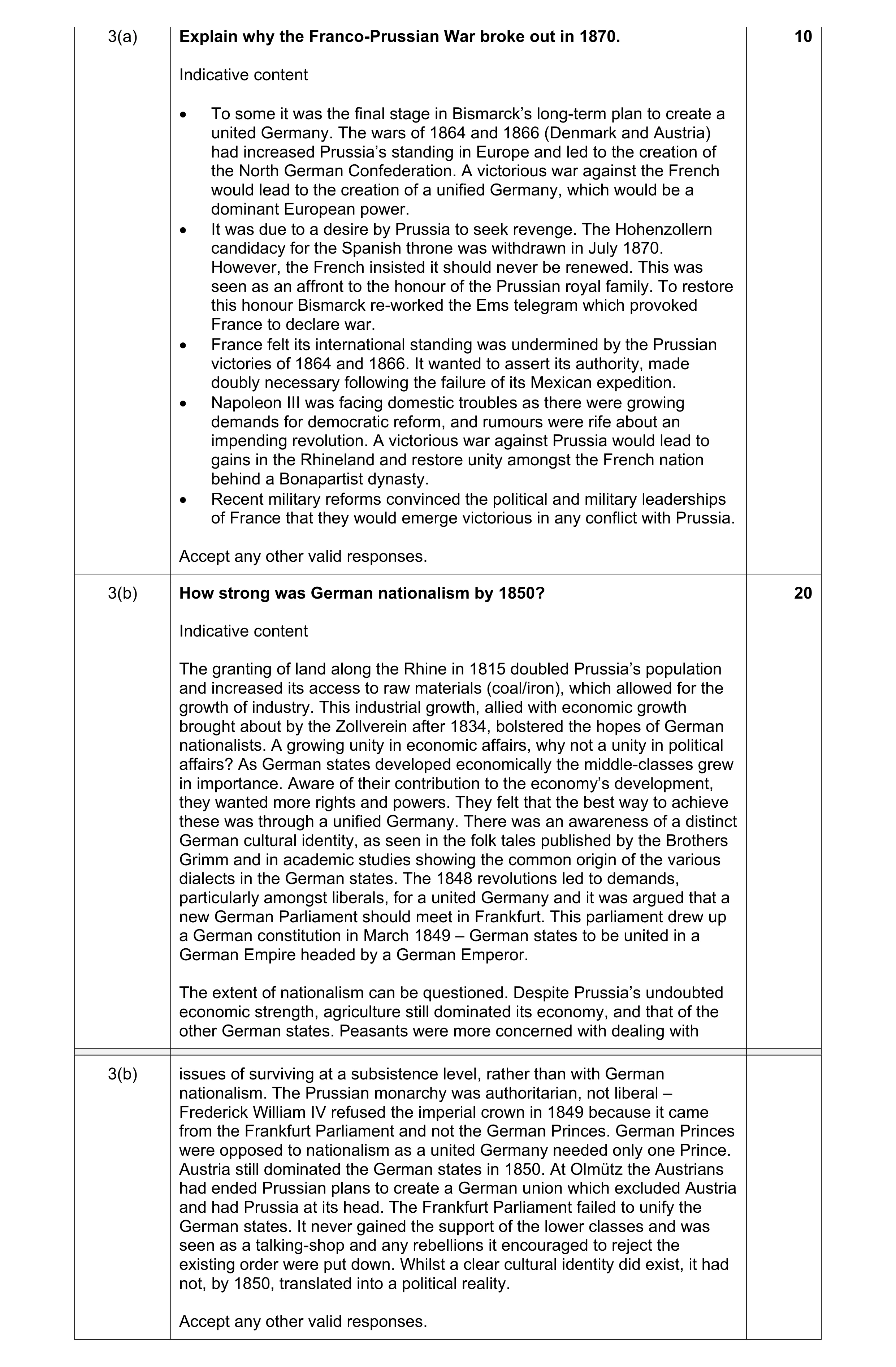 30
30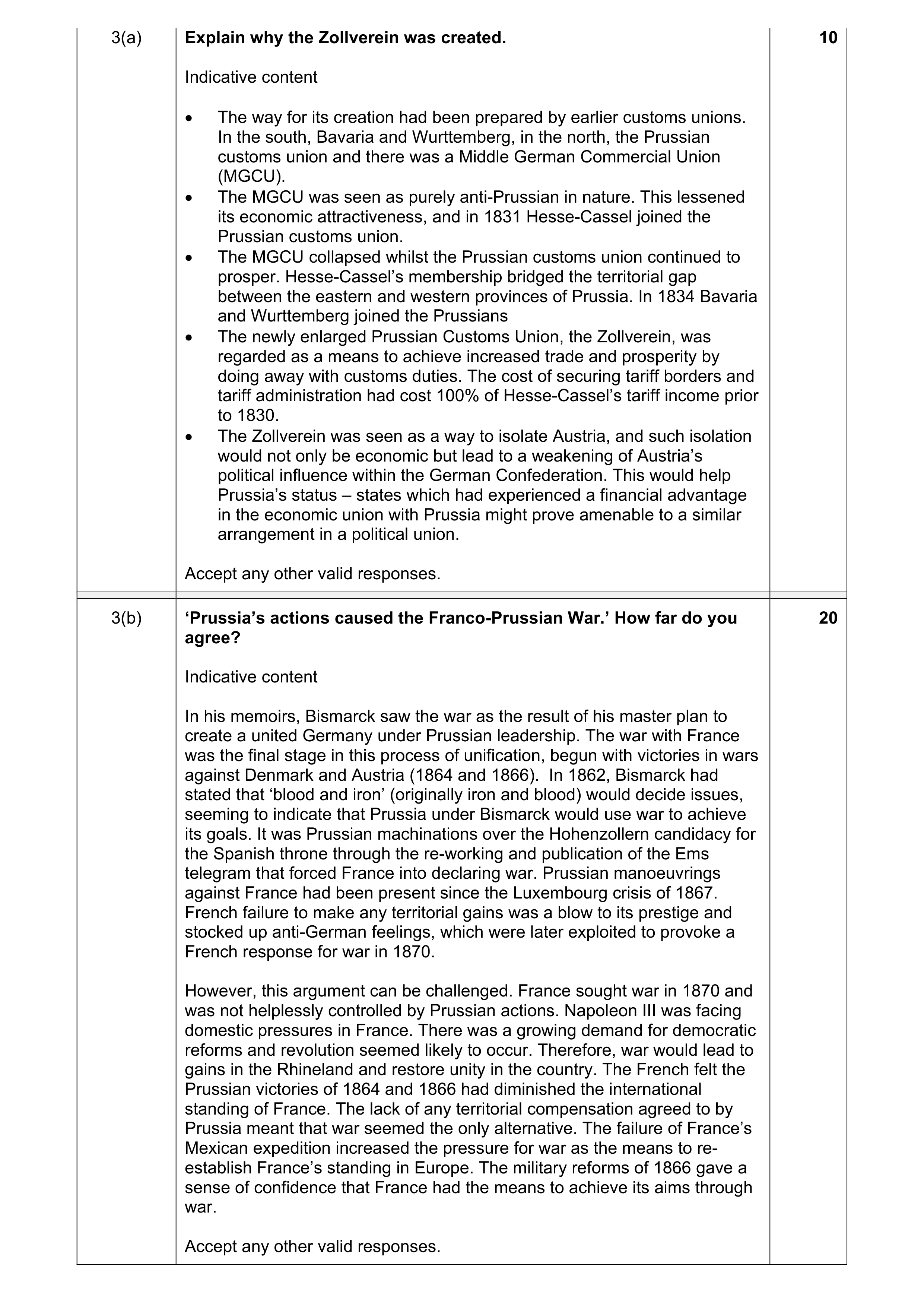 30
30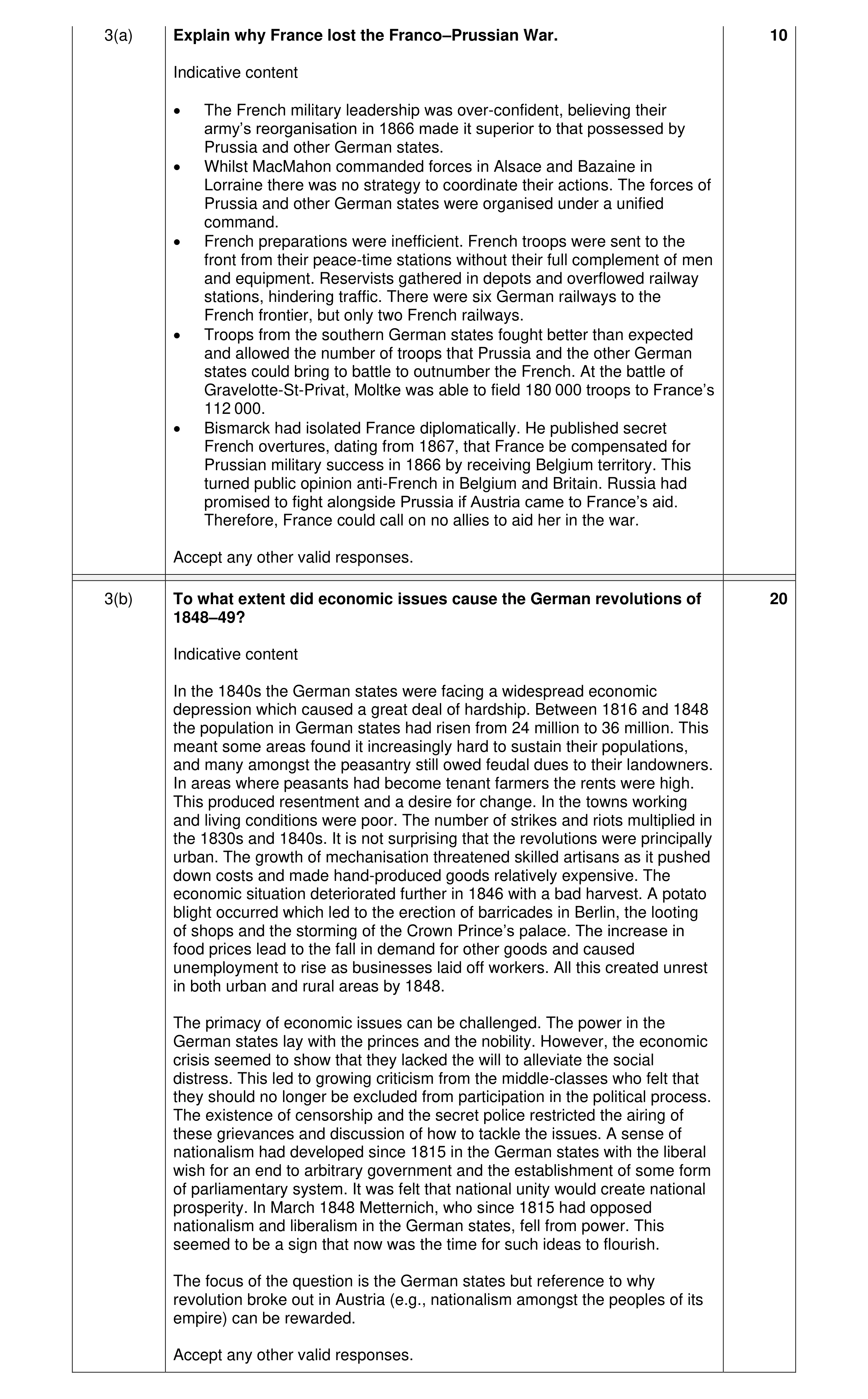 30
30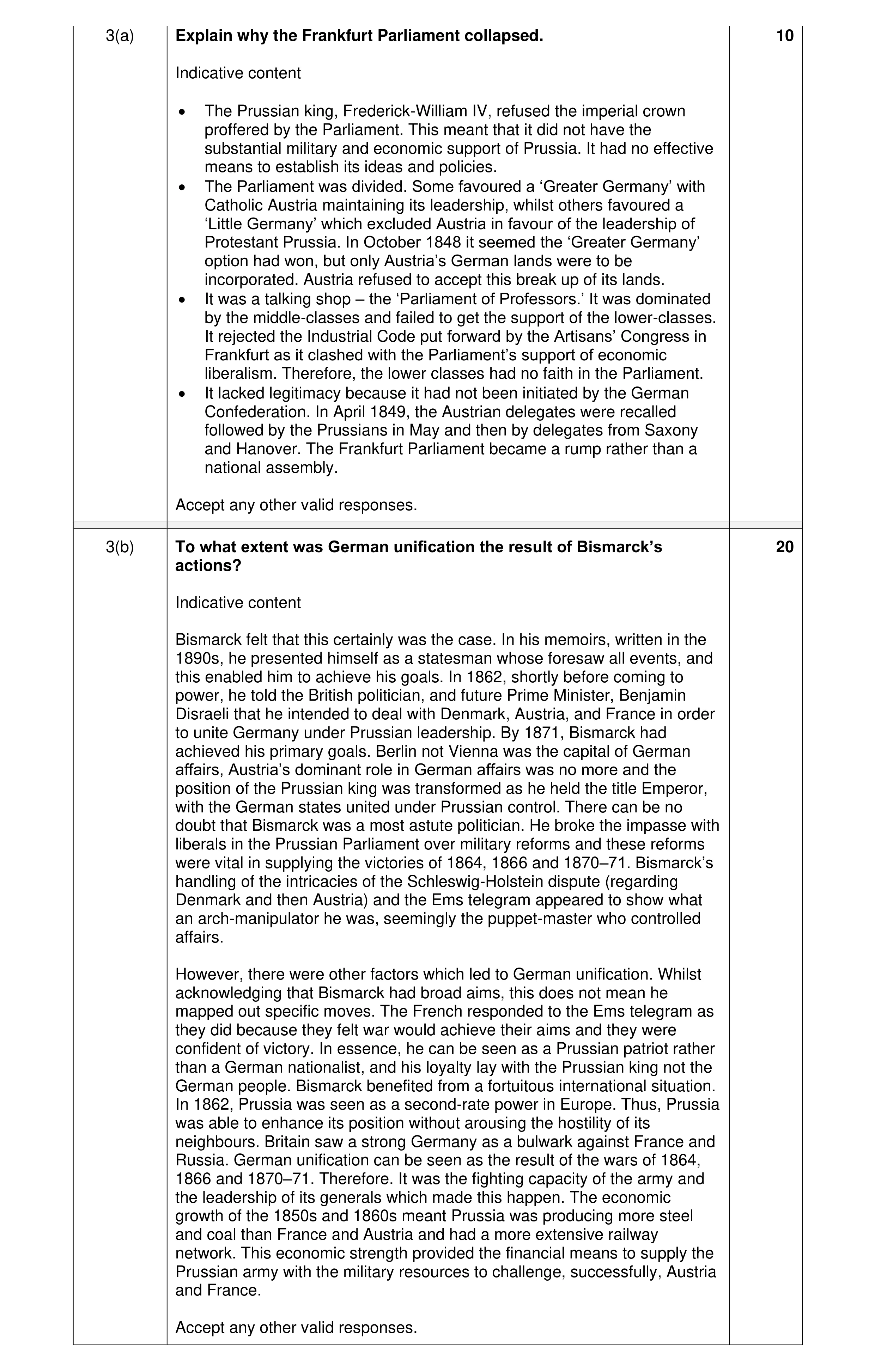 30
30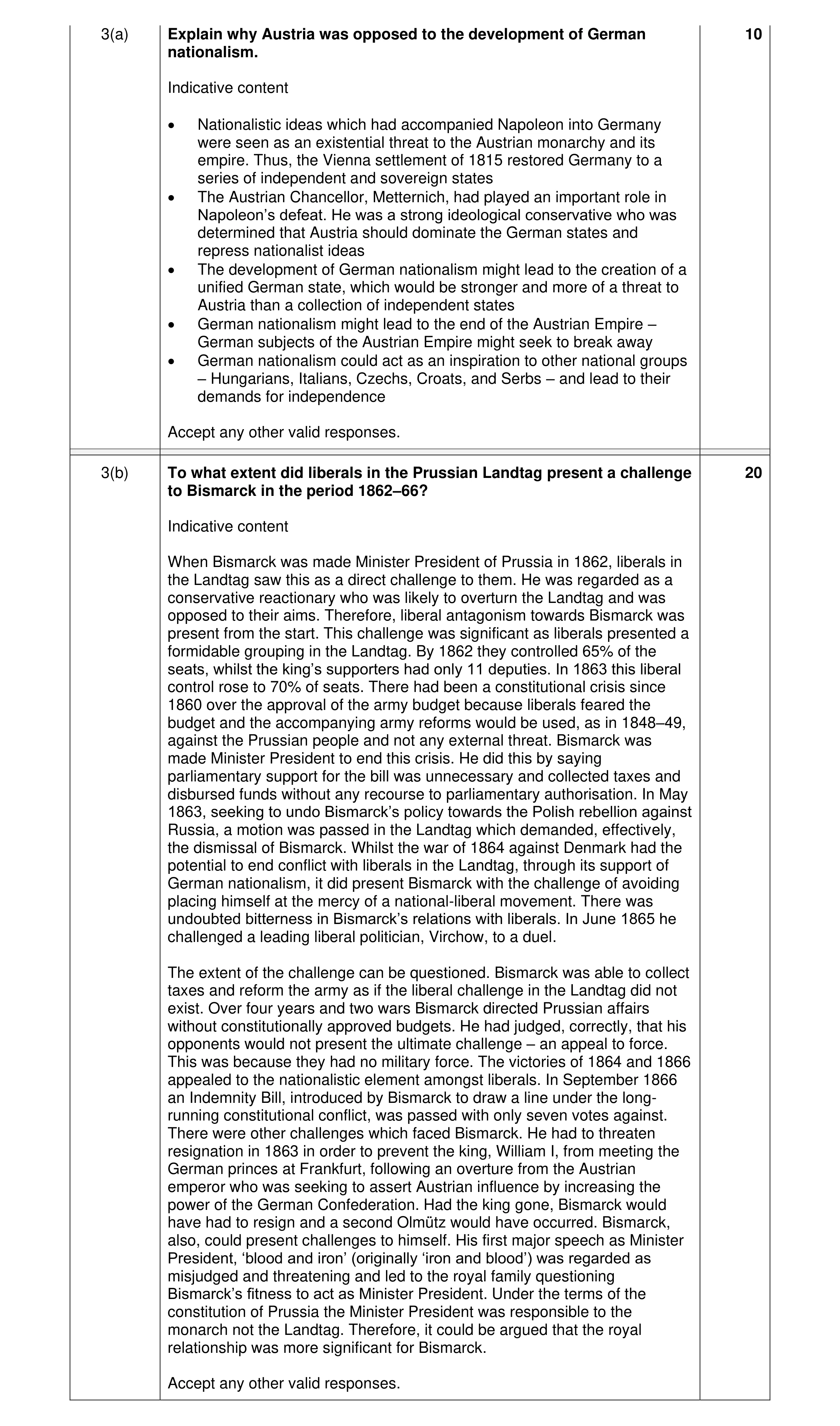 30
30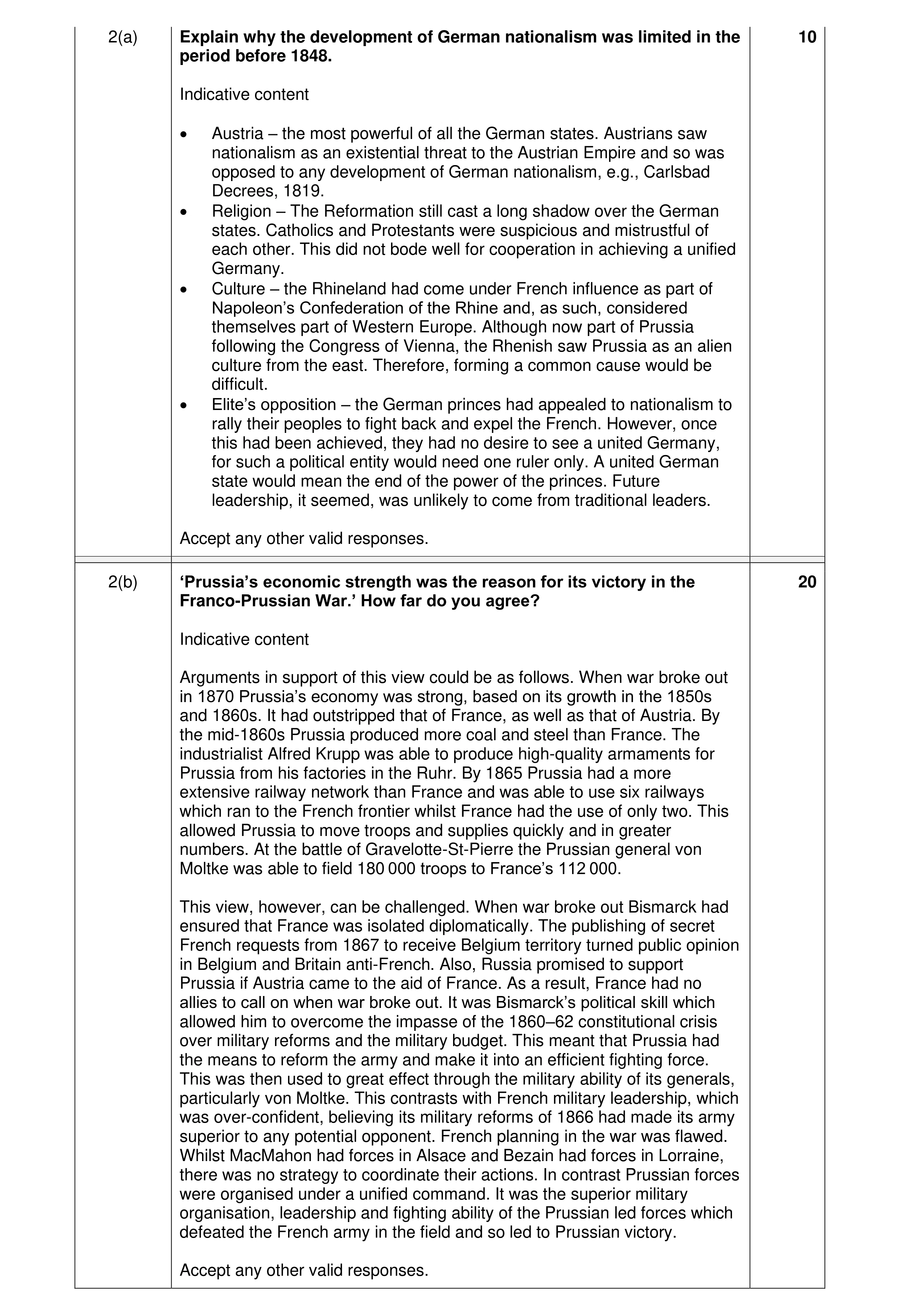 30
30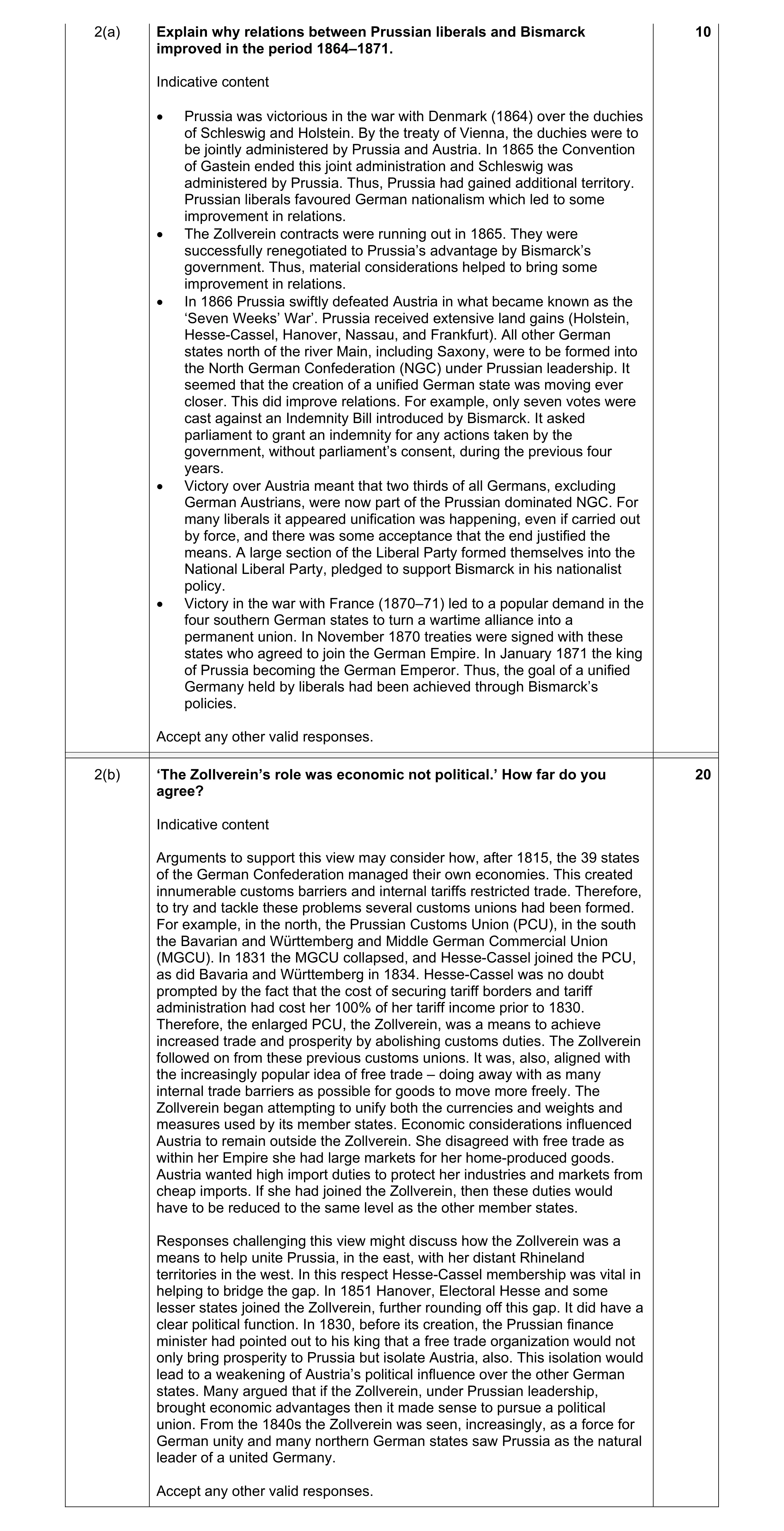 30
30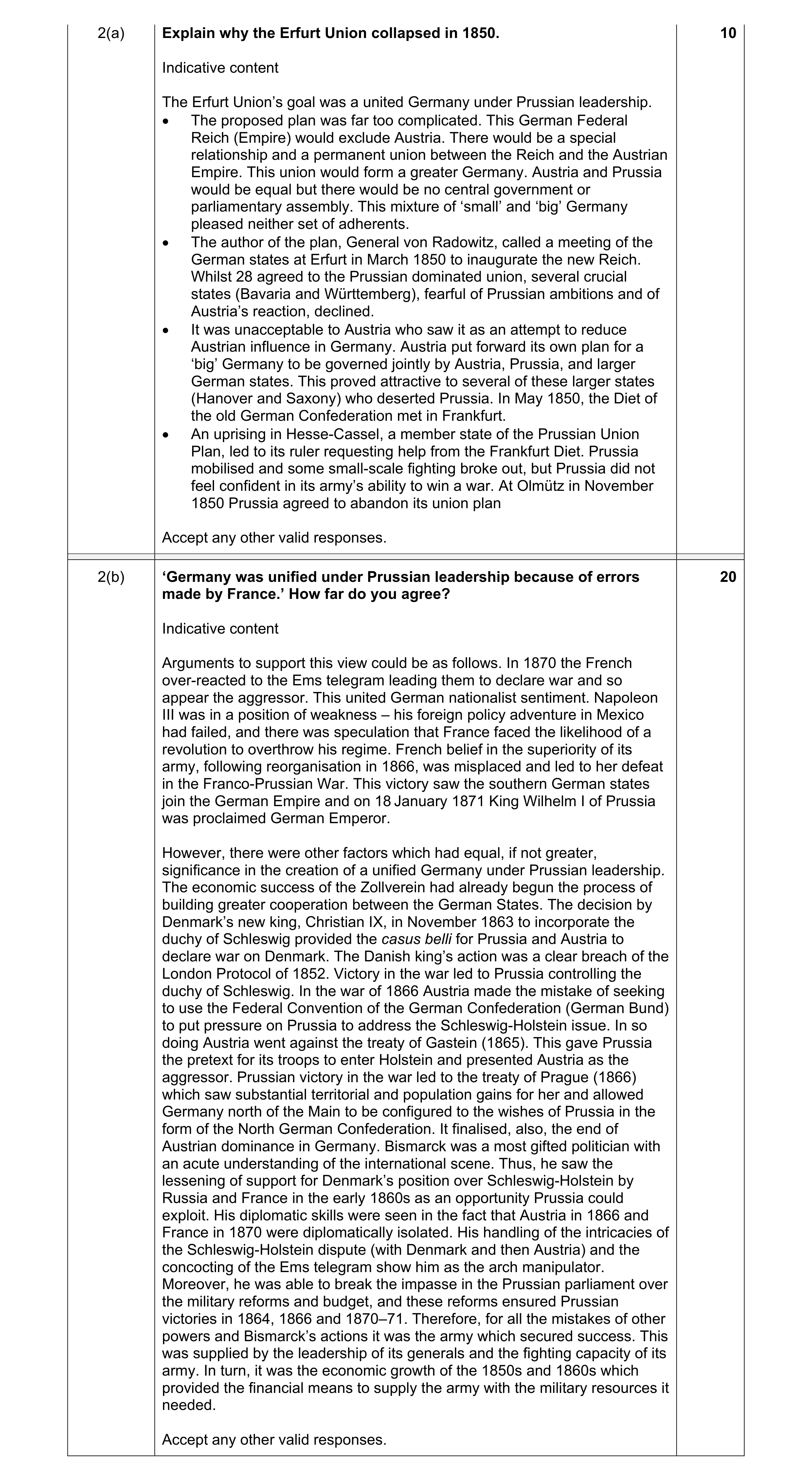 30
30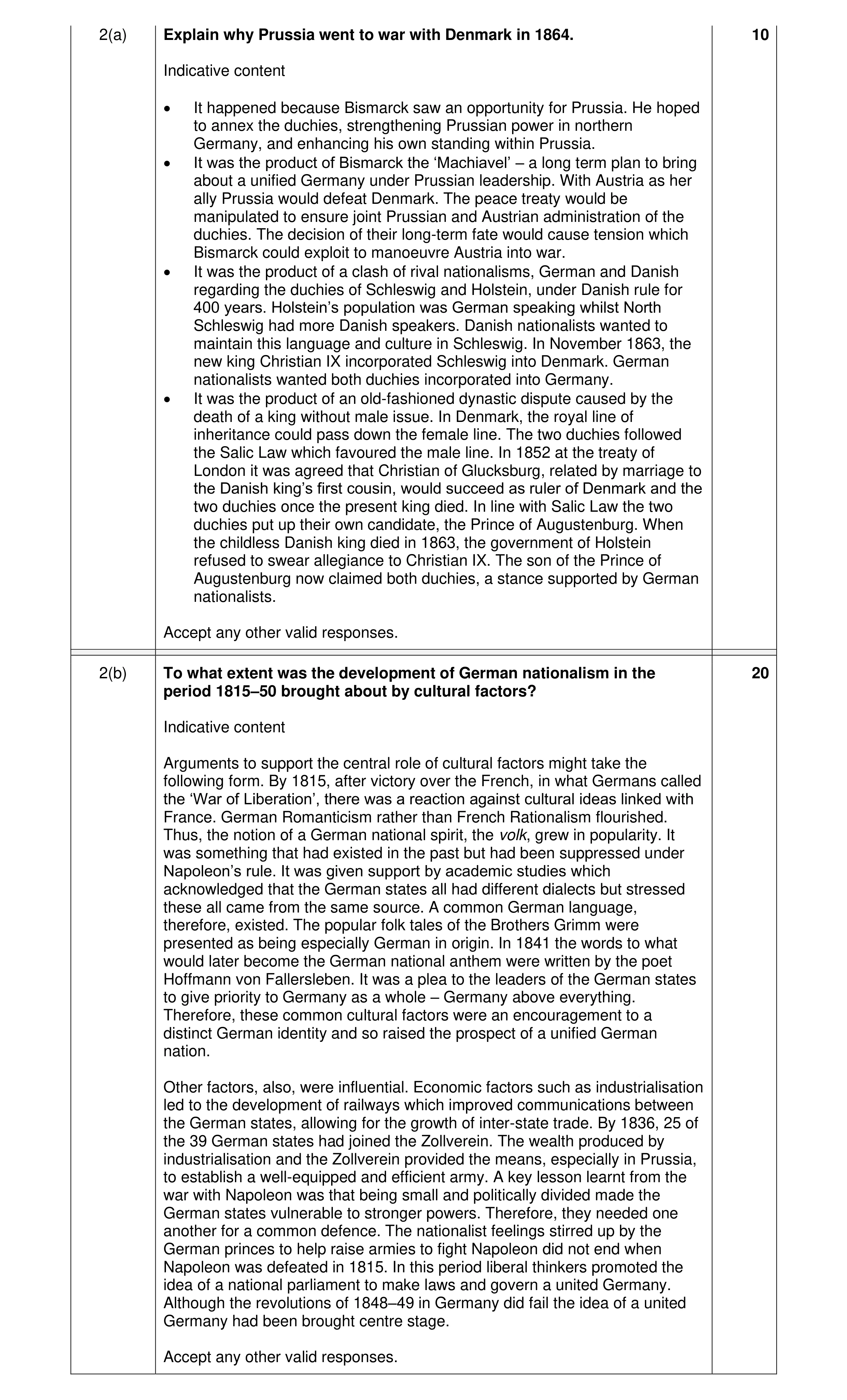 30
30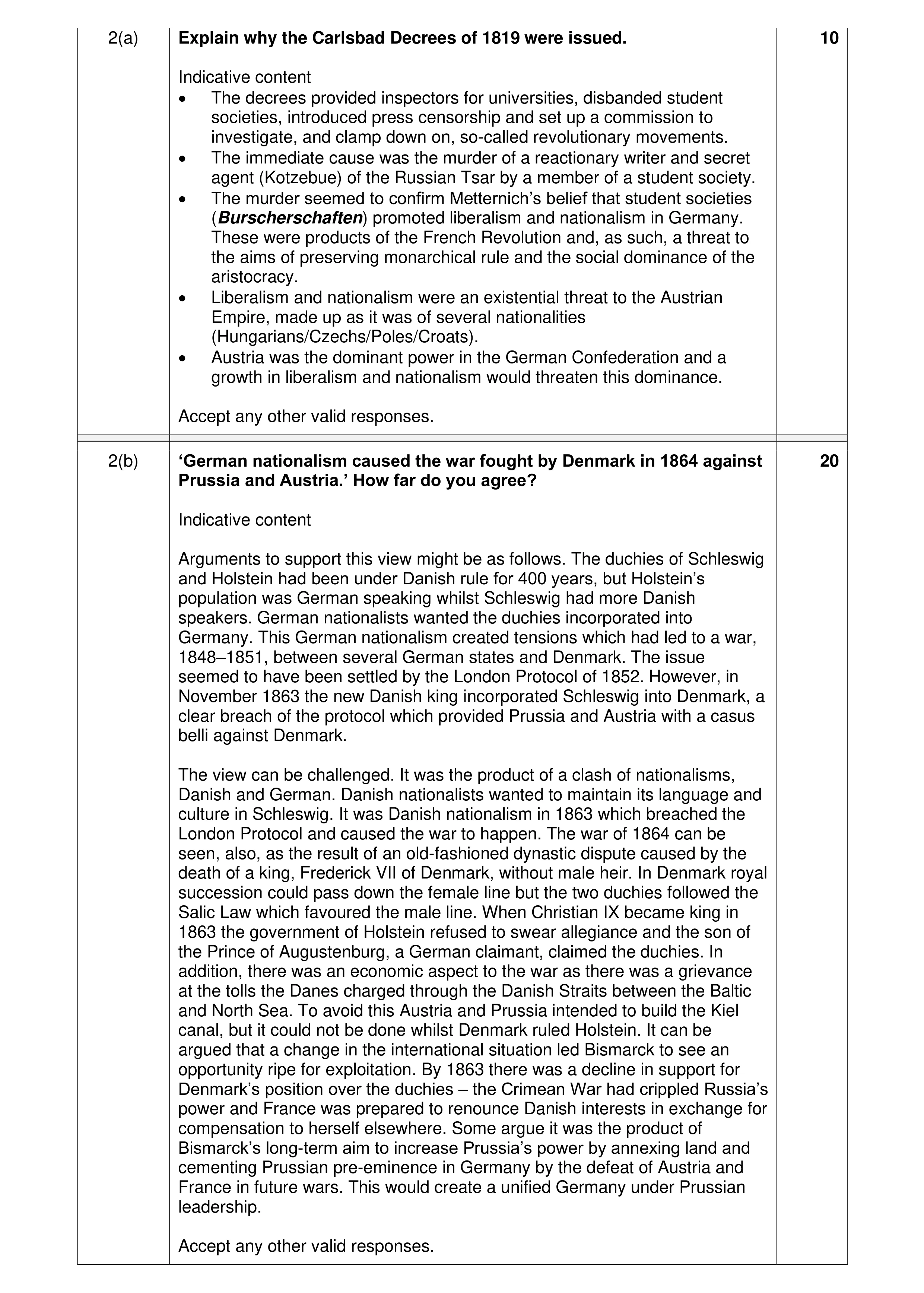 30
30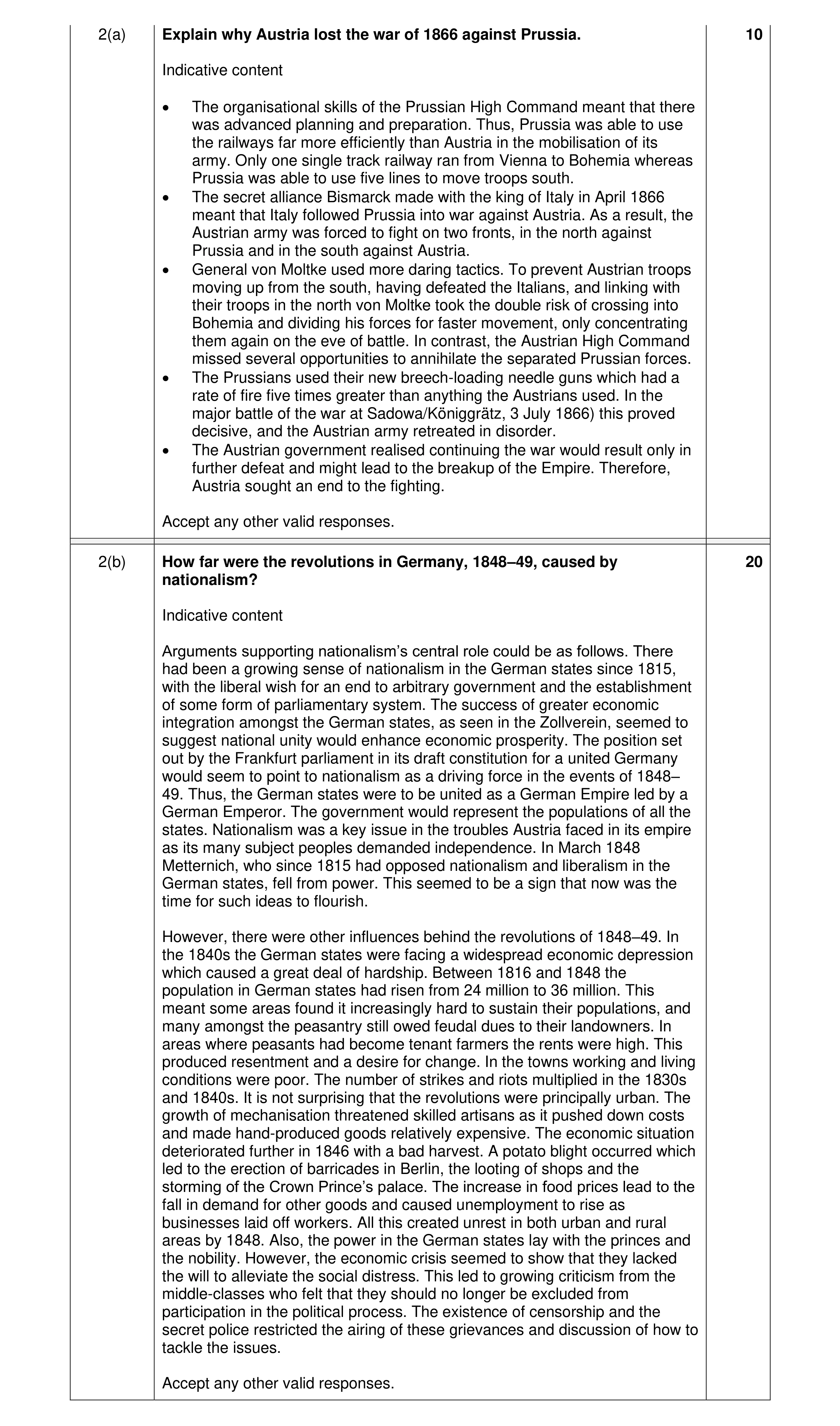 30
30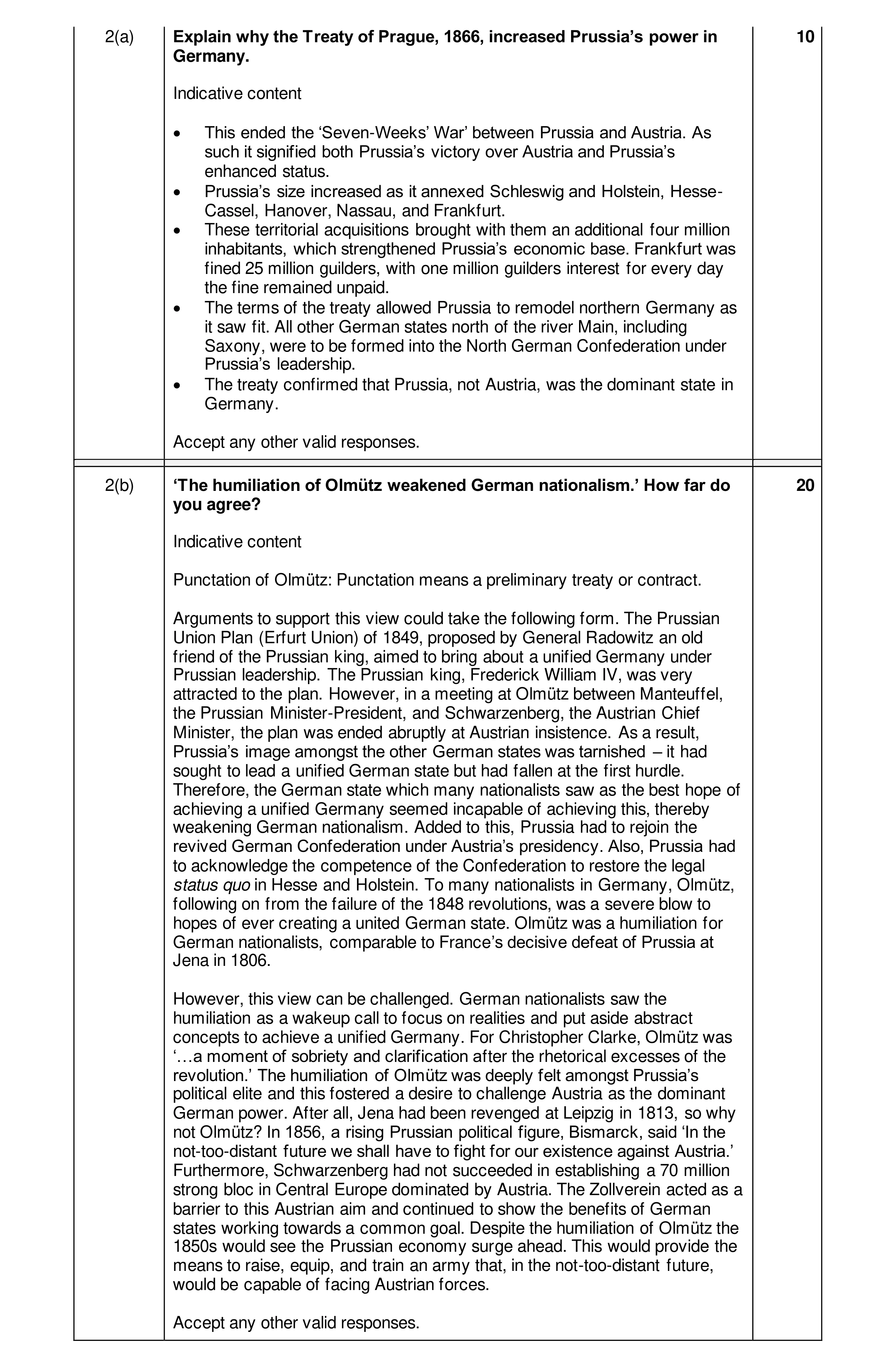 30
30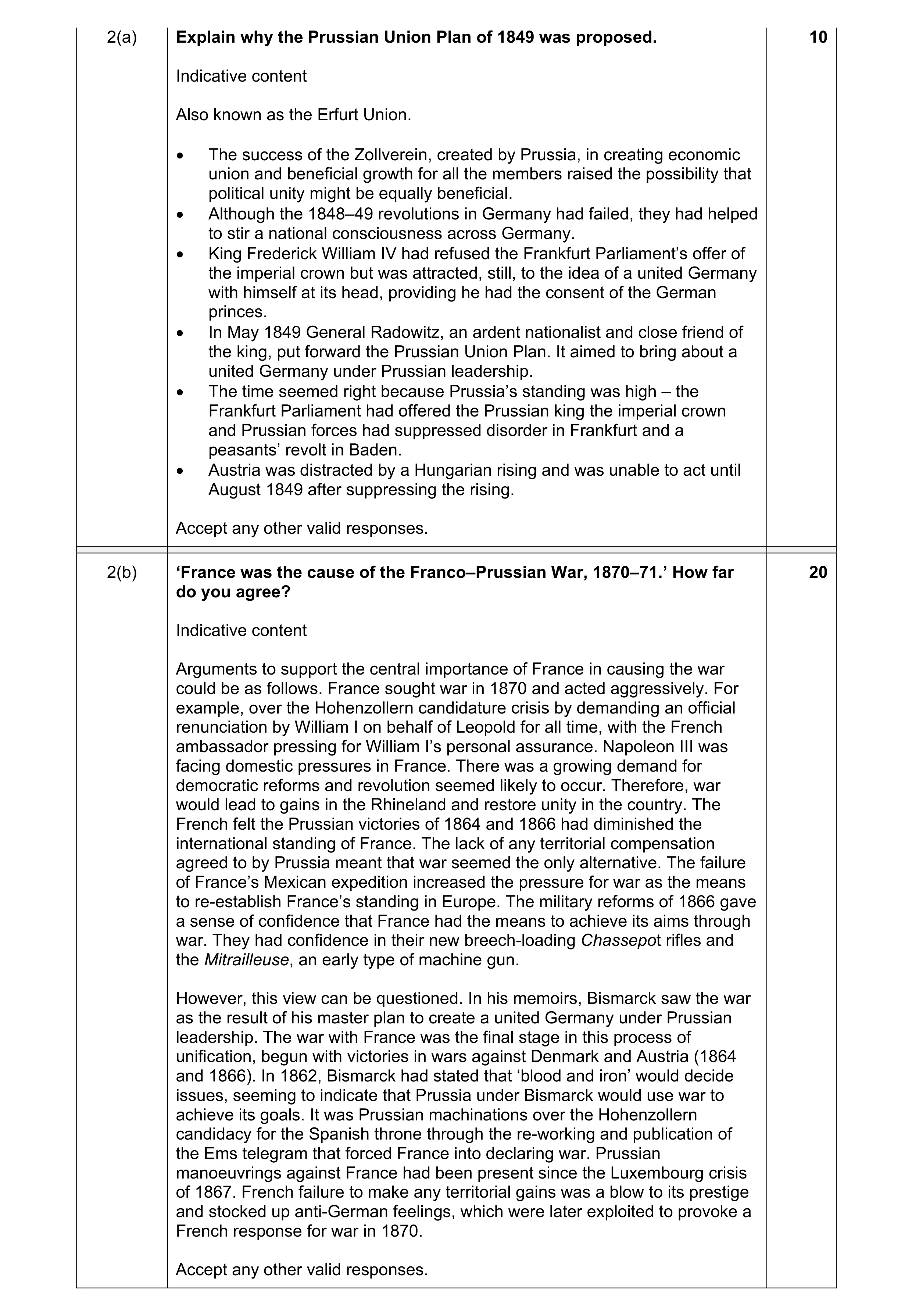 30
30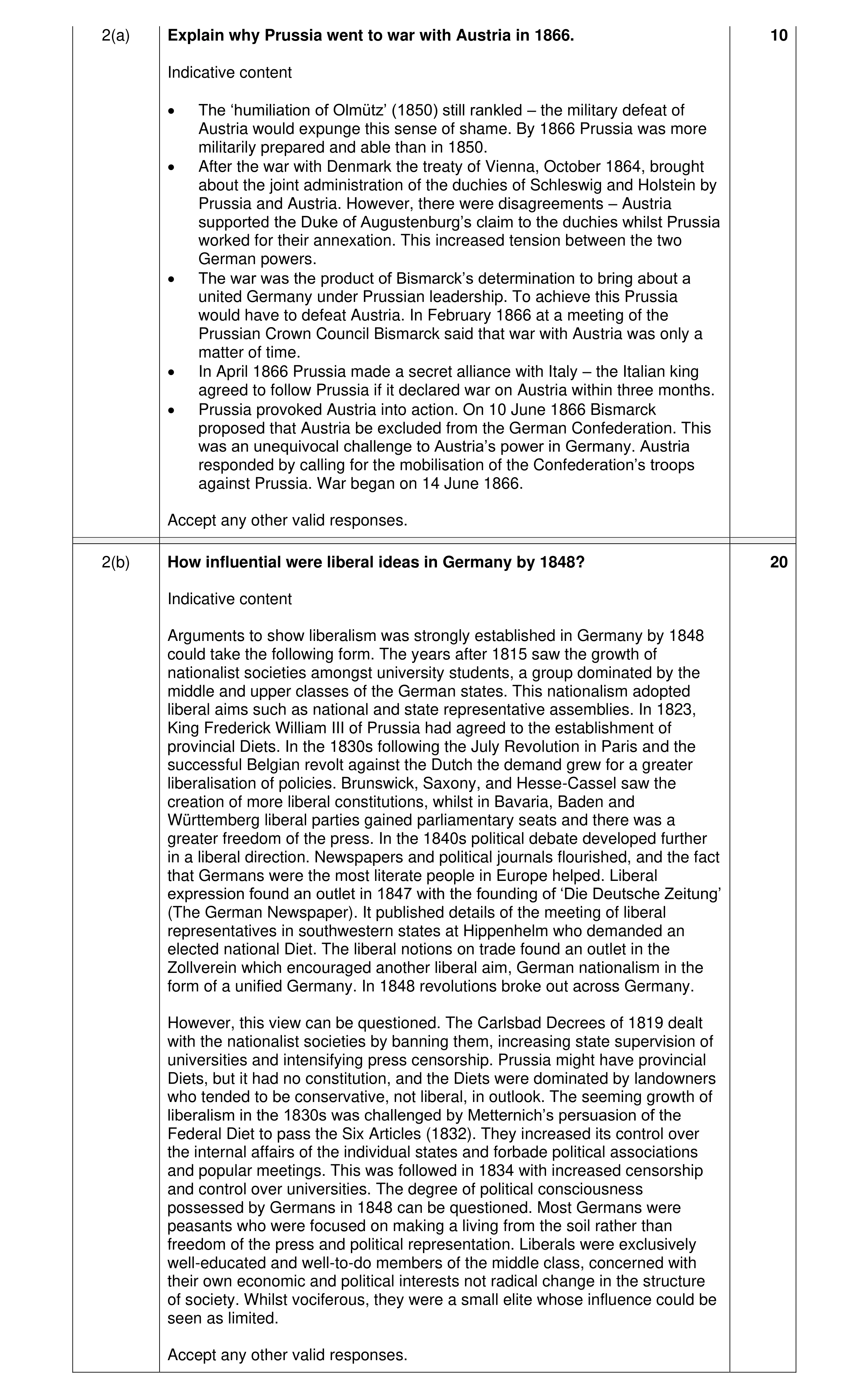 30
30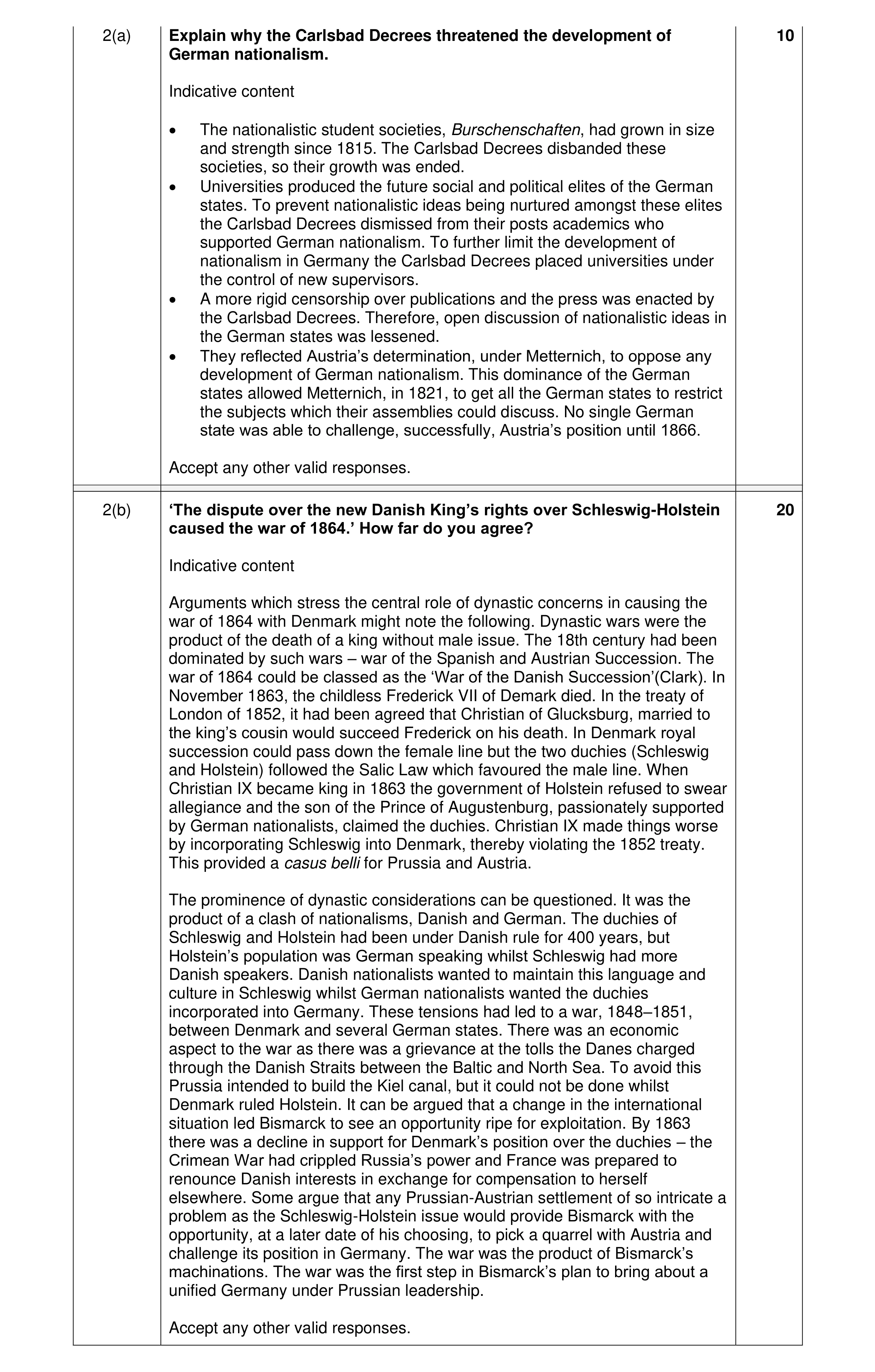 30
30