Questions as text
Q1 · What would be most likely to constrain a firm’s ability to grow? 9708/32 Oct/Nov 2011
9 What would be most likely to constrain a firm’s ability to grow? A the increased difficulty faced by the firm in marketing its product B the increased risks arising from product diversification C the increasing costs of distributing goods from a given location D the increased difficulties faced by the management in coordinating production
1 marks
Answer: D
This question in 9708/32 Oct/Nov 2011
Q2 · Which is a financial economy of scale? 9708/31 May/June 2012
6 Which is a financial economy of scale? A lower costs in raising capital B lower costs of marketing C lower risk due to diversification D lower variable costs of production
1 marks
Answer: A
This question in 9708/31 May/June 2012
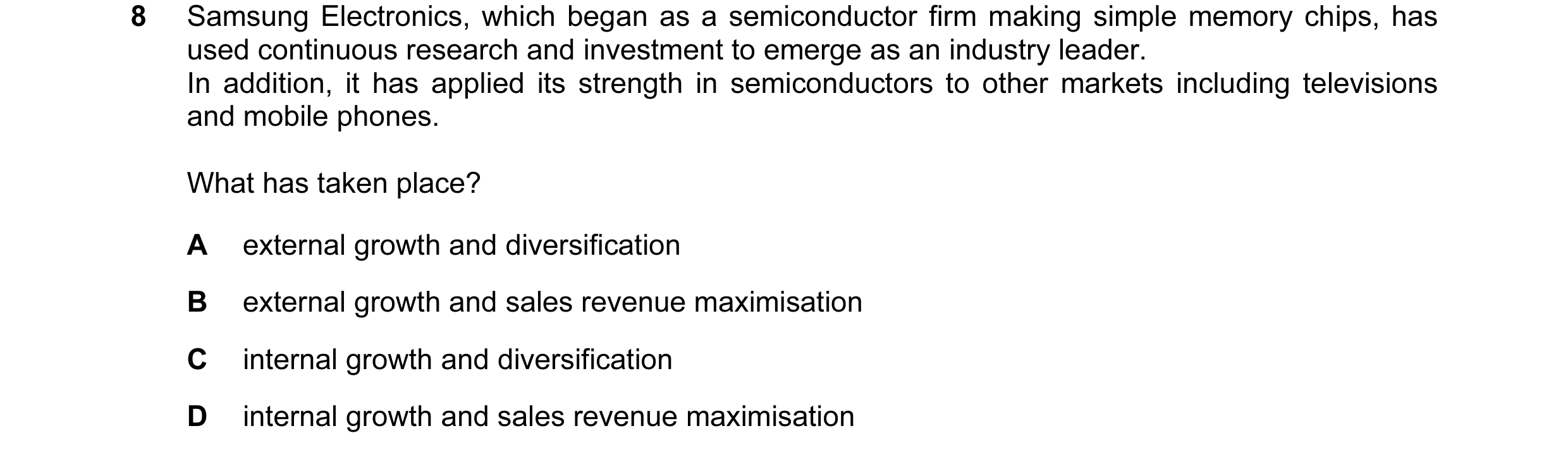
Q3 · Samsung Electronics, which began as a semiconductor firm making simple memory chips, has… 9708/33 May/June 2012
8 Samsung Electronics, which began as a semiconductor firm making simple memory chips, has used continuous research and investment to emerge as an industry leader. In addition, it has applied its strength in semiconductors to other markets including televisions and mobile phones. What has taken place? A external growth and diversification B external growth and sales revenue maximisation C internal growth and diversification D internal growth and sales revenue maximisation
1 marks
Answer: C
This question in 9708/33 May/June 2012
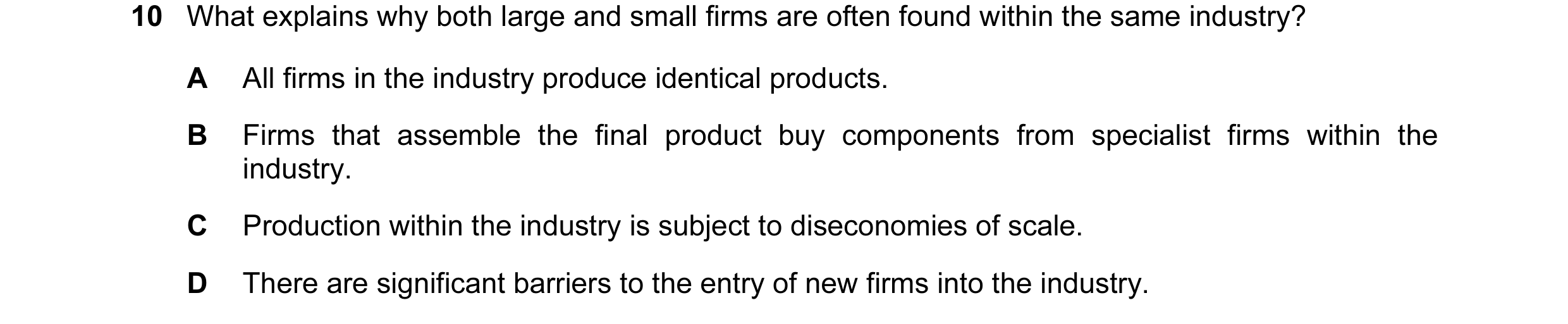
Q4 · What explains why both large and small firms are often found within the same industry? 9708/33 May/June 2012
10 What explains why both large and small firms are often found within the same industry? A All firms in the industry produce identical products. B Firms that assemble the final product buy components from specialist firms within the industry. C Production within the industry is subject to diseconomies of scale. D There are significant barriers to the entry of new firms into the industry.
1 marks
Answer: B
This question in 9708/33 May/June 2012
Q5 · What is most likely to be associated with a firm that is growing rapidly? 9708/32 Oct/Nov 2012
10 What is most likely to be associated with a firm that is growing rapidly? A a high rate of labour turnover B a low level of net investment C a low percentage of profits paid as dividends to shareholders D attainment of the necessary conditions for allocative efficiency
1 marks
Answer: C
This question in 9708/32 Oct/Nov 2012
Q6 · What is most likely to pose a threat to the survival of small local bakeries? 9708/31 May/June 2013
8 What is most likely to pose a threat to the survival of small local bakeries? A an increase in the cost per minute of television advertising B a switch in consumer preferences to cheaper mass-produced bread C diseconomies of scale in the process of bread production D increased congestion on road networks
1 marks
Answer: B
This question in 9708/31 May/June 2013
Q7 · Which feature of an economy would be most favourable for the survival of small firms? 9708/32 May/June 2013
9 Which feature of an economy would be most favourable for the survival of small firms? A capital intensive production B economies of scale in production C the presence of a stock exchange D the widespread availability of bank lending
1 marks
Answer: D
This question in 9708/32 May/June 2013
Q8 · What is most likely to pose a threat to the survival of small local bakeries? 9708/33 May/June 2013
8 What is most likely to pose a threat to the survival of small local bakeries? A an increase in the cost per minute of television advertising B a switch in consumer preferences to cheaper mass-produced bread C diseconomies of scale in the process of bread production D increased congestion on road networks
1 marks
Answer: B
This question in 9708/33 May/June 2013
Q9 · Firms can grow internally or externally 9708/31 Oct/Nov 2013
9 Firms can grow internally or externally. Which strategy is an example of a commercial bank growing internally? A the bank cutting its costs by rationalising its structure B the bank merging with another commercial bank C the bank opening new branches D the bank taking over an insurance company
1 marks
Answer: C
This question in 9708/31 Oct/Nov 2013
Q10 · What is an internal diseconomy of scale that often arises as a firm becomes larger? 9708/32 Oct/Nov 2013
9 What is an internal diseconomy of scale that often arises as a firm becomes larger? A a more complex decision-making process B an increase in the cost of raising finance for investment C an increase in traffic congestion D upward pressure on wages in the local labour market
1 marks
Answer: A
This question in 9708/32 Oct/Nov 2013
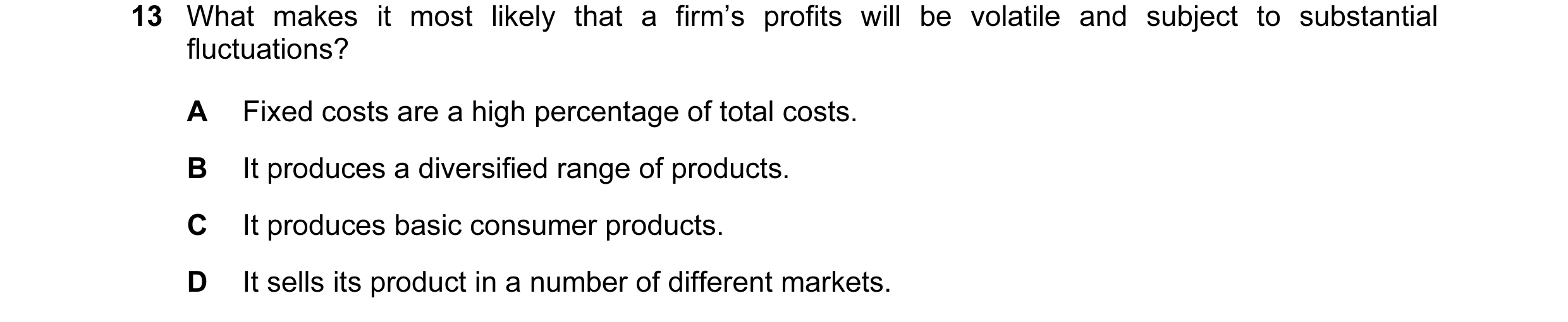
Q11 · What makes it most likely that a firm’s profits will be volatile and subject to… 9708/32 Oct/Nov 2013
13 What makes it most likely that a firm’s profits will be volatile and subject to substantial fluctuations? A Fixed costs are a high percentage of total costs. B It produces a diversified range of products. C It produces basic consumer products. D It sells its product in a number of different markets.
1 marks
Answer: A
This question in 9708/32 Oct/Nov 2013
Q12 · What is likely to make it more difficult for a small firm to survive? 9708/33 Oct/Nov 2013
10 What is likely to make it more difficult for a small firm to survive? A increased preference on the part of consumers for distinctive non-standardised products B reductions in the rate of interest charged by commercial banks C the absence of effective barriers to the entry of potential competitors D the existence of decreasing returns to scale
1 marks
Answer: C
This question in 9708/33 Oct/Nov 2013
Q13 · Which is a financial economy of scale? 9708/31 Oct/Nov 2014
10 Which is a financial economy of scale? A greater bargaining power in purchasing from suppliers B greater diversification of the product range C lower costs in raising capital D lower distribution costs by increasing market share
1 marks
Answer: C
This question in 9708/31 Oct/Nov 2014
Q14 · What makes it easier for a small firm to compete against large firms in the same industry? 9708/31 May/June 2015
10 What makes it easier for a small firm to compete against large firms in the same industry? A The nature of the industry’s product is highly standardised. B The product specification demanded by each customer is different. C There are significant barriers facing potential new entrants. D Transport costs are low relative to the value of the product.
1 marks
Answer: B
This question in 9708/31 May/June 2015
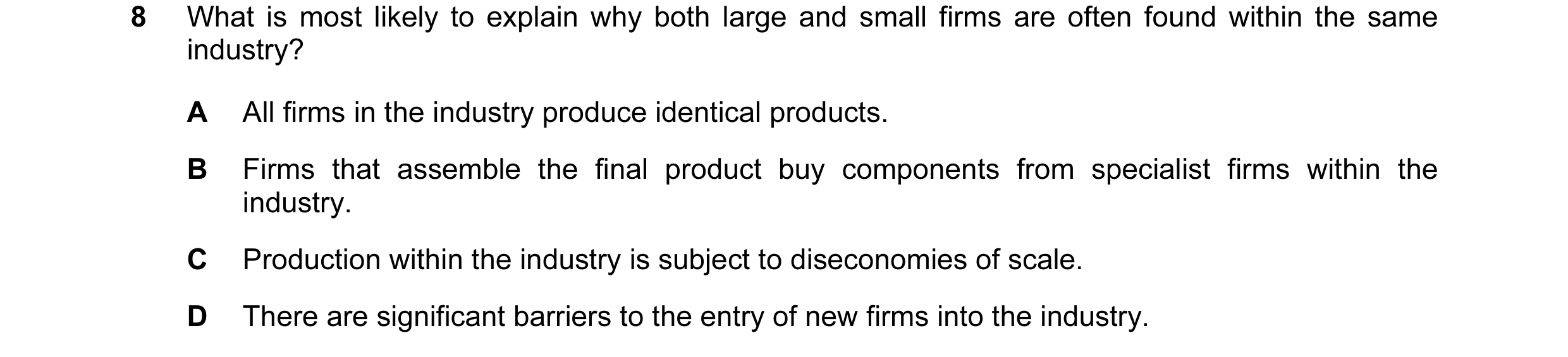
Q15 · What is most likely to explain why both large and small firms are often found within the… 9708/31 Oct/Nov 2015
8 What is most likely to explain why both large and small firms are often found within the same industry? A All firms in the industry produce identical products. B Firms that assemble the final product buy components from specialist firms within the industry. C Production within the industry is subject to diseconomies of scale. D There are significant barriers to the entry of new firms into the industry.
1 marks
This question in 9708/31 Oct/Nov 2015
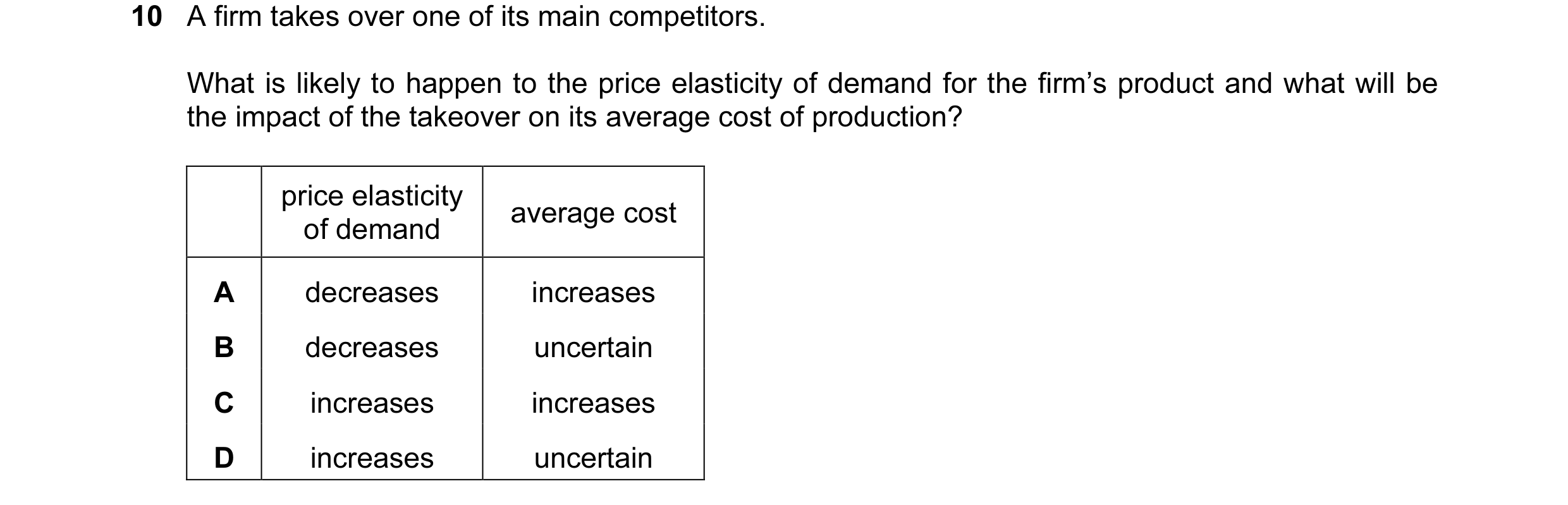
Q16 · A firm takes over one of its main competitors 9708/31 Oct/Nov 2015
10 A firm takes over one of its main competitors. What is likely to happen to the price elasticity of demand for the firm’s product and what will be the impact of the takeover on its average cost of production? price elasticity average cost of demand A decreases increases B decreases uncertain C increases increases D increases uncertain
1 marks
This question in 9708/31 Oct/Nov 2015
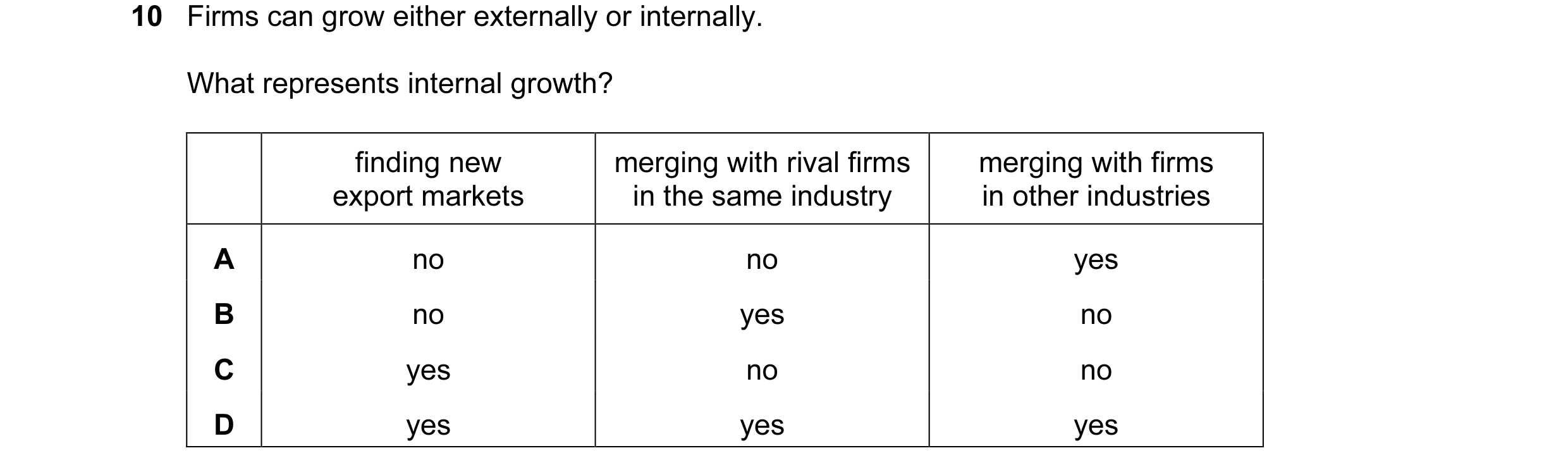
Q17 · Firms can grow either externally or internally 9708/32 Oct/Nov 2015
10 Firms can grow either externally or internally. What represents internal growth? finding new merging with rival firms merging with firms export markets in the same industry in other industries A no no yes B no yes no C yes no no D yes yes yes
1 marks
Answer: C
This question in 9708/32 Oct/Nov 2015
Q18 · What must a firm do to achieve internal growth? 9708/33 Oct/Nov 2015
10 What must a firm do to achieve internal growth? A increase productive capacity B issue new shares C launch new products D retain some of its profits
1 marks
Answer: A
This question in 9708/33 Oct/Nov 2015
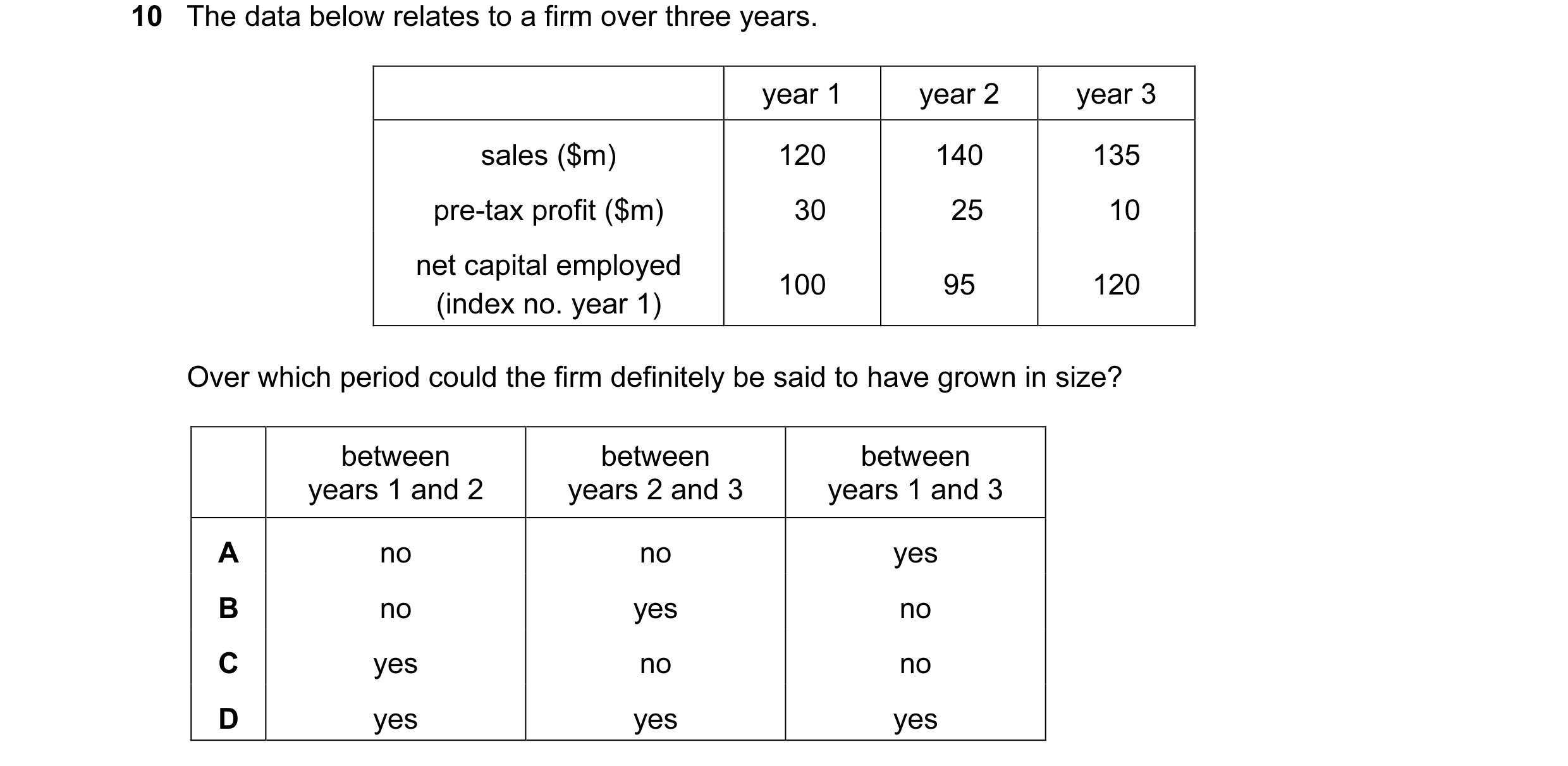
Q19 · The data below relates to a firm over three years 9708/33 May/June 2016
10 The data below relates to a firm over three years. year 1 year 2 year 3 sales ($m) 120 140 135 pre-tax profit ($m) 30 25 10 net capital employed 100 95 120 (index no. year 1) Over which period could the firm definitely be said to have grown in size? between between between years 1 and 2 years 2 and 3 years 1 and 3 A no no yes B no yes no C yes no no D yes yes yes
1 marks
Answer: A
This question in 9708/33 May/June 2016
Q20 · What is one of the long-term benefits to a firm of vertical integration? 9708/32 Oct/Nov 2016
6 What is one of the long-term benefits to a firm of vertical integration? A a concentration on activities in which the firm has a comparative advantage B a reduction in the total costs involved in agreeing contracts with other firms C an increase in the firm’s market share D improvements in efficiency resulting from increased use of market incentives
1 marks
Answer: B
This question in 9708/32 Oct/Nov 2016
Q21 · Why might an industry consist mainly of small firms? 9708/33 Oct/Nov 2016
6 Why might an industry consist mainly of small firms? A Diseconomies of scale occur at a low level of output. B Government policy encourages horizontal integration. C Integration is impossible. D There is an international market for the product.
1 marks
Answer: A
This question in 9708/33 Oct/Nov 2016
Q22 · What could be a reason for the existence of small firms in various industries? 9708/32 May/June 2017
9 What could be a reason for the existence of small firms in various industries? A a low minimum efficient scale of production B greater scope for specialisation and division of labour C the need to diversify in order to reduce risk D the principal-agent problem
1 marks
Answer: A
This question in 9708/32 May/June 2017
Q23 · Technological change reduces the minimum efficient scale of production in an industry 9708/32 Oct/Nov 2018
9 Technological change reduces the minimum efficient scale of production in an industry. What is likely to result? A increased number of firms and increased size of firms B increased number of firms and reduced size of firms C reduced number of firms and increased size of firms D reduced number of firms and reduced size of firms
1 marks
Answer: B
This question in 9708/32 Oct/Nov 2018
Q24 · What would be a reason why small firms do not survive? 9708/32 Oct/Nov 2018
11 What would be a reason why small firms do not survive? A In certain industries, there are economies of scale. B Small firms often supply personal services to consumers. C Small firms often supply products, the size of the market for which is limited. D Small owner-managed firms involve less risk.
1 marks
Answer: A
This question in 9708/32 Oct/Nov 2018
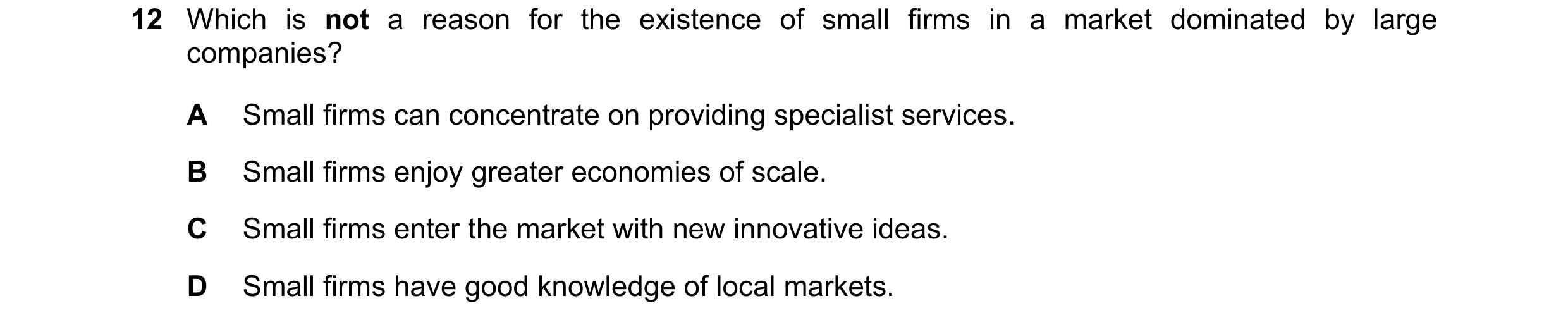
Q25 · Which is not a reason for the existence of small firms in a market dominated by large… 9708/31 Oct/Nov 2020
12 Which is not a reason for the existence of small firms in a market dominated by large companies? A Small firms can concentrate on providing specialist services. B Small firms enjoy greater economies of scale. C Small firms enter the market with new innovative ideas. D Small firms have good knowledge of local markets.
1 marks
Answer: B
This question in 9708/31 Oct/Nov 2020
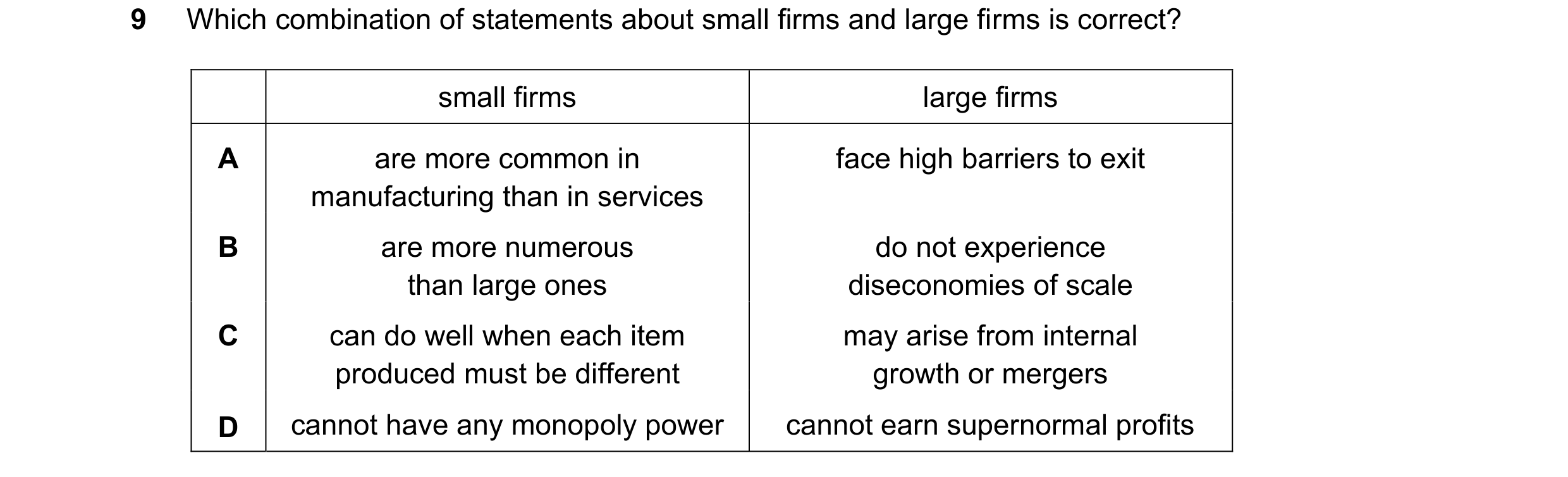
Q26 · Which combination of statements about small firms and large firms is correct? 9708/32 Oct/Nov 2020
9 Which combination of statements about small firms and large firms is correct? small firms large firms A are more common in face high barriers to exit manufacturing than in services B are more numerous do not experience than large ones diseconomies of scale C can do well when each item may arise from internal produced must be different growth or mergers D cannot have any monopoly power cannot earn supernormal profits
1 marks
Answer: C
This question in 9708/32 Oct/Nov 2020
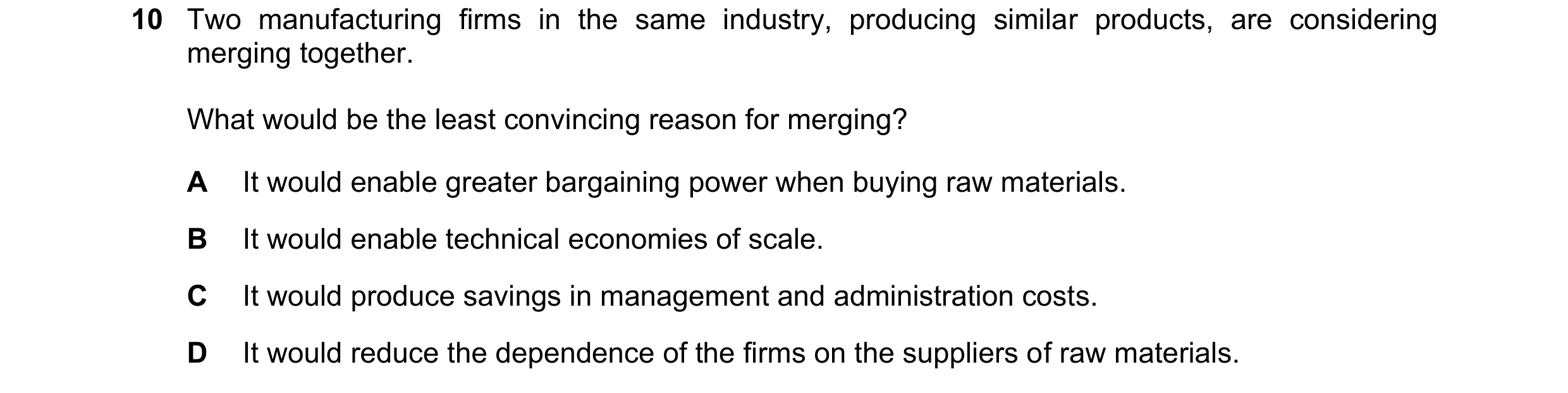
Q27 · Two manufacturing firms in the same industry, producing similar products, are considering… 9708/33 Oct/Nov 2020
10 Two manufacturing firms in the same industry, producing similar products, are considering merging together. What would be the least convincing reason for merging? A It would enable greater bargaining power when buying raw materials. B It would enable technical economies of scale. C It would produce savings in management and administration costs. D It would reduce the dependence of the firms on the suppliers of raw materials.
1 marks
Answer: D
This question in 9708/33 Oct/Nov 2020
Q28 · A firm that controlled over 50% of the market successfully merges with its main… 9708/32 Feb/March 2021
10 A firm that controlled over 50% of the market successfully merges with its main competitor to form one large company. What is the most likely reason why, from the firm’s point of view, the merger will fail? A a fall in consumer surplus B cost of funding the merger C economies of scale D market dominance
1 marks
Answer: B
This question in 9708/32 Feb/March 2021
Q29 · Why might a firm adopt a policy of diversification? 9708/31 May/June 2021
7 Why might a firm adopt a policy of diversification? A to achieve cost economies of scale B to agree common prices with rivals C to ensure greater ability to spread investment risks D to increase productivity of labour
1 marks
Answer: C
This question in 9708/31 May/June 2021
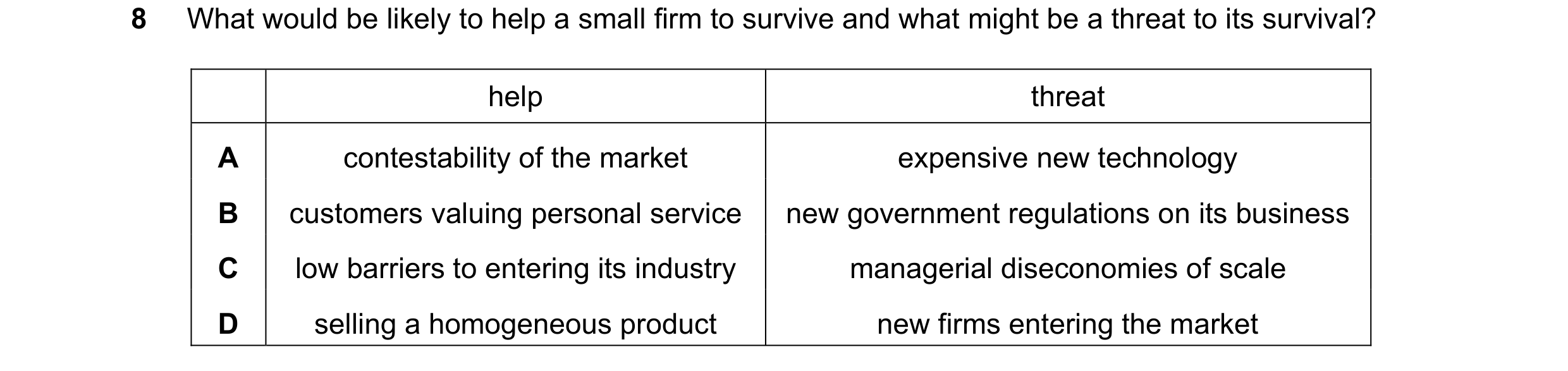
Q30 · What would be likely to help a small firm to survive and what might be a threat to its… 9708/31 May/June 2021
8 What would be likely to help a small firm to survive and what might be a threat to its survival? help threat A contestability of the market expensive new technology B customers valuing personal service new government regulations on its business C low barriers to entering its industry managerial diseconomies of scale D selling a homogeneous product new firms entering the market
1 marks
Answer: B
This question in 9708/31 May/June 2021
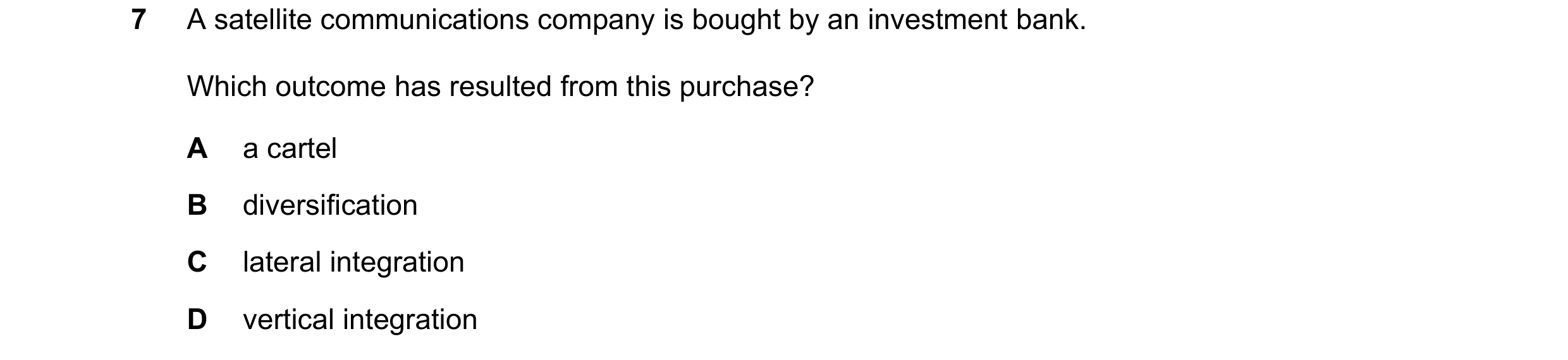
Q31 · A satellite communications company is bought by an investment bank 9708/32 May/June 2021
7 A satellite communications company is bought by an investment bank. Which outcome has resulted from this purchase? A a cartel B diversification C lateral integration D vertical integration
1 marks
Answer: B
This question in 9708/32 May/June 2021
Q32 · Why might a firm adopt a policy of diversification? 9708/33 May/June 2021
7 Why might a firm adopt a policy of diversification? A to achieve cost economies of scale B to agree common prices with rivals C to ensure greater ability to spread investment risks D to increase productivity of labour
1 marks
Answer: C
This question in 9708/33 May/June 2021
Q33 · What would be likely to help a small firm to survive and what might be a threat to its… 9708/33 May/June 2021
8 What would be likely to help a small firm to survive and what might be a threat to its survival? help threat A contestability of the market expensive new technology B customers valuing personal service new government regulations on its business C low barriers to entering its industry managerial diseconomies of scale D selling a homogeneous product new firms entering the market
1 marks
Answer: B
This question in 9708/33 May/June 2021
Q34 · Which characteristic of a market is a reason for a firm to remain small? 9708/32 Oct/Nov 2021
10 Which characteristic of a market is a reason for a firm to remain small? A The minimum efficient scale is high. B The potential for x-inefficiency is high. C There are significant economies of scale. D There is limited access to financial capital.
1 marks
Answer: D
This question in 9708/32 Oct/Nov 2021
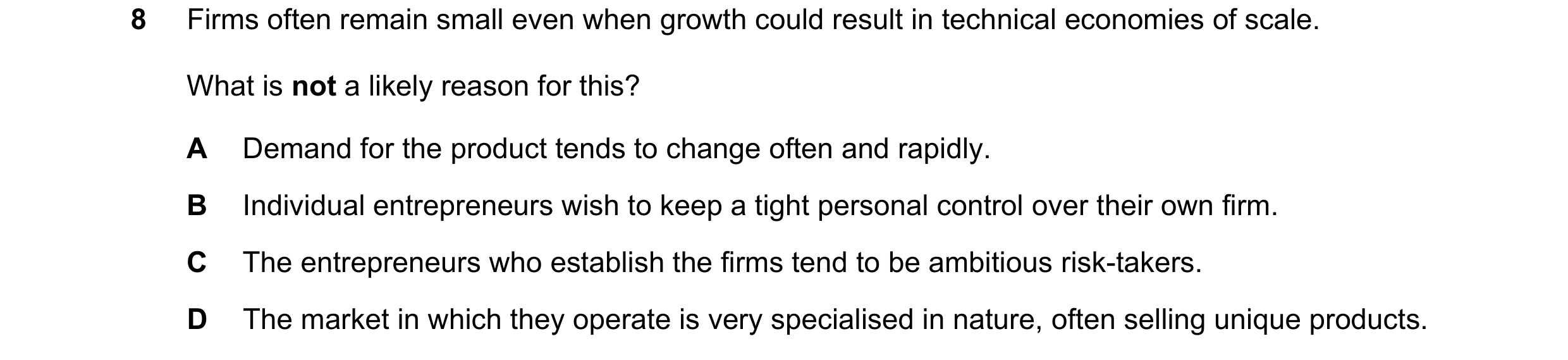
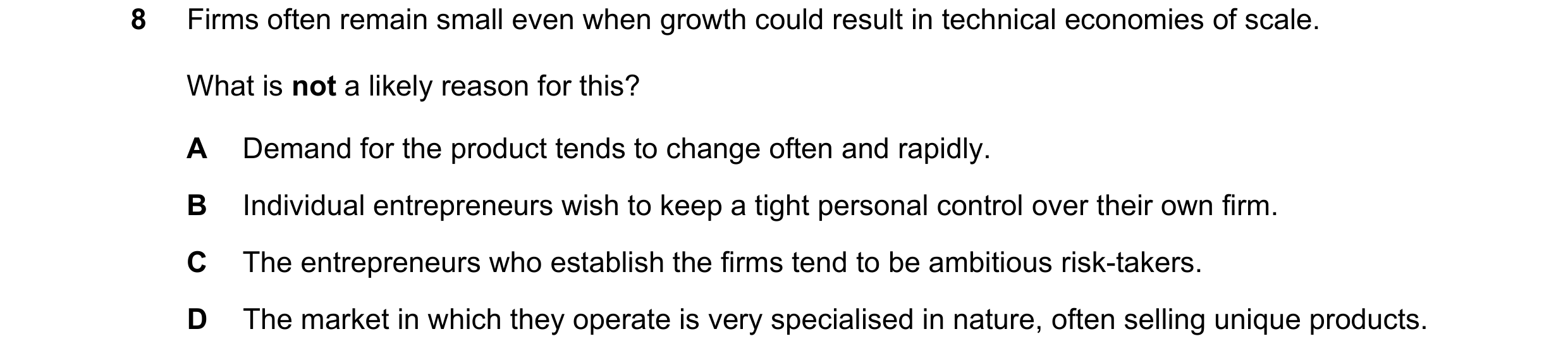
Q35 · Firms often remain small even when growth could result in technical economies of scale 9708/31 May/June 2022
8 Firms often remain small even when growth could result in technical economies of scale. What is not a likely reason for this? A Demand for the product tends to change often and rapidly. B Individual entrepreneurs wish to keep a tight personal control over their own firm. C The entrepreneurs who establish the firms tend to be ambitious risk-takers. D The market in which they operate is very specialised in nature, often selling unique products.
1 marks
Answer: C
This question in 9708/31 May/June 2022
Q36 · What would encourage an increase in the number of small firms? 9708/31 May/June 2022
12 What would encourage an increase in the number of small firms? A increasing government regulation of conditions in the workplace B more risk-averse (cautious) lending policies by banks C stronger government laws against the growth of monopoly D tougher penalties in the case of personal bankruptcy
1 marks
Answer: C
This question in 9708/31 May/June 2022
Q37 · Firms often remain small even when growth could result in technical economies of scale 9708/33 May/June 2022
8 Firms often remain small even when growth could result in technical economies of scale. What is not a likely reason for this? A Demand for the product tends to change often and rapidly. B Individual entrepreneurs wish to keep a tight personal control over their own firm. C The entrepreneurs who establish the firms tend to be ambitious risk-takers. D The market in which they operate is very specialised in nature, often selling unique products.
1 marks
Answer: C
This question in 9708/33 May/June 2022
Q38 · What would encourage an increase in the number of small firms? 9708/33 May/June 2022
12 What would encourage an increase in the number of small firms? A increasing government regulation of conditions in the workplace B more risk-averse (cautious) lending policies by banks C stronger government laws against the growth of monopoly D tougher penalties in the case of personal bankruptcy
1 marks
Answer: C
This question in 9708/33 May/June 2022
Q39 · A manufacturing company merged with two companies 9708/32 Oct/Nov 2022
11 A manufacturing company merged with two companies. One of these was company X that produced a substitute product. The other was company Y that supplied its raw materials. Which combination shows the types of merger that the manufacturing company has undertaken? merger with merger with company X company Y A horizontal horizontal B horizontal vertical C vertical horizontal D vertical vertical
1 marks
Answer: B
This question in 9708/32 Oct/Nov 2022
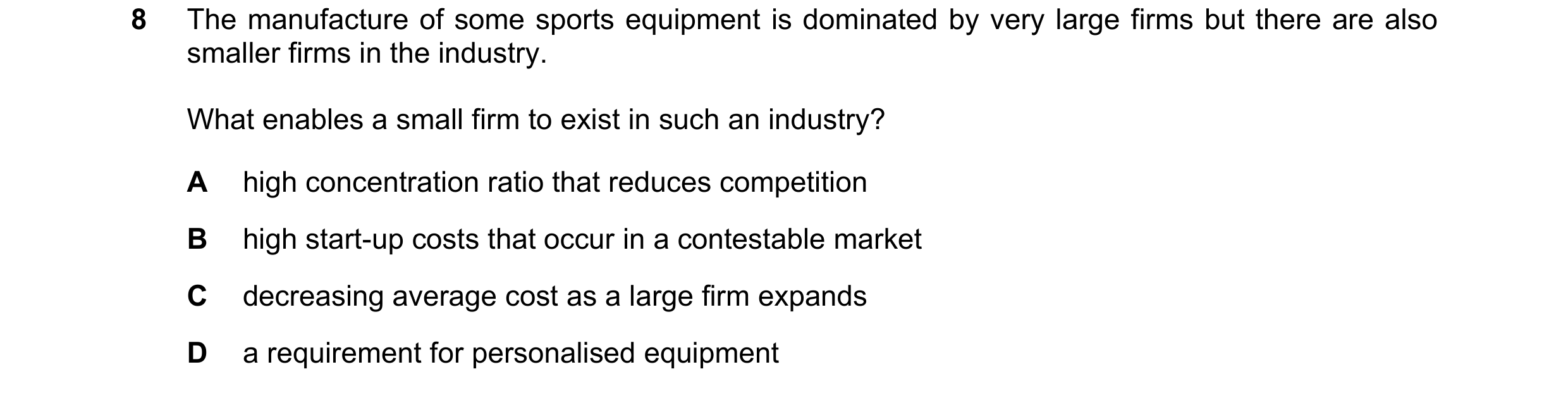
Q40 · The manufacture of some sports equipment is dominated by very large firms but there are… 9708/33 Oct/Nov 2022
8 The manufacture of some sports equipment is dominated by very large firms but there are also smaller firms in the industry. What enables a small firm to exist in such an industry? A high concentration ratio that reduces competition B high start-up costs that occur in a contestable market C decreasing average cost as a large firm expands D a requirement for personalised equipment
1 marks
Answer: D
This question in 9708/33 Oct/Nov 2022
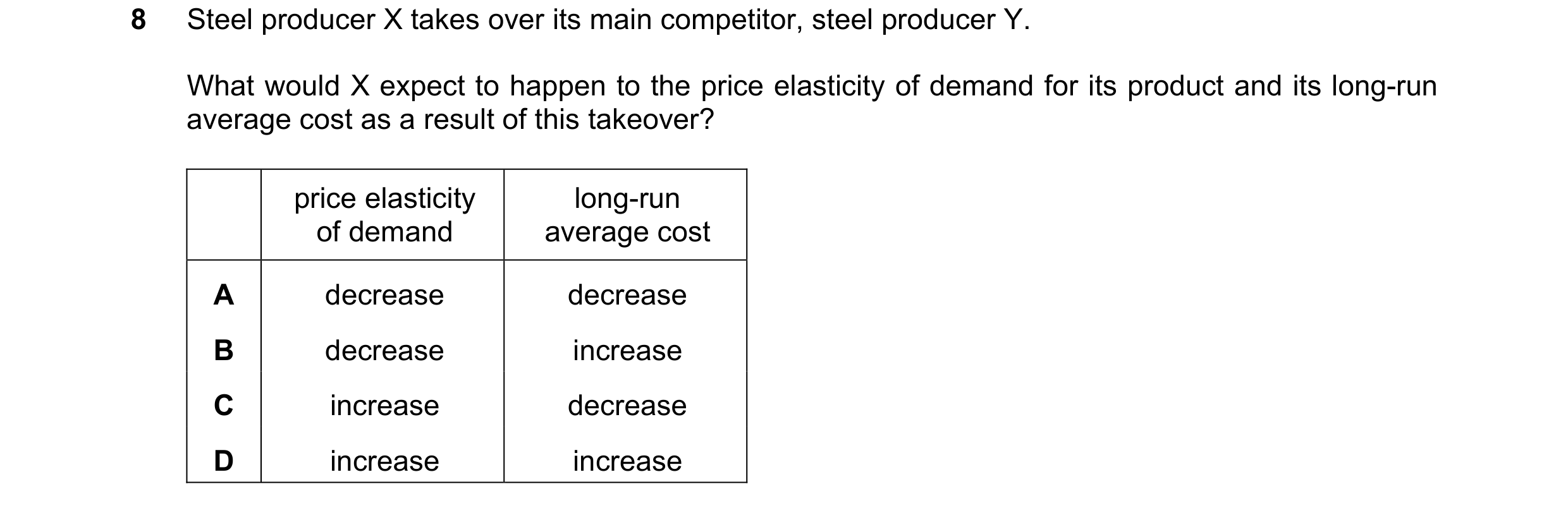
Q41 · Steel producer X takes over its main competitor, steel producer Y 9708/31 May/June 2023
8 Steel producer X takes over its main competitor, steel producer Y. What would X expect to happen to the price elasticity of demand for its product and its long-run average cost as a result of this takeover? price elasticity long-run of demand average cost A decrease decrease B decrease increase C increase decrease D increase increase
1 marks
Answer: A
This question in 9708/31 May/June 2023
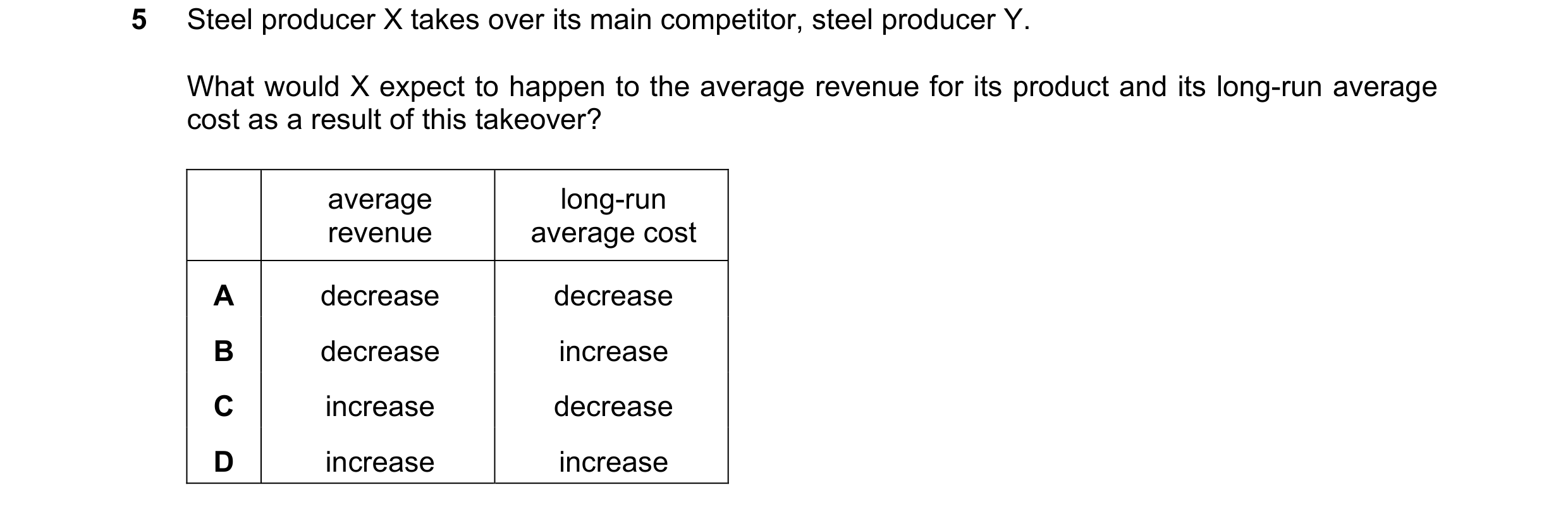
Q42 · Steel producer X takes over its main competitor, steel producer Y 9708/32 May/June 2023
5 Steel producer X takes over its main competitor, steel producer Y. What would X expect to happen to the average revenue for its product and its long-run average cost as a result of this takeover? average long-run revenue average cost A decrease decrease B decrease increase C increase decrease D increase increase
1 marks
Answer: C
This question in 9708/32 May/June 2023
Q43 · Steel producer X takes over its main competitor, steel producer Y 9708/33 May/June 2023
8 Steel producer X takes over its main competitor, steel producer Y. What would X expect to happen to the price elasticity of demand for its product and its long-run average cost as a result of this takeover? price elasticity long-run of demand average cost A decrease decrease B decrease increase C increase decrease D increase increase
1 marks
Answer: A
This question in 9708/33 May/June 2023
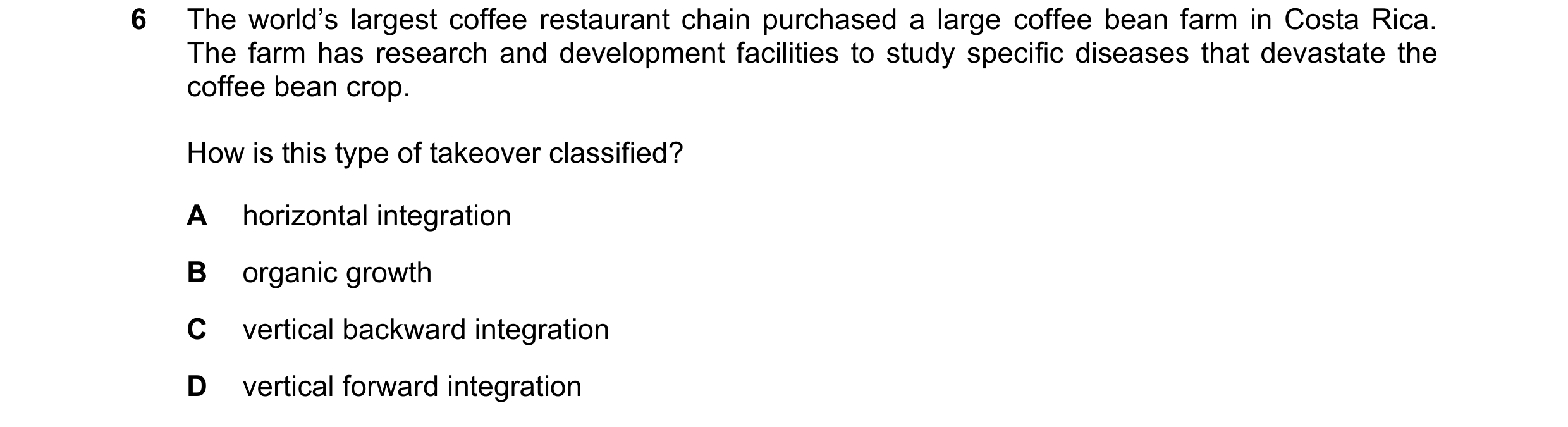
Q44 · The world’s largest coffee restaurant chain purchased a large coffee bean farm in Costa… 9708/33 Oct/Nov 2023
6 The world’s largest coffee restaurant chain purchased a large coffee bean farm in Costa Rica. The farm has research and development facilities to study specific diseases that devastate the coffee bean crop. How is this type of takeover classified? A horizontal integration B organic growth C vertical backward integration D vertical forward integration
1 marks
Answer: C
This question in 9708/33 Oct/Nov 2023
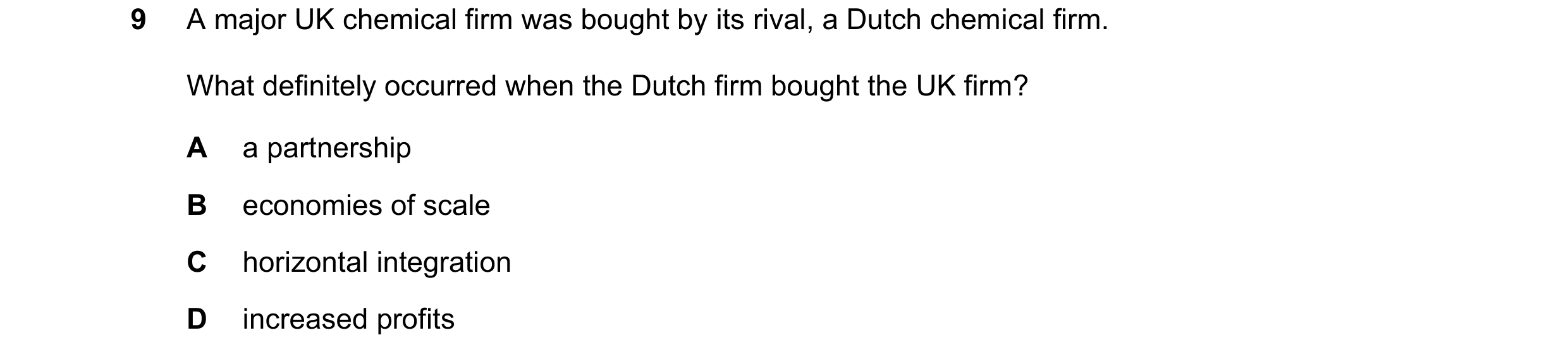
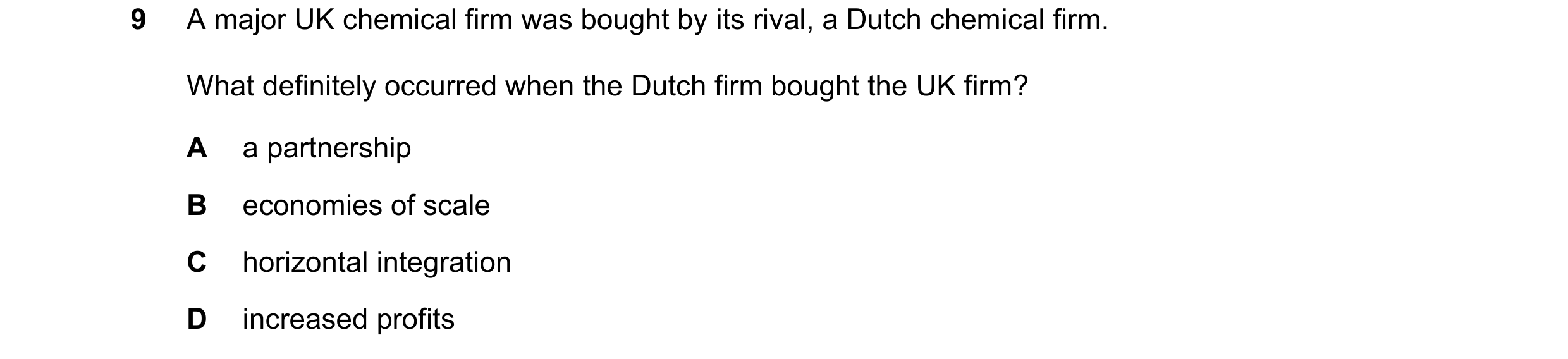
Q45 · A major UK chemical firm was bought by its rival, a Dutch chemical firm 9708/31 May/June 2024
9 A major UK chemical firm was bought by its rival, a Dutch chemical firm. What definitely occurred when the Dutch firm bought the UK firm? A a partnership B economies of scale C horizontal integration D increased profits
1 marks
Answer: C
This question in 9708/31 May/June 2024
Q46 · A major UK chemical firm was bought by its rival, a Dutch chemical firm 9708/33 May/June 2024
9 A major UK chemical firm was bought by its rival, a Dutch chemical firm. What definitely occurred when the Dutch firm bought the UK firm? A a partnership B economies of scale C horizontal integration D increased profits
1 marks
Answer: C
This question in 9708/33 May/June 2024



 1 / 9
1 / 9



 2 / 9
2 / 9

 3 / 9
3 / 9


 4 / 9
4 / 9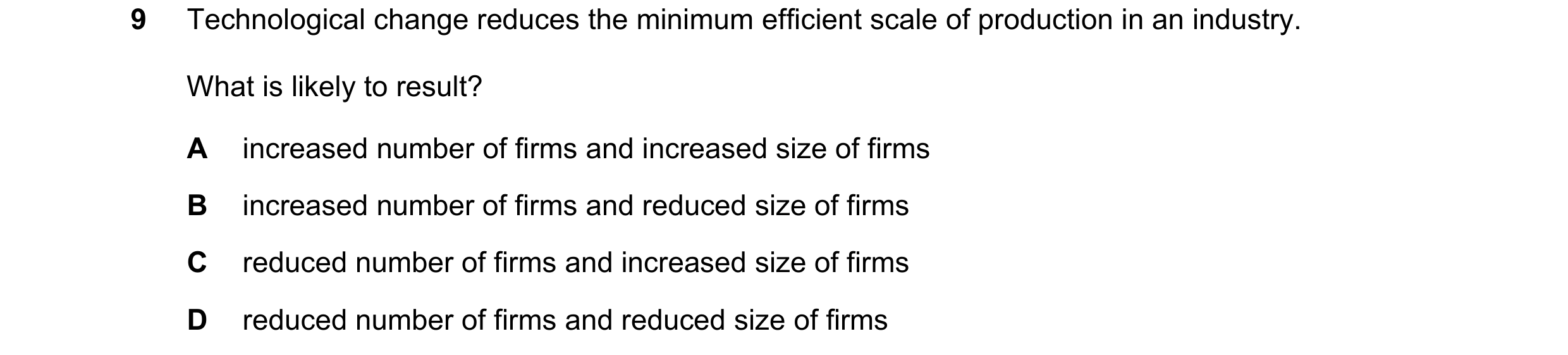

 5 / 9
5 / 9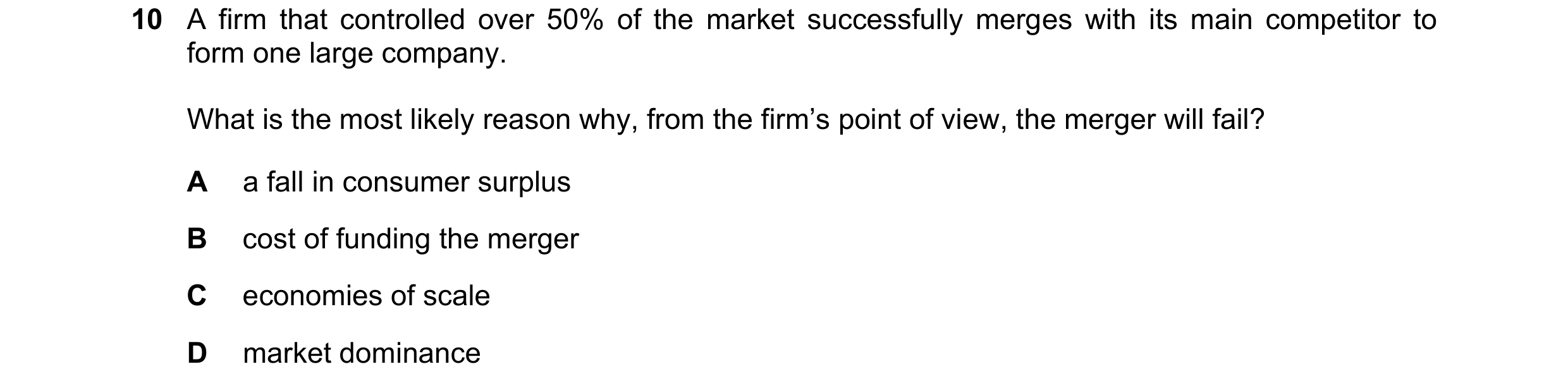

 6 / 9
6 / 9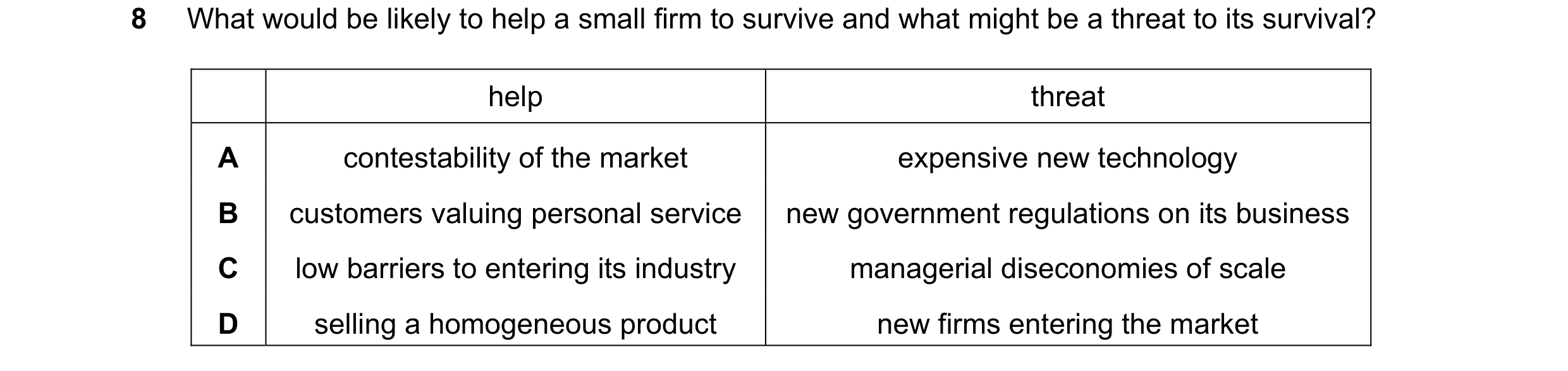


 7 / 9
7 / 9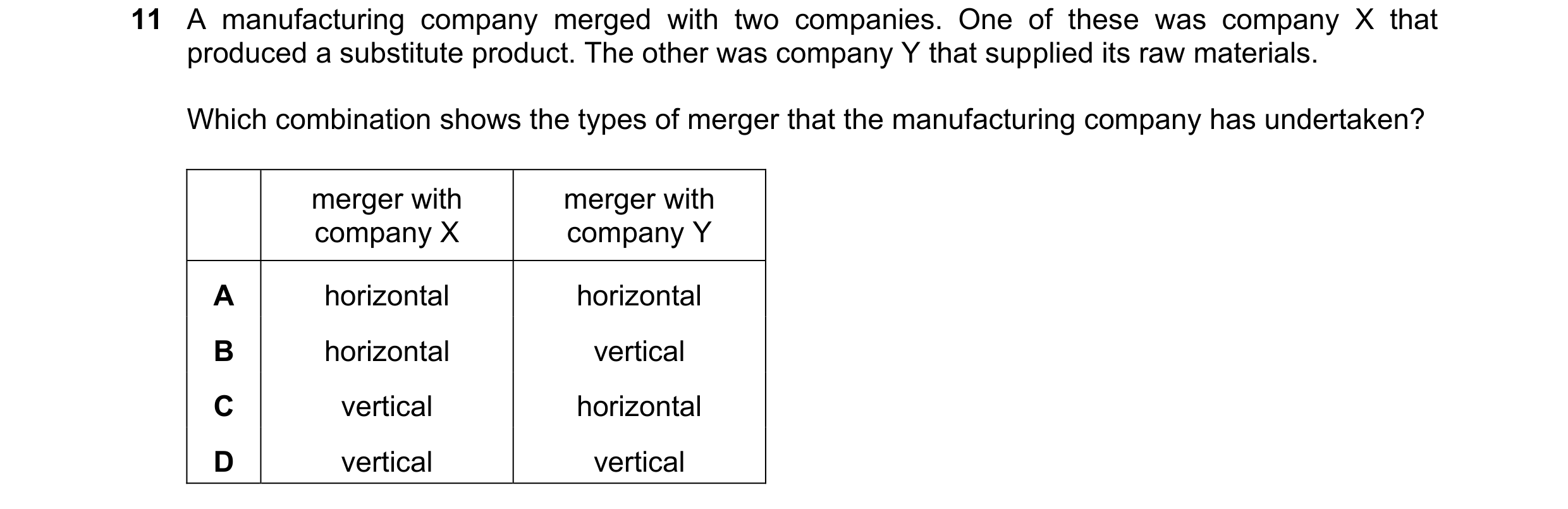
 8 / 9
8 / 9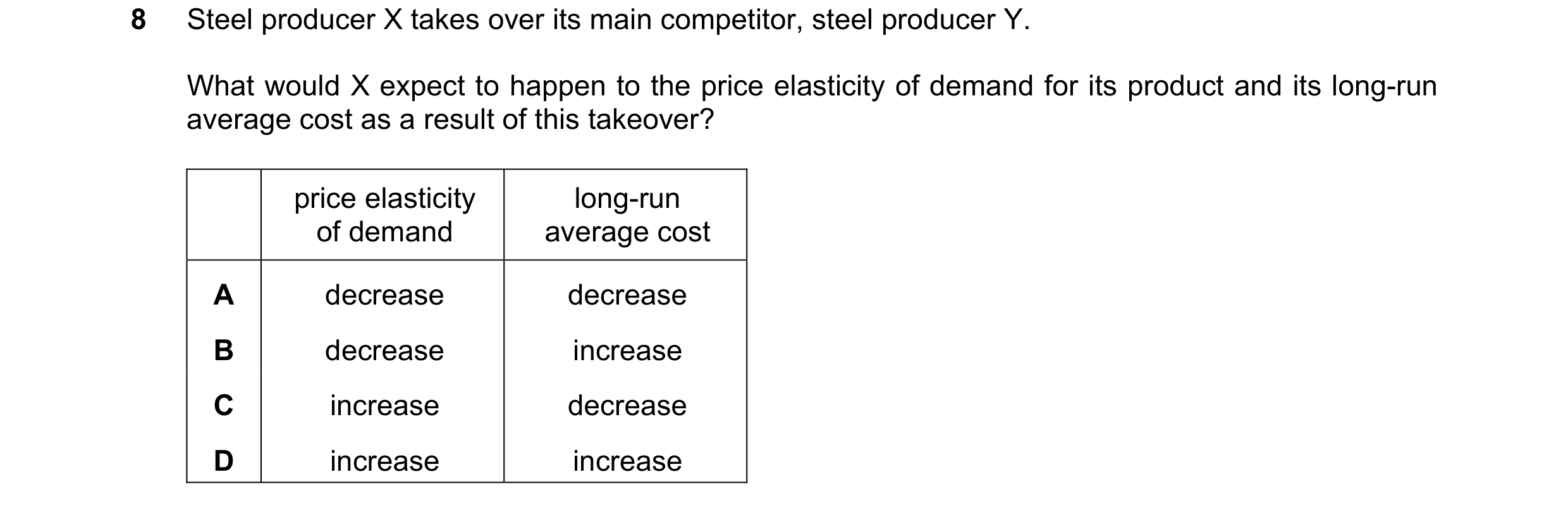
 9 / 9
9 / 9