Questions as text
Q1 · What could explain why the terms of trade of most developing economies tend to worsen… 9708/31 May/June 2010
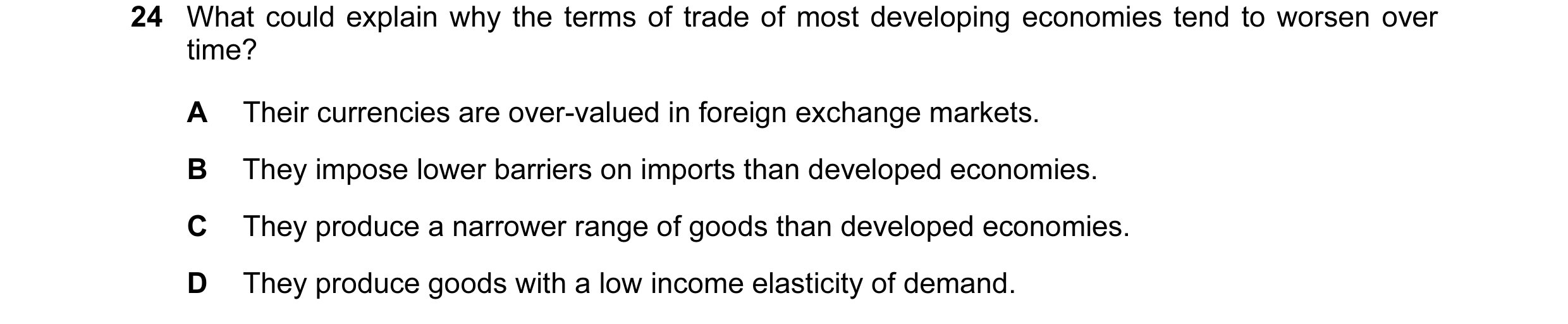
24 What could explain why the terms of trade of most developing economies tend to worsen over time? A Their currencies are over-valued in foreign exchange markets. B They impose lower barriers on imports than developed economies. C They produce a narrower range of goods than developed economies. D They produce goods with a low income elasticity of demand.
1 marks
Answer: D
This question in 9708/31 May/June 2010
Q2 · What could explain why the terms of trade of most developing economies tend to worsen… 9708/33 May/June 2010
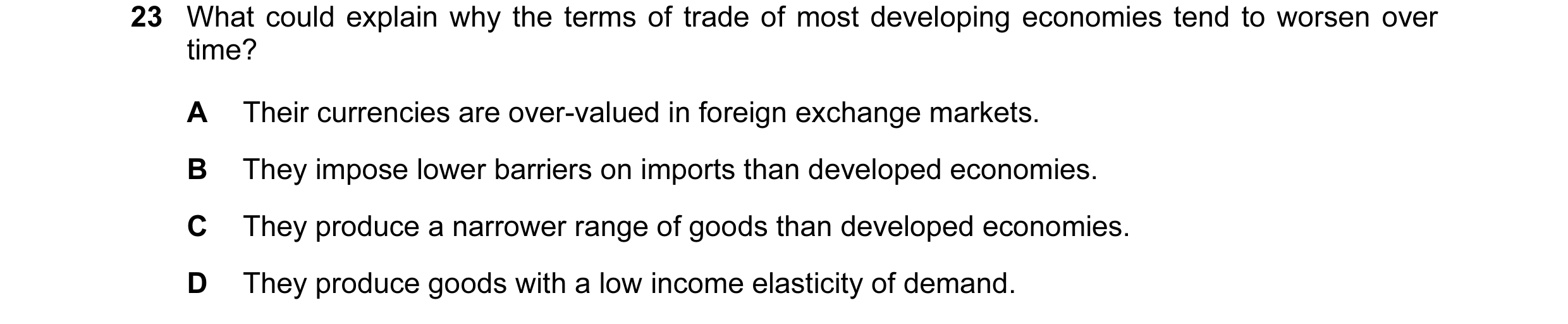
23 What could explain why the terms of trade of most developing economies tend to worsen over time? A Their currencies are over-valued in foreign exchange markets. B They impose lower barriers on imports than developed economies. C They produce a narrower range of goods than developed economies. D They produce goods with a low income elasticity of demand.
1 marks
Answer: D
This question in 9708/33 May/June 2010
Q3 · Economists have proposed that the best policy to promote development is ‘trade not aid’ 9708/31 Oct/Nov 2011
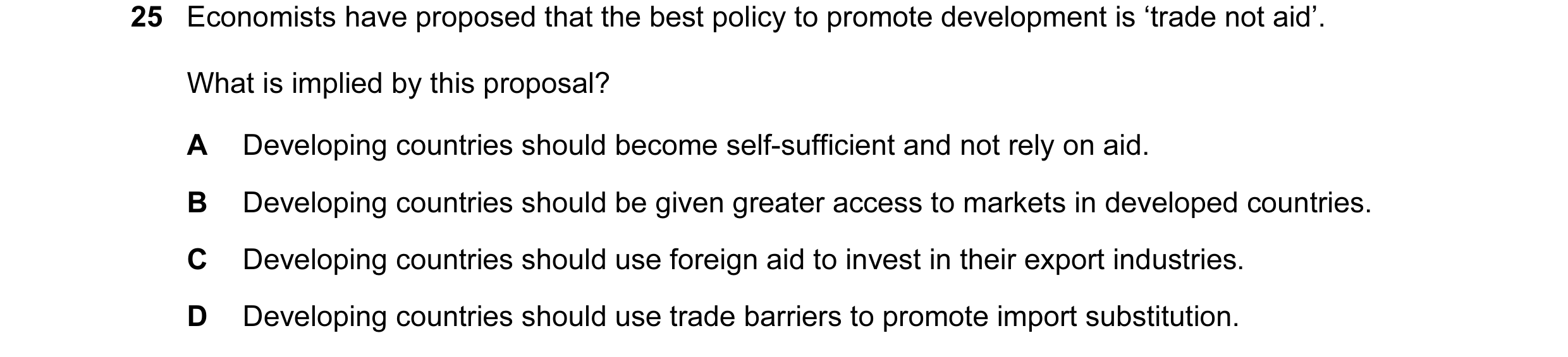
25 Economists have proposed that the best policy to promote development is ‘trade not aid’. What is implied by this proposal? A Developing countries should become self-sufficient and not rely on aid. B Developing countries should be given greater access to markets in developed countries. C Developing countries should use foreign aid to invest in their export industries. D Developing countries should use trade barriers to promote import substitution.
1 marks
Answer: B
This question in 9708/31 Oct/Nov 2011
Q4 · What is likely to result from foreign direct investment in developing economies? 9708/31 Oct/Nov 2011
26 What is likely to result from foreign direct investment in developing economies? A a reduction in local wage levels B a reduction in tax revenues in developing economies C a reduction in the range of consumer goods available to the local population D a worsening of net income flows from investments
1 marks
Answer: D
This question in 9708/31 Oct/Nov 2011
Q5 · What is not a valid economic argument for developing economies to pursue a policy of… 9708/32 Oct/Nov 2011
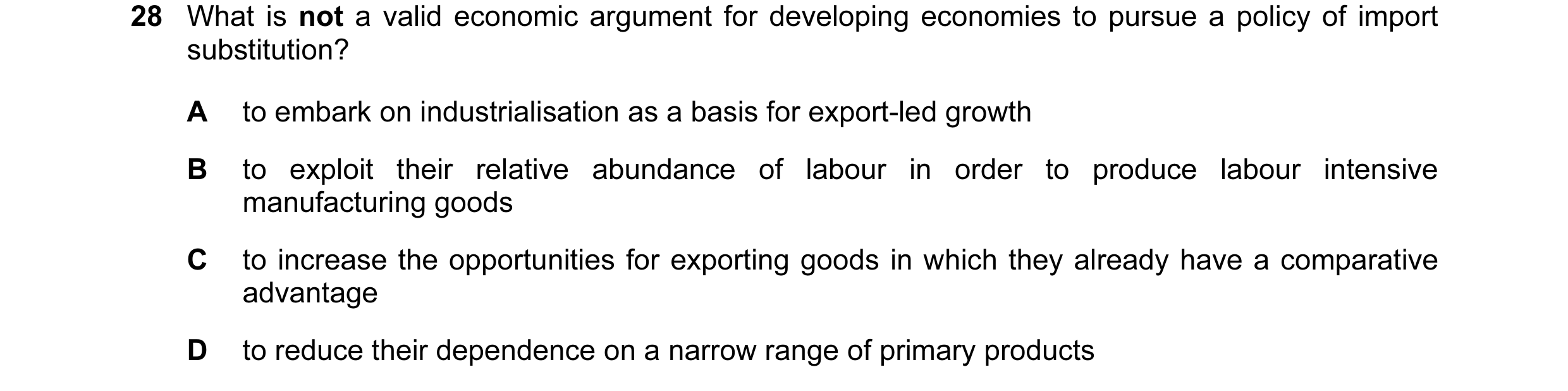
28 What is not a valid economic argument for developing economies to pursue a policy of import substitution? A to embark on industrialisation as a basis for export-led growth B to exploit their relative abundance of labour in order to produce labour intensive manufacturing goods C to increase the opportunities for exporting goods in which they already have a comparative advantage D to reduce their dependence on a narrow range of primary products
1 marks
Answer: C
This question in 9708/32 Oct/Nov 2011
Q6 · Economists have proposed that the best policy to promote development is ‘trade not aid’ 9708/33 Oct/Nov 2011
24 Economists have proposed that the best policy to promote development is ‘trade not aid’. What is implied by this proposal? A Developing countries should become self-sufficient and not rely on aid. B Developing countries should be given greater access to markets in developed countries. C Developing countries should use foreign aid to invest in their export industries. D Developing countries should use trade barriers to promote import substitution.
1 marks
Answer: B
This question in 9708/33 Oct/Nov 2011
Q7 · How will outward migration from a developing economy affect its balance of payments? 9708/33 May/June 2012
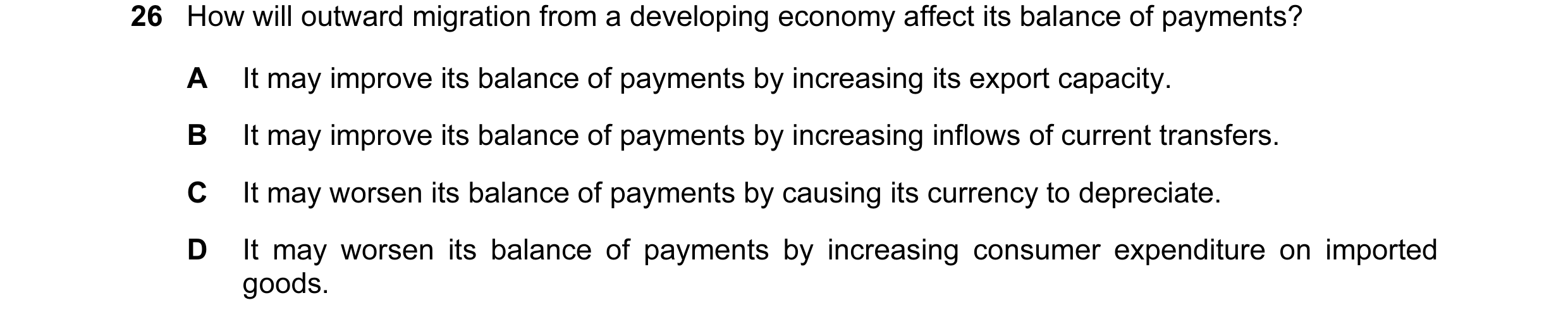
26 How will outward migration from a developing economy affect its balance of payments? A It may improve its balance of payments by increasing its export capacity. B It may improve its balance of payments by increasing inflows of current transfers. C It may worsen its balance of payments by causing its currency to depreciate. D It may worsen its balance of payments by increasing consumer expenditure on imported goods.
1 marks
Answer: B
This question in 9708/33 May/June 2012
Q8 · A developing country’s level of debt rises 9708/33 Oct/Nov 2012
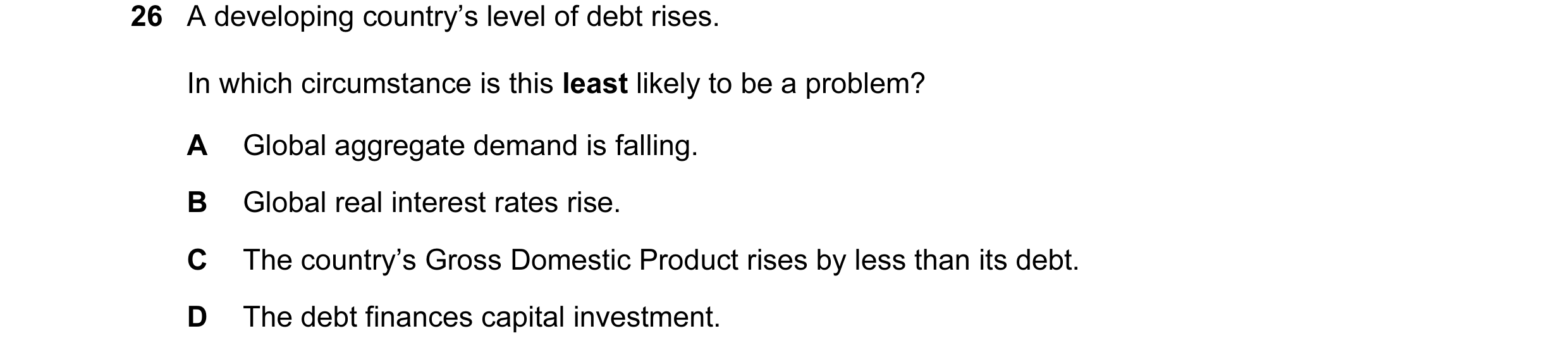
26 A developing country’s level of debt rises. In which circumstance is this least likely to be a problem? A Global aggregate demand is falling. B Global real interest rates rise. C The country’s Gross Domestic Product rises by less than its debt. D The debt finances capital investment.
1 marks
This question in 9708/33 Oct/Nov 2012
Q9 · Which policy by developed economies would be most beneficial for developing economies? 9708/31 Oct/Nov 2015
28 Which policy by developed economies would be most beneficial for developing economies? A a ban on resource exploration by mining companies in developing economies B restrictions on investment by global firms in developing economies C the abolition of restrictions on immigration of skilled labour from developing economies D the withdrawal of agricultural subsidies in developed economies
1 marks
This question in 9708/31 Oct/Nov 2015
Q10 · Economists have proposed that the best policy to promote development is ‘trade not aid’ 9708/32 Oct/Nov 2015
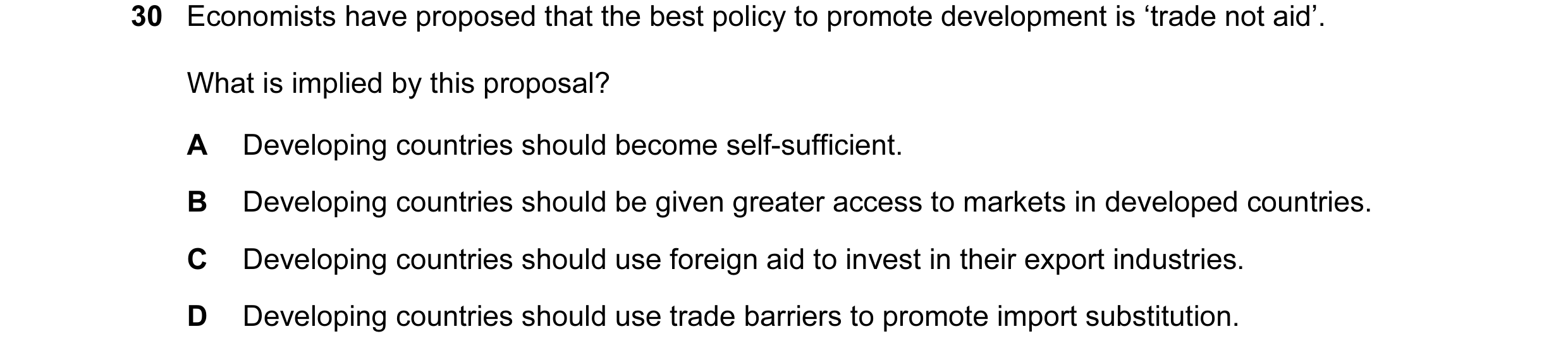
30 Economists have proposed that the best policy to promote development is ‘trade not aid’. What is implied by this proposal? A Developing countries should become self-sufficient. B Developing countries should be given greater access to markets in developed countries. C Developing countries should use foreign aid to invest in their export industries. D Developing countries should use trade barriers to promote import substitution.
1 marks
Answer: B
This question in 9708/32 Oct/Nov 2015
Q11 · How might a developing economy gain from a multilateral reduction in import tariffs and… 9708/33 Oct/Nov 2015
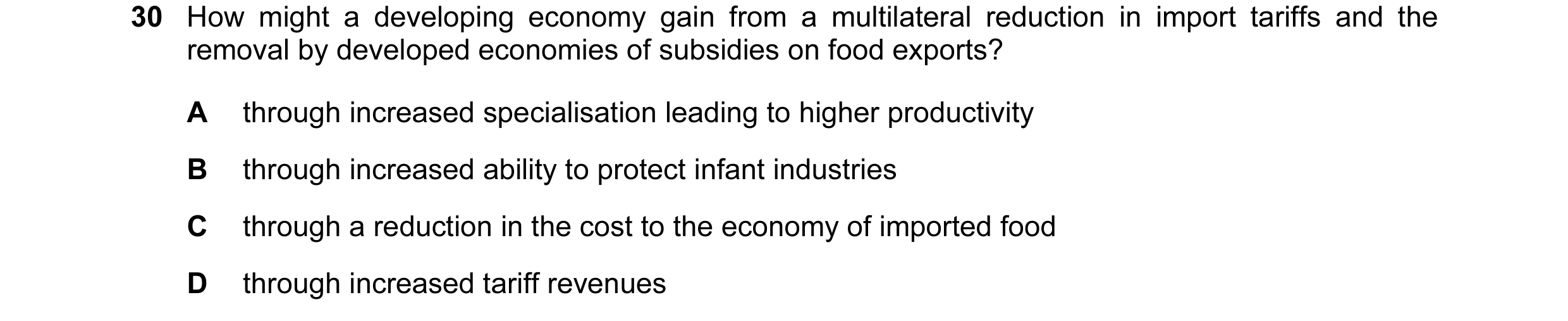
30 How might a developing economy gain from a multilateral reduction in import tariffs and the removal by developed economies of subsidies on food exports? A through increased specialisation leading to higher productivity B through increased ability to protect infant industries C through a reduction in the cost to the economy of imported food D through increased tariff revenues
1 marks
Answer: A
This question in 9708/33 Oct/Nov 2015
Q12 · Which items in the table are classified as foreign aid? 9708/32 Oct/Nov 2018
21 Which items in the table are classified as foreign aid? official portfolio foreign direct development investment investment assistance flows A no no yes B no yes no C yes no yes D yes yes no
1 marks
Answer: B
This question in 9708/32 Oct/Nov 2018
Q13 · The table provides data on the Gross National Income (GNI) and the foreign aid… 9708/32 Oct/Nov 2020
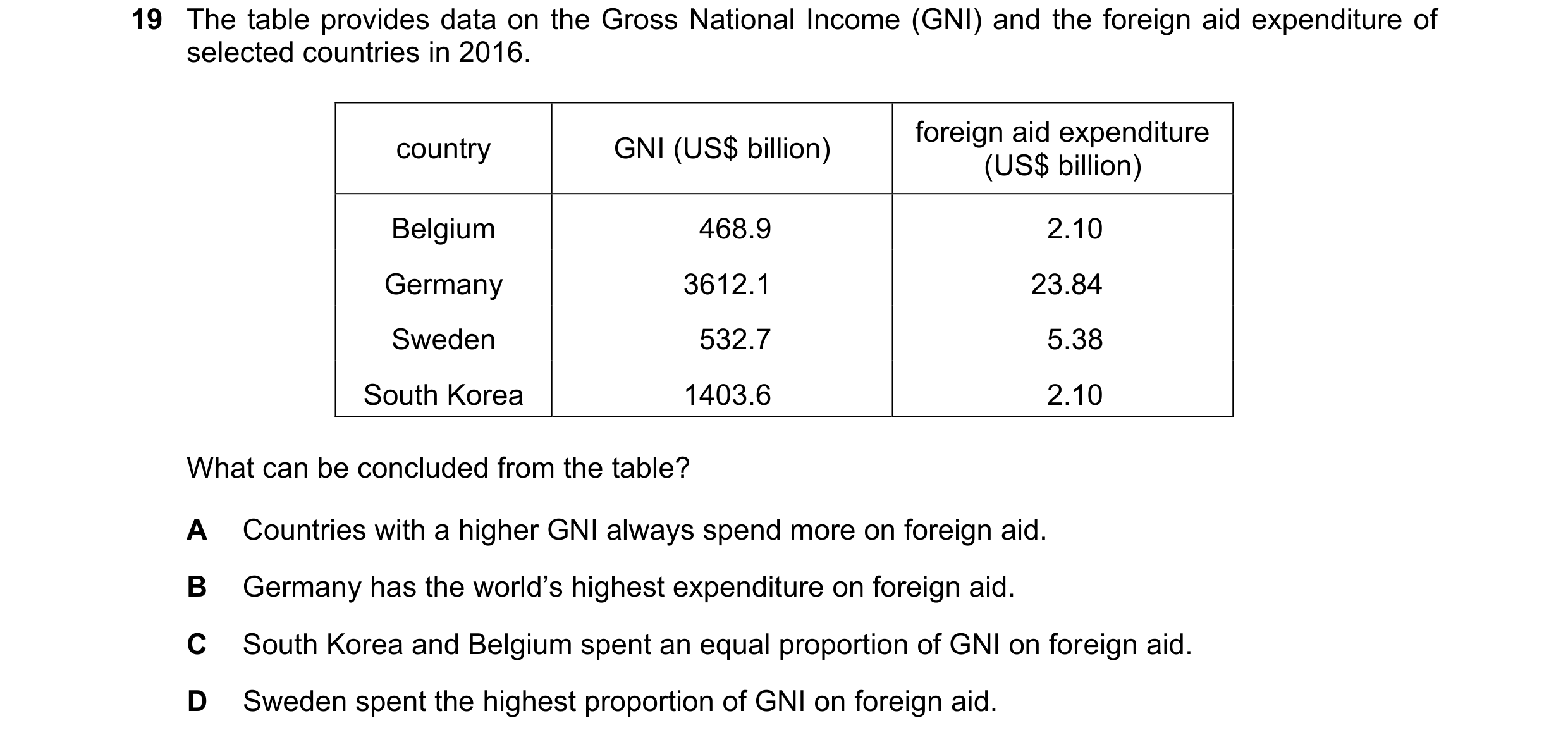
19 The table provides data on the Gross National Income (GNI) and the foreign aid expenditure of selected countries in 2016. foreign aid expenditure country GNI (US$ billion) (US$ billion) Belgium 468.9 2.10 Germany 3612.1 23.84 Sweden 532.7 5.38 South Korea 1403.6 2.10 What can be concluded from the table? A Countries with a higher GNI always spend more on foreign aid. B Germany has the world’s highest expenditure on foreign aid. C South Korea and Belgium spent an equal proportion of GNI on foreign aid. D Sweden spent the highest proportion of GNI on foreign aid.
1 marks
Answer: D
This question in 9708/32 Oct/Nov 2020
Q14 · Which policy by developed economies would be most beneficial for developing economies? 9708/32 Feb/March 2021
28 Which policy by developed economies would be most beneficial for developing economies? A a ban on resource exploration by mining companies in developing economies B restrictions on investment by global firms in developing economies C the removal of restrictions on emigration of skilled labour from developing economies D the withdrawal of agricultural subsidies in developed economies
1 marks
Answer: D
This question in 9708/32 Feb/March 2021
Q15 · The UK gives aid to the Ugandan government to spend on a school 9708/32 May/June 2021
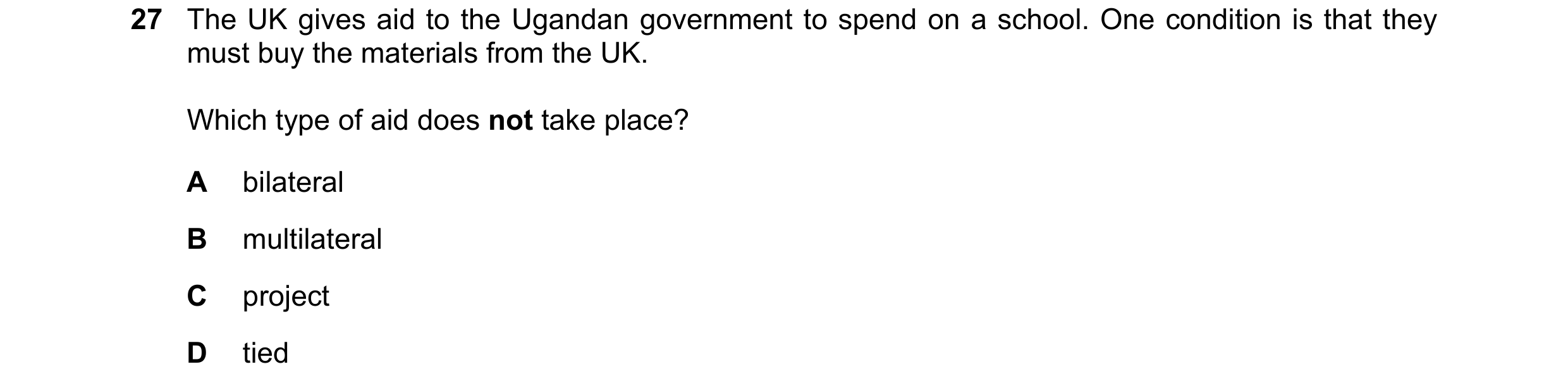
27 The UK gives aid to the Ugandan government to spend on a school. One condition is that they must buy the materials from the UK. Which type of aid does not take place? A bilateral B multilateral C project D tied
1 marks
Answer: B
This question in 9708/32 May/June 2021
Q16 · Money given by the US government to certain African countries to fight AIDS/HIV requires… 9708/31 Oct/Nov 2021
28 Money given by the US government to certain African countries to fight AIDS/HIV requires their governments to purchase expensive drugs from the US rather than cheaper products from South Africa, India or Brazil. What is this an example of? A bilateral aid B debt relief C multilateral aid D tied aid
1 marks
Answer: D
This question in 9708/31 Oct/Nov 2021
Q17 · Which items in the table are classified as foreign aid? 9708/31 May/June 2022
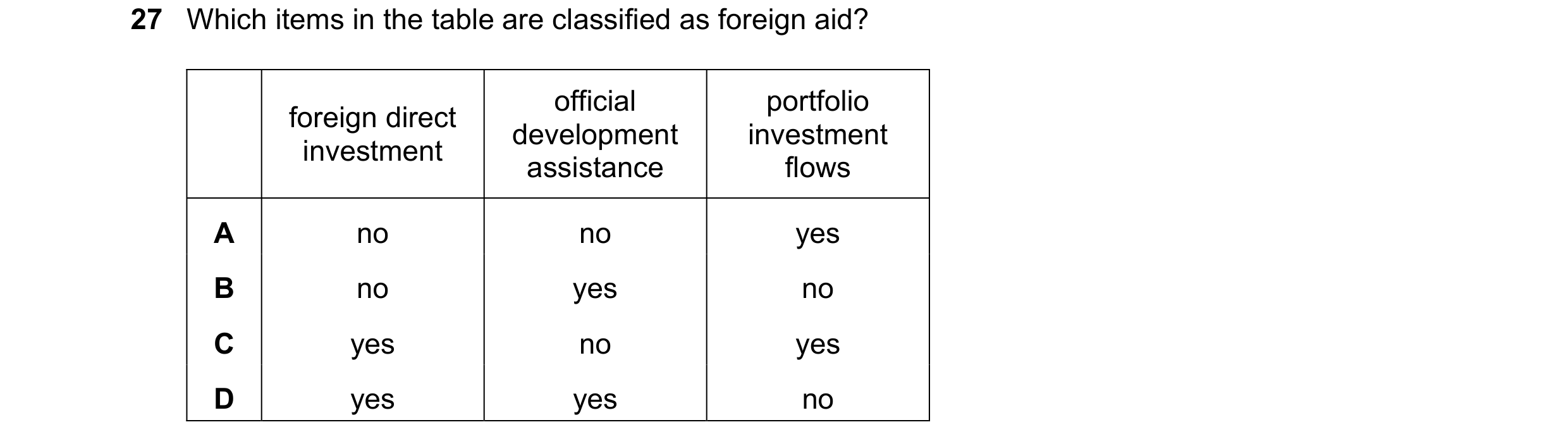
27 Which items in the table are classified as foreign aid? official portfolio foreign direct development investment investment assistance flows A no no yes B no yes no C yes no yes D yes yes no
1 marks
Answer: B
This question in 9708/31 May/June 2022
Q18 · Which items in the table are classified as foreign aid? 9708/33 May/June 2022
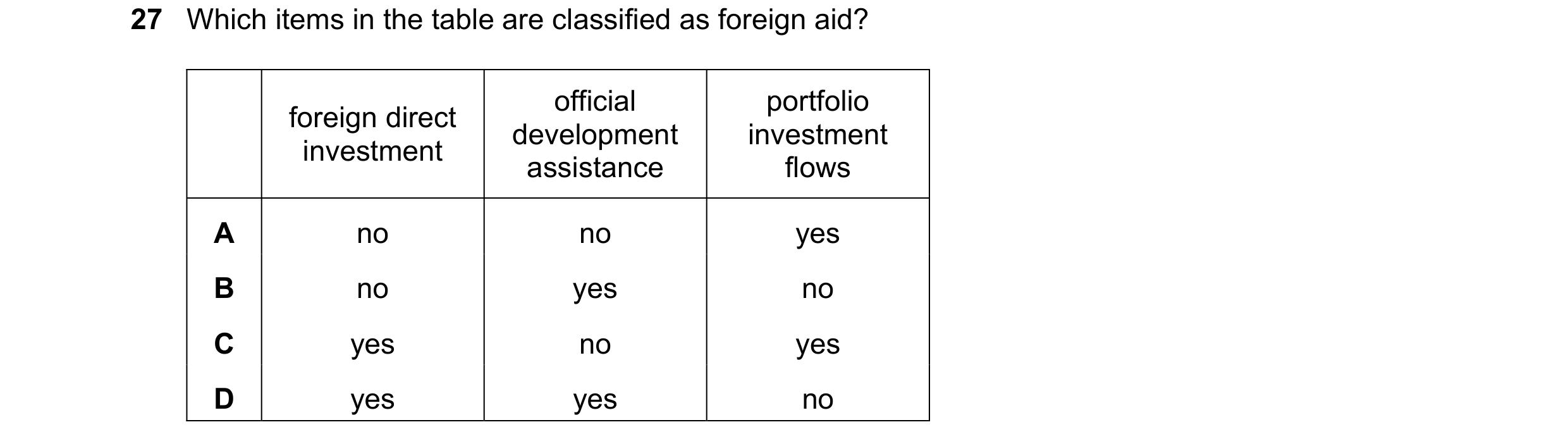
27 Which items in the table are classified as foreign aid? official portfolio foreign direct development investment investment assistance flows A no no yes B no yes no C yes no yes D yes yes no
1 marks
Answer: B
This question in 9708/33 May/June 2022
Q19 · A developing (low-income) economy is heavily dependent on the production of primary… 9708/31 Oct/Nov 2022
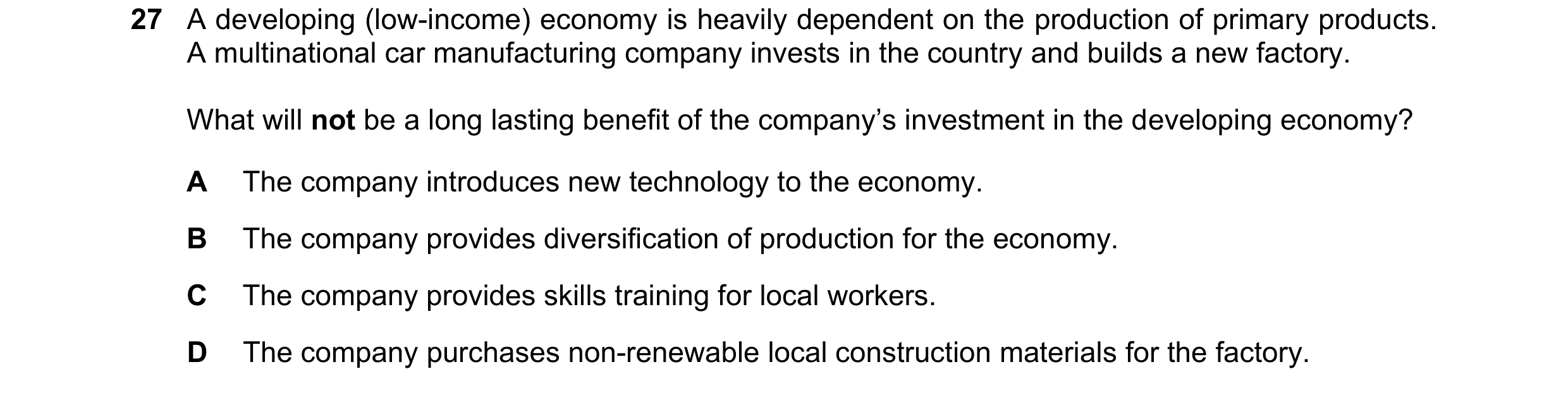
27 A developing (low-income) economy is heavily dependent on the production of primary products. A multinational car manufacturing company invests in the country and builds a new factory. What will not be a long lasting benefit of the company’s investment in the developing economy? A The company introduces new technology to the economy. B The company provides diversification of production for the economy. C The company provides skills training for local workers. D The company purchases non-renewable local construction materials for the factory.
1 marks
Answer: D
This question in 9708/31 Oct/Nov 2022
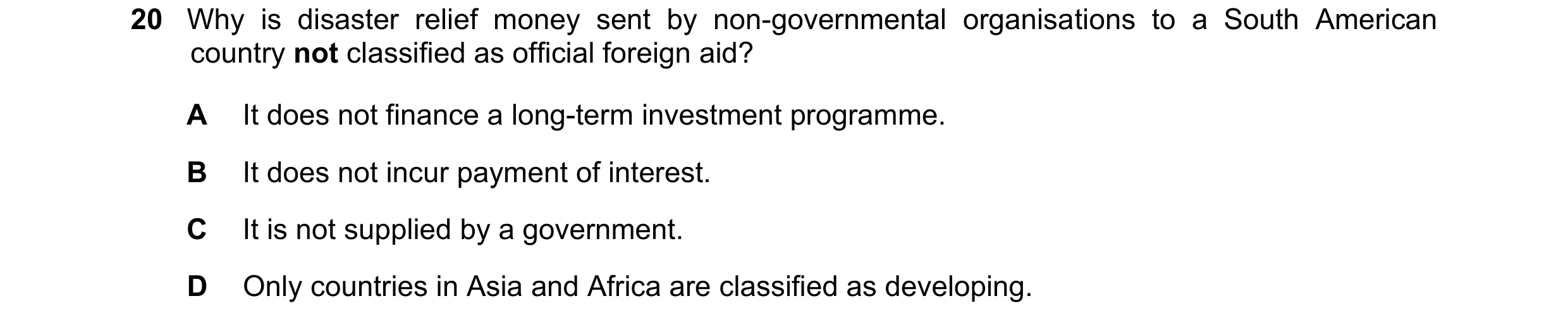
Q20 · Why is disaster relief money sent by non-governmental organisations to a South American… 9708/32 Oct/Nov 2022
20 Why is disaster relief money sent by non-governmental organisations to a South American country not classified as official foreign aid? A It does not finance a long-term investment programme. B It does not incur payment of interest. C It is not supplied by a government. D Only countries in Asia and Africa are classified as developing.
1 marks
Answer: C
This question in 9708/32 Oct/Nov 2022
Q21 · Labour from low-income countries often migrates to high-income countries and finds jobs 9708/32 Feb/March 2023
30 Labour from low-income countries often migrates to high-income countries and finds jobs. How would such a movement of labour be likely to affect the economic growth and the pressure on wage rises in the high-income country? pressure on economic growth wage rises A decrease decrease B decrease increase C increase decrease D increase increase
1 marks
Answer: C
This question in 9708/32 Feb/March 2023
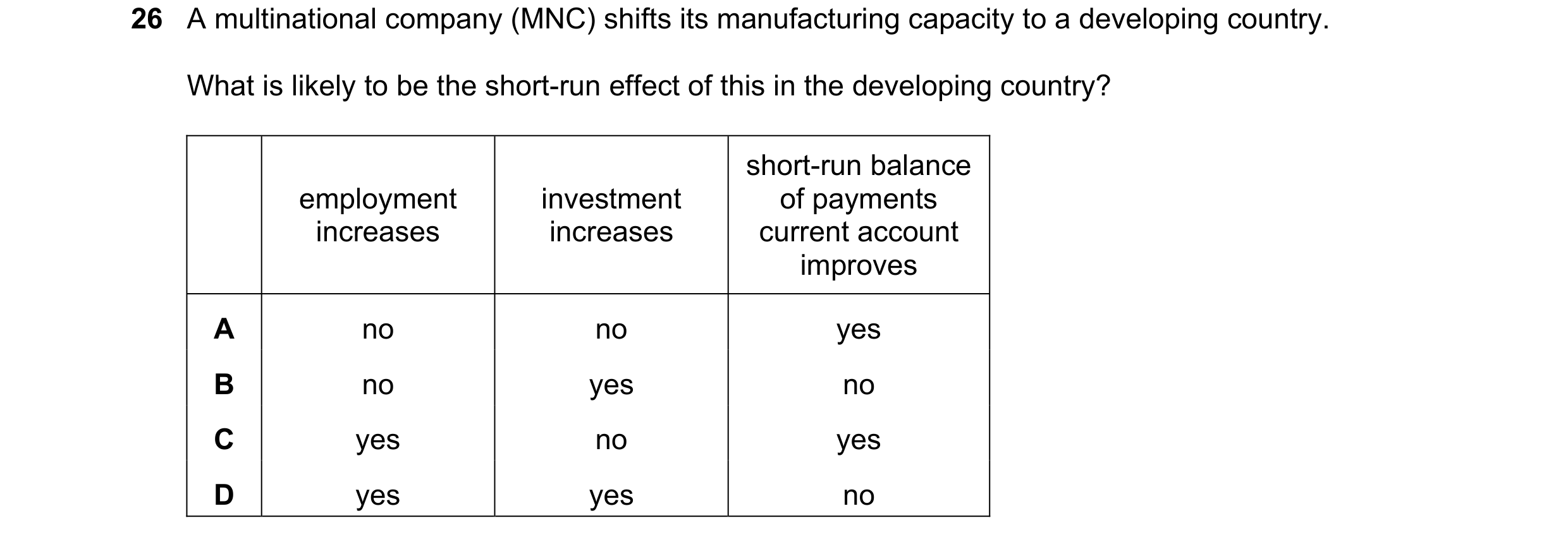
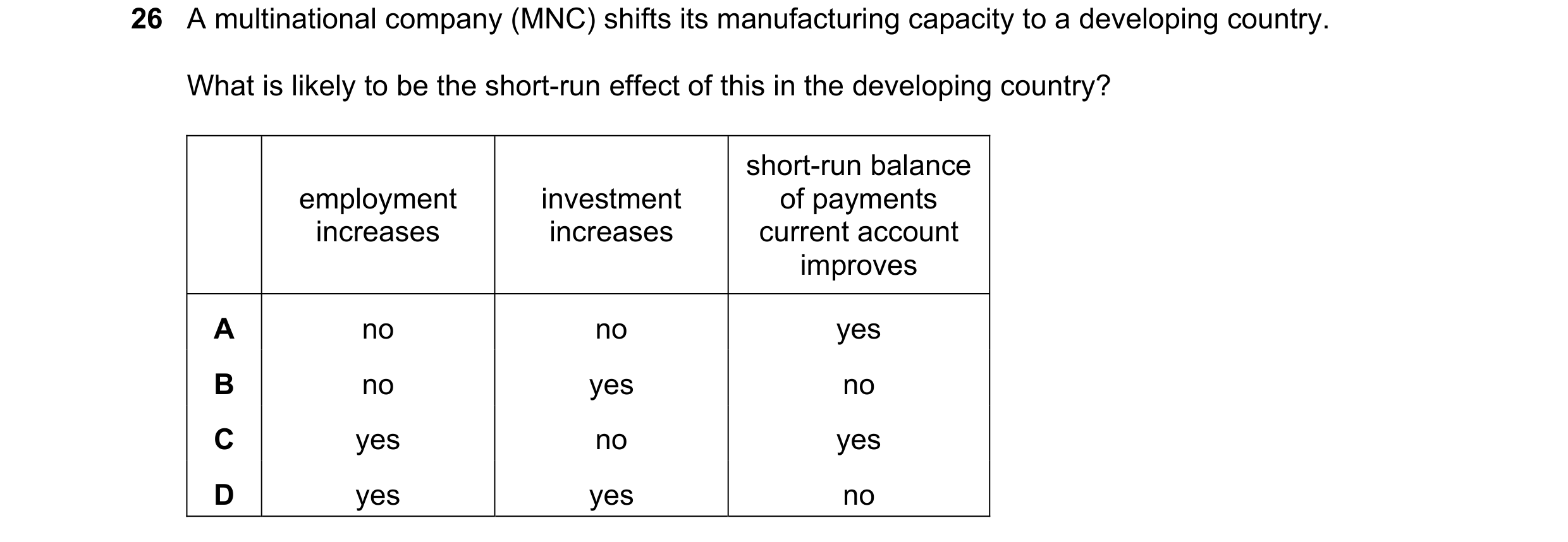
Q22 · A multinational company (MNC) shifts its manufacturing capacity to a developing country 9708/31 May/June 2023
26 A multinational company (MNC) shifts its manufacturing capacity to a developing country. What is likely to be the short-run effect of this in the developing country? short-run balance employment investment of payments increases increases current account improves A no no yes B no yes no C yes no yes D yes yes no
1 marks
Answer: D
This question in 9708/31 May/June 2023
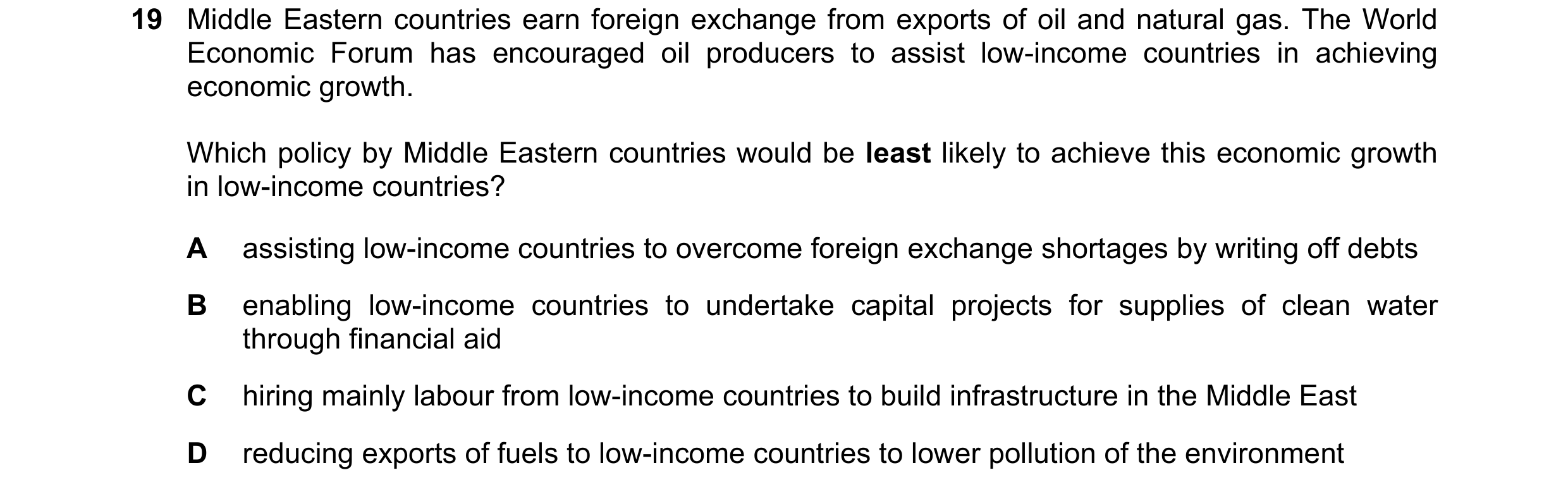
Q23 · Middle Eastern countries earn foreign exchange from exports of oil and natural gas 9708/32 May/June 2023
19 Middle Eastern countries earn foreign exchange from exports of oil and natural gas. The World Economic Forum has encouraged oil producers to assist low-income countries in achieving economic growth. Which policy by Middle Eastern countries would be least likely to achieve this economic growth in low-income countries? A assisting low-income countries to overcome foreign exchange shortages by writing off debts B enabling low-income countries to undertake capital projects for supplies of clean water through financial aid C hiring mainly labour from low-income countries to build infrastructure in the Middle East D reducing exports of fuels to low-income countries to lower pollution of the environment
1 marks
Answer: D
This question in 9708/32 May/June 2023
Q24 · A multinational company (MNC) shifts its manufacturing capacity to a developing country 9708/33 May/June 2023
26 A multinational company (MNC) shifts its manufacturing capacity to a developing country. What is likely to be the short-run effect of this in the developing country? short-run balance employment investment of payments increases increases current account improves A no no yes B no yes no C yes no yes D yes yes no
1 marks
Answer: D
This question in 9708/33 May/June 2023
Q25 · What is the role of the International Monetary Fund (IMF)? 9708/33 Oct/Nov 2023
28 What is the role of the International Monetary Fund (IMF)? A to advise countries that are experiencing trade disagreements B to help charities providing emergency assistance to countries in need C to offer short-term assistance to countries with balance of payments problems D to provide interest-free credit to developing countries for infrastructure purposes
1 marks
Answer: C
This question in 9708/33 Oct/Nov 2023
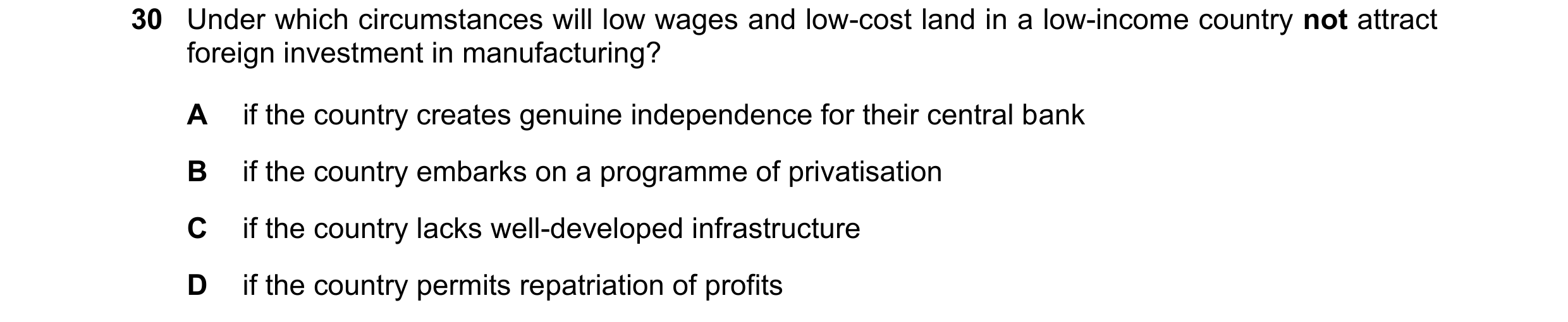
Q26 · Under which circumstances will low wages and low-cost land in a low-income country not… 9708/33 Oct/Nov 2023
30 Under which circumstances will low wages and low-cost land in a low-income country not attract foreign investment in manufacturing? A if the country creates genuine independence for their central bank B if the country embarks on a programme of privatisation C if the country lacks well-developed infrastructure D if the country permits repatriation of profits
1 marks
Answer: C
This question in 9708/33 Oct/Nov 2023
Q27 · Which role is performed by the World Bank but not by the International Monetary Fund… 9708/32 Feb/March 2025
29 Which role is performed by the World Bank but not by the International Monetary Fund (IMF)? A facilitating free trade among member countries B providing assistance to member countries to plan fiscal policies C providing bailout packages to countries facing external account challenges D providing monetary assistance to member countries to build infrastructure
1 marks
Answer: D
This question in 9708/32 Feb/March 2025

 1 / 6
1 / 6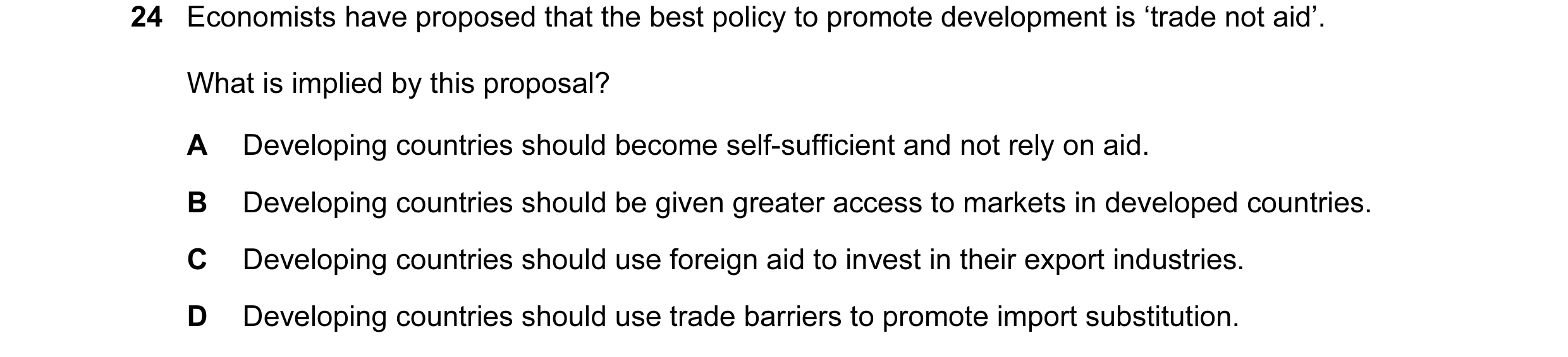

 2 / 6
2 / 6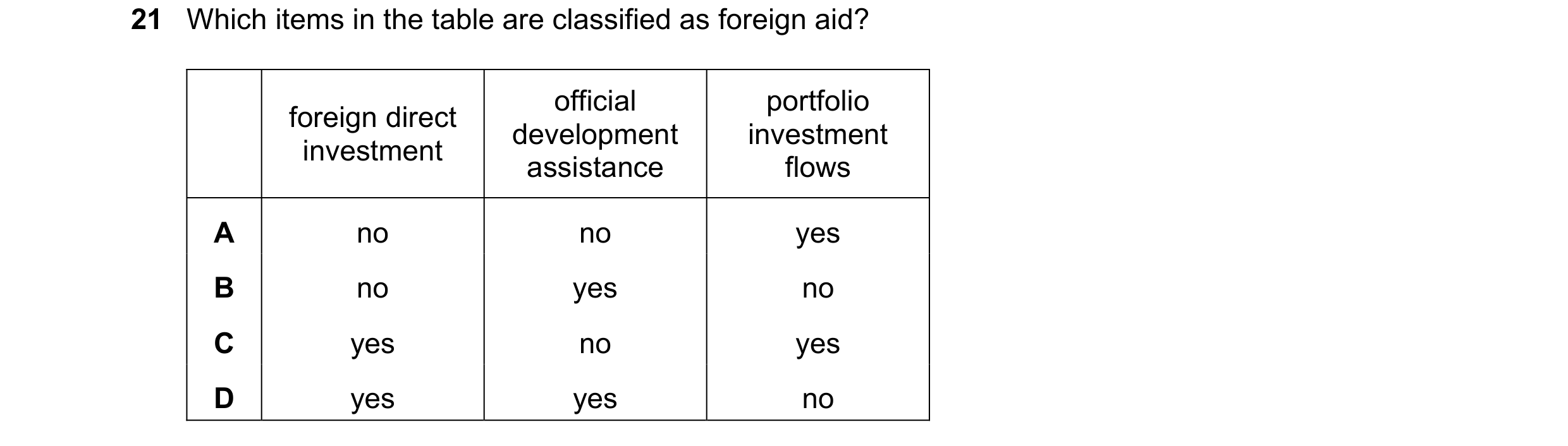

 3 / 6
3 / 6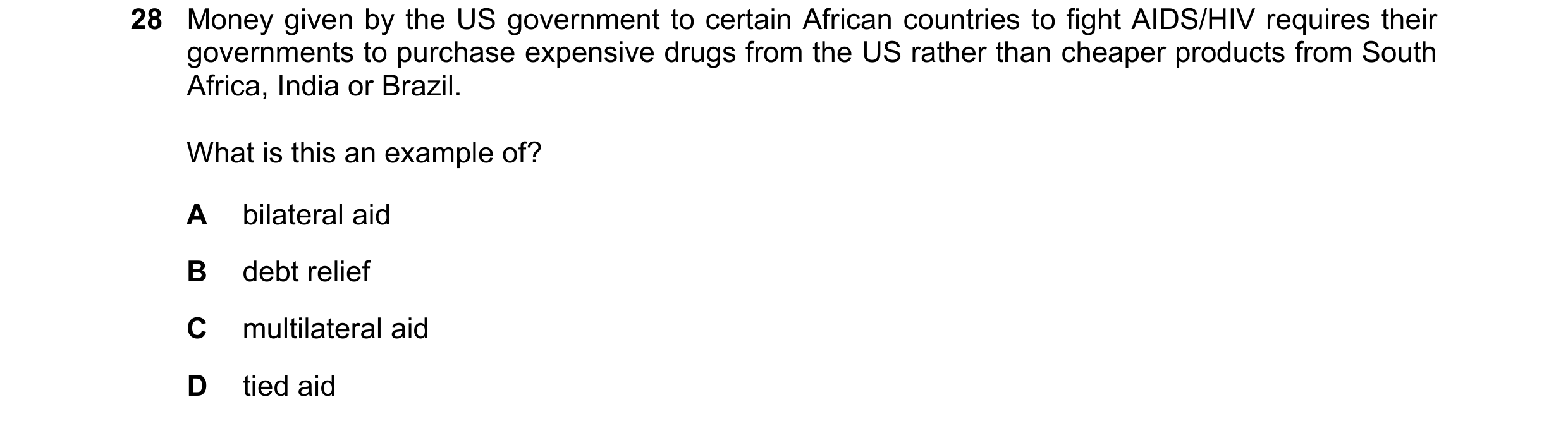
 4 / 6
4 / 6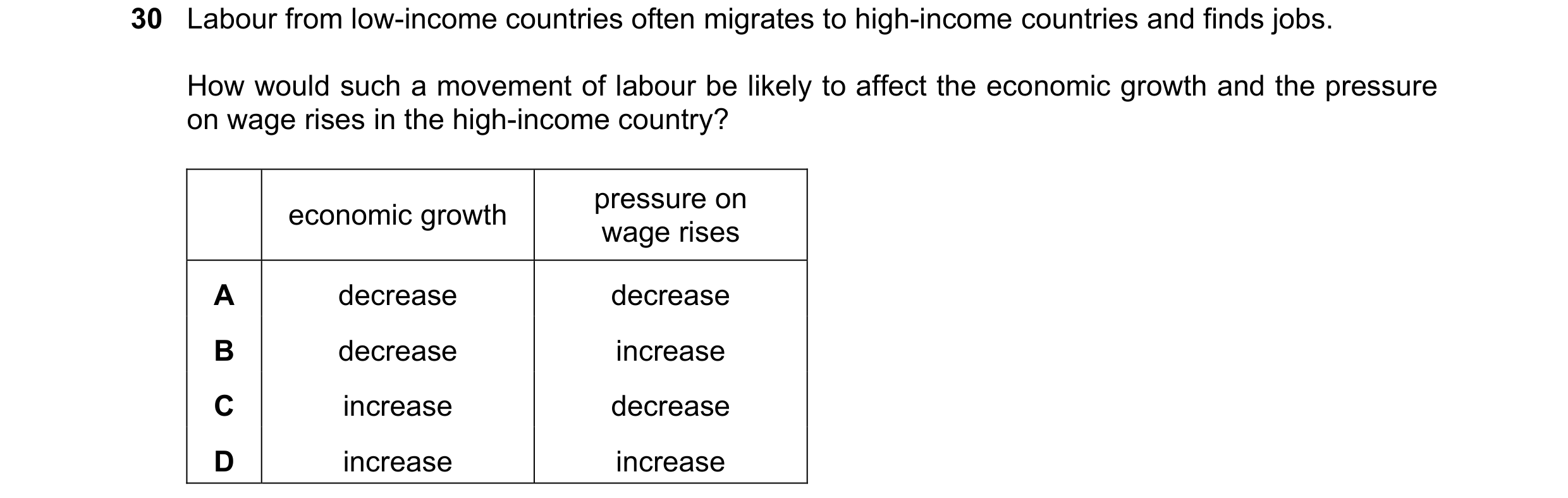
 5 / 6
5 / 6
 6 / 6
6 / 6