Questions as text
Q1 · An economy has unemployed resources and a flexible exchange rate 9708/32 Oct/Nov 2009
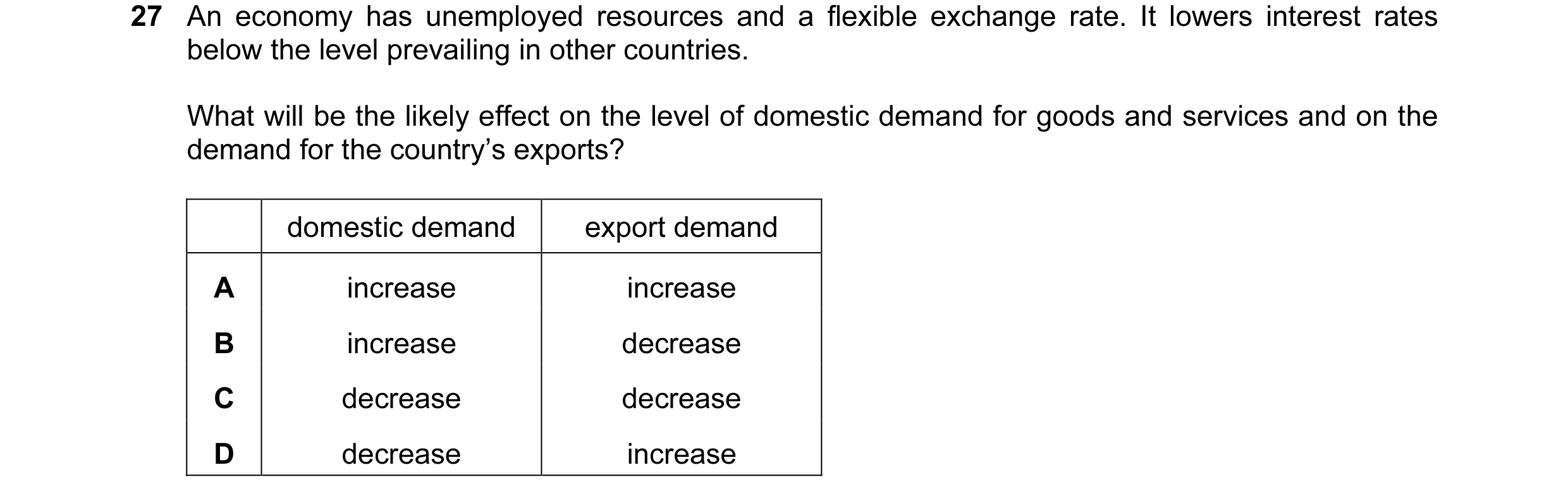
27 An economy has unemployed resources and a flexible exchange rate. It lowers interest rates below the level prevailing in other countries. What will be the likely effect on the level of domestic demand for goods and services and on the demand for the country’s exports? domestic demand export demand A increase increase B increase decrease C decrease decrease D decrease increase
1 marks
Answer: A
This question in 9708/32 Oct/Nov 2009
Q2 · Which feature of the Indian economy could explain why the purchasing power parity… 9708/31 Oct/Nov 2010
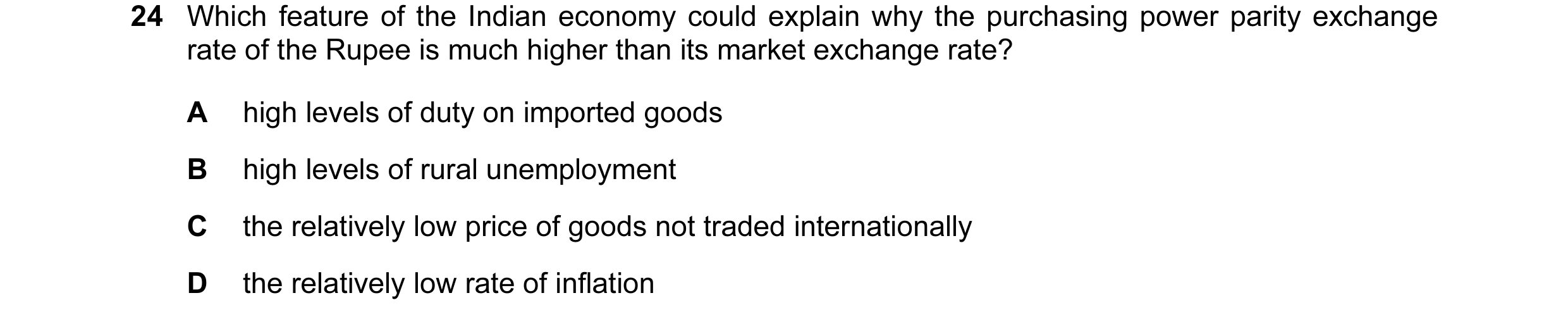
24 Which feature of the Indian economy could explain why the purchasing power parity exchange rate of the Rupee is much higher than its market exchange rate? A high levels of duty on imported goods B high levels of rural unemployment C the relatively low price of goods not traded internationally D the relatively low rate of inflation
1 marks
Answer: C
This question in 9708/31 Oct/Nov 2010
Q3 · Which feature of the Indian economy could explain why the purchasing power parity… 9708/32 Oct/Nov 2010
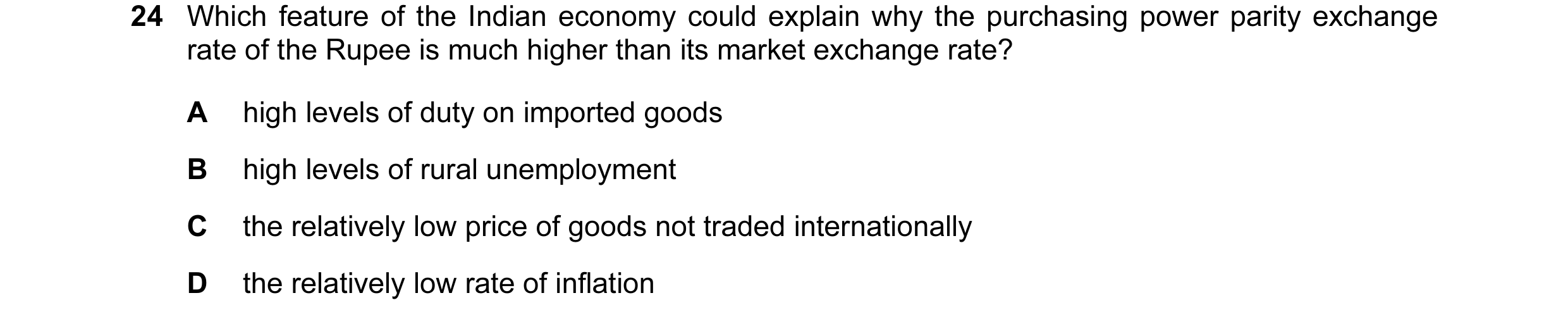
24 Which feature of the Indian economy could explain why the purchasing power parity exchange rate of the Rupee is much higher than its market exchange rate? A high levels of duty on imported goods B high levels of rural unemployment C the relatively low price of goods not traded internationally D the relatively low rate of inflation
1 marks
Answer: C
This question in 9708/32 Oct/Nov 2010
Q4 · Which feature of the Indian economy could explain why the purchasing power parity… 9708/33 Oct/Nov 2010
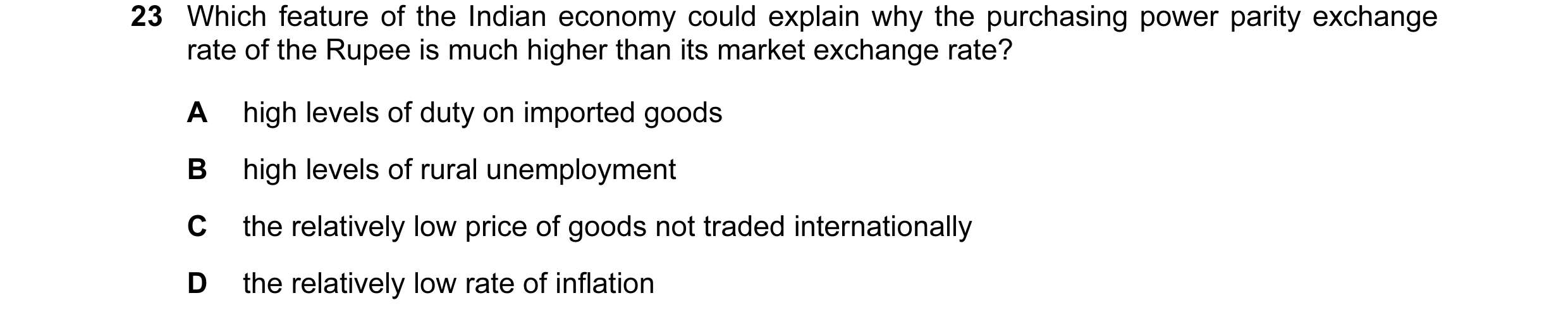
23 Which feature of the Indian economy could explain why the purchasing power parity exchange rate of the Rupee is much higher than its market exchange rate? A high levels of duty on imported goods B high levels of rural unemployment C the relatively low price of goods not traded internationally D the relatively low rate of inflation
1 marks
Answer: C
This question in 9708/33 Oct/Nov 2010
Q5 · A country decides to join a group of countries which maintain fixed parities for their… 9708/31 May/June 2011
29 A country decides to join a group of countries which maintain fixed parities for their currencies and forbid any restriction on foreign trade and payments. What will the country have to forgo to maintain a fixed parity for its currency? A an independent anti-monopoly policy B an independent fiscal policy C an independent interest rate policy D an independent prices and incomes policy
1 marks
Answer: C
This question in 9708/31 May/June 2011
Q6 · A country decides to join a group of countries which maintain fixed parities for their… 9708/32 May/June 2011
28 A country decides to join a group of countries which maintain fixed parities for their currencies and forbid any restriction on foreign trade and payments. What will the country have to forgo to maintain a fixed parity for its currency? A an independent anti-monopoly policy B an independent fiscal policy C an independent interest rate policy D an independent prices and incomes policy
1 marks
Answer: C
This question in 9708/32 May/June 2011
Q7 · A country decides to join a group of countries which maintain fixed parities for their… 9708/33 May/June 2011
28 A country decides to join a group of countries which maintain fixed parities for their currencies and forbid any restriction on foreign trade and payments. What will the country have to forgo to maintain a fixed parity for its currency? A an independent anti-monopoly policy B an independent fiscal policy C an independent interest rate policy D an independent prices and incomes policy
1 marks
Answer: C
This question in 9708/33 May/June 2011
Q8 · The graphs show the changes in the exchange rate of the £ sterling against the US $ and… 9708/31 Oct/Nov 2011
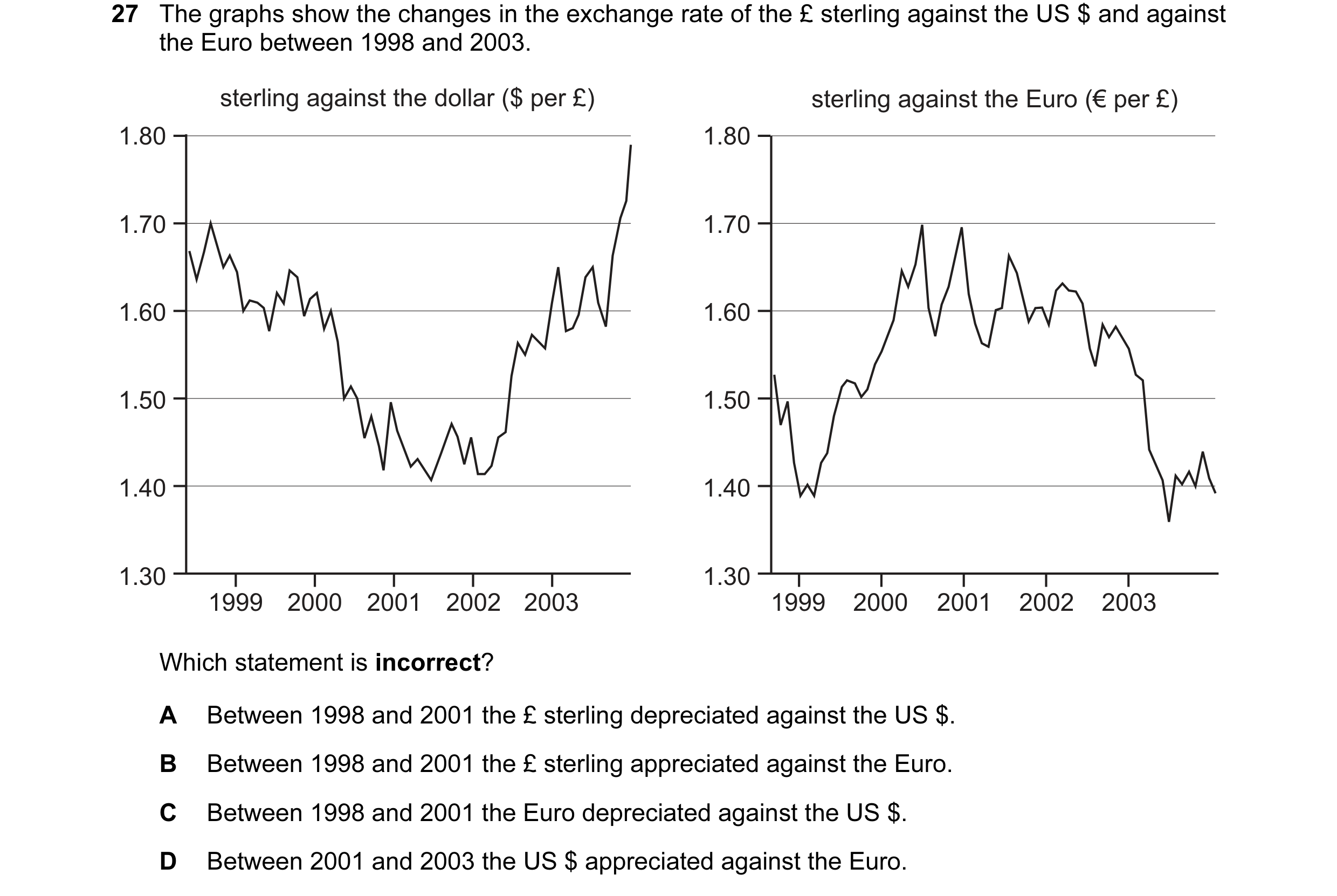
27 The graphs show the changes in the exchange rate of the £ sterling against the US $ and against the Euro between 1998 and 2003. sterling against the dollar ($ per £) sterling against the Euro (€ per £) 1.80 1.80 1.70 1.70 1.60 1.60 1.50 1.50 1.40 1.40 1.30 1.30 1999 2000 2001 2002 2003 1999 2000 2001 2002 2003 Which statement is incorrect? A Between 1998 and 2001 the £ sterling depreciated against the US $. B Between 1998 and 2001 the £ sterling appreciated against the Euro. C Between 1998 and 2001 the Euro depreciated against the US $. D Between 2001 and 2003 the US $ appreciated against the Euro.
1 marks
Answer: D
This question in 9708/31 Oct/Nov 2011
Q9 · An economy has a flexible exchange rate 9708/32 Oct/Nov 2011
30 An economy has a flexible exchange rate. It raises interest rates above the level existing in other countries. What will be the likely effect on the level of domestic demand for goods and services and on the demand for the country’s exports? domestic demand export demand A decrease decrease B decrease increase C increase decrease D increase increase
1 marks
Answer: A
This question in 9708/32 Oct/Nov 2011
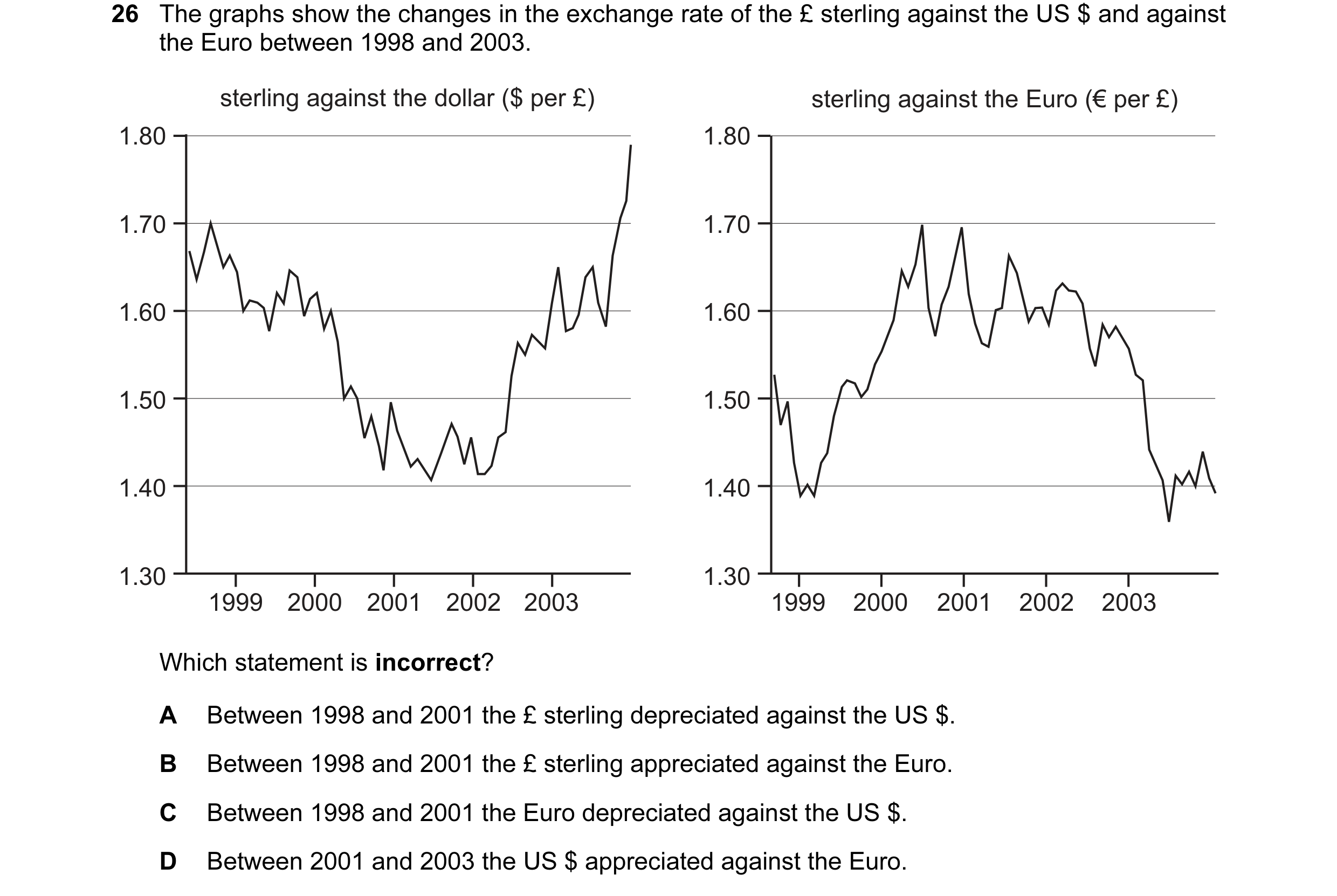
Q10 · The graphs show the changes in the exchange rate of the £ sterling against the US $ and… 9708/33 Oct/Nov 2011
26 The graphs show the changes in the exchange rate of the £ sterling against the US $ and against the Euro between 1998 and 2003. sterling against the dollar ($ per £) sterling against the Euro (€ per £) 1.80 1.80 1.70 1.70 1.60 1.60 1.50 1.50 1.40 1.40 1.30 1.30 1999 2000 2001 2002 2003 1999 2000 2001 2002 2003 Which statement is incorrect? A Between 1998 and 2001 the £ sterling depreciated against the US $. B Between 1998 and 2001 the £ sterling appreciated against the Euro. C Between 1998 and 2001 the Euro depreciated against the US $. D Between 2001 and 2003 the US $ appreciated against the Euro.
1 marks
Answer: D
This question in 9708/33 Oct/Nov 2011
Q11 · What is likely to result from the discovery of oil reserves in a developing economy? 9708/31 May/June 2012
26 What is likely to result from the discovery of oil reserves in a developing economy? A a more equal distribution of income and wealth B an increase in the real exchange rate C an increase in the competitiveness of commercial agriculture D a reduction in the volume of imports of manufactured goods
1 marks
Answer: B
This question in 9708/31 May/June 2012
Q12 · What is likely to result from the discovery of oil reserves in a developing economy? 9708/32 May/June 2012
26 What is likely to result from the discovery of oil reserves in a developing economy? A a more equal distribution of income and wealth B an increase in the real exchange rate C an increase in the competitiveness of commercial agriculture D a reduction in the volume of imports of manufactured goods
1 marks
Answer: B
This question in 9708/32 May/June 2012
Q13 · Other things being equal, what is likely to result from a reduction in interest rates in… 9708/33 May/June 2012
28 Other things being equal, what is likely to result from a reduction in interest rates in a country? A an appreciation of the country’s currency B a decrease in consumption C a decrease in investment D an outflow of short-term capital
1 marks
Answer: D
This question in 9708/33 May/June 2012
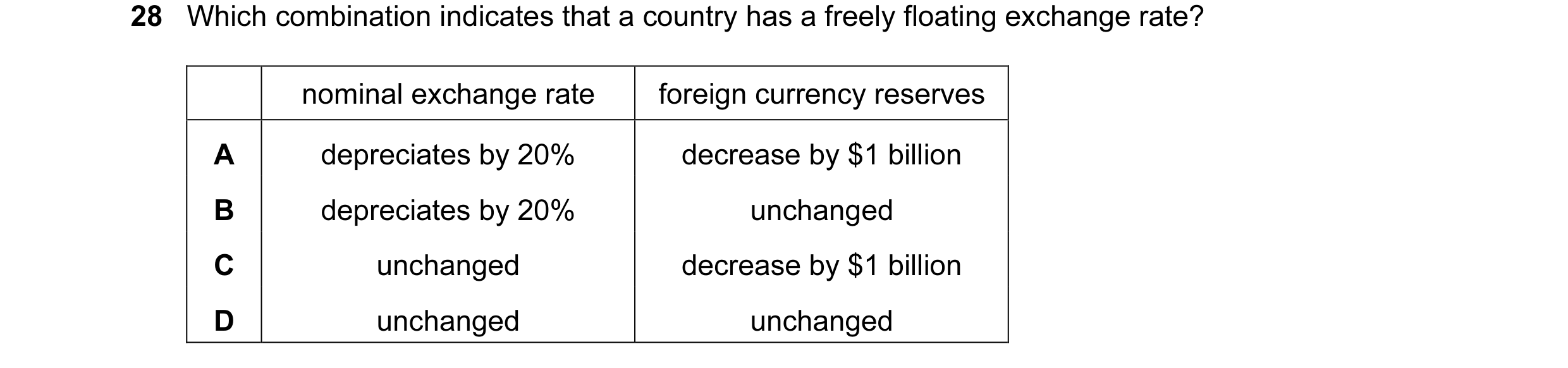
Q14 · Which combination indicates that a country has a freely floating exchange rate? 9708/31 May/June 2013
28 Which combination indicates that a country has a freely floating exchange rate? nominal exchange rate foreign currency reserves A depreciates by 20% decrease by $1 billion B depreciates by 20% unchanged C unchanged decrease by $1 billion D unchanged unchanged
1 marks
Answer: B
This question in 9708/31 May/June 2013
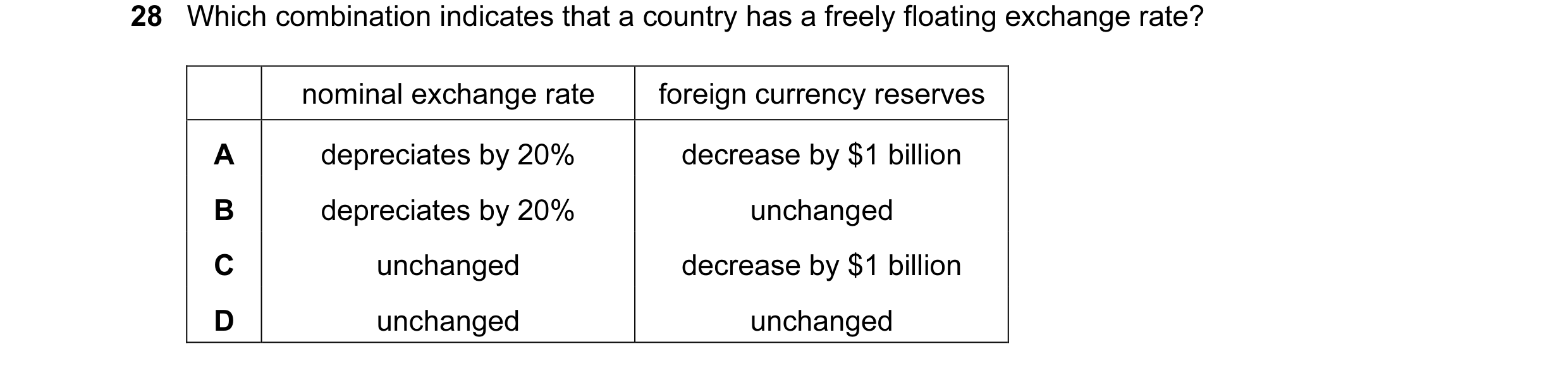
Q15 · Which combination indicates that a country has a freely floating exchange rate? 9708/33 May/June 2013
28 Which combination indicates that a country has a freely floating exchange rate? nominal exchange rate foreign currency reserves A depreciates by 20% decrease by $1 billion B depreciates by 20% unchanged C unchanged decrease by $1 billion D unchanged unchanged
1 marks
Answer: B
This question in 9708/33 May/June 2013
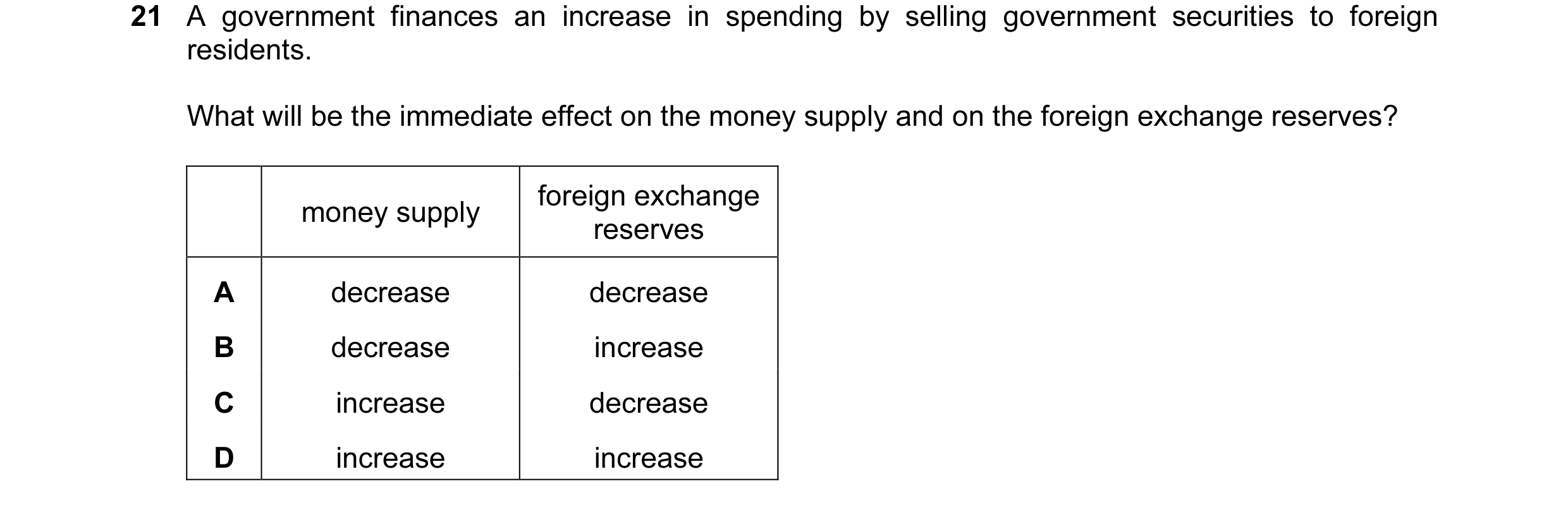
Q16 · A government finances an increase in spending by selling government securities to foreign… 9708/31 Oct/Nov 2013
21 A government finances an increase in spending by selling government securities to foreign residents. What will be the immediate effect on the money supply and on the foreign exchange reserves? foreign exchange money supply reserves A decrease decrease B decrease increase C increase decrease D increase increase
1 marks
Answer: D
This question in 9708/31 Oct/Nov 2013
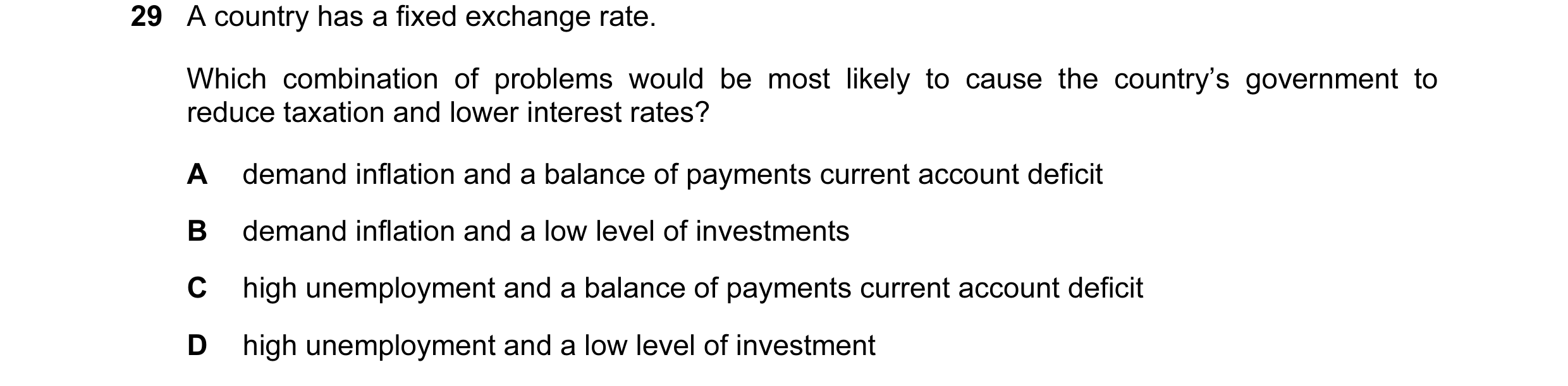
Q17 · A country has a fixed exchange rate 9708/31 Oct/Nov 2013
29 A country has a fixed exchange rate. Which combination of problems would be most likely to cause the country’s government to reduce taxation and lower interest rates? A demand inflation and a balance of payments current account deficit B demand inflation and a low level of investments C high unemployment and a balance of payments current account deficit D high unemployment and a low level of investment
1 marks
Answer: D
This question in 9708/31 Oct/Nov 2013
Q18 · Which combination indicates that a country is operating a ‘dirty float’? 9708/32 Oct/Nov 2013
26 Which combination indicates that a country is operating a ‘dirty float’? nominal exchange rate foreign currency reserves A depreciates by 20% decrease by $1 billion B depreciates by 20% unchanged C unchanged decrease by $1 billion D unchanged unchanged
1 marks
Answer: A
This question in 9708/32 Oct/Nov 2013
Q19 · Other things being equal, what is likely to result from a decrease in interest rates? 9708/33 Oct/Nov 2016
29 Other things being equal, what is likely to result from a decrease in interest rates? A a decrease in investment B a net capital inflow C an appreciation of the currency D an increase in consumption
1 marks
Answer: D
This question in 9708/33 Oct/Nov 2016
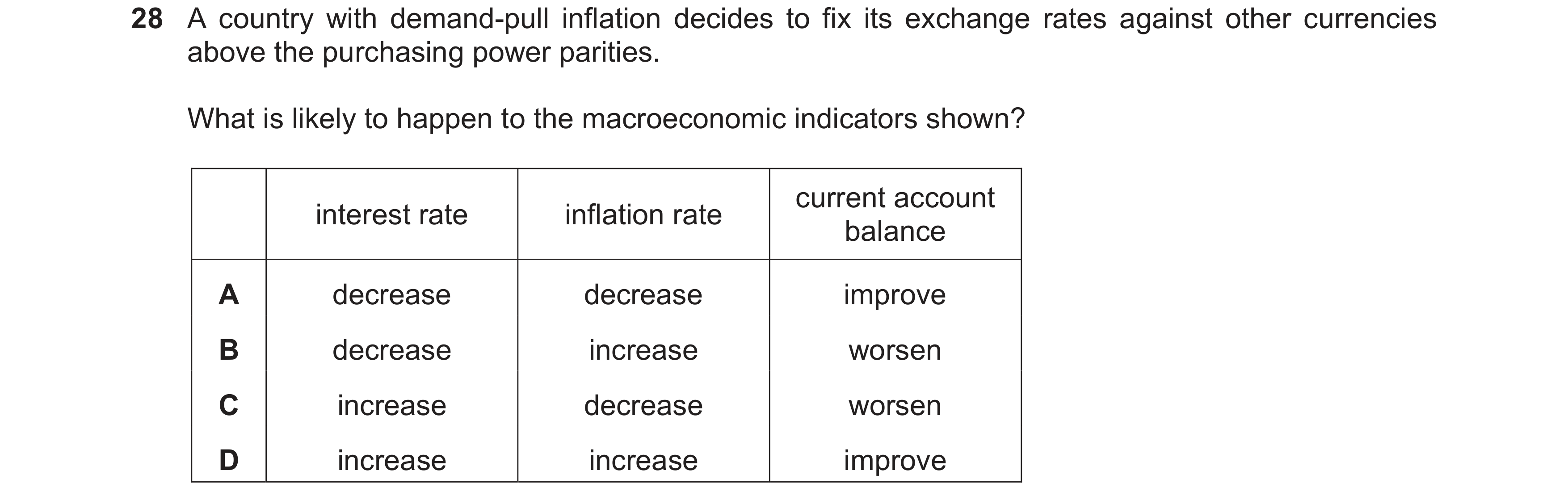
Q20 · A country with demand-pull inflation decides to fix its exchange rates against other… 9708/32 May/June 2017
28 A country with demand-pull inflation decides to fix its exchange rates against other currencies above the purchasing power parities. What is likely to happen to the macroeconomic indicators shown? current account interest rate inflation rate balance A decrease decrease improve B decrease increase worsen C increase decrease worsen D increase increase improve
1 marks
Answer: C
This question in 9708/32 May/June 2017
Q21 · What is most likely to result from the discovery of oil reserves in a developing economy? 9708/32 Oct/Nov 2018
30 What is most likely to result from the discovery of oil reserves in a developing economy? A a more equal distribution of income and wealth B an increase in the competitiveness of commercial agriculture C an increase in the exchange rate D a reduction in the volume of imports of manufactured goods
1 marks
Answer: C
This question in 9708/32 Oct/Nov 2018
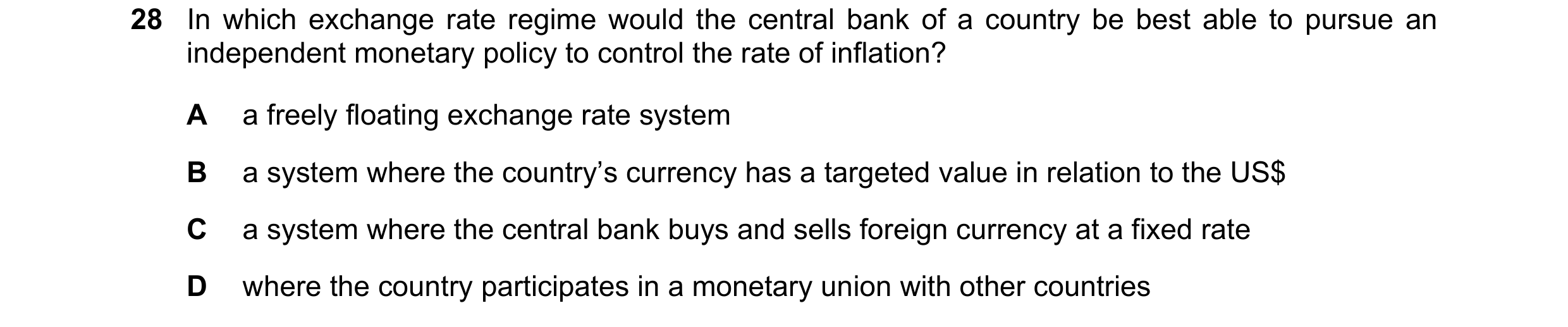
Q22 · In which exchange rate regime would the central bank of a country be best able to pursue… 9708/32 Oct/Nov 2019
28 In which exchange rate regime would the central bank of a country be best able to pursue an independent monetary policy to control the rate of inflation? A a freely floating exchange rate system B a system where the country’s currency has a targeted value in relation to the US$ C a system where the central bank buys and sells foreign currency at a fixed rate D where the country participates in a monetary union with other countries
1 marks
Answer: A
This question in 9708/32 Oct/Nov 2019
Q23 · In an economy, the elasticity of demand for imported raw materials is 0.3 and the… 9708/32 Oct/Nov 2020
29 In an economy, the elasticity of demand for imported raw materials is 0.3 and the elasticity of demand for exports is also 0.3. Following a depreciation of the economy’s currency, what will be the impact on inflation? change in cost push change in demand factors will cause pull factors will inflation to cause inflation to A decrease decrease B decrease increase C increase decrease D increase increase
1 marks
Answer: C
This question in 9708/32 Oct/Nov 2020
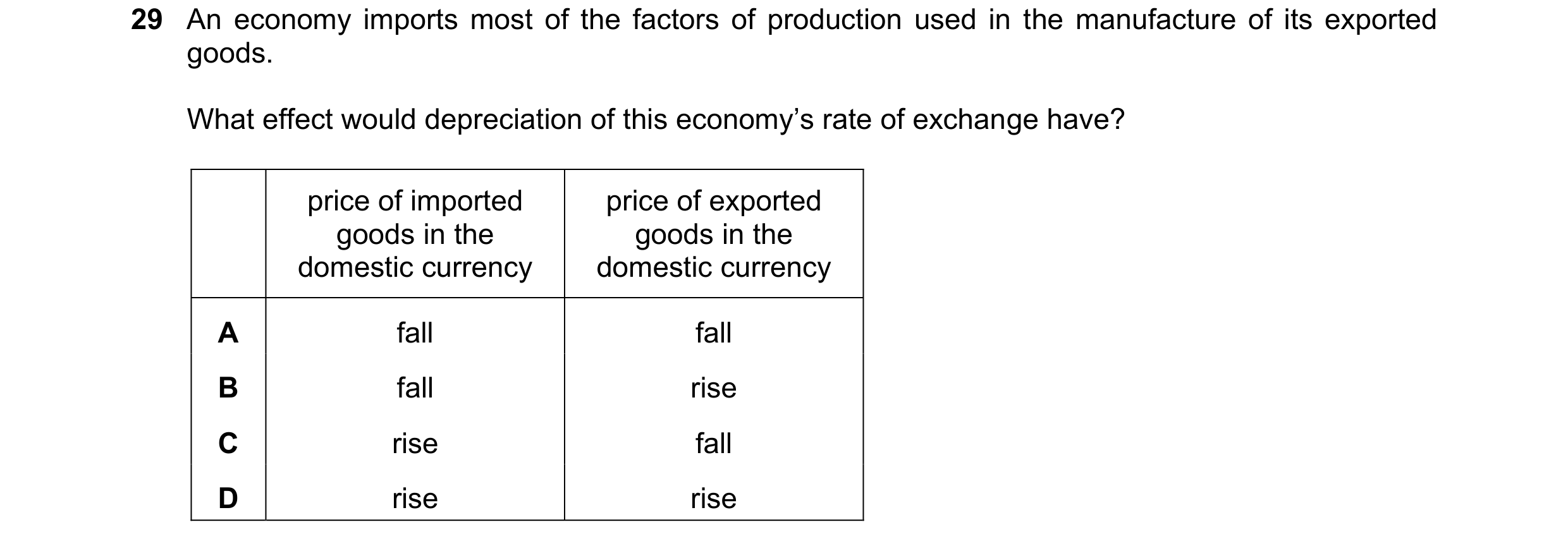
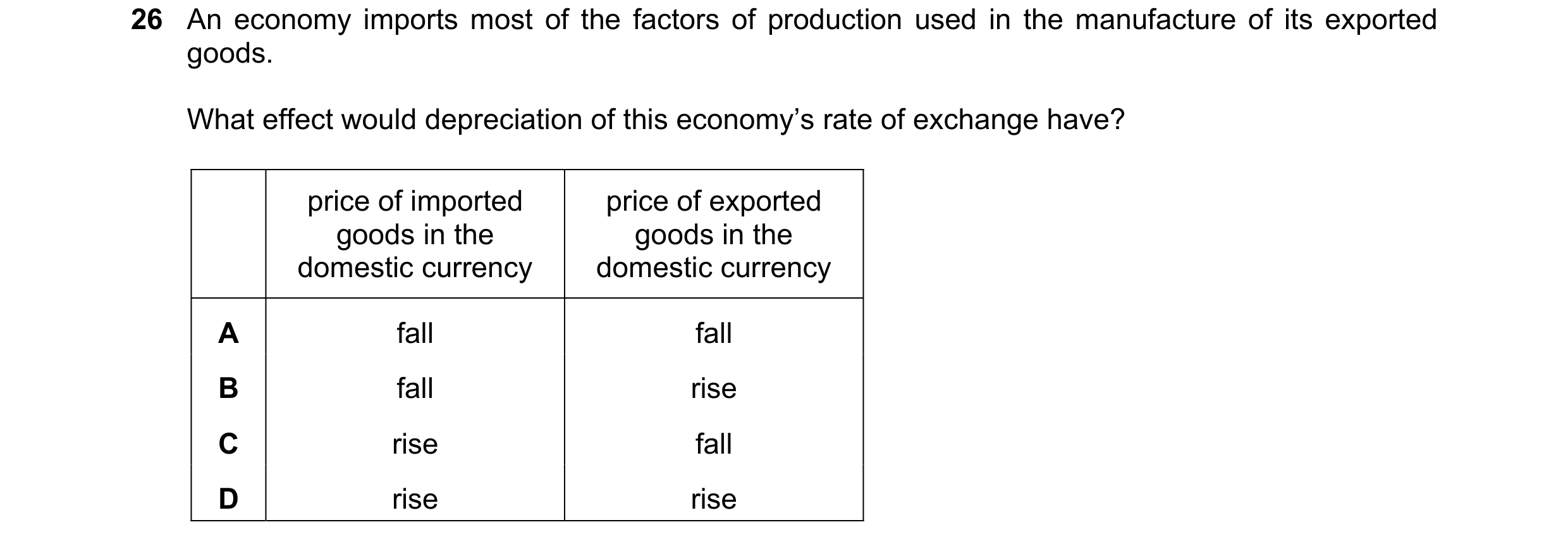
Q24 · An economy imports most of the factors of production used in the manufacture of its… 9708/33 Oct/Nov 2020
29 An economy imports most of the factors of production used in the manufacture of its exported goods. What effect would depreciation of this economy’s rate of exchange have? price of imported price of exported goods in the goods in the domestic currency domestic currency A fall fall B fall rise C rise fall D rise rise
1 marks
Answer: D
This question in 9708/33 Oct/Nov 2020
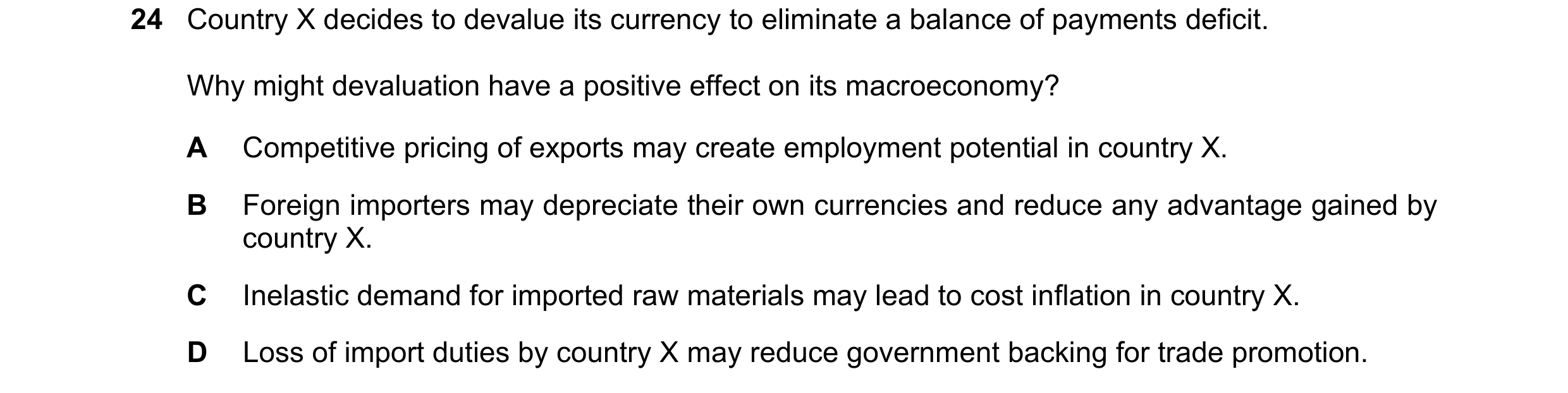
Q25 · Country X decides to devalue its currency to eliminate a balance of payments deficit 9708/32 Feb/March 2023
24 Country X decides to devalue its currency to eliminate a balance of payments deficit. Why might devaluation have a positive effect on its macroeconomy? A Competitive pricing of exports may create employment potential in country X. B Foreign importers may depreciate their own currencies and reduce any advantage gained by country X. C Inelastic demand for imported raw materials may lead to cost inflation in country X. D Loss of import duties by country X may reduce government backing for trade promotion.
1 marks
Answer: A
This question in 9708/32 Feb/March 2023
Q26 · An economy imports most of the factors of production used in the manufacture of its… 9708/32 May/June 2023
26 An economy imports most of the factors of production used in the manufacture of its exported goods. What effect would depreciation of this economy’s rate of exchange have? price of imported price of exported goods in the goods in the domestic currency domestic currency A fall fall B fall rise C rise fall D rise rise
1 marks
Answer: D
This question in 9708/32 May/June 2023
Q27 · The diagram shows a J curve which indicates that a fall in the exchange rate will worsen… 9708/32 May/June 2023
28 The diagram shows a J curve which indicates that a fall in the exchange rate will worsen the current account position before it starts to improve. J curve current account surplus O time current account deficit What is said to explain this? A a time lag before recognising that prices have changed B an improvement in the quality of goods produced C the demand for imports and exports is elastic in the short run D the supply of goods is price elastic
1 marks
Answer: A
This question in 9708/32 May/June 2023
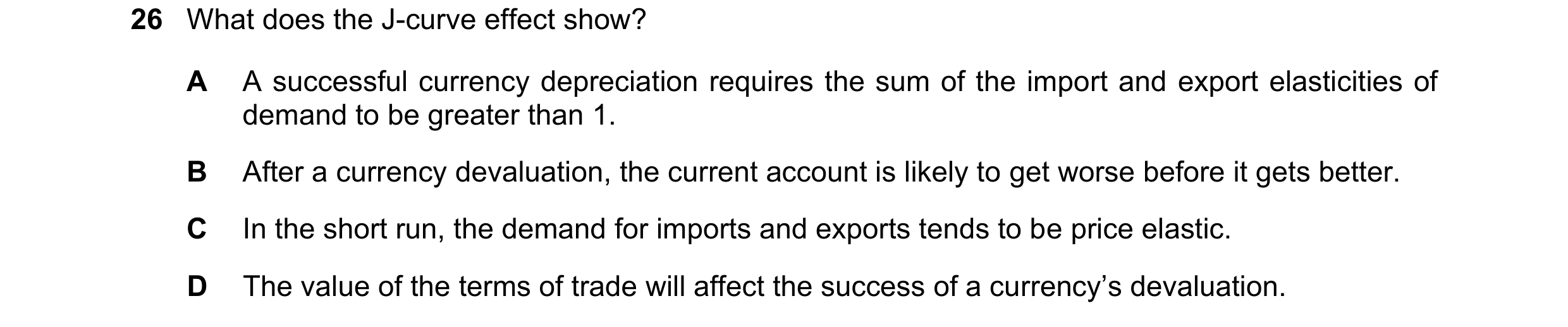
Q28 · What does the J-curve effect show? 9708/31 May/June 2024
26 What does the J-curve effect show? A A successful currency depreciation requires the sum of the import and export elasticities of demand to be greater than 1. B After a currency devaluation, the current account is likely to get worse before it gets better. C In the short run, the demand for imports and exports tends to be price elastic. D The value of the terms of trade will affect the success of a currency’s devaluation.
1 marks
Answer: B
This question in 9708/31 May/June 2024
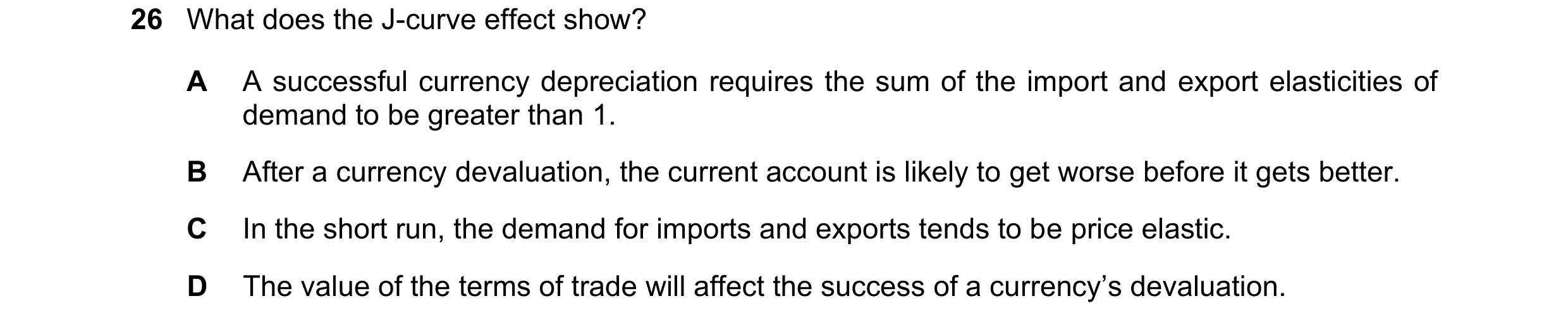
Q29 · What does the J-curve effect show? 9708/33 May/June 2024
26 What does the J-curve effect show? A A successful currency depreciation requires the sum of the import and export elasticities of demand to be greater than 1. B After a currency devaluation, the current account is likely to get worse before it gets better. C In the short run, the demand for imports and exports tends to be price elastic. D The value of the terms of trade will affect the success of a currency’s devaluation.
1 marks
Answer: B
This question in 9708/33 May/June 2024
Q30 · Which policy would not lead to an increase in the value of a country’s currency? 9708/32 Feb/March 2025
23 Which policy would not lead to an increase in the value of a country’s currency? A an increase in domestic inflation B an increase in domestic interest rates C an increase in incomes abroad D an increase in tourists visiting the country
1 marks
Answer: A
This question in 9708/32 Feb/March 2025
 1 / 7
1 / 7
 2 / 7
2 / 7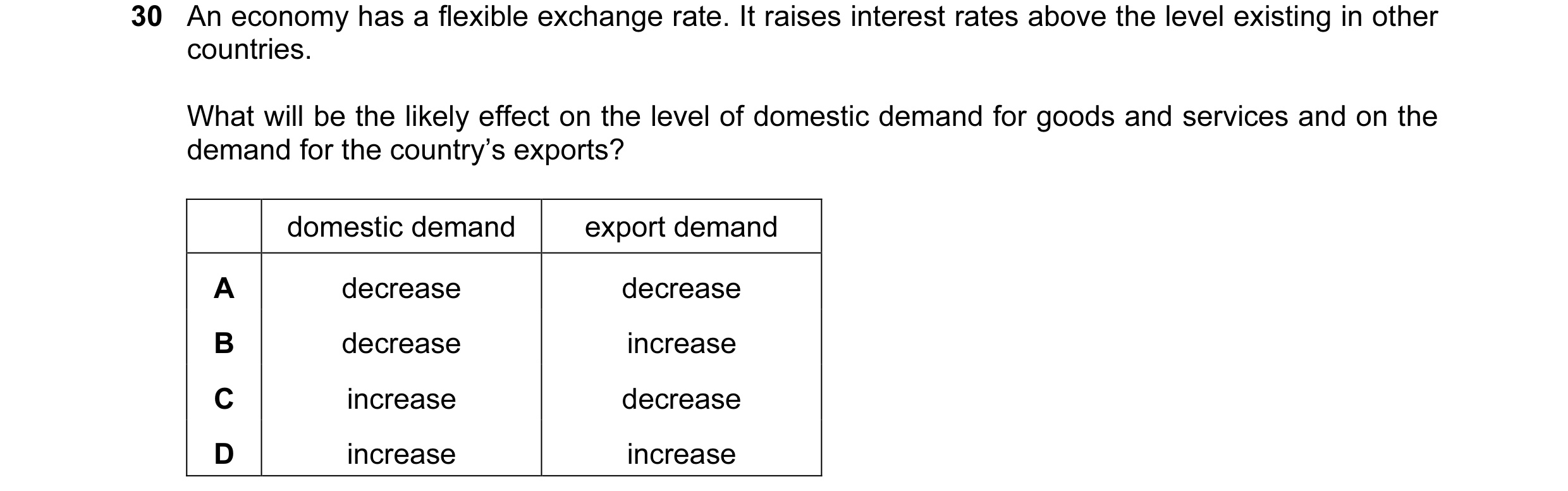

 3 / 7
3 / 7
 4 / 7
4 / 7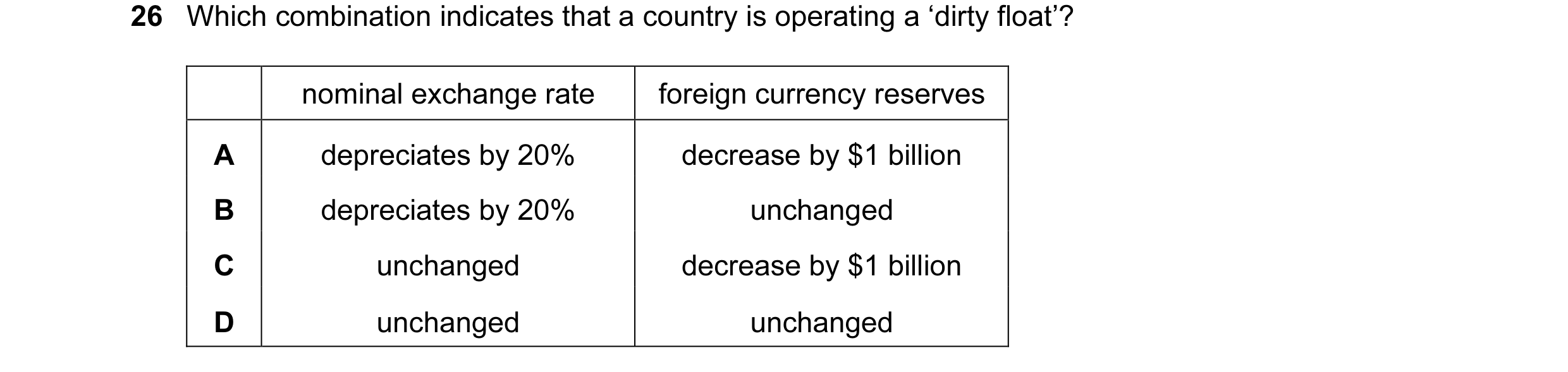


 5 / 7
5 / 7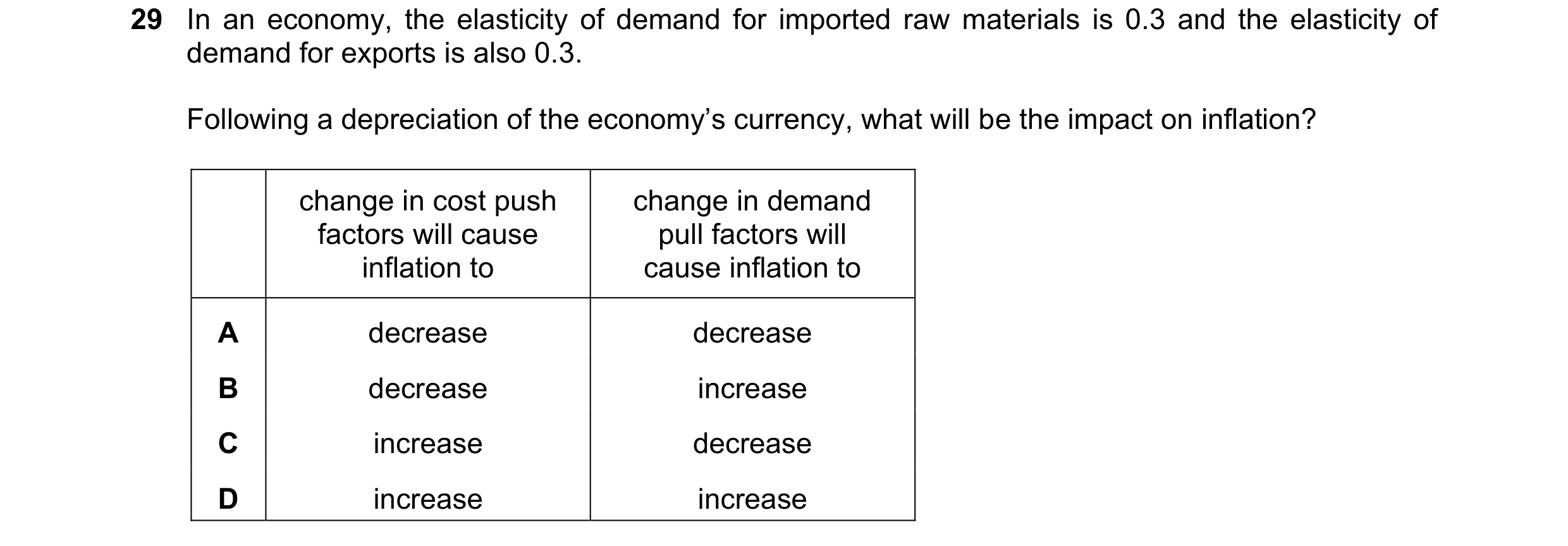
 6 / 7
6 / 7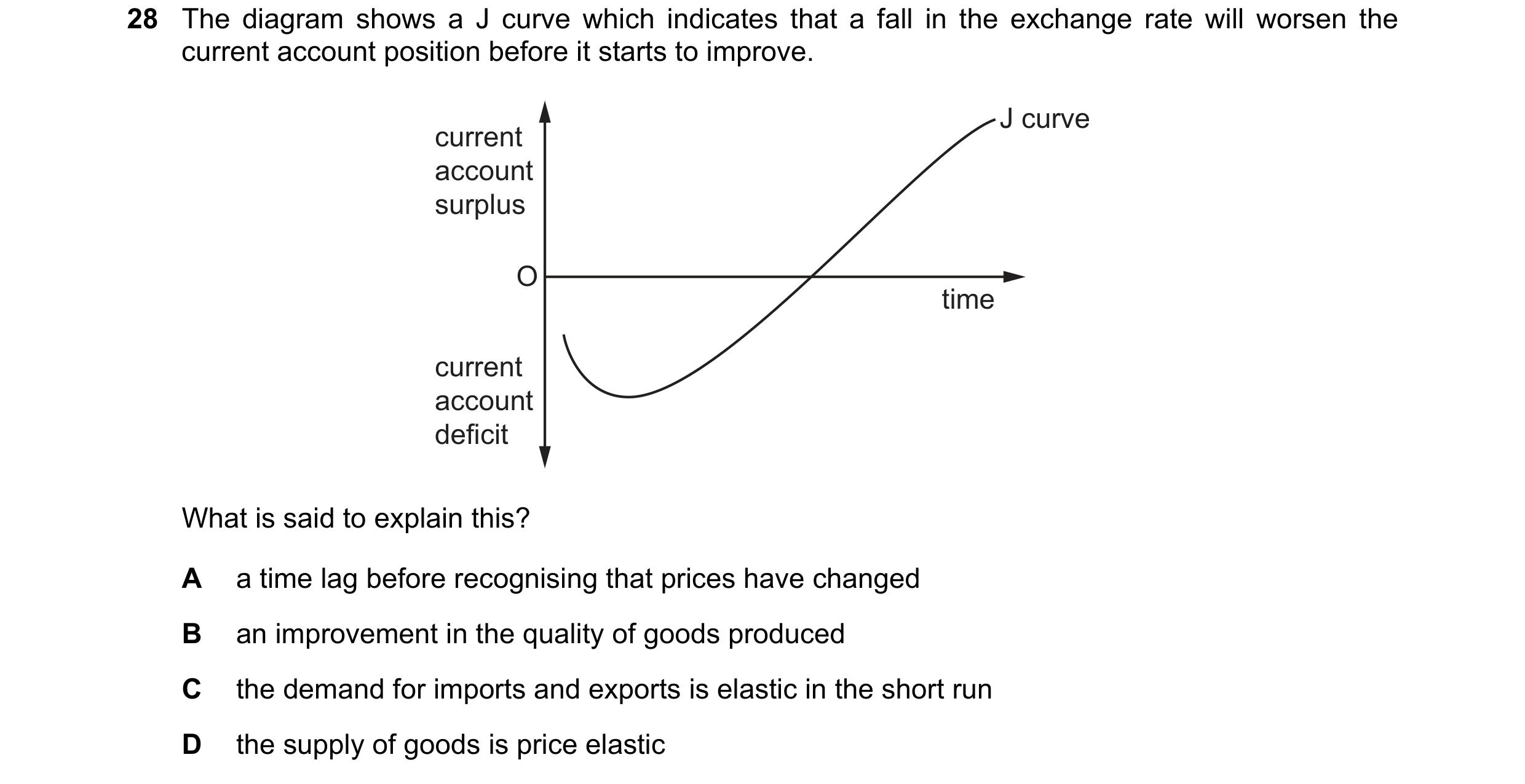
 7 / 7
7 / 7