Questions as text
Q1 · Under a system of flexible exchange rates, what determines the foreign exchange value of… 9708/11 Oct/Nov 2008
28 Under a system of flexible exchange rates, what determines the foreign exchange value of a currency? A the overall supply of and demand for a currency B the purchasing power of the currency relative to the purchasing power of foreign currencies C the surplus or deficit on the balance of payments on current account D the differential between domestic and foreign interest rates
1 marks
Answer: A
This question in 9708/11 Oct/Nov 2008
Q2 · In the diagram, D1D1 and S1S1 are the initial demand and supply curves of the pound… 9708/11 May/June 2009
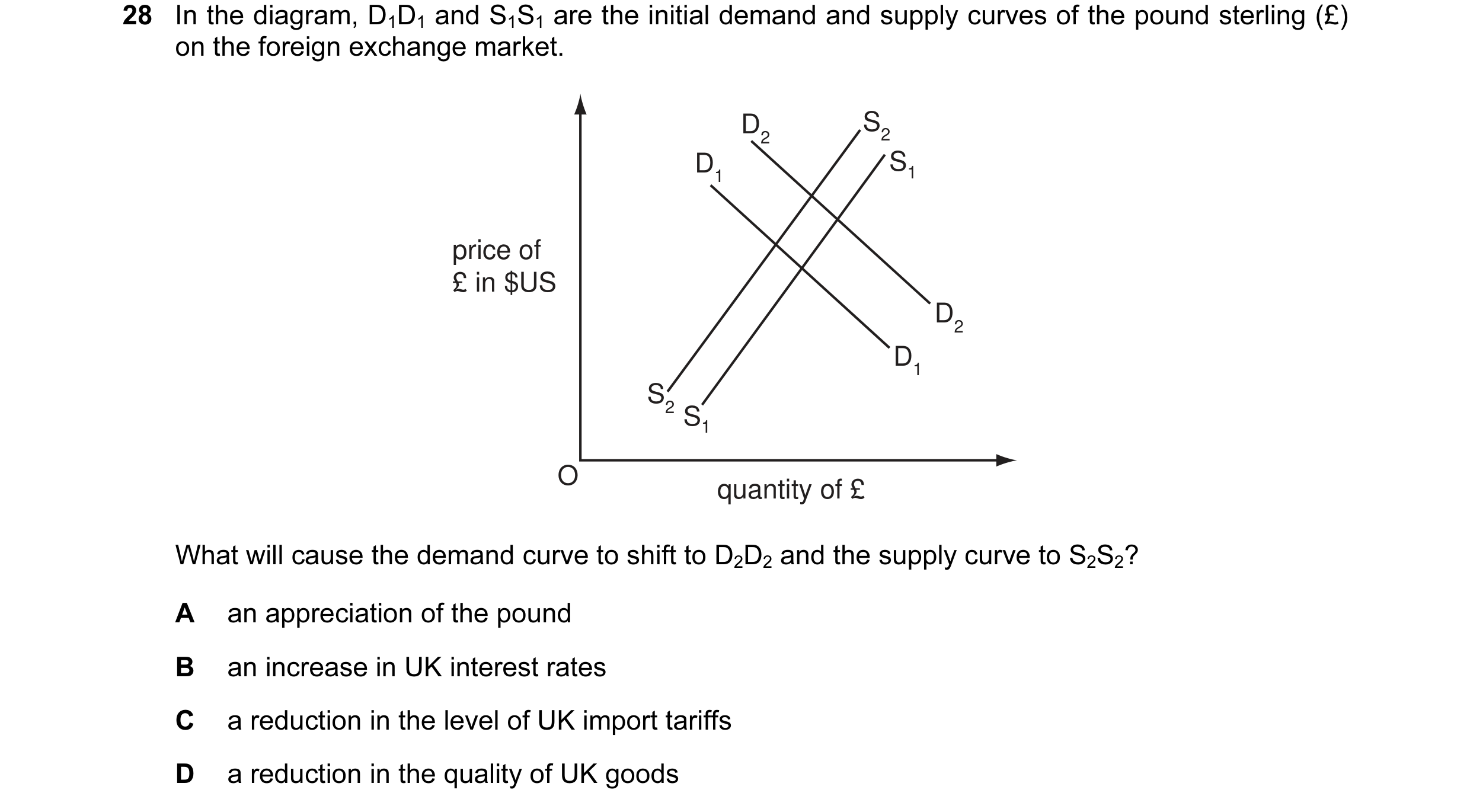
28 In the diagram, D1D1 and S1S1 are the initial demand and supply curves of the pound sterling (£) on the foreign exchange market. D2 S2 D1 S1 price of £ in $US D2 D1 S2 S1 O quantity of £ What will cause the demand curve to shift to D2D2 and the supply curve to S2S2? A an appreciation of the pound B an increase in UK interest rates C a reduction in the level of UK import tariffs D a reduction in the quality of UK goods
1 marks
Answer: B
This question in 9708/11 May/June 2009
Q3 · With an exchange rate of 5 Egyptian pounds (EGP) = 1 US dollar ($), an American product… 9708/11 May/June 2009
29 With an exchange rate of 5 Egyptian pounds (EGP) = 1 US dollar ($), an American product sells in Egypt for EGP 100. Assuming that the dollar price remains unchanged, what will be the price of the product in Egypt if the Egyptian pound appreciates to 4 EGP = 1 US$? A EGP 75 B EGP 80 C EGP 120 D EGP 125
1 marks
Answer: B
This question in 9708/11 May/June 2009
Q4 · Country X trades with only two countries, the USA and Japan 9708/12 Oct/Nov 2009
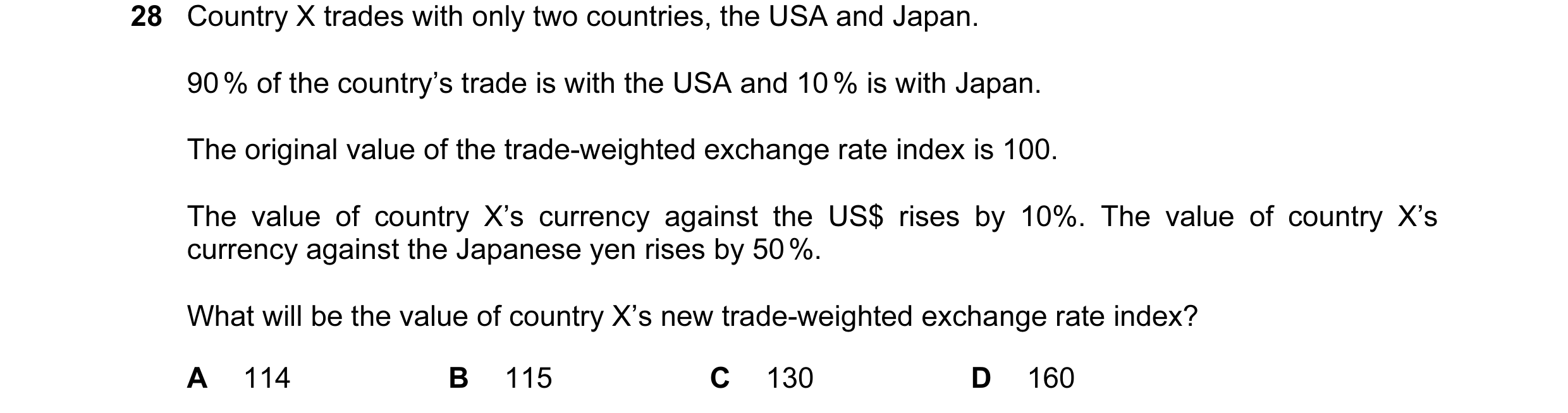
28 Country X trades with only two countries, the USA and Japan. 90 % of the country’s trade is with the USA and 10 % is with Japan. The original value of the trade-weighted exchange rate index is 100. The value of country X’s currency against the US$ rises by 10%. The value of country X’s currency against the Japanese yen rises by 50 %. What will be the value of country X’s new trade-weighted exchange rate index? A 114 B 115 C 130 D 160
1 marks
Answer: A
This question in 9708/12 Oct/Nov 2009
Q5 · At present, one unit of a country’s currency exchanges for US$1.2 9708/13 Oct/Nov 2012
29 At present, one unit of a country’s currency exchanges for US$1.2. The country aims to set its exchange rate at US$1.4. Which combination of government actions in the foreign exchange market must achieve this aim? A buying US currency and buying its own currency B buying US currency and selling its own currency C selling US currency and buying its own currency D selling US currency and selling its own currency
1 marks
Answer: C
This question in 9708/13 Oct/Nov 2012
Q6 · Country X conducts 60% of its trade with country Y and 40% of its trade with country Z 9708/11 May/June 2013
27 Country X conducts 60% of its trade with country Y and 40% of its trade with country Z. The initial value of the trade weighted exchange rate index of country X is 100. What will be its new trade weighted exchange rate index value if its currency falls in value by 20% against the currency of Y and rises by 10% against the currency of Z? A 84 B 90 C 92 D 116
1 marks
Answer: C
This question in 9708/11 May/June 2013
Q7 · A revaluation (appreciation) of the exchange rate of a currency always has the effect of… 9708/11 May/June 2013
29 A revaluation (appreciation) of the exchange rate of a currency always has the effect of A improving the current account of the balance of payments. B improving the terms of trade. C increasing the price of imports. D increasing the value of imports.
1 marks
Answer: B
This question in 9708/11 May/June 2013
Q8 · Country X trades with only two countries, the USA and Japan 9708/12 Oct/Nov 2013
28 Country X trades with only two countries, the USA and Japan. 90 % of the country’s trade is with the USA and 10 % is with Japan. The original value of the trade-weighted exchange rate index is 100. The value of country X’s currency against the US$ rises by 10%. The value of country X’s currency against the Japanese yen rises by 50 %. What will be the value of country X’s new trade-weighted exchange rate index? A 114 B 115 C 130 D 160
1 marks
Answer: A
This question in 9708/12 Oct/Nov 2013
Q9 · According to the Purchasing Power Parity theory, what determines the rate of exchange… 9708/13 Oct/Nov 2013
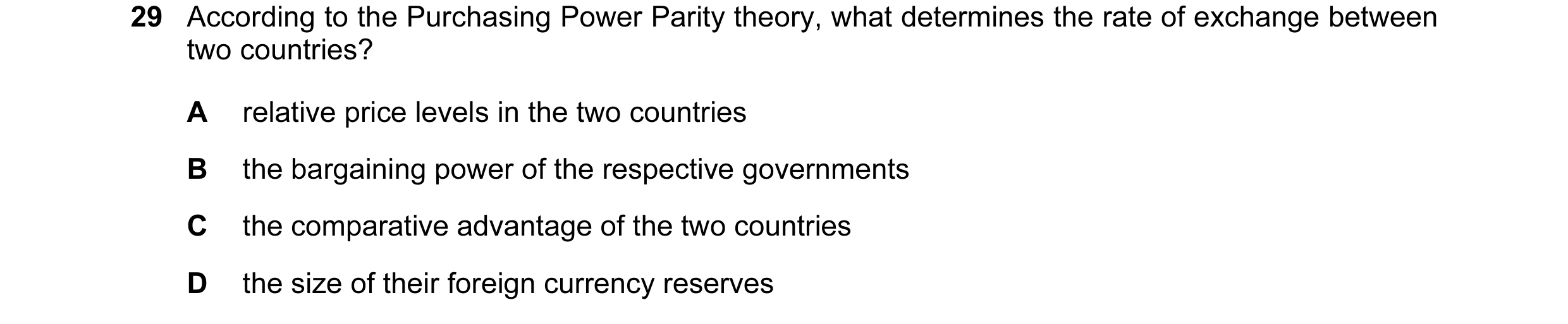
29 According to the Purchasing Power Parity theory, what determines the rate of exchange between two countries? A relative price levels in the two countries B the bargaining power of the respective governments C the comparative advantage of the two countries D the size of their foreign currency reserves
1 marks
Answer: A
This question in 9708/13 Oct/Nov 2013
Q10 · At the start of the year, the exchange rate of Country X’s dollar (X$) to Country Y’s… 9708/11 May/June 2014
28 At the start of the year, the exchange rate of Country X’s dollar (X$) to Country Y’s pound (Y£) is X$4.80 : Y£1 During the year prices increase by 10% in Country X and by 20% in Country Y. According to Purchasing Power Parity theory, what will be the exchange rate at the end of the year? A X$4.40 : Y£1 B X$4.90 : Y£1 C X$5.00 : Y£1 D X$5.20 : Y£1
1 marks
Answer: A
This question in 9708/11 May/June 2014
Q11 · What is the real exchange rate? 9708/12 May/June 2015
27 What is the real exchange rate? A the exchange rate at which foreign currency traders can buy a country’s currency B the exchange rate between a country’s currency and the US Dollar C the exchange rate with international differences in price inflation removed D the weighted average of a country’s exchange rates with its major trading partners
1 marks
Answer: C
This question in 9708/12 May/June 2015
Q12 · Between 2005 and 2010, a country’s import prices rose by 25% and its terms of trade rose… 9708/12 May/June 2016
24 Between 2005 and 2010, a country’s import prices rose by 25% and its terms of trade rose to 120 (2005 = 100). Which change has there been in the country’s export prices? A –5% B 12.5% C 45% D 50%
1 marks
Answer: D
This question in 9708/12 May/June 2016
Q13 · Which combination of changes in export prices and import prices would result in an… 9708/13 May/June 2016
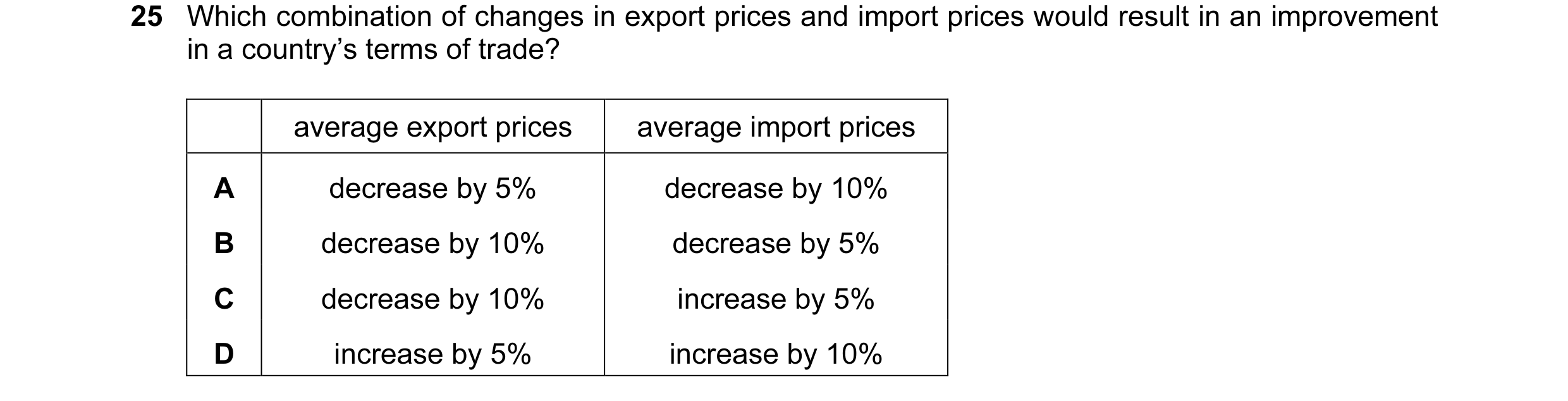
25 Which combination of changes in export prices and import prices would result in an improvement in a country’s terms of trade? average export prices average import prices A decrease by 5% decrease by 10% B decrease by 10% decrease by 5% C decrease by 10% increase by 5% D increase by 5% increase by 10%
1 marks
Answer: A
This question in 9708/13 May/June 2016
Q14 · Country X is an open economy with a floating exchange rate 9708/13 May/June 2016
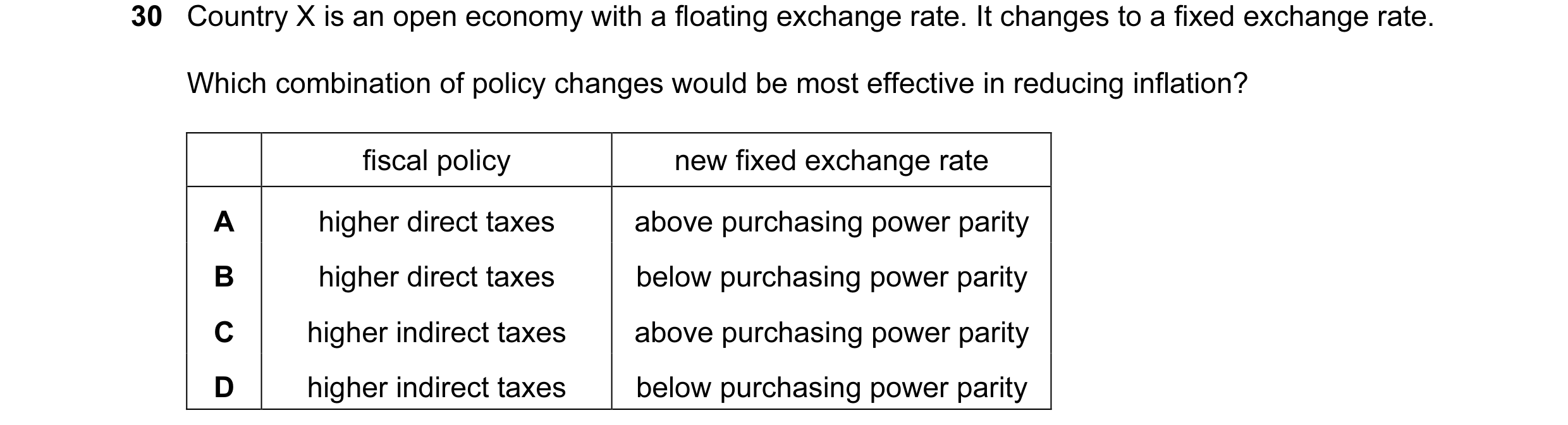
30 Country X is an open economy with a floating exchange rate. It changes to a fixed exchange rate. Which combination of policy changes would be most effective in reducing inflation? fiscal policy new fixed exchange rate A higher direct taxes above purchasing power parity B higher direct taxes below purchasing power parity C higher indirect taxes above purchasing power parity D higher indirect taxes below purchasing power parity
1 marks
Answer: A
This question in 9708/13 May/June 2016
Q15 · A country operates a fixed exchange rate 9708/13 May/June 2022
24 A country operates a fixed exchange rate. There is a major fall of international confidence in its government’s economic policies. What is likely to be the result? A a fall in its foreign exchange rate B a fall in its foreign exchange reserves C a rise in its capital inflows D a rise in its terms of trade
1 marks
Answer: B
This question in 9708/13 May/June 2022
Q16 · What will definitely change a country’s terms of trade? 9708/12 May/June 2023
25 What will definitely change a country’s terms of trade? 1 when the price of imported raw materials increases 2 a change in inflation rates 3 an appreciation of the exchange rate A 1, 2 and 3 B 1 and 2 only C 1 and 3 only D 2 and 3 only
1 marks
Answer: C
This question in 9708/12 May/June 2023
Q17 · In which situation will a country’s terms of trade improve? 9708/11 Oct/Nov 2024
30 In which situation will a country’s terms of trade improve? A Its imports rise in value less than its exports. B Its imports rise in volume less than its exports. C The price of its imports rises by less than the prices of its exports. D The value of its external payments rises by less than the value of its external receipts.
1 marks
Answer: C
This question in 9708/11 Oct/Nov 2024

 1 / 4
1 / 4


 2 / 4
2 / 4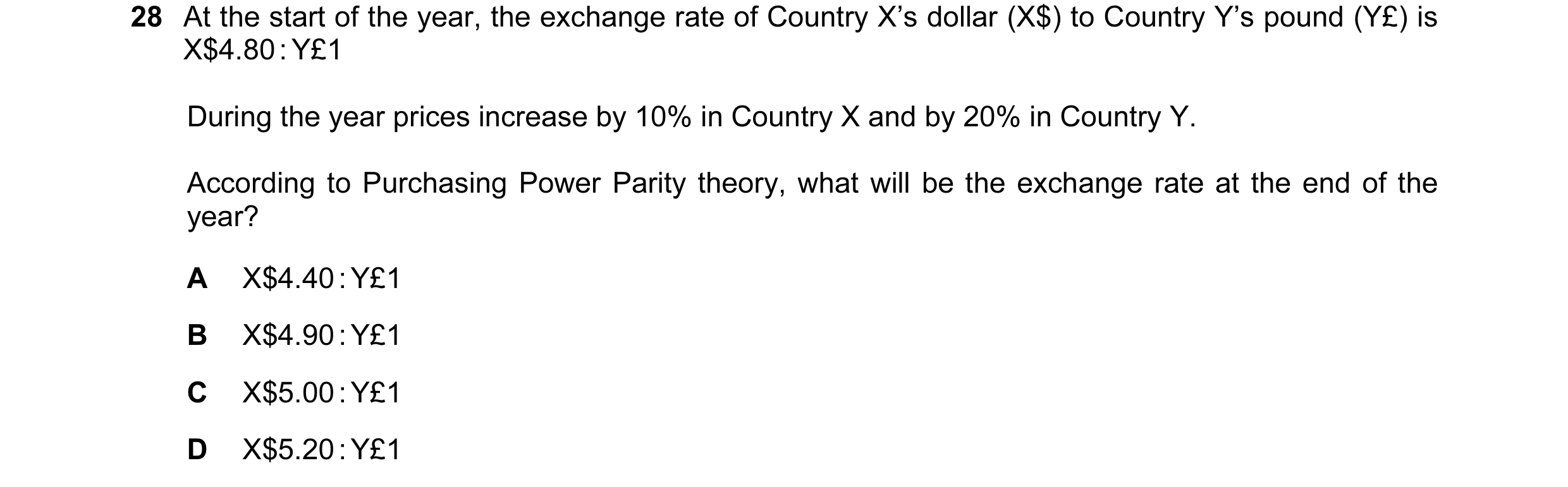


 3 / 4
3 / 4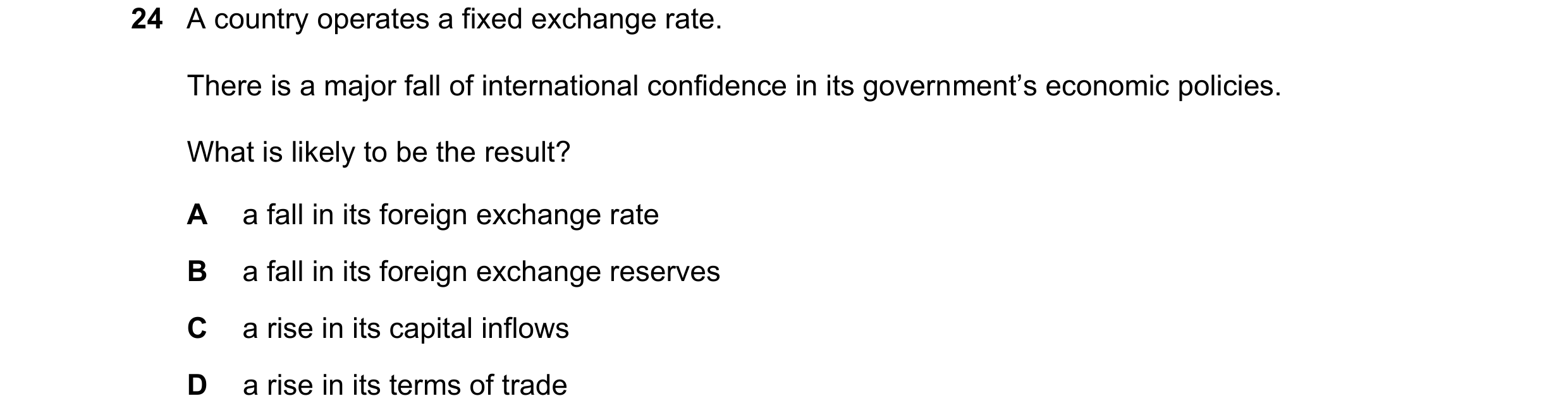

 4 / 4
4 / 4