Questions as text
Q1 · PHB (polyhydroxybutyric acid) is a natural polymer produced by a range of micro-organisms 9701/11 Oct/Nov 2005
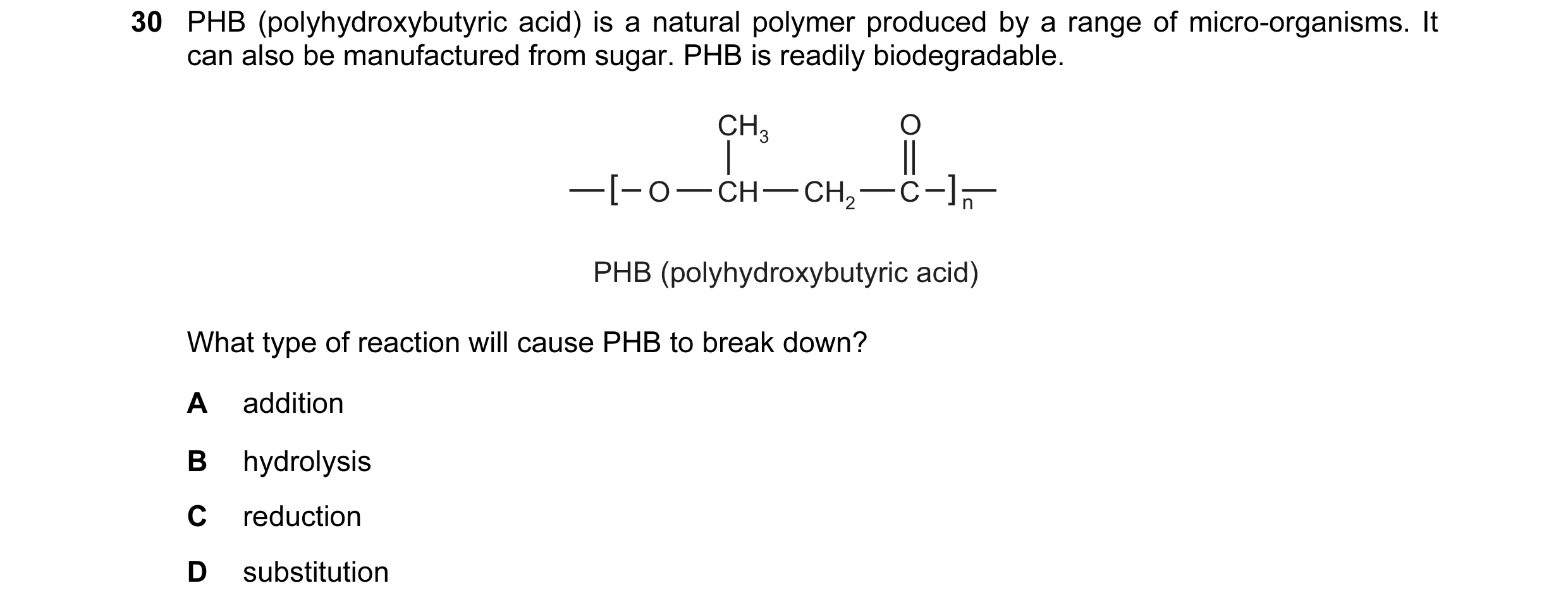
30 PHB (polyhydroxybutyric acid) is a natural polymer produced by a range of micro-organisms. It can also be manufactured from sugar. PHB is readily biodegradable. CH3 O [ O CH CH2 C [ n PHB (polyhydroxybutyric acid) What type of reaction will cause PHB to break down? A addition B hydrolysis C reduction D substitution
1 marks
Answer: B
This question in 9701/11 Oct/Nov 2005
Q2 · Kevlar has the structure below 9701/11 Oct/Nov 2008
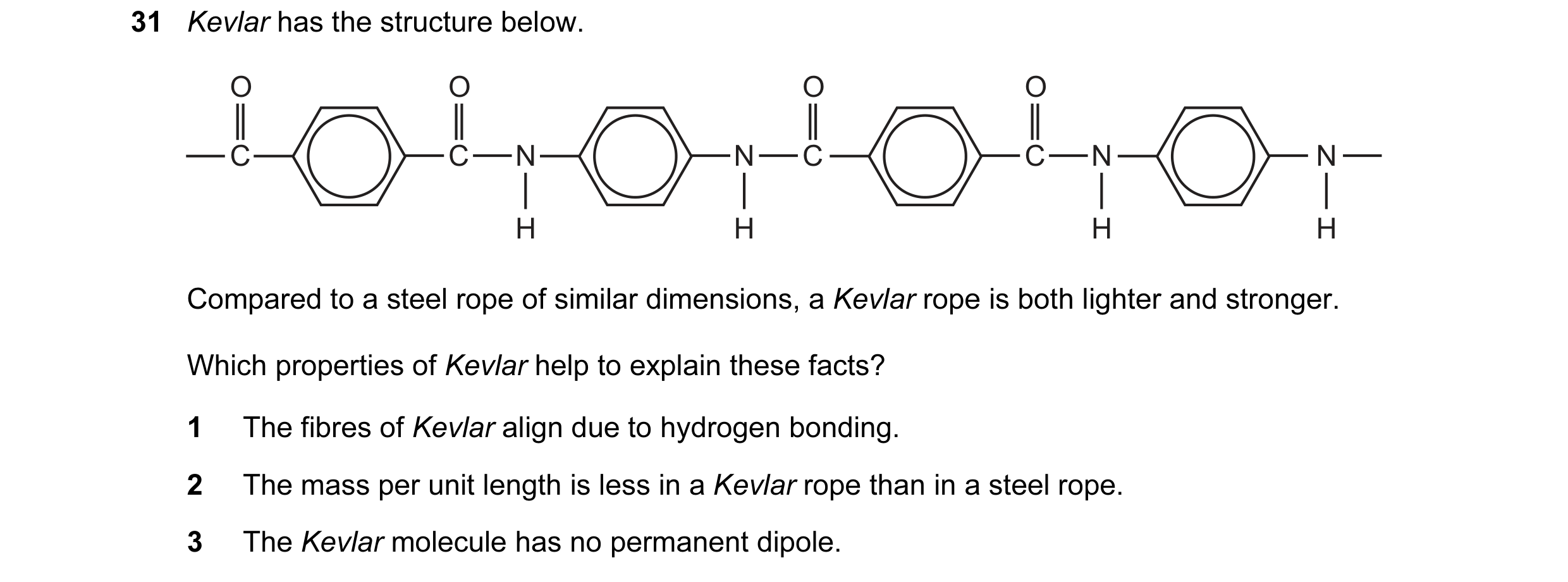
31 Kevlar has the structure below. O O O O C C N N C C N N H H H H Compared to a steel rope of similar dimensions, a Kevlar rope is both lighter and stronger. Which properties of Kevlar help to explain these facts? 1 The fibres of Kevlar align due to hydrogen bonding. 2 The mass per unit length is less in a Kevlar rope than in a steel rope. 3 The Kevlar molecule has no permanent dipole.
1 marks
Answer: B
This question in 9701/11 Oct/Nov 2008
Q3 · Caprolactone is a cyclic ester 9701/13 May/June 2016
30 Caprolactone is a cyclic ester. It is being used increasingly for the manufacture of specialist polymers. O O caprolactone From which compound could caprolactone be made by a single reaction? A OHCCH2CH2CH2CH2CHO B HOCH2CH2CH2CH2CH2CH2OH C HOCH2CH2CH2CH2CH2CO2H D HO2CCH2CH2CH2CH2CO2H Section B
1 marks
Answer: C
This question in 9701/13 May/June 2016
Q4 · The diagram represents the structure of a polymer 9701/13 May/June 2017
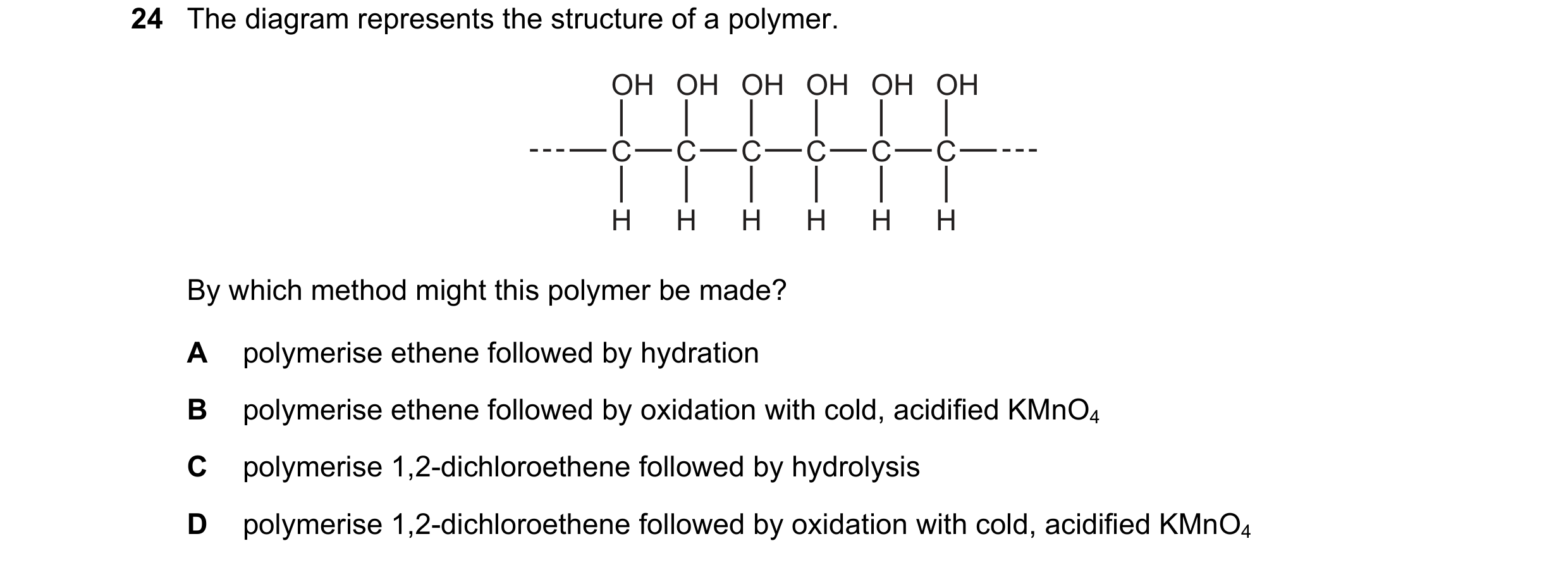
24 The diagram represents the structure of a polymer. OH OH OH OH OH OH C C C C C C H H H H H H By which method might this polymer be made? A polymerise ethene followed by hydration B polymerise ethene followed by oxidation with cold, acidified KMnO4 C polymerise 1,2-dichloroethene followed by hydrolysis D polymerise 1,2-dichloroethene followed by oxidation with cold, acidified KMnO4
1 marks
Answer: C
This question in 9701/13 May/June 2017
Q5 · The structure of lactic acid is shown 9701/12 Feb/March 2018
40 The structure of lactic acid is shown. O H3C C CH OH OH lactic acid Which esters might form when lactic acid is heated? 1 CH3CH(OH)CO2CH(CH3)CO2H CH3 CH O O C 2 C O O CH CH3 3 CH3CH(OH)CO2CH(OH)CH3
1 marks
Answer: B
This question in 9701/12 Feb/March 2018
Q6 · Which compounds produce three different organic products when hydrolysed? 9701/11 Oct/Nov 2019
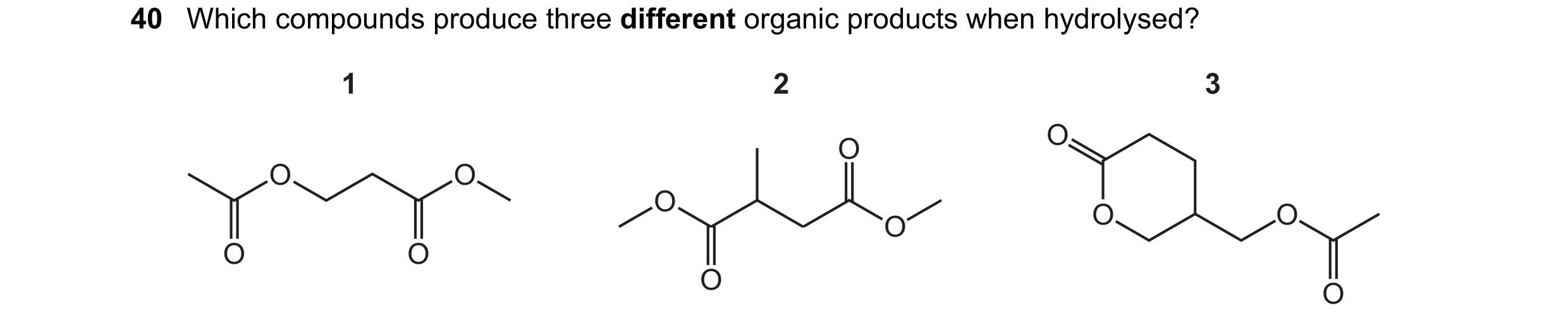
40 Which compounds produce three different organic products when hydrolysed? 1 2 3 O O O O O O O O O O O O
1 marks
Answer: D
This question in 9701/11 Oct/Nov 2019
Q7 · Which compounds produce three different organic products when hydrolysed? 9701/13 Oct/Nov 2019
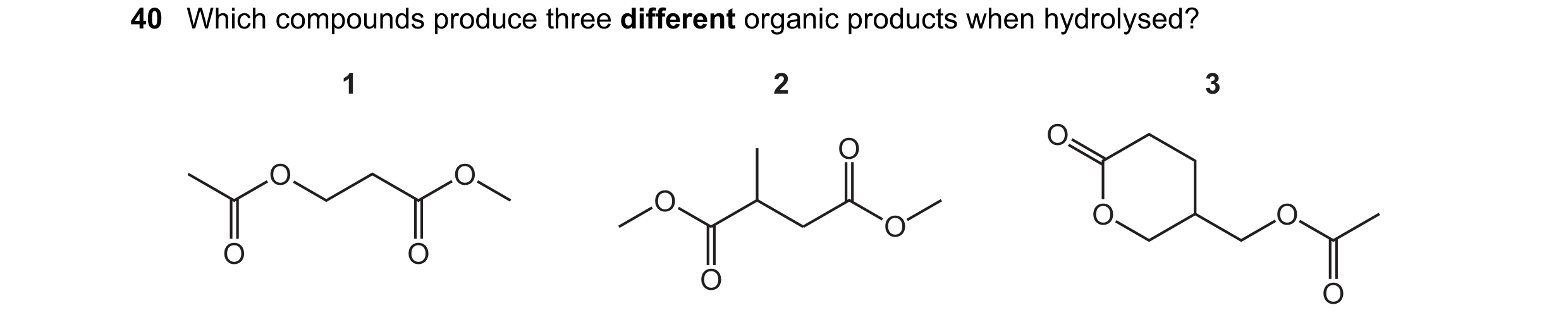
40 Which compounds produce three different organic products when hydrolysed? 1 2 3 O O O O O O O O O O O O
1 marks
Answer: D
This question in 9701/13 Oct/Nov 2019
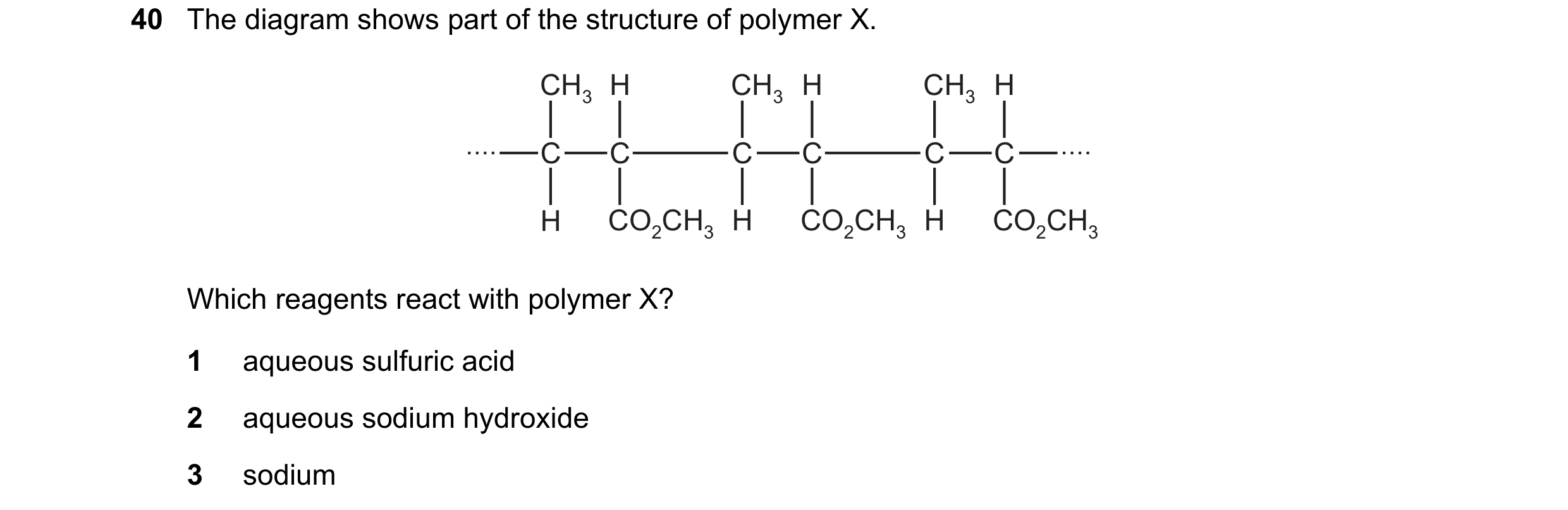
Q8 · The diagram shows part of the structure of polymer X 9701/11 Oct/Nov 2020
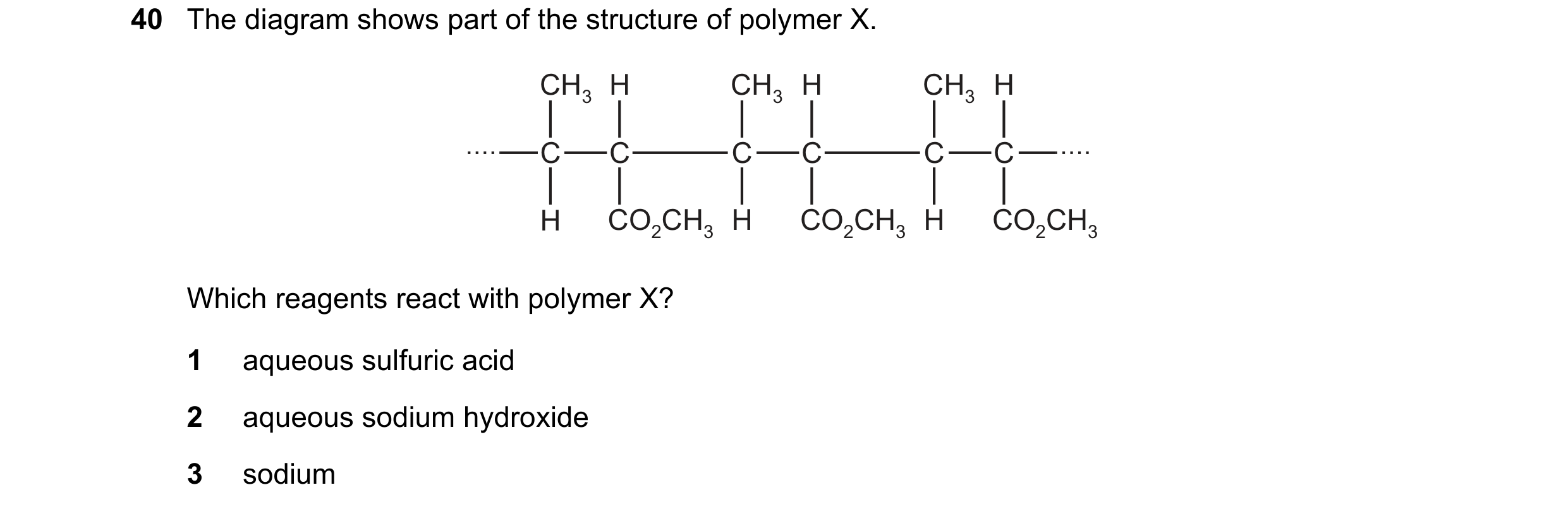
40 The diagram shows part of the structure of polymer X. CH3 H CH3 H CH3 H C C C C C C H CO2CH3 H CO2CH3 H CO2CH3 Which reagents react with polymer X? 1 aqueous sulfuric acid 2 aqueous sodium hydroxide 3 sodium
1 marks
Answer: B
This question in 9701/11 Oct/Nov 2020
Q9 · The repeat unit of a polymer is shown 9701/12 Oct/Nov 2020
32 The repeat unit of a polymer is shown. H CN C C H CO2C2H5 n Which types of intermolecular forces exist in the solid polymer? 1 temporary dipole – induced dipole interactions 2 permanent dipole – permanent dipole interactions 3 hydrogen bonds
1 marks
Answer: B
This question in 9701/12 Oct/Nov 2020
Q10 · The diagram shows part of the structure of polymer X 9701/13 Oct/Nov 2020
40 The diagram shows part of the structure of polymer X. CH3 H CH3 H CH3 H C C C C C C H CO2CH3 H CO2CH3 H CO2CH3 Which reagents react with polymer X? 1 aqueous sulfuric acid 2 aqueous sodium hydroxide 3 sodium
1 marks
Answer: B
This question in 9701/13 Oct/Nov 2020
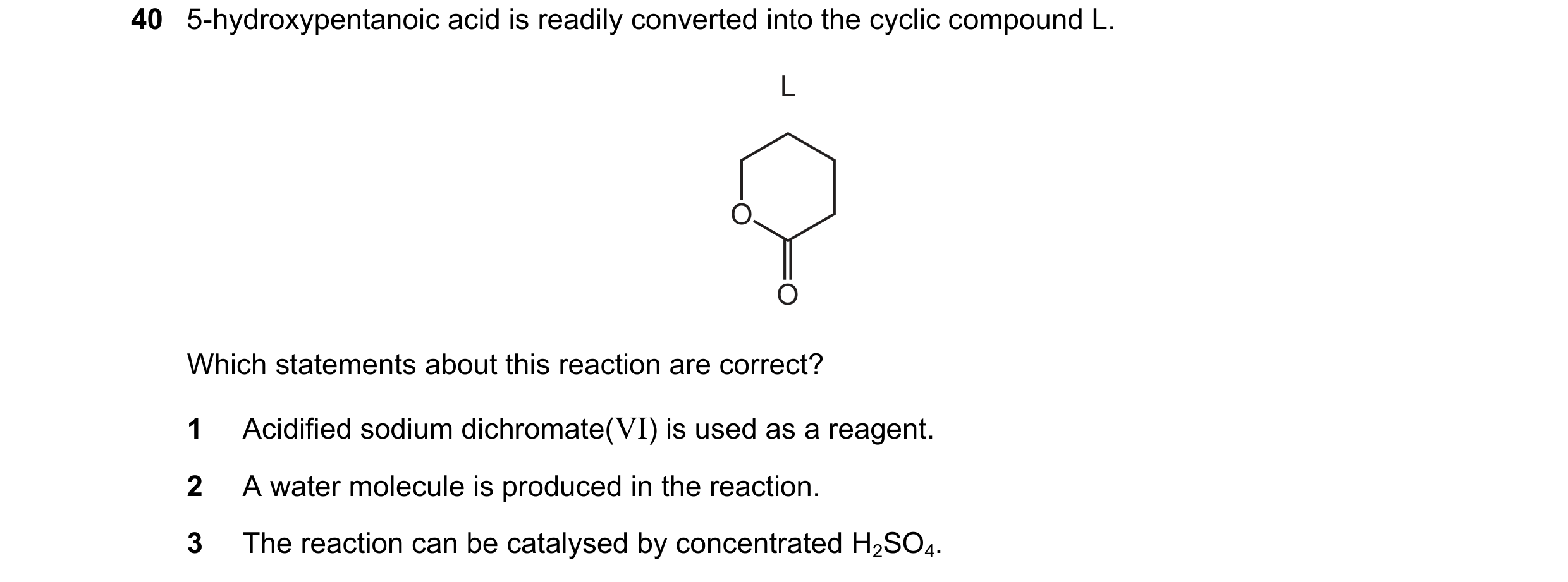
Q11 · 5-hydroxypentanoic acid is readily converted into the cyclic compound L 9701/13 May/June 2021
40 5-hydroxypentanoic acid is readily converted into the cyclic compound L. L O O Which statements about this reaction are correct? 1 Acidified sodium dichromate(VI) is used as a reagent. 2 A water molecule is produced in the reaction. 3 The reaction can be catalysed by concentrated H2SO4.
1 marks
Answer: C
This question in 9701/13 May/June 2021
Q12 · A section of an addition polymer is shown 9701/12 Oct/Nov 2025
39 A section of an addition polymer is shown. H3C CH3 C O O C H O H H H H O H C C C C C C C C H H O H O H H H H3C CH3 C C O O Which monomer is used to make this polymer? A B C D O O O O O O O O O O
1 marks
Answer: A
This question in 9701/12 Oct/Nov 2025
 1 / 5
1 / 5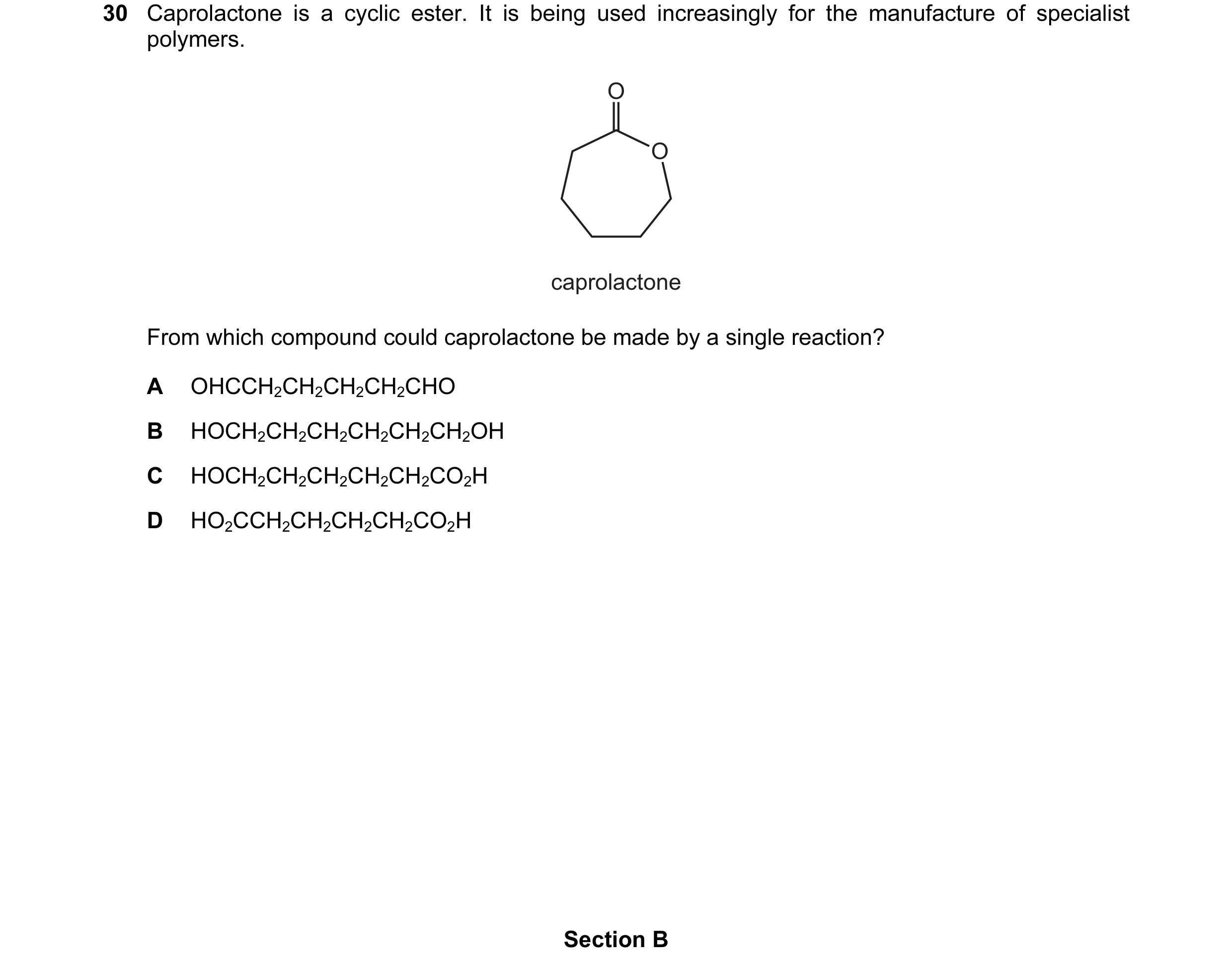
 2 / 5
2 / 5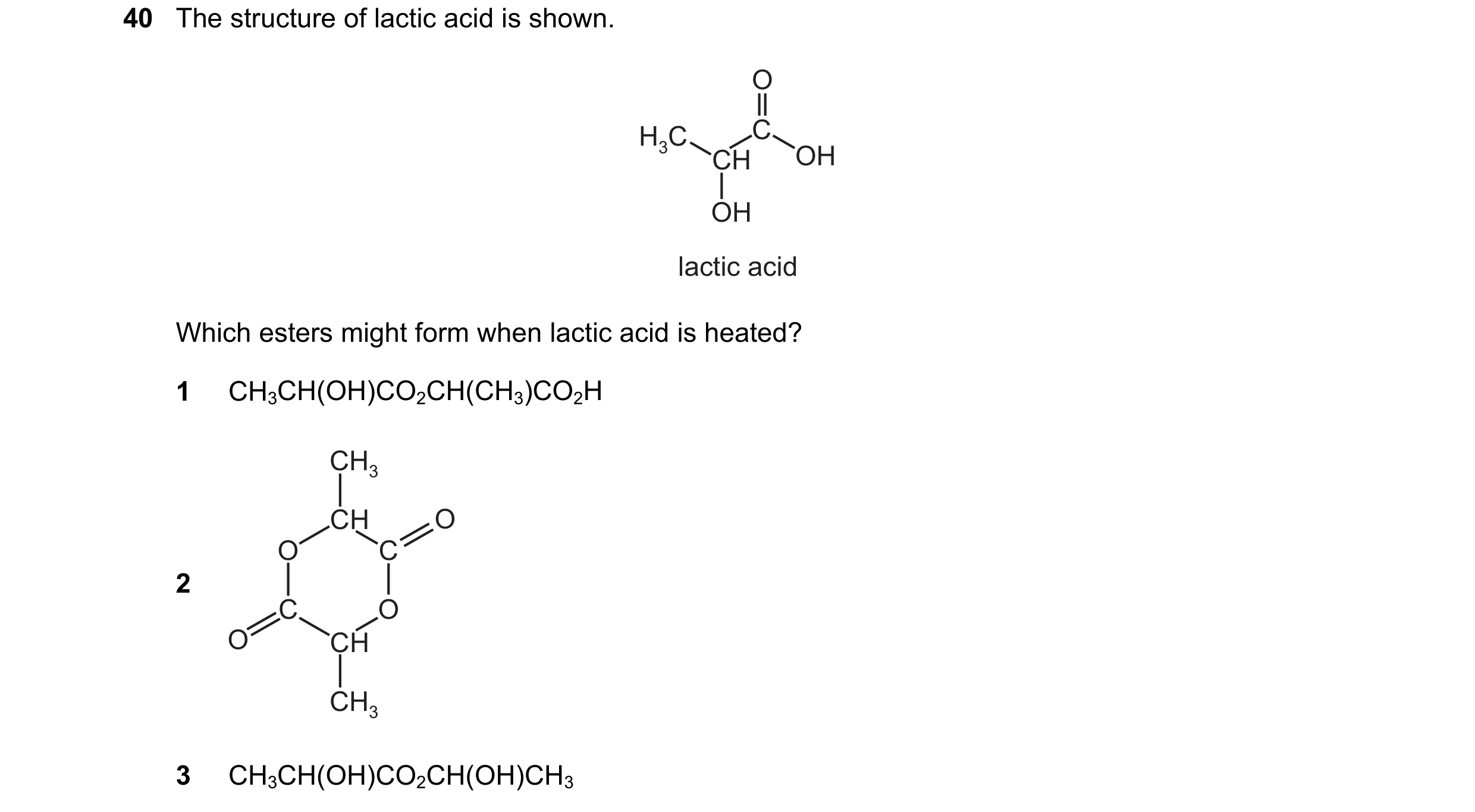
 3 / 5
3 / 5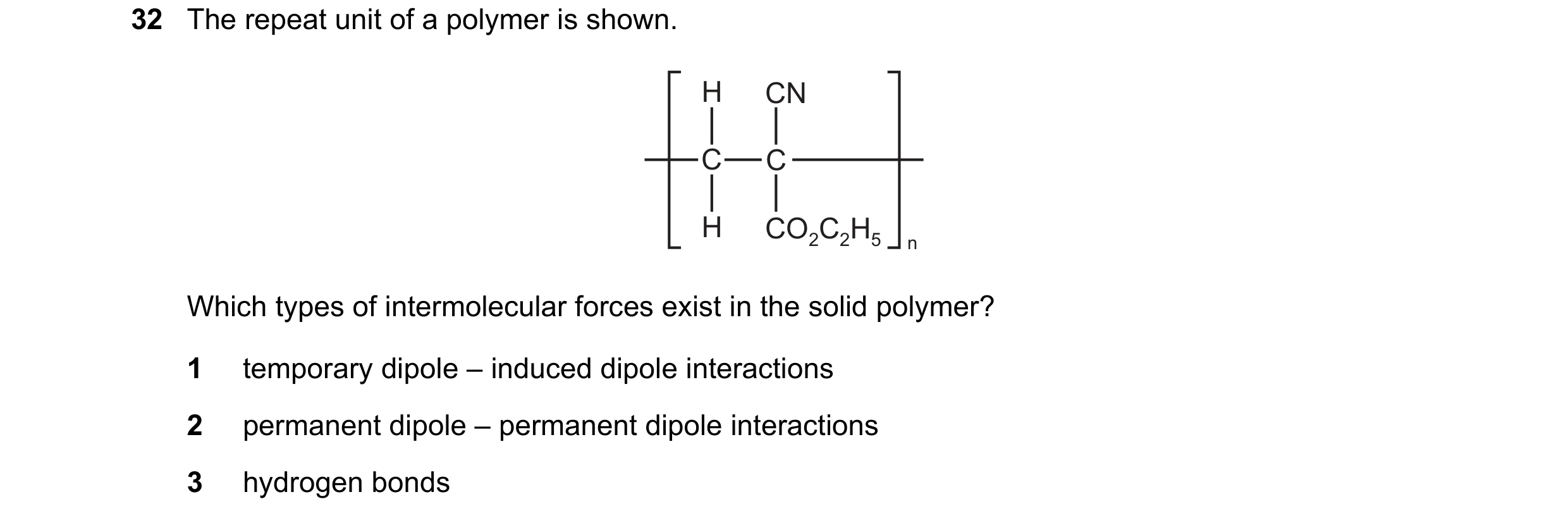
 4 / 5
4 / 5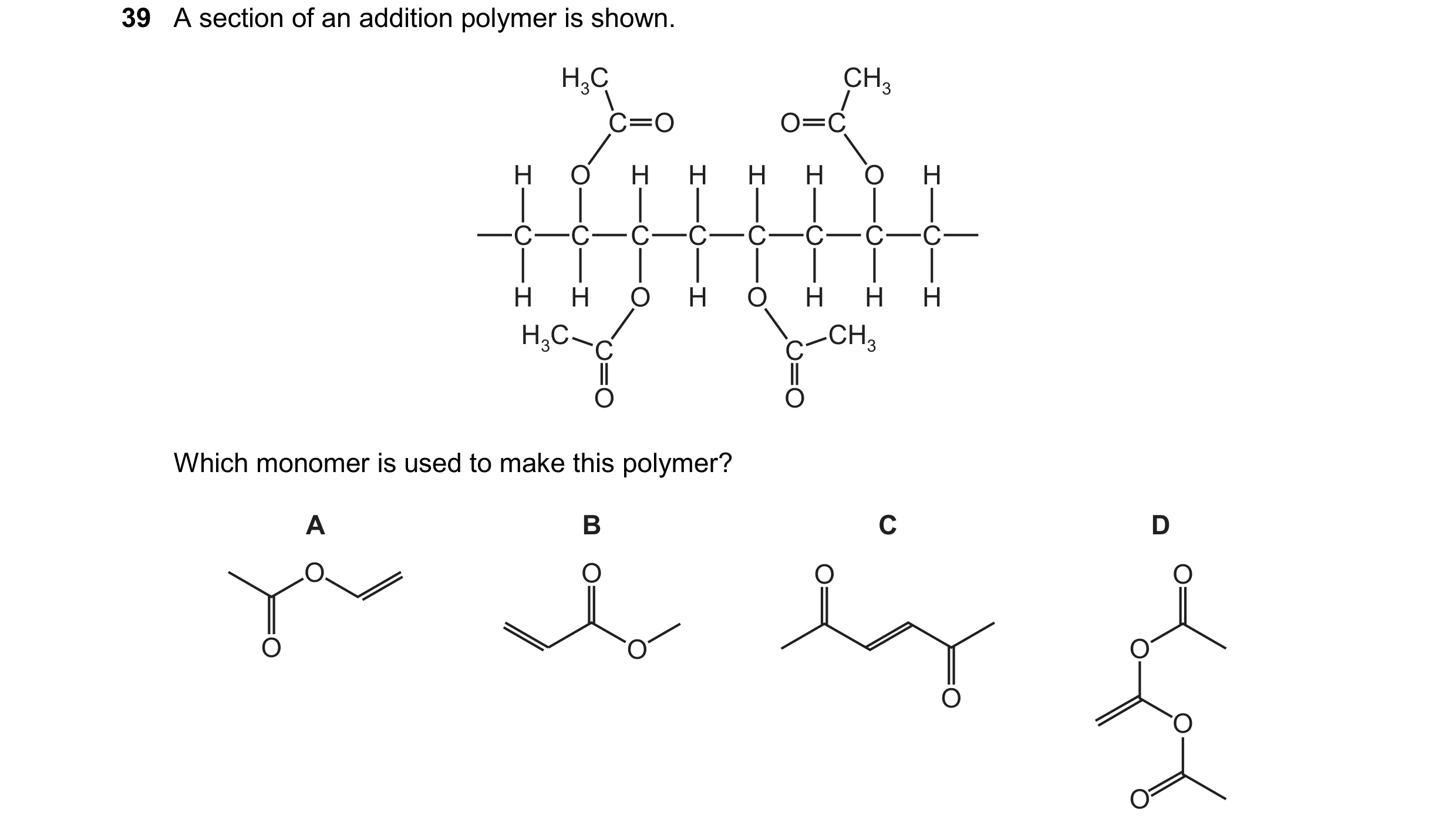 5 / 5
5 / 5