Questions as text
Q1 · Ethanol is a colourless liquid compound that contains the elements carbon, hydrogen and… 0654/33 May/June 2017
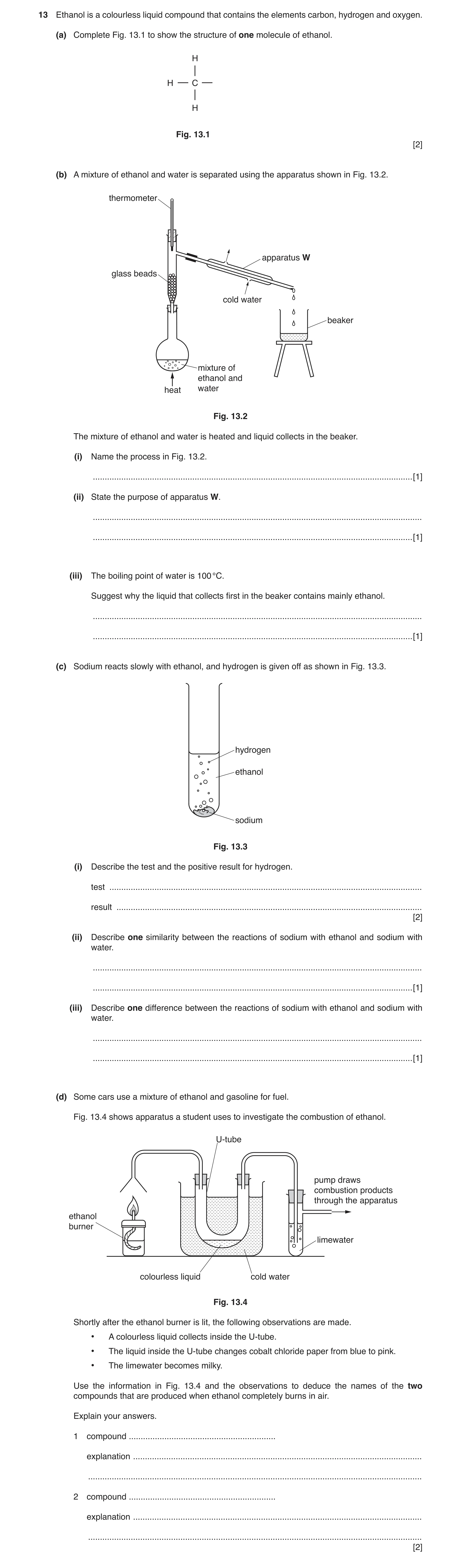
13 Ethanol is a colourless liquid compound that contains the elements carbon, hydrogen and oxygen. (a) Complete Fig. 13.1 to show the structure of one molecule of ethanol. H H C H Fig. 13.1 [2] (b) A mixture of ethanol and water is separated using the apparatus shown in Fig. 13.2. thermometer apparatus W glass beads cold water beaker mixture of ethanol and heat water Fig. 13.2 The mixture of ethanol and water is heated and liquid collects in the beaker. (i) Name the process in Fig. 13.2. … [1] (ii) State the purpose of apparatus W. … … [1] (iii) The boiling point of water is 100 °C. Suggest why the liquid that collects first in the beaker contains mainly ethanol. … … [1] (c) Sodium reacts slowly with ethanol, and hydrogen is given off as shown in Fig. 13.3. hydrogen ethanol sodium Fig. 13.3 (i) Describe the test and the positive result for hydrogen. test … result … [2] (ii) Describe one similarity between the reactions of sodium with ethanol and sodium with water. … … [1] (iii) Describe one difference between the reactions of sodium with ethanol and sodium with water. … … [1] (d) Some cars use a mixture of ethanol and gasoline for fuel. Fig. 13.4 shows apparatus a student uses to investigate the combustion of ethanol. U-tube pump draws combustion products through the apparatus ethanol burner limewater colourless liquid cold water Fig. 13.4 Shortly after the ethanol burner is lit, the following observations are made. • A colourless liquid collects inside the U-tube. • The liquid inside the U-tube changes cobalt chloride paper from blue to pink. • The limewater becomes milky. Use the information in Fig. 13.4 and the observations to deduce the names of the two compounds that are produced when ethanol completely burns in air. Explain your answers. 1 compound … explanation … … 2 compound … explanation … … [2]
11 marks
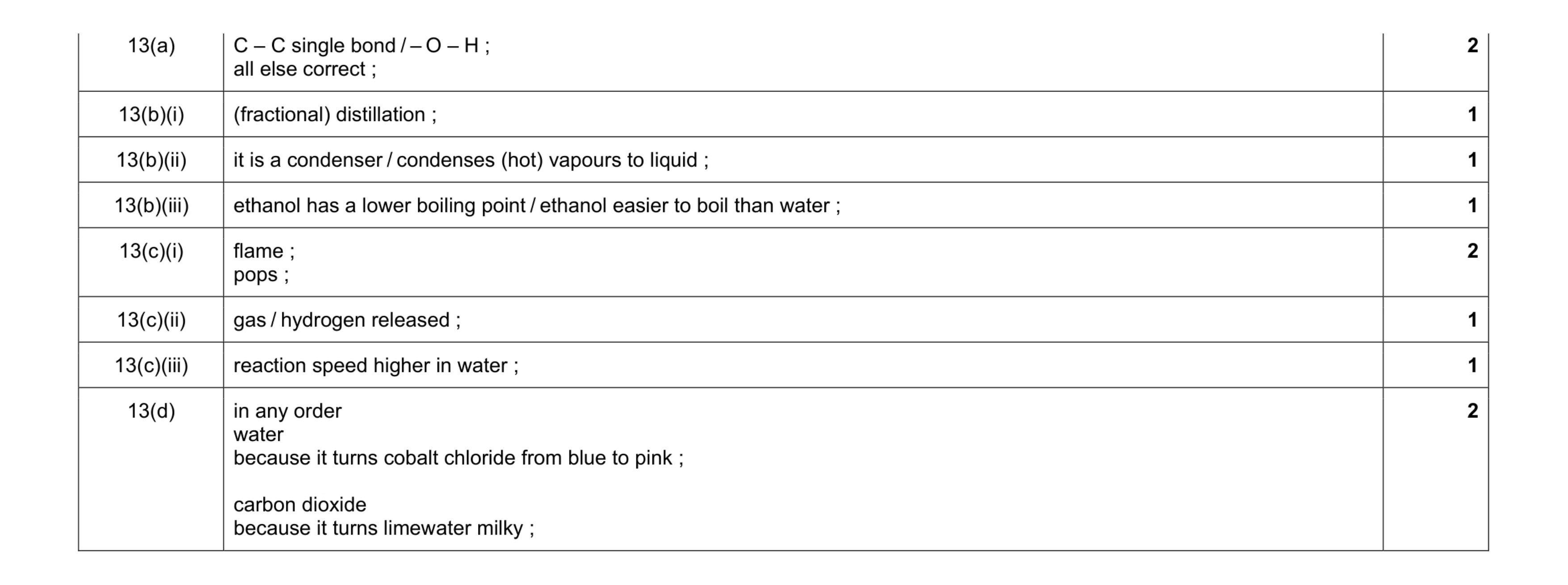
Mark scheme: 13(a) C – C single bond / – O – H ; all else correct ; 2 13(b)(i) (fractional) distillation ; 1 13(b)(ii) it is a condenser / condenses (hot) vapours to liquid ; 1 13(b)(iii) ethanol has a lower boiling point / ethanol easier to boil than water ; 1 13(c)(i) flame ; pops ; 2 13(c)(ii) gas / hydrogen released ; 1 13(c)(iii) reaction speed higher in water ; 1 13(d) in any order water because it turns cobalt chloride from blue to pink ; carbon dioxide because it turns limewater milky ; 2
This question in 0654/33 May/June 2017
Q2 · Alkanes and alkenes are types of hydrocarbons 0654/33 Oct/Nov 2018
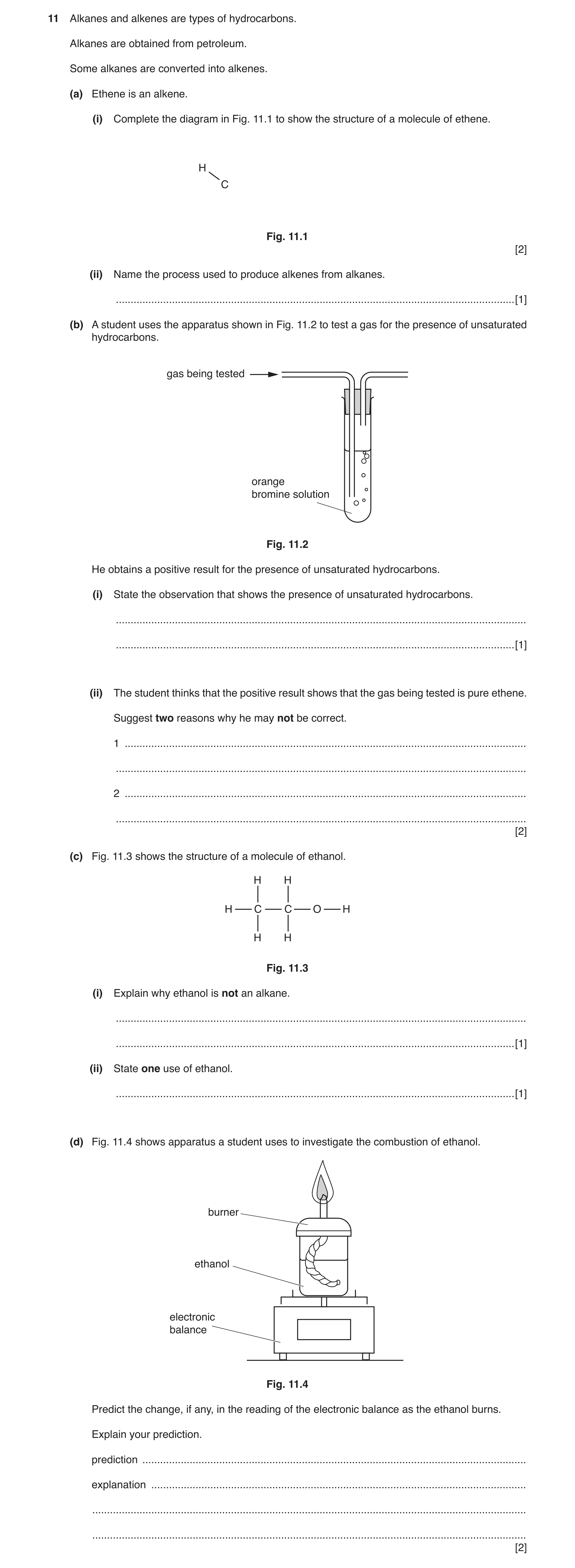
11 Alkanes and alkenes are types of hydrocarbons. Alkanes are obtained from petroleum. Some alkanes are converted into alkenes. (a) Ethene is an alkene. (i) Complete the diagram in Fig. 11.1 to show the structure of a molecule of ethene. H C Fig. 11.1 [2] (ii) Name the process used to produce alkenes from alkanes. … [1] (b) A student uses the apparatus shown in Fig. 11.2 to test a gas for the presence of unsaturated hydrocarbons. gas being tested orange bromine solution Fig. 11.2 He obtains a positive result for the presence of unsaturated hydrocarbons. (i) State the observation that shows the presence of unsaturated hydrocarbons. … … [1] (ii) The student thinks that the positive result shows that the gas being tested is pure ethene. Suggest two reasons why he may not be correct. 1 … … 2 … … [2] (c) Fig. 11.3 shows the structure of a molecule of ethanol. H H H C C O H H H Fig. 11.3 (i) Explain why ethanol is not an alkane. … … [1] (ii) State one use of ethanol. … [1] (d) Fig. 11.4 shows apparatus a student uses to investigate the combustion of ethanol. burner ethanol electronic balance Fig. 11.4 Predict the change, if any, in the reading of the electronic balance as the ethanol burns. Explain your prediction. prediction … explanation … … … [2]
10 marks
Mark scheme: 11(a)(i) carbon - carbon double bond ; 4 carbon hydrogen bonds ; 2 11(a)(ii) (catalytic / thermal) cracking ; 1 11(b)(i) (orange solution) becomes colourless ; 1 11(b)(ii) get the same result if ethene is impure ; get the same result with other alkenes ; 2 11(c)(i) alkanes contain only hydrogen and carbon / do not contain oxygen ; 1 11(c)(ii) solvent / fuel ; 1 11(d) reading decreases ; water (vapour) / carbon dioxide are released / the idea that the amount of matter in the burner reduces ; 2
This question in 0654/33 Oct/Nov 2018
Q3 · The structures of four molecules, A, B, C and D 0654/31 May/June 2019
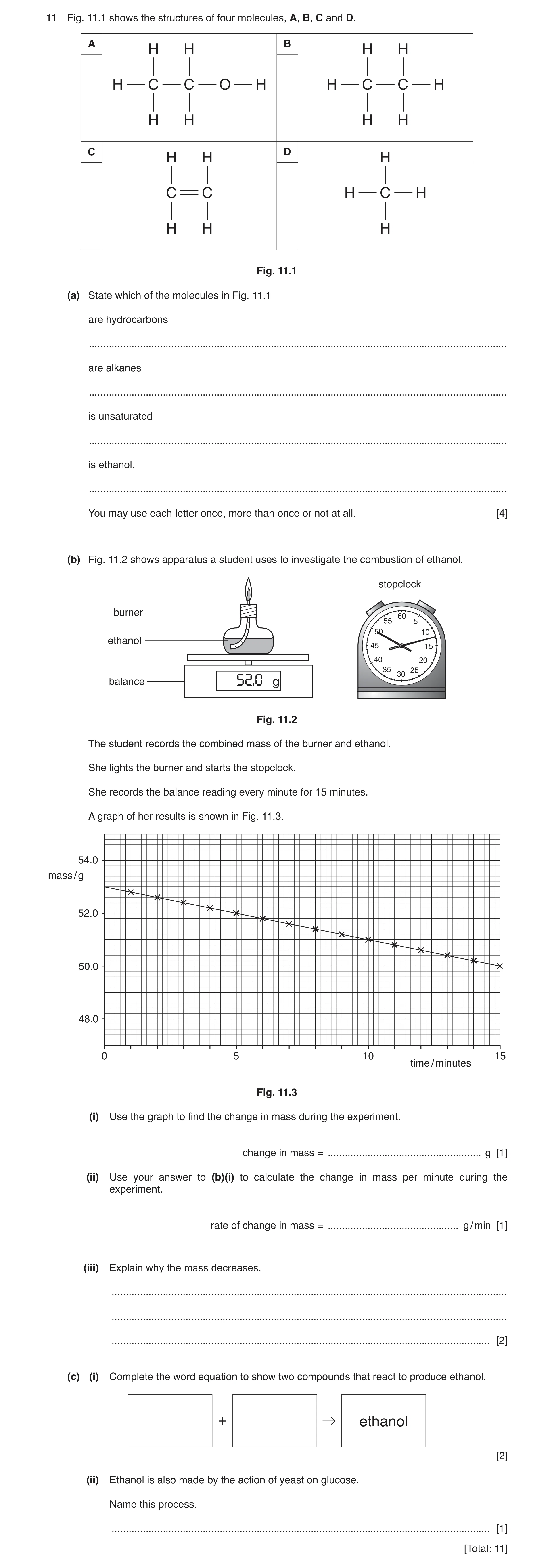
11 Fig. 11.1 shows the structures of four molecules, A, B, C and D. A H H B H H H C C O H H C C H H H H H C H H D H C C H C H H H H Fig. 11.1 (a) State which of the molecules in Fig. 11.1 are hydrocarbons … are alkanes … is unsaturated … is ethanol. … You may use each letter once, more than once or not at all. [4] (b) Fig. 11.2 shows apparatus a student uses to investigate the combustion of ethanol. stopclock burner 60 55 5 50 10 ethanol 45 15 40 20 35 25 balance 52.0 g 30 Fig. 11.2 The student records the combined mass of the burner and ethanol. She lights the burner and starts the stopclock. She records the balance reading every minute for 15 minutes. A graph of her results is shown in Fig. 11.3. 54.0 mass / g 52.0 50.0 48.0 0 5 10 15 time / minutes Fig. 11.3 (i) Use the graph to find the change in mass during the experiment. change in mass = … g [1] (ii) Use your answer to (b)(i) to calculate the change in mass per minute during the experiment. rate of change in mass = … g / min [1] (iii) Explain why the mass decreases. … … … [2] (c) (i) Complete the word equation to show two compounds that react to produce ethanol. + ethanol [2] (ii) Ethanol is also made by the action of yeast on glucose. Name this process. … [1] [Total: 11]
11 marks
Mark scheme: 11(a) B C D ; B D ; C ; A ; 4 11(b)(i) (decrease of ) 3 (g) ; 1 11(b)(ii) 3 ÷ 15 / 0.2 (g / min) ; 1 11(b)(iii) the idea that material / compounds / substances / gases escape from the burner (into the air) ; carbon dioxide / water vapour produced ; 2 11(c)(i) ethene ; + water / steam ; 2 11(c)(ii) fermentation ; 1
This question in 0654/31 May/June 2019
Q4 · A beaker containing sand and aqueous sodium chloride 0654/32 May/June 2019
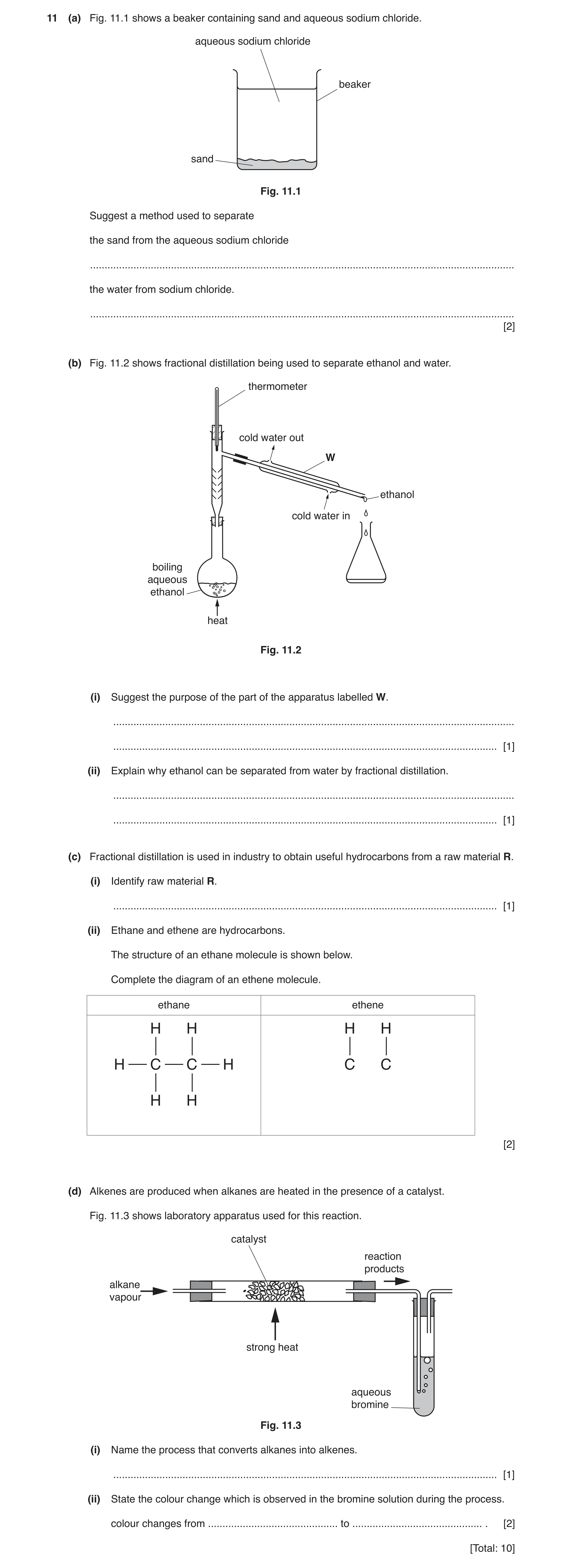
11 (a) Fig. 11.1 shows a beaker containing sand and aqueous sodium chloride. aqueous sodium chloride beaker sand Fig. 11.1 Suggest a method used to separate the sand from the aqueous sodium chloride … the water from sodium chloride. … [2] (b) Fig. 11.2 shows fractional distillation being used to separate ethanol and water. thermometer cold water out W ethanol cold water in boiling aqueous ethanol heat Fig. 11.2 (i) Suggest the purpose of the part of the apparatus labelled W. … … [1] (ii) Explain why ethanol can be separated from water by fractional distillation. … … [1] (c) Fractional distillation is used in industry to obtain useful hydrocarbons from a raw material R. (i) Identify raw material R. … [1] (ii) Ethane and ethene are hydrocarbons. The structure of an ethane molecule is shown below. Complete the diagram of an ethene molecule. ethane ethene H H H H H C C H C C H H [2] (d) Alkenes are produced when alkanes are heated in the presence of a catalyst. Fig. 11.3 shows laboratory apparatus used for this reaction. catalyst reaction products alkane vapour strong heat aqueous bromine Fig. 11.3 (i) Name the process that converts alkanes into alkenes. … [1] (ii) State the colour change which is observed in the bromine solution during the process. colour changes from … to … . [2] [Total: 10]
10 marks
Mark scheme: 11(a) filtration / decantation ; crystallisation / (heat to) evaporate the water ; 2 11(b)(i) condense ethanol vapour ; 1 11(b)(ii) liquids have different boiling points ; 1 11(c)(i) petroleum / crude oil ; 1 11(c)(ii) 1 for double bond between carbons ; 1 for four single C-H bonds ; 2 11(d)(i) (catalytic / thermal) cracking ; 1 11(d)(ii) from orange ; to colourless ; 2
This question in 0654/32 May/June 2019
Q5 · The structure of three molecules, ethene, ethanol and methane 0654/33 Oct/Nov 2019
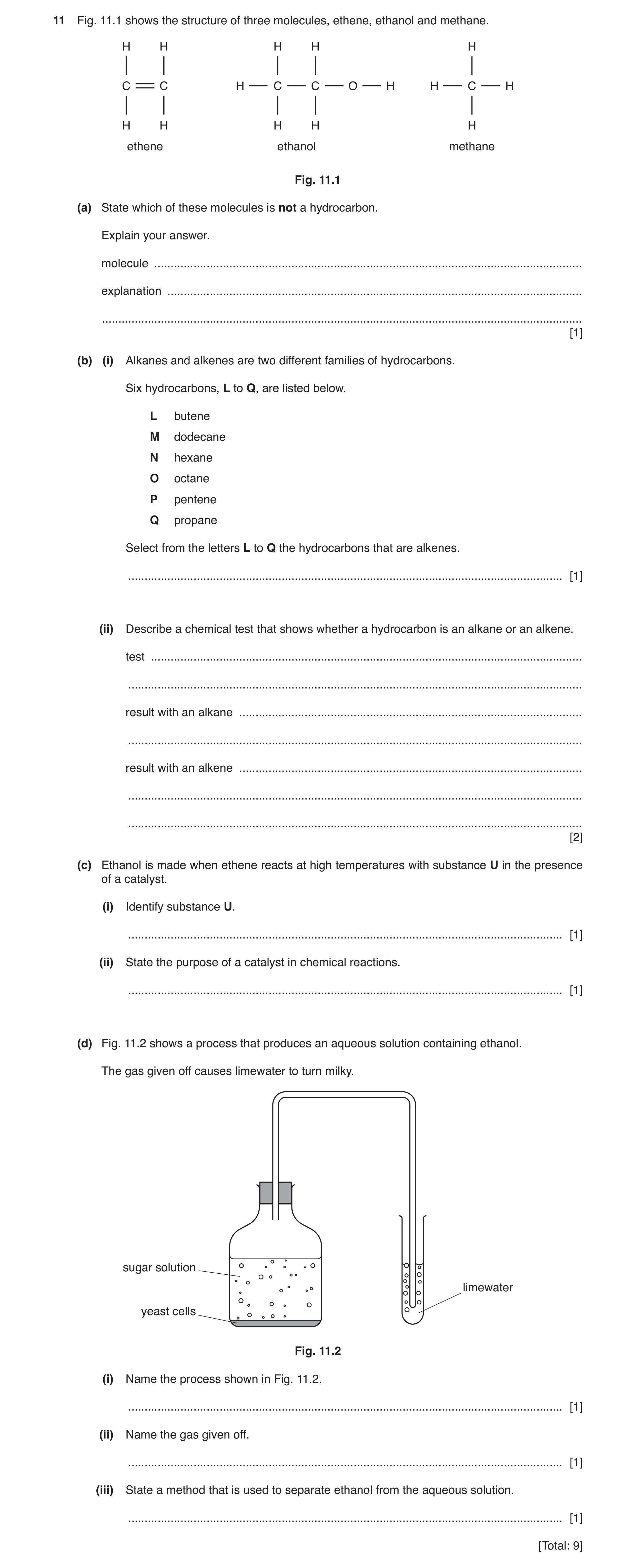
11 Fig. 11.1 shows the structure of three molecules, ethene, ethanol and methane. H H H H H C C H C C O H H C H H H H H H ethene ethanol methane Fig. 11.1 (a) State which of these molecules is not a hydrocarbon. Explain your answer. molecule … explanation … … [1] (b) (i) Alkanes and alkenes are two different families of hydrocarbons. Six hydrocarbons, L to Q, are listed below. L butene M dodecane N hexane O octane P pentene Q propane Select from the letters L to Q the hydrocarbons that are alkenes. … [1] (ii) Describe a chemical test that shows whether a hydrocarbon is an alkane or an alkene. test … … result with an alkane … … result with an alkene … … … [2] (c) Ethanol is made when ethene reacts at high temperatures with substance U in the presence of a catalyst. (i) Identify substance U. … [1] (ii) State the purpose of a catalyst in chemical reactions. … [1] (d) Fig. 11.2 shows a process that produces an aqueous solution containing ethanol. The gas given off causes limewater to turn milky. sugar solution limewater yeast cells Fig. 11.2 (i) Name the process shown in Fig. 11.2. … [1] (ii) Name the gas given off. … [1] (iii) State a method that is used to separate ethanol from the aqueous solution. … [1] [Total: 9]
9 marks
Mark scheme: 11(a) (ethanol) hydrocarbons contain only carbon and hydrogen / do not contain oxygen / (ethanol) contains oxygen ; 1 11(b)(i) L and P ; 1 11(b)(ii) reaction with (aqueous) bromine ; alkanes – no reaction / remains orange / coloured and alkenes – orange to colourless / bromine decolourised ; 2 11(c)(i) steam / H2O ; 1 11(c)(ii) increases reaction rate ; 1 11(d)(i) fermentation ; 1 11(d)(ii) carbon dioxide ; 1 11(d)(iii) distillation ; 1
This question in 0654/33 Oct/Nov 2019
Q6 · Ethane, ethene and ethanol are carbon compounds 0654/32 May/June 2020
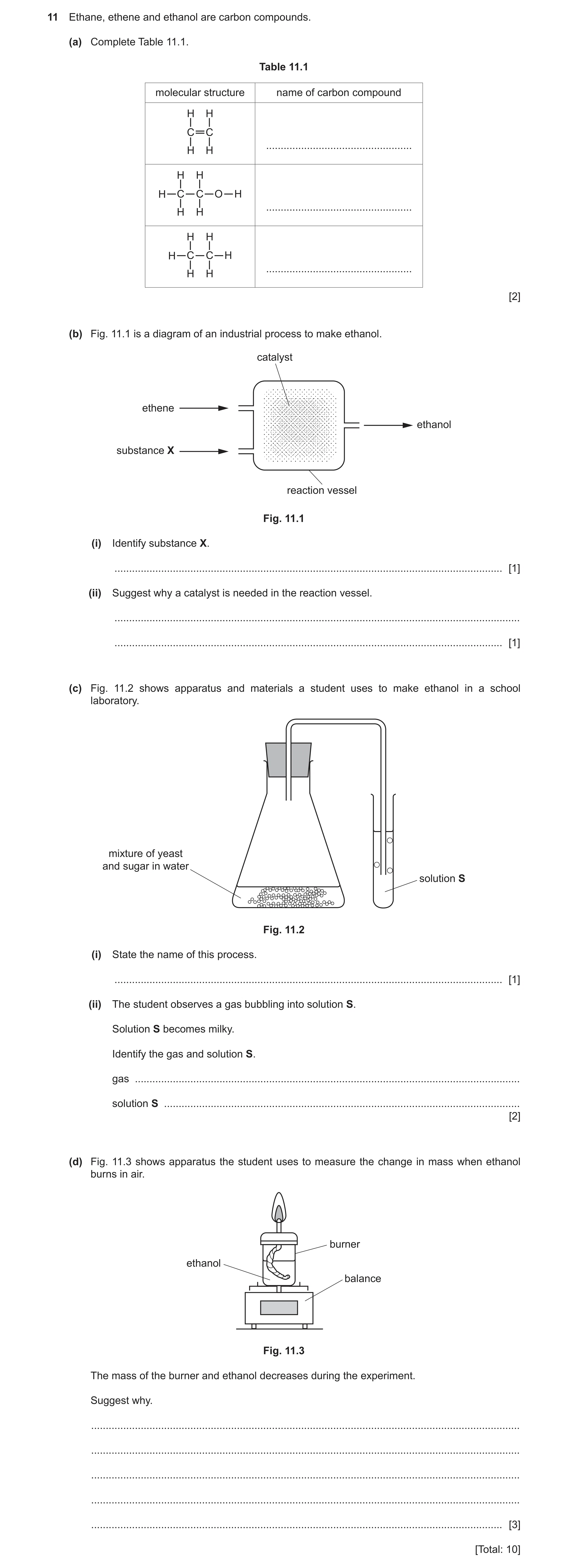
11 Ethane, ethene and ethanol are carbon compounds. (a) Complete Table 11.1. Table 11.1 molecular structure name of carbon compound H H C C … H H H H H C C O H … H H H H H C C H … H H [2] (b) Fig. 11.1 is a diagram of an industrial process to make ethanol. catalyst ethene ethanol substance X reaction vessel Fig. 11.1 (i) Identify substance X. … [1] (ii) Suggest why a catalyst is needed in the reaction vessel. … … [1] (c) Fig. 11.2 shows apparatus and materials a student uses to make ethanol in a school laboratory. mixture of yeast and sugar in water solution S Fig. 11.2 (i) State the name of this process. … [1] (ii) The student observes a gas bubbling into solution S. Solution S becomes milky. Identify the gas and solution S. gas … solution S … [2] (d) Fig. 11.3 shows apparatus the student uses to measure the change in mass when ethanol burns in air. burner ethanol balance Fig. 11.3 The mass of the burner and ethanol decreases during the experiment. Suggest why. … … … … … [3] [Total: 10]
10 marks
Mark scheme: 11(a) ethene ethanol ethane ;; one correct for 1 mark all correct for 2 marks 11(b)(i) steam / H2O ; 1 Question Answer Marks 11(b)(ii) increases rate of reaction / the idea that little ethanol produced without it ; 1 11(c)(i) fermentation ; 1 11(c)(ii) carbon dioxide ; limewater ; 2 11(d) (combustion produces) gaseous products ; which are lost (to the air) ; extra detail – products are carbon dioxide / water / carbon monoxide ; 3
This question in 0654/32 May/June 2020
Q7 · Ethane, ethene and ethanol are carbon compounds 0654/33 May/June 2020
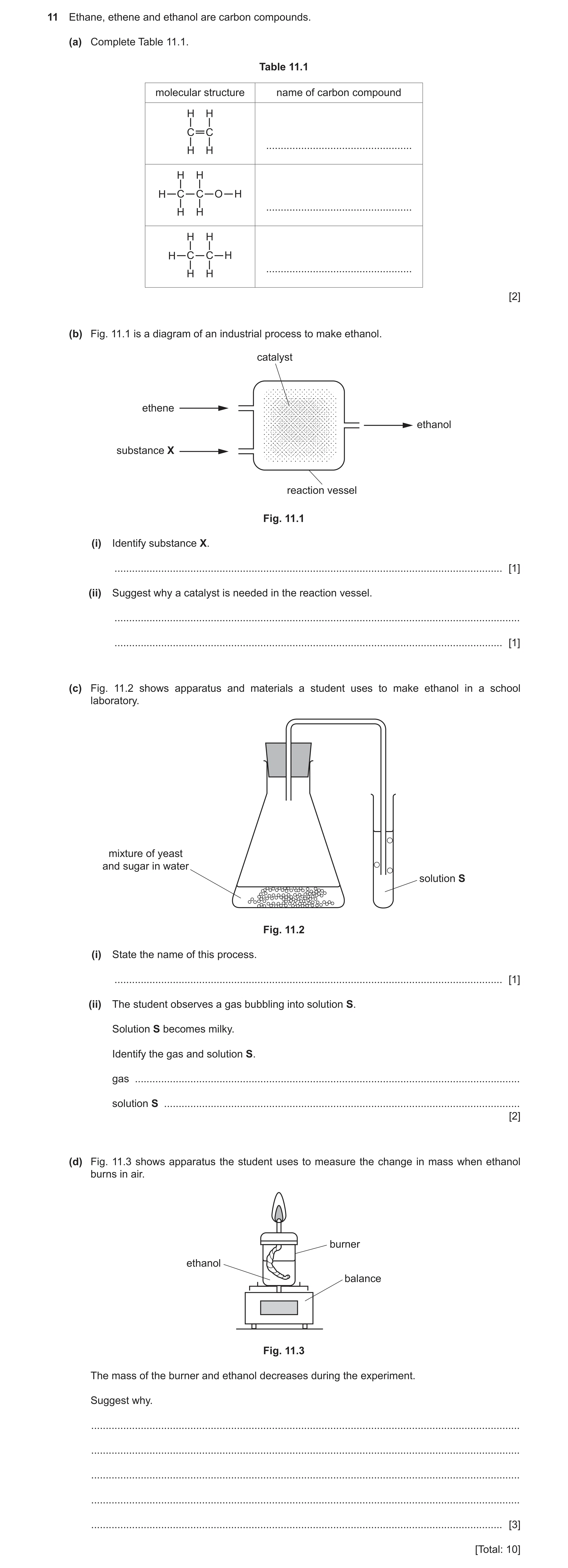
11 Ethane, ethene and ethanol are carbon compounds. (a) Complete Table 11.1. Table 11.1 molecular structure name of carbon compound H H C C … H H H H H C C O H … H H H H H C C H … H H [2] (b) Fig. 11.1 is a diagram of an industrial process to make ethanol. catalyst ethene ethanol substance X reaction vessel Fig. 11.1 (i) Identify substance X. … [1] (ii) Suggest why a catalyst is needed in the reaction vessel. … … [1] (c) Fig. 11.2 shows apparatus and materials a student uses to make ethanol in a school laboratory. mixture of yeast and sugar in water solution S Fig. 11.2 (i) State the name of this process. … [1] (ii) The student observes a gas bubbling into solution S. Solution S becomes milky. Identify the gas and solution S. gas … solution S … [2] (d) Fig. 11.3 shows apparatus the student uses to measure the change in mass when ethanol burns in air. burner ethanol balance Fig. 11.3 The mass of the burner and ethanol decreases during the experiment. Suggest why. … … … … … [3] [Total: 10]
10 marks
Mark scheme: 11(a) ethene ethanol ethane ;; one correct for 1 mark all correct for 2 marks 11(b)(i) steam / H2O ; 1 Question Answer Marks 11(b)(ii) increases rate of reaction / the idea that little ethanol produced without it ; 1 11(c)(i) fermentation ; 1 11(c)(ii) carbon dioxide ; limewater ; 2 11(d) (combustion produces) gaseous products ; which are lost (to the air) ; extra detail – products are carbon dioxide / water / carbon monoxide ; 3
This question in 0654/33 May/June 2020
Q8 · Three hydrocarbon molecules X, Y and Z 0654/32 Feb/March 2021
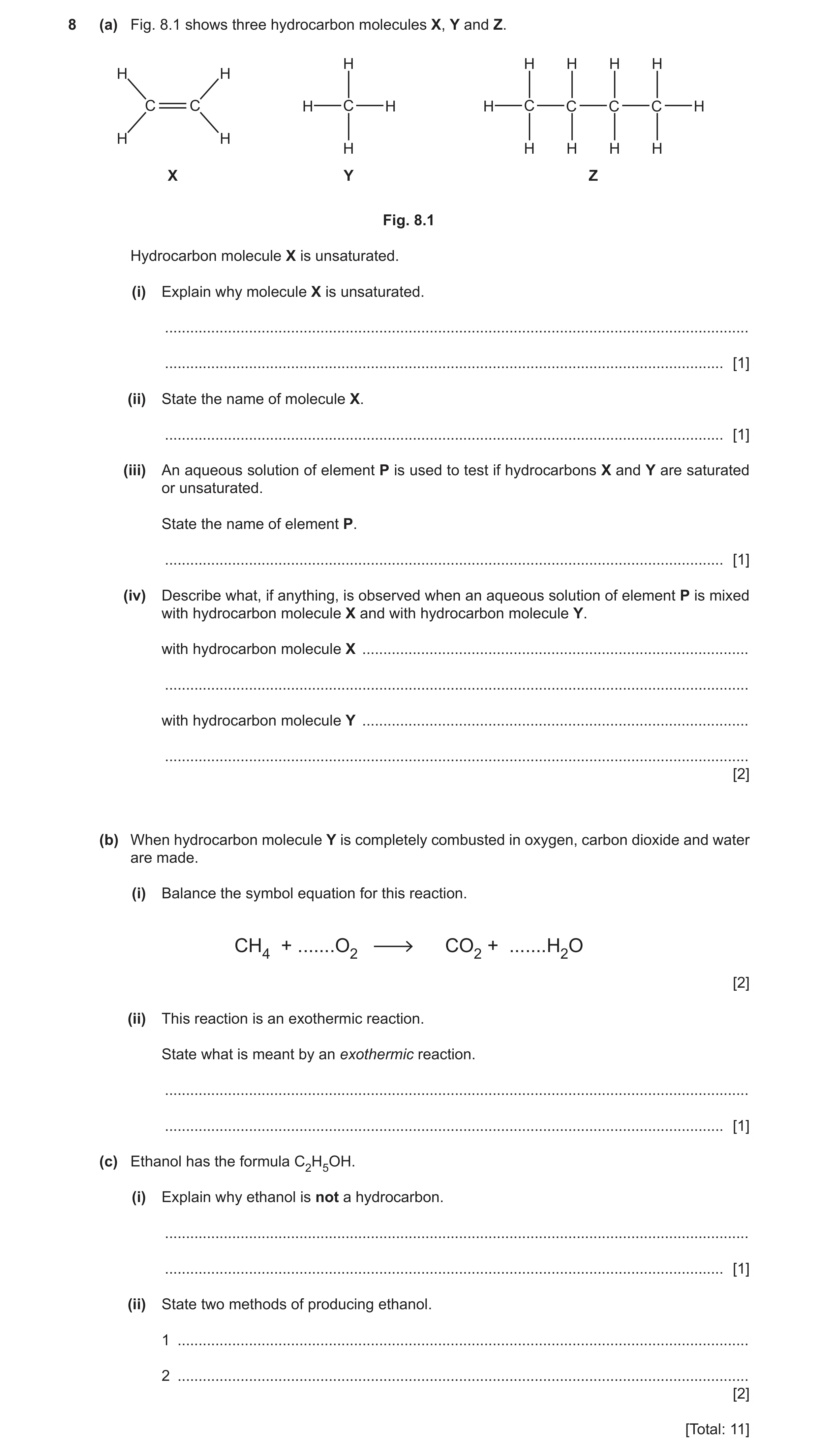
8 (a) Fig. 8.1 shows three hydrocarbon molecules X, Y and Z. H H H H H H H C C H C H H C C C C H H H H H H H H X Y Z Fig. 8.1 Hydrocarbon molecule X is unsaturated. (i) Explain why molecule X is unsaturated. … … [1] (ii) State the name of molecule X. … [1] (iii) An aqueous solution of element P is used to test if hydrocarbons X and Y are saturated or unsaturated. State the name of element P. … [1] (iv) Describe what, if anything, is observed when an aqueous solution of element P is mixed with hydrocarbon molecule X and with hydrocarbon molecule Y. with hydrocarbon molecule X … … with hydrocarbon molecule Y … … [2] (b) When hydrocarbon molecule Y is completely combusted in oxygen, carbon dioxide and water are made. (i) Balance the symbol equation for this reaction. CH4 + … O2 CO2 + … H2O [2] (ii) This reaction is an exothermic reaction. State what is meant by an exothermic reaction. … … [1] (c) Ethanol has the formula C2H5OH. (i) Explain why ethanol is not a hydrocarbon. … … [1] (ii) State two methods of producing ethanol. 1 … 2 … [2] [Total: 11]
11 marks
Mark scheme: 8(a)(i) has a carbon-carbon double bond; 1 8(a)(ii) ethene; 1 8(a)(iii) bromine; 1 8(a)(iv) decolourises/becomes colourless; stays orange/does not decolourise; 2 8(b)(i) CH4 + 2O2 → CO2 + 2H2O ;; 2 8(b)(ii) thermal energy released; 1 Question Answer Marks 8(c)(i) contains oxygen / does not contain only carbon and hydrogen; 1 8(c)(ii) fermentation; reaction of ethene and steam; 2
This question in 0654/32 Feb/March 2021
Q9 · Three molecules A, B and C 0654/31 May/June 2021
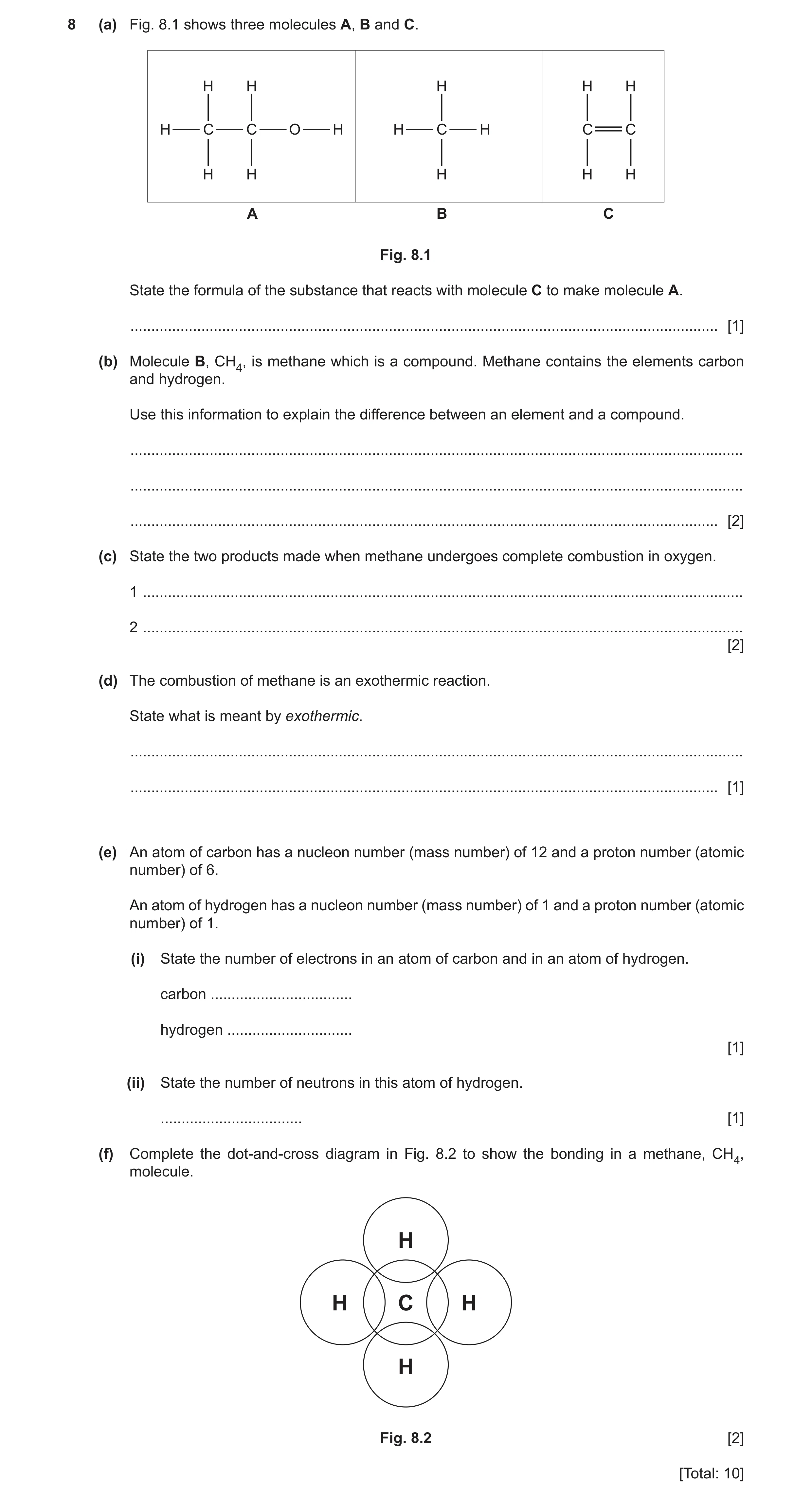
8 (a) Fig. 8.1 shows three molecules A, B and C. H H H H H H C C O H H C H C C H H H H H A B C Fig. 8.1 State the formula of the substance that reacts with molecule C to make molecule A. … [1] (b) Molecule B, CH4, is methane which is a compound. Methane contains the elements carbon and hydrogen. Use this information to explain the difference between an element and a compound. … … … [2] (c) State the two products made when methane undergoes complete combustion in oxygen. 1 … 2 … [2] (d) The combustion of methane is an exothermic reaction. State what is meant by exothermic. … … [1] (e) An atom of carbon has a nucleon number (mass number) of 12 and a proton number (atomic number) of 6. An atom of hydrogen has a nucleon number (mass number) of 1 and a proton number (atomic number) of 1. (i) State the number of electrons in an atom of carbon and in an atom of hydrogen. carbon … hydrogen … [1] (ii) State the number of neutrons in this atom of hydrogen. … [1] (f) Complete the dot‑and‑cross diagram in Fig. 8.2 to show the bonding in a methane, CH4, molecule. H H C H H Fig. 8.2 [2] [Total: 10]
10 marks
Mark scheme: 8(a) H2O ; 1 8(b) an element (e.g. carbon) contains only one type of atom ; a compound (e.g. methane) contains two or more elements / different atoms chemically combined ; 2 8(c) carbon dioxide ; water ; 2 8(d) releases thermal energy ; 1 8(e)(i) carbon 6 and hydrogen 1 ; 1 8(e)(ii) zero ; 1 Question Answer Marks 8(f) one shared pair seen ; all correct ;; 2
This question in 0654/31 May/June 2021
Q10 · Petroleum is a raw material for the production of useful substances 0654/32 Oct/Nov 2022
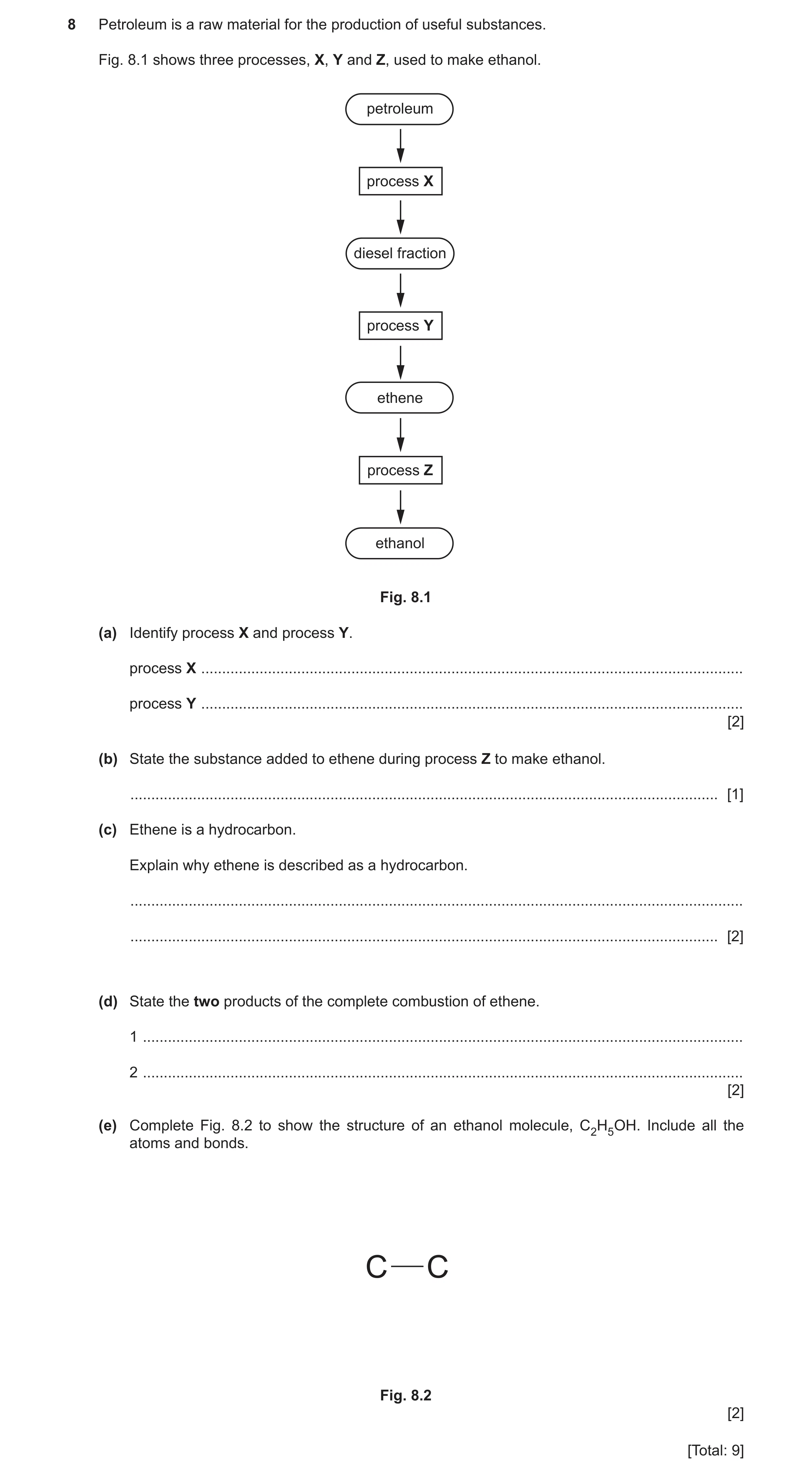
8 Petroleum is a raw material for the production of useful substances. Fig. 8.1 shows three processes, X, Y and Z, used to make ethanol. petroleum process X diesel fraction process Y ethene process Z ethanol Fig. 8.1 (a) Identify process X and process Y. process X … process Y … [2] (b) State the substance added to ethene during process Z to make ethanol. … [1] (c) Ethene is a hydrocarbon. Explain why ethene is described as a hydrocarbon. … … [2] (d) State the two products of the complete combustion of ethene. 1 … 2 … [2] (e) Complete Fig. 8.2 to show the structure of an ethanol molecule, C2H5OH. Include all the atoms and bonds. C C Fig. 8.2 [2] [Total: 9]
9 marks
Mark scheme: 8(a) process X – fractional distillation ; 2 process Y – cracking ; 8(b) steam ; 1 8(c) contains carbon and hydrogen (atoms) ; 2 only ; 8(d) carbon dioxide ; 2 water ; 8(e) 2 O – H attached to carbon ; all else correct ;
This question in 0654/32 Oct/Nov 2022
Q11 · Ethanol has the formula C2H5OH 0654/32 Feb/March 2023
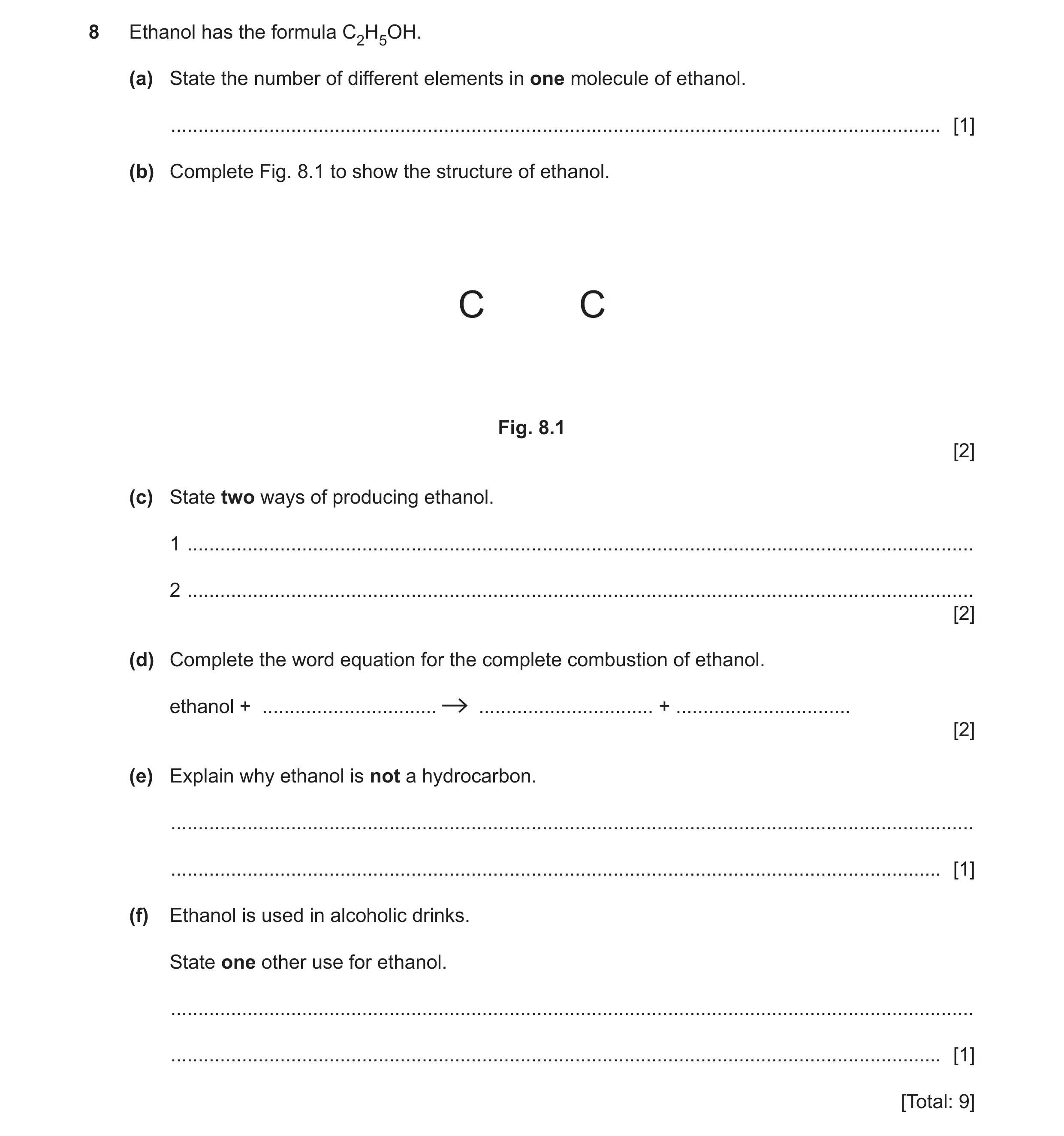
8 Ethanol has the formula C2H5OH. (a) State the number of different elements in one molecule of ethanol. … [1] (b) Complete Fig. 8.1 to show the structure of ethanol. C C Fig. 8.1 [2] (c) State two ways of producing ethanol. 1 … 2 … [2] (d) Complete the word equation for the complete combustion of ethanol. ethanol + … … + … [2] (e) Explain why ethanol is not a hydrocarbon. … … [1] (f) Ethanol is used in alcoholic drinks. State one other use for ethanol. … … [1] [Total: 9]
9 marks
Mark scheme: 8(a) 3 ; 1 8(b) 2 C-O-H ; all else correct ; 8(c) fermentation ; 2 reaction of ethene with steam / water ; 8(d) oxygen ; 2 carbon dioxide and water ; 8(e) contains oxygen ; 1 8(f) solvent / fuel ; 1
This question in 0654/32 Feb/March 2023
Q12 · Methane, CH4, is the main constituent of a fossil fuel 0654/32 Oct/Nov 2023
11 (a) Methane, CH4, is the main constituent of a fossil fuel. (i) State the name of this fossil fuel. … [1] (ii) State the name of one other fossil fuel. … [1] (iii) Methane is a greenhouse gas. State the name of one other common greenhouse gas. … [1] (b) Complete Fig. 11.1 to show the structural formula of methane. C H Fig. 11.1 [1] (c) (i) When methane is completely combusted in oxygen, carbon dioxide and water are produced. Balance the symbol equation for this reaction. CH4 + … O2 CO2 + … H2O [2] (ii) The combustion of methane is an exothermic reaction. Describe what is observed during an exothermic reaction. … … [1] (d) (i) State which diagram from Fig. 11.2 shows the structural formula of an alcohol. A B H H H H H H H C C C C H H C C C C H H H H H H H H H C D H H H H H H C C C O H C C H H H H H Fig. 11.2 … [1] (ii) Describe the chemical test that distinguishes between A and B in Fig. 11.2. test … result for A … … result for B … … [3] [Total: 11]
11 marks
Mark scheme: 11(a)(i) natural gas ; 1 11(a)(ii) coal / petroleum ; 1 11(a)(iii) carbon dioxide ; 1 11(b) 1 ; 11(c)(i) 2 (O2) ; 2 2 (H2O) ; 11(c)(ii) temperature rise ; 1 11(d)(i) C 1 11(d)(ii) test – aqueous bromine ; 3 A – no change / stays orange ; B – decolorises (from orange to colourless) ;
This question in 0654/32 Oct/Nov 2023
Q13 · Ethanol has the formula C2H5OH 0654/32 May/June 2024
5 (a) Ethanol has the formula C2H5OH. Complete Fig. 5.1 to show the structure of an ethanol molecule. C C Fig. 5.1 [2] (b) Ethanol is used as a fuel. (i) State one other use for ethanol. … [1] (ii) Write the word equation for the complete combustion of ethanol. ……… … …...…… + ……… … …..…… ……… … …..…… + ….…… … …..…… [2] (iii) The combustion of ethanol is an exothermic reaction. State what is meant by an exothermic reaction. … … … [1] (c) Ethanol is made from ethene. Ethene reacts at high temperatures with substance X in the presence of a catalyst. (i) State the name of substance X. … [1] (ii) Describe the effect of a catalyst on chemical reactions. … … [1] (iii) State one other method of making ethanol. … [1] (d) Ethanol is a liquid at room temperature. Describe the motion and separation of the particles in ethanol. motion … separation … [2] [Total: 11]
11 marks
Mark scheme: 5(a) C–O–H correct ; all else correct ; 2 5(b)(i) solvent ; 1 5(b)(ii) ethanol + oxygen → carbon dioxide + water ethanol and oxygen ; carbon dioxide and water ; 2 5(b)(iii) thermal energy released ; 1 5(c)(i) steam / water ; 1 5(c)(ii) increase rate of reaction ; 1 5(c)(iii) fermentation ; 1 Question Answer Marks 5(d) random (motion) ; touching ; 2
This question in 0654/32 May/June 2024
Q14 · Ethanol has the formula C2H5OH 0654/33 May/June 2024
5 (a) Ethanol has the formula C2H5OH. Complete Fig. 5.1 to show the structure of an ethanol molecule. C C Fig. 5.1 [2] (b) Ethanol is used as a fuel. (i) State one other use for ethanol. … [1] (ii) Write the word equation for the complete combustion of ethanol. ……… … …...…… + ……… … …..…… ……… … …..…… + ….…… … …..…… [2] (iii) The combustion of ethanol is an exothermic reaction. State what is meant by an exothermic reaction. … … … [1] (c) Ethanol is made from ethene. Ethene reacts at high temperatures with substance X in the presence of a catalyst. (i) State the name of substance X. … [1] (ii) Describe the effect of a catalyst on chemical reactions. … … [1] (iii) State one other method of making ethanol. … [1] (d) Ethanol is a liquid at room temperature. Describe the motion and separation of the particles in ethanol. motion … separation … [2] [Total: 11]
11 marks
Mark scheme: 5(a) C–O–H correct ; all else correct ; 2 5(b)(i) solvent ; 1 5(b)(ii) ethanol + oxygen → carbon dioxide + water ethanol and oxygen ; carbon dioxide and water ; 2 5(b)(iii) thermal energy released ; 1 5(c)(i) steam / water ; 1 5(c)(ii) increase rate of reaction ; 1 5(c)(iii) fermentation ; 1 Question Answer Marks 5(d) random (motion) ; touching ; 2
This question in 0654/33 May/June 2024
Q15 · Choose from the following substances to answer the questions 0654/33 Oct/Nov 2024
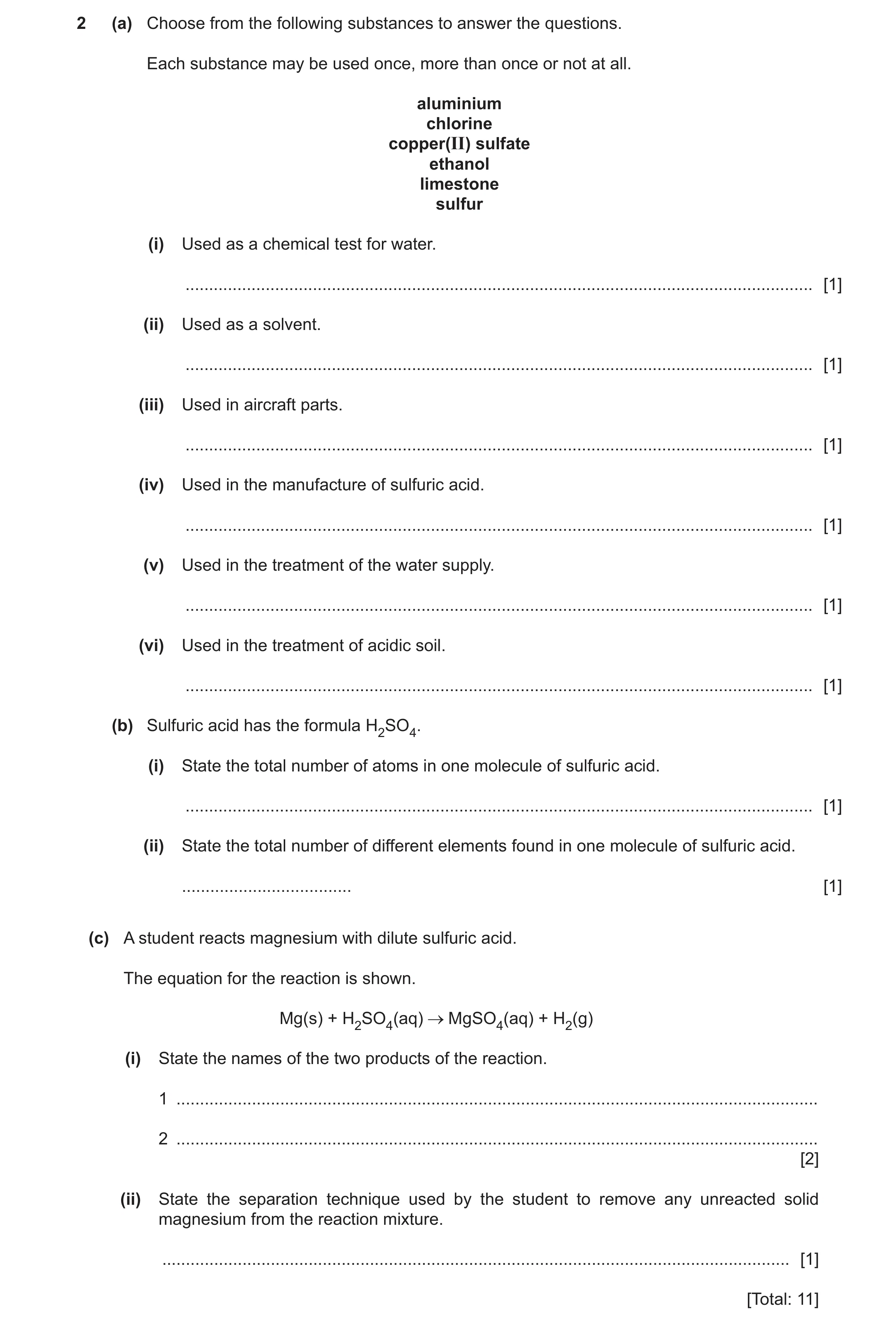
2 (a) Choose from the following substances to answer the questions. Each substance may be used once, more than once or not at all. aluminium chlorine copper(II) sulfate ethanol limestone sulfur (i) Used as a chemical test for water. … [1] (ii) Used as a solvent. … [1] (iii) Used in aircraft parts. … [1] (iv) Used in the manufacture of sulfuric acid. … [1] (v) Used in the treatment of the water supply. … [1] (vi) Used in the treatment of acidic soil. … [1] (b) Sulfuric acid has the formula H2SO4. (i) State the total number of atoms in one molecule of sulfuric acid. … [1] (ii) State the total number of different elements found in one molecule of sulfuric acid. … [1] (c) A student reacts magnesium with dilute sulfuric acid. The equation for the reaction is shown. Mg(s) + H2SO4(aq) MgSO4(aq) + H2(g) (i) State the names of the two products of the reaction. 1 … 2 … [2] (ii) State the separation technique used by the student to remove any unreacted solid magnesium from the reaction mixture. … [1] [Total: 11]
11 marks
Mark scheme: 2(a)(i) copper sulfate ; 1 2(a)(ii) ethanol ; 1 2(a)(iii) aluminium ; 1 2(a)(iv) sulfur ; 1 2(a)(v) chlorine ; 1 2(a)(vi) limestone ; 1 2(b)(i) 7 ; 1 2(b)(ii) 3 ; 1 2(c)(i) magnesium sulfate ; 2 hydrogen ; 2(c)(ii) filtration ; 1
This question in 0654/33 Oct/Nov 2024
 20 / 25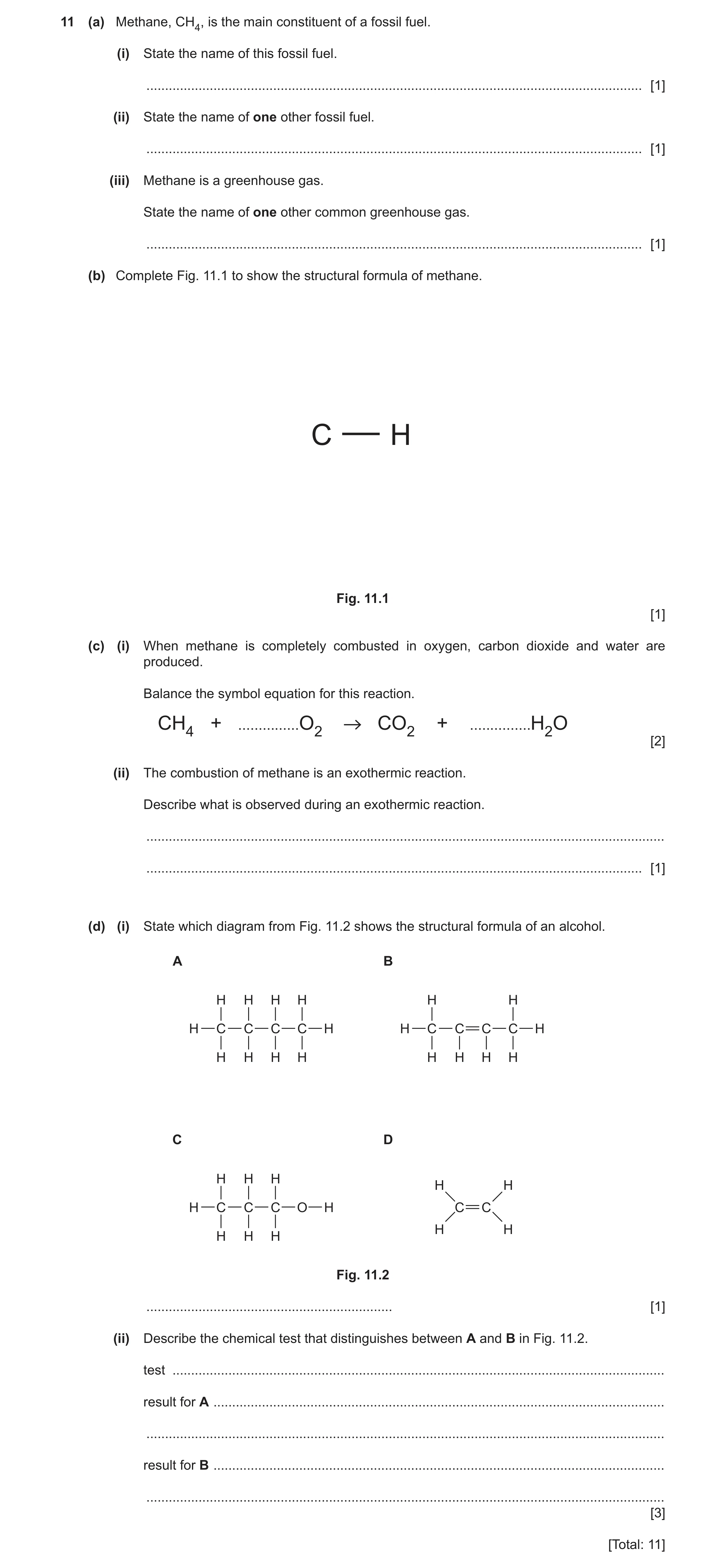
![Question 13: (a) Ethanol has the formula C2H5OH. Complete Fig. 5.1 to show the structure of an ethanol molecule. C C Fig. 5.1 [2] (b) Ethanol is used as…](https://img.pastlit.com/crops/c53110da-1116-4e3e-b812-18734b00e283/q5.webp)
![Question 14: (a) Ethanol has the formula C2H5OH. Complete Fig. 5.1 to show the structure of an ethanol molecule. C C Fig. 5.1 [2] (b) Ethanol is used as…](https://img.pastlit.com/crops/de51c13e-9126-4c74-a539-c9c7f3c4aee4/q5.webp)
 11
11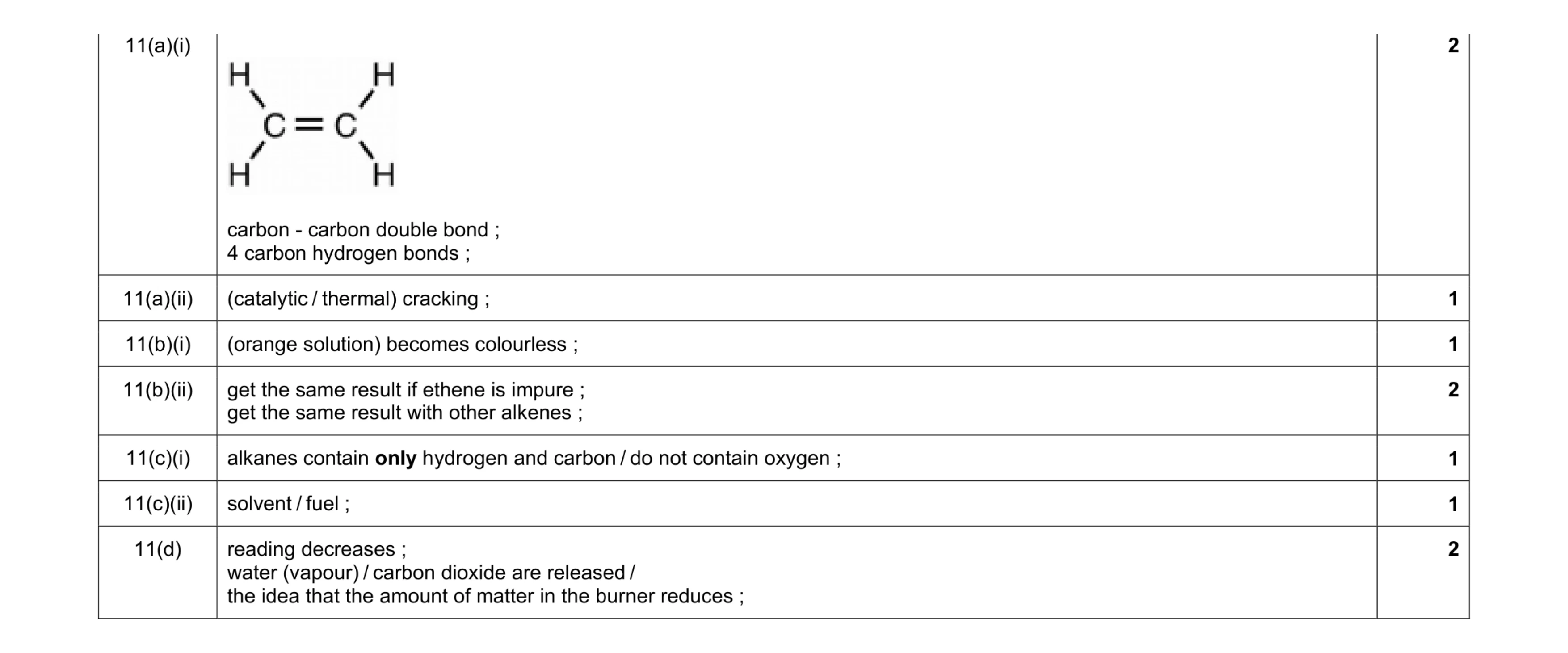 10
10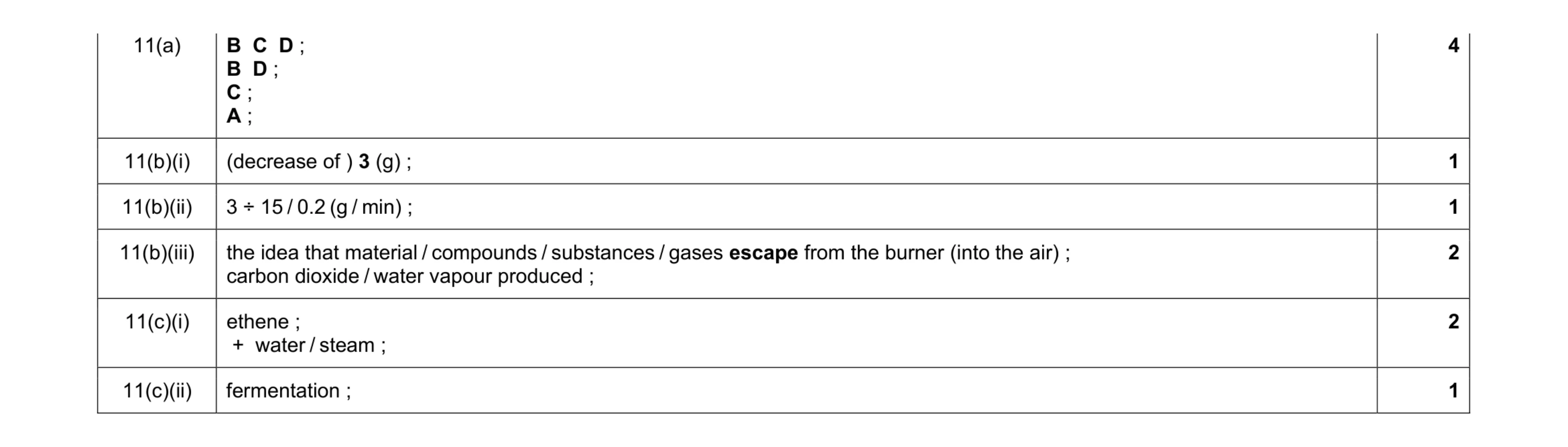 11
11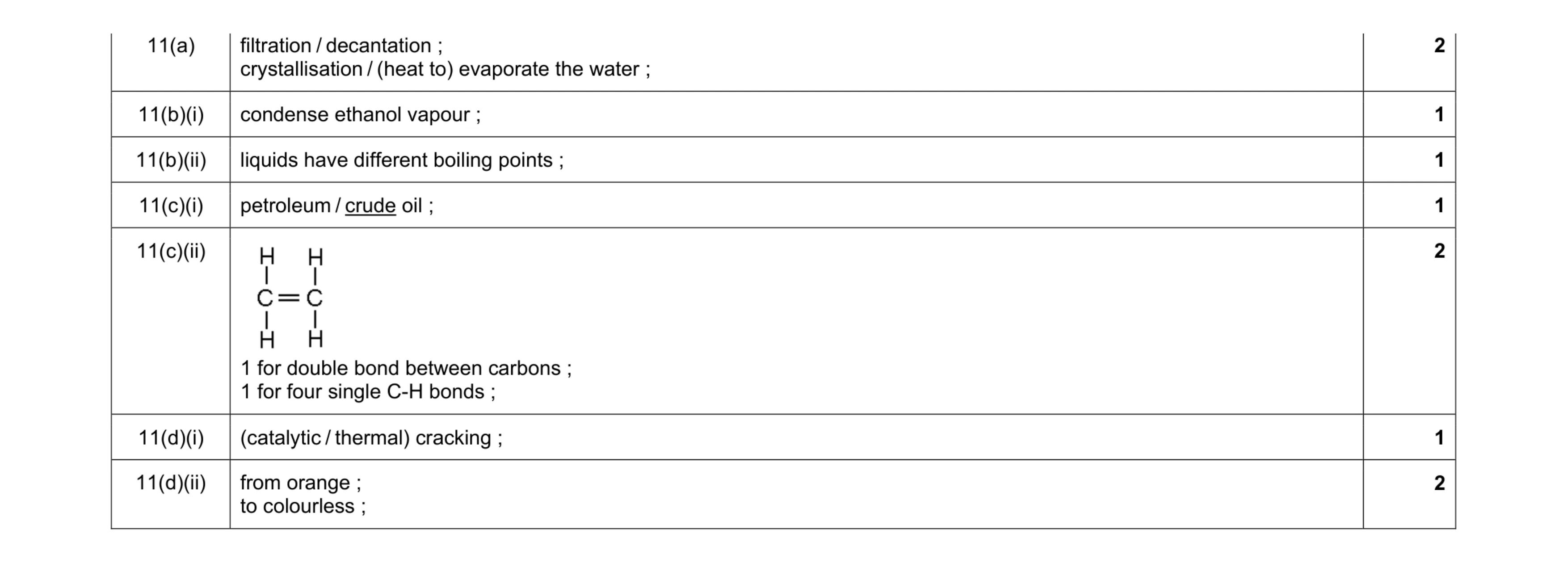 10
10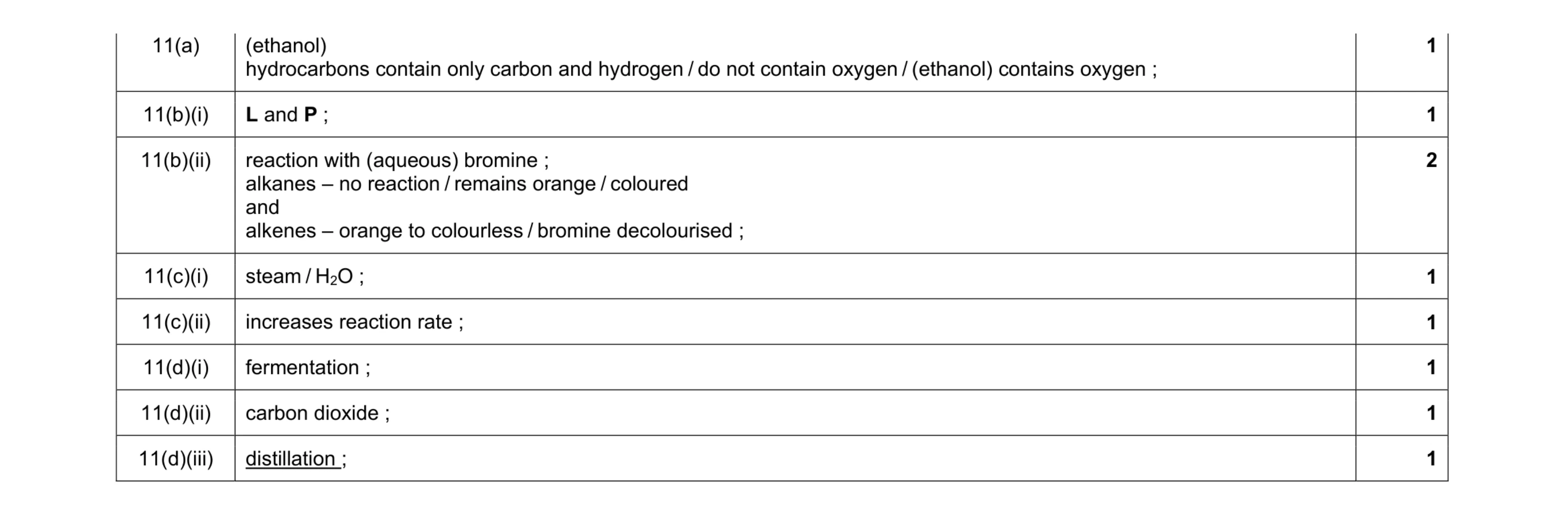 9
9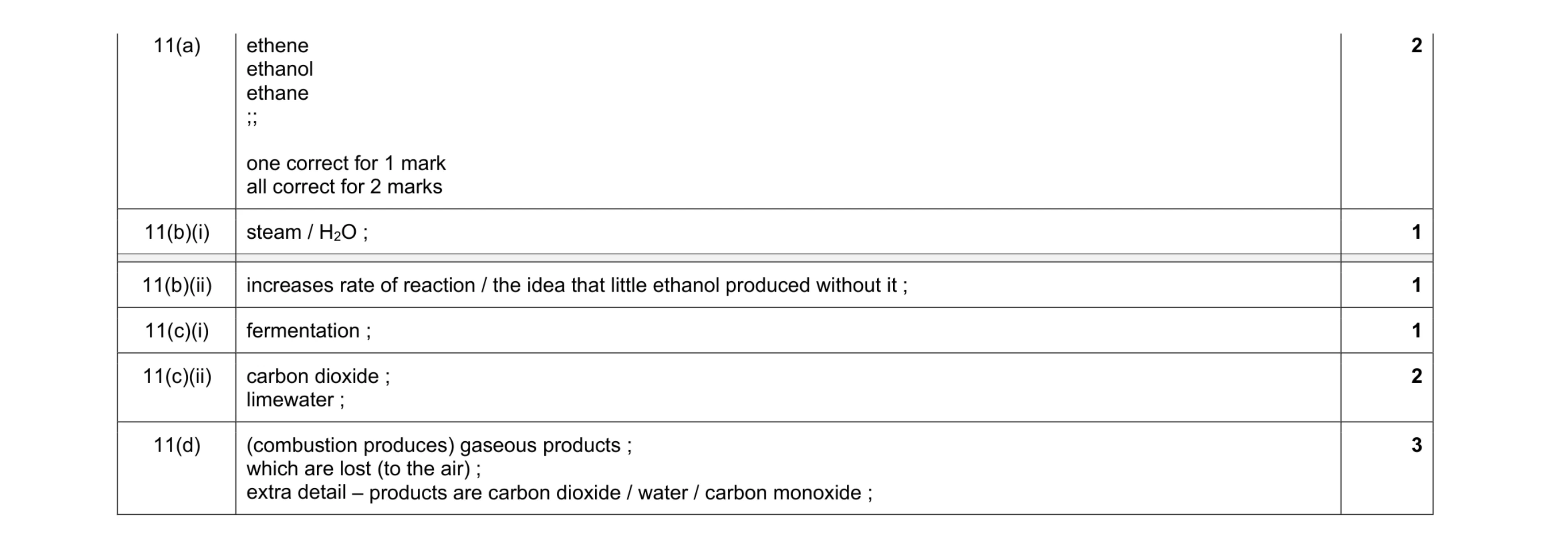 10
10 10
10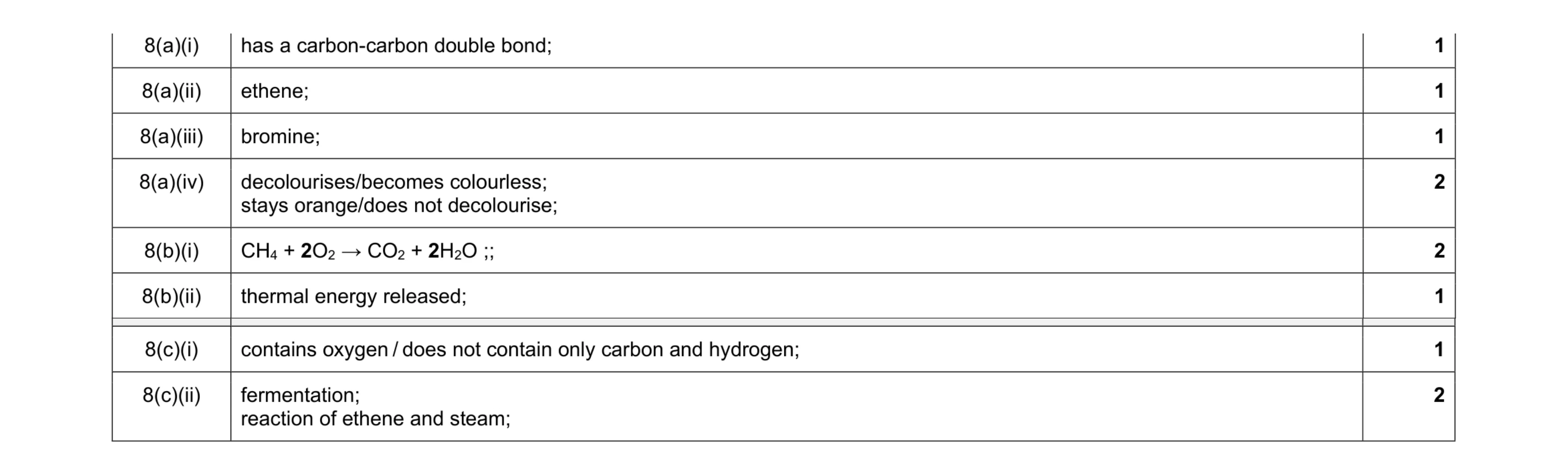 11
11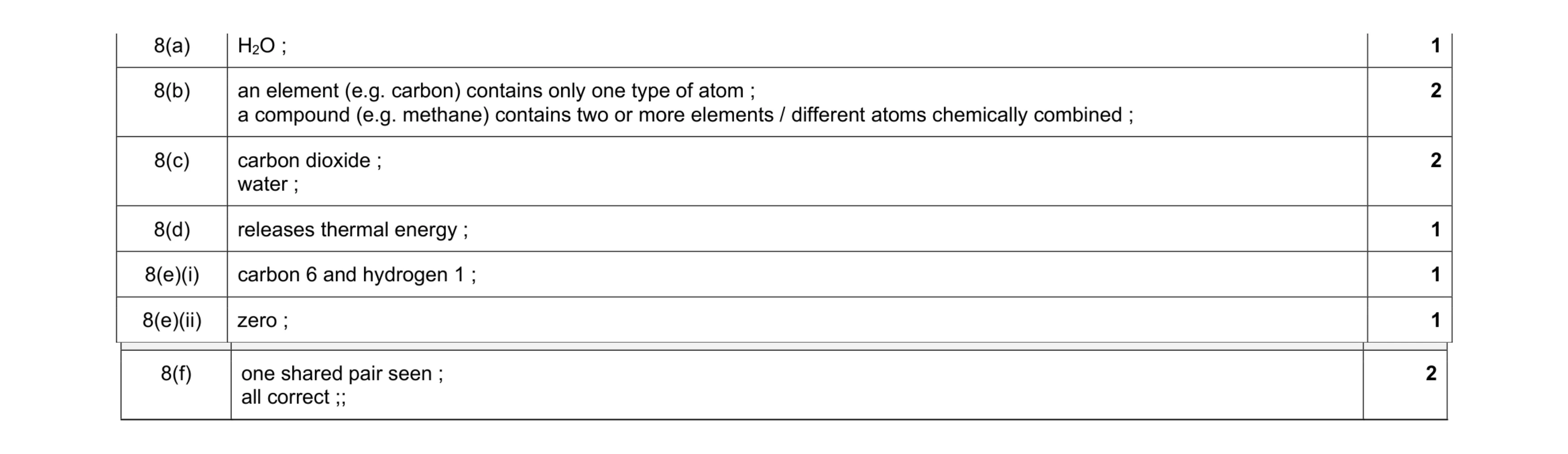 10
10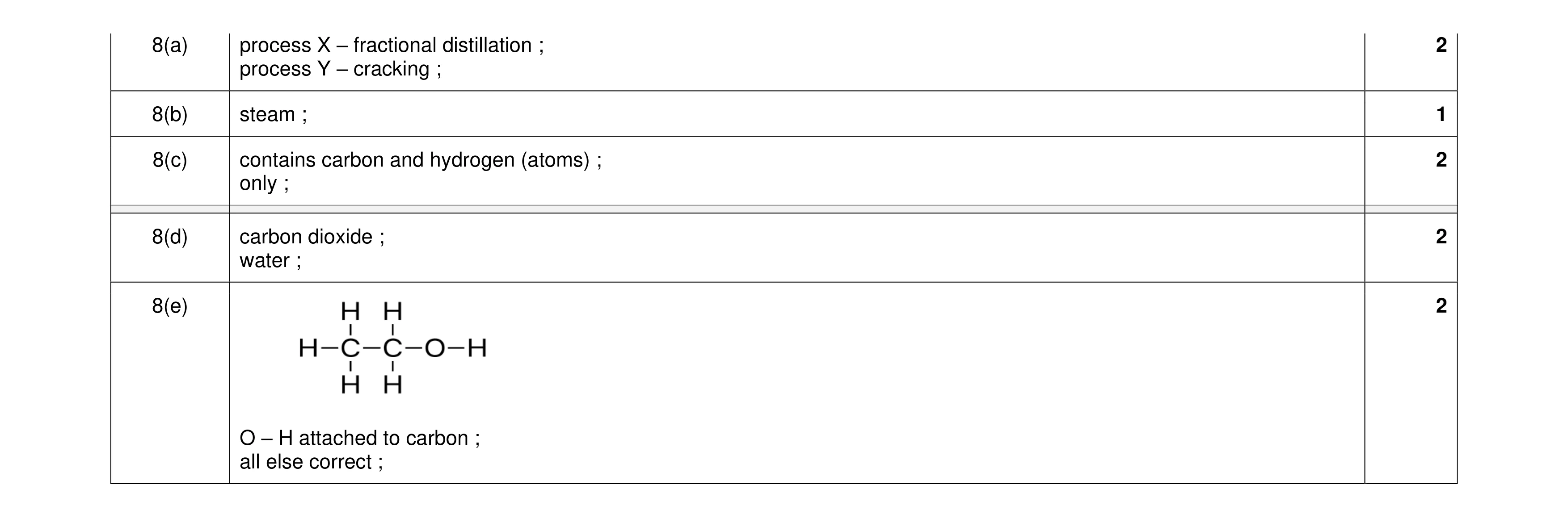 9
9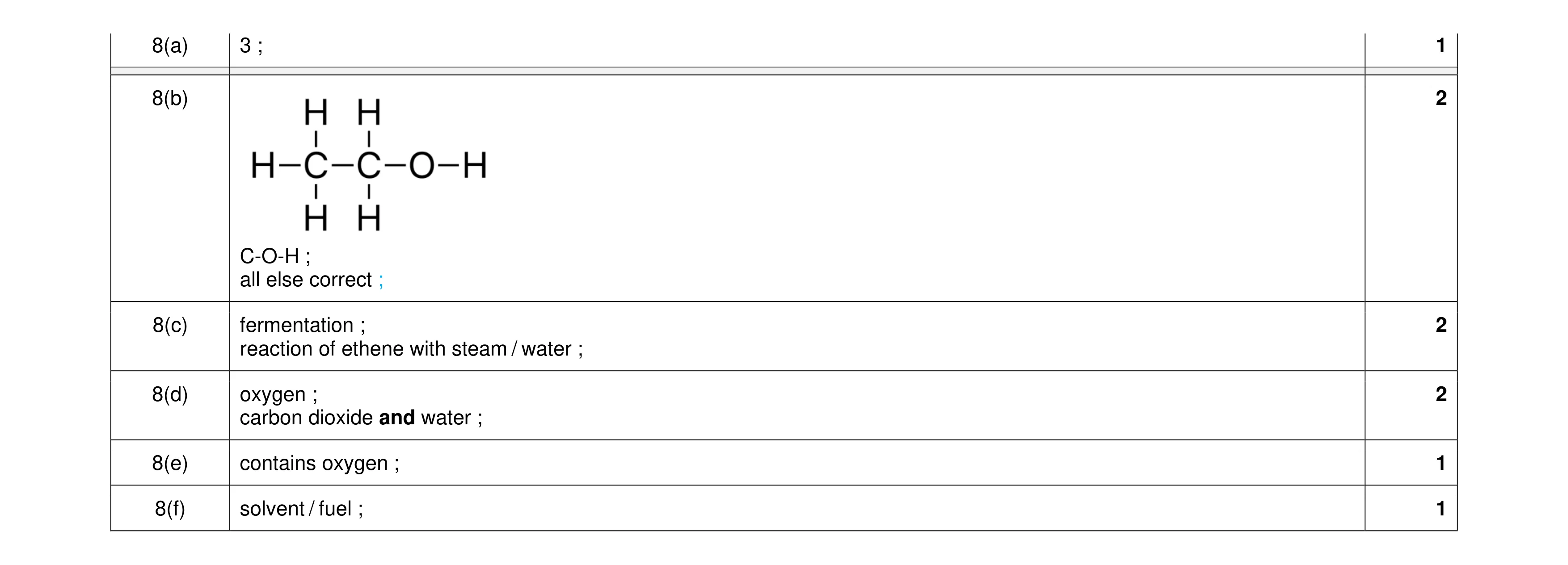 9
9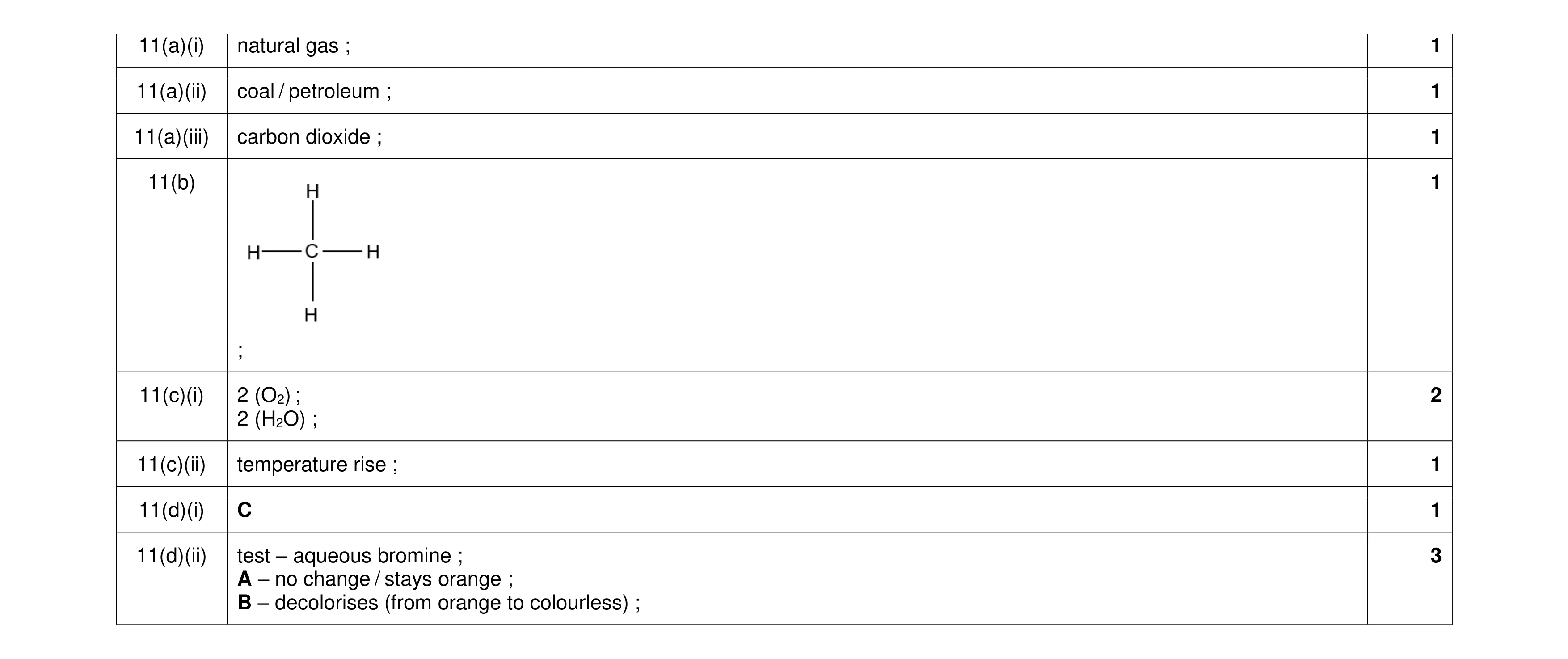 11
11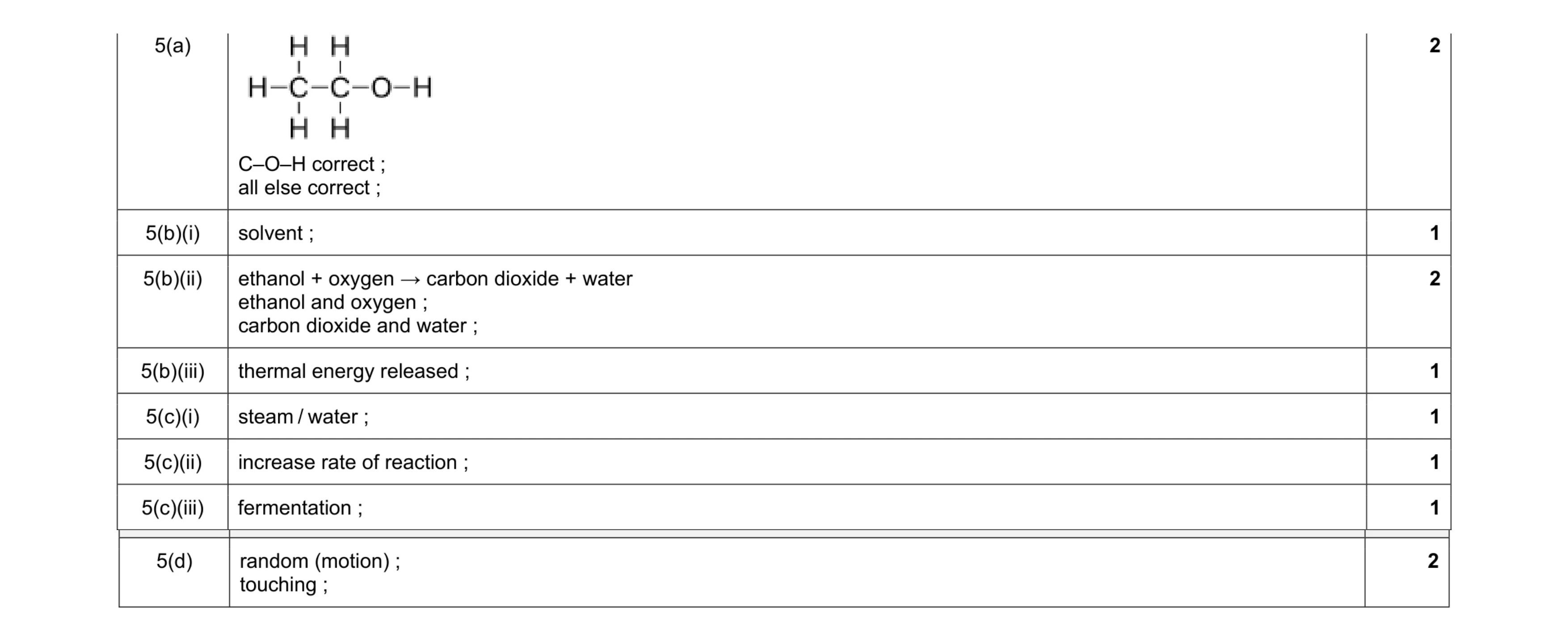 11
11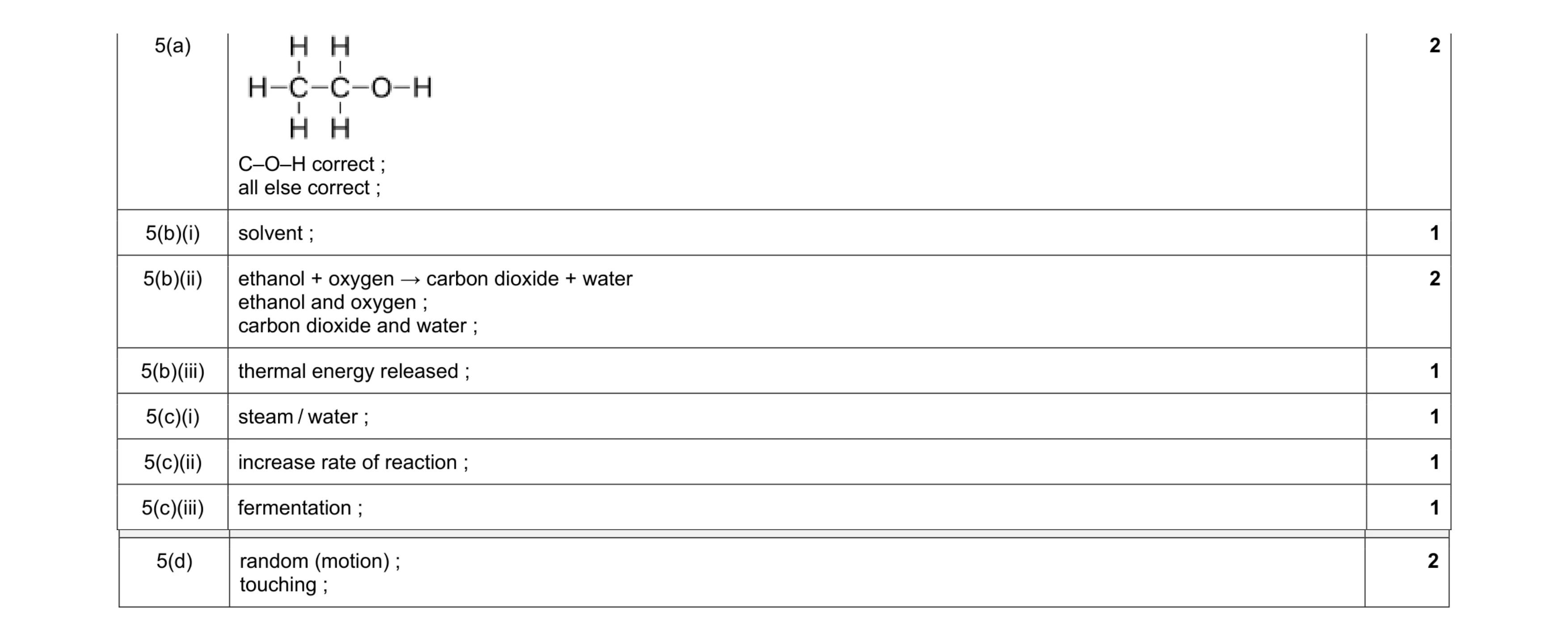 11
11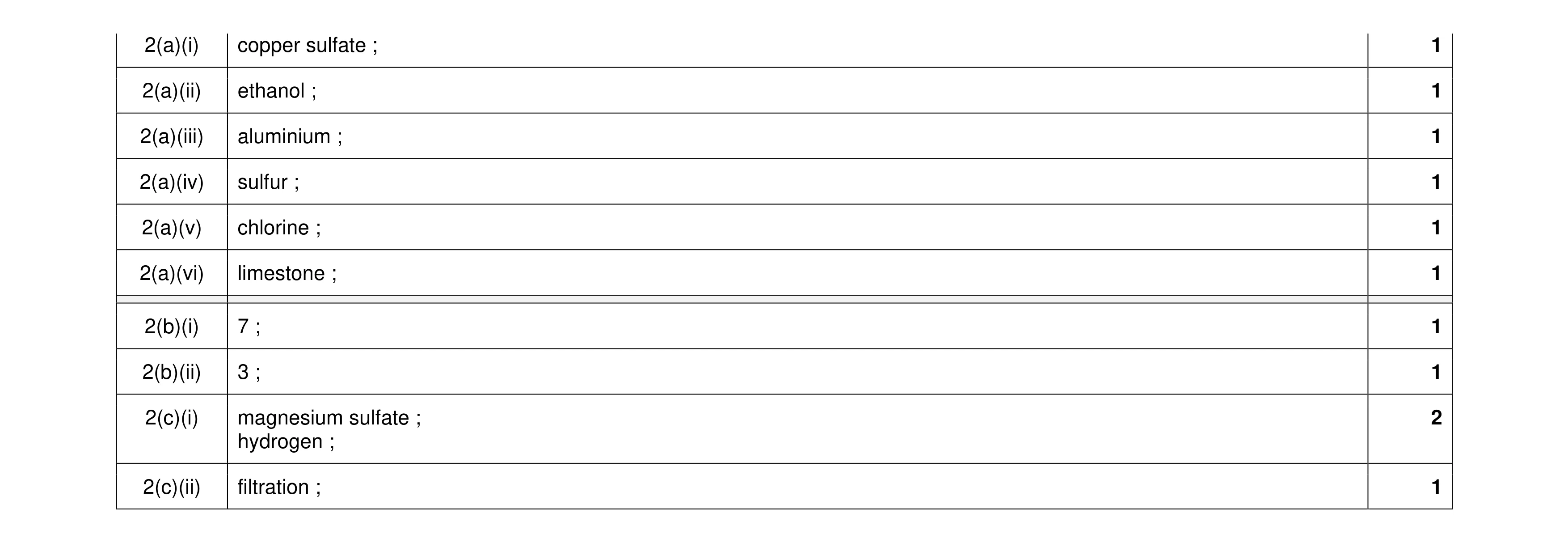 11
11