Questions as text
Q1 · Two plants, A and B, of the same species 0654/41 Oct/Nov 2018
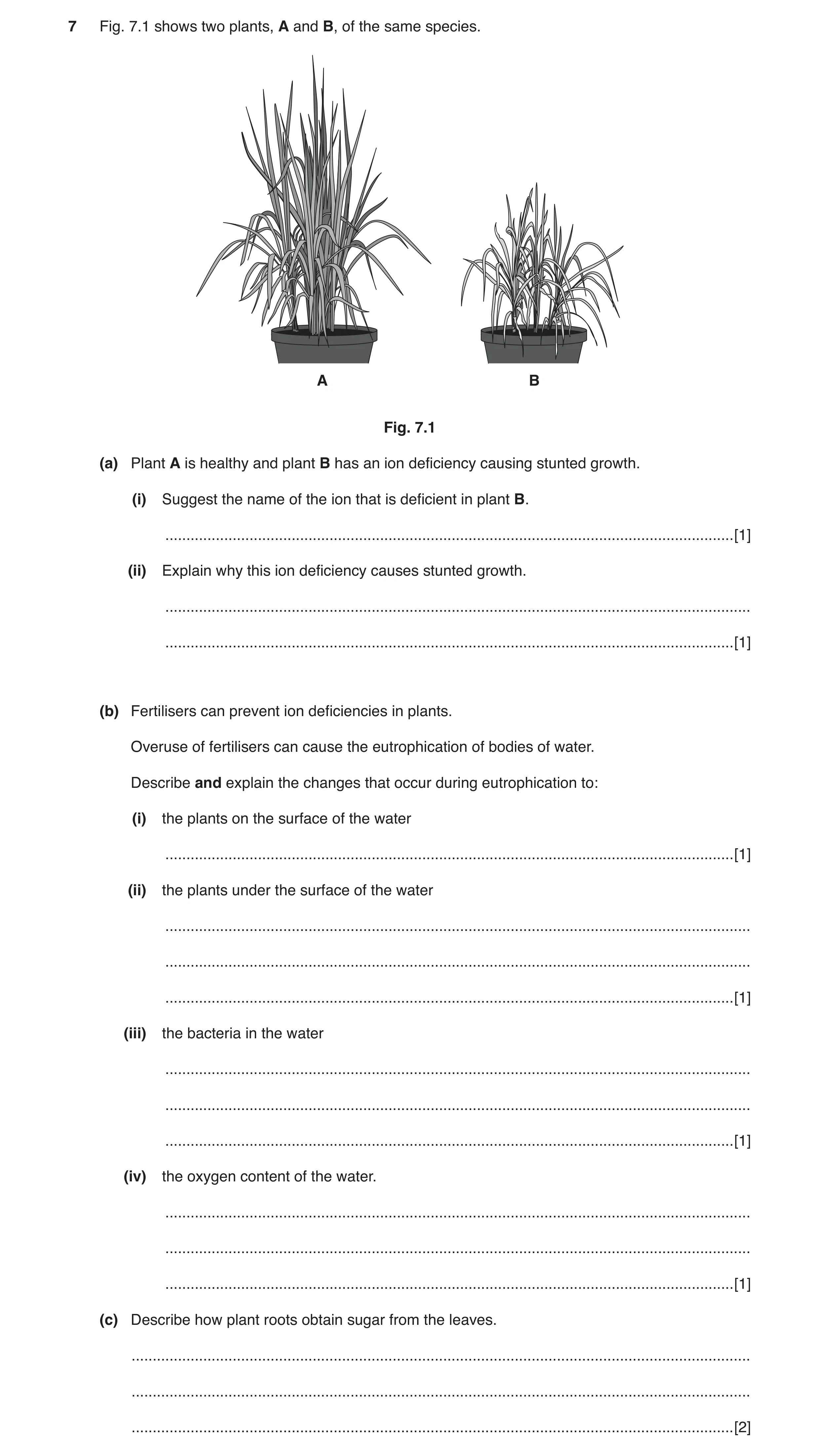
7 Fig. 7.1 shows two plants, A and B, of the same species. A B Fig. 7.1 (a) Plant A is healthy and plant B has an ion deficiency causing stunted growth. (i) Suggest the name of the ion that is deficient in plant B. … [1] (ii) Explain why this ion deficiency causes stunted growth. … … [1] (b) Fertilisers can prevent ion deficiencies in plants. Overuse of fertilisers can cause the eutrophication of bodies of water. Describe and explain the changes that occur during eutrophication to: (i) the plants on the surface of the water … [1] (ii) the plants under the surface of the water … … … [1] (iii) the bacteria in the water … … … [1] (iv) the oxygen content of the water. … … … [1] (c) Describe how plant roots obtain sugar from the leaves. … … … [2]
8 marks
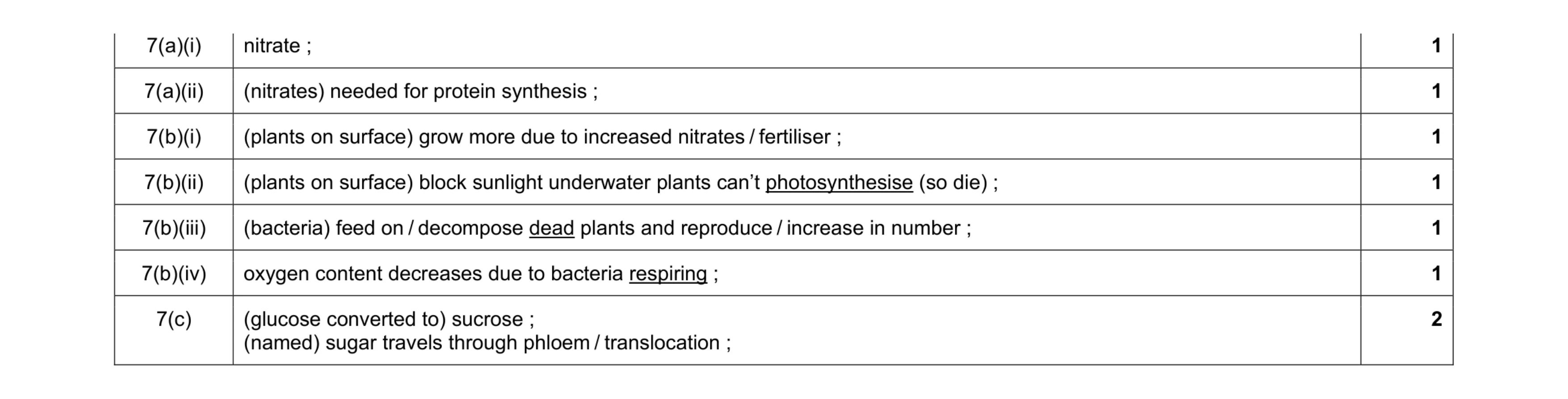
Mark scheme: 7(a)(i) nitrate ; 1 7(a)(ii) (nitrates) needed for protein synthesis ; 1 7(b)(i) (plants on surface) grow more due to increased nitrates / fertiliser ; 1 7(b)(ii) (plants on surface) block sunlight underwater plants can’t photosynthesise (so die) ; 1 7(b)(iii) (bacteria) feed on / decompose dead plants and reproduce / increase in number ; 1 7(b)(iv) oxygen content decreases due to bacteria respiring ; 1 7(c) (glucose converted to) sucrose ; (named) sugar travels through phloem / translocation ; 2
This question in 0654/41 Oct/Nov 2018
Q2 · A cross-section through a leaf 0654/42 May/June 2019
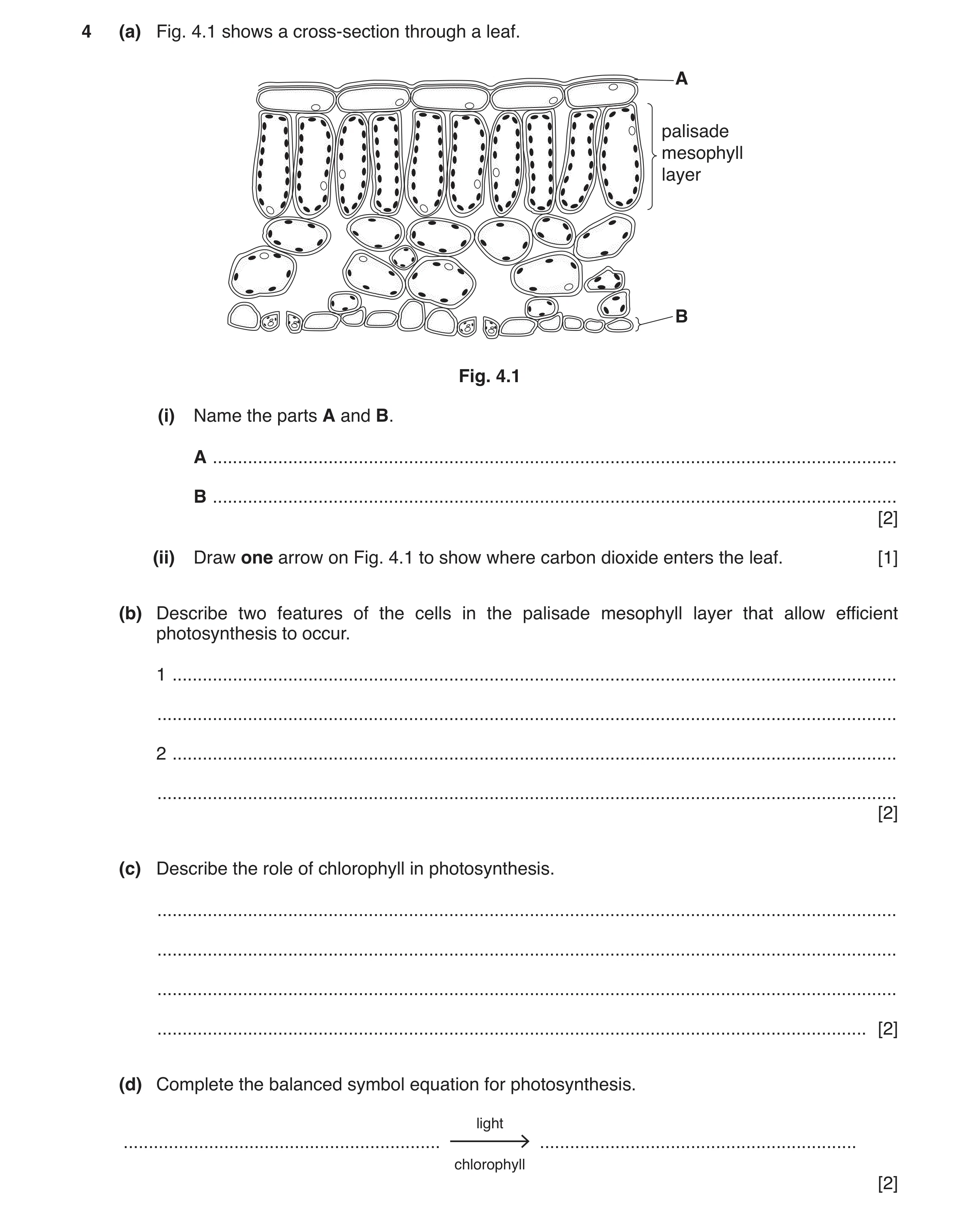
4 (a) Fig. 4.1 shows a cross-section through a leaf. A palisade mesophyll layer B Fig. 4.1 (i) Name the parts A and B. A … B … [2] (ii) Draw one arrow on Fig. 4.1 to show where carbon dioxide enters the leaf. [1] (b) Describe two features of the cells in the palisade mesophyll layer that allow efficient photosynthesis to occur. 1 … … 2 … … [2] (c) Describe the role of chlorophyll in photosynthesis. … … … … [2] (d) Complete the balanced symbol equation for photosynthesis. light … … chlorophyll [2]
9 marks
Mark scheme: 4(a)(i) A (waxy) cuticle ; B (lower) epidermis ; 2 4(a)(ii) arrow pointing to or through the stomata ; 1 4(b) cells tightly packed ; cells are close to the surface of the leaf ; contain, (many) chloroplasts / (lots of) chlorophyll ; large vacuole / chloroplasts are at the edge of cell ; thin cell walls ; max 2 4(c) transfers light energy to chemical energy ; for the synthesis of (named) carbohydrates ; 2 4(d) 6CO2 + 6H2O →C6H12O6 + 6O2 left hand side correct ; right hand side correct ; 2
This question in 0654/42 May/June 2019
Q3 · A diagram of a cross-section of a leaf 0654/42 Feb/March 2021
7 Fig. 7.1 is a diagram of a cross-section of a leaf. F E A D B C Fig. 7.1 (a) Identify the letter that represents the part in Fig. 7.1: where most photosynthesis takes place … which transports water from roots to leaves … which controls gas exchange. … [3] (b) Draw an X on Fig. 7.1 to identify a spongy mesophyll cell. [1] (c) The part labelled B in Fig. 7.1 is responsible for translocation. (i) Name the part labelled B. … [1] (ii) Name the two main substances transported by the part labelled B. 1 … 2 … [2] (d) Table 7.1 compares the processes of transpiration and translocation. Place ticks (3) in the boxes to show the correct features of transpiration and translocation. Table 7.1 transpiration translocation transports substances to regions of storage transports water movement of substances is in one direction only transport is from source to sink [2] [Total: 9]
9 marks
Mark scheme: 7(a) E ; A ; C ; 3 7(b) X on one of the spongy mesophyll cells ; 1 7(c)(i) phloem ; 1 7(c)(ii) sucrose ; amino acids ; 2 7(d) transpiration translocation transports substances to regions of storage transports water movement of substances is in one direction only transport is from source to sink ;; 2
This question in 0654/42 Feb/March 2021
Q4 · A diagram of a cross-section through a leaf 0654/42 Oct/Nov 2022
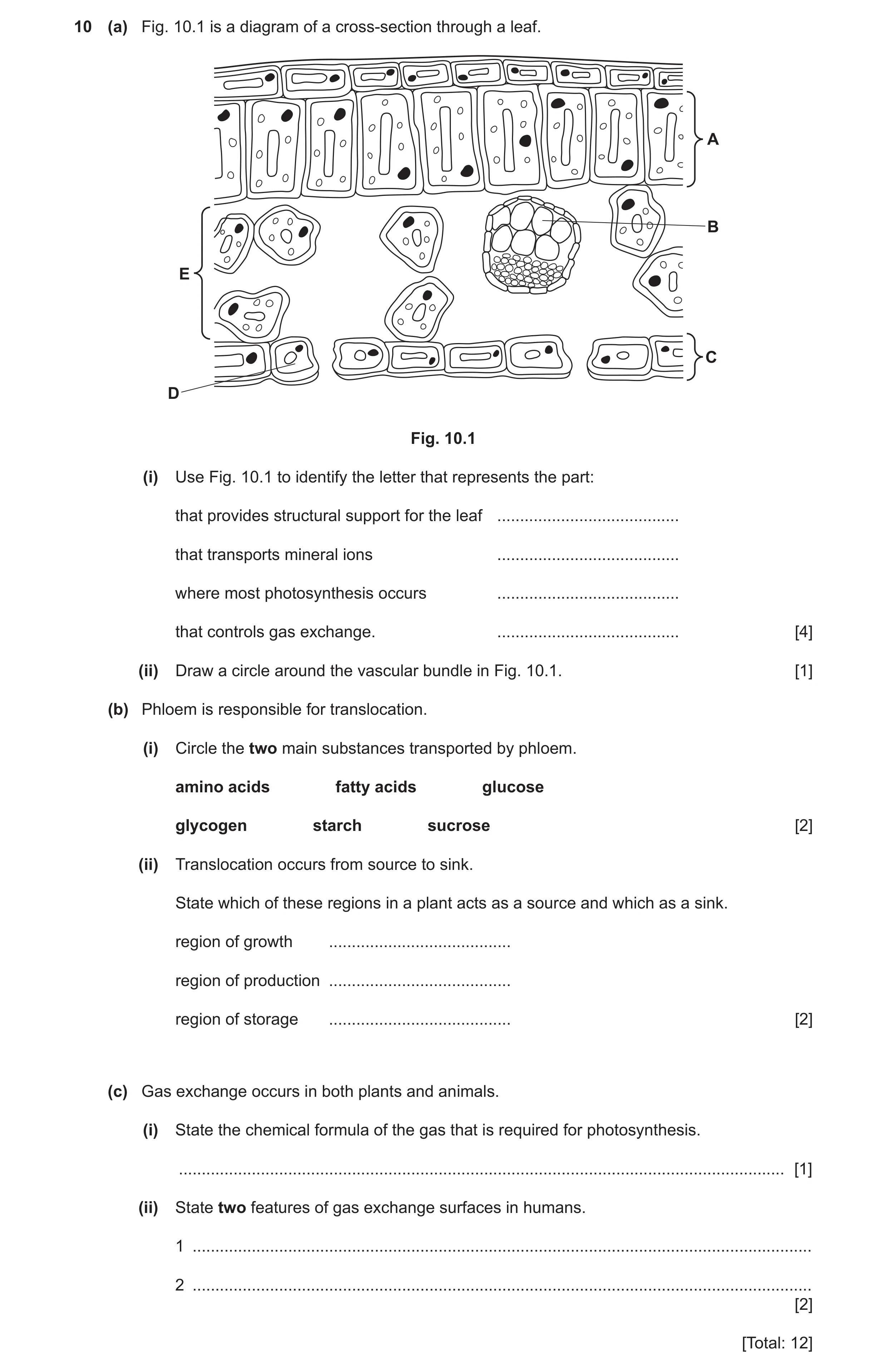
10 (a) Fig. 10.1 is a diagram of a cross-section through a leaf. A B E C D Fig. 10.1 (i) Use Fig. 10.1 to identify the letter that represents the part: that provides structural support for the leaf … that transports mineral ions … where most photosynthesis occurs … that controls gas exchange. … [4] (ii) Draw a circle around the vascular bundle in Fig. 10.1. [1] (b) Phloem is responsible for translocation. (i) Circle the two main substances transported by phloem. amino acids fatty acids glucose glycogen starch sucrose [2] (ii) Translocation occurs from source to sink. State which of these regions in a plant acts as a source and which as a sink. region of growth … region of production … region of storage … [2] (c) Gas exchange occurs in both plants and animals. (i) State the chemical formula of the gas that is required for photosynthesis. … [1] (ii) State two features of gas exchange surfaces in humans. 1 … 2 … [2] [Total: 12]
12 marks
Mark scheme: 10(a)(i) B ; 4 B ; A ; D ; 10(a)(ii) circle drawn round the vascular bundle ; 1 10(b)(i) amino acids ; 2 sucrose ; 10(b)(ii) sink 2 source sink ;; 1 correct = 0 2 correct = 1 3 correct = 2 10(c)(i) CO2 ; 1 10(c)(ii) any two from: 2 large surface area ; thin (surface) ; good blood supply ; good ventilation with air ;
This question in 0654/42 Oct/Nov 2022
Q5 · Oxygen is one of the products of photosynthesis 0654/41 May/June 2023
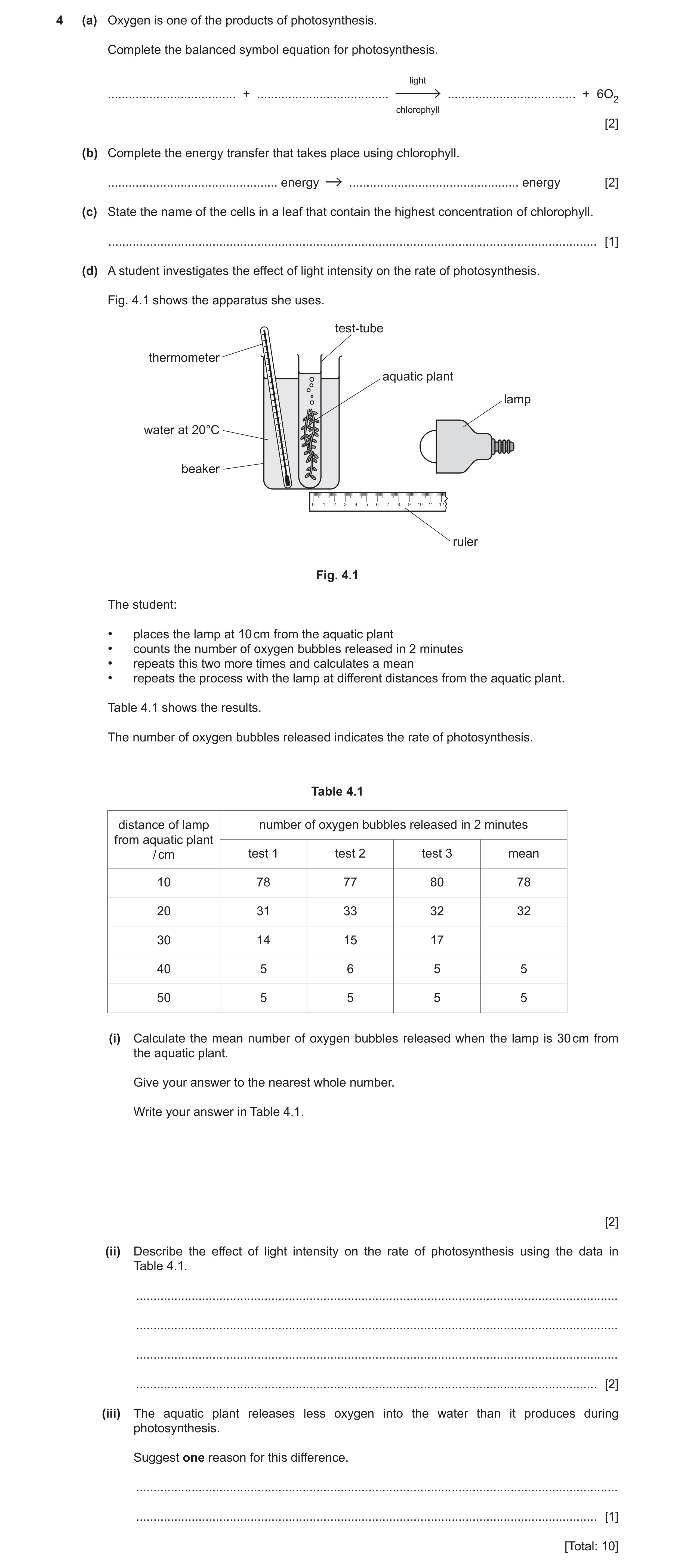
4 (a) Oxygen is one of the products of photosynthesis. Complete the balanced symbol equation for photosynthesis. light … + … … + 6O2 chlorophyll [2] (b) Complete the energy transfer that takes place using chlorophyll. … energy … energy [2] (c) State the name of the cells in a leaf that contain the highest concentration of chlorophyll. … [1] (d) A student investigates the effect of light intensity on the rate of photosynthesis. Fig. 4.1 shows the apparatus she uses. test-tube thermometer aquatic plant lamp water at 20°C beaker ruler Fig. 4.1 The student: • places the lamp at 10 cm from the aquatic plant • counts the number of oxygen bubbles released in 2 minutes • repeats this two more times and calculates a mean • repeats the process with the lamp at different distances from the aquatic plant. Table 4.1 shows the results. The number of oxygen bubbles released indicates the rate of photosynthesis. Table 4.1 distance of lamp number of oxygen bubbles released in 2 minutes from aquatic plant / cm test 1 test 2 test 3 mean 10 78 77 80 78 20 31 33 32 32 30 14 15 17 40 5 6 5 5 50 5 5 5 5 (i) Calculate the mean number of oxygen bubbles released when the lamp is 30 cm from the aquatic plant. Give your answer to the nearest whole number. Write your answer in Table 4.1. [2] (ii) Describe the effect of light intensity on the rate of photosynthesis using the data in Table 4.1. … … … … [2] (iii) The aquatic plant releases less oxygen into the water than it produces during photosynthesis. Suggest one reason for this difference. … … [1] [Total: 10]
10 marks
Mark scheme: 4(a) 6CO2 + 6H2O ; C6H12O6 ; 2 4(b) light ; chemical ; 2 4(c) palisade (mesophyll) ; 1 4(d)(i) evidence of 14+15+17 / 3 or 46 / 3 ; = 15 ; 2 4(d)(ii) as light intensity decreases the, (mean) number of bubbles of oxygen / rate of photosynthesis, decreases (initially) ; Accept ORA the (mean) number of bubbles of oxygen / the rate of photosynthesis, becomes constant after the lamp reaches 40 cm from the plant ; 2 4(d)(iii) some of the oxygen is used in respiration ; 1
This question in 0654/41 May/June 2023
Q6 · A diagram of a cross-section of a leaf 0654/43 Oct/Nov 2023
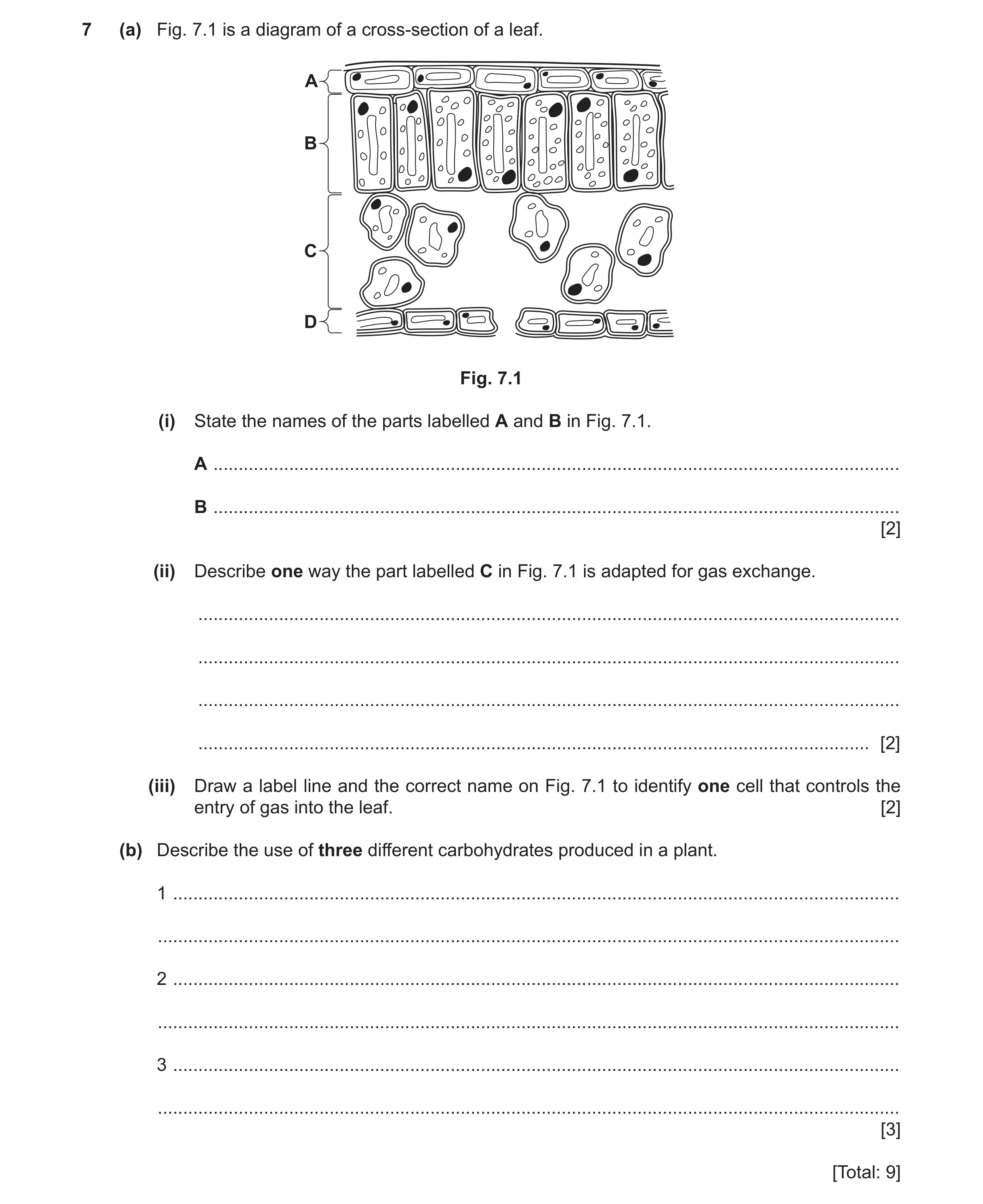
7 (a) Fig. 7.1 is a diagram of a cross-section of a leaf. A B C D Fig. 7.1 (i) State the names of the parts labelled A and B in Fig. 7.1. A … B … [2] (ii) Describe one way the part labelled C in Fig. 7.1 is adapted for gas exchange. … … … … [2] (iii) Draw a label line and the correct name on Fig. 7.1 to identify one cell that controls the entry of gas into the leaf. [2] (b) Describe the use of three different carbohydrates produced in a plant. 1 … … 2 … … 3 … … [3] [Total: 9]
9 marks
Mark scheme: 7(a)(i) A – (upper) epidermis ; 2 B – palisade (mesophyll) ; 7(a)(ii) large air spaces / spongy mesophyll cells loosely packed ; 2 for increased diffusion of gases or larger surface area for diffusion ; 7(a)(iii) guard (cell) identified with the correct name 2 identifying correct cell ; correct name ; 7(b) any three from: 3 glucose used for respiration ; storage as starch ; cellulose for cell walls ; sucrose for transport ; used in synthesis of (named) biological molecules ; AVP ;
This question in 0654/43 Oct/Nov 2023
Q7 · A cross-section of a leaf 0654/43 May/June 2024
4 (a) Fig. 4.1 shows a cross-section of a leaf. B A G C F E D Fig. 4.1 (i) State the letter in Fig. 4.1 that identifies the cells that control loss of water vapour from a leaf. … [1] (ii) State the names of the parts labelled A and B in Fig. 4.1. A … B … [2] (iii) Describe two ways in which the part labelled G in Fig. 4.1 is adapted for photosynthesis. 1 … … 2 … … [2] (b) Carbohydrates produced by photosynthesis are transported to areas of the plant described as sinks. (i) Describe how the carbohydrates are transported to the sinks. … … … … … [3] (ii) State two uses of carbohydrates in sinks. 1 … 2 … [2] (c) Carbon dioxide diffuses into a leaf during gas exchange. State two factors which increase the rate of diffusion during gas exchange. 1 … 2 … [2] [Total: 12]
12 marks
Mark scheme: 4(a)(i) D ; 1 4(a)(ii) A (upper) epidermis ; B cuticle ; 2 4(a)(iii) any two from: contain lots of chloroplasts ; located at the top of leaf ; tightly packed / column shaped ; 2 4(b)(i) as sucrose ; by translocation ; in the phloem ; 3 4(b)(ii) any two from: storage ; respiration ; growth ; 2 Question Answer Marks 4(c) any two from: increased surface area ; increased temperature ; steeper concentration gradient ; shorter diffusion distance ; 2
This question in 0654/43 May/June 2024
Q8 · State the balanced symbol equation for photosynthesis 0654/42 Oct/Nov 2024
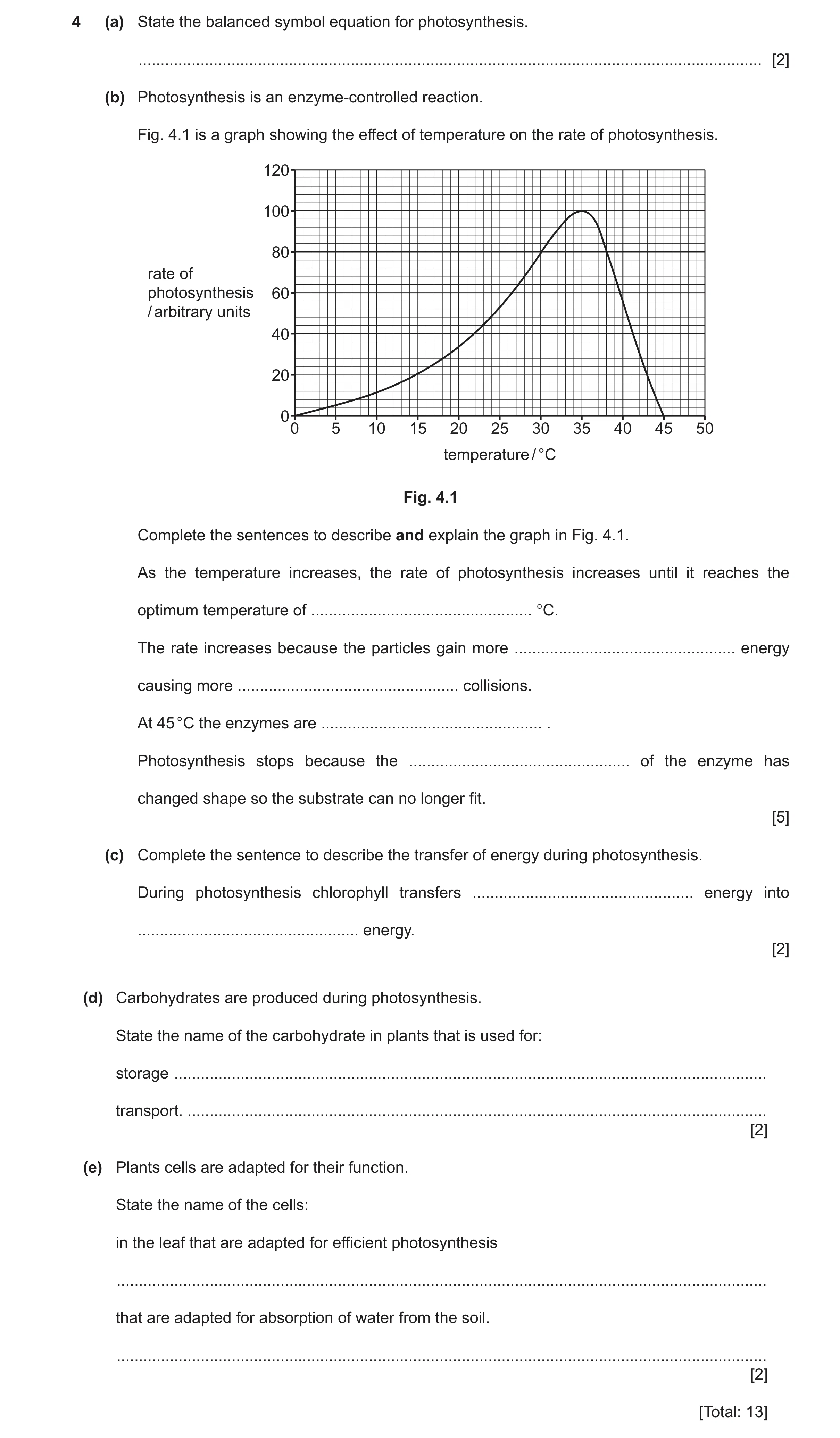
4 (a) State the balanced symbol equation for photosynthesis. … [2] (b) Photosynthesis is an enzyme-controlled reaction. Fig. 4.1 is a graph showing the effect of temperature on the rate of photosynthesis. 120 100 80 rate of photosynthesis 60 / arbitrary units 40 20 00 5 10 15 20 25 30 35 40 45 50 temperature / °C Fig. 4.1 Complete the sentences to describe and explain the graph in Fig. 4.1. As the temperature increases, the rate of photosynthesis increases until it reaches the optimum temperature of … °C. The rate increases because the particles gain more … energy causing more … collisions. At 45 °C the enzymes are … . Photosynthesis stops because the … of the enzyme has changed shape so the substrate can no longer fit. [5] (c) Complete the sentence to describe the transfer of energy during photosynthesis. During photosynthesis chlorophyll transfers … energy into … energy. [2] (d) Carbohydrates are produced during photosynthesis. State the name of the carbohydrate in plants that is used for: storage … transport. … [2] (e) Plants cells are adapted for their function. State the name of the cells: in the leaf that are adapted for efficient photosynthesis … that are adapted for absorption of water from the soil. … [2] [Total: 13]
13 marks
Mark scheme: 4(a) 2 6CO2 + 6H2O → C6H12O6 + 6O2 one mark for correctly balanced reactants (either order) ; one mark for correctly balanced products (either order) ; 4(b) 35 ; 5 kinetic ; successful / effective / frequent ; denatured ; active site ; 4(c) light ; 2 chemical ; 4(d) starch ; 2 sucrose ; 4(e) palisade mesophyll (cell) ; 2 root hair (cell) ;
This question in 0654/42 Oct/Nov 2024
Question 9 0654/43 Oct/Nov 2024
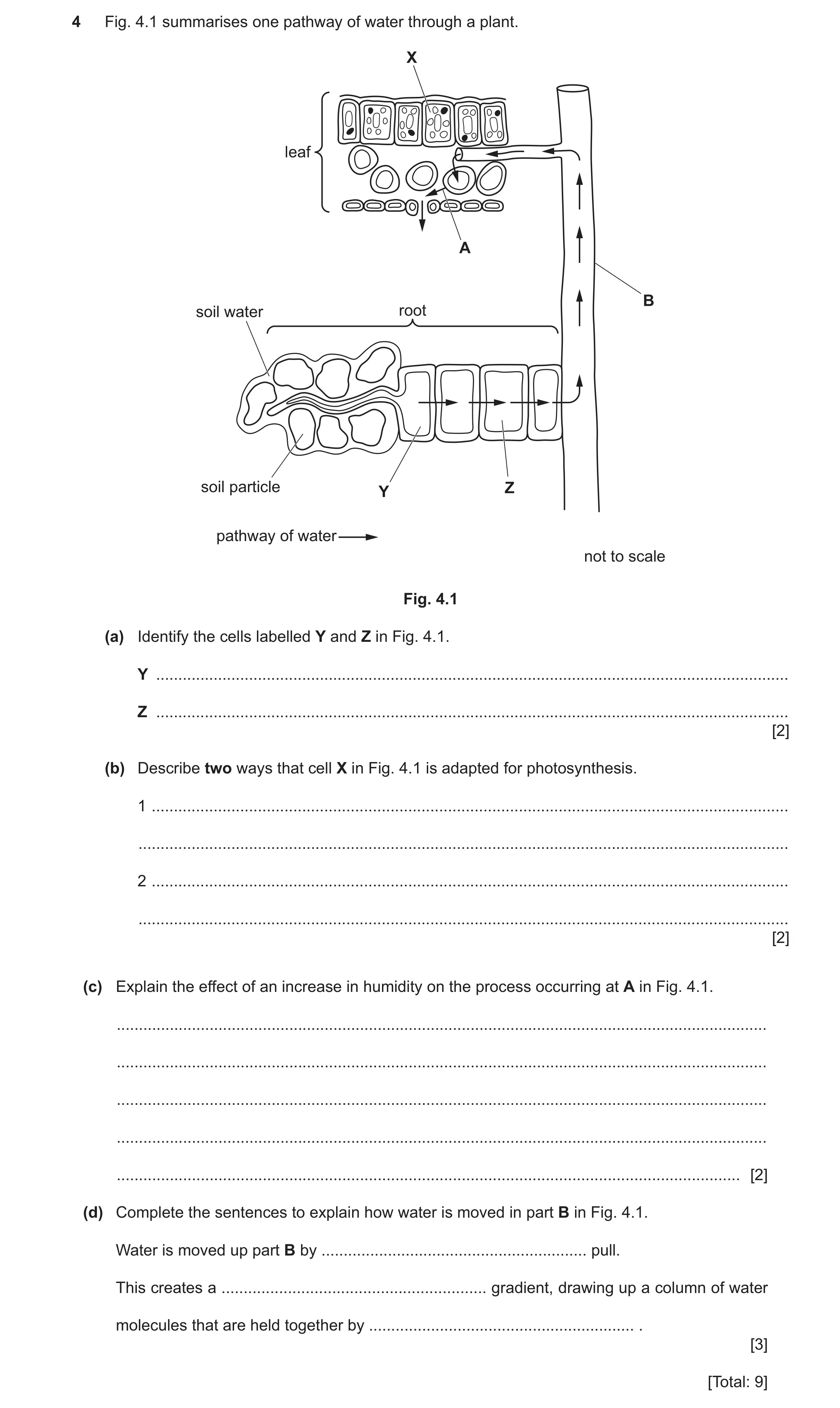
4 Fig. 4.1 summarises one pathway of water through a plant. X leaf A B soil water root soil particle Y Z pathway of water not to scale Fig. 4.1 (a) Identify the cells labelled Y and Z in Fig. 4.1. Y … Z … [2] (b) Describe two ways that cell X in Fig. 4.1 is adapted for photosynthesis. 1 … … 2 … … [2] (c) Explain the effect of an increase in humidity on the process occurring at A in Fig. 4.1. … … … … … [2] (d) Complete the sentences to explain how water is moved in part B in Fig. 4.1. Water is moved up part B by … pull. This creates a … gradient, drawing up a column of water molecules that are held together by … . [3] [Total: 9]
9 marks
Mark scheme: 4(a) Y root hair (cell) ; 2 Z (root) cortex (cell) ; 4(b) contains lots of chloroplasts ; 2 positioned at the top of the leaf (for maximum light) ; column-shaped / AW ; AVP ; 4(c) decrease in evaporation (from the surfaces of mesophyll cells) ; 2 due to a decrease in concentration / diffusion gradient (of water vapour) / AW ; 4(d) transpiration ; 3 water potential ; cohesion ;
This question in 0654/43 Oct/Nov 2024
Q10 · A cross-section through a leaf 0654/42 Feb/March 2025
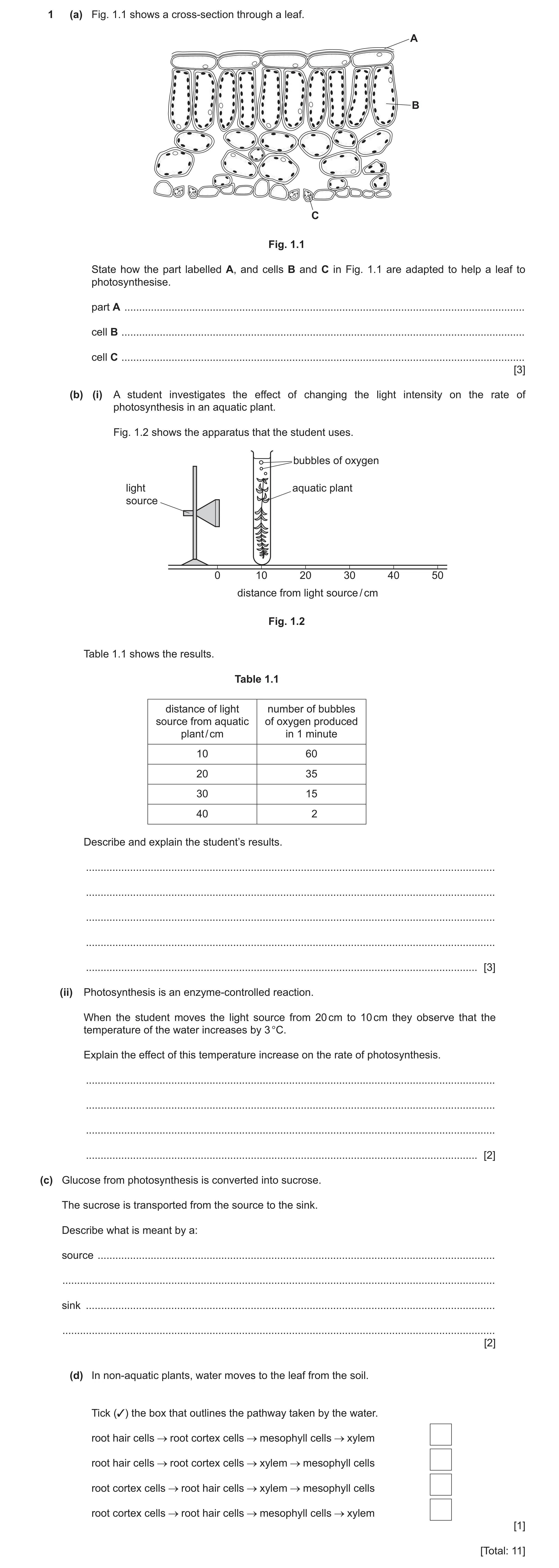
1 (a) Fig. 1.1 shows a cross-section through a leaf. A B C Fig. 1.1 State how the part labelled A, and cells B and C in Fig. 1.1 are adapted to help a leaf to photosynthesise. part A … cell B … cell C … [3] (b) (i) A student investigates the effect of changing the light intensity on the rate of photosynthesis in an aquatic plant. Fig. 1.2 shows the apparatus that the student uses. bubbles of oxygen light aquatic plant source 0 10 20 30 40 50 distance from light source / cm Fig. 1.2 Table 1.1 shows the results. Table 1.1 distance of light number of bubbles source from aquatic of oxygen produced plant / cm in 1 minute 10 60 20 35 30 15 40 2 Describe and explain the student’s results. … … … … … [3] (ii) Photosynthesis is an enzyme-controlled reaction. When the student moves the light source from 20 cm to 10 cm they observe that the temperature of the water increases by 3 °C. Explain the effect of this temperature increase on the rate of photosynthesis. … … … … [2] (c) Glucose from photosynthesis is converted into sucrose. The sucrose is transported from the source to the sink. Describe what is meant by a: source … … sink … … [2] (d) In non-aquatic plants, water moves to the leaf from the soil. Tick (✓) the box that outlines the pathway taken by the water. root hair cells root cortex cells mesophyll cells xylem root hair cells root cortex cells xylem mesophyll cells root cortex cells root hair cells xylem mesophyll cells root cortex cells root hair cells mesophyll cells xylem [1] [Total: 11]
11 marks
Mark scheme: Question Answer Marks 1(a) part A - waterproof / transparent ; 3 cell B - contain lots of chloroplasts / located near the upper surface of leaf / elongated or column-shaped, to pack together more tightly ; cell C - open and close stomata ; 1(b)(i) as distance of light source increases, the number of bubbles / the volume of oxygen, decreases or rate of photosynthesis 3 decreases ; and any two from: light intensity decreases with distance from light source light provides energy for photosynthesis oxygen is a product of photosynthesis ; ; 1(b)(ii) any two from: 2 increase in the rate of photosynthesis – no mark: increase in kinetic energy more effective collisions / more frequent collisions more enzyme-substrate complexes form ; ; 1(c) source – part of the plants that release, sucrose / amino acids ; 2 sink – part of plants that, use / store, sucrose / amino acids ; 1(d) 1 ;
This question in 0654/42 Feb/March 2025
 3 / 14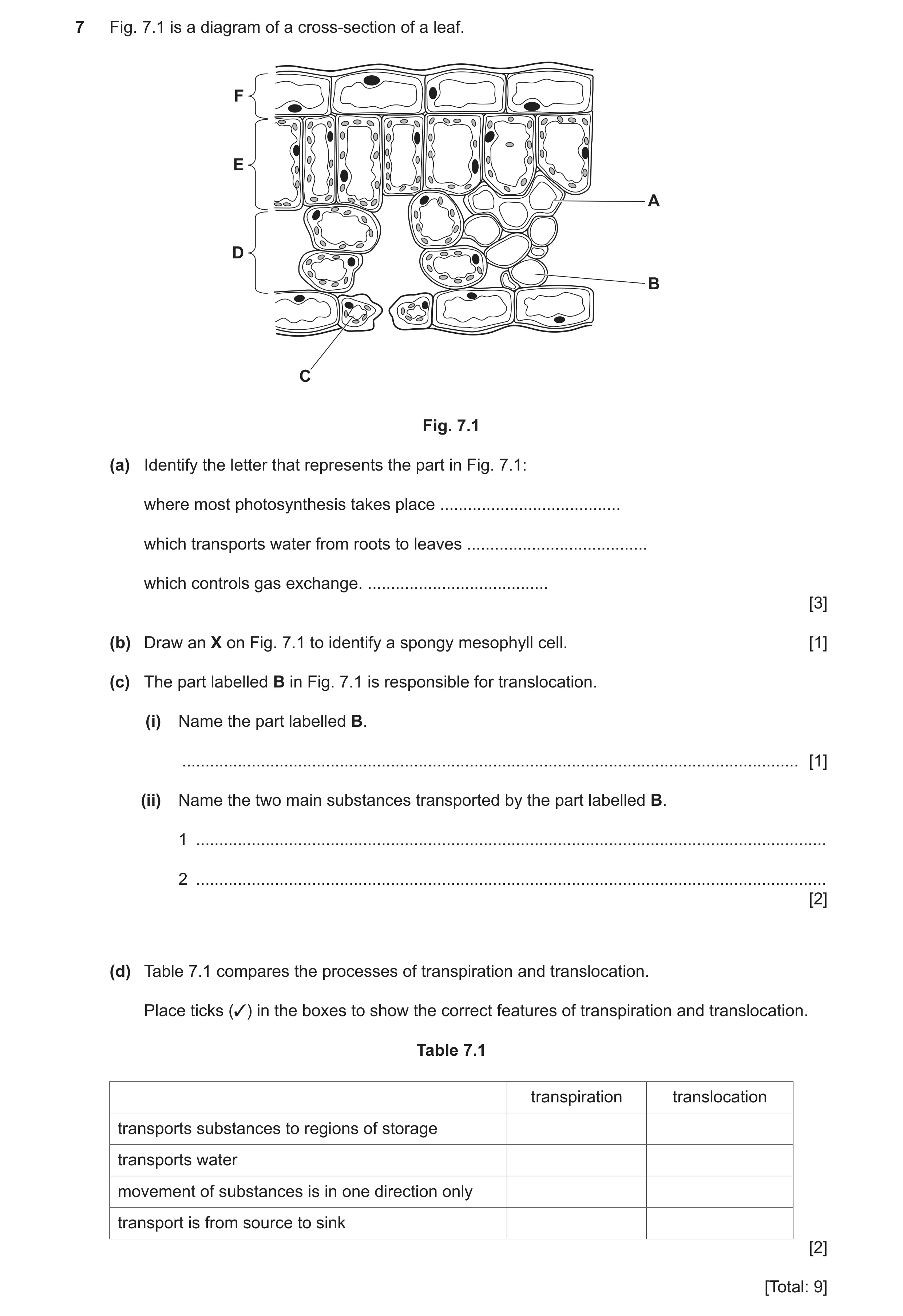
 8 / 14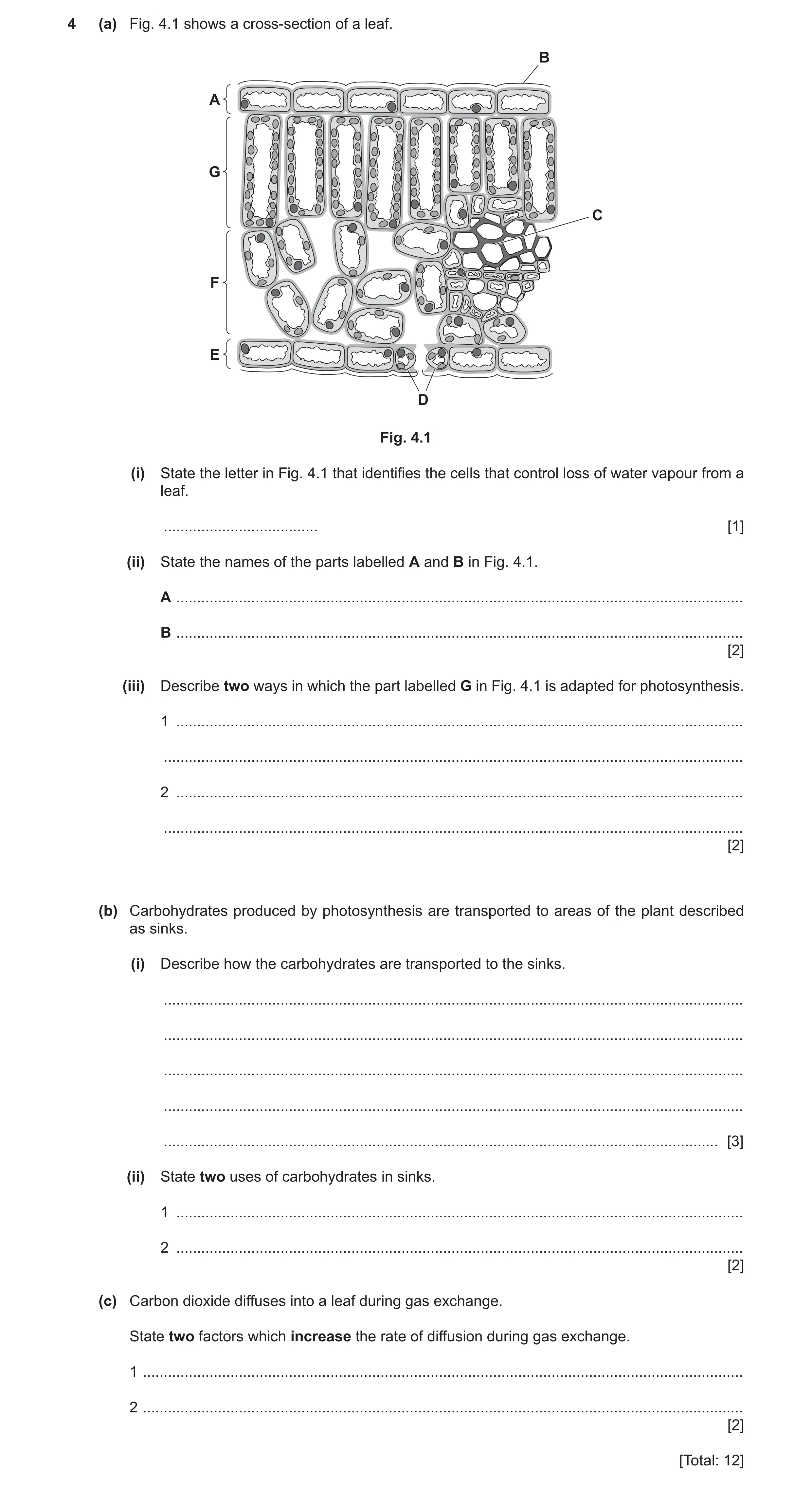
 8
8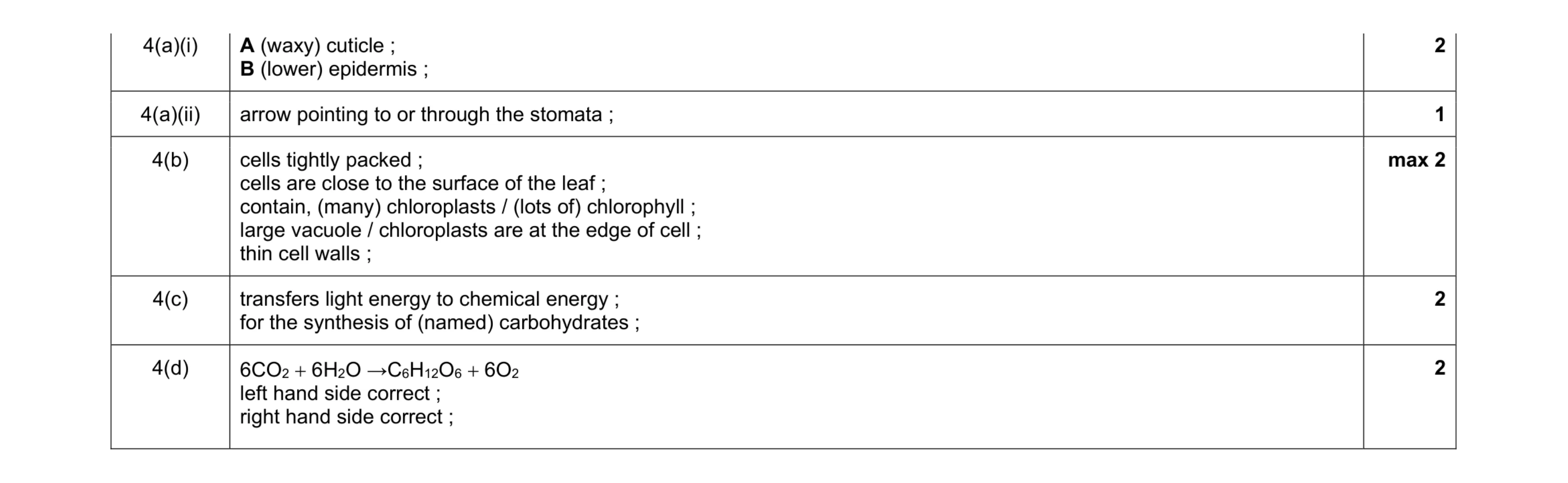 9
9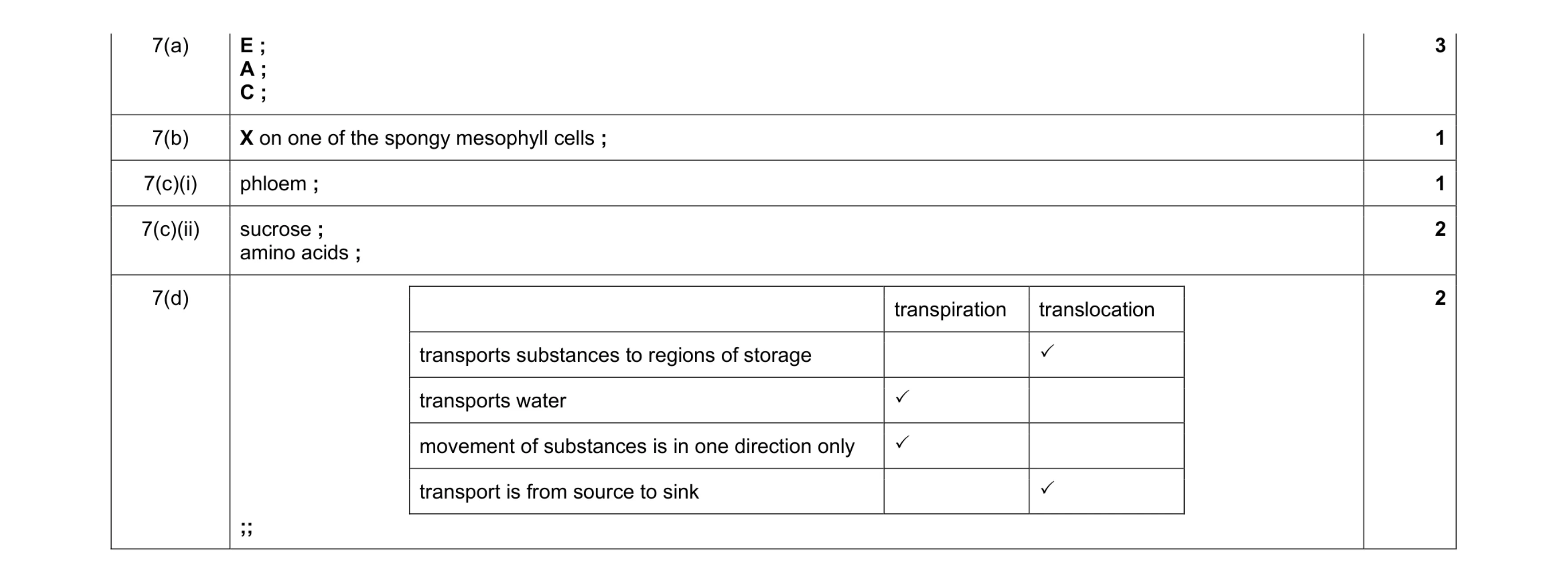 9
9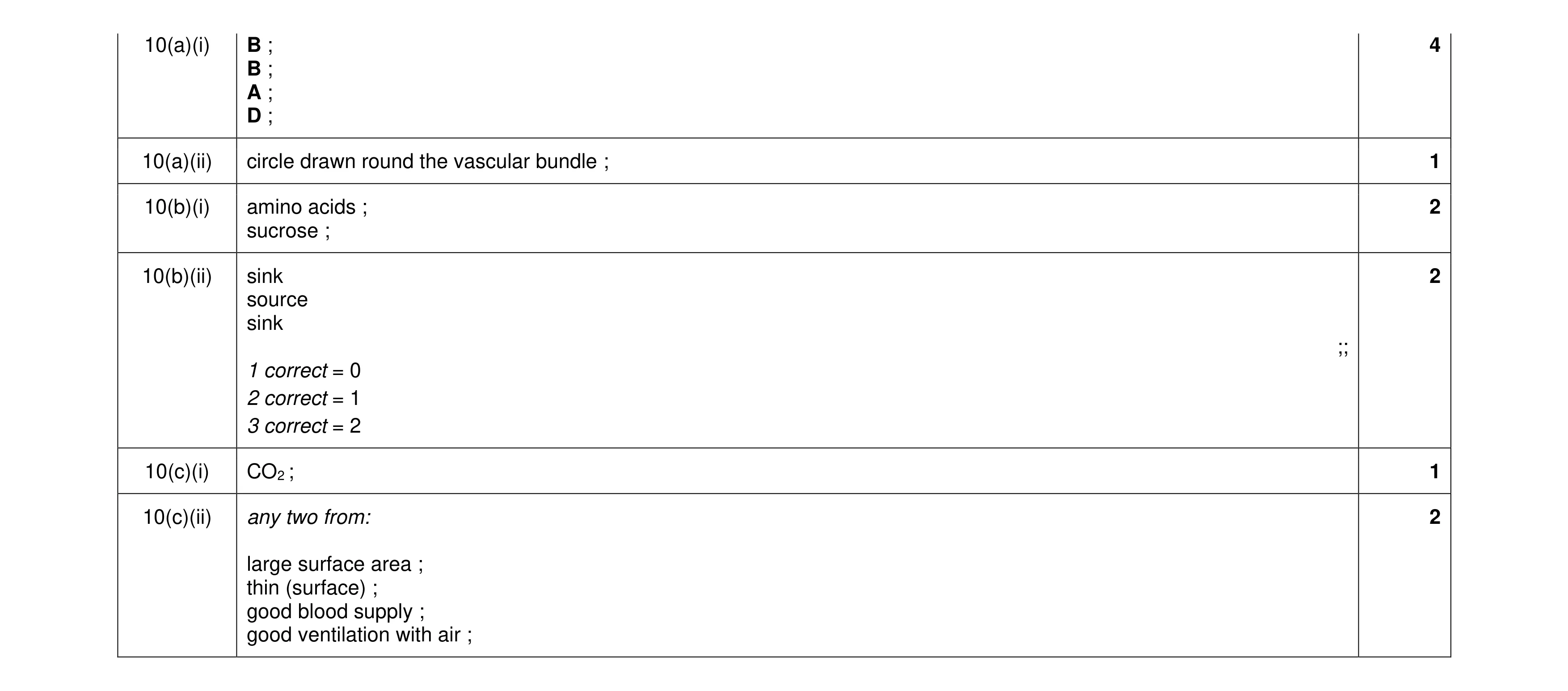 12
12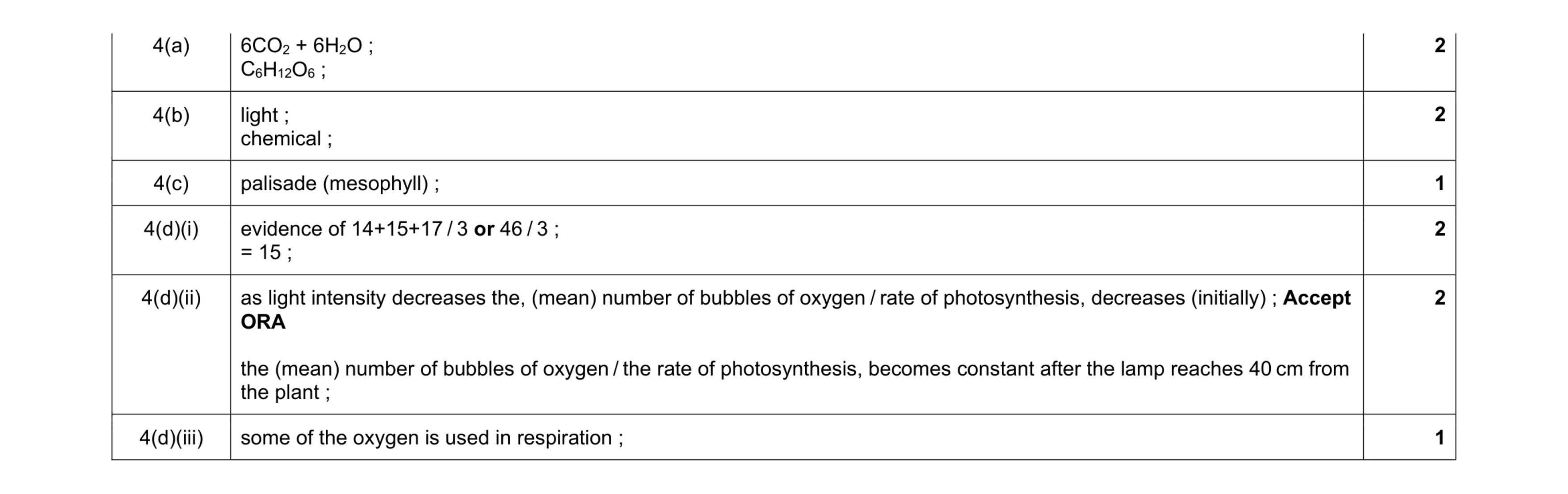 10
10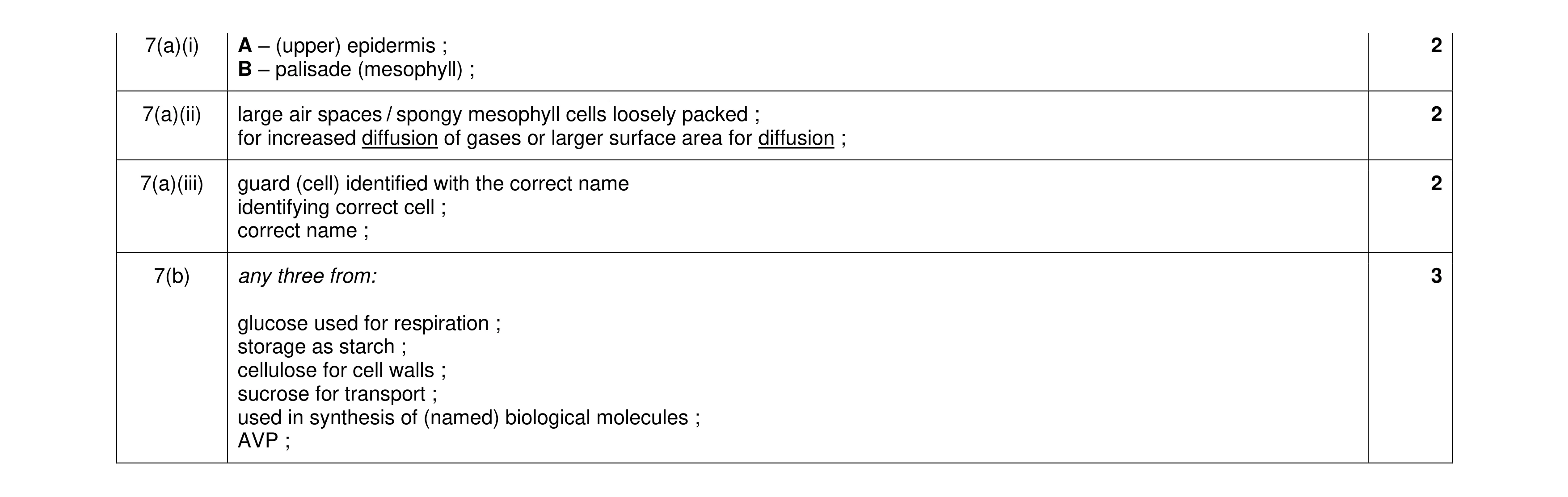 9
9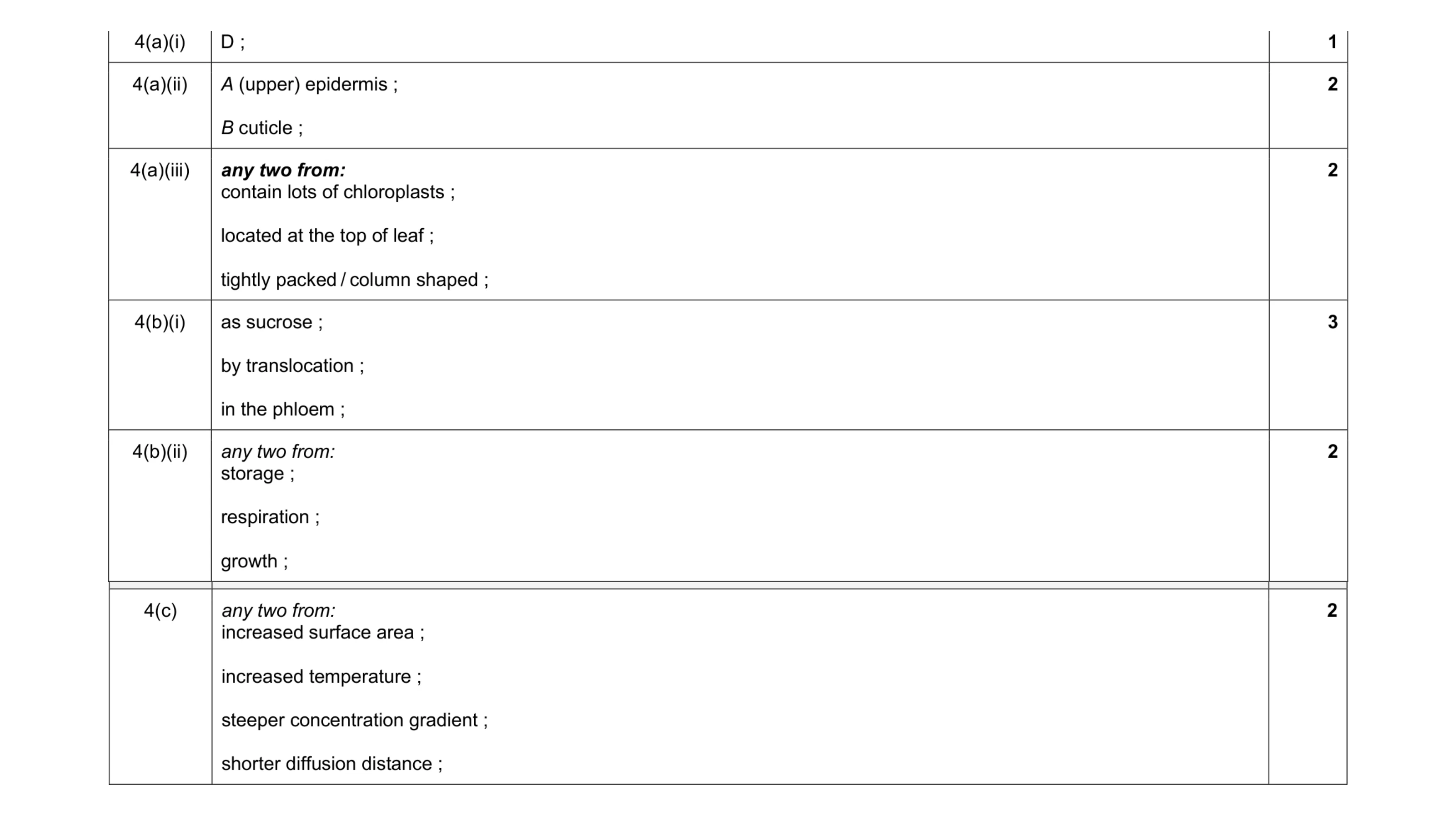 12
12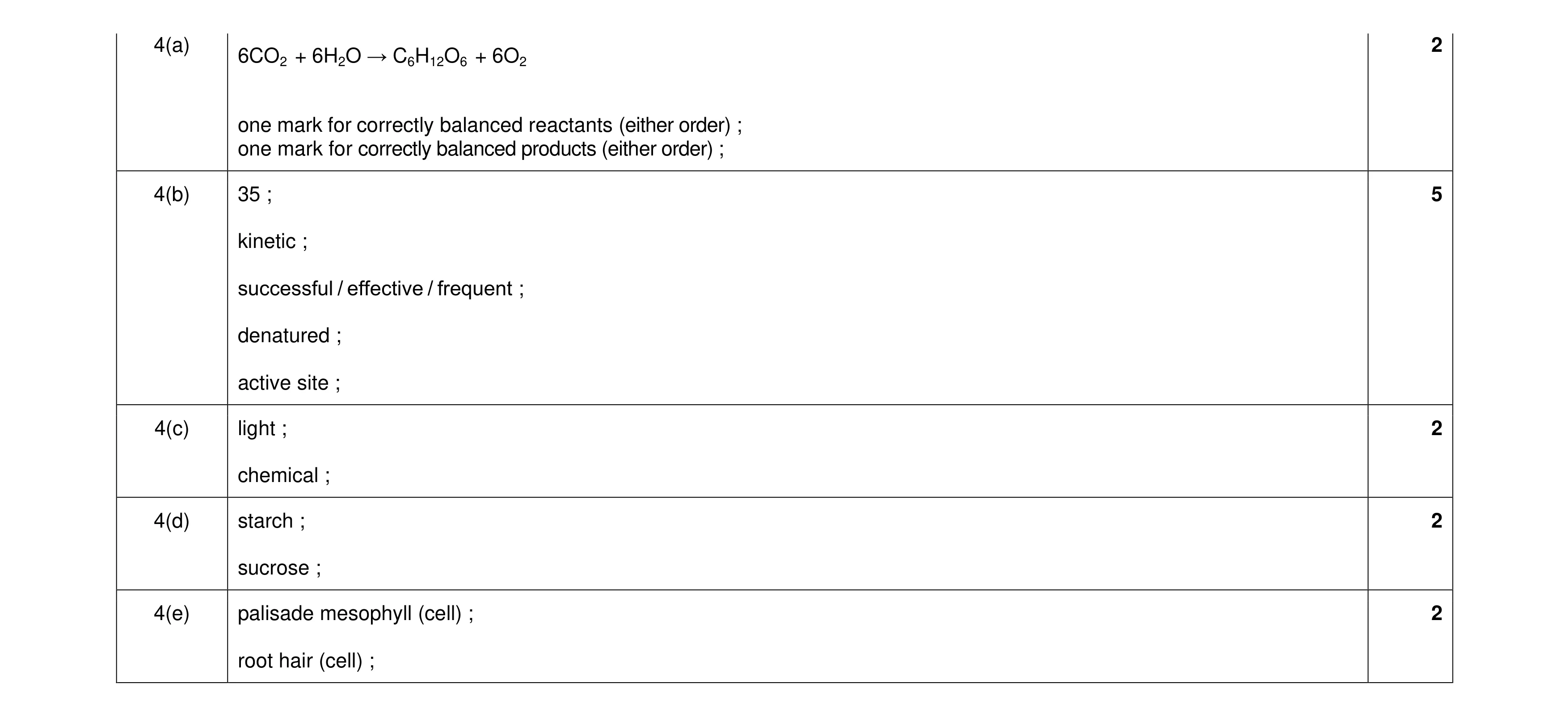 13
13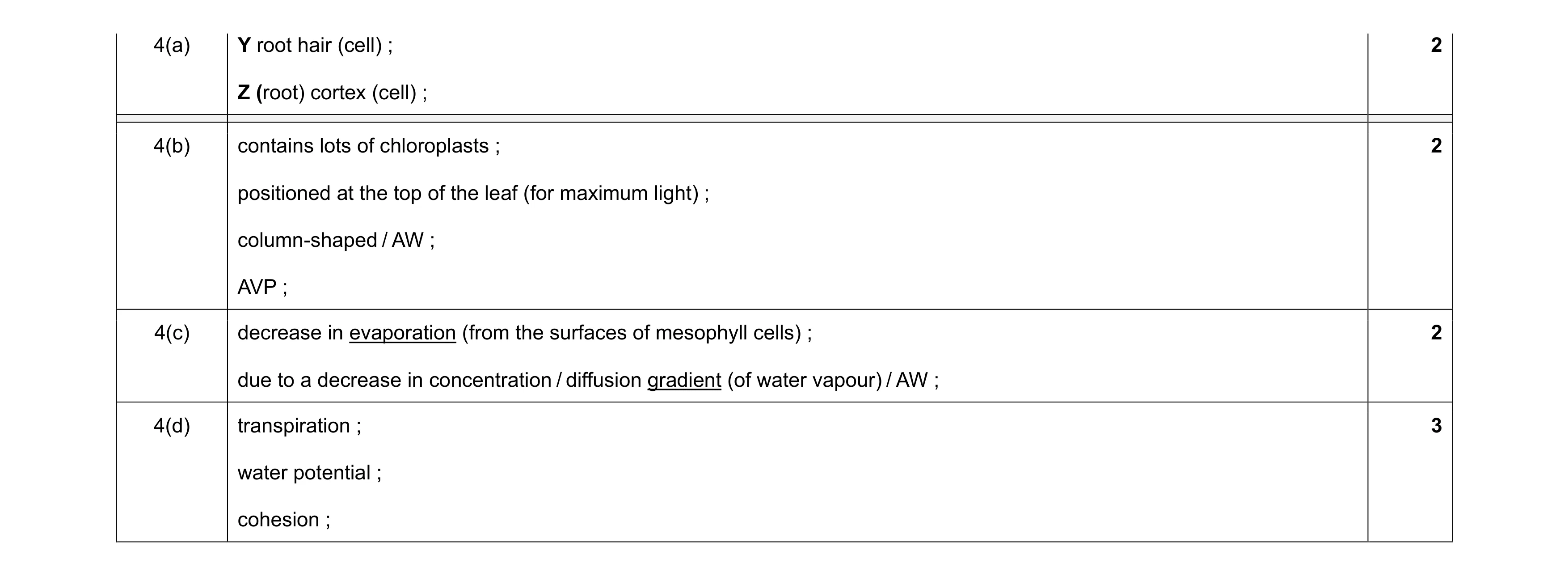 9
9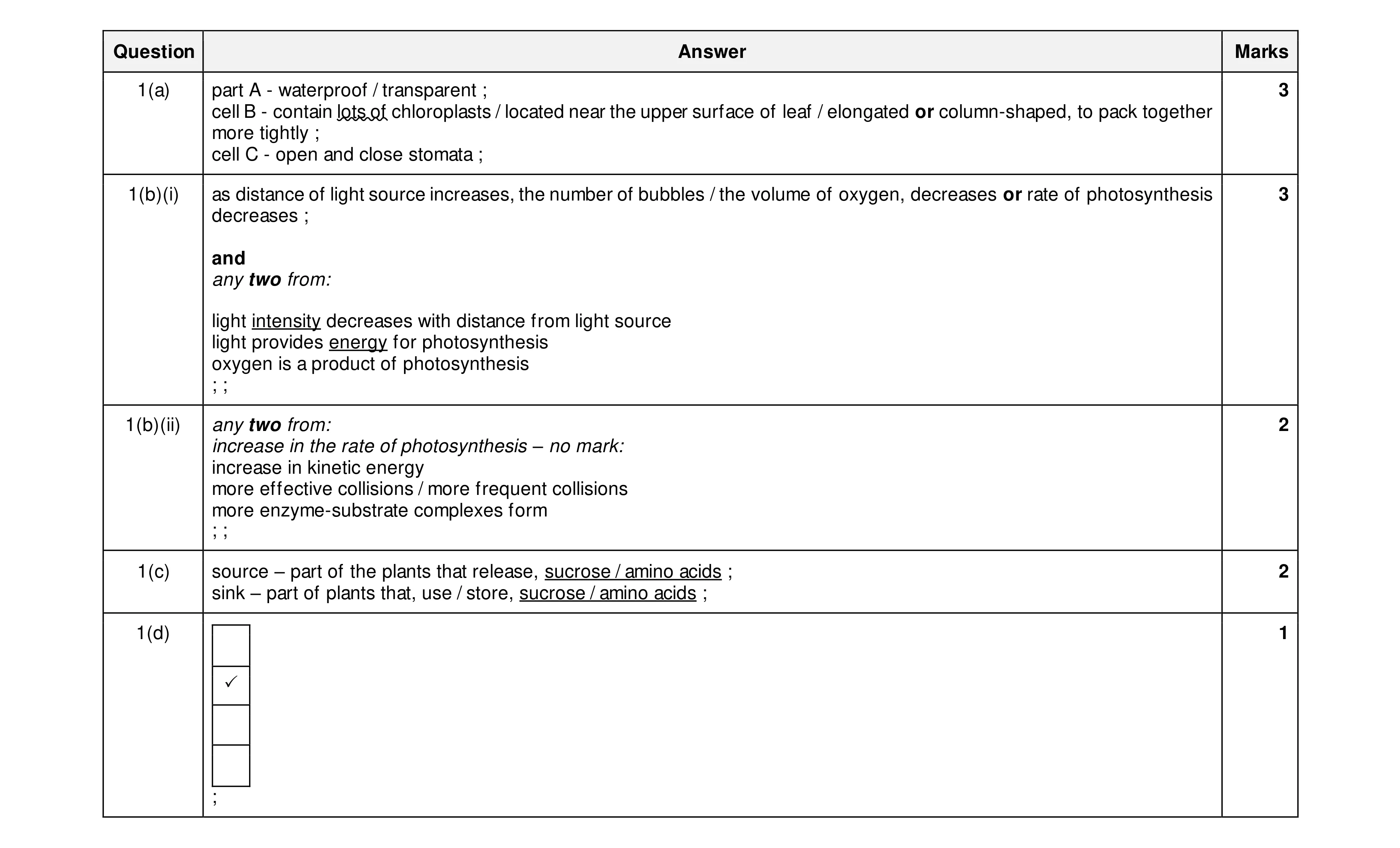 11
11