Questions as text
Q1 · A toy car powered by batteries 0653/33 Oct/Nov 2017
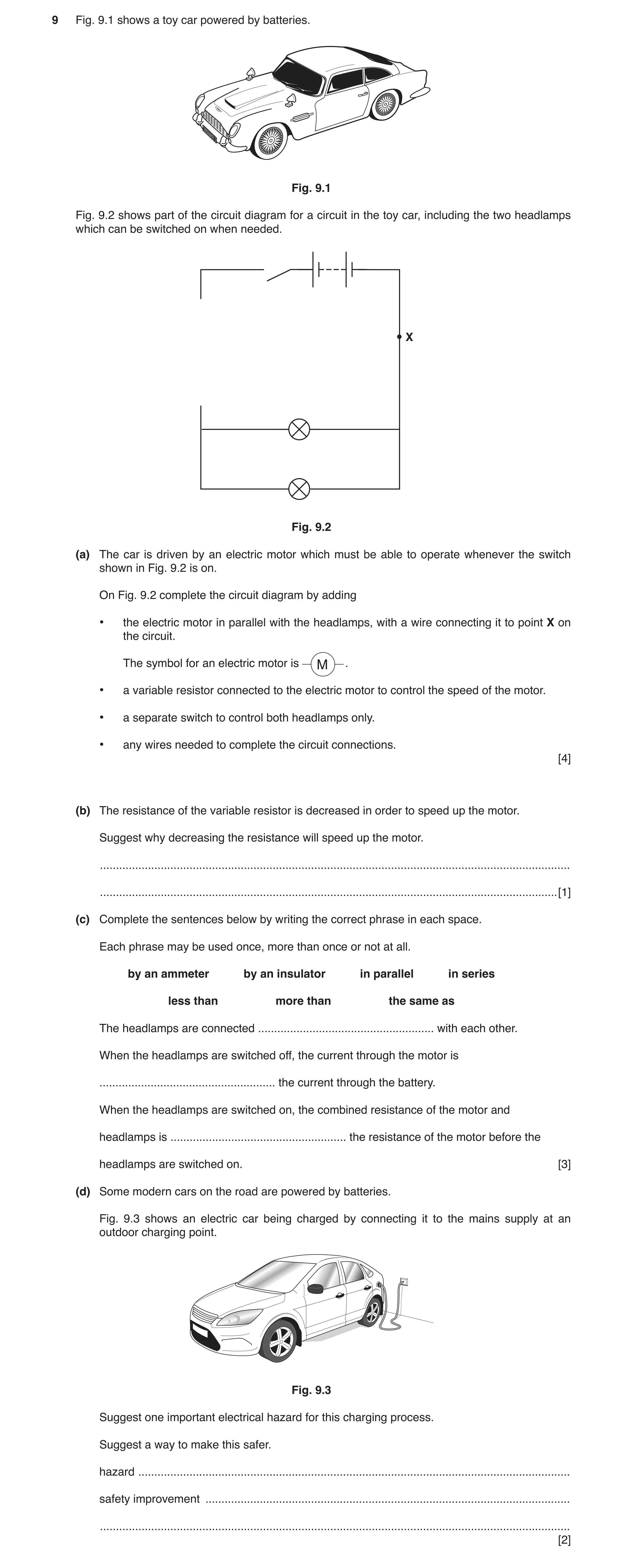
9 Fig. 9.1 shows a toy car powered by batteries. Fig. 9.1 Fig. 9.2 shows part of the circuit diagram for a circuit in the toy car, including the two headlamps which can be switched on when needed. X Fig. 9.2 (a) The car is driven by an electric motor which must be able to operate whenever the switch shown in Fig. 9.2 is on. On Fig. 9.2 complete the circuit diagram by adding • the electric motor in parallel with the headlamps, with a wire connecting it to point X on the circuit. The symbol for an electric motor is M . • a variable resistor connected to the electric motor to control the speed of the motor. • a separate switch to control both headlamps only. • any wires needed to complete the circuit connections. [4] (b) The resistance of the variable resistor is decreased in order to speed up the motor. Suggest why decreasing the resistance will speed up the motor. … … [1] (c) Complete the sentences below by writing the correct phrase in each space. Each phrase may be used once, more than once or not at all. by an ammeter by an insulator in parallel in series less than more than the same as The headlamps are connected … with each other. When the headlamps are switched off, the current through the motor is … the current through the battery. When the headlamps are switched on, the combined resistance of the motor and headlamps is … the resistance of the motor before the headlamps are switched on. [3] (d) Some modern cars on the road are powered by batteries. Fig. 9.3 shows an electric car being charged by connecting it to the mains supply at an outdoor charging point. Fig. 9.3 Suggest one important electrical hazard for this charging process. Suggest a way to make this safer. hazard … safety improvement … … [2]
10 marks
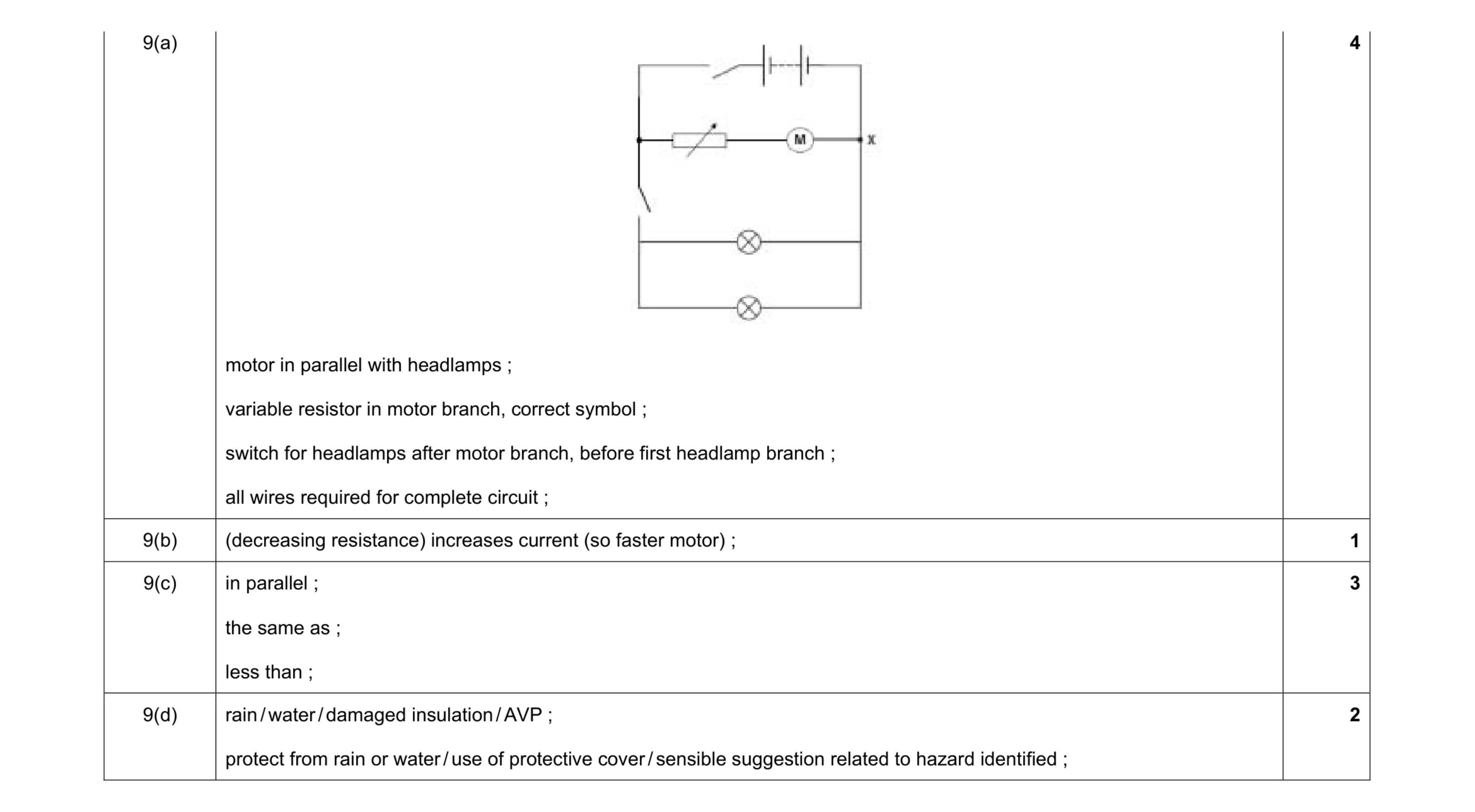
Mark scheme: 9(a) motor in parallel with headlamps ; variable resistor in motor branch, correct symbol ; switch for headlamps after motor branch, before first headlamp branch ; all wires required for complete circuit ; 4 9(b) (decreasing resistance) increases current (so faster motor) ; 1 9(c) in parallel ; the same as ; less than ; 3 9(d) rain / water / damaged insulation / AVP ; protect from rain or water / use of protective cover / sensible suggestion related to hazard identified ; 2
This question in 0653/33 Oct/Nov 2017
Q2 · An electrical device used in kitchens to kill insects 0653/31 May/June 2019
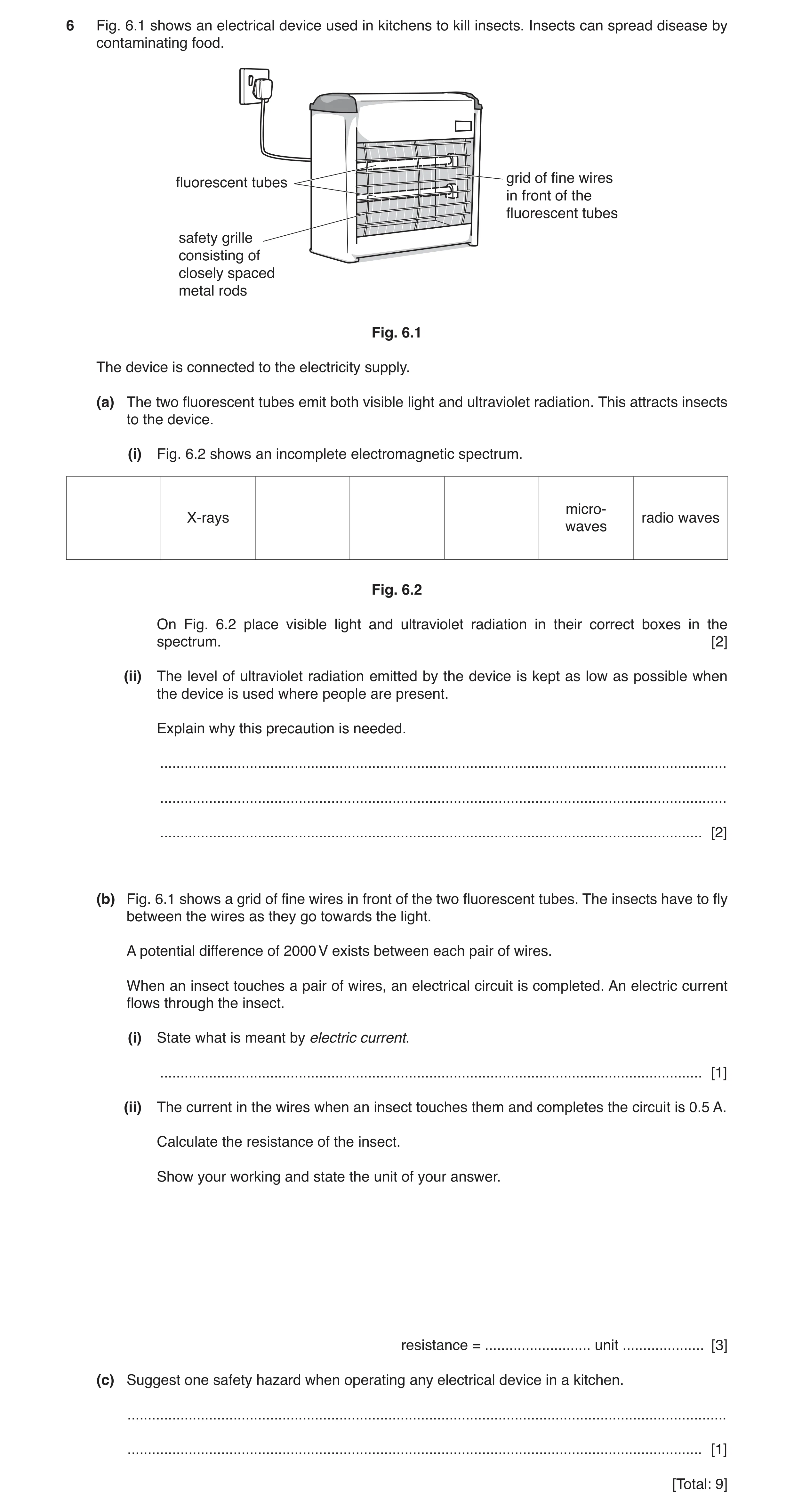
6 Fig. 6.1 shows an electrical device used in kitchens to kill insects. Insects can spread disease by contaminating food. grid of fine wires fluorescent tubes in front of the fluorescent tubes safety grille consisting of closely spaced metal rods Fig. 6.1 The device is connected to the electricity supply. (a) The two fluorescent tubes emit both visible light and ultraviolet radiation. This attracts insects to the device. (i) Fig. 6.2 shows an incomplete electromagnetic spectrum. micro- X-rays radio waves waves Fig. 6.2 On Fig. 6.2 place visible light and ultraviolet radiation in their correct boxes in the spectrum. [2] (ii) The level of ultraviolet radiation emitted by the device is kept as low as possible when the device is used where people are present. Explain why this precaution is needed. … … … [2] (b) Fig. 6.1 shows a grid of fine wires in front of the two fluorescent tubes. The insects have to fly between the wires as they go towards the light. A potential difference of 2000 V exists between each pair of wires. When an insect touches a pair of wires, an electrical circuit is completed. An electric current flows through the insect. (i) State what is meant by electric current. … [1] (ii) The current in the wires when an insect touches them and completes the circuit is 0.5 A. Calculate the resistance of the insect. Show your working and state the unit of your answer. resistance = … unit … [3] (c) Suggest one safety hazard when operating any electrical device in a kitchen. … … [1] [Total: 9]
9 marks
Mark scheme: 6(a)(i) X-rays Ultraviolet/ UV visible micro- waves radio waves ultraviolet/UV in correct box ; visible in correct box ; 2 6(a)(ii) ultraviolet can be hazardous / dangerous / harmful / cause damage ; to the retina / eyes / eyesight / cells/skin / may cause cancer ; 2 6(b)(i) flow of (electric) charge 1 6(b)(ii) R = V/I or R = 2000 / 0.5 ; = 4000 ; ohms / Ω ; 3 6(c) idea of water getting into / heat causing damage to devices ; 1
This question in 0653/31 May/June 2019
Q3 · A laboratory water-bath used to keep experiments at a constant temperature 0653/31 May/June 2019
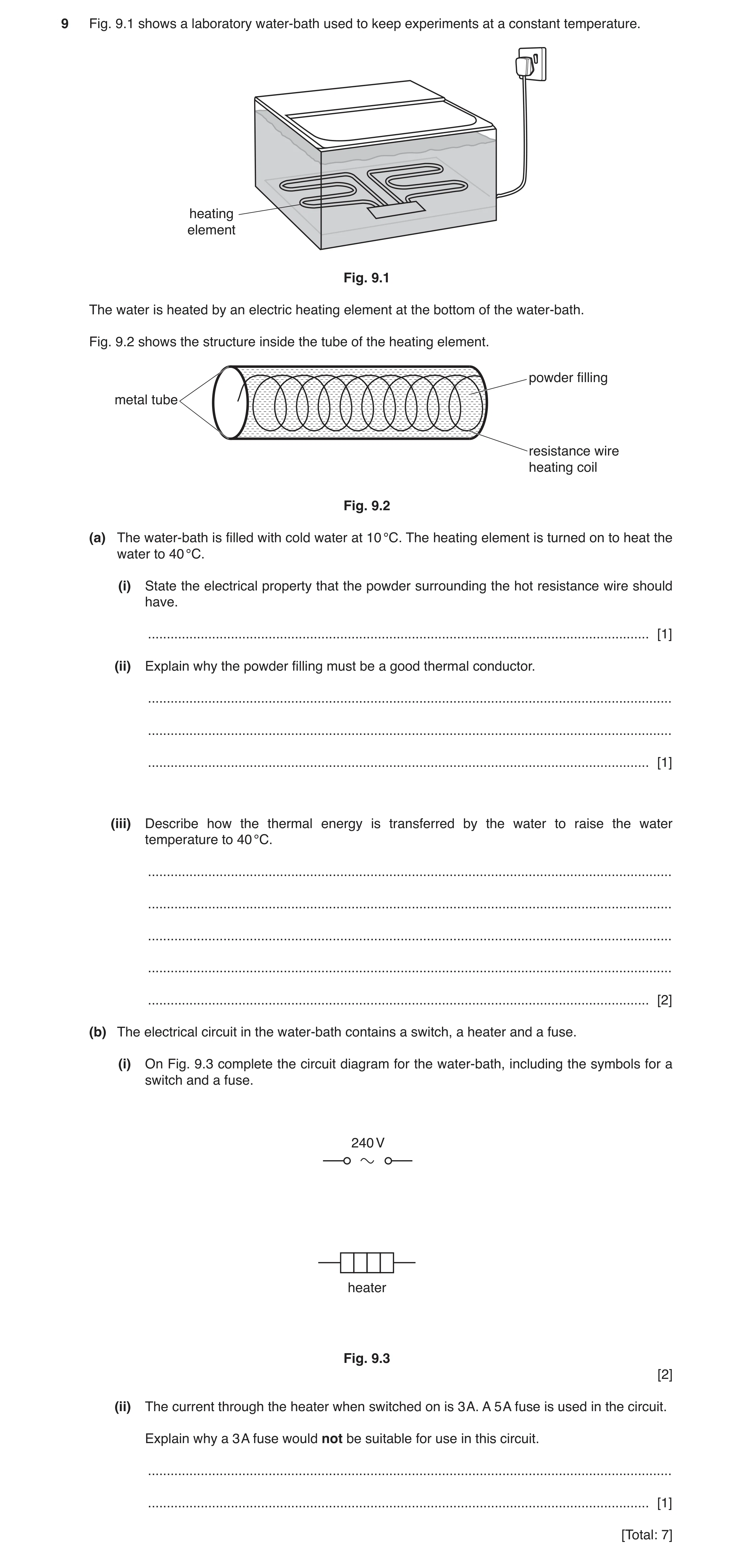
9 Fig. 9.1 shows a laboratory water-bath used to keep experiments at a constant temperature. heating element Fig. 9.1 The water is heated by an electric heating element at the bottom of the water-bath. Fig. 9.2 shows the structure inside the tube of the heating element. powder filling metal tube resistance wire heating coil Fig. 9.2 (a) The water-bath is filled with cold water at 10 °C. The heating element is turned on to heat the water to 40 °C. (i) State the electrical property that the powder surrounding the hot resistance wire should have. … [1] (ii) Explain why the powder filling must be a good thermal conductor. … … … [1] (iii) Describe how the thermal energy is transferred by the water to raise the water temperature to 40 °C. … … … … … [2] (b) The electrical circuit in the water-bath contains a switch, a heater and a fuse. (i) On Fig. 9.3 complete the circuit diagram for the water-bath, including the symbols for a switch and a fuse. 240 V heater Fig. 9.3 [2] (ii) The current through the heater when switched on is 3 A. A 5 A fuse is used in the circuit. Explain why a 3 A fuse would not be suitable for use in this circuit. … … [1] [Total: 7]
7 marks
Mark scheme: 9(a)(i) (good) insulator / poor conductor ; 1 9(a)(ii) to heat up the tube / element / water ; 1 9(a)(iii) any 2 from convection ; hot water rises ; cools then falls ; 2 9(b)(i) switch symbol ; fuse symbol + completed circuit ; 2 9(b)(ii) (fuse would) blow / melt in normal use (with a 3 A current) ; 1
This question in 0653/31 May/June 2019
Q4 · An electricity line supplying a voltage of 11 000 V 0653/33 May/June 2019
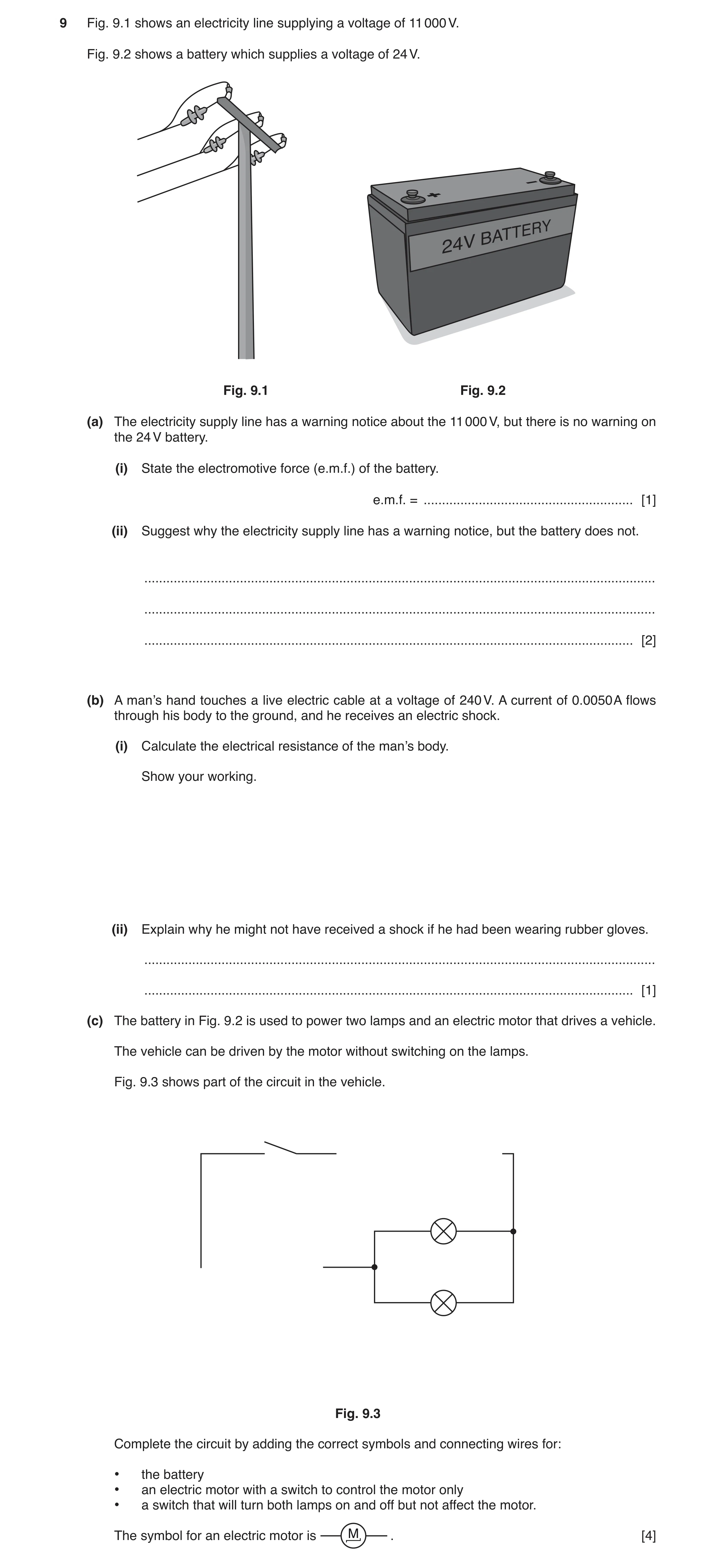
9 Fig. 9.1 shows an electricity line supplying a voltage of 11 000 V. Fig. 9.2 shows a battery which supplies a voltage of 24 V. Fig. 9.1 Fig. 9.2 (a) The electricity supply line has a warning notice about the 11 000 V, but there is no warning on the 24 V battery. (i) State the electromotive force (e.m.f.) of the battery. e.m.f. = … [1] (ii) Suggest why the electricity supply line has a warning notice, but the battery does not. … … … [2] (b) A man’s hand touches a live electric cable at a voltage of 240 V. A current of 0.0050 A flows through his body to the ground, and he receives an electric shock. (i) Calculate the electrical resistance of the man’s body. Show your working. (ii) Explain why he might not have received a shock if he had been wearing rubber gloves. … … [1] (c) The battery in Fig. 9.2 is used to power two lamps and an electric motor that drives a vehicle. The vehicle can be driven by the motor without switching on the lamps. Fig. 9.3 shows part of the circuit in the vehicle. Fig. 9.3 Complete the circuit by adding the correct symbols and connecting wires for: • the battery • an electric motor with a switch to control the motor only • a switch that will turn both lamps on and off but not affect the motor. The symbol for an electric motor is M . [4]
10 marks
Mark scheme: 9(a)(i) 24 V ; 1 9(a)(ii) must not touch the electricity line ; 11 000 V / the electricity line (can produce a current which) is fatal ; 2 9(b)(i) R = V / I or R = 240 / 0.005 ; = 48 000 (Ω) ; 2 9(b)(ii) (rubber is a) good insulator ; 1 Question Answer Marks 9(c) battery symbol ; motor symbol and additional switch symbol (anywhere) in circuit ; switch to lamps in correct place ; motor and switch connected in parallel with lamps ; 4
This question in 0653/33 May/June 2019
Question 5 0653/31 Oct/Nov 2019
9 (a) Fig. 9.1 shows a circuit diagram. heater Fig. 9.1 On Fig. 9.1, add a suitable meter to measure the e.m.f. of the battery. [2] (b) The current in a heater circuit is 10.0 A. Select from the list below the correct rating for a fuse to use in this circuit. Put a circle around your choice. 3 A 5 A 10 A 13 A [1] (c) Fig. 9.2 shows a heater fixed to a wall in a room. wall heater floor Fig. 9.2 On Fig. 9.2 draw arrows to show the direction in which air flows from the heater as the air is heated. [1] (d) On Fig. 9.3, complete the circuit by adding: • a lamp in parallel with the motor • a variable resistor to change the current through the motor, but not through the lamp. a.c. supply M motor Fig. 9.3 [3] [Total: 7]
7 marks
Mark scheme: 9(a) 2 9(b) 13 A ; 1 9(c) arrow(s) from heater going upwards ; 1 9(d) 3 correct choice of meter with symbol ; connection in parallel with cells ; lamp in parallel with motor (above or below) ; variable resistor symbol ; variable resistor in series with motor only ;
This question in 0653/31 Oct/Nov 2019
Q6 · An electric toaster that is used for toasting slices of bread 0653/31 Oct/Nov 2020
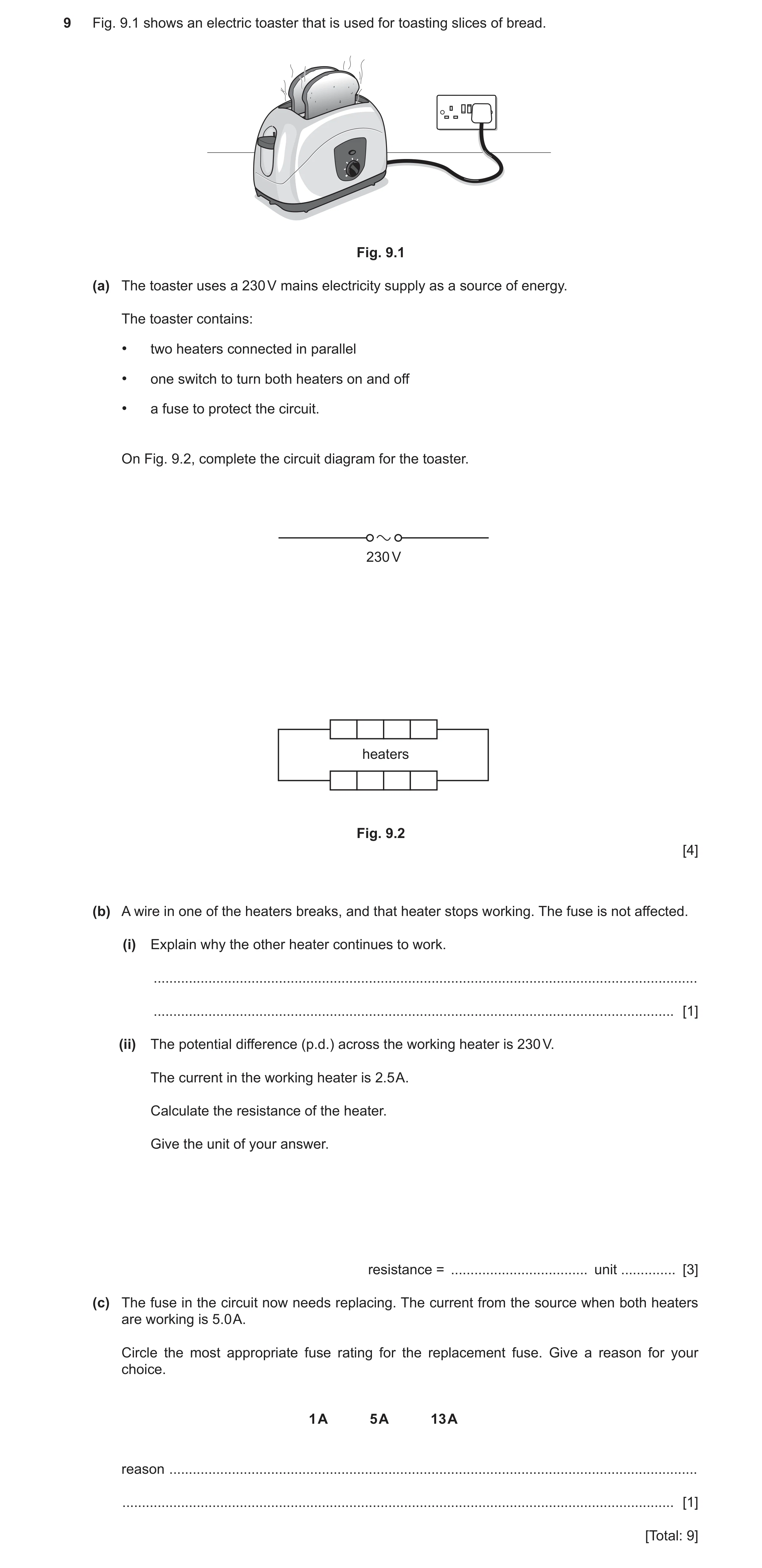
9 Fig. 9.1 shows an electric toaster that is used for toasting slices of bread. Fig. 9.1 (a) The toaster uses a 230 V mains electricity supply as a source of energy. The toaster contains: • two heaters connected in parallel • one switch to turn both heaters on and off • a fuse to protect the circuit. On Fig. 9.2, complete the circuit diagram for the toaster. 230 V heaters Fig. 9.2 [4] (b) A wire in one of the heaters breaks, and that heater stops working. The fuse is not affected. (i) Explain why the other heater continues to work. … … [1] (ii) The potential difference (p.d.) across the working heater is 230 V. The current in the working heater is 2.5 A. Calculate the resistance of the heater. Give the unit of your answer. resistance = … unit … [3] (c) The fuse in the circuit now needs replacing. The current from the source when both heaters are working is 5.0 A. Circle the most appropriate fuse rating for the replacement fuse. Give a reason for your choice. 1 A 5 A 13 A reason … … [1] [Total: 9]
9 marks
Mark scheme: 9(a) switch symbol correct ; fuse symbol correct ; fuse in main circuit ; switch in main circuit ; 4 9(b)(i) (parallel connection means there is) still a completed circuit through the working heater ; 1 9(b)(ii) R = V ÷I in any form / 230 2.5 ÷ ; 92 ; Ω / ohm ; 3 9(c) 13 A AND (because,) fuse gives a suitable margin / 5 A fuse will blow too readily ; 1
This question in 0653/31 Oct/Nov 2020
Q7 · A circuit used to supply a current to an electric motor 0653/32 Feb/March 2022
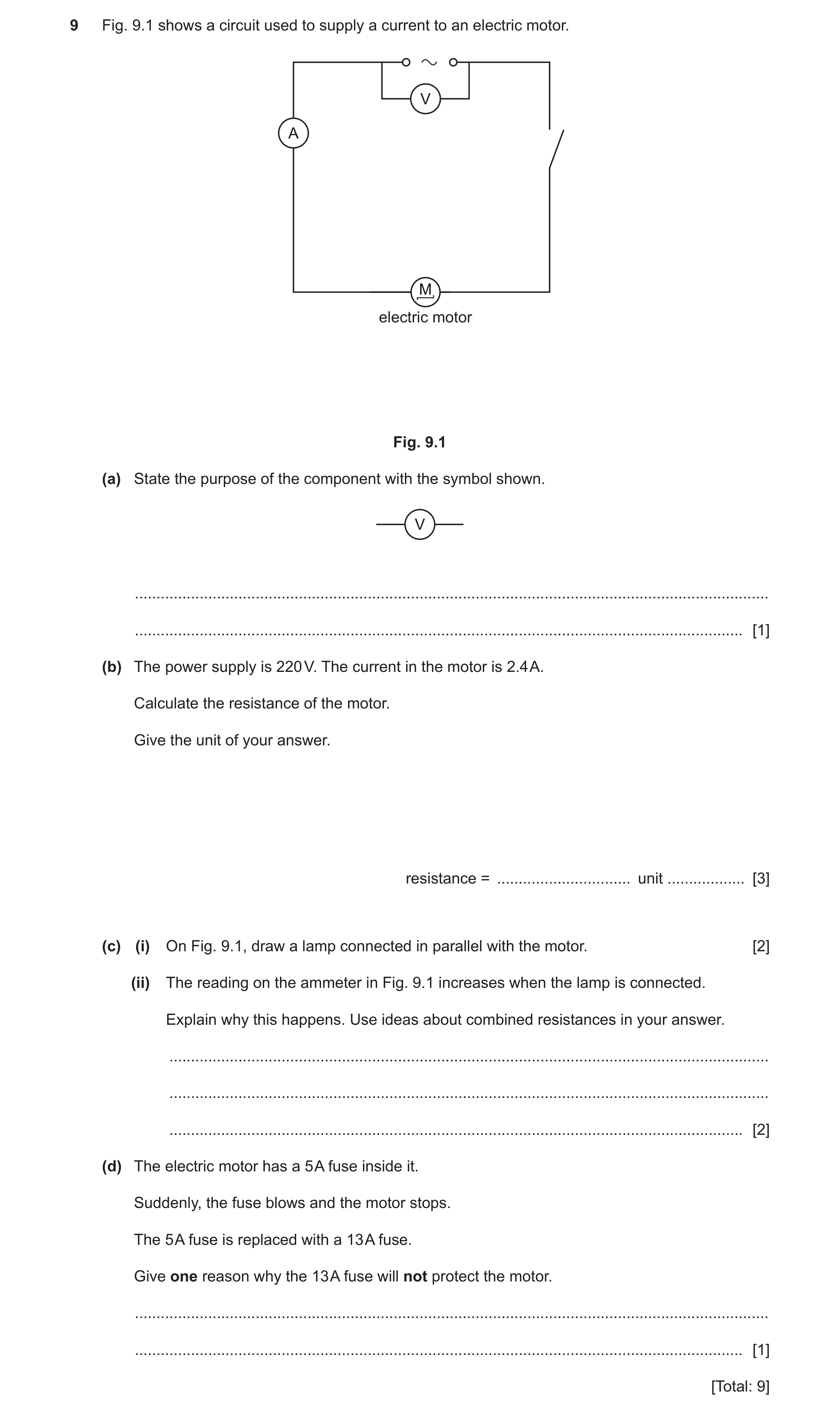
9 Fig. 9.1 shows a circuit used to supply a current to an electric motor. V A M electric motor Fig. 9.1 (a) State the purpose of the component with the symbol shown. V … … [1] (b) The power supply is 220 V. The current in the motor is 2.4 A. Calculate the resistance of the motor. Give the unit of your answer. resistance = … unit … [3] (c) (i) On Fig. 9.1, draw a lamp connected in parallel with the motor. [2] (ii) The reading on the ammeter in Fig. 9.1 increases when the lamp is connected. Explain why this happens. Use ideas about combined resistances in your answer. … … … [2] (d) The electric motor has a 5 A fuse inside it. Suddenly, the fuse blows and the motor stops. The 5 A fuse is replaced with a 13 A fuse. Give one reason why the 13 A fuse will not protect the motor. … … [1] [Total: 9]
9 marks
Mark scheme: 9(a) measures potential difference / p.d ; 1 Question Answer Marks 9(b) resistance = voltage ÷ current (in any form) / R = V ÷ I / 220 ÷ 2.4 ; 92 ; Ω / ohms ; 3 9(c)(i) 2 9(c)(ii) (combined) resistance decreases ; therefore (for the same voltage) the current increases ; 2 9(d) idea that a 13 A fuse allows too much current to flow before, blowing / damaging, components / motor / circuit ; 1 lamp symbol ; connected in parallel (above or below motor) ;
This question in 0653/32 Feb/March 2022
Q8 · A nuclear power station 0653/32 Feb/March 2024
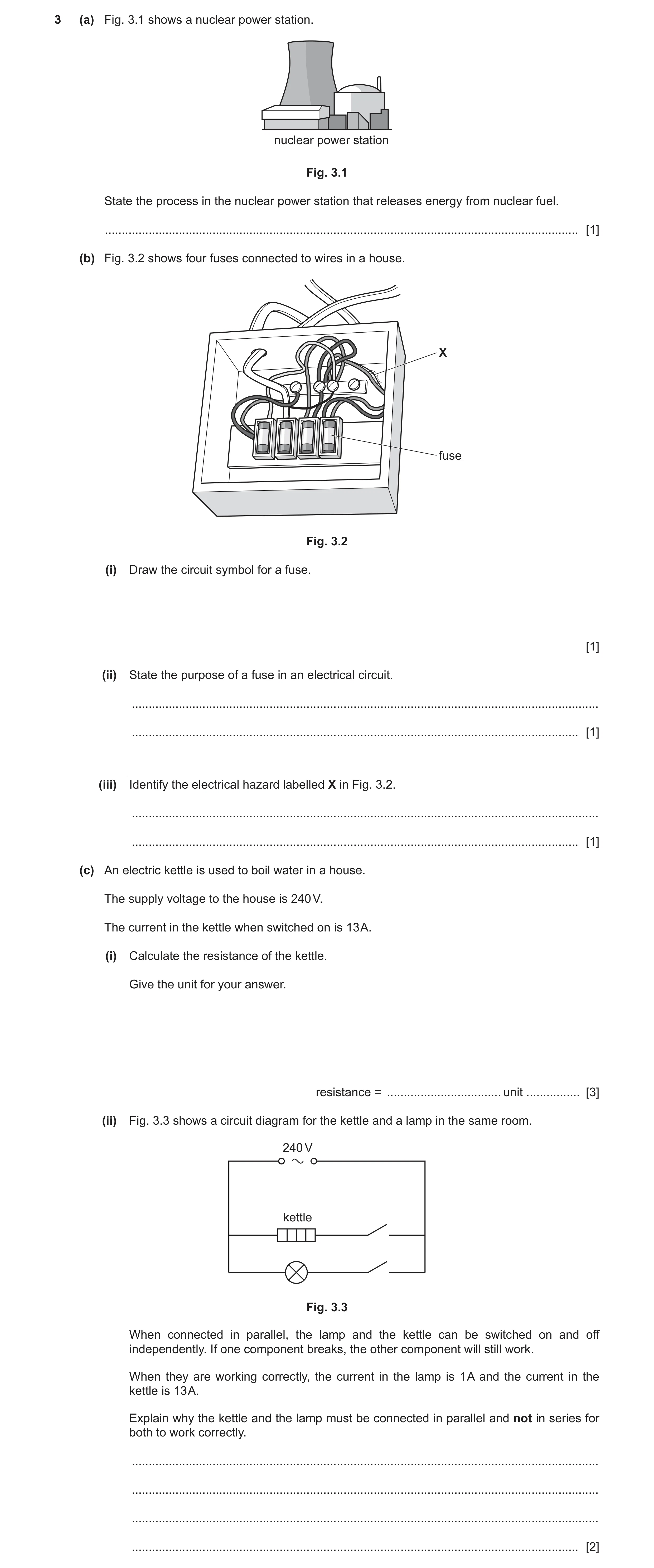
3 (a) Fig. 3.1 shows a nuclear power station. nuclear power station Fig. 3.1 State the process in the nuclear power station that releases energy from nuclear fuel. … [1] (b) Fig. 3.2 shows four fuses connected to wires in a house. X fuse Fig. 3.2 (i) Draw the circuit symbol for a fuse. [1] (ii) State the purpose of a fuse in an electrical circuit. … … [1] (iii) Identify the electrical hazard labelled X in Fig. 3.2. … … [1] (c) An electric kettle is used to boil water in a house. The supply voltage to the house is 240 V. The current in the kettle when switched on is 13 A. (i) Calculate the resistance of the kettle. Give the unit for your answer. resistance = … unit … [3] (ii) Fig. 3.3 shows a circuit diagram for the kettle and a lamp in the same room. 240 V kettle Fig. 3.3 When connected in parallel, the lamp and the kettle can be switched on and off independently. If one component breaks, the other component will still work. When they are working correctly, the current in the lamp is 1 A and the current in the kettle is 13 A. Explain why the kettle and the lamp must be connected in parallel and not in series for both to work correctly. … … … … [2]
9 marks
Mark scheme: 3(a) (nuclear) fission ; 1 3(b)(i) 1 ; 3(b)(ii) protects the circuit ; 1 3(b)(iii) damaged insulation OR 1 bare wires ; 3(c)(i) R = V I in any form ; 3 240 13 = 18 OR 18.5 ; / ohms ; 3(c)(ii) lamp and kettle need / take, (very) different currents ; 2 in series would have the same current / cannot have different currents ;
This question in 0653/32 Feb/March 2024
Q9 · An electric kettle used to boil water 0653/32 Oct/Nov 2025
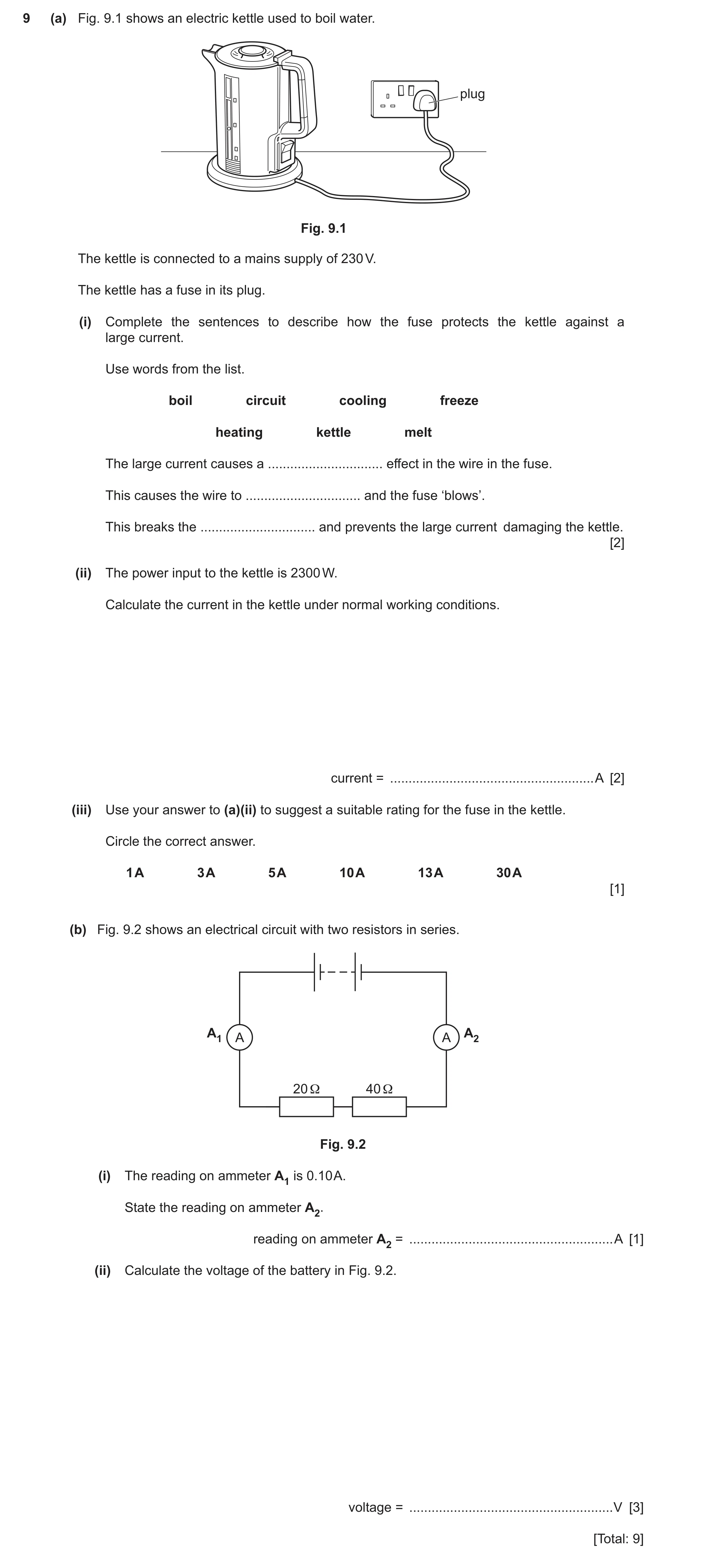
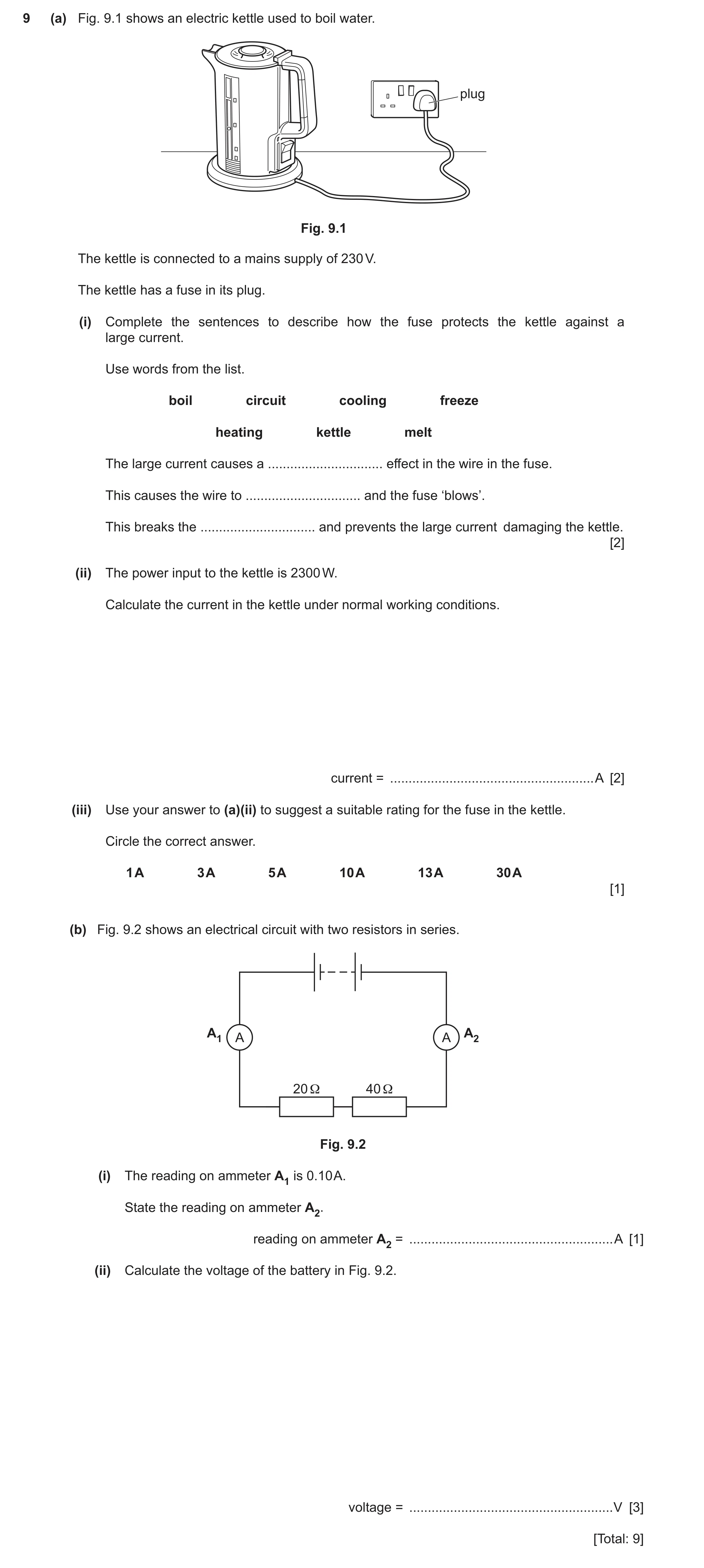
9 (a) Fig. 9.1 shows an electric kettle used to boil water. plug Fig. 9.1 The kettle is connected to a mains supply of 230 V. The kettle has a fuse in its plug. (i) Complete the sentences to describe how the fuse protects the kettle against a large current. Use words from the list. boil circuit cooling freeze heating kettle melt The large current causes a … effect in the wire in the fuse. This causes the wire to … and the fuse ‘blows’. This breaks the … and prevents the large current damaging the kettle. [2] (ii) The power input to the kettle is 2300 W. Calculate the current in the kettle under normal working conditions. current = … A [2] (iii) Use your answer to (a)(ii) to suggest a suitable rating for the fuse in the kettle. Circle the correct answer. 1 A 3 A 5 A 10 A 13 A 30 A [1] (b) Fig. 9.2 shows an electrical circuit with two resistors in series. A1 A A A2 20 Ω 40 Ω Fig. 9.2 (i) The reading on ammeter A1 is 0.10 A. State the reading on ammeter A2. reading on ammeter A2 = … A [1] (ii) Calculate the voltage of the battery in Fig. 9.2. voltage = … V [3] [Total: 9]
9 marks
Mark scheme: 9(a)(i) heating 2 melt circuit one or two correct ; three correct ; 9(a)(ii) P = IV / 2300 ÷ 230 ; 2 10 (A) ; 9(a)(iii) 13 A ; 1 9(b)(i) 0.1(0) A ; 1 9(b)(ii) (combined resistance =20 + 40 =) 60 () ; 3 R = V ÷ I / 0.10 60 ; 6(.0) V ;
This question in 0653/32 Oct/Nov 2025
Q10 · An electric kettle used to boil water 0653/33 Oct/Nov 2025
9 (a) Fig. 9.1 shows an electric kettle used to boil water. plug Fig. 9.1 The kettle is connected to a mains supply of 230 V. The kettle has a fuse in its plug. (i) Complete the sentences to describe how the fuse protects the kettle against a large current. Use words from the list. boil circuit cooling freeze heating kettle melt The large current causes a … effect in the wire in the fuse. This causes the wire to … and the fuse ‘blows’. This breaks the … and prevents the large current damaging the kettle. [2] (ii) The power input to the kettle is 2300 W. Calculate the current in the kettle under normal working conditions. current = … A [2] (iii) Use your answer to (a)(ii) to suggest a suitable rating for the fuse in the kettle. Circle the correct answer. 1 A 3 A 5 A 10 A 13 A 30 A [1] (b) Fig. 9.2 shows an electrical circuit with two resistors in series. A1 A A A2 20 Ω 40 Ω Fig. 9.2 (i) The reading on ammeter A1 is 0.10 A. State the reading on ammeter A2. reading on ammeter A2 = … A [1] (ii) Calculate the voltage of the battery in Fig. 9.2. voltage = … V [3] [Total: 9]
9 marks
Mark scheme: 9(a)(i) heating 2 melt circuit one or two correct ; three correct ; 9(a)(ii) P = IV / 2300 ÷ 230 ; 2 10 (A) ; 9(a)(iii) 13 A ; 1 9(b)(i) 0.1(0) A ; 1 9(b)(ii) (combined resistance =20 + 40 =) 60 () ; 3 R = V ÷ I / 0.10 60 ; 6(.0) V ;
This question in 0653/33 Oct/Nov 2025
![Question 5: (a) Fig. 9.1 shows a circuit diagram. heater Fig. 9.1 On Fig. 9.1, add a suitable meter to measure the e.m.f. of the battery. [2] (b) The c…](https://img.pastlit.com/crops/422f7162-5998-476e-86d9-d8c460d476ed/q9.webp)
 10
10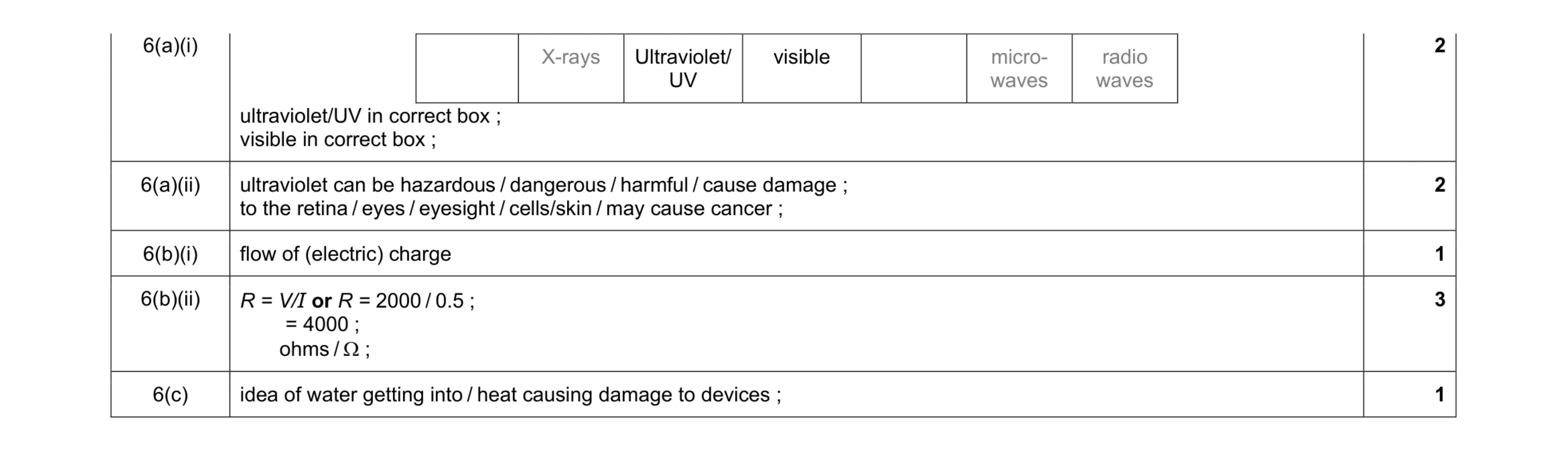 9
9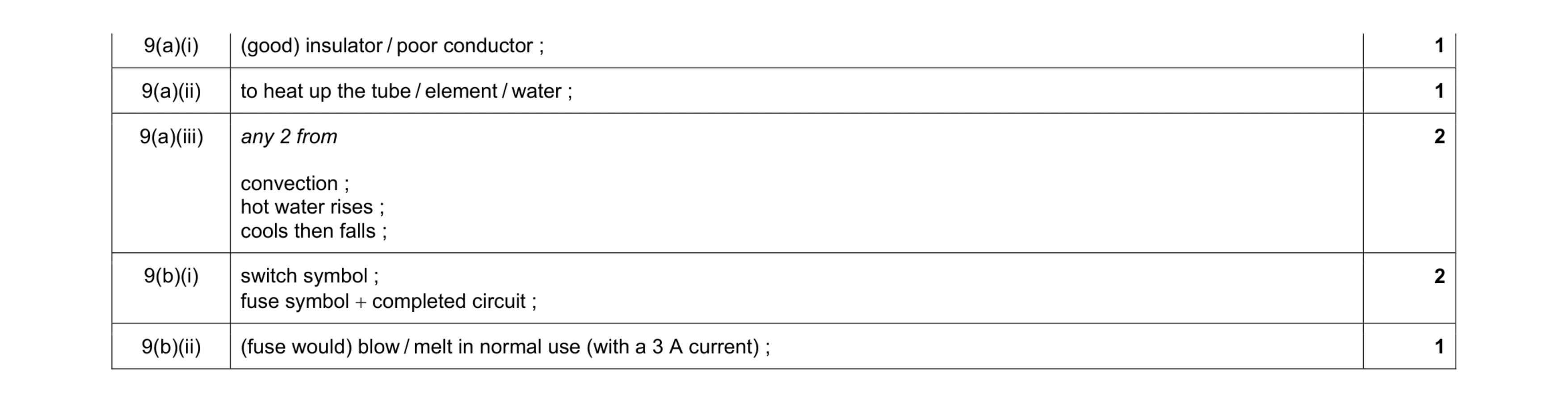 7
7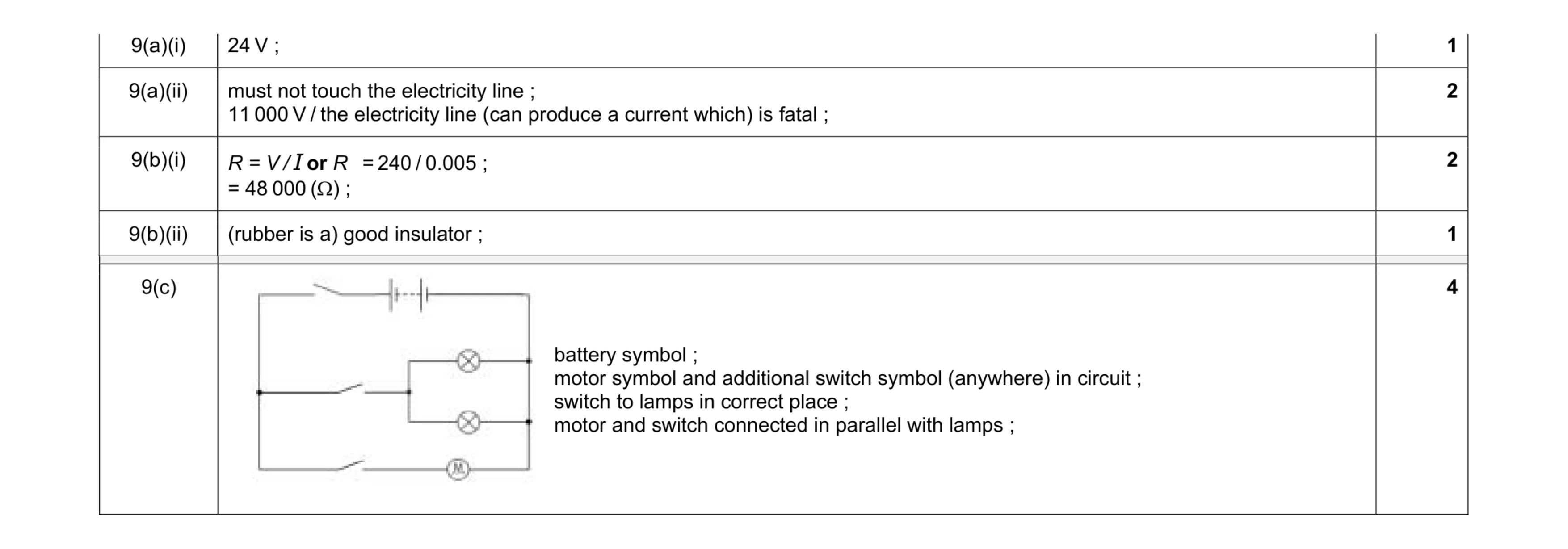 10
10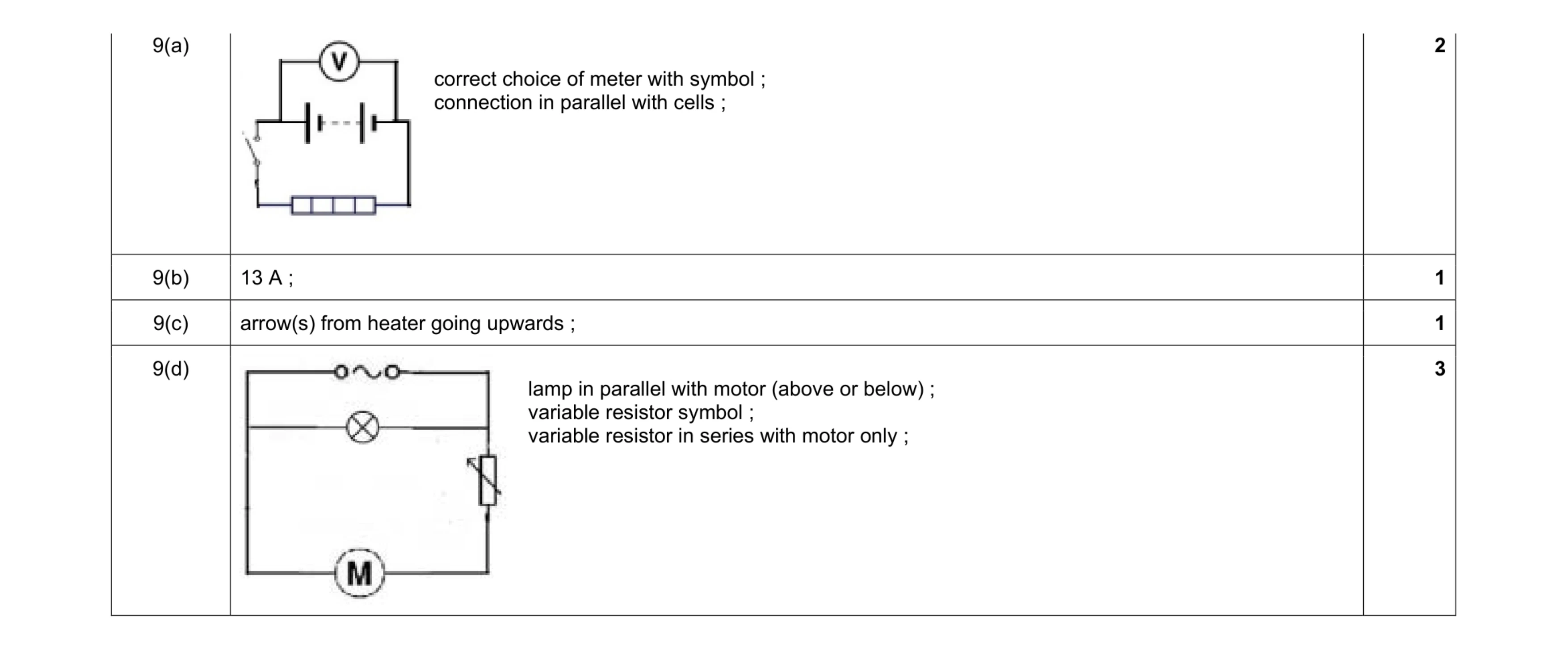 7
7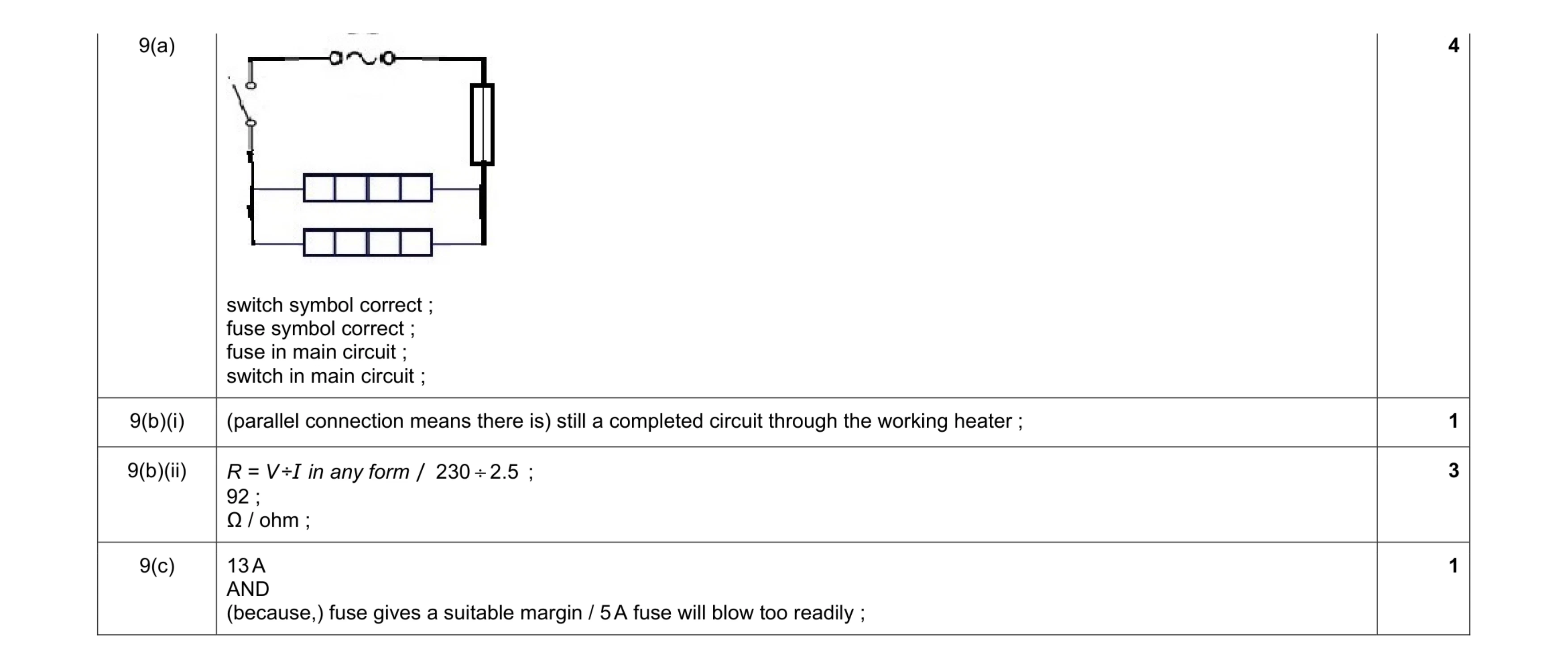 9
9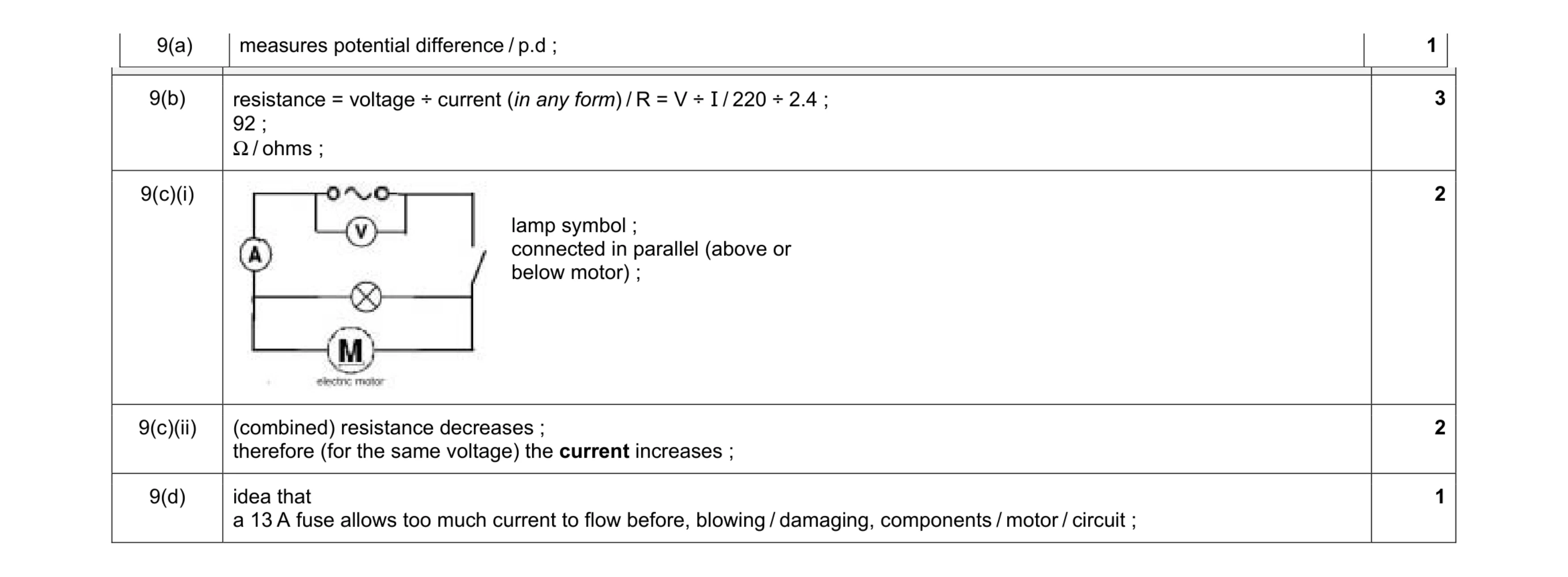 9
9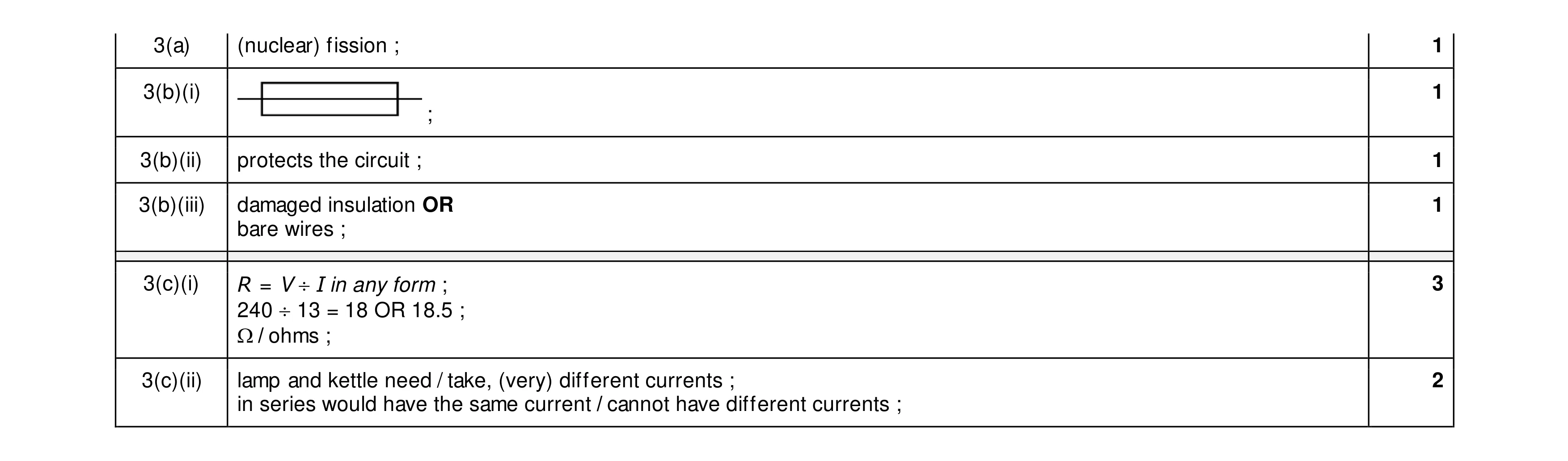 9
9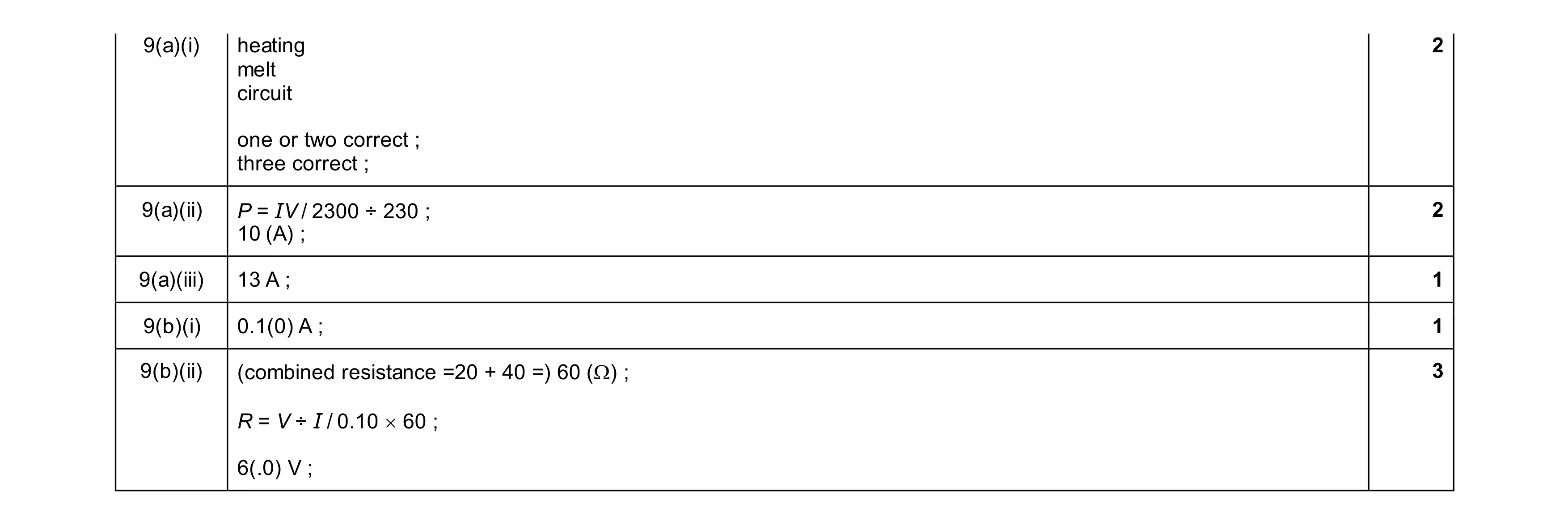 9
9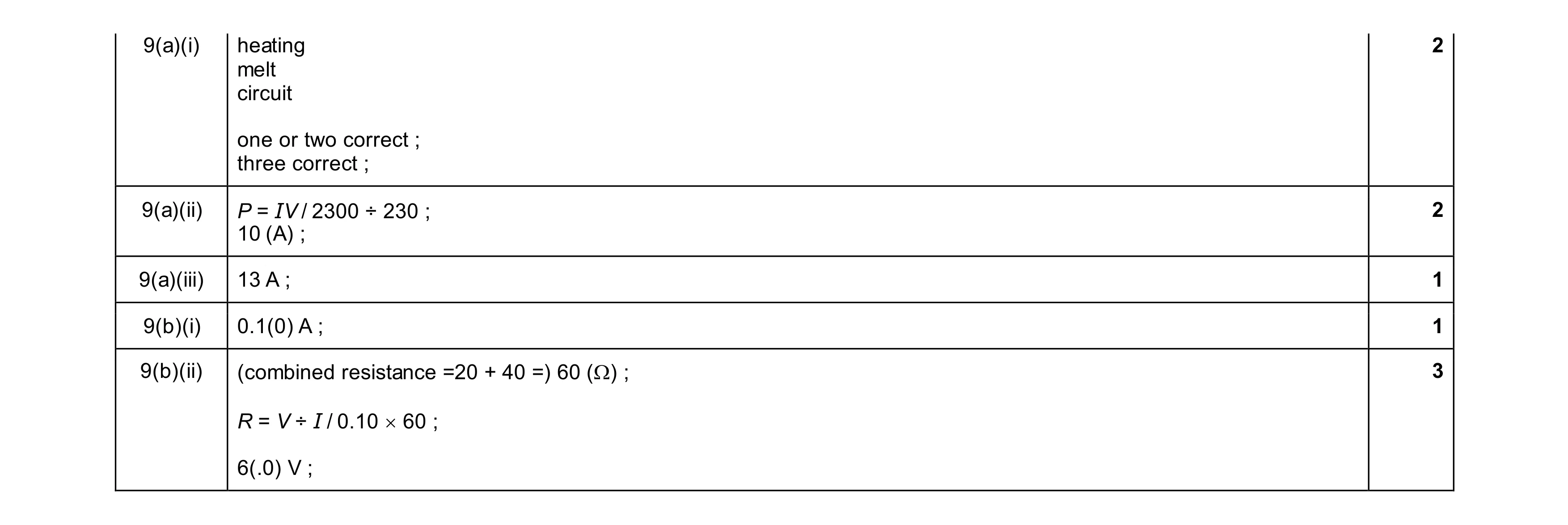 9
9