Questions as text
Q1 · Petroleum is separated into useful fractions, as shown in Fig 0653/33 Oct/Nov 2018
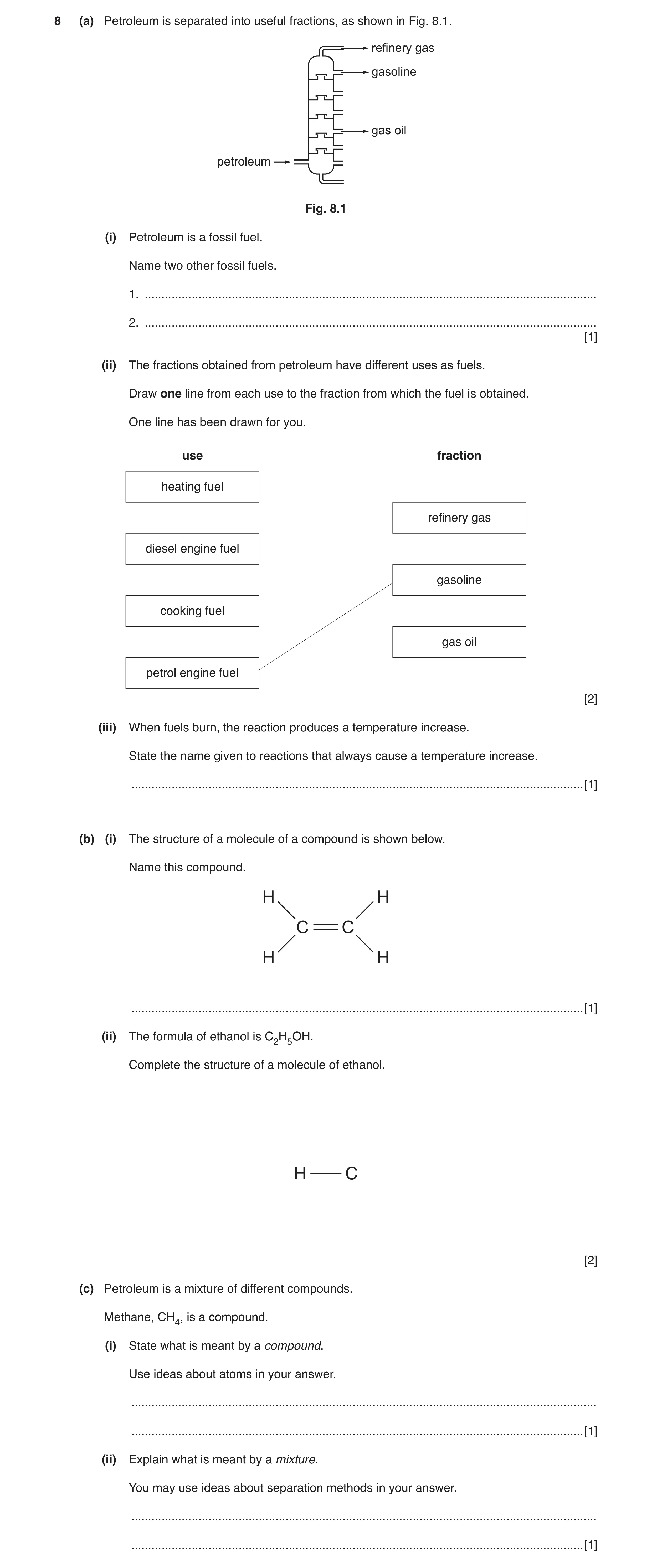
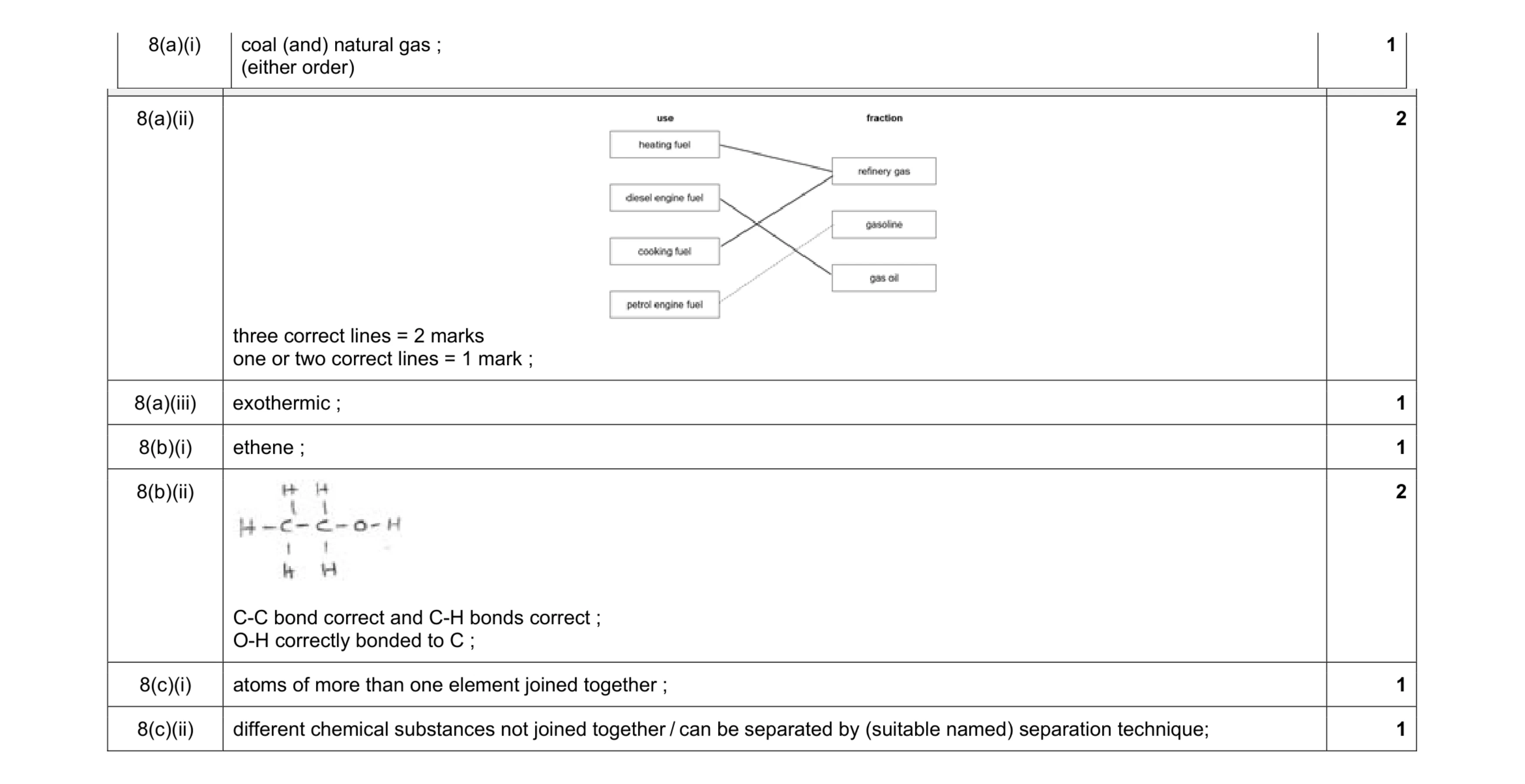
8 (a) Petroleum is separated into useful fractions, as shown in Fig. 8.1. refinery gas gasoline gas oil petroleum Fig. 8.1 (i) Petroleum is a fossil fuel. Name two other fossil fuels. 1. … 2. … [1] (ii) The fractions obtained from petroleum have different uses as fuels. Draw one line from each use to the fraction from which the fuel is obtained. One line has been drawn for you. use fraction heating fuel refinery gas diesel engine fuel gasoline cooking fuel gas oil petrol engine fuel [2] (iii) When fuels burn, the reaction produces a temperature increase. State the name given to reactions that always cause a temperature increase. … [1] (b) (i) The structure of a molecule of a compound is shown below. Name this compound. H H C C H H … [1] (ii) The formula of ethanol is C2H5OH. Complete the structure of a molecule of ethanol. H C [2] (c) Petroleum is a mixture of different compounds. Methane, CH4, is a compound. (i) State what is meant by a compound. Use ideas about atoms in your answer. … … [1] (ii) Explain what is meant by a mixture. You may use ideas about separation methods in your answer. … … [1]
9 marks
Mark scheme: 8(a)(i) coal (and) natural gas ; (either order) 1 Question Answer Marks 8(a)(ii) three correct lines = 2 marks one or two correct lines = 1 mark ; 2 8(a)(iii) exothermic ; 1 8(b)(i) ethene ; 1 8(b)(ii) C-C bond correct and C-H bonds correct ; O-H correctly bonded to C ; 2 8(c)(i) atoms of more than one element joined together ; 1 8(c)(ii) different chemical substances not joined together / can be separated by (suitable named) separation technique; 1
This question in 0653/33 Oct/Nov 2018
Q2 · Air is a mixture of elements and compounds 0653/32 Feb/March 2019
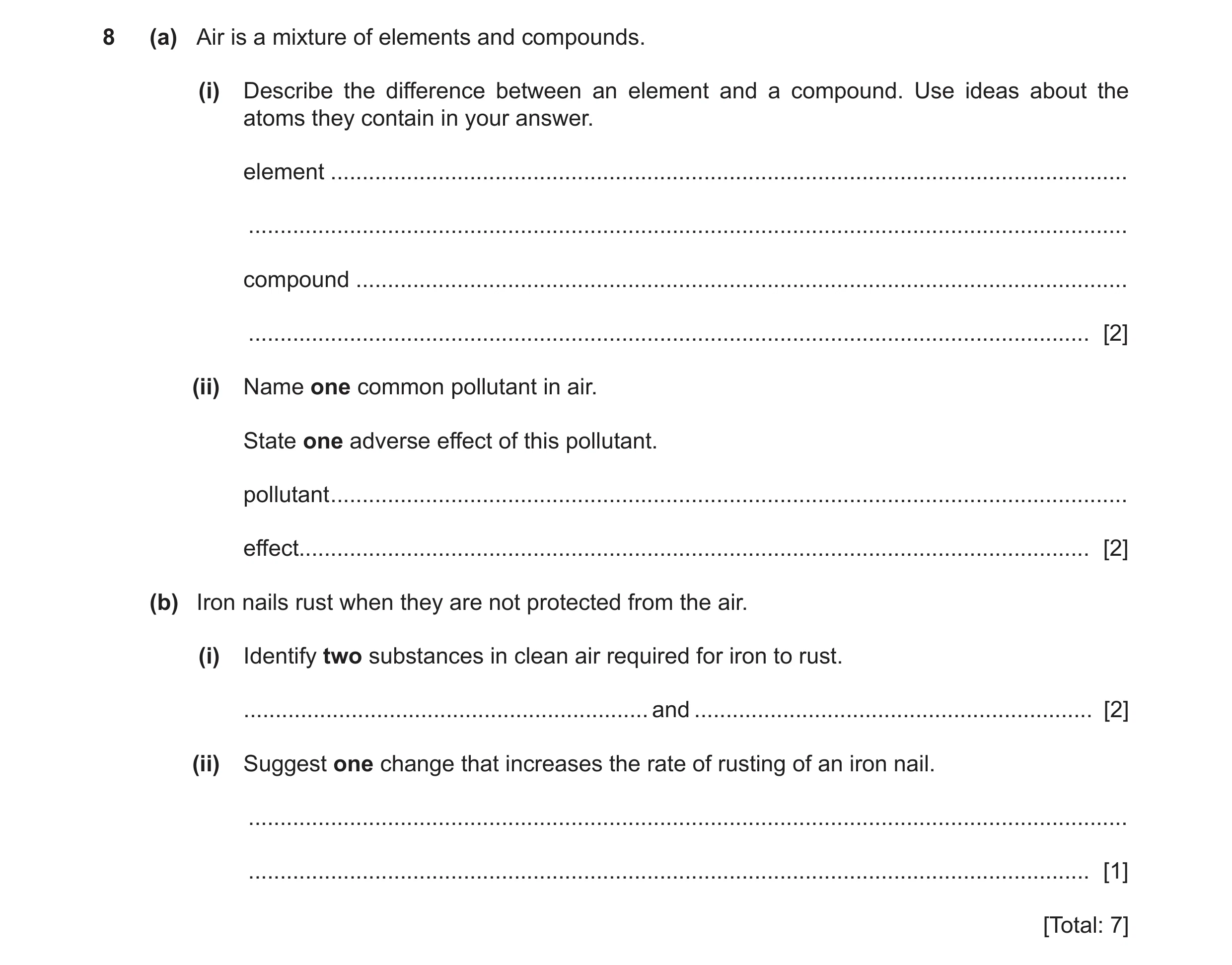
8 (a) Air is a mixture of elements and compounds. (i) Describe the difference between an element and a compound. Use ideas about the atoms they contain in your answer. element … … compound … … [2] (ii) Name one common pollutant in air. State one adverse effect of this pollutant. pollutant … effect … [2] (b) Iron nails rust when they are not protected from the air. (i) Identify two substances in clean air required for iron to rust. … and … [2] (ii) Suggest one change that increases the rate of rusting of an iron nail. … … [1] [Total: 7]
7 marks
Mark scheme: 8(a)(i) (element) contains only one type of atom / found in the Periodic Table ; (compound) consists of two or more / more than one element / type of atom ; 2 8(a)(ii) one pair of responses from carbon monoxide ; poisonous gas / affects oxygen transport / respiration ; sulfur dioxide ; forms acid rain / effect of acid rain described / problems with breathing ; oxides of nitrogen ; forms acid rain / smog can cause breathing problems ; methane ; contribution to global warming ; increase of / excess of carbon dioxide ; contributes to global warming ; 2 8(b)(i) oxygen / O2 ; water (vapour) / H2O ; either order 2 8(b)(ii) increase temperature / acidic gases present ; 1
This question in 0653/32 Feb/March 2019
Q3 · A mixture contains water, dissolved sodium chloride and an insoluble solid compound 0653/32 May/June 2021
2 (a) A mixture contains water, dissolved sodium chloride and an insoluble solid compound. (i) State what is meant by insoluble and compound. insoluble … … compound … … [2] (ii) Describe how crystals of sodium chloride are obtained from this mixture. … … … … … [3] (b) Water is a covalent molecule. Complete Fig. 2.1 to show the dot-and-cross diagram of a molecule of water. Show all the outer shell electrons. H O H Fig. 2.1 [2] (c) An atom of oxygen contains 8 electrons and it has the nucleon number (mass number) 16. State what is meant by nucleon number. … … [1] (d) Complete Table 2.1 to show the charges and approximate relative masses of neutrons and protons. Table 2.1 particle charge relative mass neutron proton [2] [Total: 10]
10 marks
Mark scheme: 2(a)(i) insoluble: cannot / does not, dissolve (in water) ; compound: two (or more) elements (chemically) combined ; 2 Question Answer Marks 2(a)(ii) any three from: filter (at the start) / filter (off the insoluble solid) ; evaporate / heat (the NaCl solution) ; leave to (cool and) crystallise ; filter off the crystals / dry between folds of filter paper ; 3 2(b) two bond pairs ; two lone pairs on O ; 2 2(c) (the total number of) protons and neutrons (in the nucleus of an atom) ; 1 2(d) particle charge relative mass neutron 0 1 proton +1 1 ;; neutron row correct ; proton row correct ; 2
This question in 0653/32 May/June 2021
Q4 · A student separates some insoluble solid material from concentrated aqueous sodium… 0653/32 Oct/Nov 2021
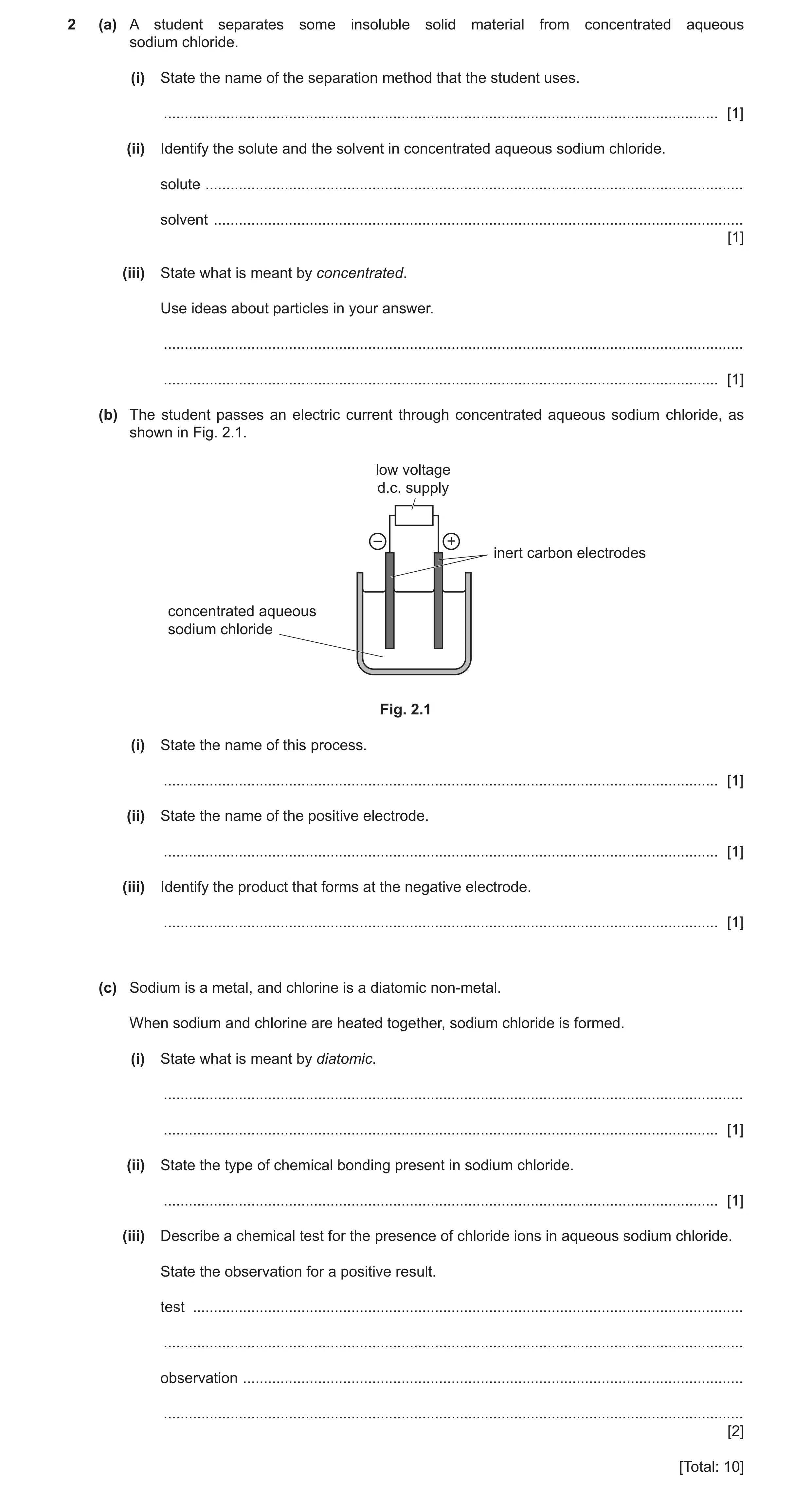
2 (a) A student separates some insoluble solid material from concentrated aqueous sodium chloride. (i) State the name of the separation method that the student uses. … [1] (ii) Identify the solute and the solvent in concentrated aqueous sodium chloride. solute … solvent … [1] (iii) State what is meant by concentrated. Use ideas about particles in your answer. … … [1] (b) The student passes an electric current through concentrated aqueous sodium chloride, as shown in Fig. 2.1. low voltage d.c. supply – + inert carbon electrodes concentrated aqueous sodium chloride Fig. 2.1 (i) State the name of this process. … [1] (ii) State the name of the positive electrode. … [1] (iii) Identify the product that forms at the negative electrode. … [1] (c) Sodium is a metal, and chlorine is a diatomic non-metal. When sodium and chlorine are heated together, sodium chloride is formed. (i) State what is meant by diatomic. … … [1] (ii) State the type of chemical bonding present in sodium chloride. … [1] (iii) Describe a chemical test for the presence of chloride ions in aqueous sodium chloride. State the observation for a positive result. test … … observation … … [2] [Total: 10]
10 marks
Mark scheme: 2(a)(i) filtration / filter(ing) ; 1 2(a)(ii) solute: sodium chloride / NaCl AND solvent: water / H2O ; 1 2(a)(iii) there are many / more solute particles in (a solution) ; 1 2(b)(i) electrolysis ; 1 2(b)(ii) anode ; 1 2(b)(iii) hydrogen ; 1 2(c)(i) (contains) only two atoms joined (in a molecule) ; 1 2(c)(ii) ionic ; 1 2(c)(iii) test: (aqueous) silver nitrate AND (dilute) nitric acid ; result: white precipitate ; 2
This question in 0653/32 Oct/Nov 2021
Q5 · The Periodic Table lists all of the known elements 0653/32 Oct/Nov 2021
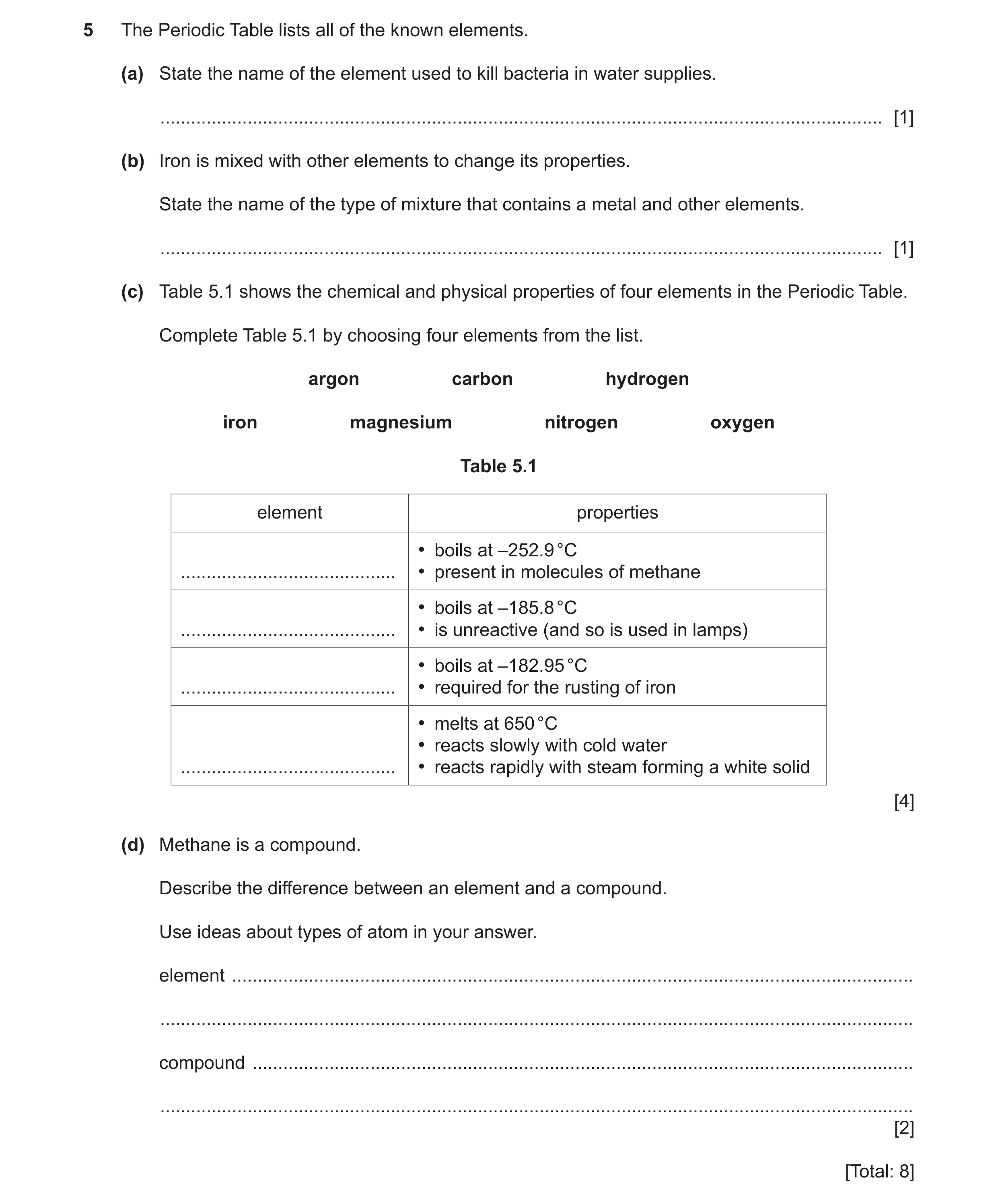
5 The Periodic Table lists all of the known elements. (a) State the name of the element used to kill bacteria in water supplies. … [1] (b) Iron is mixed with other elements to change its properties. State the name of the type of mixture that contains a metal and other elements. … [1] (c) Table 5.1 shows the chemical and physical properties of four elements in the Periodic Table. Complete Table 5.1 by choosing four elements from the list. argon carbon hydrogen iron magnesium nitrogen oxygen Table 5.1 element properties • boils at –252.9 °C … • present in molecules of methane • boils at –185.8 °C … • is unreactive (and so is used in lamps) • boils at –182.95 °C … • required for the rusting of iron • melts at 650 °C • reacts slowly with cold water … • reacts rapidly with steam forming a white solid [4] (d) Methane is a compound. Describe the difference between an element and a compound. Use ideas about types of atom in your answer. element … … compound … … [2] [Total: 8]
8 marks
Mark scheme: 5(a) chlorine ; 1 5(b) alloy(s) ; 1 5(c) hydrogen ; argon ; oxygen ; magnesium ; 4 5(d) element: contains only one type of atom ; compound: contains two (or more) types of atom ; 2 Question Answer Marks
This question in 0653/32 Oct/Nov 2021
Q6 · A student separates some insoluble solid material from concentrated aqueous sodium… 0653/33 Oct/Nov 2021
2 (a) A student separates some insoluble solid material from concentrated aqueous sodium chloride. (i) State the name of the separation method that the student uses. … [1] (ii) Identify the solute and the solvent in concentrated aqueous sodium chloride. solute … solvent … [1] (iii) State what is meant by concentrated. Use ideas about particles in your answer. … … [1] (b) The student passes an electric current through concentrated aqueous sodium chloride, as shown in Fig. 2.1. low voltage d.c. supply – + inert carbon electrodes concentrated aqueous sodium chloride Fig. 2.1 (i) State the name of this process. … [1] (ii) State the name of the positive electrode. … [1] (iii) Identify the product that forms at the negative electrode. … [1] (c) Sodium is a metal, and chlorine is a diatomic non-metal. When sodium and chlorine are heated together, sodium chloride is formed. (i) State what is meant by diatomic. … … [1] (ii) State the type of chemical bonding present in sodium chloride. … [1] (iii) Describe a chemical test for the presence of chloride ions in aqueous sodium chloride. State the observation for a positive result. test … … observation … … [2] [Total: 10]
10 marks
Mark scheme: 2(a)(i) filtration / filter(ing) ; 1 2(a)(ii) solute: sodium chloride / NaCl AND solvent: water / H2O ; 1 2(a)(iii) there are many / more solute particles in (a solution) ; 1 2(b)(i) electrolysis ; 1 2(b)(ii) anode ; 1 2(b)(iii) hydrogen ; 1 2(c)(i) (contains) only two atoms joined (in a molecule) ; 1 2(c)(ii) ionic ; 1 2(c)(iii) test: (aqueous) silver nitrate AND (dilute) nitric acid ; result: white precipitate ; 2
This question in 0653/33 Oct/Nov 2021
Q7 · The Periodic Table lists all of the known elements 0653/33 Oct/Nov 2021
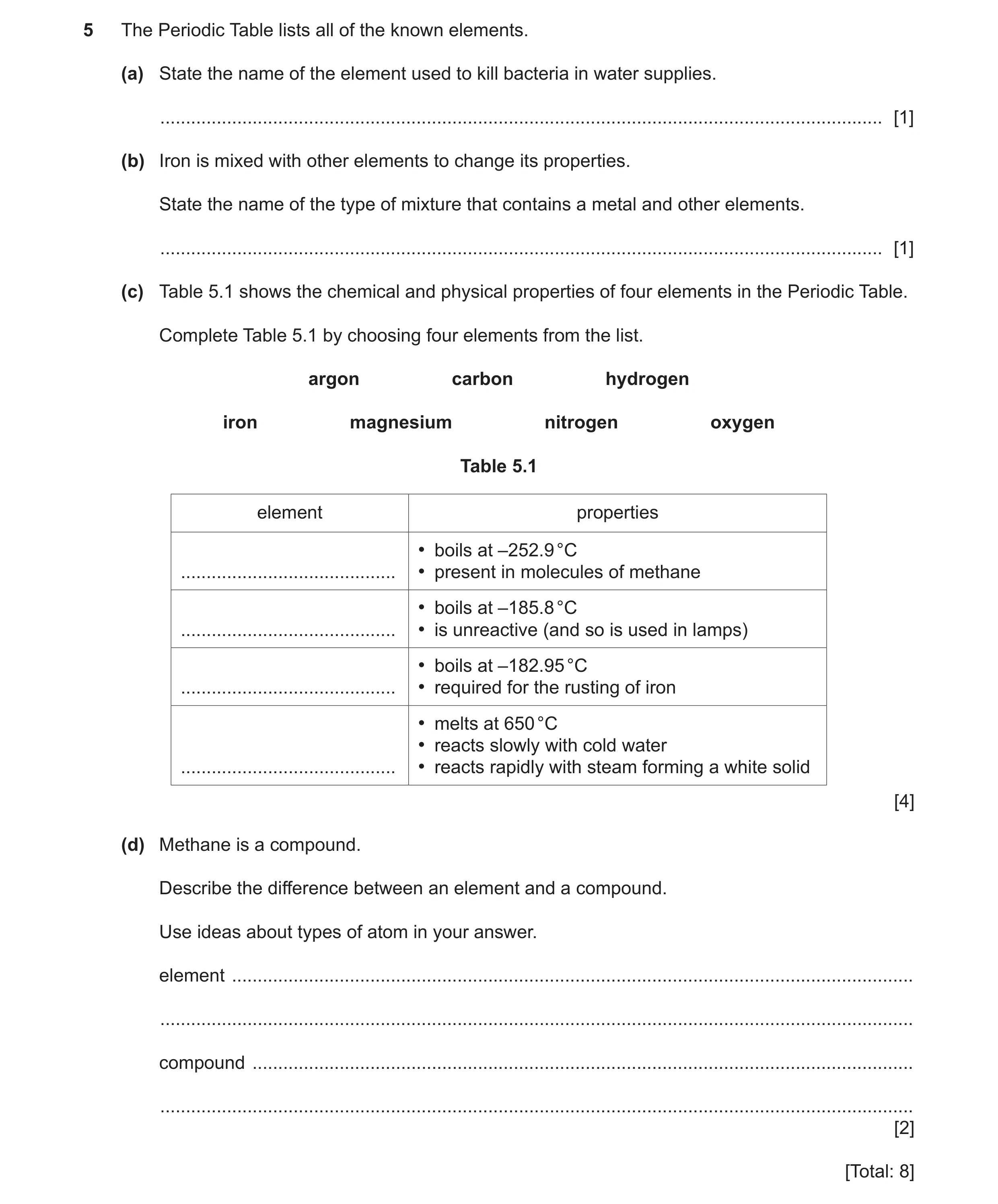
5 The Periodic Table lists all of the known elements. (a) State the name of the element used to kill bacteria in water supplies. … [1] (b) Iron is mixed with other elements to change its properties. State the name of the type of mixture that contains a metal and other elements. … [1] (c) Table 5.1 shows the chemical and physical properties of four elements in the Periodic Table. Complete Table 5.1 by choosing four elements from the list. argon carbon hydrogen iron magnesium nitrogen oxygen Table 5.1 element properties • boils at –252.9 °C … • present in molecules of methane • boils at –185.8 °C … • is unreactive (and so is used in lamps) • boils at –182.95 °C … • required for the rusting of iron • melts at 650 °C • reacts slowly with cold water … • reacts rapidly with steam forming a white solid [4] (d) Methane is a compound. Describe the difference between an element and a compound. Use ideas about types of atom in your answer. element … … compound … … [2] [Total: 8]
8 marks
Mark scheme: 5(a) chlorine ; 1 5(b) alloy(s) ; 1 5(c) hydrogen ; argon ; oxygen ; magnesium ; 4 5(d) element: contains only one type of atom ; compound: contains two (or more) types of atom ; 2 Question Answer Marks
This question in 0653/33 Oct/Nov 2021
Q8 · An aqueous solution of salt MX is made by dissolving solid MX in water 0653/31 May/June 2022
2 (a) An aqueous solution of salt MX is made by dissolving solid MX in water. (i) Identify the solvent and the solute in aqueous MX. solute … solvent … [2] (ii) A student tests separate samples of aqueous MX. The results are shown in Table 2.1. Complete Table 2.1 by naming the ions that these tests show are in aqueous MX. Table 2.1 test result name of ion add aqueous sodium green precipitate, insoluble in hydroxide excess add aqueous barium white precipitate ions under acidic conditions [2] (b) A student makes an aqueous solution of MX by reacting excess metal M with dilute acid HX. The student then separates the excess, unreacted solid metal M from the reaction mixture. (i) Suggest how the student separates solid metal M from the reaction mixture. … [1] (ii) State whether this separation process is a chemical change or a physical change. Explain your answer. change … explanation … … [1] (iii) State the effect of increasing the temperature on the rate of this reaction. … … [1] (iv) During the reaction between metal M and dilute acid HX, atoms of M become cations. Explain how atoms become cations. … … [1] (v) Suggest what happens to the value of the pH of the reaction mixture during the reaction between excess metal M and dilute acid HX. … … [1] [Total: 9]
9 marks
Mark scheme: 2(a)(i) (solute) MX ; (solvent) water / H2O ; 2 2(a)(ii) ;; 2 2(b)(i) filter / filtration ; 1 2(b)(ii) (change) physical AND (explanation) no new substance is made ; 1 2(b)(iii) (rate) increases ; 1 2(b)(iv) (atoms) lose electron(s) ; 1 2(b)(v) pH increases ; 1
This question in 0653/31 May/June 2022
Q9 · Solid sodium reacts with water 0653/32 May/June 2025
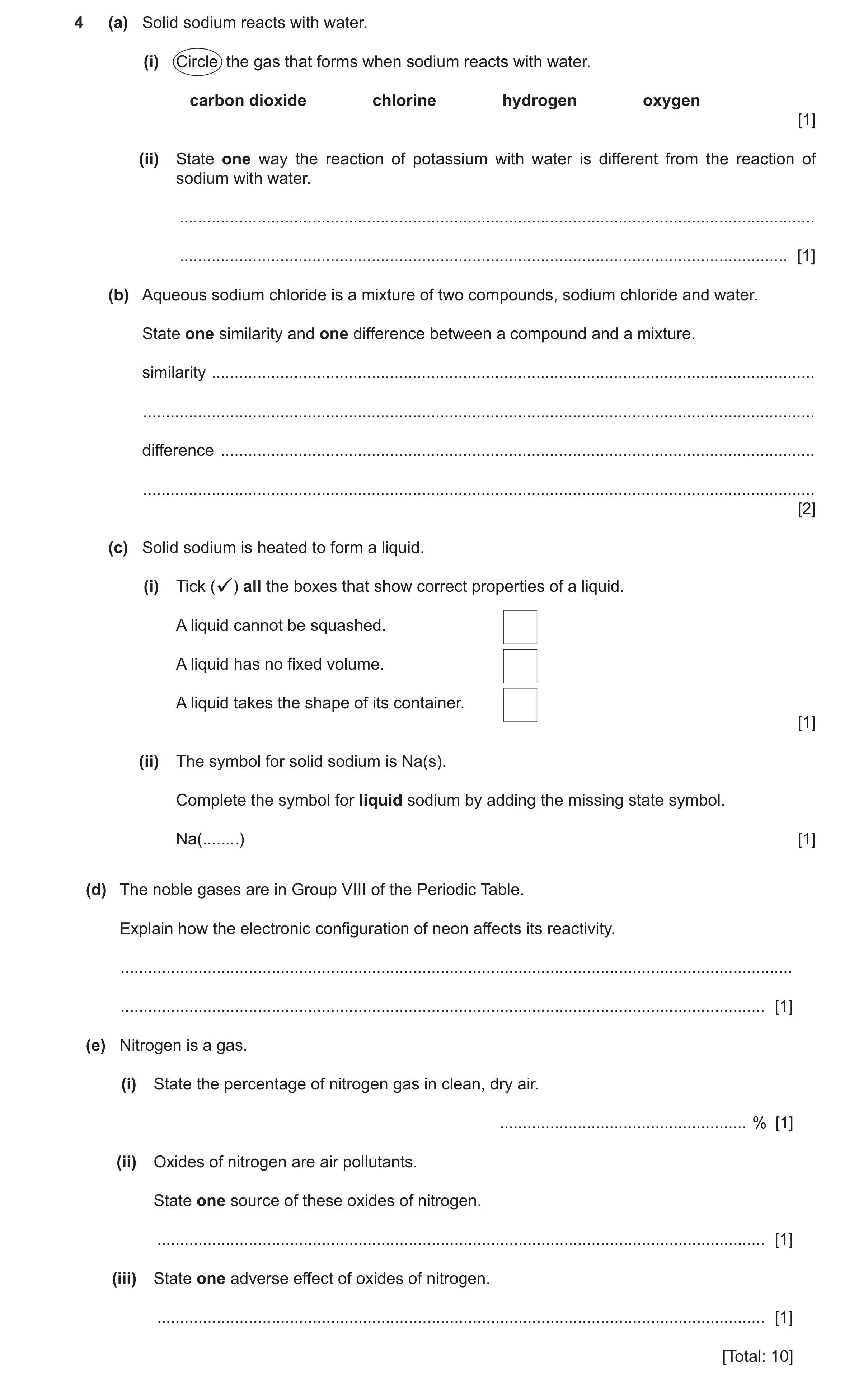
4 (a) Solid sodium reacts with water. (i) Circle the gas that forms when sodium reacts with water. carbon dioxide chlorine hydrogen oxygen [1] (ii) State one way the reaction of potassium with water is different from the reaction of sodium with water. … … [1] (b) Aqueous sodium chloride is a mixture of two compounds, sodium chloride and water. State one similarity and one difference between a compound and a mixture. similarity … … difference … … [2] (c) Solid sodium is heated to form a liquid. (i) Tick () all the boxes that show correct properties of a liquid. A liquid cannot be squashed. A liquid has no fixed volume. A liquid takes the shape of its container. [1] (ii) The symbol for solid sodium is Na(s). Complete the symbol for liquid sodium by adding the missing state symbol. Na( … ) [1] (d) The noble gases are in Group VIII of the Periodic Table. Explain how the electronic configuration of neon affects its reactivity. … … [1] (e) Nitrogen is a gas. (i) State the percentage of nitrogen gas in clean, dry air. … % [1] (ii) Oxides of nitrogen are air pollutants. State one source of these oxides of nitrogen. … [1] (iii) State one adverse effect of oxides of nitrogen. … [1] [Total: 10]
10 marks
Mark scheme: 4(a)(i) hydrogen ; 1 4(a)(ii) any one from: 1 idea of potassium is more reactive than sodium ; (potassium) moves more quickly on surface of water / ignites ; 4(b) similarity: 2 both contain two or more different, atoms / elements ; any one difference: in a compound, (the atoms / ions / elements) are (chemically) bonded together ORA ; a compound cannot be changed back / separated (into its elements) (by physical means) / mixture can be separated (by physical means) ; 4(c)(i) first and last box ticked ; 1 4(c)(ii) l / l ; 1 4(d) full outer shell or 2,8 and unreactive / inert / stable ; 1 4(e)(i) 78(%) ; 1 4(e)(ii) (reactions in) car engines ; 1 4(e)(iii) any one from: 1 acid rain ; respiratory problems ;
This question in 0653/32 May/June 2025
Q10 · Three substances and models used to represent them 0653/31 Oct/Nov 2025
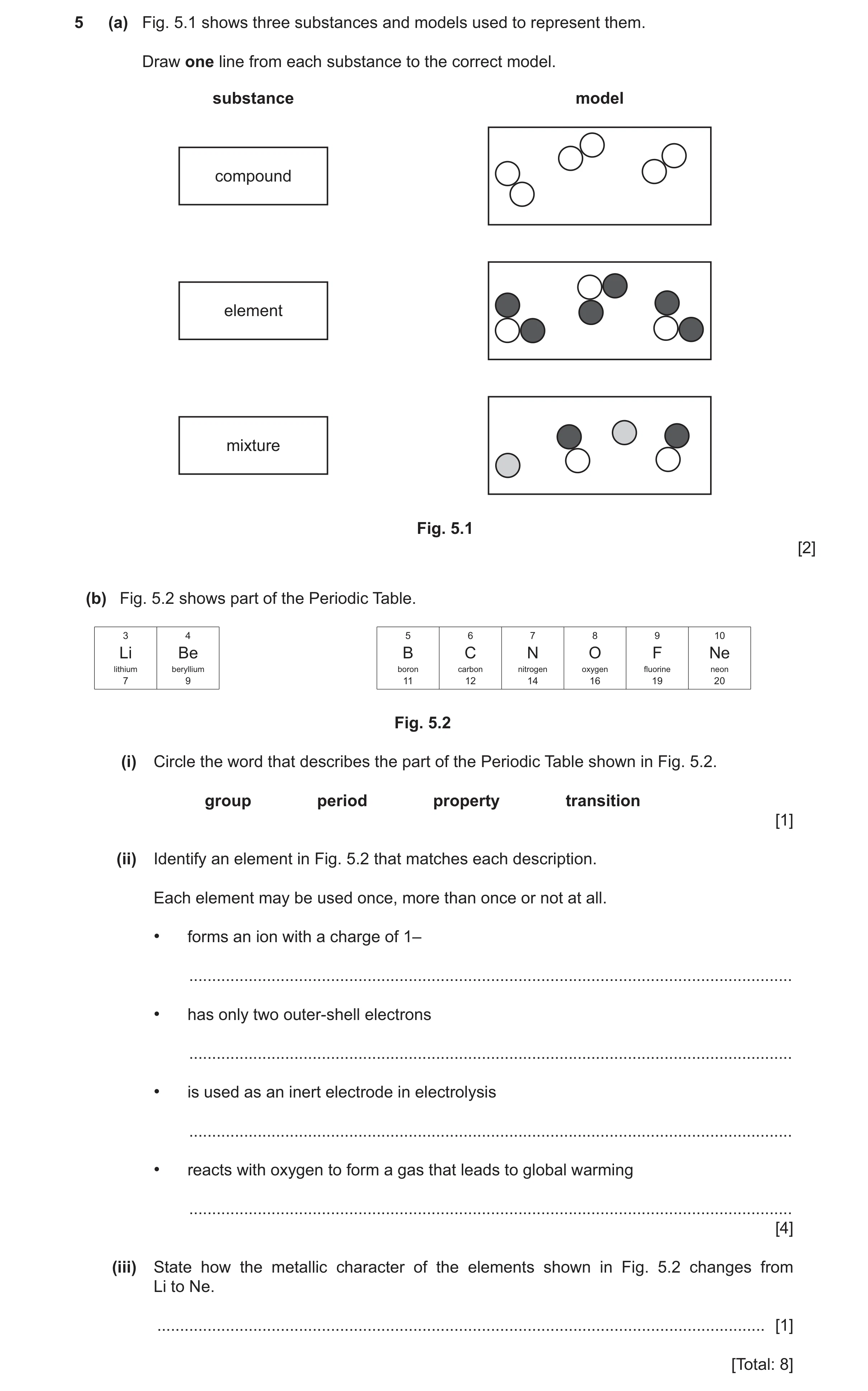
5 (a) Fig. 5.1 shows three substances and models used to represent them. Draw one line from each substance to the correct model. substance model compound element mixture Fig. 5.1 [2] (b) Fig. 5.2 shows part of the Periodic Table. 3 4 5 6 7 8 9 10 Li Be B C N O F Ne lithium beryllium boron carbon nitrogen oxygen fluorine neon 7 9 11 12 14 16 19 20 Fig. 5.2 (i) Circle the word that describes the part of the Periodic Table shown in Fig. 5.2. group period property transition [1] (ii) Identify an element in Fig. 5.2 that matches each description. Each element may be used once, more than once or not at all. • forms an ion with a charge of 1– … • has only two outer-shell electrons … • is used as an inert electrode in electrolysis … • reacts with oxygen to form a gas that leads to global warming … [4] (iii) State how the metallic character of the elements shown in Fig. 5.2 changes from Li to Ne. … [1] [Total: 8]
8 marks
Mark scheme: 5(a) 2 1 or two lines correct ; 3 lines correct ; 5(b)(i) period ; 1 5(b)(ii) fluorine / F ; 4 beryllium / Be ; carbon / C ; carbon / C / nitrogen / N ; 5(b)(iii) becomes less metallic / decreases, (from Li to Ne) ;
This question in 0653/31 Oct/Nov 2025
 3 / 13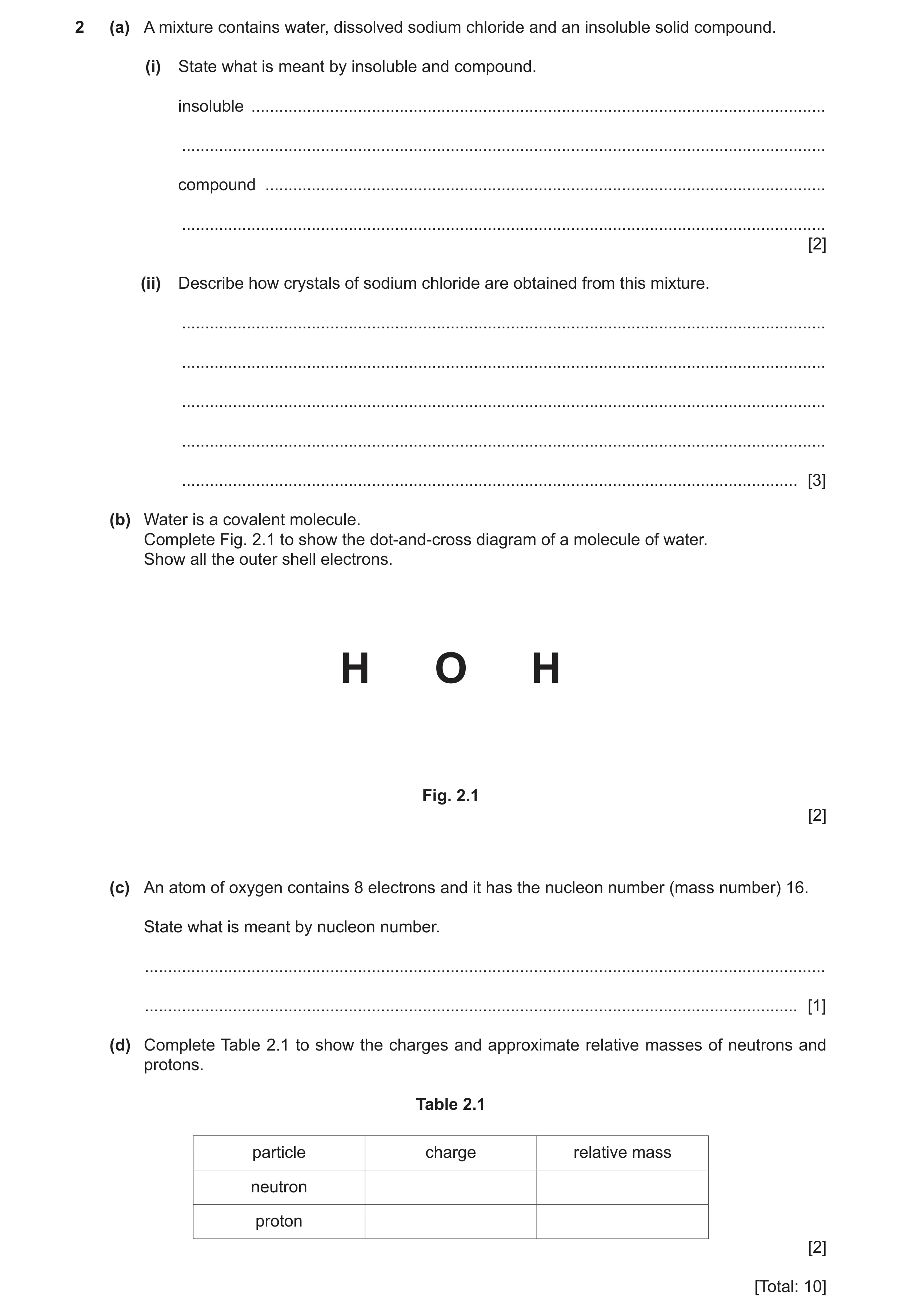
 6 / 13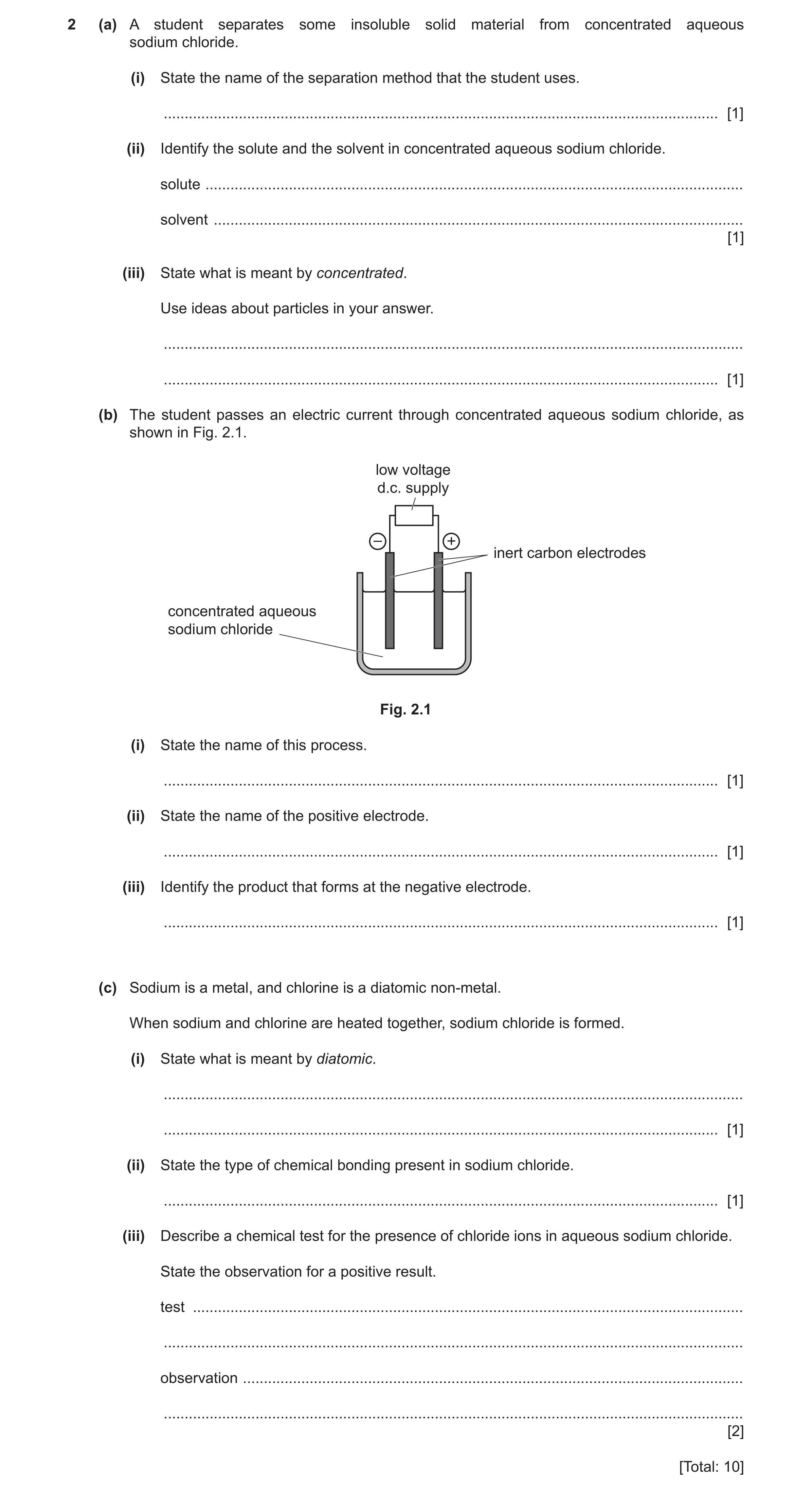
 9 / 13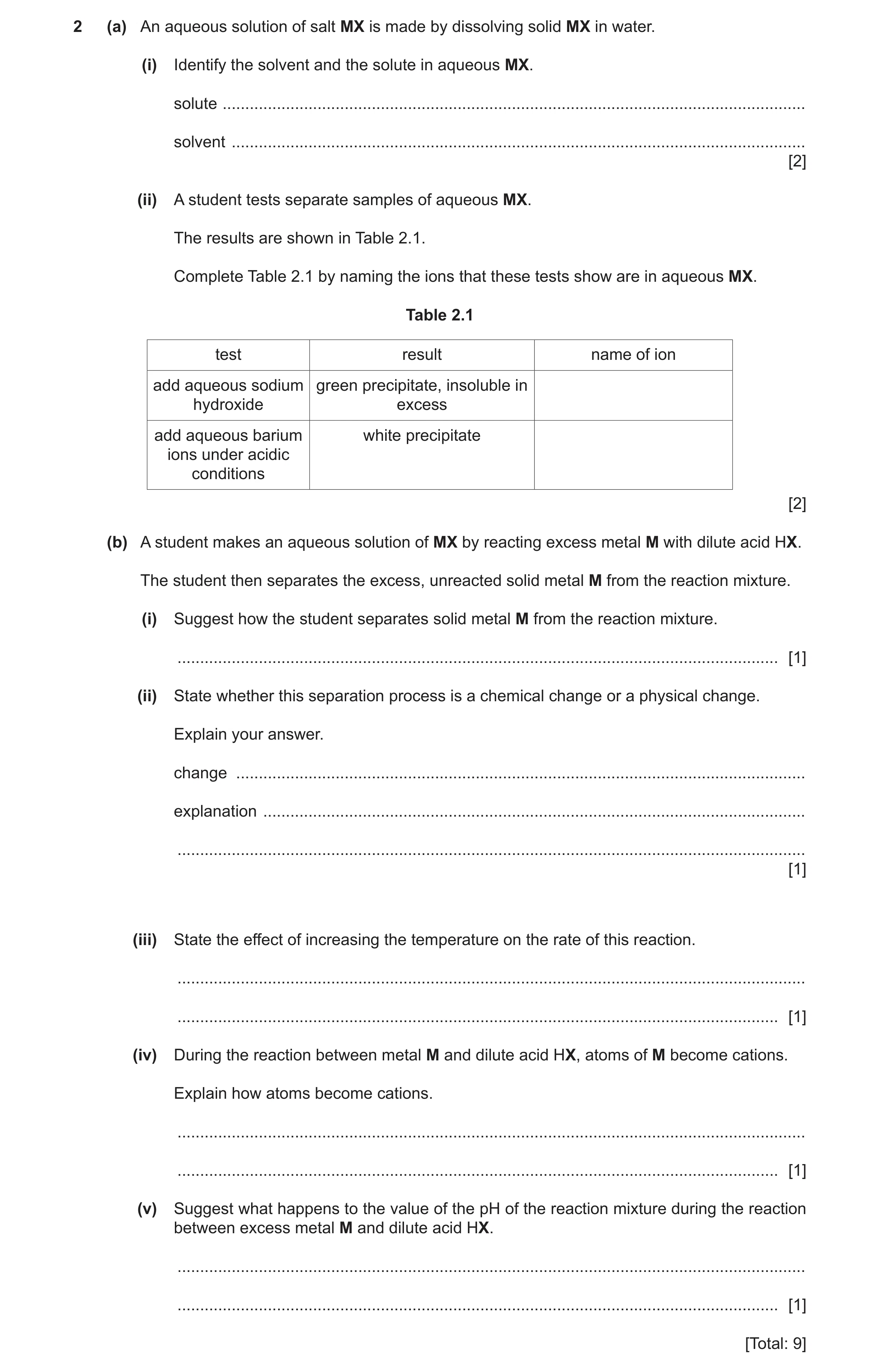
 9
9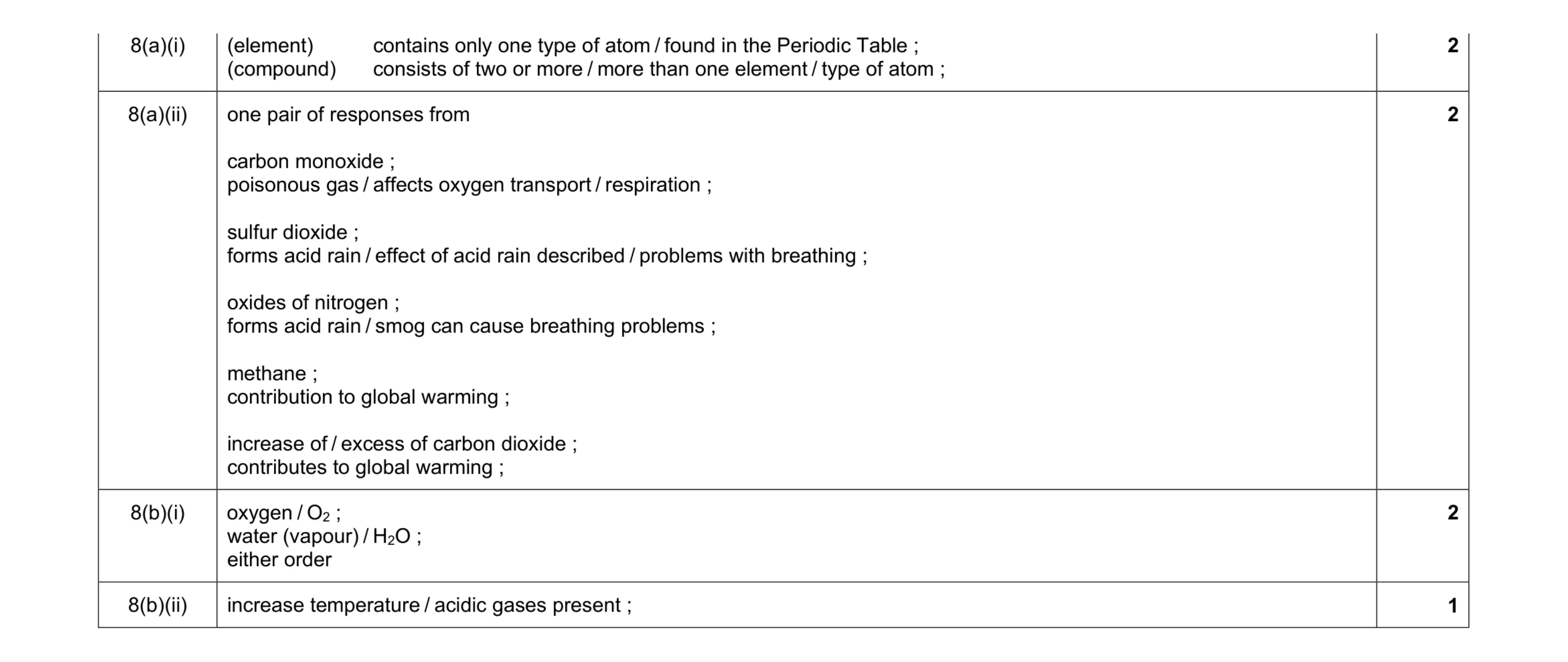 7
7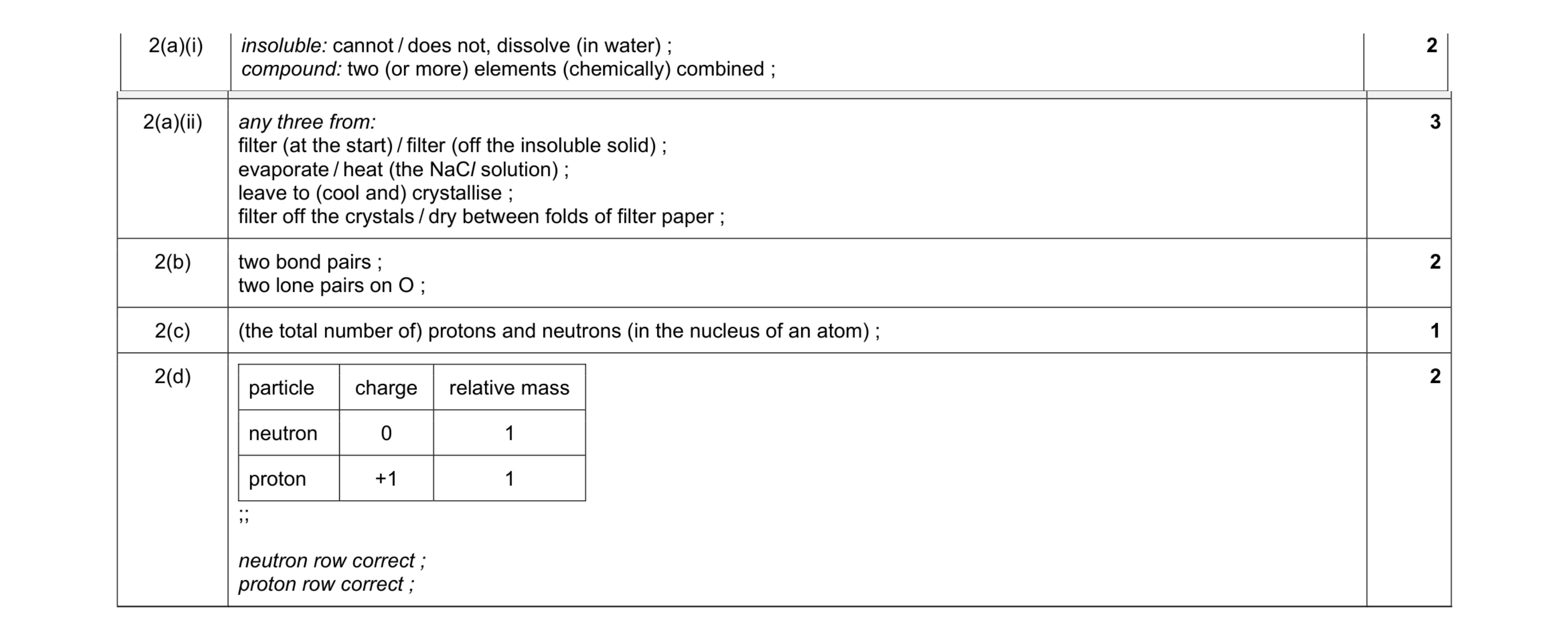 10
10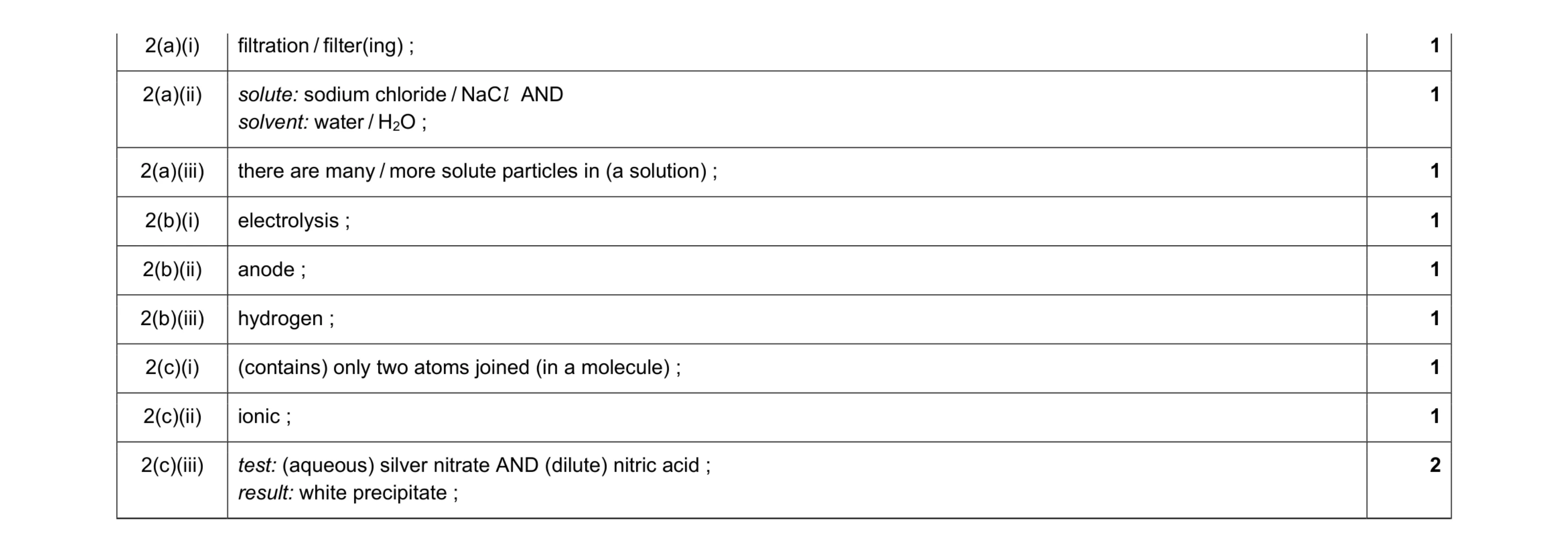 10
10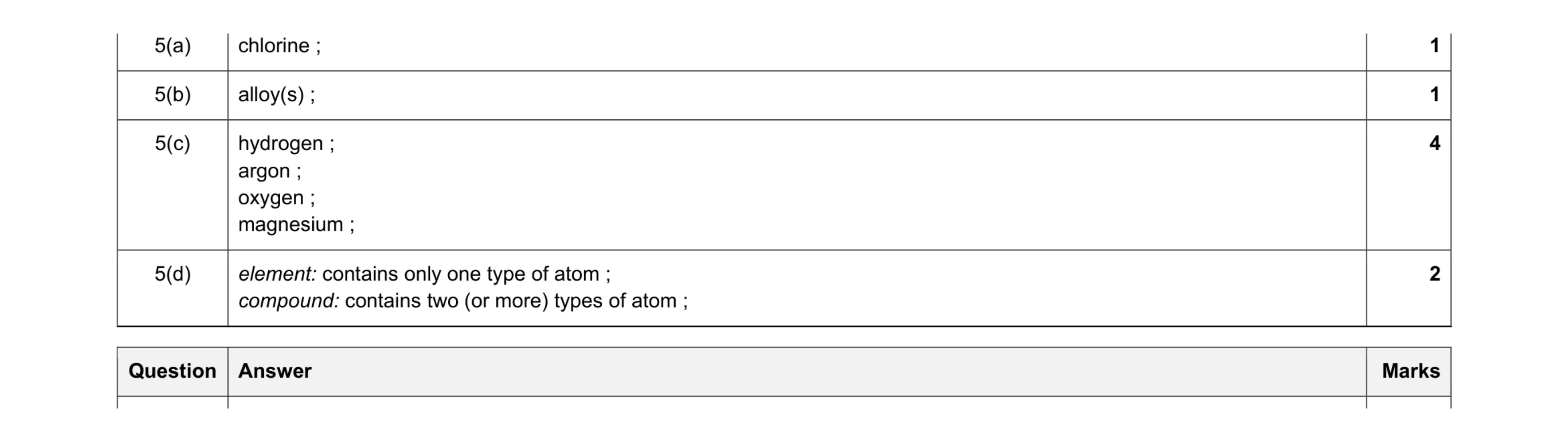 8
8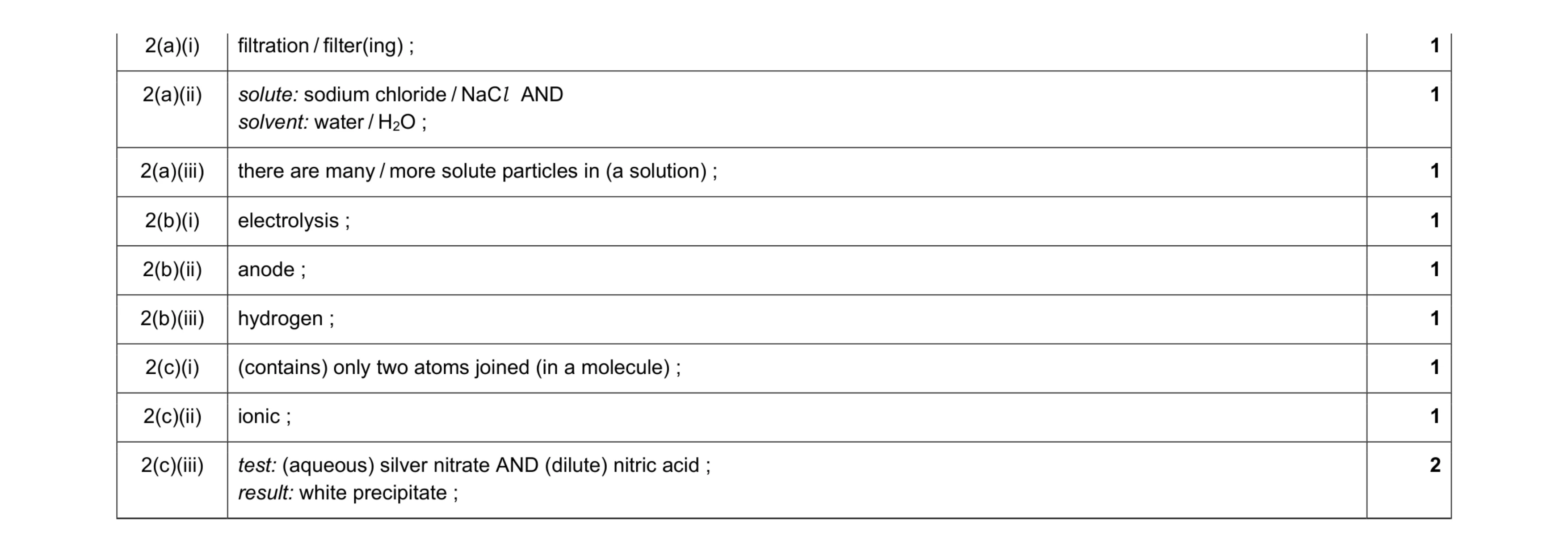 10
10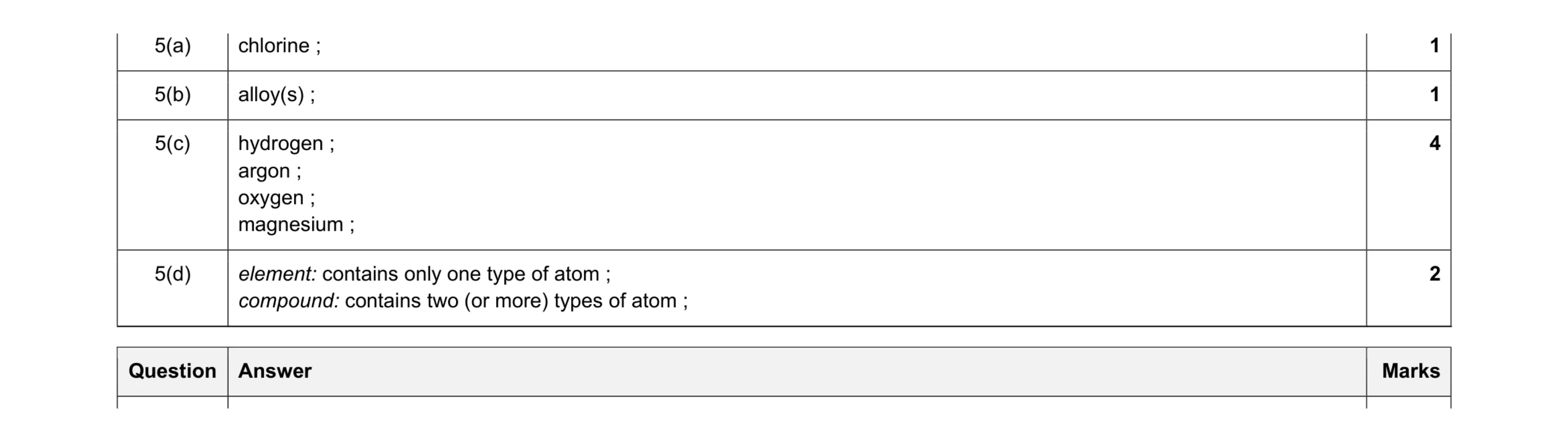 8
8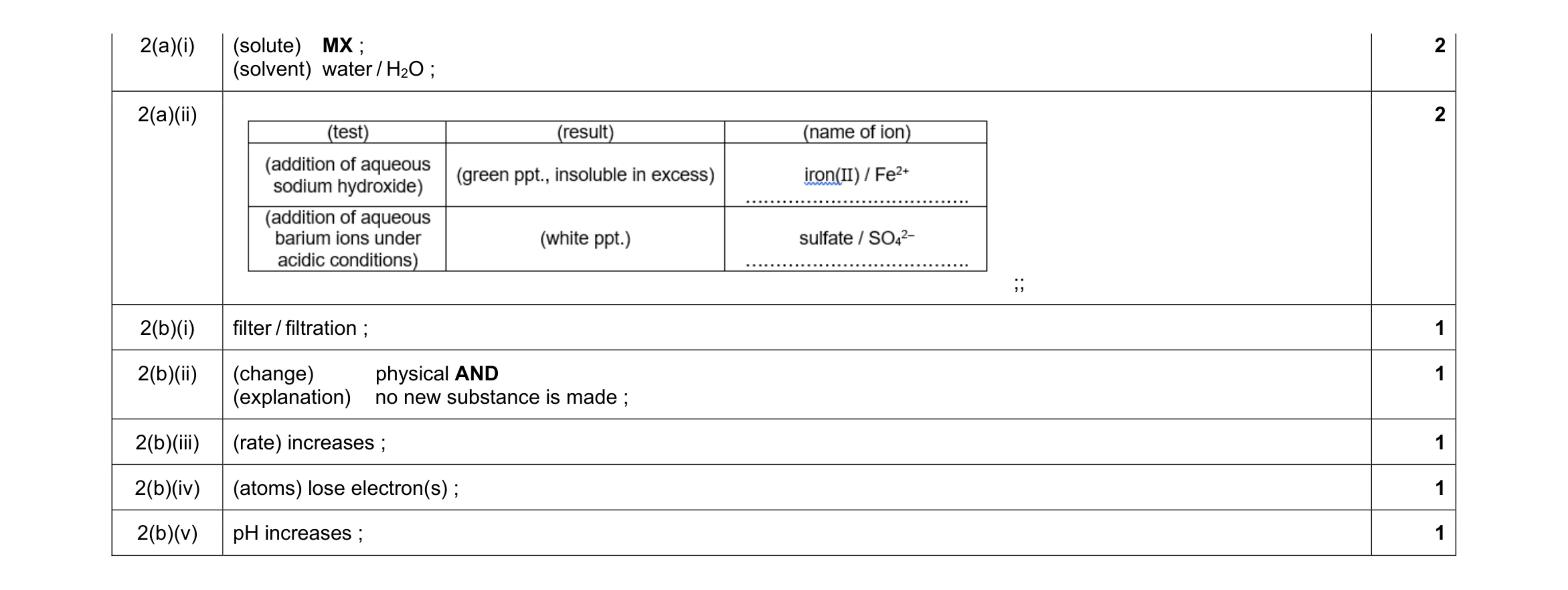 9
9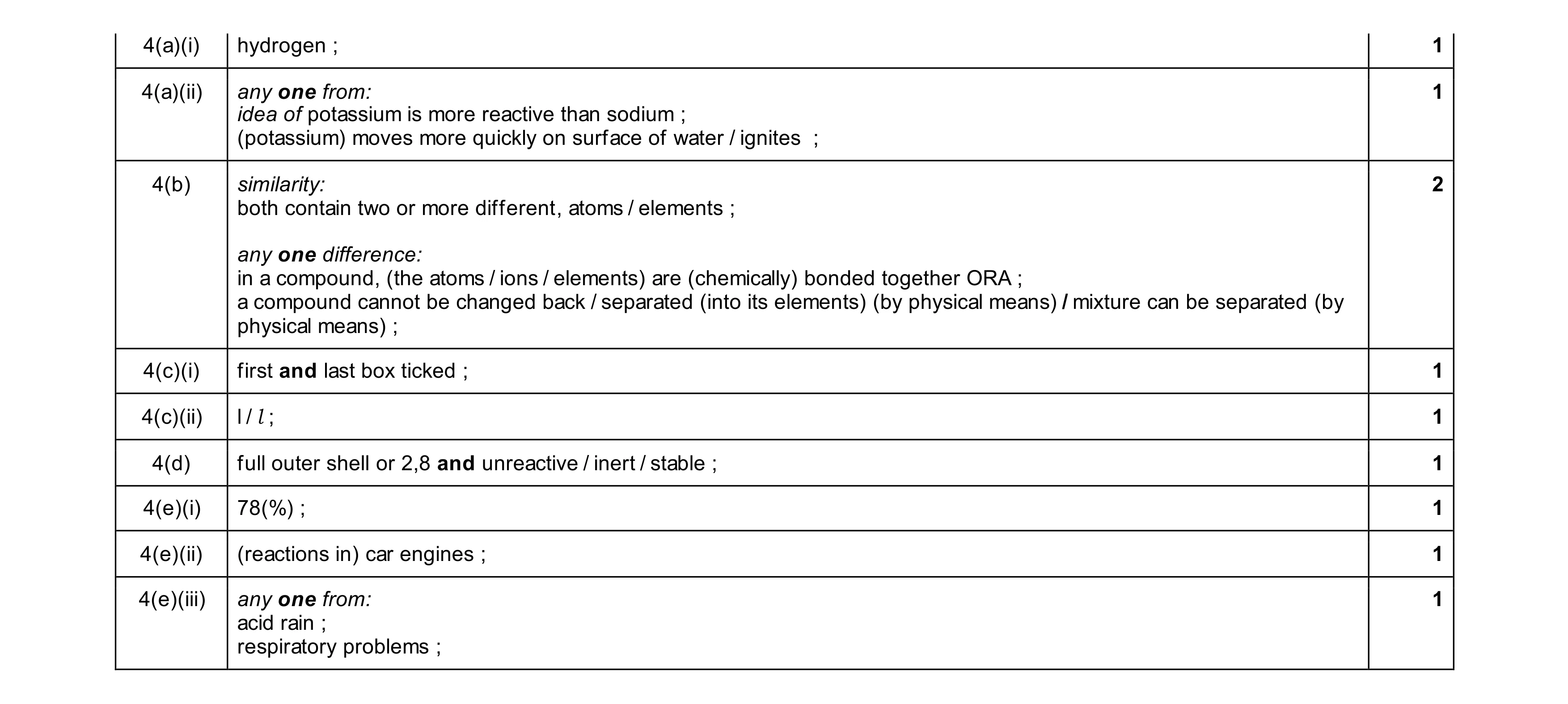 10
10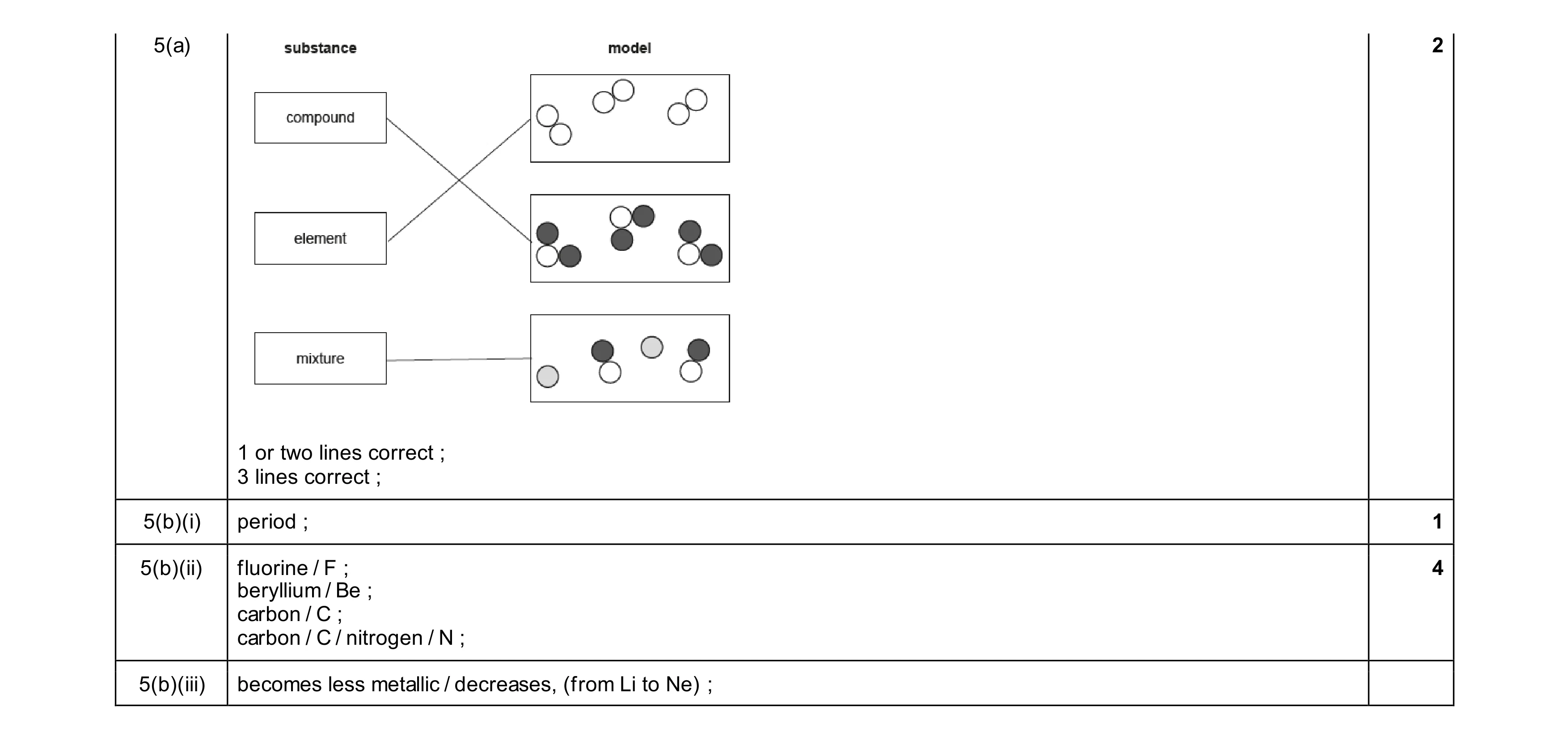 8
8