Questions as text
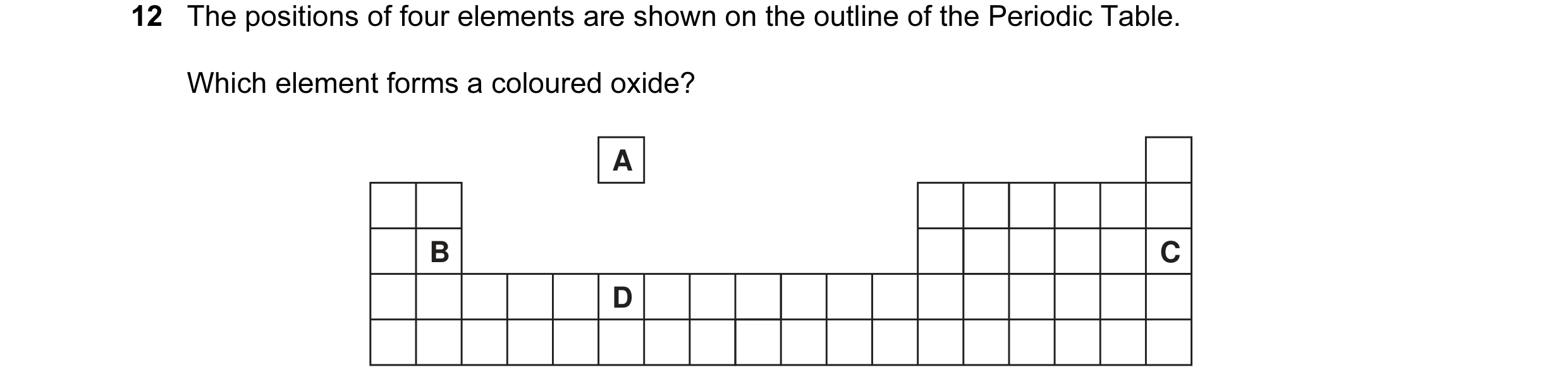
Q1 · The positions of four elements are shown on the outline of the Periodic Table 0652/11 Oct/Nov 2007
12 The positions of four elements are shown on the outline of the Periodic Table. Which element forms a coloured oxide? A B C D
1 marks
Answer: D
This question in 0652/11 Oct/Nov 2007
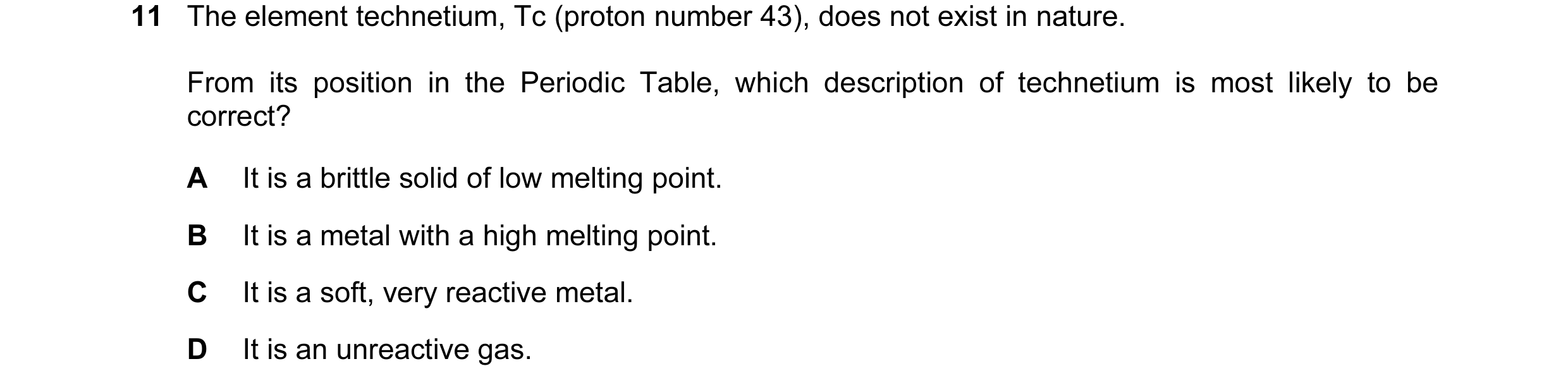
Q2 · The element technetium, Tc (proton number 43), does not exist in nature 0652/12 Oct/Nov 2011
11 The element technetium, Tc (proton number 43), does not exist in nature. From its position in the Periodic Table, which description of technetium is most likely to be correct? A It is a brittle solid of low melting point. B It is a metal with a high melting point. C It is a soft, very reactive metal. D It is an unreactive gas.
1 marks
Answer: B
This question in 0652/12 Oct/Nov 2011
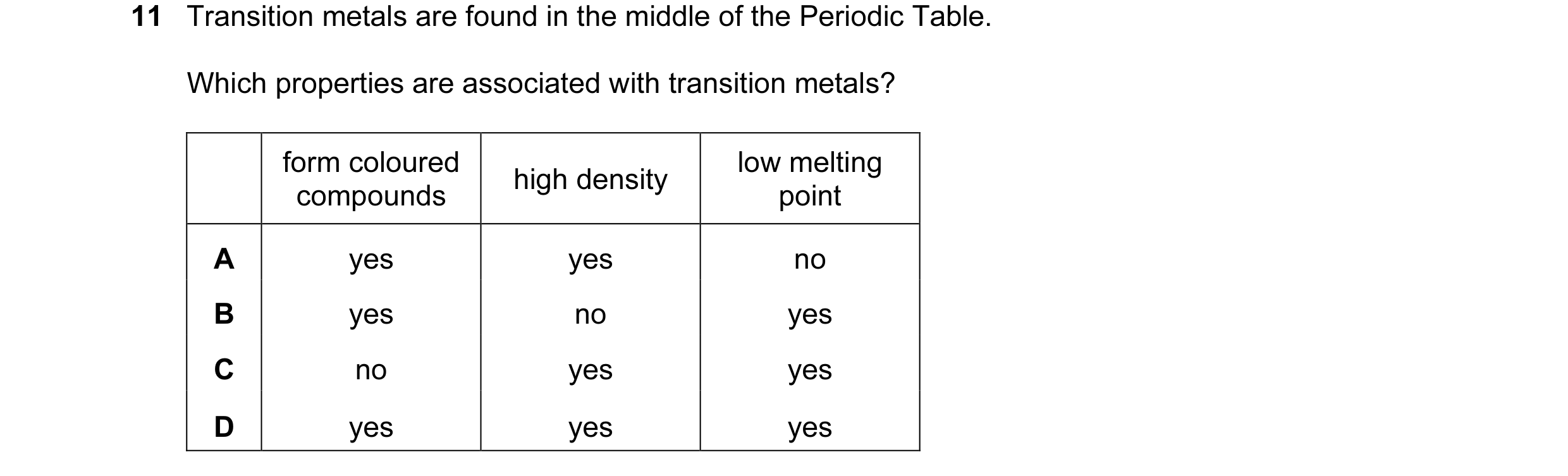
Q3 · Transition metals are found in the middle of the Periodic Table 0652/11 Oct/Nov 2013
11 Transition metals are found in the middle of the Periodic Table. Which properties are associated with transition metals? form coloured low melting high density compounds point A yes yes no B yes no yes C no yes yes D yes yes yes
1 marks
Answer: A
This question in 0652/11 Oct/Nov 2013
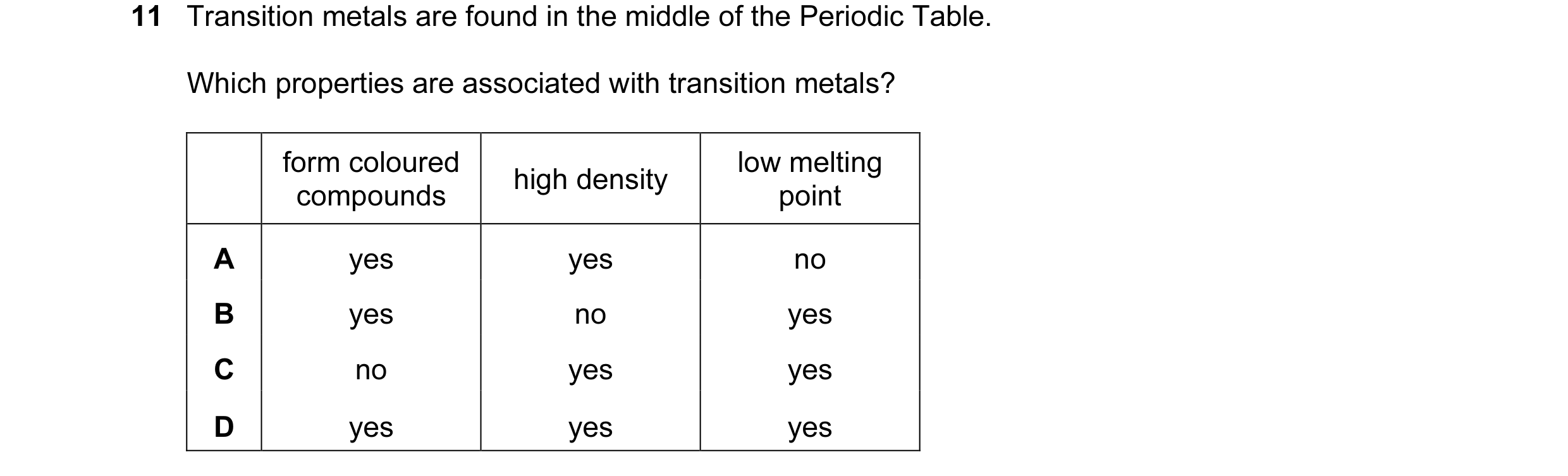
Q4 · Transition metals are found in the middle of the Periodic Table 0652/12 Oct/Nov 2013
11 Transition metals are found in the middle of the Periodic Table. Which properties are associated with transition metals? form coloured low melting high density compounds point A yes yes no B yes no yes C no yes yes D yes yes yes
1 marks
Answer: A
This question in 0652/12 Oct/Nov 2013
Q5 · Which row describes a transition element? 0652/11 Oct/Nov 2016
13 Which row describes a transition element? often acts conduction of melting point as a catalyst electricity A high no good B high yes good C high yes poor D low no poor
1 marks
Answer: B
This question in 0652/11 Oct/Nov 2016
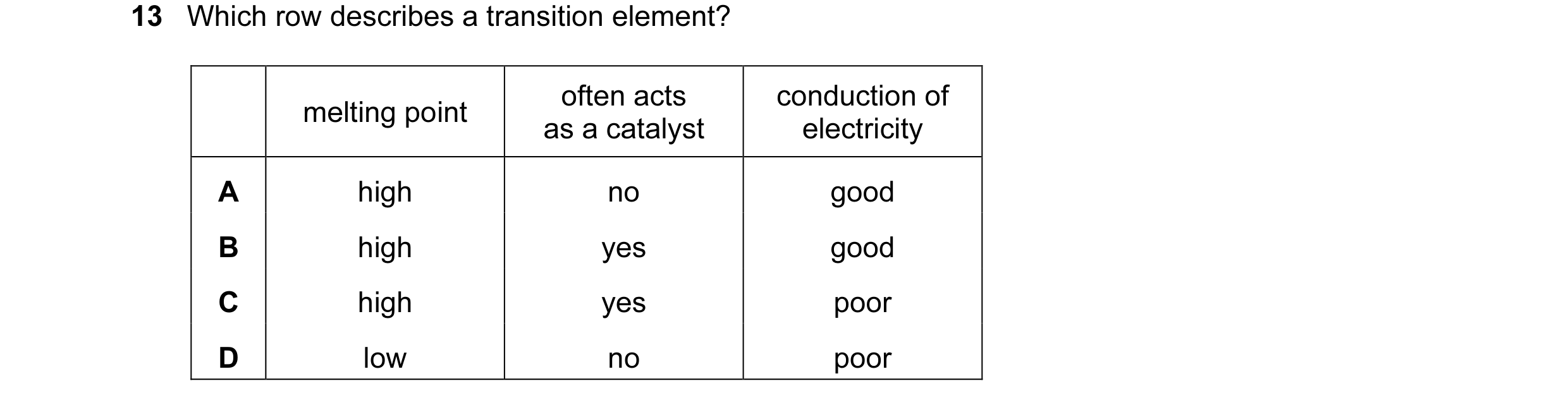
Q6 · Which row describes a transition element? 0652/12 Oct/Nov 2016
13 Which row describes a transition element? often acts conduction of melting point as a catalyst electricity A high no good B high yes good C high yes poor D low no poor
1 marks
Answer: B
This question in 0652/12 Oct/Nov 2016
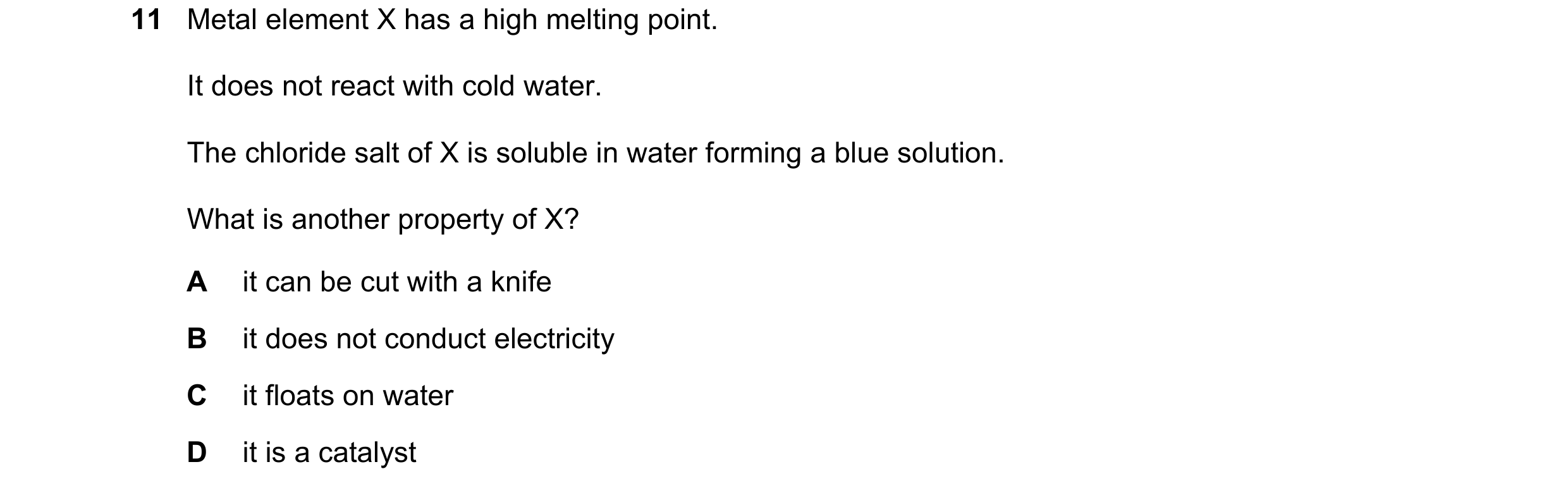
Q7 · Metal element X has a high melting point 0652/11 Oct/Nov 2017
11 Metal element X has a high melting point. It does not react with cold water. The chloride salt of X is soluble in water forming a blue solution. What is another property of X? A it can be cut with a knife B it does not conduct electricity C it floats on water D it is a catalyst
1 marks
Answer: D
This question in 0652/11 Oct/Nov 2017
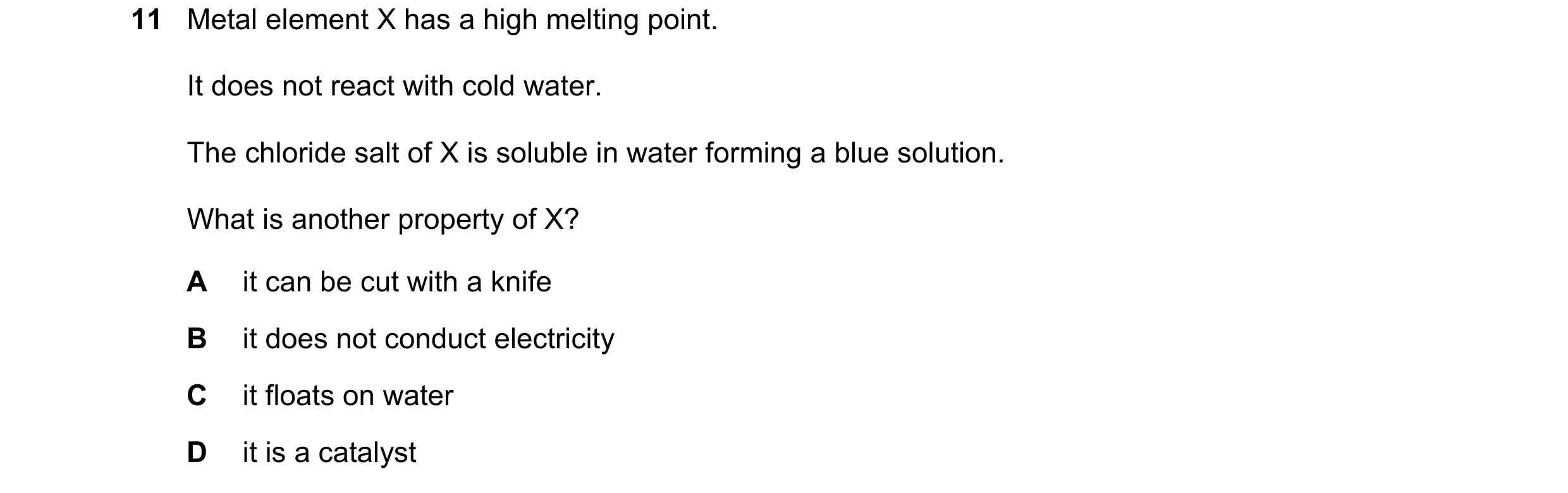
Q8 · Metal element X has a high melting point 0652/12 Oct/Nov 2017
11 Metal element X has a high melting point. It does not react with cold water. The chloride salt of X is soluble in water forming a blue solution. What is another property of X? A it can be cut with a knife B it does not conduct electricity C it floats on water D it is a catalyst
1 marks
Answer: D
This question in 0652/12 Oct/Nov 2017
Q9 · Which row describes the properties of a transition element? 0652/11 Oct/Nov 2021
14 Which row describes the properties of a transition element? melting point density colour of compounds / C g/cm 3 A –210 0.0011 one oxide is brown, but most compounds are colourless B 98 0.97 all the compounds are white C 328 11.34 the iodide is yellow, but most compounds are white D 1535 7.86 most compounds are either green or brown
1 marks
Answer: D
This question in 0652/11 Oct/Nov 2021
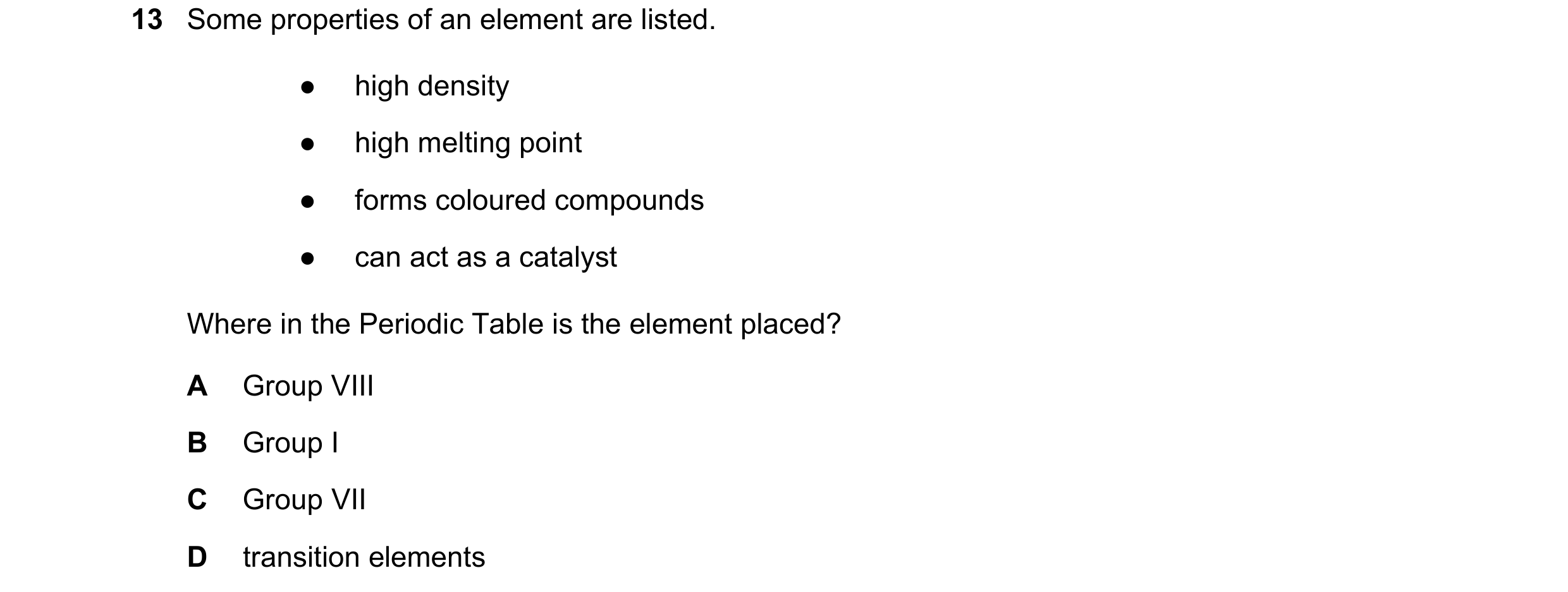
Q10 · Some properties of an element are listed 0652/11 Oct/Nov 2022
13 Some properties of an element are listed. ● high density ● high melting point ● forms coloured compounds ● can act as a catalyst Where in the Periodic Table is the element placed? A Group VIII B Group I C Group VII D transition elements
1 marks
Answer: D
This question in 0652/11 Oct/Nov 2022
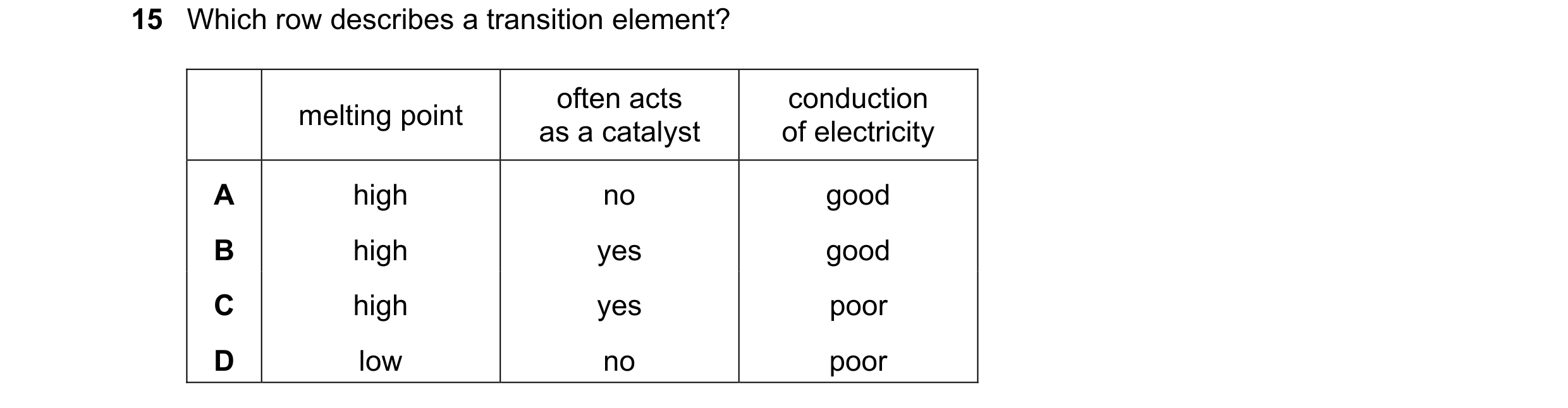
Q11 · Which row describes a transition element? 0652/11 Oct/Nov 2023
15 Which row describes a transition element? often acts conduction melting point as a catalyst of electricity A high no good B high yes good C high yes poor D low no poor
1 marks
Answer: B
This question in 0652/11 Oct/Nov 2023
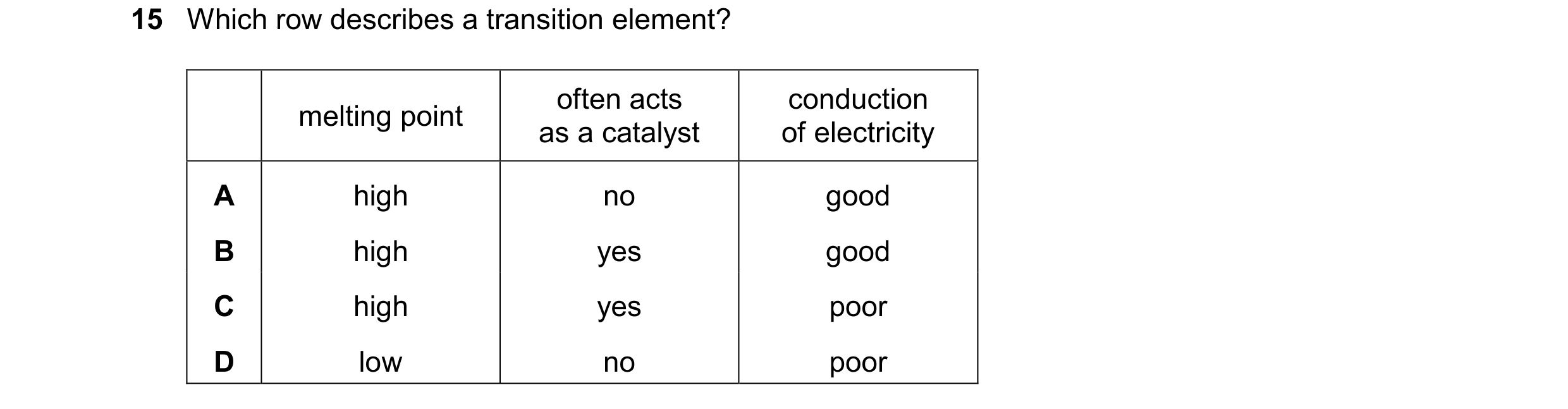
Q12 · Which row describes a transition element? 0652/12 Oct/Nov 2023
15 Which row describes a transition element? often acts conduction melting point as a catalyst of electricity A high no good B high yes good C high yes poor D low no poor
1 marks
Answer: B
This question in 0652/12 Oct/Nov 2023
Q13 · Which statement describes the properties of transition elements? 0652/11 Oct/Nov 2024
14 Which statement describes the properties of transition elements? A They have high densities and high melting points. B They have high densities and low melting points. C They have low densities and high melting points. D They have low densities and low melting points.
1 marks
Answer: A
This question in 0652/11 Oct/Nov 2024
 1 / 4
1 / 4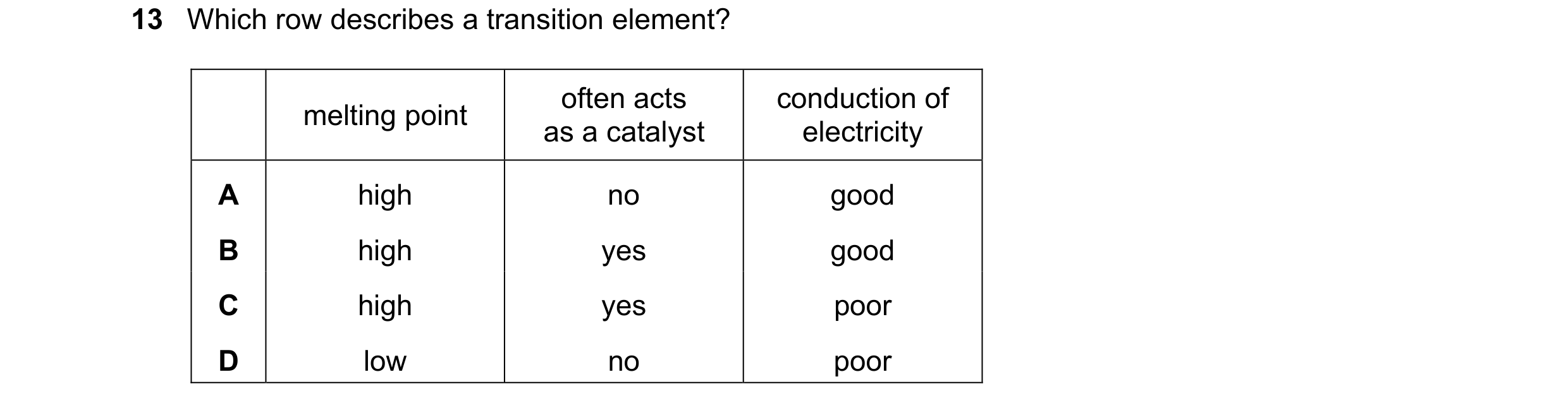
 2 / 4
2 / 4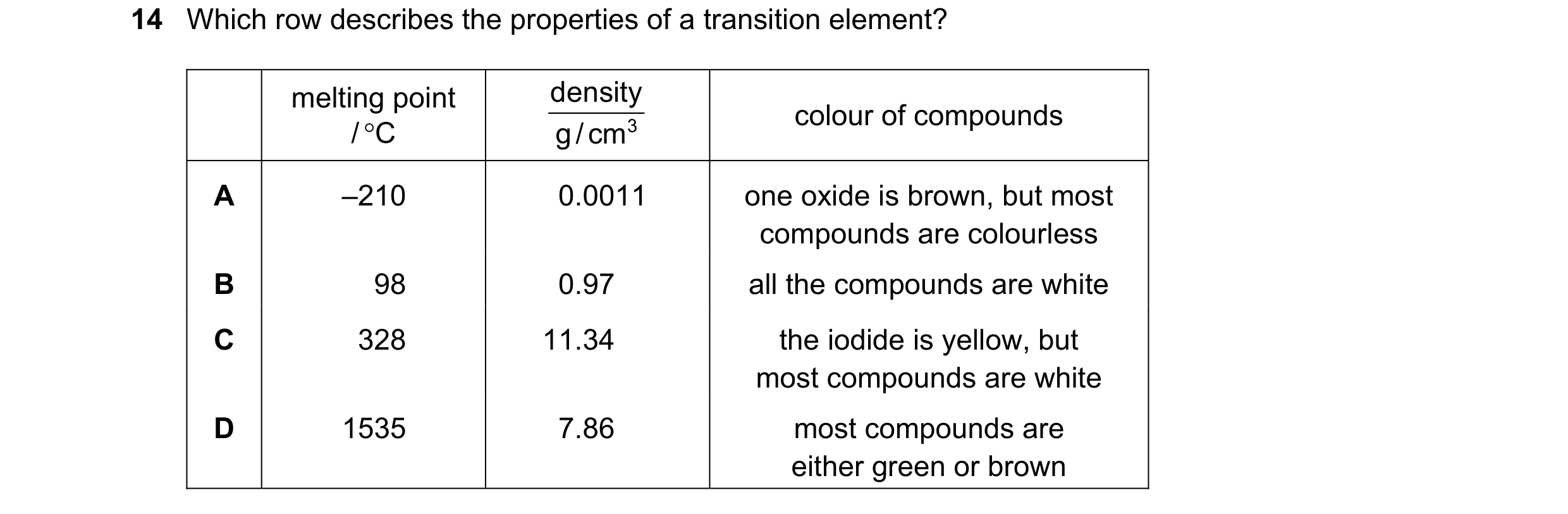
 3 / 4
3 / 4 4 / 4
4 / 4