Questions as text
Q1 · 35 m 1.1 m NOT TO 24 m SCALE D C 2.5 m B A The diagram shows a swimming pool of length 35… 0580/41 Oct/Nov 2005
7 35 m 1.1 m NOT TO 24 m SCALE D C 2.5 m B A The diagram shows a swimming pool of length 35 m and width 24 m. A cross-section of the pool, ABCD, is a trapezium with AD = 2.5 m and BC = 1.1 m. (a) Calculate (i) the area of the trapezium ABCD, [2] (ii) the volume of the pool, [2] (iii) the number of litres of water in the pool, when it is full. [1] (b) AB = 35.03 m correct to 2 decimal places. The sloping rectangular floor of the pool is painted. It costs $2.25 to paint one square metre. (i) Calculate the cost of painting the floor of the pool. [2] (ii) Write your answer to part (b)(i) correct to the nearest hundred dollars. [1] (c) (i) Calculate the volume of a cylinder, radius 12.5 cm and height 14 cm. [2] (ii) When the pool is emptied, the water flows through a cylindrical pipe of radius 12.5 cm. The water flows along this pipe at a rate of 14 centimetres per second. Calculate the time taken to empty the pool. Give your answer in days and hours, correct to the nearest hour. [4]
14 marks
Mark scheme: 7 (a) (i) 1 (2 . 5 + 1 . 1) × 35 o.e. M1 2 63 A1 (ii) their (a) x 24 M1 1512 A1ft (iii) 1512000 B1ft their (a)(ii) x 1000 (b) (i) 35.03 x 24 x 2.25 M1 1891.62… A1 www2 (ii) 1900 B1ft their b(i) rounded to nearest 100 (c) (i) 2 M1 π × 12 . 5 × 14 6870 or better A1 (6872.2339 or 6873.125 (π = 3.142)) (ii) [their (a)(ii) ÷ their (c)(i)] M1 x 1 000 000 A1 o.e. e.g. using litres ÷ (60 x 60 x 24) M1 Implied by 2.54 2 days 13 hours A1 www4 [14]
This question in 0580/41 Oct/Nov 2005
Q2 · NOT TO B C SCALE B C 12 cm 18 cm A O 12 cm A 40 cm E 22 cm D E D Diagram 1 Diagram 2… 0580/41 May/June 2006
2 NOT TO B C SCALE B C 12 cm 18 cm A O 12 cm A 40 cm E 22 cm D E D Diagram 1 Diagram 2 Diagram 1 shows a closed box. The box is a prism of length 40 cm. The cross-section of the box is shown in Diagram 2, with all the right-angles marked. AB is an arc of a circle, centre O, radius 12 cm. ED = 22 cm and DC = 18 cm. Calculate (a) the perimeter of the cross-section, [3] (b) the area of the cross-section, [3] (c) the volume of the box, [1] (d) the total surface area of the box. [4]
11 marks
Mark scheme: 2 (a) π × 24 M1 Arc length = (18.8…) 4 Perimeter = 6 + 22 + 18 + 10 + their arc M1 74.8 to 74.9 (cm) A1 (b) π × 122 M1 Sector area = (113. …) 4 Area = (6 x 22) + (12 x 10) + their sector o.e. M1 365 to 365.2 (cm2) A1 (c) 14600 to 14605 (cm3) B1 (d) their (b) x 2 M1 indep. their (a) x 40 M1 indep. Addition M1 dep. 3720 to 3730 (cm2) A1 11 IGCSE – May/June 2006 0580 and 0581 04
This question in 0580/41 May/June 2006
Q3 · P 13 cm NOT TO SCALE D C E 6 cm A 8 cm B The diagram shows a pyramid on a horizontal… 0580/41 May/June 2006
6 P 13 cm NOT TO SCALE D C E 6 cm A 8 cm B The diagram shows a pyramid on a horizontal rectangular base ABCD. The diagonals of ABCD meet at E. P is vertically above E. AB = 8 cm, BC = 6 cm and PC = 13 cm. (a) Calculate PE, the height of the pyramid. [3] (b) Calculate the volume of the pyramid. [The volume of a pyramid is given by 1 × area of base × height.] [2] 3 (c) Calculate angle PCA. [2] (d) M is the mid-point of AD and N is the mid-point of BC. Calculate angle MPN. [3] (e) (i) Calculate angle PBC. [2] (ii) K lies on PB so that BK = 4 cm. Calculate the length of KC. [3]
15 marks
Mark scheme: 6 (a) (AC =) √(82 + 62) M1 1 M1 dep. (PE =) √(132 – [ their AC]2) 2 12 A1 (b) 1 M1 × 6 × 8 × their PE 3 192 (cm3) A1 (c) their PE M1 their CE their PE sin PCA = (0.92307...) Cos = Tan = 13 13 their CE a.r.t. 67.4° (67.380 … ) A1 (d) theirPE M1 4 tan PME = (71.6°) tan MPE = (18.4°) 4 their PE 180 – 2 x anglePME dep M1 2 x angleMPE 36.8° to 36.9° A1 (e) (i) 3 M1 cos PBC = 13 76.7° (76.6576…) A1 (ii) (KC2 = ) 42 + 62 – 2 x 4 x 6 cos(theirPBC) M1 Square root of correct combination M1 dep on first M1. √40.957... or 6.3998 6.40 (cm) A1 15 IGCSE – May/June 2006 0580 and 0581 04
This question in 0580/41 May/June 2006
Q4 · NOT TO SCALE 0.8 m 0.3 m 1.2 m The diagram shows water in a channel 0580/41 May/June 2007
7 NOT TO SCALE 0.8 m 0.3 m 1.2 m The diagram shows water in a channel. This channel has a rectangular cross-section, 1.2 metres by 0.8 metres. (a) When the depth of water is 0.3 metres, the water flows along the channel at 3 metres/minute. Calculate the number of cubic metres which flow along the channel in one hour. [3] (b) When the depth of water in the channel increases to 0.8 metres, the water flows at 15 metres/minute. Calculate the percentage increase in the number of cubic metres which flow along the channel in one hour. [4] (c) The water comes from a cylindrical tank. When 2 cubic metres of water leave the tank, the level of water in the tank goes down by 1.3 millimetres. Calculate the radius of the tank, in metres, correct to one decimal place. [4] (d) When the channel is empty, its interior surface is repaired. This costs $0.12 per square metre. The total cost is $50.40. Calculate the length, in metres, of the channel. [4]
15 marks
Mark scheme: 7 (a) 1.2 × 0.3 × 3 oe M1 (1.08) or 3 × 60 (180) × 60 oe M1dep × 1.2 × 0.3 (0.36) 64.8 cao A1 www 3 (b) 1.2 × 0.8 × 15 × 60 oe (= 864 seen) M1 Their (a) 8 3 × 5 oe seen Their 864 – their (a) M1ind or their 864 ÷ their (a) × 100 (1333.3..) ÷ their (a) × 100 M1dep subtract 100 (Dep on second M1) 1230 (%) or better (1233.3…) cao A1 www 4 (1330 or 1333.3…www M1M1M0) (c) πr2× figs13 = figs 2 oe M1 2 ÷ 0.0013 M1ind (implied by 1538.46…) 2 2 ( r ) = oe M1dep Dep on M2 (489.7..) π × .00013 22.1 or 22.12 – 22.14 cao A1 www 4 figs 221… imply first M1 (d) 0.8 + 1.2 + 0.8 = (2.8) M1 Accept 2.8 seen 50.40 = area × 0.12 oe M1ind Accept 420 seen Length × their perimeter = their area oe M1 150 cao A1 www 4 [15]
This question in 0580/41 May/June 2007
Q5 · [The surface area of a sphere of radius r is 4πr2 and the volume is 4 πr 3 .] 3 (a) A… 0580/41 Oct/Nov 2007
4 [The surface area of a sphere of radius r is 4πr2 and the volume is 4 πr 3 .] 3 (a) A solid metal sphere has a radius of 3.5 cm. One cubic centimetre of the metal has a mass of 5.6 grams. Calculate (i) the surface area of the sphere, [2] (ii) the volume of the sphere, [2] (iii) the mass of the sphere. [2] (b) NOT TO SCALE h 8 cm 16 cm 16 cm Diagram 1 Diagram 2 Diagram 1 shows a cylinder with a diameter of 16 cm. It contains water to a depth of 8 cm. Two spheres identical to the sphere in part (a) are placed in the water. This is shown in Diagram 2. Calculate h, the new depth of water in the cylinder. [4] (c) A different metal sphere has a mass of 1 kilogram. One cubic centimetre of this metal has a mass of 4.8 grams. Calculate the radius of this sphere. [3]
13 marks
Mark scheme: 4 (a) (i) 4 π 5.3 2 = 153.86 to 153.96 or 154 M1A1 www2 (ii) 4 3 π 5.3 3 = 179.5 to 179. 62 or 180 M1A1 www2 (iii) their (ii)× 5.6 M1 1005 to 1006 or 1008or 1010 (g) A1ft their (ii)× 5.6 correct to 3sf or better (allow in kg) (b) π 82 × 8 (1608-1609) M1 Alt π 8 2 d = 2 × their (ii) M1 2 M1dep 2 π 8 h = 2×their (ii) + π 82 × 8 (2×their (a)(ii)) ÷ (π 8 ) M1dep (2×their (ii) + π 82 × 8 ) ÷( π 8 2 ) M1dep add 8 M1dep 9.78 to 9.79 (cm) A1 www4 (c) 1000 (or 1) ÷4.8 ÷ 43 π M1 49.7….. (or 0.0497) 3 3 M1dep Dep on previous M1 ans (or 10 × ans ) 3.67 to 3.68 (cm) A1 www3 figs 368 or ans 3.7 gets M2 [13] IGCSE – October/November 2007 0580/0581 04
This question in 0580/41 Oct/Nov 2007
Q6 · S C NOT TO SCALE 40° D z° T O 130° x° y° A B A, B, C and D lie on a circle, centre O 0580/41 May/June 2008
7 (a) S C NOT TO SCALE 40° D z° T O 130° x° y° A B A, B, C and D lie on a circle, centre O. SCT is the tangent at C and is parallel to OB. Angle AOB = 130°, and angle BCT = 40°. Angle OBC = x°, angle OBA = y° and angle ADC = z°. (i) Write down the geometrical word which completes the following statement. “ABCD is a quadrilateral.” [1] (ii) Find the values of x, y and z. [3] (iii) Write down the value of angle OCT. [1] (iv) Find the value of the reflex angle AOC. [1] (b) Q 7 cm NOT TO P SCALE X S R 10 cm P, Q, R and S lie on a circle. PQ = 7 cm and SR = 10 cm. PR and QS intersect at X. The area of triangle SRX = 20 cm2. (i) Write down the geometrical word which completes the following statement. “Triangle PQX is to triangle SRX.” [1] (ii) Calculate the area of triangle PQX. [2] (iii) Calculate the length of the perpendicular height from X to RS. [2]
11 marks
Mark scheme: 7 (a) (i) cyclic B1 Condone concyclic (ii) Any one of 40, 45, 50 B1 Angle BCT = 40° is inconsistent with ST Any one of 20, 25, 30 B1 parallel to OB. So different values of Any one of 105, 110, 115 B1 angles x, y, z, OCT and AOC can be arrived at, depending on route taken. (iii) Any one of 80, 85, 90 B1 (iv) Any one of 210, 215, 220, 225, 230 B1 (b) (i) Similar (or enlargement) B1 (ii) 2 2 M1 (0.49), (2.04) 7 10 or o.e. seen 10 7 A1 It is possible to do (iii) then (ii) and full 9.8 (9.79 to 9.81) www2 marks can still be scored (iii) 1 M1 ×10×height = 20 A1 2 [11] 4 www2 IGCSE – May/June 2008 0580, 0581 04
This question in 0580/41 May/June 2008
Q7 · For Examiner's P Use NOT TO SCALE 10 cm 14 cm Q R In triangle PQR, angle QPR is acute, PQ… 0580/41 May/June 2009
3 For Examiner's P Use NOT TO SCALE 10 cm 14 cm Q R In triangle PQR, angle QPR is acute, PQ = 10 cm and PR = 14 cm. (a) The area of triangle PQR is 48 cm2. Calculate angle QPR and show that it rounds to 43.3°, correct to 1 decimal place. You must show all your working. Answer (a) [3] (b) Calculate the length of the side QR. Answer(b) QR = cm [4]
7 marks
Mark scheme: 48 3 (a) (sin P) = o.e. fraction M2 M1 for 0.5 × 10 × 14 sin P = 48 o.e. 5.0 × 10 × 14 Allow 0.5 × 10 × 14 sin 43.3 = 48 for M1 but no further credit P = 43.29…. cao A1 (b) 102 + 142 – 2 × 10 × 14cos 43.3 (= 92.2) M2 If M0, M1 for correct implicit statement Evaluating square root M1 M1 (dependent on M2) for square root of correct combination (not negative) i.e 16cos43.3 (11.64..) implies M2M0 (QR =) 9.6(0) (9.60 to 9.603…) c.a.o. ww2 A1 [7] 250 AB 250
This question in 0580/41 May/June 2009
Q8 · For NOT TO Examiner's D C SCALE Use S R (x + 3) cm x cm A B P Q (2x + 5) cm (x + 4) cm… 0580/41 Oct/Nov 2009
5 For NOT TO Examiner's D C SCALE Use S R (x + 3) cm x cm A B P Q (2x + 5) cm (x + 4) cm The diagram shows two rectangles ABCD and PQRS. AB = (2x + 5) cm, AD = (x + 3) cm, PQ = (x + 4) cm and PS = x cm. (a) For one value of x, the area of rectangle ABCD is 59 cm2 more than the area of rectangle PQRS. (i) Show that x2 + 7x − 44 = 0. Answer(a)(i) [3] (ii) Factorise x2 + 7x − 44. Answer(a)(ii) [2] (iii) Solve the equation x2 + 7x − 44 = 0. Answer(a)(iii) x = or x = [1] (iv) Calculate the size of angle DBA. Answer(a)(iv) Angle DBA = [2] (b) For a different value of x, the rectangles ABCD and PQRS are similar. For Examiner's (i) Show that this value of x satisfies the equation x2 − 2x − 12 = 0. Use Answer(b)(i) [3] (ii) Solve the equation x2 − 2x − 12 = 0, giving your answers correct to 2 decimal places. Answer(b)(ii) x = or x = [4] (iii) Calculate the perimeter of the rectangle PQRS. Answer(b)(iii) cm [1]
16 marks
Mark scheme: 5 (a) (i) (x + 3)(2x + 5) – x(x + 4) = 59 oe M1 2x2 + 6x + 5x + 15 –x2 – 4x = 59 oe A1 Implies M1 (allow 11x for 6x + 5x) x2 + 7x – 44 = 0 E1 Correct conclusion – no errors or omissions (ii) (x + 11)(x – 4) B2 SC1 any other (x + a)(x + b) where a × b = – 44 or a + b = 7 (iii) –11, 4 www ft B1ft Strict ft dep on at least SC1 in (ii) allow recovery if new working seen (iv) (their + ve root ) + 3 Could be alt trig method tan = oe M1 oe M1 where trig function is explicit 2(their + ve root ) + 5 28.3 (00…) ft www2 A1ft ft one of their positive roots (27.4° (27.40 – 27.41) from x = 11) IGCSE – October/November 2009 0580 04 (b) (i) 2 x + 5 x + 3 = oe M1 Must be seen. Allow ratio or correct products x + 4 x x2 + 4x + 3x + 12 = 2x2 + 5x A1 Correct expansion of brackets seen (allow 7x for 4x + 3x) x2 – 2x – 12 = 0 E1 Correct conclusion – no errors or omissions M1 must be seen (ii) 2 In square root B1 for (–2)2 – 4(1)(–12) or better − ( −2 ) ± ( −2) − 41()( −12) B1,B1 p + q p − q 2 )1( If in form or , r r or (x – 1)² –12 – 1 (B1) B1 for – (–2) and 2(1) or better and x – 1 = ± 13 (B1) – 2.61, 4.61 final answers www4 B1,B1 If B0, SC1 for –2.6 and 4.6 or both answers correct to 2 or more dps rot – 2.6055…, 4.6055…. (iii) 26.4 (26.42…. to 26.44….) ft B1ft ft 4 × a positive root + 8 [16]
This question in 0580/41 Oct/Nov 2009
Q9 · For Examiner's Use Diagram 1 Diagram 2 Diagram 3 Diagram 4 The first four Diagrams in a… 0580/43 Oct/Nov 2010
11 For Examiner's Use Diagram 1 Diagram 2 Diagram 3 Diagram 4 The first four Diagrams in a sequence are shown above. Each Diagram is made from dots and one centimetre lines. The area of each small square is 1 cm2. (a) Complete the table for Diagrams 5 and 6. Diagram 1 2 3 4 5 6 Area (cm2) 2 6 12 20 Number of dots 6 12 20 30 Number of one centimetre lines 7 17 31 49 [4] (b) The area of Diagram n is n ( n + )1 cm2. (i) Find the area of Diagram 50. Answer(b)(i) cm2 [1] (ii) Which Diagram has an area of 930 cm2? Answer(b)(ii) [1] (c) Find, in terms of n, the number of dots in Diagram n. Answer(c) [1] (d) The number of one centimetre lines in Diagram n is 2 n 2 + pn + 1 . For Examiner's Use (i) Show that p = 4. Answer(d)(i) [2] (ii) Find the number of one centimetre lines in Diagram 10. Answer(d)(ii) [1] (iii) Which Diagram has 337 one centimetre lines? Answer(d)(iii) [3] (e) For each Diagram, the number of squares of area 1 cm2 is A, the number of dots is D and the number of one centimetre lines is L. Find a connection between A, D and L that is true for each Diagram. Answer(e) [1]
14 marks
Mark scheme: 11 (a) 30 42 4 B3 for 2 correct rows 42 56 or B2 for 1 correct row 71 97 or B1 for any term in column 5 correct (b) (i) 2550 1 (ii) 30 1 (c) (n + 1)(n + 2) oe final ans 1 (d) (i) 2n2 + pn + 1 = t 2 Uses a value of n up to 6 and a matching t from the table e.g. puts n = 3 and t = 31 2 × 3² + 3p + 1 = 31 M1 Correct solution shown with 1 intermediate step to p = 4 E1 OR Use p = 4 to get 2n² + 4n + 1 = 31 and simplifies to 3 term eqn M1 Solve correctly to get n = 3 E1 OR both 2 × 9 + 4 × 3 + 1 (= 31) M1 Conclusion e.g. 31 = 31 E1 with one part evaluated OR n(n + 1) + (n + 1)(n + 2) – 1 Correct simplification to 2n2 + 4n + 1 E1 or better M1 (ii) 241 1 (iii) 12 3 M1 for 2n2 + 4n + 1 = 337 and M1 for (n – 12)(n +14) or correct expression for n using formula (e) L = A + D − 1 oe 1
This question in 0580/43 Oct/Nov 2010
Q10 · For Examiner's 12 cm Use H G NOT TO 6 cm SCALE 14 cm F The diagram shows triangle FGH… 0580/41 May/June 2011
4 (a) For Examiner's 12 cm Use H G NOT TO 6 cm SCALE 14 cm F The diagram shows triangle FGH, with FG = 14 cm, GH = 12 cm and FH = 6 cm. (i) Calculate the size of angle HFG. Answer(a)(i) Angle HFG = [4] (ii) Calculate the area of triangle FGH. Answer(a)(ii) cm2 [2] (b) For Q Examiner's 18 cm Use R NOT TO SCALE 12 cm 117° P The diagram shows triangle PQR, with RP = 12 cm, RQ = 18 cm and angle RPQ = 117°. Calculate the size of angle RQP. Answer(b) Angle RQP = [3]
9 marks
Mark scheme: 6 + 14 − 12 4 (a) (i) (cos (HFG)) = M2 M1 for implicit form 2 × 6 × 14 58.4 (58.41…) A2 A1 for 0.5238… (ii) 0.5 × 6 × 14 × sin (their 58.4) oe M1 ft their (i) 35.8 or 35.77 to 35.78 A1ft Correct or ft their (i) sin(117 ) × 12 (b) (sin (RQP)) = M2 M1 for implicit form 18 36.4 or 36.44... A1 3 k
This question in 0580/41 May/June 2011
Q11 · For F Examiner's Use NOT TO SCALE C D E 14 cm 36 cm A 19 cm B In the diagram, ABCDEF is a… 0580/41 May/June 2011
6 For F Examiner's Use NOT TO SCALE C D E 14 cm 36 cm A 19 cm B In the diagram, ABCDEF is a prism of length 36 cm. The cross-section ABC is a right-angled triangle. AB = 19 cm and AC = 14 cm. Calculate (a) the length BC, Answer(a) BC = cm [2] (b) the total surface area of the prism, Answer(b) cm2 [4] (c) the volume of the prism, Answer(c) cm3 [2] (d) the length CE, Answer(d) CE = cm [2] (e) the angle between the line CE and the base ABED. Answer(e) [3]
13 marks
Mark scheme: 6 (a) 23.6 (23.60…) 2 M1 for 142 + 192 (b) 2300 or 2303 to 2304 cao 4 M3 for 2 × ½ × 14 × 19 + 14 × 36 + 19 × 36 + their BC × 36 M2 for 4 of these added M1 for ½ × 14 × 19 (c) 4788 or 4790 cao 2 M1 their triangle area × 36 (d) 43(.0) or 43.04 to 43.05 cao 2 M1 for (their (a))2 + 362 or 362 + 192 + 142 14 (e) 18.9° to 19.02° cao 3 M2 for inv sin or their CE 14 inv tan 2 2 or 19 + 36 2 2 19 + 36 inv cos or complete longer their CE methods (M1 for clearly identifying angle CEA) IGCSE – May/June 2011 0580 41
This question in 0580/41 May/June 2011
Q12 · Solve 9 I 3n + 6 Y 21 for integer values of n 0580/42 May/June 2011
5 (a) Solve 9 I 3n + 6 Y 21 for integer values of n. For Examiner's Use Answer(a) [3] (b) Factorise completely. (i) 2x2 + 10xy Answer(b)(i) [2] (ii) 3a2 O 12b2 Answer(b)(ii) [3] (c) NOT TO SCALE x cm (x + 17) cm The area of this triangle is 84 cm2. (i) Show that x2 + 17x O 168 = 0. Answer (c)(i) [2] (ii) Factorise x2 + 17x O 168. Answer(c)(ii) [2] (iii) Solve x2 + 17x O 168 = 0. Answer(c)(iii) x = or x = [1] (d) Solve For 15 − x Examiner's = 3 − 2 x. Use 2 Answer(d) x = [3] (e) Solve 2x2 O 5x O 6 = 0. Show all your working and give your answers correct to 2 decimal places. Answer(e) x = or x = [4]
20 marks
Mark scheme: 5 (a) 2, 3, 4, 5 3 M2 for 1 < n ≤ 5 seen (M1 for 1 < n or n ≤ 5 ) Allow 2 ≤n < 6 in M2 or M1 case If 0, B2 for 3 correct with no extras or 4 correct with 1 extra. (b) (i) 2x(x + 5y) 2 B1 for x(2x +10y) or 2(x2 + 5xy) (ii) 3(a – 2b)(a + 2b) 3 B2 for (3a – 6b)(a + 2b) or (a – 2b)(3a + 6b) or correct answer seen in working or B1 for 3(a2 – 4b2) If B0, SC1 for a 2 − b 2 = ( a − 2b )( a + 2b ) (c) (i) ½ x(x + 17) = 84 or M1 Condone ½ x × x + 17 = 84 but only for M mark x ( x + 17 ) = 2 × 84 No errors or omission of brackets anywhere Correct proof of x2 + 17x – 168 = 0 E1 (ii) (x – 7)(x + 24) 2 SC1 for (x + a)(x + b) where a and b are integers and a + b = 17 or ab = – 168 (iii) 7 and –24 ft 1ft Correct or ft from their factors if quadratic (d) – 3 www 3 3 B2 for 15 – 6 = x – 4x oe or better M1 for 15 – x = 2(3 – 2x) or better or 7½ – x/2 = 3 – 2x (e) ( −5) 2 − 4 × 2 × −6 B1 ( 73 ) p + q p − q p = – –5 and r = 2 × 2 B1 Dependent on or r r 5 or ( x − 4 )2 B1 3 + 1625 B1 3.39, –0.89 final answers B1B1 SC1 for 3.4 or 3.386… or 3.39 seen and – 0.9 or – 0.886… or – 0.89 seen IGCSE – May/June 2011 0580 42
This question in 0580/42 May/June 2011
Q13 · For V Examiner's V Use B C NOT TO SCALE B C A D 9.5 cm A D 2.5 cm 2.5 cm F 2.5 cm E F E F… 0580/42 May/June 2011
7 (a) For V Examiner's V Use B C NOT TO SCALE B C A D 9.5 cm A D 2.5 cm 2.5 cm F 2.5 cm E F E F E A solid pyramid has a regular hexagon of side 2.5 cm as its base. Each sloping face is an isosceles triangle with base 2.5 cm and height 9.5 cm. Calculate the total surface area of the pyramid. Answer(a) cm2 [4] (b) O 55° NOT TO 15 cm SCALE A B A sector OAB has an angle of 55° and a radius of 15 cm. Calculate the area of the sector and show that it rounds to 108 cm2, correct to 3 significant figures. Answer (b) [3] (c) For Examiner's Use 15 cm NOT TO SCALE The sector radii OA and OB in part (b) are joined to form a cone. (i) Calculate the base radius of the cone. [The curved surface area, A, of a cone with radius r and slant height l is A = πrl.] Answer(c)(i) cm [2] (ii) Calculate the perpendicular height of the cone. Answer(c)(ii) cm [3] (d) 7.5 cm NOT TO SCALE A solid cone has the same dimensions as the cone in part (c). A small cone with slant height 7.5 cm is removed by cutting parallel to the base. Calculate the volume of the remaining solid. 1 [The volume, V, of a cone with radius r and height h is V = πr2h.] 3 Answer(d) cm3 [3]
15 marks
Mark scheme: 7 (a) 87.5 (87.45 to 87.52) www 4 4 M1 for ½ × 2.5 × 9.5 soi by 11.875 or 71.25 and M2 for ½ × 2.52 × sin60 × 6 oe (16.23 to 16.24) or M1 for ½ × 2.52 × sin60 (2.706..) or 1 trapezium (8.1189..) (b) 107.9 ….. to 108.0…..www3 3 Must see at least 4 figures 55 55 M2 for × π × 152 or M1 for seen 360 360 (c) (i) 2.29 (2.291 to 2.293) www 2 2 M1 for 108 = 15πr oe allow 107.9 to 108.0… for their 108 (ii) 14.8 (14.82 to 14.83) cao www 3 3 M2 for 15 2 − their 2.29 2 (M1 for h 2 + their 2.29 2 = 15 2 ) π (d) 70.9 to 71.5 cao www 3 3 M2 for (their 2.292 × their 14.8 – their 1.1452 3 × their 7.4) (not 15 or 7.5) 7 π or × × their 2.292 × their 14.8 8 3 5.7 3 or M1 for 1/8 oe e.g. 3 or 7/8 or (½ their R 15 and ½ their h) seen
This question in 0580/42 May/June 2011
Q14 · For C Examiner's Use B 26° NOT TO SCALE 79 m 95 m 77° A 120 m D The quadrilateral ABCD… 0580/41 Oct/Nov 2011
6 For C Examiner's Use B 26° NOT TO SCALE 79 m 95 m 77° A 120 m D The quadrilateral ABCD represents an area of land. There is a straight road from A to C. AB = 79 m, AD = 120 m and CD = 95 m. Angle BCA = 26° and angle CDA = 77°. (a) Show that the length of the road, AC, is 135 m correct to the nearest metre. Answer(a) [4] (b) Calculate the size of the obtuse angle ABC. Answer(b) Angle ABC = [4] (c) A straight path is to be built from B to the nearest point on the road AC. For Examiner's Calculate the length of this path. Use Answer(c) m [3] (d) Houses are to be built on the land in triangle ACD. Each house needs at least 180 m2 of land. Calculate the maximum number of houses which can be built. Show all of your working. Answer(d) [4]
15 marks
Mark scheme: 6 (a) 1202 + 952 – 2 × 120 × 95 × cos77 M2 M1 for implicit version 135.26 … or 135.3 E2 A1 for 18295 to 18297 their 135 × sin26 sin B sin26 (b) (sinB ) = M2 M1 for = oe 79 their 135 79 48.5 to 48.7 isw A1 131 or 131.3 to 131.5 www4 B1ft ft for 180 – their 48.5 to 48.7 dep on sine rule or sine used (c) (Angle A =) 22.5 to 22.7 B1ft ft 154 – their (b), also accept angle B = 67.3 to 67.5 (ft their (b) – 64) ‘Path’/79 = sin (their A) oe M1 Dep on B1 and their A < 90 eg 79 cos 67.4 30.2 to 30.5 www3 A1 1 (d) × 120 × 95 × sin 77 oe M1 (5554) 2 Their area ÷ 180 M1 Dep on area attempt 30.8 to 30.9 A1 30 B1ft ft their 30.8 to 30.9 truncated dep on at least M1 earned After M2 answer 30 www scores A1B1 Answer 30 ww scores 0 IGCSE – October/November 2011 0580 41
This question in 0580/41 Oct/Nov 2011
Q15 · A rectangular piece of card has a square of side 2 cm removed from each corner 0580/41 Oct/Nov 2012
8 A rectangular piece of card has a square of side 2 cm removed from each corner. For Examiner's Use 2 cm 2 cm NOT TO SCALE (2x + 3) cm (x + 5) cm (a) Write expressions, in terms of x, for the dimensions of the rectangular card before the squares are removed from the corners. Answer(a) cm by cm [2] (b) The diagram shows a net for an open box. Show that the volume, V cm3, of the open box is given by the formula V = 4x2 + 26x + 30 . Answer(b) [3] (c) (i) Calculate the values of x when V = 75. For Show all your working and give your answers correct to two decimal places. Examiner's Use Answer(c)(i) x = or x = [5] (ii) Write down the length of the longest edge of the box. Answer(c)(ii) cm [1] Question 9 is printed on the next page.
11 marks
Mark scheme: 8 (a) 2x + 7 final answer 2 B1 for each, accept in either order x + 9 final answer After 0 scored allow SC1 mark for both correct but unsimplified (b) 2(2x + 3)(x + 5) at any stage M1 The × 2 could be embedded within one of the brackets e.g. (4x + 6)(x + 5) 2x2 + 3x + 10x + 15 or better B1 Expands brackets correctly 4x2 + 26x + 30 E1 No errors seen and two previous stages shown (c) (i) 4x² + 26x – 45 [= 0] soi B1 − 26 ± ( 26 ) 2 − 4( 4 )( −45) B1 ft ft their 4x² + 26x ± k [k ≠ 0] oe 2 ( 4 ) B1 ft In square root B1 ft for ( 26) 2 − 4( 4)( −45) or better (1396) p+ q p− q If in form or ; r r B1 ft for –26 and 2(4) or better –7.92, 1.42 final answers B1 B1 If B0, SC1 for –7.9 and 1.4 or both answers – 7.920…., 1.420….. or for–7.92 , 1.42 seen (ii) 6.42 [0…] 1 ft ft their greatest positive root If their x ≤ 2 then ft x + 5 If their x > 2 then ft 2x + 3 IGCSE – October/November 2012 0580 41 7
This question in 0580/41 Oct/Nov 2012
Q16 · A metal cuboid has a volume of 1080 cm3 and a mass of 8 kg 0580/43 Oct/Nov 2012
3 A metal cuboid has a volume of 1080 cm3 and a mass of 8 kg. For Examiner's (a) Calculate the mass of one cubic centimetre of the metal. Use Give your answer in grams. Answer(a) g [1] (b) The base of the cuboid measures 12 cm by 10 cm. Calculate the height of the cuboid. Answer(b) cm [2] (c) The cuboid is melted down and made into a sphere with radius r cm. (i) Calculate the value of r. 4 [The volume, V, of a sphere with radius r is V = πr 3.] 3 Answer(c)(i) r = [3] (ii) Calculate the surface area of the sphere. For Examiner's [The surface area, A, of a sphere with radius r is A = 4πr 2.] Use Answer(c)(ii) cm2 [2] (d) A larger sphere has a radius R cm. The surface area of this sphere is double the surface area of the sphere with radius r cm in part (c). R Find the value of . r Answer(d) [2]
10 marks
Mark scheme: 3 (a) 7.407….. or 7.41 1 (b) 9 2 M1 for 1080 ÷ (12 × 10) oe 1080 (c) (i) 6.36 to 6.37 www 3 M2 for 3 4 oe π 3 1080 or M1 for 4 oe [ 257.7 to 258.7] π 3 Accept 4.18 to 4.19 for 4/3 π (ii) 508 to 510 2 M1 for 4 × π × (their (c)(i))2 (d) 2 or 1.41 [1.414…] www 2 Allow over 1 or 2 : 1 etc M1 for (R / r)2 = 2 oe or [R2 =] (2 × their (c)(ii))/4π or [R2 =] 2 × (their (c)(i))²
This question in 0580/43 Oct/Nov 2012
Q17 · For Examiner′s Use NOT TO SCALE 13 cm h 5 cm (a) The diagram shows a cone of radius 5 cm… 0580/41 Oct/Nov 2013
3 For Examiner′s Use NOT TO SCALE 13 cm h 5 cm (a) The diagram shows a cone of radius 5 cm and slant height 13 cm. (i) Calculate the curved surface area of the cone. [The curved surface area, A, of a cone with radius r and slant height l is A = πrl.] Answer(a)(i) … cm2 [2] (ii) Calculate the perpendicular height, h, of the cone. Answer(a)(ii) h = … cm [3] (iii) Calculate the volume of the cone. 1 [The volume, V, of a cone with radius r and height h is V = 3 πr2h.] Answer(a)(iii) … cm3 [2] (iv) Write your answer to part (a)(iii) in cubic metres. Give your answer in standard form. Answer(a)(iv) … m3 [2] (b) For Examiner′s A Use O NOT TO SCALE 13 cm h O 5 cm B The cone is now cut along a slant height and it opens out to make the sector AOB of a circle. Calculate angle AOB. Answer(b) Angle AOB = … [4] _____________________________________________________________________________________
13 marks
Mark scheme: 3 (a) (i) 204 or 204.2 to 204.23 2 M1 for π × 5× 13 implied by answer in range 204.1 to 204.3 (ii) 12 cao 3 M2 for 13 2 − 5 2 or states 5, 12, 13 triangle or M1 for 132 = 52 + h2 or better 1 2 (iii) 314 or 314.1 to 314.2 2 M1 for × π × 5 × their (a) (ii) implied by 3 answer in range 314 to 314.3 (iv) 3.14 × 10⁻⁴ or 3.141 to 2FT FT their (a) (iii) ÷ 1003 correctly evaluated and 3.142 × 10⁻⁴ given in standard form to 3 sig figs or better or M1 FT for their (a) (iii) ÷ 1003 or SC1 for conversion of their m3 into standard form only if negative power 10π (b) 138 or 138.3 to 138.5 4 M3 for × 360 oe or 26π π × 5 × 13 ortheir (a) (i) × 360 oe 2 π × 13 or M2 for a correct fraction without × 360 or M1 for π × 2× 13 oe [81.6 to 81.8] seen or π × 13 2 oe [530.6 to 531.2] seen 2 2
This question in 0580/41 Oct/Nov 2013
Q18 · For Examiner′s D C Use 32° 70 m NOT TO SCALE 40° A B 55 m The diagram shows a school… 0580/41 Oct/Nov 2013
4 For Examiner′s D C Use 32° 70 m NOT TO SCALE 40° A B 55 m The diagram shows a school playground ABCD. ABCD is a trapezium. AB = 55 m, BD = 70 m, angle ABD = 40° and angle BCD = 32°. (a) Calculate AD. Answer(a) AD = … m [4] (b) Calculate BC. Answer(b) BC = … m [4] (c) (i) Calculate the area of the playground ABCD. For Examiner′s Use Answer(c)(i) … m2 [3] (ii) An accurate plan of the school playground is to be drawn to a scale of 1: 200 . Calculate the area of the school playground on the plan. Give your answer in cm2. Answer(c)(ii) … cm2 [2] (d) A fence, BD, divides the playground into two areas. Calculate the shortest distance from A to BD. Answer(d) … m [2] _____________________________________________________________________________________
15 marks
Mark scheme: 4 (a) 45.[0] or 45.01 to 45.02 nfww 4 M2 for 552 + 702 – 2.55.70 cos 40 or M1 for correct implicit equation A1 for 2026. …. (b) 84.9 or 84.90 to 84.92 4 B1 for angle BDC = 40 soi 70 sin (their 40 ) M2 for sin 32 or M1 for correct implicit equation (c) (i) 4060 or 4063 to 4064 nfww 3 1 1 M2 for (55 × 70 sin 40 ) + 2 2 (70 × their (b ) sin (180 − their 40 − 32)) oe or M1 for correct method for one of the triangle areas (ii) 1020 or 1015 to 1016 2FT FT their (c) (i) ÷ 4 oe correctly evaluated or M1 their (c) (i) ÷ figs 4 oe distance (d) 35.4 or 35.35… nfww 2 M1 for sin 40 = or better 55 1 or for (55 × 70 sin 40) = (70 × distance) ÷ 2 2 or better IGCSE – October/November 2013 0580 41
This question in 0580/41 Oct/Nov 2013
Q19 · A rectangular metal sheet measures 9 cm by 7 cm 0580/43 Oct/Nov 2013
3 A rectangular metal sheet measures 9 cm by 7 cm. For Examiner′s A square, of side x cm, is cut from each corner. Use The metal is then folded to make an open box of height x cm. 9 cm NOT TO x cm SCALE 7 cm x cm x cm (a) Write down, in terms of x, the length and width of the box. Answer(a) Length = … Width = … [2] (b) Show that the volume, V, of the box is 4x3 – 32x2 + 63x. Answer(b) [2] (c) Complete this table of values for V = 4x3 – 32x2 + 63x. x 0 0.5 1 1.5 2 2.5 3 3.5 V 0 35 36 30 9 0 [2] (d) On the grid opposite, draw the graph of V = 4x3 – 32x2 + 63x for 0 Y x Y 3.5 . Three of the points have been plotted for you. For V Examiner′s Use 40 35 30 25 20 15 10 5 x 0 0.5 1 1.5 2 2.5 3 3.5 [3] (e) The volume of the box is at least 30 cm3. Write down, as an inequality, the possible values of x. Answer(e) … [2] (f) (i) Write down the maximum volume of the box. Answer(f)(i) … cm3 [1] (ii) Write down the value of x which gives the maximum volume. Answer(f)(ii) … [1] _____________________________________________________________________________________
13 marks
Mark scheme: 3 (a) 9 – 2x, 7 – 2x oe 2 B1 for each, accept in any order (b) x(9 – 2x)(7 – 2x) M1FT 4x3 – 32x2 + 63x A1 Correct expansion and simplification with no errors (c) 24 20 2 B1 for each correct value (d) Correct curve 3 B2FT for 5 correct plots or B1FT for 3 or 4 correct plots (e) 0.65 to 0.75 ≤ x ≤ 2 oe 2 B1 for 0.65 to 0.75 seen (f) (i) 36 to 37 1 (ii) 1.2 to 1.4 1
This question in 0580/43 Oct/Nov 2013
Q20 · Sandra has designed this open container 0580/43 Oct/Nov 2013
6 Sandra has designed this open container. For Examiner′s The height of the container is 35 cm. Use NOT TO SCALE 35 cm The cross section of the container is designed from three semi-circles with diameters 17.5 cm, 6.5 cm and 24 cm. 17.5 cm 6.5 cm NOT TO SCALE (a) Calculate the area of the cross section of the container. Answer(a) … cm2 [3] (b) Calculate the external surface area of the container, including the base. Answer(b) … cm2 [4] (c) The container has a height of 35 cm. For Examiner′s Use Calculate the capacity of the container. Give your answer in litres. Answer(c) … litres [3] (d) Sandra’s container is completely fi lled with water. All the water is then poured into another container in the shape of a cone. The cone has radius 20 cm and height 40 cm. 20 cm NOT TO r SCALE 40 cm h (i) The diagram shows the water in the cone. h Show that r = . 2 Answer(d)(i) [1] (ii) Find the height, h, of the water in the cone. 1 [The volume, V, of a cone with radius r and height h is V = 3 πr 2h.] Answer(d)(ii) h = … cm [3] _____________________________________________________________________________________
14 marks
Mark scheme: 6 (a) 329.7 to 330 3 M2 for ½π(122 + 8.752 – 3.252) oe or M1 for ½π122 or ½π8.752 or ½π3.252 SC2 for answer 1318 to 1320 (b) 2970 or 2967 to 2969.[…] 4 M3 for ½π(24 + 17.5 + 6.5) × 35 + their (a) or M2 for ½π(24 + 17.5 + 6.5) × 35 or M1 for ½π × 24 or ½π × 17.5 or ½π × 6.5 SC3 for 3955 to 3960 dep on SC2 in (a) (c) 11.5 or 11.6 or 11.53 to 11.55 3FT M1 for their (a) × 35 A1 for 11500 or 11530 to 11550 IGCSE – October/November 2013 0580 43 r 20 r h Accept 20 : 40 = r : h leading to 40r = 20h [r = h/2] = = or (d) (i) 1 20 1 r 1 h 40 20 40 = and = 40 2 h 2 their 11545 × 12 (ii) 35.3 or 35.31 to 35.34 3 M2 for 3 oe or 2 × their r π or 1 h 2 M1 for their 11545 = × π × × h oe 3 2 1 2 or their 11545 = × π × r × 2 r oe 3 3 14 − ( − 4 ) 1 5
This question in 0580/43 Oct/Nov 2013
Q21 · S North Scale: 2 cm to 3 km P L In the scale drawing, P is a port, L is a lighthouse and… 0580/41 May/June 2014
5 S North Scale: 2 cm to 3 km P L In the scale drawing, P is a port, L is a lighthouse and S is a ship. The scale is 2 centimetres represents 3 kilometres. (a) Measure the bearing of S from P. Answer(a) … [1] (b) Find the actual distance of S from L. Answer(b) … km [2] (c) The bearing of L from S is 160°. Calculate the bearing of S from L. Answer(c) … [1] (d) Work out the scale of the map in the form 1 : n. Answer(d) 1 : … [2] (e) A boat B is ● equidistant from S and L and ● equidistant from the lines PS and SL. On the diagram, using a straight edge and compasses only, construct the position of B. [5] (f) The lighthouse stands on an island of area 1.5 cm2 on the scale drawing. Work out the actual area of the island. Answer(f) … km2 [2] __________________________________________________________________________________________
13 marks
Mark scheme: 5 (a) [0]44 to [0]48 1 (b) 12.6 to 13.2 2 B1 for 8.4 to 8.8 seen (c) 340 1 (d) 1 : 150 000 2 M1 for × 100 000 soi (e) Arcs for perp bisector of SL 1 Two pairs of correct arcs Ruled perp bisector of SL 1 Within tolerance of overlay Arcs for bisector of angle PSL 1 Marks on PS and SL plus one pair of correct arcs Ruled bisector of angle PSL 1 Within tolerance of overlay B marked within accuracy 1 Within tolerance of overlay Dep on two correct bisectors drawn (f) 3.375 2 M1 for 1.5 × 1.52 or (2/3)2 seen
This question in 0580/41 May/June 2014
Q22 · 8 cm 12 cm NOT TO SCALE 10 cm 4 cm The diagram shows a cylinder with radius 8 cm and… 0580/42 May/June 2014
5 8 cm 12 cm NOT TO SCALE 10 cm 4 cm The diagram shows a cylinder with radius 8 cm and height 12 cm which is full of water. A pipe connects the cylinder to a cone. The cone has radius 4 cm and height 10 cm. (a) (i) Calculate the volume of water in the cylinder. Show that it rounds to 2410 cm3 correct to 3 signifi cant fi gures. Answer(a)(i) [2] (ii) Change 2410 cm3 into litres. Answer(a)(ii) … litres [1] (b) Water fl ows from the cylinder along the pipe into the cone at a rate of 2 cm3 per second. Calculate the time taken to fi ll the empty cone. Give your answer in minutes and seconds correct to the nearest second. 1 [The volume, V, of a cone with radius r and height h is V = πr 2h.] 3 Answer(b) … min … s [4] (c) Find the number of empty cones which can be fi lled completely from the full cylinder. Answer(c) … [3] __________________________________________________________________________________________
10 marks
Mark scheme: 5 (a) (i) 2412 to 2413.… B2 Must be at least 4 figures shown M1 for π × 8 2 × 12 oe (ii) 2.41[0] B1 (b) 1 min 24 s 4 B3 for 83.76 to 83.8[0] or 84 or 1.396 to 1.397 or 1.4 or 1 min 23.76 to 1 min 23.8 seen or M2 for 13 π × 4 2 × 10 ÷ 2 [ 80/3π ] or M1 for 13 π × 4 2 × 10 [160/3π or 167.5 to 167.6] 2410 or (c) 14 3 M1 for 1 2 3 π × 4 × 10 2410 their cone vol from part ( b ) A1 for 14.3 to 14.4….
This question in 0580/42 May/June 2014
Q23 · A P NOT TO SCALE 56° 6.5 cm 8 cm 8 cm x O C B Q The diagram shows a triangle and a sector… 0580/43 Oct/Nov 2014
7 A P NOT TO SCALE 56° 6.5 cm 8 cm 8 cm x O C B Q The diagram shows a triangle and a sector of a circle. In triangle ABC, AB = AC = 8 cm and angle BAC = 56°. Sector OPQ has centre O, sector angle x and radius 6.5 cm. (a) Show that the area of triangle ABC is 26.5 cm2 correct to 1 decimal place. Answer(a) [2] (b) The area of sector OPQ is equal to the area of triangle ABC. (i) Calculate the sector angle x. Answer(b)(i) … [3] (ii) Calculate the perimeter of the sector OPQ. Answer(b)(ii) … cm [3] (c) The diagram shows a sector of a circle, radius r cm. NOT TO SCALE r cm 30° 1 2 1 (i) Show that the area of the shaded segment is r π - 1 cm2. 4 3 ` j Answer(c)(i) [4] (ii) The area of the segment is 5 cm2. Find the value of r. Answer(c)(ii) r = … [3] __________________________________________________________________________________________
15 marks
Mark scheme: 1 7 (a) × 8 × 8 × sin 56 oe M1 or [½ × 2] 8sin28 × 8cos28 or [½ × 2] × 7.06… × 2 3.75… 26.52 to 26.53 A1 (b) (i) 72.[0] or 71.87 to 72.0 3 M2 for 26.5/( π × 5.6 2 ) × 360 oe x 2 or M1 for ×π × 5.6 = 265. or better 360 their (b)(i) (ii) 21.1 or 21.2 or 21.14 to 21.17 3 M2 for ×π × 2 × 5.6 + 2 × 6.5 oe 360 their (b)(i) their (a) or M1 for ×π × 2 × 5.6 oe or 360 5.0 × 5.6 30 2 1 2 30 2 1 2 (c) (i) × π × r − × r × sin 30 oe M2 M1 for × π × r or × r × sin 30 360 2 360 2 1 2 1 2 ×π × r − × r A1 12 4 1 2 1 r π −1 A1 Dep on M2 A1 and no errors seen 4 3 5 (ii) 20.6 or 20.7 or 20.55 to 20.71 3 M2 for [r2 =] 1 ( 1 π − )1 4 3 or M1 for one correct rearrangement step to r 1 2 1 from r π −1 = 5 4 3
This question in 0580/43 Oct/Nov 2014
Q24 · X NOT TO 5.4 cm SCALE 62° Y 16 cm Z Show that the area of triangle XYZ is 38.1 cm2… 0580/42 Feb/March 2015
5 (a) X NOT TO 5.4 cm SCALE 62° Y 16 cm Z Show that the area of triangle XYZ is 38.1 cm2, correct to 1 decimal place. Answer(a) [2] (b) NOT TO 48° SCALE 6.7 cm x° 8.4 cm Calculate the value of x. Answer(b) x = … [4] (c) North A NOT TO SCALE P B Ship A is 180 kilometres from port P on a bearing of 063°. Ship B is 245 kilometres from P on a bearing of 146°. Calculate AB, the distance between the two ships. Answer(c) … km [5] __________________________________________________________________________________________
11 marks
Mark scheme: 5 (a) 1 × 16 × 4.5 × sin 62 oe M1 2 A1 38.14... 7.6 × sin 48 (b) 95.6 or 95.64 to 95.65 4 M2 for 4.8 or M1 for implicit form and M1dep for 180 − 48 − their 36.4 (c) 286 or 285.7 to 285.8 5 B1 for [Angle APB=] 83° M2 for 180 2 + 245 2 − 2 × 180 × 245 × cos their 83 or M1 for implicit form and A1 for [AB2 =] 81676[.1...] After 0 scored, SC2 for ans 406.87 to 406.88 or 406.9 or 407 if 146° used in cos rule Or SC1 for 180 2 + 245 2 − 2 × 180 × 245 × cos 146 4
This question in 0580/42 Feb/March 2015
Q25 · The total surface area of a cone is given by the formula A = πrl + πr2 0580/43 May/June 2015
7 (a) The total surface area of a cone is given by the formula A = πrl + πr2. (i) Find A when r = 6.2 cm and l = 10.8 cm. Answer(a)(i) … cm2 [2] (ii) Rearrange the formula to make l the subject. Answer(a)(ii) l = … [2] (b) (i) Irina walks 10 km at 4 km/h and then a further 8 km at 5 km/h. Calculate Irina’s average speed for the whole journey. Answer(b)(i) … km/h [3] (ii) Dariella walks x km at 5 km/h and then runs (x + 4) km at 10 km/h. The average speed of this journey is 7 km/h. Find the value of x. Show all your working. Answer(b)(ii) x = … [5] (c) (i) Priyantha sells her model car for $19.80 at a profit of 20%. Calculate the original price of the model car. Answer(c)(i) $ … [3] (ii) Dev sells his model car for $x at a profit of y %. Find an expression, in terms of x and y, for the original price of this model car. Write your answer as a single fraction. Answer(c)(ii) $ … [3]
18 marks
Mark scheme: 27 (a) (i) 331 or 331.1 to 331.2 2 M1 for π × 2.6 × 10⁸. + π × 2.6 A − π r 2 (ii) oe final answer 2 M1 for correct re-arrangement isolating term π r in l M1 for correct division by π r 10 8 (b) (i) 4.39 or 4.390… 3 M2 for 18 ÷ + 4 5 10 8 or M1 for or 4 5 (ii) x + x + 4 oe B1 Must be seen x x + 4 or B1 Must be seen 5 10 x + x + 4 = 7 oe M2 or M1 for evidence of total distance ÷ their x x + 4 + total time 5 10 12 B1 20 (c) (i) 16.5[0] final answer 3 M2 for 19.8 ÷ + 1 oe 100 or M1 for evidence of (100 + 20)% associated with 19.8 100 x x x (ii) final answer 3 B2 for or oe 100 + y y 1+ .001 y 1 + 100 y or B1 for 1 + or 100 + y or 1 + 0.01y 100 seen Qu Answers Mark Part Marks ( )
This question in 0580/43 May/June 2015
Q26 · A cylindrical tank contains 180 000 cm3 of water 0580/43 May/June 2015
8 (a) A cylindrical tank contains 180 000 cm3 of water. 45 cm The radius of the tank is 45 cm. NOT TO SCALE Calculate the height of water in the tank. Answer(a) … cm [2] (b) D C NOT TO 70 cm SCALE 40 cm 150 cm A 50 cm B The diagram shows an empty tank in the shape of a horizontal prism of length 150 cm. The cross section of the prism is an isosceles trapezium ABCD. AB = 50 cm, CD = 70 cm and the vertical height of the trapezium is 40 cm. (i) Calculate the volume of the tank. Answer(b)(i) … cm3 [3] (ii) Write your answer to part (b)(i) in litres. Answer(b)(ii) … litres [1] (c) The 180 000 cm3 of water flows from the tank in part (a) into the tank in part (b) at a rate of 15 cm3/s. Calculate the time this takes. Give your answer in hours and minutes. Answer(c) … h … min [3] (d) D 70 cm C x cm NOT TO F E SCALE 40 cm h cm A 50 cm B The 180 000 cm3 of water reaches the level EF as shown above. EF = x cm and the height of the water is h cm. (i) Using the properties of similar triangles, show that h = 2(x – 50). Answer(d)(i) [2] (ii) Using h = 2(x – 50), show that the shaded area, in cm2, is x2 – 2500. Answer(d)(ii) [1] (iii) Find the value of x. Answer(d)(iii) x = … [2] (iv) Find the value of h. Answer(d)(iv) h = … [1]
15 marks
Mark scheme: 28 (a) 28.3 or 28.29… 2 M1 for 180 000 ÷ (π × 45 ) 1 (b) (i) 360 000 3 M2 for (70 + 50 ) × 40 × 150 oe 2 1 or M1 for (70 + 50 ) × 40 oe 2 or their area of ABCD × 150 dependent on their area being two dimensional (ii) 360 1FT FT their (b)(i) ÷ 1000 (c) 3 h 20 min 3 M2 for 180 000 ÷ 15 ÷ 60 (implied by 200) or M1 for 180 000 ÷ 15 (implied by 12000) or correct conversion of their seconds into h and min h 12 ( x − 50 ) (d) (i) = oe M1 i.e. a correct statement from similar figures 40 10 which must contain h, x and numbers h = 2 ( x − 50 ) A1 Answer established with at least one more step and no errors or omissions 1 (ii) ( x + 50 ) 2( x − 50) M1 2 2 − 2500) ×150 = 180 000 or better (iii) 60.8 or 60.82 to 60.83 2 M1 for ( x (iv) 21.7 or 21.65 to 21.66 1FT FT for 2(their (d)(iii) – 50) evaluated only if x > 50 Qu Answers Mark Part Marks 2 13
This question in 0580/43 May/June 2015
Q27 · The scale drawing shows the positions of three towns A, B and C on a map 0580/41 Oct/Nov 2015
7 The scale drawing shows the positions of three towns A, B and C on a map. The scale of the map is 1 centimetre represents 10 kilometres. C North A North Scale: 1 cm to 10 km B (a) Find the actual distance AB. Answer(a) … km [1] (b) Measure the bearing of A from B. Answer(b) … [1] (c) Write the scale 1 cm to 10 km in the form 1 : n. Answer(c) 1 : … [1] (d) A national park lies inside the triangle ABC. The four boundaries of the national park are • equidistant from C and B • equidistant from AC and CB • 15 km from CB • along AB. On the scale drawing, shade the region which represents the national park. Leave in your construction arcs. [7] (e) On the scale drawing, a lake inside the national park has area 0.4 cm2. Calculate the actual area of the lake. Answer(e) … km2 [2] __________________________________________________________________________________________
12 marks
Mark scheme: 7 (a) 123 to 127 1 (b) 288 to 292 1 (c) [1:] 1 000 000 1
This question in 0580/41 Oct/Nov 2015
Q28 · A NOT TO SCALE B D C The diagram shows a tent ABCD 0580/42 Oct/Nov 2015
4 A NOT TO SCALE B D C The diagram shows a tent ABCD. The front of the tent is an isosceles triangle ABC, with AB = AC. The sides of the tent are congruent triangles ABD and ACD. (a) BC = 1.2 m and angle ABC = 68°. Find AC. Answer(a) AC = … m [3] (b) CD = 2.3 m and AD = 1.9 m. Find angle ADC. Answer(b) Angle ADC = … [4] (c) The floor of the tent, triangle BCD, is also an isosceles triangle with BD = CD. Calculate the area of the floor of the tent. Answer(c) … m2 [4] (d) When the tent is on horizontal ground, A is a vertical distance 1.25 m above the ground. Calculate the angle between AD and the ground. Answer(d) … [3]
14 marks
Mark scheme: 6.0 4 (a) 1.6[0] or 1.601 to 1.602 3 M2 for oe cos 68 6.0 or M1 for cos 68 = AC 9.1 2 + 3.2 2 − their6.1 2 (b) 43.5 or 43.6 or 43.49 to 43.56 4 M2 for 2 × 9.1 × 3.2 or M1 for implicit statement A1 for [cos = ] 0.724 to 0.726 1 (c) 1.33 or 1.332...nfww 4 M2 for 3.22 − ( × 2.1 )2 2 or M1 for 3.22 = h 2 + (5.0 × 2.1 )2 and M1 for 12 × 2.1 × their .222 (their 2.22 must come from attempt at Pythag or from trig in triangle BCD) .125 (d) oe 41.1 or 41.13 to 41.14 3 M2 for sin = 9.1 or M1 for correct angle identified
This question in 0580/42 Oct/Nov 2015
Q29 · The area of shape ABCDEF is 24 cm2 0580/42 Oct/Nov 2015
5 (a) The area of shape ABCDEF is 24 cm2. All lengths are in centimetres. 3x – 9 F E 2x NOT TO C SCALE D 3x + 13 A 4x B (i) Show that 5x 2 + 17x - 12 = 0 . Answer(a)(i) [3] (ii) Solve, by factorising, the equation 5x 2 + 17x - 12 = 0 . You must show all your working. Answer(a)(ii) x = … or x = … [3] (b) Solve the simultaneous equations. You must show all your working. 3x – 2y = 23 –4x – y = –5 Answer(b) x = … y = … [3] (c) Solve the equation. 2 ^t + 3h t - = 1 t t + 3 Answer(c) t = … [5]
14 marks
Mark scheme: 5 (a) (i) 4 x (3 x + 13 ) − 2 x (4 x − {3 x − 9}) = 24 M1 oe 12 x 2 + 52 x − 2 x 2 − 18 x M1 Correct removal of all their brackets Dep on two areas added or subtracted 5 x 2 + 17 x − 12 = 0 A1 with no errors or omissions seen and at least one more line of working showing collection of like terms or division by 2 (ii) (5 x − 3 )( x + 4 ) [= 0] M2 M1 for (5 x + a )( x + b ) where ab = −12 or 5b + a = 17 [a, b integers] 3 A1 If zero scored SC1 for correct answers with no oe , − 4 5 working or from other methods. (b) For correctly eliminating one M1 variable x = 3 A1 SC1 if no working shown, but 2 correct answers y = − 7 A1 given If zero scored SC1 for 2 values satisfying one of the original equations (c) t = − 2 nfww 5 M1 for 2(t + 3)(t + 3) − t 2 or better seen M1 for denominator[s] t (t + 3 ) isw or for t (t + 3 ) isw on RHS M1dep for 2t 2 + 12 t + 18 − t 2 = t 2 + 3t oe dependent on both numerators and denominator expanding to give quadratics A1 for 9t + 18 = 0 oe
This question in 0580/42 Oct/Nov 2015
Q30 · The cost of a loaf of bread is x cents 0580/43 Oct/Nov 2015
7 (a) The cost of a loaf of bread is x cents. The cost of a cake is (x – 5) cents. The total cost of 6 loaves of bread and 11 cakes is $13.56 . Find the value of x. Answer(a) x = … [4] (b) NOT TO y + 1 SCALE y y + 3 2y + 1 The area of the rectangle and the area of the triangle are equal. Find the value of y. Answer(b) y = … [4] (c) The cost of a bottle of water is (w – 1) cents. The cost of a bottle of milk is (2w – 11) cents. A certain number of bottles of water costs $4.80 . The same number of bottles of milk costs $7.80 . Find the value of w. Answer(c) w = … [4] (d) NOT TO u cm SCALE t (3u – 2) cm The area of the triangle is 2.5 cm2. (i) Show that 3u2 – 2u – 5 = 0. Answer(d)(i) [2] (ii) Factorise 3u2 – 2u – 5. Answer(d)(ii) … [2] (iii) Find the size of angle t. Answer(d)(iii) t = … [3] __________________________________________________________________________________________
19 marks
Mark scheme: 7 (a) 83 nfww 4 B3 for 17x = 1411 or 17x = 14.11 oe in form ax = b or final answer of 0.83 or B2 for 6x + 11x – 55 = 1356 oe or 6x + 11x –[0.] 55 = 13[.]56 or M1 for 6x + 11(x – [0.0]5) = 13[.]56 1 1 (b) oe nfww 4 M1 for y ( y + )3 oe or ( 2 y + 1)( y + )1 oe 3 2 and B2 for 2 y 2 + 6 y = 2 y 2 + 2 y + y + 1 oe or better or B1 for ( 2 y + 1)( y + )1 = 2 y 2 + 2 y + y + 1 soi 4[.]80 7[.]80 (c) 25 nfww 4 M1 for or w − 1 2 w − 11 4[.]80 7[.]80 M1 for = oe w − 1 2 w − 11 M1 for 480 ( 2 w − 11) = 780 ( w − )1 oe or ALT M1 for n ( w − )1 = 4[.]80 or n ( 2 w − 11) = 7[.]80 M1 for 2 wn − 11n = 7[.]80 2 wn −n2 = 9[.]60 oe M1 for 9 n = 180 oe or better or ALT M1 for n ( w − )1 = 4[.]80 or n ( 2 w − 11) = 7[.]80 4[.]80 + n 7[.]80 + 11n M1 for = n 2 n M1 for 9 n = 180 oe or better 1 1 (d) (i) u (3u − 2) = 2.5 M1 First step must involve u (3u − 2) 2 2 One further correct step leading to 3u 2 −u2 − 5 = 0 with no errors A1 (ii) (3u − 5)(u + )1 2 SC1 for (3u + a )(u + b ) where ab = − 5 or a + 3b = − 2 [a, b integers] their 53 (iii) 29.1 or 29.05… 3 M2 for tan = 3 × their 53 − 2 or M1 for substituting their positive value of u into [u and] 3u – 2
This question in 0580/43 Oct/Nov 2015
Q31 · D 180 m North C NOT TO 85° SCALE 240 m A 50° B The diagram shows a field, ABCD 0580/42 Oct/Nov 2016
3 D 180 m North C NOT TO 85° SCALE 240 m A 50° B The diagram shows a field, ABCD. AD = 180 m and AC = 240 m. Angle ABC = 50° and angle ACB = 85°. (a) Use the sine rule to calculate AB. AB = … m [3] (b) The area of triangle ACD = 12 000 m2. Show that angle CAD = 33.75°, correct to 2 decimal places. [3] (c) Calculate BD. BD = … m [5] (d) The bearing of D from A is 030°. Find the bearing of (i) B from A, … [1] (ii) A from B. … [2]
14 marks
Mark scheme: 240sin85 sin50 sin85 3 (a) M2 or M1 for = oe sin50 240 AB 312 or 312.1 …. B1 1 (b) × 180 × 240 × sin A = 12000 M1 2 24000 33.748 to 33.749 A2 A1 for sin = or better or 0.555 or 0.556 43200 or 0.5 or 0.5555 to 0.5556 (c) 328 or 328.3 to 328.5 5 B1 for [angle A =] 78.75 seen M2 for 180 2 + (their AB ) 2 −×2 180 × their AB × cos78.75 180 2 + (theirAB ) 2 − x 2 or M1 for cos78.75 = 2 × 180 × (theirAB ) A1 for 107 800 to 107 900 (d) (i) 108.75 or 108.7 or 108.8 1 (ii) 288.75 or 288.7 or 288.8 2FT FT 180 + their (d)(i) M1 for 180 + their (d)(i) or 360 – (180 – their(d)(i))
This question in 0580/42 Oct/Nov 2016
Q32 · The perimeter of each of the three shapes is 60 cm 0580/42 Oct/Nov 2016
10 The perimeter of each of the three shapes is 60 cm. Find x in each part. (a) NOT TO Rectangle x SCALE 3x x = … cm [2] (b) NOT TO Triangle 3x SCALE 4x x = … cm [3] (c) Sector x NOT TO SCALE O x x = … cm [3]
8 marks
Mark scheme: 10 (a) 7.5 2 M1 for 3x + x + 3x + x = 60 oe (b) 5 3 B2 for 3x + 4x + 5x [= 60] or better or M1 for (3 x ) 2 + (4 x ) 2 oe 90 (c) 16.8 or 16.80…. 3 M2 for x + x + × π × 2 × x [ = 60] oe 360 90 or M1 for × π × 2 × x oe 360
This question in 0580/42 Oct/Nov 2016
Q33 · Q B 525 m 104° NOT TO 872 m SCALE A C ABC is a triangular field on horizontal ground 0580/43 May/June 2017
9 Q B 525 m 104° NOT TO 872 m SCALE A C ABC is a triangular field on horizontal ground. There is a vertical pole BQ at B. AB = 525 m, BC = 872 m and angle ABC = 104°. (a) Use the cosine rule to calculate the distance AC. AC = … m [4] (b) The angle of elevation of Q from C is 1.0°. Showing all your working, calculate the angle of elevation of Q from A. … [4] (c) (i) Calculate the area of the field. … m2 [2] (ii) The field is drawn on a map with the scale 1 : 20 000. Calculate the area of the field on the map in cm2. … cm2 [2]
12 marks
Mark scheme: 9(a) 1120 or 1121. … 4 M2 for [ AC 2 =] 5252 + 8722 − 2×525×872×cos 104 or M1 for implicit version A1 for 1 257 000 to 1 258 000 9(b) [QB or x =] 872 × tan 1 seen M2 QB M1 for tan 1 = 872 tan = their QB ÷ 525 M1 1.7 or 1.660 to 1.661 nfww A1 dep on M3 9(c)(i) 222 000 or 222 100. … or 222 101 2 1 M1 for × 525 × 872 × sin104 2 9(c)(ii) 5.55 or 5.550 to 5.553 nfww 2FT FT their (c)(i) × 1002 ÷ 20 0002 M1 for their (c)(i) × 1002 ÷ 20 0002 or restart
This question in 0580/43 May/June 2017
Q34 · In this question, all measurements are in metres 0580/42 May/June 2018
7 In this question, all measurements are in metres. 6 NOT TO x SCALE 2x – 3 The diagram shows a right-angled triangle. (a) Show that 5x2 - 12x - 27 = 0. [3] (b) Solve 5x2 - 12x - 27 = 0. Show all your working and give your answers correct to 2 decimal places. x = … or x = … [4] (c) Calculate the perimeter of the triangle. … m [2] (d) Calculate the smallest angle of the triangle. … [2]
11 marks
Mark scheme: 7(a) x2 + (2x – 3)2 = 62 oe M1 or x2 + 4x2 – 6x – 6x + 9 = 36 4x2 – 6x – 6x + 9 or better B1 5x2 – 12x – 27 = 0 A1 Dep on M1B1 with no errors or omissions 7(b) 2 B2 2 −−( 12) ± ( − 12) − 4(5)( − 27) B1 for ( −12) − 4(5)( −27) or for 2 × 5 2 12 or better x − oe 10 −−( 12) + q −−( 12) − q 2 12 12 27 or oe or oe or ± + 2 × 5 2 × 5 10 10 5 or both – 1.42, 3.82 final answers B2 B1 for each If B0, SC1 for answers – 1.4 or –1.415… to – 1.415 and 3.8 or 3.815 to 3.815… or answers –1.41 and 3.81 or – 1.42 and 3.82 seen in working or for –3.82 and 1.42 as final ans 7(c) 14.4 or 14.5 or 14.44 to 14.46 2 2FT for 3 × their positive root + 3 evaluated to 3sf or better M1 for 3 × their positive root + 3 oe 7(d) 39.5 or 39.46 to 39.54… 2 M1 for trig statement seen to find either angle their x their (2 x − 3) sin = oe or sin = oe 6 6
This question in 0580/42 May/June 2018
Q35 · The diagram shows a right-angled triangle ABC 0580/42 Oct/Nov 2018
4 The diagram shows a right-angled triangle ABC. B NOT TO SCALE 4(x – 1) cm A C (2x + 5) cm The area of this triangle is 30 cm2. (a) Show that 2x2 + 3x – 20 = 0. [3] (b) Use factorisation to solve the equation 2x2 + 3x – 20 = 0. x = … or x = … [3] (c) Calculate BC. BC = … cm [3]
9 marks
Mark scheme: 4(a) 1 M1 × 4(x – 1) × (2x + 5)[sin 90] = 30 2 oe 8x2 – 8x + 20x – 20 or better B1 correct expansion of brackets Completion to 2x2 + 3x – 20 = 0 A1 with no errors or omissions seen 4(b) (2x – 5)(x + 4) M2 Allow M2 for e.g. 2x(x + 4) – 5(x + 4) then 2x – 5[= 0] and x + 4[= 0] M1 for 2x(x + 4) – 5(x + 4) or x(2x – 5) + 4(2x – 5) or (2x + a)(x + b) [= 0] where ab = – 20 or a + 2b = 3 [a, b integers] 2.5 and –4 cao B1 4(c) 11.7 or 11.66 … or 11.67 3 M2dep for (4(their 2.5 − 1)) 2 + (2 × their 2.5 + 5) 2 or M1dep for 4( their 2.5 − 1) or 2 × their 2.5 + 5 OR B1 for 20 x 2 − 12 x + 41 and M1dep for substituting x = their 2.5 into 20 x 2 − 12 x + 41 at any stage
This question in 0580/42 Oct/Nov 2018
Q36 · The diagram shows the speed−time graph for part of a journey for two people, a runner and… 0580/42 Oct/Nov 2018
6 The diagram shows the speed−time graph for part of a journey for two people, a runner and a walker. Runner 3.0 NOT TO Speed SCALE (m/s) Walker 1.2 0 0 3 15 19 Time (t seconds) (a) Calculate the acceleration of the runner for the first 3 seconds. … m/s2 [1] (b) Calculate the total distance travelled by the runner in the 19 seconds. … m [3] (c) The runner and the walker are travelling in the same direction along the same path. When t = 0, the runner is 10 metres behind the walker. Find how far the runner is ahead of the walker when t = 19. … m [3]
7 marks
Mark scheme: 6(a) 0.6 1 6(b) 50.7 3 1 M2 for 1.2 × 19 + (19 + 12) × 1.8 oe 2 or M1 for method for finding any relevant area 6(c) 17.9 3 M2 for their 50.7 – 1.2 × 19 [– 10] oe or M1 for 1.2 × 19 oe seen isw
This question in 0580/42 Oct/Nov 2018
Q37 · The lake behind a dam has an area of 55 hectares 0580/42 Oct/Nov 2018
10 (a) The lake behind a dam has an area of 55 hectares. When the gates in the dam are open, water flows out at a rate of 75 000 litres per second. (i) Show that 90 million litres of water flows out in 20 minutes. [1] (ii) Beneath the surface, the lake has vertical sides. Calculate the drop in the water level of the lake when the gates are open for 20 minutes. Give your answer in centimetres. [1 hectare = 104 m2, 1000 litres = 1 m3] … cm [3] (iii) 8.5 m NOT TO SCALE 76° The cross-section of a gate is a sector of a circle with radius 8.5 m and angle 76°. Calculate the perimeter of the sector. … m [3] (b) NOT TO 36 cm SCALE 10 cm A solid metal cone has radius 10 cm and height 36 cm. (i) Calculate the volume of this cone. 1 [The volume, V, of a cone with radius r and height h is V = r r 2h.] 3 … cm3 [2] (ii) The cone is cut, parallel to its base, to give a smaller cone. NOT TO SCALE The volume of the smaller cone is half the volume of the original cone. The smaller cone is melted down to make two different spheres. The ratio of the radii of these two spheres is 1 : 2. Calculate the radius of the smaller sphere. 4 [The volume, V, of a sphere with radius r is V = rr3.] 3 … cm [4]
13 marks
Mark scheme: 10(a)(i) 75 000 × 60 × 20 oe M1 Allow × 1200 for × 60 × 20 10(a)(ii) 16.4 or 16.36 … 3 9 × 10 7 × 100 M2 for 4 oe 1000 × 55 × 10 or B2 for answer 0.164 or 0.1636 … or B1 for answer figs 164 or 1636 … or M1 for figs 9 ÷ figs 55 10(a)(iii) 28.3 or 28.27 to 28.28 3 76 M2 for × 2π × 8.5 + 2 × 8.5 oe 360 76 or M1 for × 2π × 8.5 oe 360 10(b)(i) 3770 or 3769 to 3770. … 2 1 2 M1 for × π × 10 × 36 3 10(b)(ii) 3.68 or 3.683 to 3.684 … 4 1 3 M3 for [r3 =] × their (b)(i) × oe 2 4π × 9 or M2 for 4πr 3 4π ( 2 r ) 3 1 + = × their (b)(i) 3 3 2 4πr 3 1 1 or for = × × their (b)(i) 3 1 + 8 2 4πr 3 4π ( 2 r ) 3 or M1 for + 3 3 1 π × 10 2 × 36 1 or × or their (b)(i) seen 2 3 2 or ratio of vols = 1 : 23 oe seen
This question in 0580/42 Oct/Nov 2018
Q38 · North C D 170 m 120 m NOT TO 150 m SCALE E 50 m A 100 m B The diagram shows a field ABCDE 0580/41 May/June 2019
3 North C D 170 m 120 m NOT TO 150 m SCALE E 50 m A 100 m B The diagram shows a field ABCDE. (a) Calculate the perimeter of the field ABCDE. … m [4] (b) Calculate angle ABD. Angle ABD = … [4] (c) (i) Calculate angle CBD. Angle CBD = … [2] (ii) The point C is due north of the point B. Find the bearing of D from B. … [2] (d) Calculate the area of the field ABCDE. Give your answer in hectares. [1 hectare = 10 000 m2] … hectares [4]
16 marks
Mark scheme: 3(a) 530 4 B3 for [DE] = 130 m and [DC] = 80 m or B2 for [DE] = 130 m or [DC] = 80 m or M1 for 502 + 1202 or 1702 – 1502 3(b) 52.9 or 52.89… 4 100 2 + 150 2 − 120 2 M2 for 2 × 100 × 150 or M1 for 1202 = 1002 + 1502 – 2 × 100 × 150cos(…) 181 A1 for 0.603 or 0.6033…or 300 3(c)(i) 28.1 or 28.07… 2 15 M1 for cos = oe 17 3(c)(ii) 331.9 or 331.9… 2 FT 360 – their (c)(i) M1 for 360 – their (c)(i) oe 3(d) 1.5[0] or 1.498… nfww 4 1 M1 for × 50 × 120 oe 2 1 M1 for × 100 × 150sin(their (b)) oe 2 1 M1 for × 150 ×theirCD oe 2 1 or × 150 × 170 × sin their (c)(i) 2 If 0 scored, SC1 for dividing their area by 10 000
This question in 0580/41 May/June 2019
Q39 · Show that each interior angle of a regular pentagon is 108° 0580/42 May/June 2019
7 (a) Show that each interior angle of a regular pentagon is 108°. [2] (b) D E C NOT TO O SCALE M X A B The diagram shows a regular pentagon ABCDE. The vertices of the pentagon lie on a circle, centre O, radius 12 cm. M is the midpoint of BC. (i) Find BM. BM = … cm [3] (ii) OMX and ABX are straight lines. (a) Find BX. BX = … cm [3] (b) Calculate the area of triangle AOX. … cm2 [3]
11 marks
Mark scheme: 7(a) 360 M2 360 180 − or or M1 for or (5 − 2 ) × 180 5 5 (5 − 2 ) × 180 ( 2 × 5 − 4 ) × 90 or 90(2 × 5 – 4) or or or 3 × 180 ÷ 5 5 5 or 6 × 90 ÷ 5 5 × 180 − 360 or 5 × 180 – 360 5 5 − 2 × 180 If 0 scored, SC1 for 5 7(b)(i) 7.05 or 7.053… 3 M2 for 12 × cos54 oe or M1 for implicit form or B1 for length of edge of pentagon = 14.1 to 14.11 If 0 scored, SC1 for right angle at M 7(b)(ii)(a) 22.8 or 22.81 to 22.83… nfww 3 their(b)(i) M2 for oe cos72 or M1 for implicit form oe or B1 for AX = 36.9 or 36.93 to 36.94 7(b)(ii)(b) 179 or 179.1 to 179.3… 3 M2 for 1 × 12 × their AX × sin54 oe 2 or 1 × 12 × theirOX × sin108 oe 2 or 1 × their AX × theirOX × sin18 2 or 12 × 12 2 × sin72 + areaOBX oe or 1 2 × 12 2 × sin72 + area OMB + area MBX oe or M1 for a correct method to find area of one relevant triangle AOB, OMB, MBX, OBX or ONX seen
This question in 0580/42 May/June 2019
Q40 · S NOT TO SCALE 55° P 150 m 25° 45° R 120 m Q The diagram shows two triangles 0580/42 May/June 2020
4 S NOT TO SCALE 55° P 150 m 25° 45° R 120 m Q The diagram shows two triangles. (a) Calculate QR. QR = … m [3] (b) Calculate RS. RS = … m [4] (c) Calculate the total area of the two triangles. … m2 [3]
10 marks
Mark scheme: 4(a) 65.4 or 65.36 to 65.37 3 M1 for 1502 + 1202 – 2 × 150 × 120 cos 25 A1 for 4270 or 4272 to 4273 4(b) 125 or 124.7 to 124.8 4 B1 for [angle S =] 80 150sin55 M2 for sin their 80 sin their 80 sin55 or M1 for = oe 150 RS 4(c) 10 400 or 10 410 to 10 440 nfww 3 1 M1 for × 120 × 150sin25 oe 2 1 M1 for × 150 × their (b) sin45 oe 2
This question in 0580/42 May/June 2020
Q41 · All the lengths in this question are in centimetres 0580/43 May/June 2020
5 All the lengths in this question are in centimetres. x + 1 A F D NOT TO 2x E SCALE x + 3 B C 4x – 5 The diagram shows a shape ABCDEF made from two rectangles. The total area of the shape is 342 cm2. (a) Show that x 2 + x - 72 = 0 . [5] (b) Solve by factorisation. x 2 + x - 72 = 0 x = … or x = … [3] (c) Work out the perimeter of the shape ABCDEF. … cm [2] (d) Calculate angle DBC. Angle DBC = … [2]
12 marks
Mark scheme: 5(a) ( 4 x − 5 )( x + 3 ) + ( x + 1)( x − 3 ) = 342 M2 M1 for ( 4 x − 5 )( x + 3 ) or ( x + 1)( x − 3 ) or or for 2 x ( 4 x − 5 ) or ( 3 x − 6 )( x − 3 ) 2 x ( 4 x − 5 ) − ( 3 x − 6 )( x − 3 ) = 342 4 x 2 + 12 x − 5 x − 15 oe and M2 M1 for each x 2 + x − 3 x − 3 oe seen OR 8 x 2 − 10 x and 3 x 2 − 15 x + 18 seen 5 x 2 + 5 x − 18 = 342 leading to A1 no errors or omission x 2 + x − 72 = 0 5(b) ( x + 9 )( x − 8 ) M2 B1 for (x + a)(x + b) where ab = – 72 or a + b = 1 and a, b are integers 8, −9 B1 5(c) 86 2 FT for 12 × their x − 10 (x positive) B1 for any one of 27, 11, 16 seen or for 2 x + 2 x + 4 x − 5 + 4 x − 5 oe or better soi 5(d) 22.2 or 22.16 to 22.17 2 11 their x + 3 M1 for tan = or 27 4 × their x − 5
This question in 0580/43 May/June 2020
Q42 · A rectangle measures 8.5 cm by 10.7 cm, both correct to 1 decimal place 0580/41 Oct/Nov 2020
4 (a) A rectangle measures 8.5 cm by 10.7 cm, both correct to 1 decimal place. Calculate the upper bound of the perimeter of the rectangle. … cm [3] (b) B C D E 80° NOT TO SCALE 9 cm h 40° A 12 cm F ABDF is a parallelogram and BCDE is a straight line. AF = 12 cm, AB = 9 cm, angle CFD = 40° and angle FDE = 80°. (i) Calculate the height, h, of the parallelogram. h = … cm [2] (ii) Explain why triangle CDF is isosceles. … … [2] (iii) Calculate the area of the trapezium ABCF. … cm2 [3] (c) C B 12 cm NOT TO SCALE O 21° D A A, B, C and D are points on the circle, centre O. Angle ABD = 21° and CD = 12 cm. Calculate the area of the circle. … cm2 [5] (d) x° NOT TO 8 cm 9.5 cm SCALE The diagram shows a square with side length 8 cm and a sector of a circle with radius 9.5 cm and sector angle x°. The perimeter of the square is equal to the perimeter of the sector. Calculate the value of x. x = … [3]
18 marks
Mark scheme: 4(a) 38.6 3 M2 for [2 ×] (8.5 + 0.05 + 10.7 + 0.05) or M1 for 8.5 + 0.05 or 10.7 + 0.05 4(b)(i) 8.86 or 8.863… 2 h M1 for = sin 80 or better oe 9 4(b)(ii) ∠CDF = 100 leading to ∠DCF = 40 M1 Implied by 180-(100 + 40) = 40 Or or ∠EDF = 80 leading to ∠DCF = 40 80 – 40 ‘two equal angles’ A1 With no incorrect work seen 4(b)(iii) 66.5 or 66.45 to 66.47… 3 M2 for 0.5(3 + 12) × their (b)(i) or 12 × their (b)(i) – 0.5 × 9 × 9 × sin 100 oe or B1 for DC = 9 or BC = 3 4(c) 130 nfww or 129.6 to 129.8 5 B1 for ∠ACD = 21º or ∠CAD = 69º Method 1 12 M2 for cos 21 = oe AC or M1 for ∠ADC = 90 soi M1 for π(their AC/2)2 OR Method 2 12 r M2 for = oe sin138 sin 21 or M1 for ∠COD = 138 soi M1 for π (their r ) 2 OR Method 3 6 M2 for cos 21 = oe OC or M1 for ∠CXO = 90 soi where X is the point where the perpendicular from O meets the chord CD M1 for π ( their OC) 2 4(d) 78.4 or 78.37 to 78.41 3 M2 for x × 2 × π × 9.5 + 2 × 9.5 = 4 × 8 oe 360 x or M1 for × 2 × π × 9.5 360 After M0, SC1 for 9.5x + 19 = 32 oe
This question in 0580/41 Oct/Nov 2020
Q43 · D 287.9 m North NOT TO 205.8 m SCALE C 168 m 38° 192 m A B The diagram shows a field… 0580/41 Oct/Nov 2020
6 D 287.9 m North NOT TO 205.8 m SCALE C 168 m 38° 192 m A B The diagram shows a field, ABCD, on horizontal ground. BC = 192 m, CD = 287.9 m, BD = 168 m and AD = 205.8 m. (a) (i) Calculate angle CBD and show that it rounds to 106.0°, correct to 1 decimal place. [4] (ii) The bearing of D from B is 038°. Find the bearing of C from B. … [1] (iii) A is due east of B. Calculate the bearing of D from A. … [5] (b) (i) Calculate the area of triangle BCD. … m2 [2] (ii) Tomas buys the triangular part of the field, BCD. The cost is $35 750 per hectare. Calculate the amount he pays. Give your answer correct to the nearest $100. [1 hectare = 10 000 m2] $ … [2]
14 marks
Mark scheme: 6(a)(i) 106.01 to 106.02 4 M2 for 192 2 + 168 2 − 287.9 2 [cos[∠CBD] =] oe 2 × 192 × 168 or M1 for the implicit form A1 for –0.276 to – 0.275 6(a)(ii) 292.0 or 291.98 to 291.99 1 6(a)(iii) 310.0 or 310.03 to 310.04 5 168 × sin(90 − 38) M2 for [sin A =] 205.8 sin A sin(90 − 38) or M1 for = 168 205.8 A1 for [A =] 40.0 or 40.03 to 40.04 M1 dep for 270 + their angle DAB oe 6(b)(i) 15 500 or 15 501 to 15 503. … 2 M1 for 0.5 × 192 × 168 × sin(106) oe 6(b)(ii) 55 400 2 FT 3.575 × their (b)(i) oe rounded to nearest 100 M1 for figs 35 75 × figs their (b)(i) or figs 554 or figs 5541 to figs 5543
This question in 0580/41 Oct/Nov 2020
Q44 · A NOT TO SCALE 10.6 cm 58° 78° B C X 6.4 cm The diagram shows triangle ABC 0580/41 May/June 2021
5 A NOT TO SCALE 10.6 cm 58° 78° B C X 6.4 cm The diagram shows triangle ABC. X is a point on BC. AX = 10.6 cm, XC = 6.4 cm, angle ABC = 58° and angle AXB = 78°. (a) Calculate AC. AC = … cm [4] (b) Calculate BX. BX = … cm [4] (c) Calculate the area of triangle ABC. … cm2 [3]
11 marks
Mark scheme: 5(a) 13.5 or 13.47… 4 B1 for angle 102 seen M2 for 10.6 2 + 6.4 2 − 2 × 10.6 × 6.4 × cos (180 − 78 ) OR M1 for 10.6 2 + 6.4 2 − 2 × 10.6 × 6.4 × cos (180 − 78 ) A1 for 181.5… 5(b) 8.68 or 8.682 to 8.683 nfww 4 B1 for angle = 44 10.6 M2 for sin(180 – 58 – 78) × oe sin 58 sin(180 − 58 − 78) sin58 or M1 for = oe x 10.6 5(c) 78.2 or 78.17 to 78.19… 3 1 M2 for × 10.6 × ( 6.4 + their 8.68 ) × sin ( 78 ) 2 oe OR 1 M1 for × 10.6 × 6.4 × sin(180 – 78) oe 2 1 M1 for × 10.6 × their 8.68 × sin78 oe 2
This question in 0580/41 May/June 2021
Q45 · NOT TO 5.7 cm SCALE 9.2 cm 19.4 cm The diagram shows a brick in the shape of a cuboid 0580/41 Oct/Nov 2021
1 (a) NOT TO 5.7 cm SCALE 9.2 cm 19.4 cm The diagram shows a brick in the shape of a cuboid. (i) Calculate the total surface area of the brick. … cm2 [3] (ii) The density of the brick is 1.9 g/cm3. Work out the mass of the brick. Give your answer in kilograms. [Density = mass ÷ volume] … kg [3] (b) 9000 bricks are needed to build a house. 200 bricks cost $175. Work out the cost of the bricks needed to build 5 houses. $ … [3] (c) Saskia builds a wall using 1500 bricks. She can build at the rate of 40 bricks each hour. She works for 9 hours each day. Saskia starts work on 6 July and works every day until the wall is completed. Find the date when she completes the wall. … [3] (d) Rafa has a cylindrical tank. The cylinder has a height of 105 cm and a diameter of 45 cm. Calculate the capacity of the tank in litres. … litres [3]
15 marks
Mark scheme: Question Answer Marks Partial Marks 1(a)(i) 683 3 M2 for [2]((19.4 × 9.2) + (5.7 × 9.2) + (19.4 × 5.7)) oe or M1 for one of 19.4 × 9.2 or 5.7 × 9.2 or 19.4 × 5.7 1(a)(ii) 1.93[0] or 1.932 to 1.933 3 M2 for 19.4 × 9.2 × 5.7 × 1.9 or M1 for 19.4 × 9.2 × 5.7 1(b) 39 375 3 M2 for 9000 ÷ 200 × 175 × 5 175 or M1 for 9000 ÷ 200 soi or for soi 200 1(c) 10th July 3 1 B2 for 4.1 to 4.2 or 4 or 4 days 1.5 6 hours Or M2 for answer 9th July or 11th July or M1 for 1500 ÷ (9 × 40) 1(d) 167 or 166.9 to 167.0… 3 B2 for answer with figs 167 or figs 1669 to 1670.. or M1 for π× 22.5 2 × 10⁵ oe If 0 scored SC1 for answer 668 or 667.9 to 668.1
This question in 0580/41 Oct/Nov 2021
Q46 · Calculate the volume of (i) a solid cylinder with radius 6 cm and height 14 cm, … cm3 [2]… 0580/41 Oct/Nov 2022
1 (a) Calculate the volume of (i) a solid cylinder with radius 6 cm and height 14 cm, … cm3 [2] (ii) a solid hemisphere with radius 6 cm. 4 3 [The volume, V, of a sphere with radius r is V = rr .] 3 … cm3 [2] (b) NOT TO SCALE 14 cm 6 cm The cylinder and hemisphere in part (a) are joined to form the solid in the diagram. The solid is made of steel and 1 cm 3 of steel has a mass of 7.85 g. (i) Show that 1 cm 3 of steel has a mass of 0.007 85 kg. [1] (ii) Calculate the total mass of the solid. … kg [2] (c) 2000 cm 3of iron is melted down and some of it is used to make 50 spheres with radius 2 cm. (i) Calculate the percentage of iron that is left over. 4 3 [The volume, V, of a sphere with radius r is V = rr .] 3 … % [3] (ii) The iron left over is then made into a cube. Calculate the length of an edge of the cube. … cm [1] (d) A solid cone has radius 3R cm and slant height 9R cm. A solid cylinder has radius x cm and height 7x cm. The total surface area of the cone is equal to the total surface area of the cylinder. Given that R = kx , find the value of k. [The curved surface area, A, of a cone with radius r and slant height l is A = rrl .] k = … [4]
15 marks
Mark scheme: Question Answer Marks Partial Marks 1(a)(i) 1580 or 1583 to 1584 2 M1 for π 6 2 14 1(a)(ii) 452 or 452.3 to 452.4... 2 3 M1 for 1 4 π 6 2 3 1(b)(i) 7.85 ÷ 1000 [= 0.00785] M1 1(b)(ii) 16[.0] or 15.95 to 15.99 2 FT {their (a)(i) + their (a)(ii)} 0.00785 evaluated to 3 sig fig or better M1 for (their (a)(i) + their (a)(ii)) × 0.00785 1(c)(i) 16.2 or 16.21 to 16.23 3 4 3 2000 − 50 π 2 3 M2 for 100 2000 4 3 50 π 2 3 or for 100 2000 4 3 50 π 2 3 or M1 for 2000 1(c)(ii) 6.87 or 6.870 to 6.872 1 4 3 FT 3 2000 − their 50 π 2 3 evaluated to 3sf or better 1(d) 2 4 M1 for [π](3 R ) 2 + [π]3 R 9 R oe oe 3 M1 for 2[π]x 2 + 2[π]x 7 x oe M1 for their area of cone = their area of cylinder seen
This question in 0580/41 Oct/Nov 2022
Q47 · AB is a line with midpoint M 0580/42 Oct/Nov 2022
8 AB is a line with midpoint M. A is the point (2, 3) and M is the point (12, 7). (a) Find the coordinates of B. ( … , … ) [2] (b) Show that the equation of the perpendicular bisector of AB is 2y + 5x = 74 . [4] (c) The perpendicular bisector of AB passes through the point N. The point N has coordinates (2, n). Find the value of n. n = … [1] (d) Points A, M and N form a triangle. Find the area of the triangle. … [2]
9 marks
Mark scheme: 8(a) (22, 11) 2 B1 for each value 8(b) their11 − 3 M1 oe or better their 22 − 2 1 M1 −their m Substitution of (12, 7) into M1 Accept y – 7 = their m(x – 12) oe y = (their m)x + c leading to 2y + 5x = 74 final answer A1 Without error or omission 8(c) 32 1 8(d) 145 2 1 M1 for × (their 32 – 3) × 10 oe 2 or 1 2 2 2 2 (7 − 3) + (12 − 2) (their 32 − 7) + (2 − 12) oe 2
This question in 0580/42 Oct/Nov 2022
Q48 · C NOT TO SCALE ( x + 3) cm A ( 2x + 5) cm B The diagram shows a right-angled triangle ABC 0580/42 May/June 2023
3 C NOT TO SCALE ( x + 3) cm A ( 2x + 5) cm B The diagram shows a right-angled triangle ABC. (a) (i) The area of the triangle is 60 cm 2. Show that 2x 2 + 11 x - 105 = 0 . [3] (ii) Solve by factorisation. 2x 2 + 11x - 105 = 0 x = … or x = … [3] (iii) Calculate angle ACB. … [3] (b) Triangle ABC is similar to triangle DEF. Triangle DEF has an area of 93.75 cm 2. (i) Find the size of the smallest angle of triangle DEF. … [1] (ii) Find the length of the shortest side of triangle DEF. … cm [3]
13 marks
Mark scheme: 3(a)(i) x 3 (2 x 5) M1 Accept (x + 3)(2x + 5) = 2 × 60 or 120 60 Accept e.g. (x + 3) (x + 2.5) = 60 without 2 division by 2 shown for M1 (but not A1) 2x2 + 6x + 5x + 15 seen B1 Accept 2x2 + 11x + 15 seen 2x2 + 11x – 105 = 0 A1 Correct completion after M1B1 with the fraction seen removed with no errors or omissions seen 3(a)(ii) (2x + 21) (x – 5) [= 0] M2 M1 for partial factors 2x (x – 5) + 21(x – 5) [ = 0] or x (2x + 21) – 5 (2x + 21) [ = 0] OR (2x + a)(x + b) [ = 0] where ab = – 105 or 2b + a = 11 –10.5 and 5 B1 3(a)(iii) 61.9 or 61.92 to 61.93 3 2 their 5 5 M2 for tan = oe their 5 3 or B1FT for 2 × their 5 + 5 and their 5 + 3 3(b)(i) 28.1 or 28.07 to 28.08 1 FT their 90 – their (a)(iii) unless their (a)(iii) < 45, in which case FT their (a)(iii) 3(b)(ii) 10 3 93.75 M2 for (their 5 3) oe 60 93.75 60 or M1 for or oe seen 60 93.75 their 5 3 2 60 oe or x 93.75
This question in 0580/42 May/June 2023
Q49 · NOT TO SCALE 40 cm 30 cm 70 cm The diagram shows a box in the shape of a cuboid 0580/41 May/June 2024
7 (a) NOT TO SCALE 40 cm 30 cm 70 cm The diagram shows a box in the shape of a cuboid. The box is open at the top. (i) Work out the surface area of the inside of the open box. … cm 2 [3] (ii) Cylinders with height 20 cm and diameter 15 cm are placed in the box. Work out the maximum number of these cylinders that can completely fit inside the box. … [3] (b) A solid bronze cone has a mass 750 g. The density of the bronze is 8.9 g/cm3. The ratio radius of cone : height of cone = 1 : 3. (i) Show that the radius of the cone is 2.99 cm, correct to 3 significant figures. [Density = mass ÷ volume] 1 2 [The volume, V , of a cone with radius r and height h is V = rr h .] 3 [4] (ii) Calculate the total surface area of the cone. [The curved surface area, A, of a cone with radius r and slant height l is A = rrl .] … cm 2 [5]
15 marks
Mark scheme: 7(a)(i) 10 100 3 M2 for 30 70 2 30 40 2 40 70 or M1 for 30 × 40 or 30 × 70 or 40 × 70 7(a)(ii) 16 3 M2 for 2 fit width, 2 fit height and 4 fit length soi or M1 for 70, 30 or 40 ÷ 15 or 20 7(b)(i) 1 2 M2 M1 for using 750 and 8.9 correctly in πr 3r = their (750 ÷ 8.9 ) oe v m / d oe or 750 ÷ 8.9 3 their 750 8.9 M1dep r3 = oe r = 2.993… A1 7(b)(ii) 117 or 116.9 to 117.2 5 M4 for π 2.99 2 π 2.99 2.99 2 (3 2.99) 2 oe or M3 for π 2.99 2.99 2 (3 2.99) 2 or M2 for 2.99 2 (3 2.99) 2 or M1 for 2.992 + (3 × 2.99)2 or for π 2.99 2
This question in 0580/41 May/June 2024
Q50 · In this question all the measurements are in centimetres 0580/43 May/June 2024
4 In this question all the measurements are in centimetres. NOT TO r + 2 SCALE 30° r + 5 r + 1 The area of the triangle is equal to the area of the square. (a) Show that 3r 2 + r - 6 = 0 . [4] (b) Solve the equation 3r 2 + r - 6 = 0 . Give your answer to 2 decimal places. You must show all your working. r = … or r = … [3] (c) Find the perimeter of the square. … cm [2]
9 marks
Mark scheme: 4(a) 1 2 M2 1 ( r 5)( r 2)sin30 ( r 1) M1 for ( r 5)( r 2)sin30 oe 2 2 r 2 5r 2 r 10 or r 2 r r 1 soi B1 Leading to 3r 2 r 6 0 with no errors A1 Dependent on both expansions seen or omissions 4(b) 2 B2 1 1 4(3)( 6) 1 p B1 for 21 4(3)( 6) or for 2(3) 2(3) Or 1 p or 2(3) or 1 1 2 2 oe 2 6 6 1 r or 6 2 or 1 1 1 18 oe 3 2 2 2 1 3r 2 –1.59 and 1.26 B1 4(c) 9.028 to 9.040 2 M1 for (their root (greater than –1) + 1) × 4
This question in 0580/43 May/June 2024
Q51 · The diagram shows a field ABCD 0580/41 Oct/Nov 2024
6 The diagram shows a field ABCD. A straight path AC goes across the field. D 830 m 106° C NOT TO 420 m SCALE A 62° 1150 m B (a) Show that AC = 1028 m, correct to the nearest metre. [3] (b) Angle ACB is obtuse. Calculate angle ACB. Angle ACB = … [4] (c) Part of the field, triangle ACD, is sold for $41 500. Calculate the cost of 1 hectare of this part of the field. Give your answer correct to the nearest dollar. [1 hectare = 10 000 m2] $ … [4]
11 marks
Mark scheme: 6(a) 2 2 M2 or M1 for 420 + 830 −2 420 830 cos106 oe 420 2 + 830 2 −2 420 830 cos106 oe A1 for 1 057 474 …. 1028.3... A1 6(b) 99[.0] or 98.98 to 99.1[0…] 4 B3 for 80.89 to 81.02 1150sin62 or M2 for sin[ ACB =] oe 1028 1028 1150 or M1 for = oe sin62 sin ACB 6(c) 2477 cao nfww 4 B3 for answer 2476.9… or M2 for 1 P 420 830 sin106 = 41 500 2 10000 oe 1 or M1 for 420 830 sin106 oe 2
This question in 0580/41 Oct/Nov 2024
Question 52 0580/42 Oct/Nov 2024
3 (a) Simplify. (i) 3m - 5n - 4 m + 8 n … [2] (ii) ( 3a 2 c 3 ) 4 … [2] 4 x 3 x 2x (iii) - + 5 10 15 … [2] (b) This isosceles triangle has a perimeter of 35.5 cm. NOT TO a cm SCALE ( 3a + 2) cm Find the value of a. a = … [3] (c) Using the quadratic formula, solve 5x 2 - 4 x - 3 = 0 . You must show all your working. x = … or x = … [3] (d) Solve these simultaneous equations. y = x 2 - 4x + 5 y = 2x - 3 You must show all your working. x = … y = … x = … y = … [5]
17 marks
Mark scheme: 3(a)(i) –m + 3n final answer 2 B1 for –m or [+] 3n in final answer or for –m + 3n seen and then spoiled 3(a)(ii) 81a 8 c12 final answer 2 B1 for final answer in correct form with any two of 81, a8, c12 correct or for 81a 8 c12 seen and then spoiled 3(a)(iii) 19 x 2 6 4 x −3 3 x + 2 2 x final answer M1 for oe 30 30 3(b) 4.5 oe 3 M1 for a + 2(3a + 2) = 35.5 oe M1 for correct ka = b for their linear equation 3(c) 2 M2 2 −−( 4) ( −4) −−4 5 ( 3) M1 for ( −4) −−4 5 ( 3) or better oe 2 5 −−( 4) + q −−( 4) − q or for or or better 2 5 2 5 –0.472 or –0.4718 to –0.4717 B1 and 1.27 or 1.271 to 1.272 3(d) x2 – 6x + 8 [= 0] M2 M1 for x2 – 4x + 5 = 2x – 3 or or y2 – 6y + 5 [= 0] y + 3 2 y + 3 y = − 4 + 5 2 2 (x – 4)(x – 2) [= 0] M1 FT their 3-term quadratic but not if x2 – 4x + 5[= or 0] (y – 1)(y – 5) [=0] OR −−( 6) ( −6) 2 − 4[1] 8 [x = ] 2[ 1] or −−( 6) ( −6) 2 − 4[1] 5 [y = ] 2[ 1] OR [x = ] 3 −+8 9 or [y = ] 3 −+5 9
This question in 0580/42 Oct/Nov 2024
Q53 · 13 cm NOT TO 8 cm SCALE 9 cm Calculate the area of the trapezium 0580/43 Oct/Nov 2024
7 (a) (i) 13 cm NOT TO 8 cm SCALE 9 cm Calculate the area of the trapezium. … cm2 [2] (ii) ( y + 4) cm NOT TO ( y + 2) cm SCALE ( y + 1) cm The area of this trapezium is 264 cm2. (a) Show that 2y 2 + 9 y - 518 = 0 . [3] (b) Solve 2y 2 + 9 y - 518 = 0 by factorisation to find the value of y. y = … [3] (b) NOT TO SCALE 8 cm 75° The diagram shows a sector of a circle with radius 8 cm and angle 75°. Find the perimeter of the sector. … cm [3] (c) A B NOT TO SCALE 5 cm P Q O The diagram shows a shape ABQP made from three straight lines and an arc of a sector of a circle. The sector has centre O and angle 90°. POQ is a straight line and AP = PO = OQ = QB = 5 cm. Find the area of ABQP. Give your answer in the form a + k r . … cm2 [4]
15 marks
Mark scheme: 7(a)(i) 88 2 1 M1 for (9 + 13) 8 oe 2 7(a)(ii)(a) 1 M1 ( y + 4 + y + 1) ( y + 2) [ = 264] 2 or 1 3 ( y + 2) + ( y + 1) ( y + 2) [ = 264] 2 2 y 2 + 5 y + 4 y + 10 B1 Leading to 2 y 2 + 9 y − 518 = 0 A1 No errors or omissions 7(a)(ii)(b) (2 y + 37)( y − 14) B2 B1 for (2 y + a )( y + b) where ab = –518 or a + 2b = 9 or 2 y ( y − 14) + 37( y − 14) or y (2 y + 37) − 14(2 y + 37) 14 B1 7(b) 26.5 or 26.47... 3 10π B2 for 10.5 or 10.47… or 3 OR 75 M2 for 8 + 8 + 2π8 360 75 or M1 for 2π8 360 7(c) 25 4 25 + π 90 2 2 2 2 M2 for ( (5 + 5 ) ) 360 or M1 for [radius 2 = ] 52 + 52 1 M1 for [triangle area = ] [2×] 5 5 oe 2
This question in 0580/43 Oct/Nov 2024
Q54 · The diagram shows a pentagon made from two congruent trapeziums 0580/43 May/June 2025
4 The diagram shows a pentagon made from two congruent trapeziums. 11.4 cm NOT TO x cm SCALE 14 cm The area of the pentagon is 130.2 cm2. Calculate the value of x. x = … [3]
3 marks
Mark scheme: 4 1 3 1 14 130.2 7.2[0] or 7 M2 for × × ( x + 11.4 ) = oe or 5 2 2 2 better 1 14 or M1 for × × ( x + 11.4 ) 2 2 ALTERNATIVE METHOD 1 1 M2 for 14x + × (11.4 – x) × 14 = 130.2 oe 2 1 or M1 for 14x + × (11.4 – x) × 14 2 ALTERNATIVE METHOD 2 M2 for 1 14 14 × 11.4 – 2 × × × (11.4 – x) = 130.2 oe 2 2 or M1 for 1 14 14 × 11.4 – 2 × × × (11.4 – x) 2 2 If 0 scored, SC1 for height of obtuse-angled triangle = 4.2 (condone their choice of variables)
This question in 0580/43 May/June 2025
Q55 · The diagram shows a parallelogram 0580/42 Oct/Nov 2025
7 The diagram shows a parallelogram. NOT TO SCALE x m 6.51 m The parallelogram has the same perimeter as a circle with radius 4 m. (a) Show that x = 6.06 m , correct to 2 decimal places. [4] (b) NOT TO SCALE 6.06 m 36° 6.51 m The floor of a room is in the shape of this parallelogram. It costs $18 per square metre to tile the floor. Calculate the total cost of tiling the floor. $ … [4]
8 marks
Mark scheme: 7(a) 2 × π × 4 = 6.51 × 2 + 2x M3 M1 for 2 × π × 4 oe or better M1 for 6.51 × 2 + 2x soi 6.055 to 6.058 [= 6.06] A1 7(b) 574 or 575 4 M2 for 6.51 × 6.06 × cos 36 oe or 574.1 to 574.5… or M1 for [height = ] 6.06 × cos 36 oe seen M1 for their area × 18 leading to answer Alternative method: 1 M2 for 2 × × 6.51 × 6.06 × sin(90 + 36) oe 2 1 or M1 for × 6.51 × 6.06 × sin(90 + 36) oe seen 2 M1 for their area × 18 leading to answer
This question in 0580/42 Oct/Nov 2025
Q56 · A NOT TO D SCALE 140° 112 m 180 m 300 m C B The diagram shows a field, ABCD, in the shape… 0580/42 Oct/Nov 2025
15 A NOT TO D SCALE 140° 112 m 180 m 300 m C B The diagram shows a field, ABCD, in the shape of a quadrilateral. BD is a straight path across the field. (a) Calculate BC. BC = … m [3] (b) Calculate angle DBC. Angle DBC = … [3] (c) The total area of the field, ABCD, is 35 900 m2. Work out the length of the shortest distance from D to AB. … m [4]
10 marks
Mark scheme: 15(a) 392 or 392.4 to 392.5 3 2 2 M2 for 300 + 112 −2 300 112 cos140 OR M1 for 3002 + 1122 − 2 300 112 cos140 A1 for 154 022[…] 15(b) 10.6 or 10.7 or 10.55 to 3 112sin140 M2 for oe 10.69 their (a) 300 2 + ( their (a) ) 2 − 112 2 or cos[ DBC ] = 2 300 their (a) 112 their (a) or M1 for = oe sin DBC sin140 or 112 2 = 300 2 + ( their (a) ) 2 − 2 300 their (a) cos DBC oe 15(c) 279 or 278.9… 4 M3 for 1 1 (35 900 – 112 300 sin140 ) ÷ 180 oe 2 2 OR 1 M1 for 112 300 sin140 oe 2 M1 for recognition that the shortest distance from D is perpendicular to AB
This question in 0580/42 Oct/Nov 2025
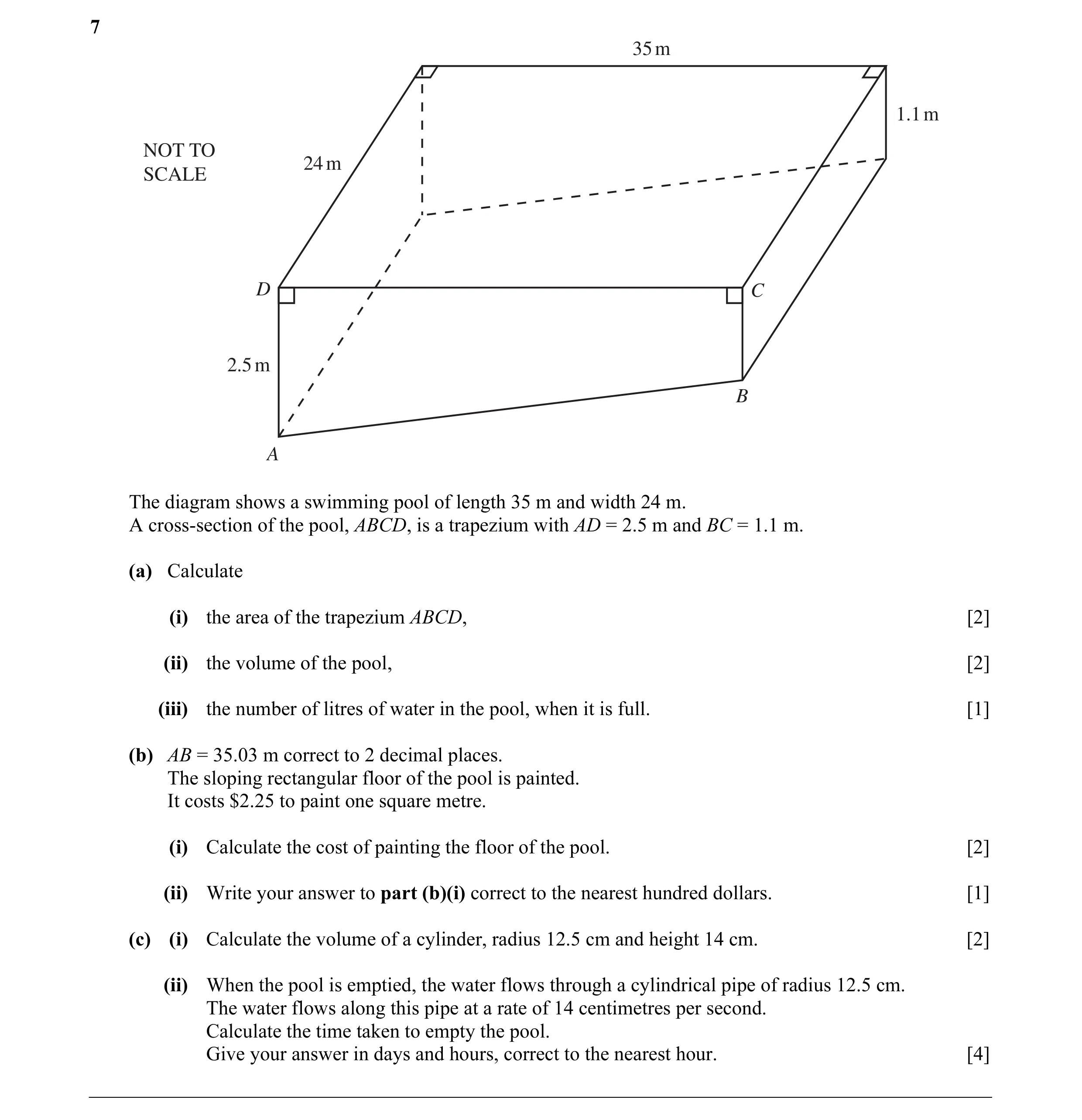 1 / 85
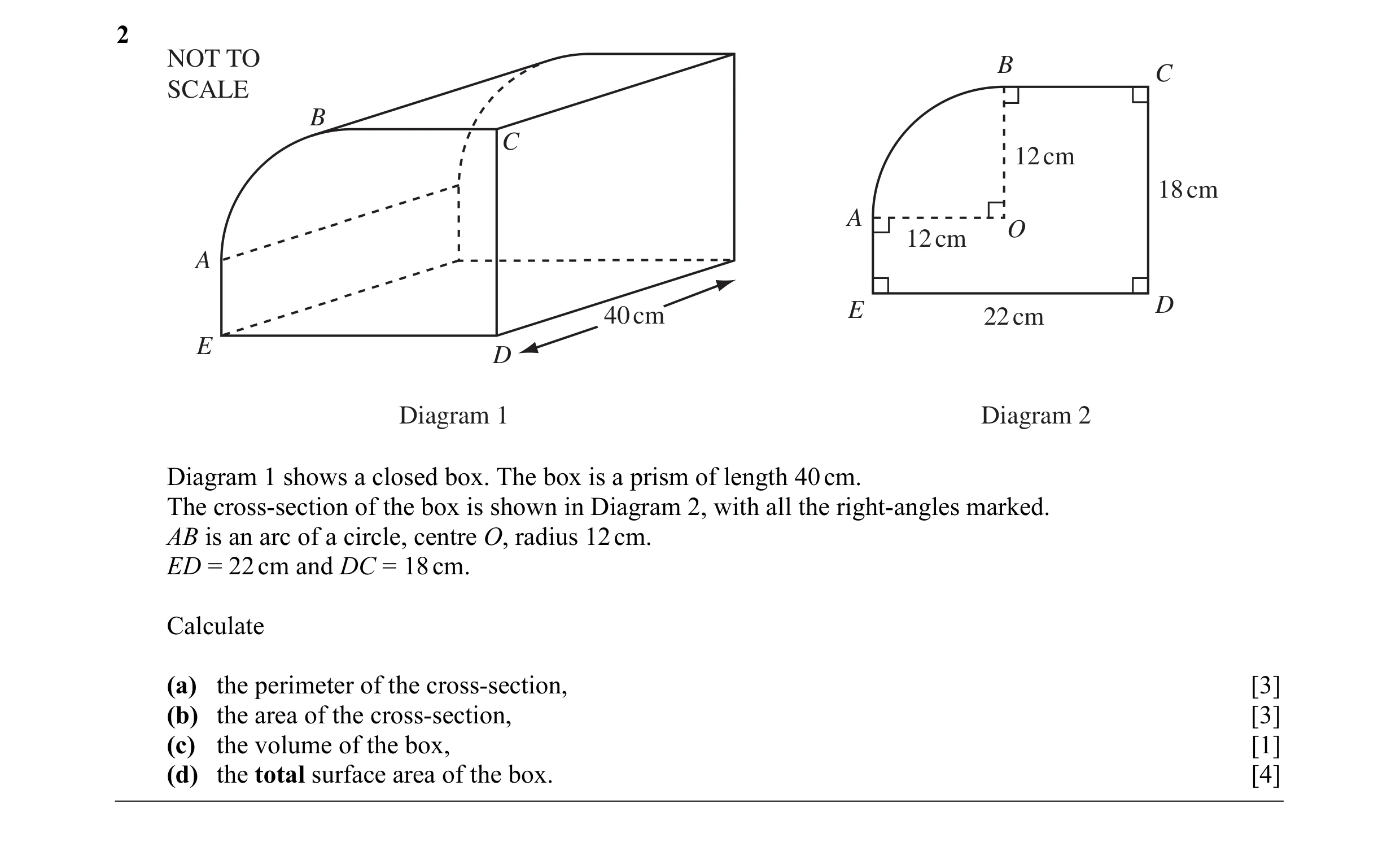 2 / 85
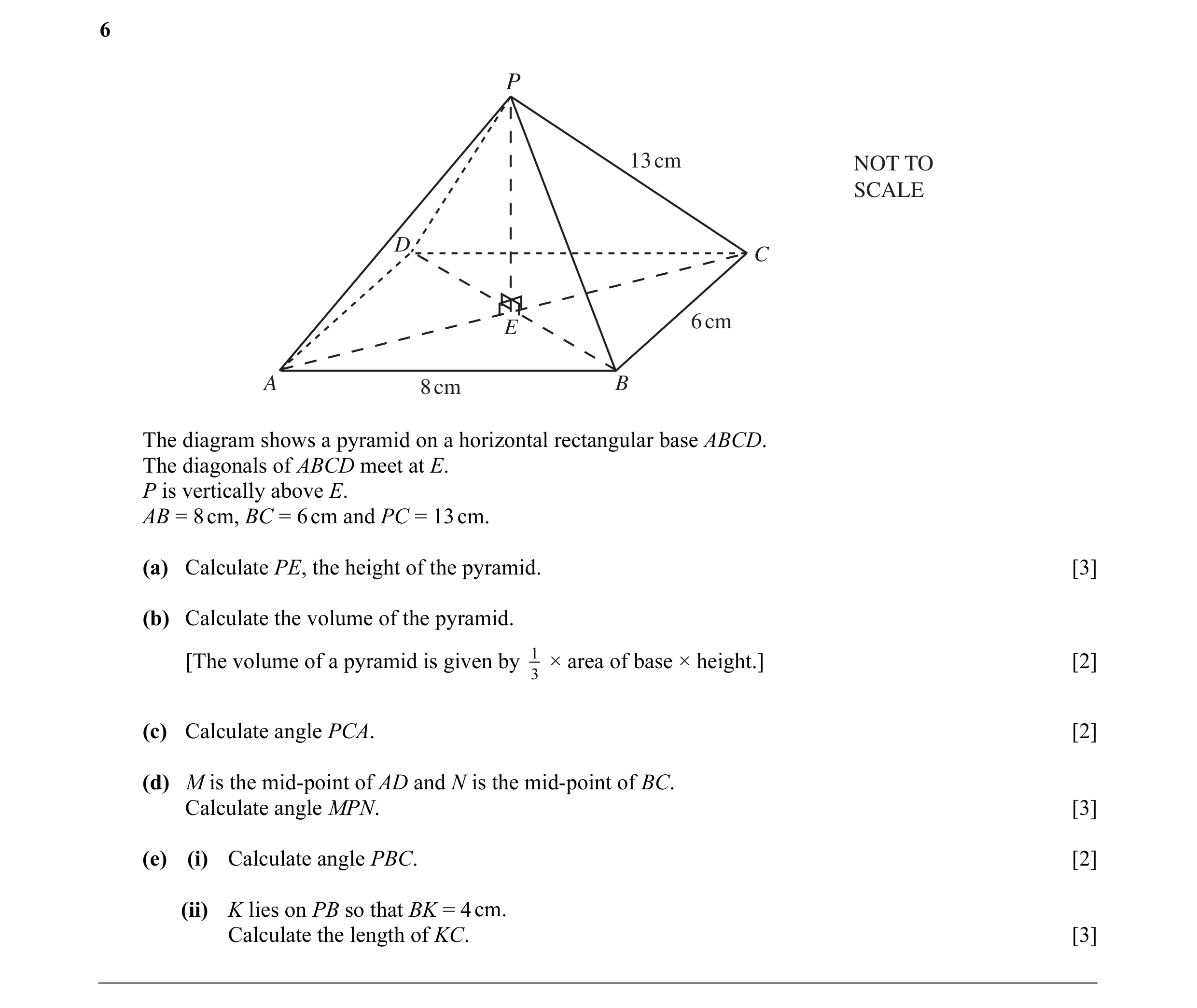 3 / 85
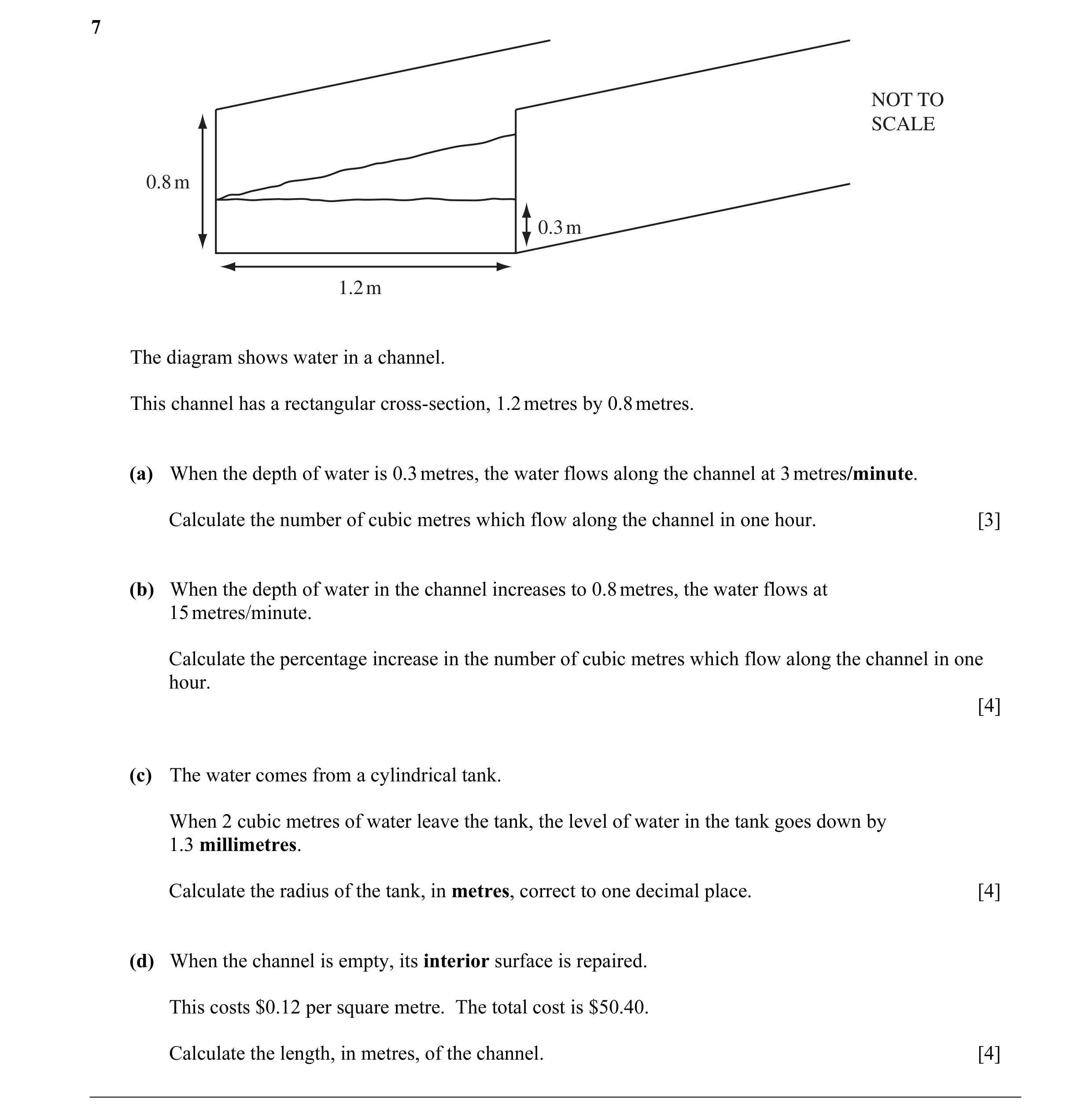 4 / 85
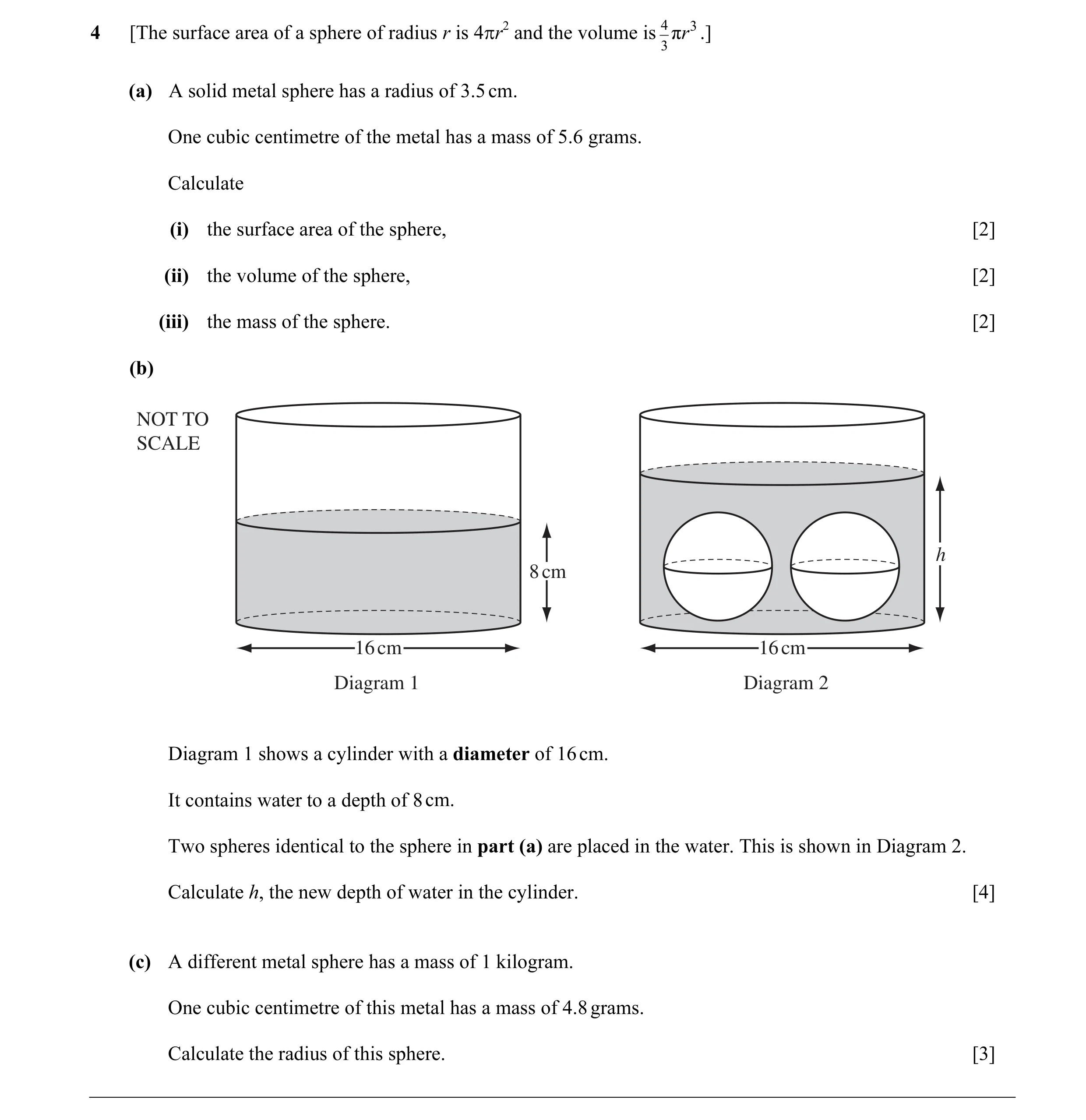 5 / 85
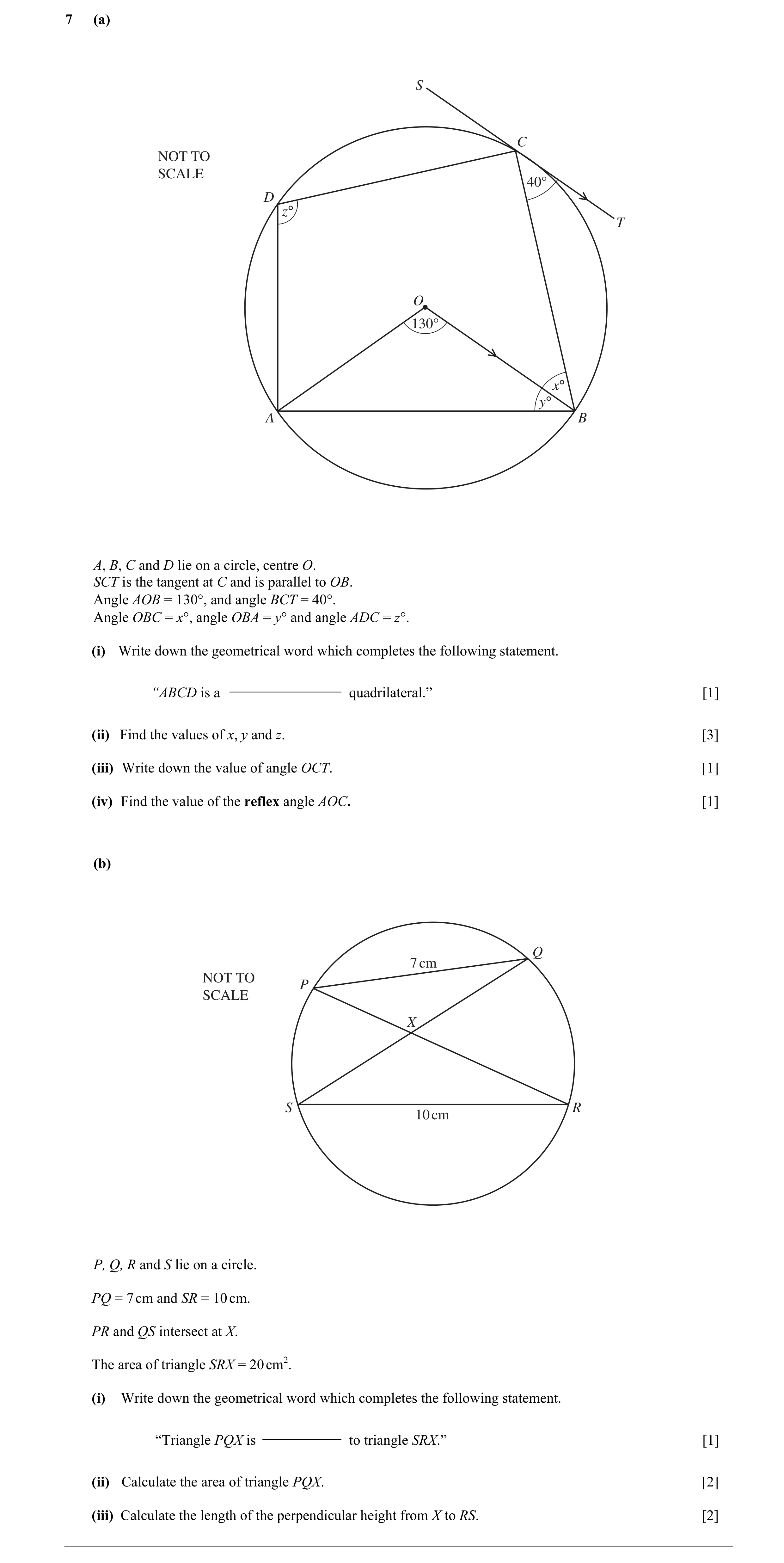
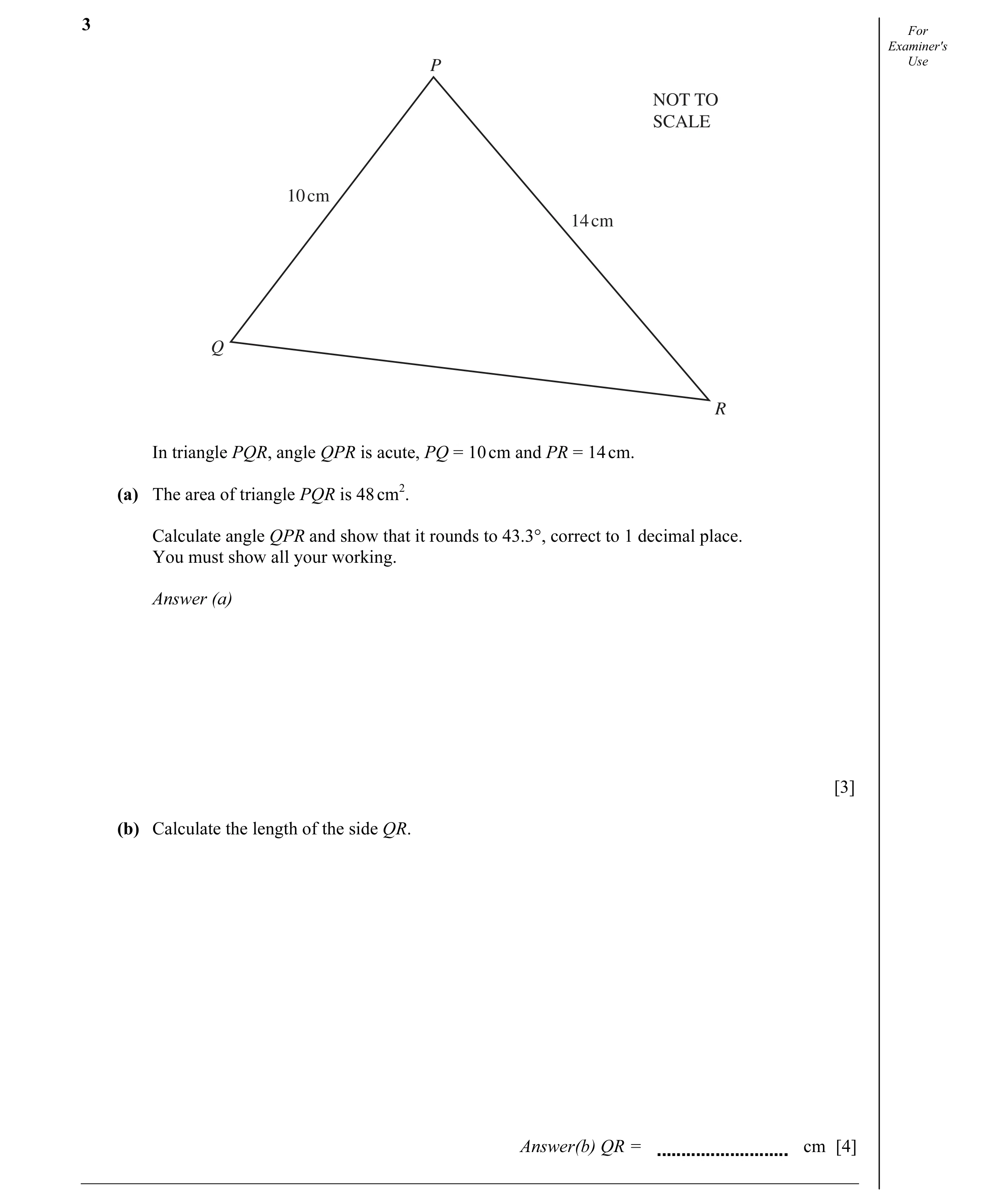 8 / 85
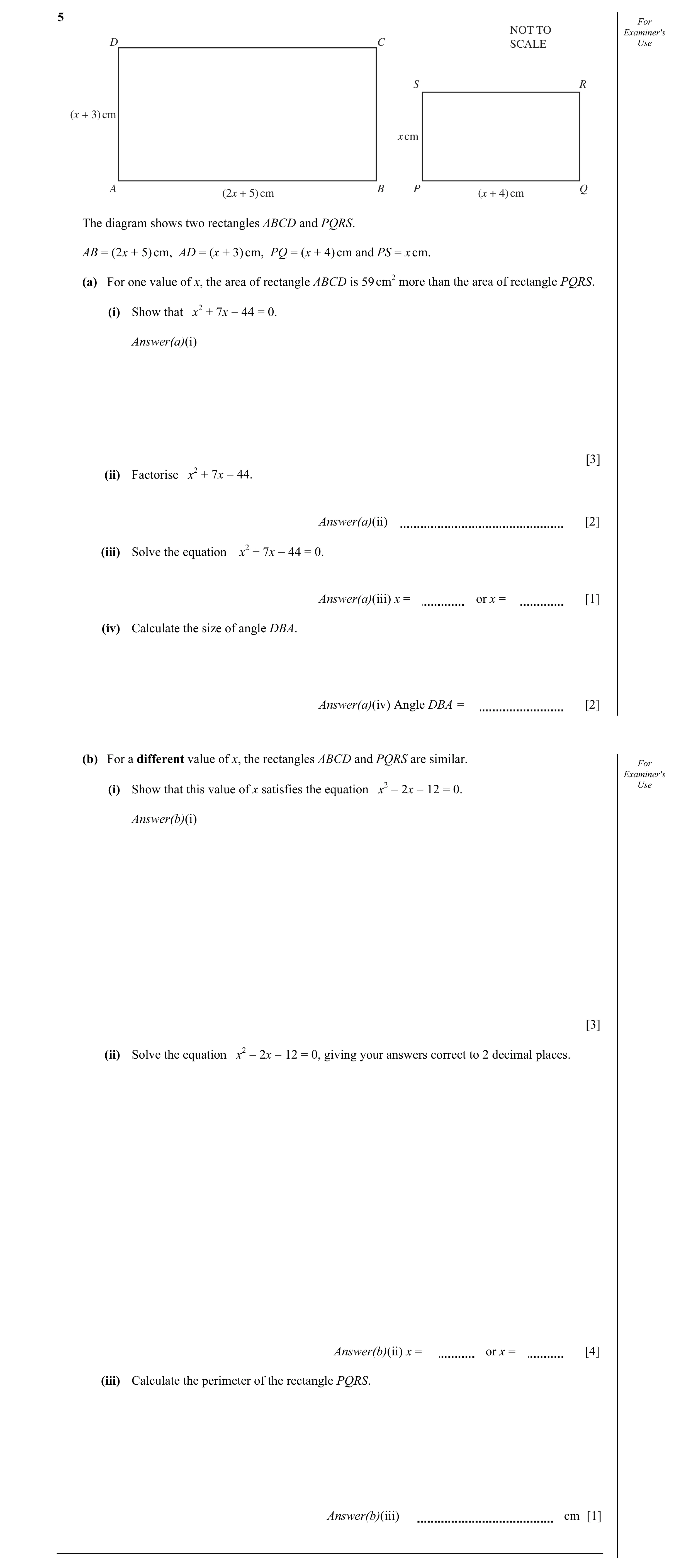
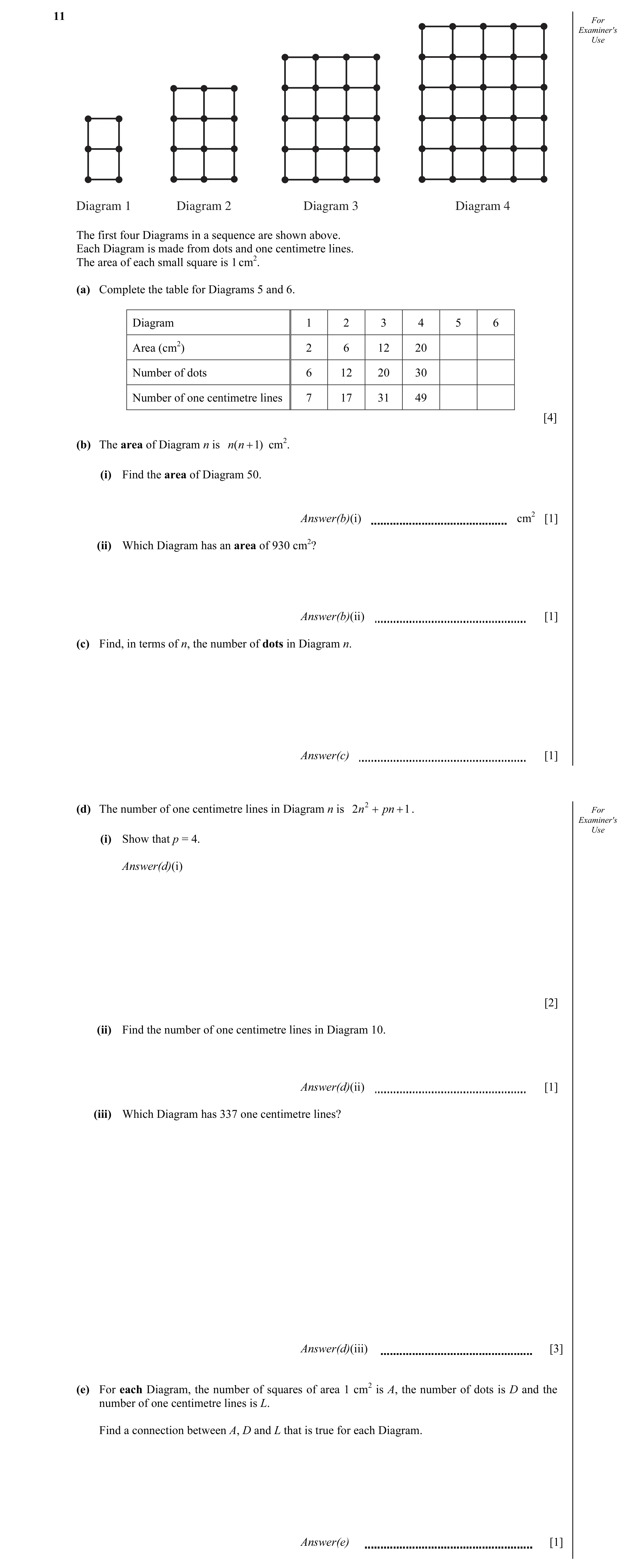
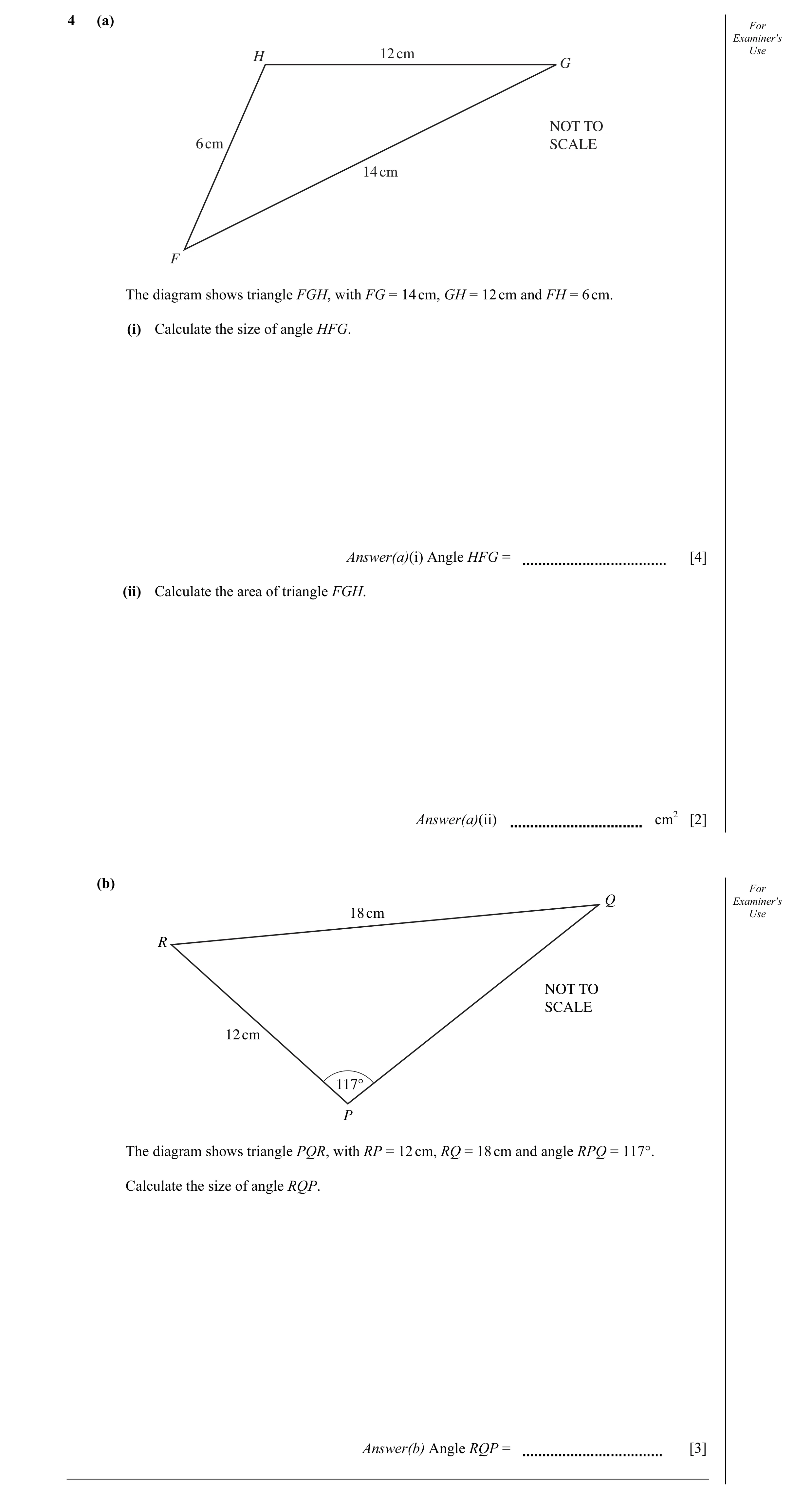
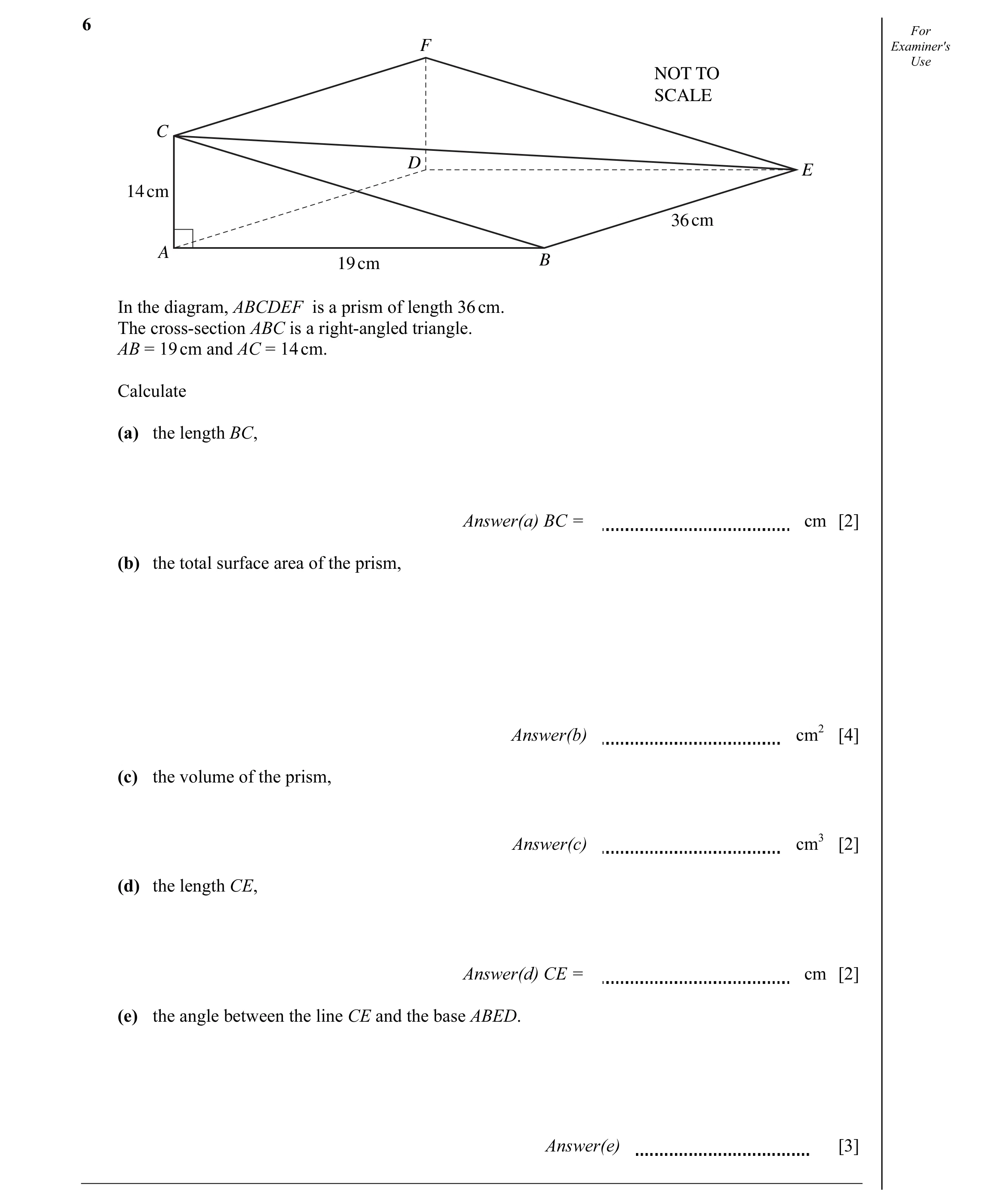 15 / 85
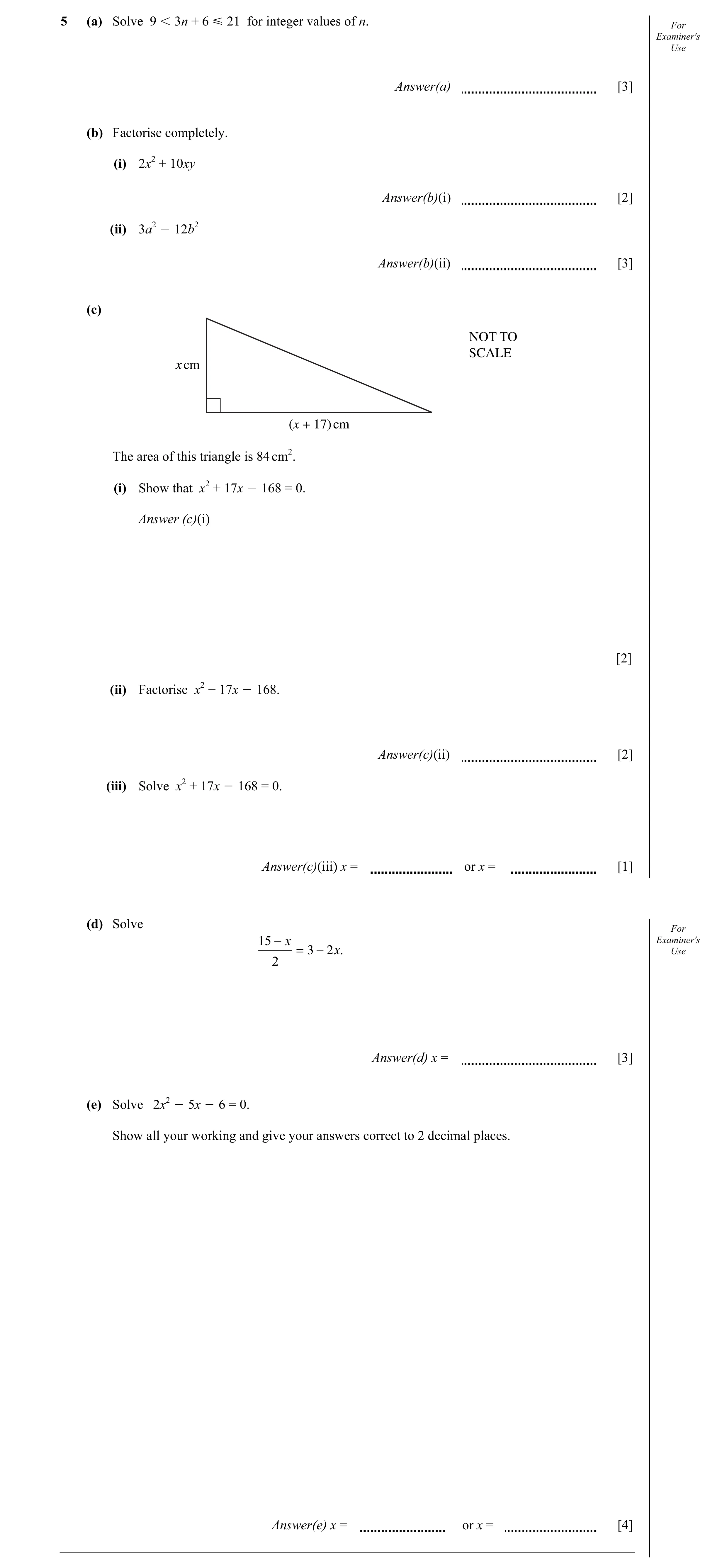
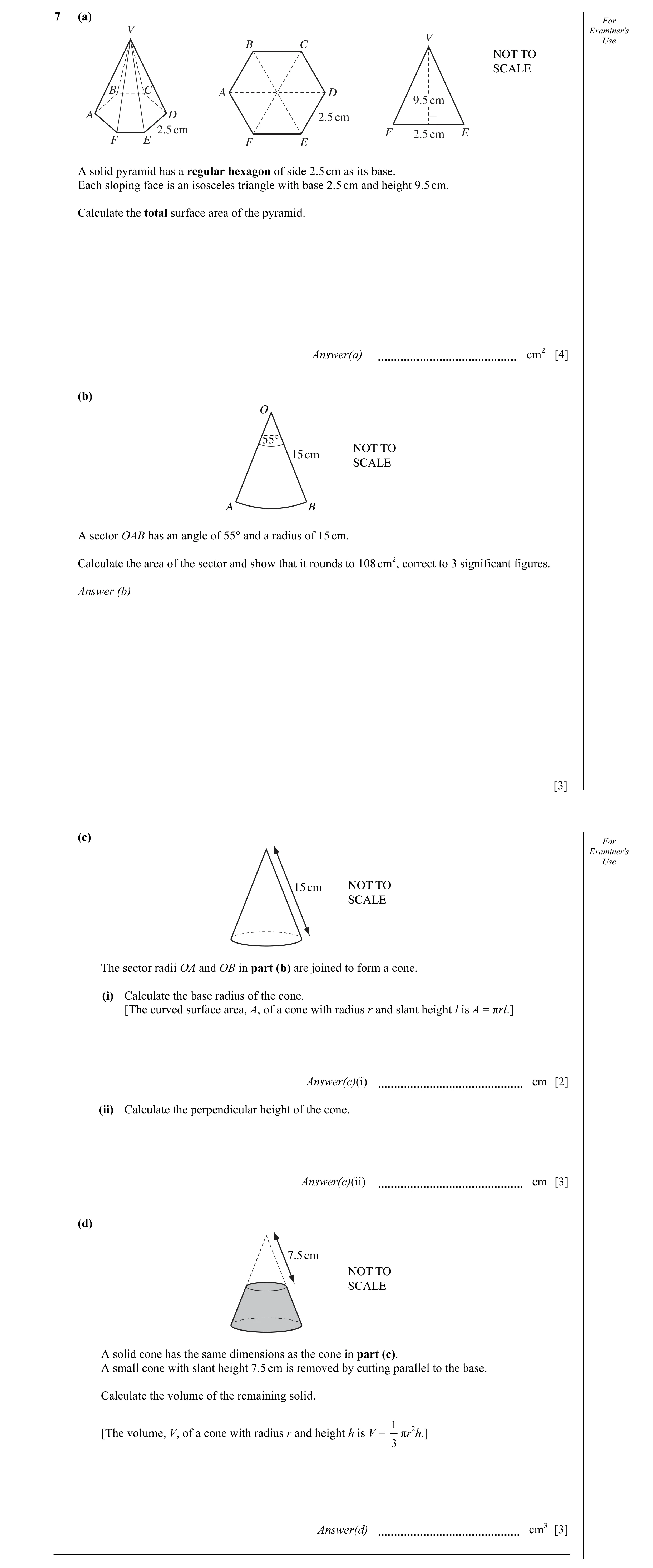
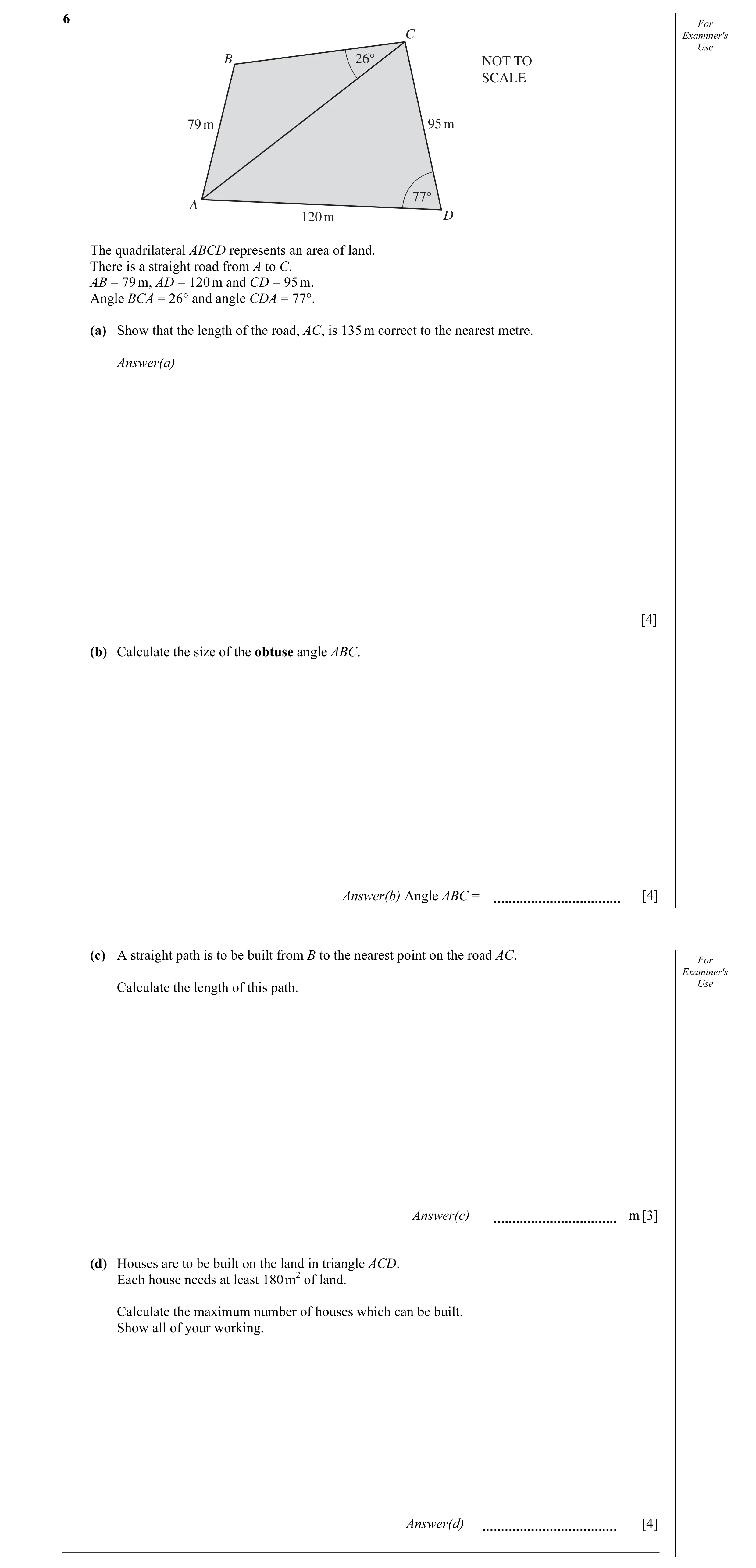
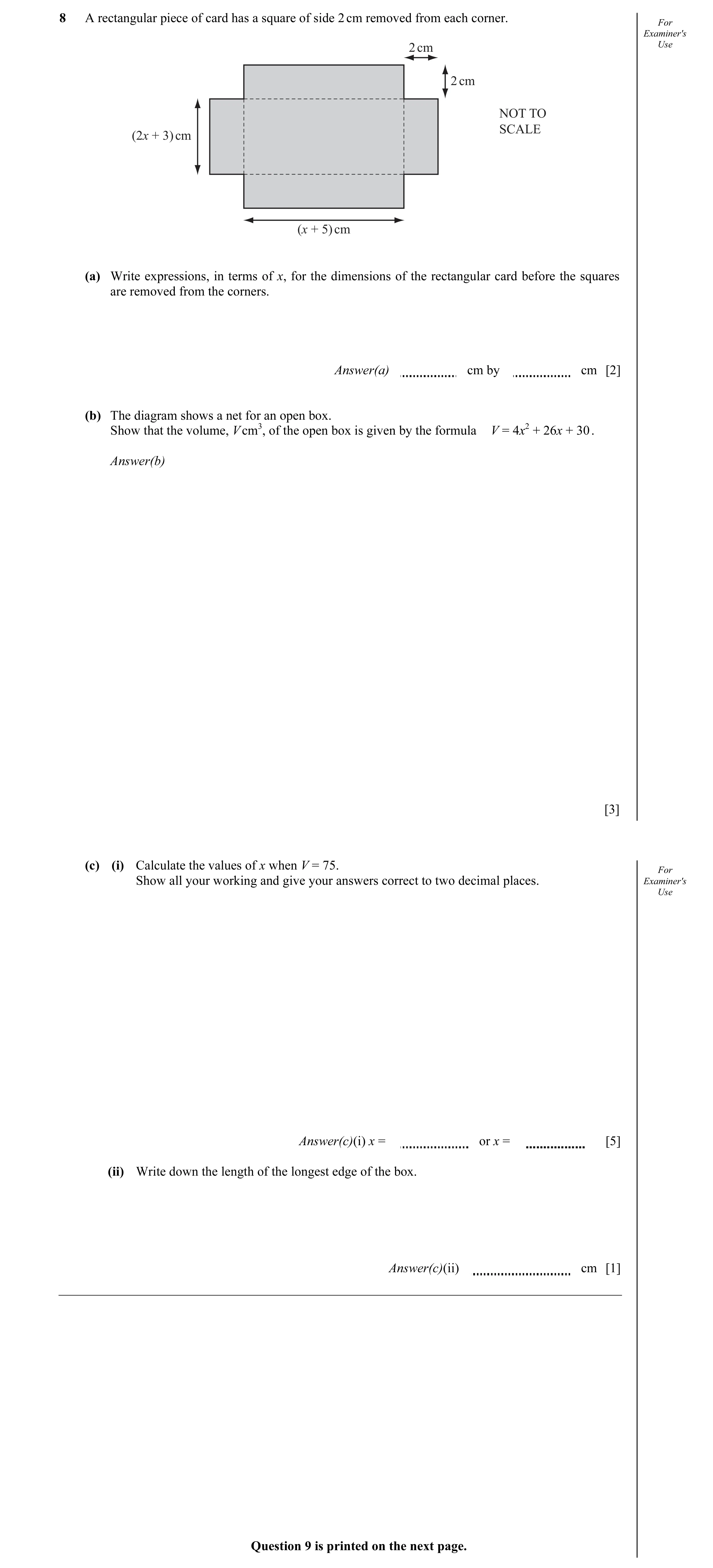
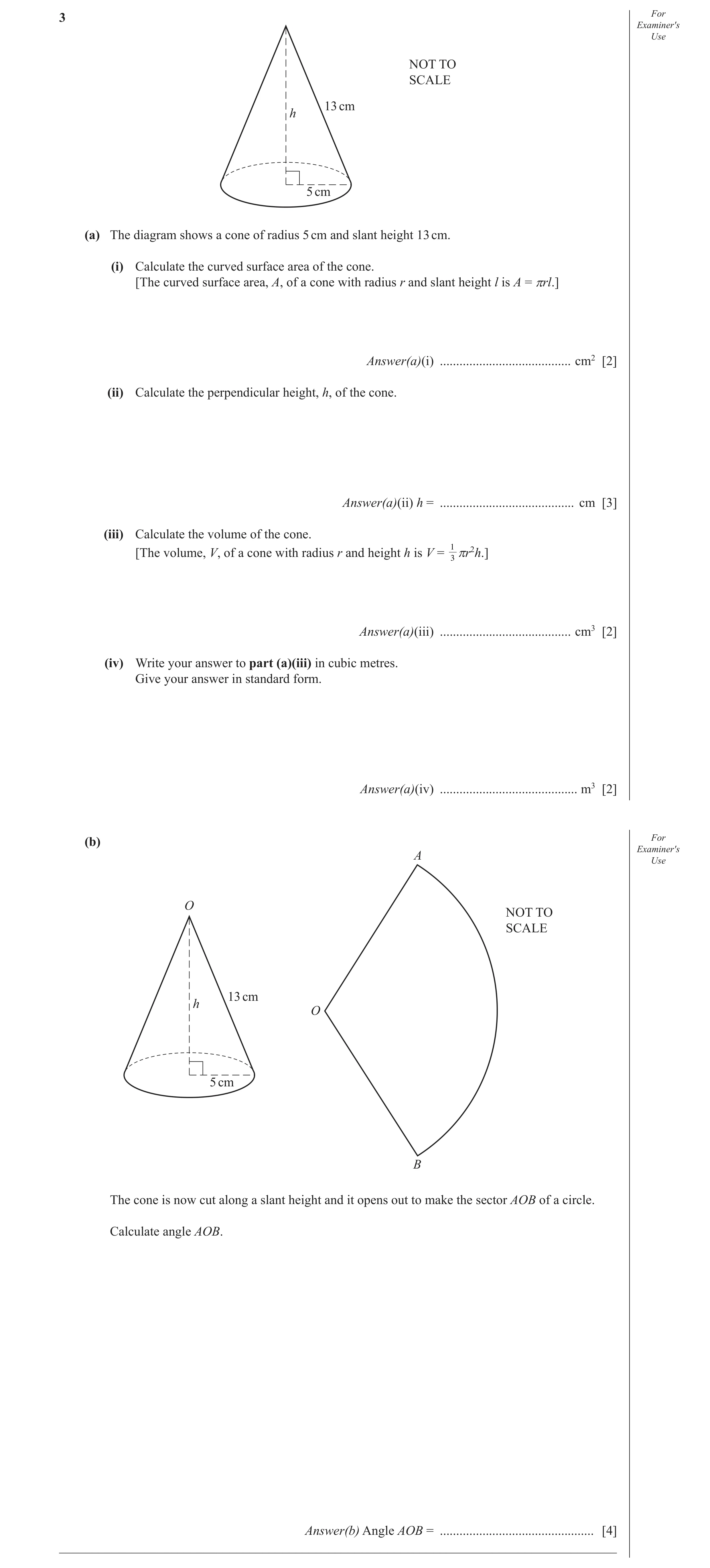
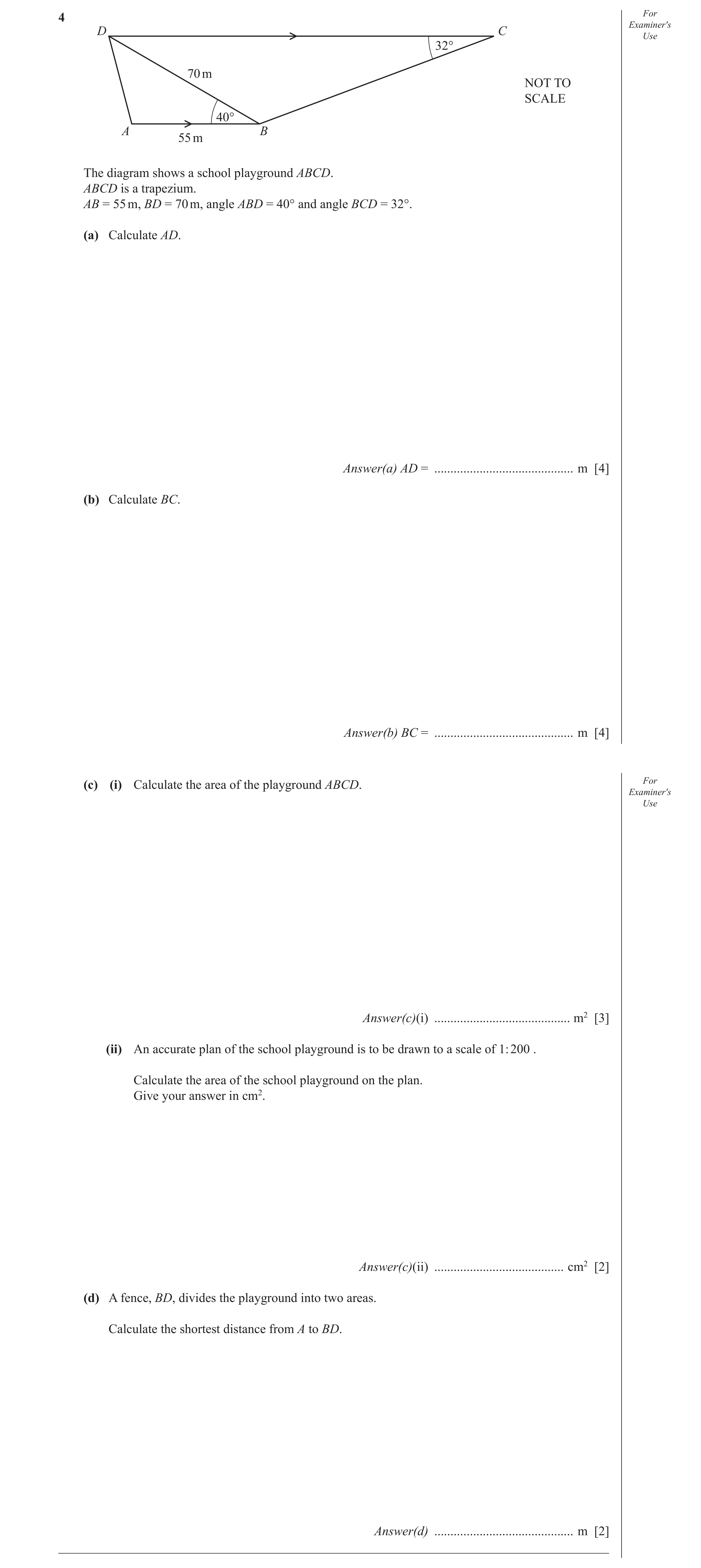
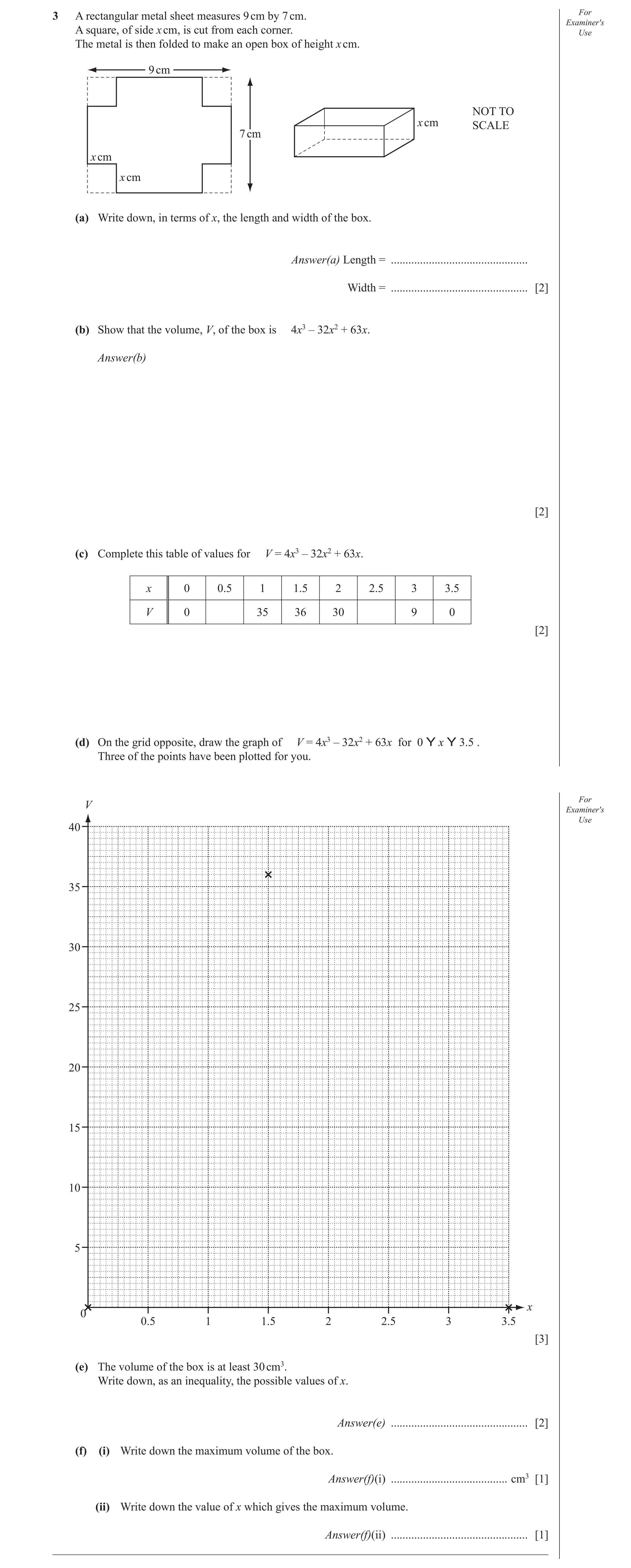
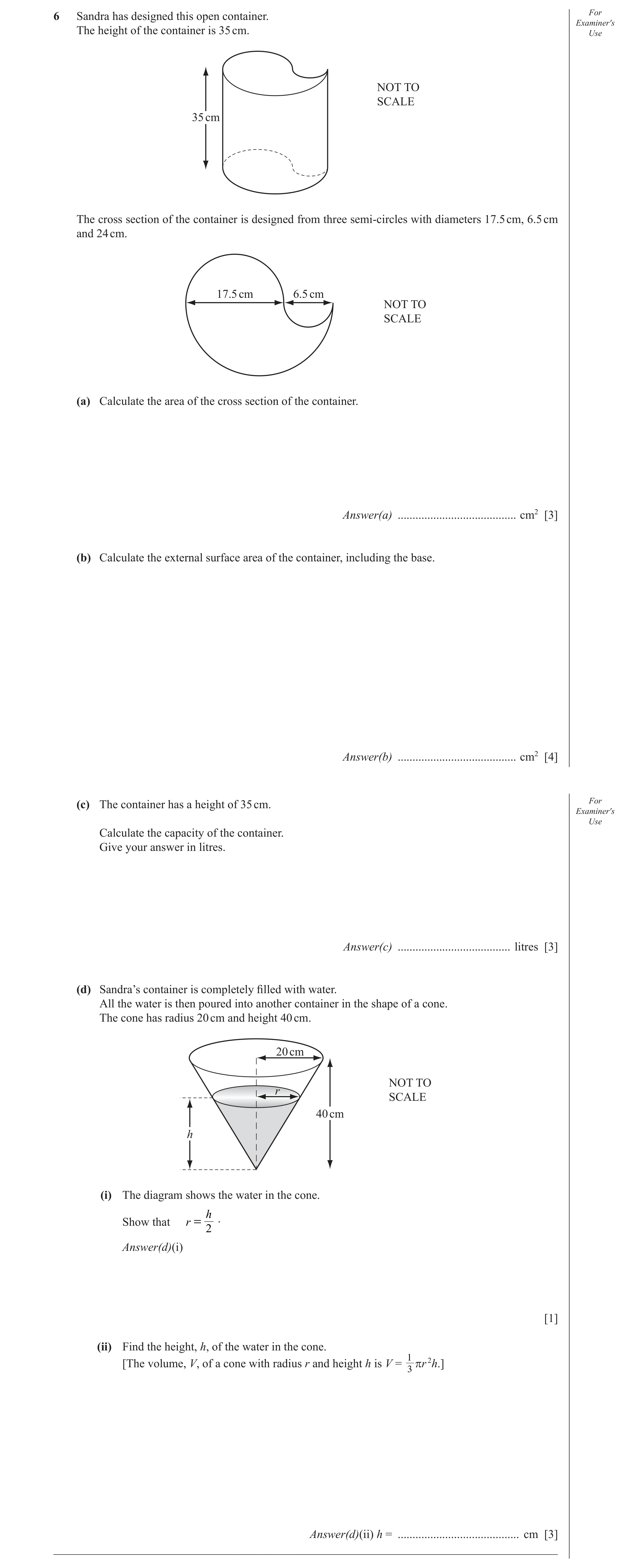
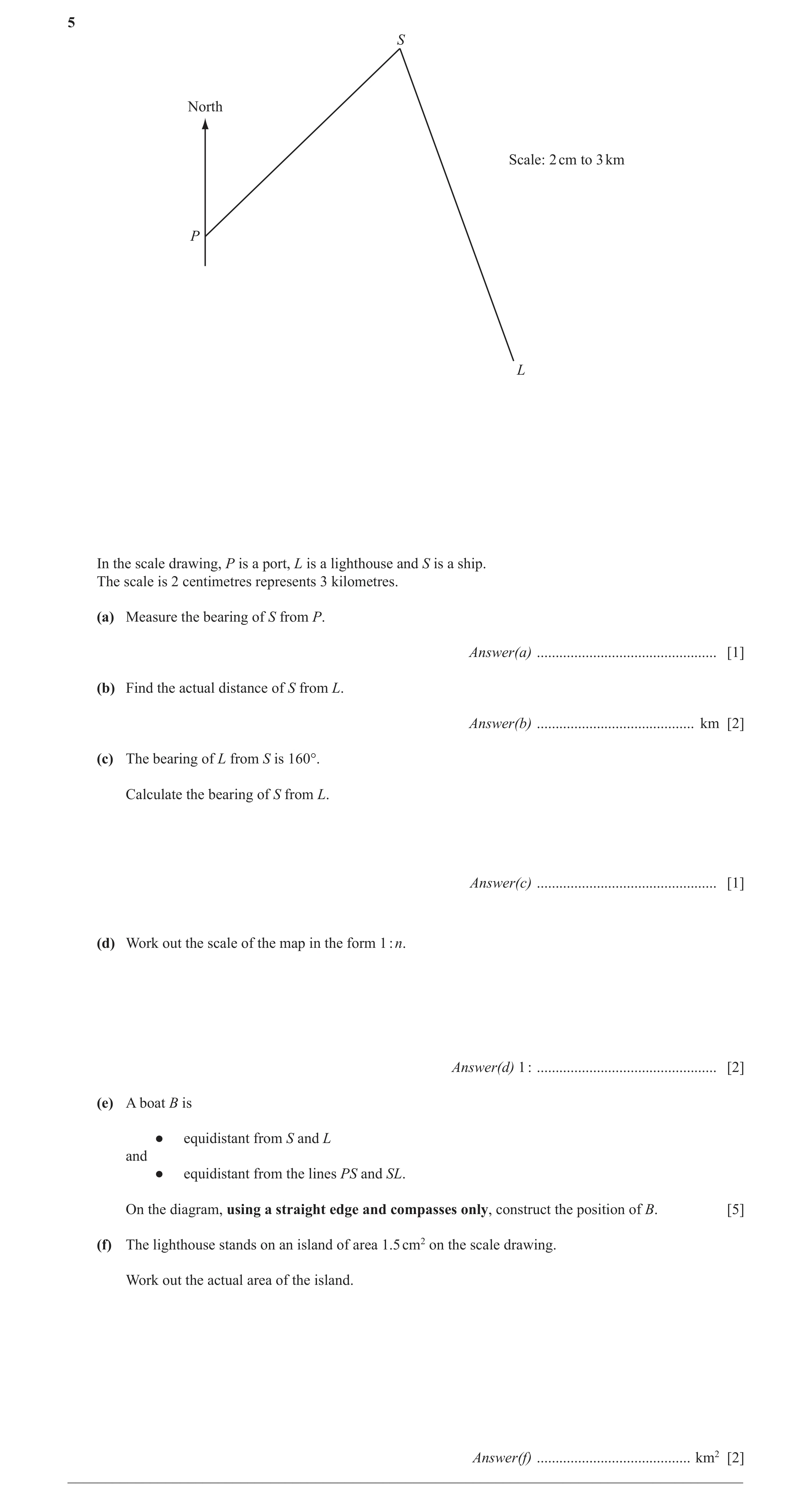
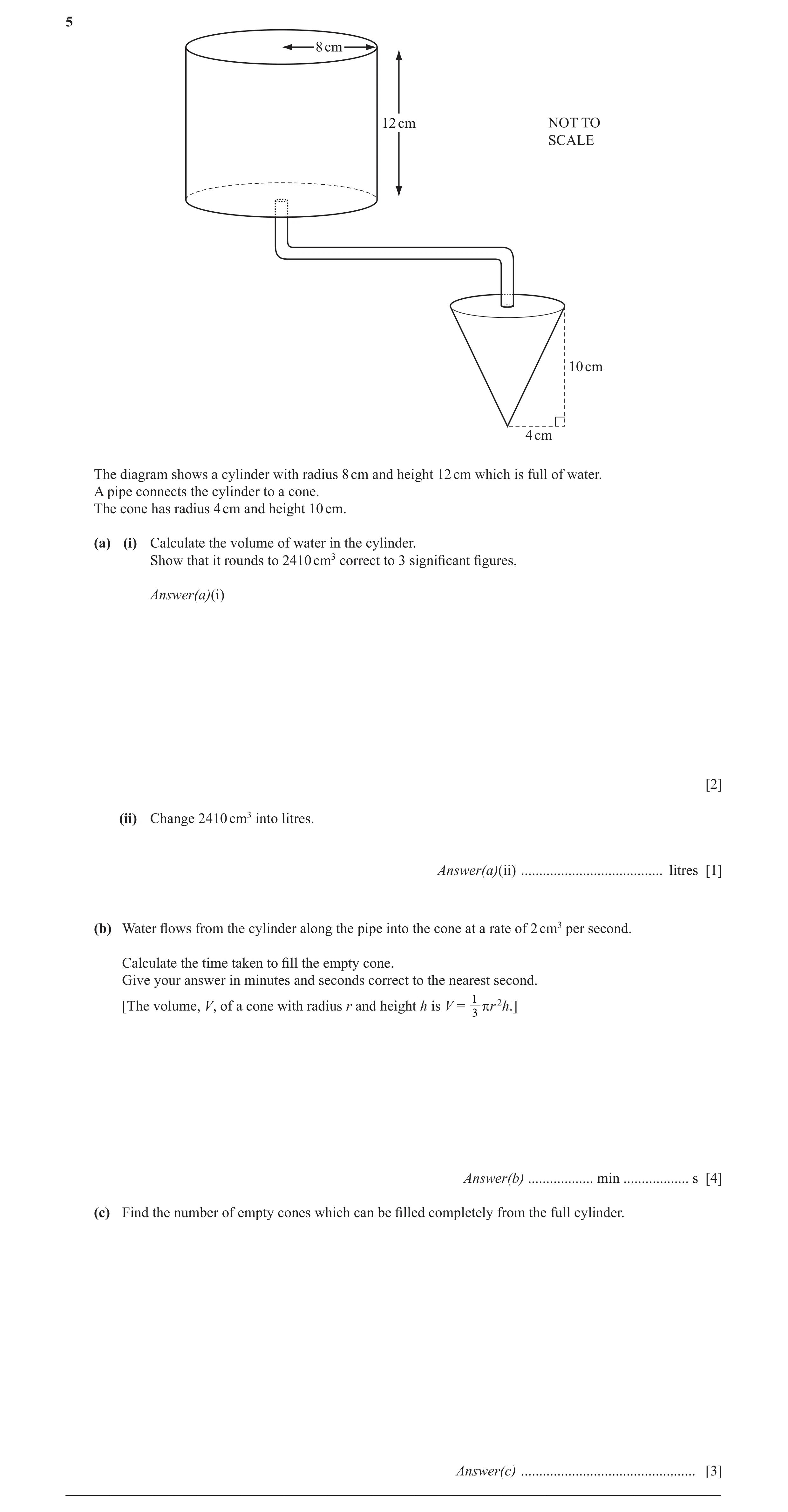
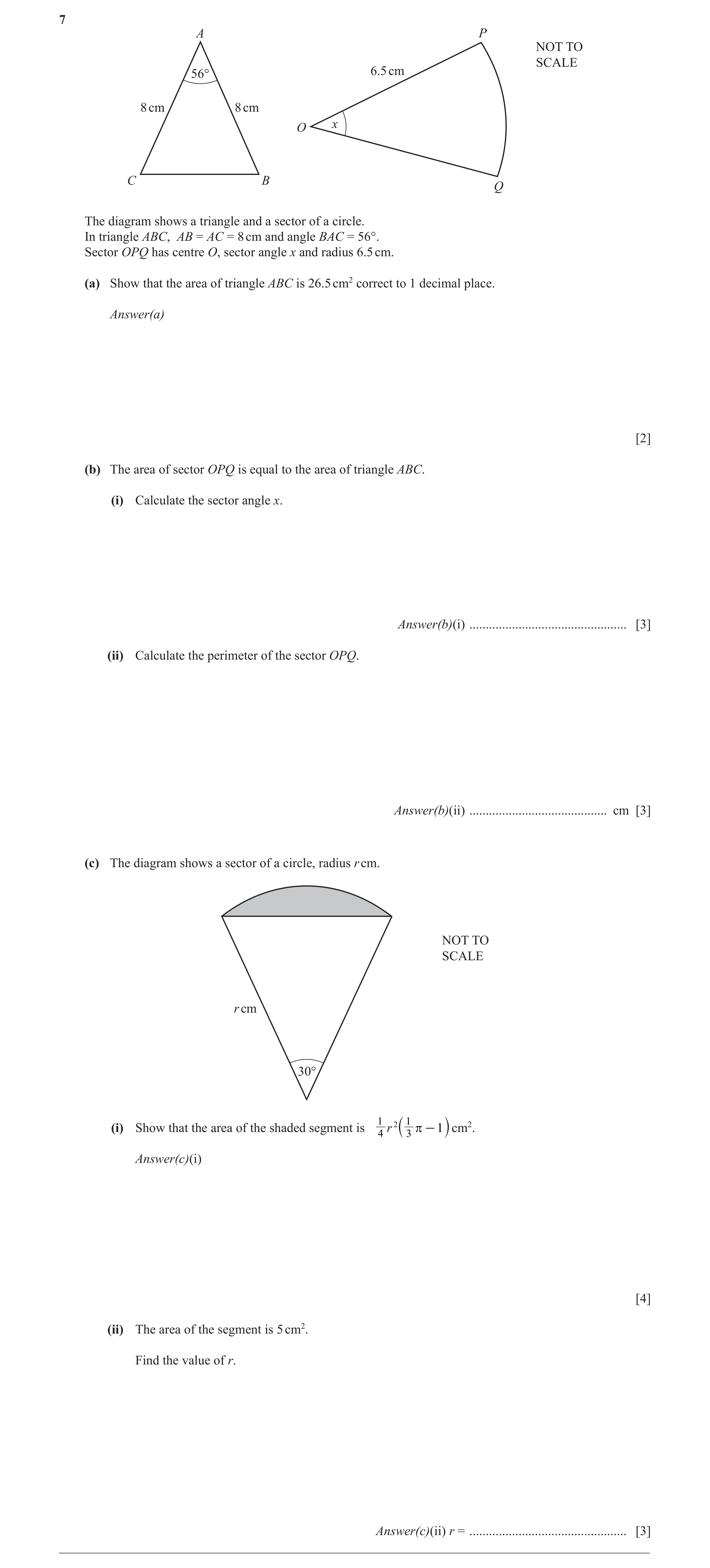
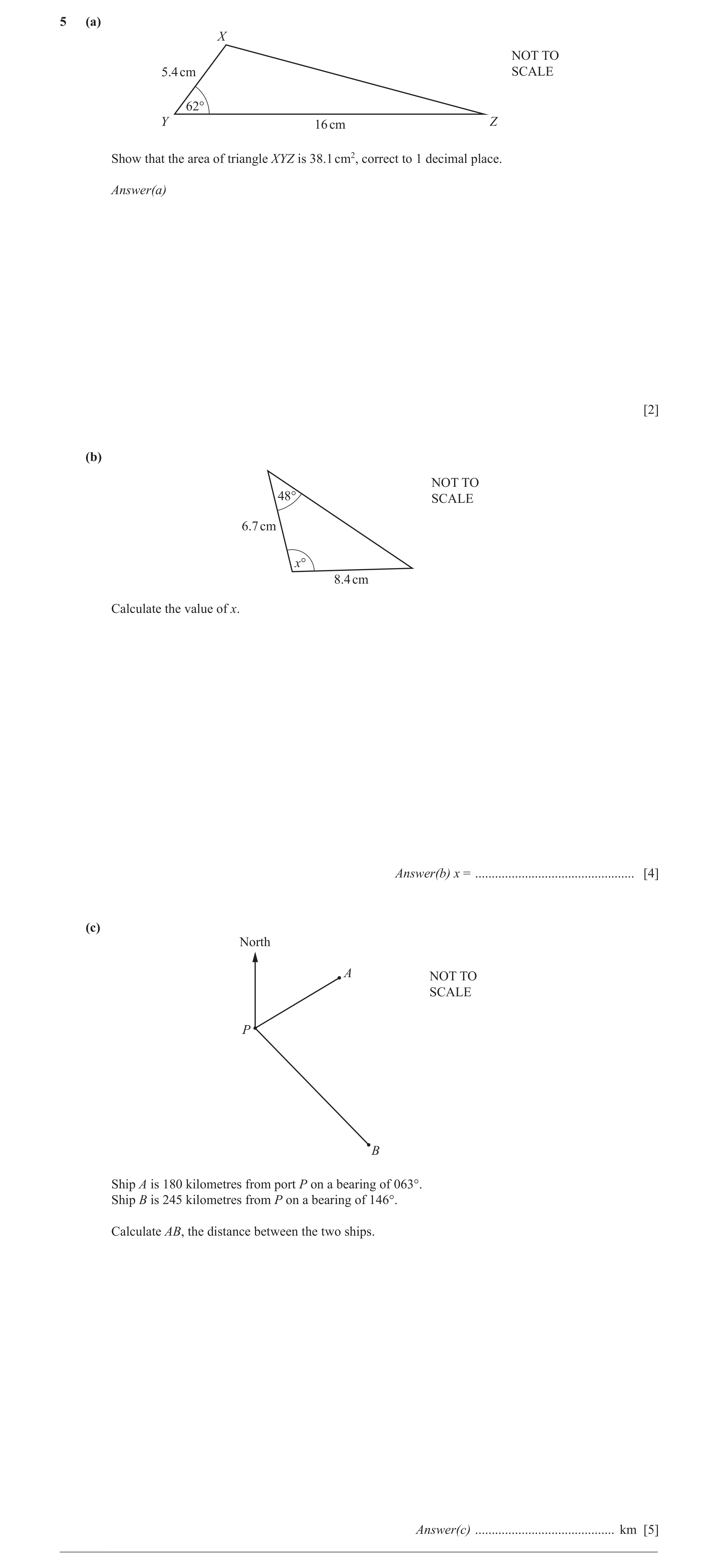
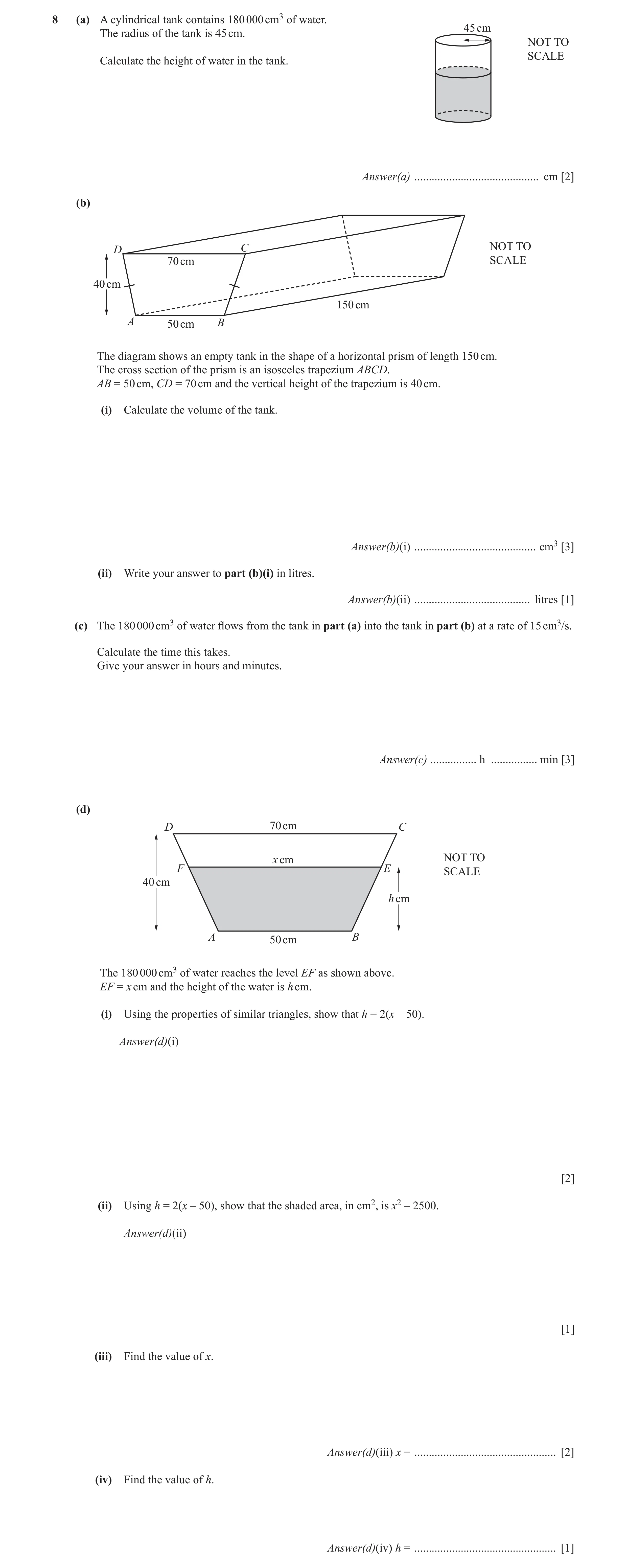
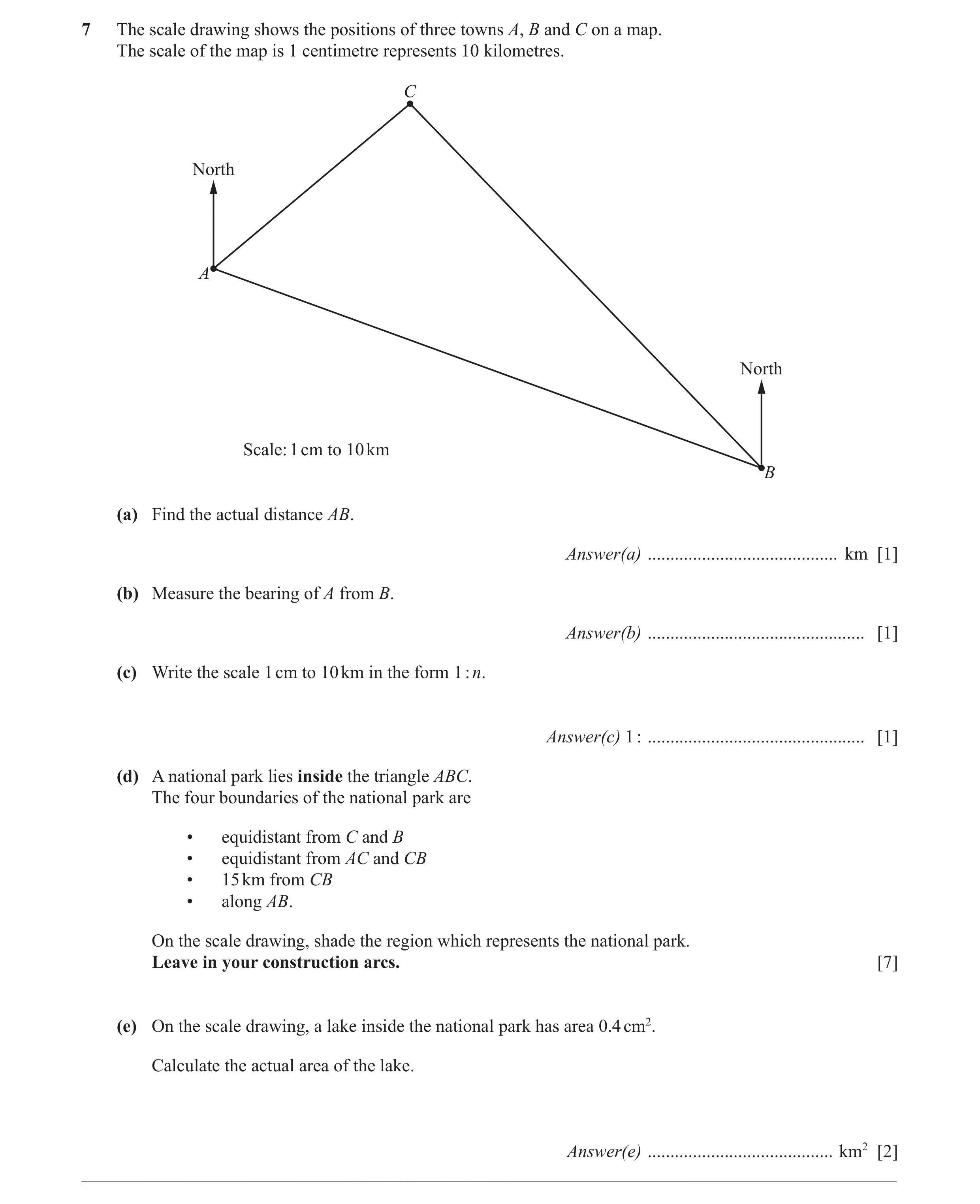 44 / 85
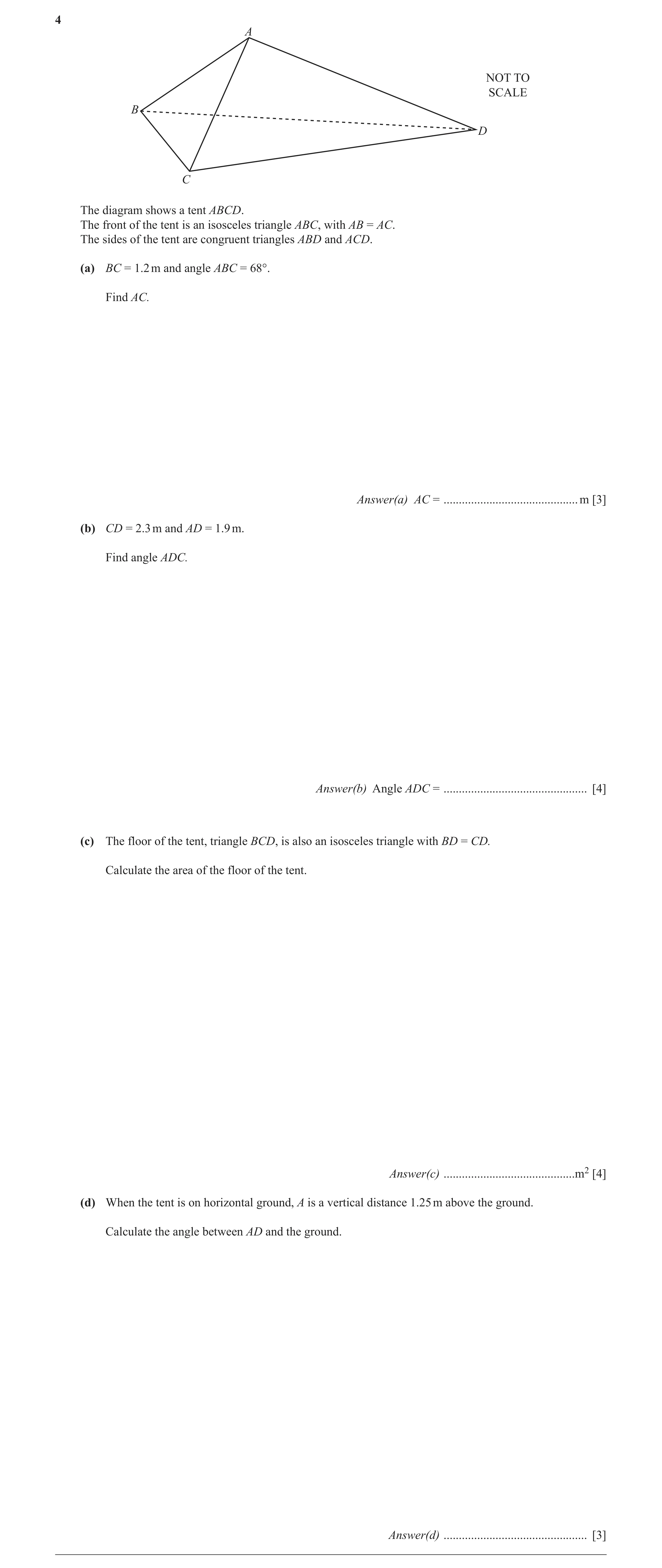
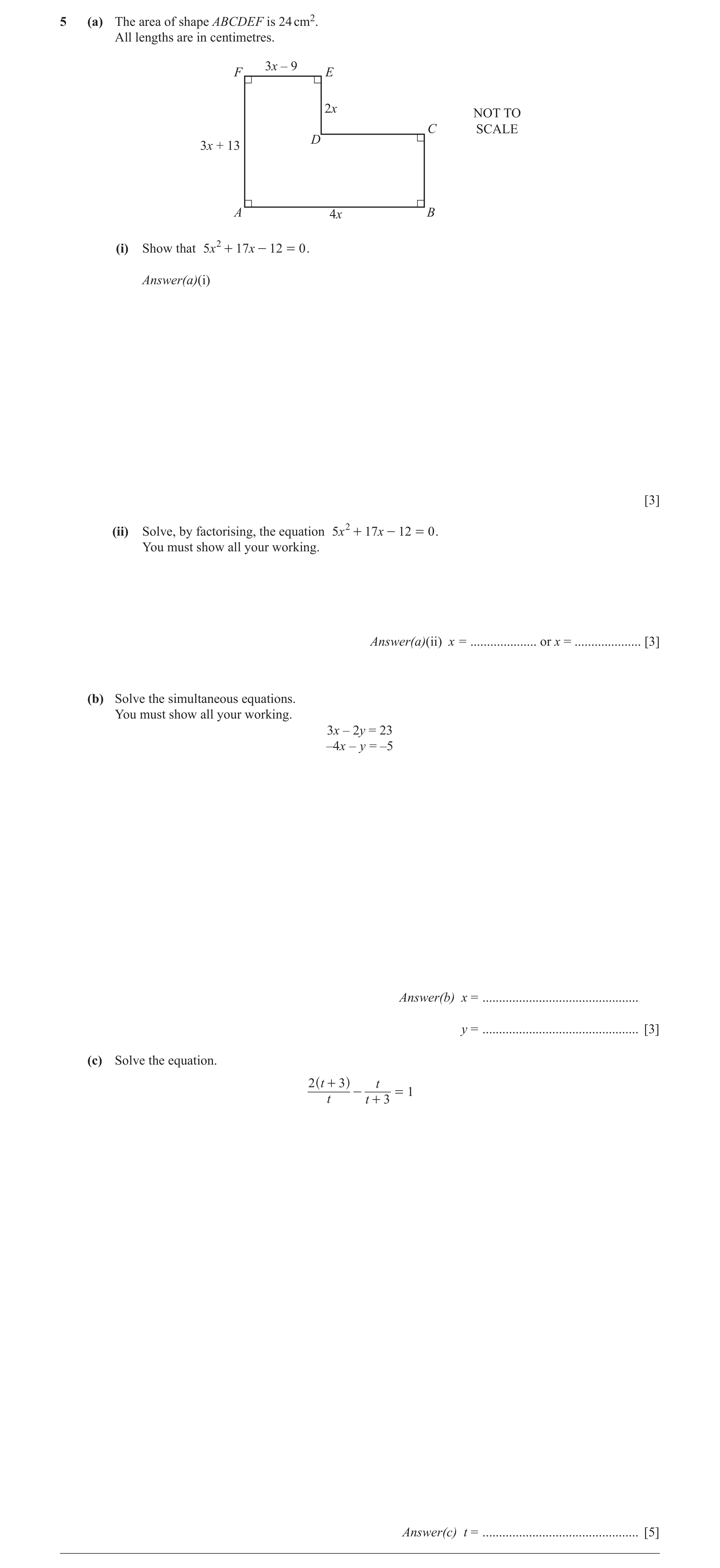
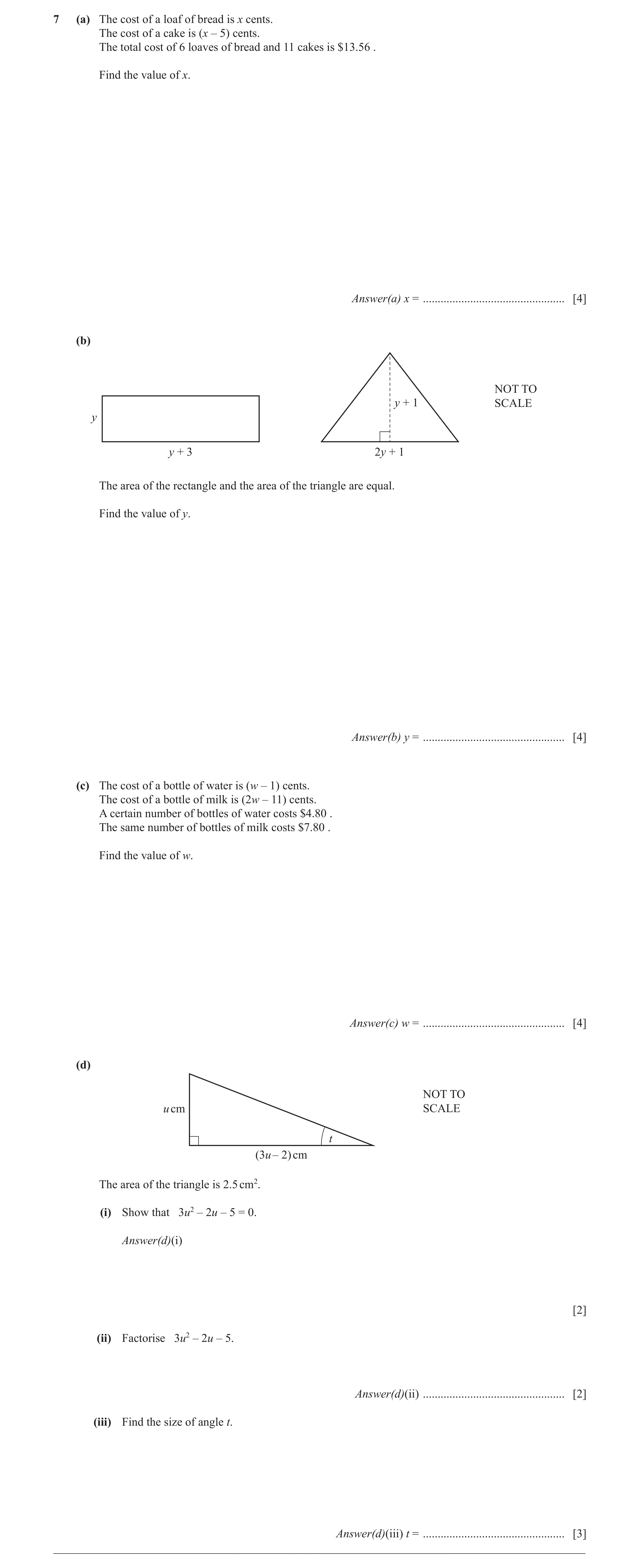
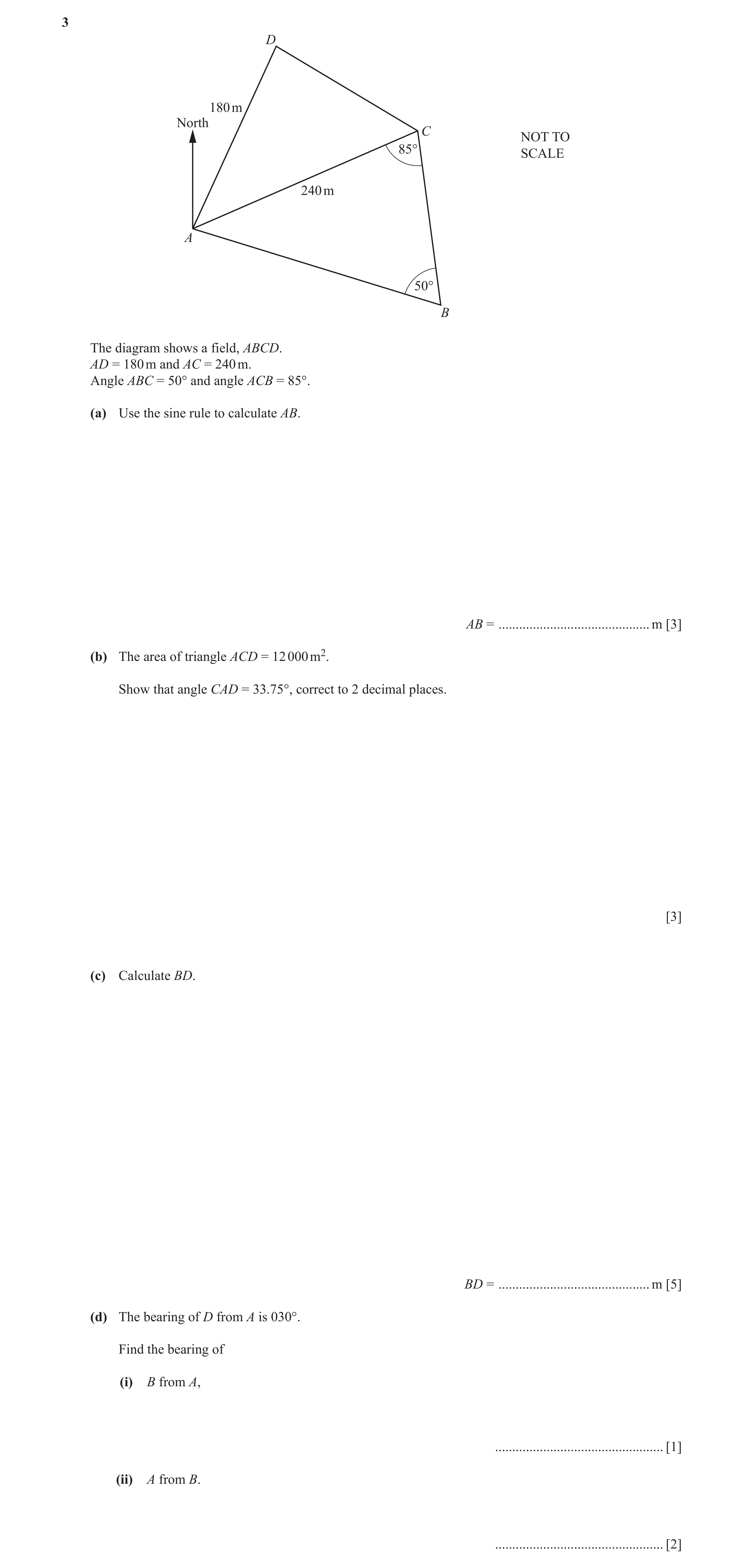
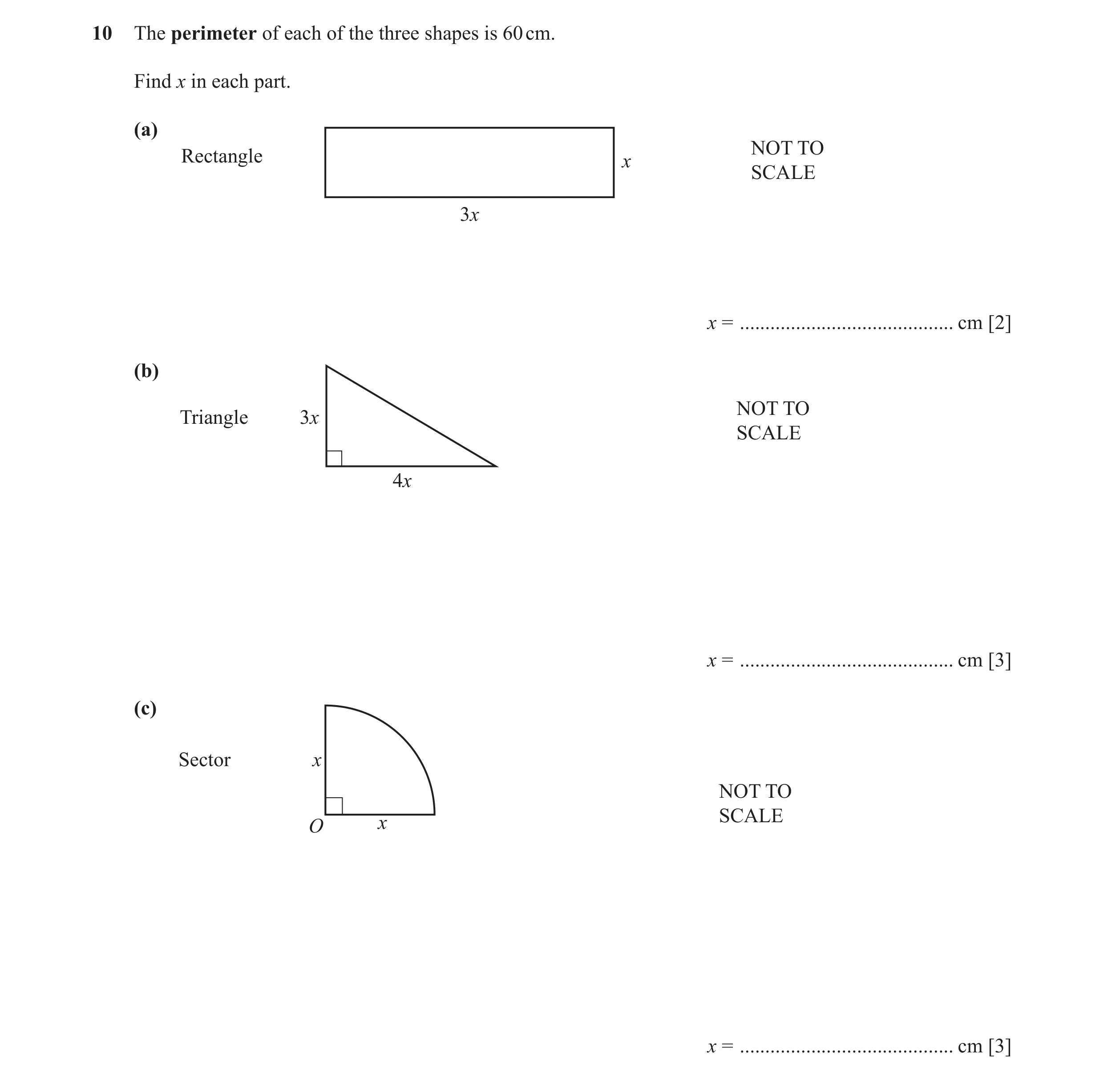 52 / 85
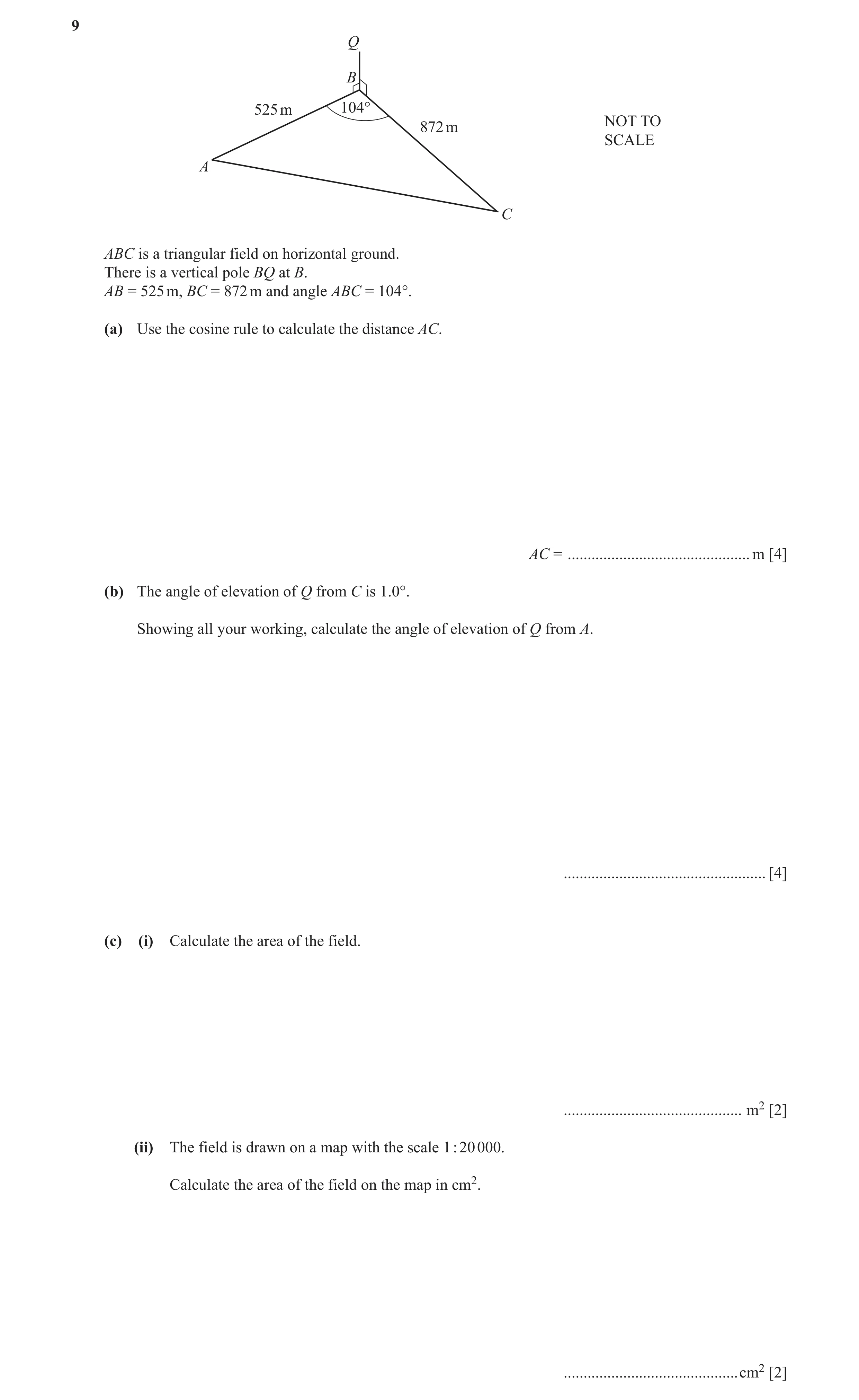
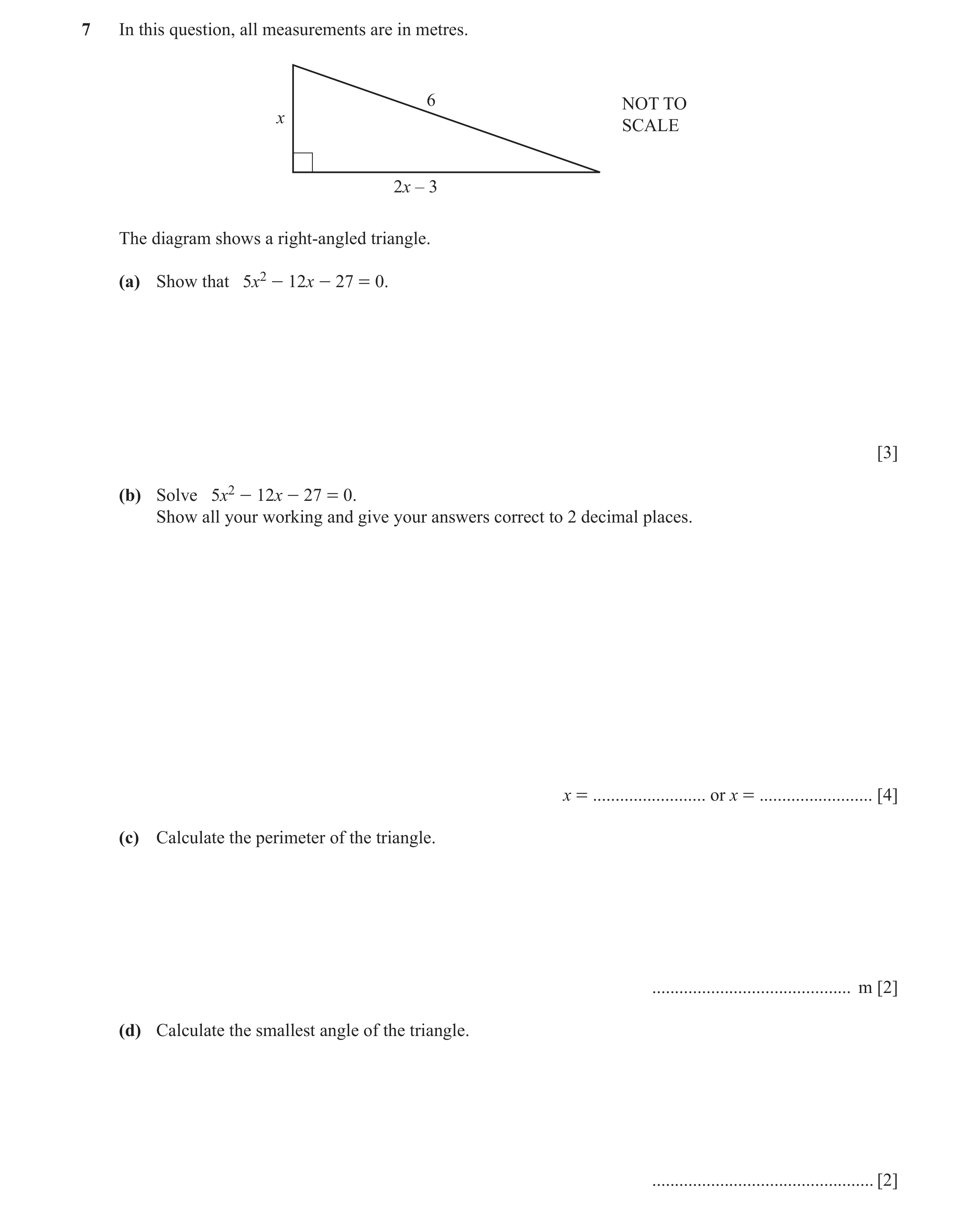 54 / 85
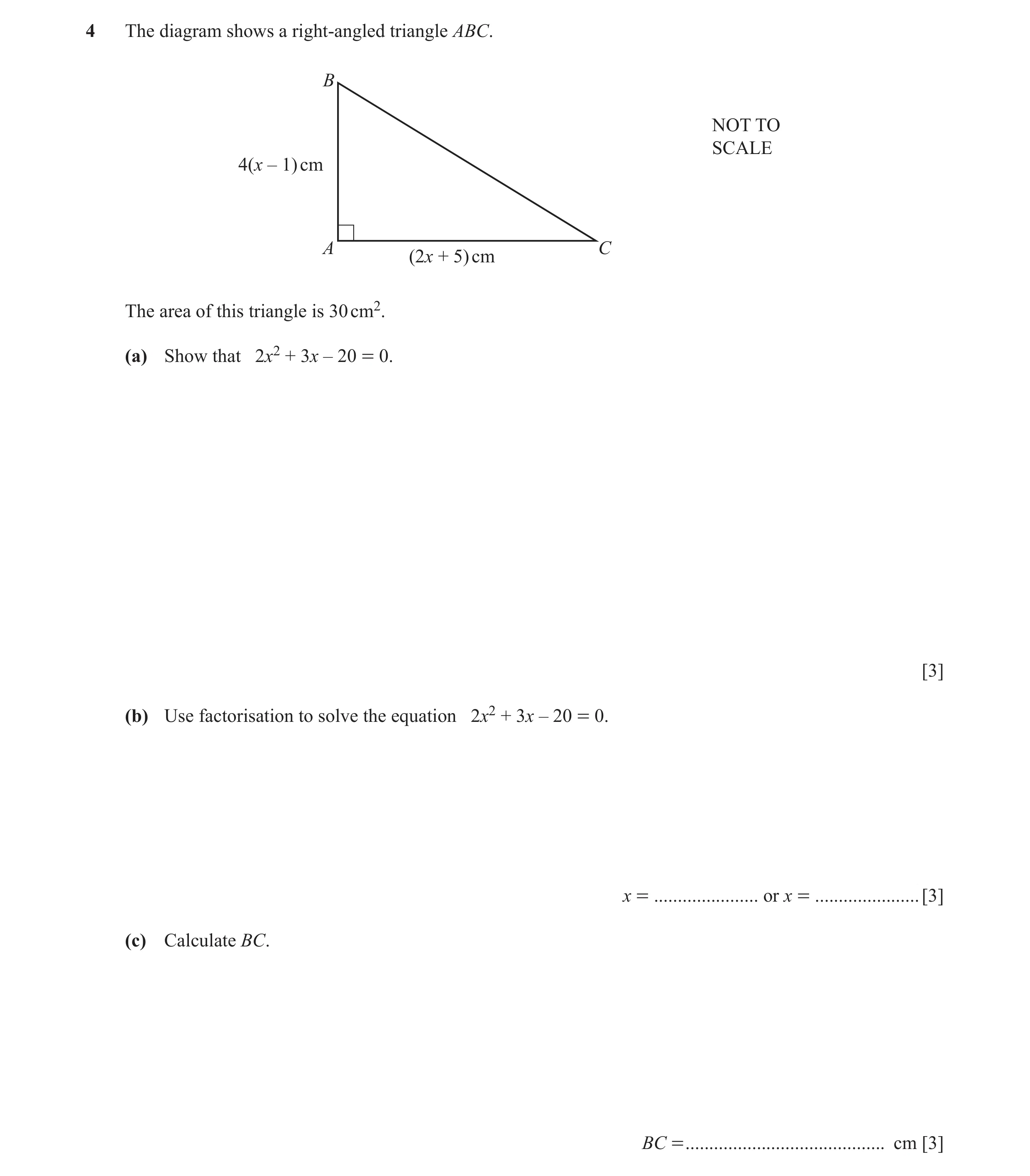 55 / 85
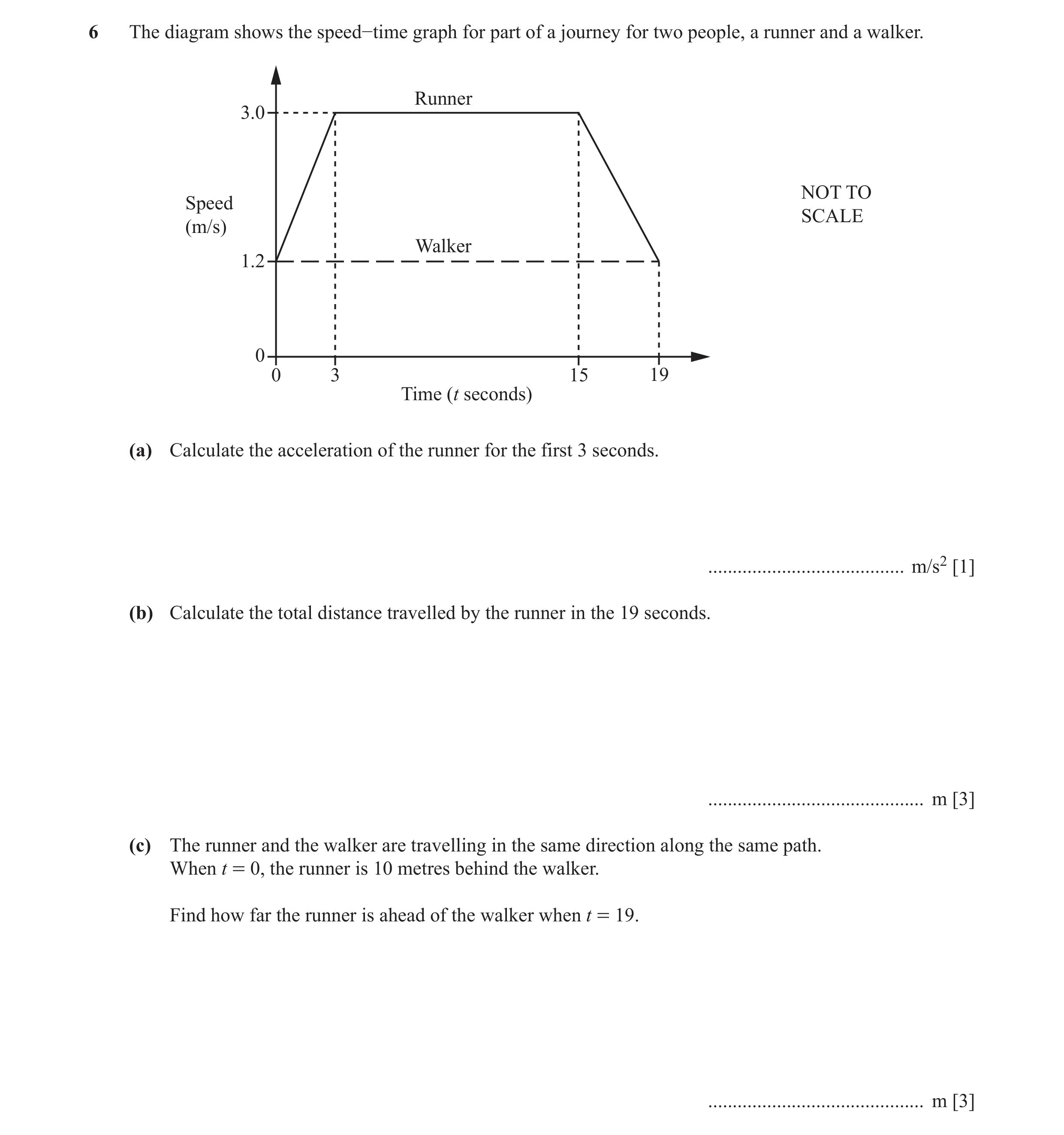 56 / 85
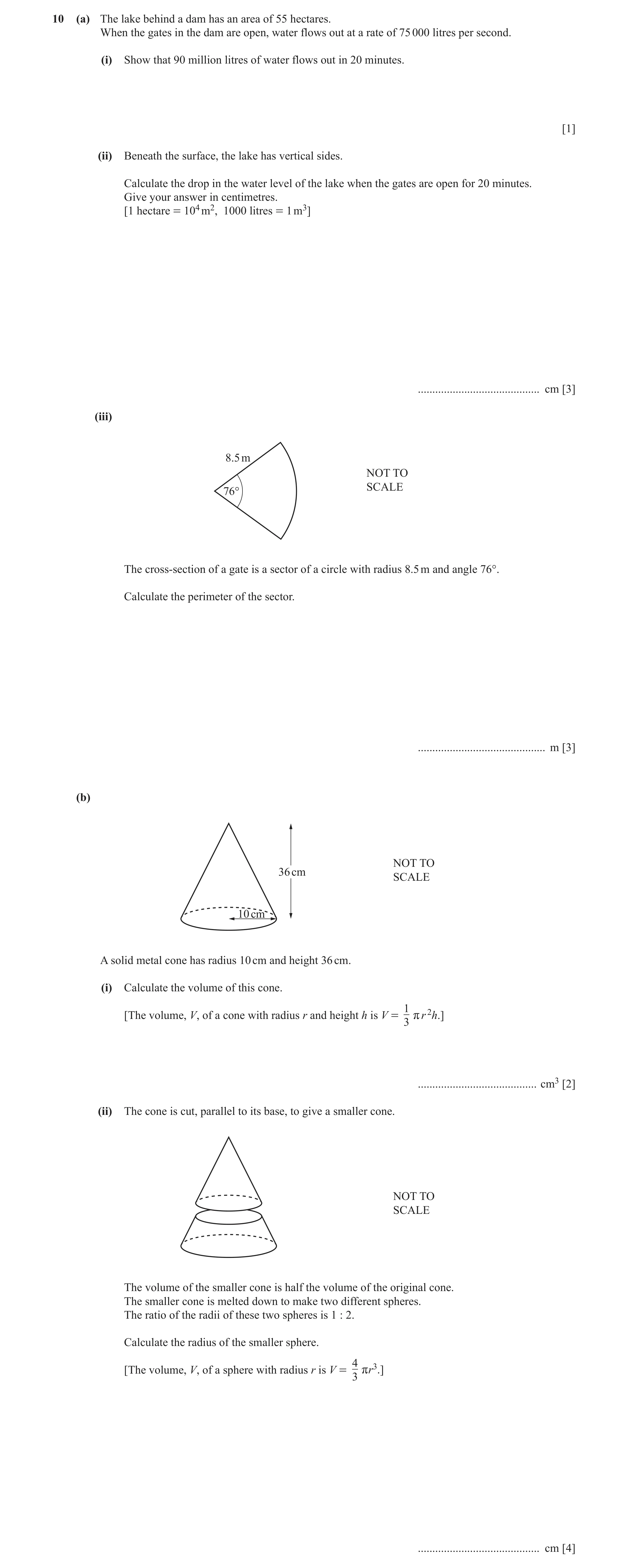
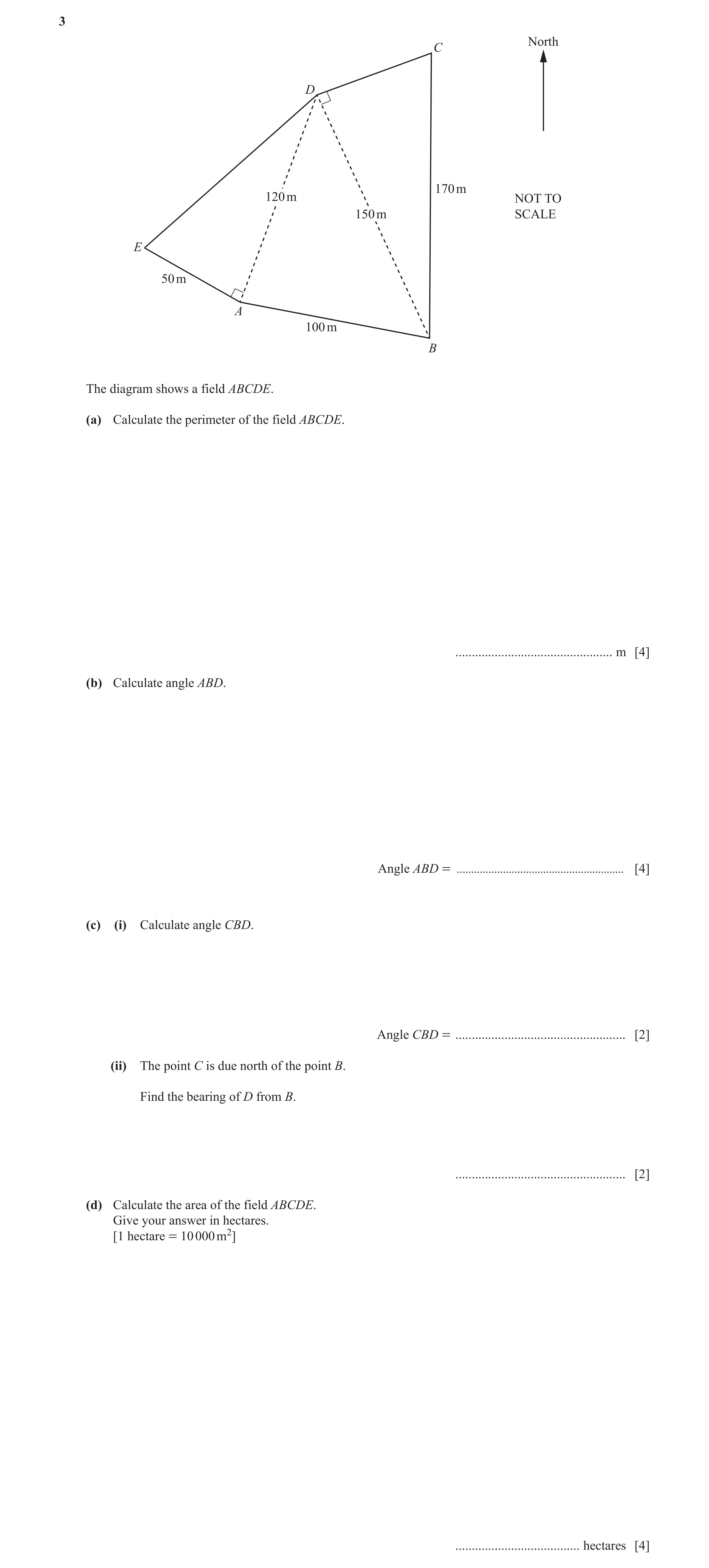
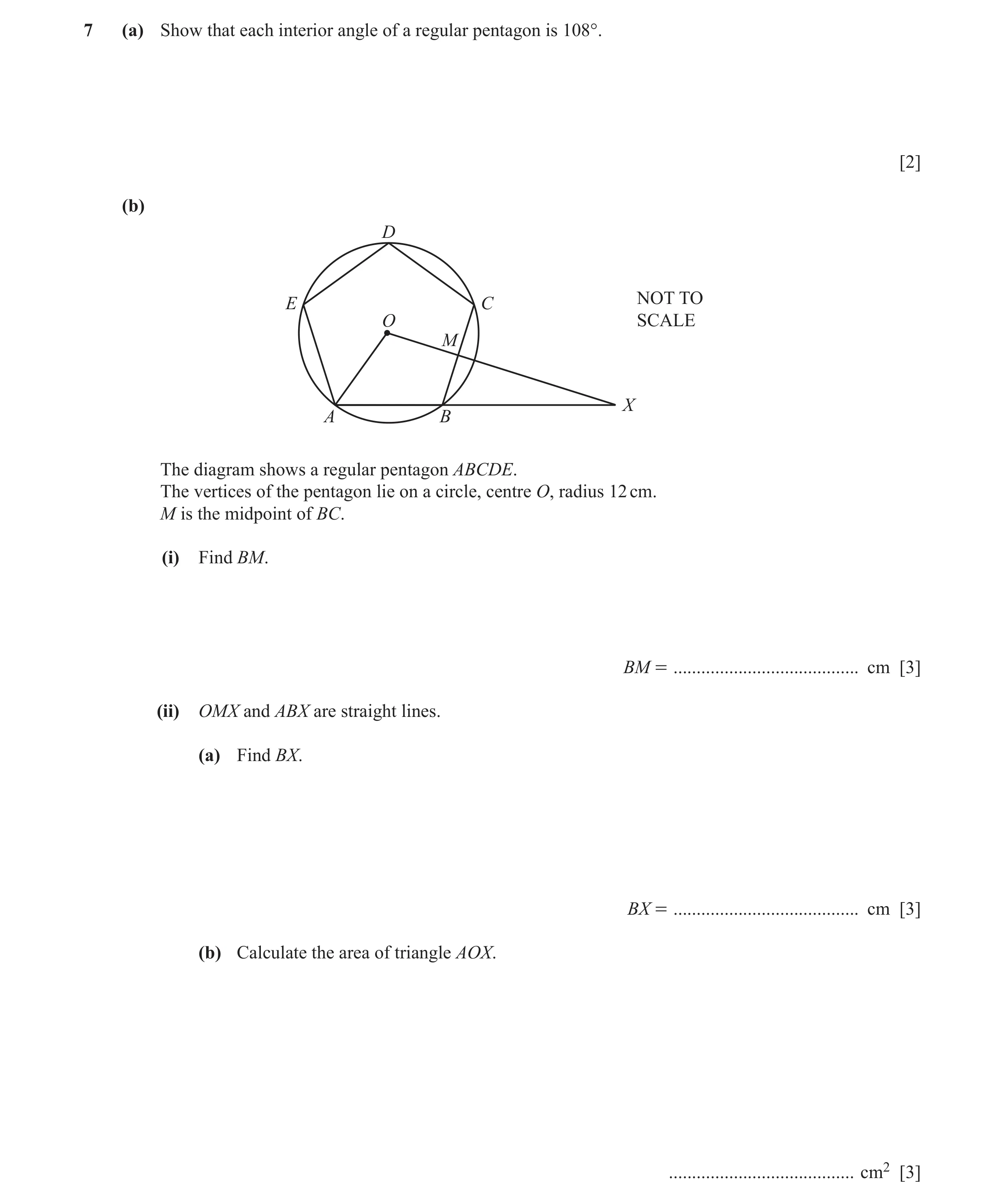 61 / 85
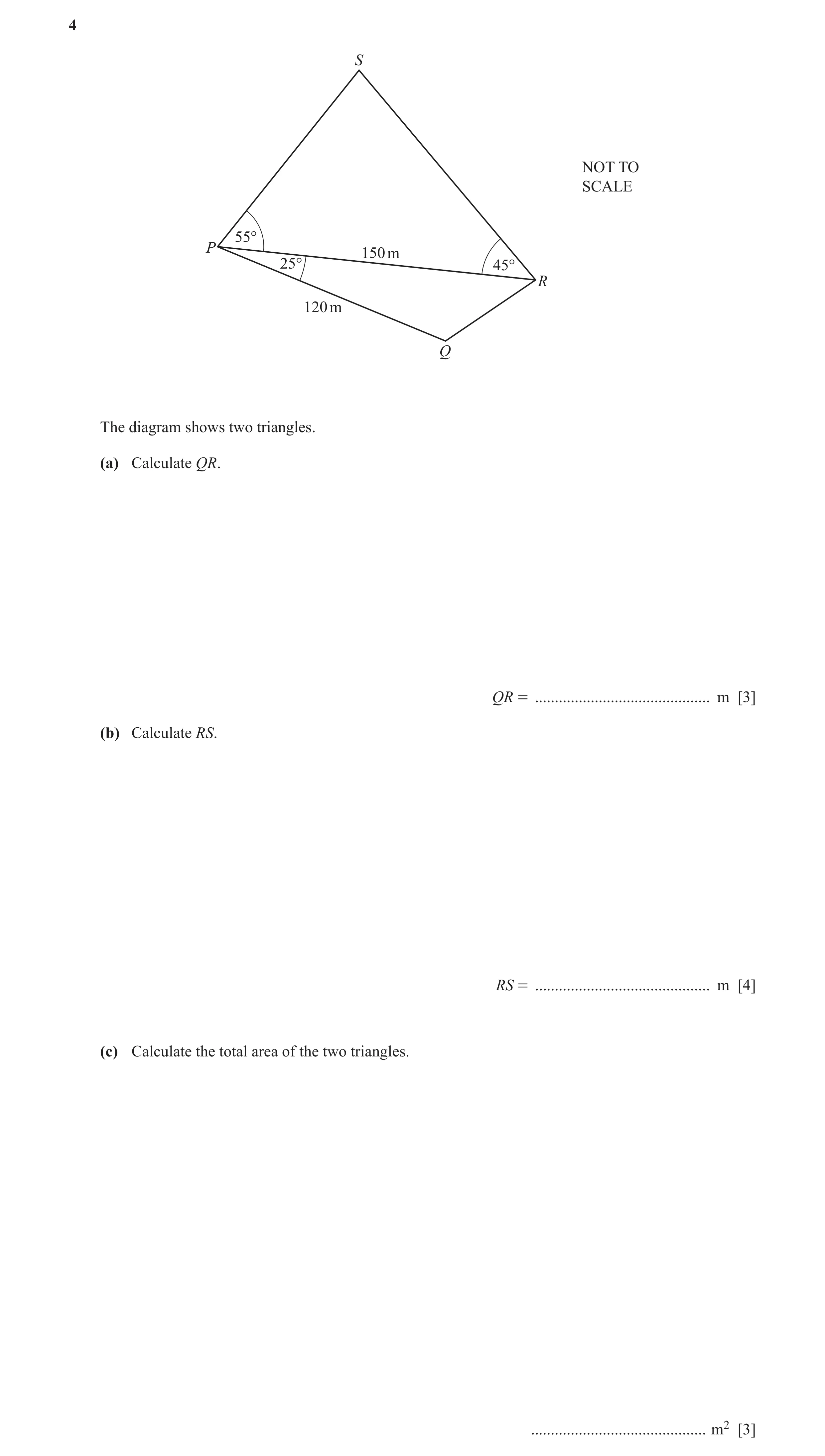
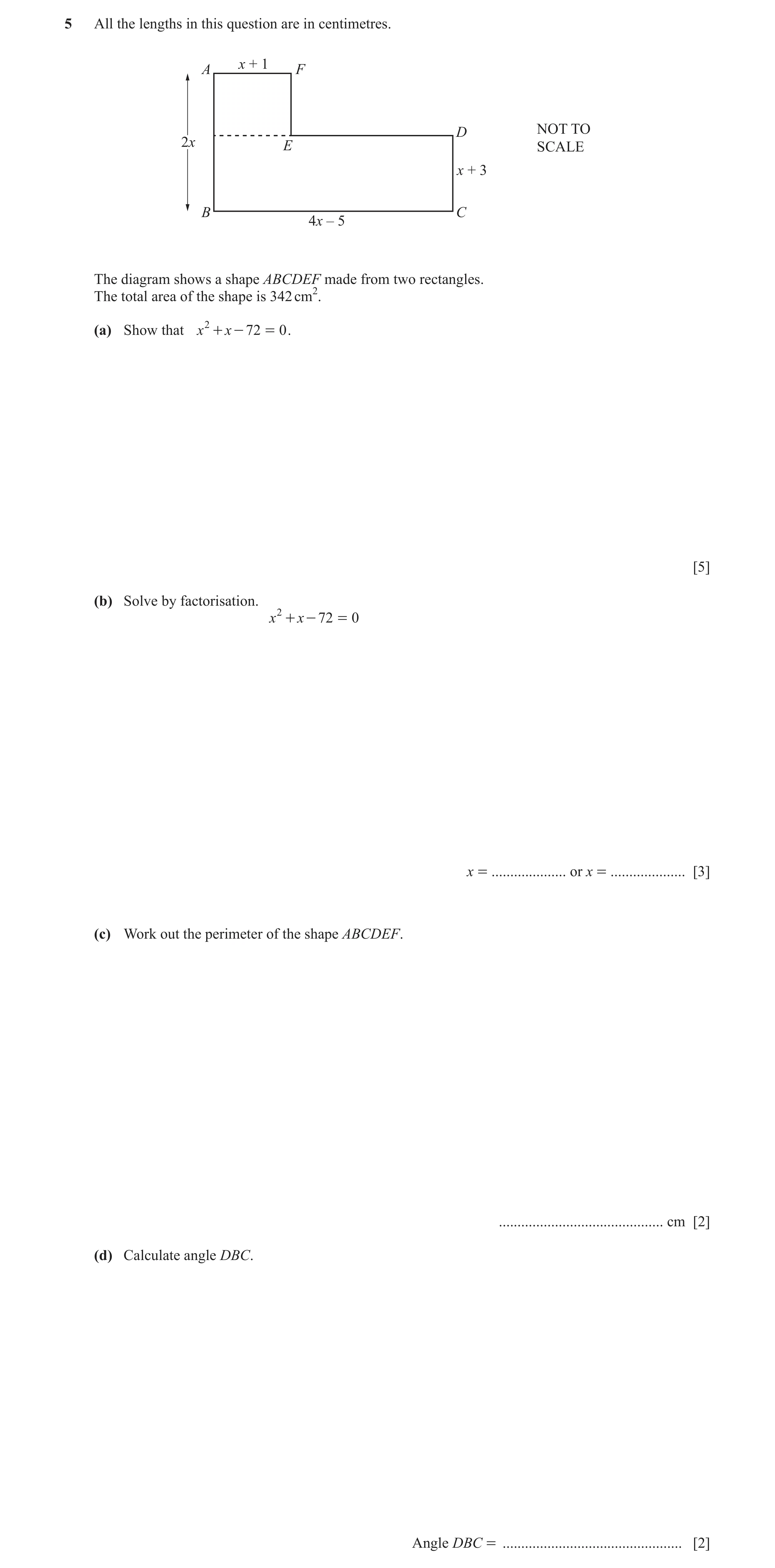
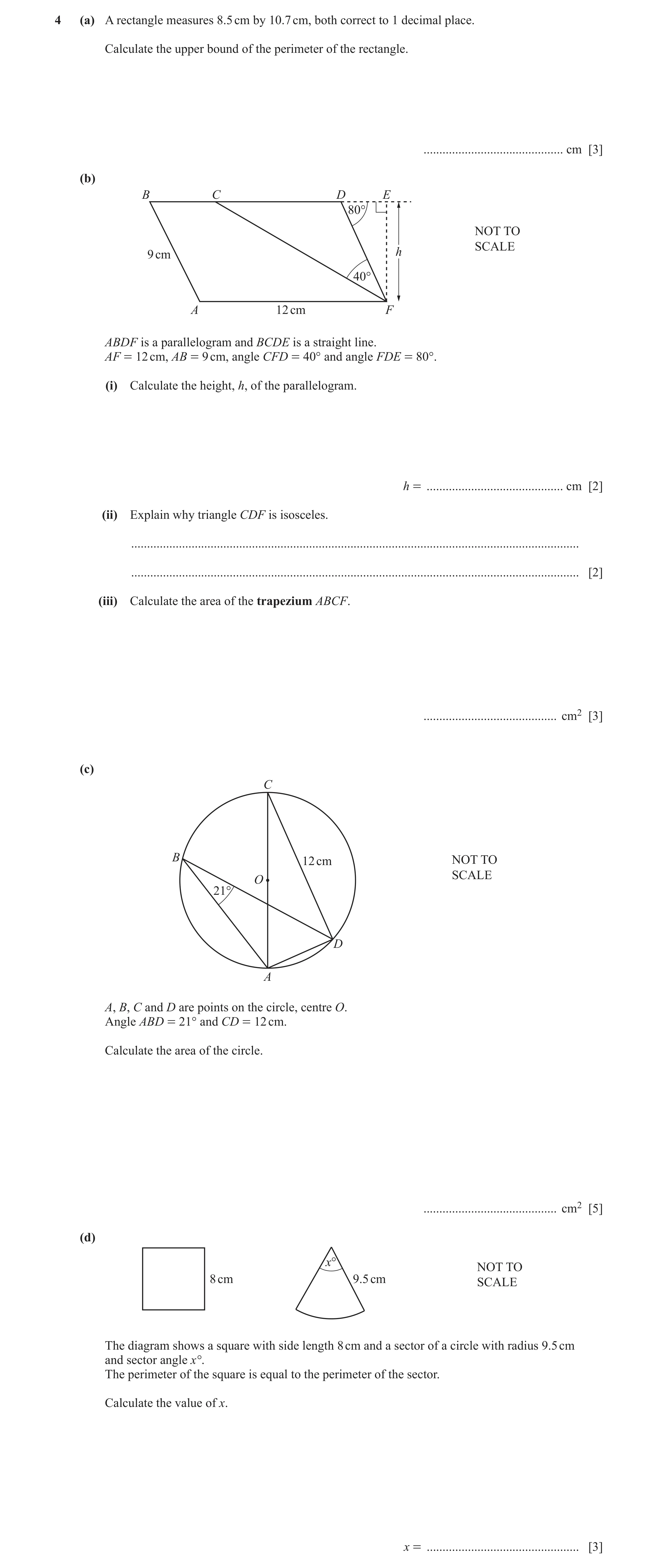
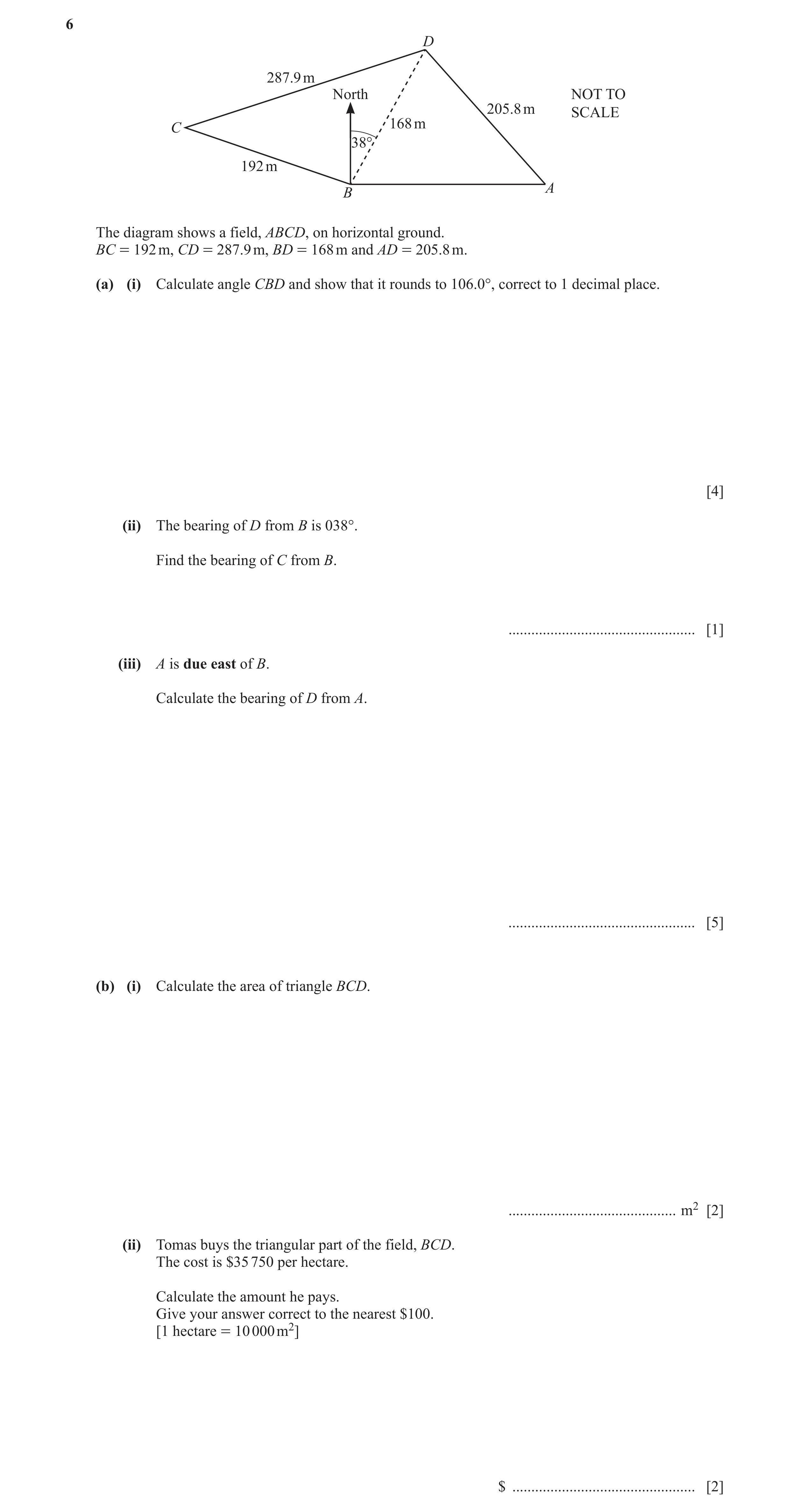
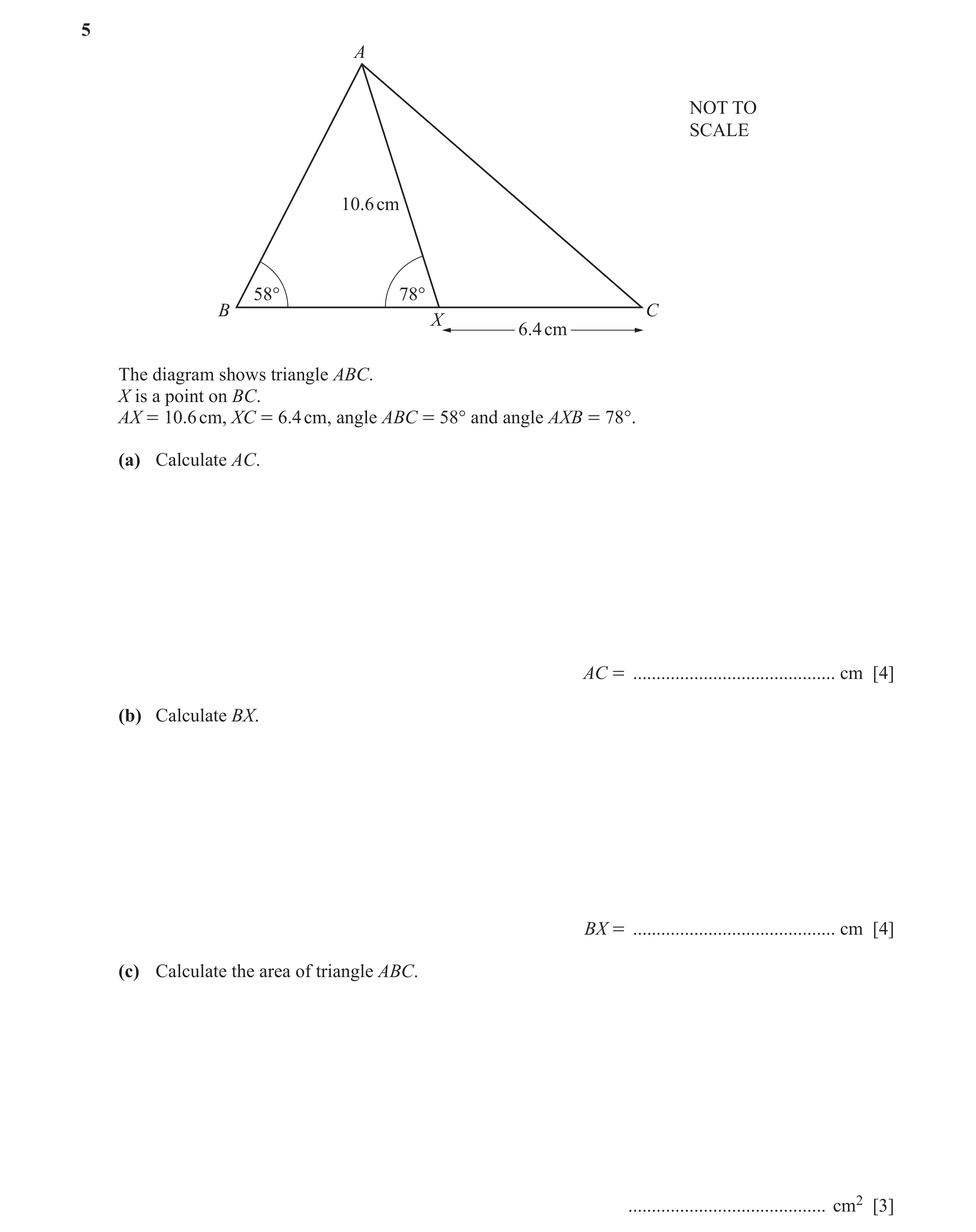 69 / 85
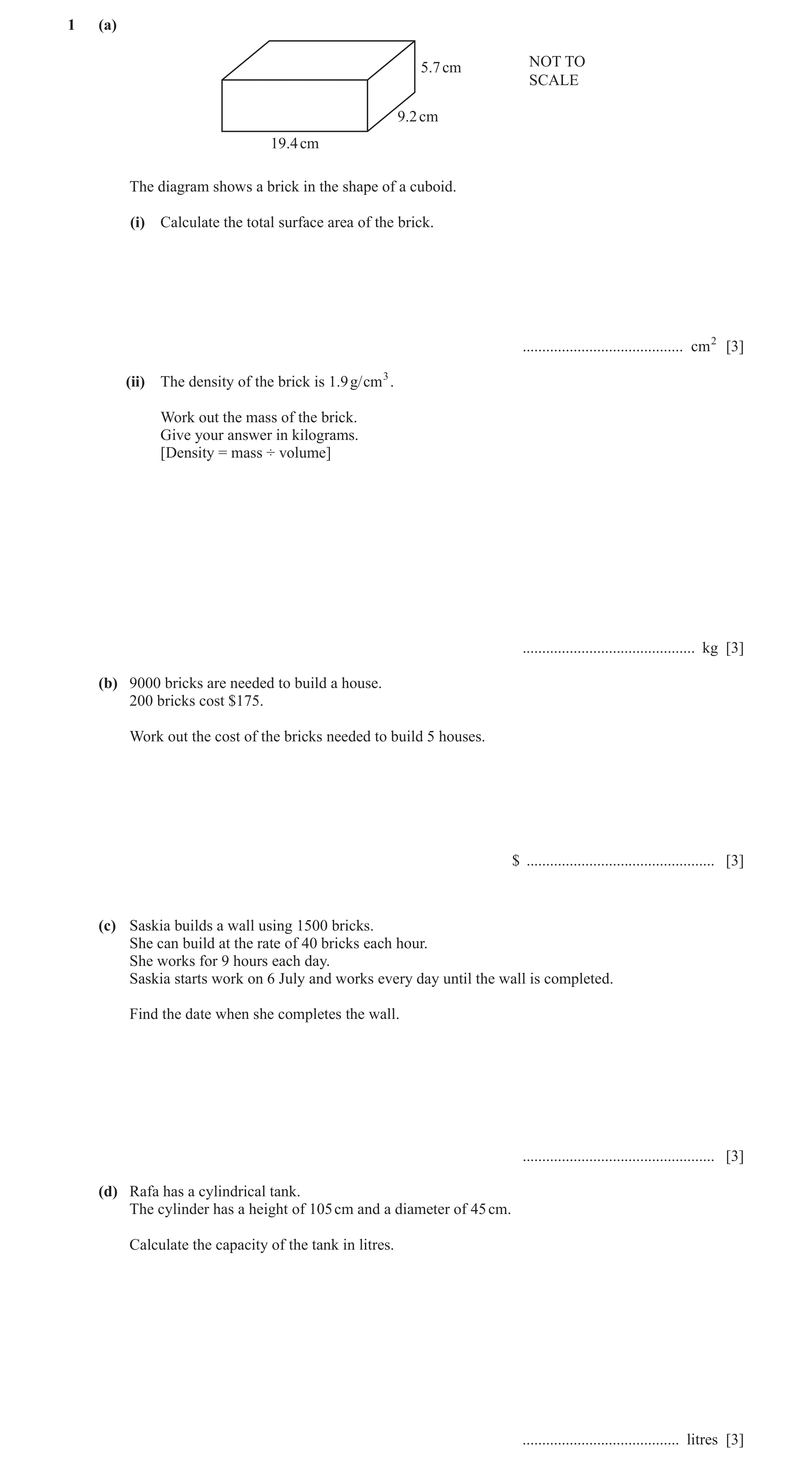
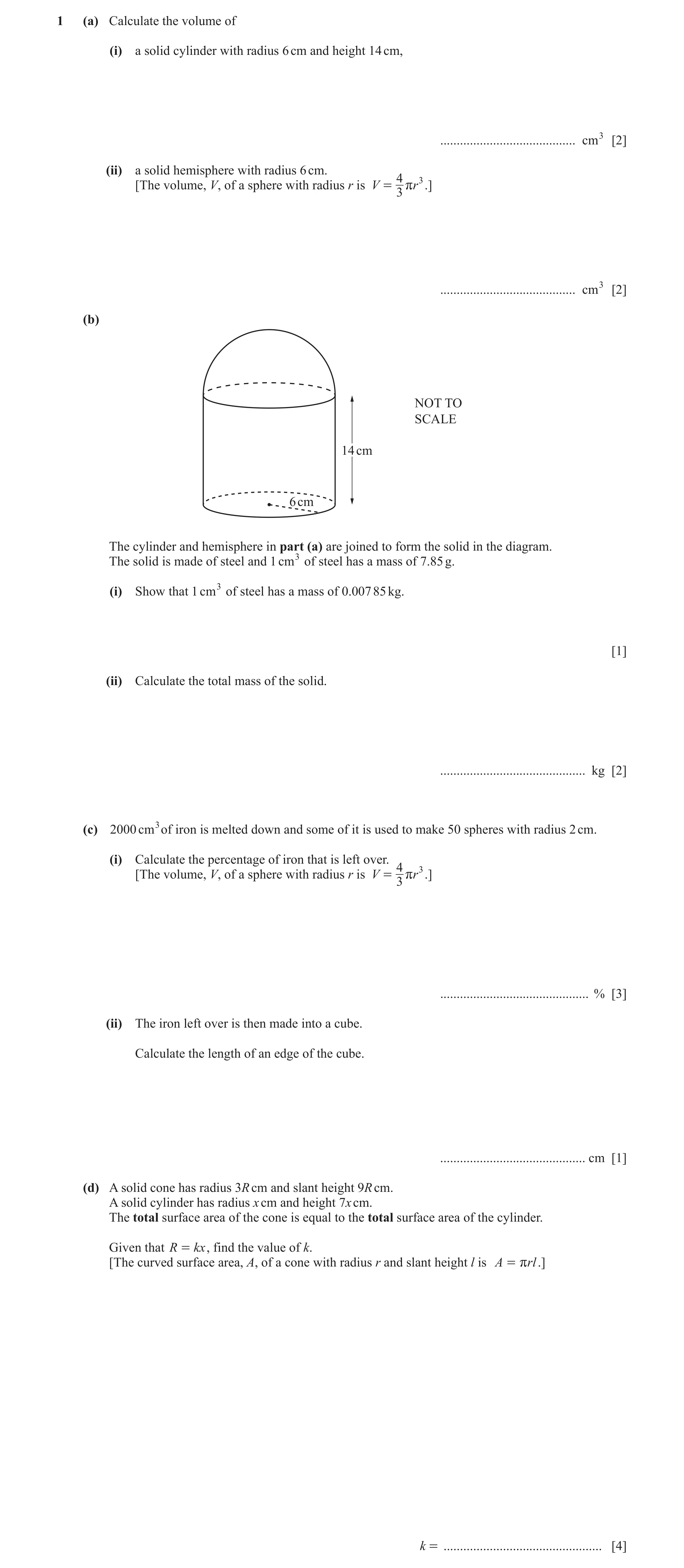
 73 / 85
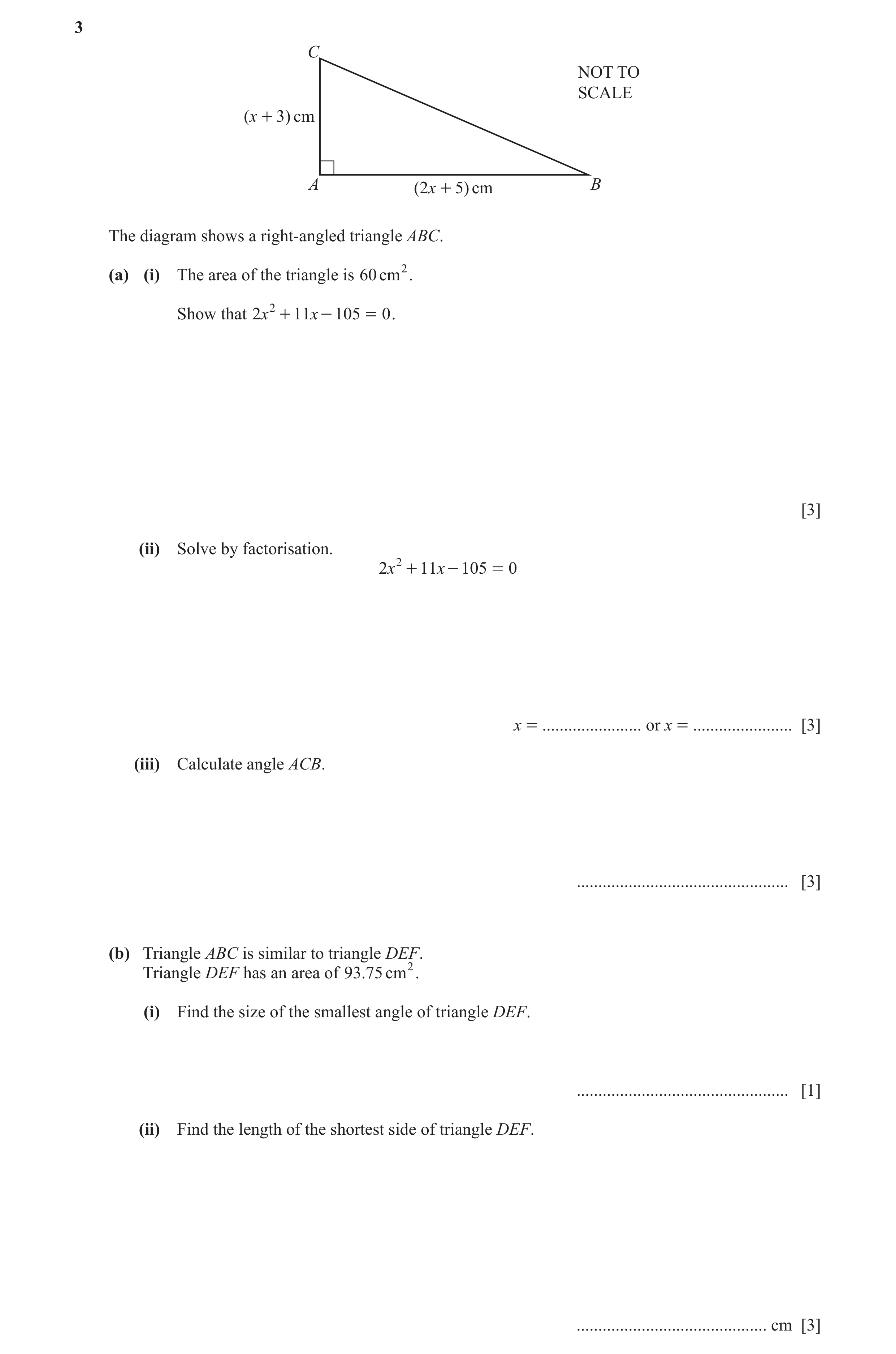
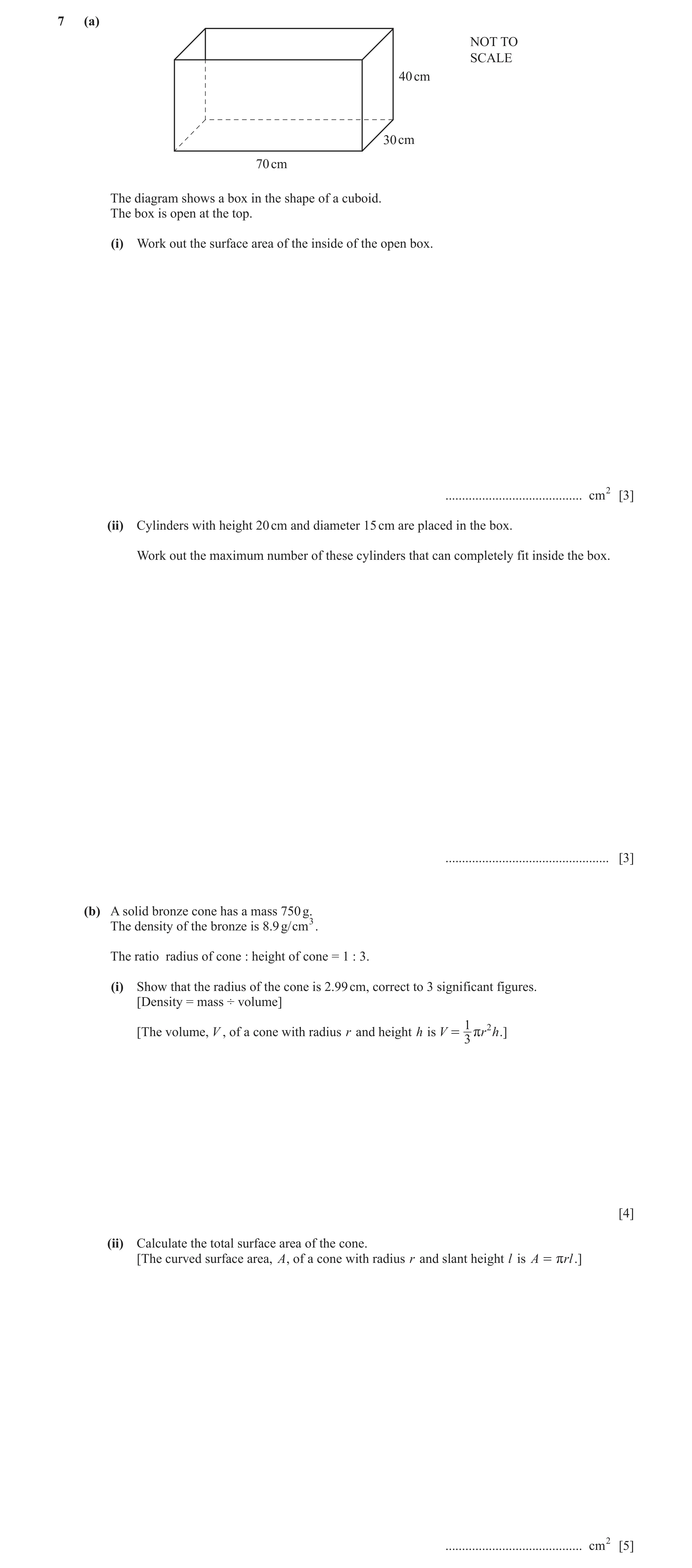
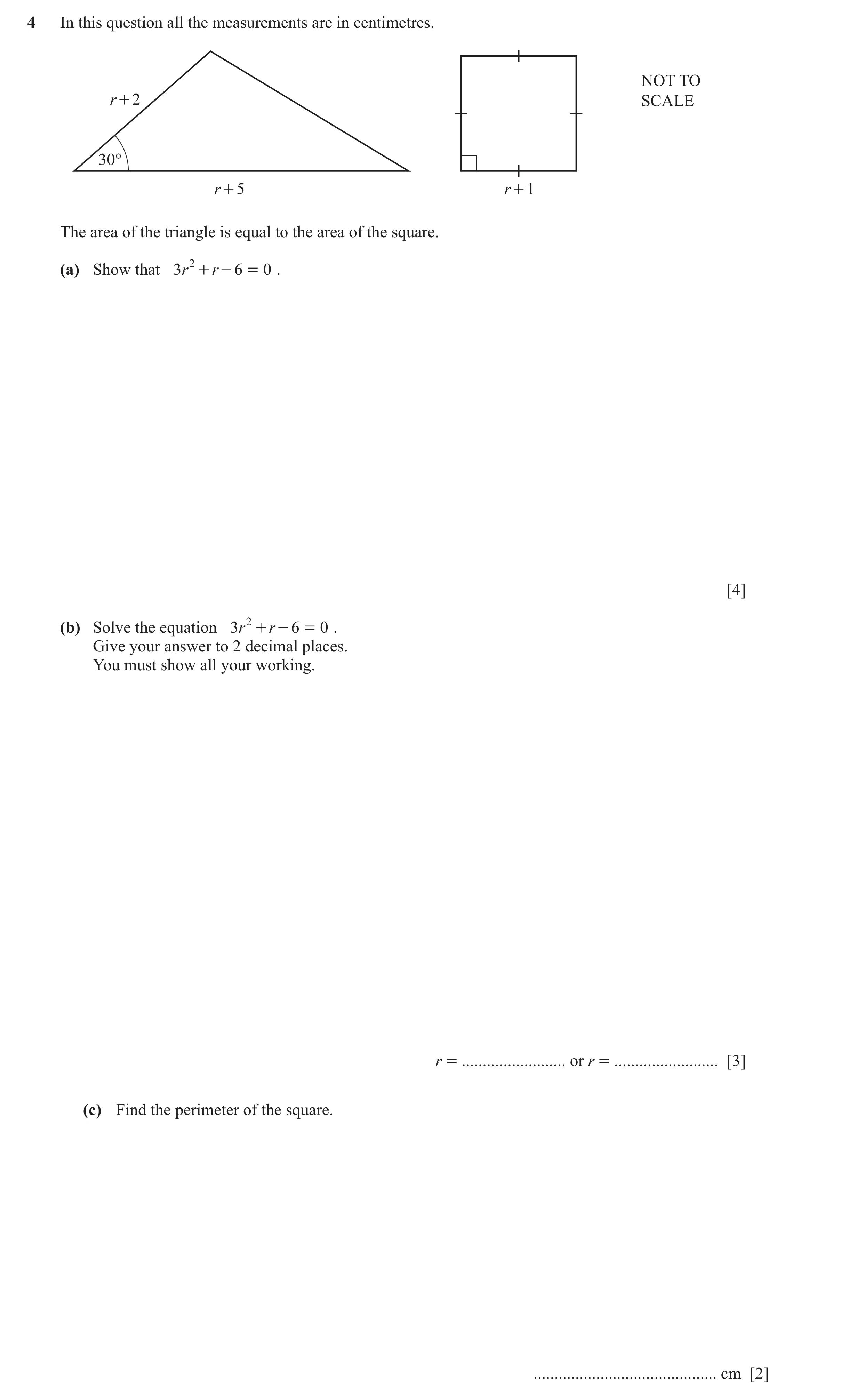
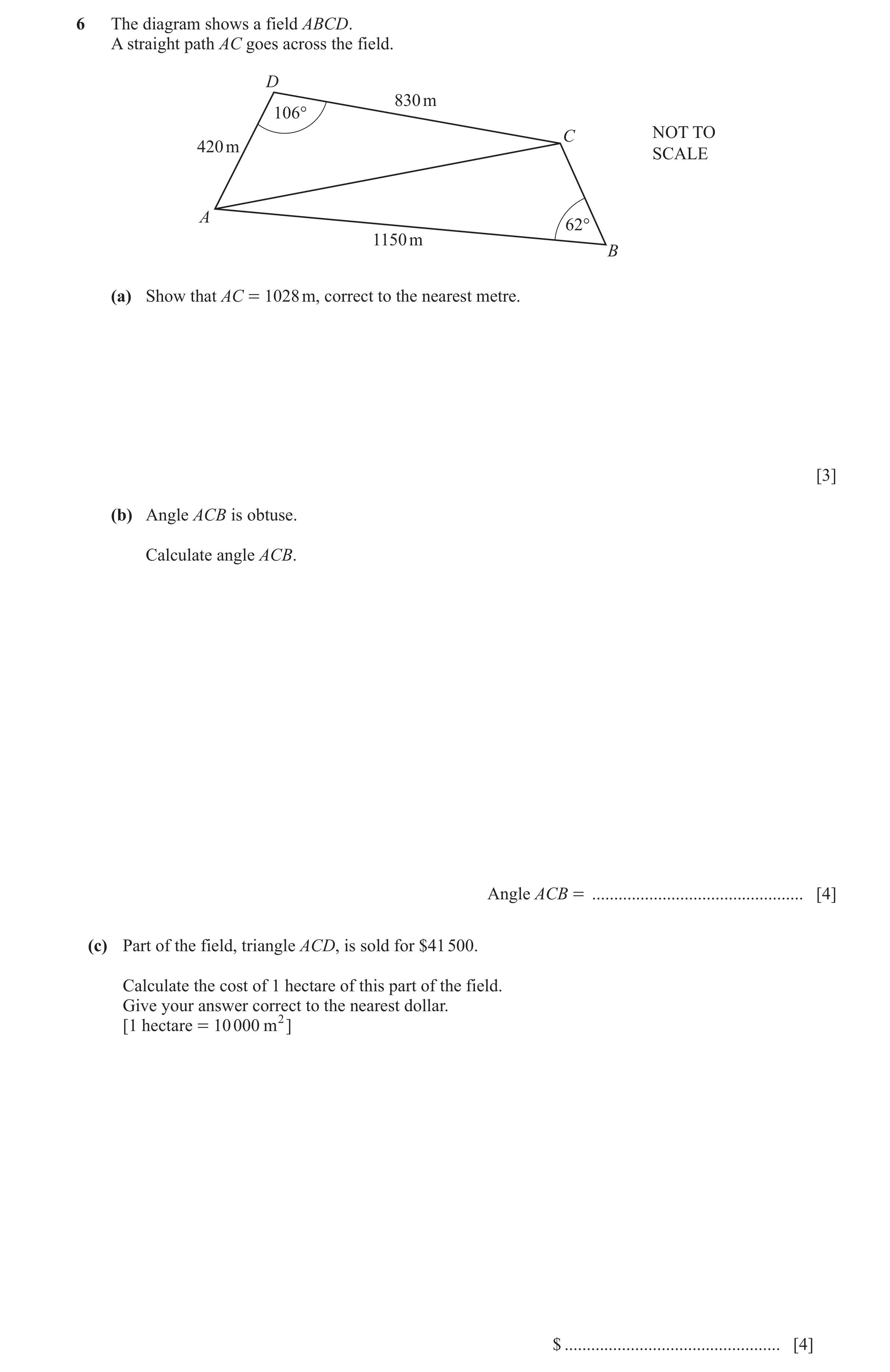
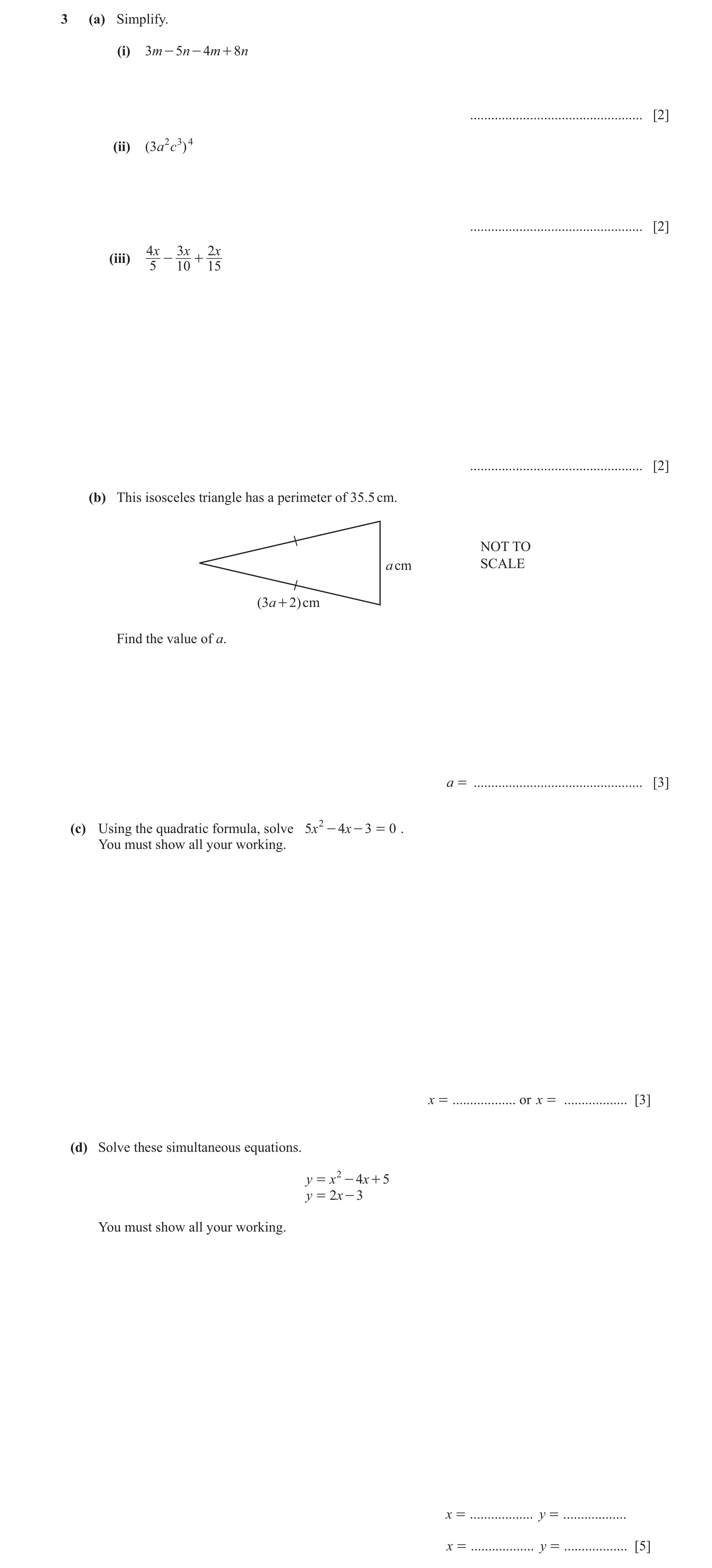
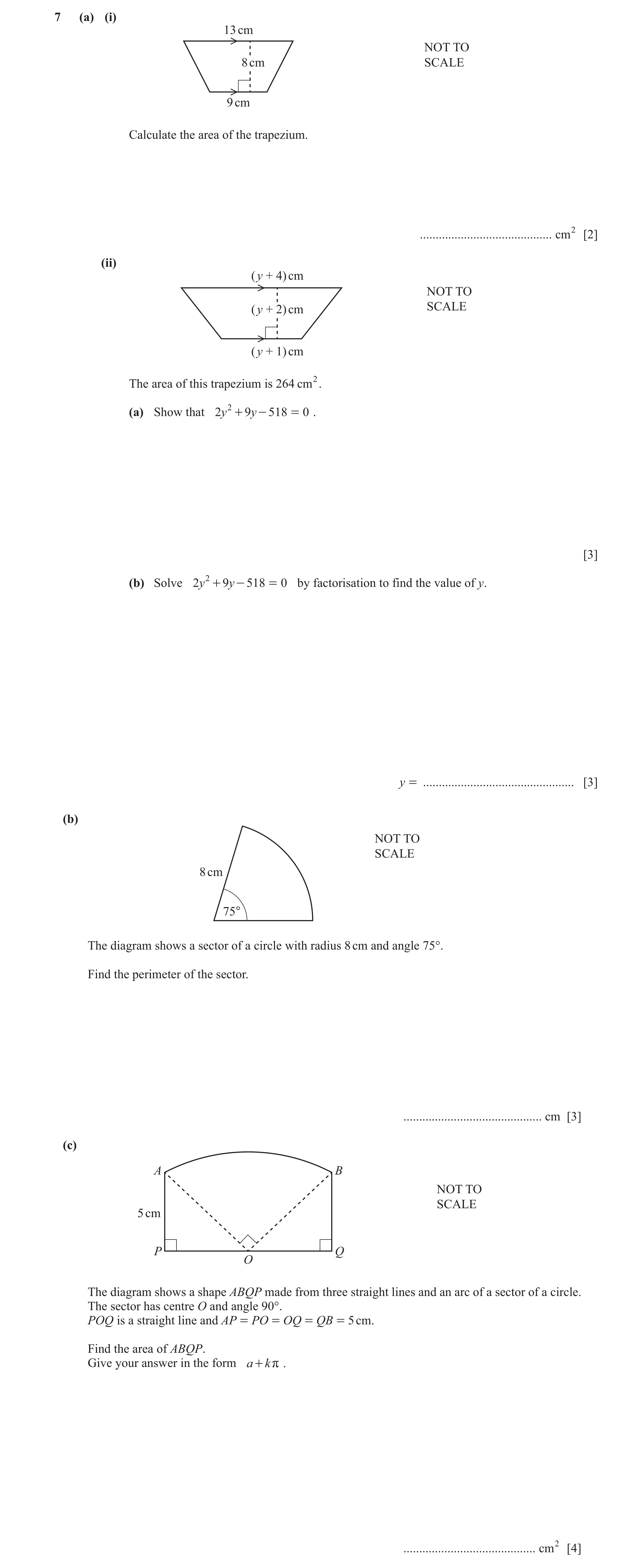
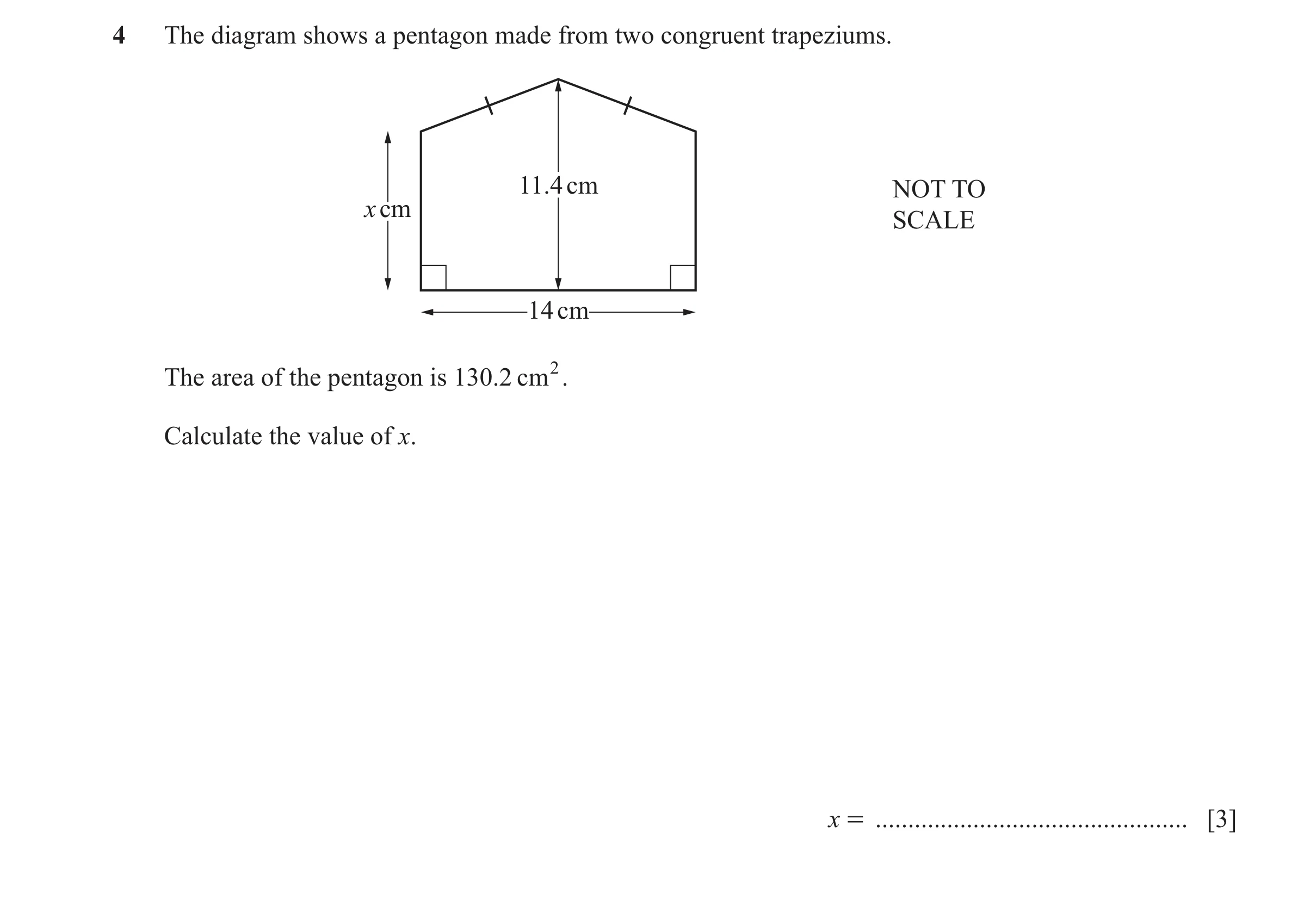 83 / 85
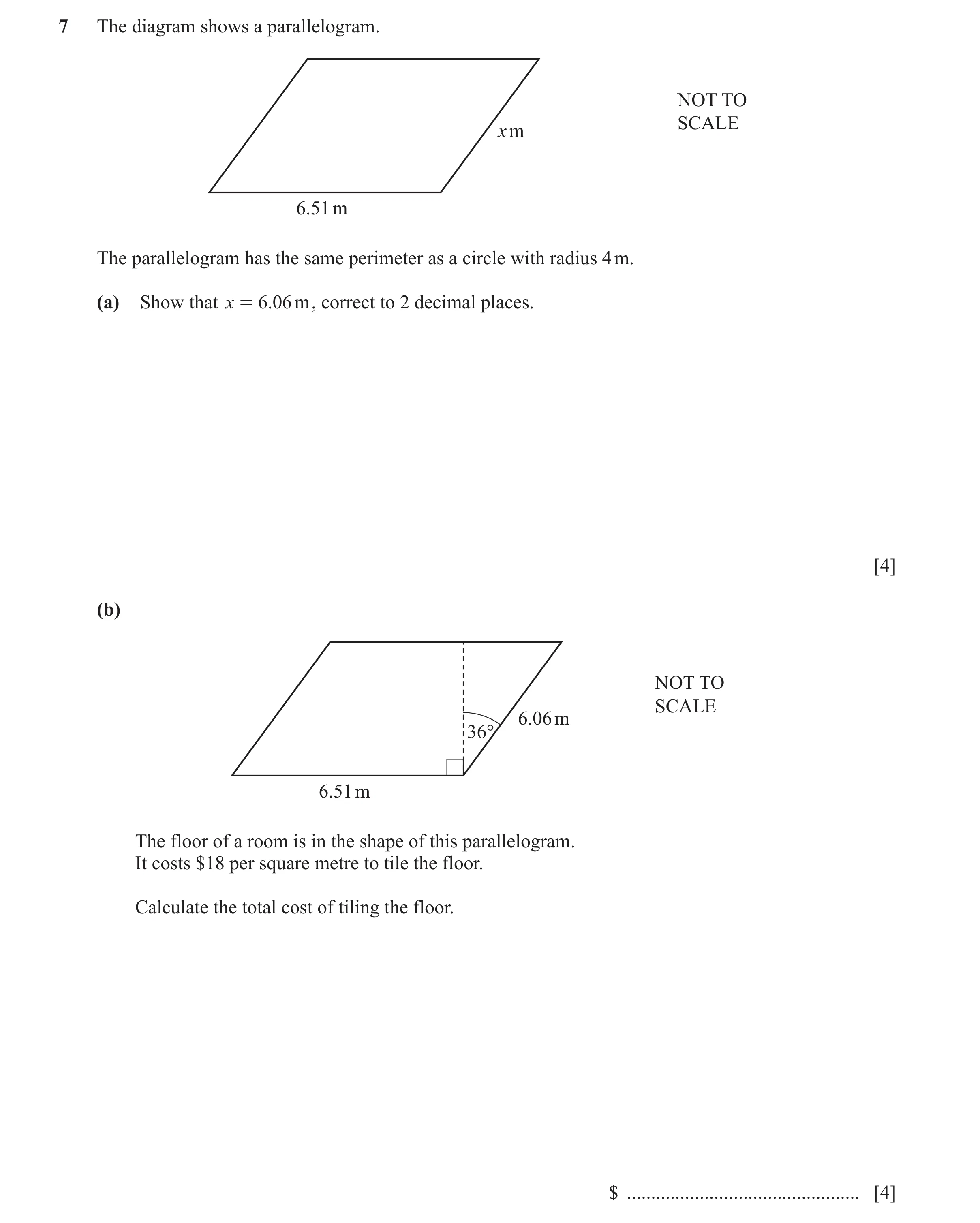 84 / 85
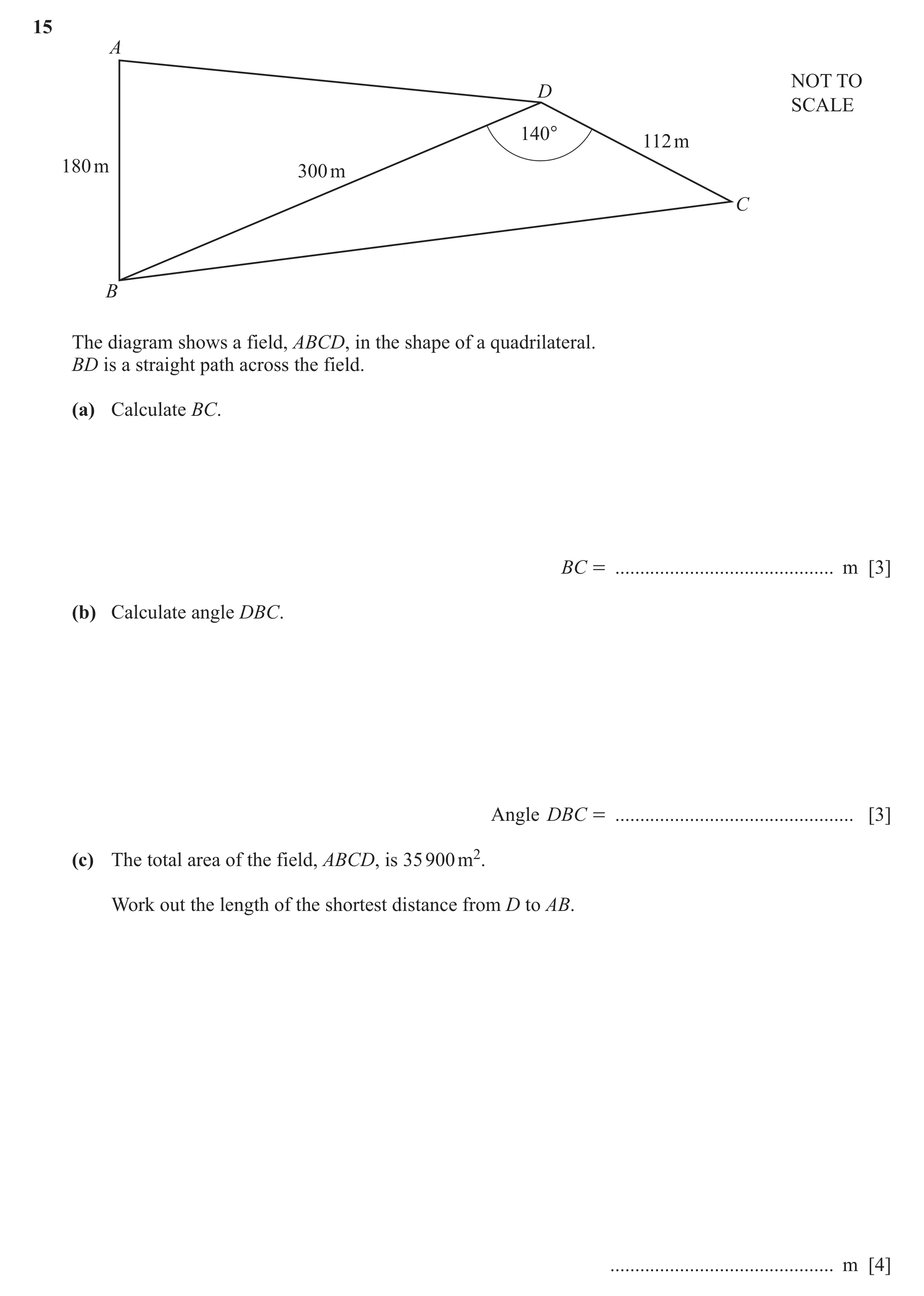 85 / 85
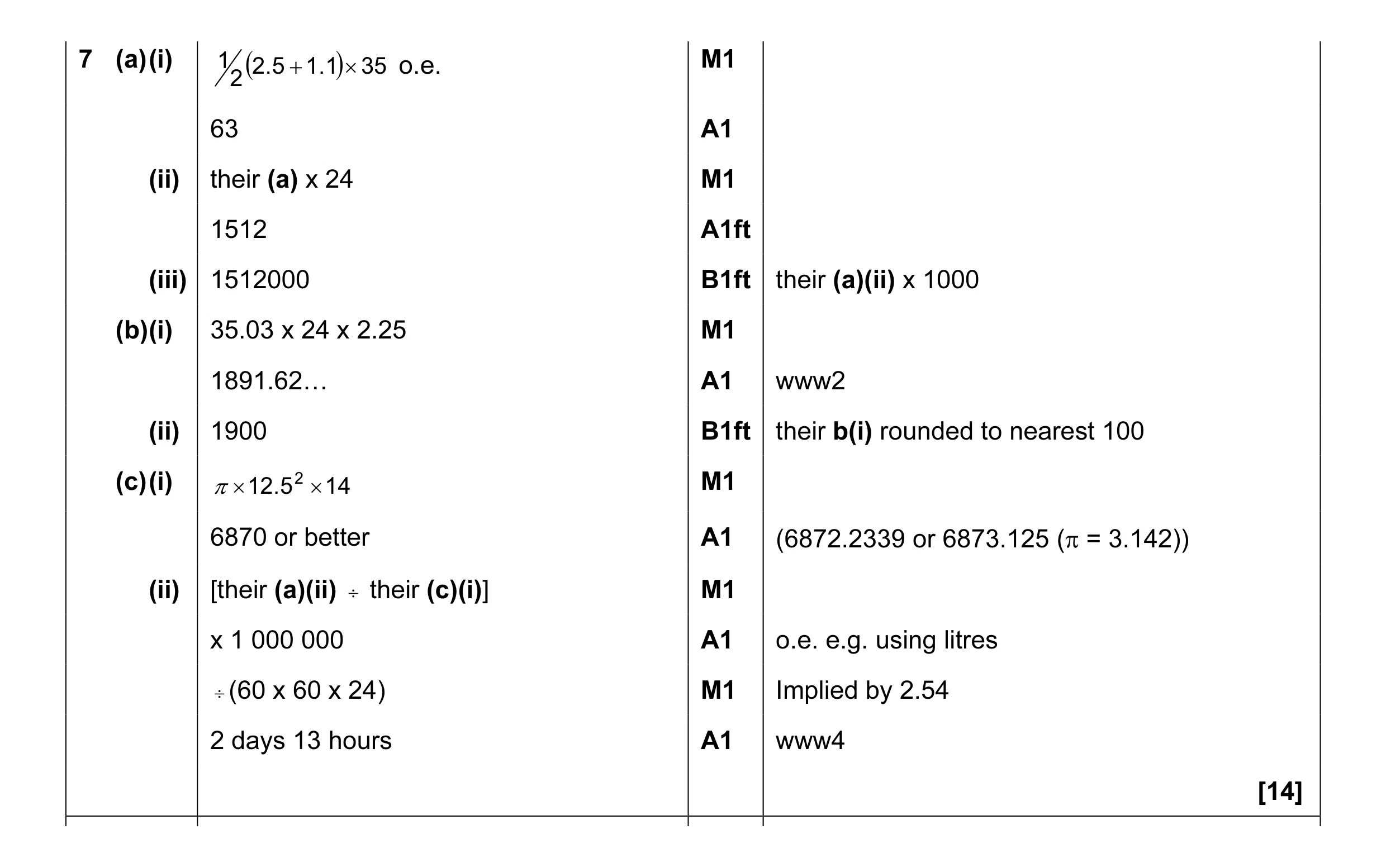 14
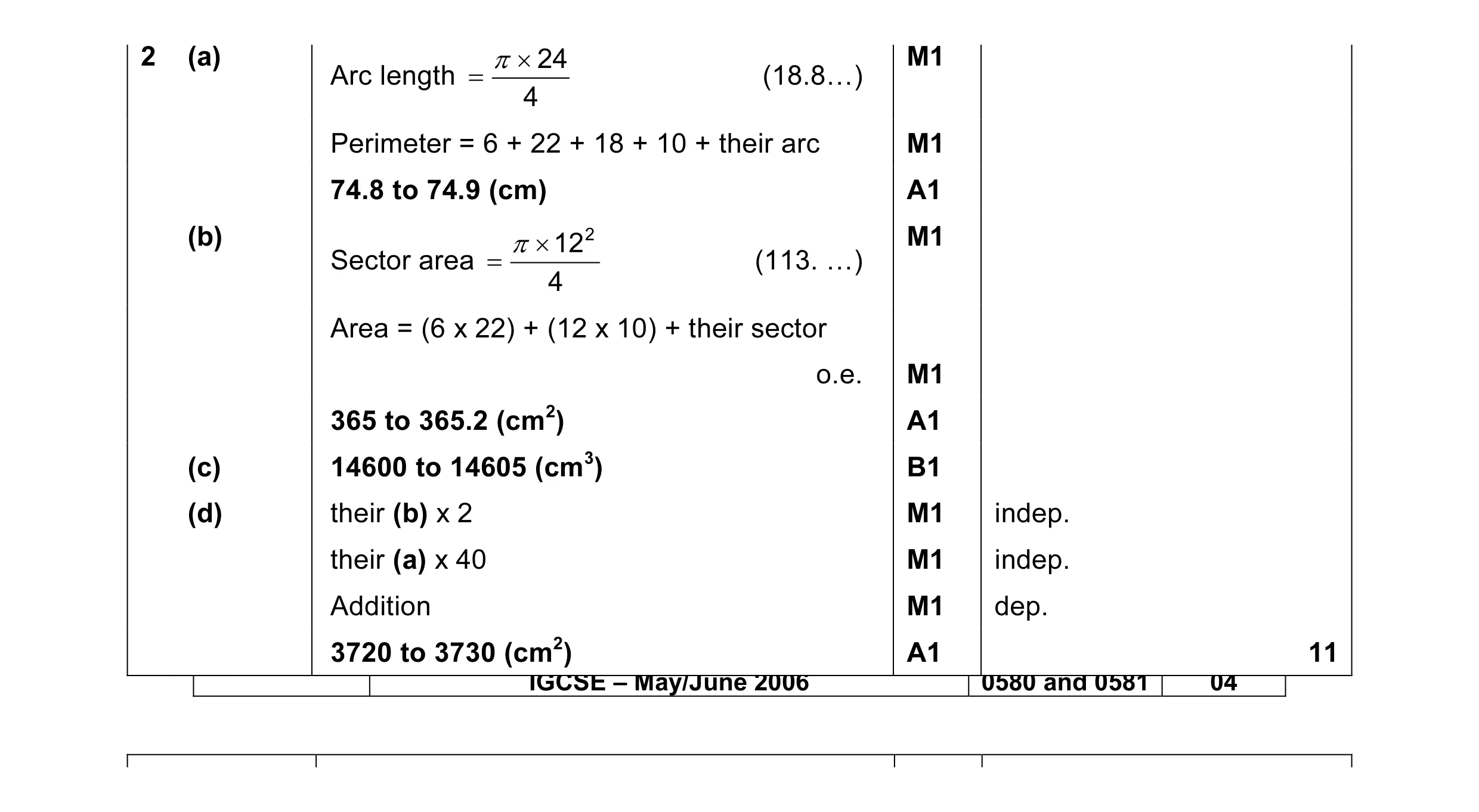 11
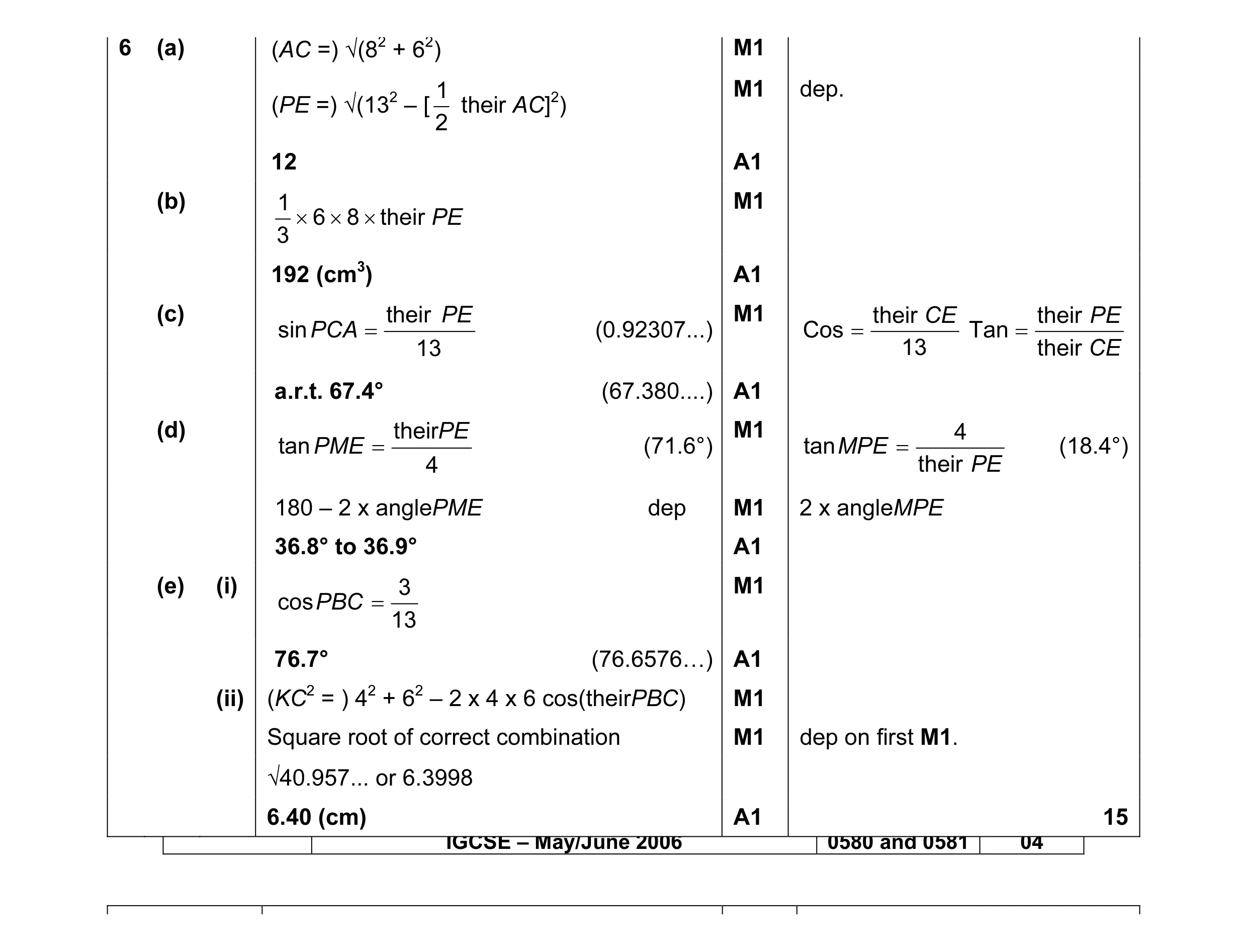 15
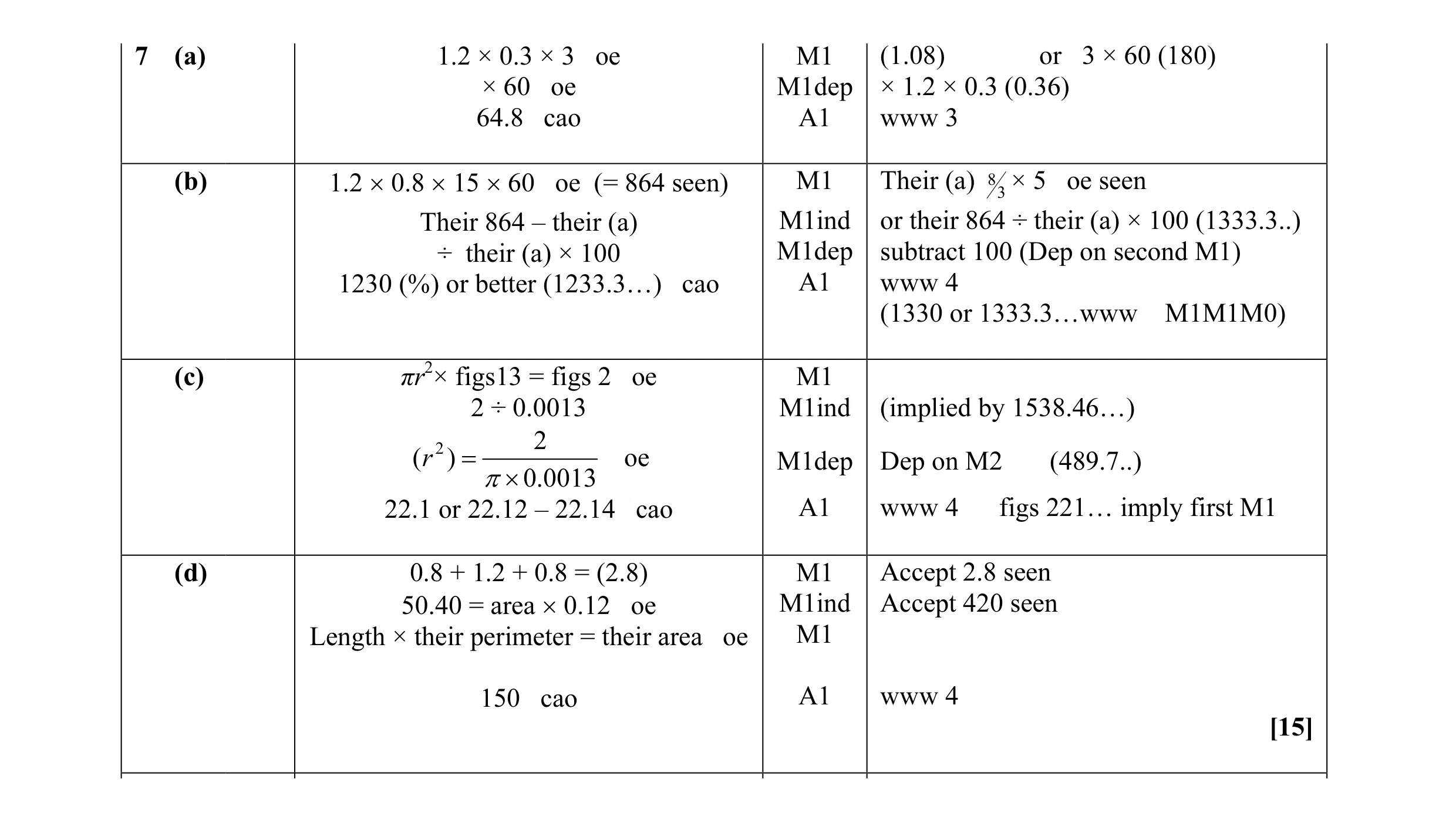 15
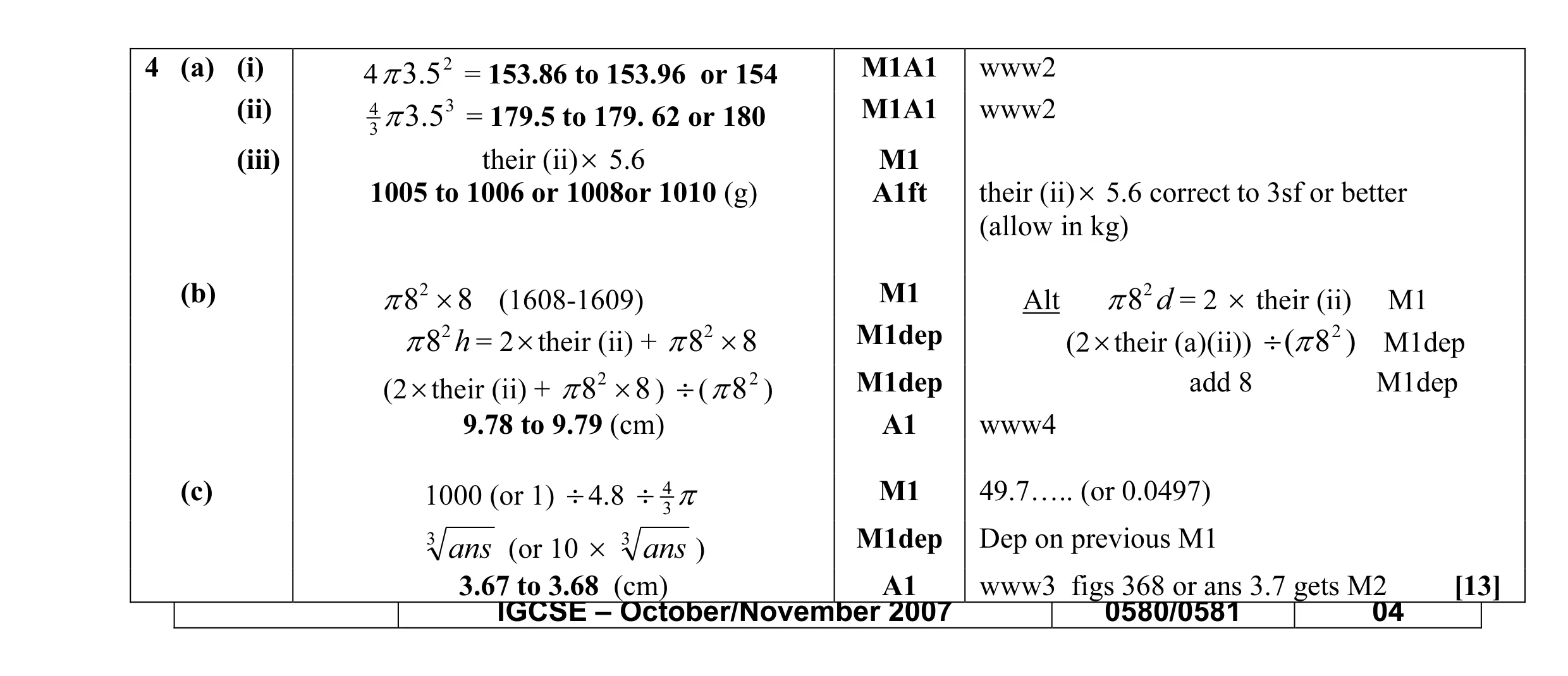 13
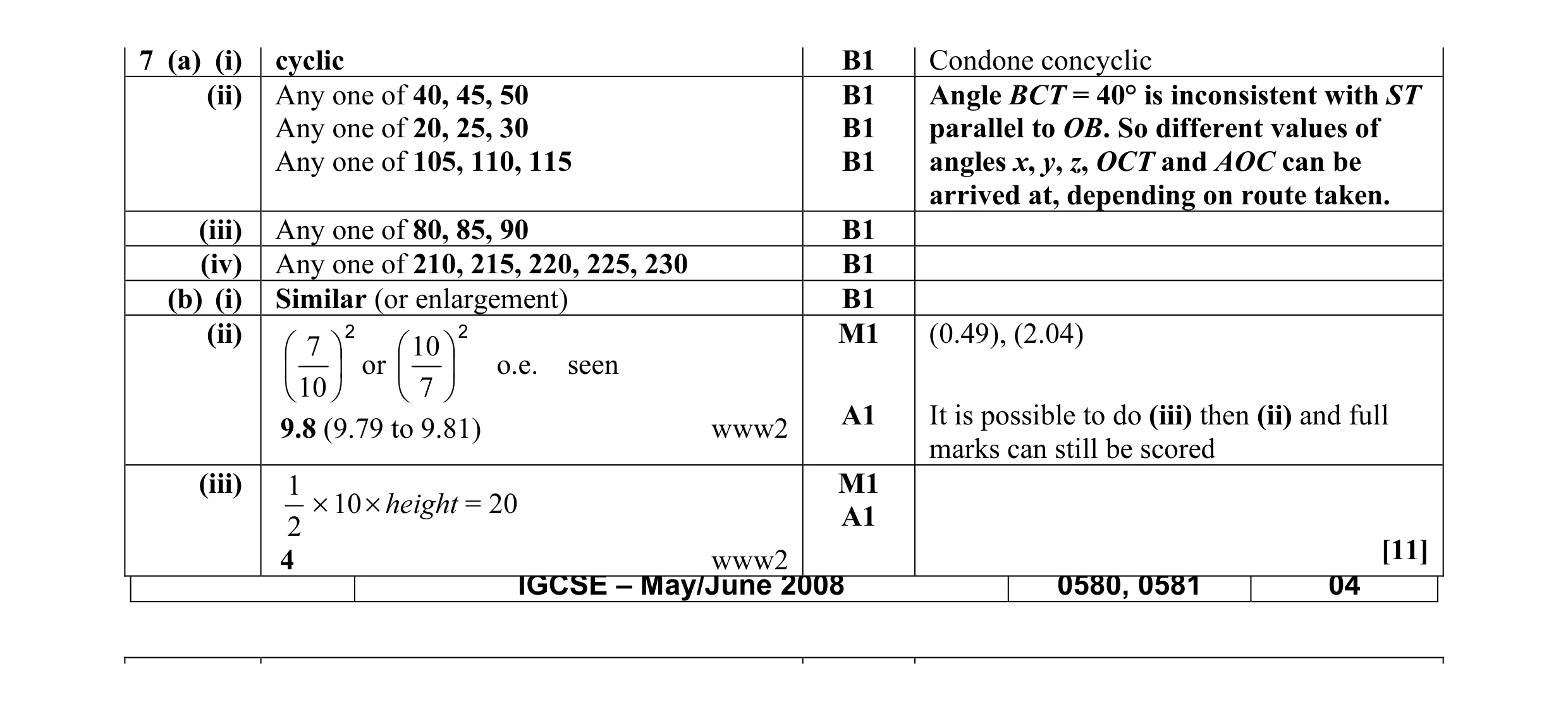 11
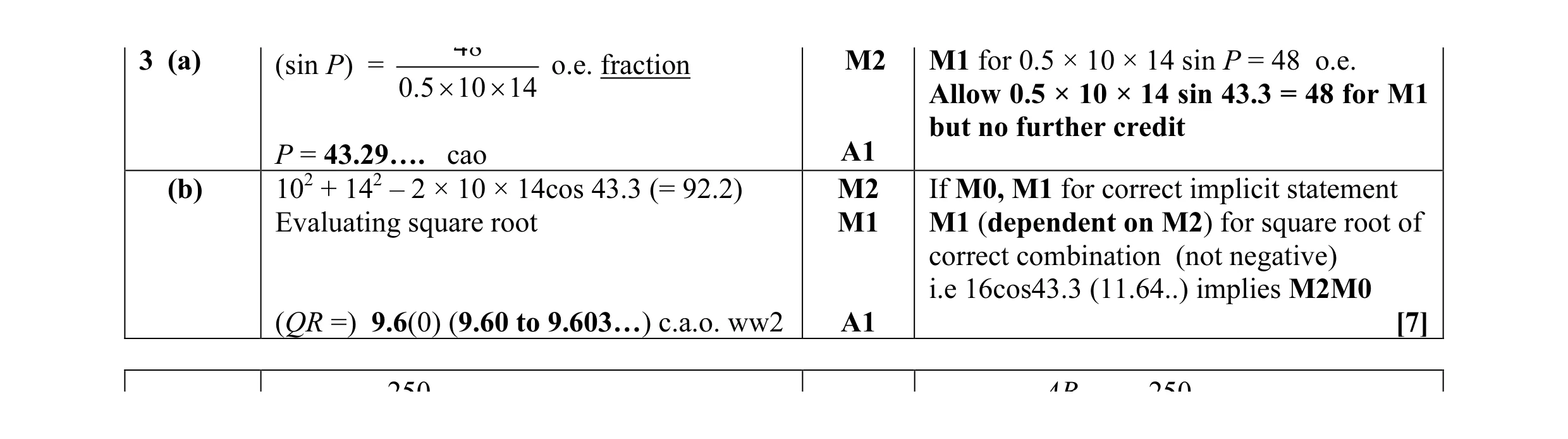 7
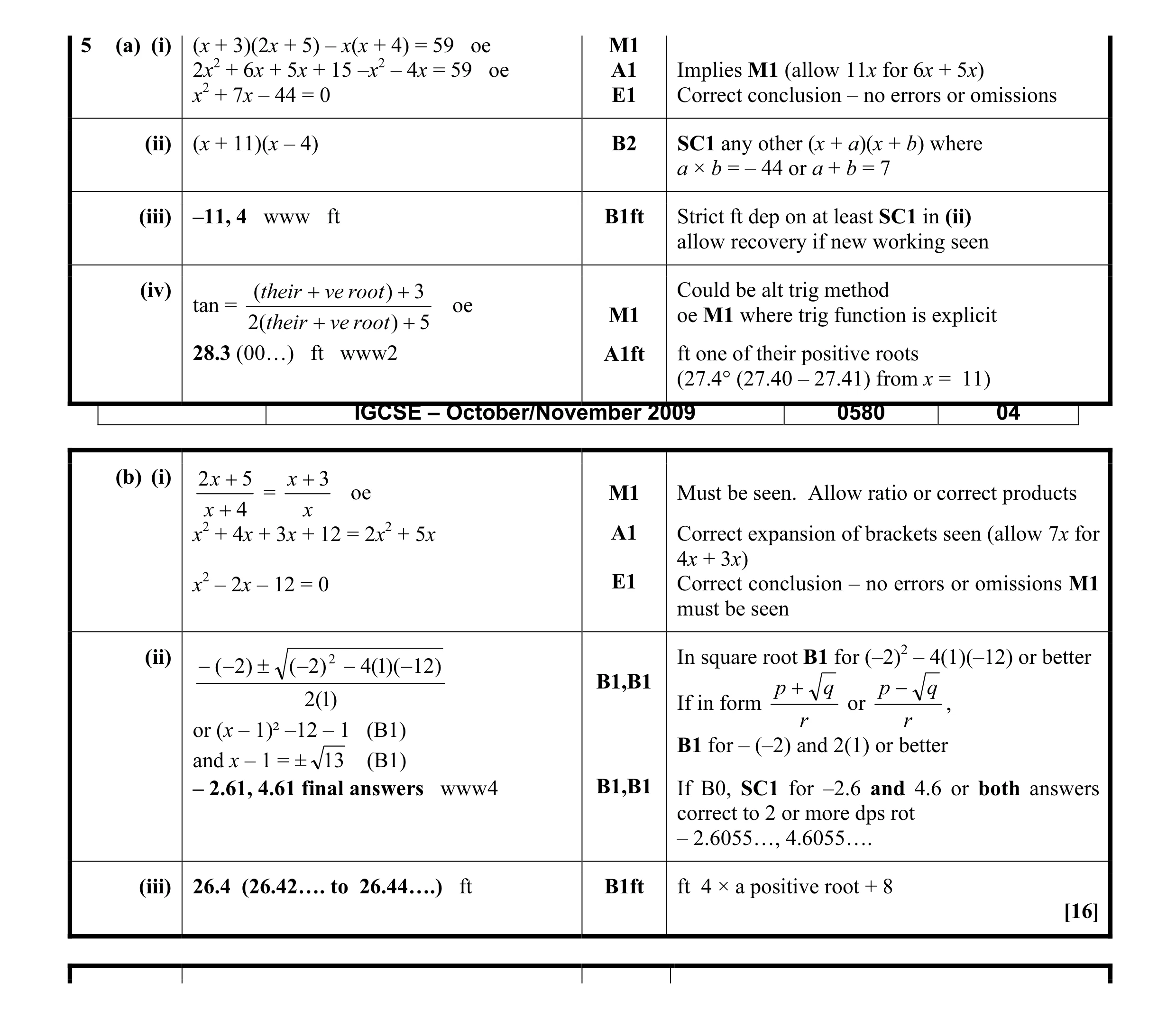 16
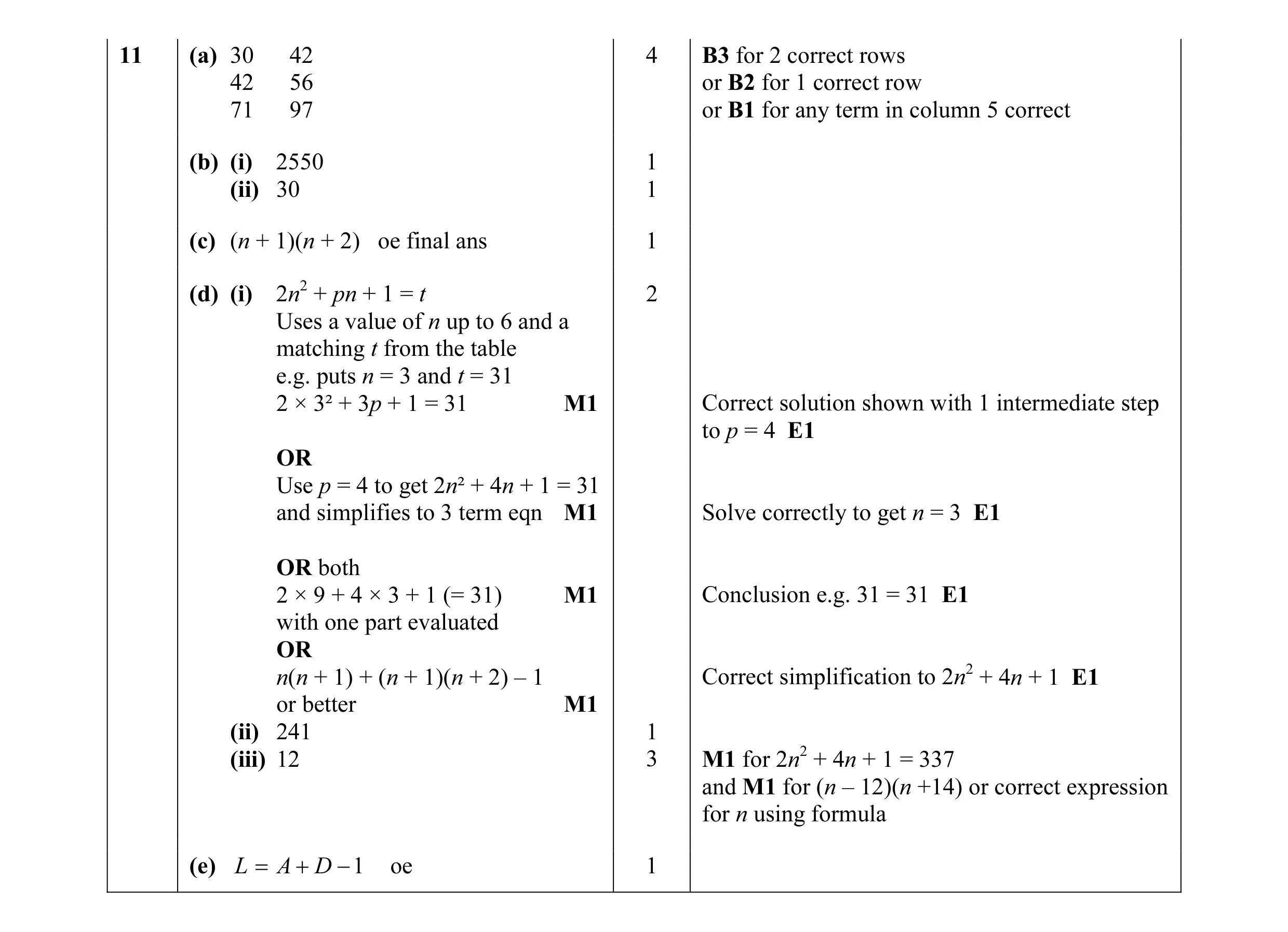 14
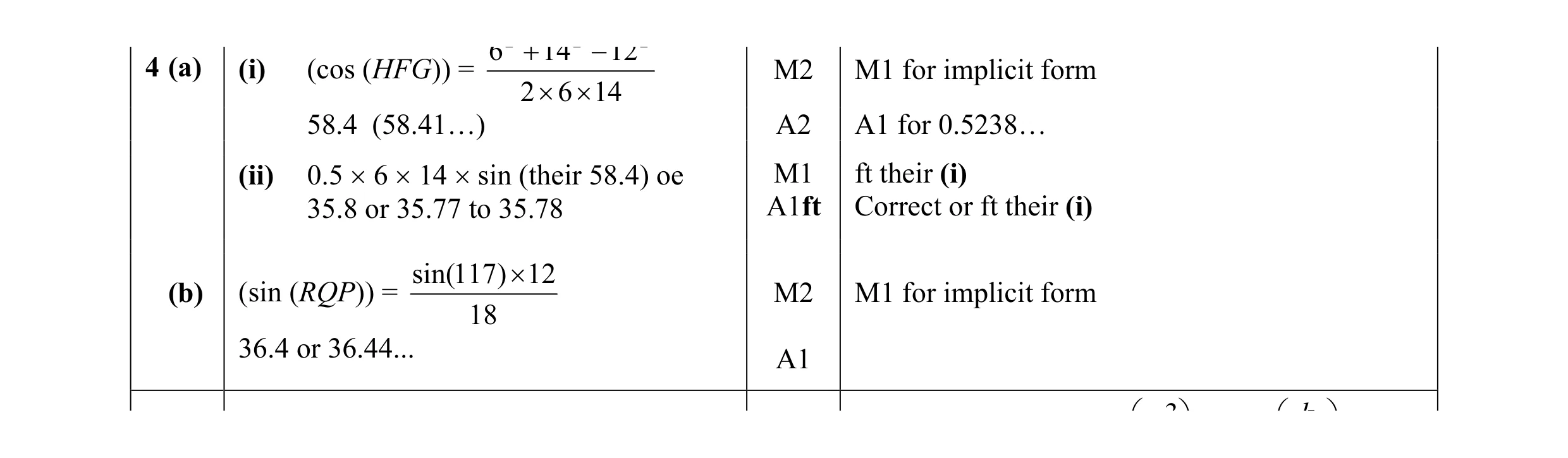 9
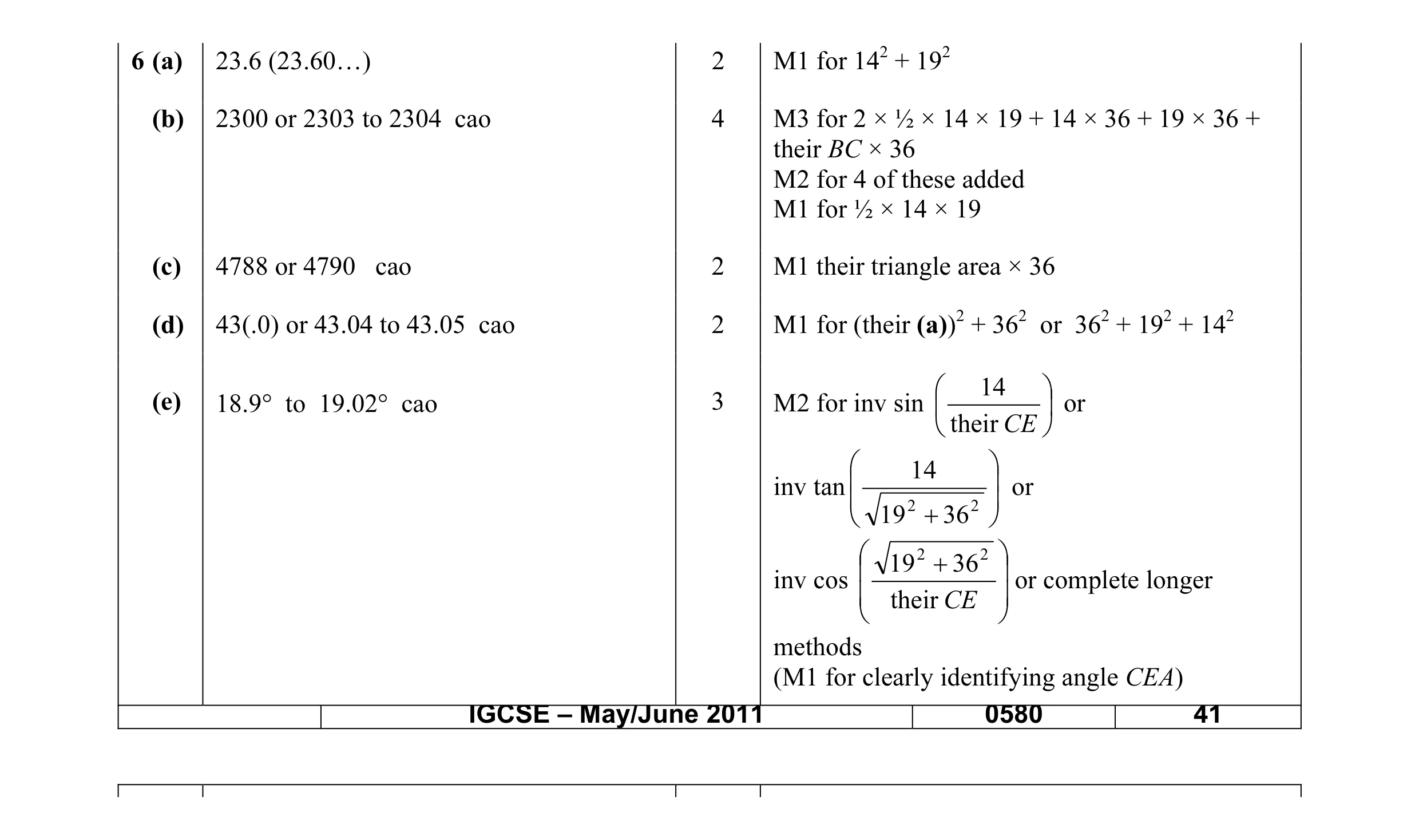 13
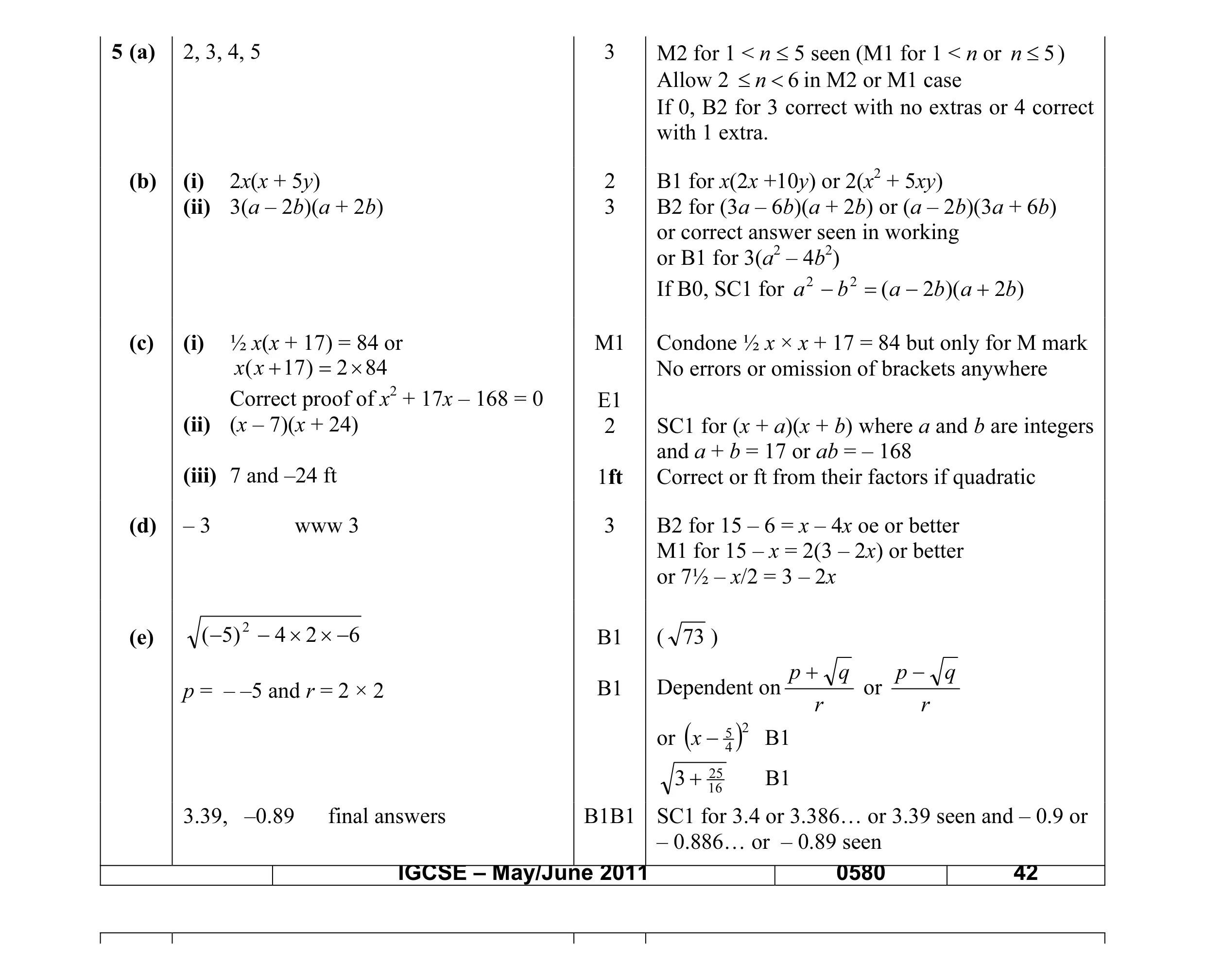 20
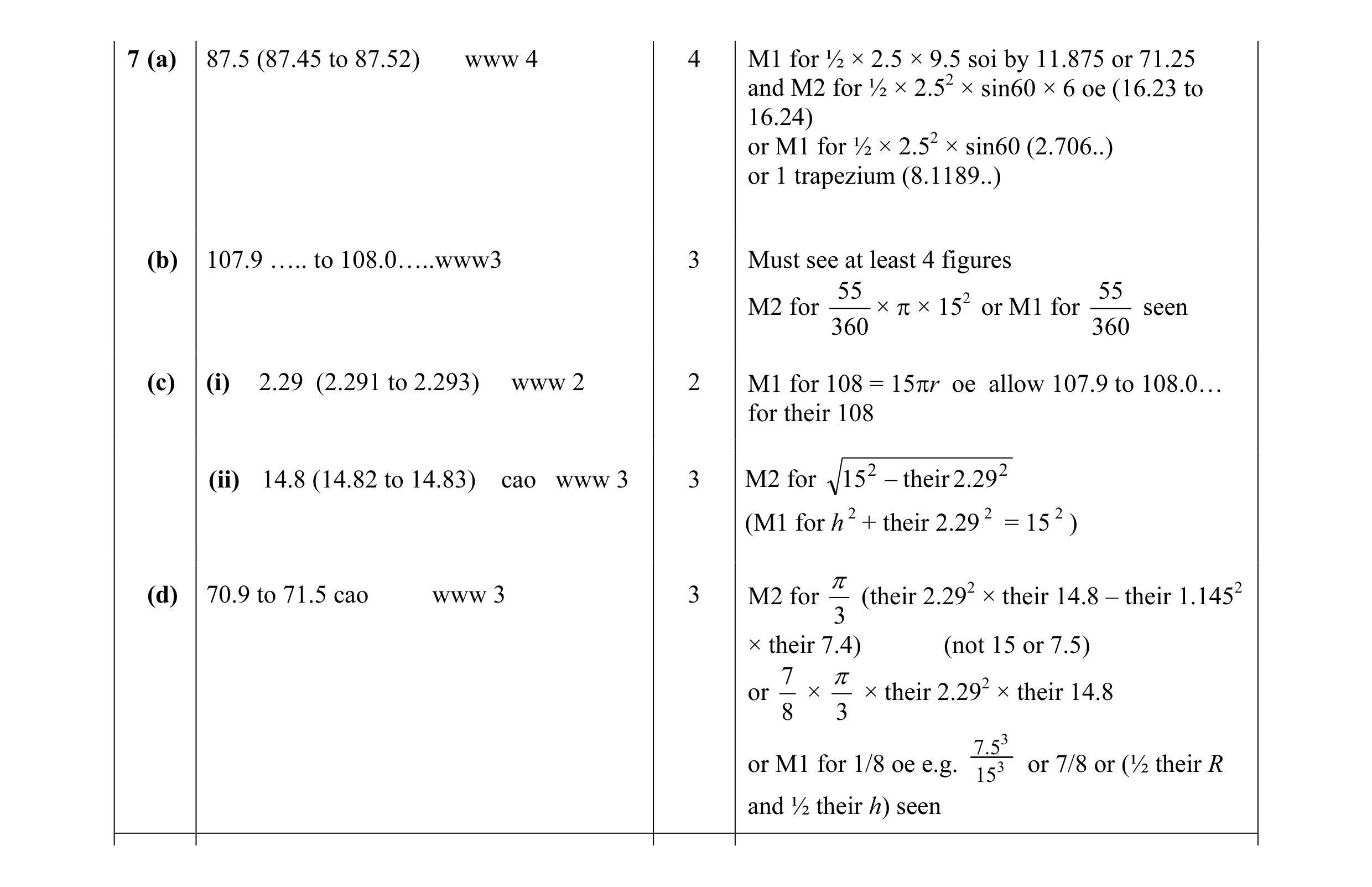 15
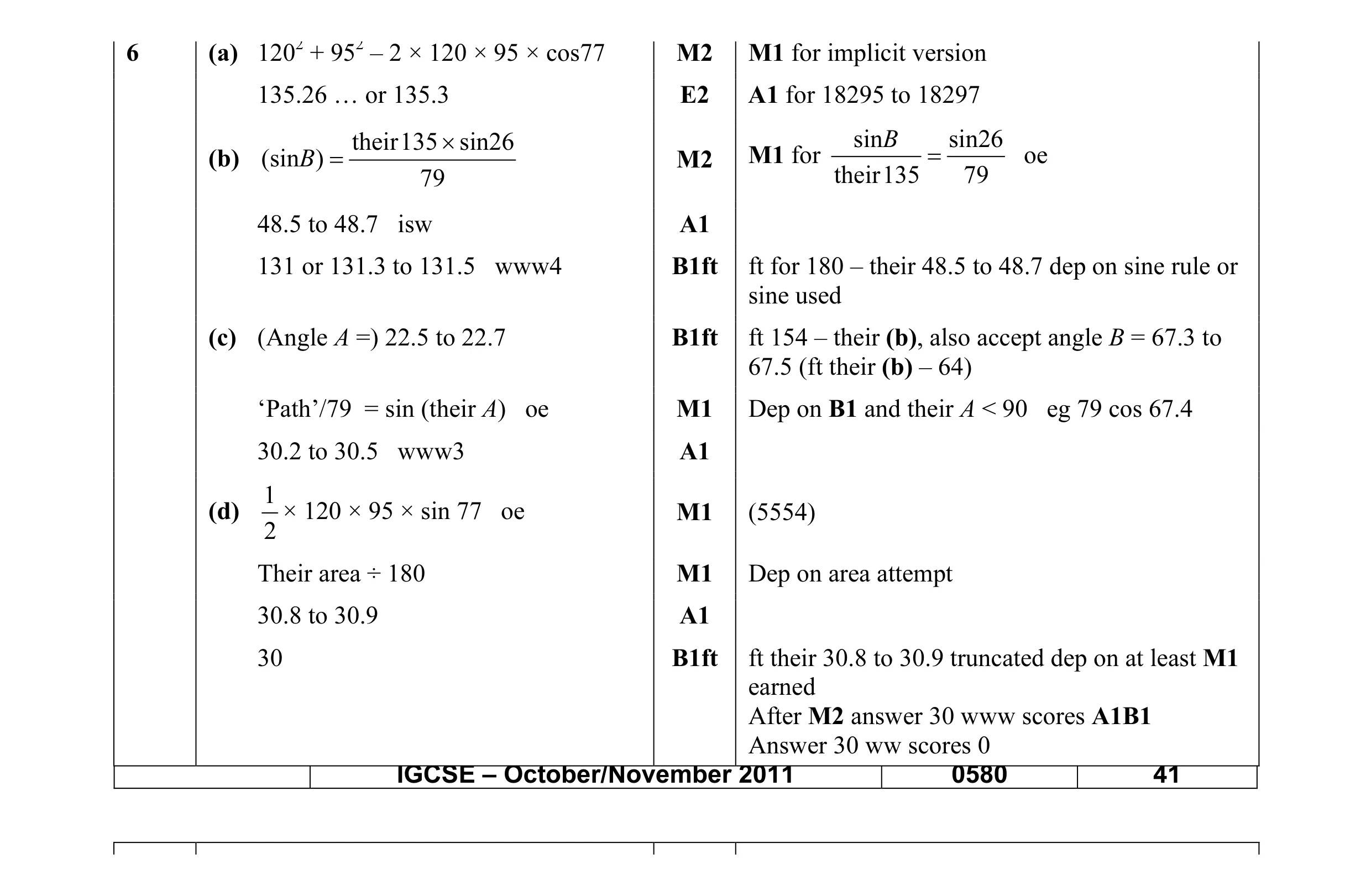 15
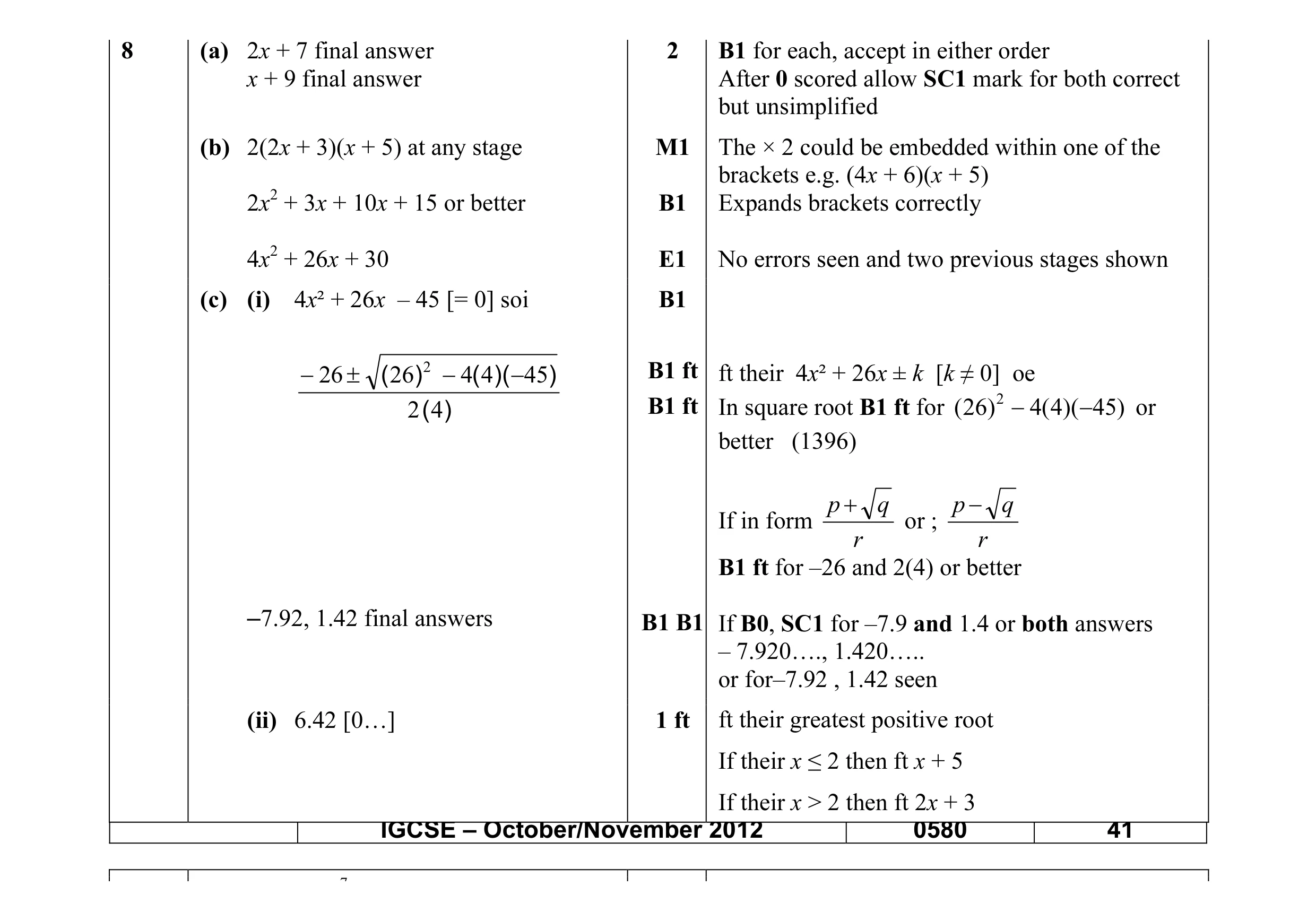 11
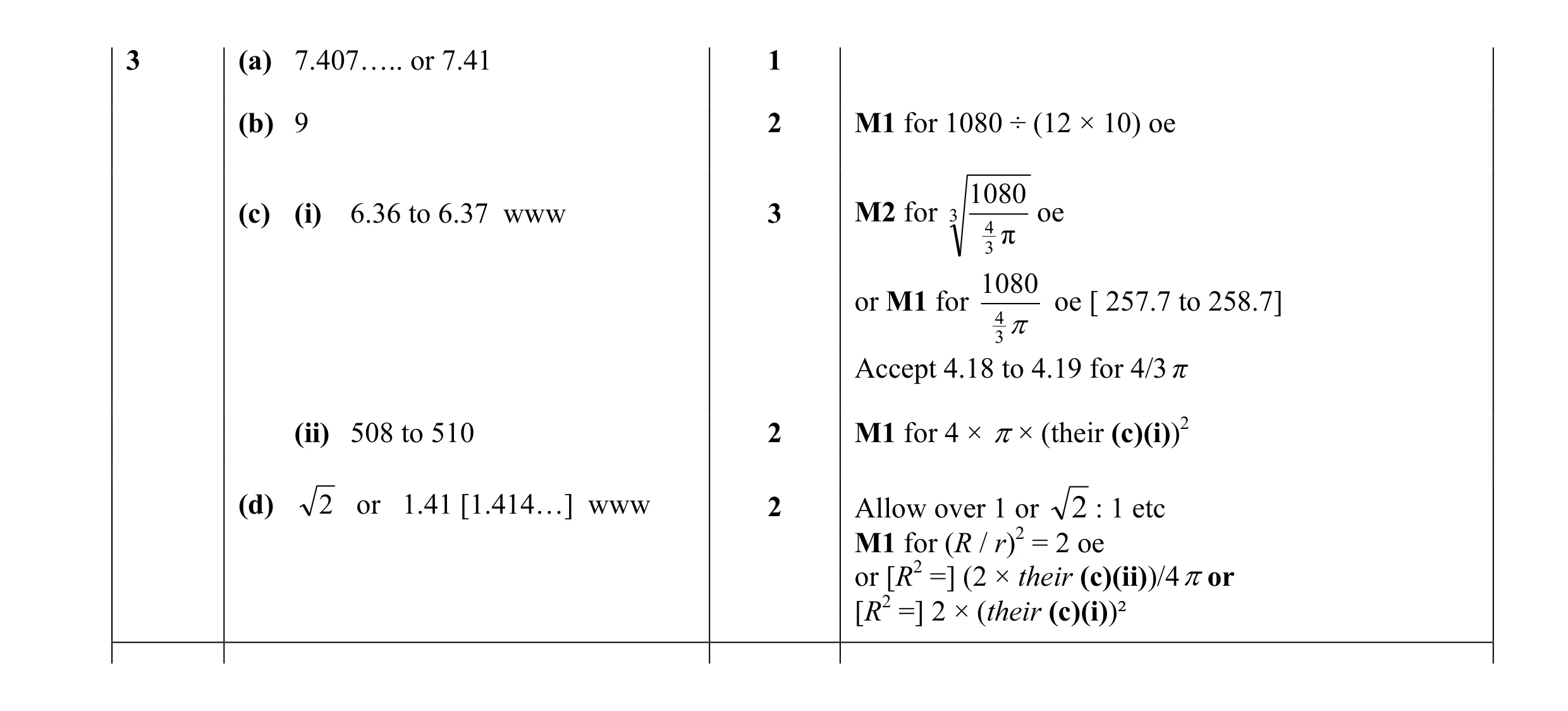 10
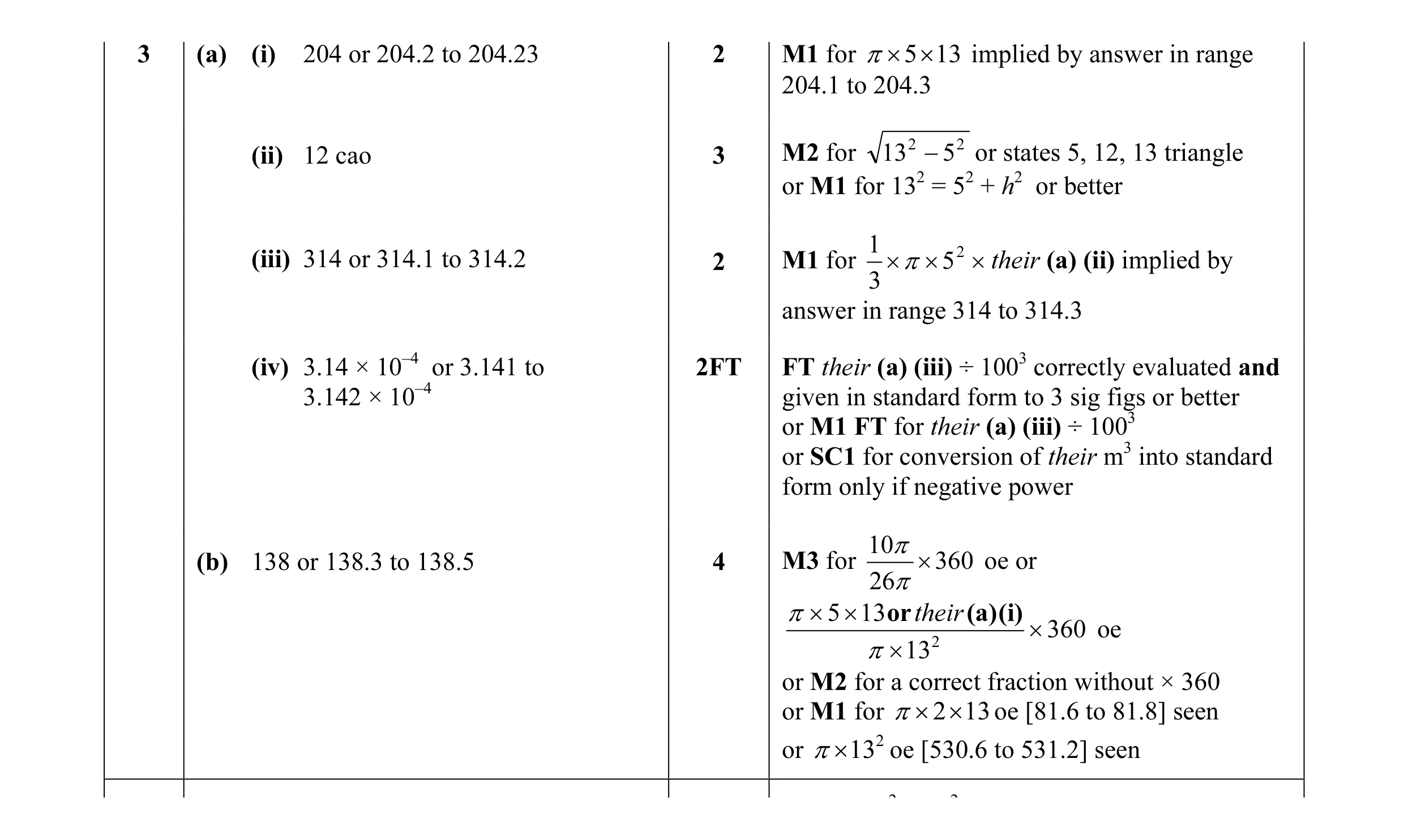 13
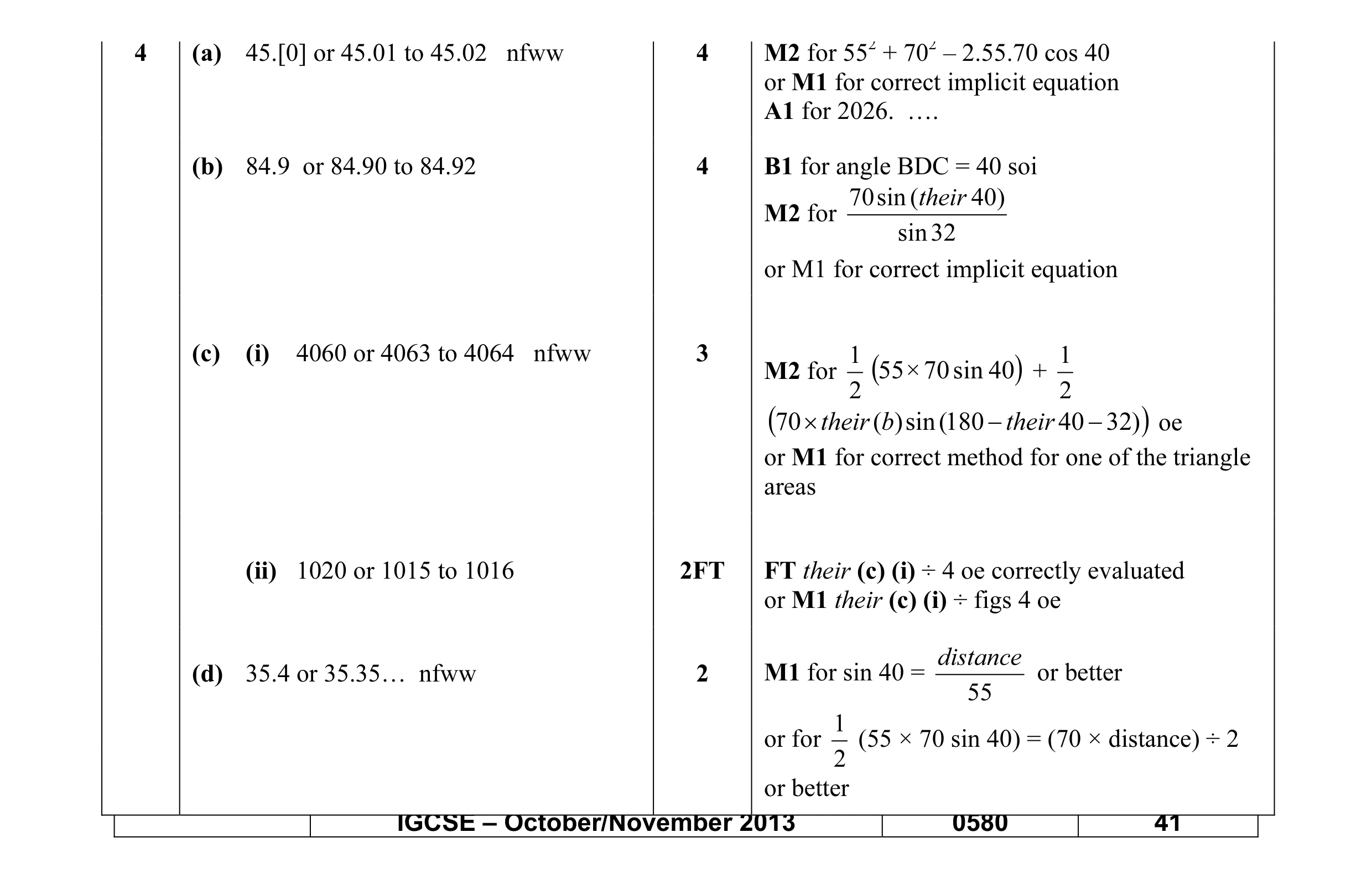 15
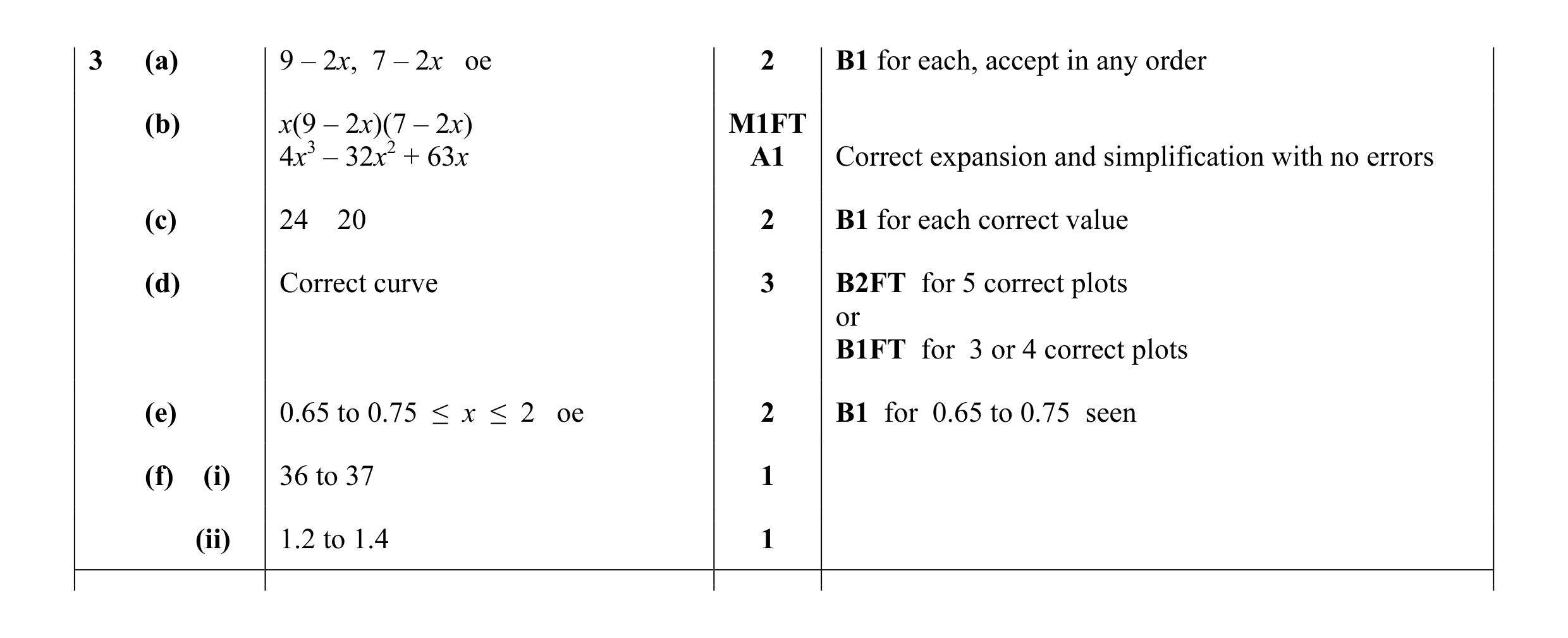 13
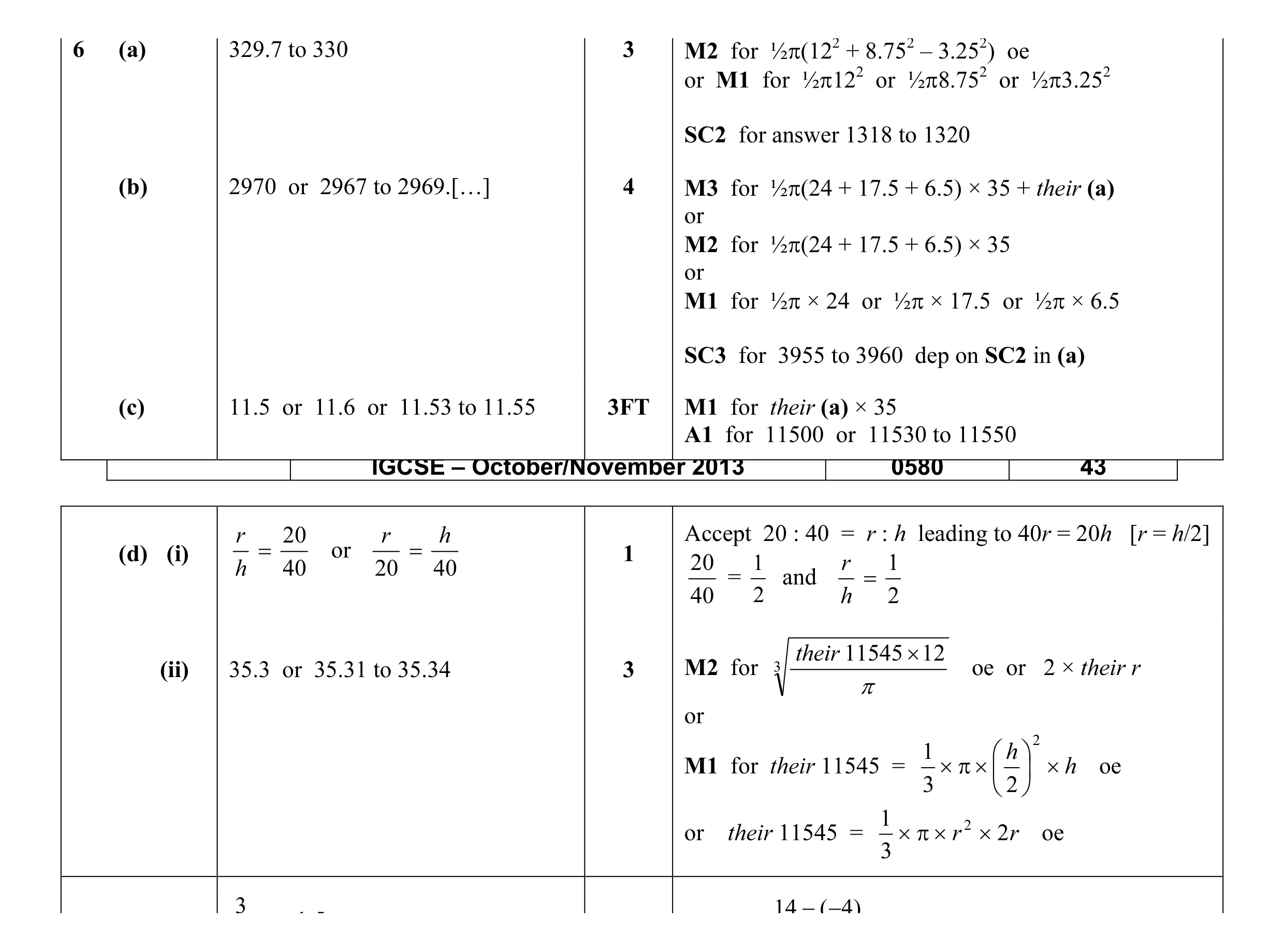 14
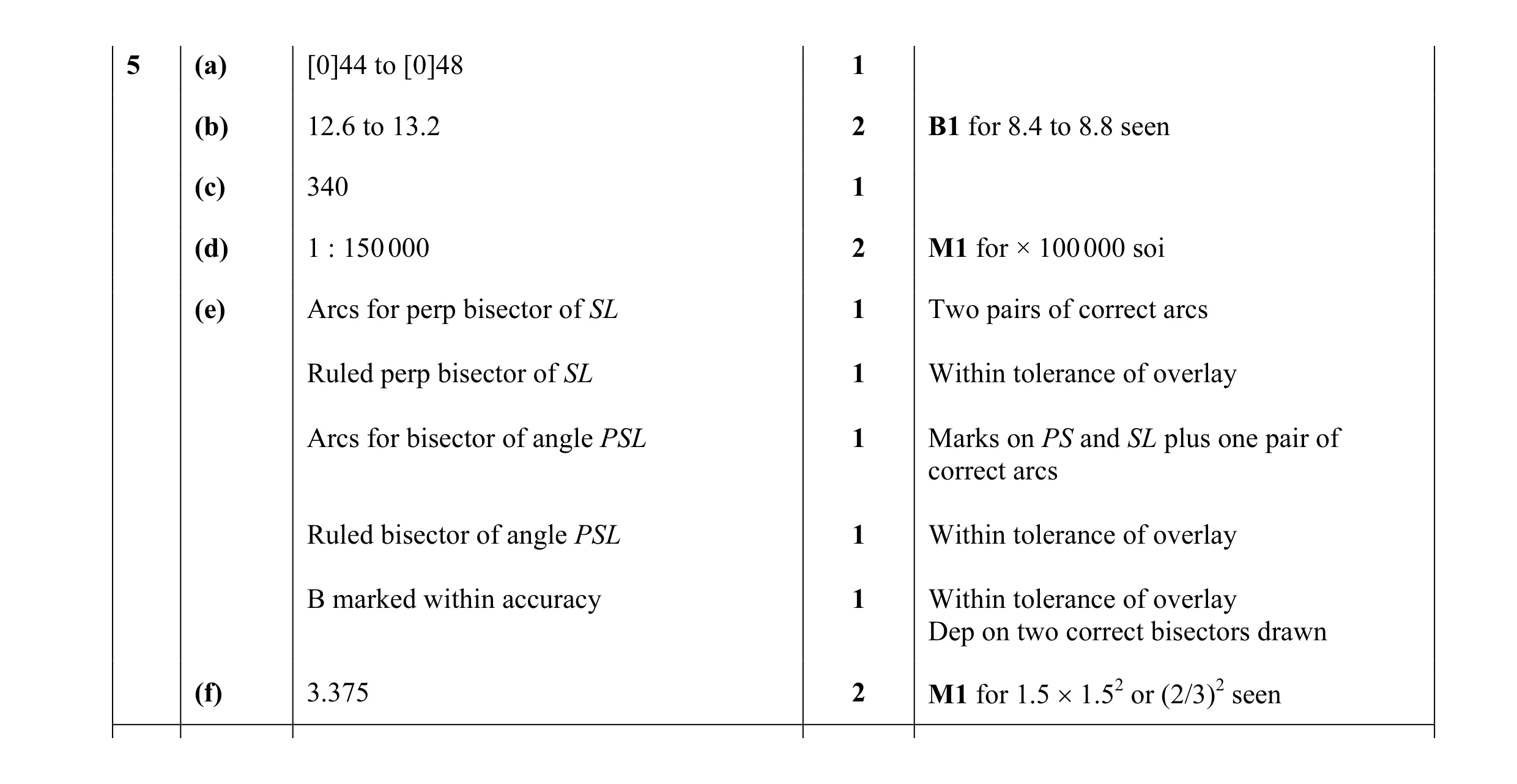 13
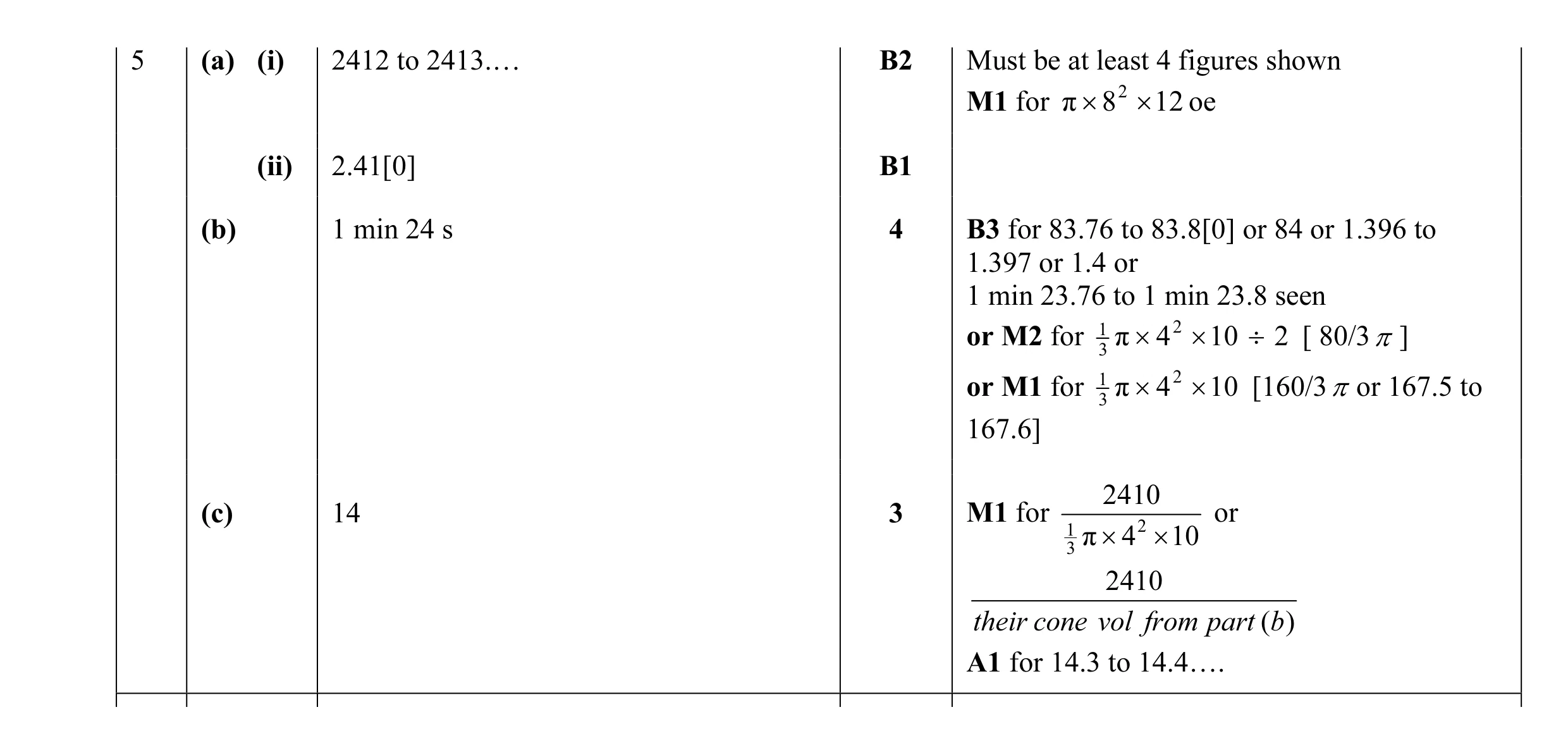 10
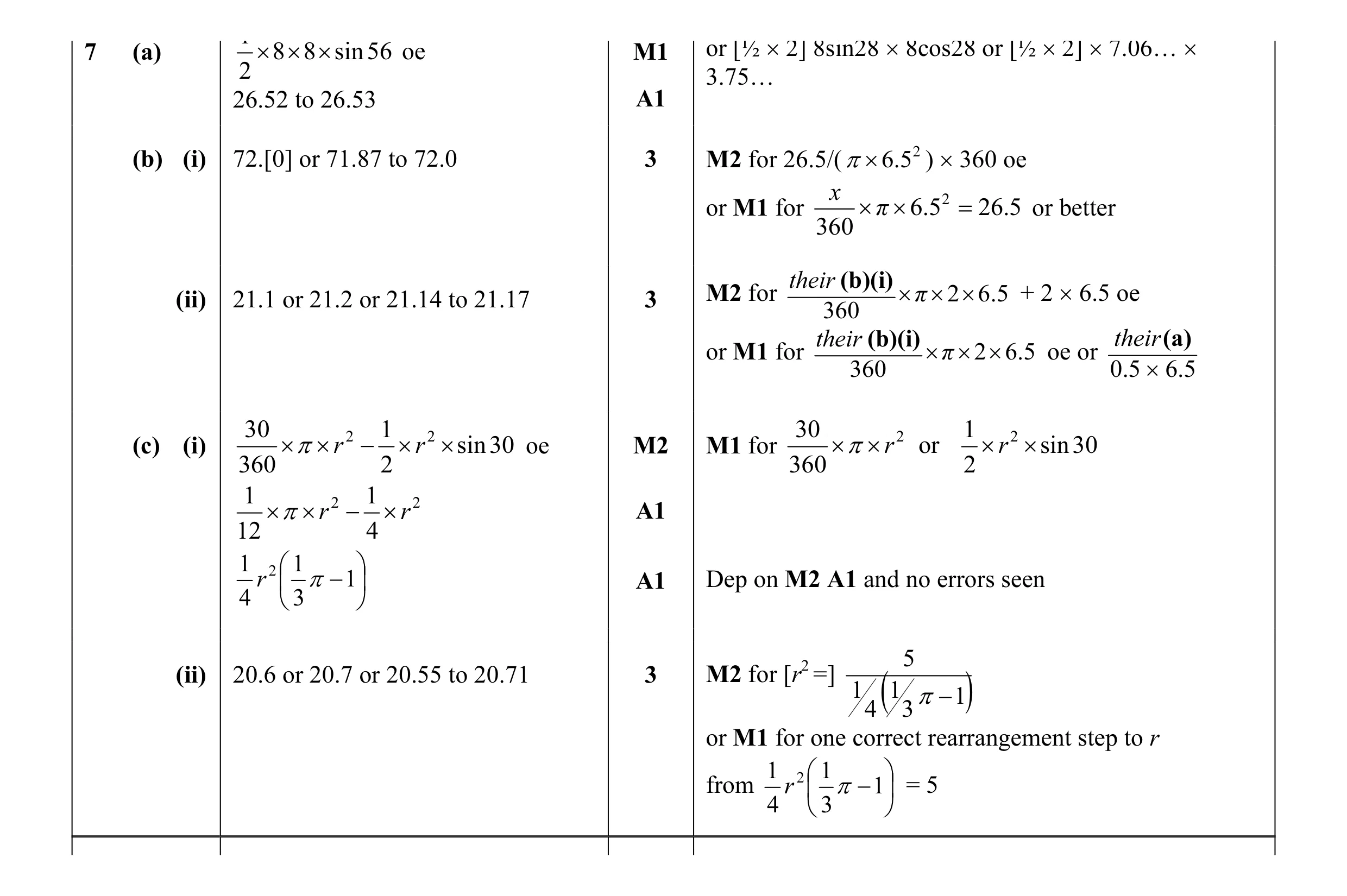 15
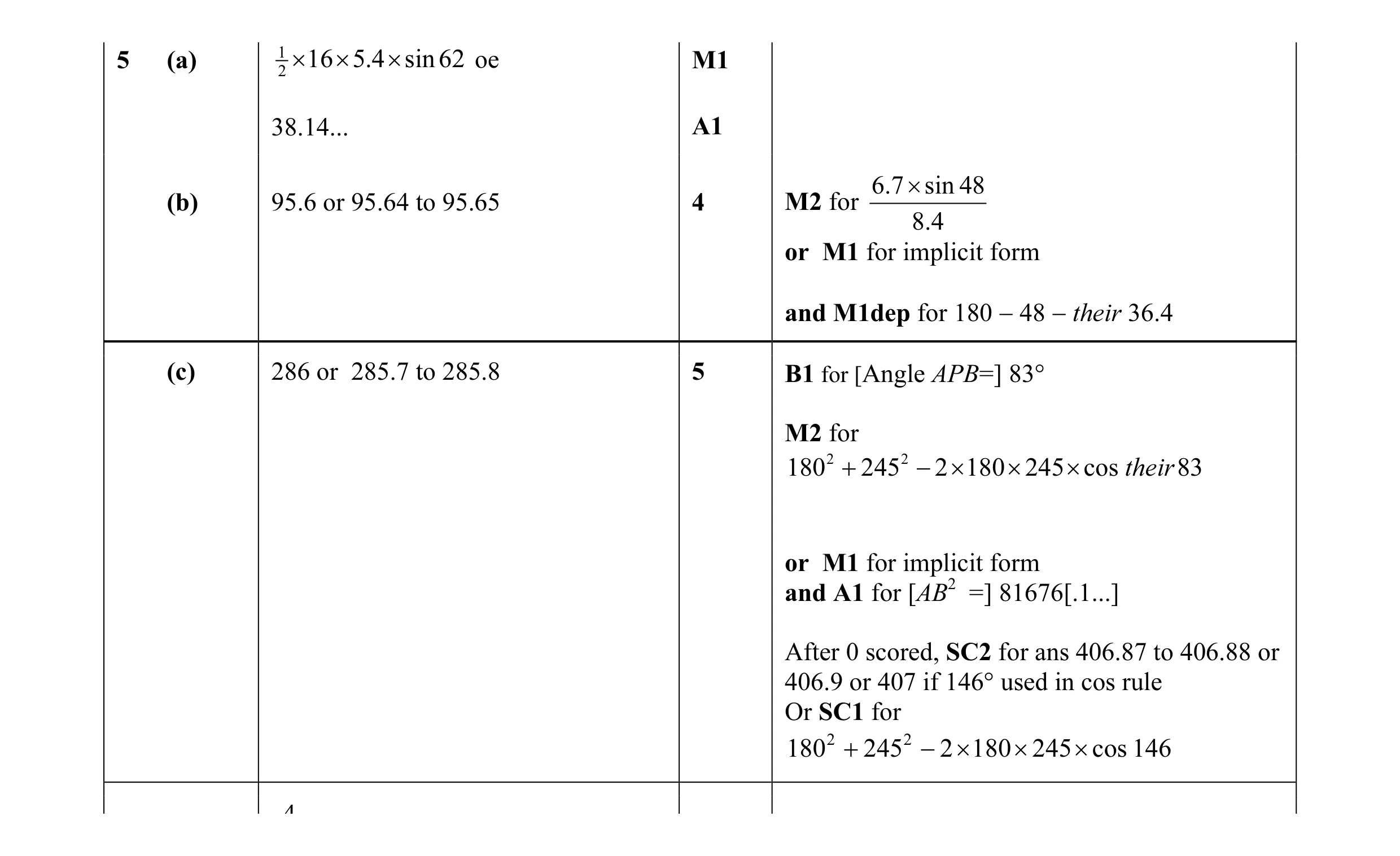 11
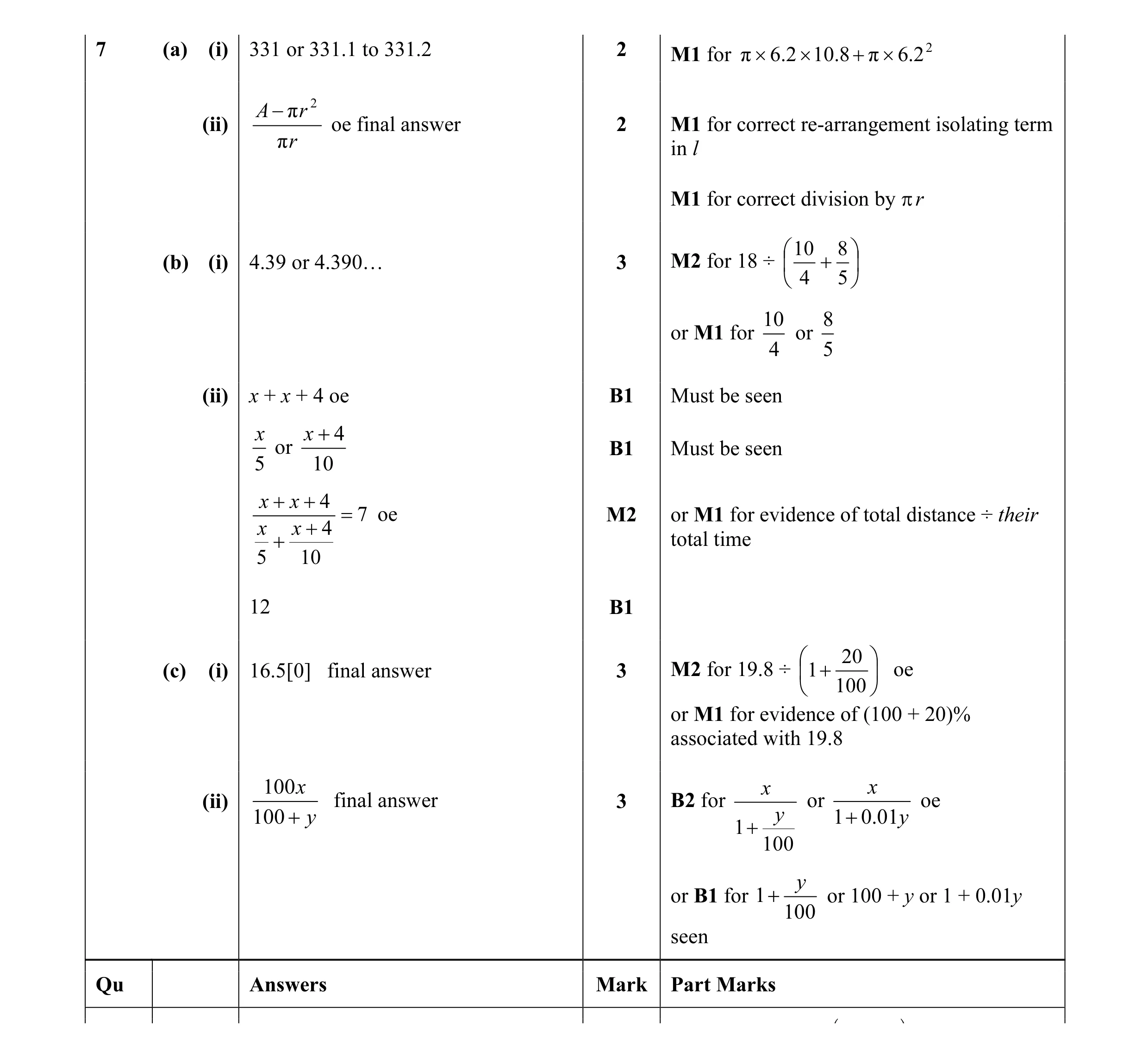 18
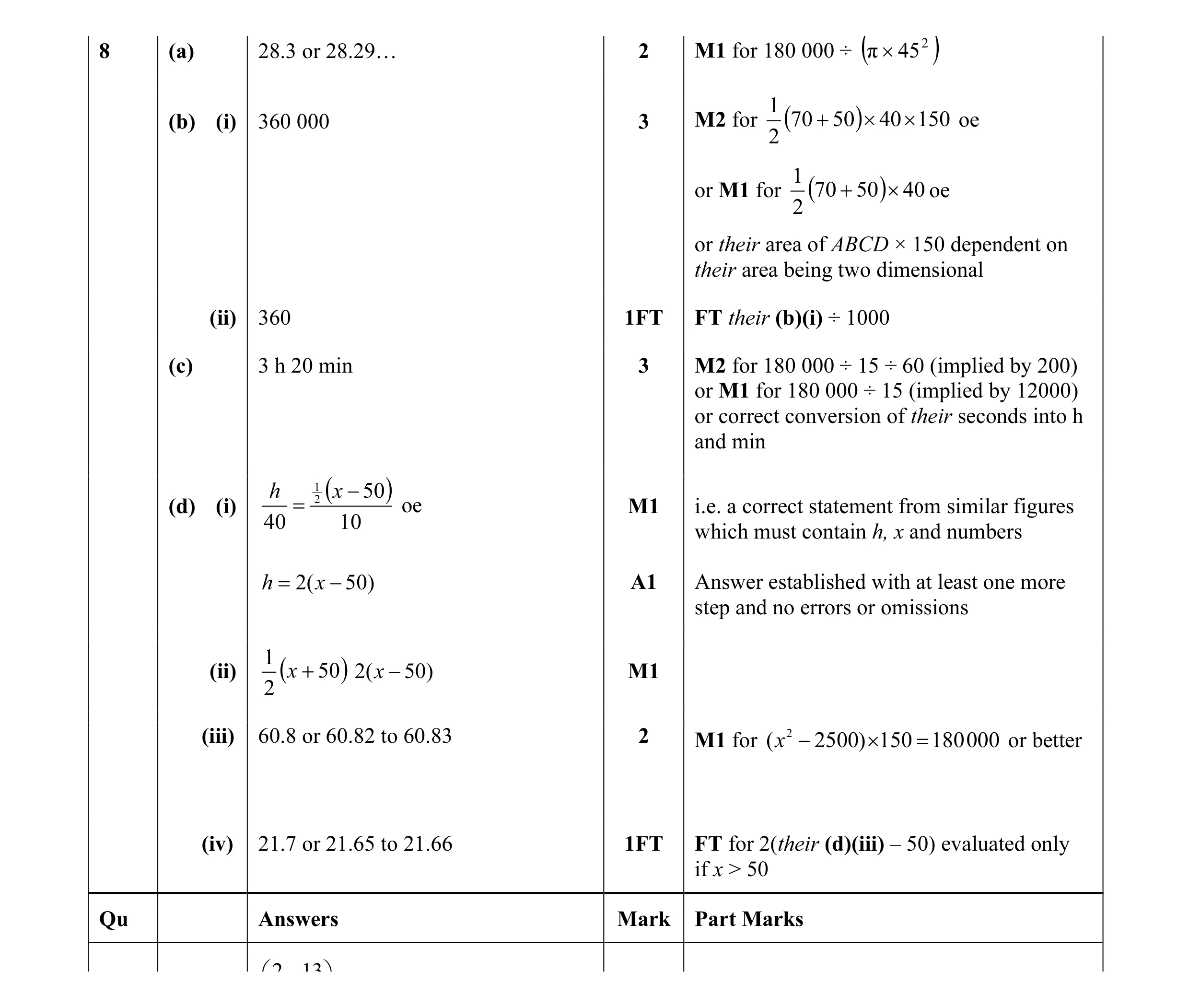 15
 12
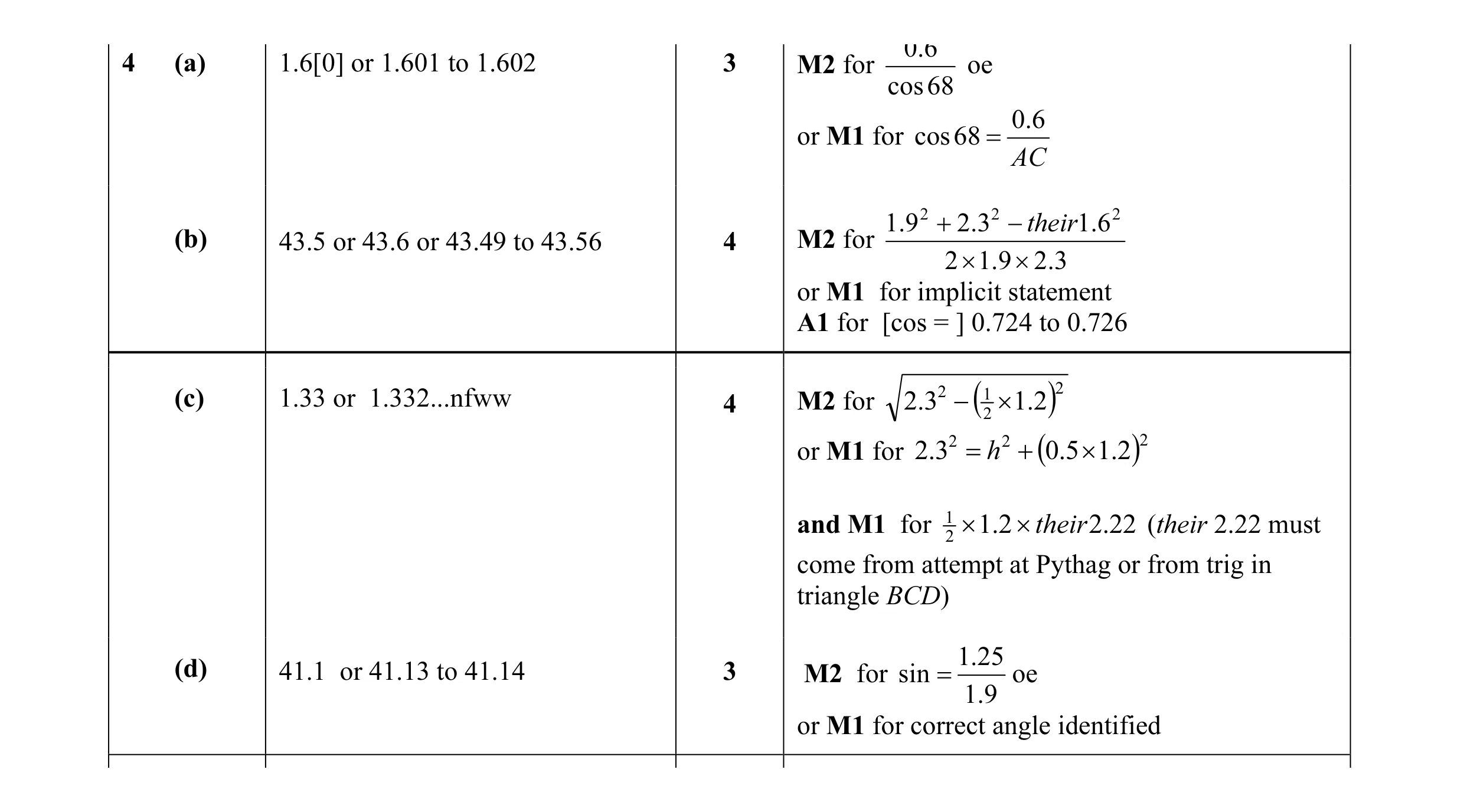 14
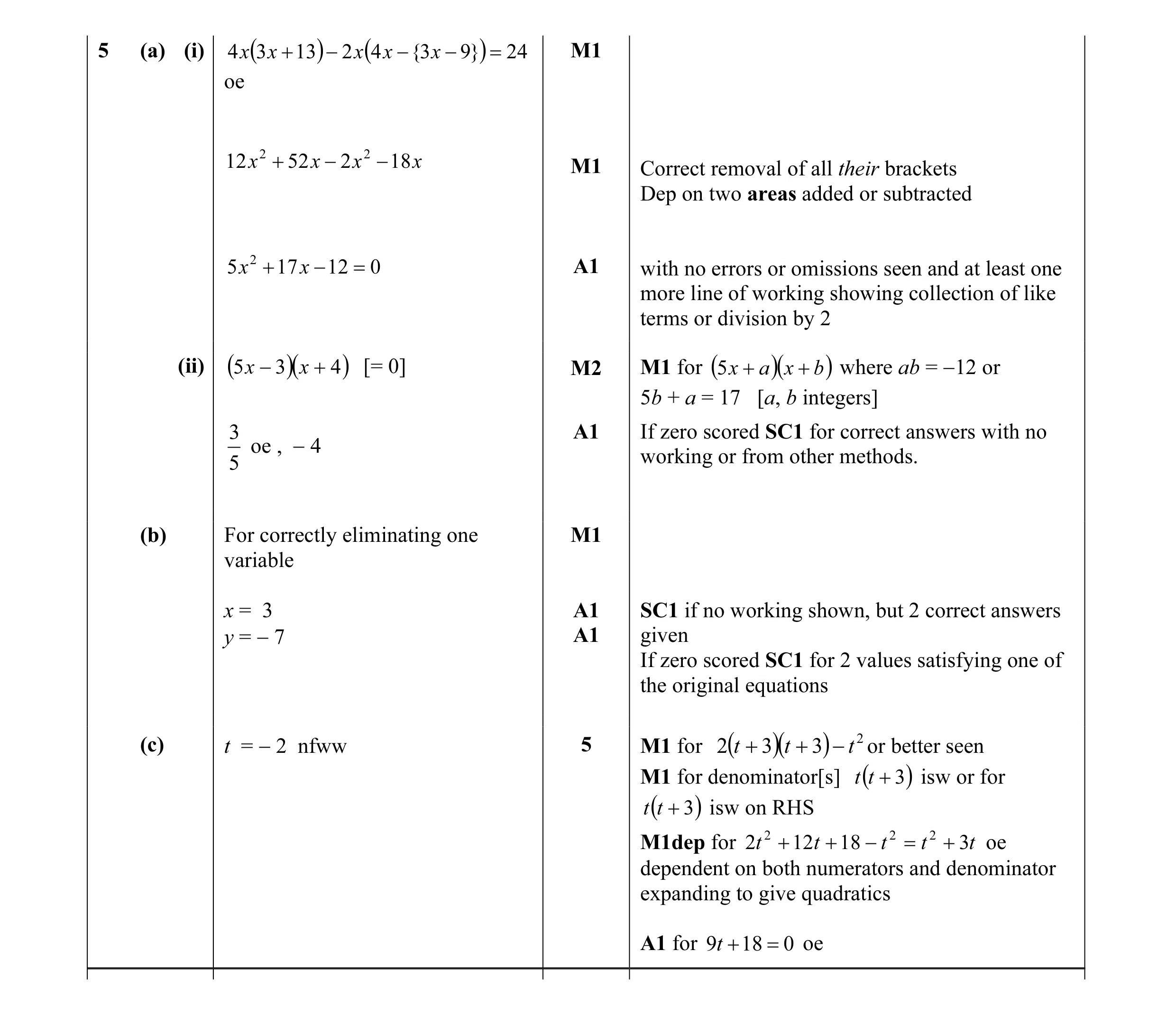 14
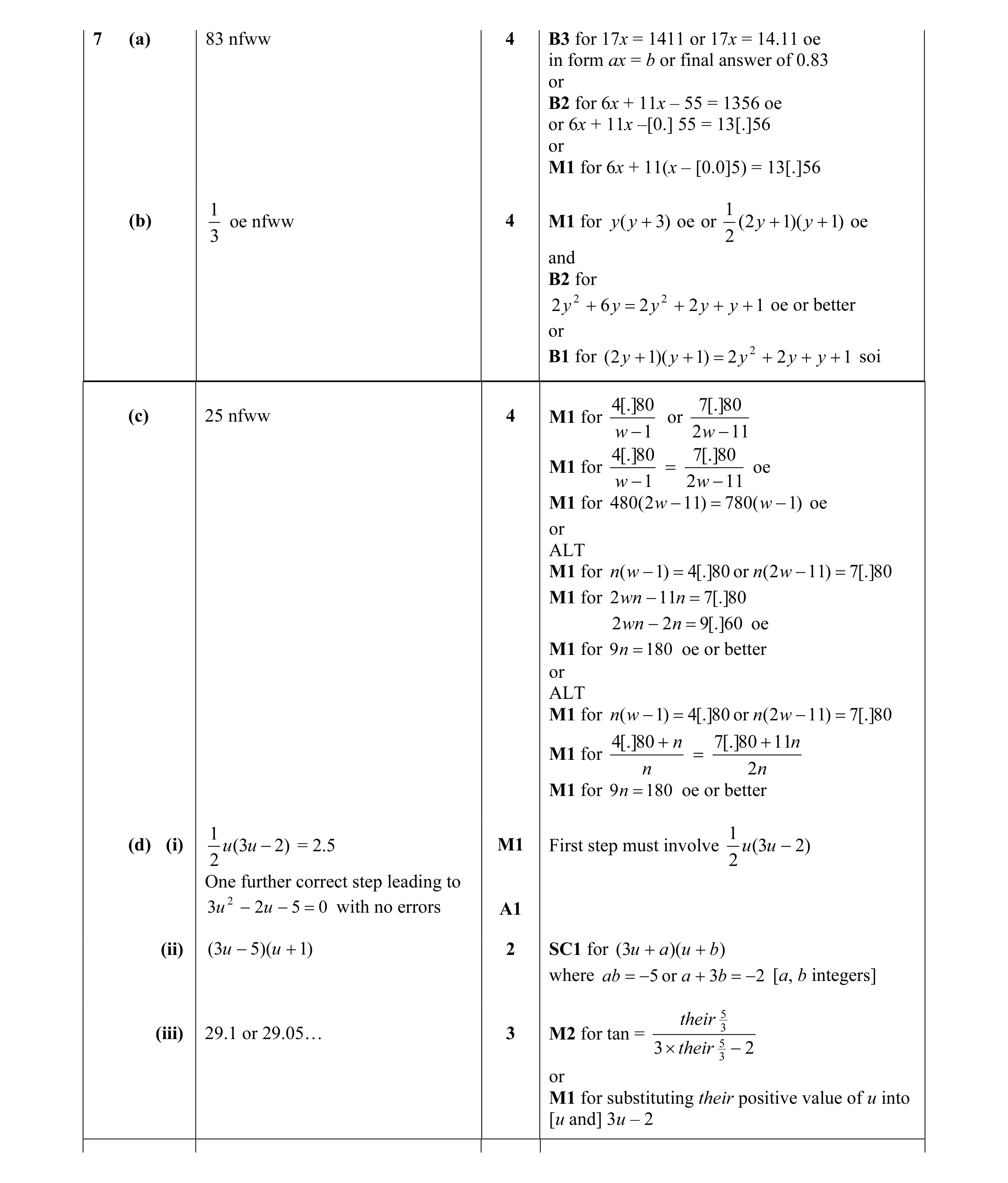 19
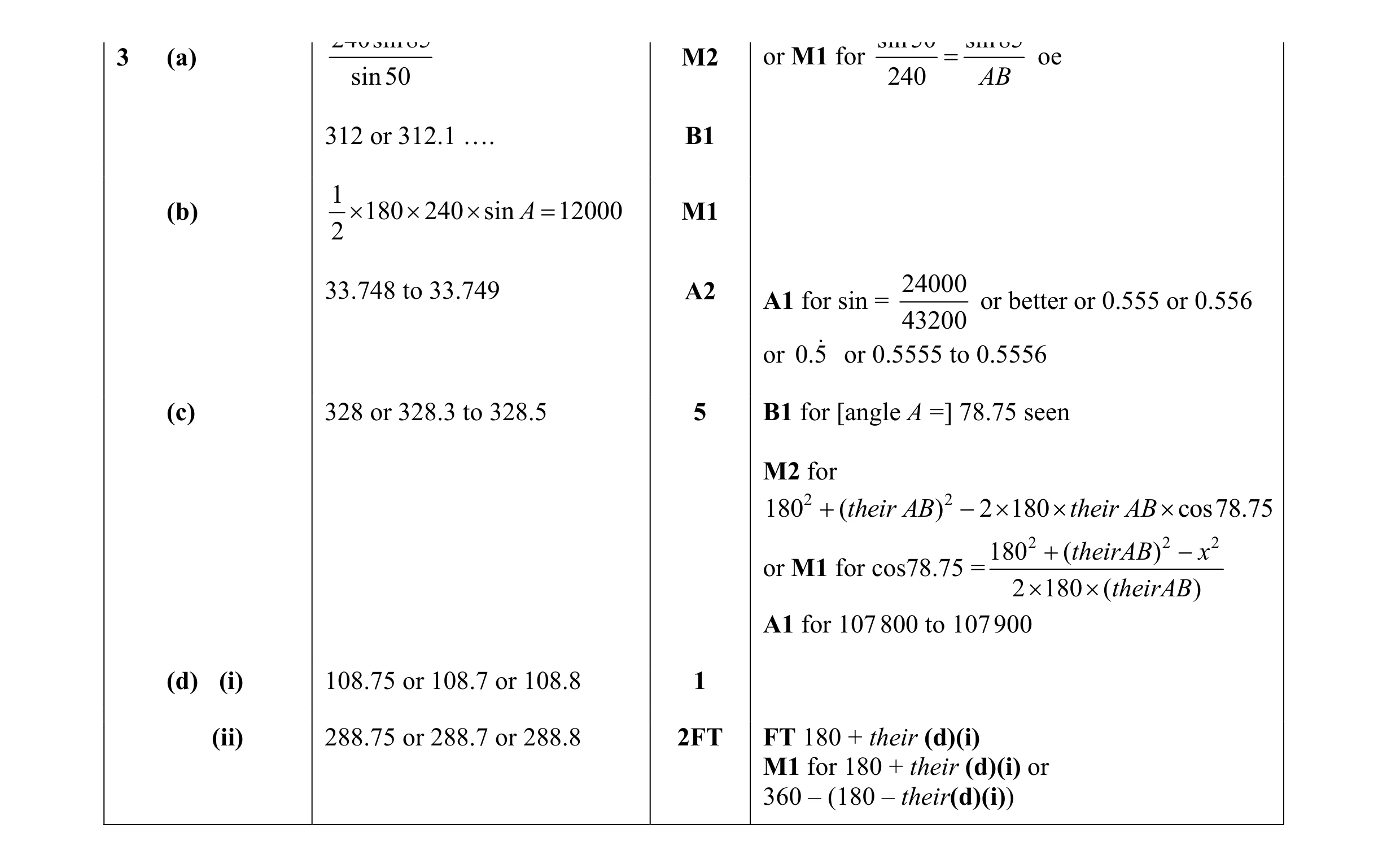 14
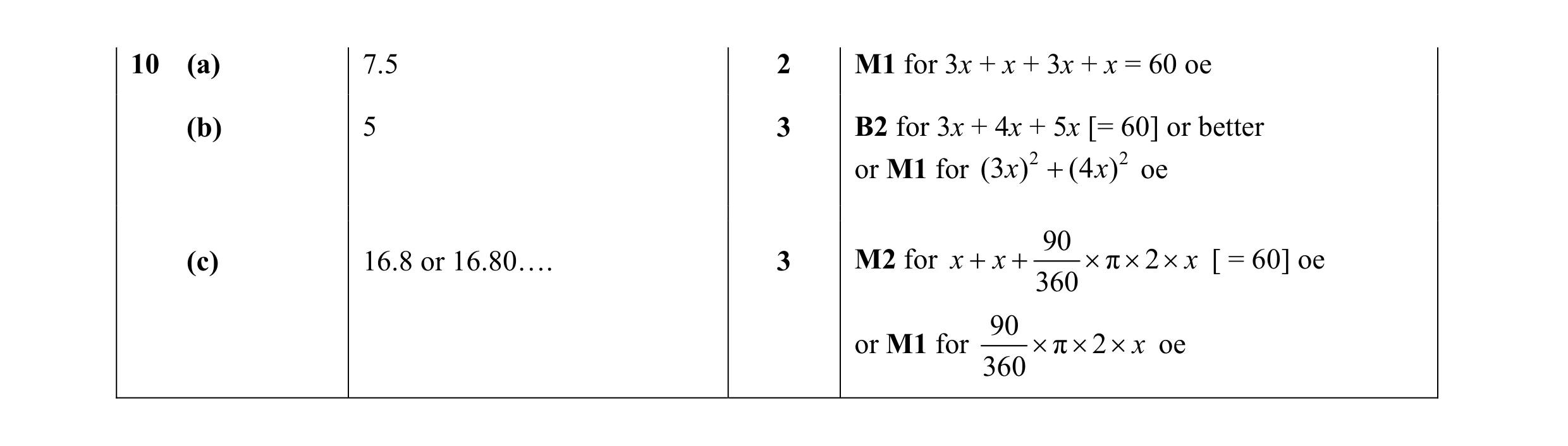 8
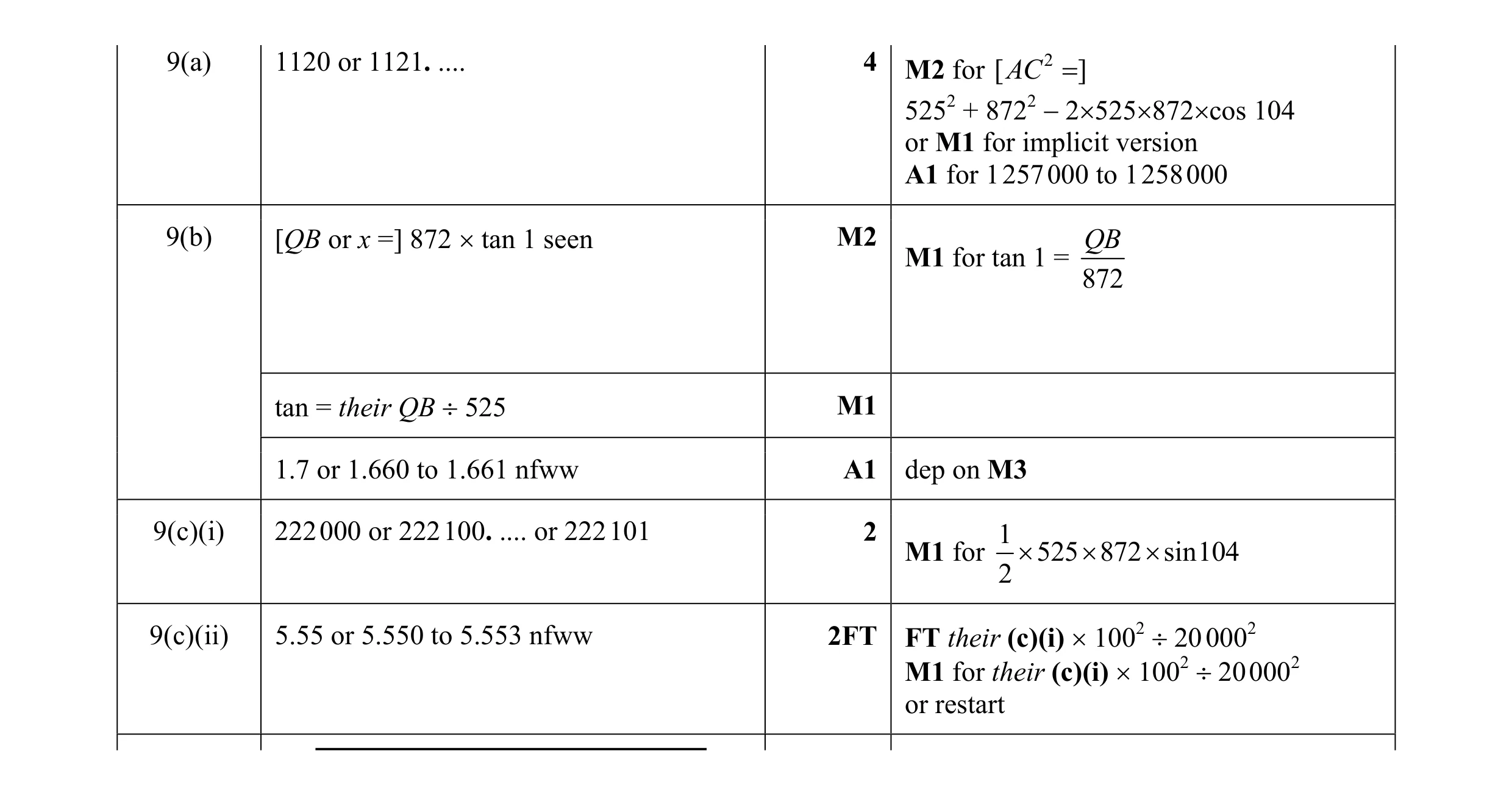 12
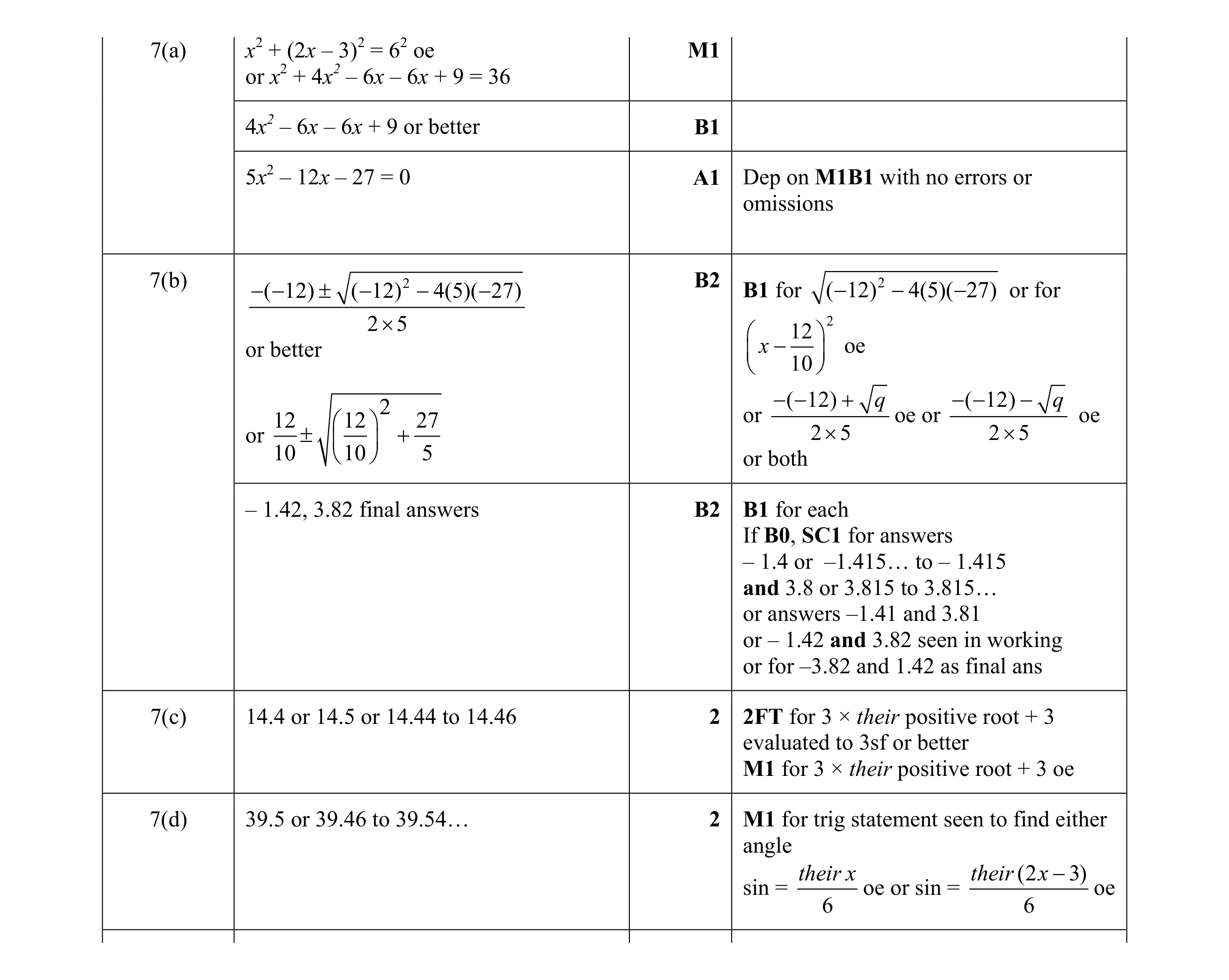 11
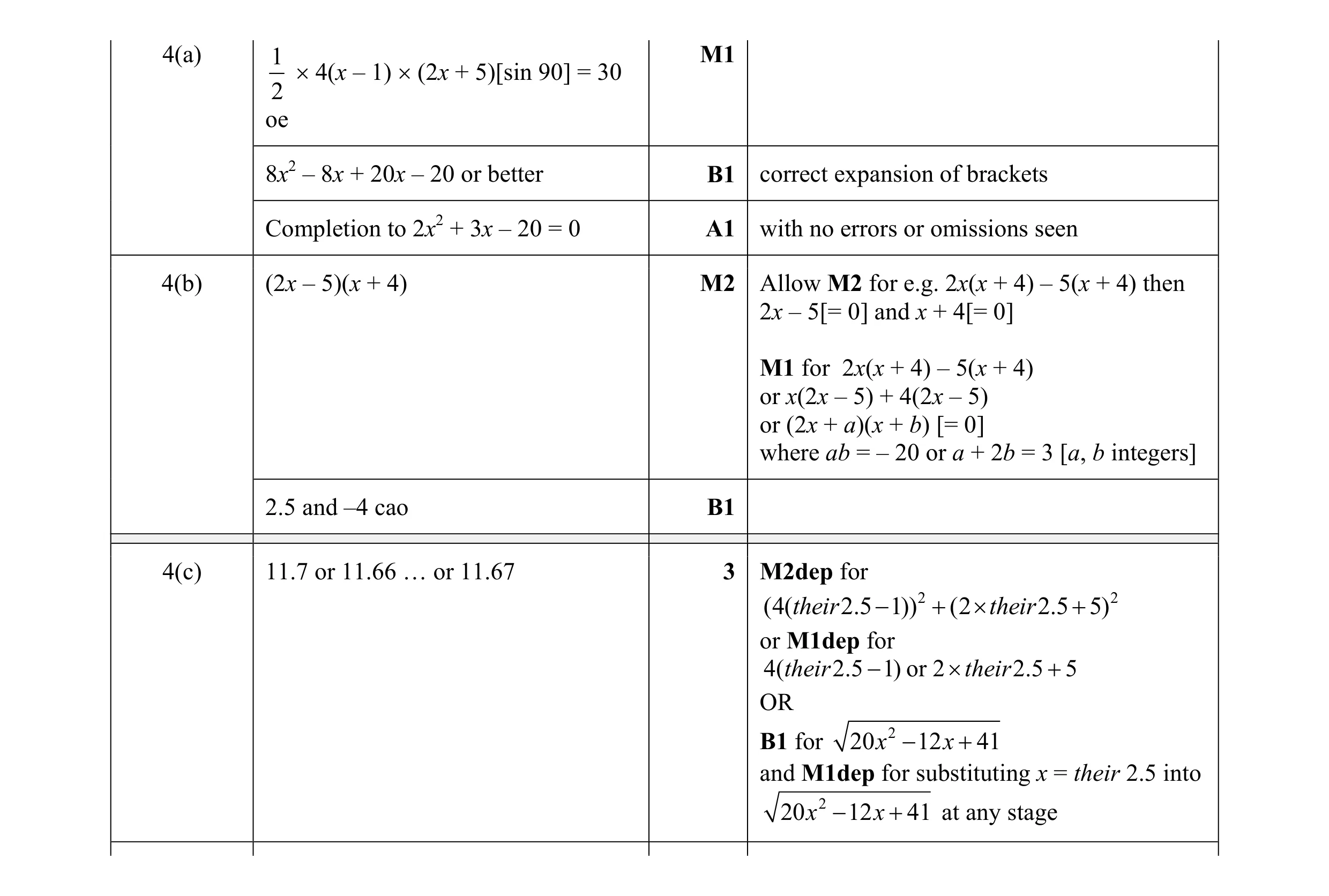 9
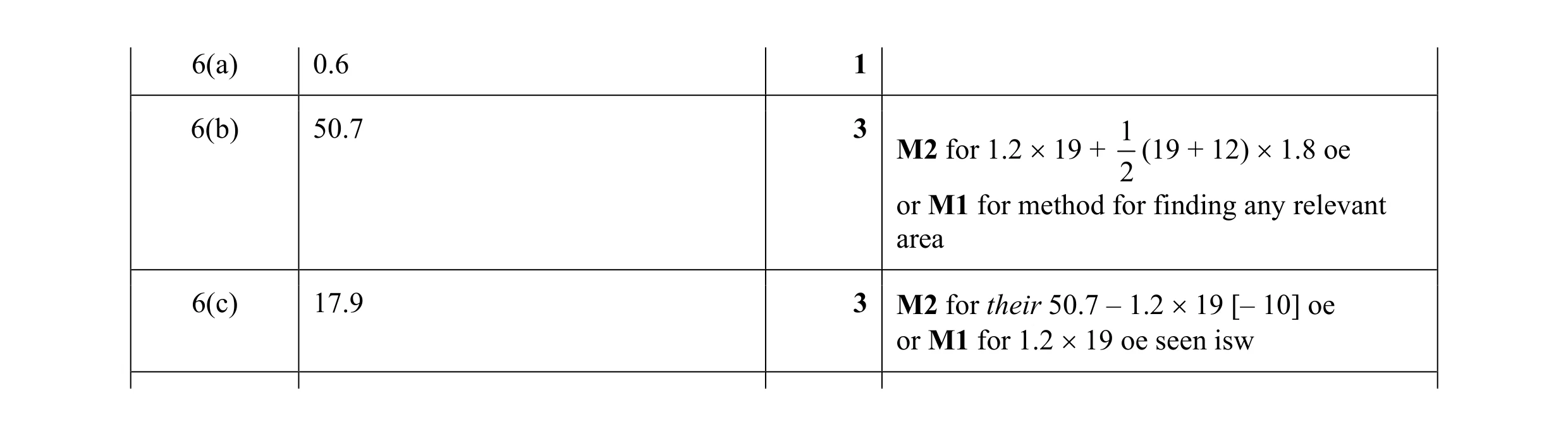 7
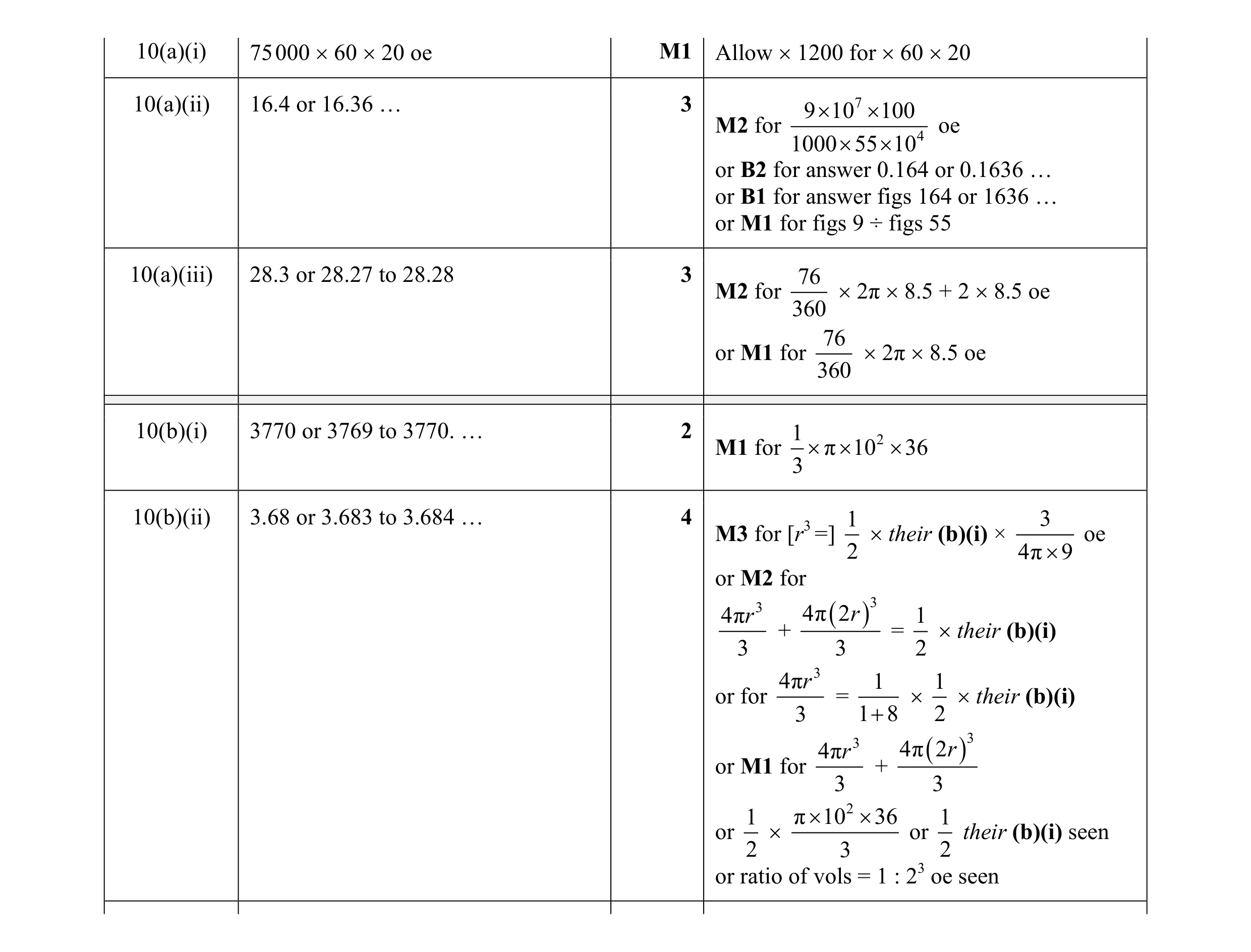 13
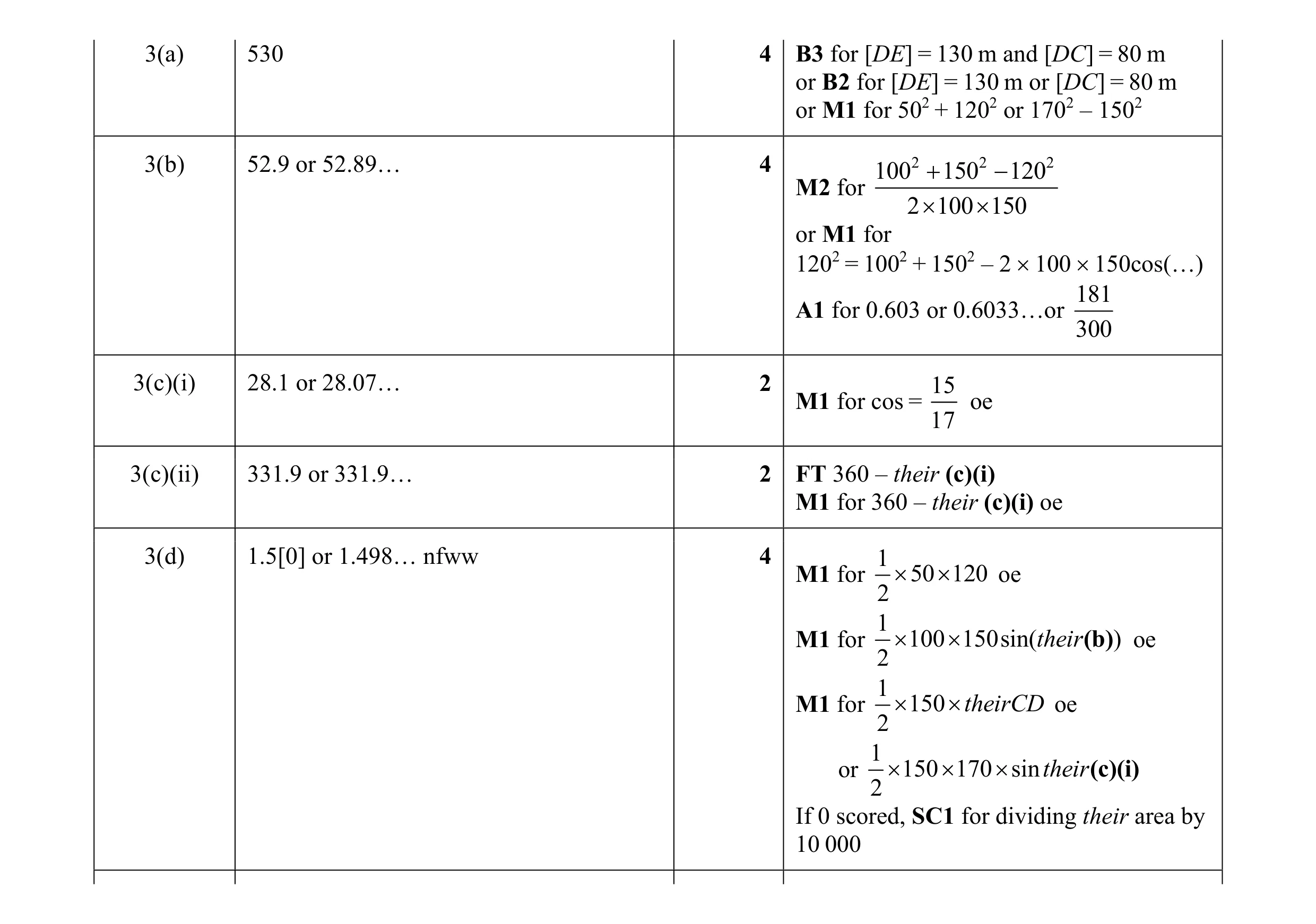 16
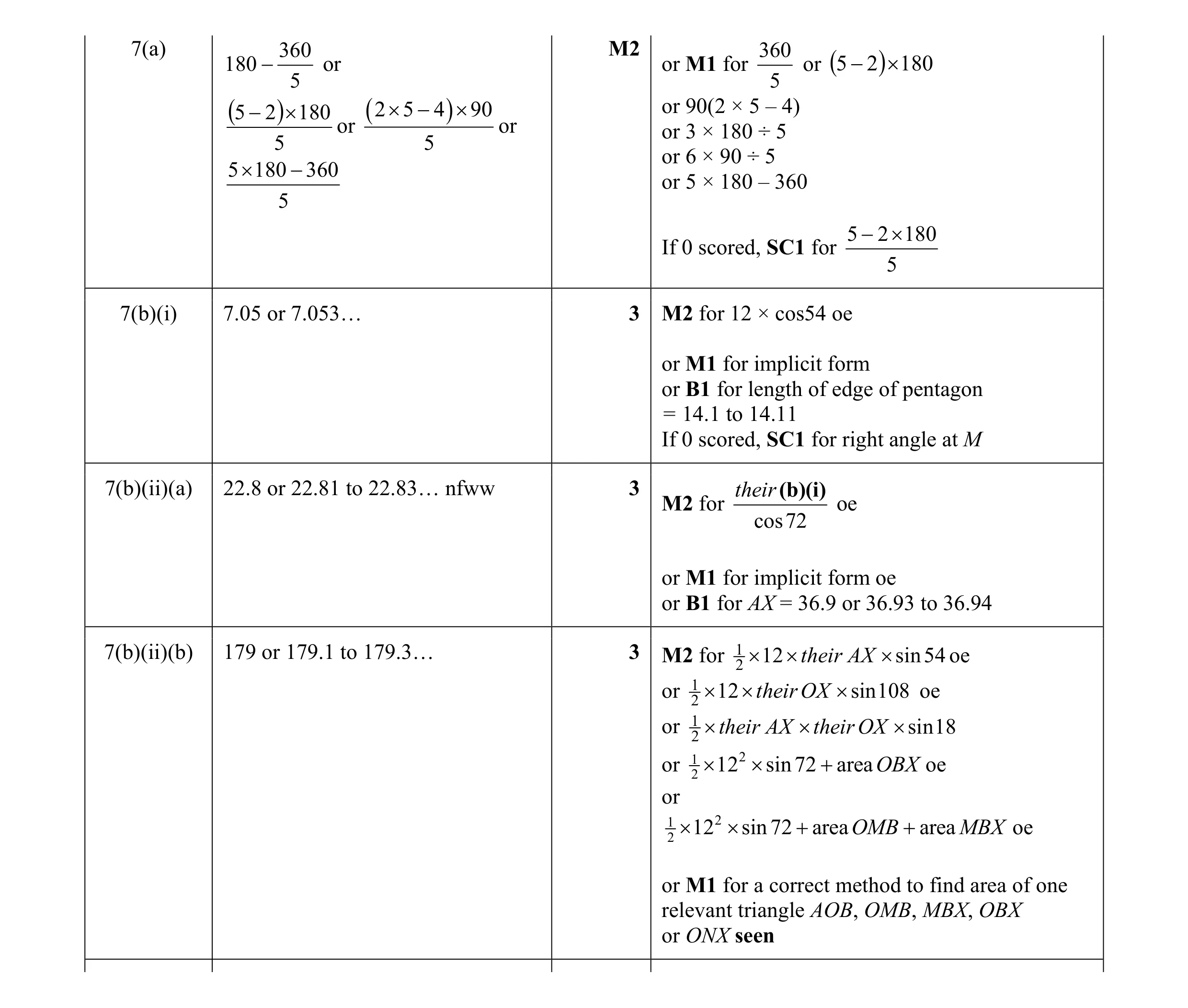 11
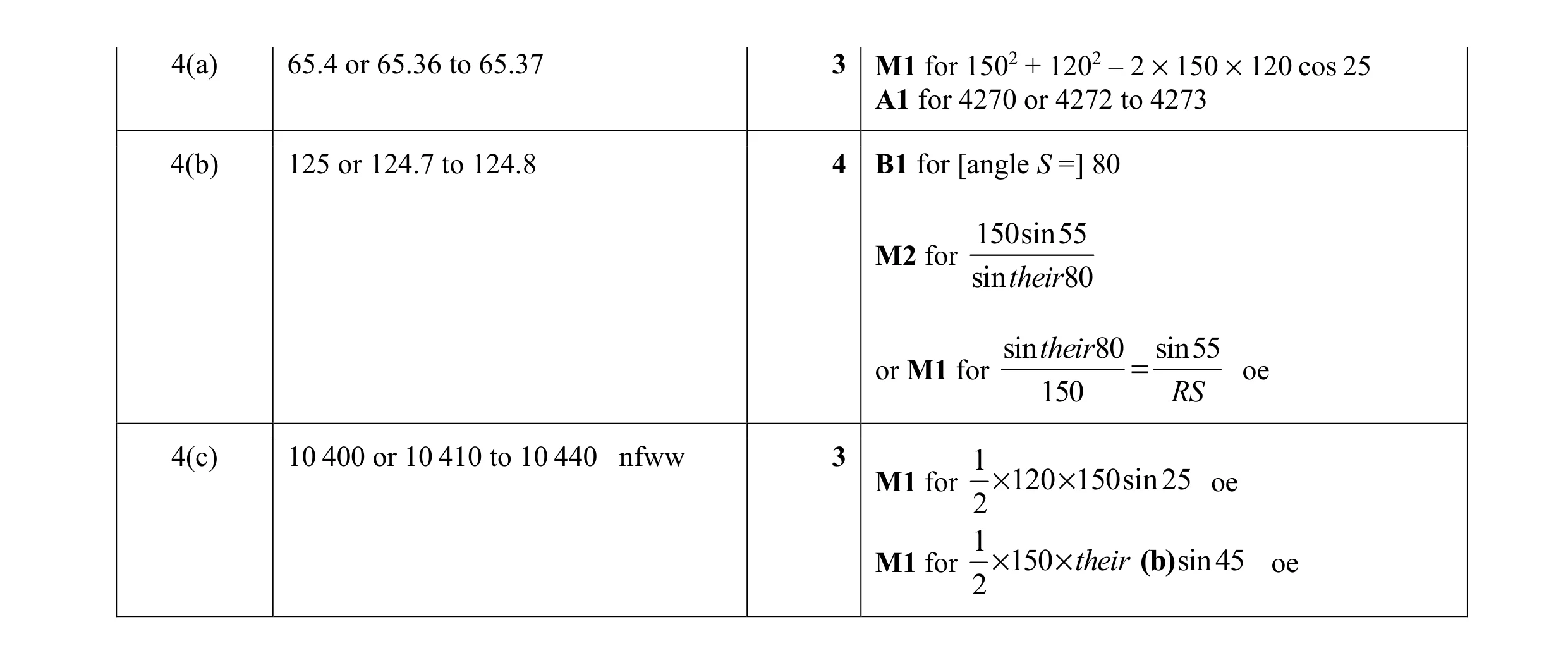 10
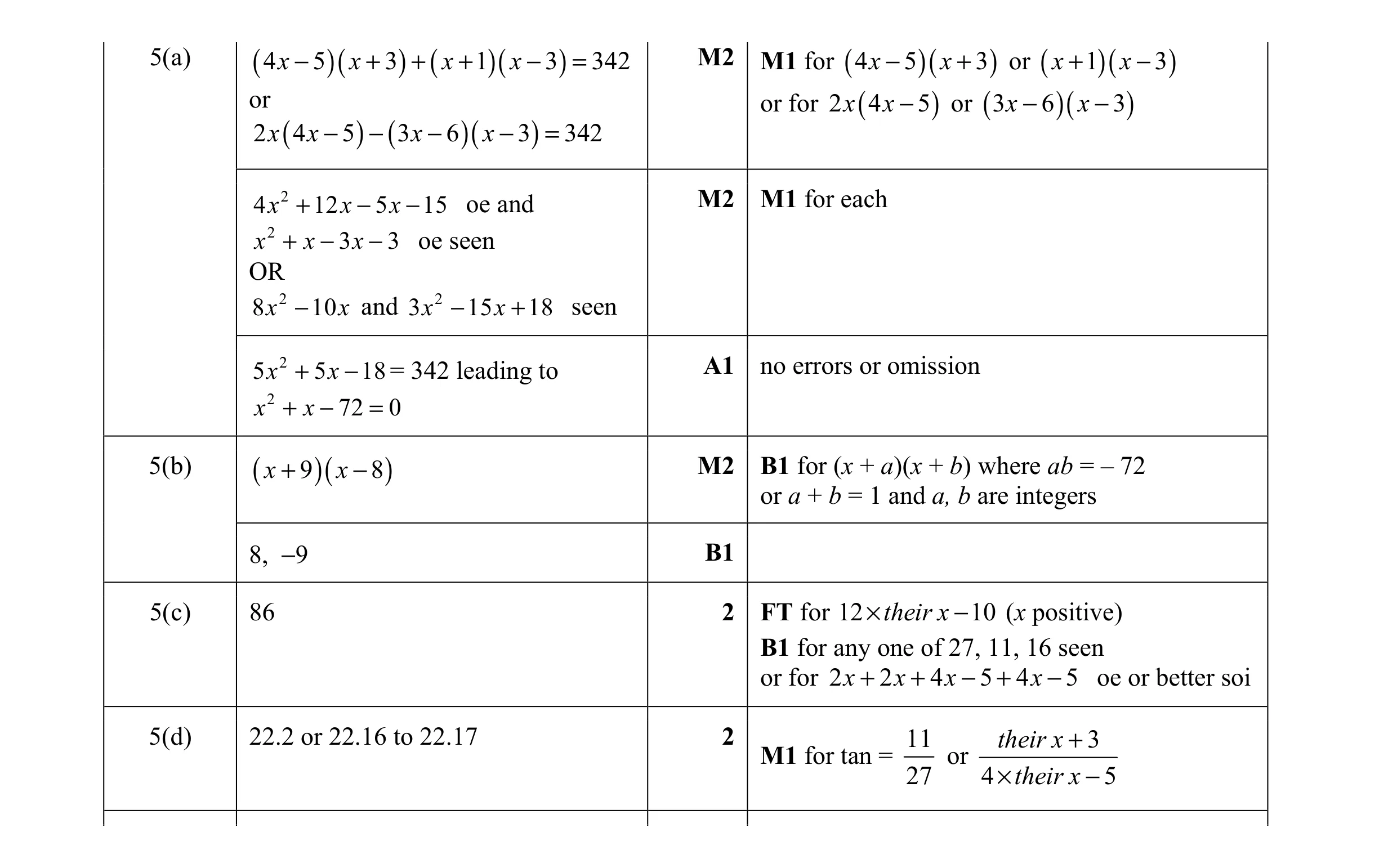 12
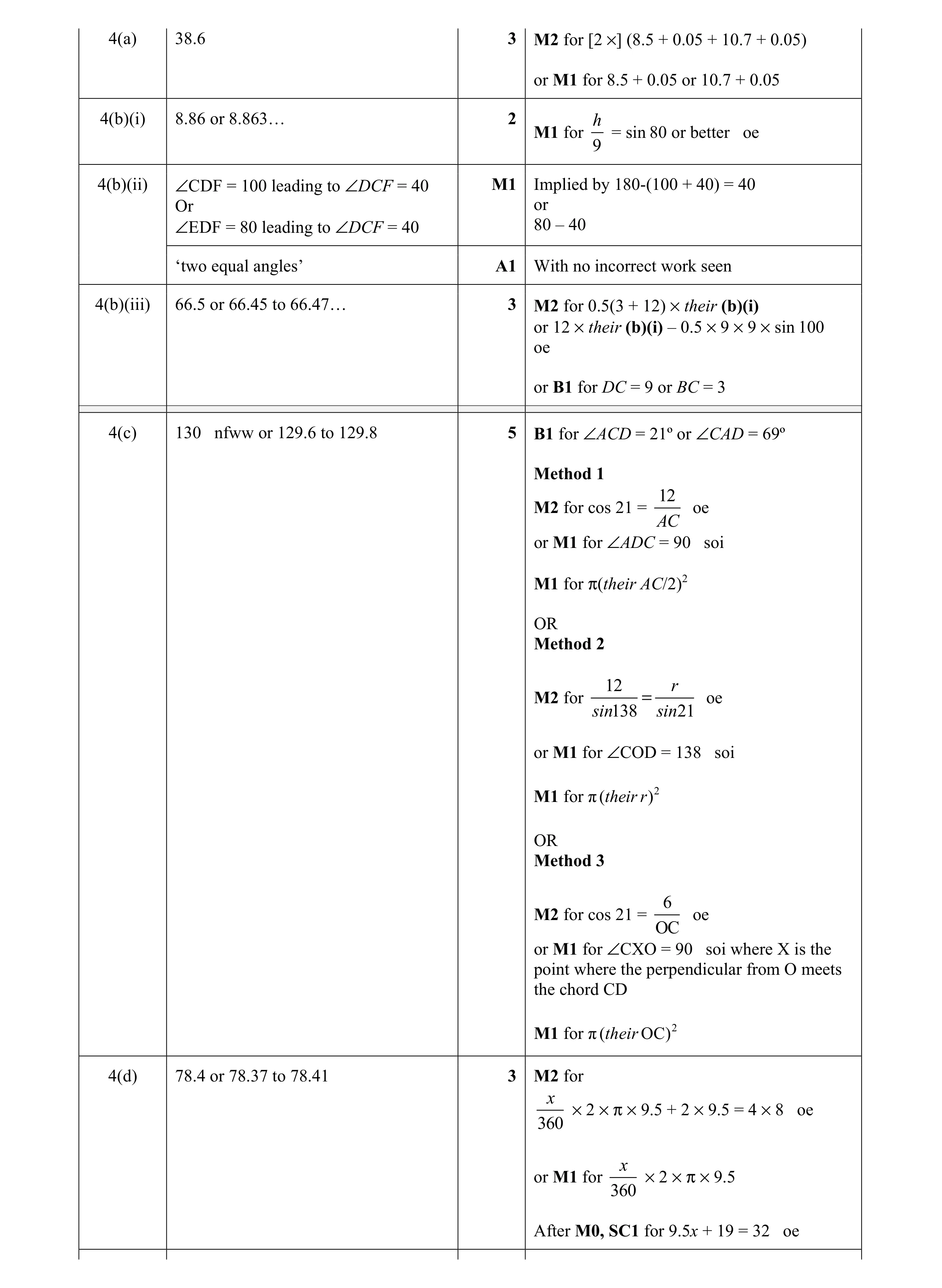 18
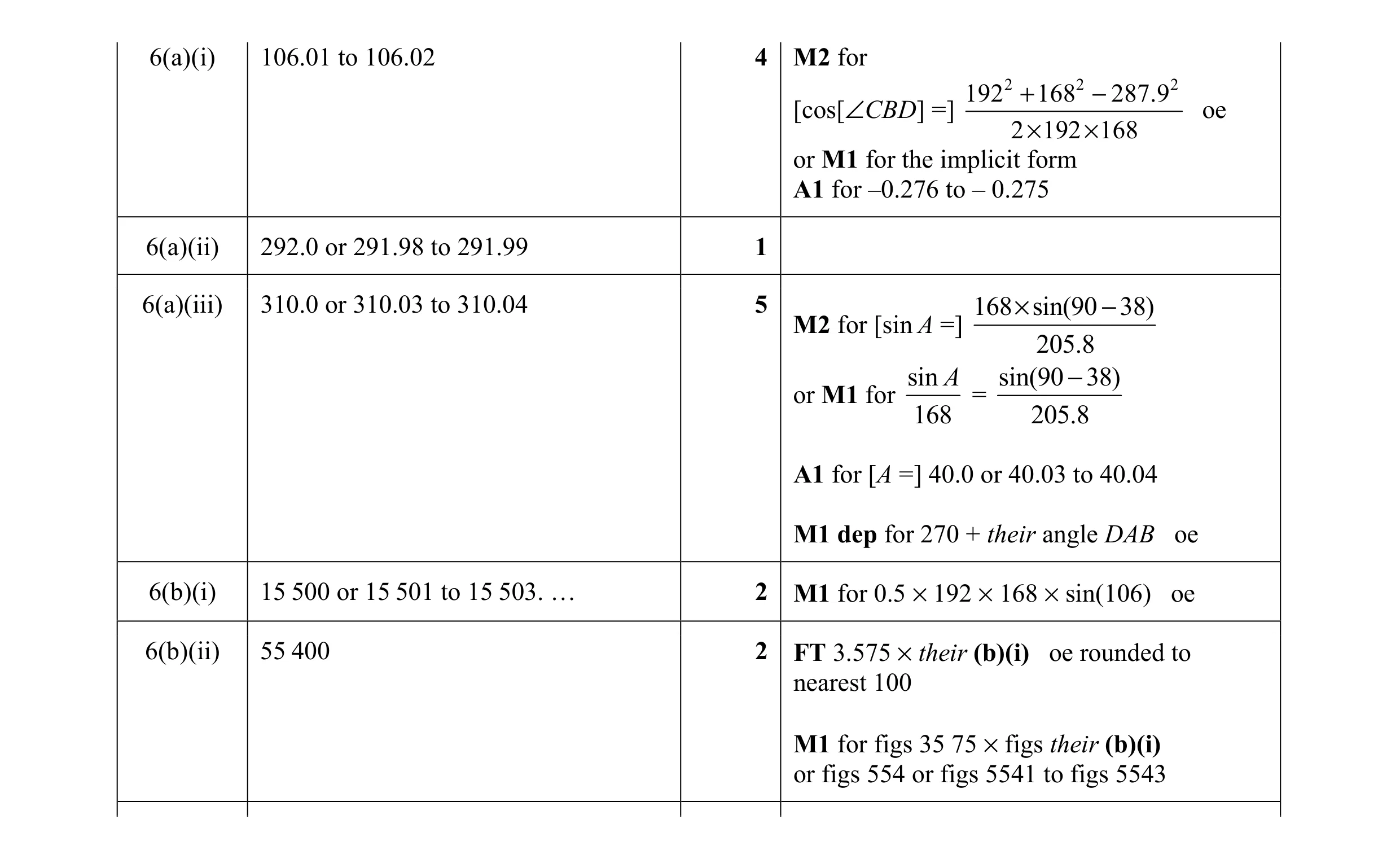 14
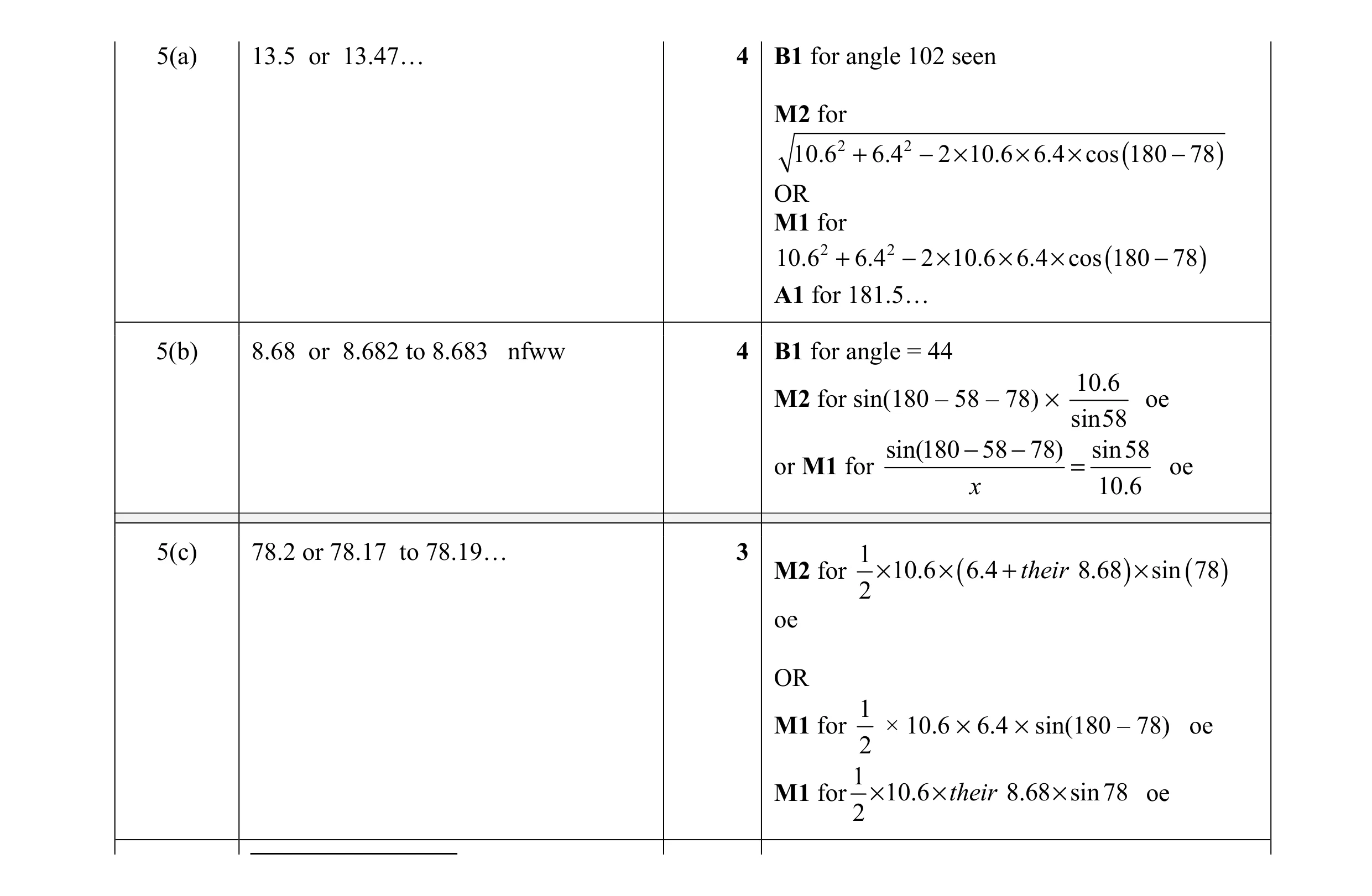 11
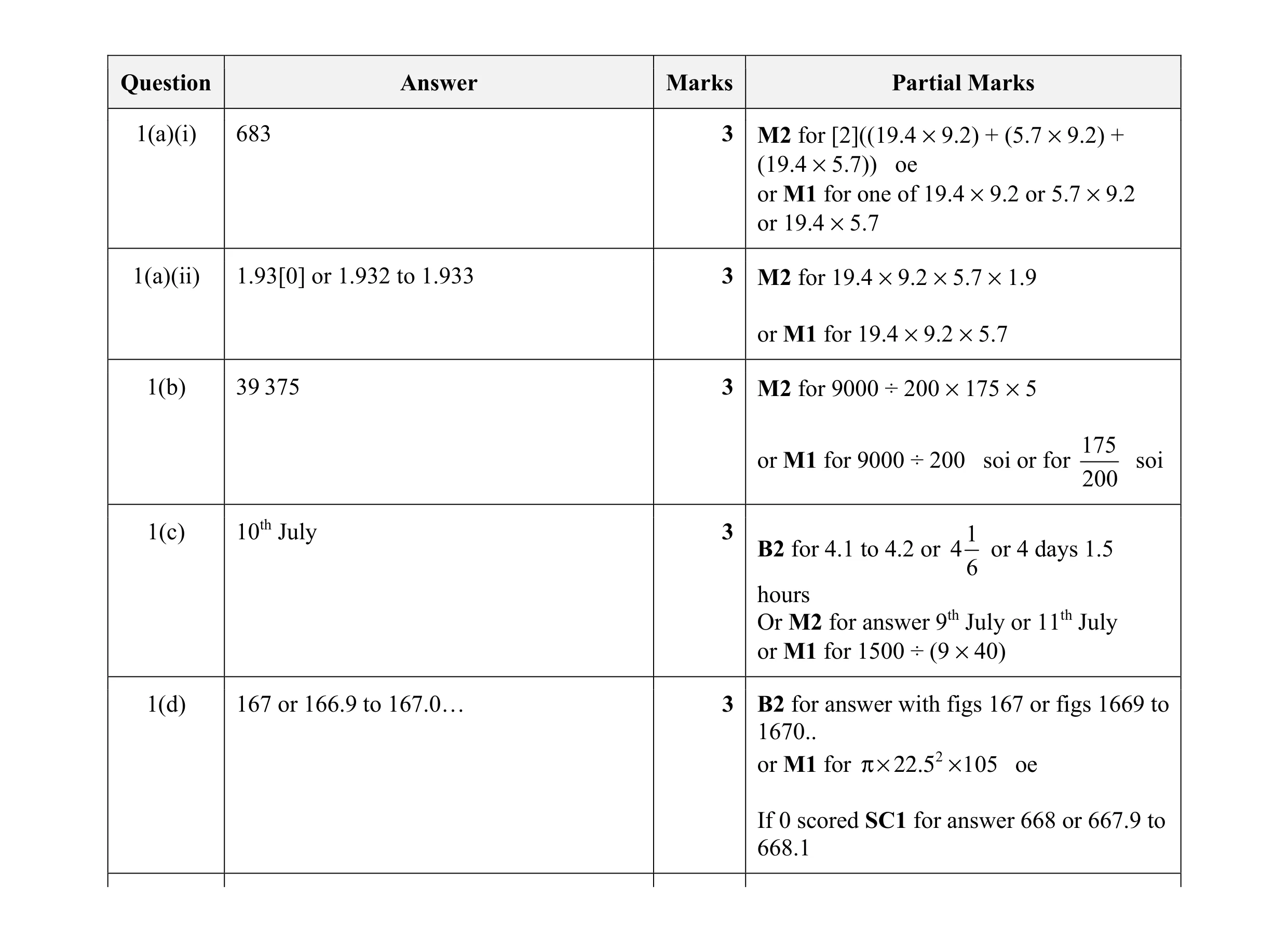 15
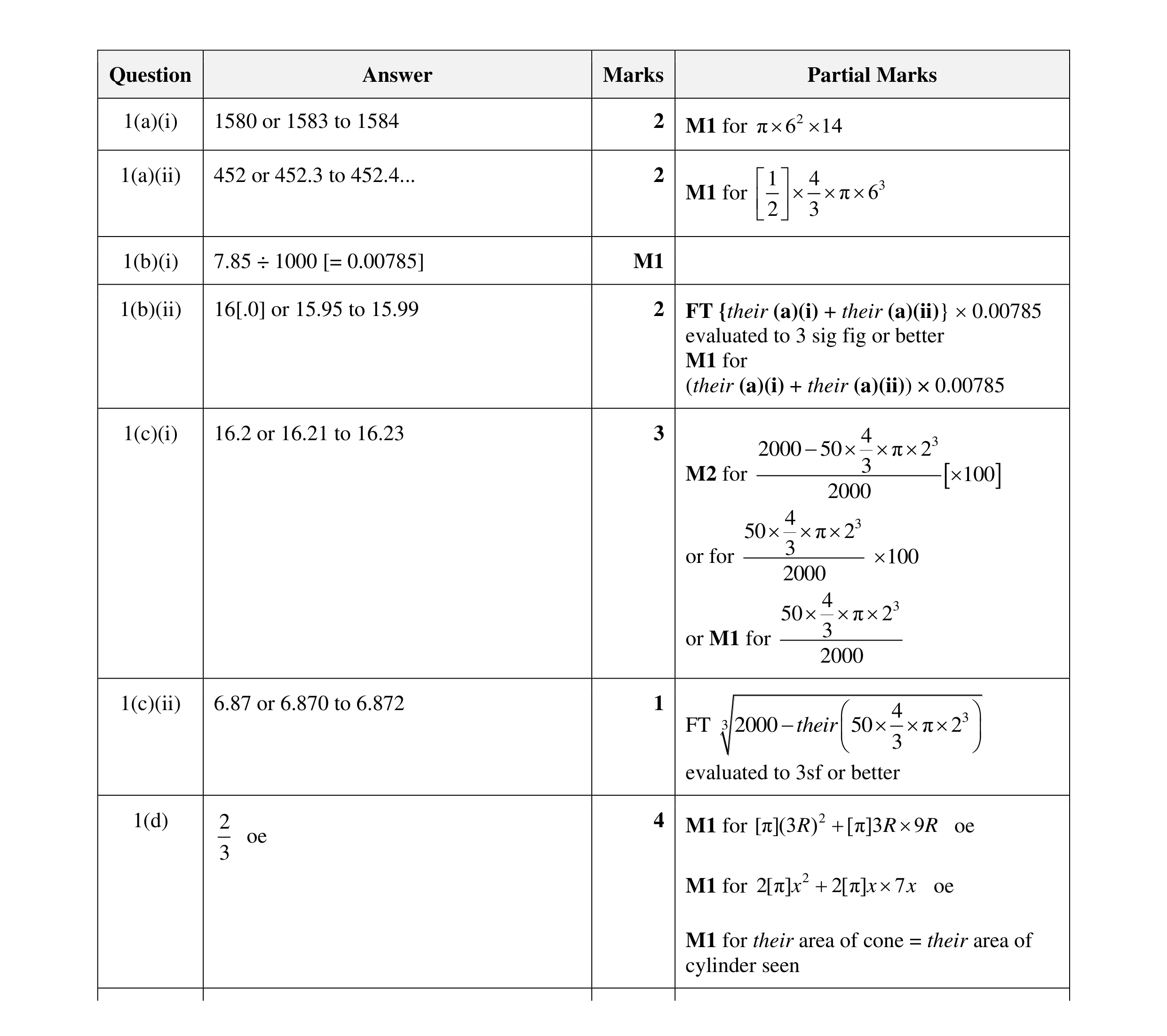 15
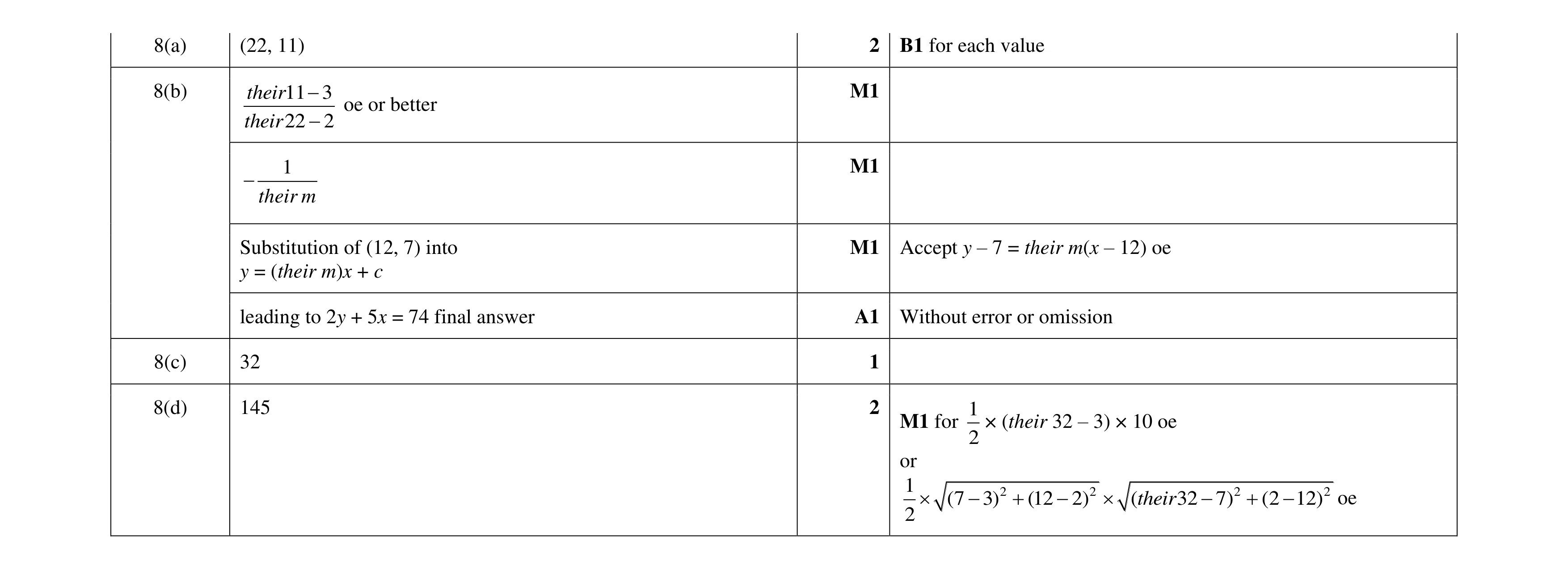 9
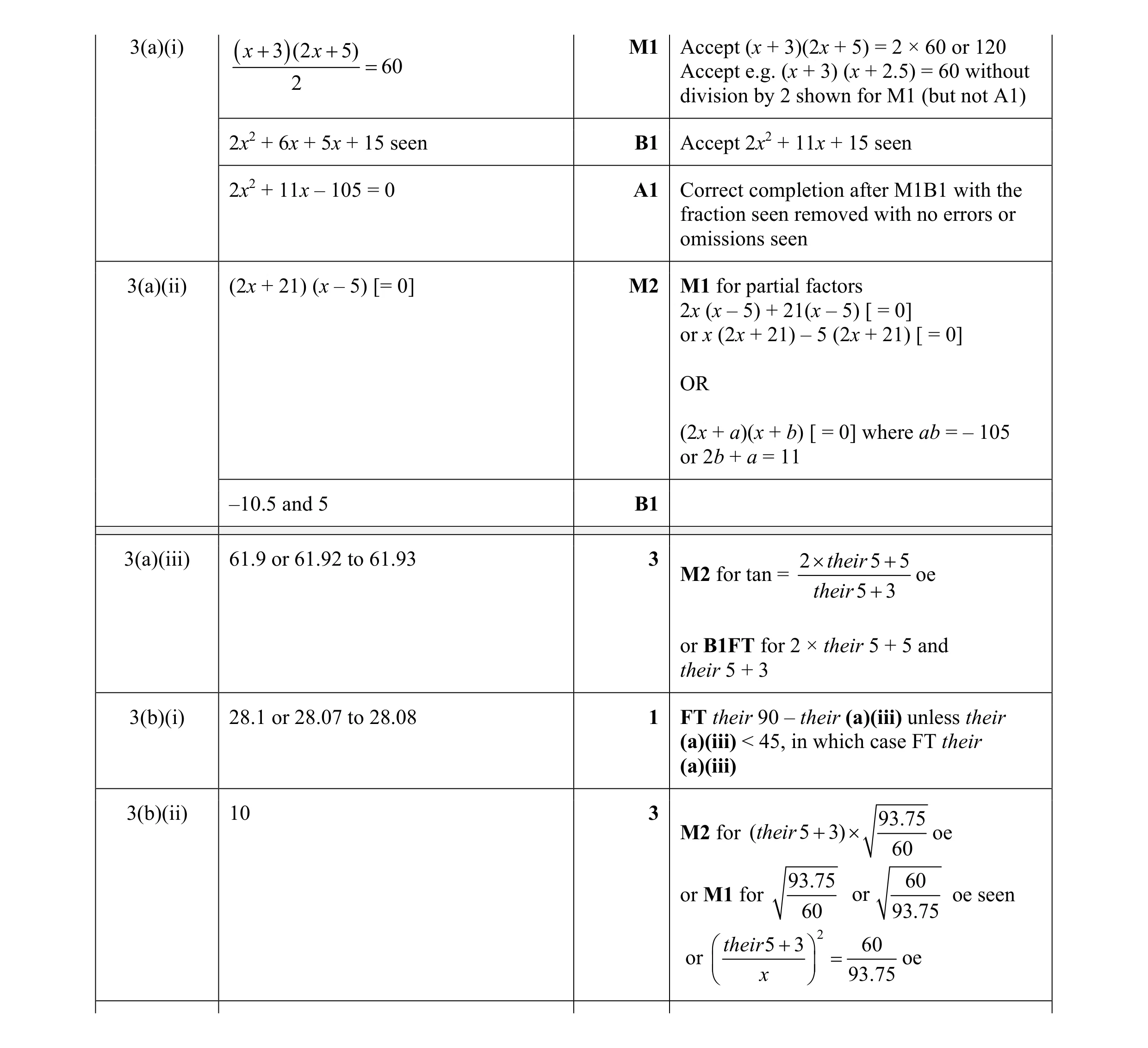 13
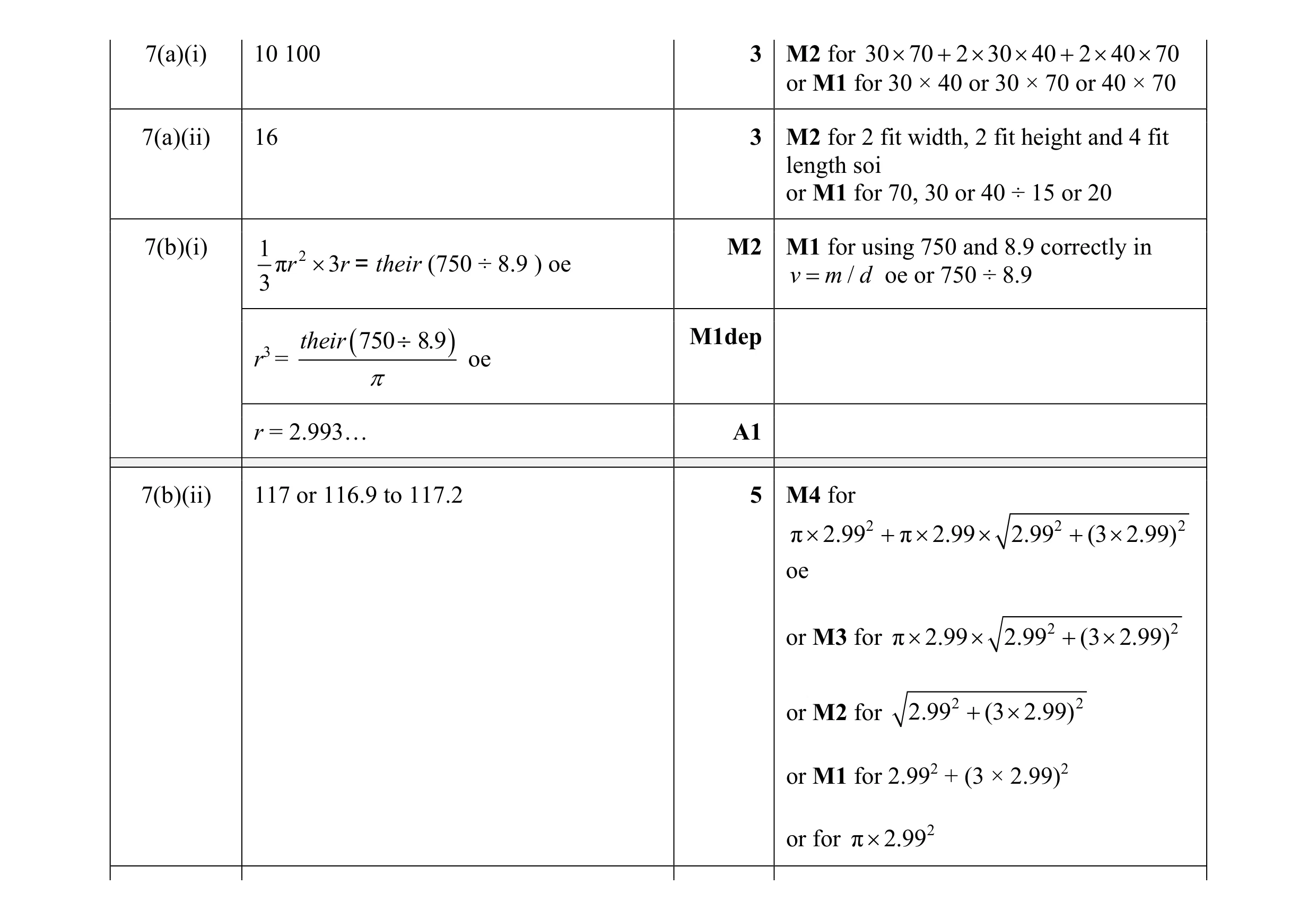 15
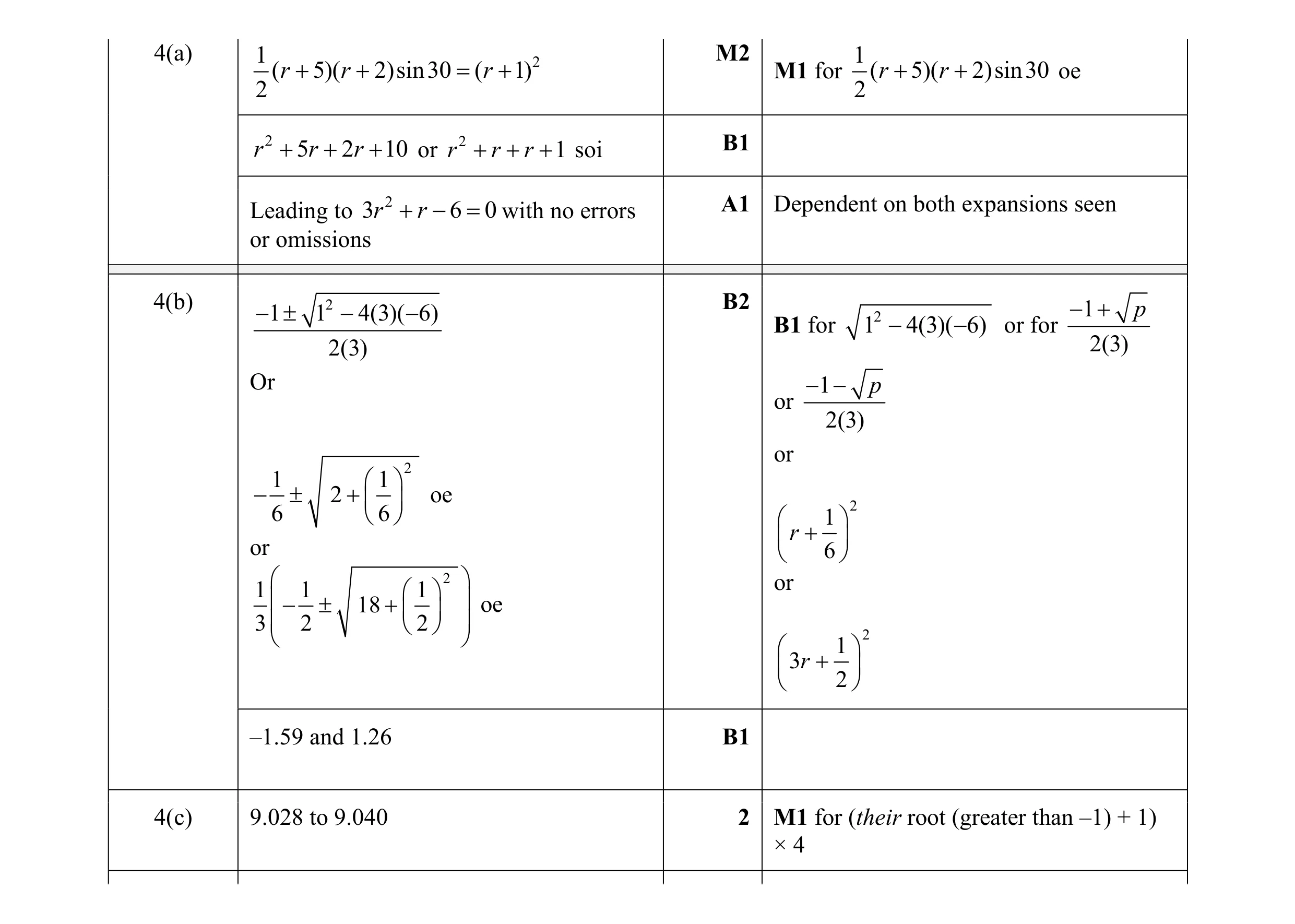 9
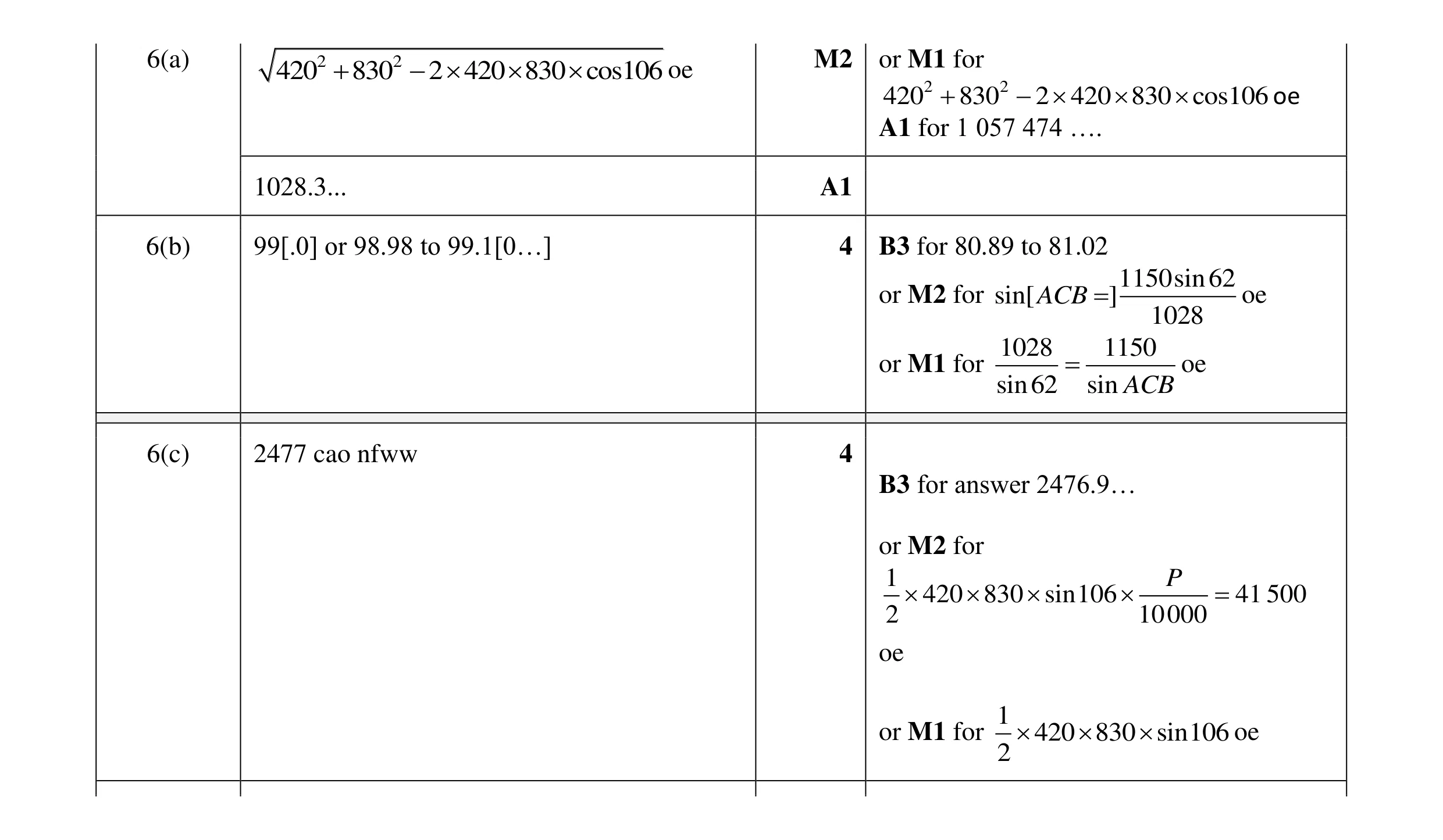 11
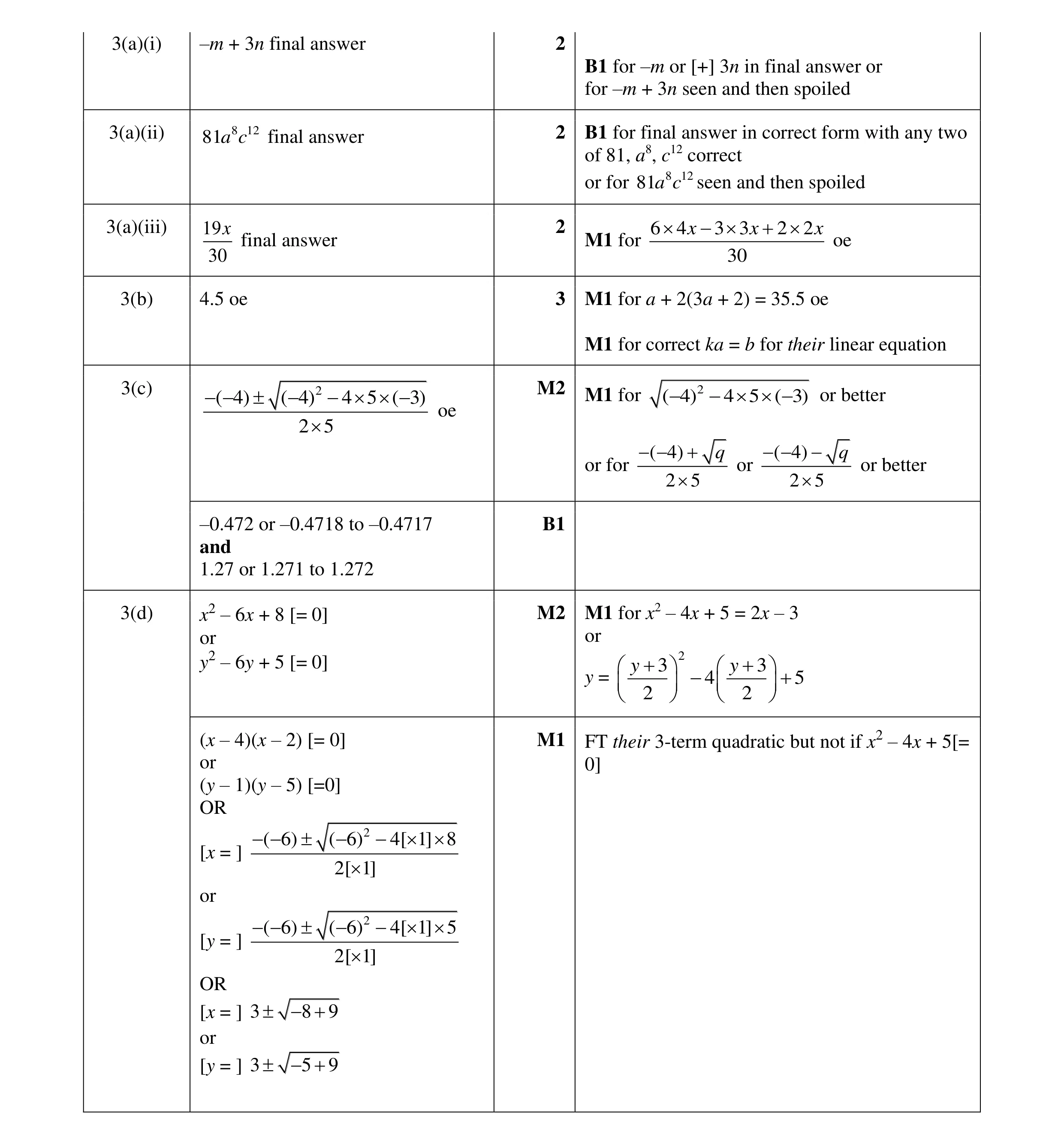 17
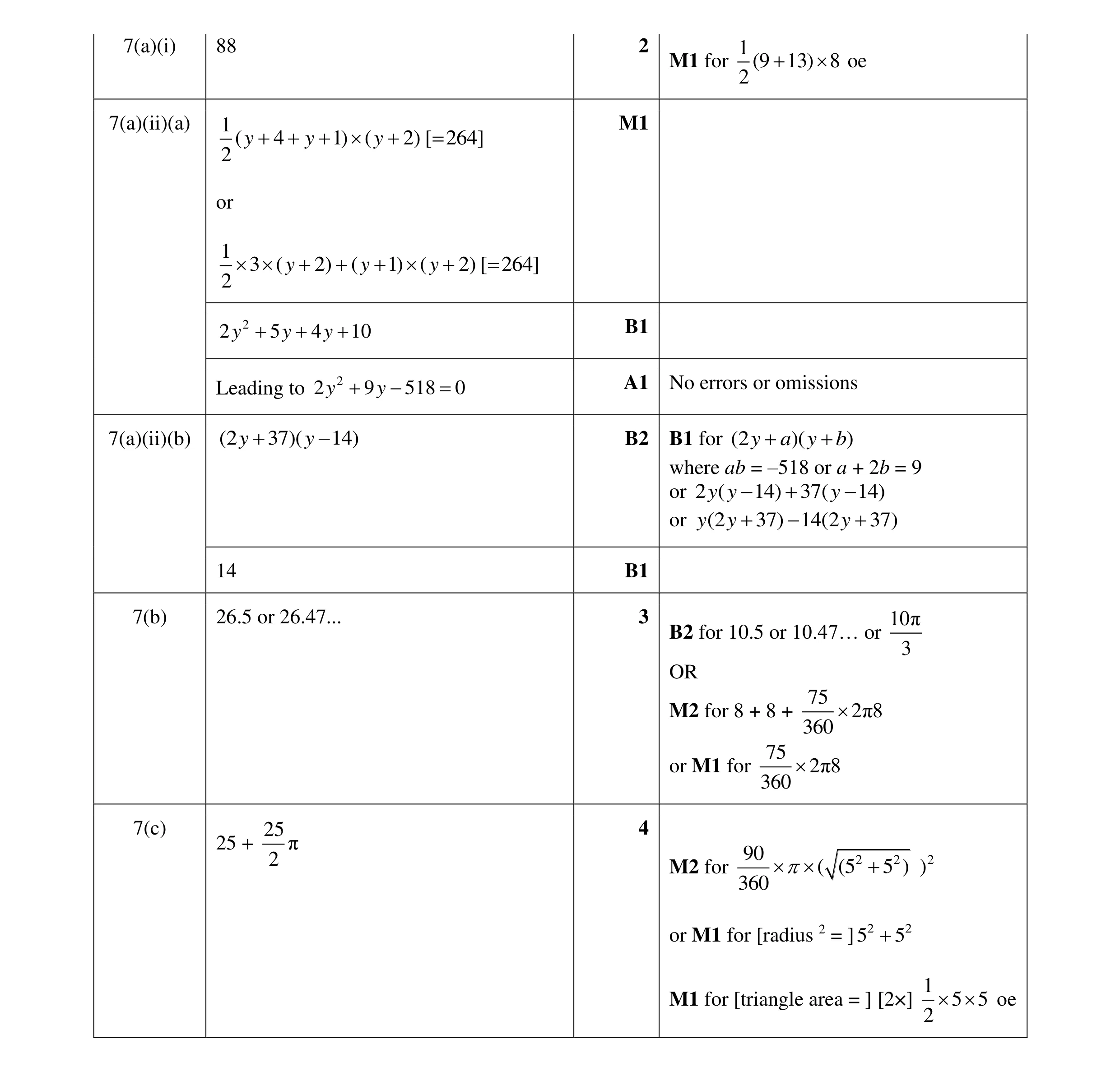 15
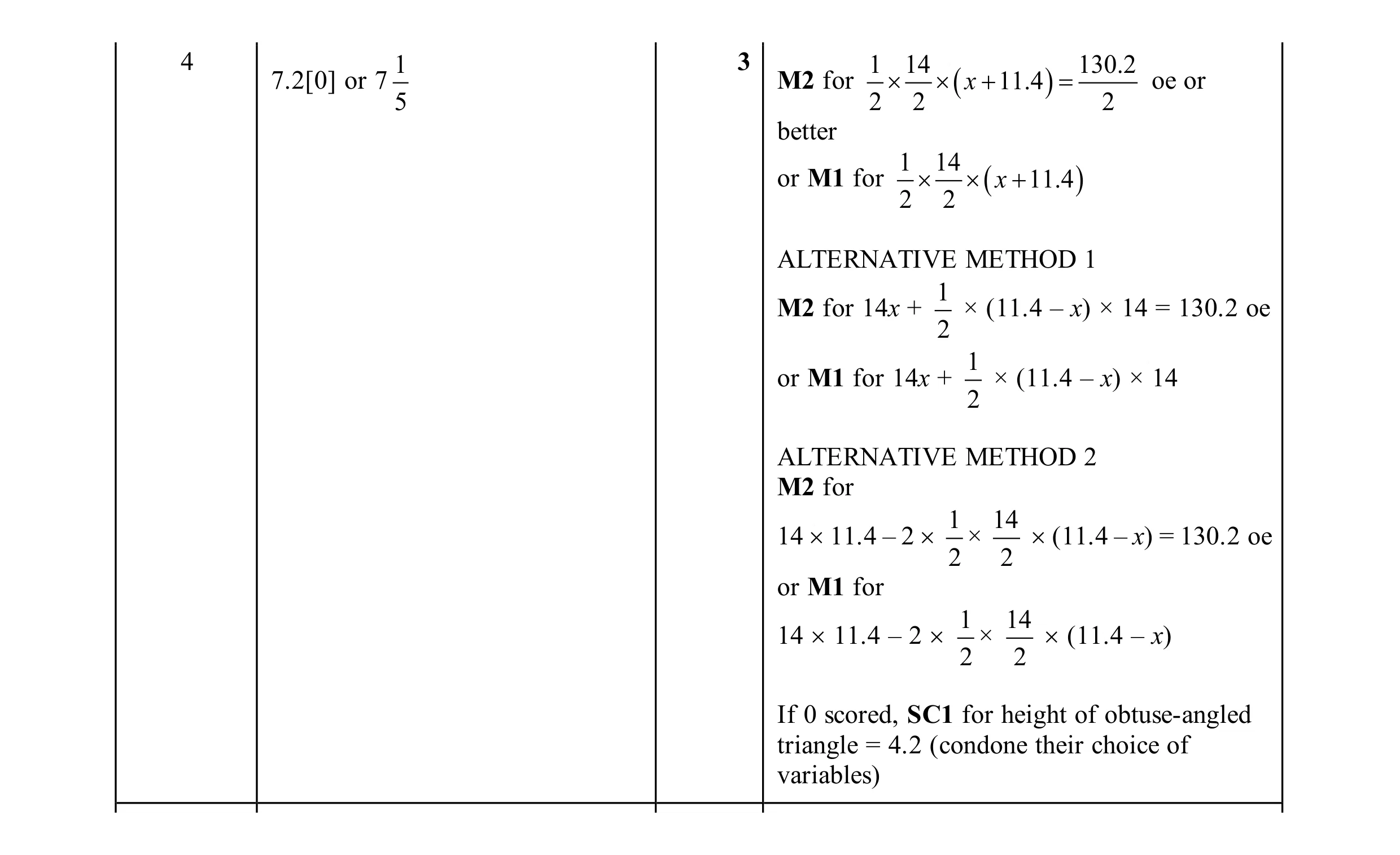 3
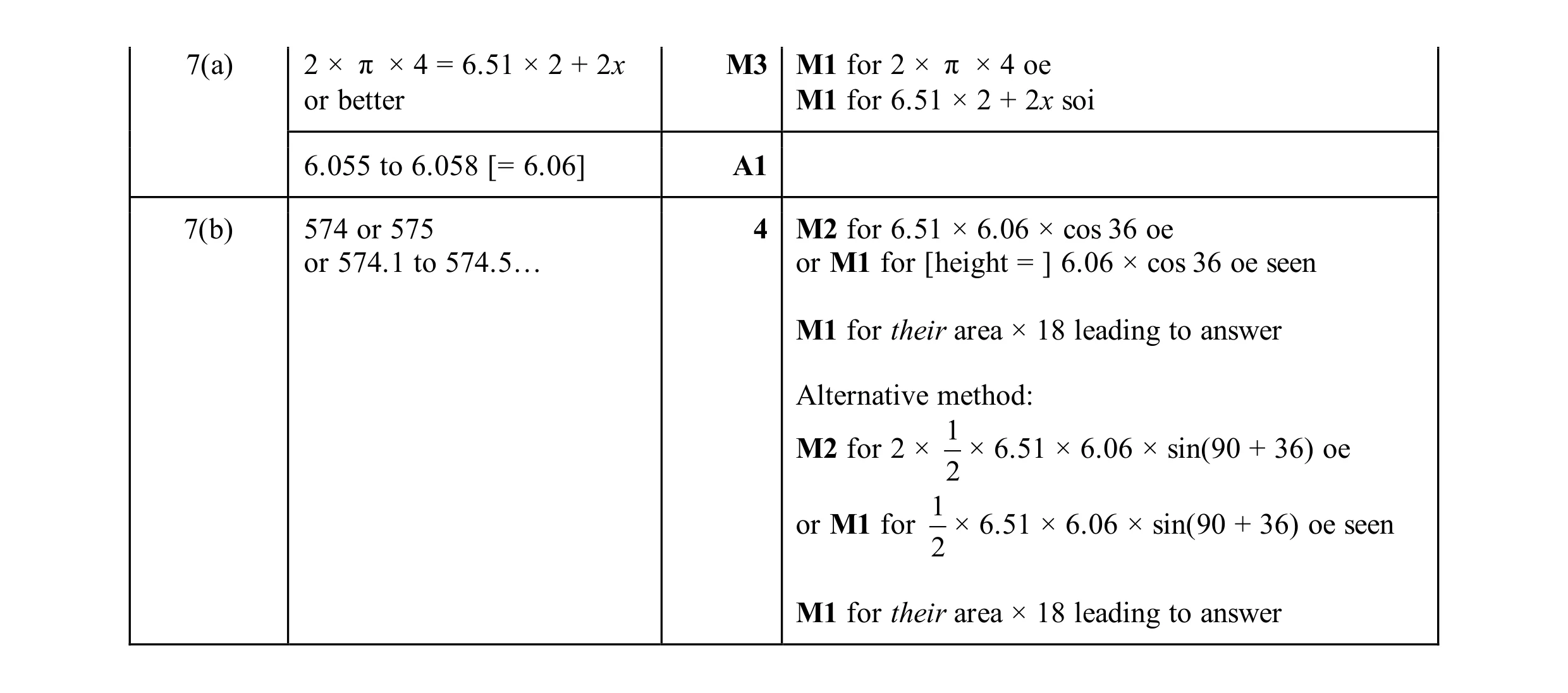 8
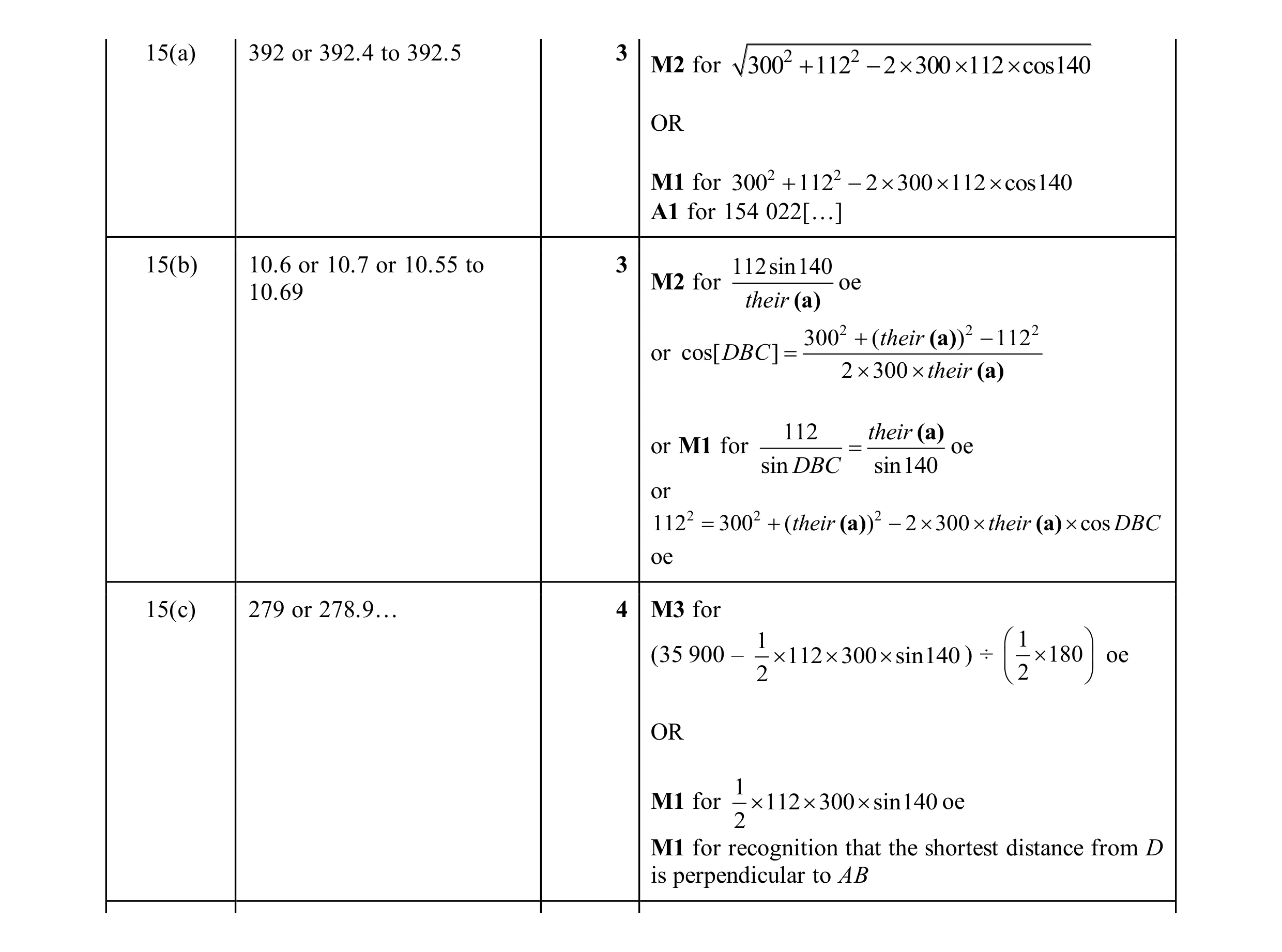 10