Questions as text
Q1 · A train completed a journey of 850 kilometres with an average speed of 80 kilometres per… 0580/41 May/June 2006
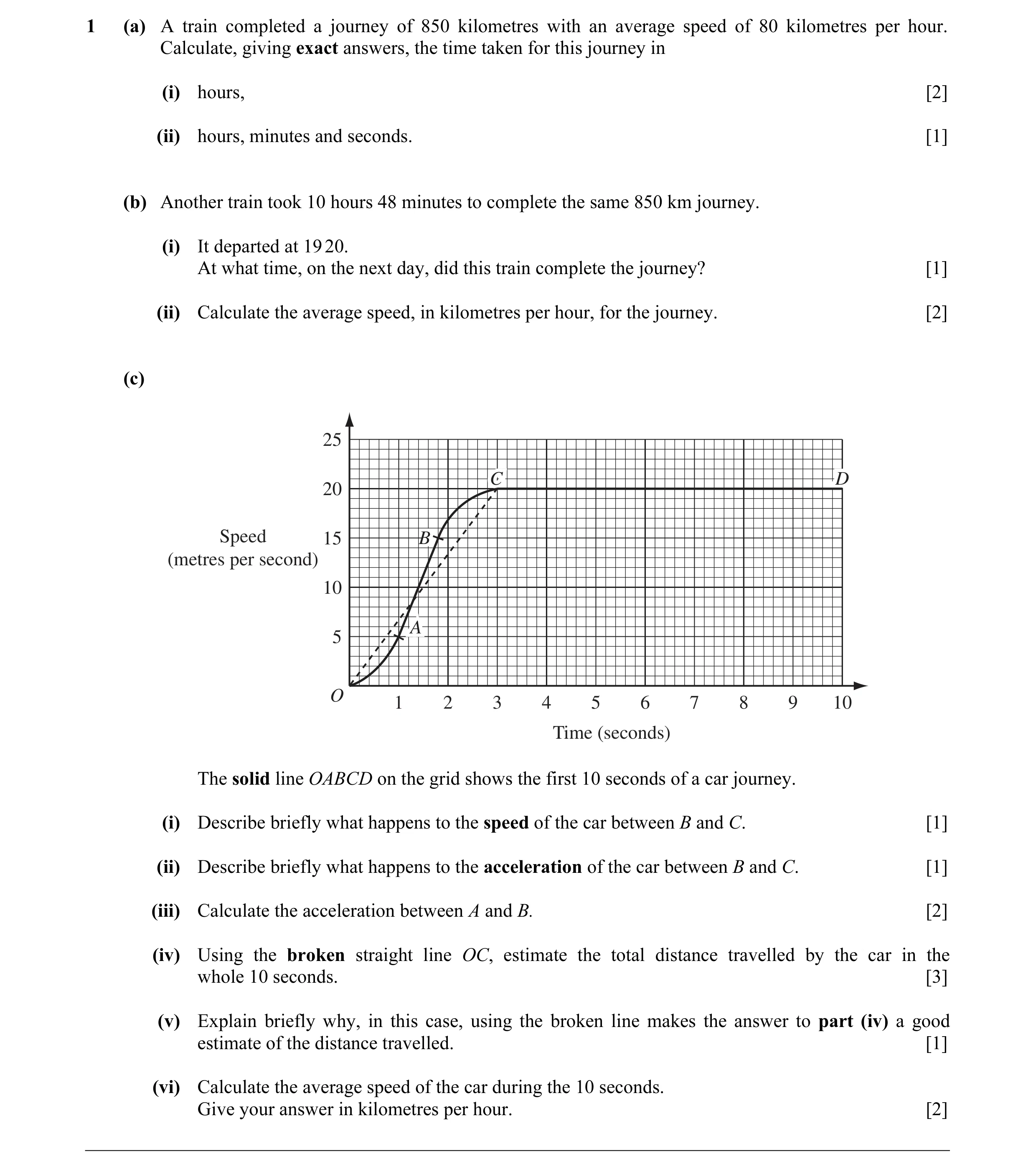
1 (a) A train completed a journey of 850 kilometres with an average speed of 80 kilometres per hour. Calculate, giving exact answers, the time taken for this journey in (i) hours, [2] (ii) hours, minutes and seconds. [1] (b) Another train took 10 hours 48 minutes to complete the same 850 km journey. (i) It departed at 19 20. At what time, on the next day, did this train complete the journey? [1] (ii) Calculate the average speed, in kilometres per hour, for the journey. [2] (c) 25 C D 20 Speed 15 BB (metres per second) 10 A 5 O 1 2 3 4 5 6 7 8 9 10 Time (seconds) The solid line OABCD on the grid shows the first 10 seconds of a car journey. (i) Describe briefly what happens to the speed of the car between B and C. [1] (ii) Describe briefly what happens to the acceleration of the car between B and C. [1] (iii) Calculate the acceleration between A and B. [2] (iv) Using the broken straight line OC, estimate the total distance travelled by the car in the whole 10 seconds. [3] (v) Explain briefly why, in this case, using the broken line makes the answer to part (iv) a good estimate of the distance travelled. [1] (vi) Calculate the average speed of the car during the 10 seconds. Give your answer in kilometres per hour. [2]
16 marks
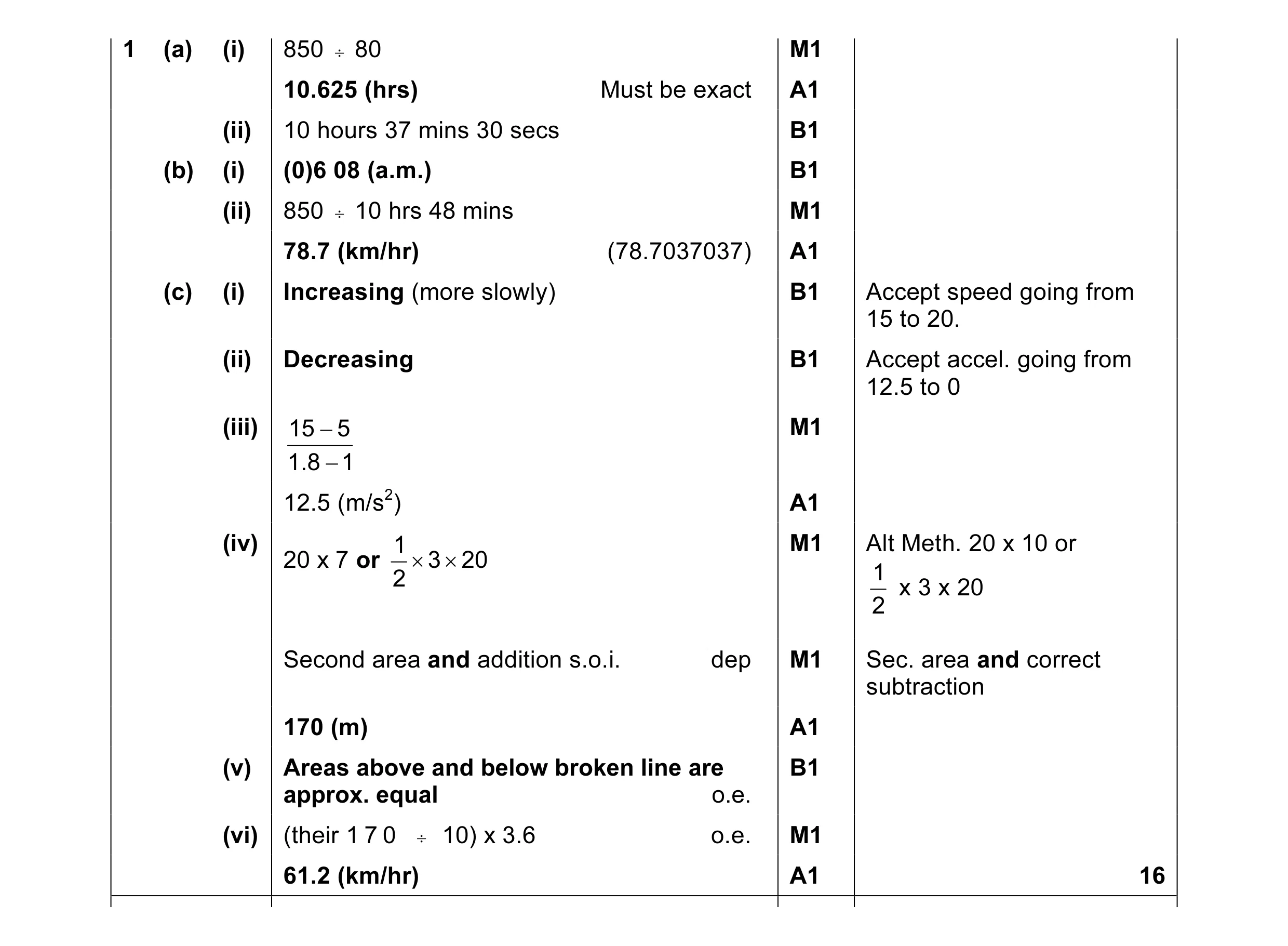
Mark scheme: 1 (a) (i) 850 ÷ 80 M1 10.625 (hrs) Must be exact A1 (ii) 10 hours 37 mins 30 secs B1 (b) (i) (0)6 08 (a.m.) B1 (ii) 850 ÷ 10 hrs 48 mins M1 78.7 (km/hr) (78.7037037) A1 (c) (i) Increasing (more slowly) B1 Accept speed going from 15 to 20. (ii) Decreasing B1 Accept accel. going from 12.5 to 0 (iii) 15 − 5 M1 1 . 8 − 1 12.5 (m/s2) A1 (iv) 1 M1 Alt Meth. 20 x 10 or 20 x 7 or × 3 × 20 2 1 x 3 x 20 2 Second area and addition s.o.i. dep M1 Sec. area and correct subtraction 170 (m) A1 (v) Areas above and below broken line are B1 approx. equal o.e. (vi) (their 1 7 0 ÷ 10) x 3.6 o.e. M1 61.2 (km/hr) A1 16
This question in 0580/41 May/June 2006
Q2 · The Martinez family travels by car to Seatown 0580/43 Oct/Nov 2012
1 (a) The Martinez family travels by car to Seatown. For The distance is 92 km and the journey takes 1 hour 25 minutes. Examiner's Use (i) The family leaves home at 07 50. Write down the time they arrive at Seatown. Answer(a)(i) [1] (ii) Calculate the average speed for the journey. Answer(a)(ii) km/h [2] (iii) During the journey, the family stops for 10 minutes. Calculate 10 minutes as a percentage of 1 hour 25 minutes. Answer(a)(iii) % [1] (iv) 92 km is 15% more than the distance from Seatown to Deecity. Calculate the distance from Seatown to Deecity. Answer(a)(iv) km [3] (b) The Martinez family spends $150 in the ratio For Examiner's fuel : meals : gifts = 11 : 16 : 3 . Use (i) Show that $15 is spent on gifts. Answer (b)(i) [2] (ii) The family buys two gifts. The first gift costs $8.25. Find the ratio cost of first gift : cost of second gift. Give your answer in its simplest form. Answer(b)(ii) : [2]
11 marks
Mark scheme: Qu. Answers Mark Part Marks 1 (a) (i) [0]9 15 [am] 1 Any acceptable form of time (ii) 64.9 or 65.[0] or 64.92 to 2 M1 for 92 ÷ (1 and 25 mins) or 92/85 × 60 oe 64.98 or 92 ÷ (1.41 to 1.42) (iii) 11.76…or 11.8 1 (iv) 80 3 M2 for 92 ÷ 1.15 oe or M1 for 115% associated with 92 (b) (i) 150 ÷ (11 + 16 + 3) or M1 Correct first step 150 × 3 oe then × 3 or ÷ 30 E1 Correct conclusion (ii) 11 : 9 final answer 2 M1 for 8.25 : (15 – 8.25) oe For M1 e.g. allow 1 : 0.818 [0.8181 to 0.8182] or 1.22 : 1 [1.222…] After M0, SC1 for 9 : 11 as final answer −11 k
This question in 0580/43 Oct/Nov 2012
Q3 · Noma fl ies from Johannesburg to Hong Kong 0580/42 Oct/Nov 2013
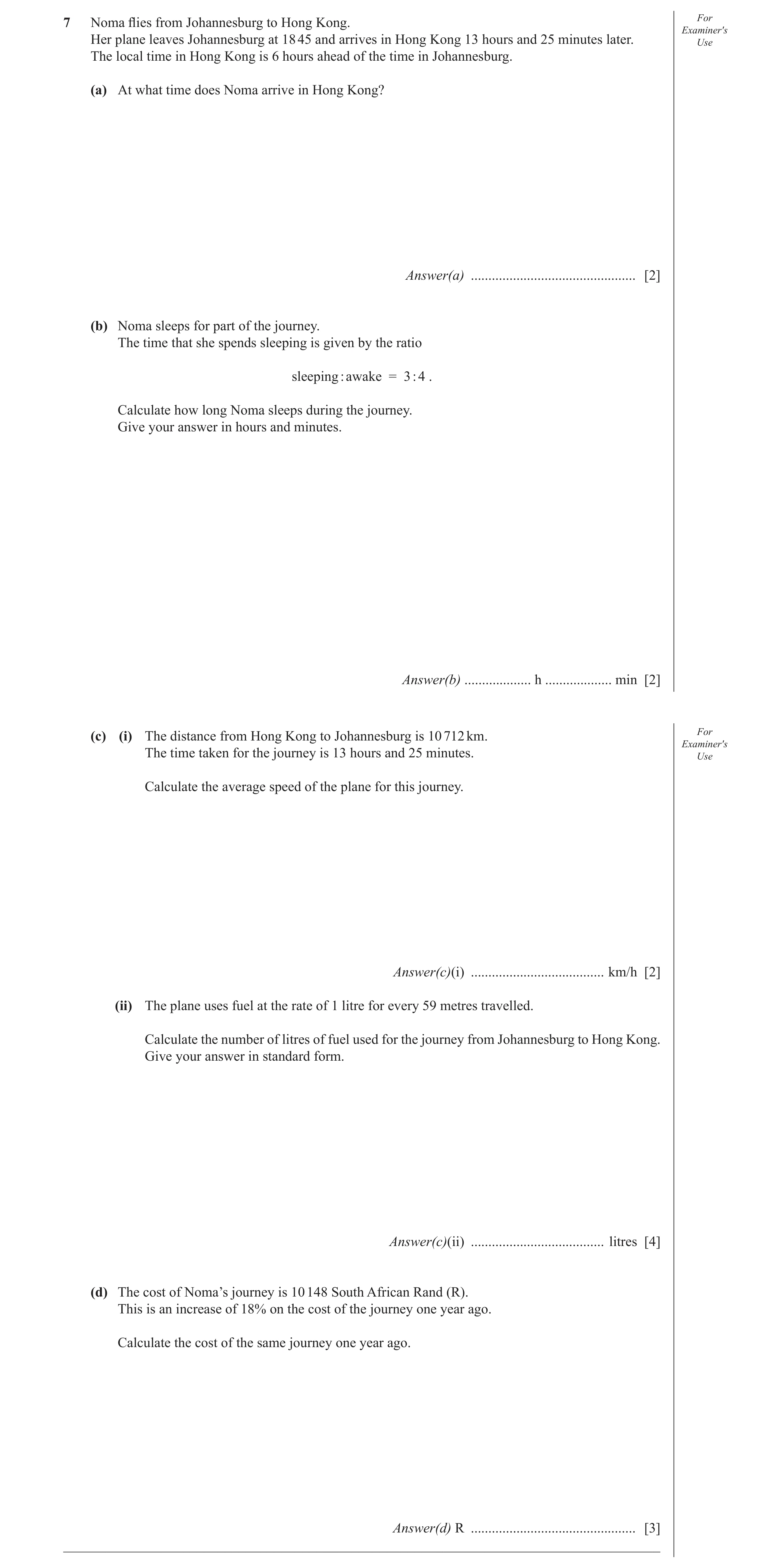
7 Noma fl ies from Johannesburg to Hong Kong. For Examiner′s Her plane leaves Johannesburg at 18 45 and arrives in Hong Kong 13 hours and 25 minutes later. Use The local time in Hong Kong is 6 hours ahead of the time in Johannesburg. (a) At what time does Noma arrive in Hong Kong? Answer(a) … [2] (b) Noma sleeps for part of the journey. The time that she spends sleeping is given by the ratio sleeping : awake = 3 : 4 . Calculate how long Noma sleeps during the journey. Give your answer in hours and minutes. Answer(b) … h … min [2] (c) (i) The distance from Hong Kong to Johannesburg is 10 712 km. For Examiner′s The time taken for the journey is 13 hours and 25 minutes. Use Calculate the average speed of the plane for this journey. Answer(c)(i) … km/h [2] (ii) The plane uses fuel at the rate of 1 litre for every 59 metres travelled. Calculate the number of litres of fuel used for the journey from Johannesburg to Hong Kong. Give your answer in standard form. Answer(c)(ii) … litres [4] (d) The cost of Noma’s journey is 10 148 South African Rand (R). This is an increase of 18% on the cost of the journey one year ago. Calculate the cost of the same journey one year ago. Answer(d) R … [3] _____________________________________________________________________________________
13 marks
Mark scheme: 7 (a) 14 10 or 2 10 pm final answer 2 M1 for (0)8 10 oe or answer 14 hours and 10 minutes or answer 2 10 [am] (b) 5 hours 45 minutes cao 2 M1 for 345 [mins] seen or for 805 /7 × 3 oe or 5.75 seen 25 (c) (i) 798 or 798.2 to 798.4…. 2 M1 for 10712 / 13 or 10712 ÷ 13.4… 60 (ii) 1.82 × 10⁵ 4 B3 for 182000 or 181500 to 181600 seen or 1.815 × 10⁵ to 1.816 × 10⁵ or M2 for 10712000/59 oe or M1 for figs 10712/figs 59 soi by figs 182 or figs 1815 to 1816 and B1 FT for their number of litres correctly converted to standard form rounded to 3sf or better (d) 8600 3 M2 for 10148 ÷ 1.18 oe or M1 for 10148 associated with 118[%]
This question in 0580/42 Oct/Nov 2013
Q4 · Ali leaves home at 10 00 to cycle to his grandmother’s house 0580/41 May/June 2014
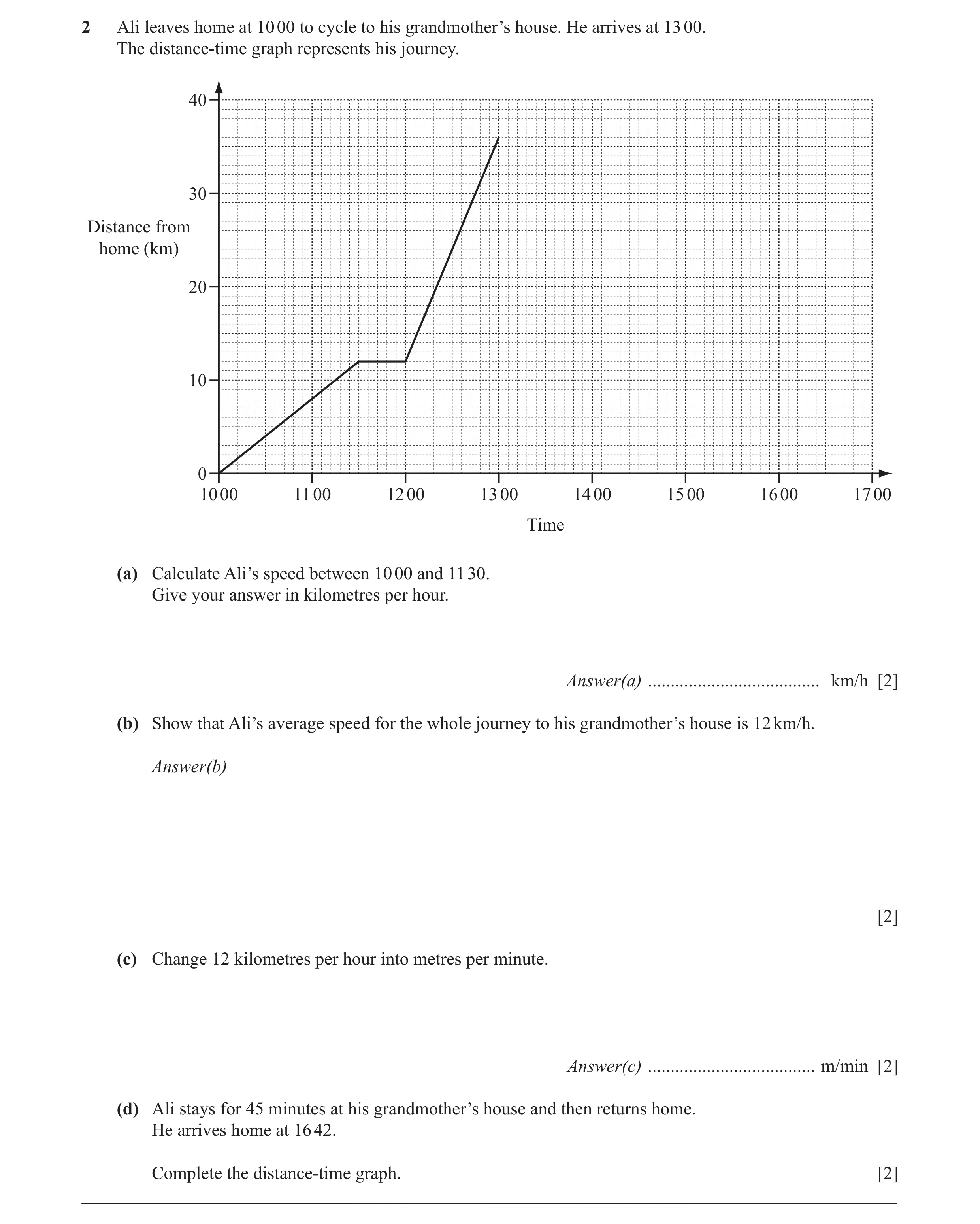
2 Ali leaves home at 10 00 to cycle to his grandmother’s house. He arrives at 13 00. The distance-time graph represents his journey. 40 30 Distance from home (km) 20 10 0 10 00 11 00 12 00 13 00 14 00 15 00 16 00 17 00 Time (a) Calculate Ali’s speed between 10 00 and 11 30. Give your answer in kilometres per hour. Answer(a) … km/h [2] (b) Show that Ali’s average speed for the whole journey to his grandmother’s house is 12 km/h. Answer(b) [2] (c) Change 12 kilometres per hour into metres per minute. Answer(c) … m/min [2] (d) Ali stays for 45 minutes at his grandmother’s house and then returns home. He arrives home at 16 42. Complete the distance-time graph. [2] __________________________________________________________________________________________
8 marks
Mark scheme: 2 (a) 8 2 M1 for 12 ÷ 1.5 oe (b) [Distance =] 36 B1 their36 ÷ 3 [= 12] oe M1 (c) 200 2 M1 for 12 × 1000 ÷ 60 oe e.g. 36 000 ÷ 180 (d) Horizontal line at 36 to 13 45 1 (their 13 45, 36) joined to (16 42, 0) 1FT
This question in 0580/41 May/June 2014
Q5 · K 680 km 65° 40° D North NOT TO SCALE 2380 km M 1560 km C The diagram shows some… 0580/43 Oct/Nov 2015
5 K 680 km 65° 40° D North NOT TO SCALE 2380 km M 1560 km C The diagram shows some distances between Mumbai (M), Kathmandu (K), Dhaka (D) and Colombo (C). (a) Angle CKD = 65°. Use the cosine rule to calculate the distance CD. Answer(a) CD = … km [4] (b) Angle MKC = 40°. Use the sine rule to calculate the acute angle KMC. Answer(b) Angle KMC = … [3] (c) The bearing of K from M is 050°. Find the bearing of M from C. Answer(c) … [2] (d) A plane from Colombo to Mumbai leaves at 21 15 and the journey takes 2 hours 24 minutes. (i) Find the time the plane arrives at Mumbai. Answer(d)(i) … [1] (ii) Calculate the average speed of the plane. Answer(d)(ii) … km/h [2] __________________________________________________________________________________________
12 marks
Mark scheme: 5 (a) 2180 or 2181…. nfww 4 M2 for 680 2 + 2380 2 − 2 × 680 × 2380 cos 65 oe or M1 for correct implicit cosine formula A1 for 4 760 000 or 4 758 000 to 4 759 000 (b) 78.7 or 78.71… 3 2380 sin 40 M2 for 1560 or 1560 2380 M1 for = oe sin 40 sin M (c) 309 or 308.7… 2FT FT 230 + their (b) B1FT 50 + their (b) for 129 or 128.7… [i.e. for C from M] (d) (i) 23 39 oe 1 (ii) 650 2 M1 for 1560 ÷ journey time
This question in 0580/43 Oct/Nov 2015
Q6 · Mr Chan flies from London to Los Angeles, a distance of 8800 km 0580/42 May/June 2016
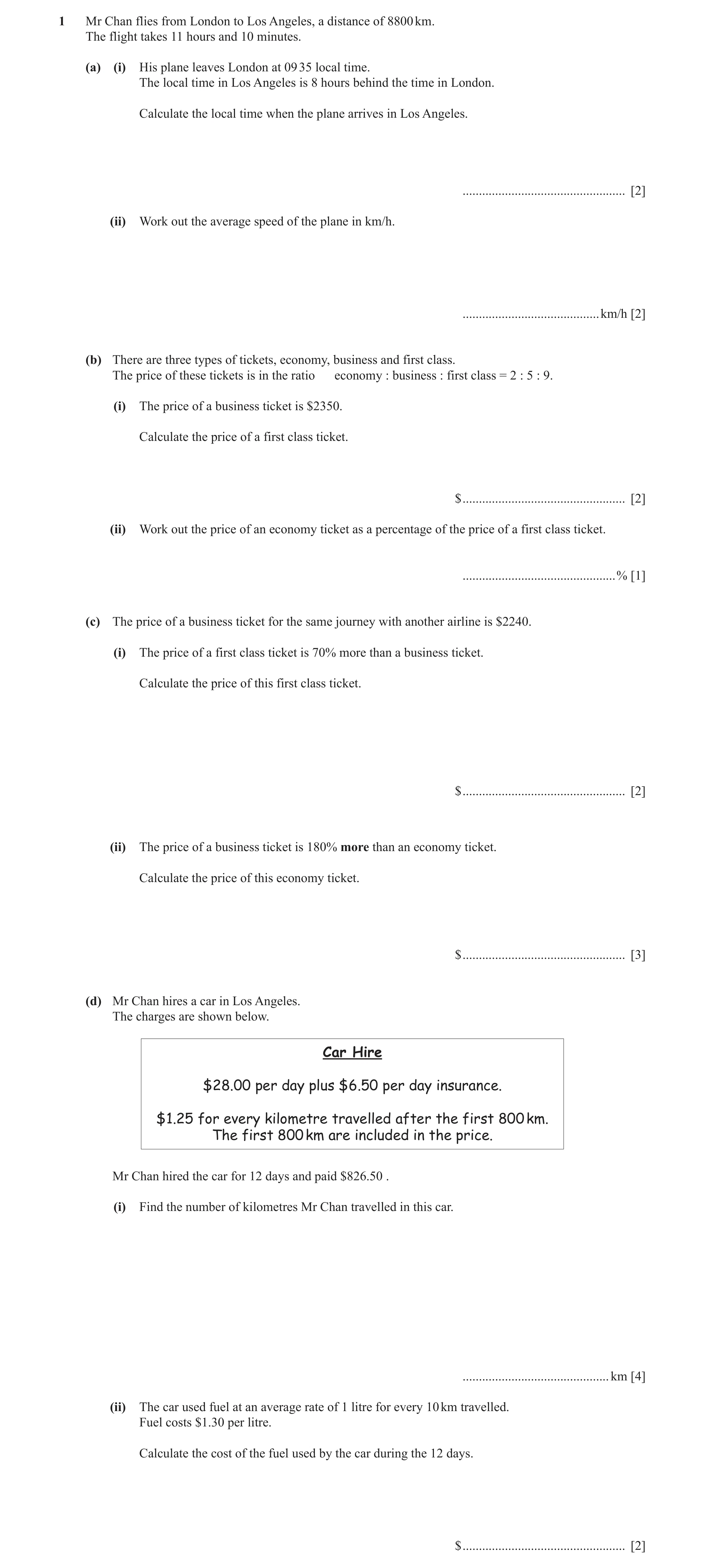
1 Mr Chan flies from London to Los Angeles, a distance of 8800 km. The flight takes 11 hours and 10 minutes. (a) (i) His plane leaves London at 09 35 local time. The local time in Los Angeles is 8 hours behind the time in London. Calculate the local time when the plane arrives in Los Angeles. … [2] (ii) Work out the average speed of the plane in km/h. … km/h [2] (b) There are three types of tickets, economy, business and first class. The price of these tickets is in the ratio economy : business : first class = 2 : 5 : 9. (i) The price of a business ticket is $2350. Calculate the price of a first class ticket. $ … [2] (ii) Work out the price of an economy ticket as a percentage of the price of a first class ticket. … % [1] (c) The price of a business ticket for the same journey with another airline is $2240. (i) The price of a first class ticket is 70% more than a business ticket. Calculate the price of this first class ticket. $ … [2] (ii) The price of a business ticket is 180% more than an economy ticket. Calculate the price of this economy ticket. $ … [3] (d) Mr Chan hires a car in Los Angeles. The charges are shown below. Car Hire $28.00 per day plus $6.50 per day insurance. $1.25 for every kilometre travelled after the first 800 km. The first 800 km are included in the price. Mr Chan hired the car for 12 days and paid $826.50 . (i) Find the number of kilometres Mr Chan travelled in this car. … km [4] (ii) The car used fuel at an average rate of 1 litre for every 10 km travelled. Fuel costs $1.30 per litre. Calculate the cost of the fuel used by the car during the 12 days. $ … [2]
18 marks
Mark scheme: Question Answer Mark Part marks 1 (a) (i) 12 45 [pm] 2 B1 for 20 45 seen or 8 45 pm seen or [0]1 35 seen (ii) 788 or 787.8 to 788.1 2 M1 for 8800 ÷ 11h 10 mins oe (b) (i) 4230[.00] 2 M1 for 2350 ÷ 5 oe (ii) 22.2 or 22.2… 1 100 + 70 (c) (i) 3808 final answer 2 M1 for 2240 × oe 100 100 + 180 (ii) 800 3 M2 for 2240 ÷ oe 100 or M1 for 2240 associated with 280% (d) (i) 1130 4 M3 for (826.5[0] – 12 × (28 + 6.5[0])) ÷ 1.25 seen or M2 for 826.5[0] – 12 × (28 + 6.5[0]) seen or M1 for 12 × (28 + 6.5[0]) seen (ii) $146.9[0] final answer 2FT FT their(d)(i) × 0.13 correctly evaluated If answer not exact to at least 3 sf or better M1 for their (d)(i) ÷ 10 × 1.3
This question in 0580/42 May/June 2016
Q7 · D North 170 m NOT TO SCALE C 33° 180 m A 220 m B The diagram shows five straight… 0580/41 Oct/Nov 2016
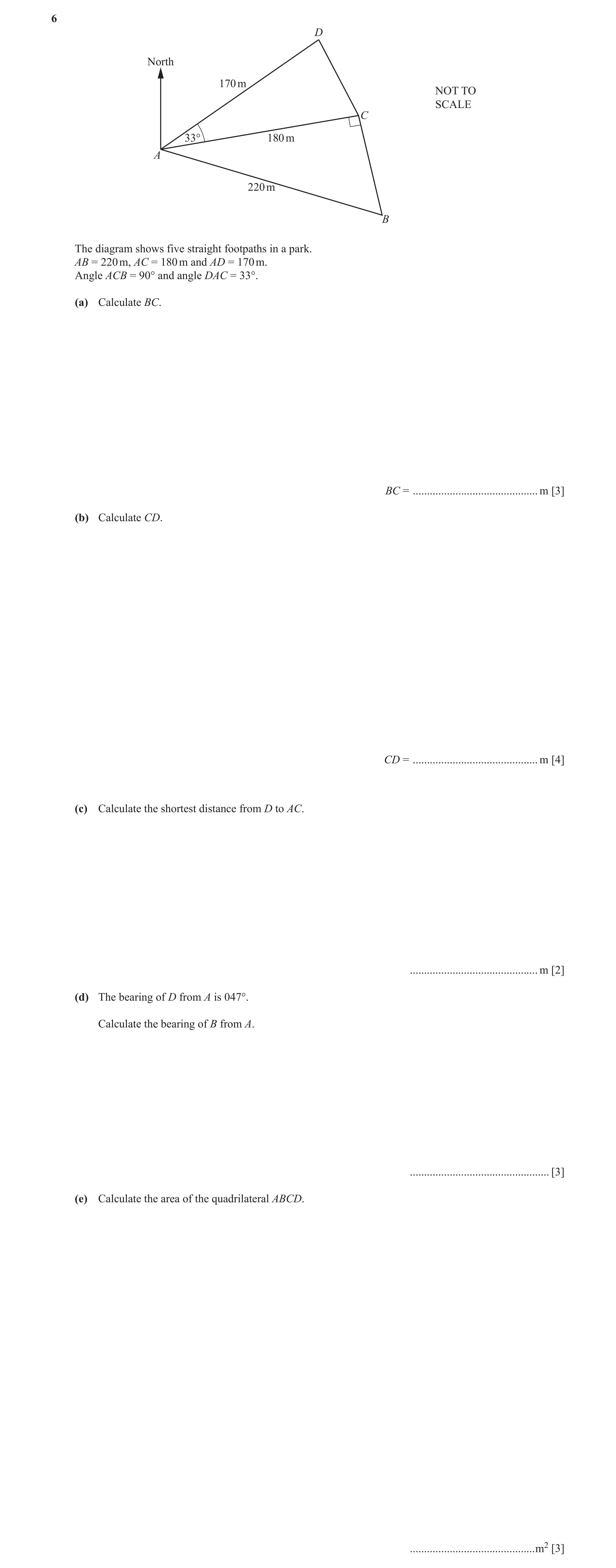
6 D North 170 m NOT TO SCALE C 33° 180 m A 220 m B The diagram shows five straight footpaths in a park. AB = 220 m, AC = 180 m and AD = 170 m. Angle ACB = 90° and angle DAC = 33°. (a) Calculate BC. BC = … m [3] (b) Calculate CD. CD = … m [4] (c) Calculate the shortest distance from D to AC. … m [2] (d) The bearing of D from A is 047°. Calculate the bearing of B from A. … [3] (e) Calculate the area of the quadrilateral ABCD. … m2 [3]
15 marks
Mark scheme: 6 (a) 126 or 126.4 to 126.5 3 M2 for 220 2 − 180 2 oe or M1 for BC2 + 1802 = 2202 oe (b) 99.9 or 99.86 to 99.87 4 M2 for 1802 + 1702 – 2 × 180 × 170 cos33 180 2 + 170 2 − CD 2 or M1 for cos33 = 2 × 180 × 170 A1 for 9970 or 9973 to 9974 dist (c) 92.6 or 92.58 to 92.59 2 M1 for = sin33 oe 170 180 (d) 115.1 or 115.0 to 115.1 3 M1 for cos = oe 220 M1dep for 47 + 33 + their angle BAC (e) 19700 or 19708 to 19720 3 M1 for 0.5 × 180 × 170 × sin33 oe or 0.5 × 180 × their (c) oe M1 for 0.5 × 180 × their (a) oe or 0.5 × 180 × 220 × sin(their BAC) oe
This question in 0580/41 Oct/Nov 2016
Q8 · D 180 m North C NOT TO 85° SCALE 240 m A 50° B The diagram shows a field, ABCD 0580/42 Oct/Nov 2016
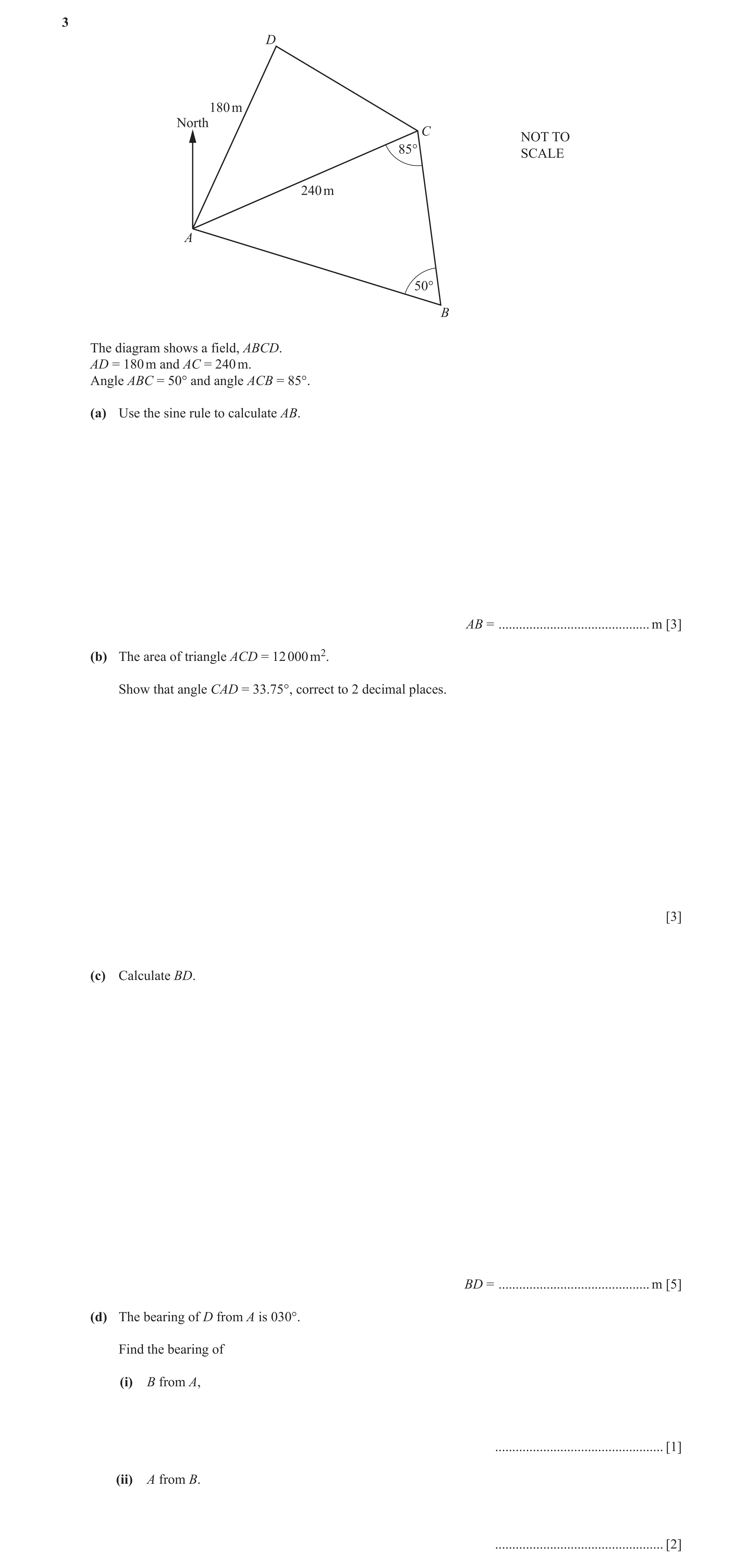
3 D 180 m North C NOT TO 85° SCALE 240 m A 50° B The diagram shows a field, ABCD. AD = 180 m and AC = 240 m. Angle ABC = 50° and angle ACB = 85°. (a) Use the sine rule to calculate AB. AB = … m [3] (b) The area of triangle ACD = 12 000 m2. Show that angle CAD = 33.75°, correct to 2 decimal places. [3] (c) Calculate BD. BD = … m [5] (d) The bearing of D from A is 030°. Find the bearing of (i) B from A, … [1] (ii) A from B. … [2]
14 marks
Mark scheme: 240sin85 sin50 sin85 3 (a) M2 or M1 for = oe sin50 240 AB 312 or 312.1 …. B1 1 (b) × 180 × 240 × sin A = 12000 M1 2 24000 33.748 to 33.749 A2 A1 for sin = or better or 0.555 or 0.556 43200 or 0.5 or 0.5555 to 0.5556 (c) 328 or 328.3 to 328.5 5 B1 for [angle A =] 78.75 seen M2 for 180 2 + (their AB ) 2 −×2 180 × their AB × cos78.75 180 2 + (theirAB ) 2 − x 2 or M1 for cos78.75 = 2 × 180 × (theirAB ) A1 for 107 800 to 107 900 (d) (i) 108.75 or 108.7 or 108.8 1 (ii) 288.75 or 288.7 or 288.8 2FT FT 180 + their (d)(i) M1 for 180 + their (d)(i) or 360 – (180 – their(d)(i))
This question in 0580/42 Oct/Nov 2016
Q9 · Amol and Priya deliver 645 parcels in the ratio Amol : Priya = 11 : 4 0580/42 Feb/March 2019
1 Amol and Priya deliver 645 parcels in the ratio Amol : Priya = 11 : 4. (a) Calculate the number of parcels Amol delivers. … [2] (b) Amol drives his truck at an average speed of 50 km/h. He leaves at 07 00 and arrives at 11 15. Calculate the distance he drives. … km [2] (c) Priya drives her van a distance of 54 km. She leaves at 10 55 and arrives at 12 38. Calculate her average speed. … km/h [3] (d) Priya has 50 identical parcels. Each parcel has a mass of 17 kg, correct to the nearest kilogram. Find the upper bound for the total mass of the 50 parcels. … kg [1] (e) 67 of the 645 parcels are damaged on the journey. Calculate the percentage of parcels that are damaged. … % [1] (f) (i) 29 parcels each have a value of $68. By writing each of these numbers correct to 1 significant figure, find an estimate for the total value of these 29 parcels. $ … [1] (ii) Without doing any calculation, complete this statement. The actual total value of these 29 parcels is less than the answer to part (f)(i) because … [1]
11 marks
Mark scheme: Question Answer Marks Partial Marks 1(a) 473 2 M1 for 645 ÷ (11 + 4) 1(b) 212.5 2 M1 for 50 × 4.25 1(c) 31.5 or 31.45 to 31.46 3 43 M2 for 54 ÷ 160 oe or M1 for time =1h 43min or 103 [mins] or 54 ÷ their time 1(d) 875 1 1(e) 10.4 or 10.38 to 10.39 1 1(f)(i) 30 [×] 70 and 2100 1 1(f)(ii) both numbers rounded up oe 1
This question in 0580/42 Feb/March 2019
Q10 · Here is part of a train timetable for a journey from London to Marseille 0580/43 May/June 2019
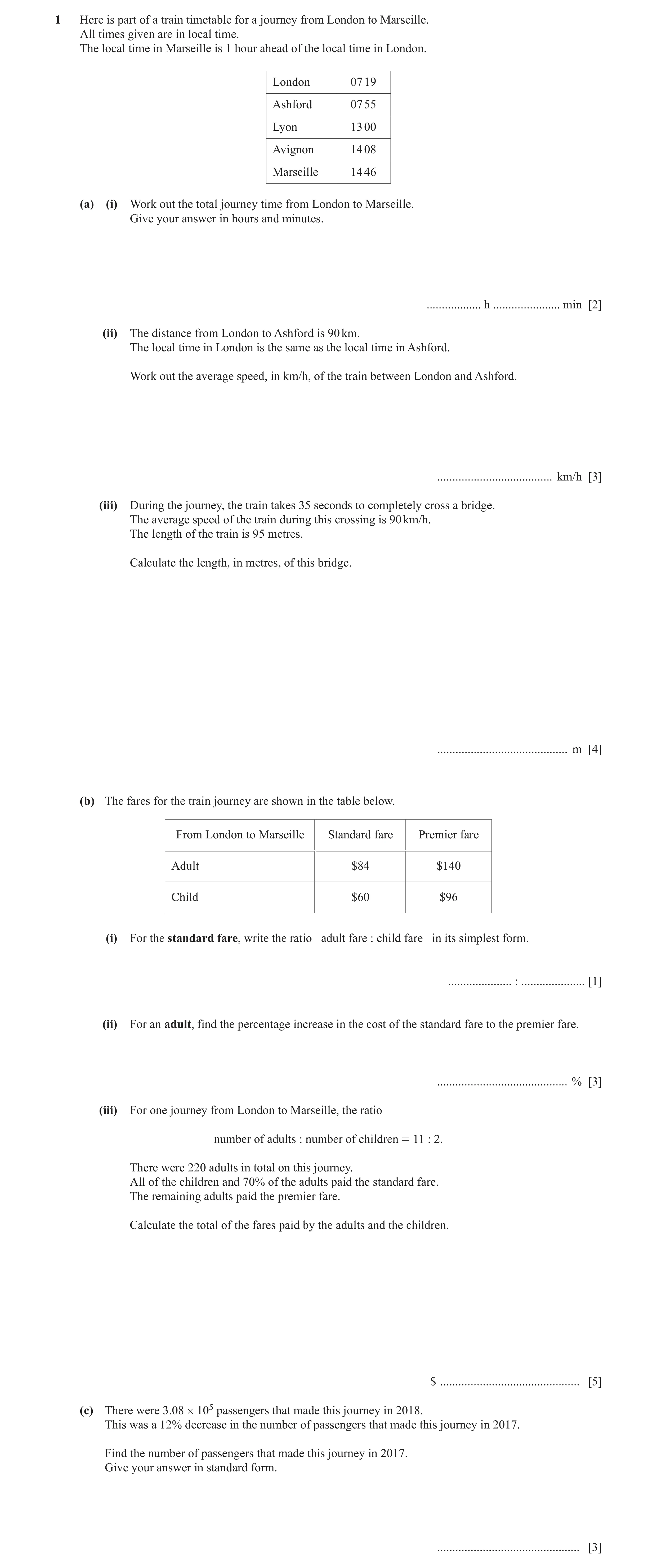
1 Here is part of a train timetable for a journey from London to Marseille. All times given are in local time. The local time in Marseille is 1 hour ahead of the local time in London. London 07 19 Ashford 07 55 Lyon 13 00 Avignon 14 08 Marseille 14 46 (a) (i) Work out the total journey time from London to Marseille. Give your answer in hours and minutes. … h … min [2] (ii) The distance from London to Ashford is 90 km. The local time in London is the same as the local time in Ashford. Work out the average speed, in km/h, of the train between London and Ashford. … km/h [3] (iii) During the journey, the train takes 35 seconds to completely cross a bridge. The average speed of the train during this crossing is 90 km/h. The length of the train is 95 metres. Calculate the length, in metres, of this bridge. … m [4] (b) The fares for the train journey are shown in the table below. From London to Marseille Standard fare Premier fare Adult $84 $140 Child $60 $96 (i) For the standard fare, write the ratio adult fare : child fare in its simplest form. … : … [1] (ii) For an adult, find the percentage increase in the cost of the standard fare to the premier fare. … % [3] (iii) For one journey from London to Marseille, the ratio number of adults : number of children = 11 : 2. There were 220 adults in total on this journey. All of the children and 70% of the adults paid the standard fare. The remaining adults paid the premier fare. Calculate the total of the fares paid by the adults and the children. $ … [5] (c) There were 3.08 # 105 passengers that made this journey in 2018. This was a 12% decrease in the number of passengers that made this journey in 2017. Find the number of passengers that made this journey in 2017. Give your answer in standard form. … [3]
21 marks
Mark scheme: Question Answer Marks Partial Marks 1(a)(i) 6h 27 mins 2 B1 for answer … h 27 mins 1(a)(ii) 150 km/h 3 90 M2 for × 60 36 90 or M1 for their time or B1 for 36 [mins] seen 1(a)(iii) 780 4 35 M3 for 90 × × 1000 – 95 oe 3600 or 35 M2 for 90 × × 1000 oe 3600 or B1 for figs 875 35 or M1 for 90 × seen 3600 1000 or for 90 × oe 3600 If 0 scored, SC1 for their distance (> 95) – 95 1(b)(i) 7 : 5 1 1(b)(ii) 66.7 or 66.66 to 66.67 3 140 − 84 M2 for [× 100] oe 84 140 or for × 100 oe 84 140 or M1 for oe 84 1(b)(iii) 24 576 5 M4 for complete method, 40 × 60 + 0.7 × 220 × 84 + 0.3 × 220 × 140 oe OR B1 for 40 [children] M1 for 0.7 × 220 × 84 oe M1 for 0.3 × 220 × 140 oe B1 for 2400 or 12936 or 9240 nfww 1(c) 3.5 × 10⁵ nfww 3 100 − 12 M2 for 3.08 × 10⁵ ÷ oe 100 or M1 for 3.08 [× 105] associated with (100–12)%
This question in 0580/43 May/June 2019
Q11 · A plane has 14 First Class seats, 70 Premium seats and 168 Economy seats 0580/41 Oct/Nov 2020
2 (a) A plane has 14 First Class seats, 70 Premium seats and 168 Economy seats. Find the ratio First Class seats : Premium seats : Economy seats. Give your answer in its simplest form. … : … : … [2] (b) (i) For a morning flight, the costs of tickets are in the ratio First Class : Premium : Economy = 14 : 6 : 5. The cost of a Premium ticket is $114. Calculate the cost of a First Class ticket and the cost of an Economy ticket. First Class $ … Economy $ … [3] (ii) For an afternoon flight, the cost of a Premium ticket is reduced from $114 to $96.90 . Calculate the percentage reduction in the cost of a ticket. … % [2] (c) When the local time in Athens is 09 00, the local time in Berlin is 08 00. A plane leaves Athens at 13 15. It arrives in Berlin at 15 05 local time. (i) Find the flight time from Athens to Berlin. … h … min [1] (ii) The distance the plane flies from Athens to Berlin is 1802 km. Calculate the average speed of the plane. Give your answer in kilometres per hour. … km/h [2]
10 marks
Mark scheme: 2(a) 1 : 5 : 12 2 1 5 12 M1 for 2 : 10 : 24 or 7 : 35 : 84 or : : 18 18 18 2(b)(i) 266 and 95 3 B2 for 266 or 95 or 266 and 95 reversed 114 or M1 for 6 2(b)(ii) 15 2 114 − 96.9 M1 for [× 100] oe 114 96.9 or × 100 114 2(c)(i) 2h 50min 1 2(c)(ii) 636 2 M1 for 1802 ÷ their 2h 50min
This question in 0580/41 Oct/Nov 2020
Q12 · NOT TO 5.7 cm SCALE 9.2 cm 19.4 cm The diagram shows a brick in the shape of a cuboid 0580/41 Oct/Nov 2021
1 (a) NOT TO 5.7 cm SCALE 9.2 cm 19.4 cm The diagram shows a brick in the shape of a cuboid. (i) Calculate the total surface area of the brick. … cm2 [3] (ii) The density of the brick is 1.9 g/cm3. Work out the mass of the brick. Give your answer in kilograms. [Density = mass ÷ volume] … kg [3] (b) 9000 bricks are needed to build a house. 200 bricks cost $175. Work out the cost of the bricks needed to build 5 houses. $ … [3] (c) Saskia builds a wall using 1500 bricks. She can build at the rate of 40 bricks each hour. She works for 9 hours each day. Saskia starts work on 6 July and works every day until the wall is completed. Find the date when she completes the wall. … [3] (d) Rafa has a cylindrical tank. The cylinder has a height of 105 cm and a diameter of 45 cm. Calculate the capacity of the tank in litres. … litres [3]
15 marks
Mark scheme: Question Answer Marks Partial Marks 1(a)(i) 683 3 M2 for [2]((19.4 × 9.2) + (5.7 × 9.2) + (19.4 × 5.7)) oe or M1 for one of 19.4 × 9.2 or 5.7 × 9.2 or 19.4 × 5.7 1(a)(ii) 1.93[0] or 1.932 to 1.933 3 M2 for 19.4 × 9.2 × 5.7 × 1.9 or M1 for 19.4 × 9.2 × 5.7 1(b) 39 375 3 M2 for 9000 ÷ 200 × 175 × 5 175 or M1 for 9000 ÷ 200 soi or for soi 200 1(c) 10th July 3 1 B2 for 4.1 to 4.2 or 4 or 4 days 1.5 6 hours Or M2 for answer 9th July or 11th July or M1 for 1500 ÷ (9 × 40) 1(d) 167 or 166.9 to 167.0… 3 B2 for answer with figs 167 or figs 1669 to 1670.. or M1 for π× 22.5 2 × 10⁵ oe If 0 scored SC1 for answer 668 or 667.9 to 668.1
This question in 0580/41 Oct/Nov 2021
Q13 · Martha walks a distance of 10 km at a speed of x km/h 0580/41 Oct/Nov 2025
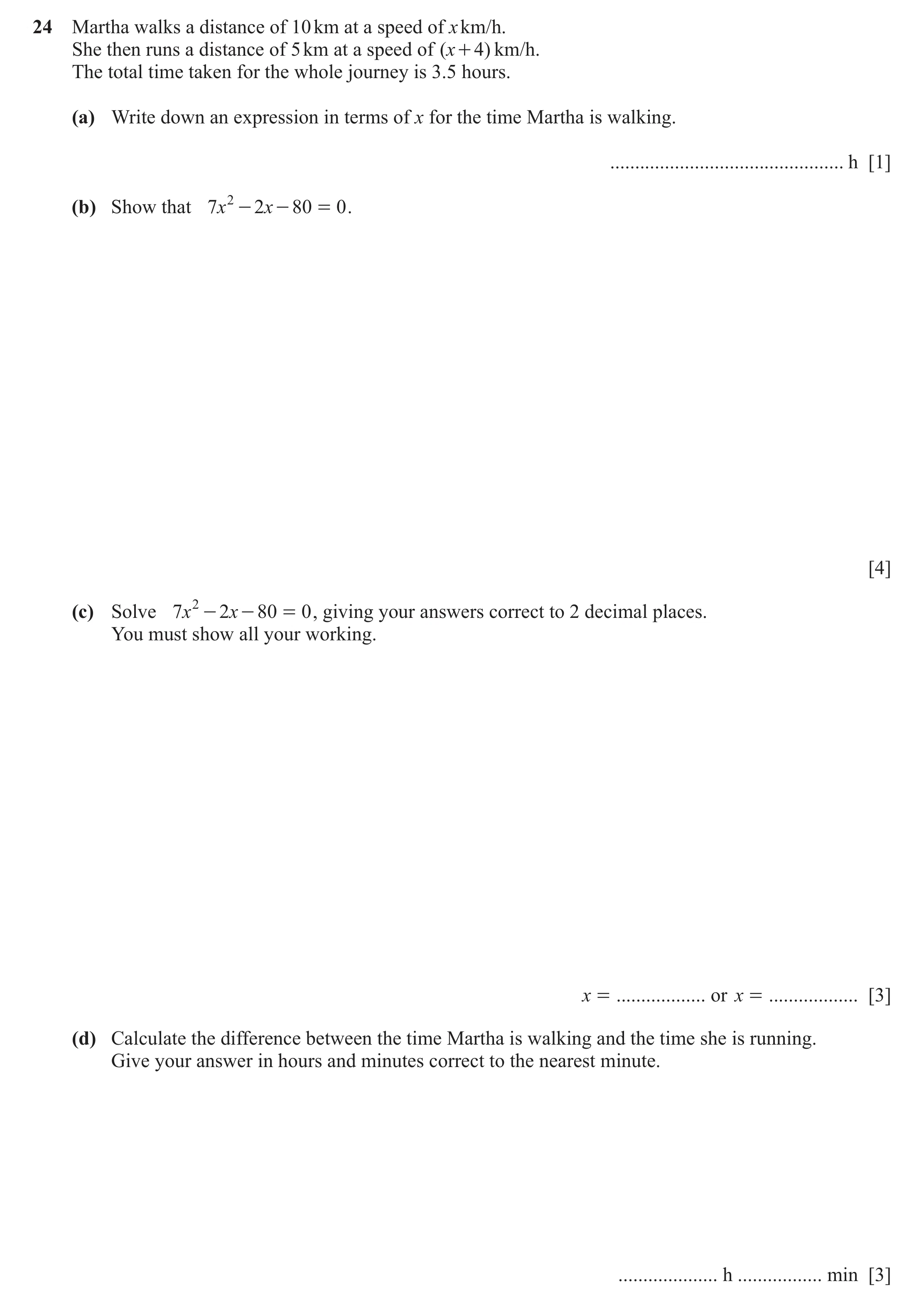
24 Martha walks a distance of 10 km at a speed of x km/h. She then runs a distance of 5 km at a speed of ( x + 4 ) km/h. The total time taken for the whole journey is 3.5 hours. (a) Write down an expression in terms of x for the time Martha is walking. … h [1] (b) Show that 7x 2 - 2 x - 80 = 0 . [4] (c) Solve 7x 2 - 2 x - 80 = 0 , giving your answers correct to 2 decimal places. You must show all your working. x = … or x = … [3] (d) Calculate the difference between the time Martha is walking and the time she is running. Give your answer in hours and minutes correct to the nearest minute. … h … min [3]
11 marks
Mark scheme: 24(a) 10 1 x 24(b) their10 + 5 = 7 oe M1 x x + 4 2 20 x + 80 + 10 x = 7 x 2 + 28 x oe M2 Strict FT for correctly clearing fractions from their three-term equation with two algebraic denominators in x and x + 4 and expanding all brackets Strict M1FT for correctly expressing their two algebraic fractions with two denominators in x and x + 4 as a single fraction or with a common denominator within a correct equation or for correctly clearing fractions from their three-term equation with two algebraic denominators in x and x + 4 but not all brackets expanded Leading to 7 x 2 − 2 x − 80 = 0 A1 No errors or omissions 24(c) 2 B2 2 −−( 2 ) ([ − ]2) − 4 ( 7 )( −80 ) or B1 for ([ −]2) − 4 ( 7 )( −80 ) oe or for oe 2 ( 7 ) −−( 2) − p −−( 2) + p oe or for oe 2(7) 2(7) 2 2 or x − 14 –3.24 and 3.53 B1 24(d) 2h 10min 3 B2 for 2.168 to 2.18 [h] or for 130.08 to 130.8 [min] or for 2hours 10.08 min to 2 hours 10.8 min OR 10 5 M2 for − their positive x their positive x + 4 or 10 5 M1 for or their positive x their positive x + 4
This question in 0580/41 Oct/Nov 2025
 1 / 20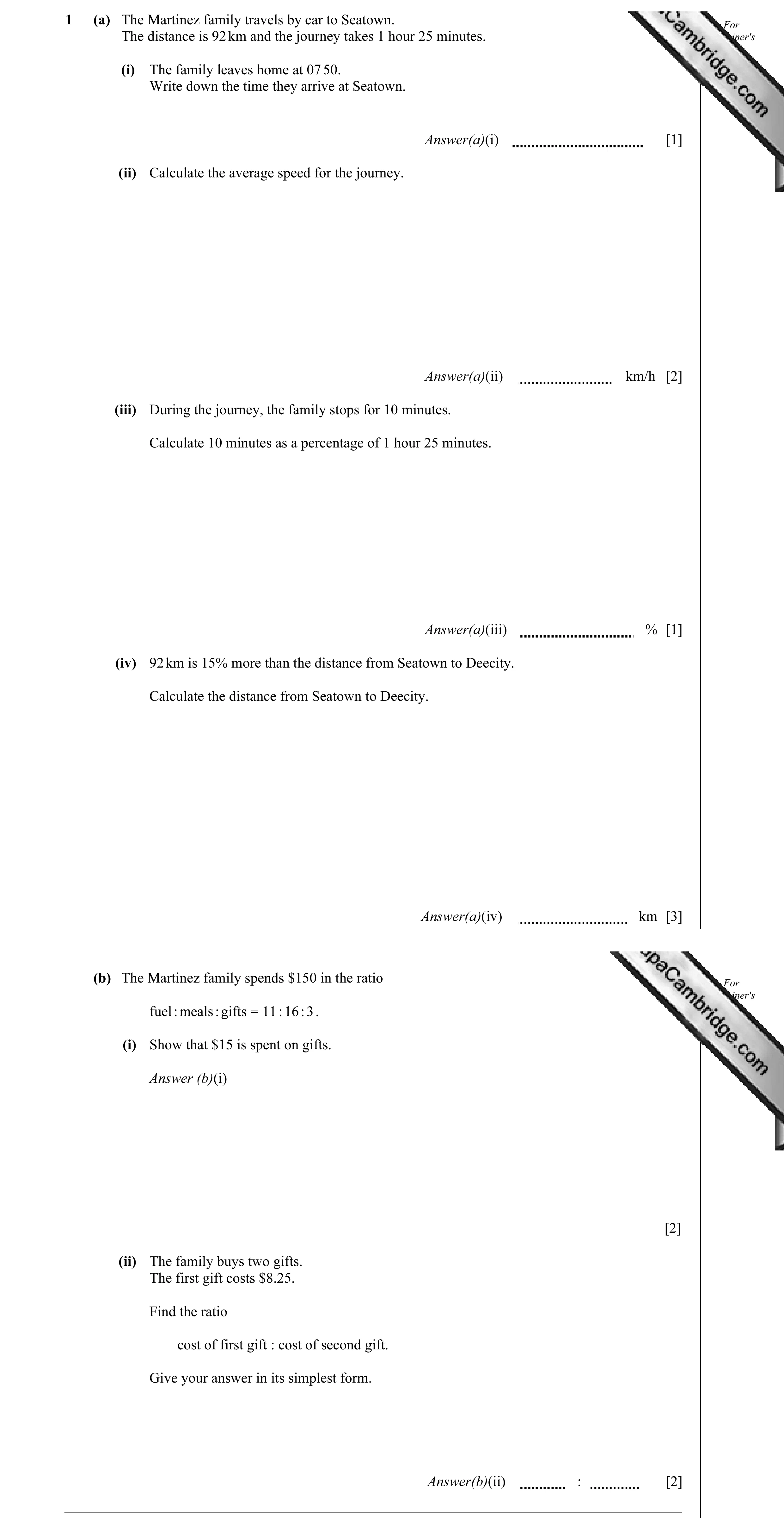
 6 / 20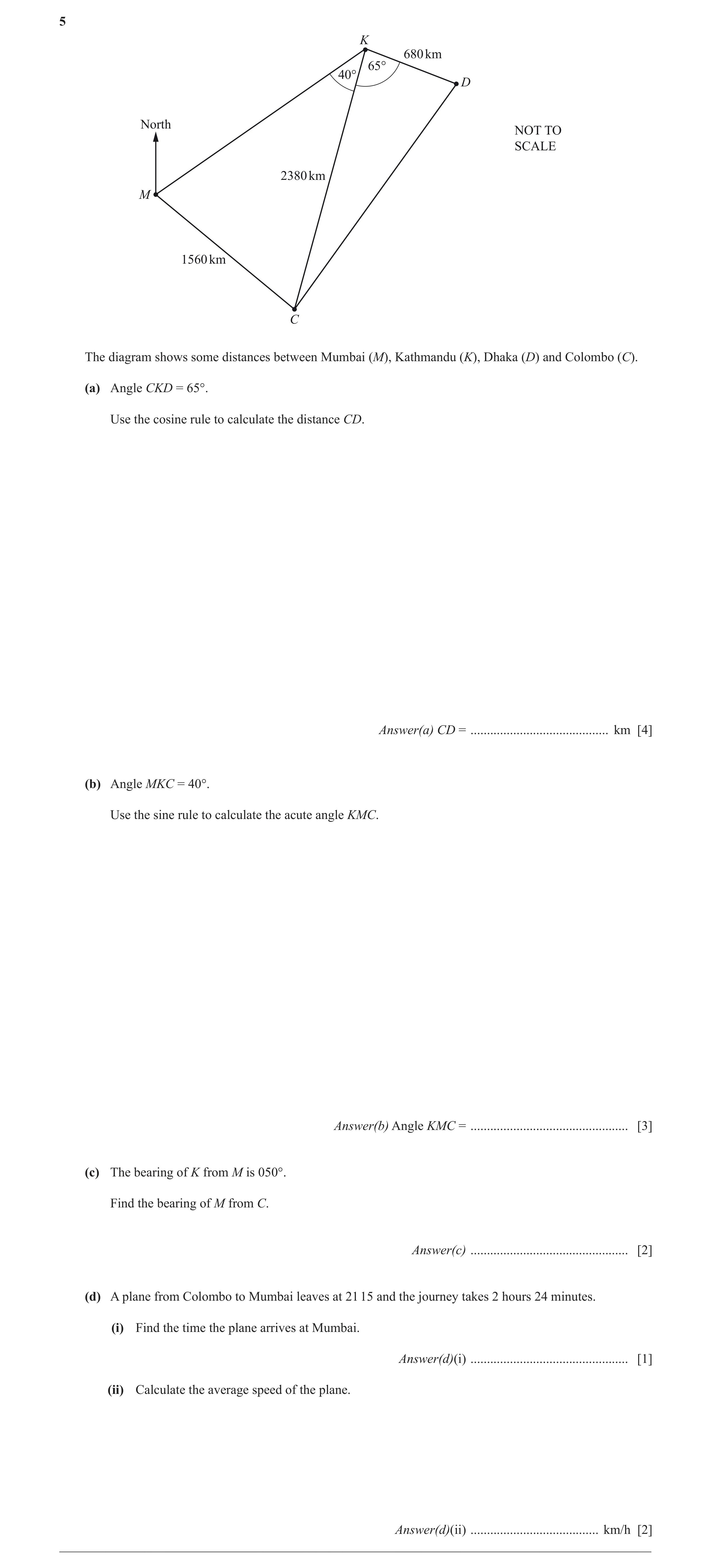
 17 / 20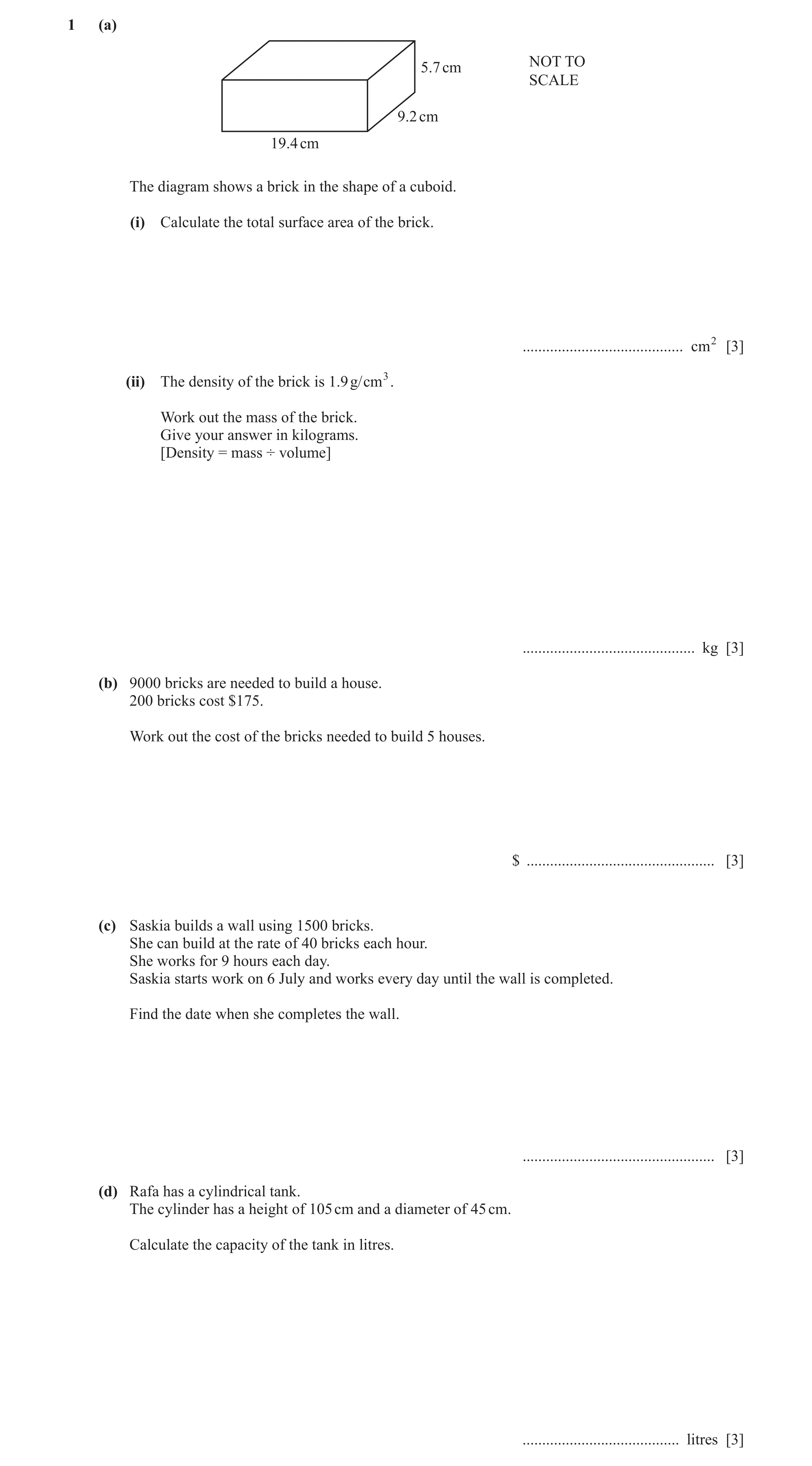
 20 / 20
 16
16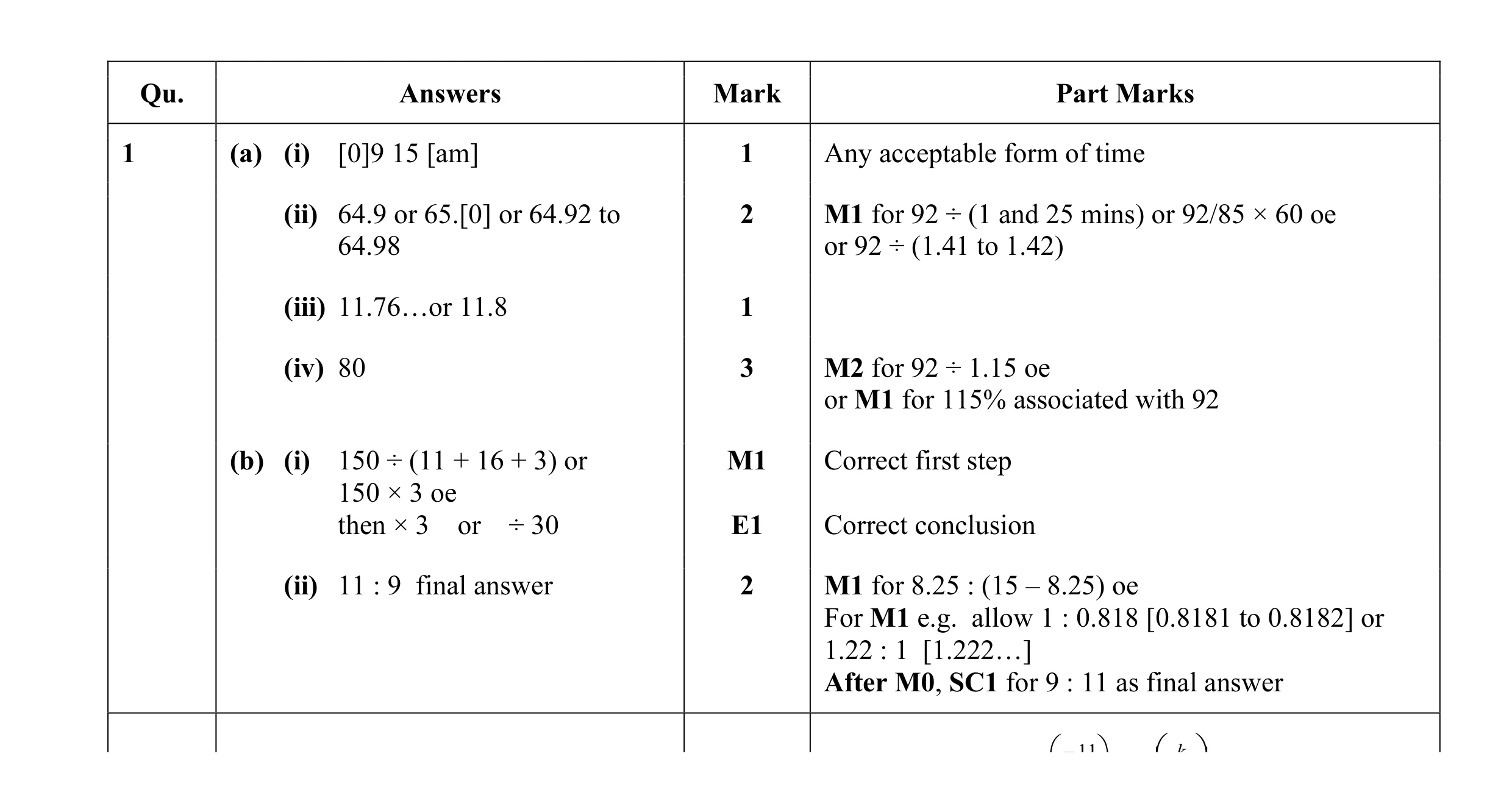 11
11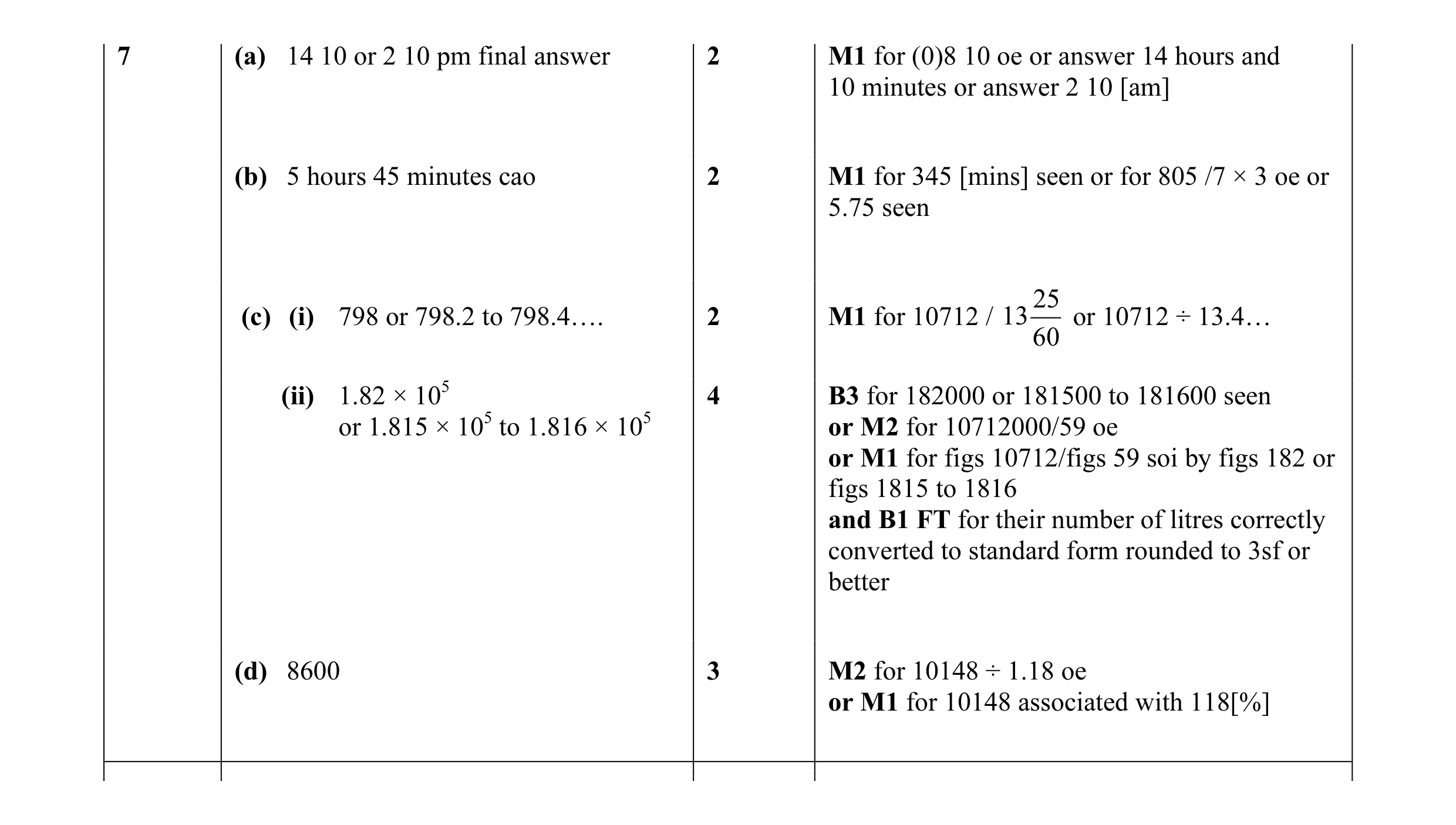 13
13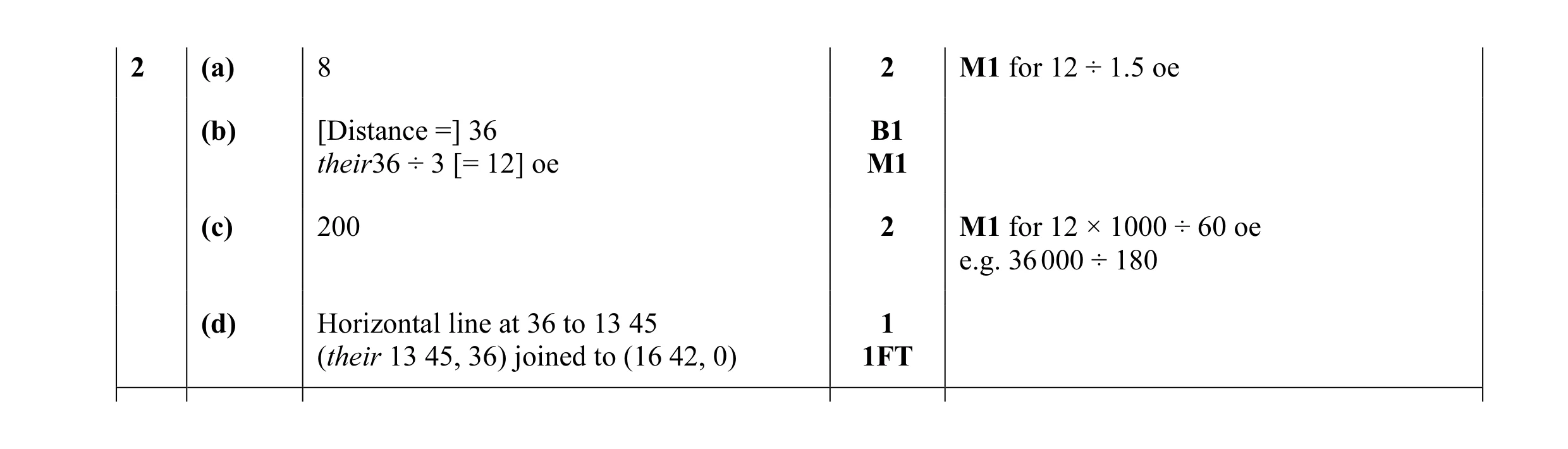 8
8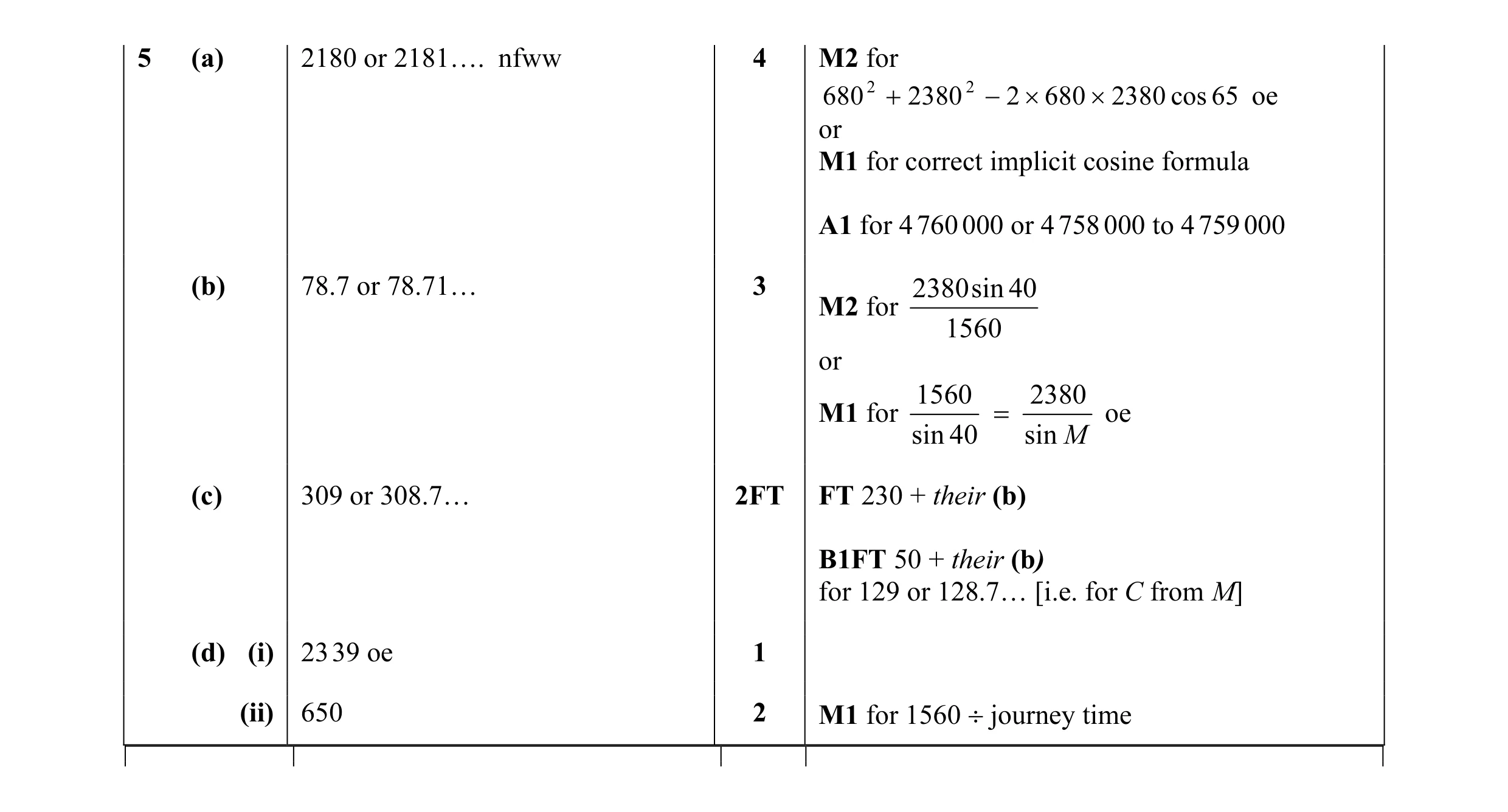 12
12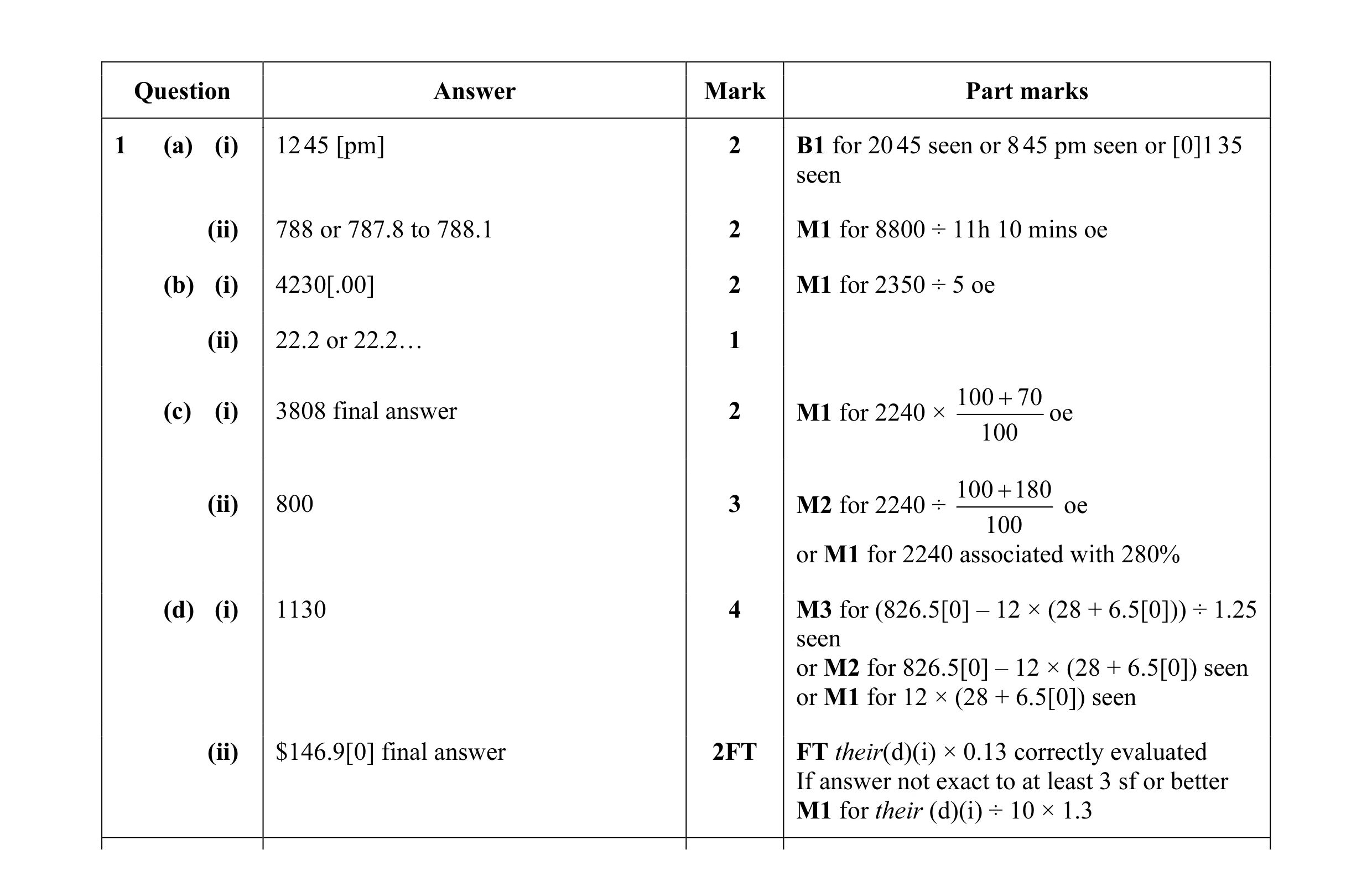 18
18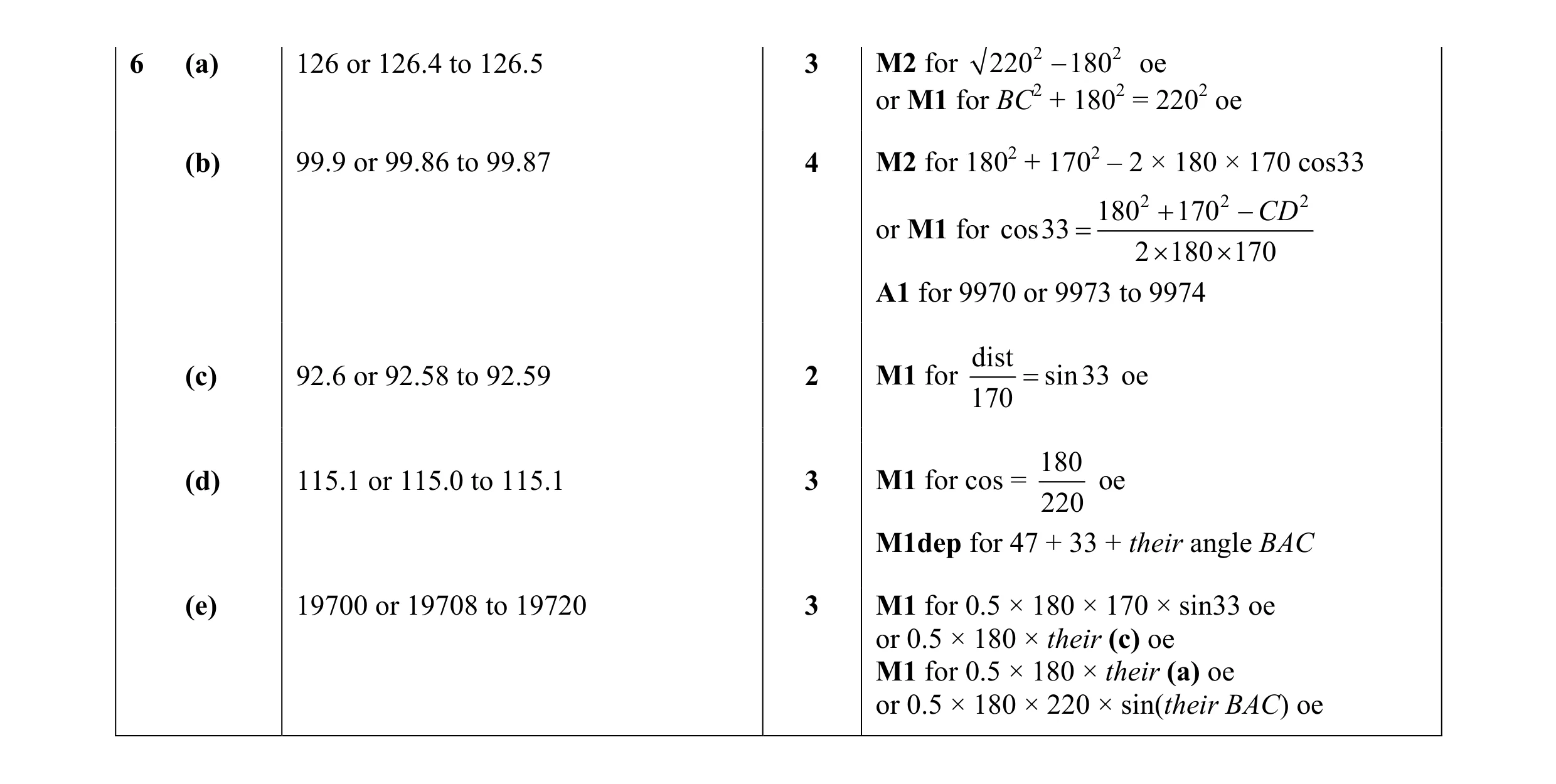 15
15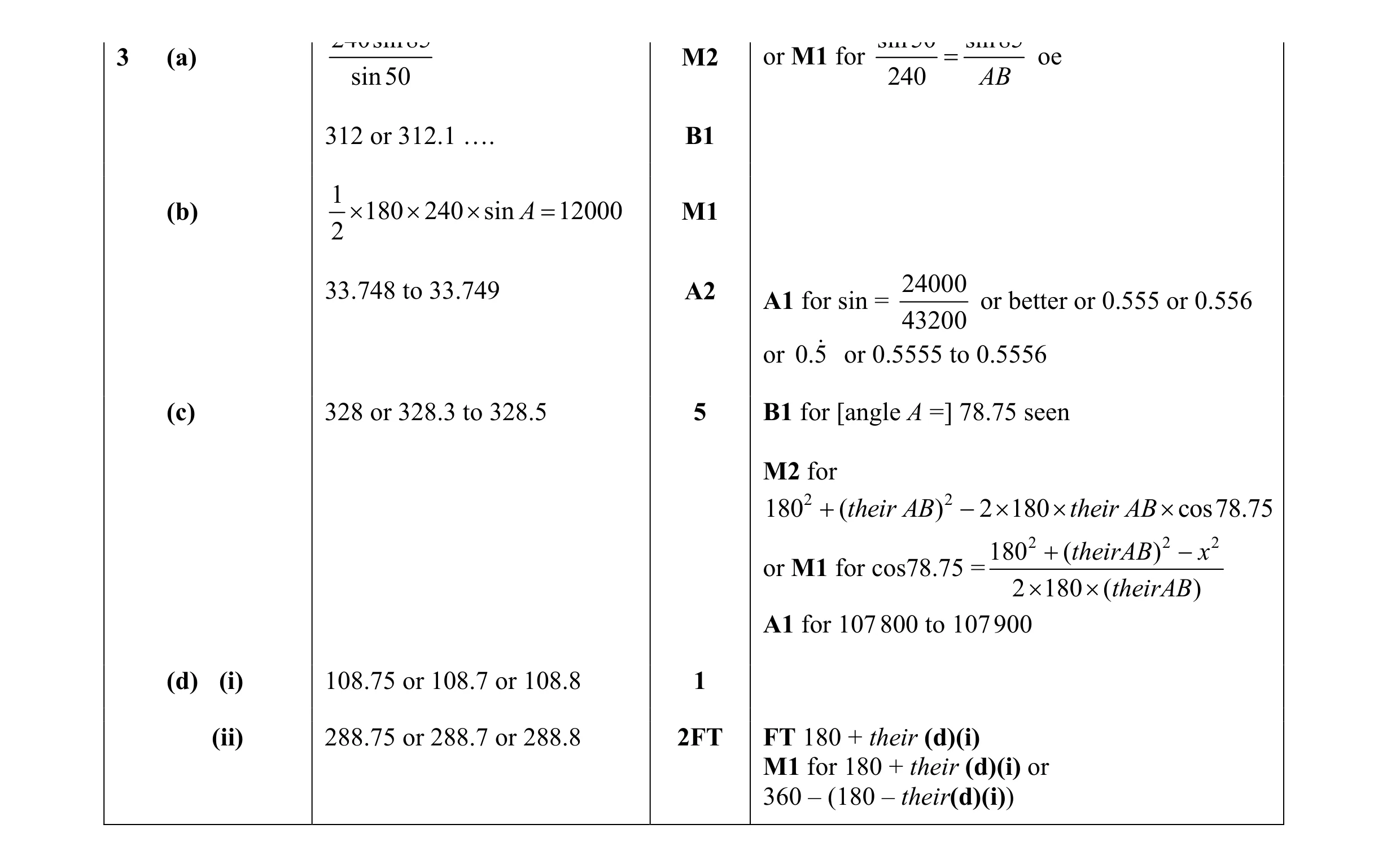 14
14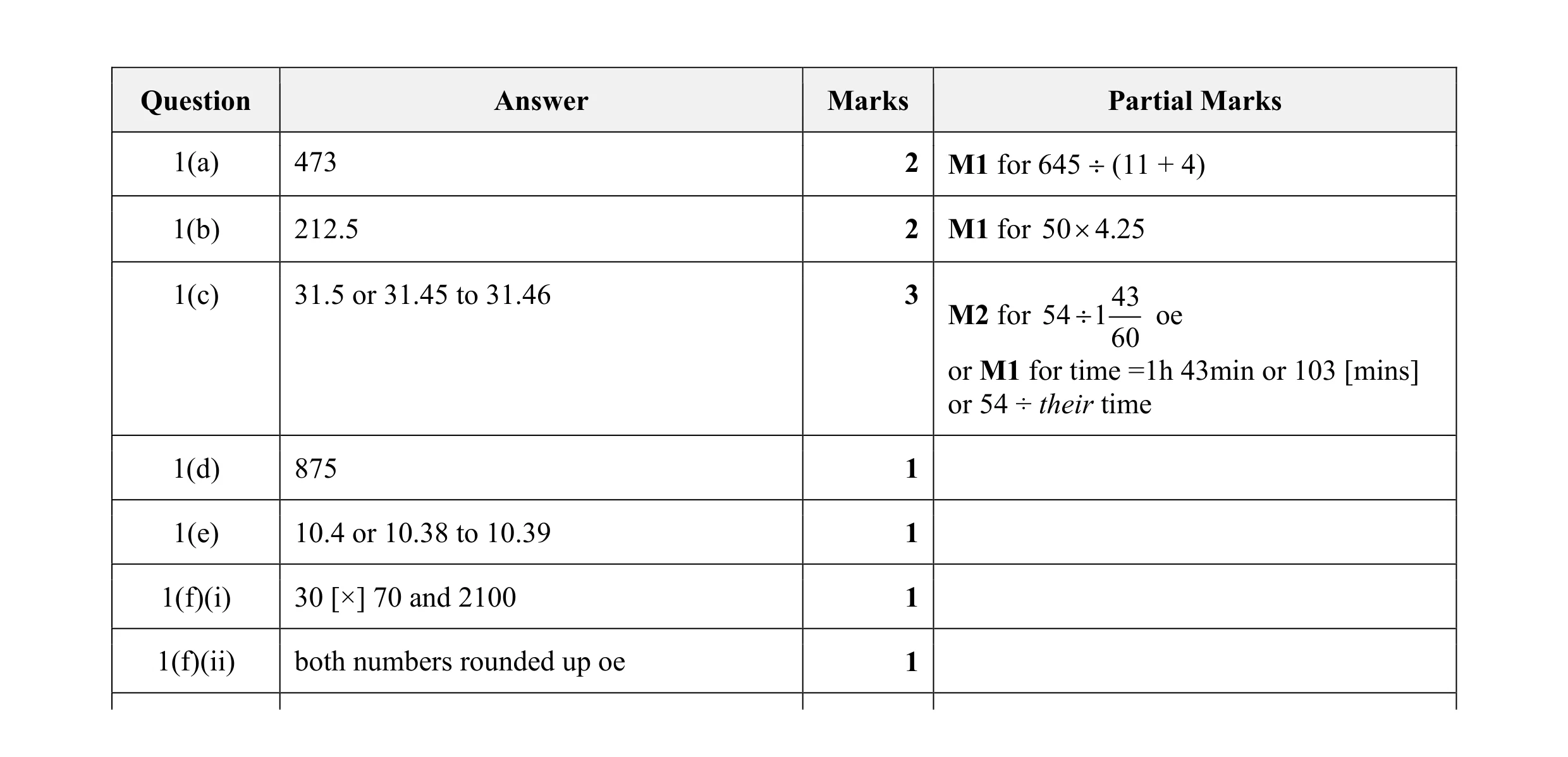 11
11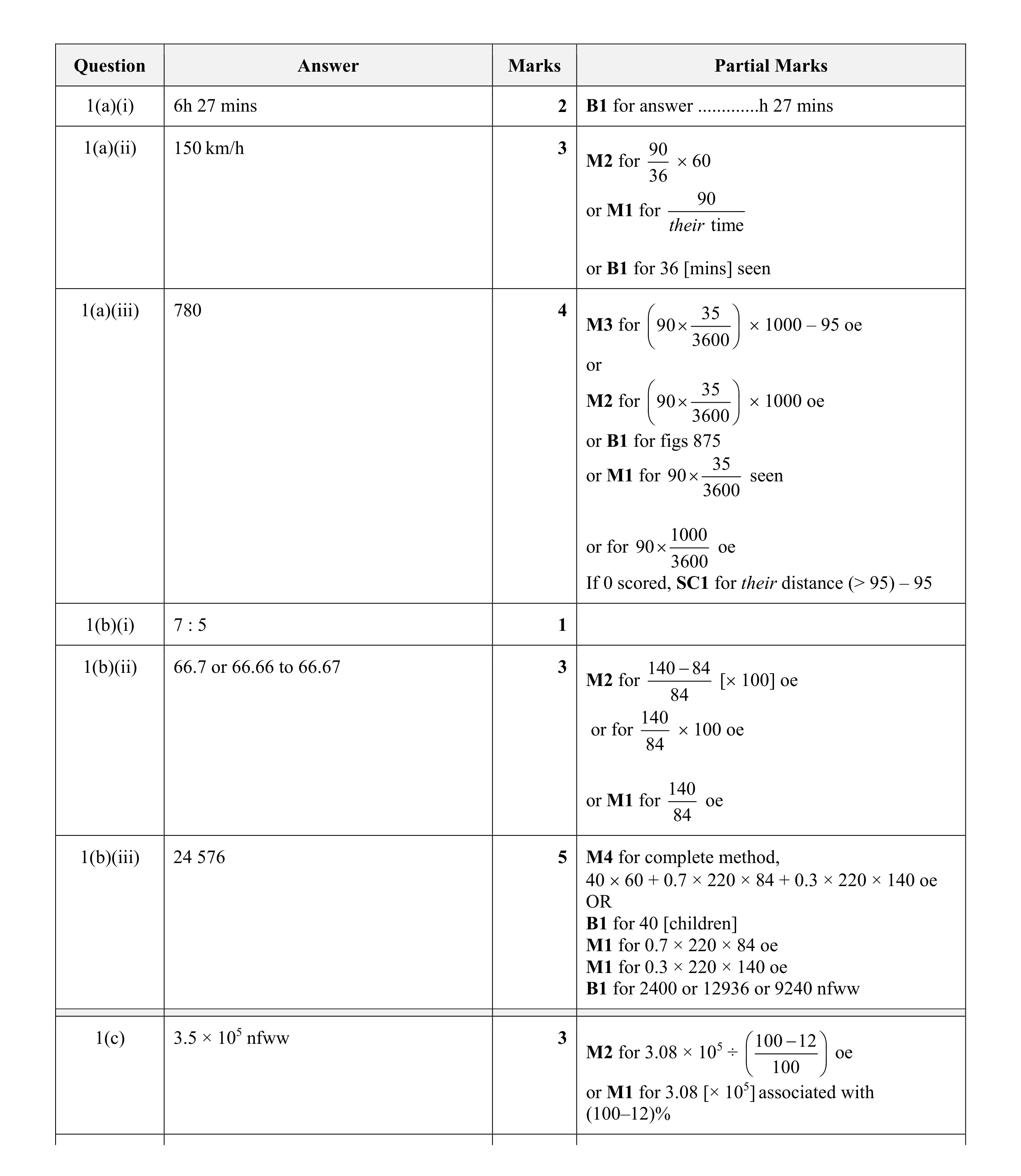 21
21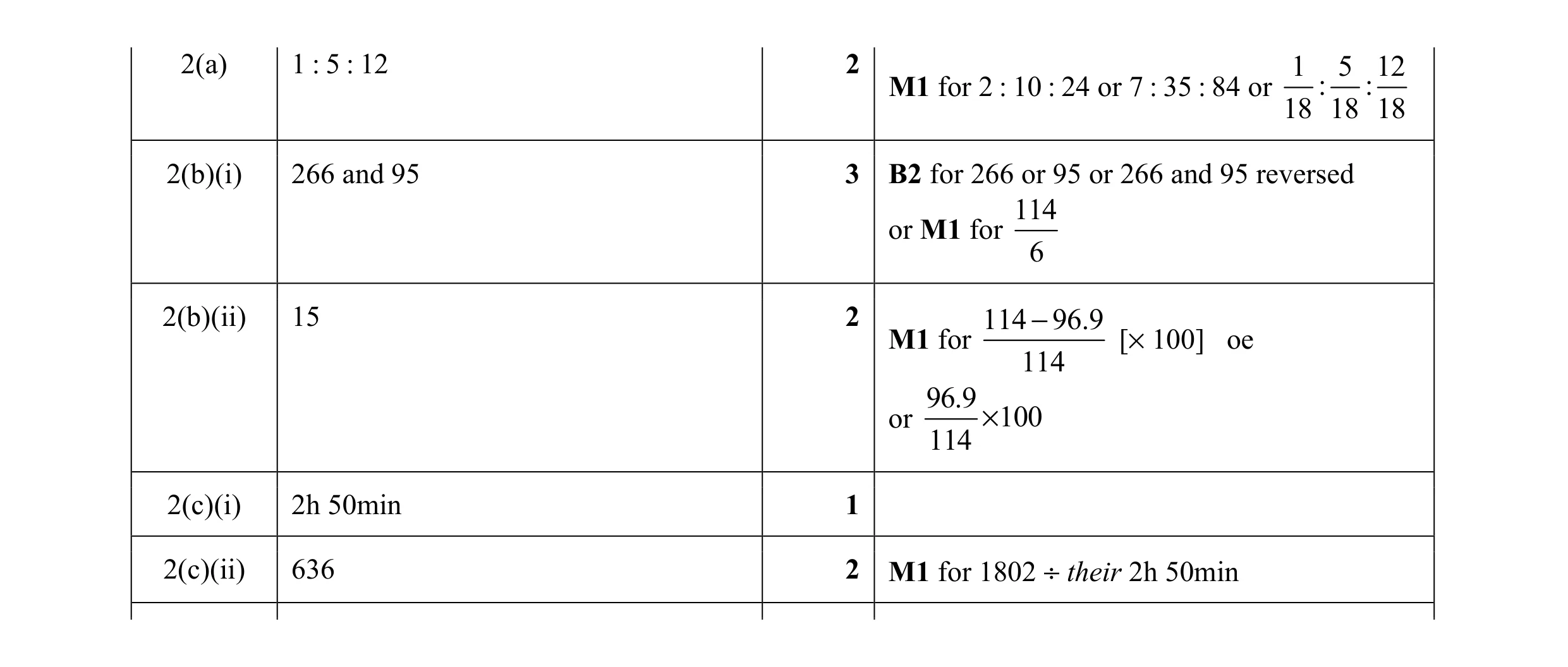 10
10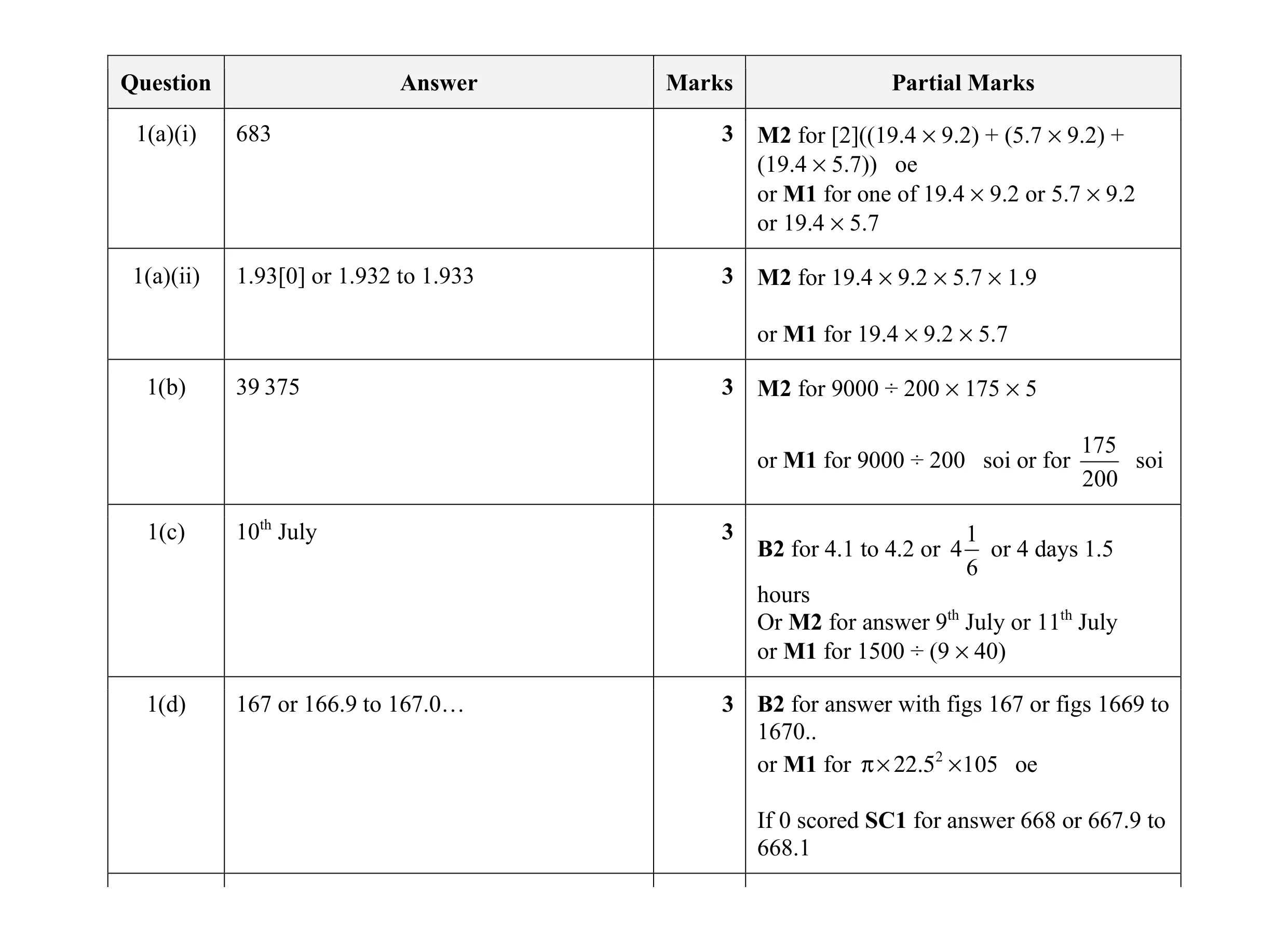 15
15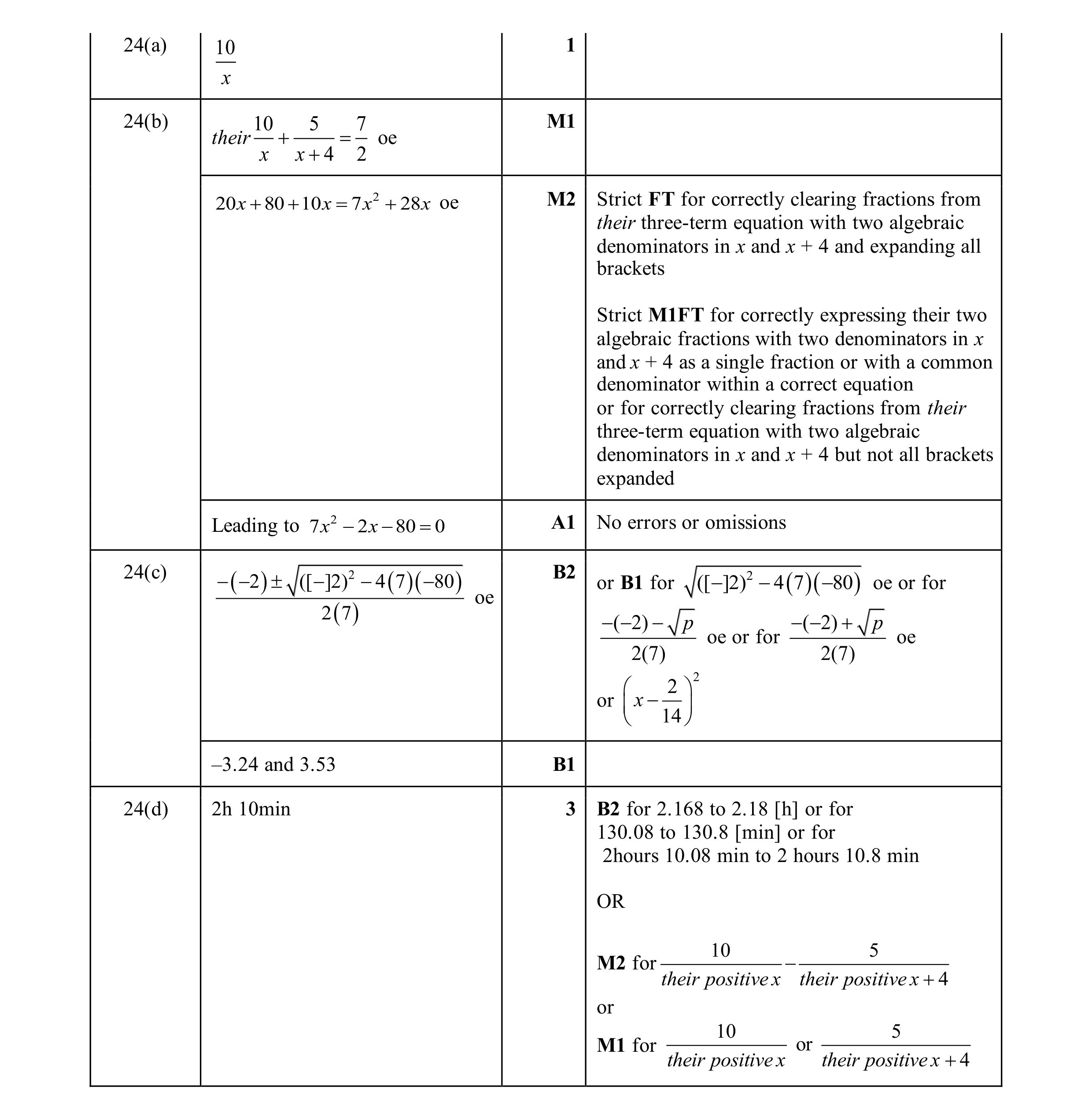 11
11