Cambridge IGCSE Mathematics 0580 — 2014 May/June Paper 4 · Variant 1
0580/41/M/J/14 · 11 questions · 130 marks · ≈146 min
The question paper and its mark scheme, free to read here and free to download. This is Cambridge’s own paper, exactly as it was sat.
Question paper20 pages
Mark scheme7 pages
Answers below. Sit the paper first if you are practising.
Questions as text
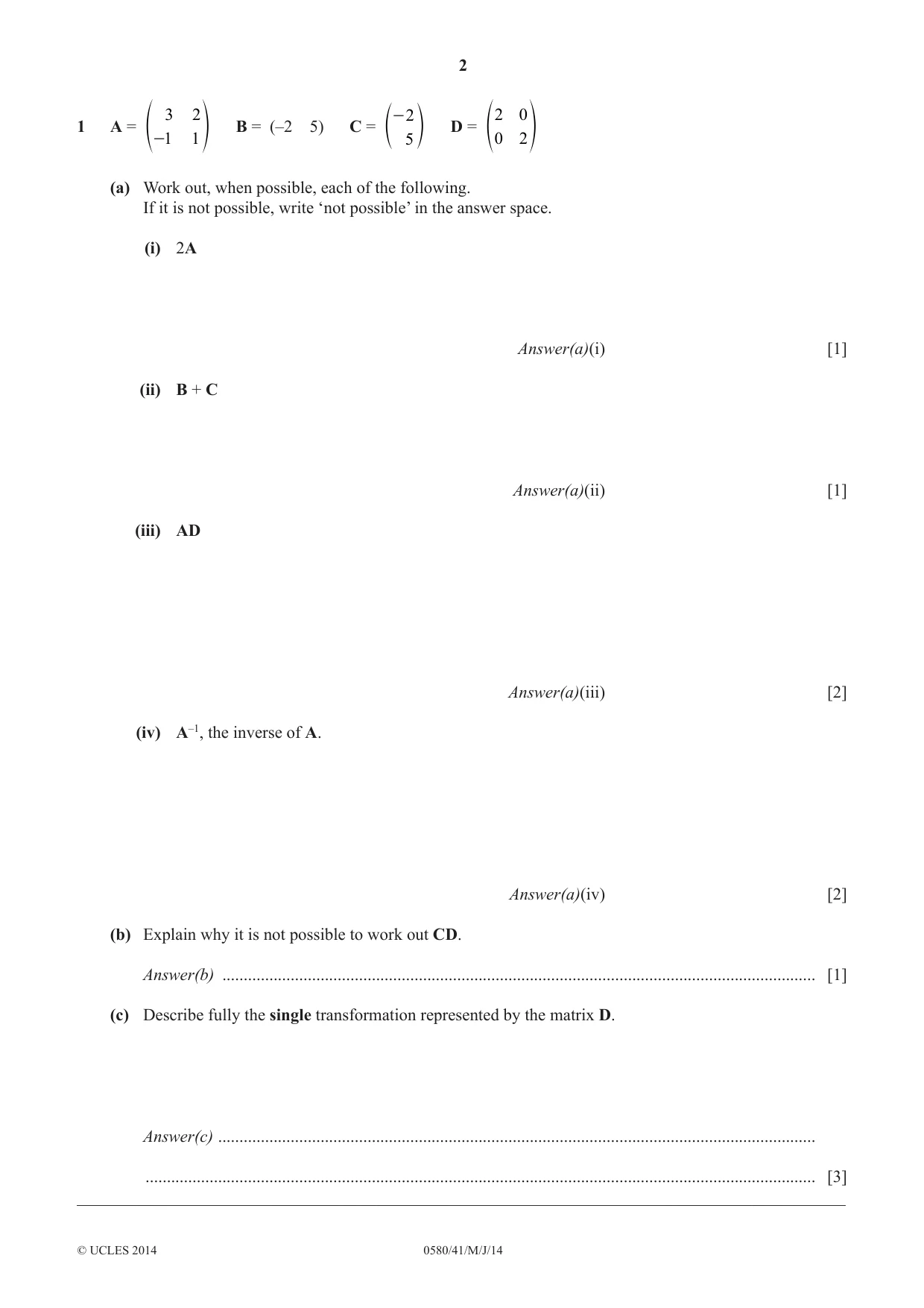
Q1 · 2 - 2 2 0 1 A = B = (–2 5) C = D = 0 2 1 1 f- p e 5 o f p (a) Work out, when possible…
3 2 - 2 2 0 1 A = B = (–2 5) C = D = 0 2 1 1 f- p e 5 o f p (a) Work out, when possible, each of the following. If it is not possible, write ‘not possible’ in the answer space. (i) 2A Answer(a)(i) [1] (ii) B + C Answer(a)(ii) [1] (iii) AD Answer(a)(iii) [2] (iv) A–1, the inverse of A. Answer(a)(iv) [2] (b) Explain why it is not possible to work out CD. Answer(b) ........................................................................................................................................... [1] (c) Describe fully the single transformation represented by the matrix D. Answer(c) ............................................................................................................................................ ............................................................................................................................................................. [3] __________________________________________________________________________________________
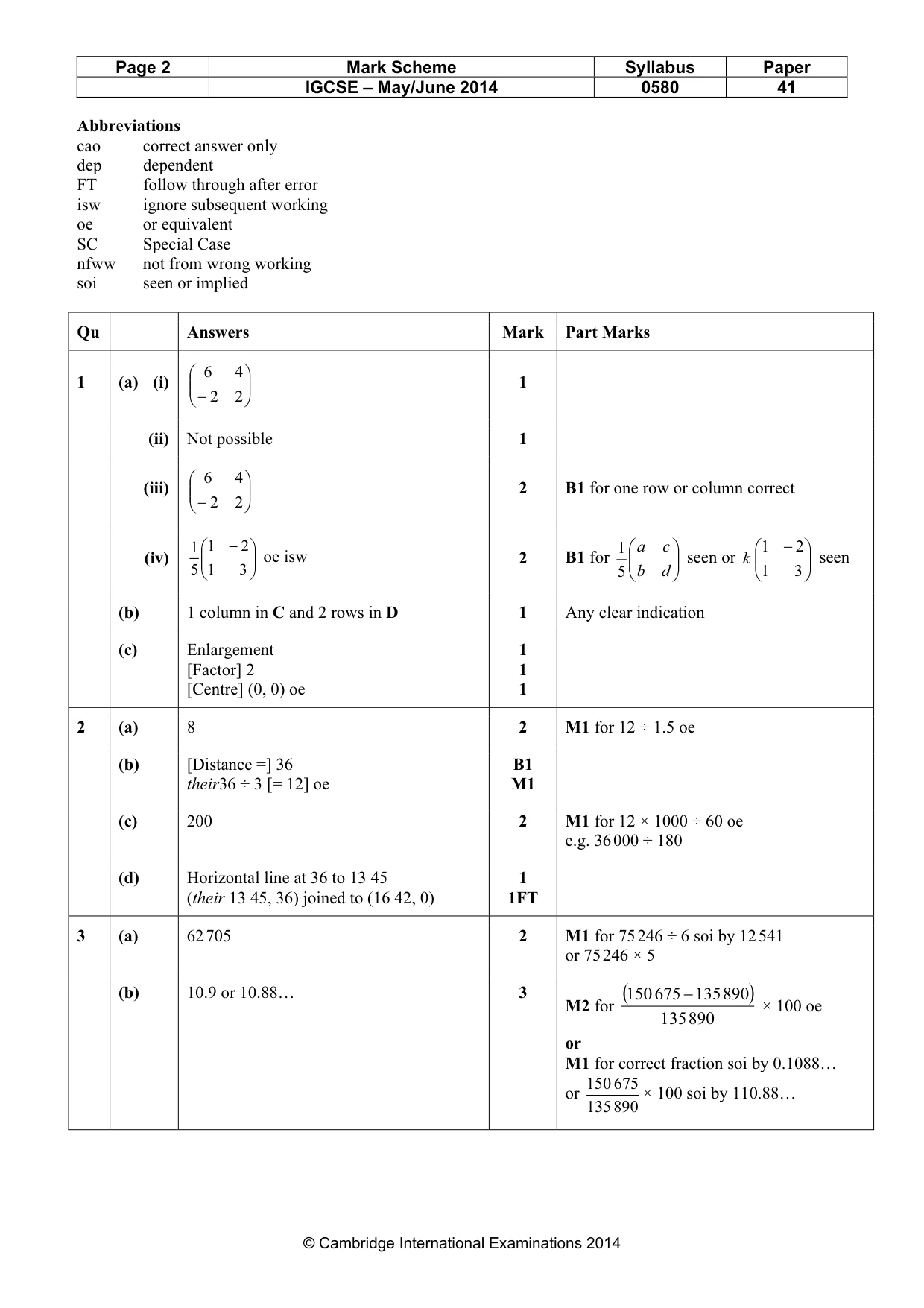
Mark scheme: 6 4 1 (a) (i) 1 − 2 2 (ii) Not possible 1 6 4 (iii) 2 B1 for one row or column correct − 2 2 1 1 − 2 1 a c 1 − 2 (iv) seen oe isw 2 B1 for seen or k b d 5 5 1 3 1 3 (b) 1 column in C and 2 rows in D 1 Any clear indication (c) Enlargement 1 [Factor] 2 1 [Centre] (0, 0) oe 1
Q2 · Ali leaves home at 10 00 to cycle to his grandmother’s house
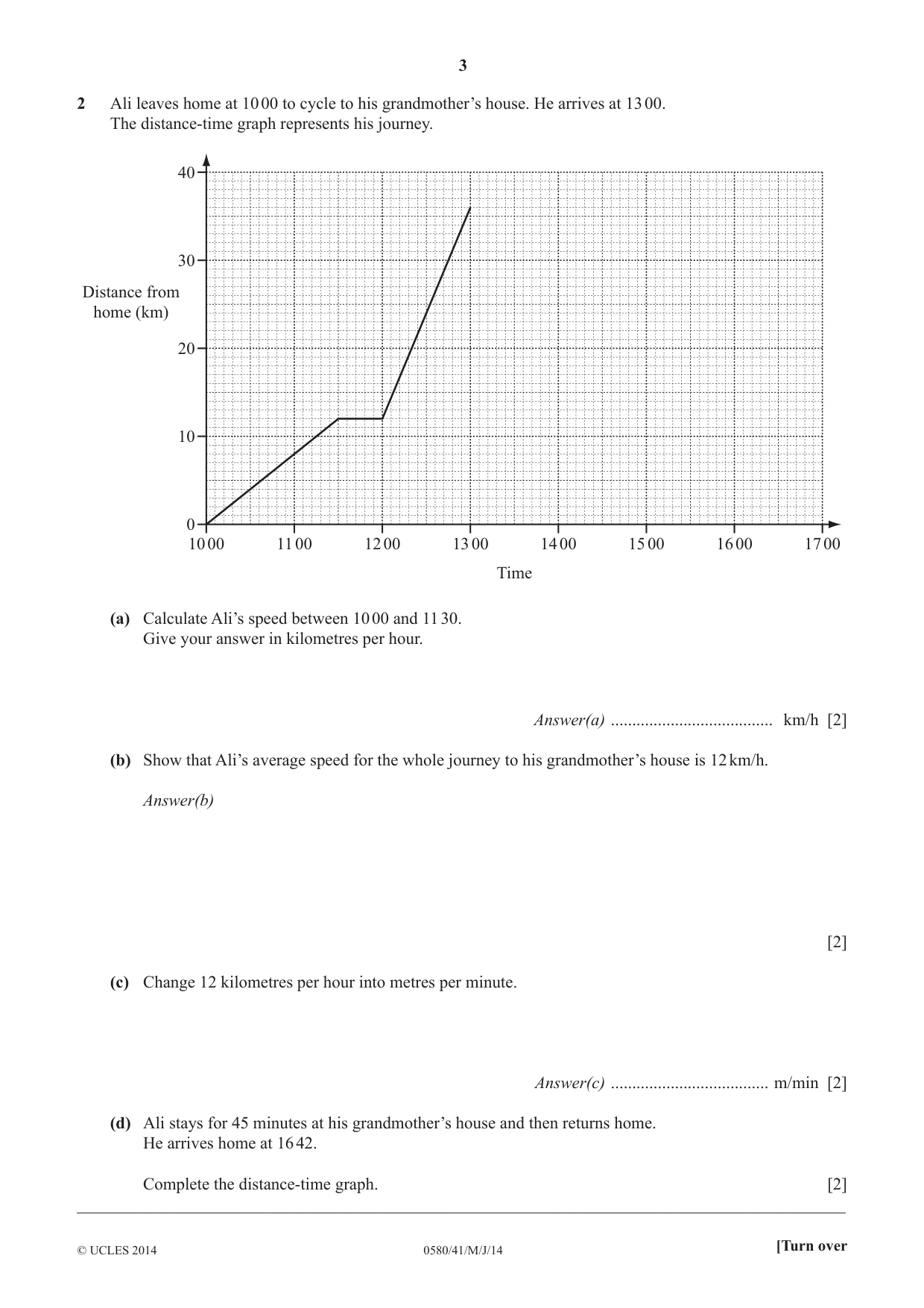
2 Ali leaves home at 10 00 to cycle to his grandmother’s house. He arrives at 13 00. The distance-time graph represents his journey. 40 30 Distance from home (km) 20 10 0 10 00 11 00 12 00 13 00 14 00 15 00 16 00 17 00 Time (a) Calculate Ali’s speed between 10 00 and 11 30. Give your answer in kilometres per hour. Answer(a) ...................................... km/h [2] (b) Show that Ali’s average speed for the whole journey to his grandmother’s house is 12 km/h. Answer(b) [2] (c) Change 12 kilometres per hour into metres per minute. Answer(c) ..................................... m/min [2] (d) Ali stays for 45 minutes at his grandmother’s house and then returns home. He arrives home at 16 42. Complete the distance-time graph. [2] __________________________________________________________________________________________
Mark scheme: 2 (a) 8 2 M1 for 12 ÷ 1.5 oe (b) [Distance =] 36 B1 their36 ÷ 3 [= 12] oe M1 (c) 200 2 M1 for 12 × 1000 ÷ 60 oe e.g. 36 000 ÷ 180 (d) Horizontal line at 36 to 13 45 1 (their 13 45, 36) joined to (16 42, 0) 1FT
Q3 · The running costs for a papermill are $75 246
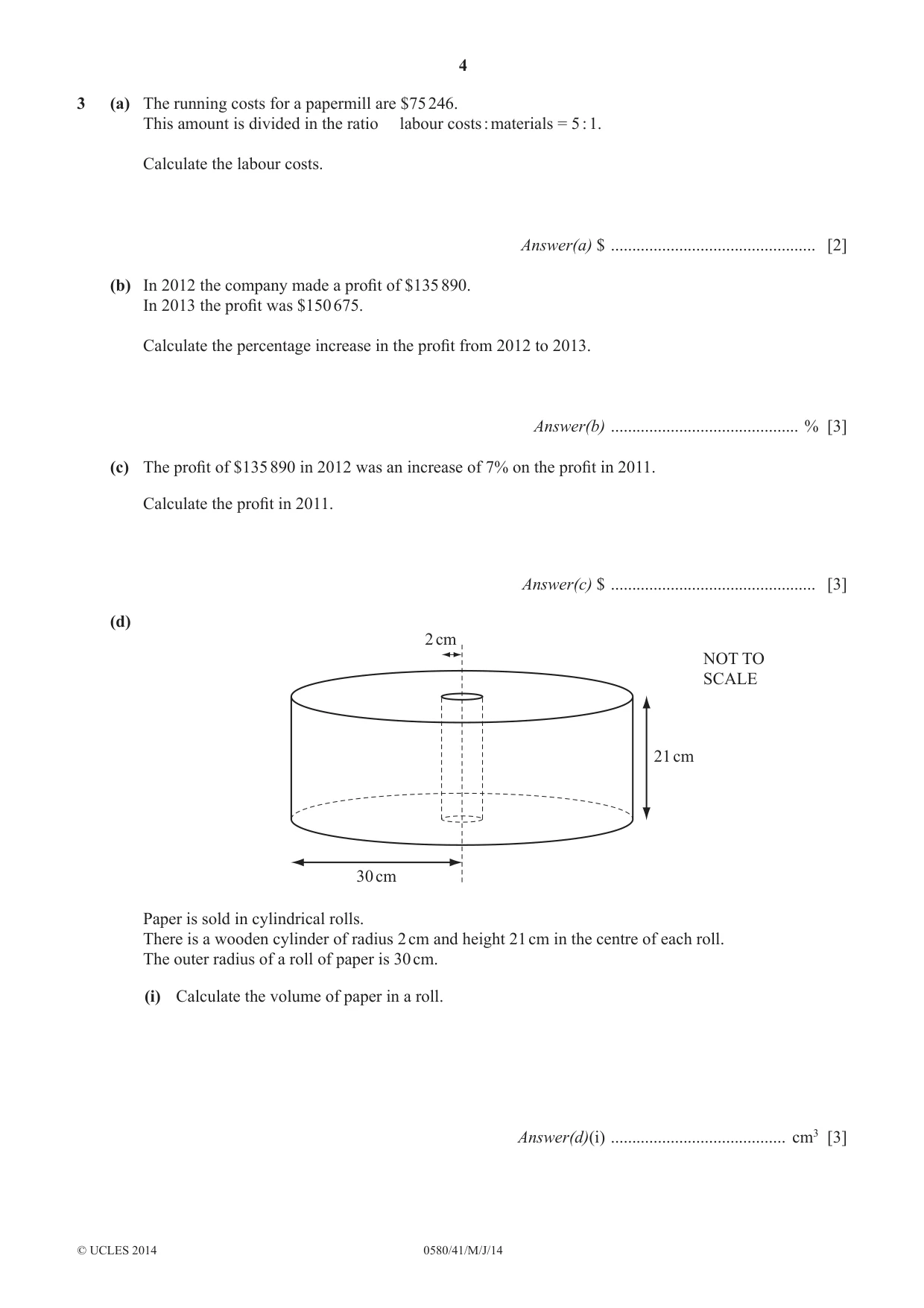
3 (a) The running costs for a papermill are $75 246. This amount is divided in the ratio labour costs : materials = 5 : 1. Calculate the labour costs. Answer(a) $ ................................................ [2] (b) In 2012 the company made a profi t of $135 890. In 2013 the profi t was $150 675. Calculate the percentage increase in the profi t from 2012 to 2013. Answer(b) ............................................ % [3] (c) The profi t of $135 890 in 2012 was an increase of 7% on the profi t in 2011. Calculate the profi t in 2011. Answer(c) $ ................................................ [3] (d) 2 cm NOT TO SCALE 21 cm 30 cm Paper is sold in cylindrical rolls. There is a wooden cylinder of radius 2 cm and height 21 cm in the centre of each roll. The outer radius of a roll of paper is 30 cm. (i) Calculate the volume of paper in a roll. Answer(d)(i) ......................................... cm3 [3] (ii) The paper is cut into sheets which measure 21 cm by 29.7 cm. The thickness of each sheet is 0.125 mm. (a) Change 0.125 millimetres into centimetres. Answer(d)(ii)(a) .......................................... cm [1] (b) Work out how many whole sheets of paper can be cut from a roll. Answer(d)(ii)(b) ................................................ [4] __________________________________________________________________________________________
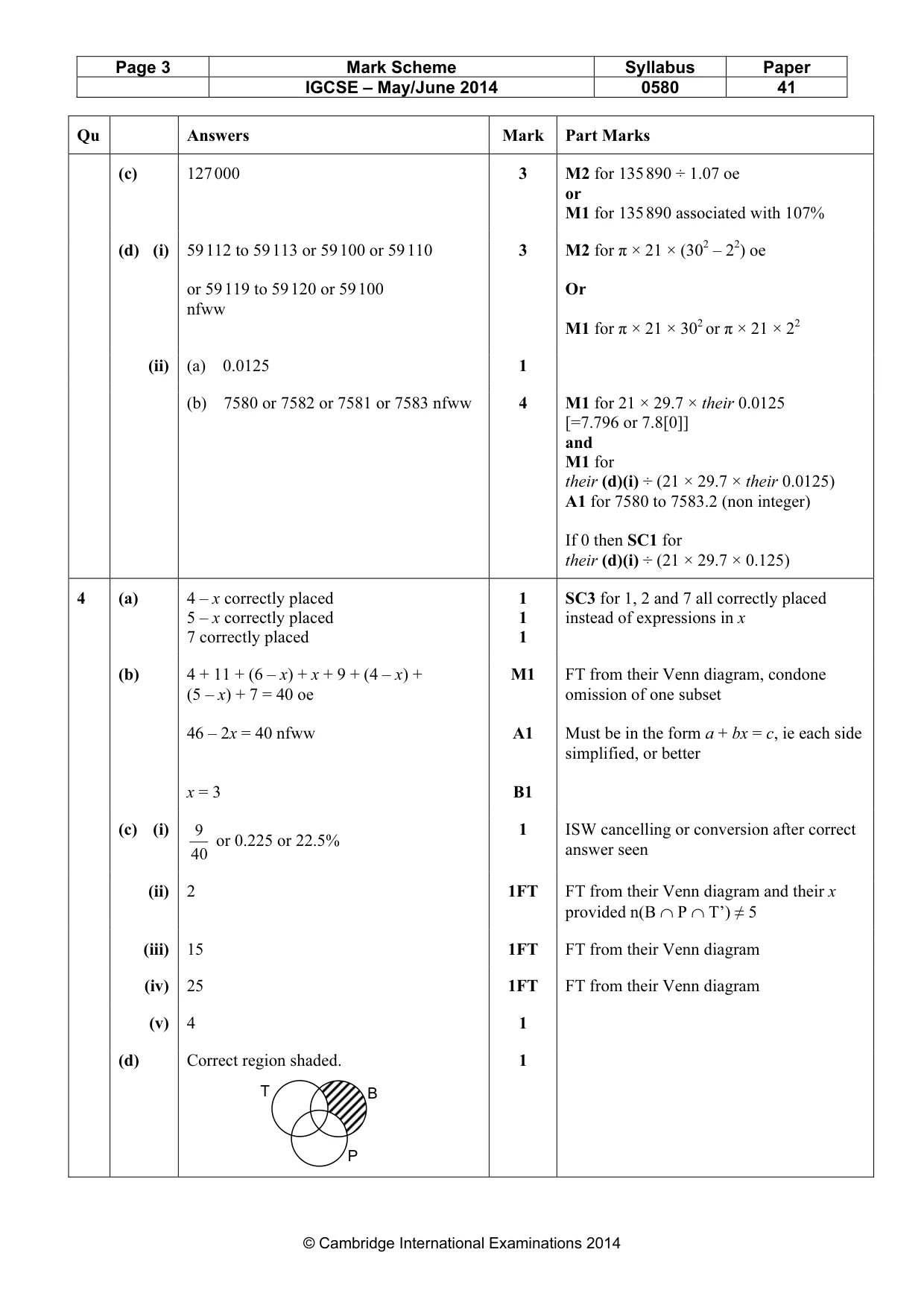
Mark scheme: 3 (a) 62 705 2 M1 for 75 246 ÷ 6 soi by 12 541 or 75 246 × 5 (b) 10.9 or 10.88… 3 (150 675 − 135 890) M2 for × 100 oe 135 890 or M1 for correct fraction soi by 0.1088… 150 675 or × 100 soi by 110.88… 135 890 IGCSE – May/June 2014 0580 41 Qu Answers Mark Part Marks (c) 127 000 3 M2 for 135 890 ÷ 1.07 oe or M1 for 135 890 associated with 107% (d) (i) 59 112 to 59 113 or 59 100 or 59 110 3 M2 for π × 21 × (302 – 22) oe or 59 119 to 59 120 or 59 100 Or nfww M1 for π × 21 × 302 or π × 21 × 22 (ii) (a) 0.0125 1 (b) 7580 or 7582 or 7581 or 7583 nfww 4 M1 for 21 × 29.7 × their 0.0125 [=7.796 or 7.8[0]] and M1 for their (d)(i) ÷ (21 × 29.7 × their 0.0125) A1 for 7580 to 7583.2 (non integer) If 0 then SC1 for their (d)(i) ÷ (21 × 29.7 × 0.125)
Q4 · T B 11 9 x 6 – x 4 P In the Venn diagram, = {children in a nursery} B = {children who…
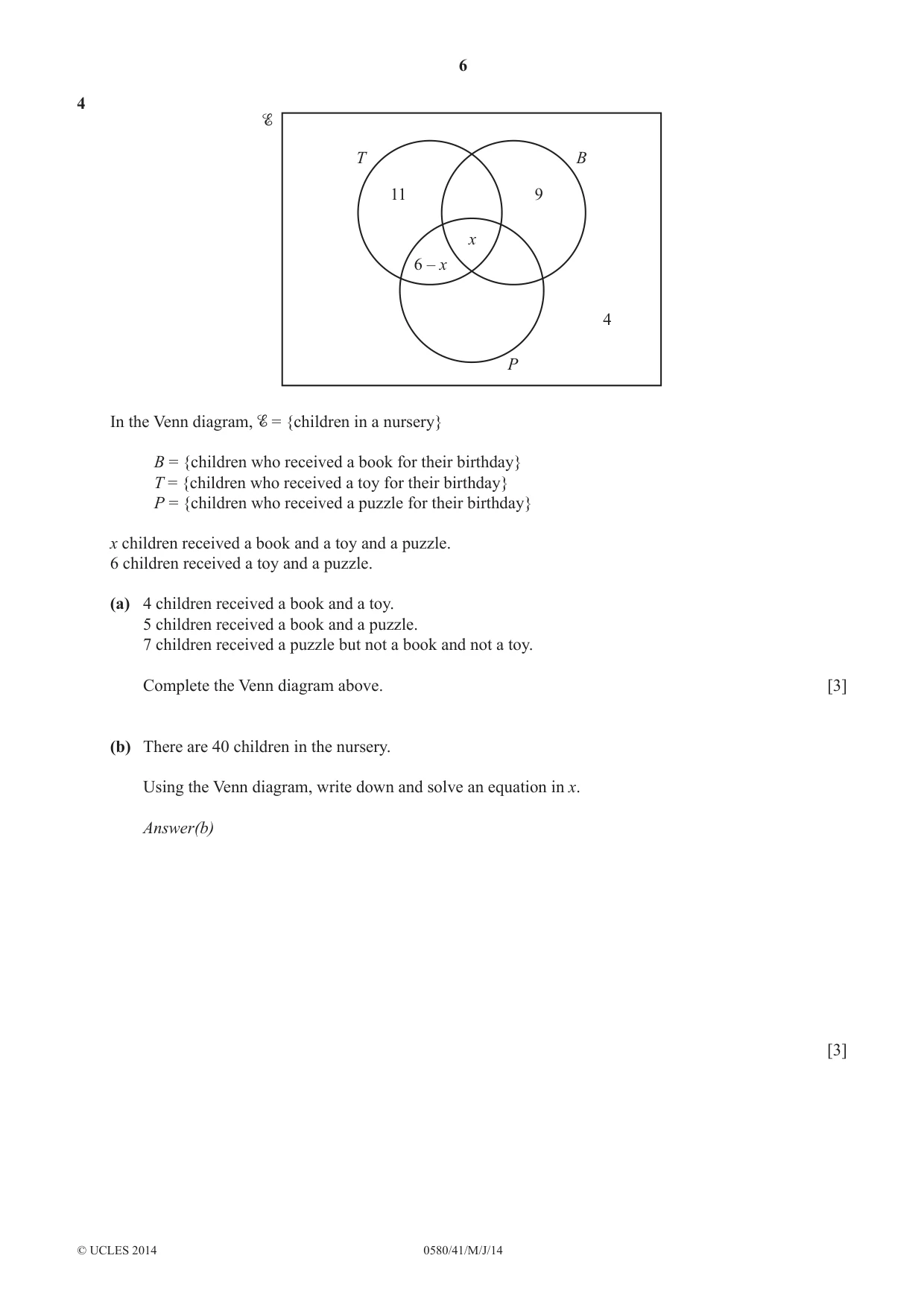
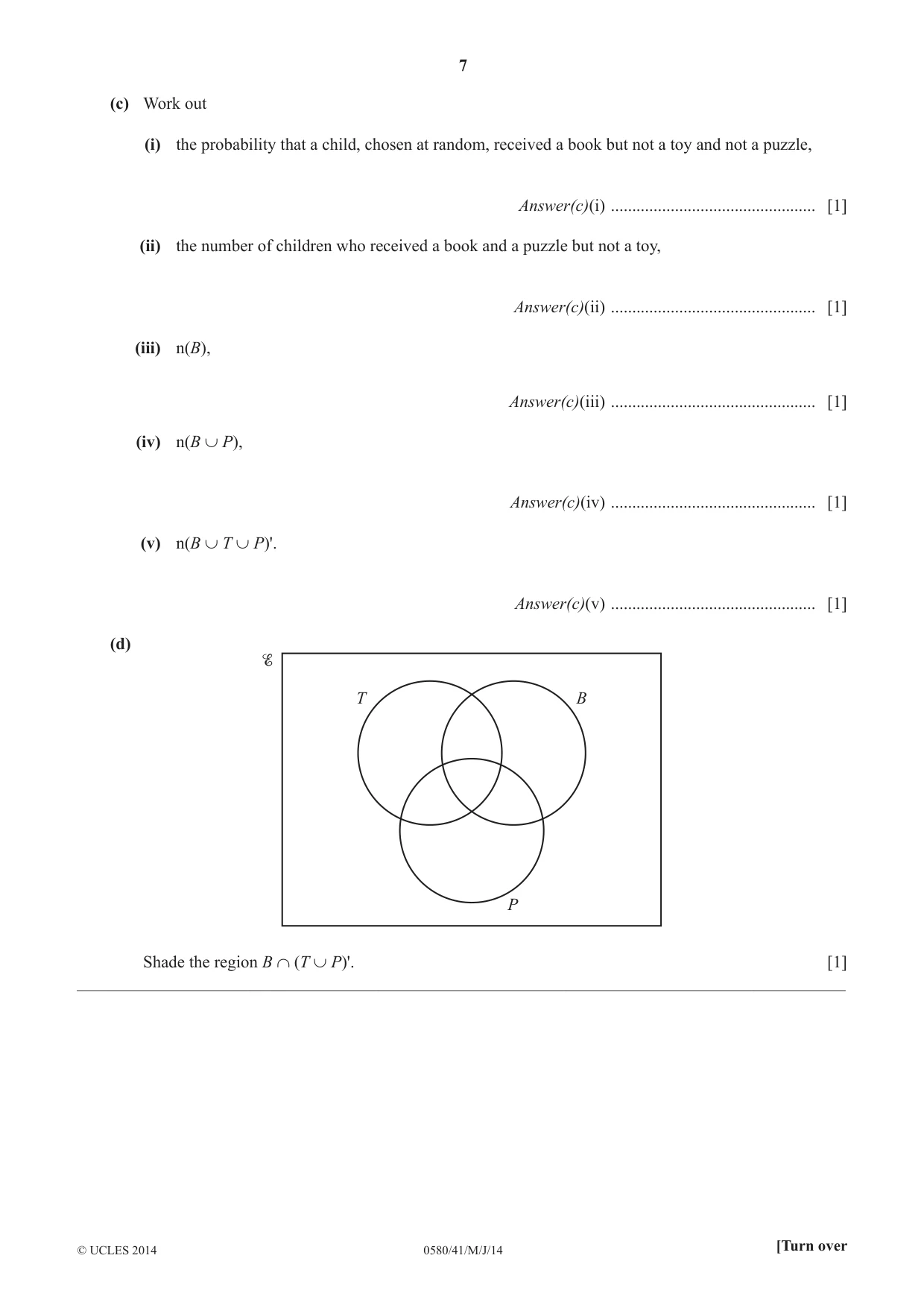
4 T B 11 9 x 6 – x 4 P In the Venn diagram, = {children in a nursery} B = {children who received a book for their birthday} T = {children who received a toy for their birthday} P = {children who received a puzzle for their birthday} x children received a book and a toy and a puzzle. 6 children received a toy and a puzzle. (a) 4 children received a book and a toy. 5 children received a book and a puzzle. 7 children received a puzzle but not a book and not a toy. Complete the Venn diagram above. [3] (b) There are 40 children in the nursery. Using the Venn diagram, write down and solve an equation in x. Answer(b) [3] (c) Work out (i) the probability that a child, chosen at random, received a book but not a toy and not a puzzle, Answer(c)(i) ................................................ [1] (ii) the number of children who received a book and a puzzle but not a toy, Answer(c)(ii) ................................................ [1] (iii) n(B), Answer(c)(iii) ................................................ [1] (iv) n(B ∪ P), Answer(c)(iv) ................................................ [1] (v) n(B ∪ T ∪ P)'. Answer(c)(v) ................................................ [1] (d) T B P Shade the region B ∩ (T ∪ P)'. [1] __________________________________________________________________________________________
Mark scheme: 4 (a) 4 – x correctly placed 1 SC3 for 1, 2 and 7 all correctly placed 5 – x correctly placed 1 instead of expressions in x 7 correctly placed 1 (b) 4 + 11 + (6 – x) + x + 9 + (4 – x) + M1 FT from their Venn diagram, condone (5 – x) + 7 = 40 oe omission of one subset 46 – 2x = 40 nfww A1 Must be in the form a + bx = c, ie each side simplified, or better x = 3 B1 (c) (i) 9 1 ISW cancelling or conversion after correct or 0.225 or 22.5% 40 answer seen (ii) 2 1FT FT from their Venn diagram and their x provided n(B ∩ P ∩ T’) ≠ 5 (iii) 15 1FT FT from their Venn diagram (iv) 25 1FT FT from their Venn diagram (v) 4 1 (d) Correct region shaded. 1 T B P IGCSE – May/June 2014 0580 41 Qu Answers Mark Part Marks
Q5 · S North Scale: 2 cm to 3 km P L In the scale drawing, P is a port, L is a lighthouse and…
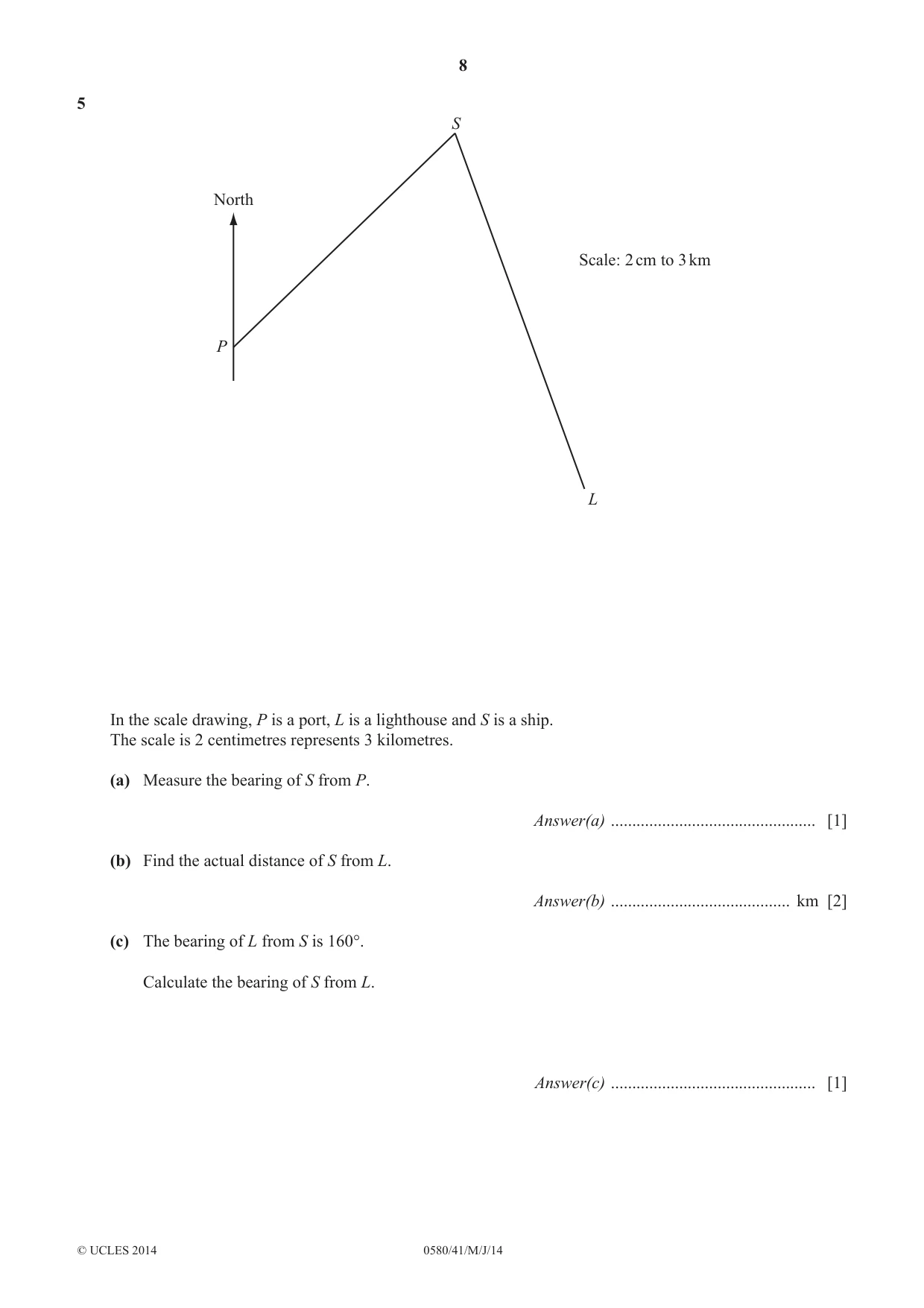
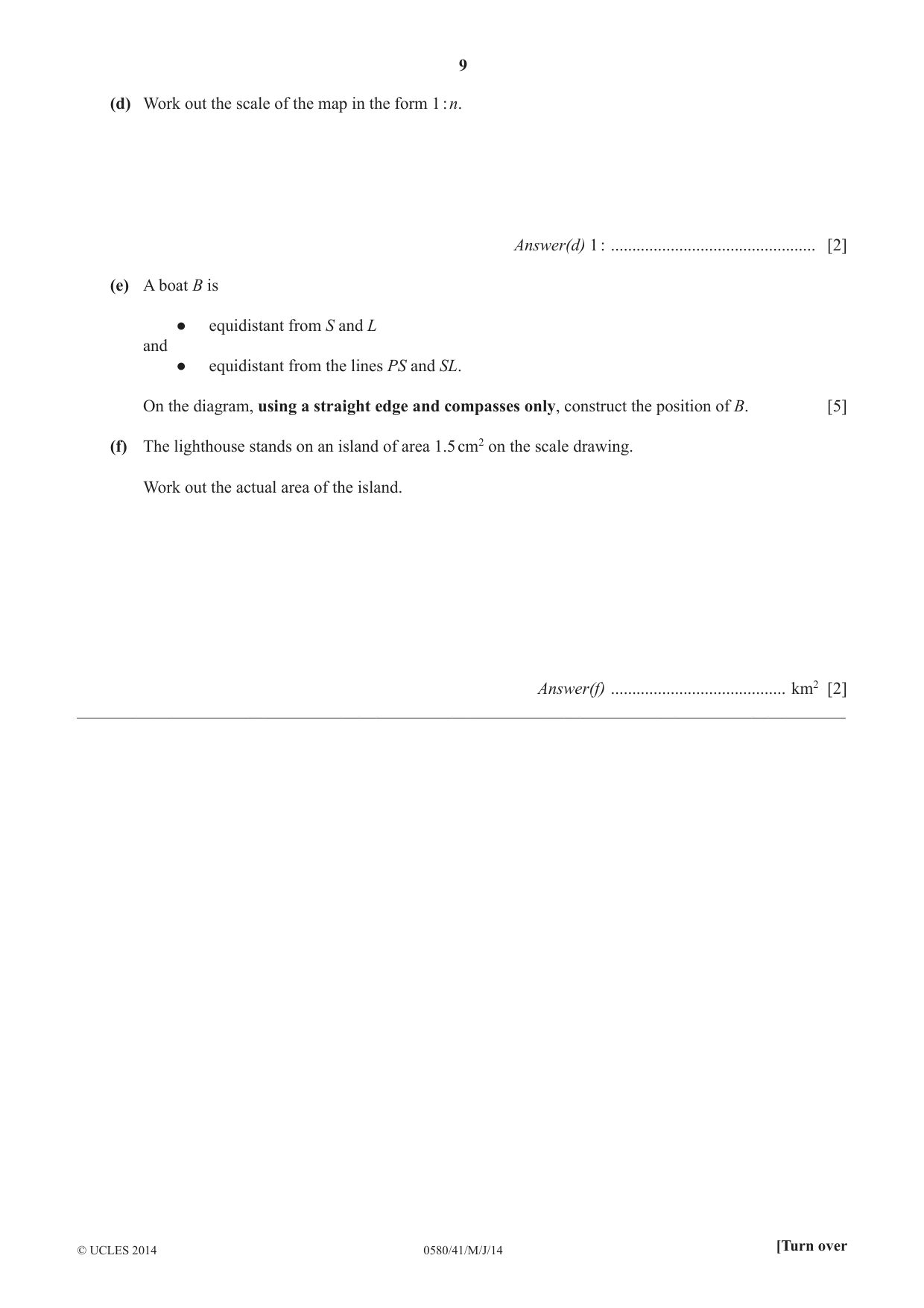
5 S North Scale: 2 cm to 3 km P L In the scale drawing, P is a port, L is a lighthouse and S is a ship. The scale is 2 centimetres represents 3 kilometres. (a) Measure the bearing of S from P. Answer(a) ................................................ [1] (b) Find the actual distance of S from L. Answer(b) .......................................... km [2] (c) The bearing of L from S is 160°. Calculate the bearing of S from L. Answer(c) ................................................ [1] (d) Work out the scale of the map in the form 1 : n. Answer(d) 1 : ................................................ [2] (e) A boat B is ● equidistant from S and L and ● equidistant from the lines PS and SL. On the diagram, using a straight edge and compasses only, construct the position of B. [5] (f) The lighthouse stands on an island of area 1.5 cm2 on the scale drawing. Work out the actual area of the island. Answer(f) ......................................... km2 [2] __________________________________________________________________________________________
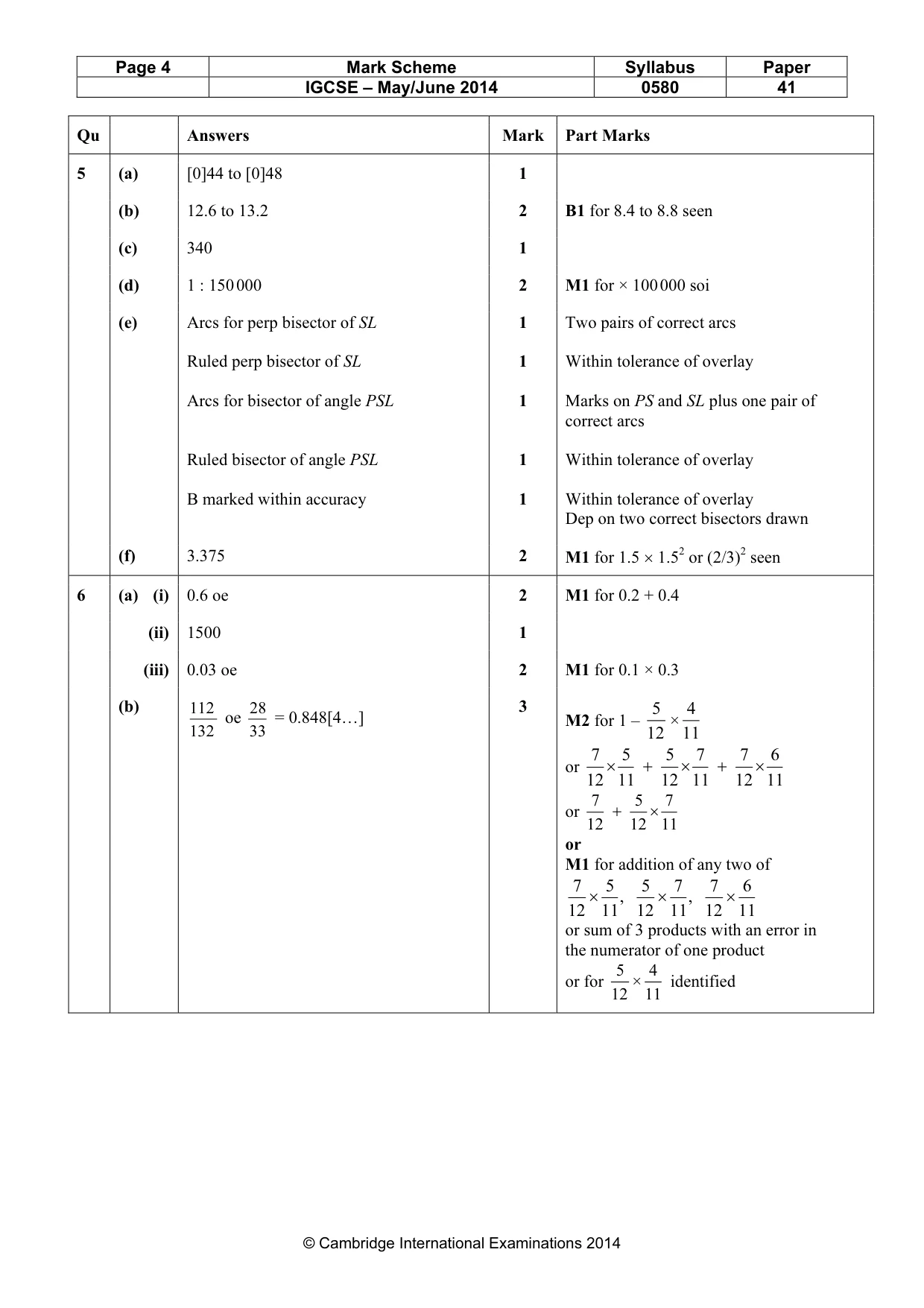
Mark scheme: 5 (a) [0]44 to [0]48 1 (b) 12.6 to 13.2 2 B1 for 8.4 to 8.8 seen (c) 340 1 (d) 1 : 150 000 2 M1 for × 100 000 soi (e) Arcs for perp bisector of SL 1 Two pairs of correct arcs Ruled perp bisector of SL 1 Within tolerance of overlay Arcs for bisector of angle PSL 1 Marks on PS and SL plus one pair of correct arcs Ruled bisector of angle PSL 1 Within tolerance of overlay B marked within accuracy 1 Within tolerance of overlay Dep on two correct bisectors drawn (f) 3.375 2 M1 for 1.5 × 1.52 or (2/3)2 seen
Q6 · A square spinner is biased
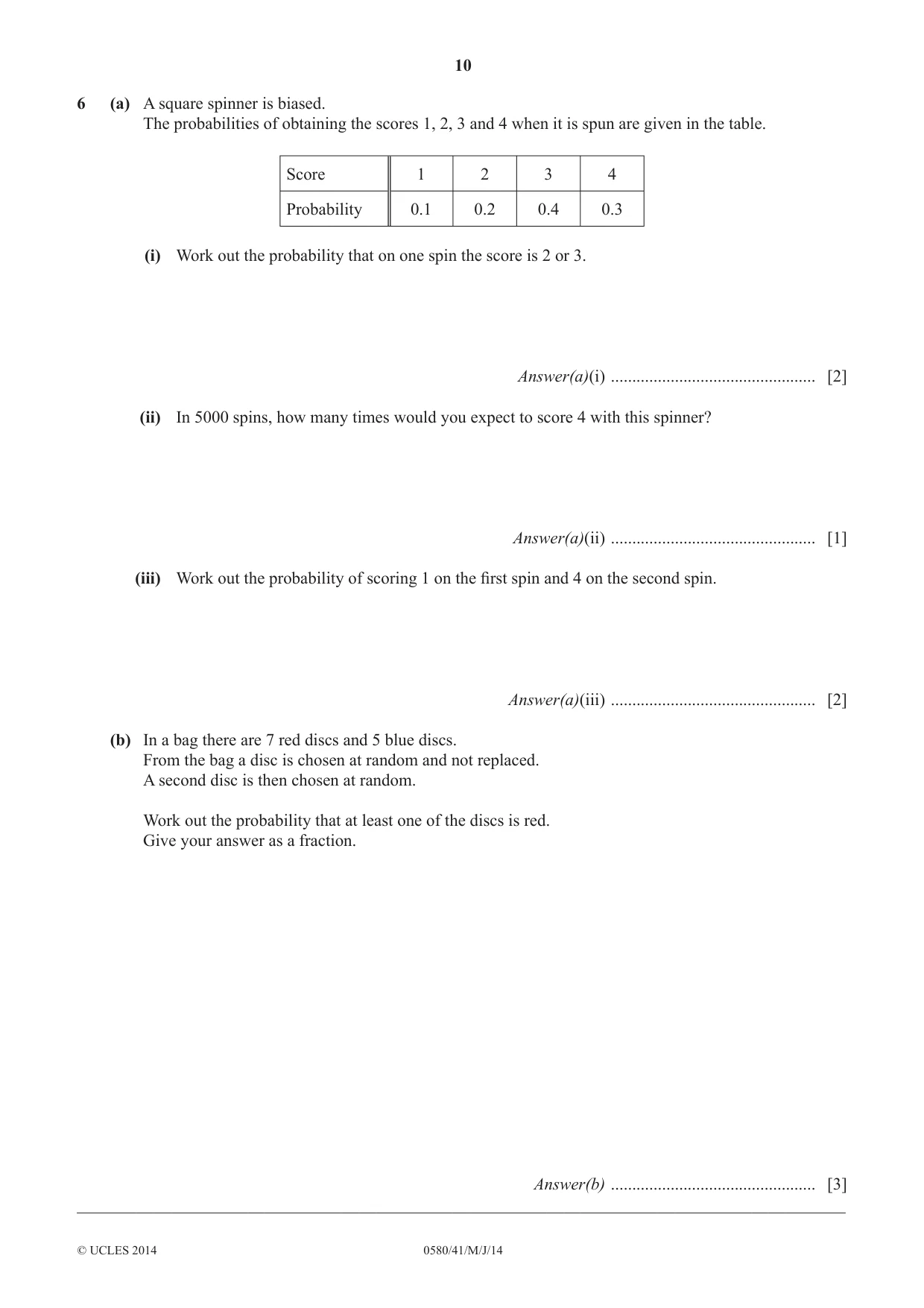
6 (a) A square spinner is biased. The probabilities of obtaining the scores 1, 2, 3 and 4 when it is spun are given in the table. Score 1 2 3 4 Probability 0.1 0.2 0.4 0.3 (i) Work out the probability that on one spin the score is 2 or 3. Answer(a)(i) ................................................ [2] (ii) In 5000 spins, how many times would you expect to score 4 with this spinner? Answer(a)(ii) ................................................ [1] (iii) Work out the probability of scoring 1 on the fi rst spin and 4 on the second spin. Answer(a)(iii) ................................................ [2] (b) In a bag there are 7 red discs and 5 blue discs. From the bag a disc is chosen at random and not replaced. A second disc is then chosen at random. Work out the probability that at least one of the discs is red. Give your answer as a fraction. Answer(b) ................................................ [3] __________________________________________________________________________________________
Mark scheme: 6 (a) (i) 0.6 oe 2 M1 for 0.2 + 0.4 (ii) 1500 1 (iii) 0.03 oe 2 M1 for 0.1 × 0.3 (b) 112 28 3 5 4 oe = 0.848[4…] M2 for 1 – 132 33 12 ×11 7 5 5 7 7 6 or × + × + × 12 11 12 11 12 11 7 5 7 or + × 12 12 11 or M1 for addition of any two of 7 5 5 7 7 6 × , × , × 12 11 12 11 12 11 or sum of 3 products with an error in the numerator of one product 5 4 or for × identified 12 11 IGCSE – May/June 2014 0580 41 Qu Answers Mark Part Marks 5 k
Q7 · Y 4 3 A 2 1 x –6 –5 –4 –3 –2 –1 0 1 2 3 4 5 6 –1 –2 –3 –4 –5 (a) On the grid, -5 (i) draw…
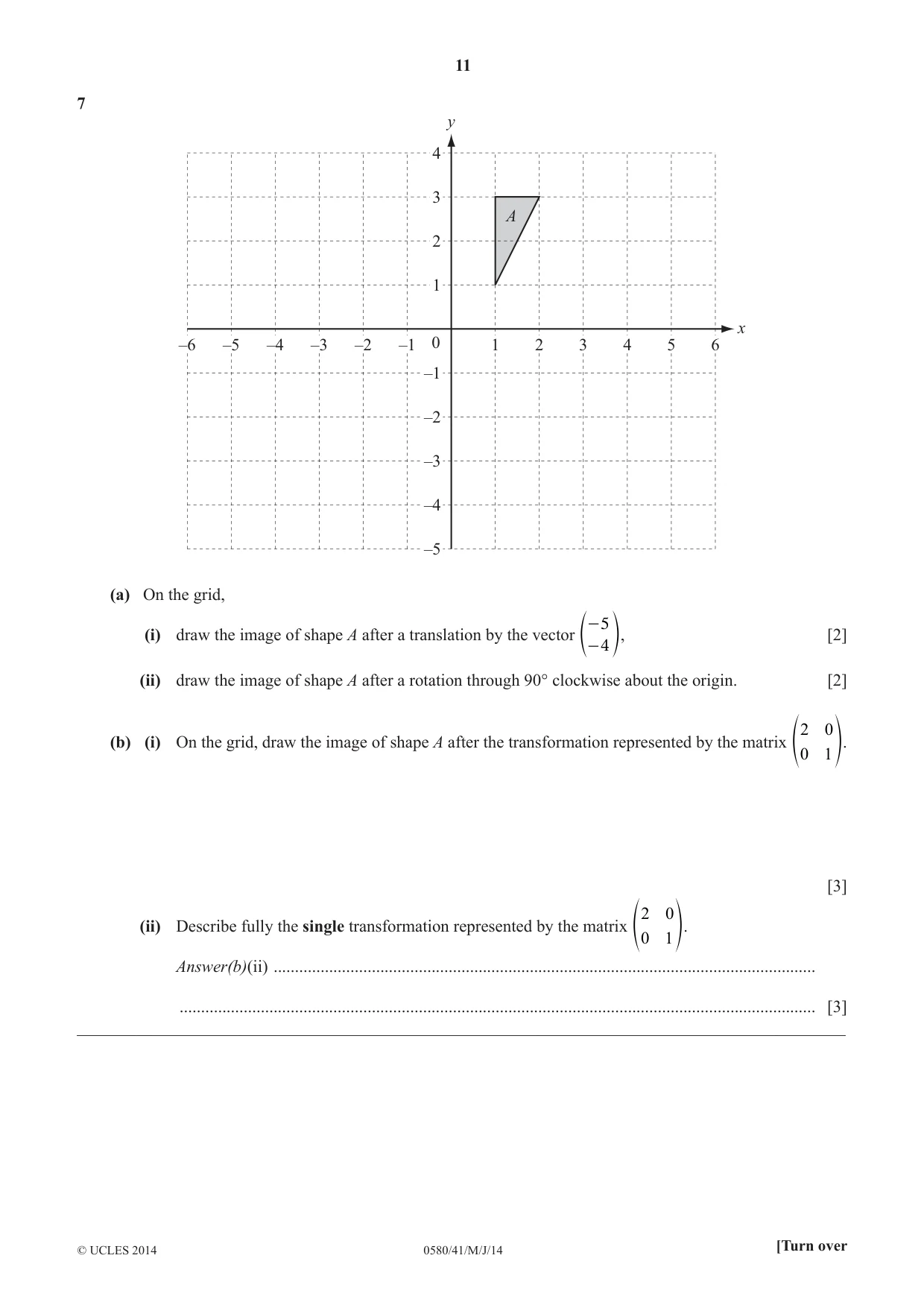
7 y 4 3 A 2 1 x –6 –5 –4 –3 –2 –1 0 1 2 3 4 5 6 –1 –2 –3 –4 –5 (a) On the grid, -5 (i) draw the image of shape A after a translation by the vector [2] e-4 o, (ii) draw the image of shape A after a rotation through 90° clockwise about the origin. [2] 2 0 (b) (i) On the grid, draw the image of shape A after the transformation represented by the matrix 0 1 f p. [3] 2 0 (ii) Describe fully the single transformation represented by the matrix 0 1 f p. Answer(b)(ii) ............................................................................................................................... ..................................................................................................................................................... [3] __________________________________________________________________________________________
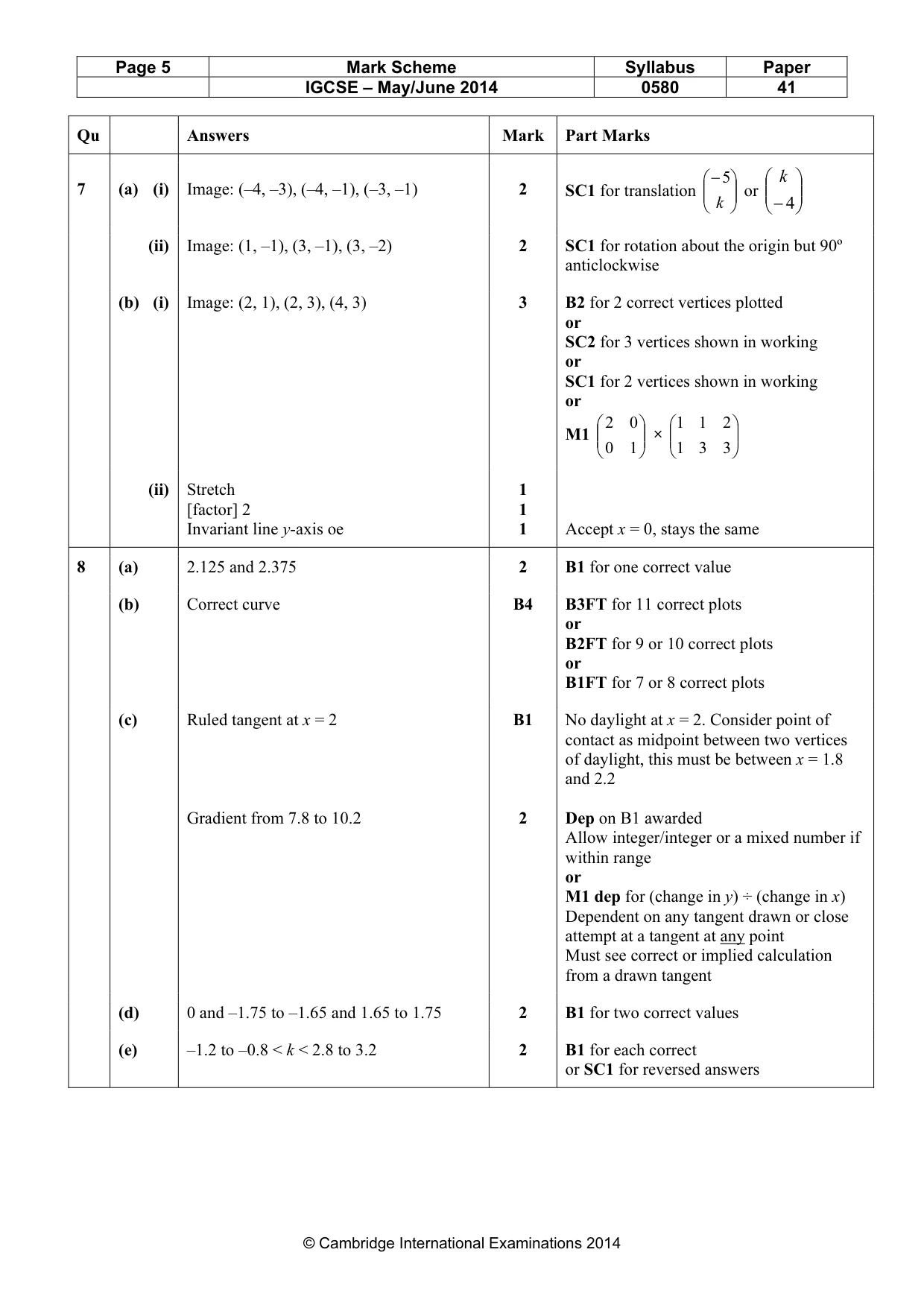
Mark scheme: − 5 k 7 (a) (i) Image: (–4, –3), (–4, –1), (–3, –1) 2 SC1 for translation or k −4 (ii) Image: (1, –1), (3, –1), (3, –2) 2 SC1 for rotation about the origin but 90º anticlockwise (b) (i) Image: (2, 1), (2, 3), (4, 3) 3 B2 for 2 correct vertices plotted or SC2 for 3 vertices shown in working or SC1 for 2 vertices shown in working or 2 0 1 1 2 M1 × 0 1 1 3 3 (ii) Stretch 1 [factor] 2 1 Invariant line y-axis oe 1 Accept x = 0, stays the same
Q8 · Complete the table of values for y = x3 – 3x + 1
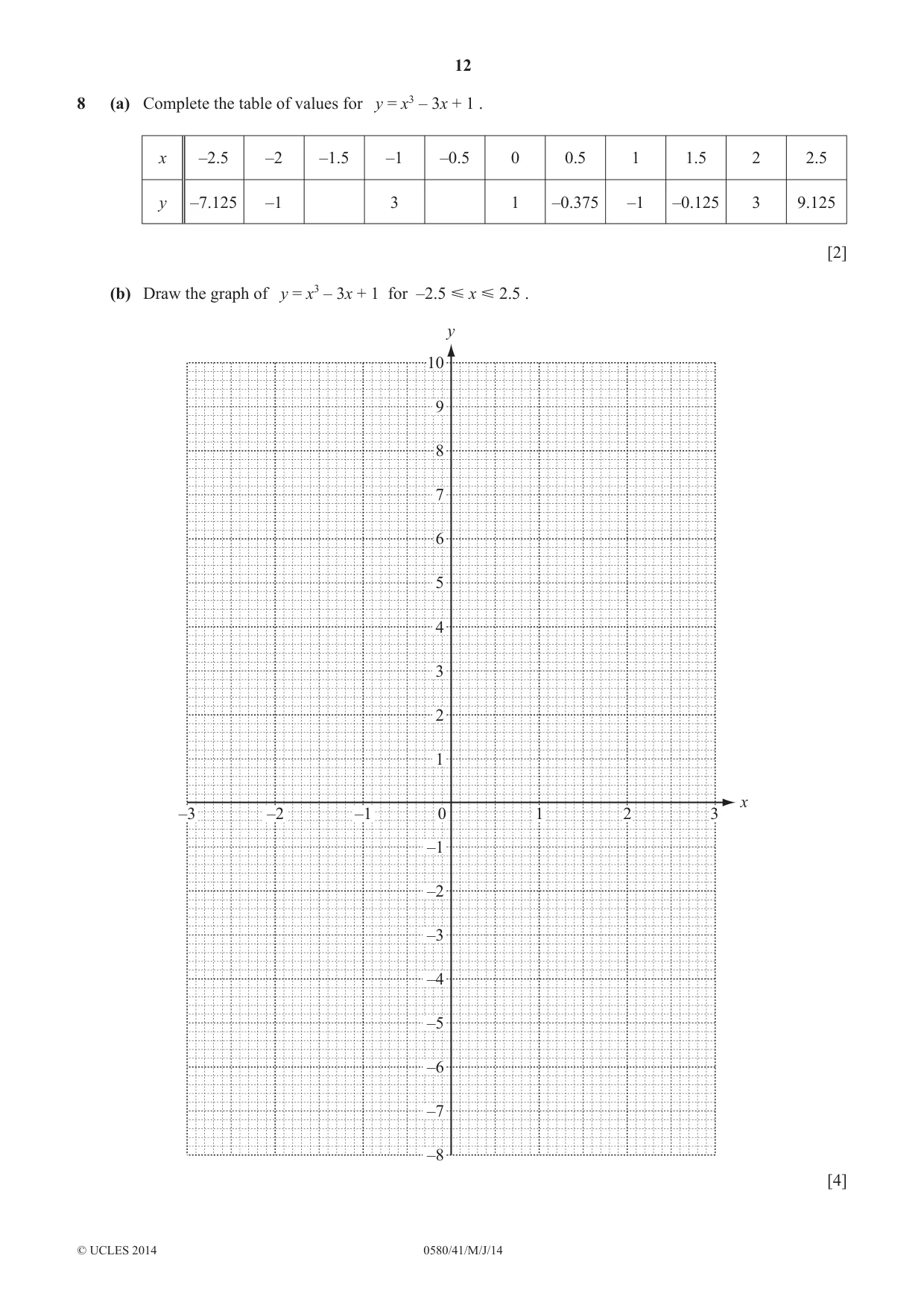
8 (a) Complete the table of values for y = x3 – 3x + 1 . x –2.5 –2 –1.5 –1 –0.5 0 0.5 1 1.5 2 2.5 y –7.125 –1 3 1 –0.375 –1 –0.125 3 9.125 [2] (b) Draw the graph of y = x3 – 3x + 1 for –2.5 Ğ x Ğ 2.5 . y 10 9 8 7 6 5 4 3 2 1 x –3 –2 –1 0 1 2 3 –1 –2 –3 –4 –5 –6 –7 –8 [4] (c) By drawing a suitable tangent, estimate the gradient of the curve at the point where x = 2. Answer(c) ................................................ [3] (d) Use your graph to solve the equation x3 – 3x + 1 = 1 . Answer(d) x = ..................... or x = ..................... or x = ..................... [2] (e) Use your graph to complete the inequality in k for which the equation x3 – 3x + 1 = k has three different solutions. Answer(e) ........................ < k < ........................ [2] __________________________________________________________________________________________
Mark scheme: 8 (a) 2.125 and 2.375 2 B1 for one correct value (b) Correct curve B4 B3FT for 11 correct plots or B2FT for 9 or 10 correct plots or B1FT for 7 or 8 correct plots (c) Ruled tangent at x = 2 B1 No daylight at x = 2. Consider point of contact as midpoint between two vertices of daylight, this must be between x = 1.8 and 2.2 Gradient from 7.8 to 10.2 2 Dep on B1 awarded Allow integer/integer or a mixed number if within range or M1 dep for (change in y) ÷ (change in x) Dependent on any tangent drawn or close attempt at a tangent at any point Must see correct or implied calculation from a drawn tangent (d) 0 and –1.75 to –1.65 and 1.65 to 1.75 2 B1 for two correct values (e) –1.2 to –0.8 < k < 2.8 to 3.2 2 B1 for each correct or SC1 for reversed answers IGCSE – May/June 2014 0580 41 Qu Answers Mark Part Marks
Q9 · 80 70 60 50 Cumulative frequency 40 30 20 10 t 0 10 20 30 40 50 Time (minutes) The times…
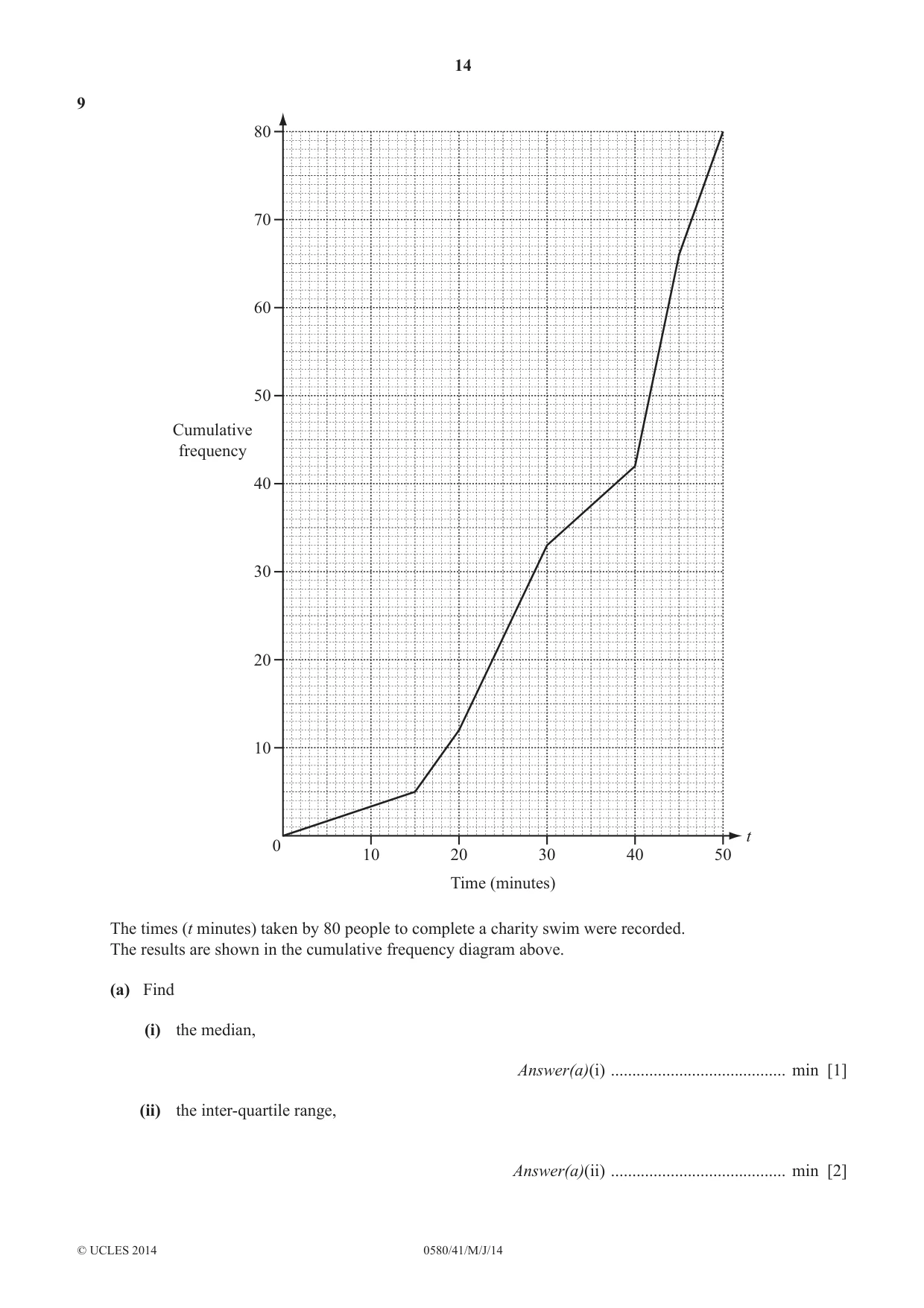
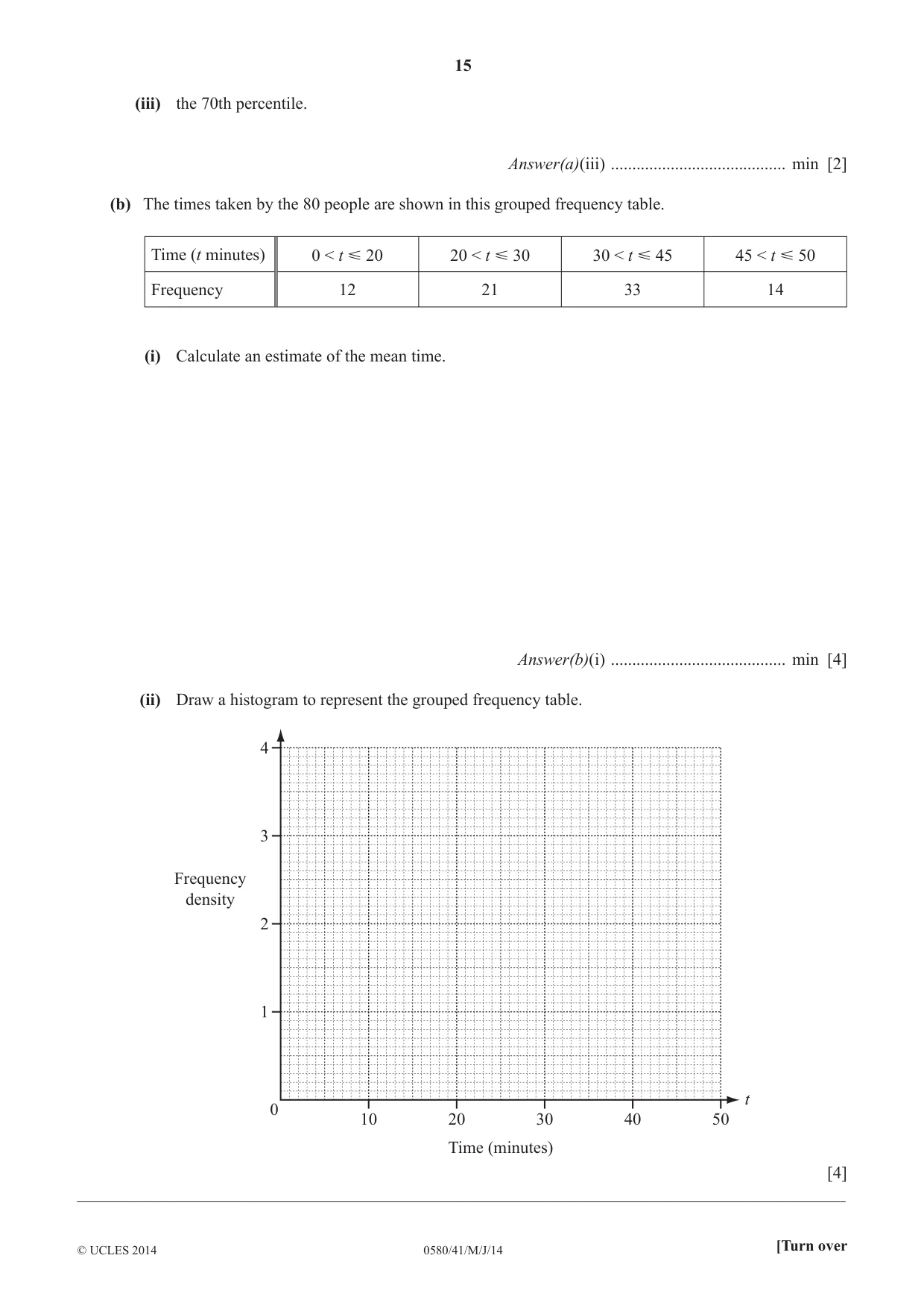
9 80 70 60 50 Cumulative frequency 40 30 20 10 t 0 10 20 30 40 50 Time (minutes) The times (t minutes) taken by 80 people to complete a charity swim were recorded. The results are shown in the cumulative frequency diagram above. (a) Find (i) the median, Answer(a)(i) ......................................... min [1] (ii) the inter-quartile range, Answer(a)(ii) ......................................... min [2] (iii) the 70th percentile. Answer(a)(iii) ......................................... min [2] (b) The times taken by the 80 people are shown in this grouped frequency table. Time (t minutes) 0 < t Ğ 20 20 < t Ğ 30 30 < t Ğ 45 45 < t Ğ 50 Frequency 12 21 33 14 (i) Calculate an estimate of the mean time. Answer(b)(i) ......................................... min [4] (ii) Draw a histogram to represent the grouped frequency table. 4 3 Frequency density 2 1 t 0 10 20 30 40 50 Time (minutes) [4] __________________________________________________________________________________________
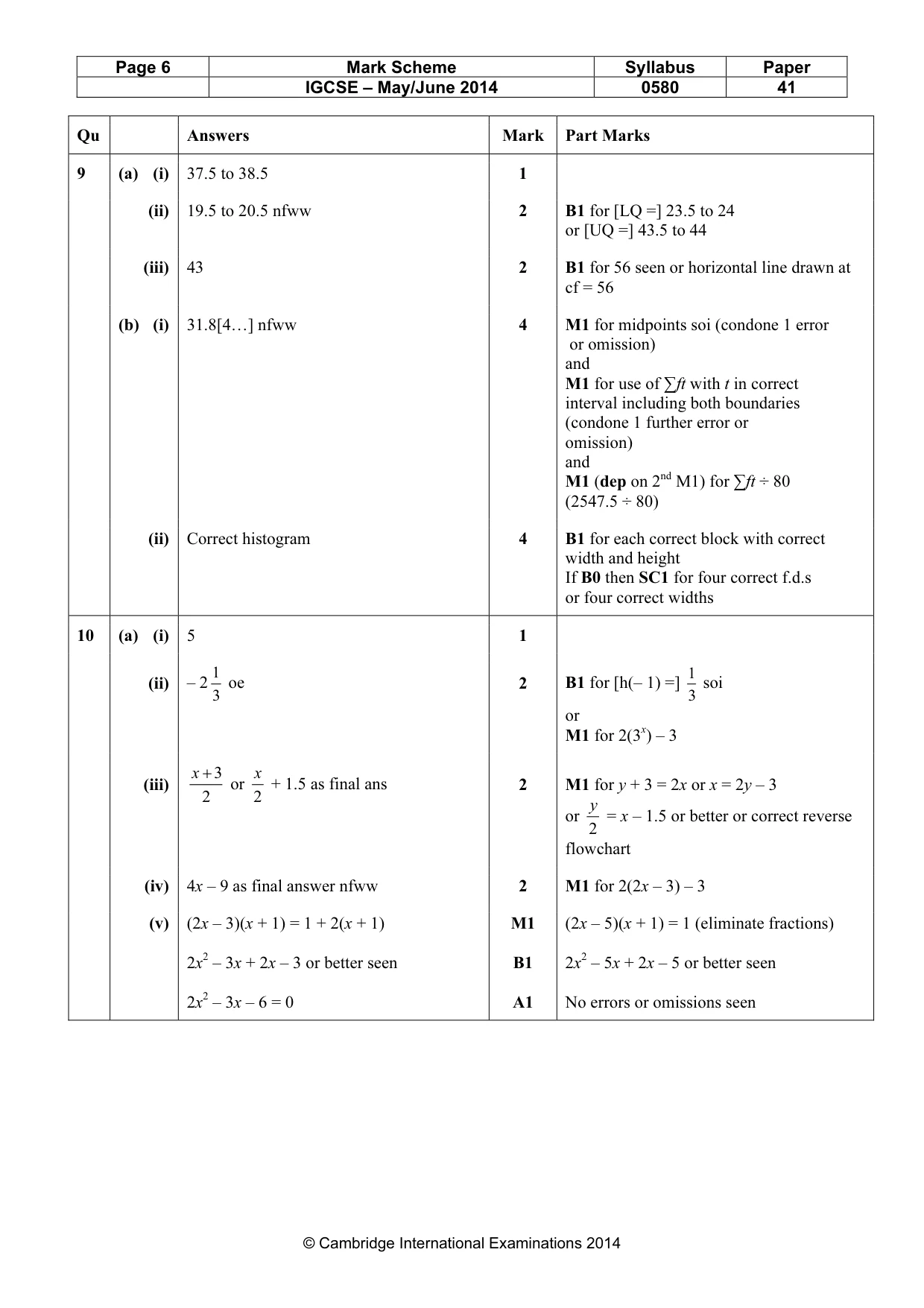
Mark scheme: 9 (a) (i) 37.5 to 38.5 1 (ii) 19.5 to 20.5 nfww 2 B1 for [LQ =] 23.5 to 24 or [UQ =] 43.5 to 44 (iii) 43 2 B1 for 56 seen or horizontal line drawn at cf = 56 (b) (i) 31.8[4…] nfww 4 M1 for midpoints soi (condone 1 error or omission) and M1 for use of ∑ft with t in correct interval including both boundaries (condone 1 further error or omission) and M1 (dep on 2nd M1) for ∑ft ÷ 80 (2547.5 ÷ 80) (ii) Correct histogram 4 B1 for each correct block with correct width and height If B0 then SC1 for four correct f.d.s or four correct widths
Q10 · 0 (a) f(x) = 2x – 3 g(x) = + 2 h(x) = 3x x + 1 (i) Work out f(4)
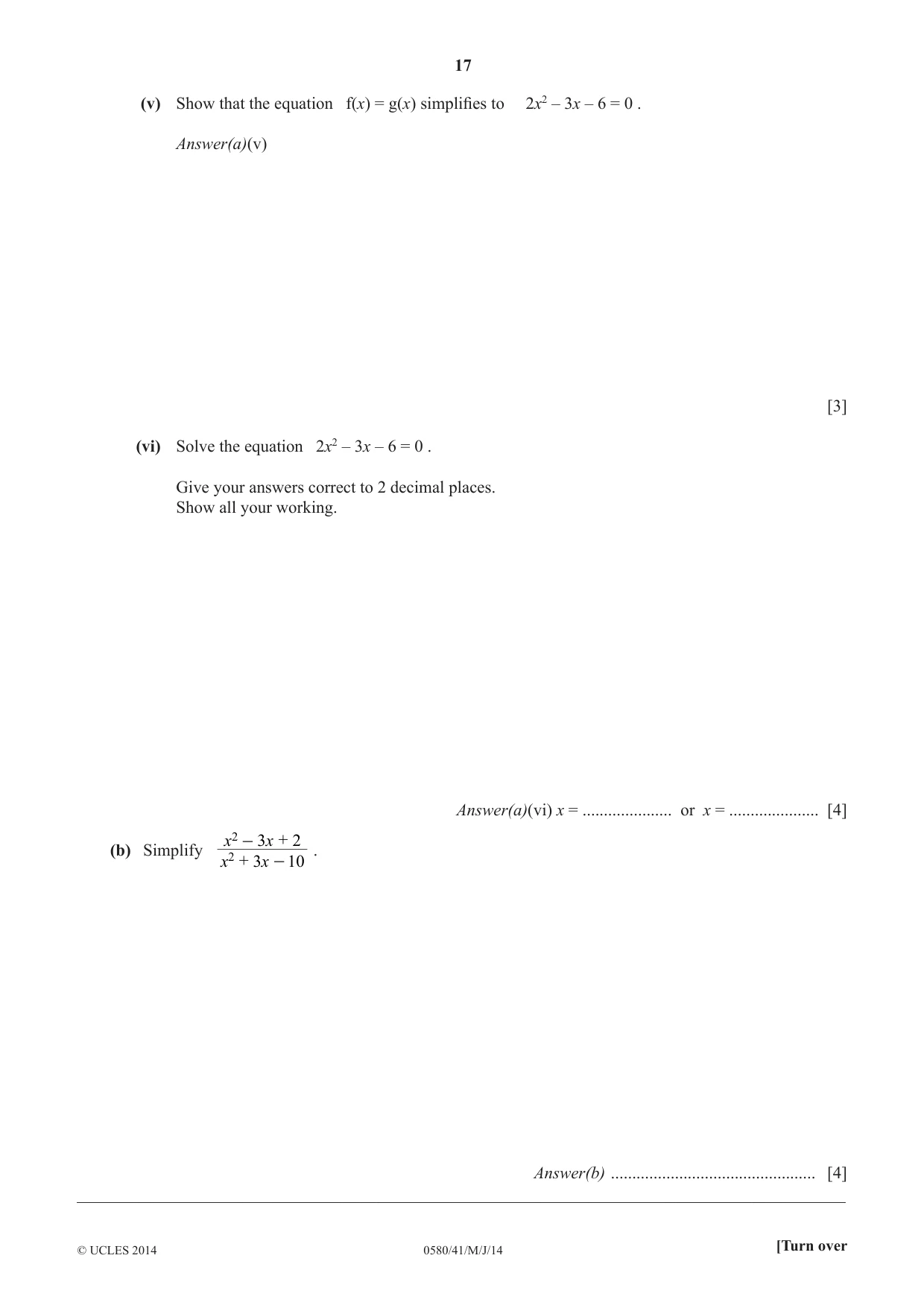
110 (a) f(x) = 2x – 3 g(x) = + 2 h(x) = 3x x + 1 (i) Work out f(4). Answer(a)(i) ................................................ [1] (ii) Work out fh(–1). Answer(a)(ii) ................................................ [2] (iii) Find f –1(x), the inverse of f(x). Answer(a)(iii) f –1(x) = ................................................ [2] (iv) Find ff(x) in its simplest form. Answer(a)(iv) ff(x) = ................................................ [2] (v) Show that the equation f(x) = g(x) simplifi es to 2x2 – 3x – 6 = 0 . Answer(a)(v) [3] (vi) Solve the equation 2x2 – 3x – 6 = 0 . Give your answers correct to 2 decimal places. Show all your working. Answer(a)(vi) x = ..................... or x = ..................... [4] x2 - 3 x + 2 (b) Simplify 2 . x + 3 x - 10 Answer(b) ................................................ [4] __________________________________________________________________________________________
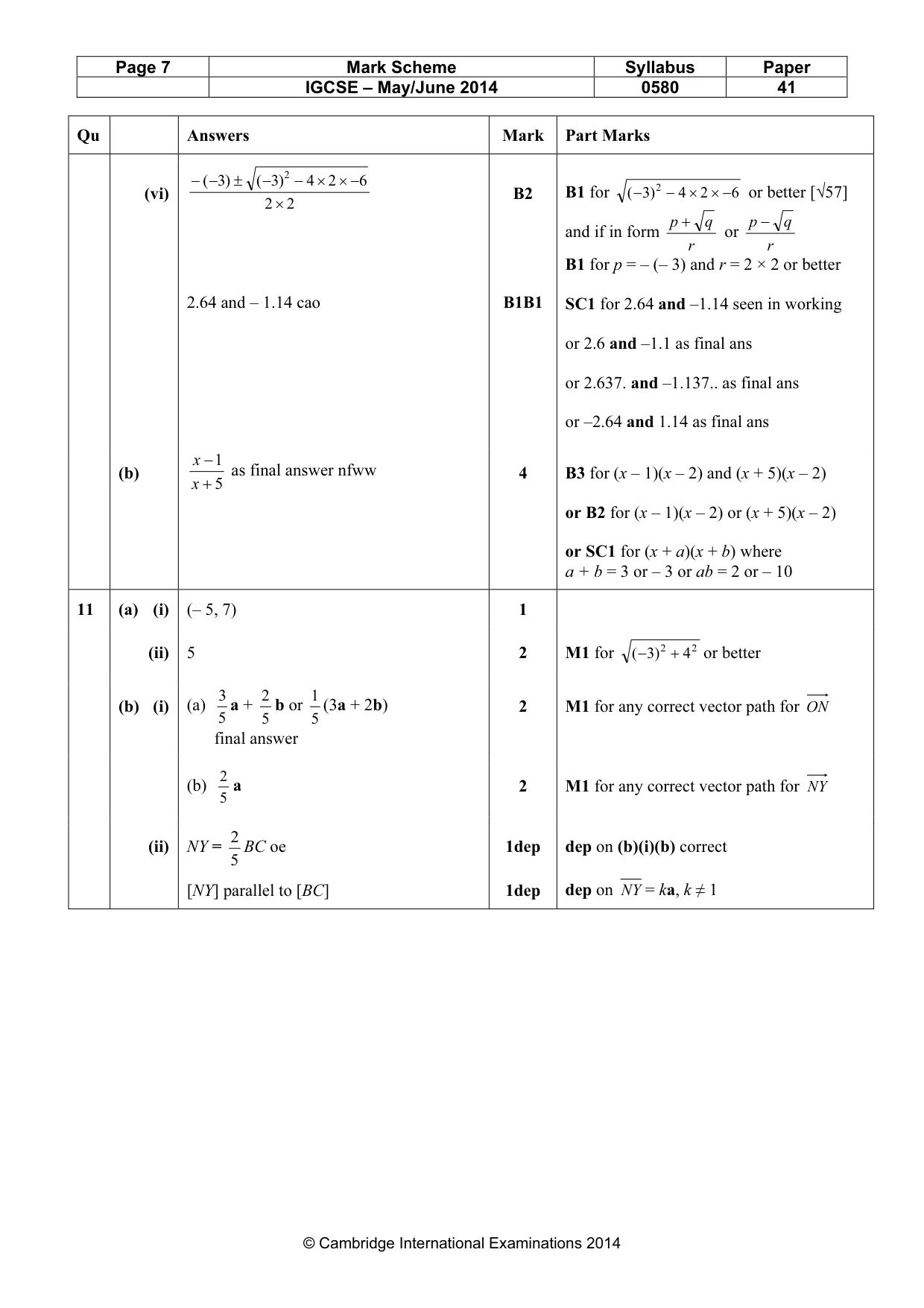
Mark scheme: 10 (a) (i) 5 1 1 1 (ii) – 2 oe 2 B1 for [h(– 1) =] soi 3 3 or M1 for 2(3x) – 3 x + 3 x (iii) or + 1.5 as final ans 2 M1 for y + 3 = 2x or x = 2y – 3 2 2 y or = x – 1.5 or better or correct reverse 2 flowchart (iv) 4x – 9 as final answer nfww 2 M1 for 2(2x – 3) – 3 (v) (2x – 3)(x + 1) = 1 + 2(x + 1) M1 (2x – 5)(x + 1) = 1 (eliminate fractions) 2x2 – 3x + 2x – 3 or better seen B1 2x2 – 5x + 2x – 5 or better seen 2x2 – 3x – 6 = 0 A1 No errors or omissions seen IGCSE – May/June 2014 0580 41 Qu Answers Mark Part Marks − ( −3) ± ( −3) 2 − 4 × 2 × −6 (vi) B2 B1 for ( − 3) 2 − 4 × 2 × − 6 or better [√57] 2 × 2 p + q p − q and if in form or r r B1 for p = – (– 3) and r = 2 × 2 or better 2.64 and – 1.14 cao B1B1 SC1 for 2.64 and –1.14 seen in working or 2.6 and –1.1 as final ans or 2.637. and –1.137.. as final ans or –2.64 and 1.14 as final ans x − 1 (b) as final answer nfww 4 B3 for (x – 1)(x – 2) and (x + 5)(x – 2) x + 5 or B2 for (x – 1)(x – 2) or (x + 5)(x – 2) or SC1 for (x + a)(x + b) where a + b = 3 or – 3 or ab = 2 or – 10
Q11 · -3 11 (a) = e 4 o (i) P is the point (–2, 3)
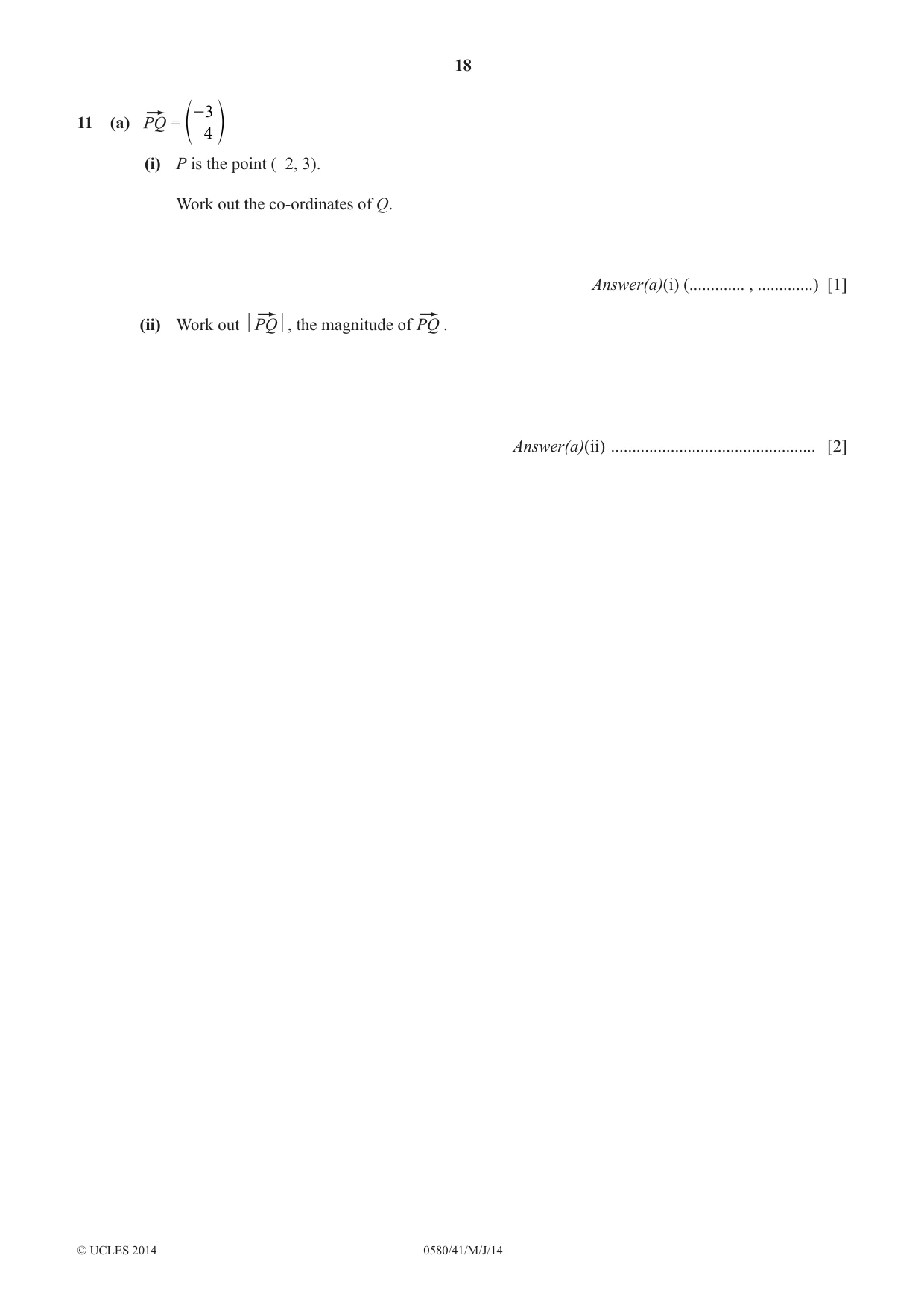
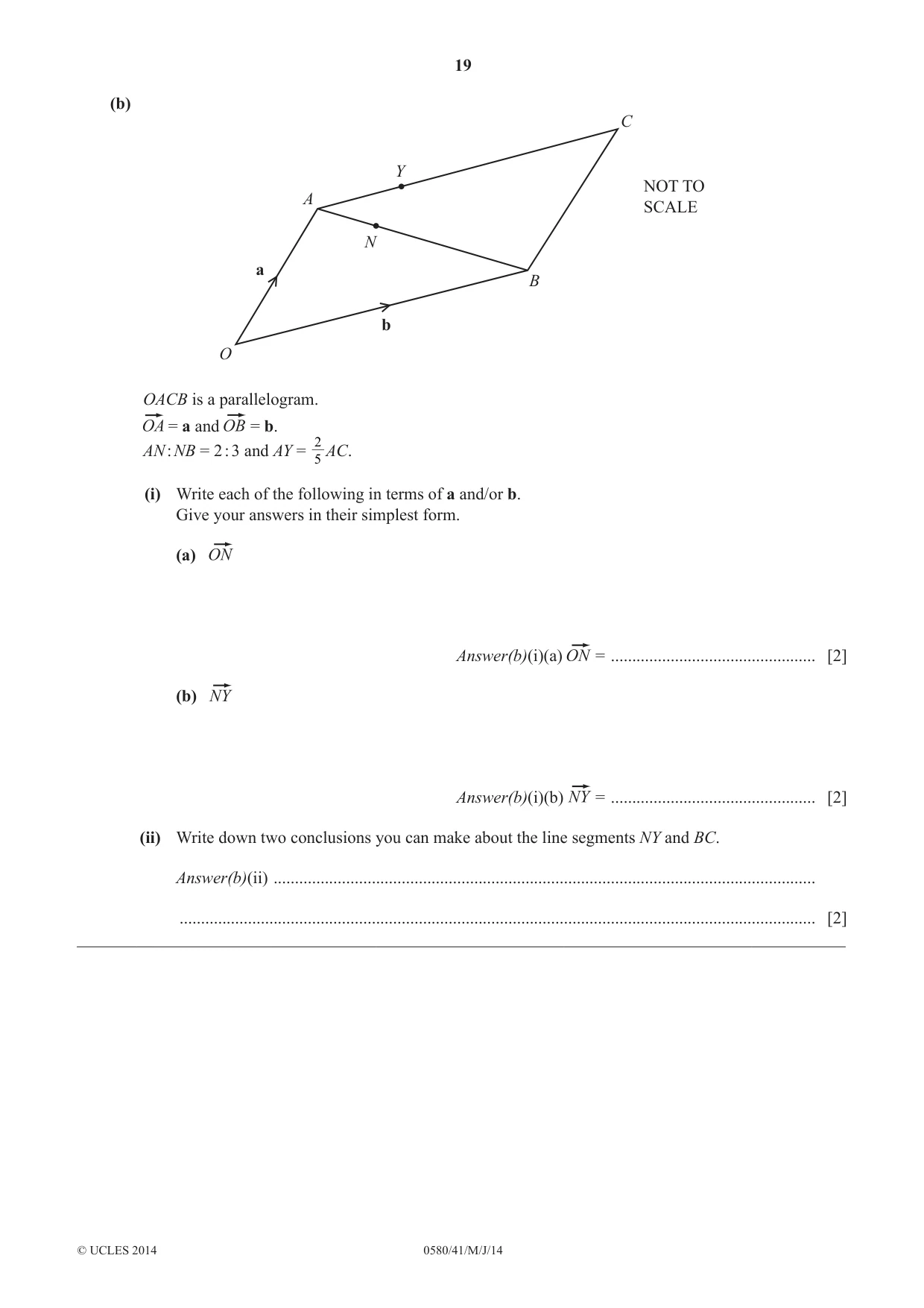
-3 11 (a) = e 4 o (i) P is the point (–2, 3). Work out the co-ordinates of Q. Answer(a)(i) (............. , .............) [1] (ii) Work out , the magnitude of . Answer(a)(ii) ................................................ [2] (b) C Y NOT TO A SCALE N a B b O OACB is a parallelogram. = a and = b. 2 AN : NB = 2 : 3 and AY = AC. 5 (i) Write each of the following in terms of a and/or b. Give your answers in their simplest form. (a) Answer(b)(i)(a) = ................................................ [2] (b) Answer(b)(i)(b) = ................................................ [2] (ii) Write down two conclusions you can make about the line segments NY and BC. Answer(b)(ii) ............................................................................................................................... ..................................................................................................................................................... [2] __________________________________________________________________________________________
Mark scheme: 11 (a) (i) (– 5, 7) 1 (ii) 5 2 M1 for ( − 3) 2 + 4 2 or better 3 2 1 (b) (i) (a) a + b or (3a + 2b) 2 M1 for any correct vector path for ON 5 5 5 (a) final answer 2 (b) a 2 M1 for any correct vector path for NY 5 2 (ii) NY = BC oe 1dep dep on (b)(i)(b) correct 5 [NY] parallel to [BC] 1dep dep on NY = ka, k ≠ 1
What was in this paper
The subtopics covered by these 11 questions, and how many questions each got. Open one in a new tab to see every Cambridge question on it.
What you needed in this session
Cambridge’s own grade thresholds for 2014 May/June, Paper 4 · Variant 1. A higher threshold means an easier paper — the bar moves with how the cohort did.