Questions as text
Q1 · Mining diamonds in Botswana Botswana is the world’s largest producer of diamonds 0455/22 May/June 2017
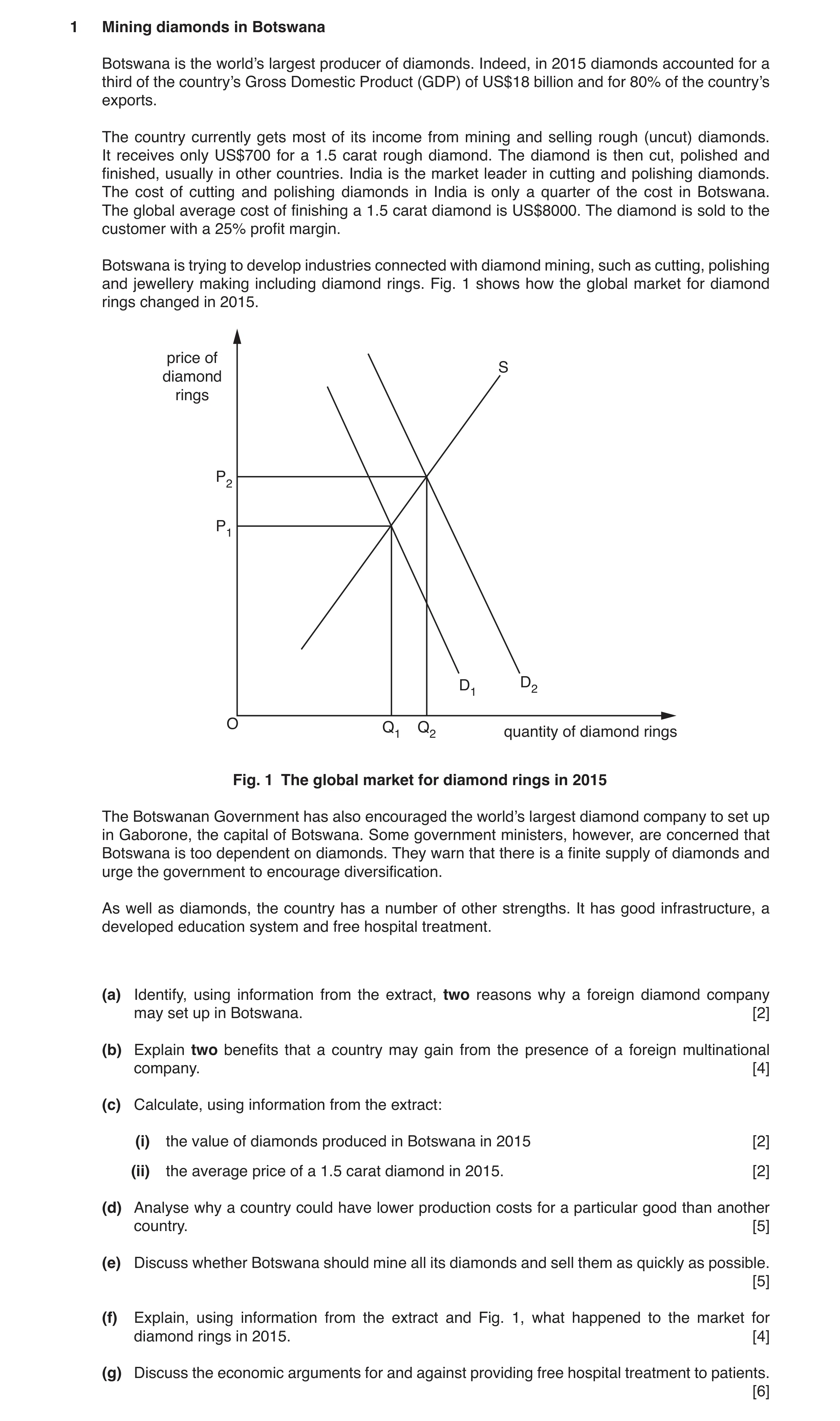
1 Mining diamonds in Botswana Botswana is the world’s largest producer of diamonds. Indeed, in 2015 diamonds accounted for a third of the country’s Gross Domestic Product (GDP) of US$18 billion and for 80% of the country’s exports. The country currently gets most of its income from mining and selling rough (uncut) diamonds. It receives only US$700 for a 1.5 carat rough diamond. The diamond is then cut, polished and finished, usually in other countries. India is the market leader in cutting and polishing diamonds. The cost of cutting and polishing diamonds in India is only a quarter of the cost in Botswana. The global average cost of finishing a 1.5 carat diamond is US$8000. The diamond is sold to the customer with a 25% profit margin. Botswana is trying to develop industries connected with diamond mining, such as cutting, polishing and jewellery making including diamond rings. Fig. 1 shows how the global market for diamond rings changed in 2015. price of S diamond rings P2 P1 D1 D2 O Q1 Q2 quantity of diamond rings Fig. 1 The global market for diamond rings in 2015 The Botswanan Government has also encouraged the world’s largest diamond company to set up in Gaborone, the capital of Botswana. Some government ministers, however, are concerned that Botswana is too dependent on diamonds. They warn that there is a finite supply of diamonds and urge the government to encourage diversification. As well as diamonds, the country has a number of other strengths. It has good infrastructure, a developed education system and free hospital treatment. (a) Identify, using information from the extract, two reasons why a foreign diamond company may set up in Botswana. [2] (b) Explain two benefits that a country may gain from the presence of a foreign multinational company. [4] (c) Calculate, using information from the extract: (i) the value of diamonds produced in Botswana in 2015 [2] (ii) the average price of a 1.5 carat diamond in 2015. [2] (d) Analyse why a country could have lower production costs for a particular good than another country. [5] (e) Discuss whether Botswana should mine all its diamonds and sell them as quickly as possible. [5] (f) Explain, using information from the extract and Fig. 1, what happened to the market for diamond rings in 2015. [4] (g) Discuss the economic arguments for and against providing free hospital treatment to patients. [6]
30 marks
Mark scheme: 1(a) Identify, using information from the extract, two reasons why a foreign diamond company may set up in Botswana. 1 mark each for each of two reasons identified: • supply of diamonds / largest producer of diamonds • cheap diamonds • educated labour force / developed education system • free healthcare • good infrastructure e.g. transport system • government encouragement • supporting (ancillary) industries e.g. diamond cutting 2 Do not accept subsidies. Question Answer Marks Guidance 1(b) Explain two benefits that a country may gain from the presence of a foreign multinational company. 1 mark each for each of two benefits identified: • higher output / economic growth • higher employment • contribution to current account position • higher tax revenue • new technology introduced • encourage other MNCs to invest • increase competition • increase variety of products produced • train workers in new skills 1 mark each for each of two explanations given: • MNCs’ output will count in the country’s GDP / raise living standards • MNCs may employ workers from the country • MNCs may export products from the country • MNCs profits will be taxed / tax revenue can be spent on e.g. education • MNCs may use more advanced capital equipment • more MNCs can increase employment • increased competition may make domestic firms more efficient/more productive / lower prices • a greater variety of products will increase consumer satisfaction • more skilled workers will be more productive 4 Maximum of 2 marks for a list of benefits. 1(c)(i) Calculate, using information from the extract, the value of diamonds produced in Botswana in 2015. $6 billion (2). Correct method i.e. 33% of US$18 billion (1). 2 Correct answer and $ sign and billion/bn/b required for 2 marks. 6 + >000s = 1 mark Question Answer Marks Guidance 1(c)(ii) Calculate, using information from the extract, the average price of a 1.5 carat diamond in 2015. $10 000 (2). Correct method: $8000 + 25% (1). OR $10 875 (2). Correct method: $8 700 + 25% (1). OR $10 667 ($10 666.66) (2) Correct method: $8000 × 100 / 75. 2 1(d) Analyse why a country could have lower production costs for a particular good than another country. • It may have a more educated/skilled labour force (1) higher productivity/greater efficiency (1) lower wastage (1). • It may have more capital goods (1) may use more advanced technology (1) lower capital costs (1). • Its firms may be producing on a larger scale (1) taking greater advantages of economies of scale (1) example (1). • The government may subsidise the product (1) or tax the product less (1). • It may specialise in the product (1). • It may have easier access to raw materials / natural resources (1) and so raw materials/natural resources may be cheaper (1). • It may have a large supply of labour (1) with low wage rates (1). • It may have low transport costs (1) due to good infrastructure (1). • It may have a more favourable climate (1). • It may have a lower inflation rate than other countries (1). • It may have lower minimum wage (1) lowering wages cost (1). • It may have weaker trade unions (1) reducing bargaining power (1). • It may have a stronger currency (1) causing lower cost of importing raw materials (1). 5 Accept but do not expect reference to comparative/absolute advantage. Maximum of 3 marks for a list- like approach. Question Answer Marks Guidance 1(e) Discuss whether Botswana should mine all its diamonds and sell them as quickly as possible. Up to 3 marks for why it should: • Increase income (1) and employment (1) and living standards now (1). • Increase government tax revenue (1) enabling government to spend more on e.g. infrastructure (1). • Increase export revenue (1) improving the current account position (1). • Demand may be high now (1) causing price to be high (1) causing greater incentive to supply now (1). • Demand may fall in the future (1) lowering prices (1) so income earned in the future may be lower in the future (1). • Higher output now may result in improved economies of scale (1) lowering costs (1). • Higher output may enable greater advantage to be taken of economies of scale (1) lowering average cost (1). Up to 3 marks for why it should not: • Will deplete stocks of diamonds (1) preventing diamond production in the future (1) there is a finite supply of diamonds (1). • Global demand may be low now (1) demand may be higher in the future (1). • Increase in supply may lower prices (1) which may reduce revenue (1). • Risk of relying on one product / one export / being too dependent on diamonds (1). • Advances in technology (1) may reduce costs of mining in the future (1). • May increase the risk of pollution (1) causing environmental damage (1). • In the long run employment (1) and GDP may be higher (1). 5 Reverse arguments may be awarded if justified by reference to short and long run. A response may develop a mixture of relevant points to achieve up to 3 marks on either side. Maximum of 2 marks for a list- like approach. 1(f) Explain, using information from the extract and Fig. 1, what happened to the market for diamond rings in 2015. The diagram shows: • Demand increasing (1) price rising (1) • Supply extending/rising/higher quantity/more diamond rings (1) due to higher income or other valid reasons (1) • Demand is inelastic (1) • Supply is inelastic (1) 4 No marks for just stating the demand curve has shifted to the right or supply is unchanged. Question Answer Marks Guidance 1(g) Discuss the economic arguments for and against providing free hospital treatment to patients. Up to 4 marks for why it should: • It may increase health (1) increase life expectancy/reduce death rate (1) improve living standards/economic development (1) • It would provide access to the poor (1) reduce poverty/provide a necessity (1) • The social benefit of hospital treatment is greater than the private benefit (1) provides external benefits (1) e.g. better quality/higher output/economic growth (1) higher labour productivity (1) may be under-consumed/under-produced (1) if left to market forces (1) people may not appreciate private benefits/benefits to themselves of hospital treatment (1) • People will have more money to spend on other items (1) Up to 4 marks for why it should not: • May increase government spending (1) opportunity cost (1) government spending on e.g. education could be higher (1) taxes may be higher (1) leading to demand-pull inflation (1) • Some of those treated could afford to pay (1) in this case not a good use of government funds (1) • May result in over-consumption (1) people seeking treatment who do not need it (1). • May reduce the work incentive of potential consumers (1) as people will need less income to pay for healthcare (1) • The quality of healthcare may fall (1) loss of profit motive (1) may reduce e.g. innovation (1) • May encourage people to take greater risks (1) e.g. eat less healthily (1). • Government could charge for healthcare/allow private sector to charge for healthcare to get more tax revenue (1) to spend on e.g. education (1) taxes could be lower (1) 6 A response may develop a mixture of relevant points to achieve up to 4 marks on either side. Maximum of 3 marks for a list- like approach.
This question in 0455/22 May/June 2017
Q2 · Singapore is usually ranked as one of the best countries in which to do business 0455/22 Oct/Nov 2017
2 Singapore is usually ranked as one of the best countries in which to do business. It is an open economy engaging in free trade. It has a history of strong entrepreneurship, low unemployment, low average costs and relatively low tax rates. Its example may encourage other countries to remove trade restrictions. (a) Define ‘average costs’. [2] (b) Explain two factors that would increase the supply of entrepreneurs in an economy. [4] (c) Analyse how the market for a product would be affected by a reduction of the tax on the product combined with a fall in the price of a complement. [6] (d) Discuss whether low unemployment in a country will encourage multinational companies (MNCs) to set up there. [8]
20 marks
Mark scheme: 2(a) Define ‘average costs’. Total cost divided by output (2). Cost per unit / average fixed cost plus average variable cost (1). 2 2(b) Explain two factors that would increase the supply of entrepreneurs in an economy. 1 mark each for each of two factors identified: • rise in education • reduction in corporation tax / tax holidays • increase in subsidies for business/entrepreneurs • reduction in the rate of interest • privatisation / move to market economy • immigration • reduction in barriers to entry / deregulation • economic boom / high level of economic activity • improved legal framework / reduction in crime 1 mark each for each of two explanations given: • rise in education will develop the skills needed to be an entrepreneur • reduction in corporation tax will increase financial return from being an entrepreneur • subsidies may make it easier / cheaper to start-up a business • a lower rate of interest will make it cheaper to borrow to start up a business / increase expectation of higher demand • privatisation / move to market economy will increase the opportunities to set up new firms • a relatively high proportion of immigrants tend to set up their own businesses • lower barriers to entry / deregulation would make it easier to set up new firms • economic boom / high level of economic activity may increase the expectation that firms will be profitable • improved legal framework / reduction in crime would be likely to make entrepreneurs feel more confident. 4 Question Answer Marks Guidance 2(c) Analyse how the market for a product would be affected by a reduction of the tax on the product combined with a fall in the price of a complement. Reducing the tax will lower costs of production (1) increase supply – written or drawn (1). A complement is a product bought to use with another product (1) a fall in its price would increase demand for this product – written or drawn (1). Effect on price is uncertain (1) would depend on relative size of changes (1). Quantity would rise – written or drawn (1). 6 Question Answer Marks Guidance 2(d) Discuss whether low unemployment in a country will encourage multinational companies (MNCs) to set up there. Up to 5 marks for why it might: Low unemployment may indicate a strong economy / economic growth (1) high incomes (1) a high level of demand (1) may expect to be able to sell a large amount in the country (1) make a high profit (1). Low unemployment may mean high tax revenue (1) government spending on education may be high (1) improving quality of workers (1) spending on infrastructure e.g. roads may be high (1) lower MNCs’ costs of production (1). Production may be capital-intensive (1) and so labour shortages may not be a significant problem (1). Other benefits may be greater than higher labour costs (1) e.g. not having to pay an import tariff (1). Up to 5 marks for why it might not: There may be difficulty in recruiting workers (1) may be a shortage of skilled workers (1) may increase trade union power (1) may have to pay high wages (1) which would increase costs (1) lower profits (1). Low unemployment may create demand-pull inflation (1) and cost-push inflation (1) this may make it relatively expensive to produce in the country (1). 8
This question in 0455/22 Oct/Nov 2017
Q3 · Russia’s struggle for economic recovery Shortly after the 2014 Winter Olympic Games in… 0455/21 Oct/Nov 2018
1 Russia’s struggle for economic recovery Shortly after the 2014 Winter Olympic Games in Sochi, Russia, the value of the Russian currency, the rouble, depreciated significantly against the US$. Russian Gross Domestic Product (GDP) growth rates also became negative. Political and economic instability in the region contributed to these changes. To avoid further outflows of financial capital from the Russian economy and further falls in the value of the Russian rouble, the central bank of Russia increased the official interest rate to 17%. By 2016, the rouble fell even more and the central bank considered selling its foreign reserves to raise the exchange rate against the US$. Overall, things did not look good for the Russian economy in 2016. Export values fell and foreign investors lacked confidence in the Russian economy. This not only had a negative impact on unemployment rates and economic growth but also had an impact on poverty rates which were expected to return to pre-2007 levels. Demographic trends did not help as Russia’s population declined due to high death rate, low fertility rate, and a high level of emigration. Domestic consumption and investment, however, showed some positive signs. Consumers bought more domestic products and domestic investment increased. However, inflation rose and the central bank introduced policy measures to avoid a rapid increase in prices. As an oil producer, Russia’s economy was affected by falling international oil prices. Saudi Arabia, the world’s second largest oil producer, continued to increase oil production despite pressures by other producers to cut production. In addition, global demand for oil was weak. Table 1 shows the price of oil between 2010 and 2016. Table 1 Price of Oil 2010–16 (US$) Price of Oil Year (US$ per barrel) 2010 82 2011 92 2012 103 2013 93 2014 95 2015 53 2016 37 In 2016, domestic Russian oil producers struggled to make a profit due to economic uncertainty and competition from renewable energy. They were also concerned that it may become even more difficult for them to make a profit in the future. This was because the government wanted to increase tax on oil producers to raise more revenue. The government believed that such an extra tax would not actually hurt the large oil producers. (a) Calculate, using the information in Table 1, the percentage change in the price of oil between 2010 and 2016. [2] (b) Explain, using information from the extract, two reasons for falling oil prices. [4] (c) Identify, using information from the extract, two ways a central bank could try to stop a fall in the international value of its currency. [2] (d) Explain, using information from the extract, two reasons for Russia’s declining population. [4] (e) Analyse the extent to which a rise in oil prices will cause inflation. [5] (f) Discuss whether or not increasing taxes on Russian oil producers will be harmful to those producers. [5] (g) Identify one way in which monetary policy differs from fiscal policy. [2] (h) Discuss whether or not the Russian government should have been concerned about the state of the Russian economy in 2016. [6]
30 marks
Mark scheme: 1(a) Calculate, using the information in Table 1, the percentage change in the price of oil between 2010 and 2016. 54.9 (2) − $37 $82 $82 × 100 correct working (1) 2 1(b) Explain, using information from the extract, two reasons for falling oil prices. Saudi Arabia’s output of oil is growing (1) increasing the supply / shown on accurate diagram (1). (Global) demand for oil is weak/decreasing / shown on accurate diagram (1) due to global economic uncertainty / competition from renewable energy / price reduced to attract consumers (1). 4 1(c) Identify, using information from the extract, two ways a central bank could try to stop a fall in the international value of its currency. Increase interest rate (1). Sell its foreign reserves / buy its own currency (1). 2 1(d) Explain, using information from the extract, two reasons for Russia’s declining population. High death rate (1) e.g. low life expectancy / poor health of the population / poor healthcare system (1). Low fertility rate (1) e.g. low birth rate / birth rates below the replacement rate (1). High levels of emigration (1) e.g. better opportunities elsewhere, unemployment, poverty, domestic political, social, and economic instability (1). 4 Question Answer Marks Guidance 1(e) Analyse the extent to which a rise in oil prices will cause inflation. Rise in oil prices will increase costs of production (1) e.g. higher energy costs / transport costs (1) resulting in cost-push inflation (1). Demand for oil is price-inelastic (1) if prices rise most consumers will keep buying it (1) some producers and consumers however may switch to other products (1) The extent will depend upon the proportion of oil costs in the total costs of other products (1) other costs may be falling (1). Because of rising oil prices, workers may demand higher wages (1) causing cost-push inflation (1). Movements in exchange rates will affect the impact on inflation (1) a rise in the exchange rate would reduce the overall effect (1). For oil producing countries export revenue may rise (1) causing higher demand (1) and demand-pull inflation (1). 5 Question Answer Marks Guidance 1(f) Discuss whether or not increasing taxes on Russian oil producers will be harmful to those producers. Up to 3 marks for reasons why it would be harmful: Producers’ costs will rise (1) they will become less profitable (1) and they already struggled to make a profit (1) small producers will find it difficult to absorb the extra costs (1). They may need to cut production / stop production completely (1) or cut costs (1) causing unemployment of the workforce (1). They might pass on the tax (1) by raising prices (1) to maintain profits (1) but this could reduce demand (1) by making them less competitive with other countries e.g. Saudi Arabia (1) less competitive with other energies e.g. renewables (1) Investments in the oil industry may fall (1) due to less funds available (1). Up to 3 marks for reasons why it would not be harmful: Demand for oil is likely to be price inelastic (1) this may enable the producers to pass on the tax in higher price to consumers (1) without losing revenue (1). Most oil producers are large (1) and earn very high profits (1) paying extra tax will not harm them significantly (1). Some of the tax revenue may be used on e.g. education/training (1) which could increase productivity of workers (1) lowering oil producer’s costs (1). 5 Each point may be credited only once, on either side of an argument, but separate development as to how/why the outcome may differ is to be rewarded. 1(g) Identify one way in which monetary policy differs from fiscal policy. Fiscal policy includes taxes / government spending (1) monetary policy includes interest rates / money supply / exchange rate (1). Fiscal policy is conducted by the government of the country (1) while monetary policy is conducted by the central bank of the country (1). 2 Maximum 1 mark for reference to only monetary OR fiscal. Question Answer Marks Guidance 1(h) Discuss whether or not the Russian government should have been concerned about the state of the Russian economy in 2016. Up to 4 marks for why they should have been concerned: Negative economic growth / recession (1) increasing unemployment (1) increasing poverty rates (1) possible policy measures to reduce poverty (1) e.g. costs of healthcare may rise (1) need for greater spending on benefits e.g. unemployment benefits (1) falling tax revenues (1) may have to increase taxes (1) opportunity cost(s) involved / reduced spending on other areas e.g. defence (1). Rising inflation (1) making goods and services less affordable (1). Emigration from Russia is increasing (1) reducing the available workforce (1). Export values are falling (1) so less foreign currency is earned (1) falling value of the rouble (1) causing imported inflation (1) leading to higher interest rates (1) higher cost of borrowing for government (1). Investors lacked confidence in the Russian economy (1) may have reduced productive potential (1). Up to 4 marks for why it is less of a cause for concern: Government spending may not need to rise (1) and tax revenue may increase (1). Domestic consumption is increasing (1) and domestic investment is increasing (1) this may create employment (1) and offset decreases in foreign investments and exports (1) therefore total (aggregate) demand might not decrease significantly (1). Inflation may be a sign of increasing demand (1) showing confidence in the economy (1). Emigration may be mainly of unskilled workers (1) who are less valuable to firms (1). The falling exchange rate may improve the current account (1) with no need for government / central bank action (1). 6 For all ‘Discuss’ questions Each point may be credited only once, on either side of an argument, but separate development as to how/why the outcome may differ is to be rewarded. Generic example Mark Economic growth will increase 1 because of reason« e.g. demand for services is increasing globally 1 Economic growth will decrease (reverse of 1st argument) 0 because of a different reason / not a reverse argument e.g. a country’s resources may be more suited to producing primary products. 1
This question in 0455/21 Oct/Nov 2018
Q4 · The markets for cars and tyres are closely related 0455/22 May/June 2019
2 The markets for cars and tyres are closely related. The five largest tyre firms used to make 66% of all tyres. The entry of more than 250 Chinese firms has reduced the global market share of the largest five firms to less than 50%. This also changed the price elasticity of demand (PED) for individual firms’ tyres. Some of these firms are state-owned enterprises and some are in the private sector. (a) Identify two types of business organisation that operate in the private sector. [2] (b) Explain what effect more firms producing tyres would have on the PED of individual firms’ tyres. [4] (c) Analyse, using a demand and supply diagram, the effect of an increase in demand for cars on the market for tyres. [6] (d) Discuss whether a large firm will earn more profit per unit sold than a small firm. [8]
20 marks
Mark scheme: 2(a) Identify two types of business organisation that operate in the private sector. • sole trader • public limited companies • cooperatives • multinationals 2 limited companies. 2(b) Explain what effect more firms producing tyres would have on the PED of individual firms’ tyres. Will increase competition (1) more substitutes will be available (1) a rise in the price of one firm’s tyres would cause people to switch to other firms’ tyres (1) demand would become more elastic (1). 4 Accept a diagram as an alternative to the last mark 2(c) Analyse, using a demand and supply diagram, the effect of an increase in demand for cars on the market for tyres. Up to 4 marks for the diagram: Axes correctly labelled – price and quantity or P and Q (1). Demand and supply curves correctly labelled (1). Shift in the demand curve to the right (1). Equilibriums correctly identified either by lines or by e.g. E1 and E2 (1). Up to 2 marks for written analysis: Price of tyres will increase / quantity traded will rise (1). Tyres are a complement of cars (1). More tyres may be purchased by drivers / car firms (1). 6 Question Answer Marks Guidance 2(d) Discuss whether a large firm will earn more profit per unit sold than a small firm. Up to 5 marks for why it might: May be able to take advantage of economies of scale (1) examples (2) lower average cost (1) permitting a lower price to be charged raising sales / enabling more profit to be made even if the price charged is the same (1). May have funds available to spend on advertising (1) create a brand image / brand loyalty (1) allowing the firm to raise price (1). May have more market power (1) may be able to keep competitors out of the market/have high barriers to entry (1) allowing the firm to raise price (1). Up to 5 marks for why it might not: Large firm may experience diseconomies of scale (1) examples (2) higher average cost (1). Small firms may be subsidised by the government (1) lower average cost/extra source of revenue (1). Small firms may be producing a new product (1) for which there may be a high demand (1). Small firms may be in a niche market (1) consumers may be willing to pay a high price (1). Small firms may respond quicker to a change in demand (1) reducing surpluses and shortages (1). Small firms may provide a personal service / develop a personal contact (1) increasing demand / enabling a higher price to be charged (1). 8 Accept an answer from the perspective of a small firm earning more/less profit.
This question in 0455/22 May/June 2019
Q5 · Among the reasons for Malaysia’s continued economic growth are rises in consumer spending… 0455/21 Oct/Nov 2020
3 Among the reasons for Malaysia’s continued economic growth are rises in consumer spending and the country’s ability to adapt to changes in global demand. For example, when the price of natural rubber fell, most rubber plantations changed to palm oil production. The government has tried to promote the growth of different sectors, including the primary sector. (a) State two sectors, other than the primary sector, in an economy. [2] (b) Explain two possible reasons for a fall in the price of a product such as natural rubber. [4] (c) Analyse the influences on spending. [6] (d) Discuss whether or not the growth of the primary sector is beneficial to a country. [8]
20 marks
Mark scheme: 3(a) State two sectors, other than the primary sector, in an economy. Secondary sector (1) Tertiary sector (1) 2 Reward but do not expect the quaternary sector. 3(b) Explain two possible reasons for a fall in the price of a product such as natural rubber. Logical explanation which might include: Decrease in demand for natural rubber (1) emergence of substitutes (1) decrease in future expected price or any other relevant examples (1). Increase in supply of natural rubber (1) due to increase in number of producers / good yield / relevant example (1). 4 3(c) Analyse the influences on spending. Coherent analysis which might include: Income (1) higher income increases the ability to spend / increases purchasing power (1). The rate of interest (1) a change in the rate of interest influences the proportion of income that is spent and saved (1) and affects borrowing (1). Confidence (1) people spend more when they are optimistic (1) about future income / job security (1). Wealth (1) people can spend some of their wealth (1) e.g. sell shares (1) use it as collateral to borrow (1). Inflation (1) spending may fall if prices rise more than money wages (1) spending may rise as people seek to buy products before they increase in price even further (1). Expansionary fiscal / monetary policy may increase spending (1). 6 Question Answer Marks Guidance 3(d) Discuss whether or not the growth of the primary sector is beneficial to a country. In assessing each answer, use the table opposite. Why it is beneficial: • can increase total output of the economy, increasing economic growth • can provide employment opportunities that are accessible to all / requires low skill / requires low technology • could increase standards of living in rural areas • provide raw materials for secondary sector • could ensure that country has food security, reduce imports of necessities, if prices of primary sector products are high e.g. high oil price which this could bring huge export revenue to the country. This could reduce current account deficit. Why it is not beneficial: • productivity may be low in the primary sector, very low value added • may be low wages and poor working conditions • overdependence on primary sector may restrict growth of secondary and tertiary sectors • some primary industries may be disrupted by weather conditions and natural disasters • supply and demand are inelastic so there may be considerable price fluctuations • natural resources e.g. copper may be depleted. 8 Level Descriptors Mark 3 A reasoned discussion which accurately examines both sides of the economic argument, making use of economic information and clear and logical analysis to evaluate economic issues and situations. One side of the argument may have more depth than the other, but overall both sides of the argument are considered and developed. There is thoughtful evaluation of economic concepts, terminology, information and/or data appropriate to the question. The discussion may also point out the possible uncertainties of alternative decisions and outcomes. 6–8 2 A reasoned discussion which makes use of economic information and clear analysis to evaluate economic issues and situations. The answer may lack some depth and development or may be one-sided. There is relevant use of economic concepts, terminology, information and data appropriate to the question. 3–5 1 There is a simple attempt at using economic definitions and terminology. Some reference may be made to economic theory, with occasional understanding. 1–2 0 A mark of zero should be awarded for no creditable content. 0 Question Answer Marks Guidance 3(d) Example of an L1 answer: Growth of the primary sector may benefit an economy because it uses renewable and non-renewable resources. It provides the raw materials needed by other sectors. Consumers’ demands cannot be fulfilled without the primary sector as it is needed to produce all goods and services. It may not be as beneficial as other sectors as wages are lower and natural resources may eventually become depleted. Principal Examiner comment: A few relevant identifications.
This question in 0455/21 Oct/Nov 2020
Q6 · Calculate the number of Germans aged over 65 in 2017 0455/22 Feb/March 2021
1 (a) Calculate the number of Germans aged over 65 in 2017. [1] (b) Identify two measures of living standards. [2] (c) Explain one cause of globalisation. [2] (d) Explain two advantages of an increase in the occupational mobility of labour. [4] (e) Analyse why the price of German luxury cars may have increased in 2018. [4] (f) Analyse whether the strength of German trade unions increased from 2013–2016. [5] (g) Discuss whether or not an ageing labour force will reduce productivity. [6] (h) Discuss whether or not immigration will increase a country’s budget surplus. [6]
30 marks
Mark scheme: 1(a) Calculate the number of Germans aged over 65 in 2017. 17.82m / 17 820 000 (1). 1 Accept 17.8 m and 18 m. 1(b) Identify two measures of living standards. Two from: • GDP per head / average income • HDI • quality of education / education 2 If more than two are given, consider the first two. 1(c) Explain one cause of globalisation. Fall in transport costs (1) reducing costs of exporting and importing / increasing international trade (1). Improvement in communications (1) due to advances in technology / increasing growth in MNCs / encouraging consumers to buy from other countries / enabling branches in different countries to keep in touch (1). 2 One mark for the cause identified and one mark for the explanation. 1(d) Explain two advantages of an increase in the occupational mobility of labour. Logical explanation which might include: Lower unemployment / increase employment (1) workers losing one job will find another job more quickly / find another job more easily / maybe more skilled / reduce frictional unemployment / reduce structural unemployment (1). Higher output / higher GDP / economic growth (1) firms experiencing higher demand will be able to expand more quickly / more elastic supply / quicker adjustment to changes in market conditions / workers may be able to multitask / change roles / may be more skilled / fewer unfilled vacancies / greater use of resources / fewer idle resources (1). 4 One mark each for each of two advantages identified and one mark each for each of two explanations. Do not credit ‘more skilled’ more than once. Question Answer Marks Guidance 1(e) Analyse why the price of German luxury cars may have increased in 2018. Coherent analysis which might include: Increase in demand (1) rise in incomes (1) people buy more luxury cars as they get richer / luxury cars become more affordable (1). rise in price of US luxury cars (1) these are substitutes to German luxury cars (1). Fall in the price of petrol / gas (1) petrol / gas is a complement to cars (1) firms can raise revenue / profits by increasing price (1). Decrease in supply (1) rise in wages (1) increasing costs of production (1). 4 Question Answer Marks Guidance 1(f) Analyse whether the strength of German trade unions increased from 2013–2016. Coherent analysis which might include: Overview Trade union membership fell (1) unemployment fell and / or wages rose (1). Analysis of why trade union strength may have fallen Trade union members represented a smaller proportion of labour force / proportion fell from 42.7% to 39.3% / number of members fell by approx. 5.6% (1). Fewer members so funds of / subscriptions to trade unions may have fallen (1) reduces ability to take industrial action / reduces collective bargaining strength (1). Lower unemployment / higher wages may mean workers feel less need to join a union (1). Analysis of why trade union strength may have increased Lower unemployment / higher wages may be the result of successful collective bargaining (1) firms would have found it more difficult to replace members asking for better wages / better working conditions / firms may be reluctant to dismiss staff (1) industrial action would have more effect / collective bargaining power may be stronger (1). Output / profits / demand for products may have increased (1) Comments. Other factors may have influenced trade union power e.g. government trade union legislation (1). Other factors may have influenced wages / unemployment e.g. national minimum wage / higher output /more skilled labour force (1). 5 Question Answer Marks Guidance 1(g) Discuss whether or not an ageing labour force will reduce productivity. Award up to 4 marks for why it might: • May discourage investment (1) workers will have less capital equipment to work with (1). • Older workers may find it more difficult to adapt to new technology (1) may resist change (1) there may not be the time to train them (1) may be less mobile (1). • Older workers may be less fit (1) less able to do manual work (1) may have time off sick (1) may have less energy / get tired (1) work slower (1). Award up to 4 marks for why it might not: • May encourage investment because of shortage of workers / desire to rely less on labour / help workers (1). • Older workers may have more experience (1) built up more skills / qualifications (1) may need less training / have received more training (1) may train young workers (1) make fewer mistakes / produce better quality output (1). • May be more reliable (1) e.g. better punctuality (1). • May stay with the employer longer / lower rate of labour turnover (1). 6 Apply this example to all questions with the command word DISCUSS (1g, 1h, 2d, 3d, 4d and 5d) Each point may be credited only once, on either side of an argument, but separate development as to how/why the outcome may differ is rewarded. Generic example Mark Tax revenue may decrease… 1 ...because of reason e.g. incomes may be lower. 1 Tax revenue may increase because incomes may be higher i.e. reverse of a previous argument. 0 Tax revenue may increase because of a different reason i.e. not the reverse of a previous argument e.g. government spending on subsidies may stimulate the economy more than spending on education. 1 Question Answer Marks Guidance 1(h) Discuss whether or not immigration will increase a country’s budget surplus. Award up to 4 marks for reasons why it might: • May increase size of the labour force (1) quality of the labour force may rise (1) employment may rise (1) more people with incomes (1) higher tax revenue (1) more income tax / direct tax revenue (1) more spending / higher total demand (1) more indirect tax revenue (1) higher profits may increase corporate tax revenue (1). Award up to 4 marks for reasons why it might not: • Some immigrants may be dependents (1) some may be unemployed (1) increase government spending on state benefits / unemployment benefits (1) pensions (1). • The government may have to spend more on education (1) healthcare (1) housing / infrastructure (1). • Labour force / population may not increase if matched by emigration (1), • Larger population size may result in the government having to spend more on measures to reduce pollution (1). 6 Increase in the size of the labour force linked to why it might.
This question in 0455/22 Feb/March 2021
Q7 · The island of Borneo is famous internationally for its rainforests which can bring many… 0455/21 Oct/Nov 2021
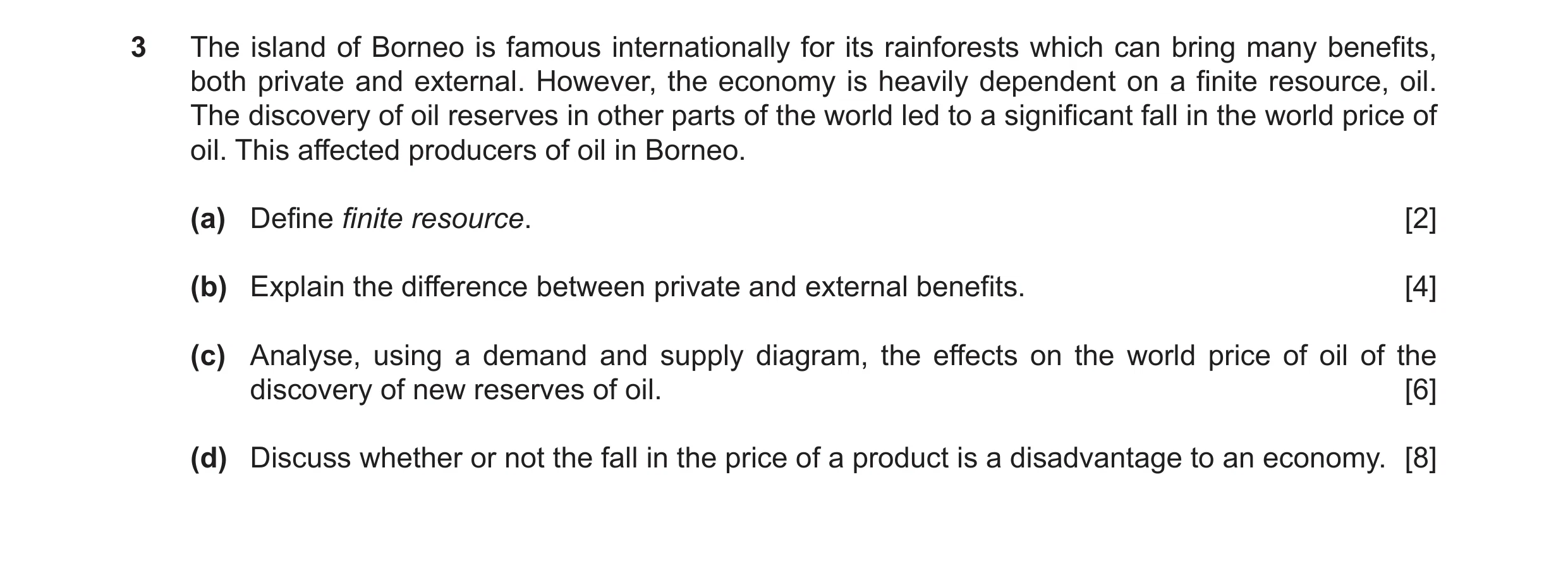
3 The island of Borneo is famous internationally for its rainforests which can bring many benefits, both private and external. However, the economy is heavily dependent on a finite resource, oil. The discovery of oil reserves in other parts of the world led to a significant fall in the world price of oil. This affected producers of oil in Borneo. (a) Define finite resource. [2] (b) Explain the difference between private and external benefits. [4] (c) Analyse, using a demand and supply diagram, the effects on the world price of oil of the discovery of new reserves of oil. [6] (d) Discuss whether or not the fall in the price of a product is a disadvantage to an economy. [8]
20 marks
Mark scheme: 3(a) Define finite resource. A resource is an aid to production (1) which is limited in supply (1) it cannot be replaced over time / fast enough / will run out (1) to keep pace with consumption (1). 2 No mark for an example 3(b) Explain the difference between private and external benefits. Logical explanation which might include: Private benefits are enjoyed by the producer (1) and consumer (1) first and second parties (1) of a product, example e.g. revenue for the producer / satisfaction for the consumer (1). External benefits are enjoyed by a third party (1) not directly involved in the production (1) or consumption process (1) example (1) 4 Maximum 3 marks for only explaining 1 type of benefit. 3(c) Analyse, using a demand and supply diagram, the effects on the world price of oil of the discovery of new reserves of oil. (6) Up to 4 marks for the diagram: Axes correctly labelled – price and quantity or P and Q (1). Original demand and supply curves correctly labelled (1). New supply curve shifted to the right (1). Equilibriums – shown by lines P1, P2 / Q1, Q2: or marking the equilibrium points E1 and E2 (1). Up to 2 marks for written comments: Discovery of new oil will enable an increase in supply (1) price will be lower (1). 6 Question Answer Marks Guidance 3(d) Discuss whether or not the fall in the price of a product is a disadvantage to an economy. In assessing each answer, use the table opposite. Why it might be a disadvantage: • It depends on size of fall in price and elasticity of demand for the product • It depends upon the importance of the product to the economy / how dependent on it • If demand is price inelastic, decrease in total revenue e.g. basic items / necessity, cannot cover the costs, firms may go out of business, less employment opportunities • Less profits, discourages investment, reduces economic growth • Less export revenue, may increase current account deficit • Fall in price may be due to cheaper imports, domestic firms lose out. • The product may be a demerit good which previously was overconsumed. • If the product is part of a deflationary situation, there could be recession / unemployment 8 Level Description Marks 3 A reasoned discussion which accurately examines both sides of the economic argument, making use of economic information and clear and logical analysis to evaluate economic issues and situations. One side of the argument may have more depth than the other, but overall both sided of the argument are considered and developed. There is thoughtful evaluation of economic concepts, terminology, information and/or data appropriate to the question. The discussion may also point out the possible uncertainties of alternative decisions and outcomes. 6–8 Question Answer Marks Guidance 3(d) Why it might not be a disadvantage: • Depends on size of fall and whether it is short or long term • If demand is elastic, increase in total revenue e.g. luxury goods / many substitutes • Increase choices and affordability of product – better living standards • Fall in the price of a raw material may lower cost of production, reducing inflation and increasing economic growth • The product may be a merit good which previously was under- consumed • It may make a basic necessity more affordable – low income groups may be better off • It may be the result of an increase in productivity / a government subsidy • It may make the product more internationally competitive, improving the current account position. Level Description Marks 2 A reasoned discussion which makes use of economic information and clear analysis to evaluate economic issues and situations. The answer may lack some depth and development may be one- sided. There is relevant use of economic concepts, terminology, information and data appropriate to the question. 3–5 1 There is a simple attempt at u sing economic definitions and terminology. Some reference may be made to economic theory, with occasional understanding. 1–2 0 A mark of zero should be awarded for no creditable content. 0
This question in 0455/21 Oct/Nov 2021
Q8 · Advances in technology have changed how trees (wood) are cut down, transported and used… 0455/22 Oct/Nov 2022
4 Advances in technology have changed how trees (wood) are cut down, transported and used in the manufacture of furniture, such as tables. Wood is in inelastic supply. Wood can be supplied in all economic systems. However, public goods are not supplied in a market economic system. (a) Define inelastic supply. [2] (b) Explain why public goods would not be supplied in a market economic system. [4] (c) Analyse, using a demand and supply diagram, the effect on the market for furniture of an increase in the price of wood. [6] (d) Discuss whether or not advances in technology will benefit a country’s population. [8]
20 marks
Mark scheme: 4(a) Define inelastic supply. 2 Allow one mark for PES = 0. Quantity supplied / supply changes by a smaller percentage change than price (2). Supply changing by less than price / PES less than 1 / PES < 1 / supply unresponsive to change in price (1). 4(b) Explain why public goods would not be supplied in a 4 No marks for examples. market economic system. Logical explanation which might include: Public goods are non-excludable (1) it is not possible to stop people who are not prepared to pay for them, from consuming them (1) free rider problem (1). Public goods are non-rival (1) if supplied for one, supplied for everyone and so cannot charge additional consumers (1). Private sector firms are profit motivated (1) they will not produce products if they cannot get revenue from them (1) would make a loss (1). 4(c) Analyse, using a demand and supply diagram, the 6 effect on the market for furniture of an increase in the price of wood. Coherent analysis which might include: Up to 4 marks for the diagram: D&S diagram: Axes correctly labelled – price and quantity or p and q (1). Original demand and supply curves correctly labelled (1). New supply curve shifted to the left (1). Equilibriums – shown by lines P1 and Q1 and P2 and Q2 or equilibrium points E1 and E2 (1). Up to 2 marks for coherent analysis which might include: Would increase costs of production (1) raise price / reduce Accept increase in price or fall in quantity on their own but quantity (traded) (1). not an increase in price of wood or fall in quantity of wood. 4(d) Discuss whether or not advances in technology will 8 Level Description Marks benefit a country’s population. 3 A reasoned discussion which 6–8 In assessing each answer, use the table opposite. accurately examines both sides of the economic argument, making use of Why it might: economic information and clear and • may reduce costs of production logical analysis to evaluate economic • may increase significance of technical economies of issues and situations. One side of the argument may have more depth than scale the other, but overall both sided of the • may lower prices argument are considered and • may make the country’s firms more internationally developed. There is thoughtful competitive evaluation of economic concepts, • may promote globalisation terminology, information and/or data • may encourage firms to expand and take on more appropriate to the question. The workers discussion may also point out the • economic growth may increase incomes possible uncertainties of alternative • may increase quality – less subject to human error decisions and outcomes. • may create new products • may improve working conditions 2 A reasoned discussion which makes 3–5 • may extend education through online learning. use of economic information and clear analysis to evaluate economic issues and situations. The answer may lack Why it might not: some depth and development may be • may increase unemployment one-sided. There is relevant use of • may make products more standardised / not produced economic concepts, terminology, to individual needs information and data appropriate to • may increase stress the question. • may be over dependence on technology which can fail • may increase fraud 1 There is a simple attempt at using 1–2 • may cause negative externalities e.g. fracking. economic definitions and terminology. Some reference may be made to economic theory, with occasional understanding. 0 A mark of zero should be awarded for 0 no creditable content.
This question in 0455/22 Oct/Nov 2022
Q9 · Calculate the price elasticity of demand for coffee 0455/21 May/June 2024
1 (a) Calculate the price elasticity of demand for coffee. [1] (b) Identify two rewards to factors of production in Nicaragua. [2] (c) Explain one way in which unemployment is measured. [2] (d) Explain two functions of money in Nicaragua. [4] (e) Analyse the relationship between the percentage of the labour force employed in agriculture and GDP per head. [4] (f) Analyse, using a demand and supply diagram, how a drought could affect the market for coffee. [5] (g) Discuss whether or not small firms benefit Nicaraguan consumers. [6] (h) Discuss whether or not Nicaragua should devote more of its resources to coffee production. [6]
30 marks
Mark scheme: 1(a) Calculate the price elasticity of demand for coffee. () 0.3 (1) 1(b) Identify two rewards to factors of production in Nicaragua. Wages (1) profits (1) 2 Only accept these answers if within the first three listed. 1(c) Explain one way in which unemployment is measured. Claimant count (1) based on workers claiming unemployment benefits (1). OR Labour force survey (1) asking people if they are out of work and looking for employment (1). 2 One mark for a way identified and one mark for an explanation. 1(d) Explain two functions of money in Nicaragua. Medium of exchange (1) used to buy and sell products / used to trade (1). Store of value (1) used to save / keeps its value over a period of time (1). 4 One mark each for each of two functions identified and one mark for each of two explanations. Only accept these answers if within the first three listed. Question Answer Mark Guidance 1(e) Analyse the relationship between the percentage of the labour force employed in agriculture and GDP per head. Coherent analysis which might include: Relationship: Inverse or negative relationship / move in opposite directions (1). Countries with a high percentage of their labour force employed in agriculture tend to have a low GDP per head (1). Supporting evidence: The four countries with the lowest % of the labour force employed in agriculture had the highest GDP per head (1) Specific reference to one or more countries e.g. Bahamas had the lowest % employed in agriculture and the highest GDP per head (1). Use of GDP per head data to show comparison between country with high employment in agriculture and one with low percentage employment in agriculture (1). Analysis of expected relationship: Wages may be low in agriculture (1) wages / value added tends to be higher in the secondary and / or tertiary sector (1). Exception: Nicaragua / Dominica (1) Nicaragua has the second highest % of labour force employed in agriculture but the lowest GDP per head / Dominica had the highest % of labour force employed in agriculture but the second to lowest GDP (1). Analysis of exception: Explanation of another influence on GDP per head (1). 4 Responses do not have to be in the format suggested but they should address the expected/normal relationship, offer supporting evidence of that, highlight any exceptions to that, and analyse the overall data. Note the four are: Bahamas Barbados Costa Rica Saint Lucia Question Answer Mark Guidance 1(f) Analyse, using a demand and supply diagram, how a drought could affect the market for coffee. Coherent analysis which might include: D&S diagram: Axes correctly labelled – price and quantity or p and q (1). Original demand and supply curves correctly labelled (1). New supply curve shifted to the left (1). Equilibriums – shown by lines P1 and Q1 and P2 and Q2 or equilibrium points marked as E1 and E2 (1). Written analysis: A drought will lead to a shortage / will increase costs of production (1). OR The lower supply will push up price / reduce quantity (traded) (1). 5 Question Answer Mark Guidance 1(g) Discuss whether or not small firms benefit Nicaraguan consumers. Award up to 4 marks for logical reasons why they might, which may include: know customers’ requirements (1) provide a personal service / see them often (1) may be flexible (1) may be many small firms / competitive markets (1) prices may be low (1) quality may be high (1) may offer wider choice collectively than a few large firms (1) may provide products for which there is only a low demand (1) niche market (1) makes goods more accessible in rural areas (1). Award up to 4 marks for logical reasons why it might not, which may include: may not be able to take advantage of economies of scale (1) examples (1) higher average cost of production (1) higher price (1) small firms may have lower profits (1) may limit investment / funds available (1) fail to raise quality (1) may limit choice (1) individual small firms may have a limited range of products (1) cannot provide all that consumers may want (1). 6 Apply this example to all questions with the command word DISCUSS 1(g), 1(h), 2(d), 3(d), 4(d) and 5(d) Each point may be credited only once, on either side of an argument, but separate development as to how/why the outcome may differ is rewarded. Generic example Mark Tax revenue may decrease… 1 ...because of reason e.g. incomes may be lower. 1 Tax revenue may increase because incomes may be higher i.e. reverse of a previous argument. 0 Tax revenue may increase because of a different reason i.e. not the reverse of a previous argument e.g. government spending on subsidies may stimulate the economy more than spending on education. 1 Only reward reference to quality or prices once. Question Answer Mark Guidance 1(h) Discuss whether or not Nicaragua should devote more of its resources to coffee production. Award up to 4 marks for logical reasons why it should, which may include: global demand for coffee is increasing (1) demand for coffee is price inelastic (1) revenue / profits may increase (1) more tax revenue for government (1) firms grow in size (1) greater specialisation / economies of scale may reduce average costs (1) raise quality (1) increase profits (1) more competitive (1) exports may increase (1) improve the current account of its balance of payments (1) lead to economic growth/higher standard of living (1) may lead to more job opportunities (1) less poverty / less government payments to unemployed (1) already twelfth biggest world producer (1) growth will give them more monopoly power (1) more power to raise price of coffee (1). Award up to 4 marks for logical reasons why it should not, which may include: other countries produce coffee (1) these may be more competitive (1) output may be affected by changes in weather (1) natural disasters (1) overproduction can exhaust land (1) leading to lower yields in future (1) opportunity cost (1) resources could be used to produce other products (1) example (1) coffee workers only receive low pay (1) world market for coffee may fall / demand is unpredictable (1) resulting in surplus capacity / wasted resources (1) bmore dependent on other countries for imports of other (agricultural) products (1) firms may suffer from diseconomies of scale (1) reduce profits (1). 6 Do not expect, but reward reference to absolute or comparative advantage.
This question in 0455/21 May/June 2024
Q10 · Calculate the number of people who are in poverty in Egypt 0455/23 May/June 2025
1 (a) Calculate the number of people who are in poverty in Egypt. [1] (b) Identify two of Egypt’s primary sector exports. [2] (c) Explain how building a new city can reduce unemployment. [2] (d) Explain why tourism is a good source of economic growth for Egypt. [4] (e) Draw a demand and supply diagram to show the likely effect of falling incomes on the market for housing in the new city. [4] (f) Analyse the relationship between investment (as a % of GDP) and economic growth rates for Egypt. [5] (g) Discuss whether or not deregulation in education in Egypt will increase living standards. [6] (h) Discuss whether or not a fall in the value of the Egyptian currency would harm the Egyptian economy. [6]
30 marks
Mark scheme: Question Answer Mark Guidance 1(a) Calculate the number of people who are in poverty in 1 30 690 000 Egypt. Accept 30.7 million. 30.69 million 1(b) Identify two of Egypt’s primary sector exports. 2 Accept any two Two from: oil (1), citrus fruits (1), gold (1) 1(c) Explain how building a new city can reduce 2 Only one mark if not linked to building. unemployment. Building a new city requires labour / creates job opportunities / increases demand for labour (1) to work in construction / build new buildings (1). 1(d) Explain why tourism is a good source of economic 4 Award a maximum of 2 marks for just identification of points growth for Egypt. without explanation. Logical explanation which might include: Egypt has many ancient / human-made attractions and buildings (1) not found in many parts of the world / that tourists want to visit (1) creating more employment / tax revenue (1). Egypt has natural attractions, such as beautiful beaches / warm climate / good weather (1) these attract tourists / low government spending required / low investments required (1). Egypt has good infrastructure (1) this can attract tourists as its easier to travel to the country or attractions / can attract investors with lower cost of production (1). Egypt has good security (1) tourists feel safe / investors are confident in the security of their investments (1). Egypt has experienced a fall its currency value (1) making holidays more affordable (1). 1(e) Draw a demand and supply diagram to show the likely 4 effect of falling incomes on the market for housing in the new city. D&S diagram: Axes correctly labelled – price and quantity or p and q (1). Original demand and supply curves correctly labelled (1). New demand curve shifted to the left (1). Equilibriums – shown by lines P1 and Q1 and P2 and Q2 or equilibrium points marked as E1 and E2 (1). 1(f) Analyse the relationship between investment (as a % of 5 Responses do not have to be in the format suggested but GDP) and economic growth rates for Egypt. they should address the expected / normal relationship, offer supporting evidence of that, highlight any exceptions to that, Coherent analysis which might include: and analyse the overall data. Expected relationship: Positive / direct (1) higher / lower investment should lead to higher / lower economic growth rates (1). Supporting evidence: From 2017–2019, Investment rising and economic growth also rising (1) From 2019–2020, investment falling and economic growth also falling (1). Analysis: Higher investment leads to higher economic growth due to higher total demand / investment is a component of total demand (1) and increased productivity / lower cost of production (1). Exception: identification of an exception 2015–2017 or 2020–21 (1), 2015–2017, investment rising but economic growth falling slightly / relatively stable / largely unchanged (1), 2020–2021, investment falling but economic growth rate rising (1). Analysis of the exception: Current investment increase now could lead to a delayed response in economic growth rates (1) data shows percentage not total investment (1). 1(g) Discuss whether or not deregulation in education in 6 Answers not referring to education, max 3 marks. Egypt will increase living standards. Apply this example to all questions with the command Award up to 4 marks for logical reasons why it might, which word DISCUSS may include: (1(g), 1(h), 2(d), 3(d), 4(d) and 5(d)) • deregulation has led to an increased number of schools / universities in Egypt (1) may increase competition Each point may be credited only once, on either side of an between private schools / universities (1) may lower argument, but separate development as to how/why the fees (1) raise quality (1) outcome may differ is rewarded. • more people have opportunities for education and training (1) making people more educated / skilled / Generic example mark qualified / literate / productive (1) easier to find jobs (1) earn an income (1) increasing affordability of goods and Tax revenue may decrease 1 services (1) more educated people tend to enjoy better health / spend more on healthcare (1) longer life because of reason e.g. incomes may be lower. 1 expectancy (1) increase HDI (1) • more school buildings will increase employment (1) of Tax revenue may increase because incomes 0 builders (1) teachers (1) may be higher i.e. reverse of a previous • may reduce government spending on education (1) argument. allowing the government to spend more on items that could increase living standards e.g. healthcare (1). Tax revenue may increase because of a different 1 reason i.e. not the reverse of a previous Award up to 4 marks for logical reasons why it might not: argument e.g. government spending on • opening more private schools and universities in Egypt subsidies may stimulate the economy more than might increase the level of inequality (1) as private spending on education. education remains unaffordable to lower income groups (1) restricting their employment opportunities (1) as private education is usually more expensive than state- provided education (1) • standards of living only improve for those from higher income groups (1) lower income groups remain in relative poverty (1) widen gap between rich and poor / increase relative poverty (1) • private schools and universities may prioritise profits (1) over the quality / standards of education provided (1). 1(h) Discuss whether or not a fall in the value of the 6 One mark for identifying increase or decrease in investment. Egyptian currency would harm the Egyptian economy. Award up to 4 marks for logical reasons why it might, which may include: • fall in the value of the Egyptian currency may cause cost push (1) inflation (1) reducing the purchasing power of Egyptians (1) as imported goods become more expensive (1) standards of living could decrease (1) • cost of production could increase (1) increasing the price of domestically produced goods (1) some firms may try to cut cost by reducing jobs (1) increase unemployment (1) • may create uncertainty / reduce confidence (1) discourage investment (1). Award up to 4 marks for logical reasons why it might not, which may include: • Egyptian exports become cheaper (1) increasing demand for exports / increasing revenues of domestic producers / incomes (1) causing economic growth (1) demand may switch from imports to domestically produced products (1) may reduce current account deficit (1) • industries such as the tourism industry may benefit (1) as holidays in Egypt become more affordable for non- Egyptians (1) • workers also have more job opportunities (1) since there is more demand for domestically produced goods and services (1) • may increase investment / hot money flows (1) reduced cost to set up an MNC / may expect profit if currency value rises later (1).
This question in 0455/23 May/June 2025
Q11 · A Swiss multinational food manufacturer increased prices for its products by an average… 0455/23 Oct/Nov 2025
2 A Swiss multinational food manufacturer increased prices for its products by an average of 8% in 2022. It increased its prices in the USA by 11.6%. This multinational company (MNC) is one of the world’s oldest MNCs. It started as a small firm but has grown over the last 160 years. Over this period, its decisions have always been influenced by opportunity cost. (a) Define multinational company. [2] (b) Explain two reasons why a firm may charge a different price for the same product in two different countries. [4] (c) Analyse how opportunity cost influences the decisions made by consumers, workers and producers. [6] (d) Discuss whether or not consumers would benefit from an increase in the number of small firms in an industry. [8]
20 marks
Mark scheme: 2(a) Define multinational company. 2 No mark for an example of an MNC. A firm that is based / has its headquarters in one country (1). Operates / produces / sets up / works (1) in another country or countries (1). 2(b) Explain two reasons why a firm may charge a different 4 One mark each for two reasons identified and one mark price for the same product in two different countries. each for two explanations. Logical explanation which might include: If more than two reasons are given, consider the first three. • demand may be higher / lower in one country (1) Note: There will be other relevant reasons. To get the resulting in higher / lower prices (1) development mark there must be a justification of why that • supply maybe higher / lower in one country (1) resulting factor will affect prices. in lower prices (1) • higher income / GNP per head in one country (1) means Do not accept answers based on foreign exchange rate. more able to afford to pay higher price (1) • price elasticity of demand may vary (1) more power to raise price where demand is inelastic (1) • greater competition in one country / more substitutes (1) leads to lower prices to be competitive (1) • indirect tax rates may vary e.g. higher GST / VAT / import tariffs (1) will lead to higher price (1) • government subsidies may be given in some countries (1) lowering price (1) • local material costs / wages may be lower in one country (1) lowering costs of production mean lower prices (1) • different transport costs (1) may be cheaper to transport to countries close by (1) • quality of good may be higher (1) enable firm to charge a higher price (1). 2(c) Analyse how opportunity cost influences the decisions 6 Maximum of 4 marks if candidates do not cover at least two made by consumers, workers and producers. out of consumers / workers / producers. Coherent analysis which might include: • opportunity cost is the (next) best alternative (1) forgone / given up (1) • example of consumers e.g. must decide between buying different products (1) due to limited income (1) • example of workers e.g. must decide between different jobs or between work and leisure (1) as time is limited (1) • example of producers / firms e.g. must decide what to make / how to make it / where to locate (1) as they have limited (financial) resources (1). 2(d) Discuss whether or not consumers would benefit from 8 Level Description Marks an increase in the number of small firms in an industry. 3 A reasoned discussion which accurately 6–8 In assessing each answer, use the table opposite. examines both sides of the economic argument, making use of economic Why they might: information and clear and logical analysis • more competition, lower price, higher quality to evaluate economic issues and • small firms may provide a more personal service situations. One side of the argument may • may produce niche products have more depth than the other, but • may be more flexible / react quickly to consumer needs overall, both sides of the argument are • may introduce new ideas / new varieties of products considered and developed. • may be easier access – consumers may not have to travel so far. There is thoughtful evaluation of economic concepts, terminology, Why they might not: information and/or data appropriate to • may be wasteful duplication the question. The discussion may also • may waste consumers time with too much information to point out the possible uncertainties of process alternative decisions and outcomes. • may have higher costs as unable to take advantage of economies of scale 2 A reasoned discussion which makes use 3–5 • may reduce profits of larger firms, reducing their of economic information and clear spending on research and development analysis to evaluate economic issues • may not stay in business for long. and situations. The answer may lack some depth and development may be one-sided. There is relevant use of economic concepts, terminology, information and data appropriate to the question. 2(d) Level Description Marks 1 There is a simple attempt at using 1–2 economic definitions and terminology. Some reference may be made to economic theory, with occasional understanding. 0 A mark of zero should be awarded for no 0 creditable content. L1 and up to 2 marks for an understanding of consumers, small firms or industry.
This question in 0455/23 Oct/Nov 2025
 2 / 6
2 / 6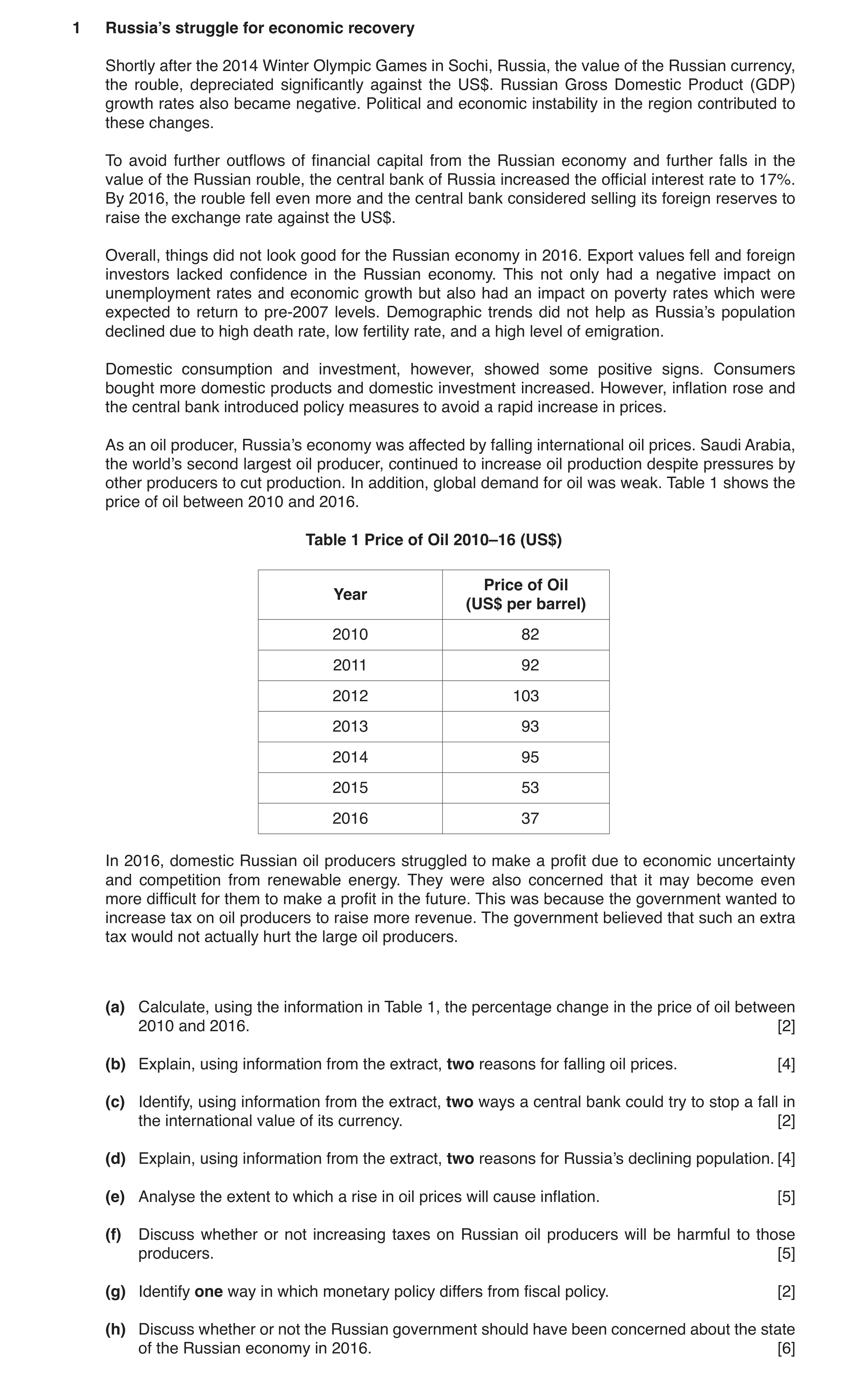
 3 / 6
3 / 6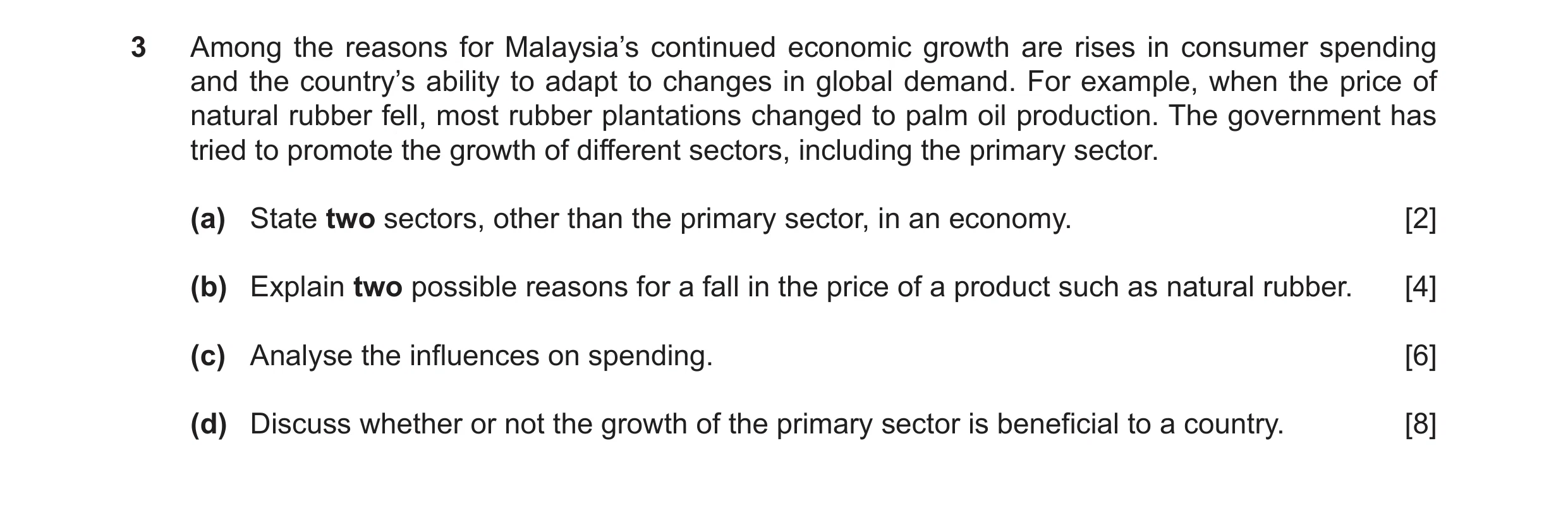
![Question 6: (a) Calculate the number of Germans aged over 65 in 2017. [1] (b) Identify two measures of living standards. [2] (c) Explain one cause of g…](https://img.pastlit.com/crops/4285558b-8258-4228-a407-9d8cc03545cd/q1.webp)
 4 / 6
4 / 6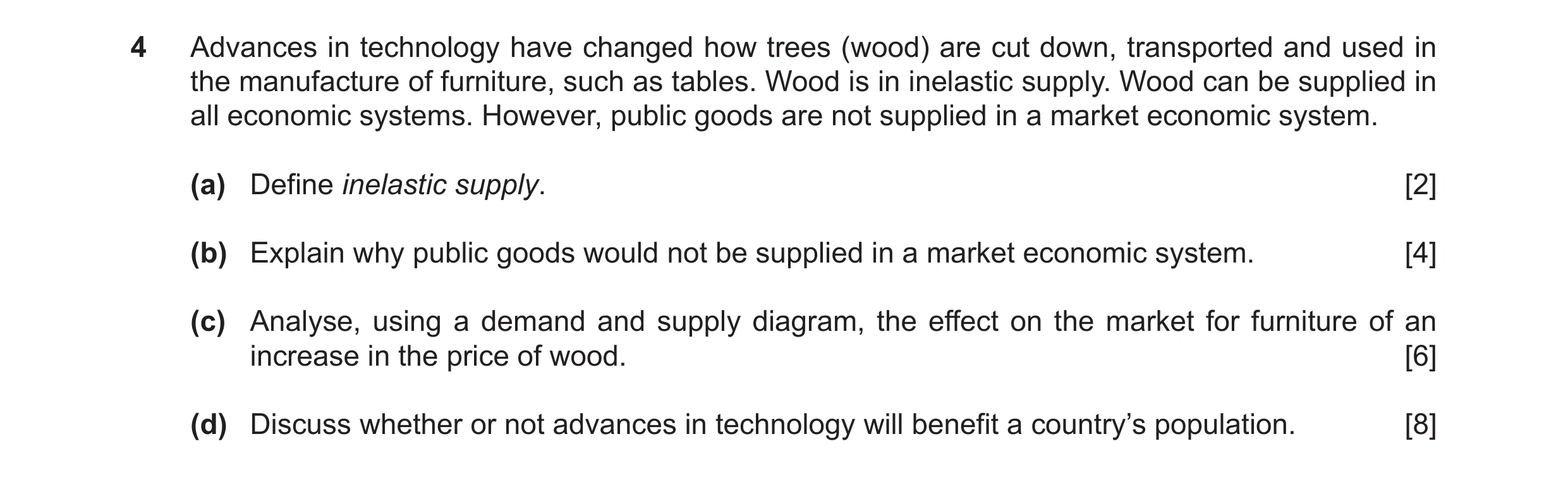
![Question 9: (a) Calculate the price elasticity of demand for coffee. [1] (b) Identify two rewards to factors of production in Nicaragua. [2] (c) Explai…](https://img.pastlit.com/crops/cc53b0b9-ab3e-45e2-9ca1-51e8e106e99b/q1.webp)
![Question 10: (a) Calculate the number of people who are in poverty in Egypt. [1] (b) Identify two of Egypt’s primary sector exports. [2] (c) Explain how…](https://img.pastlit.com/crops/f345e47f-9ea3-4d9e-a01f-8a2b5580df46/q1.webp) 5 / 6
5 / 6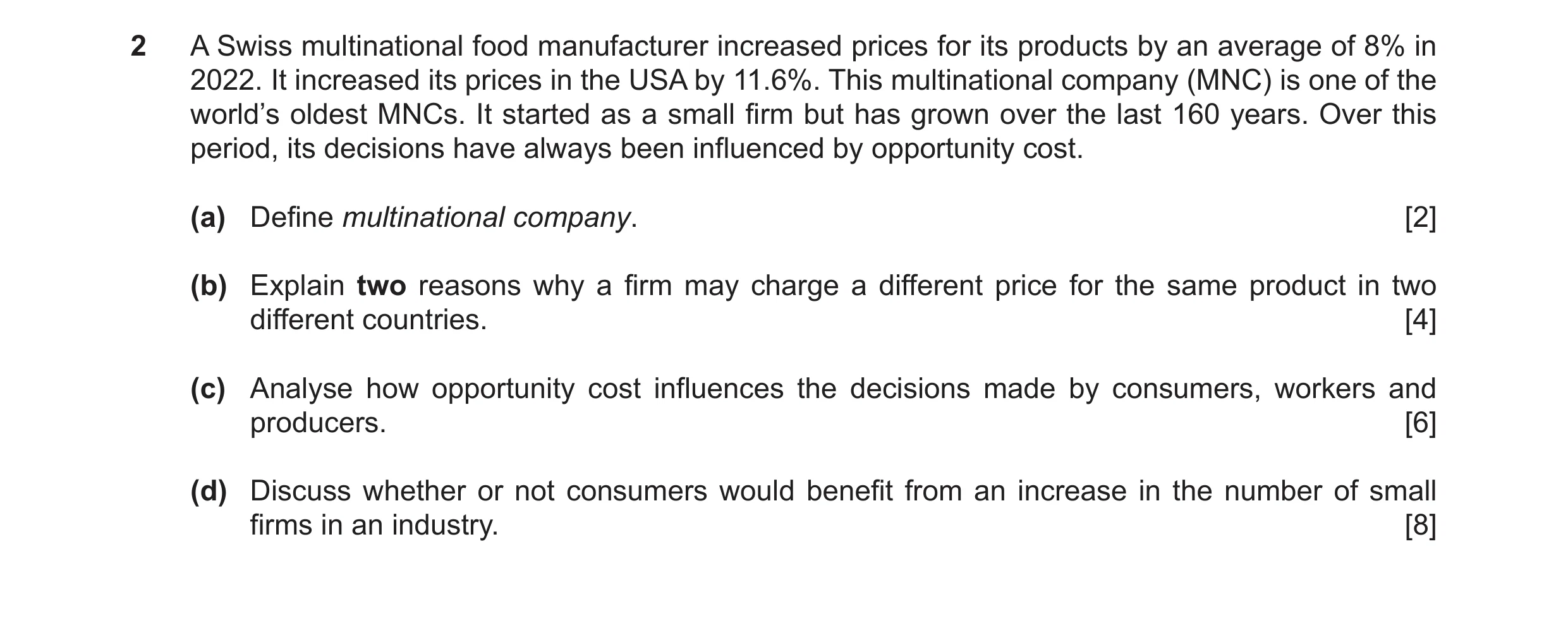 6 / 6
6 / 6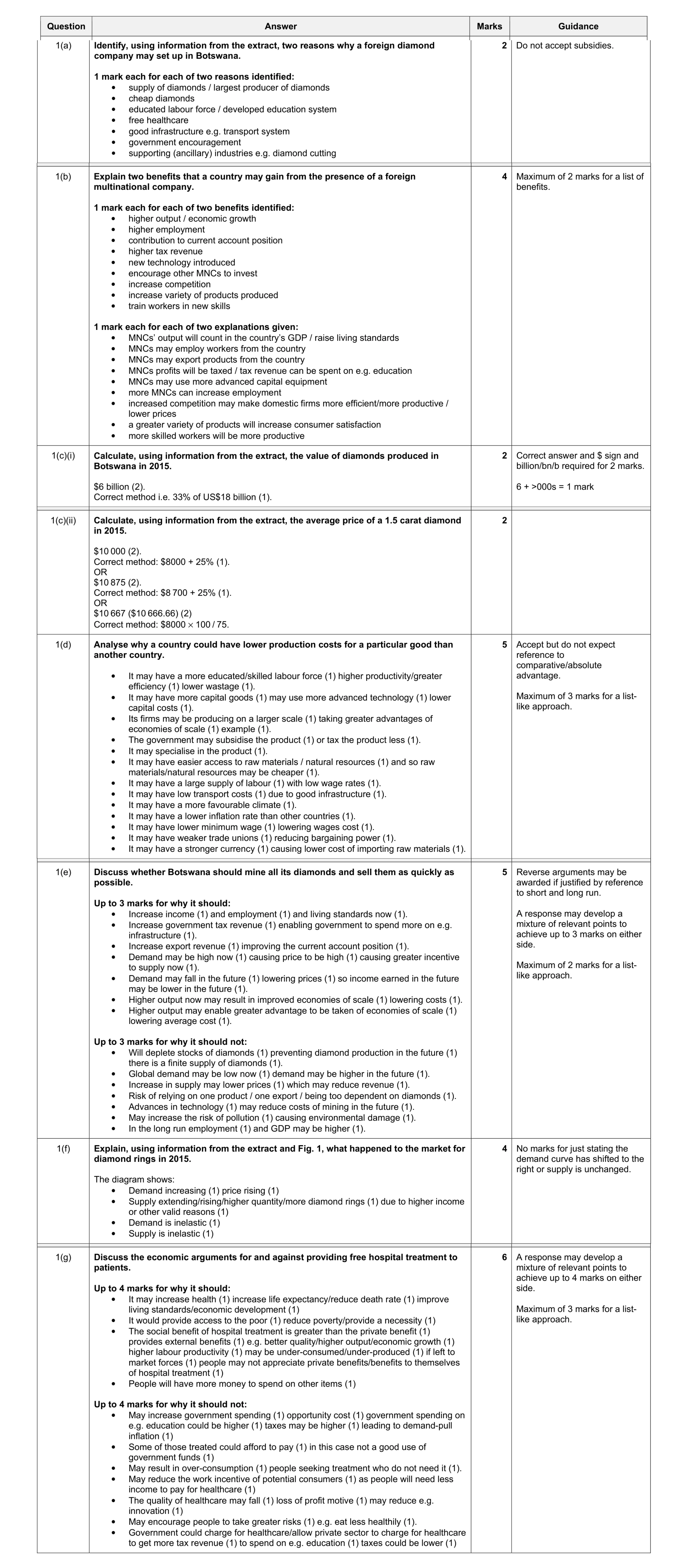 30
30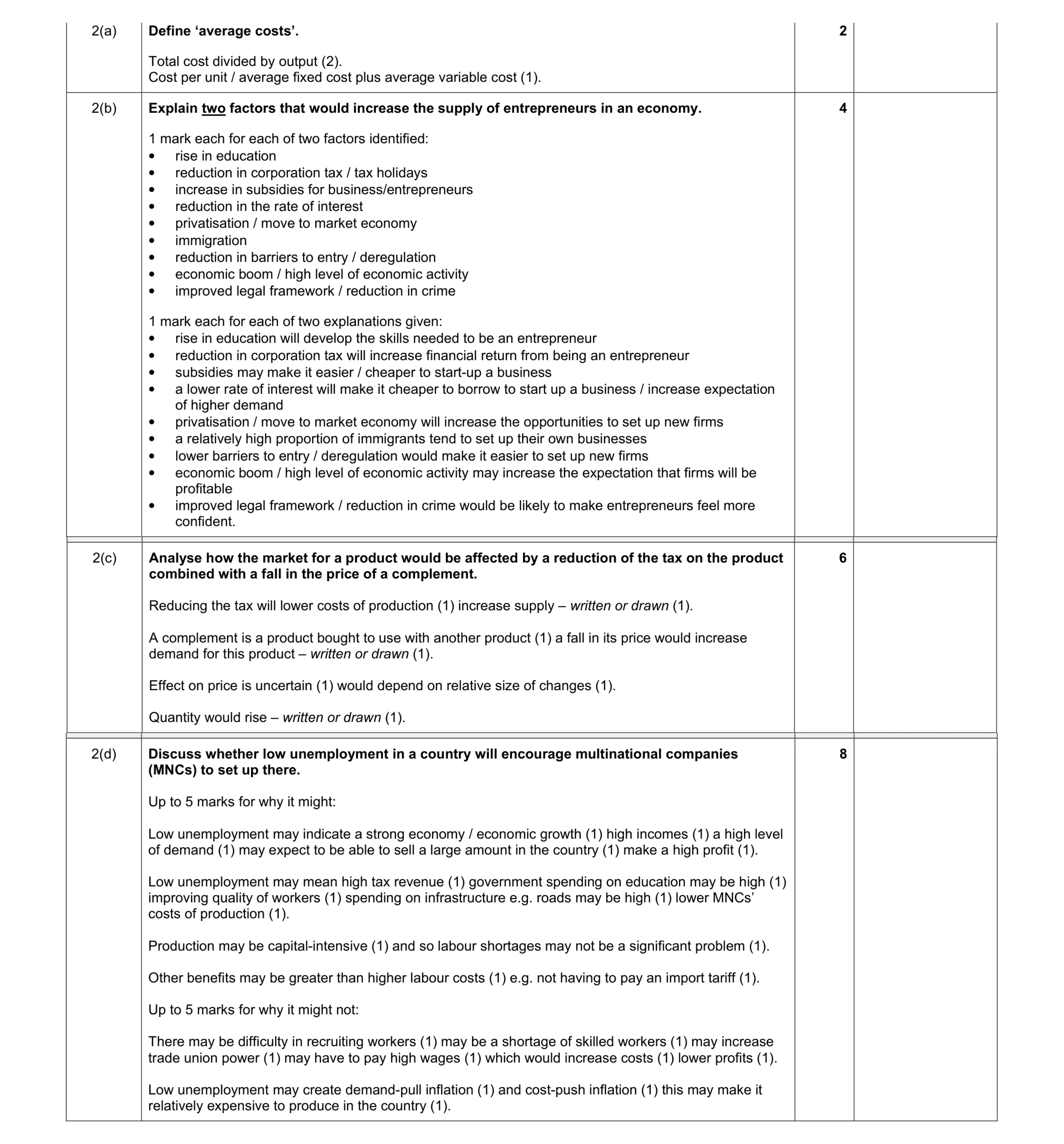 20
20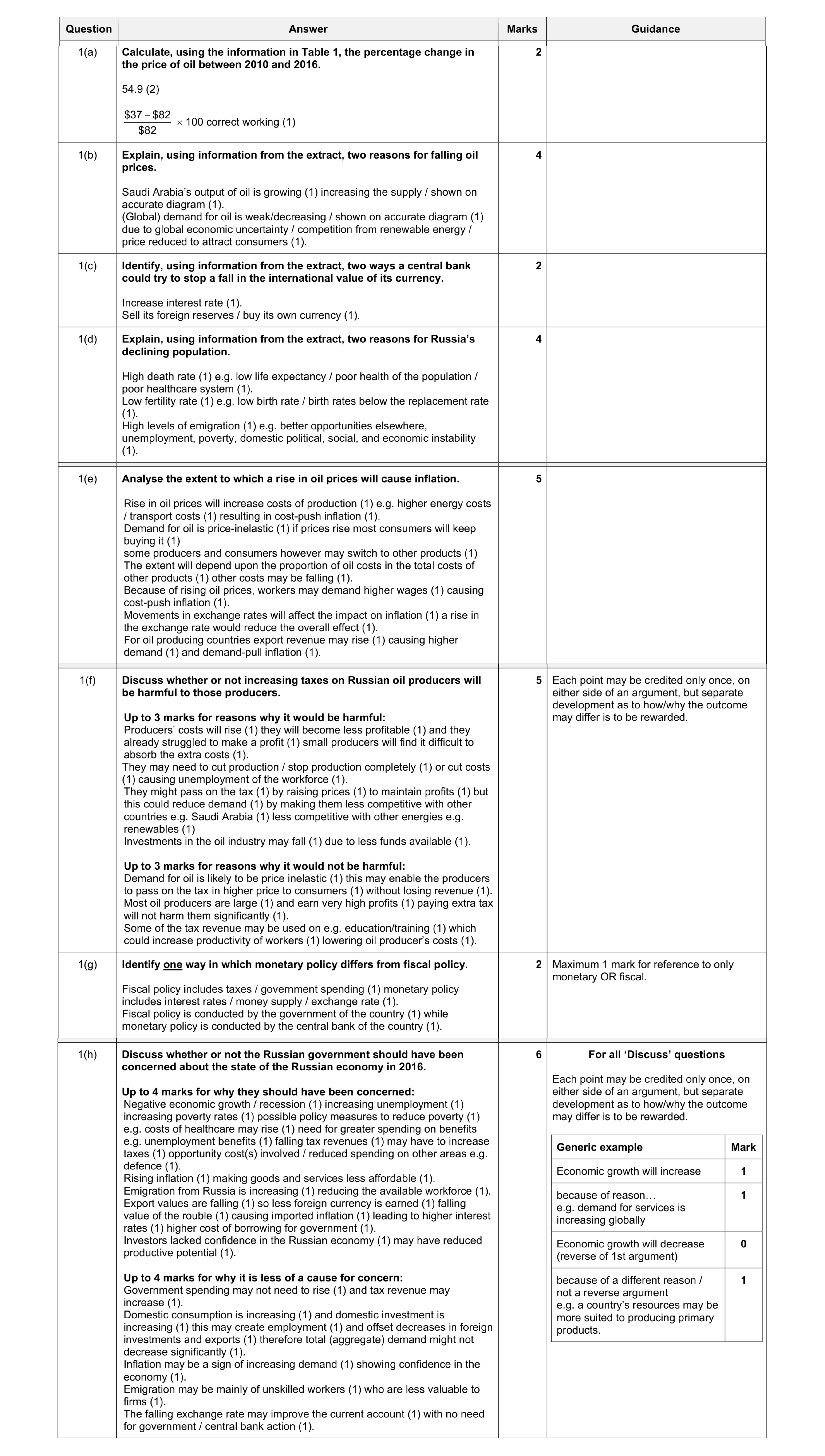 30
30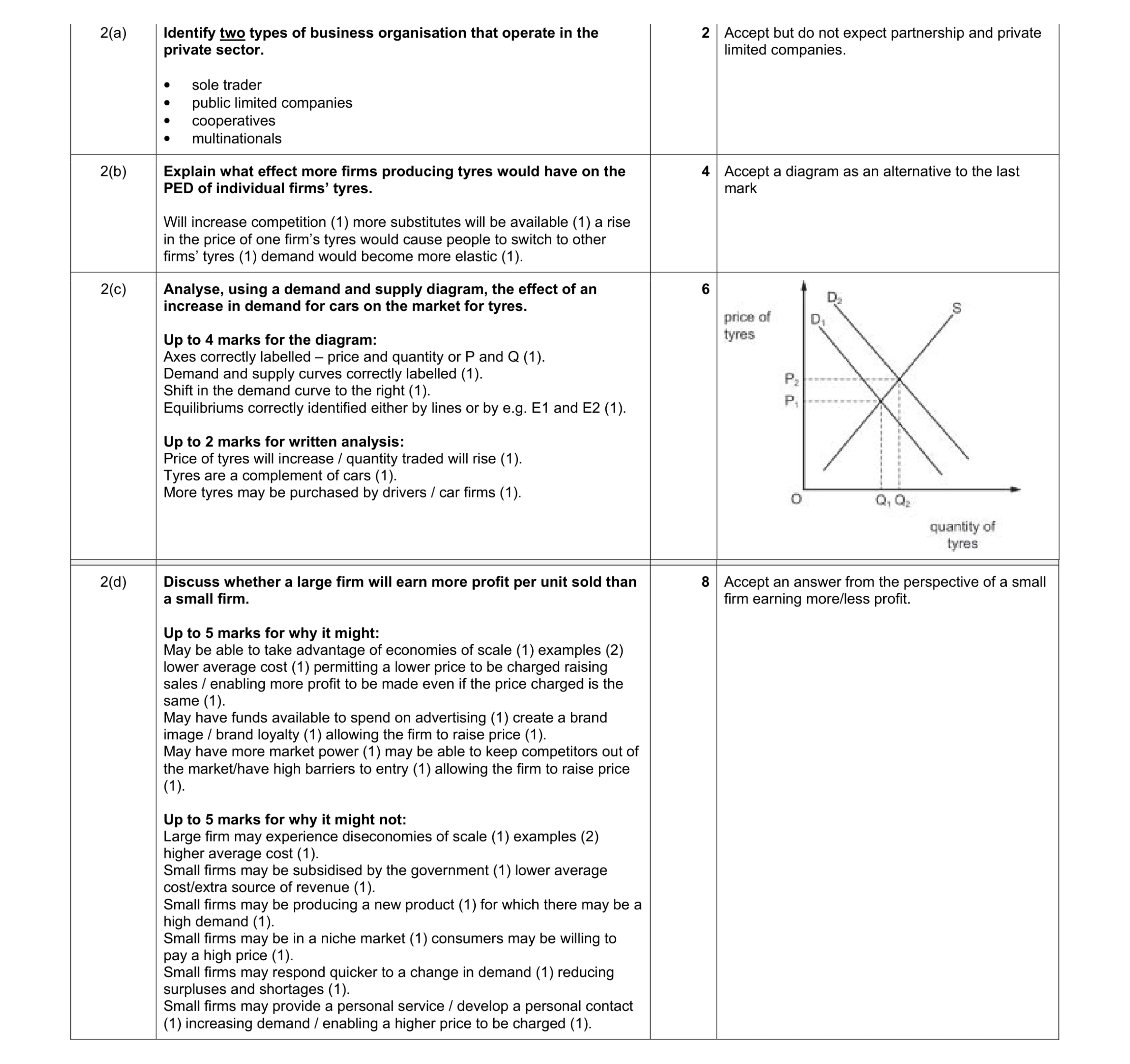 20
20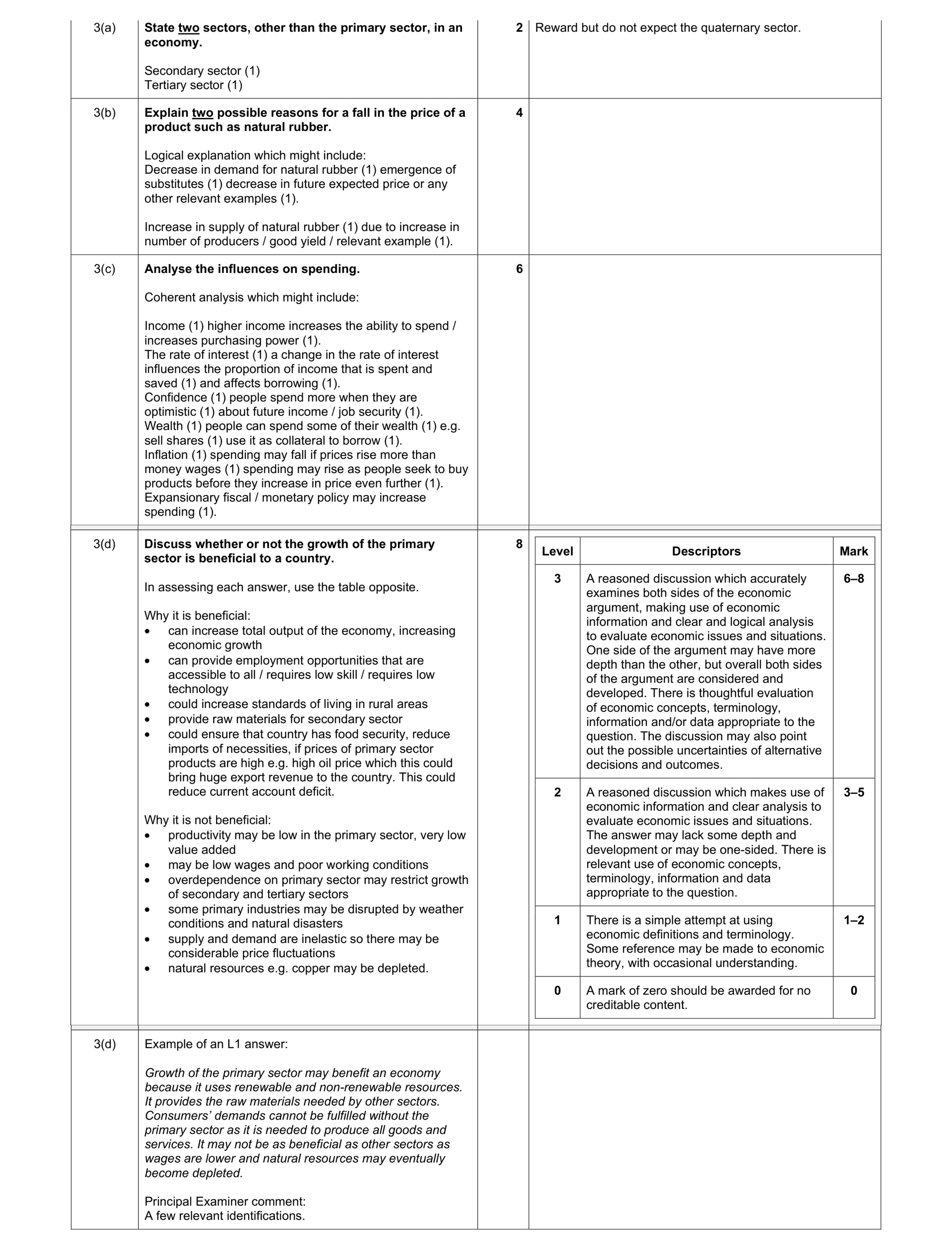 20
20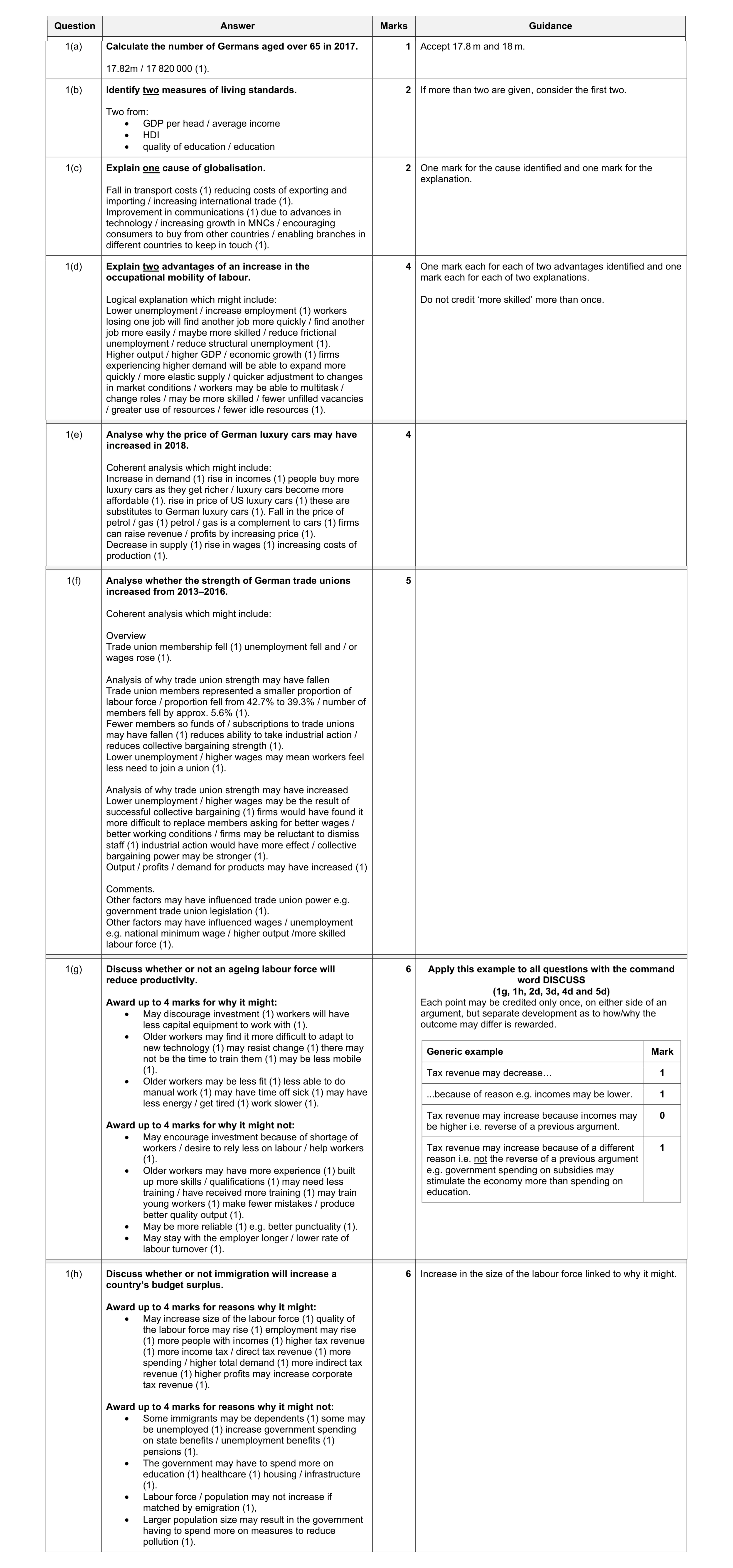 30
30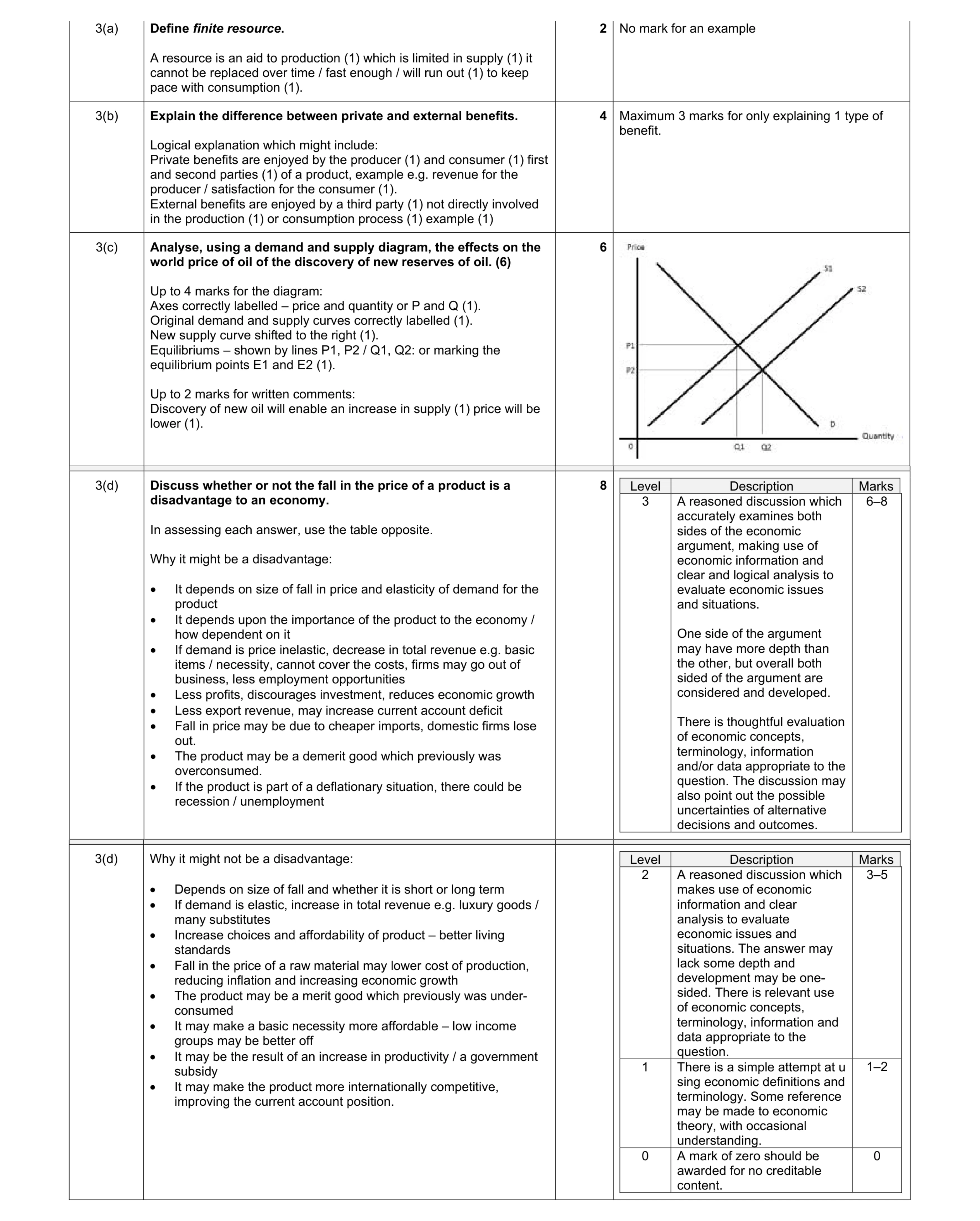 20
20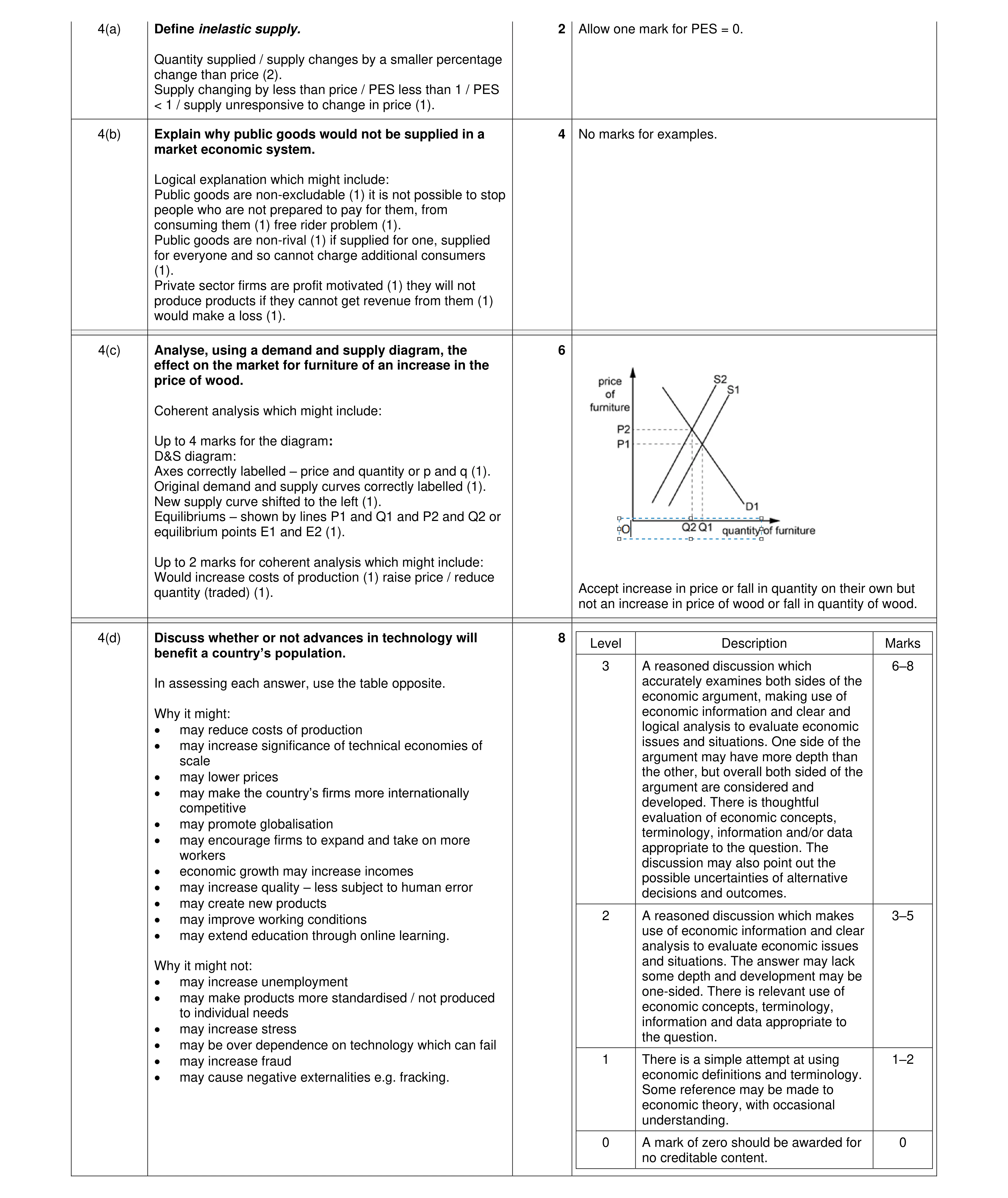 20
20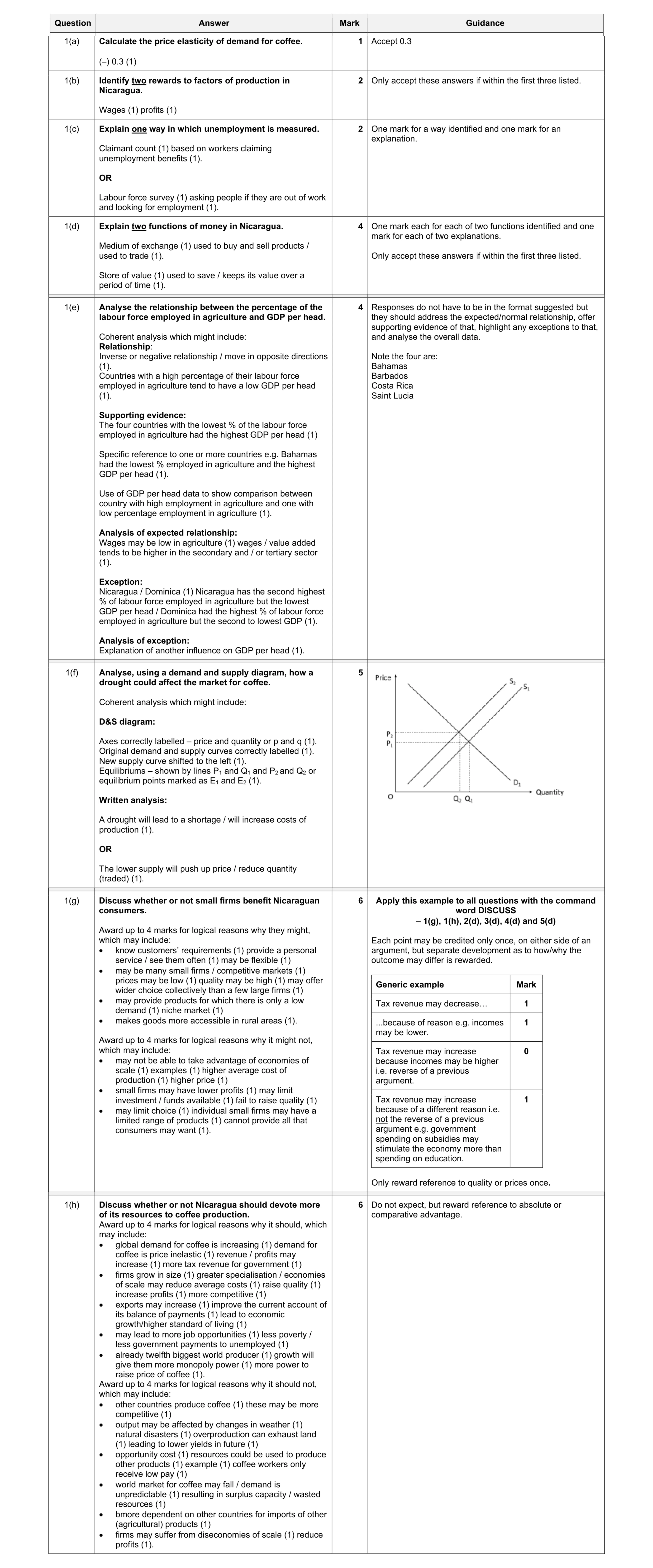 30
30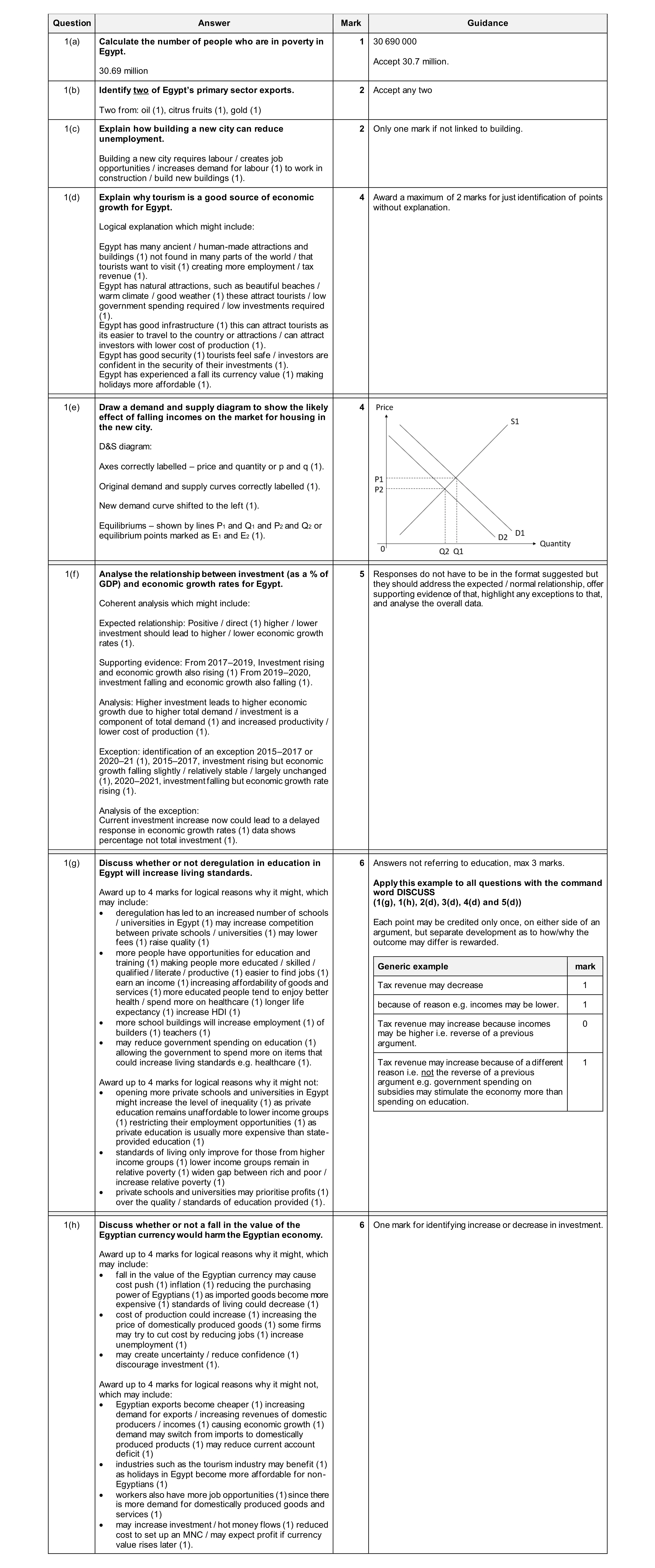 30
30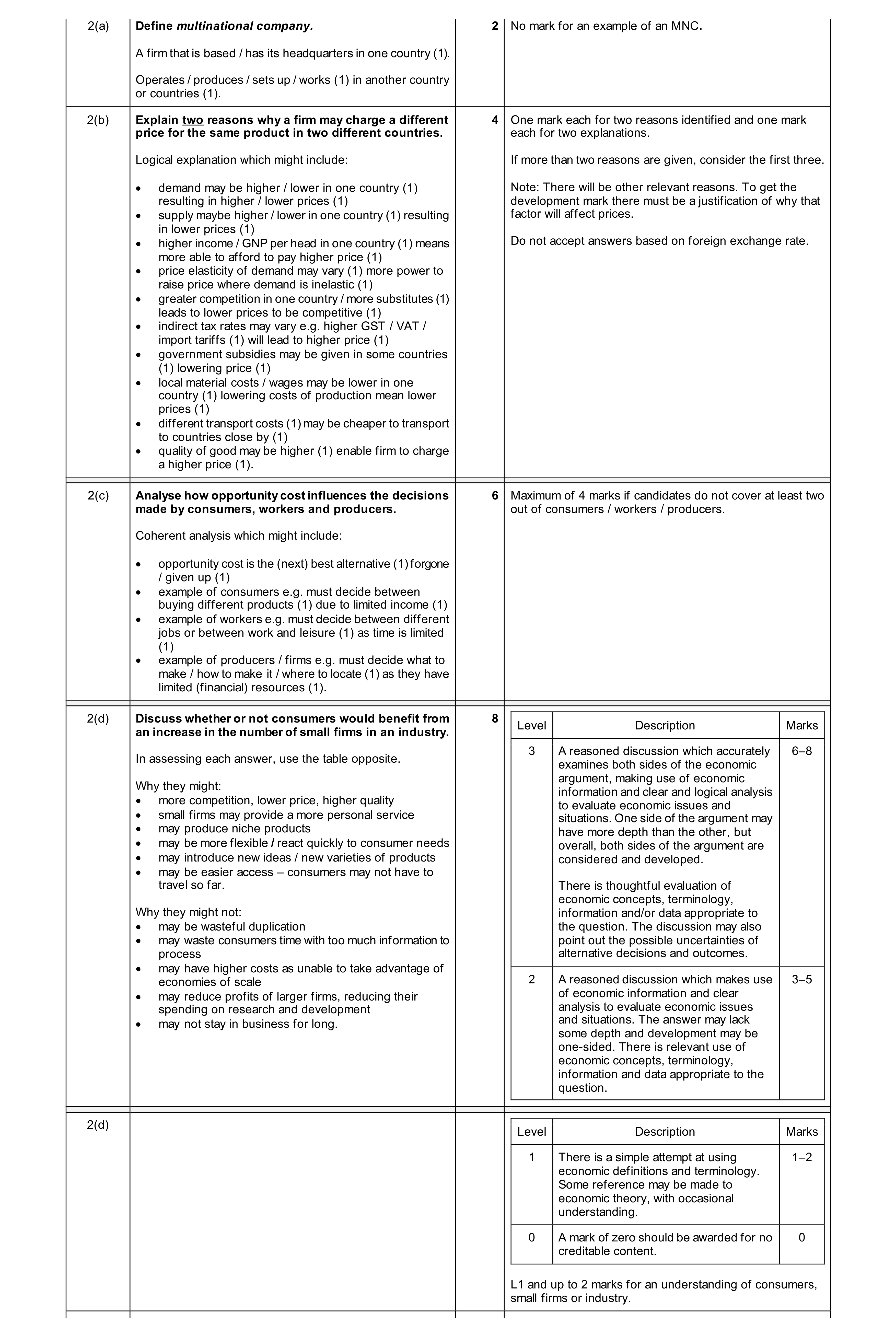 20
20