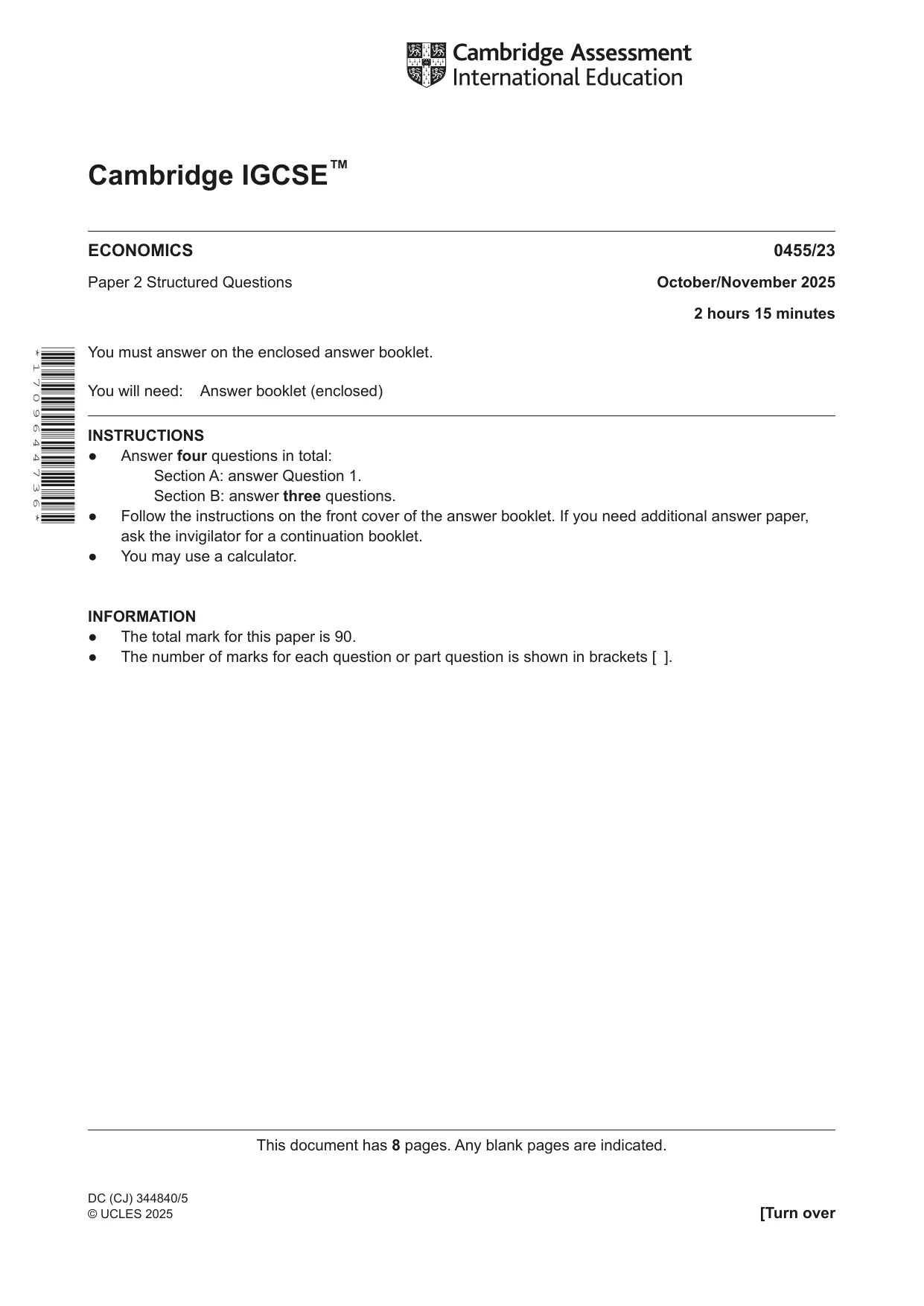
Cambridge IGCSE Economics 0455 — 2025 Oct/Nov Paper 2 · Variant 3
0455/23/O/N/25 · 5 questions · 90 marks · ≈101 min
The question paper and its mark scheme, free to read here and free to download. This is Cambridge’s own paper, exactly as it was sat.
Question paper8 pages




Mark scheme29 pages
Answers below. Sit the paper first if you are practising.
Questions as text
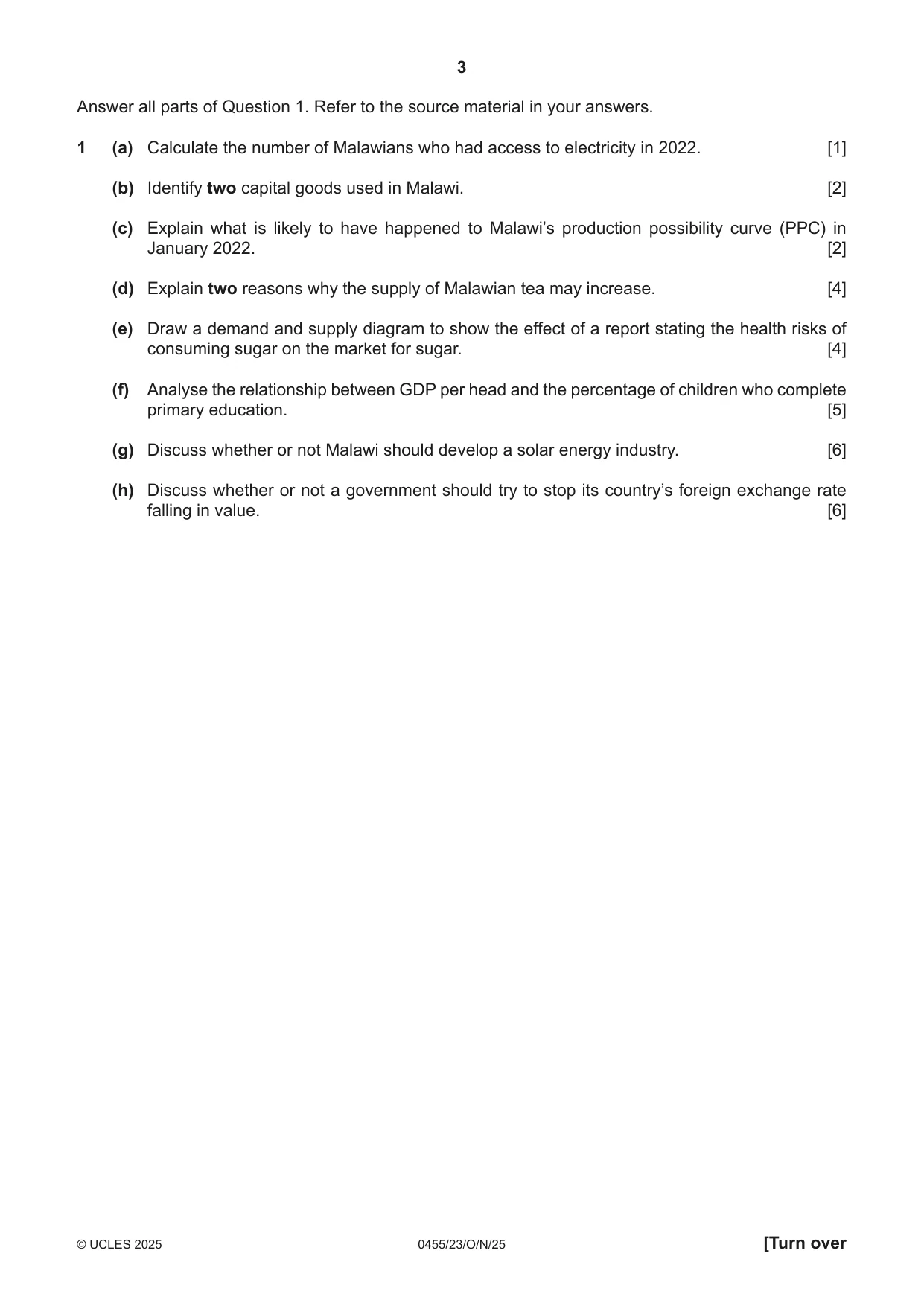
Q1 · Calculate the number of Malawians who had access to electricity in 2022
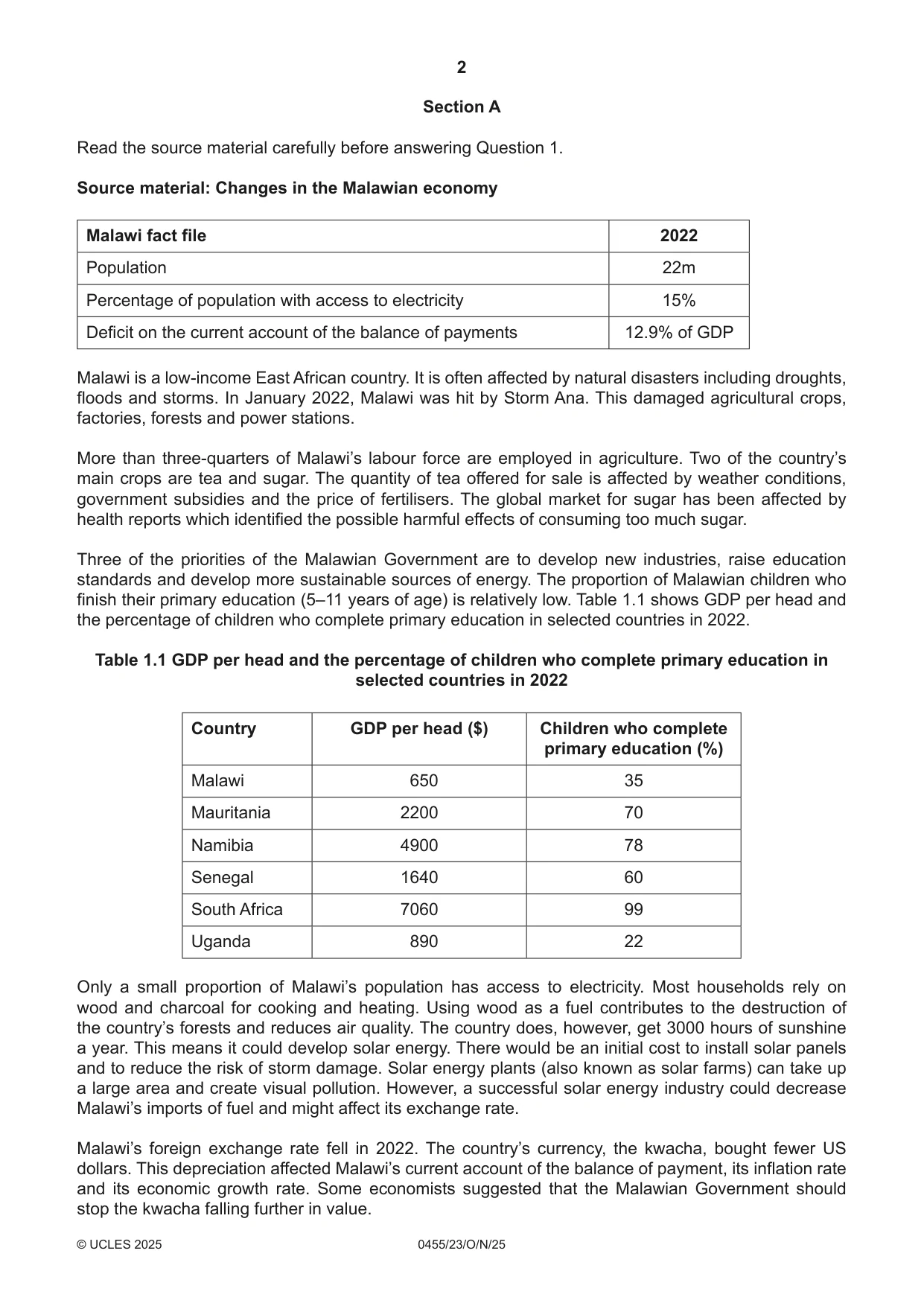
1 (a) Calculate the number of Malawians who had access to electricity in 2022. [1] (b) Identify two capital goods used in Malawi. [2] (c) Explain what is likely to have happened to Malawi’s production possibility curve (PPC) in January 2022. [2] (d) Explain two reasons why the supply of Malawian tea may increase. [4] (e) Draw a demand and supply diagram to show the effect of a report stating the health risks of consuming sugar on the market for sugar. [4] (f) Analyse the relationship between GDP per head and the percentage of children who complete primary education. [5] (g) Discuss whether or not Malawi should develop a solar energy industry. [6] (h) Discuss whether or not a government should try to stop its country’s foreign exchange rate falling in value. [6]
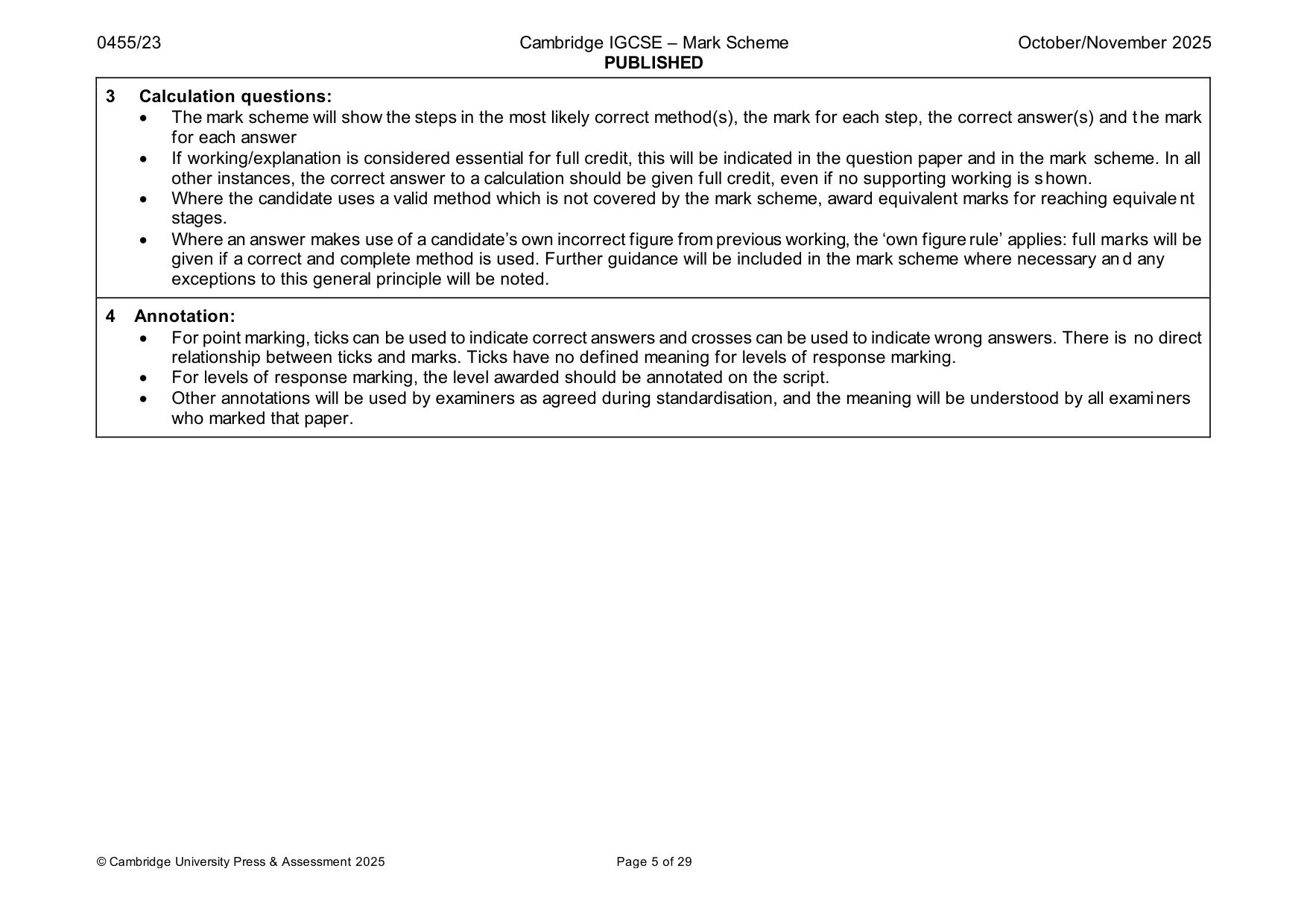
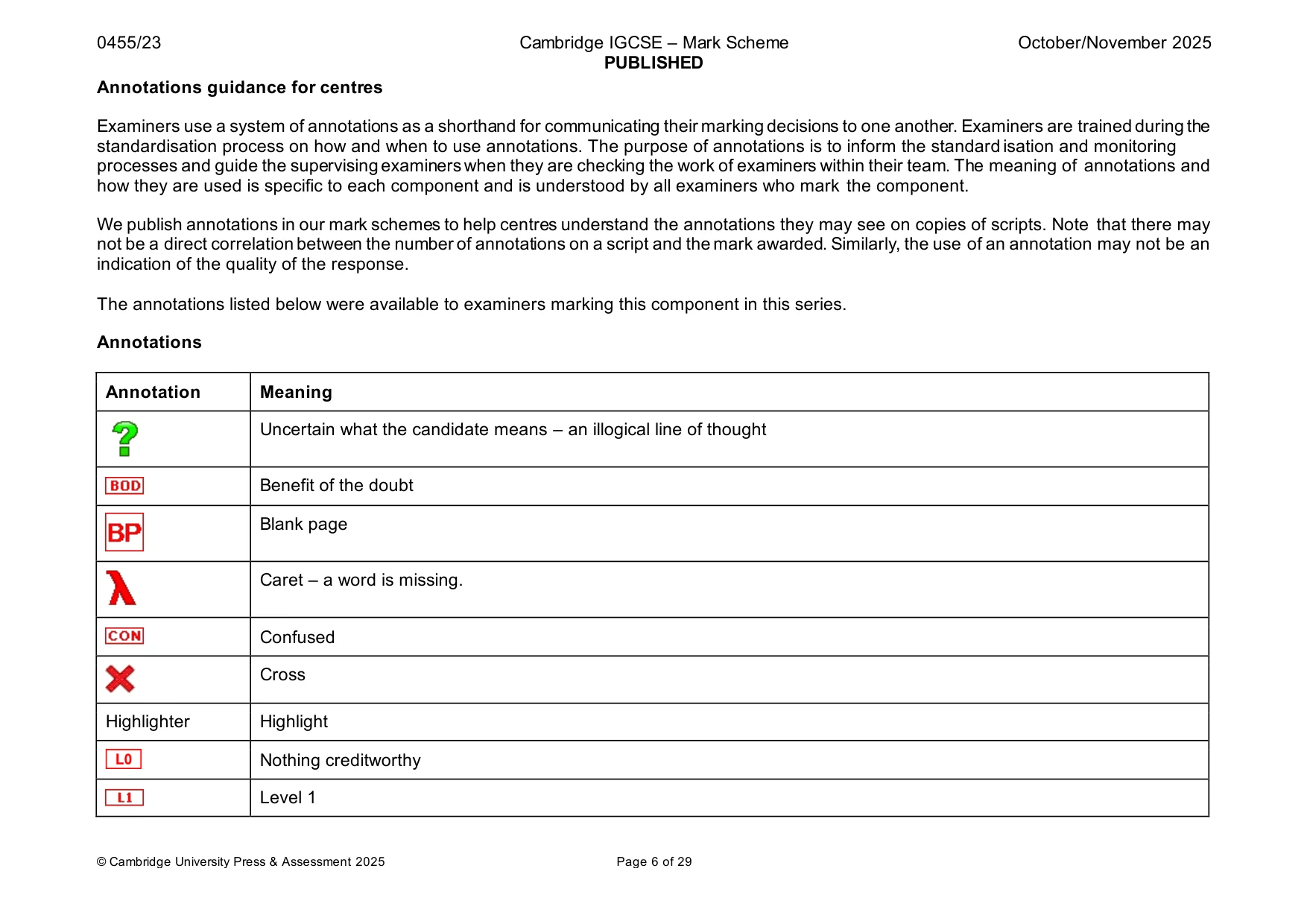
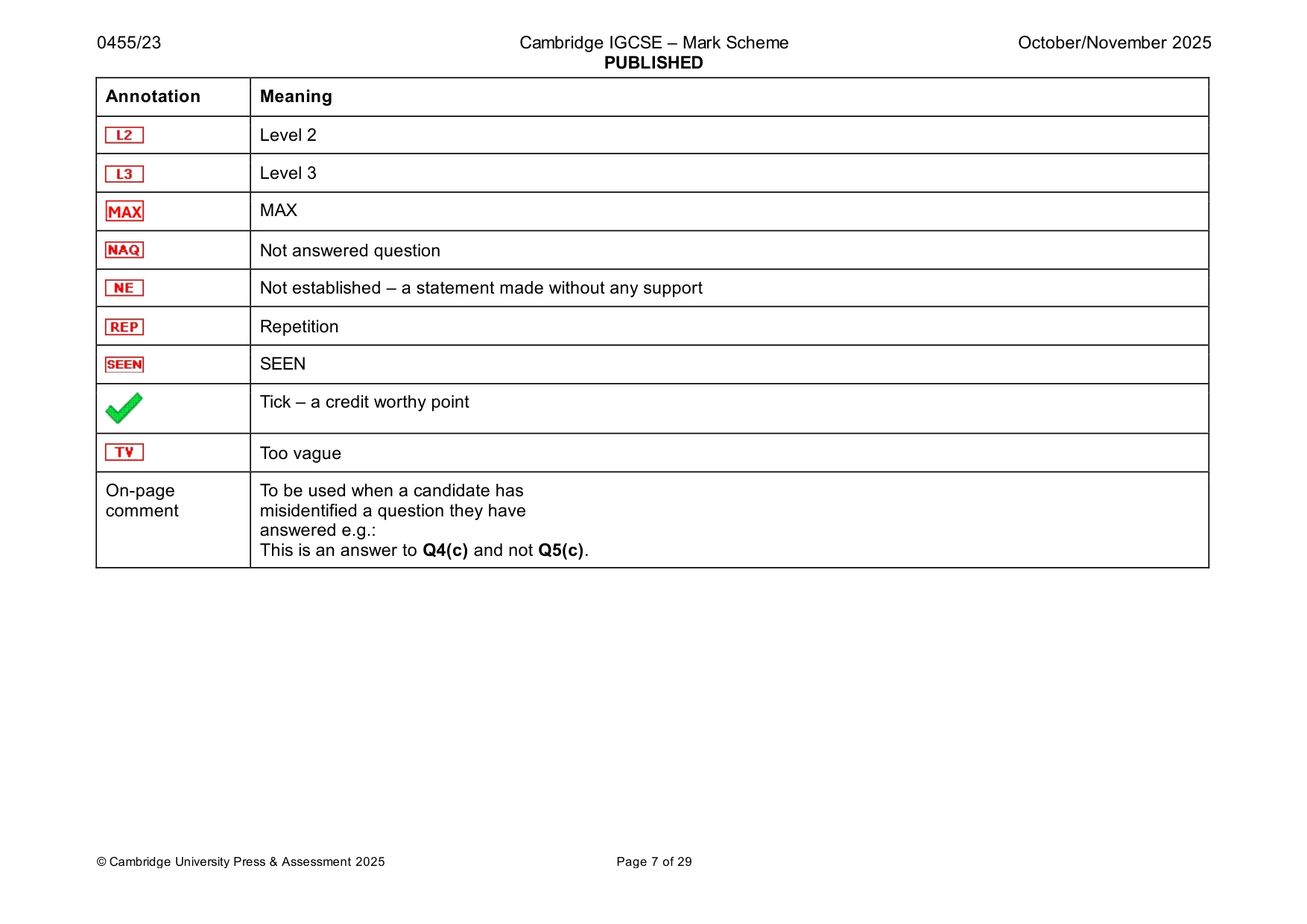
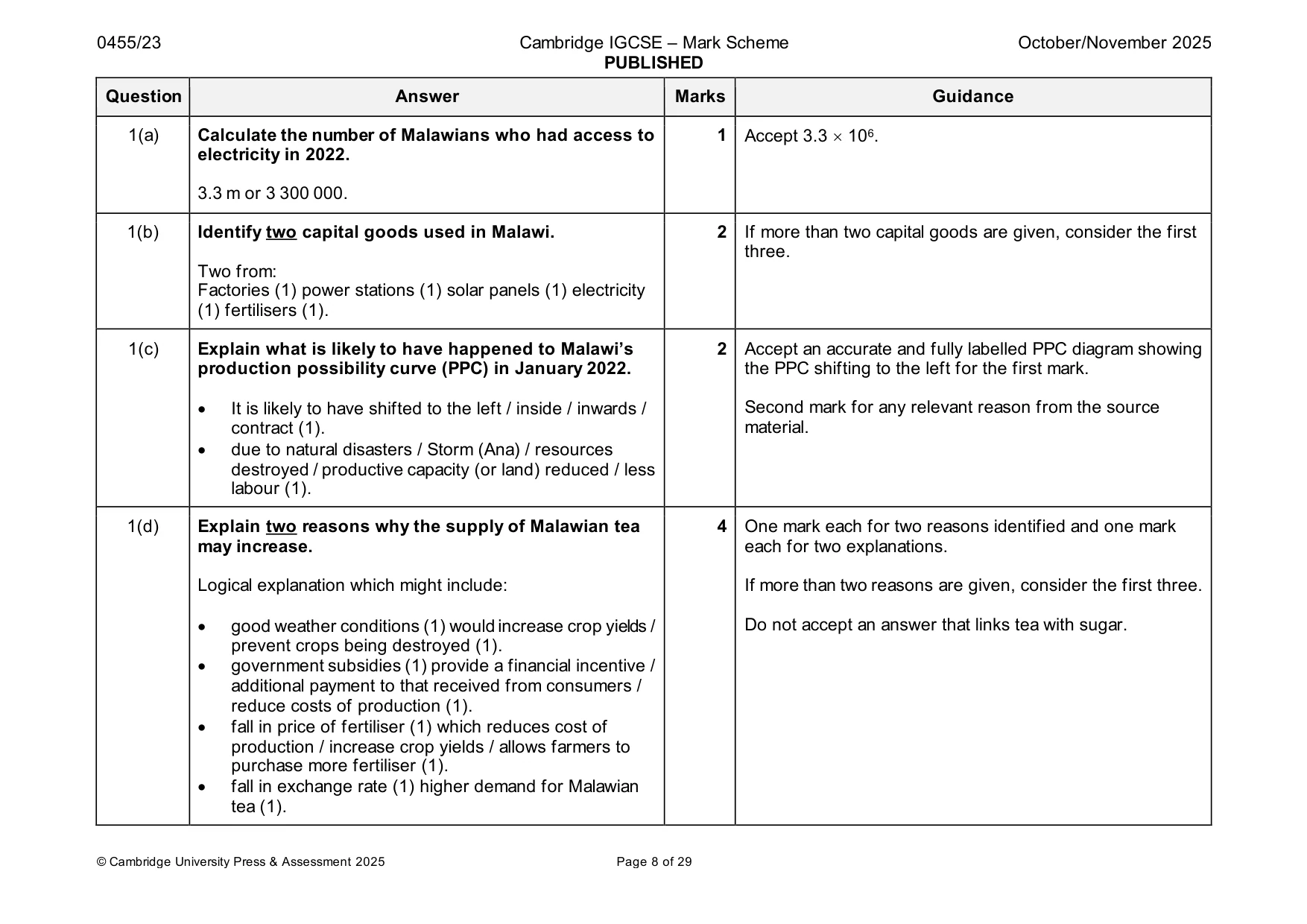
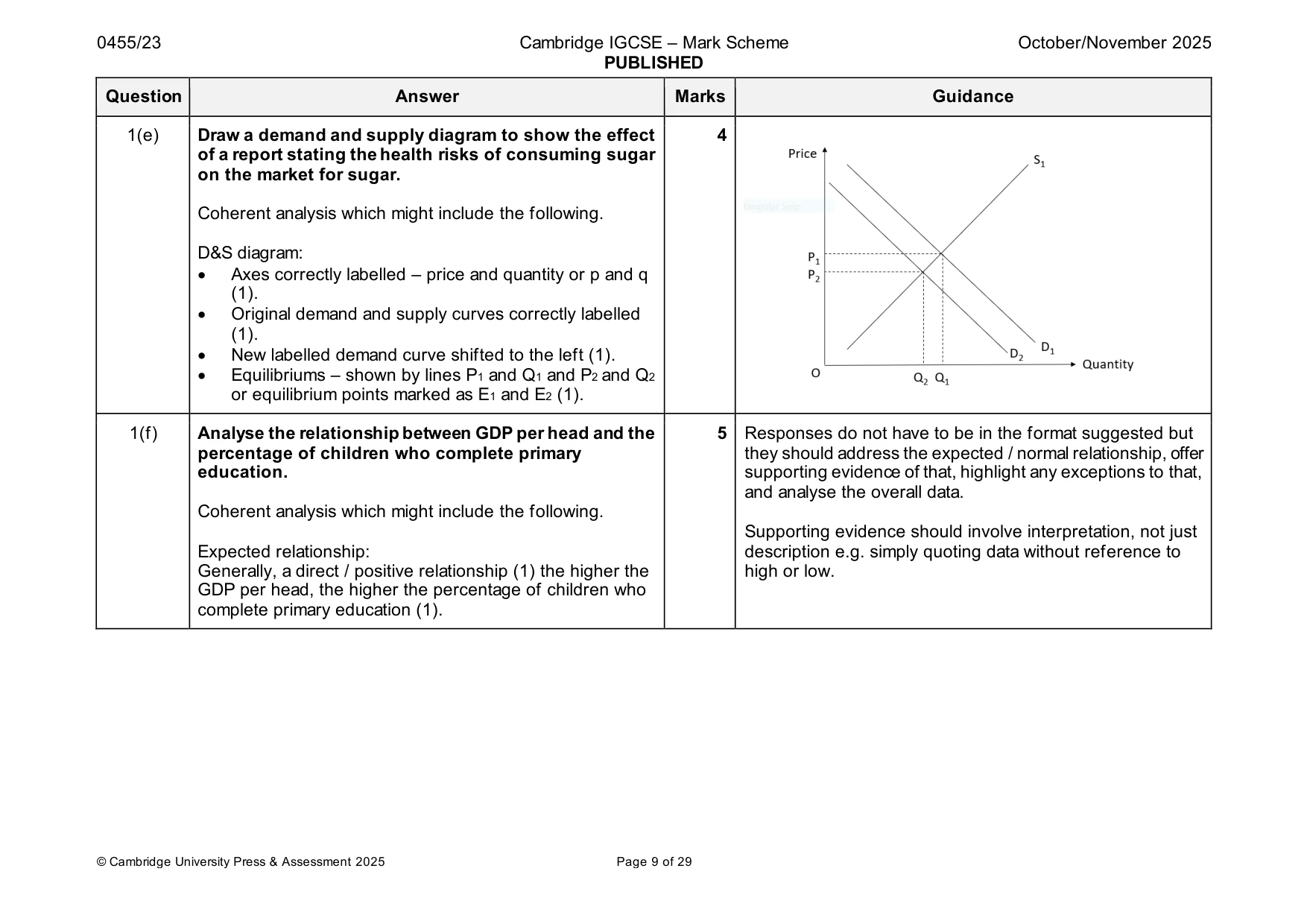
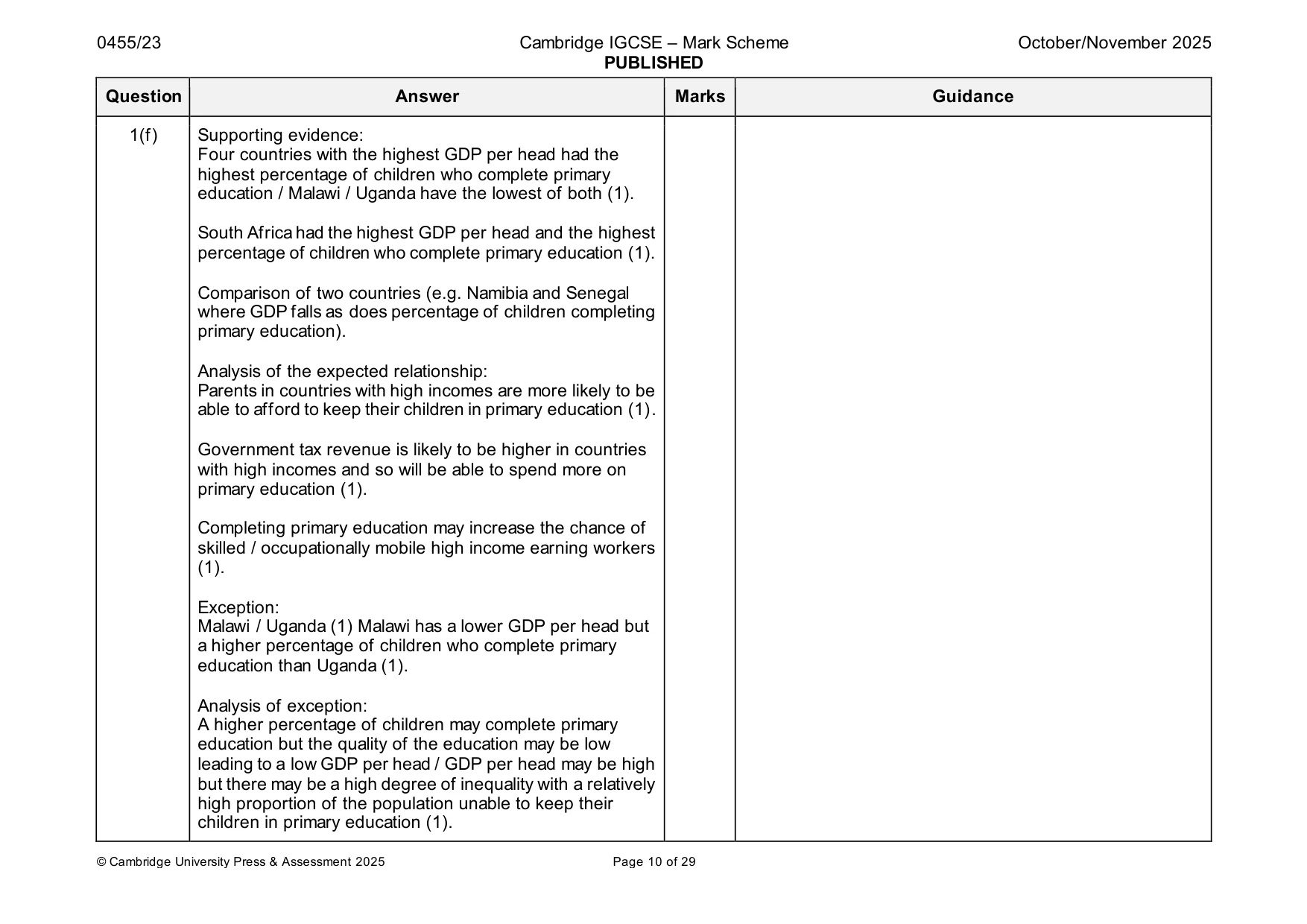
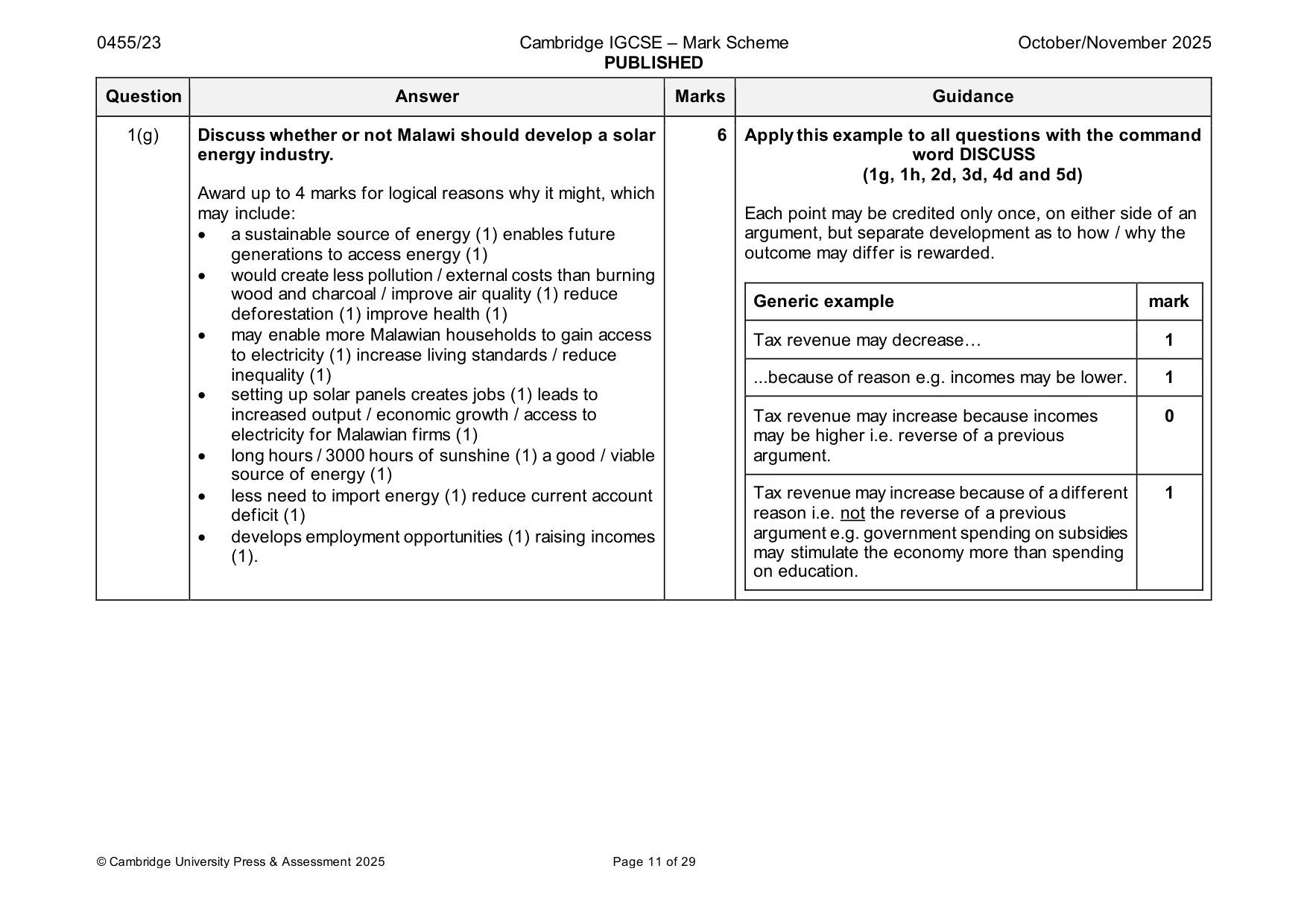
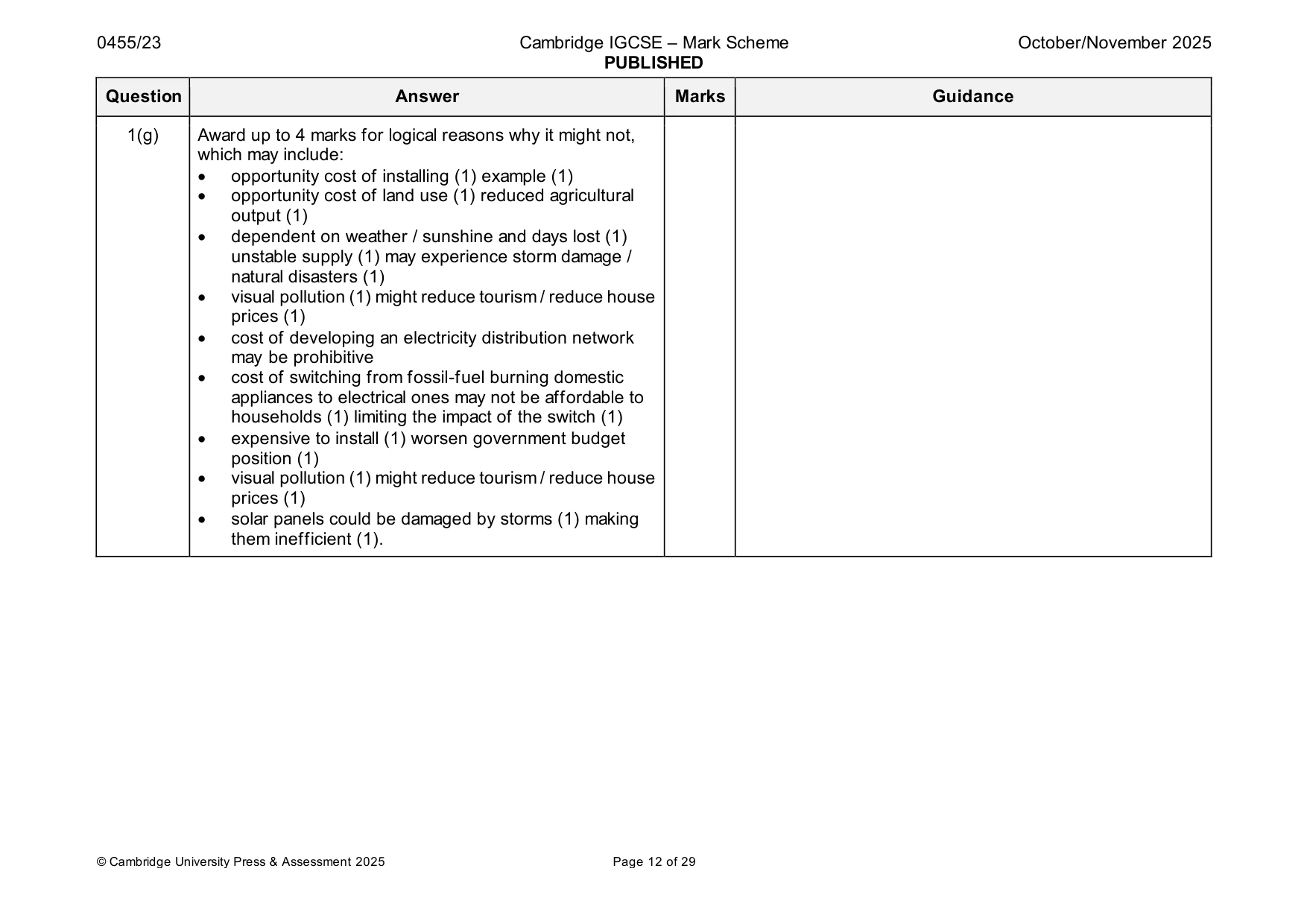
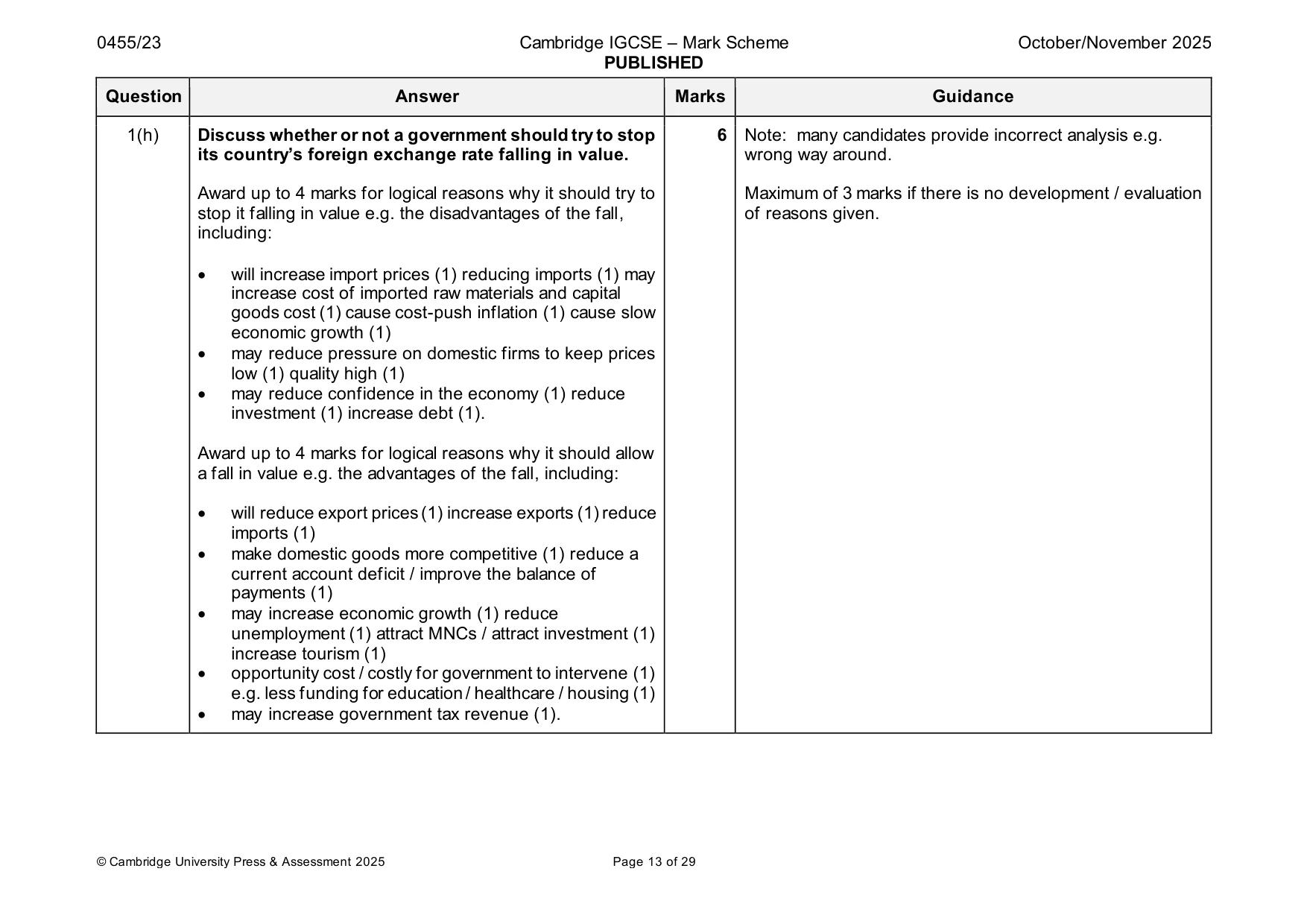
Mark scheme: Question Answer Marks Guidance 1(a) Calculate the number of Malawians who had access to 1 Accept 3.3 106. electricity in 2022. 3.3 m or 3 300 000. 1(b) Identify two capital goods used in Malawi. 2 If more than two capital goods are given, consider the first three. Two from: Factories (1) power stations (1) solar panels (1) electricity (1) fertilisers (1). 1(c) Explain what is likely to have happened to Malawi’s 2 Accept an accurate and fully labelled PPC diagram showing production possibility curve (PPC) in January 2022. the PPC shifting to the left for the first mark. • It is likely to have shifted to the left / inside / inwards / Second mark for any relevant reason from the source contract (1). material. • due to natural disasters / Storm (Ana) / resources destroyed / productive capacity (or land) reduced / less labour (1). 1(d) Explain two reasons why the supply of Malawian tea 4 One mark each for two reasons identified and one mark may increase. each for two explanations. Logical explanation which might include: If more than two reasons are given, consider the first three. • good weather conditions (1) would increase crop yields / Do not accept an answer that links tea with sugar. prevent crops being destroyed (1). • government subsidies (1) provide a financial incentive / additional payment to that received from consumers / reduce costs of production (1). • fall in price of fertiliser (1) which reduces cost of production / increase crop yields / allows farmers to purchase more fertiliser (1). • fall in exchange rate (1) higher demand for Malawian tea (1). 1(e) Draw a demand and supply diagram to show the effect 4 of a report stating the health risks of consuming sugar on the market for sugar. Coherent analysis which might include the following. D&S diagram: • Axes correctly labelled – price and quantity or p and q (1). • Original demand and supply curves correctly labelled (1). • New labelled demand curve shifted to the left (1). • Equilibriums – shown by lines P1 and Q1 and P2 and Q2 or equilibrium points marked as E1 and E2 (1). 1(f) Analyse the relationship between GDP per head and the 5 Responses do not have to be in the format suggested but percentage of children who complete primary they should address the expected / normal relationship, offer education. supporting evidence of that, highlight any exceptions to that, and analyse the overall data. Coherent analysis which might include the following. Supporting evidence should involve interpretation, not just Expected relationship: description e.g. simply quoting data without reference to Generally, a direct / positive relationship (1) the higher the high or low. GDP per head, the higher the percentage of children who complete primary education (1). 1(f) Supporting evidence: Four countries with the highest GDP per head had the highest percentage of children who complete primary education / Malawi / Uganda have the lowest of both (1). South Africa had the highest GDP per head and the highest percentage of children who complete primary education (1). Comparison of two countries (e.g. Namibia and Senegal where GDP falls as does percentage of children completing primary education). Analysis of the expected relationship: Parents in countries with high incomes are more likely to be able to afford to keep their children in primary education (1). Government tax revenue is likely to be higher in countries with high incomes and so will be able to spend more on primary education (1). Completing primary education may increase the chance of skilled / occupationally mobile high income earning workers (1). Exception: Malawi / Uganda (1) Malawi has a lower GDP per head but a higher percentage of children who complete primary education than Uganda (1). Analysis of exception: A higher percentage of children may complete primary education but the quality of the education may be low leading to a low GDP per head / GDP per head may be high but there may be a high degree of inequality with a relatively high proportion of the population unable to keep their children in primary education (1). 1(g) Discuss whether or not Malawi should develop a solar 6 Apply this example to all questions with the command energy industry. word DISCUSS (1g, 1h, 2d, 3d, 4d and 5d) Award up to 4 marks for logical reasons why it might, which may include: Each point may be credited only once, on either side of an • a sustainable source of energy (1) enables future argument, but separate development as to how / why the generations to access energy (1) outcome may differ is rewarded. • would create less pollution / external costs than burning wood and charcoal / improve air quality (1) reduce Generic example mark deforestation (1) improve health (1) • may enable more Malawian households to gain access Tax revenue may decrease… 1 to electricity (1) increase living standards / reduce inequality (1) ...because of reason e.g. incomes may be lower. 1 • setting up solar panels creates jobs (1) leads to increased output / economic growth / access to Tax revenue may increase because incomes 0 electricity for Malawian firms (1) may be higher i.e. reverse of a previous • long hours / 3000 hours of sunshine (1) a good / viable argument. source of energy (1) • less need to import energy (1) reduce current account Tax revenue may increase because of a different 1 deficit (1) reason i.e. not the reverse of a previous • develops employment opportunities (1) raising incomes argument e.g. government spending on subsidies (1). may stimulate the economy more than spending on education. 1(g) Award up to 4 marks for logical reasons why it might not, which may include: • opportunity cost of installing (1) example (1) • opportunity cost of land use (1) reduced agricultural output (1) • dependent on weather / sunshine and days lost (1) unstable supply (1) may experience storm damage / natural disasters (1) • visual pollution (1) might reduce tourism / reduce house prices (1) • cost of developing an electricity distribution network may be prohibitive • cost of switching from fossil-fuel burning domestic appliances to electrical ones may not be affordable to households (1) limiting the impact of the switch (1) • expensive to install (1) worsen government budget position (1) • visual pollution (1) might reduce tourism / reduce house prices (1) • solar panels could be damaged by storms (1) making them inefficient (1). 1(h) Discuss whether or not a government should try to stop 6 Note: many candidates provide incorrect analysis e.g. its country’s foreign exchange rate falling in value. wrong way around. Award up to 4 marks for logical reasons why it should try to Maximum of 3 marks if there is no development / evaluation stop it falling in value e.g. the disadvantages of the fall, of reasons given. including: • will increase import prices (1) reducing imports (1) may increase cost of imported raw materials and capital goods cost (1) cause cost-push inflation (1) cause slow economic growth (1) • may reduce pressure on domestic firms to keep prices low (1) quality high (1) • may reduce confidence in the economy (1) reduce investment (1) increase debt (1). Award up to 4 marks for logical reasons why it should allow a fall in value e.g. the advantages of the fall, including: • will reduce export prices (1) increase exports (1) reduce imports (1) • make domestic goods more competitive (1) reduce a current account deficit / improve the balance of payments (1) • may increase economic growth (1) reduce unemployment (1) attract MNCs / attract investment (1) increase tourism (1) • opportunity cost / costly for government to intervene (1) e.g. less funding for education / healthcare / housing (1) • may increase government tax revenue (1).
Q2 · A Swiss multinational food manufacturer increased prices for its products by an average…
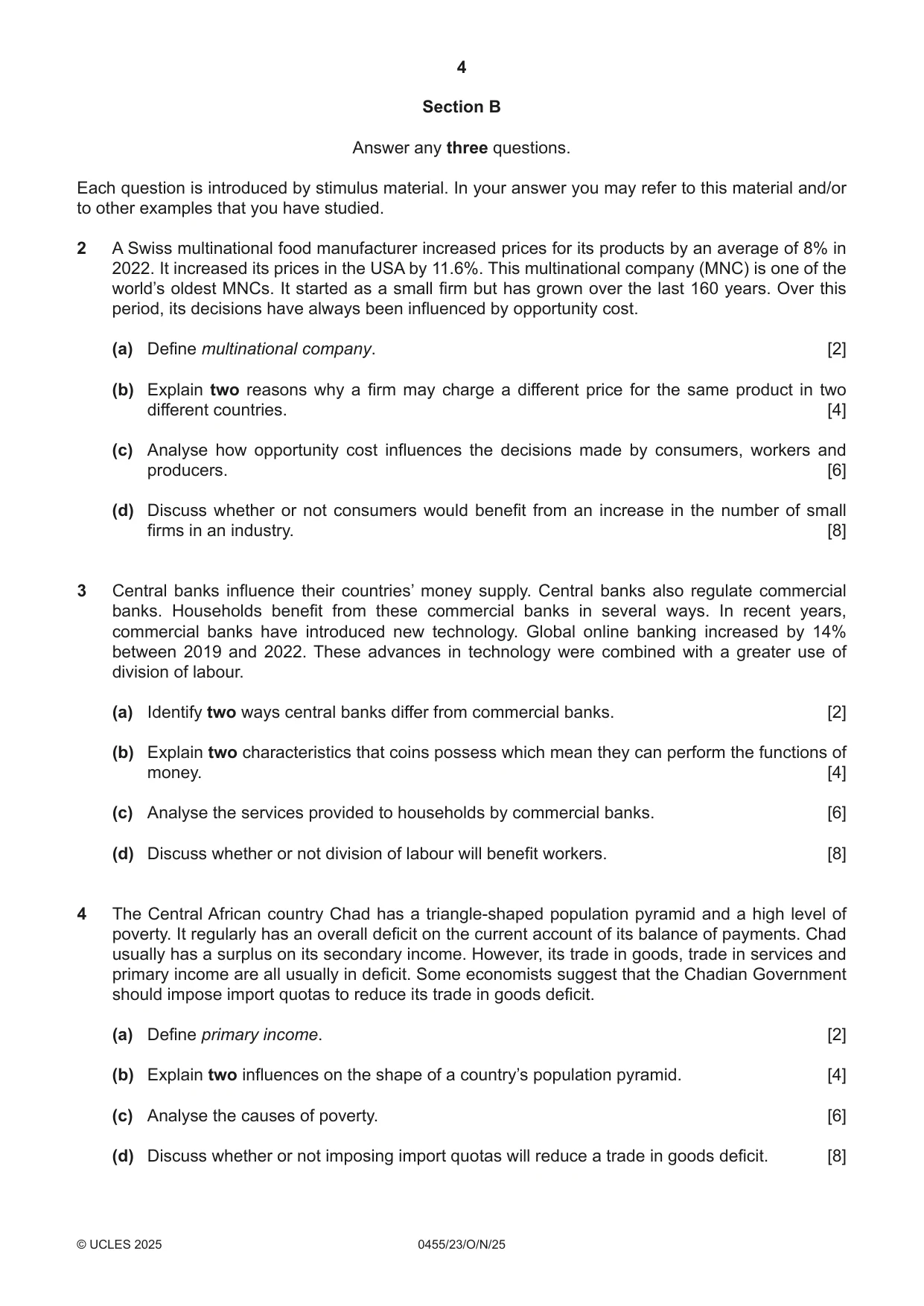
2 A Swiss multinational food manufacturer increased prices for its products by an average of 8% in 2022. It increased its prices in the USA by 11.6%. This multinational company (MNC) is one of the world’s oldest MNCs. It started as a small firm but has grown over the last 160 years. Over this period, its decisions have always been influenced by opportunity cost. (a) Define multinational company. [2] (b) Explain two reasons why a firm may charge a different price for the same product in two different countries. [4] (c) Analyse how opportunity cost influences the decisions made by consumers, workers and producers. [6] (d) Discuss whether or not consumers would benefit from an increase in the number of small firms in an industry. [8]
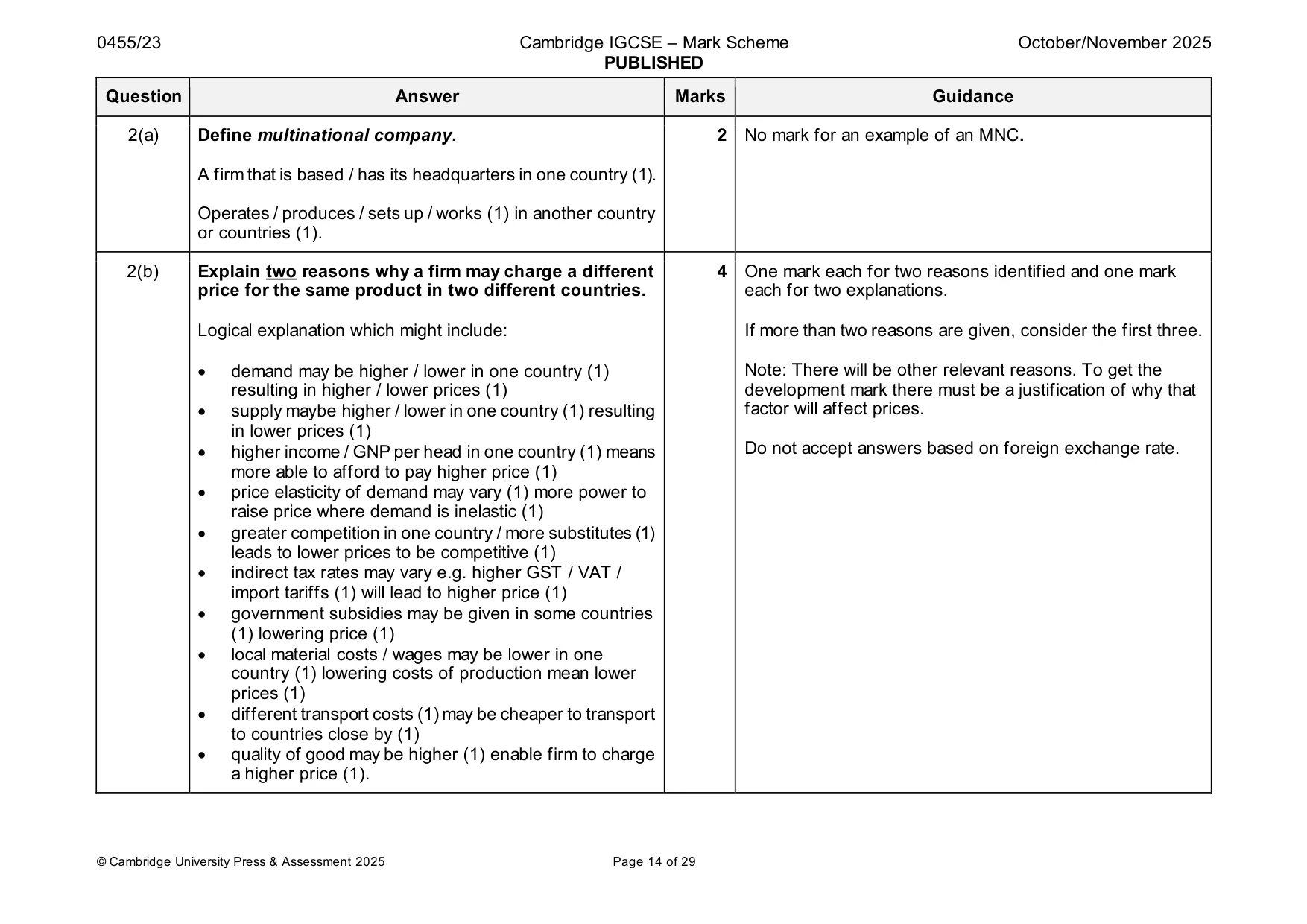
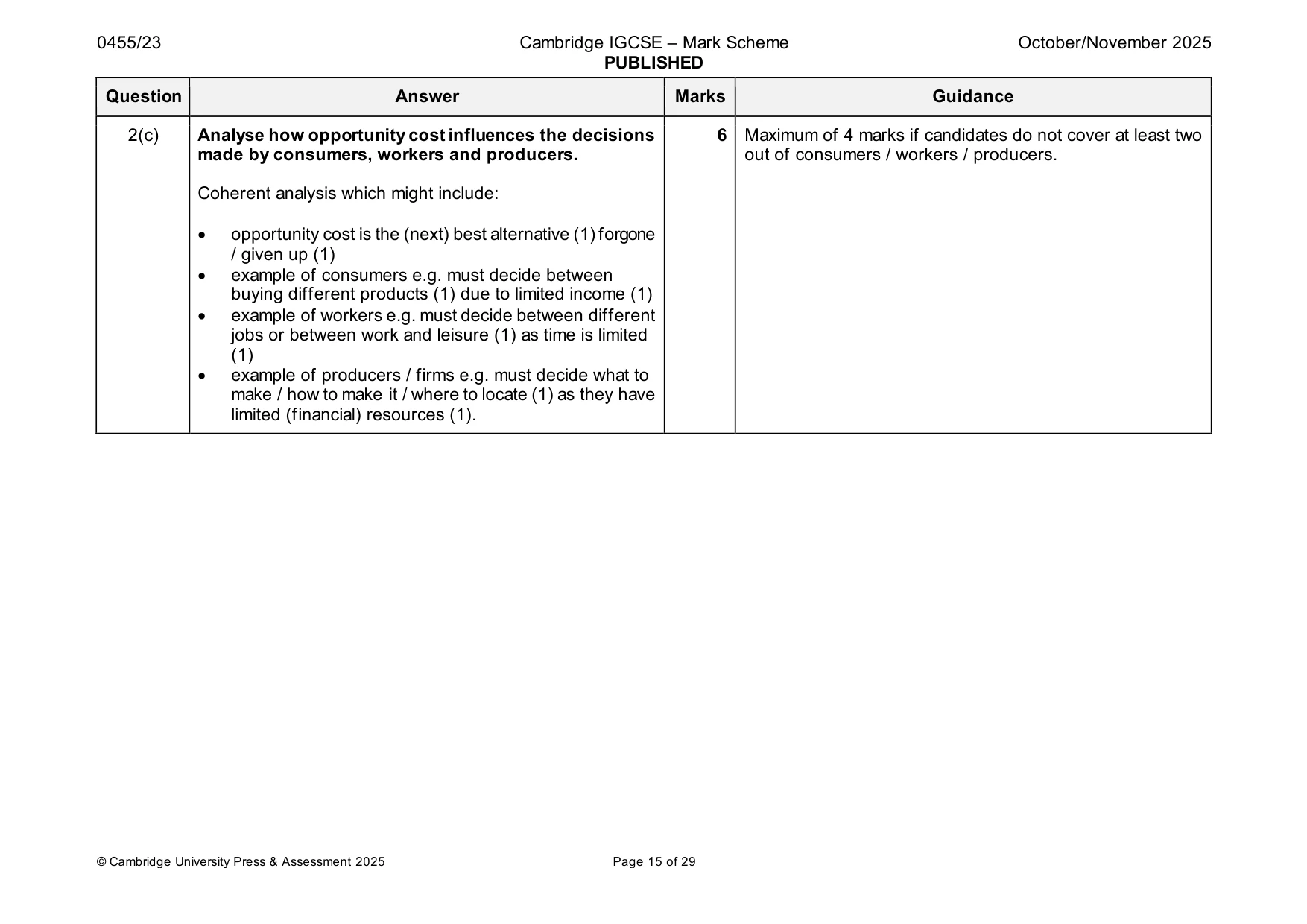
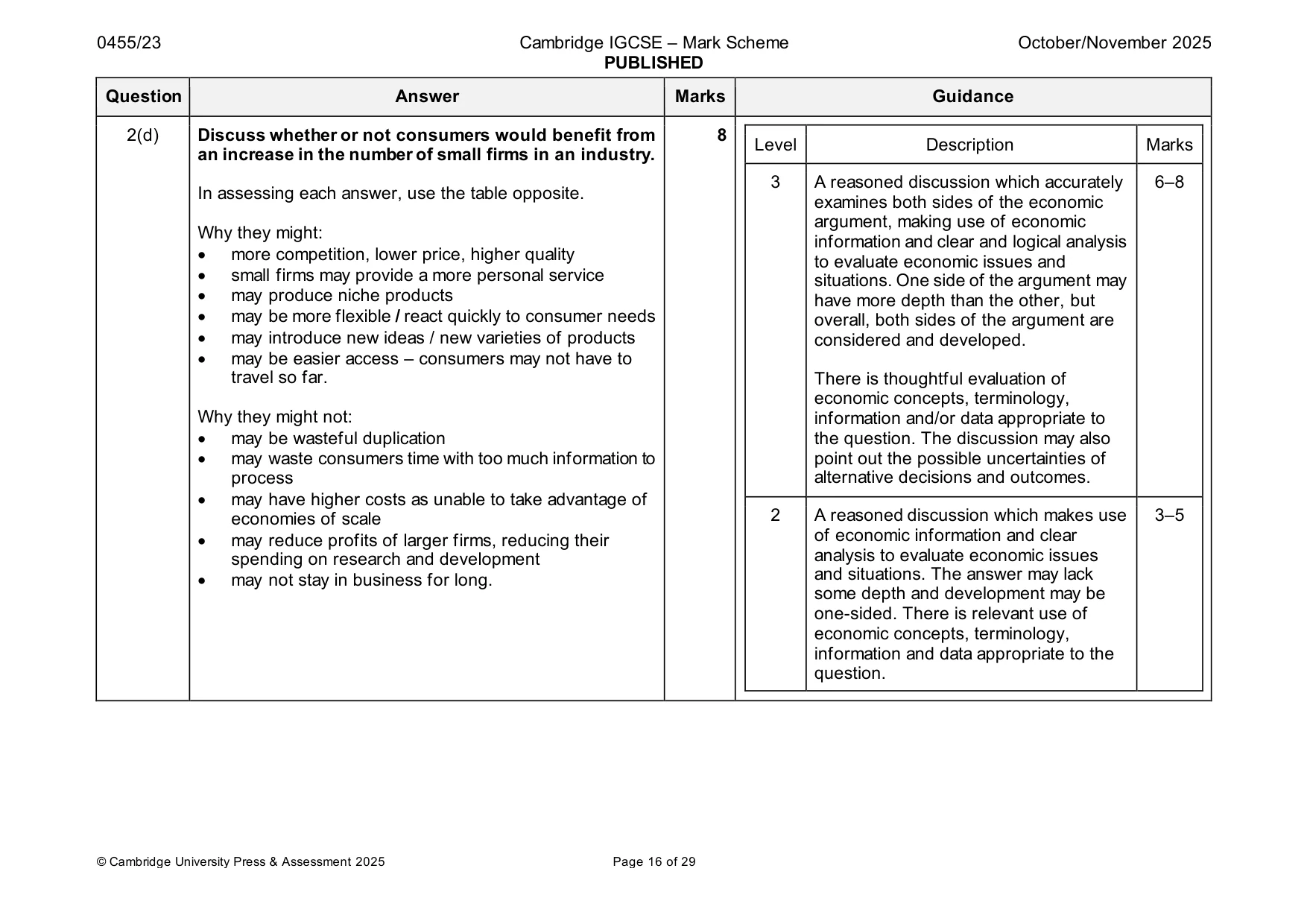
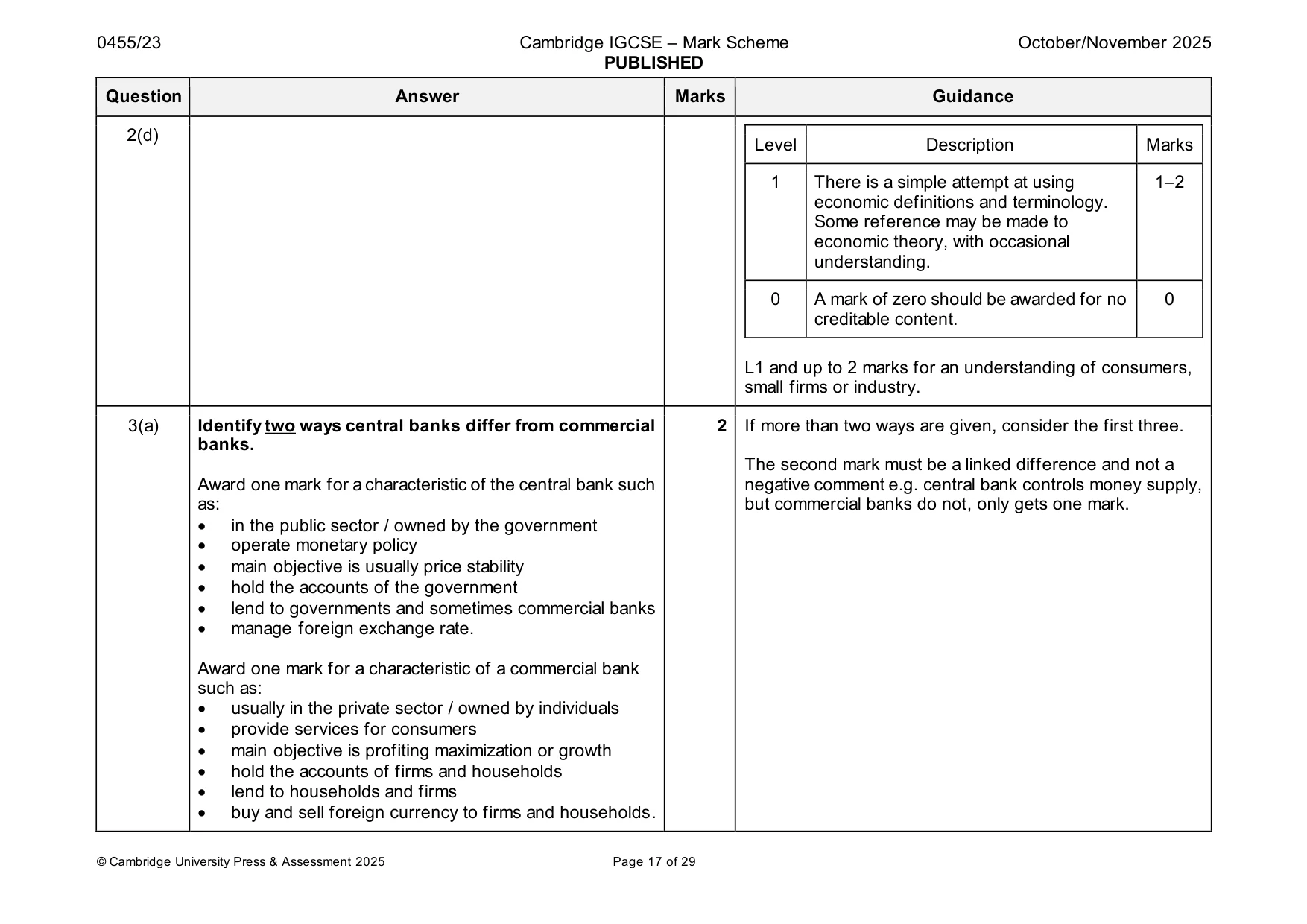
Mark scheme: 2(a) Define multinational company. 2 No mark for an example of an MNC. A firm that is based / has its headquarters in one country (1). Operates / produces / sets up / works (1) in another country or countries (1). 2(b) Explain two reasons why a firm may charge a different 4 One mark each for two reasons identified and one mark price for the same product in two different countries. each for two explanations. Logical explanation which might include: If more than two reasons are given, consider the first three. • demand may be higher / lower in one country (1) Note: There will be other relevant reasons. To get the resulting in higher / lower prices (1) development mark there must be a justification of why that • supply maybe higher / lower in one country (1) resulting factor will affect prices. in lower prices (1) • higher income / GNP per head in one country (1) means Do not accept answers based on foreign exchange rate. more able to afford to pay higher price (1) • price elasticity of demand may vary (1) more power to raise price where demand is inelastic (1) • greater competition in one country / more substitutes (1) leads to lower prices to be competitive (1) • indirect tax rates may vary e.g. higher GST / VAT / import tariffs (1) will lead to higher price (1) • government subsidies may be given in some countries (1) lowering price (1) • local material costs / wages may be lower in one country (1) lowering costs of production mean lower prices (1) • different transport costs (1) may be cheaper to transport to countries close by (1) • quality of good may be higher (1) enable firm to charge a higher price (1). 2(c) Analyse how opportunity cost influences the decisions 6 Maximum of 4 marks if candidates do not cover at least two made by consumers, workers and producers. out of consumers / workers / producers. Coherent analysis which might include: • opportunity cost is the (next) best alternative (1) forgone / given up (1) • example of consumers e.g. must decide between buying different products (1) due to limited income (1) • example of workers e.g. must decide between different jobs or between work and leisure (1) as time is limited (1) • example of producers / firms e.g. must decide what to make / how to make it / where to locate (1) as they have limited (financial) resources (1). 2(d) Discuss whether or not consumers would benefit from 8 Level Description Marks an increase in the number of small firms in an industry. 3 A reasoned discussion which accurately 6–8 In assessing each answer, use the table opposite. examines both sides of the economic argument, making use of economic Why they might: information and clear and logical analysis • more competition, lower price, higher quality to evaluate economic issues and • small firms may provide a more personal service situations. One side of the argument may • may produce niche products have more depth than the other, but • may be more flexible / react quickly to consumer needs overall, both sides of the argument are • may introduce new ideas / new varieties of products considered and developed. • may be easier access – consumers may not have to travel so far. There is thoughtful evaluation of economic concepts, terminology, Why they might not: information and/or data appropriate to • may be wasteful duplication the question. The discussion may also • may waste consumers time with too much information to point out the possible uncertainties of process alternative decisions and outcomes. • may have higher costs as unable to take advantage of economies of scale 2 A reasoned discussion which makes use 3–5 • may reduce profits of larger firms, reducing their of economic information and clear spending on research and development analysis to evaluate economic issues • may not stay in business for long. and situations. The answer may lack some depth and development may be one-sided. There is relevant use of economic concepts, terminology, information and data appropriate to the question. 2(d) Level Description Marks 1 There is a simple attempt at using 1–2 economic definitions and terminology. Some reference may be made to economic theory, with occasional understanding. 0 A mark of zero should be awarded for no 0 creditable content. L1 and up to 2 marks for an understanding of consumers, small firms or industry.
Q3 · Central banks influence their countries’ money supply
3 Central banks influence their countries’ money supply. Central banks also regulate commercial banks. Households benefit from these commercial banks in several ways. In recent years, commercial banks have introduced new technology. Global online banking increased by 14% between 2019 and 2022. These advances in technology were combined with a greater use of division of labour. (a) Identify two ways central banks differ from commercial banks. [2] (b) Explain two characteristics that coins possess which mean they can perform the functions of money. [4] (c) Analyse the services provided to households by commercial banks. [6] (d) Discuss whether or not division of labour will benefit workers. [8]
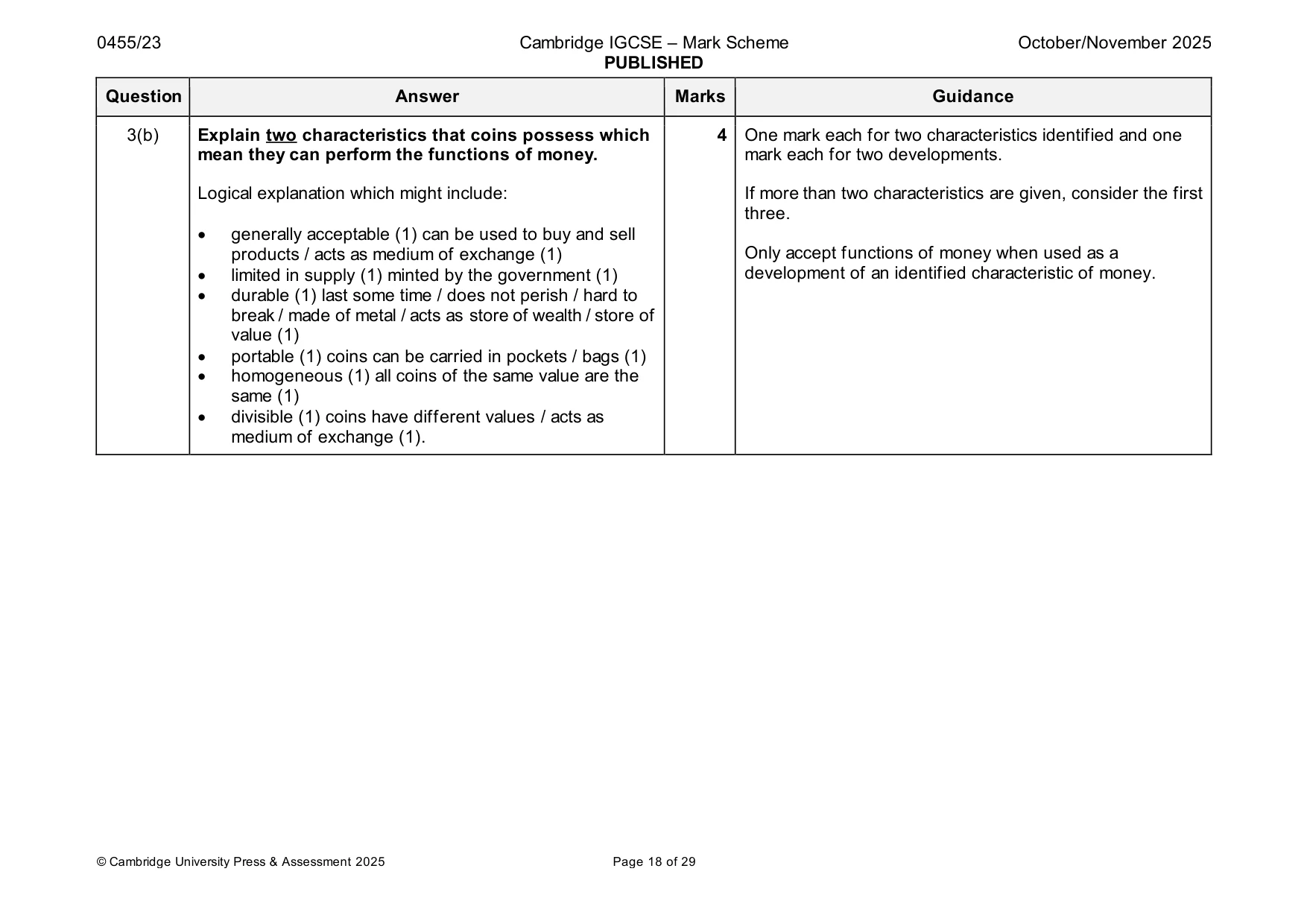
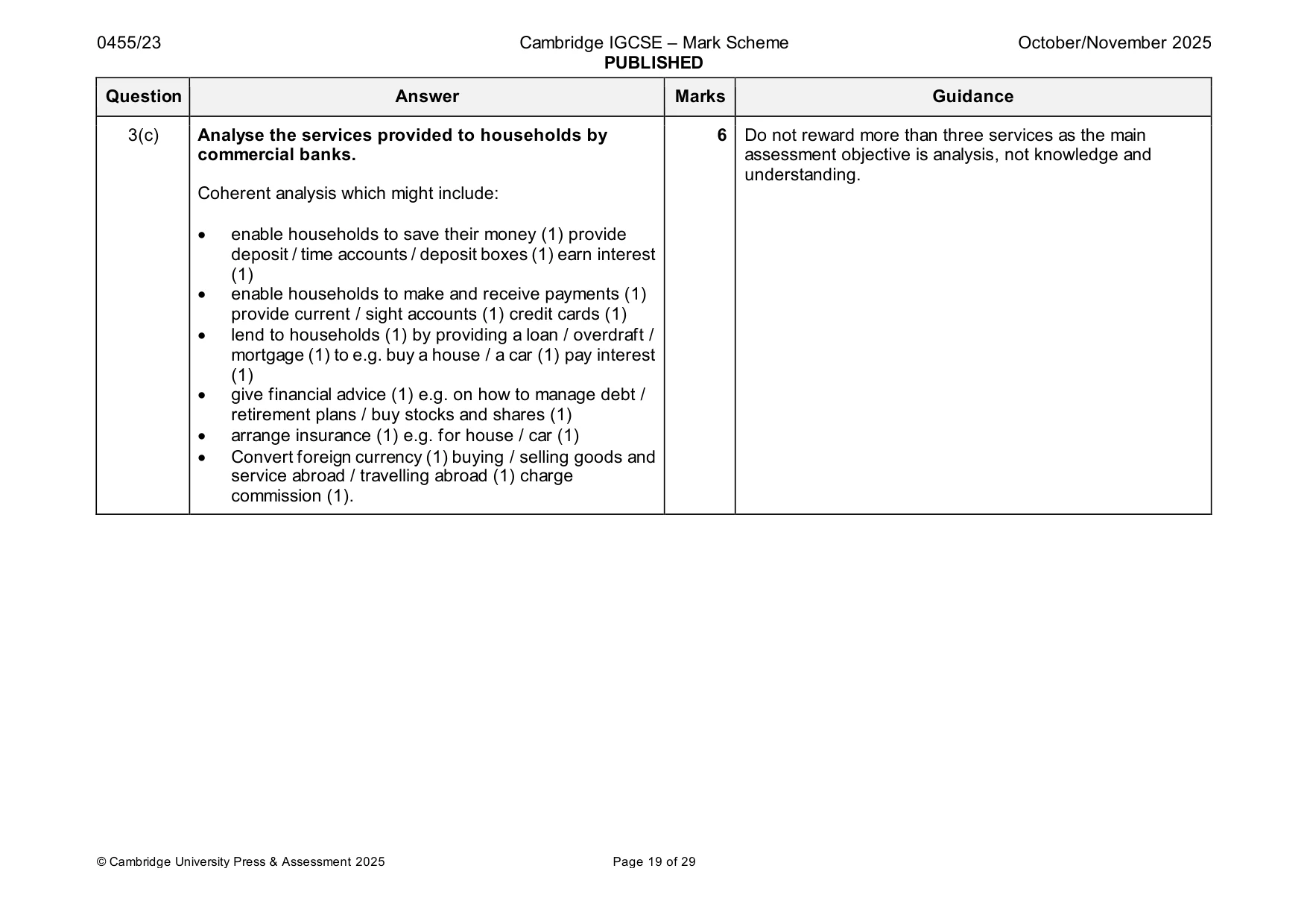
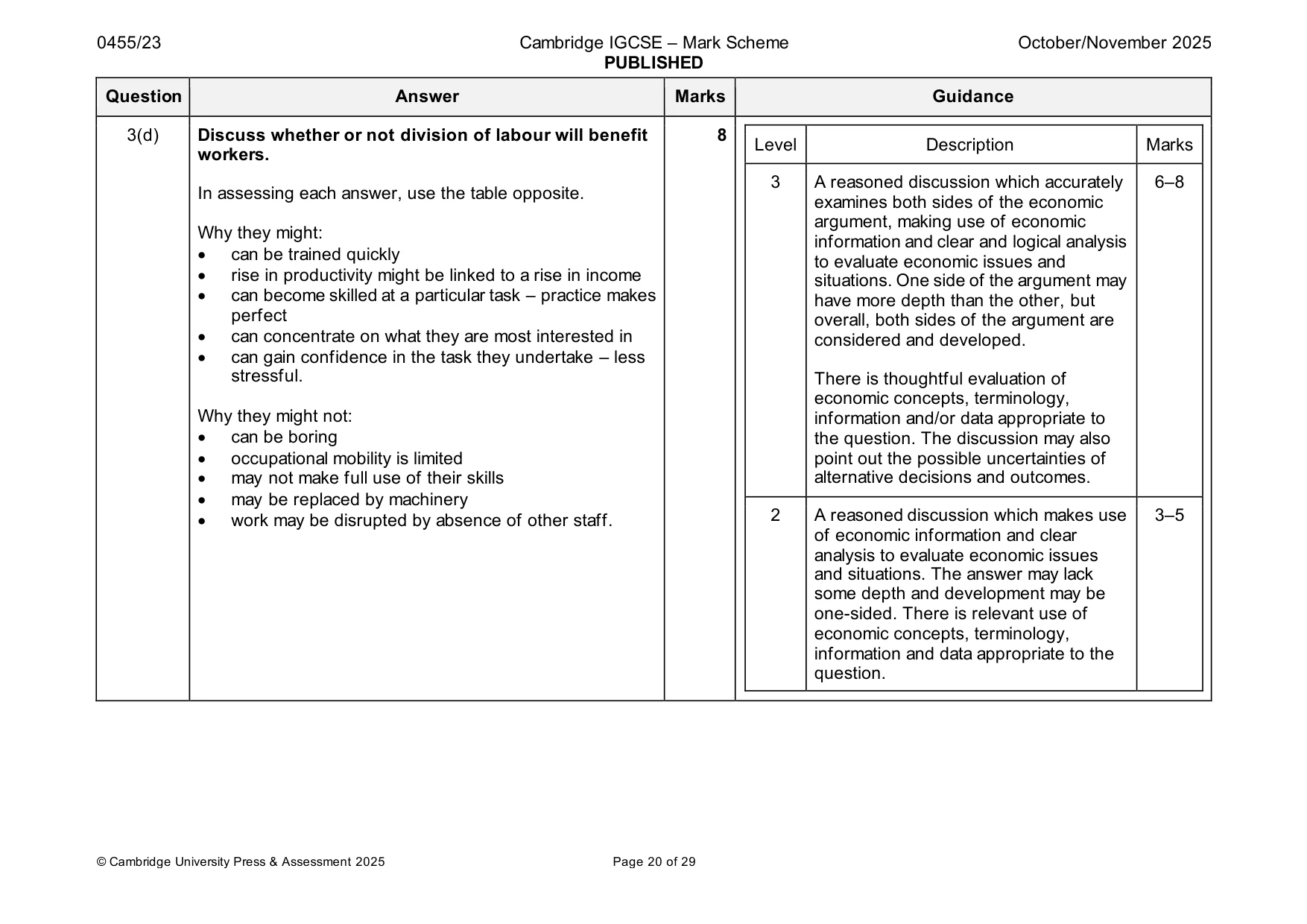
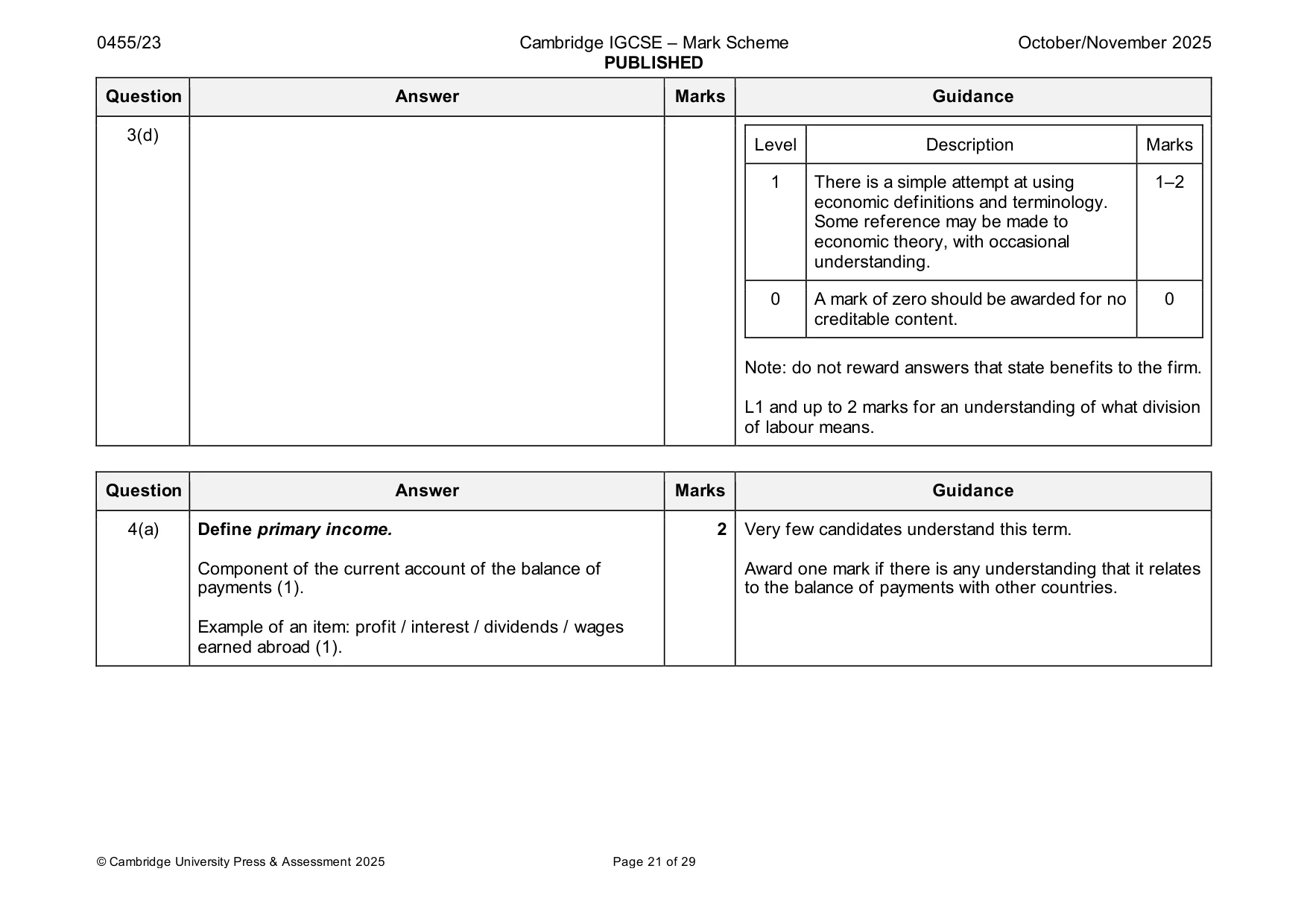
Mark scheme: 3(a) Identify two ways central banks differ from commercial 2 If more than two ways are given, consider the first three. banks. The second mark must be a linked difference and not a Award one mark for a characteristic of the central bank such negative comment e.g. central bank controls money supply, as: but commercial banks do not, only gets one mark. • in the public sector / owned by the government • operate monetary policy • main objective is usually price stability • hold the accounts of the government • lend to governments and sometimes commercial banks • manage foreign exchange rate. Award one mark for a characteristic of a commercial bank such as: • usually in the private sector / owned by individuals • provide services for consumers • main objective is profiting maximization or growth • hold the accounts of firms and households • lend to households and firms • buy and sell foreign currency to firms and households. 3(b) Explain two characteristics that coins possess which 4 One mark each for two characteristics identified and one mean they can perform the functions of money. mark each for two developments. Logical explanation which might include: If more than two characteristics are given, consider the first three. • generally acceptable (1) can be used to buy and sell products / acts as medium of exchange (1) Only accept functions of money when used as a • limited in supply (1) minted by the government (1) development of an identified characteristic of money. • durable (1) last some time / does not perish / hard to break / made of metal / acts as store of wealth / store of value (1) • portable (1) coins can be carried in pockets / bags (1) • homogeneous (1) all coins of the same value are the same (1) • divisible (1) coins have different values / acts as medium of exchange (1). 3(c) Analyse the services provided to households by 6 Do not reward more than three services as the main commercial banks. assessment objective is analysis, not knowledge and understanding. Coherent analysis which might include: • enable households to save their money (1) provide deposit / time accounts / deposit boxes (1) earn interest (1) • enable households to make and receive payments (1) provide current / sight accounts (1) credit cards (1) • lend to households (1) by providing a loan / overdraft / mortgage (1) to e.g. buy a house / a car (1) pay interest (1) • give financial advice (1) e.g. on how to manage debt / retirement plans / buy stocks and shares (1) • arrange insurance (1) e.g. for house / car (1) • Convert foreign currency (1) buying / selling goods and service abroad / travelling abroad (1) charge commission (1). 3(d) Discuss whether or not division of labour will benefit 8 Level Description Marks workers. 3 A reasoned discussion which accurately 6–8 In assessing each answer, use the table opposite. examines both sides of the economic argument, making use of economic Why they might: information and clear and logical analysis • can be trained quickly to evaluate economic issues and • rise in productivity might be linked to a rise in income situations. One side of the argument may • can become skilled at a particular task – practice makes have more depth than the other, but perfect overall, both sides of the argument are • can concentrate on what they are most interested in considered and developed. • can gain confidence in the task they undertake – less stressful. There is thoughtful evaluation of economic concepts, terminology, Why they might not: information and/or data appropriate to • can be boring the question. The discussion may also • occupational mobility is limited point out the possible uncertainties of • may not make full use of their skills alternative decisions and outcomes. • may be replaced by machinery • work may be disrupted by absence of other staff. 2 A reasoned discussion which makes use 3–5 of economic information and clear analysis to evaluate economic issues and situations. The answer may lack some depth and development may be one-sided. There is relevant use of economic concepts, terminology, information and data appropriate to the question. 3(d) Level Description Marks 1 There is a simple attempt at using 1–2 economic definitions and terminology. Some reference may be made to economic theory, with occasional understanding. 0 A mark of zero should be awarded for no 0 creditable content. Note: do not reward answers that state benefits to the firm. L1 and up to 2 marks for an understanding of what division of labour means.
Q4 · The Central African country Chad has a triangle-shaped population pyramid and a high…
4 The Central African country Chad has a triangle-shaped population pyramid and a high level of poverty. It regularly has an overall deficit on the current account of its balance of payments. Chad usually has a surplus on its secondary income. However, its trade in goods, trade in services and primary income are all usually in deficit. Some economists suggest that the Chadian Government should impose import quotas to reduce its trade in goods deficit. (a) Define primary income. [2] (b) Explain two influences on the shape of a country’s population pyramid. [4] (c) Analyse the causes of poverty. [6] (d) Discuss whether or not imposing import quotas will reduce a trade in goods deficit. [8]
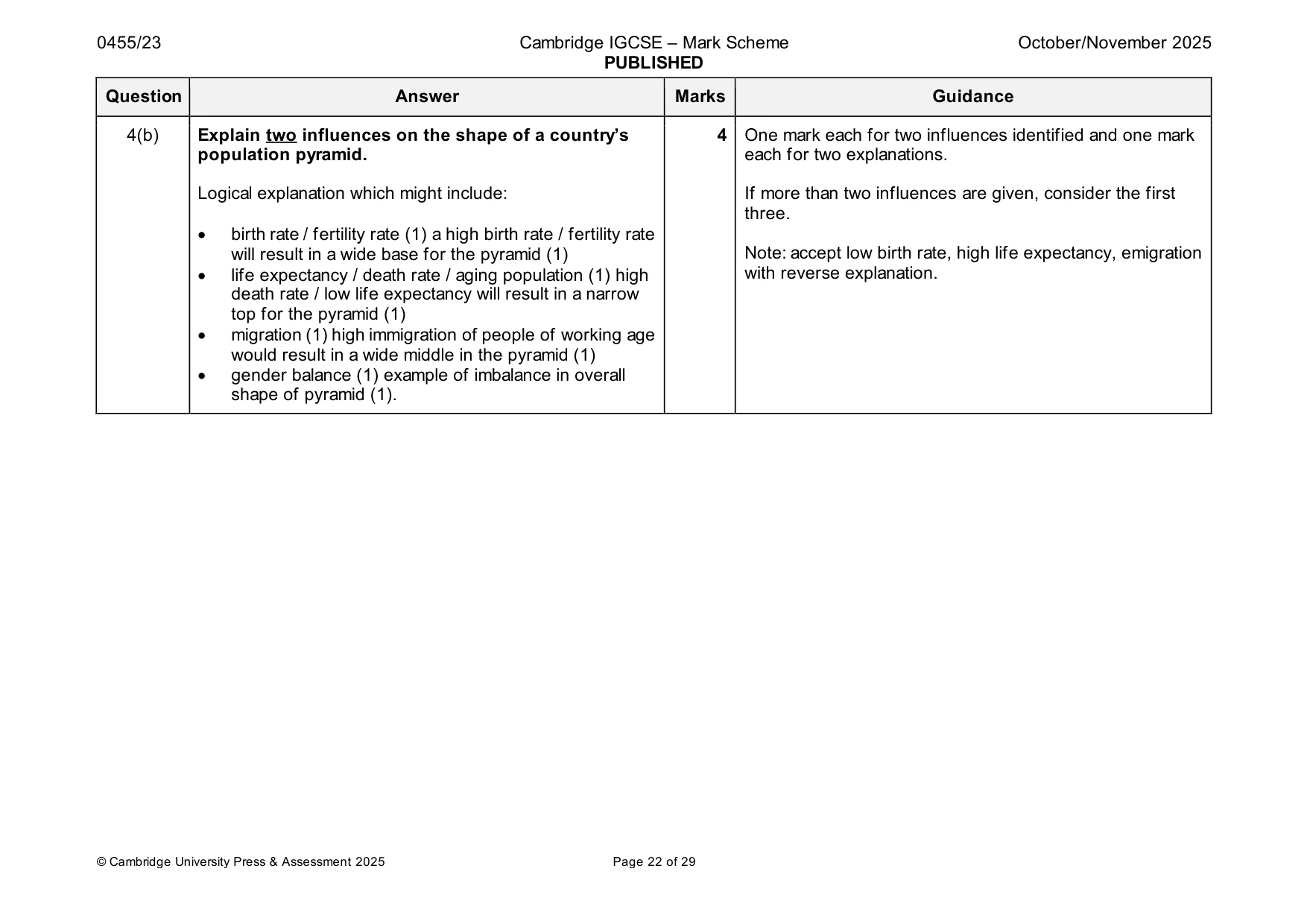
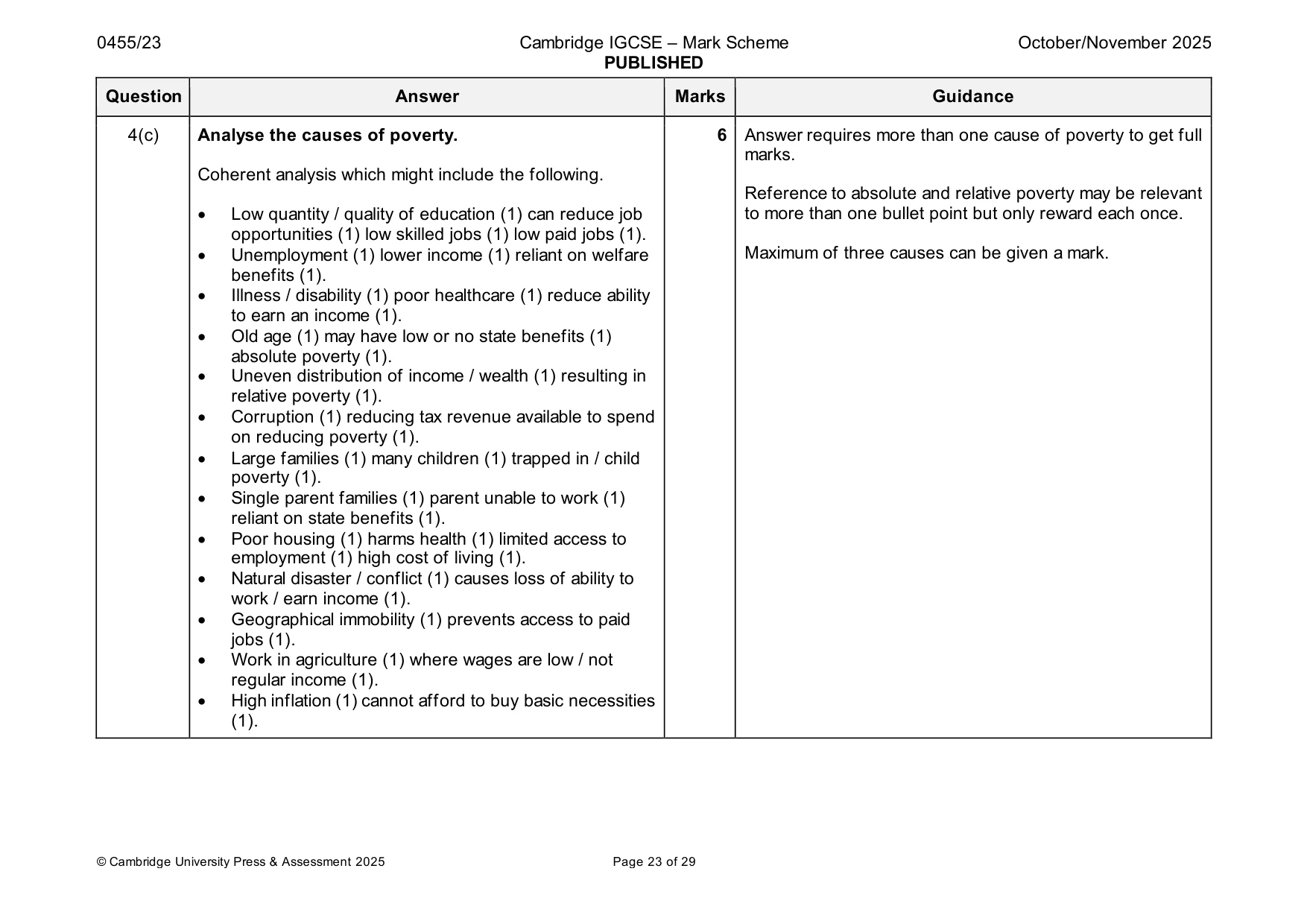
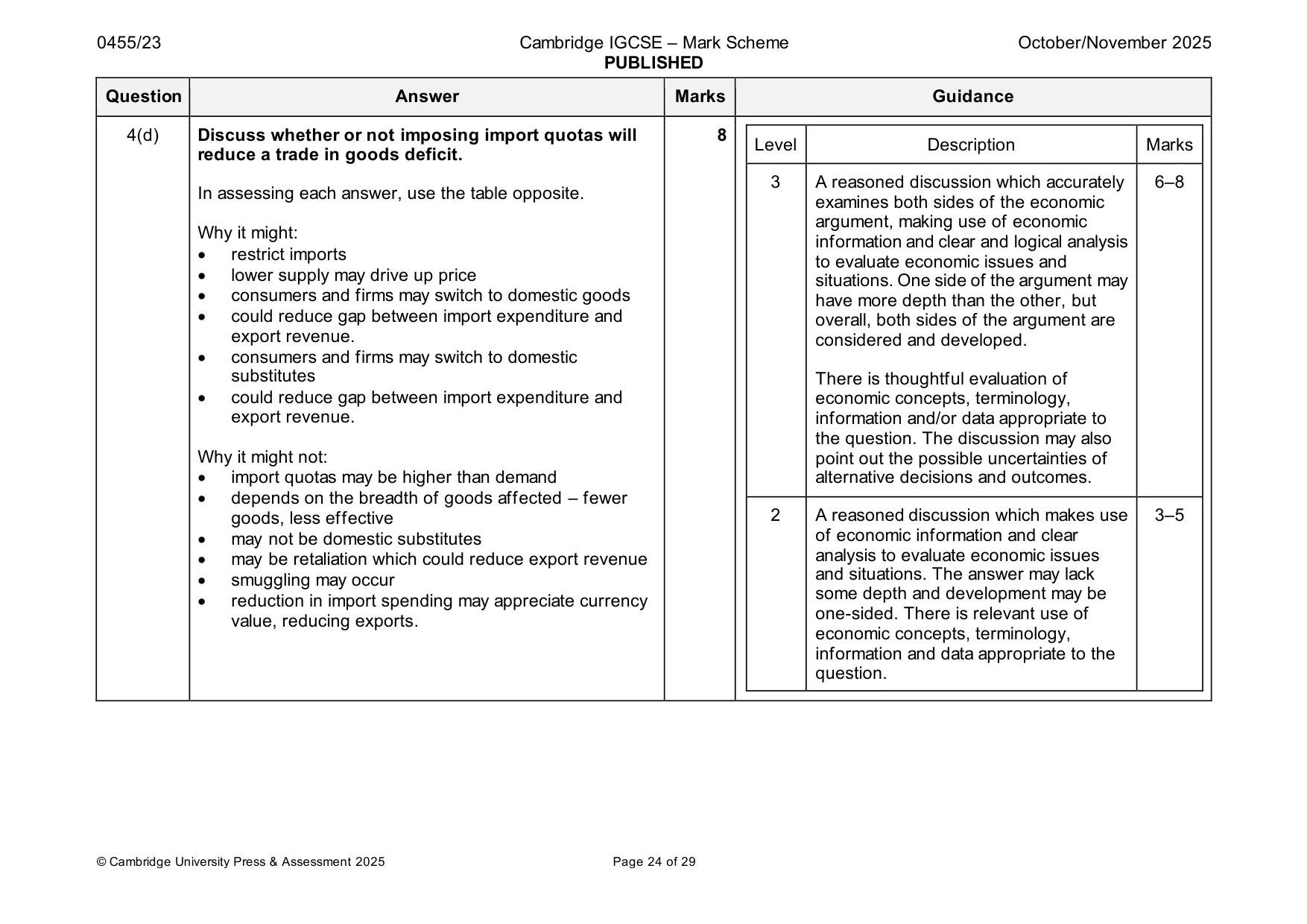
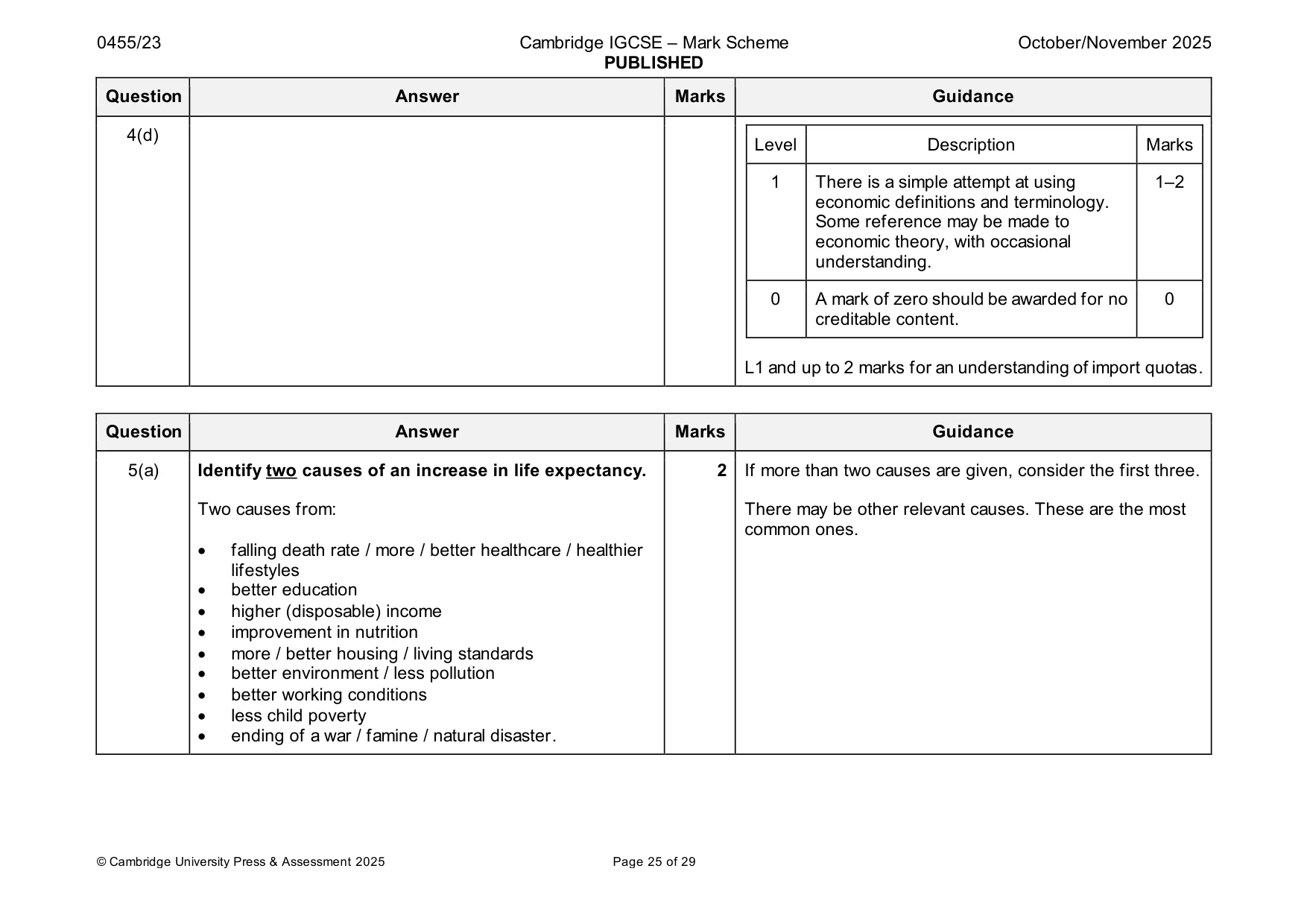
Mark scheme: 4(a) Define primary income. 2 Very few candidates understand this term. Component of the current account of the balance of Award one mark if there is any understanding that it relates payments (1). to the balance of payments with other countries. Example of an item: profit / interest / dividends / wages earned abroad (1). 4(b) Explain two influences on the shape of a country’s 4 One mark each for two influences identified and one mark population pyramid. each for two explanations. Logical explanation which might include: If more than two influences are given, consider the first three. • birth rate / fertility rate (1) a high birth rate / fertility rate will result in a wide base for the pyramid (1) Note: accept low birth rate, high life expectancy, emigration • life expectancy / death rate / aging population (1) high with reverse explanation. death rate / low life expectancy will result in a narrow top for the pyramid (1) • migration (1) high immigration of people of working age would result in a wide middle in the pyramid (1) • gender balance (1) example of imbalance in overall shape of pyramid (1). 4(c) Analyse the causes of poverty. 6 Answer requires more than one cause of poverty to get full marks. Coherent analysis which might include the following. Reference to absolute and relative poverty may be relevant • Low quantity / quality of education (1) can reduce job to more than one bullet point but only reward each once. opportunities (1) low skilled jobs (1) low paid jobs (1). • Unemployment (1) lower income (1) reliant on welfare Maximum of three causes can be given a mark. benefits (1). • Illness / disability (1) poor healthcare (1) reduce ability to earn an income (1). • Old age (1) may have low or no state benefits (1) absolute poverty (1). • Uneven distribution of income / wealth (1) resulting in relative poverty (1). • Corruption (1) reducing tax revenue available to spend on reducing poverty (1). • Large families (1) many children (1) trapped in / child poverty (1). • Single parent families (1) parent unable to work (1) reliant on state benefits (1). • Poor housing (1) harms health (1) limited access to employment (1) high cost of living (1). • Natural disaster / conflict (1) causes loss of ability to work / earn income (1). • Geographical immobility (1) prevents access to paid jobs (1). • Work in agriculture (1) where wages are low / not regular income (1). • High inflation (1) cannot afford to buy basic necessities (1). 4(d) Discuss whether or not imposing import quotas will 8 Level Description Marks reduce a trade in goods deficit. 3 A reasoned discussion which accurately 6–8 In assessing each answer, use the table opposite. examines both sides of the economic argument, making use of economic Why it might: information and clear and logical analysis • restrict imports to evaluate economic issues and • lower supply may drive up price situations. One side of the argument may • consumers and firms may switch to domestic goods have more depth than the other, but • could reduce gap between import expenditure and overall, both sides of the argument are export revenue. considered and developed. • consumers and firms may switch to domestic substitutes There is thoughtful evaluation of • could reduce gap between import expenditure and economic concepts, terminology, export revenue. information and/or data appropriate to the question. The discussion may also Why it might not: point out the possible uncertainties of • import quotas may be higher than demand alternative decisions and outcomes. • depends on the breadth of goods affected – fewer goods, less effective 2 A reasoned discussion which makes use 3–5 • may not be domestic substitutes of economic information and clear • may be retaliation which could reduce export revenue analysis to evaluate economic issues • smuggling may occur and situations. The answer may lack some depth and development may be • reduction in import spending may appreciate currency one-sided. There is relevant use of value, reducing exports. economic concepts, terminology, information and data appropriate to the question. 4(d) Level Description Marks 1 There is a simple attempt at using 1–2 economic definitions and terminology. Some reference may be made to economic theory, with occasional understanding. 0 A mark of zero should be awarded for no 0 creditable content. L1 and up to 2 marks for an understanding of import quotas.
Q5 · In 2023, the Canadian Prime Minister said that his country’s aim was to increase…
5 In 2023, the Canadian Prime Minister said that his country’s aim was to increase immigration to half a million a year. This was because the country was experiencing labour shortages and an increase in life expectancy. More workers in Canada would increase the tax revenue available to spend on pensions, and more workers would also increase consumer spending. An increase in the immigration of both skilled and unskilled workers might affect the country’s car industry. (a) Identify two causes of an increase in life expectancy. [2] (b) Explain two ways a firm could attract skilled workers from another country. [4] (c) Analyse how an increase in consumer spending could increase economic growth. [6] (d) Discuss whether or not the wages of workers employed by car firms will increase in the future. [8]
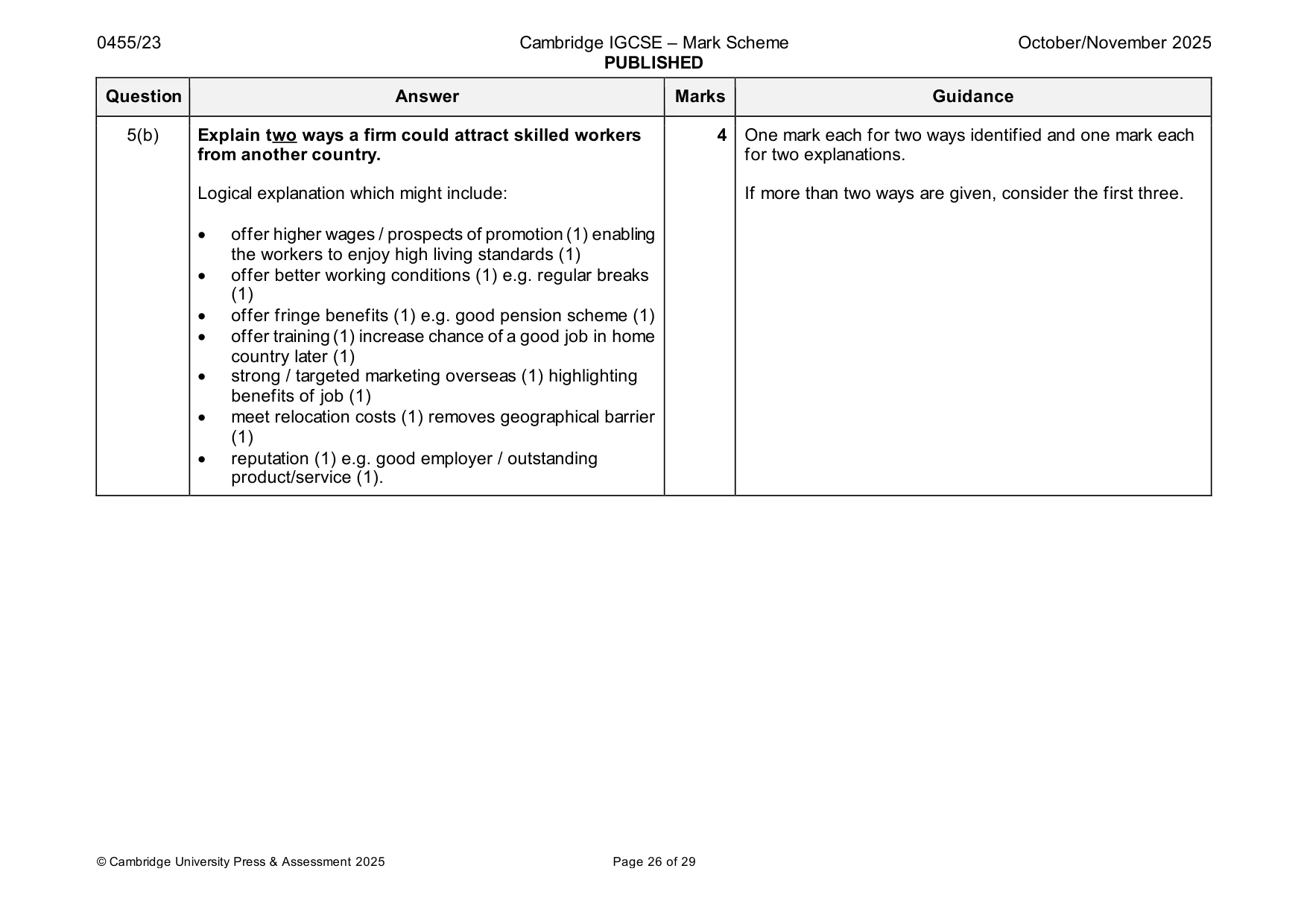
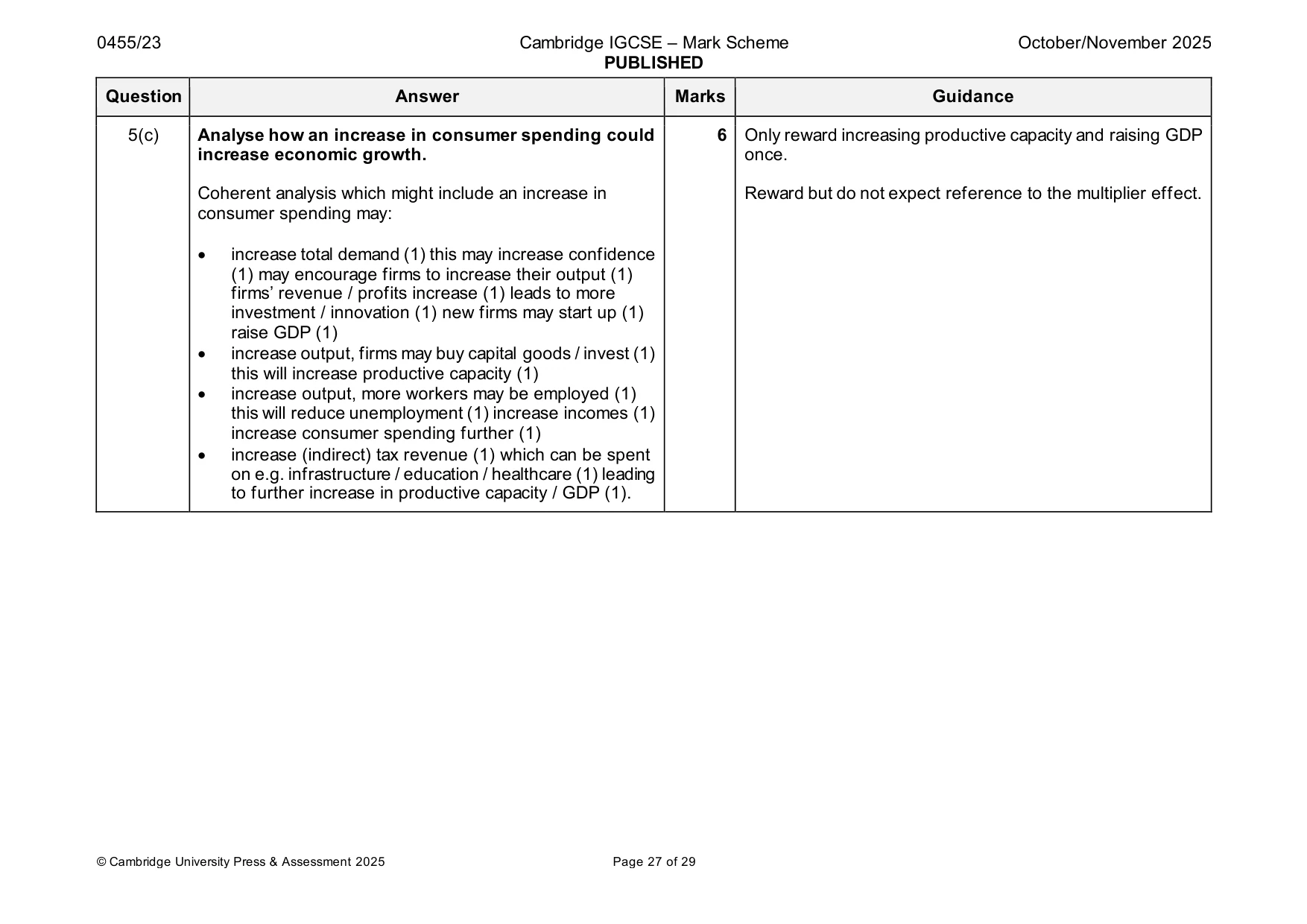
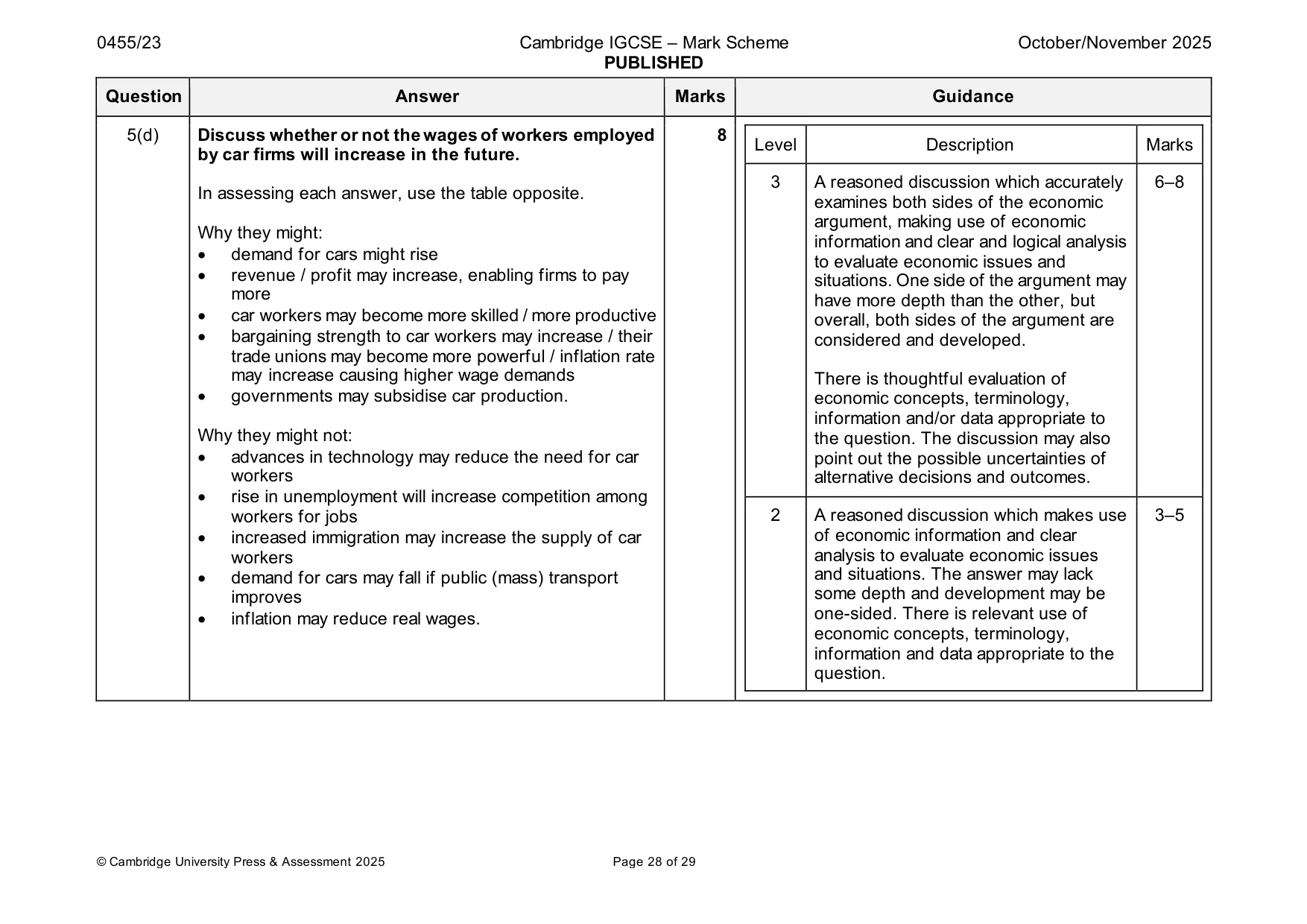
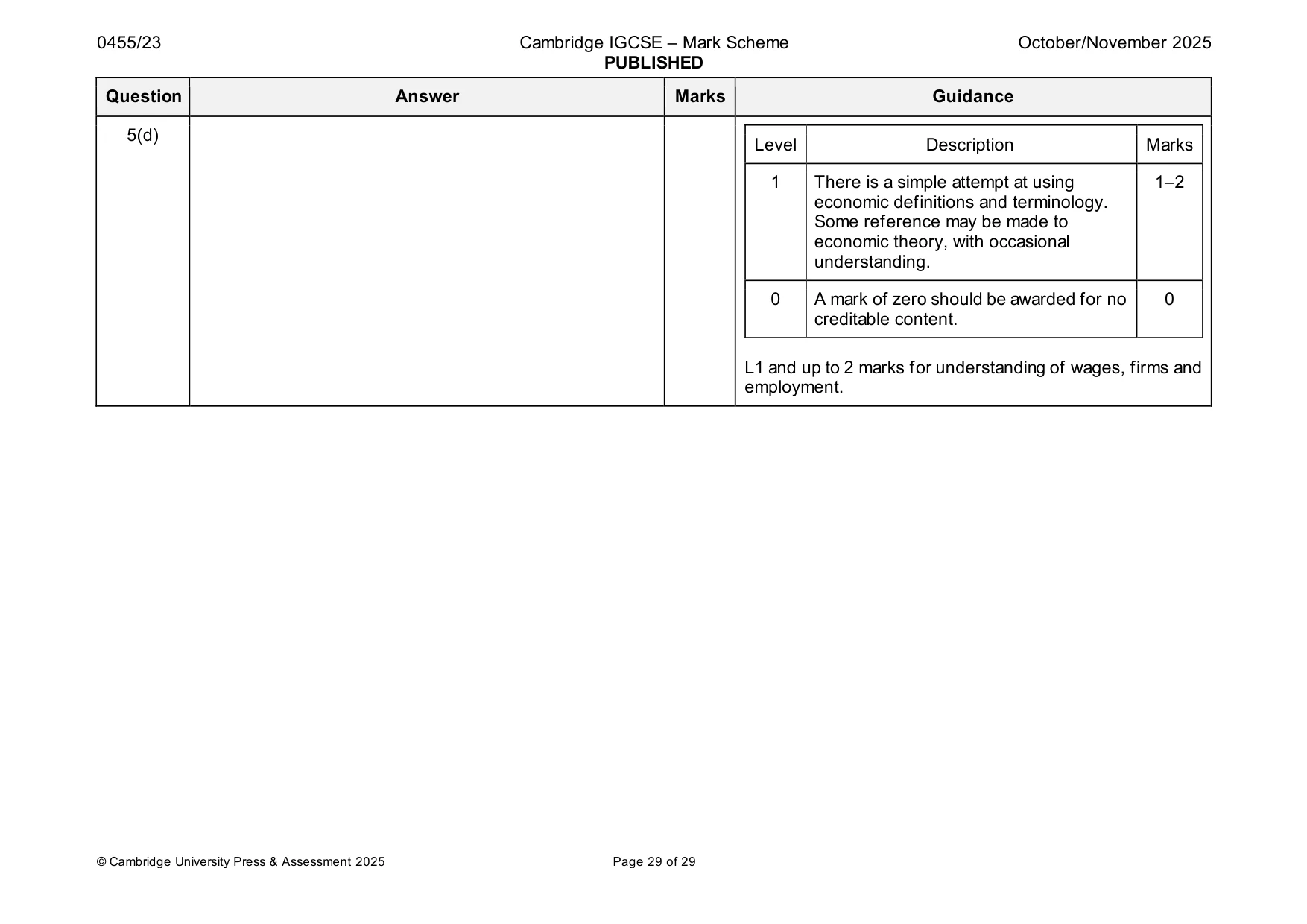
Mark scheme: 5(a) Identify two causes of an increase in life expectancy. 2 If more than two causes are given, consider the first three. Two causes from: There may be other relevant causes. These are the most common ones. • falling death rate / more / better healthcare / healthier lifestyles • better education • higher (disposable) income • improvement in nutrition • more / better housing / living standards • better environment / less pollution • better working conditions • less child poverty • ending of a war / famine / natural disaster. 5(b) Explain two ways a firm could attract skilled workers 4 One mark each for two ways identified and one mark each from another country. for two explanations. Logical explanation which might include: If more than two ways are given, consider the first three. • offer higher wages / prospects of promotion (1) enabling the workers to enjoy high living standards (1) • offer better working conditions (1) e.g. regular breaks (1) • offer fringe benefits (1) e.g. good pension scheme (1) • offer training (1) increase chance of a good job in home country later (1) • strong / targeted marketing overseas (1) highlighting benefits of job (1) • meet relocation costs (1) removes geographical barrier (1) • reputation (1) e.g. good employer / outstanding product/service (1). 5(c) Analyse how an increase in consumer spending could 6 Only reward increasing productive capacity and raising GDP increase economic growth. once. Coherent analysis which might include an increase in Reward but do not expect reference to the multiplier effect. consumer spending may: • increase total demand (1) this may increase confidence (1) may encourage firms to increase their output (1) firms’ revenue / profits increase (1) leads to more investment / innovation (1) new firms may start up (1) raise GDP (1) • increase output, firms may buy capital goods / invest (1) this will increase productive capacity (1) • increase output, more workers may be employed (1) this will reduce unemployment (1) increase incomes (1) increase consumer spending further (1) • increase (indirect) tax revenue (1) which can be spent on e.g. infrastructure / education / healthcare (1) leading to further increase in productive capacity / GDP (1). 5(d) Discuss whether or not the wages of workers employed 8 Level Description Marks by car firms will increase in the future. 3 A reasoned discussion which accurately 6–8 In assessing each answer, use the table opposite. examines both sides of the economic argument, making use of economic Why they might: information and clear and logical analysis • demand for cars might rise to evaluate economic issues and • revenue / profit may increase, enabling firms to pay situations. One side of the argument may more have more depth than the other, but • car workers may become more skilled / more productive overall, both sides of the argument are • bargaining strength to car workers may increase / their considered and developed. trade unions may become more powerful / inflation rate may increase causing higher wage demands There is thoughtful evaluation of • governments may subsidise car production. economic concepts, terminology, information and/or data appropriate to Why they might not: the question. The discussion may also • advances in technology may reduce the need for car point out the possible uncertainties of workers alternative decisions and outcomes. • rise in unemployment will increase competition among workers for jobs 2 A reasoned discussion which makes use 3–5 • increased immigration may increase the supply of car of economic information and clear workers analysis to evaluate economic issues • demand for cars may fall if public (mass) transport and situations. The answer may lack improves some depth and development may be • inflation may reduce real wages. one-sided. There is relevant use of economic concepts, terminology, information and data appropriate to the question. 5(d) Level Description Marks 1 There is a simple attempt at using 1–2 economic definitions and terminology. Some reference may be made to economic theory, with occasional understanding. 0 A mark of zero should be awarded for no 0 creditable content. L1 and up to 2 marks for understanding of wages, firms and employment.
What was in this paper
The subtopics covered by these 5 questions, and how many questions each got. Open one in a new tab to see every Cambridge question on it.
What you needed in this session
Cambridge’s own grade thresholds for 2025 Oct/Nov, Paper 2 · Variant 3. A higher threshold means an easier paper — the bar moves with how the cohort did.