Cambridge IGCSE Economics 0455 — 2020 Oct/Nov Paper 2 · Variant 1
0455/21/O/N/20 · 5 questions · 90 marks · ≈101 min
The question paper and its mark scheme, free to read here and free to download. This is Cambridge’s own paper, exactly as it was sat.
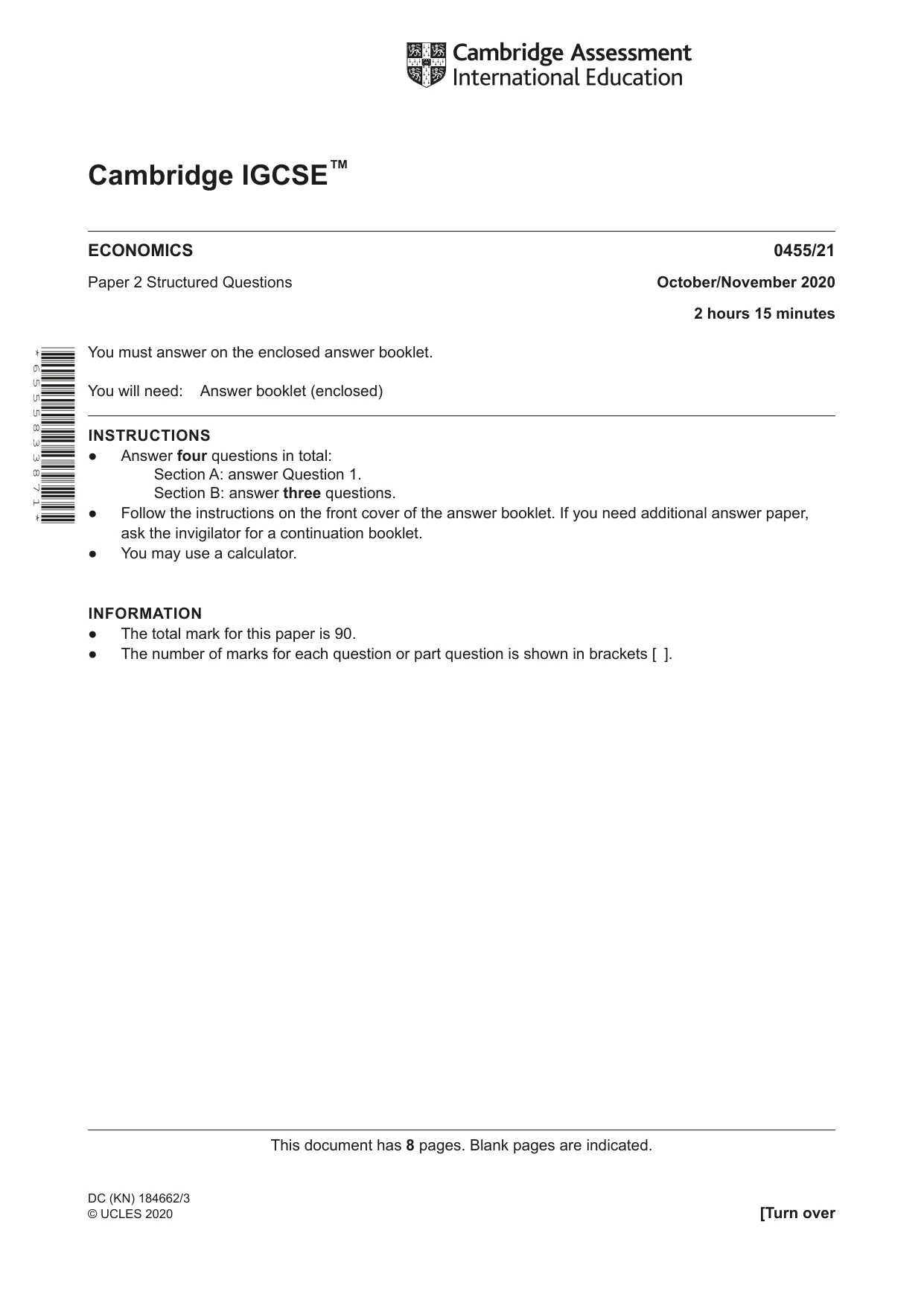
Question paper8 pages




Mark scheme18 pages
Answers below. Sit the paper first if you are practising.
Questions as text
Q1 · Calculate Turkey’s total output
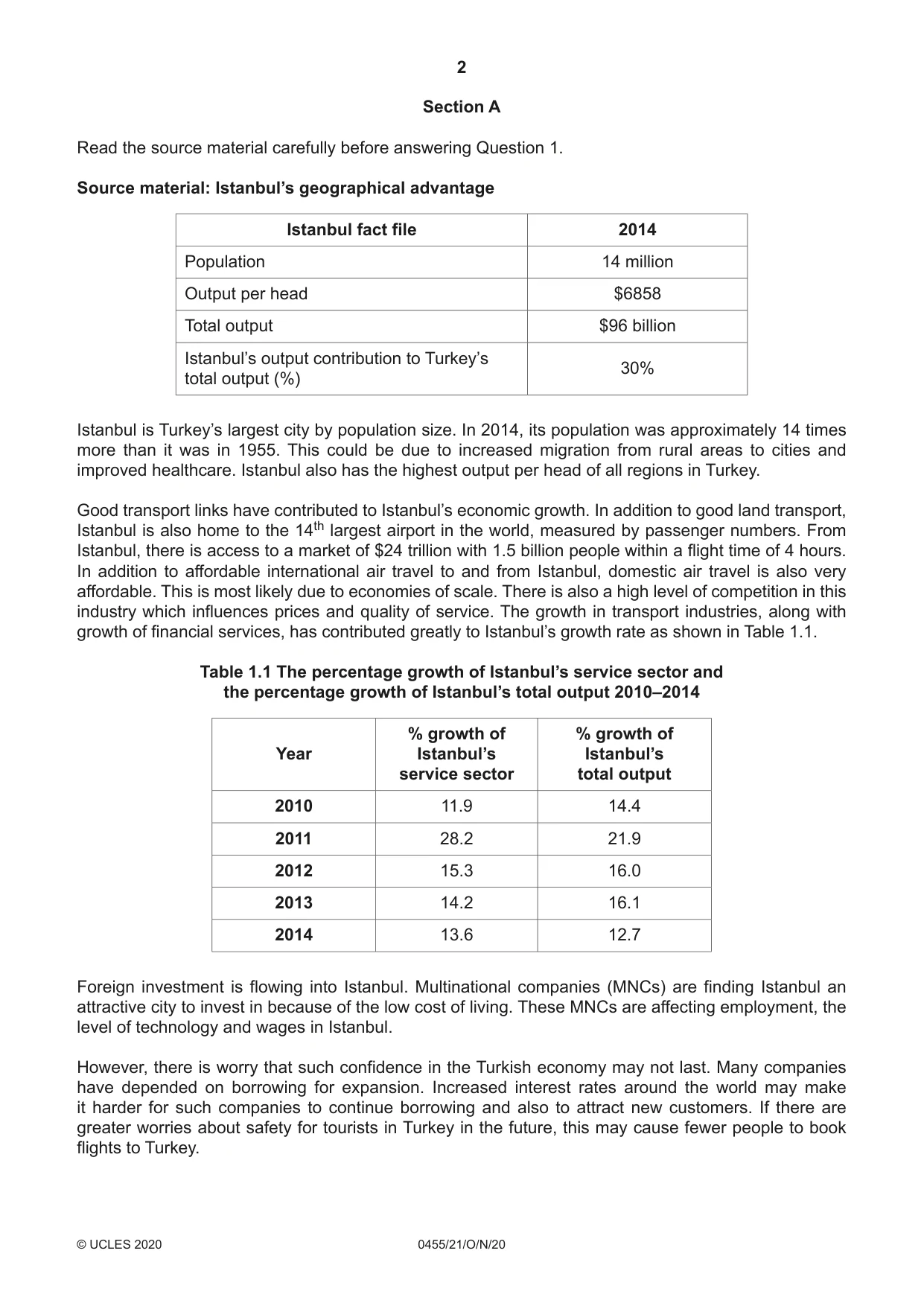
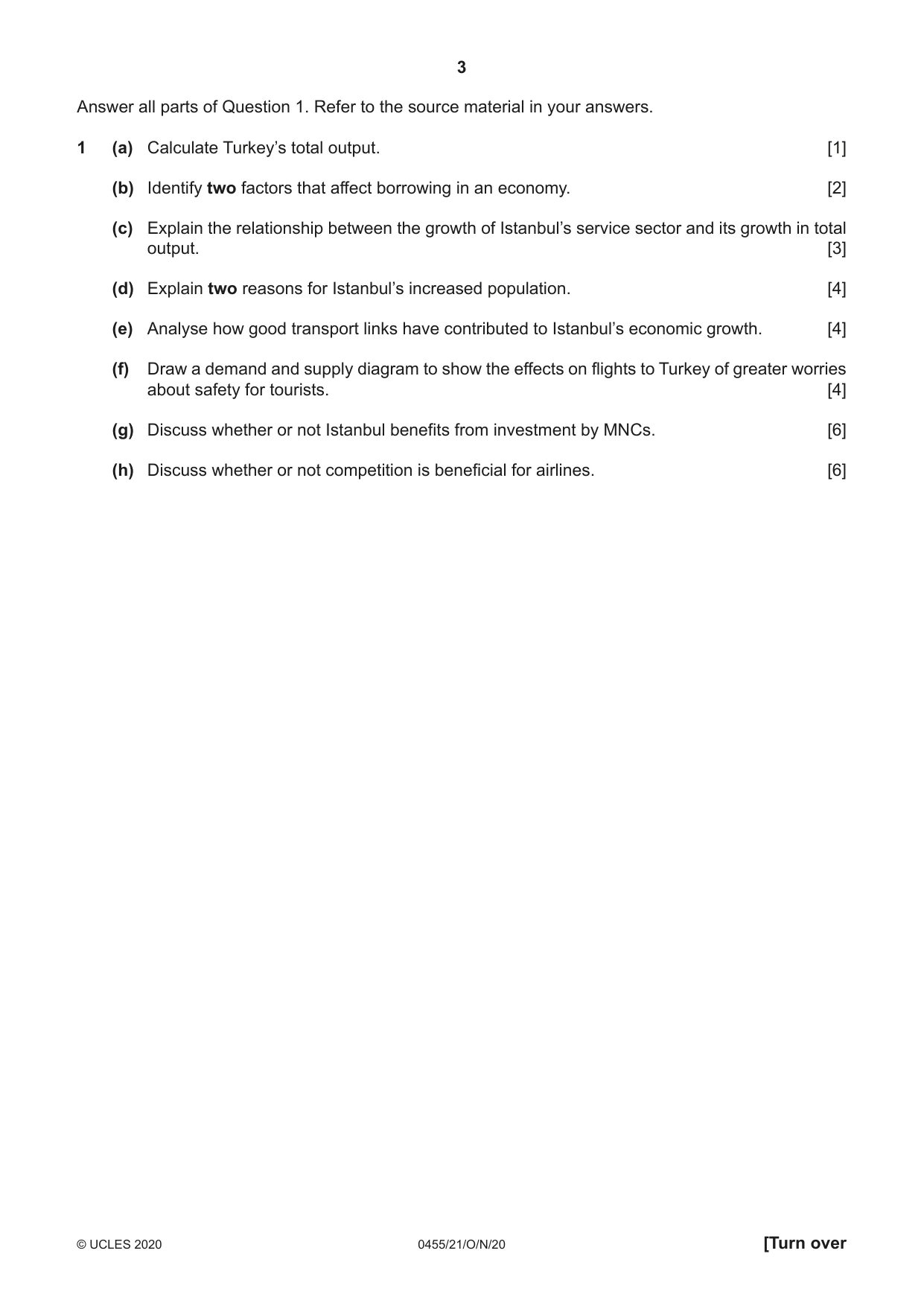
1 (a) Calculate Turkey’s total output. [1] (b) Identify two factors that affect borrowing in an economy. [2] (c) Explain the relationship between the growth of Istanbul’s service sector and its growth in total output. [3] (d) Explain two reasons for Istanbul’s increased population. [4] (e) Analyse how good transport links have contributed to Istanbul’s economic growth. [4] (f) Draw a demand and supply diagram to show the effects on flights to Turkey of greater worries about safety for tourists. [4] (g) Discuss whether or not Istanbul benefits from investment by MNCs. [6] (h) Discuss whether or not competition is beneficial for airlines. [6]
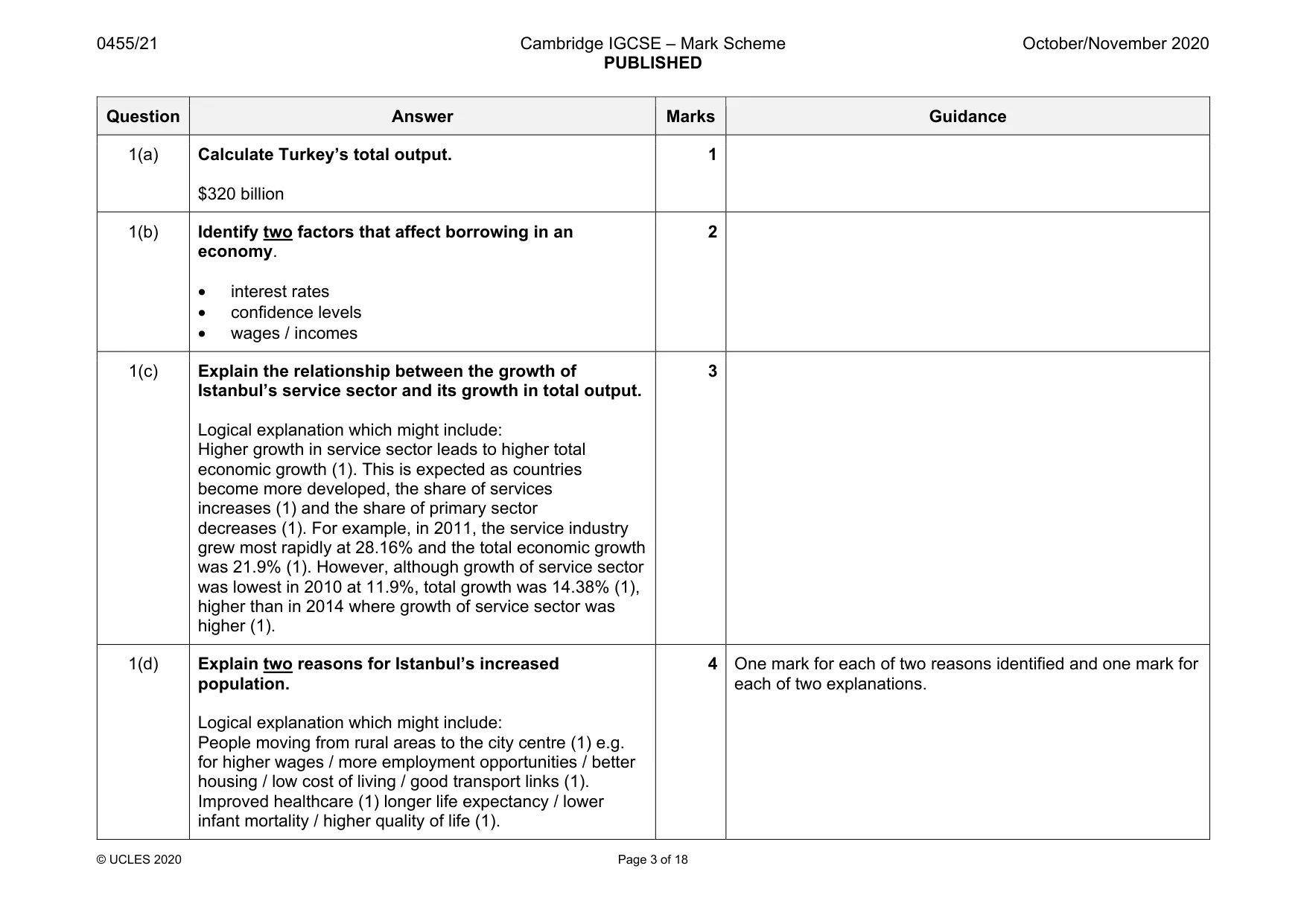
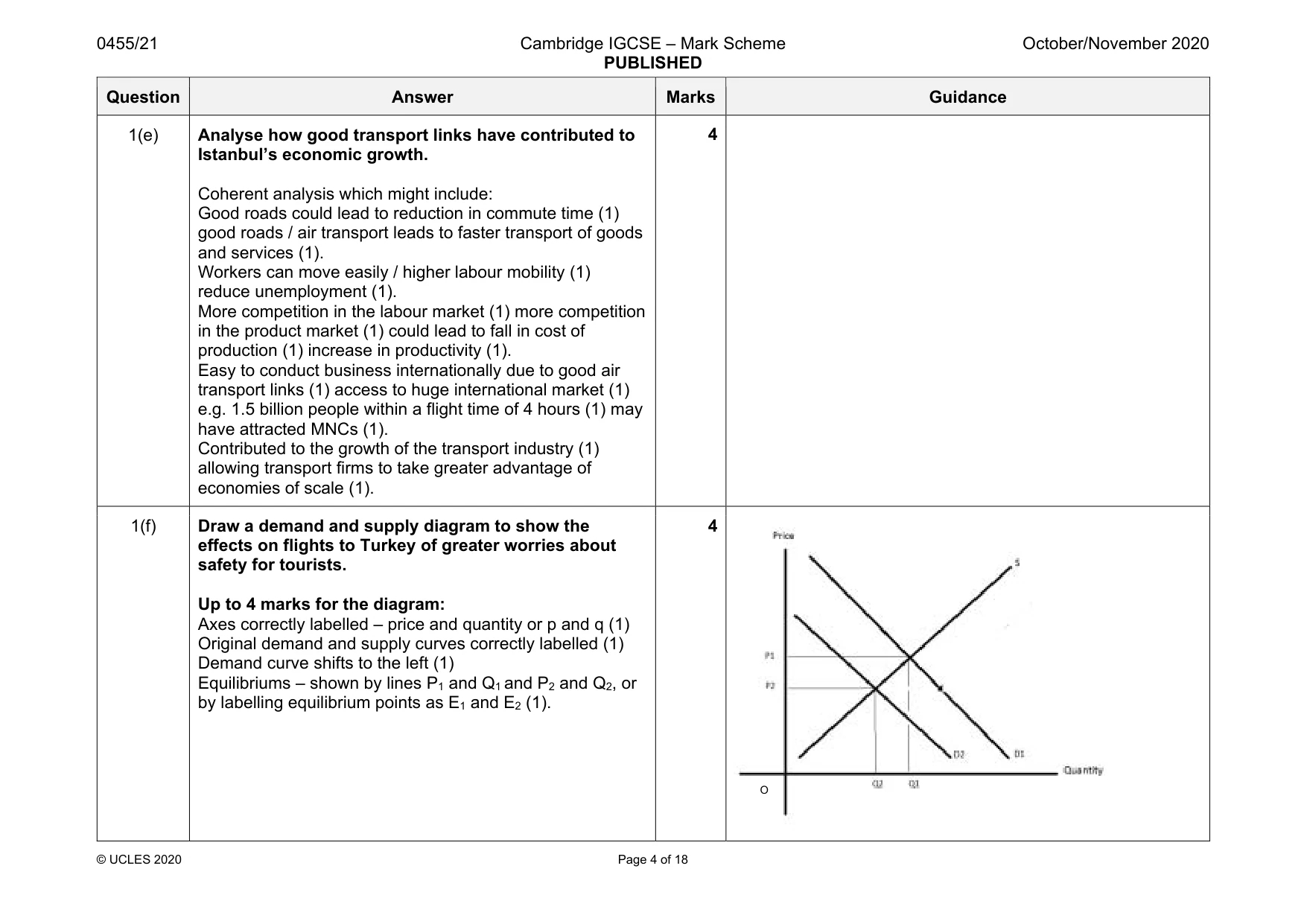
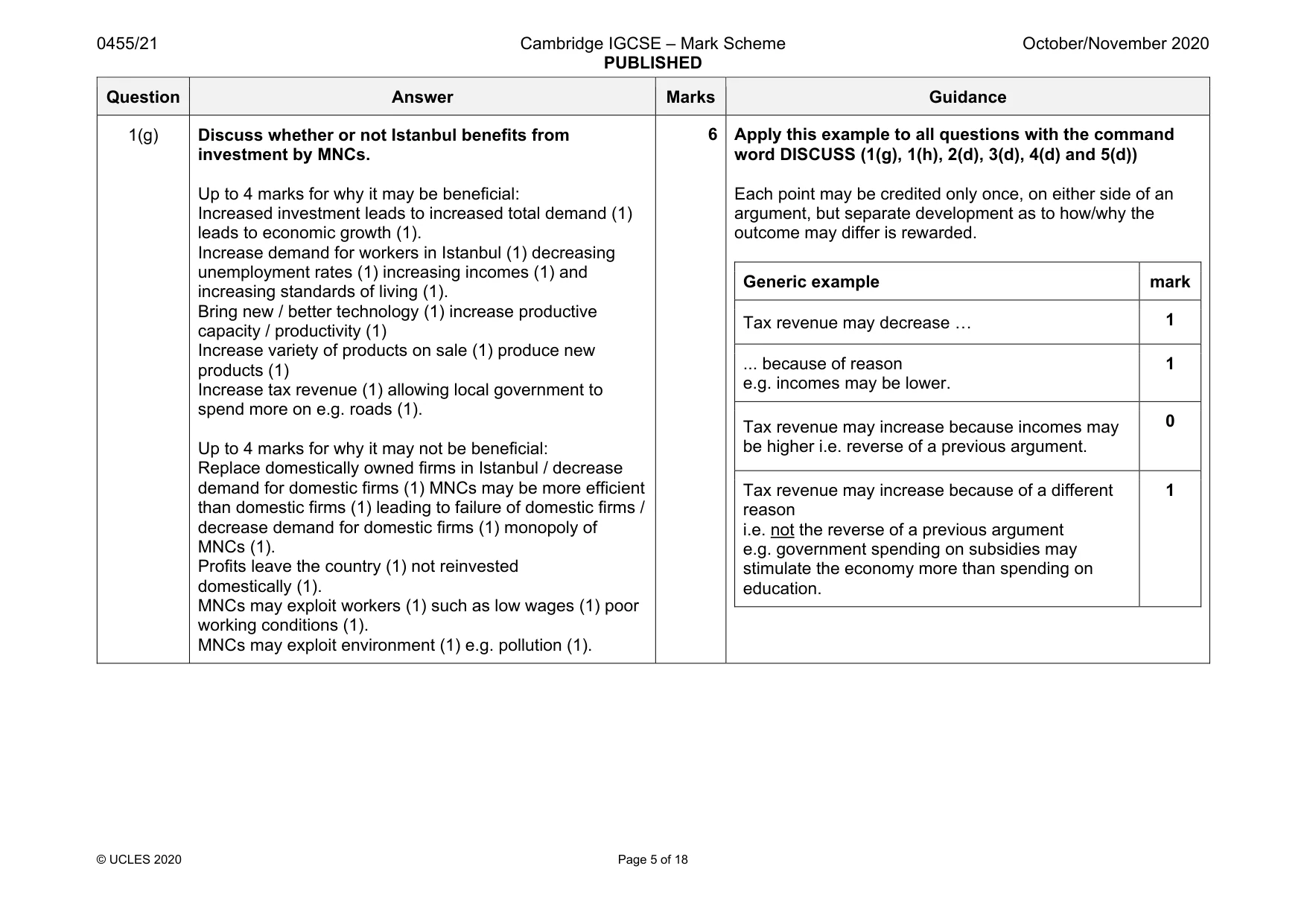
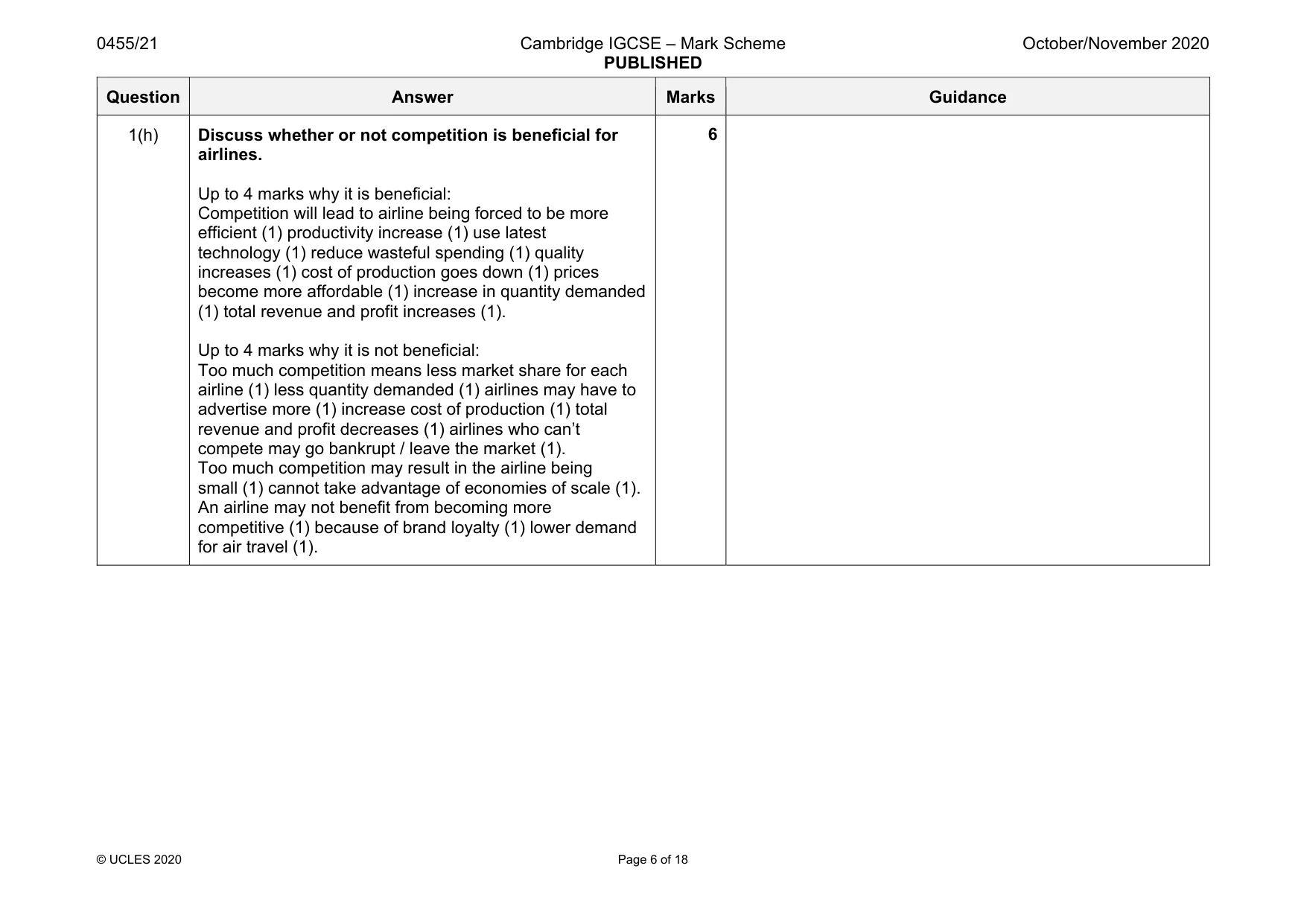
Mark scheme: 1(a) Calculate Turkey’s total output. $320 billion 1 1(b) Identify two factors that affect borrowing in an economy. • interest rates • confidence levels • wages / incomes 2 1(c) Explain the relationship between the growth of Istanbul’s service sector and its growth in total output. Logical explanation which might include: Higher growth in service sector leads to higher total economic growth (1). This is expected as countries become more developed, the share of services increases (1) and the share of primary sector decreases (1). For example, in 2011, the service industry grew most rapidly at 28.16% and the total economic growth was 21.9% (1). However, although growth of service sector was lowest in 2010 at 11.9%, total growth was 14.38% (1), higher than in 2014 where growth of service sector was higher (1). 3 1(d) Explain two reasons for Istanbul’s increased population. Logical explanation which might include: People moving from rural areas to the city centre (1) e.g. for higher wages / more employment opportunities / better housing / low cost of living / good transport links (1). Improved healthcare (1) longer life expectancy / lower infant mortality / higher quality of life (1). 4 One mark for each of two reasons identified and one mark for each of two explanations. Question Answer Marks Guidance 1(e) Analyse how good transport links have contributed to Istanbul’s economic growth. Coherent analysis which might include: Good roads could lead to reduction in commute time (1) good roads / air transport leads to faster transport of goods and services (1). Workers can move easily / higher labour mobility (1) reduce unemployment (1). More competition in the labour market (1) more competition in the product market (1) could lead to fall in cost of production (1) increase in productivity (1). Easy to conduct business internationally due to good air transport links (1) access to huge international market (1) e.g. 1.5 billion people within a flight time of 4 hours (1) may have attracted MNCs (1). Contributed to the growth of the transport industry (1) allowing transport firms to take greater advantage of economies of scale (1). 4 1(f) Draw a demand and supply diagram to show the effects on flights to Turkey of greater worries about safety for tourists. Up to 4 marks for the diagram: Axes correctly labelled – price and quantity or p and q (1) Original demand and supply curves correctly labelled (1) Demand curve shifts to the left (1) Equilibriums – shown by lines P1 and Q1 and P2 and Q2, or by labelling equilibrium points as E1 and E2 (1). 4 O Question Answer Marks Guidance 1(g) Discuss whether or not Istanbul benefits from investment by MNCs. Up to 4 marks for why it may be beneficial: Increased investment leads to increased total demand (1) leads to economic growth (1). Increase demand for workers in Istanbul (1) decreasing unemployment rates (1) increasing incomes (1) and increasing standards of living (1). Bring new / better technology (1) increase productive capacity / productivity (1) Increase variety of products on sale (1) produce new products (1) Increase tax revenue (1) allowing local government to spend more on e.g. roads (1). Up to 4 marks for why it may not be beneficial: Replace domestically owned firms in Istanbul / decrease demand for domestic firms (1) MNCs may be more efficient than domestic firms (1) leading to failure of domestic firms / decrease demand for domestic firms (1) monopoly of MNCs (1). Profits leave the country (1) not reinvested domestically (1). MNCs may exploit workers (1) such as low wages (1) poor working conditions (1). MNCs may exploit environment (1) e.g. pollution (1). 6 Apply this example to all questions with the command word DISCUSS (1(g), 1(h), 2(d), 3(d), 4(d) and 5(d)) Each point may be credited only once, on either side of an argument, but separate development as to how/why the outcome may differ is rewarded. Generic example mark Tax revenue may decrease … 1 ... because of reason e.g. incomes may be lower. 1 Tax revenue may increase because incomes may be higher i.e. reverse of a previous argument. 0 Tax revenue may increase because of a different reason i.e. not the reverse of a previous argument e.g. government spending on subsidies may stimulate the economy more than spending on education. 1 Question Answer Marks Guidance 1(h) Discuss whether or not competition is beneficial for airlines. Up to 4 marks why it is beneficial: Competition will lead to airline being forced to be more efficient (1) productivity increase (1) use latest technology (1) reduce wasteful spending (1) quality increases (1) cost of production goes down (1) prices become more affordable (1) increase in quantity demanded (1) total revenue and profit increases (1). Up to 4 marks why it is not beneficial: Too much competition means less market share for each airline (1) less quantity demanded (1) airlines may have to advertise more (1) increase cost of production (1) total revenue and profit decreases (1) airlines who can’t compete may go bankrupt / leave the market (1). Too much competition may result in the airline being small (1) cannot take advantage of economies of scale (1). An airline may not benefit from becoming more competitive (1) because of brand loyalty (1) lower demand for air travel (1). 6
Q2 · The election of a new president in South Africa in 2018 led to improvement in business…
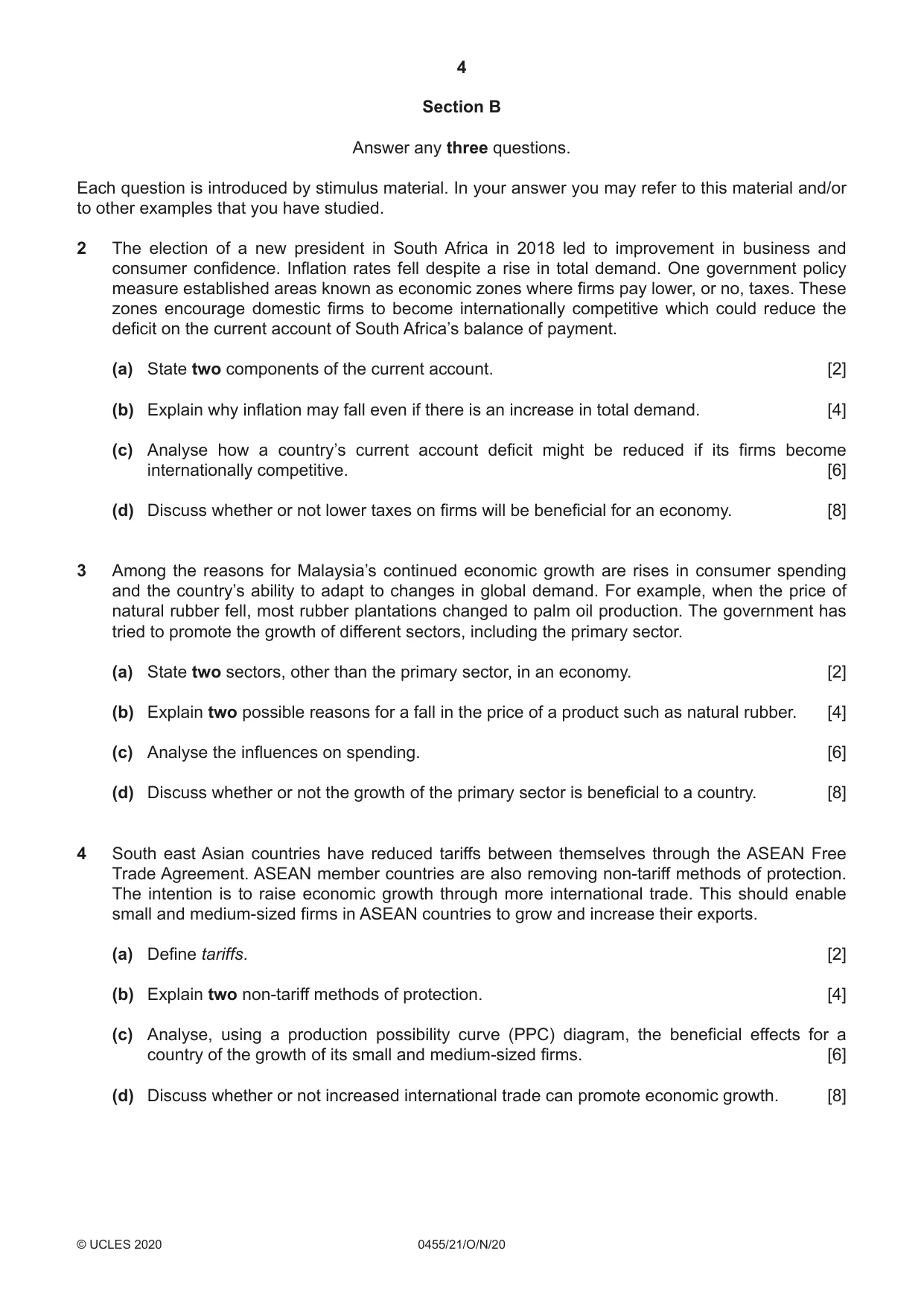
2 The election of a new president in South Africa in 2018 led to improvement in business and consumer confidence. Inflation rates fell despite a rise in total demand. One government policy measure established areas known as economic zones where firms pay lower, or no, taxes. These zones encourage domestic firms to become internationally competitive which could reduce the deficit on the current account of South Africa’s balance of payment. (a) State two components of the current account. [2] (b) Explain why inflation may fall even if there is an increase in total demand. [4] (c) Analyse how a country’s current account deficit might be reduced if its firms become internationally competitive. [6] (d) Discuss whether or not lower taxes on firms will be beneficial for an economy. [8]
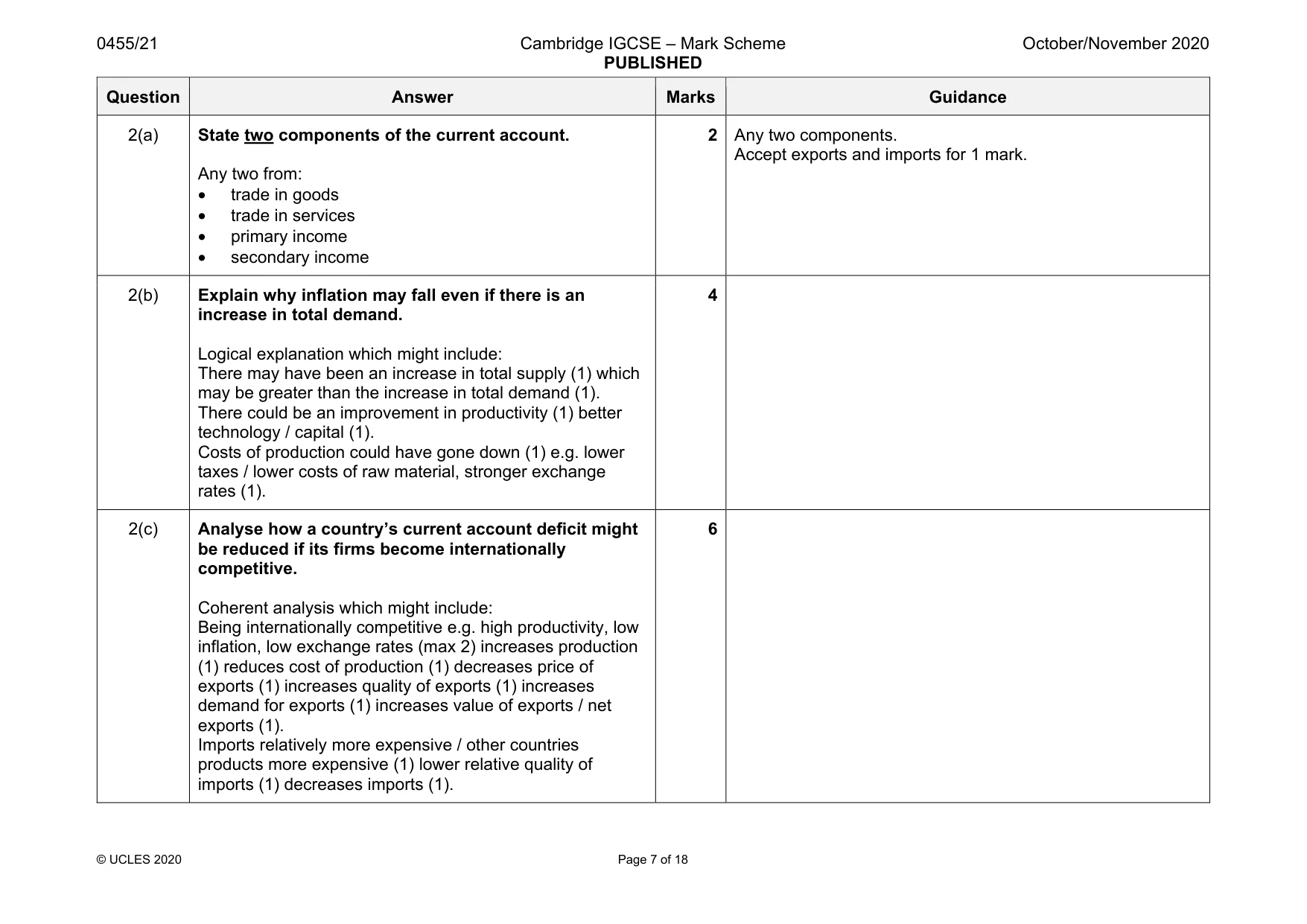
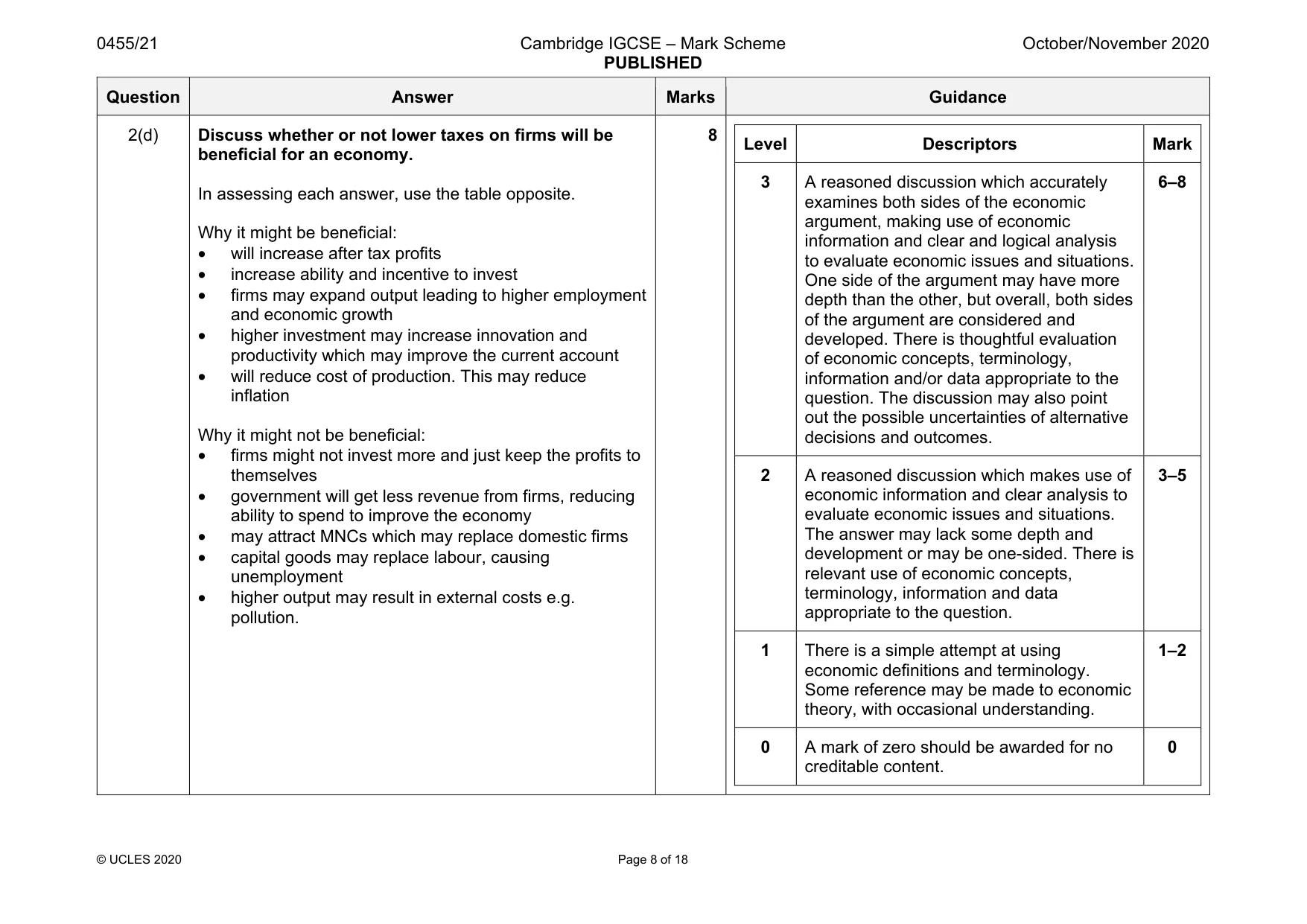
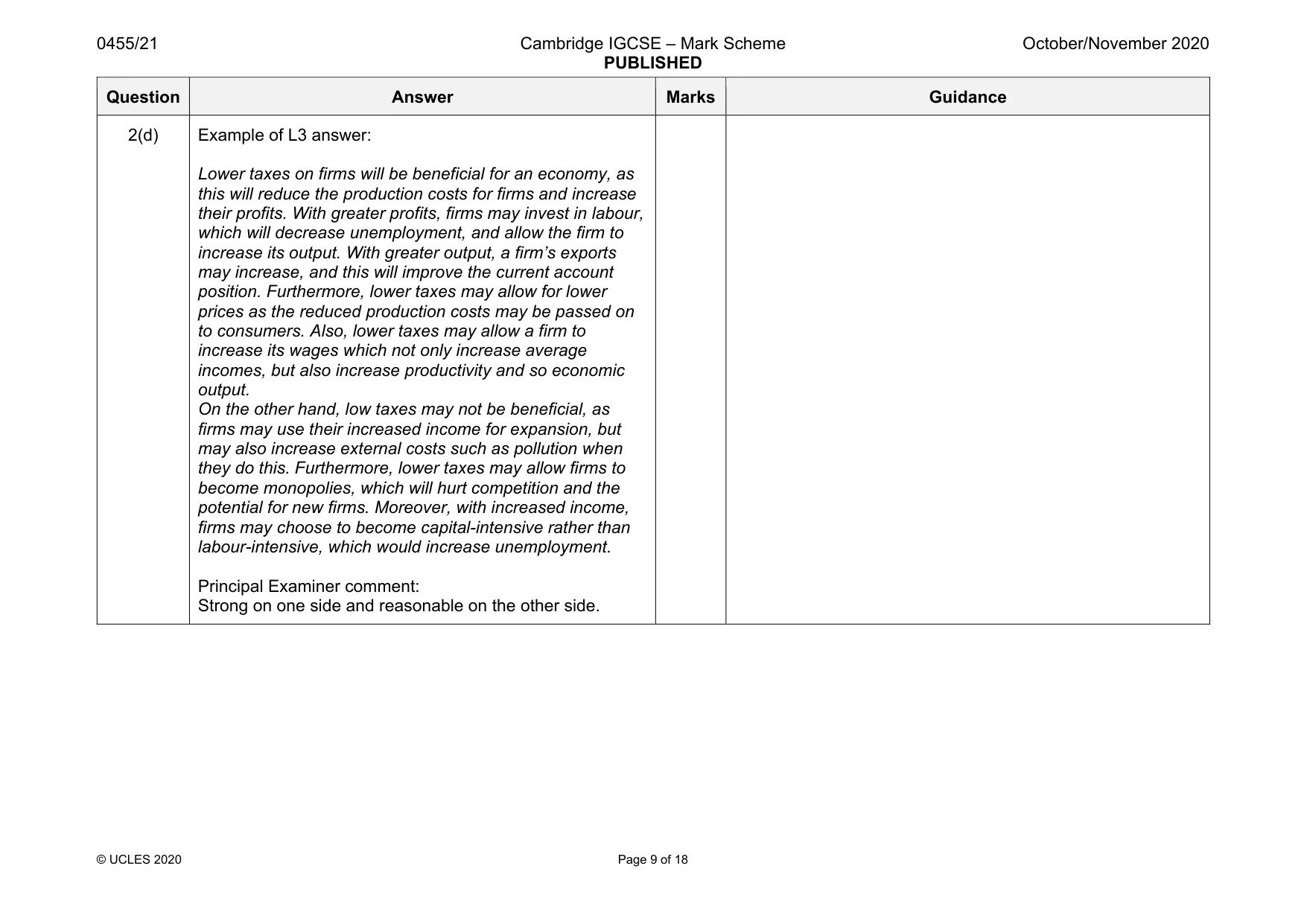
Mark scheme: 2(a) State two components of the current account. Any two from: • trade in goods • trade in services • primary income • secondary income 2 Any two components. Accept exports and imports for 1 mark. 2(b) Explain why inflation may fall even if there is an increase in total demand. Logical explanation which might include: There may have been an increase in total supply (1) which may be greater than the increase in total demand (1). There could be an improvement in productivity (1) better technology / capital (1). Costs of production could have gone down (1) e.g. lower taxes / lower costs of raw material, stronger exchange rates (1). 4 2(c) Analyse how a country’s current account deficit might be reduced if its firms become internationally competitive. Coherent analysis which might include: Being internationally competitive e.g. high productivity, low inflation, low exchange rates (max 2) increases production (1) reduces cost of production (1) decreases price of exports (1) increases quality of exports (1) increases demand for exports (1) increases value of exports / net exports (1). Imports relatively more expensive / other countries products more expensive (1) lower relative quality of imports (1) decreases imports (1). 6 Question Answer Marks Guidance 2(d) Discuss whether or not lower taxes on firms will be beneficial for an economy. In assessing each answer, use the table opposite. Why it might be beneficial: • will increase after tax profits • increase ability and incentive to invest • firms may expand output leading to higher employment and economic growth • higher investment may increase innovation and productivity which may improve the current account • will reduce cost of production. This may reduce inflation Why it might not be beneficial: • firms might not invest more and just keep the profits to themselves • government will get less revenue from firms, reducing ability to spend to improve the economy • may attract MNCs which may replace domestic firms • capital goods may replace labour, causing unemployment • higher output may result in external costs e.g. pollution. 8 Level Descriptors Mark 3 A reasoned discussion which accurately examines both sides of the economic argument, making use of economic information and clear and logical analysis to evaluate economic issues and situations. One side of the argument may have more depth than the other, but overall, both sides of the argument are considered and developed. There is thoughtful evaluation of economic concepts, terminology, information and/or data appropriate to the question. The discussion may also point out the possible uncertainties of alternative decisions and outcomes. 6–8 2 A reasoned discussion which makes use of economic information and clear analysis to evaluate economic issues and situations. The answer may lack some depth and development or may be one-sided. There is relevant use of economic concepts, terminology, information and data appropriate to the question. 3–5 1 There is a simple attempt at using economic definitions and terminology. Some reference may be made to economic theory, with occasional understanding. 1–2 0 A mark of zero should be awarded for no creditable content. 0 Question Answer Marks Guidance 2(d) Example of L3 answer: Lower taxes on firms will be beneficial for an economy, as this will reduce the production costs for firms and increase their profits. With greater profits, firms may invest in labour, which will decrease unemployment, and allow the firm to increase its output. With greater output, a firm’s exports may increase, and this will improve the current account position. Furthermore, lower taxes may allow for lower prices as the reduced production costs may be passed on to consumers. Also, lower taxes may allow a firm to increase its wages which not only increase average incomes, but also increase productivity and so economic output. On the other hand, low taxes may not be beneficial, as firms may use their increased income for expansion, but may also increase external costs such as pollution when they do this. Furthermore, lower taxes may allow firms to become monopolies, which will hurt competition and the potential for new firms. Moreover, with increased income, firms may choose to become capital-intensive rather than labour-intensive, which would increase unemployment. Principal Examiner comment: Strong on one side and reasonable on the other side.
Q3 · Among the reasons for Malaysia’s continued economic growth are rises in consumer spending…
3 Among the reasons for Malaysia’s continued economic growth are rises in consumer spending and the country’s ability to adapt to changes in global demand. For example, when the price of natural rubber fell, most rubber plantations changed to palm oil production. The government has tried to promote the growth of different sectors, including the primary sector. (a) State two sectors, other than the primary sector, in an economy. [2] (b) Explain two possible reasons for a fall in the price of a product such as natural rubber. [4] (c) Analyse the influences on spending. [6] (d) Discuss whether or not the growth of the primary sector is beneficial to a country. [8]
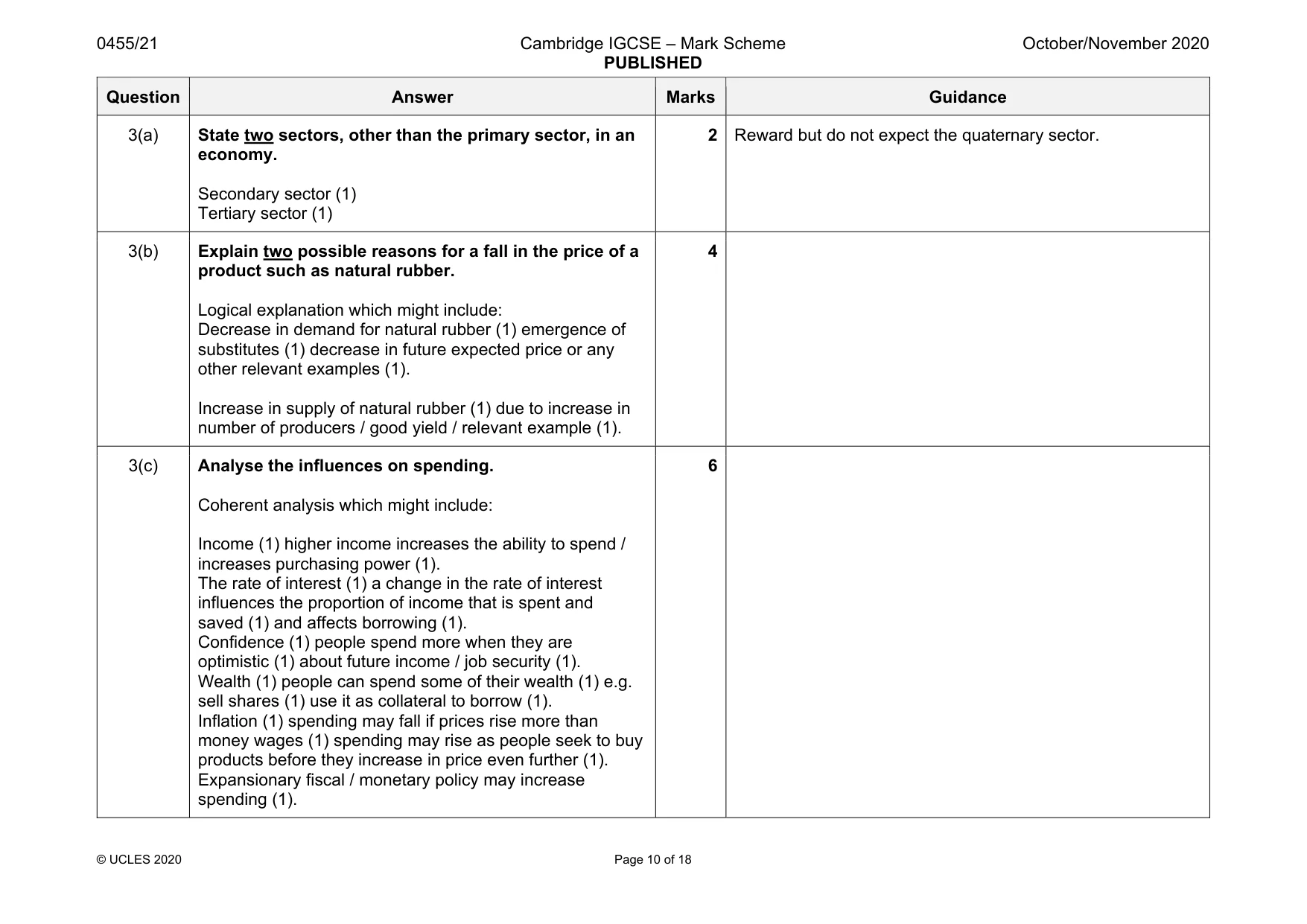
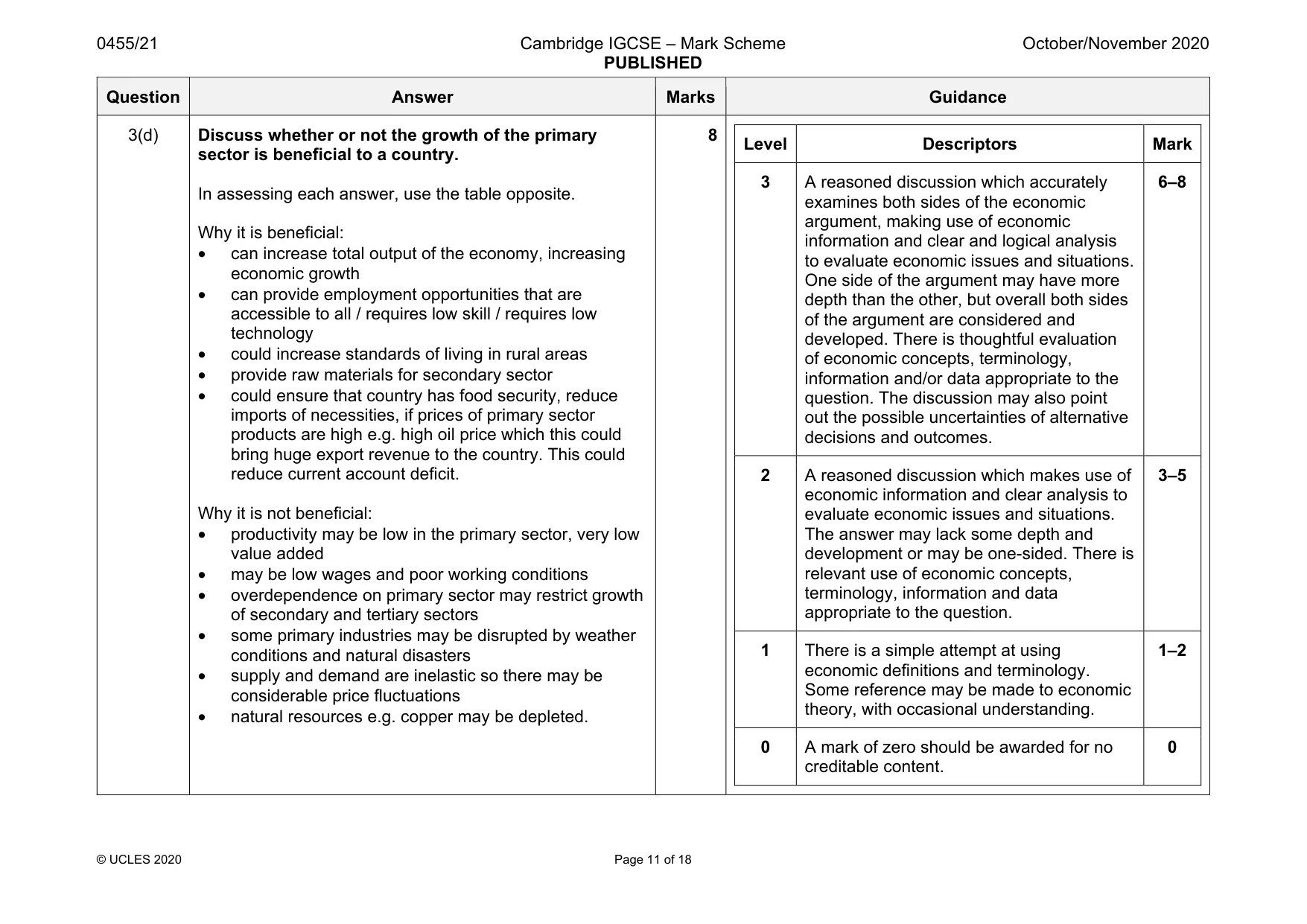
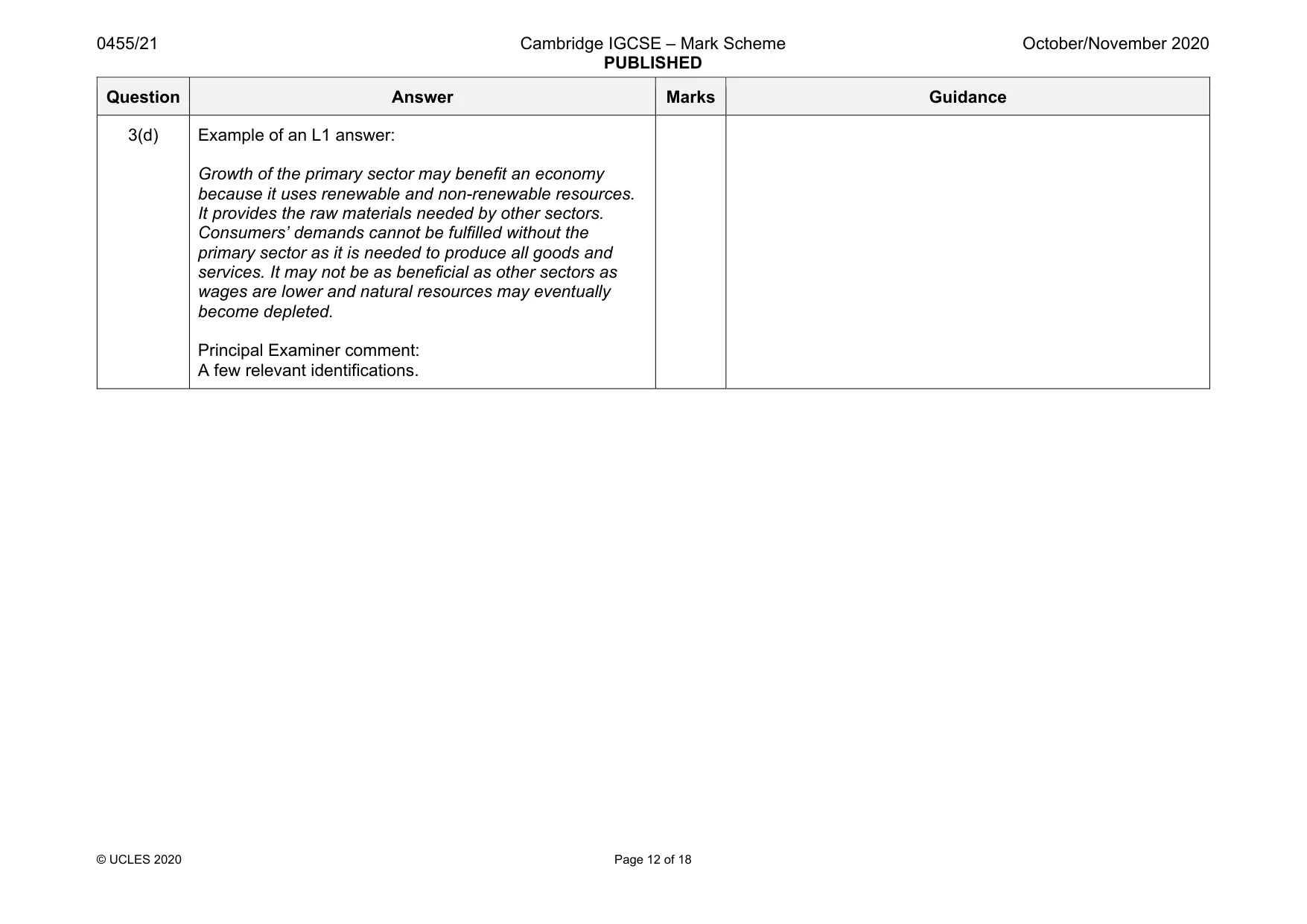
Mark scheme: 3(a) State two sectors, other than the primary sector, in an economy. Secondary sector (1) Tertiary sector (1) 2 Reward but do not expect the quaternary sector. 3(b) Explain two possible reasons for a fall in the price of a product such as natural rubber. Logical explanation which might include: Decrease in demand for natural rubber (1) emergence of substitutes (1) decrease in future expected price or any other relevant examples (1). Increase in supply of natural rubber (1) due to increase in number of producers / good yield / relevant example (1). 4 3(c) Analyse the influences on spending. Coherent analysis which might include: Income (1) higher income increases the ability to spend / increases purchasing power (1). The rate of interest (1) a change in the rate of interest influences the proportion of income that is spent and saved (1) and affects borrowing (1). Confidence (1) people spend more when they are optimistic (1) about future income / job security (1). Wealth (1) people can spend some of their wealth (1) e.g. sell shares (1) use it as collateral to borrow (1). Inflation (1) spending may fall if prices rise more than money wages (1) spending may rise as people seek to buy products before they increase in price even further (1). Expansionary fiscal / monetary policy may increase spending (1). 6 Question Answer Marks Guidance 3(d) Discuss whether or not the growth of the primary sector is beneficial to a country. In assessing each answer, use the table opposite. Why it is beneficial: • can increase total output of the economy, increasing economic growth • can provide employment opportunities that are accessible to all / requires low skill / requires low technology • could increase standards of living in rural areas • provide raw materials for secondary sector • could ensure that country has food security, reduce imports of necessities, if prices of primary sector products are high e.g. high oil price which this could bring huge export revenue to the country. This could reduce current account deficit. Why it is not beneficial: • productivity may be low in the primary sector, very low value added • may be low wages and poor working conditions • overdependence on primary sector may restrict growth of secondary and tertiary sectors • some primary industries may be disrupted by weather conditions and natural disasters • supply and demand are inelastic so there may be considerable price fluctuations • natural resources e.g. copper may be depleted. 8 Level Descriptors Mark 3 A reasoned discussion which accurately examines both sides of the economic argument, making use of economic information and clear and logical analysis to evaluate economic issues and situations. One side of the argument may have more depth than the other, but overall both sides of the argument are considered and developed. There is thoughtful evaluation of economic concepts, terminology, information and/or data appropriate to the question. The discussion may also point out the possible uncertainties of alternative decisions and outcomes. 6–8 2 A reasoned discussion which makes use of economic information and clear analysis to evaluate economic issues and situations. The answer may lack some depth and development or may be one-sided. There is relevant use of economic concepts, terminology, information and data appropriate to the question. 3–5 1 There is a simple attempt at using economic definitions and terminology. Some reference may be made to economic theory, with occasional understanding. 1–2 0 A mark of zero should be awarded for no creditable content. 0 Question Answer Marks Guidance 3(d) Example of an L1 answer: Growth of the primary sector may benefit an economy because it uses renewable and non-renewable resources. It provides the raw materials needed by other sectors. Consumers’ demands cannot be fulfilled without the primary sector as it is needed to produce all goods and services. It may not be as beneficial as other sectors as wages are lower and natural resources may eventually become depleted. Principal Examiner comment: A few relevant identifications.
Q4 · South east Asian countries have reduced tariffs between themselves through the ASEAN Free…
4 South east Asian countries have reduced tariffs between themselves through the ASEAN Free Trade Agreement. ASEAN member countries are also removing non-tariff methods of protection. The intention is to raise economic growth through more international trade. This should enable small and medium-sized firms in ASEAN countries to grow and increase their exports. (a) Define tariffs. [2] (b) Explain two non-tariff methods of protection. [4] (c) Analyse, using a production possibility curve (PPC) diagram, the beneficial effects for a country of the growth of its small and medium-sized firms. [6] (d) Discuss whether or not increased international trade can promote economic growth. [8]
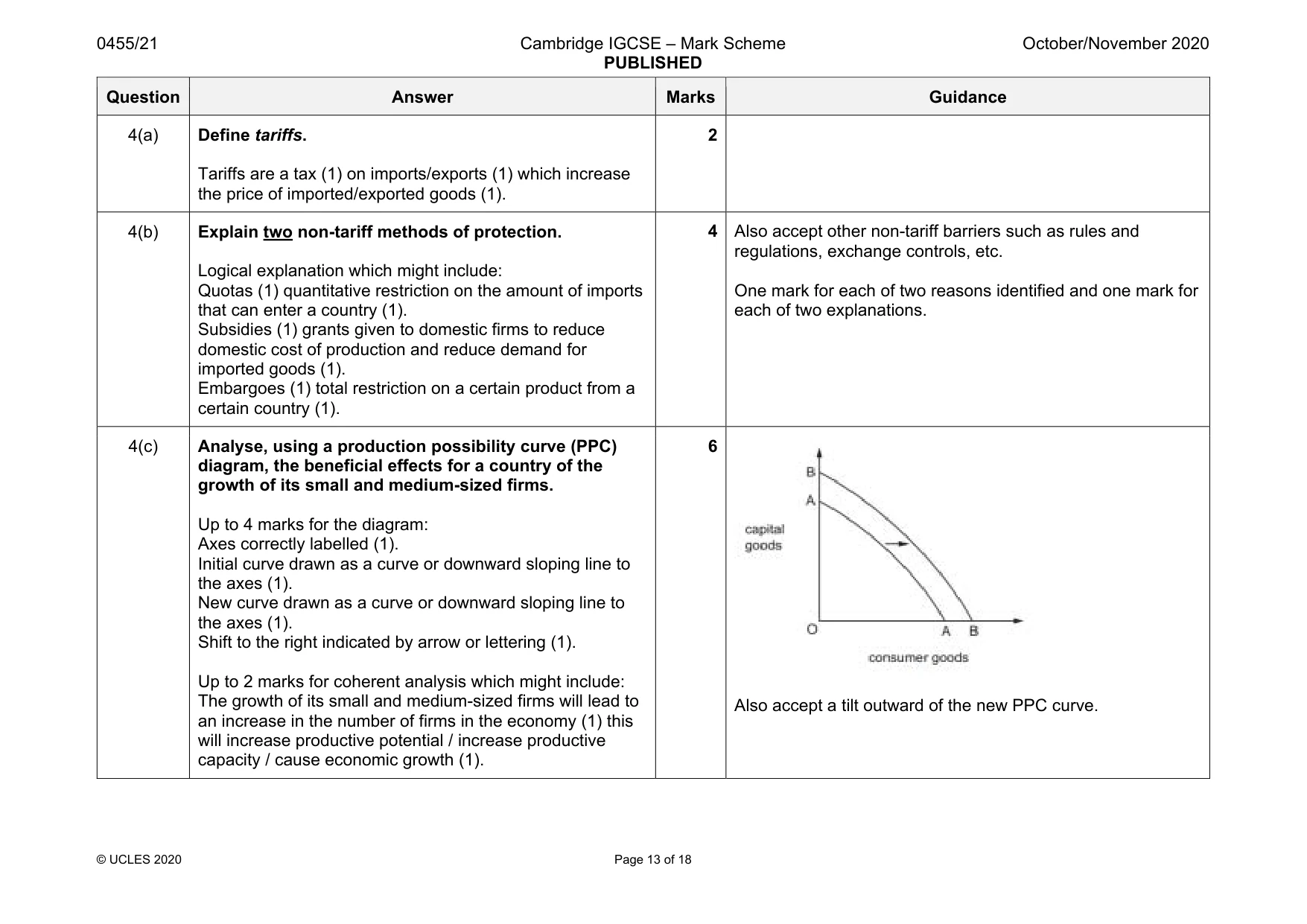
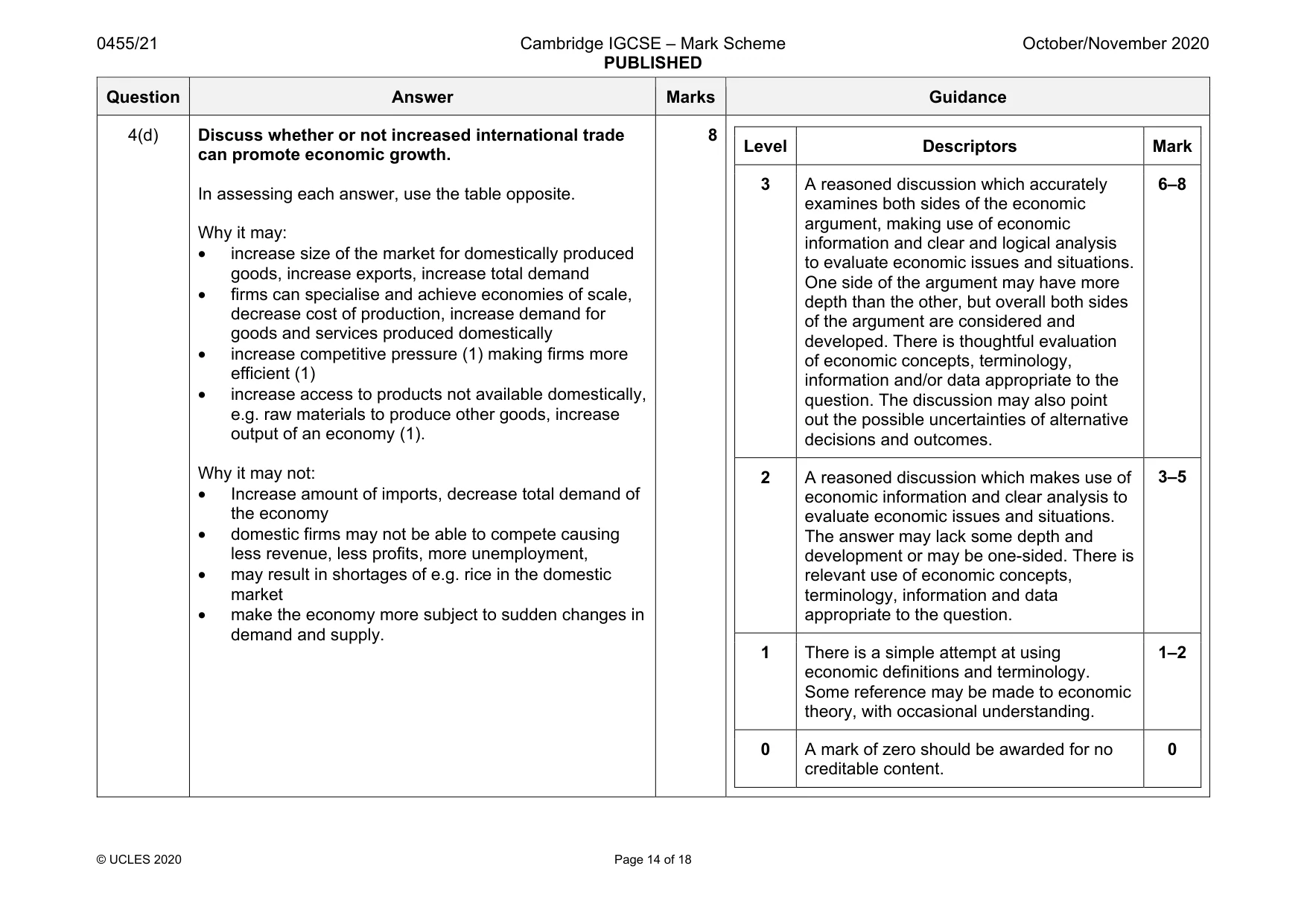
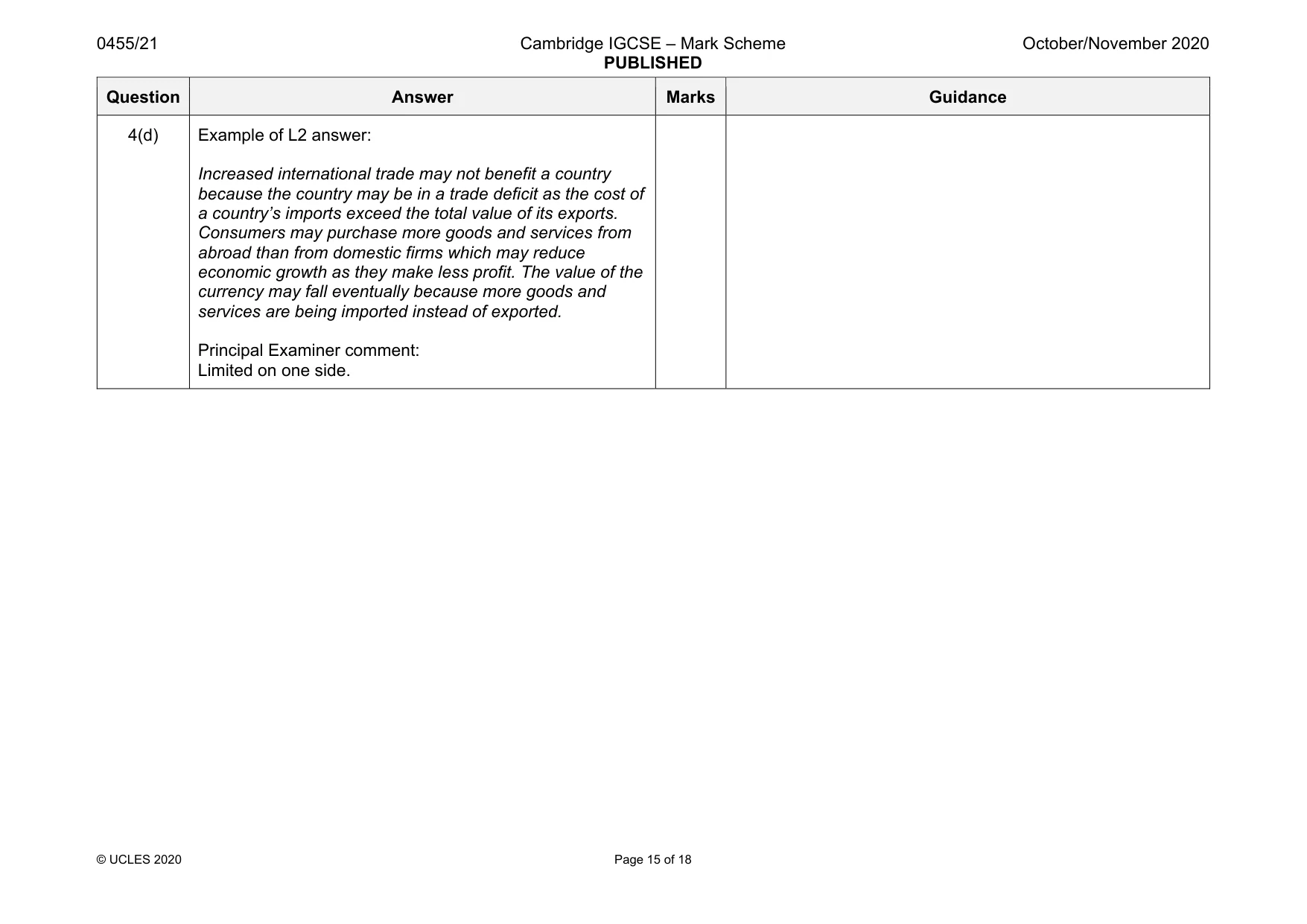
Mark scheme: 4(a) Define tariffs. Tariffs are a tax (1) on imports/exports (1) which increase the price of imported/exported goods (1). 2 4(b) Explain two non-tariff methods of protection. Logical explanation which might include: Quotas (1) quantitative restriction on the amount of imports that can enter a country (1). Subsidies (1) grants given to domestic firms to reduce domestic cost of production and reduce demand for imported goods (1). Embargoes (1) total restriction on a certain product from a certain country (1). 4 Also accept other non-tariff barriers such as rules and regulations, exchange controls, etc. One mark for each of two reasons identified and one mark for each of two explanations. 4(c) Analyse, using a production possibility curve (PPC) diagram, the beneficial effects for a country of the growth of its small and medium-sized firms. Up to 4 marks for the diagram: Axes correctly labelled (1). Initial curve drawn as a curve or downward sloping line to the axes (1). New curve drawn as a curve or downward sloping line to the axes (1). Shift to the right indicated by arrow or lettering (1). Up to 2 marks for coherent analysis which might include: The growth of its small and medium-sized firms will lead to an increase in the number of firms in the economy (1) this will increase productive potential / increase productive capacity / cause economic growth (1). 6 Also accept a tilt outward of the new PPC curve. Question Answer Marks Guidance 4(d) Discuss whether or not increased international trade can promote economic growth. In assessing each answer, use the table opposite. Why it may: • increase size of the market for domestically produced goods, increase exports, increase total demand • firms can specialise and achieve economies of scale, decrease cost of production, increase demand for goods and services produced domestically • increase competitive pressure (1) making firms more efficient (1) • increase access to products not available domestically, e.g. raw materials to produce other goods, increase output of an economy (1). Why it may not: • Increase amount of imports, decrease total demand of the economy • domestic firms may not be able to compete causing less revenue, less profits, more unemployment, • may result in shortages of e.g. rice in the domestic market • make the economy more subject to sudden changes in demand and supply. 8 Level Descriptors Mark 3 A reasoned discussion which accurately examines both sides of the economic argument, making use of economic information and clear and logical analysis to evaluate economic issues and situations. One side of the argument may have more depth than the other, but overall both sides of the argument are considered and developed. There is thoughtful evaluation of economic concepts, terminology, information and/or data appropriate to the question. The discussion may also point out the possible uncertainties of alternative decisions and outcomes. 6–8 2 A reasoned discussion which makes use of economic information and clear analysis to evaluate economic issues and situations. The answer may lack some depth and development or may be one-sided. There is relevant use of economic concepts, terminology, information and data appropriate to the question. 3–5 1 There is a simple attempt at using economic definitions and terminology. Some reference may be made to economic theory, with occasional understanding. 1–2 0 A mark of zero should be awarded for no creditable content. 0 Question Answer Marks Guidance 4(d) Example of L2 answer: Increased international trade may not benefit a country because the country may be in a trade deficit as the cost of a country’s imports exceed the total value of its exports. Consumers may purchase more goods and services from abroad than from domestic firms which may reduce economic growth as they make less profit. The value of the currency may fall eventually because more goods and services are being imported instead of exported. Principal Examiner comment: Limited on one side.
Q5 · Free trade has allowed the Mexican economy to specialise in low-cost manufacturing
5 Free trade has allowed the Mexican economy to specialise in low-cost manufacturing. Unemployment nationally is relatively low, but approximately 50 million people were still considered to be in poverty in 2016. In addition, there are worries that technological advances will soon replace labour with capital. (a) State the rewards for labour and capital. [2] (b) Explain the two types of poverty. [4] (c) Analyse how firms can benefit from specialisation. [6] (d) Discuss whether or not supply-side policy measures can reduce unemployment. [8]
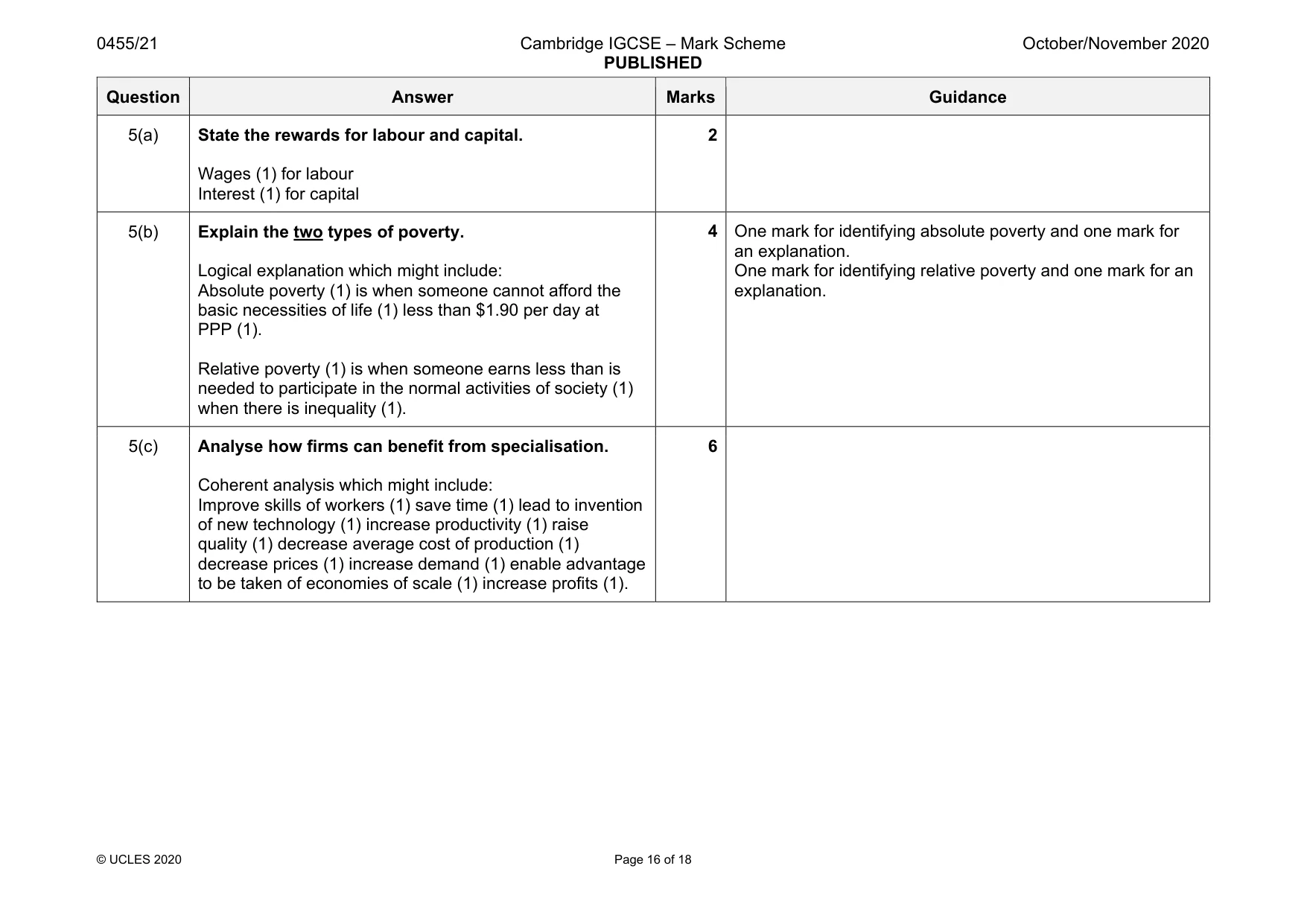
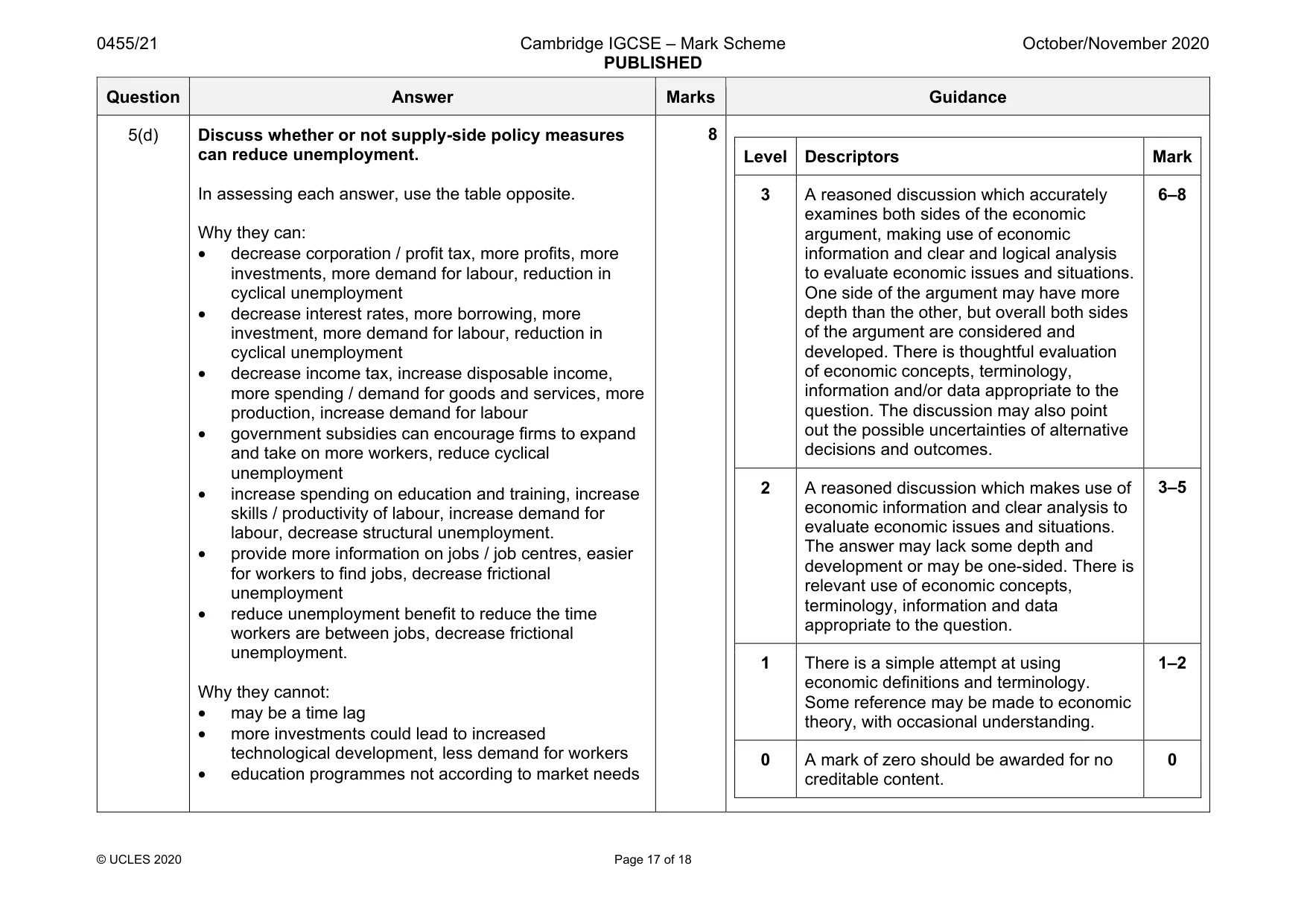
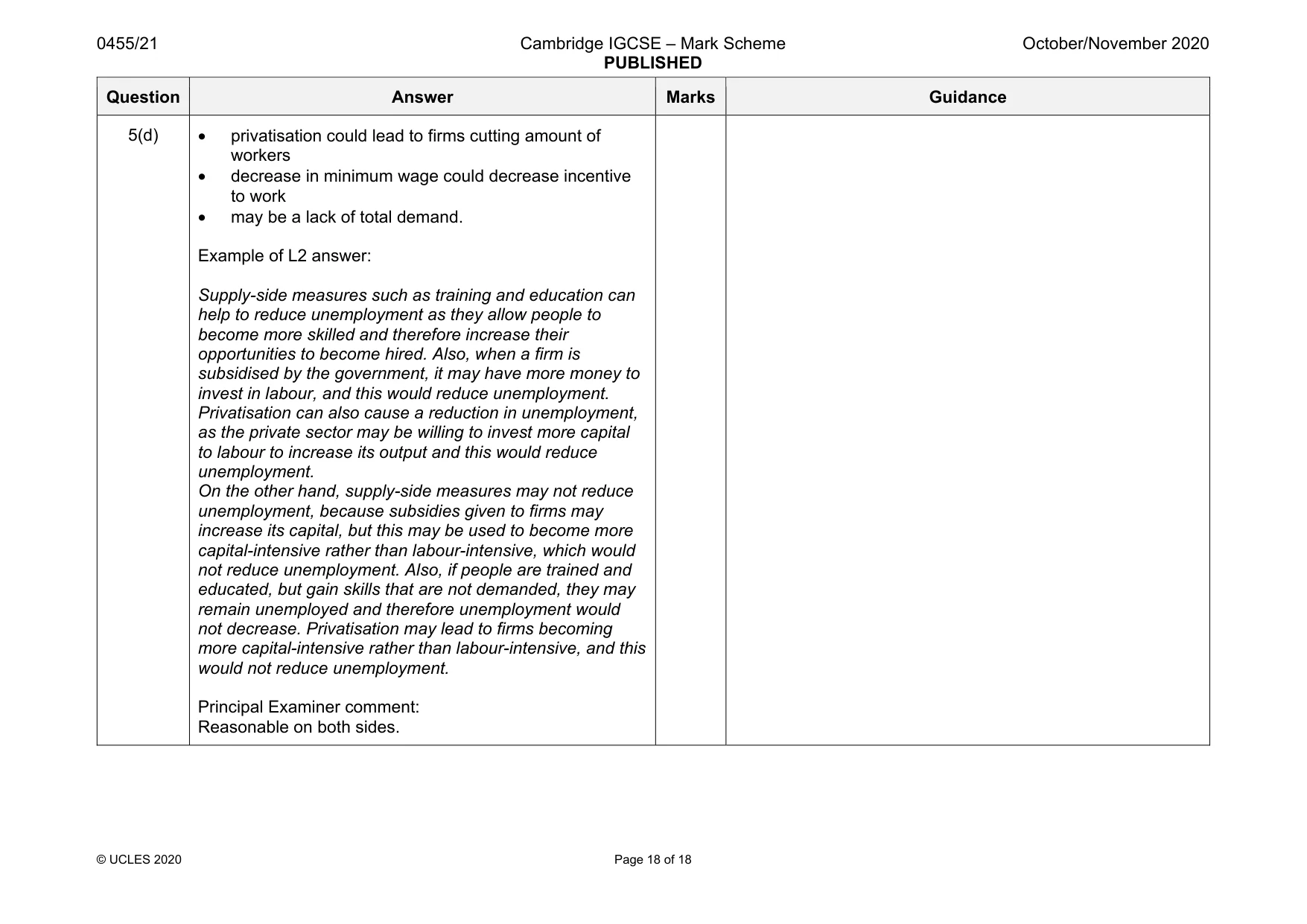
Mark scheme: 5(a) State the rewards for labour and capital. Wages (1) for labour Interest (1) for capital 2 5(b) Explain the two types of poverty. Logical explanation which might include: Absolute poverty (1) is when someone cannot afford the basic necessities of life (1) less than $1.90 per day at PPP (1). Relative poverty (1) is when someone earns less than is needed to participate in the normal activities of society (1) when there is inequality (1). 4 One mark for identifying absolute poverty and one mark for an explanation. One mark for identifying relative poverty and one mark for an explanation. 5(c) Analyse how firms can benefit from specialisation. Coherent analysis which might include: Improve skills of workers (1) save time (1) lead to invention of new technology (1) increase productivity (1) raise quality (1) decrease average cost of production (1) decrease prices (1) increase demand (1) enable advantage to be taken of economies of scale (1) increase profits (1). 6 Question Answer Marks Guidance 5(d) Discuss whether or not supply-side policy measures can reduce unemployment. In assessing each answer, use the table opposite. Why they can: • decrease corporation / profit tax, more profits, more investments, more demand for labour, reduction in cyclical unemployment • decrease interest rates, more borrowing, more investment, more demand for labour, reduction in cyclical unemployment • decrease income tax, increase disposable income, more spending / demand for goods and services, more production, increase demand for labour • government subsidies can encourage firms to expand and take on more workers, reduce cyclical unemployment • increase spending on education and training, increase skills / productivity of labour, increase demand for labour, decrease structural unemployment. • provide more information on jobs / job centres, easier for workers to find jobs, decrease frictional unemployment • reduce unemployment benefit to reduce the time workers are between jobs, decrease frictional unemployment. Why they cannot: • may be a time lag • more investments could lead to increased technological development, less demand for workers • education programmes not according to market needs 8 Level Descriptors Mark 3 A reasoned discussion which accurately examines both sides of the economic argument, making use of economic information and clear and logical analysis to evaluate economic issues and situations. One side of the argument may have more depth than the other, but overall both sides of the argument are considered and developed. There is thoughtful evaluation of economic concepts, terminology, information and/or data appropriate to the question. The discussion may also point out the possible uncertainties of alternative decisions and outcomes. 6–8 2 A reasoned discussion which makes use of economic information and clear analysis to evaluate economic issues and situations. The answer may lack some depth and development or may be one-sided. There is relevant use of economic concepts, terminology, information and data appropriate to the question. 3–5 1 There is a simple attempt at using economic definitions and terminology. Some reference may be made to economic theory, with occasional understanding. 1–2 0 A mark of zero should be awarded for no creditable content. 0 Question Answer Marks Guidance 5(d) • privatisation could lead to firms cutting amount of workers • decrease in minimum wage could decrease incentive to work • may be a lack of total demand. Example of L2 answer: Supply-side measures such as training and education can help to reduce unemployment as they allow people to become more skilled and therefore increase their opportunities to become hired. Also, when a firm is subsidised by the government, it may have more money to invest in labour, and this would reduce unemployment. Privatisation can also cause a reduction in unemployment, as the private sector may be willing to invest more capital to labour to increase its output and this would reduce unemployment. On the other hand, supply-side measures may not reduce unemployment, because subsidies given to firms may increase its capital, but this may be used to become more capital-intensive rather than labour-intensive, which would not reduce unemployment. Also, if people are trained and educated, but gain skills that are not demanded, they may remain unemployed and therefore unemployment would not decrease. Privatisation may lead to firms becoming more capital-intensive rather than labour-intensive, and this would not reduce unemployment. Principal Examiner comment: Reasonable on both sides.
What was in this paper
The subtopics covered by these 5 questions, and how many questions each got. Open one in a new tab to see every Cambridge question on it.
What you needed in this session
Cambridge’s own grade thresholds for 2020 Oct/Nov, Paper 2 · Variant 1. A higher threshold means an easier paper — the bar moves with how the cohort did.