Questions as text
Q1 · Elements in Group I of the Periodic Table react with water 0971/22 Oct/Nov 2018
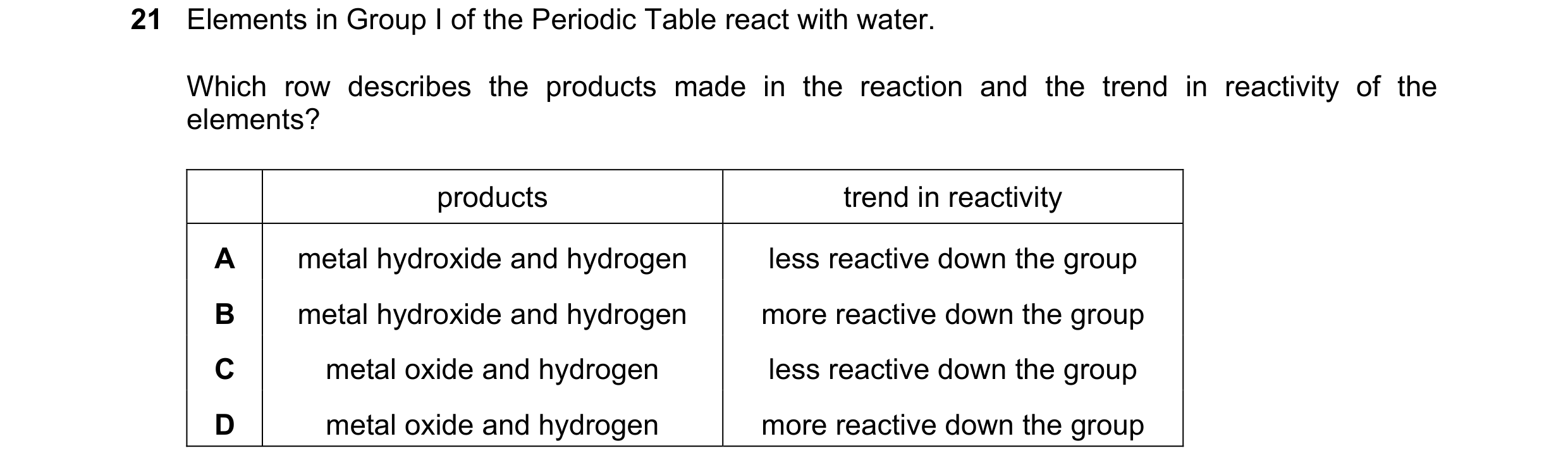
21 Elements in Group I of the Periodic Table react with water. Which row describes the products made in the reaction and the trend in reactivity of the elements? products trend in reactivity A metal hydroxide and hydrogen less reactive down the group B metal hydroxide and hydrogen more reactive down the group C metal oxide and hydrogen less reactive down the group D metal oxide and hydrogen more reactive down the group
1 marks
Answer: B
This question in 0971/22 Oct/Nov 2018
Q2 · The properties of an element are shown 0971/21 May/June 2019
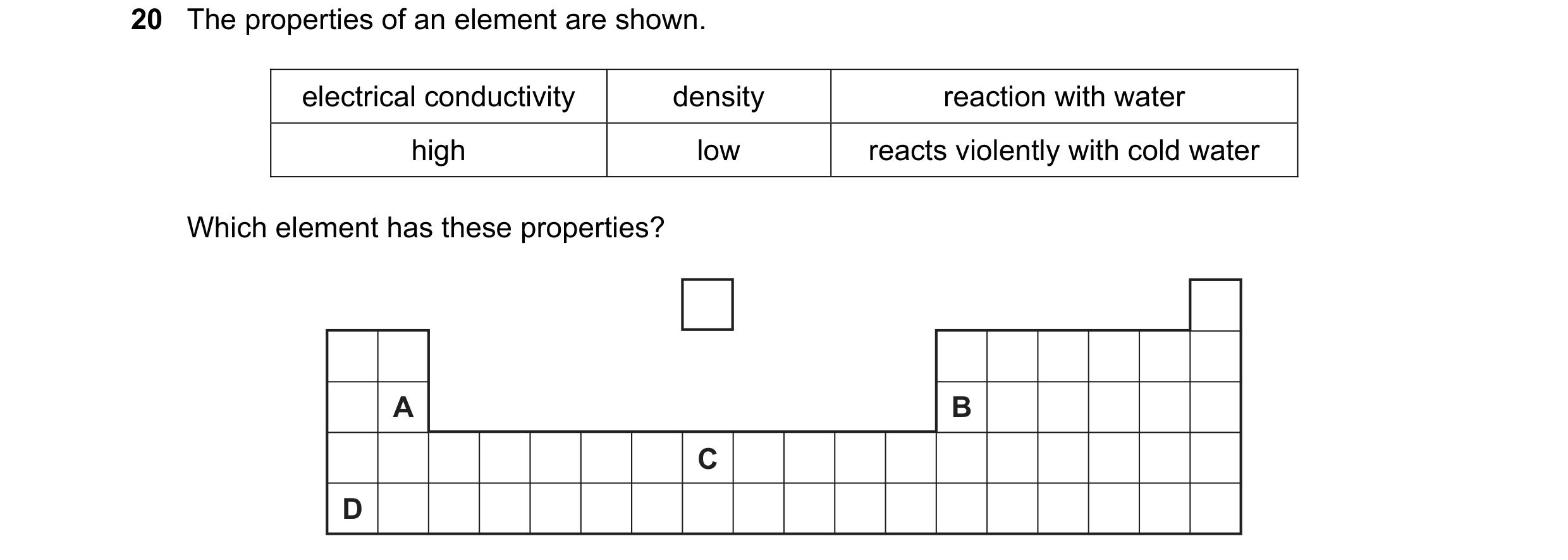
20 The properties of an element are shown. electrical conductivity density reaction with water high low reacts violently with cold water Which element has these properties? A B C D
1 marks
Answer: D
This question in 0971/21 May/June 2019
Q3 · A Group I metal (lithium, sodium or potassium) is reacted with a Group VII element… 0971/21 May/June 2020
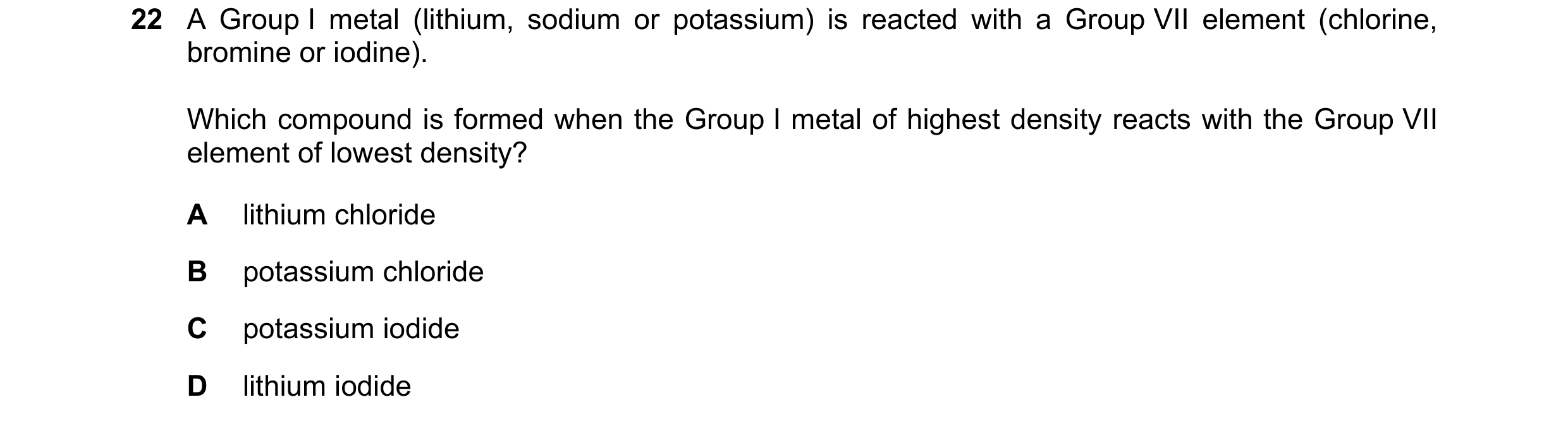
22 A Group I metal (lithium, sodium or potassium) is reacted with a Group VII element (chlorine, bromine or iodine). Which compound is formed when the Group I metal of highest density reacts with the Group VII element of lowest density? A lithium chloride B potassium chloride C potassium iodide D lithium iodide
1 marks
Answer: B
This question in 0971/21 May/June 2020
Q4 · Which statement about Group I and Group VII elements is correct? 0971/22 May/June 2020
22 Which statement about Group I and Group VII elements is correct? A Group VII elements are monoatomic non-metals. B Lithium is more reactive with water than caesium. C The melting points of Group I metals increase down the group. D Potassium bromide reacts with chlorine to produce an orange solution.
1 marks
Answer: D
This question in 0971/22 May/June 2020
Q5 · Rubidium is in Group I of the Periodic Table and bromine is in Group VII 0971/22 Oct/Nov 2020
9 Rubidium is in Group I of the Periodic Table and bromine is in Group VII. Rubidium reacts with bromine to form an ionic compound. Which row shows the electron change taking place for rubidium and the correct formula of the rubidium ion? electron change formula of ion formed A electron gained Rb+ B electron gained Rb– C electron lost Rb+ D electron lost Rb–
1 marks
Answer: C
This question in 0971/22 Oct/Nov 2020
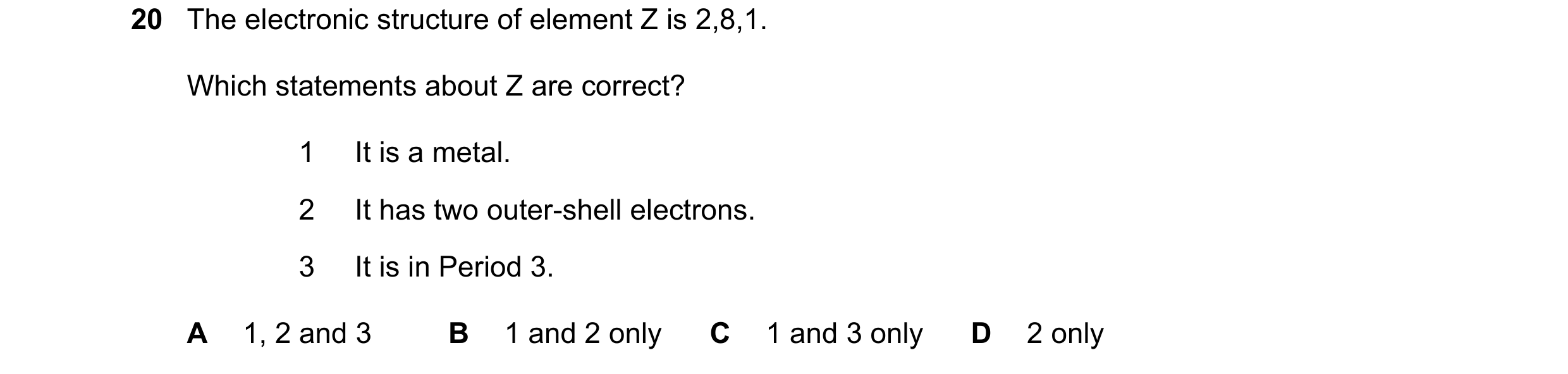
Q6 · The electronic structure of element Z is 2,8,1 0971/21 May/June 2022
20 The electronic structure of element Z is 2,8,1. Which statements about Z are correct? 1 It is a metal. 2 It has two outer-shell electrons. 3 It is in Period 3. A 1, 2 and 3 B 1 and 2 only C 1 and 3 only D 2 only
1 marks
Answer: C
This question in 0971/21 May/June 2022
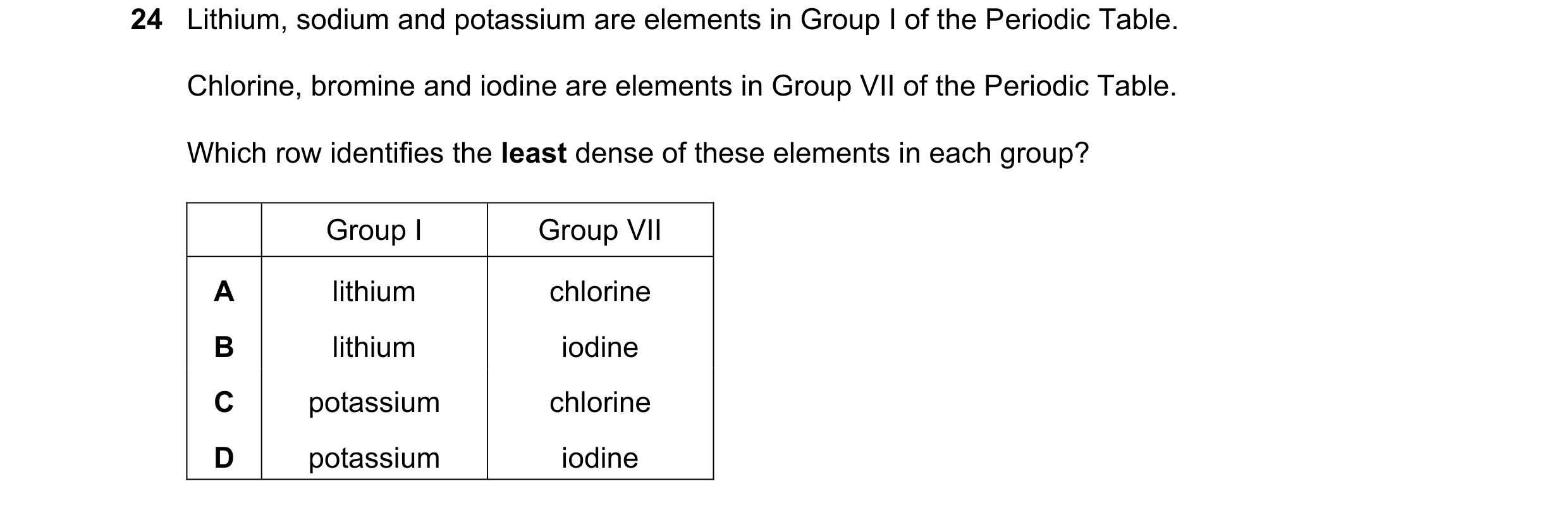
Q7 · Lithium, sodium and potassium are elements in Group I of the Periodic Table 0971/22 May/June 2022
24 Lithium, sodium and potassium are elements in Group I of the Periodic Table. Chlorine, bromine and iodine are elements in Group VII of the Periodic Table. Which row identifies the least dense of these elements in each group? Group I Group VII A lithium chlorine B lithium iodine C potassium chlorine D potassium iodine
1 marks
Answer: A
This question in 0971/22 May/June 2022
Q8 · Some information about elements in Group II of the Periodic Table is shown 0971/21 May/June 2023
19 Some information about elements in Group II of the Periodic Table is shown. time taken to make 10 cm3 density in melting element of hydrogen gas when 1 g of g / cm3 point / °C metal is added to cold water beryllium no reaction 1.85 1280 magnesium >300 seconds 1.74 650 calcium 60 seconds 1.54 850 strontium 30 seconds 2.62 768 barium 10 seconds 3.51 714 Which row shows the correct trends in reactivity, density and melting point of the elements going down Group II of the Periodic Table? reactivity density melting point A decreases down group increases down group decreases down group B decreases down group decreases down group no clear trend C increases down group no clear trend increases down group D increases down group no clear trend no clear trend
1 marks
Answer: D
This question in 0971/21 May/June 2023
Q9 · Which statement about alkali metals is correct? 0971/22 May/June 2023
21 Which statement about alkali metals is correct? A Lithium is more dense than sodium. B Sodium is more reactive than potassium. C Sodium has a higher melting point than potassium. D They are in Group II of the Periodic Table.
1 marks
Answer: C
This question in 0971/22 May/June 2023
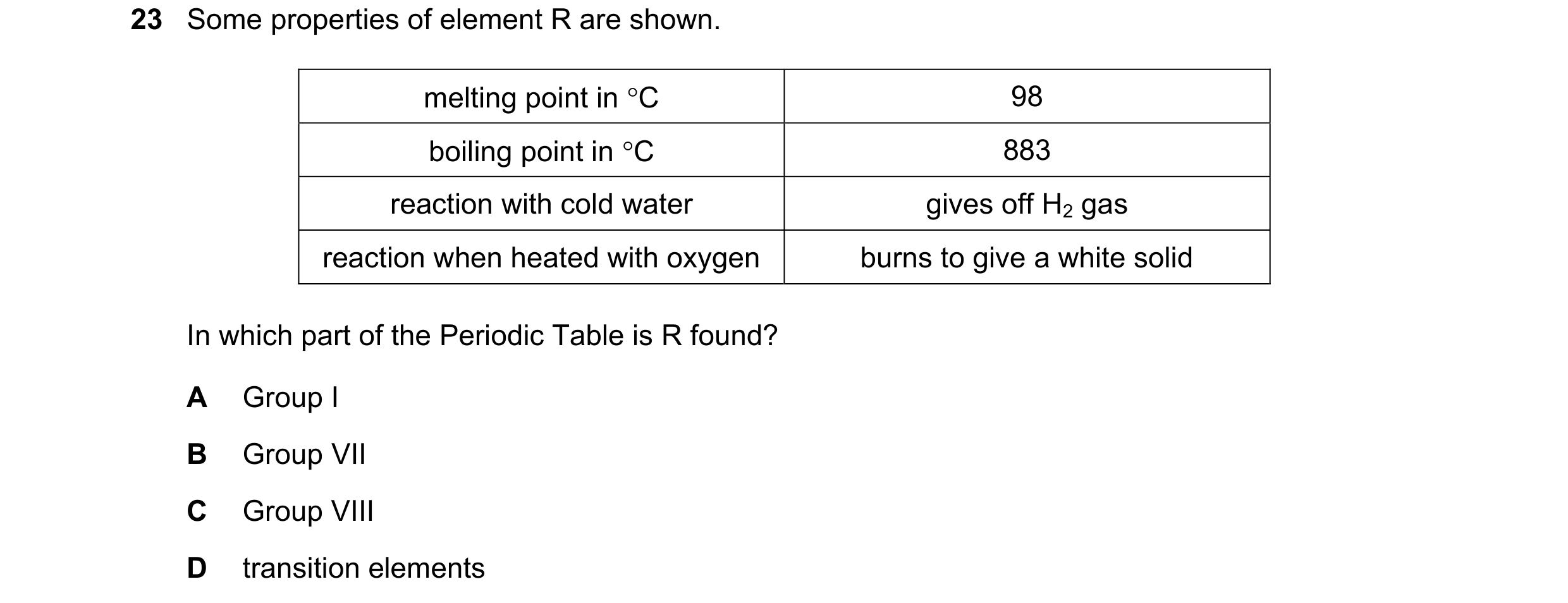
Q10 · Some properties of element R are shown 0971/22 Oct/Nov 2023
23 Some properties of element R are shown. melting point in C 98 boiling point in C 883 reaction with cold water gives off H2 gas reaction when heated with oxygen burns to give a white solid In which part of the Periodic Table is R found? A Group I B Group VII C Group VIII D transition elements
1 marks
Answer: A
This question in 0971/22 Oct/Nov 2023
Q11 · Lithium and potassium are metals in Group I of the Periodic Table 0971/22 May/June 2024
21 Lithium and potassium are metals in Group I of the Periodic Table. Lithium has a melting point of 181°C and a density of 0.53g/cm3. Which row describes the melting point and density of potassium? melting point in °C density in g/cm3 A less than 181 less than 0.53 B less than 181 greater than 0.53 C greater than 181 less than 0.53 D greater than 181 greater than 0.53
1 marks
Answer: B
This question in 0971/22 May/June 2024
Q12 · Sodium is a Group I metal 0971/22 May/June 2025
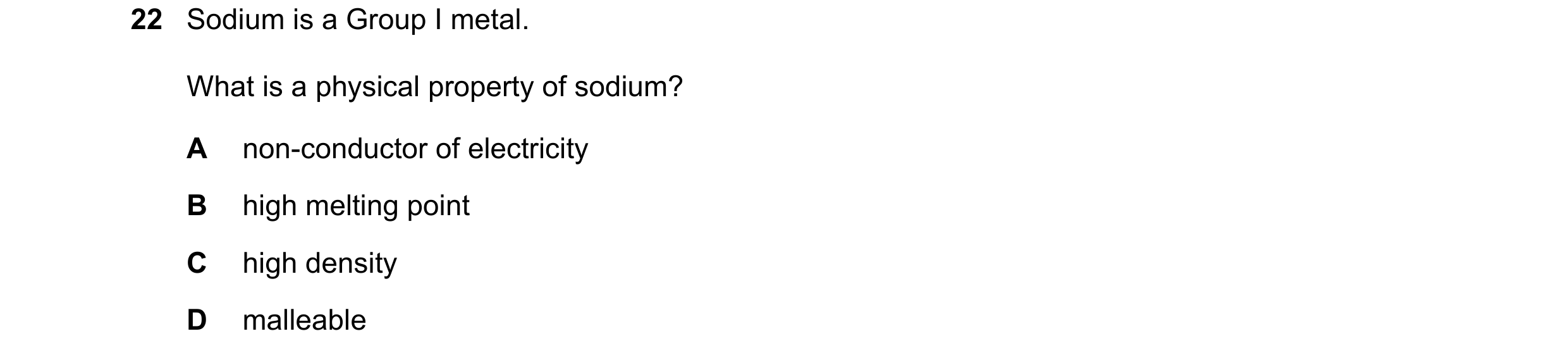
22 Sodium is a Group I metal. What is a physical property of sodium? A non-conductor of electricity B high melting point C high density D malleable
1 marks
Answer: D
This question in 0971/22 May/June 2025
Q13 · Which statement about the elements in Group I is correct? 0971/22 Oct/Nov 2025
23 Which statement about the elements in Group I is correct? A Hydrogen is produced when Group I elements react with water. B Ions of Group I elements have a 1– charge. C Sodium is more reactive than potassium. D Solid sodium is a poor electrical conductor.
1 marks
Answer: A
This question in 0971/22 Oct/Nov 2025
 1 / 4
1 / 4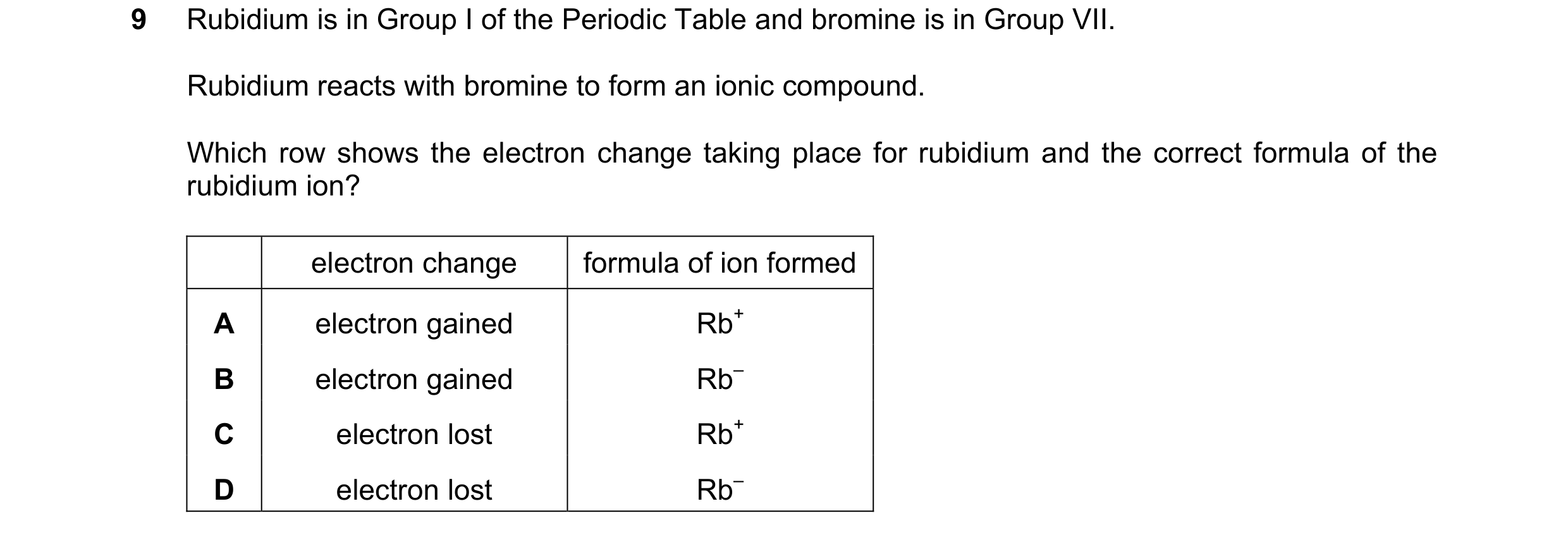
 2 / 4
2 / 4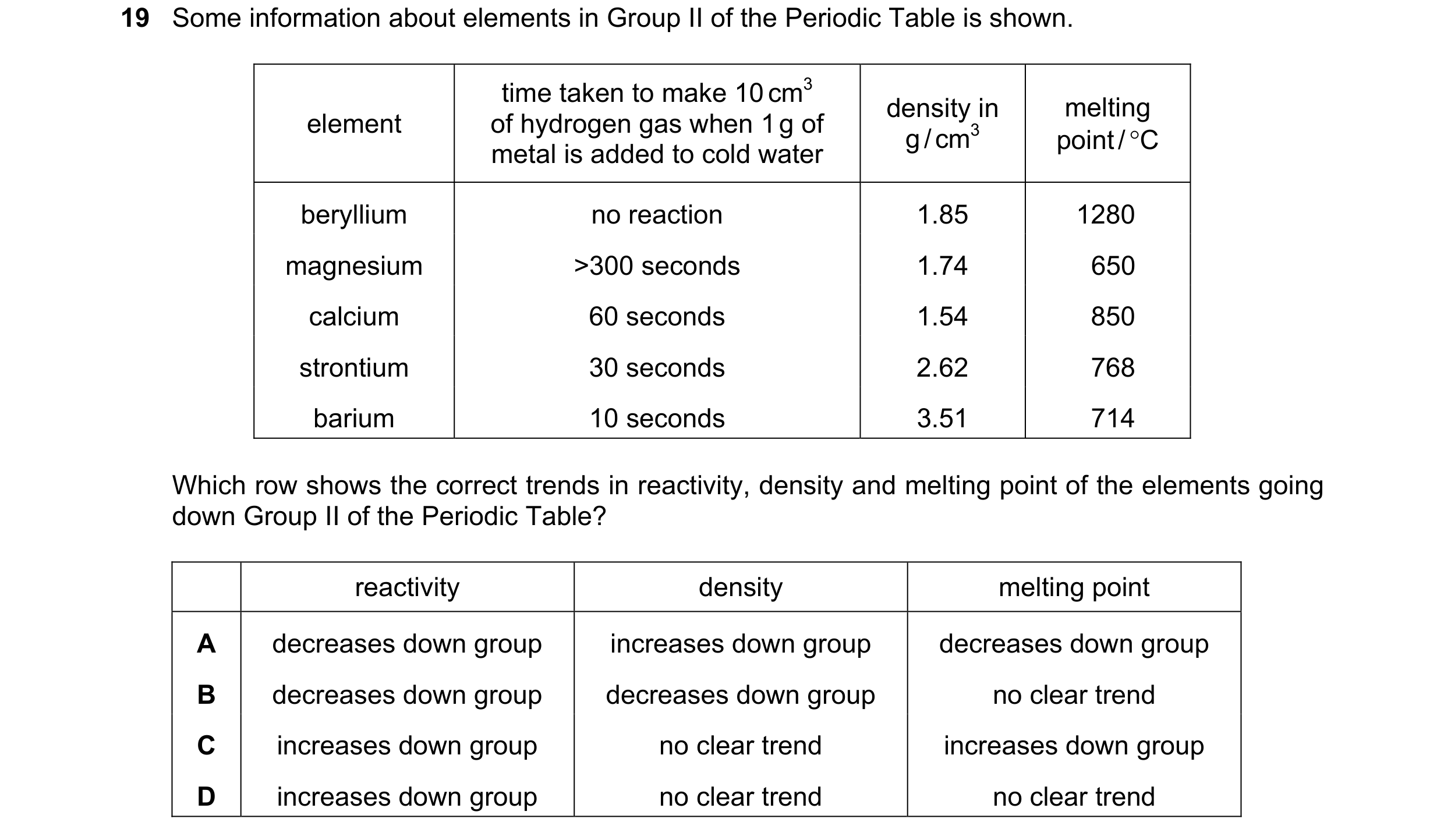

 3 / 4
3 / 4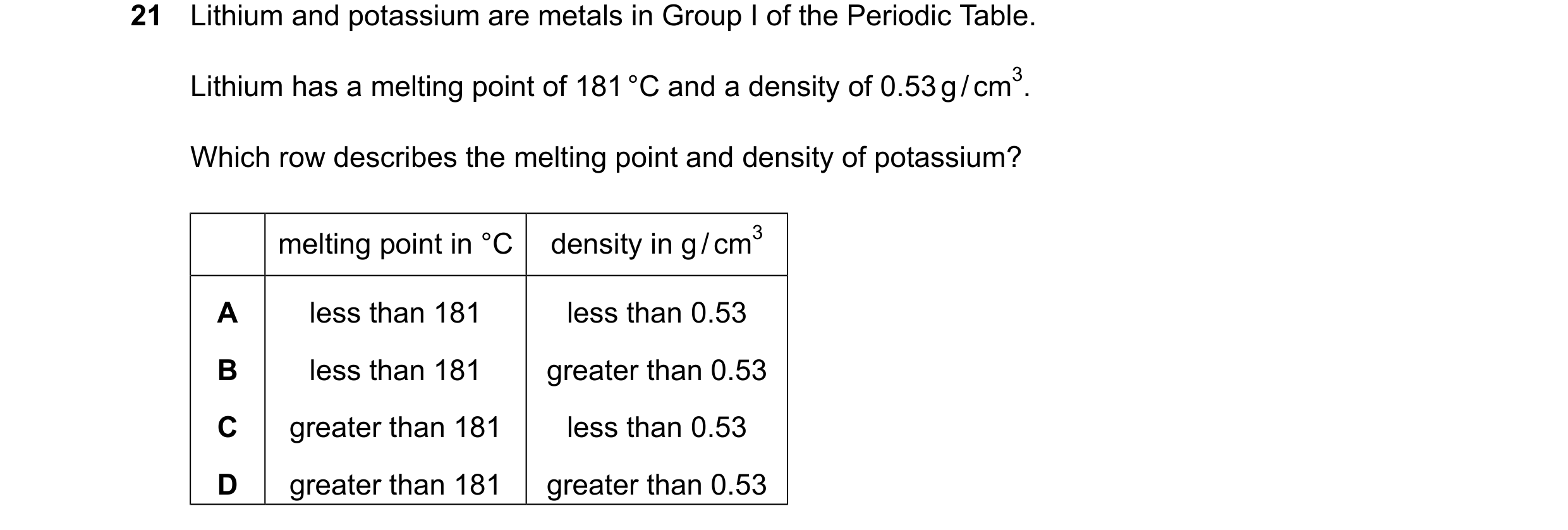
 4 / 4
4 / 4