Questions as text
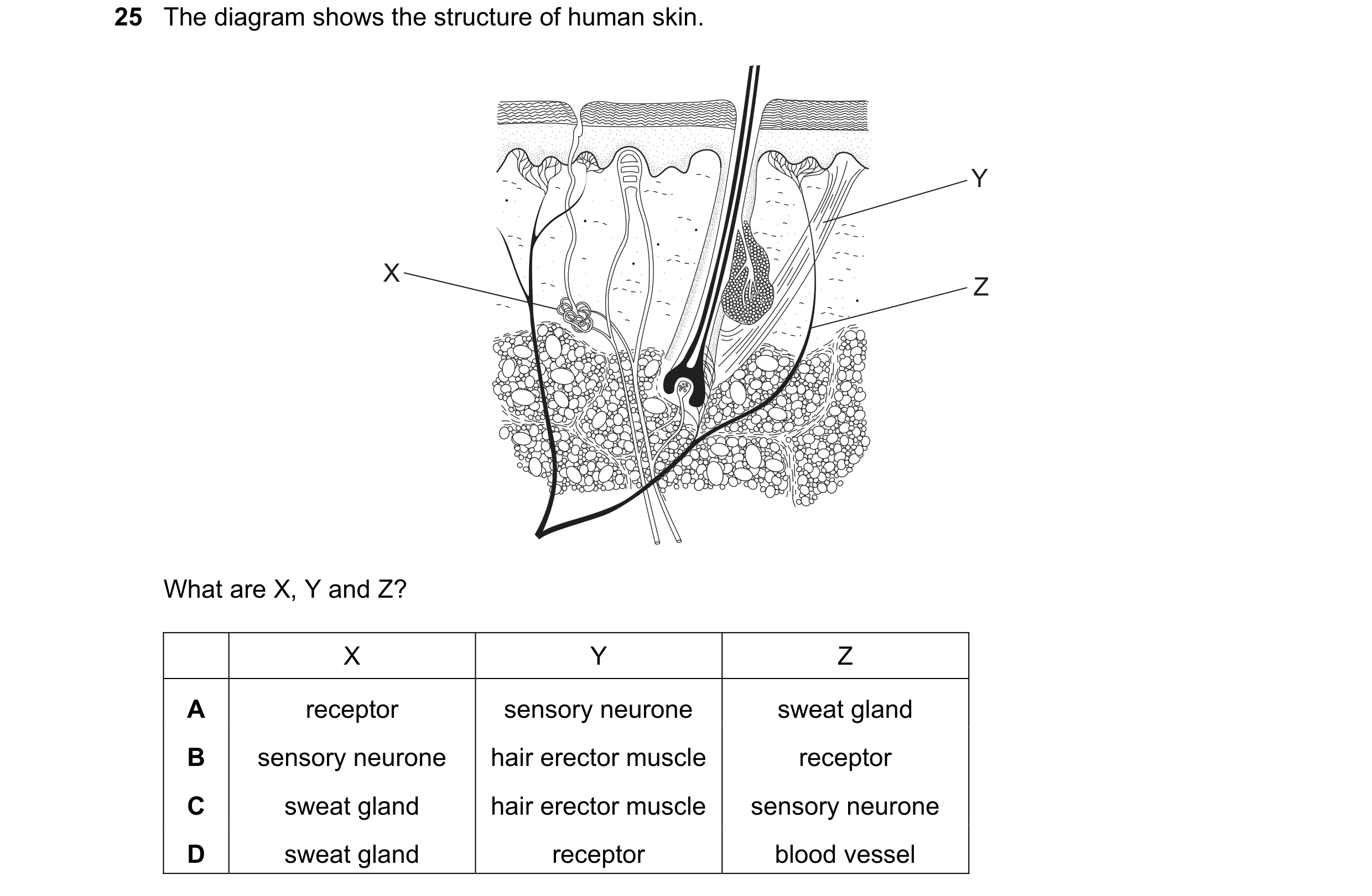
Q1 · The diagram shows the structure of human skin 0970/21 May/June 2018
25 The diagram shows the structure of human skin. Y X Z What are X, Y and Z? X Y Z A receptor sensory neurone sweat gland B sensory neurone hair erector muscle receptor C sweat gland hair erector muscle sensory neurone D sweat gland receptor blood vessel
1 marks
Answer: C
This question in 0970/21 May/June 2018
Q2 · A person drinks a glass of iced water and the volume of sweat they secrete decreases 0970/22 Oct/Nov 2018
1 A person drinks a glass of iced water and the volume of sweat they secrete decreases. This is an example of which characteristic of living organisms? A growth B movement C respiration D sensitivity
1 marks
Answer: D
This question in 0970/22 Oct/Nov 2018
Q3 · A person carries out vigorous exercise without drinking any water 0970/22 Oct/Nov 2018
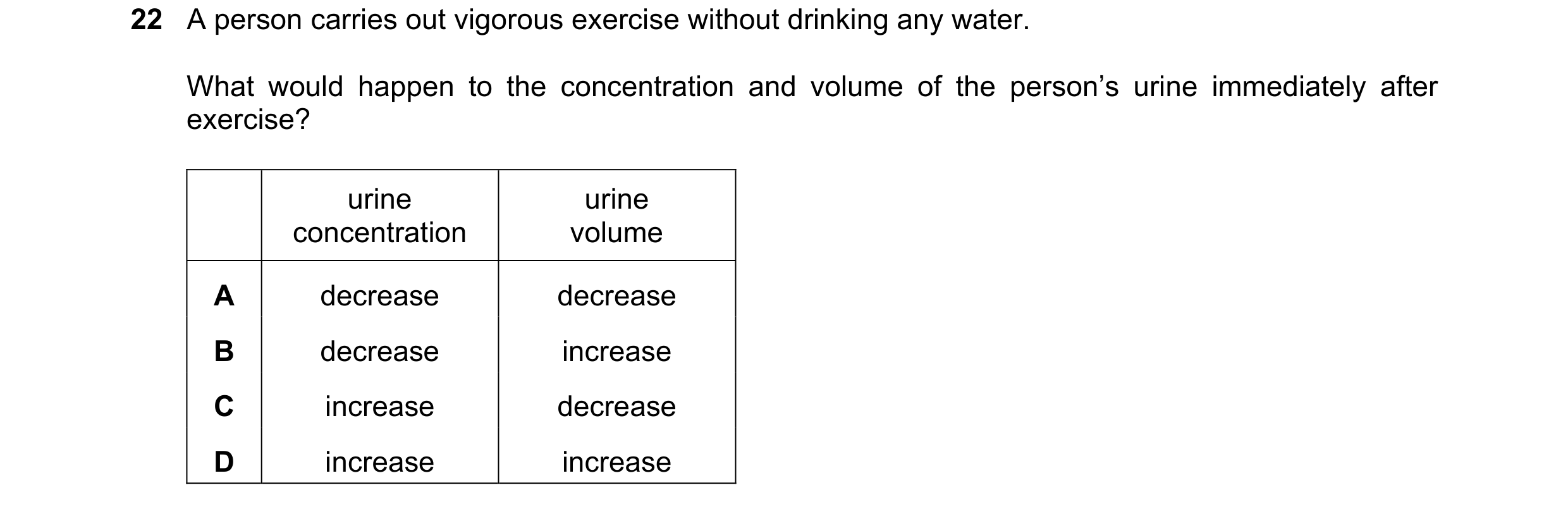
22 A person carries out vigorous exercise without drinking any water. What would happen to the concentration and volume of the person’s urine immediately after exercise? urine urine concentration volume A decrease decrease B decrease increase C increase decrease D increase increase
1 marks
Answer: C
This question in 0970/22 Oct/Nov 2018
Q4 · What is a response to a low concentration of glucose in the blood? 0970/22 Oct/Nov 2018
25 What is a response to a low concentration of glucose in the blood? A Glucagon will cause the body to convert glucose into glycogen. B Glucagon will cause the body to convert glycogen into glucose. C Insulin will cause the body to convert glucose into glycogen. D Insulin will cause the body to convert glycogen into glucose.
1 marks
Answer: B
This question in 0970/22 Oct/Nov 2018
Q5 · The liver and the pancreas work together to control the concentration of glucose in the… 0970/21 May/June 2020
26 The liver and the pancreas work together to control the concentration of glucose in the blood. Which statement is correct? A The liver converts the small molecule glucose to the large molecule glucagon. B The liver releases the hormone insulin when blood glucose levels are too high. C The pancreas does not respond to an increase in blood glucose levels. D The pancreas responds to a fall in blood glucose by increasing the release of the hormone glucagon.
1 marks
Answer: D
This question in 0970/21 May/June 2020
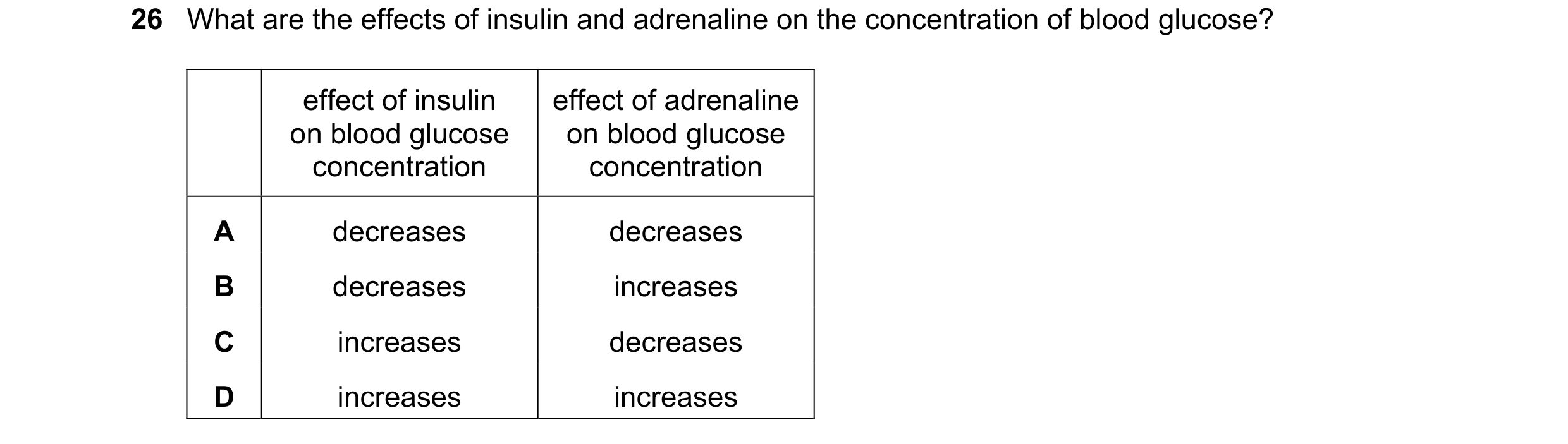
Q6 · What are the effects of insulin and adrenaline on the concentration of blood glucose? 0970/22 May/June 2020
26 What are the effects of insulin and adrenaline on the concentration of blood glucose? effect of insulin effect of adrenaline on blood glucose on blood glucose concentration concentration A decreases decreases B decreases increases C increases decreases D increases increases
1 marks
Answer: B
This question in 0970/22 May/June 2020
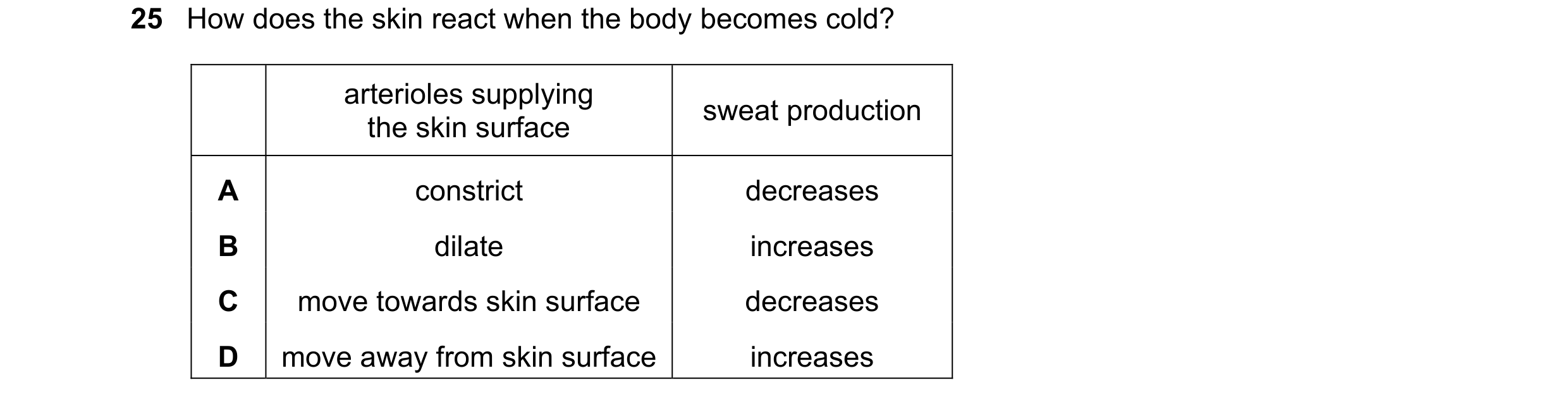
Q7 · How does the skin react when the body becomes cold? 0970/22 Oct/Nov 2020
25 How does the skin react when the body becomes cold? arterioles supplying sweat production the skin surface A constrict decreases B dilate increases C move towards skin surface decreases D move away from skin surface increases
1 marks
Answer: A
This question in 0970/22 Oct/Nov 2020
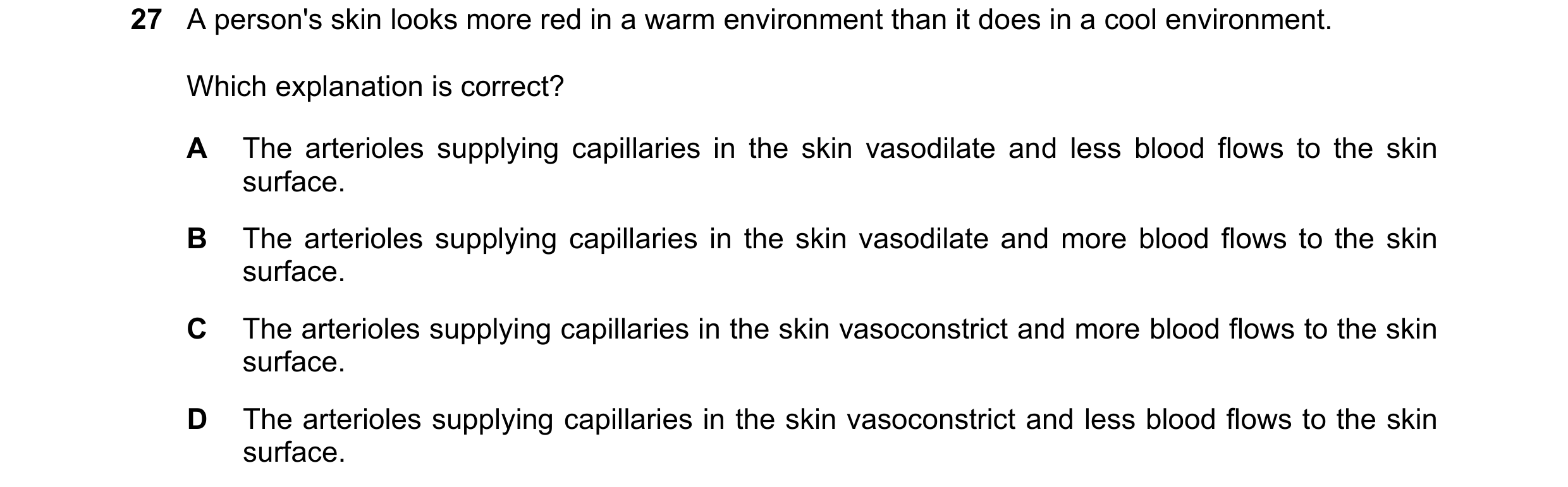
Q8 · A person's skin looks more red in a warm environment than it does in a cool environment 0970/22 May/June 2021
27 A person's skin looks more red in a warm environment than it does in a cool environment. Which explanation is correct? A The arterioles supplying capillaries in the skin vasodilate and less blood flows to the skin surface. B The arterioles supplying capillaries in the skin vasodilate and more blood flows to the skin surface. C The arterioles supplying capillaries in the skin vasoconstrict and more blood flows to the skin surface. D The arterioles supplying capillaries in the skin vasoconstrict and less blood flows to the skin surface.
1 marks
Answer: B
This question in 0970/22 May/June 2021
Q9 · Which process is a response of the body that is part of a negative feedback process? 0970/22 Oct/Nov 2021
26 Which process is a response of the body that is part of a negative feedback process? A release of insulin in response to low blood glucose concentration B vasoconstriction in response to an increase in blood temperature C synthesis of glycogen in response to increase in blood glucose concentration D sweating in response to a decrease in blood temperature
1 marks
Answer: C
This question in 0970/22 Oct/Nov 2021
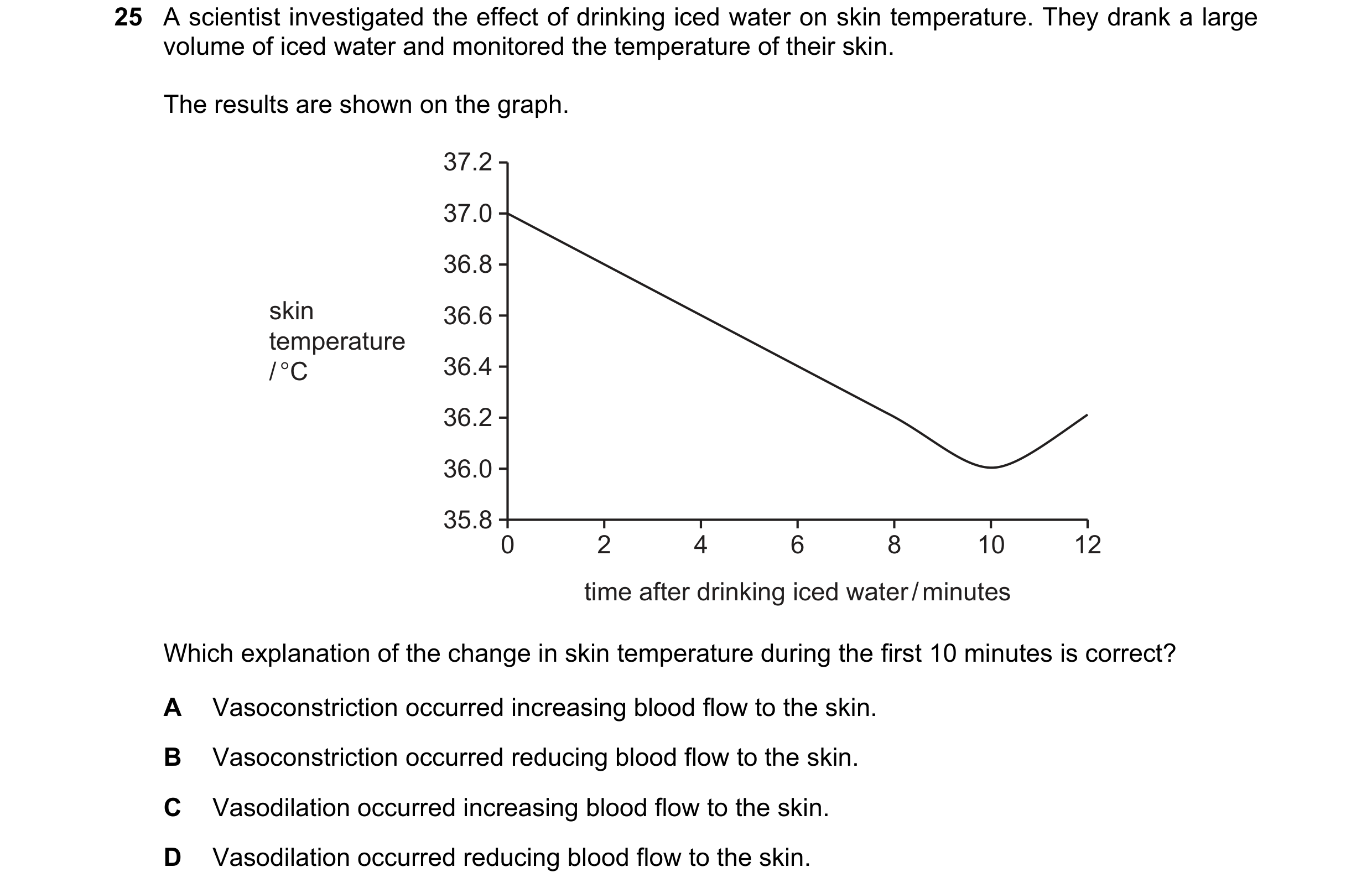
Q10 · A scientist investigated the effect of drinking iced water on skin temperature 0970/21 May/June 2022
25 A scientist investigated the effect of drinking iced water on skin temperature. They drank a large volume of iced water and monitored the temperature of their skin. The results are shown on the graph. 37.2 37.0 36.8 skin 36.6 temperature / °C 36.4 36.2 36.0 35.8 0 2 4 6 8 10 12 time after drinking iced water / minutes Which explanation of the change in skin temperature during the first 10 minutes is correct? A Vasoconstriction occurred increasing blood flow to the skin. B Vasoconstriction occurred reducing blood flow to the skin. C Vasodilation occurred increasing blood flow to the skin. D Vasodilation occurred reducing blood flow to the skin.
1 marks
Answer: B
This question in 0970/21 May/June 2022
Q11 · The concentration of glucose in the blood is controlled by negative feedback 0970/22 May/June 2022
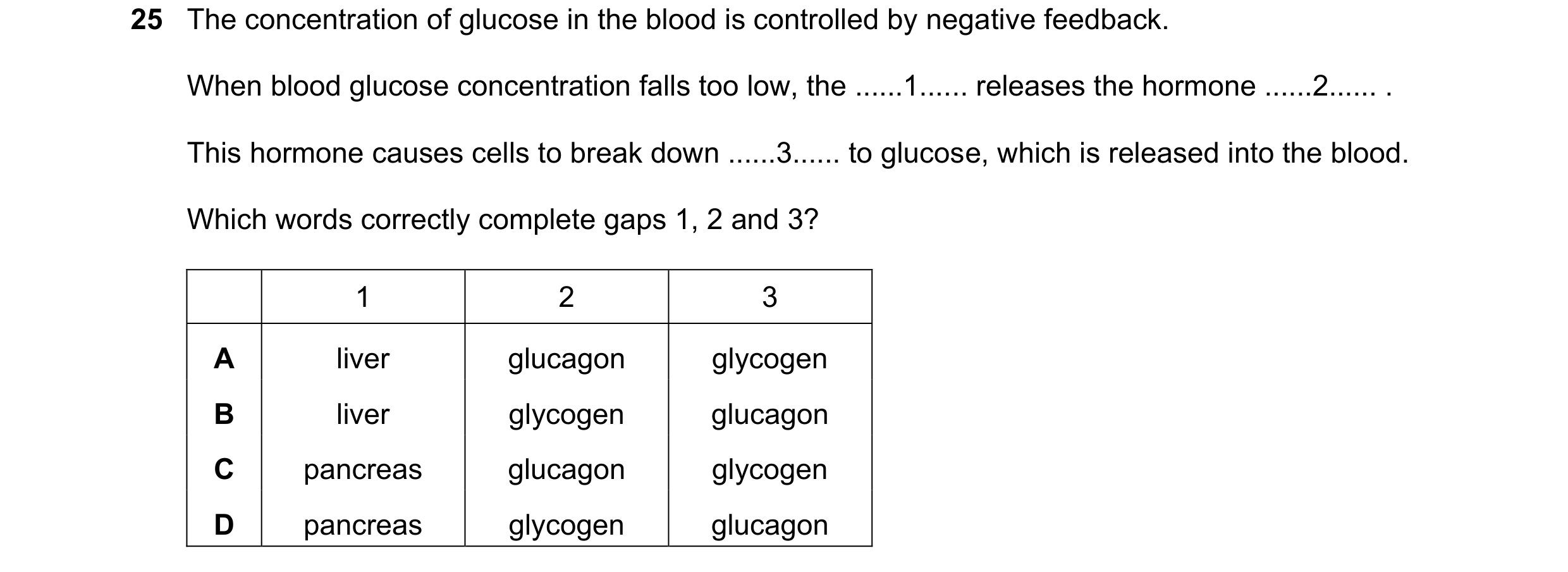
25 The concentration of glucose in the blood is controlled by negative feedback. When blood glucose concentration falls too low, the … 1 … releases the hormone … 2 … . This hormone causes cells to break down … 3 … to glucose, which is released into the blood. Which words correctly complete gaps 1, 2 and 3? 1 2 3 A liver glucagon glycogen B liver glycogen glucagon C pancreas glucagon glycogen D pancreas glycogen glucagon
1 marks
Answer: C
This question in 0970/22 May/June 2022
Q12 · What is a response to a low concentration of glucose in the blood? 0970/22 Oct/Nov 2022
24 What is a response to a low concentration of glucose in the blood? A Glucagon will cause the body to convert glucose into glycogen. B Glucagon will cause the body to convert glycogen into glucose. C Insulin will cause the body to convert glucose into glycogen. D Insulin will cause the body to convert glycogen into glucose.
1 marks
Answer: B
This question in 0970/22 Oct/Nov 2022
Q13 · During exercise, receptors detect a change in the blood and cause the breathing rate to… 0970/22 Oct/Nov 2023
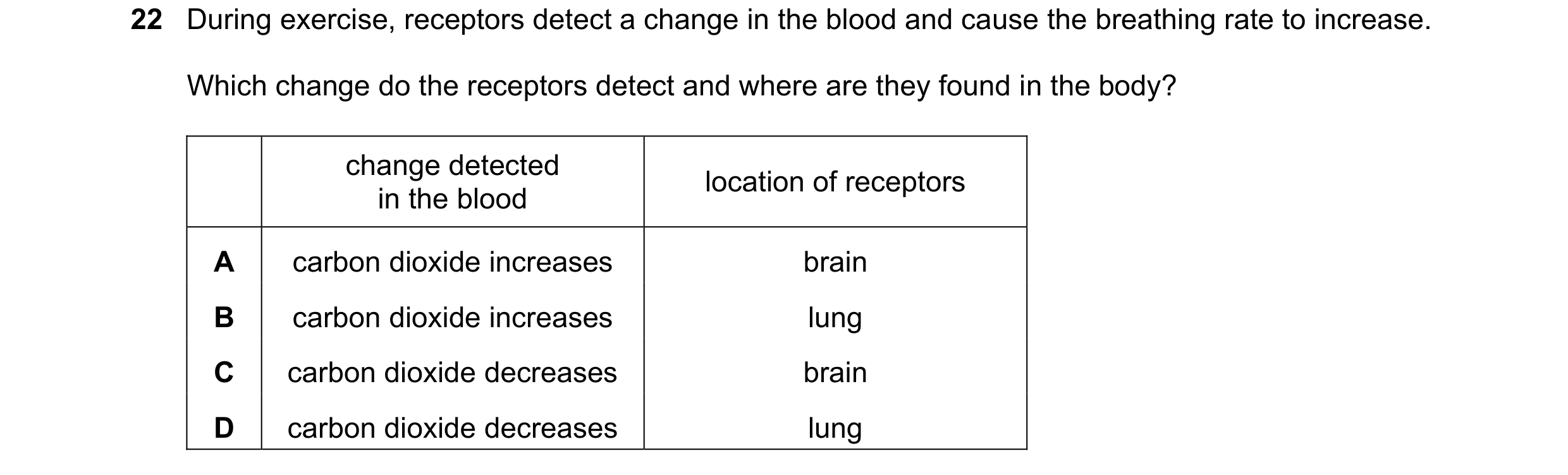
22 During exercise, receptors detect a change in the blood and cause the breathing rate to increase. Which change do the receptors detect and where are they found in the body? change detected location of receptors in the blood A carbon dioxide increases brain B carbon dioxide increases lung C carbon dioxide decreases brain D carbon dioxide decreases lung
1 marks
Answer: A
This question in 0970/22 Oct/Nov 2023
Q14 · Which hormones can increase blood glucose concentration? 0970/22 Oct/Nov 2023
27 Which hormones can increase blood glucose concentration? A adrenaline and insulin B adrenaline and glucagon C adrenaline only D glucagon only
1 marks
Answer: B
This question in 0970/22 Oct/Nov 2023
Q15 · What describes how the body maintains a constant internal temperature on a hot day? 0970/21 May/June 2024
27 What describes how the body maintains a constant internal temperature on a hot day? A Vasoconstriction increases blood flow to the skin surface capillaries. B Vasoconstriction decreases blood flow to the skin surface capillaries. C Vasodilation increases blood flow to the skin surface capillaries. D Vasodilation decreases blood flow to the skin surface capillaries.
1 marks
Answer: C
This question in 0970/21 May/June 2024
Q16 · What would lead to a decrease in blood glucose concentration? 0970/21 May/June 2024
28 What would lead to a decrease in blood glucose concentration? A increased release of adrenaline B increased release of amylase C increased release of glucagon D increased release of insulin
1 marks
Answer: D
This question in 0970/21 May/June 2024
Q17 · What is a response of the human body to overheating? 0970/21 May/June 2025
24 What is a response of the human body to overheating? A vasoconstriction of arterioles B vasoconstriction of veins C vasodilation of arterioles D vasodilation of veins
1 marks
Answer: C
This question in 0970/21 May/June 2025
Q18 · Which effect does adrenaline have on blood glucose concentration and pulse rate? 0970/22 Oct/Nov 2025
20 Which effect does adrenaline have on blood glucose concentration and pulse rate? blood glucose pulse rate concentration A decreases decreases B decreases increases C increases decreases D increases increases
1 marks
Answer: D
This question in 0970/22 Oct/Nov 2025
 1 / 5
1 / 5
 2 / 5
2 / 5
 3 / 5
3 / 5



 4 / 5
4 / 5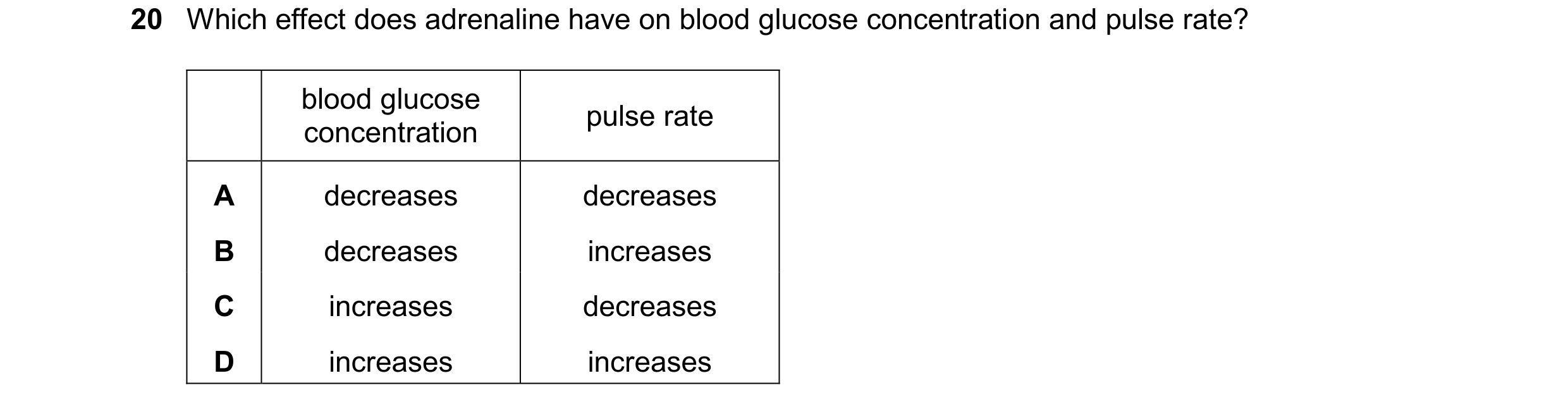 5 / 5
5 / 5