Questions as text
Q1 · A Nefarious Secretive Agency, in a remote location which is not served by public… 9694/31 Oct/Nov 2017
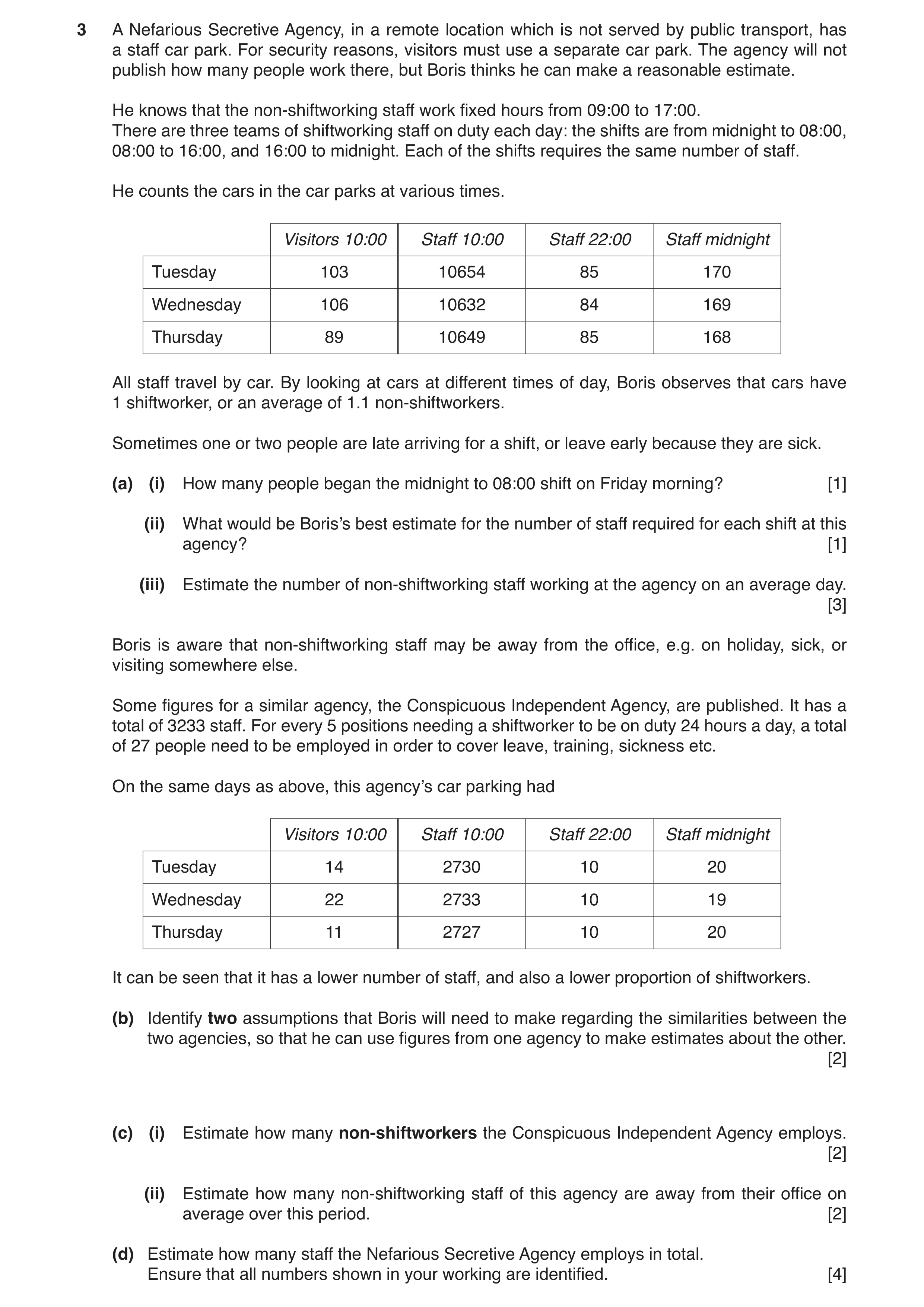
3 A Nefarious Secretive Agency, in a remote location which is not served by public transport, has a staff car park. For security reasons, visitors must use a separate car park. The agency will not publish how many people work there, but Boris thinks he can make a reasonable estimate. He knows that the non-shiftworking staff work fixed hours from 09:00 to 17:00. There are three teams of shiftworking staff on duty each day: the shifts are from midnight to 08:00, 08:00 to 16:00, and 16:00 to midnight. Each of the shifts requires the same number of staff. He counts the cars in the car parks at various times. Visitors 10:00 Staff 10:00 Staff 22:00 Staff midnight Tuesday 103 10654 85 170 Wednesday 106 10632 84 169 Thursday 89 10649 85 168 All staff travel by car. By looking at cars at different times of day, Boris observes that cars have 1 shiftworker, or an average of 1.1 non-shiftworkers. Sometimes one or two people are late arriving for a shift, or leave early because they are sick. (a) (i) How many people began the midnight to 08:00 shift on Friday morning? [1] (ii) What would be Boris’s best estimate for the number of staff required for each shift at this agency? [1] (iii) Estimate the number of non-shiftworking staff working at the agency on an average day. [3] Boris is aware that non-shiftworking staff may be away from the office, e.g. on holiday, sick, or visiting somewhere else. Some figures for a similar agency, the Conspicuous Independent Agency, are published. It has a total of 3233 staff. For every 5 positions needing a shiftworker to be on duty 24 hours a day, a total of 27 people need to be employed in order to cover leave, training, sickness etc. On the same days as above, this agency’s car parking had Visitors 10:00 Staff 10:00 Staff 22:00 Staff midnight Tuesday 14 2730 10 20 Wednesday 22 2733 10 19 Thursday 11 2727 10 20 It can be seen that it has a lower number of staff, and also a lower proportion of shiftworkers. (b) Identify two assumptions that Boris will need to make regarding the similarities between the two agencies, so that he can use figures from one agency to make estimates about the other. [2] (c) (i) Estimate how many non-shiftworkers the Conspicuous Independent Agency employs. [2] (ii) Estimate how many non-shiftworking staff of this agency are away from their office on average over this period. [2] (d) Estimate how many staff the Nefarious Secretive Agency employs in total. Ensure that all numbers shown in your working are identified. [4]
15 marks
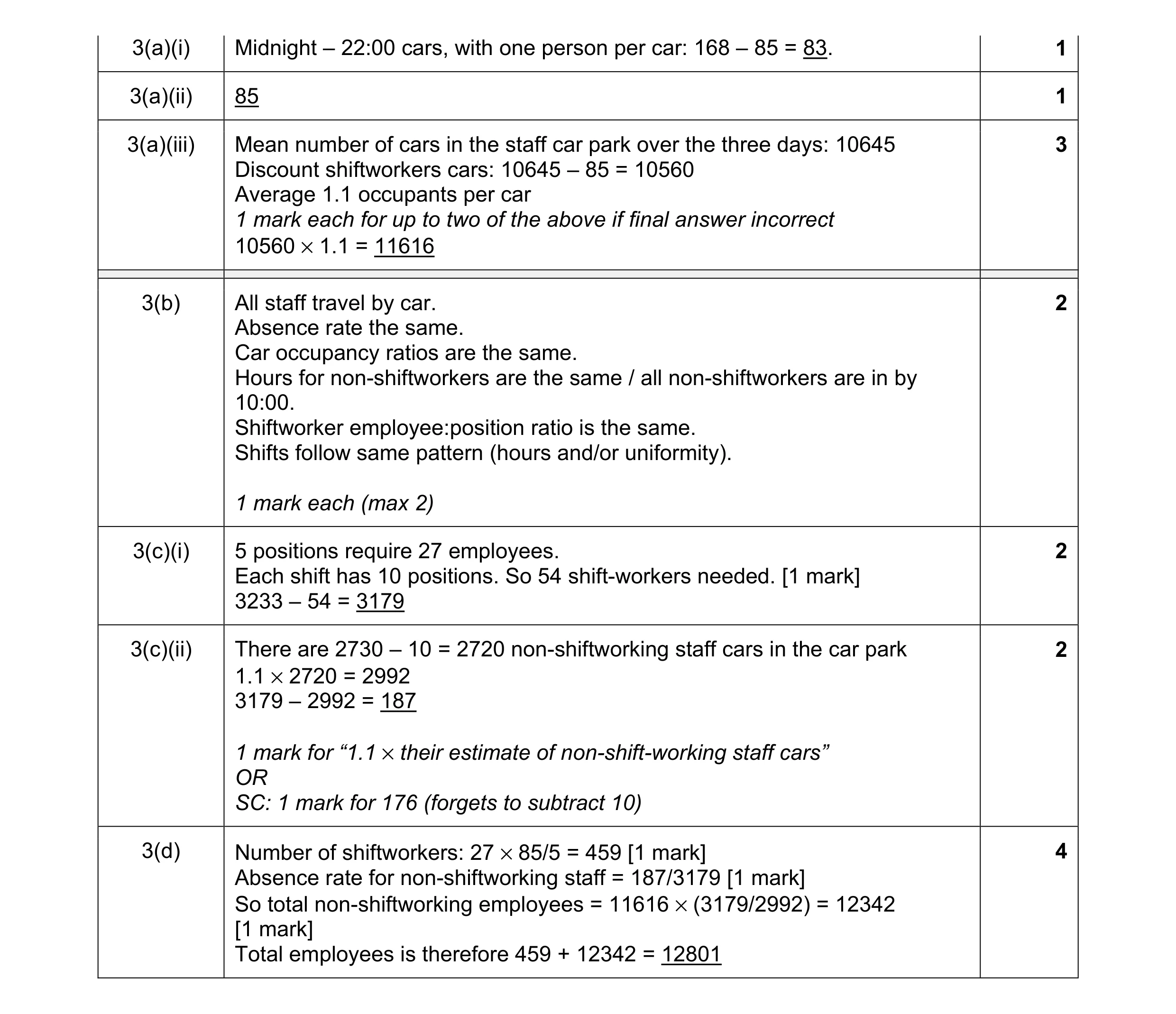
Mark scheme: 3(a)(i) Midnight – 22:00 cars, with one person per car: 168 – 85 = 83. 1 3(a)(ii) 85 1 3(a)(iii) Mean number of cars in the staff car park over the three days: 10645 3 Discount shiftworkers cars: 10645 – 85 = 10560 Average 1.1 occupants per car 1 mark each for up to two of the above if final answer incorrect 10560 × 1.1 = 11616 3(b) All staff travel by car. 2 Absence rate the same. Car occupancy ratios are the same. Hours for non-shiftworkers are the same / all non-shiftworkers are in by 10:00. Shiftworker employee:position ratio is the same. Shifts follow same pattern (hours and/or uniformity). 1 mark each (max 2) 3(c)(i) 5 positions require 27 employees. 2 Each shift has 10 positions. So 54 shift-workers needed. [1 mark] 3233 – 54 = 3179 3(c)(ii) There are 2730 – 10 = 2720 non-shiftworking staff cars in the car park 2 1.1 × 2720 = 2992 3179 – 2992 = 187 1 mark for “1.1 × their estimate of non-shift-working staff cars” OR SC: 1 mark for 176 (forgets to subtract 10) 3(d) Number of shiftworkers: 27 × 85/5 = 459 [1 mark] 4 Absence rate for non-shiftworking staff = 187/3179 [1 mark] So total non-shiftworking employees = 11616 × (3179/2992) = 12342 [1 mark] Total employees is therefore 459 + 12342 = 12801
This question in 9694/31 Oct/Nov 2017
Q2 · Jaspreet owns a business making suits to order – he only makes the suits once a customer… 9694/31 Oct/Nov 2018
3 Jaspreet owns a business making suits to order – he only makes the suits once a customer has ordered them. Customers can order any number of pairs of trousers, jackets and waistcoats at the following prices: Pair of trousers $40 Jacket $85 Waistcoat $50 If a jacket is bought with a pair of trousers, the price is reduced by $10, meaning that the two items together cost just $115. Last Monday morning Roger ordered two pairs of trousers and one jacket. (a) What was the total price of this order? [1] Jaspreet does not make any of the items himself, but employs two tailors, Harry and Joe, for this. Each of them works for a total of 8 hours each day from Monday to Friday. Only one tailor can work on any one item at any time. When one item is finished the tailor will immediately start work on another, if there are more items still to be made. Each tailor takes a total of 10 hours to make a pair of trousers, 20 hours to make a jacket and 15 hours to make a waistcoat. Each item must be entirely made by one tailor. The tailors were able to start working on Roger’s order at the start of work on Tuesday. Their work was planned so that the order would be completed as quickly as possible. (b) On which day was the order completed? [1] (c) What is the maximum total price of an order that the two tailors would be able to complete within four working days, if they had no other work needing to be done? [3] Priya is organising a large event and wants to know how long an order would take to be completed. The order would be for 5 pairs of trousers, 7 jackets and 3 waistcoats. (d) What is the minimum number of hours in which the work on this order could be completed? Suggest a set of items that each tailor should make. [3] Customers come into Jaspreet’s shop and are measured for the items that they want. He then tells them which day they can come to collect their items. On Monday morning this week, both of the tailors still had work to do on orders from last week. Harry had 4 hours of work left on a waistcoat, while Joe had 3 hours left to work on a jacket. Following this there were two further orders to be completed, the details of which are below: Order Collection day 1 pair of trousers Wednesday 1 waistcoat Friday 1 pair of trousers A customer urgently needs a jacket, a waistcoat and pair of trousers for an event this weekend and asked on Monday morning if his order can be completed to collect on Friday, at the end of the working day. Both of the tailors are willing to work for more hours this week. (e) How many extra hours would Jaspreet need to ask the tailors to work in order to get the order ready to collect before the end of normal working hours on Friday, without completing either of the other orders late? Suggest a set of items that each tailor should make. [3] (f) How many extra hours would be needed to complete the orders on time if Harry was unable to work any extra hours? [1] If an order is not ready on the agreed collection day, Jaspreet reduces the price by 20%. The reduction increases by an additional 10% for each extra weekday that the order is late, as compensation. For example, if an order for which the agreed collection day was Thursday is not ready until Monday, the price will be reduced by 30%. Jaspreet has decided that he will not pay for any additional hours of work from the tailors, but he will make sure that the urgent order is completed by Friday. (g) If he allocates the work in the best possible way, how much money will he lose? [3]
15 marks
Mark scheme: 3(a) Trousers bought with jacket: $115 1 Additional pair of trousers: $40 Total price = $155 3(b) The quickest way to complete the order is for one tailor to make the jacket 1 (20 hours) and one tailor to make the trousers (20 hours in total). Therefore 20 hours are needed in total. 16 hours of work will be completed on Tuesday and Wednesday, so the items will be ready on Thursday. 3(c) Four working days is a total of 32 hours, so each tailor can make either 3 3 pairs of trousers ($120 each, so $240) 1 pair of trousers and 1 jacket ($125 – discount $10 each, so $230) 2 waistcoats ($100 each, so $200) The maximum total price would be $240. If 3 marks cannot be awarded, award 1 mark for (max 2): calculating the income per hour for two of the three items ($4, $4.25, $3.33) OR correctly calculating one of the three options above (120/240, 125/250, 100/200) correctly applying the discount (115/230) SC: 2 marks for an answer of $250 for 1 trousers and 1 jacket (forgetting the discount) OR an answer of $120 (forgetting there are two tailors) 3(d) The total time for the order is 5 × 10 + 7 × 20 + 3 × 15 = 235 hours. [1] 3 This means that the shortest time is 120 hours. [1] One way to achieve this would be for Harry to do 6 jackets and Joe to do 5 trousers, 1 jacket and 3 waistcoats Alternative: Harry does 1 trouser, 4 jackets and 2 waistcoats, and Joe does 4 trouser, 3 jacket and 1 waistcoat [1] 3(e) The total time needed for completing the orders is 7 hours for the order that 3 is still in progress, 10 hours, 25 hours and 45 hours for the other three orders, making a total of 87 hours for all of the work. [1] There is a total of 2 × 5 × 8 = 80 hours available if no extra hours are worked, so 7 extra hours will be needed. [1] If Harry is given 40 hours from the three orders (so that he has 4 extra hours), this will leave Joe with 3 extra hours. For example, Harry could be allocated two pairs of trousers followed by the jacket, and Joe the two waistcoats and a pair of trousers. [1] Alternatively, for solutions using scheduling: A schedule which allows for the non-urgent orders to be completed on time. [1] A schedule in which both tailors are occupied for the full 40 hours of the normal week. [1] Answer of 7 hours. [1] 3(f) If Harry can’t work any extra hours then he needs to have work allocated 1 that gets him as close as possible to his 40 hours. After he has completed the 4 hours to finish the waistcoat he can be allocated 35 hours of work to make a total of 39 in the week. 8 extra hours will be needed. 3(g) Since there are 7 hours more work needed than are available by the end of 3 the week, one of the orders must be completed on Monday. Delaying any one order to be finished on Monday will allow the others to be completed on time. [1] The order that is due on Wednesday would need a 40% reduction. The discount would be $16. The order that is due on Friday would need a 20% reduction. The discount would be $18. [1 for the value of either discount] The best option involves losing $16.
This question in 9694/31 Oct/Nov 2018
Q3 · Jaspreet owns a business making suits to order – he only makes the suits once a customer… 9694/33 Oct/Nov 2018
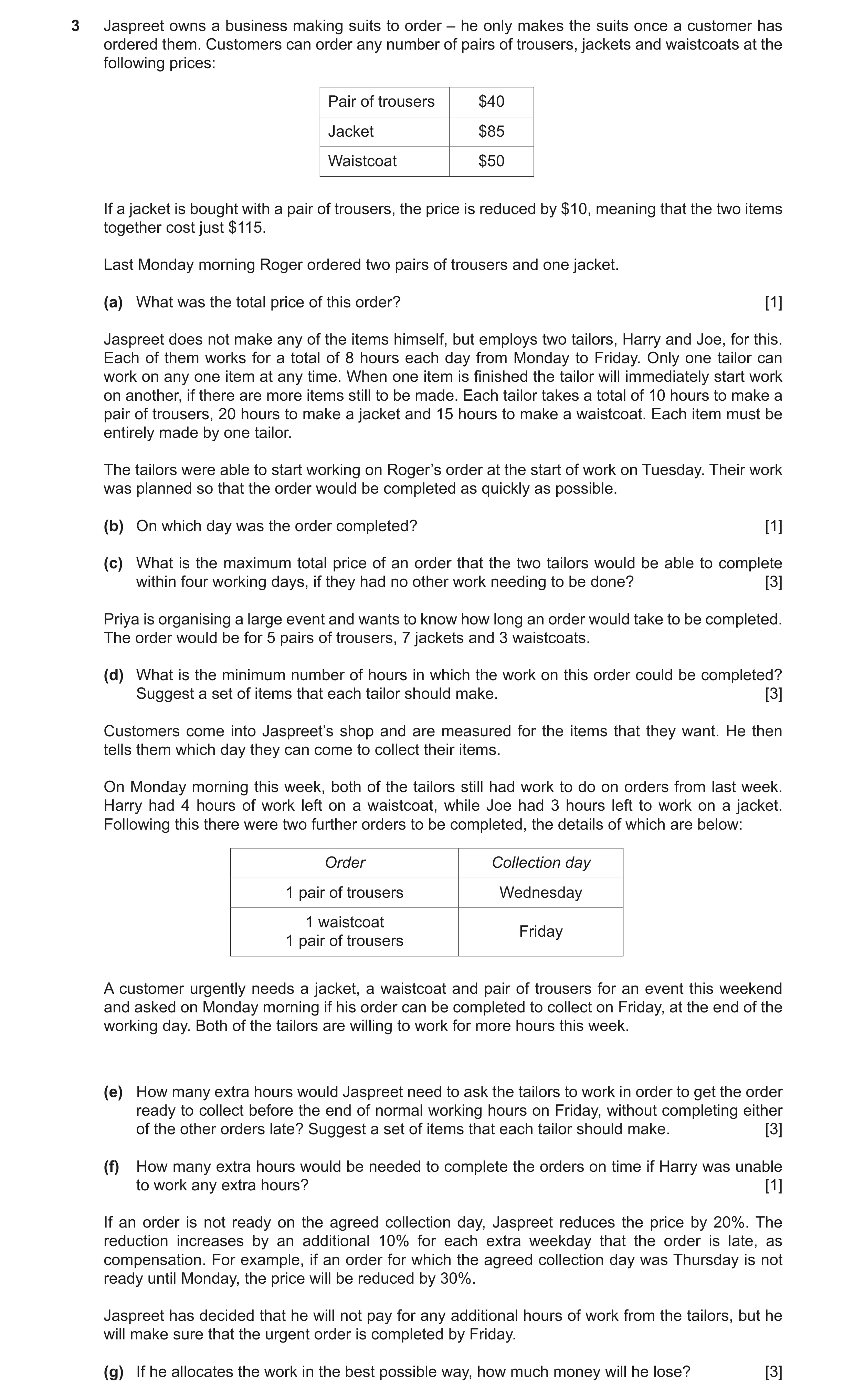
3 Jaspreet owns a business making suits to order – he only makes the suits once a customer has ordered them. Customers can order any number of pairs of trousers, jackets and waistcoats at the following prices: Pair of trousers $40 Jacket $85 Waistcoat $50 If a jacket is bought with a pair of trousers, the price is reduced by $10, meaning that the two items together cost just $115. Last Monday morning Roger ordered two pairs of trousers and one jacket. (a) What was the total price of this order? [1] Jaspreet does not make any of the items himself, but employs two tailors, Harry and Joe, for this. Each of them works for a total of 8 hours each day from Monday to Friday. Only one tailor can work on any one item at any time. When one item is finished the tailor will immediately start work on another, if there are more items still to be made. Each tailor takes a total of 10 hours to make a pair of trousers, 20 hours to make a jacket and 15 hours to make a waistcoat. Each item must be entirely made by one tailor. The tailors were able to start working on Roger’s order at the start of work on Tuesday. Their work was planned so that the order would be completed as quickly as possible. (b) On which day was the order completed? [1] (c) What is the maximum total price of an order that the two tailors would be able to complete within four working days, if they had no other work needing to be done? [3] Priya is organising a large event and wants to know how long an order would take to be completed. The order would be for 5 pairs of trousers, 7 jackets and 3 waistcoats. (d) What is the minimum number of hours in which the work on this order could be completed? Suggest a set of items that each tailor should make. [3] Customers come into Jaspreet’s shop and are measured for the items that they want. He then tells them which day they can come to collect their items. On Monday morning this week, both of the tailors still had work to do on orders from last week. Harry had 4 hours of work left on a waistcoat, while Joe had 3 hours left to work on a jacket. Following this there were two further orders to be completed, the details of which are below: Order Collection day 1 pair of trousers Wednesday 1 waistcoat Friday 1 pair of trousers A customer urgently needs a jacket, a waistcoat and pair of trousers for an event this weekend and asked on Monday morning if his order can be completed to collect on Friday, at the end of the working day. Both of the tailors are willing to work for more hours this week. (e) How many extra hours would Jaspreet need to ask the tailors to work in order to get the order ready to collect before the end of normal working hours on Friday, without completing either of the other orders late? Suggest a set of items that each tailor should make. [3] (f) How many extra hours would be needed to complete the orders on time if Harry was unable to work any extra hours? [1] If an order is not ready on the agreed collection day, Jaspreet reduces the price by 20%. The reduction increases by an additional 10% for each extra weekday that the order is late, as compensation. For example, if an order for which the agreed collection day was Thursday is not ready until Monday, the price will be reduced by 30%. Jaspreet has decided that he will not pay for any additional hours of work from the tailors, but he will make sure that the urgent order is completed by Friday. (g) If he allocates the work in the best possible way, how much money will he lose? [3]
15 marks
Mark scheme: 3(a) Trousers bought with jacket: $115 1 Additional pair of trousers: $40 Total price = $155 3(b) The quickest way to complete the order is for one tailor to make the jacket 1 (20 hours) and one tailor to make the trousers (20 hours in total). Therefore 20 hours are needed in total. 16 hours of work will be completed on Tuesday and Wednesday, so the items will be ready on Thursday. 3(c) Four working days is a total of 32 hours, so each tailor can make either 3 3 pairs of trousers ($120 each, so $240) 1 pair of trousers and 1 jacket ($125 – discount $10 each, so $230) 2 waistcoats ($100 each, so $200) The maximum total price would be $240. If 3 marks cannot be awarded, award 1 mark for (max 2): calculating the income per hour for two of the three items ($4, $4.25, $3.33) OR correctly calculating one of the three options above (120/240, 125/250, 100/200) correctly applying the discount (115/230) SC: 2 marks for an answer of $250 for 1 trousers and 1 jacket (forgetting the discount) OR an answer of $120 (forgetting there are two tailors) 3(d) The total time for the order is 5 × 10 + 7 × 20 + 3 × 15 = 235 hours. [1] 3 This means that the shortest time is 120 hours. [1] One way to achieve this would be for Harry to do 6 jackets and Joe to do 5 trousers, 1 jacket and 3 waistcoats Alternative: Harry does 1 trouser, 4 jackets and 2 waistcoats, and Joe does 4 trouser, 3 jacket and 1 waistcoat [1] 3(e) The total time needed for completing the orders is 7 hours for the order that 3 is still in progress, 10 hours, 25 hours and 45 hours for the other three orders, making a total of 87 hours for all of the work. [1] There is a total of 2 × 5 × 8 = 80 hours available if no extra hours are worked, so 7 extra hours will be needed. [1] If Harry is given 40 hours from the three orders (so that he has 4 extra hours), this will leave Joe with 3 extra hours. For example, Harry could be allocated two pairs of trousers followed by the jacket, and Joe the two waistcoats and a pair of trousers. [1] Alternatively, for solutions using scheduling: A schedule which allows for the non-urgent orders to be completed on time. [1] A schedule in which both tailors are occupied for the full 40 hours of the normal week. [1] Answer of 7 hours. [1] 3(f) If Harry can’t work any extra hours then he needs to have work allocated 1 that gets him as close as possible to his 40 hours. After he has completed the 4 hours to finish the waistcoat he can be allocated 35 hours of work to make a total of 39 in the week. 8 extra hours will be needed. 3(g) Since there are 7 hours more work needed than are available by the end of 3 the week, one of the orders must be completed on Monday. Delaying any one order to be finished on Monday will allow the others to be completed on time. [1] The order that is due on Wednesday would need a 40% reduction. The discount would be $16. The order that is due on Friday would need a 20% reduction. The discount would be $18. [1 for the value of either discount] The best option involves losing $16.
This question in 9694/33 Oct/Nov 2018
Q4 · Electronic passports (e-passports) are only useful if their origin can be checked 9694/31 Oct/Nov 2019
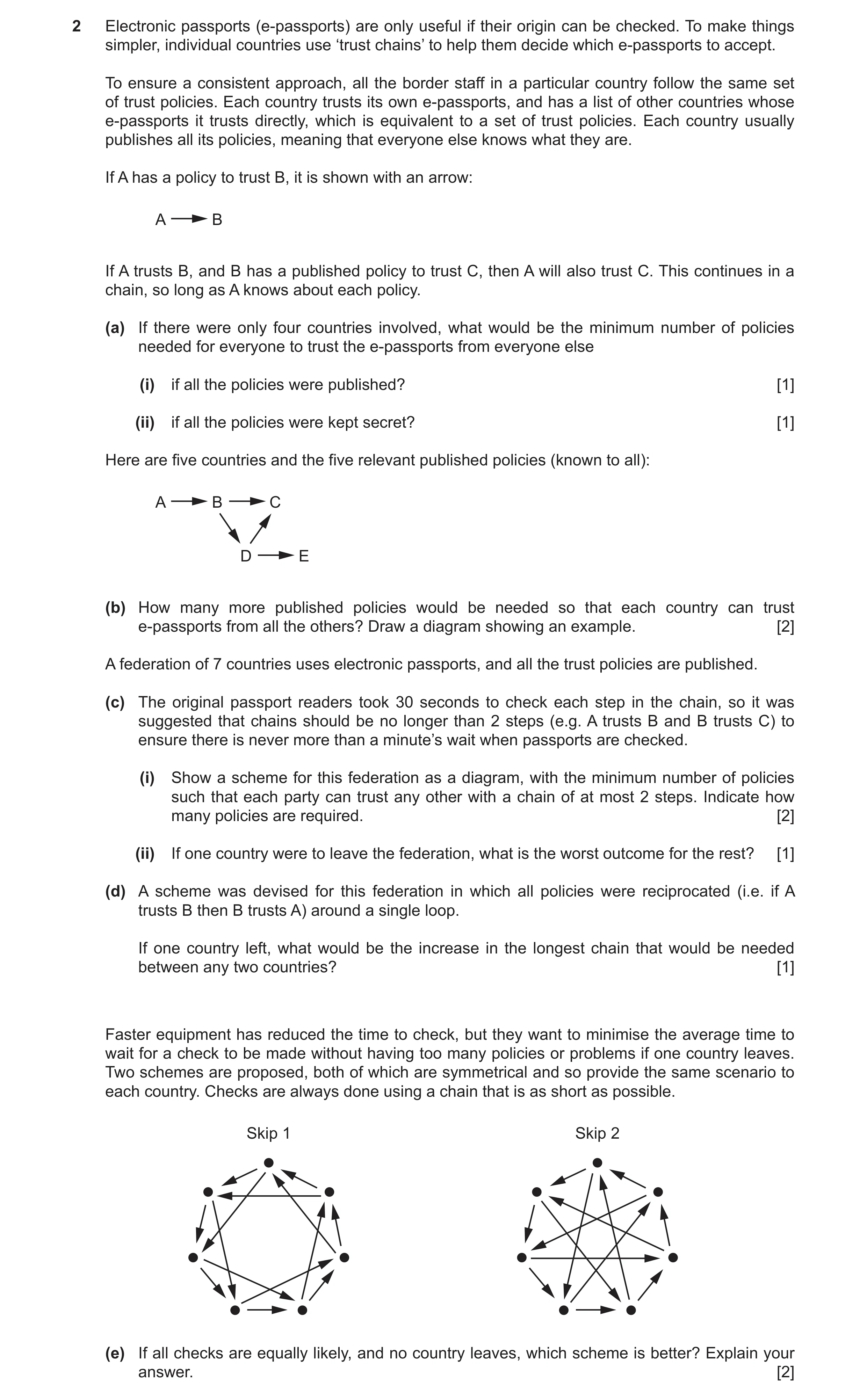
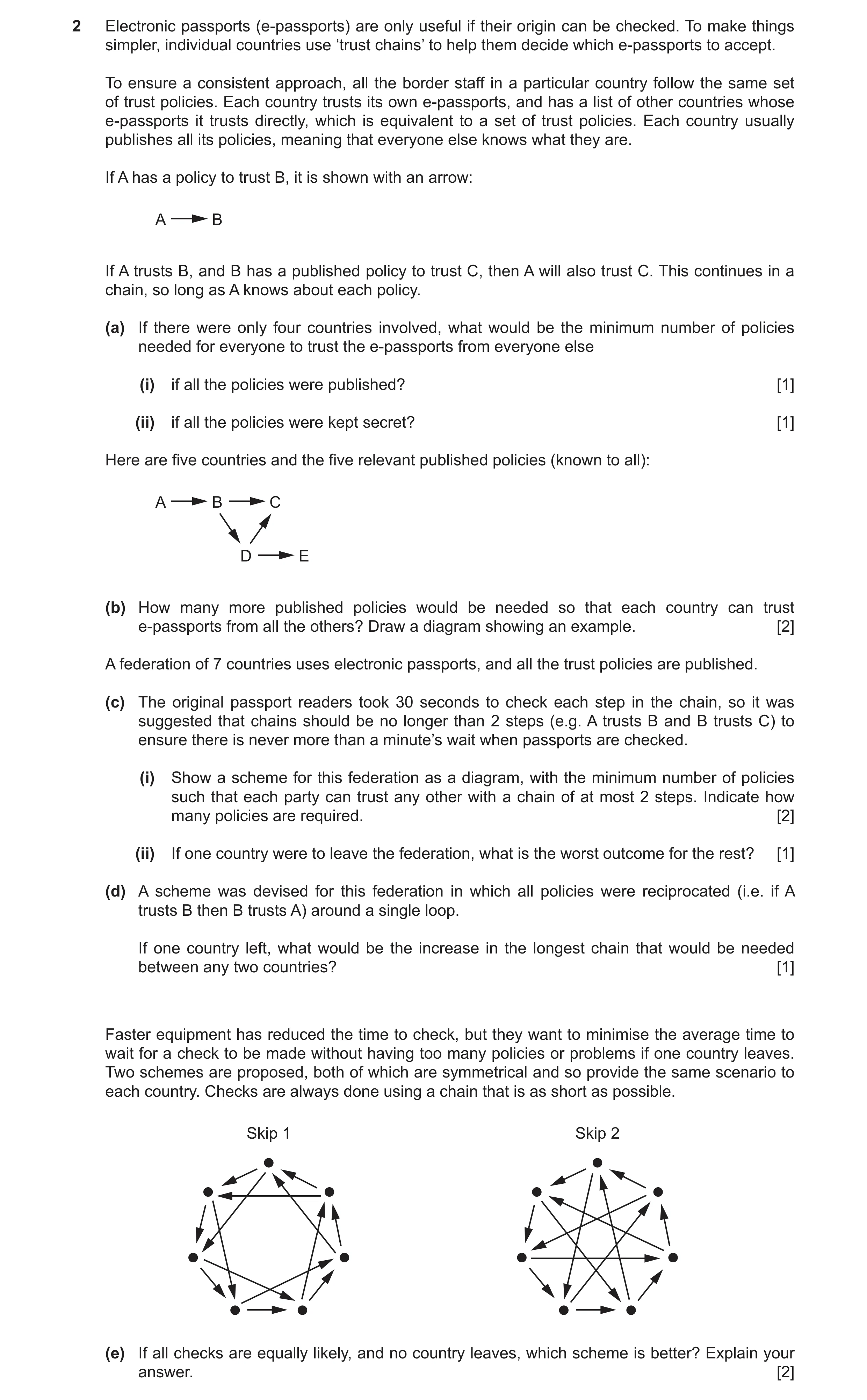
2 Electronic passports (e-passports) are only useful if their origin can be checked. To make things simpler, individual countries use ‘trust chains’ to help them decide which e-passports to accept. To ensure a consistent approach, all the border staff in a particular country follow the same set of trust policies. Each country trusts its own e-passports, and has a list of other countries whose e-passports it trusts directly, which is equivalent to a set of trust policies. Each country usually publishes all its policies, meaning that everyone else knows what they are. If A has a policy to trust B, it is shown with an arrow: A B If A trusts B, and B has a published policy to trust C, then A will also trust C. This continues in a chain, so long as A knows about each policy. (a) If there were only four countries involved, what would be the minimum number of policies needed for everyone to trust the e-passports from everyone else (i) if all the policies were published? [1] (ii) if all the policies were kept secret? [1] Here are five countries and the five relevant published policies (known to all): A B C D E (b) How many more published policies would be needed so that each country can trust e-passports from all the others? Draw a diagram showing an example. [2] A federation of 7 countries uses electronic passports, and all the trust policies are published. (c) The original passport readers took 30 seconds to check each step in the chain, so it was suggested that chains should be no longer than 2 steps (e.g. A trusts B and B trusts C) to ensure there is never more than a minute’s wait when passports are checked. (i) Show a scheme for this federation as a diagram, with the minimum number of policies such that each party can trust any other with a chain of at most 2 steps. Indicate how many policies are required. [2] (ii) If one country were to leave the federation, what is the worst outcome for the rest? [1] (d) A scheme was devised for this federation in which all policies were reciprocated (i.e. if A trusts B then B trusts A) around a single loop. If one country left, what would be the increase in the longest chain that would be needed between any two countries? [1] Faster equipment has reduced the time to check, but they want to minimise the average time to wait for a check to be made without having too many policies or problems if one country leaves. Two schemes are proposed, both of which are symmetrical and so provide the same scenario to each country. Checks are always done using a chain that is as short as possible. Skip 1 Skip 2 (e) If all checks are equally likely, and no country leaves, which scheme is better? Explain your answer. [2]
10 marks
Mark scheme: 2(a)(i) There must be 4. 1 2(a)(ii) All 12 distinct ordered pairs. 1 2(b) Both C and E need to trust others, and there are solutions with just 2: 2 EA and CA (or CB or CD or CE), or CA and EC (or EB or ED) 2 marks for any complete and correct diagram (condone omission of given 5 arrows) 1 mark for any diagram in which all trust relationships present, but also superfluous ones but with a maximum of 4 extra connections. SC: 1 mark for links identified but not shown in diagram. 2(c)(i) One country has to trust all others, and all others have to trust it: a six- 2 pointed star. 2 × 6 = 12 policies are required. 1 mark for any directed graph with desired property but which is not minimal SC: 1 mark for correct structure with 6 nodes instead of 7. 2(c)(ii) The departure of the central country would remove all trusted links for 1 everyone. 2(d) Rotational symmetry means that we only have to look at one case. 1 Longest chain was 3, is now 5, so difference of 2 Must be supported 2(e) 2 All countries are the same (by symmetry). The minimum steps others are: Skip 1: 1,1,2,2,3,3; Skip 2: 1,2,1,2,3,2 So Skip 2 is better by 1 step in 6 passport checks. 1 mark for Skip 2 with supporting evidence of decision. 1 mark for satisfactory quantification of the difference: allow any clear, precise explanation, e.g. average number of checks, total checks for all chains for 1 particular country, etc.
This question in 9694/31 Oct/Nov 2019
Q5 · Electronic passports (e-passports) are only useful if their origin can be checked 9694/32 Oct/Nov 2019
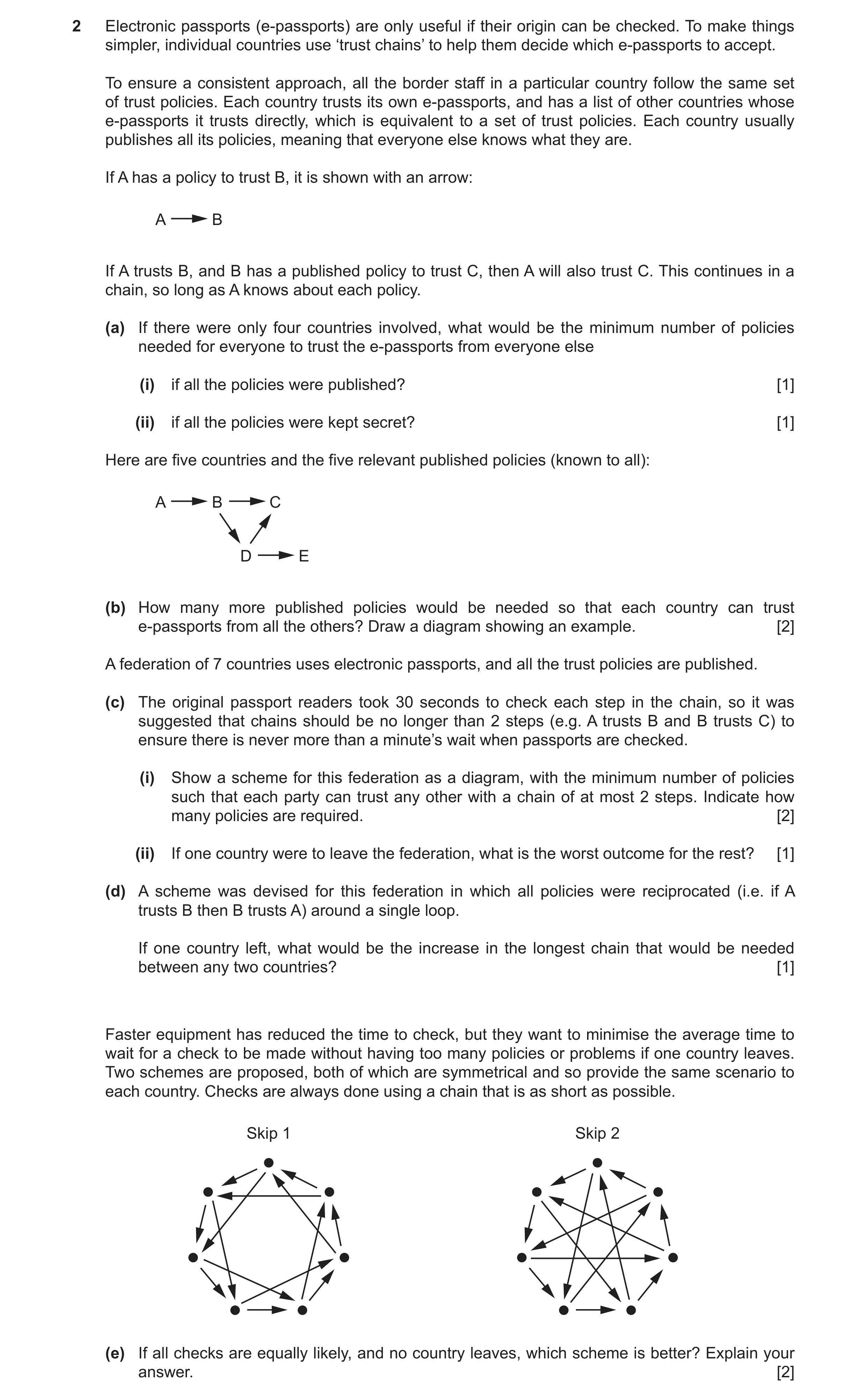
2 Electronic passports (e-passports) are only useful if their origin can be checked. To make things simpler, individual countries use ‘trust chains’ to help them decide which e-passports to accept. To ensure a consistent approach, all the border staff in a particular country follow the same set of trust policies. Each country trusts its own e-passports, and has a list of other countries whose e-passports it trusts directly, which is equivalent to a set of trust policies. Each country usually publishes all its policies, meaning that everyone else knows what they are. If A has a policy to trust B, it is shown with an arrow: A B If A trusts B, and B has a published policy to trust C, then A will also trust C. This continues in a chain, so long as A knows about each policy. (a) If there were only four countries involved, what would be the minimum number of policies needed for everyone to trust the e-passports from everyone else (i) if all the policies were published? [1] (ii) if all the policies were kept secret? [1] Here are five countries and the five relevant published policies (known to all): A B C D E (b) How many more published policies would be needed so that each country can trust e-passports from all the others? Draw a diagram showing an example. [2] A federation of 7 countries uses electronic passports, and all the trust policies are published. (c) The original passport readers took 30 seconds to check each step in the chain, so it was suggested that chains should be no longer than 2 steps (e.g. A trusts B and B trusts C) to ensure there is never more than a minute’s wait when passports are checked. (i) Show a scheme for this federation as a diagram, with the minimum number of policies such that each party can trust any other with a chain of at most 2 steps. Indicate how many policies are required. [2] (ii) If one country were to leave the federation, what is the worst outcome for the rest? [1] (d) A scheme was devised for this federation in which all policies were reciprocated (i.e. if A trusts B then B trusts A) around a single loop. If one country left, what would be the increase in the longest chain that would be needed between any two countries? [1] Faster equipment has reduced the time to check, but they want to minimise the average time to wait for a check to be made without having too many policies or problems if one country leaves. Two schemes are proposed, both of which are symmetrical and so provide the same scenario to each country. Checks are always done using a chain that is as short as possible. Skip 1 Skip 2 (e) If all checks are equally likely, and no country leaves, which scheme is better? Explain your answer. [2]
10 marks
Mark scheme: 2(a)(i) There must be 4. 1 2(a)(ii) All 12 distinct ordered pairs. 1 2(b) Both C and E need to trust others, and there are solutions with just 2: 2 EA and CA (or CB or CD or CE), or CA and EC (or EB or ED) 2 marks for any complete and correct diagram (condone omission of given 5 arrows) 1 mark for any diagram in which all trust relationships present, but also superfluous ones but with a maximum of 4 extra connections. SC: 1 mark for links identified but not shown in diagram. 2(c)(i) One country has to trust all others, and all others have to trust it: a six- 2 pointed star. 2 × 6 = 12 policies are required. 1 mark for any directed graph with desired property but which is not minimal SC: 1 mark for correct structure with 6 nodes instead of 7. 2(c)(ii) The departure of the central country would remove all trusted links for 1 everyone. 2(d) Rotational symmetry means that we only have to look at one case. 1 Longest chain was 3, is now 5, so difference of 2 Must be supported 2(e) 2 All countries are the same (by symmetry). The minimum steps others are: Skip 1: 1,1,2,2,3,3; Skip 2: 1,2,1,2,3,2 So Skip 2 is better by 1 step in 6 passport checks. 1 mark for Skip 2 with supporting evidence of decision. 1 mark for satisfactory quantification of the difference: allow any clear, precise explanation, e.g. average number of checks, total checks for all chains for 1 particular country, etc.
This question in 9694/32 Oct/Nov 2019
Q6 · Electronic passports (e-passports) are only useful if their origin can be checked 9694/33 Oct/Nov 2019
2 Electronic passports (e-passports) are only useful if their origin can be checked. To make things simpler, individual countries use ‘trust chains’ to help them decide which e-passports to accept. To ensure a consistent approach, all the border staff in a particular country follow the same set of trust policies. Each country trusts its own e-passports, and has a list of other countries whose e-passports it trusts directly, which is equivalent to a set of trust policies. Each country usually publishes all its policies, meaning that everyone else knows what they are. If A has a policy to trust B, it is shown with an arrow: A B If A trusts B, and B has a published policy to trust C, then A will also trust C. This continues in a chain, so long as A knows about each policy. (a) If there were only four countries involved, what would be the minimum number of policies needed for everyone to trust the e-passports from everyone else (i) if all the policies were published? [1] (ii) if all the policies were kept secret? [1] Here are five countries and the five relevant published policies (known to all): A B C D E (b) How many more published policies would be needed so that each country can trust e-passports from all the others? Draw a diagram showing an example. [2] A federation of 7 countries uses electronic passports, and all the trust policies are published. (c) The original passport readers took 30 seconds to check each step in the chain, so it was suggested that chains should be no longer than 2 steps (e.g. A trusts B and B trusts C) to ensure there is never more than a minute’s wait when passports are checked. (i) Show a scheme for this federation as a diagram, with the minimum number of policies such that each party can trust any other with a chain of at most 2 steps. Indicate how many policies are required. [2] (ii) If one country were to leave the federation, what is the worst outcome for the rest? [1] (d) A scheme was devised for this federation in which all policies were reciprocated (i.e. if A trusts B then B trusts A) around a single loop. If one country left, what would be the increase in the longest chain that would be needed between any two countries? [1] Faster equipment has reduced the time to check, but they want to minimise the average time to wait for a check to be made without having too many policies or problems if one country leaves. Two schemes are proposed, both of which are symmetrical and so provide the same scenario to each country. Checks are always done using a chain that is as short as possible. Skip 1 Skip 2 (e) If all checks are equally likely, and no country leaves, which scheme is better? Explain your answer. [2]
10 marks
Mark scheme: 2(a)(i) There must be 4. 1 2(a)(ii) All 12 distinct ordered pairs. 1 2(b) Both C and E need to trust others, and there are solutions with just 2: 2 EA and CA (or CB or CD or CE), or CA and EC (or EB or ED) 2 marks for any complete and correct diagram (condone omission of given 5 arrows) 1 mark for any diagram in which all trust relationships present, but also superfluous ones but with a maximum of 4 extra connections. SC: 1 mark for links identified but not shown in diagram. 2(c)(i) One country has to trust all others, and all others have to trust it: a six- 2 pointed star. 2 × 6 = 12 policies are required. 1 mark for any directed graph with desired property but which is not minimal SC: 1 mark for correct structure with 6 nodes instead of 7. 2(c)(ii) The departure of the central country would remove all trusted links for 1 everyone. 2(d) Rotational symmetry means that we only have to look at one case. 1 Longest chain was 3, is now 5, so difference of 2 Must be supported 2(e) 2 All countries are the same (by symmetry). The minimum steps others are: Skip 1: 1,1,2,2,3,3; Skip 2: 1,2,1,2,3,2 So Skip 2 is better by 1 step in 6 passport checks. 1 mark for Skip 2 with supporting evidence of decision. 1 mark for satisfactory quantification of the difference: allow any clear, precise explanation, e.g. average number of checks, total checks for all chains for 1 particular country, etc.
This question in 9694/33 Oct/Nov 2019
Q7 · Matchboxes are often made from a cardboard ‘tray’ (the five faces of a cuboid without a… 9694/31 Oct/Nov 2021
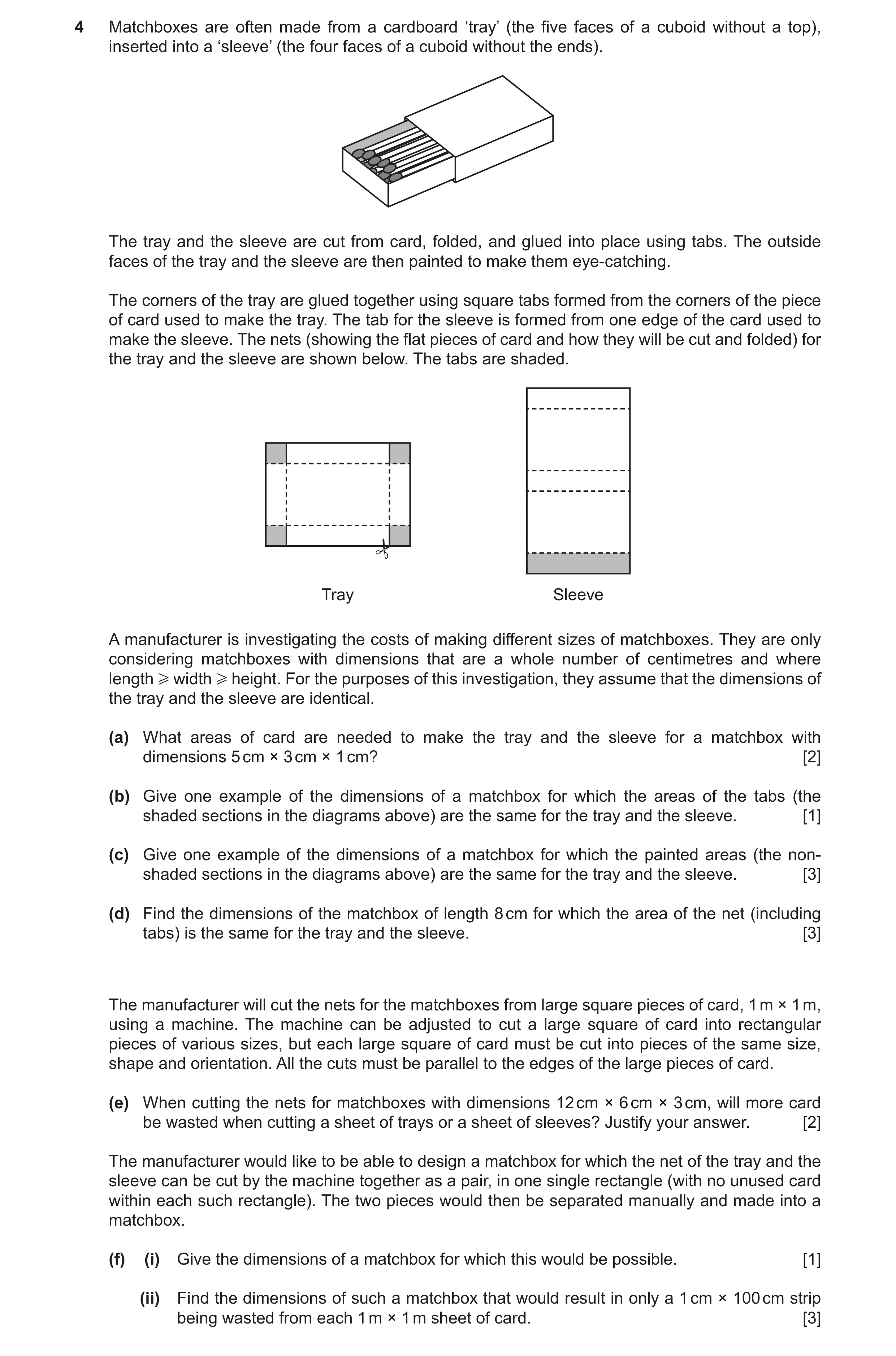
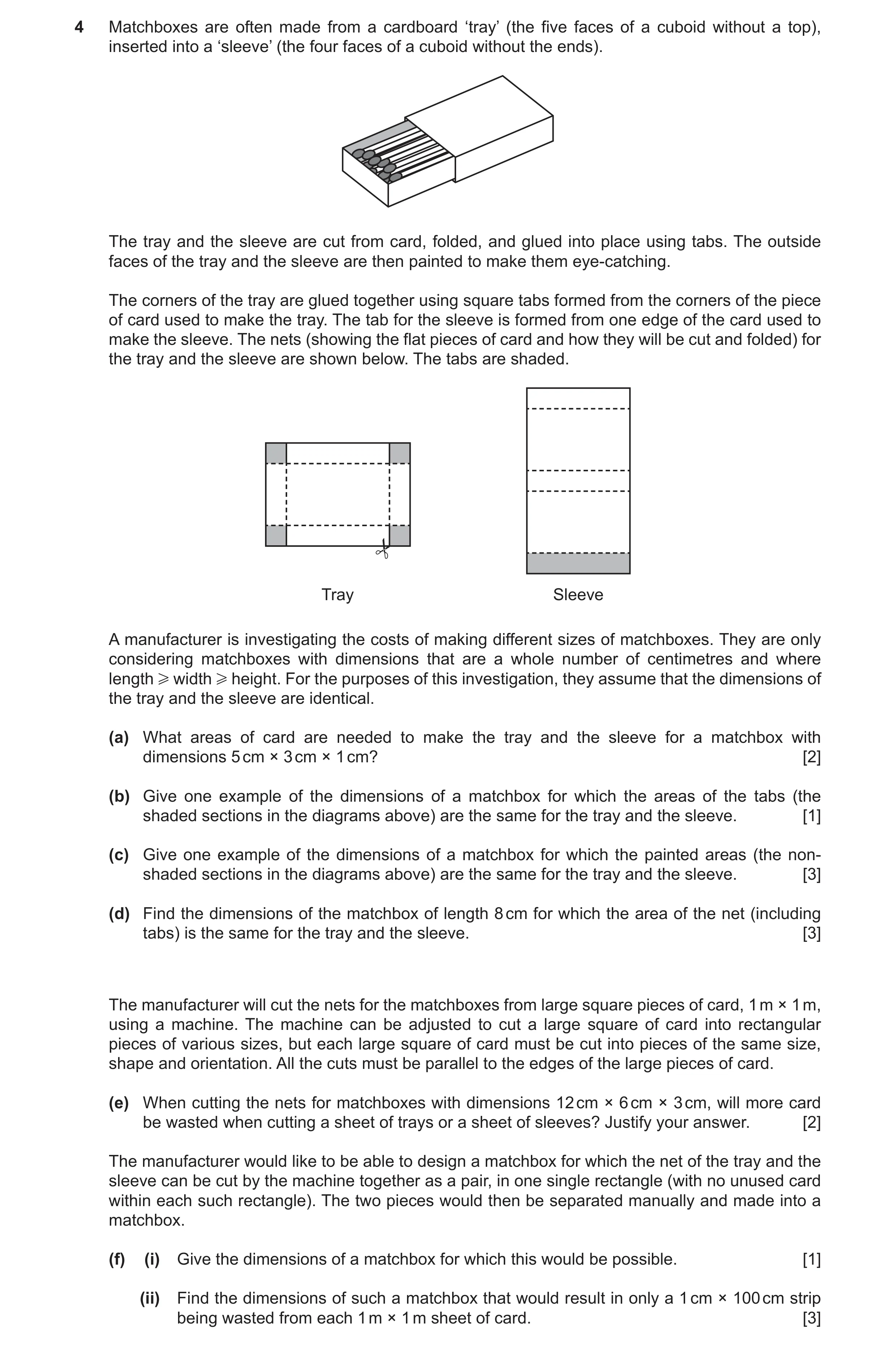
4 Matchboxes are often made from a cardboard ‘tray’ (the five faces of a cuboid without a top), inserted into a ‘sleeve’ (the four faces of a cuboid without the ends). The tray and the sleeve are cut from card, folded, and glued into place using tabs. The outside faces of the tray and the sleeve are then painted to make them eye-catching. The corners of the tray are glued together using square tabs formed from the corners of the piece of card used to make the tray. The tab for the sleeve is formed from one edge of the card used to make the sleeve. The nets (showing the flat pieces of card and how they will be cut and folded) for the tray and the sleeve are shown below. The tabs are shaded. # Tray Sleeve A manufacturer is investigating the costs of making different sizes of matchboxes. They are only considering matchboxes with dimensions that are a whole number of centimetres and where length H width H height. For the purposes of this investigation, they assume that the dimensions of the tray and the sleeve are identical. (a) What areas of card are needed to make the tray and the sleeve for a matchbox with dimensions 5 cm × 3 cm × 1 cm? [2] (b) Give one example of the dimensions of a matchbox for which the areas of the tabs (the shaded sections in the diagrams above) are the same for the tray and the sleeve. [1] (c) Give one example of the dimensions of a matchbox for which the painted areas (the non- shaded sections in the diagrams above) are the same for the tray and the sleeve. [3] (d) Find the dimensions of the matchbox of length 8 cm for which the area of the net (including tabs) is the same for the tray and the sleeve. [3] The manufacturer will cut the nets for the matchboxes from large square pieces of card, 1 m × 1 m, using a machine. The machine can be adjusted to cut a large square of card into rectangular pieces of various sizes, but each large square of card must be cut into pieces of the same size, shape and orientation. All the cuts must be parallel to the edges of the large pieces of card. (e) When cutting the nets for matchboxes with dimensions 12 cm × 6 cm × 3 cm, will more card be wasted when cutting a sheet of trays or a sheet of sleeves? Justify your answer. [2] The manufacturer would like to be able to design a matchbox for which the net of the tray and the sleeve can be cut by the machine together as a pair, in one single rectangle (with no unused card within each such rectangle). The two pieces would then be separated manually and made into a matchbox. (f) (i) Give the dimensions of a matchbox for which this would be possible. [1] (ii) Find the dimensions of such a matchbox that would result in only a 1 cm × 100 cm strip being wasted from each 1 m × 1 m sheet of card. [3]
15 marks
Mark scheme: 4(a) Tray = 35 cm2 [1] 2 Sleeve = 45 cm2 [1] 4(b) 4 × H × H = L × H or 4H = L 1 Any answer for which the length = 4 × height 4(c) 3 marks for any answer where L = 2H 3 OR 1 mark for each of the following (max 2): • an algebraic representation of the area of painted tray • an algebraic representation of the area of painted sleeve 4(d) 8 × 6 × 3 3 1 mark for each of the following (max 2): • a correct algebraic expression of the equation (that simplifies to 8W + 8H = 2HW + 4H2) • substitute a value for H or W and deduce matching other value • one pair of tray and sleeve correctly calculated • another pair of tray and sleeve correctly calculated 4(e) Tray net has dimensions 18 × 12 2 Sleeve net has dimensions 21 × 12 Can fit trays to cover 90 × 96 on one sheet, and sleeves to cover 84 × 96 1 mark for either So sleeves will generate more waste [1]. 4(f)(i) Any matchbox with dimensions 1 L = 2W + H, where 2W + 3H ⩽ 100 OR L = W + 2H, where L + 2W + 5H ⩽ 100 4(f)(ii) 1 mark for finding a dimension of the net pair that is a factor of 100. 3 1 mark for finding the other dimension of the net pair that wastes no more than 400 cm2. 10 × 4 × 3 or 19 × 8 × 3 L = W + 2H layout 3 10 3 3 4 3 4 3 3 4 3 OR L = 2W + H layout 3 8 3 19 3 19 3
This question in 9694/31 Oct/Nov 2021
Q8 · Matchboxes are often made from a cardboard ‘tray’ (the five faces of a cuboid without a… 9694/32 Oct/Nov 2021
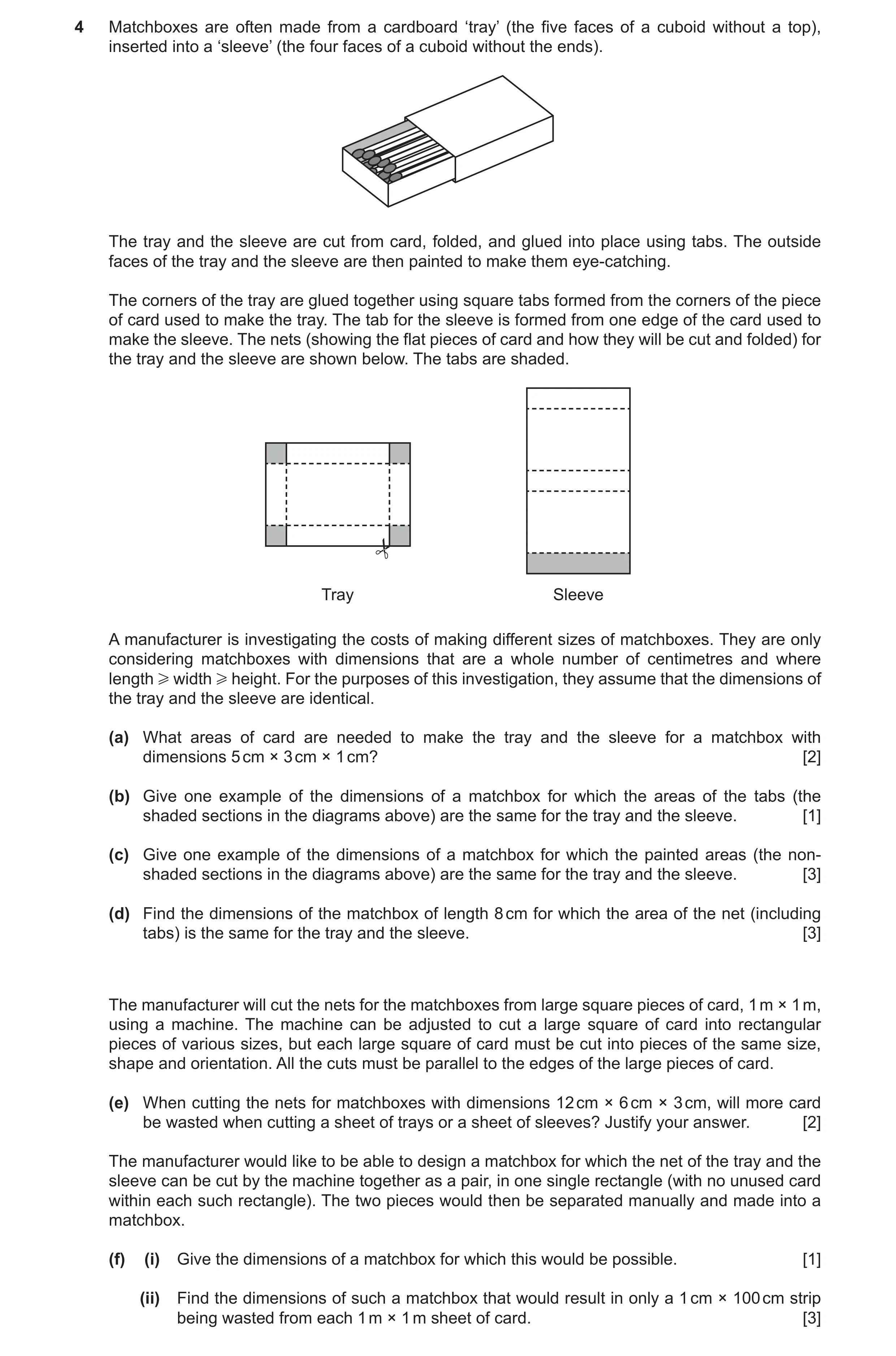
4 Matchboxes are often made from a cardboard ‘tray’ (the five faces of a cuboid without a top), inserted into a ‘sleeve’ (the four faces of a cuboid without the ends). The tray and the sleeve are cut from card, folded, and glued into place using tabs. The outside faces of the tray and the sleeve are then painted to make them eye-catching. The corners of the tray are glued together using square tabs formed from the corners of the piece of card used to make the tray. The tab for the sleeve is formed from one edge of the card used to make the sleeve. The nets (showing the flat pieces of card and how they will be cut and folded) for the tray and the sleeve are shown below. The tabs are shaded. # Tray Sleeve A manufacturer is investigating the costs of making different sizes of matchboxes. They are only considering matchboxes with dimensions that are a whole number of centimetres and where length H width H height. For the purposes of this investigation, they assume that the dimensions of the tray and the sleeve are identical. (a) What areas of card are needed to make the tray and the sleeve for a matchbox with dimensions 5 cm × 3 cm × 1 cm? [2] (b) Give one example of the dimensions of a matchbox for which the areas of the tabs (the shaded sections in the diagrams above) are the same for the tray and the sleeve. [1] (c) Give one example of the dimensions of a matchbox for which the painted areas (the non- shaded sections in the diagrams above) are the same for the tray and the sleeve. [3] (d) Find the dimensions of the matchbox of length 8 cm for which the area of the net (including tabs) is the same for the tray and the sleeve. [3] The manufacturer will cut the nets for the matchboxes from large square pieces of card, 1 m × 1 m, using a machine. The machine can be adjusted to cut a large square of card into rectangular pieces of various sizes, but each large square of card must be cut into pieces of the same size, shape and orientation. All the cuts must be parallel to the edges of the large pieces of card. (e) When cutting the nets for matchboxes with dimensions 12 cm × 6 cm × 3 cm, will more card be wasted when cutting a sheet of trays or a sheet of sleeves? Justify your answer. [2] The manufacturer would like to be able to design a matchbox for which the net of the tray and the sleeve can be cut by the machine together as a pair, in one single rectangle (with no unused card within each such rectangle). The two pieces would then be separated manually and made into a matchbox. (f) (i) Give the dimensions of a matchbox for which this would be possible. [1] (ii) Find the dimensions of such a matchbox that would result in only a 1 cm × 100 cm strip being wasted from each 1 m × 1 m sheet of card. [3]
15 marks
Mark scheme: 4(a) Tray = 35 cm2 [1] 2 Sleeve = 45 cm2 [1] 4(b) 4 × H × H = L × H or 4H = L 1 Any answer for which the length = 4 × height 4(c) 3 marks for any answer where L = 2H 3 OR 1 mark for each of the following (max 2): • an algebraic representation of the area of painted tray • an algebraic representation of the area of painted sleeve 4(d) 8 × 6 × 3 3 1 mark for each of the following (max 2): • a correct algebraic expression of the equation (that simplifies to 8W + 8H = 2HW + 4H2) • substitute a value for H or W and deduce matching other value • one pair of tray and sleeve correctly calculated • another pair of tray and sleeve correctly calculated 4(e) Tray net has dimensions 18 × 12 2 Sleeve net has dimensions 21 × 12 Can fit trays to cover 90 × 96 on one sheet, and sleeves to cover 84 × 96 1 mark for either So sleeves will generate more waste [1]. 4(f)(i) Any matchbox with dimensions 1 L = 2W + H, where 2W + 3H ⩽ 100 OR L = W + 2H, where L + 2W + 5H ⩽ 100 4(f)(ii) 1 mark for finding a dimension of the net pair that is a factor of 100. 3 1 mark for finding the other dimension of the net pair that wastes no more than 400 cm2. 10 × 4 × 3 or 19 × 8 × 3 L = W + 2H layout 3 10 3 3 4 3 4 3 3 4 3 OR L = 2W + H layout 3 8 3 19 3 19 3
This question in 9694/32 Oct/Nov 2021
Q9 · Matchboxes are often made from a cardboard ‘tray’ (the five faces of a cuboid without a… 9694/33 Oct/Nov 2021
4 Matchboxes are often made from a cardboard ‘tray’ (the five faces of a cuboid without a top), inserted into a ‘sleeve’ (the four faces of a cuboid without the ends). The tray and the sleeve are cut from card, folded, and glued into place using tabs. The outside faces of the tray and the sleeve are then painted to make them eye-catching. The corners of the tray are glued together using square tabs formed from the corners of the piece of card used to make the tray. The tab for the sleeve is formed from one edge of the card used to make the sleeve. The nets (showing the flat pieces of card and how they will be cut and folded) for the tray and the sleeve are shown below. The tabs are shaded. # Tray Sleeve A manufacturer is investigating the costs of making different sizes of matchboxes. They are only considering matchboxes with dimensions that are a whole number of centimetres and where length H width H height. For the purposes of this investigation, they assume that the dimensions of the tray and the sleeve are identical. (a) What areas of card are needed to make the tray and the sleeve for a matchbox with dimensions 5 cm × 3 cm × 1 cm? [2] (b) Give one example of the dimensions of a matchbox for which the areas of the tabs (the shaded sections in the diagrams above) are the same for the tray and the sleeve. [1] (c) Give one example of the dimensions of a matchbox for which the painted areas (the non- shaded sections in the diagrams above) are the same for the tray and the sleeve. [3] (d) Find the dimensions of the matchbox of length 8 cm for which the area of the net (including tabs) is the same for the tray and the sleeve. [3] The manufacturer will cut the nets for the matchboxes from large square pieces of card, 1 m × 1 m, using a machine. The machine can be adjusted to cut a large square of card into rectangular pieces of various sizes, but each large square of card must be cut into pieces of the same size, shape and orientation. All the cuts must be parallel to the edges of the large pieces of card. (e) When cutting the nets for matchboxes with dimensions 12 cm × 6 cm × 3 cm, will more card be wasted when cutting a sheet of trays or a sheet of sleeves? Justify your answer. [2] The manufacturer would like to be able to design a matchbox for which the net of the tray and the sleeve can be cut by the machine together as a pair, in one single rectangle (with no unused card within each such rectangle). The two pieces would then be separated manually and made into a matchbox. (f) (i) Give the dimensions of a matchbox for which this would be possible. [1] (ii) Find the dimensions of such a matchbox that would result in only a 1 cm × 100 cm strip being wasted from each 1 m × 1 m sheet of card. [3]
15 marks
Mark scheme: 4(a) Tray = 35 cm2 [1] 2 Sleeve = 45 cm2 [1] 4(b) 4 × H × H = L × H or 4H = L 1 Any answer for which the length = 4 × height 4(c) 3 marks for any answer where L = 2H 3 OR 1 mark for each of the following (max 2): • an algebraic representation of the area of painted tray • an algebraic representation of the area of painted sleeve 4(d) 8 × 6 × 3 3 1 mark for each of the following (max 2): • a correct algebraic expression of the equation (that simplifies to 8W + 8H = 2HW + 4H2) • substitute a value for H or W and deduce matching other value • one pair of tray and sleeve correctly calculated • another pair of tray and sleeve correctly calculated 4(e) Tray net has dimensions 18 × 12 2 Sleeve net has dimensions 21 × 12 Can fit trays to cover 90 × 96 on one sheet, and sleeves to cover 84 × 96 1 mark for either So sleeves will generate more waste [1]. 4(f)(i) Any matchbox with dimensions 1 L = 2W + H, where 2W + 3H ⩽ 100 OR L = W + 2H, where L + 2W + 5H ⩽ 100 4(f)(ii) 1 mark for finding a dimension of the net pair that is a factor of 100. 3 1 mark for finding the other dimension of the net pair that wastes no more than 400 cm2. 10 × 4 × 3 or 19 × 8 × 3 L = W + 2H layout 3 10 3 3 4 3 4 3 3 4 3 OR L = 2W + H layout 3 8 3 19 3 19 3
This question in 9694/33 Oct/Nov 2021
Q10 · Lilly wants to eat dinner at Trista’s Restaurant 9694/31 May/June 2022
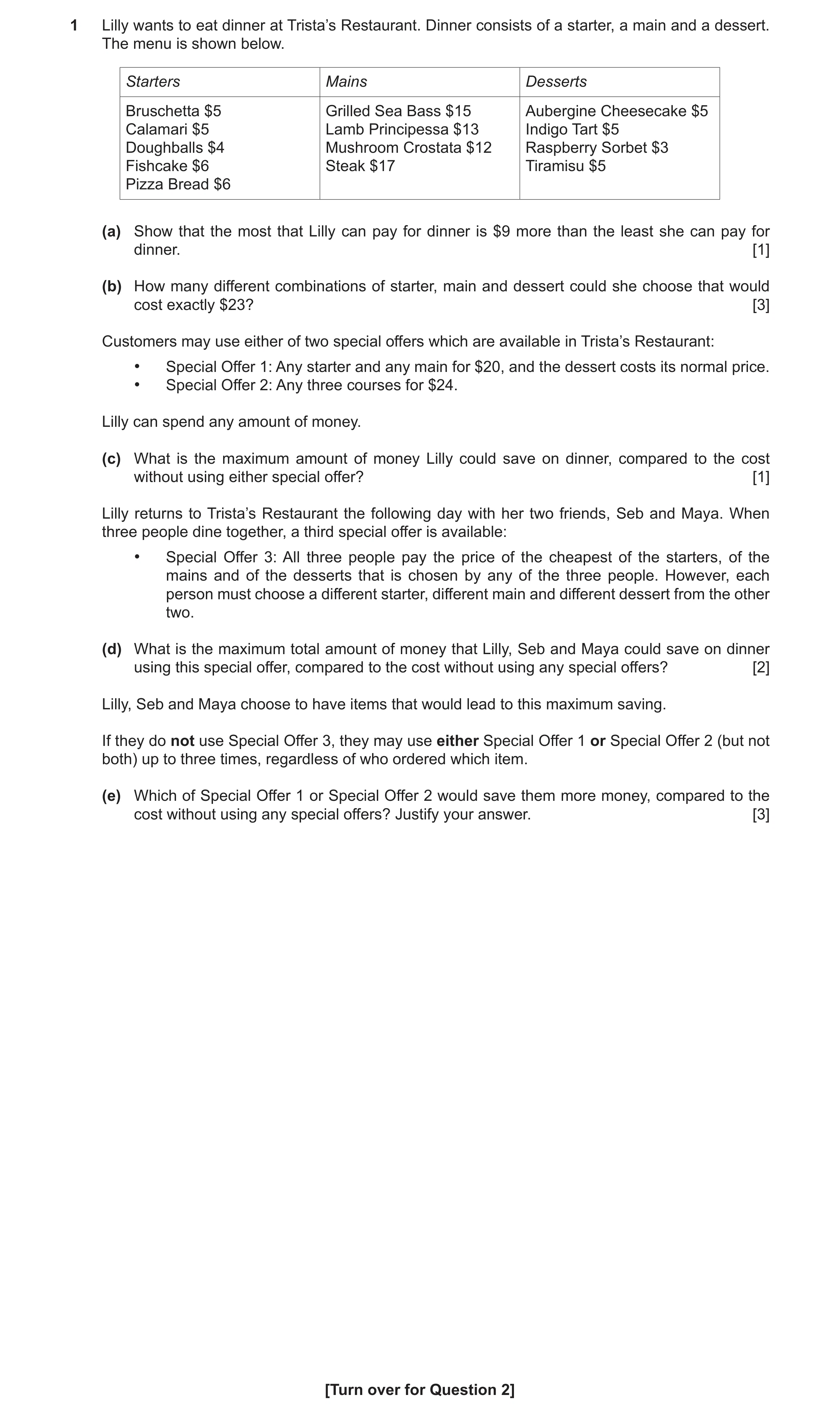
1 Lilly wants to eat dinner at Trista’s Restaurant. Dinner consists of a starter, a main and a dessert. The menu is shown below. Starters Mains Desserts Bruschetta $5 Grilled Sea Bass $15 Aubergine Cheesecake $5 Calamari $5 Lamb Principessa $13 Indigo Tart $5 Doughballs $4 Mushroom Crostata $12 Raspberry Sorbet $3 Fishcake $6 Steak $17 Tiramisu $5 Pizza Bread $6 (a) Show that the most that Lilly can pay for dinner is $9 more than the least she can pay for dinner. [1] (b) How many different combinations of starter, main and dessert could she choose that would cost exactly $23? [3] Customers may use either of two special offers which are available in Trista’s Restaurant: • Special Offer 1: Any starter and any main for $20, and the dessert costs its normal price. • Special Offer 2: Any three courses for $24. Lilly can spend any amount of money. (c) What is the maximum amount of money Lilly could save on dinner, compared to the cost without using either special offer? [1] Lilly returns to Trista’s Restaurant the following day with her two friends, Seb and Maya. When three people dine together, a third special offer is available: • Special Offer 3: All three people pay the price of the cheapest of the starters, of the mains and of the desserts that is chosen by any of the three people. However, each person must choose a different starter, different main and different dessert from the other two. (d) What is the maximum total amount of money that Lilly, Seb and Maya could save on dinner using this special offer, compared to the cost without using any special offers? [2] Lilly, Seb and Maya choose to have items that would lead to this maximum saving. If they do not use Special Offer 3, they may use either Special Offer 1 or Special Offer 2 (but not both) up to three times, regardless of who ordered which item. (e) Which of Special Offer 1 or Special Offer 2 would save them more money, compared to the cost without using any special offers? Justify your answer. [3] [Turn over for Question 2]
10 marks
Mark scheme: Question Answer Marks 1(a) The most she can pay is $6 + $17 + $5 = $28. 1 The least she can pay is $4 + $12 + $3 = $19. And $28 – $19 = $9. AG May also be presented with per-item differences as $2 + $5 + $2. 1(b) She can spend $5, $15 and $3 in 2 ways. 3 She can spend $5, $13 and $5 in 2 3 = 6 ways. She can spend $6, $12 and $5 in 2 3 = 6 ways. So there is a total of 2 + 6 + 6 = 14 different combinations. Award 2 marks for the three combinations of dollars and no extras OR for any two of the 2, 6 and 6 ways. Award 1 mark for two of the combinations of dollars OR for any one of the 2, 6 and 6 ways. 1(c) Special Offer 1: 6 + 17 – 20 1 = $3 Special Offer 2: 6 + 17 + 5 – 24 = $4 1(d) They can save $16 – $12 = $4 on the starter, $44 – $36 = $8 on the main 2 and $13 – $9 = $4 on the dessert, making a total saving of $16. Award 1 mark for any two of the $4, $8 and $4 OR for calculating the costs for any two of the three best-case courses ($16, $44, $13) OR $57 seen OR $19 identified as cheapest 1(e) Special Offer 1: 3 Doughballs $4 and Mushroom Crostata $12 can be paired for $16, cheaper than using the special offer. The other dishes would then be 2 $20 + $10 + $3. Total $69. Special Offer 2: Doughballs $4, Mushroom Crostata $12 and Raspberry Sorbet $3 can be combined for $19, cheaper than using the special offer. The other dishes would then be 2 $24. Total $67. So Special Offer 2 is cheaper. 1 mark for the $16 in SO1 1 mark for the $19 in SO2. 1 mark for concluding Special Offer 2 from $69 and $67. SC: 1 mark for Special Offer 2 justified with $72 v. $73 (assumes three applications of each special offer, and then offer 1 gives no saving).
This question in 9694/31 May/June 2022
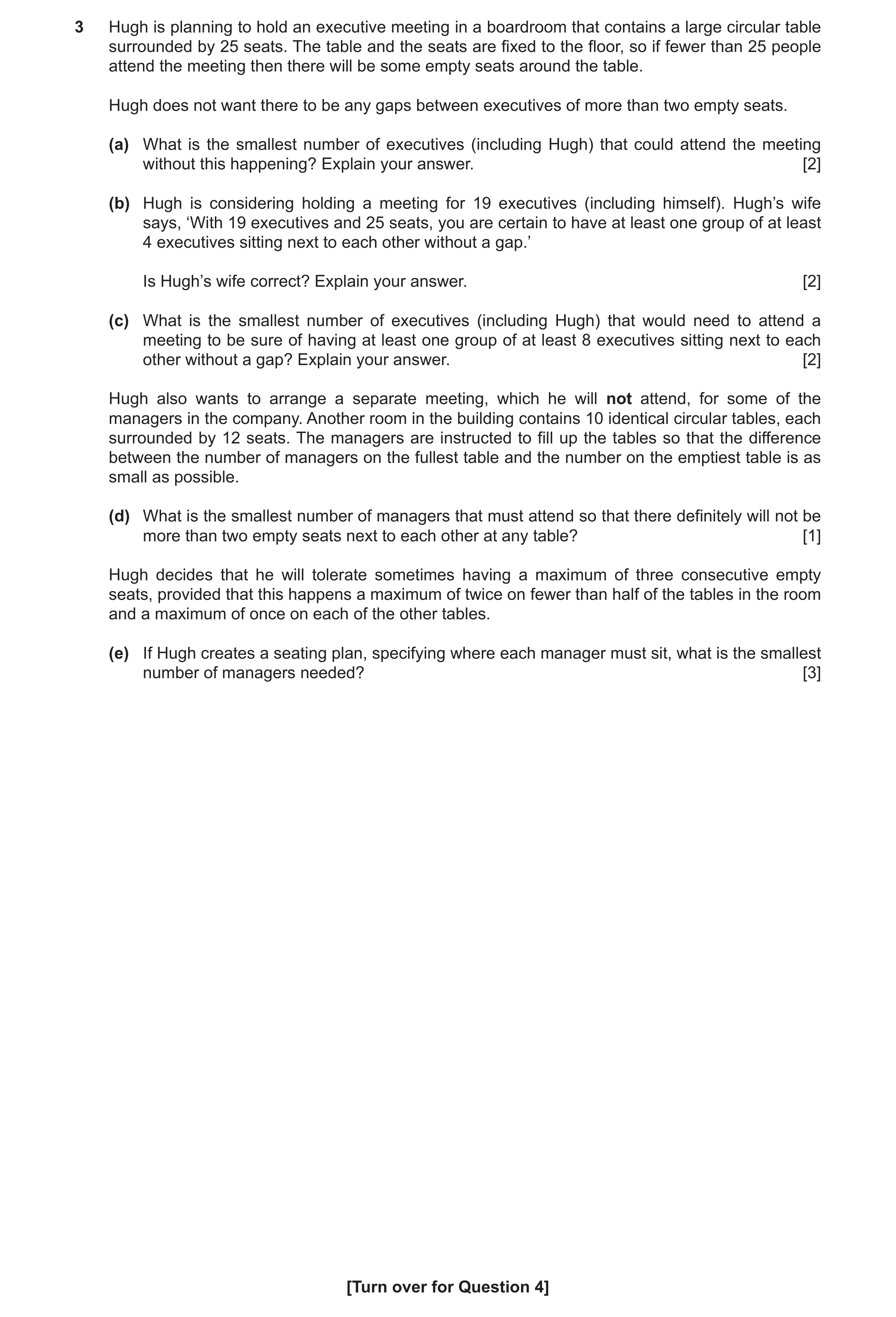
Q11 · Hugh is planning to hold an executive meeting in a boardroom that contains a large… 9694/31 Oct/Nov 2022
3 Hugh is planning to hold an executive meeting in a boardroom that contains a large circular table surrounded by 25 seats. The table and the seats are fixed to the floor, so if fewer than 25 people attend the meeting then there will be some empty seats around the table. Hugh does not want there to be any gaps between executives of more than two empty seats. (a) What is the smallest number of executives (including Hugh) that could attend the meeting without this happening? Explain your answer. [2] (b) Hugh is considering holding a meeting for 19 executives (including himself). Hugh’s wife says, ‘With 19 executives and 25 seats, you are certain to have at least one group of at least 4 executives sitting next to each other without a gap.’ Is Hugh’s wife correct? Explain your answer. [2] (c) What is the smallest number of executives (including Hugh) that would need to attend a meeting to be sure of having at least one group of at least 8 executives sitting next to each other without a gap? Explain your answer. [2] Hugh also wants to arrange a separate meeting, which he will not attend, for some of the managers in the company. Another room in the building contains 10 identical circular tables, each surrounded by 12 seats. The managers are instructed to fill up the tables so that the difference between the number of managers on the fullest table and the number on the emptiest table is as small as possible. (d) What is the smallest number of managers that must attend so that there definitely will not be more than two empty seats next to each other at any table? [1] Hugh decides that he will tolerate sometimes having a maximum of three consecutive empty seats, provided that this happens a maximum of twice on fewer than half of the tables in the room and a maximum of once on each of the other tables. (e) If Hugh creates a seating plan, specifying where each manager must sit, what is the smallest number of managers needed? [3] [Turn over for Question 4]
10 marks
Mark scheme: 3(a) 9 executives are necessary [1] 2 If there are 2 empty seats between every pair of executives, then with 8 executives this would only account for 8 + 2 8 = 24 seats. [1] 3(b) She is correct, because 18 executives could sit in 6 separate groups of 3 2 (or 5 groups of 3, a pair and a single), but, no matter where they sit, the nineteenth executive will have to create a group of at least 4. Award 1 mark for recognising that 18 executives could sit down without 4 executives sitting consecutively. Alternatively: 6 separate groups of three people plus a gap would use up 6 4 = 24 seats, but there are 25 seats, so there must be another person in a seat somewhere, making a group of 4. Award 1 mark for evidence of 6 4. 3(c) 7 people sitting together with one empty seat can happen 3 times [1] 2 so with 22 executives (only 3 empty seats) a group of (at least) 8 must occur. 3(d) 10 managers could sit consecutively on each table, which would mean that 1 Hugh must invite at least 10 (12 – 2) = 100 managers. 3(e) 4 managers are necessary in order to prevent more than two groups of 3 3 consecutive empty seats. [1] In fact, only 4 managers, suitably deployed, are needed to prevent 3 consecutive empty seats. [1] So the total number of managers needed is 4 10 = 40.
This question in 9694/31 Oct/Nov 2022
Q12 · Hugh is planning to hold an executive meeting in a boardroom that contains a large… 9694/32 Oct/Nov 2022
3 Hugh is planning to hold an executive meeting in a boardroom that contains a large circular table surrounded by 25 seats. The table and the seats are fixed to the floor, so if fewer than 25 people attend the meeting then there will be some empty seats around the table. Hugh does not want there to be any gaps between executives of more than two empty seats. (a) What is the smallest number of executives (including Hugh) that could attend the meeting without this happening? Explain your answer. [2] (b) Hugh is considering holding a meeting for 19 executives (including himself). Hugh’s wife says, ‘With 19 executives and 25 seats, you are certain to have at least one group of at least 4 executives sitting next to each other without a gap.’ Is Hugh’s wife correct? Explain your answer. [2] (c) What is the smallest number of executives (including Hugh) that would need to attend a meeting to be sure of having at least one group of at least 8 executives sitting next to each other without a gap? Explain your answer. [2] Hugh also wants to arrange a separate meeting, which he will not attend, for some of the managers in the company. Another room in the building contains 10 identical circular tables, each surrounded by 12 seats. The managers are instructed to fill up the tables so that the difference between the number of managers on the fullest table and the number on the emptiest table is as small as possible. (d) What is the smallest number of managers that must attend so that there definitely will not be more than two empty seats next to each other at any table? [1] Hugh decides that he will tolerate sometimes having a maximum of three consecutive empty seats, provided that this happens a maximum of twice on fewer than half of the tables in the room and a maximum of once on each of the other tables. (e) If Hugh creates a seating plan, specifying where each manager must sit, what is the smallest number of managers needed? [3] [Turn over for Question 4]
10 marks
Mark scheme: 3(a) 9 executives are necessary [1] 2 If there are 2 empty seats between every pair of executives, then with 8 executives this would only account for 8 + 2 8 = 24 seats. [1] 3(b) She is correct, because 18 executives could sit in 6 separate groups of 3 2 (or 5 groups of 3, a pair and a single), but, no matter where they sit, the nineteenth executive will have to create a group of at least 4. Award 1 mark for recognising that 18 executives could sit down without 4 executives sitting consecutively. Alternatively: 6 separate groups of three people plus a gap would use up 6 4 = 24 seats, but there are 25 seats, so there must be another person in a seat somewhere, making a group of 4. Award 1 mark for evidence of 6 4. 3(c) 7 people sitting together with one empty seat can happen 3 times [1] 2 so with 22 executives (only 3 empty seats) a group of (at least) 8 must occur. 3(d) 10 managers could sit consecutively on each table, which would mean that 1 Hugh must invite at least 10 (12 – 2) = 100 managers. 3(e) 4 managers are necessary in order to prevent more than two groups of 3 3 consecutive empty seats. [1] In fact, only 4 managers, suitably deployed, are needed to prevent 3 consecutive empty seats. [1] So the total number of managers needed is 4 10 = 40.
This question in 9694/32 Oct/Nov 2022
Q13 · Hugh is planning to hold an executive meeting in a boardroom that contains a large… 9694/33 Oct/Nov 2022
3 Hugh is planning to hold an executive meeting in a boardroom that contains a large circular table surrounded by 25 seats. The table and the seats are fixed to the floor, so if fewer than 25 people attend the meeting then there will be some empty seats around the table. Hugh does not want there to be any gaps between executives of more than two empty seats. (a) What is the smallest number of executives (including Hugh) that could attend the meeting without this happening? Explain your answer. [2] (b) Hugh is considering holding a meeting for 19 executives (including himself). Hugh’s wife says, ‘With 19 executives and 25 seats, you are certain to have at least one group of at least 4 executives sitting next to each other without a gap.’ Is Hugh’s wife correct? Explain your answer. [2] (c) What is the smallest number of executives (including Hugh) that would need to attend a meeting to be sure of having at least one group of at least 8 executives sitting next to each other without a gap? Explain your answer. [2] Hugh also wants to arrange a separate meeting, which he will not attend, for some of the managers in the company. Another room in the building contains 10 identical circular tables, each surrounded by 12 seats. The managers are instructed to fill up the tables so that the difference between the number of managers on the fullest table and the number on the emptiest table is as small as possible. (d) What is the smallest number of managers that must attend so that there definitely will not be more than two empty seats next to each other at any table? [1] Hugh decides that he will tolerate sometimes having a maximum of three consecutive empty seats, provided that this happens a maximum of twice on fewer than half of the tables in the room and a maximum of once on each of the other tables. (e) If Hugh creates a seating plan, specifying where each manager must sit, what is the smallest number of managers needed? [3] [Turn over for Question 4]
10 marks
Mark scheme: 3(a) 9 executives are necessary [1] 2 If there are 2 empty seats between every pair of executives, then with 8 executives this would only account for 8 + 2 8 = 24 seats. [1] 3(b) She is correct, because 18 executives could sit in 6 separate groups of 3 2 (or 5 groups of 3, a pair and a single), but, no matter where they sit, the nineteenth executive will have to create a group of at least 4. Award 1 mark for recognising that 18 executives could sit down without 4 executives sitting consecutively. Alternatively: 6 separate groups of three people plus a gap would use up 6 4 = 24 seats, but there are 25 seats, so there must be another person in a seat somewhere, making a group of 4. Award 1 mark for evidence of 6 4. 3(c) 7 people sitting together with one empty seat can happen 3 times [1] 2 so with 22 executives (only 3 empty seats) a group of (at least) 8 must occur. 3(d) 10 managers could sit consecutively on each table, which would mean that 1 Hugh must invite at least 10 (12 – 2) = 100 managers. 3(e) 4 managers are necessary in order to prevent more than two groups of 3 3 consecutive empty seats. [1] In fact, only 4 managers, suitably deployed, are needed to prevent 3 consecutive empty seats. [1] So the total number of managers needed is 4 10 = 40.
This question in 9694/33 Oct/Nov 2022
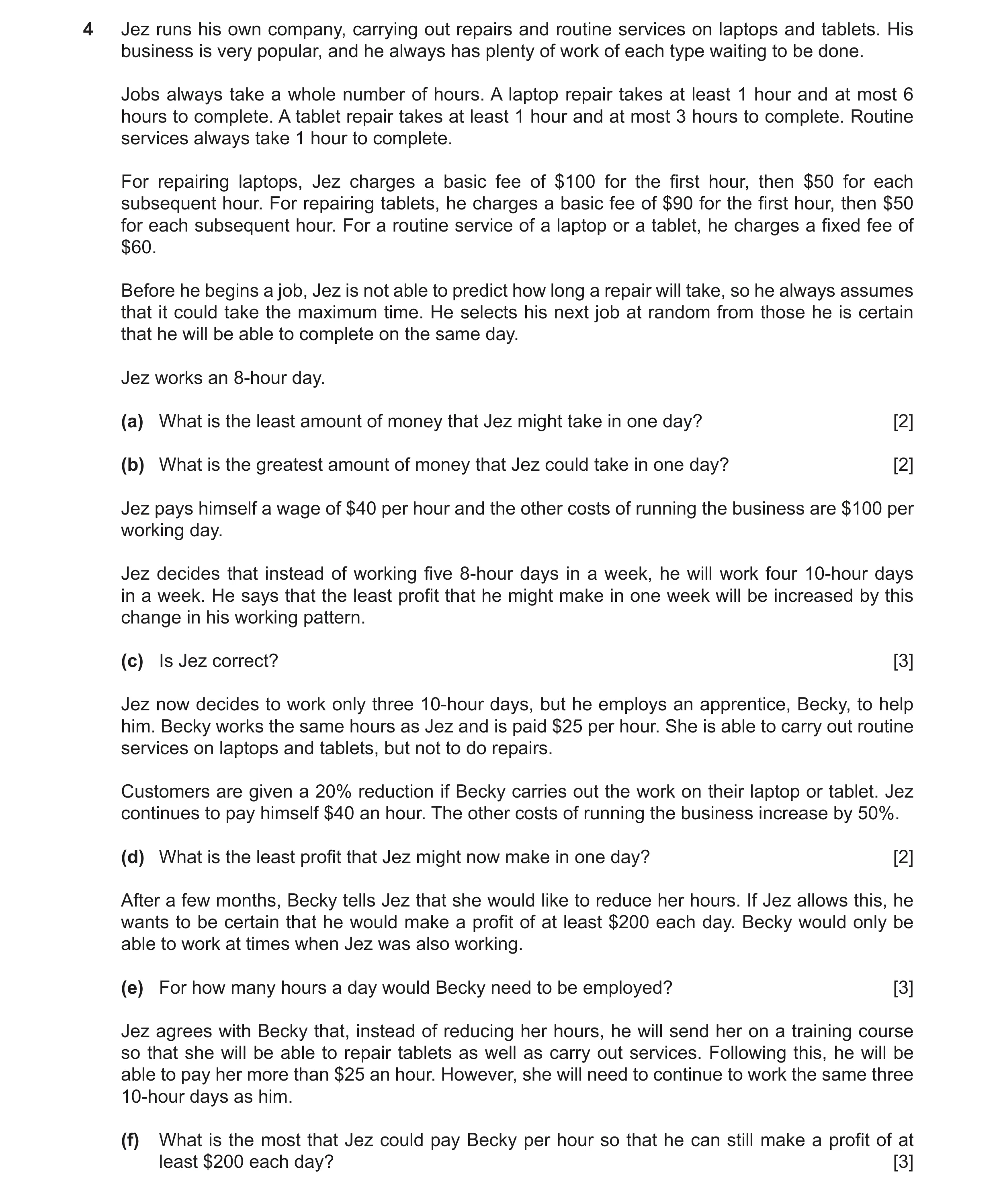
Q14 · Jez runs his own company, carrying out repairs and routine services on laptops and tablets 9694/31 May/June 2024
4 Jez runs his own company, carrying out repairs and routine services on laptops and tablets. His business is very popular, and he always has plenty of work of each type waiting to be done. Jobs always take a whole number of hours. A laptop repair takes at least 1 hour and at most 6 hours to complete. A tablet repair takes at least 1 hour and at most 3 hours to complete. Routine services always take 1 hour to complete. For repairing laptops, Jez charges a basic fee of $100 for the first hour, then $50 for each subsequent hour. For repairing tablets, he charges a basic fee of $90 for the first hour, then $50 for each subsequent hour. For a routine service of a laptop or a tablet, he charges a fixed fee of $60. Before he begins a job, Jez is not able to predict how long a repair will take, so he always assumes that it could take the maximum time. He selects his next job at random from those he is certain that he will be able to complete on the same day. Jez works an 8-hour day. (a) What is the least amount of money that Jez might take in one day? [2] (b) What is the greatest amount of money that Jez could take in one day? [2] Jez pays himself a wage of $40 per hour and the other costs of running the business are $100 per working day. Jez decides that instead of working five 8-hour days in a week, he will work four 10-hour days in a week. He says that the least profit that he might make in one week will be increased by this change in his working pattern. (c) Is Jez correct? [3] Jez now decides to work only three 10-hour days, but he employs an apprentice, Becky, to help him. Becky works the same hours as Jez and is paid $25 per hour. She is able to carry out routine services on laptops and tablets, but not to do repairs. Customers are given a 20% reduction if Becky carries out the work on their laptop or tablet. Jez continues to pay himself $40 an hour. The other costs of running the business increase by 50%. (d) What is the least profit that Jez might now make in one day? [2] After a few months, Becky tells Jez that she would like to reduce her hours. If Jez allows this, he wants to be certain that he would make a profit of at least $200 each day. Becky would only be able to work at times when Jez was also working. (e) For how many hours a day would Becky need to be employed? [3] Jez agrees with Becky that, instead of reducing her hours, he will send her on a training course so that she will be able to repair tablets as well as carry out services. Following this, he will be able to pay her more than $25 an hour. However, she will need to continue to work the same three 10-hour days as him. (f) What is the most that Jez could pay Becky per hour so that he can still make a profit of at least $200 each day? [3]
15 marks
Mark scheme: 4(a) 1 laptop repair @ 6 hours = $350 [1] 2 + 2 services @ $60 = $120 $470 4(b) 3 laptop repairs @ 1 hour each = $300 [1] 2 + 3 tablet repairs @ 1 hour each = $270 + 2 services @ $60 = $120 $690 SC: 1 mark for answer of $800 4(c) Yes with $250 and $360 seen 3 5 8-hour days: least profit per day is ‘$470’ – $100 – 8 $40 = $50, so weekly profit = $250 4 10-hour days: least income comes from 1 laptop repair taking 6 hours + 4 services = $590 Profit per day = $590 – $100 – 10 $40 = $90, so weekly profit $360 OR since salary unchanged: Yes with $1850 and $1960 seen $470 – $100 = $370 and $590 – $100 = $490 per day so 5 $370 = $1850 and 4 $490 = $1960 Award 1 mark for $250 OR $590 OR $360 OR $1850 OR $490 OR $1960 Award 2 marks for $250 AND ($590 OR $360) OR $1850 AND ($490 OR $1960) Alternative methods may look at weekly income v. cost: Yes with $2350 and $110 seen $2350 → $2360, income +$10; cost –$100; so weekly profit increase by $110 Award 1 mark for $2350 or $2360 or $110 Award 2 marks for $2350 and ($2360 or $110) SC: 2 marks for stating Jez is correct based on $250 compared with $400 OR stating Jez is correct based on $1850 compared with $2000 4(d) Least income = $590 (Jez) + 10 $48 (Becky) = $1070 2 Outgoings are $150 + 10 $40 + 10 $25 = $800 1 mark for either Profit = $1070 – $800 = $270 Alternatively: Jez profit = $590 – 10 $40 = $190 Becky profit = 10 $48 – 10 $25 = $230 1 mark for either Other outgoings are $150 Profit = $190 + $230 – $150 = $270 SC: 2 marks for $280 if $600 for Jez seen in 4(c) 4(e) Follow through incorrect value of $600 in 4(c) OR their $270 in 4(d) except for 3 final answer Becky can do one service per hour, at a profit of $23 [1] Profit at 10 hours is $270, so can reduce profit by up to $70 [1] 70 / 23, so 3 hours reduction So 7 hours [1] Alternatively: Least income = $590 + $48x Outgoings = $150 + 10 $40 + $25x Profit per day = $(590 + 48x – 550 – 25x) = $(40 + 23x) [1] 40 + 23x ⩾ 200 [1] requires x to be at least 6.95, so Becky needs to work 7 hours [1] Alternatively: Becky can do one repair per hour, at a profit of $23 [1] Calculation of profit for Becky working a number of hours in the range [5,9] [1] 7 hours [1] 4(f) Least income from Jez is still $590 3 Least income from Becky: 10 routine service = $600 (before discount) so $480 once 20% discount applied [1] Minimum total income is therefore $590 + $480 = $1070 For $200 profit, outgoings must be at most $870 [1] Jez pays himself $400 Other costs are $150 Maximum amount that Becky can be paid is $320 for 10 hours $32 per hour Alternatively: Least income from Becky: 10 routine service = $600 (before discount) so $480 once 20% discount applied [1] Which is the same as before, so the profit is still $270 if Becky earns $25 per hour Maximum possible increase to Becky’s rate of pay is $70/10 [1] New rate of pay is $32 per hour
This question in 9694/31 May/June 2024
Q15 · Every morning on his expedition to the South Pole, Amundsen recorded the outside… 9694/31 Oct/Nov 2024
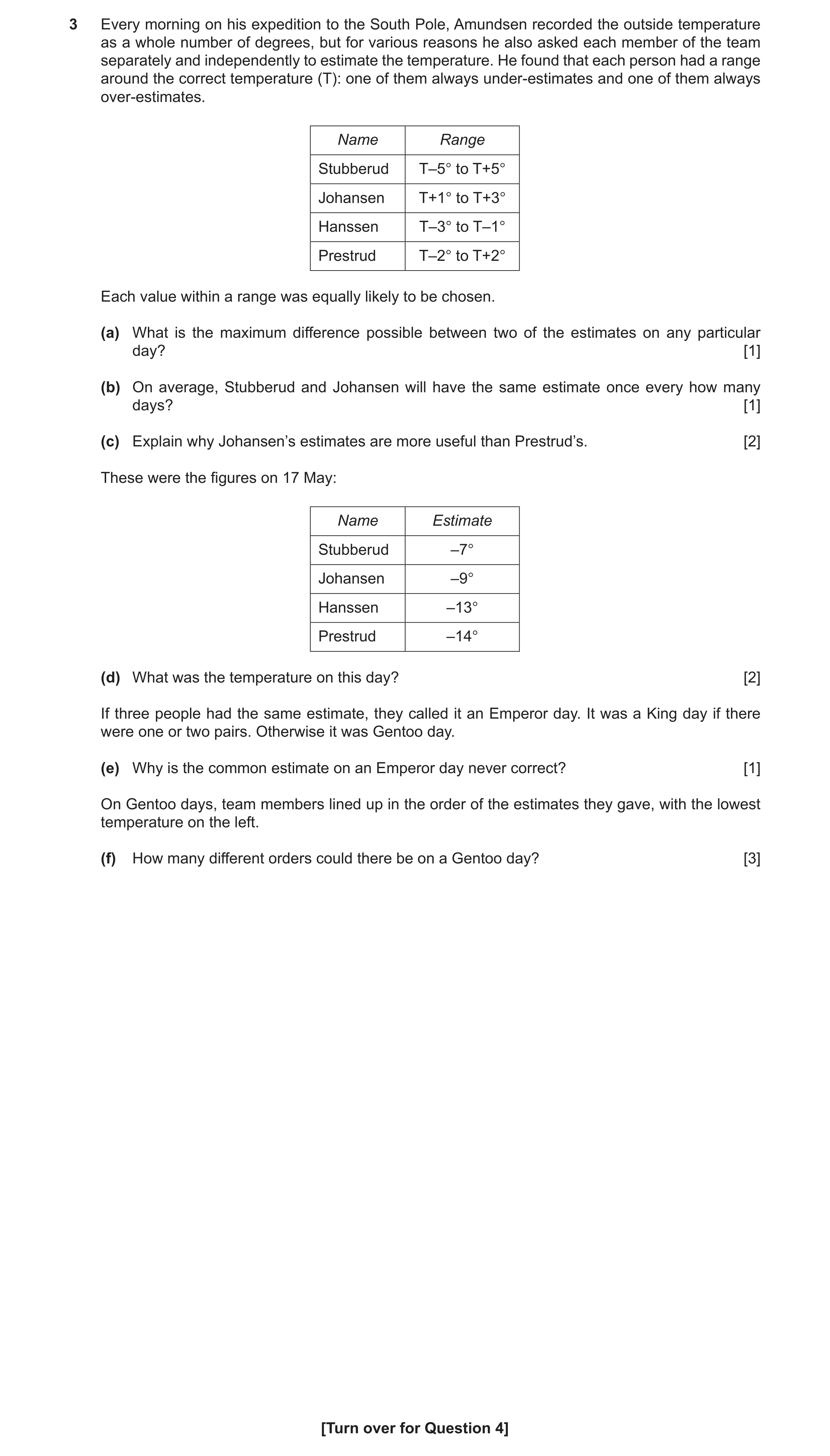
3 Every morning on his expedition to the South Pole, Amundsen recorded the outside temperature as a whole number of degrees, but for various reasons he also asked each member of the team separately and independently to estimate the temperature. He found that each person had a range around the correct temperature (T): one of them always under-estimates and one of them always over-estimates. Name Range Stubberud T‒5° to T+5° Johansen T+1° to T+3° Hanssen T‒3° to T‒1° Prestrud T‒2° to T+2° Each value within a range was equally likely to be chosen. (a) What is the maximum difference possible between two of the estimates on any particular day? [1] (b) On average, Stubberud and Johansen will have the same estimate once every how many days? [1] (c) Explain why Johansen’s estimates are more useful than Prestrud’s. [2] These were the figures on 17 May: Name Estimate Stubberud ‒7° Johansen ‒9° Hanssen ‒13° Prestrud ‒14° (d) What was the temperature on this day? [2] If three people had the same estimate, they called it an Emperor day. It was a King day if there were one or two pairs. Otherwise it was Gentoo day. (e) Why is the common estimate on an Emperor day never correct? [1] On Gentoo days, team members lined up in the order of the estimates they gave, with the lowest temperature on the left. (f) How many different orders could there be on a Gentoo day? [3] [Turn over for Question 4]
10 marks
Mark scheme: 3(a) Maximum is 3 one way and 5 the other, so 8° 1 3(b) Whatever J does, there’s a 1 in 11 chance that it will match 1 3(c) J has the smaller spread [1] 2 And it is known that his estimate will always be too high [1] (whereas P’s could be higher or lower) OR His estimate can be corrected (by subtracting 2) [1] 3(d) (Either J or H shows that) T must be –12°, –11° or –10° [1] 2 OR Any one of J, H and S shows that the minimum possible value is –12 [1] –12° [1] is the only one consistent with P 3(e) Must include H or J, (neither of which include T) 1 OR Triple can only be one of T–2, T–1, T + 1 or T + 2 OR Only two include T in range (S & P) 3(f) Gentoo day: the order of H and J is fixed. Each order PHJ HPJ HJP can have 3 S inserted in any position except PSH and JSP, so 10. If 3 not awarded then 1 mark each for (max 2): • H must be to the left of J • If S could be in any position then there would be 12 possibilities • (But) PSHJ and HJSP are not possible OR 1 mark for SHPJ, HSPJ, HPSJ, HPJS 1 mark for SPHJ, PHSJ, PHJS AND not PSHJ 1 mark for SHJP, HSJP, HJPS AND not HJSP OR 1 mark for any four correct, with no more than two incorrect
This question in 9694/31 Oct/Nov 2024
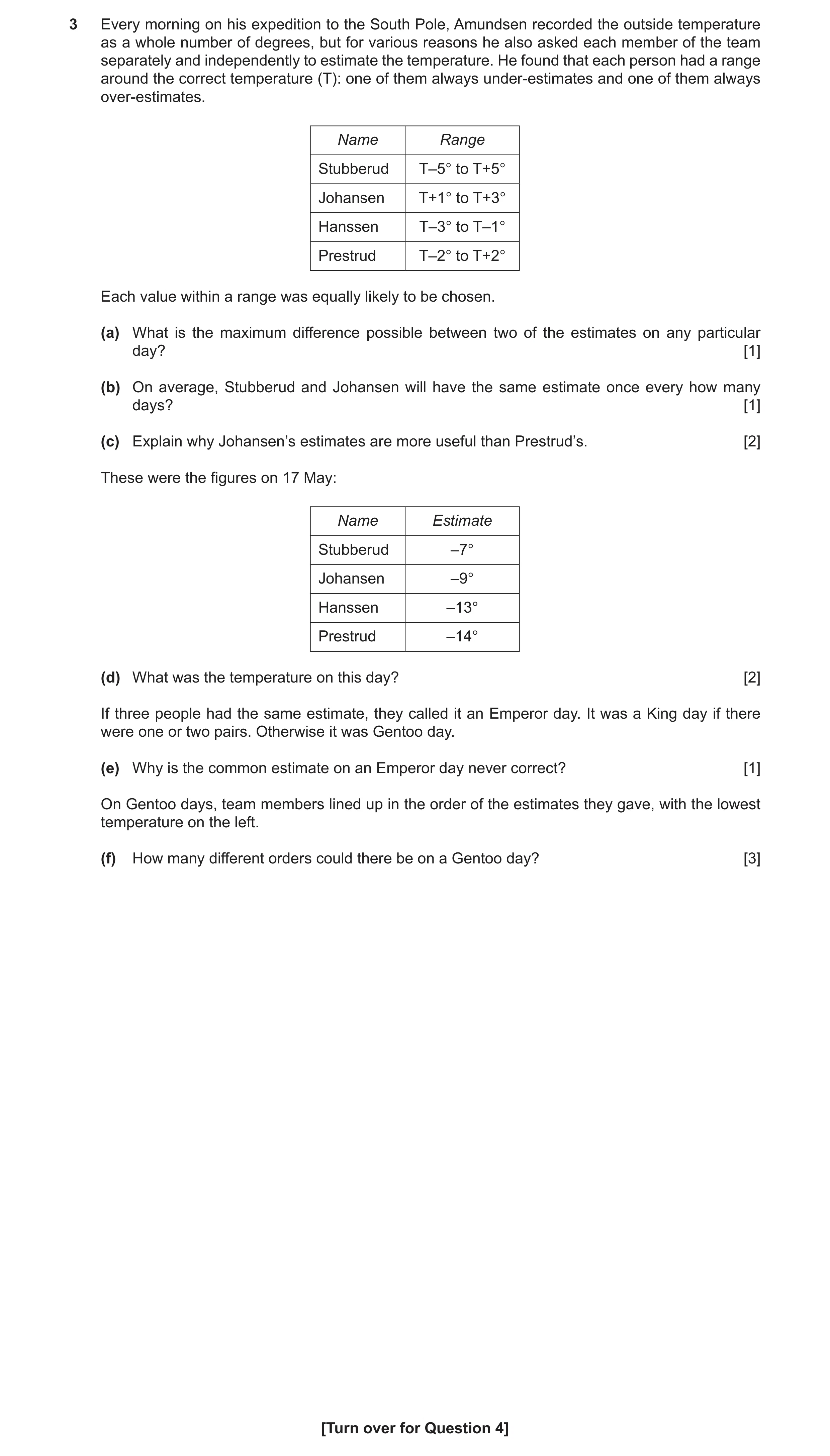
Q16 · Every morning on his expedition to the South Pole, Amundsen recorded the outside… 9694/32 Oct/Nov 2024
3 Every morning on his expedition to the South Pole, Amundsen recorded the outside temperature as a whole number of degrees, but for various reasons he also asked each member of the team separately and independently to estimate the temperature. He found that each person had a range around the correct temperature (T): one of them always under-estimates and one of them always over-estimates. Name Range Stubberud T‒5° to T+5° Johansen T+1° to T+3° Hanssen T‒3° to T‒1° Prestrud T‒2° to T+2° Each value within a range was equally likely to be chosen. (a) What is the maximum difference possible between two of the estimates on any particular day? [1] (b) On average, Stubberud and Johansen will have the same estimate once every how many days? [1] (c) Explain why Johansen’s estimates are more useful than Prestrud’s. [2] These were the figures on 17 May: Name Estimate Stubberud ‒7° Johansen ‒9° Hanssen ‒13° Prestrud ‒14° (d) What was the temperature on this day? [2] If three people had the same estimate, they called it an Emperor day. It was a King day if there were one or two pairs. Otherwise it was Gentoo day. (e) Why is the common estimate on an Emperor day never correct? [1] On Gentoo days, team members lined up in the order of the estimates they gave, with the lowest temperature on the left. (f) How many different orders could there be on a Gentoo day? [3] [Turn over for Question 4]
10 marks
Mark scheme: 3(a) Maximum is 3 one way and 5 the other, so 8° 1 3(b) Whatever J does, there’s a 1 in 11 chance that it will match 1 3(c) J has the smaller spread [1] 2 And it is known that his estimate will always be too high [1] (whereas P’s could be higher or lower) OR His estimate can be corrected (by subtracting 2) [1] 3(d) (Either J or H shows that) T must be –12°, –11° or –10° [1] 2 OR Any one of J, H and S shows that the minimum possible value is –12 [1] –12° [1] is the only one consistent with P 3(e) Must include H or J, (neither of which include T) 1 OR Triple can only be one of T–2, T–1, T + 1 or T + 2 OR Only two include T in range (S & P) 3(f) Gentoo day: the order of H and J is fixed. Each order PHJ HPJ HJP can have 3 S inserted in any position except PSH and JSP, so 10. If 3 not awarded then 1 mark each for (max 2): • H must be to the left of J • If S could be in any position then there would be 12 possibilities • (But) PSHJ and HJSP are not possible OR 1 mark for SHPJ, HSPJ, HPSJ, HPJS 1 mark for SPHJ, PHSJ, PHJS AND not PSHJ 1 mark for SHJP, HSJP, HJPS AND not HJSP OR 1 mark for any four correct, with no more than two incorrect
This question in 9694/32 Oct/Nov 2024
Q17 · Every morning on his expedition to the South Pole, Amundsen recorded the outside… 9694/33 Oct/Nov 2024
3 Every morning on his expedition to the South Pole, Amundsen recorded the outside temperature as a whole number of degrees, but for various reasons he also asked each member of the team separately and independently to estimate the temperature. He found that each person had a range around the correct temperature (T): one of them always under-estimates and one of them always over-estimates. Name Range Stubberud T‒5° to T+5° Johansen T+1° to T+3° Hanssen T‒3° to T‒1° Prestrud T‒2° to T+2° Each value within a range was equally likely to be chosen. (a) What is the maximum difference possible between two of the estimates on any particular day? [1] (b) On average, Stubberud and Johansen will have the same estimate once every how many days? [1] (c) Explain why Johansen’s estimates are more useful than Prestrud’s. [2] These were the figures on 17 May: Name Estimate Stubberud ‒7° Johansen ‒9° Hanssen ‒13° Prestrud ‒14° (d) What was the temperature on this day? [2] If three people had the same estimate, they called it an Emperor day. It was a King day if there were one or two pairs. Otherwise it was Gentoo day. (e) Why is the common estimate on an Emperor day never correct? [1] On Gentoo days, team members lined up in the order of the estimates they gave, with the lowest temperature on the left. (f) How many different orders could there be on a Gentoo day? [3] [Turn over for Question 4]
10 marks
Mark scheme: 3(a) Maximum is 3 one way and 5 the other, so 8° 1 3(b) Whatever J does, there’s a 1 in 11 chance that it will match 1 3(c) J has the smaller spread [1] 2 And it is known that his estimate will always be too high [1] (whereas P’s could be higher or lower) OR His estimate can be corrected (by subtracting 2) [1] 3(d) (Either J or H shows that) T must be –12°, –11° or –10° [1] 2 OR Any one of J, H and S shows that the minimum possible value is –12 [1] –12° [1] is the only one consistent with P 3(e) Must include H or J, (neither of which include T) 1 OR Triple can only be one of T–2, T–1, T + 1 or T + 2 OR Only two include T in range (S & P) 3(f) Gentoo day: the order of H and J is fixed. Each order PHJ HPJ HJP can have 3 S inserted in any position except PSH and JSP, so 10. If 3 not awarded then 1 mark each for (max 2): • H must be to the left of J • If S could be in any position then there would be 12 possibilities • (But) PSHJ and HJSP are not possible OR 1 mark for SHPJ, HSPJ, HPSJ, HPJS 1 mark for SPHJ, PHSJ, PHJS AND not PSHJ 1 mark for SHJP, HSJP, HJPS AND not HJSP OR 1 mark for any four correct, with no more than two incorrect
This question in 9694/33 Oct/Nov 2024
 1 / 21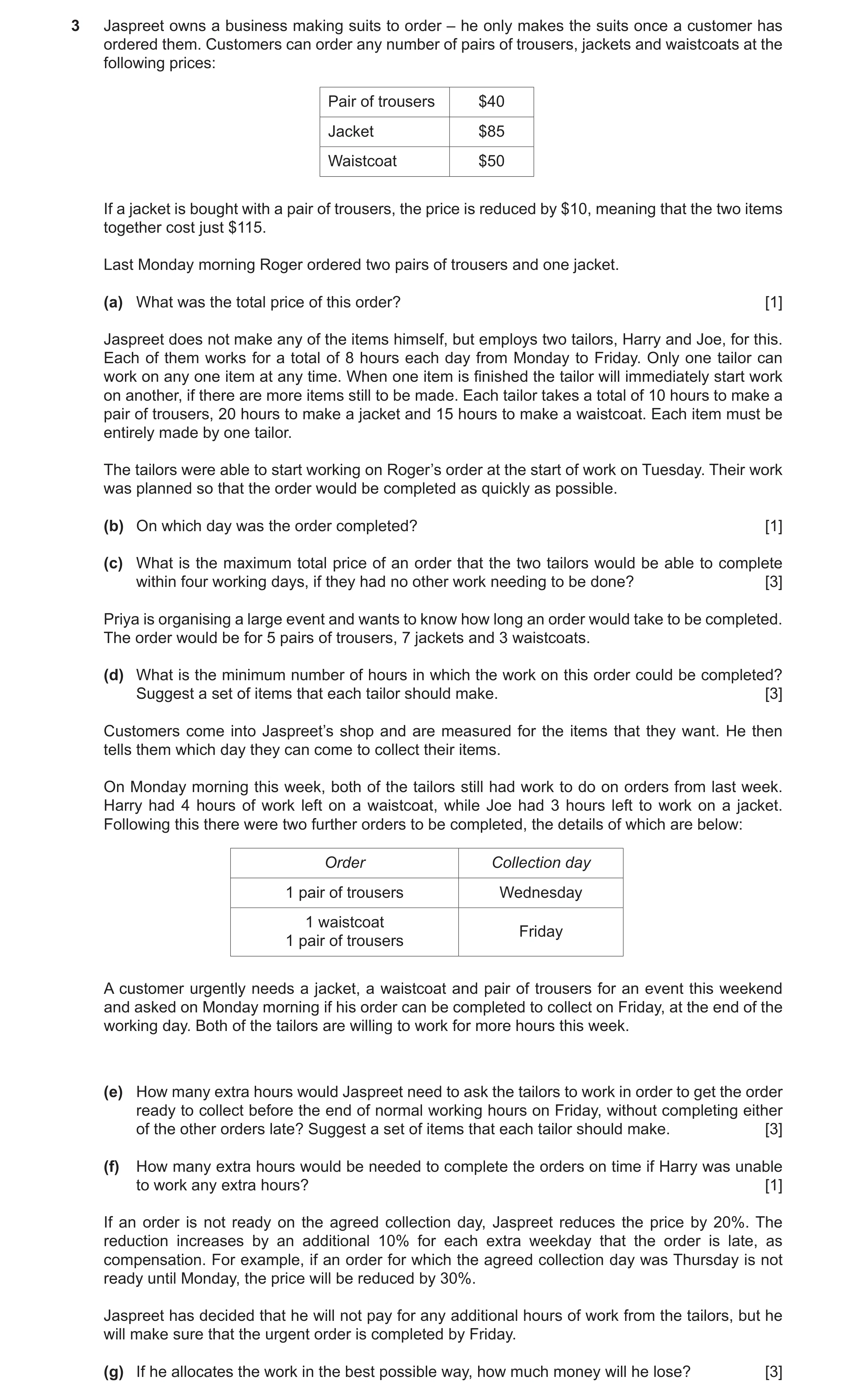
 17 / 21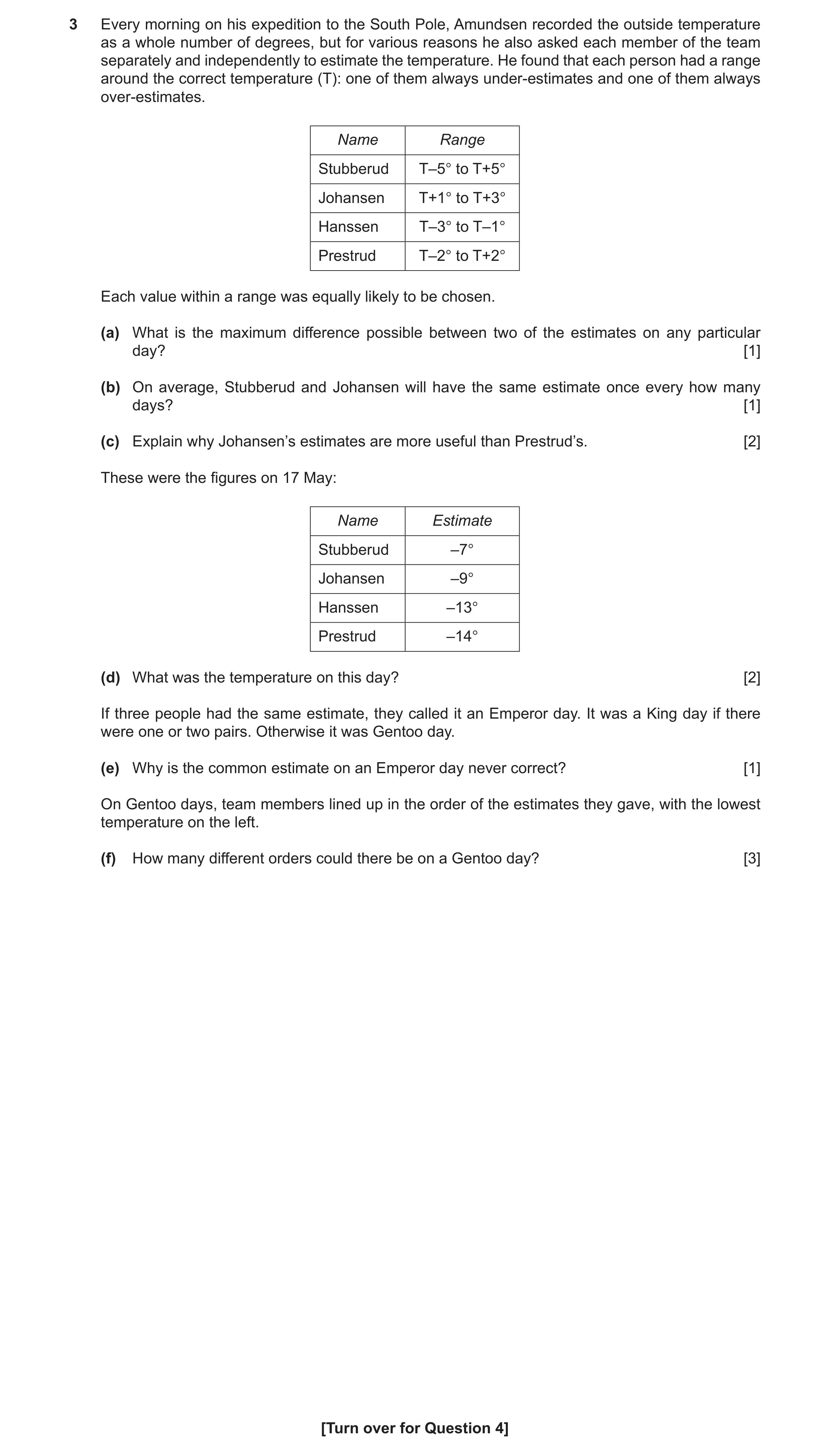
 15
15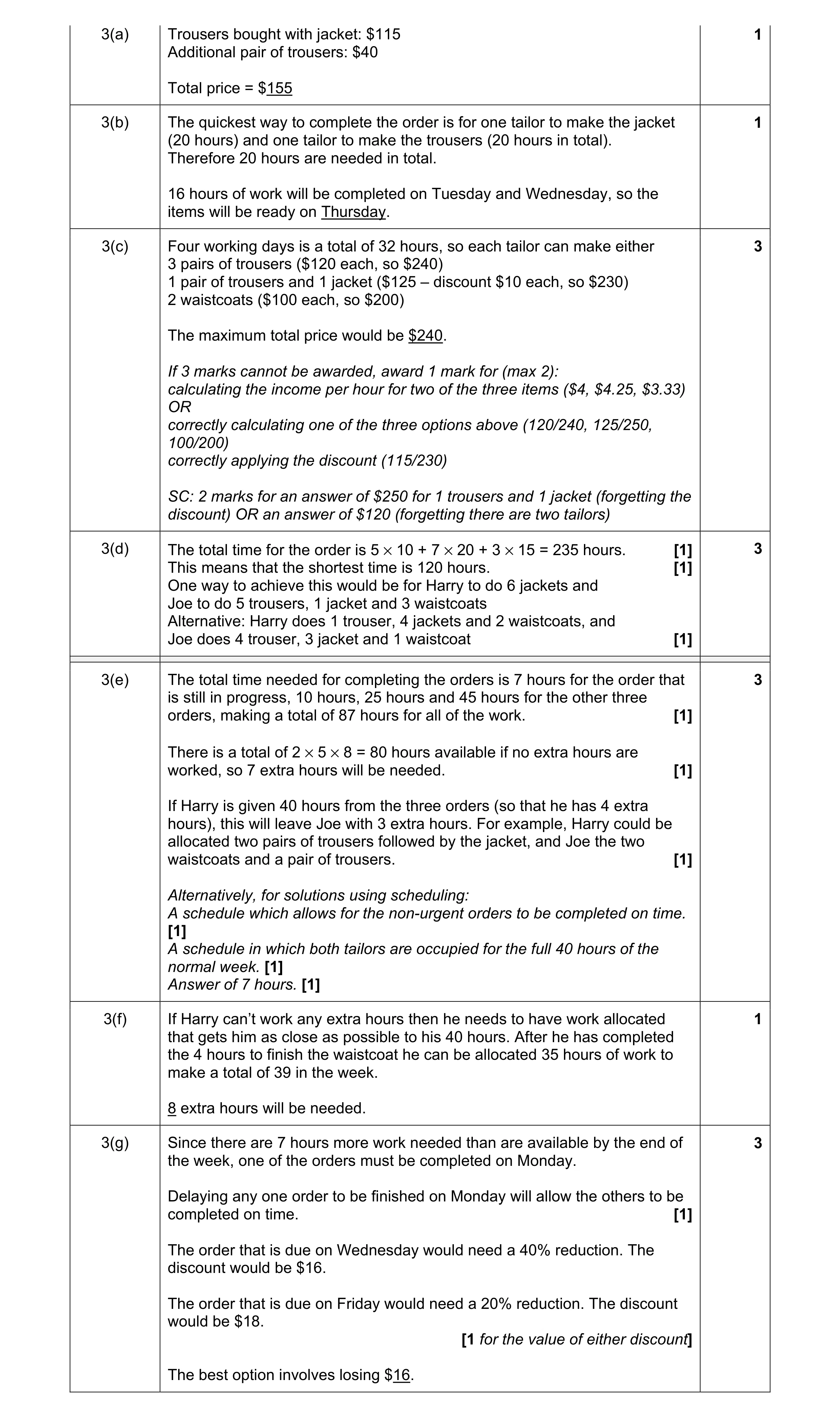 15
15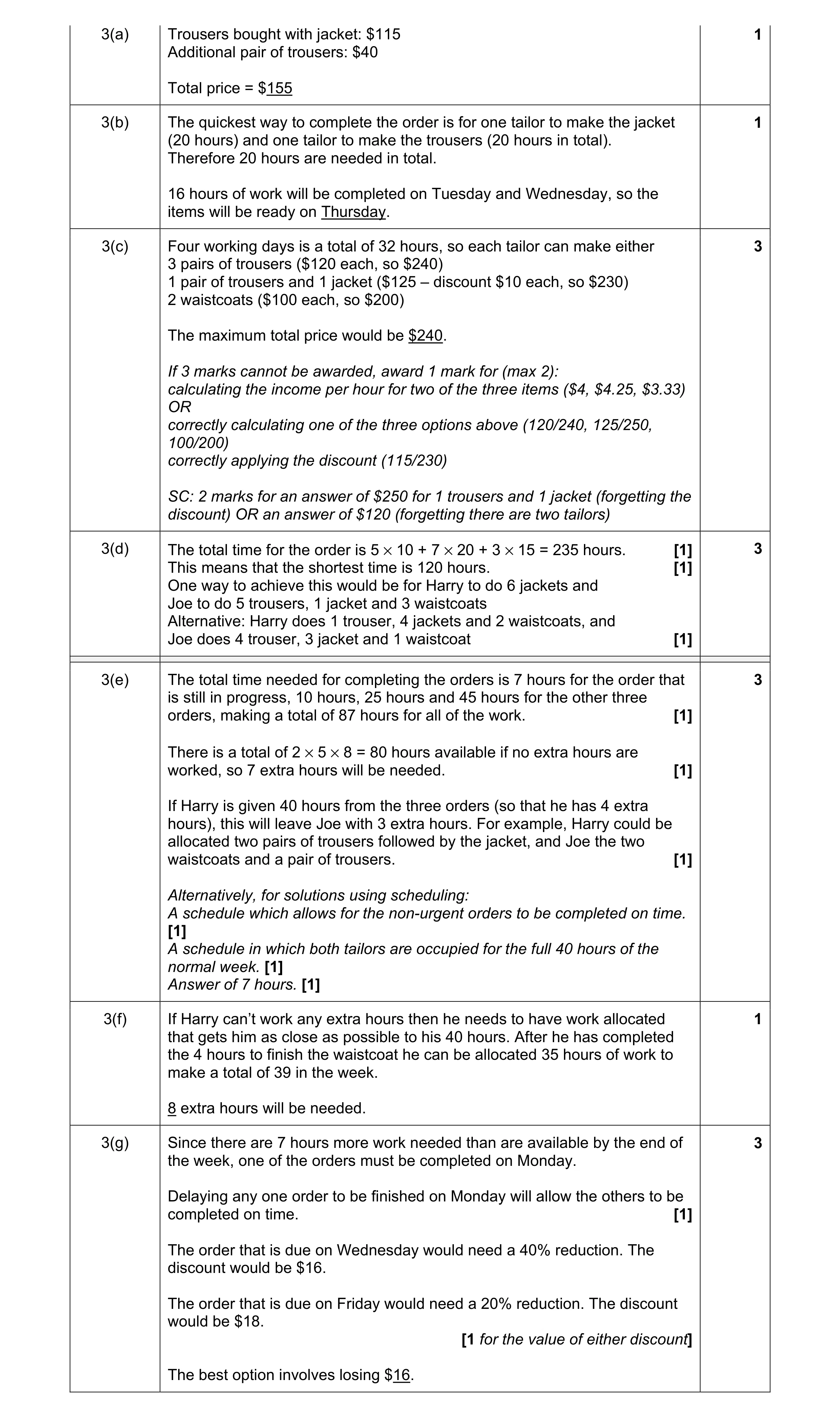 15
15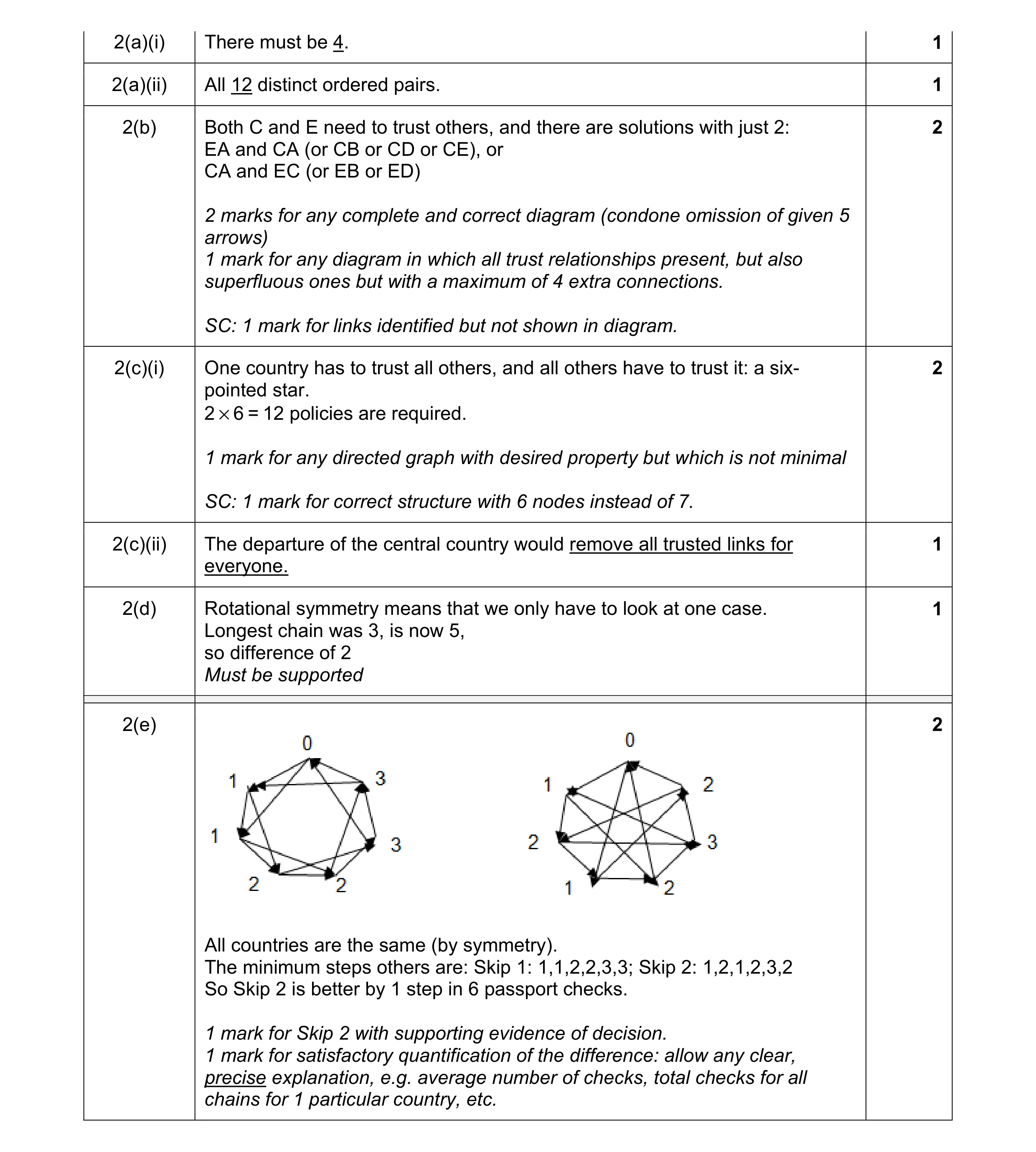 10
10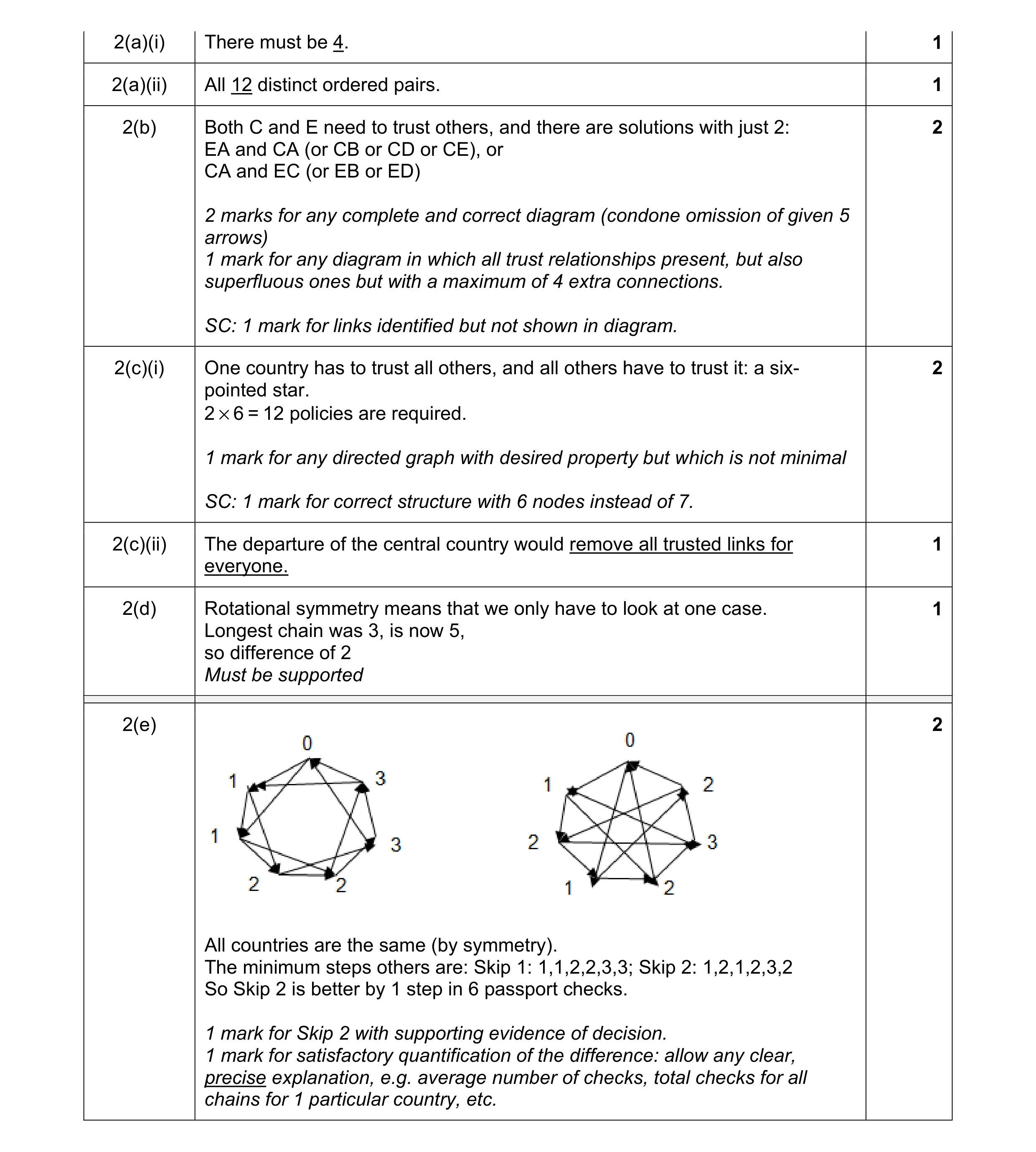 10
10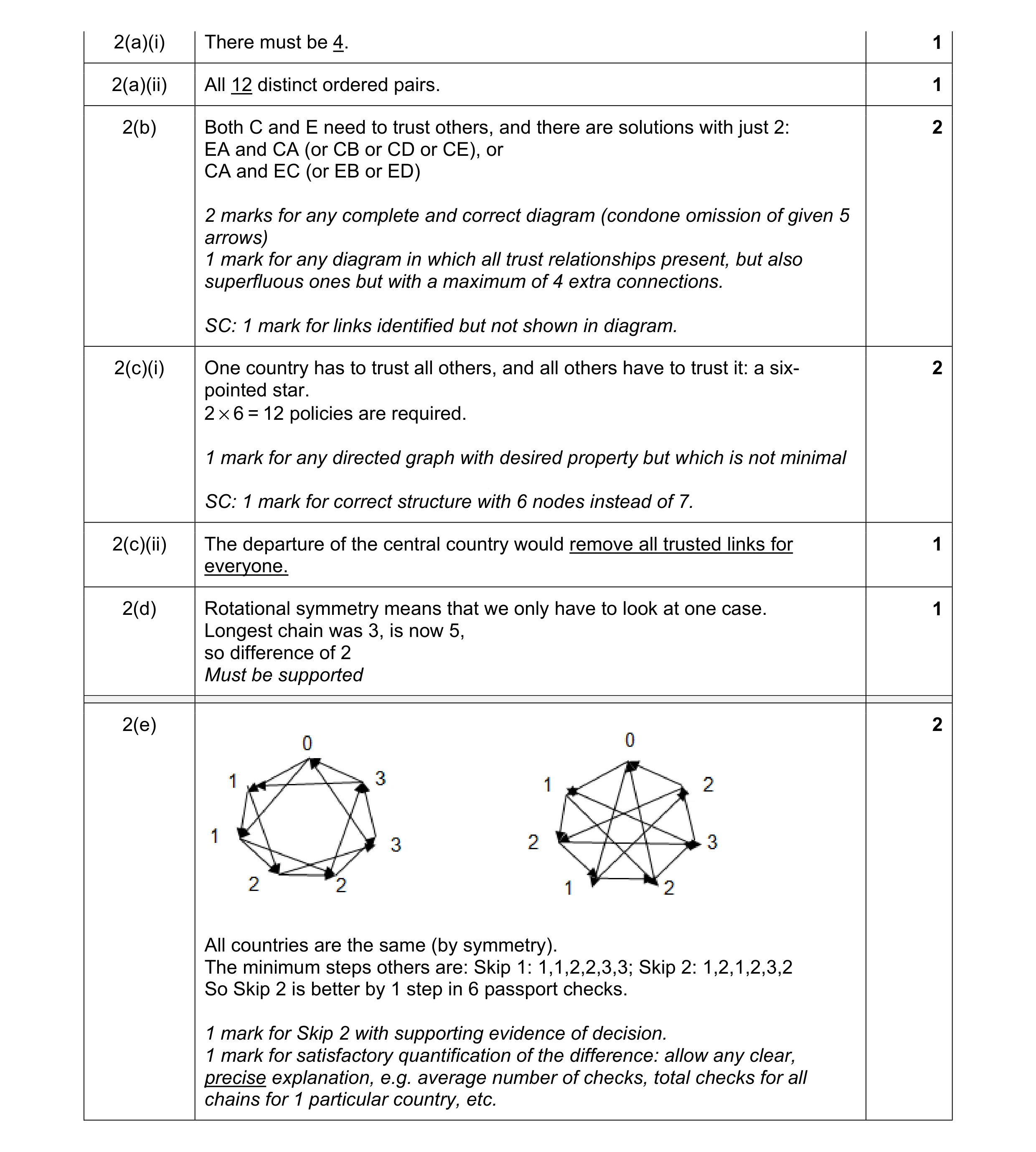 10
10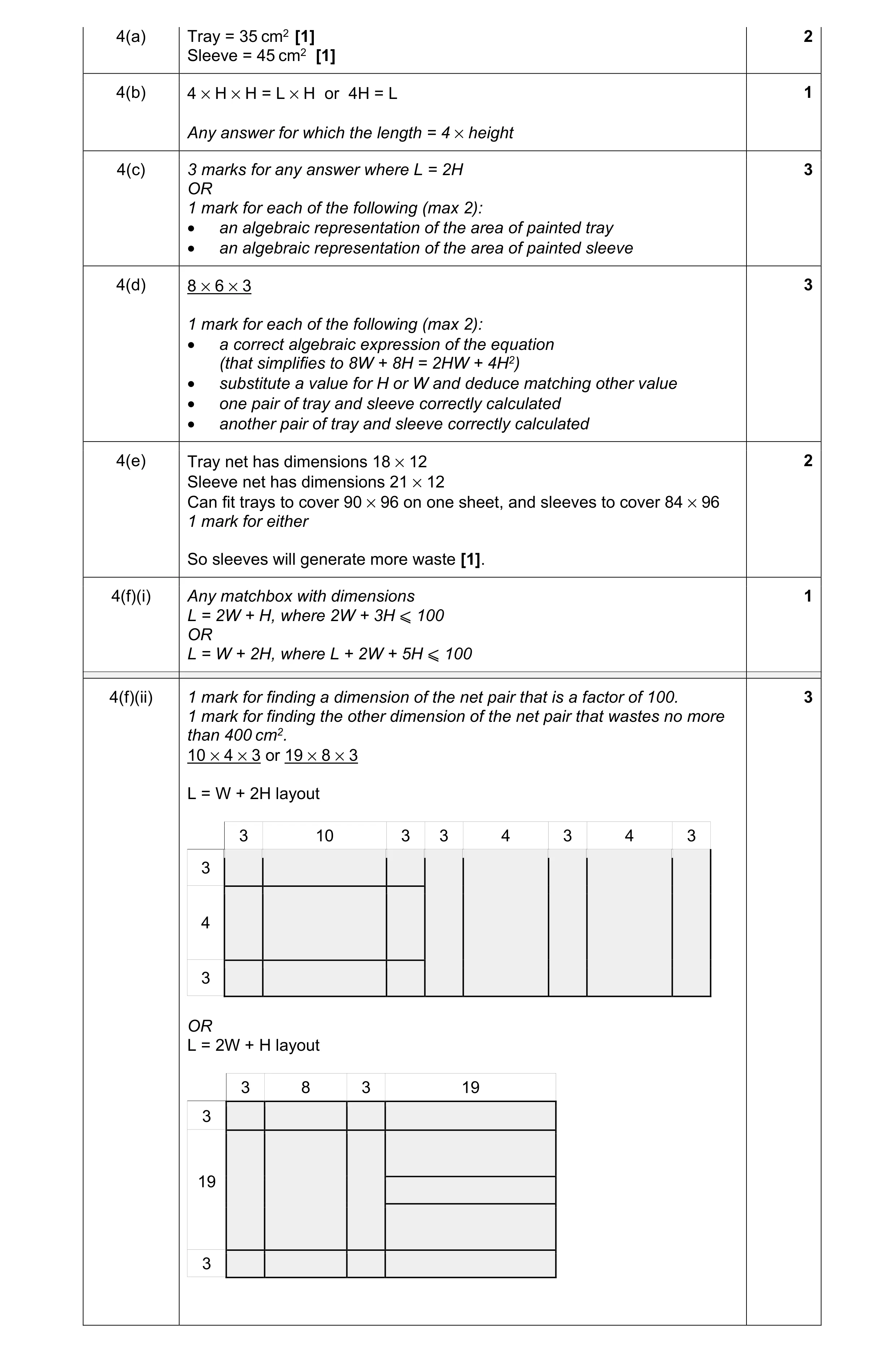 15
15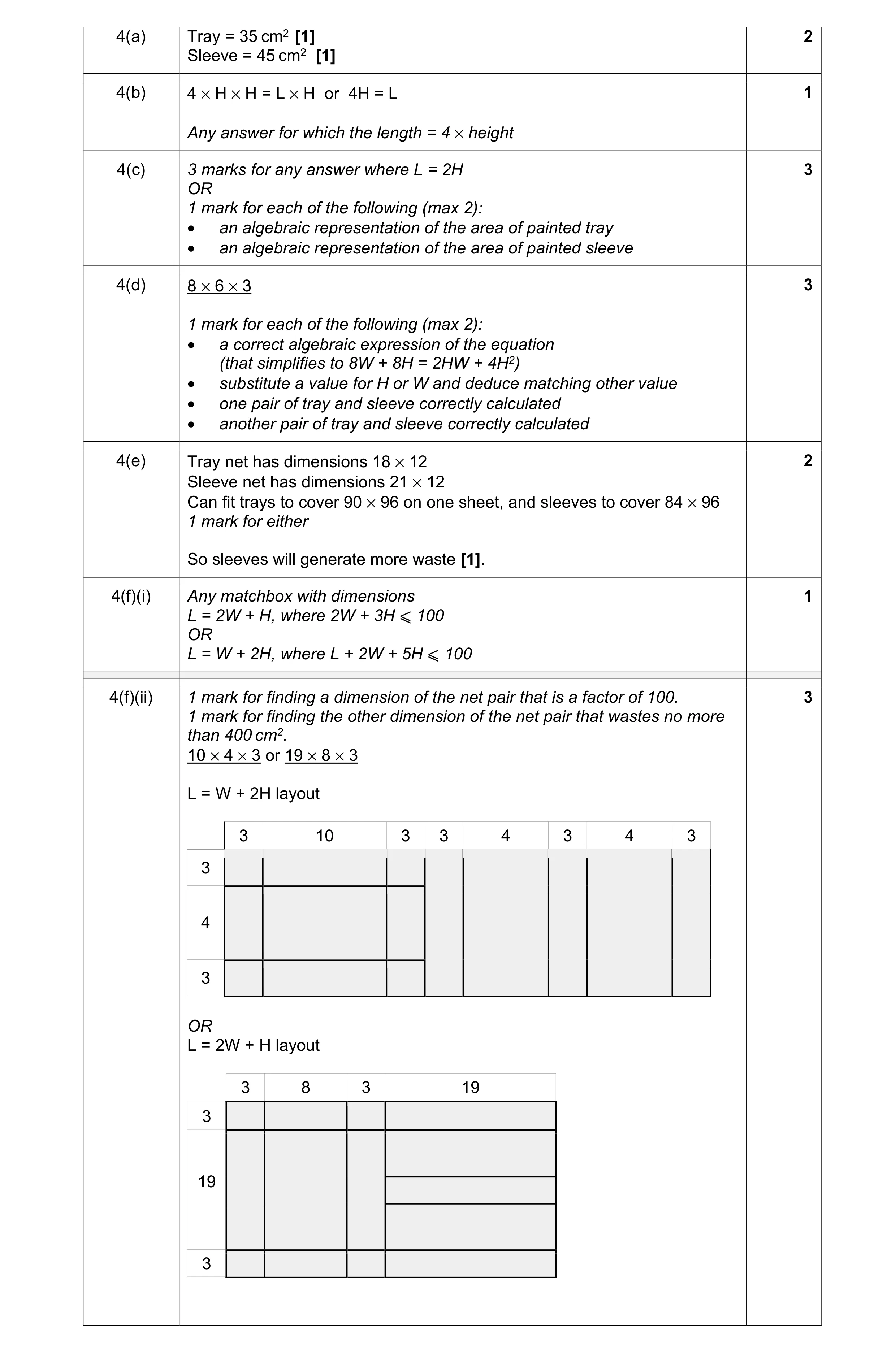 15
15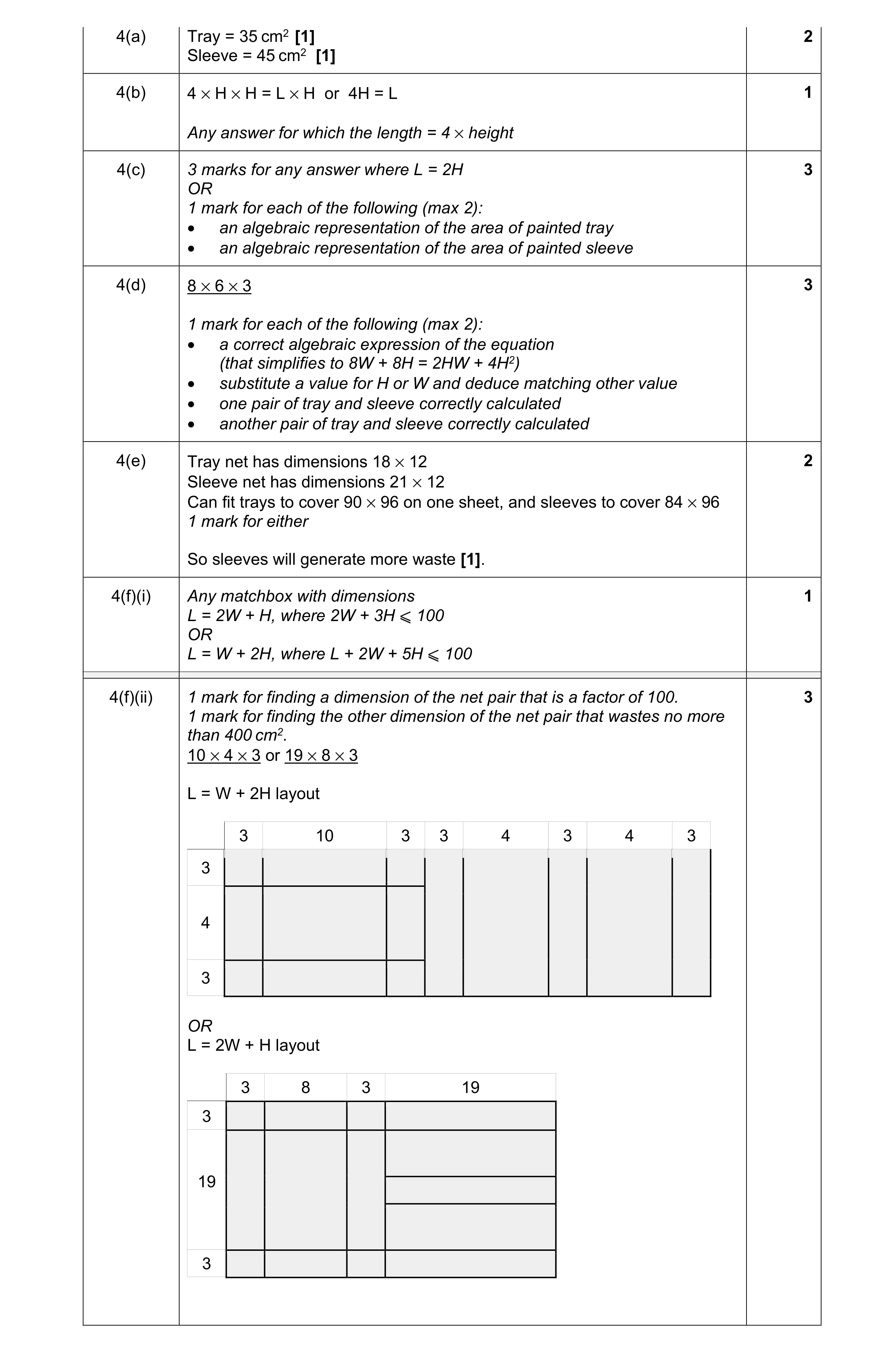 15
15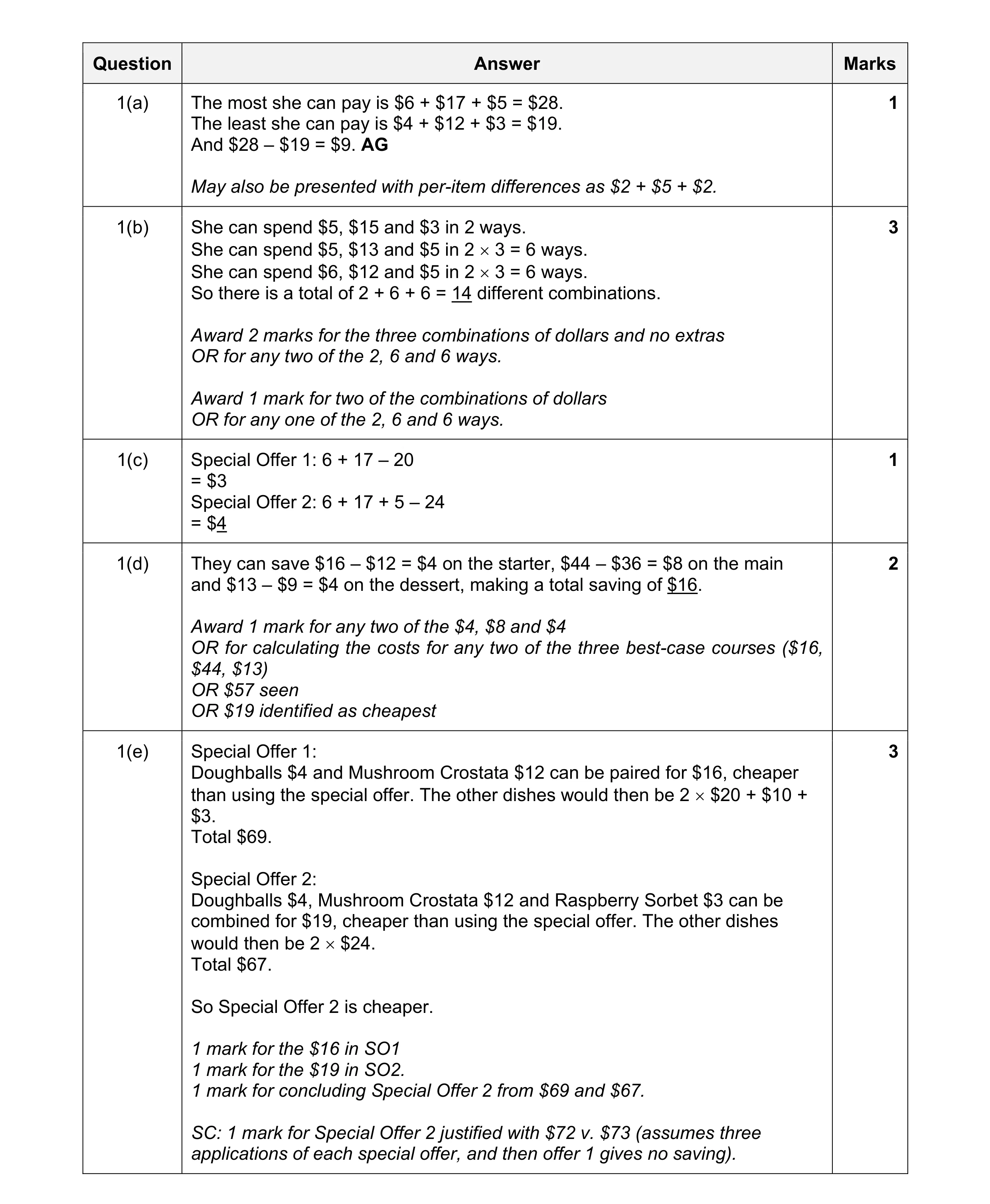 10
10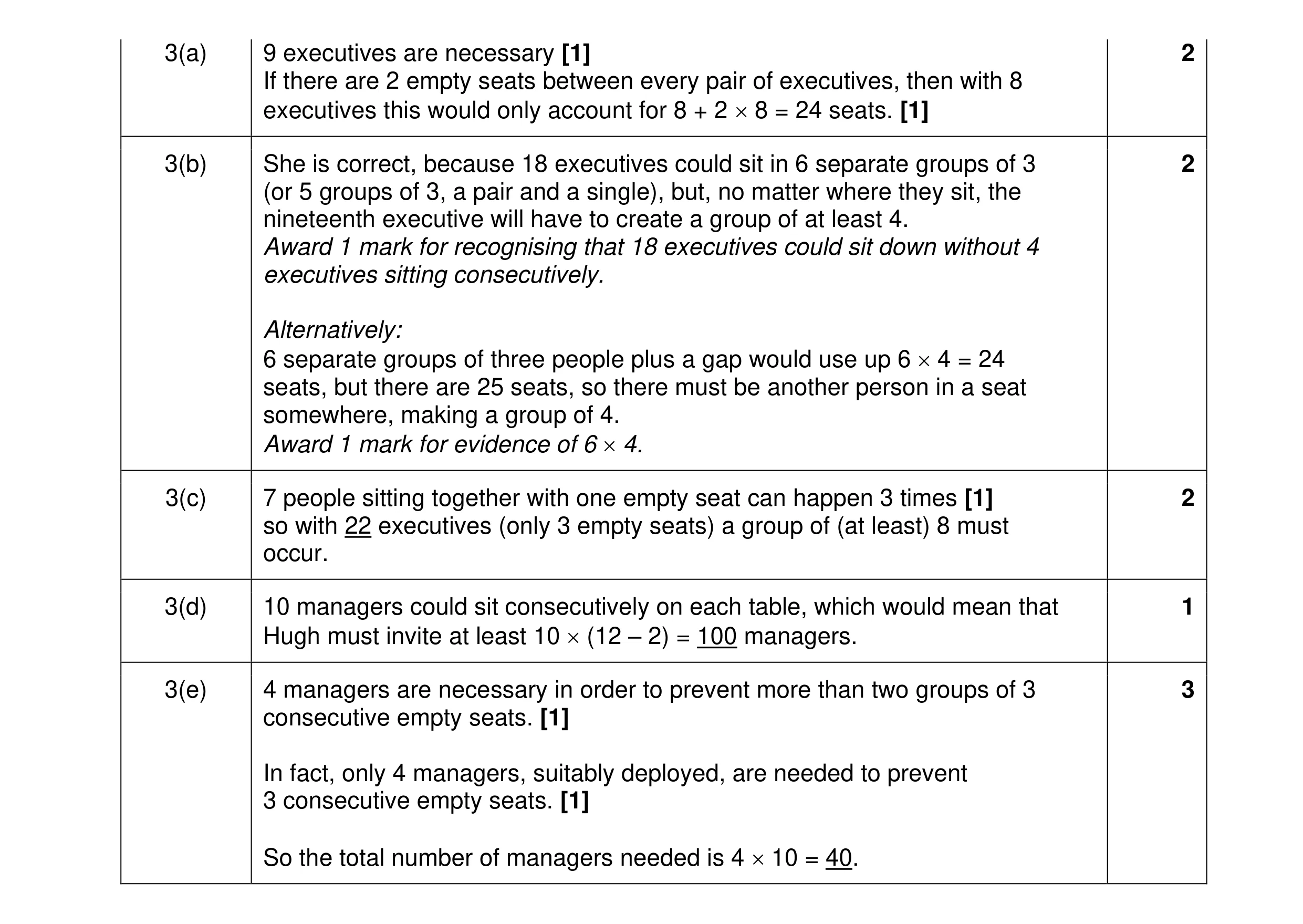 10
10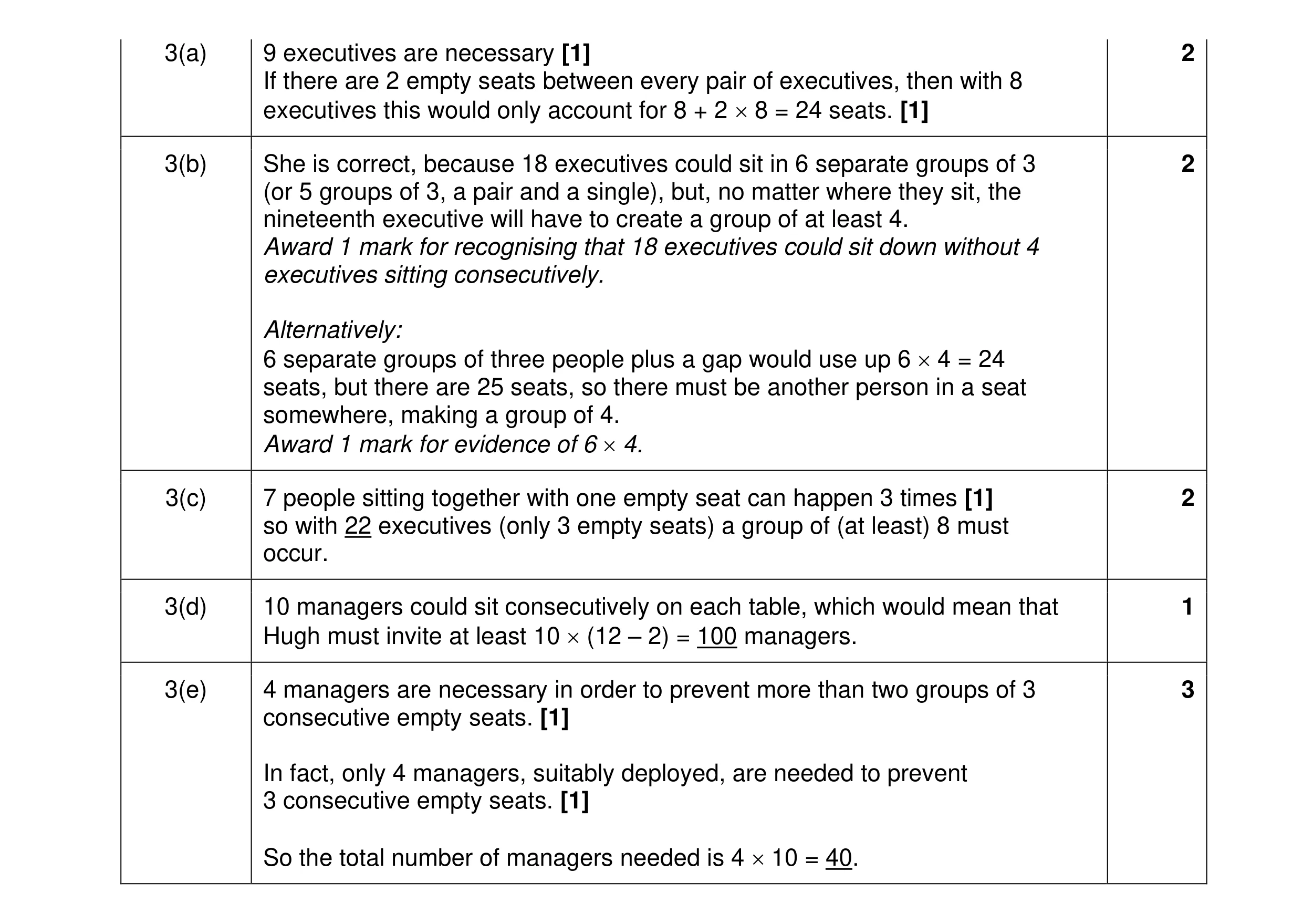 10
10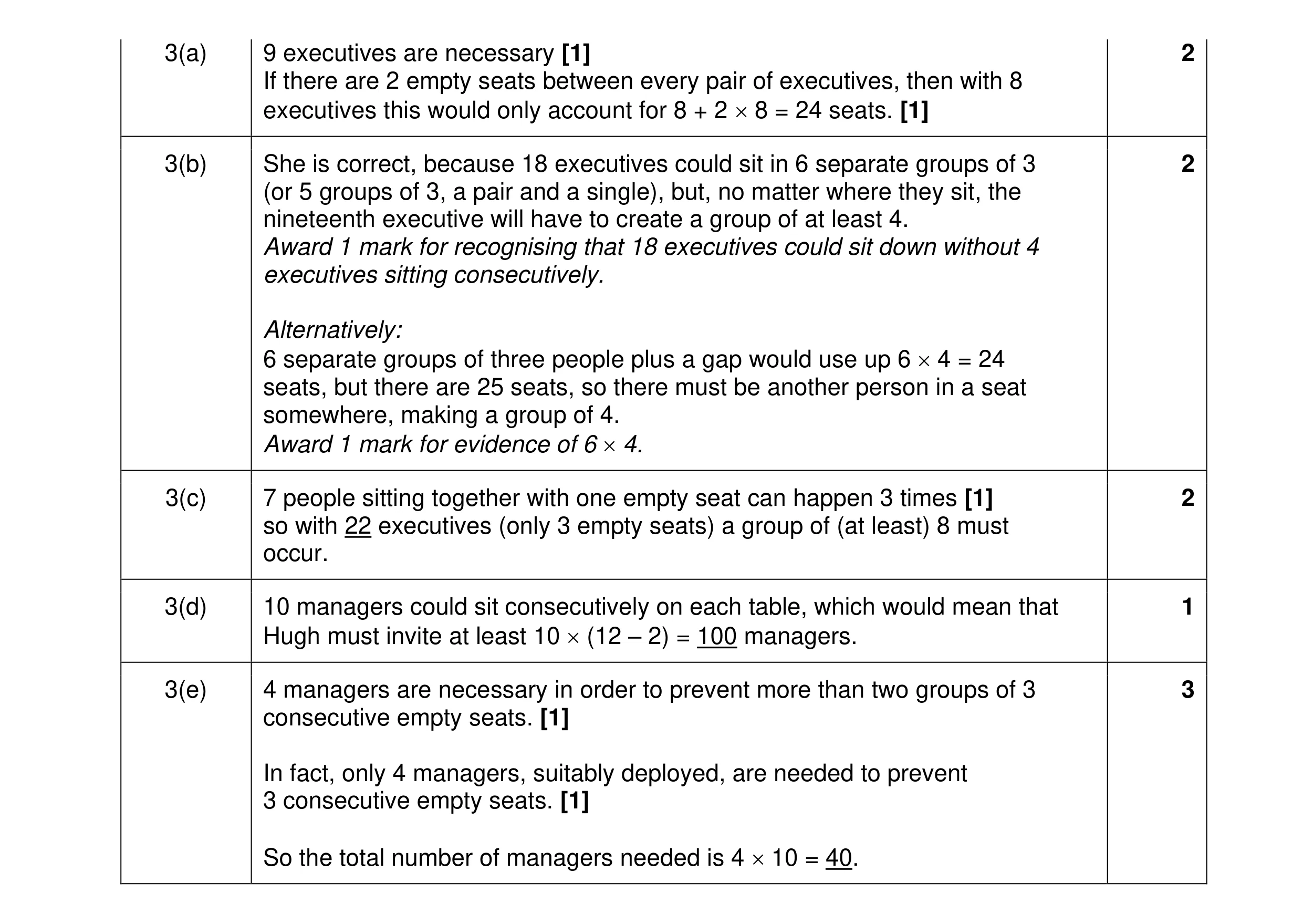 10
10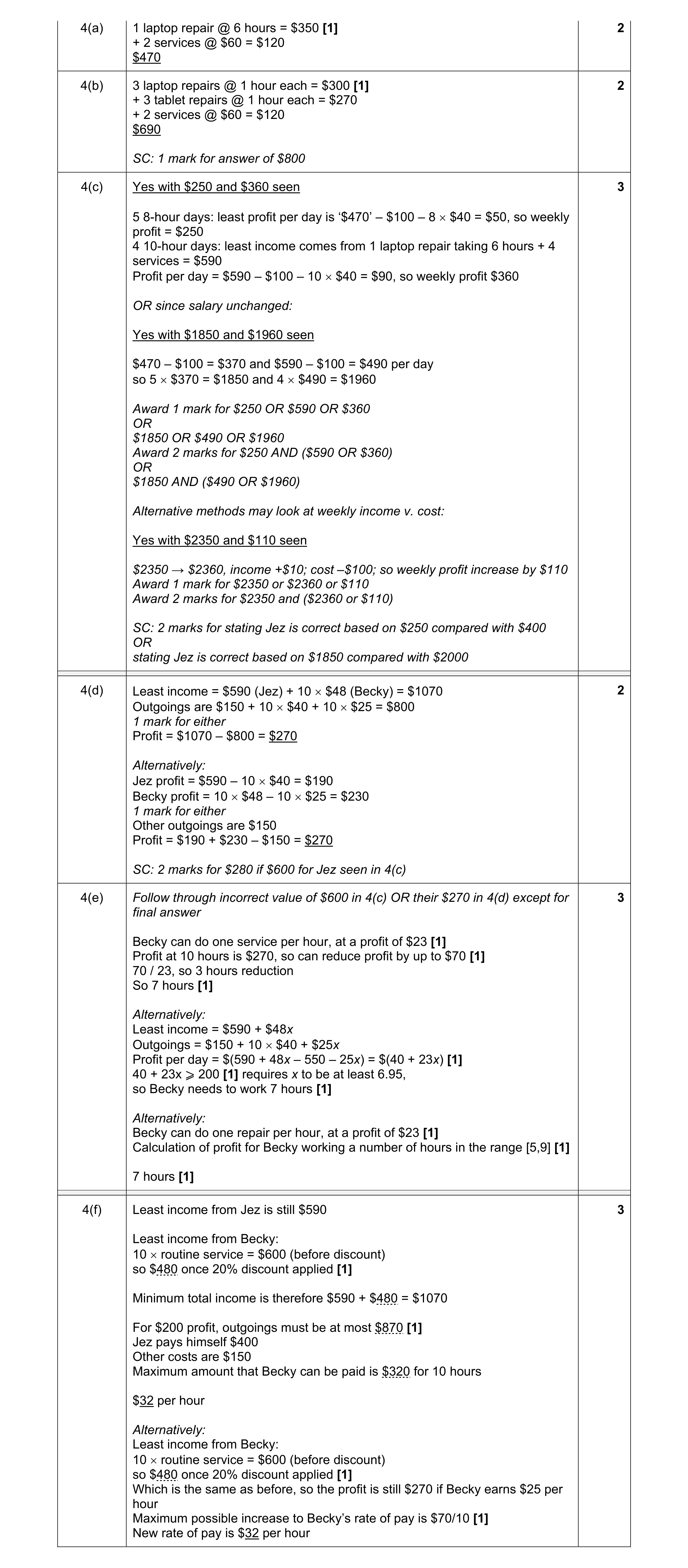 15
15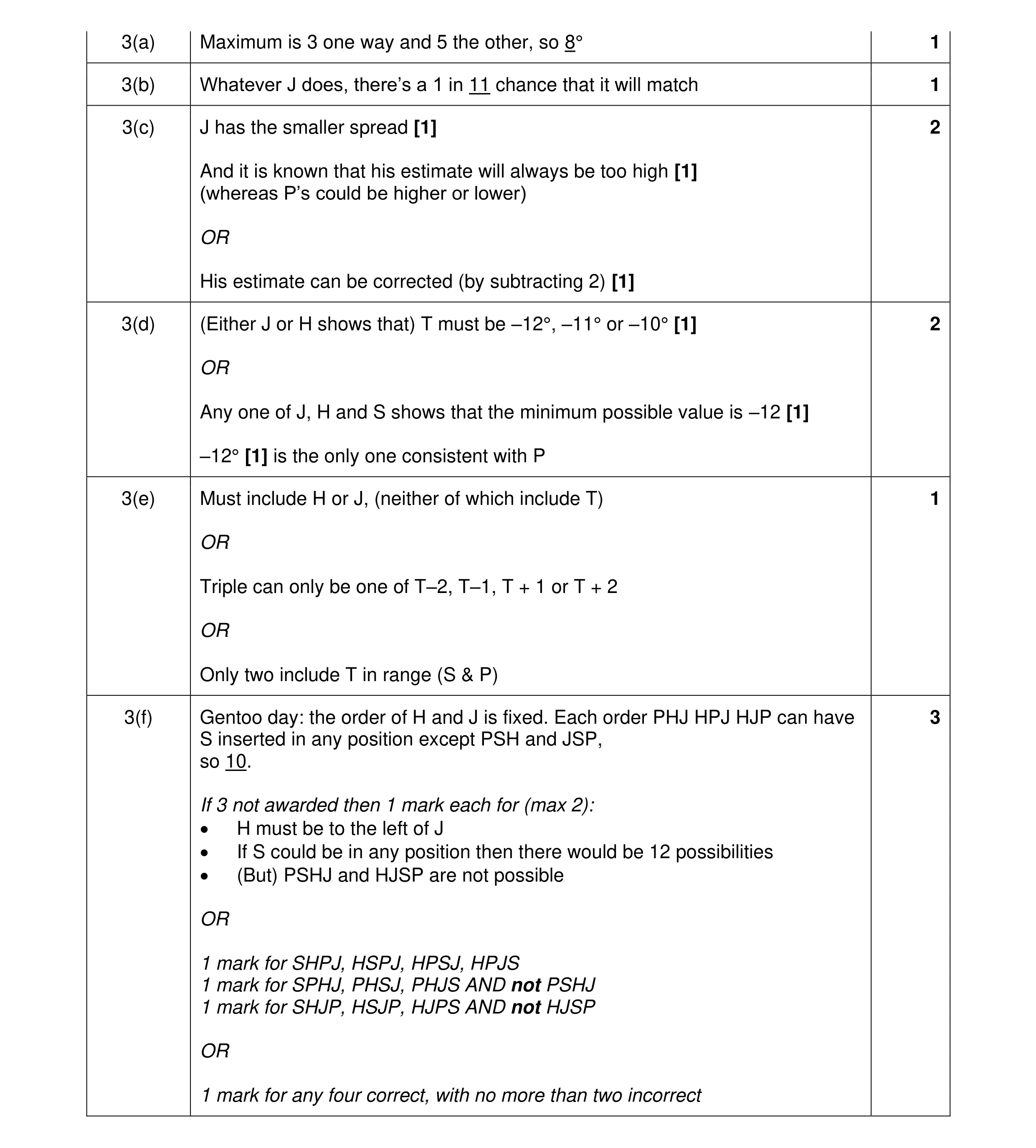 10
10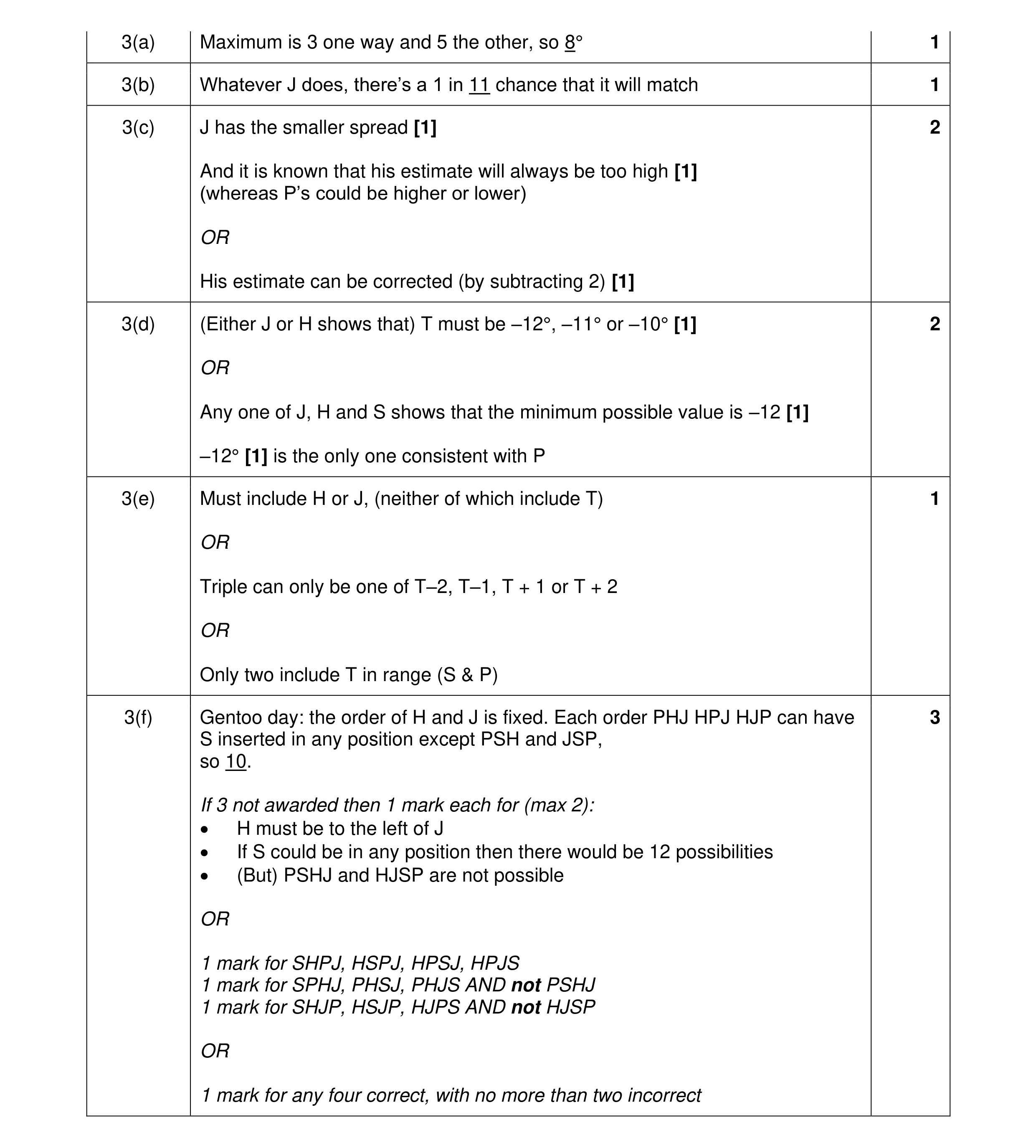 10
10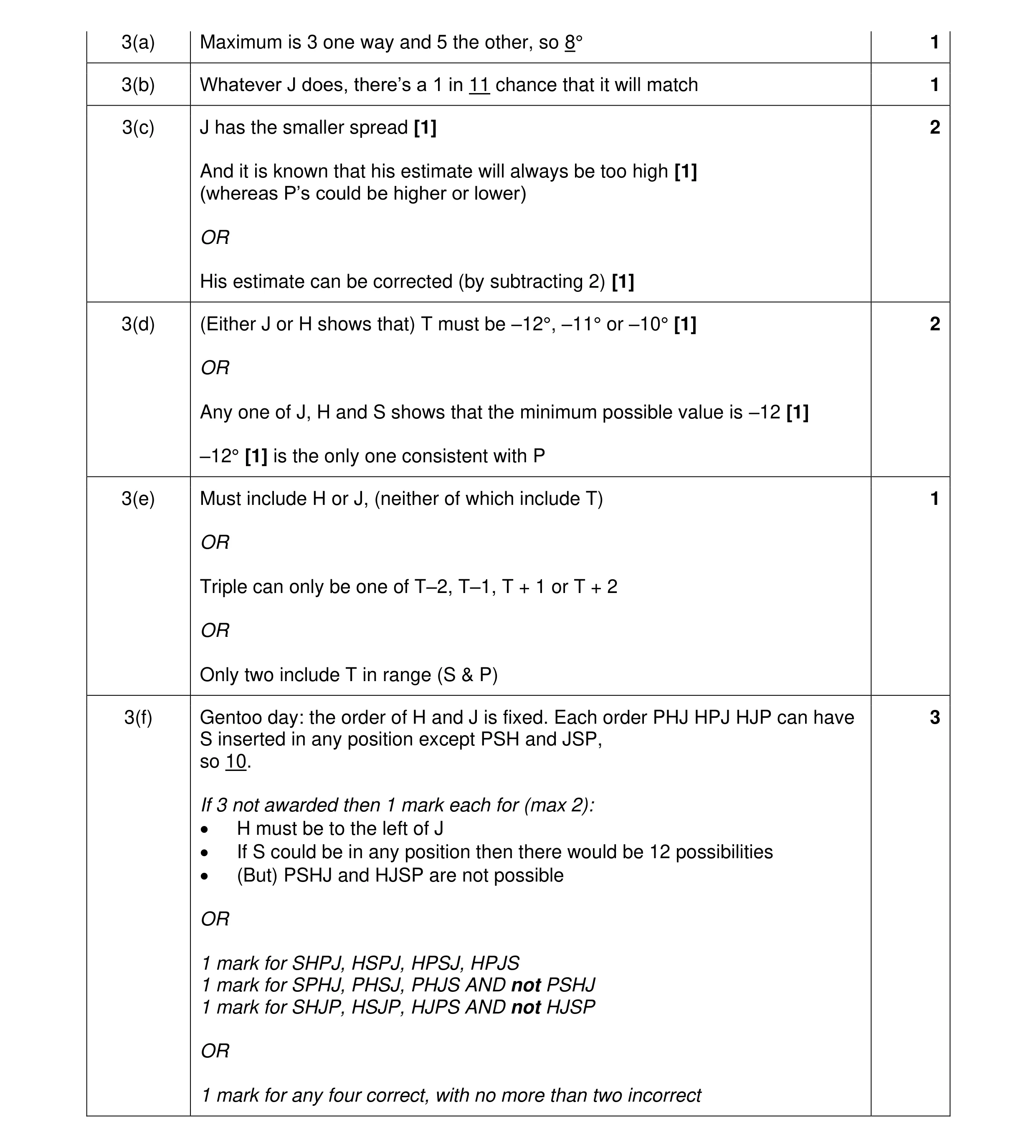 10
10