Cambridge A Level Thinking Skills 9694 — 2024 May/June Paper 3 · Variant 1
9694/31/M/J/24 · 4 questions · 50 marks · ≈56 min
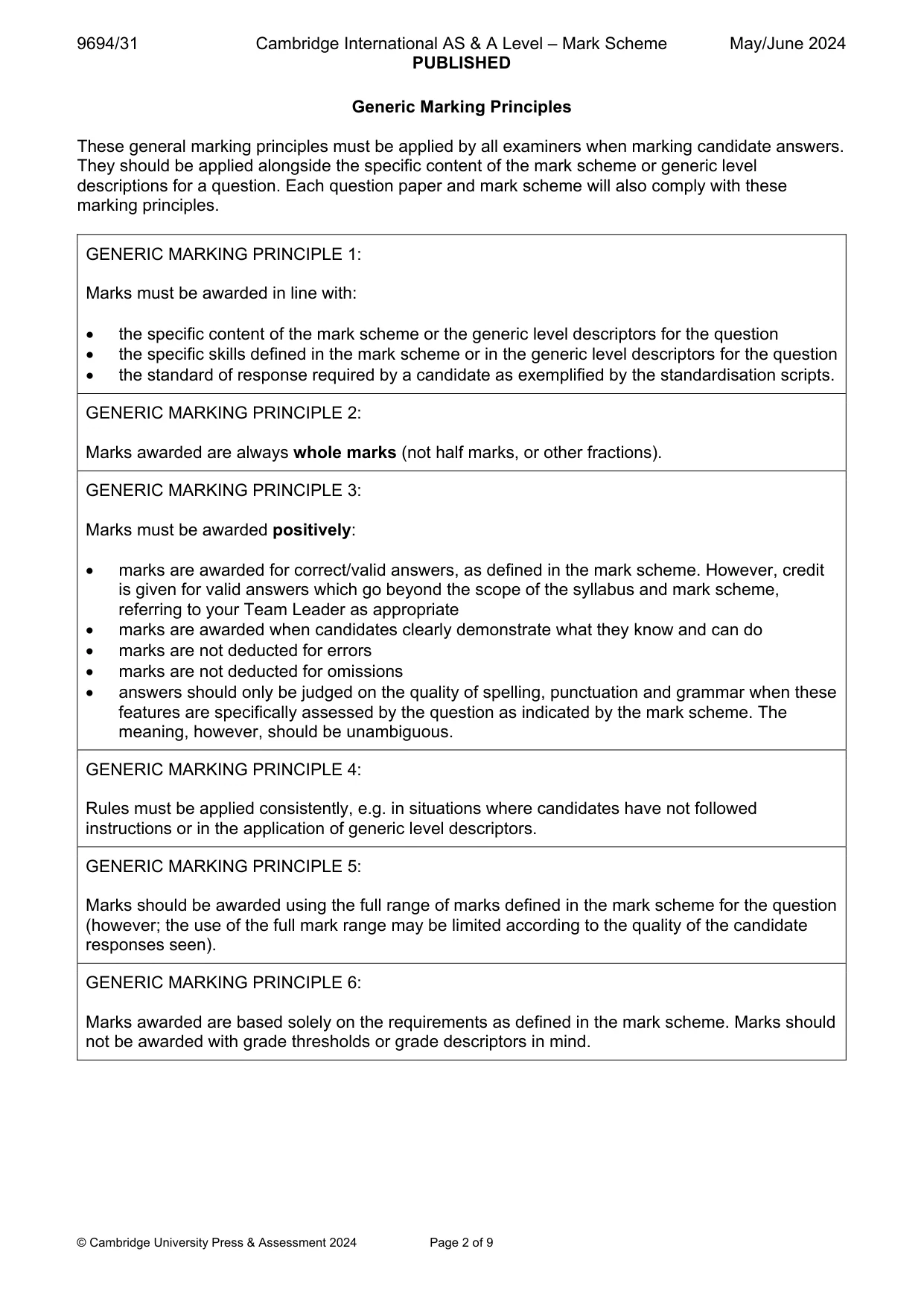
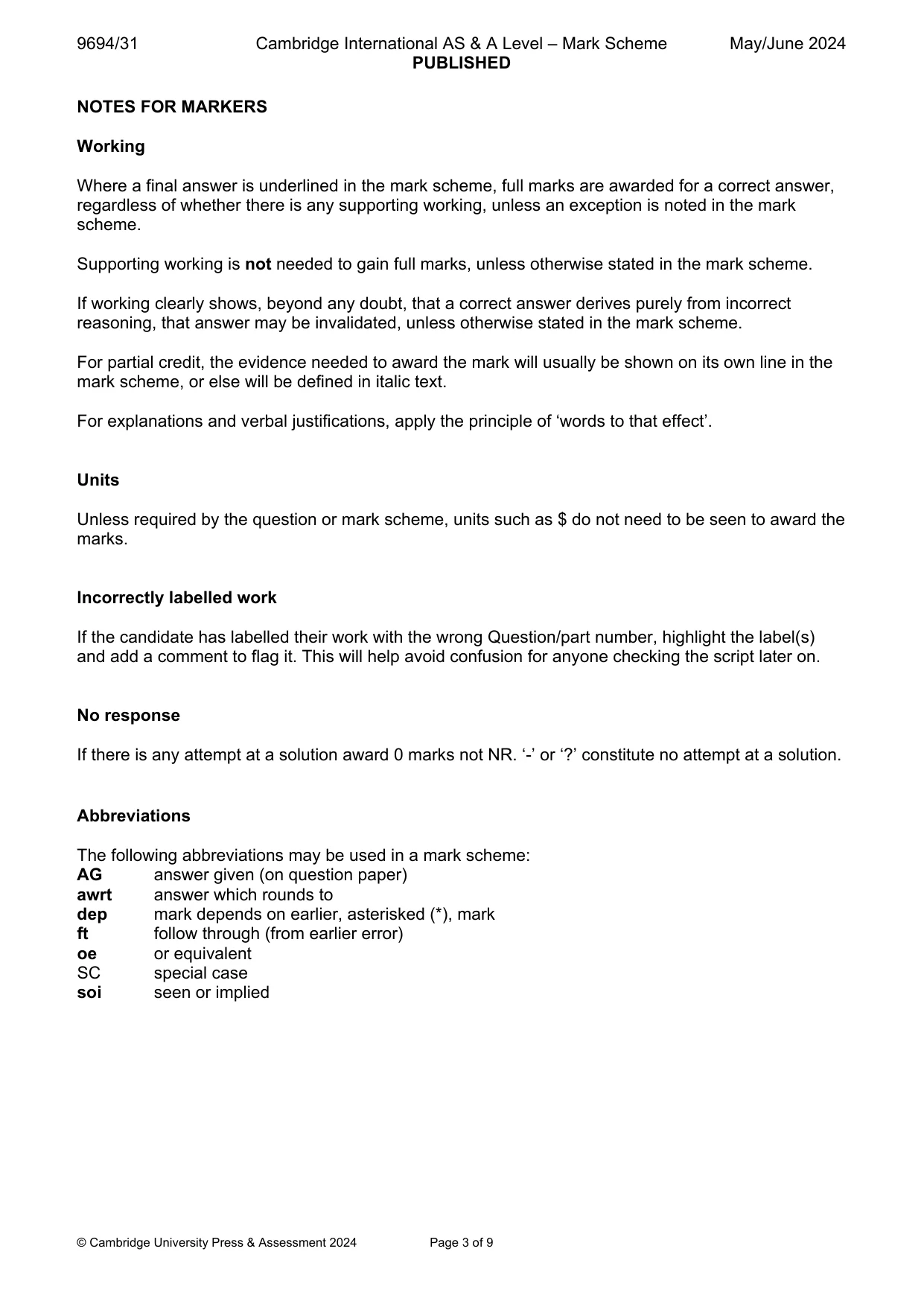
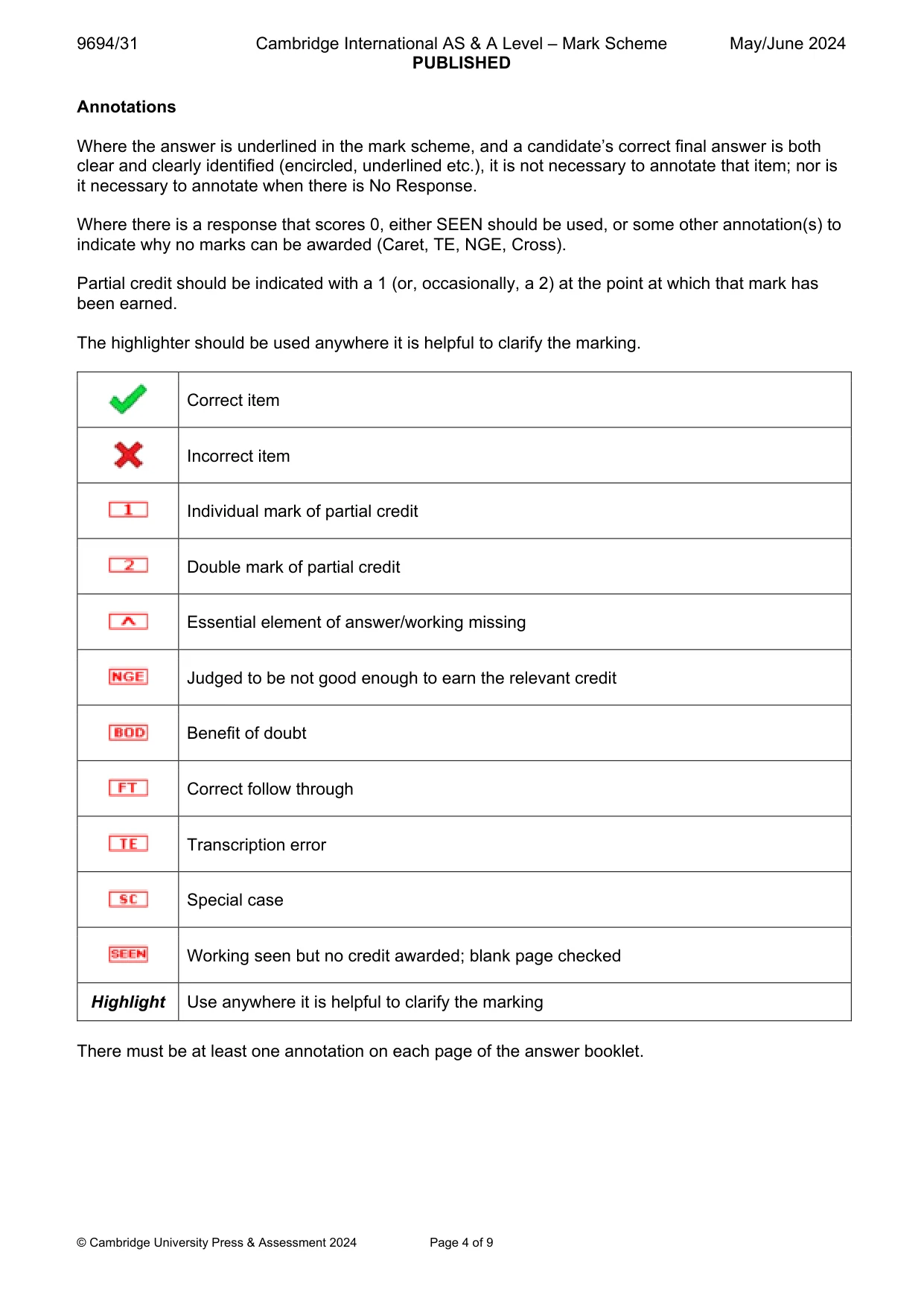
The question paper and its mark scheme, free to read here and free to download. This is Cambridge’s own paper, exactly as it was sat.
Question paper8 pages

Mark scheme9 pages
Answers below. Sit the paper first if you are practising.
Questions as text
Q1 · Frank runs a funfair which has 7 small rides and 6 big rides
1 Frank runs a funfair which has 7 small rides and 6 big rides. There are two options for paying for entry to the fair and for rides: Wristband and Tokens. • Wristband: $12 gives entry to the fair and an unlimited number of rides. • Tokens: Entry to the fair is free, tokens cost $1.20 each or 10 tokens cost $10. Each go on a small ride requires 1 token and each go on a big ride requires 2 tokens. A wristband can only be used by the person who buys it; tokens can be used by anyone. Jim went to the fair and chose to use the Tokens option. By the time he left the fair he had had 4 goes on small rides and 6 goes on big rides. (a) What is the smallest amount of money that Jim could have saved if he had used the Wristband option instead? [2] Kenny and two of his friends are going to the fair. They will all go on the same rides together, and they might go on some of the rides more than once. They will have as many goes on rides as possible such that it will be cheaper for them to use the Tokens option. (b) (i) What is the greatest possible number of goes on rides that each of the friends will be able to have? [2] (ii) What is the least possible number of goes on rides that each of the friends will be able to have? [2] Frank’s funfair is open from 14:00 to 22:00 each day. Each small ride lasts 5 minutes and each big ride lasts 10 minutes, including time for getting on and off the ride. The queuing time for small rides is 10 minutes and the queuing time for big rides is 20 minutes. It takes 2 minutes to walk between rides. Pete is going to the fair tomorrow. He will arrive at the first ride at 16:00 and must get off the final ride no later than 21:30. He will go on an equal number of small and big rides and will fit in as many rides as possible. (c) What is the earliest time at which Pete might get off his final ride? [3] Pete works out that if he arrives at the first ride 11 minutes earlier than planned, he will be able to fit in another two rides. (d) Is Pete correct? Explain your answer. [1] [Turn over for Question 2]
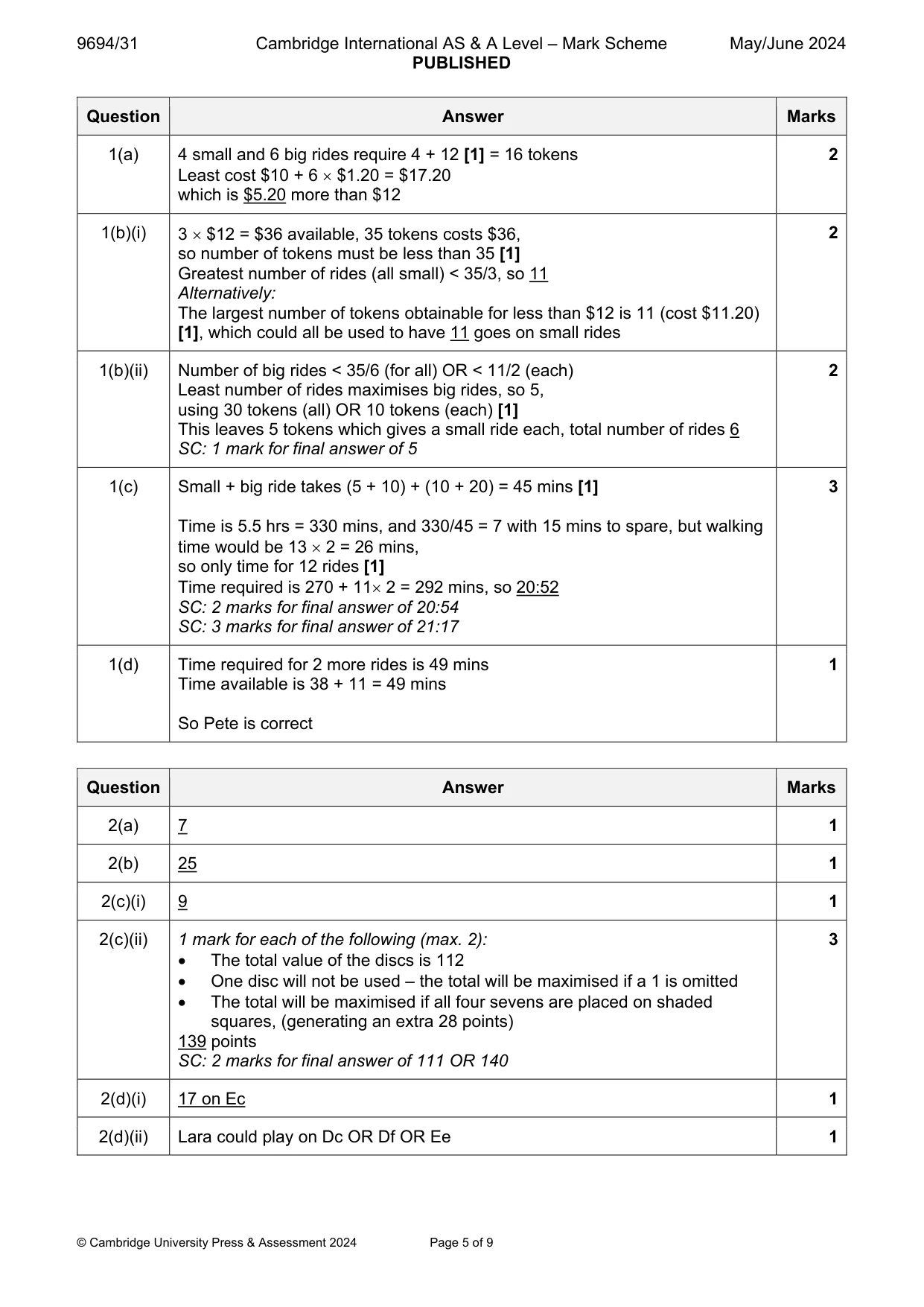
Mark scheme: Question Answer Marks 1(a) 4 small and 6 big rides require 4 + 12 [1] = 16 tokens 2 Least cost $10 + 6 $1.20 = $17.20 which is $5.20 more than $12 1(b)(i) 3 $12 = $36 available, 35 tokens costs $36, 2 so number of tokens must be less than 35 [1] Greatest number of rides (all small) < 35/3, so 11 Alternatively: The largest number of tokens obtainable for less than $12 is 11 (cost $11.20) [1], which could all be used to have 11 goes on small rides 1(b)(ii) Number of big rides < 35/6 (for all) OR < 11/2 (each) 2 Least number of rides maximises big rides, so 5, using 30 tokens (all) OR 10 tokens (each) [1] This leaves 5 tokens which gives a small ride each, total number of rides 6 SC: 1 mark for final answer of 5 1(c) Small + big ride takes (5 + 10) + (10 + 20) = 45 mins [1] 3 Time is 5.5 hrs = 330 mins, and 330/45 = 7 with 15 mins to spare, but walking time would be 13 2 = 26 mins, so only time for 12 rides [1] Time required is 270 + 11 2 = 292 mins, so 20:52 SC: 2 marks for final answer of 20:54 SC: 3 marks for final answer of 21:17 1(d) Time required for 2 more rides is 49 mins 1 Time available is 38 + 11 = 49 mins So Pete is correct
More questions on Identify cases that satisfy given criteria
Q2 · Trayles is a game for two players
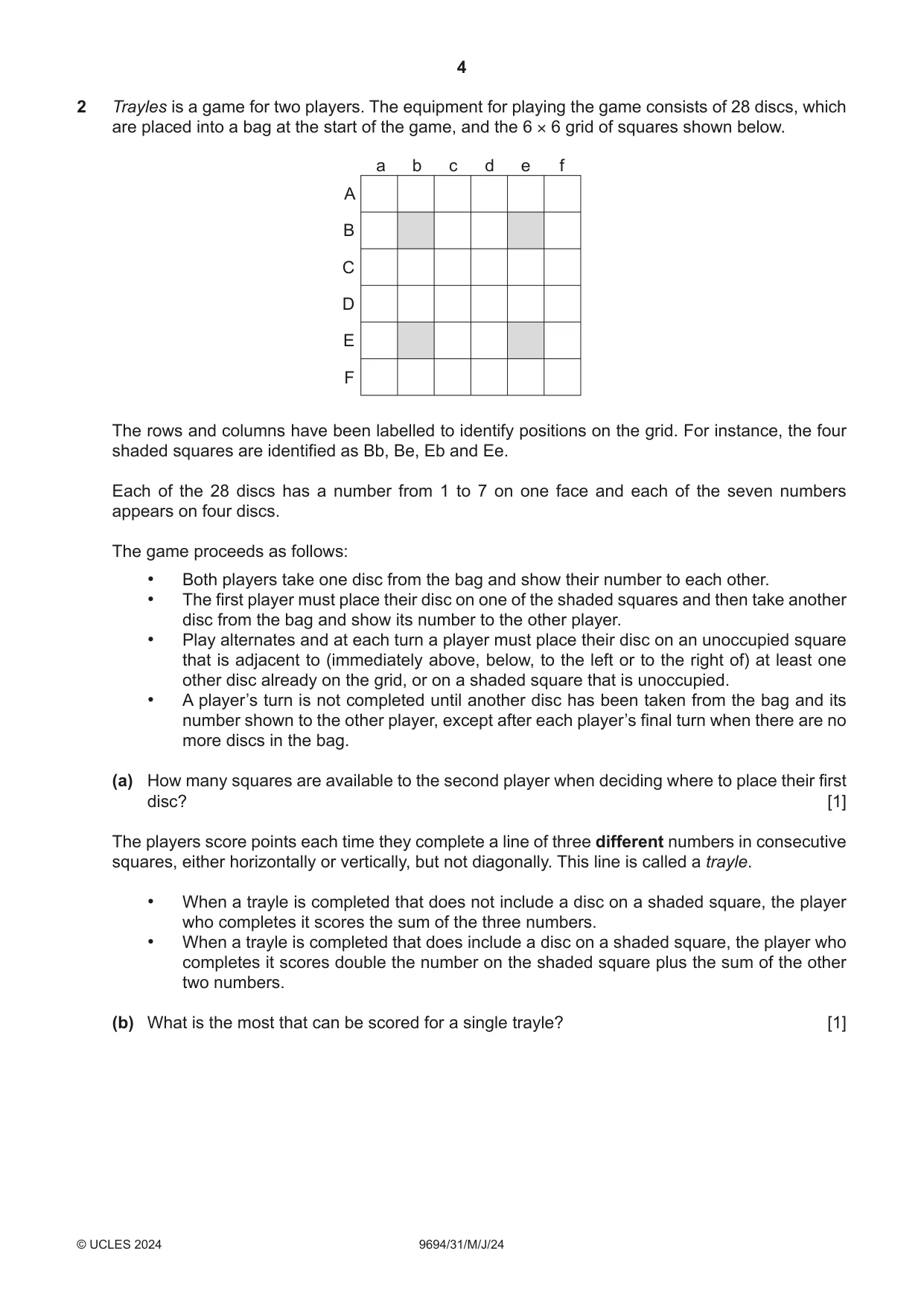
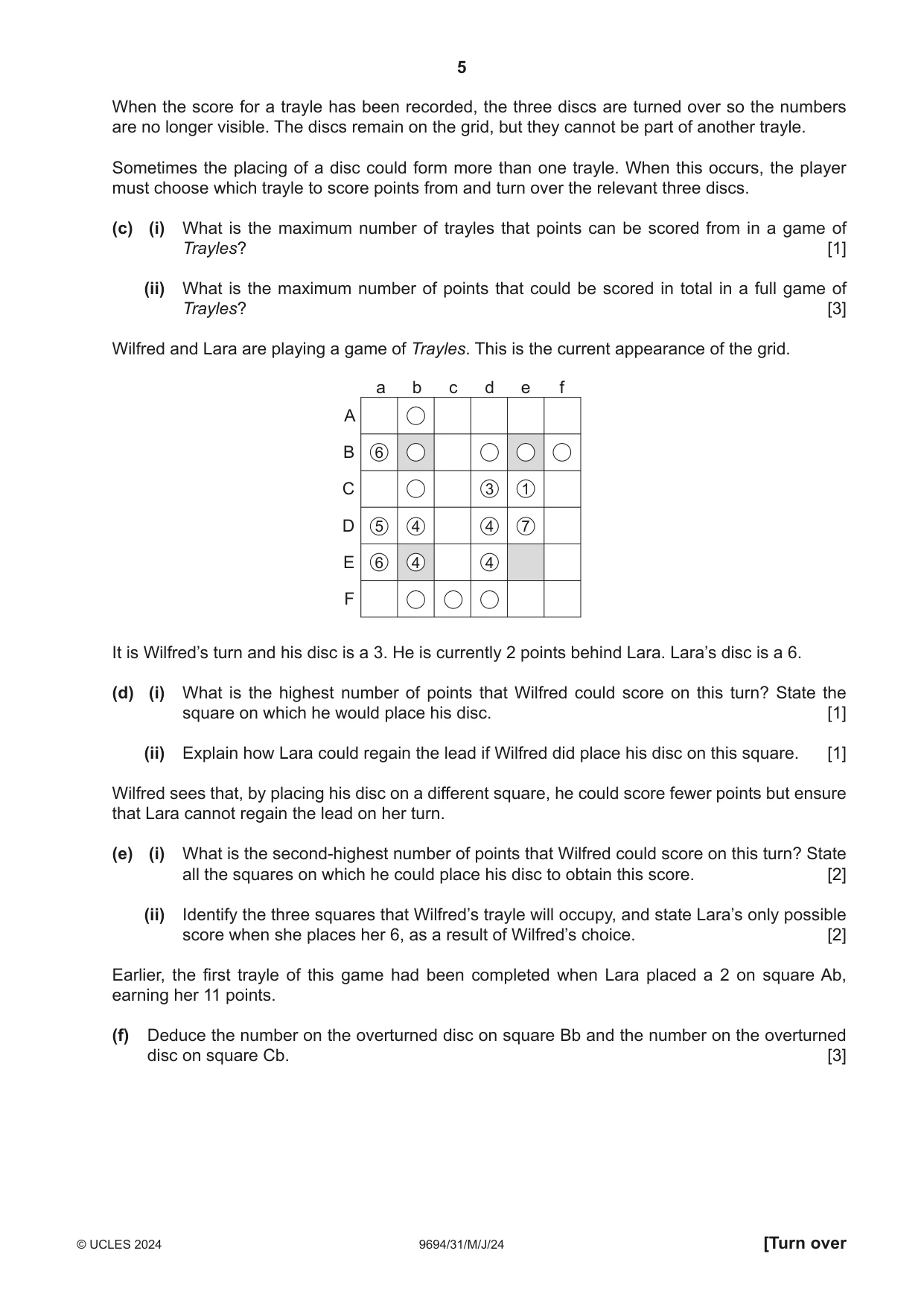
2 Trayles is a game for two players. The equipment for playing the game consists of 28 discs, which are placed into a bag at the start of the game, and the 6 × 6 grid of squares shown below. a b c d e f A B C D E F The rows and columns have been labelled to identify positions on the grid. For instance, the four shaded squares are identified as Bb, Be, Eb and Ee. Each of the 28 discs has a number from 1 to 7 on one face and each of the seven numbers appears on four discs. The game proceeds as follows: • Both players take one disc from the bag and show their number to each other. • The first player must place their disc on one of the shaded squares and then take another disc from the bag and show its number to the other player. • Play alternates and at each turn a player must place their disc on an unoccupied square that is adjacent to (immediately above, below, to the left or to the right of) at least one other disc already on the grid, or on a shaded square that is unoccupied. • A player’s turn is not completed until another disc has been taken from the bag and its number shown to the other player, except after each player’s final turn when there are no more discs in the bag. (a) How many squares are available to the second player when deciding where to place their first disc? [1] The players score points each time they complete a line of three different numbers in consecutive squares, either horizontally or vertically, but not diagonally. This line is called a trayle. • When a trayle is completed that does not include a disc on a shaded square, the player who completes it scores the sum of the three numbers. • When a trayle is completed that does include a disc on a shaded square, the player who completes it scores double the number on the shaded square plus the sum of the other two numbers. (b) What is the most that can be scored for a single trayle? [1] When the score for a trayle has been recorded, the three discs are turned over so the numbers are no longer visible. The discs remain on the grid, but they cannot be part of another trayle. Sometimes the placing of a disc could form more than one trayle. When this occurs, the player must choose which trayle to score points from and turn over the relevant three discs. (c) (i) What is the maximum number of trayles that points can be scored from in a game of Trayles? [1] (ii) What is the maximum number of points that could be scored in total in a full game of Trayles? [3] Wilfred and Lara are playing a game of Trayles. This is the current appearance of the grid. a b c d e f A B 6 C 3 1 D 5 4 4 7 E 6 4 4 F It is Wilfred’s turn and his disc is a 3. He is currently 2 points behind Lara. Lara’s disc is a 6. (d) (i) What is the highest number of points that Wilfred could score on this turn? State the square on which he would place his disc. [1] (ii) Explain how Lara could regain the lead if Wilfred did place his disc on this square. [1] Wilfred sees that, by placing his disc on a different square, he could score fewer points but ensure that Lara cannot regain the lead on her turn. (e) (i) What is the second-highest number of points that Wilfred could score on this turn? State all the squares on which he could place his disc to obtain this score. [2] (ii) Identify the three squares that Wilfred’s trayle will occupy, and state Lara’s only possible score when she places her 6, as a result of Wilfred’s choice. [2] Earlier, the first trayle of this game had been completed when Lara placed a 2 on square Ab, earning her 11 points. (f) Deduce the number on the overturned disc on square Bb and the number on the overturned disc on square Cb. [3]
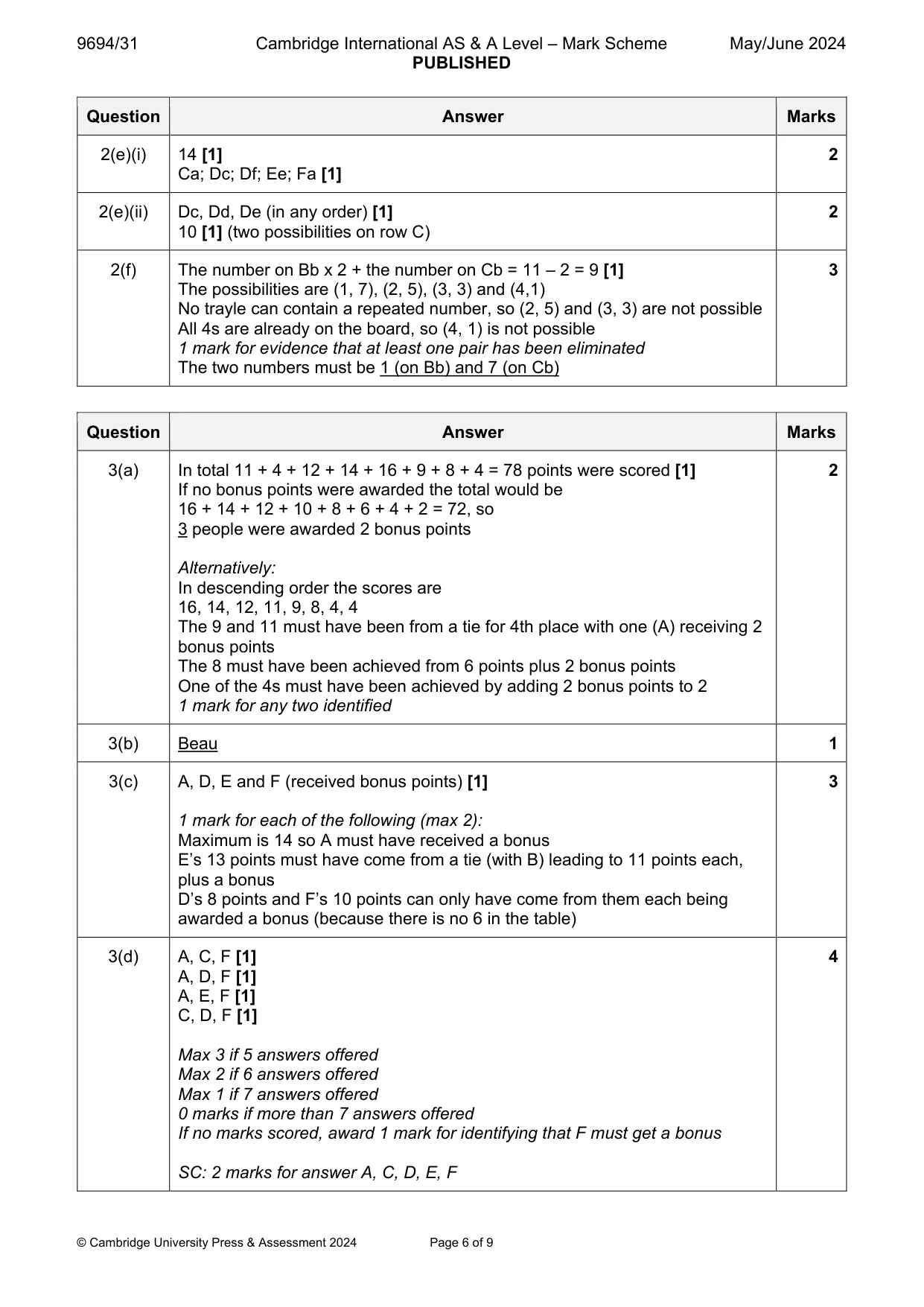
Mark scheme: 2(a) 7 1 2(b) 25 1 2(c)(i) 9 1 2(c)(ii) 1 mark for each of the following (max. 2): 3 The total value of the discs is 112 One disc will not be used – the total will be maximised if a 1 is omitted The total will be maximised if all four sevens are placed on shaded squares, (generating an extra 28 points) 139 points SC: 2 marks for final answer of 111 OR 140 2(d)(i) 17 on Ec 1 2(d)(ii) Lara could play on Dc OR Df OR Ee 1 2(e)(i) 14 [1] 2 Ca; Dc; Df; Ee; Fa [1] 2(e)(ii) Dc, Dd, De (in any order) [1] 2 10 [1] (two possibilities on row C) 2(f) The number on Bb x 2 + the number on Cb = 11 – 2 = 9 [1] 3 The possibilities are (1, 7), (2, 5), (3, 3) and (4,1) No trayle can contain a repeated number, so (2, 5) and (3, 3) are not possible All 4s are already on the board, so (4, 1) is not possible 1 mark for evidence that at least one pair has been eliminated The two numbers must be 1 (on Bb) and 7 (on Cb)
Q3 · A singing competition takes place over six rounds
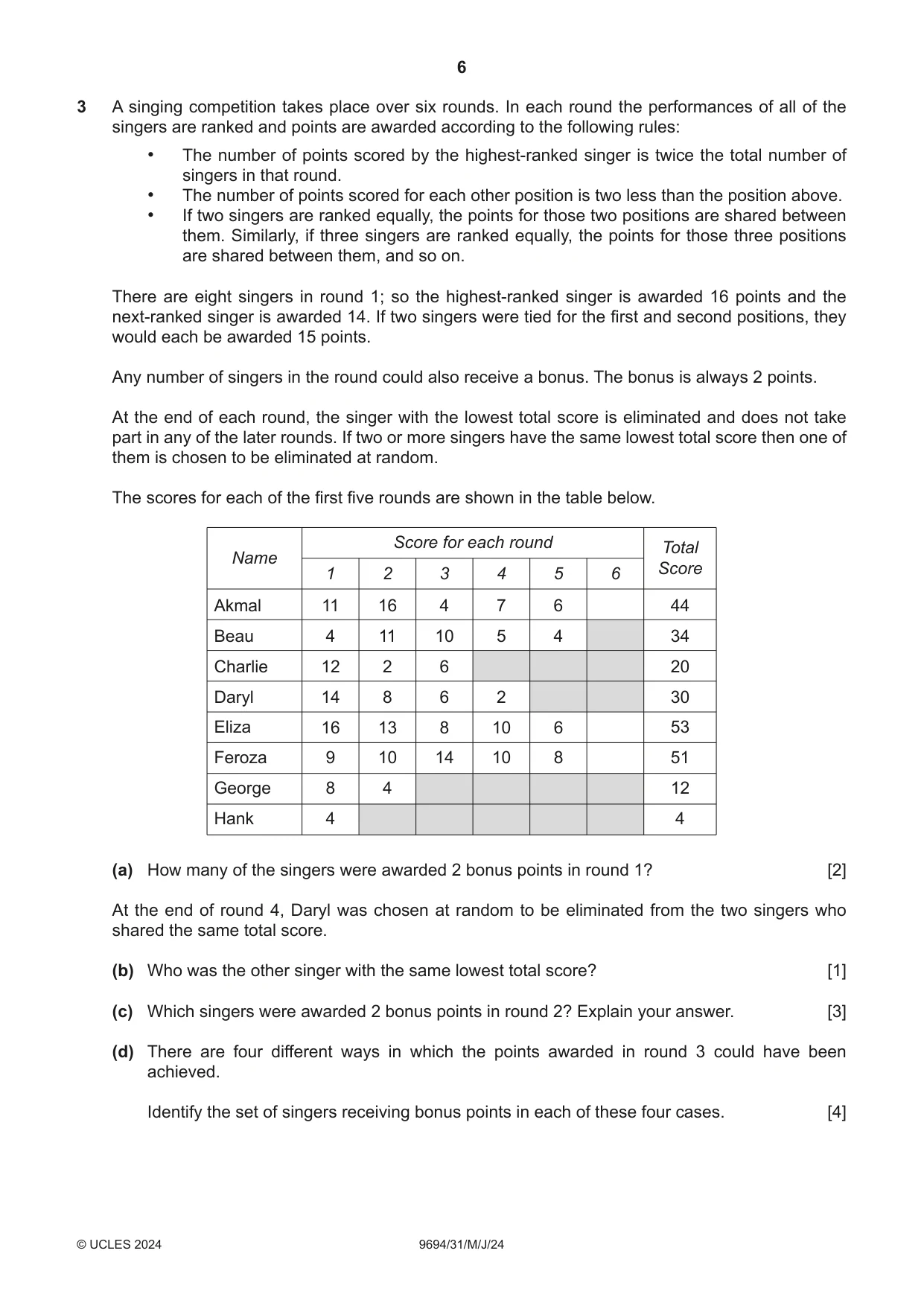
3 A singing competition takes place over six rounds. In each round the performances of all of the singers are ranked and points are awarded according to the following rules: • The number of points scored by the highest-ranked singer is twice the total number of singers in that round. • The number of points scored for each other position is two less than the position above. • If two singers are ranked equally, the points for those two positions are shared between them. Similarly, if three singers are ranked equally, the points for those three positions are shared between them, and so on. There are eight singers in round 1; so the highest-ranked singer is awarded 16 points and the next-ranked singer is awarded 14. If two singers were tied for the first and second positions, they would each be awarded 15 points. Any number of singers in the round could also receive a bonus. The bonus is always 2 points. At the end of each round, the singer with the lowest total score is eliminated and does not take part in any of the later rounds. If two or more singers have the same lowest total score then one of them is chosen to be eliminated at random. The scores for each of the first five rounds are shown in the table below. Score for each round Total Name Score 1 2 3 4 5 6 Akmal 11 16 4 7 6 44 Beau 4 11 10 5 4 34 Charlie 12 2 6 20 Daryl 14 8 6 2 30 Eliza 16 13 8 10 6 53 Feroza 9 10 14 10 8 51 George 8 4 12 Hank 4 4 (a) How many of the singers were awarded 2 bonus points in round 1? [2] At the end of round 4, Daryl was chosen at random to be eliminated from the two singers who shared the same total score. (b) Who was the other singer with the same lowest total score? [1] (c) Which singers were awarded 2 bonus points in round 2? Explain your answer. [3] (d) There are four different ways in which the points awarded in round 3 could have been achieved. Identify the set of singers receiving bonus points in each of these four cases. [4]
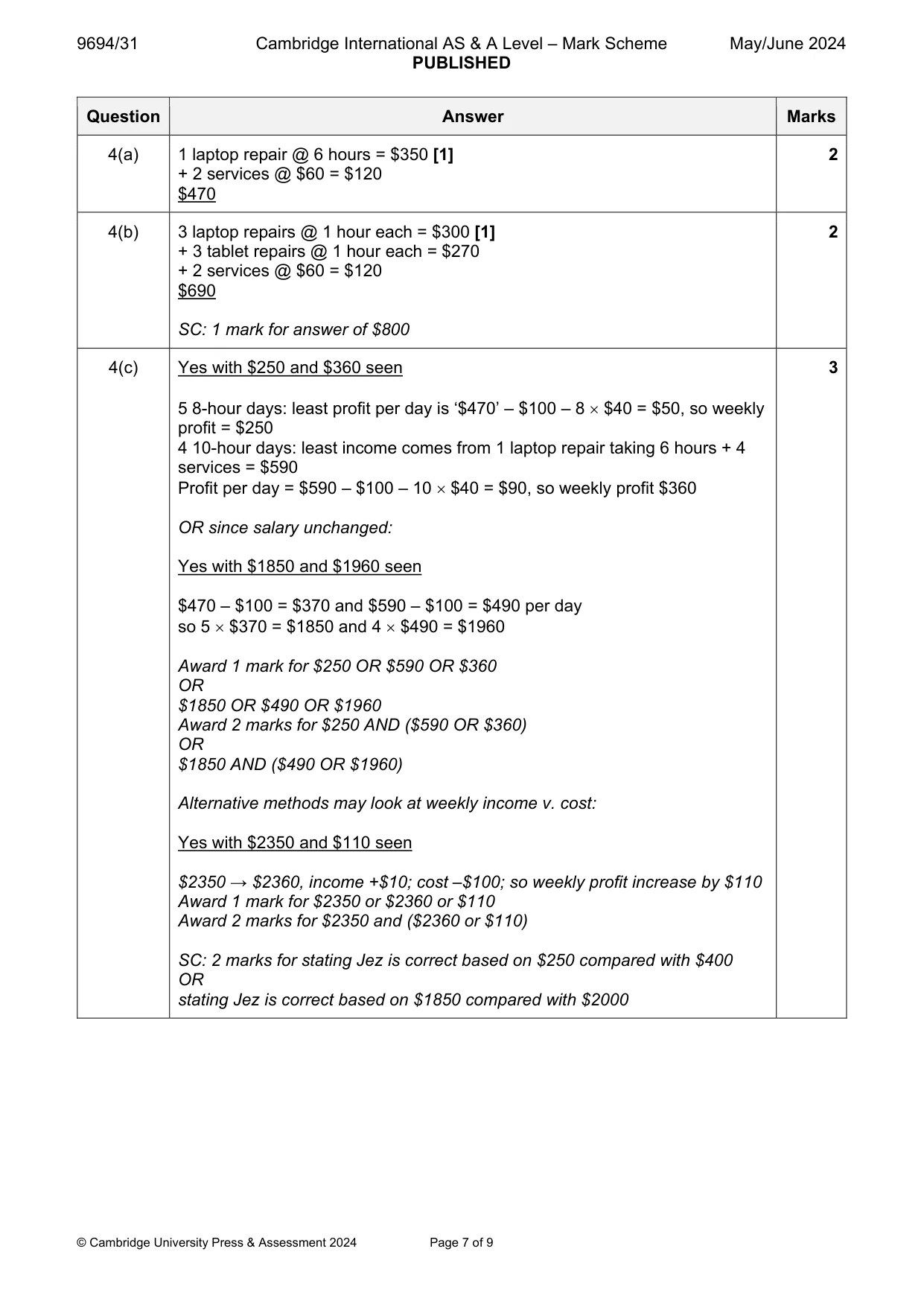
Mark scheme: 3(a) In total 11 + 4 + 12 + 14 + 16 + 9 + 8 + 4 = 78 points were scored [1] 2 If no bonus points were awarded the total would be 16 + 14 + 12 + 10 + 8 + 6 + 4 + 2 = 72, so 3 people were awarded 2 bonus points Alternatively: In descending order the scores are 16, 14, 12, 11, 9, 8, 4, 4 The 9 and 11 must have been from a tie for 4th place with one (A) receiving 2 bonus points The 8 must have been achieved from 6 points plus 2 bonus points One of the 4s must have been achieved by adding 2 bonus points to 2 1 mark for any two identified 3(b) Beau 1 3(c) A, D, E and F (received bonus points) [1] 3 1 mark for each of the following (max 2): Maximum is 14 so A must have received a bonus E’s 13 points must have come from a tie (with B) leading to 11 points each, plus a bonus D’s 8 points and F’s 10 points can only have come from them each being awarded a bonus (because there is no 6 in the table) 3(d) A, C, F [1] 4 A, D, F [1] A, E, F [1] C, D, F [1] Max 3 if 5 answers offered Max 2 if 6 answers offered Max 1 if 7 answers offered 0 marks if more than 7 answers offered If no marks scored, award 1 mark for identifying that F must get a bonus SC: 2 marks for answer A, C, D, E, F
Q4 · Jez runs his own company, carrying out repairs and routine services on laptops and tablets
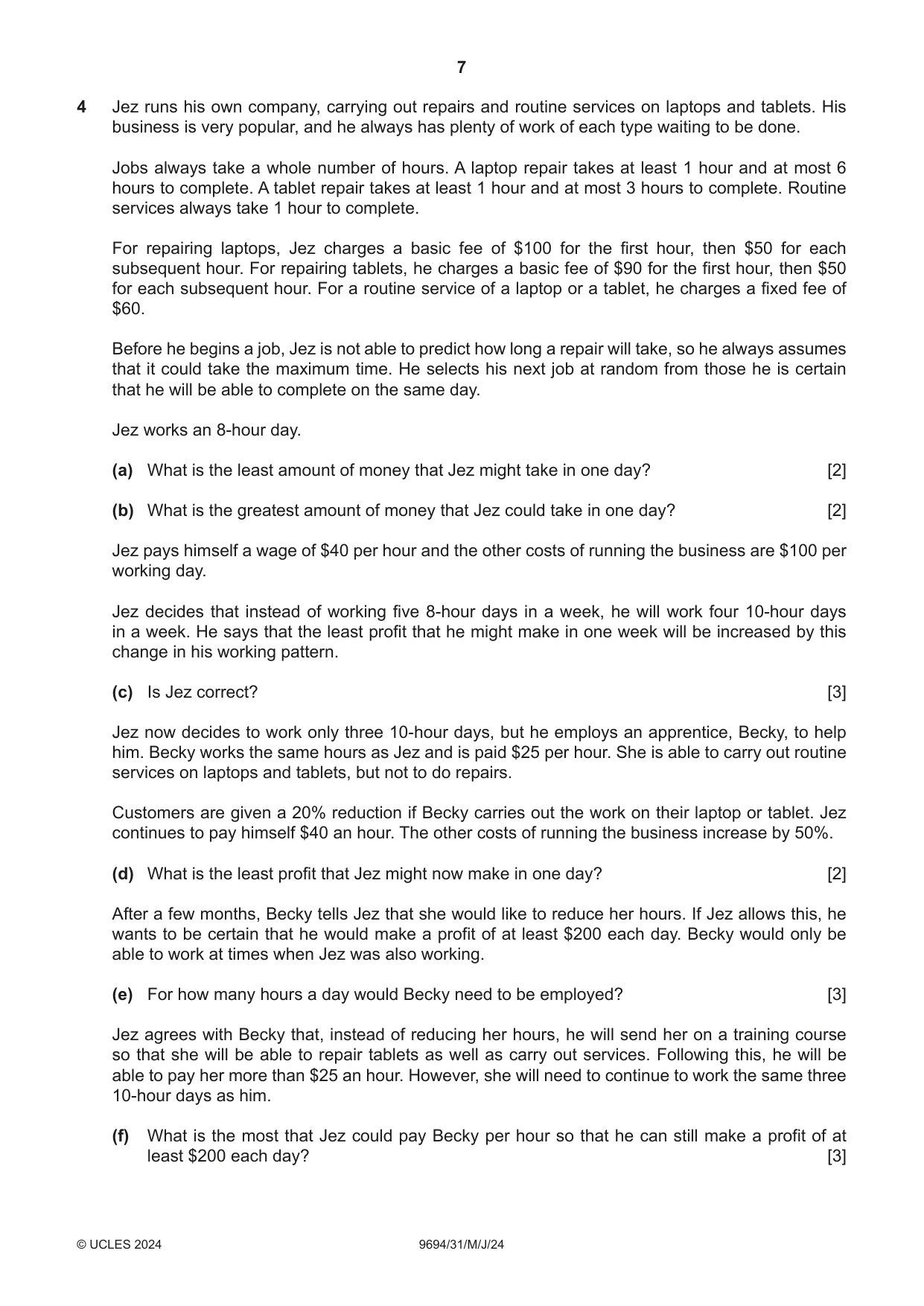
4 Jez runs his own company, carrying out repairs and routine services on laptops and tablets. His business is very popular, and he always has plenty of work of each type waiting to be done. Jobs always take a whole number of hours. A laptop repair takes at least 1 hour and at most 6 hours to complete. A tablet repair takes at least 1 hour and at most 3 hours to complete. Routine services always take 1 hour to complete. For repairing laptops, Jez charges a basic fee of $100 for the first hour, then $50 for each subsequent hour. For repairing tablets, he charges a basic fee of $90 for the first hour, then $50 for each subsequent hour. For a routine service of a laptop or a tablet, he charges a fixed fee of $60. Before he begins a job, Jez is not able to predict how long a repair will take, so he always assumes that it could take the maximum time. He selects his next job at random from those he is certain that he will be able to complete on the same day. Jez works an 8-hour day. (a) What is the least amount of money that Jez might take in one day? [2] (b) What is the greatest amount of money that Jez could take in one day? [2] Jez pays himself a wage of $40 per hour and the other costs of running the business are $100 per working day. Jez decides that instead of working five 8-hour days in a week, he will work four 10-hour days in a week. He says that the least profit that he might make in one week will be increased by this change in his working pattern. (c) Is Jez correct? [3] Jez now decides to work only three 10-hour days, but he employs an apprentice, Becky, to help him. Becky works the same hours as Jez and is paid $25 per hour. She is able to carry out routine services on laptops and tablets, but not to do repairs. Customers are given a 20% reduction if Becky carries out the work on their laptop or tablet. Jez continues to pay himself $40 an hour. The other costs of running the business increase by 50%. (d) What is the least profit that Jez might now make in one day? [2] After a few months, Becky tells Jez that she would like to reduce her hours. If Jez allows this, he wants to be certain that he would make a profit of at least $200 each day. Becky would only be able to work at times when Jez was also working. (e) For how many hours a day would Becky need to be employed? [3] Jez agrees with Becky that, instead of reducing her hours, he will send her on a training course so that she will be able to repair tablets as well as carry out services. Following this, he will be able to pay her more than $25 an hour. However, she will need to continue to work the same three 10-hour days as him. (f) What is the most that Jez could pay Becky per hour so that he can still make a profit of at least $200 each day? [3]
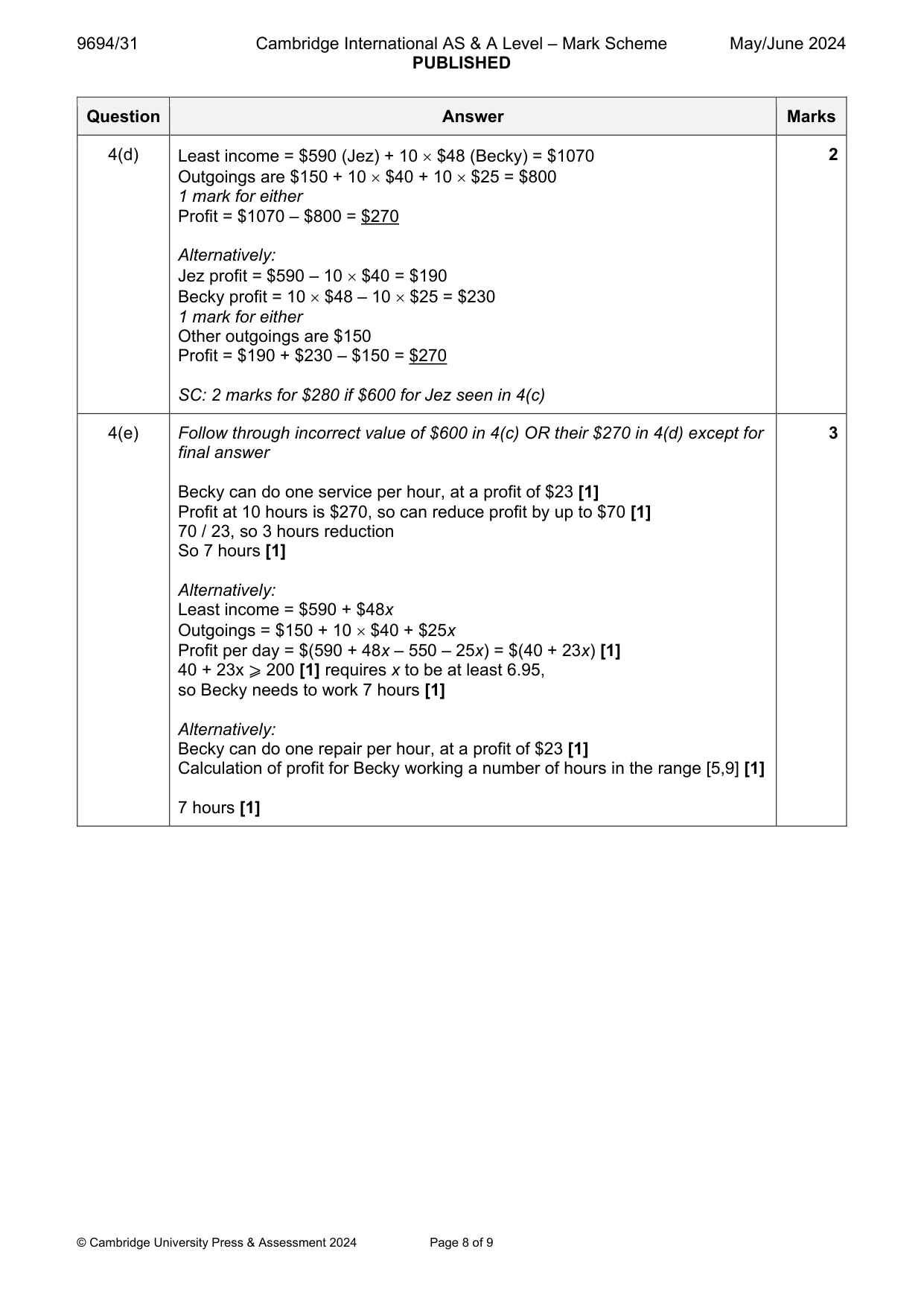
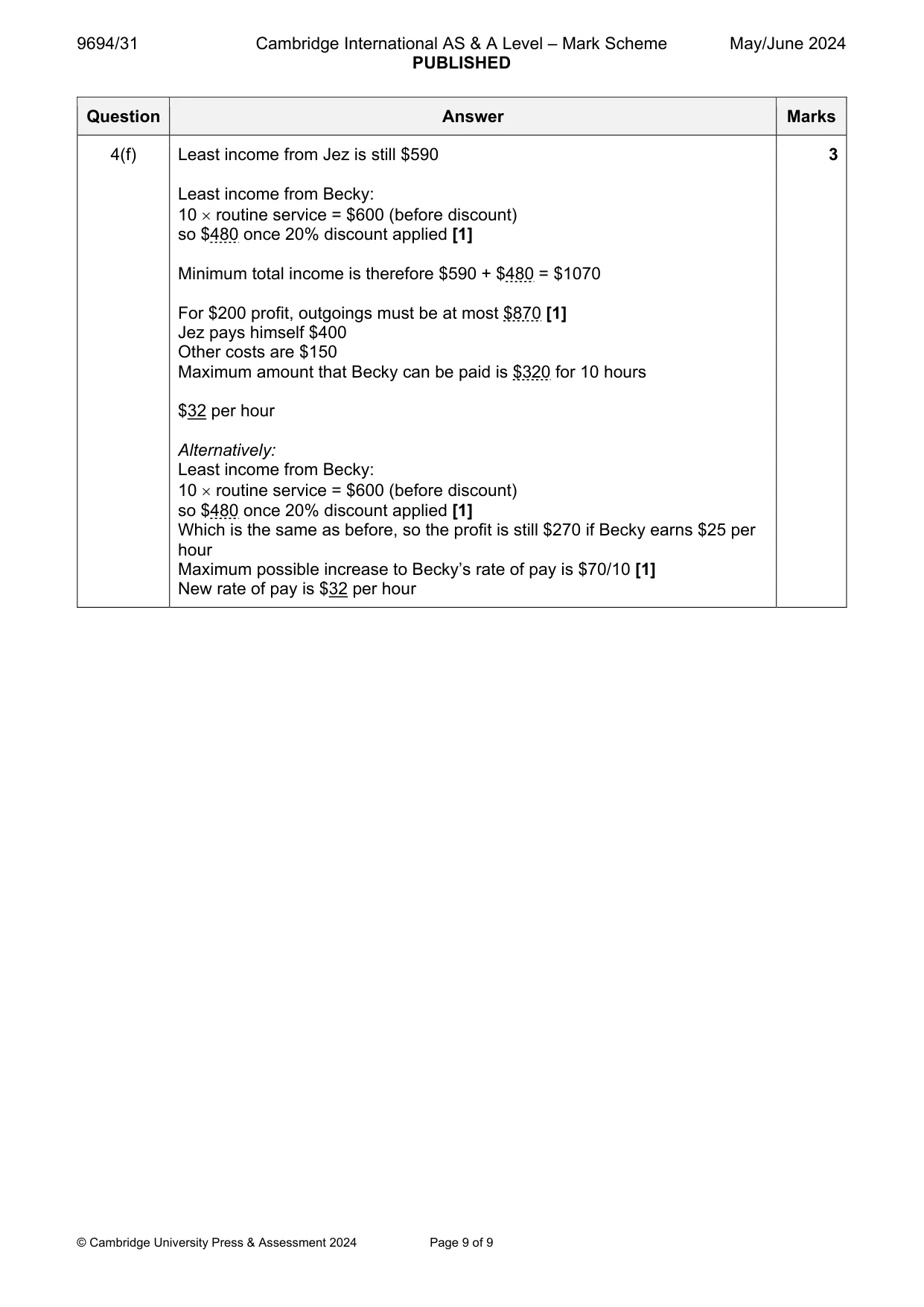
Mark scheme: 4(a) 1 laptop repair @ 6 hours = $350 [1] 2 + 2 services @ $60 = $120 $470 4(b) 3 laptop repairs @ 1 hour each = $300 [1] 2 + 3 tablet repairs @ 1 hour each = $270 + 2 services @ $60 = $120 $690 SC: 1 mark for answer of $800 4(c) Yes with $250 and $360 seen 3 5 8-hour days: least profit per day is ‘$470’ – $100 – 8 $40 = $50, so weekly profit = $250 4 10-hour days: least income comes from 1 laptop repair taking 6 hours + 4 services = $590 Profit per day = $590 – $100 – 10 $40 = $90, so weekly profit $360 OR since salary unchanged: Yes with $1850 and $1960 seen $470 – $100 = $370 and $590 – $100 = $490 per day so 5 $370 = $1850 and 4 $490 = $1960 Award 1 mark for $250 OR $590 OR $360 OR $1850 OR $490 OR $1960 Award 2 marks for $250 AND ($590 OR $360) OR $1850 AND ($490 OR $1960) Alternative methods may look at weekly income v. cost: Yes with $2350 and $110 seen $2350 → $2360, income +$10; cost –$100; so weekly profit increase by $110 Award 1 mark for $2350 or $2360 or $110 Award 2 marks for $2350 and ($2360 or $110) SC: 2 marks for stating Jez is correct based on $250 compared with $400 OR stating Jez is correct based on $1850 compared with $2000 4(d) Least income = $590 (Jez) + 10 $48 (Becky) = $1070 2 Outgoings are $150 + 10 $40 + 10 $25 = $800 1 mark for either Profit = $1070 – $800 = $270 Alternatively: Jez profit = $590 – 10 $40 = $190 Becky profit = 10 $48 – 10 $25 = $230 1 mark for either Other outgoings are $150 Profit = $190 + $230 – $150 = $270 SC: 2 marks for $280 if $600 for Jez seen in 4(c) 4(e) Follow through incorrect value of $600 in 4(c) OR their $270 in 4(d) except for 3 final answer Becky can do one service per hour, at a profit of $23 [1] Profit at 10 hours is $270, so can reduce profit by up to $70 [1] 70 / 23, so 3 hours reduction So 7 hours [1] Alternatively: Least income = $590 + $48x Outgoings = $150 + 10 $40 + $25x Profit per day = $(590 + 48x – 550 – 25x) = $(40 + 23x) [1] 40 + 23x ⩾ 200 [1] requires x to be at least 6.95, so Becky needs to work 7 hours [1] Alternatively: Becky can do one repair per hour, at a profit of $23 [1] Calculation of profit for Becky working a number of hours in the range [5,9] [1] 7 hours [1] 4(f) Least income from Jez is still $590 3 Least income from Becky: 10 routine service = $600 (before discount) so $480 once 20% discount applied [1] Minimum total income is therefore $590 + $480 = $1070 For $200 profit, outgoings must be at most $870 [1] Jez pays himself $400 Other costs are $150 Maximum amount that Becky can be paid is $320 for 10 hours $32 per hour Alternatively: Least income from Becky: 10 routine service = $600 (before discount) so $480 once 20% discount applied [1] Which is the same as before, so the profit is still $270 if Becky earns $25 per hour Maximum possible increase to Becky’s rate of pay is $70/10 [1] New rate of pay is $32 per hour
More questions on Identify the impact of a change to a problem
What was in this paper
The subtopics covered by these 4 questions, and how many questions each got. Open one in a new tab to see every Cambridge question on it.
What you needed in this session
Cambridge’s own grade thresholds for 2024 May/June, Paper 3 · Variant 1. A higher threshold means an easier paper — the bar moves with how the cohort did.