Cambridge A Level Thinking Skills 9694 — 2022 May/June Paper 3 · Variant 1
9694/31/M/J/22 · 4 questions · 50 marks · ≈56 min
The question paper and its mark scheme, free to read here and free to download. This is Cambridge’s own paper, exactly as it was sat.
Question paper12 pages



Mark scheme8 pages
Answers below. Sit the paper first if you are practising.
Questions as text
Q1 · Lilly wants to eat dinner at Trista’s Restaurant
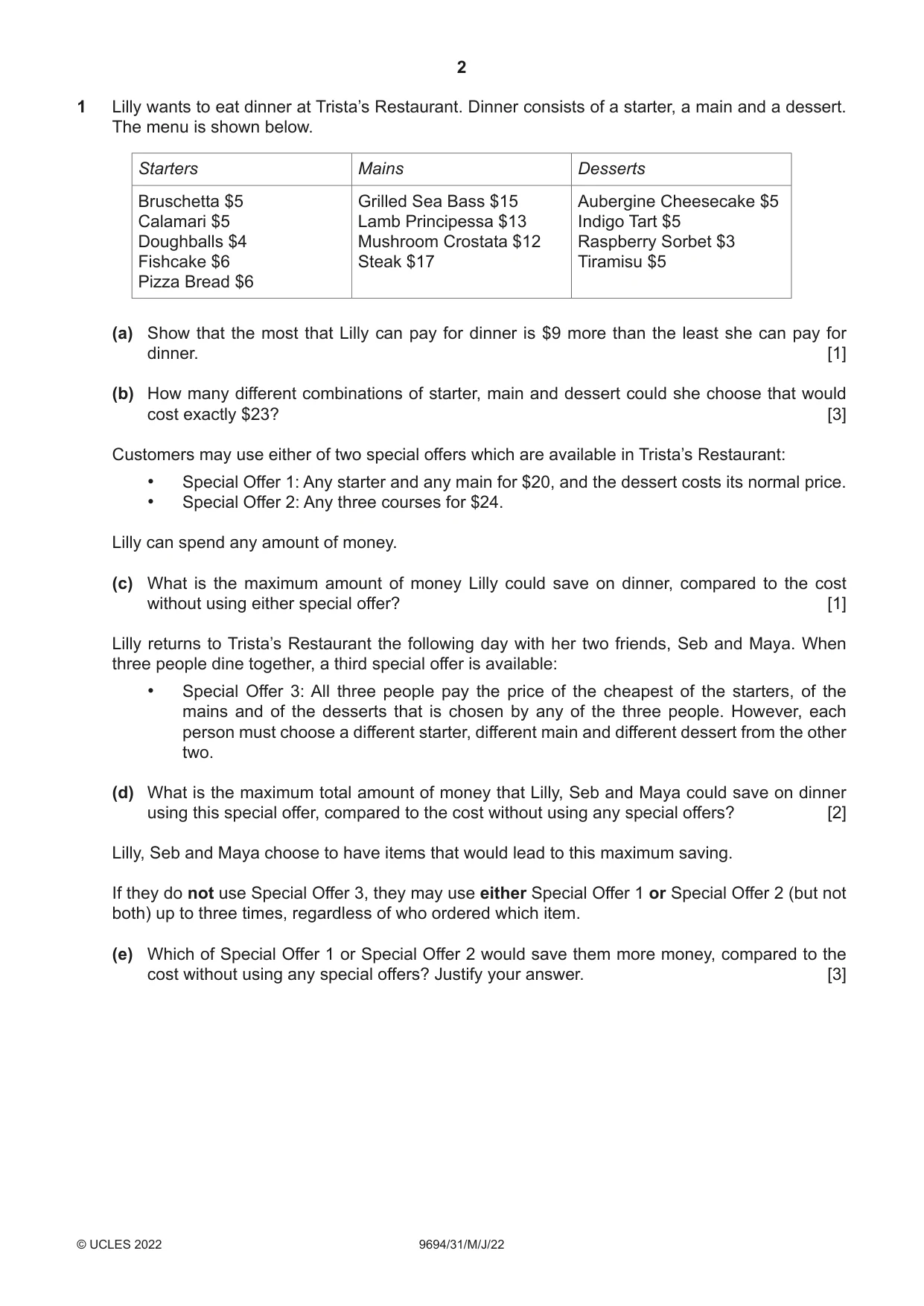
1 Lilly wants to eat dinner at Trista’s Restaurant. Dinner consists of a starter, a main and a dessert. The menu is shown below. Starters Mains Desserts Bruschetta $5 Grilled Sea Bass $15 Aubergine Cheesecake $5 Calamari $5 Lamb Principessa $13 Indigo Tart $5 Doughballs $4 Mushroom Crostata $12 Raspberry Sorbet $3 Fishcake $6 Steak $17 Tiramisu $5 Pizza Bread $6 (a) Show that the most that Lilly can pay for dinner is $9 more than the least she can pay for dinner. [1] (b) How many different combinations of starter, main and dessert could she choose that would cost exactly $23? [3] Customers may use either of two special offers which are available in Trista’s Restaurant: • Special Offer 1: Any starter and any main for $20, and the dessert costs its normal price. • Special Offer 2: Any three courses for $24. Lilly can spend any amount of money. (c) What is the maximum amount of money Lilly could save on dinner, compared to the cost without using either special offer? [1] Lilly returns to Trista’s Restaurant the following day with her two friends, Seb and Maya. When three people dine together, a third special offer is available: • Special Offer 3: All three people pay the price of the cheapest of the starters, of the mains and of the desserts that is chosen by any of the three people. However, each person must choose a different starter, different main and different dessert from the other two. (d) What is the maximum total amount of money that Lilly, Seb and Maya could save on dinner using this special offer, compared to the cost without using any special offers? [2] Lilly, Seb and Maya choose to have items that would lead to this maximum saving. If they do not use Special Offer 3, they may use either Special Offer 1 or Special Offer 2 (but not both) up to three times, regardless of who ordered which item. (e) Which of Special Offer 1 or Special Offer 2 would save them more money, compared to the cost without using any special offers? Justify your answer. [3] [Turn over for Question 2]
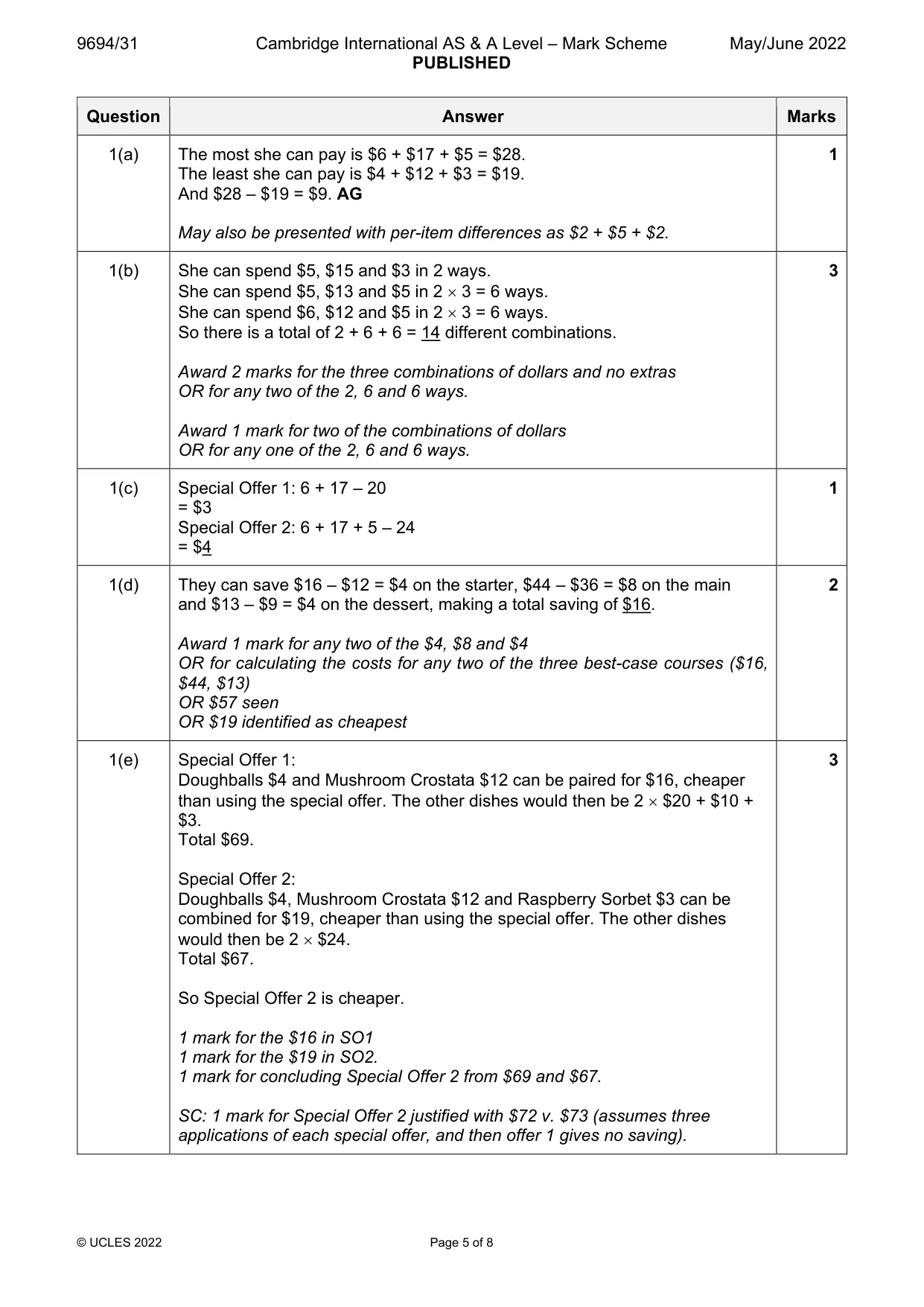
Mark scheme: Question Answer Marks 1(a) The most she can pay is $6 + $17 + $5 = $28. 1 The least she can pay is $4 + $12 + $3 = $19. And $28 – $19 = $9. AG May also be presented with per-item differences as $2 + $5 + $2. 1(b) She can spend $5, $15 and $3 in 2 ways. 3 She can spend $5, $13 and $5 in 2 3 = 6 ways. She can spend $6, $12 and $5 in 2 3 = 6 ways. So there is a total of 2 + 6 + 6 = 14 different combinations. Award 2 marks for the three combinations of dollars and no extras OR for any two of the 2, 6 and 6 ways. Award 1 mark for two of the combinations of dollars OR for any one of the 2, 6 and 6 ways. 1(c) Special Offer 1: 6 + 17 – 20 1 = $3 Special Offer 2: 6 + 17 + 5 – 24 = $4 1(d) They can save $16 – $12 = $4 on the starter, $44 – $36 = $8 on the main 2 and $13 – $9 = $4 on the dessert, making a total saving of $16. Award 1 mark for any two of the $4, $8 and $4 OR for calculating the costs for any two of the three best-case courses ($16, $44, $13) OR $57 seen OR $19 identified as cheapest 1(e) Special Offer 1: 3 Doughballs $4 and Mushroom Crostata $12 can be paired for $16, cheaper than using the special offer. The other dishes would then be 2 $20 + $10 + $3. Total $69. Special Offer 2: Doughballs $4, Mushroom Crostata $12 and Raspberry Sorbet $3 can be combined for $19, cheaper than using the special offer. The other dishes would then be 2 $24. Total $67. So Special Offer 2 is cheaper. 1 mark for the $16 in SO1 1 mark for the $19 in SO2. 1 mark for concluding Special Offer 2 from $69 and $67. SC: 1 mark for Special Offer 2 justified with $72 v. $73 (assumes three applications of each special offer, and then offer 1 gives no saving).
More questions on Identify cases that satisfy given criteria
Q2 · Argo runs an after-school club and he is devising a competition for the young people who…
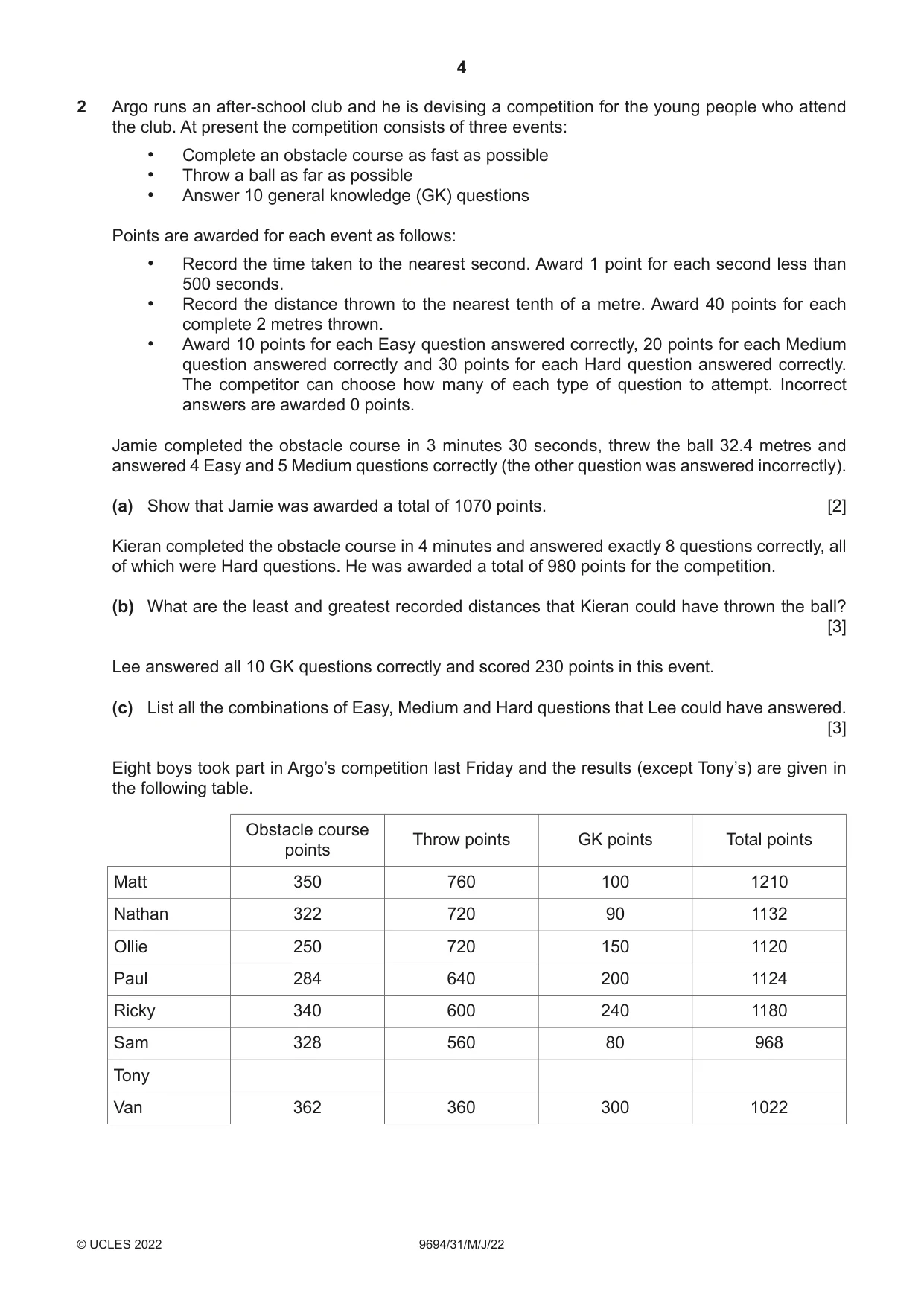
2 Argo runs an after-school club and he is devising a competition for the young people who attend the club. At present the competition consists of three events: • Complete an obstacle course as fast as possible • Throw a ball as far as possible • Answer 10 general knowledge (GK) questions Points are awarded for each event as follows: • Record the time taken to the nearest second. Award 1 point for each second less than 500 seconds. • Record the distance thrown to the nearest tenth of a metre. Award 40 points for each complete 2 metres thrown. • Award 10 points for each Easy question answered correctly, 20 points for each Medium question answered correctly and 30 points for each Hard question answered correctly. The competitor can choose how many of each type of question to attempt. Incorrect answers are awarded 0 points. Jamie completed the obstacle course in 3 minutes 30 seconds, threw the ball 32.4 metres and answered 4 Easy and 5 Medium questions correctly (the other question was answered incorrectly). (a) Show that Jamie was awarded a total of 1070 points. [2] Kieran completed the obstacle course in 4 minutes and answered exactly 8 questions correctly, all of which were Hard questions. He was awarded a total of 980 points for the competition. (b) What are the least and greatest recorded distances that Kieran could have thrown the ball? [3] Lee answered all 10 GK questions correctly and scored 230 points in this event. (c) List all the combinations of Easy, Medium and Hard questions that Lee could have answered. [3] Eight boys took part in Argo’s competition last Friday and the results (except Tony’s) are given in the following table. Obstacle course Throw points GK points Total points points Matt 350 760 100 1210 Nathan 322 720 90 1132 Ollie 250 720 150 1120 Paul 284 640 200 1124 Ricky 340 600 240 1180 Sam 328 560 80 968 Tony Van 362 360 300 1022
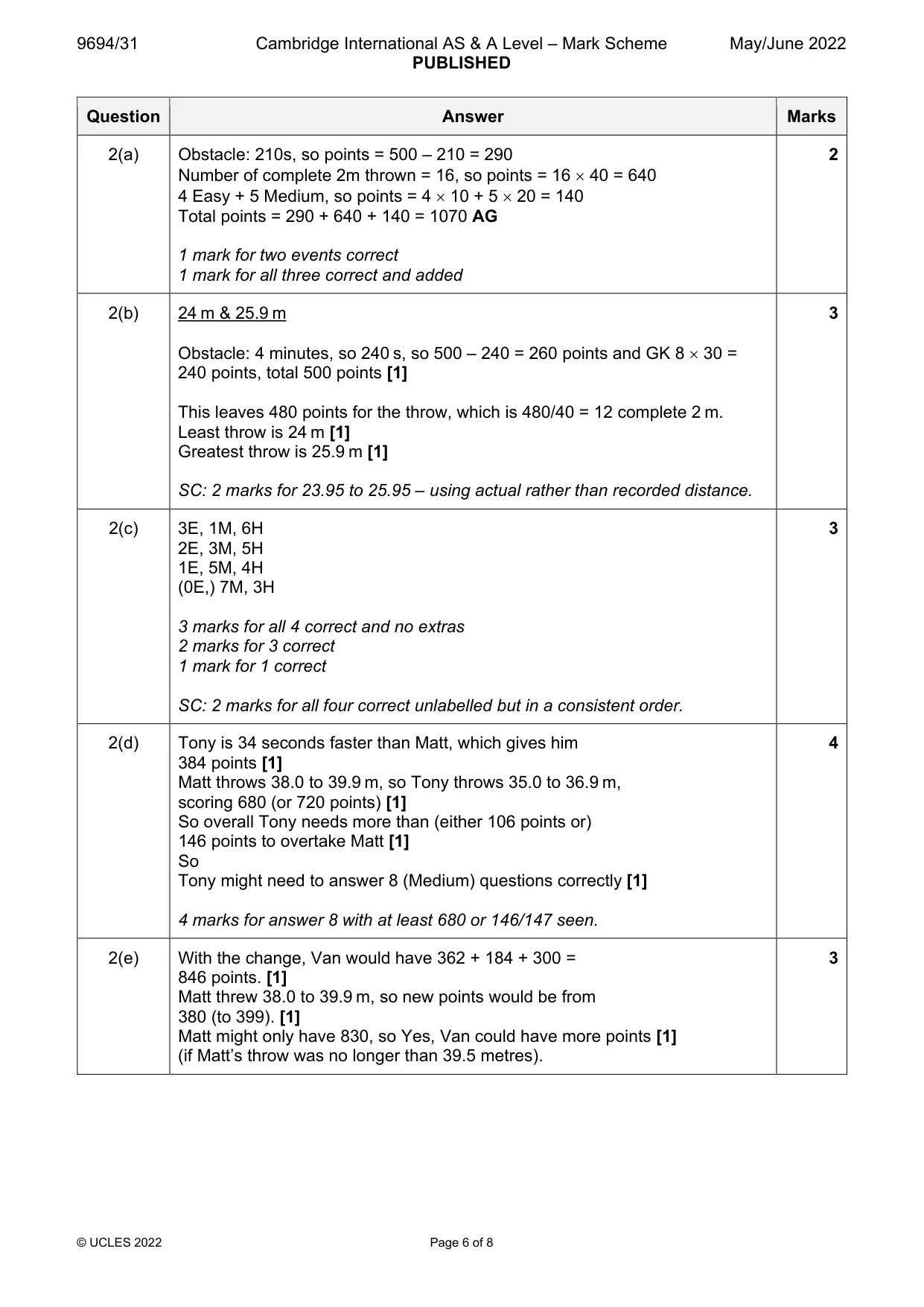
Mark scheme: 2(a) Obstacle: 210s, so points = 500 – 210 = 290 2 Number of complete 2m thrown = 16, so points = 16 40 = 640 4 Easy + 5 Medium, so points = 4 10 + 5 20 = 140 Total points = 290 + 640 + 140 = 1070 AG 1 mark for two events correct 1 mark for all three correct and added 2(b) 24 m & 25.9 m 3 Obstacle: 4 minutes, so 240 s, so 500 – 240 = 260 points and GK 8 30 = 240 points, total 500 points [1] This leaves 480 points for the throw, which is 480/40 = 12 complete 2 m. Least throw is 24 m [1] Greatest throw is 25.9 m [1] SC: 2 marks for 23.95 to 25.95 – using actual rather than recorded distance. 2(c) 3E, 1M, 6H 3 2E, 3M, 5H 1E, 5M, 4H (0E,) 7M, 3H 3 marks for all 4 correct and no extras 2 marks for 3 correct 1 mark for 1 correct SC: 2 marks for all four correct unlabelled but in a consistent order. 2(d) Tony is 34 seconds faster than Matt, which gives him 4 384 points [1] Matt throws 38.0 to 39.9 m, so Tony throws 35.0 to 36.9 m, scoring 680 (or 720 points) [1] So overall Tony needs more than (either 106 points or) 146 points to overtake Matt [1] So Tony might need to answer 8 (Medium) questions correctly [1] 4 marks for answer 8 with at least 680 or 146/147 seen. 2(e) With the change, Van would have 362 + 184 + 300 = 3 846 points. [1] Matt threw 38.0 to 39.9 m, so new points would be from 380 (to 399). [1] Matt might only have 830, so Yes, Van could have more points [1] (if Matt’s throw was no longer than 39.5 metres).
Q3 · Metres less than Matt
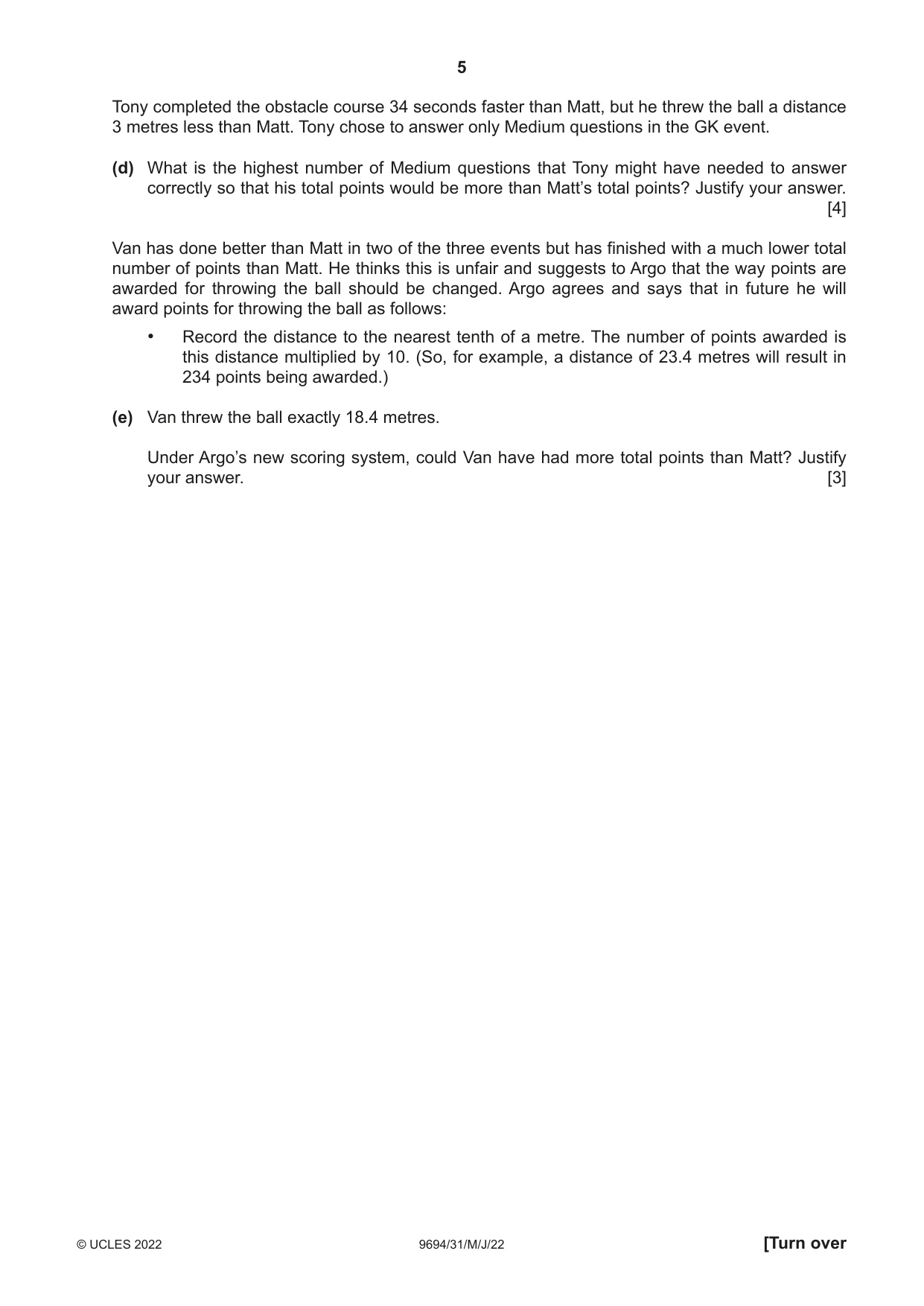
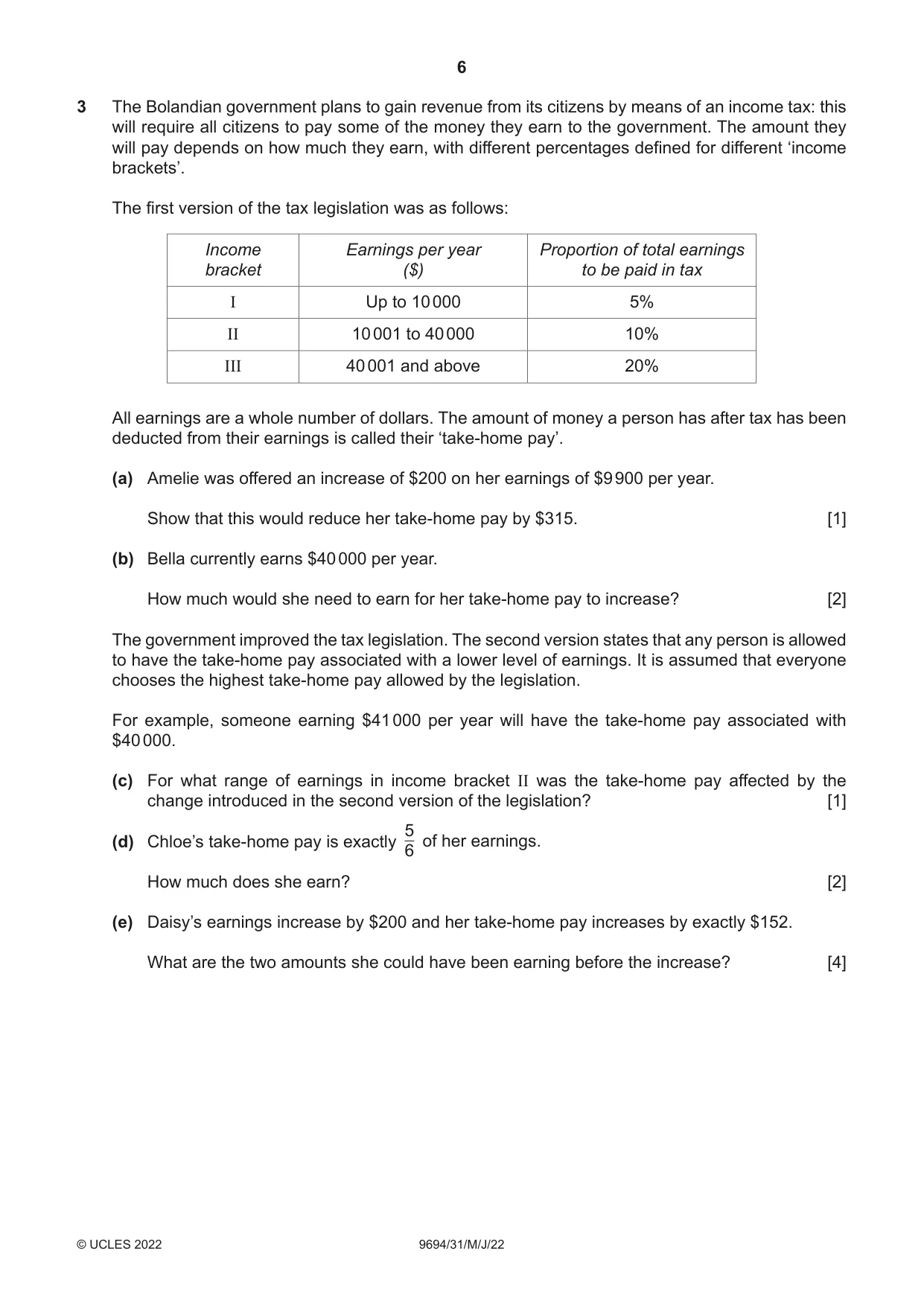
3 metres less than Matt. Tony chose to answer only Medium questions in the GK event. (d) What is the highest number of Medium questions that Tony might have needed to answer correctly so that his total points would be more than Matt’s total points? Justify your answer. [4] Van has done better than Matt in two of the three events but has finished with a much lower total number of points than Matt. He thinks this is unfair and suggests to Argo that the way points are awarded for throwing the ball should be changed. Argo agrees and says that in future he will award points for throwing the ball as follows: • Record the distance to the nearest tenth of a metre. The number of points awarded is this distance multiplied by 10. (So, for example, a distance of 23.4 metres will result in 234 points being awarded.) (e) Van threw the ball exactly 18.4 metres. Under Argo’s new scoring system, could Van have had more total points than Matt? Justify your answer. [3] 3 The Bolandian government plans to gain revenue from its citizens by means of an income tax: this will require all citizens to pay some of the money they earn to the government. The amount they will pay depends on how much they earn, with different percentages defined for different ‘income brackets’. The first version of the tax legislation was as follows: Income Earnings per year Proportion of total earnings bracket ($) to be paid in tax I Up to 10 000 5% II 10 001 to 40 000 10% III 40 001 and above 20% All earnings are a whole number of dollars. The amount of money a person has after tax has been deducted from their earnings is called their ‘take-home pay’. (a) Amelie was offered an increase of $200 on her earnings of $9 900 per year. Show that this would reduce her take-home pay by $315. [1] (b) Bella currently earns $40 000 per year. How much would she need to earn for her take-home pay to increase? [2] The government improved the tax legislation. The second version states that any person is allowed to have the take-home pay associated with a lower level of earnings. It is assumed that everyone chooses the highest take-home pay allowed by the legislation. For example, someone earning $41 000 per year will have the take-home pay associated with $40 000. (c) For what range of earnings in income bracket II was the take-home pay affected by the change introduced in the second version of the legislation? [1] 5 (d) Chloe’s take-home pay is exactly of her earnings. 6 How much does she earn? [2] (e) Daisy’s earnings increase by $200 and her take-home pay increases by exactly $152. What are the two amounts she could have been earning before the increase? [4] [Turn over for Question 4]
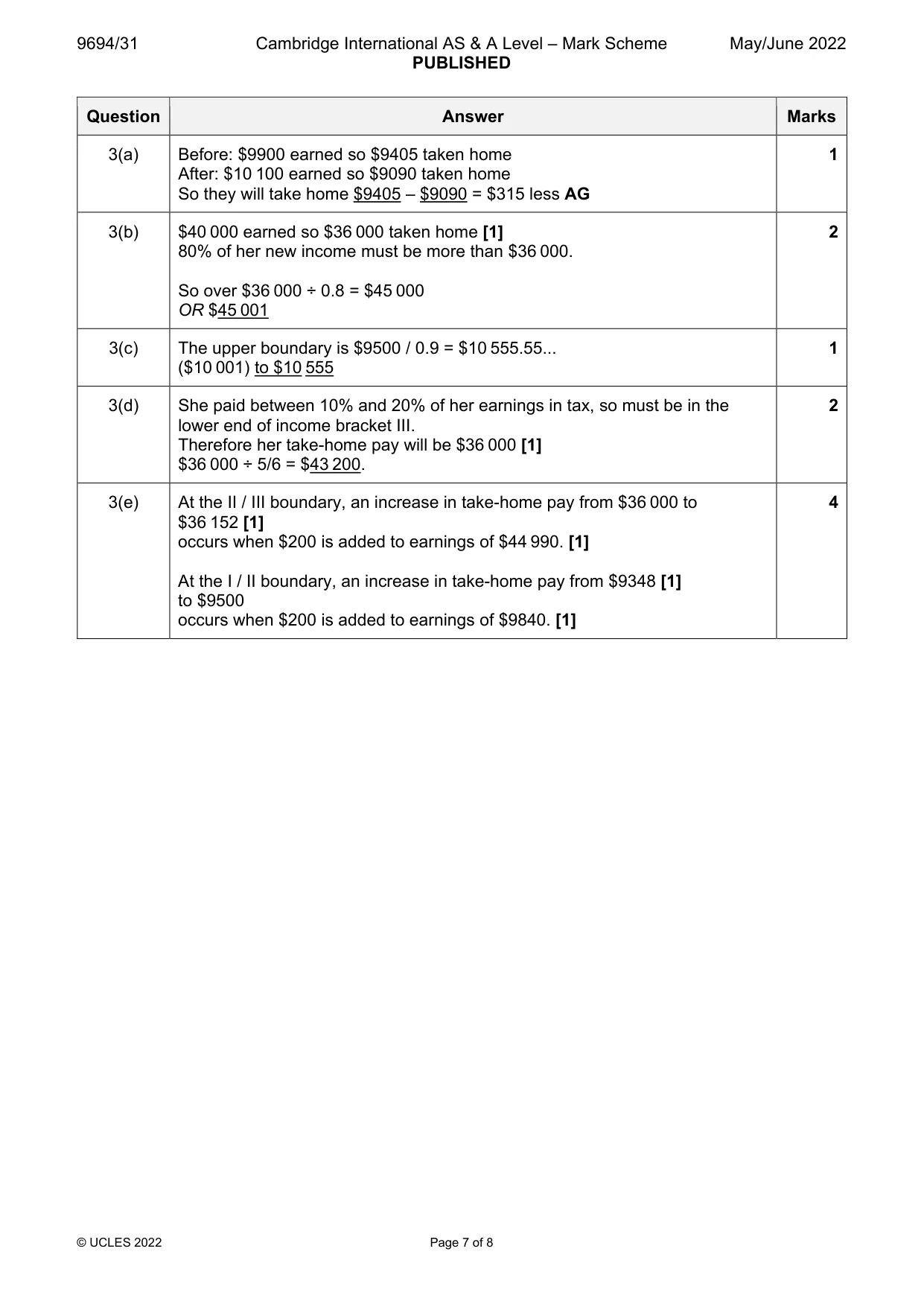
Mark scheme: 3(a) Before: $9900 earned so $9405 taken home 1 After: $10 100 earned so $9090 taken home So they will take home $9405 – $9090 = $315 less AG 3(b) $40 000 earned so $36 000 taken home [1] 2 80% of her new income must be more than $36 000. So over $36 000 ÷ 0.8 = $45 000 OR $45 001 3(c) The upper boundary is $9500 / 0.9 = $10 555.55... 1 ($10 001) to $10 555 3(d) She paid between 10% and 20% of her earnings in tax, so must be in the 2 lower end of income bracket III. Therefore her take-home pay will be $36 000 [1] $36 000 ÷ 5/6 = $43 200. 3(e) At the II / III boundary, an increase in take-home pay from $36 000 to 4 $36 152 [1] occurs when $200 is added to earnings of $44 990. [1] At the I / II boundary, an increase in take-home pay from $9348 [1] to $9500 occurs when $200 is added to earnings of $9840. [1]
Q4 · Make&Break is a game, played over a number of rounds, in which two players, X and Y, take…
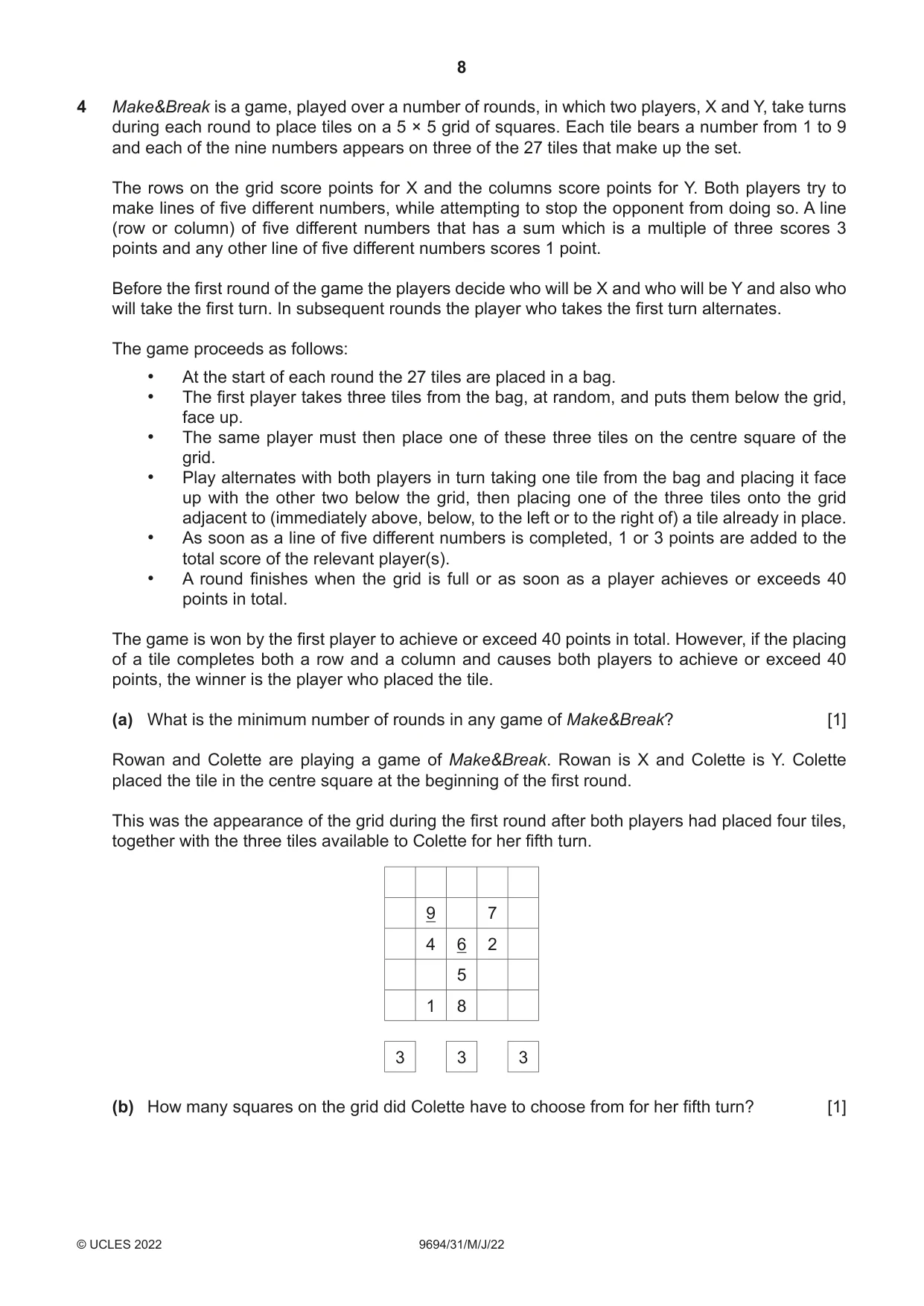
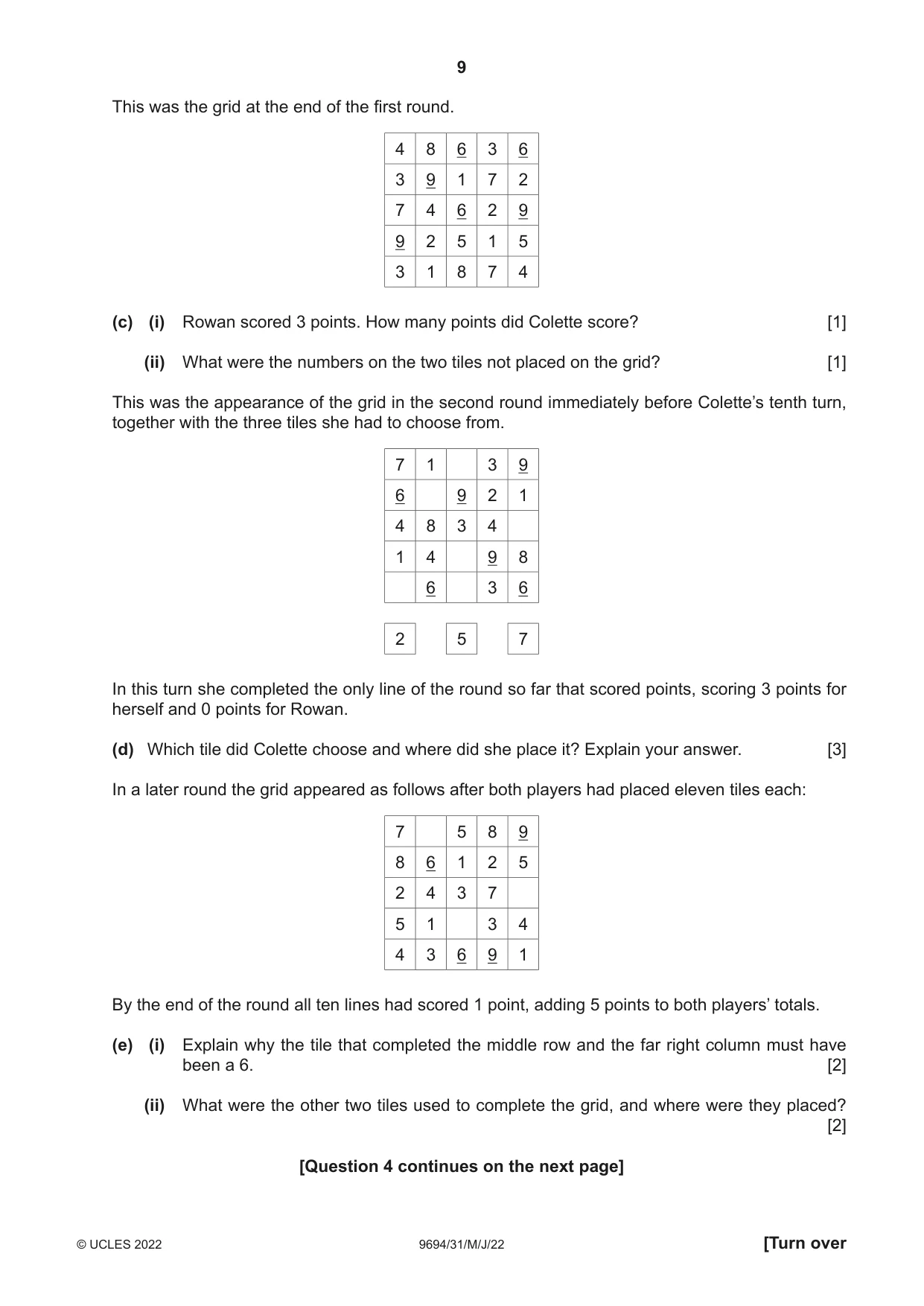
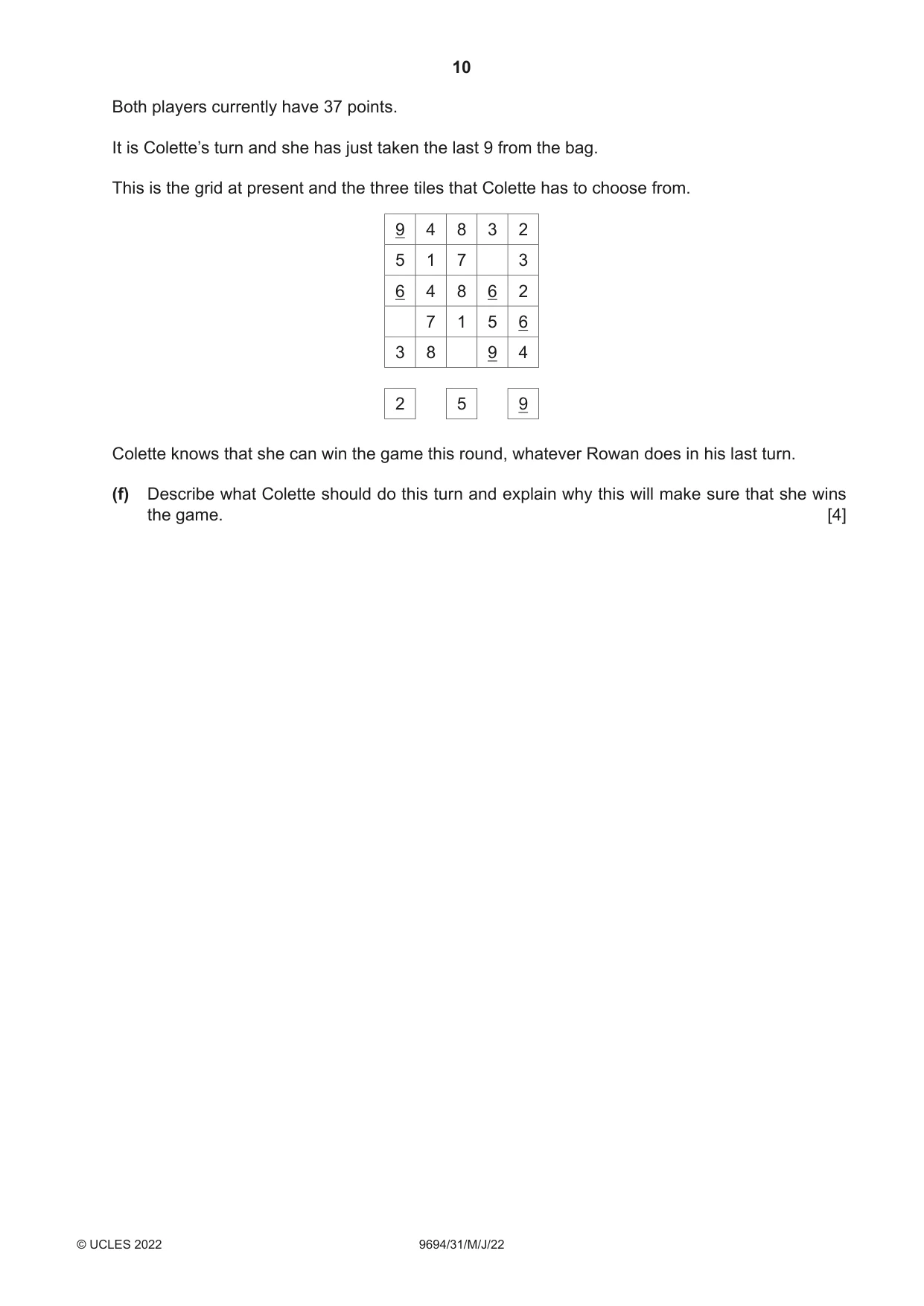
4 Make&Break is a game, played over a number of rounds, in which two players, X and Y, take turns during each round to place tiles on a 5 × 5 grid of squares. Each tile bears a number from 1 to 9 and each of the nine numbers appears on three of the 27 tiles that make up the set. The rows on the grid score points for X and the columns score points for Y. Both players try to make lines of five different numbers, while attempting to stop the opponent from doing so. A line (row or column) of five different numbers that has a sum which is a multiple of three scores 3 points and any other line of five different numbers scores 1 point. Before the first round of the game the players decide who will be X and who will be Y and also who will take the first turn. In subsequent rounds the player who takes the first turn alternates. The game proceeds as follows: • At the start of each round the 27 tiles are placed in a bag. • The first player takes three tiles from the bag, at random, and puts them below the grid, face up. • The same player must then place one of these three tiles on the centre square of the grid. • Play alternates with both players in turn taking one tile from the bag and placing it face up with the other two below the grid, then placing one of the three tiles onto the grid adjacent to (immediately above, below, to the left or to the right of) a tile already in place. • As soon as a line of five different numbers is completed, 1 or 3 points are added to the total score of the relevant player(s). • A round finishes when the grid is full or as soon as a player achieves or exceeds 40 points in total. The game is won by the first player to achieve or exceed 40 points in total. However, if the placing of a tile completes both a row and a column and causes both players to achieve or exceed 40 points, the winner is the player who placed the tile. (a) What is the minimum number of rounds in any game of Make&Break? [1] Rowan and Colette are playing a game of Make&Break. Rowan is X and Colette is Y. Colette placed the tile in the centre square at the beginning of the first round. This was the appearance of the grid during the first round after both players had placed four tiles, together with the three tiles available to Colette for her fifth turn. 9 7 4 6 2 5 1 8 3 3 3 (b) How many squares on the grid did Colette have to choose from for her fifth turn? [1] This was the grid at the end of the first round. 4 8 6 3 6 3 9 1 7 2 7 4 6 2 9 9 2 5 1 5 3 1 8 7 4 (c) (i) Rowan scored 3 points. How many points did Colette score? [1] (ii) What were the numbers on the two tiles not placed on the grid? [1] This was the appearance of the grid in the second round immediately before Colette’s tenth turn, together with the three tiles she had to choose from. 7 1 3 9 6 9 2 1 4 8 3 4 1 4 9 8 6 3 6 2 5 7 In this turn she completed the only line of the round so far that scored points, scoring 3 points for herself and 0 points for Rowan. (d) Which tile did Colette choose and where did she place it? Explain your answer. [3] In a later round the grid appeared as follows after both players had placed eleven tiles each: 7 5 8 9 8 6 1 2 5 2 4 3 7 5 1 3 4 4 3 6 9 1 By the end of the round all ten lines had scored 1 point, adding 5 points to both players’ totals. (e) (i) Explain why the tile that completed the middle row and the far right column must have been a 6. [2] (ii) What were the other two tiles used to complete the grid, and where were they placed? [2] [Question 4 continues on the next page] Both players currently have 37 points. It is Colette’s turn and she has just taken the last 9 from the bag. This is the grid at present and the three tiles that Colette has to choose from. 9 4 8 3 2 5 1 7 3 6 4 8 6 2 7 1 5 6 3 8 9 4 2 5 9 Colette knows that she can win the game this round, whatever Rowan does in his last turn. (f) Describe what Colette should do this turn and explain why this will make sure that she wins the game. [4]
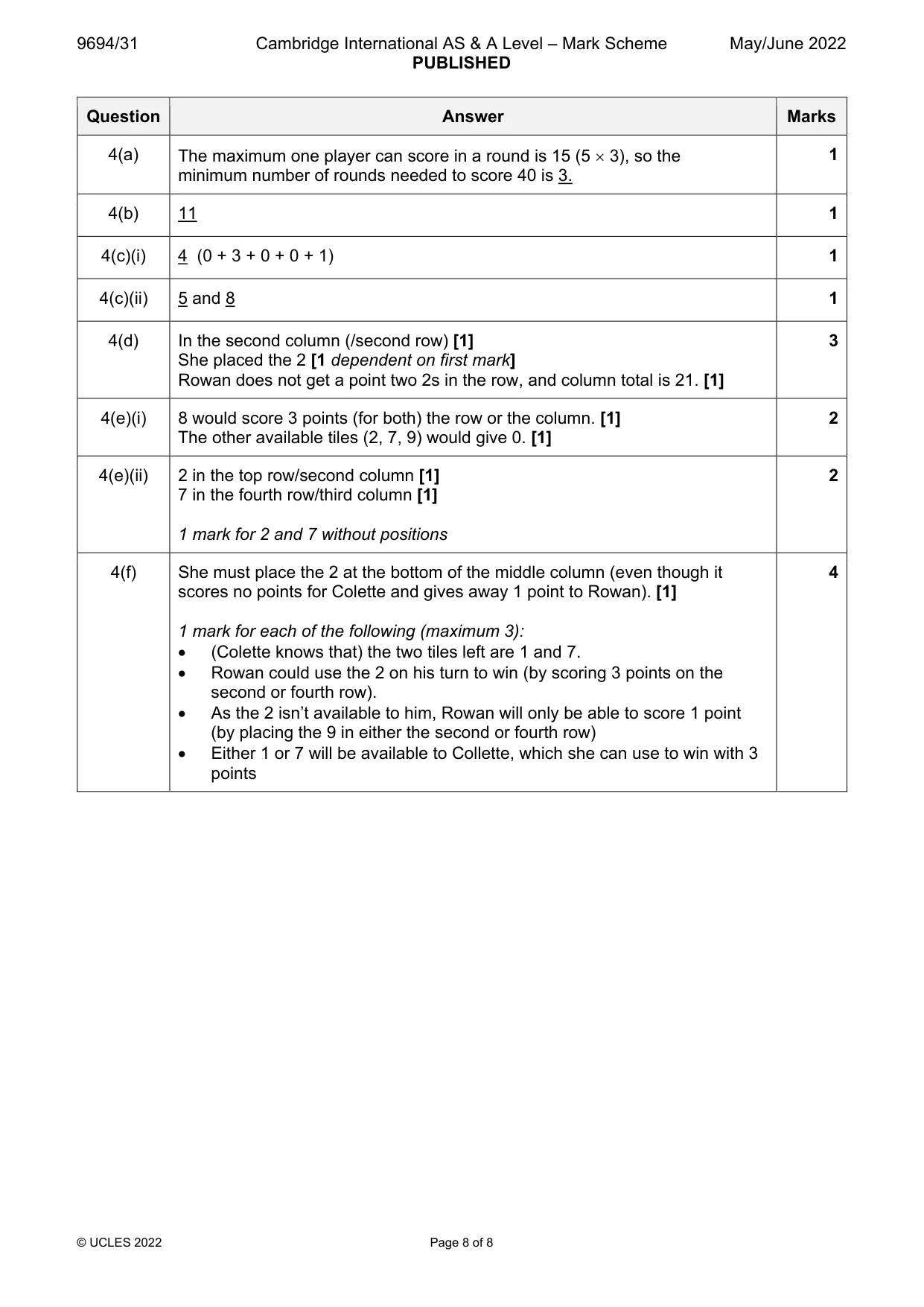
Mark scheme: 4(a) The maximum one player can score in a round is 15 (5 3), so the 1 minimum number of rounds needed to score 40 is 3. 4(b) 11 1 4(c)(i) 4 (0 + 3 + 0 + 0 + 1) 1 4(c)(ii) 5 and 8 1 4(d) In the second column (/second row) [1] 3 She placed the 2 [1 dependent on first mark] Rowan does not get a point two 2s in the row, and column total is 21. [1] 4(e)(i) 8 would score 3 points (for both) the row or the column. [1] 2 The other available tiles (2, 7, 9) would give 0. [1] 4(e)(ii) 2 in the top row/second column [1] 2 7 in the fourth row/third column [1] 1 mark for 2 and 7 without positions 4(f) She must place the 2 at the bottom of the middle column (even though it 4 scores no points for Colette and gives away 1 point to Rowan). [1] 1 mark for each of the following (maximum 3): (Colette knows that) the two tiles left are 1 and 7. Rowan could use the 2 on his turn to win (by scoring 3 points on the second or fourth row). As the 2 isn’t available to him, Rowan will only be able to score 1 point (by placing the 9 in either the second or fourth row) Either 1 or 7 will be available to Collette, which she can use to win with 3 points
What was in this paper
The subtopics covered by these 4 questions, and how many questions each got. Open one in a new tab to see every Cambridge question on it.
What you needed in this session
Cambridge’s own grade thresholds for 2022 May/June, Paper 3 · Variant 1. A higher threshold means an easier paper — the bar moves with how the cohort did.