Cambridge A Level Thinking Skills 9694 — 2019 Oct/Nov Paper 3 · Variant 2
9694/32/O/N/19 · 4 questions · 50 marks · ≈56 min
The question paper and its mark scheme, free to read here and free to download. This is Cambridge’s own paper, exactly as it was sat.
Question paper12 pages



Mark scheme7 pages
Answers below. Sit the paper first if you are practising.
Questions as text
Q1 · An online toy store sells all of its toys in boxes that are wrapped and then tied with…
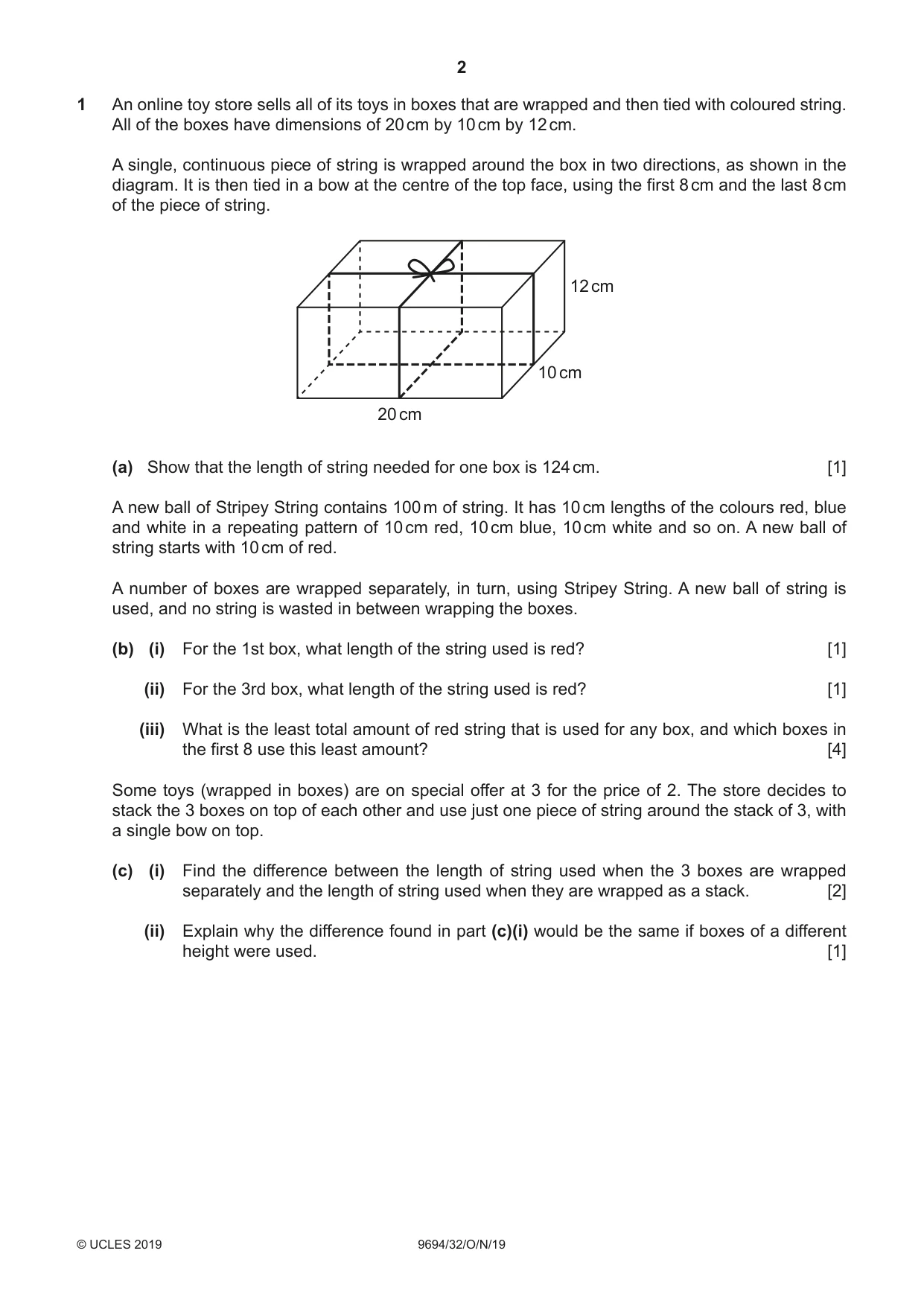
1 An online toy store sells all of its toys in boxes that are wrapped and then tied with coloured string. All of the boxes have dimensions of 20 cm by 10 cm by 12 cm. A single, continuous piece of string is wrapped around the box in two directions, as shown in the diagram. It is then tied in a bow at the centre of the top face, using the first 8 cm and the last 8 cm of the piece of string. 12 cm 10 cm 20 cm (a) Show that the length of string needed for one box is 124 cm. [1] A new ball of Stripey String contains 100 m of string. It has 10 cm lengths of the colours red, blue and white in a repeating pattern of 10 cm red, 10 cm blue, 10 cm white and so on. A new ball of string starts with 10 cm of red. A number of boxes are wrapped separately, in turn, using Stripey String. A new ball of string is used, and no string is wasted in between wrapping the boxes. (b) (i) For the 1st box, what length of the string used is red? [1] (ii) For the 3rd box, what length of the string used is red? [1] (iii) What is the least total amount of red string that is used for any box, and which boxes in the first 8 use this least amount? [4] Some toys (wrapped in boxes) are on special offer at 3 for the price of 2. The store decides to stack the 3 boxes on top of each other and use just one piece of string around the stack of 3, with a single bow on top. (c) (i) Find the difference between the length of string used when the 3 boxes are wrapped separately and the length of string used when they are wrapped as a stack. [2] (ii) Explain why the difference found in part (c)(i) would be the same if boxes of a different height were used. [1] [Question 2 begins on the next page]
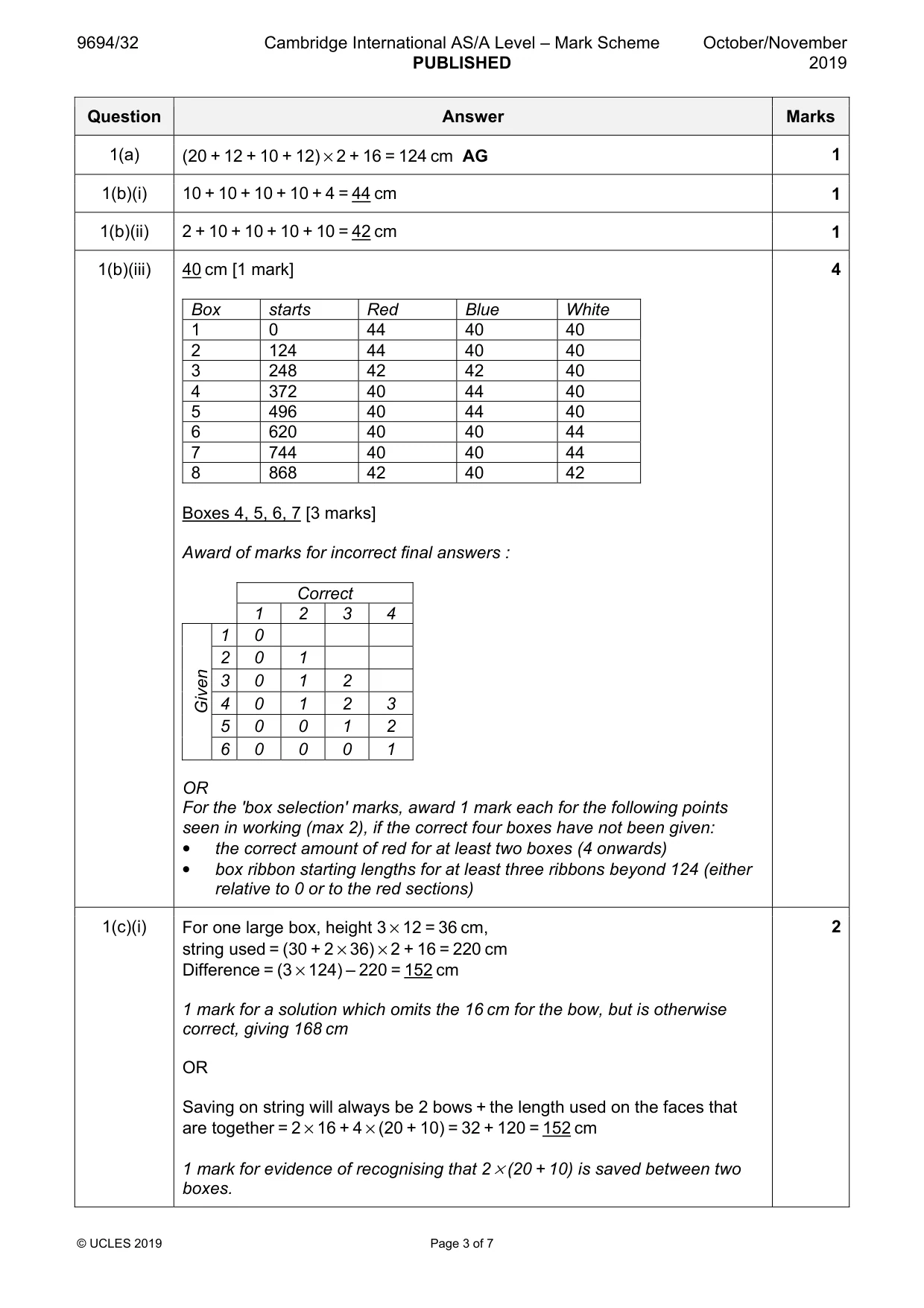
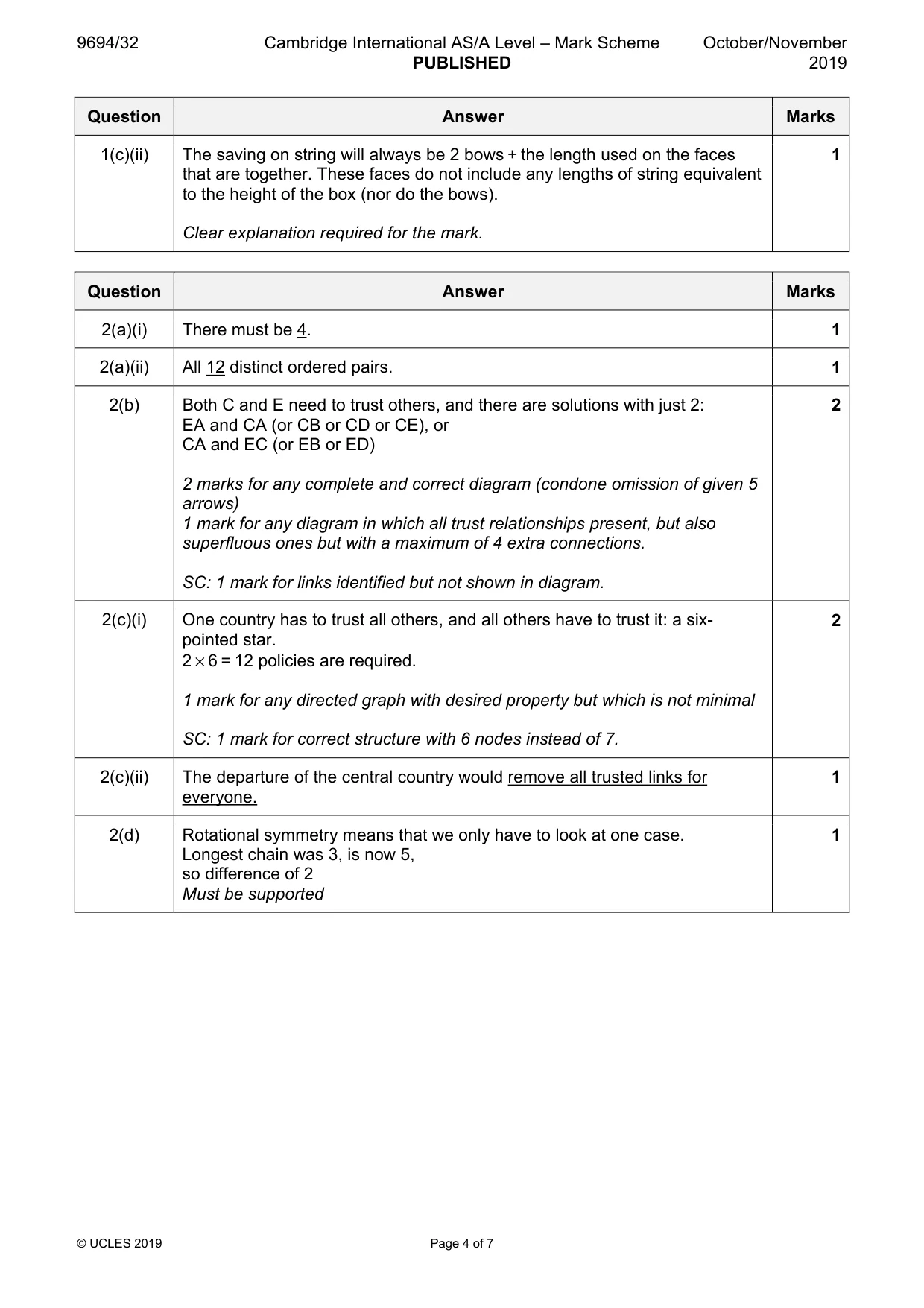
Mark scheme: Question Answer Marks 1(a) (20 + 12 + 10 + 12) × 2 + 16 = 124 cm AG 1 1(b)(i) 10 + 10 + 10 + 10 + 4 = 44 cm 1 1(b)(ii) 2 + 10 + 10 + 10 + 10 = 42 cm 1 1(b)(iii) 40 cm [1 mark] 4 Box starts Red Blue White 1 0 44 40 40 2 124 44 40 40 3 248 42 42 40 4 372 40 44 40 5 496 40 44 40 6 620 40 40 44 7 744 40 40 44 8 868 42 40 42 Boxes 4, 5, 6, 7 [3 marks] Award of marks for incorrect final answers : Correct 1 2 3 4 1 0 2 0 1 Given 34 00 11 22 3 5 0 0 1 2 6 0 0 0 1 OR For the 'box selection' marks, award 1 mark each for the following points seen in working (max 2), if the correct four boxes have not been given: • the correct amount of red for at least two boxes (4 onwards) • box ribbon starting lengths for at least three ribbons beyond 124 (either relative to 0 or to the red sections) 1(c)(i) For one large box, height 3 × 12 = 36 cm, 2 string used = (30 + 2 × 36) × 2 + 16 = 220 cm Difference = (3 × 124) – 220 = 152 cm 1 mark for a solution which omits the 16 cm for the bow, but is otherwise correct, giving 168 cm OR Saving on string will always be 2 bows + the length used on the faces that are together = 2 × 16 + 4 × (20 + 10) = 32 + 120 = 152 cm 1 mark for evidence of recognising that 2 × (20 + 10) is saved between two boxes. 1(c)(ii) The saving on string will always be 2 bows + the length used on the faces 1 that are together. These faces do not include any lengths of string equivalent to the height of the box (nor do the bows). Clear explanation required for the mark.
More questions on Perform appropriate operations with information
Q2 · Electronic passports (e-passports) are only useful if their origin can be checked
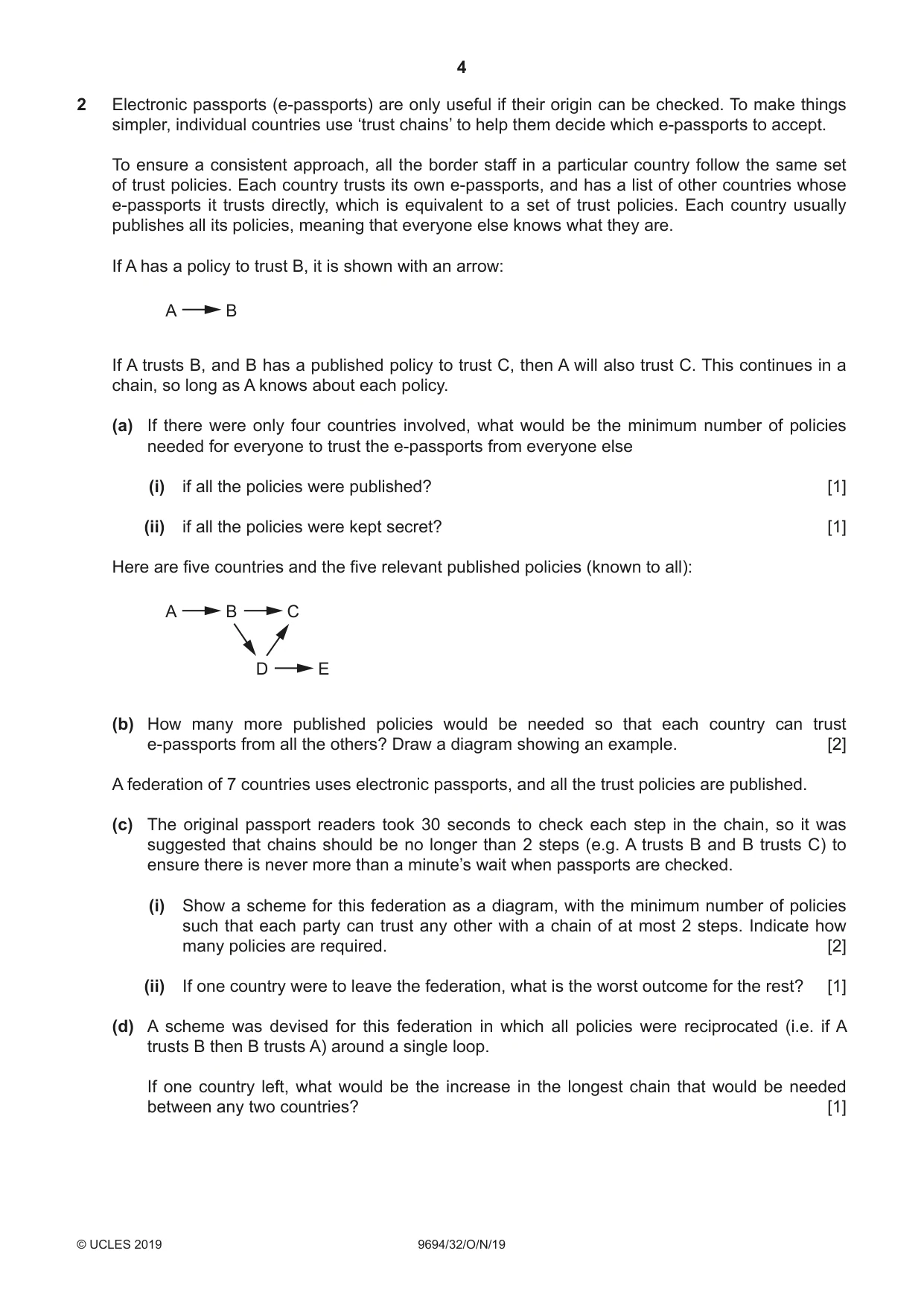
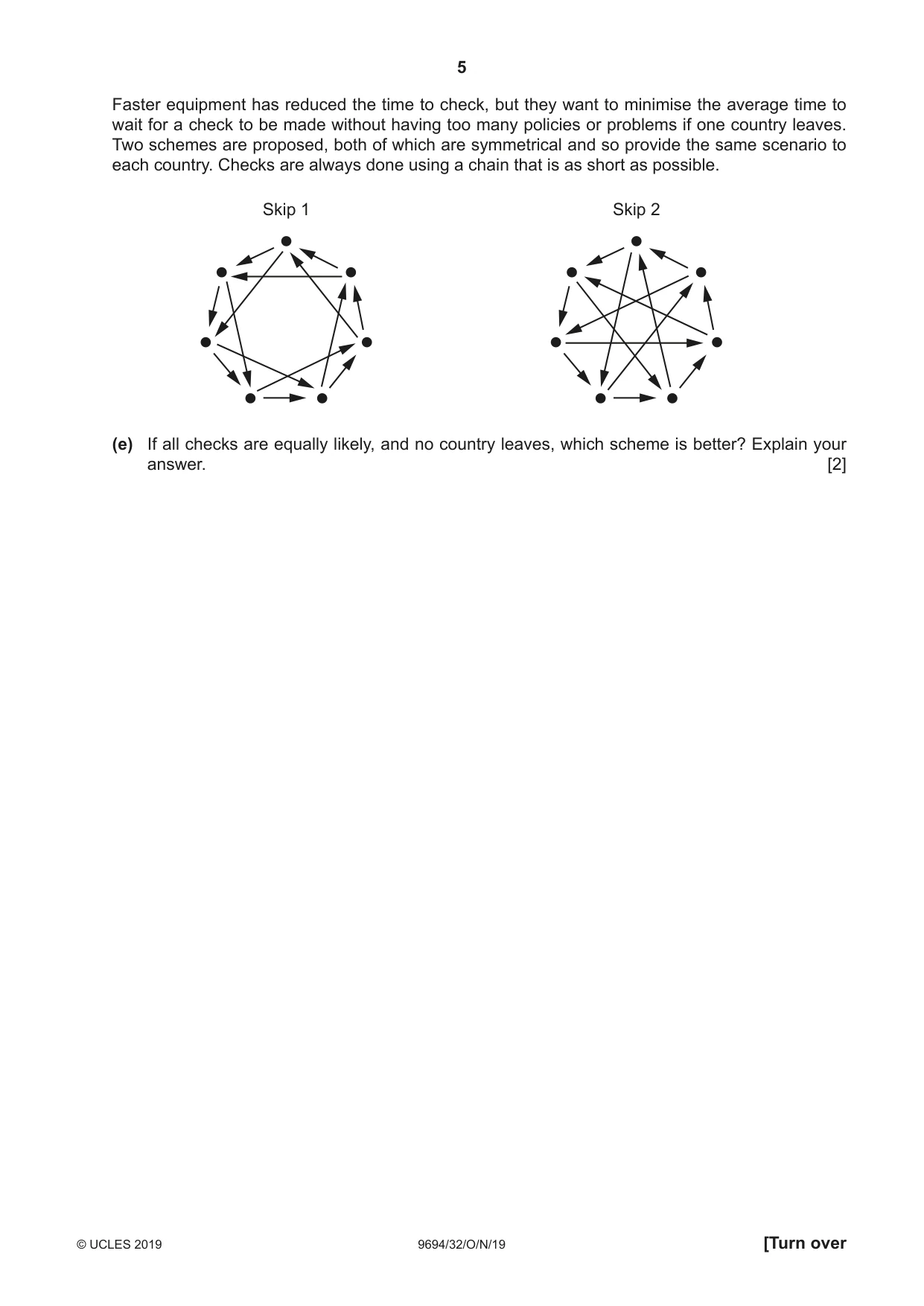
2 Electronic passports (e-passports) are only useful if their origin can be checked. To make things simpler, individual countries use ‘trust chains’ to help them decide which e-passports to accept. To ensure a consistent approach, all the border staff in a particular country follow the same set of trust policies. Each country trusts its own e-passports, and has a list of other countries whose e-passports it trusts directly, which is equivalent to a set of trust policies. Each country usually publishes all its policies, meaning that everyone else knows what they are. If A has a policy to trust B, it is shown with an arrow: A B If A trusts B, and B has a published policy to trust C, then A will also trust C. This continues in a chain, so long as A knows about each policy. (a) If there were only four countries involved, what would be the minimum number of policies needed for everyone to trust the e-passports from everyone else (i) if all the policies were published? [1] (ii) if all the policies were kept secret? [1] Here are five countries and the five relevant published policies (known to all): A B C D E (b) How many more published policies would be needed so that each country can trust e-passports from all the others? Draw a diagram showing an example. [2] A federation of 7 countries uses electronic passports, and all the trust policies are published. (c) The original passport readers took 30 seconds to check each step in the chain, so it was suggested that chains should be no longer than 2 steps (e.g. A trusts B and B trusts C) to ensure there is never more than a minute’s wait when passports are checked. (i) Show a scheme for this federation as a diagram, with the minimum number of policies such that each party can trust any other with a chain of at most 2 steps. Indicate how many policies are required. [2] (ii) If one country were to leave the federation, what is the worst outcome for the rest? [1] (d) A scheme was devised for this federation in which all policies were reciprocated (i.e. if A trusts B then B trusts A) around a single loop. If one country left, what would be the increase in the longest chain that would be needed between any two countries? [1] Faster equipment has reduced the time to check, but they want to minimise the average time to wait for a check to be made without having too many policies or problems if one country leaves. Two schemes are proposed, both of which are symmetrical and so provide the same scenario to each country. Checks are always done using a chain that is as short as possible. Skip 1 Skip 2 (e) If all checks are equally likely, and no country leaves, which scheme is better? Explain your answer. [2]
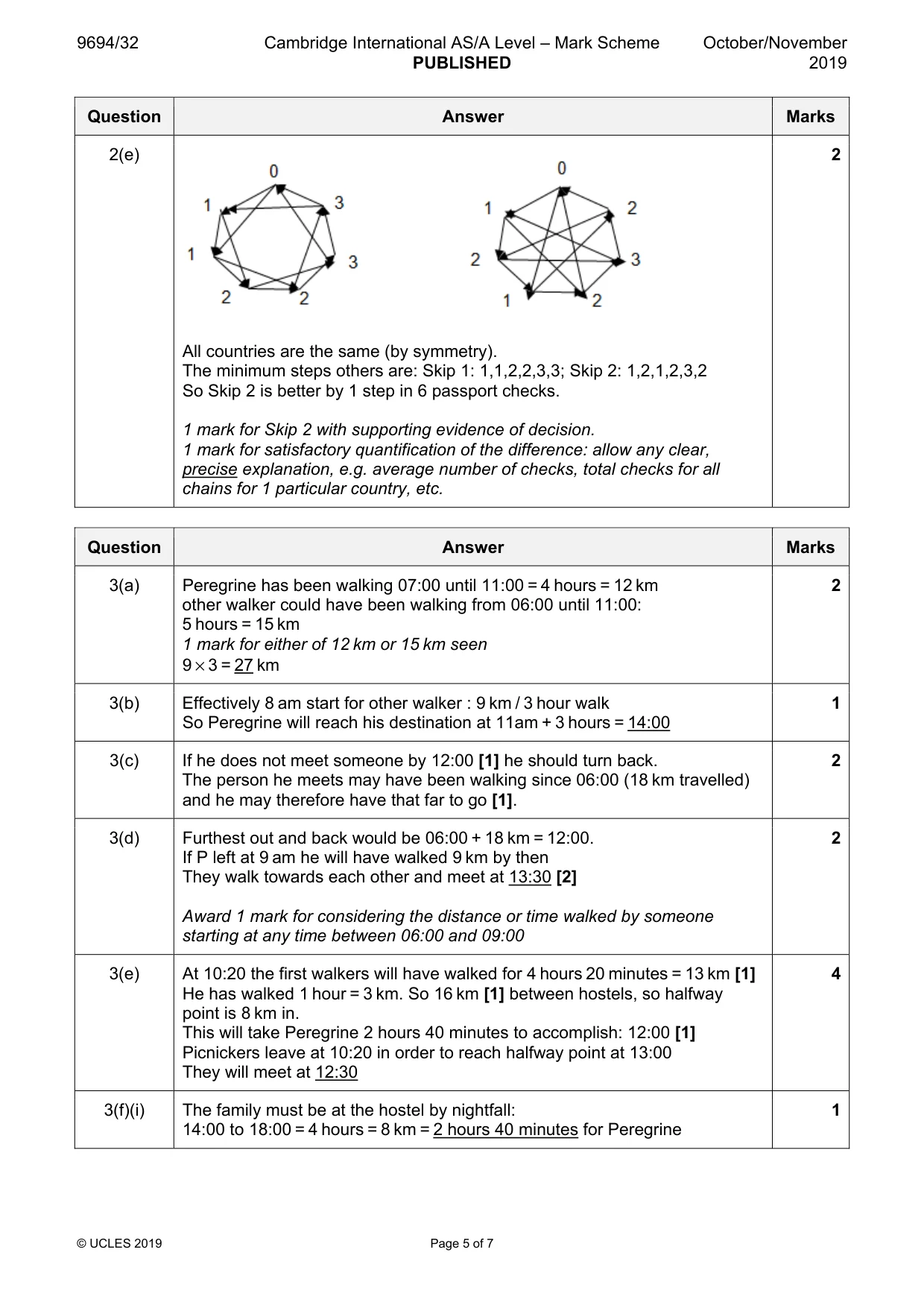
Mark scheme: 2(a)(i) There must be 4. 1 2(a)(ii) All 12 distinct ordered pairs. 1 2(b) Both C and E need to trust others, and there are solutions with just 2: 2 EA and CA (or CB or CD or CE), or CA and EC (or EB or ED) 2 marks for any complete and correct diagram (condone omission of given 5 arrows) 1 mark for any diagram in which all trust relationships present, but also superfluous ones but with a maximum of 4 extra connections. SC: 1 mark for links identified but not shown in diagram. 2(c)(i) One country has to trust all others, and all others have to trust it: a six- 2 pointed star. 2 × 6 = 12 policies are required. 1 mark for any directed graph with desired property but which is not minimal SC: 1 mark for correct structure with 6 nodes instead of 7. 2(c)(ii) The departure of the central country would remove all trusted links for 1 everyone. 2(d) Rotational symmetry means that we only have to look at one case. 1 Longest chain was 3, is now 5, so difference of 2 Must be supported 2(e) 2 All countries are the same (by symmetry). The minimum steps others are: Skip 1: 1,1,2,2,3,3; Skip 2: 1,2,1,2,3,2 So Skip 2 is better by 1 step in 6 passport checks. 1 mark for Skip 2 with supporting evidence of decision. 1 mark for satisfactory quantification of the difference: allow any clear, precise explanation, e.g. average number of checks, total checks for all chains for 1 particular country, etc.
Q3 · Peregrine is spending a week walking along a famous mountain path
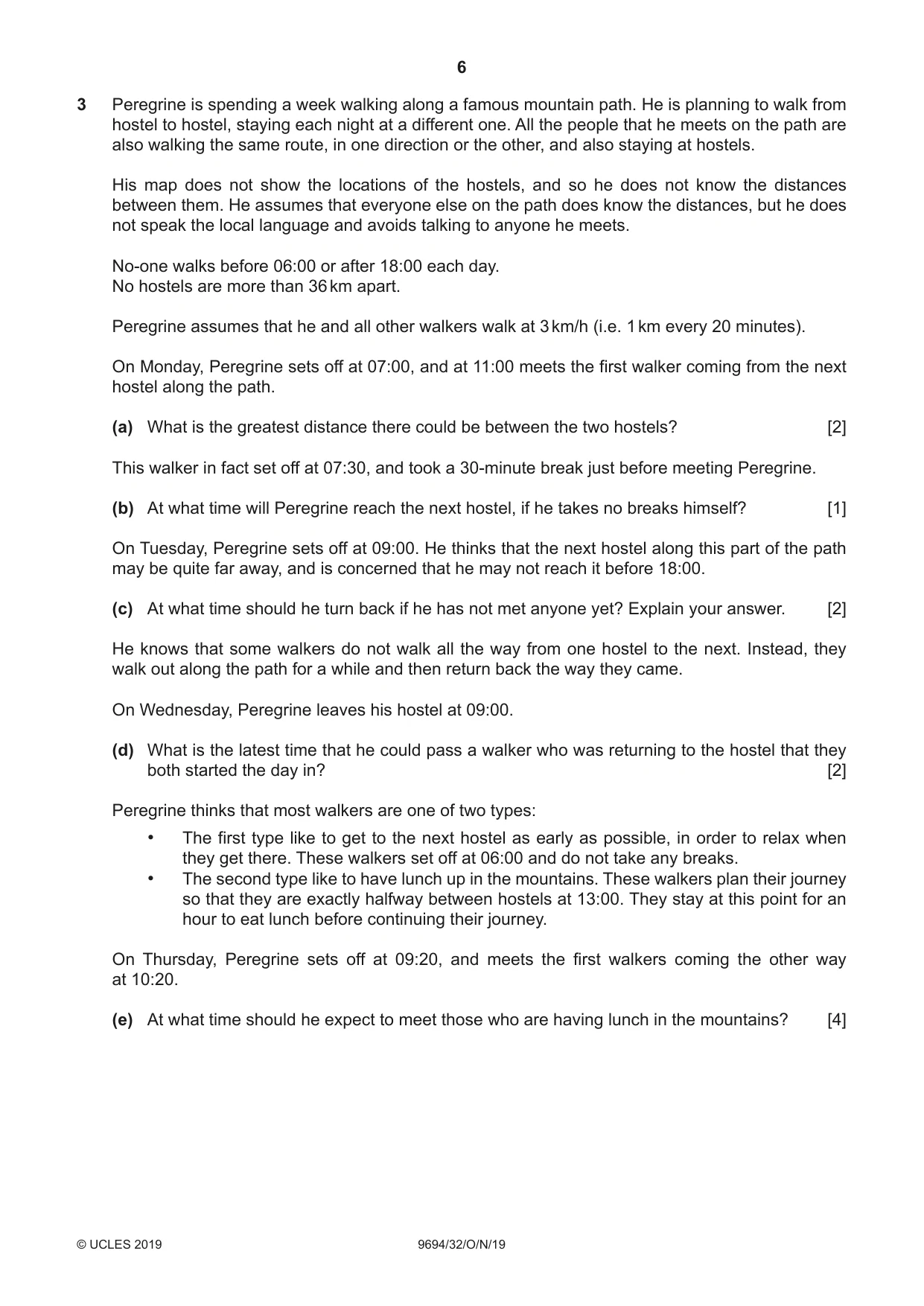
3 Peregrine is spending a week walking along a famous mountain path. He is planning to walk from hostel to hostel, staying each night at a different one. All the people that he meets on the path are also walking the same route, in one direction or the other, and also staying at hostels. His map does not show the locations of the hostels, and so he does not know the distances between them. He assumes that everyone else on the path does know the distances, but he does not speak the local language and avoids talking to anyone he meets. No-one walks before 06:00 or after 18:00 each day. No hostels are more than 36 km apart. Peregrine assumes that he and all other walkers walk at 3 km/h (i.e. 1 km every 20 minutes). On Monday, Peregrine sets off at 07:00, and at 11:00 meets the first walker coming from the next hostel along the path. (a) What is the greatest distance there could be between the two hostels? [2] This walker in fact set off at 07:30, and took a 30-minute break just before meeting Peregrine. (b) At what time will Peregrine reach the next hostel, if he takes no breaks himself? [1] On Tuesday, Peregrine sets off at 09:00. He thinks that the next hostel along this part of the path may be quite far away, and is concerned that he may not reach it before 18:00. (c) At what time should he turn back if he has not met anyone yet? Explain your answer. [2] He knows that some walkers do not walk all the way from one hostel to the next. Instead, they walk out along the path for a while and then return back the way they came. On Wednesday, Peregrine leaves his hostel at 09:00. (d) What is the latest time that he could pass a walker who was returning to the hostel that they both started the day in? [2] Peregrine thinks that most walkers are one of two types: • The first type like to get to the next hostel as early as possible, in order to relax when they get there. These walkers set off at 06:00 and do not take any breaks. • The second type like to have lunch up in the mountains. These walkers plan their journey so that they are exactly halfway between hostels at 13:00. They stay at this point for an hour to eat lunch before continuing their journey. On Thursday, Peregrine sets off at 09:20, and meets the first walkers coming the other way at 10:20. (e) At what time should he expect to meet those who are having lunch in the mountains? [4] On Friday and Saturday, Peregrine walks in the foothills, where the path is less steep. Families with young children often walk on these sections of the path, and they are also popular with runners. He assumes that families walk at 2 km/h, and runners run at 4 km/h. On Friday, Peregrine sets off from his hostel at 09:00. He overtakes a family at 14:00. (f) (i) What is the maximum amount of time he might have to walk to reach the next hostel? [1] (ii) What is the latest time he can expect to overtake a family who set off from the same hostel as him? [1] On Saturday, Peregrine sets off from his hostel at 11:00. (g) What is the latest time that a runner who overtakes him could have set off from the same hostel as him? [2]
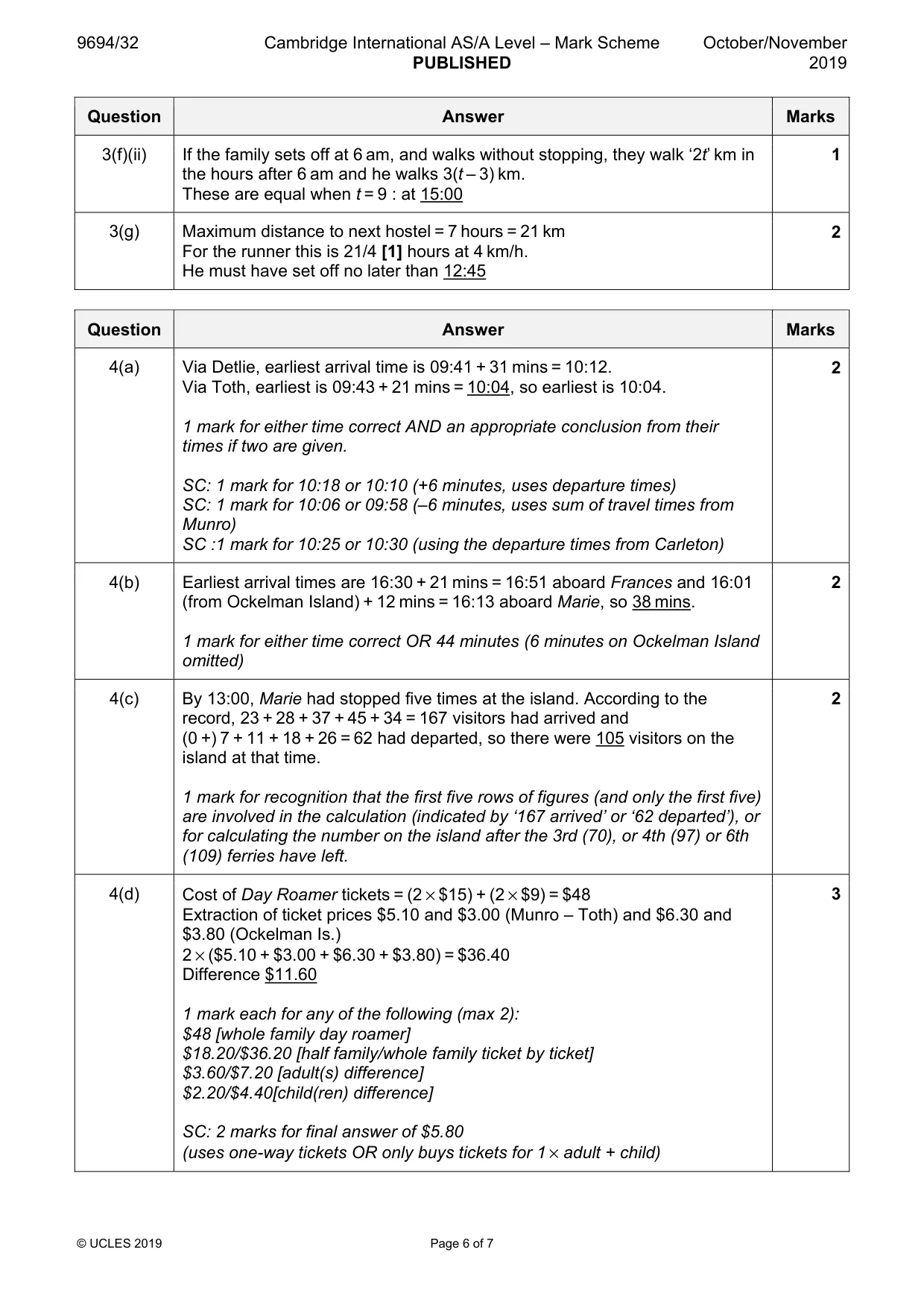
Mark scheme: 3(a) Peregrine has been walking 07:00 until 11:00 = 4 hours = 12 km 2 other walker could have been walking from 06:00 until 11:00: 5 hours = 15 km 1 mark for either of 12 km or 15 km seen 9 × 3 = 27 km 3(b) Effectively 8 am start for other walker : 9 km / 3 hour walk 1 So Peregrine will reach his destination at 11am + 3 hours = 14:00 3(c) If he does not meet someone by 12:00 [1] he should turn back. 2 The person he meets may have been walking since 06:00 (18 km travelled) and he may therefore have that far to go [1]. 3(d) Furthest out and back would be 06:00 + 18 km = 12:00. 2 If P left at 9 am he will have walked 9 km by then They walk towards each other and meet at 13:30 [2] Award 1 mark for considering the distance or time walked by someone starting at any time between 06:00 and 09:00 3(e) At 10:20 the first walkers will have walked for 4 hours 20 minutes = 13 km [1] 4 He has walked 1 hour = 3 km. So 16 km [1] between hostels, so halfway point is 8 km in. This will take Peregrine 2 hours 40 minutes to accomplish: 12:00 [1] Picnickers leave at 10:20 in order to reach halfway point at 13:00 They will meet at 12:30 3(f)(i) The family must be at the hostel by nightfall: 1 14:00 to 18:00 = 4 hours = 8 km = 2 hours 40 minutes for Peregrine 3(f)(ii) If the family sets off at 6 am, and walks without stopping, they walk ‘2t’ km in 1 the hours after 6 am and he walks 3(t – 3) km. These are equal when t = 9 : at 15:00 3(g) Maximum distance to next hostel = 7 hours = 21 km 2 For the runner this is 21/4 [1] hours at 4 km/h. He must have set off no later than 12:45
Q4 · This map shows the ferry routes on Lake Veronica, together with the time taken to sail…
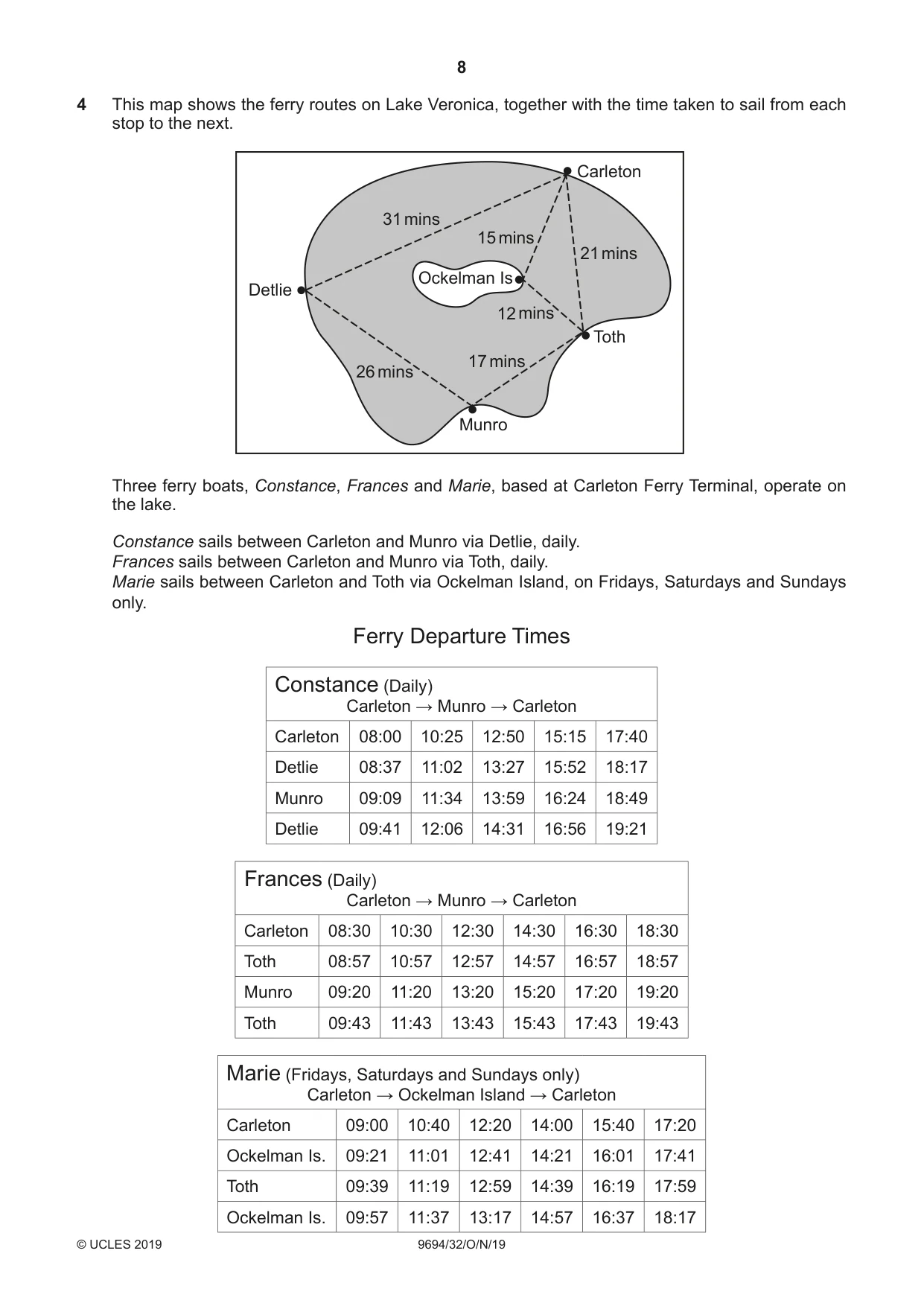
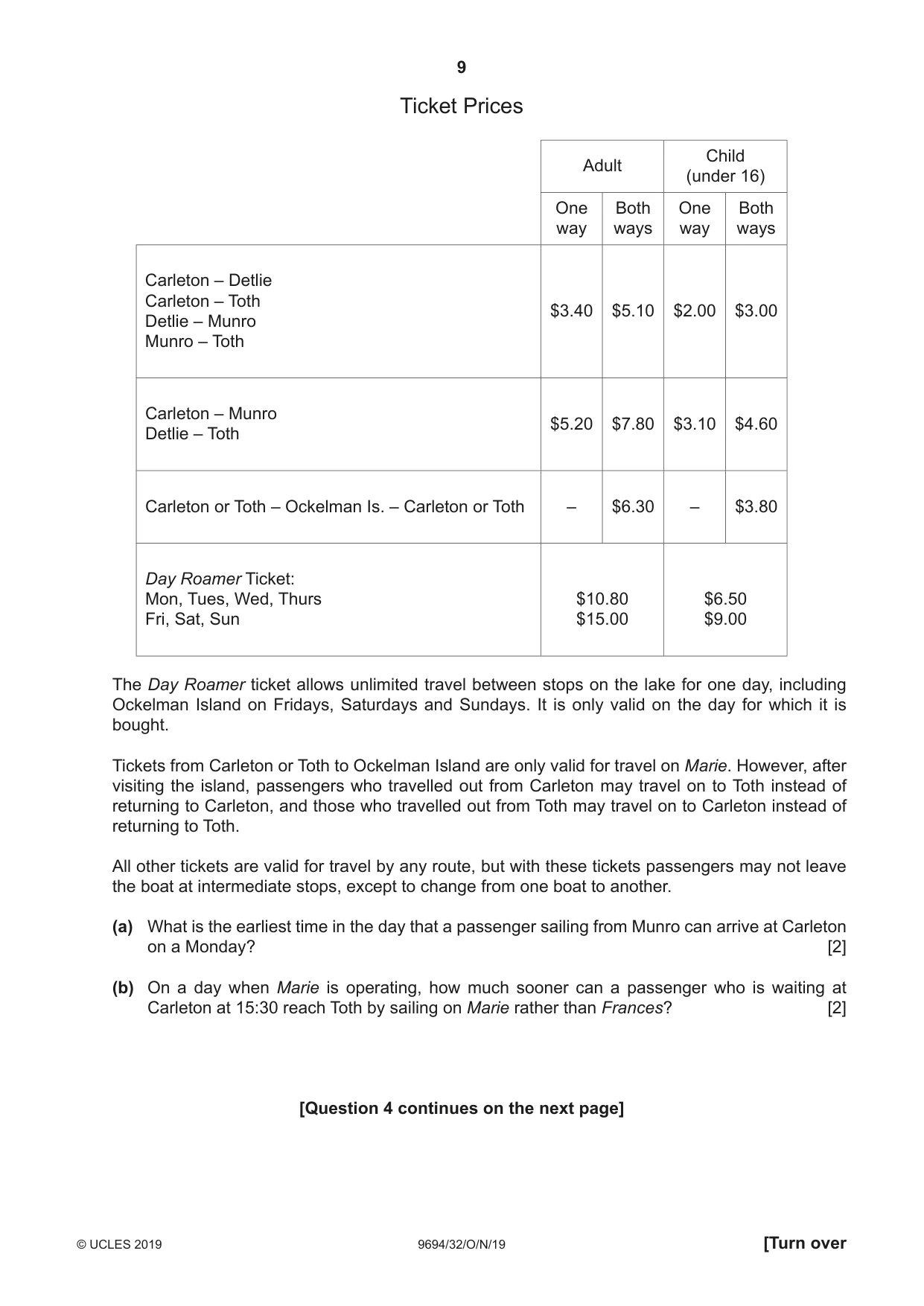
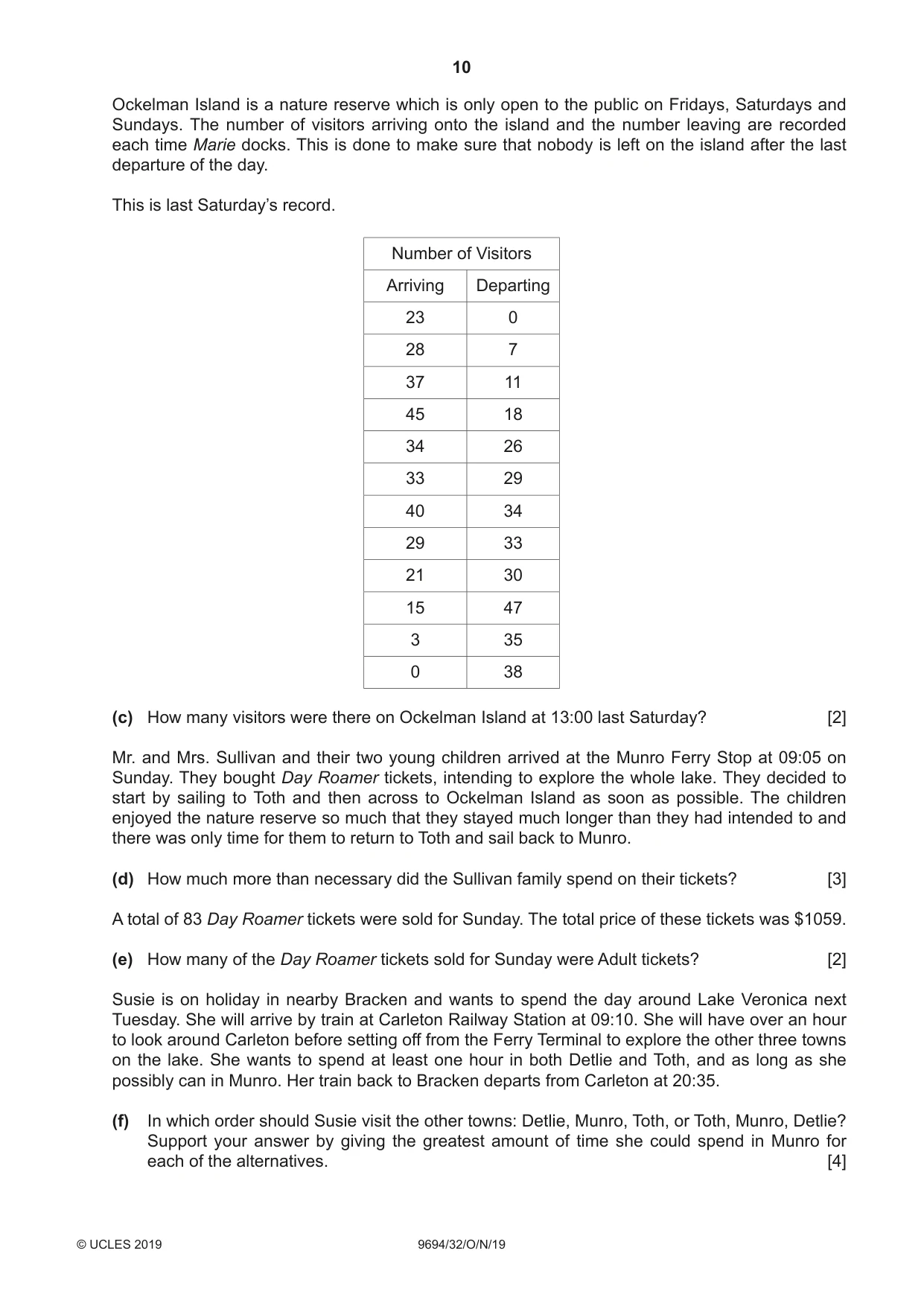
4 This map shows the ferry routes on Lake Veronica, together with the time taken to sail from each stop to the next. Carleton 31 mins 15 mins 21 mins Ockelman Is Detlie 12 mins Toth 17 mins 26 mins Munro Three ferry boats, Constance, Frances and Marie, based at Carleton Ferry Terminal, operate on the lake. Constance sails between Carleton and Munro via Detlie, daily. Frances sails between Carleton and Munro via Toth, daily. Marie sails between Carleton and Toth via Ockelman Island, on Fridays, Saturdays and Sundays only. Ferry Departure Times Constance (Daily) Carleton → Munro → Carleton Carleton 08:00 10:25 12:50 15:15 17:40 Detlie 08:37 11:02 13:27 15:52 18:17 Munro 09:09 11:34 13:59 16:24 18:49 Detlie 09:41 12:06 14:31 16:56 19:21 Frances (Daily) Carleton → Munro → Carleton Carleton 08:30 10:30 12:30 14:30 16:30 18:30 Toth 08:57 10:57 12:57 14:57 16:57 18:57 Munro 09:20 11:20 13:20 15:20 17:20 19:20 Toth 09:43 11:43 13:43 15:43 17:43 19:43 Marie (Fridays, Saturdays and Sundays only) Carleton → Ockelman Island → Carleton Carleton 09:00 10:40 12:20 14:00 15:40 17:20 Ockelman Is. 09:21 11:01 12:41 14:21 16:01 17:41 Toth 09:39 11:19 12:59 14:39 16:19 17:59 Ockelman Is. 09:57 11:37 13:17 14:57 16:37 18:17 Ticket Prices Child Adult (under 16) One Both One Both way ways way ways Carleton – Detlie Carleton – Toth $3.40 $5.10 $2.00 $3.00 Detlie – Munro Munro – Toth Carleton – Munro $5.20 $7.80 $3.10 $4.60 Detlie – Toth Carleton or Toth – Ockelman Is. – Carleton or Toth – $6.30 – $3.80 Day Roamer Ticket: Mon, Tues, Wed, Thurs $10.80 $6.50 Fri, Sat, Sun $15.00 $9.00 The Day Roamer ticket allows unlimited travel between stops on the lake for one day, including Ockelman Island on Fridays, Saturdays and Sundays. It is only valid on the day for which it is bought. Tickets from Carleton or Toth to Ockelman Island are only valid for travel on Marie. However, after visiting the island, passengers who travelled out from Carleton may travel on to Toth instead of returning to Carleton, and those who travelled out from Toth may travel on to Carleton instead of returning to Toth. All other tickets are valid for travel by any route, but with these tickets passengers may not leave the boat at intermediate stops, except to change from one boat to another. (a) What is the earliest time in the day that a passenger sailing from Munro can arrive at Carleton on a Monday? [2] (b) On a day when Marie is operating, how much sooner can a passenger who is waiting at Carleton at 15:30 reach Toth by sailing on Marie rather than Frances? [2] [Question 4 continues on the next page] Ockelman Island is a nature reserve which is only open to the public on Fridays, Saturdays and Sundays. The number of visitors arriving onto the island and the number leaving are recorded each time Marie docks. This is done to make sure that nobody is left on the island after the last departure of the day. This is last Saturday’s record. Number of Visitors Arriving Departing 23 0 28 7 37 11 45 18 34 26 33 29 40 34 29 33 21 30 15 47 3 35 0 38 (c) How many visitors were there on Ockelman Island at 13:00 last Saturday? [2] Mr. and Mrs. Sullivan and their two young children arrived at the Munro Ferry Stop at 09:05 on Sunday. They bought Day Roamer tickets, intending to explore the whole lake. They decided to start by sailing to Toth and then across to Ockelman Island as soon as possible. The children enjoyed the nature reserve so much that they stayed much longer than they had intended to and there was only time for them to return to Toth and sail back to Munro. (d) How much more than necessary did the Sullivan family spend on their tickets? [3] A total of 83 Day Roamer tickets were sold for Sunday. The total price of these tickets was $1059. (e) How many of the Day Roamer tickets sold for Sunday were Adult tickets? [2] Susie is on holiday in nearby Bracken and wants to spend the day around Lake Veronica next Tuesday. She will arrive by train at Carleton Railway Station at 09:10. She will have over an hour to look around Carleton before setting off from the Ferry Terminal to explore the other three towns on the lake. She wants to spend at least one hour in both Detlie and Toth, and as long as she possibly can in Munro. Her train back to Bracken departs from Carleton at 20:35. (f) In which order should Susie visit the other towns: Detlie, Munro, Toth, or Toth, Munro, Detlie? Support your answer by giving the greatest amount of time she could spend in Munro for each of the alternatives. [4]
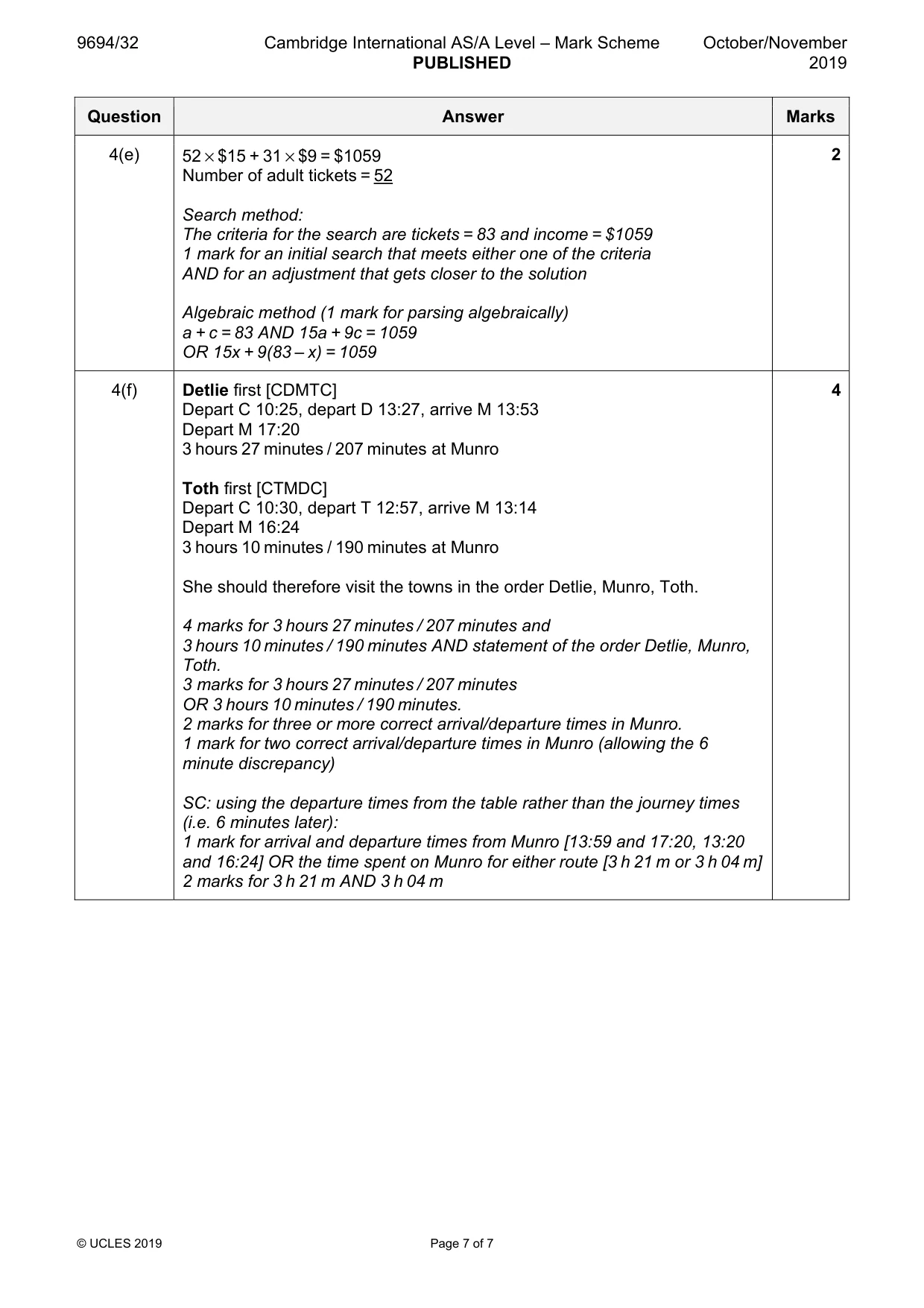
Mark scheme: 4(a) Via Detlie, earliest arrival time is 09:41 + 31 mins = 10:12. 2 Via Toth, earliest is 09:43 + 21 mins = 10:04, so earliest is 10:04. 1 mark for either time correct AND an appropriate conclusion from their times if two are given. SC: 1 mark for 10:18 or 10:10 (+6 minutes, uses departure times) SC: 1 mark for 10:06 or 09:58 (–6 minutes, uses sum of travel times from Munro) SC :1 mark for 10:25 or 10:30 (using the departure times from Carleton) 4(b) Earliest arrival times are 16:30 + 21 mins = 16:51 aboard Frances and 16:01 2 (from Ockelman Island) + 12 mins = 16:13 aboard Marie, so 38 mins. 1 mark for either time correct OR 44 minutes (6 minutes on Ockelman Island omitted) 4(c) By 13:00, Marie had stopped five times at the island. According to the 2 record, 23 + 28 + 37 + 45 + 34 = 167 visitors had arrived and (0 +) 7 + 11 + 18 + 26 = 62 had departed, so there were 105 visitors on the island at that time. 1 mark for recognition that the first five rows of figures (and only the first five) are involved in the calculation (indicated by ‘167 arrived’ or ‘62 departed’), or for calculating the number on the island after the 3rd (70), or 4th (97) or 6th (109) ferries have left. 4(d) Cost of Day Roamer tickets = (2 × $15) + (2 × $9) = $48 3 Extraction of ticket prices $5.10 and $3.00 (Munro – Toth) and $6.30 and $3.80 (Ockelman Is.) 2 × ($5.10 + $3.00 + $6.30 + $3.80) = $36.40 Difference $11.60 1 mark each for any of the following (max 2): $48 [whole family day roamer] $18.20/$36.20 [half family/whole family ticket by ticket] $3.60/$7.20 [adult(s) difference] $2.20/$4.40[child(ren) difference] SC: 2 marks for final answer of $5.80 (uses one-way tickets OR only buys tickets for 1 × adult + child) 4(e) 52 × $15 + 31 × $9 = $1059 2 Number of adult tickets = 52 Search method: The criteria for the search are tickets = 83 and income = $1059 1 mark for an initial search that meets either one of the criteria AND for an adjustment that gets closer to the solution Algebraic method (1 mark for parsing algebraically) a + c = 83 AND 15a + 9c = 1059 OR 15x + 9(83 – x) = 1059 4(f) Detlie first [CDMTC] 4 Depart C 10:25, depart D 13:27, arrive M 13:53 Depart M 17:20 3 hours 27 minutes / 207 minutes at Munro Toth first [CTMDC] Depart C 10:30, depart T 12:57, arrive M 13:14 Depart M 16:24 3 hours 10 minutes / 190 minutes at Munro She should therefore visit the towns in the order Detlie, Munro, Toth. 4 marks for 3 hours 27 minutes / 207 minutes and 3 hours 10 minutes / 190 minutes AND statement of the order Detlie, Munro, Toth. 3 marks for 3 hours 27 minutes / 207 minutes OR 3 hours 10 minutes / 190 minutes. 2 marks for three or more correct arrival/departure times in Munro. 1 mark for two correct arrival/departure times in Munro (allowing the 6 minute discrepancy) SC: using the departure times from the table rather than the journey times (i.e. 6 minutes later): 1 mark for arrival and departure times from Munro [13:59 and 17:20, 13:20 and 16:24] OR the time spent on Munro for either route [3 h 21 m or 3 h 04 m] 2 marks for 3 h 21 m AND 3 h 04 m
More questions on Identify cases that satisfy given criteria
What was in this paper
The subtopics covered by these 4 questions, and how many questions each got. Open one in a new tab to see every Cambridge question on it.
What you needed in this session
Cambridge’s own grade thresholds for 2019 Oct/Nov, Paper 3 · Variant 2. A higher threshold means an easier paper — the bar moves with how the cohort did.