Cambridge A Level Thinking Skills 9694 — 2021 Oct/Nov Paper 3 · Variant 1
9694/31/O/N/21 · 4 questions · 50 marks · ≈56 min
The question paper and its mark scheme, free to read here and free to download. This is Cambridge’s own paper, exactly as it was sat.
Question paper12 pages





Mark scheme9 pages
Answers below. Sit the paper first if you are practising.
Questions as text
Q1 · Jennifer is planning to take part in a sponsored marathon next week
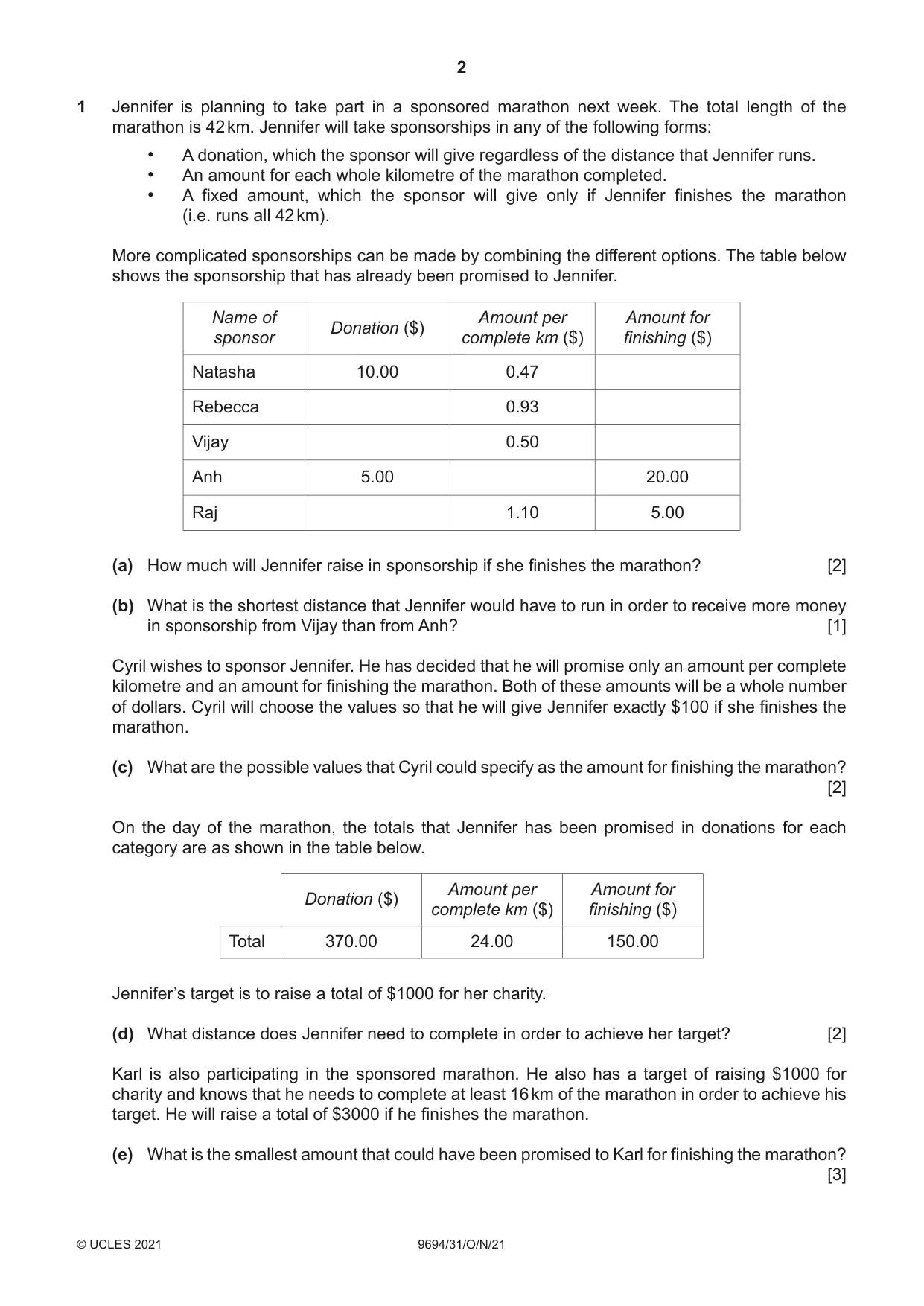
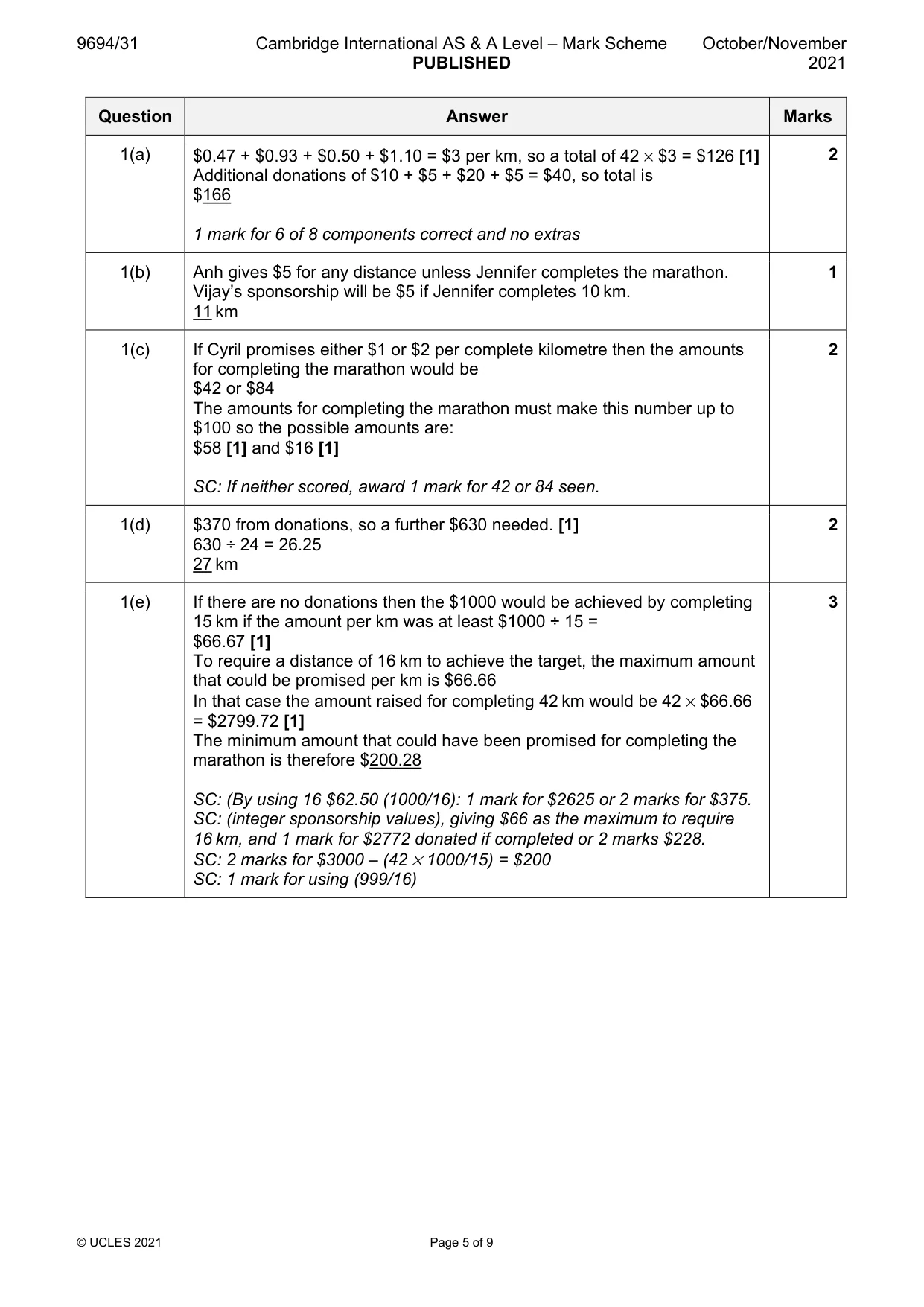
1 Jennifer is planning to take part in a sponsored marathon next week. The total length of the marathon is 42 km. Jennifer will take sponsorships in any of the following forms: • A donation, which the sponsor will give regardless of the distance that Jennifer runs. • An amount for each whole kilometre of the marathon completed. • A fixed amount, which the sponsor will give only if Jennifer finishes the marathon (i.e. runs all 42 km). More complicated sponsorships can be made by combining the different options. The table below shows the sponsorship that has already been promised to Jennifer. Name of Amount per Amount for Donation ($) sponsor complete km ($) finishing ($) Natasha 10.00 0.47 Rebecca 0.93 Vijay 0.50 Anh 5.00 20.00 Raj 1.10 5.00 (a) How much will Jennifer raise in sponsorship if she finishes the marathon? [2] (b) What is the shortest distance that Jennifer would have to run in order to receive more money in sponsorship from Vijay than from Anh? [1] Cyril wishes to sponsor Jennifer. He has decided that he will promise only an amount per complete kilometre and an amount for finishing the marathon. Both of these amounts will be a whole number of dollars. Cyril will choose the values so that he will give Jennifer exactly $100 if she finishes the marathon. (c) What are the possible values that Cyril could specify as the amount for finishing the marathon? [2] On the day of the marathon, the totals that Jennifer has been promised in donations for each category are as shown in the table below. Amount per Amount for Donation ($) complete km ($) finishing ($) Total 370.00 24.00 150.00 Jennifer’s target is to raise a total of $1000 for her charity. (d) What distance does Jennifer need to complete in order to achieve her target? [2] Karl is also participating in the sponsored marathon. He also has a target of raising $1000 for charity and knows that he needs to complete at least 16 km of the marathon in order to achieve his target. He will raise a total of $3000 if he finishes the marathon. (e) What is the smallest amount that could have been promised to Karl for finishing the marathon? [3] [Question 2 begins on the next page]
Mark scheme: Question Answer Marks 1(a) $0.47 + $0.93 + $0.50 + $1.10 = $3 per km, so a total of 42 × $3 = $126 [1] 2 Additional donations of $10 + $5 + $20 + $5 = $40, so total is $166 1 mark for 6 of 8 components correct and no extras 1(b) Anh gives $5 for any distance unless Jennifer completes the marathon. 1 Vijay’s sponsorship will be $5 if Jennifer completes 10 km. 11 km 1(c) If Cyril promises either $1 or $2 per complete kilometre then the amounts 2 for completing the marathon would be $42 or $84 The amounts for completing the marathon must make this number up to $100 so the possible amounts are: $58 [1] and $16 [1] SC: If neither scored, award 1 mark for 42 or 84 seen. 1(d) $370 from donations, so a further $630 needed. [1] 2 630 ÷ 24 = 26.25 27 km 1(e) If there are no donations then the $1000 would be achieved by completing 3 15 km if the amount per km was at least $1000 ÷ 15 = $66.67 [1] To require a distance of 16 km to achieve the target, the maximum amount that could be promised per km is $66.66 In that case the amount raised for completing 42 km would be 42 × $66.66 = $2799.72 [1] The minimum amount that could have been promised for completing the marathon is therefore $200.28 SC: (By using 16 $62.50 (1000/16): 1 mark for $2625 or 2 marks for $375. SC: (integer sponsorship values), giving $66 as the maximum to require 16 km, and 1 mark for $2772 donated if completed or 2 marks $228. SC: 2 marks for $3000 – (42 × 1000/15) = $200 SC: 1 mark for using (999/16)
Q2 · Give and Take is a TV general knowledge quiz programme
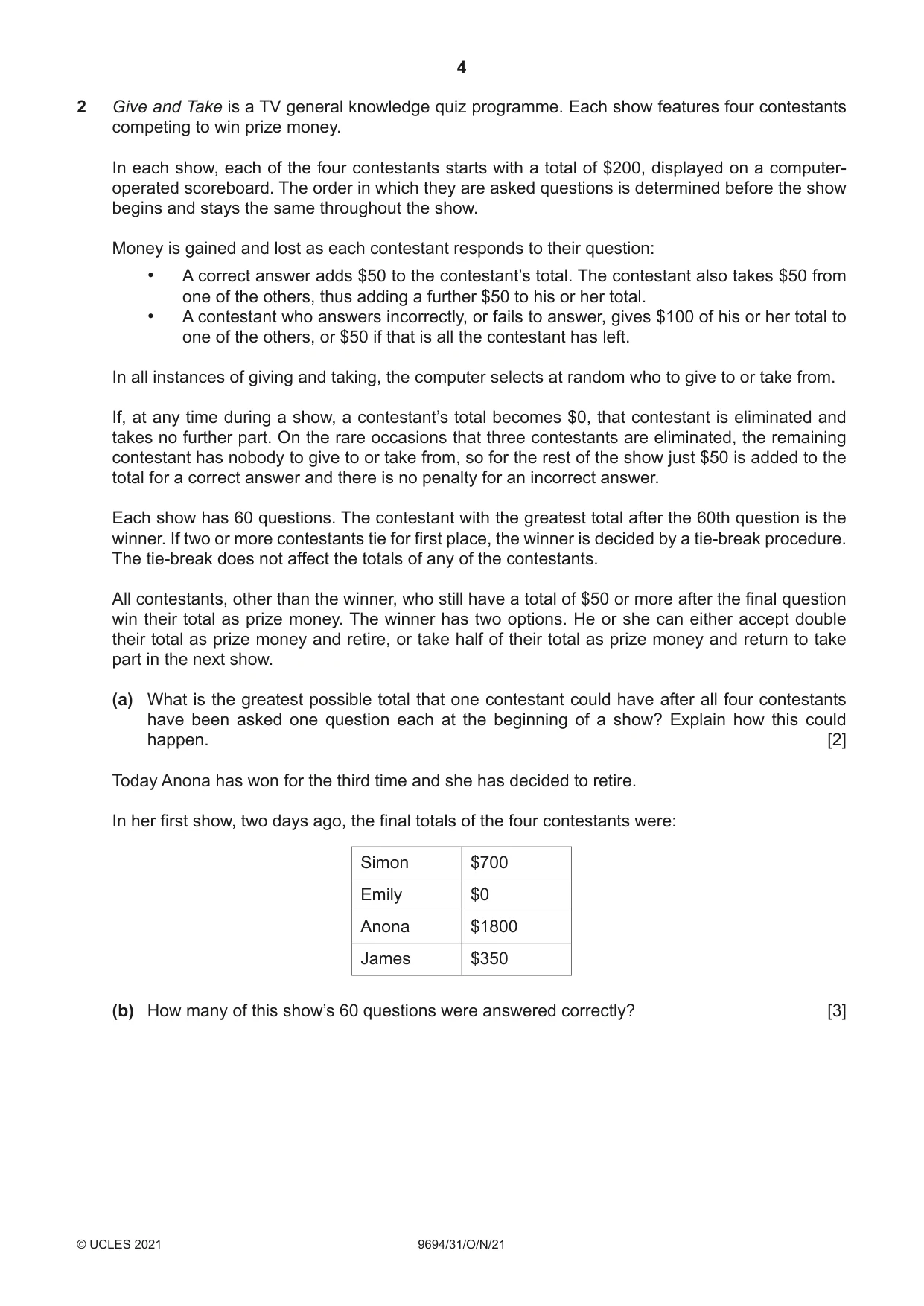
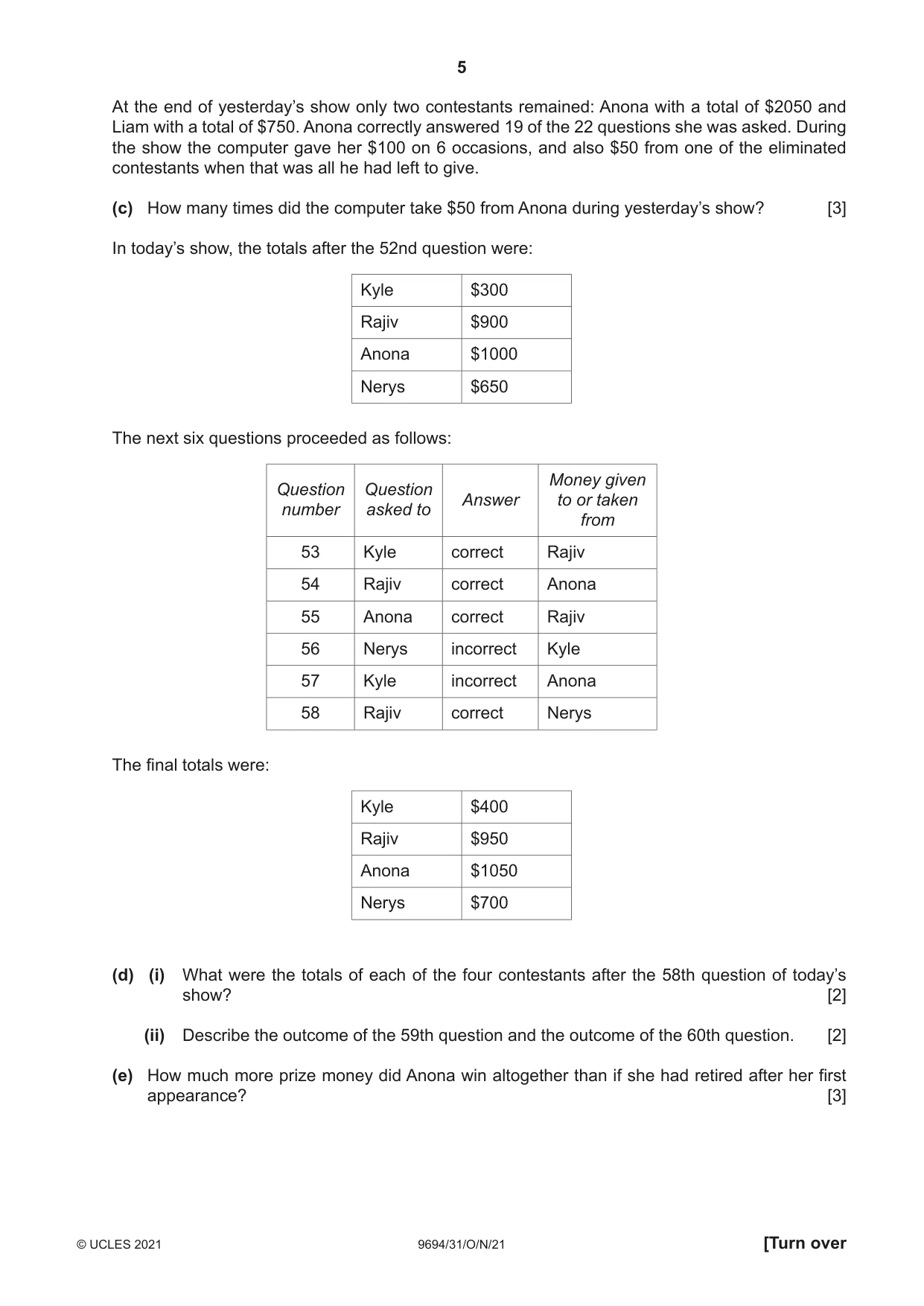
2 Give and Take is a TV general knowledge quiz programme. Each show features four contestants competing to win prize money. In each show, each of the four contestants starts with a total of $200, displayed on a computer- operated scoreboard. The order in which they are asked questions is determined before the show begins and stays the same throughout the show. Money is gained and lost as each contestant responds to their question: • A correct answer adds $50 to the contestant’s total. The contestant also takes $50 from one of the others, thus adding a further $50 to his or her total. • A contestant who answers incorrectly, or fails to answer, gives $100 of his or her total to one of the others, or $50 if that is all the contestant has left. In all instances of giving and taking, the computer selects at random who to give to or take from. If, at any time during a show, a contestant’s total becomes $0, that contestant is eliminated and takes no further part. On the rare occasions that three contestants are eliminated, the remaining contestant has nobody to give to or take from, so for the rest of the show just $50 is added to the total for a correct answer and there is no penalty for an incorrect answer. Each show has 60 questions. The contestant with the greatest total after the 60th question is the winner. If two or more contestants tie for first place, the winner is decided by a tie-break procedure. The tie-break does not affect the totals of any of the contestants. All contestants, other than the winner, who still have a total of $50 or more after the final question win their total as prize money. The winner has two options. He or she can either accept double their total as prize money and retire, or take half of their total as prize money and return to take part in the next show. (a) What is the greatest possible total that one contestant could have after all four contestants have been asked one question each at the beginning of a show? Explain how this could happen. [2] Today Anona has won for the third time and she has decided to retire. In her first show, two days ago, the final totals of the four contestants were: Simon $700 Emily $0 Anona $1800 James $350 (b) How many of this show’s 60 questions were answered correctly? [3] At the end of yesterday’s show only two contestants remained: Anona with a total of $2050 and Liam with a total of $750. Anona correctly answered 19 of the 22 questions she was asked. During the show the computer gave her $100 on 6 occasions, and also $50 from one of the eliminated contestants when that was all he had left to give. (c) How many times did the computer take $50 from Anona during yesterday’s show? [3] In today’s show, the totals after the 52nd question were: Kyle $300 Rajiv $900 Anona $1000 Nerys $650 The next six questions proceeded as follows: Money given Question Question Answer to or taken number asked to from 53 Kyle correct Rajiv 54 Rajiv correct Anona 55 Anona correct Rajiv 56 Nerys incorrect Kyle 57 Kyle incorrect Anona 58 Rajiv correct Nerys The final totals were: Kyle $400 Rajiv $950 Anona $1050 Nerys $700 (d) (i) What were the totals of each of the four contestants after the 58th question of today’s show? [2] (ii) Describe the outcome of the 59th question and the outcome of the 60th question. [2] (e) How much more prize money did Anona win altogether than if she had retired after her first appearance? [3]
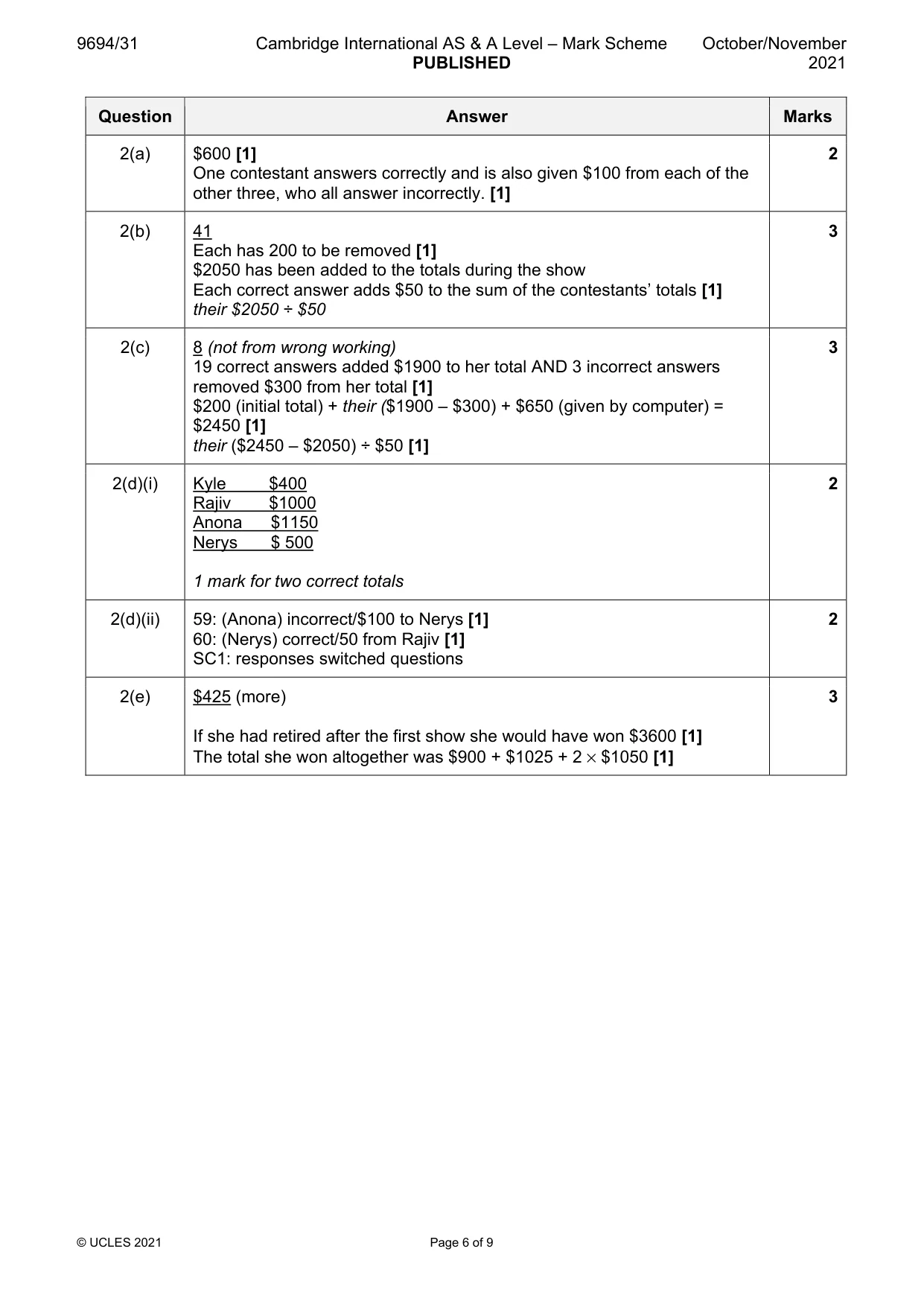
Mark scheme: 2(a) $600 [1] 2 One contestant answers correctly and is also given $100 from each of the other three, who all answer incorrectly. [1] 2(b) 41 3 Each has 200 to be removed [1] $2050 has been added to the totals during the show Each correct answer adds $50 to the sum of the contestants’ totals [1] their $2050 ÷ $50 2(c) 8 (not from wrong working) 3 19 correct answers added $1900 to her total AND 3 incorrect answers removed $300 from her total [1] $200 (initial total) + their ($1900 – $300) + $650 (given by computer) = $2450 [1] their ($2450 – $2050) ÷ $50 [1] 2(d)(i) Kyle $400 2 Rajiv $1000 Anona $1150 Nerys $ 500 1 mark for two correct totals 2(d)(ii) 59: (Anona) incorrect/$100 to Nerys [1] 2 60: (Nerys) correct/50 from Rajiv [1] SC1: responses switched questions 2(e) $425 (more) 3 If she had retired after the first show she would have won $3600 [1] The total she won altogether was $900 + $1025 + 2 × $1050 [1]
More questions on Perform appropriate operations with information
Q3 · Carpenters sometimes use ropes with carefully positioned ribbons on them to measure…
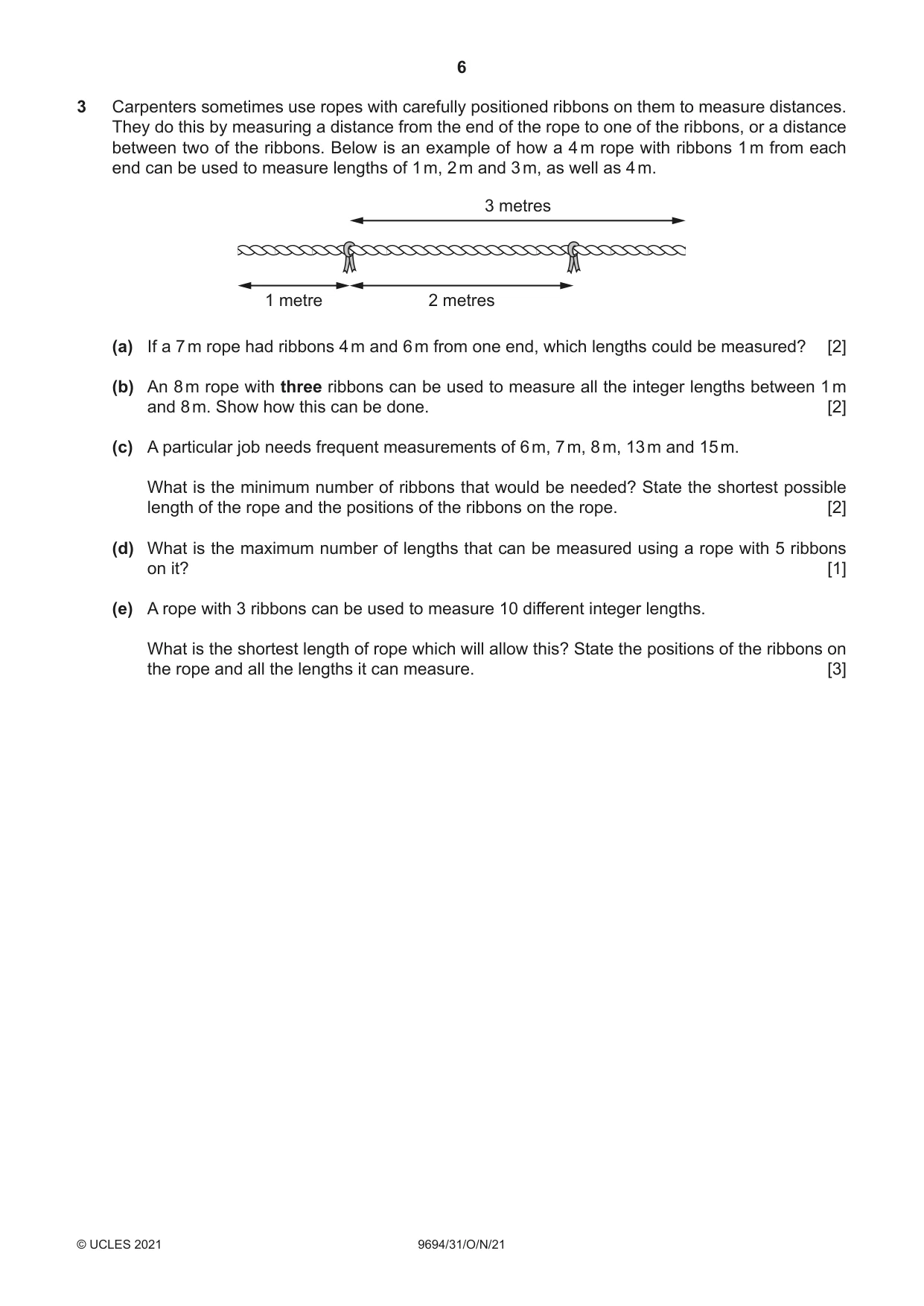
3 Carpenters sometimes use ropes with carefully positioned ribbons on them to measure distances. They do this by measuring a distance from the end of the rope to one of the ribbons, or a distance between two of the ribbons. Below is an example of how a 4 m rope with ribbons 1 m from each end can be used to measure lengths of 1 m, 2 m and 3 m, as well as 4 m. 3 metres 1 metre 2 metres (a) If a 7 m rope had ribbons 4 m and 6 m from one end, which lengths could be measured? [2] (b) An 8 m rope with three ribbons can be used to measure all the integer lengths between 1 m and 8 m. Show how this can be done. [2] (c) A particular job needs frequent measurements of 6 m, 7 m, 8 m, 13 m and 15 m. What is the minimum number of ribbons that would be needed? State the shortest possible length of the rope and the positions of the ribbons on the rope. [2] (d) What is the maximum number of lengths that can be measured using a rope with 5 ribbons on it? [1] (e) A rope with 3 ribbons can be used to measure 10 different integer lengths. What is the shortest length of rope which will allow this? State the positions of the ribbons on the rope and all the lengths it can measure. [3] [Question 4 begins on the next page]
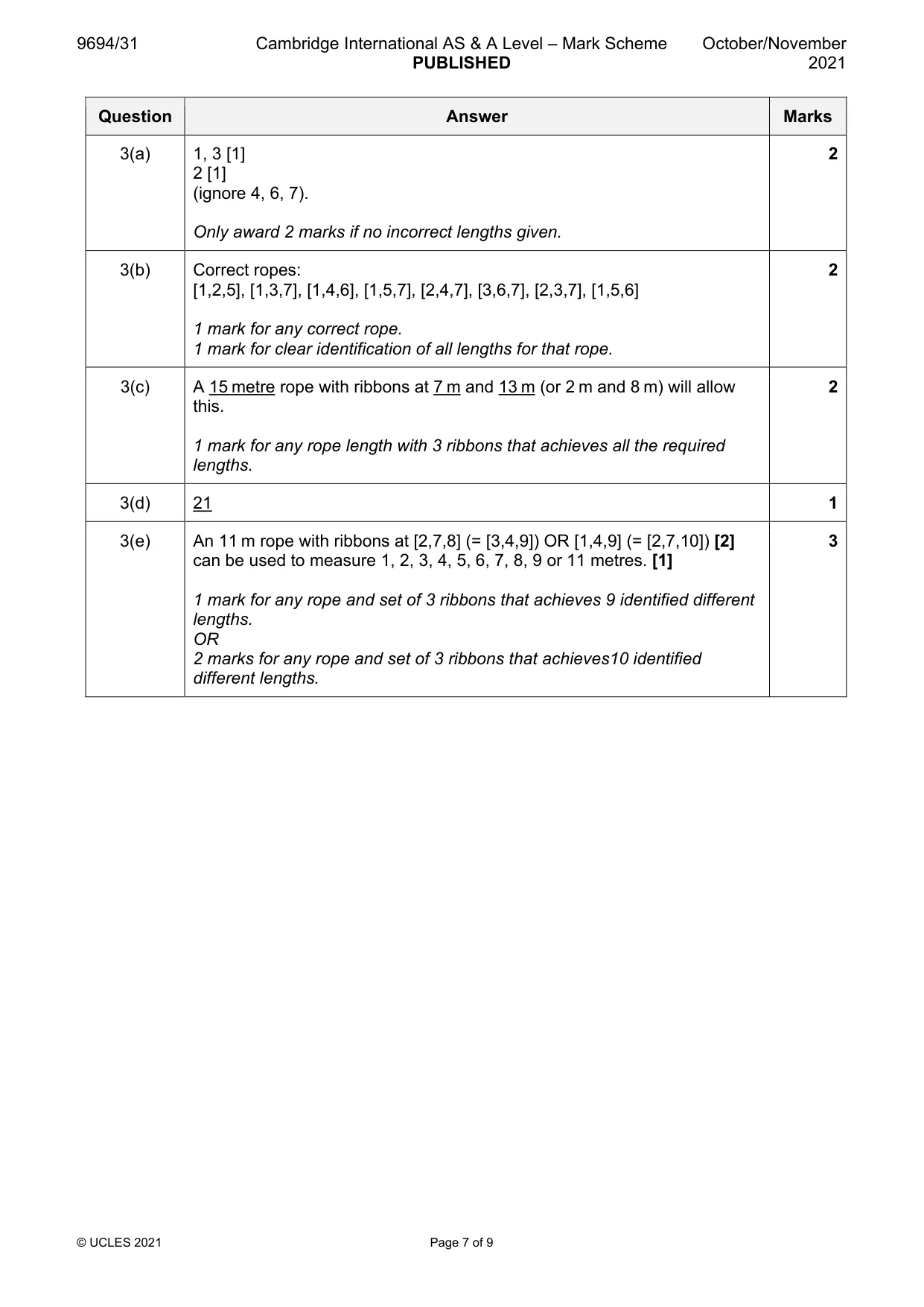
Mark scheme: 3(a) 1, 3 [1] 2 2 [1] (ignore 4, 6, 7). Only award 2 marks if no incorrect lengths given. 3(b) Correct ropes: 2 [1,2,5], [1,3,7], [1,4,6], [1,5,7], [2,4,7], [3,6,7], [2,3,7], [1,5,6] 1 mark for any correct rope. 1 mark for clear identification of all lengths for that rope. 3(c) A 15 metre rope with ribbons at 7 m and 13 m (or 2 m and 8 m) will allow 2 this. 1 mark for any rope length with 3 ribbons that achieves all the required lengths. 3(d) 21 1 3(e) An 11 m rope with ribbons at [2,7,8] (= [3,4,9]) OR [1,4,9] (= [2,7,10]) [2] 3 can be used to measure 1, 2, 3, 4, 5, 6, 7, 8, 9 or 11 metres. [1] 1 mark for any rope and set of 3 ribbons that achieves 9 identified different lengths. OR 2 marks for any rope and set of 3 ribbons that achieves10 identified different lengths.
Q4 · Matchboxes are often made from a cardboard ‘tray’ (the five faces of a cuboid without a…
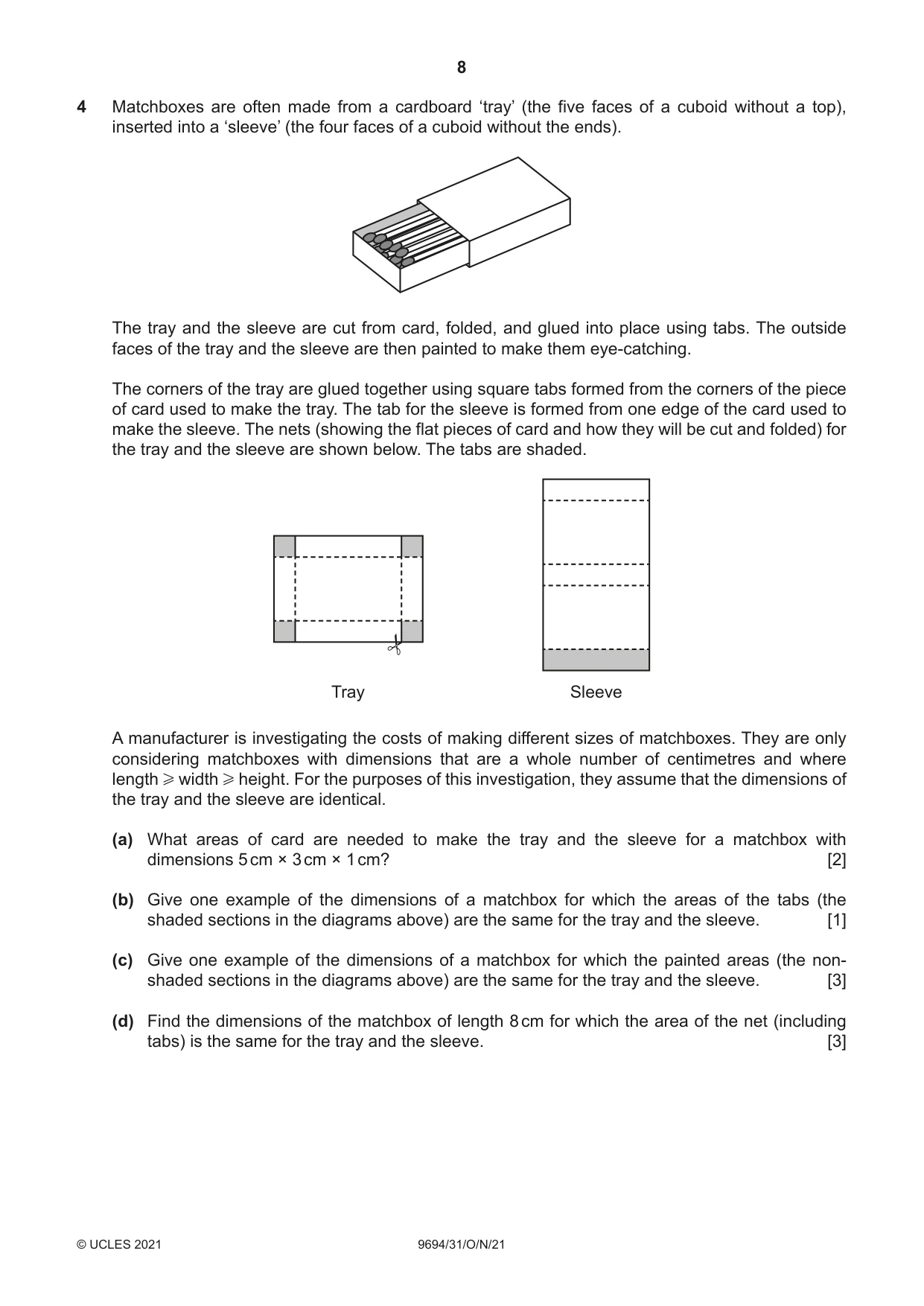
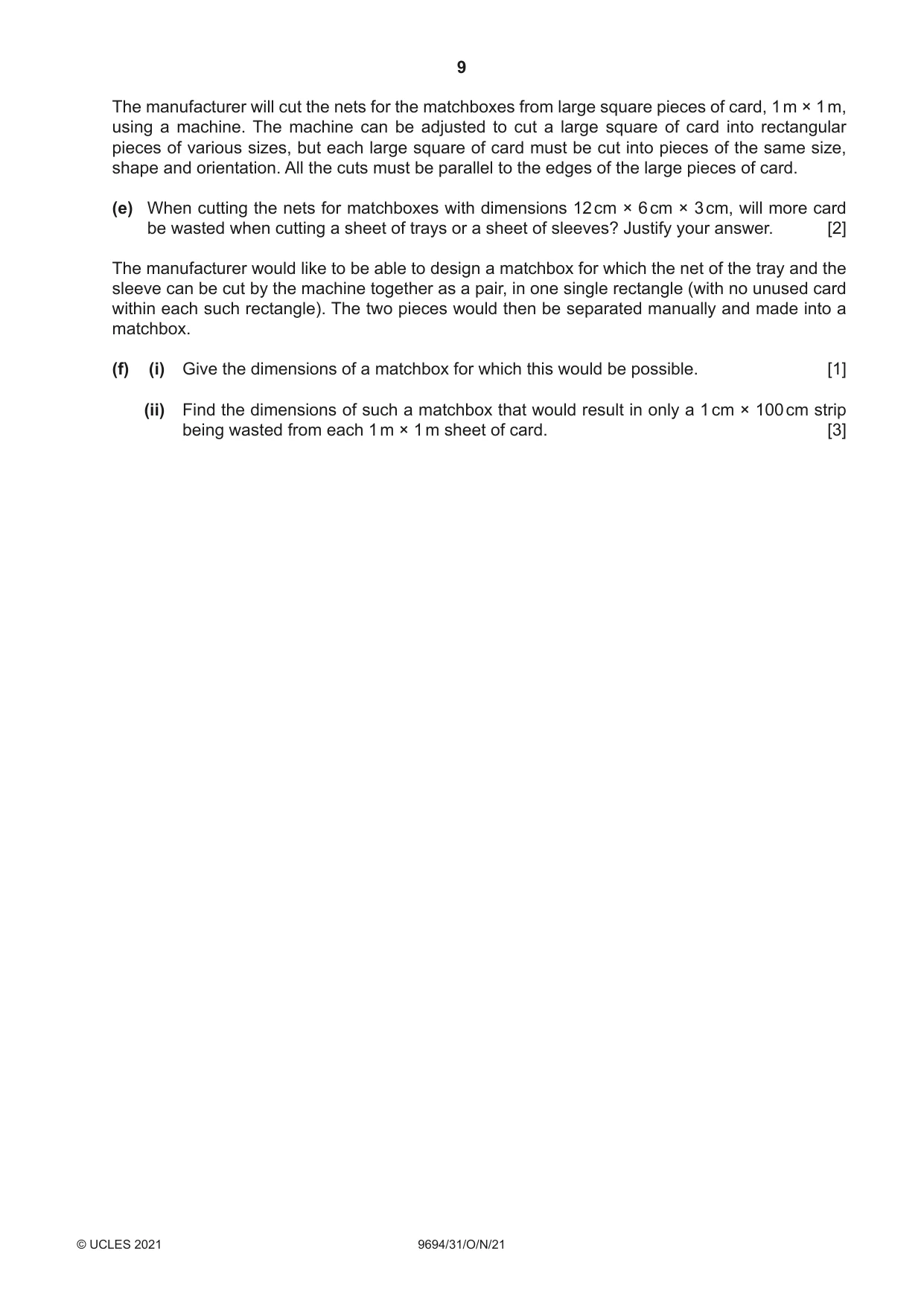
4 Matchboxes are often made from a cardboard ‘tray’ (the five faces of a cuboid without a top), inserted into a ‘sleeve’ (the four faces of a cuboid without the ends). The tray and the sleeve are cut from card, folded, and glued into place using tabs. The outside faces of the tray and the sleeve are then painted to make them eye-catching. The corners of the tray are glued together using square tabs formed from the corners of the piece of card used to make the tray. The tab for the sleeve is formed from one edge of the card used to make the sleeve. The nets (showing the flat pieces of card and how they will be cut and folded) for the tray and the sleeve are shown below. The tabs are shaded. # Tray Sleeve A manufacturer is investigating the costs of making different sizes of matchboxes. They are only considering matchboxes with dimensions that are a whole number of centimetres and where length H width H height. For the purposes of this investigation, they assume that the dimensions of the tray and the sleeve are identical. (a) What areas of card are needed to make the tray and the sleeve for a matchbox with dimensions 5 cm × 3 cm × 1 cm? [2] (b) Give one example of the dimensions of a matchbox for which the areas of the tabs (the shaded sections in the diagrams above) are the same for the tray and the sleeve. [1] (c) Give one example of the dimensions of a matchbox for which the painted areas (the non- shaded sections in the diagrams above) are the same for the tray and the sleeve. [3] (d) Find the dimensions of the matchbox of length 8 cm for which the area of the net (including tabs) is the same for the tray and the sleeve. [3] The manufacturer will cut the nets for the matchboxes from large square pieces of card, 1 m × 1 m, using a machine. The machine can be adjusted to cut a large square of card into rectangular pieces of various sizes, but each large square of card must be cut into pieces of the same size, shape and orientation. All the cuts must be parallel to the edges of the large pieces of card. (e) When cutting the nets for matchboxes with dimensions 12 cm × 6 cm × 3 cm, will more card be wasted when cutting a sheet of trays or a sheet of sleeves? Justify your answer. [2] The manufacturer would like to be able to design a matchbox for which the net of the tray and the sleeve can be cut by the machine together as a pair, in one single rectangle (with no unused card within each such rectangle). The two pieces would then be separated manually and made into a matchbox. (f) (i) Give the dimensions of a matchbox for which this would be possible. [1] (ii) Find the dimensions of such a matchbox that would result in only a 1 cm × 100 cm strip being wasted from each 1 m × 1 m sheet of card. [3]
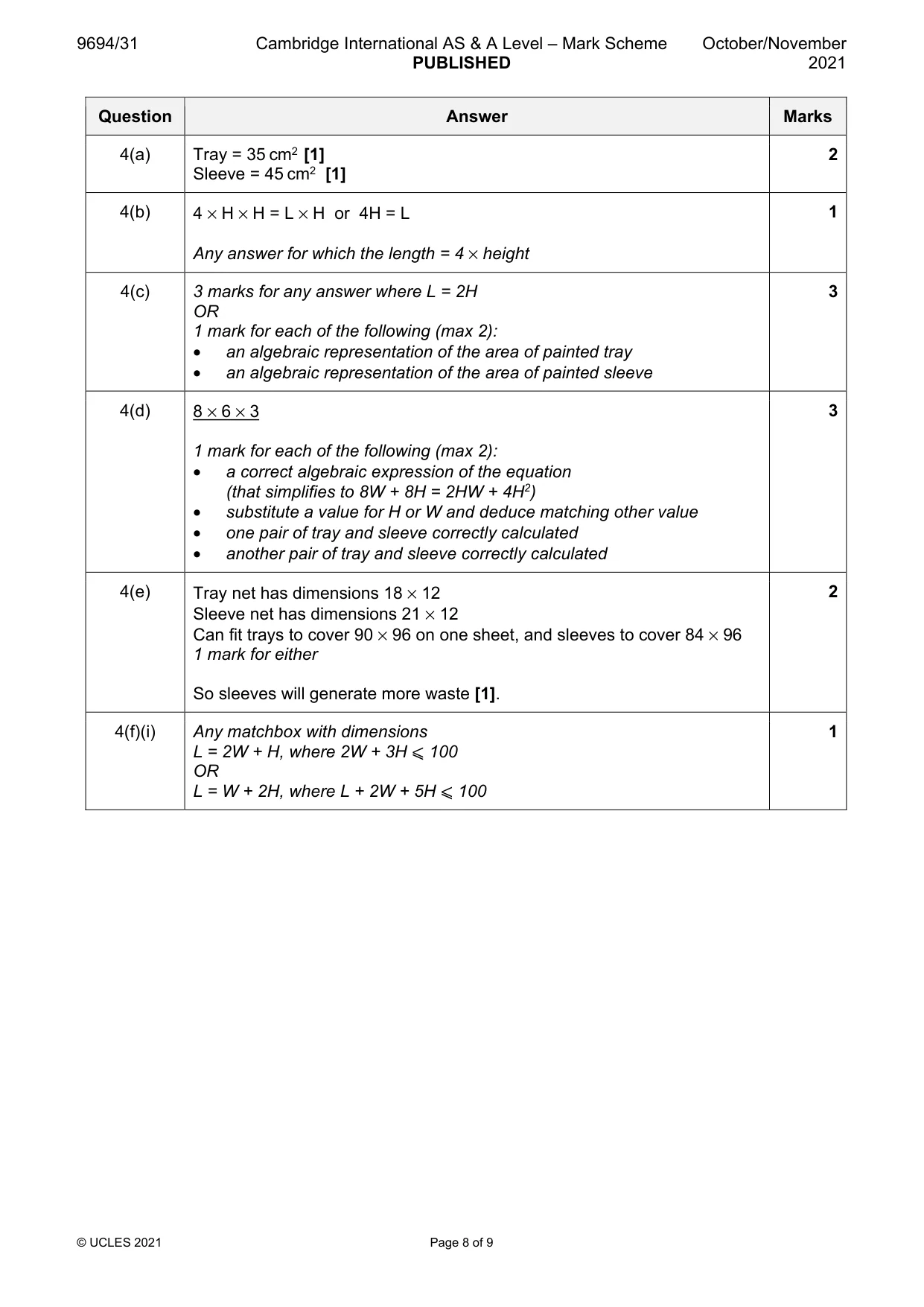
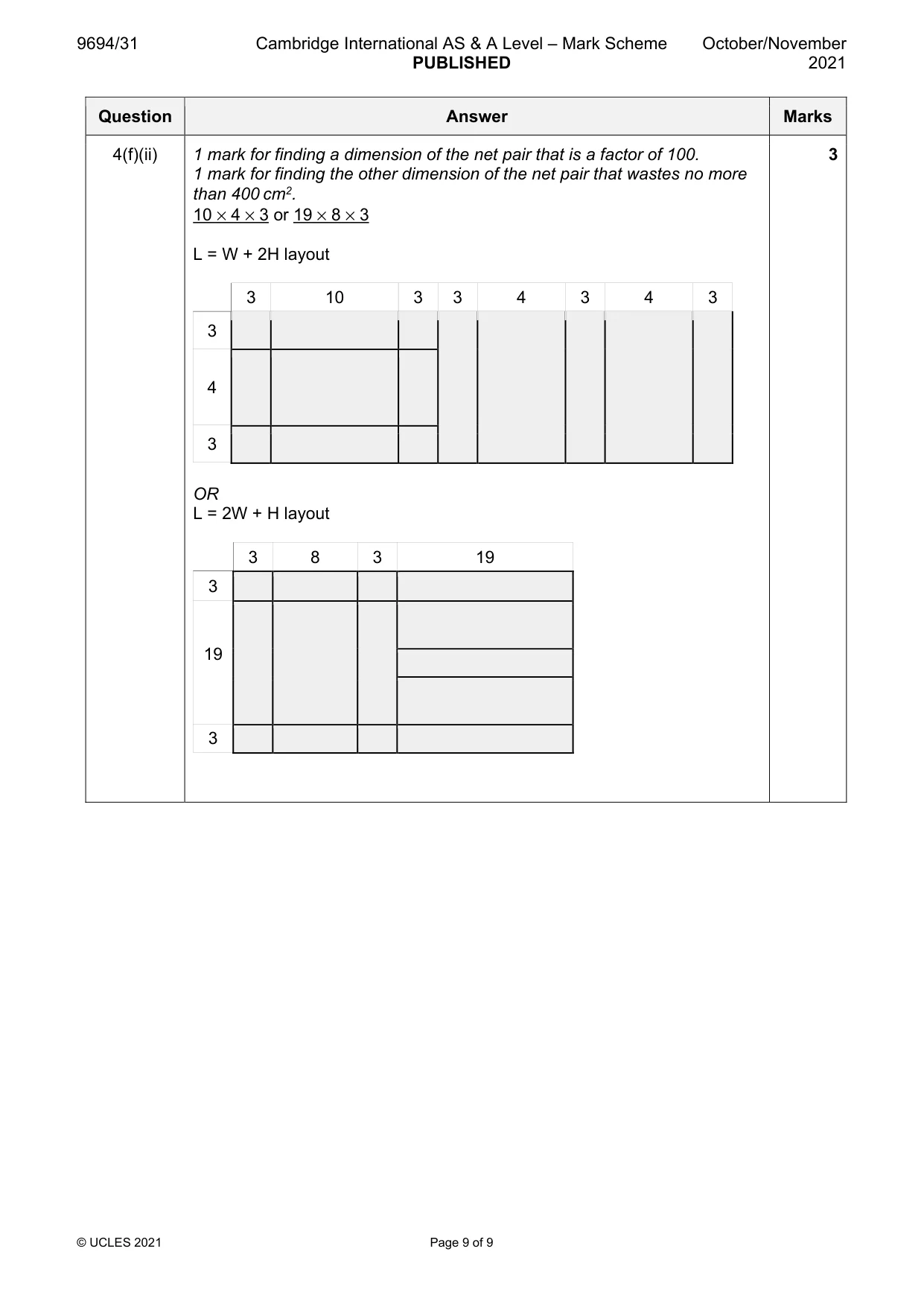
Mark scheme: 4(a) Tray = 35 cm2 [1] 2 Sleeve = 45 cm2 [1] 4(b) 4 × H × H = L × H or 4H = L 1 Any answer for which the length = 4 × height 4(c) 3 marks for any answer where L = 2H 3 OR 1 mark for each of the following (max 2): • an algebraic representation of the area of painted tray • an algebraic representation of the area of painted sleeve 4(d) 8 × 6 × 3 3 1 mark for each of the following (max 2): • a correct algebraic expression of the equation (that simplifies to 8W + 8H = 2HW + 4H2) • substitute a value for H or W and deduce matching other value • one pair of tray and sleeve correctly calculated • another pair of tray and sleeve correctly calculated 4(e) Tray net has dimensions 18 × 12 2 Sleeve net has dimensions 21 × 12 Can fit trays to cover 90 × 96 on one sheet, and sleeves to cover 84 × 96 1 mark for either So sleeves will generate more waste [1]. 4(f)(i) Any matchbox with dimensions 1 L = 2W + H, where 2W + 3H ⩽ 100 OR L = W + 2H, where L + 2W + 5H ⩽ 100 4(f)(ii) 1 mark for finding a dimension of the net pair that is a factor of 100. 3 1 mark for finding the other dimension of the net pair that wastes no more than 400 cm2. 10 × 4 × 3 or 19 × 8 × 3 L = W + 2H layout 3 10 3 3 4 3 4 3 3 4 3 OR L = 2W + H layout 3 8 3 19 3 19 3
What was in this paper
The subtopics covered by these 4 questions, and how many questions each got. Open one in a new tab to see every Cambridge question on it.
What you needed in this session
Cambridge’s own grade thresholds for 2021 Oct/Nov, Paper 3 · Variant 1. A higher threshold means an easier paper — the bar moves with how the cohort did.