Cambridge A Level Thinking Skills 9694 — 2024 Oct/Nov Paper 3 · Variant 1
9694/31/O/N/24 · 4 questions · 50 marks · ≈56 min
The question paper and its mark scheme, free to read here and free to download. This is Cambridge’s own paper, exactly as it was sat.
Question paper12 pages





Mark scheme9 pages
Answers below. Sit the paper first if you are practising.
Questions as text
Q1 · A rural hospital is planning the staff and beds it will need during the forthcoming months
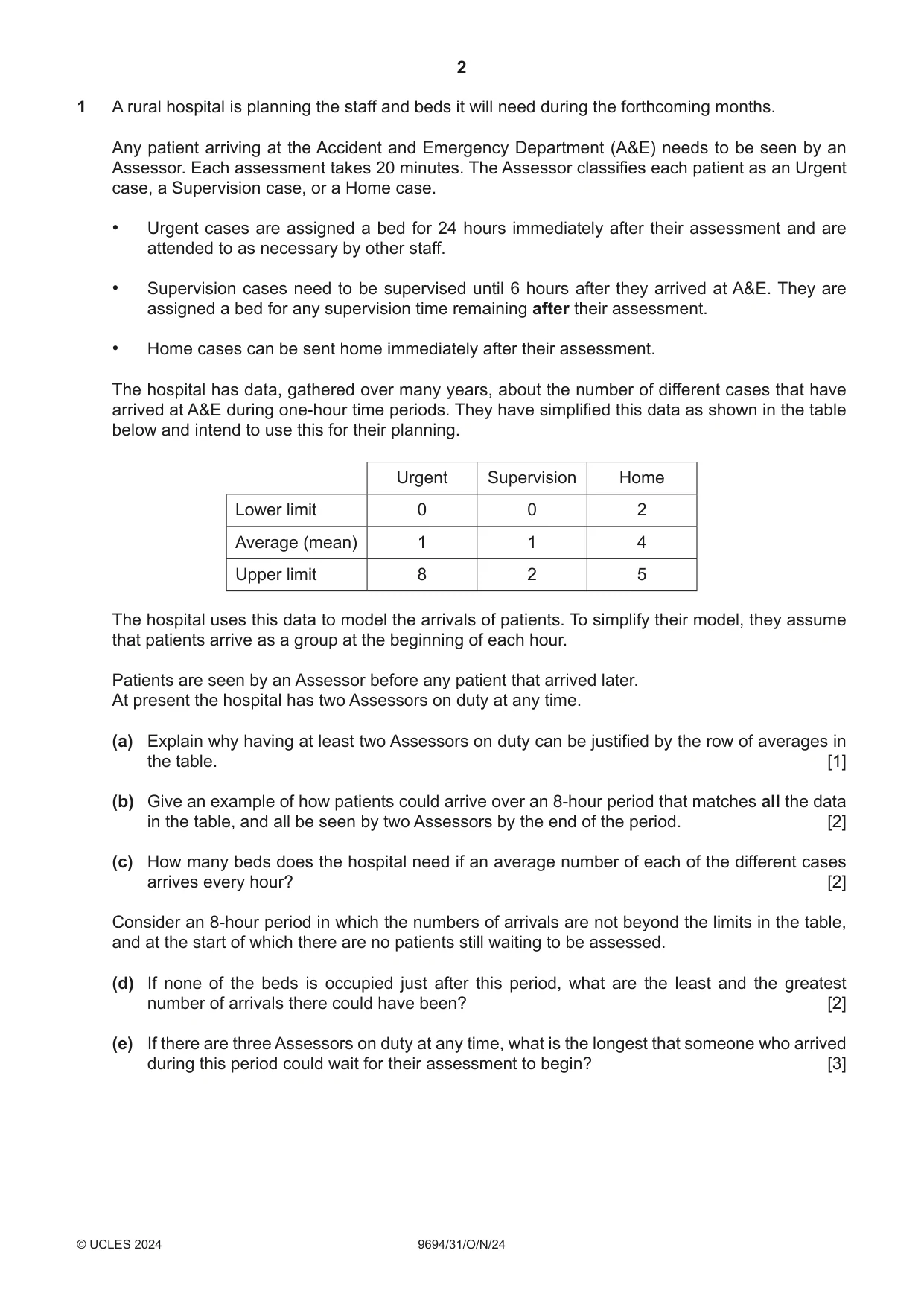
1 A rural hospital is planning the staff and beds it will need during the forthcoming months. Any patient arriving at the Accident and Emergency Department (A&E) needs to be seen by an Assessor. Each assessment takes 20 minutes. The Assessor classifies each patient as an Urgent case, a Supervision case, or a Home case. • Urgent cases are assigned a bed for 24 hours immediately after their assessment and are attended to as necessary by other staff. • Supervision cases need to be supervised until 6 hours after they arrived at A&E. They are assigned a bed for any supervision time remaining after their assessment. • Home cases can be sent home immediately after their assessment. The hospital has data, gathered over many years, about the number of different cases that have arrived at A&E during one-hour time periods. They have simplified this data as shown in the table below and intend to use this for their planning. Urgent Supervision Home Lower limit 0 0 2 Average (mean) 1 1 4 Upper limit 8 2 5 The hospital uses this data to model the arrivals of patients. To simplify their model, they assume that patients arrive as a group at the beginning of each hour. Patients are seen by an Assessor before any patient that arrived later. At present the hospital has two Assessors on duty at any time. (a) Explain why having at least two Assessors on duty can be justified by the row of averages in the table. [1] (b) Give an example of how patients could arrive over an 8-hour period that matches all the data in the table, and all be seen by two Assessors by the end of the period. [2] (c) How many beds does the hospital need if an average number of each of the different cases arrives every hour? [2] Consider an 8-hour period in which the numbers of arrivals are not beyond the limits in the table, and at the start of which there are no patients still waiting to be assessed. (d) If none of the beds is occupied just after this period, what are the least and the greatest number of arrivals there could have been? [2] (e) If there are three Assessors on duty at any time, what is the longest that someone who arrived during this period could wait for their assessment to begin? [3] [Turn over for Question 2]
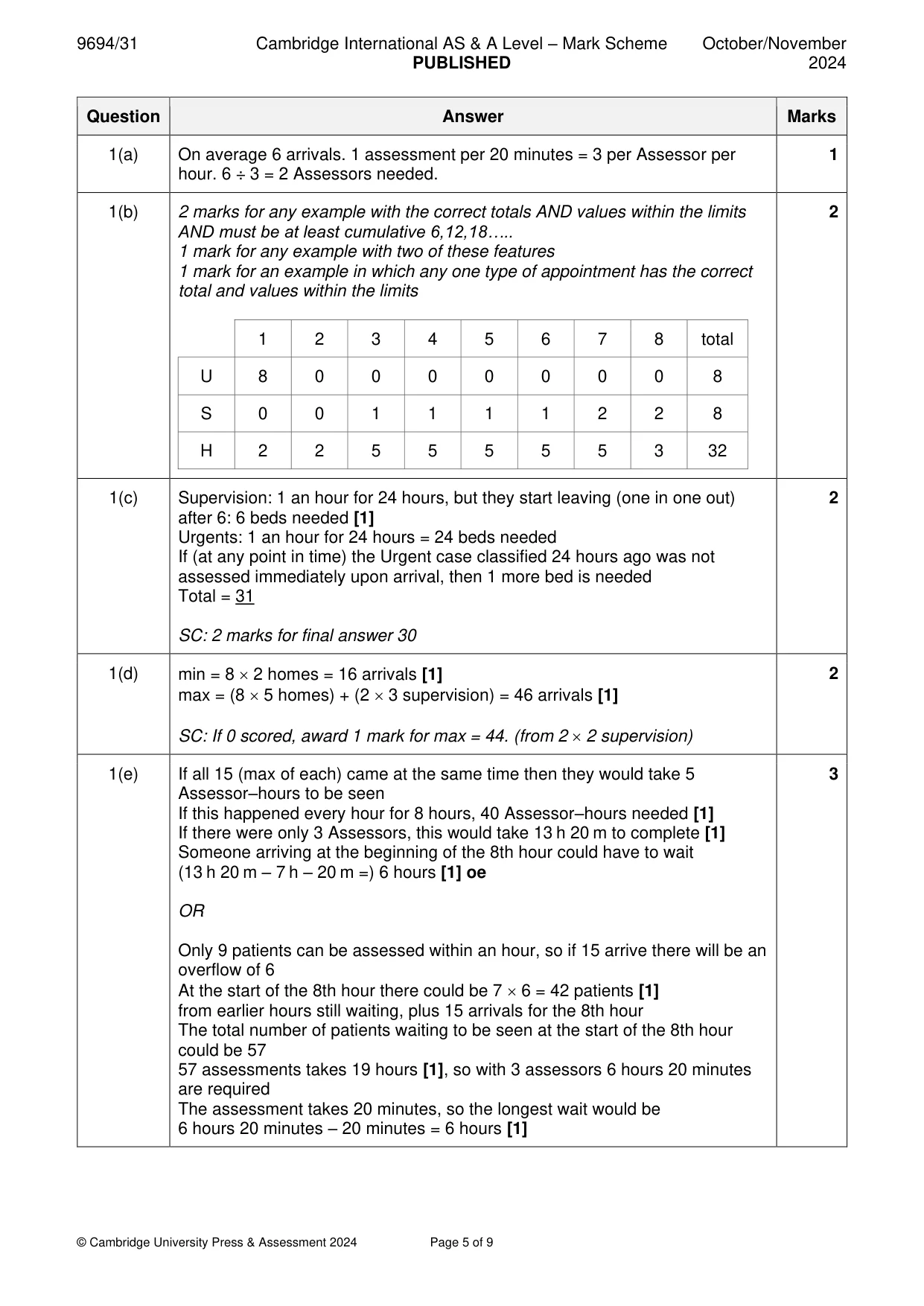
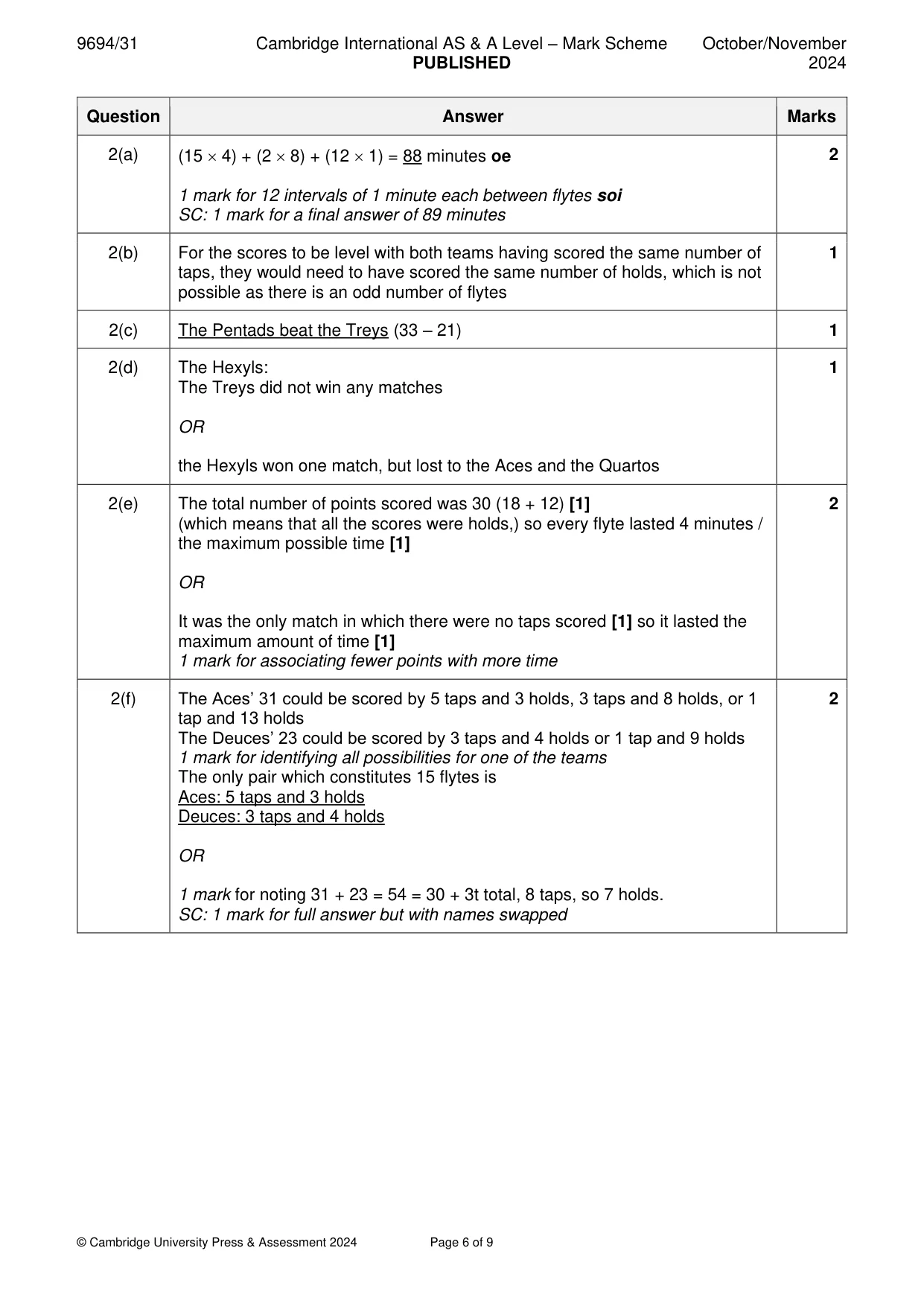
Mark scheme: Question Answer Marks 1(a) On average 6 arrivals. 1 assessment per 20 minutes = 3 per Assessor per 1 hour. 6 ÷ 3 = 2 Assessors needed. 1(b) 2 marks for any example with the correct totals AND values within the limits 2 AND must be at least cumulative 6,12,18….. 1 mark for any example with two of these features 1 mark for an example in which any one type of appointment has the correct total and values within the limits 1 2 3 4 5 6 7 8 total U 8 0 0 0 0 0 0 0 8 S 0 0 1 1 1 1 2 2 8 H 2 2 5 5 5 5 5 3 32 1(c) Supervision: 1 an hour for 24 hours, but they start leaving (one in one out) 2 after 6: 6 beds needed [1] Urgents: 1 an hour for 24 hours = 24 beds needed If (at any point in time) the Urgent case classified 24 hours ago was not assessed immediately upon arrival, then 1 more bed is needed Total = 31 SC: 2 marks for final answer 30 1(d) min = 8 2 homes = 16 arrivals [1] 2 max = (8 5 homes) + (2 3 supervision) = 46 arrivals [1] SC: If 0 scored, award 1 mark for max = 44. (from 2 2 supervision) 1(e) If all 15 (max of each) came at the same time then they would take 5 3 Assessor–hours to be seen If this happened every hour for 8 hours, 40 Assessor–hours needed [1] If there were only 3 Assessors, this would take 13 h 20 m to complete [1] Someone arriving at the beginning of the 8th hour could have to wait (13 h 20 m – 7 h – 20 m =) 6 hours [1] oe OR Only 9 patients can be assessed within an hour, so if 15 arrive there will be an overflow of 6 At the start of the 8th hour there could be 7 6 = 42 patients [1] from earlier hours still waiting, plus 15 arrivals for the 8th hour The total number of patients waiting to be seen at the start of the 8th hour could be 57 57 assessments takes 19 hours [1], so with 3 assessors 6 hours 20 minutes are required The assessment takes 20 minutes, so the longest wait would be 6 hours 20 minutes – 20 minutes = 6 hours [1]
More questions on Identify the impact of a change to a problem
Q2 · Fansee is a ball sport in which two teams attempt to hit a target suspended above the…
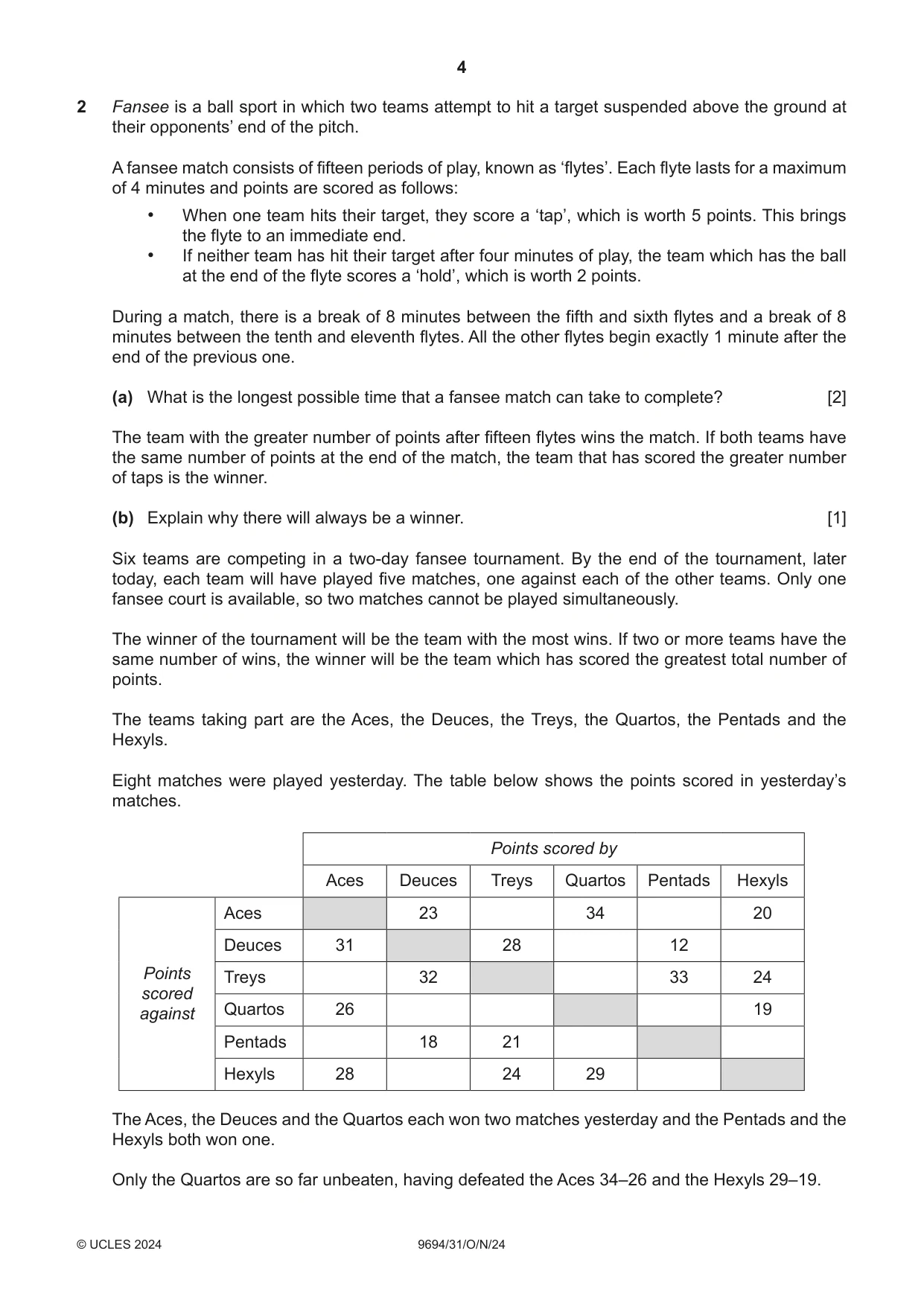
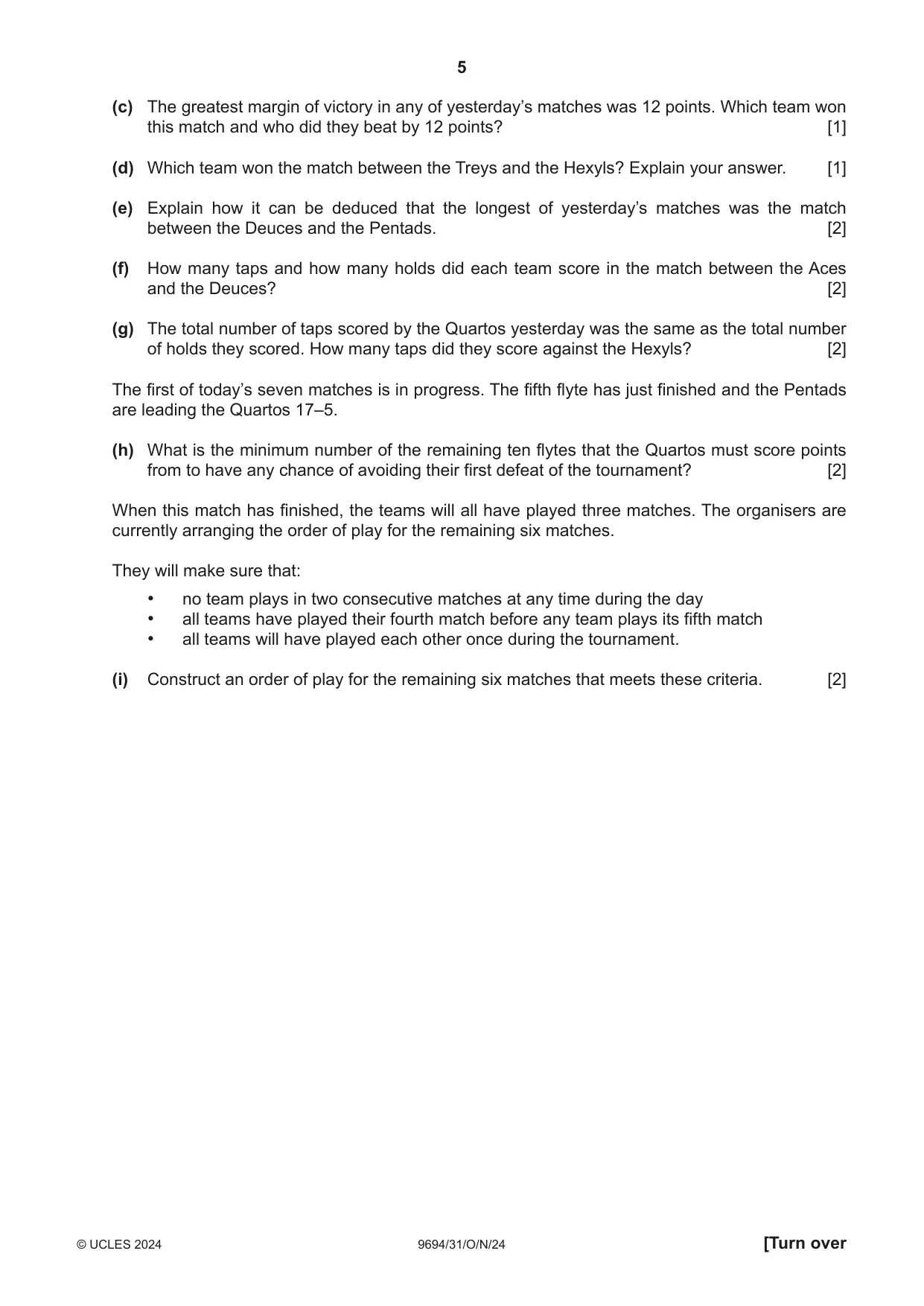
2 Fansee is a ball sport in which two teams attempt to hit a target suspended above the ground at their opponents’ end of the pitch. A fansee match consists of fifteen periods of play, known as ‘flytes’. Each flyte lasts for a maximum of 4 minutes and points are scored as follows: • When one team hits their target, they score a ‘tap’, which is worth 5 points. This brings the flyte to an immediate end. • If neither team has hit their target after four minutes of play, the team which has the ball at the end of the flyte scores a ‘hold’, which is worth 2 points. During a match, there is a break of 8 minutes between the fifth and sixth flytes and a break of 8 minutes between the tenth and eleventh flytes. All the other flytes begin exactly 1 minute after the end of the previous one. (a) What is the longest possible time that a fansee match can take to complete? [2] The team with the greater number of points after fifteen flytes wins the match. If both teams have the same number of points at the end of the match, the team that has scored the greater number of taps is the winner. (b) Explain why there will always be a winner. [1] Six teams are competing in a two-day fansee tournament. By the end of the tournament, later today, each team will have played five matches, one against each of the other teams. Only one fansee court is available, so two matches cannot be played simultaneously. The winner of the tournament will be the team with the most wins. If two or more teams have the same number of wins, the winner will be the team which has scored the greatest total number of points. The teams taking part are the Aces, the Deuces, the Treys, the Quartos, the Pentads and the Hexyls. Eight matches were played yesterday. The table below shows the points scored in yesterday’s matches. Points scored by Aces Deuces Treys Quartos Pentads Hexyls Aces 23 34 20 Deuces 31 28 12 Points Treys 32 33 24 scored against Quartos 26 19 Pentads 18 21 Hexyls 28 24 29 The Aces, the Deuces and the Quartos each won two matches yesterday and the Pentads and the Hexyls both won one. Only the Quartos are so far unbeaten, having defeated the Aces 34–26 and the Hexyls 29–19. (c) The greatest margin of victory in any of yesterday’s matches was 12 points. Which team won this match and who did they beat by 12 points? [1] (d) Which team won the match between the Treys and the Hexyls? Explain your answer. [1] (e) Explain how it can be deduced that the longest of yesterday’s matches was the match between the Deuces and the Pentads. [2] (f) How many taps and how many holds did each team score in the match between the Aces and the Deuces? [2] (g) The total number of taps scored by the Quartos yesterday was the same as the total number of holds they scored. How many taps did they score against the Hexyls? [2] The first of today’s seven matches is in progress. The fifth flyte has just finished and the Pentads are leading the Quartos 17–5. (h) What is the minimum number of the remaining ten flytes that the Quartos must score points from to have any chance of avoiding their first defeat of the tournament? [2] When this match has finished, the teams will all have played three matches. The organisers are currently arranging the order of play for the remaining six matches. They will make sure that: • no team plays in two consecutive matches at any time during the day • all teams have played their fourth match before any team plays its fifth match • all teams will have played each other once during the tournament. (i) Construct an order of play for the remaining six matches that meets these criteria. [2]
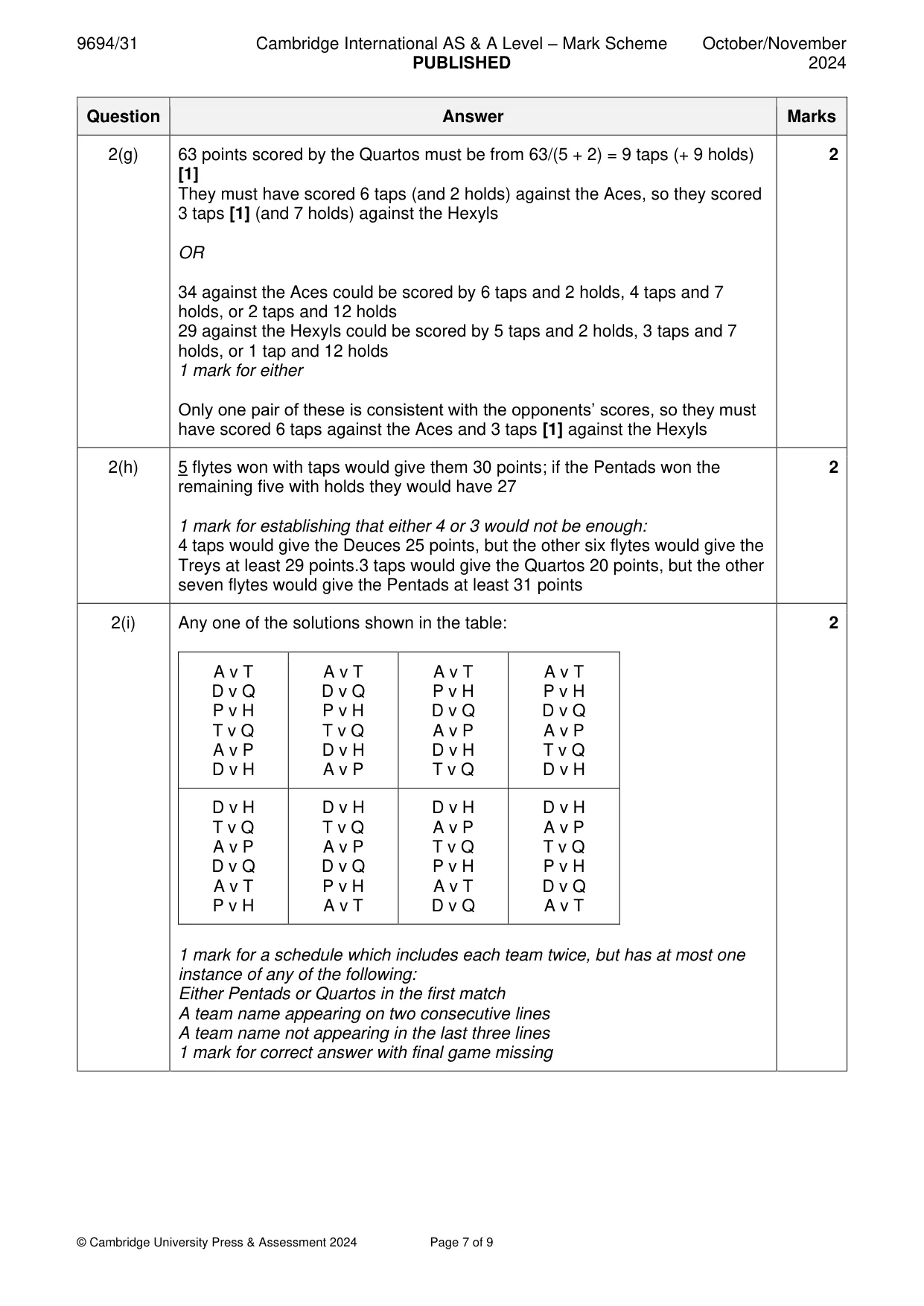
Mark scheme: 2(a) (15 4) + (2 8) + (12 1) = 88 minutes oe 2 1 mark for 12 intervals of 1 minute each between flytes soi SC: 1 mark for a final answer of 89 minutes 2(b) For the scores to be level with both teams having scored the same number of 1 taps, they would need to have scored the same number of holds, which is not possible as there is an odd number of flytes 2(c) The Pentads beat the Treys (33 – 21) 1 2(d) The Hexyls: 1 The Treys did not win any matches OR the Hexyls won one match, but lost to the Aces and the Quartos 2(e) The total number of points scored was 30 (18 + 12) [1] 2 (which means that all the scores were holds,) so every flyte lasted 4 minutes / the maximum possible time [1] OR It was the only match in which there were no taps scored [1] so it lasted the maximum amount of time [1] 1 mark for associating fewer points with more time 2(f) The Aces’ 31 could be scored by 5 taps and 3 holds, 3 taps and 8 holds, or 1 2 tap and 13 holds The Deuces’ 23 could be scored by 3 taps and 4 holds or 1 tap and 9 holds 1 mark for identifying all possibilities for one of the teams The only pair which constitutes 15 flytes is Aces: 5 taps and 3 holds Deuces: 3 taps and 4 holds OR 1 mark for noting 31 + 23 = 54 = 30 + 3t total, 8 taps, so 7 holds. SC: 1 mark for full answer but with names swapped 2(g) 63 points scored by the Quartos must be from 63/(5 + 2) = 9 taps (+ 9 holds) 2 [1] They must have scored 6 taps (and 2 holds) against the Aces, so they scored 3 taps [1] (and 7 holds) against the Hexyls OR 34 against the Aces could be scored by 6 taps and 2 holds, 4 taps and 7 holds, or 2 taps and 12 holds 29 against the Hexyls could be scored by 5 taps and 2 holds, 3 taps and 7 holds, or 1 tap and 12 holds 1 mark for either Only one pair of these is consistent with the opponents’ scores, so they must have scored 6 taps against the Aces and 3 taps [1] against the Hexyls 2(h) 5 flytes won with taps would give them 30 points; if the Pentads won the 2 remaining five with holds they would have 27 1 mark for establishing that either 4 or 3 would not be enough: 4 taps would give the Deuces 25 points, but the other six flytes would give the Treys at least 29 points.3 taps would give the Quartos 20 points, but the other seven flytes would give the Pentads at least 31 points 2(i) Any one of the solutions shown in the table: 2 A v T A v T A v T A v T D v Q D v Q P v H P v H P v H P v H D v Q D v Q T v Q T v Q A v P A v P A v P D v H D v H T v Q D v H A v P T v Q D v H D v H D v H D v H D v H T v Q T v Q A v P A v P A v P A v P T v Q T v Q D v Q D v Q P v H P v H A v T P v H A v T D v Q P v H A v T D v Q A v T 1 mark for a schedule which includes each team twice, but has at most one instance of any of the following: Either Pentads or Quartos in the first match A team name appearing on two consecutive lines A team name not appearing in the last three lines 1 mark for correct answer with final game missing
Q3 · Every morning on his expedition to the South Pole, Amundsen recorded the outside…
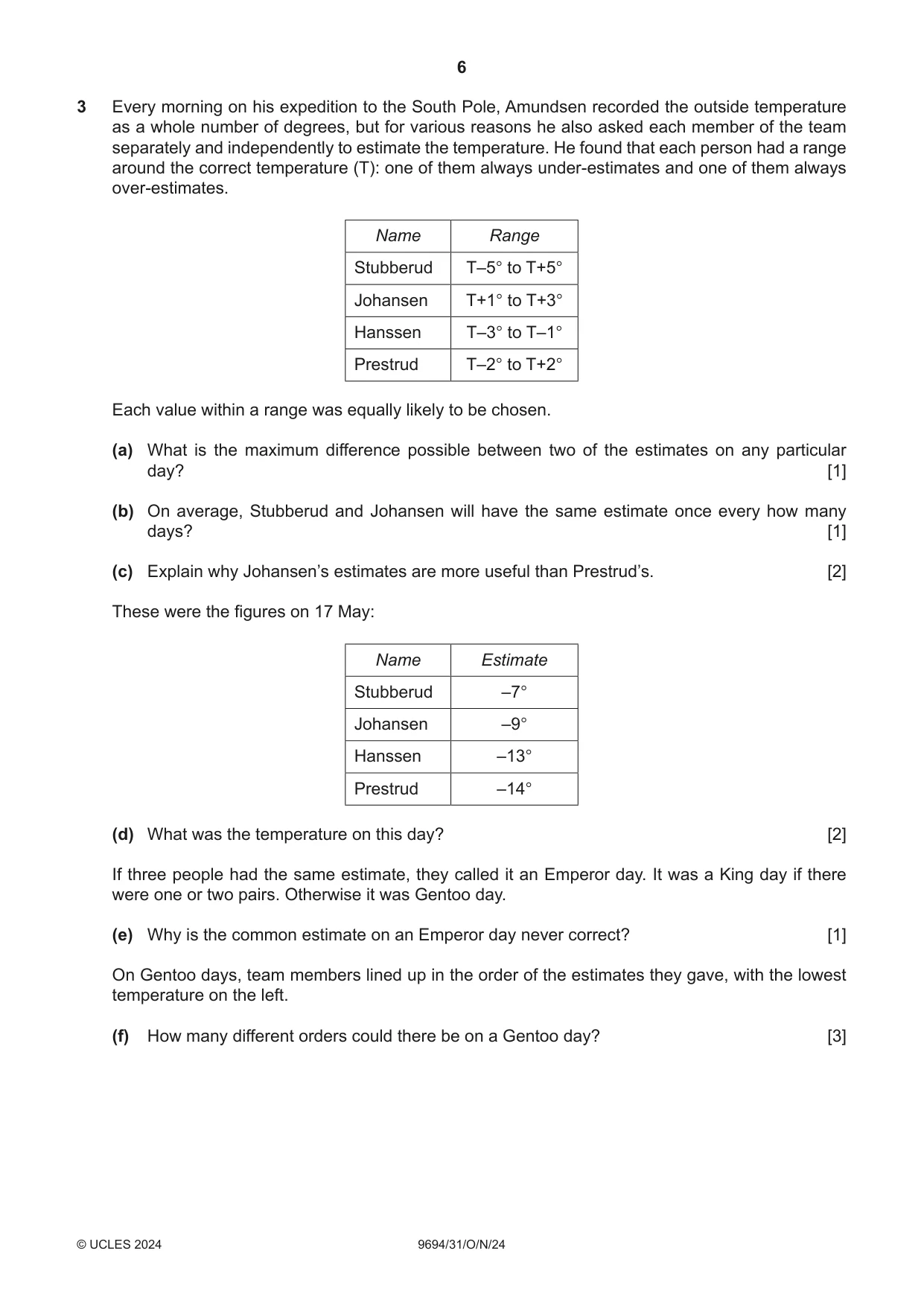
3 Every morning on his expedition to the South Pole, Amundsen recorded the outside temperature as a whole number of degrees, but for various reasons he also asked each member of the team separately and independently to estimate the temperature. He found that each person had a range around the correct temperature (T): one of them always under-estimates and one of them always over-estimates. Name Range Stubberud T‒5° to T+5° Johansen T+1° to T+3° Hanssen T‒3° to T‒1° Prestrud T‒2° to T+2° Each value within a range was equally likely to be chosen. (a) What is the maximum difference possible between two of the estimates on any particular day? [1] (b) On average, Stubberud and Johansen will have the same estimate once every how many days? [1] (c) Explain why Johansen’s estimates are more useful than Prestrud’s. [2] These were the figures on 17 May: Name Estimate Stubberud ‒7° Johansen ‒9° Hanssen ‒13° Prestrud ‒14° (d) What was the temperature on this day? [2] If three people had the same estimate, they called it an Emperor day. It was a King day if there were one or two pairs. Otherwise it was Gentoo day. (e) Why is the common estimate on an Emperor day never correct? [1] On Gentoo days, team members lined up in the order of the estimates they gave, with the lowest temperature on the left. (f) How many different orders could there be on a Gentoo day? [3] [Turn over for Question 4]
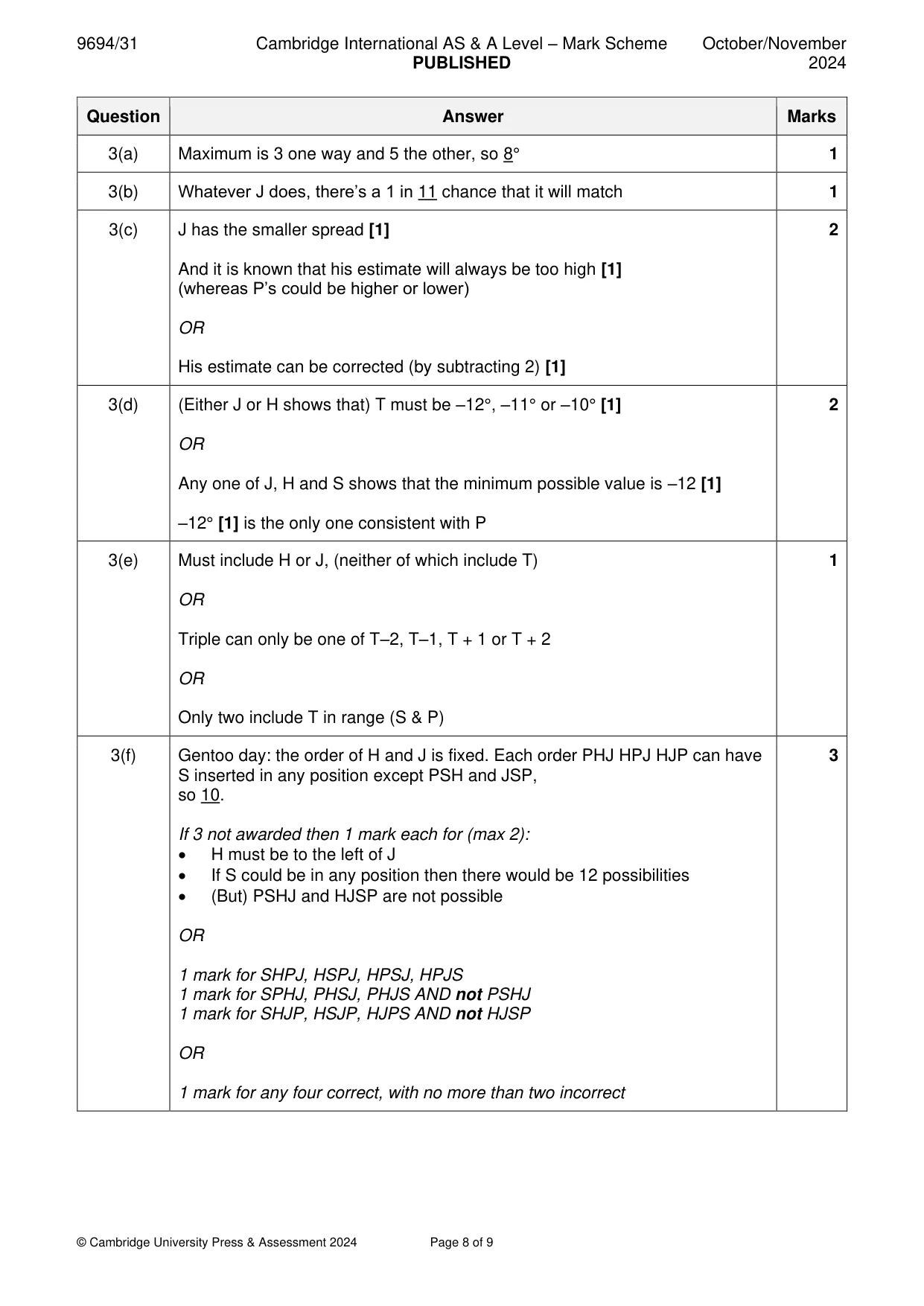
Mark scheme: 3(a) Maximum is 3 one way and 5 the other, so 8° 1 3(b) Whatever J does, there’s a 1 in 11 chance that it will match 1 3(c) J has the smaller spread [1] 2 And it is known that his estimate will always be too high [1] (whereas P’s could be higher or lower) OR His estimate can be corrected (by subtracting 2) [1] 3(d) (Either J or H shows that) T must be –12°, –11° or –10° [1] 2 OR Any one of J, H and S shows that the minimum possible value is –12 [1] –12° [1] is the only one consistent with P 3(e) Must include H or J, (neither of which include T) 1 OR Triple can only be one of T–2, T–1, T + 1 or T + 2 OR Only two include T in range (S & P) 3(f) Gentoo day: the order of H and J is fixed. Each order PHJ HPJ HJP can have 3 S inserted in any position except PSH and JSP, so 10. If 3 not awarded then 1 mark each for (max 2): • H must be to the left of J • If S could be in any position then there would be 12 possibilities • (But) PSHJ and HJSP are not possible OR 1 mark for SHPJ, HSPJ, HPSJ, HPJS 1 mark for SPHJ, PHSJ, PHJS AND not PSHJ 1 mark for SHJP, HSJP, HJPS AND not HJSP OR 1 mark for any four correct, with no more than two incorrect
More questions on Perform appropriate operations with information
Q4 · Canals are flat inland waterways that were designed to be used to transport goods from…
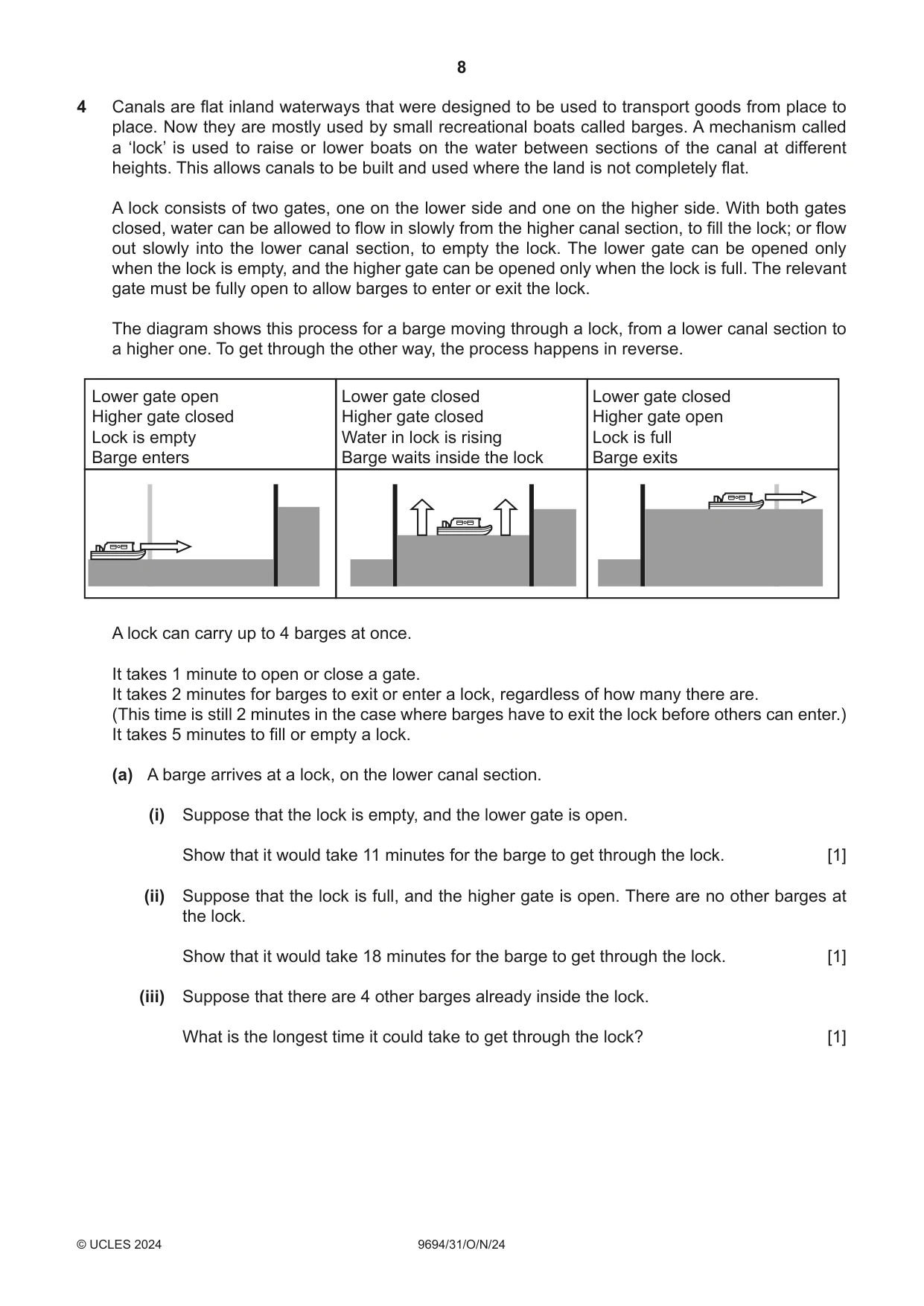
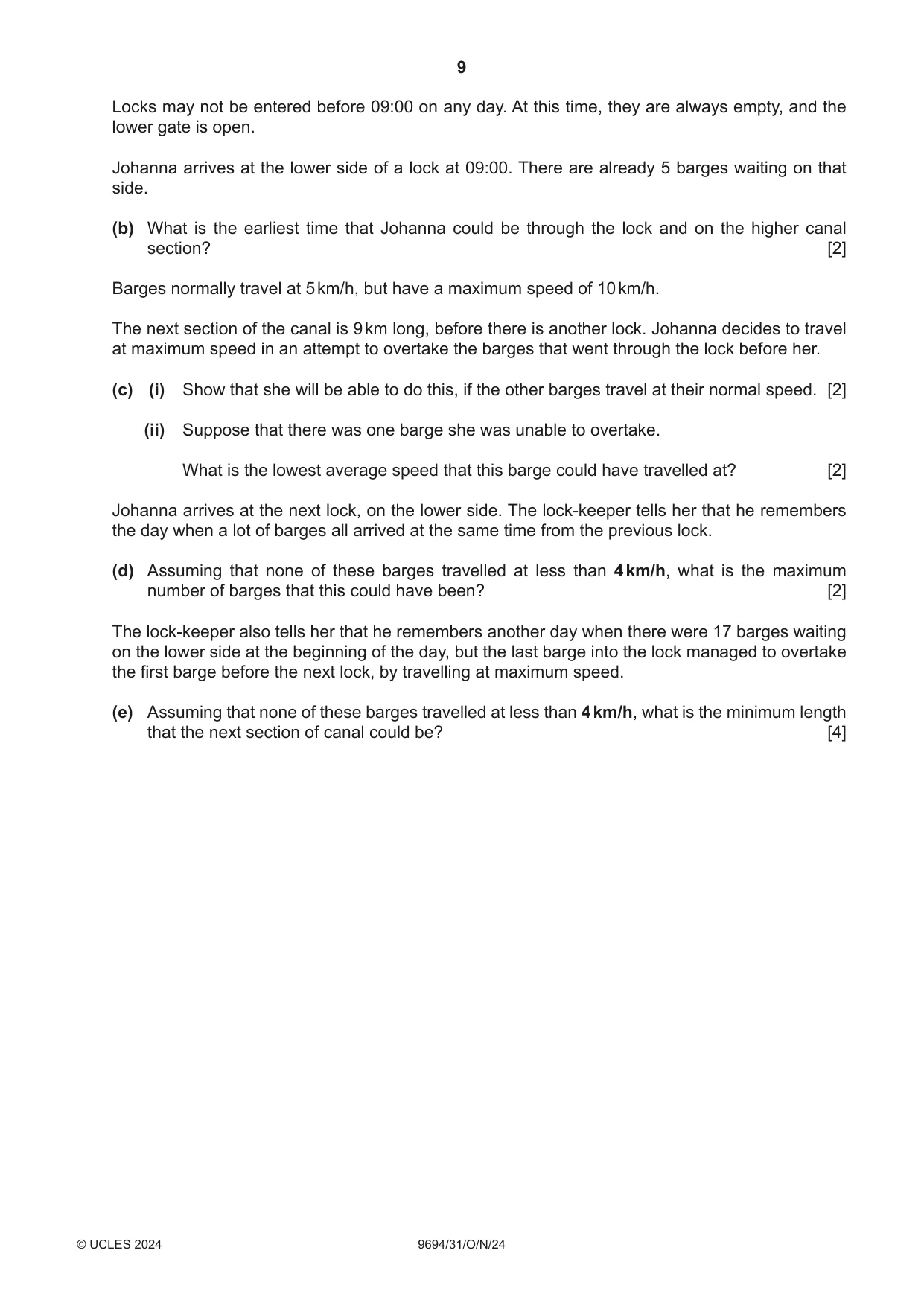
4 Canals are flat inland waterways that were designed to be used to transport goods from place to place. Now they are mostly used by small recreational boats called barges. A mechanism called a ‘lock’ is used to raise or lower boats on the water between sections of the canal at different heights. This allows canals to be built and used where the land is not completely flat. A lock consists of two gates, one on the lower side and one on the higher side. With both gates closed, water can be allowed to flow in slowly from the higher canal section, to fill the lock; or flow out slowly into the lower canal section, to empty the lock. The lower gate can be opened only when the lock is empty, and the higher gate can be opened only when the lock is full. The relevant gate must be fully open to allow barges to enter or exit the lock. The diagram shows this process for a barge moving through a lock, from a lower canal section to a higher one. To get through the other way, the process happens in reverse. Lower gate open Lower gate closed Lower gate closed Higher gate closed Higher gate closed Higher gate open Lock is empty Water in lock is rising Lock is full Barge enters Barge waits inside the lock Barge exits A lock can carry up to 4 barges at once. It takes 1 minute to open or close a gate. It takes 2 minutes for barges to exit or enter a lock, regardless of how many there are. (This time is still 2 minutes in the case where barges have to exit the lock before others can enter.) It takes 5 minutes to fill or empty a lock. (a) A barge arrives at a lock, on the lower canal section. (i) Suppose that the lock is empty, and the lower gate is open. Show that it would take 11 minutes for the barge to get through the lock. [1] (ii) Suppose that the lock is full, and the higher gate is open. There are no other barges at the lock. Show that it would take 18 minutes for the barge to get through the lock. [1] (iii) Suppose that there are 4 other barges already inside the lock. What is the longest time it could take to get through the lock? [1] Locks may not be entered before 09:00 on any day. At this time, they are always empty, and the lower gate is open. Johanna arrives at the lower side of a lock at 09:00. There are already 5 barges waiting on that side. (b) What is the earliest time that Johanna could be through the lock and on the higher canal section? [2] Barges normally travel at 5 km/h, but have a maximum speed of 10 km/h. The next section of the canal is 9 km long, before there is another lock. Johanna decides to travel at maximum speed in an attempt to overtake the barges that went through the lock before her. (c) (i) Show that she will be able to do this, if the other barges travel at their normal speed. [2] (ii) Suppose that there was one barge she was unable to overtake. What is the lowest average speed that this barge could have travelled at? [2] Johanna arrives at the next lock, on the lower side. The lock-keeper tells her that he remembers the day when a lot of barges all arrived at the same time from the previous lock. (d) Assuming that none of these barges travelled at less than 4 km/h, what is the maximum number of barges that this could have been? [2] The lock-keeper also tells her that he remembers another day when there were 17 barges waiting on the lower side at the beginning of the day, but the last barge into the lock managed to overtake the first barge before the next lock, by travelling at maximum speed. (e) Assuming that none of these barges travelled at less than 4 km/h, what is the minimum length that the next section of canal could be? [4]
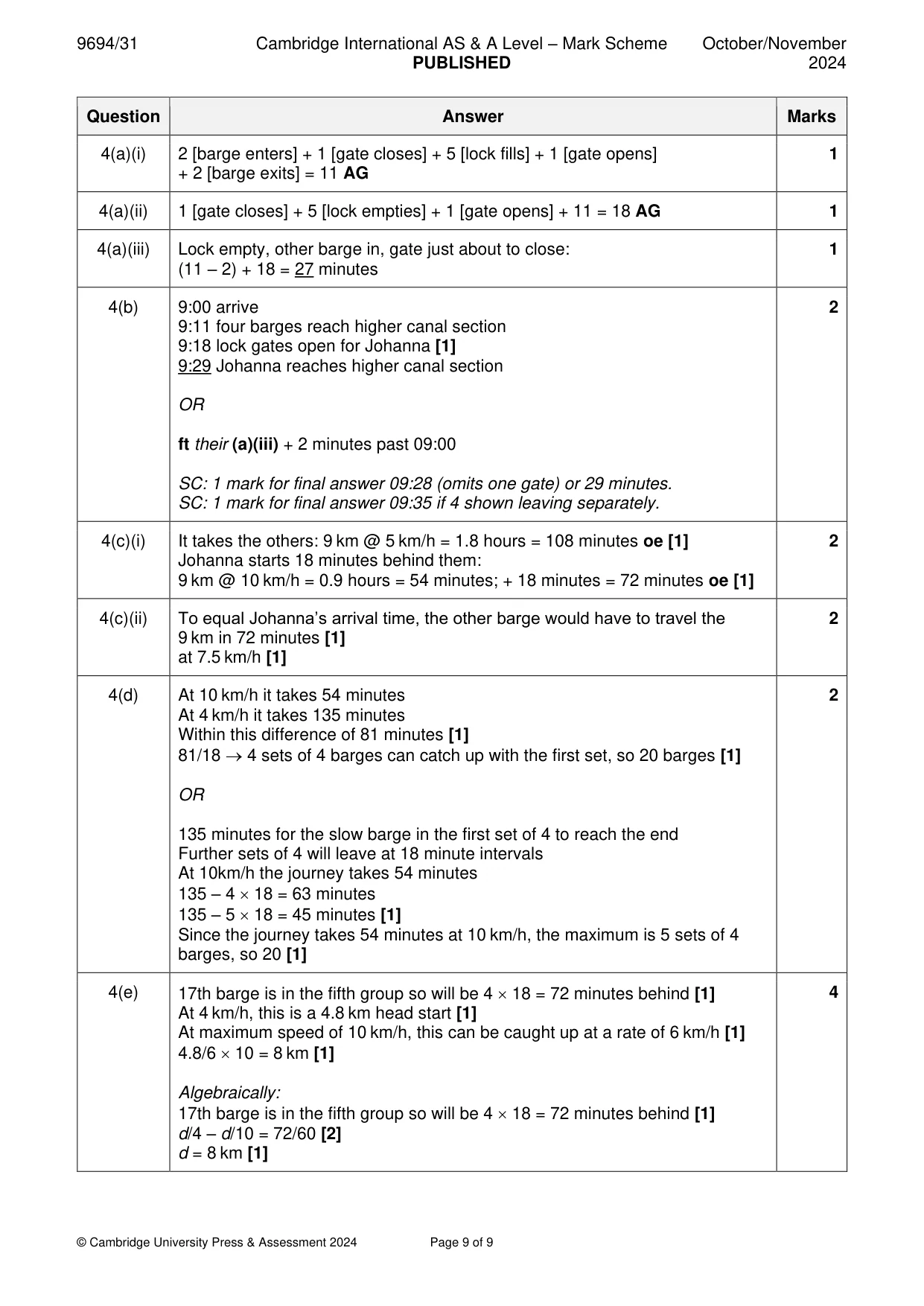
Mark scheme: 4(a)(i) 2 [barge enters] + 1 [gate closes] + 5 [lock fills] + 1 [gate opens] 1 + 2 [barge exits] = 11 AG 4(a)(ii) 1 [gate closes] + 5 [lock empties] + 1 [gate opens] + 11 = 18 AG 1 4(a)(iii) Lock empty, other barge in, gate just about to close: 1 (11 – 2) + 18 = 27 minutes 4(b) 9:00 arrive 2 9:11 four barges reach higher canal section 9:18 lock gates open for Johanna [1] 9:29 Johanna reaches higher canal section OR ft their (a)(iii) + 2 minutes past 09:00 SC: 1 mark for final answer 09:28 (omits one gate) or 29 minutes. SC: 1 mark for final answer 09:35 if 4 shown leaving separately. 4(c)(i) It takes the others: 9 km @ 5 km/h = 1.8 hours = 108 minutes oe [1] 2 Johanna starts 18 minutes behind them: 9 km @ 10 km/h = 0.9 hours = 54 minutes; + 18 minutes = 72 minutes oe [1] 4(c)(ii) To equal Johanna’s arrival time, the other barge would have to travel the 2 9 km in 72 minutes [1] at 7.5 km/h [1] 4(d) At 10 km/h it takes 54 minutes 2 At 4 km/h it takes 135 minutes Within this difference of 81 minutes [1] 81/18 → 4 sets of 4 barges can catch up with the first set, so 20 barges [1] OR 135 minutes for the slow barge in the first set of 4 to reach the end Further sets of 4 will leave at 18 minute intervals At 10km/h the journey takes 54 minutes 135 – 4 18 = 63 minutes 135 – 5 18 = 45 minutes [1] Since the journey takes 54 minutes at 10 km/h, the maximum is 5 sets of 4 barges, so 20 [1] 4(e) 17th barge is in the fifth group so will be 4 18 = 72 minutes behind [1] 4 At 4 km/h, this is a 4.8 km head start [1] At maximum speed of 10 km/h, this can be caught up at a rate of 6 km/h [1] 4.8/6 10 = 8 km [1] Algebraically: 17th barge is in the fifth group so will be 4 18 = 72 minutes behind [1] d/4 – d/10 = 72/60 [2] d = 8 km [1]
More questions on Perform appropriate operations with information
What was in this paper
The subtopics covered by these 4 questions, and how many questions each got. Open one in a new tab to see every Cambridge question on it.
What you needed in this session
Cambridge’s own grade thresholds for 2024 Oct/Nov, Paper 3 · Variant 1. A higher threshold means an easier paper — the bar moves with how the cohort did.