Cambridge A Level Thinking Skills 9694 — 2017 Oct/Nov Paper 3 · Variant 1
9694/31/O/N/17 · 4 questions · 50 marks · ≈56 min
The question paper and its mark scheme, free to read here and free to download. This is Cambridge’s own paper, exactly as it was sat.
Question paper12 pages




Mark scheme5 pages
Answers below. Sit the paper first if you are practising.
Questions as text
Q1 · Five days every week, Faridah sells ice cream at the beach from a box on the back of her…
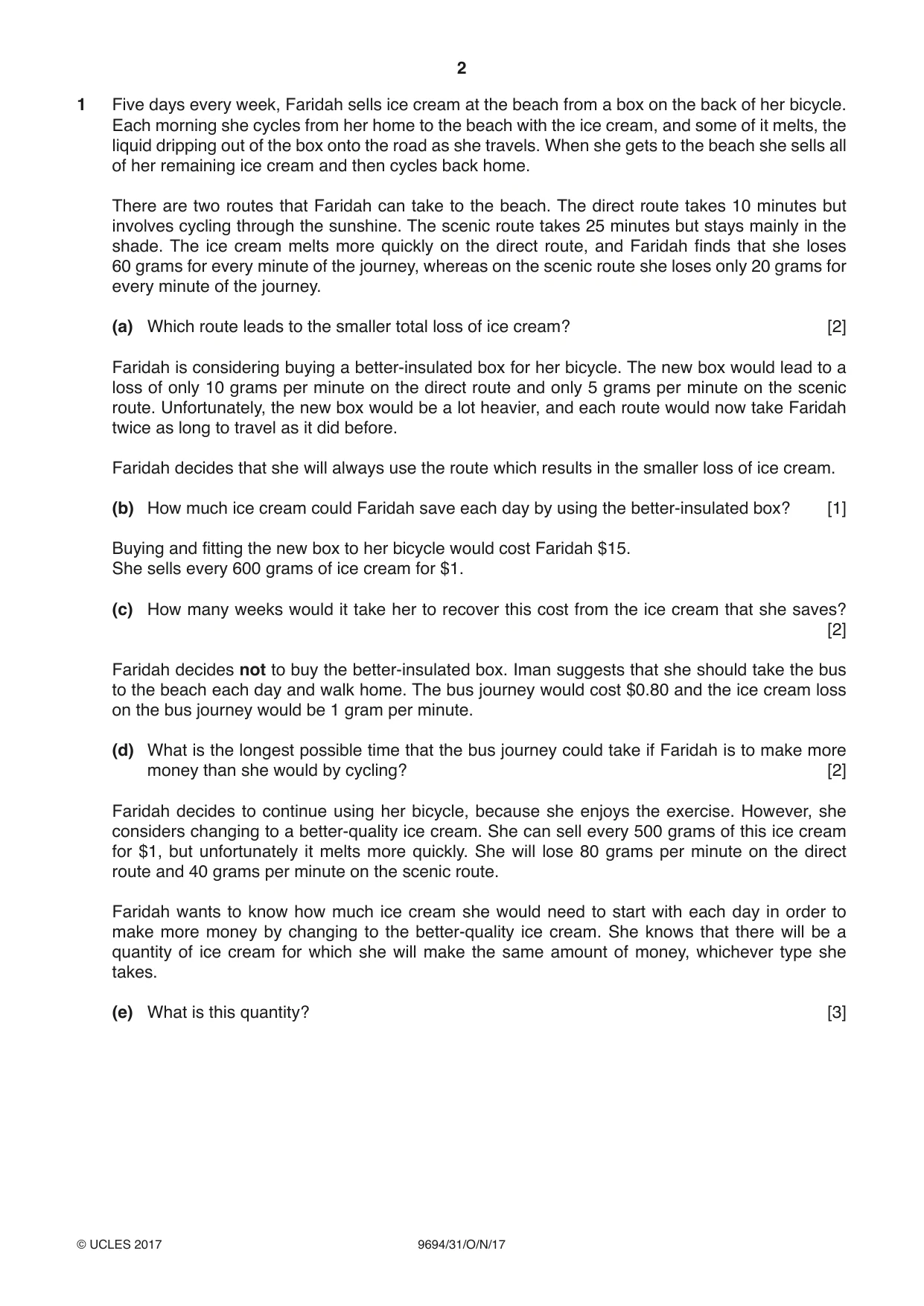
1 Five days every week, Faridah sells ice cream at the beach from a box on the back of her bicycle. Each morning she cycles from her home to the beach with the ice cream, and some of it melts, the liquid dripping out of the box onto the road as she travels. When she gets to the beach she sells all of her remaining ice cream and then cycles back home. There are two routes that Faridah can take to the beach. The direct route takes 10 minutes but involves cycling through the sunshine. The scenic route takes 25 minutes but stays mainly in the shade. The ice cream melts more quickly on the direct route, and Faridah finds that she loses 60 grams for every minute of the journey, whereas on the scenic route she loses only 20 grams for every minute of the journey. (a) Which route leads to the smaller total loss of ice cream? [2] Faridah is considering buying a better-insulated box for her bicycle. The new box would lead to a loss of only 10 grams per minute on the direct route and only 5 grams per minute on the scenic route. Unfortunately, the new box would be a lot heavier, and each route would now take Faridah twice as long to travel as it did before. Faridah decides that she will always use the route which results in the smaller loss of ice cream. (b) How much ice cream could Faridah save each day by using the better-insulated box? [1] Buying and fitting the new box to her bicycle would cost Faridah $15. She sells every 600 grams of ice cream for $1. (c) How many weeks would it take her to recover this cost from the ice cream that she saves? [2] Faridah decides not to buy the better-insulated box. Iman suggests that she should take the bus to the beach each day and walk home. The bus journey would cost $0.80 and the ice cream loss on the bus journey would be 1 gram per minute. (d) What is the longest possible time that the bus journey could take if Faridah is to make more money than she would by cycling? [2] Faridah decides to continue using her bicycle, because she enjoys the exercise. However, she considers changing to a better-quality ice cream. She can sell every 500 grams of this ice cream for $1, but unfortunately it melts more quickly. She will lose 80 grams per minute on the direct route and 40 grams per minute on the scenic route. Faridah wants to know how much ice cream she would need to start with each day in order to make more money by changing to the better-quality ice cream. She knows that there will be a quantity of ice cream for which she will make the same amount of money, whichever type she takes. (e) What is this quantity? [3] [Question 2 begins on the next page]
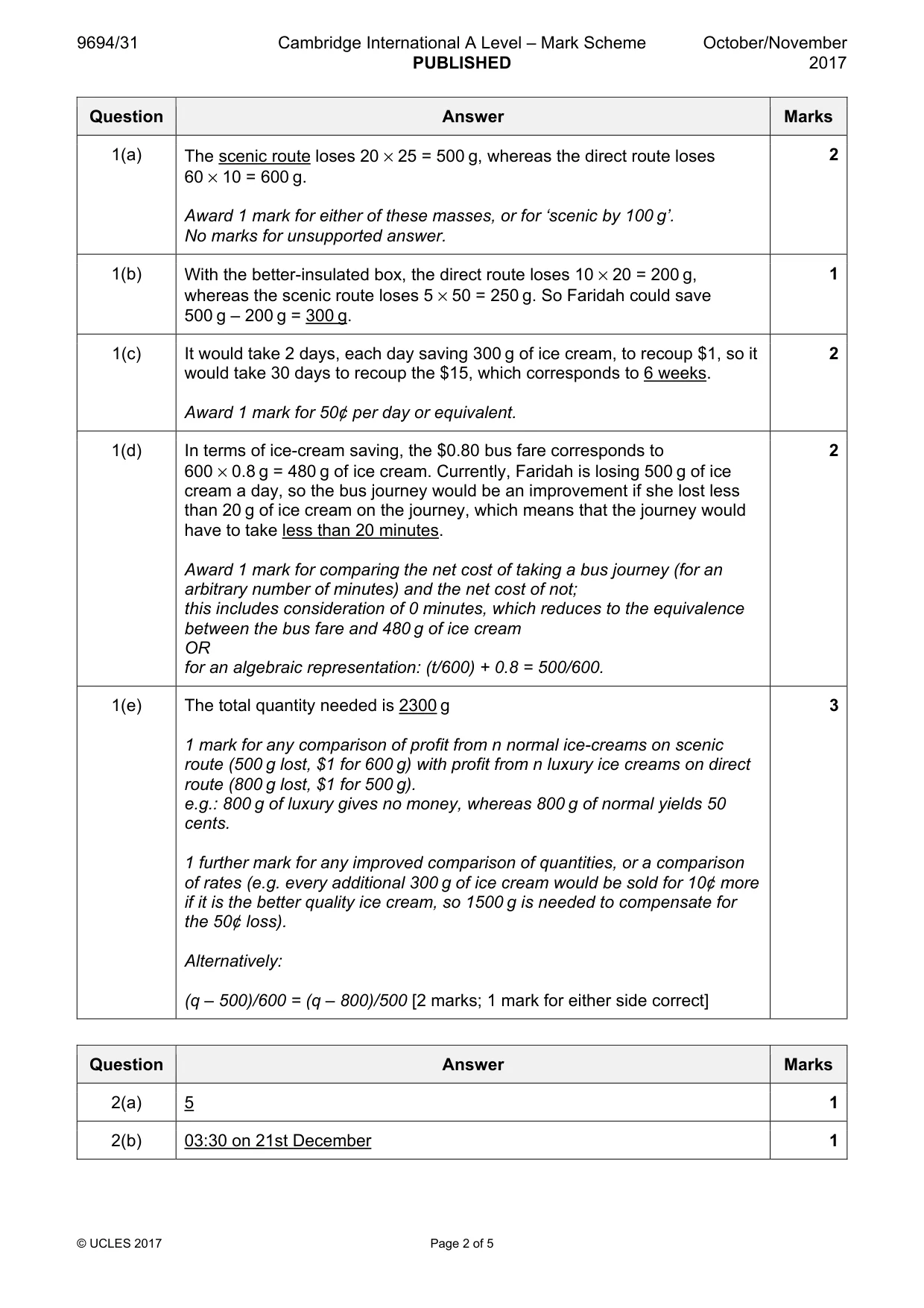
Mark scheme: Question Answer Marks 1(a) The scenic route loses 20 × 25 = 500 g, whereas the direct route loses 2 60 × 10 = 600 g. Award 1 mark for either of these masses, or for ‘scenic by 100 g’. No marks for unsupported answer. 1(b) With the better-insulated box, the direct route loses 10 × 20 = 200 g, 1 whereas the scenic route loses 5 × 50 = 250 g. So Faridah could save 500 g – 200 g = 300 g. 1(c) It would take 2 days, each day saving 300 g of ice cream, to recoup $1, so it 2 would take 30 days to recoup the $15, which corresponds to 6 weeks. Award 1 mark for 50¢ per day or equivalent. 1(d) In terms of ice-cream saving, the $0.80 bus fare corresponds to 2 600 × 0.8 g = 480 g of ice cream. Currently, Faridah is losing 500 g of ice cream a day, so the bus journey would be an improvement if she lost less than 20 g of ice cream on the journey, which means that the journey would have to take less than 20 minutes. Award 1 mark for comparing the net cost of taking a bus journey (for an arbitrary number of minutes) and the net cost of not; this includes consideration of 0 minutes, which reduces to the equivalence between the bus fare and 480 g of ice cream OR for an algebraic representation: (t/600) + 0.8 = 500/600. 1(e) The total quantity needed is 2300 g 3 1 mark for any comparison of profit from n normal ice-creams on scenic route (500 g lost, $1 for 600 g) with profit from n luxury ice creams on direct route (800 g lost, $1 for 500 g). e.g.: 800 g of luxury gives no money, whereas 800 g of normal yields 50 cents. 1 further mark for any improved comparison of quantities, or a comparison of rates (e.g. every additional 300 g of ice cream would be sold for 10¢ more if it is the better quality ice cream, so 1500 g is needed to compensate for the 50¢ loss). Alternatively: (q – 500)/600 = (q – 800)/500 [2 marks; 1 mark for either side correct]
More questions on Perform appropriate operations with information
Q2 · Universal Time (UT) is the standard time at 0° longitude (which is the imaginary line…
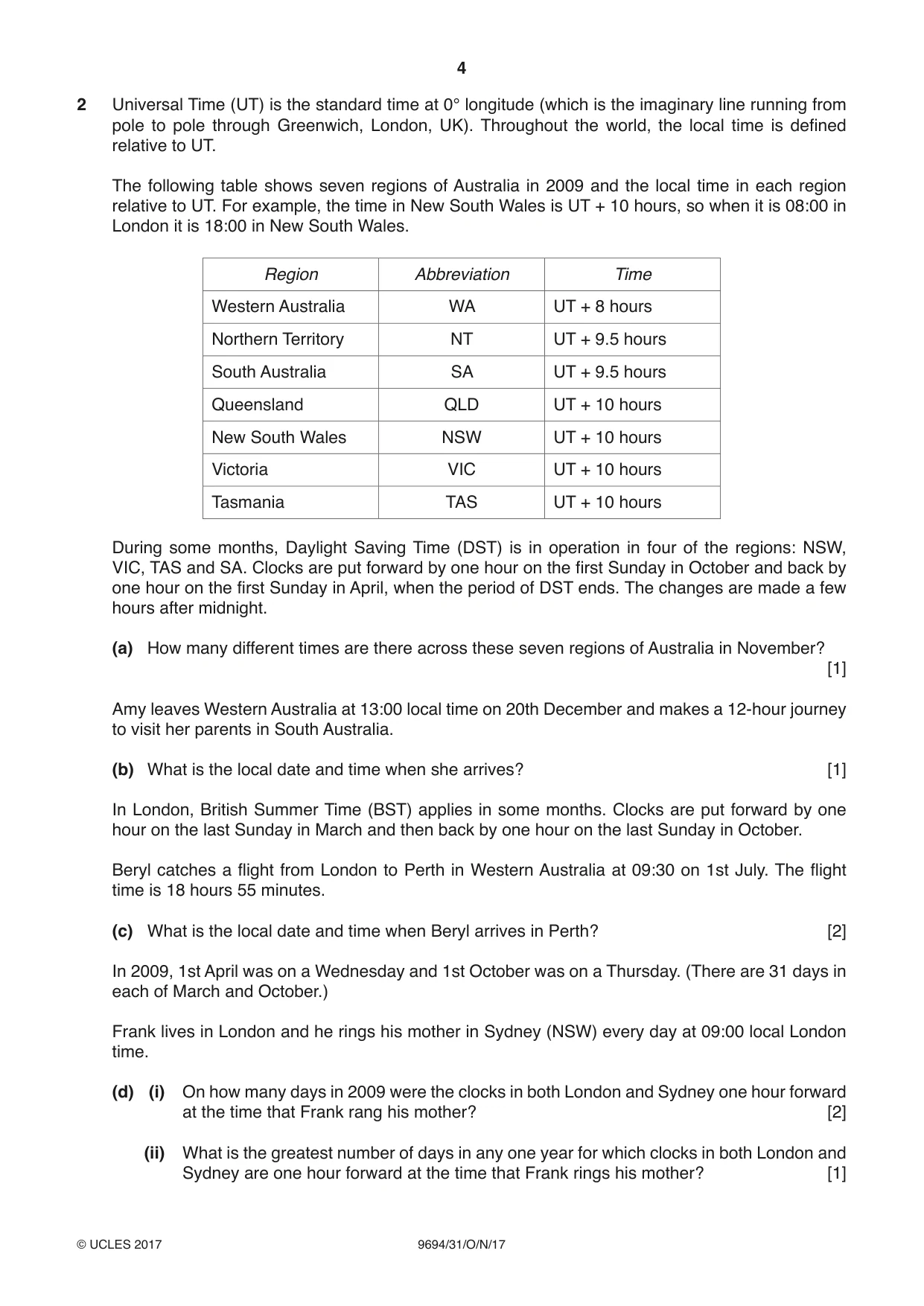
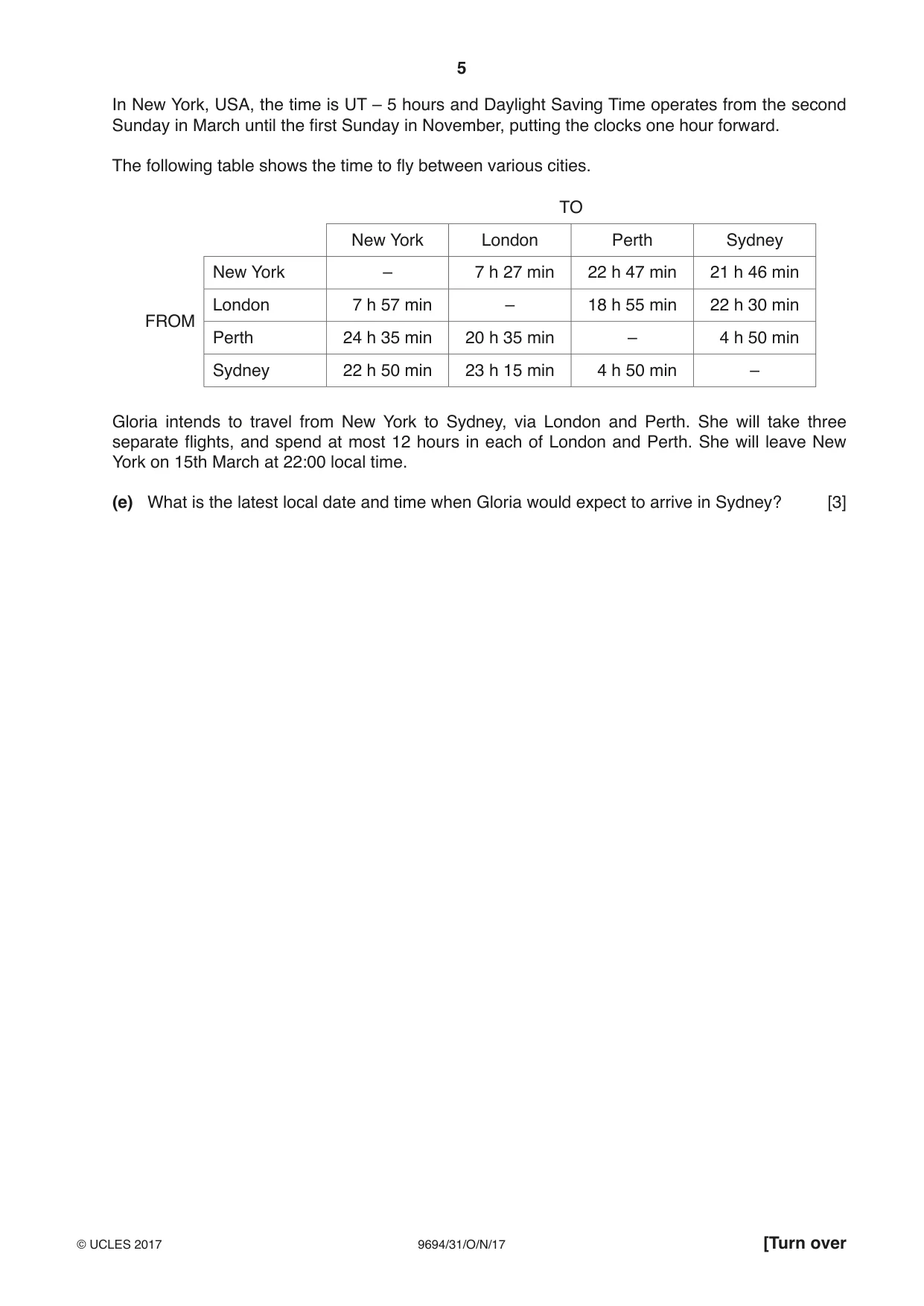
2 Universal Time (UT) is the standard time at 0° longitude (which is the imaginary line running from pole to pole through Greenwich, London, UK). Throughout the world, the local time is defined relative to UT. The following table shows seven regions of Australia in 2009 and the local time in each region relative to UT. For example, the time in New South Wales is UT + 10 hours, so when it is 08:00 in London it is 18:00 in New South Wales. Region Abbreviation Time Western Australia WA UT + 8 hours Northern Territory NT UT + 9.5 hours South Australia SA UT + 9.5 hours Queensland QLD UT + 10 hours New South Wales NSW UT + 10 hours Victoria VIC UT + 10 hours Tasmania TAS UT + 10 hours During some months, Daylight Saving Time (DST) is in operation in four of the regions: NSW, VIC, TAS and SA. Clocks are put forward by one hour on the first Sunday in October and back by one hour on the first Sunday in April, when the period of DST ends. The changes are made a few hours after midnight. (a) How many different times are there across these seven regions of Australia in November? [1] Amy leaves Western Australia at 13:00 local time on 20th December and makes a 12-hour journey to visit her parents in South Australia. (b) What is the local date and time when she arrives? [1] In London, British Summer Time (BST) applies in some months. Clocks are put forward by one hour on the last Sunday in March and then back by one hour on the last Sunday in October. Beryl catches a flight from London to Perth in Western Australia at 09:30 on 1st July. The flight time is 18 hours 55 minutes. (c) What is the local date and time when Beryl arrives in Perth? [2] In 2009, 1st April was on a Wednesday and 1st October was on a Thursday. (There are 31 days in each of March and October.) Frank lives in London and he rings his mother in Sydney (NSW) every day at 09:00 local London time. (d) (i) On how many days in 2009 were the clocks in both London and Sydney one hour forward at the time that Frank rang his mother? [2] (ii) What is the greatest number of days in any one year for which clocks in both London and Sydney are one hour forward at the time that Frank rings his mother? [1] In New York, USA, the time is UT – 5 hours and Daylight Saving Time operates from the second Sunday in March until the first Sunday in November, putting the clocks one hour forward. The following table shows the time to fly between various cities. TO New York London Perth Sydney New York – 7 h 27 min 22 h 47 min 21 h 46 min London 7 h 57 min – 18 h 55 min 22 h 30 min FROM Perth 24 h 35 min 20 h 35 min – 4 h 50 min Sydney 22 h 50 min 23 h 15 min 4 h 50 min – Gloria intends to travel from New York to Sydney, via London and Perth. She will take three separate flights, and spend at most 12 hours in each of London and Perth. She will leave New York on 15th March at 22:00 local time. (e) What is the latest local date and time when Gloria would expect to arrive in Sydney? [3]
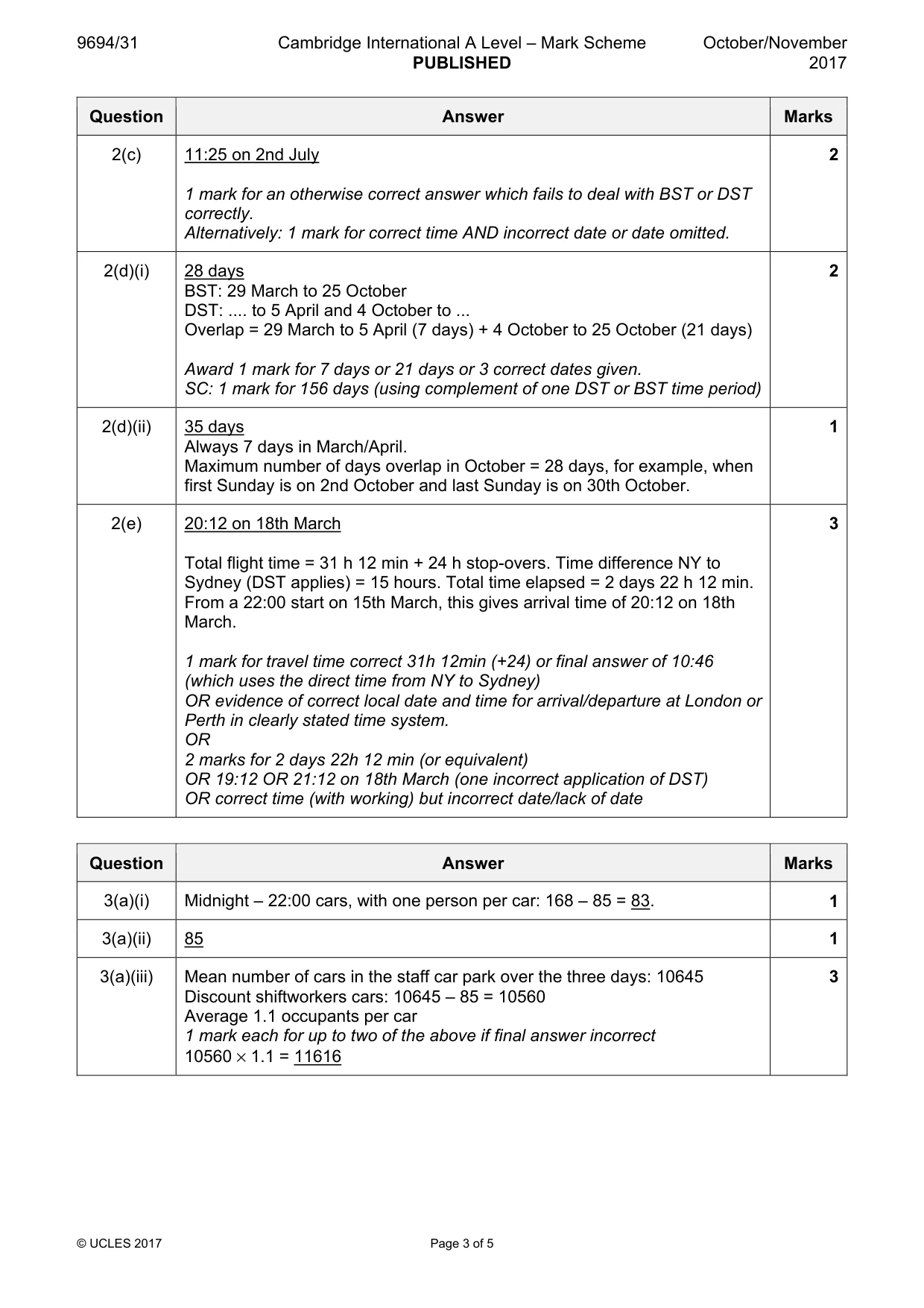
Mark scheme: 2(a) 5 1 2(b) 03:30 on 21st December 1 2(c) 11:25 on 2nd July 2 1 mark for an otherwise correct answer which fails to deal with BST or DST correctly. Alternatively: 1 mark for correct time AND incorrect date or date omitted. 2(d)(i) 28 days 2 BST: 29 March to 25 October DST: .... to 5 April and 4 October to ... Overlap = 29 March to 5 April (7 days) + 4 October to 25 October (21 days) Award 1 mark for 7 days or 21 days or 3 correct dates given. SC: 1 mark for 156 days (using complement of one DST or BST time period) 2(d)(ii) 35 days 1 Always 7 days in March/April. Maximum number of days overlap in October = 28 days, for example, when first Sunday is on 2nd October and last Sunday is on 30th October. 2(e) 20:12 on 18th March 3 Total flight time = 31 h 12 min + 24 h stop-overs. Time difference NY to Sydney (DST applies) = 15 hours. Total time elapsed = 2 days 22 h 12 min. From a 22:00 start on 15th March, this gives arrival time of 20:12 on 18th March. 1 mark for travel time correct 31h 12min (+24) or final answer of 10:46 (which uses the direct time from NY to Sydney) OR evidence of correct local date and time for arrival/departure at London or Perth in clearly stated time system. OR 2 marks for 2 days 22h 12 min (or equivalent) OR 19:12 OR 21:12 on 18th March (one incorrect application of DST) OR correct time (with working) but incorrect date/lack of date
Q3 · A Nefarious Secretive Agency, in a remote location which is not served by public…
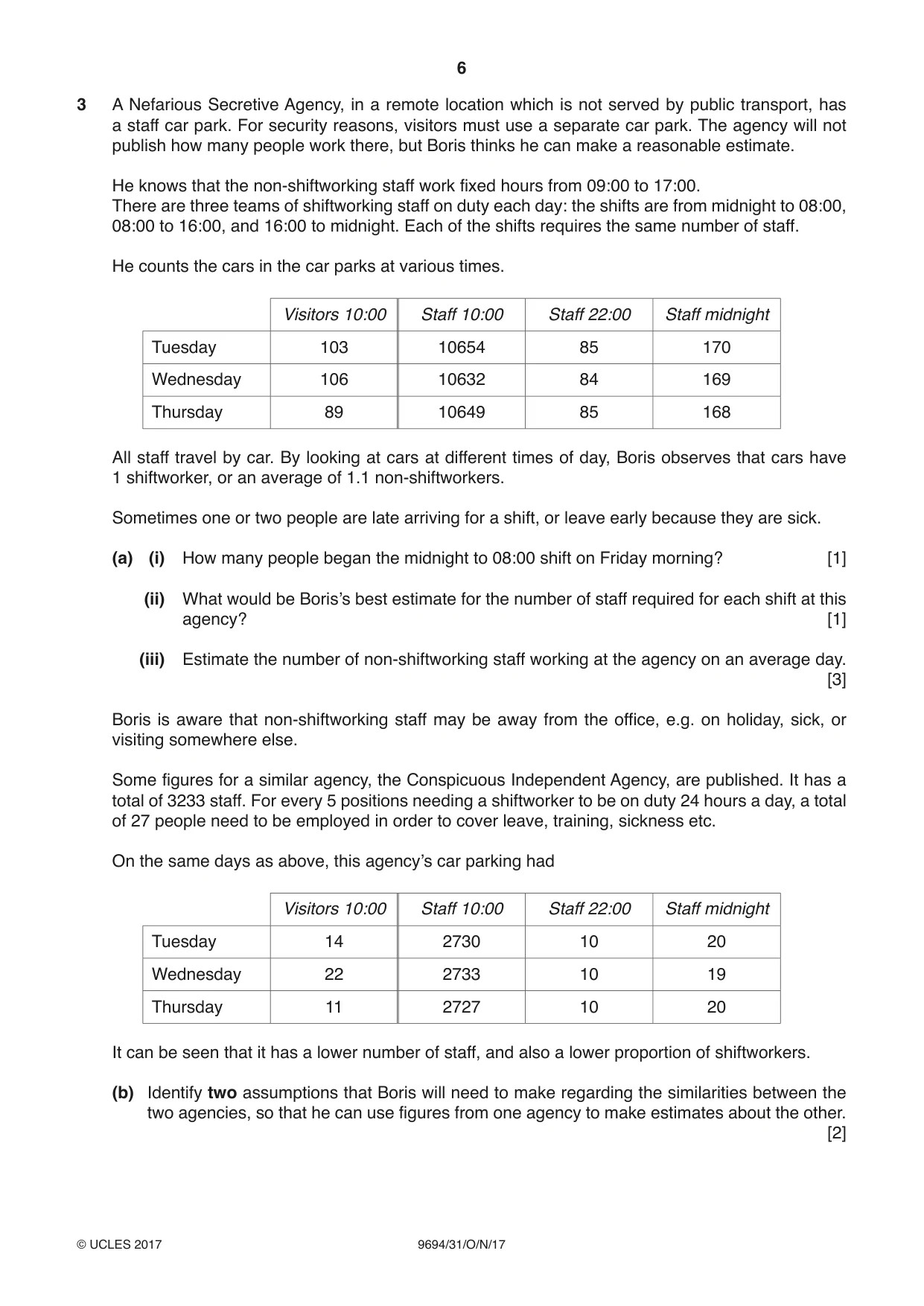
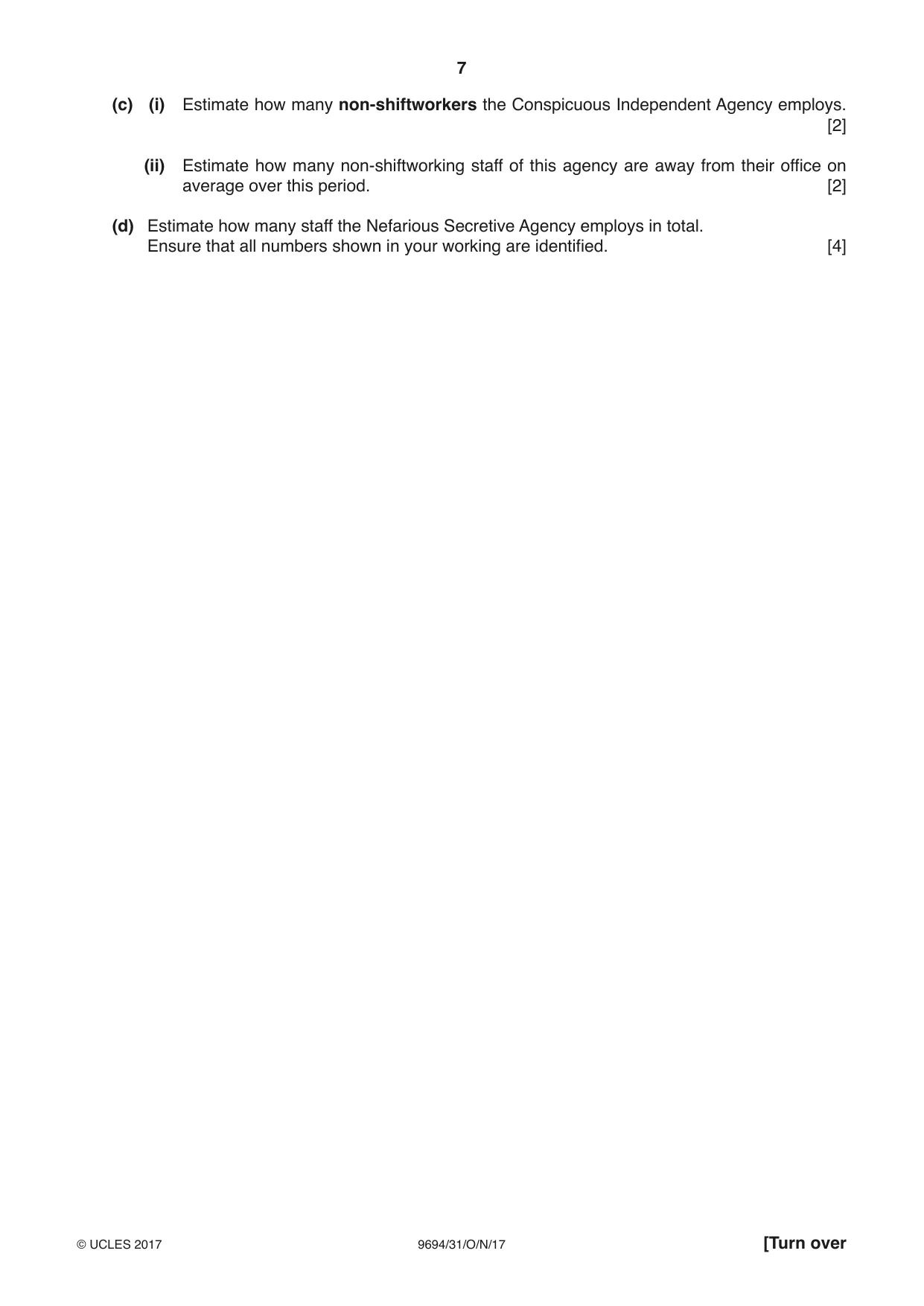
3 A Nefarious Secretive Agency, in a remote location which is not served by public transport, has a staff car park. For security reasons, visitors must use a separate car park. The agency will not publish how many people work there, but Boris thinks he can make a reasonable estimate. He knows that the non-shiftworking staff work fixed hours from 09:00 to 17:00. There are three teams of shiftworking staff on duty each day: the shifts are from midnight to 08:00, 08:00 to 16:00, and 16:00 to midnight. Each of the shifts requires the same number of staff. He counts the cars in the car parks at various times. Visitors 10:00 Staff 10:00 Staff 22:00 Staff midnight Tuesday 103 10654 85 170 Wednesday 106 10632 84 169 Thursday 89 10649 85 168 All staff travel by car. By looking at cars at different times of day, Boris observes that cars have 1 shiftworker, or an average of 1.1 non-shiftworkers. Sometimes one or two people are late arriving for a shift, or leave early because they are sick. (a) (i) How many people began the midnight to 08:00 shift on Friday morning? [1] (ii) What would be Boris’s best estimate for the number of staff required for each shift at this agency? [1] (iii) Estimate the number of non-shiftworking staff working at the agency on an average day. [3] Boris is aware that non-shiftworking staff may be away from the office, e.g. on holiday, sick, or visiting somewhere else. Some figures for a similar agency, the Conspicuous Independent Agency, are published. It has a total of 3233 staff. For every 5 positions needing a shiftworker to be on duty 24 hours a day, a total of 27 people need to be employed in order to cover leave, training, sickness etc. On the same days as above, this agency’s car parking had Visitors 10:00 Staff 10:00 Staff 22:00 Staff midnight Tuesday 14 2730 10 20 Wednesday 22 2733 10 19 Thursday 11 2727 10 20 It can be seen that it has a lower number of staff, and also a lower proportion of shiftworkers. (b) Identify two assumptions that Boris will need to make regarding the similarities between the two agencies, so that he can use figures from one agency to make estimates about the other. [2] (c) (i) Estimate how many non-shiftworkers the Conspicuous Independent Agency employs. [2] (ii) Estimate how many non-shiftworking staff of this agency are away from their office on average over this period. [2] (d) Estimate how many staff the Nefarious Secretive Agency employs in total. Ensure that all numbers shown in your working are identified. [4]
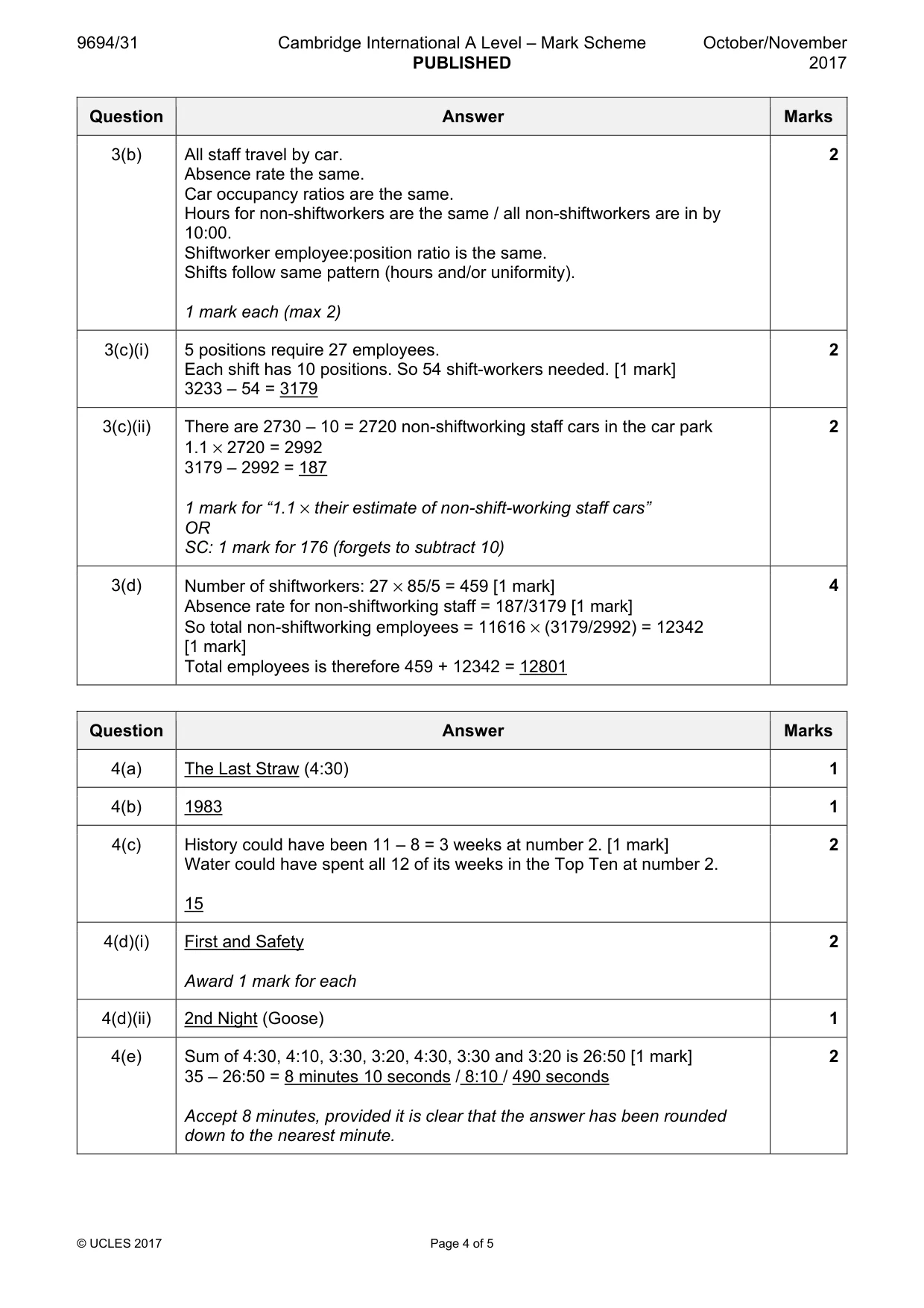
Mark scheme: 3(a)(i) Midnight – 22:00 cars, with one person per car: 168 – 85 = 83. 1 3(a)(ii) 85 1 3(a)(iii) Mean number of cars in the staff car park over the three days: 10645 3 Discount shiftworkers cars: 10645 – 85 = 10560 Average 1.1 occupants per car 1 mark each for up to two of the above if final answer incorrect 10560 × 1.1 = 11616 3(b) All staff travel by car. 2 Absence rate the same. Car occupancy ratios are the same. Hours for non-shiftworkers are the same / all non-shiftworkers are in by 10:00. Shiftworker employee:position ratio is the same. Shifts follow same pattern (hours and/or uniformity). 1 mark each (max 2) 3(c)(i) 5 positions require 27 employees. 2 Each shift has 10 positions. So 54 shift-workers needed. [1 mark] 3233 – 54 = 3179 3(c)(ii) There are 2730 – 10 = 2720 non-shiftworking staff cars in the car park 2 1.1 × 2720 = 2992 3179 – 2992 = 187 1 mark for “1.1 × their estimate of non-shift-working staff cars” OR SC: 1 mark for 176 (forgets to subtract 10) 3(d) Number of shiftworkers: 27 × 85/5 = 459 [1 mark] 4 Absence rate for non-shiftworking staff = 187/3179 [1 mark] So total non-shiftworking employees = 11616 × (3179/2992) = 12342 [1 mark] Total employees is therefore 459 + 12342 = 12801
Q4 · The Proverbs were a successful band in the 1980s, whose songs frequently made it into the…
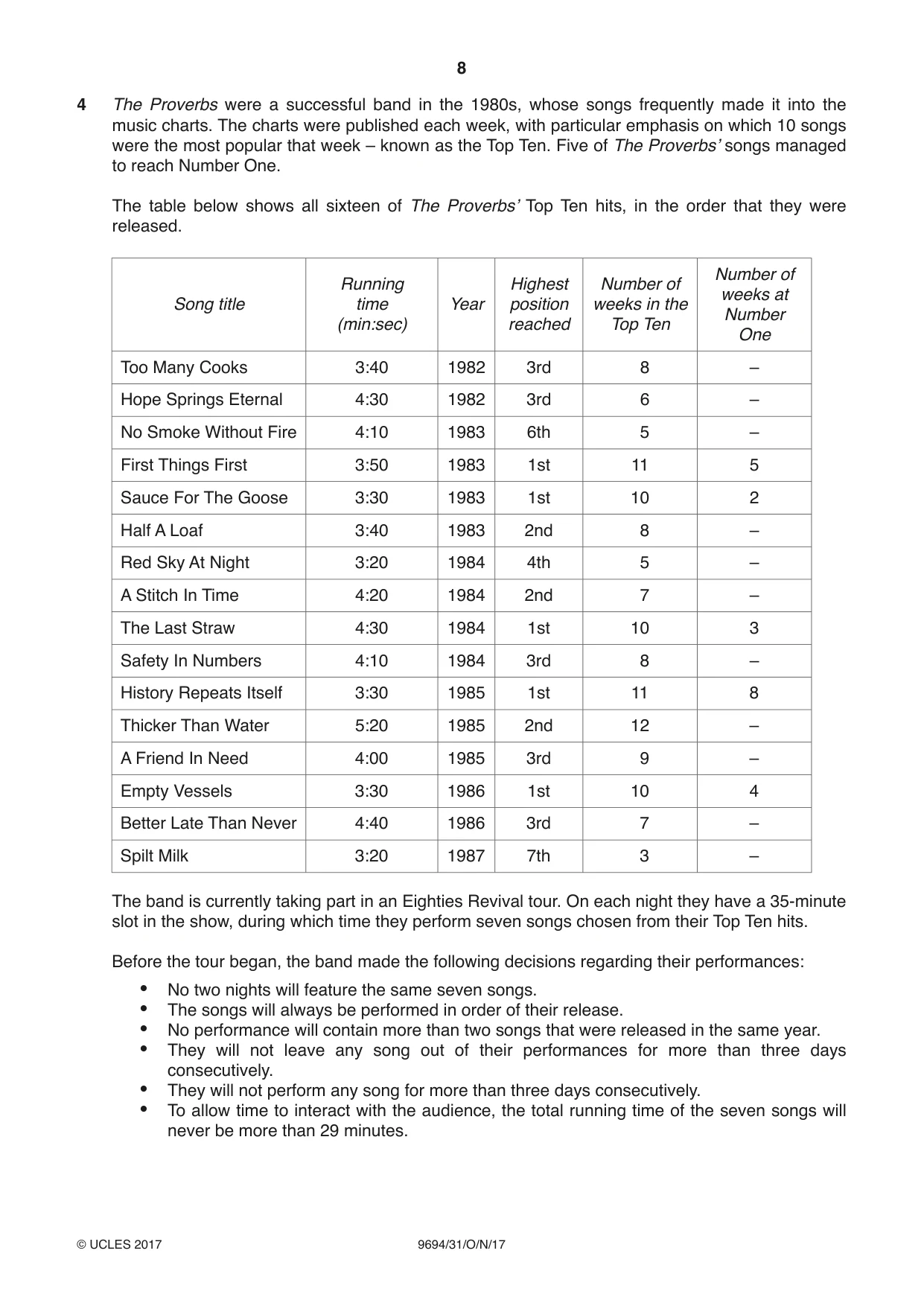
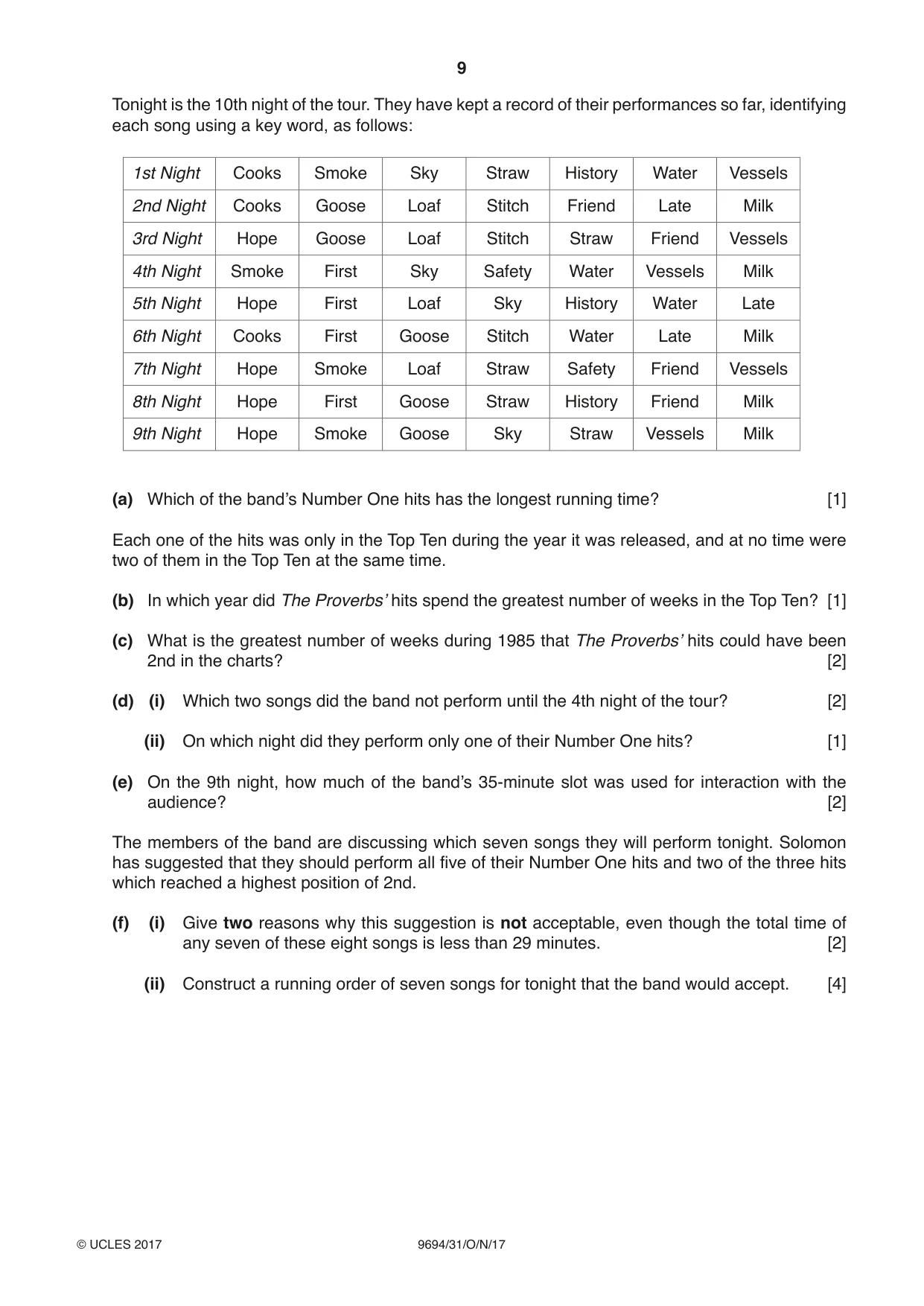
4 The Proverbs were a successful band in the 1980s, whose songs frequently made it into the music charts. The charts were published each week, with particular emphasis on which 10 songs were the most popular that week – known as the Top Ten. Five of The Proverbs’ songs managed to reach Number One. The table below shows all sixteen of The Proverbs’ Top Ten hits, in the order that they were released. Number of Running Highest Number of weeks at Song title time Year position weeks in the Number (min:sec) reached Top Ten One Too Many Cooks 3:40 1982 3rd 8 – Hope Springs Eternal 4:30 1982 3rd 6 – No Smoke Without Fire 4:10 1983 6th 5 – First Things First 3:50 1983 1st 11 5 Sauce For The Goose 3:30 1983 1st 10 2 Half A Loaf 3:40 1983 2nd 8 – Red Sky At Night 3:20 1984 4th 5 – A Stitch In Time 4:20 1984 2nd 7 – The Last Straw 4:30 1984 1st 10 3 Safety In Numbers 4:10 1984 3rd 8 – History Repeats Itself 3:30 1985 1st 11 8 Thicker Than Water 5:20 1985 2nd 12 – A Friend In Need 4:00 1985 3rd 9 – Empty Vessels 3:30 1986 1st 10 4 Better Late Than Never 4:40 1986 3rd 7 – Spilt Milk 3:20 1987 7th 3 – The band is currently taking part in an Eighties Revival tour. On each night they have a 35-minute slot in the show, during which time they perform seven songs chosen from their Top Ten hits. Before the tour began, the band made the following decisions regarding their performances: • No two nights will feature the same seven songs. • The songs will always be performed in order of their release. • No performance will contain more than two songs that were released in the same year. • They will not leave any song out of their performances for more than three days consecutively. • They will not perform any song for more than three days consecutively. • To allow time to interact with the audience, the total running time of the seven songs will never be more than 29 minutes. Tonight is the 10th night of the tour. They have kept a record of their performances so far, identifying each song using a key word, as follows: 1st Night Cooks Smoke Sky Straw History Water Vessels 2nd Night Cooks Goose Loaf Stitch Friend Late Milk 3rd Night Hope Goose Loaf Stitch Straw Friend Vessels 4th Night Smoke First Sky Safety Water Vessels Milk 5th Night Hope First Loaf Sky History Water Late 6th Night Cooks First Goose Stitch Water Late Milk 7th Night Hope Smoke Loaf Straw Safety Friend Vessels 8th Night Hope First Goose Straw History Friend Milk 9th Night Hope Smoke Goose Sky Straw Vessels Milk (a) Which of the band’s Number One hits has the longest running time? [1] Each one of the hits was only in the Top Ten during the year it was released, and at no time were two of them in the Top Ten at the same time. (b) In which year did The Proverbs’ hits spend the greatest number of weeks in the Top Ten? [1] (c) What is the greatest number of weeks during 1985 that The Proverbs’ hits could have been 2nd in the charts? [2] (d) (i) Which two songs did the band not perform until the 4th night of the tour? [2] (ii) On which night did they perform only one of their Number One hits? [1] (e) On the 9th night, how much of the band’s 35-minute slot was used for interaction with the audience? [2] The members of the band are discussing which seven songs they will perform tonight. Solomon has suggested that they should perform all five of their Number One hits and two of the three hits which reached a highest position of 2nd. (f) (i) Give two reasons why this suggestion is not acceptable, even though the total time of any seven of these eight songs is less than 29 minutes. [2] (ii) Construct a running order of seven songs for tonight that the band would accept. [4]
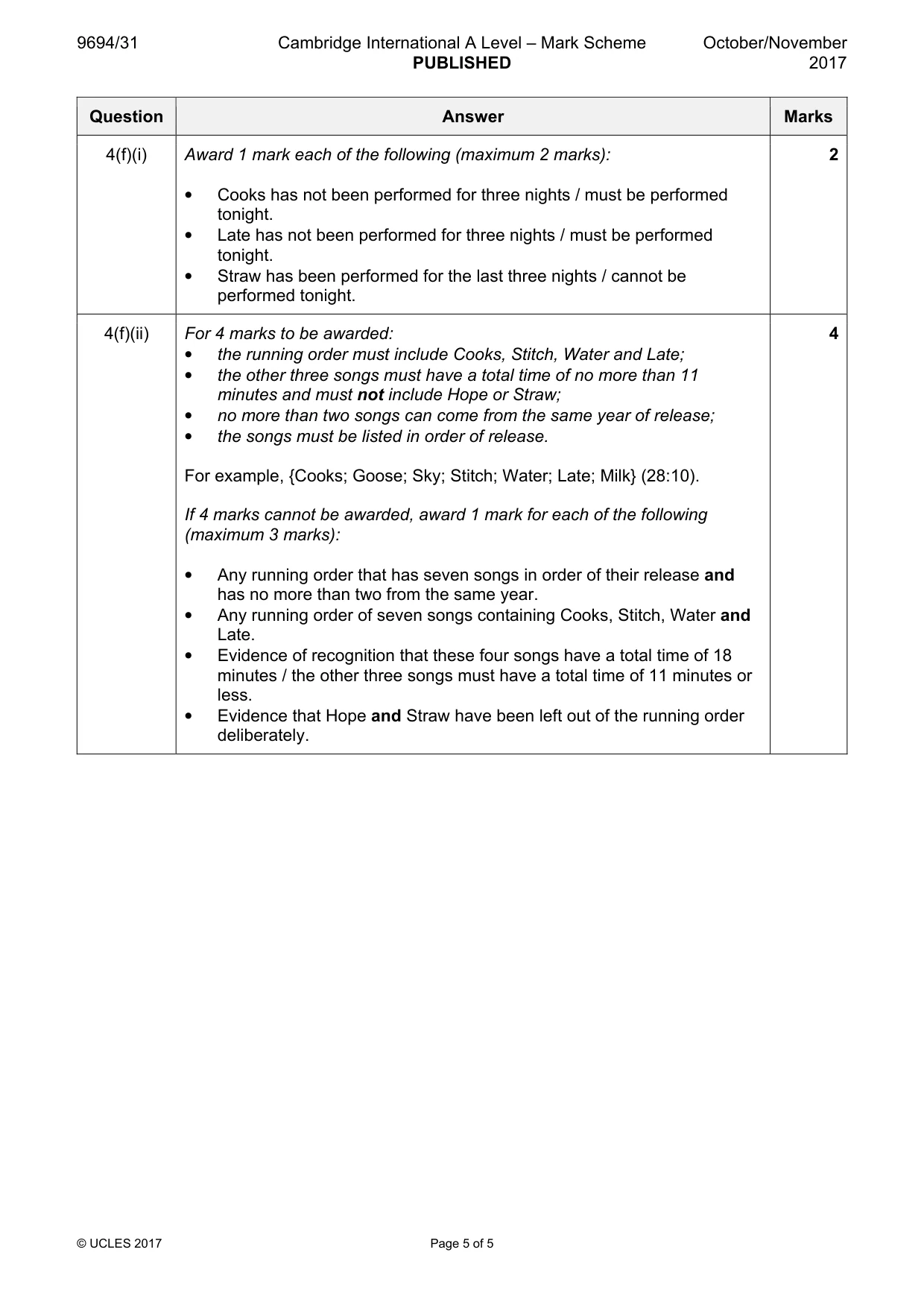
Mark scheme: 4(a) The Last Straw (4:30) 1 4(b) 1983 1 4(c) History could have been 11 – 8 = 3 weeks at number 2. [1 mark] 2 Water could have spent all 12 of its weeks in the Top Ten at number 2. 15 4(d)(i) First and Safety 2 Award 1 mark for each 4(d)(ii) 2nd Night (Goose) 1 4(e) Sum of 4:30, 4:10, 3:30, 3:20, 4:30, 3:30 and 3:20 is 26:50 [1 mark] 2 35 – 26:50 = 8 minutes 10 seconds / 8:10 / 490 seconds Accept 8 minutes, provided it is clear that the answer has been rounded down to the nearest minute. 4(f)(i) Award 1 mark each of the following (maximum 2 marks): 2 • Cooks has not been performed for three nights / must be performed tonight. • Late has not been performed for three nights / must be performed tonight. • Straw has been performed for the last three nights / cannot be performed tonight. 4(f)(ii) For 4 marks to be awarded: 4 • the running order must include Cooks, Stitch, Water and Late; • the other three songs must have a total time of no more than 11 minutes and must not include Hope or Straw; • no more than two songs can come from the same year of release; • the songs must be listed in order of release. For example, {Cooks; Goose; Sky; Stitch; Water; Late; Milk} (28:10). If 4 marks cannot be awarded, award 1 mark for each of the following (maximum 3 marks): • Any running order that has seven songs in order of their release and has no more than two from the same year. • Any running order of seven songs containing Cooks, Stitch, Water and Late. • Evidence of recognition that these four songs have a total time of 18 minutes / the other three songs must have a total time of 11 minutes or less. • Evidence that Hope and Straw have been left out of the running order deliberately.
More questions on Perform appropriate operations with information
What was in this paper
The subtopics covered by these 4 questions, and how many questions each got. Open one in a new tab to see every Cambridge question on it.
What you needed in this session
Cambridge’s own grade thresholds for 2017 Oct/Nov, Paper 3 · Variant 1. A higher threshold means an easier paper — the bar moves with how the cohort did.