Cambridge A Level Thinking Skills 9694 — 2018 Oct/Nov Paper 3 · Variant 1
9694/31/O/N/18 · 4 questions · 50 marks · ≈56 min
The question paper and its mark scheme, free to read here and free to download. This is Cambridge’s own paper, exactly as it was sat.
Question paper8 pages
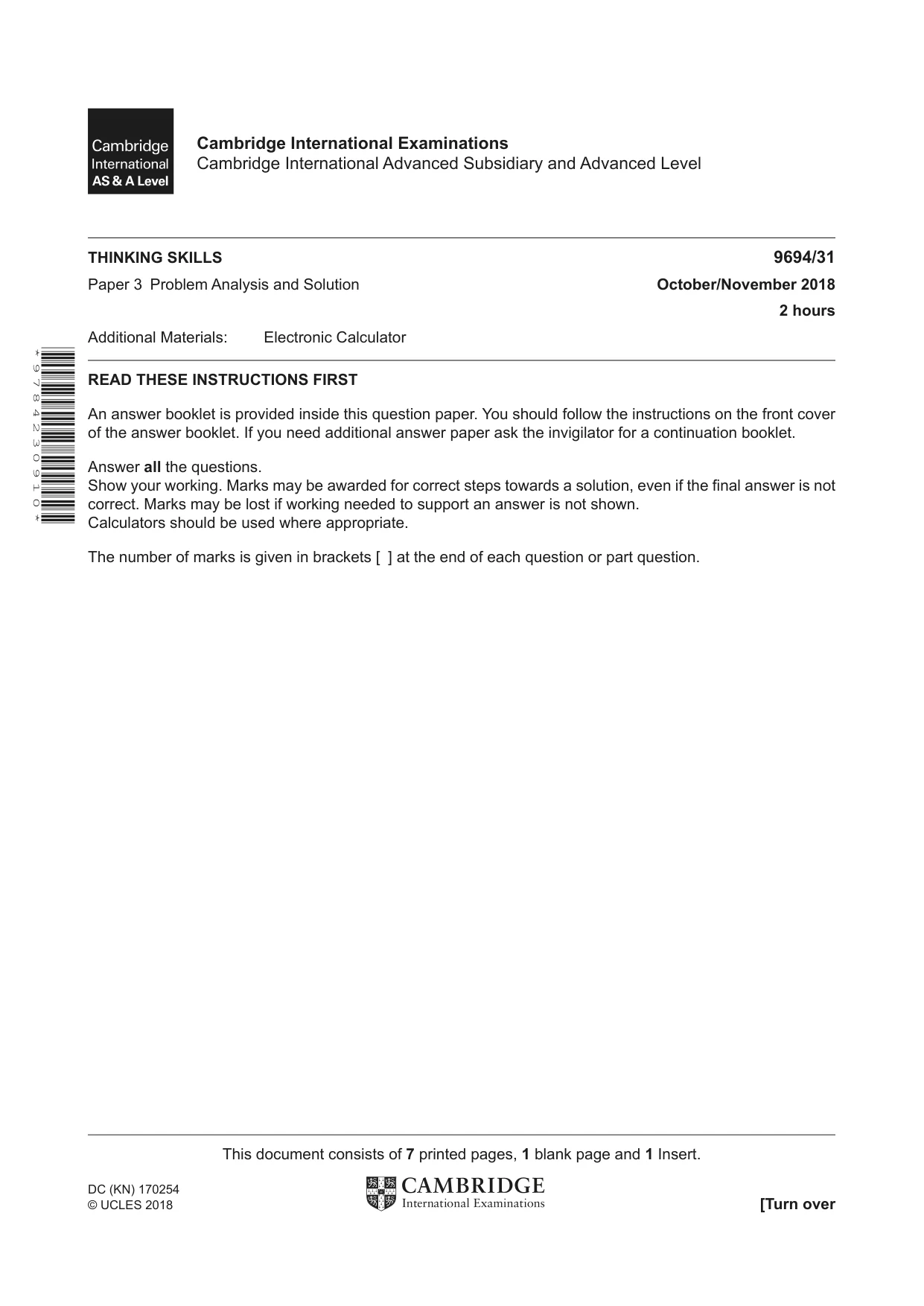

Mark scheme8 pages
Answers below. Sit the paper first if you are practising.

Questions as text
Q1 · Fred likes to go out and will do so every day unless he has a reason not to
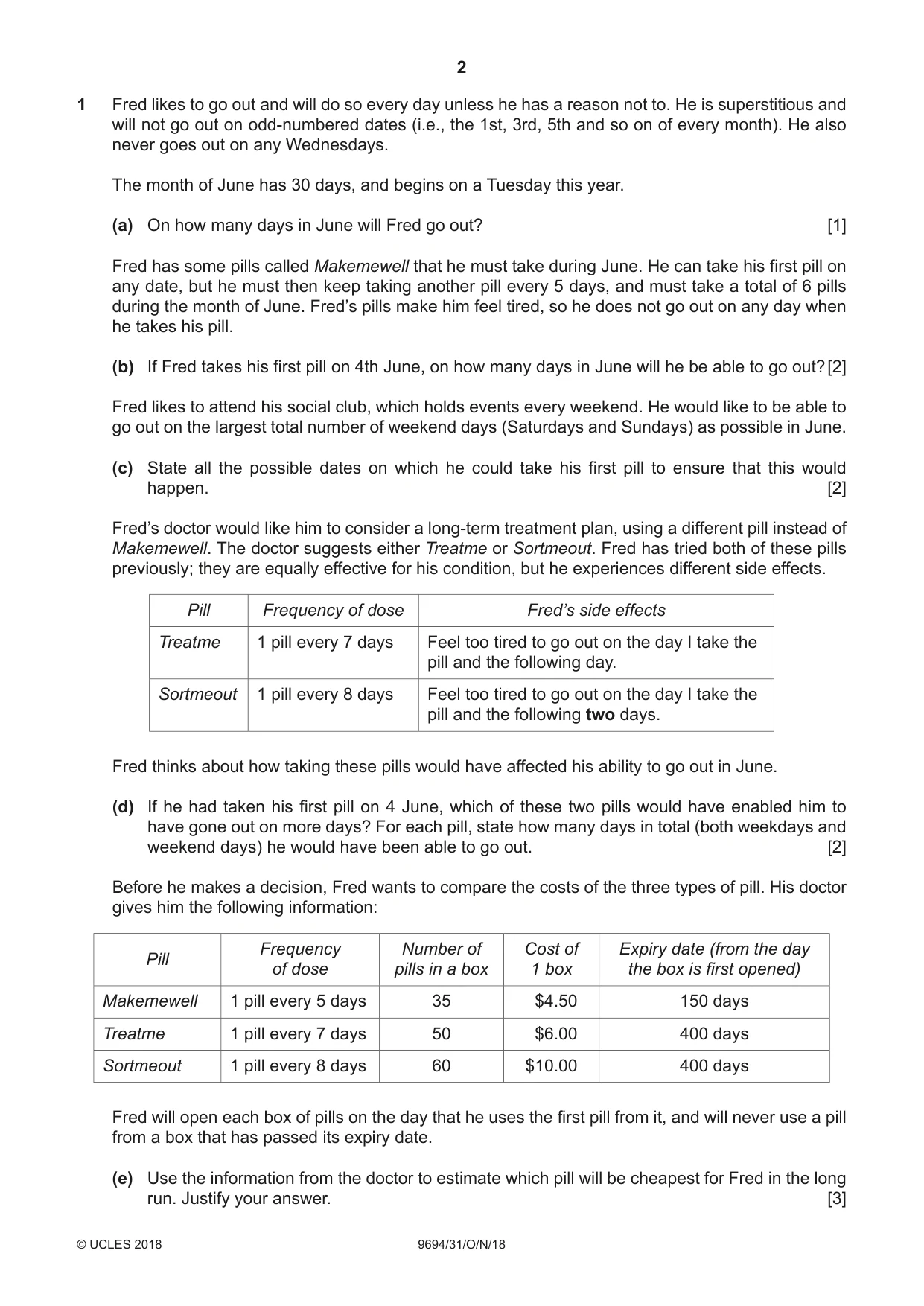
1 Fred likes to go out and will do so every day unless he has a reason not to. He is superstitious and will not go out on odd-numbered dates (i.e., the 1st, 3rd, 5th and so on of every month). He also never goes out on any Wednesdays. The month of June has 30 days, and begins on a Tuesday this year. (a) On how many days in June will Fred go out? [1] Fred has some pills called Makemewell that he must take during June. He can take his first pill on any date, but he must then keep taking another pill every 5 days, and must take a total of 6 pills during the month of June. Fred’s pills make him feel tired, so he does not go out on any day when he takes his pill. (b) If Fred takes his first pill on 4th June, on how many days in June will he be able to go out? [2] Fred likes to attend his social club, which holds events every weekend. He would like to be able to go out on the largest total number of weekend days (Saturdays and Sundays) as possible in June. (c) State all the possible dates on which he could take his first pill to ensure that this would happen. [2] Fred’s doctor would like him to consider a long-term treatment plan, using a different pill instead of Makemewell. The doctor suggests either Treatme or Sortmeout. Fred has tried both of these pills previously; they are equally effective for his condition, but he experiences different side effects. Pill Frequency of dose Fred’s side effects Treatme 1 pill every 7 days Feel too tired to go out on the day I take the pill and the following day. Sortmeout 1 pill every 8 days Feel too tired to go out on the day I take the pill and the following two days. Fred thinks about how taking these pills would have affected his ability to go out in June. (d) If he had taken his first pill on 4 June, which of these two pills would have enabled him to have gone out on more days? For each pill, state how many days in total (both weekdays and weekend days) he would have been able to go out. [2] Before he makes a decision, Fred wants to compare the costs of the three types of pill. His doctor gives him the following information: Frequency Number of Cost of Expiry date (from the day Pill of dose pills in a box 1 box the box is first opened) Makemewell 1 pill every 5 days 35 $4.50 150 days Treatme 1 pill every 7 days 50 $6.00 400 days Sortmeout 1 pill every 8 days 60 $10.00 400 days Fred will open each box of pills on the day that he uses the first pill from it, and will never use a pill from a box that has passed its expiry date. (e) Use the information from the doctor to estimate which pill will be cheapest for Fred in the long run. Justify your answer. [3]
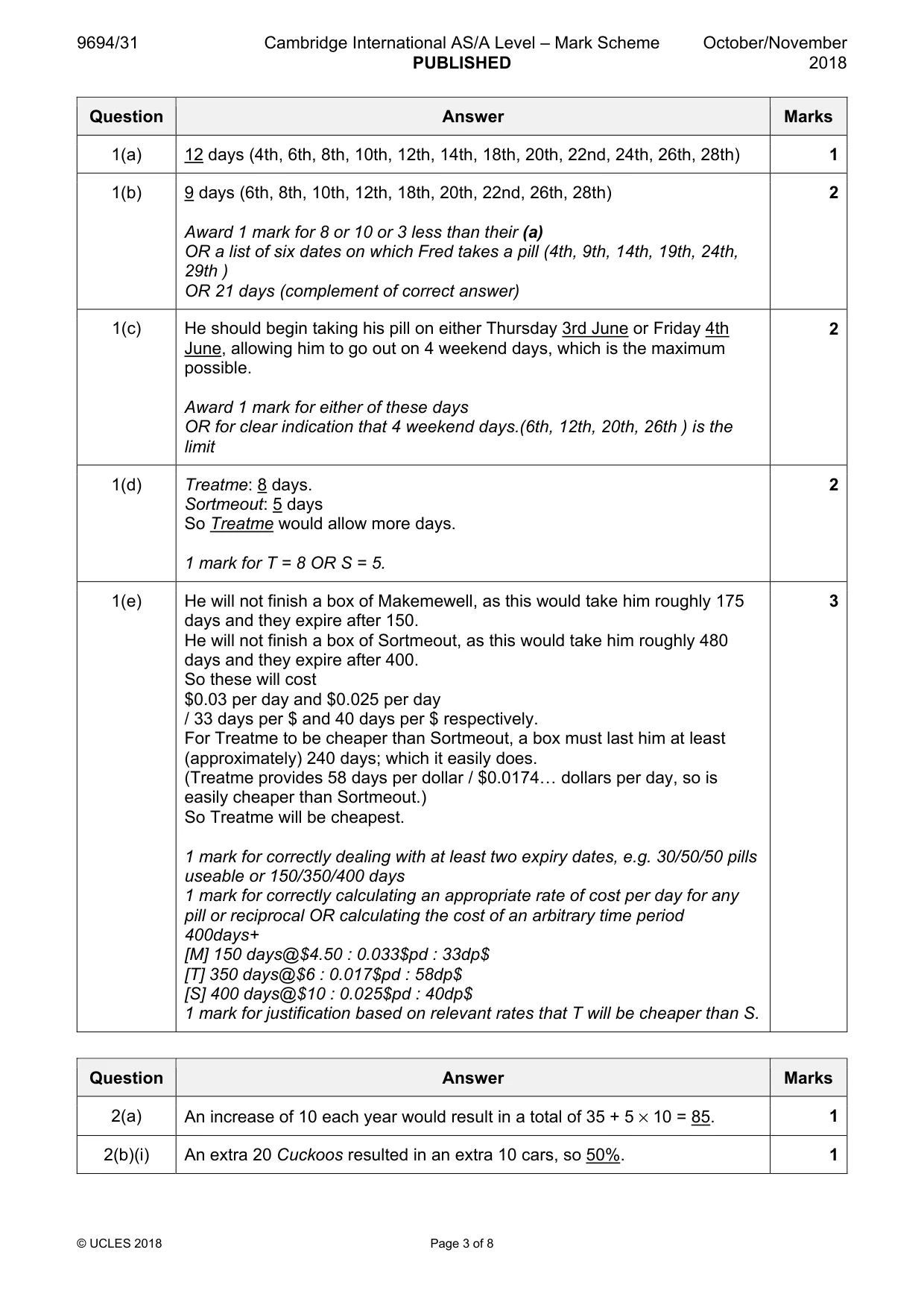
Mark scheme: Question Answer Marks 1(a) 12 days (4th, 6th, 8th, 10th, 12th, 14th, 18th, 20th, 22nd, 24th, 26th, 28th) 1 1(b) 9 days (6th, 8th, 10th, 12th, 18th, 20th, 22nd, 26th, 28th) 2 Award 1 mark for 8 or 10 or 3 less than their (a) OR a list of six dates on which Fred takes a pill (4th, 9th, 14th, 19th, 24th, 29th ) OR 21 days (complement of correct answer) 1(c) He should begin taking his pill on either Thursday 3rd June or Friday 4th 2 June, allowing him to go out on 4 weekend days, which is the maximum possible. Award 1 mark for either of these days OR for clear indication that 4 weekend days.(6th, 12th, 20th, 26th ) is the limit 1(d) Treatme: 8 days. 2 Sortmeout: 5 days So Treatme would allow more days. 1 mark for T = 8 OR S = 5. 1(e) He will not finish a box of Makemewell, as this would take him roughly 175 3 days and they expire after 150. He will not finish a box of Sortmeout, as this would take him roughly 480 days and they expire after 400. So these will cost $0.03 per day and $0.025 per day / 33 days per $ and 40 days per $ respectively. For Treatme to be cheaper than Sortmeout, a box must last him at least (approximately) 240 days; which it easily does. (Treatme provides 58 days per dollar / $0.0174« dollars per day, so is easily cheaper than Sortmeout.) So Treatme will be cheapest. 1 mark for correctly dealing with at least two expiry dates, e.g. 30/50/50 pills useable or 150/350/400 days 1 mark for correctly calculating an appropriate rate of cost per day for any pill or reciprocal OR calculating the cost of an arbitrary time period 400days+ [M] 150 days@$4.50 : 0.033$pd : 33dp$ [T] 350 days@$6 : 0.017$pd : 58dp$ [S] 400 days@$10 : 0.025$pd : 40dp$ 1 mark for justification based on relevant rates that T will be cheaper than S.
More questions on Perform appropriate operations with information
Q2 · Birdnest village school educates children for 5 years
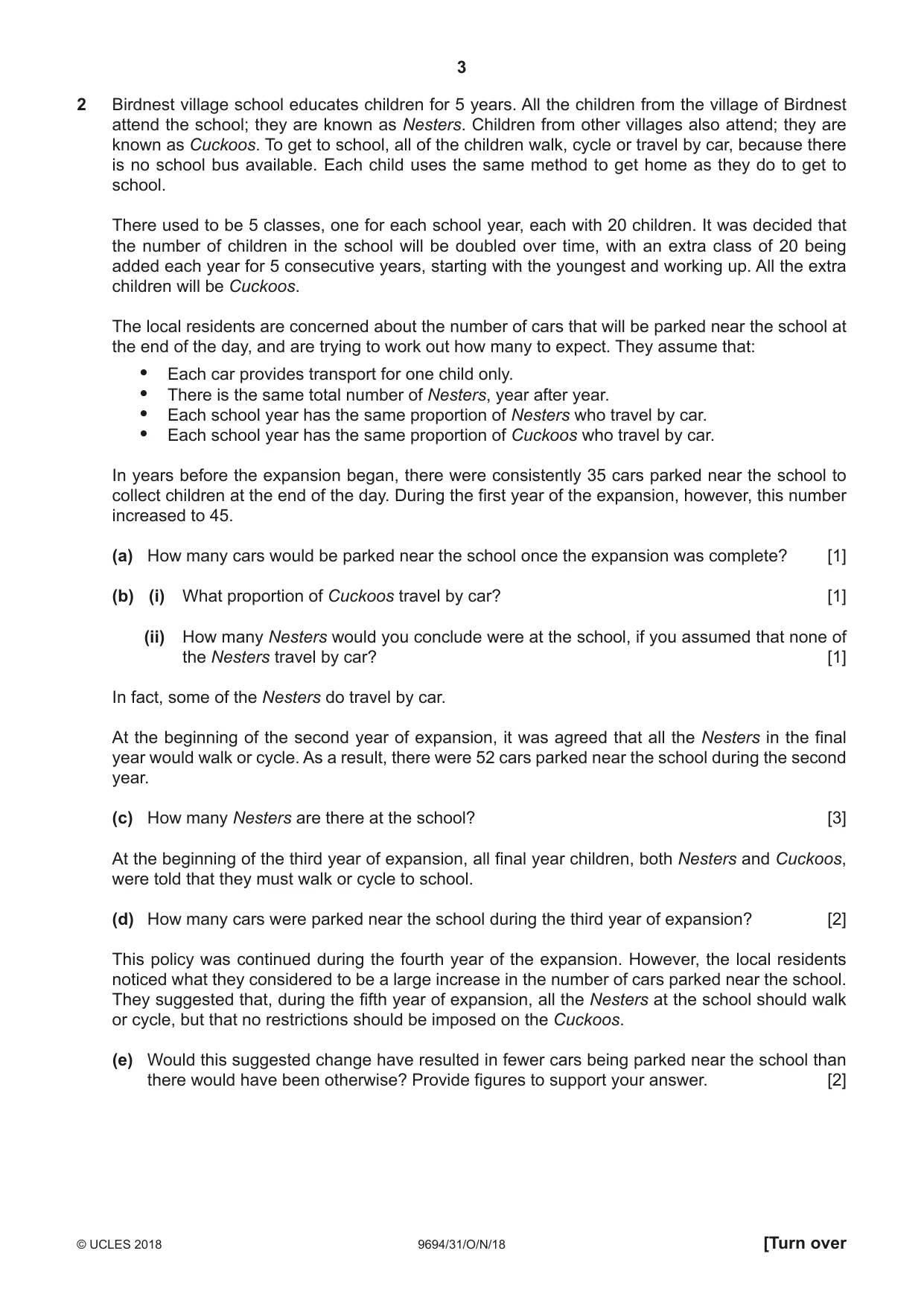
2 Birdnest village school educates children for 5 years. All the children from the village of Birdnest attend the school; they are known as Nesters. Children from other villages also attend; they are known as Cuckoos. To get to school, all of the children walk, cycle or travel by car, because there is no school bus available. Each child uses the same method to get home as they do to get to school. There used to be 5 classes, one for each school year, each with 20 children. It was decided that the number of children in the school will be doubled over time, with an extra class of 20 being added each year for 5 consecutive years, starting with the youngest and working up. All the extra children will be Cuckoos. The local residents are concerned about the number of cars that will be parked near the school at the end of the day, and are trying to work out how many to expect. They assume that: • Each car provides transport for one child only. • There is the same total number of Nesters, year after year. • Each school year has the same proportion of Nesters who travel by car. • Each school year has the same proportion of Cuckoos who travel by car. In years before the expansion began, there were consistently 35 cars parked near the school to collect children at the end of the day. During the first year of the expansion, however, this number increased to 45. (a) How many cars would be parked near the school once the expansion was complete? [1] (b) (i) What proportion of Cuckoos travel by car? [1] (ii) How many Nesters would you conclude were at the school, if you assumed that none of the Nesters travel by car? [1] In fact, some of the Nesters do travel by car. At the beginning of the second year of expansion, it was agreed that all the Nesters in the final year would walk or cycle. As a result, there were 52 cars parked near the school during the second year. (c) How many Nesters are there at the school? [3] At the beginning of the third year of expansion, all final year children, both Nesters and Cuckoos, were told that they must walk or cycle to school. (d) How many cars were parked near the school during the third year of expansion? [2] This policy was continued during the fourth year of the expansion. However, the local residents noticed what they considered to be a large increase in the number of cars parked near the school. They suggested that, during the fifth year of expansion, all the Nesters at the school should walk or cycle, but that no restrictions should be imposed on the Cuckoos. (e) Would this suggested change have resulted in fewer cars being parked near the school than there would have been otherwise? Provide figures to support your answer. [2]
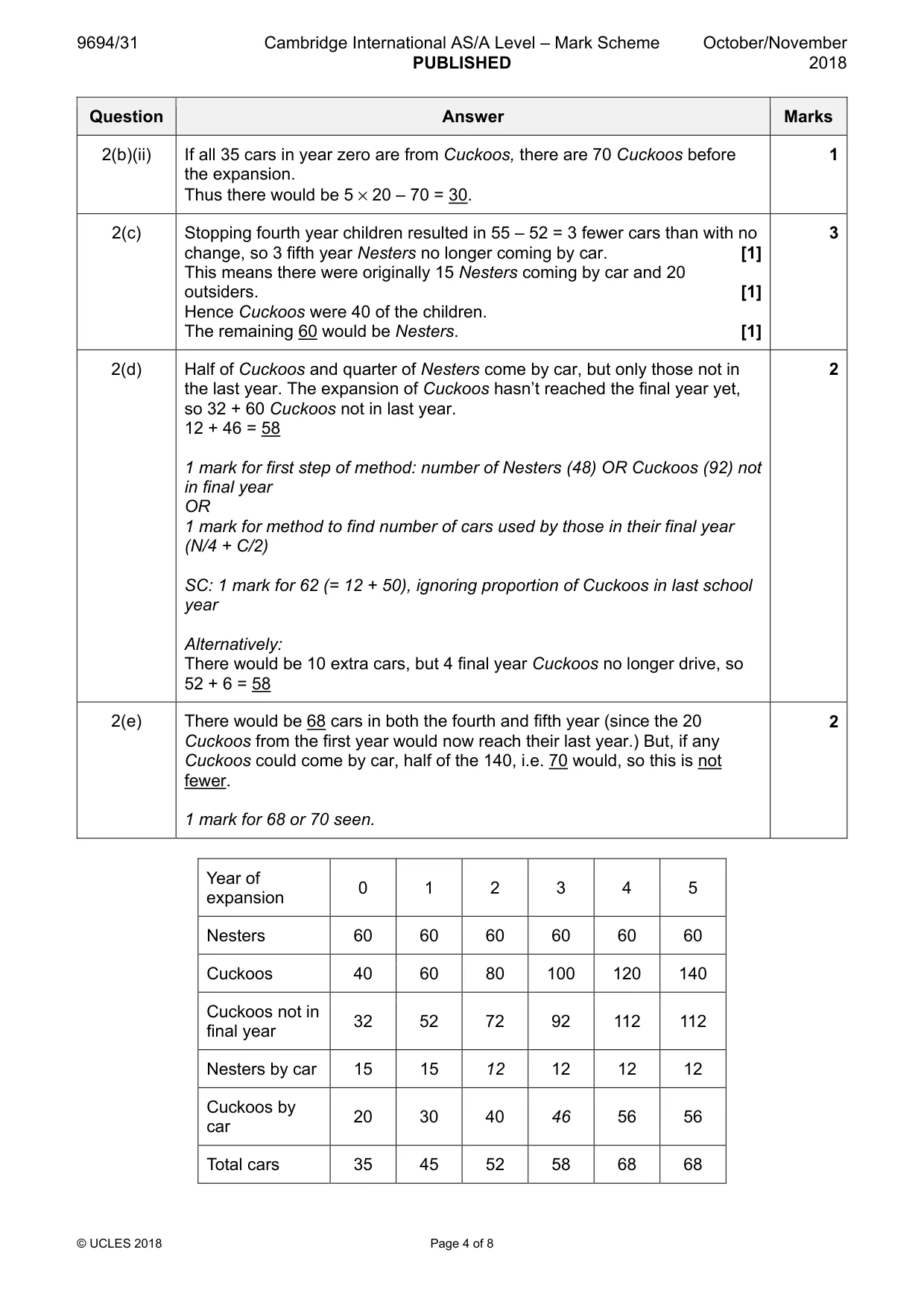
Mark scheme: 2(a) An increase of 10 each year would result in a total of 35 + 5 × 10 = 85. 1 2(b)(i) An extra 20 Cuckoos resulted in an extra 10 cars, so 50%. 1 2(b)(ii) If all 35 cars in year zero are from Cuckoos, there are 70 Cuckoos before 1 the expansion. Thus there would be 5 × 20 – 70 = 30. 2(c) Stopping fourth year children resulted in 55 – 52 = 3 fewer cars than with no 3 change, so 3 fifth year Nesters no longer coming by car. [1] This means there were originally 15 Nesters coming by car and 20 outsiders. [1] Hence Cuckoos were 40 of the children. The remaining 60 would be Nesters. [1] 2(d) Half of Cuckoos and quarter of Nesters come by car, but only those not in 2 the last year. The expansion of Cuckoos hasn’t reached the final year yet, so 32 + 60 Cuckoos not in last year. 12 + 46 = 58 1 mark for first step of method: number of Nesters (48) OR Cuckoos (92) not in final year OR 1 mark for method to find number of cars used by those in their final year (N/4 + C/2) SC: 1 mark for 62 (= 12 + 50), ignoring proportion of Cuckoos in last school year Alternatively: There would be 10 extra cars, but 4 final year Cuckoos no longer drive, so 52 + 6 = 58 2(e) There would be 68 cars in both the fourth and fifth year (since the 20 2 Cuckoos from the first year would now reach their last year.) But, if any Cuckoos could come by car, half of the 140, i.e. 70 would, so this is not fewer. 1 mark for 68 or 70 seen. Year of 0 1 2 3 4 5 expansion Nesters 60 60 60 60 60 60 Cuckoos 40 60 80 100 120 140 Cuckoos not in 32 52 72 92 112 112 final year Nesters by car 15 15 12 12 12 12 Cuckoos by 20 30 40 46 56 56 car Total cars 35 45 52 58 68 68
Q3 · Jaspreet owns a business making suits to order – he only makes the suits once a customer…
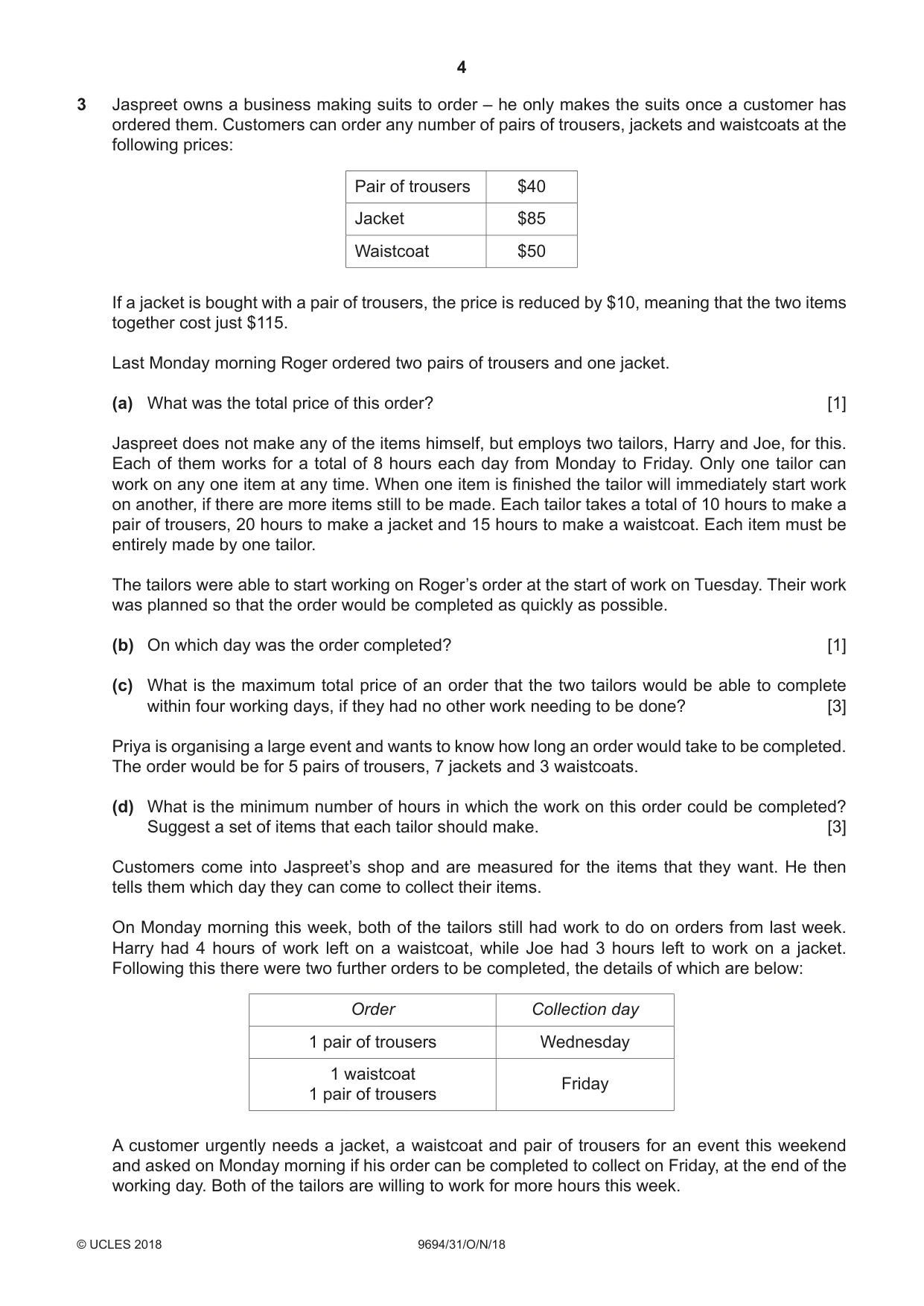
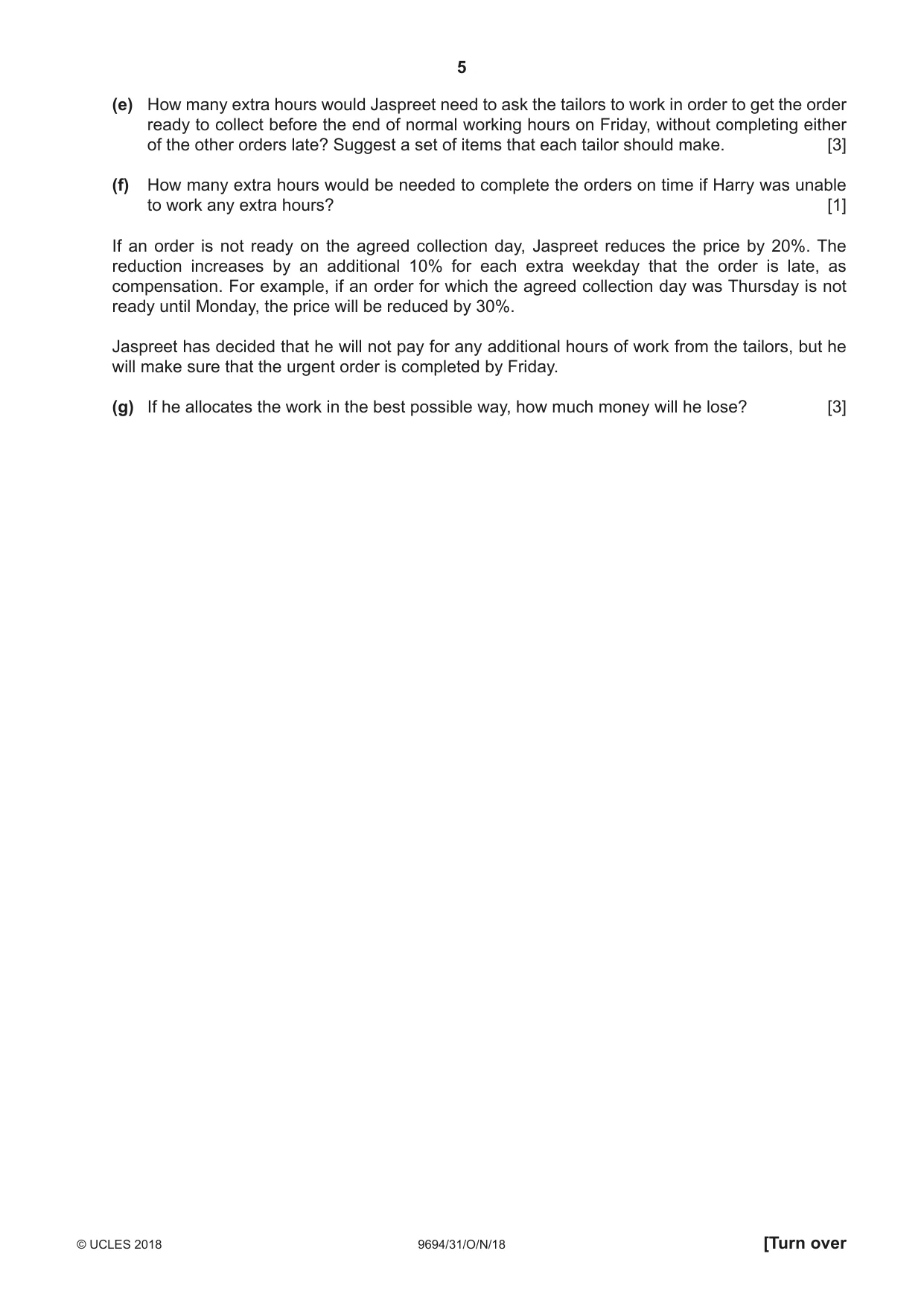
3 Jaspreet owns a business making suits to order – he only makes the suits once a customer has ordered them. Customers can order any number of pairs of trousers, jackets and waistcoats at the following prices: Pair of trousers $40 Jacket $85 Waistcoat $50 If a jacket is bought with a pair of trousers, the price is reduced by $10, meaning that the two items together cost just $115. Last Monday morning Roger ordered two pairs of trousers and one jacket. (a) What was the total price of this order? [1] Jaspreet does not make any of the items himself, but employs two tailors, Harry and Joe, for this. Each of them works for a total of 8 hours each day from Monday to Friday. Only one tailor can work on any one item at any time. When one item is finished the tailor will immediately start work on another, if there are more items still to be made. Each tailor takes a total of 10 hours to make a pair of trousers, 20 hours to make a jacket and 15 hours to make a waistcoat. Each item must be entirely made by one tailor. The tailors were able to start working on Roger’s order at the start of work on Tuesday. Their work was planned so that the order would be completed as quickly as possible. (b) On which day was the order completed? [1] (c) What is the maximum total price of an order that the two tailors would be able to complete within four working days, if they had no other work needing to be done? [3] Priya is organising a large event and wants to know how long an order would take to be completed. The order would be for 5 pairs of trousers, 7 jackets and 3 waistcoats. (d) What is the minimum number of hours in which the work on this order could be completed? Suggest a set of items that each tailor should make. [3] Customers come into Jaspreet’s shop and are measured for the items that they want. He then tells them which day they can come to collect their items. On Monday morning this week, both of the tailors still had work to do on orders from last week. Harry had 4 hours of work left on a waistcoat, while Joe had 3 hours left to work on a jacket. Following this there were two further orders to be completed, the details of which are below: Order Collection day 1 pair of trousers Wednesday 1 waistcoat Friday 1 pair of trousers A customer urgently needs a jacket, a waistcoat and pair of trousers for an event this weekend and asked on Monday morning if his order can be completed to collect on Friday, at the end of the working day. Both of the tailors are willing to work for more hours this week. (e) How many extra hours would Jaspreet need to ask the tailors to work in order to get the order ready to collect before the end of normal working hours on Friday, without completing either of the other orders late? Suggest a set of items that each tailor should make. [3] (f) How many extra hours would be needed to complete the orders on time if Harry was unable to work any extra hours? [1] If an order is not ready on the agreed collection day, Jaspreet reduces the price by 20%. The reduction increases by an additional 10% for each extra weekday that the order is late, as compensation. For example, if an order for which the agreed collection day was Thursday is not ready until Monday, the price will be reduced by 30%. Jaspreet has decided that he will not pay for any additional hours of work from the tailors, but he will make sure that the urgent order is completed by Friday. (g) If he allocates the work in the best possible way, how much money will he lose? [3]
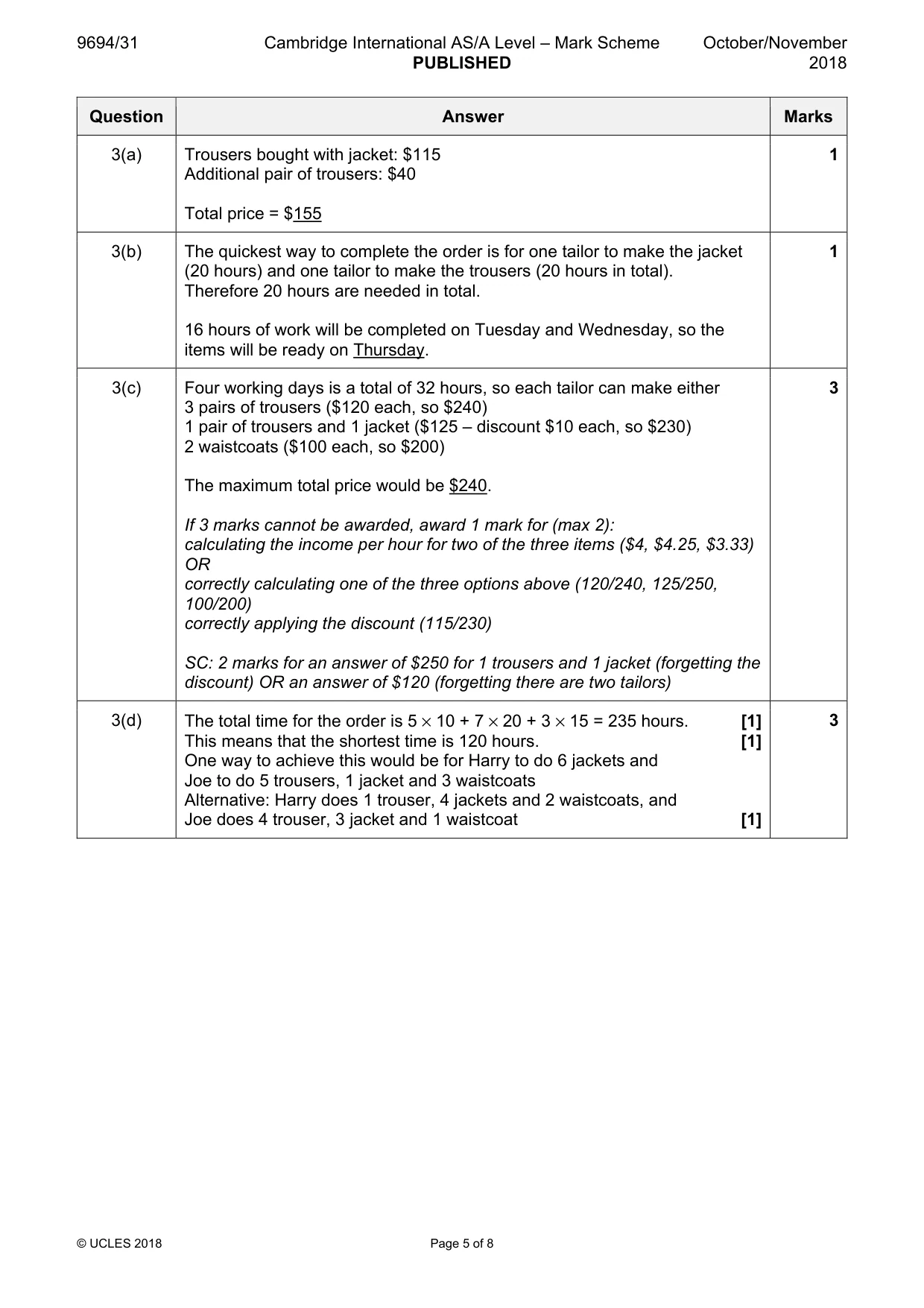
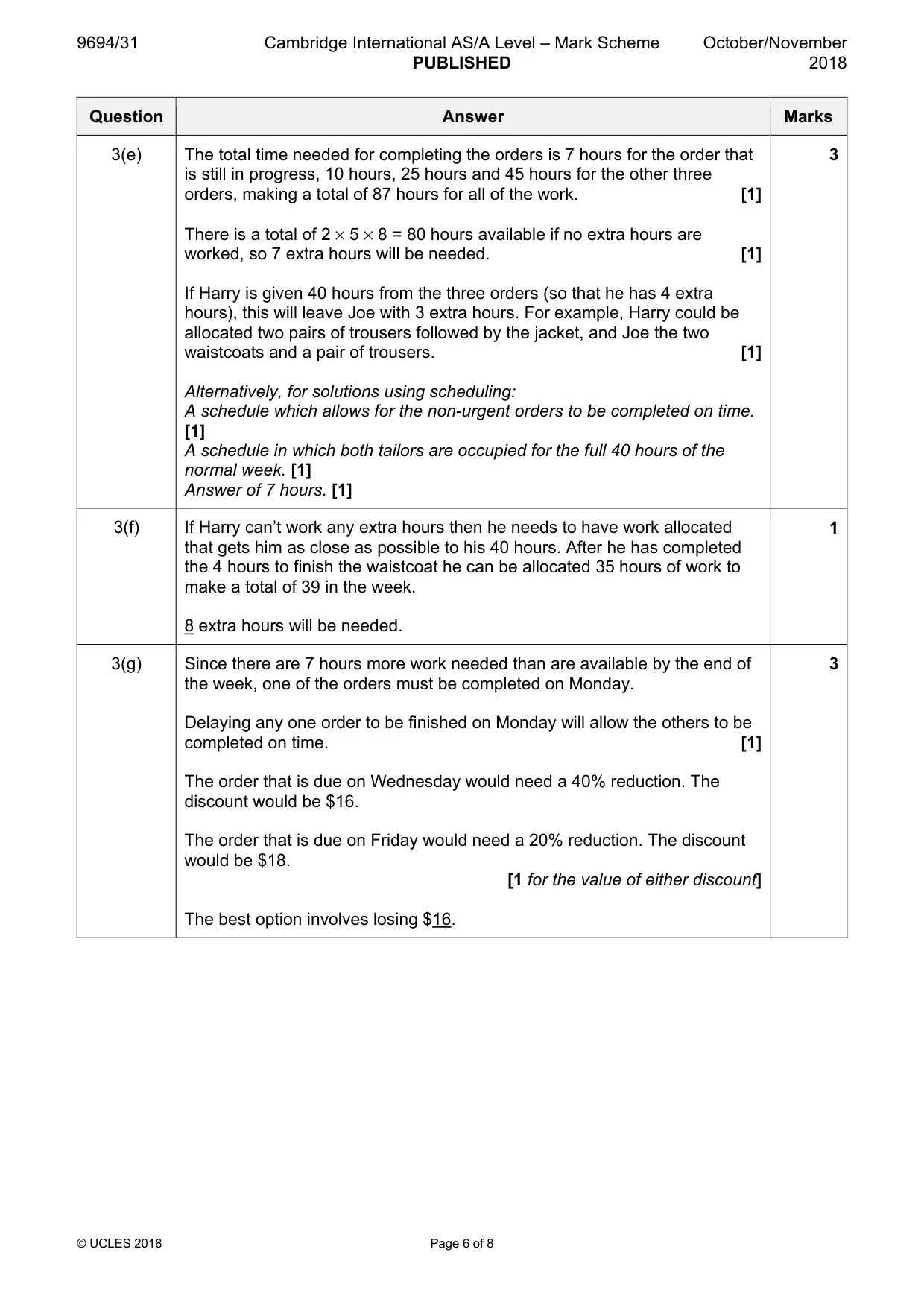
Mark scheme: 3(a) Trousers bought with jacket: $115 1 Additional pair of trousers: $40 Total price = $155 3(b) The quickest way to complete the order is for one tailor to make the jacket 1 (20 hours) and one tailor to make the trousers (20 hours in total). Therefore 20 hours are needed in total. 16 hours of work will be completed on Tuesday and Wednesday, so the items will be ready on Thursday. 3(c) Four working days is a total of 32 hours, so each tailor can make either 3 3 pairs of trousers ($120 each, so $240) 1 pair of trousers and 1 jacket ($125 – discount $10 each, so $230) 2 waistcoats ($100 each, so $200) The maximum total price would be $240. If 3 marks cannot be awarded, award 1 mark for (max 2): calculating the income per hour for two of the three items ($4, $4.25, $3.33) OR correctly calculating one of the three options above (120/240, 125/250, 100/200) correctly applying the discount (115/230) SC: 2 marks for an answer of $250 for 1 trousers and 1 jacket (forgetting the discount) OR an answer of $120 (forgetting there are two tailors) 3(d) The total time for the order is 5 × 10 + 7 × 20 + 3 × 15 = 235 hours. [1] 3 This means that the shortest time is 120 hours. [1] One way to achieve this would be for Harry to do 6 jackets and Joe to do 5 trousers, 1 jacket and 3 waistcoats Alternative: Harry does 1 trouser, 4 jackets and 2 waistcoats, and Joe does 4 trouser, 3 jacket and 1 waistcoat [1] 3(e) The total time needed for completing the orders is 7 hours for the order that 3 is still in progress, 10 hours, 25 hours and 45 hours for the other three orders, making a total of 87 hours for all of the work. [1] There is a total of 2 × 5 × 8 = 80 hours available if no extra hours are worked, so 7 extra hours will be needed. [1] If Harry is given 40 hours from the three orders (so that he has 4 extra hours), this will leave Joe with 3 extra hours. For example, Harry could be allocated two pairs of trousers followed by the jacket, and Joe the two waistcoats and a pair of trousers. [1] Alternatively, for solutions using scheduling: A schedule which allows for the non-urgent orders to be completed on time. [1] A schedule in which both tailors are occupied for the full 40 hours of the normal week. [1] Answer of 7 hours. [1] 3(f) If Harry can’t work any extra hours then he needs to have work allocated 1 that gets him as close as possible to his 40 hours. After he has completed the 4 hours to finish the waistcoat he can be allocated 35 hours of work to make a total of 39 in the week. 8 extra hours will be needed. 3(g) Since there are 7 hours more work needed than are available by the end of 3 the week, one of the orders must be completed on Monday. Delaying any one order to be finished on Monday will allow the others to be completed on time. [1] The order that is due on Wednesday would need a 40% reduction. The discount would be $16. The order that is due on Friday would need a 20% reduction. The discount would be $18. [1 for the value of either discount] The best option involves losing $16.
More questions on Identify the impact of a change to a problem
Q4 · David is trying to work out the bonuses that he will pay to his employees for their work…
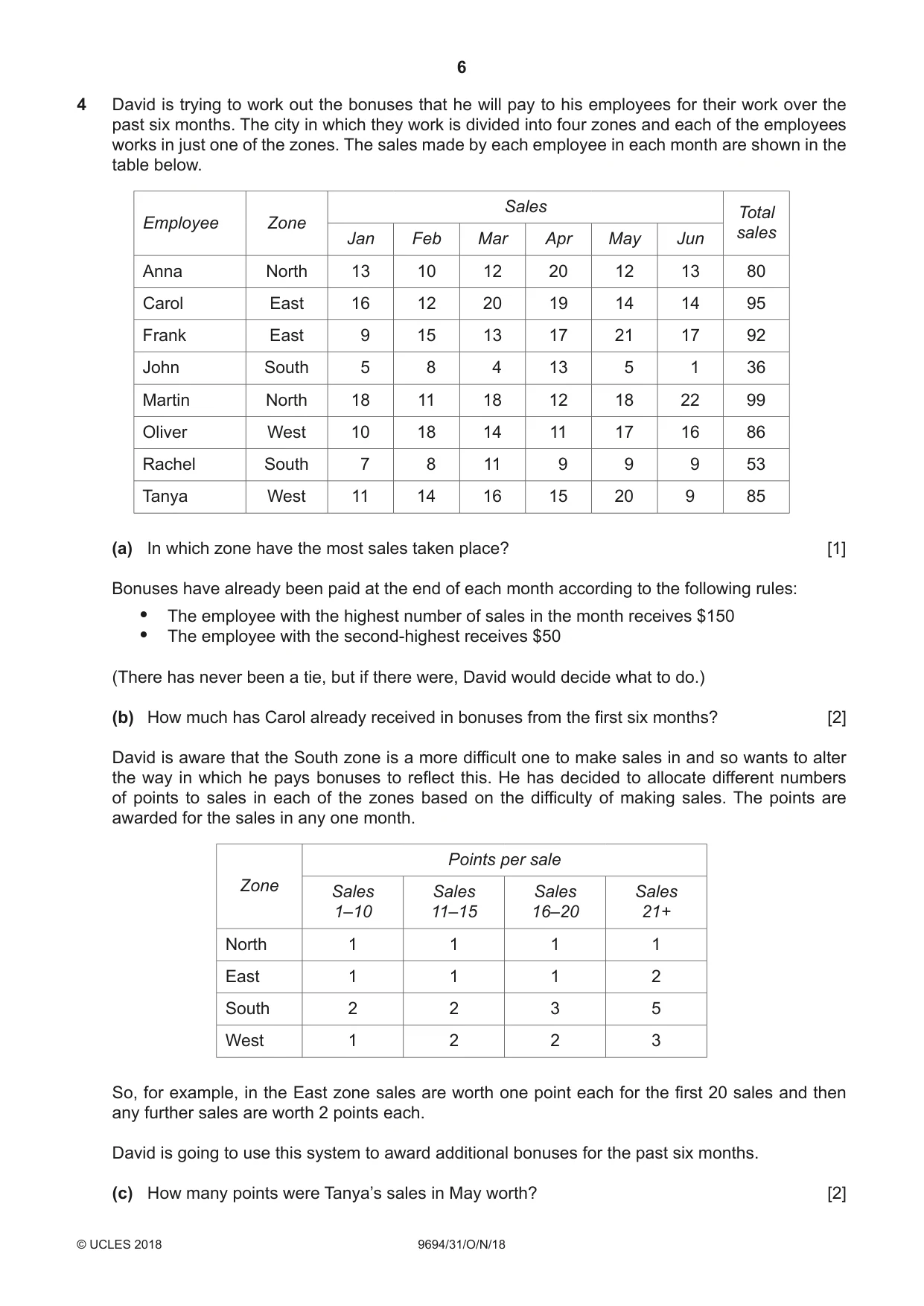
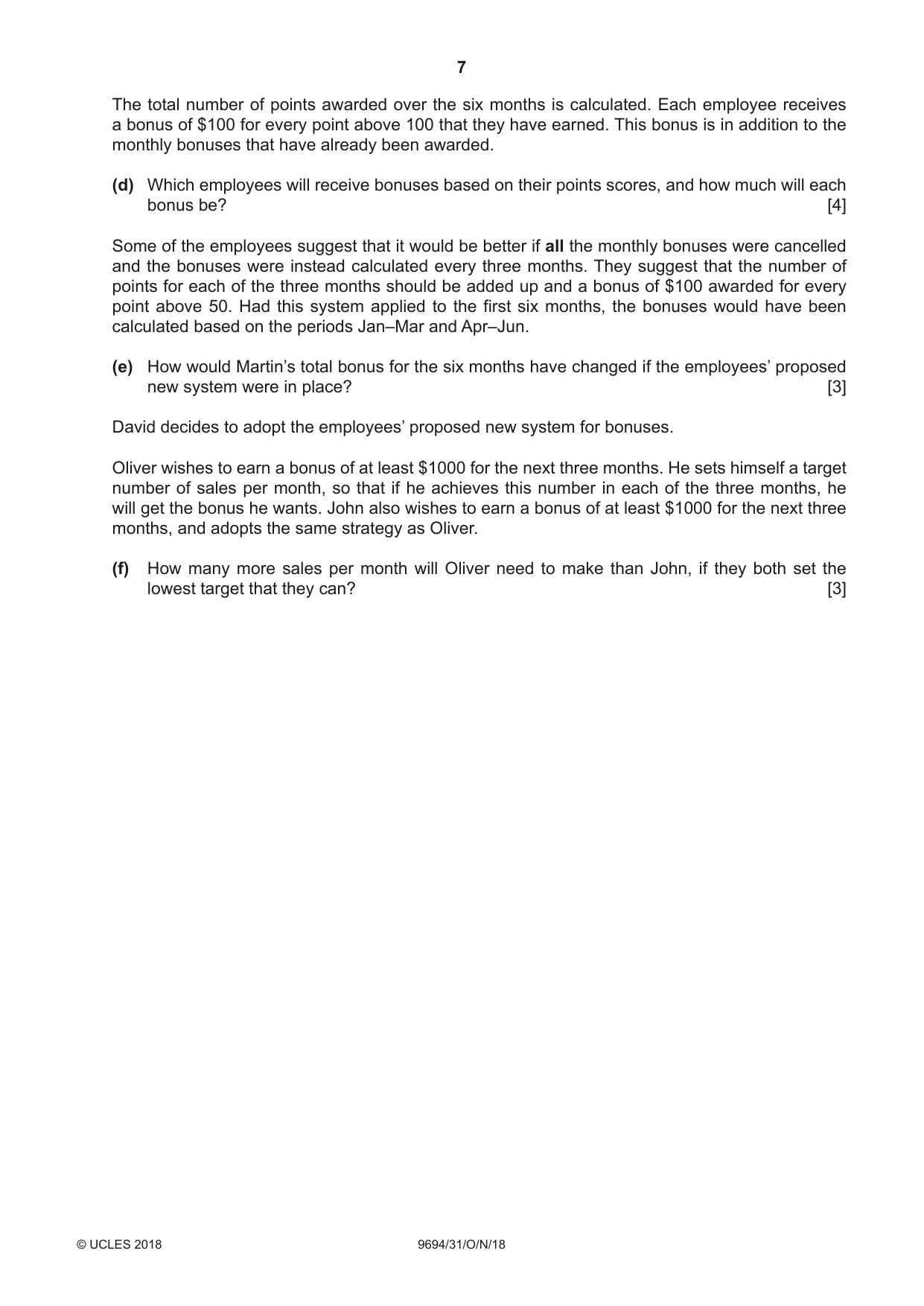
4 David is trying to work out the bonuses that he will pay to his employees for their work over the past six months. The city in which they work is divided into four zones and each of the employees works in just one of the zones. The sales made by each employee in each month are shown in the table below. Sales Total Employee Zone sales Jan Feb Mar Apr May Jun Anna North 13 10 12 20 12 13 80 Carol East 16 12 20 19 14 14 95 Frank East 9 15 13 17 21 17 92 John South 5 8 4 13 5 1 36 Martin North 18 11 18 12 18 22 99 Oliver West 10 18 14 11 17 16 86 Rachel South 7 8 11 9 9 9 53 Tanya West 11 14 16 15 20 9 85 (a) In which zone have the most sales taken place? [1] Bonuses have already been paid at the end of each month according to the following rules: • The employee with the highest number of sales in the month receives $150 • The employee with the second-highest receives $50 (There has never been a tie, but if there were, David would decide what to do.) (b) How much has Carol already received in bonuses from the first six months? [2] David is aware that the South zone is a more difficult one to make sales in and so wants to alter the way in which he pays bonuses to reflect this. He has decided to allocate different numbers of points to sales in each of the zones based on the difficulty of making sales. The points are awarded for the sales in any one month. Points per sale Zone Sales Sales Sales Sales 1–10 11–15 16–20 21+ North 1 1 1 1 East 1 1 1 2 South 2 2 3 5 West 1 2 2 3 So, for example, in the East zone sales are worth one point each for the first 20 sales and then any further sales are worth 2 points each. David is going to use this system to award additional bonuses for the past six months. (c) How many points were Tanya’s sales in May worth? [2] The total number of points awarded over the six months is calculated. Each employee receives a bonus of $100 for every point above 100 that they have earned. This bonus is in addition to the monthly bonuses that have already been awarded. (d) Which employees will receive bonuses based on their points scores, and how much will each bonus be? [4] Some of the employees suggest that it would be better if all the monthly bonuses were cancelled and the bonuses were instead calculated every three months. They suggest that the number of points for each of the three months should be added up and a bonus of $100 awarded for every point above 50. Had this system applied to the first six months, the bonuses would have been calculated based on the periods Jan–Mar and Apr–Jun. (e) How would Martin’s total bonus for the six months have changed if the employees’ proposed new system were in place? [3] David decides to adopt the employees’ proposed new system for bonuses. Oliver wishes to earn a bonus of at least $1000 for the next three months. He sets himself a target number of sales per month, so that if he achieves this number in each of the three months, he will get the bonus he wants. John also wishes to earn a bonus of at least $1000 for the next three months, and adopts the same strategy as Oliver. (f) How many more sales per month will Oliver need to make than John, if they both set the lowest target that they can? [3]
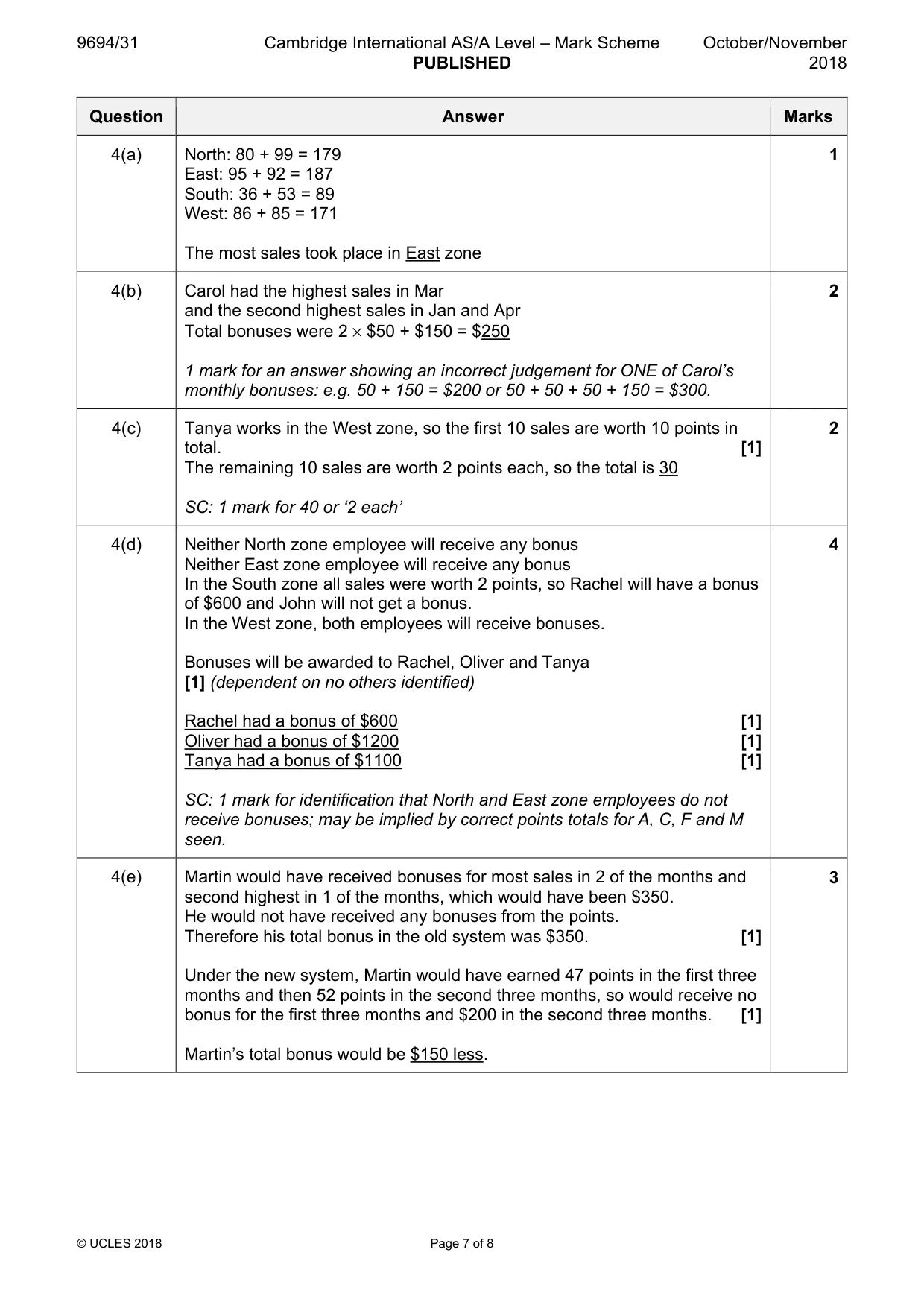
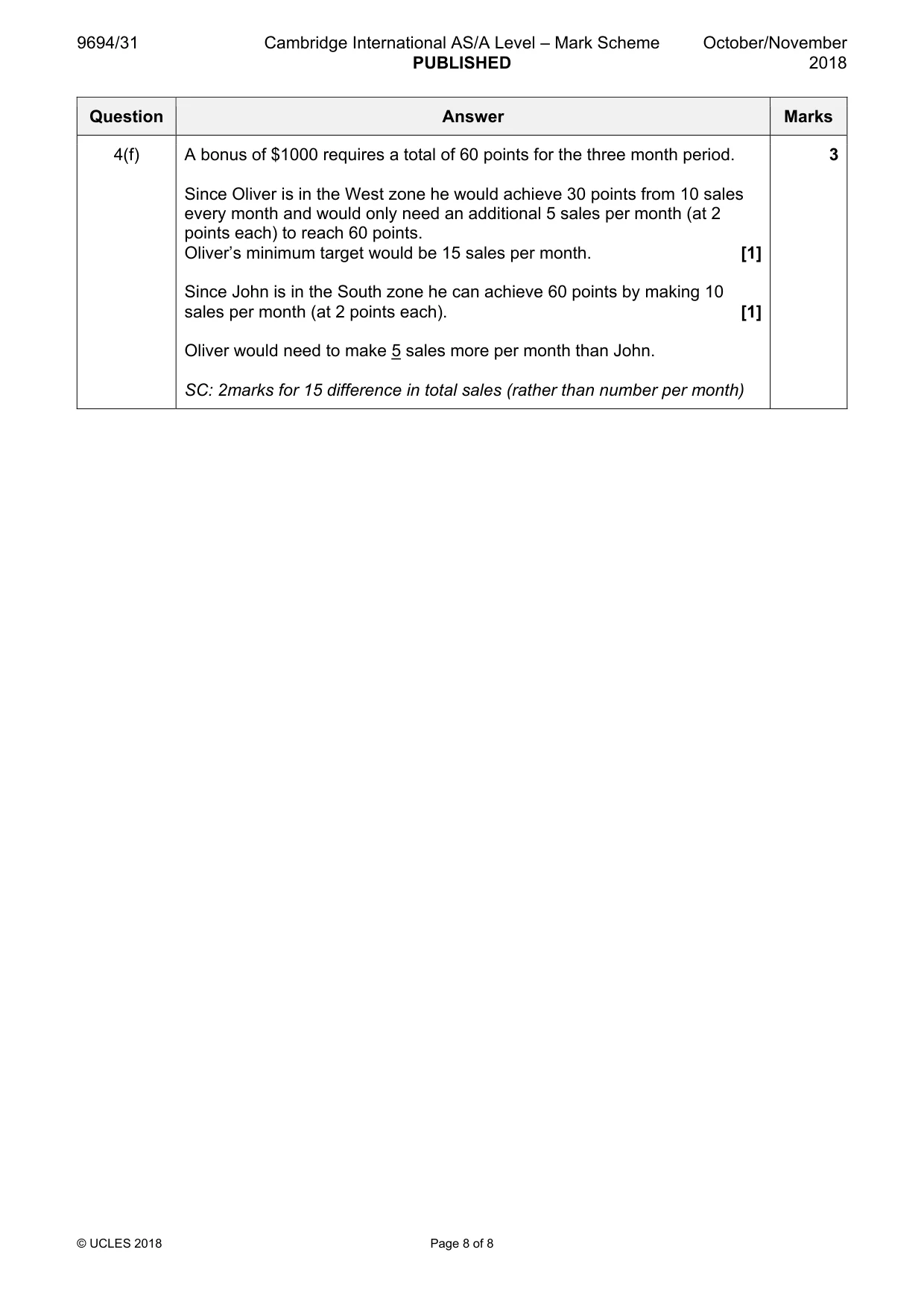
Mark scheme: 4(a) North: 80 + 99 = 179 1 East: 95 + 92 = 187 South: 36 + 53 = 89 West: 86 + 85 = 171 The most sales took place in East zone 4(b) Carol had the highest sales in Mar 2 and the second highest sales in Jan and Apr Total bonuses were 2 × $50 + $150 = $250 1 mark for an answer showing an incorrect judgement for ONE of Carol’s monthly bonuses: e.g. 50 + 150 = $200 or 50 + 50 + 50 + 150 = $300. 4(c) Tanya works in the West zone, so the first 10 sales are worth 10 points in 2 total. [1] The remaining 10 sales are worth 2 points each, so the total is 30 SC: 1 mark for 40 or ‘2 each’ 4(d) Neither North zone employee will receive any bonus 4 Neither East zone employee will receive any bonus In the South zone all sales were worth 2 points, so Rachel will have a bonus of $600 and John will not get a bonus. In the West zone, both employees will receive bonuses. Bonuses will be awarded to Rachel, Oliver and Tanya [1] (dependent on no others identified) Rachel had a bonus of $600 [1] Oliver had a bonus of $1200 [1] Tanya had a bonus of $1100 [1] SC: 1 mark for identification that North and East zone employees do not receive bonuses; may be implied by correct points totals for A, C, F and M seen. 4(e) Martin would have received bonuses for most sales in 2 of the months and 3 second highest in 1 of the months, which would have been $350. He would not have received any bonuses from the points. Therefore his total bonus in the old system was $350. [1] Under the new system, Martin would have earned 47 points in the first three months and then 52 points in the second three months, so would receive no bonus for the first three months and $200 in the second three months. [1] Martin’s total bonus would be $150 less. 4(f) A bonus of $1000 requires a total of 60 points for the three month period. 3 Since Oliver is in the West zone he would achieve 30 points from 10 sales every month and would only need an additional 5 sales per month (at 2 points each) to reach 60 points. Oliver’s minimum target would be 15 sales per month. [1] Since John is in the South zone he can achieve 60 points by making 10 sales per month (at 2 points each). [1] Oliver would need to make 5 sales more per month than John. SC: 2marks for 15 difference in total sales (rather than number per month)
More questions on Perform appropriate operations with information
What was in this paper
The subtopics covered by these 4 questions, and how many questions each got. Open one in a new tab to see every Cambridge question on it.
What you needed in this session
Cambridge’s own grade thresholds for 2018 Oct/Nov, Paper 3 · Variant 1. A higher threshold means an easier paper — the bar moves with how the cohort did.