Cambridge A Level Thinking Skills 9694 — 2022 Oct/Nov Paper 3 · Variant 1
9694/31/O/N/22 · 5 questions · 50 marks · ≈56 min
The question paper and its mark scheme, free to read here and free to download. This is Cambridge’s own paper, exactly as it was sat.
Question paper12 pages




Mark scheme9 pages
Answers below. Sit the paper first if you are practising.
Questions as text
Q1 · Liam runs a small business which provides training courses
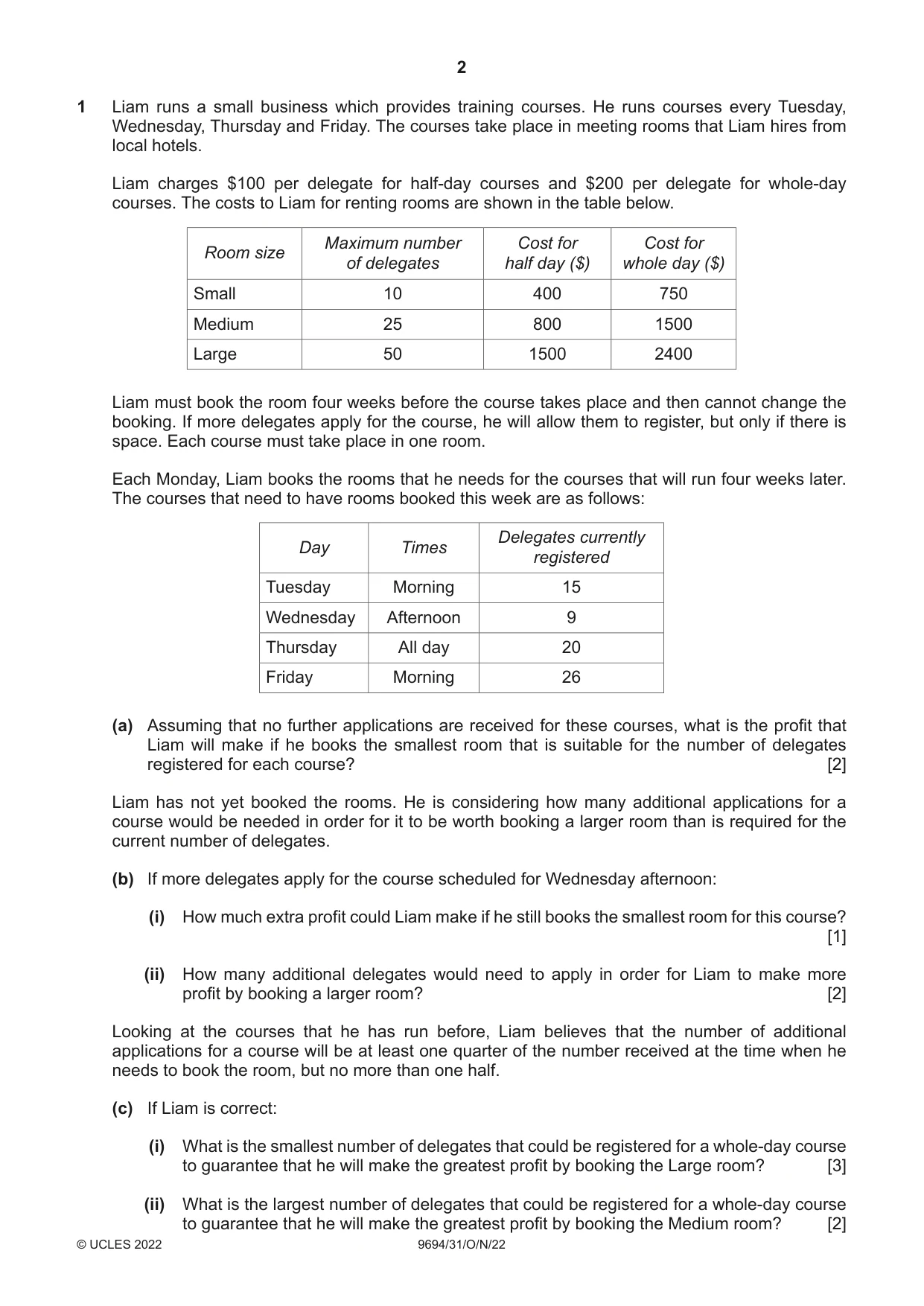
1 Liam runs a small business which provides training courses. He runs courses every Tuesday, Wednesday, Thursday and Friday. The courses take place in meeting rooms that Liam hires from local hotels. Liam charges $100 per delegate for half-day courses and $200 per delegate for whole-day courses. The costs to Liam for renting rooms are shown in the table below. Maximum number Cost for Cost for Room size of delegates half day ($) whole day ($) Small 10 400 750 Medium 25 800 1500 Large 50 1500 2400 Liam must book the room four weeks before the course takes place and then cannot change the booking. If more delegates apply for the course, he will allow them to register, but only if there is space. Each course must take place in one room. Each Monday, Liam books the rooms that he needs for the courses that will run four weeks later. The courses that need to have rooms booked this week are as follows: Delegates currently Day Times registered Tuesday Morning 15 Wednesday Afternoon 9 Thursday All day 20 Friday Morning 26 (a) Assuming that no further applications are received for these courses, what is the profit that Liam will make if he books the smallest room that is suitable for the number of delegates registered for each course? [2] Liam has not yet booked the rooms. He is considering how many additional applications for a course would be needed in order for it to be worth booking a larger room than is required for the current number of delegates. (b) If more delegates apply for the course scheduled for Wednesday afternoon: (i) How much extra profit could Liam make if he still books the smallest room for this course? [1] (ii) How many additional delegates would need to apply in order for Liam to make more profit by booking a larger room? [2] Looking at the courses that he has run before, Liam believes that the number of additional applications for a course will be at least one quarter of the number received at the time when he needs to book the room, but no more than one half. (c) If Liam is correct: (i) What is the smallest number of delegates that could be registered for a whole-day course to guarantee that he will make the greatest profit by booking the Large room? [3] (ii) What is the largest number of delegates that could be registered for a whole-day course to guarantee that he will make the greatest profit by booking the Medium room? [2] [Turn over for Question 2]
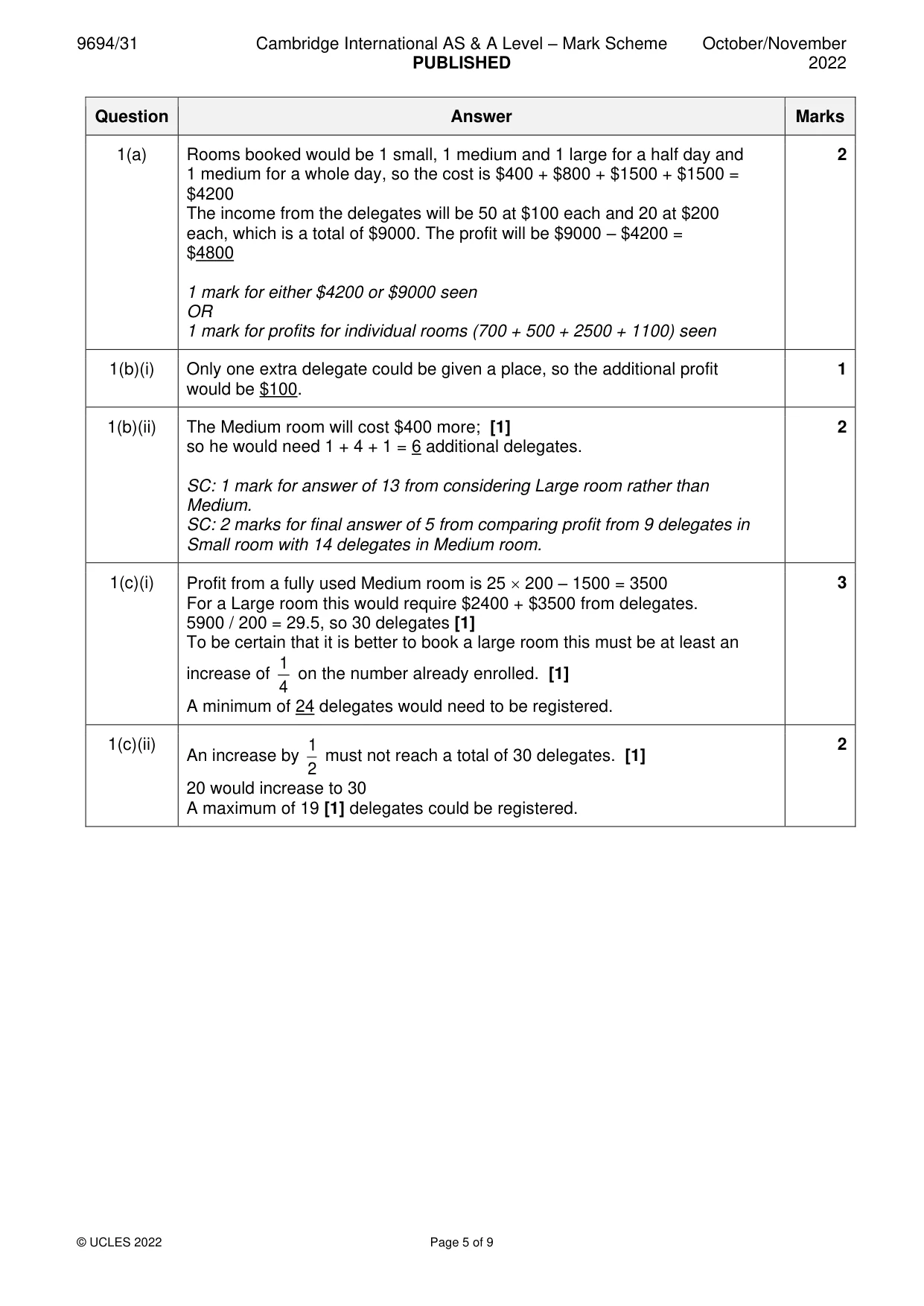
Mark scheme: Question Answer Marks 1(a) Rooms booked would be 1 small, 1 medium and 1 large for a half day and 2 1 medium for a whole day, so the cost is $400 + $800 + $1500 + $1500 = $4200 The income from the delegates will be 50 at $100 each and 20 at $200 each, which is a total of $9000. The profit will be $9000 – $4200 = $4800 1 mark for either $4200 or $9000 seen OR 1 mark for profits for individual rooms (700 + 500 + 2500 + 1100) seen 1(b)(i) Only one extra delegate could be given a place, so the additional profit 1 would be $100. 1(b)(ii) The Medium room will cost $400 more; [1] 2 so he would need 1 + 4 + 1 = 6 additional delegates. SC: 1 mark for answer of 13 from considering Large room rather than Medium. SC: 2 marks for final answer of 5 from comparing profit from 9 delegates in Small room with 14 delegates in Medium room. 1(c)(i) Profit from a fully used Medium room is 25 200 – 1500 = 3500 3 For a Large room this would require $2400 + $3500 from delegates. 5900 / 200 = 29.5, so 30 delegates [1] To be certain that it is better to book a large room this must be at least an 1 increase of on the number already enrolled. [1] 4 A minimum of 24 delegates would need to be registered. 1(c)(ii) 1 2 An increase by must not reach a total of 30 delegates. [1] 2 20 would increase to 30 A maximum of 19 [1] delegates could be registered.
More questions on Perform appropriate operations with information
Q2 · Pumpet is a game for two players
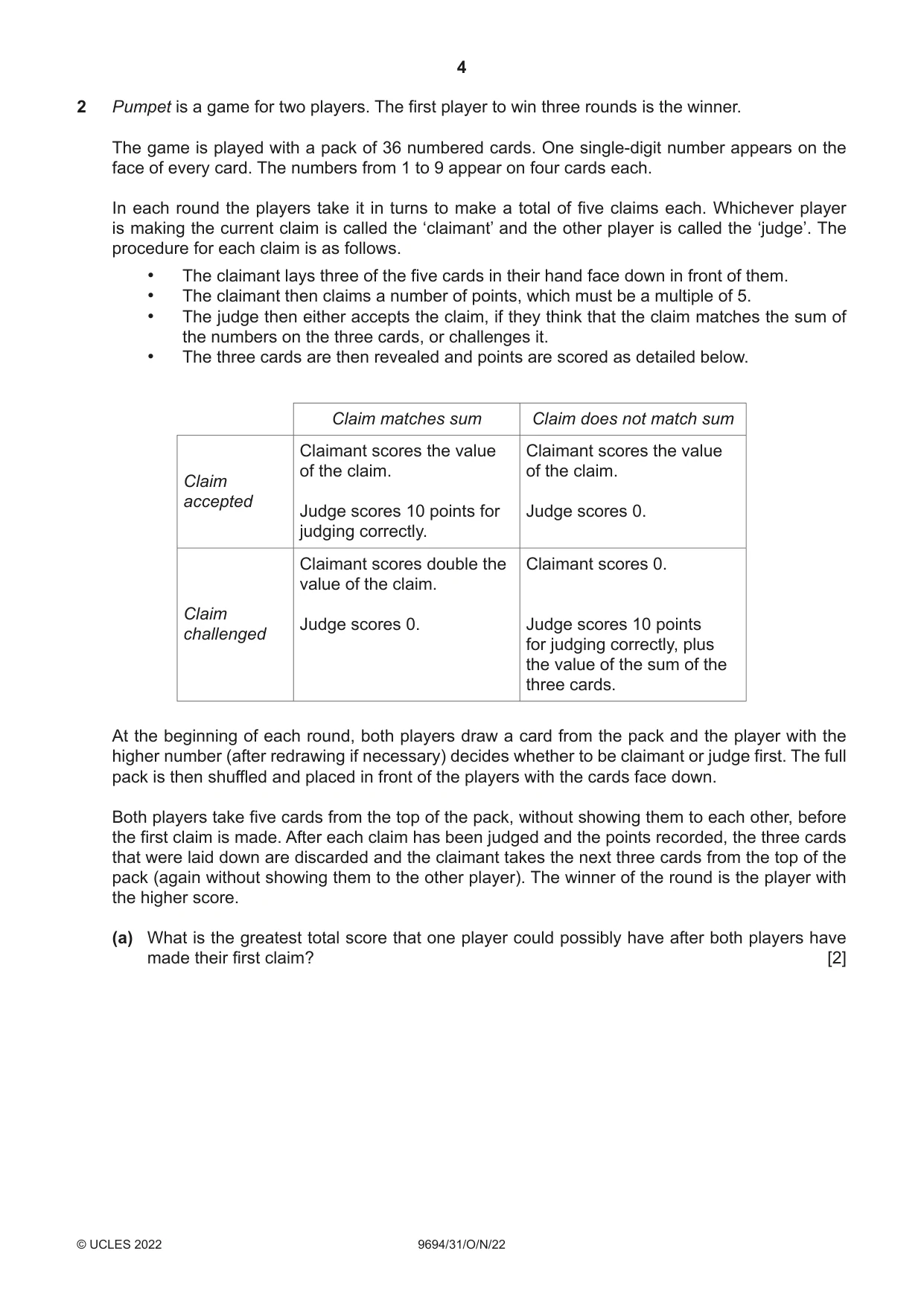
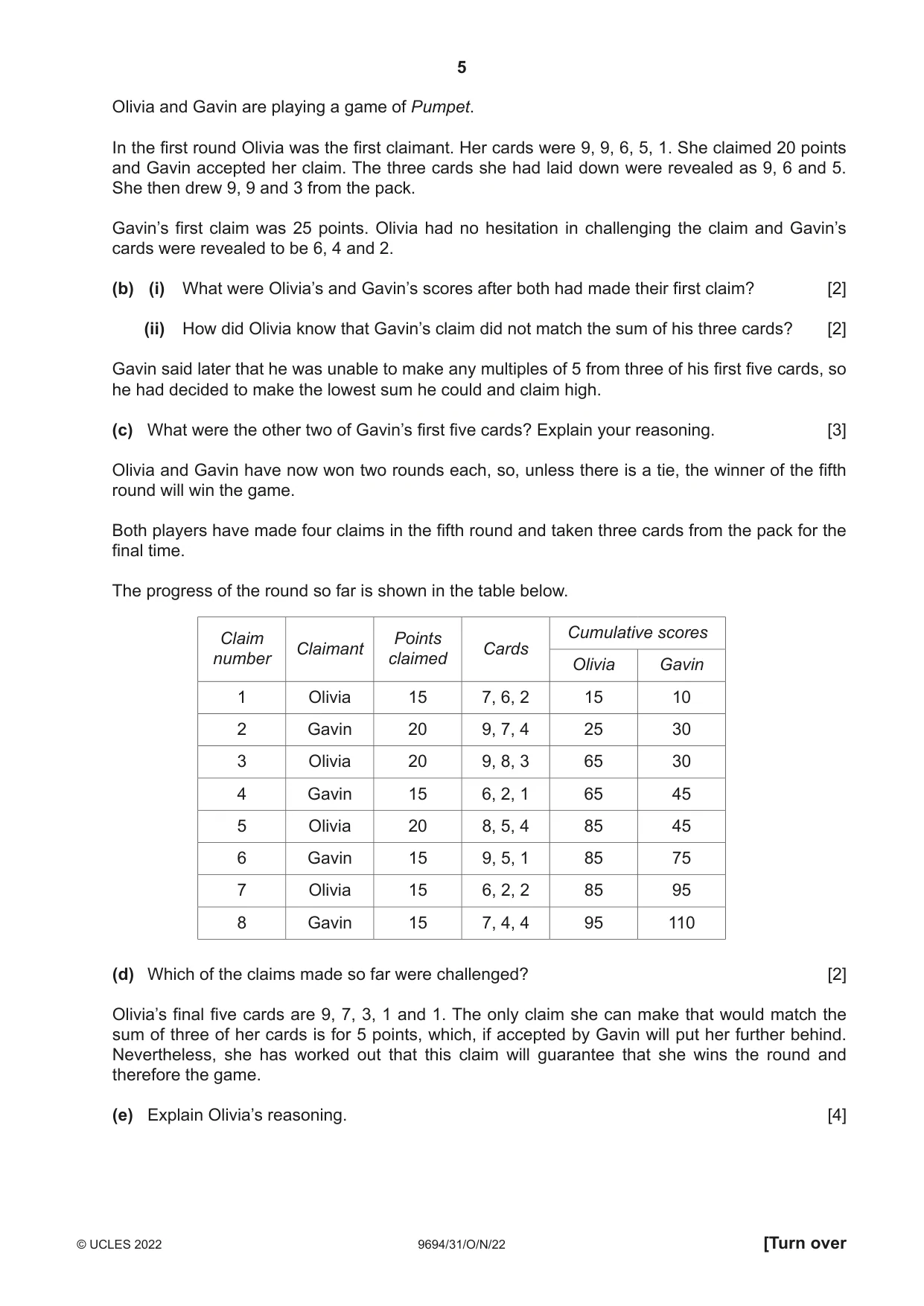
2 Pumpet is a game for two players. The first player to win three rounds is the winner. The game is played with a pack of 36 numbered cards. One single-digit number appears on the face of every card. The numbers from 1 to 9 appear on four cards each. In each round the players take it in turns to make a total of five claims each. Whichever player is making the current claim is called the ‘claimant’ and the other player is called the ‘judge’. The procedure for each claim is as follows. • The claimant lays three of the five cards in their hand face down in front of them. • The claimant then claims a number of points, which must be a multiple of 5. • The judge then either accepts the claim, if they think that the claim matches the sum of the numbers on the three cards, or challenges it. • The three cards are then revealed and points are scored as detailed below. Claim matches sum Claim does not match sum Claimant scores the value Claimant scores the value of the claim. of the claim. Claim accepted Judge scores 10 points for Judge scores 0. judging correctly. Claimant scores double the Claimant scores 0. value of the claim. Claim Judge scores 0. Judge scores 10 points challenged for judging correctly, plus the value of the sum of the three cards. At the beginning of each round, both players draw a card from the pack and the player with the higher number (after redrawing if necessary) decides whether to be claimant or judge first. The full pack is then shuffled and placed in front of the players with the cards face down. Both players take five cards from the top of the pack, without showing them to each other, before the first claim is made. After each claim has been judged and the points recorded, the three cards that were laid down are discarded and the claimant takes the next three cards from the top of the pack (again without showing them to the other player). The winner of the round is the player with the higher score. (a) What is the greatest total score that one player could possibly have after both players have made their first claim? [2] Olivia and Gavin are playing a game of Pumpet. In the first round Olivia was the first claimant. Her cards were 9, 9, 6, 5, 1. She claimed 20 points and Gavin accepted her claim. The three cards she had laid down were revealed as 9, 6 and 5. She then drew 9, 9 and 3 from the pack. Gavin’s first claim was 25 points. Olivia had no hesitation in challenging the claim and Gavin’s cards were revealed to be 6, 4 and 2. (b) (i) What were Olivia’s and Gavin’s scores after both had made their first claim? [2] (ii) How did Olivia know that Gavin’s claim did not match the sum of his three cards? [2] Gavin said later that he was unable to make any multiples of 5 from three of his first five cards, so he had decided to make the lowest sum he could and claim high. (c) What were the other two of Gavin’s first five cards? Explain your reasoning. [3] Olivia and Gavin have now won two rounds each, so, unless there is a tie, the winner of the fifth round will win the game. Both players have made four claims in the fifth round and taken three cards from the pack for the final time. The progress of the round so far is shown in the table below. Cumulative scores Claim Points Claimant Cards number claimed Olivia Gavin 1 Olivia 15 7, 6, 2 15 10 2 Gavin 20 9, 7, 4 25 30 3 Olivia 20 9, 8, 3 65 30 4 Gavin 15 6, 2, 1 65 45 5 Olivia 20 8, 5, 4 85 45 6 Gavin 15 9, 5, 1 85 75 7 Olivia 15 6, 2, 2 85 95 8 Gavin 15 7, 4, 4 95 110 (d) Which of the claims made so far were challenged? [2] Olivia’s final five cards are 9, 7, 3, 1 and 1. The only claim she can make that would match the sum of three of her cards is for 5 points, which, if accepted by Gavin will put her further behind. Nevertheless, she has worked out that this claim will guarantee that she wins the round and therefore the game. (e) Explain Olivia’s reasoning. [4]
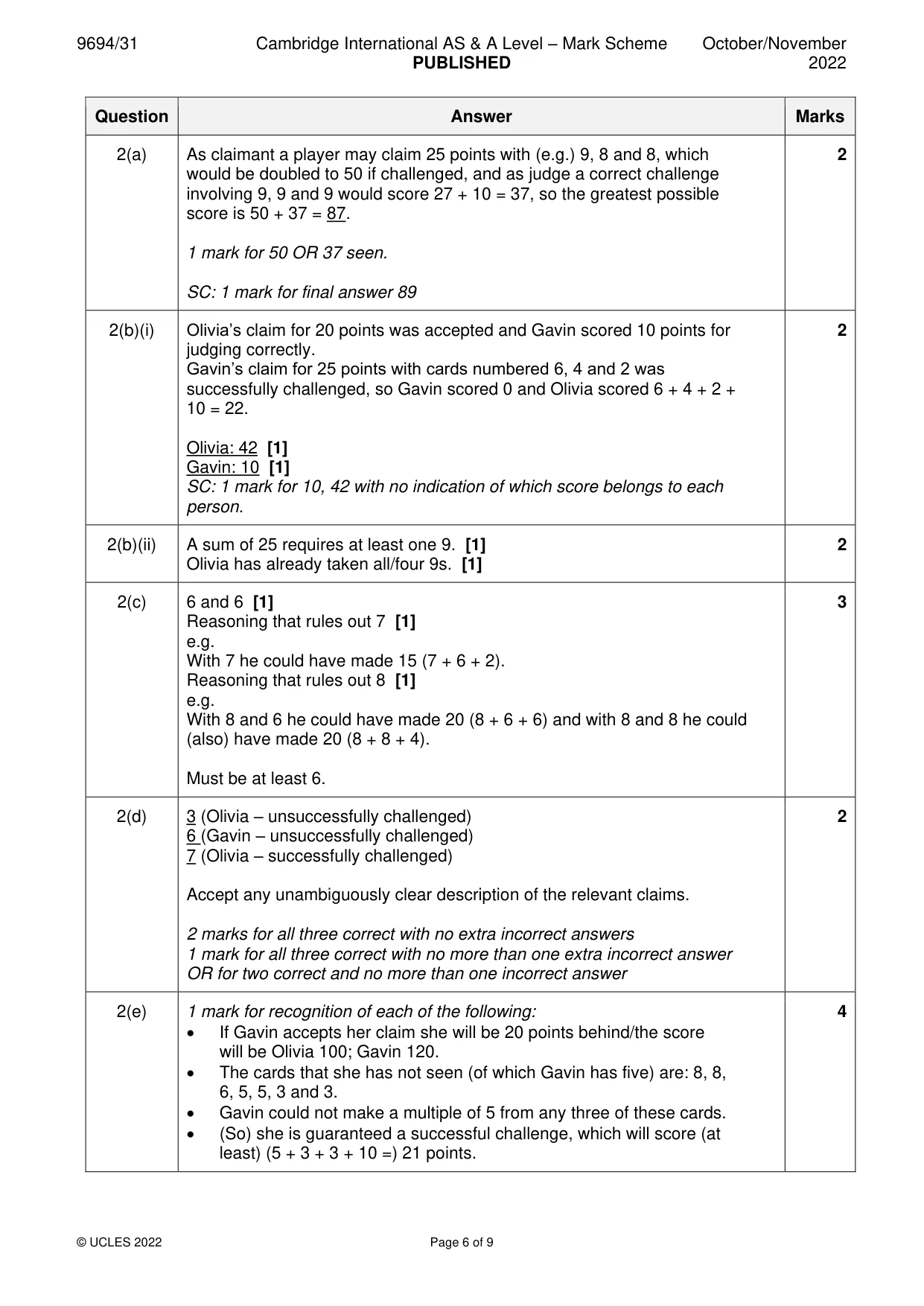
Mark scheme: 2(a) As claimant a player may claim 25 points with (e.g.) 9, 8 and 8, which 2 would be doubled to 50 if challenged, and as judge a correct challenge involving 9, 9 and 9 would score 27 + 10 = 37, so the greatest possible score is 50 + 37 = 87. 1 mark for 50 OR 37 seen. SC: 1 mark for final answer 89 2(b)(i) Olivia’s claim for 20 points was accepted and Gavin scored 10 points for 2 judging correctly. Gavin’s claim for 25 points with cards numbered 6, 4 and 2 was successfully challenged, so Gavin scored 0 and Olivia scored 6 + 4 + 2 + 10 = 22. Olivia: 42 [1] Gavin: 10 [1] SC: 1 mark for 10, 42 with no indication of which score belongs to each person. 2(b)(ii) A sum of 25 requires at least one 9. [1] 2 Olivia has already taken all/four 9s. [1] 2(c) 6 and 6 [1] 3 Reasoning that rules out 7 [1] e.g. With 7 he could have made 15 (7 + 6 + 2). Reasoning that rules out 8 [1] e.g. With 8 and 6 he could have made 20 (8 + 6 + 6) and with 8 and 8 he could (also) have made 20 (8 + 8 + 4). Must be at least 6. 2(d) 3 (Olivia – unsuccessfully challenged) 2 6 (Gavin – unsuccessfully challenged) 7 (Olivia – successfully challenged) Accept any unambiguously clear description of the relevant claims. 2 marks for all three correct with no extra incorrect answers 1 mark for all three correct with no more than one extra incorrect answer OR for two correct and no more than one incorrect answer 2(e) 1 mark for recognition of each of the following: 4 • If Gavin accepts her claim she will be 20 points behind/the score will be Olivia 100; Gavin 120. • The cards that she has not seen (of which Gavin has five) are: 8, 8, 6, 5, 5, 3 and 3. • Gavin could not make a multiple of 5 from any three of these cards. • (So) she is guaranteed a successful challenge, which will score (at least) (5 + 3 + 3 + 10 =) 21 points.
Q3 · Hugh is planning to hold an executive meeting in a boardroom that contains a large…
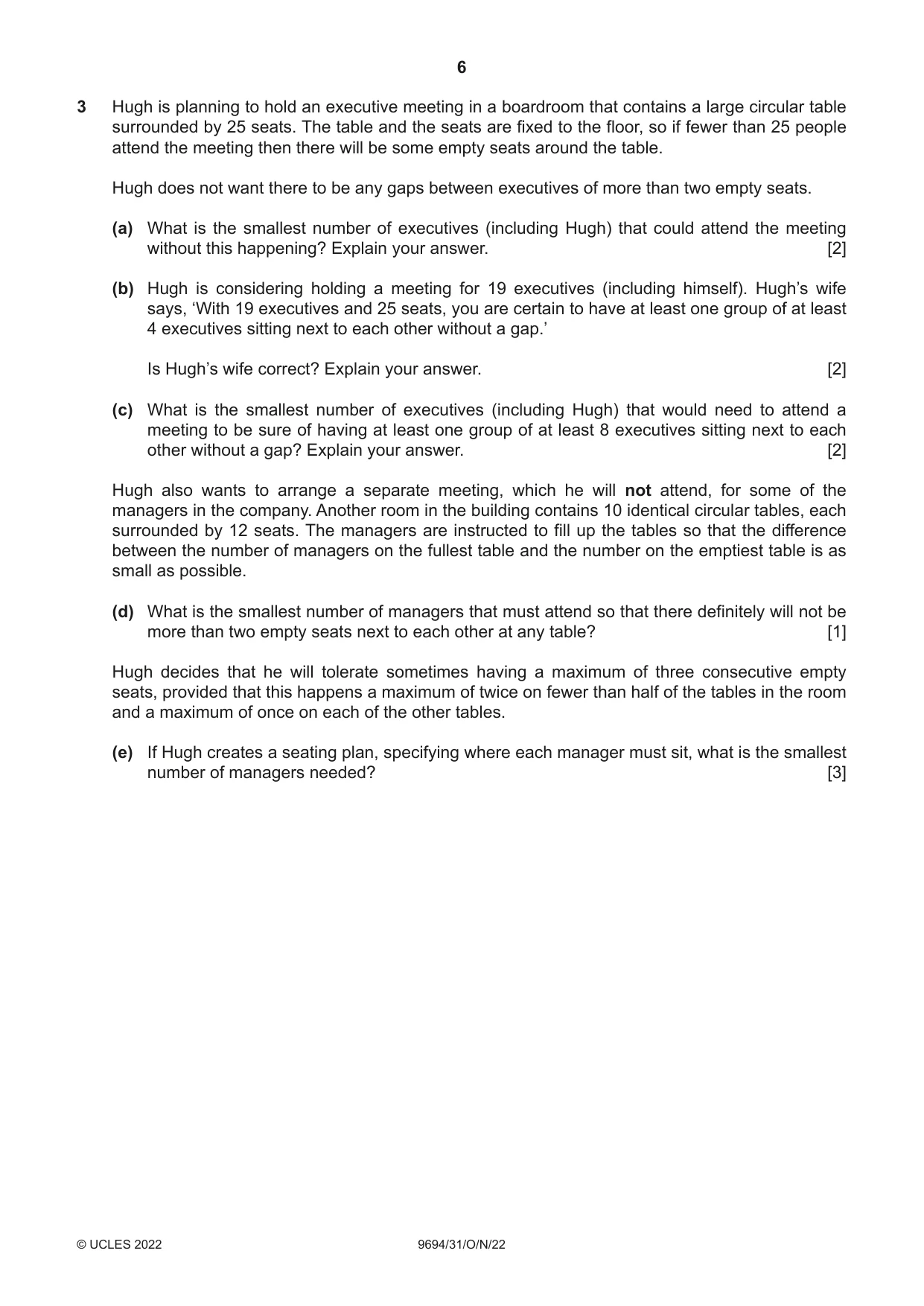
3 Hugh is planning to hold an executive meeting in a boardroom that contains a large circular table surrounded by 25 seats. The table and the seats are fixed to the floor, so if fewer than 25 people attend the meeting then there will be some empty seats around the table. Hugh does not want there to be any gaps between executives of more than two empty seats. (a) What is the smallest number of executives (including Hugh) that could attend the meeting without this happening? Explain your answer. [2] (b) Hugh is considering holding a meeting for 19 executives (including himself). Hugh’s wife says, ‘With 19 executives and 25 seats, you are certain to have at least one group of at least 4 executives sitting next to each other without a gap.’ Is Hugh’s wife correct? Explain your answer. [2] (c) What is the smallest number of executives (including Hugh) that would need to attend a meeting to be sure of having at least one group of at least 8 executives sitting next to each other without a gap? Explain your answer. [2] Hugh also wants to arrange a separate meeting, which he will not attend, for some of the managers in the company. Another room in the building contains 10 identical circular tables, each surrounded by 12 seats. The managers are instructed to fill up the tables so that the difference between the number of managers on the fullest table and the number on the emptiest table is as small as possible. (d) What is the smallest number of managers that must attend so that there definitely will not be more than two empty seats next to each other at any table? [1] Hugh decides that he will tolerate sometimes having a maximum of three consecutive empty seats, provided that this happens a maximum of twice on fewer than half of the tables in the room and a maximum of once on each of the other tables. (e) If Hugh creates a seating plan, specifying where each manager must sit, what is the smallest number of managers needed? [3] [Turn over for Question 4]
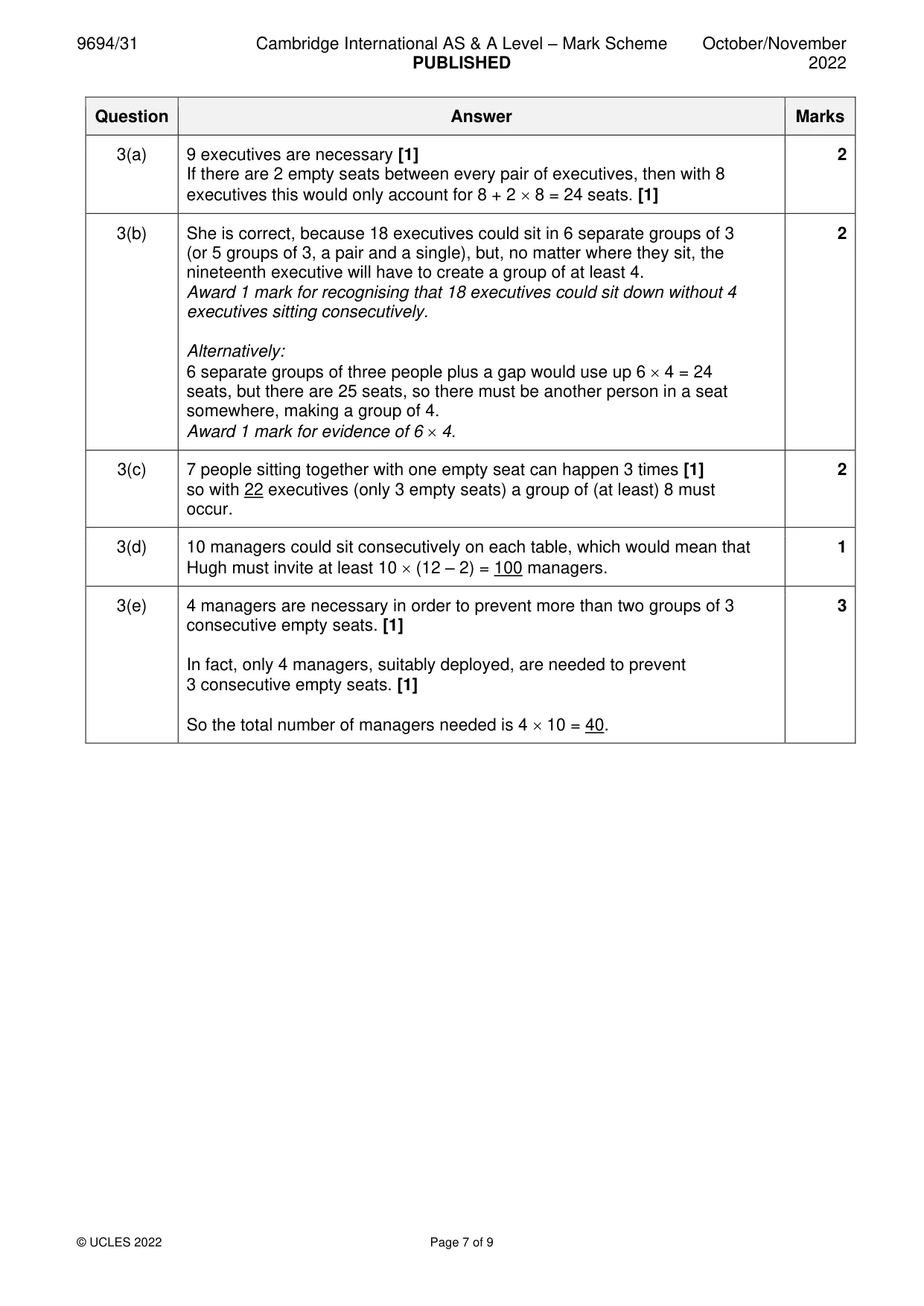
Mark scheme: 3(a) 9 executives are necessary [1] 2 If there are 2 empty seats between every pair of executives, then with 8 executives this would only account for 8 + 2 8 = 24 seats. [1] 3(b) She is correct, because 18 executives could sit in 6 separate groups of 3 2 (or 5 groups of 3, a pair and a single), but, no matter where they sit, the nineteenth executive will have to create a group of at least 4. Award 1 mark for recognising that 18 executives could sit down without 4 executives sitting consecutively. Alternatively: 6 separate groups of three people plus a gap would use up 6 4 = 24 seats, but there are 25 seats, so there must be another person in a seat somewhere, making a group of 4. Award 1 mark for evidence of 6 4. 3(c) 7 people sitting together with one empty seat can happen 3 times [1] 2 so with 22 executives (only 3 empty seats) a group of (at least) 8 must occur. 3(d) 10 managers could sit consecutively on each table, which would mean that 1 Hugh must invite at least 10 (12 – 2) = 100 managers. 3(e) 4 managers are necessary in order to prevent more than two groups of 3 3 consecutive empty seats. [1] In fact, only 4 managers, suitably deployed, are needed to prevent 3 consecutive empty seats. [1] So the total number of managers needed is 4 10 = 40.
Q4 · Quadrominoes is a two-player game that is played with a set of square tiles
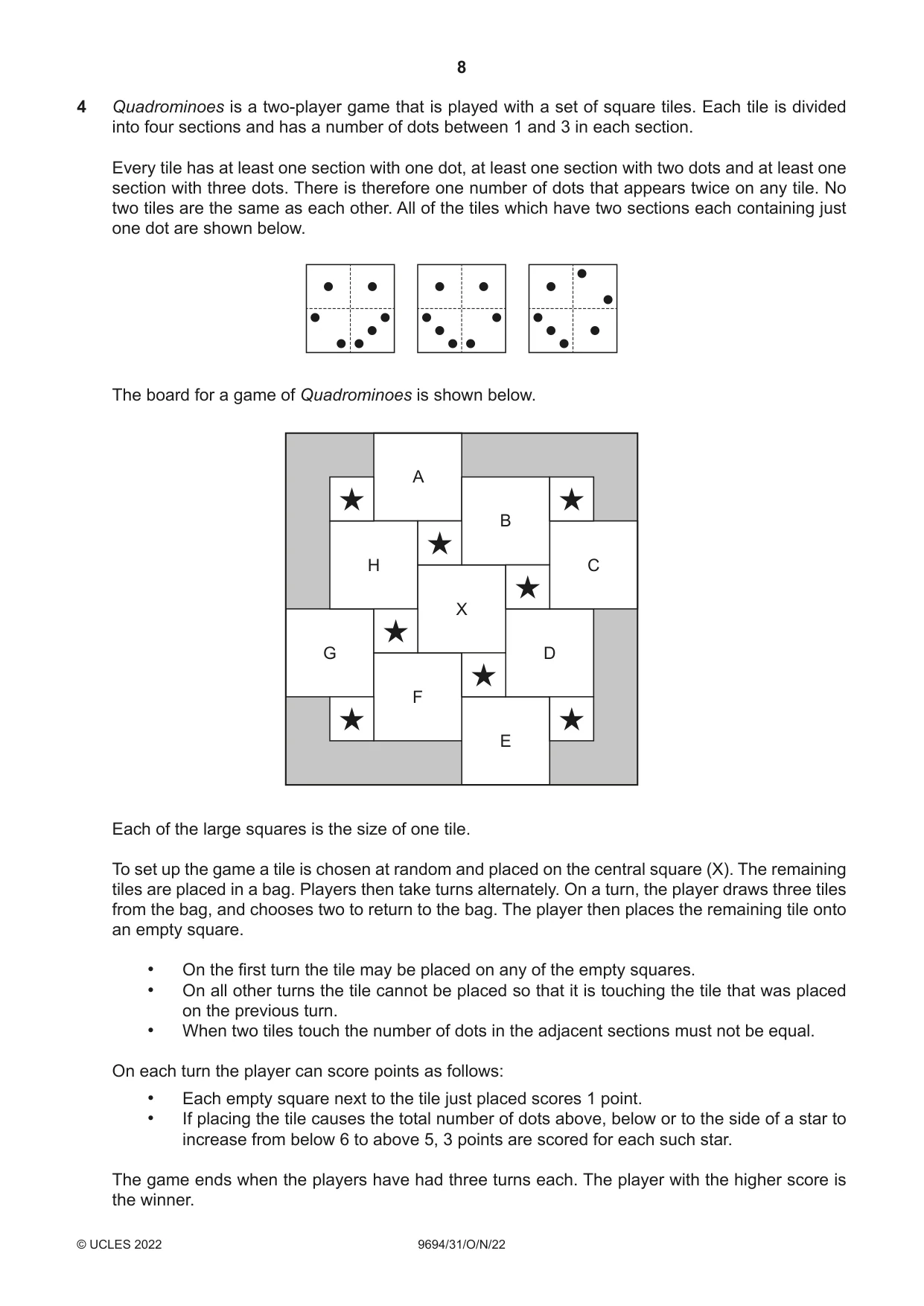
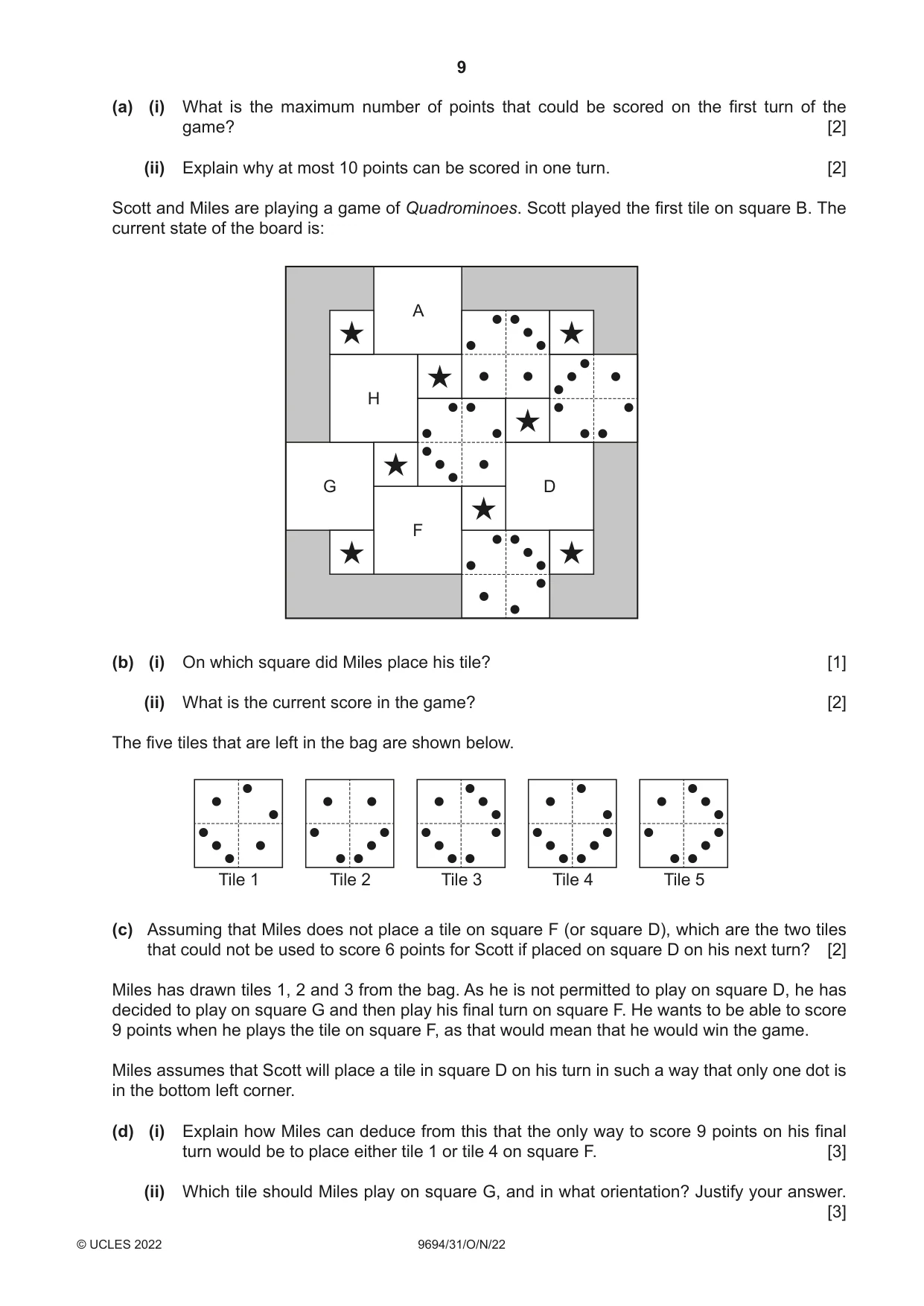
4 Quadrominoes is a two-player game that is played with a set of square tiles. Each tile is divided into four sections and has a number of dots between 1 and 3 in each section. Every tile has at least one section with one dot, at least one section with two dots and at least one section with three dots. There is therefore one number of dots that appears twice on any tile. No two tiles are the same as each other. All of the tiles which have two sections each containing just one dot are shown below. The board for a game of Quadrominoes is shown below. A B H C X G D F E Each of the large squares is the size of one tile. To set up the game a tile is chosen at random and placed on the central square (X). The remaining tiles are placed in a bag. Players then take turns alternately. On a turn, the player draws three tiles from the bag, and chooses two to return to the bag. The player then places the remaining tile onto an empty square. • On the first turn the tile may be placed on any of the empty squares. • On all other turns the tile cannot be placed so that it is touching the tile that was placed on the previous turn. • When two tiles touch the number of dots in the adjacent sections must not be equal. On each turn the player can score points as follows: • Each empty square next to the tile just placed scores 1 point. • If placing the tile causes the total number of dots above, below or to the side of a star to increase from below 6 to above 5, 3 points are scored for each such star. The game ends when the players have had three turns each. The player with the higher score is the winner. (a) (i) What is the maximum number of points that could be scored on the first turn of the game? [2] (ii) Explain why at most 10 points can be scored in one turn. [2] Scott and Miles are playing a game of Quadrominoes. Scott played the first tile on square B. The current state of the board is: A H G D F (b) (i) On which square did Miles place his tile? [1] (ii) What is the current score in the game? [2] The five tiles that are left in the bag are shown below. Tile 1 Tile 2 Tile 3 Tile 4 Tile 5 (c) Assuming that Miles does not place a tile on square F (or square D), which are the two tiles that could not be used to score 6 points for Scott if placed on square D on his next turn? [2] Miles has drawn tiles 1, 2 and 3 from the bag. As he is not permitted to play on square D, he has decided to play on square G and then play his final turn on square F. He wants to be able to score
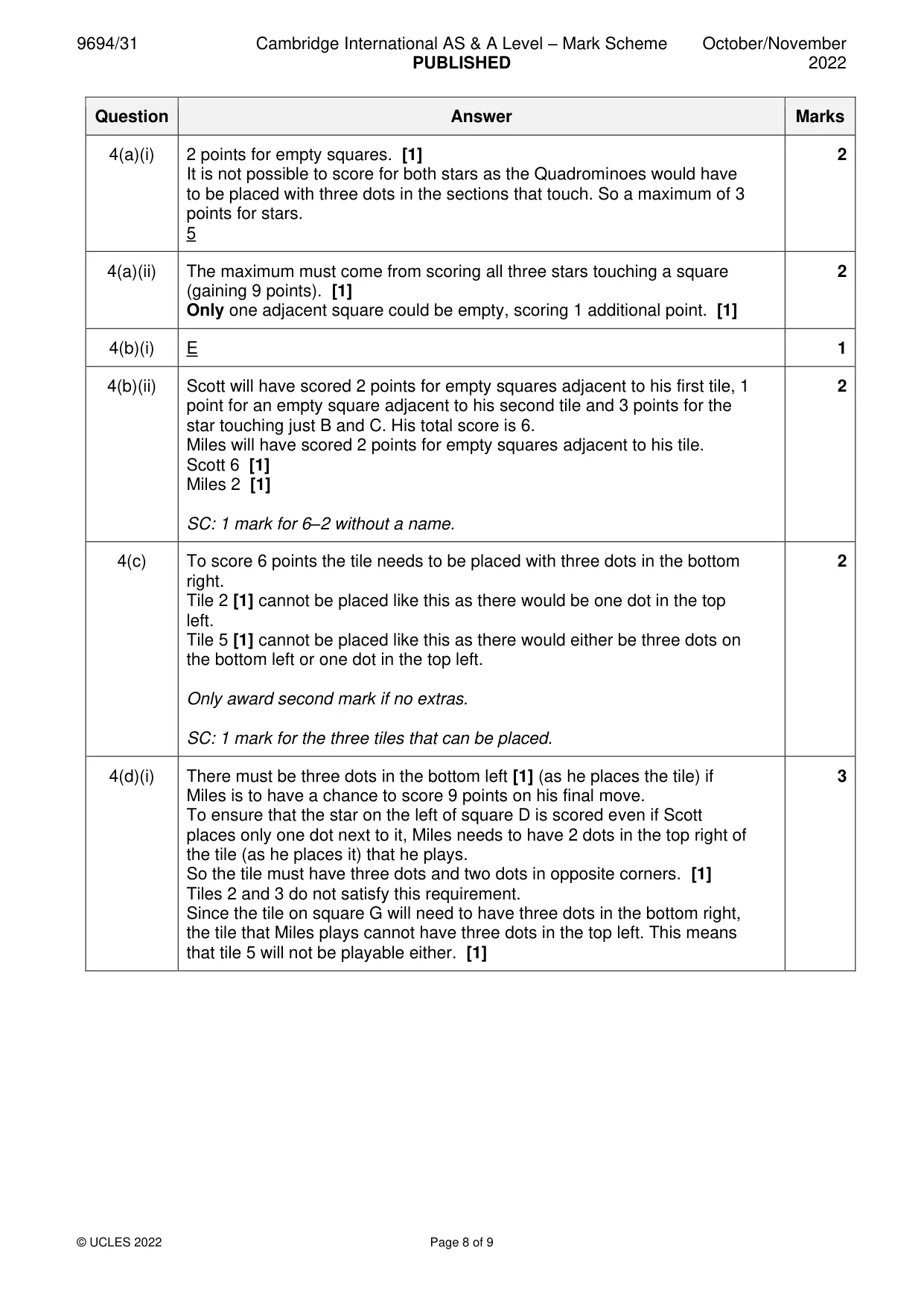
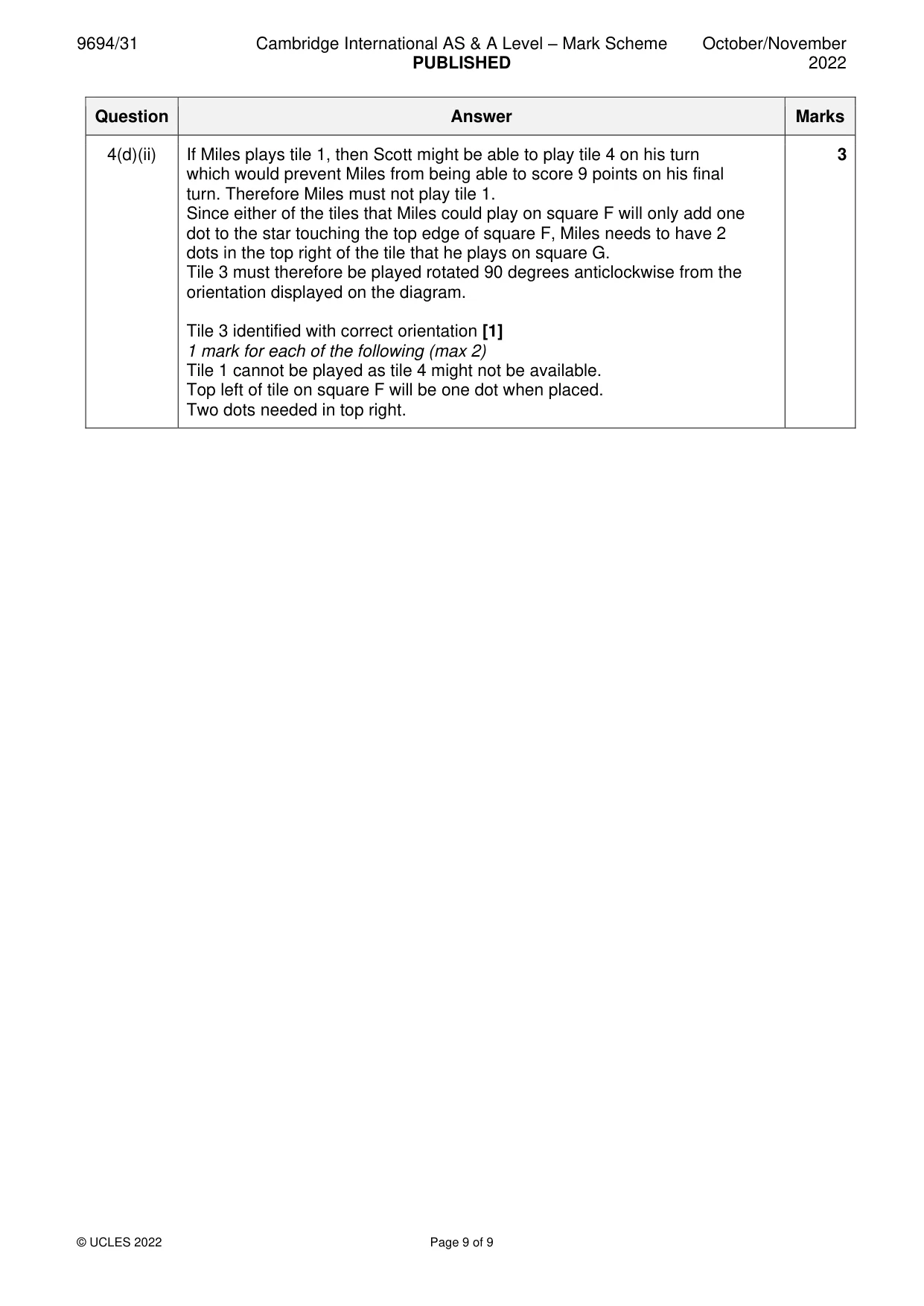
Mark scheme: 4(a)(i) 2 points for empty squares. [1] 2 It is not possible to score for both stars as the Quadrominoes would have to be placed with three dots in the sections that touch. So a maximum of 3 points for stars. 5 4(a)(ii) The maximum must come from scoring all three stars touching a square 2 (gaining 9 points). [1] Only one adjacent square could be empty, scoring 1 additional point. [1] 4(b)(i) E 1 4(b)(ii) Scott will have scored 2 points for empty squares adjacent to his first tile, 1 2 point for an empty square adjacent to his second tile and 3 points for the star touching just B and C. His total score is 6. Miles will have scored 2 points for empty squares adjacent to his tile. Scott 6 [1] Miles 2 [1] SC: 1 mark for 6–2 without a name. 4(c) To score 6 points the tile needs to be placed with three dots in the bottom 2 right. Tile 2 [1] cannot be placed like this as there would be one dot in the top left. Tile 5 [1] cannot be placed like this as there would either be three dots on the bottom left or one dot in the top left. Only award second mark if no extras. SC: 1 mark for the three tiles that can be placed. 4(d)(i) There must be three dots in the bottom left [1] (as he places the tile) if 3 Miles is to have a chance to score 9 points on his final move. To ensure that the star on the left of square D is scored even if Scott places only one dot next to it, Miles needs to have 2 dots in the top right of the tile (as he places it) that he plays. So the tile must have three dots and two dots in opposite corners. [1] Tiles 2 and 3 do not satisfy this requirement. Since the tile on square G will need to have three dots in the bottom right, the tile that Miles plays cannot have three dots in the top left. This means that tile 5 will not be playable either. [1] 4(d)(ii) If Miles plays tile 1, then Scott might be able to play tile 4 on his turn 3 which would prevent Miles from being able to score 9 points on his final turn. Therefore Miles must not play tile 1. Since either of the tiles that Miles could play on square F will only add one dot to the star touching the top edge of square F, Miles needs to have 2 dots in the top right of the tile that he plays on square G. Tile 3 must therefore be played rotated 90 degrees anticlockwise from the orientation displayed on the diagram. Tile 3 identified with correct orientation [1] 1 mark for each of the following (max 2) Tile 1 cannot be played as tile 4 might not be available. Top left of tile on square F will be one dot when placed. Two dots needed in top right.
Q9 · Points when he plays the tile on square F, as that would mean that he would win the game
9 points when he plays the tile on square F, as that would mean that he would win the game. Miles assumes that Scott will place a tile in square D on his turn in such a way that only one dot is in the bottom left corner. (d) (i) Explain how Miles can deduce from this that the only way to score 9 points on his final turn would be to place either tile 1 or tile 4 on square F. [3] (ii) Which tile should Miles play on square G, and in what orientation? Justify your answer. [3]
What was in this paper
The subtopics covered by these 5 questions, and how many questions each got. Open one in a new tab to see every Cambridge question on it.
What you needed in this session
Cambridge’s own grade thresholds for 2022 Oct/Nov, Paper 3 · Variant 1. A higher threshold means an easier paper — the bar moves with how the cohort did.