Questions as text
Q1 · Explain what is meant by work done 9702/21 May/June 2011
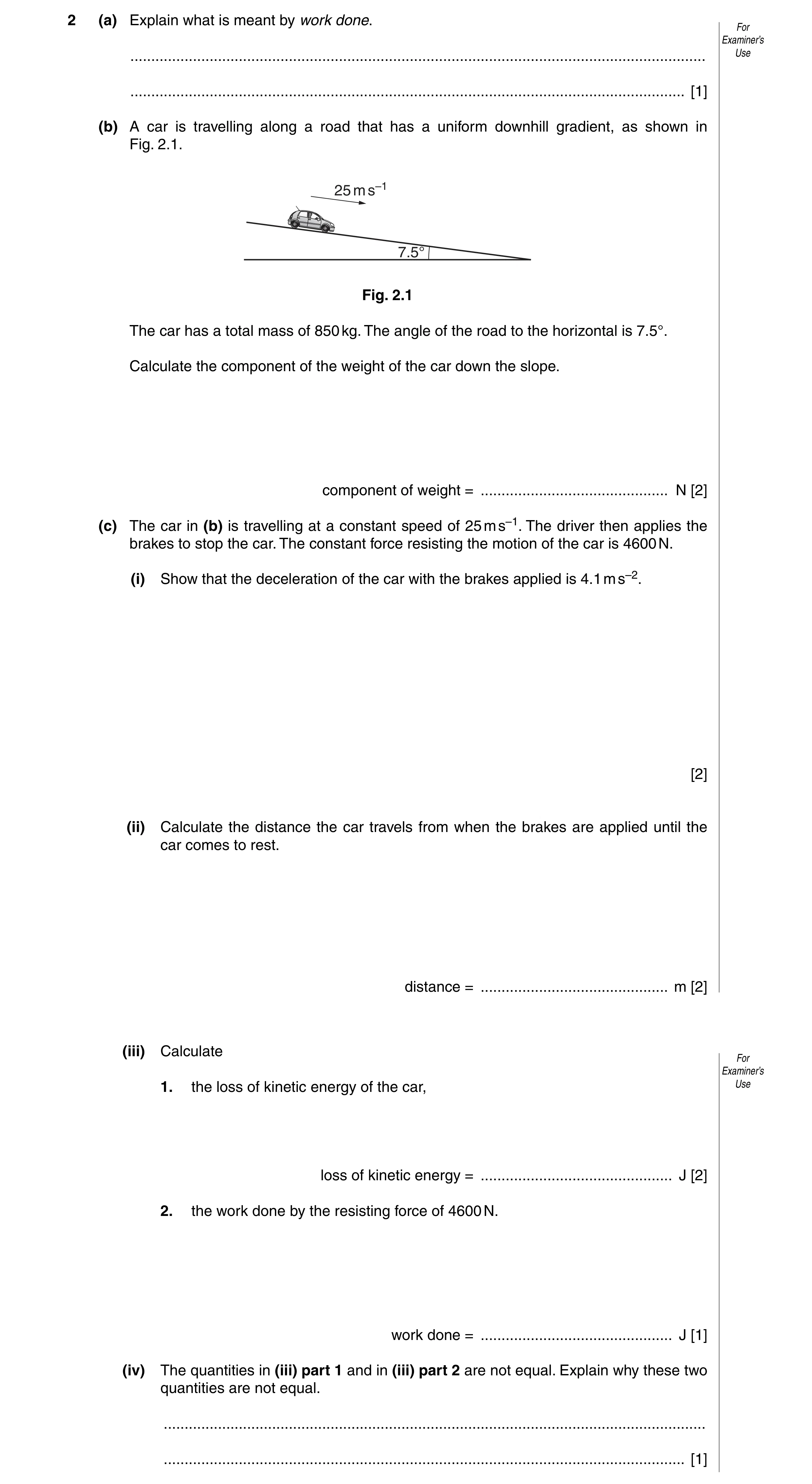
2 (a) Explain what is meant by work done. For Examiner’s … Use … [1] (b) A car is travelling along a road that has a uniform downhill gradient, as shown in Fig. 2.1. 25 m s–1 7.5° Fig. 2.1 The car has a total mass of 850 kg. The angle of the road to the horizontal is 7.5°. Calculate the component of the weight of the car down the slope. component of weight = … N [2] (c) The car in (b) is travelling at a constant speed of 25 m s–1. The driver then applies the brakes to stop the car. The constant force resisting the motion of the car is 4600 N. (i) Show that the deceleration of the car with the brakes applied is 4.1 m s–2. [2] (ii) Calculate the distance the car travels from when the brakes are applied until the car comes to rest. distance = … m [2] (iii) Calculate For Examiner’s 1. the loss of kinetic energy of the car, Use loss of kinetic energy = … J [2] 2. the work done by the resisting force of 4600 N. work done = … J [1] (iv) The quantities in (iii) part 1 and in (iii) part 2 are not equal. Explain why these two quantities are not equal. … … [1]
11 marks
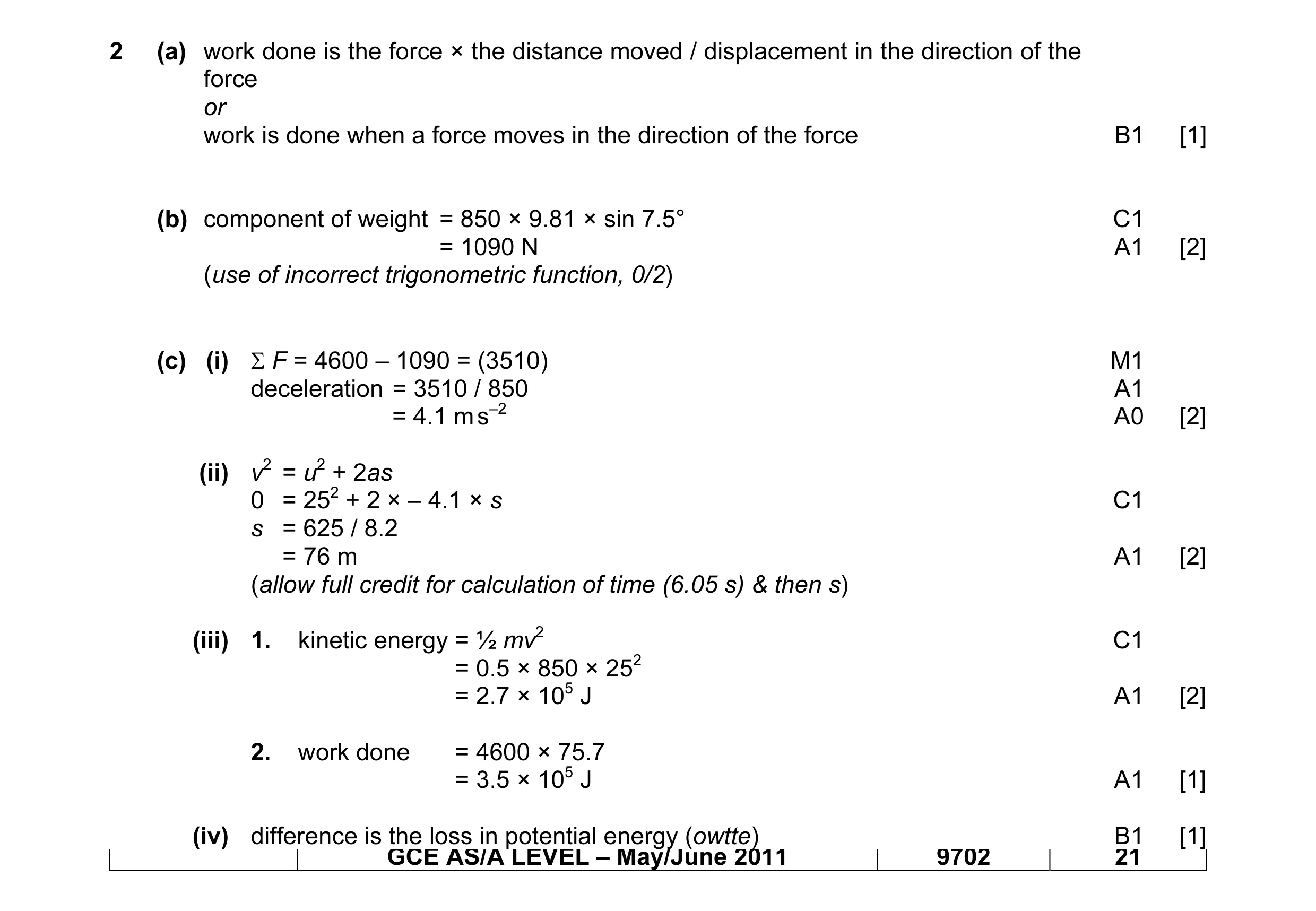
Mark scheme: 2 (a) work done is the force × the distance moved / displacement in the direction of the force or work is done when a force moves in the direction of the force B1 [1] (b) component of weight = 850 × 9.81 × sin 7.5° C1 = 1090 N A1 [2] (use of incorrect trigonometric function, 0/2) (c) (i) Σ F = 4600 – 1090 = (3510) M1 deceleration = 3510 / 850 A1 = 4.1 m s–2 A0 [2] (ii) v2 = u2 + 2as 0 = 252 + 2 × – 4.1 × s C1 s = 625 / 8.2 = 76 m A1 [2] (allow full credit for calculation of time (6.05 s) & then s) (iii) 1. kinetic energy = ½ mv2 C1 = 0.5 × 850 × 252 = 2.7 × 10⁵ J A1 [2] 2. work done = 4600 × 75.7 = 3.5 × 10⁵ J A1 [1] (iv) difference is the loss in potential energy (owtte) B1 [1] GCE AS/A LEVEL – May/June 2011 9702 21
This question in 9702/21 May/June 2011
Q2 · State Newton’s first law 9702/22 May/June 2012
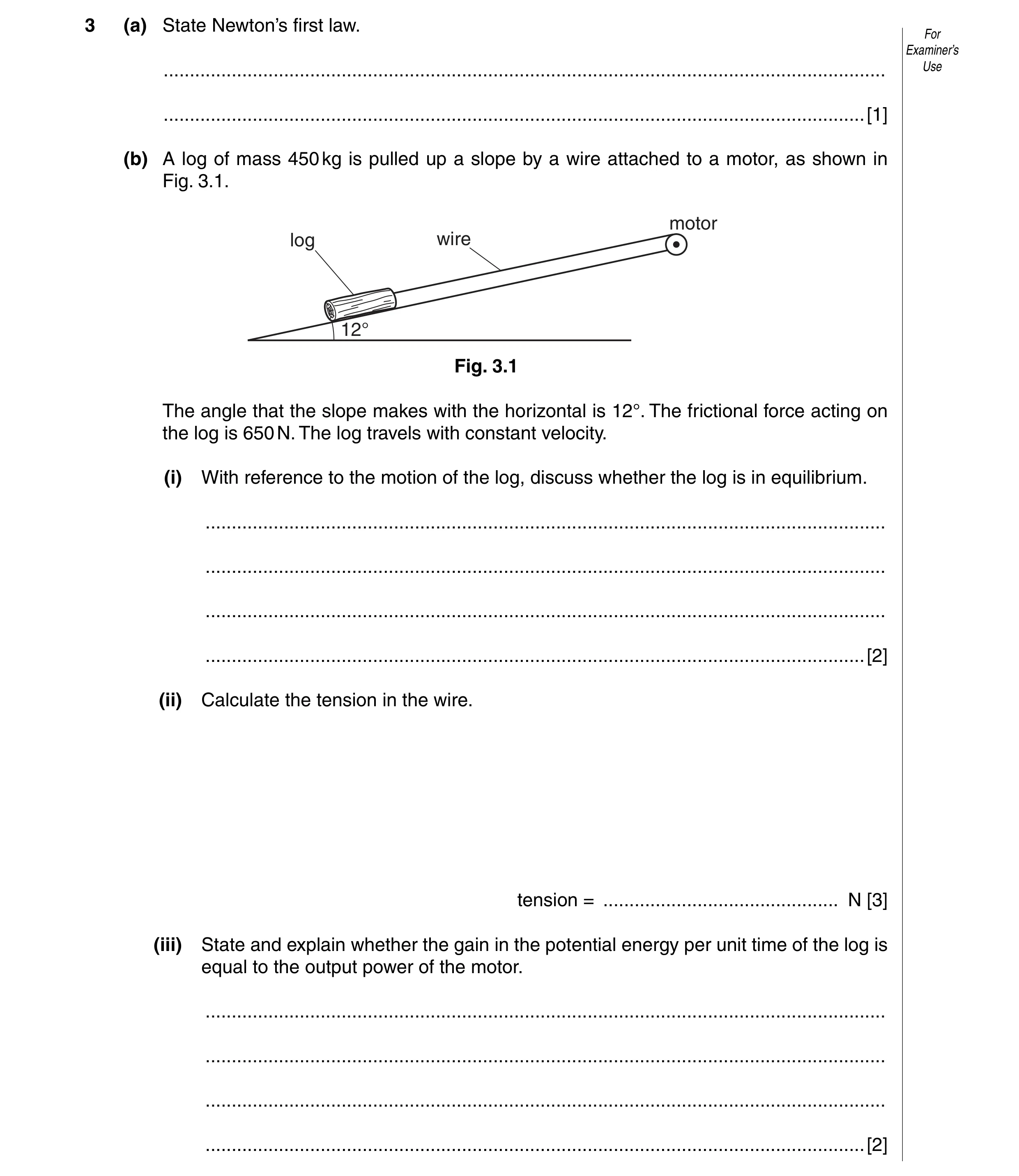
3 (a) State Newton’s first law. For Examiner’s … Use … [1] (b) A log of mass 450 kg is pulled up a slope by a wire attached to a motor, as shown in Fig. 3.1. motor log wire 12° Fig. 3.1 The angle that the slope makes with the horizontal is 12°. The frictional force acting on the log is 650 N. The log travels with constant velocity. (i) With reference to the motion of the log, discuss whether the log is in equilibrium. … … … … [2] (ii) Calculate the tension in the wire. tension = … N [3] (iii) State and explain whether the gain in the potential energy per unit time of the log is equal to the output power of the motor. … … … … [2]
8 marks
Mark scheme: 3 (a) A body continues at rest or constant velocity unless acted on by a resultant (external) force B1 [1] (b) (i) constant velocity/zero acceleration and therefore no resultant force M1 no resultant force (and no resultant torque) hence in equilibrium A1 [2] (ii) component of weight = 450 × 9.81 × sin 12° (= 917.8) C1 tension = 650 + 450 g sin12° = (650 + 917.8) C1 = 1600 (1570) N A1 [3] GCE AS/A LEVEL – May/June 2012 9702 22 (iii) work done against frictional force or friction between log and slope M1 output power greater than the gain in PE / s A1 [2]
This question in 9702/22 May/June 2012
Question 3 9702/23 Oct/Nov 2012
3 (a) Define power. For Examiner’s … Use … [1] (b) A cyclist travels along a horizontal road. The variation with time t of speed v is shown in Fig. 3.1. 12.0 10.0 8.0 v / m s–1 6.0 4.0 2.0 0 0 2 4 6 8 10 12 14 16 18 20 22 24 26 28 t / s Fig. 3.1 The cyclist maintains a constant power and after some time reaches a constant speed of 12 m s–1. (i) Describe and explain the motion of the cyclist. … … … … … [3] (ii) When the cyclist is moving at a constant speed of 12 m s–1 the resistive force is For 48 N. Show that the power of the cyclist is about 600 W. Explain your working. Examiner’s Use [2] (iii) Use Fig. 3.1 to show that the acceleration of the cyclist when his speed is 8.0 m s–1 is about 0.5 m s–2. [2] (iv) The total mass of the cyclist and bicycle is 80 kg. Calculate the resistive force R acting on the cyclist when his speed is 8.0 m s–1. Use the value for the acceleration given in (iii). R = … N [3] (v) Use the information given in (ii) and your answer to (iv) to show that, in this situation, the resistive force R is proportional to the speed v of the cyclist. [1]
12 marks
Mark scheme: 3 (a) power is the rate of doing work or power = work done / time (taken) or power = energy transferred / time (taken) B1 [1] (b) (i) as the speed increases drag / air resistance increases B1 resultant force reduces hence acceleration is less B1 constant speed when resultant force is zero B1 [3] (allow one mark for speed increases and acceleration decreases) GCE AS/A LEVEL – October/November 2012 9702 23 (ii) force from cyclist = drag force / resistive force B1 P = 12 × 48 M1 P = 576 W A0 [2] (iii) tangent drawn at speed = 8.0 m s–1 M1 gradient values that show acceleration between 0.44 to 0.48 m s–2 A1 [2] (iv) F – R = ma C1 600 / 8 – R = 80 × 0.5 [using P = 576] 576 / 8 – R = 80 × 0.5 C1 R = 75 – 40 = 35 N R = 72 – 40 = 32 N A1 [3] (v) at 12 m s–1 drag is 48 N, at 8 m s–1 drag is 35 or 32 N R / v calculated as 4 and 4 or 4.4 and consistent response for whether R is proportional to v or not B1 [1]
This question in 9702/23 Oct/Nov 2012
Q4 · An electron is travelling in a straight line through a vacuum with a constant speed of… 9702/22 Feb/March 2017
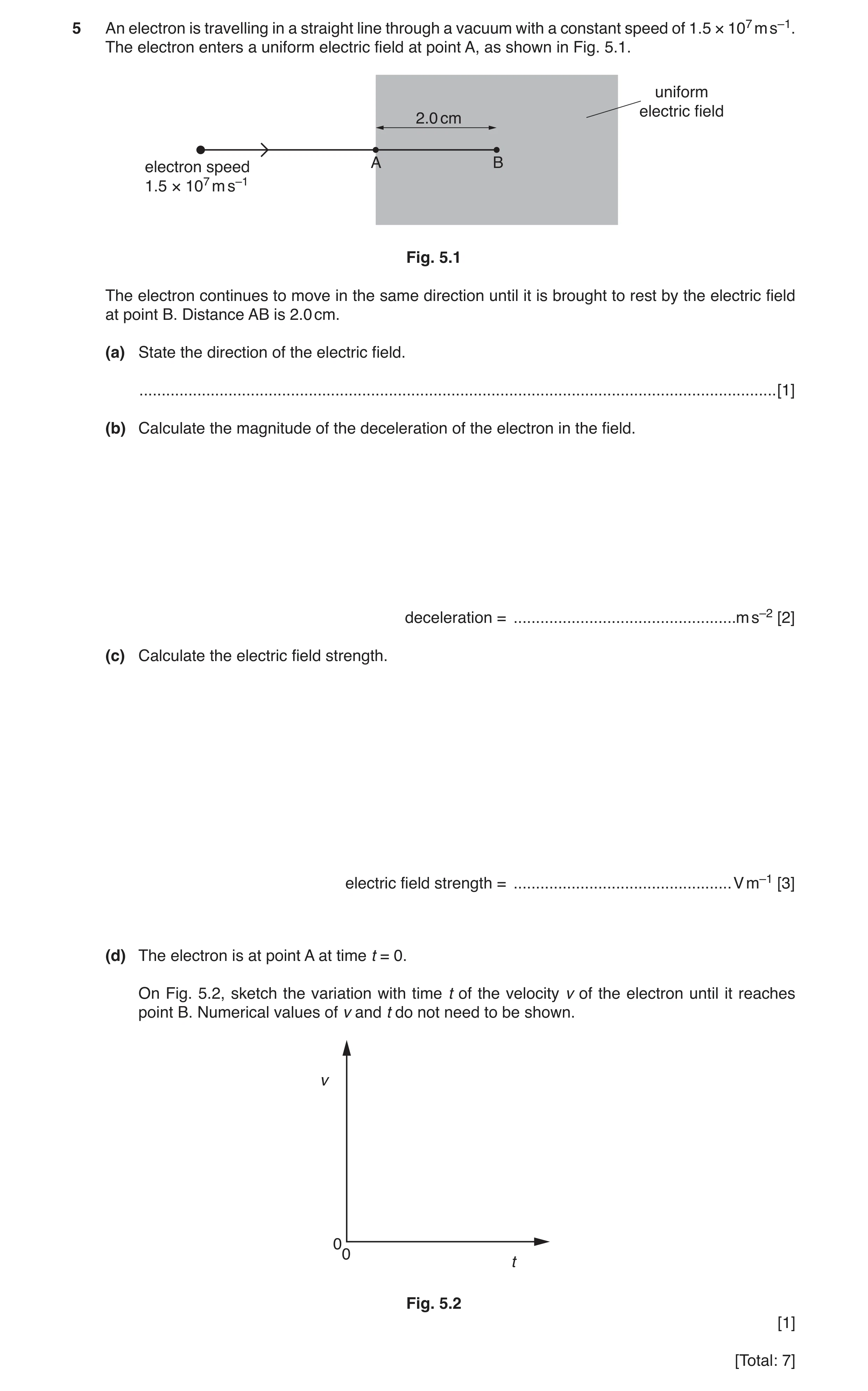
5 An electron is travelling in a straight line through a vacuum with a constant speed of 1.5 × 10⁷ m s–1. The electron enters a uniform electric field at point A, as shown in Fig. 5.1. uniform electric field 2.0 cm electron speed A B 1.5 × 10⁷ m s–1 Fig. 5.1 The electron continues to move in the same direction until it is brought to rest by the electric field at point B. Distance AB is 2.0 cm. (a) State the direction of the electric field. … [1] (b) Calculate the magnitude of the deceleration of the electron in the field. deceleration = … m s–2 [2] (c) Calculate the electric field strength. electric field strength = … V m–1 [3] (d) The electron is at point A at time t = 0. On Fig. 5.2, sketch the variation with time t of the velocity v of the electron until it reaches point B. Numerical values of v and t do not need to be shown. v 0 0 t Fig. 5.2 [1] [Total: 7]
7 marks
Mark scheme: 5(a) to the right / from the left / from A to B / in the same direction as electron velocity B1 5(b) v 2 = u 2 + 2as a = (1.5 × 10⁷)2 / (2 × 2.0 × 10–2) Other alternative calculations for the C1 mark: e.g. a = 1.5×10⁷ / 2.67×10⁻⁹ e.g. a = [(1.5×107 × 2.67×10–9) – 2.0×10–2] × [2 / (2.67×10⁻⁹)2] e.g. a = (2.0×10–2 × 2) / (2.67×10⁻⁹)2 C1 = 5.6 × 10¹⁵ m s–2 A1 5(c) E = F / Q C1 = (9.1 × 10–31 × 5.6 × 1015) / 1.6 × 10⁻¹⁹ C1 = 3.2 × 10⁴ V m–1 A1 5(d) straight line with negative gradient starting at an intercept on the v-axis and ending at an intercept on the t-axis. B1
This question in 9702/22 Feb/March 2017
Q5 · The variation with time t of the velocity v of two cars P and Q is shown in Fig 9702/21 Oct/Nov 2017
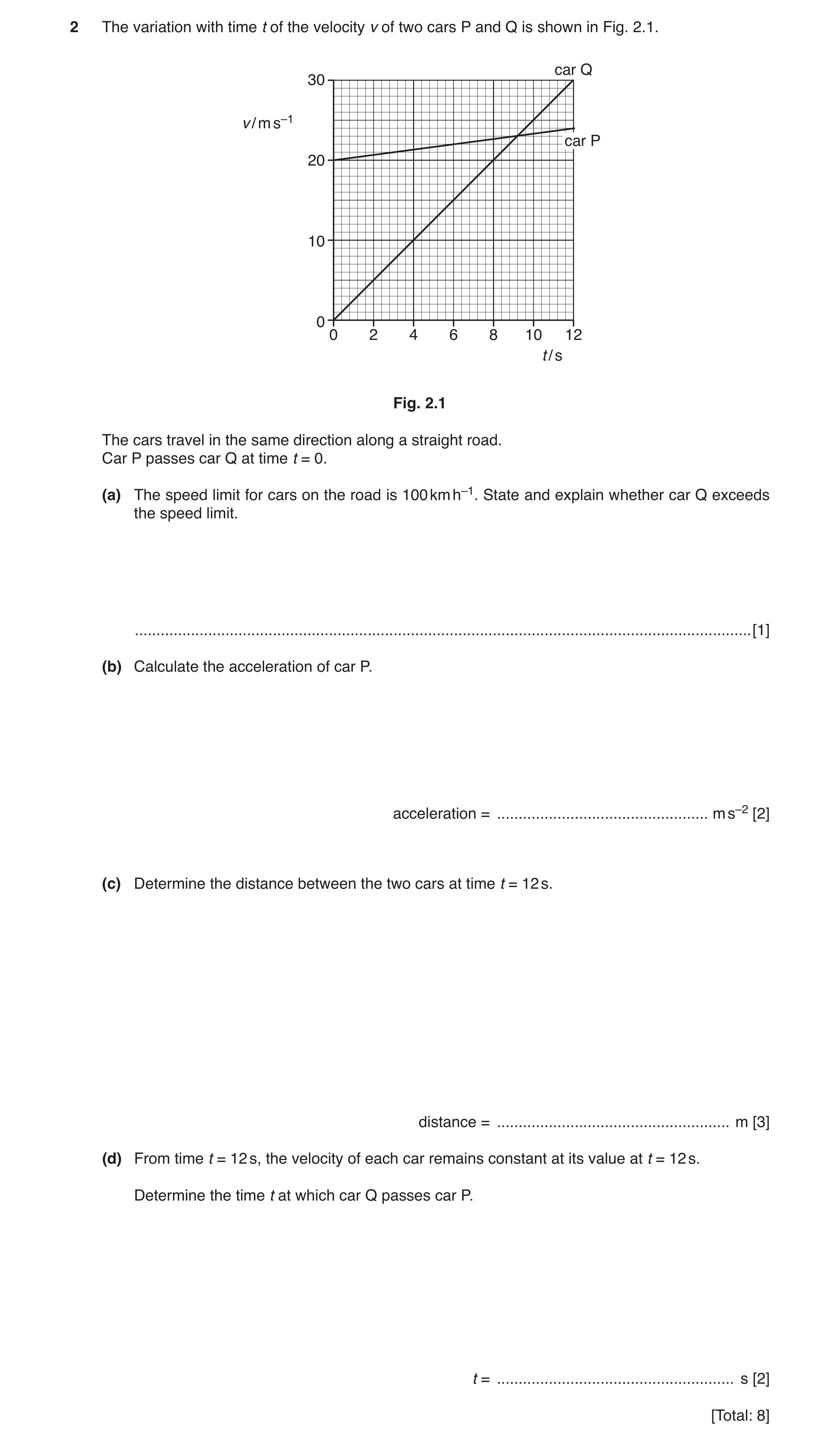
2 The variation with time t of the velocity v of two cars P and Q is shown in Fig. 2.1. car Q 30 v / m s–1 car P 20 10 0 0 2 4 6 8 10 12 t / s Fig. 2.1 The cars travel in the same direction along a straight road. Car P passes car Q at time t = 0. (a) The speed limit for cars on the road is 100 km h–1. State and explain whether car Q exceeds the speed limit. … [1] (b) Calculate the acceleration of car P. acceleration = … m s–2 [2] (c) Determine the distance between the two cars at time t = 12 s. distance = … m [3] (d) From time t = 12 s, the velocity of each car remains constant at its value at t = 12 s. Determine the time t at which car Q passes car P. t = … s [2] [Total: 8]
8 marks
Mark scheme: 2(a) or 100 km h–1 = 28 m s–1 and so exceeds speed limit B1 2(b) acceleration = gradient or ∆v / (∆)t or (v – u) / t C1 e.g. acceleration = (24 – 20) / 12 [other points on graph line may be used] = 0.33 m s–2 A1 2(c) distance travelled by Q = ½ × 12 × 30 (= 180 m) C1 distance travelled by P = ½ × (20 + 24) × 12 (= 264 m) C1 distance between cars = 264 – 180 = 84 m A1 2(d) 30 – 24 = 6 m s–1 ‘extra’ time T = 84 / 6 (= 14 s) or 180 + 30T = 264 + 24T ‘extra’ time T = 84 / 6 (= 14 s) C1 t = 12 + 14 = 26 s A1
This question in 9702/21 Oct/Nov 2017
Q6 · State Newton’s first law of motion 9702/23 May/June 2020
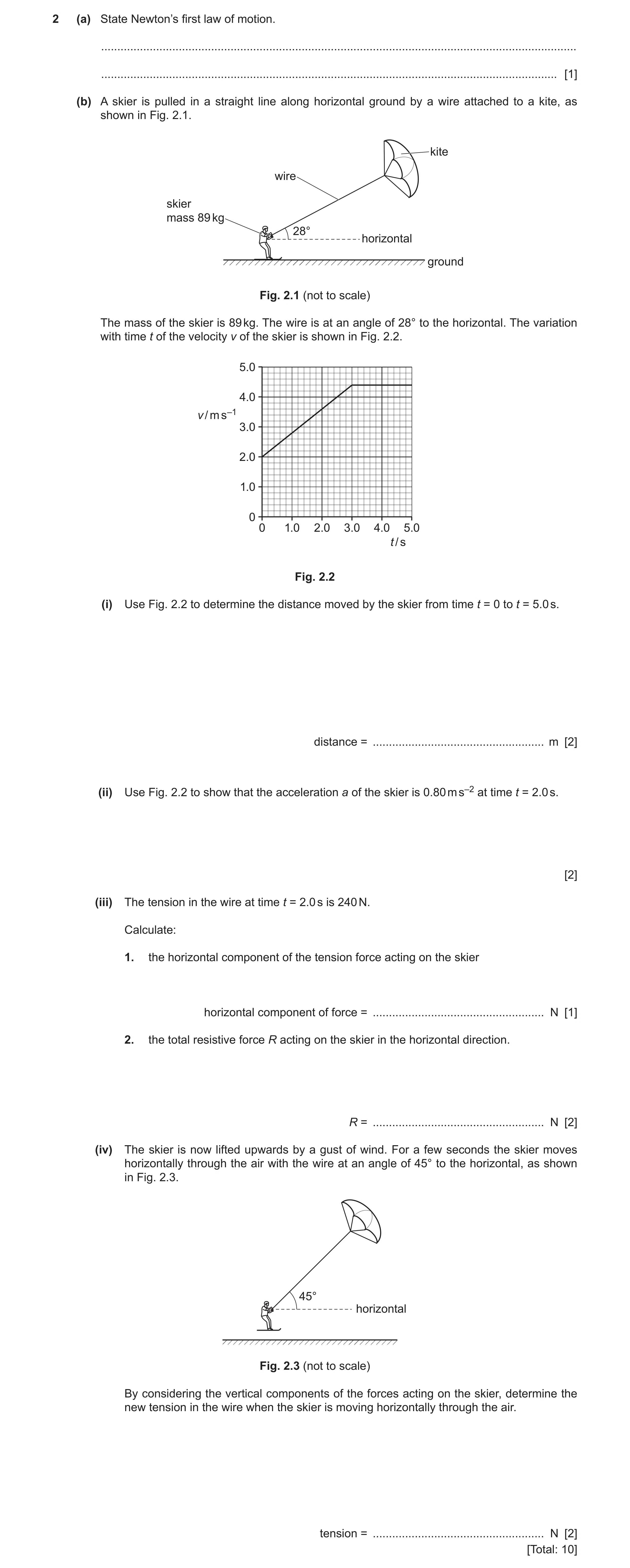
2 (a) State Newton’s first law of motion. … … [1] (b) A skier is pulled in a straight line along horizontal ground by a wire attached to a kite, as shown in Fig. 2.1. kite wire skier mass 89 kg 28° horizontal ground Fig. 2.1 (not to scale) The mass of the skier is 89 kg. The wire is at an angle of 28° to the horizontal. The variation with time t of the velocity v of the skier is shown in Fig. 2.2. 5.0 4.0 v / m s–1 3.0 2.0 1.0 0 0 1.0 2.0 3.0 4.0 5.0 t / s Fig. 2.2 (i) Use Fig. 2.2 to determine the distance moved by the skier from time t = 0 to t = 5.0 s. distance = … m [2] (ii) Use Fig. 2.2 to show that the acceleration a of the skier is 0.80 m s–2 at time t = 2.0 s. [2] (iii) The tension in the wire at time t = 2.0 s is 240 N. Calculate: 1. the horizontal component of the tension force acting on the skier horizontal component of force = … N [1] 2. the total resistive force R acting on the skier in the horizontal direction. R = … N [2] (iv) The skier is now lifted upwards by a gust of wind. For a few seconds the skier moves horizontally through the air with the wire at an angle of 45° to the horizontal, as shown in Fig. 2.3. 45° horizontal Fig. 2.3 (not to scale) By considering the vertical components of the forces acting on the skier, determine the new tension in the wire when the skier is moving horizontally through the air. tension = … N [2] [Total: 10]
10 marks
Mark scheme: 2(a) a body continues at (rest or) constant velocity unless acted upon by a resultant force B1 2(b)(i) distance = [½ × (2.0 + 4.4) × 3.0] + [4.4 × 2.0] C1 = 9.6 + 8.8 = 18 m A1 2(b)(ii) a = (v – u) / t or gradient or Δv / (Δ)t C1 e.g. a = (4.4 – 2.0) / 3.0 = 0.80 m s–2 A1 2(b)(iii) 1. force = 240 cos 28° or 240 sin 62° = 210 N A1 2. resultant force = 89 × 0.80 (= 71.2 N) C1 R = 210 – 71 = 140 N A1 2(b)(iv) T sin 45° = mg C1 T = (89 × 9.81) / sin 45° = 1200 N A1
This question in 9702/23 May/June 2020
Q7 · Complete Table 1.1 by stating whether each of the quantities is a vector or a scalar 9702/22 Feb/March 2021
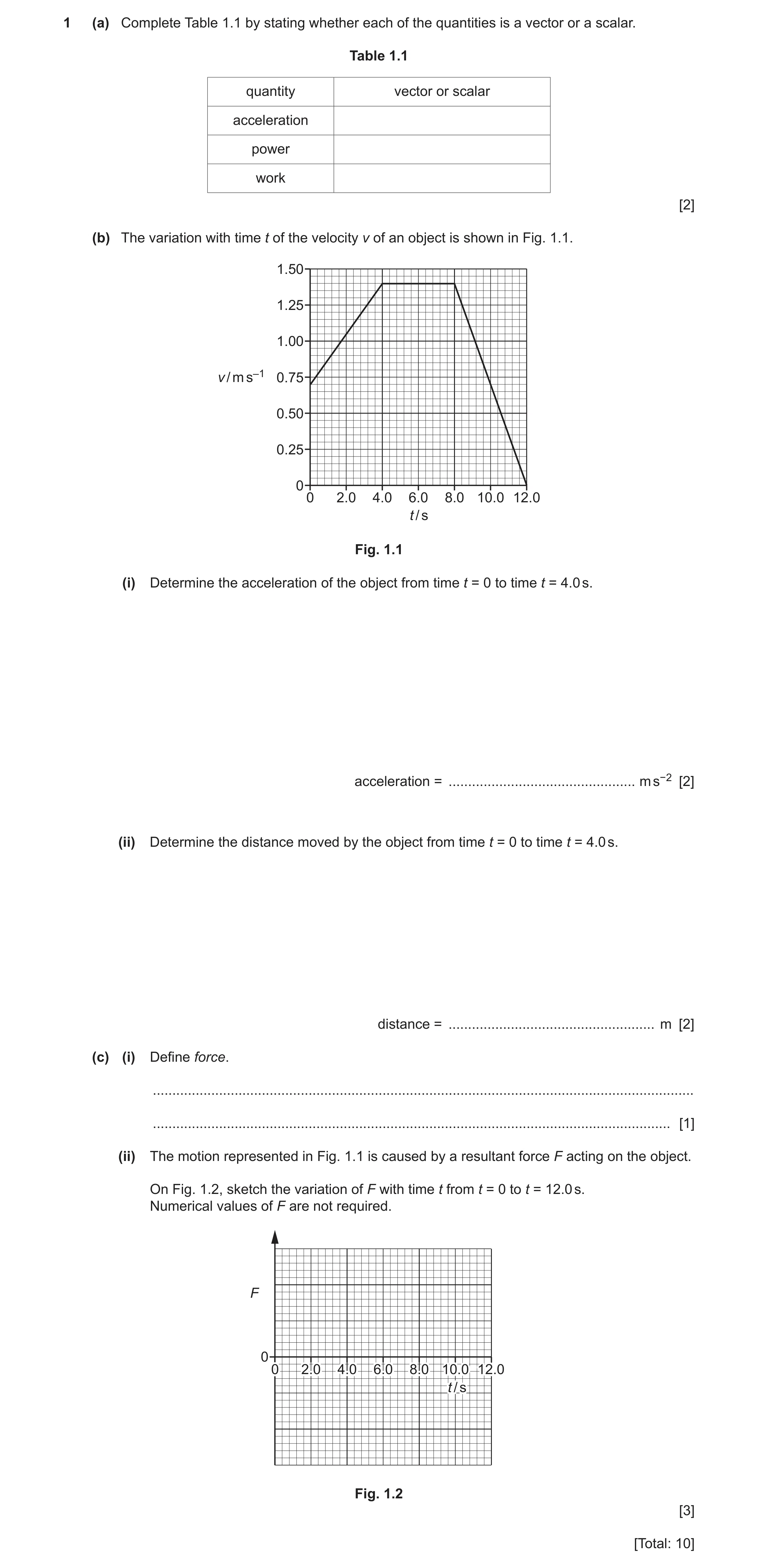
1 (a) Complete Table 1.1 by stating whether each of the quantities is a vector or a scalar. Table 1.1 quantity vector or scalar acceleration power work [2] (b) The variation with time t of the velocity v of an object is shown in Fig. 1.1. 1.50 1.25 1.00 v / m s–1 0.75 0.50 0.25 0 0 2.0 4.0 6.0 8.0 10.0 12.0 t / s Fig. 1.1 (i) Determine the acceleration of the object from time t = 0 to time t = 4.0 s. acceleration = … m s−2 [2] (ii) Determine the distance moved by the object from time t = 0 to time t = 4.0 s. distance = … m [2] (c) (i) Define force. … … [1] (ii) The motion represented in Fig. 1.1 is caused by a resultant force F acting on the object. On Fig. 1.2, sketch the variation of F with time t from t = 0 to t = 12.0 s. Numerical values of F are not required. F 0 00 2.02.0 4.04.0 6.06.0 8.08.0 10.010.0 12.012.0 tt // ss Fig. 1.2 [3] [Total: 10]
10 marks
Mark scheme: 1(a) acceleration: vector work: scalar power: scalar Three correct scores 2 marks. Two correct scores 1 mark. B2 1(b)(i) a = (v – u) / t or a = gradient or a = Δv / (Δ)t e.g. a = (1.40 – 0.70) / 4.0 C1 = 0.18 m s–2 A1 1(b)(ii) distance = 0.5 × (0.70 + 1.40) × 4.0 or (0.70 × 4.0) + (0.5 × 0.70 × 4.0) C1 = 4.2 m A1 1(c)(i) (force equal to) rate of change of momentum B1 1(c)(ii) horizontal line starting from t = 0 and ending at t = 4.0 s at a positive value of F B1 horizontal line starting from t = 4.0 s and ending at t = 8.0 s at F = 0 B1 horizontal line starting from t = 8.0 s and ending at t = 12.0 s at a negative value of F and the magnitude of F is larger than from t = 0 to 4.0 s B1
This question in 9702/22 Feb/March 2021
Q8 · A ball is thrown vertically downwards to the ground, as illustrated in Fig 9702/22 May/June 2021
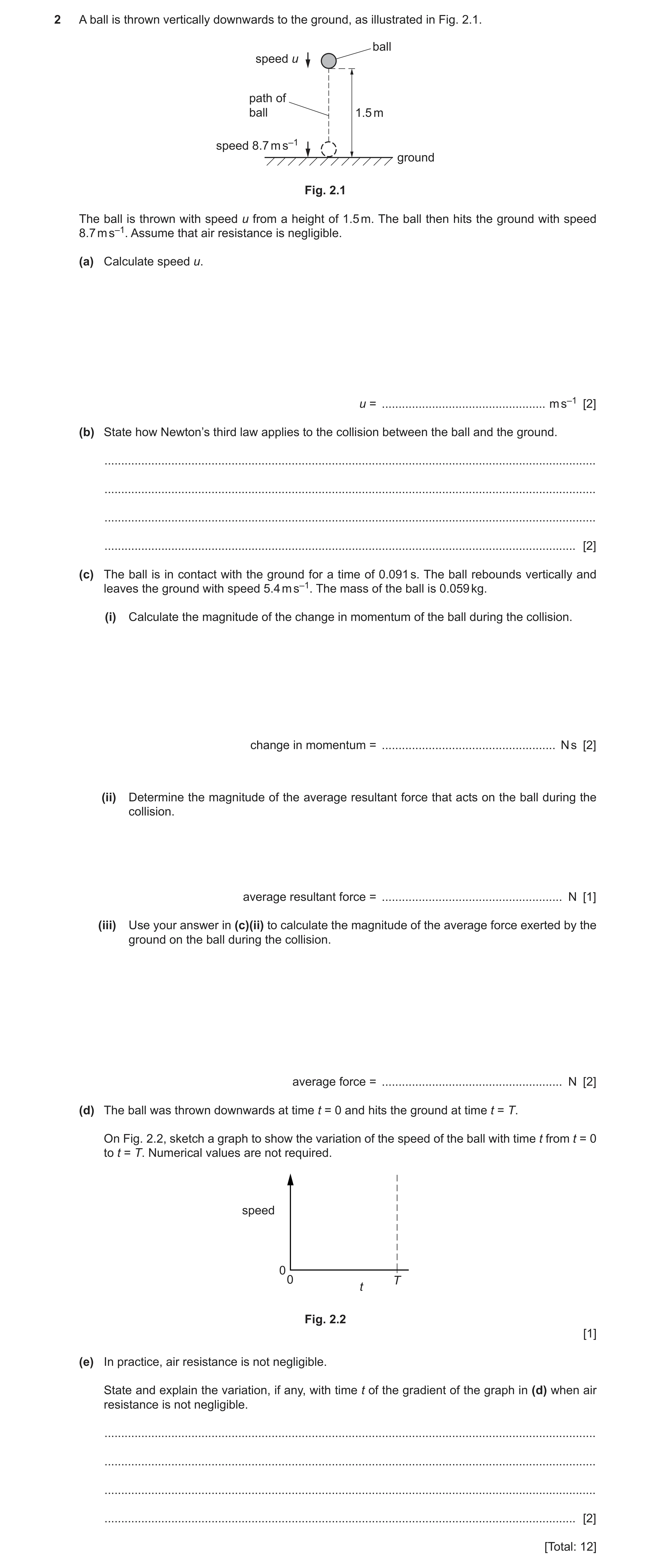
2 A ball is thrown vertically downwards to the ground, as illustrated in Fig. 2.1. ball speed u path of ball 1.5 m speed 8.7 m s–1 ground Fig. 2.1 The ball is thrown with speed u from a height of 1.5 m. The ball then hits the ground with speed 8.7 m s–1. Assume that air resistance is negligible. (a) Calculate speed u. u = … m s–1 [2] (b) State how Newton’s third law applies to the collision between the ball and the ground. … … … … [2] (c) The ball is in contact with the ground for a time of 0.091 s. The ball rebounds vertically and leaves the ground with speed 5.4 m s–1. The mass of the ball is 0.059 kg. (i) Calculate the magnitude of the change in momentum of the ball during the collision. change in momentum = … N s [2] (ii) Determine the magnitude of the average resultant force that acts on the ball during the collision. average resultant force = … N [1] (iii) Use your answer in (c)(ii) to calculate the magnitude of the average force exerted by the ground on the ball during the collision. average force = … N [2] (d) The ball was thrown downwards at time t = 0 and hits the ground at time t = T. On Fig. 2.2, sketch a graph to show the variation of the speed of the ball with time t from t = 0 to t = T. Numerical values are not required. speed 0 0 T t Fig. 2.2 [1] (e) In practice, air resistance is not negligible. State and explain the variation, if any, with time t of the gradient of the graph in (d) when air resistance is not negligible. … … … … [2] [Total: 12]
12 marks
Mark scheme: 2(a) v2 = u2 + 2as u2 = 8.72 – (2 × 9.81 × 1.5) C1 u = 6.8 m s–1 A1 2(b) (magnitude of) force on ball (by ground) equal to force on ground (by ball) B1 (direction of) force on ball (by ground) opposite to force on ground (by ball) B1 2(c)(i) (p = ) 0.059 × 8.7 or 0.059 × 5.4 C1 change in momentum = 0.059 (8.7 + 5.4) = 0.83 N s A1 2(c)(ii) resultant force = 0.83 / 0.091 or 0.059 [(8.7 + 5.4) / 0.091] = 9.1 N A1 2(c)(iii) (W =) 0.059 × 9.81 C1 (W =) 0.58 (N) force = 9.1 + 0.58 = 9.7 N A1 2(d) straight line with a positive gradient and starting from a non-zero value of speed at t = 0 and ending when t = T B1 2(e) air resistance increases B1 resultant force/acceleration decreases so gradient (of curve) decreases B1
This question in 9702/22 May/June 2021
Q9 · A hot-air balloon floats just above the ground 9702/21 Oct/Nov 2023
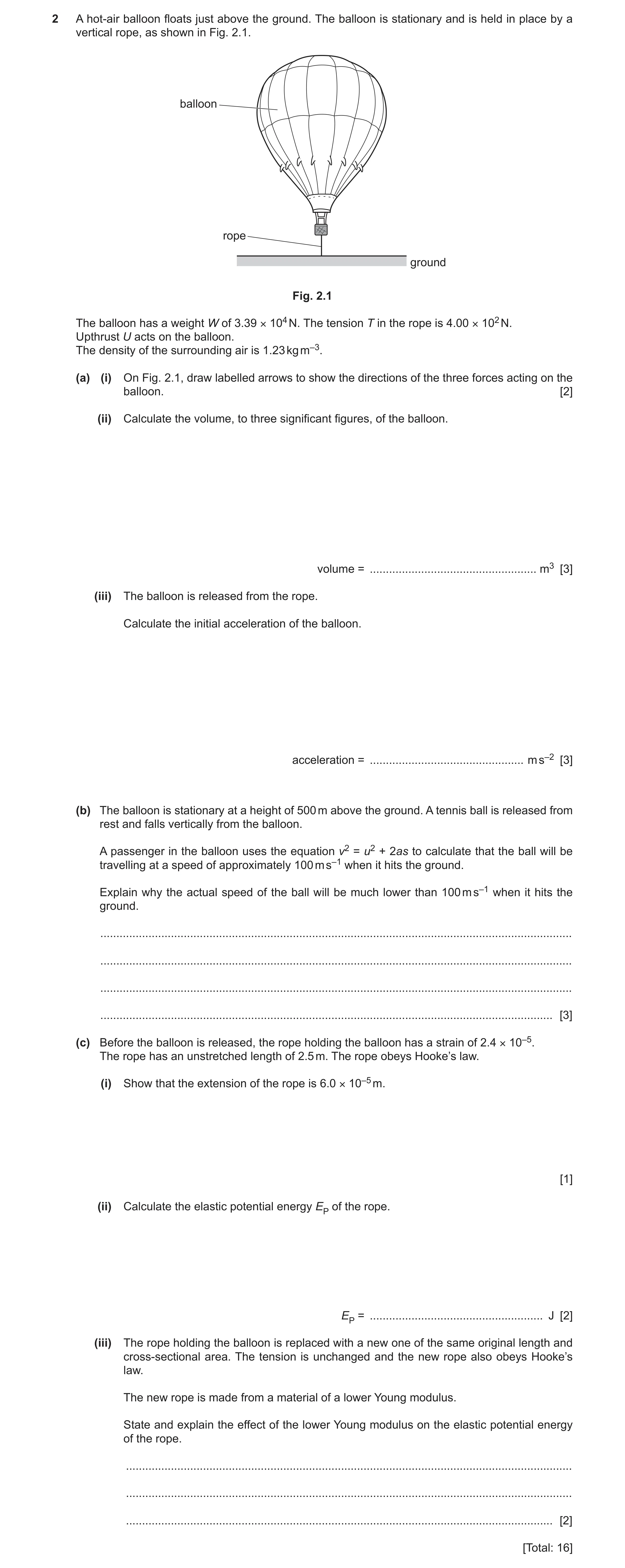
2 A hot-air balloon floats just above the ground. The balloon is stationary and is held in place by a vertical rope, as shown in Fig. 2.1. balloon rope ground Fig. 2.1 The balloon has a weight W of 3.39 × 10⁴ N. The tension T in the rope is 4.00 × 10² N. Upthrust U acts on the balloon. The density of the surrounding air is 1.23 kg m–3. (a) (i) On Fig. 2.1, draw labelled arrows to show the directions of the three forces acting on the balloon. [2] (ii) Calculate the volume, to three significant figures, of the balloon. volume = … m3 [3] (iii) The balloon is released from the rope. Calculate the initial acceleration of the balloon. acceleration = … m s–2 [3] (b) The balloon is stationary at a height of 500 m above the ground. A tennis ball is released from rest and falls vertically from the balloon. A passenger in the balloon uses the equation v2 = u2 + 2as to calculate that the ball will be travelling at a speed of approximately 100 m s–1 when it hits the ground. Explain why the actual speed of the ball will be much lower than 100 m s–1 when it hits the ground. … … … … [3] (c) Before the balloon is released, the rope holding the balloon has a strain of 2.4 × 10⁻⁵. The rope has an unstretched length of 2.5 m. The rope obeys Hooke’s law. (i) Show that the extension of the rope is 6.0 × 10⁻⁵ m. [1] (ii) Calculate the elastic potential energy EP of the rope. EP = … J [2] (iii) The rope holding the balloon is replaced with a new one of the same original length and cross-sectional area. The tension is unchanged and the new rope also obeys Hooke’s law. The new rope is made from a material of a lower Young modulus. State and explain the effect of the lower Young modulus on the elastic potential energy of the rope. … … … [2] [Total: 16]
16 marks
Mark scheme: 2(a)(i) arrow upwards () and labelled upthrust / U B2 arrow downwards () and labelled weight / W / mg arrow downwards () and labelled tension / T 1 mark: One or two correctly labelled arrows 2 marks: Three correctly labelled arrows 2(a)(ii) U = T + W or upthrust = tension + weight C1 Vg = T + W C1 V = [(4.00 102) + (3.39 104)] / (1.23 9.81) V = 2.84 103 m3 A1 2(a)(iii) m = W / g or a = F / m C1 a = (4.00 102) / [(3.39 104) / 9.81)] C1 a = 0.12 m s–2 A1 2(b) there is air resistance (which increases with speed) B1 (average) resultant force is less (than weight) B1 (average) acceleration is less (than g / 9.81, so speed is less than 100 m s–1) B1 2(c)(i) (extension =) 2.5 2.4 10–5 = 6.0 10–5 (m) A1 2(c)(ii) E(P) = ½ Fx C1 or E(P) = ½ kx2 and F = kx E(P) = ½ 4.00 102 6.0 10–5 or E(P) = ½ 6.7 106 (6.0 10–5)2 A1 E(P) = 0.012 J 2(c)(iii) longer extension M1 or smaller spring constant elastic potential energy is greater A1
This question in 9702/21 Oct/Nov 2023
Q10 · A high‑altitude balloon is stationary in still air 9702/22 Oct/Nov 2023
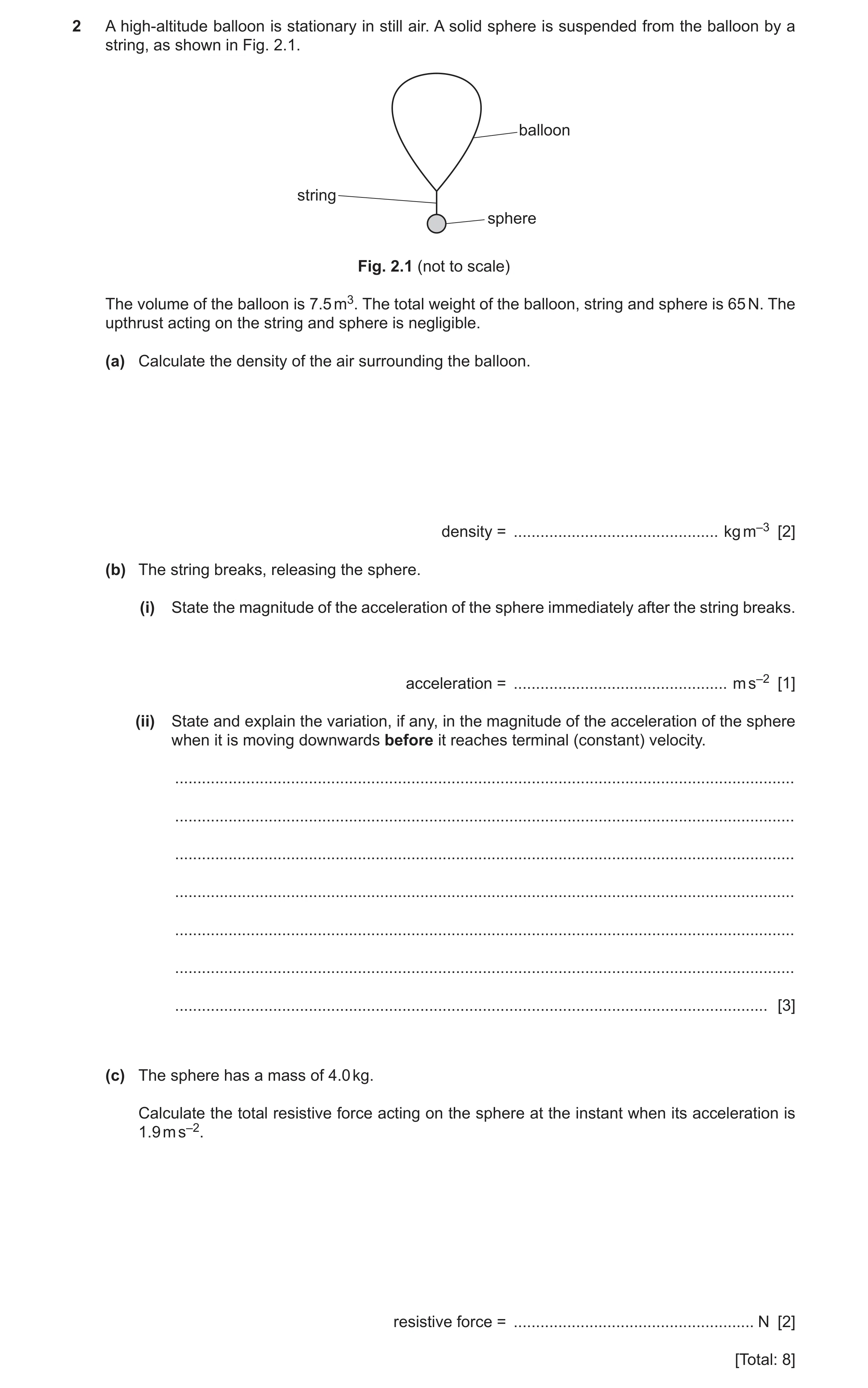
2 A high‑altitude balloon is stationary in still air. A solid sphere is suspended from the balloon by a string, as shown in Fig. 2.1. balloon string sphere Fig. 2.1 (not to scale) The volume of the balloon is 7.5 m3. The total weight of the balloon, string and sphere is 65 N. The upthrust acting on the string and sphere is negligible. (a) Calculate the density of the air surrounding the balloon. density = … kg m–3 [2] (b) The string breaks, releasing the sphere. (i) State the magnitude of the acceleration of the sphere immediately after the string breaks. acceleration = … m s–2 [1] (ii) State and explain the variation, if any, in the magnitude of the acceleration of the sphere when it is moving downwards before it reaches terminal (constant) velocity. … … … … … … … [3] (c) The sphere has a mass of 4.0 kg. Calculate the total resistive force acting on the sphere at the instant when its acceleration is 1.9 m s–2. resistive force = … N [2] [Total: 8]
8 marks
Mark scheme: 2(a) 65 = gV C1 or 65 = mg and m = V = 65 / (9.81 7.5) A1 = 0.88 kg m–3 2(b)(i) acceleration = 9.8 m s–2 A1 2(b)(ii) air resistance (acting on sphere) increases B1 resultant force (on sphere) decreases B1 (magnitude of) acceleration decreases B1 2(c) F = ma C1 = 4.0 1.9 ( = 7.6 N) resistive force = (4.0 9.81) – (4.0 1.9) A1 = 32 N
This question in 9702/22 Oct/Nov 2023
Q11 · A skydiver jumps from an aircraft at time t = 0 and falls vertically downwards 9702/22 May/June 2024
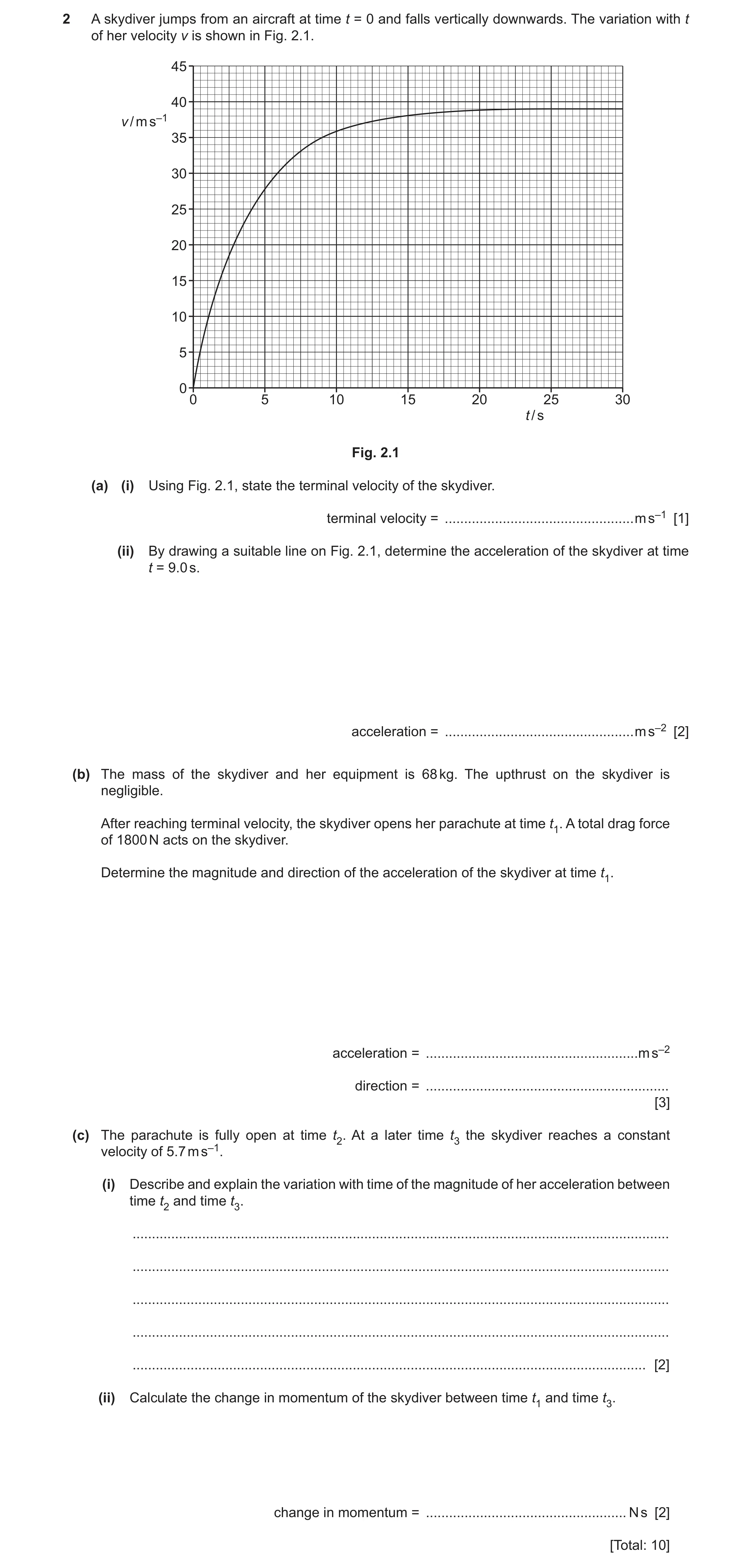
2 A skydiver jumps from an aircraft at time t = 0 and falls vertically downwards. The variation with t of her velocity v is shown in Fig. 2.1. 45 40 v / m s–1 35 30 25 20 15 10 5 0 0 5 10 15 20 25 30 t / s Fig. 2.1 (a) (i) Using Fig. 2.1, state the terminal velocity of the skydiver. terminal velocity = … m s–1 [1] (ii) By drawing a suitable line on Fig. 2.1, determine the acceleration of the skydiver at time t = 9.0 s. acceleration = … m s–2 [2] (b) The mass of the skydiver and her equipment is 68 kg. The upthrust on the skydiver is negligible. After reaching terminal velocity, the skydiver opens her parachute at time t1. A total drag force of 1800 N acts on the skydiver. Determine the magnitude and direction of the acceleration of the skydiver at time t1. acceleration = … m s–2 direction = … [3] (c) The parachute is fully open at time t2. At a later time t3 the skydiver reaches a constant velocity of 5.7 m s–1. (i) Describe and explain the variation with time of the magnitude of her acceleration between time t2 and time t3. … … … … … [2] (ii) Calculate the change in momentum of the skydiver between time t1 and time t3. change in momentum = … N s [2] [Total: 10]
10 marks
Mark scheme: 2(a)(i) 39 m s–1 A1 2(a)(ii) tangent line to curve drawn on Fig. 2.1 C1 a = gradient of tangent line = v / t e.g. = (44 – 26) / (18 – 0) 0.9 ⩽ a ⩽ 1.1 m s–2 A1 2(b) ()F = 68 9.81 – 1800 ( = –1133 N) C1 a = ()F / m = – 1133 / 68 = (–)17 m s–2 A1 upwards B1 2c(i) drag force decreases (as speed decreases) B1 (as speed decreases) resultant force decreases so (magnitude of) acceleration decreases (to zero) B1 2(c)(ii) ()p = mv or ()p = m(v – u) C1 = 68 (5.7 – 39) = (–)2300 N s A1
This question in 9702/22 May/June 2024
 3 / 17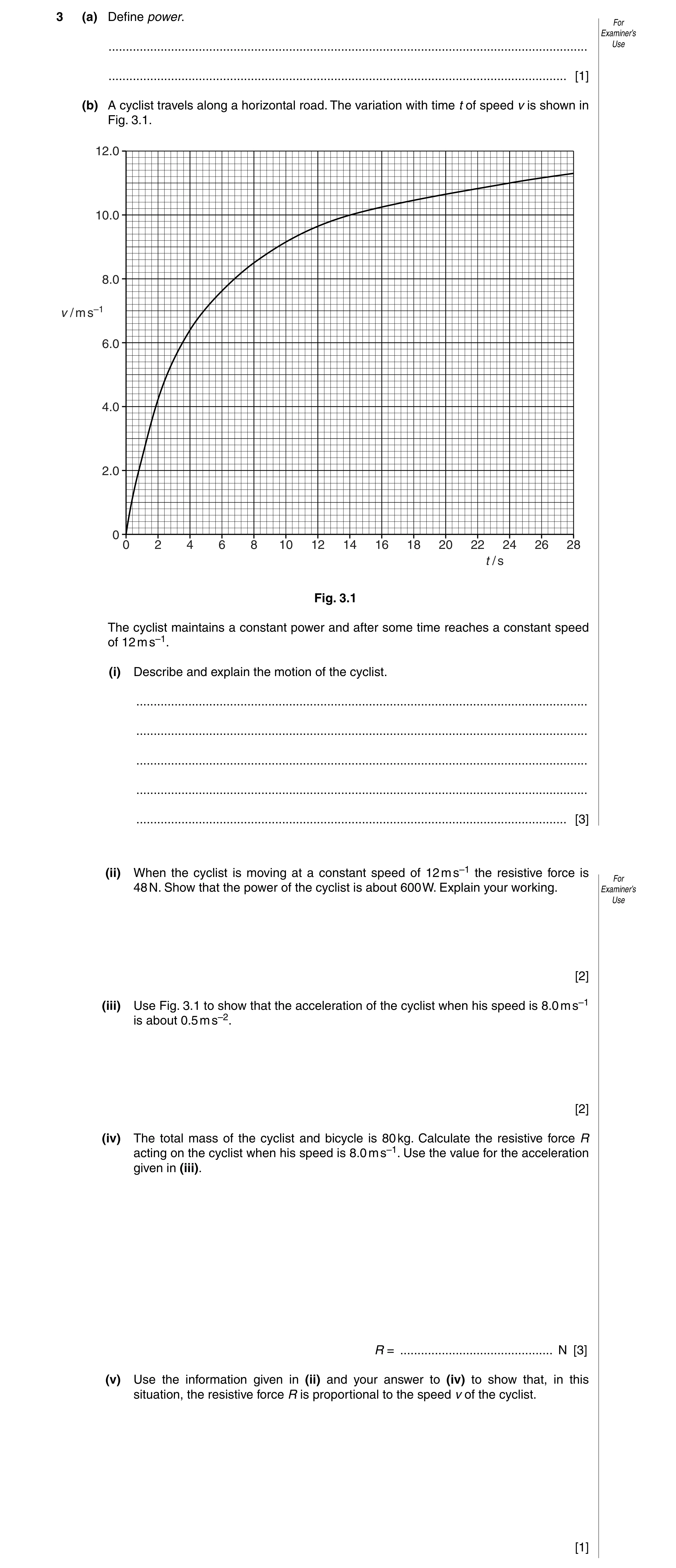
 11
11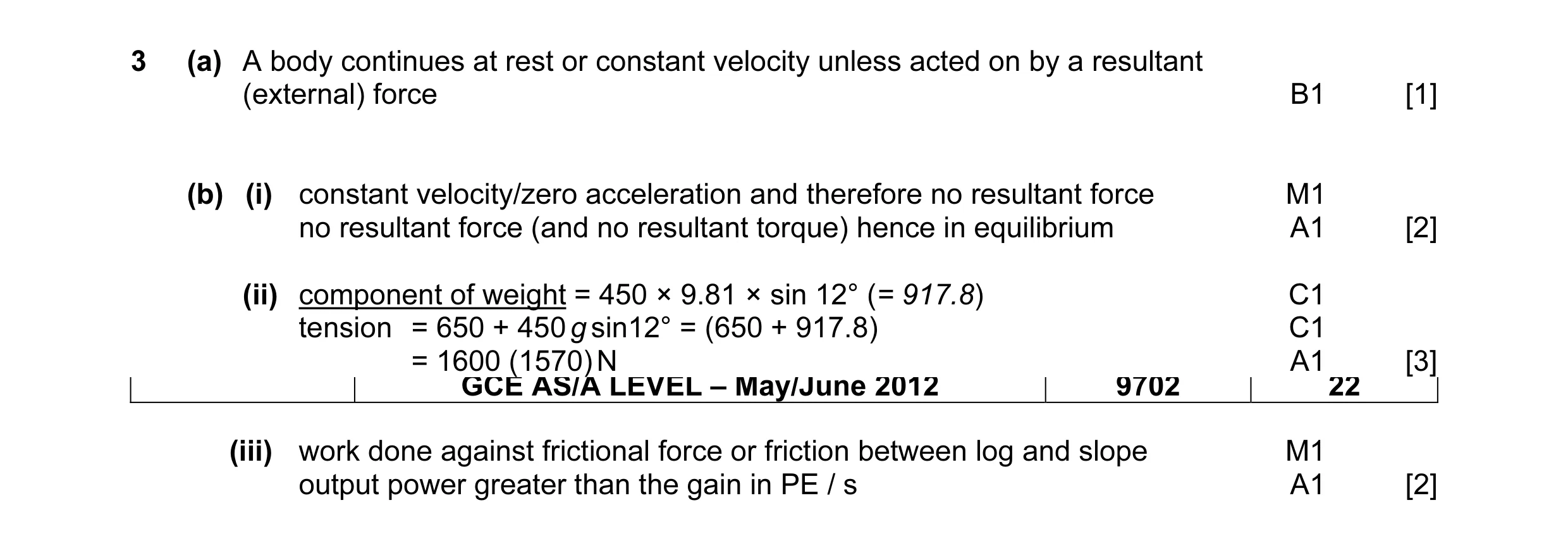 8
8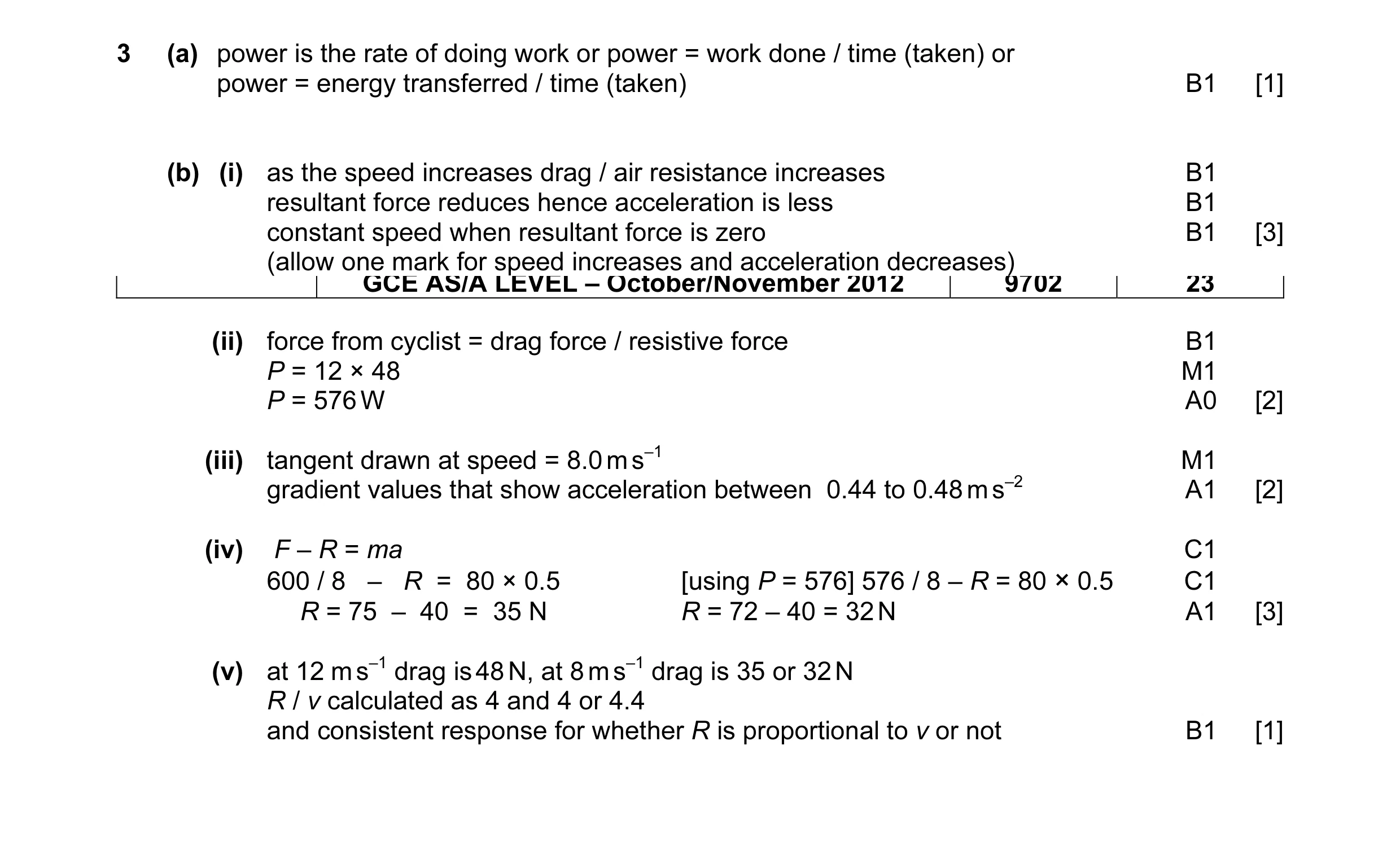 12
12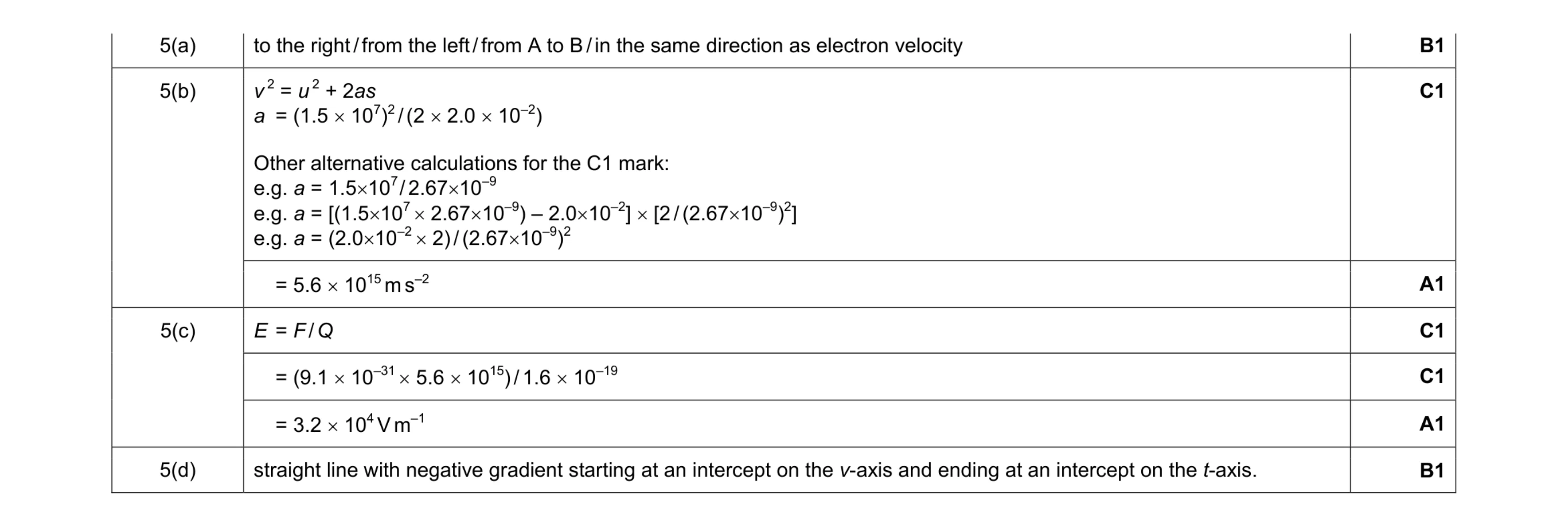 7
7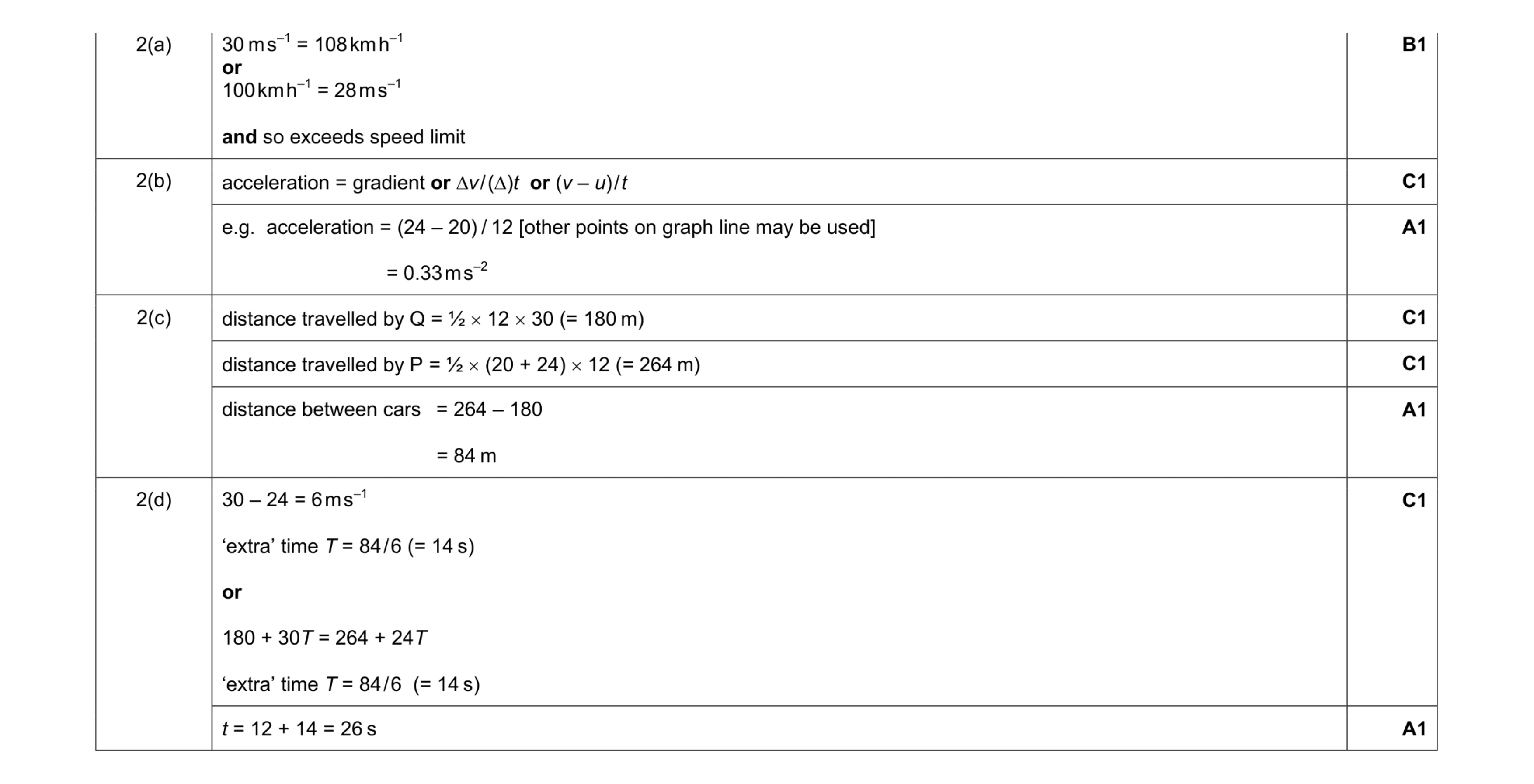 8
8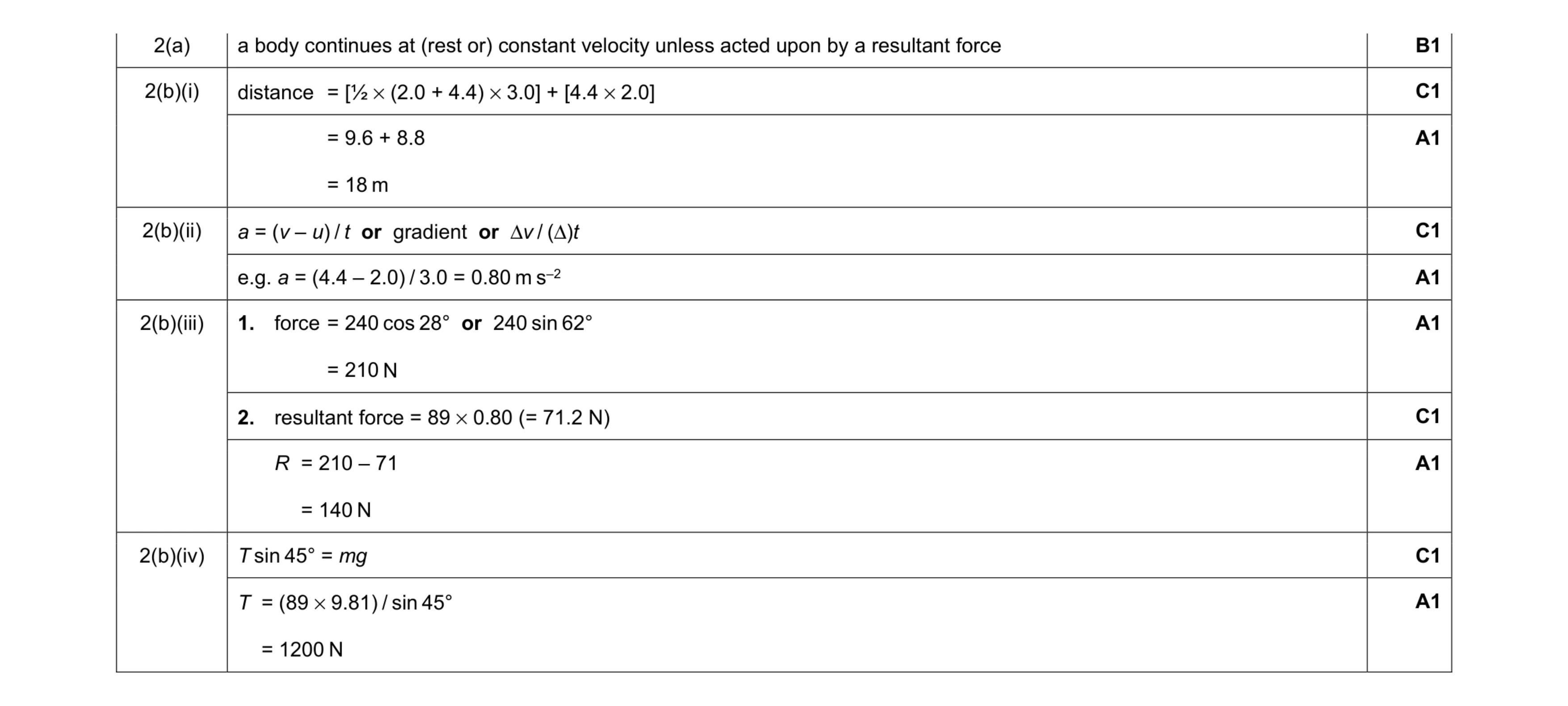 10
10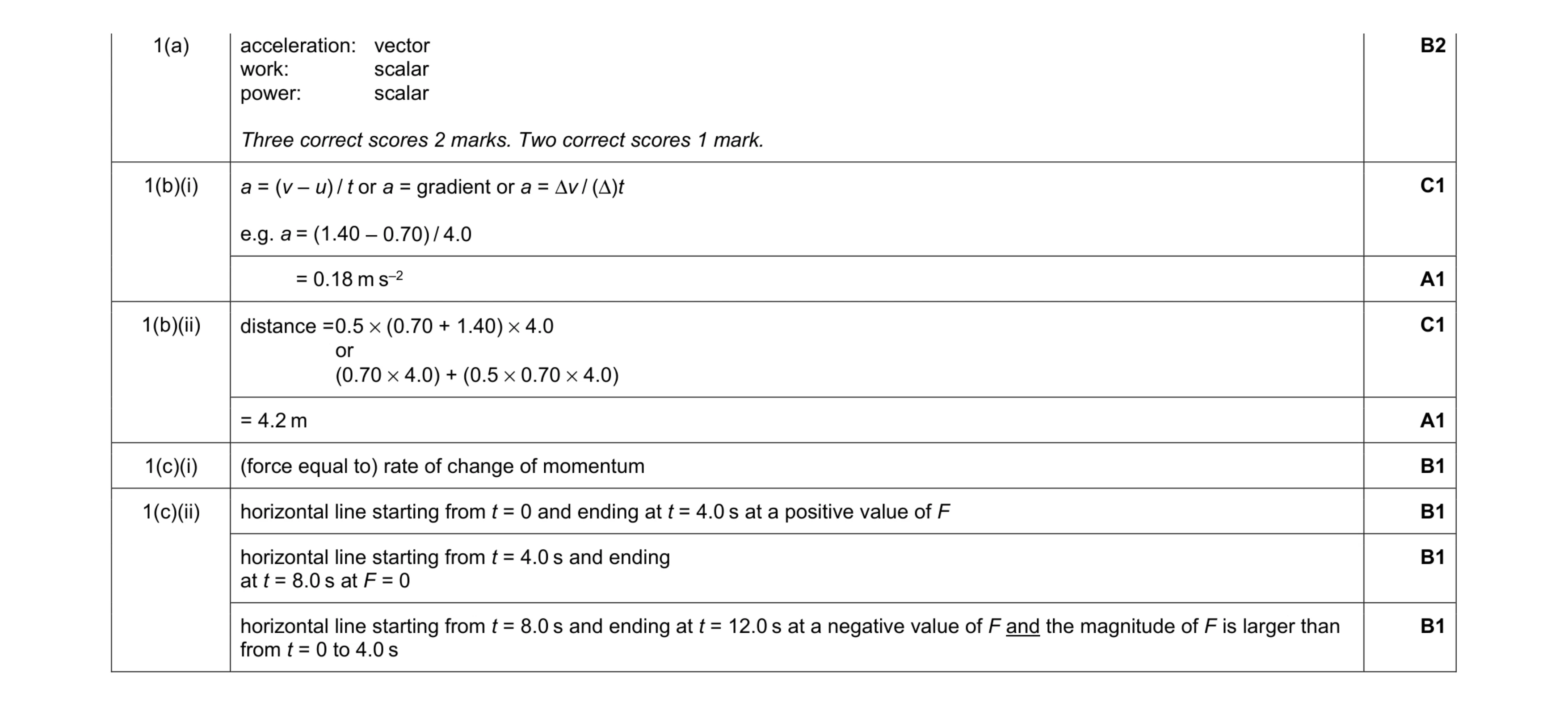 10
10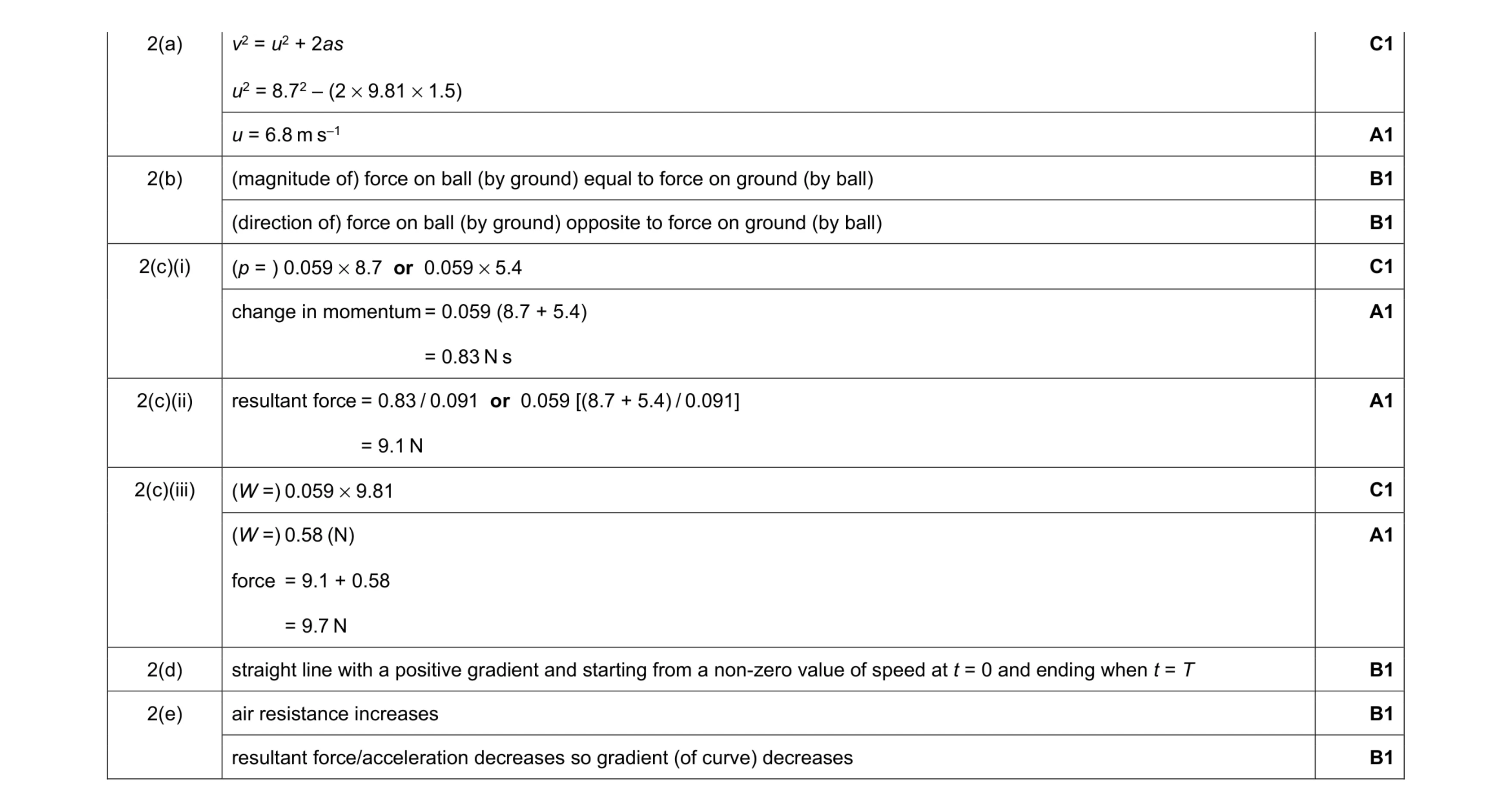 12
12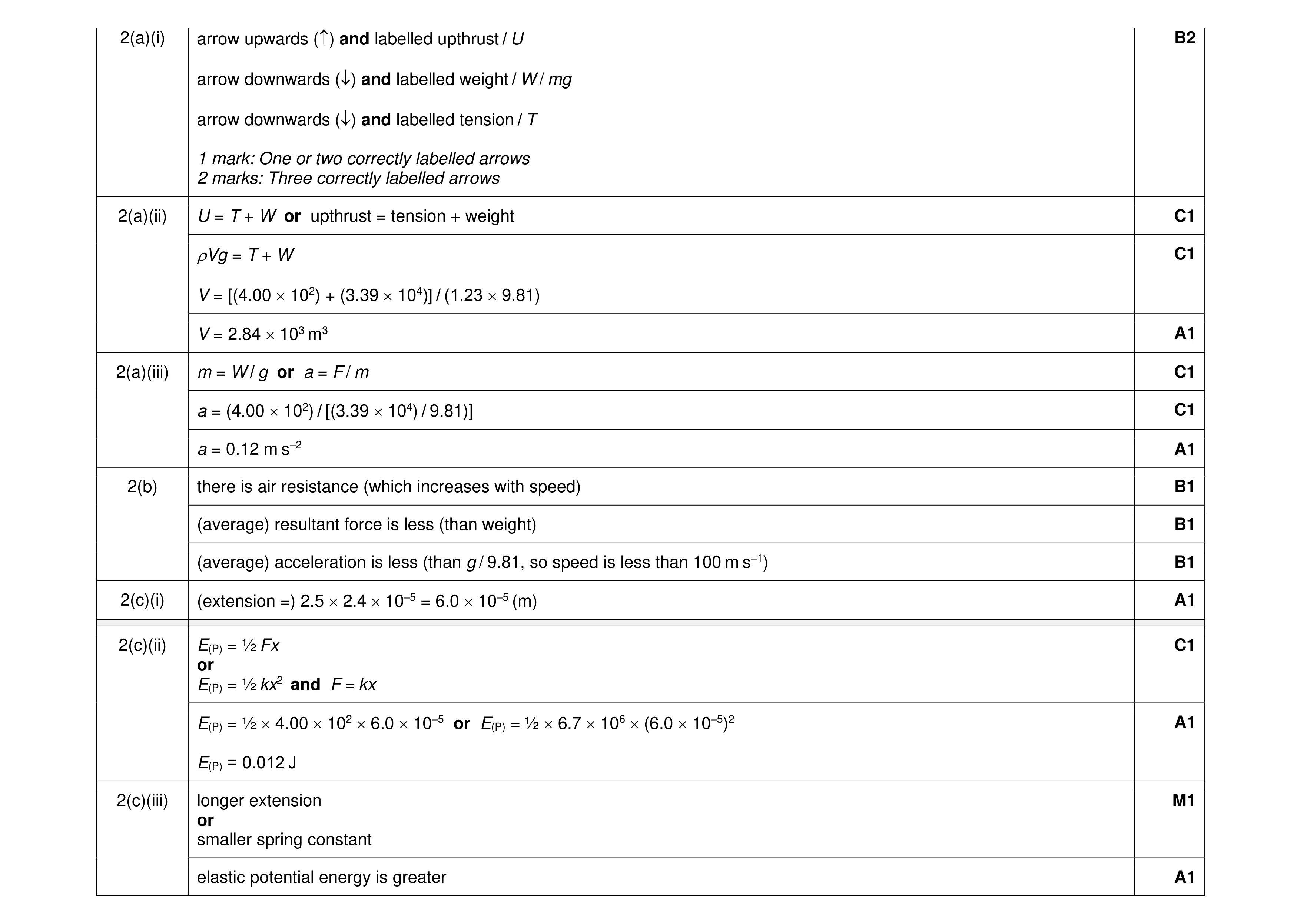 16
16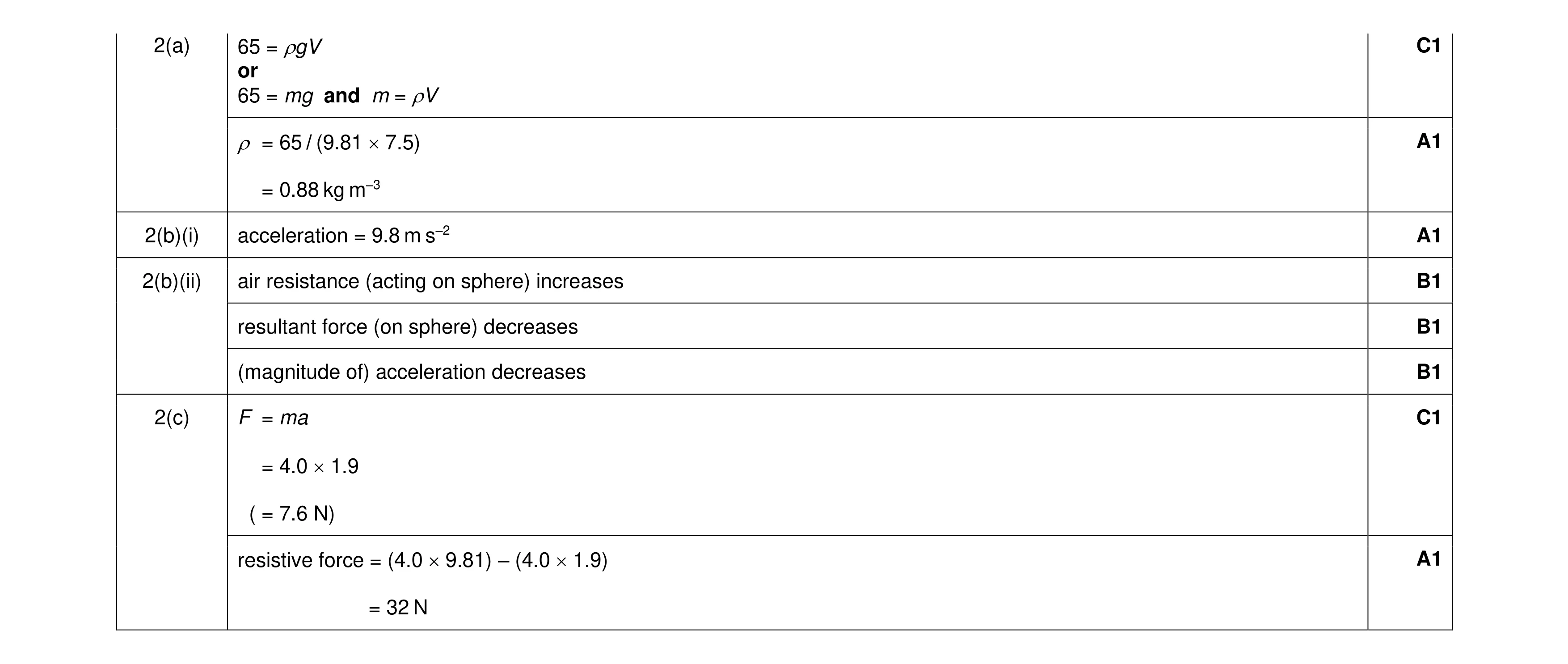 8
8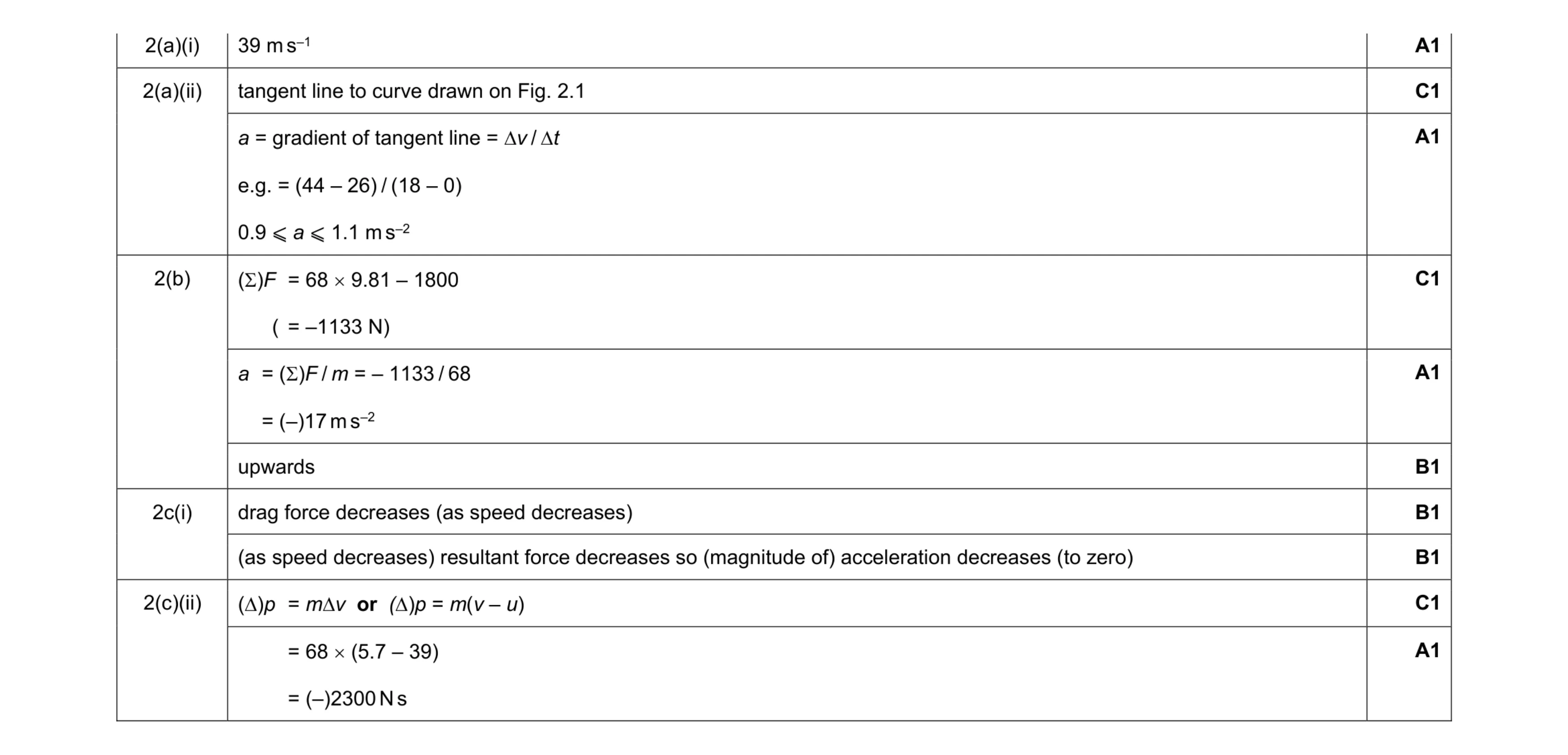 10
10