Questions as text
Q1 · On a straight horizontal test track, driverless vehicles (with no passengers) are being… 9709/42 Feb/March 2020
6 On a straight horizontal test track, driverless vehicles (with no passengers) are being tested. A car of mass 1600 kg is towing a trailer of mass 700 kg along the track. The brakes are applied, resulting in a deceleration of 12 m s−2. The braking force acts on the car only. In addition to the braking force there are constant resistance forces of 600 N on the car and of 200 N on the trailer. (a) Find the magnitude of the force in the tow-bar. [2] … … … … … … … … … … … (b) Find the braking force. [2] … … … … … … … … … … (c) At the instant when the brakes are applied, the car has speed 22 m s−1. At this instant the car is 17.5 m away from a stationary van, which is directly in front of the car. Show that the car hits the van at a speed of 8 m s−1. [2] … … … … … … … … … … … (d) After the collision, the van starts to move with speed 5 m s−1 and the car and trailer continue moving in the same direction with speed 2 m s−1. Find the mass of the van. [3] … … … … … … … … … …
9 marks
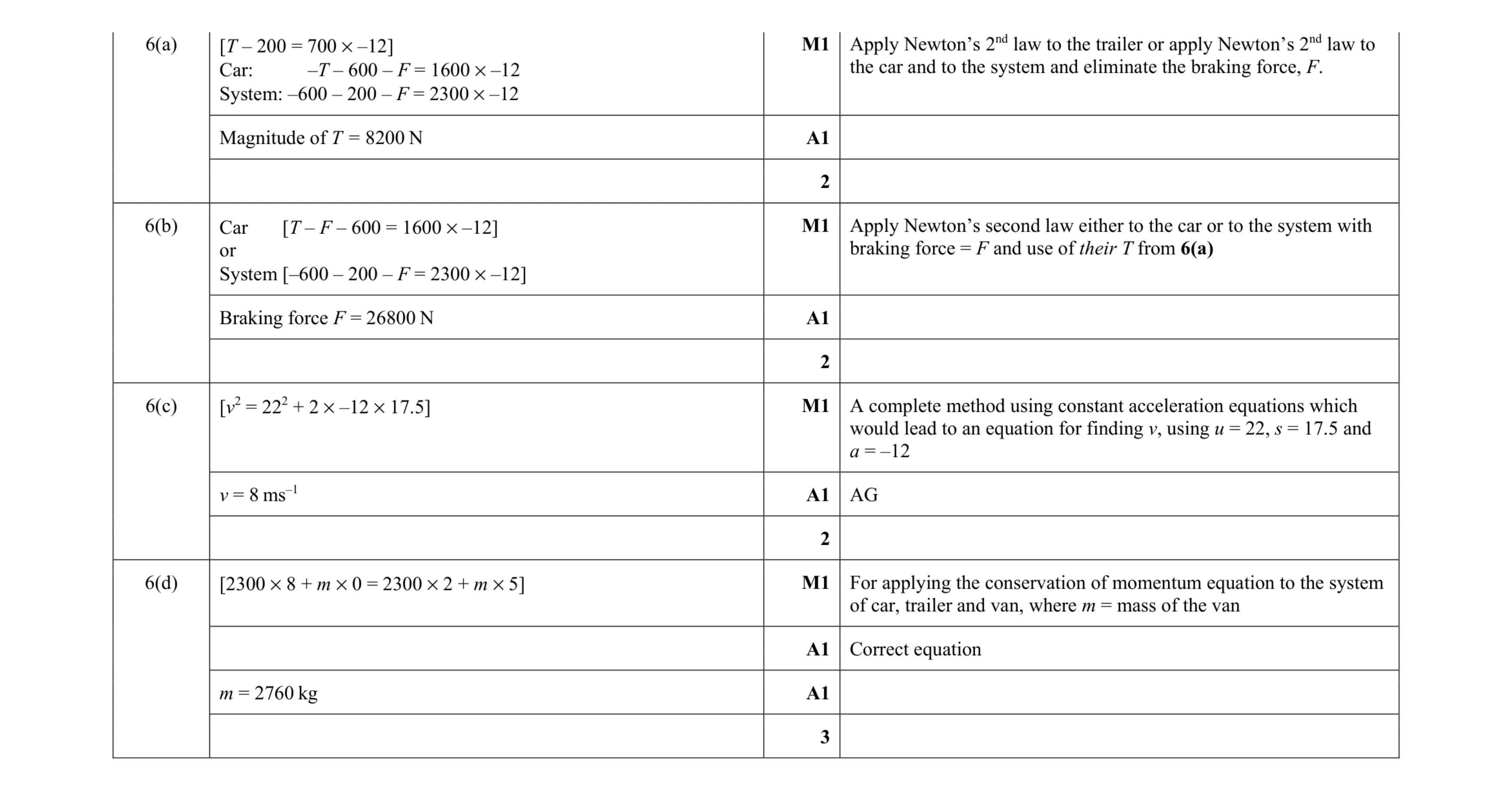
Mark scheme: 6(a) [T – 200 = 700 × –12] Car: –T – 600 – F = 1600 × –12 System: –600 – 200 – F = 2300 × –12 the car and to the system and eliminate the braking force, F. Magnitude of T = 8200 N A1 2 6(b) Car [T – F – 600 = 1600 × –12] or System [–600 – 200 – F = 2300 × –12] M1 Apply Newton’s second law either to the car or to the system with braking force = F and use of their T from 6(a) Braking force F = 26800 N A1 2 6(c) [v2 = 222 + 2 × –12 × 17.5] M1 A complete method using constant acceleration equations which would lead to an equation for finding v, using u = 22, s = 17.5 and a = –12 v = 8 ms–1 A1 AG 2 6(d) [2300 × 8 + m × 0 = 2300 × 2 + m × 5] M1 For applying the conservation of momentum equation to the system of car, trailer and van, where m = mass of the van A1 Correct equation m = 2760 kg A1 3
This question in 9709/42 Feb/March 2020
Q2 · 0.3 kg P 2.5 m Q 0.2 kg 30Å 1.5 m A particle P of mass 0.3 kg, lying on a smooth plane… 9709/41 May/June 2020
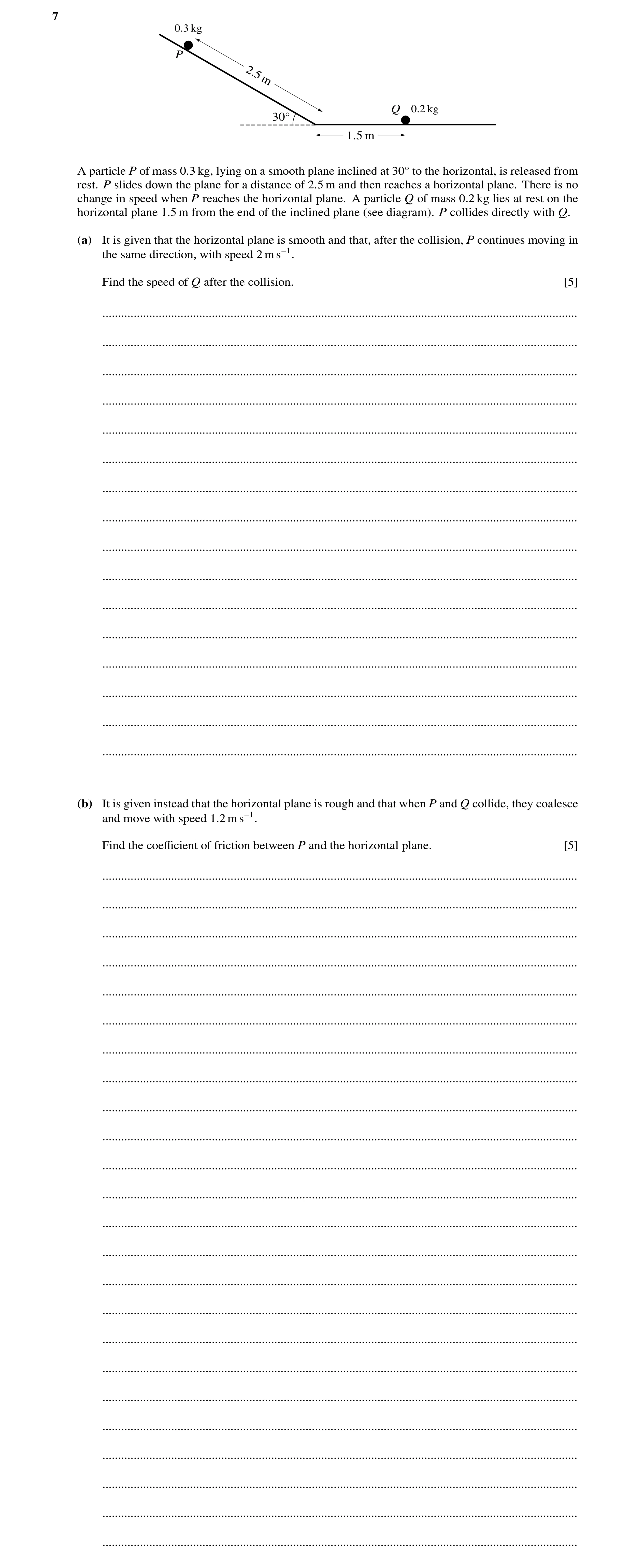
7 0.3 kg P 2.5 m Q 0.2 kg 30Å 1.5 m A particle P of mass 0.3 kg, lying on a smooth plane inclined at 30Å to the horizontal, is released from rest. P slides down the plane for a distance of 2.5 m and then reaches a horizontal plane. There is no change in speed when P reaches the horizontal plane. A particle Q of mass 0.2 kg lies at rest on the horizontal plane 1.5 m from the end of the inclined plane (see diagram). P collides directly with Q. (a) It is given that the horizontal plane is smooth and that, after the collision, P continues moving in the same direction, with speed 2 m s−1. Find the speed of Q after the collision. [5] … … … … … … … … … … … … … … … … (b) It is given instead that the horizontal plane is rough and that when P and Q collide, they coalesce and move with speed 1.2 m s−1. Find the coefficient of friction between P and the horizontal plane. [5] … … … … … … … … … … … … … … … … … … … … … … … …
10 marks
Mark scheme: 7(a) (M1 for applying Newton’s second law parallel to the plane) M1 v2 = 0 + 2 × 2.5 × a M1 v = 5 A1 0.3 × 5 + 0 = 0.3 × 2 + 0.2 w M1 Velocity of Q = 4.5 ms–1 A1 5 Question Answer Marks 7(b) 0.3 × z + 0 = 0.5 × 1.2 M1 Velocity of P before collision z = 2 A1 Friction force on P after reaches horizontal plane F = μ × 0.3 g B1 μ × 0.3g × 1.5 = 1 2 × 0.3 × 52 – 1 2 × 0.3 × 22 M1 Coefficient μ = 0.7 A1 Alternative method for question 7(b) 0.3 × z + 0 = 0.5 × 1.2 M1 Velocity of P before collision z = 2 A1 Friction force on P after reaches horizontal plane F = μ × 0.3 g B1 a = (52 – 22) / (2 × 1.5) = 7, F = 0.3 × 7 M1 Coefficient μ = 0.7 A1 5
This question in 9709/41 May/June 2020
Q3 · Small smooth spheres A and B, of equal radii and of masses 4 kg and 2 kg respectively… 9709/42 May/June 2020
4 Small smooth spheres A and B, of equal radii and of masses 4 kg and 2 kg respectively, lie on a smooth horizontal plane. Initially B is at rest and A is moving towards B with speed 10 m s−1. After the spheres collide A continues to move in the same direction but with half the speed of B. (a) Find the speed of B after the collision. [2] … … … … … … … … … … … A third small smooth sphere C, of mass 1 kg and with the same radius as A and B, is at rest on the plane. B now collides directly with C. After this collision B continues to move in the same direction but with one third the speed of C. (b) Show that there is another collision between A and B. [3] … … … … … … … … … … … … … … … … (c) A and B coalesce during this collision. Find the total loss of kinetic energy in the system due to the three collisions. [5] … … … … … … … … … … … … … … … …
10 marks
Mark scheme: 4(a) × + = × + M1 5 and 10 A B v v = = A1 2 4(b) Conservation of momentum B, C 2 10 [ 0] 2 3 v v × + = × + M1 4 v = A1 A B v v > , hence another collision A1 3 4(c) Conservation of momentum A, B M1 1 14 4 5 2 4 4 2 (ms ) 3 their their v v v − × + × = + = A1 KE initial = 2 1 4 10 2 × × M1 KE final = 2 2 1 14 1 6 ( ) 1 12 2 3 2 their their × × + × × A1 Loss of KE = 412 188 200 3 3 − = A1 5
This question in 9709/42 May/June 2020
Q4 · Particles P of mass m kg and Q of mass 0.2 kg are free to move on a smooth horizontal… 9709/43 May/June 2020
1 Particles P of mass m kg and Q of mass 0.2 kg are free to move on a smooth horizontal plane. P is projected at a speed of 2 m s−1 towards Q which is stationary. After the collision P and Q move in opposite directions with speeds of 0.5 m s−1 and 1 m s−1 respectively. Find m. [3] … … … … … … … … … … … … … … … … … … … … … … …
3 marks
Mark scheme: 1 Use of conservation of momentum M1 m × 2 + 0 = m × (–0.5) + 0.2 × 1 A1 m = 0.08 A1 3
This question in 9709/43 May/June 2020
Q5 · A particle B of mass 5 kg is at rest on a smooth horizontal table 9709/41 Oct/Nov 2020
1 A particle B of mass 5 kg is at rest on a smooth horizontal table. A particle A of mass 2.5 kg moves on the table with a speed of 6 m s−1 and collides directly with B. In the collision the two particles coalesce. (a) Find the speed of the combined particle after the collision. [2] … … … … … … … … … (b) Find the loss of kinetic energy of the system due to the collision. [3] … … … … … … … … … … … … …
5 marks
Mark scheme: 1(a) 6 × 2.5 = 2.5v + 5v M1 Apply conservation of momentum, 3 terms implied v = 2 ms–1 A1 2 1(b) Use KE = ½ mv2 either before or after collision M1 Allow this for either particle KE(before) = 0.5 × 2.5 × 62 KE(after) = 0.5 × 7.5 × 22 A1 FT Both correct FT on v Loss of KE = 30 J A1 3
This question in 9709/41 Oct/Nov 2020
Q6 · Two particles P and Q, of masses 0.2 kg and 0.5 kg respectively, are at rest on a smooth… 9709/42 Oct/Nov 2020
1 Two particles P and Q, of masses 0.2 kg and 0.5 kg respectively, are at rest on a smooth horizontal plane. P is projected towards Q with speed 2 m s−1. (a) Write down the momentum of P. [1] … … … … (b) After the collision P continues to move in the same direction with speed 0.3 m s−1. Find the speed of Q after the collision. [2] … … … … … … … … … … … … … … … … …
3 marks
Mark scheme: 1(a) B1 1 1(b) 0.4 = 0.2 × 0.3 + 0.5v M1 Apply conservation of momentum, 3 terms v = 0.68 ms–1 A1 FT FT on answer in 1(a) 2
This question in 9709/42 Oct/Nov 2020
Q7 · Two small smooth spheres A and B, of equal radii and of masses 4 kg and m kg… 9709/43 Oct/Nov 2020
4 Two small smooth spheres A and B, of equal radii and of masses 4 kg and m kg respectively, lie on a smooth horizontal plane. Initially, sphere B is at rest and A is moving towards B with speed 6 m s−1. After the collision A moves with speed 1.5 m s−1 and B moves with speed 3 m s−1. Find the two possible values of the loss of kinetic energy due to the collision. [6] … … … … … … … … … … … … … … … … … … … … … … …
6 marks
Mark scheme: 4 For using conservation of momentum (either case) M1 6 × 4 = 3m + 4 × 1.5 or 6 × 4 = 3m – 4 × 1.5 A1 m = 6 and m = 10 A1 KEA initial = ½ × 4 × 62 (72 J) or KEA after = ½ × 4 × 1.52 (4.5 J) or KEB after = ½ × 6 × 32 (27 J) or KEB after = ½ × 10 × 32 (45 J) B1 FT KE = ½ × m × v2 FT 4.5m for KEB KE loss = [½ × 4 × 62 – ½ × 4 × 1.52 – ½ × 6 × 32] or [½ × 4 × 62 – ½ × 4 × 1.52 – ½ × 10 × 32] M1 Uses KE loss = KE before – KE after Loss of KE = 40.5 J or 22.5 J A1 6
This question in 9709/43 Oct/Nov 2020
Q8 · Two particles P and Q of masses 0.2 kg and 0.3 kg respectively are free to move in a… 9709/42 Feb/March 2021
1 Two particles P and Q of masses 0.2 kg and 0.3 kg respectively are free to move in a horizontal straight line on a smooth horizontal plane. P is projected towards Q with speed 0.5 m s−1. At the same instant Q is projected towards P with speed 1 m s−1. Q comes to rest in the resulting collision. Find the speed of P after the collision. [3] … … … … … … … … … … … … … … … … … … … … … … …
3 marks
Mark scheme: 1 ±0.2 × 0.5 or ±0.3 × 1 B1 For initial momentum for either particle. Allow kg or g. 0.2 × 0.5 + 0.3 × (−1) = 0.2 × v + 0 M1 For conservation of momentum. Dimensions correct. Allow if 3 relevant momentum terms are seen regardless of sign. Speed = 1 m s–1 A1 Allow if final answer given as v = 1 or speed = 1 from an equation whose solution is v = –1 3
This question in 9709/42 Feb/March 2021
Q9 · Three particles P, Q and R, of masses 0.1 kg, 0.2 kg and 0.5 kg respectively, are at rest… 9709/41 May/June 2021
3 Three particles P, Q and R, of masses 0.1 kg, 0.2 kg and 0.5 kg respectively, are at rest in a straight line on a smooth horizontal plane. Particle P is projected towards Q at a speed of 5 m s−1. After P and Q collide, P rebounds with speed 1 m s−1. (a) Find the speed of Q immediately after the collision with P. [3] … … … … … … … … … … Q now collides with R. Immediately after the collision with Q, R begins to move with speed V m s−1. (b) Given that there is no subsequent collision between P and Q, find the greatest possible value of V. [3] … … … … … … … … … …
6 marks
Mark scheme: 3(a) Use of conservation of momentum, 3 terms M1 Correct dimensions ( ) ( ) 0.1 5 0 0.1 1 0.2 × + = × − + × ±v A1 3 = v m s–1 A1 A0 for 3 = − v 3 3(b) 0.2 3 0 0.2 0.5 their u V × + = × + M1 Use of conservation of momentum, 3 terms, correct dimensions. Allow 0 = u used or if Q and R coalesce 1 − u B1 Allow 1 = − u . Allow equality for finding greatest value of V. Condition for no collision with P, may be a statement. Greatest 1.6 = V A1 FT FT on their 3 from 3(a) if 1 = − u used. 3
This question in 9709/41 May/June 2021
Q10 · Particles P of mass 0.4 kg and Q of mass 0.5 kg are free to move on a smooth horizontal… 9709/43 May/June 2021
1 Particles P of mass 0.4 kg and Q of mass 0.5 kg are free to move on a smooth horizontal plane. P and Q are moving directly towards each other with speeds 2.5 m s−1 and 1.5 m s−1 respectively. After P and Q collide, the speed of Q is twice the speed of P. Find the two possible values of the speed of P after the collision. [4] … … … … … … … … … … … … … … … … … … … … … … …
4 marks
Mark scheme: 1 0.4 × 2.5 – 0.5 × 1.5 M1 Attempt momentum before impact. 0.4 × 2.5 – 0.5 × 1.5 = 0.4v + 0.5 × 2v M1 Use of conservation of momentum, either case. 0.4 × 2.5 – 0.5 × 1.5 = 0.4v + 0.5 × 2v or 0.4 × 2.5 – 0.5 × 1.5 = –0.4v + 0.5 × 2v A1 One correct equation Speed is 0.179 m s–1 or 0.417 m s–1 A1 Both values 4
This question in 9709/43 May/June 2021
Q11 · Two small smooth spheres A and B, of equal radii and of masses km kg and m kg… 9709/41 Oct/Nov 2021
2 Two small smooth spheres A and B, of equal radii and of masses km kg and m kg respectively, where k > 1, are free to move on a smooth horizontal plane. A is moving towards B with speed 6 m s−1 and B is moving towards A with speed 2 m s−1. After the collision A and B coalesce and move with speed 4 m s−1. (a) Find k. [3] … … … … … … … … … … … … (b) Find, in terms of m, the loss of kinetic energy due to the collision. [2] … … … … … … … … …
5 marks
Mark scheme: 2(a) Attempt at use of conservation of momentum M1 4 terms implied, i.e. m and km included before and after collision. Velocity after collision is the same for m and km. ( ) 6 2 4 × − × = + × km m km m A1 3 k = A1 3 2(b) KE initial = ( ) 2 2 1 1 6 2 2 2 × × + × × − km m KE after = ( ) 2 1 4 2 × + × km m M1 Attempt at any of the three possible KE terms, unsimplified. k need not be substituted here. Loss of KE = 24m J A1 FT KE loss = 56m – 32m FT on their ,k KE loss ( ) 10 6 = − k m, 0.6 > k . 2
This question in 9709/41 Oct/Nov 2021
Q12 · P m kg 6.4 m Q 2m kg ! 9709/42 Oct/Nov 2021
7 P m kg 6.4 m Q 2m kg ! Particles P and Q have masses m kg and 2m kg respectively. The particles are initially held at rest 6.4 m apart on the same line of greatest slope of a rough plane inclined at an angle ! to the horizontal, where sin ! = 0.8 (see diagram). Particle P is released from rest and slides down the line of greatest slope. Simultaneously, particle Q is projected up the same line of greatest slope at a speed of 10 m s−1. The coefficient of friction between each particle and the plane is 0.6. (a) Show that the acceleration of Q up the plane is −11.6 m s−2. [4] … … … … … … … … … (b) Find the time for which the particles are in motion before they collide. [5] … … … … … … … … … … … … … … … … … (c) The particles coalesce on impact. Find the speed of the combined particle immediately after the impact. [4] … … … … … … … … … … … …
13 marks
Mark scheme: 7(a) For Q: –2mg sin α – F = 2ma [–16m – 7.2m = 2ma] R = 2mg cos α [= 12m] M1 Apply Newton’s 2nd law along or perpendicular to the plane to particle Q. Must use values for α or sin α or cos α . A1 Both correct. F = 0.6 × 2mg cos α = 0.6 × 0.6 × 20m [= 7.2m] [2(m)a = –2(m)g (0.8) – 0.6 × 2(m)g (0.6)] M1 Using 0.6 = F R where R is a component of 2mg only Acceleration of Q up the plane while moving up the plane is a = –11.6 ms–2 A1 AG 4 7(b) For P: mg sin α – 0.6R = ma, leading to 8m – 3.6m = ma [ 2 cos 6 , 4.4 ms α − = = = R mg m a ] M1 Apply Newton’s 2nd law to attempt to find the acceleration of particle P. Must use values for α or sin α . Q comes to rest when 1 1 25 10 11.6 0, 0.862 29 − = = = T T M1 For using constant acceleration equations to attempt to determine when 0 = Q v . For P ( ) [ ] 2 1 down 1 4.4 1.635 2 = × × = Ps T For Q ( ) ( ) [ ] 2 1 1 up 1 10 11.6 4.31 2 = + × − × = Q s T T M1 Use constant acceleration equations to attempt to find either ( ) down Ps or ( ) up Q s at time 1T . ( ) ( ) [ ] 6.4 0.455 = − − = P down Q up d s s and to find [ ] 2 0.12 = T by using ( ) 2 2 1 2 4.4 = − = × P Q d s s T T [ 2 Ps and 2 Q s are distances travelled by P and Q in time 2 T ] M1 For attempting to find the extra distance [ ] 0.455 = d needed to reach 6.4 m and using 1 4.4 = P u T at 1T to find 2 T as ( ) 2 2 1 2 2 2 1 1 4.4 4.4 4.4 2 2 = + × − × d T T T T . Time before collision = [ ] 1 2 0.862 0.12 0.982 t T T = + = + = A1 0.98194357 = … t Question Answer Marks Guidance 7(b) Alternative method for Question 7(b) For P: mg sin α – 0.6R = ma, leading to 8m – 3.6m = ma [ 2 cos 6 , 4.4 ms α − = = = R mg m a ] M1 Apply Newton’s 2nd law to attempt to find the acceleration of particle P. Must use values for α or sin α Q comes to rest when 1 1 25 10 11.6 0, 0.862 29 − = = = T T M1 For using constant acceleration equations to attempt to determine when 0 = Q v For P ( ) 2 down 1 4.4 2 = × × Ps t For Q ( ) ( ) ( ) 2 2 1 1 1 up 1 1 10 11.6 4.4 2 2 = + × − − × − Q s T T t T M1 Use constant acceleration equations to attempt to find either ( ) down Ps or ( ) up Q s at time t where t is the total time before collision. ( ) 2 2 1 1 1 1 4.4 10 11.6 2 2 × + + × − t T T ( ) 2 1 1 4.4 2 − × − t T 6.4 = M1 For using ( ) ( ) down up 6.4 + = P Q s s and solving for t Time before collision is 0.982 t = s A1 0.98194357 = … t 5 Special case for those who do not take into account the fact that Q comes to rest and then changes its direction For P: mg sin α – 0.6R = ma, leading to 8m – 3.6m = ma [ 2 cos 6 , 4.4 ms α − = = = R mg m a ] M1 Apply Newton’s 2nd law to attempt to find the acceleration of particle P. Must use values for α or sin α . For P sp(down) = (±) 1 2 × 4.4t2 For Q sq(up) = (±) 10t + 1 2 × (–11.6)t2 M1 For using constant acceleration equations to attempt to find either sp(down) or sq(up). sp + sq = 6.4 leading to 1 2 × 4.4t2 + 10t + 1 2 × (–11.6)t2 = 6.4 M1 For applying (±) sp + (±) sq = 6.4 using their expressions for sp and sq to set up and solve a 3-term quadratic equation in t to obtain at least 1 solution. Question Answer Marks Guidance 7(b) Time that particles are in motion before collision = t = 1 s A1 Must reject t = 16/9 Maximum mark 4 out of 5 4 7(c) up(down) = 0 + 4.4 × 0.982 [= 4.3208] B1 FT Allow ±4.4. FT on their 4.4 and their 0.982 uq(down) = 4.4 × 0.12 [= 0.528] B1 FT Allow ±4.4. FT on their 4.4 and their 0.12 ±m × 4.3208 ± 2m × 0.528 = ± (m + 2m)v [Correct equation is m × 4.3208 + 2m × 0.528 = ± (m + 2m)v] M1 Apply conservation of momentum, 4 terms, using their up and uq values with m and 2m respectively. Velocity of P and Q after impact must be equal. Speed of combined particle immediately after impact = v = 1.79 ms–1 A1 Must be positive Special case for those who do not take into account the fact that Q comes to rest and then changes its direction up(down) = 0 + 4.4 × 1 [= 4.4] B1 FT Allow ±4.4, FT on their 1 and their 4.4 uq(up) = 10 – 11.6 × 1 [= –1.6] so uq(down) = 1.6 B1 FT Allow ± (10 – 11.6 × 1), FT on their 1 ± m × 4.4 ± 2m × 1.6 = ± (m + 2m)v M1 Apply conservation of momentum, 4 terms, using their up and uq values with m and 2m respectively. Velocity of P and Q after impact must be equal. Speed of combined particle immediately after impact = v = 2.53 ms–1 A1 Allow 38 15 v = . Must be positive. 4
This question in 9709/42 Oct/Nov 2021
Q13 · Two particles A and B, of masses 0.4kg and 0.2kg respectively, are moving down the same… 9709/41 May/June 2022
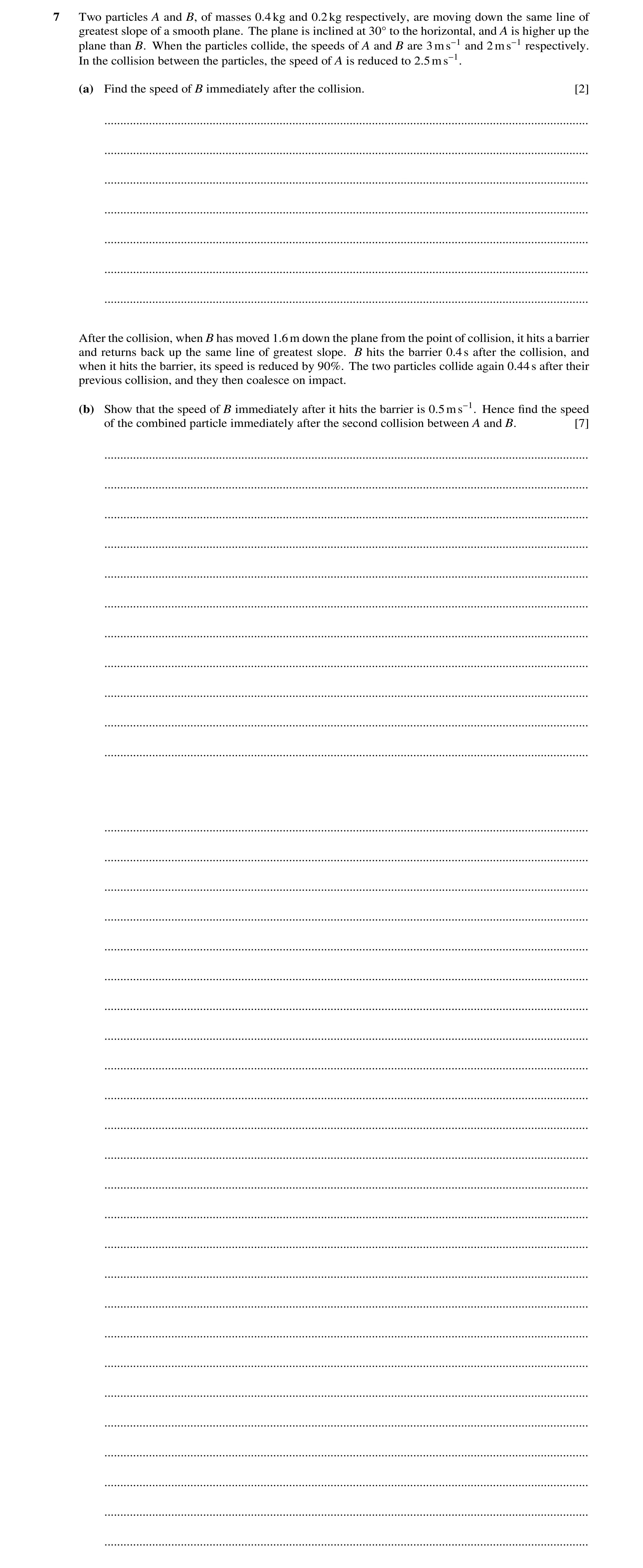
7 Two particles A and B, of masses 0.4kg and 0.2kg respectively, are moving down the same line of greatest slope of a smooth plane. The plane is inclined at 30Å to the horizontal, and A is higher up the plane than B. When the particles collide, the speeds of A and B are 3ms−1 and 2ms−1 respectively. In the collision between the particles, the speed of A is reduced to 2.5ms−1. (a) Find the speed of B immediately after the collision. [2] … … … … … … … After the collision, when B has moved 1.6m down the plane from the point of collision, it hits a barrier and returns back up the same line of greatest slope. B hits the barrier 0.4s after the collision, and when it hits the barrier, its speed is reduced by 90%. The two particles collide again 0.44s after their previous collision, and they then coalesce on impact. (b) Show that the speed of B immediately after it hits the barrier is 0.5ms−1. Hence find the speed of the combined particle immediately after the second collision between A and B. [7] … … … … … … … … … … … … … … … … … … … … … … … … … … … … … … … … … … … …
9 marks
Mark scheme: 7(a) v = 3 ms−1 A1 Allow M1A0 if g included with the masses. 2 7(b) For A 0.4 sin30 0.4 g a or for B 0.2 sin30 0.2 g a or sin30 mg ma M1 For either. Allow sin/cos mix. a = 5 or sin30 g A1 Allow sin30 g without working for M1A1 For B when hits barrier 2 2 3 2 5 1.6 v [⇒ v = 5] OR 3 5 0.4 5 v u at v v M1 Using their a g and their v from part (a) OR: use of 2 u v s t 3 1.6 0.4 5 2 v v OR 2 2 1 1 0.2 0.2 3 0.2 1.6 sin30 2 2 v g Speed after hitting barrier = 0.1 5 = 0.5 A1 AG vA = 2.5 + 5 0.44 [= 4.7] vB = −0.5 + 5 0.04 [= −0.3] or vB = 0.5 + (–5) 0.04 [= 0.3] *M1 Use of v u at for either with correct t-value, with initial speeds 2.5 or 0.5 their a g 0.4 4.7 + 0.2 (−0.3) = 0.6 vcomb DM1 Use of v u at for BOTH with correct t-values, initial speeds 2.5, 0.5 and their acceleration (same for both) and use of conservation of momentum with correct number of terms. Allow sign errors. vcomb = 3.03 ms−1 A1 Allow 91 1 3 30 30 v Allow DM1A0 if g included with the masses. 7
This question in 9709/41 May/June 2022
Q14 · Small smooth spheres A and B, of equal radii and of masses 5kg and 3kg respectively, lie… 9709/42 May/June 2022
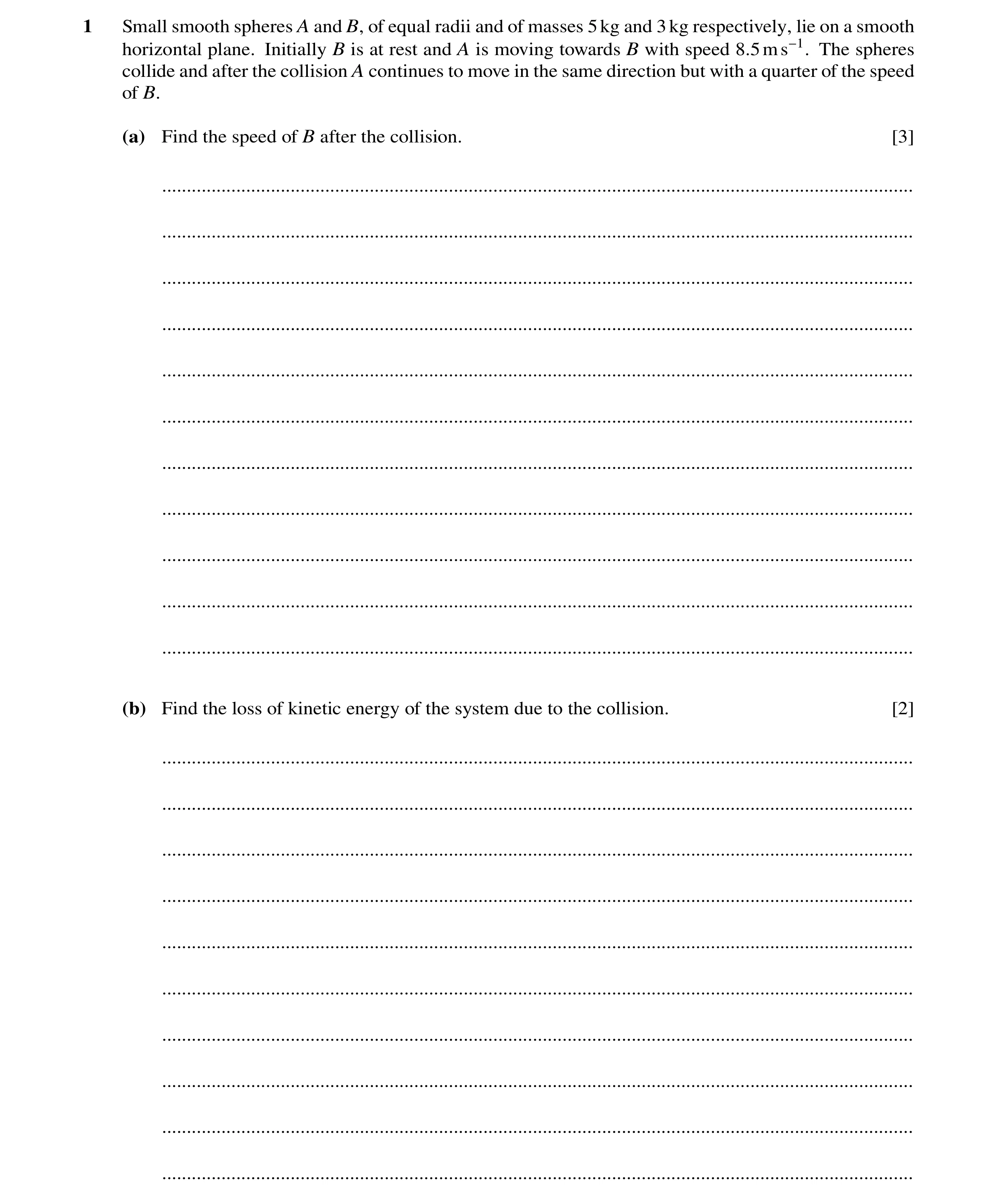
1 Small smooth spheres A and B, of equal radii and of masses 5kg and 3kg respectively, lie on a smooth horizontal plane. Initially B is at rest and A is moving towards B with speed 8.5ms−1. The spheres collide and after the collision A continues to move in the same direction but with a quarter of the speed of B. (a) Find the speed of B after the collision. [3] … … … … … … … … … … … (b) Find the loss of kinetic energy of the system due to the collision. [2] … … … … … … … … … …
5 marks
Mark scheme: 1(a) Conservation of momentum M1 3 terms; allow M1 if speed of A after collision is 1 8.5 4 . Allow 5 8.5 5 3 X Y where X and Y are different which may be seen by later work. If X and Y are subsequently used as being equal then M0. 5 8.5 5 0.25 3 v v A1 OE e.g. 5 8.5 5 3 4 V V Speed of B 1 10 ms A1 Do not award if 10 from using mgv, maximum 2/3 –10 is A0 as speed required not velocity 3 1(b) KE before 2 1 5 8.5 180.625 2 KE after 2 2 1 1 5 2.5 3 10 15.625 150 165.625 2 2 1 Attempt at any of the 3 terms for KE, using their 1 10 ms Not 2 1 5 3 8.5 2 , not 2 1 5 3 2.5 2 not 2 1 5 3 10 2 unless X Y seen KE loss 180.625 165.625 15 J A1 Accept ‒15, AWRT 15.0 2
This question in 9709/42 May/June 2022
Q15 · Two particles P and Q, of masses 0.3kg and 0.2kg respectively, are at rest on a smooth… 9709/43 May/June 2022
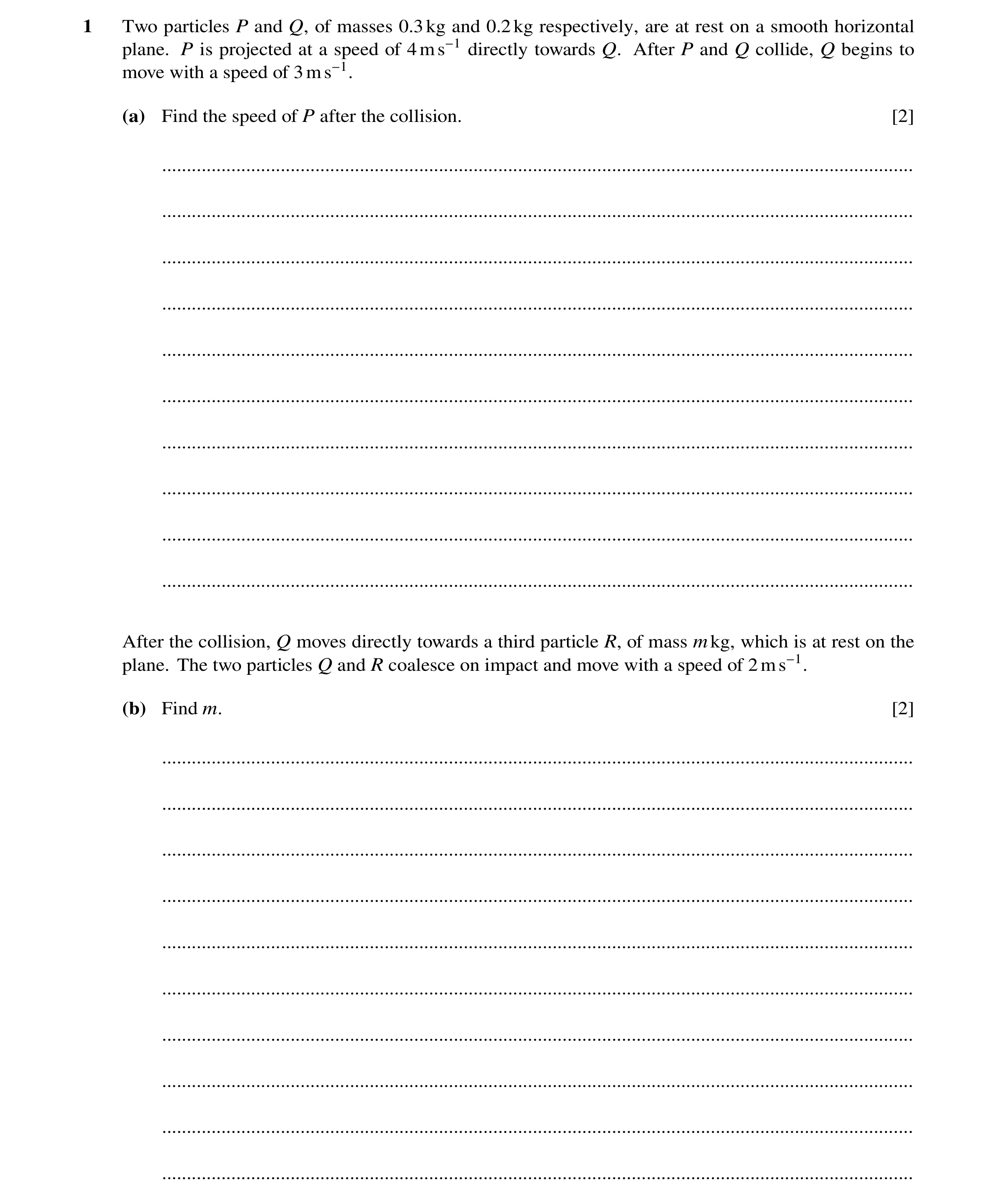
1 Two particles P and Q, of masses 0.3kg and 0.2kg respectively, are at rest on a smooth horizontal plane. P is projected at a speed of 4ms−1 directly towards Q. After P and Q collide, Q begins to move with a speed of 3ms−1. (a) Find the speed of P after the collision. [2] … … … … … … … … … … After the collision, Q moves directly towards a third particle R, of mass mkg, which is at rest on the plane. The two particles Q and R coalesce on impact and move with a speed of 2ms−1. (b) Find m. [2] … … … … … … … … … …
4 marks
Mark scheme: 1(a) M1 For attempt at use of conservation of momentum Speed = 2 ms−1 A1 2 1(b) 0.2 3 0 0.2 2 m M1 For attempt at use of conservation of momentum m = 0.1 A1 2
This question in 9709/43 May/June 2022
Q16 · Small smooth spheres A and B, of equal radii and of masses 6kg and 2kg respectively, lie… 9709/41 Oct/Nov 2022
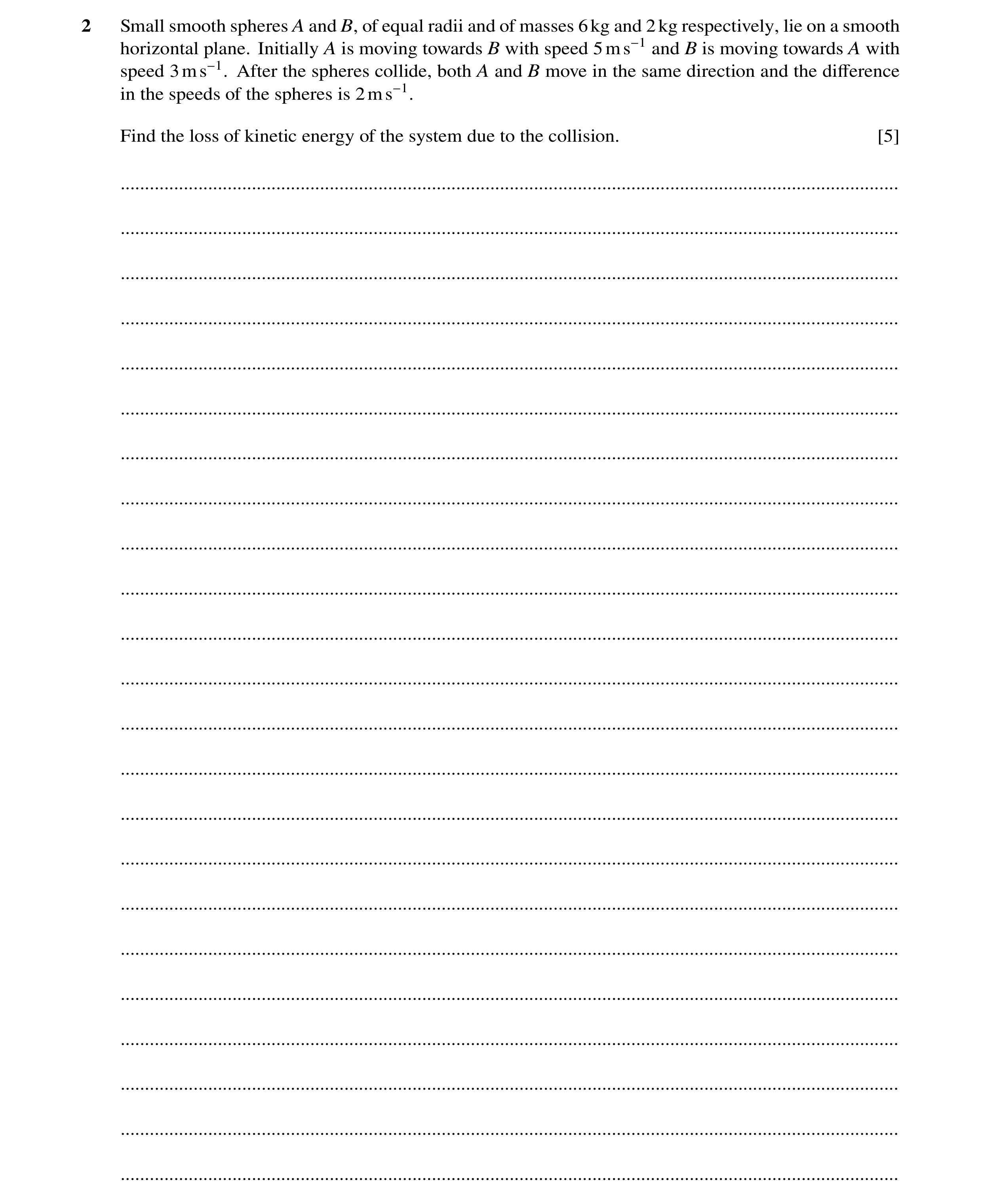
2 Small smooth spheres A and B, of equal radii and of masses 6kg and 2kg respectively, lie on a smooth horizontal plane. Initially A is moving towards B with speed 5ms−1 and B is moving towards A with speed 3ms−1. After the spheres collide, both A and B move in the same direction and the difference in the speeds of the spheres is 2ms−1. Find the loss of kinetic energy of the system due to the collision. [5] … … … … … … … … … … … … … … … … … … … … … … …
5 marks
Mark scheme: 2 Use conservation of momentum *M1 4 dimensionally correct terms. Allow sign errors, v A and v B must be 6 +5 2 −( 3) = 6v A + 2vB different. Use v B = v A + 2 or v A = v B − 2 with their momentum equation and solve for v A or v B DM1 Allow v B = v A 2 or v A = v B 2 . v A = 2.5 or v B = 4.5 A1 Attempt at initial KE, or final KE, or change in KE for A , or change in KE for B M1 Allow use or their v A and/or v B . Allow if 2 KE equations seen. 1 2 1 2 Initial KE = 6 5 + −2 ( 3 ) = 84 2 2 1 2 1 2 Final KE = 6 ( their 2.5 ) + 2 ( their 4.5 ) 2 2 1 2 1 2 Change in KE for A = 6 5 − 6 ( their 2.5 ) 2 2 1 2 1 2 Change in KE for B = −2 ( 3) − 2 ( their 4.5 ) 2 2 Loss of KE = 45 J A1 Allow –45 J. Allow if mgv used in momentum equation. 5
This question in 9709/41 Oct/Nov 2022
Q17 · Three particles A, B and C of masses 0.3kg, 0.4kg and mkg respectively lie at rest in a… 9709/42 Oct/Nov 2022
6 Three particles A, B and C of masses 0.3kg, 0.4kg and mkg respectively lie at rest in a straight line on a smooth horizontal plane. The distance between B and C is 2.1m. A is projected directly towards B with speed 2ms−1. After A collides with B the speed of A is reduced to 0.6ms−1, still moving in the same direction. (a) Show that the speed of B after the collision is 1.05ms−1. [2] … … … … … … After the collision between A and B, B moves directly towards C. Particle B now collides with C. After this collision, the two particles coalesce and have a combined speed of 0.5ms−1. (b) Find m. [2] … … … … … … … … … … … … … … (c) Find the time that it takes, from the instant when B and C collide, until A collides with the combined particle. [5] … … … … … … … … … … … … … … … … … … … … … … … … …
9 marks
Mark scheme: 6(a) 0.3 2 +0 = 0.3 0.6 + 0.4 v M1 For use of conservation of momentum. Must be 3 terms. Allow sign errors. Speed of B = 1.05 ms−1 A1 AG Allow M1 A0 if g included with the masses. 2 6(b) 0.4 1.05 +0 = ( 0.4 + m ) 0.5 M1 For use of conservation of momentum. Must be 3 terms. Allow sign errors. 11 A1 Allow M1 A0 if g included with the masses. m = 0.44 or 25 2 6(c) 1.2 [m] or 0.9 [m] B1 Must be a distance as some candidates get 1.2 from 0.6 . 0.5 0.5t B1 1 2 Seen but not + at unless later state that a = 0 . 2 B0 if only 0.5t = 2.1 (may see solving to find t = 3.5) . 0.6t B1 1 2 Seen but not + at unless later state that a = 0 . 2 Allow B2 in place of second and third B1 marks for ‘difference in speeds is 0.1 [ ms−1]’. Distances equal so 0.6t − 0.9 = 0.5t and solve for t M1 OE Must get to ‘ t = ’. Allow ± their 0.9 but not ±1.2 0.9 or ± 2.1 or 1.5 . Do not allow 0.6t + 0.5t = 0.9 . Or t = Do not allow M1 if either or both terms include 0.6 − 0.5 1 2 + at unless they state a = 0. 2 Time = 9 s A1 CWO 6(c) Alternative method for question 6(c) using time from start of motion 1 [m] or 1.1[m] B1 0.6T B1 1 2 Seen but not + aT unless later state that a = 0 . 2 0.5T B1 1 2 Seen but not + aT unless later state that a = 0 . 2 Allow B2 in place of second and third B1 marks for ‘difference in speeds is 0.1 [ ms−1]’. Distances equal so 0.6T − 1.1 = 0.5T and solve for T M1 OE Must get to ‘ T = ’. Allow ± their 1.1 but not ±1.0 1.1 or ± 2.1. Do not allow 0.6T + 0.5T = 1.1 . Or T = Do not allow M1 if either or both terms include 0.6 − 0.5 1 2 + aT unless they state a = 0 2 ⇒ Time from BC collision = 11 − 2 = 9 s A1 CWO 6(c) Alternative method for question 6(c) using distance travelled from time when B and C collide 1.2 [m] or 0.9 [m] B1 d + 0.9 B1 FT Allow ± their 0.9 but not ±1.2 or ± 2.1 or 1.5 . Time taken for A is 0.6 Or d + 0.9 = 0.6t d B1 Time taken for BC is 0.5 Or d = 0.5t d + 0.9 d 4.5 M1 Must get to ‘ t = ’. = d = 4.5 Time = Allow ± their 0.9 but not ±1.2 or ± 2.1. 0.6 0.5 0.5 Time = 9 s A1 CWO 5
This question in 9709/42 Oct/Nov 2022
Q18 · O A E 1.8 m F 1Å B 7.0 m C The diagram shows a smooth track which lies in a vertical plane 9709/42 Feb/March 2023
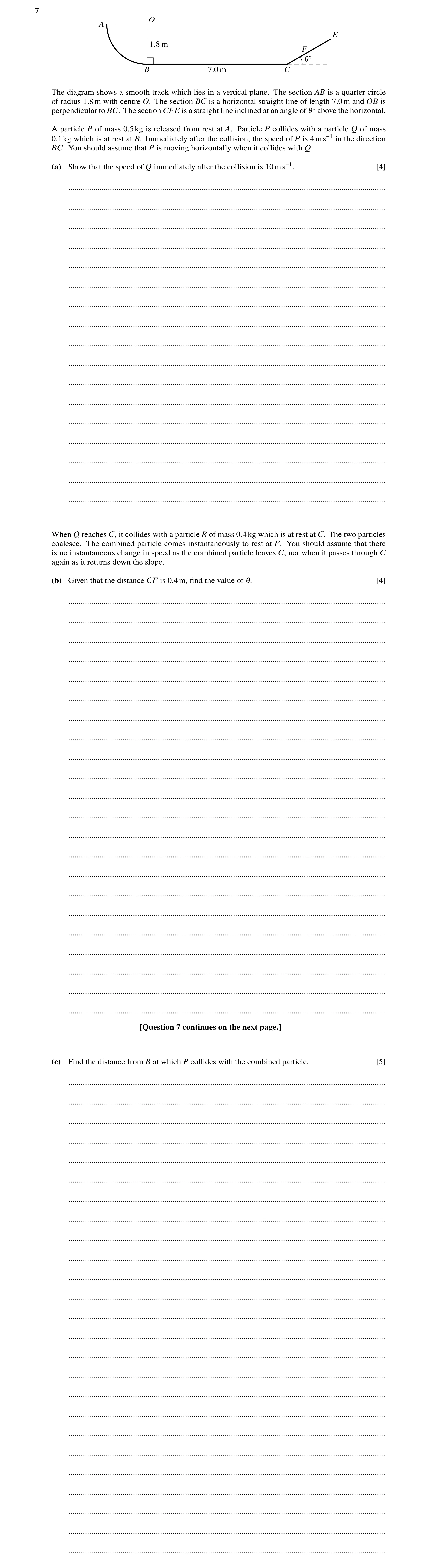
7 O A E 1.8 m F 1Å B 7.0 m C The diagram shows a smooth track which lies in a vertical plane. The section AB is a quarter circle of radius 1.8m with centre O. The section BC is a horizontal straight line of length 7.0m and OB is perpendicular to BC. The section CFE is a straight line inclined at an angle of 1Å above the horizontal. A particle P of mass 0.5kg is released from rest at A. Particle P collides with a particle Q of mass 0.1kg which is at rest at B. Immediately after the collision, the speed of P is 4ms−1 in the direction BC. You should assume that P is moving horizontally when it collides with Q. (a) Show that the speed of Q immediately after the collision is 10ms−1. [4] … … … … … … … … … … … … … … … … … When Q reaches C, it collides with a particle R of mass 0.4kg which is at rest at C. The two particles coalesce. The combined particle comes instantaneously to rest at F. You should assume that there is no instantaneous change in speed as the combined particle leaves C, nor when it passes through C again as it returns down the slope. (b) Given that the distance CF is 0.4m, find the value of 1. [4] … … … … … … … … … … … … … … … … … … … … … … [Question 7 continues on the next page.] (c) Find the distance from B at which P collides with the combined particle. [5] … … … … … … … … … … … … … … … … … … … … … … … … …
13 marks
Mark scheme: 7(a) Attempt to use conservation of energy M1 2 terms, dimensionally correct. 1 2 1 2 Do not allow from use of constant acceleration. 0.5v = 0.5 g 1.8 or mv = mg 1.8 2 2 v = 6 A1 Do not allow from use of constant acceleration. Attempt at conservation of momentum M1 3 terms; allow sign errors; allow their v = 6 or just v ; allow if 0.5 6 ( + 0 ) = 0.5 +4 0.1w using mgv (consistently in all terms). Speed of Q ( = w ) = 1 0 m s-1 A1 AG Do not allow from use of constant acceleration. Do not allow if using mgv. Use of constant acceleration gets M0 A0 M1 A0 maximum. 4 SC Assuming elastic collision 1 2 1 2 M1A1 0.5 g 1.8 = 0.1w + 0.5 4 2 2 M1 For attempt at conservation of energy, 3 terms; allow sign errors. B1 Speed of Q ( = w ) = 1 0 m s-1 7(b) Attempt at conservation of momentum *M1 3 terms, allow sign errors, allow if using mgv. 0.1 10 = ( 0.1 + 0.4 ) z ( z = 2 ) Attempt to use conservation of energy *DM1 Dependent on previous M mark. 1 2 4 terms, dimensionally correct. ( 0.1 + 0.4 ) ( their 2 ) = ( 0.1 + 0.4 ) gh ( h = 0.2 ) Do not allow from use of constant acceleration. 2 their 2 10 . Use trigonometry to get an equation in and solve for DM1 Dependent on previous 2 M marks. −1 their 0.2 Using their h and 0.4 . = sin Allow sin/cos mix. 0.4 θ = 30 A1 Do not allow if using mgv. Alternative method for Question 7(b): Using constant acceleration Attempt at conservation of momentum *M1 2 terms, allow sign errors, allow if using mgv. 0.1 10 = 0.5 z ( z = 2 ) Attempt at use of constant acceleration *DM1 Dependent on previous M mark. 0 2 = ( their 2 ) 2 2 a 0.4 ( a = 5 ) Uses constant acceleration with u = their 2 and s = 0.4 to get an equation in a ; their 2 10 . Use N2L to get an equation in leading to a positive value of DM1 Dependent on previous 2 M marks. and solve for Using their a ; May have m for 0.5 . ( 0.5 ) theira = ( 0.5 ) g sin Allow sin/cos mix. θ = 30 A1 Do not allow if using mgv. 4 7(c) Q takes 0.7 s to travel from B to C B1 ( their 2 ) + 0 B1FT SOI 0.4 = t =t 0.4 0.8 2 FT their 2 from (b), t = . their 2 u + v For use of s = t to get a time up the slope. 2 Allow for total time on slope from 1 2 0 = ( their 2 ) t − ( their a ) t =t 0.8 . 2 Distance between P moved is ( 0.7 + 0.8 ) 4 ( = 6 ) B1 Allow 1 m from point C. Set up equation in t using 4t , ( their 2 ) t and their 6 and solve for M1 Must have considered all parts of motion to find times from relevant equations. t 4t + ( their 2 ) t = ( their 1) OR ( their 6 ) + 4t + ( their 2 ) t = 7 2 A1 Distance from B = 6 m 3 7(c) Alternative method for last 3 marks of Question 7(c) b 7 − b B1 Where b is distance from B [Time for P = ] and [Time for QR = ] 4 2 OR Where c is distance from C. 7 − c c OR [Time for P = ] and [Time for QR = ] 4 2 Attempt to form an equation from use of total time and solve for b M1 Where b is distance from B (or c ) OR Where c is distance from C. Must have considered all parts of motion to find times from 7 − b b 2 relevant equations. + 0.7 + 0.4 + 0.4 = b = 6 2 4 3 c 7 − c 1 OR + 0.7 + 0.4 + 0.4 = c = 2 4 3 2 A1 Distance from B = 6 m 3 5
This question in 9709/42 Feb/March 2023
Q19 · Two particles P and Q, of masses mkg and 0.3kg respectively, are at rest on a smooth… 9709/41 May/June 2023
1 Two particles P and Q, of masses mkg and 0.3kg respectively, are at rest on a smooth horizontal plane. P is projected at a speed of 5ms−1 directly towards Q. After P and Q collide, P moves with a speed of 2ms−1 in the same direction as it was originally moving. (a) Find, in terms of m, the speed of Q after the collision. [2] … … … … … … … … … … After this collision, Q moves directly towards a third particle R, of mass 0.6kg, which is at rest on the plane. Q is brought to rest in the collision with R, and R begins to move with a speed of 1.5ms−1. (b) Find the value of m. [2] … … … … … … … … … …
4 marks
Mark scheme: 1(a) M1 Attempt at conservation of momentum; 3 non-zero terms (with m appearing in two terms); allow sign errors. Speed 10 m (m s–1) A1 M1A0 if using g in momentum terms. 10 v m is A0. 2 1(b) 0.3 10 0 0 0.6 1.5 [3 0.9] m m M1 Attempt at conservation of momentum between Q and R (so must be using correct masses of 0.3 and 0.6) to form a linear equation in m using their answer from (a); 2 non-zero terms; allow sign errors. m = 0.3 A1FT FT 3 +ve coefficient of from their m (a) Condone including kg in answer. 2
This question in 9709/41 May/June 2023
Q20 · Two particles A and B, of masses 3.2kg and 2.4kg respectively, lie on a smooth horizontal… 9709/42 May/June 2023
2 Two particles A and B, of masses 3.2kg and 2.4kg respectively, lie on a smooth horizontal table. A moves towards B with a speed of vms−1 and collides with B, which is moving towards A with a speed of 6ms−1. In the collision the two particles come to rest. (a) Find the value of v. [2] … … … … … … … … … … (b) Find the loss of kinetic energy of the system due to the collision. [2] … … … … … … … … … … … …
4 marks
Mark scheme: 2(a) 3.2 2.4 6 0 v allow sign errors. 4.5 v A1 M1A0 for use of mgv. 4.5 v is A0. 2 Question Answer Marks Guidance 2(b) KE 2 1 3.2 4.5 2 their OR 2 1 2.4 6 2 M1 Attempt at either KE term, using their v. Do not allow 2 1 3.2 4.5 6 2 their , or 2 1 2.4 4.5 6 2 their , or 2 1 3.2 2.4 4.5 6 2 their , or 2 1 3.2 4.5 0 2 their , or 2 1 2.4 6 0 2 . KEloss 75.6 J A1 Allow –75.6. Note 2 1 3.2 2.4 6 2 or 2 1 3.2 2.4 4.5 2 their is M1A0. 2
This question in 9709/42 May/June 2023
Q21 · Two particles P and Q, of masses 0.1kg and 0.4kg respectively, are free to move on a… 9709/43 May/June 2023
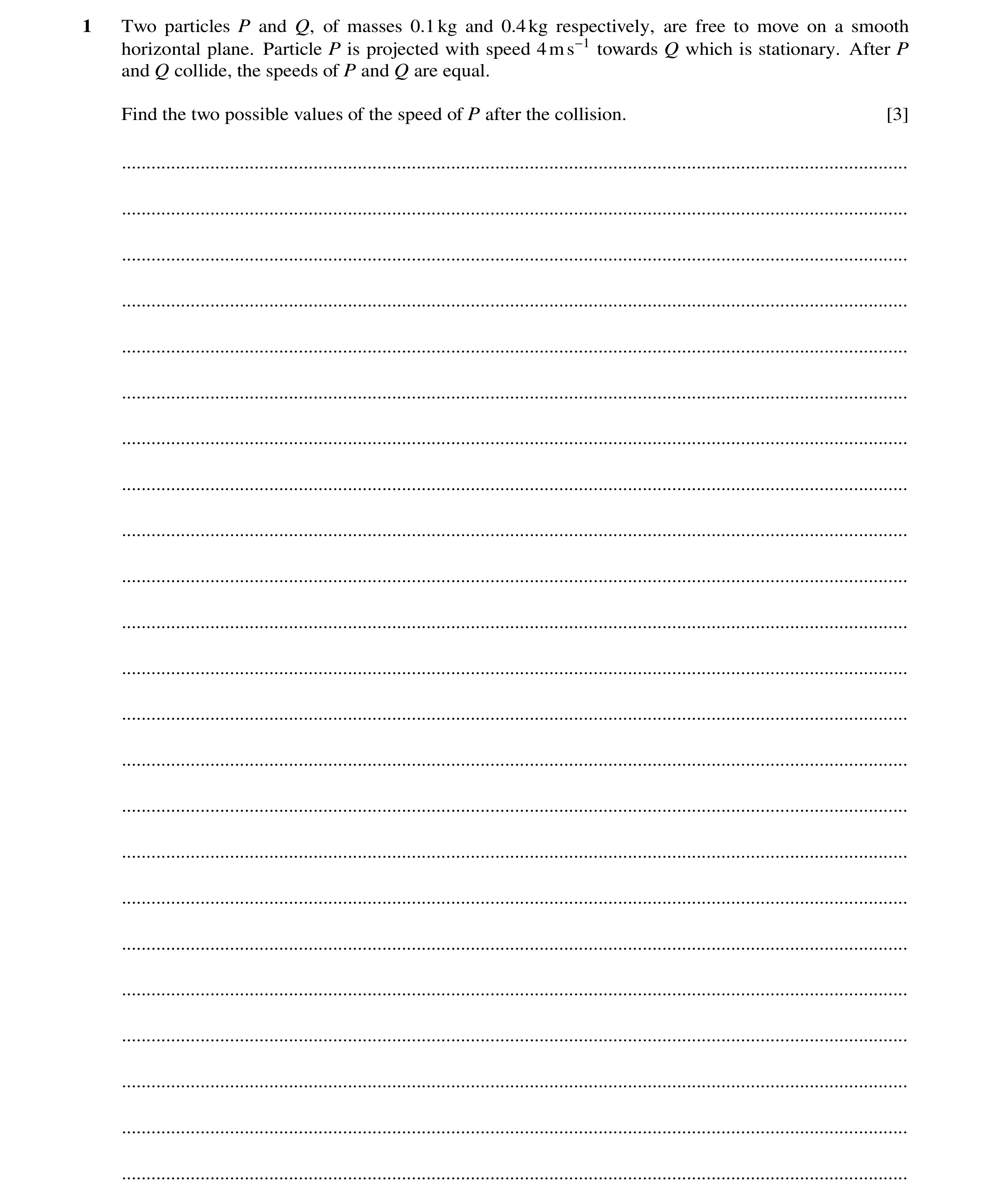
1 Two particles P and Q, of masses 0.1kg and 0.4kg respectively, are free to move on a smooth horizontal plane. Particle P is projected with speed 4ms−1 towards Q which is stationary. After P and Q collide, the speeds of P and Q are equal. Find the two possible values of the speed of P after the collision. [3] … … … … … … … … … … … … … … … … … … … … … … …
3 marks
Mark scheme: 1 For attempt at use of conservation of momentum in one case M1 or 0.1 4 0 0.4 0.1 v v OE. Must have correct number of terms. Allow sign errors. Speed = 0.8 [m s−1] or 4 5 A1 Must be positive. Allow Max M1A1A0 if g included with the masses. Speed = 4 3 [m s−1] Allow 1.33 A1 Must be positive. 3
This question in 9709/43 May/June 2023
Q22 · Two particles P and Q, of masses 6kg and 2kg respectively, lie at rest 12.5m apart on a… 9709/41 Oct/Nov 2023
4 Two particles P and Q, of masses 6kg and 2kg respectively, lie at rest 12.5m apart on a rough horizontal plane. The coefficient of friction between each particle and the plane is 0.4. Particle P is projected towards Q with speed 20ms−1. (a) Show that the speed of P immediately before the collision with Q is 10 3ms−1. [3] … … … … … … … … … … In the collision P and Q coalesce to form particle R. (b) Find the loss of kinetic energy due to the collision. [4] … … … … … … … … … … … … … … … … … … … … … … The coefficient of friction between R and the plane is 0.4. (c) Find the distance travelled by particle R before coming to rest. [2] … … … … … … … … … … … …
9 marks
Mark scheme: 4(a) −0.4 6 g = 6 a *B1 Resolve horizontally using Newton’s second law; 2 relevant terms; must be either −0.4 6 g = 6 a or 0.4 6 g = 6a. v 2 = 202 + 2 −( 4 ) 12.5 DM1 Use complete suvat method to get an equation in v or v 2 – must be using u = 20, s = 12.5 and their a. v 2 = 300 v = 10 3 A1 AG. Condone correct expression for v or v2 followed by correct answer. Alternative method for Question 4(a) RF = 0.4 6 g *B1 Correct application of F = R for P. 0.5 6 20 2 − 0.5 6 v 2 = 12.5 (0.4 6 g ) DM1 3 relevant terms; dimensionally correct; allow sign errors only. v 2 = 300 v = 10 3 A1 AG. Condone correct expression for v or v2 followed by correct answer. 3 4(b) 6 10 3 = ( 6 + 2 ) v ' M1 For use of conservation of momentum, 3 non-zero terms, allow sign errors. Use of 20 is M0. v ' = 7.5 3 A1 12.99038… 1 2 B1 Either initial kinetic energy or final kinetic energy correct. Initial KE = 6 10 3 ( ) = 900 Allow unsimplified. 2 1 2 Final KE = 8 7.5 3 = 675 ( ) 2 Loss of KE = 225 J A1 4 4(c) 2 M1 Use complete suvat method to find distance. This must be 0 = their 7.5 3 + 2 ( their − 4 ) s ( ) using their v from part (b), so it is dependent on scoring the first M mark in part (b) and either their a from part (a), or from 0.4 8 g = 8a. [Distance =] 21.1 m A1 21.1 or better (21.09375). 2
This question in 9709/41 Oct/Nov 2023
Q23 · A particle A of mass 0.5kg is projected vertically upwards from horizontal ground with… 9709/42 Oct/Nov 2023
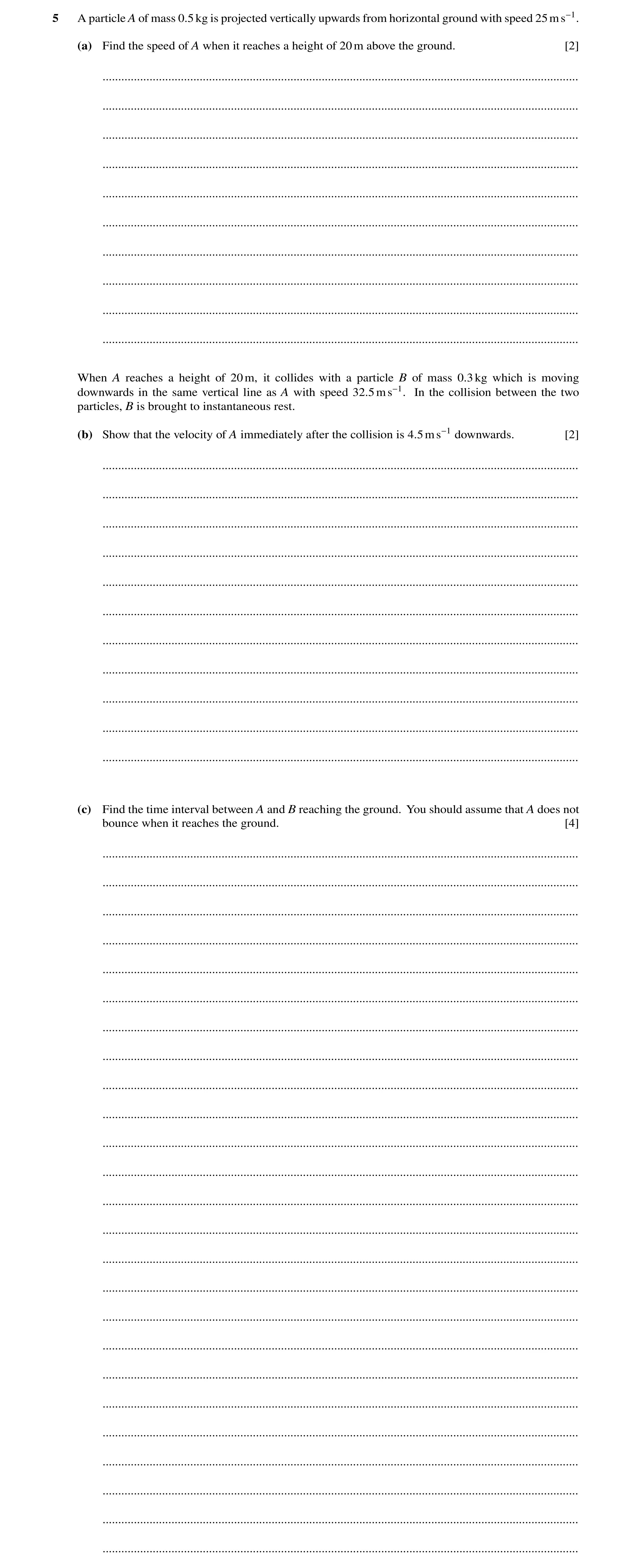
5 A particle A of mass 0.5kg is projected vertically upwards from horizontal ground with speed 25ms−1. (a) Find the speed of A when it reaches a height of 20m above the ground. [2] … … … … … … … … … … When A reaches a height of 20m, it collides with a particle B of mass 0.3kg which is moving downwards in the same vertical line as A with speed 32.5ms−1. In the collision between the two particles, B is brought to instantaneous rest. (b) Show that the velocity of A immediately after the collision is 4.5ms−1 downwards. [2] … … … … … … … … … … … (c) Find the time interval between A and B reaching the ground. You should assume that A does not bounce when it reaches the ground. [4] … … … … … … … … … … … … … … … … … … … … … … … … …
8 marks
Mark scheme: 5(a) v 2 = 252 + 2 ( − g ) 20 M1 Use of v 2 = u 2 + 2 as with u = 25 , s = 20 and a = g . 1 2 1 2 OR using change in KE = change OR 0.5 v = 0.5 25 − 0.5 g 20 2 2 in PE. Speed = 15 m s-1 A1 2 5(b) Taking up as positive direction: 0.5 15 + 0.3 −( 32.5 ) = 0.5v + 0 or M1 For use of conservation of momentum, 3 non-zero terms, allow sign errors, using their speed Taking down as positive direction: 0.5 −( 15 ) + 0.3 32.5 = 0.5v + 0 15 m s-1. Must show how 2.25 is obtained. [Taking up as positive direction: velocity of A = −4.5 m s−1] A1 Any error seen in calculating v is [Taking down as positive direction: velocity of A = 4.5 m s−1] A0. Speed = 4.5 m s–1 direction downwards Must explicitly say 4.5 m s–1 and downwards. 2 5(c) 1 2 M1 Using constant acceleration Downwards to be positive, for A 20 = 4.5t A + gt A and solve for At formula(e) to get a correct equation 2 in At and solve for At . 1 2 Upwards to be positive, for A −20 = −4.5t A − gt A and solve for At If using quadratic formula, must be 2 the correct formula. If factorising, when brackets expanded, 2 terms correct. 1 2 M1 Using constant acceleration For B 20 = 0 + gt B t = 2 and solve for Bt formula(e) to get a correct equation 2 in Bt and solve for Bt . At = 1.6 or Bt = 2 A1 Difference = 0.4 s only A1 4
This question in 9709/42 Oct/Nov 2023
Q24 · A particle P of mass 0.2 kg is projected vertically upwards from horizontal ground with… 9709/41 May/June 2024
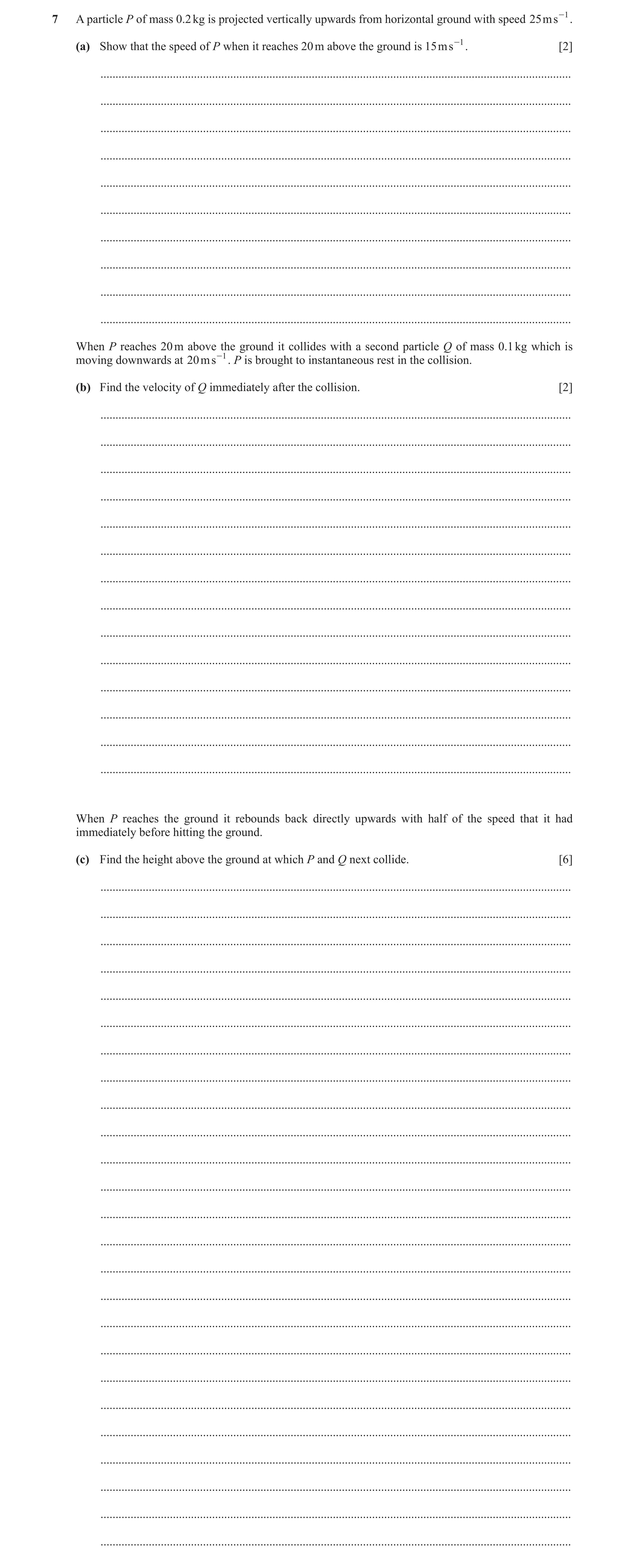
7 A particle P of mass 0.2 kg is projected vertically upwards from horizontal ground with speed 25 ms -1 . (a) Show that the speed of P when it reaches 20 m above the ground is 15 ms -1 . [2] … … … … … … … … … … When P reaches 20 m above the ground it collides with a second particle Q of mass 0.1 kg which is moving downwards at 20 ms -1 . P is brought to instantaneous rest in the collision. (b) Find the velocity of Q immediately after the collision. [2] … … … … … … … … … … … … … … When P reaches the ground it rebounds back directly upwards with half of the speed that it had immediately before hitting the ground. (c) Find the height above the ground at which P and Q next collide. [6] … … … … … … … … … … … … … … … … … … … … … … … … …
10 marks
Mark scheme: 7(a) 2 2 25 2 20 v g M1 For use of 2 2 2 v u as or equivalent to get an equation in v only with 25, 20 u s and . a g ⇒ speed = 15 m s–1 A1 AG Allow verification – at least one intermediate step from equation of motion to given result. Any errors seen is A0. Alternative method for Question 7(a): 2 2 1 1 0.2 20 0.2 25 0.2 2 2 g v (M1) Attempt at energy with 0.2, 20, 25; m h u correct number of terms, allow sign errors. ⇒ speed = 15 m s-1 (A1) AG Allow verification - at least one intermediate step from conservation of energy to given result. Any errors seen is A0. 2 7(b) 0.2 15 0.1 20 0 0.1v or 0.2 15 0.1 20 0 0.1V M1 OE Attempt at conservation of momentum; 3 non-zero terms; allow sign errors – use of 25 is M0. 10 v m s-1 upwards A1 Must have direction (possibly seen on diagram). If using mgv for momentum, then M1 A0 max. 2 Question Answer Marks Guidance 7(c) Speed of P at impact is 20 m s–1 B1 From 2 0 2 20 v g (OE) - possibly implied by speed of P after impact being stated at 10. Time to when P reaches ground = 2 s B1 From 2 1 2 20 0 g t (OE). 2 1 2 10 P s t g t M1 Distance travelled by P after impact with the ground. Must be using their 10 (speed of P after impact with the ground) and . a g 2 1 2 10 Q s t g t M1 Distance travelled by Q after P’s impact with the ground. Must be using their ±10 (the speed/vel. of Q after their 2 s ( '10' ( ) 2 g where ‘10’ is the value from (b)) and . a g 20 1 P Q s s t A1 Time after P hits the ground to next collision. Height = 5m A1 CWO Question Answer Marks Guidance 7(c) Alternative Method for last 4 marks: 2 1 2 10 Q s t g t (M1) Expression for the displacement of Q after first impact of P and Q. Must be using their 10 (from (b)) and . a g 2 1 2 10 ( 2) ( 2) P s t g t (M1) Expression for the displacement of P (for values of 2 t ) measured from point of first collision between P and Q. Must be using their 2 (time for P to reach ground), their 10 (speed of P after impact with the ground), . a g 20 3 Q P s s t (A1) Correct time between collisions of P and Q. Height = 5m (A1) CWO 6
This question in 9709/41 May/June 2024
Q25 · Three particles A, B and C of masses 5 kg, 1 kg and 2 kg respectively lie at rest in that… 9709/42 May/June 2024
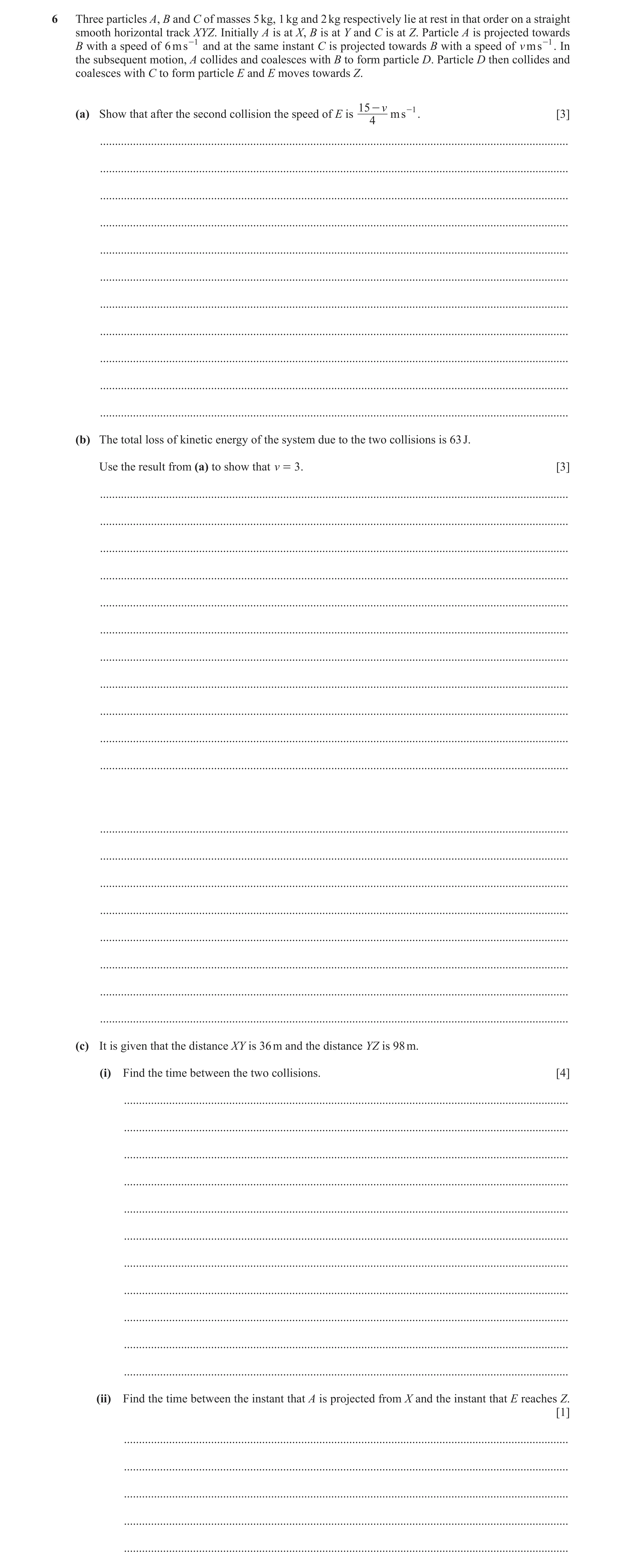
6 Three particles A, B and C of masses 5 kg, 1 kg and 2 kg respectively lie at rest in that order on a straight smooth horizontal track XYZ. Initially A is at X, B is at Y and C is at Z. Particle A is projected towards B with a speed of 6 ms -1 and at the same instant C is projected towards B with a speed of v ms -1 . In the subsequent motion, A collides and coalesces with B to form particle D. Particle D then collides and coalesces with C to form particle E and E moves towards Z. 15 - v -1 (a) Show that after the second collision the speed of E is ms . [3] 4 … … … … … … … … … … … (b) The total loss of kinetic energy of the system due to the two collisions is 63 J. Use the result from (a) to show that v = 3 . [3] … … … … … … … … … … … … … … … … … … … (c) It is given that the distance XY is 36 m and the distance YZ is 98 m. (i) Find the time between the two collisions. [4] … … … … … … … … … … … (ii) Find the time between the instant that A is projected from X and the instant that E reaches Z. [1] … … … … …
11 marks
Mark scheme: 6(a) Attempt at conservation of momentum for the 1st collision 5 6 5 1 D v For reference 5. D v If mgv used, allow M1 M1 A0 max. Attempt at conservation of momentum for the 2nd collision 5 1 2 5 1 2 D E their v v v DM1 6 non-zero terms; allow sign errors; using correct masses; allow their numerical . D v Allow E v v for this mark. Note: 5 6 2 5 1 2 E v v is M2. If mgv used, allow M1 M1 A0 max. 15 4 E v v A1 AG Must in terms of v, as v is given in the question or explicitly defined their letter used as v. Do not allow E v v for this mark. Any error seen is A0 but condone saying ‘divide by 2’ or equivalent. If mgv used, allow M1 M1 A0 max. 3 Question Answer Marks Guidance 6(b) 2 2 2 1 1 KE 5 6 2 90 2 2 initial v v 2 1 15 KE 5 1 2 2 4 final v B1 For either KEinitial or KE final correct. Attempt difference in KE is 63 to get an equation 2 2 2 1 1 1 15 5 6 2 5 1 2 63 2 2 2 4 v v M1 Using sum of two initial KE 63. final KEs Correct number of relevant terms – correct masses, must be adding 2 KE terms for . KEinitial sum of two initial KEs and KE final coming from use of correct formula and of the correct form. Solve algebraically 2 3 30 117 0 v v OE to get 3 v ONLY A1 AG Any error seen is A0. Allow solving correct quadratic expression, rather than correct quadratic equation, for full marks. If 13 v seen it must be discarded. Must see solving for this mark. A quadratic equation followed by the answer is insufficient. Question Answer Marks Guidance 6(b) Alternative Method for Question 6(b): Using loss of KE in second collision 2 2 2 1 1 1 KE 6 5 2 75 2 2 st after collision v v 2 1 15 KE 5 1 2 2 4 final v (B1) For either 1 KE st after collision or KE final correct. Attempt difference in KE is 2 2 1 1 63 5 6 6 5 63 15 48 2 2 to get an equation 2 2 2 1 1 1 15 6 5 2 5 1 2 63 15 2 2 2 4 v v (M1) Using 1 KE KE 63 1 5 . st final after collision their Correct number of relevant terms. 1 , KE st after collision KE final and their 15 coming from use of correct formula and of the correct form. Solve algebraically 2 3 30 117 0 v v OE to get 3 v ONLY (A1) AG Any error seen is A0. If 13 v seen it must be discarded. Must see solving for this mark. A quadratic equation followed by the answer is insufficient. Alternative Method 2 for Question 6(b): Verifying that 3 v 2 2 1 1 KE 5 6 2 3 99 2 2 initial (B1) 2 1 15 3 KE 5 1 2 36 2 4 final (B1) KE KE 63 initial final , hence loss in KE is 63 J (B1) Must have a conclusion for this mark. 3 Question Answer Marks Guidance 6(c)(i) Time A to B = 6 s B1 Distance BC 98 3 6 80 their *B1FT FT their 6 which MUST come from 6 36. t Use sum of distance moved by D and distance moved by C is 80 m 5 3 80 their t t their OR use distance moved by C divided by relative velocity 80 5 3 their DM1 Using D theirv from part (a). 6 D v or 3 and 80 98. their Time = 10 s A1 Do not ISW. 4 6(c)(ii) 3 10 3 6 6 10 3 32 s B1 1
This question in 9709/42 May/June 2024
Q26 · Two particles P and Q of masses 0.2 kg and 0.5 kg respectively are at rest on a smooth… 9709/43 May/June 2024
1 Two particles P and Q of masses 0.2 kg and 0.5 kg respectively are at rest on a smooth horizontal plane. Particle P is projected with a speed 6 m s -1 directly towards Q. After P and Q collide, P moves with a speed of 1 m s -1 . Find the two possible speeds of Q after the collision. [3] … … … … … … … … … … … … … … … … … … … … … … … … …
3 marks
Mark scheme: 1 M1 For attempt at use of conservation of momentum in at least one case. Must have three non-zero terms. Allow sign errors. Must have correct masses with relevant velocities. Their v may be in opposite direction. Speed = 2 m s−1 A1 Do not allow negative. Speed = 2.8[0] m s−1 or 14 5 m s−1 or 4 25 m s−1 A1 OE Do not allow negative. 3
This question in 9709/43 May/June 2024
Q27 · Two particles, A and B, of masses 3 kg and 6 kg respectively, lie on a smooth horizontal… 9709/43 Oct/Nov 2024
4 Two particles, A and B, of masses 3 kg and 6 kg respectively, lie on a smooth horizontal plane. Initially, B is at rest and A is moving towards B with speed 8 m s -1. After A and B collide, A moves with speed 2 m s -1. Find the greater of the two possible total losses of kinetic energy due to the collision. [6] … … … … … … … … … … … … … … … … … … … … … … … … …
6 marks
Mark scheme: 4 For attempt at use of conservation of momentum. *M1 Must have three non-zero terms. Allow sign errors. Must have correct masses with relevant velocities. Their v may be in the opposite direction. If g included with the masses: Allow M1A0A1 for first three marks. Can then score M1M0A0 for final three marks. 3 =8 3 +2 6v A1 Or 3 =8 −+3 2 6v v = 3 v = 5 A1 Allow finding only v = 3, but if both speeds found they must both be correct KEafter DM1 Allow use of any vB even if 0 = 81 = 0.5 3 2 2 + 0.5 6 their v B 2 = 33 if correct Using speed of 5, KE after = 0.5 3 22 + 0.5 6 their 52 Candidates may work out the loss for each particle separately which only scores DM1 when losses subsequently added together. 2 2 2 DM1 If two speeds found then FT their lower speed, even if later choose 0.5 3 8 − 0.5 3 2 + 0.5 6 their 3 ( KEloss = ± ( ) ) the wrong loss. = 96 − 33 if correct If only one speed found then FT their speed. If the candidate thinks that the particles coalesce then score M0 here Loss = 63 [J] A1 If both losses found, must state which is the greater. Only award this mark if no errors – e.g. the KE loss for v = 5 should be 15 J. If wrong then A0. Allow −63 [J]. Can score full marks even if only v = 3 is found. 6
This question in 9709/43 Oct/Nov 2024
Q28 · P 0.6 kg Q 0.4 kg R 0.8 kg 3 m 3 m Three particles P, Q and R, of masses 0.6 kg, 0.4 kg… 9709/42 Feb/March 2025
5 P 0.6 kg Q 0.4 kg R 0.8 kg 3 m 3 m Three particles P, Q and R, of masses 0.6 kg, 0.4 kg and 0.8 kg respectively, are at rest in a straight line on a smooth horizontal plane. The distance from P to Q is 3 m, and the distance from Q to R is also 3 m (see diagram). P is projected directly towards Q with speed 3 m s -1. After P and Q collide, P continues to move in the same direction with speed 1.5 m s -1. (a) Find the speed of Q after the collision. [2] … … … … … … … … … … … In the subsequent collision between Q and R, these particles coalesce. (b) Find the speed of the combined particle after this collision. [1] … … … … … … … … … (c) Find the time that it takes from when P is initially projected until the instant at which P collides with the combined particle. [4] … … … … … … … … … … … … … … … … … … … … … … … … … … …
7 marks
Mark scheme: 5(a) 0.6 =3 0.6 1.5 + 0.4v M1 Attempt at conservation of momentum. 3 non-zero terms. Allow sign errors. Speed = 2.25 m s−1 A1 OE must be positive. Allow max M1A0 if g included with the masses. 2 5(b) 0.4 2.25 = ( 0.4 + 0.8 ) w speed = 0.75 m s−1 B1FT OE condone including g if already penalised in (a). FT their 2.25. their 2.25 speed = 3 1 5(c) 3 4 *B1FT Q takes = s to reach the point at which R was initially. their 2.25 3 3 *B1FT 1.5 = 2 their 2.25 3 OR 3 − 1.5 = 1 their 2.25 3 OR ( their 0.75 ) = 1 their 2.25 Difference in speeds of P and QR = 1.5 − their 0.75 = 0 .75 m s−1 DM1 Dependent on both previous B marks. For attempt to find time. 3 3 − 1.5 their 2.25 so time = 1.5 − their 0.75 3 4 t OR ( their 0.75 ) t 3 − 1.5 = 1.5t →= their 2.25 3 3 8 T = OR( their 0.75 ) T 3 = 1.5T → their 2.25 3 3 3 3 11 T ' = OR ( their 0.75 ) T ' 3 = 1.5 T ' → their 2.25 3 3 3 3 3 3 3 11 T ' = OR ( their 0.75 ) T ' = 1.5 T → their 2.25 3 3 1.5 3 5(c) 3 4 4 A1 Allow 3.67 s. Time = + + = 11s 3 3 3 3 Alternative for Q5(c) 3 4 *B1FT Q takes = s to reach the point at which R was initially. their 2.25 3 3 *B1FT P takes = 2 s to reach the point at which R was initially, so combined 1.5 3 3 2 particle has travelled for − = s beyond where R was initially. 1.5 their 2.25 3 3 3 So combined particle is − ( their 0.75 ) = 0.5 m beyond 1.5 their 2.25 where R was initially. Difference in speeds of P and QR = 1.5 − their 0.75 = 0 .75 m s−1 M1 Dependent on both previous B marks. For attempt to find time. 3 3 their 0.75 ) − ( 1.5 their 2.25 2 so time = = 1.5 − their 0.75 3 3 2 11 A1 Allow 3.67 s. Time = + 2 + = s 3 3 3 4
This question in 9709/42 Feb/March 2025
Q29 · When a particle P of mass m kg has speed u ms – 1, its momentum is 4 N s and its kinetic… 9709/41 May/June 2025
5 When a particle P of mass m kg has speed u ms – 1, its momentum is 4 N s and its kinetic energy is 16 J. (a) Find the value of m and the value of u. [3] … … … … … … … … P is now projected on a smooth horizontal surface with speed v ms – 1 directly towards a particle Q of mass 1.25 kg which is stationary. After P and Q collide, the velocity of P is w ms – 1 and the velocity of Q is 2w ms – 1. The loss of kinetic energy in the collision is 25 J. (b) Find the value of v and the value of w. [4] … … … … … … … … … … … … … … …
7 marks
Mark scheme: 5(a) 1 2 B1 mu = 16 2 mu = 4 B1 u = 8, m = 0.5 B1 3 5(b) 0.5 =v 0.5 w + 1.25 2 w v = 6 w *M1 Using their value of m. Correct number of terms, allow sign errors. 1 2 1 2 1 2 *M1 Using their value of m 0.5 v − 0.5 w + 1.25 ( 2 w ) = 25 2 2 2 2 1 2 2 25 2 DM1 For equation in w or v only. 9 w − w − 2.5 w − 25 = 0 w = 25 Dependent on the two previous M marks 4 4 w = 2, v = 12 A1 For both. Use of mg in momentum A0 4
This question in 9709/41 May/June 2025
Q30 · Two particles P and Q, of masses 0.1 kg and 0.3 kg respectively, are at rest on a smooth… 9709/43 May/June 2025
1 Two particles P and Q, of masses 0.1 kg and 0.3 kg respectively, are at rest on a smooth horizontal plane. P is projected directly towards Q with speed 4u ms -1. At the same instant, Q is projected directly towards P with speed u ms -1. After P and Q collide, P moves with speed 2 ms -1 and Q moves with speed 4 ms -1. (a) Find the two possible values of u. [3] … … … … … … … … … … … (b) Find the largest possible loss of kinetic energy in the collision. [2] … … … … … … … … … … … … …
5 marks
Mark scheme: Question Answer Marks Guidance 1(a) 0.1 4u − 0.3 =u 0.1+2 0.3 4 M1 For use of conservation of momentum once. Must have or 0.1 4u − 0.3 u = 0.1 −( 2 ) + 0.3 4 correct number of terms. Allow g included with all 4 masses and sign errors only. u = 14 A1 Must be positive. u = 10 A1 Must be positive. Allow Max M1 A1 A0 if g included with the masses. Note: 0.1 4u − 0.3 u = 0.1 2 + 0.3 −( 4 ) leading to u = 10 (or –10) scores A0. Maximum M1 A1 if more than 2 values of u stated. 3 1(b) 1 2 1 2 M1 For expression or equivalent difference. Allow sign 0.1 ( 4 their 14 ) + 0.3 ( their 14 ) errors only. Using their 14 which is the larger of the 2 2 2 values found in part (a). If only one value of u found in 1 2 1 2 − 0.1 2 − 0.3 4 part (a) then M0. If no value for u substituted, then 2 2 M0. = (156.8 + 29.4 − 0.2 − 2.4 ) Largest loss = 183.6 J A1 918 Allow − 183.6, . This mark is dependent on 5 full marks in part (a). Condone negative values for u and v used. If calculating both KE losses, then largest must be chosen for this mark. Condone 184 CWO. 2
This question in 9709/43 May/June 2025
Q31 · 1.5 kg 0.005 kg A machine for driving a nail into a block of wood causes a hammerhead to… 9709/45 May/June 2025
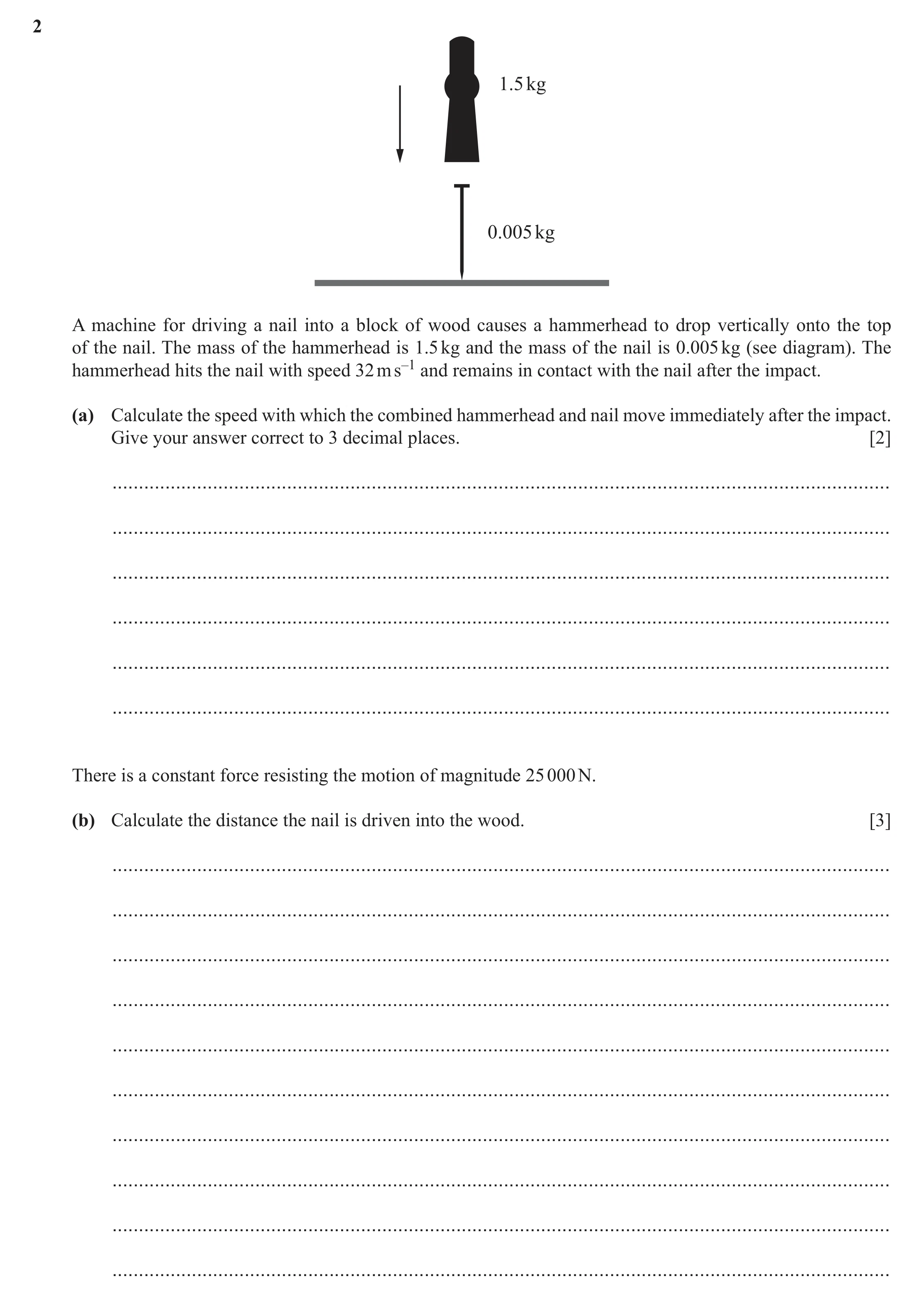
2 1.5 kg 0.005 kg A machine for driving a nail into a block of wood causes a hammerhead to drop vertically onto the top of the nail. The mass of the hammerhead is 1.5 kg and the mass of the nail is 0.005 kg (see diagram). The hammerhead hits the nail with speed 32 m s–1 and remains in contact with the nail after the impact. (a) Calculate the speed with which the combined hammerhead and nail move immediately after the impact. Give your answer correct to 3 decimal places. [2] … … … … … … There is a constant force resisting the motion of magnitude 25 000 N. (b) Calculate the distance the nail is driven into the wood. [3] … … … … … … … … … …
5 marks
Mark scheme: 2(a) 1.5 32 = (1.5 + 0.005 ) v M1 Conservation of momentum. Must have three non-zero terms. Allow sign errors. Must have correct masses with relevant velocities. Note: M1A0 if g included with the masses speed = 31.894 m s-1 Allow ‘31.894 = 31.9’ A1 ISW. Must be given to 3dp as specified in question. 2 2(b) (1.5 + 0.005 ) g − 25000 = (1.5 + 0.005 ) a → a =−16601.29568 *M1 Use of N2L with correct number of relevant terms; allow sign errors, but masses must be added, not subtracted. Mass must be (1.5 + 0.005 ) . 2 DM1 Use of constant acceleration to get an equation in s 0 = ( their 31.894 ) + 2 ( their −16601.29568 ) s using their negative a and their speed (allow rounded to 3sf or better). Must use suvat correctly. s = 0.0306 m A1 0.030636983… Note: answer 0.0306184 from omitting weight terms in N2L giving a = 16611.29.. . This gets M0M0A0. Use of speed = 31.9 gives s = 0.030649 which gets full credit if correctly obtained. Alternative method using energy PE ‒ work done against friction = ( (1.5 + 0.005 ) g − 25000 ) s =24984.95s B1 ( (1.5 + 0.005 ) g − 25000 ) s = − 1 (1.5 + 0.005 ) their 31.894 2 M1 Allowbe correct.sign Correcterrors includingnumber ofin termsPE butandall dimensionallymasses must 2 correct. Using their speed (allow rounded to 3sf or better). s = 0.0306 m A1 0.030636983… 3
This question in 9709/45 May/June 2025
Q32 · Two particles, P and Q, of masses 3 kg and 5 kg respectively, are at rest on a smooth… 9709/41 Oct/Nov 2025
2 Two particles, P and Q, of masses 3 kg and 5 kg respectively, are at rest on a smooth horizontal plane. P is projected at a speed of 4 m s -1 directly towards Q. After P and Q collide, P has speed 1 m s -1. (a) Find the two possible speeds of Q after the collision. [3] … … … … … … … … … … … … It is given that m J of kinetic energy, where m 2 0 , is lost during the collision. (b) Find the value of m. [2] … … … … … … … … … … … …
5 marks
Mark scheme: 2(a) 3 =4 3 −( 1) + 5 v M1 Attempt at conservation of linear momentum; three non-zero terms – allow sign errors. M1 only if using weight rather than mass. or 3 =4 3 +1 5v v = 3 m s−1 A1 v = 1.8 m s−1 A1 If A0 A0 SC B1 for both −3 and −1.8 . 3 2(b) 1 2 1 2 1 2 M1 Attempt at either the total kinetic energy before or KE = 3 4 ( = 24 ) or KE = 3 1 + 5 1.8 ( = 9.6 ) after the collision. 2 2 2 The total KE (before and after) could be embedded in a calculation for the KE loss. 1 2 1 2 M1 be awarded just on sight of 24, 19.6 or 14.4. or KE = 3 1 + 5 3 ( = 24 ) 2 2 = 14.4 ONLY A1 Allow –14.4. Must have discarded = 0 if mentioned. 2
This question in 9709/41 Oct/Nov 2025
Q33 · A particle P of mass 0.1 kg is projected vertically upwards with speed 30 m s -1 from… 9709/42 Oct/Nov 2025
4 A particle P of mass 0.1 kg is projected vertically upwards with speed 30 m s -1 from horizontal ground. At the same instant a particle Q of mass 0.4 kg is projected vertically upwards with speed 10 m s -1 from a height of 15 m above the ground. P and Q move in the same vertical line. (a) Find the height above the ground at which P and Q collide. [4] … … … … … … … … … … … … … … … … … … … … … … … … … When P and Q collide, they coalesce. (b) Find the speed of the combined particle at the instant that it reaches the ground. [5] … … … … … … … … … … … … … … … … … … … … … … … … … …
9 marks
Mark scheme: 4(a) 1 2 *M1 1 2 [Height gained by P ( Ps ) =]30t − gt For use of s = ut + at at least once with a = g and 2 2 1 2 u = 30 or u = 10 . [Height lost by Q = ]10t − gt ( sQ ) Allow this M1 only if using a found value of t . 2 1 2 1 2 DM1 For use of s P = sQ 15 with Ps and s Q of the correct Meet when 30t − gt = 10t − gt + 15 2 2 form which would lead to a linear equation in t (so in 1 2 the expressions for Ps and s Q the signs of the gt 2 terms must be the same). 3 A1 OE. t = or 0.75 CWO. 4 315 A1 Allow 19.7 or better. Height = 19.6875 m or m CWO. 16 DO NOT ISW. 4 4(b) 3 3 *B1FT For either expression for the speed of P or Q before 30 − 10 − = 2.5 v P = g g = 22.5 vQ = 3 4 4 impact FT theirt = and/or FT their height. 4 2 315 OR vP = 30 − 2 g 19.6875 = 22.5 = = 19.6875 . 16 19.6875 − 15 ) = 2.5 vQ = 10 2 − 2 g ( The 2 M marks in 4(a) must have been awarded. 0.1 22.5 + 0.4 2.5 = ( 0.1 + 0.4 ) vPQ DM1 Use of conservation of momentum; correct number of non-zero terms, allow sign errors. 22.5 and 2.5 coming from a correct method. Do not allow with v P = 30 or with vQ = 10. If using mg rather than m , then do not allow subsequent A marks. v PQ = 6.5 A1 SOI, allow to 2sf. v 2 = their 6.5 2 + 2 g their19.6875 DM1 Dependent on previous M1 and B1. Complete method to get an equation in speed or OR 2 (speed)2. 0 = their 6.5 + 2 ( − g ) s =s 2.1125 , May see t = 2.738061302 . height above ground = 2.1125 + 19.6875 = 21.8 hence v 2 = 0 2 + 2 g 21.8 Speed = 20.9 m s-1 or 2 109 m s-1 A1 20.88061303 Use of g in momentum equation can be awarded B1M1A0M1A0, 3 marks max. 5
This question in 9709/42 Oct/Nov 2025
Q34 · Two particles A and B of masses km and m respectively, where k and m are constants, are… 9709/45 Oct/Nov 2025
6 Two particles A and B of masses km and m respectively, where k and m are constants, are free to move in a straight line on a smooth horizontal plane. Particle A is projected towards B with speed 2u and at the same instant B is projected towards A with speed u. The particles collide. After the collision the speed of A is u and both particles move in the same direction as A’s original motion. It is given that 35% of the total kinetic energy is lost in the collision. Find, in terms of u, the speed of B after the collision. [8] … … … … … … … … … … … … … … … … … … … … … … … … … … … … … … … … … … … … … … … … … … … … … … … … … …
8 marks
Mark scheme: 6 km 2u − m u = km u + m vB *M1 Attempt at CLM; correct number of terms and correct masses with relevant velocities but allow sign errors. v B is the speed of B after impact. If g included with the masses then M1A0. vB + u vB A1 Any correct equation linking v B , k and u but with m v B = ( k − )1 u or ku = vB + u or k = or k = + 1 u u eliminated. 1 2 1 2 2 1 2 *B1 KE before impact. 2 kmu + mu KEbefore = km ( 2u ) + m ( u ) = 2 2 2 1 2 1 2 *B1FT KE after impact. KEafter = km u + mvB Allow if their expression for v B is wrong. 2 2 1 2 1 2 2 Or KEafter = km u + mu ( k − 1) Allow B1B1 for the change in KE = 2 2 3 2 1 2 1 2 kmu + mu − mv B 2 2 2 2 1 2 1 2 2 *DM1 Setting up the equation 0.65 KEbefore = KE after OE k + ( k − 1) 0.65 2 kmu + mu = mu ( ) 2 2 with their expression for v B in terms of k substituted. 2 1 2 1 2 2 2 1 2 Must be correct way around and must use 0.65 OE. 2 kmu + − mu 2 kmu + k + ( k − 1) Or mu = 0.35 mu ( ) 2 2 2 Dependent on M1B1B1. 2 2 1 2 2 Or 0.8ku + 0.325u = ( k − 1) u May see 1.6 ku 2 + 0.65u 2 = v B2 leading to 2 1.6ku 2 + 0.65u 2 = ( k − 1) 2 u 2 . 2.6k + 0.65 = k + k 2 − 2k + 1 k 2 − 3.6k + 0.35 = 0 DM1 Re-arrange to a 3-term quadratic in k only – 2 Dependent on M1B1B1M1. or 20k − 72k + 7 = 0 6 k = 3.5 only A1 If k = 0.1 seen must be rejected. Reason not required but if a reason given it must be valid e.g. as k – 1 > 0 or reject later e.g. if k = 0.1 vB = −0.9u but not possible as vB 0 . vB = 2.5u A1 Not dependent on previous A mark. If g included in momentum equation then max M1A0B1B1M1M1A1A0. Ignore the other solution if shown ( vB = −0.9u ) ALTERNATIVE (eliminating k) km 2u − m u = km u + m vB *M1 Attempt at CLM; correct number of terms and correct masses with relevant velocities but allow sign errors - v B is the speed of B after impact. If g included with the masses then M1A0. vB + u vB A1 Any correct equation linking v B , k and u but with m v B = ( k − )1 u or ku = vB + u or k = or k = + 1 u u eliminated. 1 2 1 2 2 1 2 *B1FT KE before impact. 2 kmu + mu KEbefore = km ( 2u ) + m ( u ) = Allow if their expression for k is wrong. 2 2 2 1 v B + u 2 1 2 2u ) + mu Or KEbefore = m ( 2 u 2 1 2 1 2 *B1FT KE after impact. KEafter = km u + mvB Allow if their expression for k is wrong. 2 2 1 v B + u 2 1 2 or KEafter = m u + mv B Allow B1B1 for the change in KE 2 u 2 3 2 1 2 1 2 kmu + mu − mv B . 2 2 2 6 1 vB + u 2 1 2 1 vB + u 2 1 2 *DM1 Setting up the equation 0.65 KEbefore = KE after . m u + mvB or 0.65 m ( 2u ) + mu = 2 u 2 2 u 2 OE with expression for k in terms of v B substituted. 1 v B + u 2 1 2 1 v B + u 2 1 2 Must be correct way around and must use 0.65 OE. m ( 2u ) + mu − m u + mv B = Dependent on M1B1B1. 2 u 2 2 u 2 1 1 v B + u May see 1.6 ku 2 + 0.65u 2 = v B 2 oe leading to 0.35 mu 2 2u ) 2 + m ( 2 u 2 v B + u 2 2 2 u + 0.65u = v B . 1.6 1 1 1 u or 0.65 mu 2 mu ( v B + u ) + mv B 2 2 mu ( v B + u ) + = 2 2 2 1.3uv B + 1.625u 2 = 0.5u 2 + 0.5uv B + 0.5v B 2 DM1 Re-arrange to a 3-term quadratic in terms of v B and u 2 2 only. v B − 1.6uv B − 2.25u = 0 Dependent on M1B1B1M1. 20v B 2 − 32uv B − 45u 2 = 0 v B −0.9u A1 Explicitly seen and rejected. vB = 2.5u A1 Not dependent on previous A mark. If g included in momentum equation, then max Ignore the other solution if shown ( vB = −0.9u ) M1A0B1B1M1M1A1A0. 8
This question in 9709/45 Oct/Nov 2025
 7 / 49
 8 / 49
 9 / 49
 10 / 49
 11 / 49
 12 / 49
 13 / 49
 14 / 49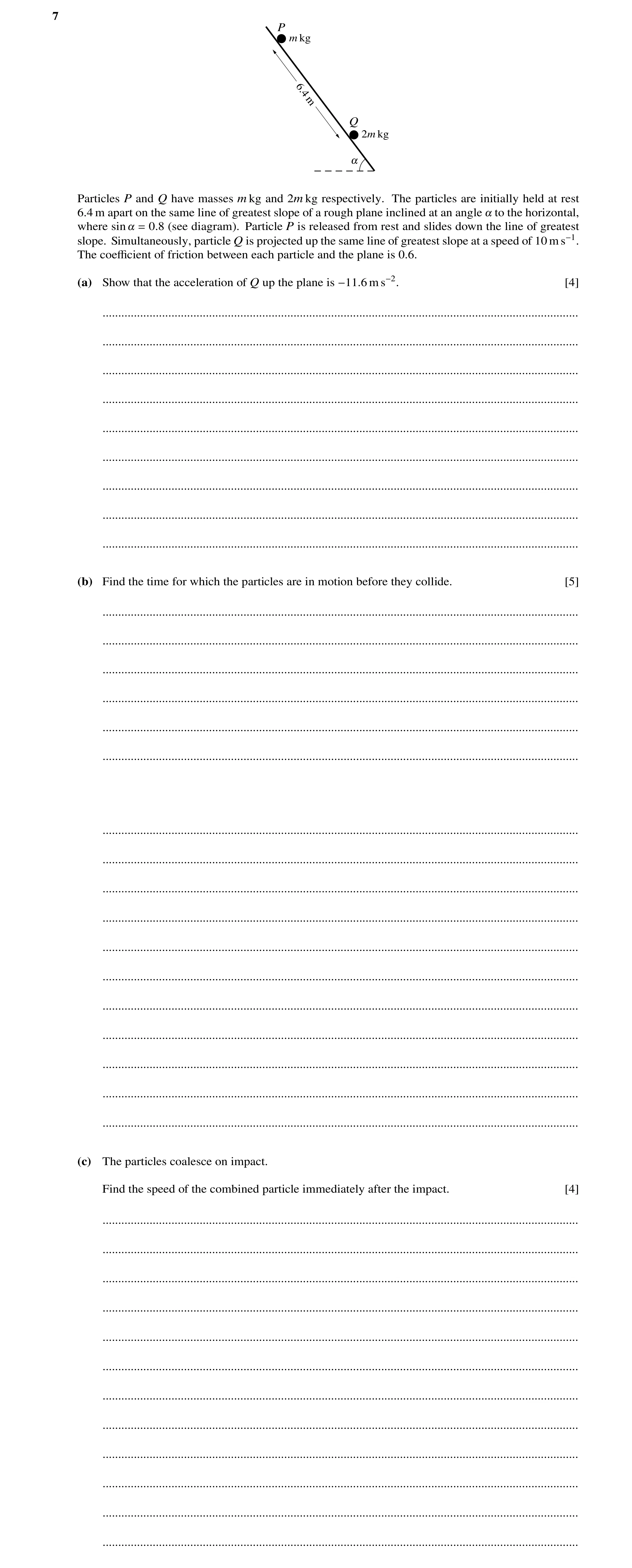
 19 / 49
 20 / 49
 21 / 49
 27 / 49
 28 / 49
 29 / 49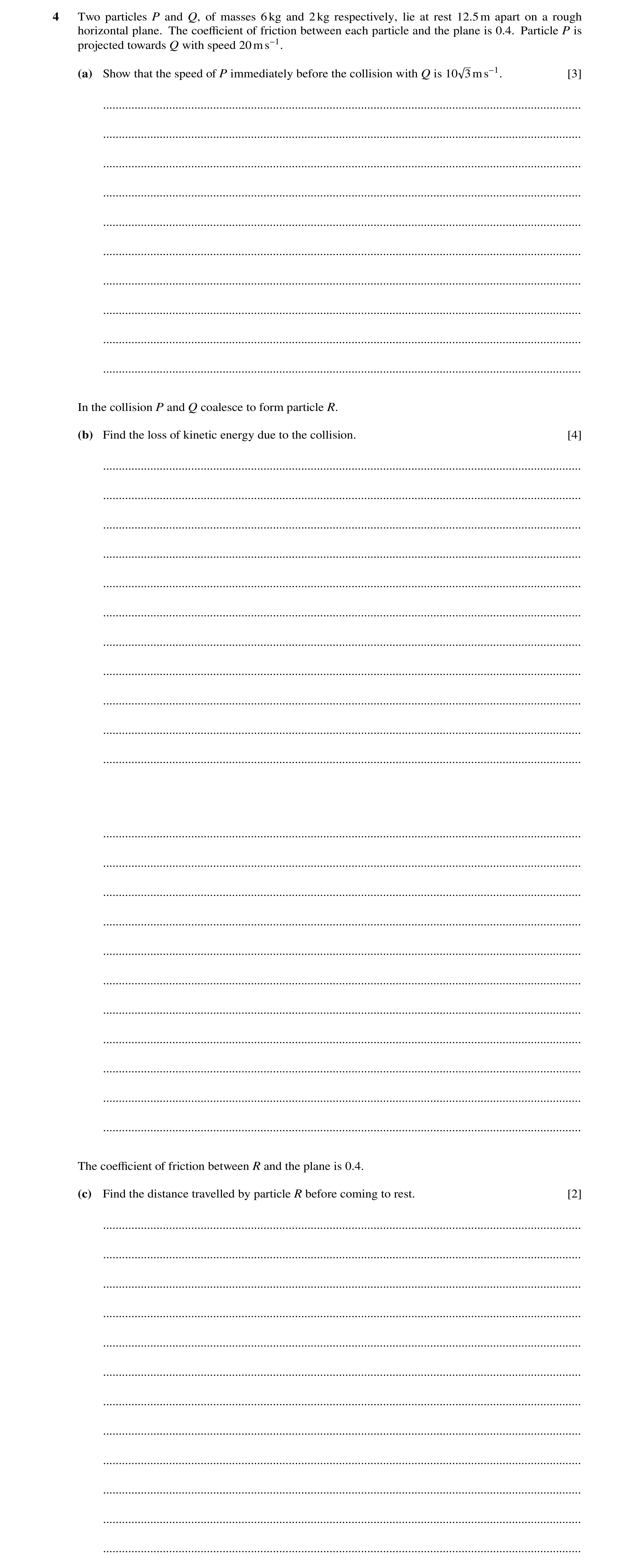
 38 / 49
 39 / 49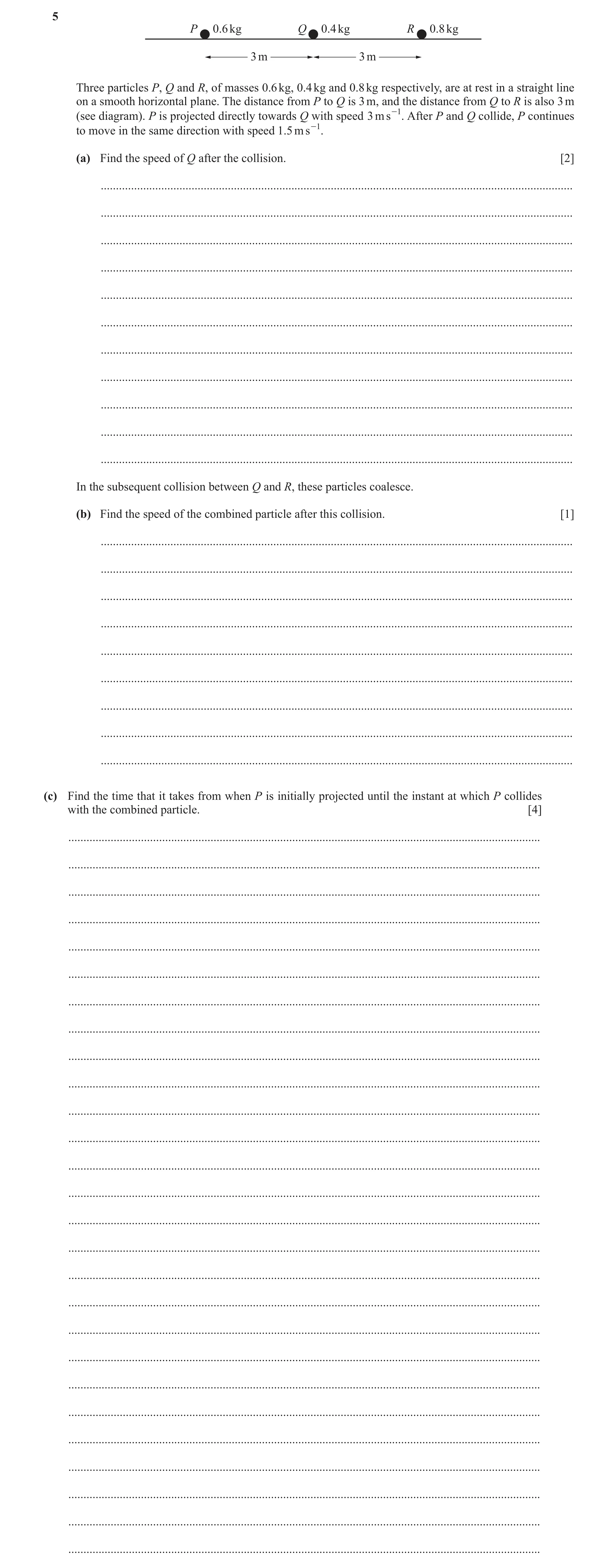
 42 / 49
 43 / 49
 44 / 49
 45 / 49
 9
9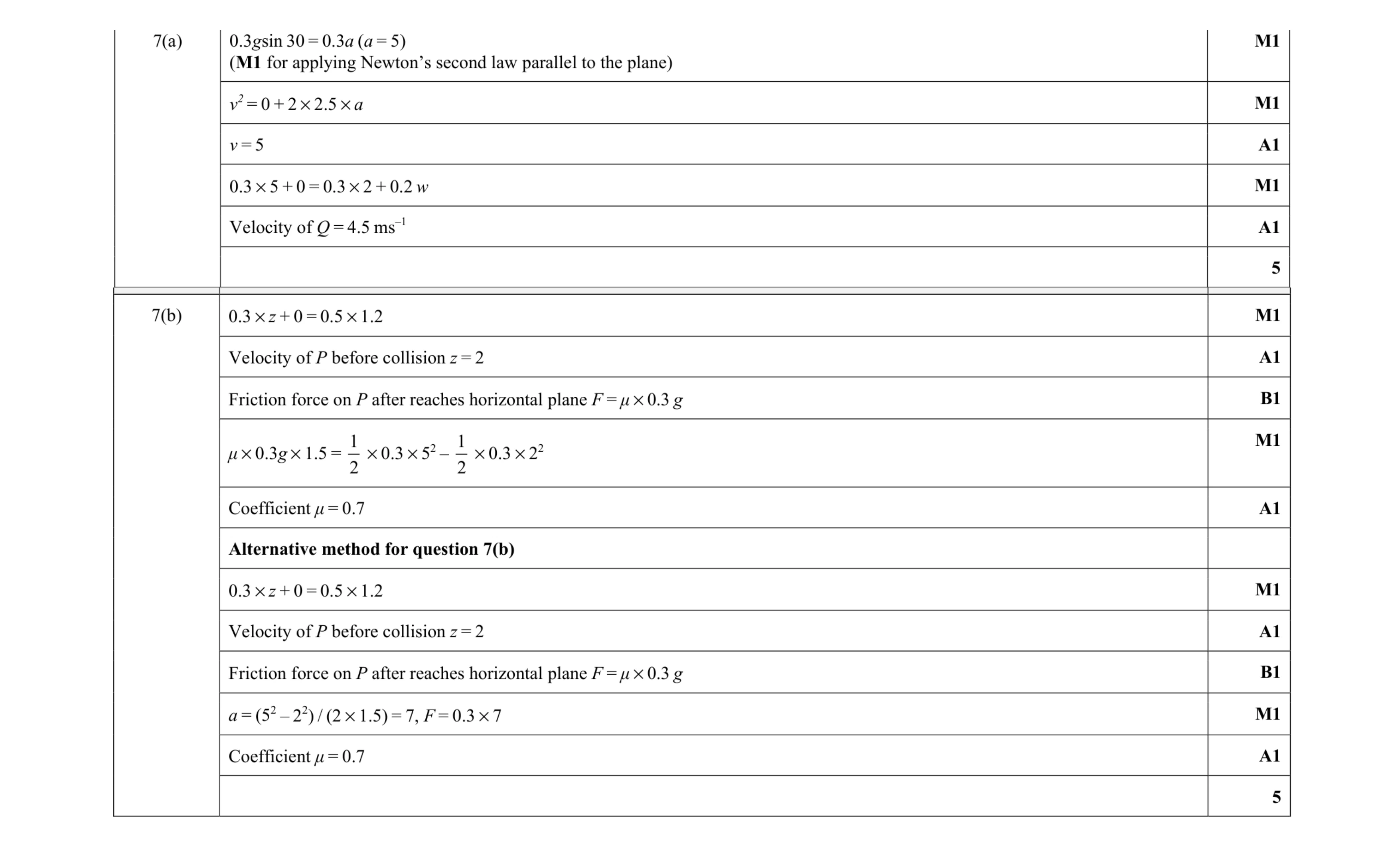 10
10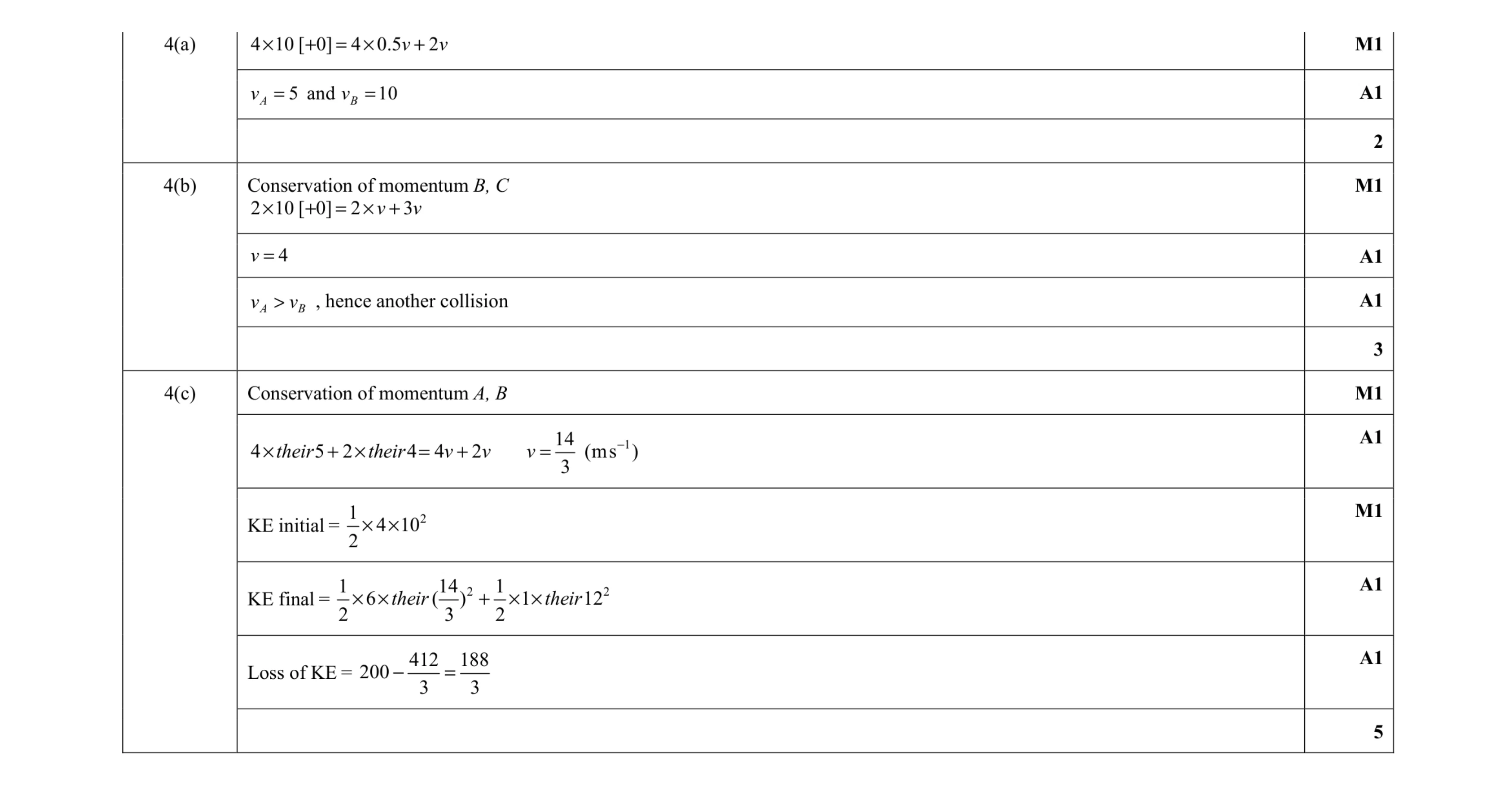 10
10 3
3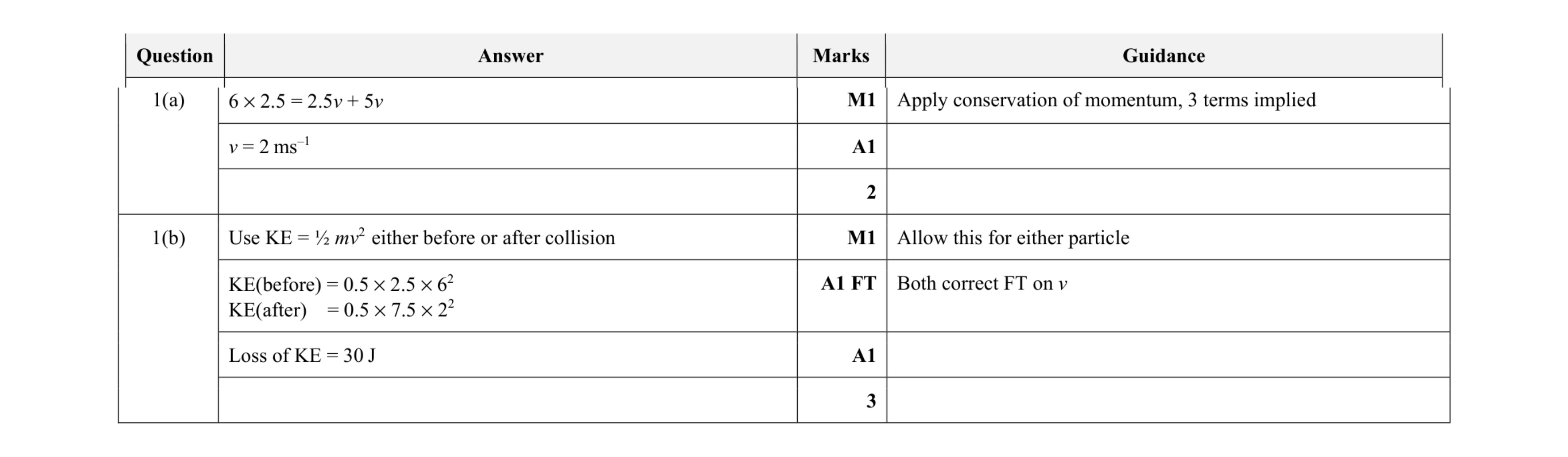 5
5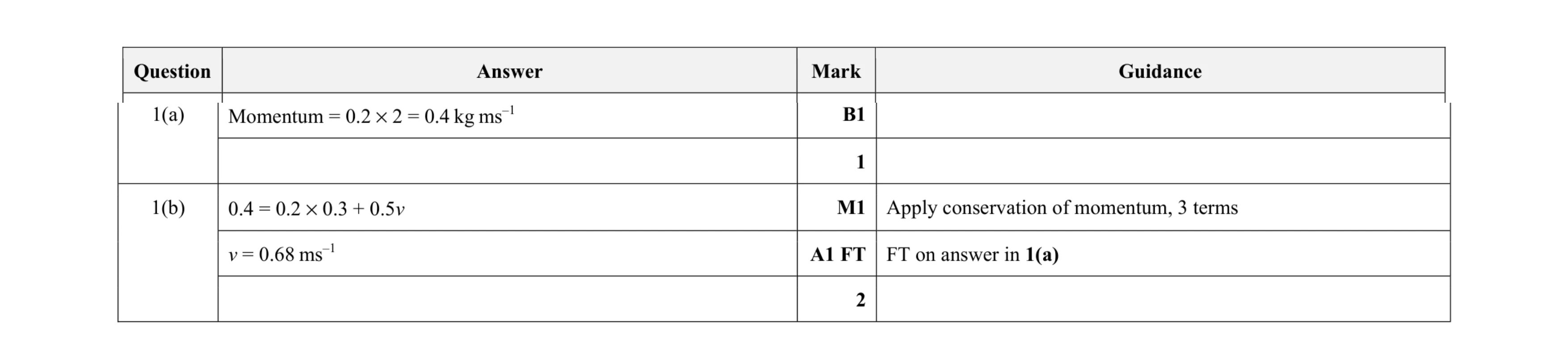 3
3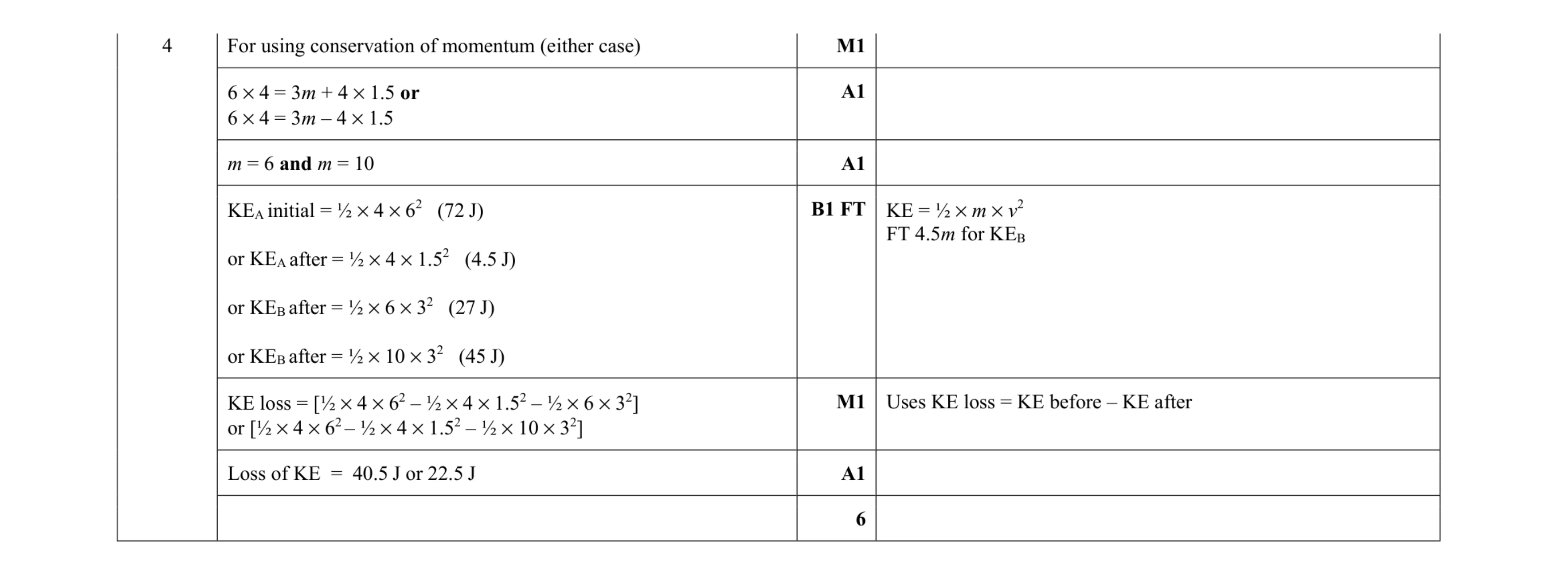 6
6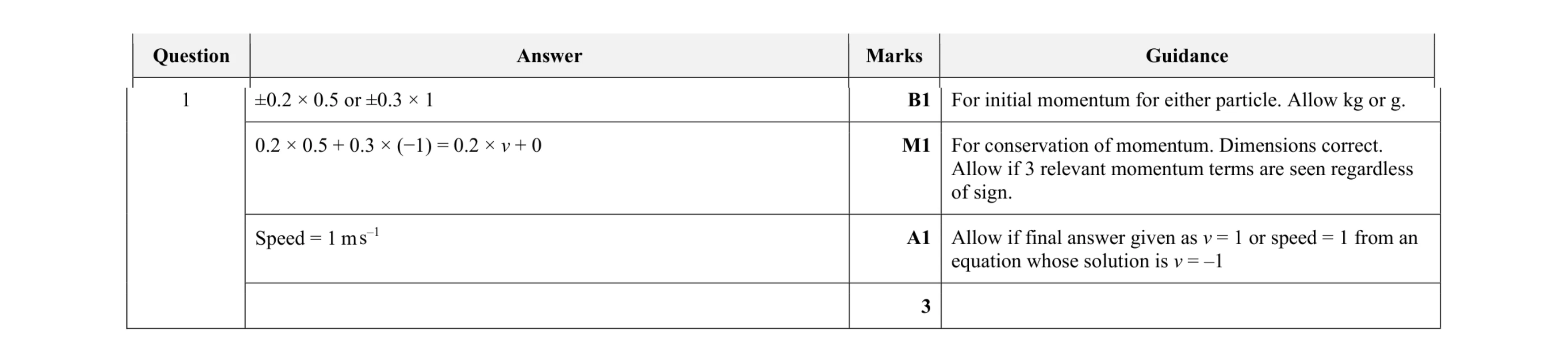 3
3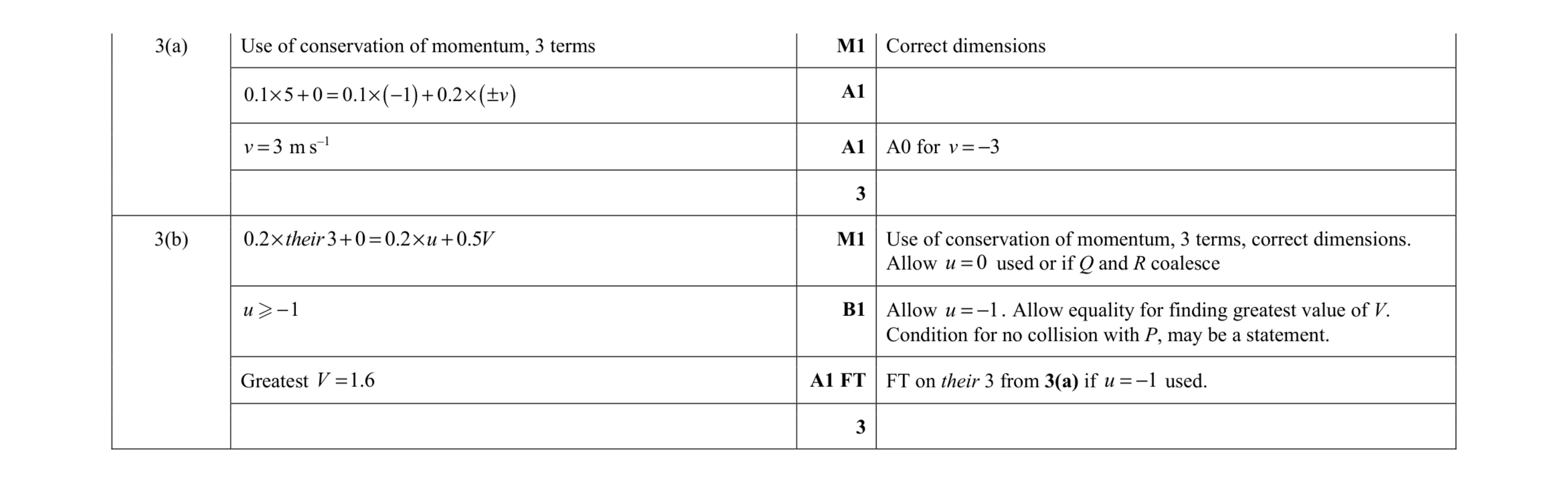 6
6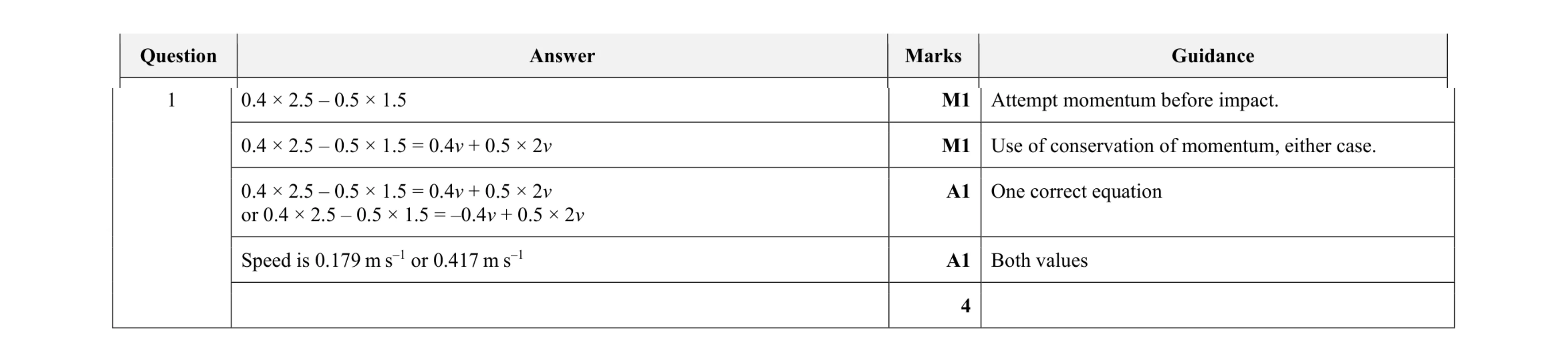 4
4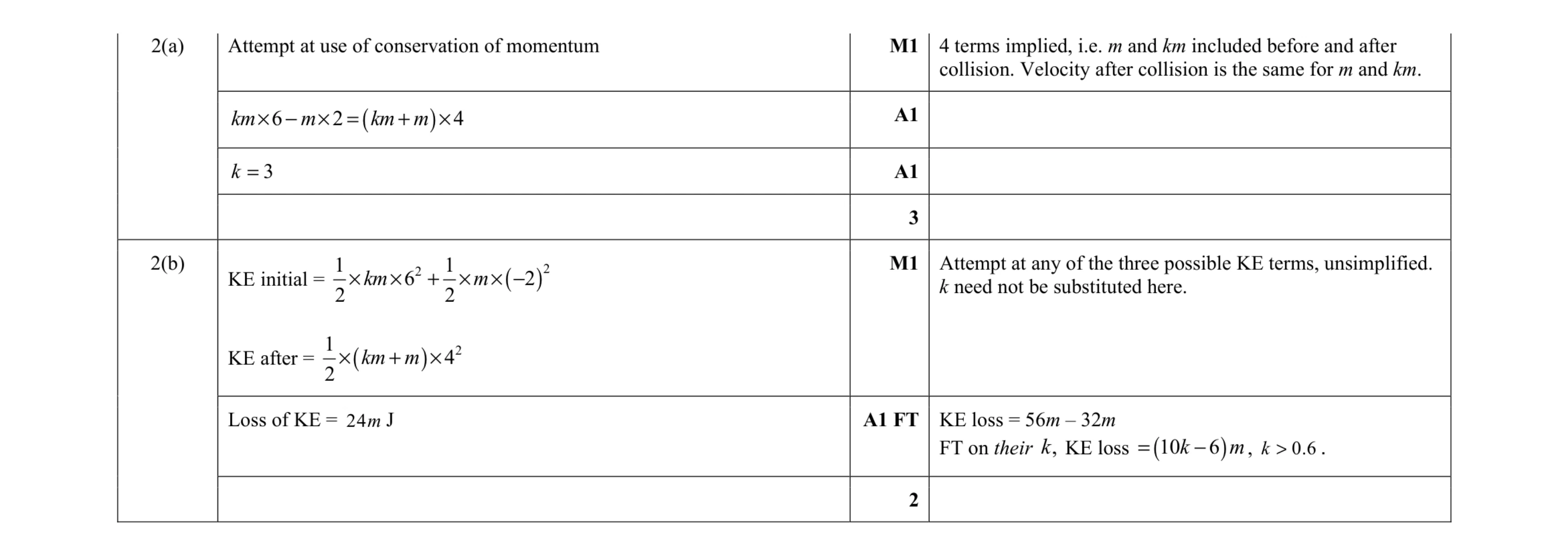 5
5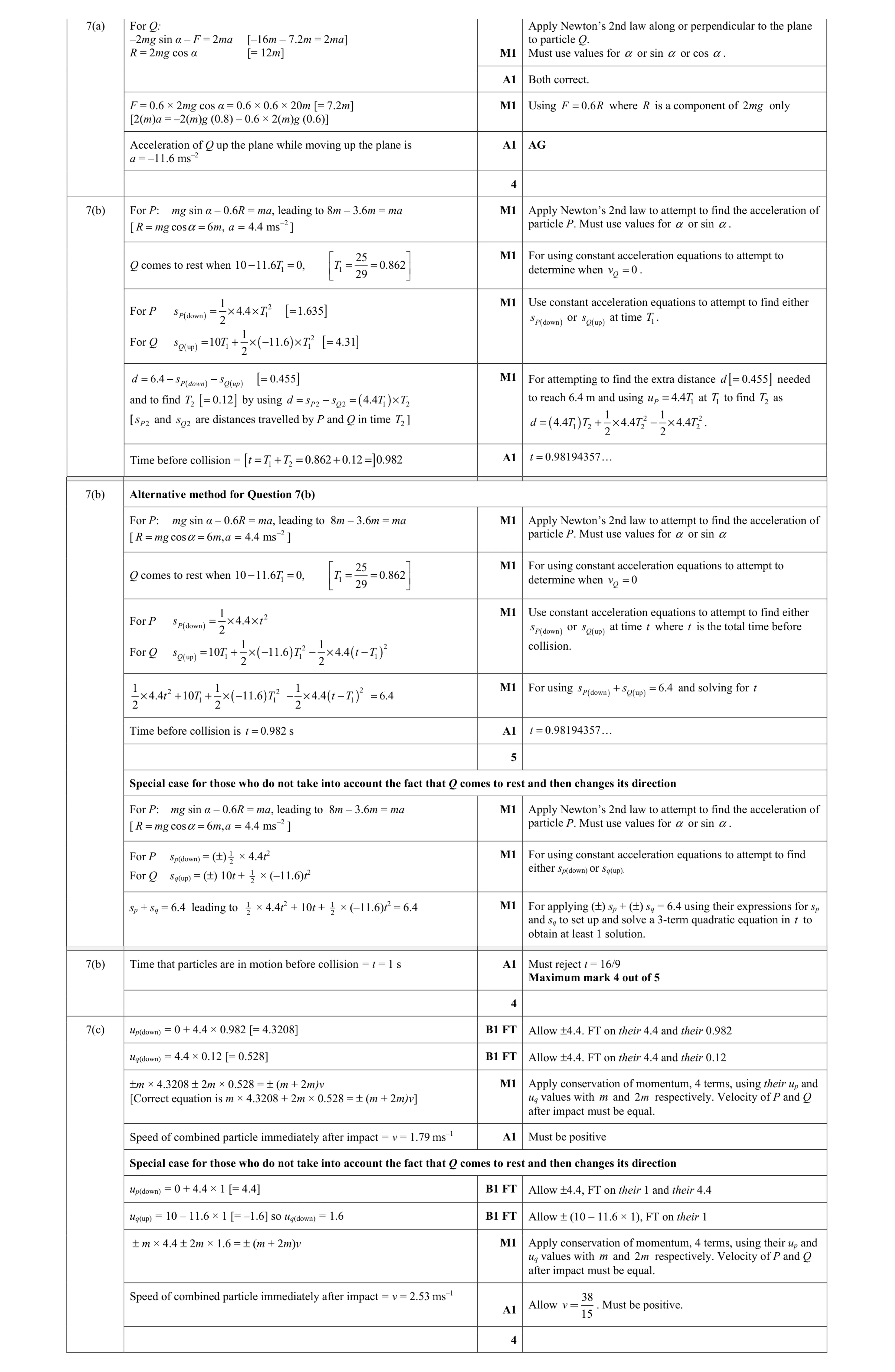 13
13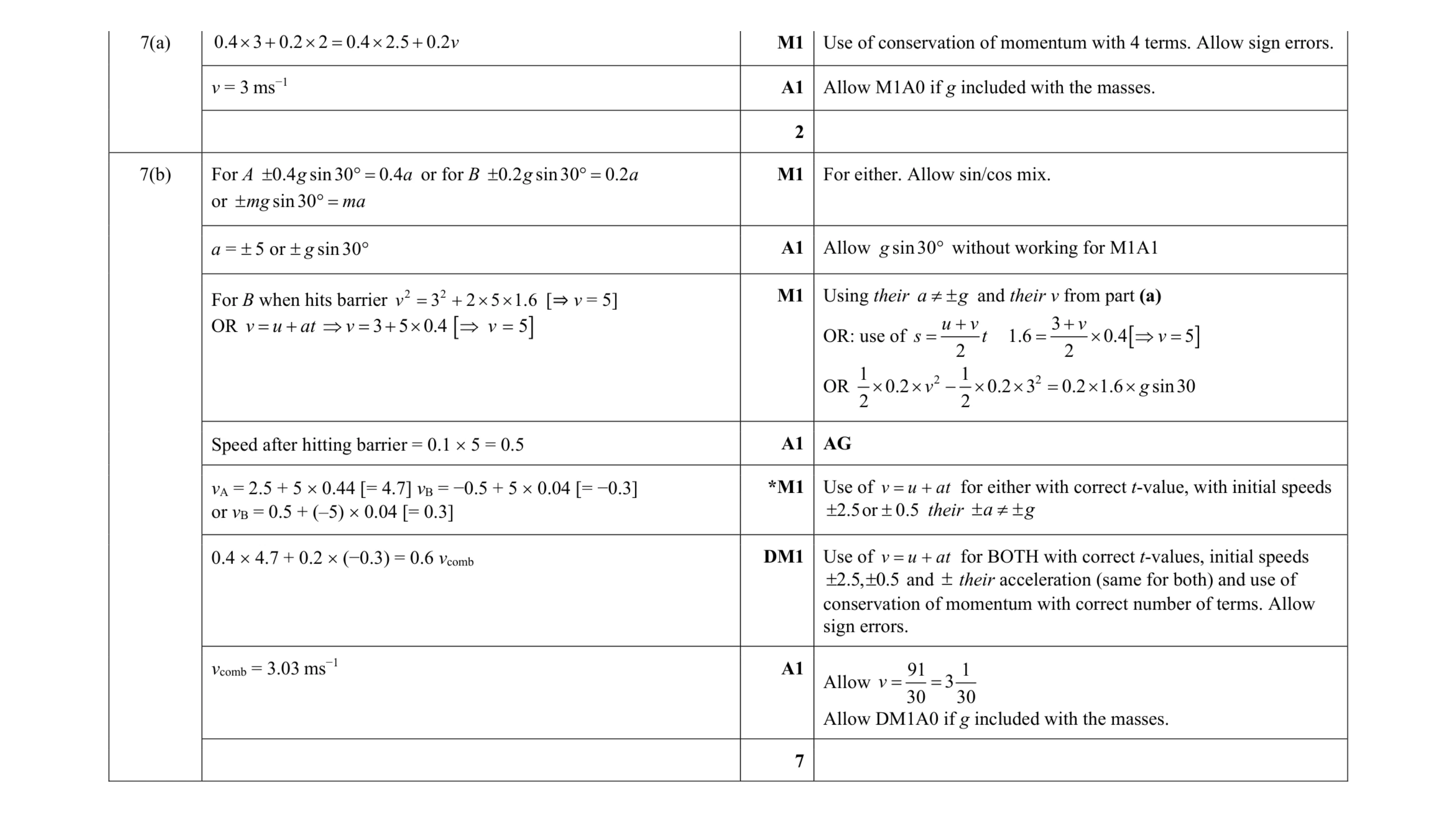 9
9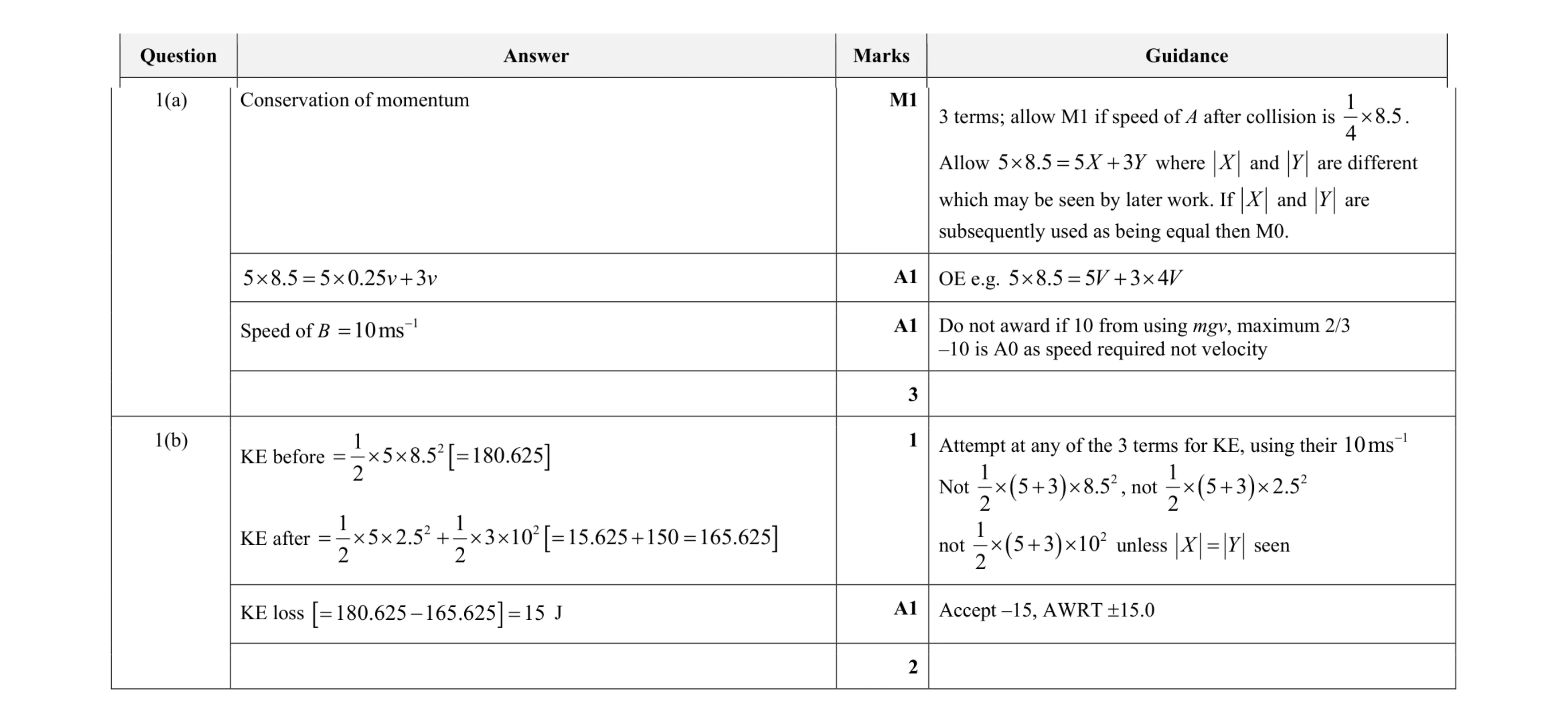 5
5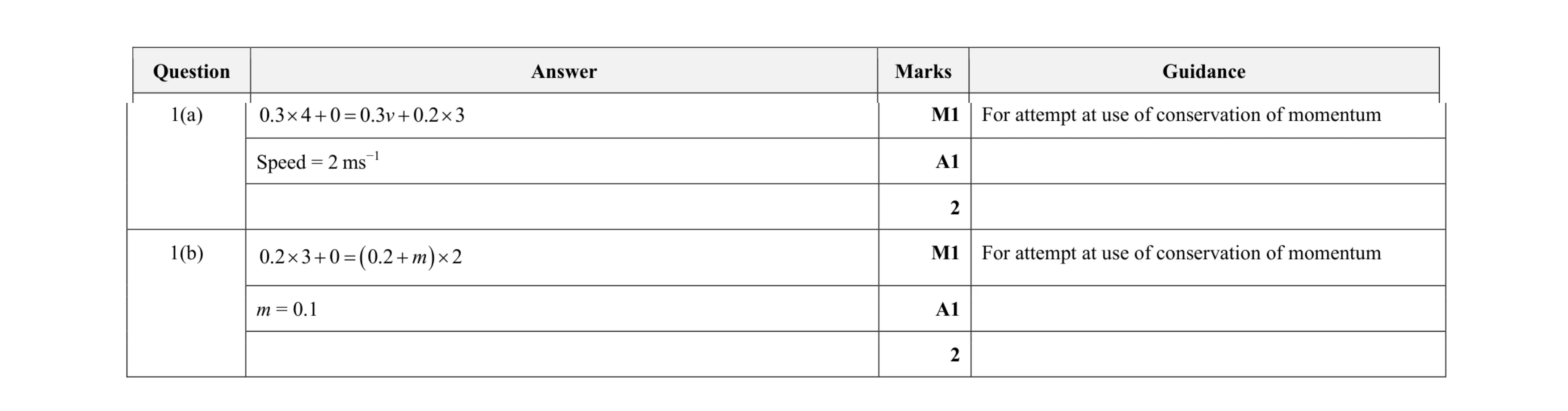 4
4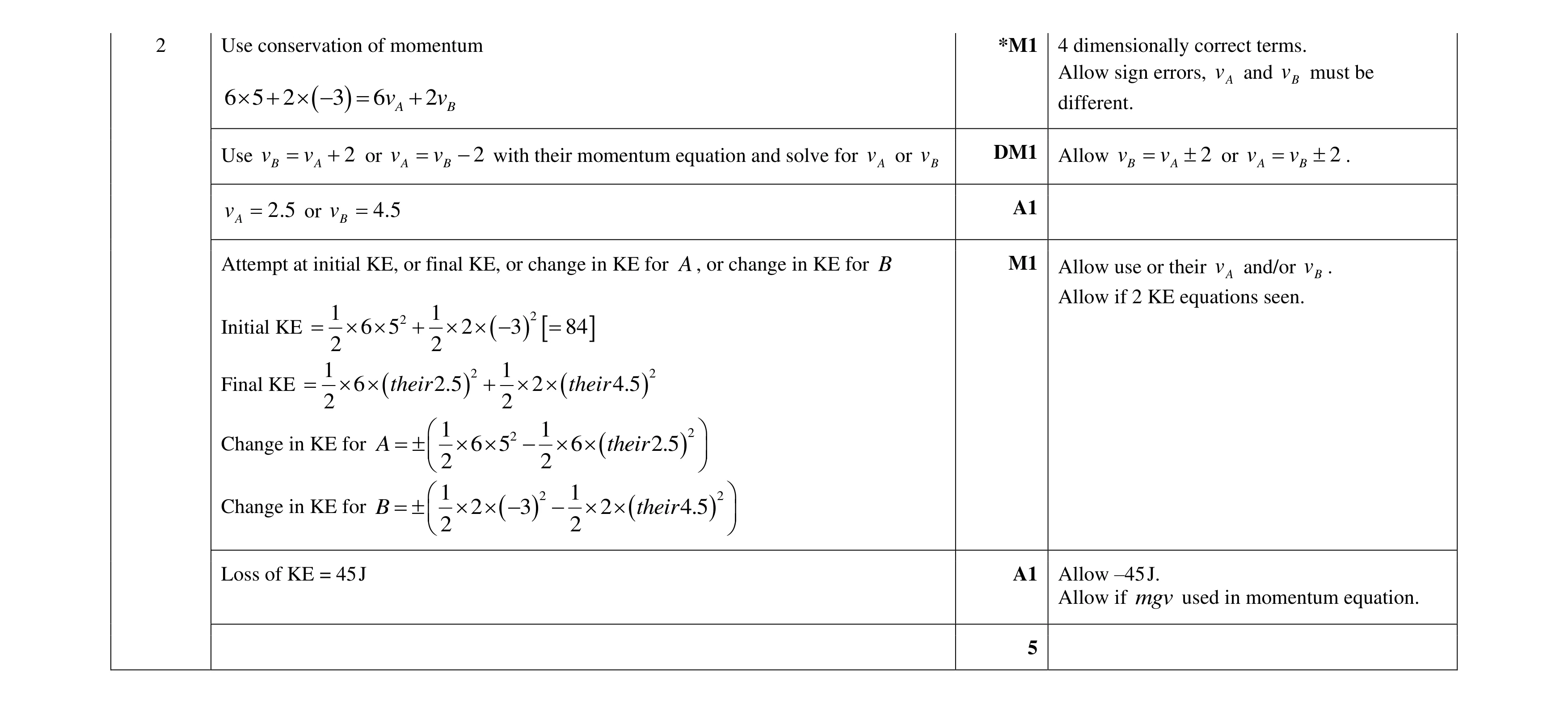 5
5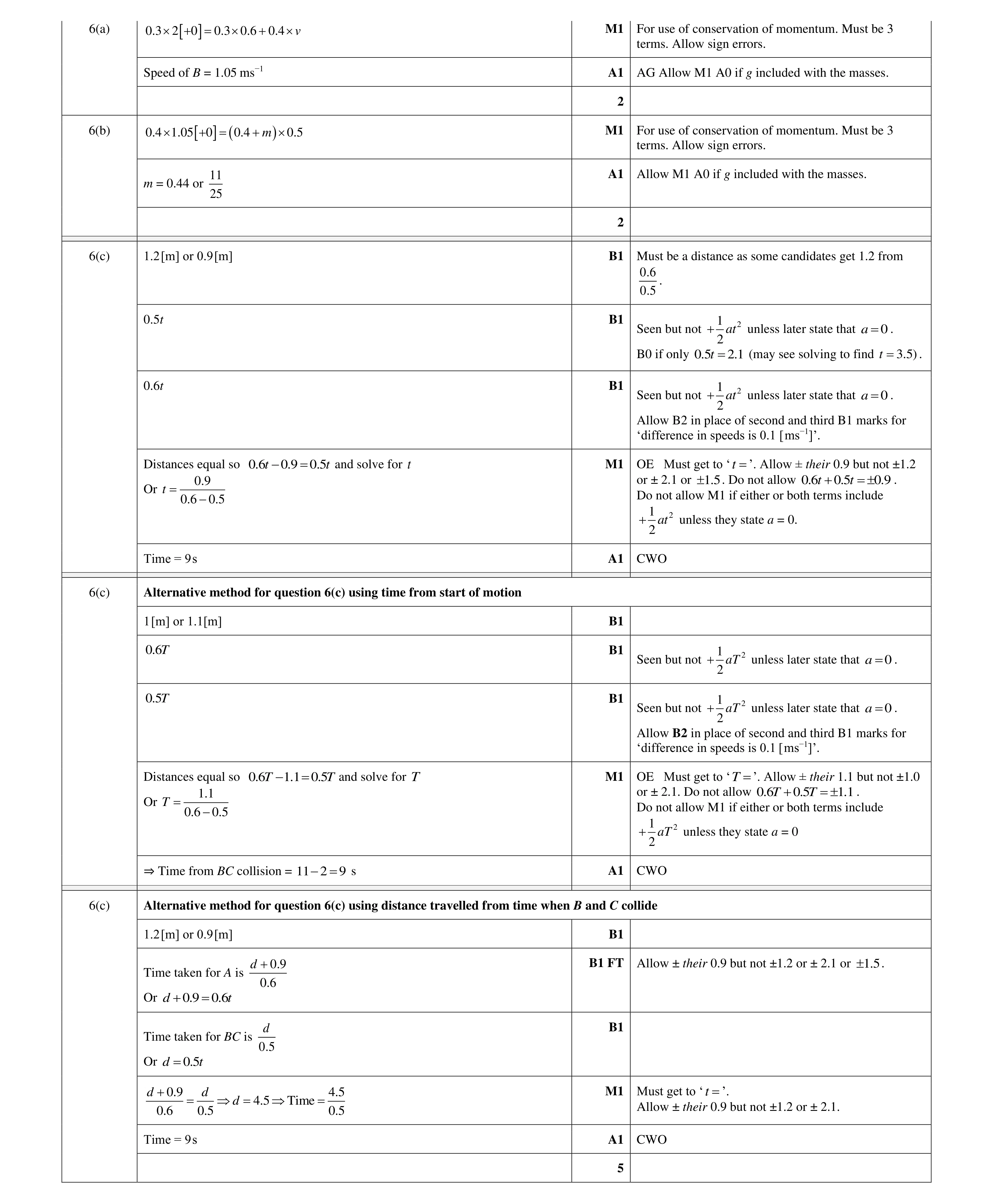 9
9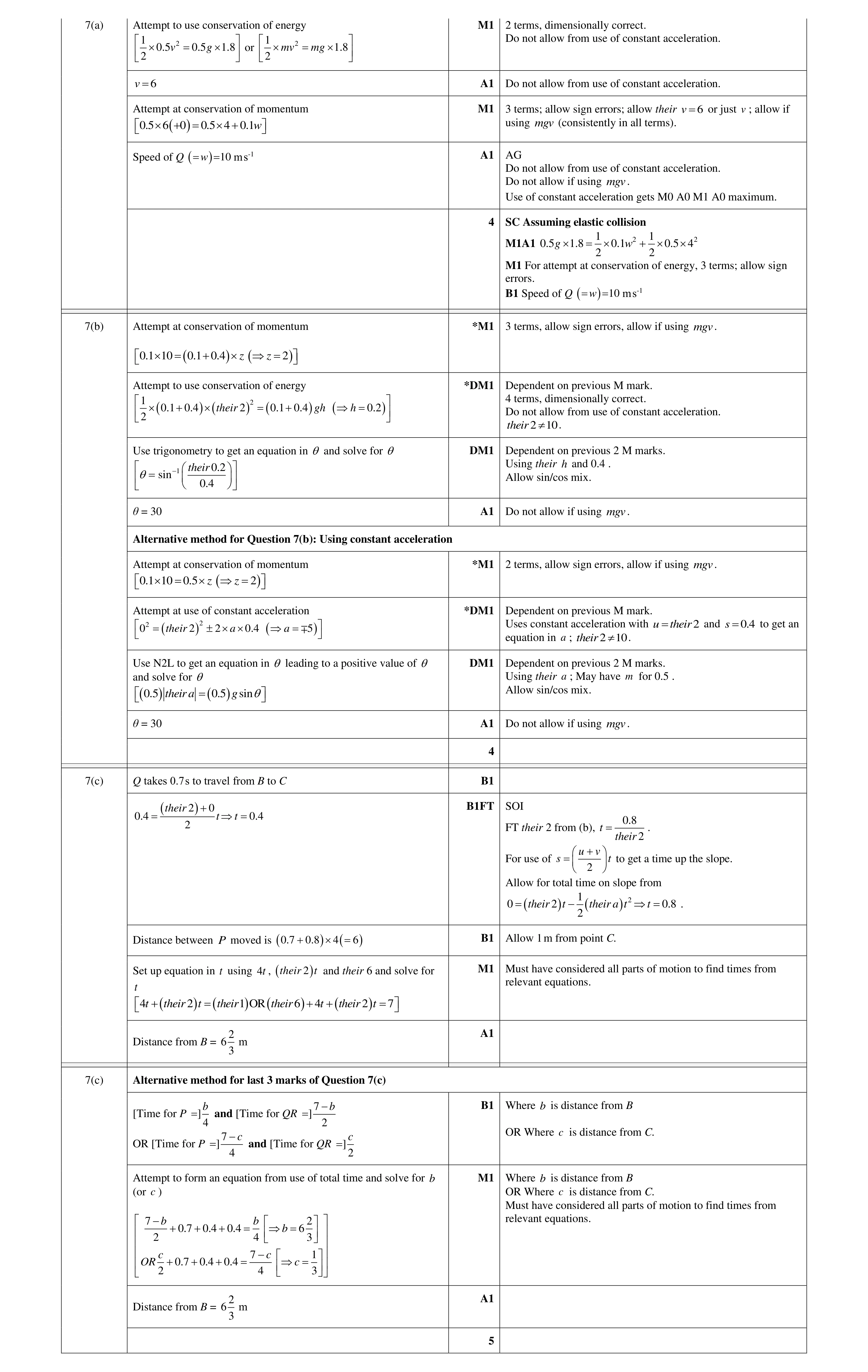 13
13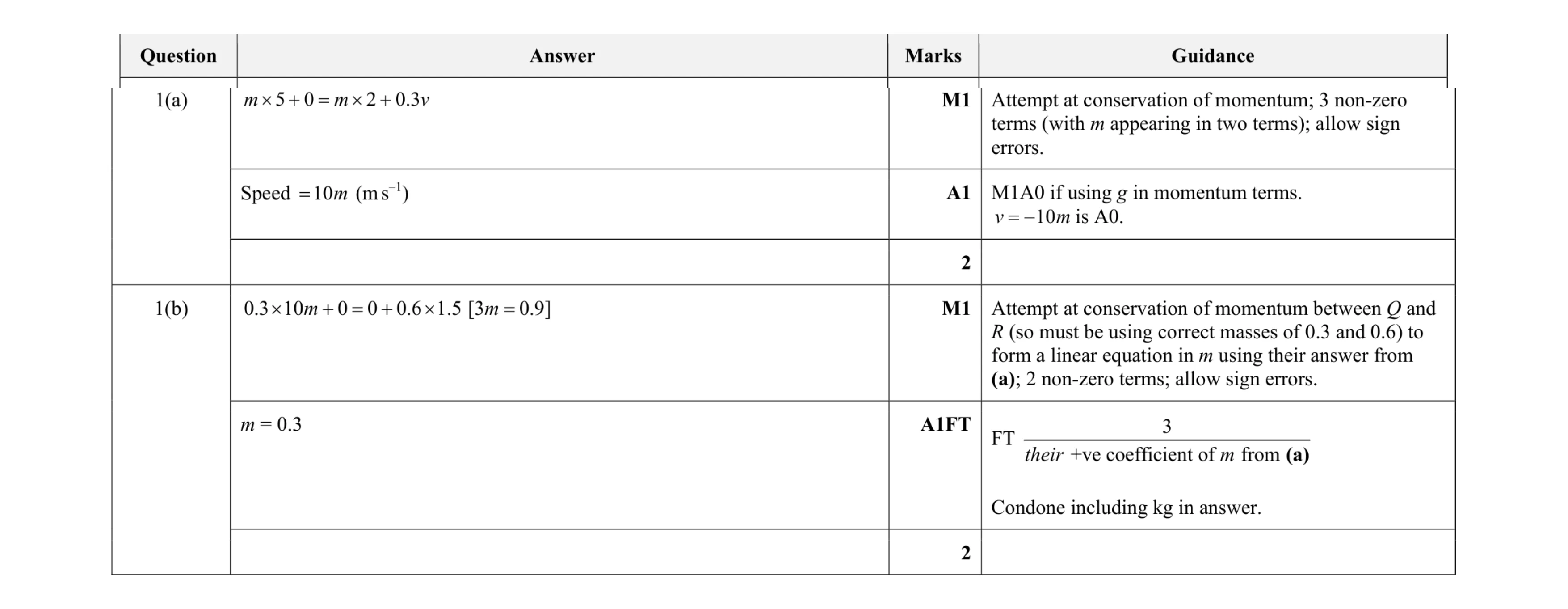 4
4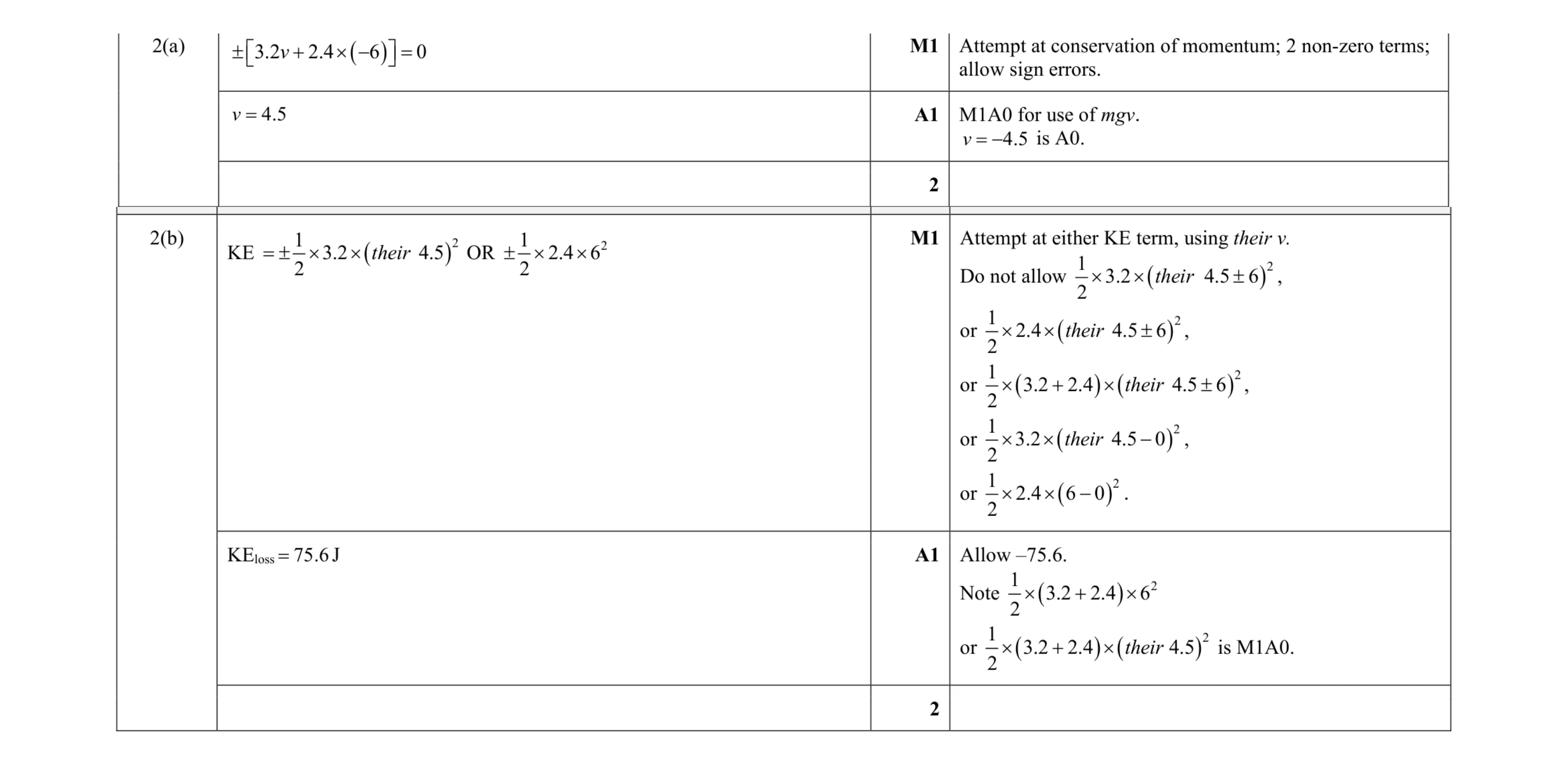 4
4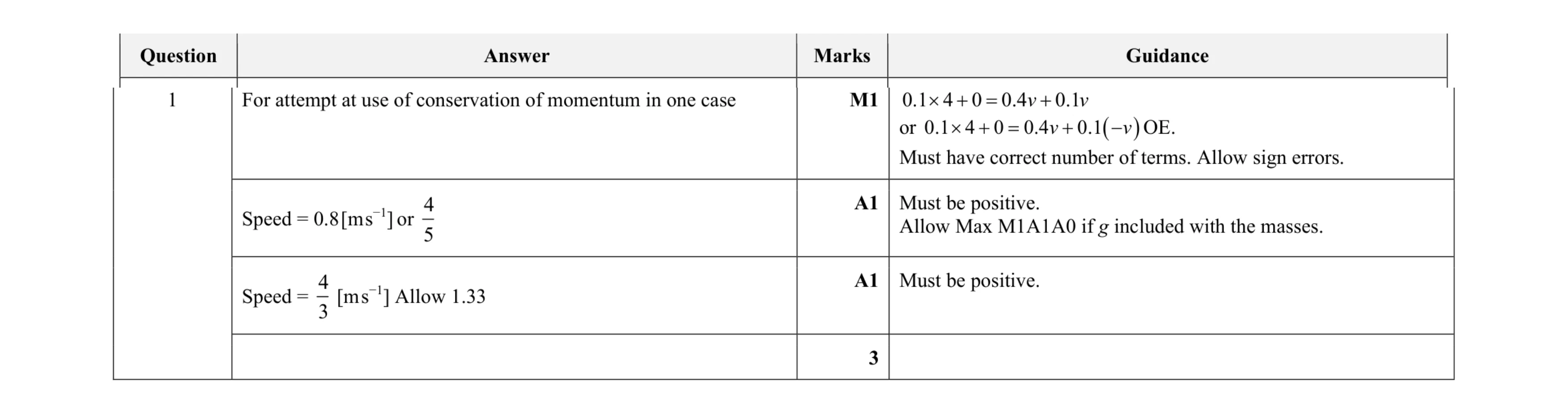 3
3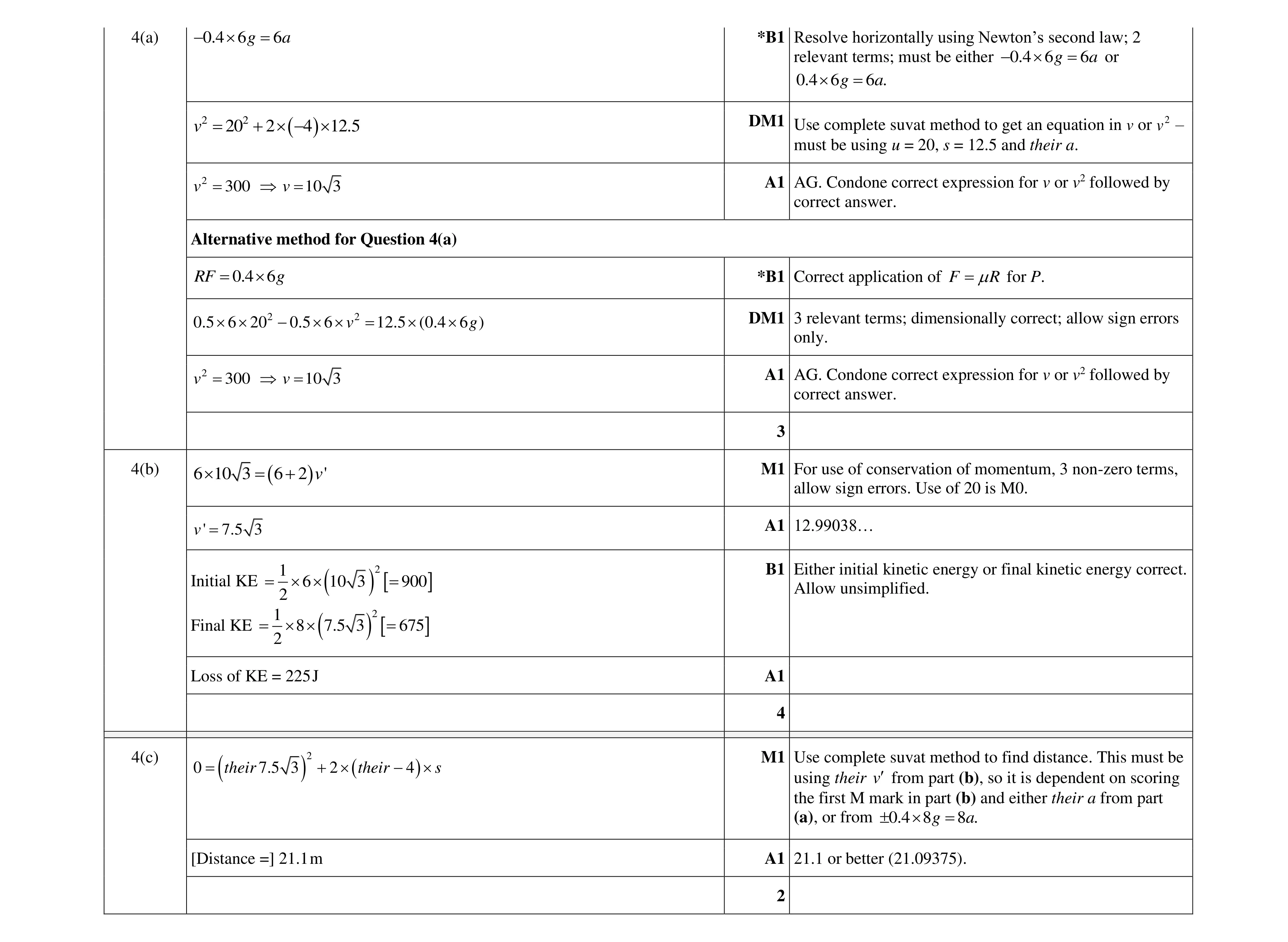 9
9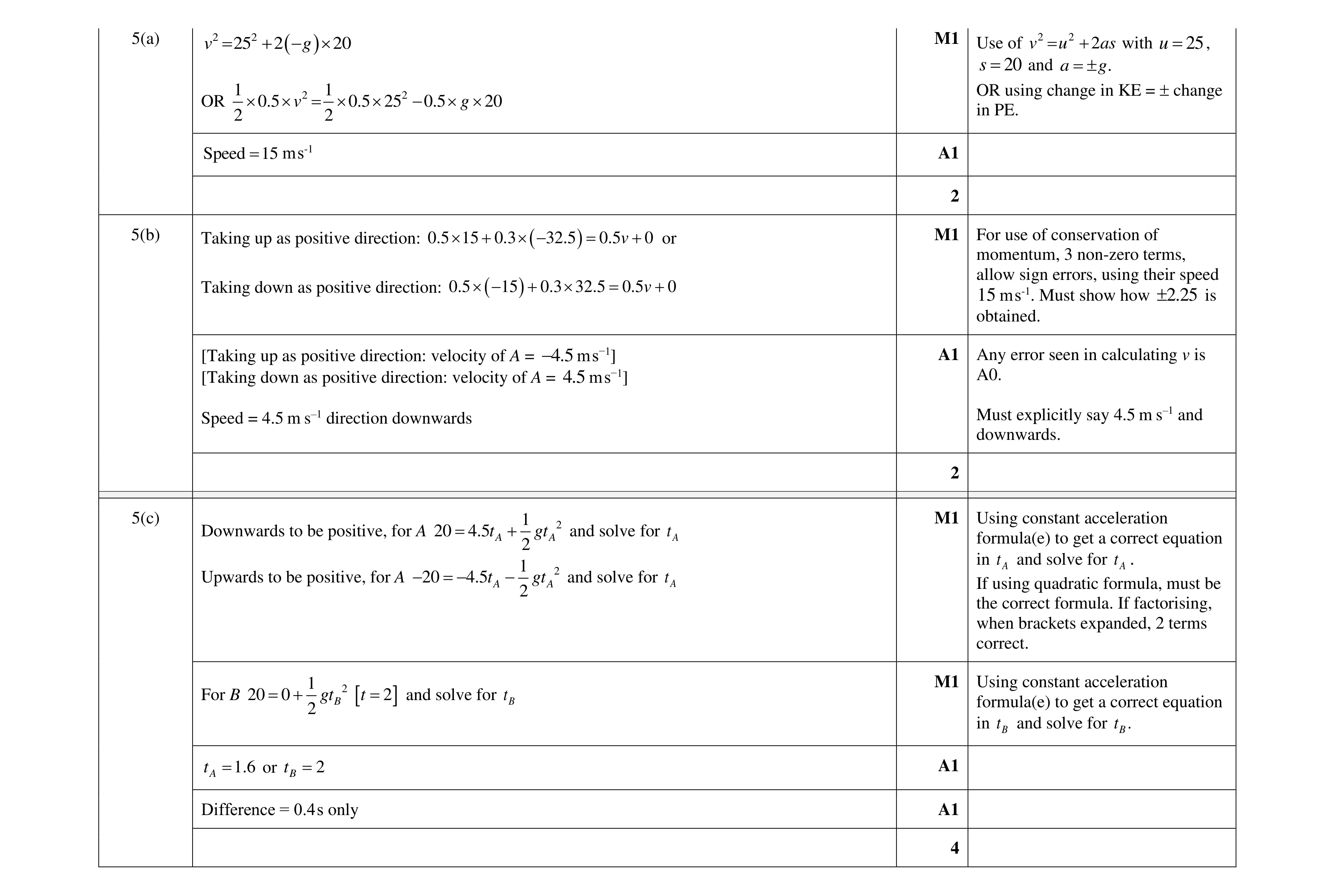 8
8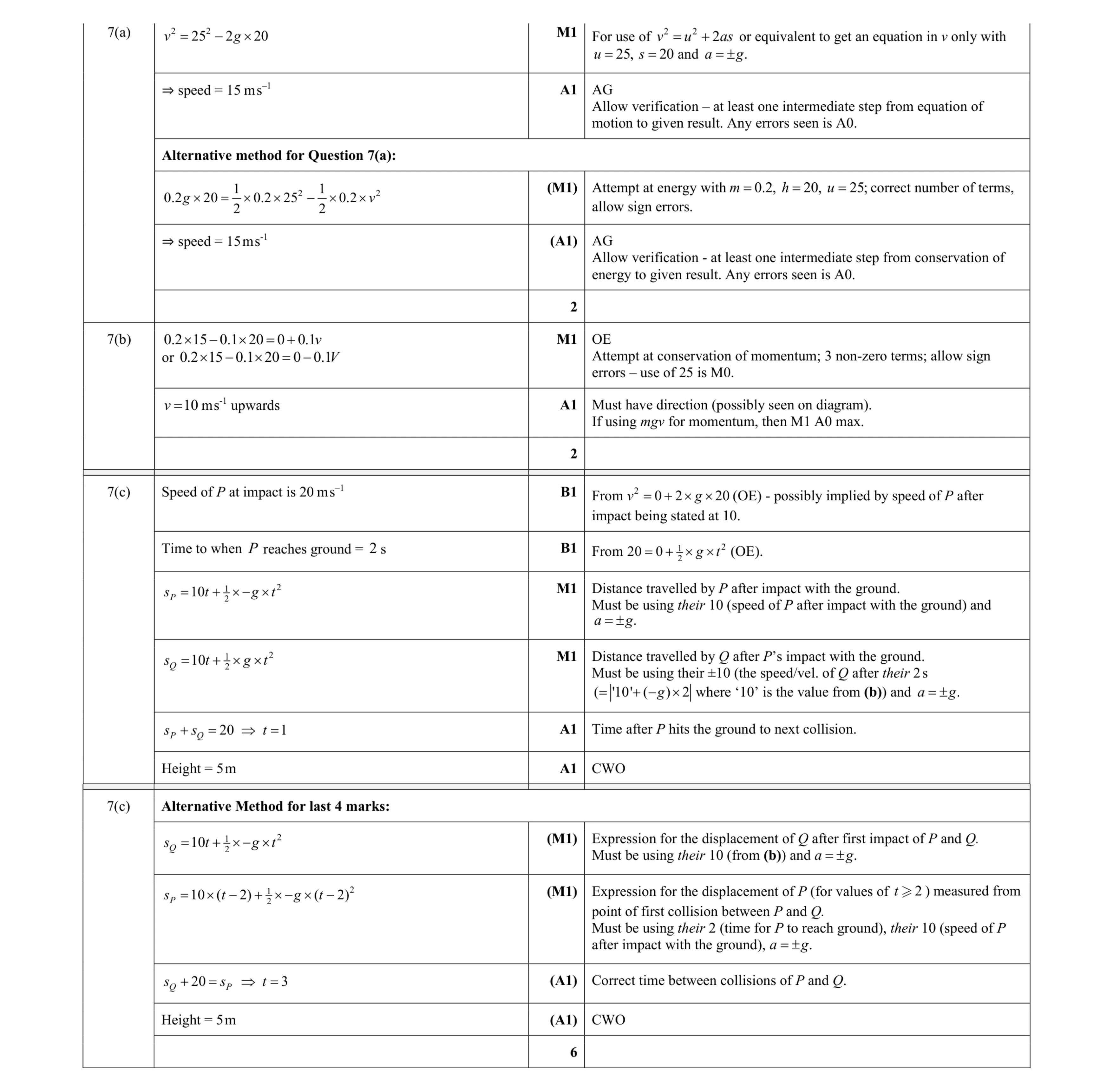 10
10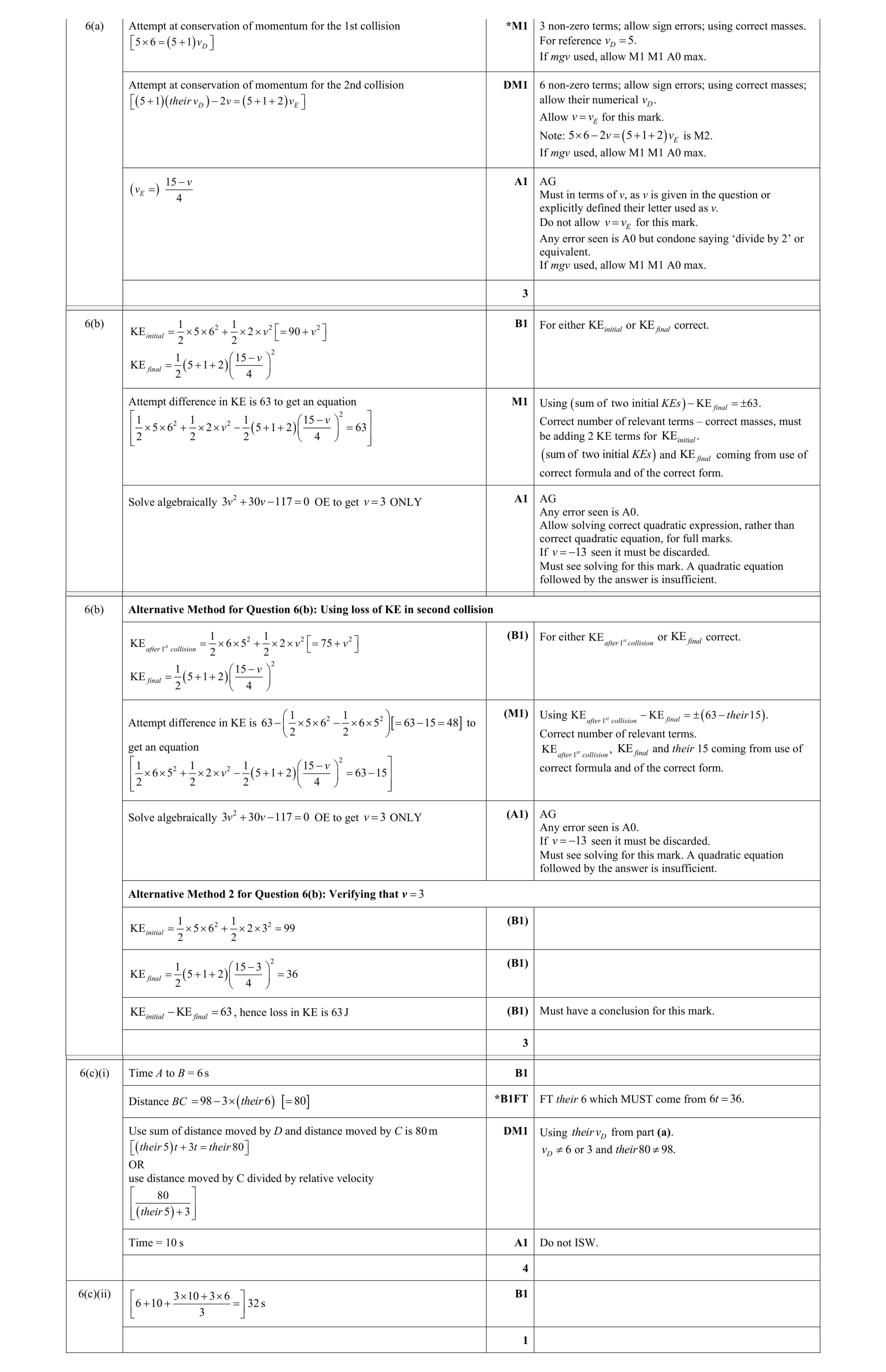 11
11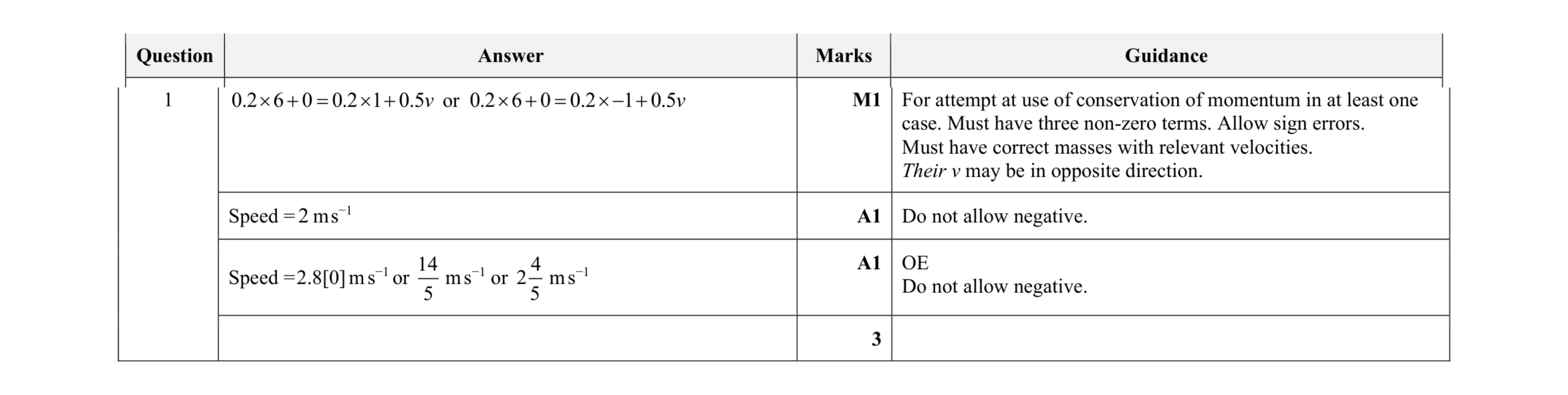 3
3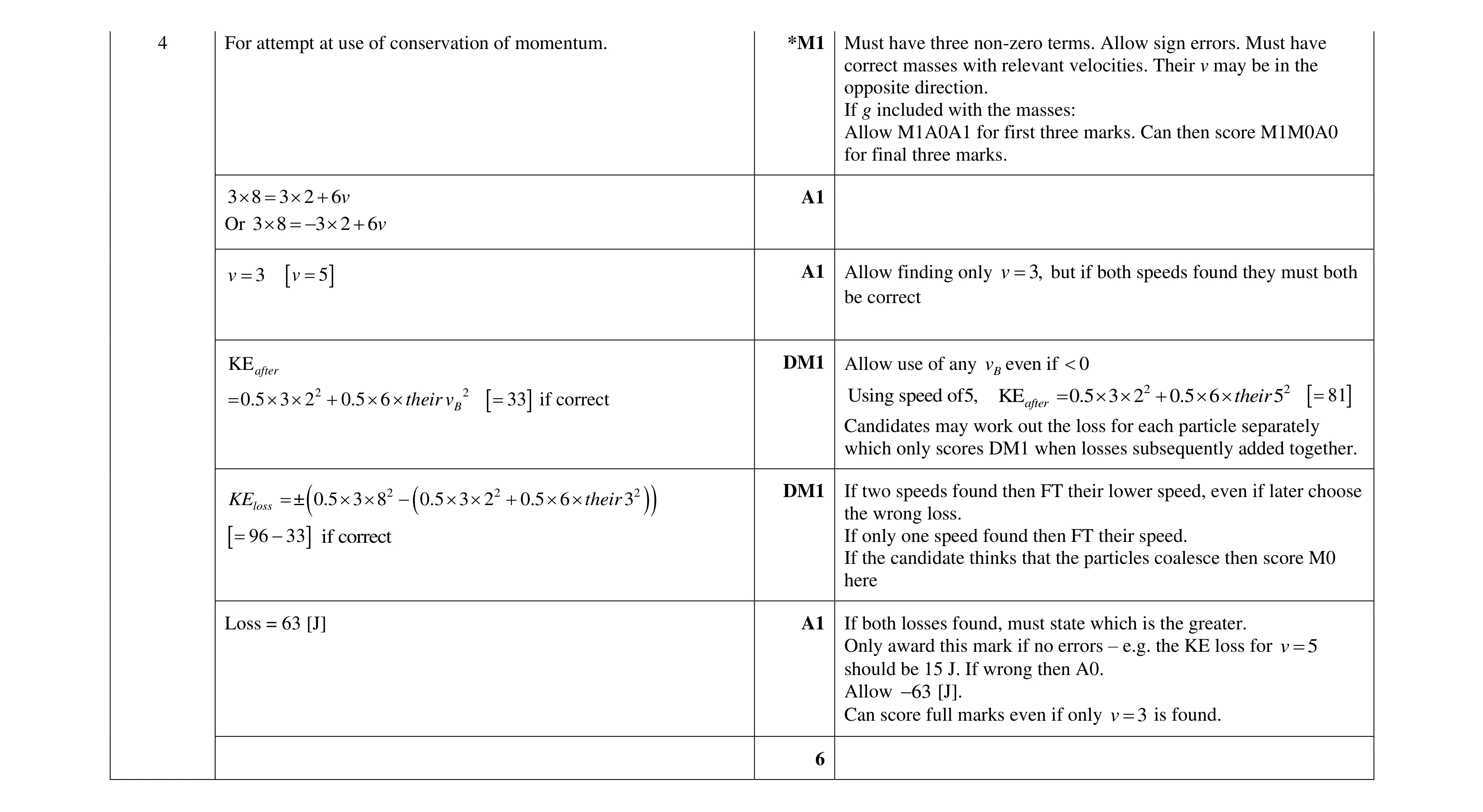 6
6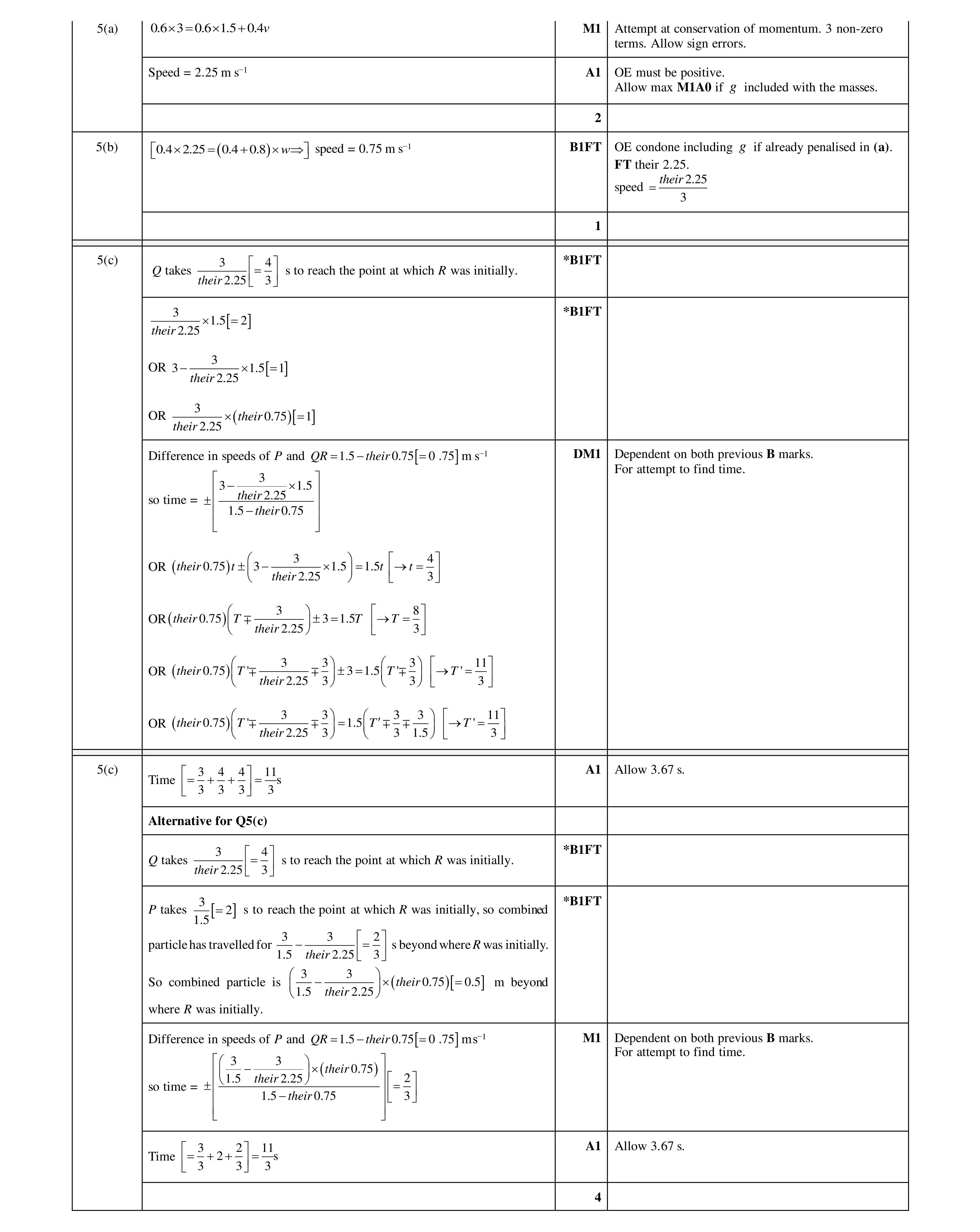 7
7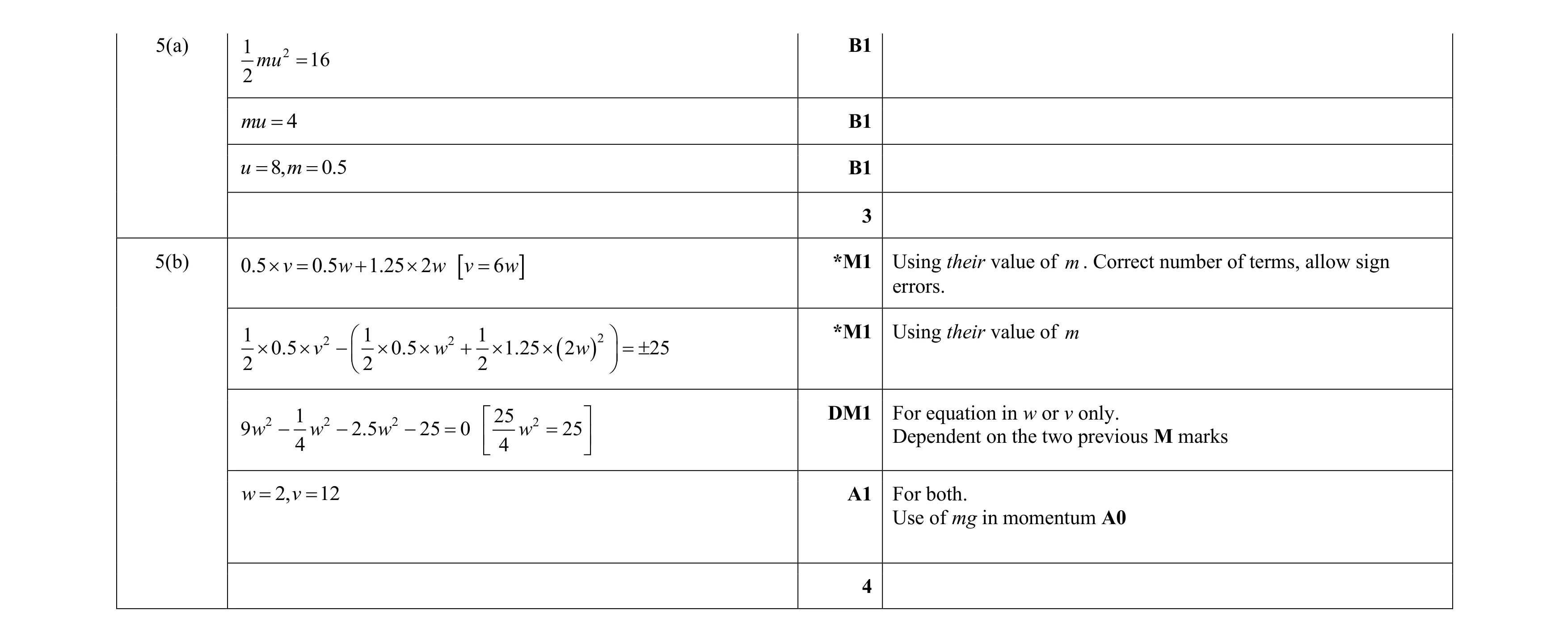 7
7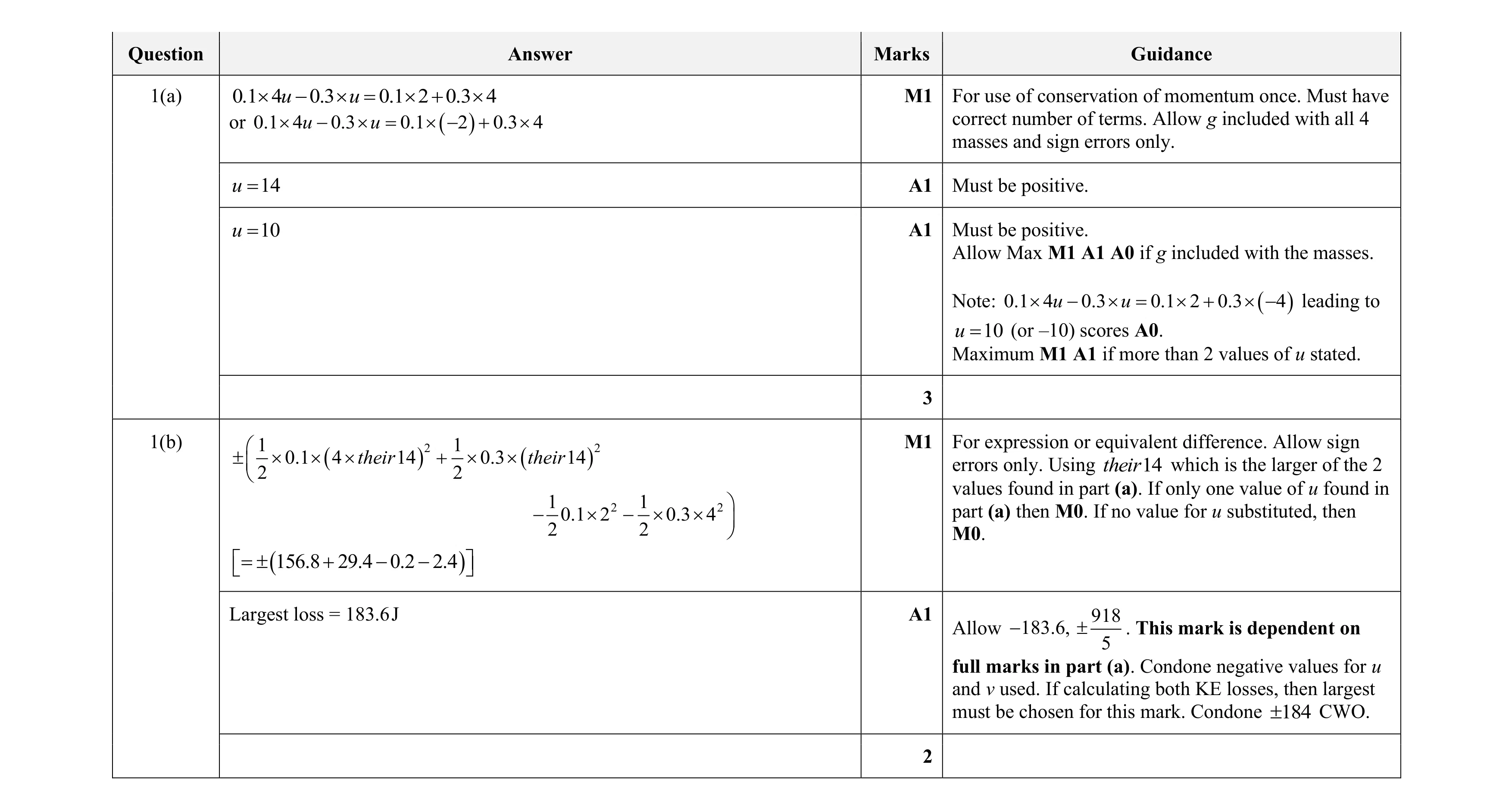 5
5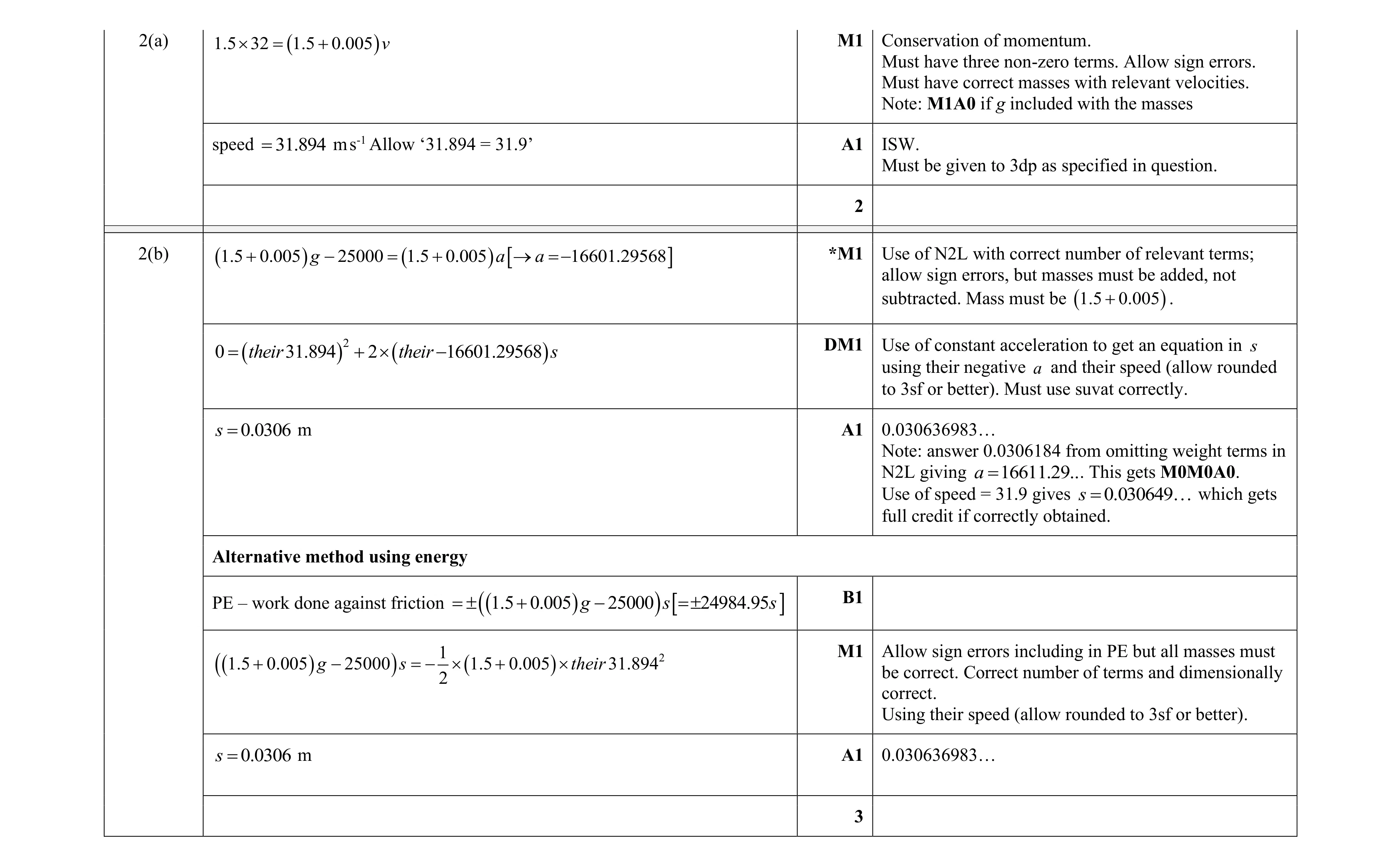 5
5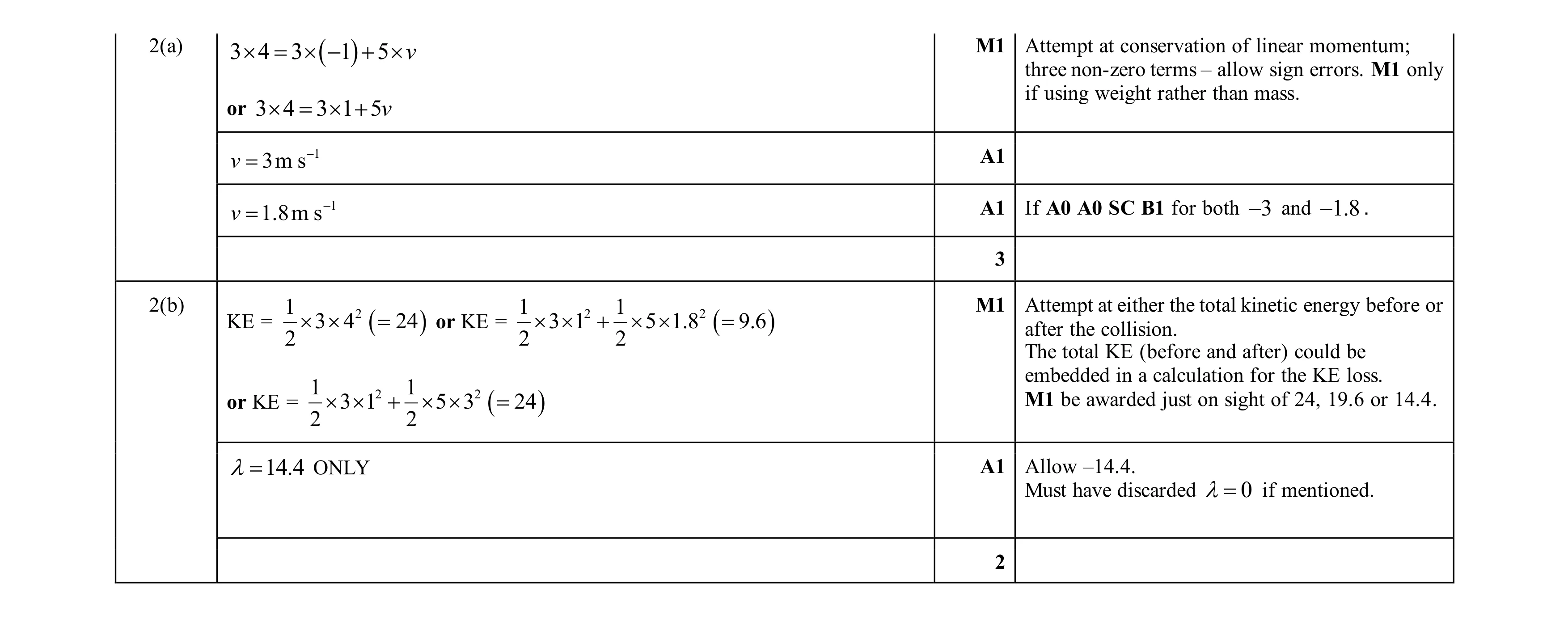 5
5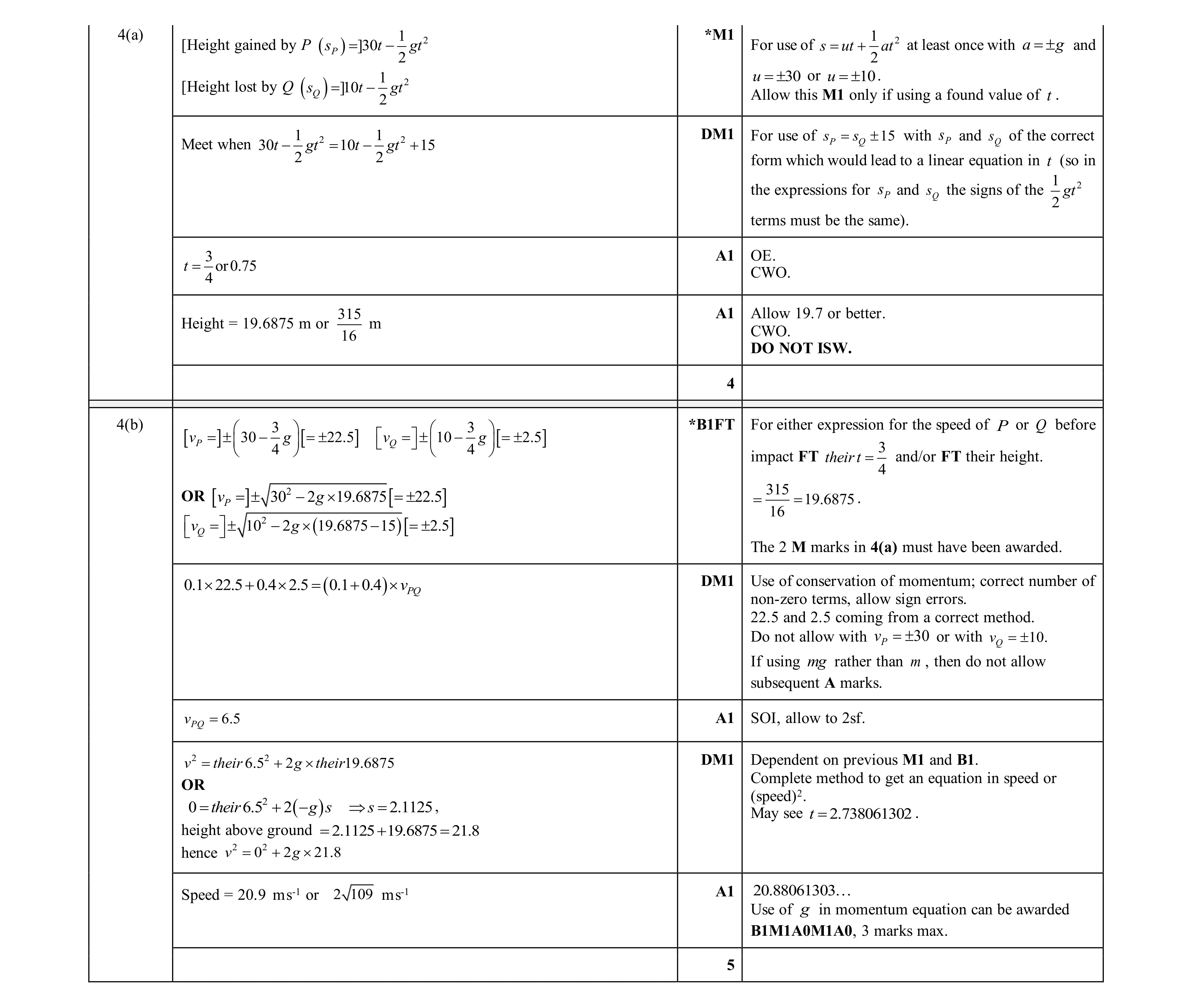 9
9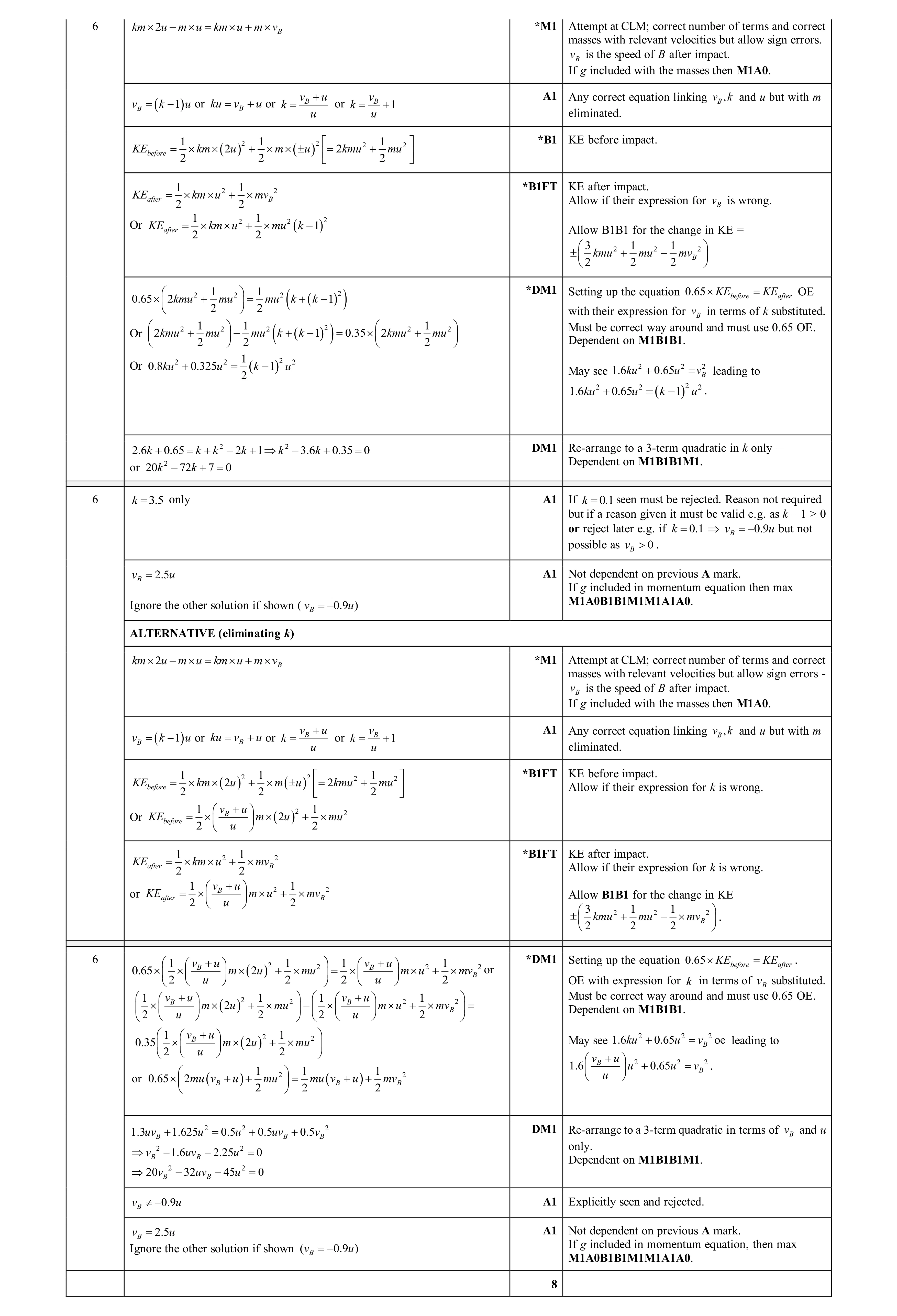 8
8