Questions as text
Q1 · 1 Expand in ascending powers of x, up to and including the term in x2, simplifying the (2… 9709/31 Oct/Nov 2004
1 1 Expand in ascending powers of x, up to and including the term in x2, simplifying the (2 + x)3 coefficients. [4]
4 marks
Mark scheme: 1 EITHER: Obtain correct unsimplified version of the x or x2 term in the −3 expansion of (2 + x )−3 or + 1 1 x M1 2 1 State correct first term B1 8 3 3 2 Obtain next two terms − x + x A1 + A1 16 16 [The M mark is not earned by versions with unexpanded binomial − 3 coefficients such as .] 1 [Accept exact decimal equivalents of fractions.] 1 3 3 2 [SR: Answers given as 1 − x + x can earn M1B1A1.] 8 2 2 −3 1 1 [SR: Solutions involving k + 1 x , where k = 2, 8 or , can earn 2 2 M1 and A1√ for correctly simplifying both the terms in x and x2.] OR: Differentiate expression and evaluate f(0) and f′(0), where f′(x) = k(2 + x)-4 M1 1 State correct first term B1 8 3 3 2 Obtain next two terms − x + x A1 + A1 4 16 16 [Accept exact decimal equivalents of fractions.]
This question in 9709/31 Oct/Nov 2004
Q2 · Expand (1 + 4x)−1 2 in ascending powers of x, up to and including the term in x3… 9709/31 May/June 2005
1 Expand (1 + 4x)−1 2 in ascending powers of x, up to and including the term in x3, simplifying the coefficients. [4]
4 marks
Mark scheme: 1 EITHER: Obtain correct unsimplified version of the x or x 2 or x 3 term M1 State correct first two terms 1 – 2x A1 Obtain next two terms 6 x 2 − 20 x 3 A1 + A1 [The M mark is not earned by versions with unexpanded binomial − 21 coefficients, e.g. .] 2 OR: Differentiate expression and evaluate f(0) and f’(0), − 32 M1 where f ′(x) = k (1 + 4 x ) State correct first two terms 1 – 2x A1 Obtain next two terms 6 x 2 − 20 x 3 A1 + A1 4
This question in 9709/31 May/June 2005
Q3 · Expand (1 + x) √(1 −2x) in ascending powers of x, up to and including the term in x2… 9709/31 Oct/Nov 2008
2 Expand (1 + x) √(1 −2x) in ascending powers of x, up to and including the term in x2, simplifying the coefficients. [4]
4 marks
Mark scheme: 2 EITHER: State correct unsimplified first two terms of the expansion of 1( − 2 x ) , e.g. 1 + 1 ( −2 x ) B1 2 State correct unsimplified term in x 2 , e.g. 12 .( 12 − 1).( − 2 x ) 2 / !2 B1 Obtain sufficient terms of the product of (1 + x) and the expansion up to the term in x 2 of 1( − 2 x ) M1 Obtain final answer 1 − 32 x 2 A1 1 [The B marks are not earned by versions with symbolic binomial coefficients such as 2 .] 1 [SR: An attempt to rewrite 1( + x ) 1( − 2 x ) as 1( − 3 x 2 ) earns M1 A1 and the subsequent expansion 1 − 32 x 2 gets M1 A1.] OR: Differentiate expression and evaluate f(0) and f ′(0), having used the product rule M1 Obtain f(0) = 1 and f ′(0) = 0 correctly A1 Obtain f ′′(0) = −3 correctly A1 Obtain final answer 1 − 32 x 2 , with no errors seen A1 [4]
This question in 9709/31 Oct/Nov 2008
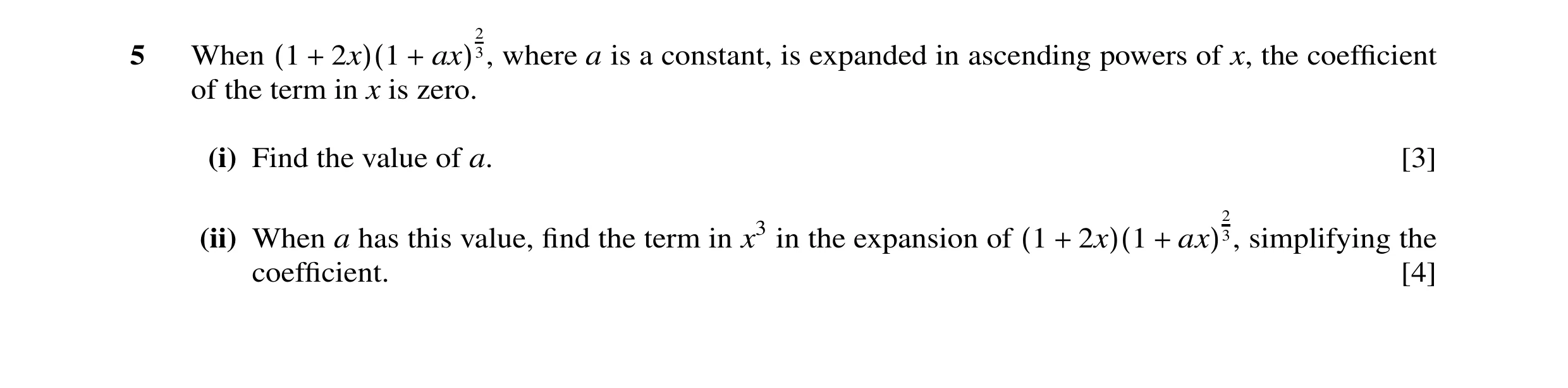
Q4 · 5 When 3, where a is a constant, is expanded in ascending powers of x, the coefficient (1… 9709/31 May/June 2009
2 5 When 3, where a is a constant, is expanded in ascending powers of x, the coefficient (1 + 2x)(1 + ax) of the term in x is zero. (i) Find the value of a. [3] 2 (ii) When a has this value, find the term in x3 in the expansion of 3, simplifying the (1 + 2x)(1 + ax) coefficient. [4]
7 marks
Mark scheme: ax B15 (i) State correct first two terms of the expansion of (1 + ax )3 , i.e. 1+ 23 2 Form an expression for the coefficient of x in the expansion of (1 + 2 x )(1 + ax )3 and equate it to zero M1 Obtain a = –3 A1 3 2 (ii) Obtain correct unsimplified terms in x2 and x3 in the expansion of (1 − 3 x )3 2 or (1 + ax )3 B1√ + B1 √ Carry out multiplication by 1 + 2x obtaining two terms in x3 M1 Obtain final answer − 103 x 3 , or equivalent A1 4 2 [Symbolic binomial coefficients, e.g. 3 , are not acceptable for the B marks in (i) or (ii)] 1 dx 2 dy 2
This question in 9709/31 May/June 2009
Q5 · Expand in ascending powers of x, up to and including the term in x2, simplifying the… 9709/33 Oct/Nov 2010
1 Expand in ascending powers of x, up to and including the term in x2, simplifying the coefficients.(1 + 2x)−3 [3]
3 marks
Mark scheme: 1 Obtain 1 – 6x B1 State correct unsimplified x2 term. Binomial coefficients must be expanded. M1 Obtain … + 24x2 A1 [3]
This question in 9709/33 Oct/Nov 2010
Q6 · Expand in ascending powers of x up to and including the term in x3, simplifying the 3√(1… 9709/31 May/June 2011
1 Expand in ascending powers of x up to and including the term in x3, simplifying the 3√(1 −6x) coefficients. [4]
4 marks
Mark scheme: 1 1 Either: Obtain 1 + kx, where k = ±6 or ± 1 M1 3 Obtain 1− 2 x A1 Obtain –4x2 A1 Obtain − 403 x 3 or equivalent A1 − 23 Or: Differentiate expression to obtain form k 1( −x6 ) and evaluate f(0) and f ′(0) M1 − 23 Obtain f ′(x) = –2(1 – 6x) and hence the correct first two terms 1 – 2x A1 − 53 Obtain f ′′(x) = –8(1 – 6x) and hence –4x2 A1 − 83 40 3 Obtain f ′′′(x) = –80(1 – 6x) and hence − 3 x or equivalent A1 [4] k cos 2 x
This question in 9709/31 May/June 2011
Q7 · 1 Expand in ascending powers of x, up to and including the term in x2, simplifying the (2… 9709/33 Oct/Nov 2011
16 1 Expand in ascending powers of x, up to and including the term in x2, simplifying the (2 + x)2 coefficients. [4]
4 marks
Mark scheme: 1 Either Obtain correct unsimplified version of x or x2 term in expansion of M1 1 (2 + x)–2 or (1 + x)–2 2 Correct first term 4 from correct work B1 Obtain –4x A1 Obtain + 3x2 A1 Or Differentiate and evaluate f(0) and f΄ (0) where f΄ (x) = k(2+x)–3 M1 State correct first term 4 B1 Obtain –4x A1 Obtain + 3x2 A1 [4]
This question in 9709/33 Oct/Nov 2011
Q8 · 2 (i) Expand in ascending powers of x, up to and including the term in x2, simplifying… 9709/31 May/June 2012
1 2 (i) Expand in ascending powers of x, up to and including the term in x2, simplifying the coefficients.√(1 −4x) [3] 1 2x (ii) Hence find the coefficient of x2 in the expansion of [2] + √(4 −16x).
5 marks
Mark scheme: 2 M12 (i) Either Obtain correct (unsimplified) version of x or x2 term from 1( − 4 x 1) Obtain 1 + 2x A1 Obtain + 6x2 A1 − 32 Or Differentiate and evaluate f(0) and f′(0) where f′(x) = k 1( −x4 ) M1 Obtain 1 + 2x A1 Obtain + 6x2 A1 [3] (ii) Combine both x2 terms from product of 1 + 2x and answer from part (i) M1 Obtain 5 A1 [2]
This question in 9709/31 May/June 2012
Q9 · 1 Expand in ascending powers of x, up to and including the term in x2, simplifying the… 9709/33 May/June 2012
1 1 Expand in ascending powers of x, up to and including the term in x2, simplifying the √(4 + 3x) coefficients. [4]
4 marks
Mark scheme: 1 EITHER: Obtain a correct unsimplified version of the x or x2 term of the expansion of − 12 3 − 12 ( 4 + 3 x ) or 1( + 4 x ) M1 1 State correct first term B1 2 3 27 2 Obtain the next two terms − x + x A1 + A1 16 256 − 32 OR: Differentiate and evaluate f(0) and f ′(0), where f ′( x ) = k ( 4 + 3 x ) M1 1 State correct first term B1 2 3 27 2 Obtain the next two terms − x + x A1 + A1 [4] 16 256 − 12 [Symbolic coefficients, e.g. are not sufficient for the M or B mark.] 2
This question in 9709/33 May/June 2012
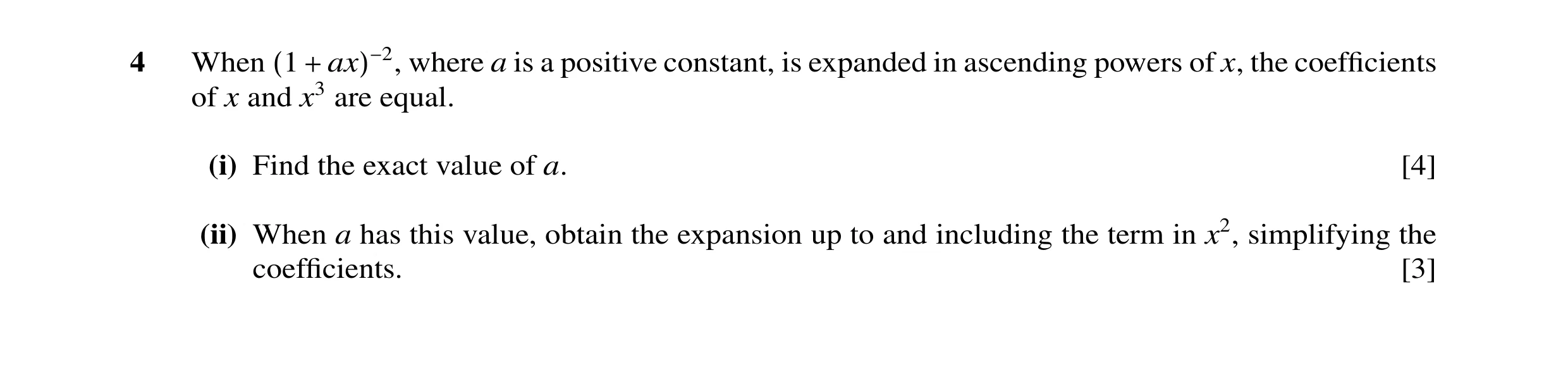
Q10 · When where a is a positive constant, is expanded in ascending powers of x, the… 9709/31 Oct/Nov 2012
4 When where a is a positive constant, is expanded in ascending powers of x, the coefficients of x and(1 x3+ ax)−2,are equal. (i) Find the exact value of a. [4] (ii) When a has this value, obtain the expansion up to and including the term in x2, simplifying the coefficients. [3]
7 marks
Mark scheme: 4 (i) Obtain correct unsimplified terms in x and x3 B1 + B1 Equate coefficients and solve for a M1 1 Obtain final answer a = , or exact equivalent A1 [4] √2 (ii) Use correct method and value of a to find the first two terms of the expansion (1 + ax)–2 M1 Obtain 1 – √2x, or equivalent A1 3 Obtain term 2 x A1 [3] –2 a, are not sufficient for the first B marks] [Symbolic coefficients, e.g. 1 [The f.t. is solely on the value of a.] GCE AS/A LEVEL – October/November 2012 9709 31
This question in 9709/31 Oct/Nov 2012
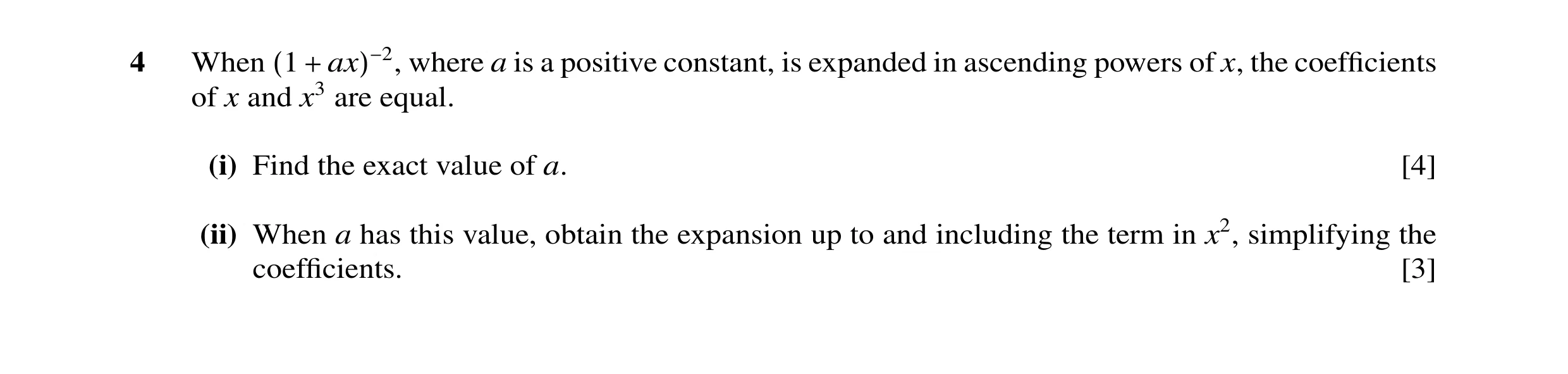
Q11 · When where a is a positive constant, is expanded in ascending powers of x, the… 9709/32 Oct/Nov 2012
4 When where a is a positive constant, is expanded in ascending powers of x, the coefficients of x and(1 x3+ ax)−2,are equal. (i) Find the exact value of a. [4] (ii) When a has this value, obtain the expansion up to and including the term in x2, simplifying the coefficients. [3]
7 marks
Mark scheme: 4 (i) Obtain correct unsimplified terms in x and x3 B1 + B1 Equate coefficients and solve for a M1 1 Obtain final answer a = , or exact equivalent A1 [4] √2 (ii) Use correct method and value of a to find the first two terms of the expansion (1 + ax)–2 M1 Obtain 1 – √2x, or equivalent A1 3 Obtain term 2 x A1 [3] –2 a, are not sufficient for the first B marks] [Symbolic coefficients, e.g. 1 [The f.t. is solely on the value of a.] GCE AS/A LEVEL – October/November 2012 9709 32
This question in 9709/32 Oct/Nov 2012
Q12 · Expand 2 in ascending powers of x, up to and including the term in x2, simplifying the… 9709/31 May/June 2020
2 (a) Expand 2 in ascending powers of x, up to and including the term in x2, simplifying the −3x −2 coefficients. [4] … … … … … … … … … … … … … … … … … … (b) State the set of values of x for which the expansion is valid. [1] … … … … …
5 marks
Mark scheme: 2(a) State a correct unsimplified version of the x or x2 term of the expansion of (2 – 3x)–2 or 2 3 1 2 − − x State correct first term 1 4 B1 Obtain the next two terms 2 3 27 4 16 + x x A1 + A1 4 2(b) State answer 2 3 < x , or equivalent B1 1
This question in 9709/31 May/June 2020
Q13 · 2 (a) Expand 1 6x in ascending powers of x, up to and including the term in x3… 9709/32 Oct/Nov 2020
3 2 (a) Expand 1 6x in ascending powers of x, up to and including the term in x3, simplifying the coefficients. [4] … … … … … … … … … … … … … … … … … … (b) State the set of values of x for which the expansion is valid. [1] … … … … …
5 marks
Mark scheme: 2(a) State a correct unsimplified version of the x or 2 x or 3 x term M1 For the given expression State correct first two terms 1 + 2x A1 Obtain the next two terms 2 3 40 4 3 x x − + A1 + A1 One mark for each correct term. ISW Accept 1 3 13 The question asks for simplified coefficients, so candidates should cancel fractions. 4 2(b) State answer 1 6 x < B1 OE. Strict inequality 1
This question in 9709/32 Oct/Nov 2020
Q14 · Expand 2 in ascending powers of x, up to and including the term in x4, simplifying the… 9709/31 May/June 2022
2 (a) Expand 2 in ascending powers of x, up to and including the term in x4, simplifying the −x2 −2 coefficients. [4] … … … … … … … … … … … … … … … … … … (b) State the set of values of x for which the expansion is valid. [1] … … … … …
5 marks
Mark scheme: 2(a) State a correct unsimplified version of the x or the 4 x term of the expansion of 2 2 2 x or 2 2 1 1 2 x M1 2 2 2 1 2. 3 1 2 ... 4 2 2 2 x x Symbolic binomial coefficients are not sufficient for the M1. State correct first term 1 4 B1 Accept 2-2 . Obtain the next two terms 2 4 1 3 4 16 x x A1 A1 A1 for each one correct ISW. Full marks for 2 4 3 1 4 4 1 x x ISW. SC allow M1 A1 A1 for 1 4 and 2 4 3 4 1 x x SOI. SC allow M1 A1 for 2 4 3 4 1 x x 4 2(b) State answer 2 x B1 Or 2 2 x . 1
This question in 9709/31 May/June 2022
Q15 · 2x2 Expand + in ascending powers of x, up to and including the term in x2, simplifying… 9709/33 Oct/Nov 2022
1 2x2 Expand + in ascending powers of x, up to and including the term in x2, simplifying the 1 −2x coefficients. [5] … … … … … … … … … … … … … … … … … … … … … … … …
5 marks
Mark scheme: 2 1 B1 2 State a correct unsimplified term in x or x 2 of the expansion of either (1 + 2 x ) 1 − 2 or (1 −x2 ) 1 B1 2 up to the term in x 2 State correct unsimplified expansion of (1 + 2 x ) 1 B1 − 2 up to the term in x 2 State correct unsimplified expansion of (1 −x2 ) Obtain sufficient terms of the product of the expansions M1 Obtain final answer 1 + 2 x + 2 x 2 A1 Alternative method for question 2 1 B1 − 2 and state a term of the 1 − 4 x 2 State that the expression equals (1 + 2 x )( ) expansion 1 B1 + B1 − State correct unsimplified expansion of 1 −x4 2 2 up to the term in x 2 ( ) Obtain sufficient terms of the product of (1 + 2x) and the expansion M1 Obtain final answer 1 + 2 x + 2 x 2 A1 5
This question in 9709/33 Oct/Nov 2022
Q16 · Find the coefficient of x2 in the expansion of ( 2x - 5) 4 - x 9709/32 Feb/March 2024
2 (a) Find the coefficient of x2 in the expansion of ( 2x - 5) 4 - x . [4] … … … … … … … … … … … … … … … … … … … … (b) State the set of values of x for which the expansion in part (a) is valid. [1] … … … … … …
5 marks
Mark scheme: 12(a) 2 B1 1 − x − x State unsimplified term in x, or its coefficient, in the expansion of ( 4 −x ) 2 × × = 4 1 . 2 4 4 1 2 B1 1 × − 1 − x 2 − x 2 x 2 State unsimplifed term in x 2 , or its coefficient, in the expansion of ( 4 −x ) 1 2 2 2 4 × × = . Allow . 2 4 64 4 1 M1 Allow unsimplified 2x. 2 , signs, etc. 1 Multiply by ( 2 x − 5 ) and obtain 2 terms in x 2 , allow even if errors in 4 2 1 − x 4 × × − 5. 2 4 1 −1 1 × 2 2 2 2 2 − x x 4 × × . Allow . 2 4 4 − x − x 2 −1 −1 2 x × ( −5 ) × or 2 × ( −5 ) × . 4 64 4 64 27 54 A1 Allow in a full expansion up to x2, ignore extra Obtain − or –0.421875 or − terms even if they contain errors. 64 128 4 2(b) x < 4 B1 or −<4 x < 4 . 1
This question in 9709/32 Feb/March 2024
Q17 · 1 Expand ( 9 - 3)x 2 in ascending powers of x, up to and including the term in x2… 9709/32 Oct/Nov 2024
1 1 Expand ( 9 - 3)x 2 in ascending powers of x, up to and including the term in x2, simplifying the coefficients. [4] … … … … … … … … … … … … … … … … … … … … … … … … … … … …
4 marks
Mark scheme: Question Answer Marks Guidance 1 1 Obtain a correct unsimplified version of the x or x 2 term of the expansion of M1 1 1 1 2 12 1 E.g. − x or − x 2 or 1 1 2 2 3 2 9 ( 9 −x3 ) 2 or 1 − x −1 1 −1 −3 3 1 2 1 2 2 2 9 ( −3 x ) or 9 ( −3 x ) 2 . 2 2 Not for symbolic coefficients in the form n C r . State correct first term 3 B1 1 1 2 A1 A1 A1 for each term correct. Obtain the next two terms − x − x Do not ISW. 2 24 1 1 2 SC M1A1 for 1 − x − x seen on its own or 6 72 as a factor. 4
This question in 9709/32 Oct/Nov 2024
Q18 · - 232 (a) Expand ( 6 - x)( 1 - 2x) in ascending powers of x, up to and including the term… 9709/32 May/June 2025
- 232 (a) Expand ( 6 - x)( 1 - 2x) in ascending powers of x, up to and including the term in x2, simplifying the coefficients. [4] … … … … … … … … … … … … … … … … … (b) State the set of values of x for which the expansion is valid. [1] … … … … … … … … … …
5 marks
Mark scheme: 2(a) − 3 B1 2 Find the first two terms of the expansion of (1 − 2x ) B1 15 3 3 3 3 2 x 2 − − 1 − 1 − − − 2 2 2 2 2 2 Ignore extra terms. Obtain correct third term −( 2 x ) or ( 2 x ) 2! 2! 2 M1 2 2 Multiply their 3 term expansion a + bx + cx by (6 – x) obtaining all necessary 6 + 18 x + 45 x −−x 3x … terms Ignore extra terms. 6 + 17x + 42x2 A1 Ignore extra terms. Allow with the terms in any order. 4 2(b) 1 1 1 B1 OE |x| < or − x or (-0.5, 0.5) or ]-0.5, 0.5[ B0 for an ambiguous statement. 2 2 2 Must be strict inequality. 1
This question in 9709/32 May/June 2025
![Question 1: 1 Expand in ascending powers of x, up to and including the term in x2, simplifying the (2 + x)3 coefficients. [4]](https://img.pastlit.com/crops/94c119d2-4c4b-40f9-8932-046f3d9fd834/q1.webp)
![Question 2: Expand (1 + 4x)−1 2 in ascending powers of x, up to and including the term in x3, simplifying the coefficients. [4]](https://img.pastlit.com/crops/1dbfac46-832e-4e42-9cf5-84a8cda34c60/q1.webp)
![Question 3: Expand (1 + x) √(1 −2x) in ascending powers of x, up to and including the term in x2, simplifying the coefficients. [4]](https://img.pastlit.com/crops/50741b57-4b57-4e85-9f09-4497a8622d84/q2.webp)
![Question 5: Expand in ascending powers of x, up to and including the term in x2, simplifying the coefficients.(1 + 2x)−3 [3]](https://img.pastlit.com/crops/0acdbc32-78ba-49a2-be37-2740cec187eb/q1.webp)
![Question 6: Expand in ascending powers of x up to and including the term in x3, simplifying the 3√(1 −6x) coefficients. [4]](https://img.pastlit.com/crops/d538f322-2ff3-415c-9ee8-f3a360a45a53/q1.webp)
![Question 7: 1 Expand in ascending powers of x, up to and including the term in x2, simplifying the (2 + x)2 coefficients. [4]](https://img.pastlit.com/crops/469cb031-d93e-4f67-9e43-0bbc0497efc3/q1.webp) 1 / 9
1 / 9![Question 8: 2 (i) Expand in ascending powers of x, up to and including the term in x2, simplifying the coefficients.√(1 −4x) [3] 1 2x (ii) Hence find the…](https://img.pastlit.com/crops/eb1ffb76-7688-4dc9-97bb-4f11caac8ca1/q2.webp)
![Question 9: 1 Expand in ascending powers of x, up to and including the term in x2, simplifying the √(4 + 3x) coefficients. [4]](https://img.pastlit.com/crops/ffc031dd-7645-42ef-a8bc-8a0f8345ebcb/q1.webp)
 2 / 9
2 / 9![Question 12: (a) Expand 2 in ascending powers of x, up to and including the term in x2, simplifying the −3x −2 coefficients. [4] .........................…](https://img.pastlit.com/crops/bf3553f7-27e1-41b2-99a3-e4630a5ae4eb/q2.webp) 3 / 9
3 / 9![Question 13: 2 (a) Expand 1 6x in ascending powers of x, up to and including the term in x3, simplifying the coefficients. [4] ...........................…](https://img.pastlit.com/crops/aeabdbf6-055e-47fb-8005-bf3dee3c6855/q2.webp) 4 / 9
4 / 9![Question 14: (a) Expand 2 in ascending powers of x, up to and including the term in x4, simplifying the −x2 −2 coefficients. [4] .........................…](https://img.pastlit.com/crops/88890bea-5882-403b-895a-82a86138d55a/q2.webp) 5 / 9
5 / 9![Question 15: 2x2 Expand + in ascending powers of x, up to and including the term in x2, simplifying the 1 −2x coefficients. [5] ..........................…](https://img.pastlit.com/crops/accf5a73-a956-4ec6-94e0-c7b63fc0edba/q2.webp) 6 / 9
6 / 9![Question 16: (a) Find the coefficient of x2 in the expansion of ( 2x - 5) 4 - x . [4] ..................................................................…](https://img.pastlit.com/crops/7e578ace-a8a9-41e0-8743-11cacfdd1971/q2.webp) 7 / 9
7 / 9![Question 17: 1 Expand ( 9 - 3)x 2 in ascending powers of x, up to and including the term in x2, simplifying the coefficients. [4] ......................…](https://img.pastlit.com/crops/b67b0fc8-9555-4852-90e2-709639aecc18/q1.webp) 8 / 9
8 / 9![Question 18: - 232 (a) Expand ( 6 - x)( 1 - 2x) in ascending powers of x, up to and including the term in x2, simplifying the coefficients. [4] ........…](https://img.pastlit.com/crops/839eb451-3c89-4685-8cb5-2dc929ba7724/q2.webp) 9 / 9
9 / 9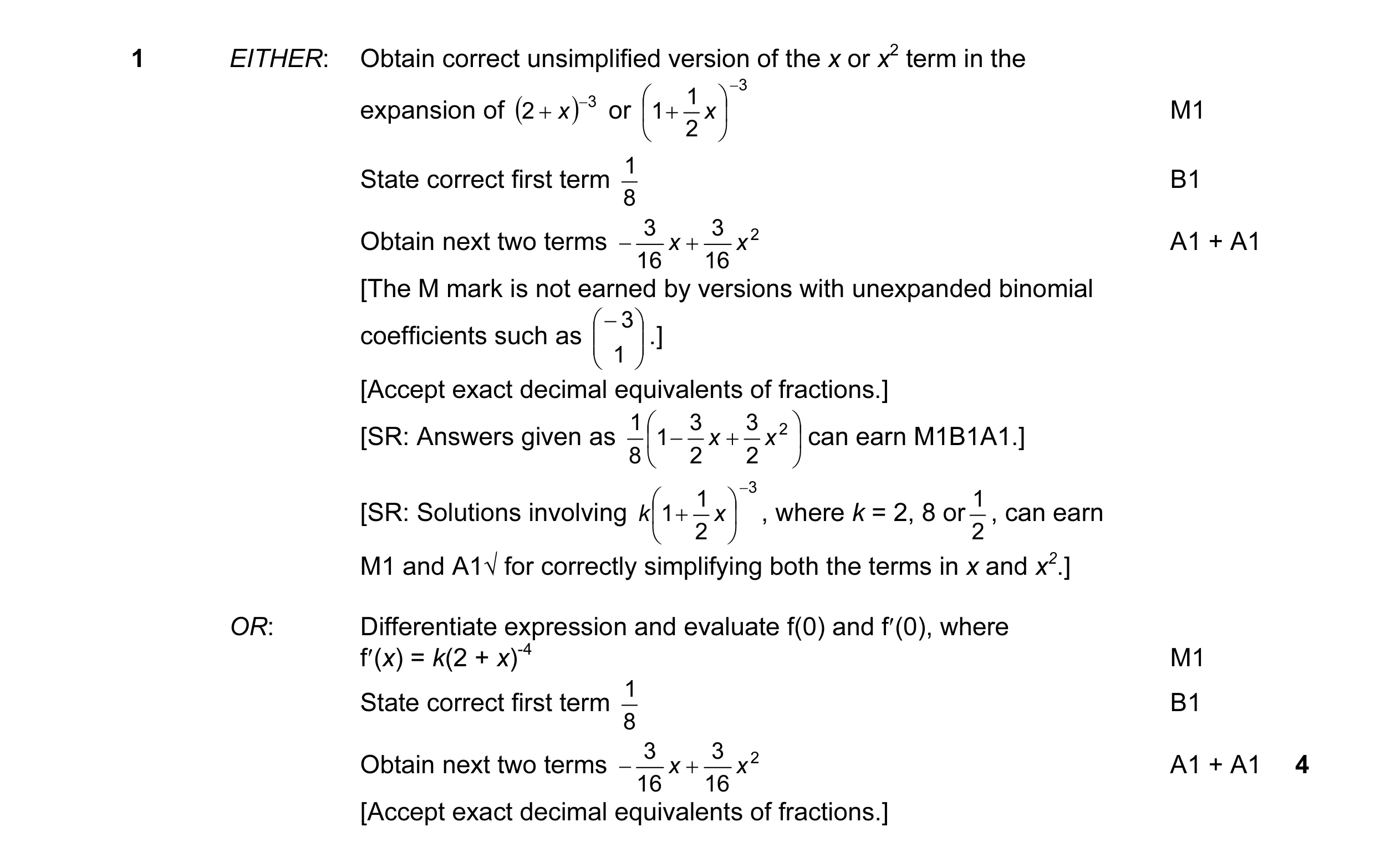 4
4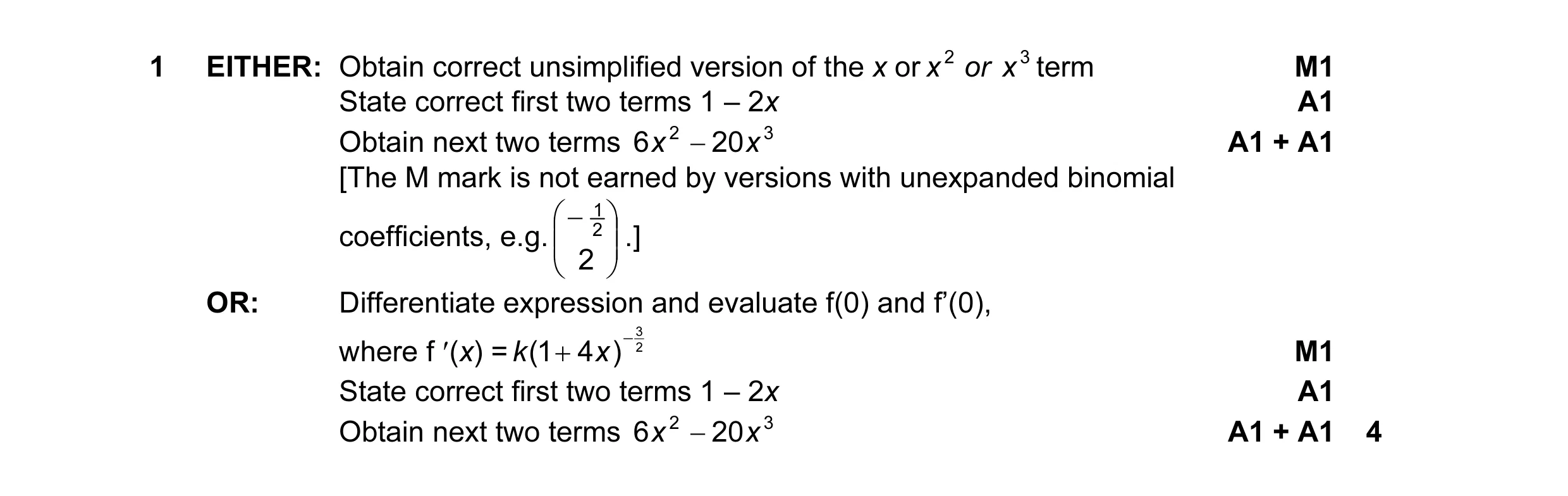 4
4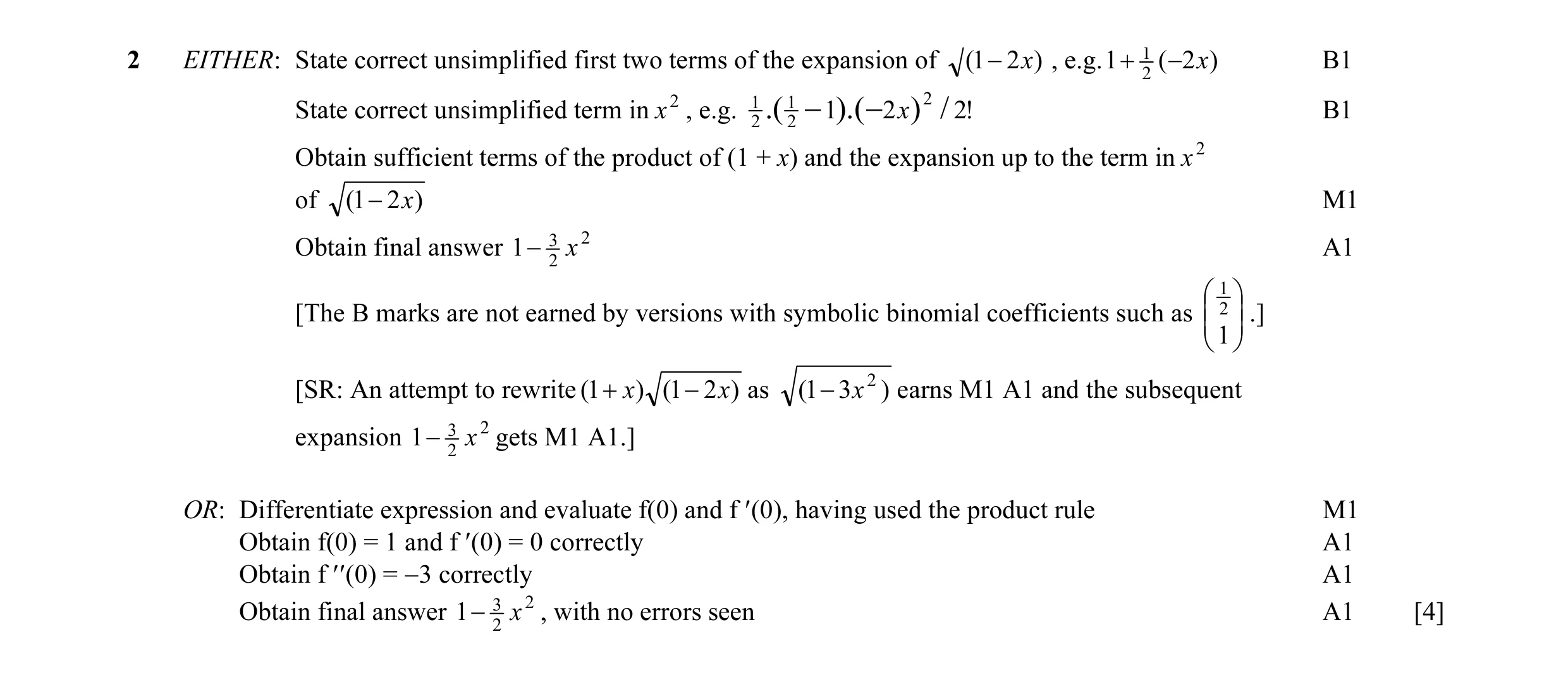 4
4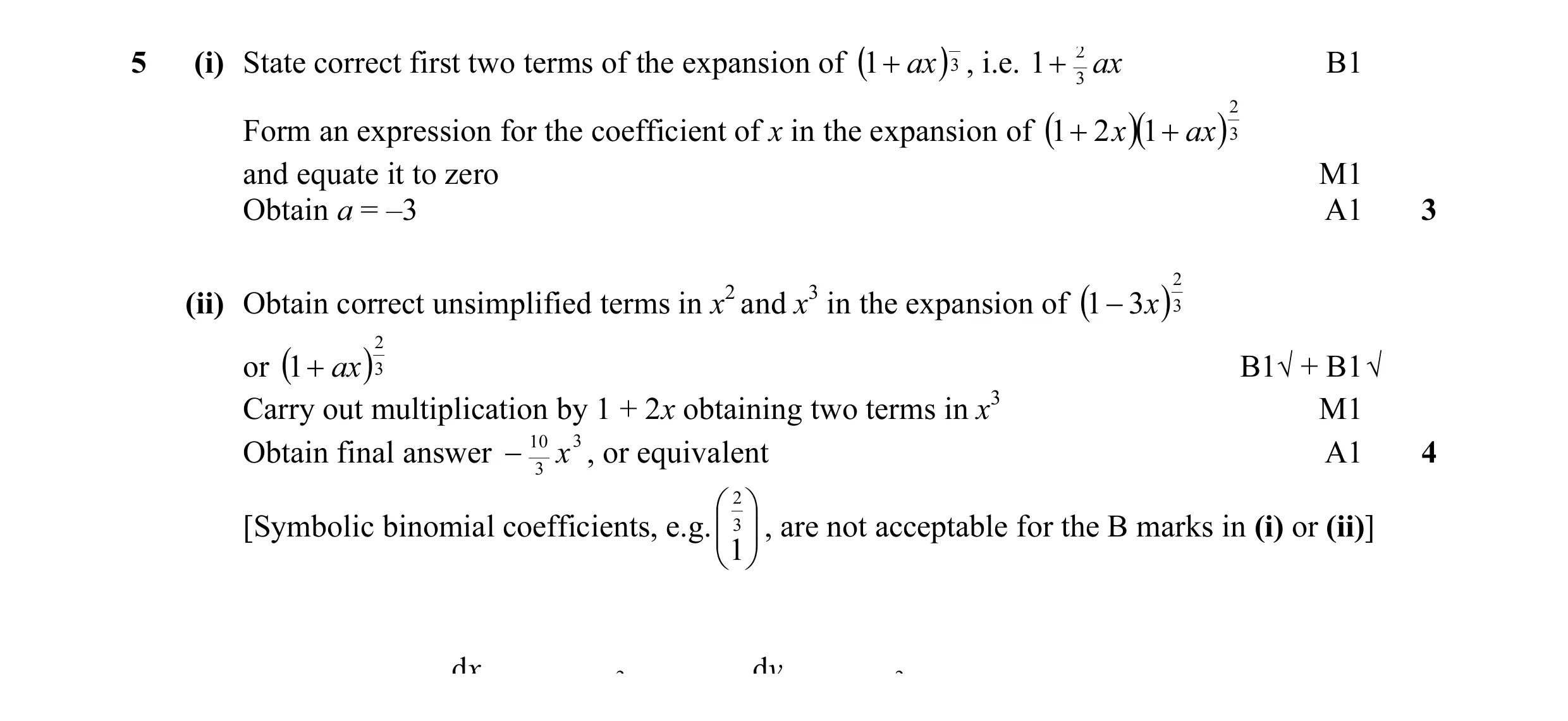 7
7 3
3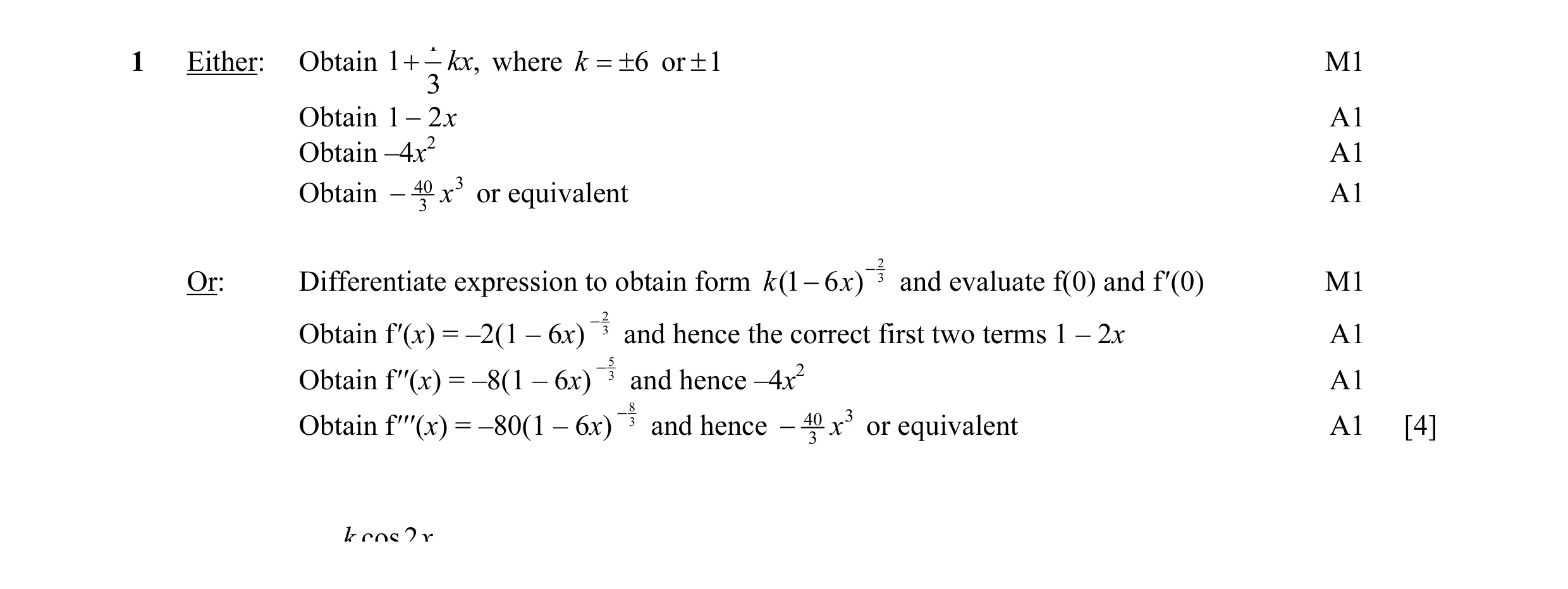 4
4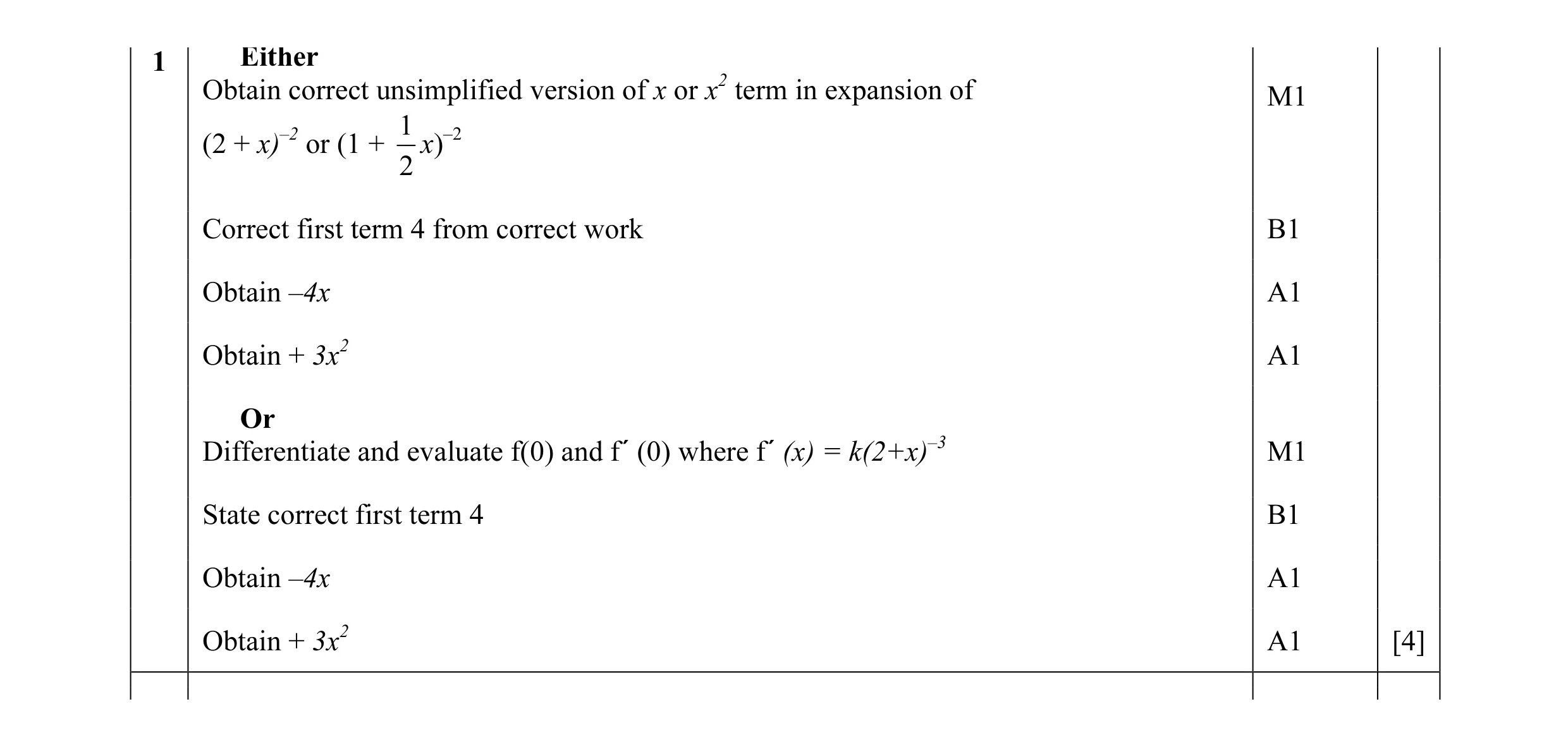 4
4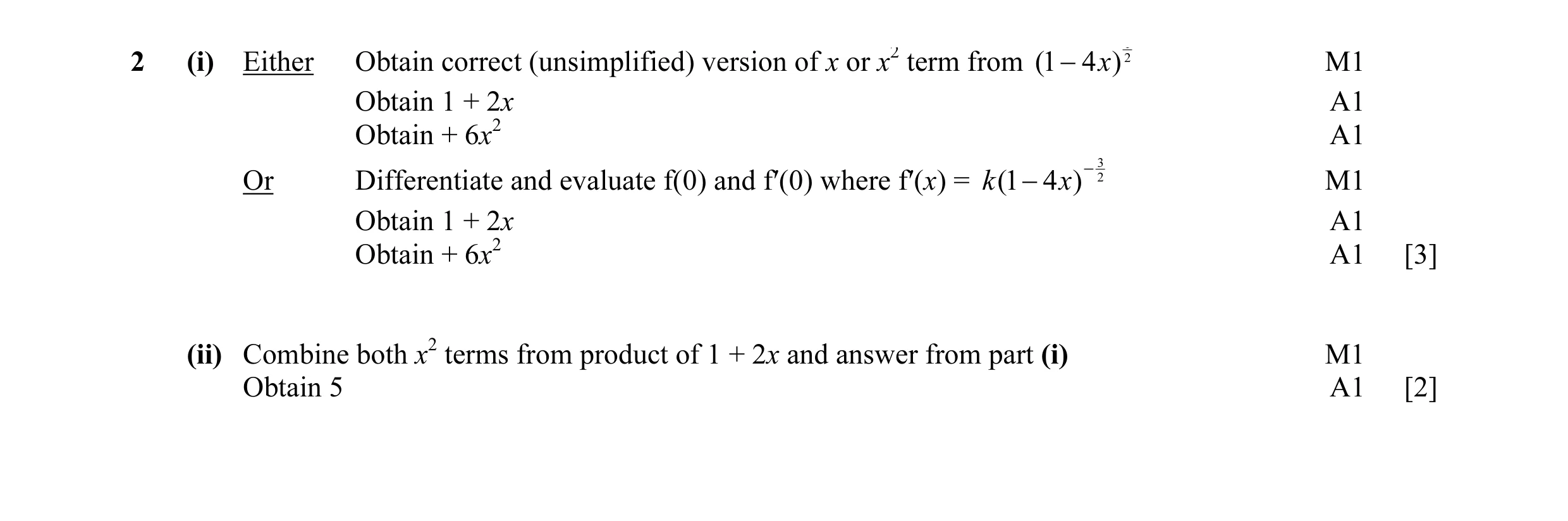 5
5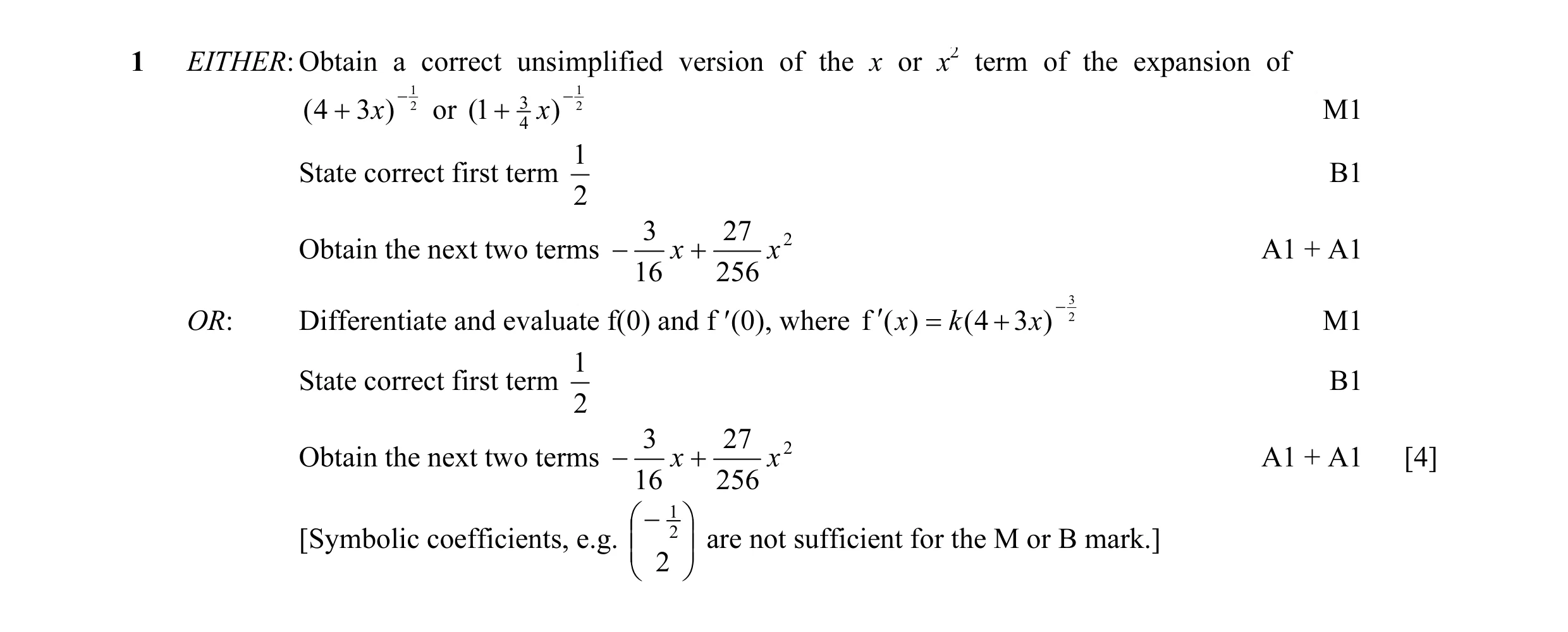 4
4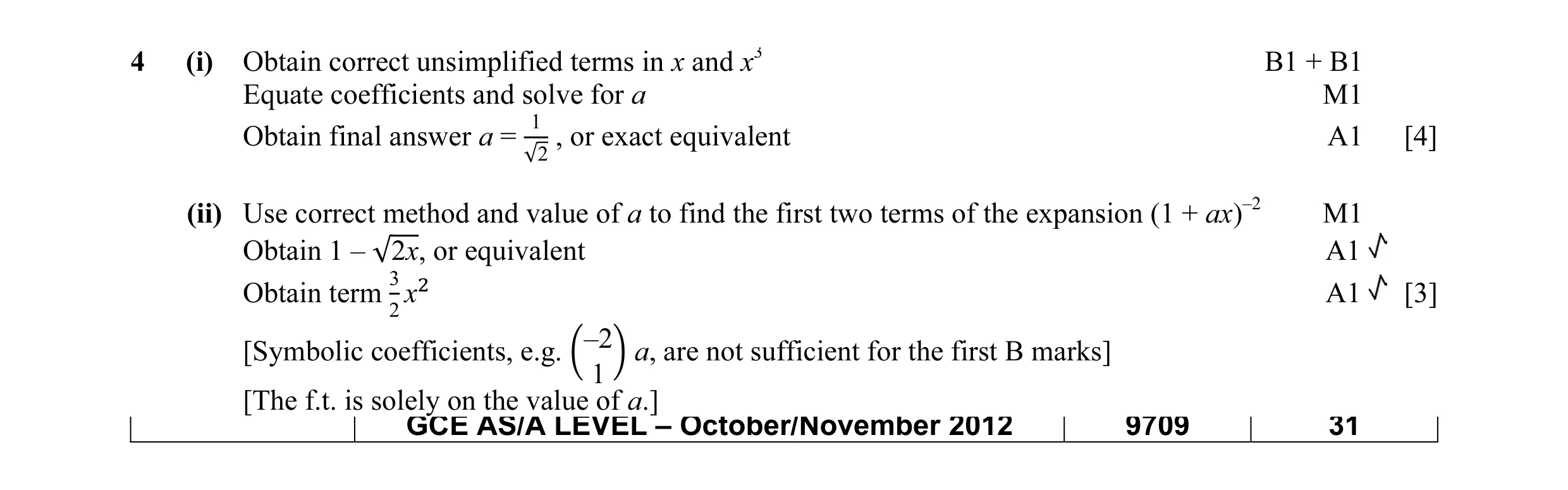 7
7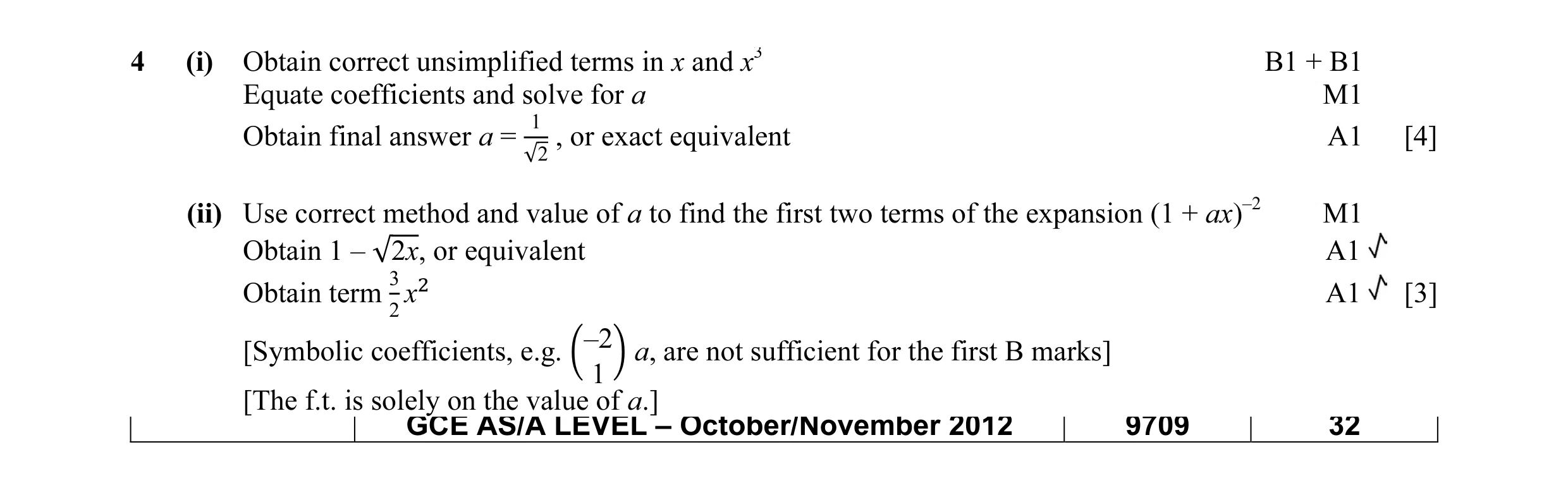 7
7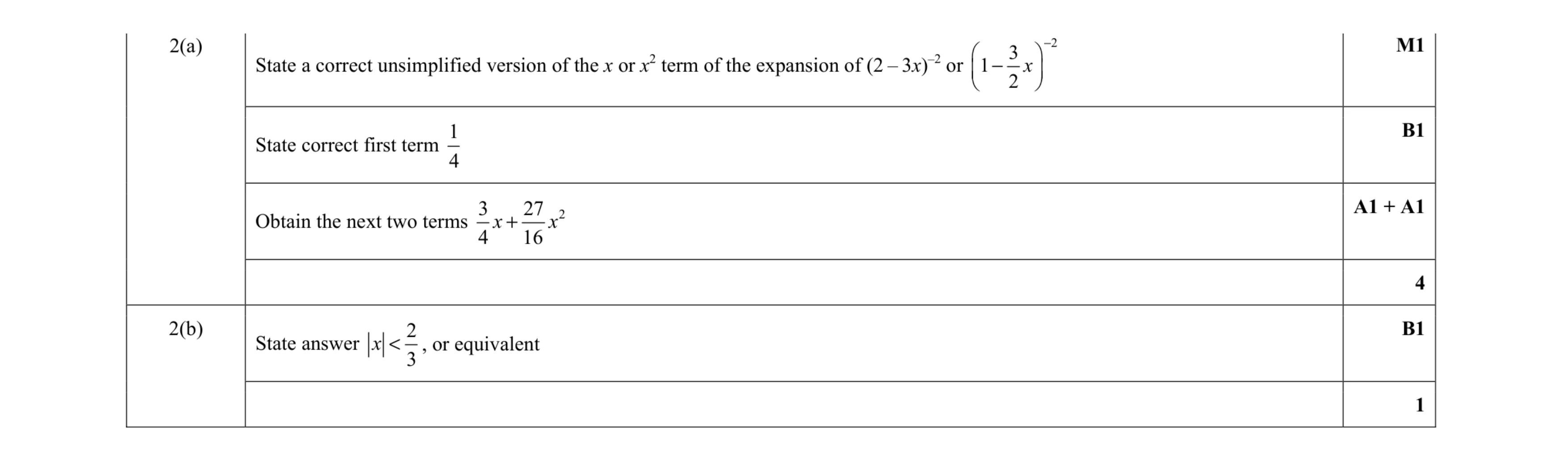 5
5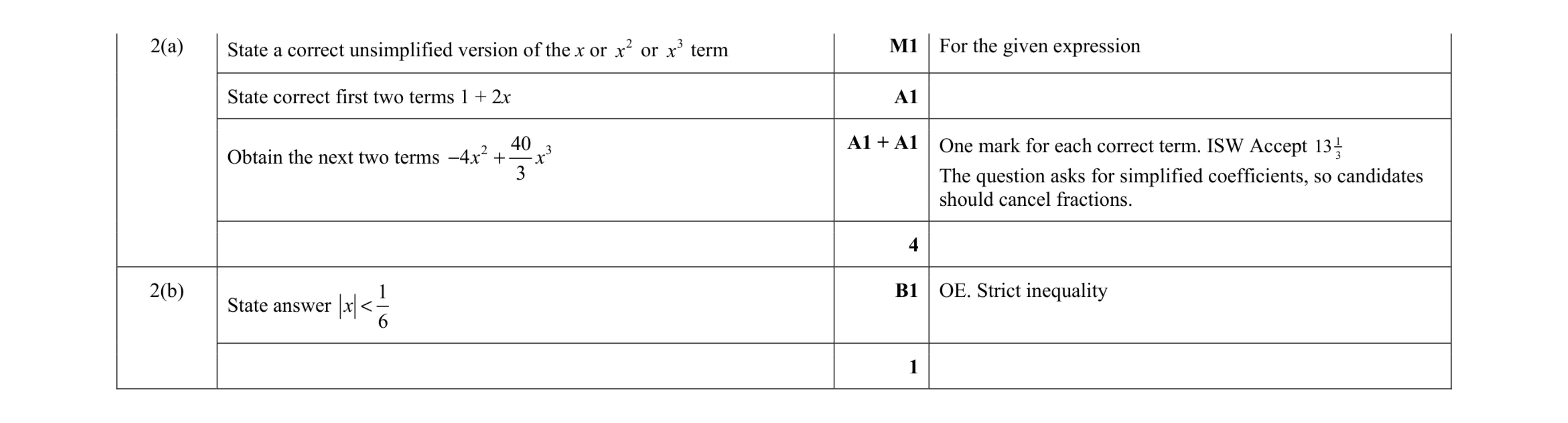 5
5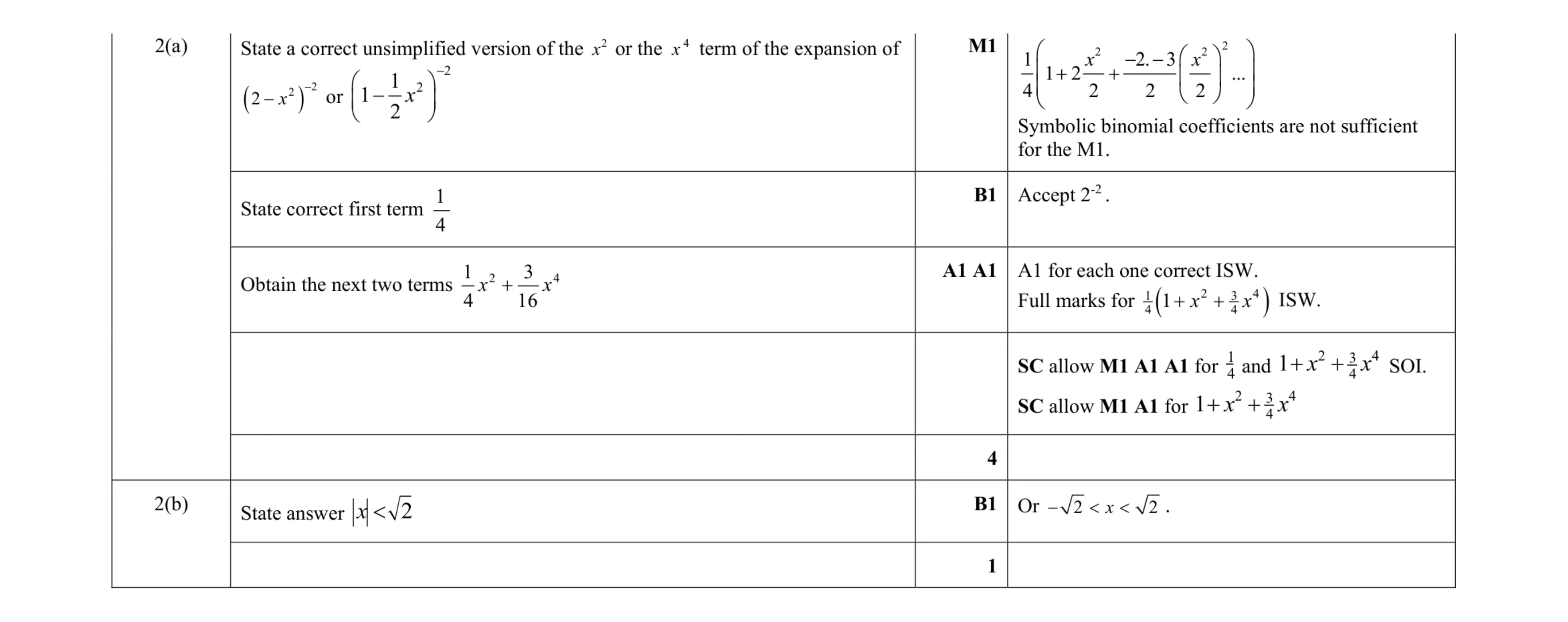 5
5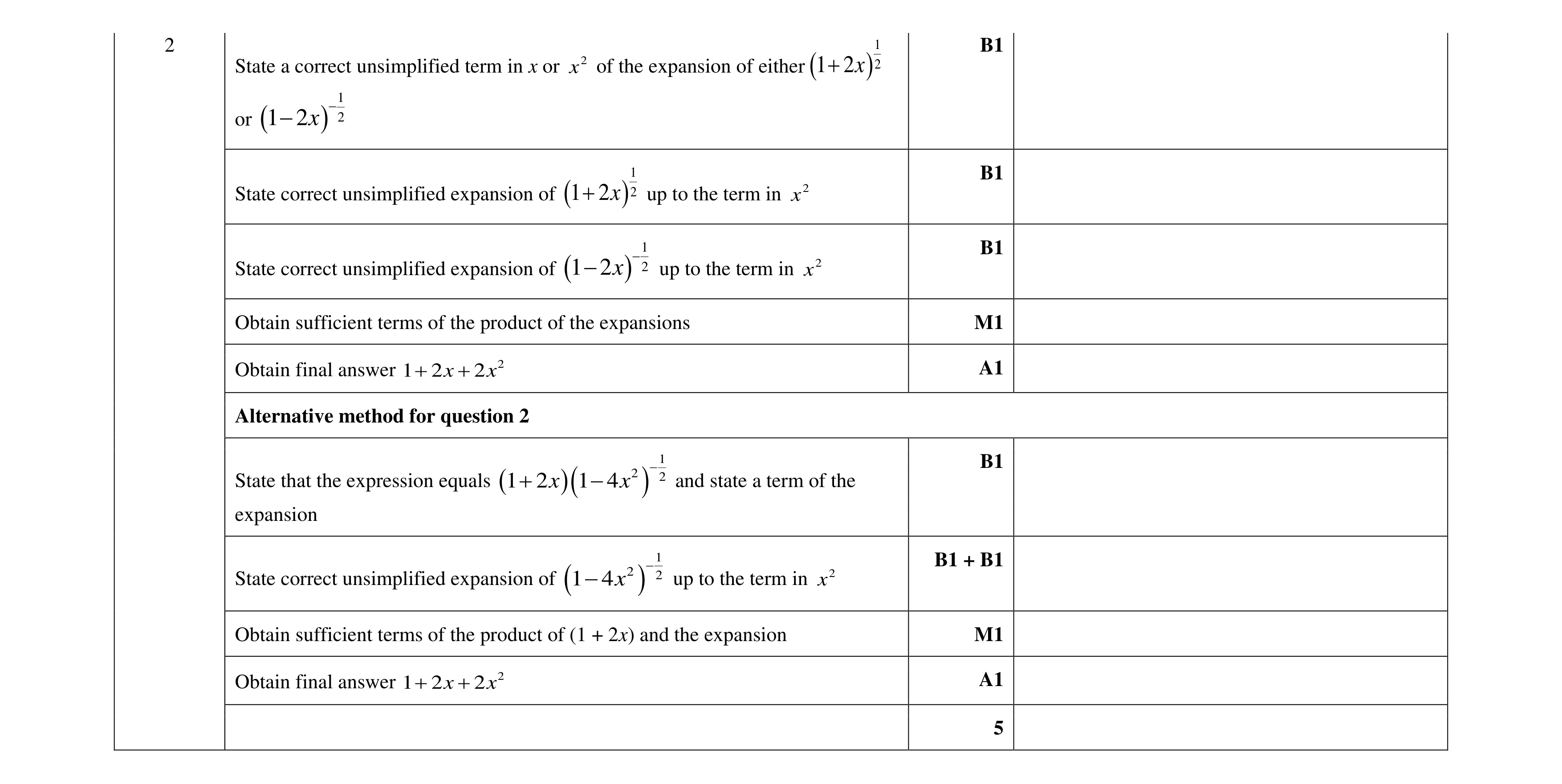 5
5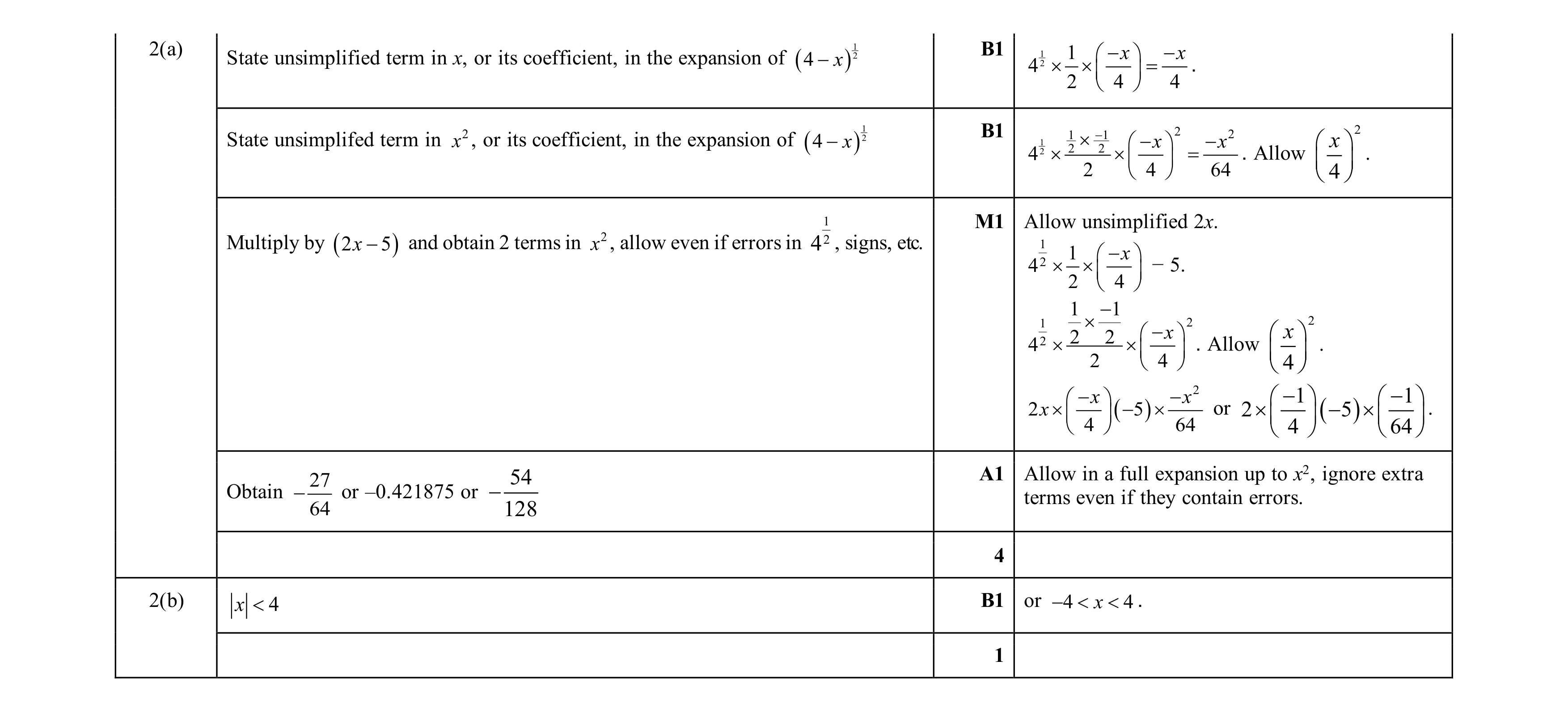 5
5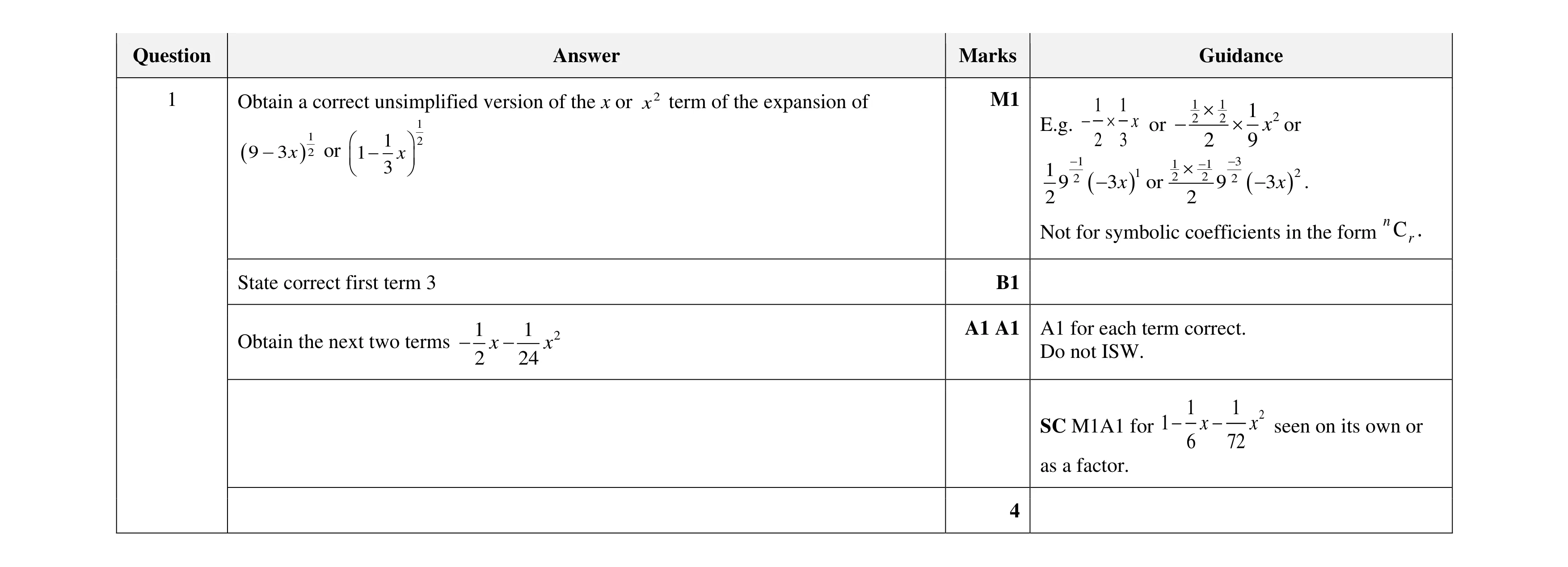 4
4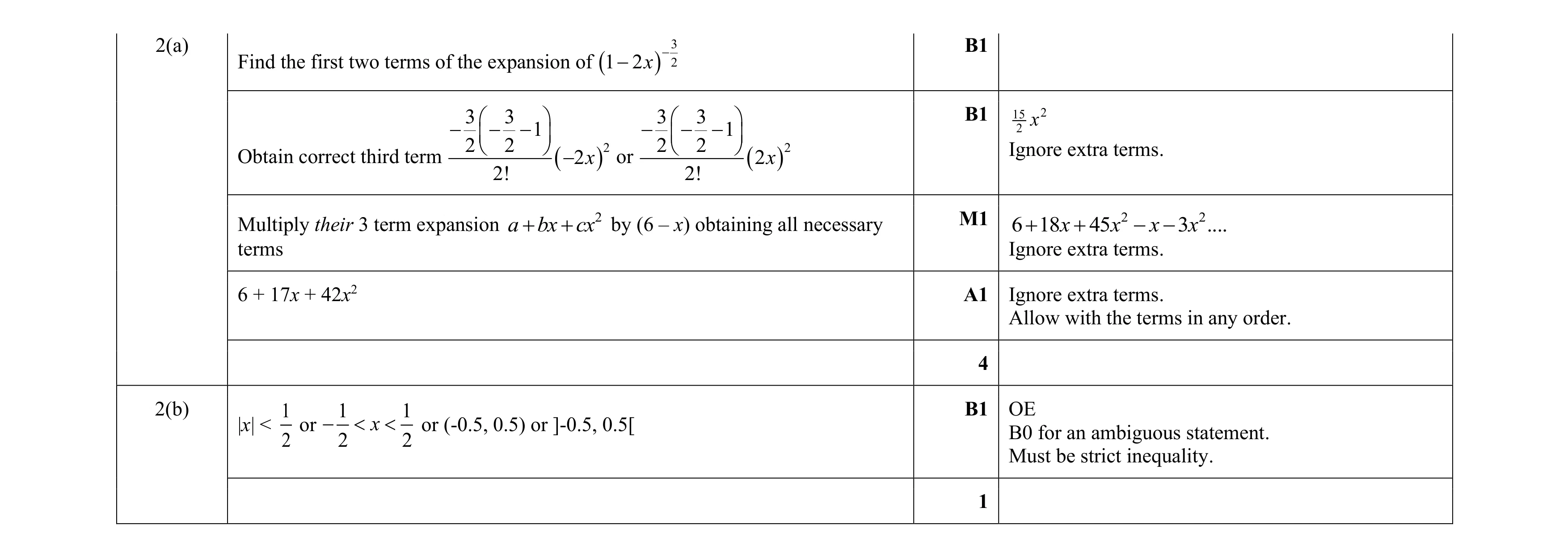 5
5