Cambridge A Level Mathematics 9709 — 2011 May/June Paper 3 · Variant 1
9709/31/M/J/11 · 10 questions · 75 marks · ≈84 min
The question paper and its mark scheme, free to read here and free to download. This is Cambridge’s own paper, exactly as it was sat.
Question paper4 pages
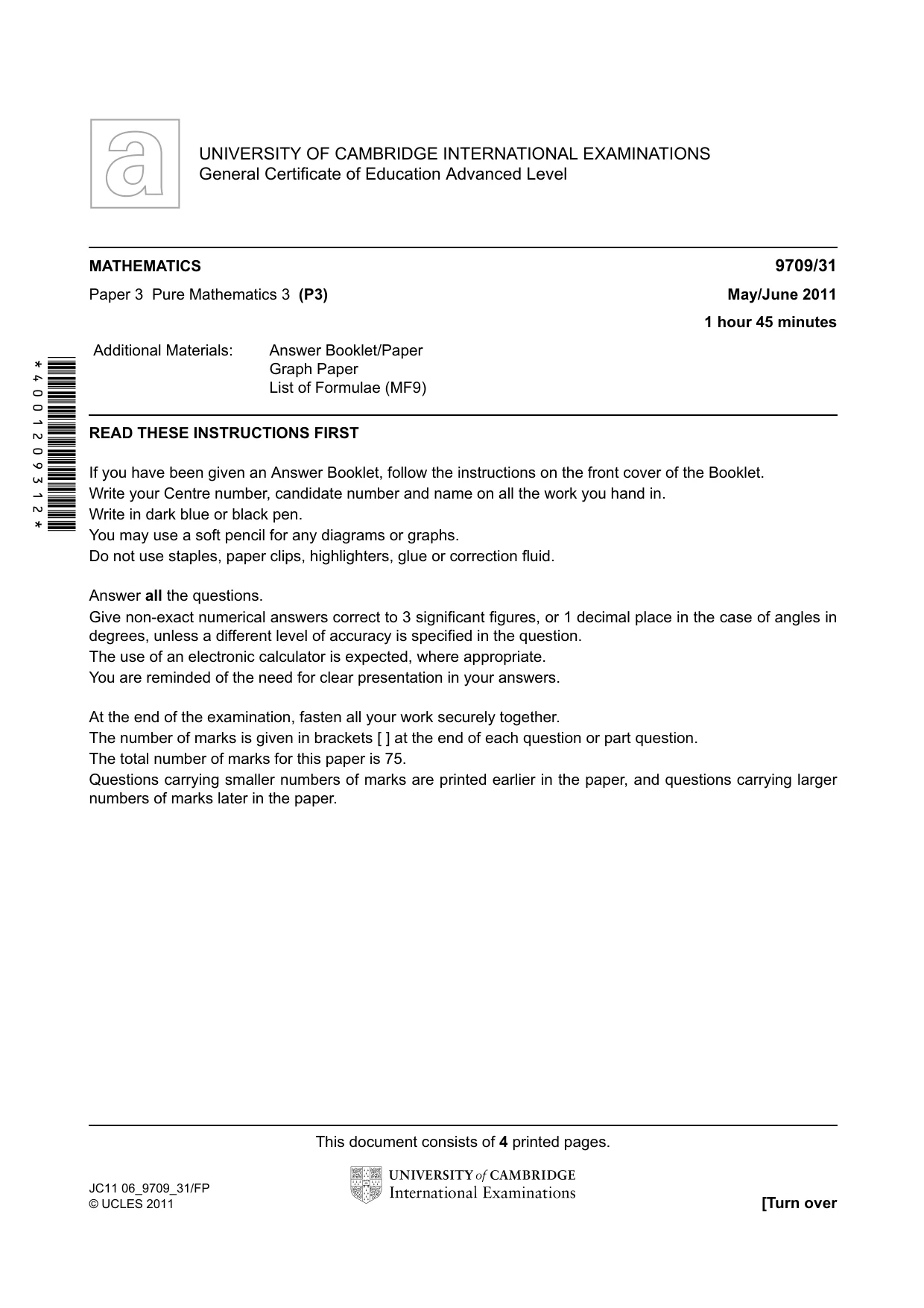
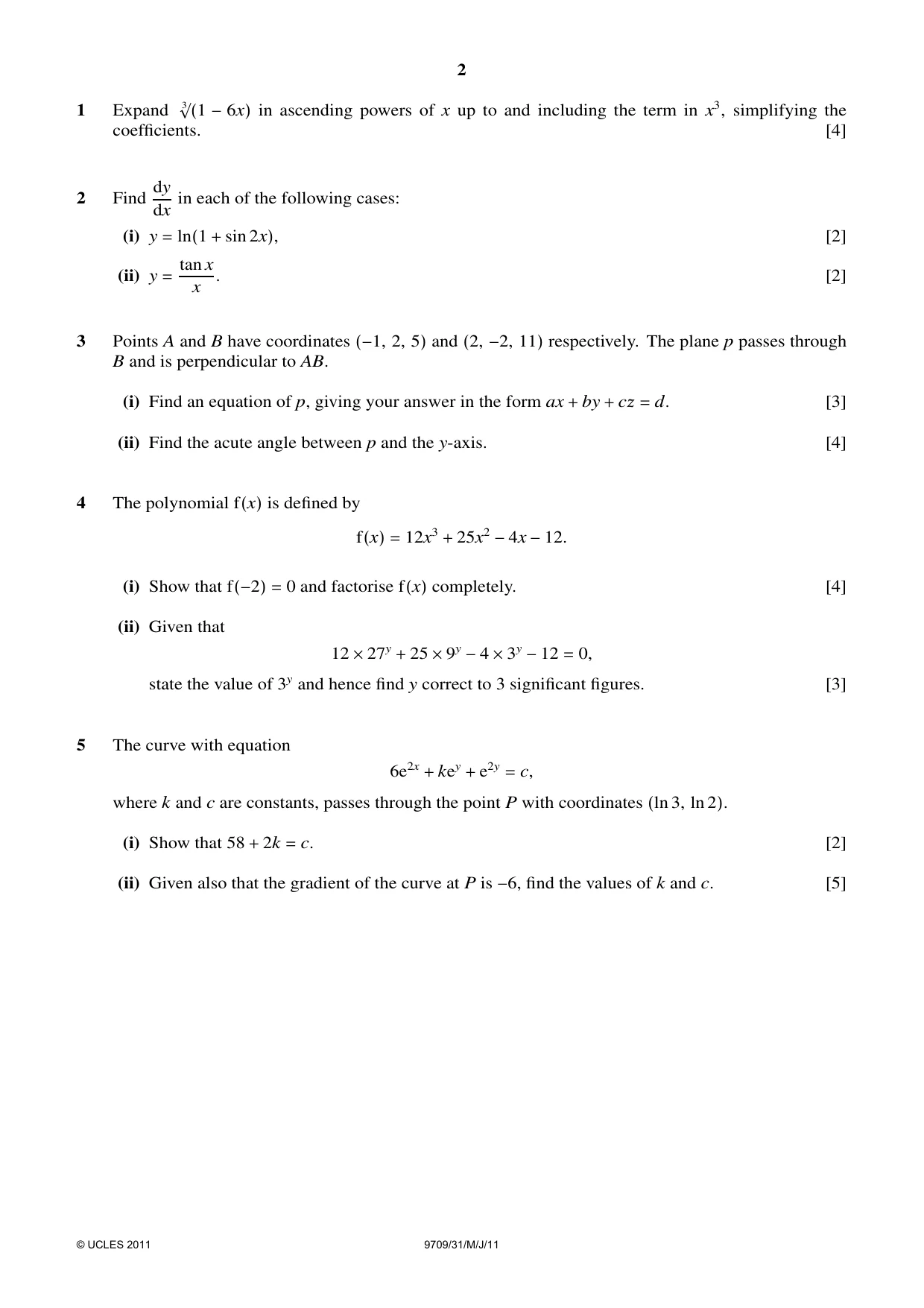
Mark scheme7 pages
Answers below. Sit the paper first if you are practising.
Questions as text
Q1 · Expand in ascending powers of x up to and including the term in x3, simplifying the 3√(1…
1 Expand in ascending powers of x up to and including the term in x3, simplifying the 3√(1 −6x) coefficients. [4]
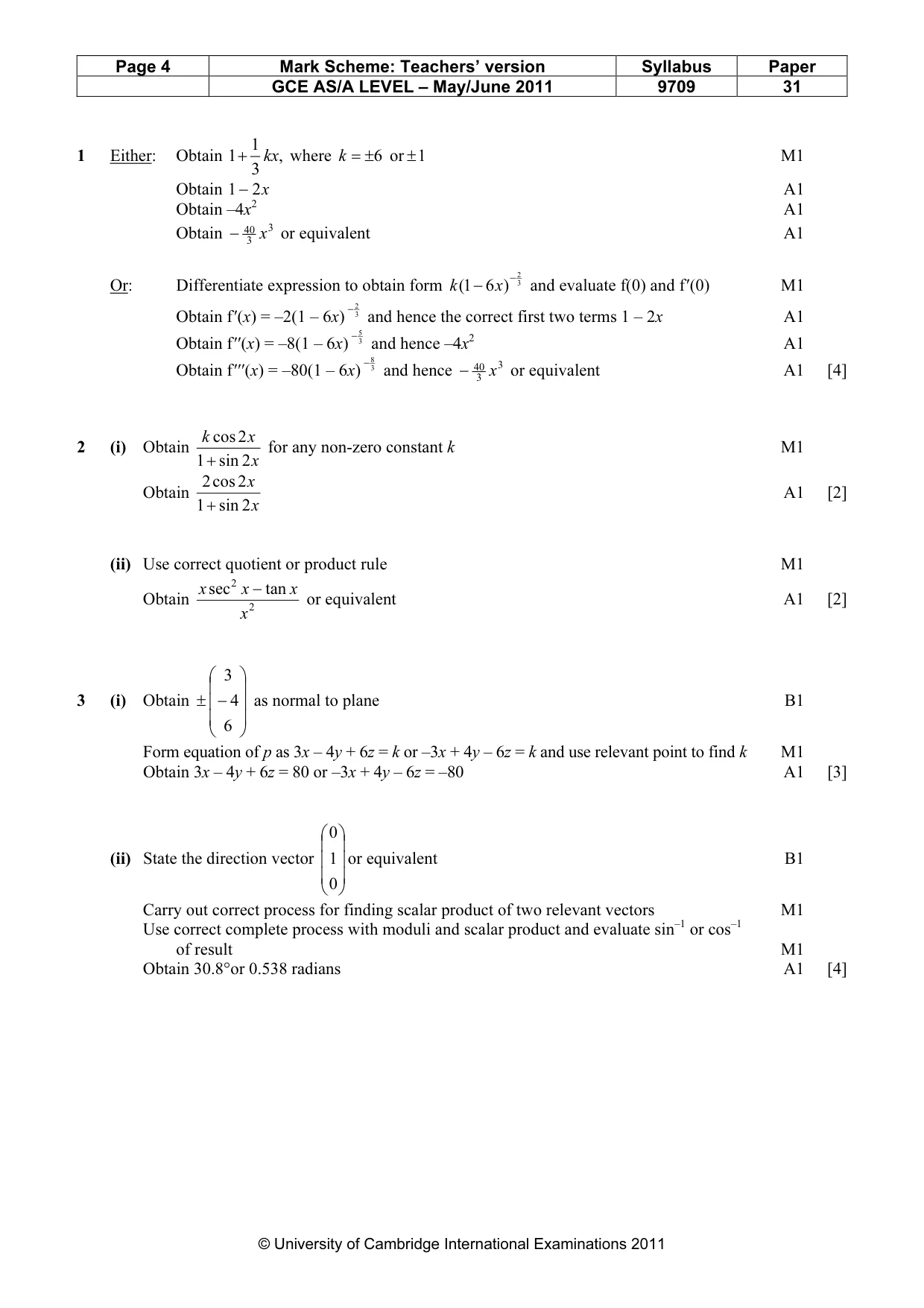
Mark scheme: 1 1 Either: Obtain 1 + kx, where k = ±6 or ± 1 M1 3 Obtain 1− 2 x A1 Obtain –4x2 A1 Obtain − 403 x 3 or equivalent A1 − 23 Or: Differentiate expression to obtain form k 1( −x6 ) and evaluate f(0) and f ′(0) M1 − 23 Obtain f ′(x) = –2(1 – 6x) and hence the correct first two terms 1 – 2x A1 − 53 Obtain f ′′(x) = –8(1 – 6x) and hence –4x2 A1 − 83 40 3 Obtain f ′′′(x) = –80(1 – 6x) and hence − 3 x or equivalent A1 [4] k cos 2 x
Q2 · Dy 2 Find in each of the following cases: dx (i) y sin [2] = ln(1 + 2x), tan x (ii) y
dy 2 Find in each of the following cases: dx (i) y sin [2] = ln(1 + 2x), tan x (ii) y . [2] = x
Mark scheme: k cos 2 x 2 (i) Obtain for any non-zero constant k M1 1 + sin 2 x 2 cos 2 x Obtain A1 [2] 1 + sin 2 x (ii) Use correct quotient or product rule M1 x sec 2 x − tan x Obtain 2 or equivalent A1 [2] x 3
Q3 · Points A and B have coordinates 2, and respectively
3 Points A and B have coordinates 2, and respectively. The plane p passes through (−1, 5) (2, −2, 11) B and is perpendicular to AB. (i) Find an equation of p, giving your answer in the form ax by d. [3] + + cß = (ii) Find the acute angle between p and the y-axis. [4]
Mark scheme: 3 (i) Obtain ± − 4 as normal to plane B1 6 Form equation of p as 3x – 4y + 6z = k or –3x + 4y – 6z = k and use relevant point to find k M1 Obtain 3x – 4y + 6z = 80 or –3x + 4y – 6z = –80 A1 [3] 0 (ii) State the direction vector 1 or equivalent B1 0 Carry out correct process for finding scalar product of two relevant vectors M1 Use correct complete process with moduli and scalar product and evaluate sin–1 or cos–1 of result M1 Obtain 30.8°or 0.538 radians A1 [4] GCE AS/A LEVEL – May/June 2011 9709 31
Q4 · The polynomial is defined by f(x) 12x3 25x2 f(x) = + −4x −12
4 The polynomial is defined by f(x) 12x3 25x2 f(x) = + −4x −12. (i) Show that 0 and factorise completely. [4] f(−2) = f(x) (ii) Given that 12 27y 25 9y 3y 0, × + × −4 × −12 = state the value of 3y and hence find y correct to 3 significant figures. [3]
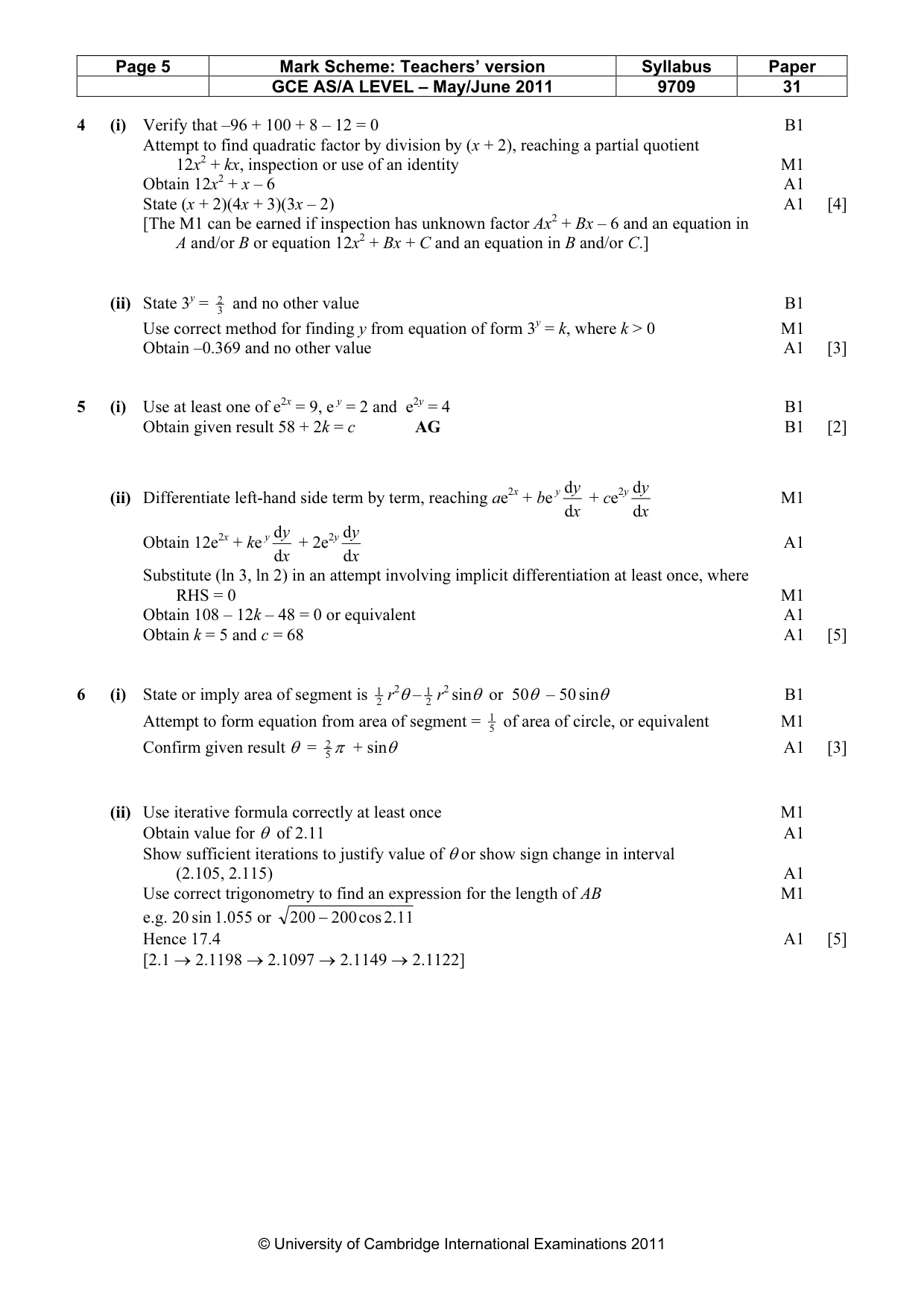
Mark scheme: 4 (i) Verify that –96 + 100 + 8 – 12 = 0 B1 Attempt to find quadratic factor by division by (x + 2), reaching a partial quotient 12x2 + kx, inspection or use of an identity M1 Obtain 12x2 + x – 6 A1 State (x + 2)(4x + 3)(3x – 2) A1 [4] [The M1 can be earned if inspection has unknown factor Ax2 + Bx – 6 and an equation in A and/or B or equation 12x2 + Bx + C and an equation in B and/or C.] (ii) State 3y = 23 and no other value B1 Use correct method for finding y from equation of form 3y = k, where k > 0 M1 Obtain –0.369 and no other value A1 [3] 2 2
Q5 · The curve with equation 6e2x key e2y c, + + = where k and c are constants, passes through…
5 The curve with equation 6e2x key e2y c, + + = where k and c are constants, passes through the point P with coordinates 3, ln (ln 2). (i) Show that 58 2k c. [2] + = (ii) Given also that the gradient of the curve at P is find the values of k and c. [5] −6,
Mark scheme: 5 (i) Use at least one of e2x = 9, e y = 2 and e2y = 4 B1 Obtain given result 58 + 2k = c AG B1 [2] dy dy y (ii) Differentiate left-hand side term by term, reaching ae2x + be + ce2y M1 dx dx dy dy y Obtain 12e2x + ke + 2e2y A1 dx dx Substitute (ln 3, ln 2) in an attempt involving implicit differentiation at least once, where RHS = 0 M1 Obtain 108 – 12k – 48 = 0 or equivalent A1 Obtain k = 5 and c = 68 A1 [5] 2 2
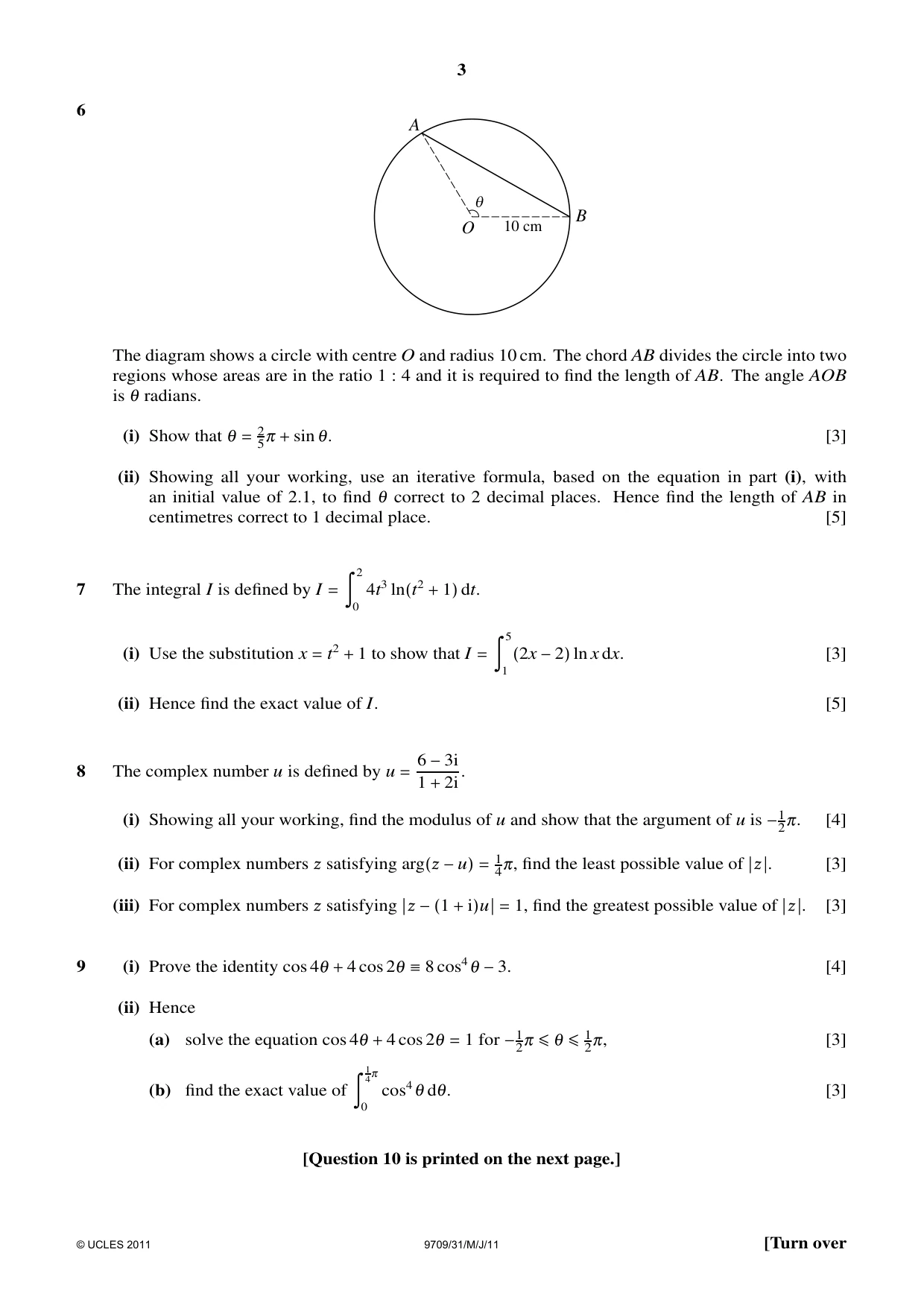
Q6 · A q B O 10 cm The diagram shows a circle with centre O and radius 10 cm
6 A q B O 10 cm The diagram shows a circle with centre O and radius 10 cm. The chord AB divides the circle into two regions whose areas are in the ratio 1 : 4 and it is required to find the length of AB. The angle AOB is θ radians. (i) Show that θ 25π sin θ. [3] = + (ii) Showing all your working, use an iterative formula, based on the equation in part (i), with an initial value of 2.1, to find θ correct to 2 decimal places. Hence find the length of AB in centimetres correct to 1 decimal place. [5]
Mark scheme: 6 (i) State or imply area of segment is 12 r2θ – 12 r2 sinθ or 50θ – 50 sinθ B1 Attempt to form equation from area of segment = 15 of area of circle, or equivalent M1 Confirm given result θ = 52 π + sinθ A1 [3] (ii) Use iterative formula correctly at least once M1 Obtain value for θ of 2.11 A1 Show sufficient iterations to justify value of θ or show sign change in interval (2.105, 2.115) A1 Use correct trigonometry to find an expression for the length of AB M1 e.g. 20 sin 1.055 or 200 − 200 cos .211 Hence 17.4 A1 [5] [2.1 → 2.1198 → 2.1097 → 2.1149 → 2.1122] GCE AS/A LEVEL – May/June 2011 9709 31
Q7 · 7 The integral I is defined by I 4t3 dt
2 7 The integral I is defined by I 4t3 dt. = ã 0 ln(t2 + 1) 5 (i) Use the substitution x t2 1 to show that I ln x dx. [3] = + = ã 1 (2x −2) (ii) Hence find the exact value of I. [5]
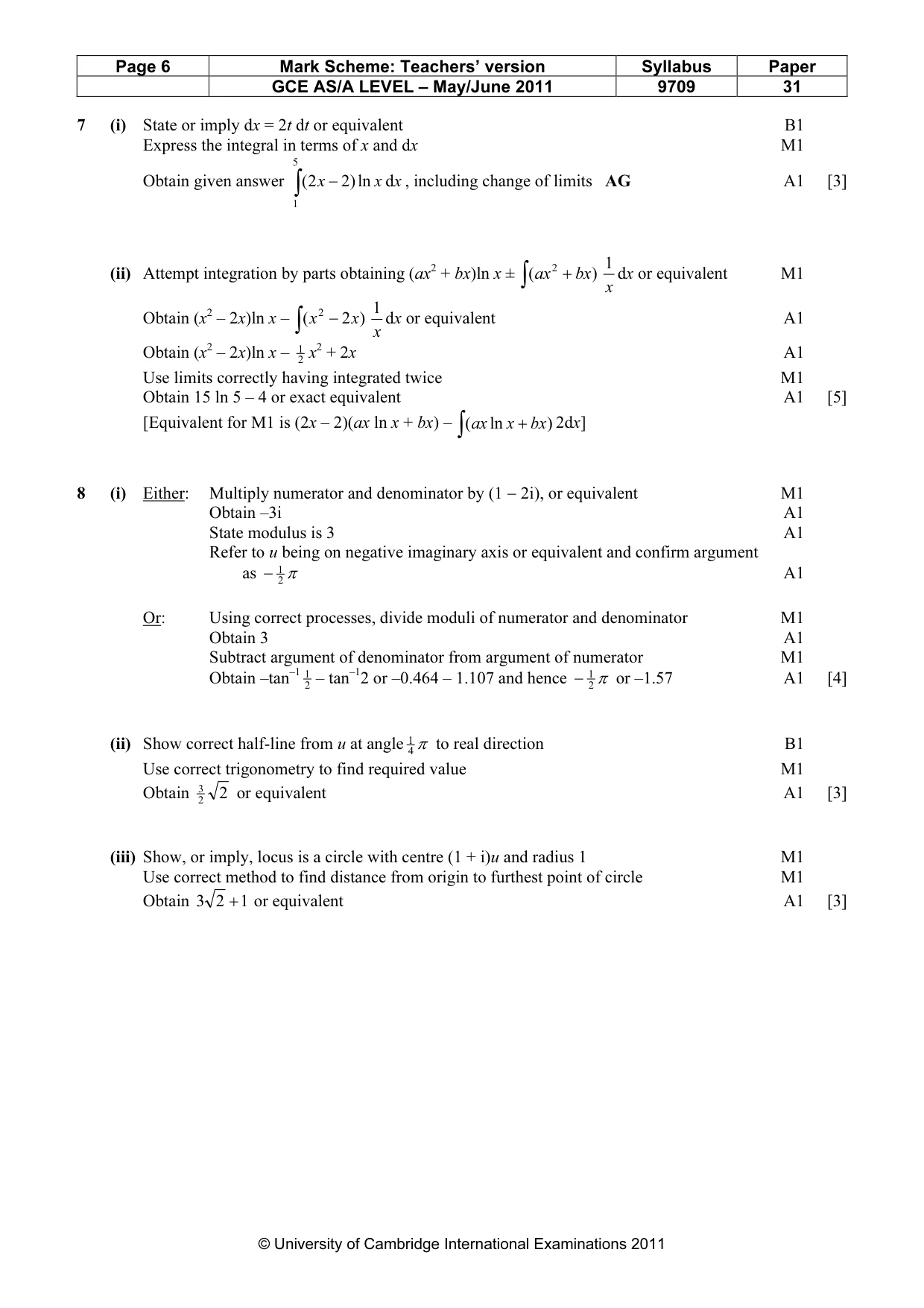
Mark scheme: 7 (i) State or imply dx = 2t dt or equivalent B1 Express the integral in terms of x and dx M1 5 Obtain given answer ∫ ( 2 x − 2) ln x d x , including change of limits AG A1 [3] 1 2 1 (ii) Attempt integration by parts obtaining (ax2 + bx)ln x ±∫ ( ax + bx ) x dx or equivalent M1 2 1 Obtain (x2 – 2x)ln x –∫ ( x − 2 x ) x dx or equivalent A1 Obtain (x2 – 2x)ln x – 12 x2 + 2x A1 Use limits correctly having integrated twice M1 Obtain 15 ln 5 – 4 or exact equivalent A1 [5] [Equivalent for M1 is (2x – 2)(ax ln x + bx) –∫ ( ax ln x + bx ) 2dx]
Q8 · The complex number u is defined by u −3i = 1 2i
68 The complex number u is defined by u −3i = 1 2i. + (i) Showing all your working, find the modulus of u and show that the argument of u is 2π. [4] −1 (ii) For complex numbers satisfying 14π, find the least possible value of [3] ß arg(ß −u) = |ß|. (iii) For complex numbers satisfying 1, find the greatest possible value of [3] ß |ß −(1 + i)u| = |ß|.
Mark scheme: 8 (i) Either: Multiply numerator and denominator by (1 − 2i), or equivalent M1 Obtain –3i A1 State modulus is 3 A1 Refer to u being on negative imaginary axis or equivalent and confirm argument as − 12 π A1 Or: Using correct processes, divide moduli of numerator and denominator M1 Obtain 3 A1 Subtract argument of denominator from argument of numerator M1 Obtain –tan–1 12 – tan–12 or –0.464 – 1.107 and hence − 12 π or –1.57 A1 [4] (ii) Show correct half-line from u at angle 14 π to real direction B1 Use correct trigonometry to find required value M1 Obtain 32 2 or equivalent A1 [3] (iii) Show, or imply, locus is a circle with centre (1 + i)u and radius 1 M1 Use correct method to find distance from origin to furthest point of circle M1 Obtain 3 2 + 1 or equivalent A1 [3] GCE AS/A LEVEL – May/June 2011 9709 31 2 2 2 2
Q9 · Prove the identity cos 4θ 4 cos 2θ cos4θ [4] + ≡8 −3
9 (i) Prove the identity cos 4θ 4 cos 2θ cos4θ [4] + ≡8 −3. (ii) Hence (a) solve the equation cos 4θ 4 cos 2θ 1 for 2π 2π, [3] + = −1 ≤θ ≤1 14π (b) find the exact value of cos4θ dθ. [3] ã 0 [Question 10 is printed on the next page.]
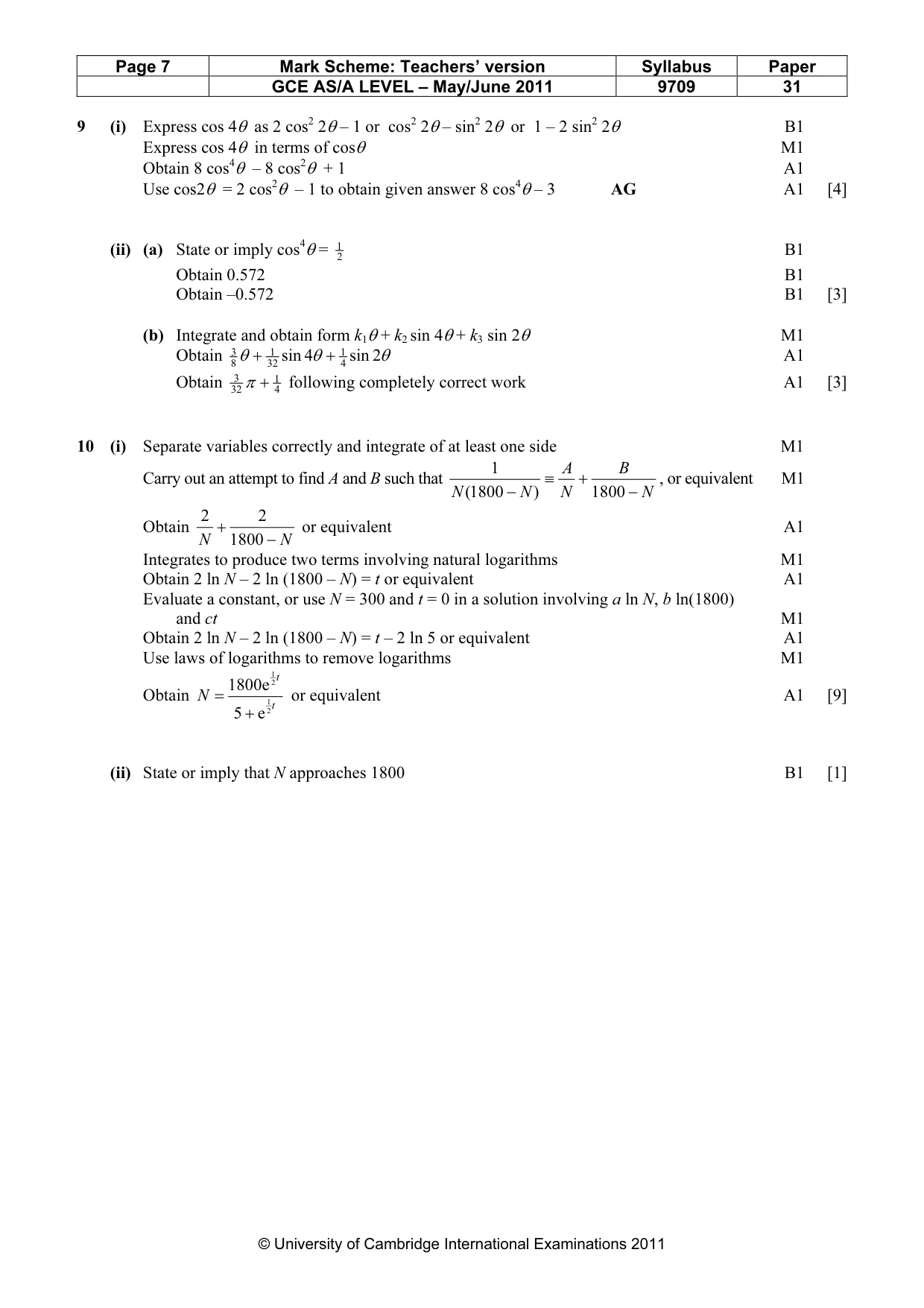
Mark scheme: 9 (i) Express cos 4θ as 2 cos2 2θ – 1 or cos2 2θ – sin2 2θ or 1 – 2 sin2 2θ B1 Express cos 4θ in terms of cosθ M1 Obtain 8 cos4θ – 8 cos2θ + 1 A1 Use cos2θ = 2 cos2θ – 1 to obtain given answer 8 cos4θ – 3 AG A1 [4] (ii) (a) State or imply cos4θ = 12 B1 Obtain 0.572 B1 Obtain –0.572 B1 [3] (b) Integrate and obtain form k1θ + k2 sin 4θ + k3 sin 2θ M1 Obtain 83 θ + 321 sin 4θ + 14 sin 2θ A1 Obtain 323 π + 14 following completely correct work A1 [3]
Q10 · The number of birds of a certain species in a forested region is recorded over several…
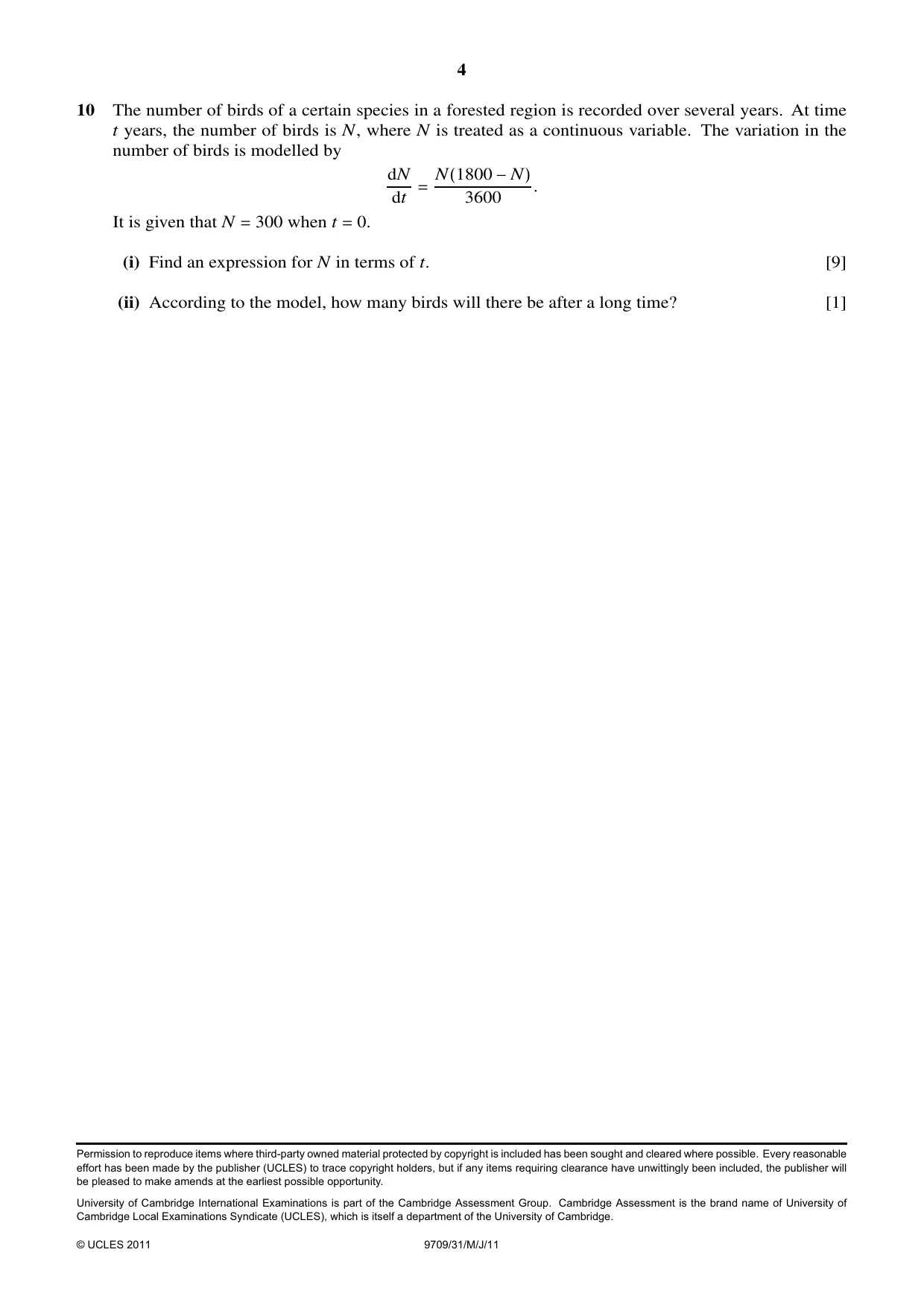
10 The number of birds of a certain species in a forested region is recorded over several years. At time t years, the number of birds is N, where N is treated as a continuous variable. The variation in the number of birds is modelled by dN N(1800 −N) . dt = 3600 It is given that N 300 when t 0. = = (i) Find an expression for N in terms of t. [9] (ii) According to the model, how many birds will there be after a long time? [1]
Mark scheme: 10 (i) Separate variables correctly and integrate of at least one side M1 1 A B Carry out an attempt to find A and B such that ≡ + , or equivalent M1 N (1800 − N ) N 1800 − N 2 2 Obtain + or equivalent A1 N 1800 − N Integrates to produce two terms involving natural logarithms M1 Obtain 2 ln N – 2 ln (1800 – N) = t or equivalent A1 Evaluate a constant, or use N = 300 and t = 0 in a solution involving a ln N, b ln(1800) and ct M1 Obtain 2 ln N – 2 ln (1800 – N) = t – 2 ln 5 or equivalent A1 Use laws of logarithms to remove logarithms M1 1 2 t 1800e or equivalent A1 [9] Obtain N = 1 2 t 5 + e (ii) State or imply that N approaches 1800 B1 [1]
What was in this paper
The subtopics covered by these 10 questions, and how many questions each got. Open one in a new tab to see every Cambridge question on it.
What you needed in this session
Cambridge’s own grade thresholds for 2011 May/June, Paper 3 · Variant 1. A higher threshold means an easier paper — the bar moves with how the cohort did.