Questions as text
Q1 · Chinook salmon lay large eggs compared to other salmon species 9693/30 Oct/Nov 2019
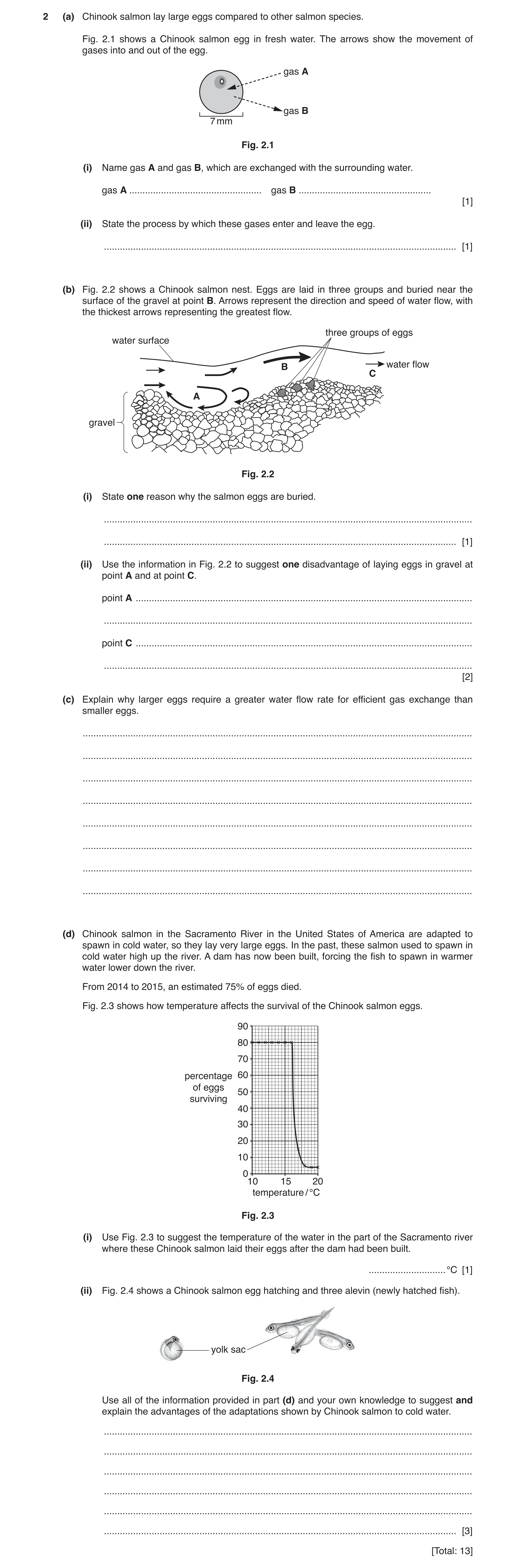
2 (a) Chinook salmon lay large eggs compared to other salmon species. Fig. 2.1 shows a Chinook salmon egg in fresh water. The arrows show the movement of gases into and out of the egg. gas A gas B 7 mm Fig. 2.1 (i) Name gas A and gas B, which are exchanged with the surrounding water. gas A … gas B … [1] (ii) State the process by which these gases enter and leave the egg. … [1] (b) Fig. 2.2 shows a Chinook salmon nest. Eggs are laid in three groups and buried near the surface of the gravel at point B. Arrows represent the direction and speed of water flow, with the thickest arrows representing the greatest flow. three groups of eggs water surface B water flow C A gravel Fig. 2.2 (i) State one reason why the salmon eggs are buried. … … [1] (ii) Use the information in Fig. 2.2 to suggest one disadvantage of laying eggs in gravel at point A and at point C. point A … … point C … … [2] (c) Explain why larger eggs require a greater water flow rate for efficient gas exchange than smaller eggs. … … … … … … … … (d) Chinook salmon in the Sacramento River in the United States of America are adapted to spawn in cold water, so they lay very large eggs. In the past, these salmon used to spawn in cold water high up the river. A dam has now been built, forcing the fish to spawn in warmer water lower down the river. From 2014 to 2015, an estimated 75% of eggs died. Fig. 2.3 shows how temperature affects the survival of the Chinook salmon eggs. 90 80 70 percentage 60 of eggs 50 surviving 40 30 20 10 0 10 15 20 temperature / °C Fig. 2.3 (i) Use Fig. 2.3 to suggest the temperature of the water in the part of the Sacramento river where these Chinook salmon laid their eggs after the dam had been built. … °C [1] (ii) Fig. 2.4 shows a Chinook salmon egg hatching and three alevin (newly hatched fish). yolk sac Fig. 2.4 Use all of the information provided in part (d) and your own knowledge to suggest and explain the advantages of the adaptations shown by Chinook salmon to cold water. … … … … … … [3] [Total: 13]
13 marks
This question in 9693/30 Oct/Nov 2019
Q2 · Sea anemones are classified in the same group as coral polyps 9693/30 May/June 2021
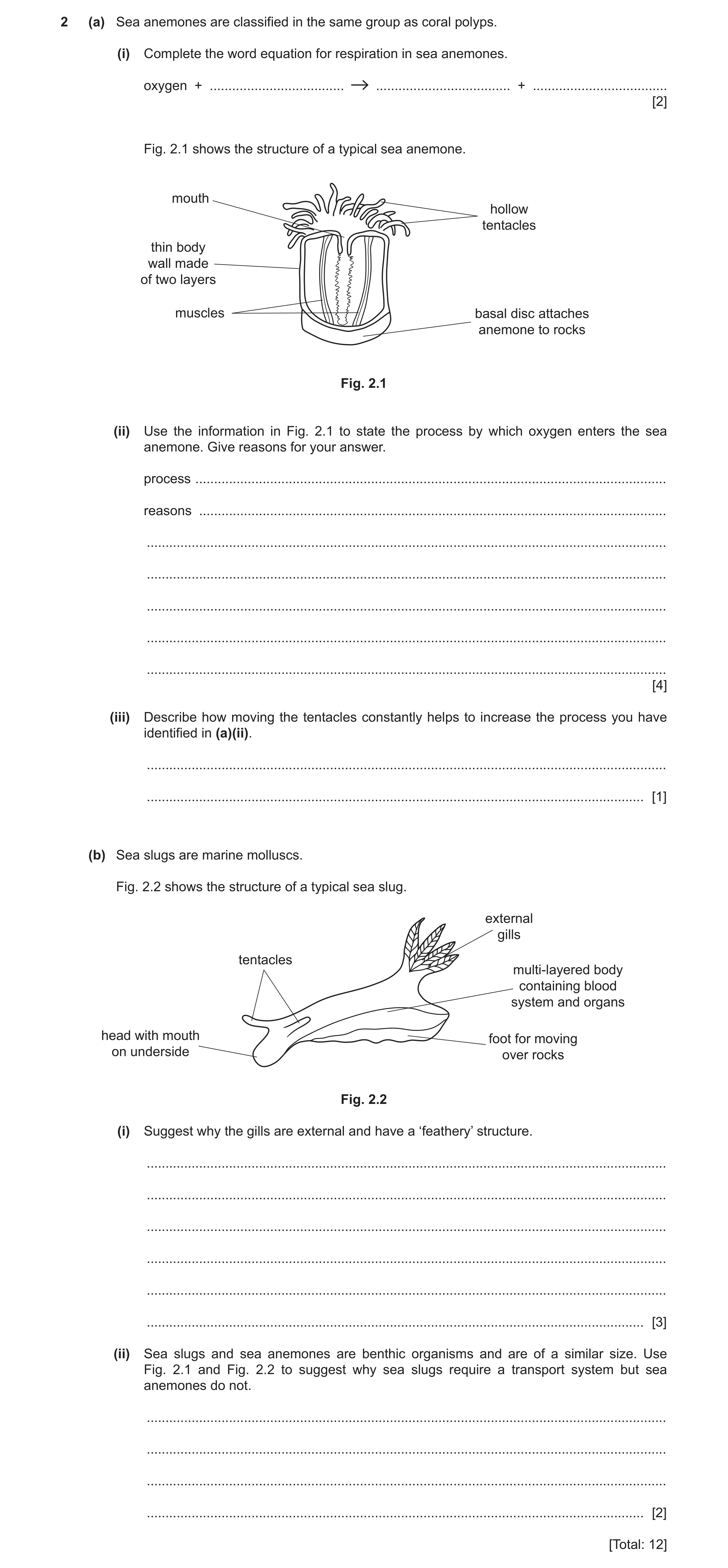
2 (a) Sea anemones are classified in the same group as coral polyps. (i) Complete the word equation for respiration in sea anemones. oxygen + … … + … [2] Fig. 2.1 shows the structure of a typical sea anemone. mouth hollow tentacles thin body wall made of two layers muscles basal disc attaches anemone to rocks Fig. 2.1 (ii) Use the information in Fig. 2.1 to state the process by which oxygen enters the sea anemone. Give reasons for your answer. process … reasons … … … … … … [4] (iii) Describe how moving the tentacles constantly helps to increase the process you have identified in (a)(ii). … … [1] (b) Sea slugs are marine molluscs. Fig. 2.2 shows the structure of a typical sea slug. external gills tentacles multi-layered body containing blood system and organs head with mouth foot for moving on underside over rocks Fig. 2.2 (i) Suggest why the gills are external and have a ‘feathery’ structure. … … … … … … [3] (ii) Sea slugs and sea anemones are benthic organisms and are of a similar size. Use Fig. 2.1 and Fig. 2.2 to suggest why sea slugs require a transport system but sea anemones do not. … … … … [2] [Total: 12]
12 marks
This question in 9693/30 May/June 2021
Q3 · A part of a cell from a fish, as seen using an electron microscope 9693/31 May/June 2022
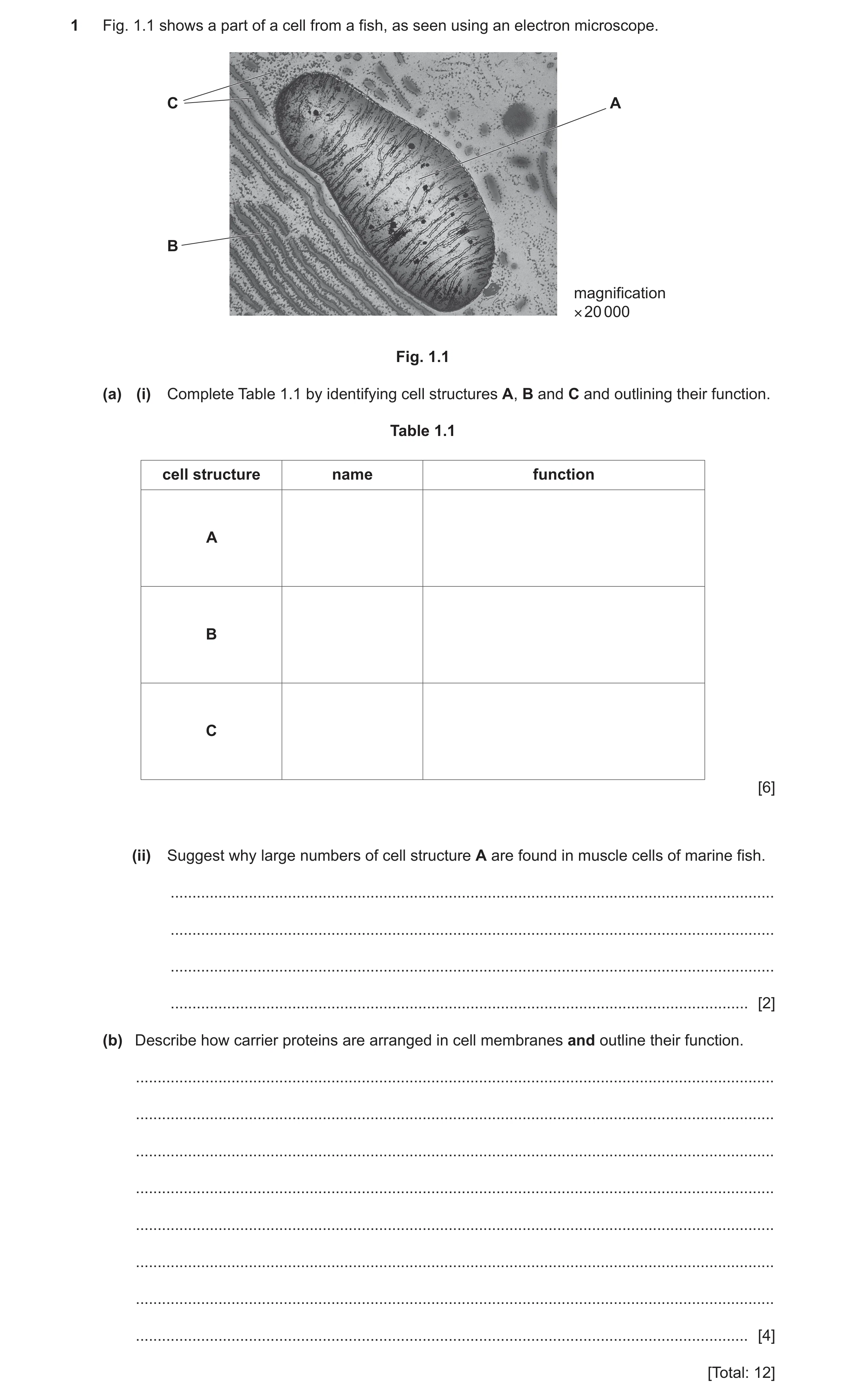
1 Fig. 1.1 shows a part of a cell from a fish, as seen using an electron microscope. C A B magnification × 20 000 Fig. 1.1 (a) (i) Complete Table 1.1 by identifying cell structures A, B and C and outlining their function. Table 1.1 cell structure name function A B C [6] (ii) Suggest why large numbers of cell structure A are found in muscle cells of marine fish. … … … … [2] (b) Describe how carrier proteins are arranged in cell membranes and outline their function. … … … … … … … … [4] [Total: 12]
12 marks
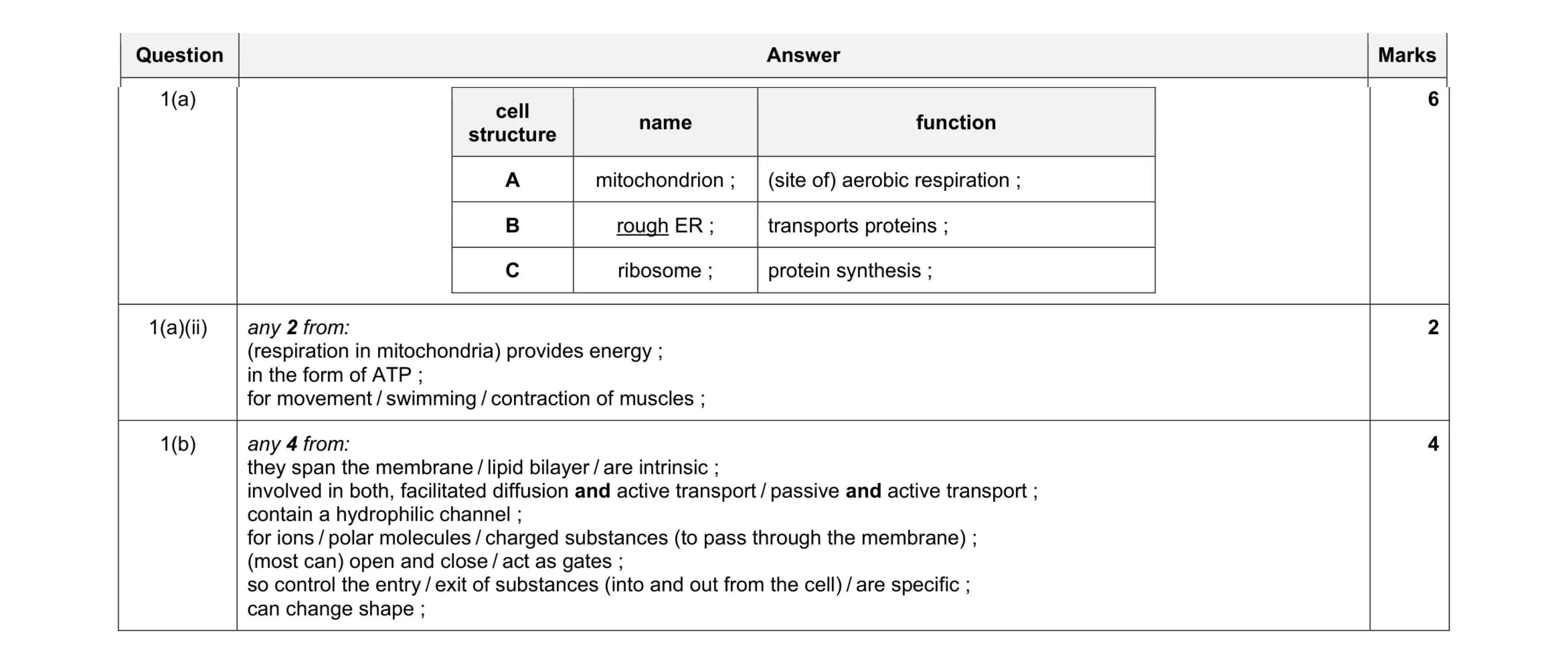
Mark scheme: 1(a) cell structure name function A mitochondrion ; (site of) aerobic respiration ; B rough ER ; transports proteins ; C ribosome ; protein synthesis ; 6 1(a)(ii) any 2 from: (respiration in mitochondria) provides energy ; in the form of ATP ; for movement / swimming / contraction of muscles ; 2 1(b) any 4 from: they span the membrane / lipid bilayer / are intrinsic ; involved in both, facilitated diffusion and active transport / passive and active transport ; contain a hydrophilic channel ; for ions / polar molecules / charged substances (to pass through the membrane) ; (most can) open and close / act as gates ; so control the entry / exit of substances (into and out from the cell) / are specific ; can change shape ; 4
This question in 9693/31 May/June 2022
Q4 · There is continuous movement of substances through the cell membranes of cells of marine… 9693/31 Oct/Nov 2022
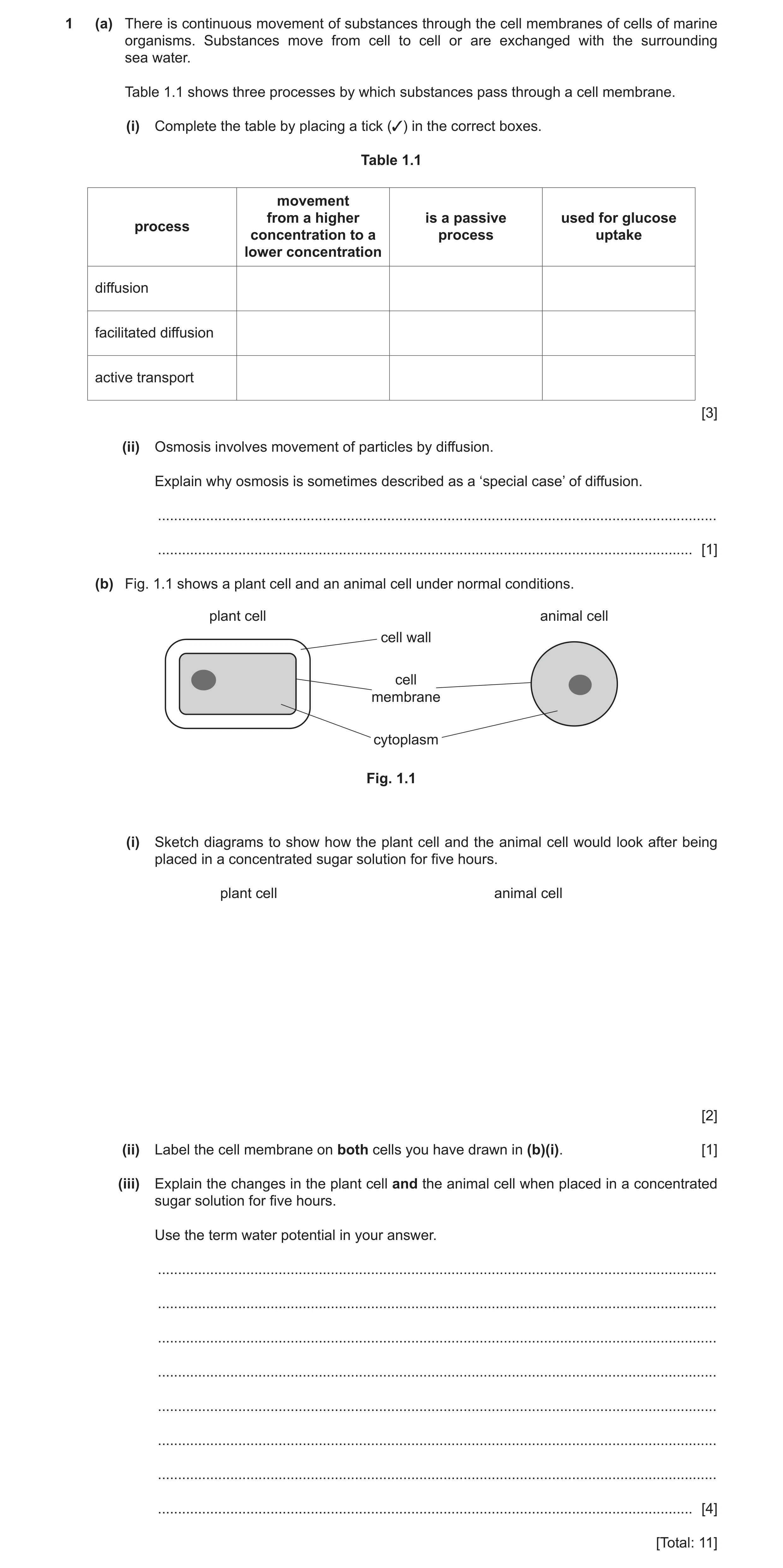
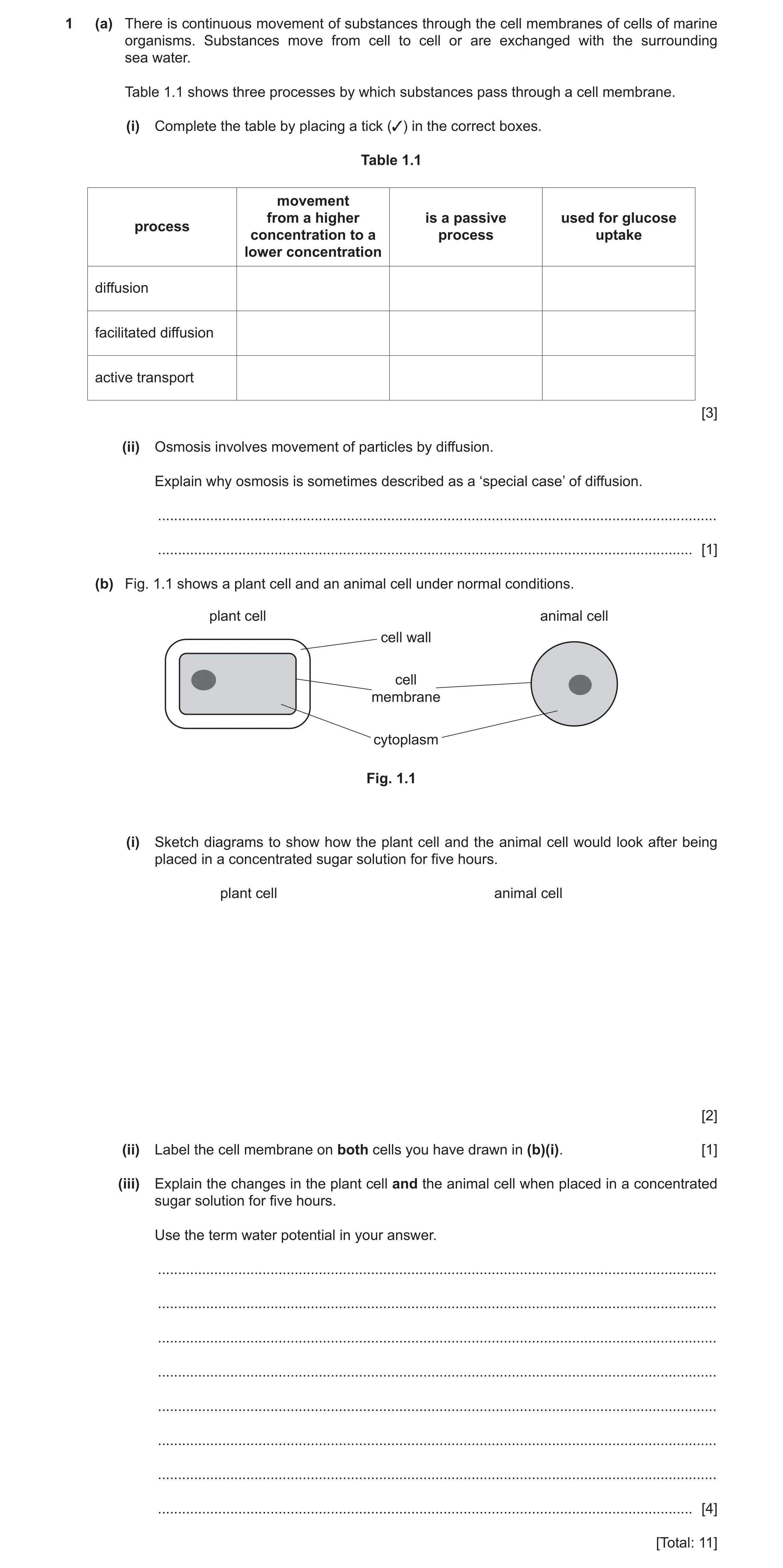
1 (a) There is continuous movement of substances through the cell membranes of cells of marine organisms. Substances move from cell to cell or are exchanged with the surrounding sea water. Table 1.1 shows three processes by which substances pass through a cell membrane. (i) Complete the table by placing a tick (✓) in the correct boxes. Table 1.1 movement from a higher is a passive used for glucose process concentration to a process uptake lower concentration diffusion facilitated diffusion active transport [3] (ii) Osmosis involves movement of particles by diffusion. Explain why osmosis is sometimes described as a ‘special case’ of diffusion. … … [1] (b) Fig. 1.1 shows a plant cell and an animal cell under normal conditions. plant cell animal cell cell wall cell membrane cytoplasm Fig. 1.1 (i) Sketch diagrams to show how the plant cell and the animal cell would look after being placed in a concentrated sugar solution for five hours. plant cell animal cell [2] (ii) Label the cell membrane on both cells you have drawn in (b)(i). [1] (iii) Explain the changes in the plant cell and the animal cell when placed in a concentrated sugar solution for five hours. Use the term water potential in your answer. … … … … … … … … [4] [Total: 11]
11 marks
Mark scheme: Question Answer Marks 1(a)(i) 3 movement from a used for glucose process high concentration to is a passive process uptake a lower concentration diffusion √ √ facilitated diffusion √ √ √ active transport √ ; ; ; 1(a)(ii) it only applies to water ; 1 1(b)(i) 2 ; ; 1(b)(ii) correct label on both cells ; 1 1(b)(iii) water diffuses from an area of high water potential inside the cell ; 4 out into the (concentrated) sugar solution / to area of lower water potential ; so cell membrane pulls away from cell wall in a plant cell ; animal cell shrinks ;
This question in 9693/31 Oct/Nov 2022
Q5 · There is continuous movement of substances through the cell membranes of cells of marine… 9693/32 Oct/Nov 2022
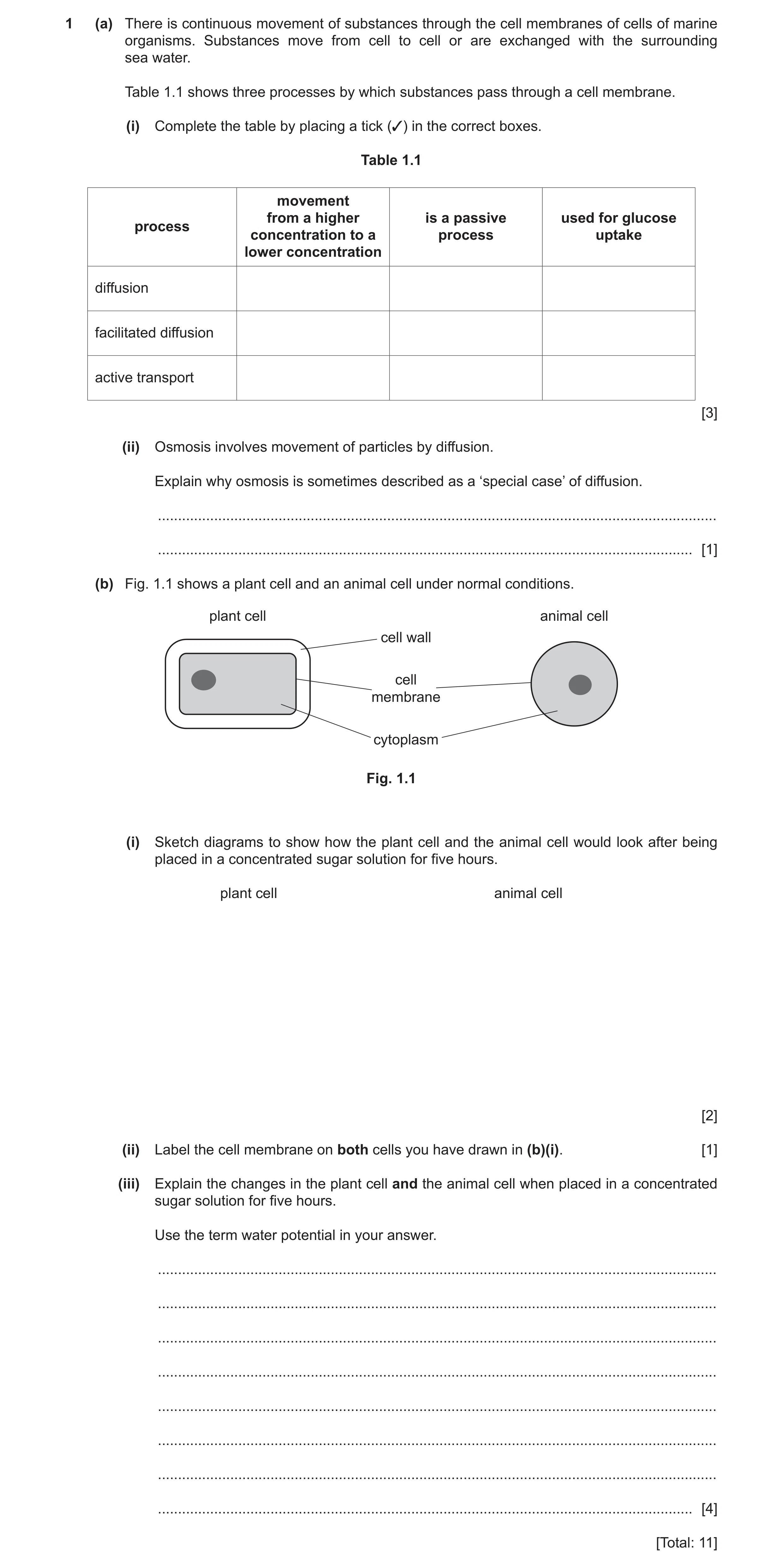
1 (a) There is continuous movement of substances through the cell membranes of cells of marine organisms. Substances move from cell to cell or are exchanged with the surrounding sea water. Table 1.1 shows three processes by which substances pass through a cell membrane. (i) Complete the table by placing a tick (✓) in the correct boxes. Table 1.1 movement from a higher is a passive used for glucose process concentration to a process uptake lower concentration diffusion facilitated diffusion active transport [3] (ii) Osmosis involves movement of particles by diffusion. Explain why osmosis is sometimes described as a ‘special case’ of diffusion. … … [1] (b) Fig. 1.1 shows a plant cell and an animal cell under normal conditions. plant cell animal cell cell wall cell membrane cytoplasm Fig. 1.1 (i) Sketch diagrams to show how the plant cell and the animal cell would look after being placed in a concentrated sugar solution for five hours. plant cell animal cell [2] (ii) Label the cell membrane on both cells you have drawn in (b)(i). [1] (iii) Explain the changes in the plant cell and the animal cell when placed in a concentrated sugar solution for five hours. Use the term water potential in your answer. … … … … … … … … [4] [Total: 11]
11 marks
Mark scheme: Question Answer Marks 1(a)(i) 3 movement from a used for glucose process high concentration to is a passive process uptake a lower concentration diffusion √ √ facilitated diffusion √ √ √ active transport √ ; ; ; 1(a)(ii) it only applies to water ; 1 1(b)(i) 2 ; ; 1(b)(ii) correct label on both cells ; 1 1(b)(iii) water diffuses from an area of high water potential inside the cell ; 4 out into the (concentrated) sugar solution / to area of lower water potential ; so cell membrane pulls away from cell wall in a plant cell ; animal cell shrinks ;
This question in 9693/32 Oct/Nov 2022
Q6 · There is continuous movement of substances through the cell membranes of cells of marine… 9693/33 Oct/Nov 2022
1 (a) There is continuous movement of substances through the cell membranes of cells of marine organisms. Substances move from cell to cell or are exchanged with the surrounding sea water. Table 1.1 shows three processes by which substances pass through a cell membrane. (i) Complete the table by placing a tick (✓) in the correct boxes. Table 1.1 movement from a higher is a passive used for glucose process concentration to a process uptake lower concentration diffusion facilitated diffusion active transport [3] (ii) Osmosis involves movement of particles by diffusion. Explain why osmosis is sometimes described as a ‘special case’ of diffusion. … … [1] (b) Fig. 1.1 shows a plant cell and an animal cell under normal conditions. plant cell animal cell cell wall cell membrane cytoplasm Fig. 1.1 (i) Sketch diagrams to show how the plant cell and the animal cell would look after being placed in a concentrated sugar solution for five hours. plant cell animal cell [2] (ii) Label the cell membrane on both cells you have drawn in (b)(i). [1] (iii) Explain the changes in the plant cell and the animal cell when placed in a concentrated sugar solution for five hours. Use the term water potential in your answer. … … … … … … … … [4] [Total: 11]
11 marks
Mark scheme: Question Answer Marks 1(a)(i) 3 movement from a used for glucose process high concentration to is a passive process uptake a lower concentration diffusion √ √ facilitated diffusion √ √ √ active transport √ ; ; ; 1(a)(ii) it only applies to water ; 1 1(b)(i) 2 ; ; 1(b)(ii) correct label on both cells ; 1 1(b)(iii) water diffuses from an area of high water potential inside the cell ; 4 out into the (concentrated) sugar solution / to area of lower water potential ; so cell membrane pulls away from cell wall in a plant cell ; animal cell shrinks ;
This question in 9693/33 Oct/Nov 2022
Q7 · Describe how ions such as sodium pass through the cell membrane 9693/31 May/June 2023
7 Describe how ions such as sodium pass through the cell membrane. … … … … … … … … … … … … … … [7]
7 marks
Mark scheme: 7 any 7 of: 1 sodium ions are charged ; 2 so cannot pass through the lipid bilayer ; 3 pass through the membrane by facilitated diffusion and active transport ; 4 using channel proteins and carrier proteins ; 5 (proteins) are specific ; 6 during (facilitated) diffusion ions pass through channel proteins ; 7 from a high concentration to a low concentration / down a concentration gradient ; 8 no ATP / no energy required / passive ; 9 channel proteins have a fixed shape / can open and close / are gated ; 10 carrier proteins are used for active transport ; 11 (during active transport) ions pass from a low concentration to a high concentration / against concentration gradient ; 12 requires ATP / energy / ions pumped across membrane ; 13 carrier proteins can change their shape ; 7
This question in 9693/31 May/June 2023
Q8 · Golden samphire (Limbarda crithmoides) growing in the splash zone of a rocky shore 9693/32 May/June 2023
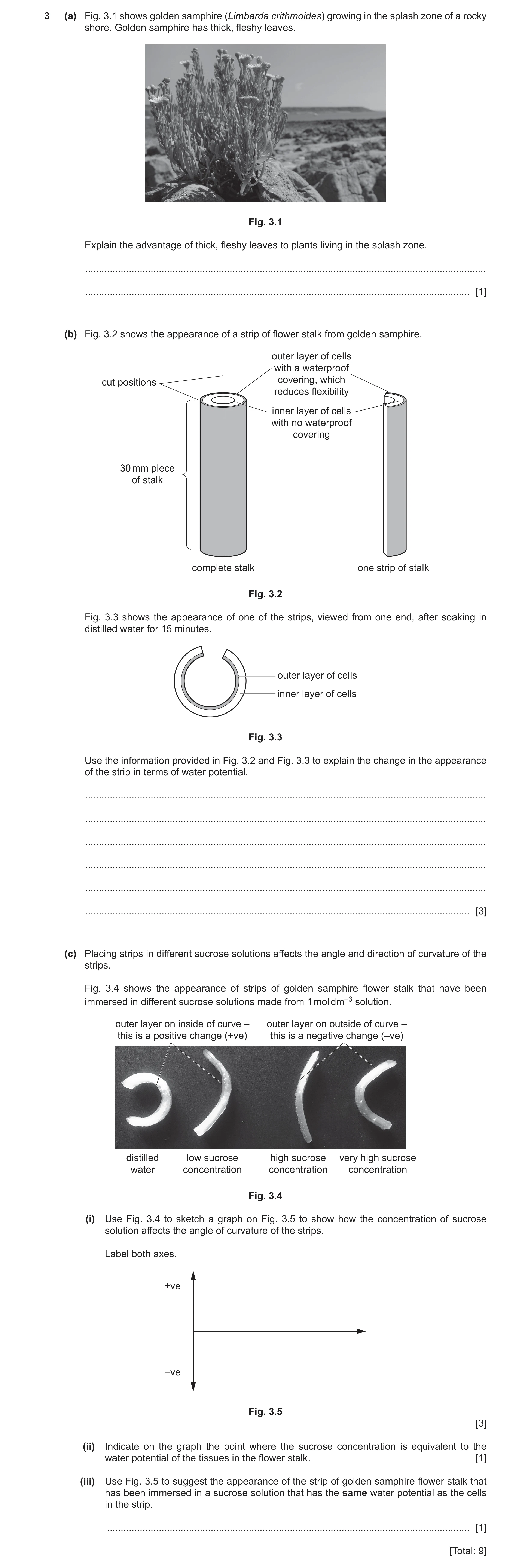
3 (a) Fig. 3.1 shows golden samphire (Limbarda crithmoides) growing in the splash zone of a rocky shore. Golden samphire has thick, fleshy leaves. Fig. 3.1 Explain the advantage of thick, fleshy leaves to plants living in the splash zone. … … [1] (b) Fig. 3.2 shows the appearance of a strip of flower stalk from golden samphire. outer layer of cells with a waterproof cut positions covering, which reduces flexibility inner layer of cells with no waterproof covering 30 mm piece of stalk complete stalk one strip of stalk Fig. 3.2 Fig. 3.3 shows the appearance of one of the strips, viewed from one end, after soaking in distilled water for 15 minutes. outer layer of cells inner layer of cells Fig. 3.3 Use the information provided in Fig. 3.2 and Fig. 3.3 to explain the change in the appearance of the strip in terms of water potential. … … … … … … [3] (c) Placing strips in different sucrose solutions affects the angle and direction of curvature of the strips. Fig. 3.4 shows the appearance of strips of golden samphire flower stalk that have been immersed in different sucrose solutions made from 1 mol dm–3 solution. outer layer on inside of curve – outer layer on outside of curve – this is a positive change (+ve) this is a negative change (–ve) distilled low sucrose high sucrose very high sucrose water concentration concentration concentration Fig. 3.4 (i) Use Fig. 3.4 to sketch a graph on Fig. 3.5 to show how the concentration of sucrose solution affects the angle of curvature of the strips. Label both axes. +ve –ve Fig. 3.5 [3] (ii) Indicate on the graph the point where the sucrose concentration is equivalent to the water potential of the tissues in the flower stalk. [1] (iii) Use Fig. 3.5 to suggest the appearance of the strip of golden samphire flower stalk that has been immersed in a sucrose solution that has the same water potential as the cells in the strip. … [1] [Total: 9]
9 marks
Mark scheme: 3(a) store water, to prevent desiccation / as fresh water is limiting ; 1 3(b) any 3 of: water entered the, plant / inner layer of cells, by osmosis ; from higher water potential (distilled water) to lower water potential (plant) / down a water potential gradient ; outer layer was covered in a waterproof layer ; preventing water entering (by osmosis) ; cells in inner layer expanded more than those on outside ; 3 3(c)(i) x-axis label – sucrose concentration and mol dm–3 ; y-axis label – degree or angle of curvature / bending ; line – (straight) line crosses x-axis from positive to negative ; 3 3(c)(ii) water potential identified where line crosses x-axis ; 1 3(c)(iii) straight / not curved / no bending ; 1
This question in 9693/32 May/June 2023
Q9 · Golden samphire (Limbarda crithmoides) growing in the splash zone of a rocky shore 9693/33 May/June 2023
3 (a) Fig. 3.1 shows golden samphire (Limbarda crithmoides) growing in the splash zone of a rocky shore. Golden samphire has thick, fleshy leaves. Fig. 3.1 Explain the advantage of thick, fleshy leaves to plants living in the splash zone. … … [1] (b) Fig. 3.2 shows the appearance of a strip of flower stalk from golden samphire. outer layer of cells with a waterproof cut positions covering, which reduces flexibility inner layer of cells with no waterproof covering 30 mm piece of stalk complete stalk one strip of stalk Fig. 3.2 Fig. 3.3 shows the appearance of one of the strips, viewed from one end, after soaking in distilled water for 15 minutes. outer layer of cells inner layer of cells Fig. 3.3 Use the information provided in Fig. 3.2 and Fig. 3.3 to explain the change in the appearance of the strip in terms of water potential. … … … … … … [3] (c) Placing strips in different sucrose solutions affects the angle and direction of curvature of the strips. Fig. 3.4 shows the appearance of strips of golden samphire flower stalk that have been immersed in different sucrose solutions made from 1 mol dm–3 solution. outer layer on inside of curve – outer layer on outside of curve – this is a positive change (+ve) this is a negative change (–ve) distilled low sucrose high sucrose very high sucrose water concentration concentration concentration Fig. 3.4 (i) Use Fig. 3.4 to sketch a graph on Fig. 3.5 to show how the concentration of sucrose solution affects the angle of curvature of the strips. Label both axes. +ve –ve Fig. 3.5 [3] (ii) Indicate on the graph the point where the sucrose concentration is equivalent to the water potential of the tissues in the flower stalk. [1] (iii) Use Fig. 3.5 to suggest the appearance of the strip of golden samphire flower stalk that has been immersed in a sucrose solution that has the same water potential as the cells in the strip. … [1] [Total: 9]
9 marks
Mark scheme: 3(a) store water, to prevent desiccation / as fresh water is limiting ; 1 3(b) any 3 of: water entered the, plant / inner layer of cells, by osmosis ; from higher water potential (distilled water) to lower water potential (plant) / down a water potential gradient ; outer layer was covered in a waterproof layer ; preventing water entering (by osmosis) ; cells in inner layer expanded more than those on outside ; 3 3(c)(i) x-axis label – sucrose concentration and mol dm–3 ; y-axis label – degree or angle of curvature / bending ; line – (straight) line crosses x-axis from positive to negative ; 3 3(c)(ii) water potential identified where line crosses x-axis ; 1 3(c)(iii) straight / not curved / no bending ; 1
This question in 9693/33 May/June 2023
Q10 · Describe the process of diffusion and explain its importance in marine organisms 9693/31 May/June 2024
6 (a) Describe the process of diffusion and explain its importance in marine organisms. … … … … … … … … … … … … … … … … [8] (b) Describe how water moves between cells and their environments and explain the effects of this water movement on plant cells and animal cells. … … … … … … … … … … … … … … [7] [Total: 15]
15 marks
Mark scheme: 6(a) any 8 of: 1 diffusion is the random (net) movement of particles ; 2 from a high concentration to a lower concentration / down a conc. gradient ; 3 (the random movement is) caused by the kinetic energy of the particles ; 4 ref. to two (named) examples of particles / gases / liquids / molecules / ions (which move by diffusion) ; 5 it is passive / does not require, ATP / energy ; 6 the greater the difference in concentration, the faster the rate of diffusion ; 7 rate increases with temperature (as particles have more kinetic energy) ; 8 rate increases with surface area ; 9 diffusion can only occur over short distances ; 10 non-polar molecules diffuse more easily through cell membranes than polar ones ; 11 because they are soluble in the non-polar phospholipid tails ; 12 (diffusion used) for gaseous exchange ; 13 for respiration / photosynthesis ; 14 suitable example of a gas exchange surface ; 15 important for mineral uptake (from sea water) ; 16 correct ref.to facilitated diffusion or osmosis ; 6(b) any 7 of: 1 water moves by osmosis ; 2 from an area of high water potential to an area of lower water potential / down a water potential gradient ; 3 through, a selectively permeable membrane / the cell membrane / tonoplast ; 4 the water potential of a cell is affected by the concentration of solutes in the cytoplasm / vacuole ; 5 the higher the concentration of solutes, the lower the water potential ; ORA 6 ref. to pressure increasing water potential ; 7 when a cell gains water its water potential becomes less negative ; ORA 8 if plant cells lose (too much) water they can become flaccid / plasmolysed ; 9 if animal cells lose (too much) water they can shrink ; 10 when plant cells gain water they become turgid ; 11 so providing support ; 12 if animal cells gain (too much) water they can burst ; ORA 13 as they do not have a cell wall (to provide support) ; ORA 14 AVP ; 7
This question in 9693/31 May/June 2024
Q11 · State the difference between the meanings of stenohaline and euryhaline 9693/32 May/June 2025
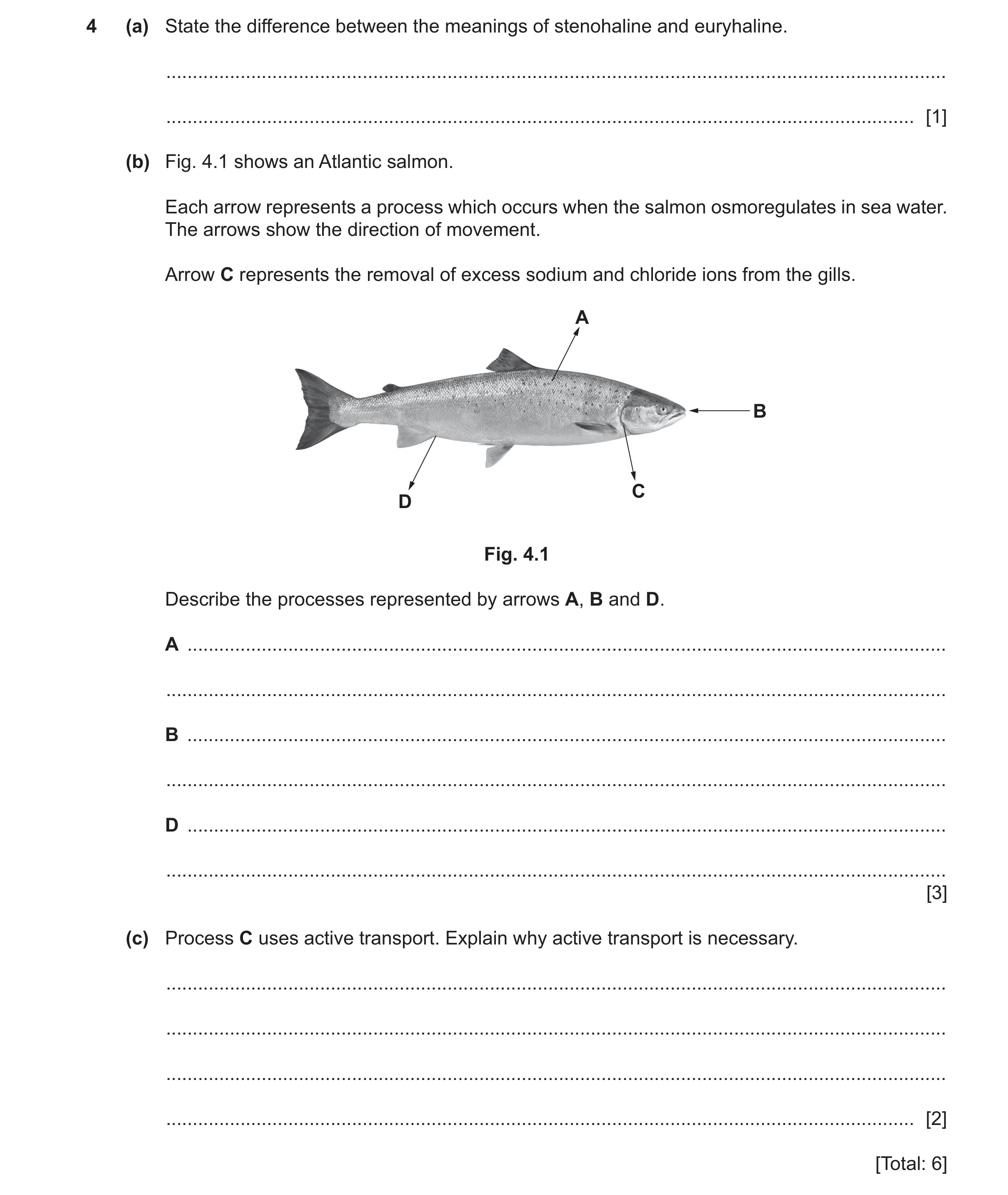
4 (a) State the difference between the meanings of stenohaline and euryhaline. … … [1] (b) Fig. 4.1 shows an Atlantic salmon. Each arrow represents a process which occurs when the salmon osmoregulates in sea water. The arrows show the direction of movement. Arrow C represents the removal of excess sodium and chloride ions from the gills. A B C D Fig. 4.1 Describe the processes represented by arrows A, B and D. A … … B … … D … … [3] (c) Process C uses active transport. Explain why active transport is necessary. … … … … [2] [Total: 6]
6 marks
Mark scheme: 4(a) euryhaline can tolerate in a wide range of salinities AND 1 stenohaline can only tolerate small changes in salinity / AW ; 4(b) A – loss of water through skin ; 3 B – (constantly) drinking (sea water) ; D – removal of, concentrated / low volume of, urine ; 4(c) any 2 of: 2 1 there is a higher concentration of sodium and chloride ions in the sea water than in the fish ; 2 so ions move out against their concentration gradient ; 3 which requires energy from ATP ;
This question in 9693/32 May/June 2025
Q12 · State the difference between the meanings of stenohaline and euryhaline 9693/33 May/June 2025
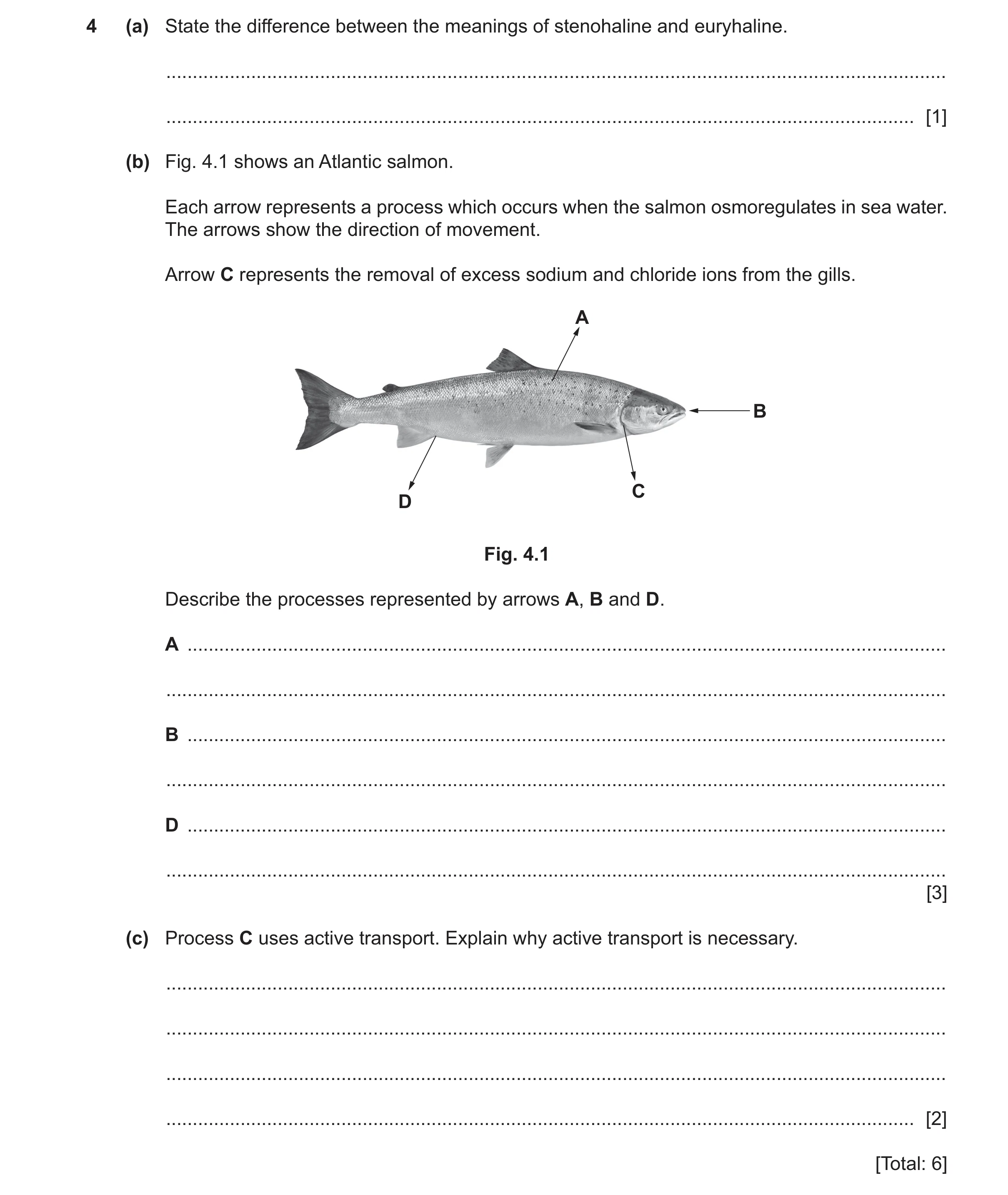
4 (a) State the difference between the meanings of stenohaline and euryhaline. … … [1] (b) Fig. 4.1 shows an Atlantic salmon. Each arrow represents a process which occurs when the salmon osmoregulates in sea water. The arrows show the direction of movement. Arrow C represents the removal of excess sodium and chloride ions from the gills. A B C D Fig. 4.1 Describe the processes represented by arrows A, B and D. A … … B … … D … … [3] (c) Process C uses active transport. Explain why active transport is necessary. … … … … [2] [Total: 6]
6 marks
Mark scheme: 4(a) euryhaline can tolerate in a wide range of salinities AND 1 stenohaline can only tolerate small changes in salinity / AW ; 4(b) A – loss of water through skin ; 3 B – (constantly) drinking (sea water) ; D – removal of, concentrated / low volume of, urine ; 4(c) any 2 of: 2 1 there is a higher concentration of sodium and chloride ions in the sea water than in the fish ; 2 so ions move out against their concentration gradient ; 3 which requires energy from ATP ;
This question in 9693/33 May/June 2025
 10 / 18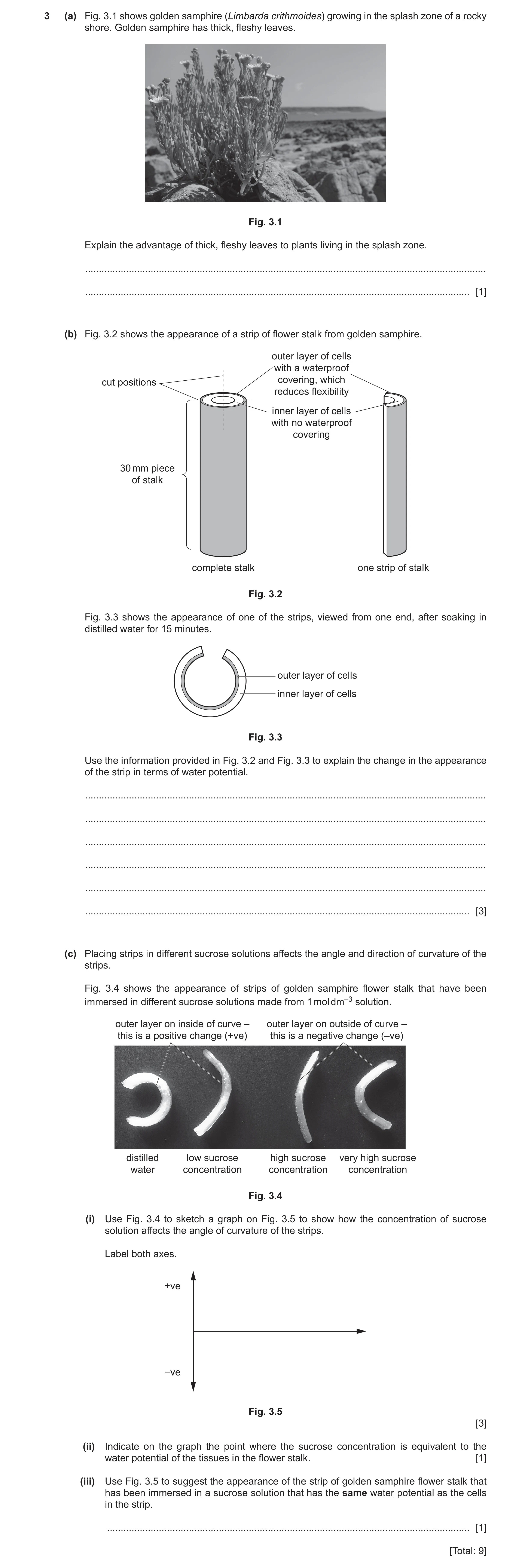
 17 / 18
 18 / 18
 12
12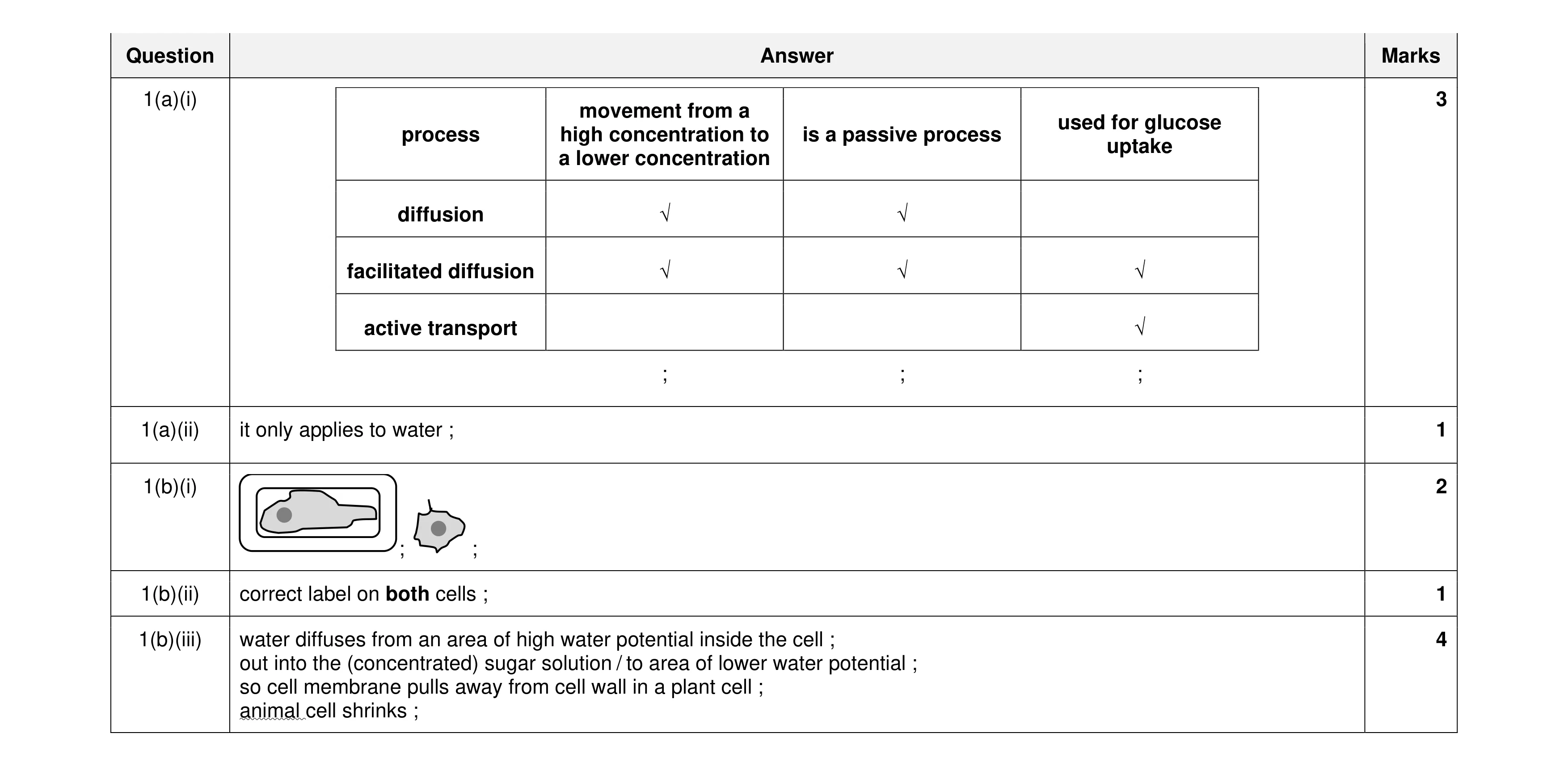 11
11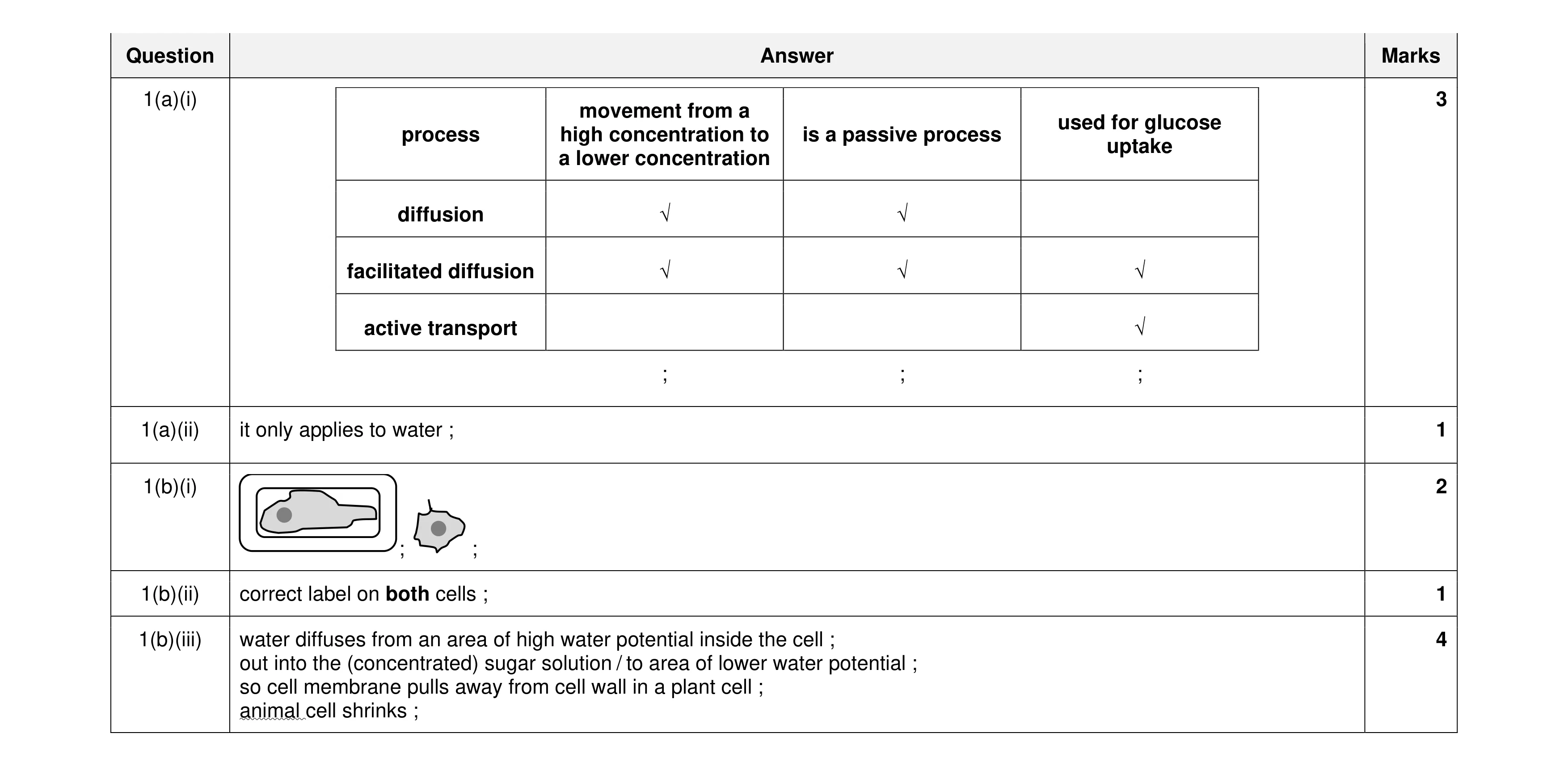 11
11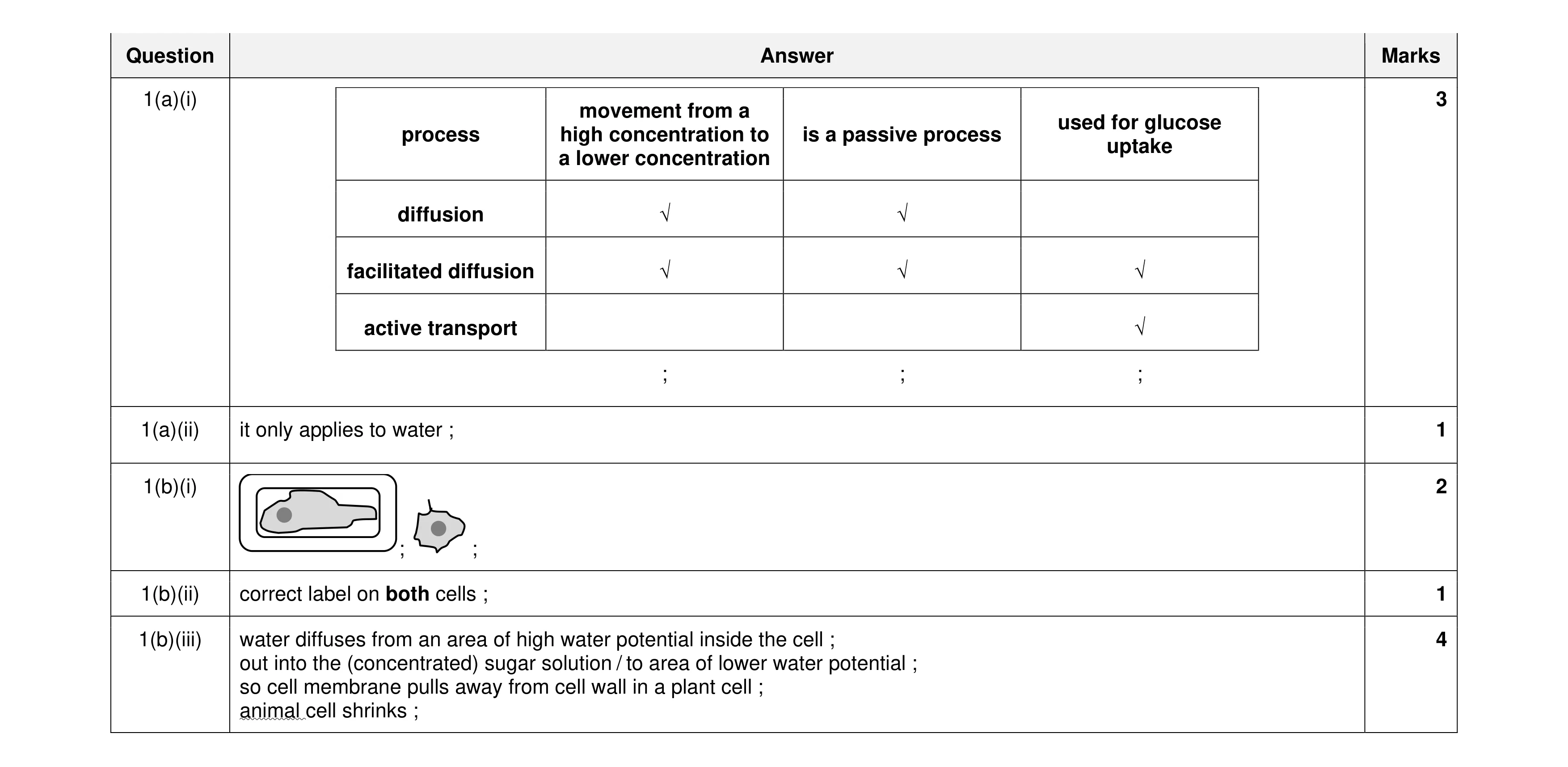 11
11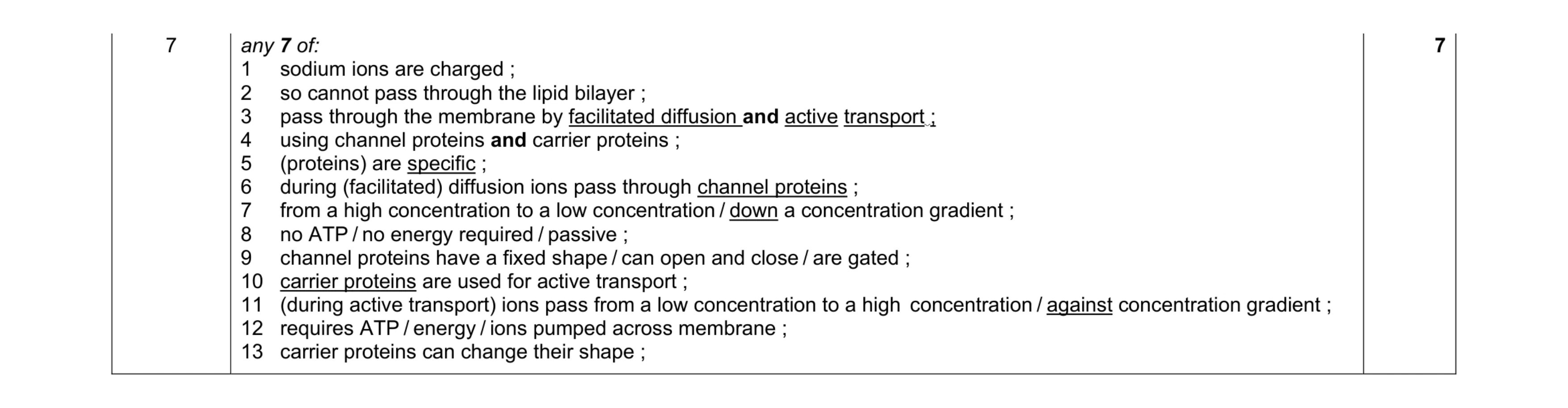 7
7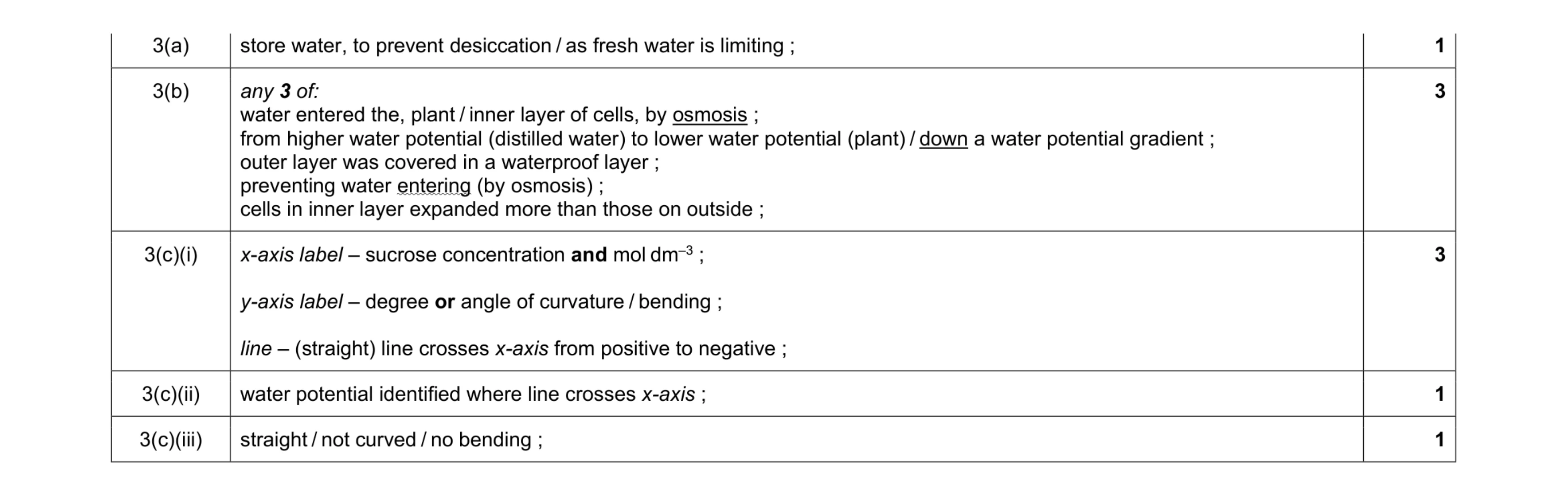 9
9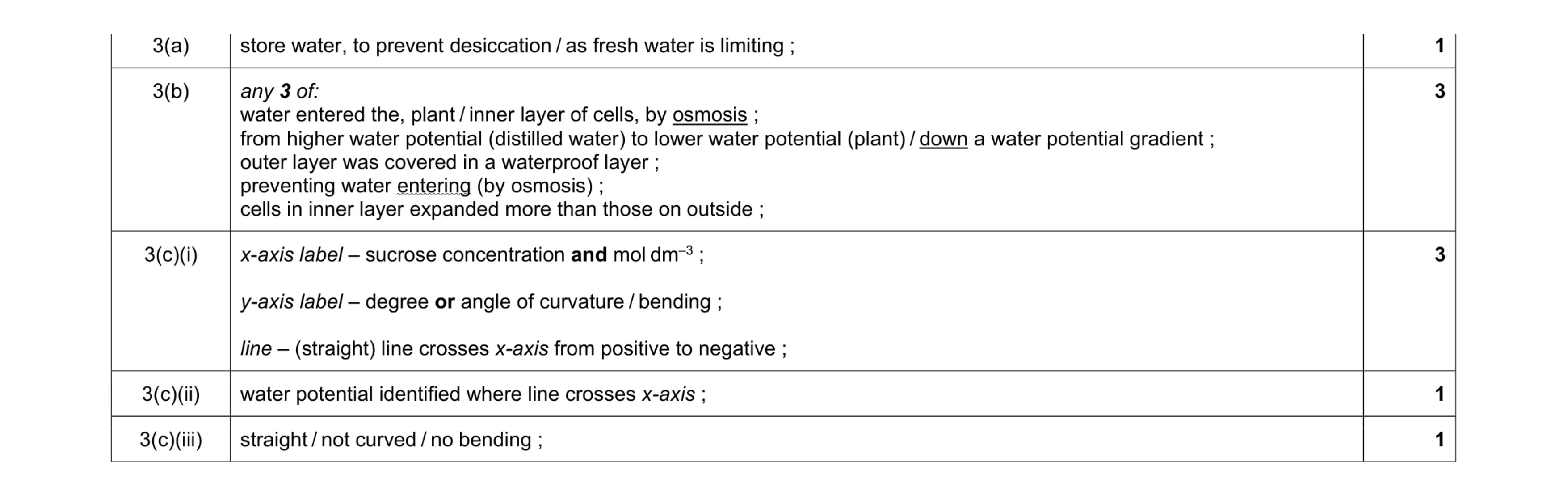 9
9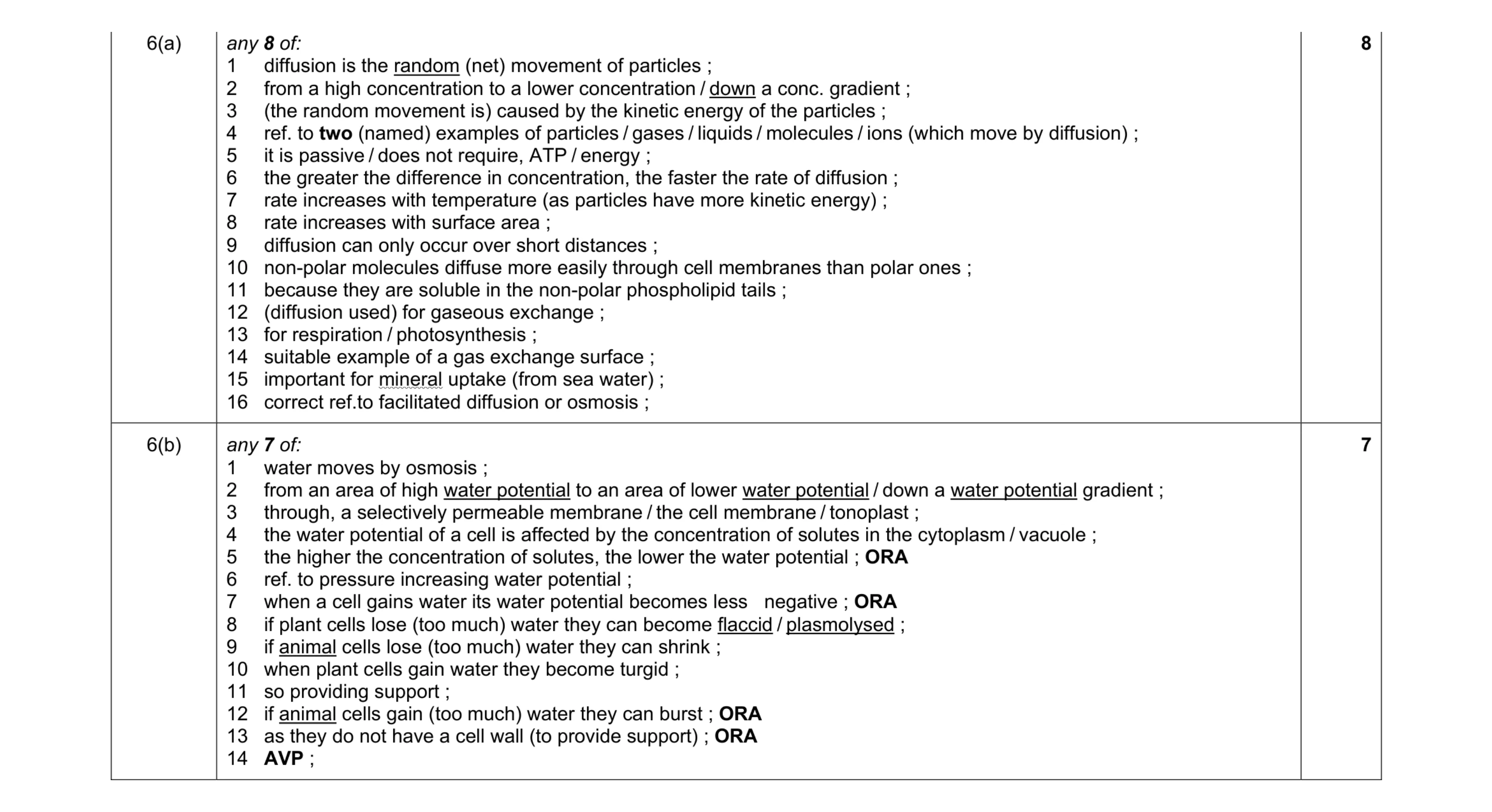 15
15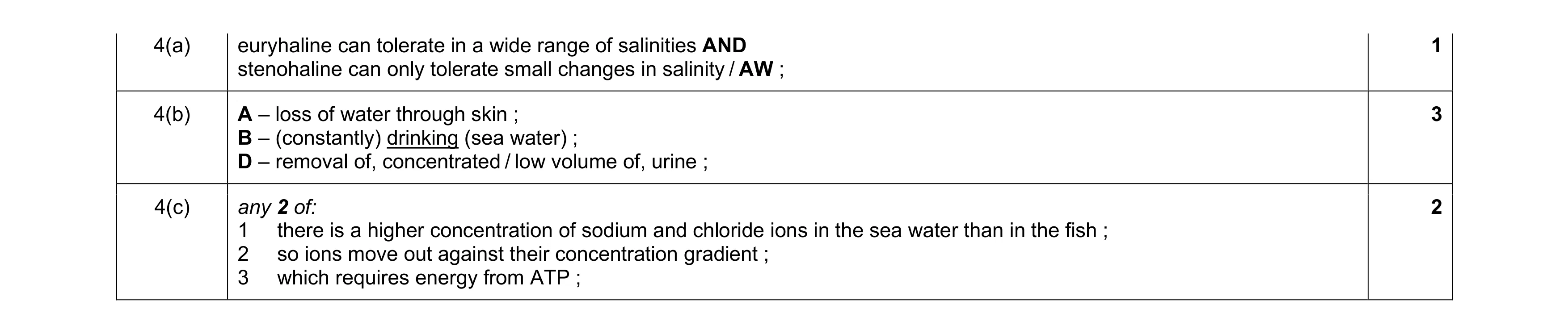 6
6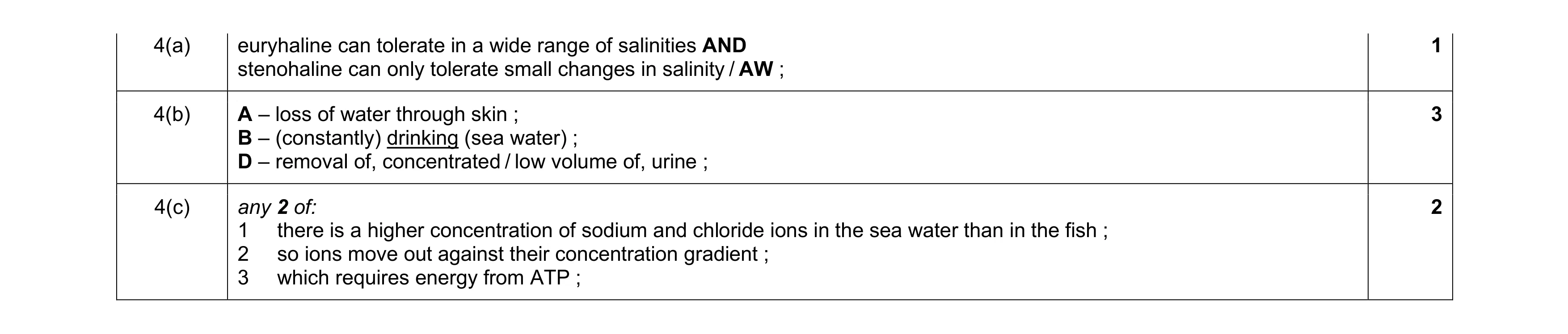 6
6