Questions as text
Q1 · The mean salinity of sea water is about 35 parts per thousand (‰) 9693/21 Oct/Nov 2017
4 (a) The mean salinity of sea water is about 35 parts per thousand (‰). The salinity in a tropical lagoon was measured and found to be 37 ‰ and the salinity in an estuary was found to be 20 ‰. Suggest explanations for these differences in salinity. … … … … … … [3] (b) Describe what is meant by the Coriolis effect and how it affects ocean currents. … … … … … [2] (c) Explain how temperature and wind produce ocean currents and upwelling. … … … … … … … … … … [5] (d) The surface layer of the sea contains a reservoir of dissolved nutrients. With reference to named examples, discuss how these nutrients may be lost from the surface layer. … … … … … … … … … … … … [5] [Total: 15]
15 marks
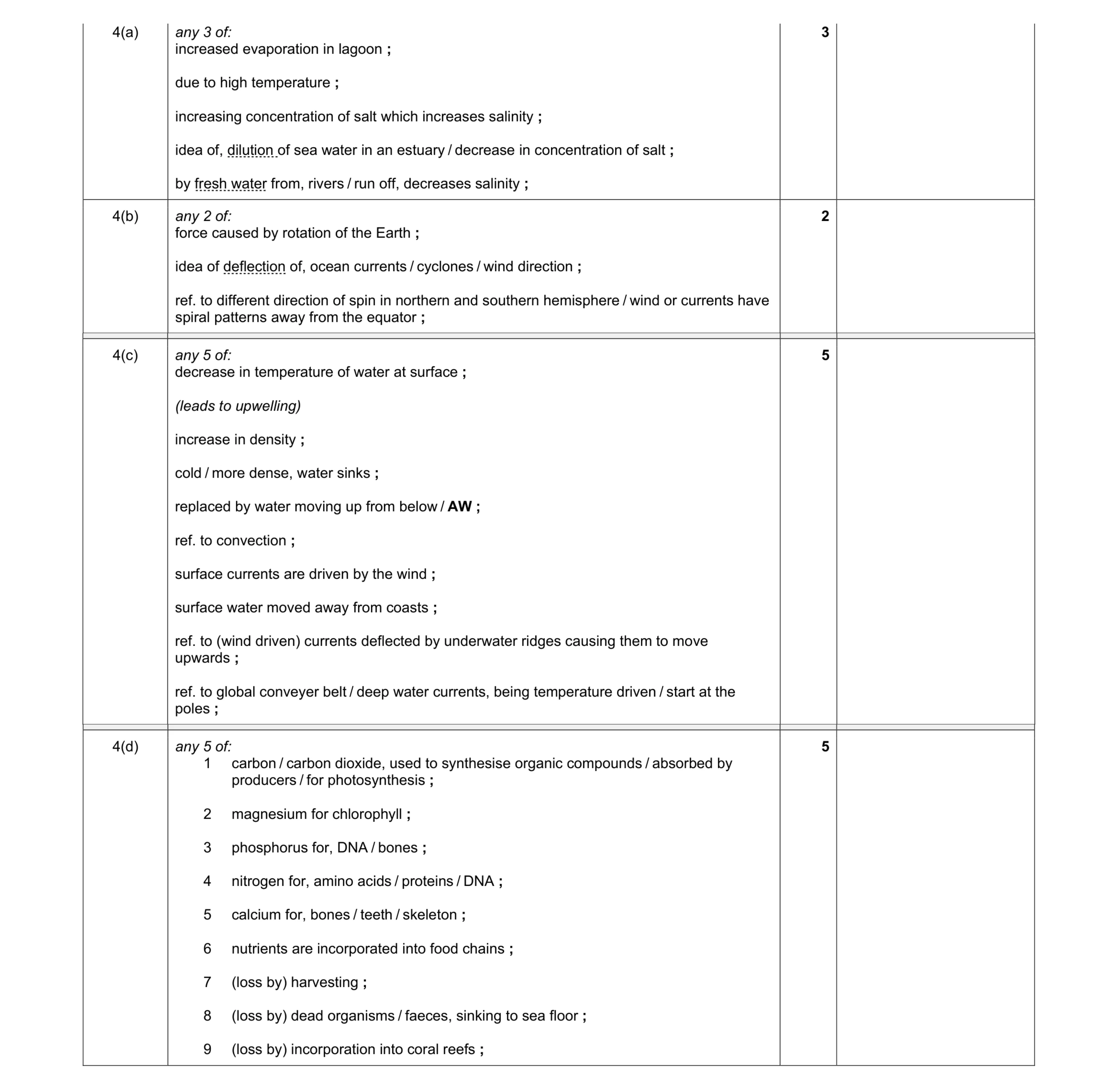
Mark scheme: 4(a) any 3 of: increased evaporation in lagoon ; due to high temperature ; increasing concentration of salt which increases salinity ; idea of, dilution of sea water in an estuary / decrease in concentration of salt ; by fresh water from, rivers / run off, decreases salinity ; 3 4(b) any 2 of: force caused by rotation of the Earth ; idea of deflection of, ocean currents / cyclones / wind direction ; ref. to different direction of spin in northern and southern hemisphere / wind or currents have spiral patterns away from the equator ; 2 Question Answer Marks Guidance 4(c) any 5 of: decrease in temperature of water at surface ; (leads to upwelling) increase in density ; cold / more dense, water sinks ; replaced by water moving up from below / AW ; ref. to convection ; surface currents are driven by the wind ; surface water moved away from coasts ; ref. to (wind driven) currents deflected by underwater ridges causing them to move upwards ; ref. to global conveyer belt / deep water currents, being temperature driven / start at the poles ; 5 Question Answer Marks Guidance 4(d) any 5 of: 1 carbon / carbon dioxide, used to synthesise organic compounds / absorbed by producers / for photosynthesis ; 2 magnesium for chlorophyll ; 3 phosphorus for, DNA / bones ; 4 nitrogen for, amino acids / proteins / DNA ; 5 calcium for, bones / teeth / skeleton ; 6 nutrients are incorporated into food chains ; 7 (loss by) harvesting ; 8 (loss by) dead organisms / faeces, sinking to sea floor ; 9 (loss by) incorporation into coral reefs ; 5
This question in 9693/21 Oct/Nov 2017
Q2 · Explain how the alignment of the Sun and the Moon affects the tidal range 9693/21 May/June 2018
4 (a) (i) Explain how the alignment of the Sun and the Moon affects the tidal range. You may use diagrams in your answer. … … … … … … … … … … … … … … … … [6] (ii) Describe other factors that can affect tidal range. … … … … … … [3] (b) Outline how environmental factors affect the formation of communities on a rocky shore. … … … … … … … … … … … … [6] [Total: 15]
15 marks
Mark scheme: 4(a)(i) Any 6 of: 1 ref. to tides due to gravitational, effects / pull / forces, of Sun and Moon ; 2 neap tides have a small(er) range ; 3 spring tides have a large(r) range ; (neap tides) 4 when the Sun, (Earth) and Moon form a right angle / perpendicular ; 5 reduced gravitational effect ; (spring tides) 6 when the Sun, (Earth) and Moon are in a straight line / aligned ; 7 combined / greater, gravitational effect ; 6 tides alone is insufficient for MP2 and 3- idea of tidal range is needed 4(a)(ii) wind direction ; wind speed / strength ; air pressure ; size / depth / area / volume, of water body ; idea of, geomorphology ; 3 A offshore / on shore wind for wind direction I wind unqualified for MP1 and 2 e.g. shape of, coast / shore / seabed, slope of coast Question Answer Marks Guidance 4(b) 1 idea of, organism adapted to survive where they live / environment ; 2 nutrient availability ; 3 ref. to gas concentration / gas availability ; 4 salinity varies ; 5 idea of, large temperature range ; 6 idea of, desiccation / exposure to air OR freezing ; 7 wave action ; 8 topography / slope / shape ; 9 exposed / sheltered, (coastline) ; 10 tidal range ; 11 type of substrate / resistance to, erosion / weathering ; 6 A aspect
This question in 9693/21 May/June 2018
Q3 · The Humboldt Current off the coasts of Chile and Peru causes upwelling 9693/22 May/June 2018
4 The Humboldt Current off the coasts of Chile and Peru causes upwelling. This supports huge shoals of the Peruvian anchoveta, which provide the greatest catches of any fish species. (a) Explain how upwelling supports large numbers of fish. … … … … … … … … … … [5] (b) Discuss the advantages of shoaling in fish such as the Peruvian anchoveta. … … … … … … … … … … [5] (c) Describe the causes of El Niño events. Explain how such an event may result in the collapse of the Peruvian anchoveta population. … … … … … … … … … … [5] [Total: 15]
15 marks
Mark scheme: 4(a) any five of nutrient rich water ; ref. named nutrient ; rise up from depth / upwellings ; idea of, replenishing nutrients in surface ; stimulates growth / reproduction of phytoplankton / producers ; increases productivity ; increase food / energy / (zoo)plankton, for fish (such as anchoveta) ; 5 Question Answer Marks Guidance 4(b) any five of successful strategy for feeding / helps feeding ; by, idea of, more eyes to spot the food ; by, idea of, corralling prey / splitting up schools of prey fish / break-up bait balls ; successful predator avoidance / helps avoid predation / reduces predation ; by, idea of, more eyes to spot the predators ; by, idea of, large numbers will confuse predator ; by, idea of less chance of predation on an individual / forming a bait ball ; successful strategy for reproduction / assists in reproduction / easier reproduction ; due to, proximity of mates / increased chance of finding a mate / easier to find a mate ; increase chance of fertilisation ; (increase) hydrodynamic efficiency / reduce drag ; saves energy / increase swimming speed (for same amount of energy) ; 5 Question Answer Marks Guidance 4(c) any five of winds reverse / change direction ; decreased wind from E / change in trade winds ; less upwelling ; ref. warmer (surface) water (over Humboldt Current) ; lowers thermocline / thermocline found deeper in ocean ; prevents nutrient rich water reaching surface / less nutrients at surface ; reduction in phytoplankton / productivity ; decreased zooplankton / decreased food source (for anchoveta) ; increased rainfall ; (may) alter nutrient availability / salinity ; reduction in light energy ; 5
This question in 9693/22 May/June 2018
Q4 · The Humboldt Current off the coasts of Chile and Peru causes upwelling 9693/23 May/June 2018
4 The Humboldt Current off the coasts of Chile and Peru causes upwelling. This supports huge shoals of the Peruvian anchoveta, which provide the greatest catches of any fish species. (a) Explain how upwelling supports large numbers of fish. … … … … … … … … … … [5] (b) Discuss the advantages of shoaling in fish such as the Peruvian anchoveta. … … … … … … … … … … [5] (c) Describe the causes of El Niño events. Explain how such an event may result in the collapse of the Peruvian anchoveta population. … … … … … … … … … … [5] [Total: 15]
15 marks
Mark scheme: 4(a) any five of nutrient rich water ; ref. named nutrient ; rise up from depth / upwellings ; idea of, replenishing nutrients in surface ; stimulates growth / reproduction of phytoplankton / producers ; increases productivity ; increase food / energy / (zoo)plankton, for fish (such as anchoveta) ; 5 Question Answer Marks Guidance 4(b) any five of successful strategy for feeding / helps feeding ; by, idea of, more eyes to spot the food ; by, idea of, corralling prey / splitting up schools of prey fish / break-up bait balls ; successful predator avoidance / helps avoid predation / reduces predation ; by, idea of, more eyes to spot the predators ; by, idea of, large numbers will confuse predator ; by, idea of less chance of predation on an individual / forming a bait ball ; successful strategy for reproduction / assists in reproduction / easier reproduction ; due to, proximity of mates / increased chance of finding a mate / easier to find a mate ; increase chance of fertilisation ; (increase) hydrodynamic efficiency / reduce drag ; saves energy / increase swimming speed (for same amount of energy) ; 5 Question Answer Marks Guidance 4(c) any five of winds reverse / change direction ; decreased wind from E / change in trade winds ; less upwelling ; ref. warmer (surface) water (over Humboldt Current) ; lowers thermocline / thermocline found deeper in ocean ; prevents nutrient rich water reaching surface / less nutrients at surface ; reduction in phytoplankton / productivity ; decreased zooplankton / decreased food source (for anchoveta) ; increased rainfall ; (may) alter nutrient availability / salinity ; reduction in light energy ; 5
This question in 9693/23 May/June 2018
Q5 · How the sea surface temperature (SST) of the Pacific Ocean in December 1997 varied from… 9693/21 May/June 2019
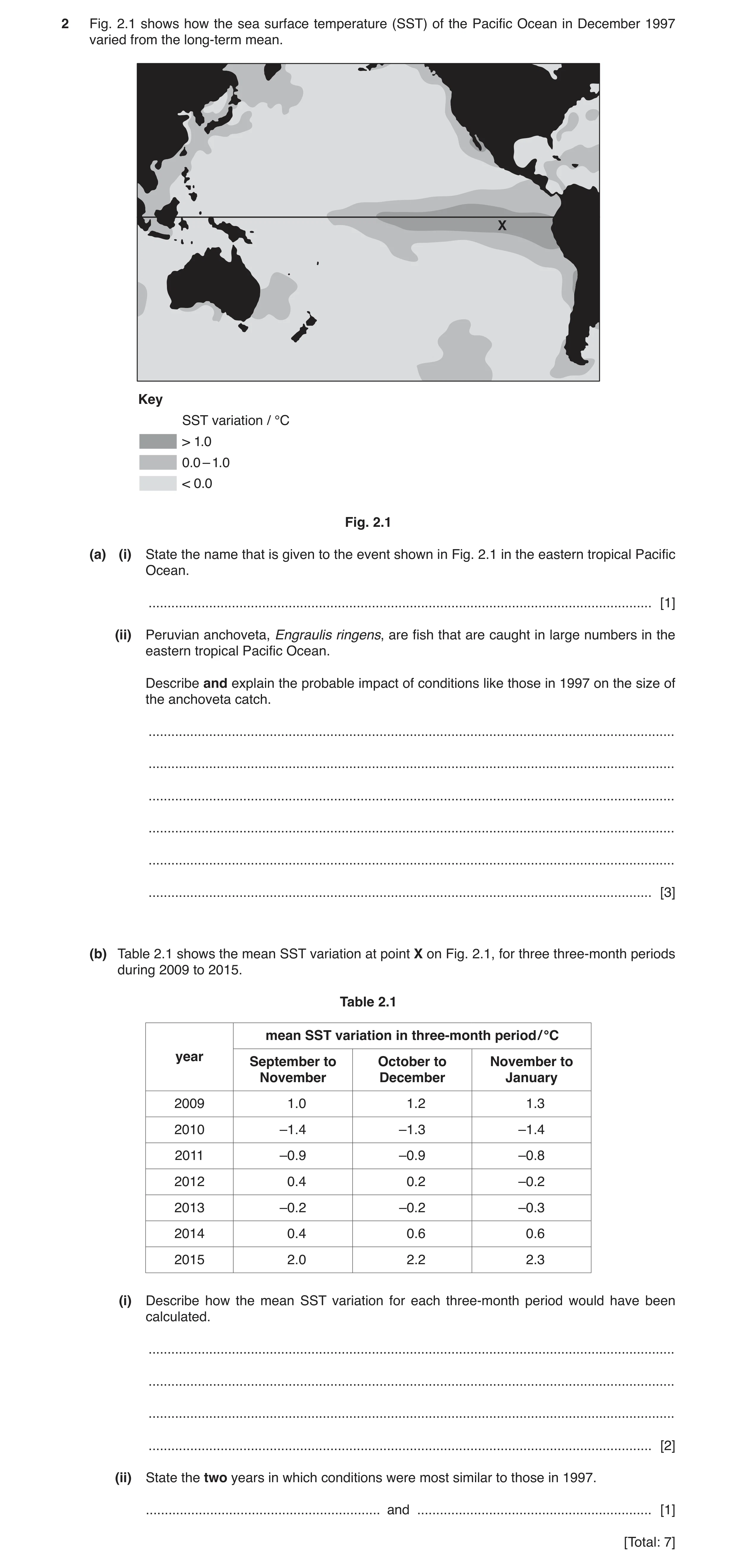
2 Fig. 2.1 shows how the sea surface temperature (SST) of the Pacific Ocean in December 1997 varied from the long-term mean. X Key SST variation / °C > 1.0 0.0 – 1.0 < 0.0 Fig. 2.1 (a) (i) State the name that is given to the event shown in Fig. 2.1 in the eastern tropical Pacific Ocean. … [1] (ii) Peruvian anchoveta, Engraulis ringens, are fish that are caught in large numbers in the eastern tropical Pacific Ocean. Describe and explain the probable impact of conditions like those in 1997 on the size of the anchoveta catch. … … … … … … [3] (b) Table 2.1 shows the mean SST variation at point X on Fig. 2.1, for three three-month periods during 2009 to 2015. Table 2.1 mean SST variation in three‑month period / °C year September to October to November to November December January 2009 1.0 1.2 1.3 2010 –1.4 –1.3 –1.4 2011 –0.9 –0.9 –0.8 2012 0.4 0.2 –0.2 2013 –0.2 –0.2 –0.3 2014 0.4 0.6 0.6 2015 2.0 2.2 2.3 (i) Describe how the mean SST variation for each three-month period would have been calculated. … … … … [2] (ii) State the two years in which conditions were most similar to those in 1997. … and … [1] [Total: 7]
7 marks
Mark scheme: 2(a)(i) El Niño ; 1 I southern oscillation R La Nina / La Nino / La Niña / La Niño 2(a)(ii) catch likely to be reduced ; reduces / stops upwelling OR fewer nutrients reaching surface waters ; low productivity / low productivity in (named) producer ; 3 A reduction in producer population 2(b)(i) the variation / values / data for each month added together ; then divided by relevant number of values ; 2 R temperature values added 2(b)(ii) 2009 / 2014 / 2015 ; 1 two years required for mark
This question in 9693/21 May/June 2019
Q6 · Explain how tectonic processes can lead to a tsunami 9693/21 May/June 2019
4 (a) Explain how tectonic processes can lead to a tsunami. … … … … … … … … [4] (b) Outline the Darwin-Dana-Daly theory of atoll formation. … … … … … … … … … … [5] (c) Tidal range is affected by the relative positions of the Earth, Moon and Sun. Describe how other factors can affect the tidal range. … … … … … … … … … … … … [6] [Total: 15]
15 marks
Mark scheme: 4(a) any 4 of: movement of convergent / transform (plate) boundaries ; build-up of pressure / tension ; sudden release / sudden slippage; (of) large amounts of energy ; (from) earthquake below seabed / underwater earthquake ; (causing) vertical displacement of seabed ; large displacement of (sea)water ; 4 Question Answer Marks Guidance 4(b) any 5 of: 1 oceanic volcano emerges / volcanic island ; 2 colonised / settling, by, reef-building / hermatypic, coral OR colonised / settling, by coral polyps / coral larvae ; 3 so, fringing reef develops ; 4 volcano becomes dormant / extinct ; 5 volcano / island, begins to sink / subside ; 6 so, barrier reef develops ; 7 lagoon / description of, forms between reef and island ; 8 volcano / island, eventually sinks below sea level / disappears ; 5 Accept marking points from well labelled / annotated diagrams. I coral unqualified R if answer implies barrier formed before fringing 4(c) any 6 of: 1 shape / morphology / configuration / geomorphology, of coastline ; 2 funnelling / channelling, of water into small area increases range ; 3 slope / relief of shore ; 4 lower range on shallower relief ; 5 size / volume, of water body ; 6 larger body has greater range; 7 air / atmospheric pressure ; 8 lower pressure causes greater range / higher tide ; 9 speed / strength of wind; 10 greater wind speed increases range / higher tide ; 11 wind direction (onshore / offshore) ; 12 correct description e.g. onshore causing higher tide ; 6
This question in 9693/21 May/June 2019
Q7 · A research boat spent six months, from July to January, monitoring the currents and… 9693/21 May/June 2020
3 A research boat spent six months, from July to January, monitoring the currents and conditions off the Indian coastline, where the ocean had a depth of 1000 m. (a) Describe and explain how the wind patterns would differ in this area in summer (July and August) from in winter (December and January). … … … … … … … … [4] (b) Water temperature, salinity and oxygen concentration were measured at different depths. Describe and explain how each factor would change with increasing depth. temperature … … … … … … salinity … … … … … … oxygen concentration … … … … … … [8] (c) Outline the factors that produce ocean currents. … … … … … … [3] [Total: 15]
15 marks
Mark scheme: 3(a) one of: winds reverse ; winds change direction ; any 3 from: 1 in July / Aug Asian continent / landmass warmer than sea ; 2 air over continent becomes less dense and rises ; 3 so air drawn from ocean to replace it ; 4 south-west wind created ORA for winter months Question Answer Marks 3(b) any 8 of : Temperature: 1 decrease in temperature with depth ; 2 surface waters warmer due to heat from Sun / solar radiation ; 3 reference to thermocline ; 4 as region of steep decrease ; 5 density of warmer water ; Salinity: 6 highest at surface due to evaporation ; 7 reference to halocline ; 8 as steep decrease ; 9 then slow increase with depth due to density ; Oxygen: 10 surface waters have higher concentration ; 11 due to atmospheric dissolution / photosynthesis / wave action ; 12 oxygen minimum layer due to uptake by organisms ; 13 increase in oxygen again at greater depths ; 14 due to increased solubility in cooler temperature / at higher pressure ; 8 Question Answer Marks 3(c) any 3 of: effect of wind ; temperature ; Coriolis effect… ; …explanation of ; influence of tides ; change in density ; topography of sea-bed ; 3
This question in 9693/21 May/June 2020
Q8 · Tuna and sardines are examples of fish that survive in the open ocean 9693/22 May/June 2020
3 Tuna and sardines are examples of fish that survive in the open ocean. (a) Research has shown that the populations of tuna and sardines have fluctuated greatly over the last 500 years, showing periods of rapid decline and then subsequent recovery. Explain how in some years upwelling may cause the population sizes of tuna and sardines to increase and not in other years. … … … … … … … … [4] (b) Both tuna and sardines use shoaling as a survival strategy in the open ocean. Compare the benefits of shoaling to tuna and to sardines. … … … … … … … … [4] (c) With reference to tuna, explain the meaning of the term parasitism. … … … … … … [3] (d) Tuna occupy a general ecological niche. Explain how a general ecological niche differs from the niche of many coral-eating butterfly fish. … … … … … … … … [4] [Total: 15]
15 marks
Mark scheme: 3(a) upwelling brings nutrient rich water nearer to surface ; increase in primary productivity in surface waters ; increase in animal populations in food chains ; more food for tuna and sardines ; AND / OR: degree of upwelling varies year on year ; reference to impact of El Niño / La Niña ; 4 3(b) any 4 from: 1 both may benefit from increased chance of reproductive success ; 2 idea of, both may benefit from increased hydrodynamic efficiency ; 3 sardines (are prey to various predators so benefit from) safety in numbers ; 4 due to lower probability of predation / ability to respond to each other’s movements ; 5 Tuna may benefit from increased predation efficiency ; 6 due to scattering of prey / increased chance of isolating prey ; 4 3(c) when one organism lives on or in another ; for its non-mutual benefit / benefiting at the expense of the other ; such as nematode worms in tuna ; 3 Question Answer Marks 3(d) any 4 from : 1 tuna live in more than one habitat / described ; 2 tuna feed on a wide range of prey ; 3 butterfly fish have a specialised niche ; 4 eat only, coral / one type of food ; 5 live only on coral reefs ; 6 niche is an organism's role in an ecosystem ; 4
This question in 9693/22 May/June 2020
Q9 · Tuna and sardines are examples of fish that survive in the open ocean 9693/23 May/June 2020
3 Tuna and sardines are examples of fish that survive in the open ocean. (a) Research has shown that the populations of tuna and sardines have fluctuated greatly over the last 500 years, showing periods of rapid decline and then subsequent recovery. Explain how in some years upwelling may cause the population sizes of tuna and sardines to increase and not in other years. … … … … … … … … [4] (b) Both tuna and sardines use shoaling as a survival strategy in the open ocean. Compare the benefits of shoaling to tuna and to sardines. … … … … … … … … [4] (c) With reference to tuna, explain the meaning of the term parasitism. … … … … … … [3] (d) Tuna occupy a general ecological niche. Explain how a general ecological niche differs from the niche of many coral-eating butterfly fish. … … … … … … … … [4] [Total: 15]
15 marks
Mark scheme: 3(a) any 3 from: upwelling brings nutrient rich water nearer to surface ; 4 increase in primary productivity in surface waters ; increase in animal populations in food chains ; more food for tuna and sardines ; AND / OR: degree of upwelling varies year on year ; reference to impact of El Niño / La Niña ; 3(b) any 4 from: 4 1 both may benefit from increased chance of reproductive success ; 2 idea of, both may benefit from increased hydrodynamic efficiency ; 3 sardines (are prey to various predators so benefit from) safety in numbers ; 4 due to lower probability of predation / ability to respond to each other’s movements ; 5 Tuna may benefit from increased predation efficiency ; 6 due to scattering of prey / increased chance of isolating prey ; 3(c) when one organism lives on or in another ; 3 for its non-mutual benefit / benefiting at the expense of the other ; such as nematode worms in tuna ; 3(d) any 4 from : 4 1 tuna live in more than one habitat / described ; 2 tuna feed on a wide range of prey ; 3 butterfly fish have a specialised niche ; 4 eat only, coral / one type of food ; 5 live only on coral reefs ; 6 niche is an organism's role in an ecosystem ;
This question in 9693/23 May/June 2020
Q10 · Discuss the causes and effects of El-Niño events in the Pacific Ocean 9693/20 Oct/Nov 2020
3 (a) Discuss the causes and effects of El-Niño events in the Pacific Ocean. … … … … … … … … … … … … … … [7] (b) Tropical cyclones (hurricanes or typhoons) can have severe impacts on coral reefs. Discuss the effects of tropical cyclones on coral reefs and on local coastal human communities. … … … … … … … … … … … … … … … … [8] [Total: 15]
15 marks
This question in 9693/20 Oct/Nov 2020
Q11 · Ocean currents can distribute nutrients and organisms around the globe 9693/20 Oct/Nov 2021
3 Ocean currents can distribute nutrients and organisms around the globe. (a) Discuss the factors that cause both surface and deep oceanic currents to form. … … … … … … … … … … … … … … [7] (b) Describe the cycling of calcium within the marine environment. … … … … … … … … … … … … … … … … [8] [Total: 15]
15 marks
This question in 9693/20 Oct/Nov 2021
Q12 · An atoll in the Indian Ocean 9693/21 May/June 2022
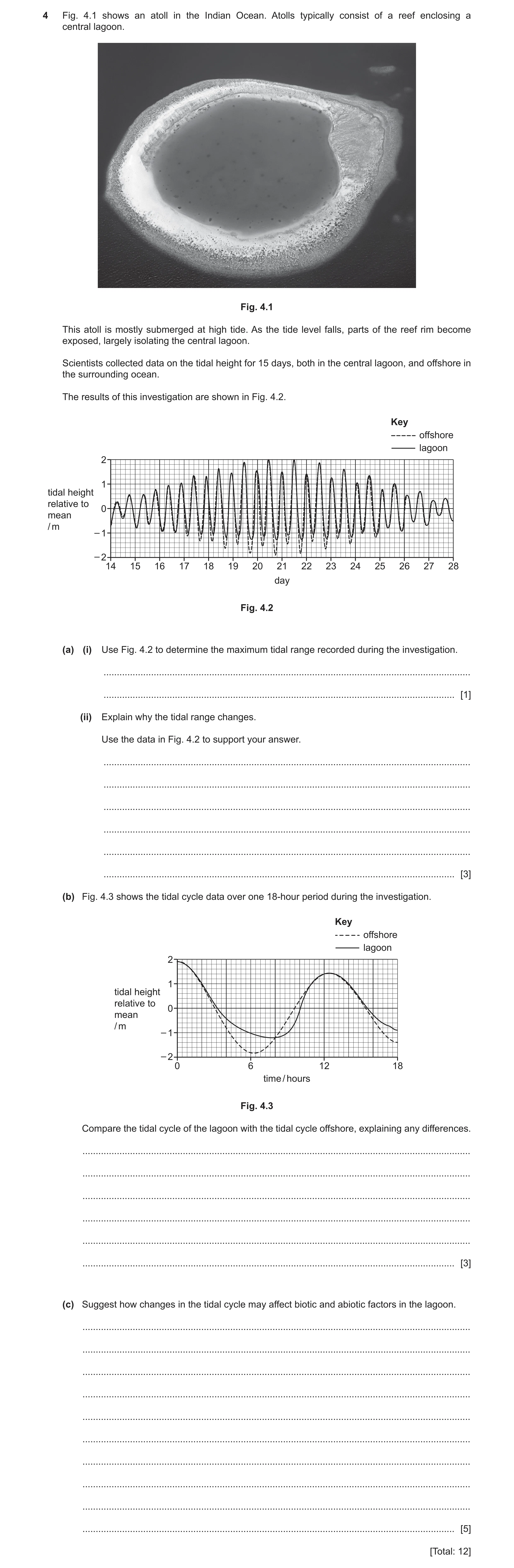
4 Fig. 4.1 shows an atoll in the Indian Ocean. Atolls typically consist of a reef enclosing a central lagoon. Fig. 4.1 This atoll is mostly submerged at high tide. As the tide level falls, parts of the reef rim become exposed, largely isolating the central lagoon. Scientists collected data on the tidal height for 15 days, both in the central lagoon, and offshore in the surrounding ocean. The results of this investigation are shown in Fig. 4.2. Key offshore lagoon 2 1 tidal height relative to 0 mean / m – 1 – 2 14 15 16 17 18 19 20 21 22 23 24 25 26 27 28 day Fig. 4.2 (a) (i) Use Fig. 4.2 to determine the maximum tidal range recorded during the investigation. … … [1] (ii) Explain why the tidal range changes. Use the data in Fig. 4.2 to support your answer. … … … … … … [3] (b) Fig. 4.3 shows the tidal cycle data over one 18-hour period during the investigation. Key offshore lagoon 2 1 tidal height relative to 0 mean / m – 1 – 2 0 6 12 18 time / hours Fig. 4.3 Compare the tidal cycle of the lagoon with the tidal cycle offshore, explaining any differences. … … … … … … [3] (c) Suggest how changes in the tidal cycle may affect biotic and abiotic factors in the lagoon. … … … … … … … … … … [5] [Total: 12]
12 marks
Mark scheme: 4(a)(i) 3.9 (m) ; 1 4(a)(ii) any 3 from: ref. to gravitational pull of Moon AND Sun ; ref. to alignment of Moon AND Sun ; correct description of spring OR neap tide ; correct use of example days from data ; 3 4(b) MAX 2 from: high tide is the same time for both ; (idea of) low tide is later for lagoon / low tide has a lag time for lagoon / lagoon takes longer to adjust between high and low tides ; high tide is the same depth / height, for both ; low tide is lower for offshore / tidal range is greater offshore ORA ; PLUS at least 1 from: idea that water is trapped inside lagoon / takes time to drain away ; idea that not all water leaves lagoon before tide turns ; rate of water flow into the lagoon (after low tide) is greater than offshore ; rate of change of tide height is greater for the lagoon than offshore ; offshore tide needs to be high enough to re-enter the lagoon ; 3 Question Answer Marks 4(c) any 5 from: abiotic factors: 1 higher tides will allow greater mixing of ocean and lagoon water / ORA ; 2 (may affect) mixing of nutrients ; 3 (may affect) temperature of lagoon water ; 4 (may affect) salinity of lagoon due, to evaporation (at low tide) / influx of sea water at high tide ; 5 (reef) erosion ; 6 change in atoll shape / movement of sand / sediments / morphology of lagoon ; 7 correct ref. to light intensity ; 8 change in oxygen / carbon dioxide, levels / concentration; biotic factors: 9 lower tides will result in reef acting as barrier to organisms ; 10 ability of predators to enter or exit lagoon / prey will need to avoid predators ; 11 (at low tide) food availability changes e.g. may affect ability of zooplankton / phytoplankton to enter lagoon ; 12 (may affect) ability of larvae to enter / leave lagoon ; 13 (idea of) desiccation of corals / organisms ; 14 damage to vegetation ; 15 competition increases as more species enter lagoon at high tide ; 5
This question in 9693/21 May/June 2022
 15
15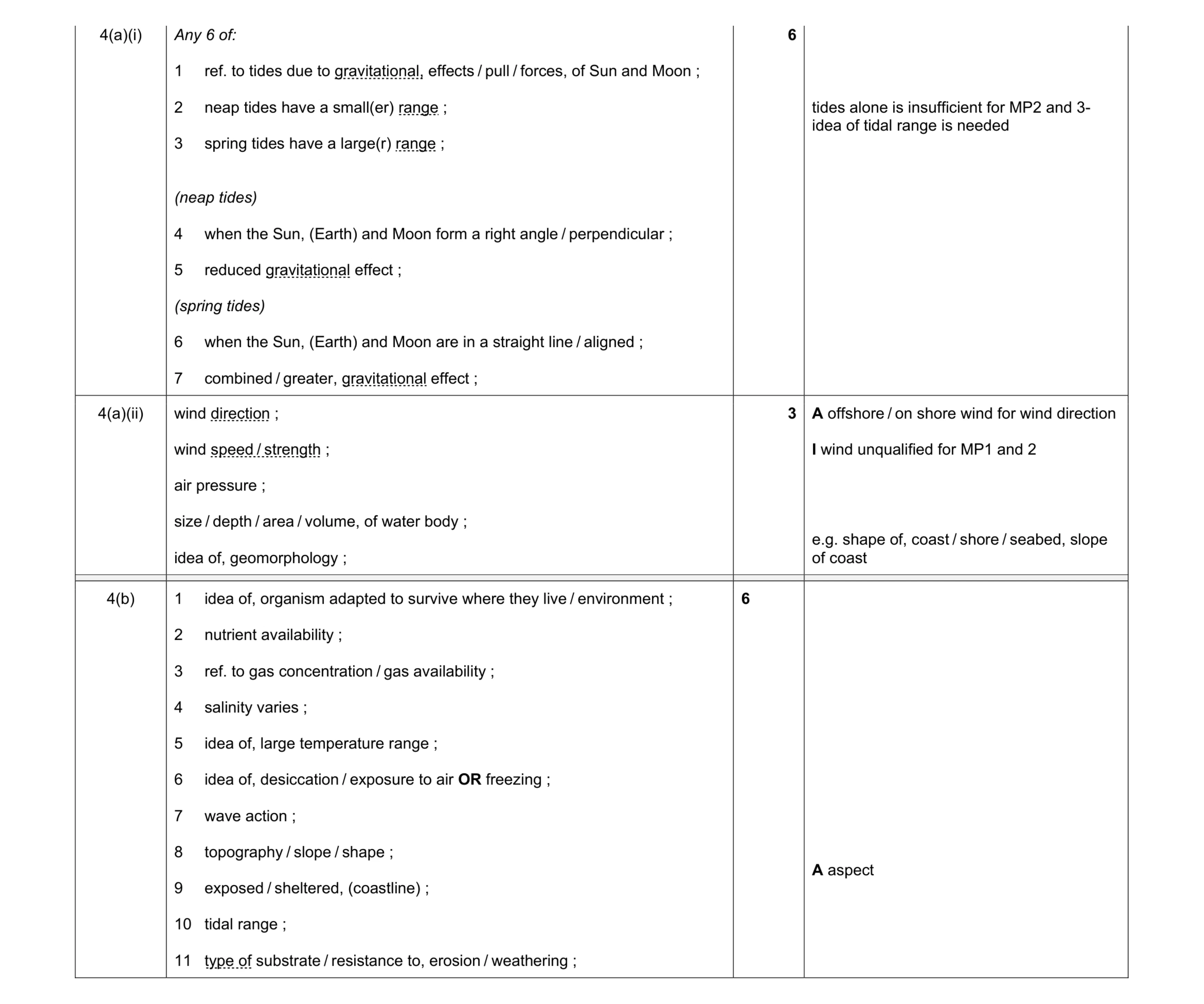 15
15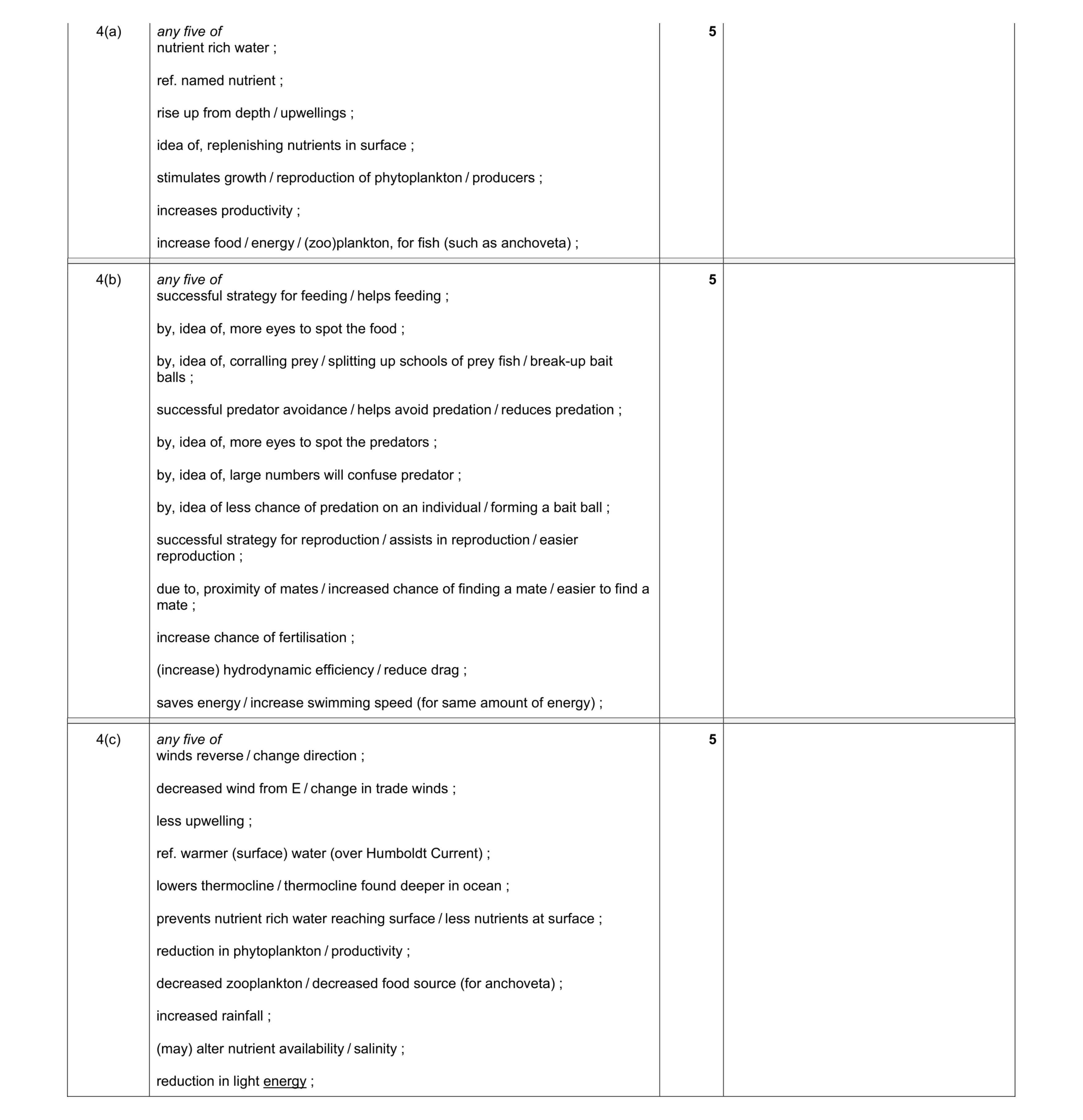 15
15 15
15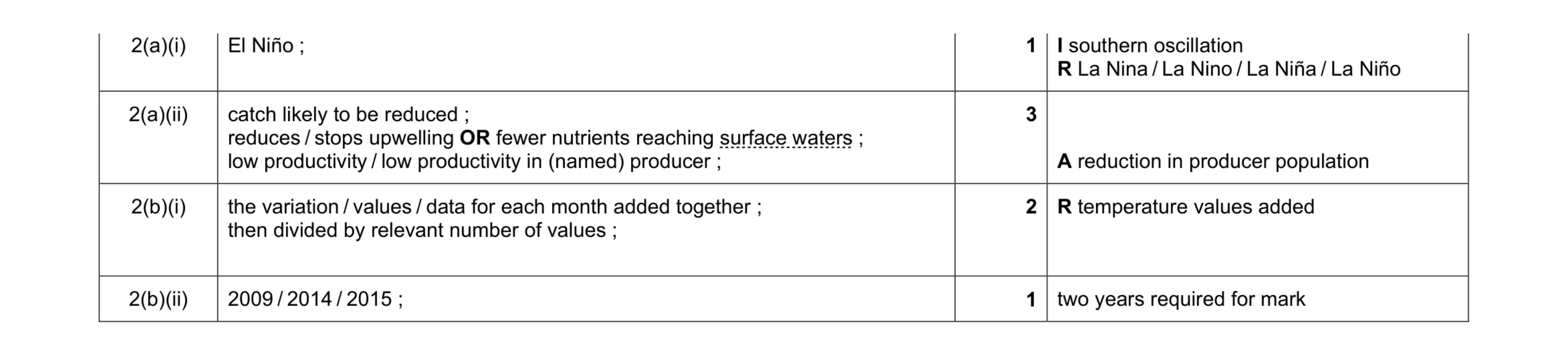 7
7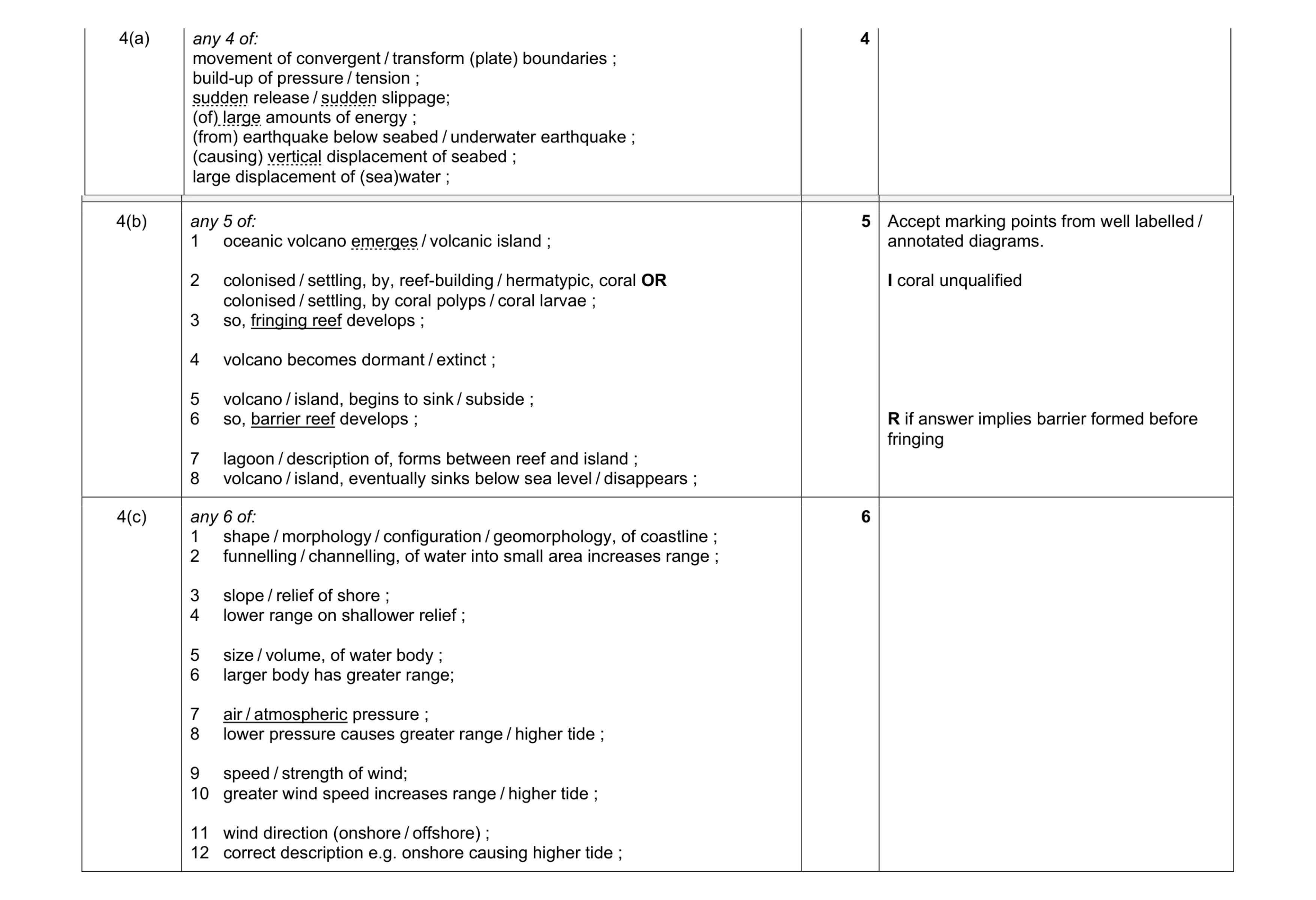 15
15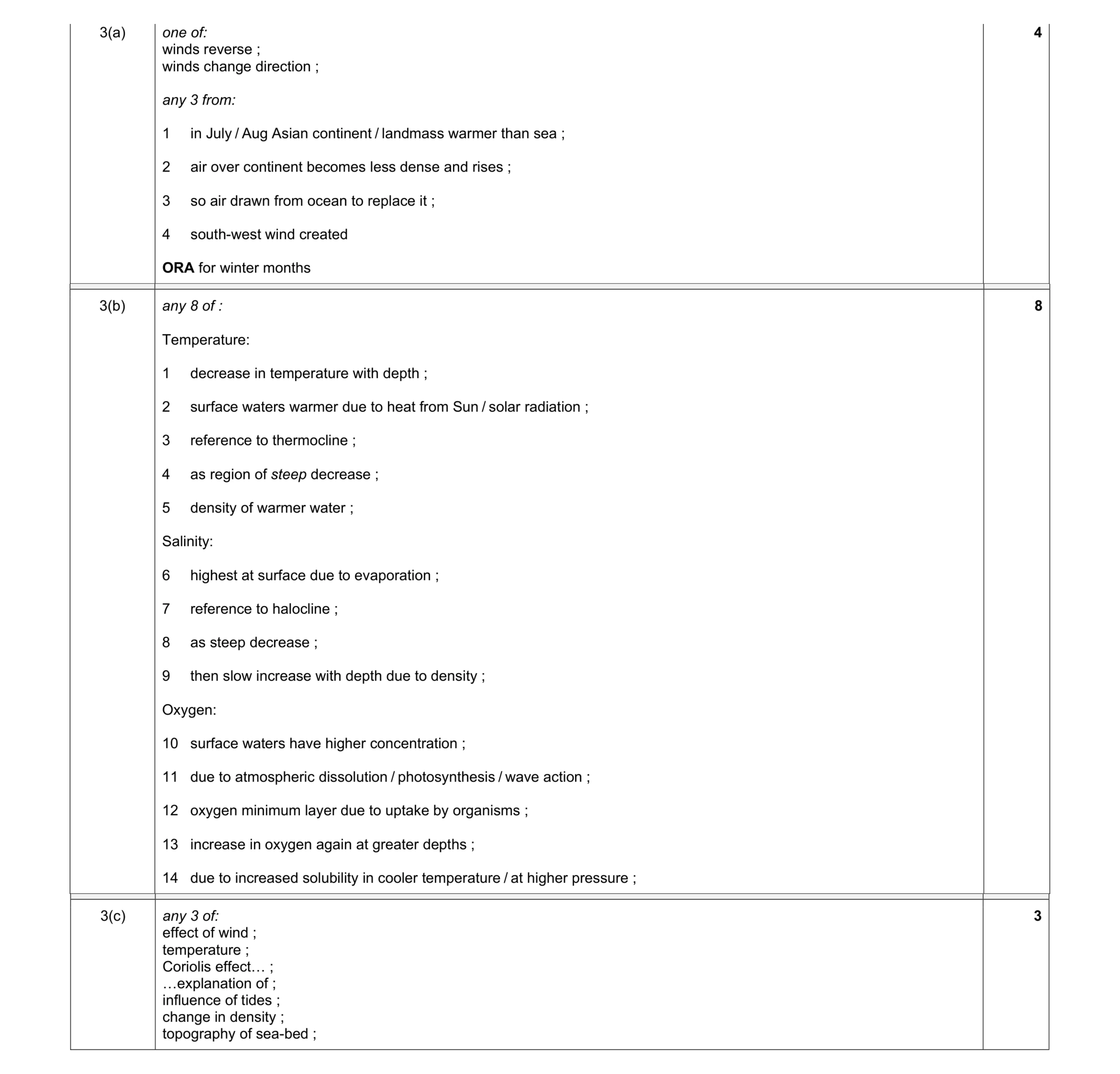 15
15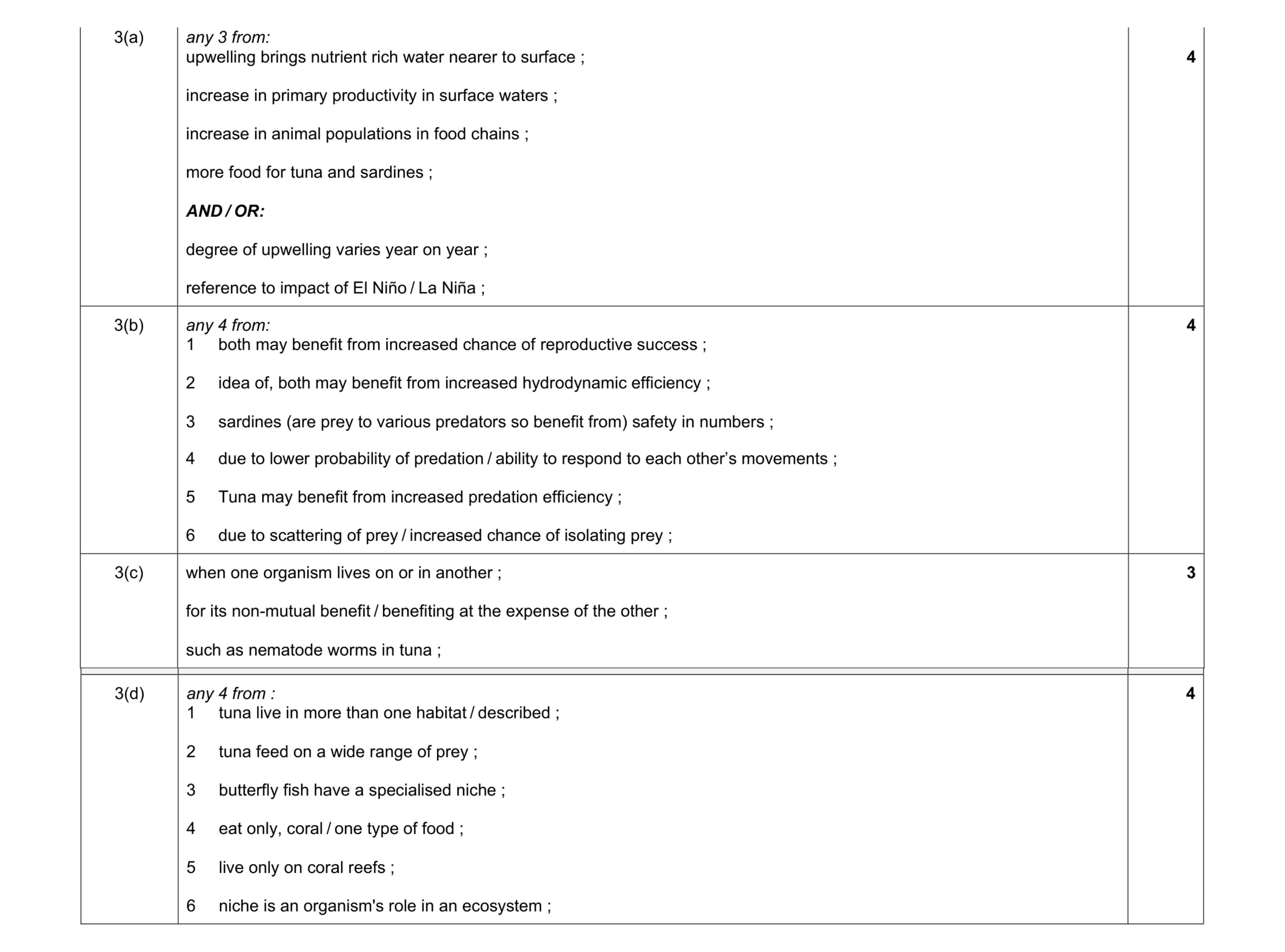 15
15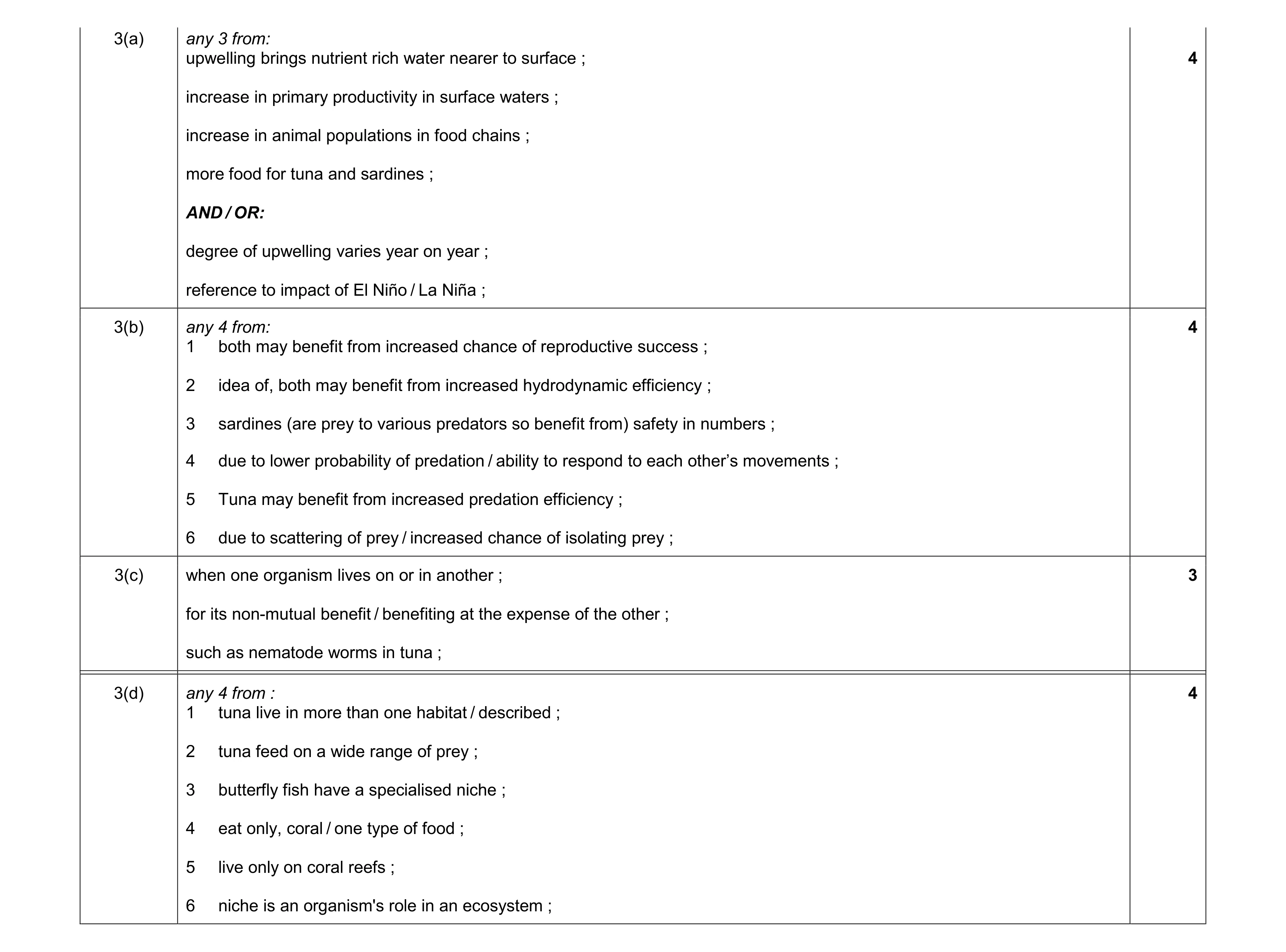 15
15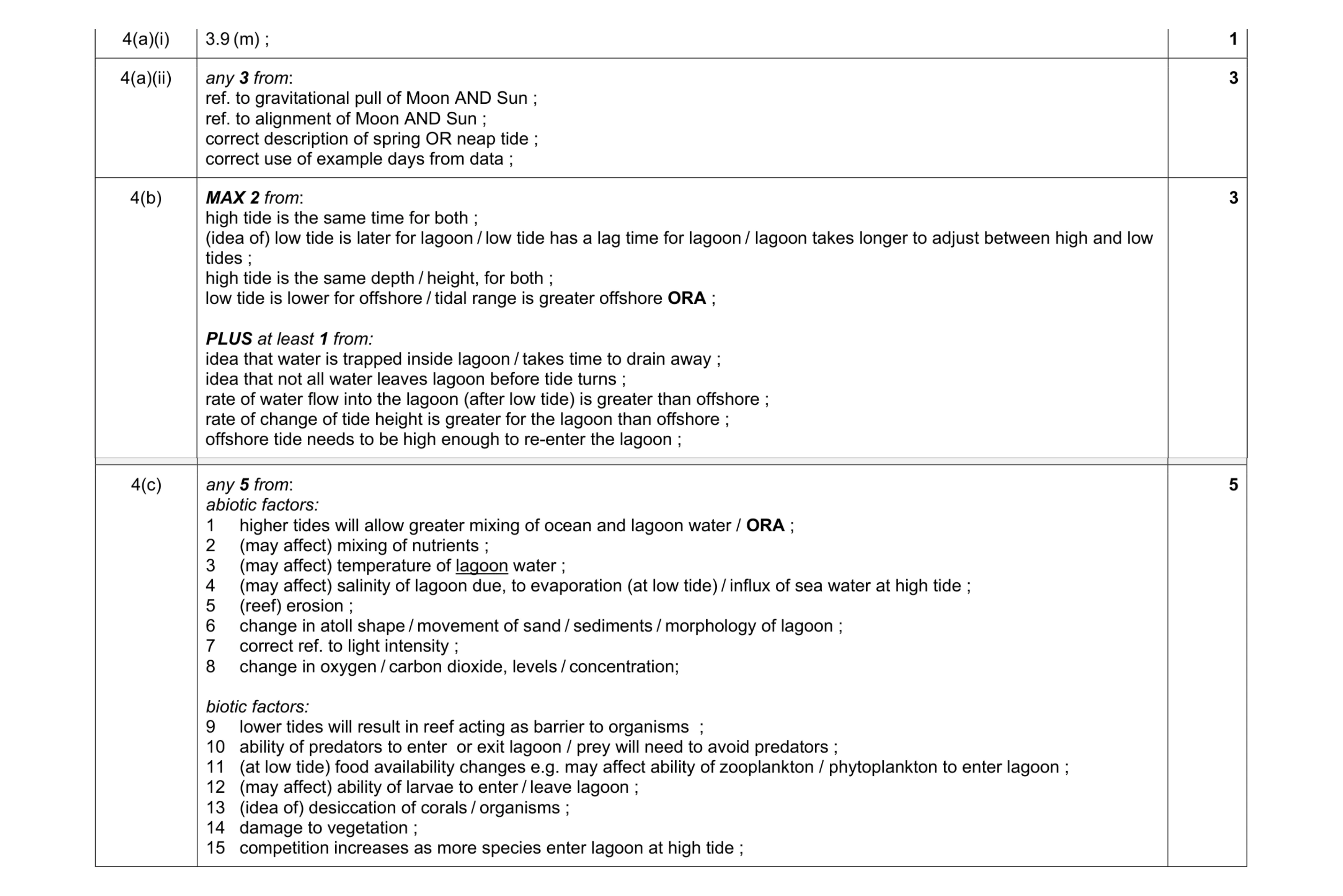 12
12