Questions as text
Q1 · A new computer system is to be developed for a factory 9626/32 Feb/March 2017
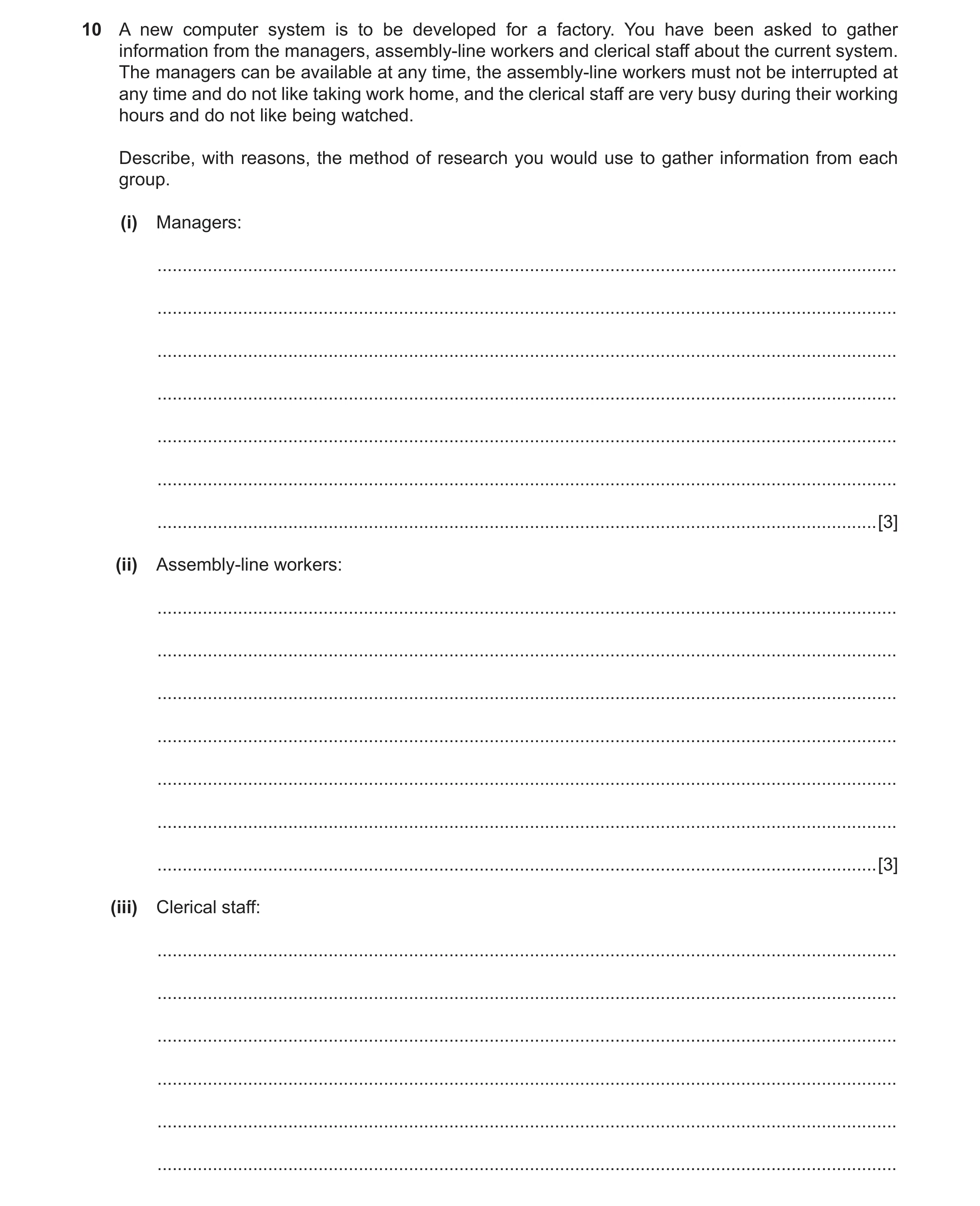
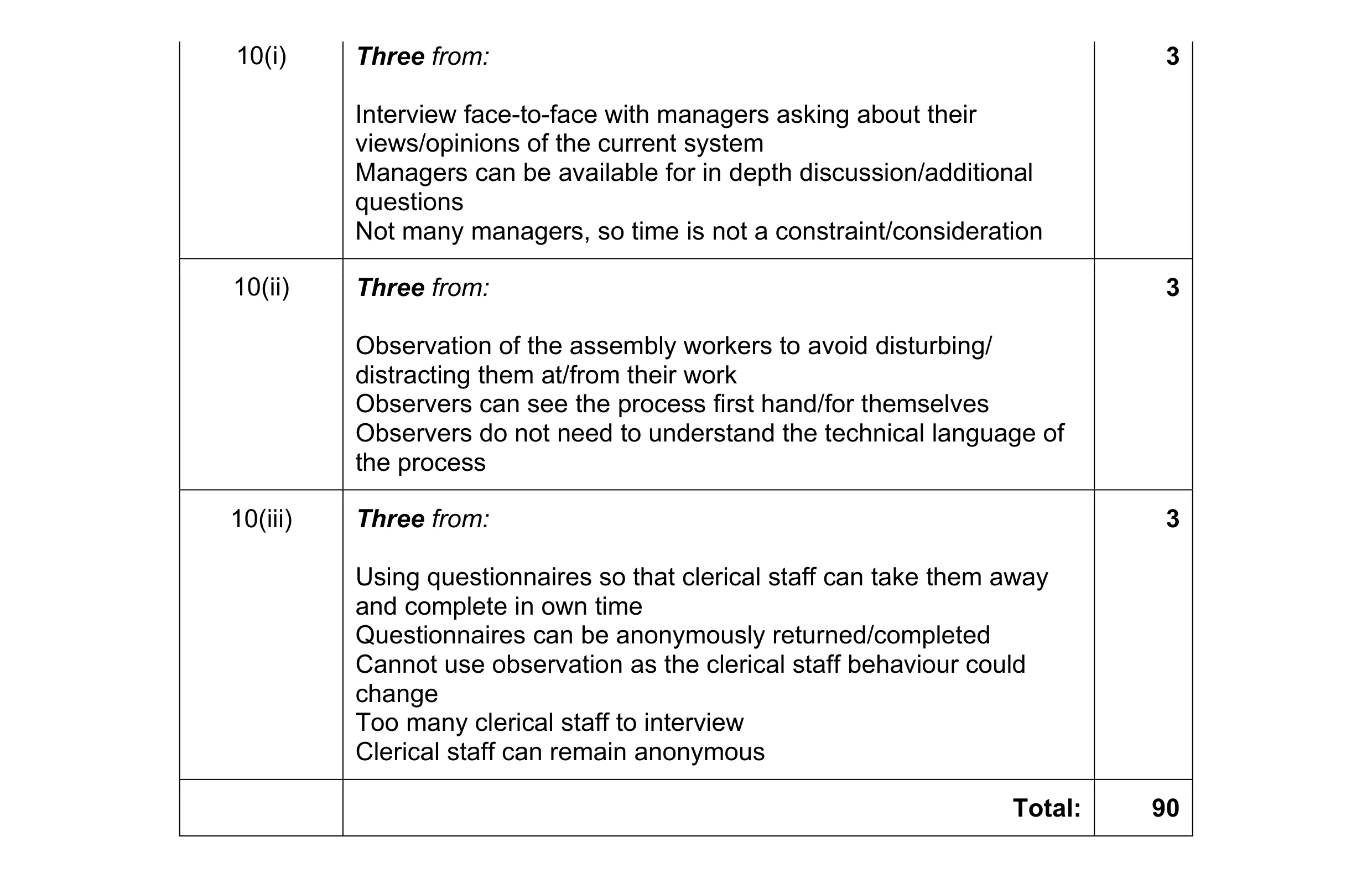
10 A new computer system is to be developed for a factory. You have been asked to gather information from the managers, assembly-line workers and clerical staff about the current system. The managers can be available at any time, the assembly-line workers must not be interrupted at any time and do not like taking work home, and the clerical staff are very busy during their working hours and do not like being watched. Describe, with reasons, the method of research you would use to gather information from each group. (i) Managers: … … … … … … … [3] (ii) Assembly-line workers: … … … … … … … [3] (iii) Clerical staff: … … … … … …
6 marks
Mark scheme: 10(i) Three from: 3 Interview face-to-face with managers asking about their views/opinions of the current system Managers can be available for in depth discussion/additional questions Not many managers, so time is not a constraint/consideration 10(ii) Three from: 3 Observation of the assembly workers to avoid disturbing/ distracting them at/from their work Observers can see the process first hand/for themselves Observers do not need to understand the technical language of the process 10(iii) Three from: 3 Using questionnaires so that clerical staff can take them away and complete in own time Questionnaires can be anonymously returned/completed Cannot use observation as the clerical staff behaviour could change Too many clerical staff to interview Clerical staff can remain anonymous Total: 90
This question in 9626/32 Feb/March 2017
Q2 · RockIT Limo Hire is a taxi company that has an online booking system 9626/32 May/June 2017
4 RockIT Limo Hire is a taxi company that has an online booking system. Customers can book a journey using a smartphone. When the company receives a booking request from a customer, it collects the following data: • customer name and mobile telephone number • how many passengers • address from which journey will start • address of destination • date and time of journey. RockIT Limo Hire’s computer system checks its booking diary to see if the booking can be accepted. If the booking can be accepted: • the customer is informed by text (SMS) that the booking is confirmed • the booking is added to the electronic diary. If the booking cannot be accepted: • the customer is sent a text (SMS) to state that the booking is refused • the customer details are deleted from the system. In the box below, draw a Level 1 data flow diagram (DFD) to represent the RockIT Limo Hire booking system. [8]
8 marks
Mark scheme: 4 Eight from: e.g. 8 Customer with appropriate shape 1 mark Diary store with appropriate shape 1 mark Booking process with appropriate shape 1 mark 5 named arrows in correct direction 5 marks
This question in 9626/32 May/June 2017
Q3 · A new computer system is to be installed by a company to replace its existing system 9626/33 Oct/Nov 2017
3 A new computer system is to be installed by a company to replace its existing system. A systems analyst is producing a report on the current operations of the company before the company installs the new computer system. The analyst is interviewing the users of the existing system. Evaluate other methods that the analyst could use to research the existing system. … … … … … … … … … … … … … … … … … … … … … [8]
8 marks
Mark scheme: 3 Answers/Indicative content 8 Evaluation requires that advantages and disadvantages be discussed and weighed up in importance. Answers may make reference to e.g.: Document analysis: • less time consuming than other methods/more efficient as it requires data selection rather than data collection • many documents are readily available/in public domain • documents unaffected by research process • documents are stable/do not change due to observer’s presence • documents can be more exact/precise • documents provide wide/broad coverage of topics • documents may lack detail as not produced for research • documents may be difficult to retrieve/locate • documents may be incomplete Questionnaires: • relatively inexpensive to administer when large numbers are involved • reduced researcher bias • questionnaires are familiar to participants • data can be collected in a format that is easy to analyse • participants may not complete questionnaires/return the questionnaires fully/properly leading to incomplete data • questions may not mean the same to all participants • may be unclear who has completed the questionnaires • unable to develop the questioning further • questionnaires can be difficult to formulate Observation: • can collect data where/when activity occurs • can be unobtrusive • can provide ‘behind the scenes’ information/can directly see the activities • can be susceptible to observer bias • observed often perform better when watched • cannot help understand why people behave as they do/do what they do 3 This question to be marked as a Level of Response. Level 3 7–8 marks Candidates will evaluate in detail use of at least two of document analysis, questionnaires, and observation for this research. There will be a reasoned conclusion/opinion. The information will be relevant, clear, organised and presented in a structured and coherent format. Subject specific terminology will be used accurately and appropriately. Level 2 4–6 marks Candidates will evaluate the use of at least two of document analysis, questionnaires, and observation for this research. There may be a reasoned conclusion/opinion. For the most part, the information will be relevant and presented in a structured and coherent format. Subject specific terminology will be used appropriately and for the most part correctly. Level 1 1–3 marks Candidates will describe use of document analysis, questionnaires, or observation for this research. Answers may be in the form of a list. There will be little or no use of specialist terms. Level 0 0 marks Response with no valid content.
This question in 9626/33 Oct/Nov 2017
Q4 · As part of a project to create a new software application, a system analyst will produce… 9626/31 May/June 2018
4 As part of a project to create a new software application, a system analyst will produce a software requirements specification and a user requirements specification. (a) Describe the contents of a software requirements specification for the new software application. … … … … … … … … … [4] (b) Describe the purpose of a user requirements specification for the new software application. … … … … … … … … … [4] (c) Give one reason why the user requirements specification might prove to be inaccurate. … … … [1]
9 marks
Mark scheme: 4(a) Four from: 4 The purpose of the software and its intended audience The functions and capabilities of the software to be developed The operational/user environment in which it will/should be used The user interfaces to be used The hardware interfaces that will be needed/hardware requirements The software interfaces/interfaces to other software that will be needed Communication protocols/interfaces The performance levels of the software The structure of the data elements to be used/developed The reliability of the software The security and privacy systems to be used The safety systems/backup protocols/systems/methods to be used The constraints/limitations of the software. 4(b) Four from: 4 To be part of the contract between the developers and the end user/purchaser/commissioning company To provide a mandate/terms of reference for the design and development of the software/contain all the information to define the function of the new software To provide a list of (testable) design criteria for the software/features to be included in the software To list what the user expects the new software to be able to do To ensure that all mandatory features (e.g. accessibility options) are included To rank the features (required by end user) in order of mandatory, desirable, optional and possible future developments To provide a set of success criteria against which the software can be tested/evaluated. 4(c) One from: 1 The wrong user may have been chosen so the user requirements are not accurate The user requirements may change during the development cycle/lifetime of the project so the project becomes more complex/’mission creep’.
This question in 9626/31 May/June 2018
Q5 · Discuss the advantages and disadvantages of carrying out research into an existing… 9626/31 May/June 2018
8 Discuss the advantages and disadvantages of carrying out research into an existing computerised stock control system using the analysis of existing documents. … … … … … … … … … … … … … … … … … … … … [8]
8 marks
Mark scheme: 8 Eight from: 8 Advantages: Eliminates the ‘researcher effect’/Hawthorne Effect where the presence of a researcher may affect the observed data May provide a larger sample for analysis Provides access to data that may be inaccessible in any other way e.g. people may be unwilling to discuss/mention details Cost of the research is relatively low compared to other methods of gathering data Documentation may be highly detailed containing vast repositories of data gathered over long periods of time/tracking over time/previous observations/questionnaires Documentation may contain spontaneous comments of recorders e.g. personal feelings/comments/observations/notes that give greater insight into the operations of a company/stock control system Disadvantages: Can be subjective/based on views of the researcher Can be time-consuming compared to other methods of gathering data Documents are not usually designed for research purposes so may be difficult to comprehend/follow by researcher Documentation may be incomplete as documents can be misfiled/lost over time Documentation can vary in quality of information Researcher may lose/damage/misplace important documents during the research process Max 6 for all advantages or all disadvantages. 1 mark available for a reasoned conclusion/opinion.
This question in 9626/31 May/June 2018
Q6 · Analyse the effectiveness of observation as a research technique 9626/32 Oct/Nov 2018
11 Analyse the effectiveness of observation as a research technique. … … … … … … … … … … … … … … [6]
6 marks
Mark scheme: 11 Six from: 6 Observation is primary research so is valid/reliable Observer can check the accuracy of the data themselves Observation can be applied to almost any scenario where no verbal responses are possible/obtainable Observation does not require agreement of participants so no need for observer to ask People being observed do not have to give up time to answer questions/give data Observation is not effective for uncertain events as event may take place when observer not present/blinks Some events/phenomena cannot be observed... ...feelings/emotions are not observable so observation is ineffective Observation is unreliable for social phenomena as bias by observer is difficult to remove/compensate for Observers need to have the technical knowledge of what they are observing to be able to make valid observations of a process Observation can be a slow method of research Observation results are difficult to validate.
This question in 9626/32 Oct/Nov 2018
Q7 · The manager of a company has decided to contact existing customers to gather detailed… 9626/31 May/June 2019
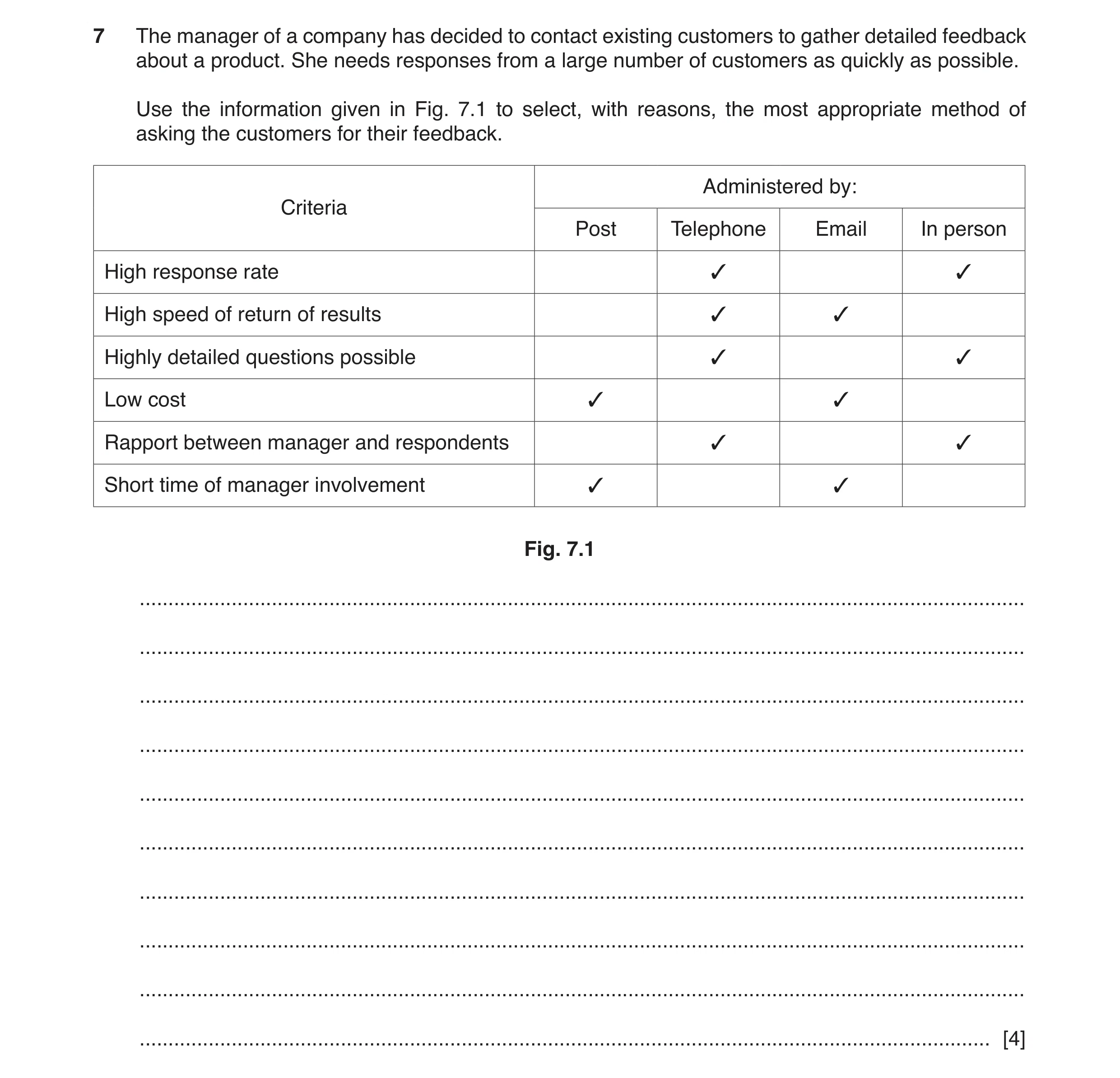
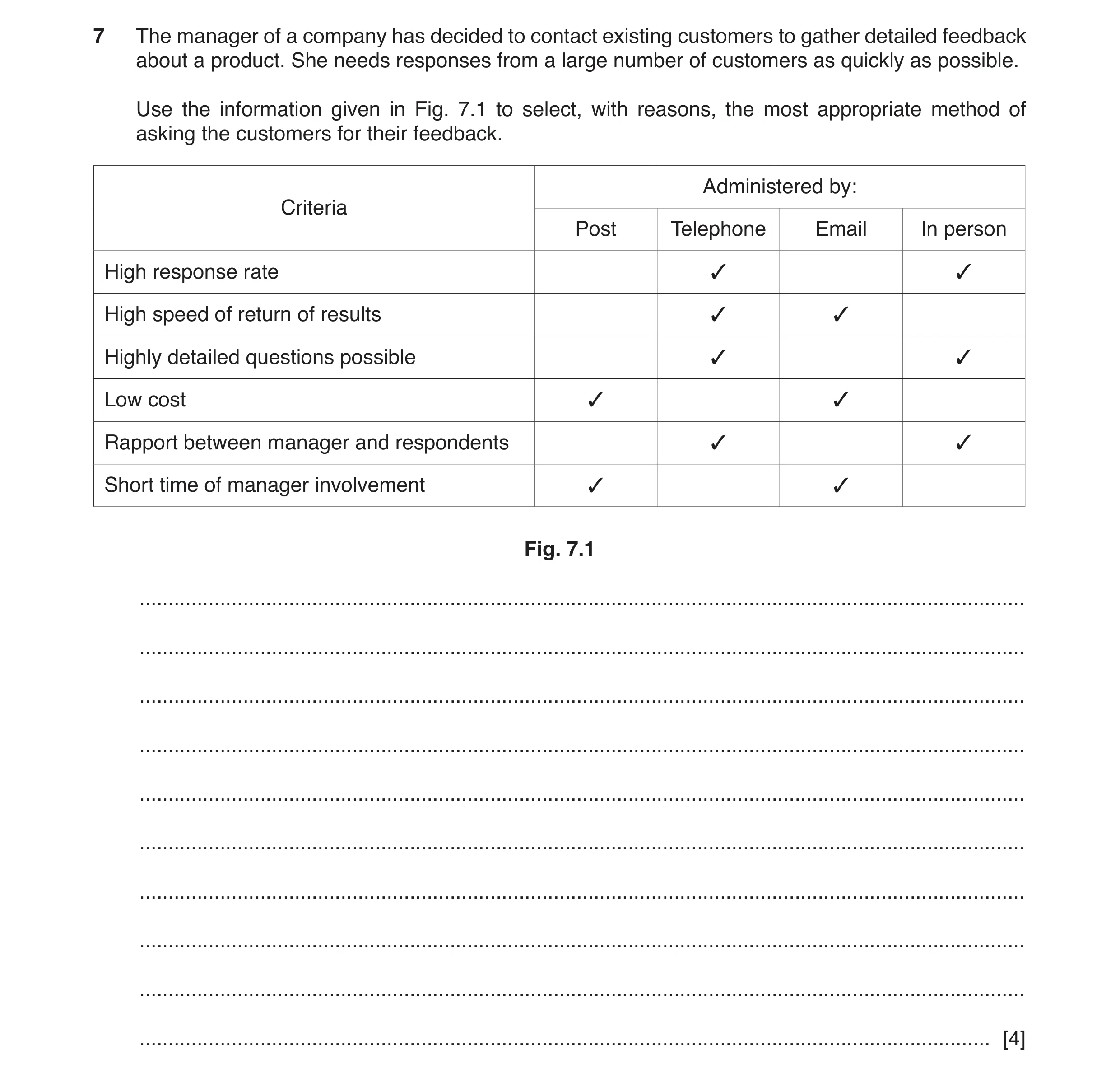
7 The manager of a company has decided to contact existing customers to gather detailed feedback about a product. She needs responses from a large number of customers as quickly as possible. Use the information given in Fig. 7.1 to select, with reasons, the most appropriate method of asking the customers for their feedback. Administered by: Criteria Post Telephone Email In person 3 3 High response rate 3 3 High speed of return of results 3 3 Highly detailed questions possible 3 3 Low cost 3 3 Rapport between manager and respondents 3 3 Short time of manager involvement Fig. 7.1 … … … … … … … … … … [4]
4 marks
Mark scheme: 7 Four from: 4 Detail is needed so Telephone or Personal administration are options Rapport is needed so Telephone or Personal administration are options High response rate is needed so Telephone or Personal administration are options High speed of return of results is required so Telephone or Email are options Only Telephone meets all the requirements.
This question in 9626/31 May/June 2019
Q8 · Analyse the use of focus groups as a method of gathering feedback about a new product… 9626/32 May/June 2019
4 Analyse the use of focus groups as a method of gathering feedback about a new product before it is made available for sale. … … … … … … … … … … … … … … … … … … … … [8]
8 marks
Mark scheme: 4 Eight from e.g.: 8 Focus group is an interview with a small number of respondents conducted by a trained interviewer / moderator Members often have similar backgrounds / expertise in order to pool ideas / views Representatives of the organiser / stake holders may be present to gather views / suggest ideas Informal so that respondents can interact in a natural manner and freely give their views Interviewer / moderator may have a guide / agenda to lead the discussion to a conclusion as the session progresses Can provide accurate information in a short time Can be less expensive that other methods of gathering information Can be more expensive if carried out over e.g. national areas to gather information from wide range of people Results / views can be affected by presence of observers / representatives of interested parties Validity of outcomes can be questionable as participants may not be independent / be affected by presence or stake holders Outcomes may not be kept confidential as participants are often from external sources.
This question in 9626/32 May/June 2019
Q9 · The manager of a company has decided to contact existing customers to gather detailed… 9626/33 May/June 2019
7 The manager of a company has decided to contact existing customers to gather detailed feedback about a product. She needs responses from a large number of customers as quickly as possible. Use the information given in Fig. 7.1 to select, with reasons, the most appropriate method of asking the customers for their feedback. Administered by: Criteria Post Telephone Email In person 3 3 High response rate 3 3 High speed of return of results 3 3 Highly detailed questions possible 3 3 Low cost 3 3 Rapport between manager and respondents 3 3 Short time of manager involvement Fig. 7.1 … … … … … … … … … … [4]
4 marks
Mark scheme: 7 Four from: 4 Detail is needed so Telephone or Personal administration are options Rapport is needed so Telephone or Personal administration are options High response rate is needed so Telephone or Personal administration are options High speed of return of results is required so Telephone or Email are options Only Telephone meets all the requirements.
This question in 9626/33 May/June 2019
Q10 · Evaluate the use of questionnaires in comparison to interviews and observation when… 9626/31 Oct/Nov 2019
4 Evaluate the use of questionnaires in comparison to interviews and observation when collecting data. … … … … … … … … … … … … … … … … … … … … [8]
8 marks
Mark scheme: 4 Command word: Evaluate: discuss the importance of, weigh up, the 8 advantages and disadvantages, judge the overall effectiveness, weigh up your opinions. Eight from: Advantages: Large amounts of information may be gathered from many responders in a shorter time than interviewing Unlike with questionnaires, interviewees might try and provide answers which they think the interviewer wants to hear Can be carried out by any number of researchers with little effect on the reliability and validity of the data Easier to analyse quantitatively than interviews Disadvantages: Cannot see the process as a whole as you would with observation Cannot move away from their ‘script’ and ask a more in-depth question as they could with interviews Cannot interpret body language as would be possible with observation/interviews Do not have to arrange a set time as would be required for interviews Questionnaires can lead to people not telling the truth as they are anonymous, which is less likely with interviews Questions cannot be changed once they are typed up unlike interviews Follow up questions cannot be asked unlike interviews More difficult to interpret emotions/feelings on a subject Cannot determine how much thought/consideration has been given to the answers by respondents Cannot have questions explained as to their purpose/meaning unlike interviews.
This question in 9626/31 Oct/Nov 2019
Q11 · Evaluate the use of questionnaires in comparison to interviews and observation when… 9626/33 Oct/Nov 2019
4 Evaluate the use of questionnaires in comparison to interviews and observation when collecting data. … … … … … … … … … … … … … … … … … … … … [8]
8 marks
Mark scheme: 4 Command word: Evaluate: discuss the importance of, weigh up, the 8 advantages and disadvantages, judge the overall effectiveness, weigh up your opinions. Eight from: Advantages: Large amounts of information may be gathered from many responders in a shorter time than interviewing Unlike with questionnaires, interviewees might try and provide answers which they think the interviewer wants to hear Can be carried out by any number of researchers with little effect on the reliability and validity of the data Easier to analyse quantitatively than interviews Disadvantages: Cannot see the process as a whole as you would with observation Cannot move away from their ‘script’ and ask a more in-depth question as they could with interviews Cannot interpret body language as would be possible with observation/interviews Do not have to arrange a set time as would be required for interviews Questionnaires can lead to people not telling the truth as they are anonymous, which is less likely with interviews Questions cannot be changed once they are typed up unlike interviews Follow up questions cannot be asked unlike interviews More difficult to interpret emotions/feelings on a subject Cannot determine how much thought/consideration has been given to the answers by respondents Cannot have questions explained as to their purpose/meaning unlike interviews.
This question in 9626/33 Oct/Nov 2019
Q12 · A new website is being developed 9626/32 May/June 2020
8 A new website is being developed. The developer wishes to involve users in the development process. Analyse the use of interviews for researching the views of the users. … … … … … … … … … … … … … … … … … … … … [8]
8 marks
Mark scheme: 8 Eight from: 8 Interviews are conducted in person or over the telephone. Can be formal/structured or informal. Requires the production of a script which can take time/resources to create/test. Language difficulties can be resolved. Can encourage/allow/enable open-ended responses. Further questions may be asked based on response to previous question. Questions can be explained/further clarification can be added. Can resolve ambiguities in responses. Can achieve a high response rate. Are (mostly) qualitative in outcome. Responders may give the answers that they think the interviewer wants to have so data is invalid/unreliable. Can be (very) time consuming for interviewer and interviewee(s) resulting in increased costs. Questions may be interpreted by interviewer/interviewee in different ways resulting in unreliable/invalid data. Open-ended responses may be transcribed differently by different analysts.
This question in 9626/32 May/June 2020
Q13 · Mae, a systems analyst, will use document analysis to carry out research into a company 9626/33 Oct/Nov 2020
11 Mae, a systems analyst, will use document analysis to carry out research into a company. (a) Describe the steps she should go through when preparing to examine the company documents. … … … … … … … … … … [4] (b) Describe the steps Mae should go through when examining the company documents. … … … … … … … … … … [4]
8 marks
Mark scheme: 11(a) Four from: 4 Identify/create a list of documents to explore/examine (e.g. population, samples, respondents, participants) Consider how documents will be accessed with attention to linguistic or cultural barriers. Acknowledge and address biases in documents Consider strategies for evaluating suitability/relevance of documents Be clear about the data that she is searching for Consider ethical issues (e.g. confidential documents) Consider alternative sources if requested documents are not available. 11(b) Four from: 4 Gather relevant documents Develop an organisation and management method of work Produce a data flow diagram Determine the source and destination of the documents/ask questions about document Make copies of the originals for annotation Assess the authenticity of documents Examine documents’ contents/purposes/biases Examine background information Examine the content Keep records/notes of findings/observations.
This question in 9626/33 Oct/Nov 2020
Q14 · A café owner wants to research the background and views of her customers about the food… 9626/32 Feb/March 2021
7 A café owner wants to research the background and views of her customers about the food and service in the café. She has decided to interview each of her customers. Evaluate, by weighing up the advantages and disadvantages, the use of interviews for gathering information about the background and views of the customers. … … … … … … … … … … … … … … … … … … … … [8]
8 marks
Mark scheme: 7 Evaluate: Discuss the importance of, weigh up the advantages and 8 disadvantages, judge the effectiveness, weigh up your opinions. Eight from: Advantages: Allows more detailed answers to be collected so more data is gathered Allows follow up questions to be asked so that ambiguities/incomplete answers can be clarified Gather detailed data about interviewee’s feelings/perceptions/opinions so wider view of responses Achieve a high response rate so more data is gathered Interviewee’s own words are recorded so more detail is collected Question wording can be customised to interviewees so that more precise answers can be gathered Precise meaning of questions can be clarified/explained to respondent if e.g. they speak English as a Second Language Interviewees are not influenced by others in the group, so answers are more specific to the individual Interviewer can direct the focus of questioning to collect details Interviewees may be less self-conscious/more confident in a one-to-one situation Disadvantages: Can be time-consuming to set up/interview/transcribe so fewer interviews can be done Analysis of questions/feedback can be costly/expensive as it requires e.g. manual data entry Different interviewers may understand/interpret/transcribe interviews in different ways so data may not be reliable Quality of the data depends on the skill of the interviewer so gathered data can vary/be unreliable Sample size is limited due to the availability of interviewers so data may be unrepresentative Respondents may not give honest answers so data may be unreliable Respondents may give answers that the interviewer wants so data may be biased. Must be at least 2 of each for full marks 1 mark available for a reasoned opinion/conclusion.
This question in 9626/32 Feb/March 2021
Q15 · A manager of a library is considering introducing an updated computer system for lending… 9626/31 May/June 2021
5 A manager of a library is considering introducing an updated computer system for lending out books. Library users will be asked to complete a questionnaire about the current system. Evaluate, by weighing up the advantages and disadvantages, the use of questionnaires for gathering information in this scenario. … … … … … … … … … … … … … … … … … … … … [8]
8 marks
Mark scheme: 5 Evaluate: Discuss the importance of, weigh up the advantages and 8 disadvantages, judge the effectiveness, weigh up your opinions. Eight from: Advantages: Less expensive than other methods of gathering information due to reduced costs of employing e.g. interviewers/observers/reader of documents Can be targeted at specific groups of people/only at library users Results can be gathered more quickly than reading documents/interviews Size of sample can be controlled/scaled up with ease compared to interviews Analysis of results can be automatic with online questionnaires Respondents can remain anonymous No time constraint on respondent/respondent can fill in questionnaire in own time Unlike manual questionnaires, online questionnaire can have customised questions depending on previous answers/branching routes through questions Disadvantages: Respondents may not provide honest answers/may have a hidden agenda as they are anonymous Respondents may not answer all questions so the data may be incomplete Respondents may not understand questions/may interpret them differently/It is not known if respondents understand No emotion/feelings are conveyed Free response questions can be difficult to analyse Precise customisation is difficult compared to interviews Questionnaire may be difficult to access by disabled persons Questionnaires can be boring to answer so may not get valid data. Must be at least 2 of each for full marks. Must be a proper evaluation to obtain full marks. Max 6 marks if bullets/list of points.
This question in 9626/31 May/June 2021
Q16 · A manager of a library is considering introducing an updated computer system for lending… 9626/33 May/June 2021
5 A manager of a library is considering introducing an updated computer system for lending out books. Library users will be asked to complete a questionnaire about the current system. Evaluate, by weighing up the advantages and disadvantages, the use of questionnaires for gathering information in this scenario. … … … … … … … … … … … … … … … … … … … … [8]
8 marks
Mark scheme: 5 Evaluate: Discuss the importance of, weigh up the advantages and 8 disadvantages, judge the effectiveness, weigh up your opinions. Eight from: Advantages: Less expensive than other methods of gathering information due to reduced costs of employing e.g. interviewers/observers/reader of documents Can be targeted at specific groups of people/only at library users Results can be gathered more quickly than reading documents/interviews Size of sample can be controlled/scaled up with ease compared to interviews Analysis of results can be automatic with online questionnaires Respondents can remain anonymous No time constraint on respondent/respondent can fill in questionnaire in own time Unlike manual questionnaires, online questionnaire can have customised questions depending on previous answers/branching routes through questions Disadvantages: Respondents may not provide honest answers/may have a hidden agenda as they are anonymous Respondents may not answer all questions so the data may be incomplete Respondents may not understand questions/may interpret them differently/It is not known if respondents understand No emotion/feelings are conveyed Free response questions can be difficult to analyse Precise customisation is difficult compared to interviews Questionnaire may be difficult to access by disabled persons Questionnaires can be boring to answer so may not get valid data. Must be at least 2 of each for full marks. Must be a proper evaluation to obtain full marks. Max 6 marks if bullets/list of points.
This question in 9626/33 May/June 2021
Q17 · A company wants to use an online questionnaire to get feedback from customers about the… 9626/31 Oct/Nov 2021
1 A company wants to use an online questionnaire to get feedback from customers about the medicine it makes. (a) Describe the features of online questionnaires that make them suitable for gathering feedback from customers. … … … … … … … … … … … … … … … … … … … … [8] (b) Describe two drawbacks of using online questionnaires to gather feedback. … … … … … … [2]
10 marks
Mark scheme: Question Answer Marks 1(a) Eight from: 8 Drop down lists offering a choice to respondent Radio buttons allowing only one choice to be made Text boxes to gather free response answers/comments Single character boxes to ensure data entry is appropriate Validation rules to ensure that only reasonable data/comments/information is/are collected Validation rules place a limit on the number of characters in text boxes/in open-ended answers Inclusion of instructions/help/FAQs available to assist in completing the form Pop-up boxes to explain questions in more detail Multi-lingual options for different languages Branching logic to route participants around questions that do not apply to them Progress bar so participants can see how far they have got in the questionnaire Automatic survey/questionnaire expiry to set an end date for responses Can re-direct to end-of survey URL/web page Integration of answers from previous questions into new specific questions Real-time survey results can be shown to participants Results in the form of a graph can be displayed at the end of the survey/use of questionnaire Can send customised email(s) to participants to remind them/as a ‘thank you’/incomplete questionnaire alert Can send report (for analysis) on survey/use of questionnaire/answers to specific questions to customised list of personnel Can include a ‘forward to’ option so that participants can send the questionnaire link to others Can be set up to prevent multiple responses/place a limit on responses from the same participants Can include an opt-out option so that participants are not repeatedly invited to complete the questionnaire(s). 1(b) Two from: 2 Sample of respondents can be too small to provide meaningful results/statistics Sample of respondents may not be representative of customers/not all customers will respond No interviewer involved so no ‘follow-up’ questions possible Customers may not give honest answers if invited by email with incentives (e.g. free sample/discount when responding) Difficult to check that a respondent is a genuine customer Only customers with internet access can be questioned.
This question in 9626/31 Oct/Nov 2021
Q18 · A company wants to use an online questionnaire to get feedback from customers about the… 9626/33 Oct/Nov 2021
1 A company wants to use an online questionnaire to get feedback from customers about the medicine it makes. (a) Describe the features of online questionnaires that make them suitable for gathering feedback from customers. … … … … … … … … … … … … … … … … … … … … [8] (b) Describe two drawbacks of using online questionnaires to gather feedback. … … … … … … [2]
10 marks
Mark scheme: Question Answer Marks 1(a) Eight from: 8 Drop down lists offering a choice to respondent Radio buttons allowing only one choice to be made Text boxes to gather free response answers/comments Single character boxes to ensure data entry is appropriate Validation rules to ensure that only reasonable data/comments/information is/are collected Validation rules place a limit on the number of characters in text boxes/in open-ended answers Inclusion of instructions/help/FAQs available to assist in completing the form Pop-up boxes to explain questions in more detail Multi-lingual options for different languages Branching logic to route participants around questions that do not apply to them Progress bar so participants can see how far they have got in the questionnaire Automatic survey/questionnaire expiry to set an end date for responses Can re-direct to end-of survey URL/web page Integration of answers from previous questions into new specific questions Real-time survey results can be shown to participants Results in the form of a graph can be displayed at the end of the survey/use of questionnaire Can send customised email(s) to participants to remind them/as a ‘thank you’/incomplete questionnaire alert Can send report (for analysis) on survey/use of questionnaire/answers to specific questions to customised list of personnel Can include a ‘forward to’ option so that participants can send the questionnaire link to others Can be set up to prevent multiple responses/place a limit on responses from the same participants Can include an opt-out option so that participants are not repeatedly invited to complete the questionnaire(s). 1(b) Two from: 2 Sample of respondents can be too small to provide meaningful results/statistics Sample of respondents may not be representative of customers/not all customers will respond No interviewer involved so no ‘follow-up’ questions possible Customers may not give honest answers if invited by email with incentives (e.g. free sample/discount when responding) Difficult to check that a respondent is a genuine customer Only customers with internet access can be questioned.
This question in 9626/33 Oct/Nov 2021
Q19 · A scientist requires a new computer system to help with her research into climate change 9626/32 Oct/Nov 2022
5 A scientist requires a new computer system to help with her research into climate change. A systems analyst will use document analysis to investigate the existing computer system. Evaluate the use of document analysis in this scenario. … … … … … … … … … … … … … … … … … … … … [8]
8 marks
Mark scheme: 5 Eight from: 8 Strengths: Document analysis is systematic process of reviewing/evaluating/reading printed and computer-based/internet-sourced documents …which provides a large amount of information Data in documents is examined and analysed to gain meaning/interpreted to gain understanding/knowledge ...so requires that analyst be literate/have knowledge/be competent in the topics/system under review Analyst has to/should combine document research with other forms of analysis …so must be proficient in other forms of analysis to reach conclusions that are reliable so must be highly skilled Document analysis uses data that has already been collected ….so only data selection is needed so requires less time than other methods Document analysis costs only include the method of analysing because the cost of collection is not needed/ uses data that has already been collected …so is less costly than other research methods Many documents are freely available/in pubic domain/already published ….so are accessible to analyst Document analysis uses unobtrusive/non-invasive/non-interactive research methods …so does not affect the subject being researched Historical documents are stable/not altered by being researched …so can be examined several times/re-examined by analysts Documents contain references/exact details that can be cross-refenced to other sources …making the research more reliable Weaknesses: Documents are produced only as a record of an event …so may lack insufficient detail to be useful in the research Data may be inaccurately recorded …so may not reflect actual events/contain all the data so trends would not be accurate Documents may not be in a form that allows data to be electronically retrievable/searchable …so research can be prolonged/miss important data Researcher may be (unintentionally) biased when selecting documents …so data may be incomplete. Must be at least 2 strengths and at least 2 weaknesses for full marks. Max 6 marks if bullets/list of statements/points.
This question in 9626/32 Oct/Nov 2022
Q20 · Draw three different symbols used in a data flow diagram (DFD) 9626/32 Feb/March 2024
6 Draw three different symbols used in a data flow diagram (DFD). For each symbol, state its purpose. Symbol 1 Purpose 1 … … … Symbol 2 Purpose 2 … … … Symbol 3 Purpose 3 … … … [6]
6 marks
Mark scheme: 6 Six from: 6 i.e. process, data store, data source, duplicate data source (the only ones in the syllabus), also allow arrow (and its purpose),and other valid DFD symbols. Symbols from the syllabus: Max three for DFD Symbols, max two per symbol: • Drawing of DFD Symbol (1st) – correct stated/statements of purpose matched to the symbol (1)
This question in 9626/32 Feb/March 2024
Q21 · Describe the purpose of the user requirements specification for a new system 9626/32 Oct/Nov 2025
6 Describe the purpose of the user requirements specification for a new system. … … … … … … … … … … … … … … [6]
6 marks
Mark scheme: 6 Six from: 6 • Sets out the agreement / contract between the client and the developer − so client cannot demand / add new requirements / features to design / new system / product − so developer cannot claim to have finished when they have not completed new system • Defines what is to be produced • Defines what client wants new system to be able to do / purpose of new system / goal of new system / functional objectives of the new system • Defines how client wants new system to function • Defines where new system is to be located / how it is to be integrated into client business / how or where installed • Used to inform systems specification / other specifications • Used to inform the evaluation
This question in 9626/32 Oct/Nov 2025
 1 / 22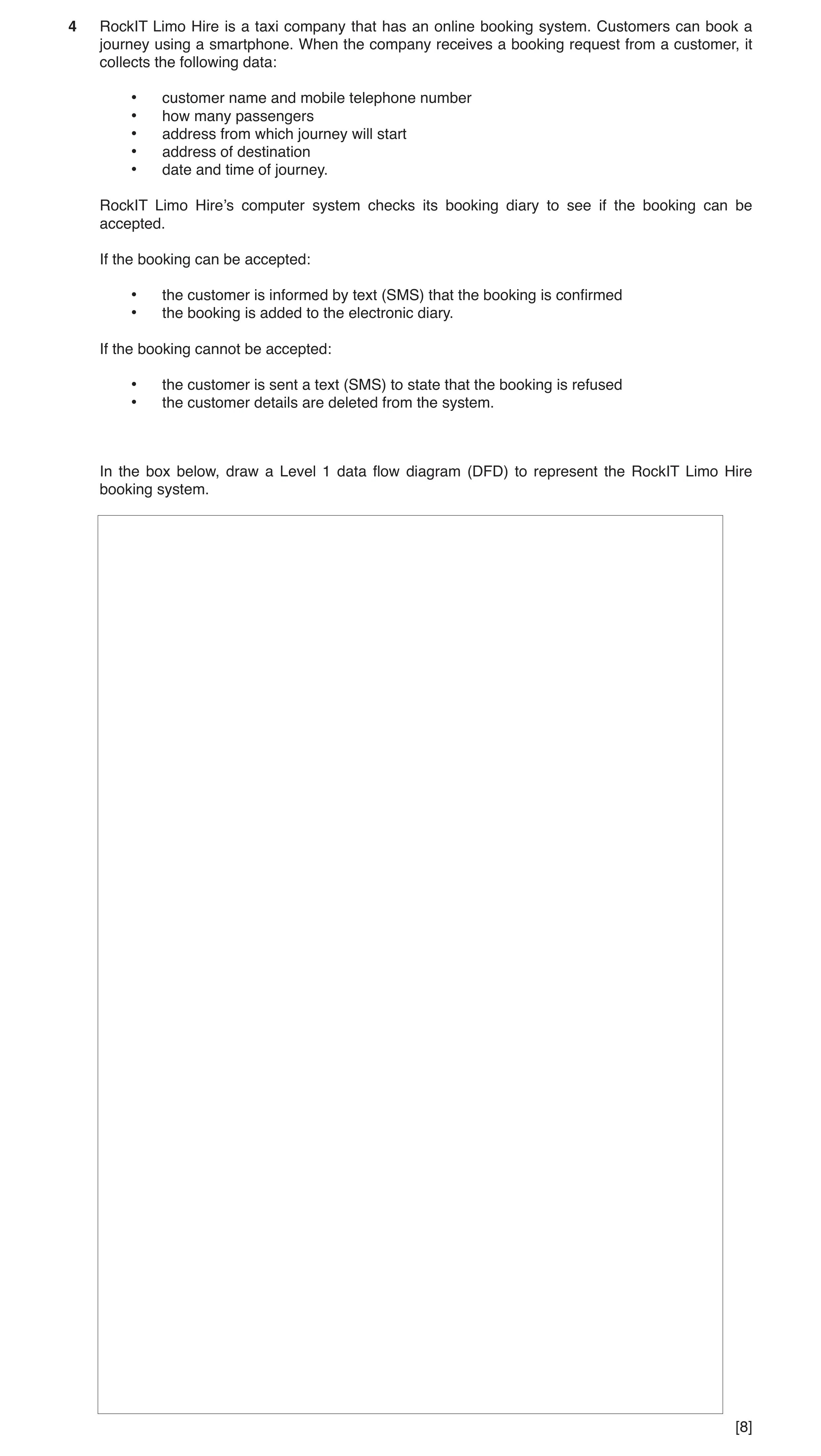
 4 / 22
 5 / 22
 6 / 22
 7 / 22
 8 / 22
 9 / 22
 10 / 22
 11 / 22
 12 / 22
 13 / 22
 14 / 22
 15 / 22
 16 / 22
 17 / 22
 18 / 22
 19 / 22
 20 / 22
 21 / 22
 22 / 22
 6
6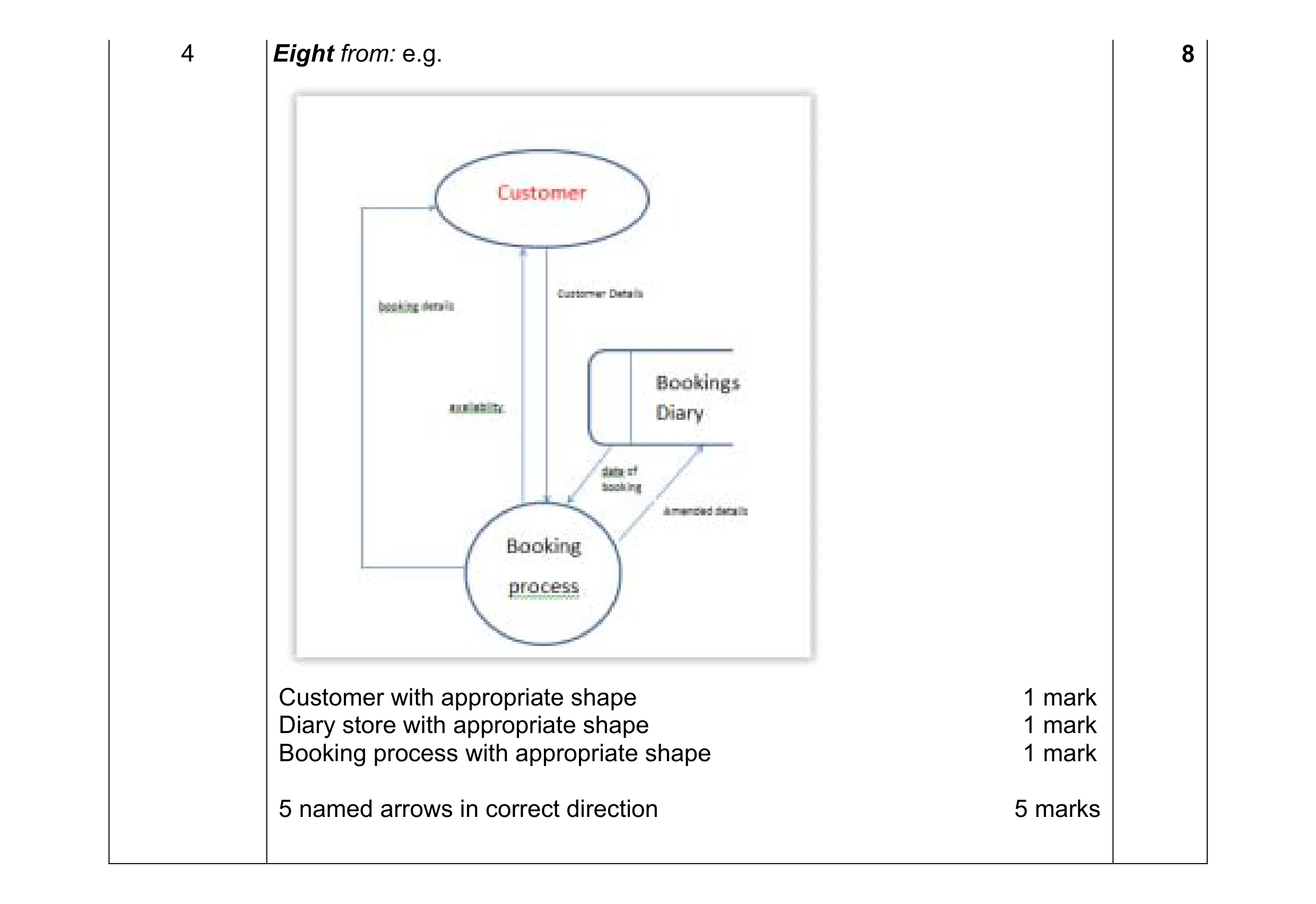 8
8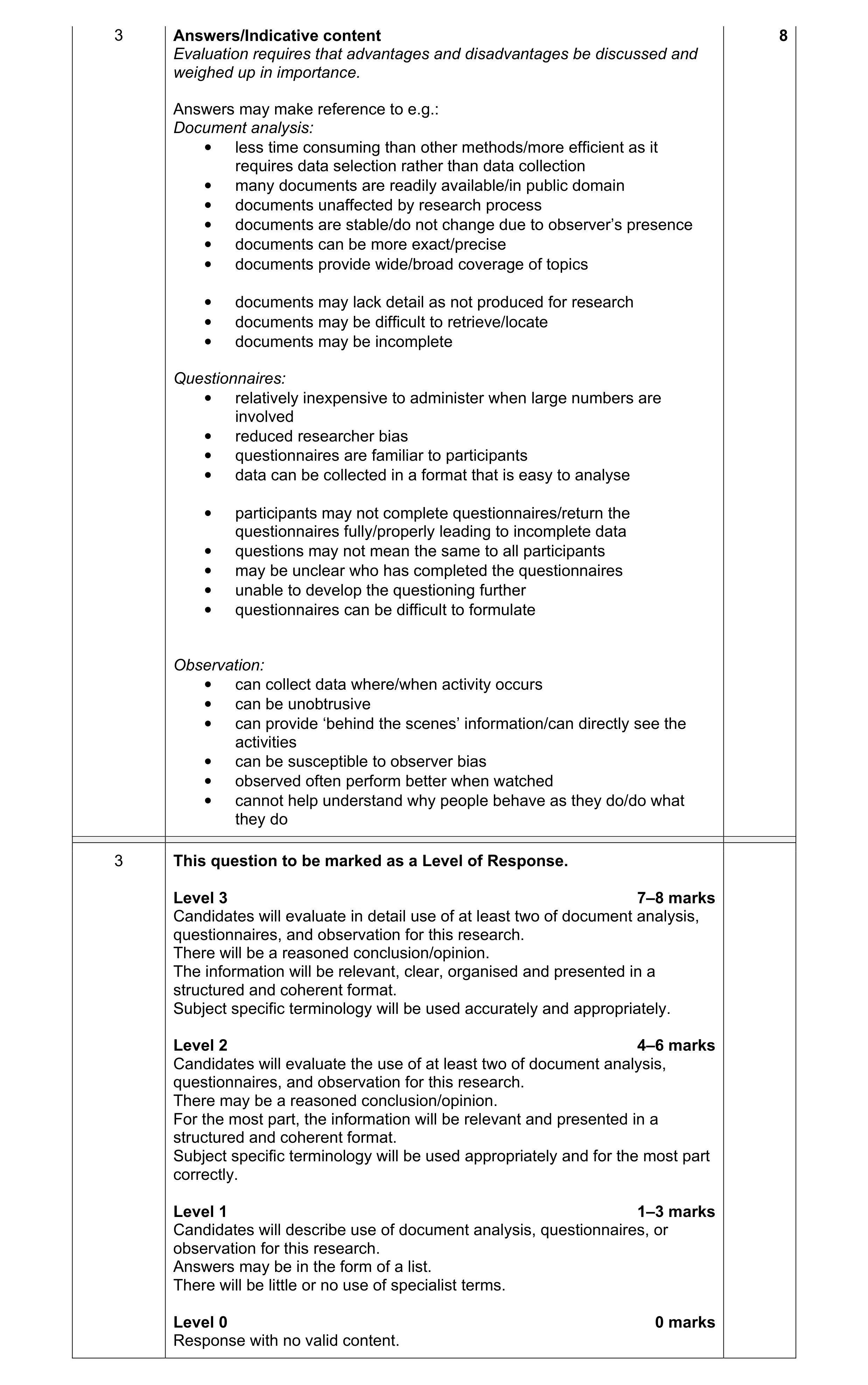 8
8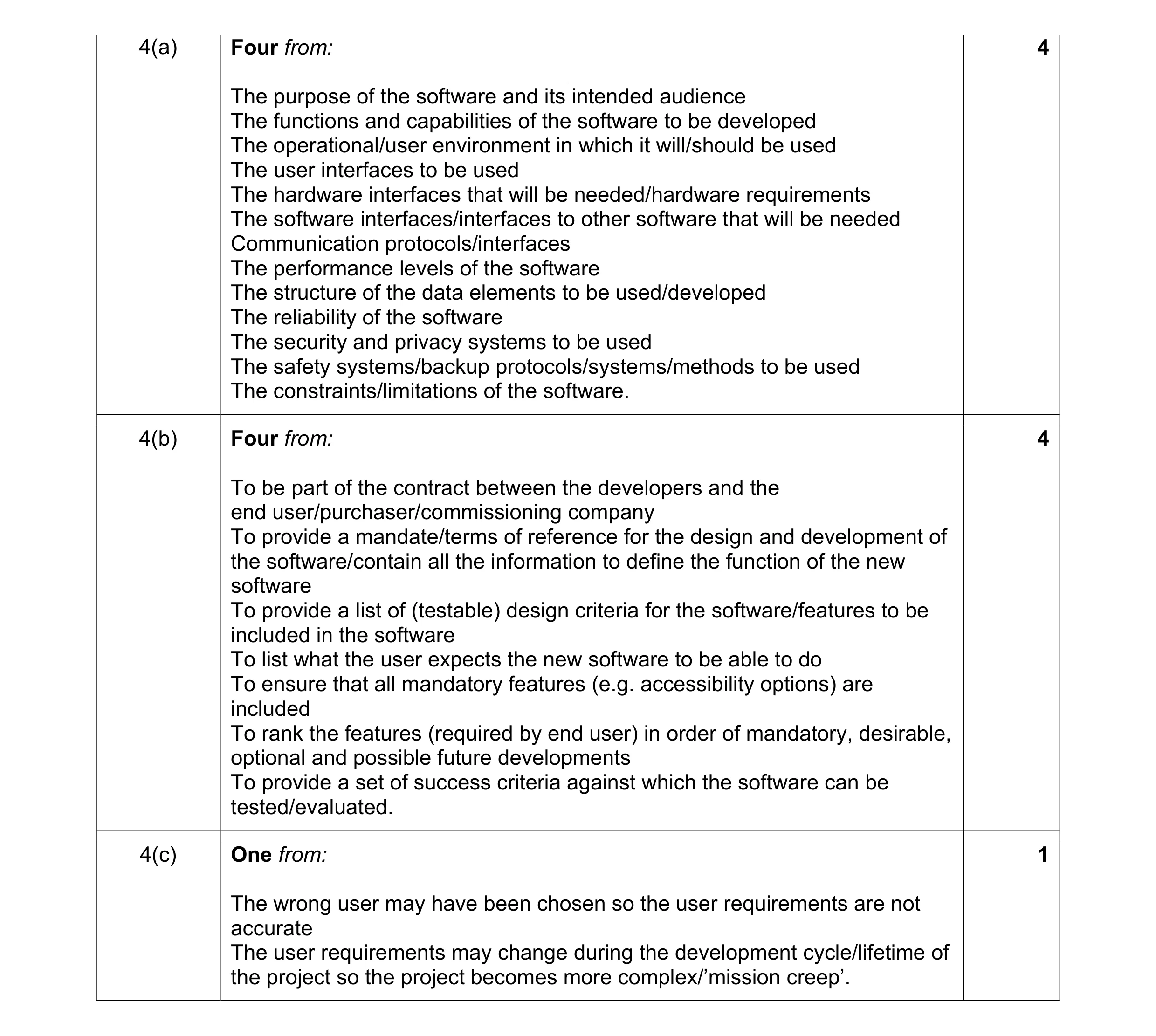 9
9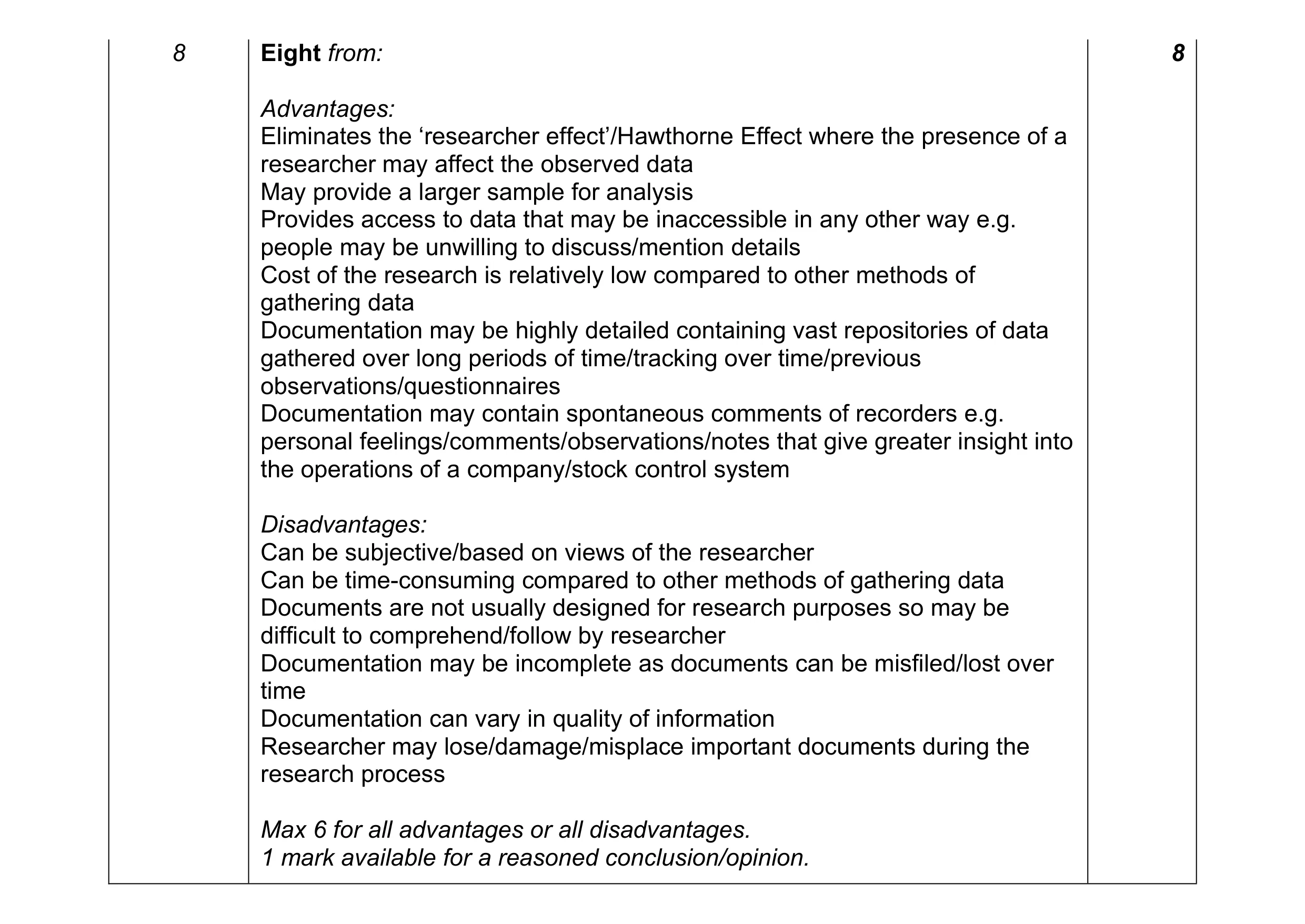 8
8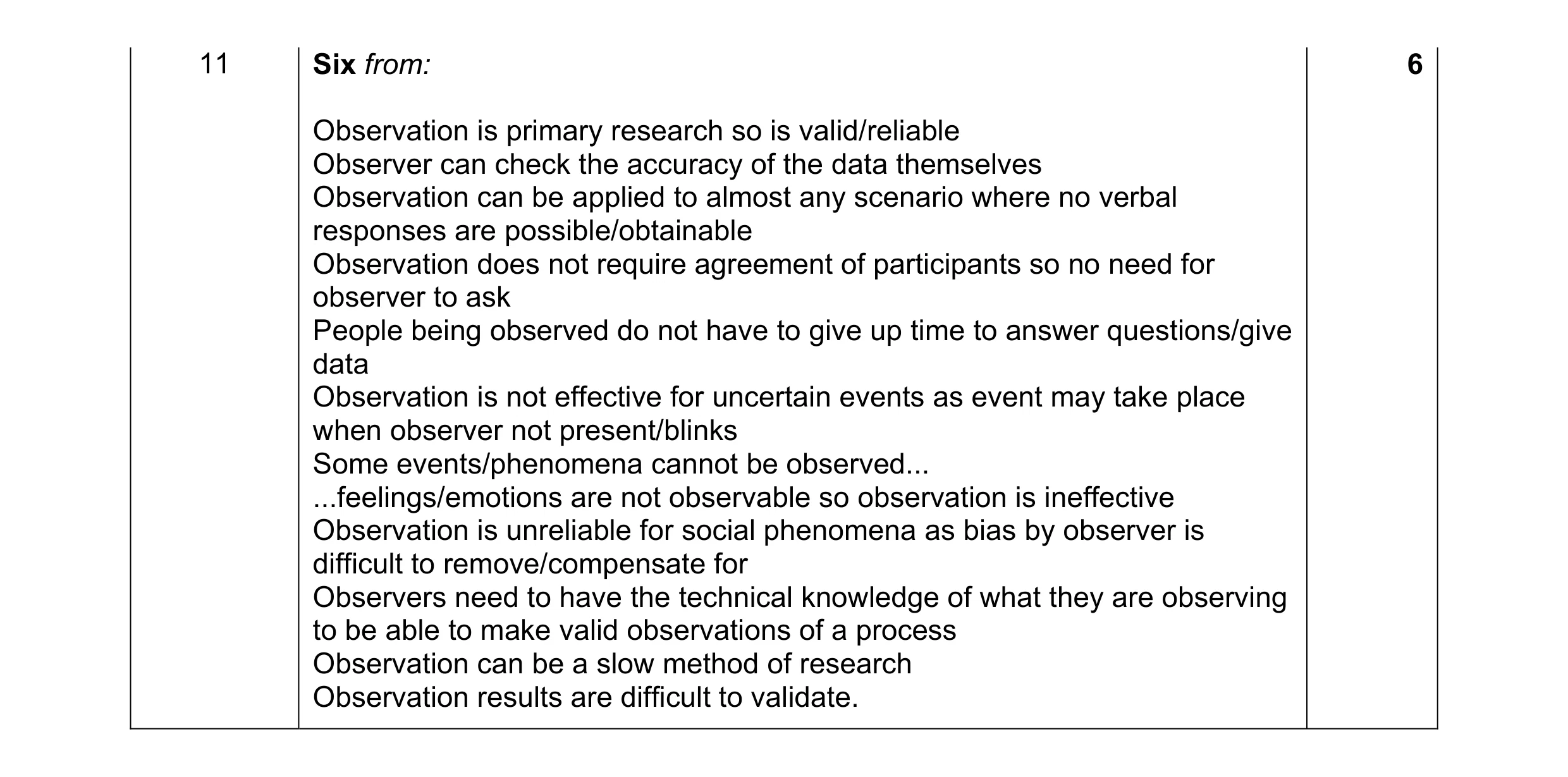 6
6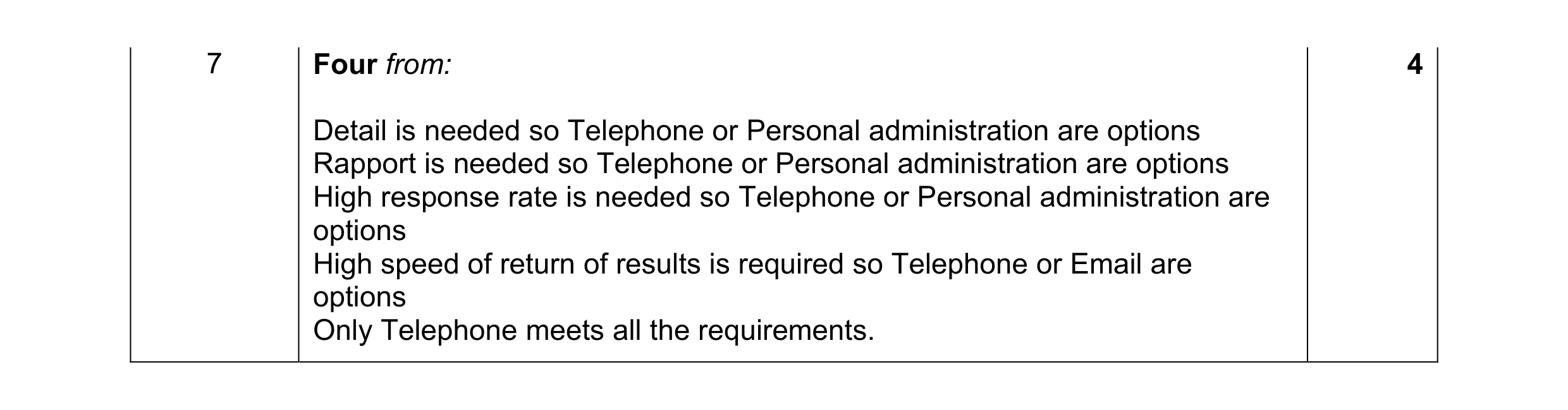 4
4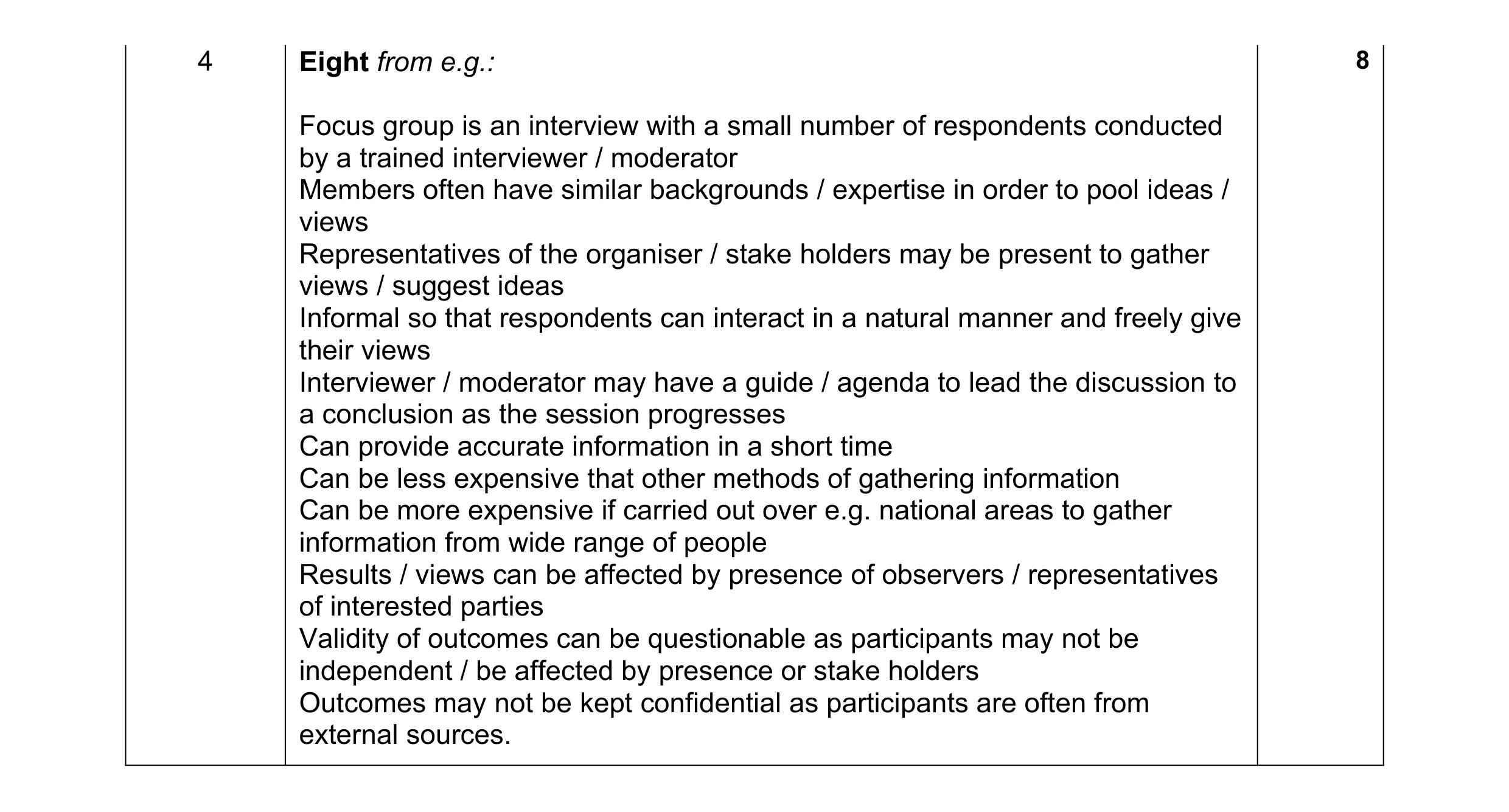 8
8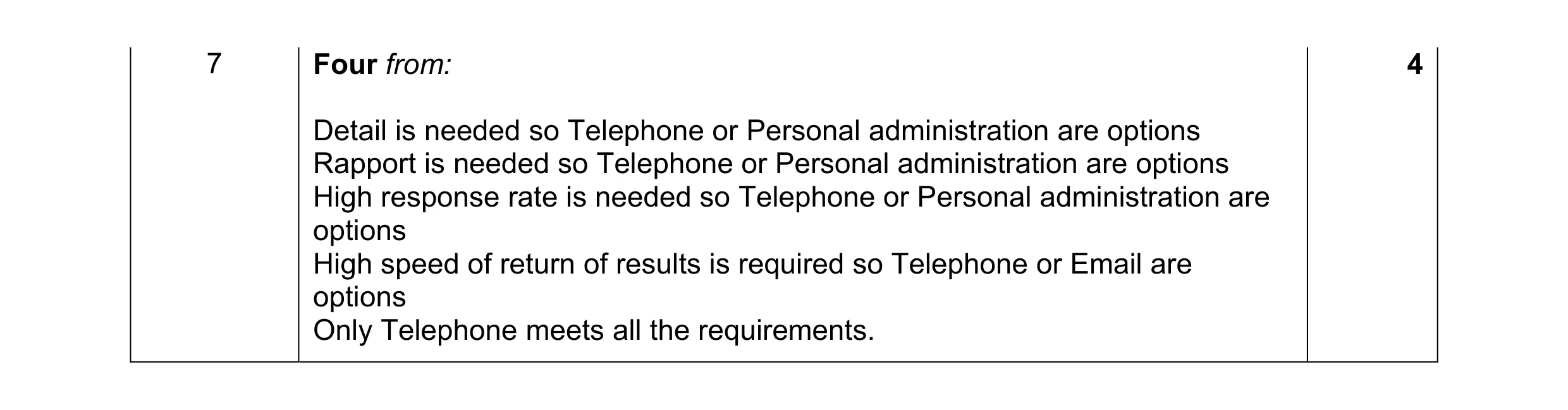 4
4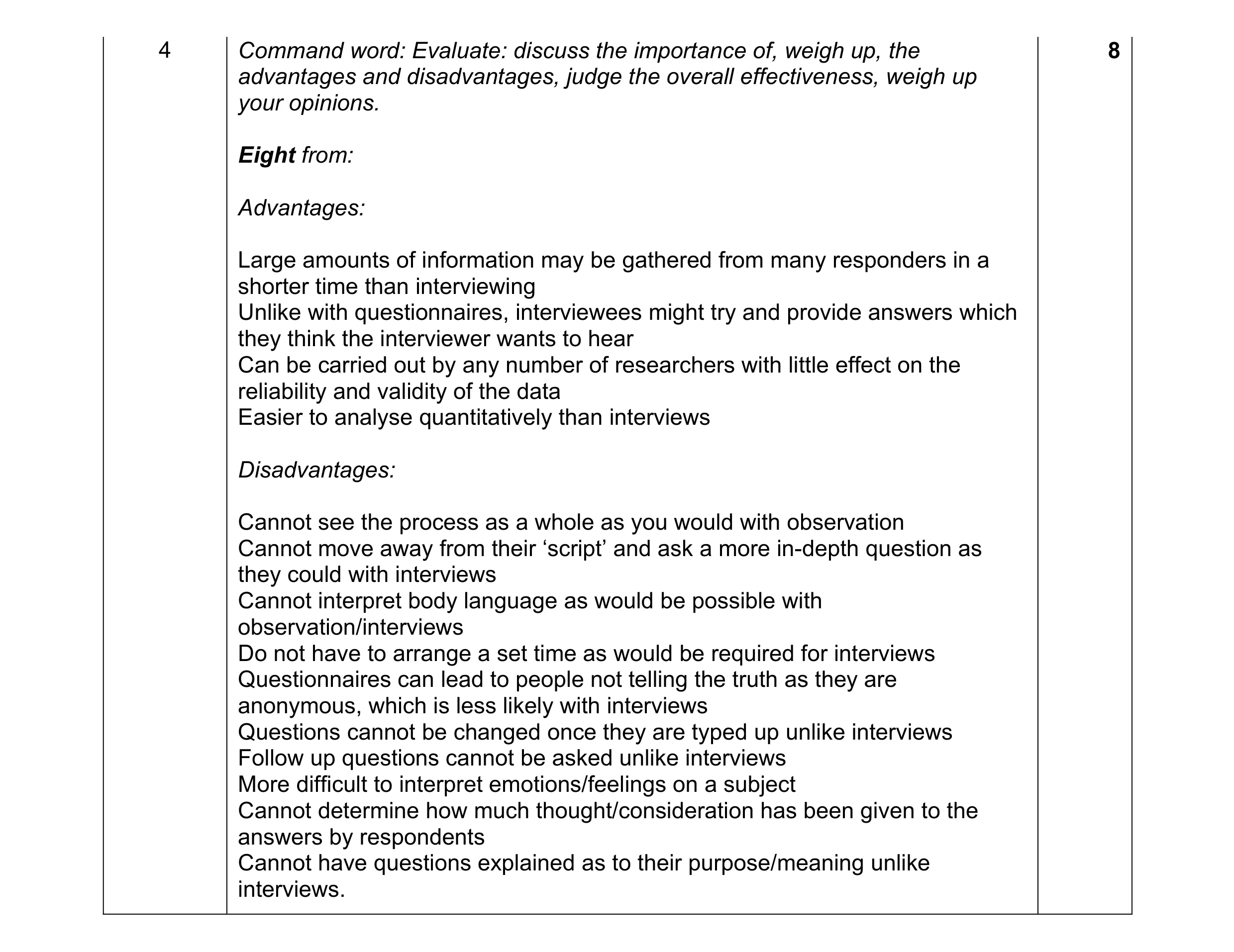 8
8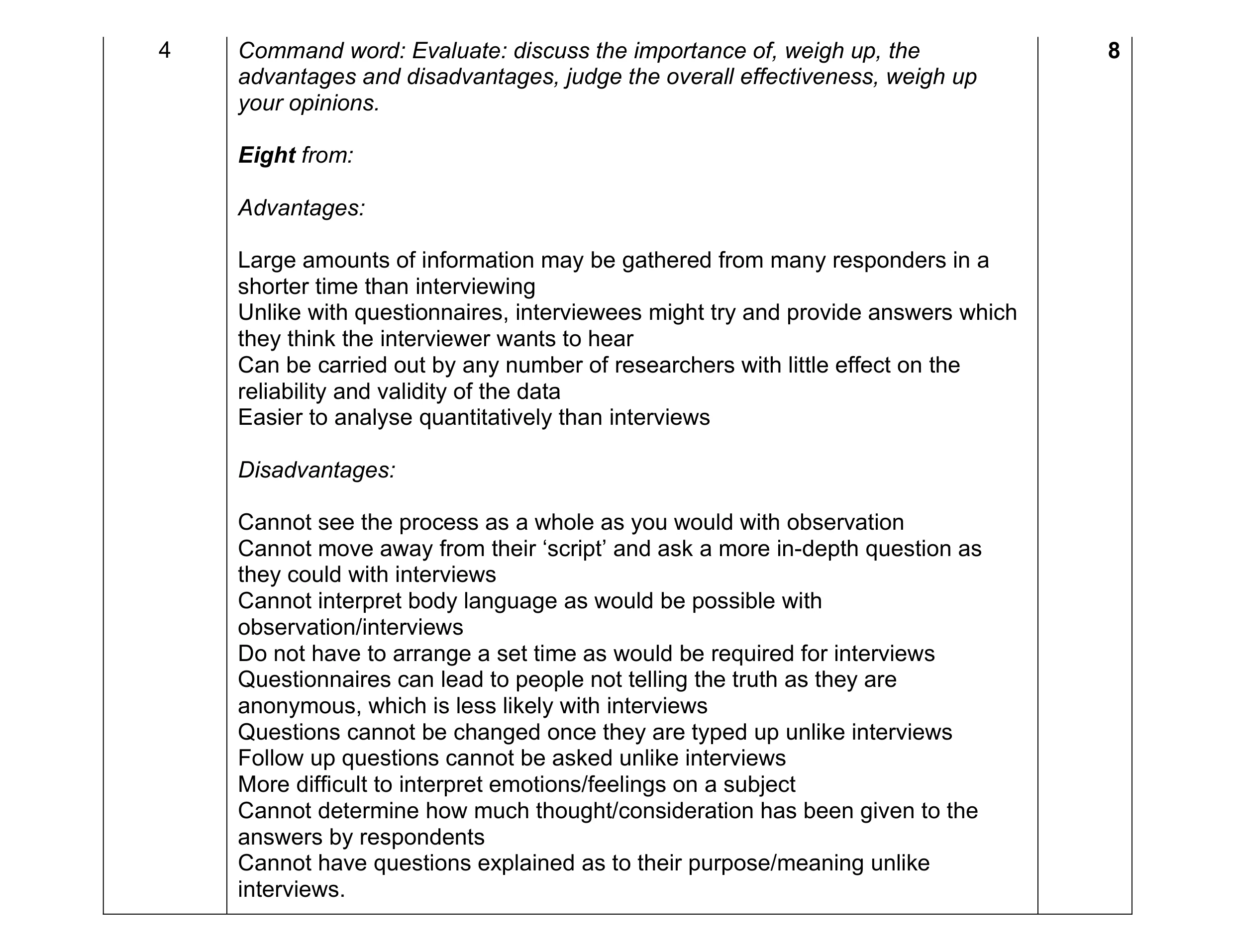 8
8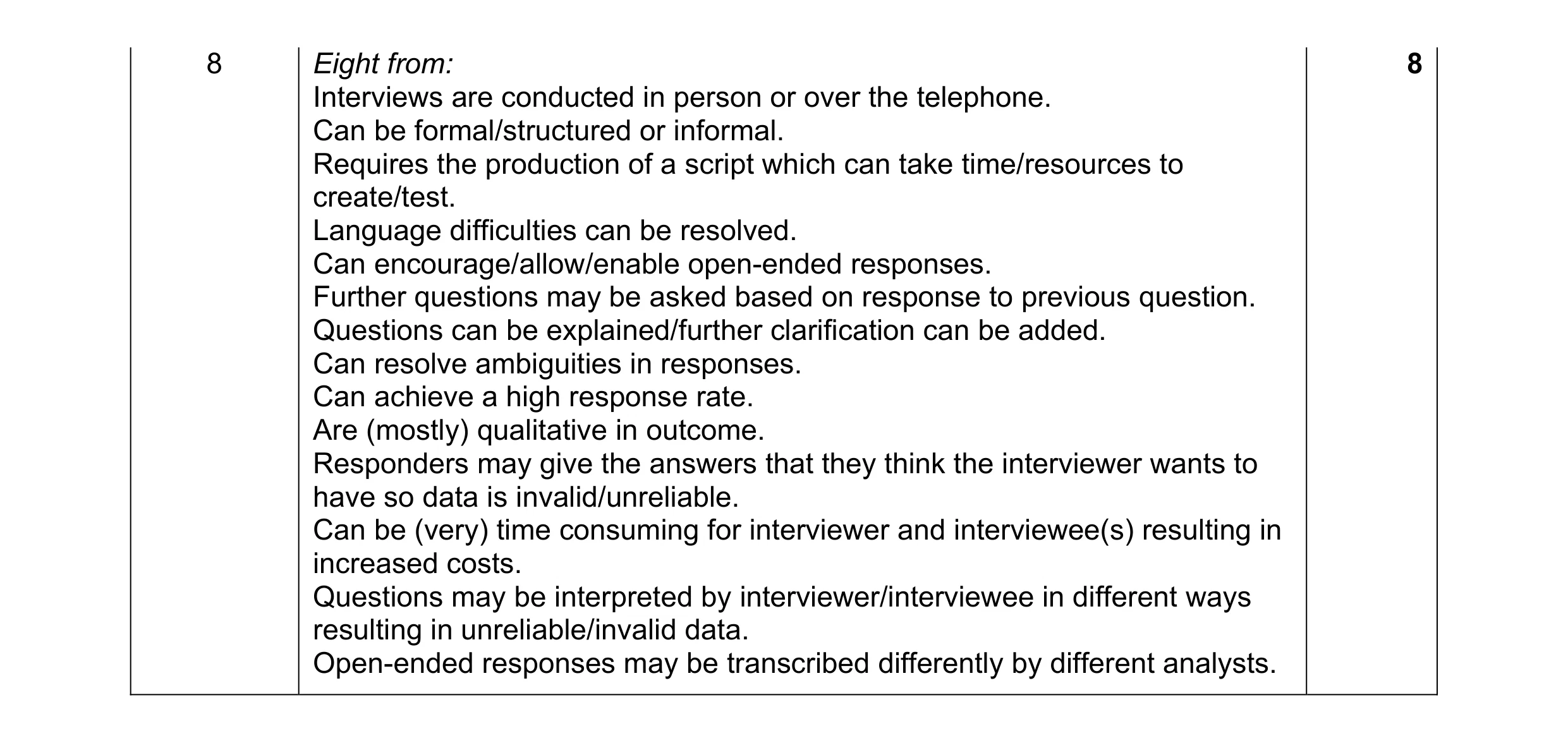 8
8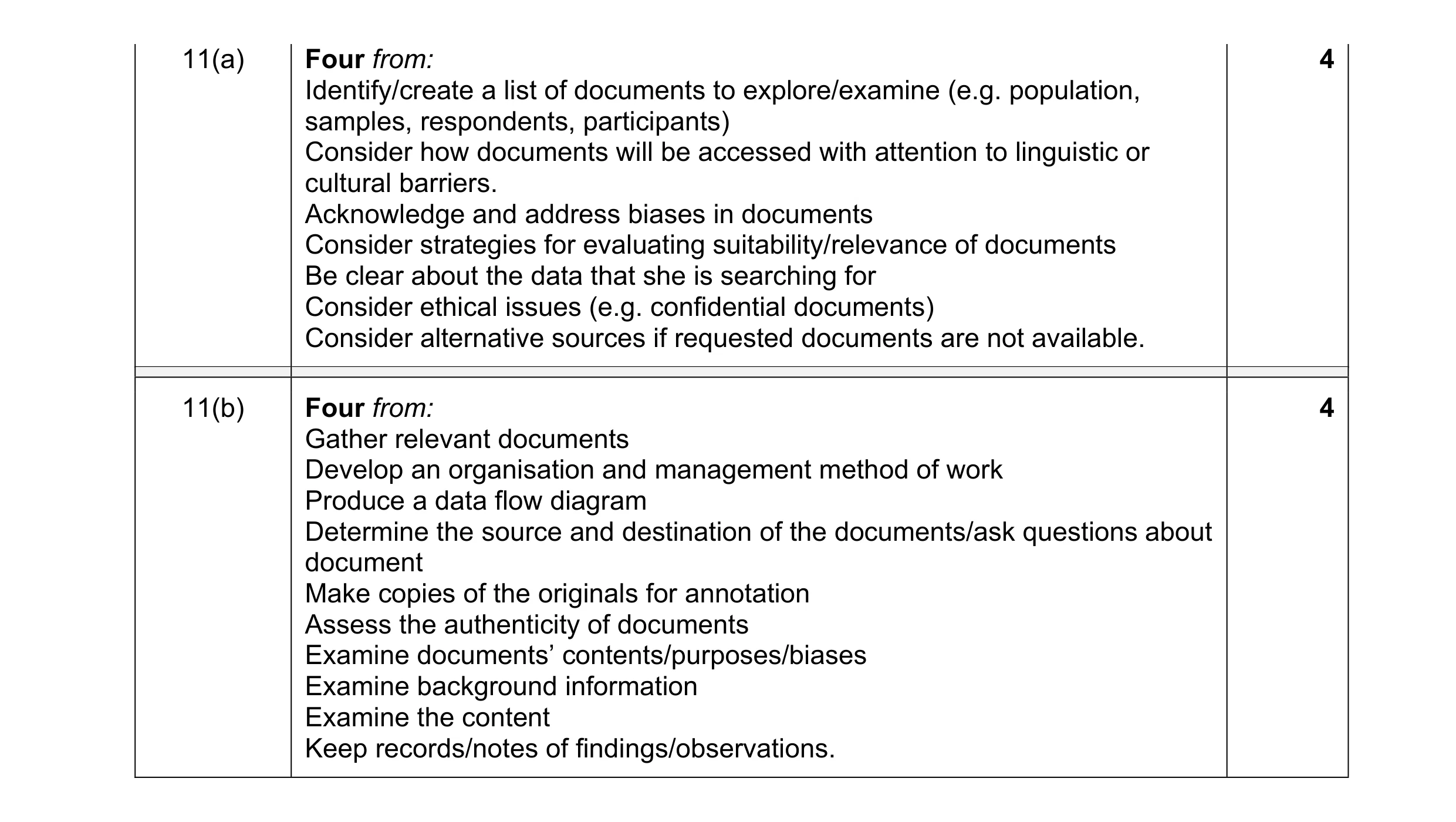 8
8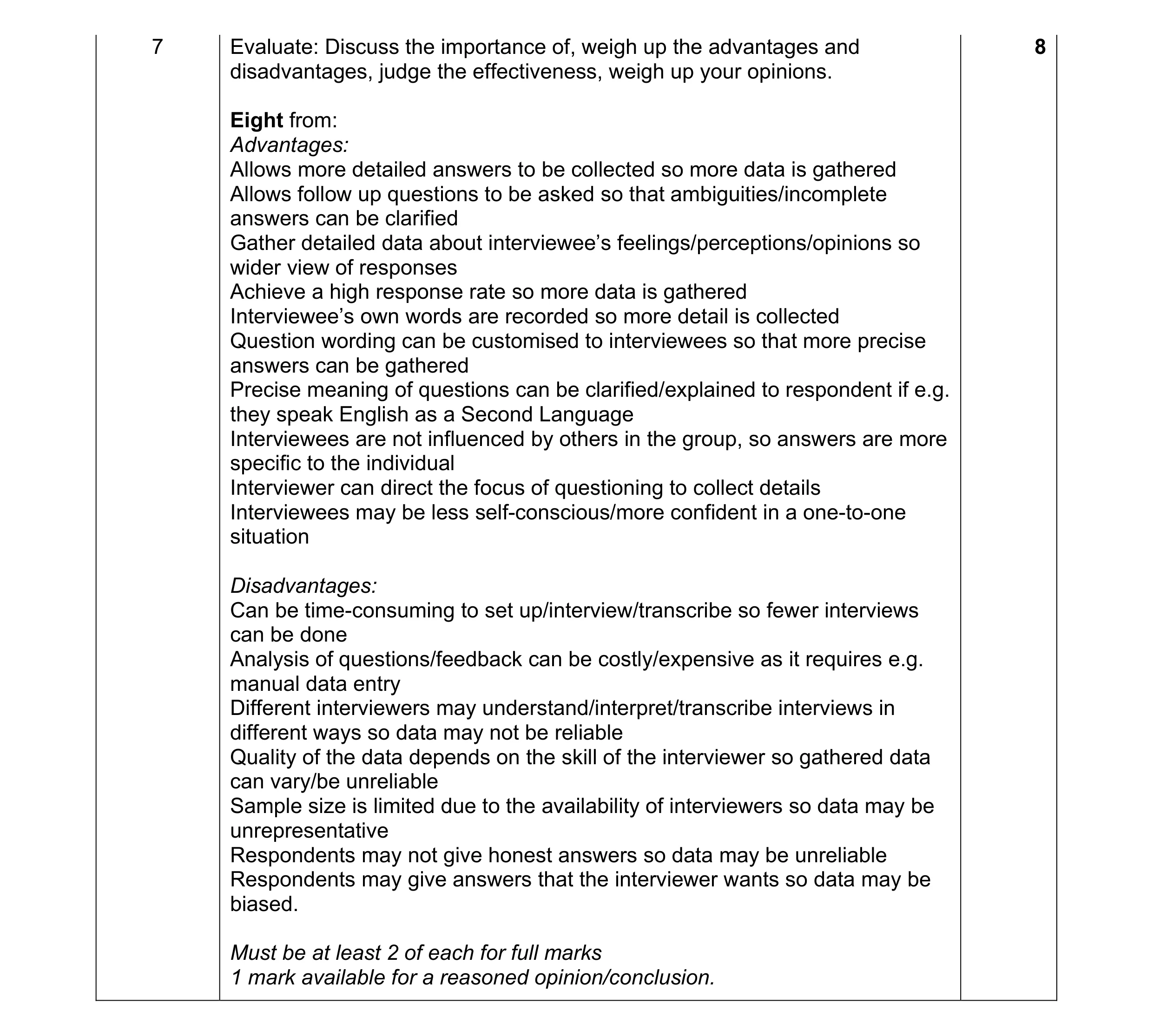 8
8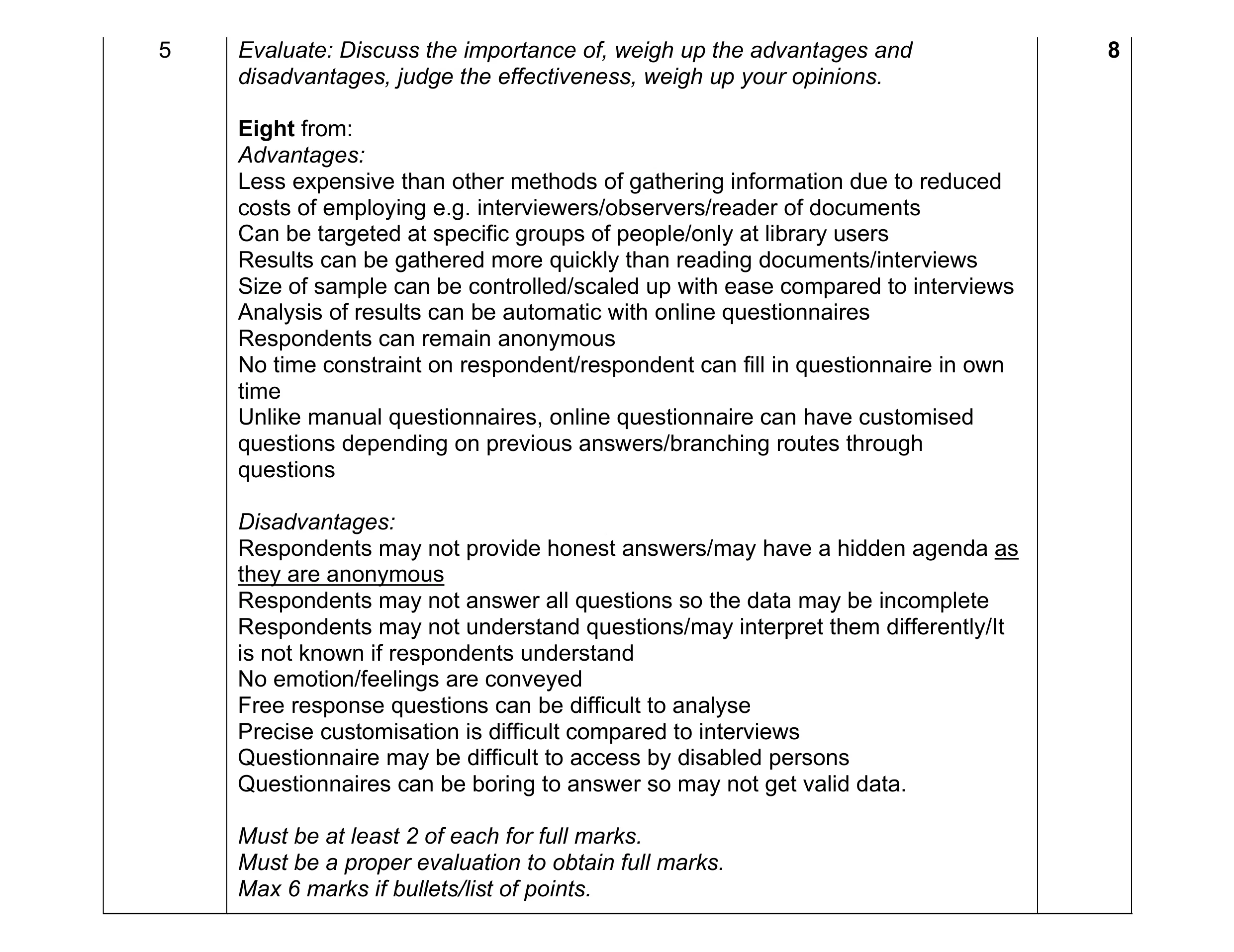 8
8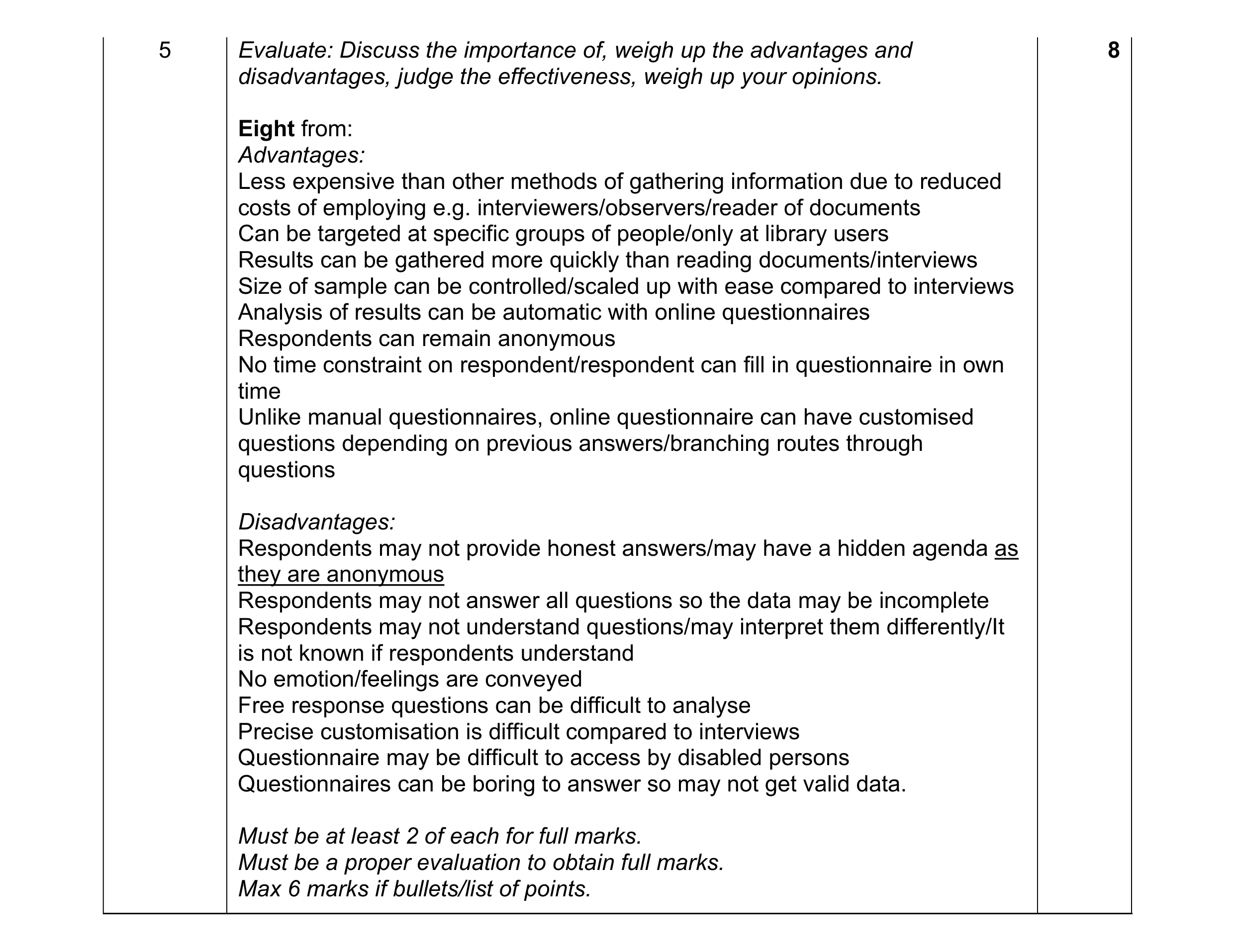 8
8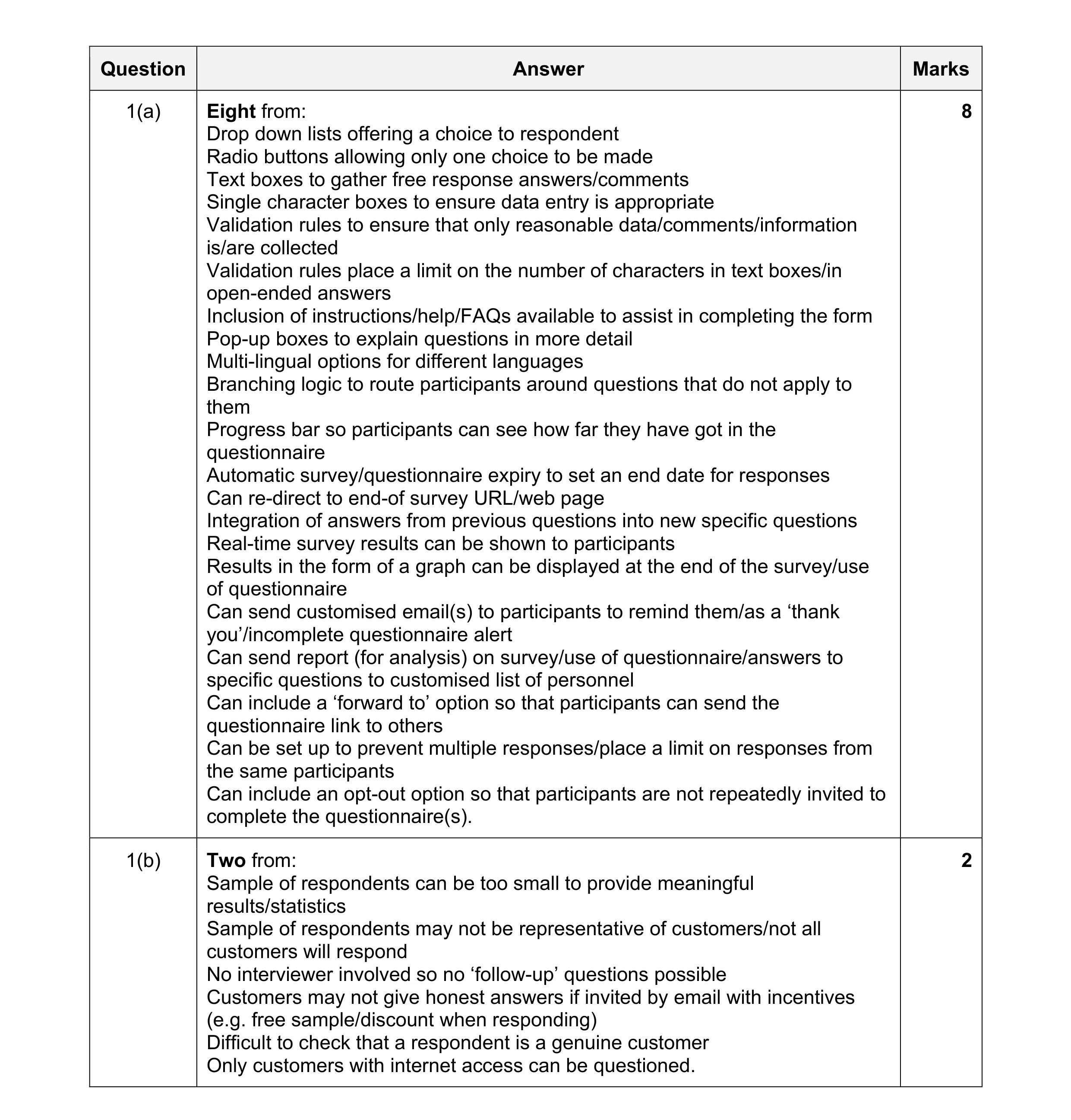 10
10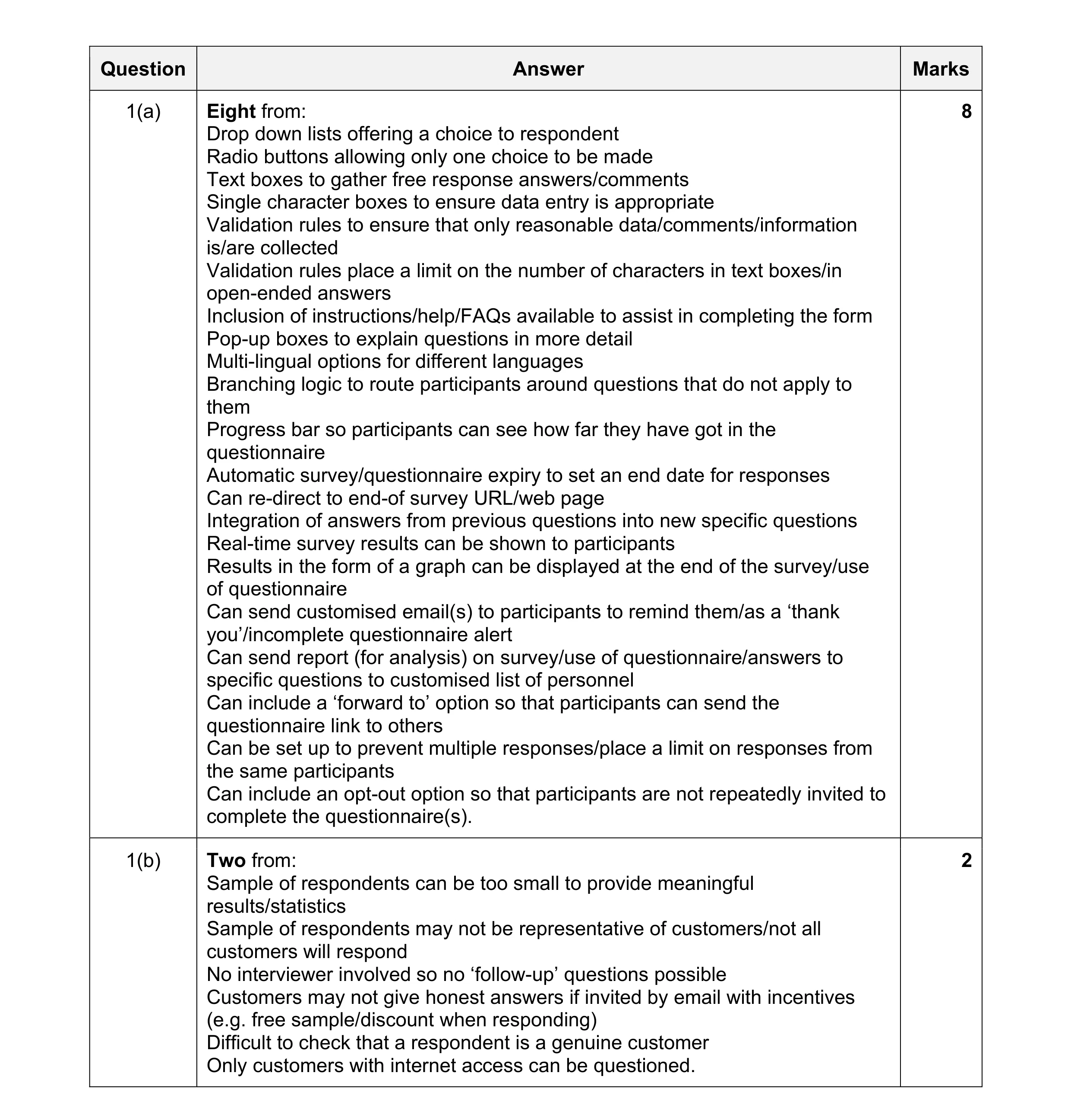 10
10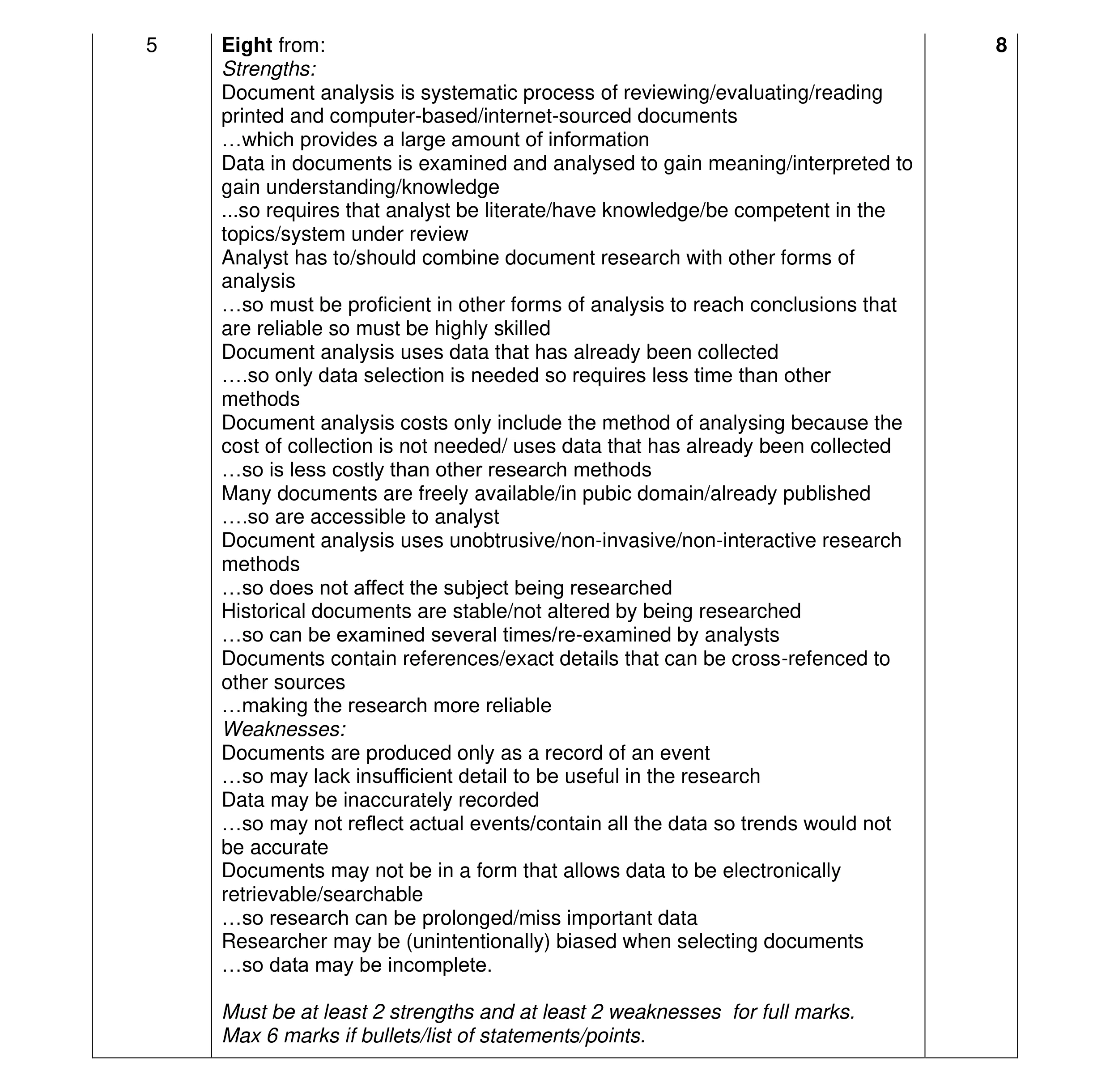 8
8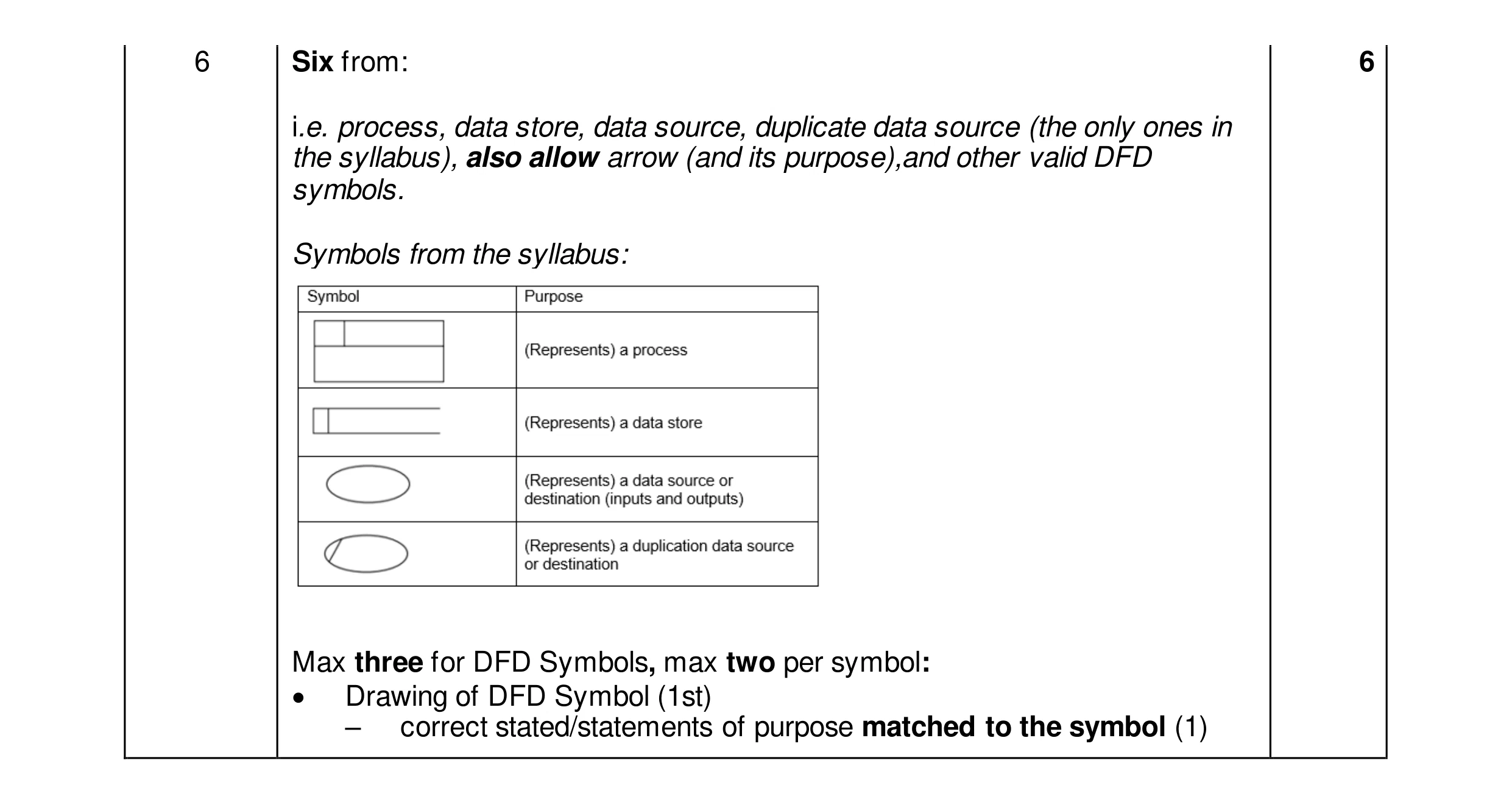 6
6 6
6