Cambridge A Level Information Technology (from 2017) 9626 — 2019 May/June Paper 3 · Variant 2
9626/32/M/J/19 · 13 questions · 90 marks · ≈101 min
The question paper and its mark scheme, free to read here and free to download. This is Cambridge’s own paper, exactly as it was sat.
Question paper20 pages












Mark scheme12 pages
Answers below. Sit the paper first if you are practising.





Questions as text
Q1 · Describe how the features of a 4G cellular communications system improve the ability of a…
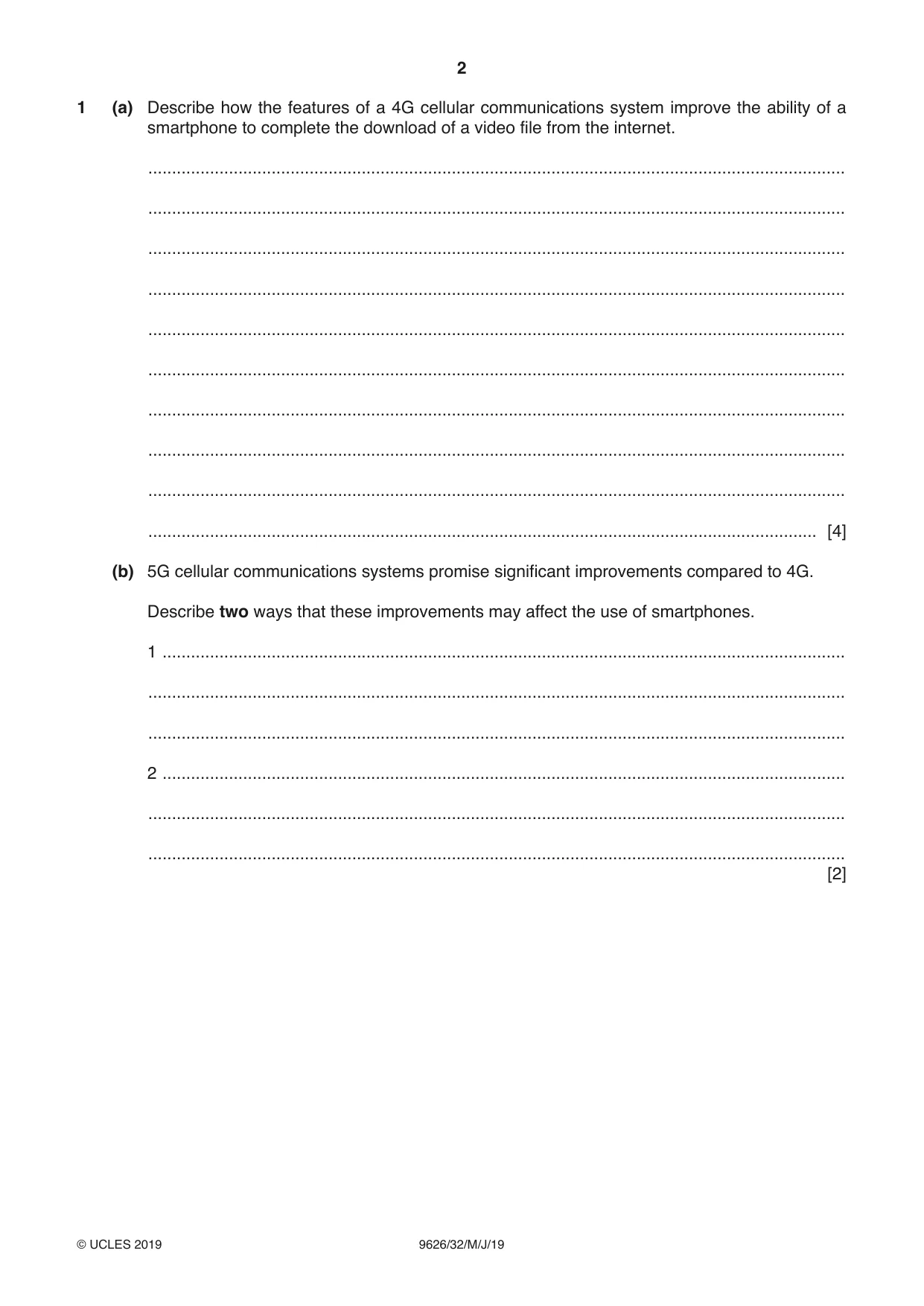
1 (a) Describe how the features of a 4G cellular communications system improve the ability of a smartphone to complete the download of a video file from the internet. ................................................................................................................................................... ................................................................................................................................................... ................................................................................................................................................... ................................................................................................................................................... ................................................................................................................................................... ................................................................................................................................................... ................................................................................................................................................... ................................................................................................................................................... ................................................................................................................................................... ............................................................................................................................................. [4] (b) 5G cellular communications systems promise significant improvements compared to 4G. Describe two ways that these improvements may affect the use of smartphones. 1 ................................................................................................................................................ ................................................................................................................................................... ................................................................................................................................................... 2 ................................................................................................................................................ ................................................................................................................................................... ................................................................................................................................................... [2]
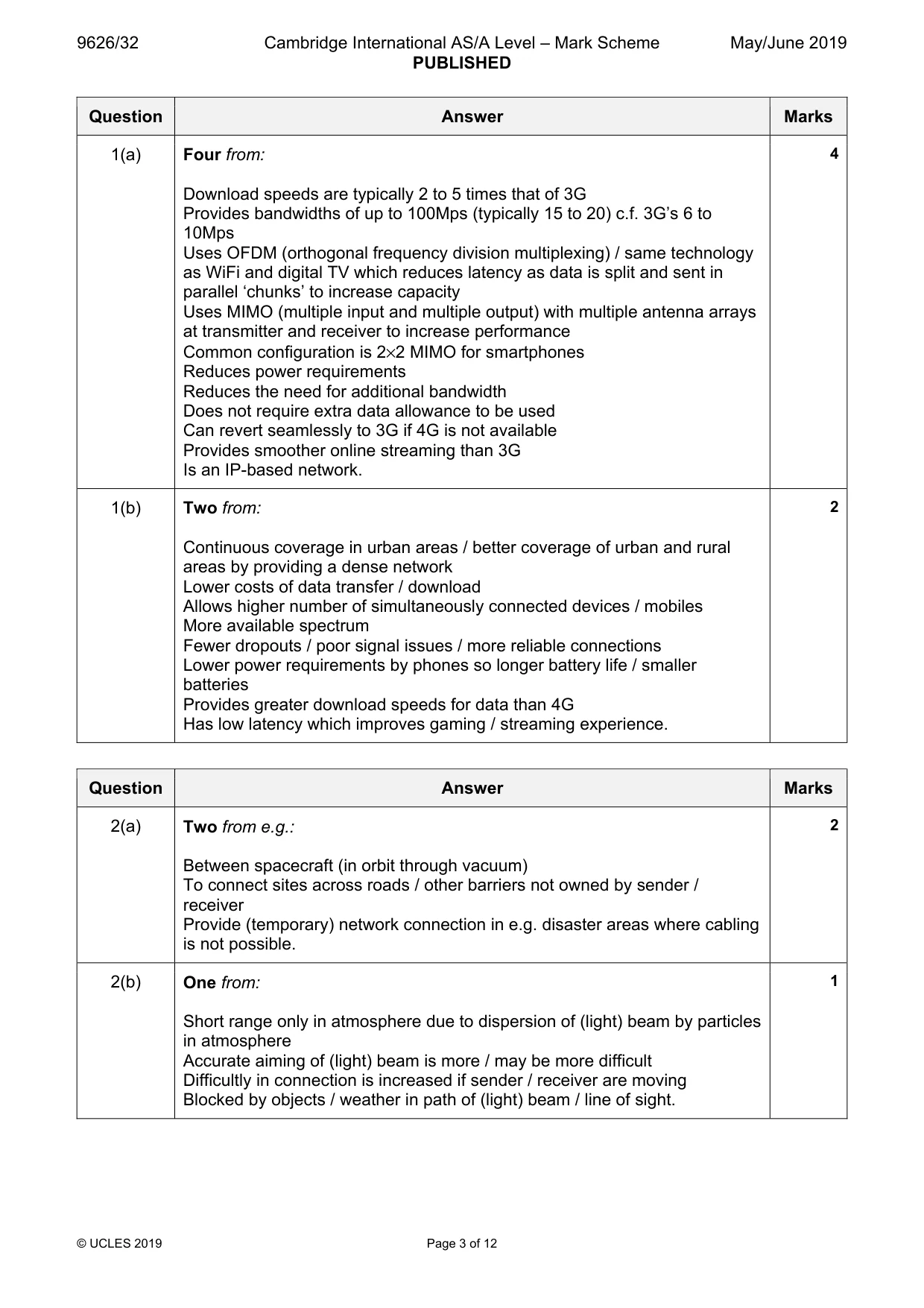
Mark scheme: Question Answer Marks 1(a) Four from: 4 Download speeds are typically 2 to 5 times that of 3G Provides bandwidths of up to 100Mps (typically 15 to 20) c.f. 3G’s 6 to 10Mps Uses OFDM (orthogonal frequency division multiplexing) / same technology as WiFi and digital TV which reduces latency as data is split and sent in parallel ‘chunks’ to increase capacity Uses MIMO (multiple input and multiple output) with multiple antenna arrays at transmitter and receiver to increase performance Common configuration is 2×2 MIMO for smartphones Reduces power requirements Reduces the need for additional bandwidth Does not require extra data allowance to be used Can revert seamlessly to 3G if 4G is not available Provides smoother online streaming than 3G Is an IP-based network. 1(b) Two from: 2 Continuous coverage in urban areas / better coverage of urban and rural areas by providing a dense network Lower costs of data transfer / download Allows higher number of simultaneously connected devices / mobiles More available spectrum Fewer dropouts / poor signal issues / more reliable connections Lower power requirements by phones so longer battery life / smaller batteries Provides greater download speeds for data than 4G Has low latency which improves gaming / streaming experience.
Q2 · Lasers can be used to create a data link between devices without using cables
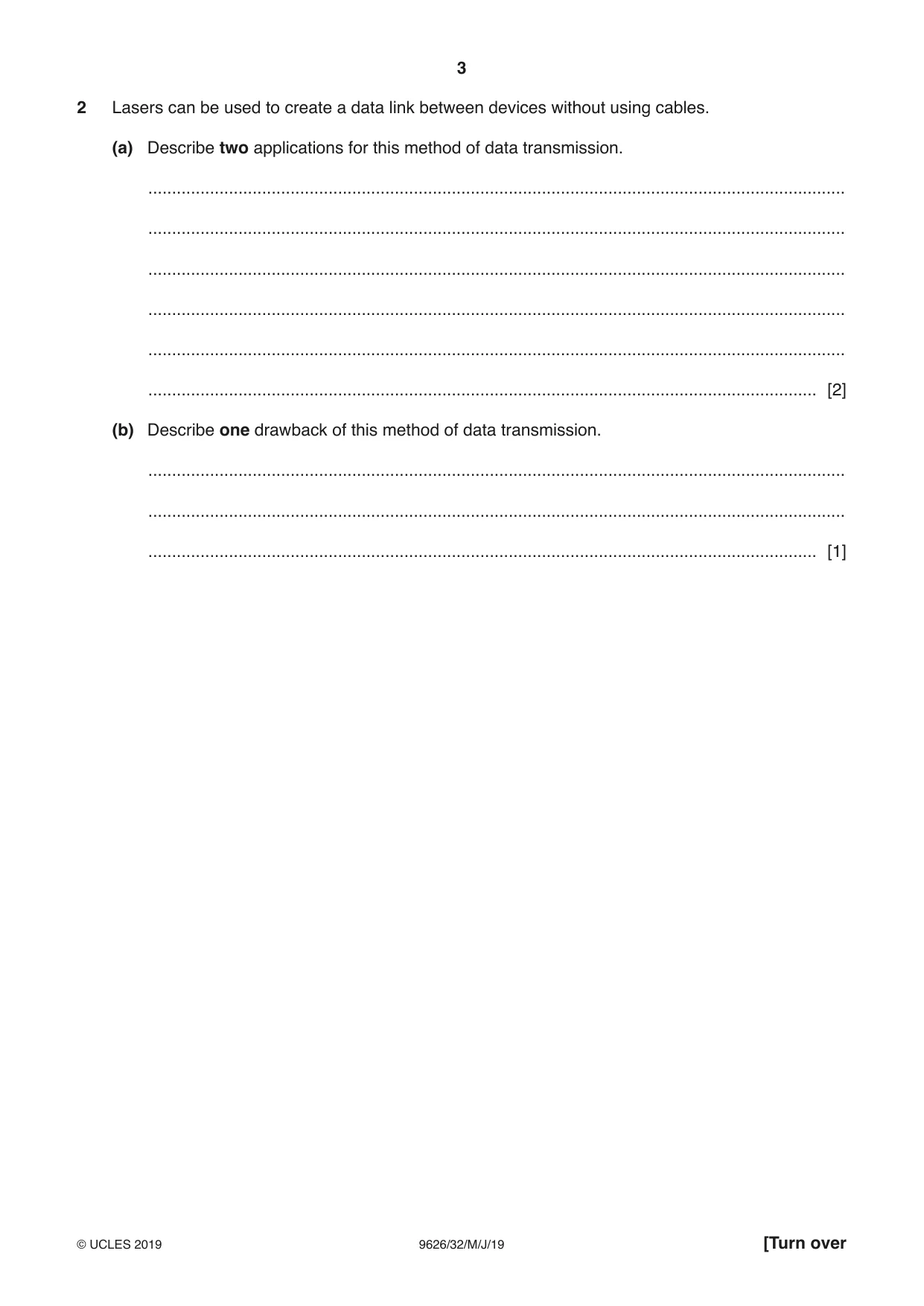
2 Lasers can be used to create a data link between devices without using cables. (a) Describe two applications for this method of data transmission. ................................................................................................................................................... ................................................................................................................................................... ................................................................................................................................................... ................................................................................................................................................... ................................................................................................................................................... ............................................................................................................................................. [2] (b) Describe one drawback of this method of data transmission. ................................................................................................................................................... ................................................................................................................................................... ............................................................................................................................................. [1]
Mark scheme: 2(a) Two from e.g.: 2 Between spacecraft (in orbit through vacuum) To connect sites across roads / other barriers not owned by sender / receiver Provide (temporary) network connection in e.g. disaster areas where cabling is not possible. 2(b) One from: 1 Short range only in atmosphere due to dispersion of (light) beam by particles in atmosphere Accurate aiming of (light) beam is more / may be more difficult Difficultly in connection is increased if sender / receiver are moving Blocked by objects / weather in path of (light) beam / line of sight.
Q3 · An author has written the source code of a web page that will be used when a person…
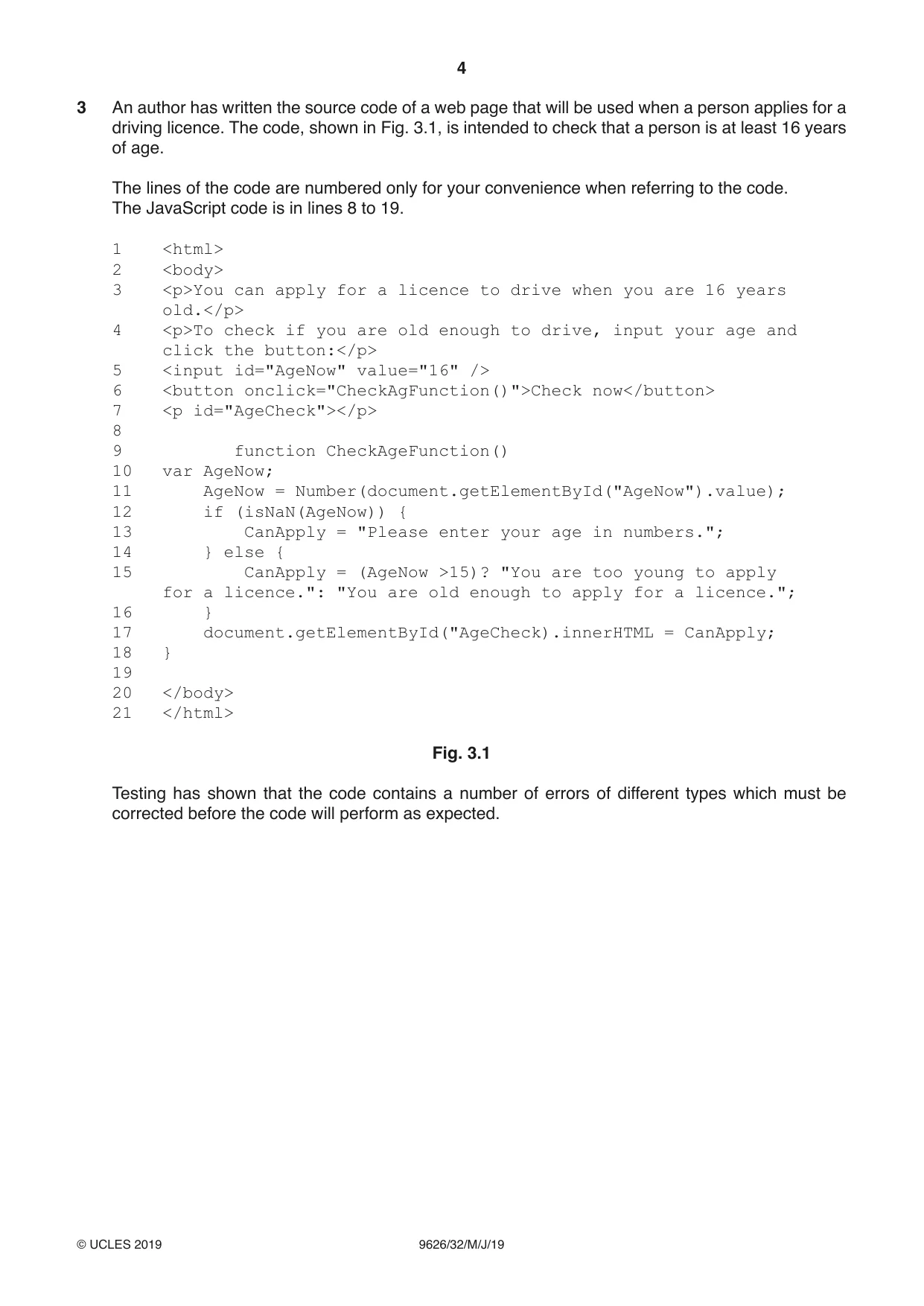
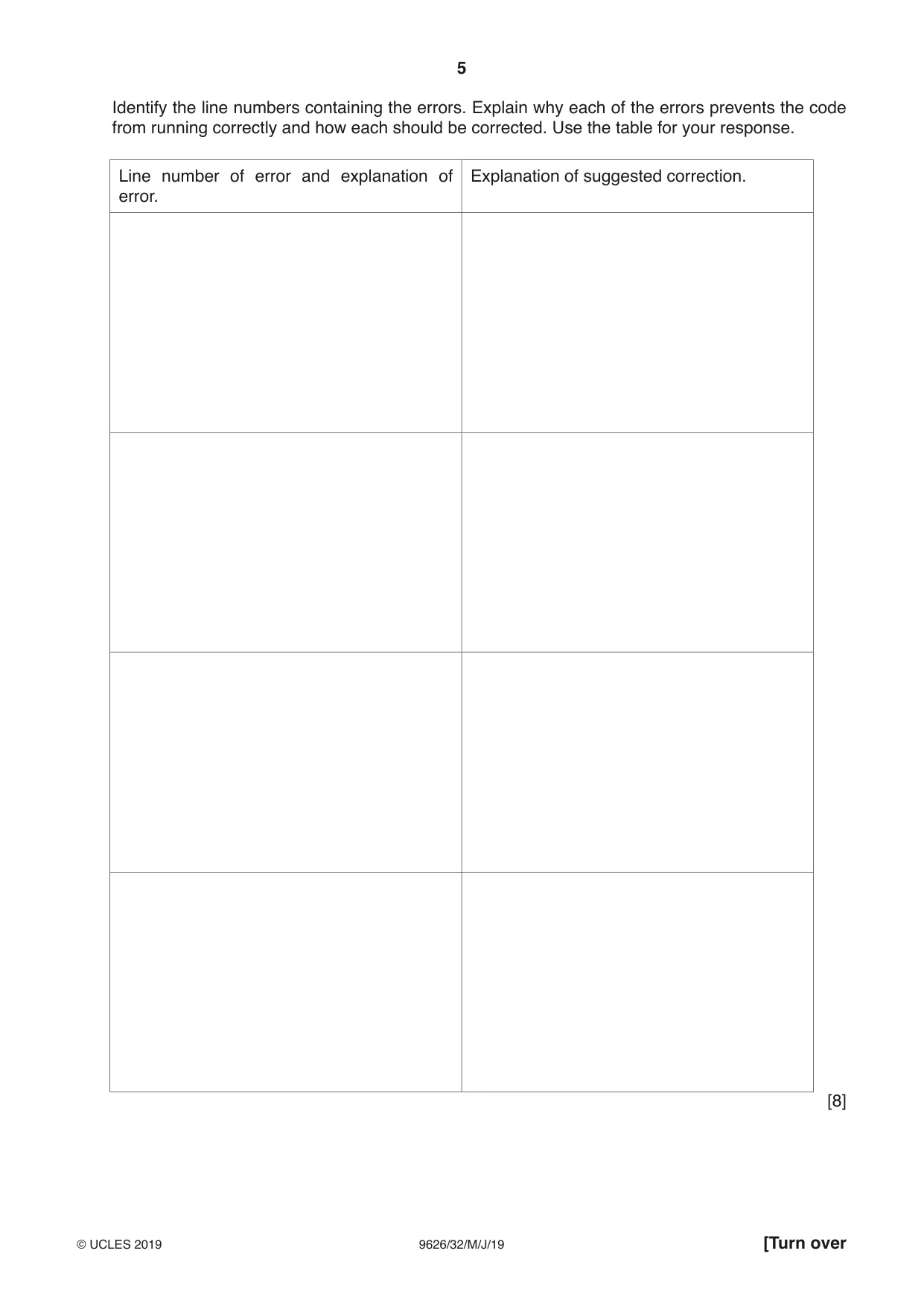
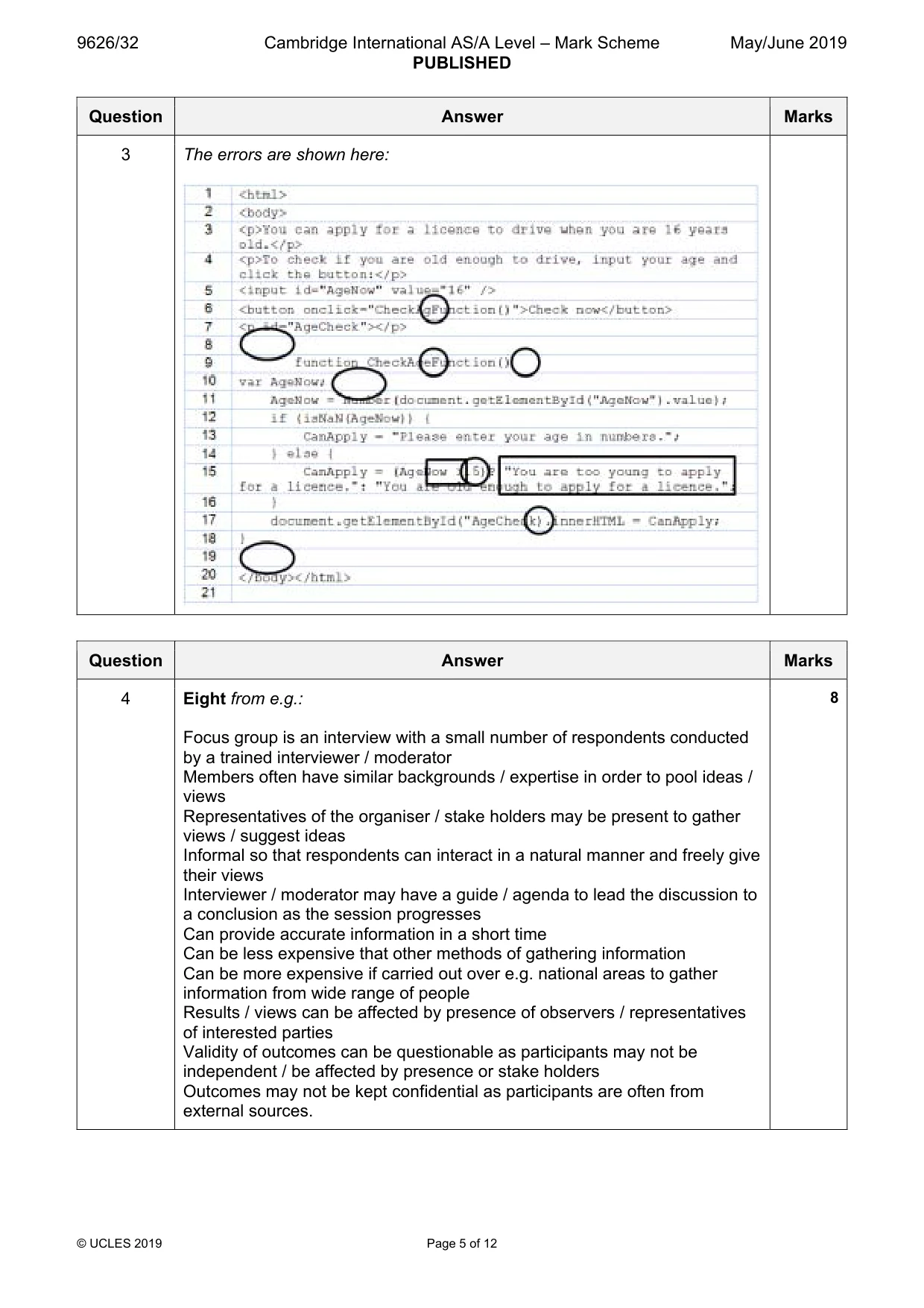
3 An author has written the source code of a web page that will be used when a person applies for a driving licence. The code, shown in Fig. 3.1, is intended to check that a person is at least 16 years of age. The lines of the code are numbered only for your convenience when referring to the code. The JavaScript code is in lines 8 to 19. 1 <html> 2 <body> 3 <p>You can apply for a licence to drive when you are 16 years old.</p> 4 <p>To check if you are old enough to drive, input your age and click the button:</p> 5 <input id="AgeNow" value="16" /> 6 <button onclick="CheckAgFunction()">Check now</button> 7 <p id="AgeCheck"></p> 8 9 function CheckAgeFunction() 10 var AgeNow; 11 AgeNow = Number(document.getElementById("AgeNow").value); 12 if (isNaN(AgeNow)) { 13 CanApply = "Please enter your age in numbers."; 14 } else { 15 CanApply = (AgeNow >15)? "You are too young to apply for a licence.": "You are old enough to apply for a licence."; 16 } 17 document.getElementById("AgeCheck).innerHTML = CanApply; 18 } 19 20 </body> 21 </html> Fig. 3.1 Testing has shown that the code contains a number of errors of different types which must be corrected before the code will perform as expected. Identify the line numbers containing the errors. Explain why each of the errors prevents the code from running correctly and how each should be corrected. Use the table for your response. Line number of error and explanation of Explanation of suggested correction. error. [8]
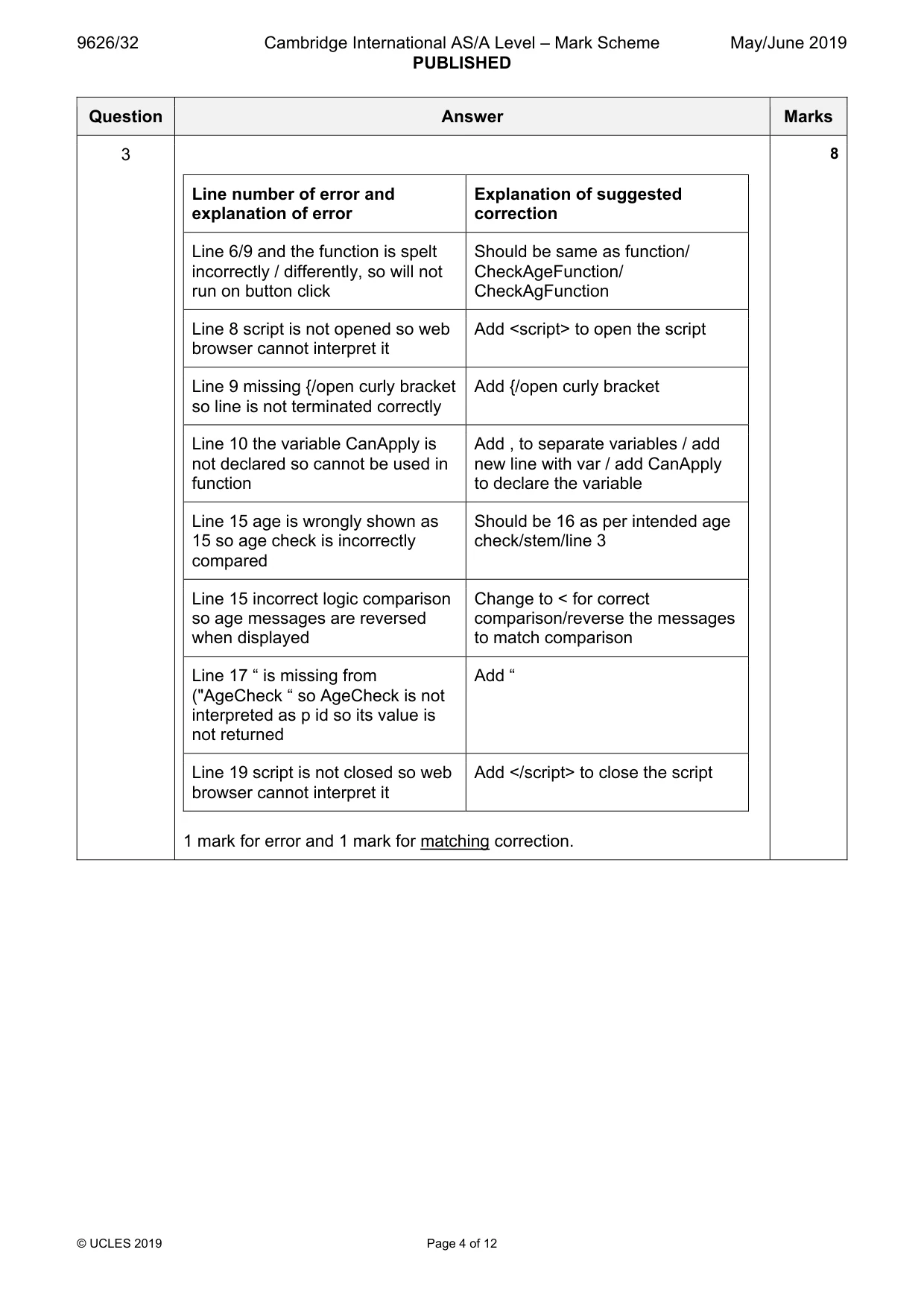
Mark scheme: 3 8 Line number of error and Explanation of suggested explanation of error correction Line 6/9 and the function is spelt Should be same as function/ incorrectly / differently, so will not CheckAgeFunction/ run on button click CheckAgFunction Line 8 script is not opened so web Add <script> to open the script browser cannot interpret it Line 9 missing {/open curly bracket Add {/open curly bracket so line is not terminated correctly Line 10 the variable CanApply is Add , to separate variables / add not declared so cannot be used in new line with var / add CanApply function to declare the variable Line 15 age is wrongly shown as Should be 16 as per intended age 15 so age check is incorrectly check/stem/line 3 compared Line 15 incorrect logic comparison Change to < for correct so age messages are reversed comparison/reverse the messages when displayed to match comparison Line 17 “ is missing from Add “ ("AgeCheck “ so AgeCheck is not interpreted as p id so its value is not returned Line 19 script is not closed so web Add </script> to close the script browser cannot interpret it 1 mark for error and 1 mark for matching correction.
Q4 · Analyse the use of focus groups as a method of gathering feedback about a new product…
4 Analyse the use of focus groups as a method of gathering feedback about a new product before it is made available for sale. .......................................................................................................................................................... .......................................................................................................................................................... .......................................................................................................................................................... .......................................................................................................................................................... .......................................................................................................................................................... .......................................................................................................................................................... .......................................................................................................................................................... .......................................................................................................................................................... .......................................................................................................................................................... .......................................................................................................................................................... .......................................................................................................................................................... .......................................................................................................................................................... .......................................................................................................................................................... .......................................................................................................................................................... .......................................................................................................................................................... .......................................................................................................................................................... .......................................................................................................................................................... .......................................................................................................................................................... .......................................................................................................................................................... .................................................................................................................................................... [8]
Mark scheme: 4 Eight from e.g.: 8 Focus group is an interview with a small number of respondents conducted by a trained interviewer / moderator Members often have similar backgrounds / expertise in order to pool ideas / views Representatives of the organiser / stake holders may be present to gather views / suggest ideas Informal so that respondents can interact in a natural manner and freely give their views Interviewer / moderator may have a guide / agenda to lead the discussion to a conclusion as the session progresses Can provide accurate information in a short time Can be less expensive that other methods of gathering information Can be more expensive if carried out over e.g. national areas to gather information from wide range of people Results / views can be affected by presence of observers / representatives of interested parties Validity of outcomes can be questionable as participants may not be independent / be affected by presence or stake holders Outcomes may not be kept confidential as participants are often from external sources.
Q5 · A table of tasks for a building project
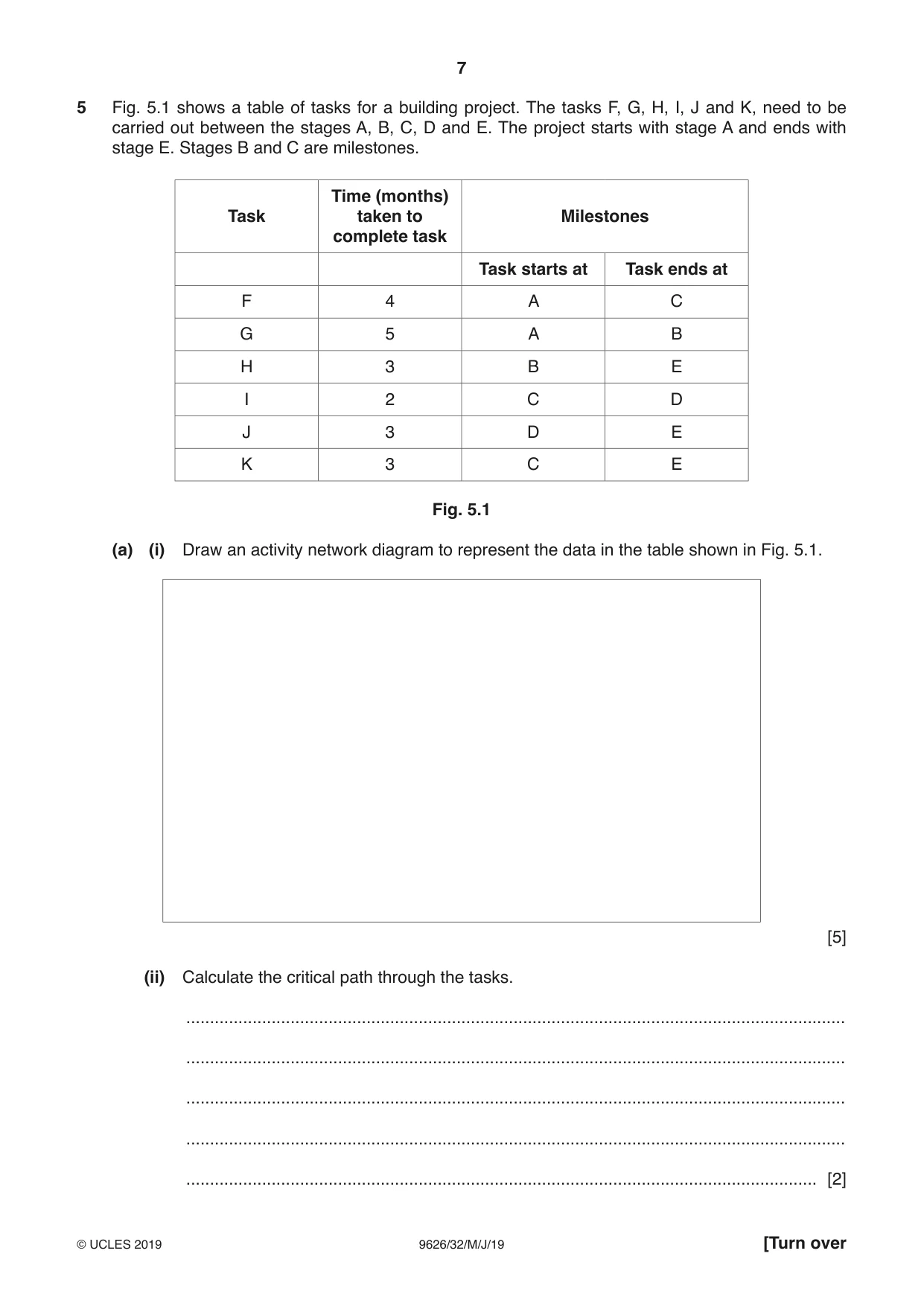
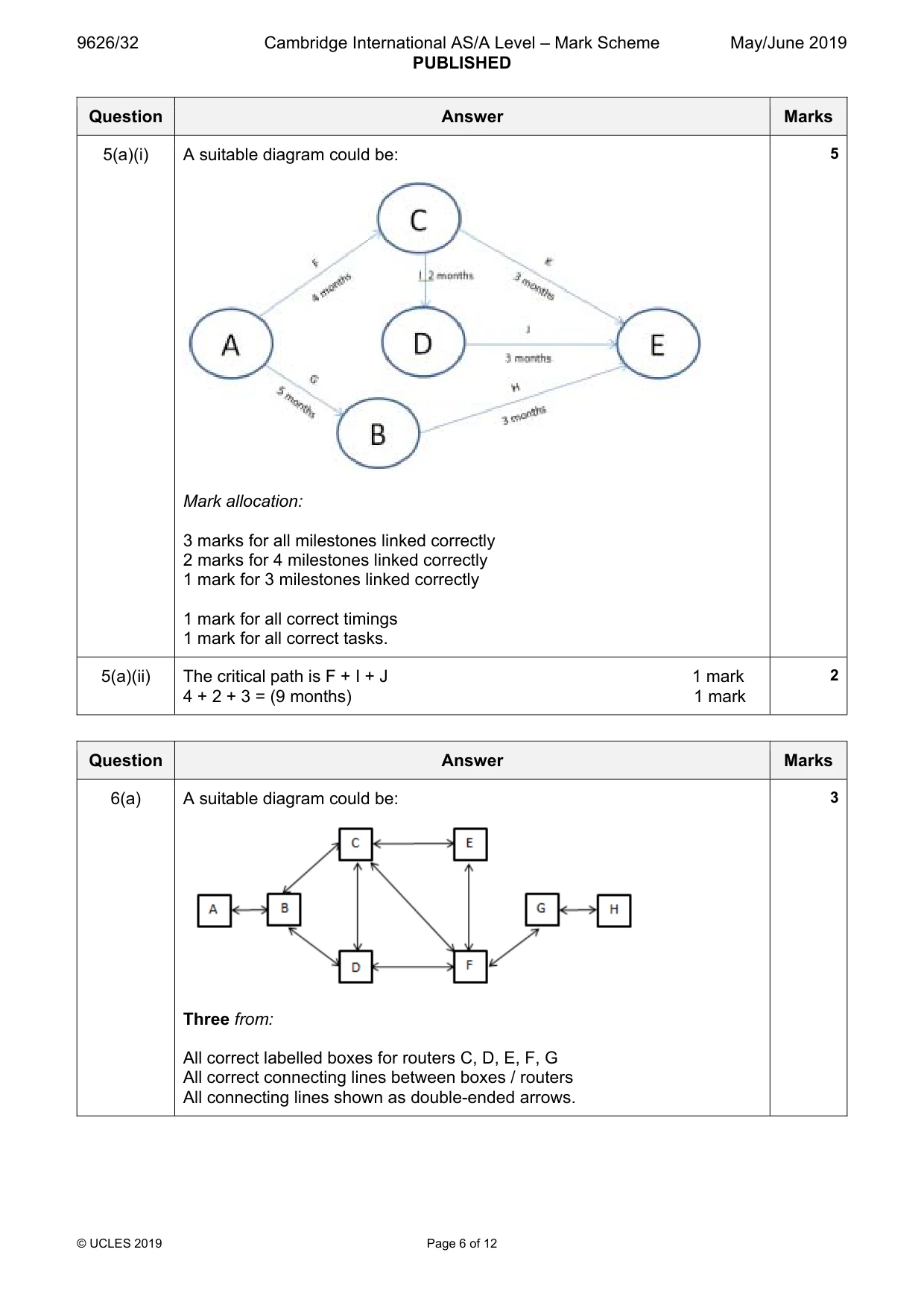
5 Fig. 5.1 shows a table of tasks for a building project. The tasks F, G, H, I, J and K, need to be carried out between the stages A, B, C, D and E. The project starts with stage A and ends with stage E. Stages B and C are milestones. Time (months) Task taken to Milestones complete task Task starts at Task ends at F 4 A C G 5 A B H 3 B E I 2 C D J 3 D E K 3 C E Fig. 5.1 (a) (i) Draw an activity network diagram to represent the data in the table shown in Fig. 5.1. [5] (ii) Calculate the critical path through the tasks. ........................................................................................................................................... ........................................................................................................................................... ........................................................................................................................................... ........................................................................................................................................... ..................................................................................................................................... [2]
Mark scheme: 5(a)(i) A suitable diagram could be: 5 Mark allocation: 3 marks for all milestones linked correctly 2 marks for 4 milestones linked correctly 1 mark for 3 milestones linked correctly 1 mark for all correct timings 1 mark for all correct tasks. 5(a)(ii) The critical path is F + I + J 1 mark 2 4 + 2 + 3 = (9 months) 1 mark
More questions on Tools and techniques for project management tasks
Q6 · A packet switched network has routers at nodes labelled A, B, C, D, E, F, G and H
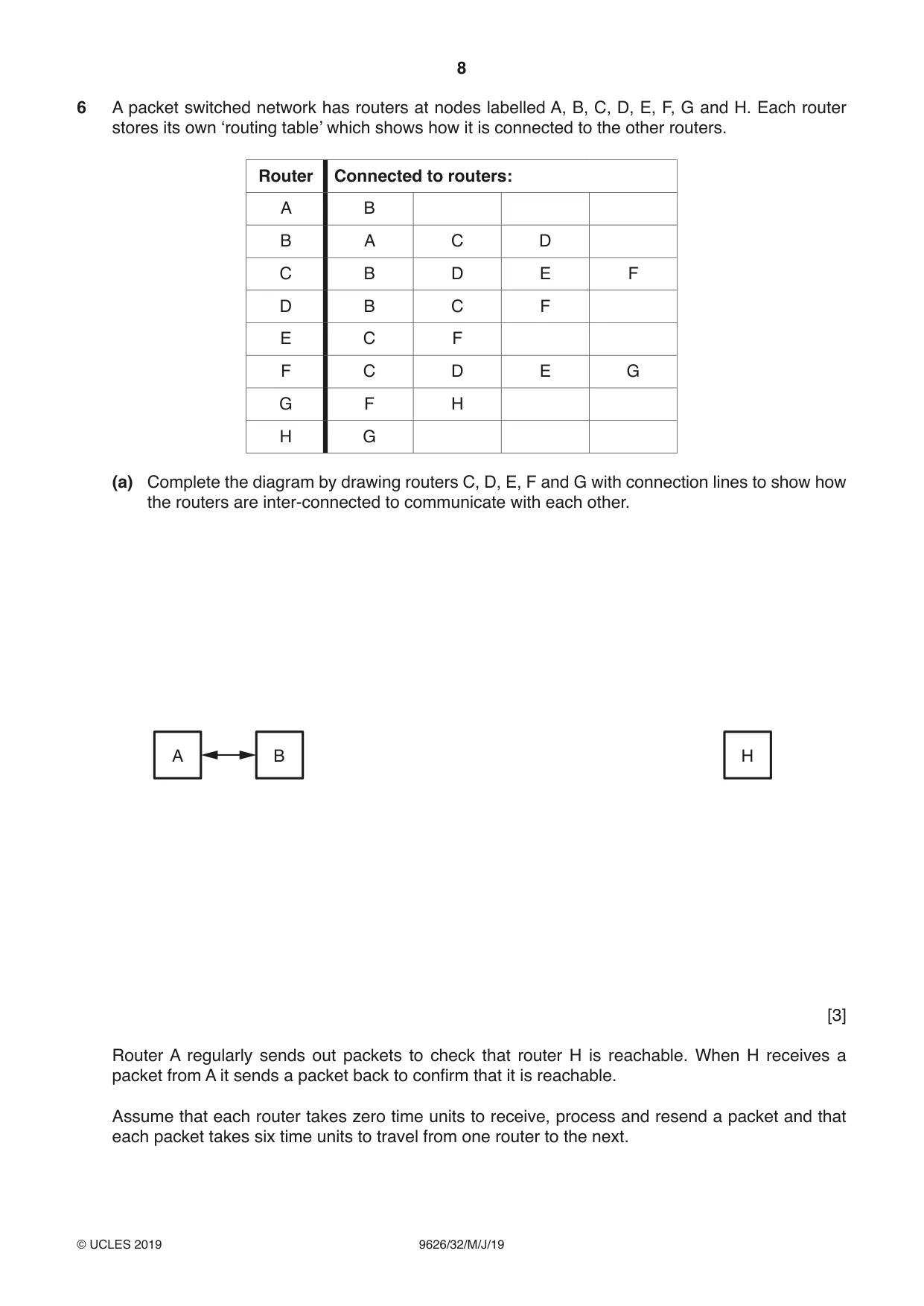
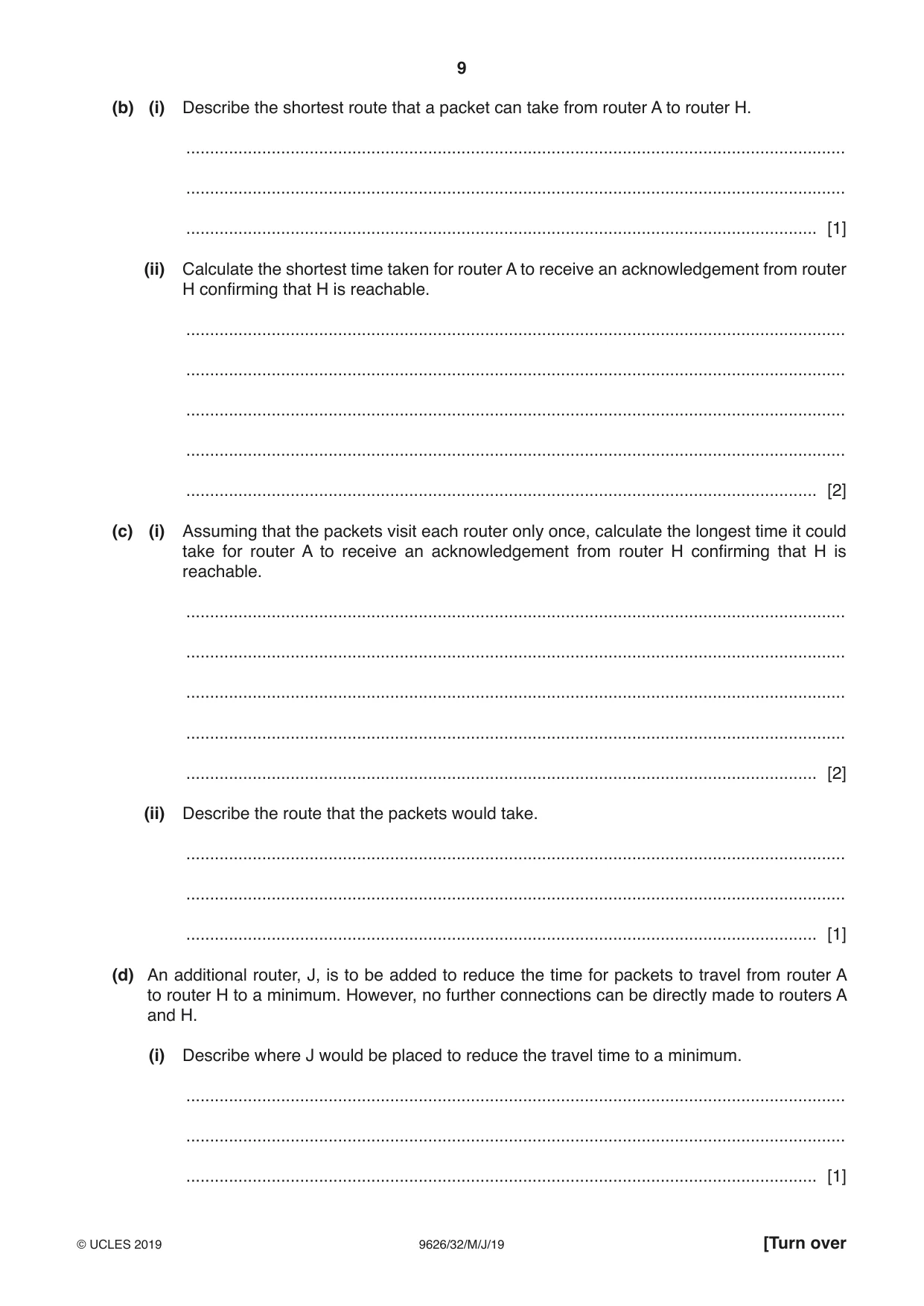
6 A packet switched network has routers at nodes labelled A, B, C, D, E, F, G and H. Each router stores its own ‘routing table’ which shows how it is connected to the other routers. Router Connected to routers: A B B A C D C B D E F D B C F E C F F C D E G G F H H G (a) Complete the diagram by drawing routers C, D, E, F and G with connection lines to show how the routers are inter-connected to communicate with each other. A B H [3] Router A regularly sends out packets to check that router H is reachable. When H receives a packet from A it sends a packet back to confirm that it is reachable. Assume that each router takes zero time units to receive, process and resend a packet and that each packet takes six time units to travel from one router to the next. (b) (i) Describe the shortest route that a packet can take from router A to router H. ........................................................................................................................................... ........................................................................................................................................... ..................................................................................................................................... [1] (ii) Calculate the shortest time taken for router A to receive an acknowledgement from router H confirming that H is reachable. ........................................................................................................................................... ........................................................................................................................................... ........................................................................................................................................... ........................................................................................................................................... ..................................................................................................................................... [2] (c) (i) Assuming that the packets visit each router only once, calculate the longest time it could take for router A to receive an acknowledgement from router H confirming that H is reachable. ........................................................................................................................................... ........................................................................................................................................... ........................................................................................................................................... ........................................................................................................................................... ..................................................................................................................................... [2] (ii) Describe the route that the packets would take. ........................................................................................................................................... ........................................................................................................................................... ..................................................................................................................................... [1] (d) An additional router, J, is to be added to reduce the time for packets to travel from router A to router H to a minimum. However, no further connections can be directly made to routers A and H. (i) Describe where J would be placed to reduce the travel time to a minimum. ........................................................................................................................................... ........................................................................................................................................... ..................................................................................................................................... [1] (ii) Calculate the new minimum time that it would take for A to receive an acknowledgement that H was reachable. ........................................................................................................................................... ........................................................................................................................................... ........................................................................................................................................... ........................................................................................................................................... ..................................................................................................................................... [2]
Mark scheme: 6(a) A suitable diagram could be: 3 Three from: All correct labelled boxes for routers C, D, E, F, G All correct connecting lines between boxes / routers All connecting lines shown as double-ended arrows. 6(b)(i) (A, B), C/D, F, G, (H). 1 6(b)(ii) Two from: 2 shortest route is 5 hops so: 5 × 6 = 30 (time units) × 2 for return, 30 × 2 = 60 (time units). 6(c)(i) Two from: 2 longest route takes 7 hops so: 7 × 6 = 42 (time units) × 2 for return = 84 (time units). 6(c)(ii) One mark for all correct: 1 (A, B), D, C, E, F, G (H). 6(d)(i) Between B and G. 1 6(d)(ii) Two from: 2 4 hops × 6 = 24 × 2 = 48 (time units).
Q7 · Computing devices use network interface cards
7 Computing devices use network interface cards. (a) Describe the role of a network interface card. ................................................................................................................................................... ................................................................................................................................................... ................................................................................................................................................... ................................................................................................................................................... ................................................................................................................................................... ................................................................................................................................................... ................................................................................................................................................... ................................................................................................................................................... ................................................................................................................................................... ............................................................................................................................................. [4] (b) Describe how a network interface card is involved in the sending and receiving of data. ................................................................................................................................................... ................................................................................................................................................... ................................................................................................................................................... ................................................................................................................................................... ................................................................................................................................................... ................................................................................................................................................... ................................................................................................................................................... ................................................................................................................................................... ................................................................................................................................................... ................................................................................................................................................... ................................................................................................................................................... ................................................................................................................................................... ................................................................................................................................................... ................................................................................................................................................... ................................................................................................................................................... ................................................................................................................................................... ............................................................................................................................................. [7]
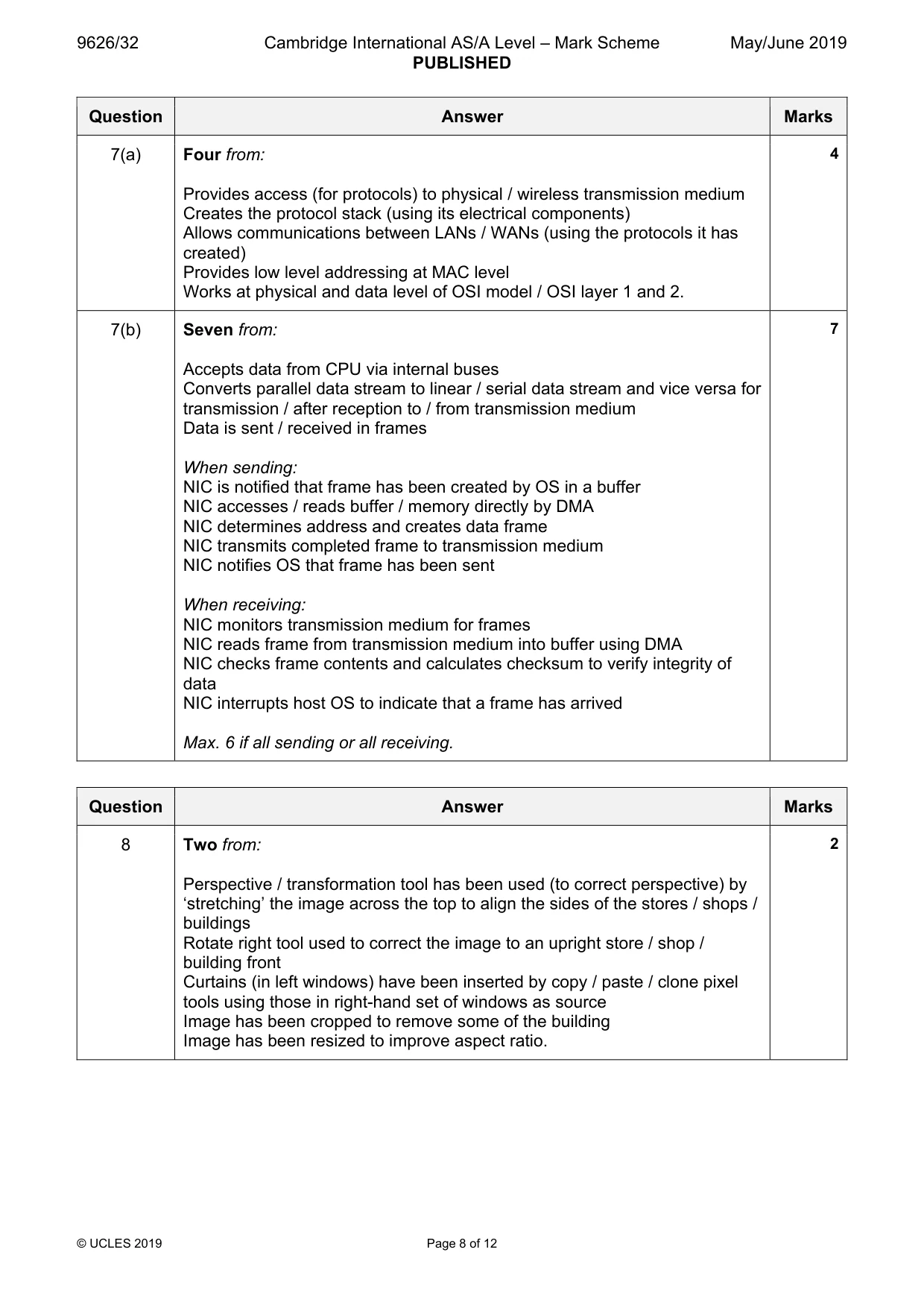
Mark scheme: 7(a) Four from: 4 Provides access (for protocols) to physical / wireless transmission medium Creates the protocol stack (using its electrical components) Allows communications between LANs / WANs (using the protocols it has created) Provides low level addressing at MAC level Works at physical and data level of OSI model / OSI layer 1 and 2. 7(b) Seven from: 7 Accepts data from CPU via internal buses Converts parallel data stream to linear / serial data stream and vice versa for transmission / after reception to / from transmission medium Data is sent / received in frames When sending: NIC is notified that frame has been created by OS in a buffer NIC accesses / reads buffer / memory directly by DMA NIC determines address and creates data frame NIC transmits completed frame to transmission medium NIC notifies OS that frame has been sent When receiving: NIC monitors transmission medium for frames NIC reads frame from transmission medium into buffer using DMA NIC checks frame contents and calculates checksum to verify integrity of data NIC interrupts host OS to indicate that a frame has arrived Max. 6 if all sending or all receiving.
Q8 · The photograph in Fig
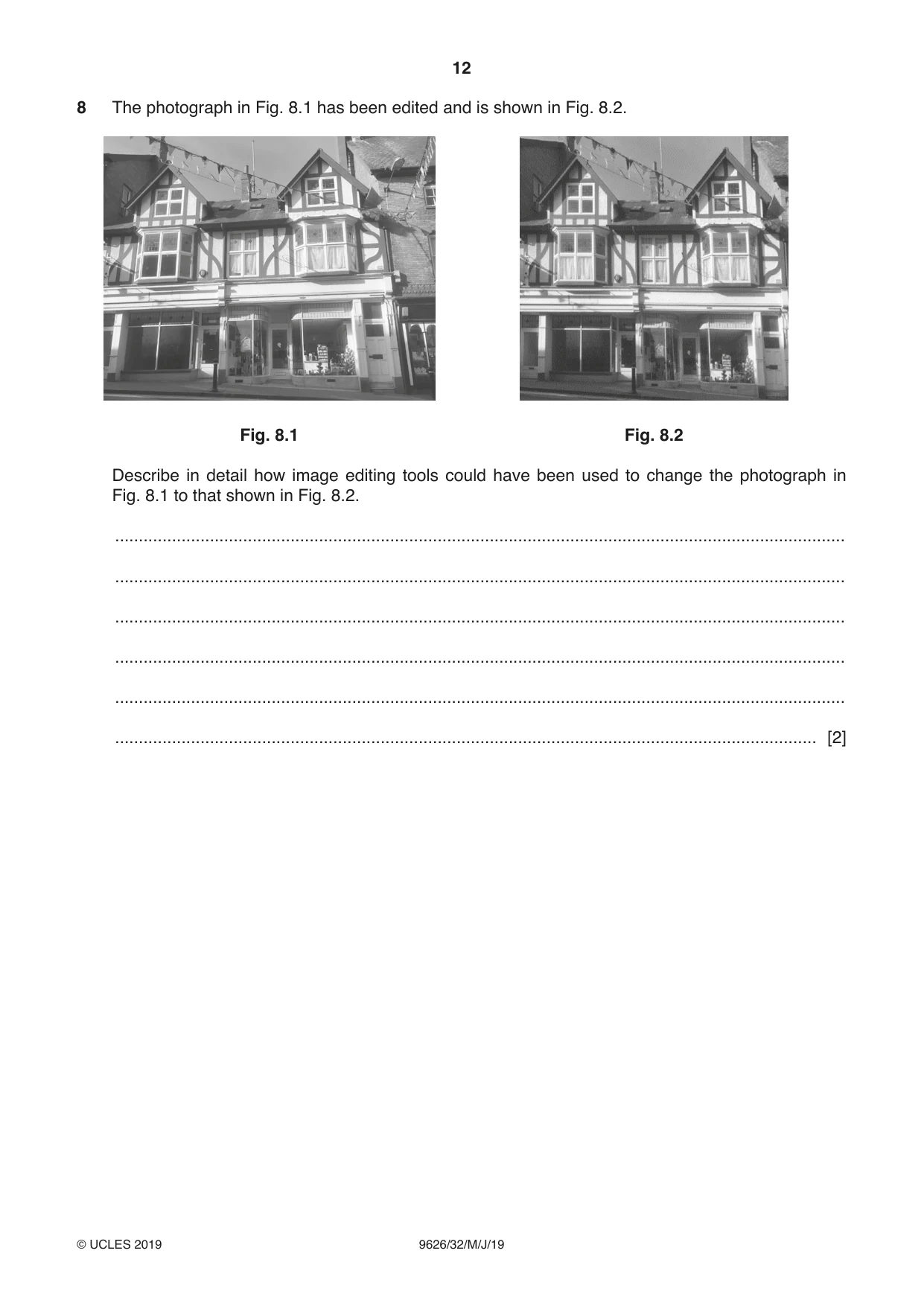
8 The photograph in Fig. 8.1 has been edited and is shown in Fig. 8.2. Fig. 8.1 Fig. 8.2 Describe in detail how image editing tools could have been used to change the photograph in Fig. 8.1 to that shown in Fig. 8.2. .......................................................................................................................................................... .......................................................................................................................................................... .......................................................................................................................................................... .......................................................................................................................................................... .......................................................................................................................................................... .................................................................................................................................................... [2]
Mark scheme: 8 Two from: 2 Perspective / transformation tool has been used (to correct perspective) by ‘stretching’ the image across the top to align the sides of the stores / shops / buildings Rotate right tool used to correct the image to an upright store / shop / building front Curtains (in left windows) have been inserted by copy / paste / clone pixel tools using those in right-hand set of windows as source Image has been cropped to remove some of the building Image has been resized to improve aspect ratio.
Q9 · Colour gradients can be used when filling shapes in digital images
9 Colour gradients can be used when filling shapes in digital images. (a) Describe two properties of the filled shape that can be changed with the use of colour gradients. ................................................................................................................................................... ................................................................................................................................................... ................................................................................................................................................... ................................................................................................................................................... ................................................................................................................................................... ............................................................................................................................................. [2] (b) Describe the types of gradient that can be used when filling a shape with colour. ................................................................................................................................................... ................................................................................................................................................... ................................................................................................................................................... ................................................................................................................................................... ................................................................................................................................................... ................................................................................................................................................... ................................................................................................................................................... ................................................................................................................................................... ................................................................................................................................................... ............................................................................................................................................. [4]
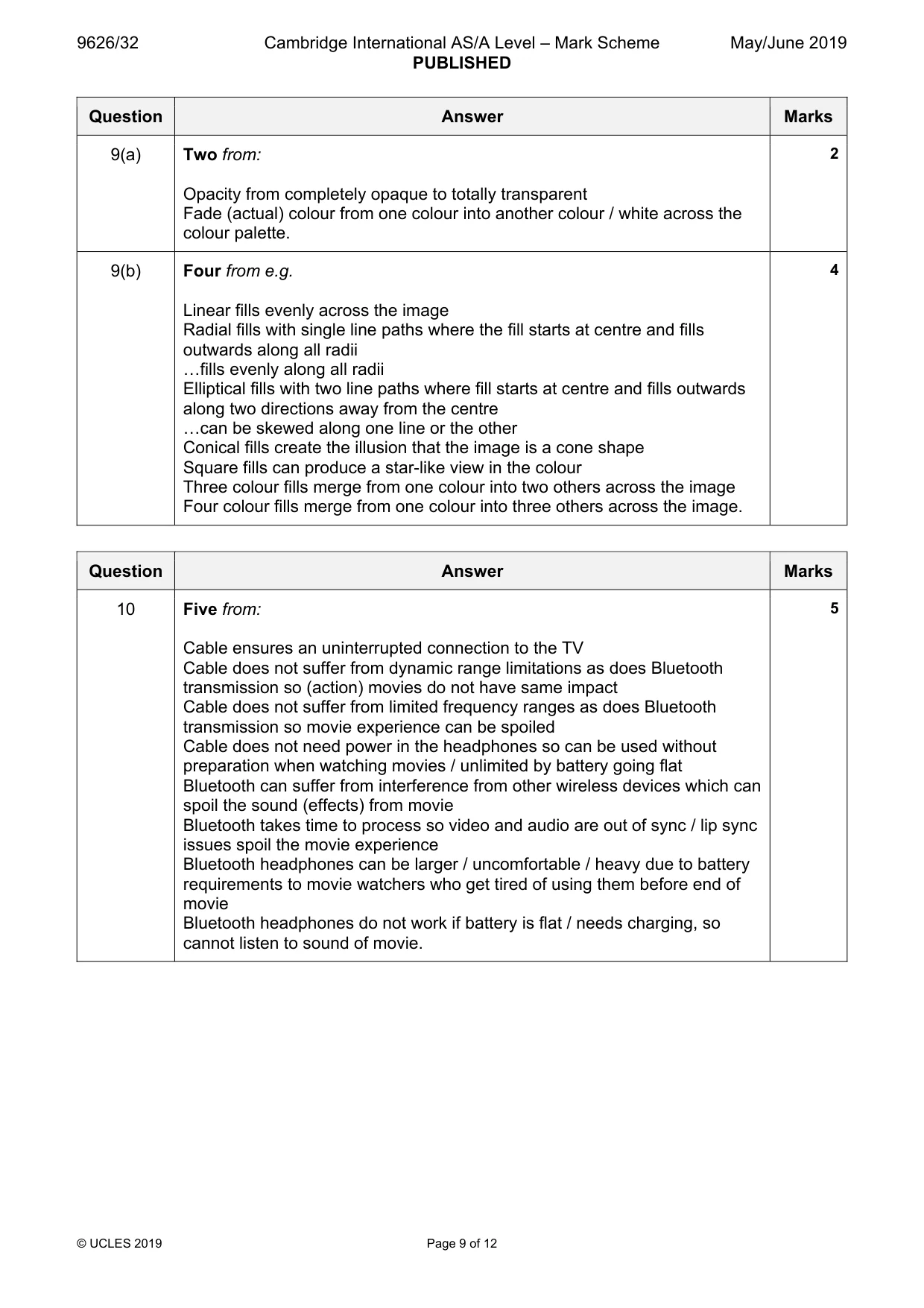
Mark scheme: 9(a) Two from: 2 Opacity from completely opaque to totally transparent Fade (actual) colour from one colour into another colour / white across the colour palette. 9(b) Four from e.g. 4 Linear fills evenly across the image Radial fills with single line paths where the fill starts at centre and fills outwards along all radii «fills evenly along all radii Elliptical fills with two line paths where fill starts at centre and fills outwards along two directions away from the centre «can be skewed along one line or the other Conical fills create the illusion that the image is a cone shape Square fills can produce a star-like view in the colour Three colour fills merge from one colour into two others across the image Four colour fills merge from one colour into three others across the image.
Q10 · Homer uses headphones to listen to the audio from movies playing on his television
10 Homer uses headphones to listen to the audio from movies playing on his television. Homer is trying to decide whether to use Bluetooth or cables to connect his headphones to the TV while he watches the movies. Choose, with reasons, the most appropriate of these methods so that Homer can hear the soundtrack while watching movies. .......................................................................................................................................................... .......................................................................................................................................................... .......................................................................................................................................................... .......................................................................................................................................................... .......................................................................................................................................................... .......................................................................................................................................................... .......................................................................................................................................................... .......................................................................................................................................................... .......................................................................................................................................................... .......................................................................................................................................................... .......................................................................................................................................................... .................................................................................................................................................... [5]
Mark scheme: 10 Five from: 5 Cable ensures an uninterrupted connection to the TV Cable does not suffer from dynamic range limitations as does Bluetooth transmission so (action) movies do not have same impact Cable does not suffer from limited frequency ranges as does Bluetooth transmission so movie experience can be spoiled Cable does not need power in the headphones so can be used without preparation when watching movies / unlimited by battery going flat Bluetooth can suffer from interference from other wireless devices which can spoil the sound (effects) from movie Bluetooth takes time to process so video and audio are out of sync / lip sync issues spoil the movie experience Bluetooth headphones can be larger / uncomfortable / heavy due to battery requirements to movie watchers who get tired of using them before end of movie Bluetooth headphones do not work if battery is flat / needs charging, so cannot listen to sound of movie.
Q11 · Evaluate the use of anti-virus software and anti-spyware in combatting IT crime
11 Evaluate the use of anti-virus software and anti-spyware in combatting IT crime. .......................................................................................................................................................... .......................................................................................................................................................... .......................................................................................................................................................... .......................................................................................................................................................... .......................................................................................................................................................... .......................................................................................................................................................... .......................................................................................................................................................... .......................................................................................................................................................... .......................................................................................................................................................... .......................................................................................................................................................... .......................................................................................................................................................... .......................................................................................................................................................... .......................................................................................................................................................... .......................................................................................................................................................... .......................................................................................................................................................... .......................................................................................................................................................... .......................................................................................................................................................... .......................................................................................................................................................... .......................................................................................................................................................... .................................................................................................................................................... [8]
Mark scheme: 11 This question to be marked as a Level of Response. 8 Level 3 (7–8 marks) Candidates will evaluate, giving both advantages and disadvantages, of the use of anti-virus software in combatting IT crime. The information will be relevant, clear, organised and presented in a structured and coherent format. There will be a reasoned conclusion / opinion. Subject specific terminology will be used accurately and appropriately. Level 2 (4–6 marks) Candidates will explain both advantages and disadvantages, of the use of anti-virus software in combatting IT crime. For the most part, the information will be relevant and presented in a structured and coherent format. There may be a reasoned conclusion / opinion. Subject specific terminology will be used appropriately and for the most part correctly. Level 1 (1–3 marks) Candidates will describe the use of anti-virus software in combatting IT crime Candidates will explain advantages / disadvantages of the use of anti-virus software in combatting IT crime Answers may be in the form of a list. There will be little or no use of specialist terms. Level 0 (0 marks): Response with no valid content. Answers may make reference to e.g.: Advantages Removes virus / malicious software that could delete / edit / destroy data Protect against spyware to prevent theft of confidential / personal information thus preventing unauthorised access to bank accounts leading to financial loss Can help / may protect against spam / phishing emails thus preventing the divulgence of confidential / personal information Protect against identity theft that may be a result of stolen confidential / personal information Protect against redirection of automatic payments (‘stealware’ or ‘chargeware / affiliate fraud’) to help prevent ’click fraud’ Can help protect / stop unwanted / unauthorised use of computer for crypto- currency mining
Q12 · Explain how perpetrator analysis could be used when planning for disaster recovery
12 Explain how perpetrator analysis could be used when planning for disaster recovery. .......................................................................................................................................................... .......................................................................................................................................................... .......................................................................................................................................................... .......................................................................................................................................................... .......................................................................................................................................................... .......................................................................................................................................................... .......................................................................................................................................................... .......................................................................................................................................................... .......................................................................................................................................................... .......................................................................................................................................................... .......................................................................................................................................................... .......................................................................................................................................................... .......................................................................................................................................................... .................................................................................................................................................... [6]
Mark scheme: 12 Six from: 6 Perpetrators are the attackers and include e.g. script kiddies, crackers, hackers, terrorists, business competitors, (foreign) governments who carry out the crimes / intrusions Each type of perpetrator has different skills / aims that can be identified by an analysis .. the higher the skill, the higher the risk of crime being perpetrated Analysis of their actions is carried out by the company / victim agents / representatives who design / implement the plan for disaster recovery Allocation of resources to disaster recovery from cyber threats depends on likelihood of perpetrators succeeding / wishing to / probability of attack on the company Analysis will define / determine the type of resource allocated e.g. firewalls / antivirus / antispyware software Intrusion detection systems can be deployed to combat the type of perpetrator identified by the analysis Resources can be targeted at the type of intruder / risk identified by the analysis of who / what is likely to be of concern.
Q13 · Many countries have enacted laws to govern the use of personal data
13 Many countries have enacted laws to govern the use of personal data. Analyse the need for data protection laws. .......................................................................................................................................................... .......................................................................................................................................................... .......................................................................................................................................................... .......................................................................................................................................................... .......................................................................................................................................................... .......................................................................................................................................................... .......................................................................................................................................................... .......................................................................................................................................................... .......................................................................................................................................................... .......................................................................................................................................................... .......................................................................................................................................................... .......................................................................................................................................................... .......................................................................................................................................................... .......................................................................................................................................................... .......................................................................................................................................................... .......................................................................................................................................................... .......................................................................................................................................................... .......................................................................................................................................................... .......................................................................................................................................................... .................................................................................................................................................... [8]
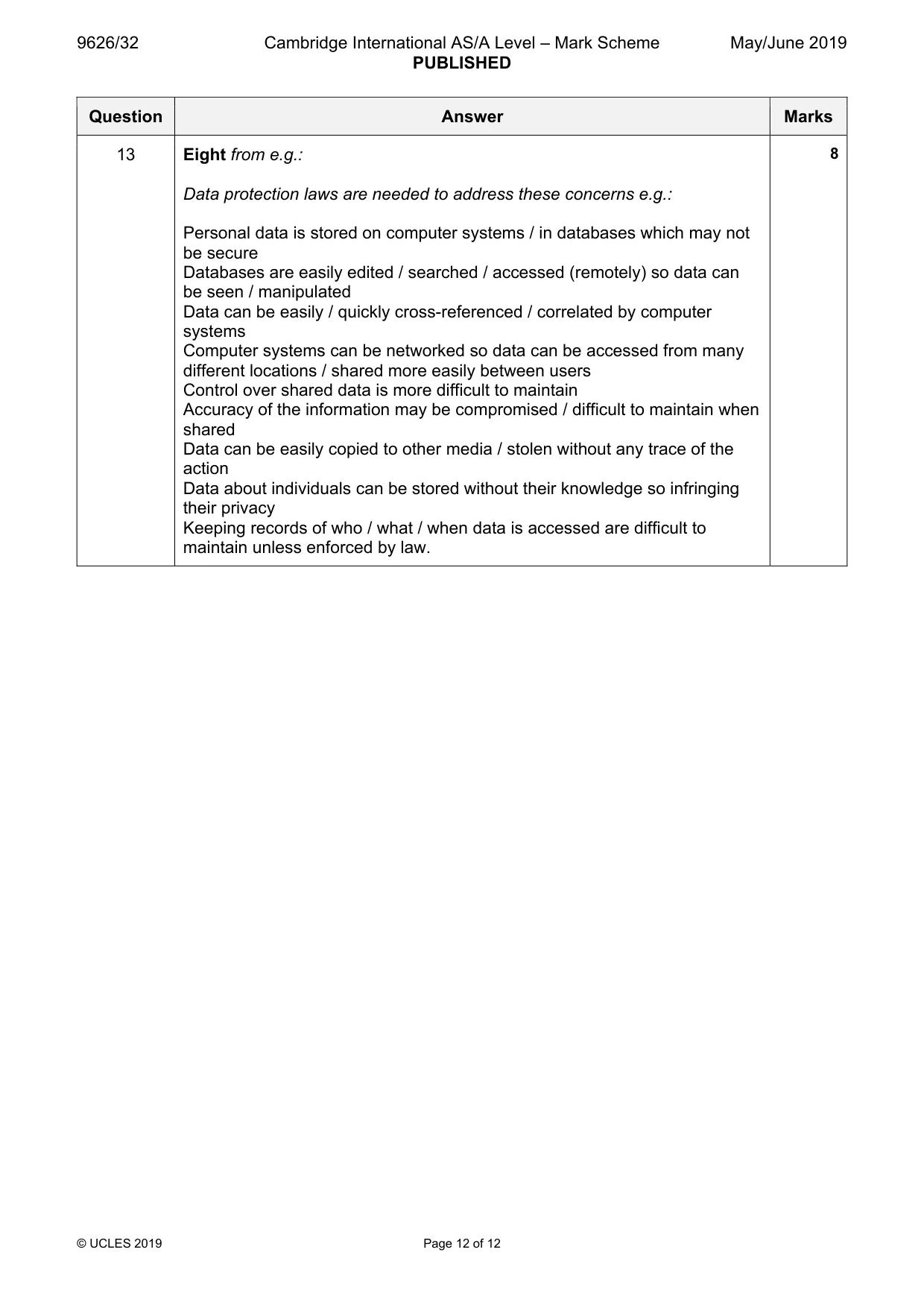
Mark scheme: 13 Eight from e.g.: 8 Data protection laws are needed to address these concerns e.g.: Personal data is stored on computer systems / in databases which may not be secure Databases are easily edited / searched / accessed (remotely) so data can be seen / manipulated Data can be easily / quickly cross-referenced / correlated by computer systems Computer systems can be networked so data can be accessed from many different locations / shared more easily between users Control over shared data is more difficult to maintain Accuracy of the information may be compromised / difficult to maintain when shared Data can be easily copied to other media / stolen without any trace of the action Data about individuals can be stored without their knowledge so infringing their privacy Keeping records of who / what / when data is accessed are difficult to maintain unless enforced by law.
What was in this paper
The subtopics covered by these 13 questions, and how many questions each got. Open one in a new tab to see every Cambridge question on it.
What you needed in this session
Cambridge’s own grade thresholds for 2019 May/June, Paper 3 · Variant 2. A higher threshold means an easier paper — the bar moves with how the cohort did.