Cambridge A Level Information Technology (from 2017) 9626 — 2018 May/June Paper 3 · Variant 1
9626/31/M/J/18 · 13 questions · 90 marks · ≈101 min
The question paper and its mark scheme, free to read here and free to download. This is Cambridge’s own paper, exactly as it was sat.
Question paper16 pages









Mark scheme11 pages
Answers below. Sit the paper first if you are practising.
Questions as text
Q1 · A company stores details of its customers in a database which is to be used as the source…
1 A company stores details of its customers in a database which is to be used as the source file for a mail merge. A letter, created as the master document, is to be sent to all the customers by post or by email. The company prefers to send the letter by email. However, letters will be sent by post if the company does not have a current email address for the customer in its database. Describe how a mail merge field in the master document can be set up to exclude those customers whose email address is not stored in the database. .......................................................................................................................................................... .......................................................................................................................................................... .......................................................................................................................................................... .......................................................................................................................................................... .......................................................................................................................................................... .......................................................................................................................................................... .......................................................................................................................................................... .......................................................................................................................................................... ......................................................................................................................................................[4]
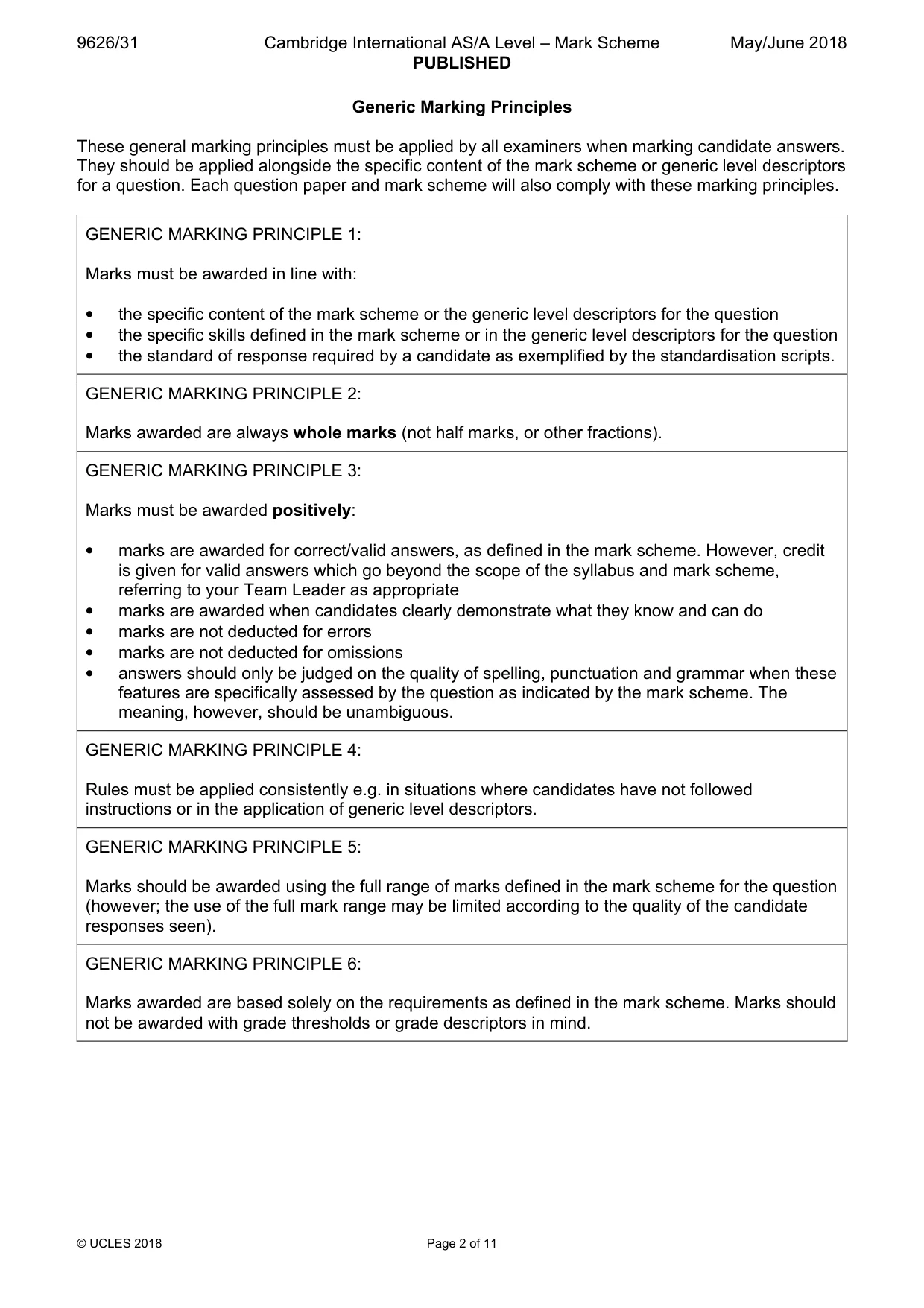
Mark scheme: Question Answer Marks 1 Four from: 4 Open master document/letter Insert (new) merge field at appropriate position Either: Insert SKIPIF merge command/skip record if Select merge field ‘email’ Set comparison to ‘is blank’/not present. Or, if attempt at writing a merge field, max 2: The mergefield formula is: {SKIPIF {MERGEFIELD email field} = “” } Marks awarded : {SKIPIF = “” } {MERGEFIELD email field}
Q2 · JavaScript defines a number of primitive data types
2 JavaScript defines a number of primitive data types. (a) Explain the term ‘primitive’ when used in this context. ................................................................................................................................................... ................................................................................................................................................... ................................................................................................................................................... ................................................................................................................................................... ...............................................................................................................................................[2] (b) Describe three primitive data types used in JavaScript. 1 ................................................................................................................................................ ................................................................................................................................................... ................................................................................................................................................... 2 ................................................................................................................................................ ................................................................................................................................................... ................................................................................................................................................... 3 ................................................................................................................................................ ................................................................................................................................................... ...............................................................................................................................................[3]
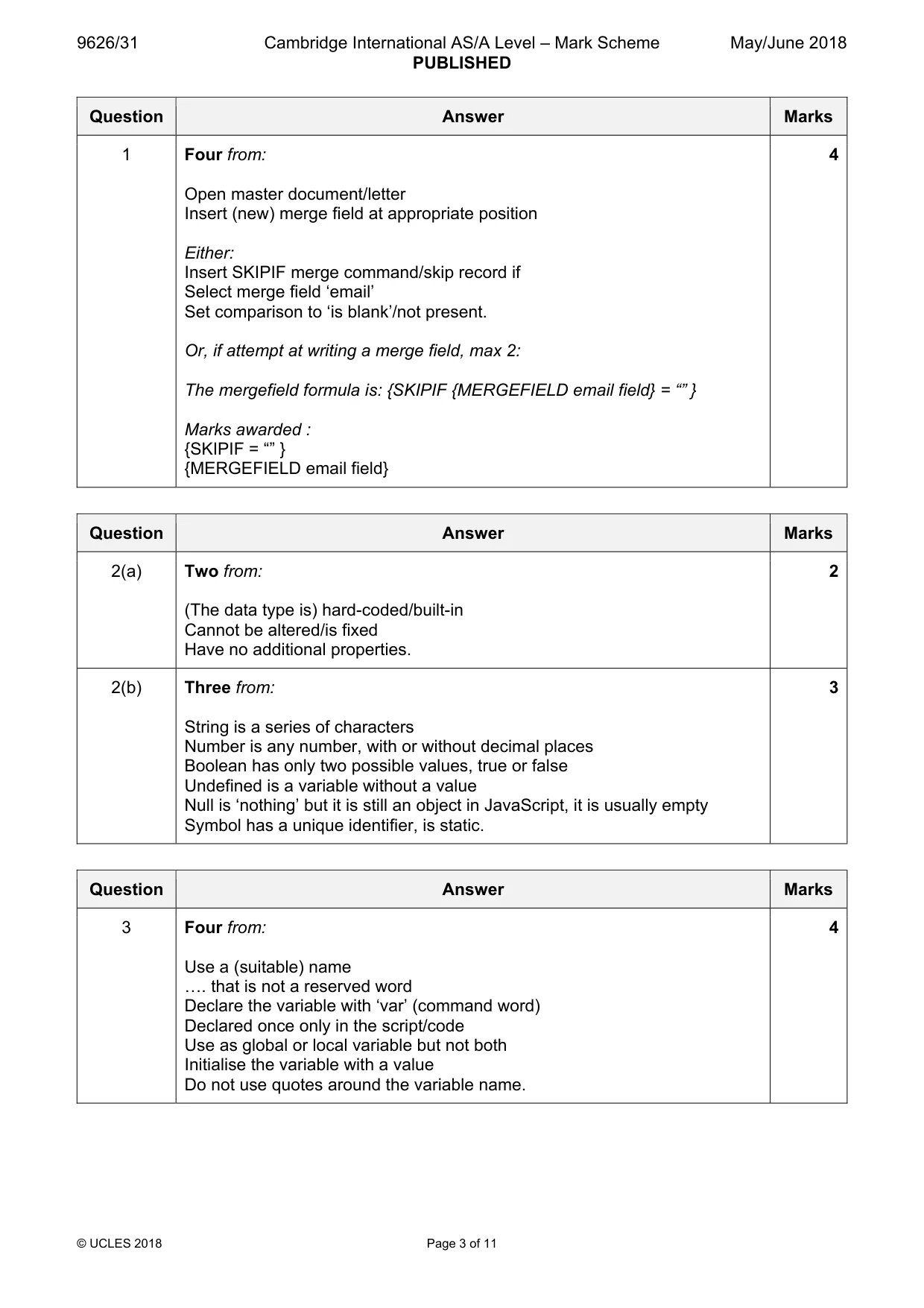
Mark scheme: 2(a) Two from: 2 (The data type is) hard-coded/built-in Cannot be altered/is fixed Have no additional properties. 2(b) Three from: 3 String is a series of characters Number is any number, with or without decimal places Boolean has only two possible values, true or false Undefined is a variable without a value Null is ‘nothing’ but it is still an object in JavaScript, it is usually empty Symbol has a unique identifier, is static.
Q3 · Variables are used in JavaScript to hold values
3 Variables are used in JavaScript to hold values. Explain how a variable is created in JavaScript code. .......................................................................................................................................................... .......................................................................................................................................................... .......................................................................................................................................................... .......................................................................................................................................................... .......................................................................................................................................................... .......................................................................................................................................................... .......................................................................................................................................................... .......................................................................................................................................................... ......................................................................................................................................................[4]
Mark scheme: 3 Four from: 4 Use a (suitable) name «. that is not a reserved word Declare the variable with ‘var’ (command word) Declared once only in the script/code Use as global or local variable but not both Initialise the variable with a value Do not use quotes around the variable name.
Q4 · As part of a project to create a new software application, a system analyst will produce…
4 As part of a project to create a new software application, a system analyst will produce a software requirements specification and a user requirements specification. (a) Describe the contents of a software requirements specification for the new software application. ................................................................................................................................................... ................................................................................................................................................... ................................................................................................................................................... ................................................................................................................................................... ................................................................................................................................................... ................................................................................................................................................... ................................................................................................................................................... ................................................................................................................................................... ...............................................................................................................................................[4] (b) Describe the purpose of a user requirements specification for the new software application. ................................................................................................................................................... ................................................................................................................................................... ................................................................................................................................................... ................................................................................................................................................... ................................................................................................................................................... ................................................................................................................................................... ................................................................................................................................................... ................................................................................................................................................... ...............................................................................................................................................[4] (c) Give one reason why the user requirements specification might prove to be inaccurate. ................................................................................................................................................... ................................................................................................................................................... ...............................................................................................................................................[1]
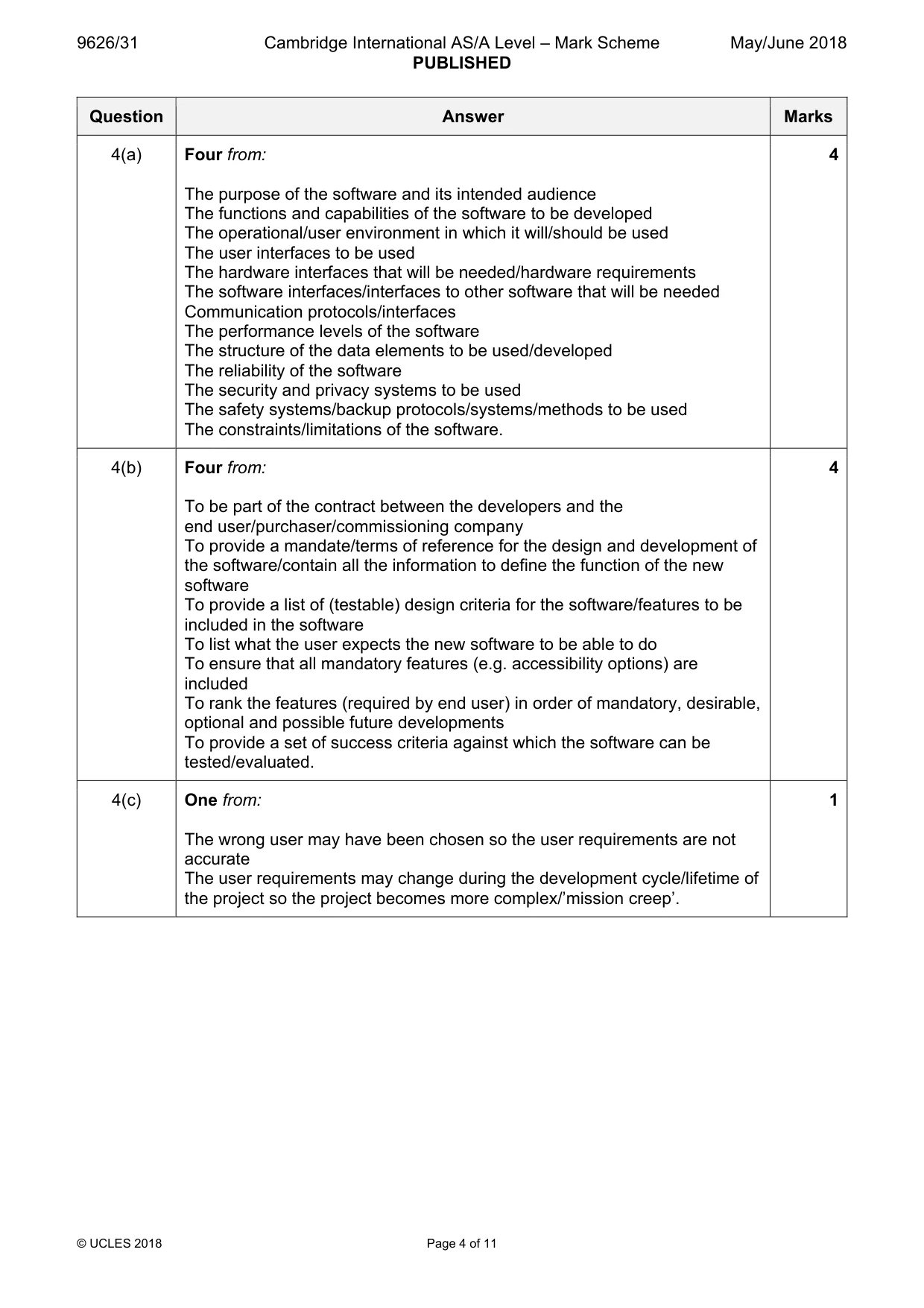
Mark scheme: 4(a) Four from: 4 The purpose of the software and its intended audience The functions and capabilities of the software to be developed The operational/user environment in which it will/should be used The user interfaces to be used The hardware interfaces that will be needed/hardware requirements The software interfaces/interfaces to other software that will be needed Communication protocols/interfaces The performance levels of the software The structure of the data elements to be used/developed The reliability of the software The security and privacy systems to be used The safety systems/backup protocols/systems/methods to be used The constraints/limitations of the software. 4(b) Four from: 4 To be part of the contract between the developers and the end user/purchaser/commissioning company To provide a mandate/terms of reference for the design and development of the software/contain all the information to define the function of the new software To provide a list of (testable) design criteria for the software/features to be included in the software To list what the user expects the new software to be able to do To ensure that all mandatory features (e.g. accessibility options) are included To rank the features (required by end user) in order of mandatory, desirable, optional and possible future developments To provide a set of success criteria against which the software can be tested/evaluated. 4(c) One from: 1 The wrong user may have been chosen so the user requirements are not accurate The user requirements may change during the development cycle/lifetime of the project so the project becomes more complex/’mission creep’.
Q5 · Discuss the benefits and drawbacks of the use of satellite technology in global…
5 Discuss the benefits and drawbacks of the use of satellite technology in global positioning systems (GPS). .......................................................................................................................................................... .......................................................................................................................................................... .......................................................................................................................................................... .......................................................................................................................................................... .......................................................................................................................................................... .......................................................................................................................................................... .......................................................................................................................................................... .......................................................................................................................................................... .......................................................................................................................................................... .......................................................................................................................................................... .......................................................................................................................................................... .......................................................................................................................................................... .......................................................................................................................................................... .......................................................................................................................................................... .......................................................................................................................................................... .......................................................................................................................................................... .......................................................................................................................................................... .......................................................................................................................................................... .......................................................................................................................................................... ......................................................................................................................................................[8]
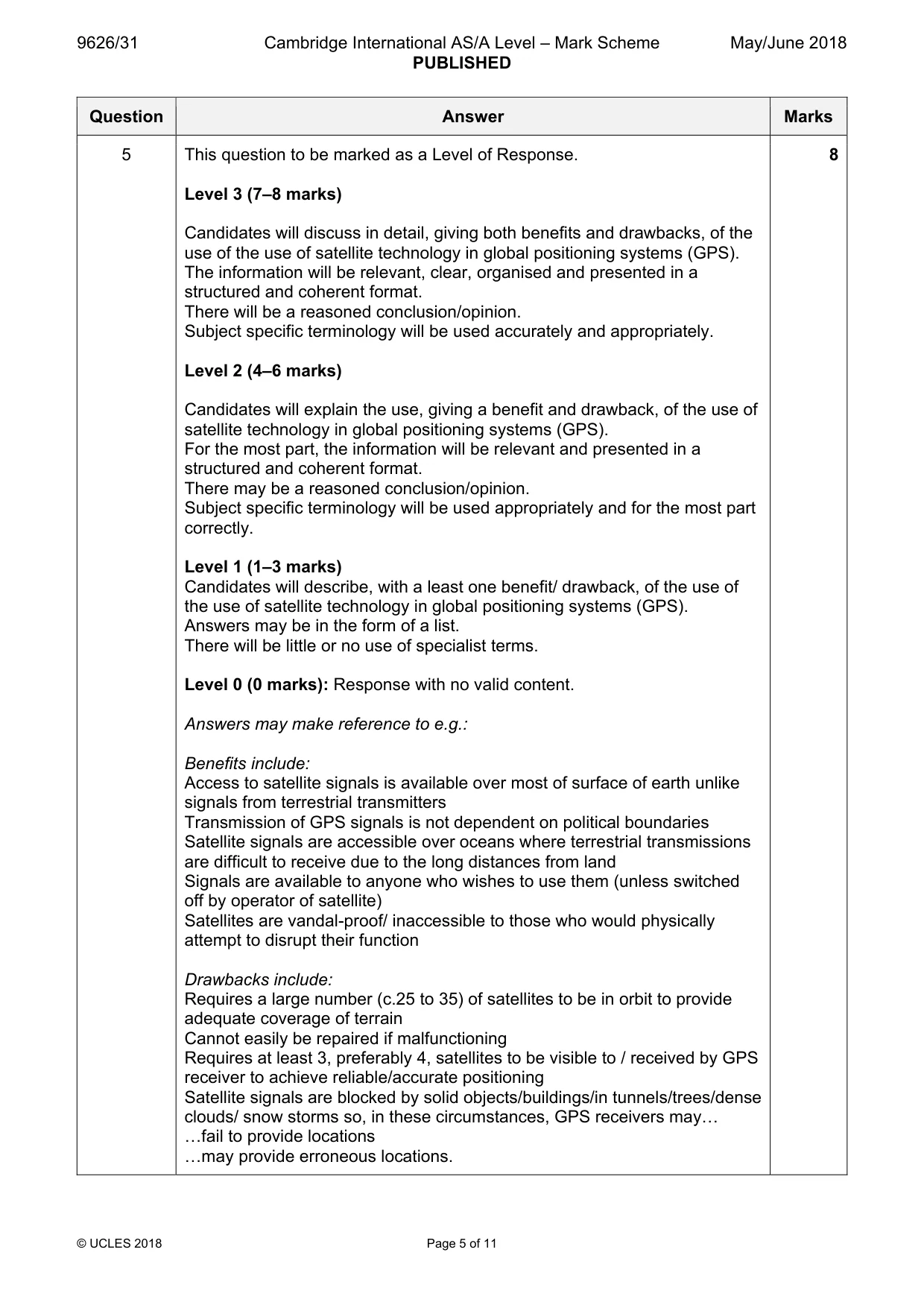
Mark scheme: 5 This question to be marked as a Level of Response. 8 Level 3 (7–8 marks) Candidates will discuss in detail, giving both benefits and drawbacks, of the use of the use of satellite technology in global positioning systems (GPS). The information will be relevant, clear, organised and presented in a structured and coherent format. There will be a reasoned conclusion/opinion. Subject specific terminology will be used accurately and appropriately. Level 2 (4–6 marks) Candidates will explain the use, giving a benefit and drawback, of the use of satellite technology in global positioning systems (GPS). For the most part, the information will be relevant and presented in a structured and coherent format. There may be a reasoned conclusion/opinion. Subject specific terminology will be used appropriately and for the most part correctly. Level 1 (1–3 marks) Candidates will describe, with a least one benefit/ drawback, of the use of the use of satellite technology in global positioning systems (GPS). Answers may be in the form of a list. There will be little or no use of specialist terms. Level 0 (0 marks): Response with no valid content. Answers may make reference to e.g.: Benefits include: Access to satellite signals is available over most of surface of earth unlike signals from terrestrial transmitters Transmission of GPS signals is not dependent on political boundaries Satellite signals are accessible over oceans where terrestrial transmissions are difficult to receive due to the long distances from land Signals are available to anyone who wishes to use them (unless switched off by operator of satellite) Satellites are vandal-proof/ inaccessible to those who would physically attempt to disrupt their function Drawbacks include: Requires a large number (c.25 to 35) of satellites to be in orbit to provide adequate coverage of terrain Cannot easily be repaired if malfunctioning Requires at least 3, preferably 4, satellites to be visible to / received by GPS receiver to achieve reliable/accurate positioning Satellite signals are blocked by solid objects/buildings/in tunnels/trees/dense clouds/ snow storms so, in these circumstances, GPS receivers may« «fail to provide locations «may provide erroneous locations.
Q6 · Tamsin is evaluating CPU hardware for use in a new tablet computer
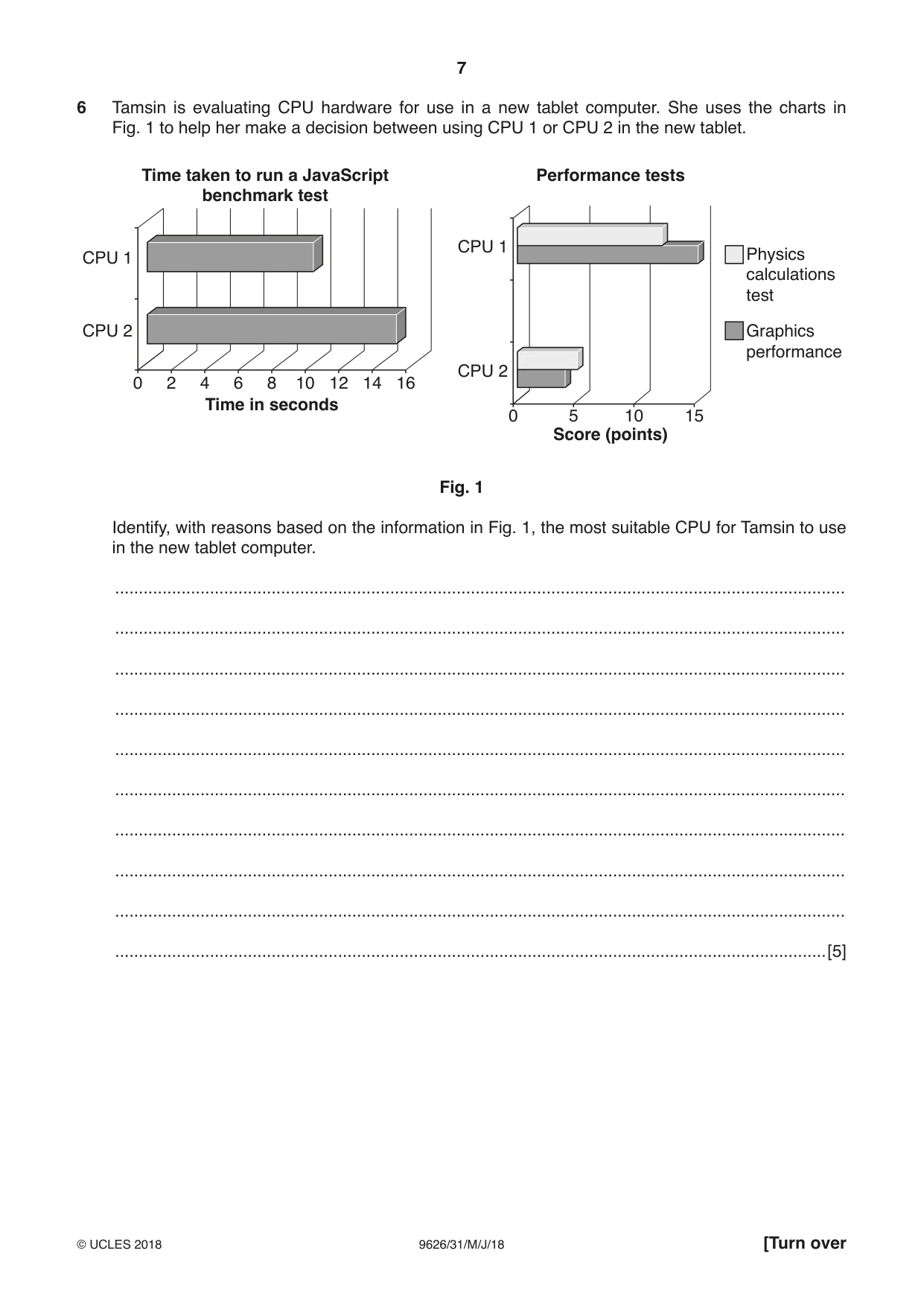
6 Tamsin is evaluating CPU hardware for use in a new tablet computer. She uses the charts in Fig. 1 to help her make a decision between using CPU 1 or CPU 2 in the new tablet. Time taken to run a JavaScript Performance tests benchmark test CPU 1CPU 1 Physics calculations test CPU 2 Graphics performance CPU 2 0 2 4 6 8 10 12 14 16 Time in seconds 0 5 10 15 Score (points) Fig. 1 Identify, with reasons based on the information in Fig. 1, the most suitable CPU for Tamsin to use in the new tablet computer. .......................................................................................................................................................... .......................................................................................................................................................... .......................................................................................................................................................... .......................................................................................................................................................... .......................................................................................................................................................... .......................................................................................................................................................... .......................................................................................................................................................... .......................................................................................................................................................... .......................................................................................................................................................... ......................................................................................................................................................[5]
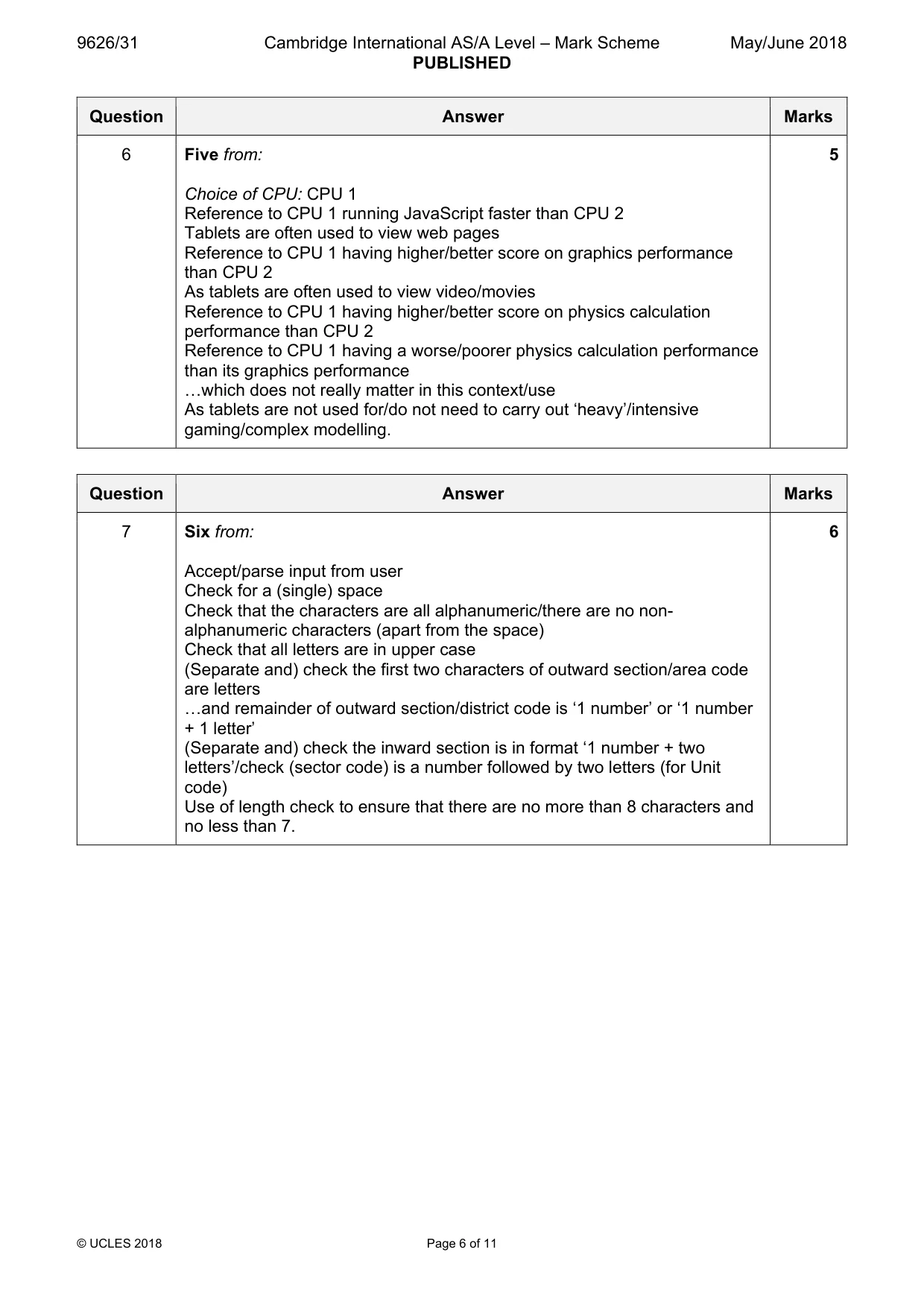
Mark scheme: 6 Five from: 5 Choice of CPU: CPU 1 Reference to CPU 1 running JavaScript faster than CPU 2 Tablets are often used to view web pages Reference to CPU 1 having higher/better score on graphics performance than CPU 2 As tablets are often used to view video/movies Reference to CPU 1 having higher/better score on physics calculation performance than CPU 2 Reference to CPU 1 having a worse/poorer physics calculation performance than its graphics performance «which does not really matter in this context/use As tablets are not used for/do not need to carry out ‘heavy’/intensive gaming/complex modelling.
Q7 · Cynthia has created a database to store details of her friends in the UK and wants to…
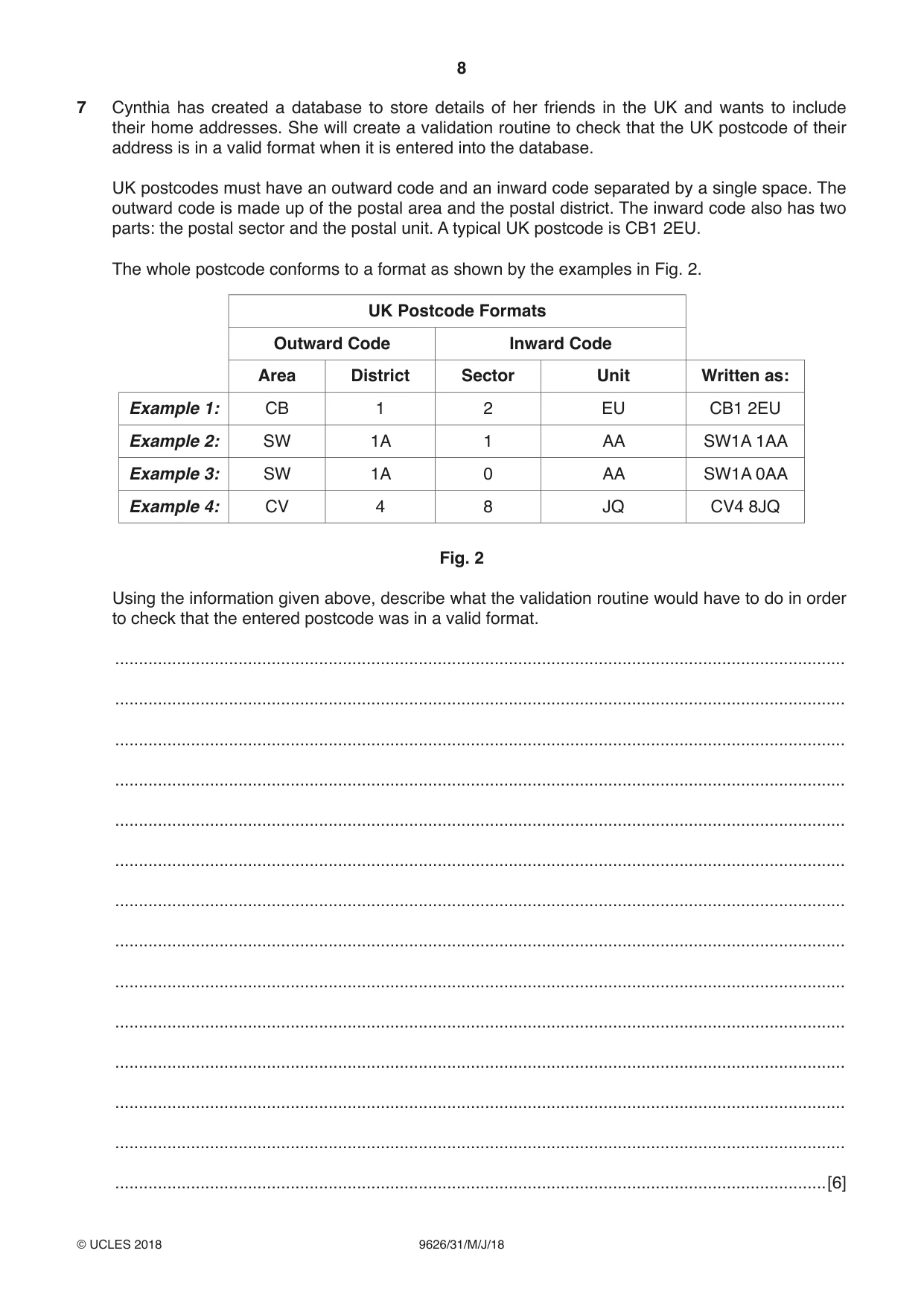
7 Cynthia has created a database to store details of her friends in the UK and wants to include their home addresses. She will create a validation routine to check that the UK postcode of their address is in a valid format when it is entered into the database. UK postcodes must have an outward code and an inward code separated by a single space. The outward code is made up of the postal area and the postal district. The inward code also has two parts: the postal sector and the postal unit. A typical UK postcode is CB1 2EU. The whole postcode conforms to a format as shown by the examples in Fig. 2. UK Postcode Formats Outward Code Inward Code Area District Sector Unit Written as: Example 1: CB 1 2 EU CB1 2EU Example 2: SW 1A 1 AA SW1A 1AA Example 3: SW 1A 0 AA SW1A 0AA Example 4: CV 4 8 JQ CV4 8JQ Fig. 2 Using the information given above, describe what the validation routine would have to do in order to check that the entered postcode was in a valid format. .......................................................................................................................................................... .......................................................................................................................................................... .......................................................................................................................................................... .......................................................................................................................................................... .......................................................................................................................................................... .......................................................................................................................................................... .......................................................................................................................................................... .......................................................................................................................................................... .......................................................................................................................................................... .......................................................................................................................................................... .......................................................................................................................................................... .......................................................................................................................................................... .......................................................................................................................................................... ......................................................................................................................................................[6]
Mark scheme: 7 Six from: 6 Accept/parse input from user Check for a (single) space Check that the characters are all alphanumeric/there are no non- alphanumeric characters (apart from the space) Check that all letters are in upper case (Separate and) check the first two characters of outward section/area code are letters «and remainder of outward section/district code is ‘1 number’ or ‘1 number + 1 letter’ (Separate and) check the inward section is in format ‘1 number + two letters’/check (sector code) is a number followed by two letters (for Unit code) Use of length check to ensure that there are no more than 8 characters and no less than 7.
Q8 · Discuss the advantages and disadvantages of carrying out research into an existing…
8 Discuss the advantages and disadvantages of carrying out research into an existing computerised stock control system using the analysis of existing documents. .......................................................................................................................................................... .......................................................................................................................................................... .......................................................................................................................................................... .......................................................................................................................................................... .......................................................................................................................................................... .......................................................................................................................................................... .......................................................................................................................................................... .......................................................................................................................................................... .......................................................................................................................................................... .......................................................................................................................................................... .......................................................................................................................................................... .......................................................................................................................................................... .......................................................................................................................................................... .......................................................................................................................................................... .......................................................................................................................................................... .......................................................................................................................................................... .......................................................................................................................................................... .......................................................................................................................................................... .......................................................................................................................................................... ......................................................................................................................................................[8]
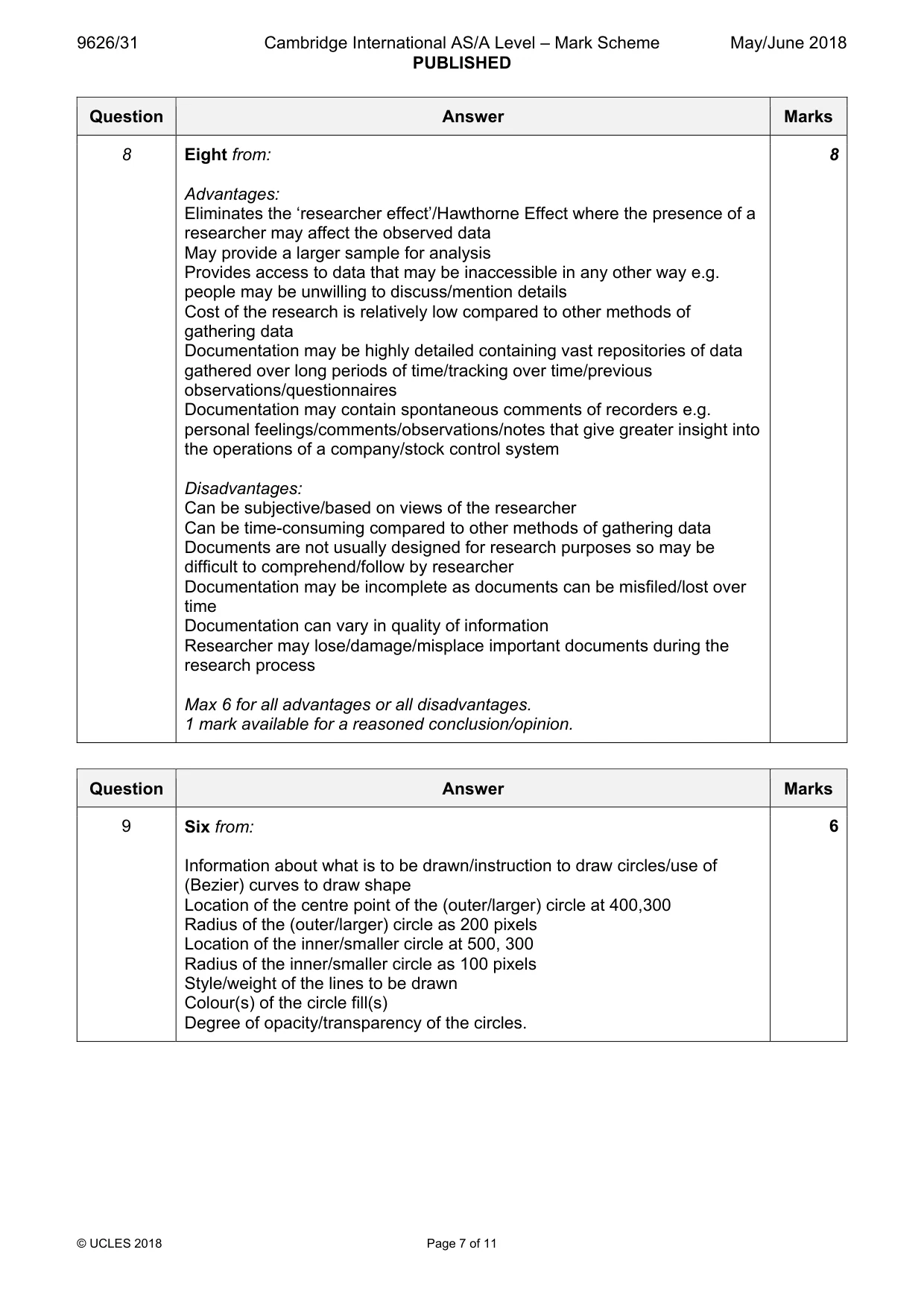
Mark scheme: 8 Eight from: 8 Advantages: Eliminates the ‘researcher effect’/Hawthorne Effect where the presence of a researcher may affect the observed data May provide a larger sample for analysis Provides access to data that may be inaccessible in any other way e.g. people may be unwilling to discuss/mention details Cost of the research is relatively low compared to other methods of gathering data Documentation may be highly detailed containing vast repositories of data gathered over long periods of time/tracking over time/previous observations/questionnaires Documentation may contain spontaneous comments of recorders e.g. personal feelings/comments/observations/notes that give greater insight into the operations of a company/stock control system Disadvantages: Can be subjective/based on views of the researcher Can be time-consuming compared to other methods of gathering data Documents are not usually designed for research purposes so may be difficult to comprehend/follow by researcher Documentation may be incomplete as documents can be misfiled/lost over time Documentation can vary in quality of information Researcher may lose/damage/misplace important documents during the research process Max 6 for all advantages or all disadvantages. 1 mark available for a reasoned conclusion/opinion.
Q9 · A graphics artist has drawn a shape on a 600 × 800 pixel resolution grid as shown in Fig
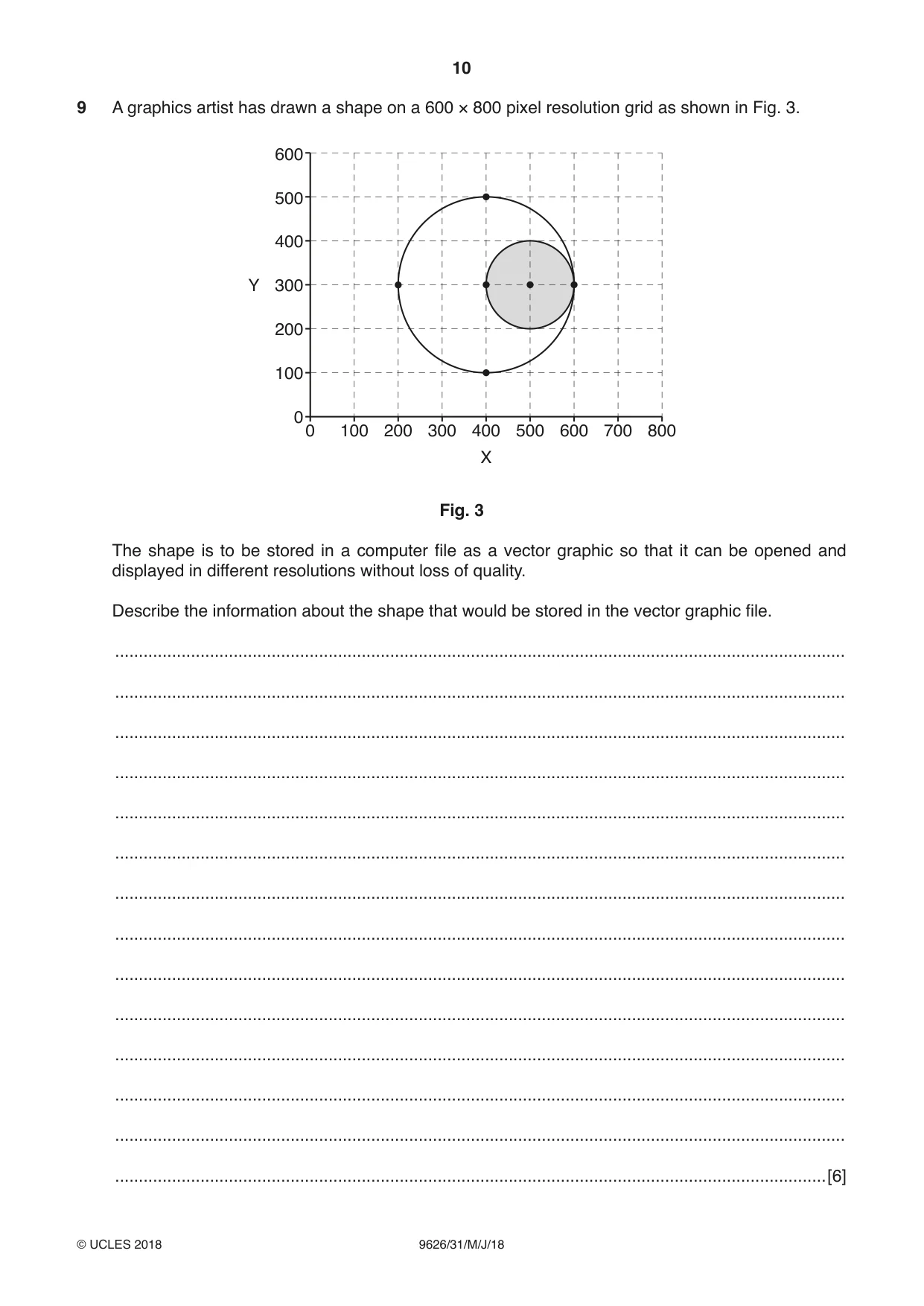
9 A graphics artist has drawn a shape on a 600 × 800 pixel resolution grid as shown in Fig. 3. 600 500 400 Y 300 200 100 00 100 200 300 400 500 600 700 800 X Fig. 3 The shape is to be stored in a computer file as a vector graphic so that it can be opened and displayed in different resolutions without loss of quality. Describe the information about the shape that would be stored in the vector graphic file. .......................................................................................................................................................... .......................................................................................................................................................... .......................................................................................................................................................... .......................................................................................................................................................... .......................................................................................................................................................... .......................................................................................................................................................... .......................................................................................................................................................... .......................................................................................................................................................... .......................................................................................................................................................... .......................................................................................................................................................... .......................................................................................................................................................... .......................................................................................................................................................... .......................................................................................................................................................... ......................................................................................................................................................[6]
Mark scheme: 9 Six from: 6 Information about what is to be drawn/instruction to draw circles/use of (Bezier) curves to draw shape Location of the centre point of the (outer/larger) circle at 400,300 Radius of the (outer/larger) circle as 200 pixels Location of the inner/smaller circle at 500, 300 Radius of the inner/smaller circle as 100 pixels Style/weight of the lines to be drawn Colour(s) of the circle fill(s) Degree of opacity/transparency of the circles.
Q10 · A large school is creating a relational database to store details of pupils and teachers
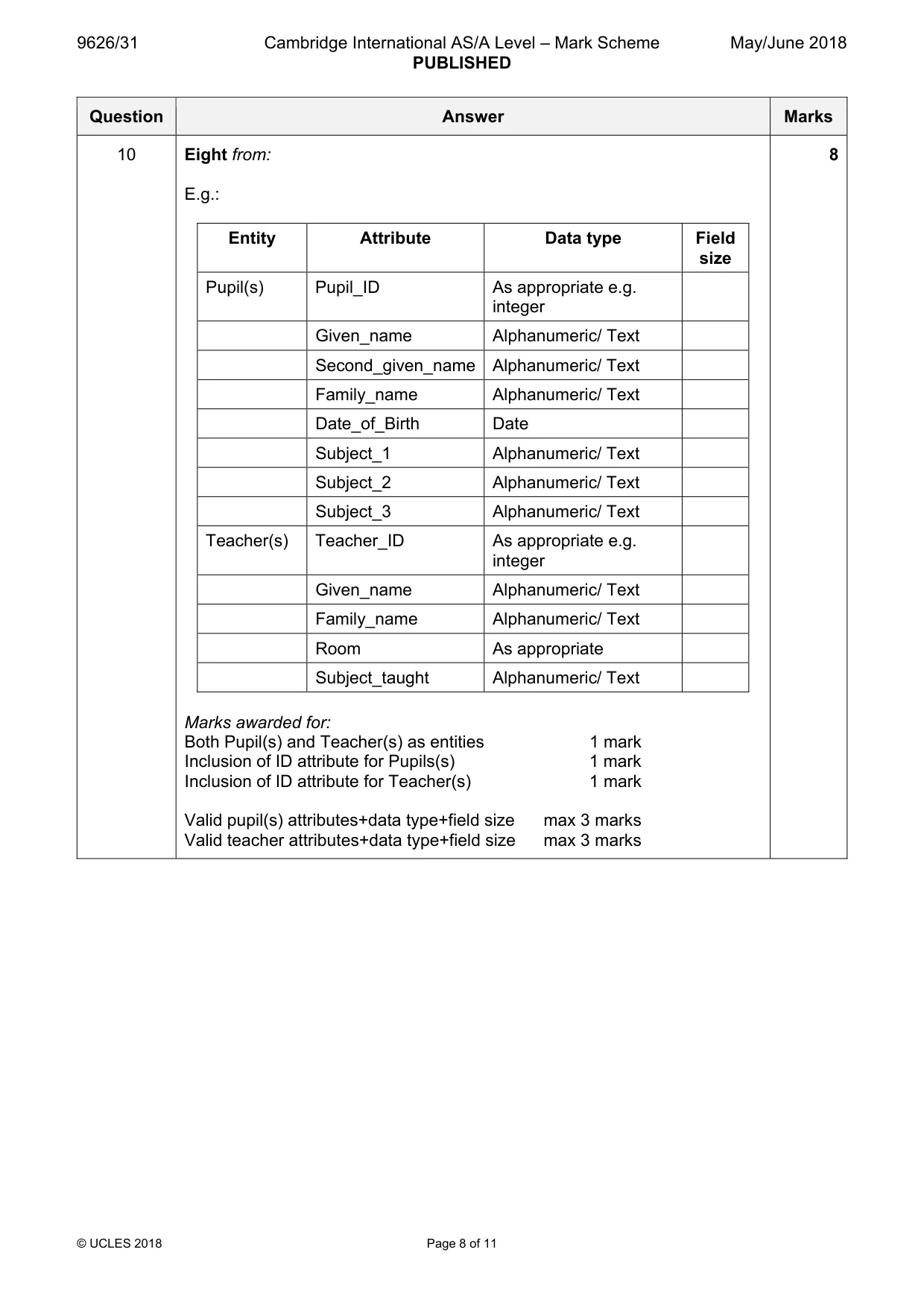
10 A large school is creating a relational database to store details of pupils and teachers. Examples of the data to be stored are shown: Pupils: Orlando Albert Sockett Teachers: Christopher Wallace Born: 22 October 1999 Based in Room 27 Studies: English, Mathematics, Science Teaches English Using the information given, create a data dictionary in the table to list the entities and attributes of the new database: Entity Attribute Data type Field size [8]
Mark scheme: 10 Eight from: 8 E.g.: Entity Attribute Data type Field size Pupil(s) Pupil_ID As appropriate e.g. integer Given_name Alphanumeric/ Text Second_given_name Alphanumeric/ Text Family_name Alphanumeric/ Text Date_of_Birth Date Subject_1 Alphanumeric/ Text Subject_2 Alphanumeric/ Text Subject_3 Alphanumeric/ Text Teacher(s) Teacher_ID As appropriate e.g. integer Given_name Alphanumeric/ Text Family_name Alphanumeric/ Text Room As appropriate Subject_taught Alphanumeric/ Text Marks awarded for: Both Pupil(s) and Teacher(s) as entities 1 mark Inclusion of ID attribute for Pupils(s) 1 mark Inclusion of ID attribute for Teacher(s) 1 mark Valid pupil(s) attributes+data type+field size max 3 marks Valid teacher attributes+data type+field size max 3 marks
Q11 · An automatic washing machine has a number of wash cycles controlled by an embedded…
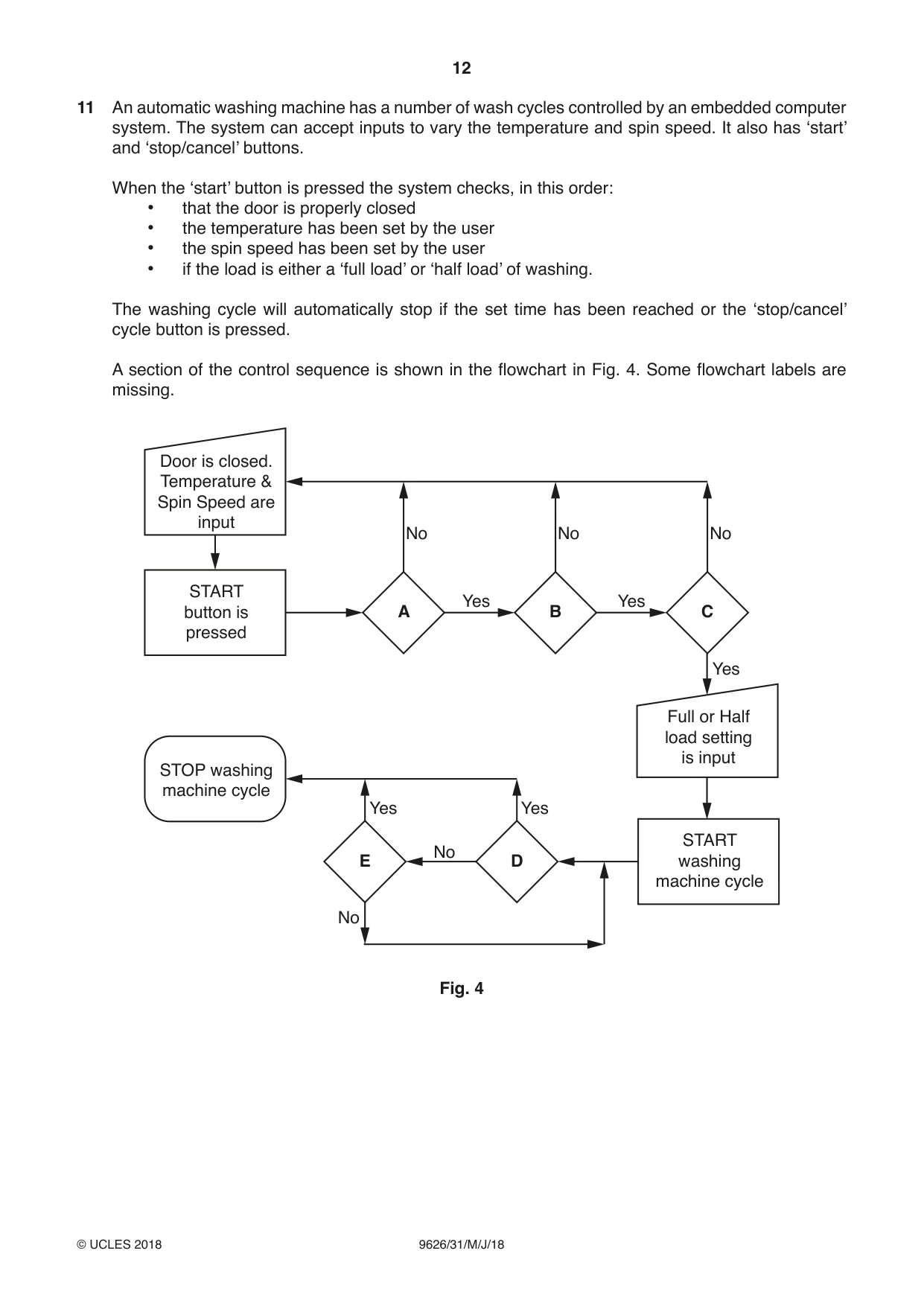
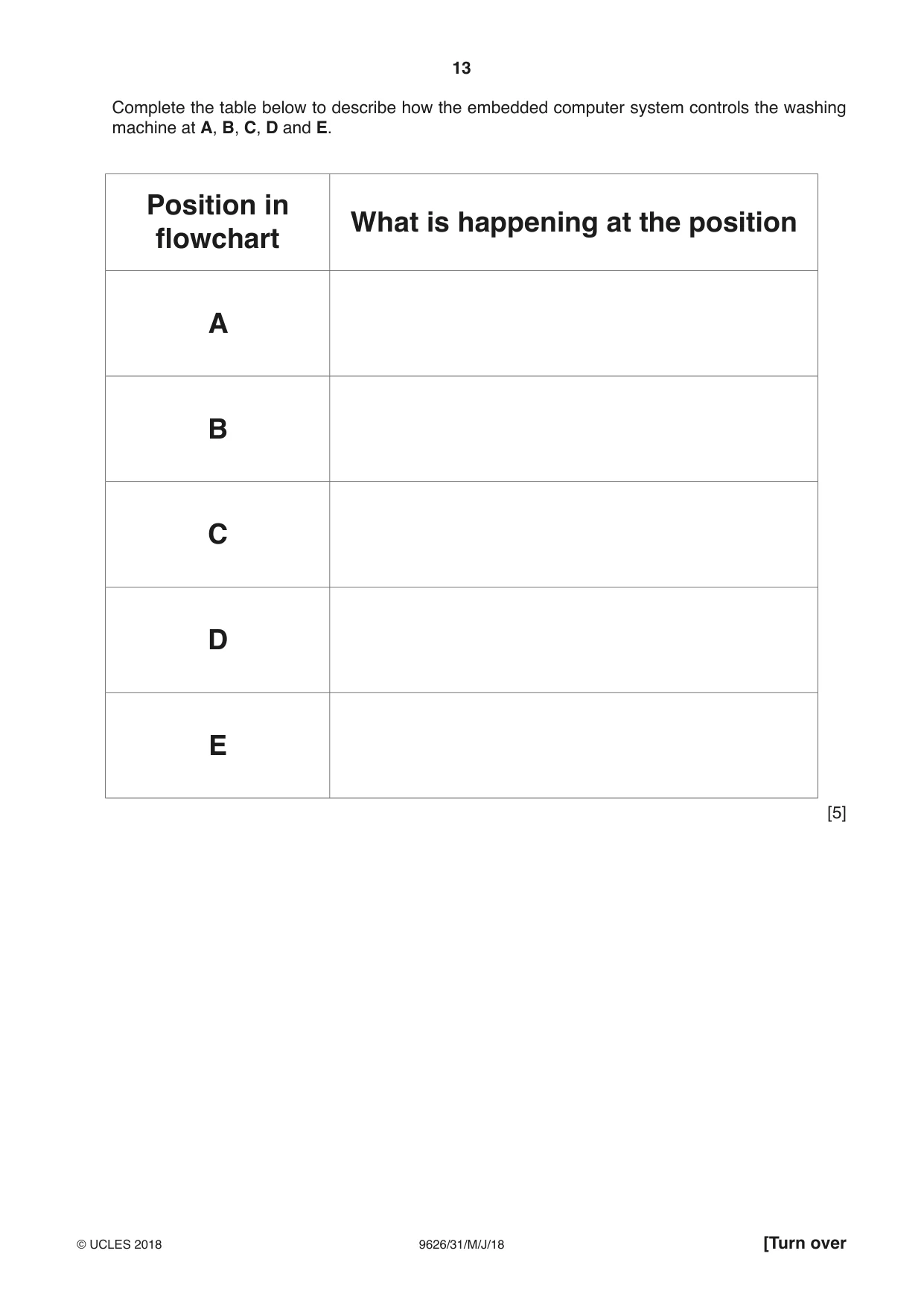
11 An automatic washing machine has a number of wash cycles controlled by an embedded computer system. The system can accept inputs to vary the temperature and spin speed. It also has ‘start’ and ‘stop/cancel’ buttons. When the ‘start’ button is pressed the system checks, in this order: • that the door is properly closed • the temperature has been set by the user • the spin speed has been set by the user • if the load is either a ‘full load’ or ‘half load’ of washing. The washing cycle will automatically stop if the set time has been reached or the ‘stop/cancel’ cycle button is pressed. A section of the control sequence is shown in the flowchart in Fig. 4. Some flowchart labels are missing. Door is closed. Temperature & Spin Speed are input No No No START Yes Yes button is A B C pressed Yes Full or Half load setting is input STOP washing machine cycle Yes Yes START No E D washing machine cycle No Fig. 4 Complete the table below to describe how the embedded computer system controls the washing machine at A, B, C, D and E. Position in What is happening at the position flowchart A B C D E [5]
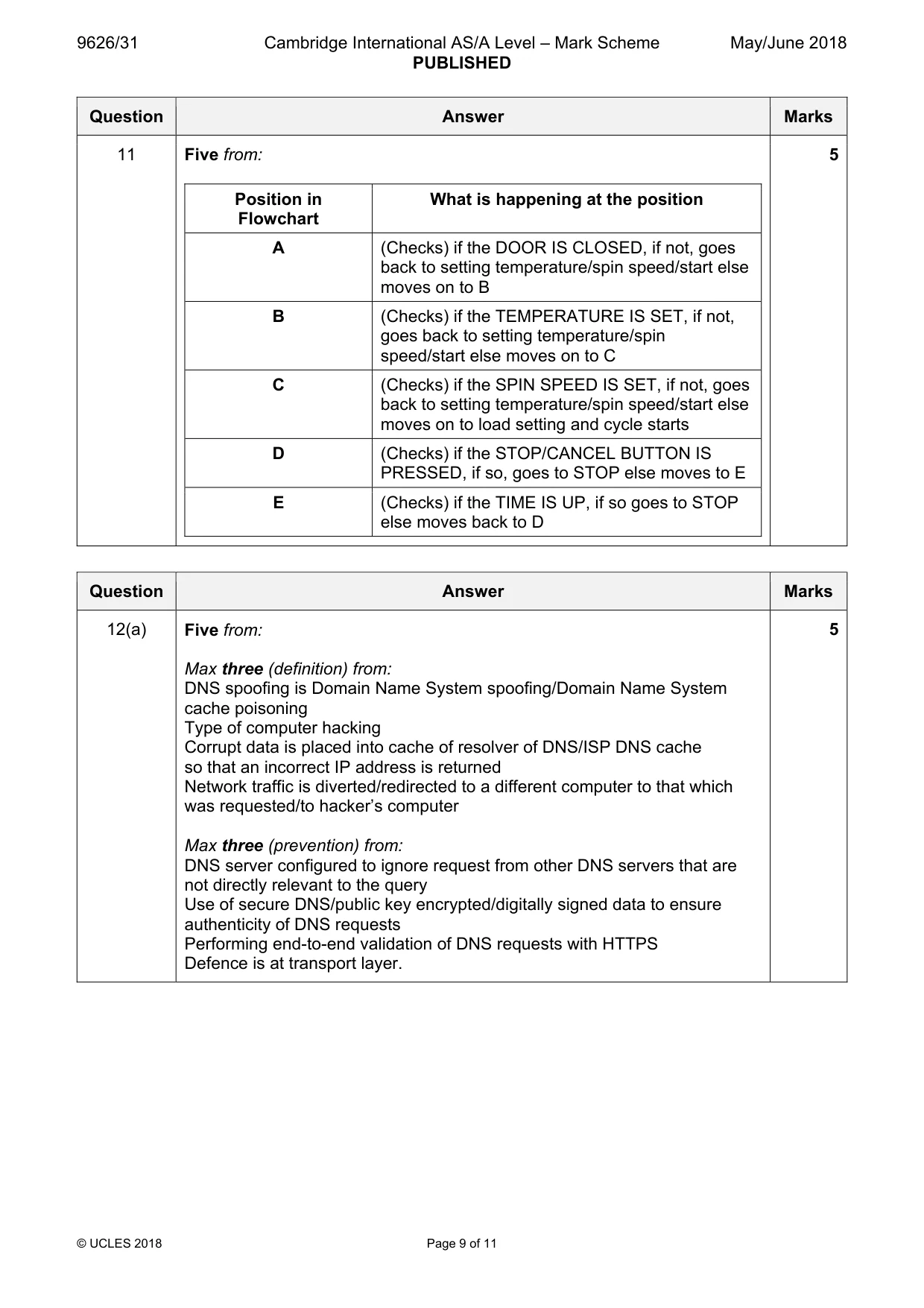
Mark scheme: 11 Five from: 5 Position in What is happening at the position Flowchart A (Checks) if the DOOR IS CLOSED, if not, goes back to setting temperature/spin speed/start else moves on to B B (Checks) if the TEMPERATURE IS SET, if not, goes back to setting temperature/spin speed/start else moves on to C C (Checks) if the SPIN SPEED IS SET, if not, goes back to setting temperature/spin speed/start else moves on to load setting and cycle starts D (Checks) if the STOP/CANCEL BUTTON IS PRESSED, if so, goes to STOP else moves to E E (Checks) if the TIME IS UP, if so goes to STOP else moves back to D
Q12 · The networking of computers can give rise to a variety of issues
12 The networking of computers can give rise to a variety of issues. Describe each of the following security issues and suggest how, other than using physical security methods, the risk from each may be reduced. (a) DNS spoofing. ................................................................................................................................................... ................................................................................................................................................... ................................................................................................................................................... ................................................................................................................................................... ................................................................................................................................................... ................................................................................................................................................... ................................................................................................................................................... ................................................................................................................................................... ................................................................................................................................................... ...............................................................................................................................................[5] (b) DoS attack. ................................................................................................................................................... ................................................................................................................................................... ................................................................................................................................................... ................................................................................................................................................... ................................................................................................................................................... ................................................................................................................................................... ................................................................................................................................................... ................................................................................................................................................... ................................................................................................................................................... ...............................................................................................................................................[5] (c) ARP spoofing. ................................................................................................................................................... ................................................................................................................................................... ................................................................................................................................................... ................................................................................................................................................... ................................................................................................................................................... ................................................................................................................................................... ................................................................................................................................................... ................................................................................................................................................... ...............................................................................................................................................[4] PLEASE TURN OVER FOR QUESTION 13.
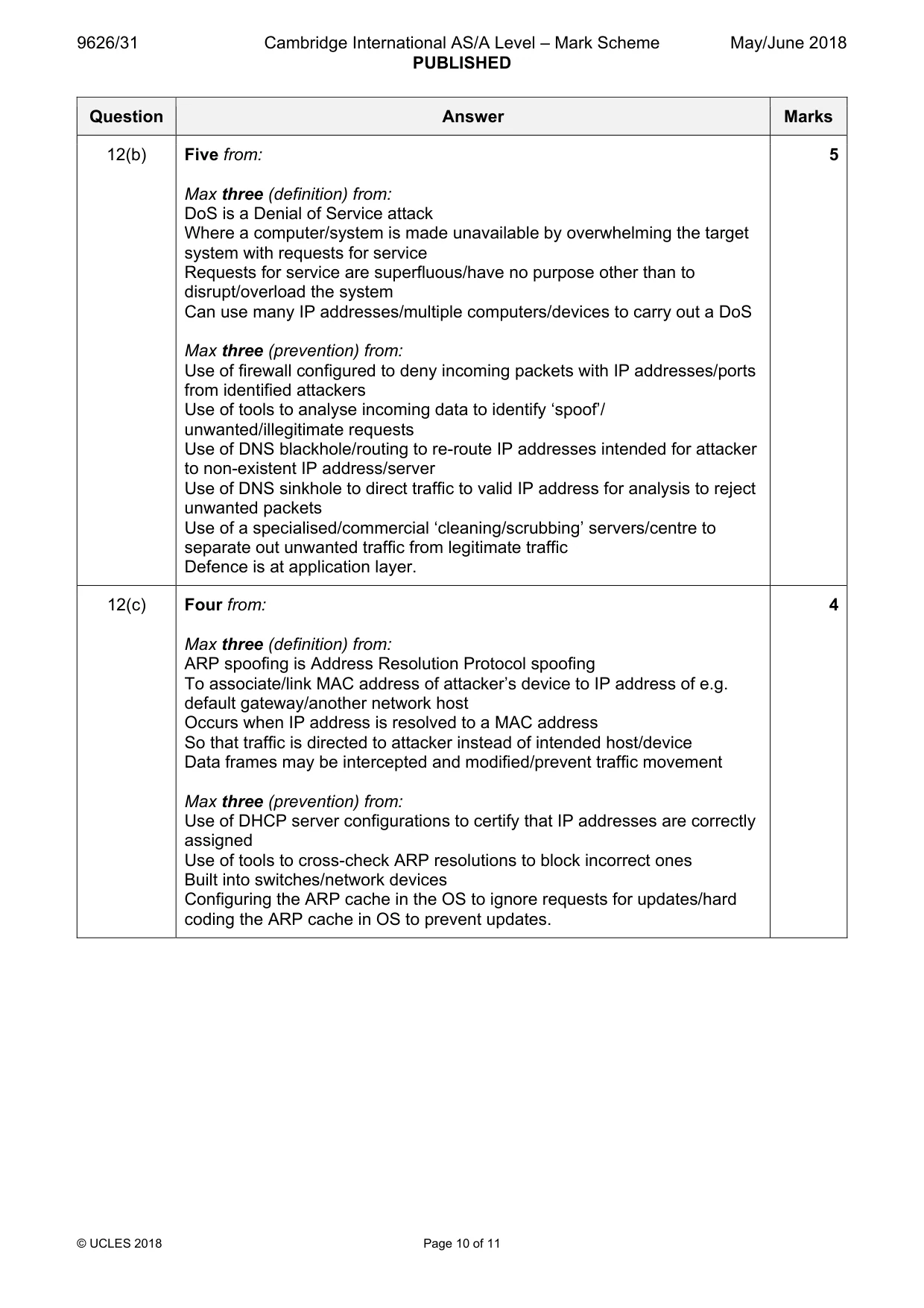
Mark scheme: 12(a) Five from: 5 Max three (definition) from: DNS spoofing is Domain Name System spoofing/Domain Name System cache poisoning Type of computer hacking Corrupt data is placed into cache of resolver of DNS/ISP DNS cache so that an incorrect IP address is returned Network traffic is diverted/redirected to a different computer to that which was requested/to hacker’s computer Max three (prevention) from: DNS server configured to ignore request from other DNS servers that are not directly relevant to the query Use of secure DNS/public key encrypted/digitally signed data to ensure authenticity of DNS requests Performing end-to-end validation of DNS requests with HTTPS Defence is at transport layer. 12(b) Five from: 5 Max three (definition) from: DoS is a Denial of Service attack Where a computer/system is made unavailable by overwhelming the target system with requests for service Requests for service are superfluous/have no purpose other than to disrupt/overload the system Can use many IP addresses/multiple computers/devices to carry out a DoS Max three (prevention) from: Use of firewall configured to deny incoming packets with IP addresses/ports from identified attackers Use of tools to analyse incoming data to identify ‘spoof’/ unwanted/illegitimate requests Use of DNS blackhole/routing to re-route IP addresses intended for attacker to non-existent IP address/server Use of DNS sinkhole to direct traffic to valid IP address for analysis to reject unwanted packets Use of a specialised/commercial ‘cleaning/scrubbing’ servers/centre to separate out unwanted traffic from legitimate traffic Defence is at application layer. 12(c) Four from: 4 Max three (definition) from: ARP spoofing is Address Resolution Protocol spoofing To associate/link MAC address of attacker’s device to IP address of e.g. default gateway/another network host Occurs when IP address is resolved to a MAC address So that traffic is directed to attacker instead of intended host/device Data frames may be intercepted and modified/prevent traffic movement Max three (prevention) from: Use of DHCP server configurations to certify that IP addresses are correctly assigned Use of tools to cross-check ARP resolutions to block incorrect ones Built into switches/network devices Configuring the ARP cache in the OS to ignore requests for updates/hard coding the ARP cache in OS to prevent updates.
Q13 · Companies use a range of physical security methods to try to prevent unauthorised access…
13 Companies use a range of physical security methods to try to prevent unauthorised access to the company data stored on their networks. Evaluate the use of physical security methods in attempting to prevent unauthorised access to the stored data. .......................................................................................................................................................... .......................................................................................................................................................... .......................................................................................................................................................... .......................................................................................................................................................... .......................................................................................................................................................... .......................................................................................................................................................... .......................................................................................................................................................... .......................................................................................................................................................... .......................................................................................................................................................... .......................................................................................................................................................... .......................................................................................................................................................... .......................................................................................................................................................... .......................................................................................................................................................... .......................................................................................................................................................... .......................................................................................................................................................... .......................................................................................................................................................... .......................................................................................................................................................... .......................................................................................................................................................... .......................................................................................................................................................... ......................................................................................................................................................[8]
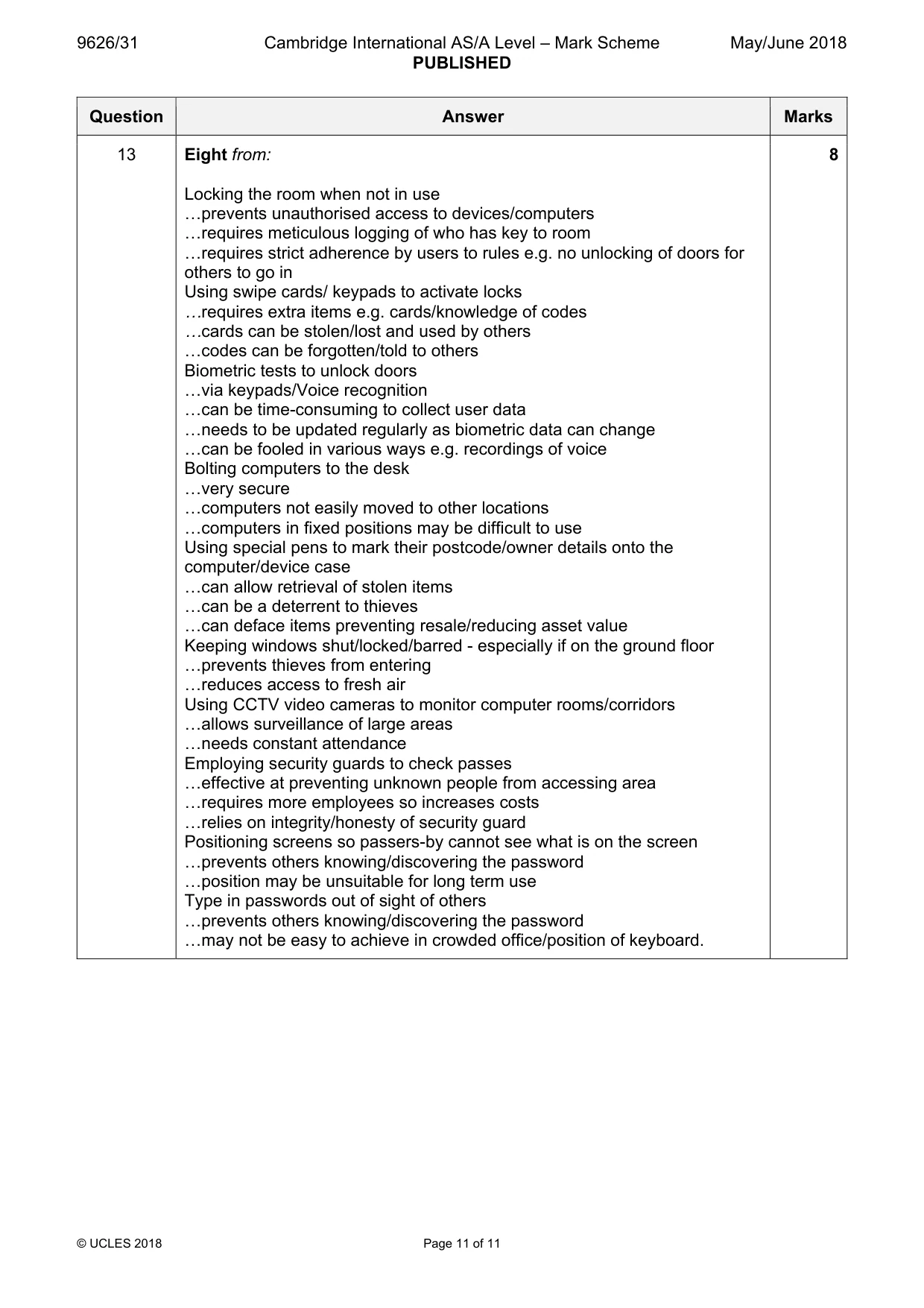
Mark scheme: 13 Eight from: 8 Locking the room when not in use «prevents unauthorised access to devices/computers «requires meticulous logging of who has key to room «requires strict adherence by users to rules e.g. no unlocking of doors for others to go in Using swipe cards/ keypads to activate locks «requires extra items e.g. cards/knowledge of codes «cards can be stolen/lost and used by others «codes can be forgotten/told to others Biometric tests to unlock doors «via keypads/Voice recognition «can be time-consuming to collect user data «needs to be updated regularly as biometric data can change «can be fooled in various ways e.g. recordings of voice Bolting computers to the desk «very secure «computers not easily moved to other locations «computers in fixed positions may be difficult to use Using special pens to mark their postcode/owner details onto the computer/device case «can allow retrieval of stolen items «can be a deterrent to thieves «can deface items preventing resale/reducing asset value Keeping windows shut/locked/barred - especially if on the ground floor «prevents thieves from entering «reduces access to fresh air Using CCTV video cameras to monitor computer rooms/corridors «allows surveillance of large areas «needs constant attendance Employing security guards to check passes «effective at preventing unknown people from accessing area «requires more employees so increases costs «relies on integrity/honesty of security guard Positioning screens so passers-by cannot see what is on the screen «prevents others knowing/discovering the password «position may be unsuitable for long term use Type in passwords out of sight of others «prevents others knowing/discovering the password «may not be easy to achieve in crowded office/position of keyboard.
What was in this paper
The subtopics covered by these 13 questions, and how many questions each got. Open one in a new tab to see every Cambridge question on it.
What you needed in this session
Cambridge’s own grade thresholds for 2018 May/June, Paper 3 · Variant 1. A higher threshold means an easier paper — the bar moves with how the cohort did.