Cambridge A Level Economics 9708 — 2025 Oct/Nov Paper 2 · Variant 1
9708/21/O/N/25 · 5 questions · 60 marks · ≈68 min
The question paper and its mark scheme, free to read here and free to download. This is Cambridge’s own paper, exactly as it was sat.
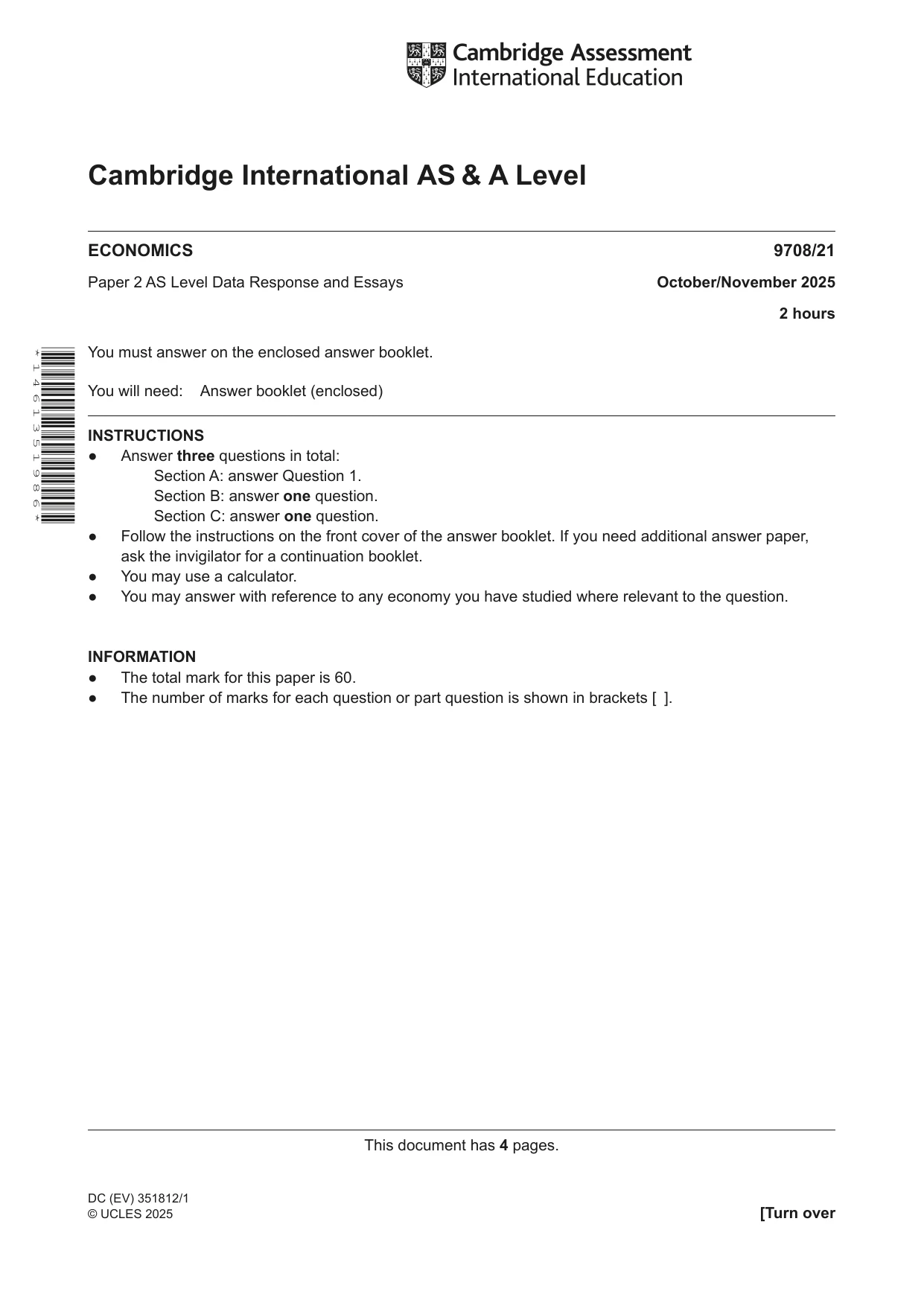
Question paper4 pages
Mark scheme24 pages
Answers below. Sit the paper first if you are practising.

Questions as text
Q1 · Mexico’s backward-looking energy policy is bad for the country and the planet In 2023…
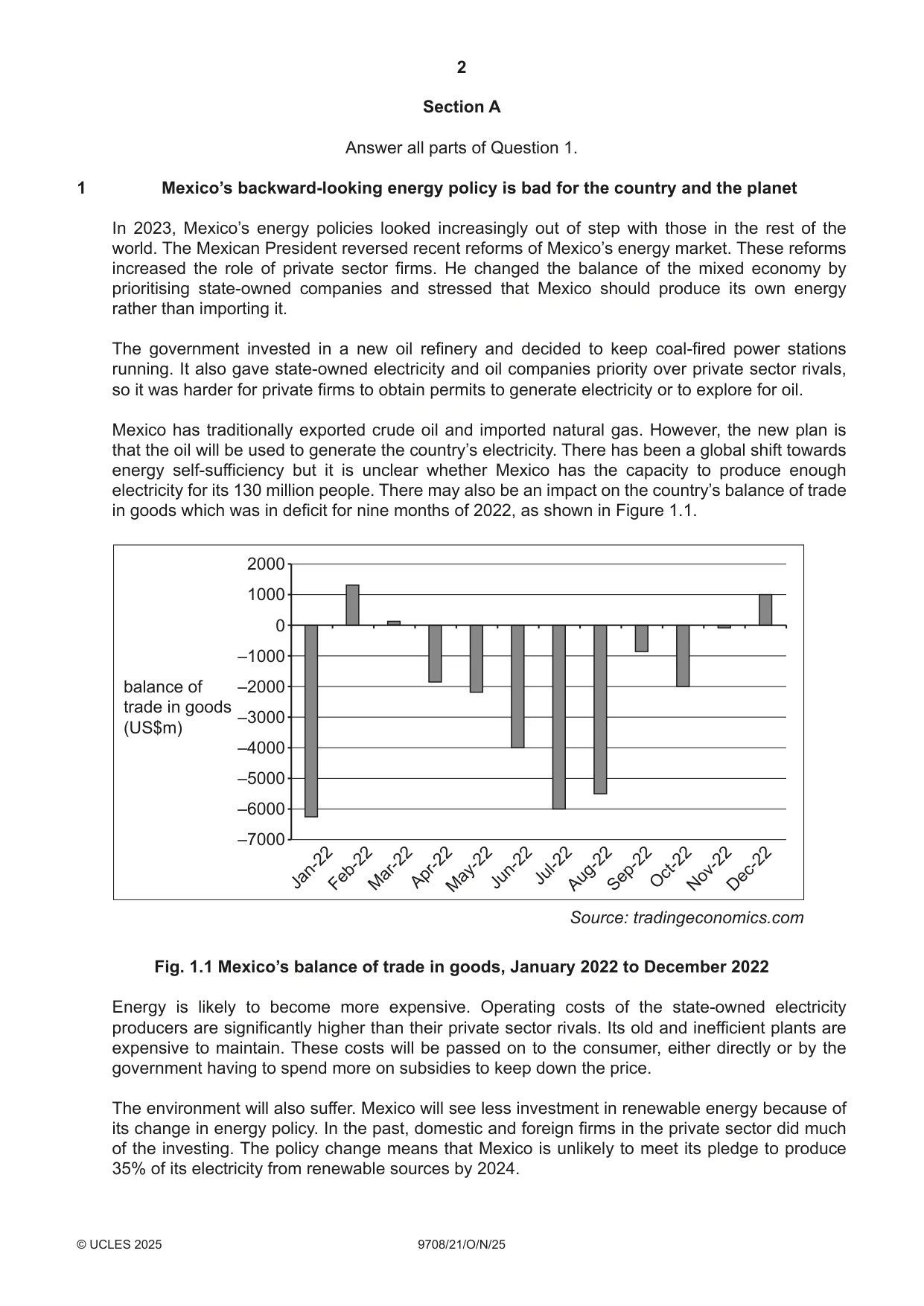
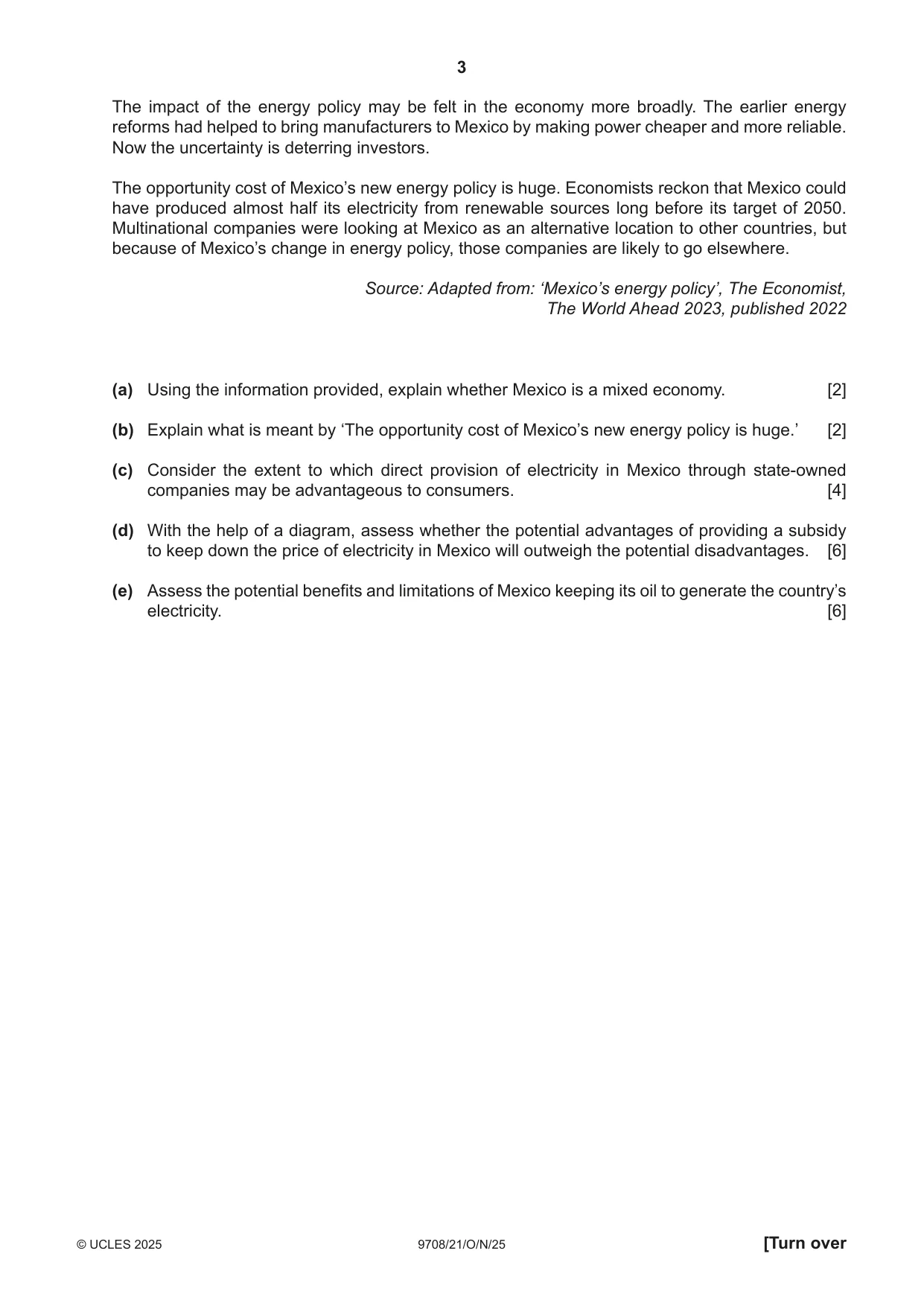
1 Mexico’s backward-looking energy policy is bad for the country and the planet In 2023, Mexico’s energy policies looked increasingly out of step with those in the rest of the world. The Mexican President reversed recent reforms of Mexico’s energy market. These reforms increased the role of private sector firms. He changed the balance of the mixed economy by prioritising state-owned companies and stressed that Mexico should produce its own energy rather than importing it. The government invested in a new oil refinery and decided to keep coal-fired power stations running. It also gave state-owned electricity and oil companies priority over private sector rivals, so it was harder for private firms to obtain permits to generate electricity or to explore for oil. Mexico has traditionally exported crude oil and imported natural gas. However, the new plan is that the oil will be used to generate the country’s electricity. There has been a global shift towards energy self-sufficiency but it is unclear whether Mexico has the capacity to produce enough electricity for its 130 million people. There may also be an impact on the country’s balance of trade in goods which was in deficit for nine months of 2022, as shown in Figure 1.1. 2000 1000 0 –1000 balance of –2000 trade in goods –3000 (US$m) –4000 –5000 –6000 –7000 Jan-22Feb-22Mar-22Apr-22May-22Jun-22Jul-22Aug-22Sep-22Oct-22Nov-22Dec-22 Source: tradingeconomics.com Fig. 1.1 Mexico’s balance of trade in goods, January 2022 to December 2022 Energy is likely to become more expensive. Operating costs of the state-owned electricity producers are significantly higher than their private sector rivals. Its old and inefficient plants are expensive to maintain. These costs will be passed on to the consumer, either directly or by the government having to spend more on subsidies to keep down the price. The environment will also suffer. Mexico will see less investment in renewable energy because of its change in energy policy. In the past, domestic and foreign firms in the private sector did much of the investing. The policy change means that Mexico is unlikely to meet its pledge to produce 35% of its electricity from renewable sources by 2024. The impact of the energy policy may be felt in the economy more broadly. The earlier energy reforms had helped to bring manufacturers to Mexico by making power cheaper and more reliable. Now the uncertainty is deterring investors. The opportunity cost of Mexico’s new energy policy is huge. Economists reckon that Mexico could have produced almost half its electricity from renewable sources long before its target of 2050. Multinational companies were looking at Mexico as an alternative location to other countries, but because of Mexico’s change in energy policy, those companies are likely to go elsewhere. Source: Adapted from: ‘Mexico’s energy policy’, The Economist, The World Ahead 2023, published 2022 (a) Using the information provided, explain whether Mexico is a mixed economy. [2] (b) Explain what is meant by ‘The opportunity cost of Mexico’s new energy policy is huge.’ [2] (c) Consider the extent to which direct provision of electricity in Mexico through state-owned companies may be advantageous to consumers. [4] (d) With the help of a diagram, assess whether the potential advantages of providing a subsidy to keep down the price of electricity in Mexico will outweigh the potential disadvantages. [6] (e) Assess the potential benefits and limitations of Mexico keeping its oil to generate the country’s electricity. [6]
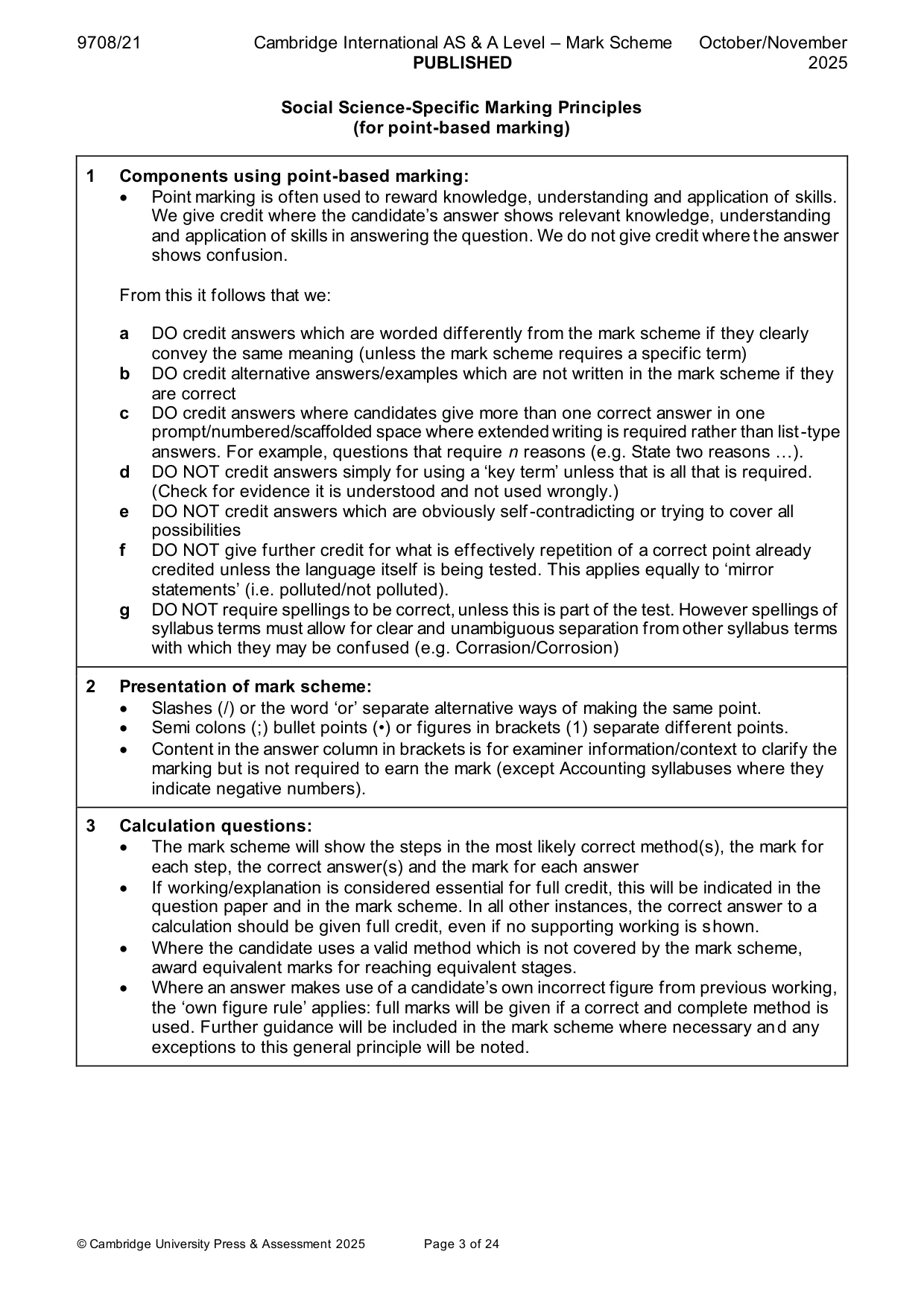
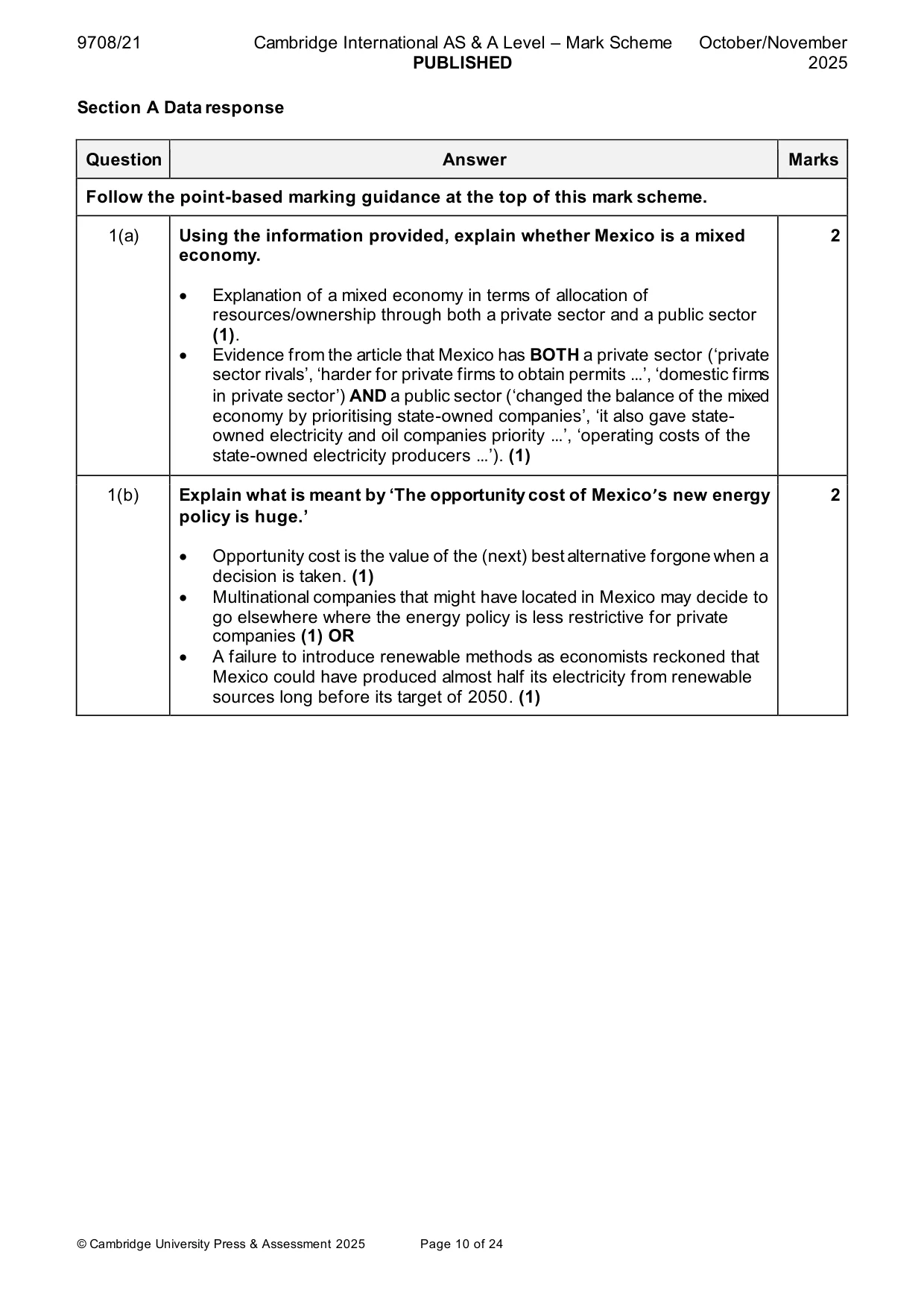
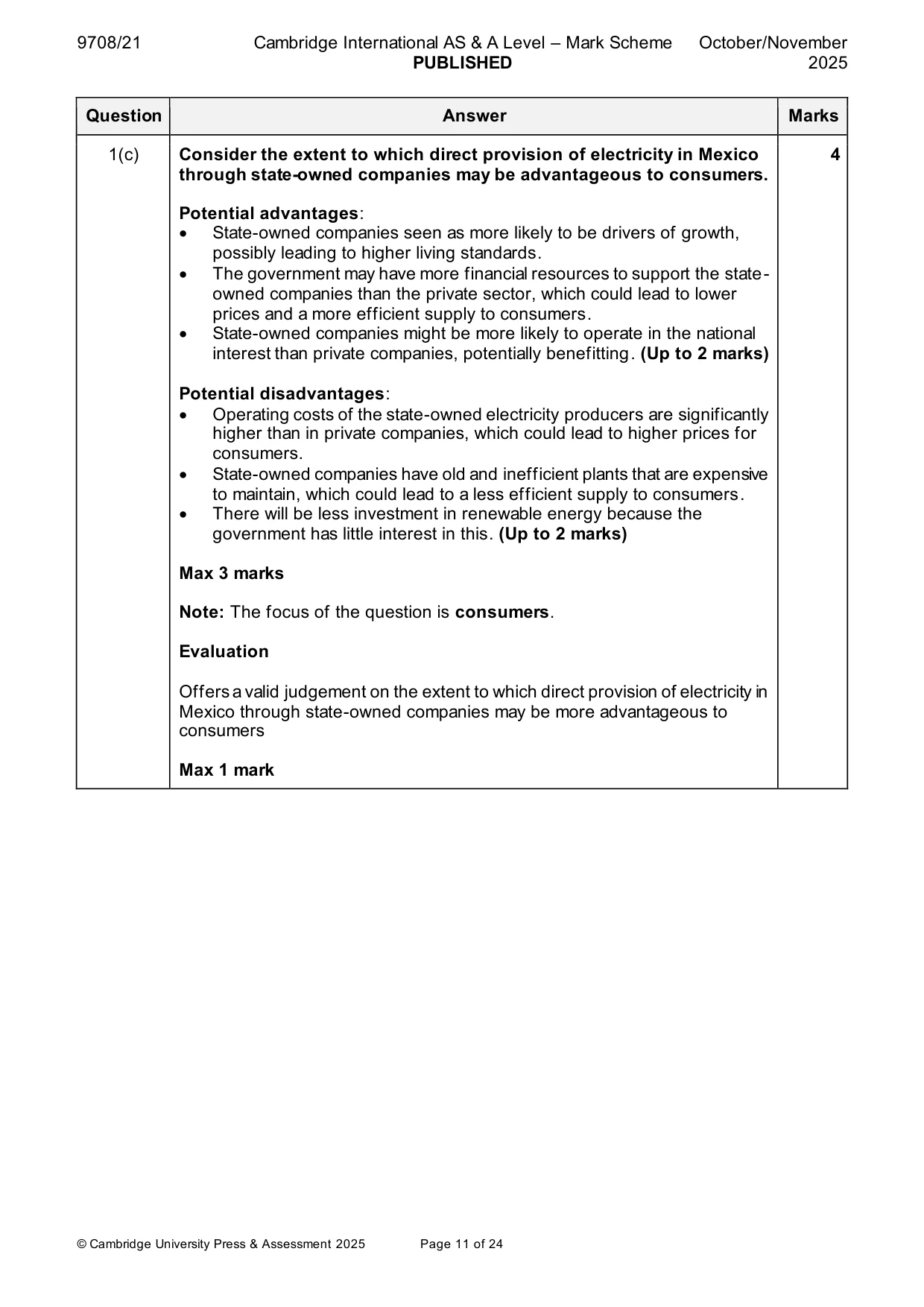
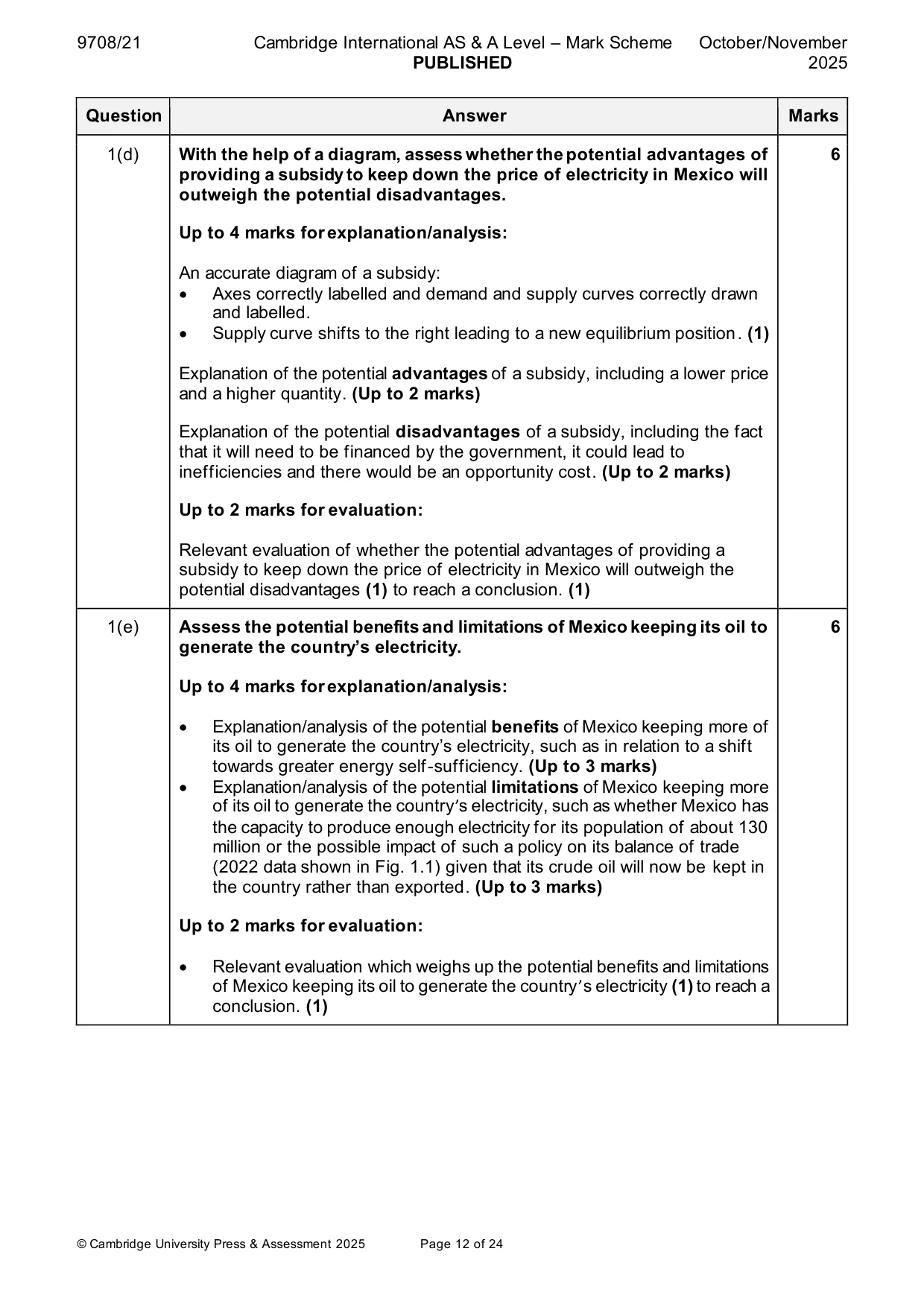
Mark scheme: Question Answer Marks Follow the point-based marking guidance at the top of this mark scheme. 1(a) Using the information provided, explain whether Mexico is a mixed 2 economy. • Explanation of a mixed economy in terms of allocation of resources/ownership through both a private sector and a public sector (1). • Evidence from the article that Mexico has BOTH a private sector (‘private sector rivals’, ‘harder for private firms to obtain permits …’, ‘domestic firms in private sector’) AND a public sector (‘changed the balance of the mixed economy by prioritising state-owned companies’, ‘it also gave state- owned electricity and oil companies priority …’, ‘operating costs of the state-owned electricity producers …’). (1) 1(b) Explain what is meant by ‘The opportunity cost of Mexico’s new energy 2 policy is huge.’ • Opportunity cost is the value of the (next) best alternative forgone when a decision is taken. (1) • Multinational companies that might have located in Mexico may decide to go elsewhere where the energy policy is less restrictive for private companies (1) OR • A failure to introduce renewable methods as economists reckoned that Mexico could have produced almost half its electricity from renewable sources long before its target of 2050. (1) 1(c) Consider the extent to which direct provision of electricity in Mexico 4 through state-owned companies may be advantageous to consumers. Potential advantages: • State-owned companies seen as more likely to be drivers of growth, possibly leading to higher living standards. • The government may have more financial resources to support the state- owned companies than the private sector, which could lead to lower prices and a more efficient supply to consumers. • State-owned companies might be more likely to operate in the national interest than private companies, potentially benefitting. (Up to 2 marks) Potential disadvantages: • Operating costs of the state-owned electricity producers are significantly higher than in private companies, which could lead to higher prices for consumers. • State-owned companies have old and inefficient plants that are expensive to maintain, which could lead to a less efficient supply to consumers. • There will be less investment in renewable energy because the government has little interest in this. (Up to 2 marks) Max 3 marks Note: The focus of the question is consumers. Evaluation Offers a valid judgement on the extent to which direct provision of electricity in Mexico through state-owned companies may be more advantageous to consumers Max 1 mark 1(d) With the help of a diagram, assess whether the potential advantages of 6 providing a subsidy to keep down the price of electricity in Mexico will outweigh the potential disadvantages. Up to 4 marks for explanation/analysis: An accurate diagram of a subsidy: • Axes correctly labelled and demand and supply curves correctly drawn and labelled. • Supply curve shifts to the right leading to a new equilibrium position. (1) Explanation of the potential advantages of a subsidy, including a lower price and a higher quantity. (Up to 2 marks) Explanation of the potential disadvantages of a subsidy, including the fact that it will need to be financed by the government, it could lead to inefficiencies and there would be an opportunity cost. (Up to 2 marks) Up to 2 marks for evaluation: Relevant evaluation of whether the potential advantages of providing a subsidy to keep down the price of electricity in Mexico will outweigh the potential disadvantages (1) to reach a conclusion. (1) 1(e) Assess the potential benefits and limitations of Mexico keeping its oil to 6 generate the country’s electricity. Up to 4 marks for explanation/analysis: • Explanation/analysis of the potential benefits of Mexico keeping more of its oil to generate the country’s electricity, such as in relation to a shift towards greater energy self-sufficiency. (Up to 3 marks) • Explanation/analysis of the potential limitations of Mexico keeping more of its oil to generate the country’s electricity, such as whether Mexico has the capacity to produce enough electricity for its population of about 130 million or the possible impact of such a policy on its balance of trade (2022 data shown in Fig. 1.1) given that its crude oil will now be kept in the country rather than exported. (Up to 3 marks) Up to 2 marks for evaluation: • Relevant evaluation which weighs up the potential benefits and limitations of Mexico keeping its oil to generate the country’s electricity (1) to reach a conclusion. (1)
More questions on Methods and effects of government intervention in markets
Q2 · With the help of a formula, explain what is meant by price elasticity of demand for a…
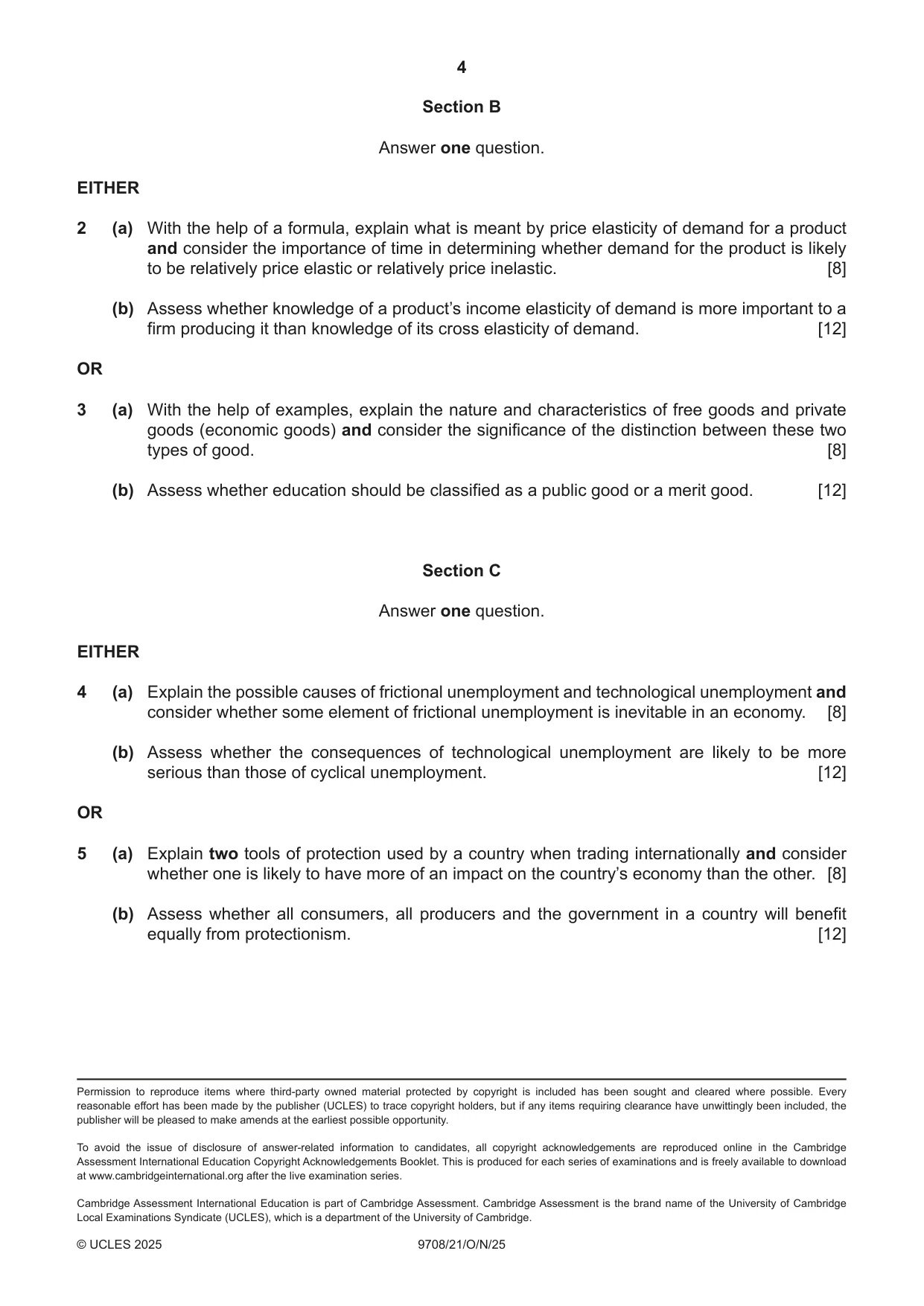
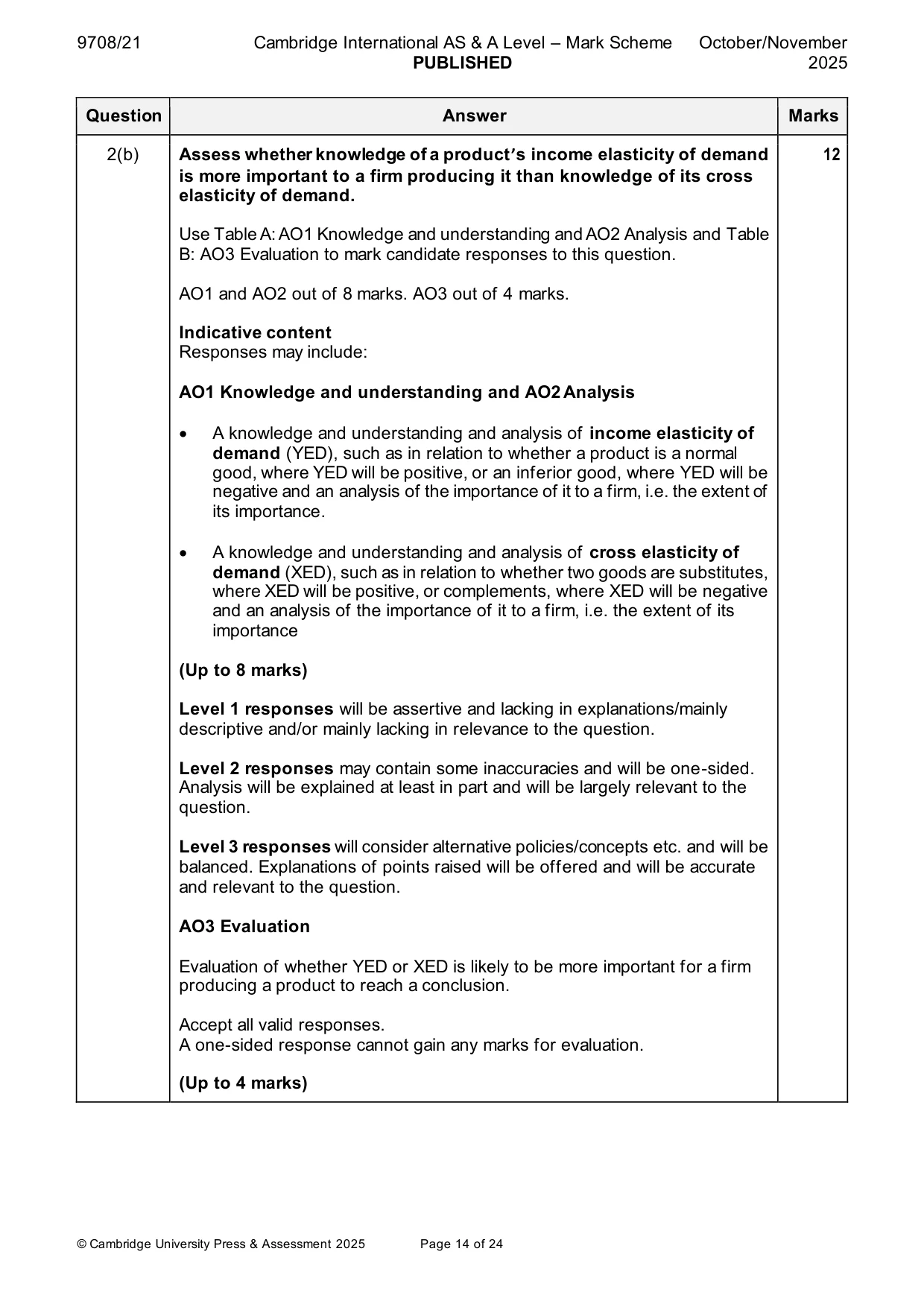
2 (a) With the help of a formula, explain what is meant by price elasticity of demand for a product and consider the importance of time in determining whether demand for the product is likely to be relatively price elastic or relatively price inelastic. [8] (b) Assess whether knowledge of a product’s income elasticity of demand is more important to a firm producing it than knowledge of its cross elasticity of demand. [12] OR
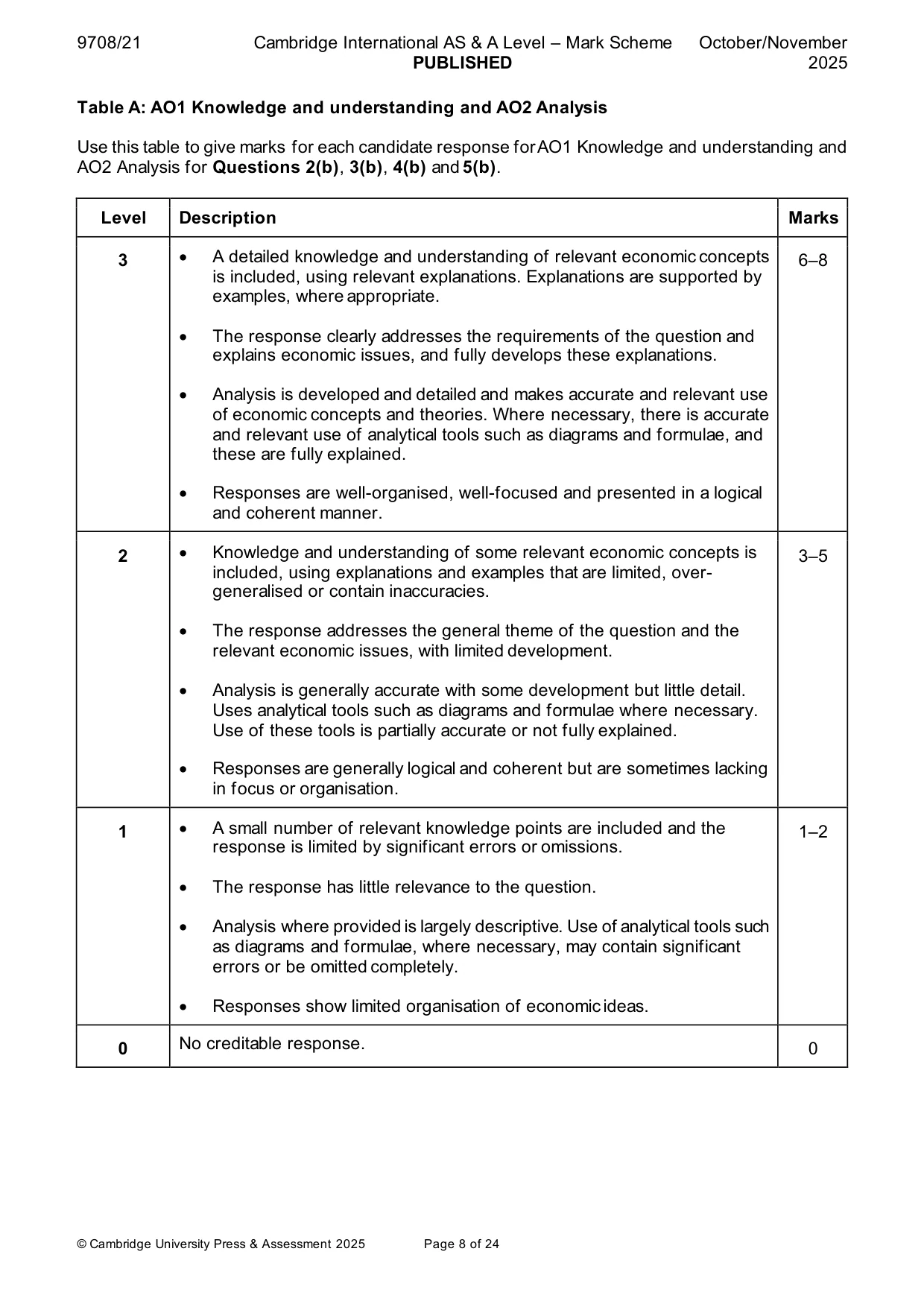
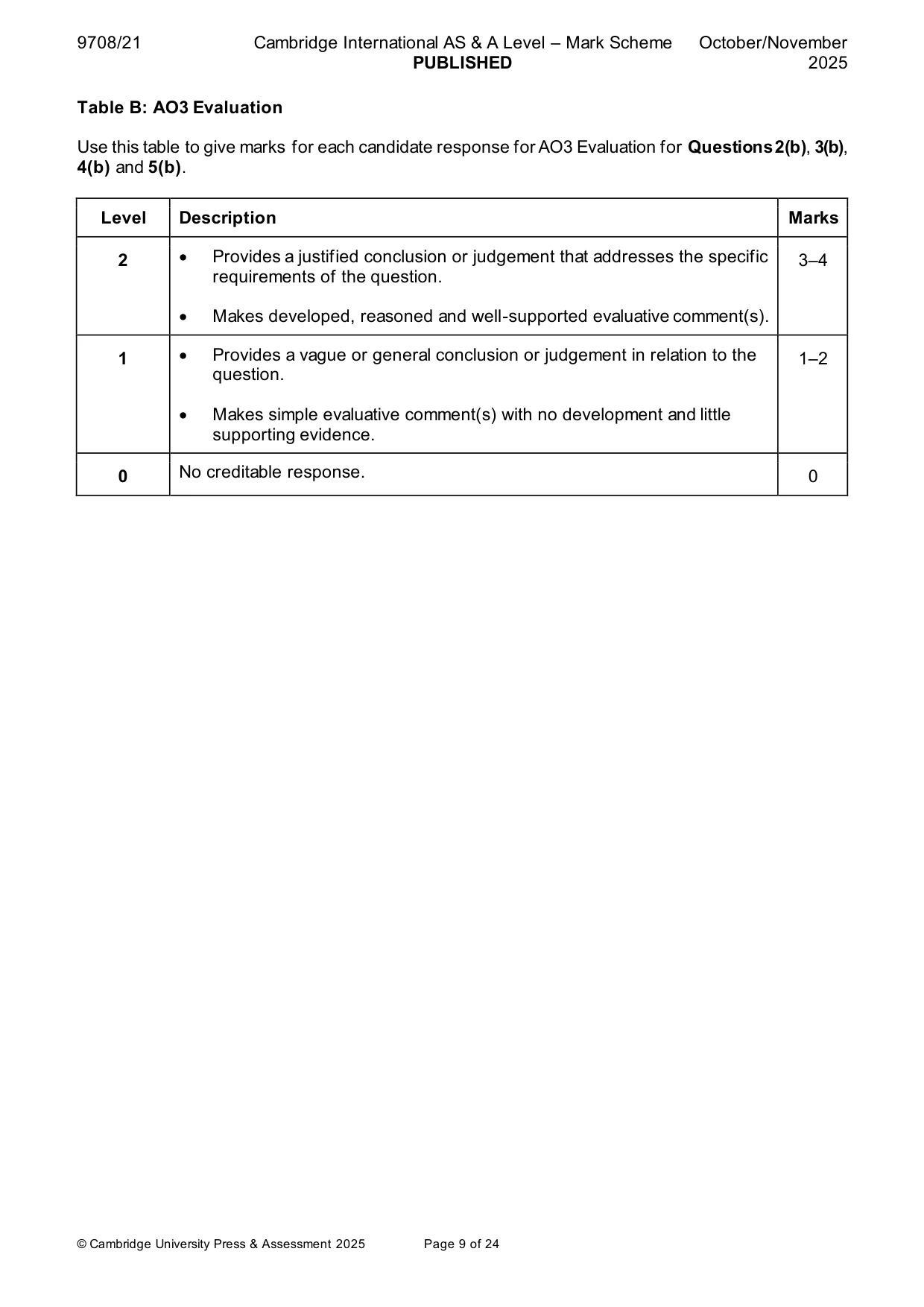
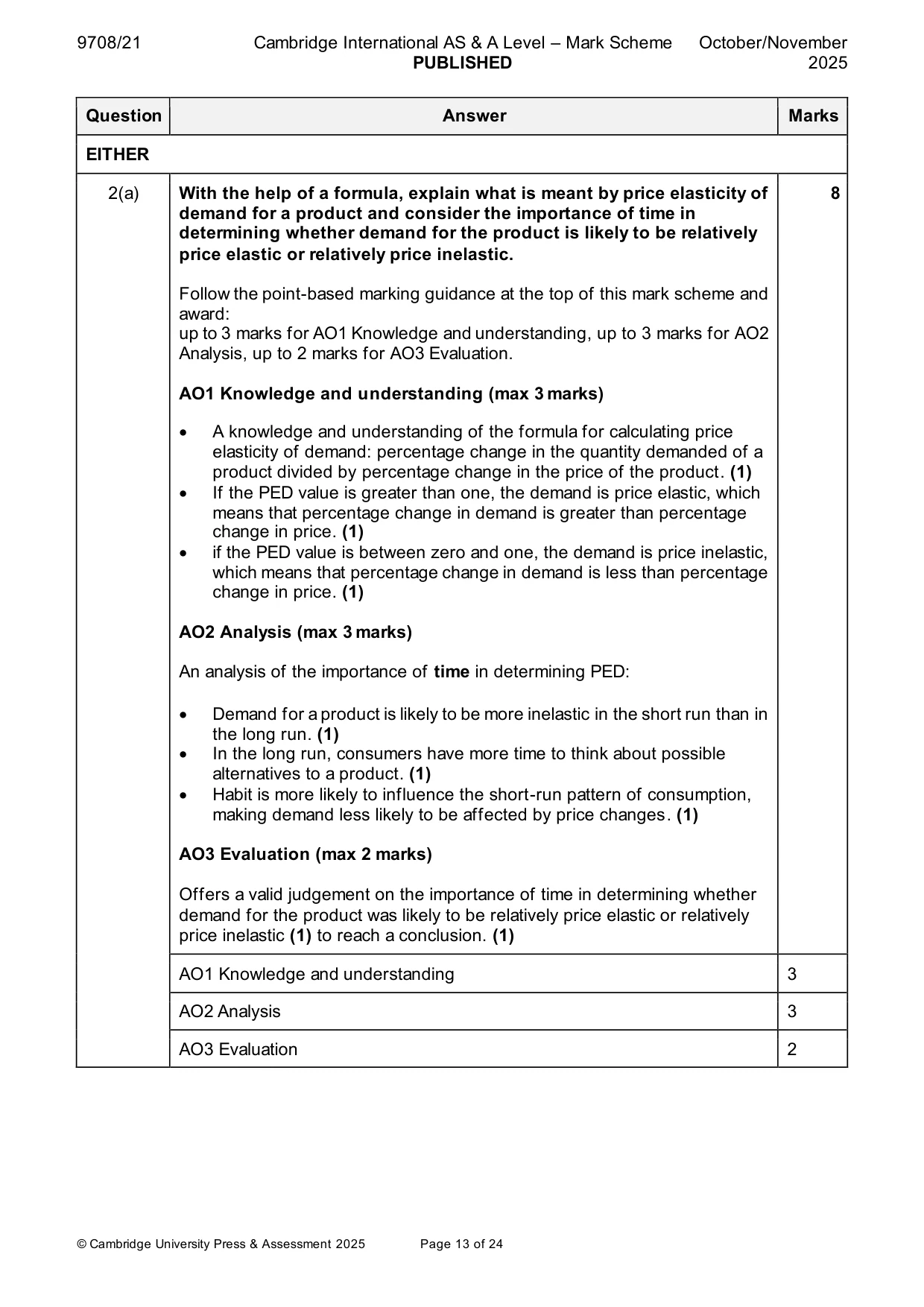
Mark scheme: 2(a) With the help of a formula, explain what is meant by price elasticity of 8 demand for a product and consider the importance of time in determining whether demand for the product is likely to be relatively price elastic or relatively price inelastic. Follow the point-based marking guidance at the top of this mark scheme and award: up to 3 marks for AO1 Knowledge and understanding, up to 3 marks for AO2 Analysis, up to 2 marks for AO3 Evaluation. AO1 Knowledge and understanding (max 3 marks) • A knowledge and understanding of the formula for calculating price elasticity of demand: percentage change in the quantity demanded of a product divided by percentage change in the price of the product. (1) • If the PED value is greater than one, the demand is price elastic, which means that percentage change in demand is greater than percentage change in price. (1) • if the PED value is between zero and one, the demand is price inelastic, which means that percentage change in demand is less than percentage change in price. (1) AO2 Analysis (max 3 marks) An analysis of the importance of time in determining PED: • Demand for a product is likely to be more inelastic in the short run than in the long run. (1) • In the long run, consumers have more time to think about possible alternatives to a product. (1) • Habit is more likely to influence the short-run pattern of consumption, making demand less likely to be affected by price changes. (1) AO3 Evaluation (max 2 marks) Offers a valid judgement on the importance of time in determining whether demand for the product was likely to be relatively price elastic or relatively price inelastic (1) to reach a conclusion. (1) AO1 Knowledge and understanding 3 AO2 Analysis 3 AO3 Evaluation 2 2(b) Assess whether knowledge of a product’s income elasticity of demand 12 is more important to a firm producing it than knowledge of its cross elasticity of demand. Use Table A: AO1 Knowledge and understanding and AO2 Analysis and Table B: AO3 Evaluation to mark candidate responses to this question. AO1 and AO2 out of 8 marks. AO3 out of 4 marks. Indicative content Responses may include: AO1 Knowledge and understanding and AO2 Analysis • A knowledge and understanding and analysis of income elasticity of demand (YED), such as in relation to whether a product is a normal good, where YED will be positive, or an inferior good, where YED will be negative and an analysis of the importance of it to a firm, i.e. the extent of its importance. • A knowledge and understanding and analysis of cross elasticity of demand (XED), such as in relation to whether two goods are substitutes, where XED will be positive, or complements, where XED will be negative and an analysis of the importance of it to a firm, i.e. the extent of its importance (Up to 8 marks) Level 1 responses will be assertive and lacking in explanations/mainly descriptive and/or mainly lacking in relevance to the question. Level 2 responses may contain some inaccuracies and will be one-sided. Analysis will be explained at least in part and will be largely relevant to the question. Level 3 responses will consider alternative policies/concepts etc. and will be balanced. Explanations of points raised will be offered and will be accurate and relevant to the question. AO3 Evaluation Evaluation of whether YED or XED is likely to be more important for a firm producing a product to reach a conclusion. Accept all valid responses. A one-sided response cannot gain any marks for evaluation. (Up to 4 marks) 2(b) AO1 Knowledge and understanding and AO2 Analysis 8 AO3 Evaluation 4
More questions on Price elasticity, income elasticity and cross elasticity of demand
Q3 · With the help of examples, explain the nature and characteristics of free goods and…
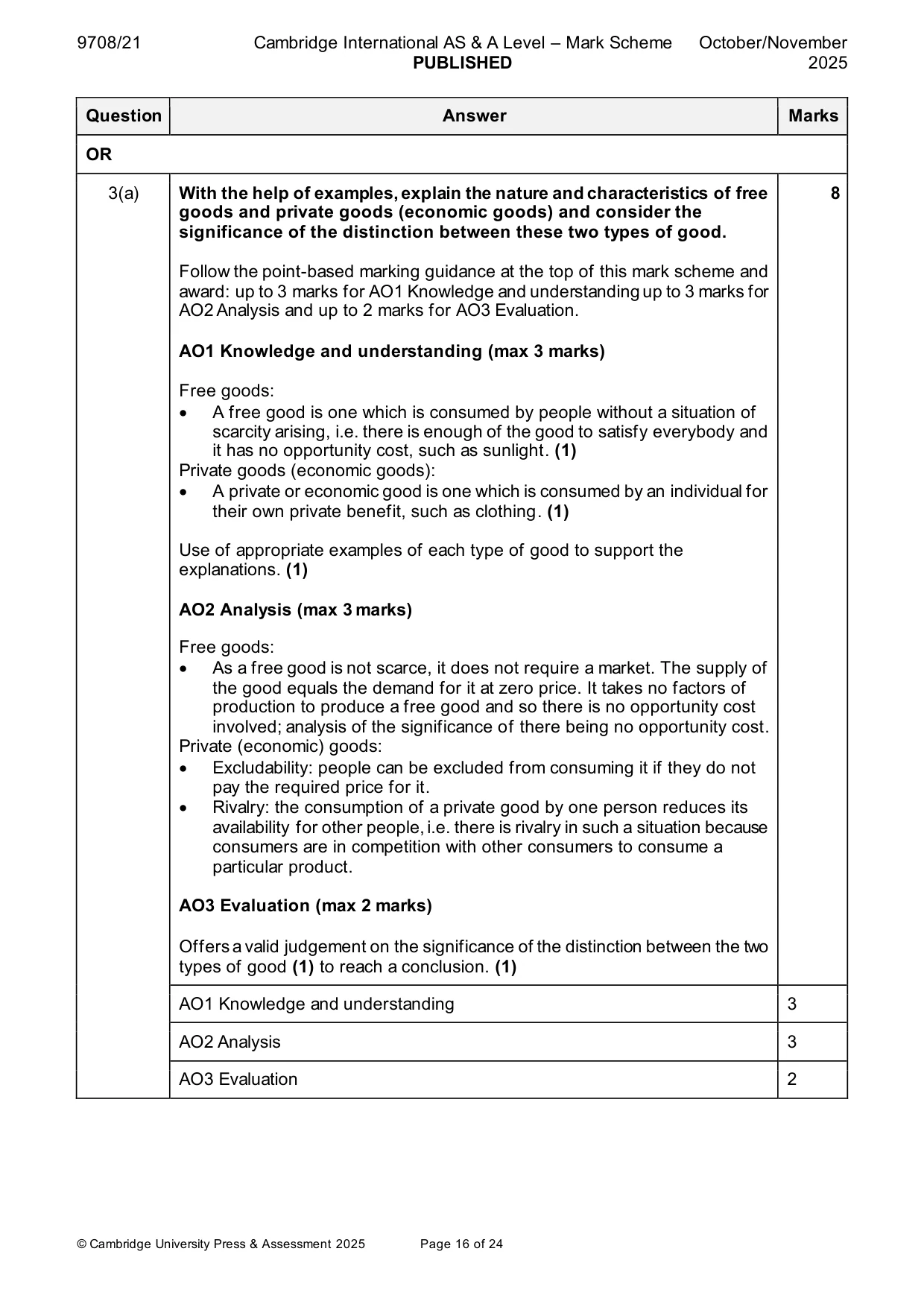
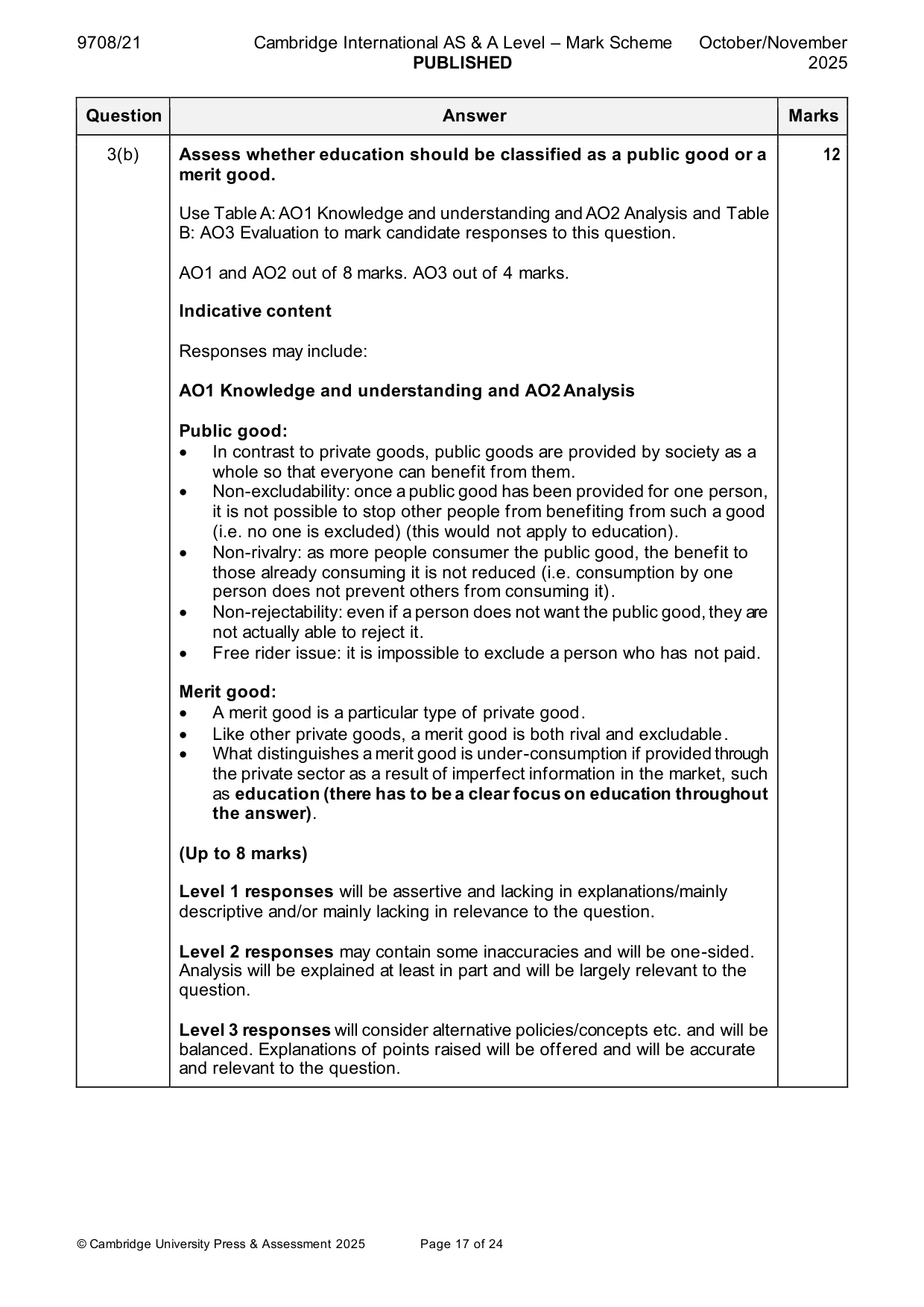
3 (a) With the help of examples, explain the nature and characteristics of free goods and private goods (economic goods) and consider the significance of the distinction between these two types of good. [8] (b) Assess whether education should be classified as a public good or a merit good. [12] Section C Answer one question. EITHER
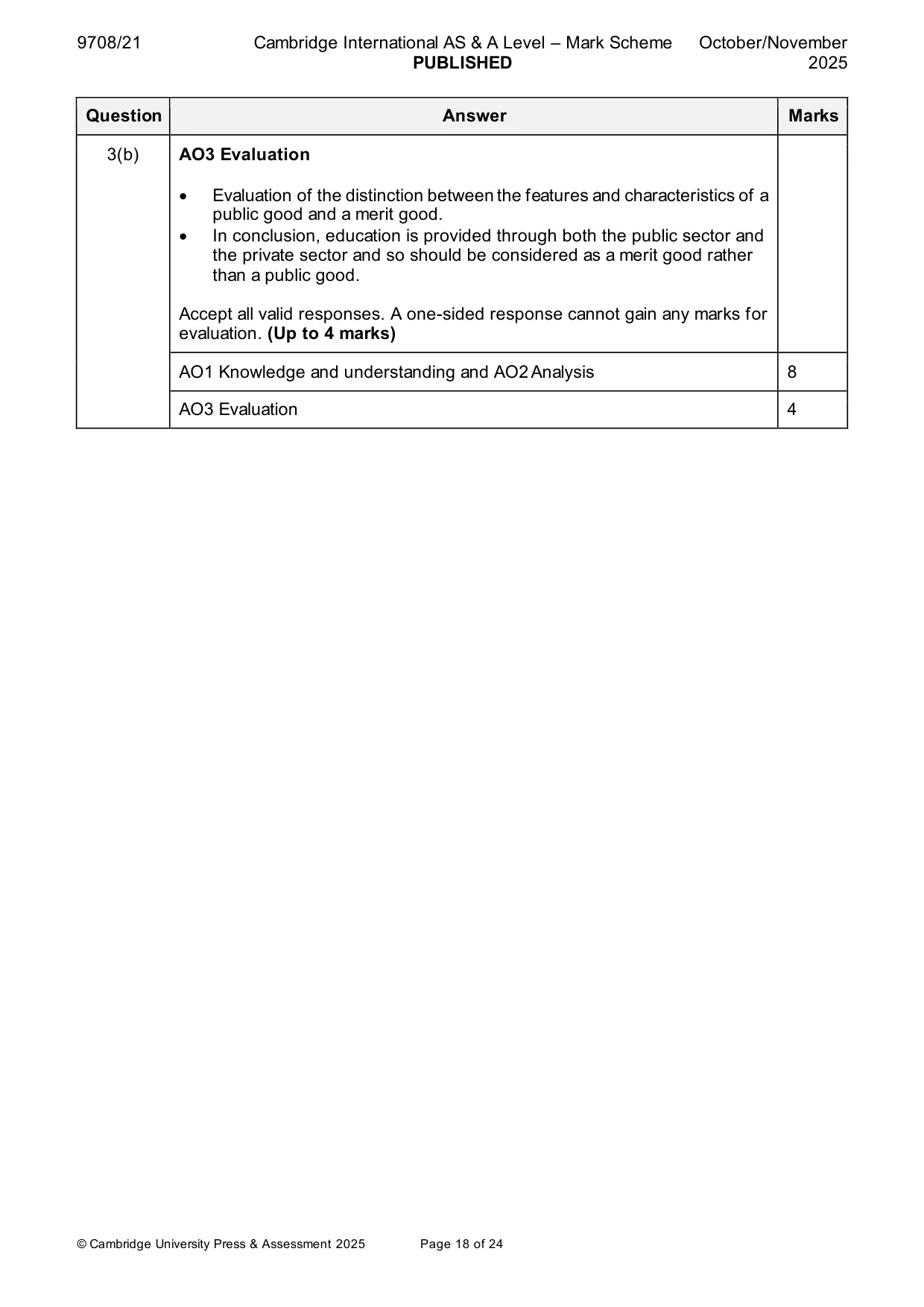
Mark scheme: 3(a) With the help of examples, explain the nature and characteristics of free 8 goods and private goods (economic goods) and consider the significance of the distinction between these two types of good. Follow the point-based marking guidance at the top of this mark scheme and award: up to 3 marks for AO1 Knowledge and understanding up to 3 marks for AO2 Analysis and up to 2 marks for AO3 Evaluation. AO1 Knowledge and understanding (max 3 marks) Free goods: • A free good is one which is consumed by people without a situation of scarcity arising, i.e. there is enough of the good to satisfy everybody and it has no opportunity cost, such as sunlight. (1) Private goods (economic goods): • A private or economic good is one which is consumed by an individual for their own private benefit, such as clothing. (1) Use of appropriate examples of each type of good to support the explanations. (1) AO2 Analysis (max 3 marks) Free goods: • As a free good is not scarce, it does not require a market. The supply of the good equals the demand for it at zero price. It takes no factors of production to produce a free good and so there is no opportunity cost involved; analysis of the significance of there being no opportunity cost. Private (economic) goods: • Excludability: people can be excluded from consuming it if they do not pay the required price for it. • Rivalry: the consumption of a private good by one person reduces its availability for other people, i.e. there is rivalry in such a situation because consumers are in competition with other consumers to consume a particular product. AO3 Evaluation (max 2 marks) Offers a valid judgement on the significance of the distinction between the two types of good (1) to reach a conclusion. (1) AO1 Knowledge and understanding 3 AO2 Analysis 3 AO3 Evaluation 2 3(b) Assess whether education should be classified as a public good or a 12 merit good. Use Table A: AO1 Knowledge and understanding and AO2 Analysis and Table B: AO3 Evaluation to mark candidate responses to this question. AO1 and AO2 out of 8 marks. AO3 out of 4 marks. Indicative content Responses may include: AO1 Knowledge and understanding and AO2 Analysis Public good: • In contrast to private goods, public goods are provided by society as a whole so that everyone can benefit from them. • Non-excludability: once a public good has been provided for one person, it is not possible to stop other people from benefiting from such a good (i.e. no one is excluded) (this would not apply to education). • Non-rivalry: as more people consumer the public good, the benefit to those already consuming it is not reduced (i.e. consumption by one person does not prevent others from consuming it). • Non-rejectability: even if a person does not want the public good, they are not actually able to reject it. • Free rider issue: it is impossible to exclude a person who has not paid. Merit good: • A merit good is a particular type of private good. • Like other private goods, a merit good is both rival and excludable. • What distinguishes a merit good is under-consumption if provided through the private sector as a result of imperfect information in the market, such as education (there has to be a clear focus on education throughout the answer). (Up to 8 marks) Level 1 responses will be assertive and lacking in explanations/mainly descriptive and/or mainly lacking in relevance to the question. Level 2 responses may contain some inaccuracies and will be one-sided. Analysis will be explained at least in part and will be largely relevant to the question. Level 3 responses will consider alternative policies/concepts etc. and will be balanced. Explanations of points raised will be offered and will be accurate and relevant to the question. 3(b) AO3 Evaluation • Evaluation of the distinction between the features and characteristics of a public good and a merit good. • In conclusion, education is provided through both the public sector and the private sector and so should be considered as a merit good rather than a public good. Accept all valid responses. A one-sided response cannot gain any marks for evaluation. (Up to 4 marks) AO1 Knowledge and understanding and AO2 Analysis 8 AO3 Evaluation 4
More questions on Private costs and benefits, externalities and social costs and benefits
Q4 · Explain the possible causes of frictional unemployment and technological unemployment and…
4 (a) Explain the possible causes of frictional unemployment and technological unemployment and consider whether some element of frictional unemployment is inevitable in an economy. [8] (b) Assess whether the consequences of technological unemployment are likely to be more serious than those of cyclical unemployment. [12] OR
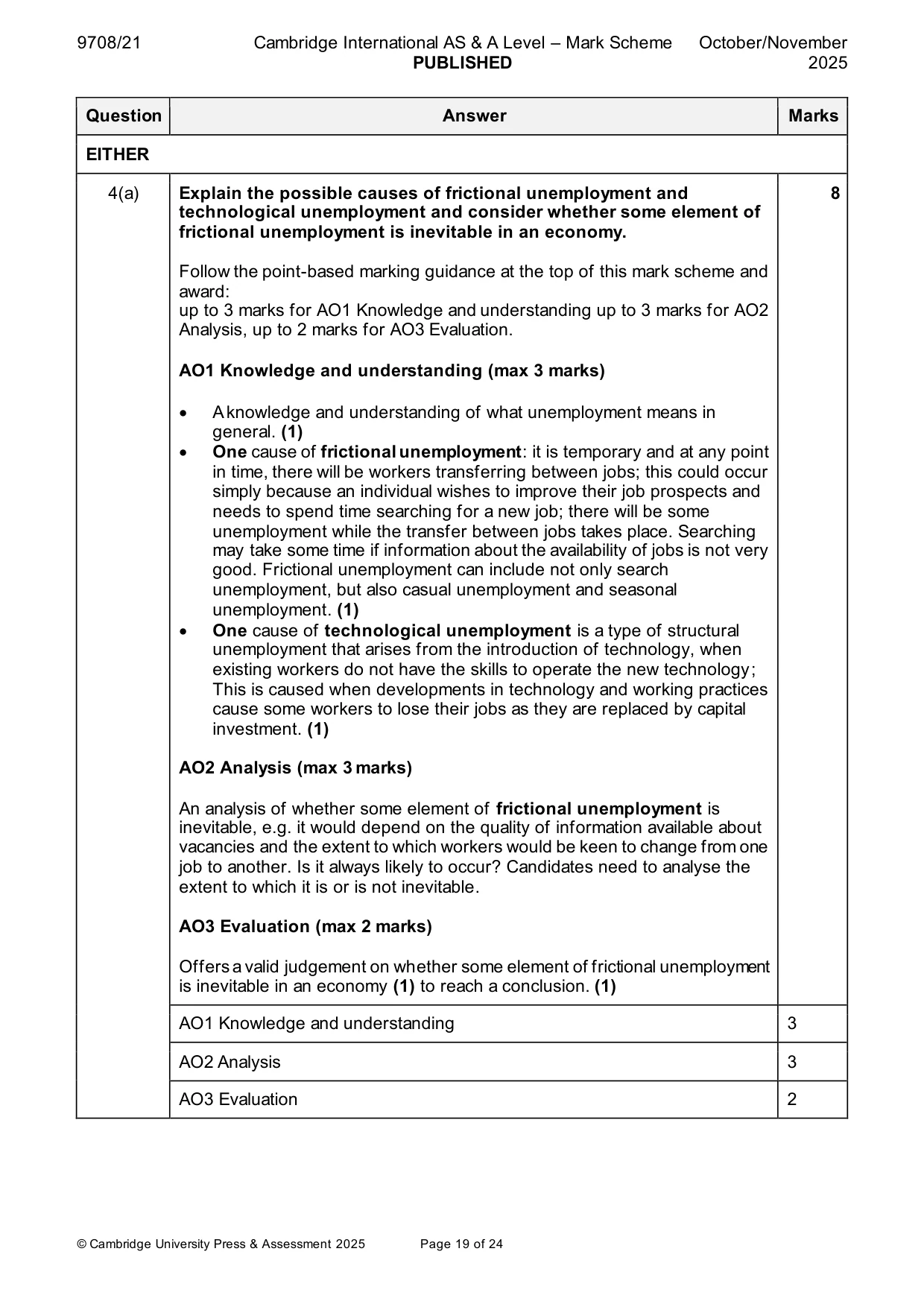
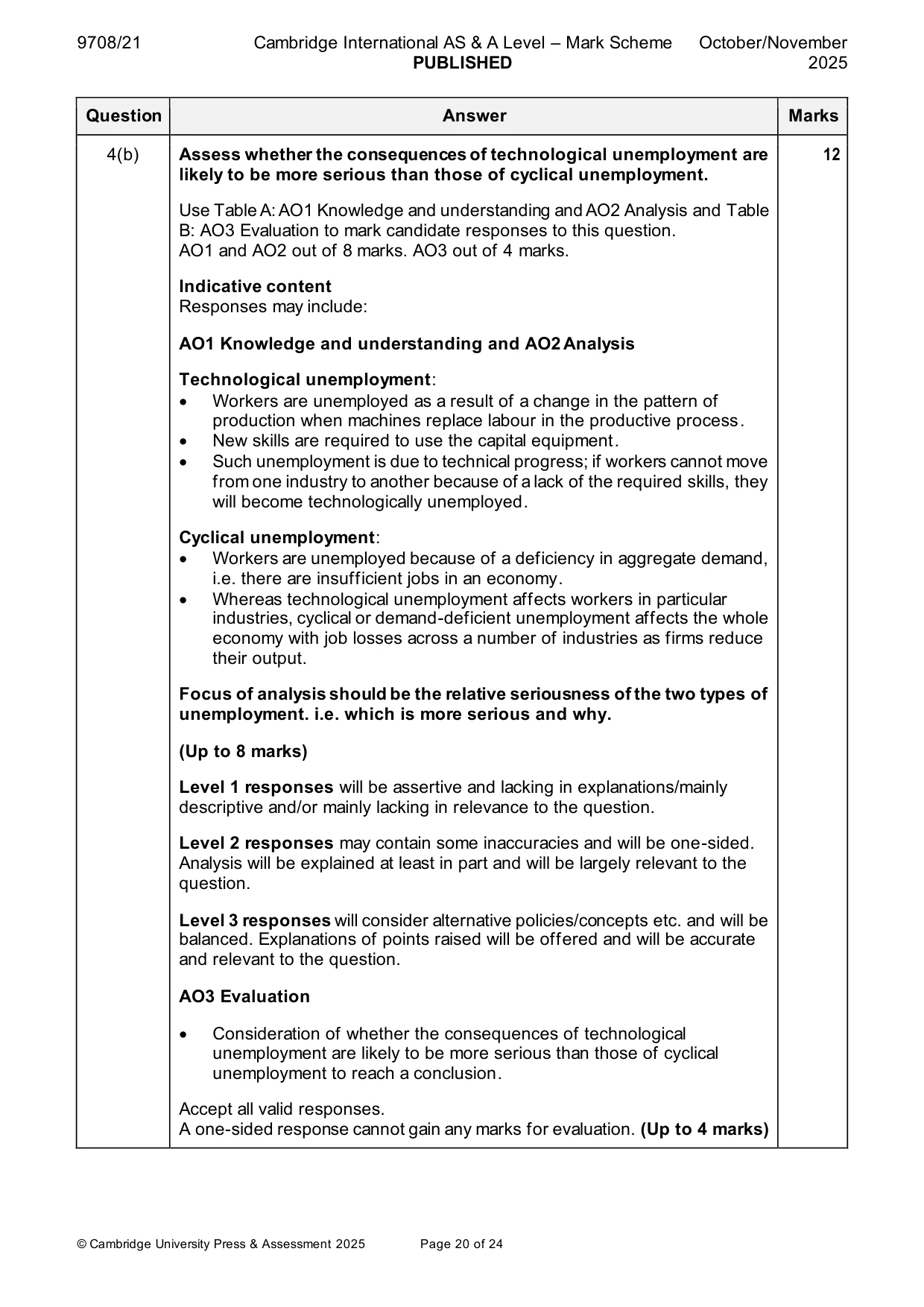
Mark scheme: 4(a) Explain the possible causes of frictional unemployment and 8 technological unemployment and consider whether some element of frictional unemployment is inevitable in an economy. Follow the point-based marking guidance at the top of this mark scheme and award: up to 3 marks for AO1 Knowledge and understanding up to 3 marks for AO2 Analysis, up to 2 marks for AO3 Evaluation. AO1 Knowledge and understanding (max 3 marks) • A knowledge and understanding of what unemployment means in general. (1) • One cause of frictional unemployment: it is temporary and at any point in time, there will be workers transferring between jobs; this could occur simply because an individual wishes to improve their job prospects and needs to spend time searching for a new job; there will be some unemployment while the transfer between jobs takes place. Searching may take some time if information about the availability of jobs is not very good. Frictional unemployment can include not only search unemployment, but also casual unemployment and seasonal unemployment. (1) • One cause of technological unemployment is a type of structural unemployment that arises from the introduction of technology, when existing workers do not have the skills to operate the new technology; This is caused when developments in technology and working practices cause some workers to lose their jobs as they are replaced by capital investment. (1) AO2 Analysis (max 3 marks) An analysis of whether some element of frictional unemployment is inevitable, e.g. it would depend on the quality of information available about vacancies and the extent to which workers would be keen to change from one job to another. Is it always likely to occur? Candidates need to analyse the extent to which it is or is not inevitable. AO3 Evaluation (max 2 marks) Offers a valid judgement on whether some element of frictional unemployment is inevitable in an economy (1) to reach a conclusion. (1) AO1 Knowledge and understanding 3 AO2 Analysis 3 AO3 Evaluation 2 4(b) Assess whether the consequences of technological unemployment are 12 likely to be more serious than those of cyclical unemployment. Use Table A: AO1 Knowledge and understanding and AO2 Analysis and Table B: AO3 Evaluation to mark candidate responses to this question. AO1 and AO2 out of 8 marks. AO3 out of 4 marks. Indicative content Responses may include: AO1 Knowledge and understanding and AO2 Analysis Technological unemployment: • Workers are unemployed as a result of a change in the pattern of production when machines replace labour in the productive process. • New skills are required to use the capital equipment. • Such unemployment is due to technical progress; if workers cannot move from one industry to another because of a lack of the required skills, they will become technologically unemployed. Cyclical unemployment: • Workers are unemployed because of a deficiency in aggregate demand, i.e. there are insufficient jobs in an economy. • Whereas technological unemployment affects workers in particular industries, cyclical or demand-deficient unemployment affects the whole economy with job losses across a number of industries as firms reduce their output. Focus of analysis should be the relative seriousness of the two types of unemployment. i.e. which is more serious and why. (Up to 8 marks) Level 1 responses will be assertive and lacking in explanations/mainly descriptive and/or mainly lacking in relevance to the question. Level 2 responses may contain some inaccuracies and will be one-sided. Analysis will be explained at least in part and will be largely relevant to the question. Level 3 responses will consider alternative policies/concepts etc. and will be balanced. Explanations of points raised will be offered and will be accurate and relevant to the question. AO3 Evaluation • Consideration of whether the consequences of technological unemployment are likely to be more serious than those of cyclical unemployment to reach a conclusion. Accept all valid responses. A one-sided response cannot gain any marks for evaluation. (Up to 4 marks) 4(b) AO1 Knowledge and understanding and AO2 Analysis 8 AO3 Evaluation 4
Q5 · Explain two tools of protection used by a country when trading internationally and…
5 (a) Explain two tools of protection used by a country when trading internationally and consider whether one is likely to have more of an impact on the country’s economy than the other. [8] (b) Assess whether all consumers, all producers and the government in a country will benefit equally from protectionism. [12]
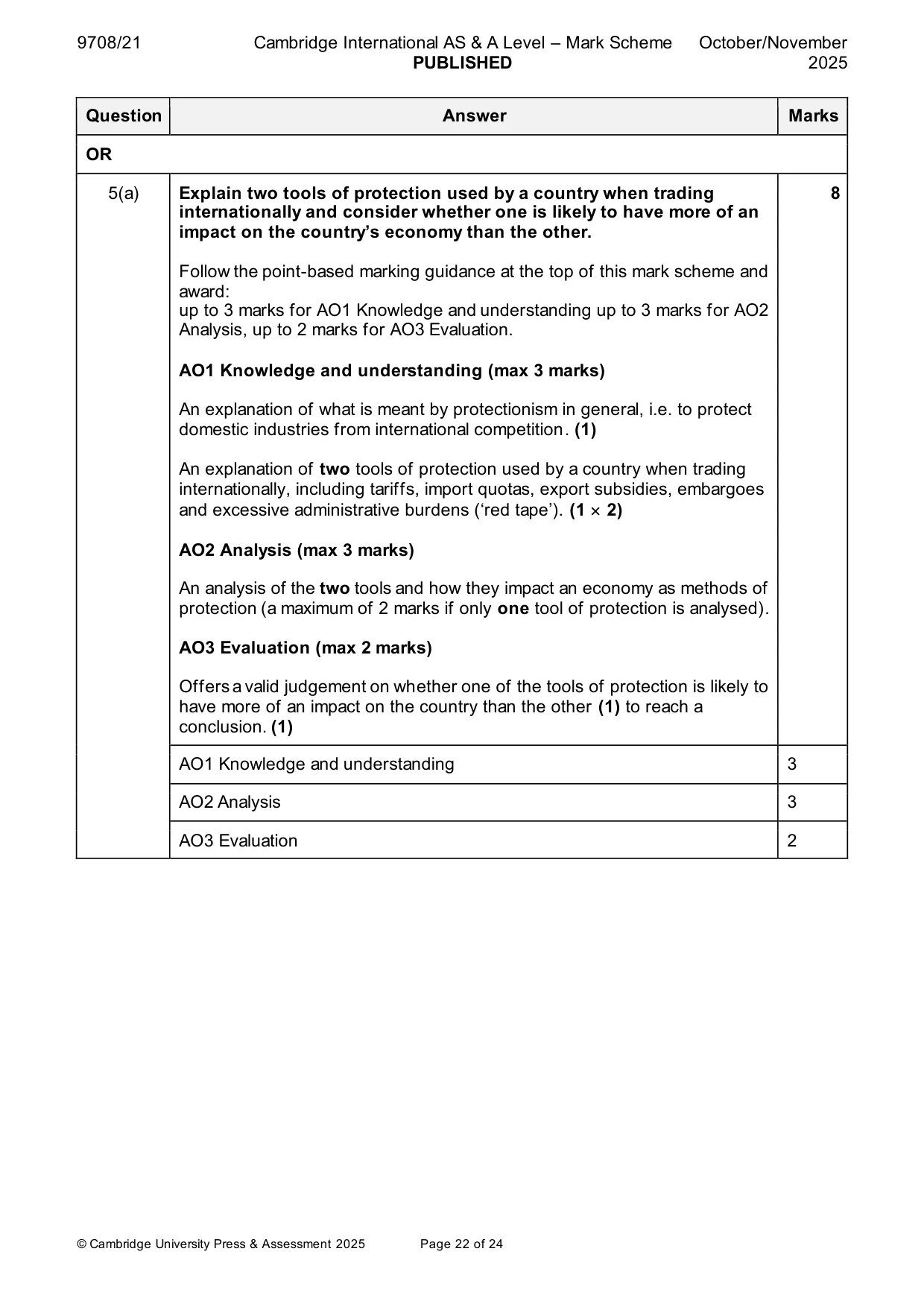
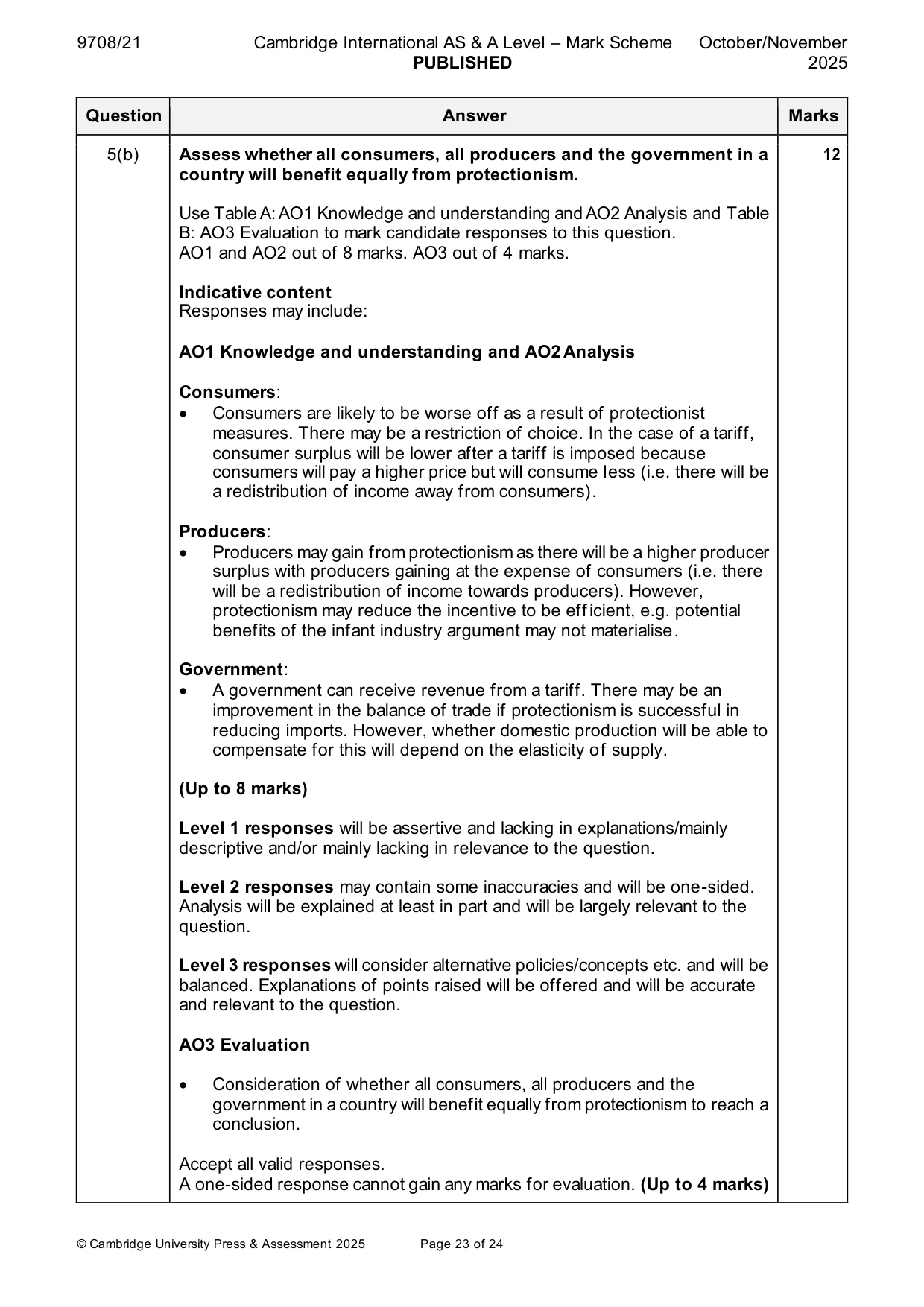
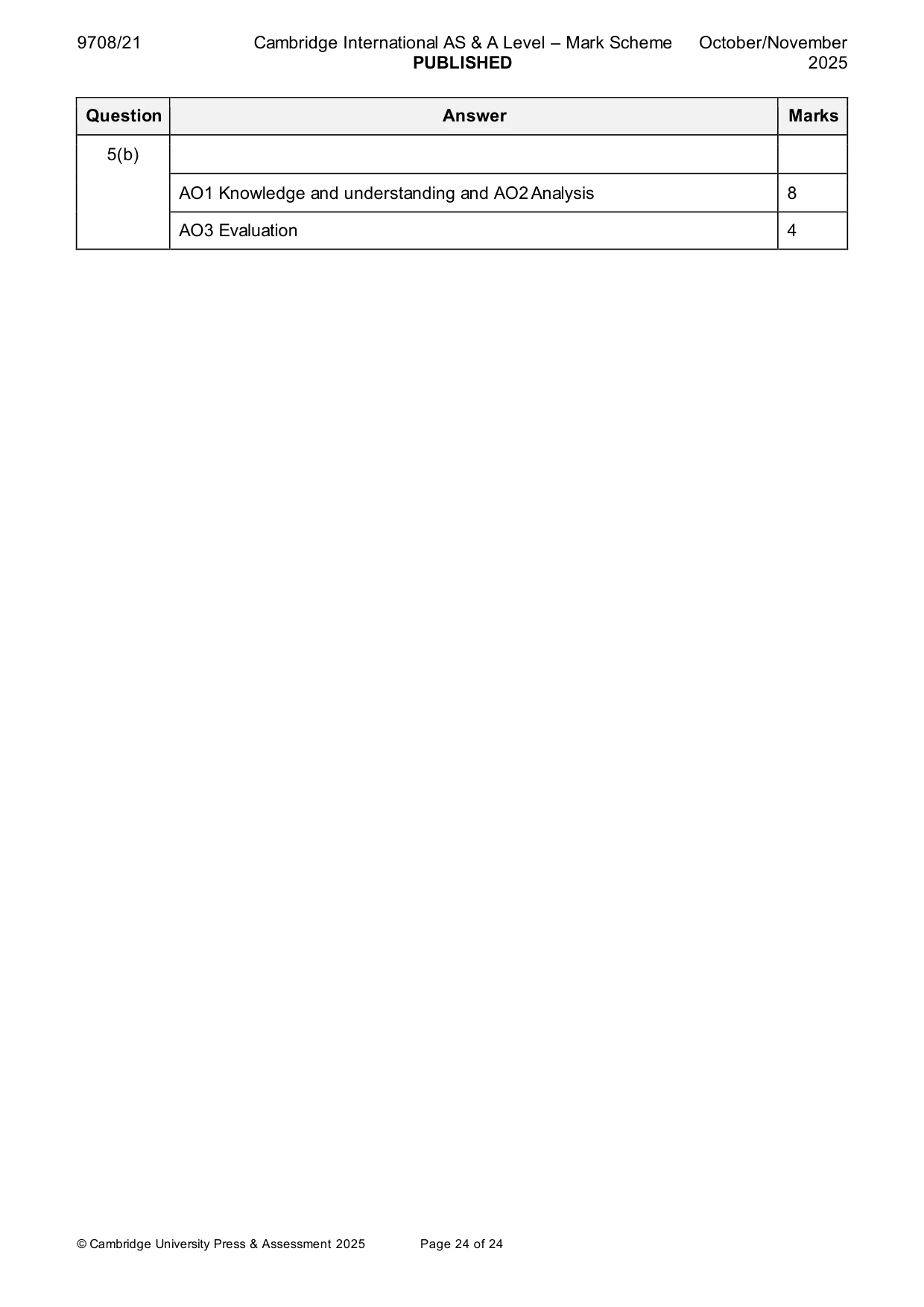
Mark scheme: 5(a) Explain two tools of protection used by a country when trading 8 internationally and consider whether one is likely to have more of an impact on the country’s economy than the other. Follow the point-based marking guidance at the top of this mark scheme and award: up to 3 marks for AO1 Knowledge and understanding up to 3 marks for AO2 Analysis, up to 2 marks for AO3 Evaluation. AO1 Knowledge and understanding (max 3 marks) An explanation of what is meant by protectionism in general, i.e. to protect domestic industries from international competition. (1) An explanation of two tools of protection used by a country when trading internationally, including tariffs, import quotas, export subsidies, embargoes and excessive administrative burdens (‘red tape’). (1 2) AO2 Analysis (max 3 marks) An analysis of the two tools and how they impact an economy as methods of protection (a maximum of 2 marks if only one tool of protection is analysed). AO3 Evaluation (max 2 marks) Offers a valid judgement on whether one of the tools of protection is likely to have more of an impact on the country than the other (1) to reach a conclusion. (1) AO1 Knowledge and understanding 3 AO2 Analysis 3 AO3 Evaluation 2 5(b) Assess whether all consumers, all producers and the government in a 12 country will benefit equally from protectionism. Use Table A: AO1 Knowledge and understanding and AO2 Analysis and Table B: AO3 Evaluation to mark candidate responses to this question. AO1 and AO2 out of 8 marks. AO3 out of 4 marks. Indicative content Responses may include: AO1 Knowledge and understanding and AO2 Analysis Consumers: • Consumers are likely to be worse off as a result of protectionist measures. There may be a restriction of choice. In the case of a tariff, consumer surplus will be lower after a tariff is imposed because consumers will pay a higher price but will consume less (i.e. there will be a redistribution of income away from consumers). Producers: • Producers may gain from protectionism as there will be a higher producer surplus with producers gaining at the expense of consumers (i.e. there will be a redistribution of income towards producers). However, protectionism may reduce the incentive to be efficient, e.g. potential benefits of the infant industry argument may not materialise. Government: • A government can receive revenue from a tariff. There may be an improvement in the balance of trade if protectionism is successful in reducing imports. However, whether domestic production will be able to compensate for this will depend on the elasticity of supply. (Up to 8 marks) Level 1 responses will be assertive and lacking in explanations/mainly descriptive and/or mainly lacking in relevance to the question. Level 2 responses may contain some inaccuracies and will be one-sided. Analysis will be explained at least in part and will be largely relevant to the question. Level 3 responses will consider alternative policies/concepts etc. and will be balanced. Explanations of points raised will be offered and will be accurate and relevant to the question. AO3 Evaluation • Consideration of whether all consumers, all producers and the government in a country will benefit equally from protectionism to reach a conclusion. Accept all valid responses. A one-sided response cannot gain any marks for evaluation. (Up to 4 marks) 5(b) AO1 Knowledge and understanding and AO2 Analysis 8 AO3 Evaluation 4
What was in this paper
The subtopics covered by these 5 questions, and how many questions each got. Open one in a new tab to see every Cambridge question on it.
What you needed in this session
Cambridge’s own grade thresholds for 2025 Oct/Nov, Paper 2 · Variant 1. A higher threshold means an easier paper — the bar moves with how the cohort did.