Cambridge A Level Economics 9708 — 2025 May/June Paper 2 · Variant 1
9708/21/M/J/25 · 5 questions · 60 marks · ≈68 min
The question paper and its mark scheme, free to read here and free to download. This is Cambridge’s own paper, exactly as it was sat.
Question paper4 pages
Mark scheme20 pages
Answers below. Sit the paper first if you are practising.

Questions as text
Q1 · Inflation rate falls in the United States (US), but fears continue over the economic…
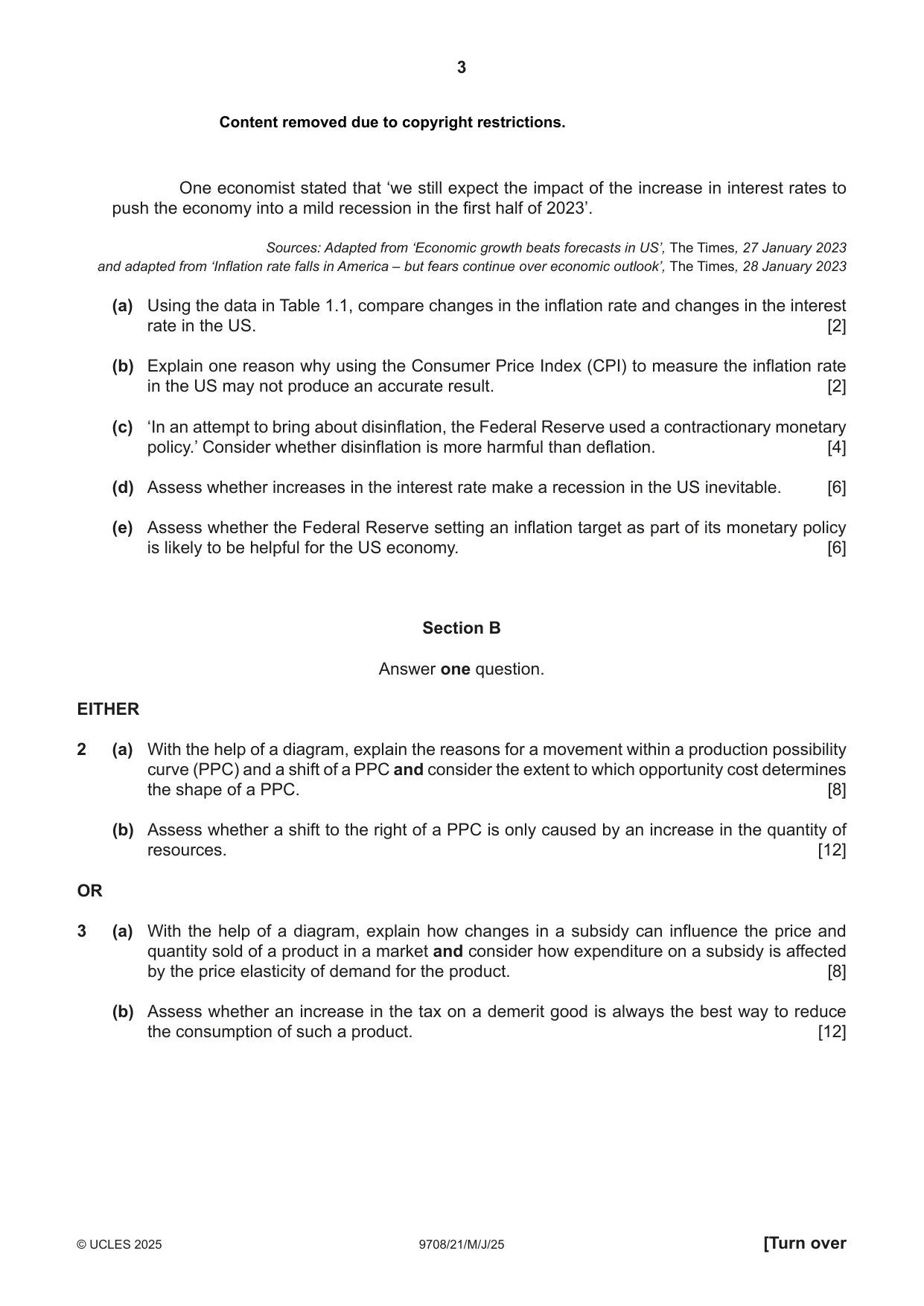
1 Inflation rate falls in the United States (US), but fears continue over the economic outlook Americans have been worried about the rate of inflation in the US, especially the increases in food, rent, energy and vehicle prices. Content removed due to copyright restrictions. Content removed due to copyright restrictions. One economist stated that ‘we still expect the impact of the increase in interest rates to push the economy into a mild recession in the first half of 2023’. Sources: Adapted from ‘Economic growth beats forecasts in US’, The Times, 27 January 2023 and adapted from ‘Inflation rate falls in America – but fears continue over economic outlook’, The Times, 28 January 2023 (a) Using the data in Table 1.1, compare changes in the inflation rate and changes in the interest rate in the US. [2] (b) Explain one reason why using the Consumer Price Index (CPI) to measure the inflation rate in the US may not produce an accurate result. [2] (c) ‘In an attempt to bring about disinflation, the Federal Reserve used a contractionary monetary policy.’ Consider whether disinflation is more harmful than deflation. [4] (d) Assess whether increases in the interest rate make a recession in the US inevitable. [6] (e) Assess whether the Federal Reserve setting an inflation target as part of its monetary policy is likely to be helpful for the US economy. [6]
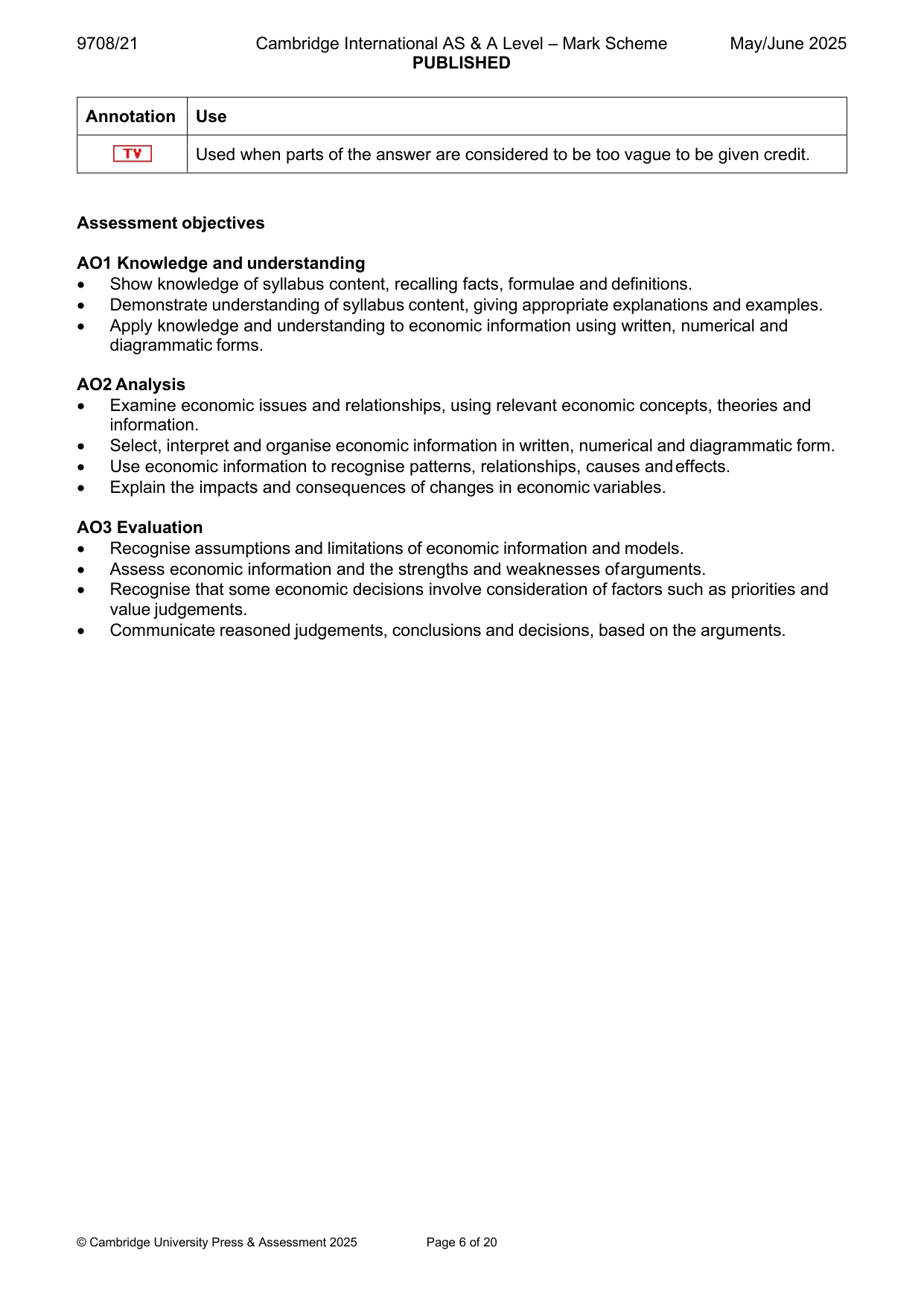
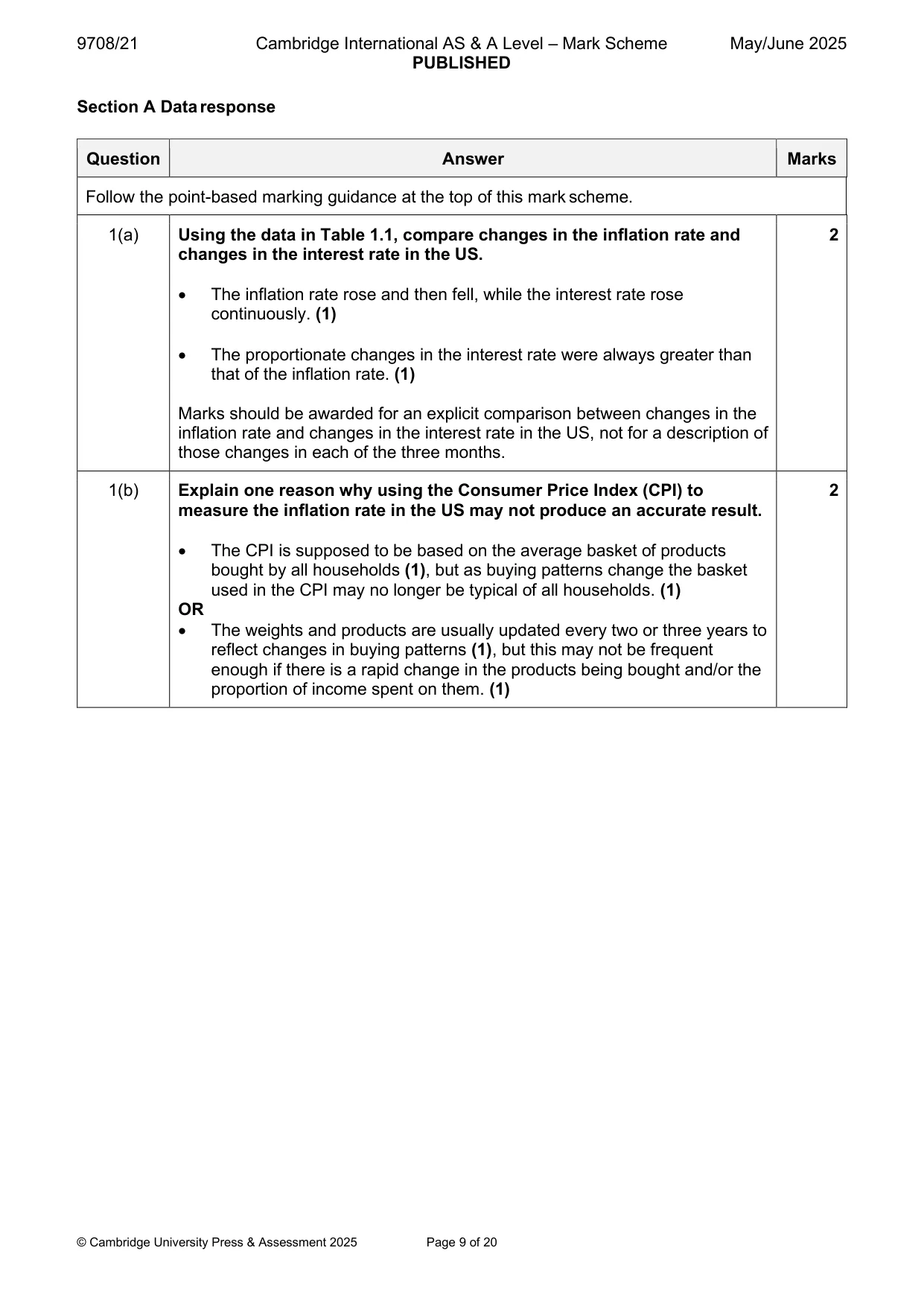
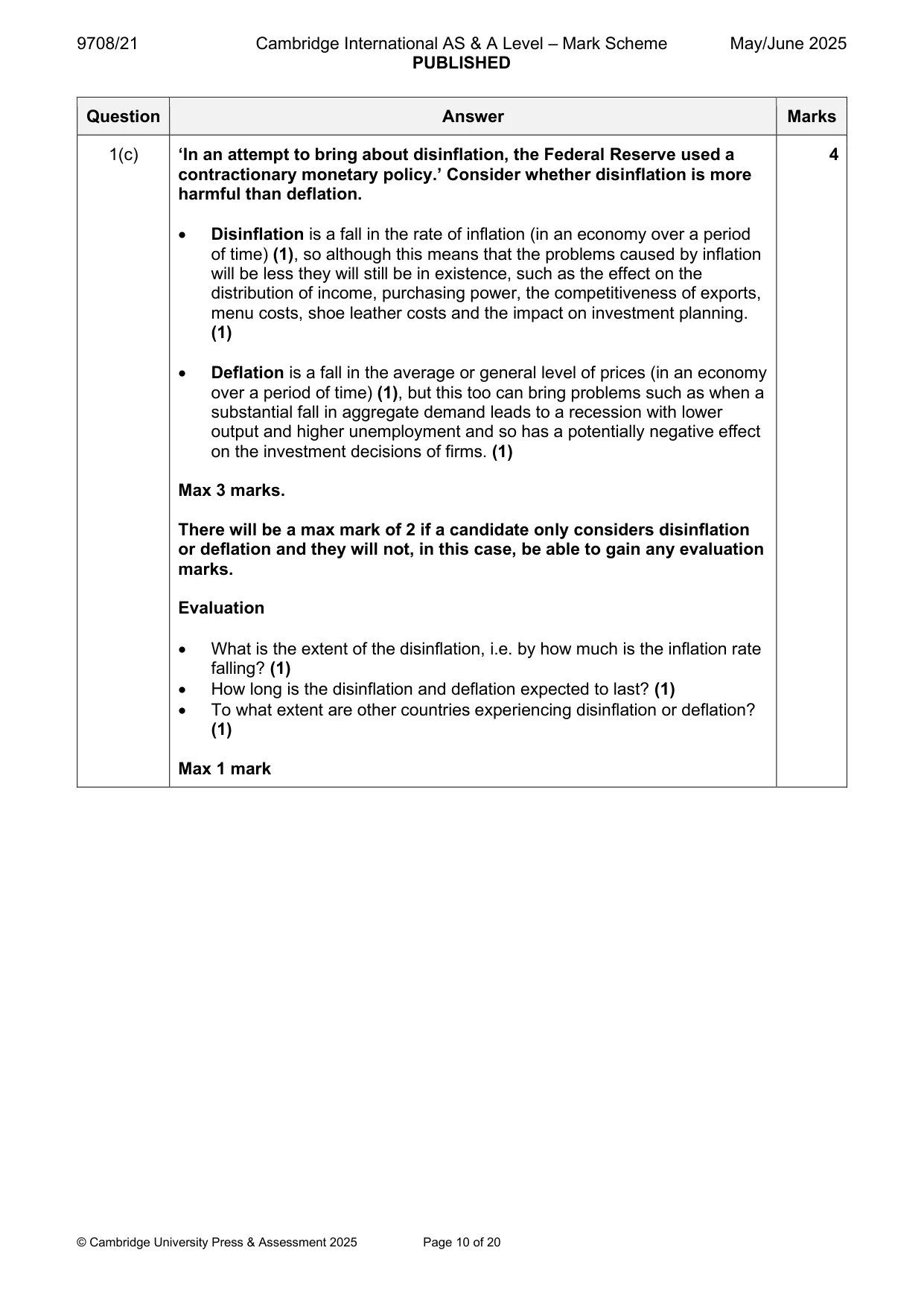
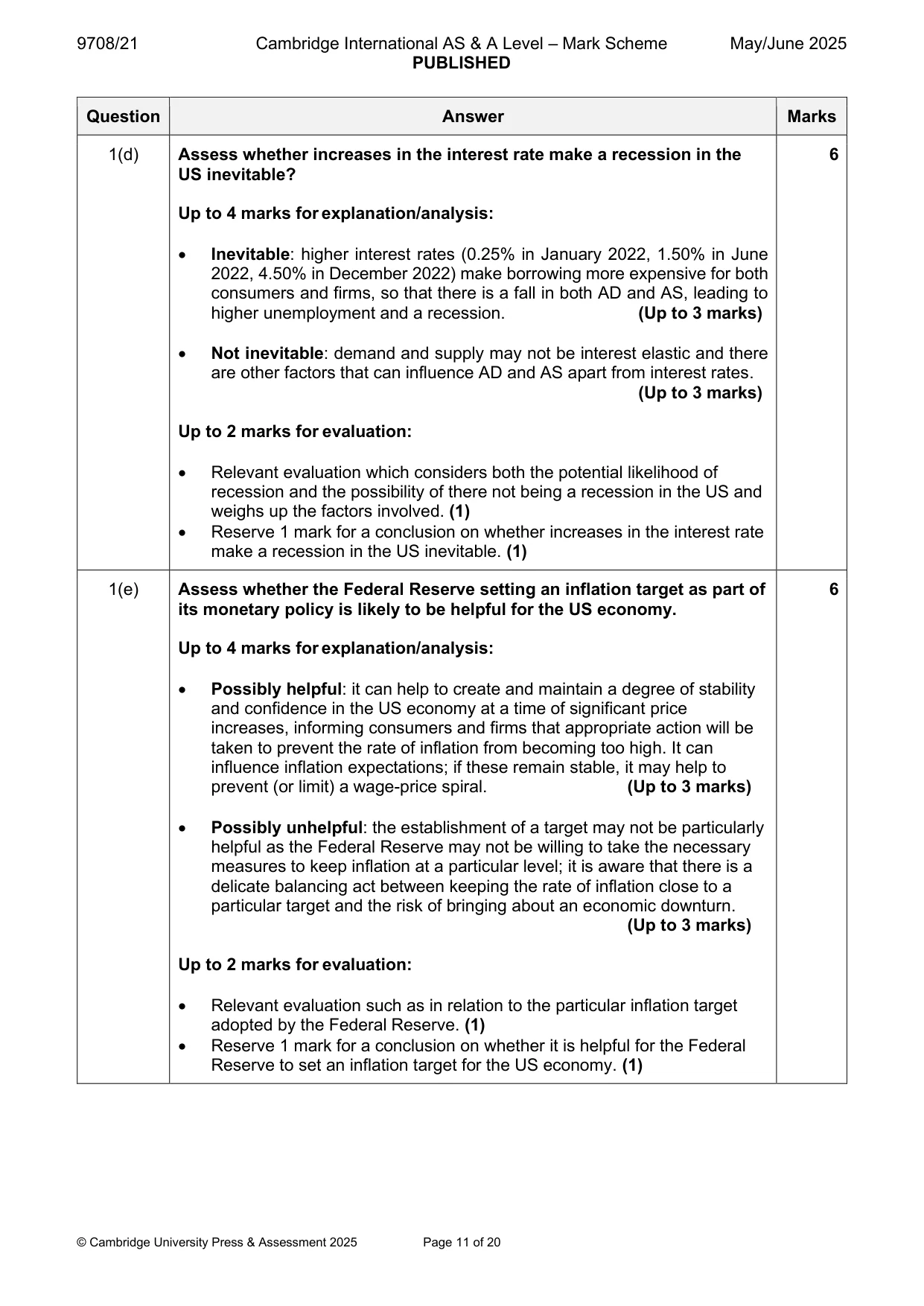
Mark scheme: Question Answer Marks Follow the point-based marking guidance at the top of this mark scheme. 1(a) Using the data in Table 1.1, compare changes in the inflation rate and 2 changes in the interest rate in the US. • The inflation rate rose and then fell, while the interest rate rose continuously. (1) • The proportionate changes in the interest rate were always greater than that of the inflation rate. (1) Marks should be awarded for an explicit comparison between changes in the inflation rate and changes in the interest rate in the US, not for a description of those changes in each of the three months. 1(b) Explain one reason why using the Consumer Price Index (CPI) to 2 measure the inflation rate in the US may not produce an accurate result. • The CPI is supposed to be based on the average basket of products bought by all households (1), but as buying patterns change the basket used in the CPI may no longer be typical of all households. (1) OR • The weights and products are usually updated every two or three years to reflect changes in buying patterns (1), but this may not be frequent enough if there is a rapid change in the products being bought and/or the proportion of income spent on them. (1) 1(c) ‘In an attempt to bring about disinflation, the Federal Reserve used a 4 contractionary monetary policy.’ Consider whether disinflation is more harmful than deflation. • Disinflation is a fall in the rate of inflation (in an economy over a period of time) (1), so although this means that the problems caused by inflation will be less they will still be in existence, such as the effect on the distribution of income, purchasing power, the competitiveness of exports, menu costs, shoe leather costs and the impact on investment planning. (1) • Deflation is a fall in the average or general level of prices (in an economy over a period of time) (1), but this too can bring problems such as when a substantial fall in aggregate demand leads to a recession with lower output and higher unemployment and so has a potentially negative effect on the investment decisions of firms. (1) Max 3 marks. There will be a max mark of 2 if a candidate only considers disinflation or deflation and they will not, in this case, be able to gain any evaluation marks. Evaluation • What is the extent of the disinflation, i.e. by how much is the inflation rate falling? (1) • How long is the disinflation and deflation expected to last? (1) • To what extent are other countries experiencing disinflation or deflation? (1) Max 1 mark 1(d) Assess whether increases in the interest rate make a recession in the 6 US inevitable? Up to 4 marks for explanation/analysis: • Inevitable: higher interest rates (0.25% in January 2022, 1.50% in June 2022, 4.50% in December 2022) make borrowing more expensive for both consumers and firms, so that there is a fall in both AD and AS, leading to higher unemployment and a recession. (Up to 3 marks) • Not inevitable: demand and supply may not be interest elastic and there are other factors that can influence AD and AS apart from interest rates. (Up to 3 marks) Up to 2 marks for evaluation: • Relevant evaluation which considers both the potential likelihood of recession and the possibility of there not being a recession in the US and weighs up the factors involved. (1) • Reserve 1 mark for a conclusion on whether increases in the interest rate make a recession in the US inevitable. (1) 1(e) Assess whether the Federal Reserve setting an inflation target as part of 6 its monetary policy is likely to be helpful for the US economy. Up to 4 marks for explanation/analysis: • Possibly helpful: it can help to create and maintain a degree of stability and confidence in the US economy at a time of significant price increases, informing consumers and firms that appropriate action will be taken to prevent the rate of inflation from becoming too high. It can influence inflation expectations; if these remain stable, it may help to prevent (or limit) a wage-price spiral. (Up to 3 marks) • Possibly unhelpful: the establishment of a target may not be particularly helpful as the Federal Reserve may not be willing to take the necessary measures to keep inflation at a particular level; it is aware that there is a delicate balancing act between keeping the rate of inflation close to a particular target and the risk of bringing about an economic downturn. (Up to 3 marks) Up to 2 marks for evaluation: • Relevant evaluation such as in relation to the particular inflation target adopted by the Federal Reserve. (1) • Reserve 1 mark for a conclusion on whether it is helpful for the Federal Reserve to set an inflation target for the US economy. (1) Section B Microeconomics essay
Q2 · With the help of a diagram, explain the reasons for a movement within a production…
2 (a) With the help of a diagram, explain the reasons for a movement within a production possibility curve (PPC) and a shift of a PPC and consider the extent to which opportunity cost determines the shape of a PPC. [8] (b) Assess whether a shift to the right of a PPC is only caused by an increase in the quantity of resources. [12] OR
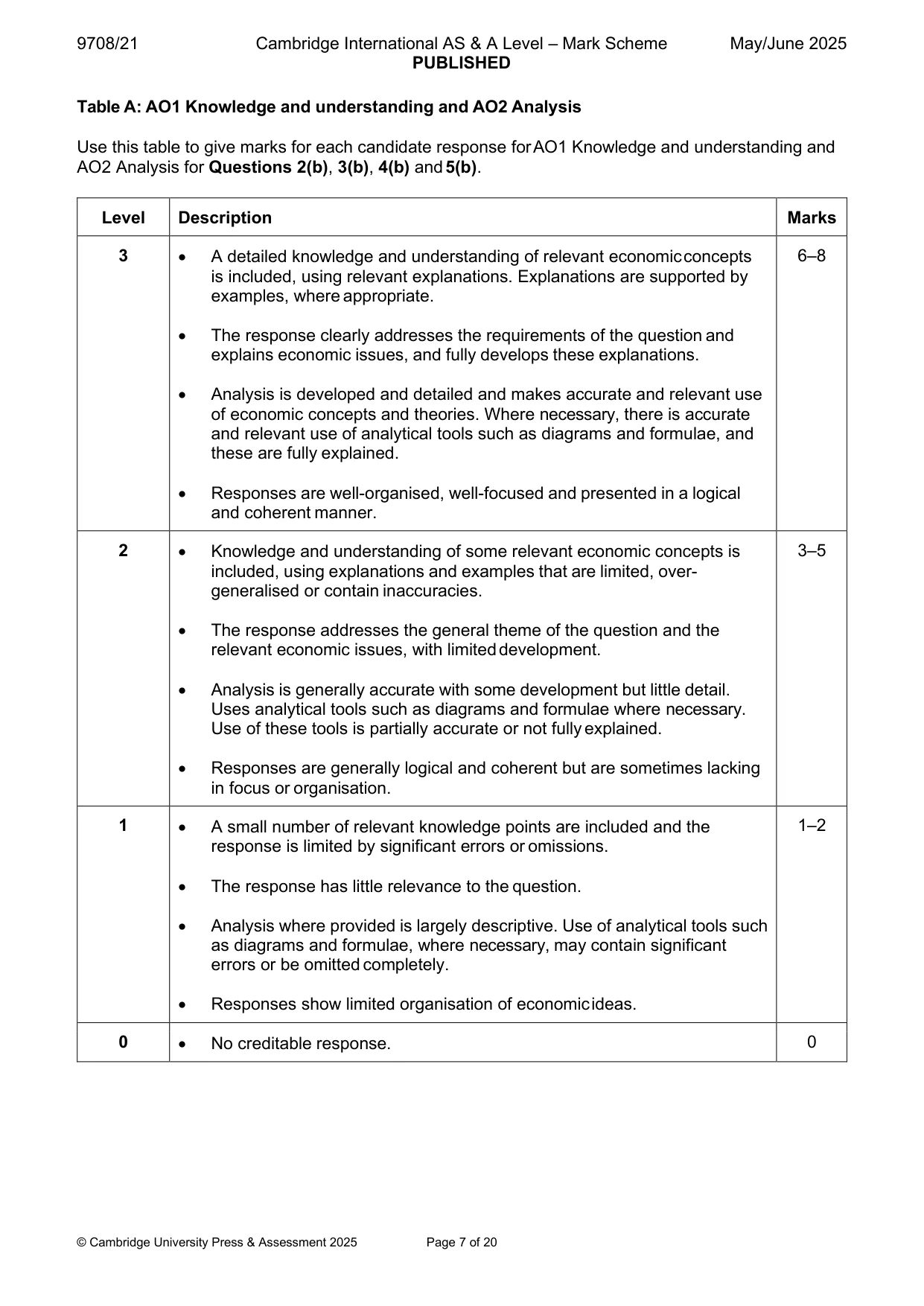
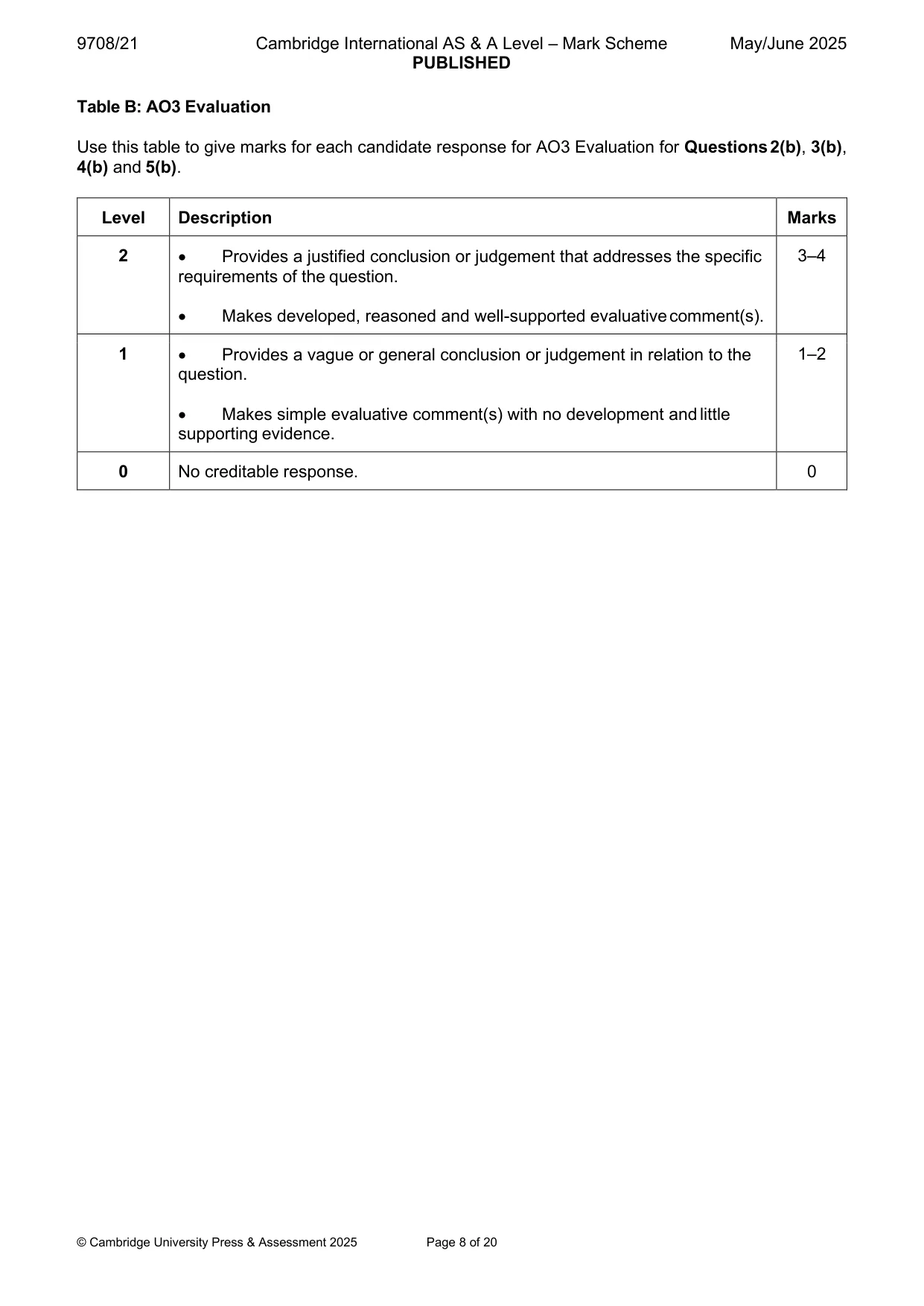
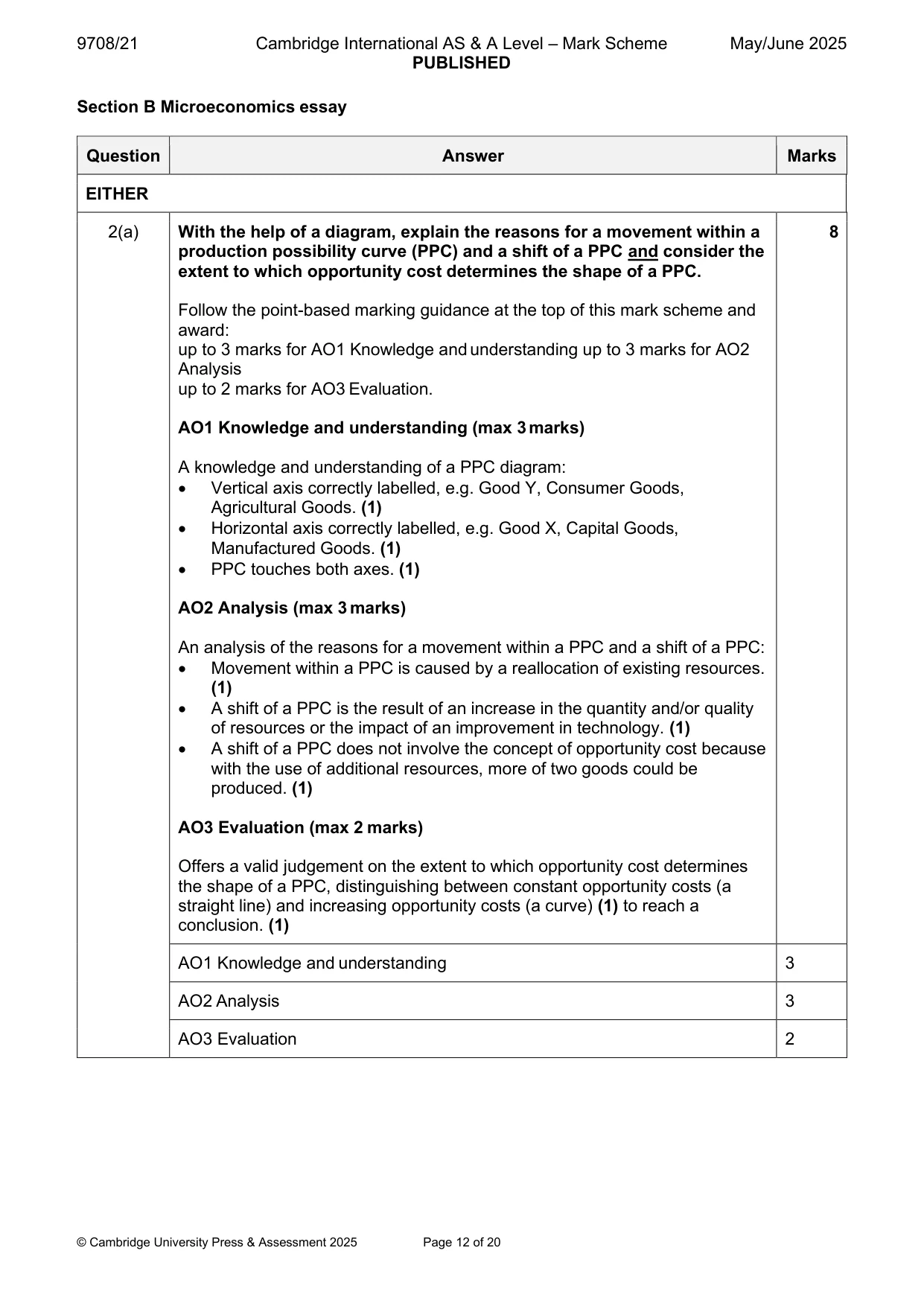
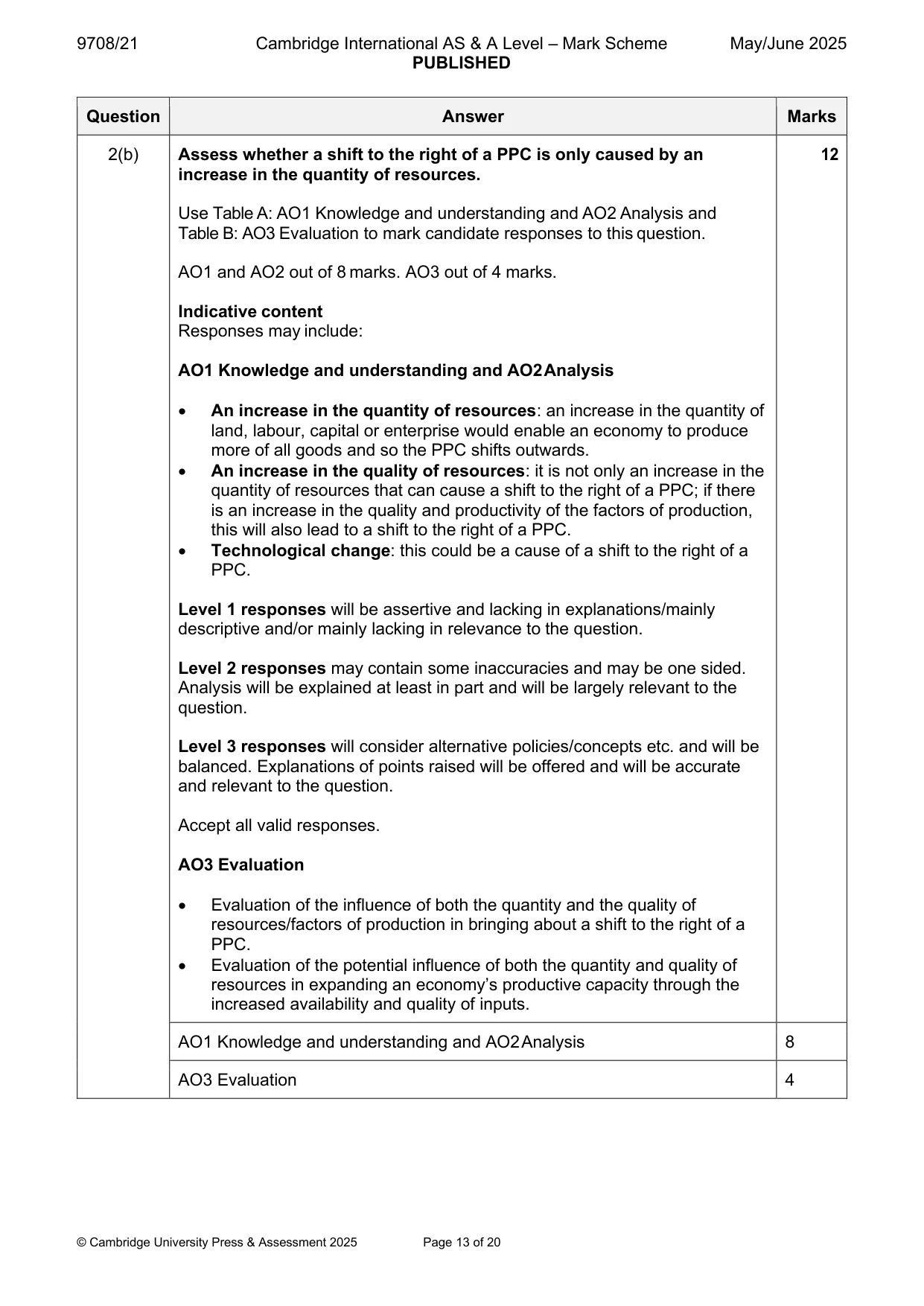
Mark scheme: 2(a) With the help of a diagram, explain the reasons for a movement within a 8 production possibility curve (PPC) and a shift of a PPC and consider the extent to which opportunity cost determines the shape of a PPC. Follow the point-based marking guidance at the top of this mark scheme and award: up to 3 marks for AO1 Knowledge and understanding up to 3 marks for AO2 Analysis up to 2 marks for AO3 Evaluation. AO1 Knowledge and understanding (max 3 marks) A knowledge and understanding of a PPC diagram: • Vertical axis correctly labelled, e.g. Good Y, Consumer Goods, Agricultural Goods. (1) • Horizontal axis correctly labelled, e.g. Good X, Capital Goods, Manufactured Goods. (1) • PPC touches both axes. (1) AO2 Analysis (max 3 marks) An analysis of the reasons for a movement within a PPC and a shift of a PPC: • Movement within a PPC is caused by a reallocation of existing resources. (1) • A shift of a PPC is the result of an increase in the quantity and/or quality of resources or the impact of an improvement in technology. (1) • A shift of a PPC does not involve the concept of opportunity cost because with the use of additional resources, more of two goods could be produced. (1) AO3 Evaluation (max 2 marks) Offers a valid judgement on the extent to which opportunity cost determines the shape of a PPC, distinguishing between constant opportunity costs (a straight line) and increasing opportunity costs (a curve) (1) to reach a conclusion. (1) AO1 Knowledge and understanding 3 AO2 Analysis 3 AO3 Evaluation 2 2(b) Assess whether a shift to the right of a PPC is only caused by an 12 increase in the quantity of resources. Use Table A: AO1 Knowledge and understanding and AO2 Analysis and Table B: AO3 Evaluation to mark candidate responses to this question. AO1 and AO2 out of 8 marks. AO3 out of 4 marks. Indicative content Responses may include: AO1 Knowledge and understanding and AO2 Analysis • An increase in the quantity of resources: an increase in the quantity of land, labour, capital or enterprise would enable an economy to produce more of all goods and so the PPC shifts outwards. • An increase in the quality of resources: it is not only an increase in the quantity of resources that can cause a shift to the right of a PPC; if there is an increase in the quality and productivity of the factors of production, this will also lead to a shift to the right of a PPC. • Technological change: this could be a cause of a shift to the right of a PPC. Level 1 responses will be assertive and lacking in explanations/mainly descriptive and/or mainly lacking in relevance to the question. Level 2 responses may contain some inaccuracies and may be one sided. Analysis will be explained at least in part and will be largely relevant to the question. Level 3 responses will consider alternative policies/concepts etc. and will be balanced. Explanations of points raised will be offered and will be accurate and relevant to the question. Accept all valid responses. AO3 Evaluation • Evaluation of the influence of both the quantity and the quality of resources/factors of production in bringing about a shift to the right of a PPC. • Evaluation of the potential influence of both the quantity and quality of resources in expanding an economy’s productive capacity through the increased availability and quality of inputs. AO1 Knowledge and understanding and AO2 Analysis 8 AO3 Evaluation 4
Q3 · With the help of a diagram, explain how changes in a subsidy can influence the price and…
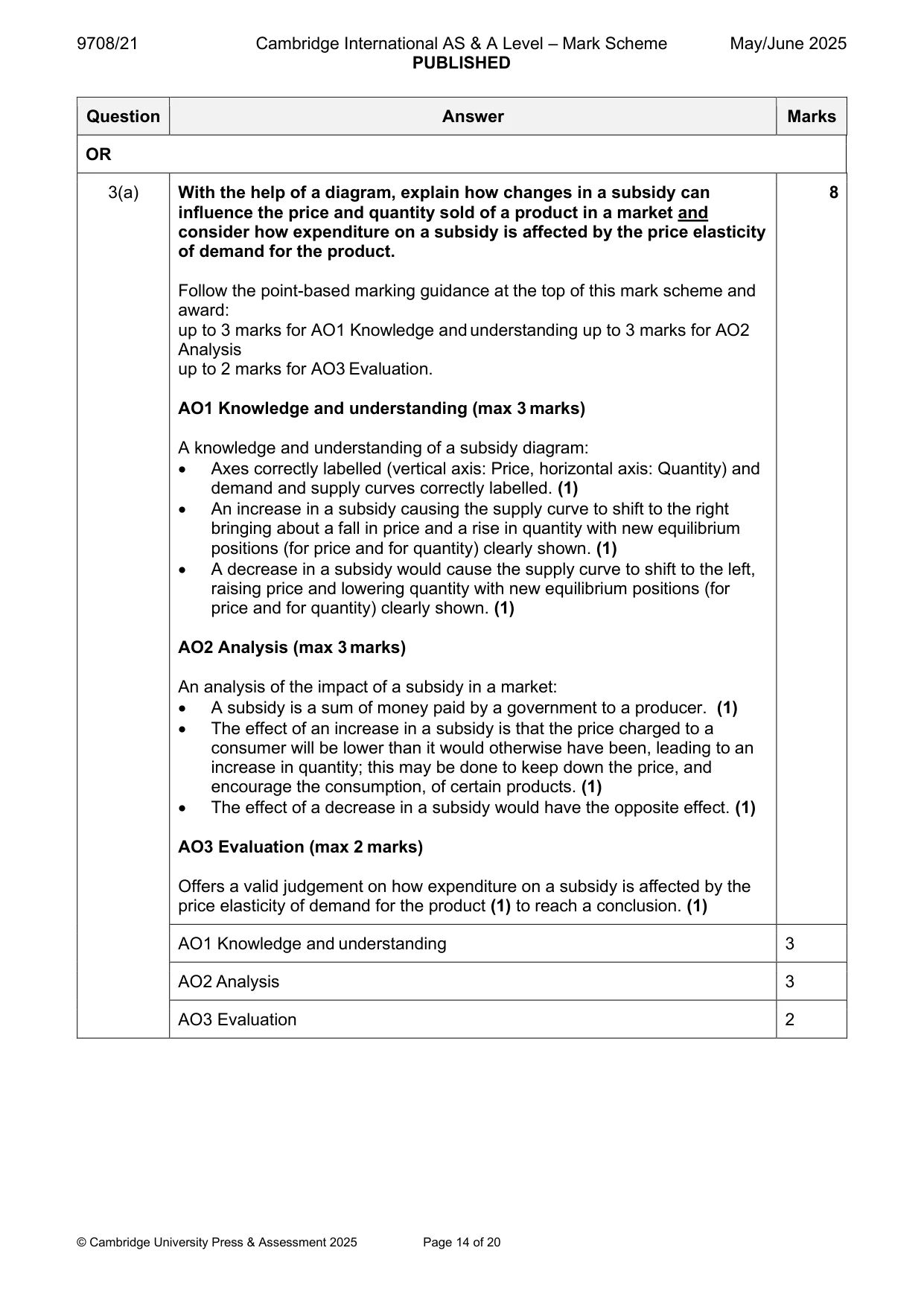
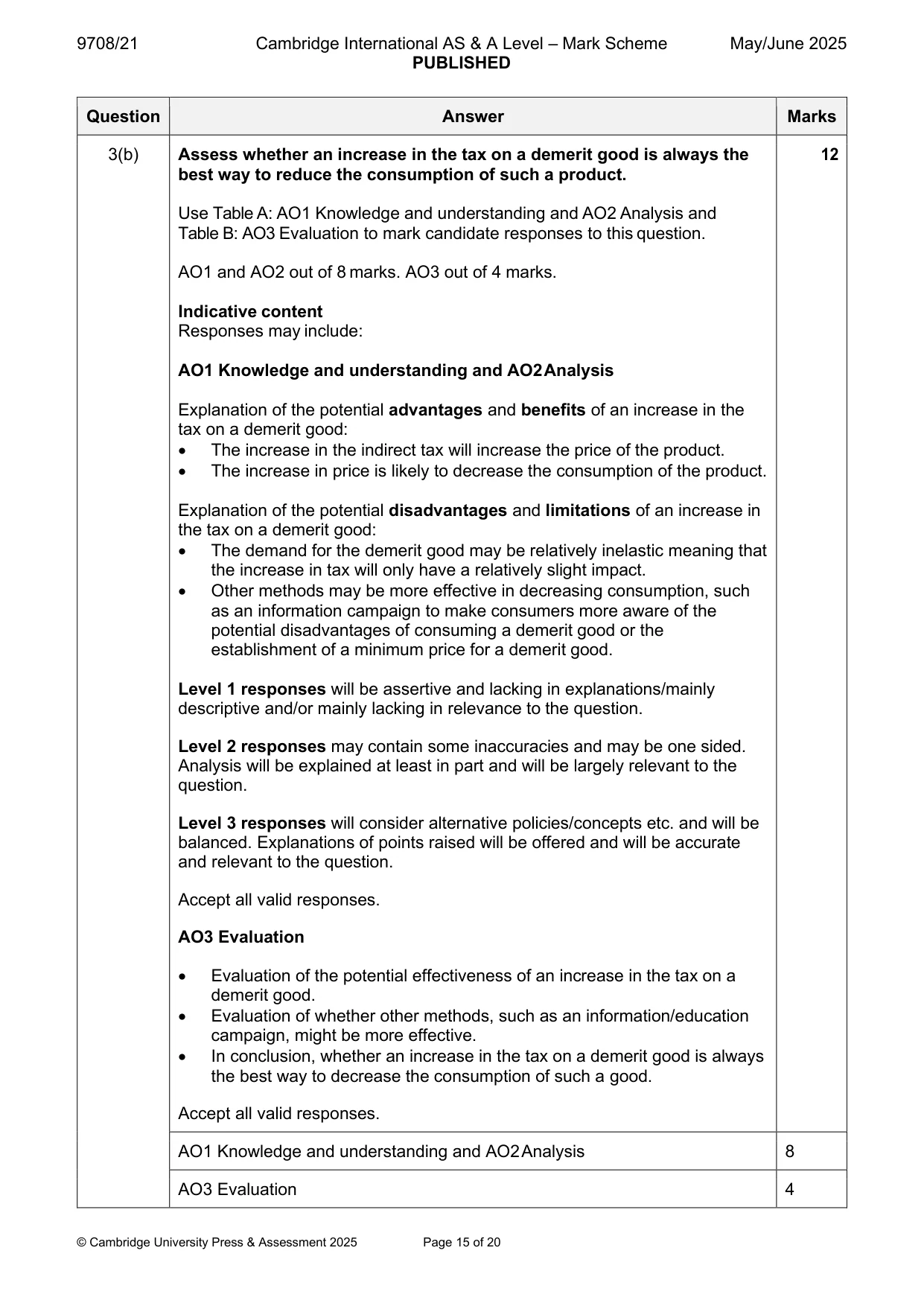
3 (a) With the help of a diagram, explain how changes in a subsidy can influence the price and quantity sold of a product in a market and consider how expenditure on a subsidy is affected by the price elasticity of demand for the product. [8] (b) Assess whether an increase in the tax on a demerit good is always the best way to reduce the consumption of such a product. [12] Section C Answer one question. EITHER
Mark scheme: 3(a) With the help of a diagram, explain how changes in a subsidy can 8 influence the price and quantity sold of a product in a market and consider how expenditure on a subsidy is affected by the price elasticity of demand for the product. Follow the point-based marking guidance at the top of this mark scheme and award: up to 3 marks for AO1 Knowledge and understanding up to 3 marks for AO2 Analysis up to 2 marks for AO3 Evaluation. AO1 Knowledge and understanding (max 3 marks) A knowledge and understanding of a subsidy diagram: • Axes correctly labelled (vertical axis: Price, horizontal axis: Quantity) and demand and supply curves correctly labelled. (1) • An increase in a subsidy causing the supply curve to shift to the right bringing about a fall in price and a rise in quantity with new equilibrium positions (for price and for quantity) clearly shown. (1) • A decrease in a subsidy would cause the supply curve to shift to the left, raising price and lowering quantity with new equilibrium positions (for price and for quantity) clearly shown. (1) AO2 Analysis (max 3 marks) An analysis of the impact of a subsidy in a market: • A subsidy is a sum of money paid by a government to a producer. (1) • The effect of an increase in a subsidy is that the price charged to a consumer will be lower than it would otherwise have been, leading to an increase in quantity; this may be done to keep down the price, and encourage the consumption, of certain products. (1) • The effect of a decrease in a subsidy would have the opposite effect. (1) AO3 Evaluation (max 2 marks) Offers a valid judgement on how expenditure on a subsidy is affected by the price elasticity of demand for the product (1) to reach a conclusion. (1) AO1 Knowledge and understanding 3 AO2 Analysis 3 AO3 Evaluation 2 3(b) Assess whether an increase in the tax on a demerit good is always the 12 best way to reduce the consumption of such a product. Use Table A: AO1 Knowledge and understanding and AO2 Analysis and Table B: AO3 Evaluation to mark candidate responses to this question. AO1 and AO2 out of 8 marks. AO3 out of 4 marks. Indicative content Responses may include: AO1 Knowledge and understanding and AO2 Analysis Explanation of the potential advantages and benefits of an increase in the tax on a demerit good: • The increase in the indirect tax will increase the price of the product. • The increase in price is likely to decrease the consumption of the product. Explanation of the potential disadvantages and limitations of an increase in the tax on a demerit good: • The demand for the demerit good may be relatively inelastic meaning that the increase in tax will only have a relatively slight impact. • Other methods may be more effective in decreasing consumption, such as an information campaign to make consumers more aware of the potential disadvantages of consuming a demerit good or the establishment of a minimum price for a demerit good. Level 1 responses will be assertive and lacking in explanations/mainly descriptive and/or mainly lacking in relevance to the question. Level 2 responses may contain some inaccuracies and may be one sided. Analysis will be explained at least in part and will be largely relevant to the question. Level 3 responses will consider alternative policies/concepts etc. and will be balanced. Explanations of points raised will be offered and will be accurate and relevant to the question. Accept all valid responses. AO3 Evaluation • Evaluation of the potential effectiveness of an increase in the tax on a demerit good. • Evaluation of whether other methods, such as an information/education campaign, might be more effective. • In conclusion, whether an increase in the tax on a demerit good is always the best way to decrease the consumption of such a good. Accept all valid responses. AO1 Knowledge and understanding and AO2 Analysis 8 AO3 Evaluation 4 Section C Macroeconomics essay
Q4 · Explain how the circular flow of income in an economy changes when that economy moves…
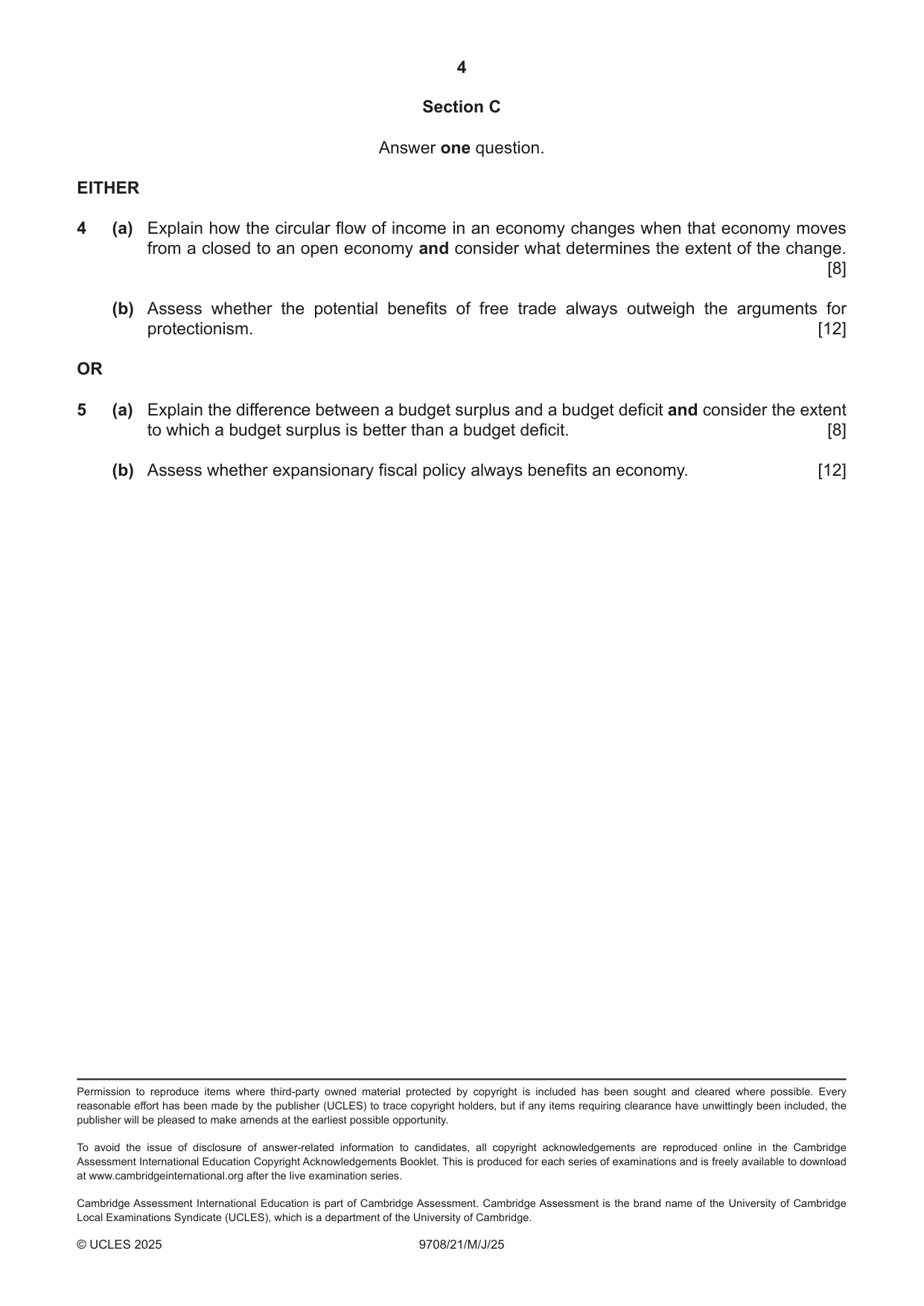
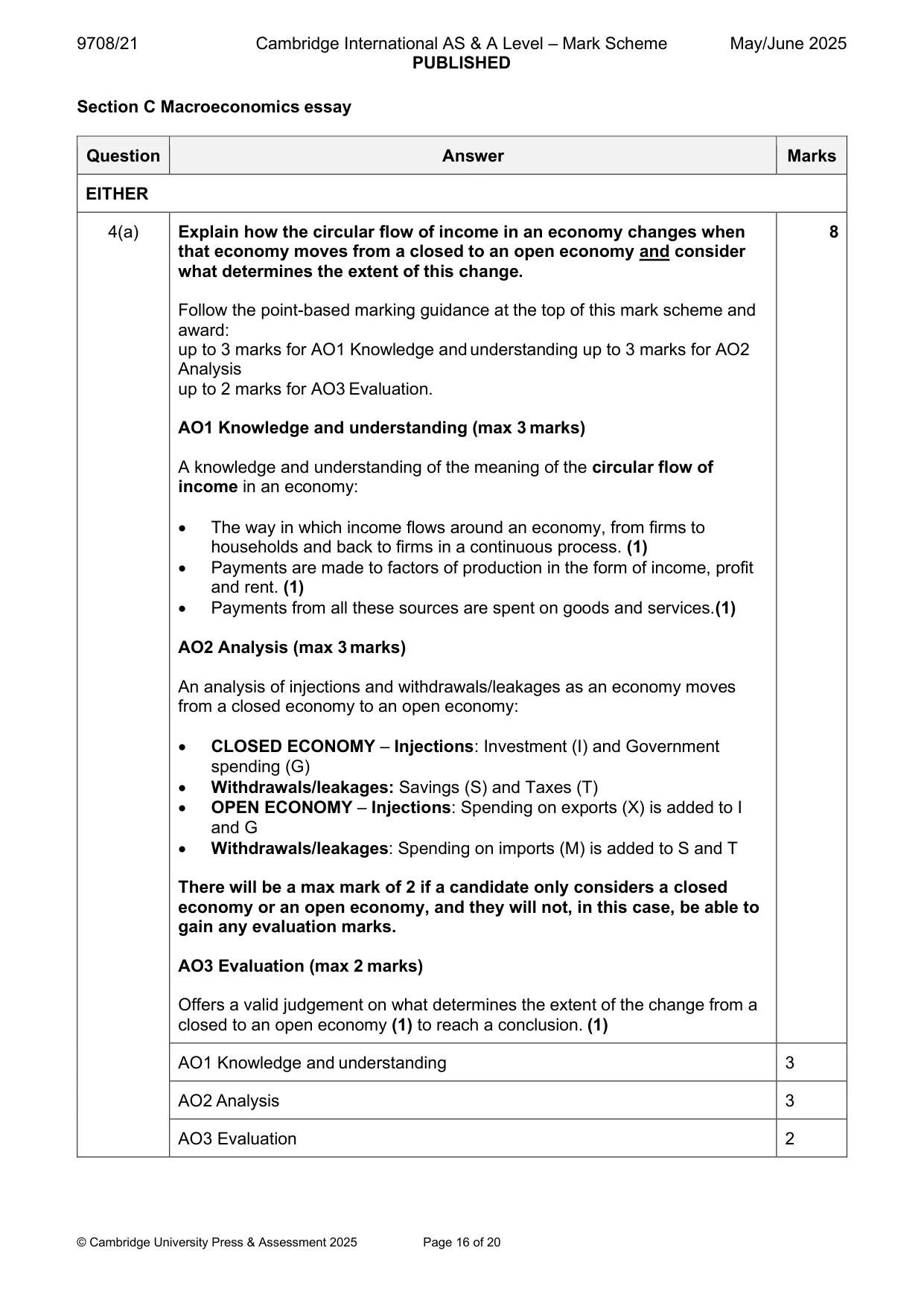
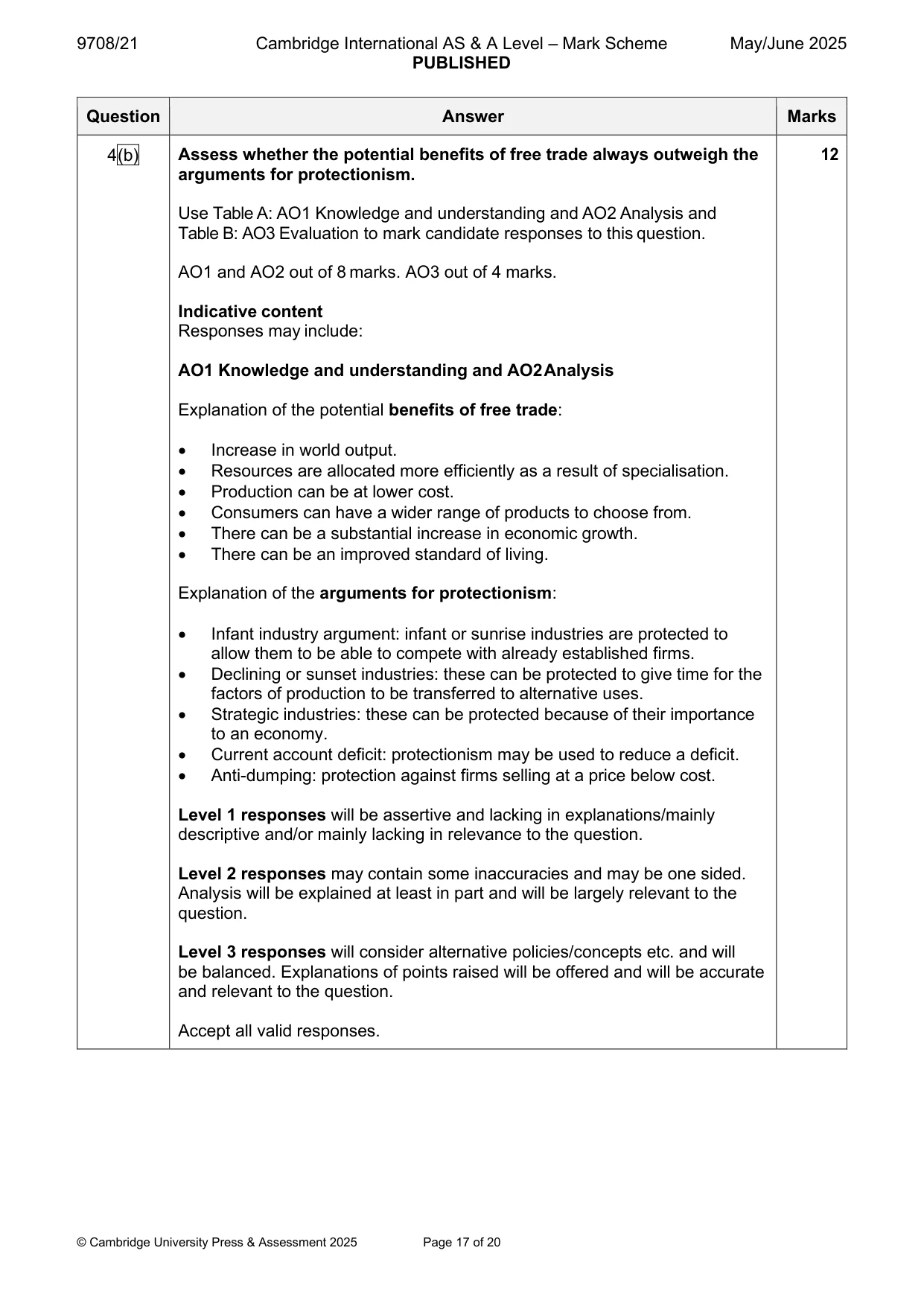
4 (a) Explain how the circular flow of income in an economy changes when that economy moves from a closed to an open economy and consider what determines the extent of the change. [8] (b) Assess whether the potential benefits of free trade always outweigh the arguments for protectionism. [12] OR
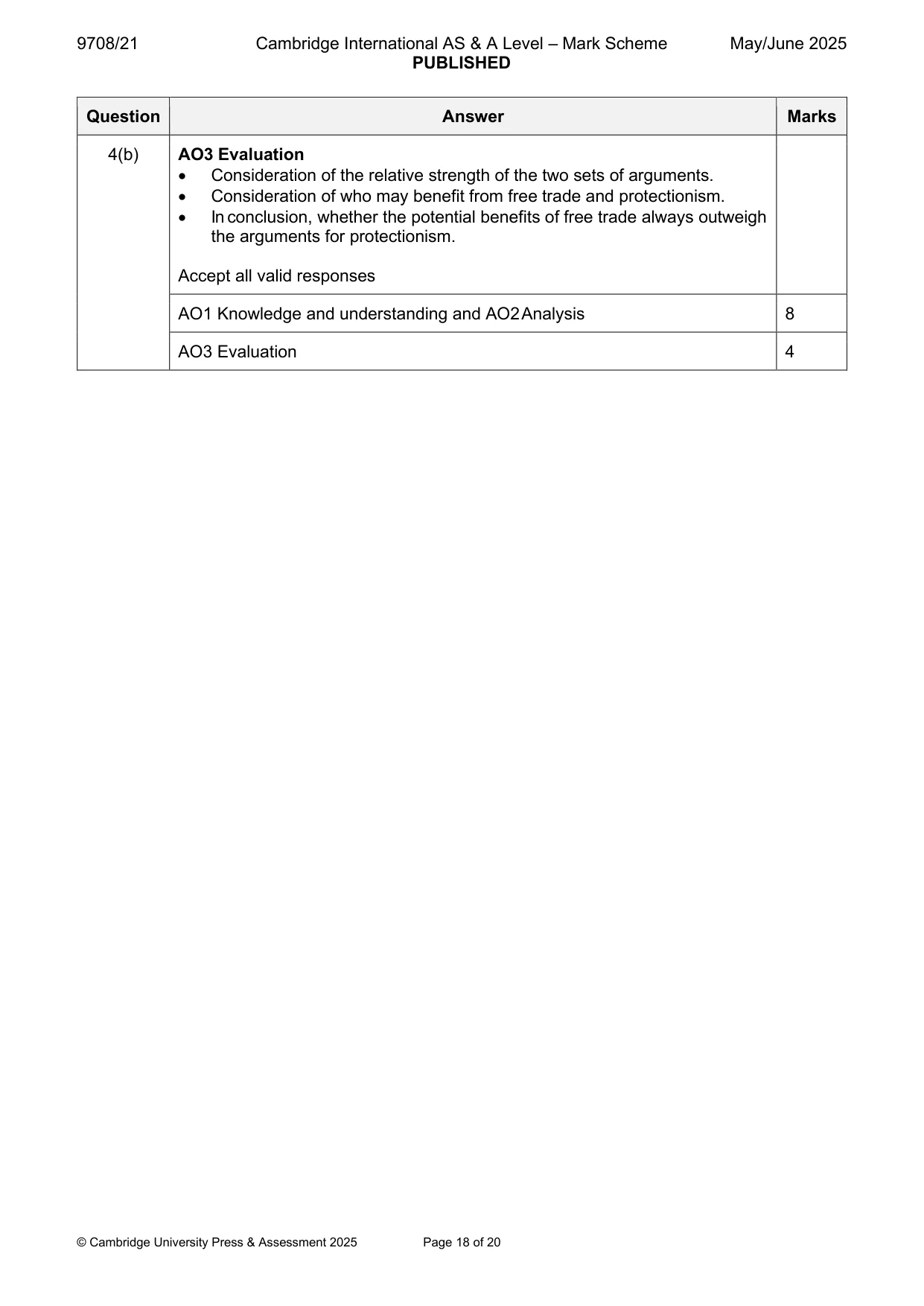
Mark scheme: 4(a) Explain how the circular flow of income in an economy changes when 8 that economy moves from a closed to an open economy and consider what determines the extent of this change. Follow the point-based marking guidance at the top of this mark scheme and award: up to 3 marks for AO1 Knowledge and understanding up to 3 marks for AO2 Analysis up to 2 marks for AO3 Evaluation. AO1 Knowledge and understanding (max 3 marks) A knowledge and understanding of the meaning of the circular flow of income in an economy: • The way in which income flows around an economy, from firms to households and back to firms in a continuous process. (1) • Payments are made to factors of production in the form of income, profit and rent. (1) • Payments from all these sources are spent on goods and services.(1) AO2 Analysis (max 3 marks) An analysis of injections and withdrawals/leakages as an economy moves from a closed economy to an open economy: • CLOSED ECONOMY – Injections: Investment (I) and Government spending (G) • Withdrawals/leakages: Savings (S) and Taxes (T) • OPEN ECONOMY – Injections: Spending on exports (X) is added to I and G • Withdrawals/leakages: Spending on imports (M) is added to S and T There will be a max mark of 2 if a candidate only considers a closed economy or an open economy, and they will not, in this case, be able to gain any evaluation marks. AO3 Evaluation (max 2 marks) Offers a valid judgement on what determines the extent of the change from a closed to an open economy (1) to reach a conclusion. (1) AO1 Knowledge and understanding 3 AO2 Analysis 3 AO3 Evaluation 2 4(b) Assess whether the potential benefits of free trade always outweigh the 12 arguments for protectionism. Use Table A: AO1 Knowledge and understanding and AO2 Analysis and Table B: AO3 Evaluation to mark candidate responses to this question. AO1 and AO2 out of 8 marks. AO3 out of 4 marks. Indicative content Responses may include: AO1 Knowledge and understanding and AO2 Analysis Explanation of the potential benefits of free trade: • Increase in world output. • Resources are allocated more efficiently as a result of specialisation. • Production can be at lower cost. • Consumers can have a wider range of products to choose from. • There can be a substantial increase in economic growth. • There can be an improved standard of living. Explanation of the arguments for protectionism: • Infant industry argument: infant or sunrise industries are protected to allow them to be able to compete with already established firms. • Declining or sunset industries: these can be protected to give time for the factors of production to be transferred to alternative uses. • Strategic industries: these can be protected because of their importance to an economy. • Current account deficit: protectionism may be used to reduce a deficit. • Anti-dumping: protection against firms selling at a price below cost. Level 1 responses will be assertive and lacking in explanations/mainly descriptive and/or mainly lacking in relevance to the question. Level 2 responses may contain some inaccuracies and may be one sided. Analysis will be explained at least in part and will be largely relevant to the question. Level 3 responses will consider alternative policies/concepts etc. and will be balanced. Explanations of points raised will be offered and will be accurate and relevant to the question. Accept all valid responses. 4(b) AO3 Evaluation • Consideration of the relative strength of the two sets of arguments. • Consideration of who may benefit from free trade and protectionism. • In conclusion, whether the potential benefits of free trade always outweigh the arguments for protectionism. Accept all valid responses AO1 Knowledge and understanding and AO2 Analysis 8 AO3 Evaluation 4
Q5 · Explain the difference between a budget surplus and a budget deficit and consider the…
5 (a) Explain the difference between a budget surplus and a budget deficit and consider the extent to which a budget surplus is better than a budget deficit. [8] (b) Assess whether expansionary fiscal policy always benefits an economy. [12]
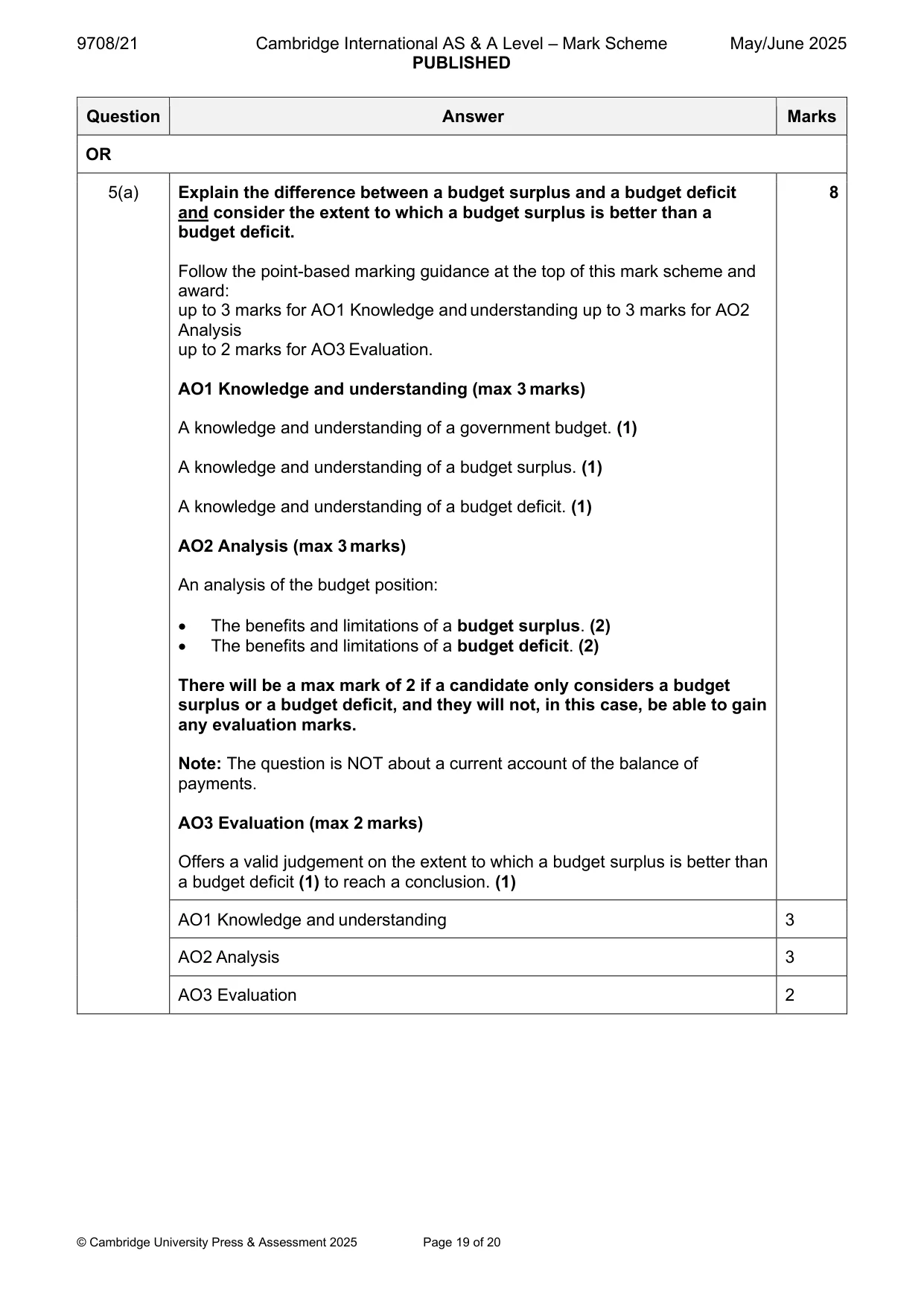
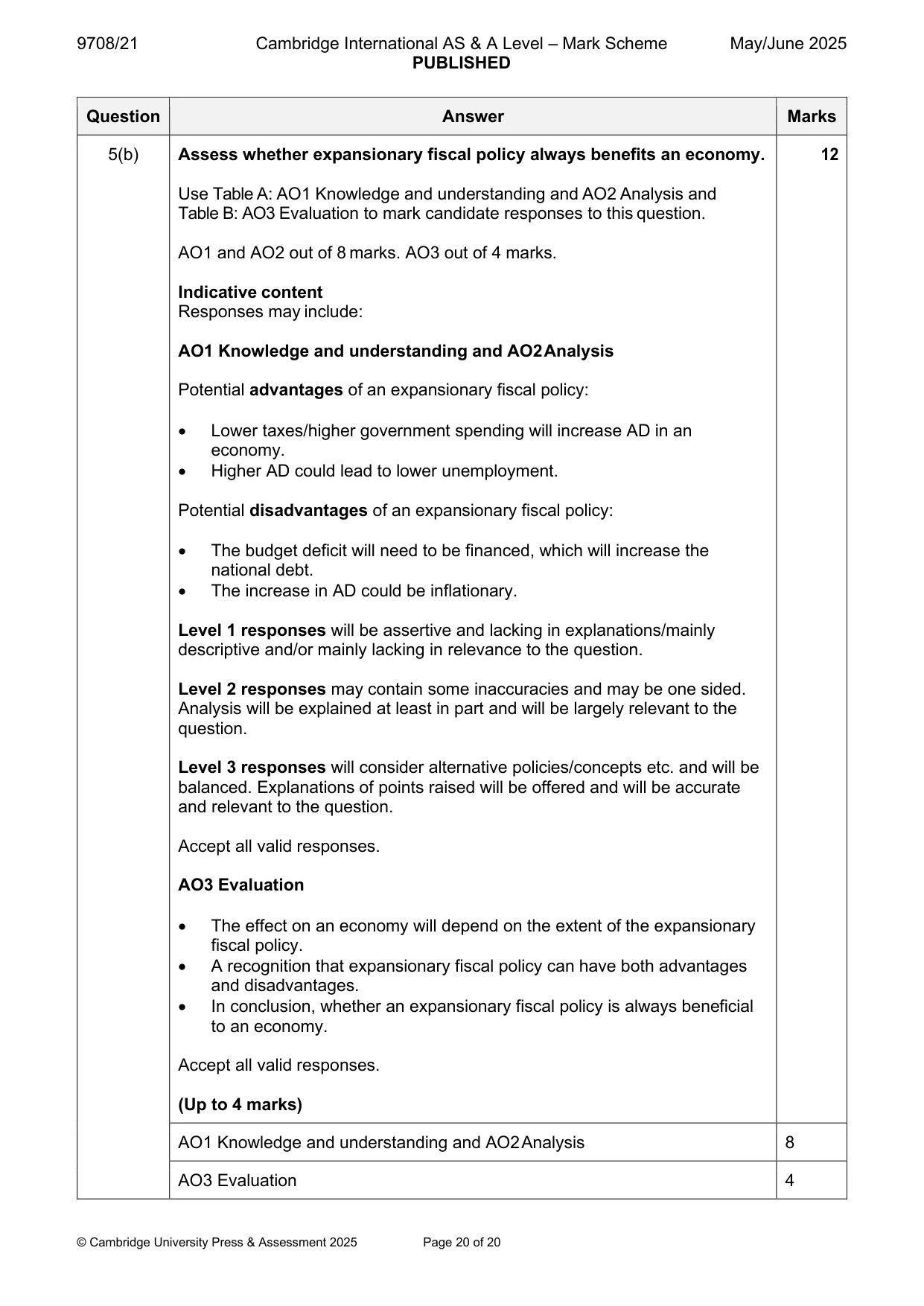
Mark scheme: 5(a) Explain the difference between a budget surplus and a budget deficit 8 and consider the extent to which a budget surplus is better than a budget deficit. Follow the point-based marking guidance at the top of this mark scheme and award: up to 3 marks for AO1 Knowledge and understanding up to 3 marks for AO2 Analysis up to 2 marks for AO3 Evaluation. AO1 Knowledge and understanding (max 3 marks) A knowledge and understanding of a government budget. (1) A knowledge and understanding of a budget surplus. (1) A knowledge and understanding of a budget deficit. (1) AO2 Analysis (max 3 marks) An analysis of the budget position: • The benefits and limitations of a budget surplus. (2) • The benefits and limitations of a budget deficit. (2) There will be a max mark of 2 if a candidate only considers a budget surplus or a budget deficit, and they will not, in this case, be able to gain any evaluation marks. Note: The question is NOT about a current account of the balance of payments. AO3 Evaluation (max 2 marks) Offers a valid judgement on the extent to which a budget surplus is better than a budget deficit (1) to reach a conclusion. (1) AO1 Knowledge and understanding 3 AO2 Analysis 3 AO3 Evaluation 2 5(b) Assess whether expansionary fiscal policy always benefits an economy. 12 Use Table A: AO1 Knowledge and understanding and AO2 Analysis and Table B: AO3 Evaluation to mark candidate responses to this question. AO1 and AO2 out of 8 marks. AO3 out of 4 marks. Indicative content Responses may include: AO1 Knowledge and understanding and AO2 Analysis Potential advantages of an expansionary fiscal policy: • Lower taxes/higher government spending will increase AD in an economy. • Higher AD could lead to lower unemployment. Potential disadvantages of an expansionary fiscal policy: • The budget deficit will need to be financed, which will increase the national debt. • The increase in AD could be inflationary. Level 1 responses will be assertive and lacking in explanations/mainly descriptive and/or mainly lacking in relevance to the question. Level 2 responses may contain some inaccuracies and may be one sided. Analysis will be explained at least in part and will be largely relevant to the question. Level 3 responses will consider alternative policies/concepts etc. and will be balanced. Explanations of points raised will be offered and will be accurate and relevant to the question. Accept all valid responses. AO3 Evaluation • The effect on an economy will depend on the extent of the expansionary fiscal policy. • A recognition that expansionary fiscal policy can have both advantages and disadvantages. • In conclusion, whether an expansionary fiscal policy is always beneficial to an economy. Accept all valid responses. (Up to 4 marks) AO1 Knowledge and understanding and AO2 Analysis 8 AO3 Evaluation 4
What was in this paper
The subtopics covered by these 5 questions, and how many questions each got. Open one in a new tab to see every Cambridge question on it.
What you needed in this session
Cambridge’s own grade thresholds for 2025 May/June, Paper 2 · Variant 1. A higher threshold means an easier paper — the bar moves with how the cohort did.