Cambridge A Level Economics 9708 — 2024 Oct/Nov Paper 2 · Variant 1
9708/21/O/N/24 · 5 questions · 60 marks · ≈68 min
The question paper and its mark scheme, free to read here and free to download. This is Cambridge’s own paper, exactly as it was sat.
Question paper4 pages
Mark scheme18 pages
Answers below. Sit the paper first if you are practising.

Questions as text
Q1 · Inflation in Argentina Argentina’s annual inflation rate increased from just over 40% in…
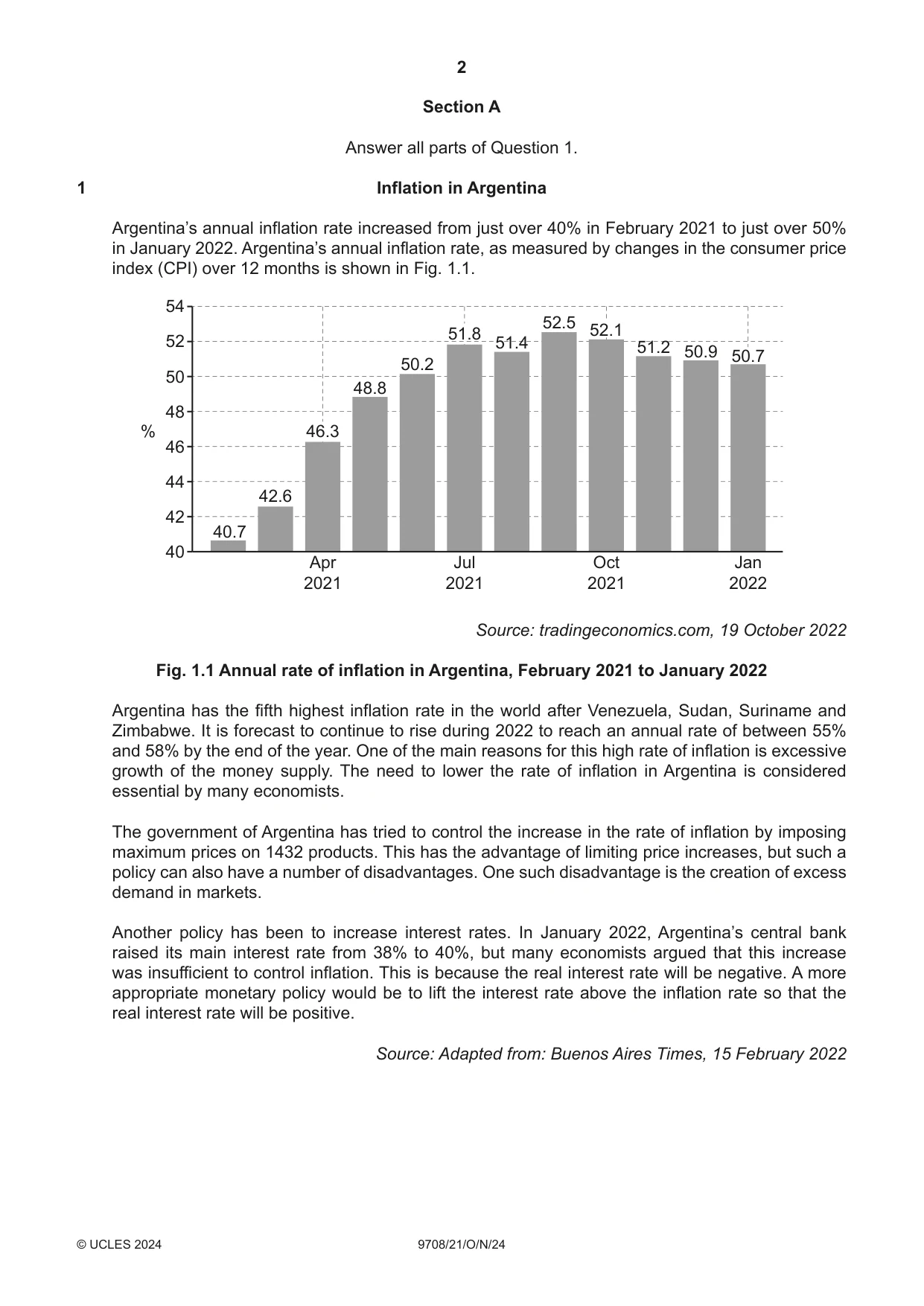
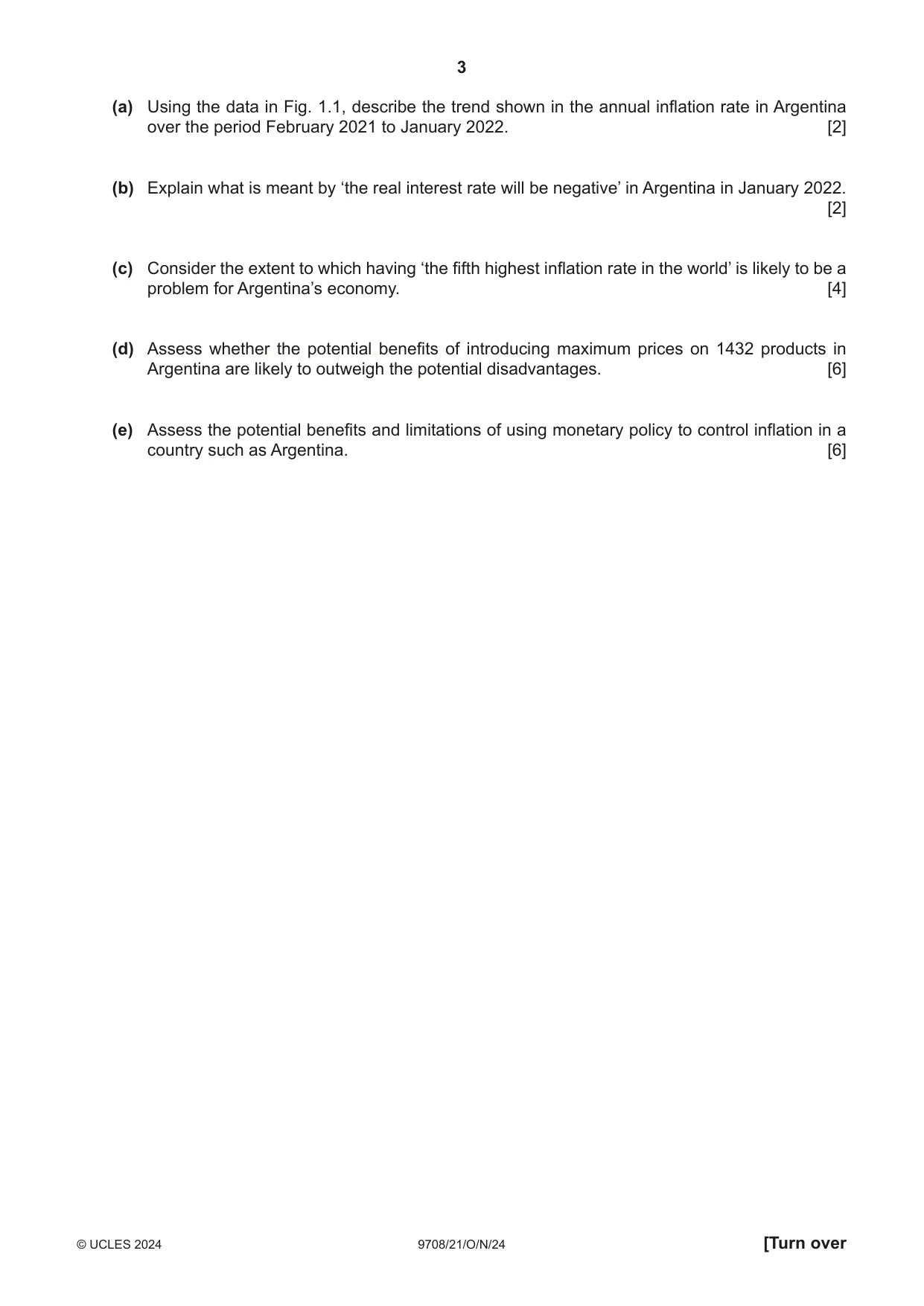
1 Inflation in Argentina Argentina’s annual inflation rate increased from just over 40% in February 2021 to just over 50% in January 2022. Argentina’s annual inflation rate, as measured by changes in the consumer price index (CPI) over 12 months is shown in Fig. 1.1. 54 52.5 51.8 52.1 52 51.4 51.2 50.9 50.7 50.2 50 48.8 48 % 46.3 46 44 42.6 42 40.7 40 Apr Jul Oct Jan 2021 2021 2021 2022 Source: tradingeconomics.com, 19 October 2022 Fig. 1.1 Annual rate of inflation in Argentina, February 2021 to January 2022 Argentina has the fifth highest inflation rate in the world after Venezuela, Sudan, Suriname and Zimbabwe. It is forecast to continue to rise during 2022 to reach an annual rate of between 55% and 58% by the end of the year. One of the main reasons for this high rate of inflation is excessive growth of the money supply. The need to lower the rate of inflation in Argentina is considered essential by many economists. The government of Argentina has tried to control the increase in the rate of inflation by imposing maximum prices on 1432 products. This has the advantage of limiting price increases, but such a policy can also have a number of disadvantages. One such disadvantage is the creation of excess demand in markets. Another policy has been to increase interest rates. In January 2022, Argentina’s central bank raised its main interest rate from 38% to 40%, but many economists argued that this increase was insufficient to control inflation. This is because the real interest rate will be negative. A more appropriate monetary policy would be to lift the interest rate above the inflation rate so that the real interest rate will be positive. Source: Adapted from: Buenos Aires Times, 15 February 2022 (a) Using the data in Fig. 1.1, describe the trend shown in the annual inflation rate in Argentina over the period February 2021 to January 2022. [2] (b) Explain what is meant by ‘the real interest rate will be negative’ in Argentina in January 2022. [2] (c) Consider the extent to which having ‘the fifth highest inflation rate in the world’ is likely to be a problem for Argentina’s economy. [4] (d) Assess whether the potential benefits of introducing maximum prices on 1432 products in Argentina are likely to outweigh the potential disadvantages. [6] (e) Assess the potential benefits and limitations of using monetary policy to control inflation in a country such as Argentina. [6]
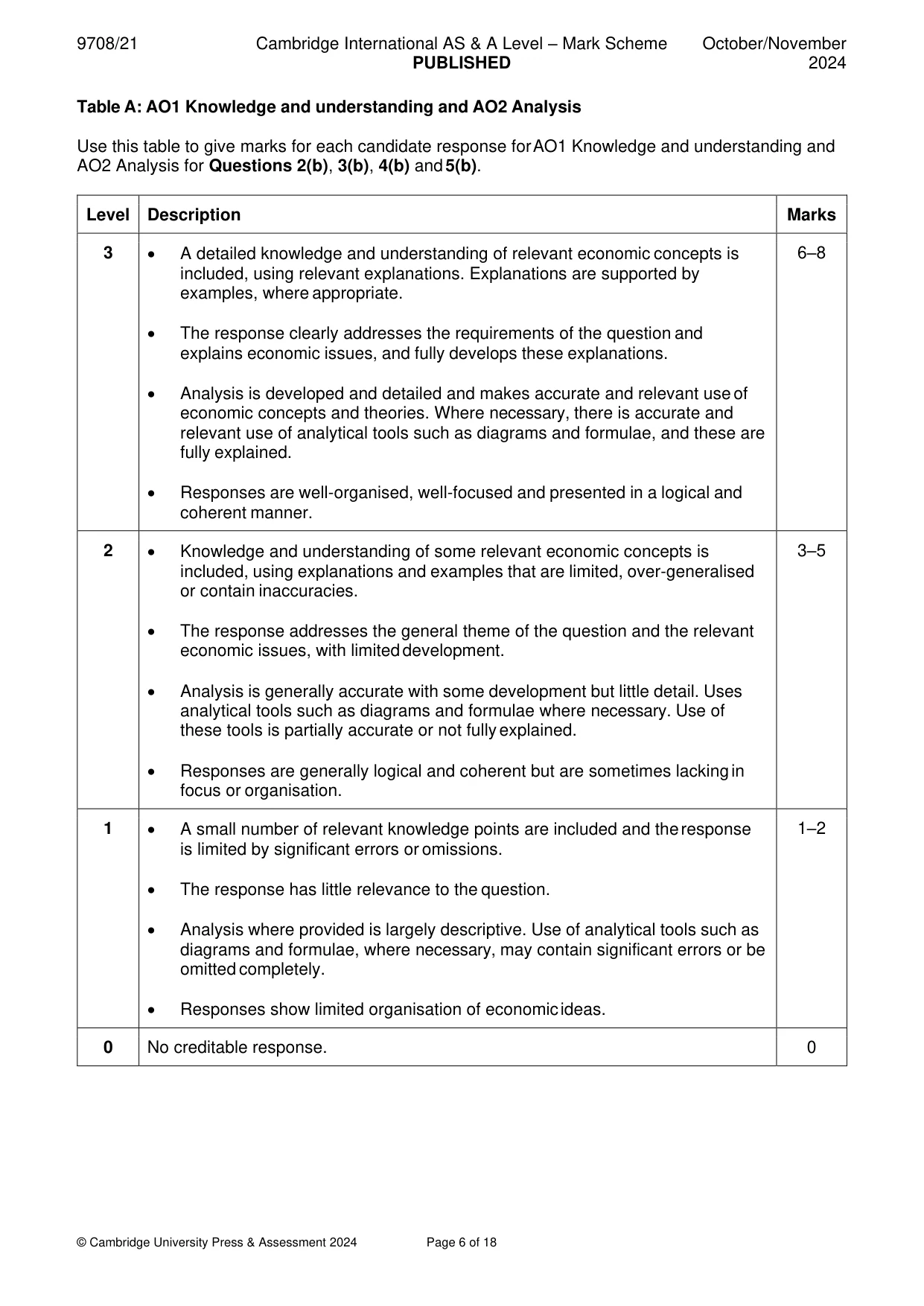
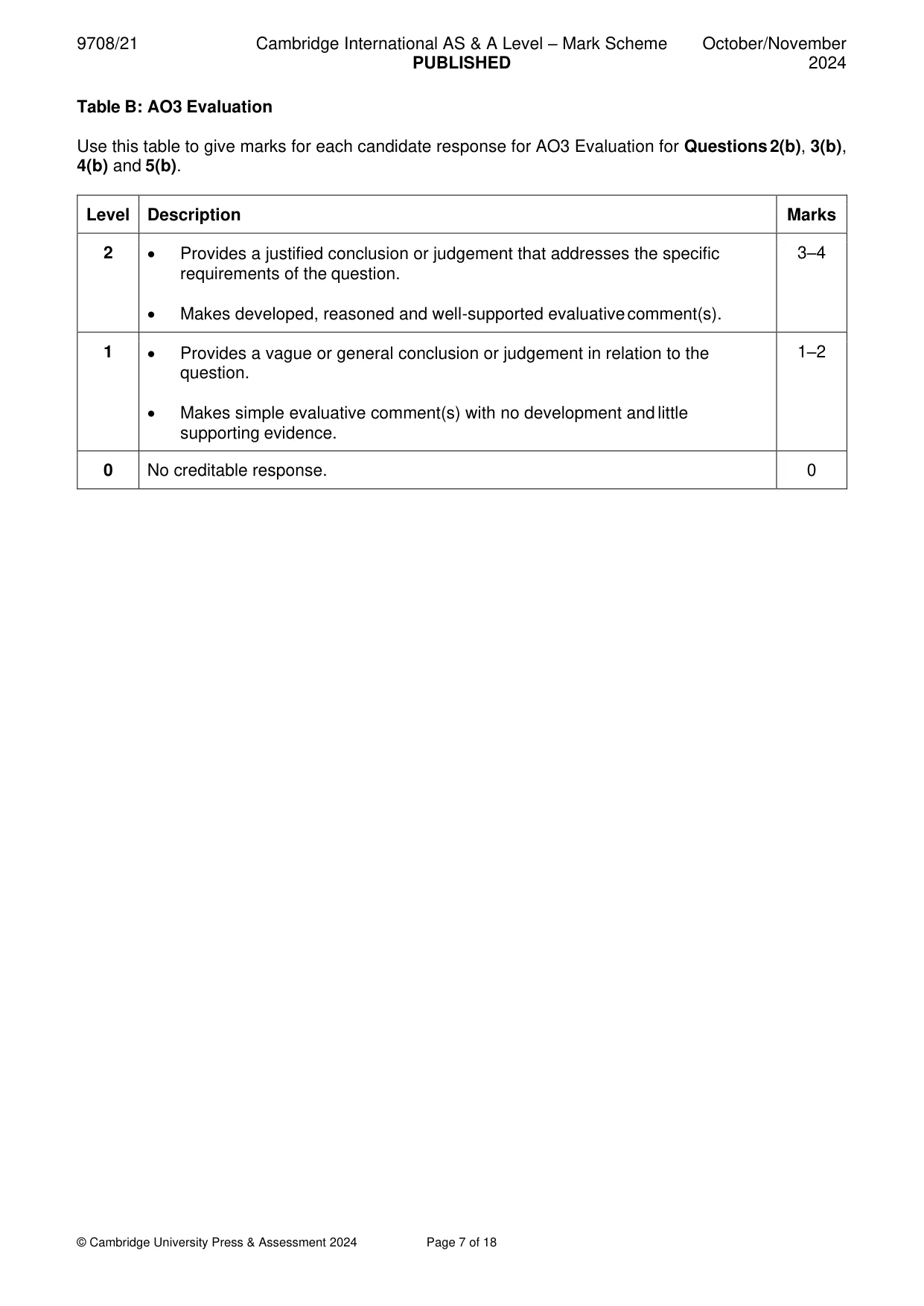
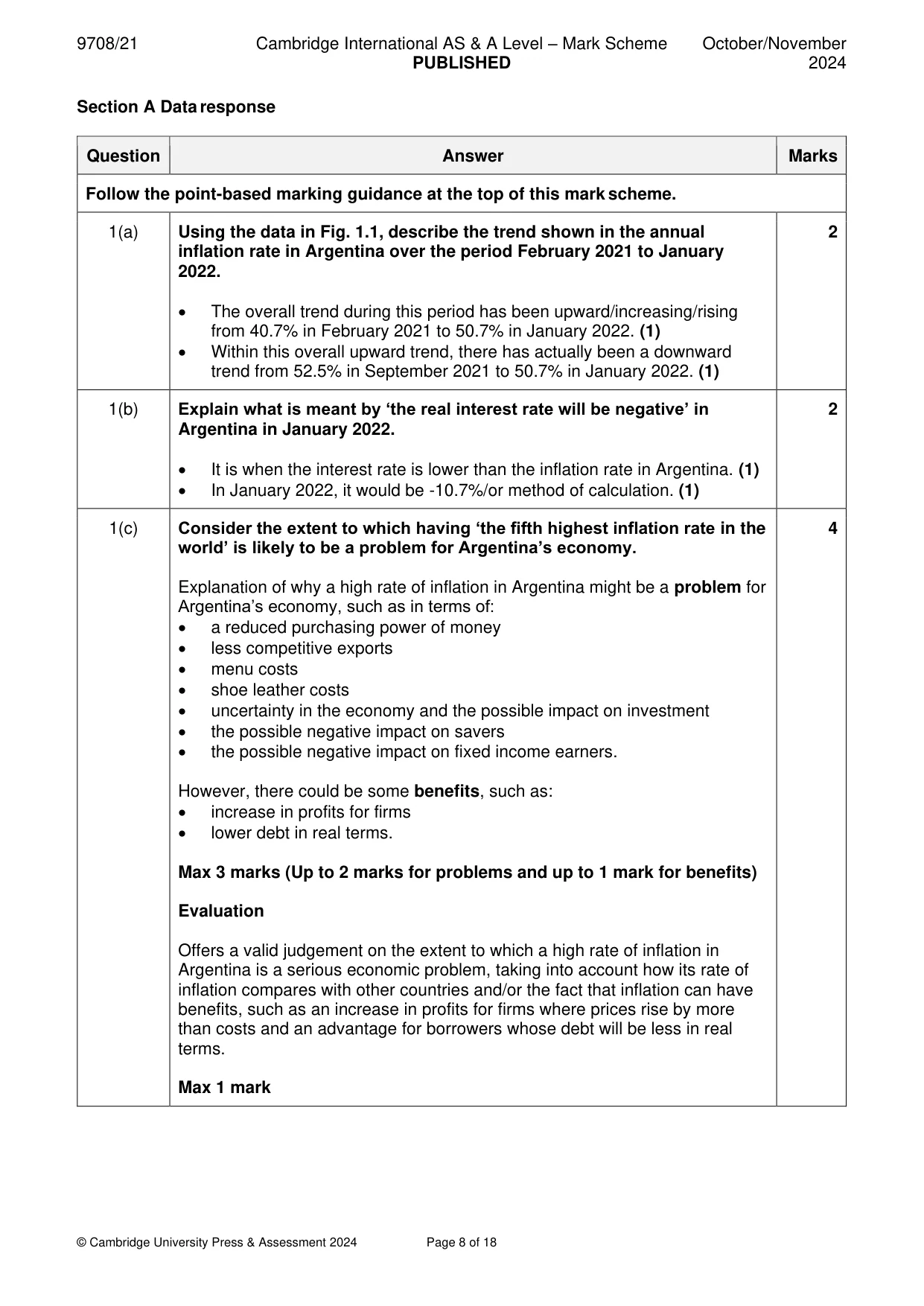
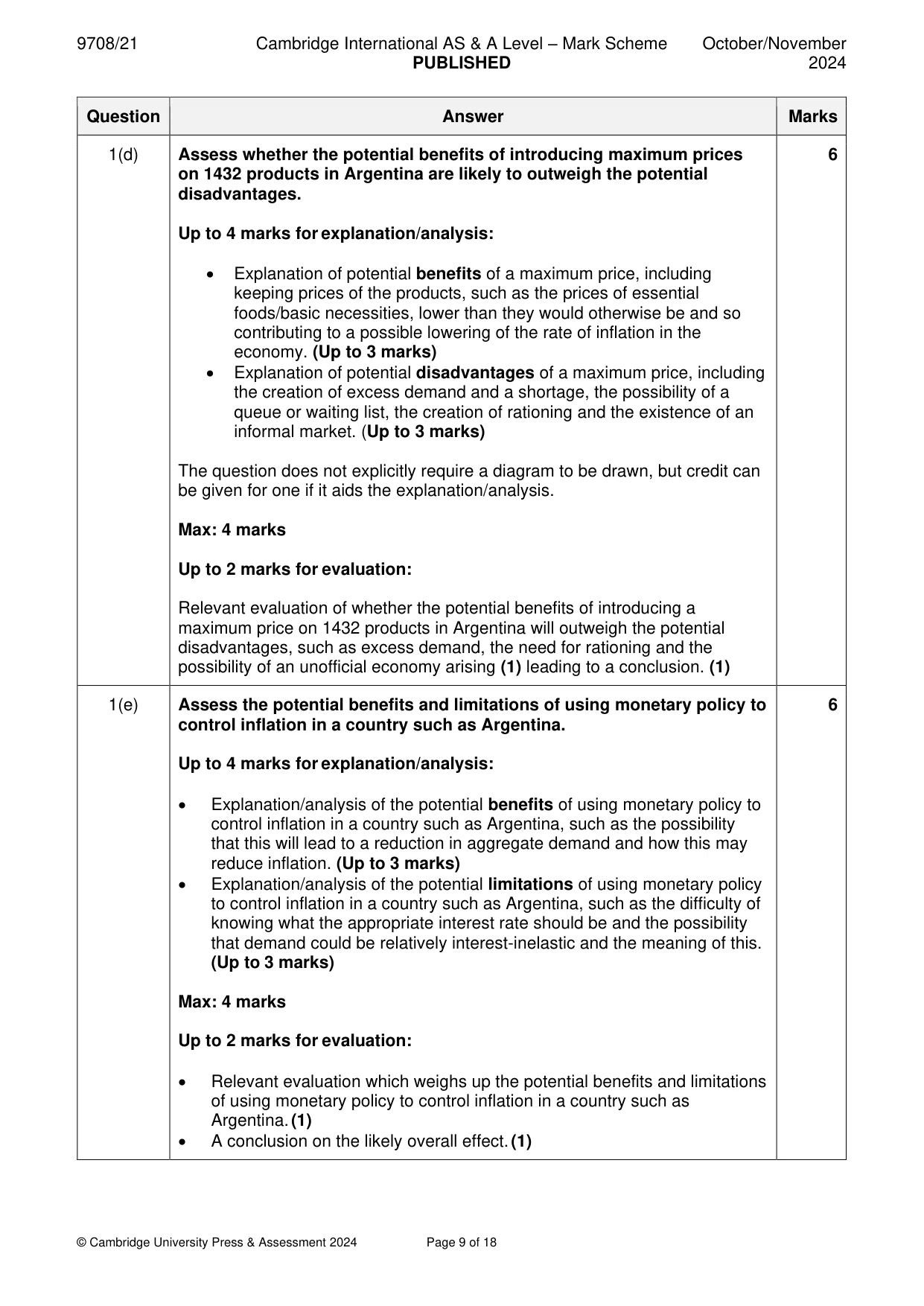
Mark scheme: Question Answer Marks Follow the point-based marking guidance at the top of this mark scheme. 1(a) Using the data in Fig. 1.1, describe the trend shown in the annual 2 inflation rate in Argentina over the period February 2021 to January 2022. • The overall trend during this period has been upward/increasing/rising from 40.7% in February 2021 to 50.7% in January 2022. (1) • Within this overall upward trend, there has actually been a downward trend from 52.5% in September 2021 to 50.7% in January 2022. (1) 1(b) Explain what is meant by ‘the real interest rate will be negative’ in 2 Argentina in January 2022. • It is when the interest rate is lower than the inflation rate in Argentina. (1) • In January 2022, it would be -10.7%/or method of calculation. (1) 1(c) Consider the extent to which having ‘the fifth highest inflation rate in the 4 world’ is likely to be a problem for Argentina’s economy. Explanation of why a high rate of inflation in Argentina might be a problem for Argentina’s economy, such as in terms of: • a reduced purchasing power of money • less competitive exports • menu costs • shoe leather costs • uncertainty in the economy and the possible impact on investment • the possible negative impact on savers • the possible negative impact on fixed income earners. However, there could be some benefits, such as: • increase in profits for firms • lower debt in real terms. Max 3 marks (Up to 2 marks for problems and up to 1 mark for benefits) Evaluation Offers a valid judgement on the extent to which a high rate of inflation in Argentina is a serious economic problem, taking into account how its rate of inflation compares with other countries and/or the fact that inflation can have benefits, such as an increase in profits for firms where prices rise by more than costs and an advantage for borrowers whose debt will be less in real terms. Max 1 mark 1(d) Assess whether the potential benefits of introducing maximum prices 6 on 1432 products in Argentina are likely to outweigh the potential disadvantages. Up to 4 marks for explanation/analysis: • Explanation of potential benefits of a maximum price, including keeping prices of the products, such as the prices of essential foods/basic necessities, lower than they would otherwise be and so contributing to a possible lowering of the rate of inflation in the economy. (Up to 3 marks) • Explanation of potential disadvantages of a maximum price, including the creation of excess demand and a shortage, the possibility of a queue or waiting list, the creation of rationing and the existence of an informal market. (Up to 3 marks) The question does not explicitly require a diagram to be drawn, but credit can be given for one if it aids the explanation/analysis. Max: 4 marks Up to 2 marks for evaluation: Relevant evaluation of whether the potential benefits of introducing a maximum price on 1432 products in Argentina will outweigh the potential disadvantages, such as excess demand, the need for rationing and the possibility of an unofficial economy arising (1) leading to a conclusion. (1) 1(e) Assess the potential benefits and limitations of using monetary policy to 6 control inflation in a country such as Argentina. Up to 4 marks for explanation/analysis: • Explanation/analysis of the potential benefits of using monetary policy to control inflation in a country such as Argentina, such as the possibility that this will lead to a reduction in aggregate demand and how this may reduce inflation. (Up to 3 marks) • Explanation/analysis of the potential limitations of using monetary policy to control inflation in a country such as Argentina, such as the difficulty of knowing what the appropriate interest rate should be and the possibility that demand could be relatively interest-inelastic and the meaning of this. (Up to 3 marks) Max: 4 marks Up to 2 marks for evaluation: • Relevant evaluation which weighs up the potential benefits and limitations of using monetary policy to control inflation in a country such as Argentina. (1) • A conclusion on the likely overall effect. (1)
Q2 · Explain the determinants of supply for an agricultural product, such as rice, and…
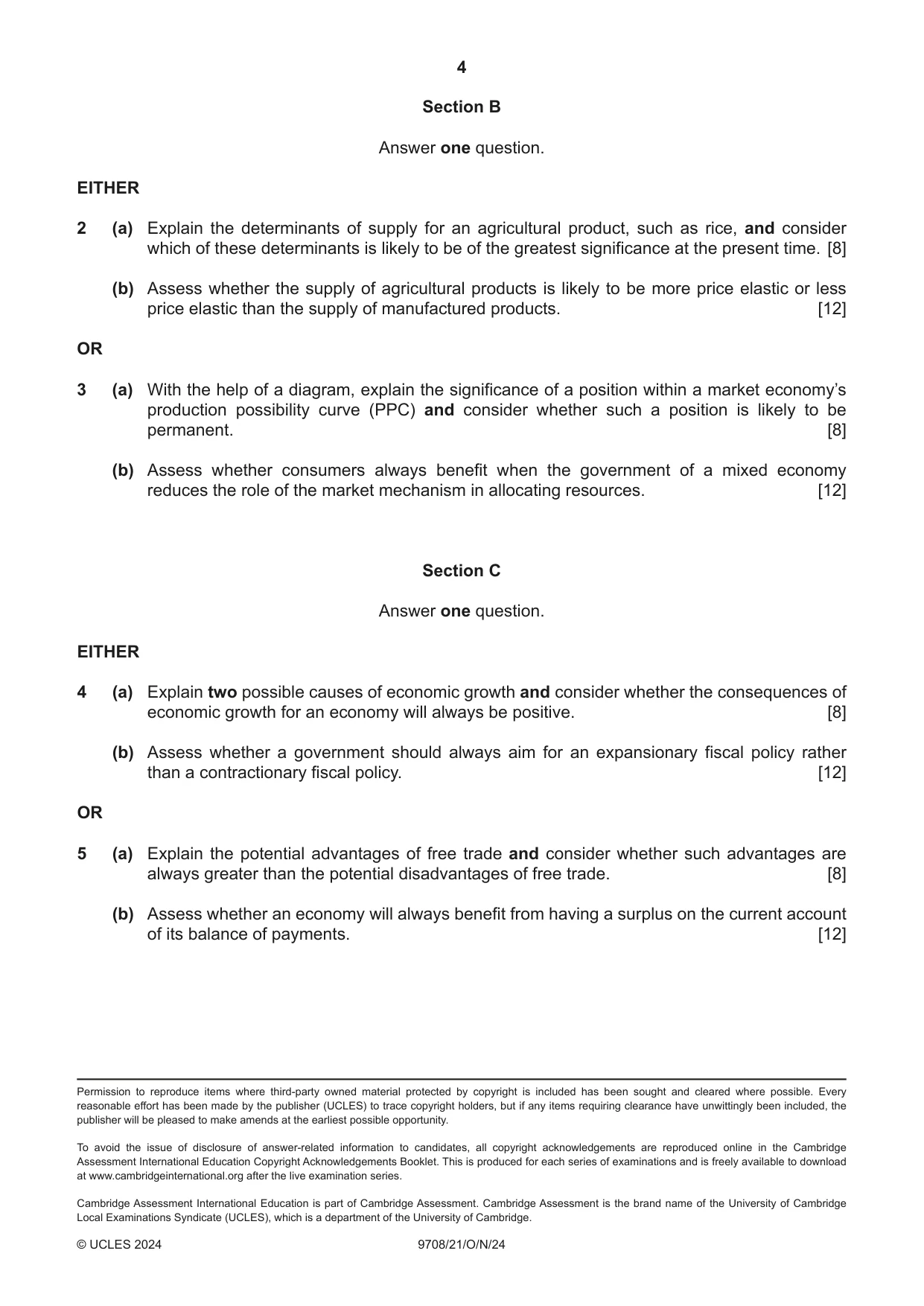
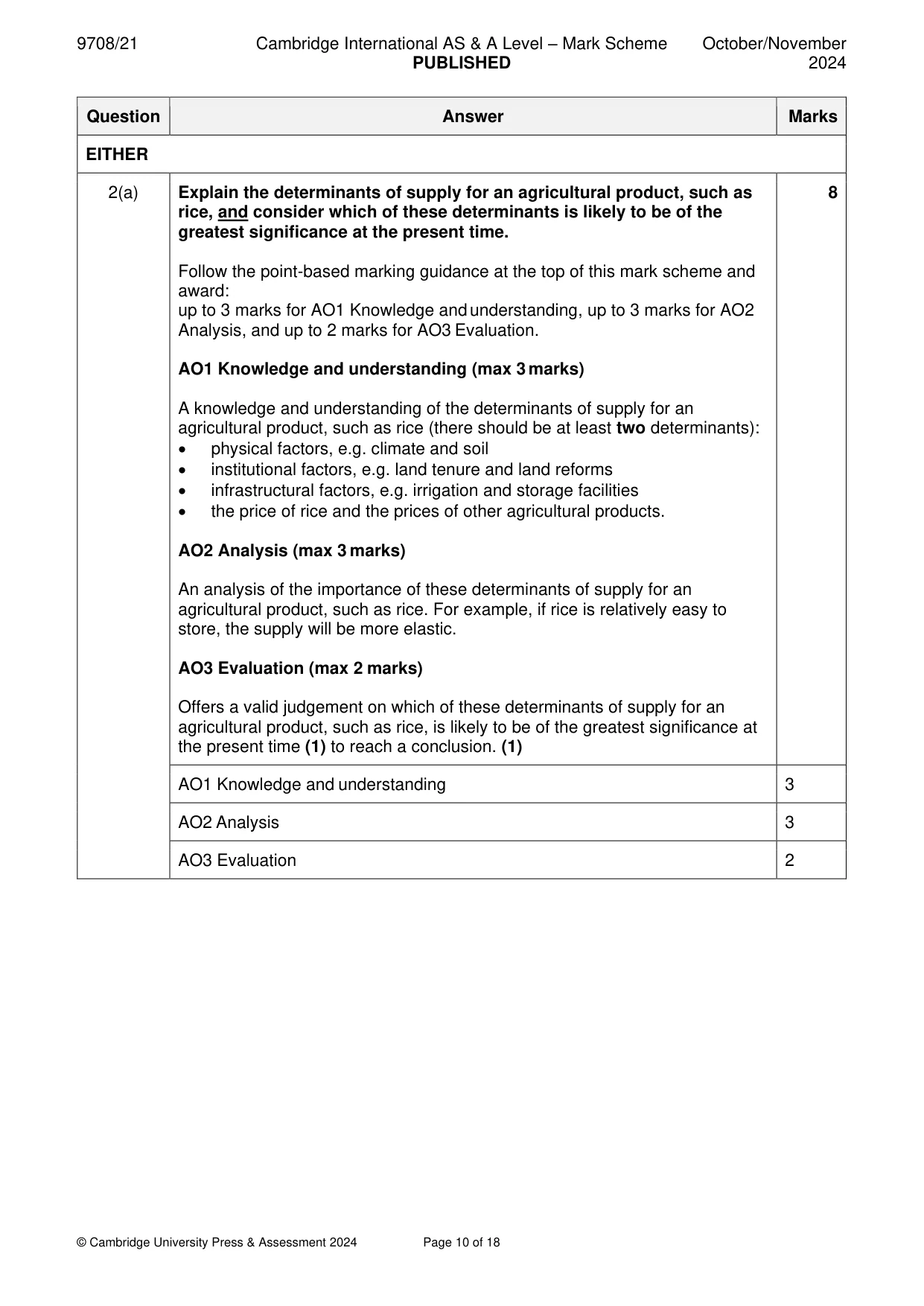
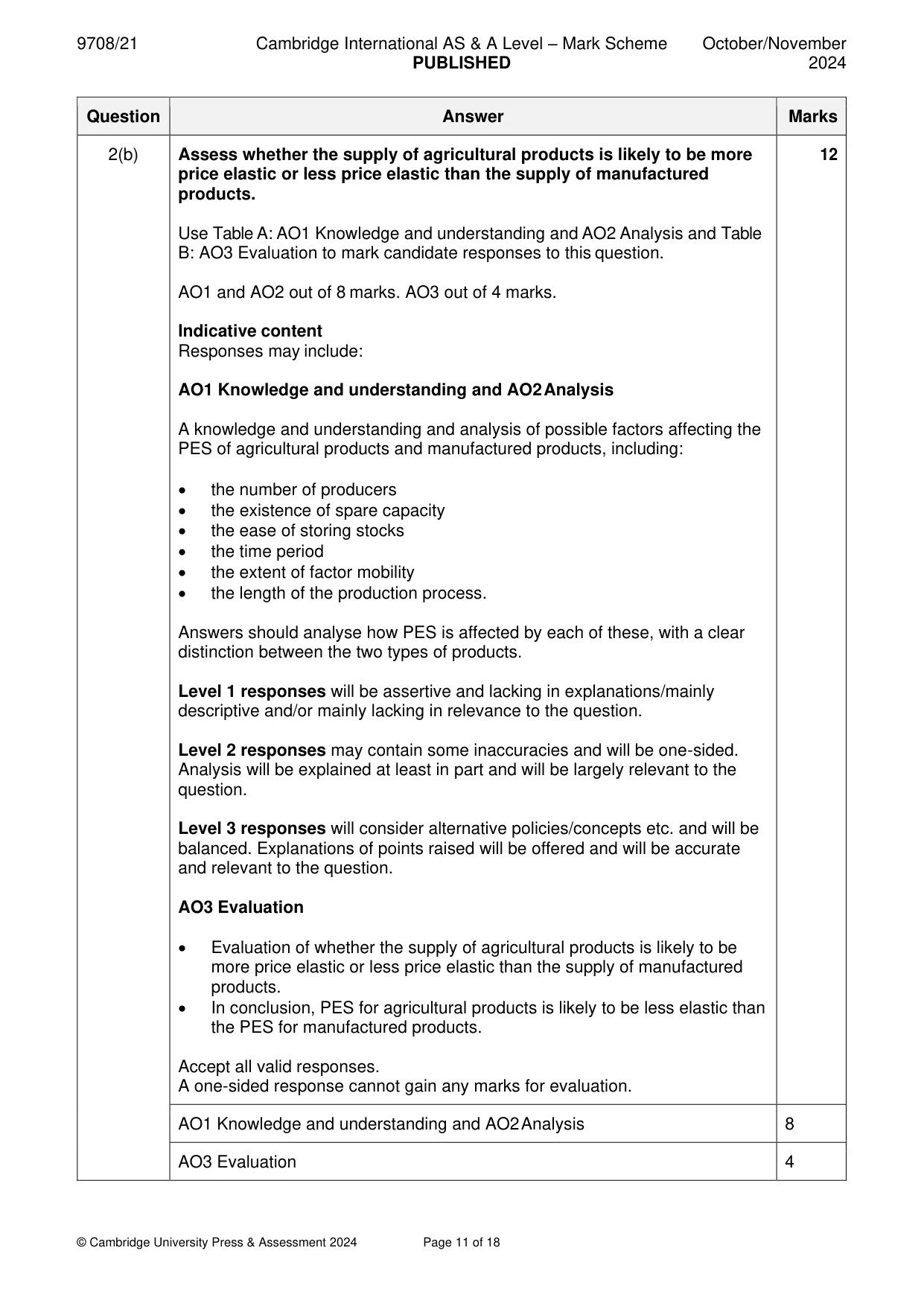
2 (a) Explain the determinants of supply for an agricultural product, such as rice, and consider which of these determinants is likely to be of the greatest significance at the present time. [8] (b) Assess whether the supply of agricultural products is likely to be more price elastic or less price elastic than the supply of manufactured products. [12] OR
Mark scheme: 2(a) Explain the determinants of supply for an agricultural product, such as 8 rice, and consider which of these determinants is likely to be of the greatest significance at the present time. Follow the point-based marking guidance at the top of this mark scheme and award: up to 3 marks for AO1 Knowledge and understanding, up to 3 marks for AO2 Analysis, and up to 2 marks for AO3 Evaluation. AO1 Knowledge and understanding (max 3 marks) A knowledge and understanding of the determinants of supply for an agricultural product, such as rice (there should be at least two determinants): • physical factors, e.g. climate and soil • institutional factors, e.g. land tenure and land reforms • infrastructural factors, e.g. irrigation and storage facilities • the price of rice and the prices of other agricultural products. AO2 Analysis (max 3 marks) An analysis of the importance of these determinants of supply for an agricultural product, such as rice. For example, if rice is relatively easy to store, the supply will be more elastic. AO3 Evaluation (max 2 marks) Offers a valid judgement on which of these determinants of supply for an agricultural product, such as rice, is likely to be of the greatest significance at the present time (1) to reach a conclusion. (1) AO1 Knowledge and understanding 3 AO2 Analysis 3 AO3 Evaluation 2 2(b) Assess whether the supply of agricultural products is likely to be more 12 price elastic or less price elastic than the supply of manufactured products. Use Table A: AO1 Knowledge and understanding and AO2 Analysis and Table B: AO3 Evaluation to mark candidate responses to this question. AO1 and AO2 out of 8 marks. AO3 out of 4 marks. Indicative content Responses may include: AO1 Knowledge and understanding and AO2 Analysis A knowledge and understanding and analysis of possible factors affecting the PES of agricultural products and manufactured products, including: • the number of producers • the existence of spare capacity • the ease of storing stocks • the time period • the extent of factor mobility • the length of the production process. Answers should analyse how PES is affected by each of these, with a clear distinction between the two types of products. Level 1 responses will be assertive and lacking in explanations/mainly descriptive and/or mainly lacking in relevance to the question. Level 2 responses may contain some inaccuracies and will be one-sided. Analysis will be explained at least in part and will be largely relevant to the question. Level 3 responses will consider alternative policies/concepts etc. and will be balanced. Explanations of points raised will be offered and will be accurate and relevant to the question. AO3 Evaluation • Evaluation of whether the supply of agricultural products is likely to be more price elastic or less price elastic than the supply of manufactured products. • In conclusion, PES for agricultural products is likely to be less elastic than the PES for manufactured products. Accept all valid responses. A one-sided response cannot gain any marks for evaluation. AO1 Knowledge and understanding and AO2 Analysis 8 AO3 Evaluation 4
Q3 · With the help of a diagram, explain the significance of a position within a market…
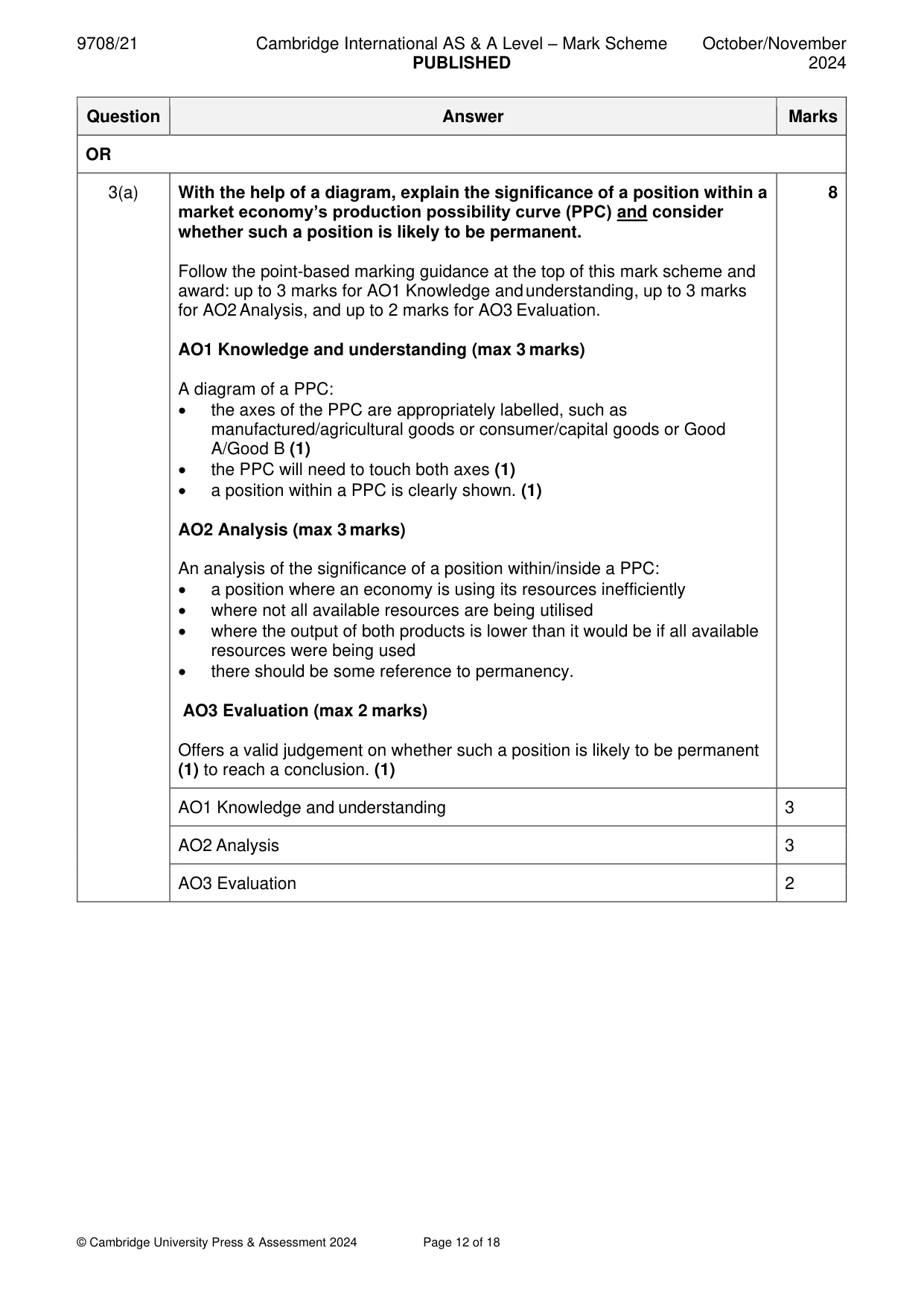
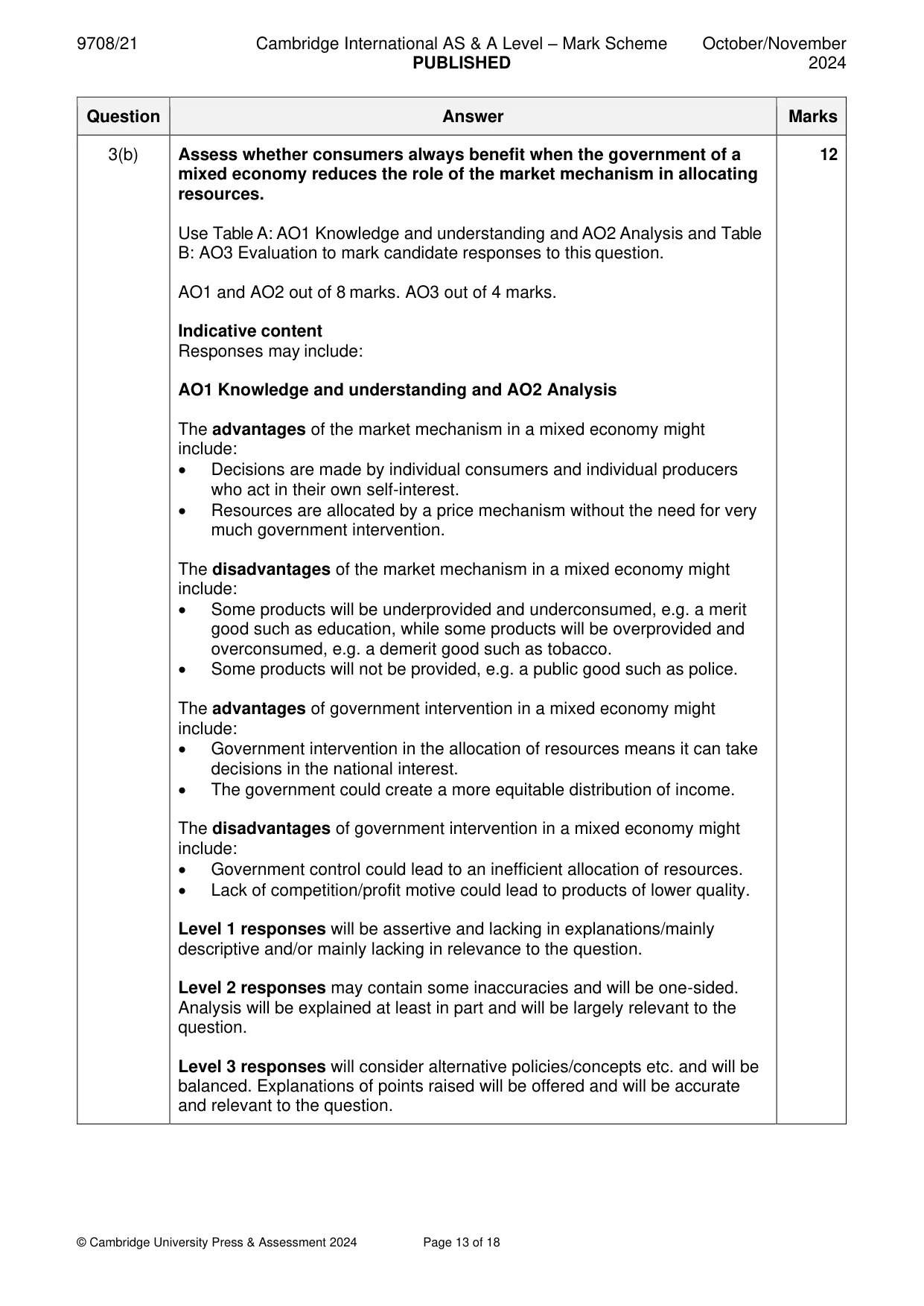
3 (a) With the help of a diagram, explain the significance of a position within a market economy’s production possibility curve (PPC) and consider whether such a position is likely to be permanent. [8] (b) Assess whether consumers always benefit when the government of a mixed economy reduces the role of the market mechanism in allocating resources. [12] Section C Answer one question. EITHER
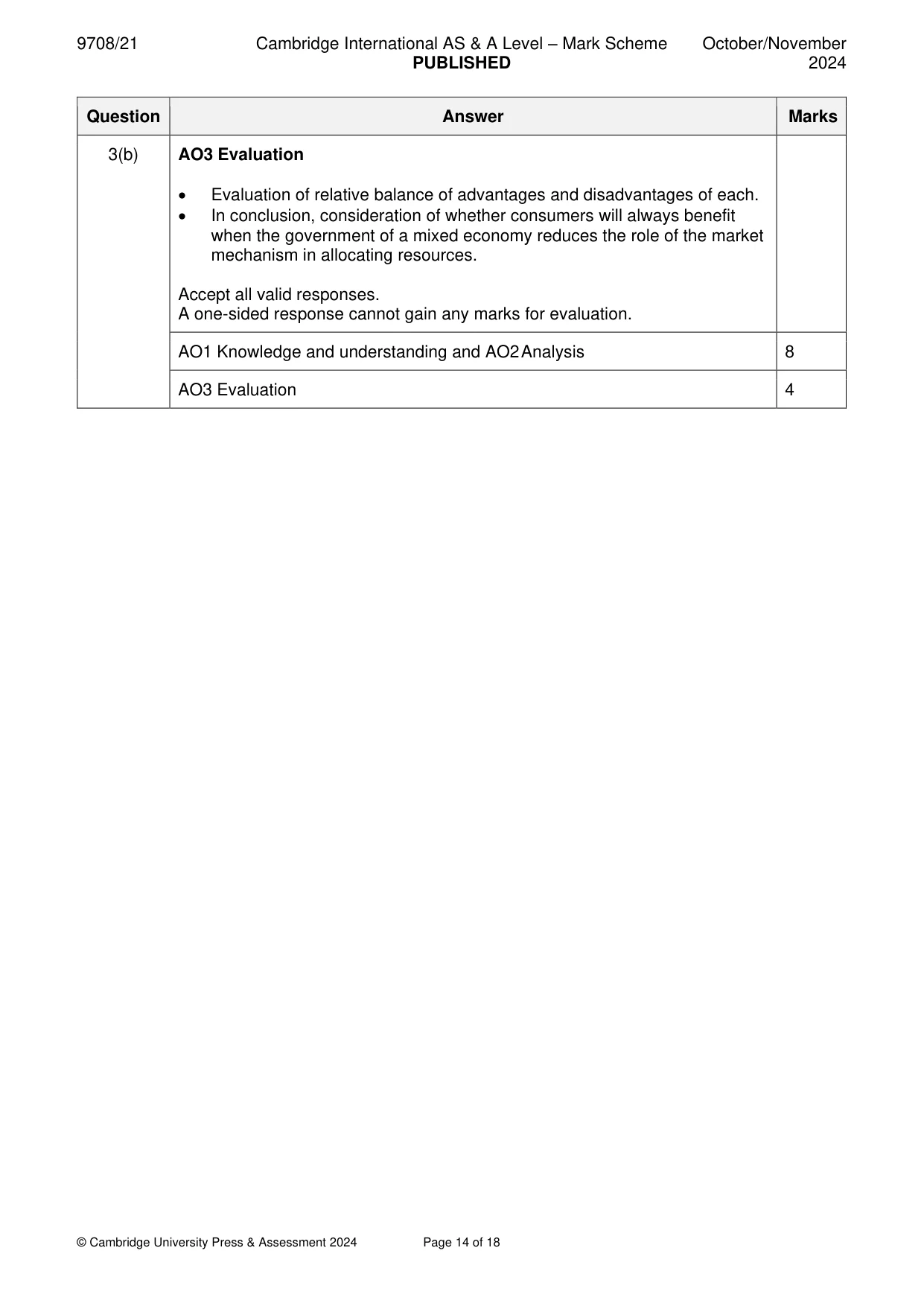
Mark scheme: 3(a) With the help of a diagram, explain the significance of a position within a 8 market economy’s production possibility curve (PPC) and consider whether such a position is likely to be permanent. Follow the point-based marking guidance at the top of this mark scheme and award: up to 3 marks for AO1 Knowledge and understanding, up to 3 marks for AO2 Analysis, and up to 2 marks for AO3 Evaluation. AO1 Knowledge and understanding (max 3 marks) A diagram of a PPC: • the axes of the PPC are appropriately labelled, such as manufactured/agricultural goods or consumer/capital goods or Good A/Good B (1) • the PPC will need to touch both axes (1) • a position within a PPC is clearly shown. (1) AO2 Analysis (max 3 marks) An analysis of the significance of a position within/inside a PPC: • a position where an economy is using its resources inefficiently • where not all available resources are being utilised • where the output of both products is lower than it would be if all available resources were being used • there should be some reference to permanency. AO3 Evaluation (max 2 marks) Offers a valid judgement on whether such a position is likely to be permanent (1) to reach a conclusion. (1) AO1 Knowledge and understanding 3 AO2 Analysis 3 AO3 Evaluation 2 3(b) Assess whether consumers always benefit when the government of a 12 mixed economy reduces the role of the market mechanism in allocating resources. Use Table A: AO1 Knowledge and understanding and AO2 Analysis and Table B: AO3 Evaluation to mark candidate responses to this question. AO1 and AO2 out of 8 marks. AO3 out of 4 marks. Indicative content Responses may include: AO1 Knowledge and understanding and AO2 Analysis The advantages of the market mechanism in a mixed economy might include: • Decisions are made by individual consumers and individual producers who act in their own self-interest. • Resources are allocated by a price mechanism without the need for very much government intervention. The disadvantages of the market mechanism in a mixed economy might include: • Some products will be underprovided and underconsumed, e.g. a merit good such as education, while some products will be overprovided and overconsumed, e.g. a demerit good such as tobacco. • Some products will not be provided, e.g. a public good such as police. The advantages of government intervention in a mixed economy might include: • Government intervention in the allocation of resources means it can take decisions in the national interest. • The government could create a more equitable distribution of income. The disadvantages of government intervention in a mixed economy might include: • Government control could lead to an inefficient allocation of resources. • Lack of competition/profit motive could lead to products of lower quality. Level 1 responses will be assertive and lacking in explanations/mainly descriptive and/or mainly lacking in relevance to the question. Level 2 responses may contain some inaccuracies and will be one-sided. Analysis will be explained at least in part and will be largely relevant to the question. Level 3 responses will consider alternative policies/concepts etc. and will be balanced. Explanations of points raised will be offered and will be accurate and relevant to the question. 3(b) AO3 Evaluation • Evaluation of relative balance of advantages and disadvantages of each. • In conclusion, consideration of whether consumers will always benefit when the government of a mixed economy reduces the role of the market mechanism in allocating resources. Accept all valid responses. A one-sided response cannot gain any marks for evaluation. AO1 Knowledge and understanding and AO2 Analysis 8 AO3 Evaluation 4
More questions on Methods and effects of government intervention in markets
Q4 · Explain two possible causes of economic growth and consider whether the consequences of…
4 (a) Explain two possible causes of economic growth and consider whether the consequences of economic growth for an economy will always be positive. [8] (b) Assess whether a government should always aim for an expansionary fiscal policy rather than a contractionary fiscal policy. [12] OR
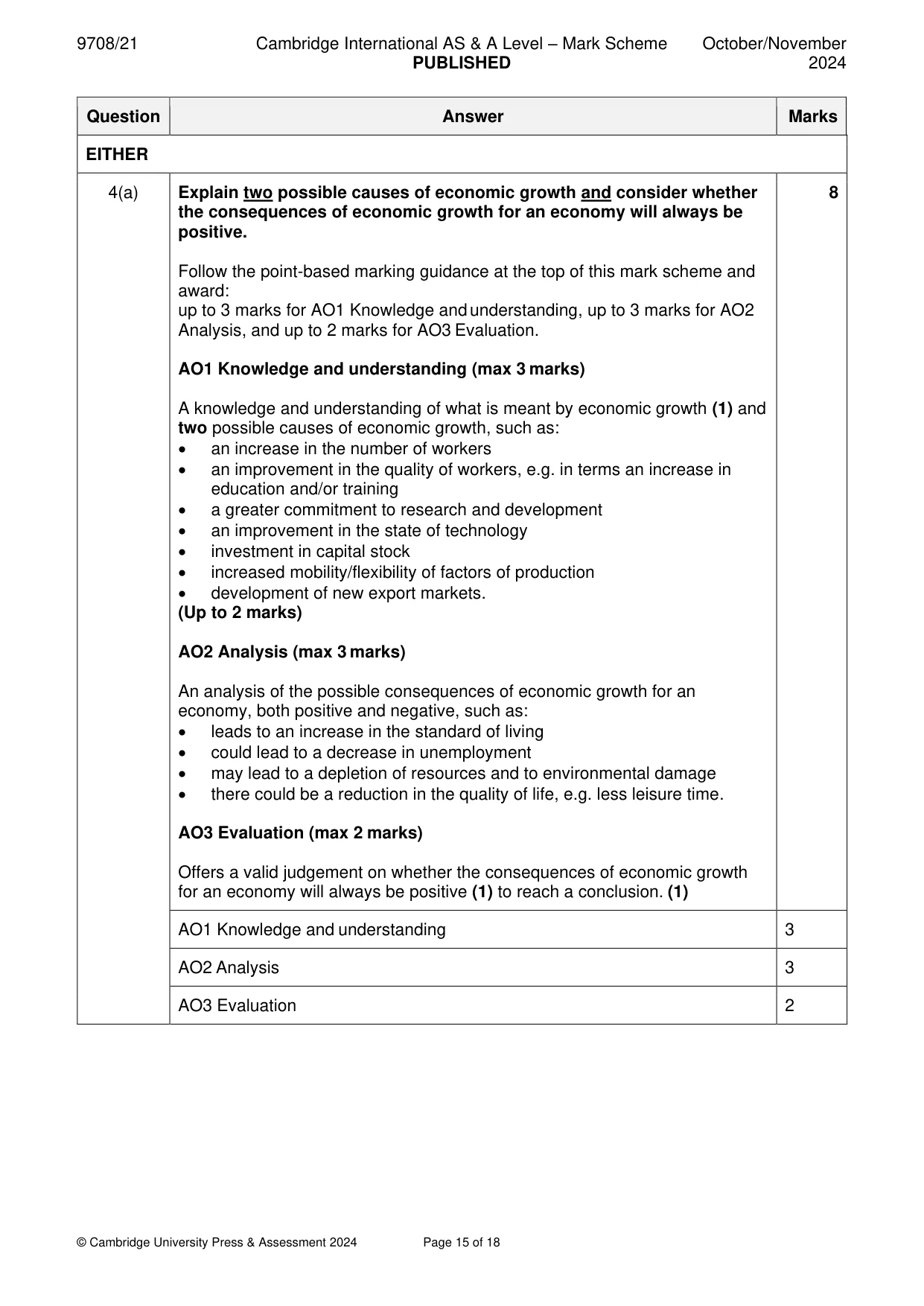
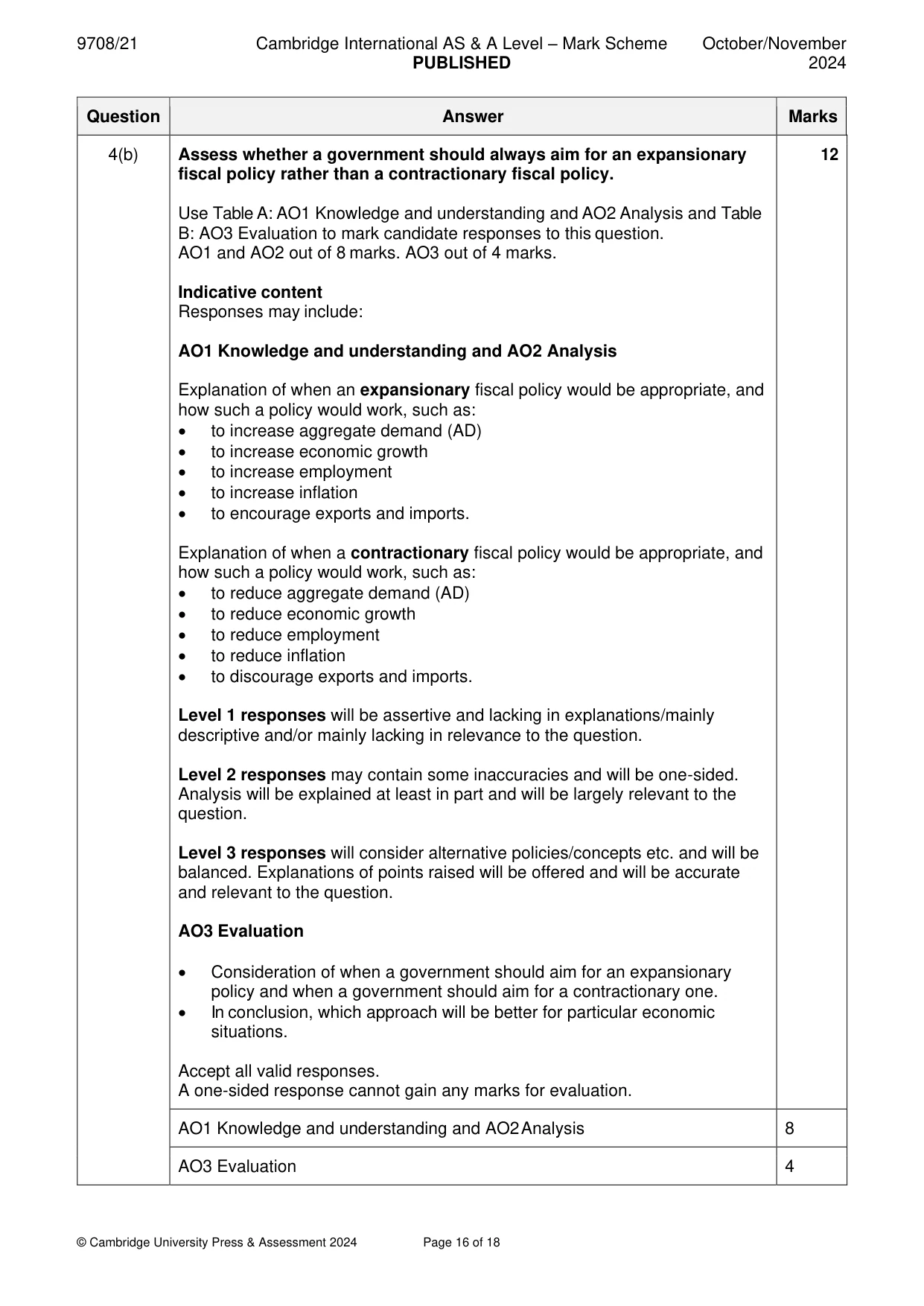
Mark scheme: 4(a) Explain two possible causes of economic growth and consider whether 8 the consequences of economic growth for an economy will always be positive. Follow the point-based marking guidance at the top of this mark scheme and award: up to 3 marks for AO1 Knowledge and understanding, up to 3 marks for AO2 Analysis, and up to 2 marks for AO3 Evaluation. AO1 Knowledge and understanding (max 3 marks) A knowledge and understanding of what is meant by economic growth (1) and two possible causes of economic growth, such as: • an increase in the number of workers • an improvement in the quality of workers, e.g. in terms an increase in education and/or training • a greater commitment to research and development • an improvement in the state of technology • investment in capital stock • increased mobility/flexibility of factors of production • development of new export markets. (Up to 2 marks) AO2 Analysis (max 3 marks) An analysis of the possible consequences of economic growth for an economy, both positive and negative, such as: • leads to an increase in the standard of living • could lead to a decrease in unemployment • may lead to a depletion of resources and to environmental damage • there could be a reduction in the quality of life, e.g. less leisure time. AO3 Evaluation (max 2 marks) Offers a valid judgement on whether the consequences of economic growth for an economy will always be positive (1) to reach a conclusion. (1) AO1 Knowledge and understanding 3 AO2 Analysis 3 AO3 Evaluation 2 4(b) Assess whether a government should always aim for an expansionary 12 fiscal policy rather than a contractionary fiscal policy. Use Table A: AO1 Knowledge and understanding and AO2 Analysis and Table B: AO3 Evaluation to mark candidate responses to this question. AO1 and AO2 out of 8 marks. AO3 out of 4 marks. Indicative content Responses may include: AO1 Knowledge and understanding and AO2 Analysis Explanation of when an expansionary fiscal policy would be appropriate, and how such a policy would work, such as: • to increase aggregate demand (AD) • to increase economic growth • to increase employment • to increase inflation • to encourage exports and imports. Explanation of when a contractionary fiscal policy would be appropriate, and how such a policy would work, such as: • to reduce aggregate demand (AD) • to reduce economic growth • to reduce employment • to reduce inflation • to discourage exports and imports. Level 1 responses will be assertive and lacking in explanations/mainly descriptive and/or mainly lacking in relevance to the question. Level 2 responses may contain some inaccuracies and will be one-sided. Analysis will be explained at least in part and will be largely relevant to the question. Level 3 responses will consider alternative policies/concepts etc. and will be balanced. Explanations of points raised will be offered and will be accurate and relevant to the question. AO3 Evaluation • Consideration of when a government should aim for an expansionary policy and when a government should aim for a contractionary one. • In conclusion, which approach will be better for particular economic situations. Accept all valid responses. A one-sided response cannot gain any marks for evaluation. AO1 Knowledge and understanding and AO2 Analysis 8 AO3 Evaluation 4
Q5 · Explain the potential advantages of free trade and consider whether such advantages are…
5 (a) Explain the potential advantages of free trade and consider whether such advantages are always greater than the potential disadvantages of free trade. [8] (b) Assess whether an economy will always benefit from having a surplus on the current account of its balance of payments. [12]
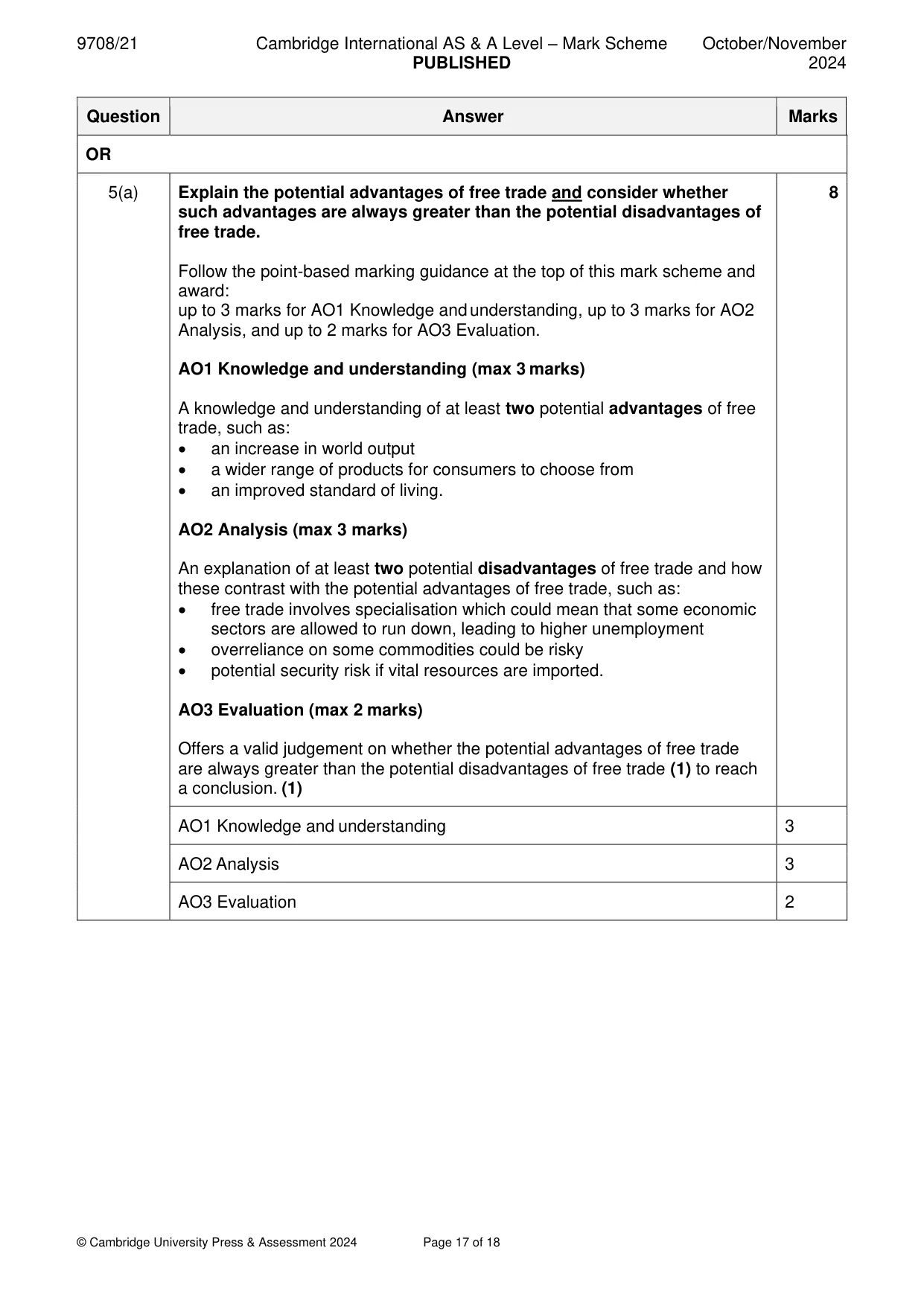
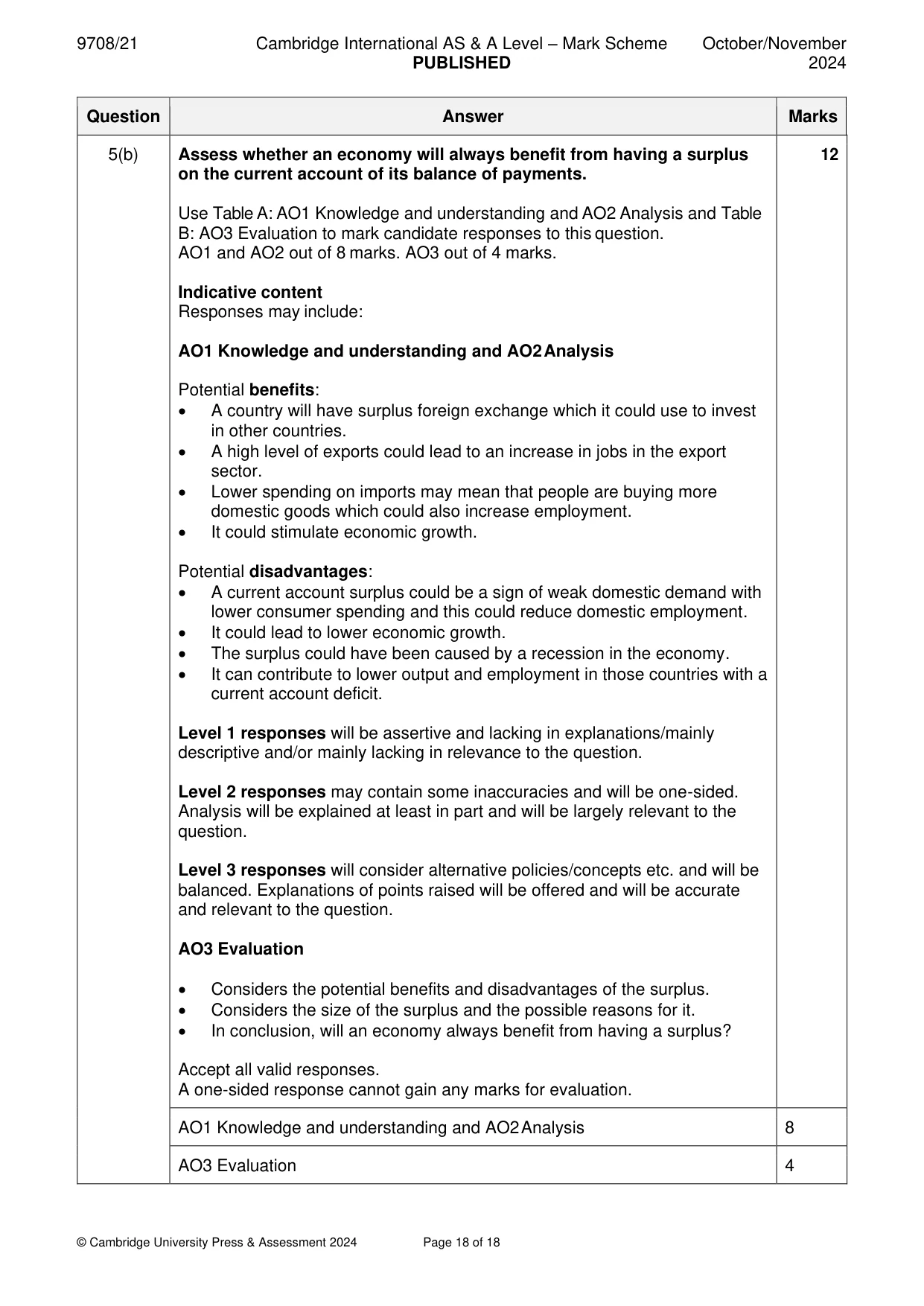
Mark scheme: 5(a) Explain the potential advantages of free trade and consider whether 8 such advantages are always greater than the potential disadvantages of free trade. Follow the point-based marking guidance at the top of this mark scheme and award: up to 3 marks for AO1 Knowledge and understanding, up to 3 marks for AO2 Analysis, and up to 2 marks for AO3 Evaluation. AO1 Knowledge and understanding (max 3 marks) A knowledge and understanding of at least two potential advantages of free trade, such as: • an increase in world output • a wider range of products for consumers to choose from • an improved standard of living. AO2 Analysis (max 3 marks) An explanation of at least two potential disadvantages of free trade and how these contrast with the potential advantages of free trade, such as: • free trade involves specialisation which could mean that some economic sectors are allowed to run down, leading to higher unemployment • overreliance on some commodities could be risky • potential security risk if vital resources are imported. AO3 Evaluation (max 2 marks) Offers a valid judgement on whether the potential advantages of free trade are always greater than the potential disadvantages of free trade (1) to reach a conclusion. (1) AO1 Knowledge and understanding 3 AO2 Analysis 3 AO3 Evaluation 2 5(b) Assess whether an economy will always benefit from having a surplus 12 on the current account of its balance of payments. Use Table A: AO1 Knowledge and understanding and AO2 Analysis and Table B: AO3 Evaluation to mark candidate responses to this question. AO1 and AO2 out of 8 marks. AO3 out of 4 marks. Indicative content Responses may include: AO1 Knowledge and understanding and AO2 Analysis Potential benefits: • A country will have surplus foreign exchange which it could use to invest in other countries. • A high level of exports could lead to an increase in jobs in the export sector. • Lower spending on imports may mean that people are buying more domestic goods which could also increase employment. • It could stimulate economic growth. Potential disadvantages: • A current account surplus could be a sign of weak domestic demand with lower consumer spending and this could reduce domestic employment. • It could lead to lower economic growth. • The surplus could have been caused by a recession in the economy. • It can contribute to lower output and employment in those countries with a current account deficit. Level 1 responses will be assertive and lacking in explanations/mainly descriptive and/or mainly lacking in relevance to the question. Level 2 responses may contain some inaccuracies and will be one-sided. Analysis will be explained at least in part and will be largely relevant to the question. Level 3 responses will consider alternative policies/concepts etc. and will be balanced. Explanations of points raised will be offered and will be accurate and relevant to the question. AO3 Evaluation • Considers the potential benefits and disadvantages of the surplus. • Considers the size of the surplus and the possible reasons for it. • In conclusion, will an economy always benefit from having a surplus? Accept all valid responses. A one-sided response cannot gain any marks for evaluation. AO1 Knowledge and understanding and AO2 Analysis 8 AO3 Evaluation 4
More questions on Current account of the balance of payments
What was in this paper
The subtopics covered by these 5 questions, and how many questions each got. Open one in a new tab to see every Cambridge question on it.
What you needed in this session
Cambridge’s own grade thresholds for 2024 Oct/Nov, Paper 2 · Variant 1. A higher threshold means an easier paper — the bar moves with how the cohort did.