Cambridge A Level Economics 9708 — 2024 May/June Paper 2 · Variant 1
9708/21/M/J/24 · 5 questions · 60 marks · ≈68 min
The question paper and its mark scheme, free to read here and free to download. This is Cambridge’s own paper, exactly as it was sat.
Question paper4 pages
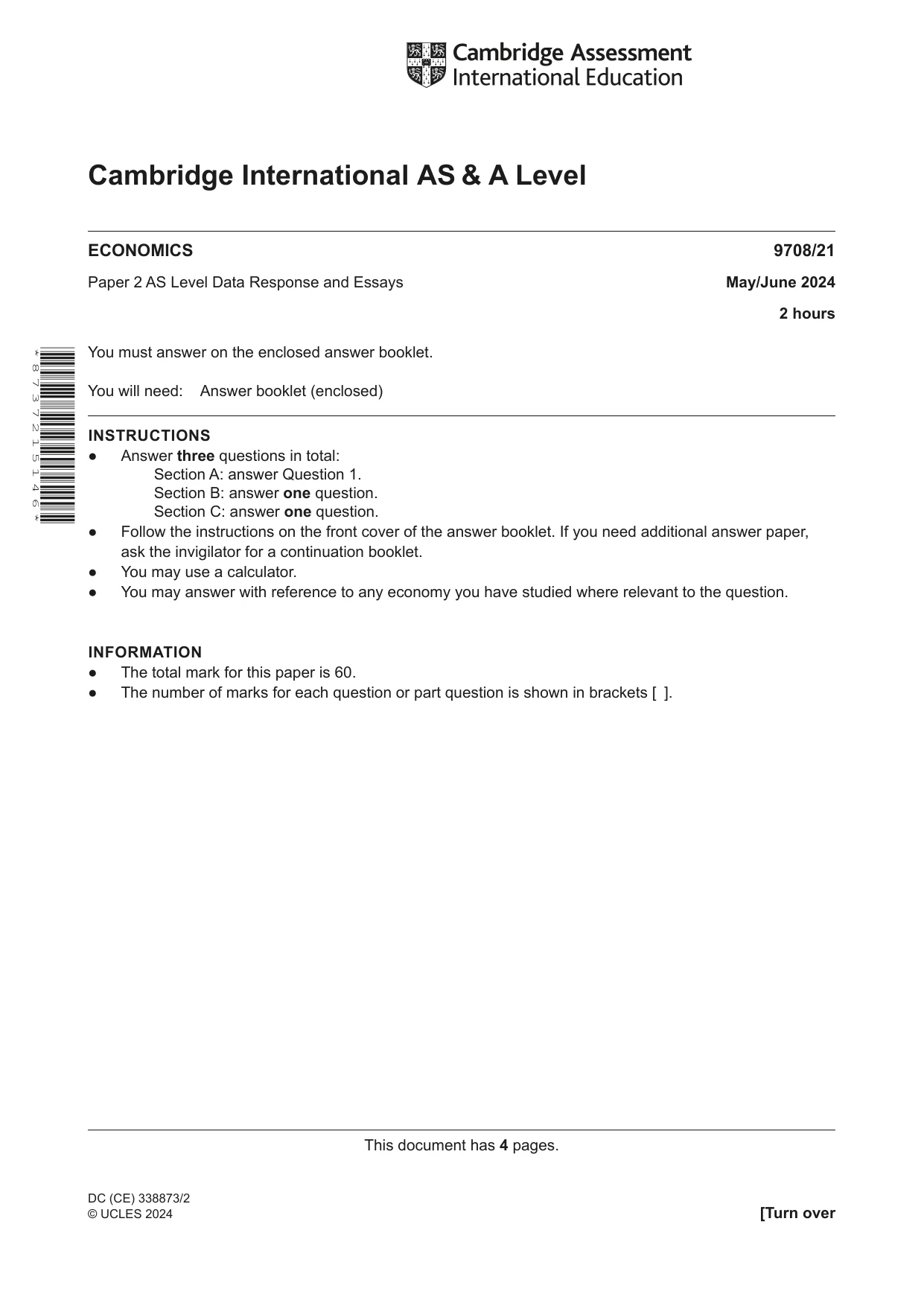
Mark scheme16 pages
Answers below. Sit the paper first if you are practising.
Questions as text
Q1 · Will an increase in exports lead Sri Lanka back into economic growth?
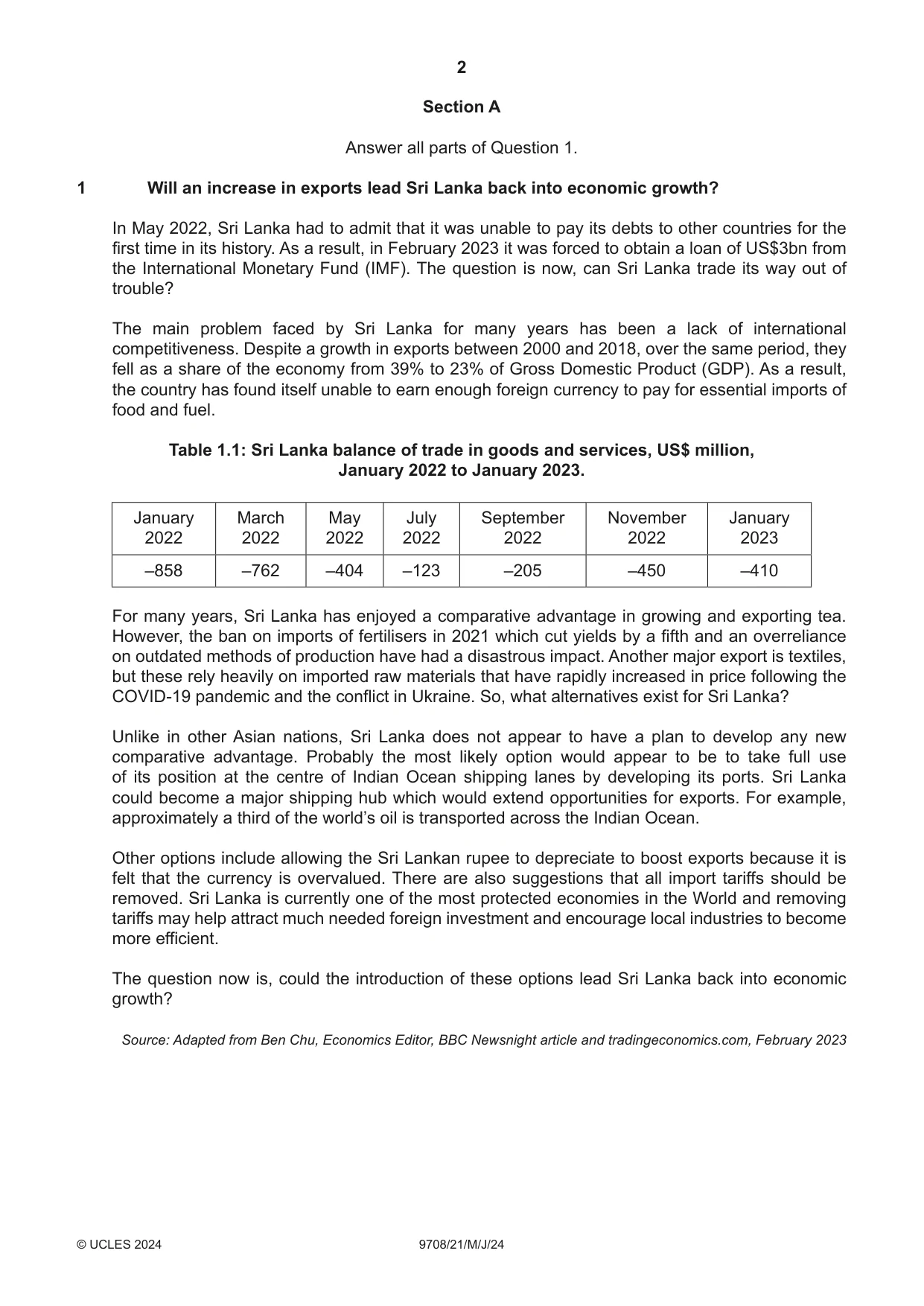
1 Will an increase in exports lead Sri Lanka back into economic growth? In May 2022, Sri Lanka had to admit that it was unable to pay its debts to other countries for the first time in its history. As a result, in February 2023 it was forced to obtain a loan of US$3bn from the International Monetary Fund (IMF). The question is now, can Sri Lanka trade its way out of trouble? The main problem faced by Sri Lanka for many years has been a lack of international competitiveness. Despite a growth in exports between 2000 and 2018, over the same period, they fell as a share of the economy from 39% to 23% of Gross Domestic Product (GDP). As a result, the country has found itself unable to earn enough foreign currency to pay for essential imports of food and fuel. Table 1.1: Sri Lanka balance of trade in goods and services, US$ million, January 2022 to January 2023. January March May July September November January 2022 2022 2022 2022 2022 2022 2023 –858 –762 –404 –123 –205 –450 –410 For many years, Sri Lanka has enjoyed a comparative advantage in growing and exporting tea. However, the ban on imports of fertilisers in 2021 which cut yields by a fifth and an overreliance on outdated methods of production have had a disastrous impact. Another major export is textiles, but these rely heavily on imported raw materials that have rapidly increased in price following the COVID-19 pandemic and the conflict in Ukraine. So, what alternatives exist for Sri Lanka? Unlike in other Asian nations, Sri Lanka does not appear to have a plan to develop any new comparative advantage. Probably the most likely option would appear to be to take full use of its position at the centre of Indian Ocean shipping lanes by developing its ports. Sri Lanka could become a major shipping hub which would extend opportunities for exports. For example, approximately a third of the world’s oil is transported across the Indian Ocean. Other options include allowing the Sri Lankan rupee to depreciate to boost exports because it is felt that the currency is overvalued. There are also suggestions that all import tariffs should be removed. Sri Lanka is currently one of the most protected economies in the World and removing tariffs may help attract much needed foreign investment and encourage local industries to become more efficient. The question now is, could the introduction of these options lead Sri Lanka back into economic growth? Source: Adapted from Ben Chu, Economics Editor, BBC Newsnight article and tradingeconomics.com, February 2023 (a) Using Table 1.1: (i) Identify the overall trend in Sri Lanka’s balance of trade in goods and services between January 2022 and January 2023. [1] (ii) Calculate the percentage change in Sri Lanka’s balance of trade in goods and services between January 2022 and January 2023. [1] (b) Explain what is meant by ‘Sri Lanka has enjoyed a comparative advantage in growing and exporting tea.’. [2] (c) Consider the extent to which depreciation of the Sri Lankan rupee could improve the country’s balance of trade in goods and services. [4] (d) Assess whether the removal of all protectionism is likely to reduce the balance of trade deficit. [6] (e) Assess the extent to which supply-side policies will be able to ‘lead Sri Lanka back into economic growth’. [6]
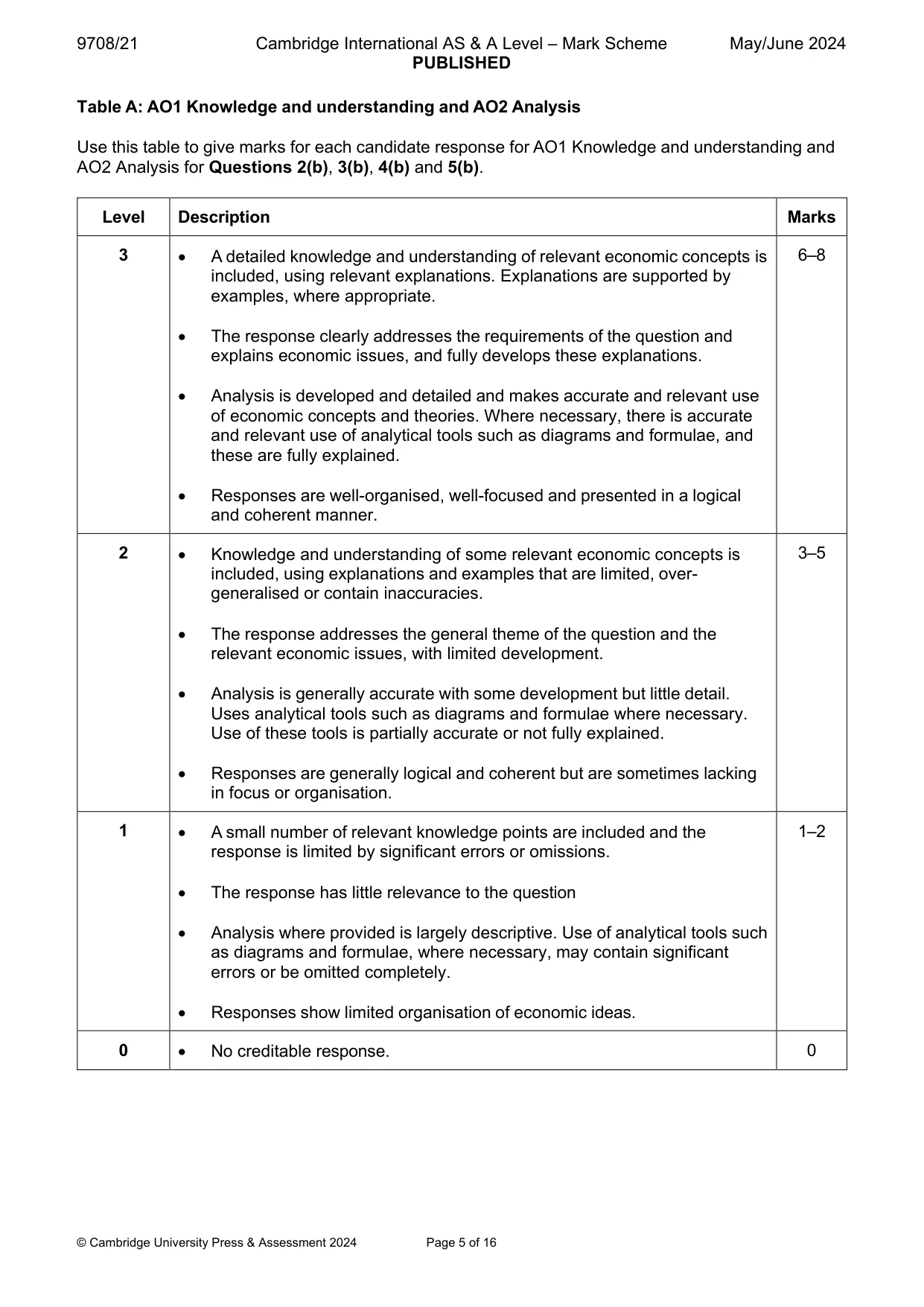
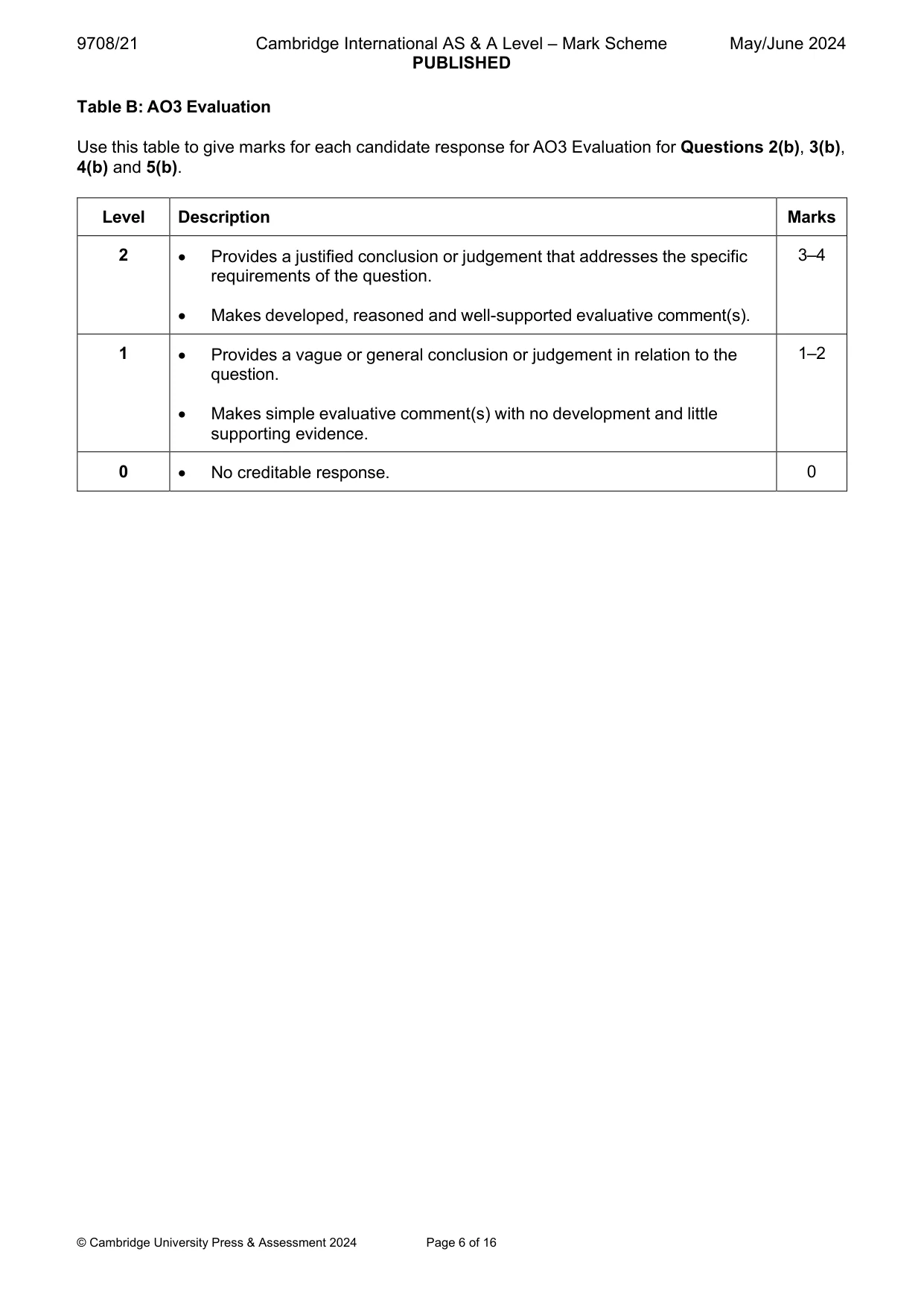
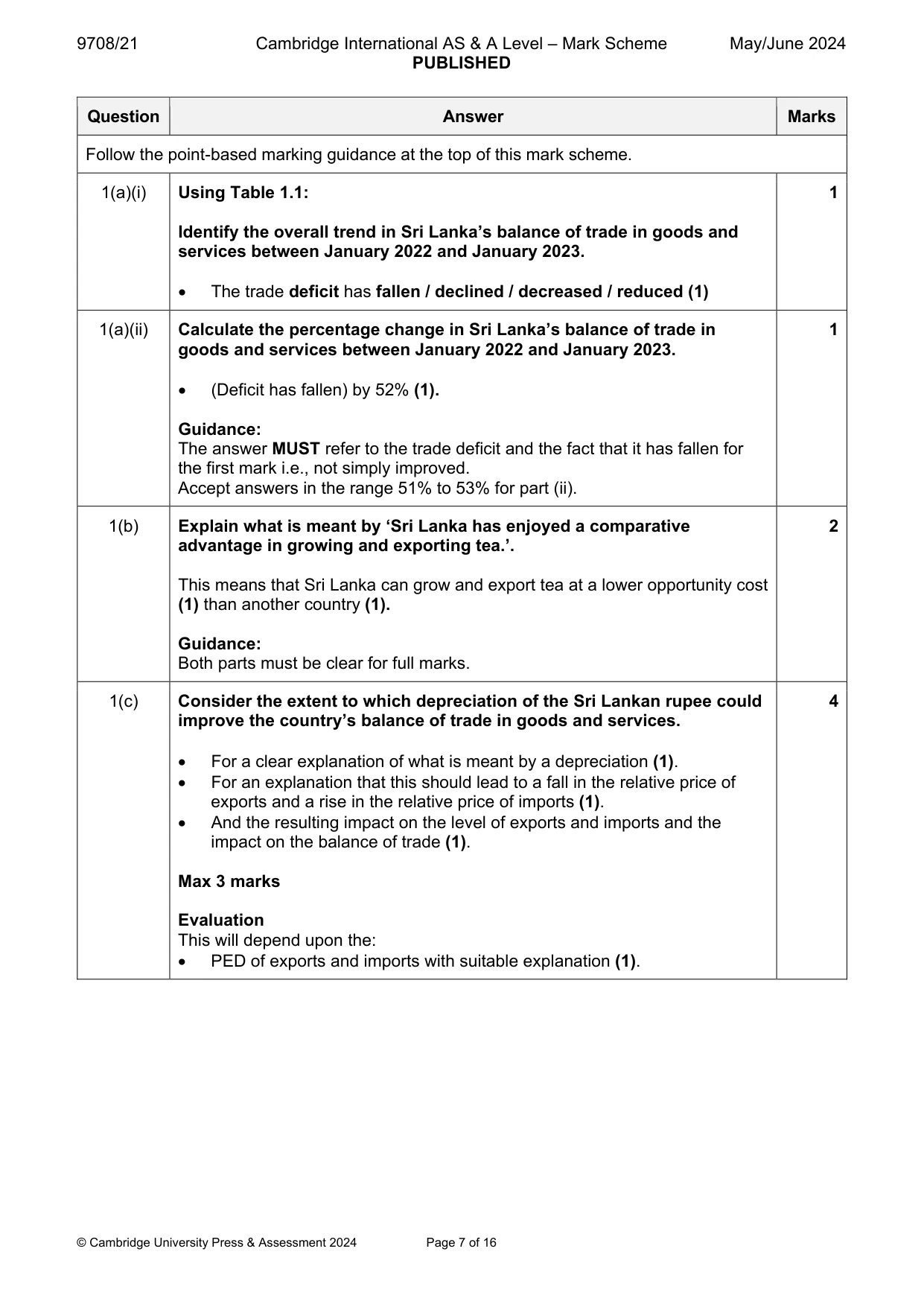
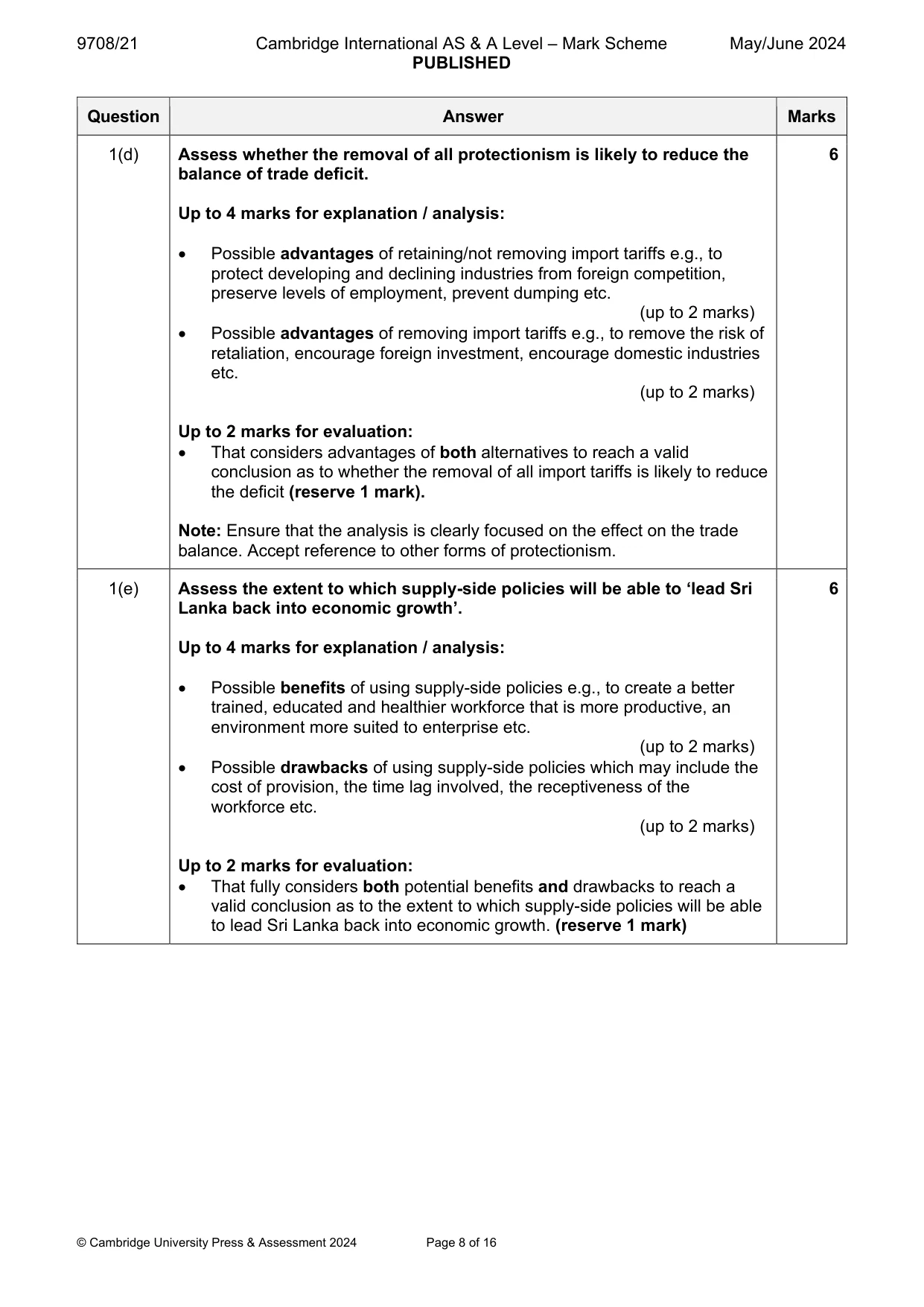
Mark scheme: 1(a)(i) Using Table 1.1: 1 Identify the overall trend in Sri Lanka’s balance of trade in goods and services between January 2022 and January 2023. The trade deficit has fallen / declined / decreased / reduced (1) 1(a)(ii) Calculate the percentage change in Sri Lanka’s balance of trade in 1 goods and services between January 2022 and January 2023. (Deficit has fallen) by 52% (1). Guidance: The answer MUST refer to the trade deficit and the fact that it has fallen for the first mark i.e., not simply improved. Accept answers in the range 51% to 53% for part (ii). 1(b) Explain what is meant by ‘Sri Lanka has enjoyed a comparative 2 advantage in growing and exporting tea.’. This means that Sri Lanka can grow and export tea at a lower opportunity cost (1) than another country (1). Guidance: Both parts must be clear for full marks. 1(c) Consider the extent to which depreciation of the Sri Lankan rupee could 4 improve the country’s balance of trade in goods and services. For a clear explanation of what is meant by a depreciation (1). For an explanation that this should lead to a fall in the relative price of exports and a rise in the relative price of imports (1). And the resulting impact on the level of exports and imports and the impact on the balance of trade (1). Max 3 marks Evaluation This will depend upon the: PED of exports and imports with suitable explanation (1). 1(d) Assess whether the removal of all protectionism is likely to reduce the 6 balance of trade deficit. Up to 4 marks for explanation / analysis: Possible advantages of retaining/not removing import tariffs e.g., to protect developing and declining industries from foreign competition, preserve levels of employment, prevent dumping etc. (up to 2 marks) Possible advantages of removing import tariffs e.g., to remove the risk of retaliation, encourage foreign investment, encourage domestic industries etc. (up to 2 marks) Up to 2 marks for evaluation: That considers advantages of both alternatives to reach a valid conclusion as to whether the removal of all import tariffs is likely to reduce the deficit (reserve 1 mark). Note: Ensure that the analysis is clearly focused on the effect on the trade balance. Accept reference to other forms of protectionism. 1(e) Assess the extent to which supply-side policies will be able to ‘lead Sri 6 Lanka back into economic growth’. Up to 4 marks for explanation / analysis: Possible benefits of using supply-side policies e.g., to create a better trained, educated and healthier workforce that is more productive, an environment more suited to enterprise etc. (up to 2 marks) Possible drawbacks of using supply-side policies which may include the cost of provision, the time lag involved, the receptiveness of the workforce etc. (up to 2 marks) Up to 2 marks for evaluation: That fully considers both potential benefits and drawbacks to reach a valid conclusion as to the extent to which supply-side policies will be able to lead Sri Lanka back into economic growth. (reserve 1 mark) Section B
More questions on Policies to correct imbalances in the current account of the balance of payments
Q2 · With the use of examples, explain the difference between public goods and merit goods and…
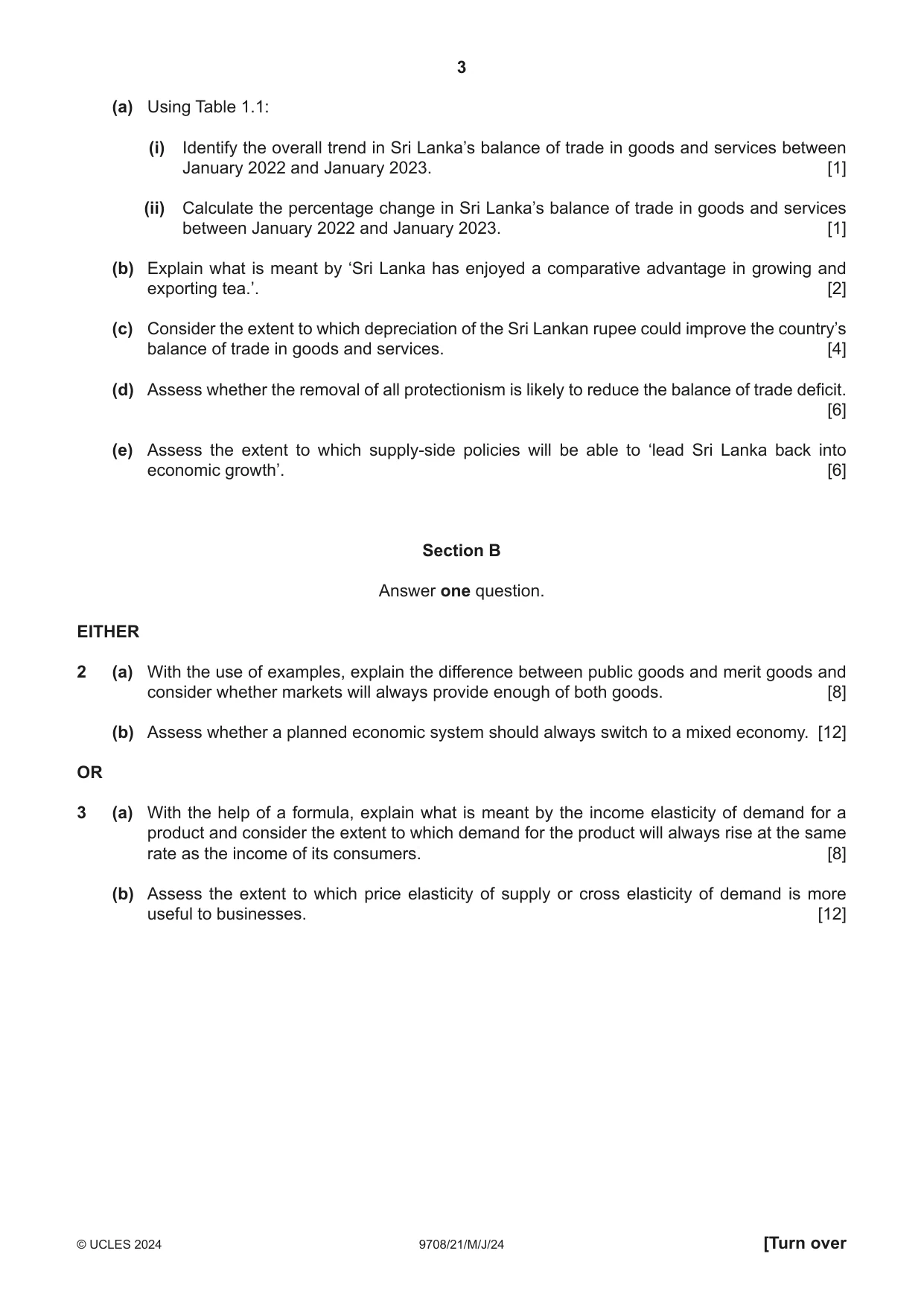
2 (a) With the use of examples, explain the difference between public goods and merit goods and consider whether markets will always provide enough of both goods. [8] (b) Assess whether a planned economic system should always switch to a mixed economy. [12] OR
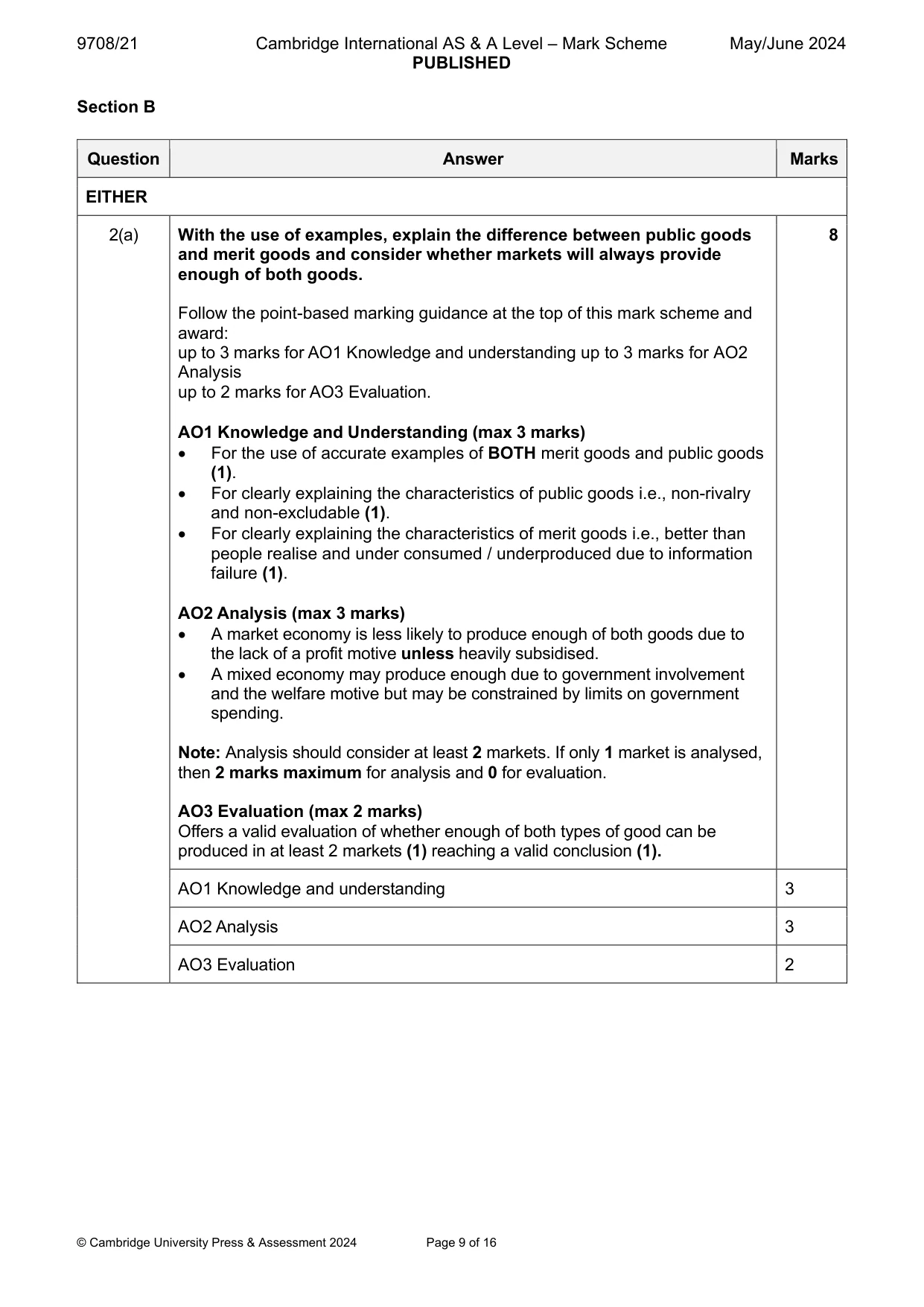
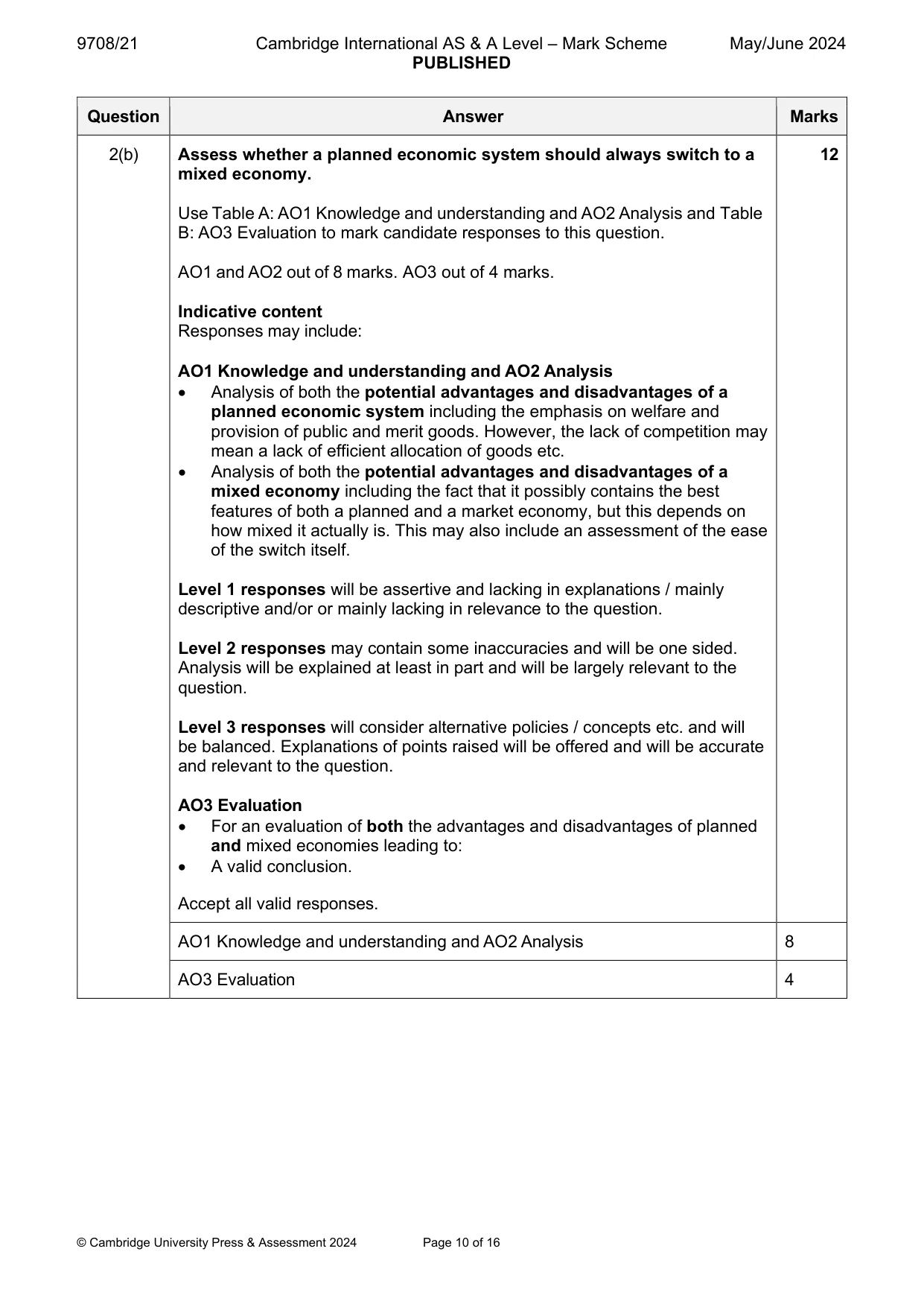
Mark scheme: 2(a) With the use of examples, explain the difference between public goods 8 and merit goods and consider whether markets will always provide enough of both goods. Follow the point-based marking guidance at the top of this mark scheme and award: up to 3 marks for AO1 Knowledge and understanding up to 3 marks for AO2 Analysis up to 2 marks for AO3 Evaluation. AO1 Knowledge and Understanding (max 3 marks) For the use of accurate examples of BOTH merit goods and public goods (1). For clearly explaining the characteristics of public goods i.e., non-rivalry and non-excludable (1). For clearly explaining the characteristics of merit goods i.e., better than people realise and under consumed / underproduced due to information failure (1). AO2 Analysis (max 3 marks) A market economy is less likely to produce enough of both goods due to the lack of a profit motive unless heavily subsidised. A mixed economy may produce enough due to government involvement and the welfare motive but may be constrained by limits on government spending. Note: Analysis should consider at least 2 markets. If only 1 market is analysed, then 2 marks maximum for analysis and 0 for evaluation. AO3 Evaluation (max 2 marks) Offers a valid evaluation of whether enough of both types of good can be produced in at least 2 markets (1) reaching a valid conclusion (1). AO1 Knowledge and understanding 3 AO2 Analysis 3 AO3 Evaluation 2 2(b) Assess whether a planned economic system should always switch to a 12 mixed economy. Use Table A: AO1 Knowledge and understanding and AO2 Analysis and Table B: AO3 Evaluation to mark candidate responses to this question. AO1 and AO2 out of 8 marks. AO3 out of 4 marks. Indicative content Responses may include: AO1 Knowledge and understanding and AO2 Analysis Analysis of both the potential advantages and disadvantages of a planned economic system including the emphasis on welfare and provision of public and merit goods. However, the lack of competition may mean a lack of efficient allocation of goods etc. Analysis of both the potential advantages and disadvantages of a mixed economy including the fact that it possibly contains the best features of both a planned and a market economy, but this depends on how mixed it actually is. This may also include an assessment of the ease of the switch itself. Level 1 responses will be assertive and lacking in explanations / mainly descriptive and/or or mainly lacking in relevance to the question. Level 2 responses may contain some inaccuracies and will be one sided. Analysis will be explained at least in part and will be largely relevant to the question. Level 3 responses will consider alternative policies / concepts etc. and will be balanced. Explanations of points raised will be offered and will be accurate and relevant to the question. AO3 Evaluation For an evaluation of both the advantages and disadvantages of planned and mixed economies leading to: A valid conclusion. Accept all valid responses. AO1 Knowledge and understanding and AO2 Analysis 8 AO3 Evaluation 4
More questions on Resource allocation in different economic systems
Q3 · With the help of a formula, explain what is meant by the income elasticity of demand for…
3 (a) With the help of a formula, explain what is meant by the income elasticity of demand for a product and consider the extent to which demand for the product will always rise at the same rate as the income of its consumers. [8] (b) Assess the extent to which price elasticity of supply or cross elasticity of demand is more useful to businesses. [12] Section C Answer one question. EITHER
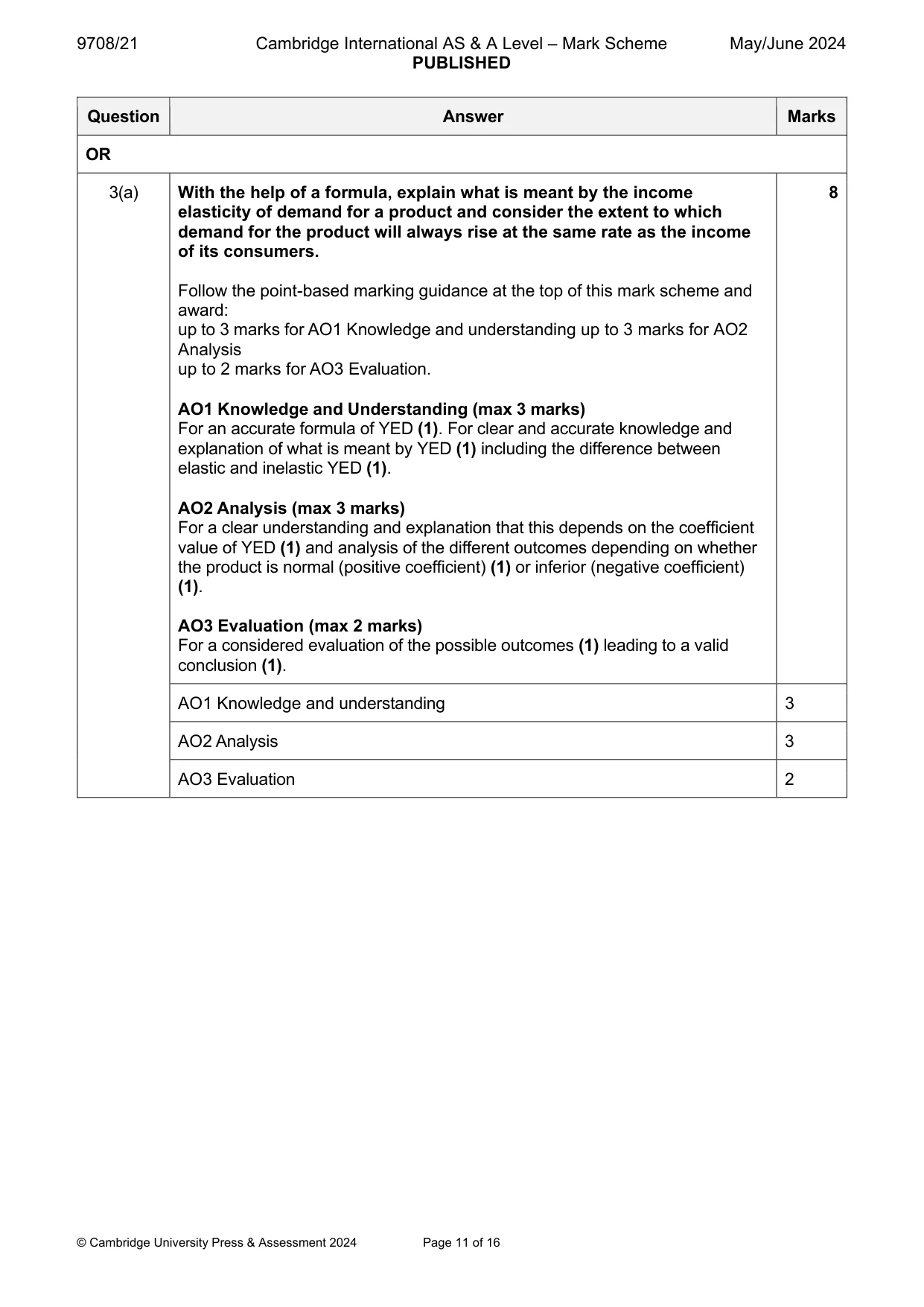
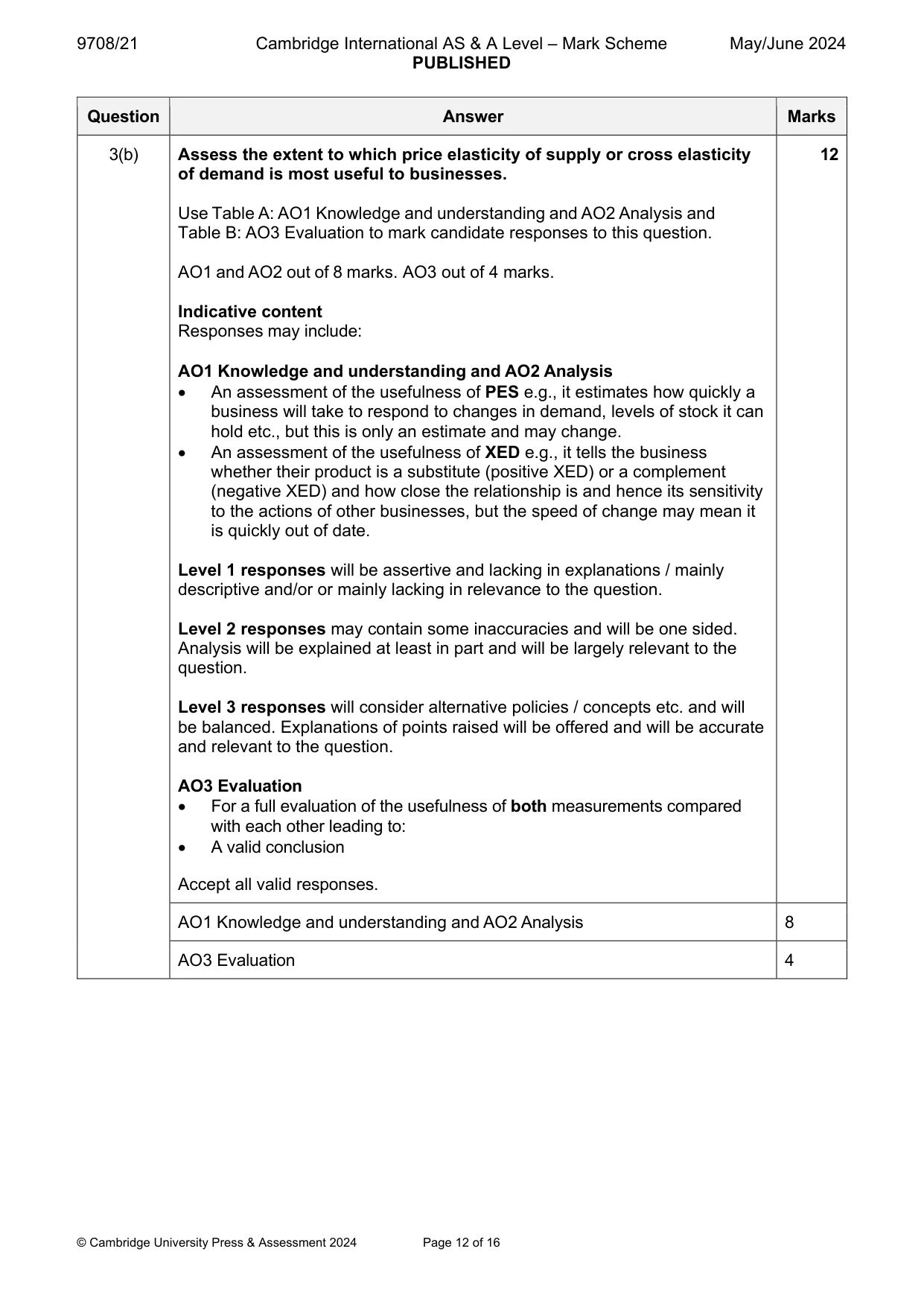
Mark scheme: 3(a) With the help of a formula, explain what is meant by the income 8 elasticity of demand for a product and consider the extent to which demand for the product will always rise at the same rate as the income of its consumers. Follow the point-based marking guidance at the top of this mark scheme and award: up to 3 marks for AO1 Knowledge and understanding up to 3 marks for AO2 Analysis up to 2 marks for AO3 Evaluation. AO1 Knowledge and Understanding (max 3 marks) For an accurate formula of YED (1). For clear and accurate knowledge and explanation of what is meant by YED (1) including the difference between elastic and inelastic YED (1). AO2 Analysis (max 3 marks) For a clear understanding and explanation that this depends on the coefficient value of YED (1) and analysis of the different outcomes depending on whether the product is normal (positive coefficient) (1) or inferior (negative coefficient) (1). AO3 Evaluation (max 2 marks) For a considered evaluation of the possible outcomes (1) leading to a valid conclusion (1). AO1 Knowledge and understanding 3 AO2 Analysis 3 AO3 Evaluation 2 3(b) Assess the extent to which price elasticity of supply or cross elasticity 12 of demand is most useful to businesses. Use Table A: AO1 Knowledge and understanding and AO2 Analysis and Table B: AO3 Evaluation to mark candidate responses to this question. AO1 and AO2 out of 8 marks. AO3 out of 4 marks. Indicative content Responses may include: AO1 Knowledge and understanding and AO2 Analysis An assessment of the usefulness of PES e.g., it estimates how quickly a business will take to respond to changes in demand, levels of stock it can hold etc., but this is only an estimate and may change. An assessment of the usefulness of XED e.g., it tells the business whether their product is a substitute (positive XED) or a complement (negative XED) and how close the relationship is and hence its sensitivity to the actions of other businesses, but the speed of change may mean it is quickly out of date. Level 1 responses will be assertive and lacking in explanations / mainly descriptive and/or or mainly lacking in relevance to the question. Level 2 responses may contain some inaccuracies and will be one sided. Analysis will be explained at least in part and will be largely relevant to the question. Level 3 responses will consider alternative policies / concepts etc. and will be balanced. Explanations of points raised will be offered and will be accurate and relevant to the question. AO3 Evaluation For a full evaluation of the usefulness of both measurements compared with each other leading to: A valid conclusion Accept all valid responses. AO1 Knowledge and understanding and AO2 Analysis 8 AO3 Evaluation 4 Section C
More questions on Price elasticity, income elasticity and cross elasticity of demand
Q4 · Explain three of the components of aggregate demand and consider the extent to which they…
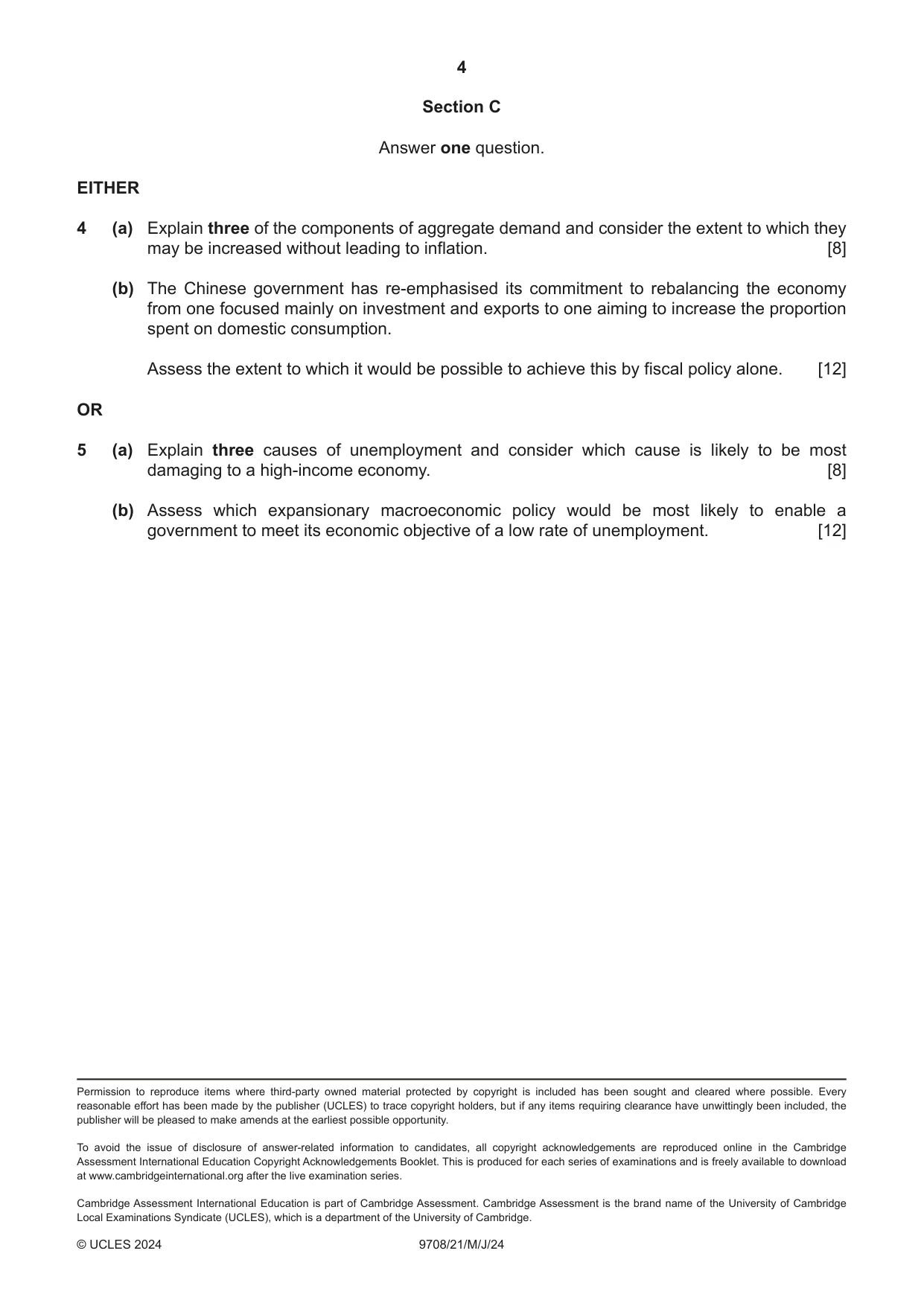
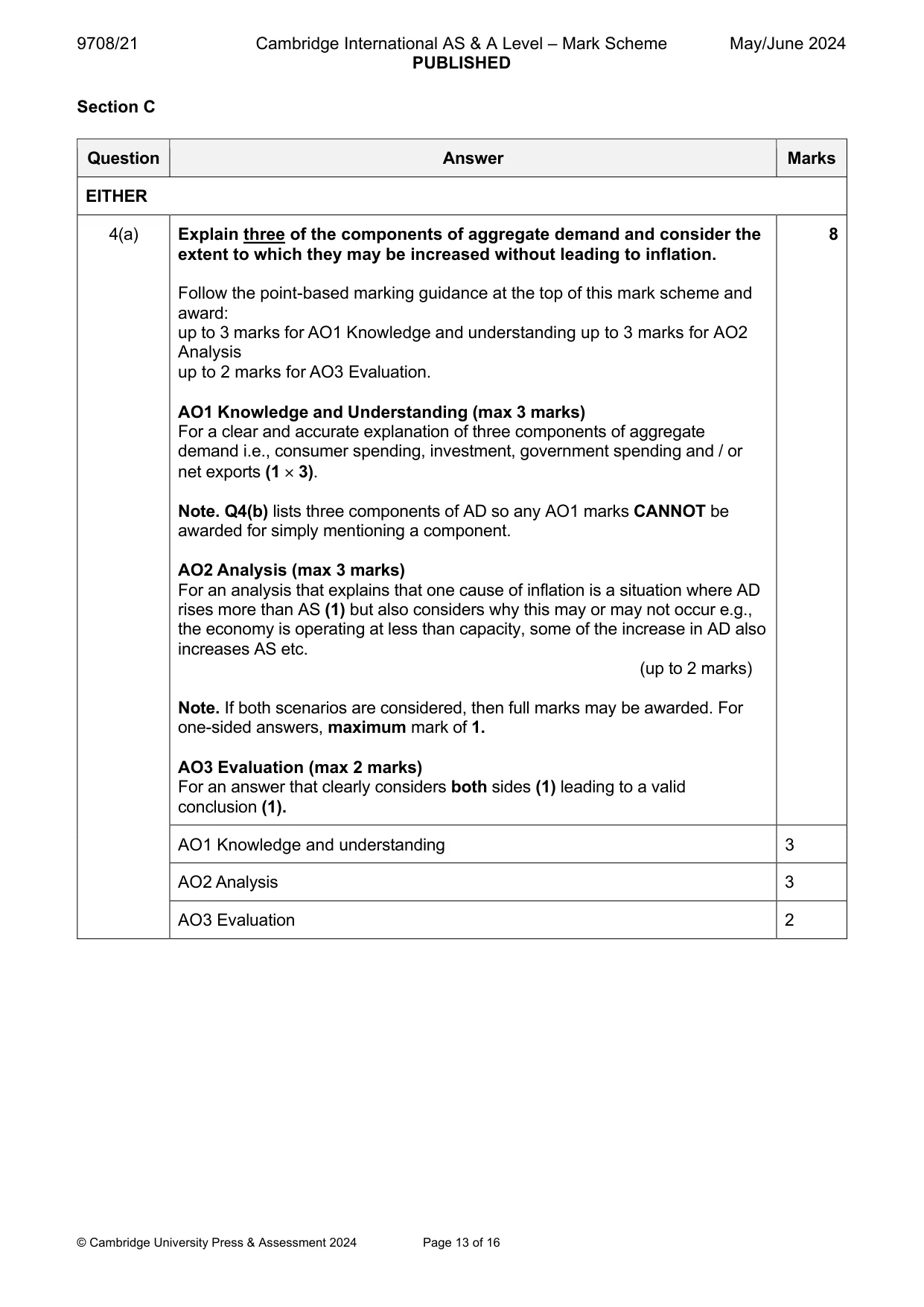
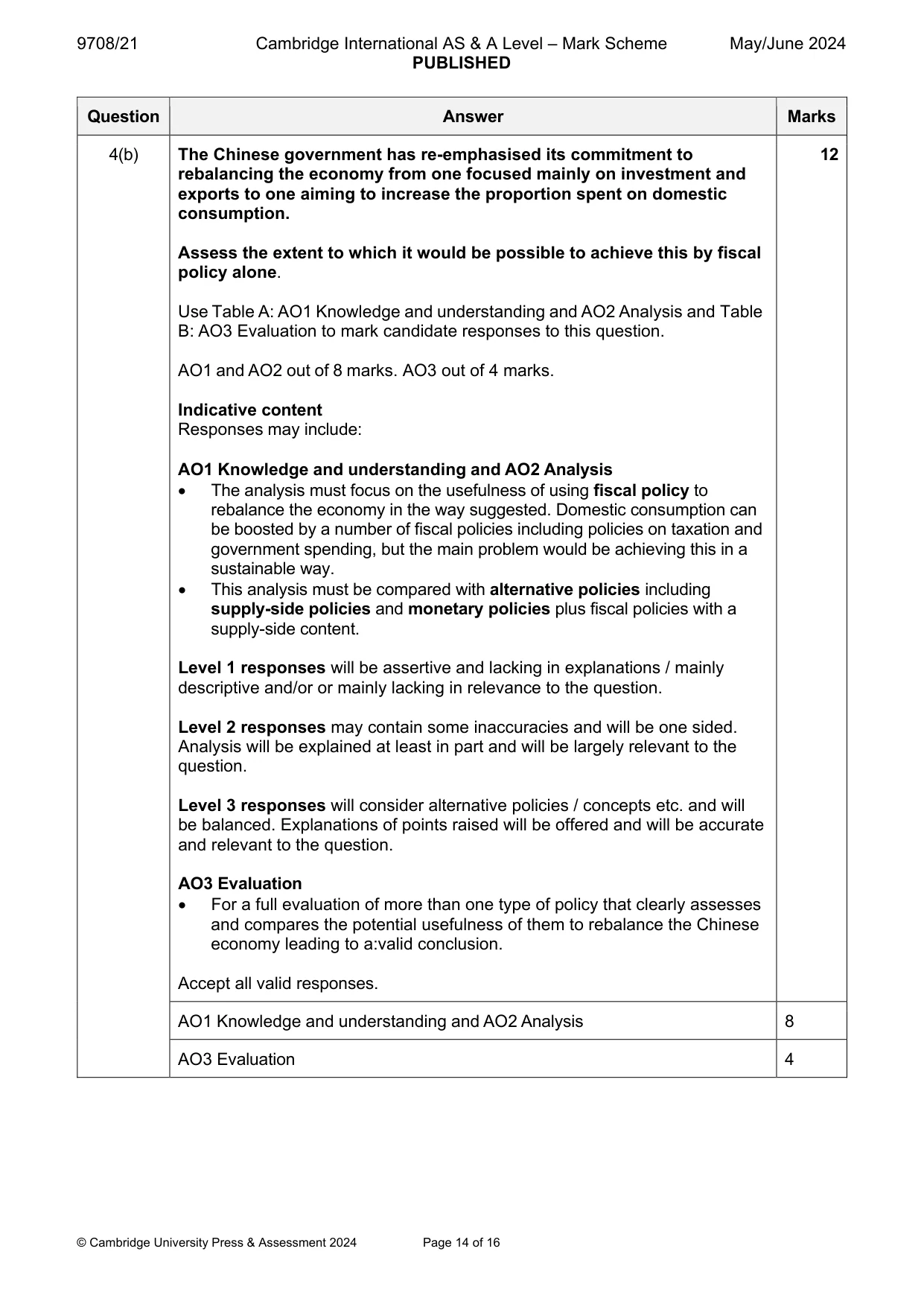
4 (a) Explain three of the components of aggregate demand and consider the extent to which they may be increased without leading to inflation. [8] (b) The Chinese government has re-emphasised its commitment to rebalancing the economy from one focused mainly on investment and exports to one aiming to increase the proportion spent on domestic consumption. Assess the extent to which it would be possible to achieve this by fiscal policy alone. [12] OR
Mark scheme: 4(a) Explain three of the components of aggregate demand and consider the 8 extent to which they may be increased without leading to inflation. Follow the point-based marking guidance at the top of this mark scheme and award: up to 3 marks for AO1 Knowledge and understanding up to 3 marks for AO2 Analysis up to 2 marks for AO3 Evaluation. AO1 Knowledge and Understanding (max 3 marks) For a clear and accurate explanation of three components of aggregate demand i.e., consumer spending, investment, government spending and / or net exports (1 3). Note. Q4(b) lists three components of AD so any AO1 marks CANNOT be awarded for simply mentioning a component. AO2 Analysis (max 3 marks) For an analysis that explains that one cause of inflation is a situation where AD rises more than AS (1) but also considers why this may or may not occur e.g., the economy is operating at less than capacity, some of the increase in AD also increases AS etc. (up to 2 marks) Note. If both scenarios are considered, then full marks may be awarded. For one-sided answers, maximum mark of 1. AO3 Evaluation (max 2 marks) For an answer that clearly considers both sides (1) leading to a valid conclusion (1). AO1 Knowledge and understanding 3 AO2 Analysis 3 AO3 Evaluation 2 4(b) The Chinese government has re-emphasised its commitment to 12 rebalancing the economy from one focused mainly on investment and exports to one aiming to increase the proportion spent on domestic consumption. Assess the extent to which it would be possible to achieve this by fiscal policy alone. Use Table A: AO1 Knowledge and understanding and AO2 Analysis and Table B: AO3 Evaluation to mark candidate responses to this question. AO1 and AO2 out of 8 marks. AO3 out of 4 marks. Indicative content Responses may include: AO1 Knowledge and understanding and AO2 Analysis The analysis must focus on the usefulness of using fiscal policy to rebalance the economy in the way suggested. Domestic consumption can be boosted by a number of fiscal policies including policies on taxation and government spending, but the main problem would be achieving this in a sustainable way. This analysis must be compared with alternative policies including supply-side policies and monetary policies plus fiscal policies with a supply-side content. Level 1 responses will be assertive and lacking in explanations / mainly descriptive and/or or mainly lacking in relevance to the question. Level 2 responses may contain some inaccuracies and will be one sided. Analysis will be explained at least in part and will be largely relevant to the question. Level 3 responses will consider alternative policies / concepts etc. and will be balanced. Explanations of points raised will be offered and will be accurate and relevant to the question. AO3 Evaluation For a full evaluation of more than one type of policy that clearly assesses and compares the potential usefulness of them to rebalance the Chinese economy leading to a:valid conclusion. Accept all valid responses. AO1 Knowledge and understanding and AO2 Analysis 8 AO3 Evaluation 4
Q5 · Explain three causes of unemployment and consider which cause is likely to be most…
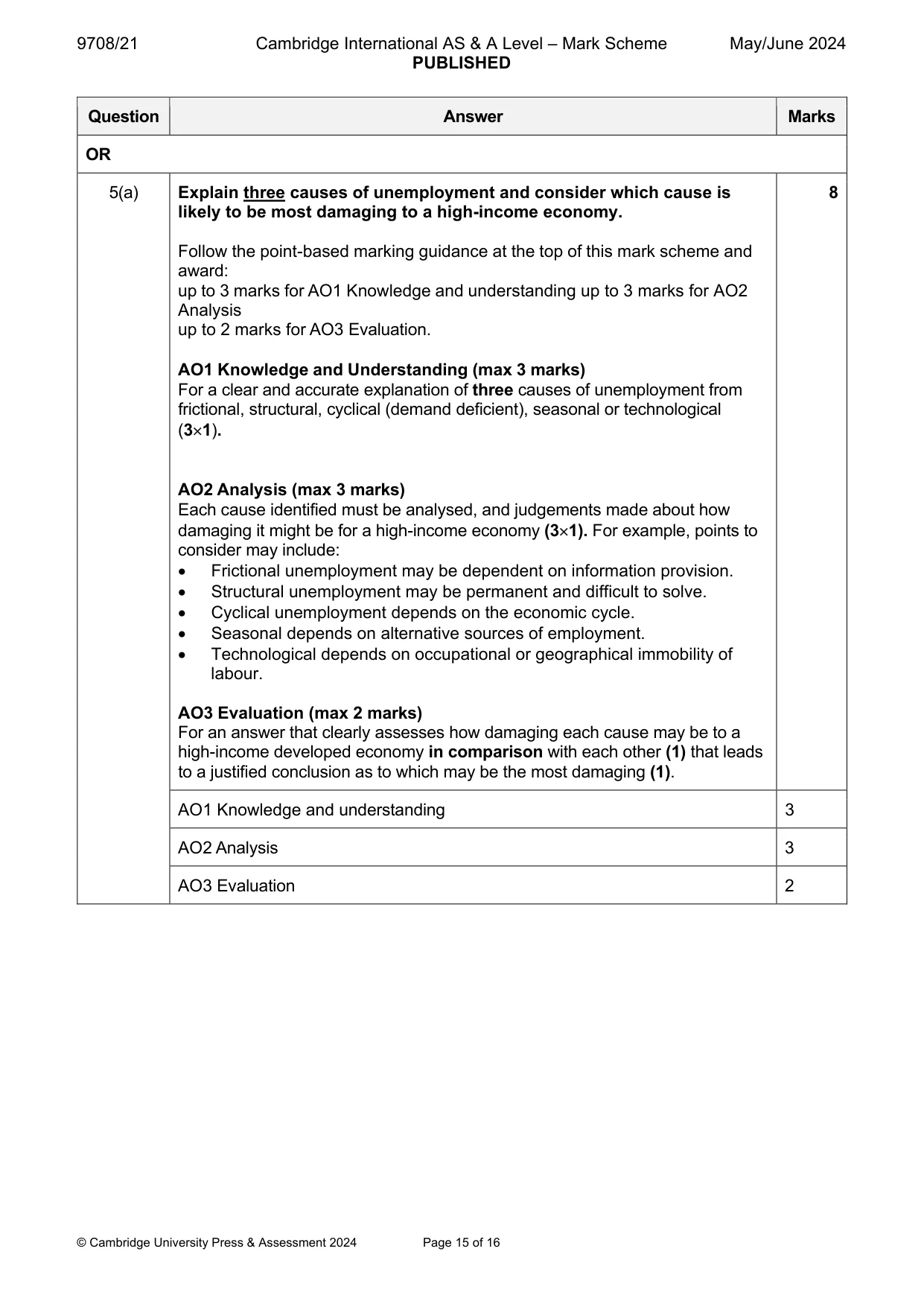
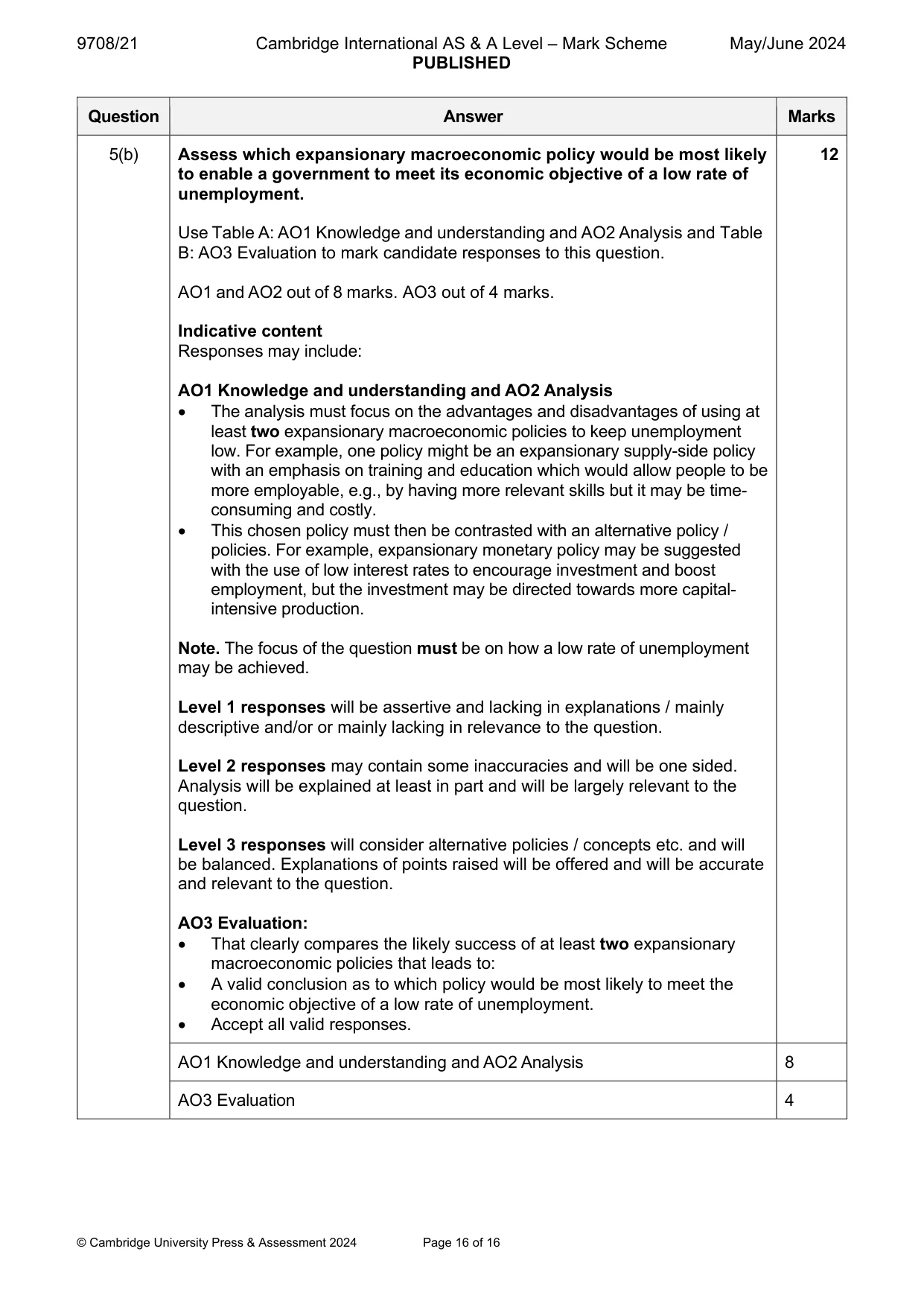
5 (a) Explain three causes of unemployment and consider which cause is likely to be most damaging to a high-income economy. [8] (b) Assess which expansionary macroeconomic policy would be most likely to enable a government to meet its economic objective of a low rate of unemployment. [12]
Mark scheme: 5(a) Explain three causes of unemployment and consider which cause is 8 likely to be most damaging to a high-income economy. Follow the point-based marking guidance at the top of this mark scheme and award: up to 3 marks for AO1 Knowledge and understanding up to 3 marks for AO2 Analysis up to 2 marks for AO3 Evaluation. AO1 Knowledge and Understanding (max 3 marks) For a clear and accurate explanation of three causes of unemployment from frictional, structural, cyclical (demand deficient), seasonal or technological (31). AO2 Analysis (max 3 marks) Each cause identified must be analysed, and judgements made about how damaging it might be for a high-income economy (31). For example, points to consider may include: Frictional unemployment may be dependent on information provision. Structural unemployment may be permanent and difficult to solve. Cyclical unemployment depends on the economic cycle. Seasonal depends on alternative sources of employment. Technological depends on occupational or geographical immobility of labour. AO3 Evaluation (max 2 marks) For an answer that clearly assesses how damaging each cause may be to a high-income developed economy in comparison with each other (1) that leads to a justified conclusion as to which may be the most damaging (1). AO1 Knowledge and understanding 3 AO2 Analysis 3 AO3 Evaluation 2 5(b) Assess which expansionary macroeconomic policy would be most likely 12 to enable a government to meet its economic objective of a low rate of unemployment. Use Table A: AO1 Knowledge and understanding and AO2 Analysis and Table B: AO3 Evaluation to mark candidate responses to this question. AO1 and AO2 out of 8 marks. AO3 out of 4 marks. Indicative content Responses may include: AO1 Knowledge and understanding and AO2 Analysis The analysis must focus on the advantages and disadvantages of using at least two expansionary macroeconomic policies to keep unemployment low. For example, one policy might be an expansionary supply-side policy with an emphasis on training and education which would allow people to be more employable, e.g., by having more relevant skills but it may be time- consuming and costly. This chosen policy must then be contrasted with an alternative policy / policies. For example, expansionary monetary policy may be suggested with the use of low interest rates to encourage investment and boost employment, but the investment may be directed towards more capital- intensive production. Note. The focus of the question must be on how a low rate of unemployment may be achieved. Level 1 responses will be assertive and lacking in explanations / mainly descriptive and/or or mainly lacking in relevance to the question. Level 2 responses may contain some inaccuracies and will be one sided. Analysis will be explained at least in part and will be largely relevant to the question. Level 3 responses will consider alternative policies / concepts etc. and will be balanced. Explanations of points raised will be offered and will be accurate and relevant to the question. AO3 Evaluation: That clearly compares the likely success of at least two expansionary macroeconomic policies that leads to: A valid conclusion as to which policy would be most likely to meet the economic objective of a low rate of unemployment. Accept all valid responses. AO1 Knowledge and understanding and AO2 Analysis 8 AO3 Evaluation 4
More questions on Effectiveness of policy options to meet all macroeconomic objectives
What was in this paper
The subtopics covered by these 5 questions, and how many questions each got. Open one in a new tab to see every Cambridge question on it.
What you needed in this session
Cambridge’s own grade thresholds for 2024 May/June, Paper 2 · Variant 1. A higher threshold means an easier paper — the bar moves with how the cohort did.