Cambridge A Level Economics 9708 — 2023 Oct/Nov Paper 2 · Variant 1
9708/21/O/N/23 · 5 questions · 60 marks · ≈68 min
The question paper and its mark scheme, free to read here and free to download. This is Cambridge’s own paper, exactly as it was sat.
Question paper4 pages
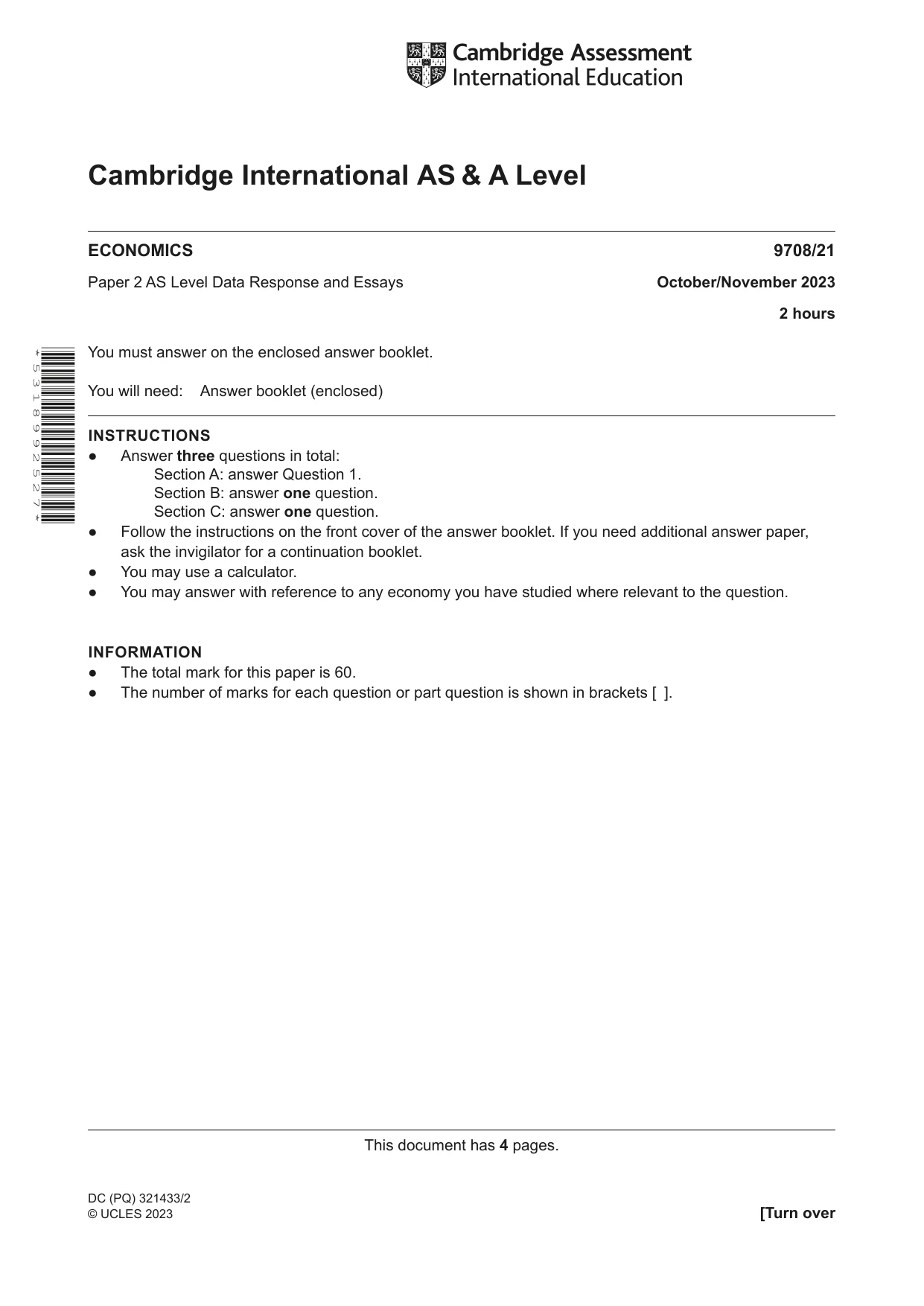
Mark scheme16 pages
Answers below. Sit the paper first if you are practising.
Questions as text
Q1 · Economic growth in Taiwan In 2021, Taiwan’s economy is forecast to grow at its fastest…
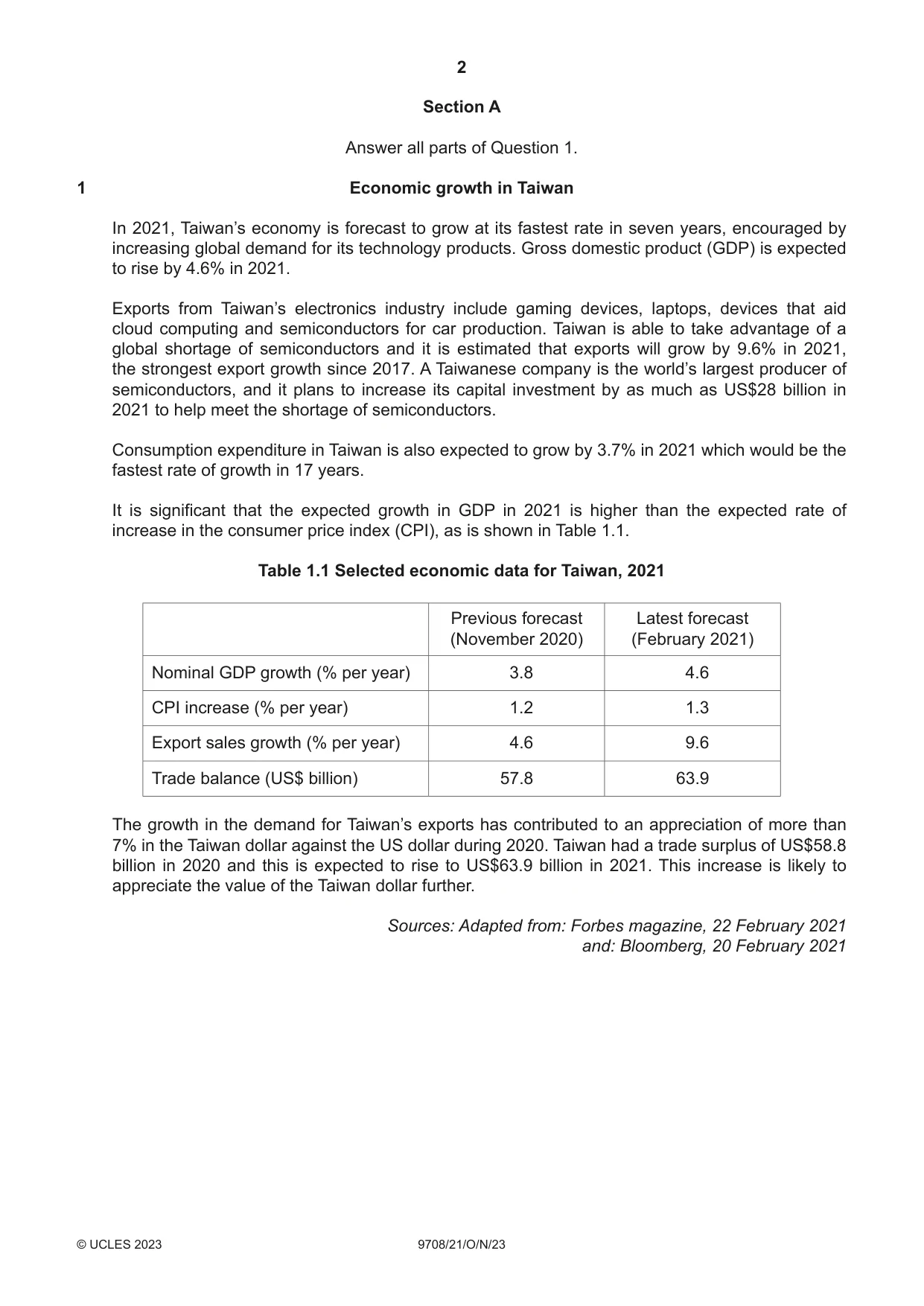
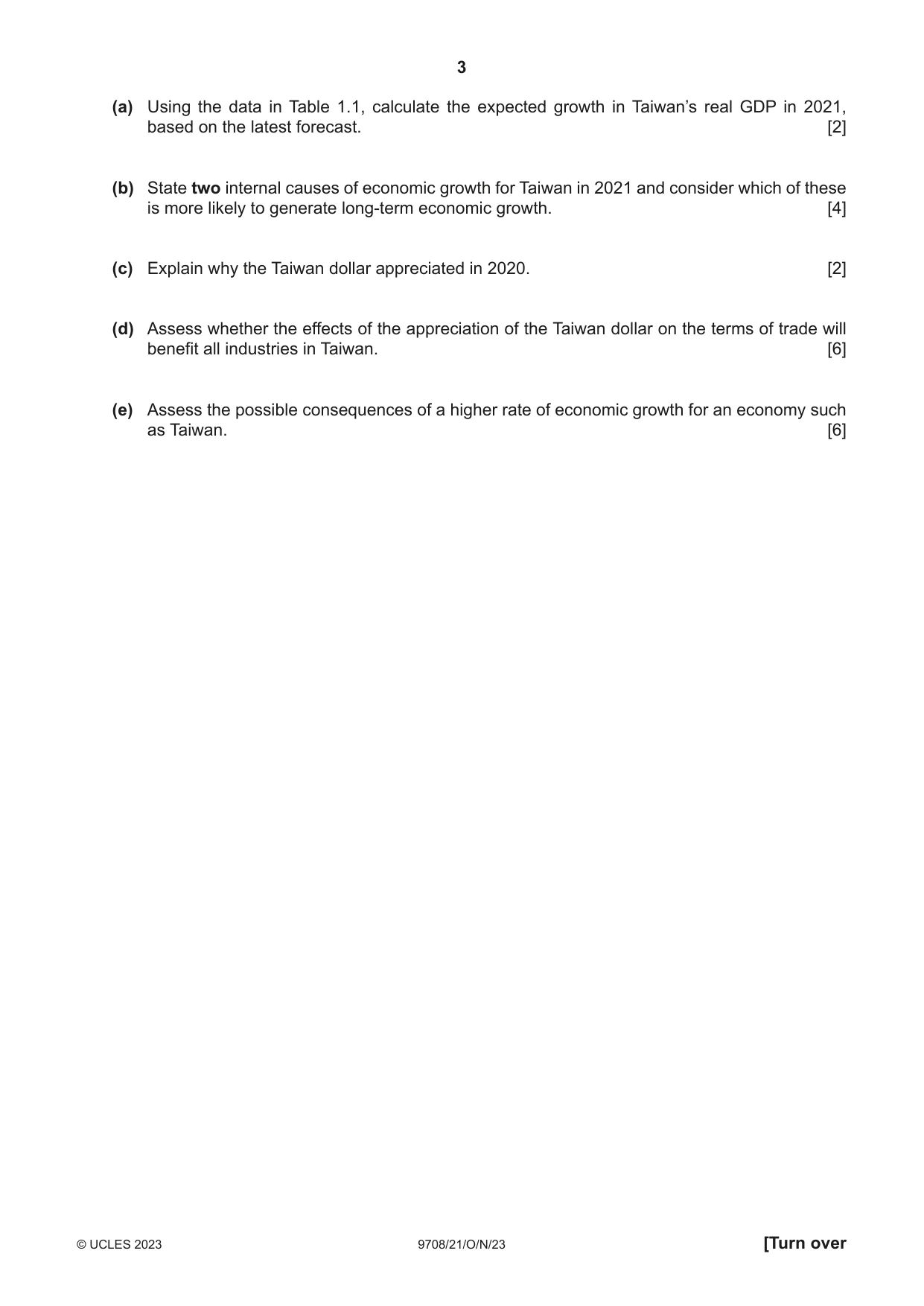
1 Economic growth in Taiwan In 2021, Taiwan’s economy is forecast to grow at its fastest rate in seven years, encouraged by increasing global demand for its technology products. Gross domestic product (GDP) is expected to rise by 4.6% in 2021. Exports from Taiwan’s electronics industry include gaming devices, laptops, devices that aid cloud computing and semiconductors for car production. Taiwan is able to take advantage of a global shortage of semiconductors and it is estimated that exports will grow by 9.6% in 2021, the strongest export growth since 2017. A Taiwanese company is the world’s largest producer of semiconductors, and it plans to increase its capital investment by as much as US$28 billion in 2021 to help meet the shortage of semiconductors. Consumption expenditure in Taiwan is also expected to grow by 3.7% in 2021 which would be the fastest rate of growth in 17 years. It is significant that the expected growth in GDP in 2021 is higher than the expected rate of increase in the consumer price index (CPI), as is shown in Table 1.1. Table 1.1 Selected economic data for Taiwan, 2021 Previous forecast Latest forecast (November 2020) (February 2021) Nominal GDP growth (% per year) 3.8 4.6 CPI increase (% per year) 1.2 1.3 Export sales growth (% per year) 4.6 9.6 Trade balance (US$ billion) 57.8 63.9 The growth in the demand for Taiwan’s exports has contributed to an appreciation of more than 7% in the Taiwan dollar against the US dollar during 2020. Taiwan had a trade surplus of US$58.8 billion in 2020 and this is expected to rise to US$63.9 billion in 2021. This increase is likely to appreciate the value of the Taiwan dollar further. Sources: Adapted from: Forbes magazine, 22 February 2021 and: Bloomberg, 20 February 2021 (a) Using the data in Table 1.1, calculate the expected growth in Taiwan’s real GDP in 2021, based on the latest forecast. [2] (b) State two internal causes of economic growth for Taiwan in 2021 and consider which of these is more likely to generate long-term economic growth. [4] (c) Explain why the Taiwan dollar appreciated in 2020. [2] (d) Assess whether the effects of the appreciation of the Taiwan dollar on the terms of trade will benefit all industries in Taiwan. [6] (e) Assess the possible consequences of a higher rate of economic growth for an economy such as Taiwan. [6]
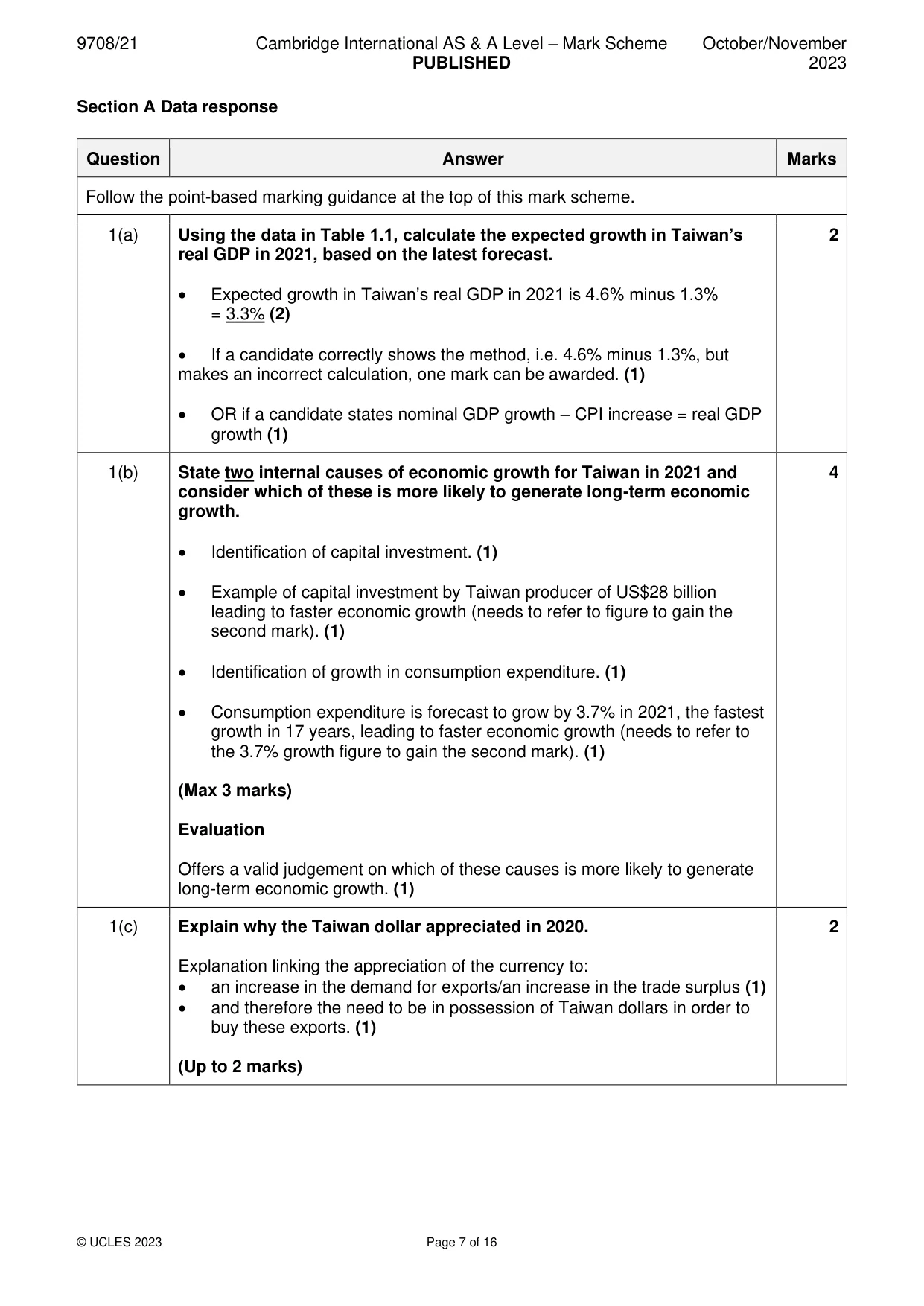
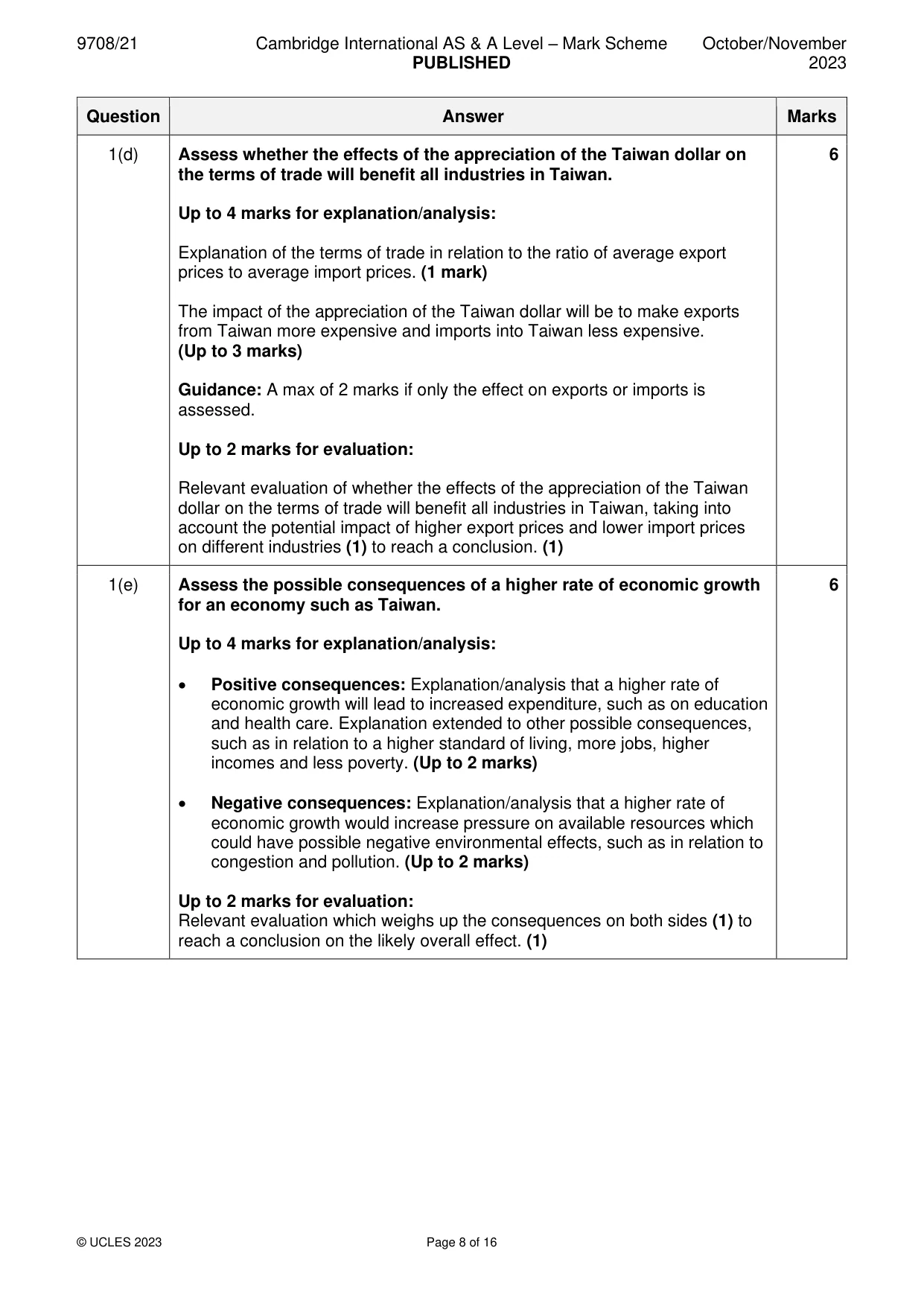
Mark scheme: Question Answer Marks Follow the point-based marking guidance at the top of this mark scheme. 1(a) Using the data in Table 1.1, calculate the expected growth in Taiwan’s 2 real GDP in 2021, based on the latest forecast. • Expected growth in Taiwan’s real GDP in 2021 is 4.6% minus 1.3% = 3.3% (2) • If a candidate correctly shows the method, i.e. 4.6% minus 1.3%, but makes an incorrect calculation, one mark can be awarded. (1) • OR if a candidate states nominal GDP growth – CPI increase = real GDP growth (1) 1(b) State two internal causes of economic growth for Taiwan in 2021 and 4 consider which of these is more likely to generate long-term economic growth. • Identification of capital investment. (1) • Example of capital investment by Taiwan producer of US$28 billion leading to faster economic growth (needs to refer to figure to gain the second mark). (1) • Identification of growth in consumption expenditure. (1) • Consumption expenditure is forecast to grow by 3.7% in 2021, the fastest growth in 17 years, leading to faster economic growth (needs to refer to the 3.7% growth figure to gain the second mark). (1) (Max 3 marks) Evaluation Offers a valid judgement on which of these causes is more likely to generate long-term economic growth. (1) 1(c) Explain why the Taiwan dollar appreciated in 2020. 2 Explanation linking the appreciation of the currency to: • an increase in the demand for exports/an increase in the trade surplus (1) • and therefore the need to be in possession of Taiwan dollars in order to buy these exports. (1) (Up to 2 marks) 1(d) Assess whether the effects of the appreciation of the Taiwan dollar on 6 the terms of trade will benefit all industries in Taiwan. Up to 4 marks for explanation/analysis: Explanation of the terms of trade in relation to the ratio of average export prices to average import prices. (1 mark) The impact of the appreciation of the Taiwan dollar will be to make exports from Taiwan more expensive and imports into Taiwan less expensive. (Up to 3 marks) Guidance: A max of 2 marks if only the effect on exports or imports is assessed. Up to 2 marks for evaluation: Relevant evaluation of whether the effects of the appreciation of the Taiwan dollar on the terms of trade will benefit all industries in Taiwan, taking into account the potential impact of higher export prices and lower import prices on different industries (1) to reach a conclusion. (1) 1(e) Assess the possible consequences of a higher rate of economic growth 6 for an economy such as Taiwan. Up to 4 marks for explanation/analysis: • Positive consequences: Explanation/analysis that a higher rate of economic growth will lead to increased expenditure, such as on education and health care. Explanation extended to other possible consequences, such as in relation to a higher standard of living, more jobs, higher incomes and less poverty. (Up to 2 marks) • Negative consequences: Explanation/analysis that a higher rate of economic growth would increase pressure on available resources which could have possible negative environmental effects, such as in relation to congestion and pollution. (Up to 2 marks) Up to 2 marks for evaluation: Relevant evaluation which weighs up the consequences on both sides (1) to reach a conclusion on the likely overall effect. (1)
Q2 · With the help of a diagram, explain what could cause an increase in demand for a product…
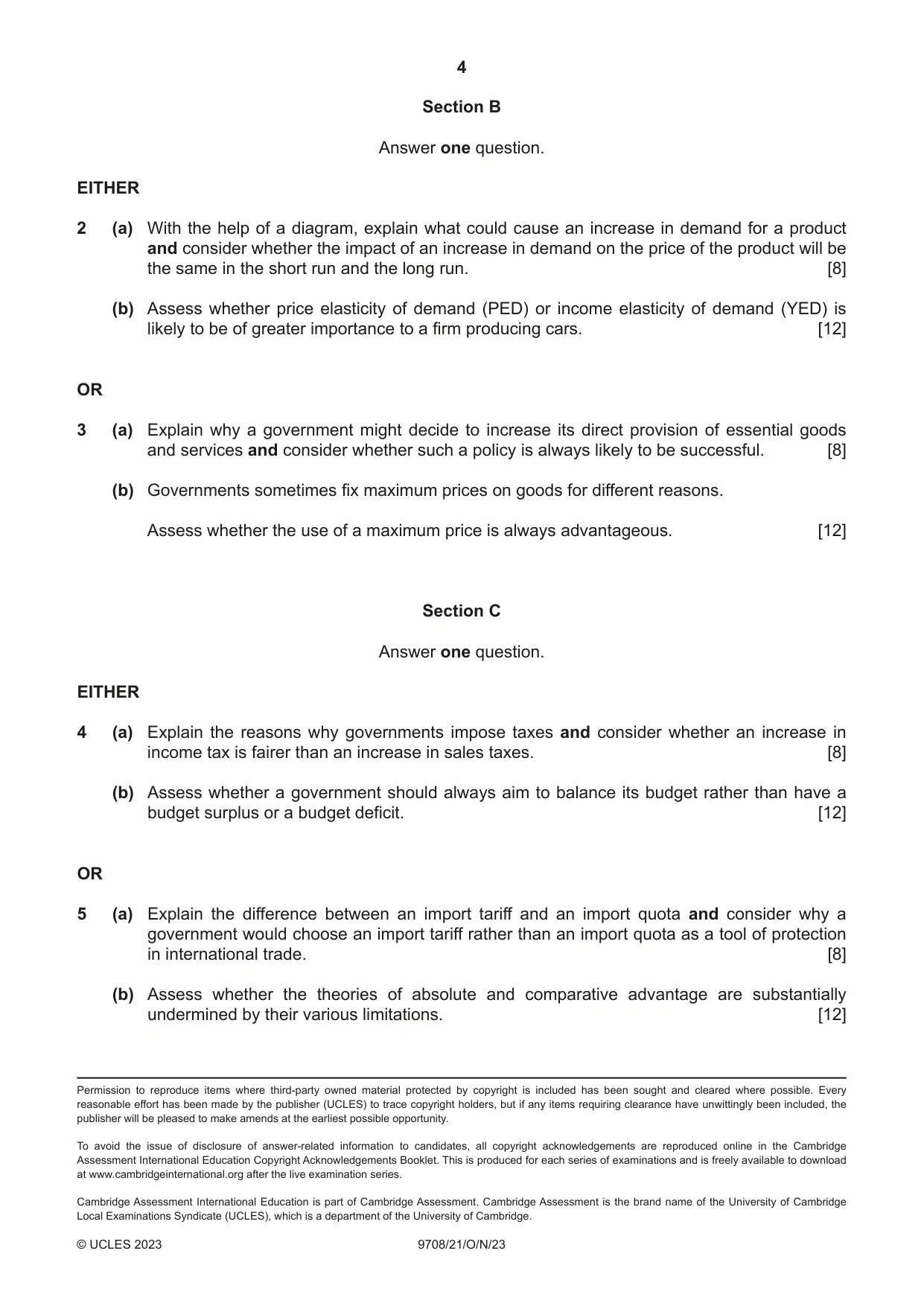
2 (a) With the help of a diagram, explain what could cause an increase in demand for a product and consider whether the impact of an increase in demand on the price of the product will be the same in the short run and the long run. [8] (b) Assess whether price elasticity of demand (PED) or income elasticity of demand (YED) is likely to be of greater importance to a firm producing cars. [12] OR
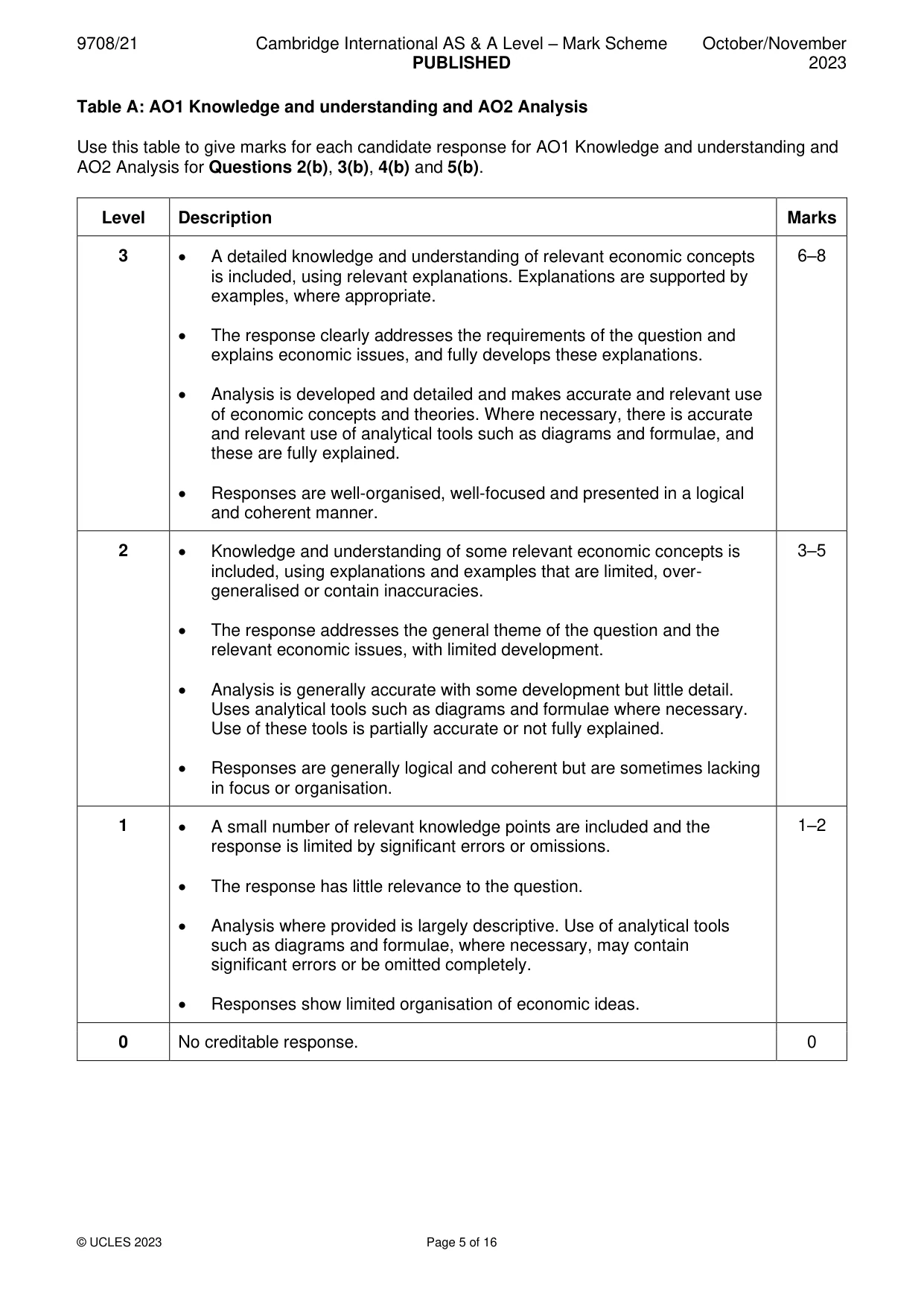
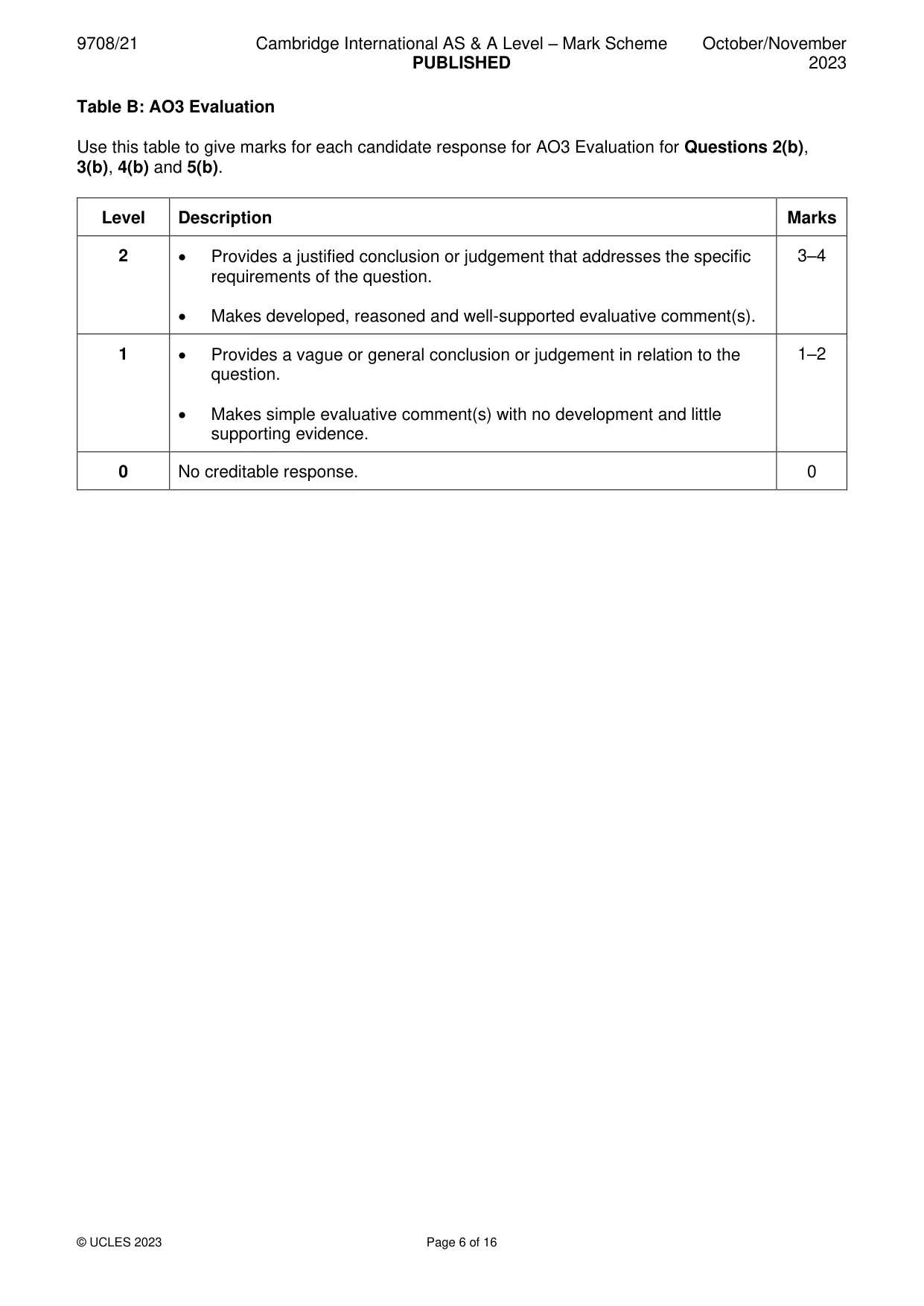
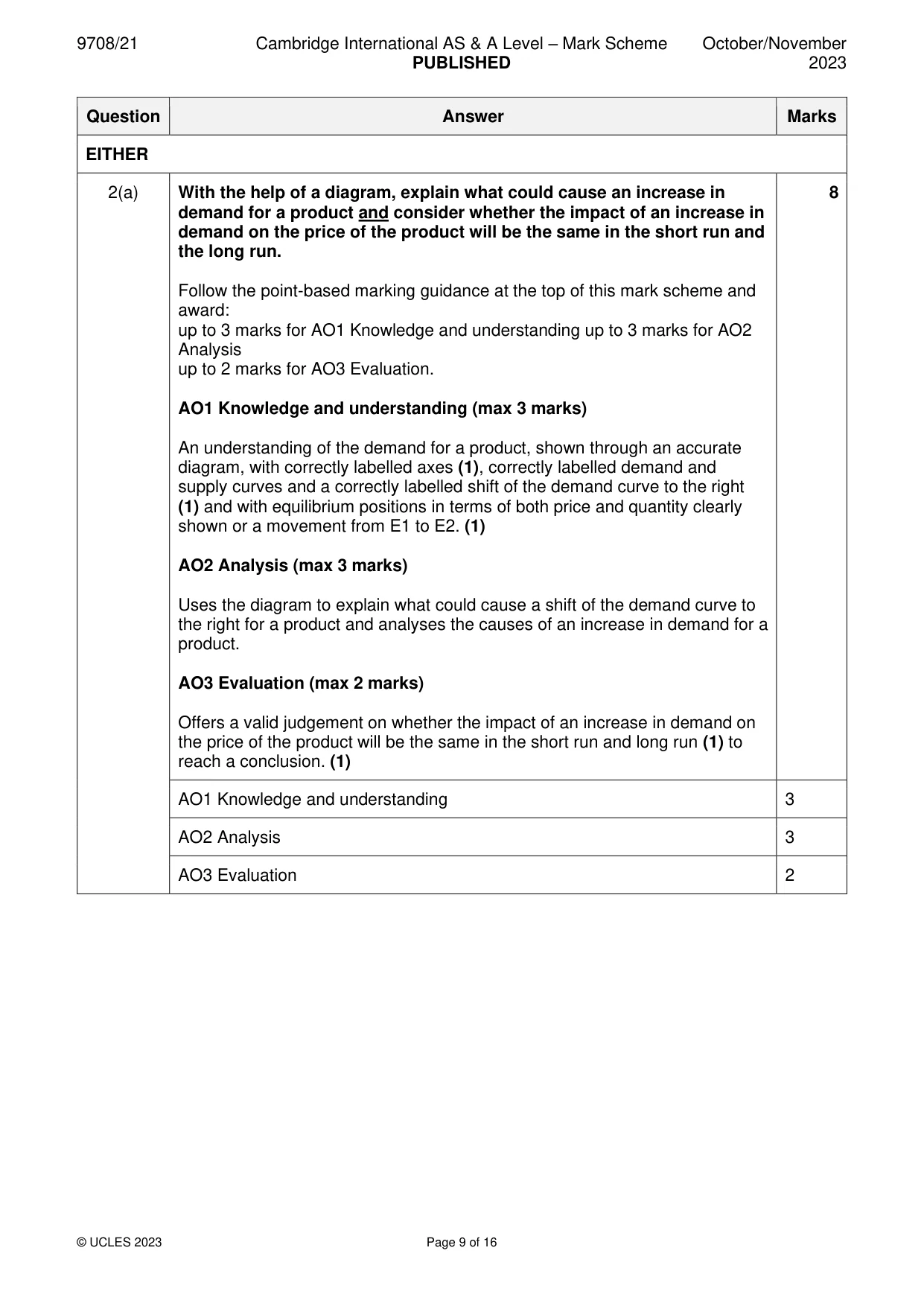
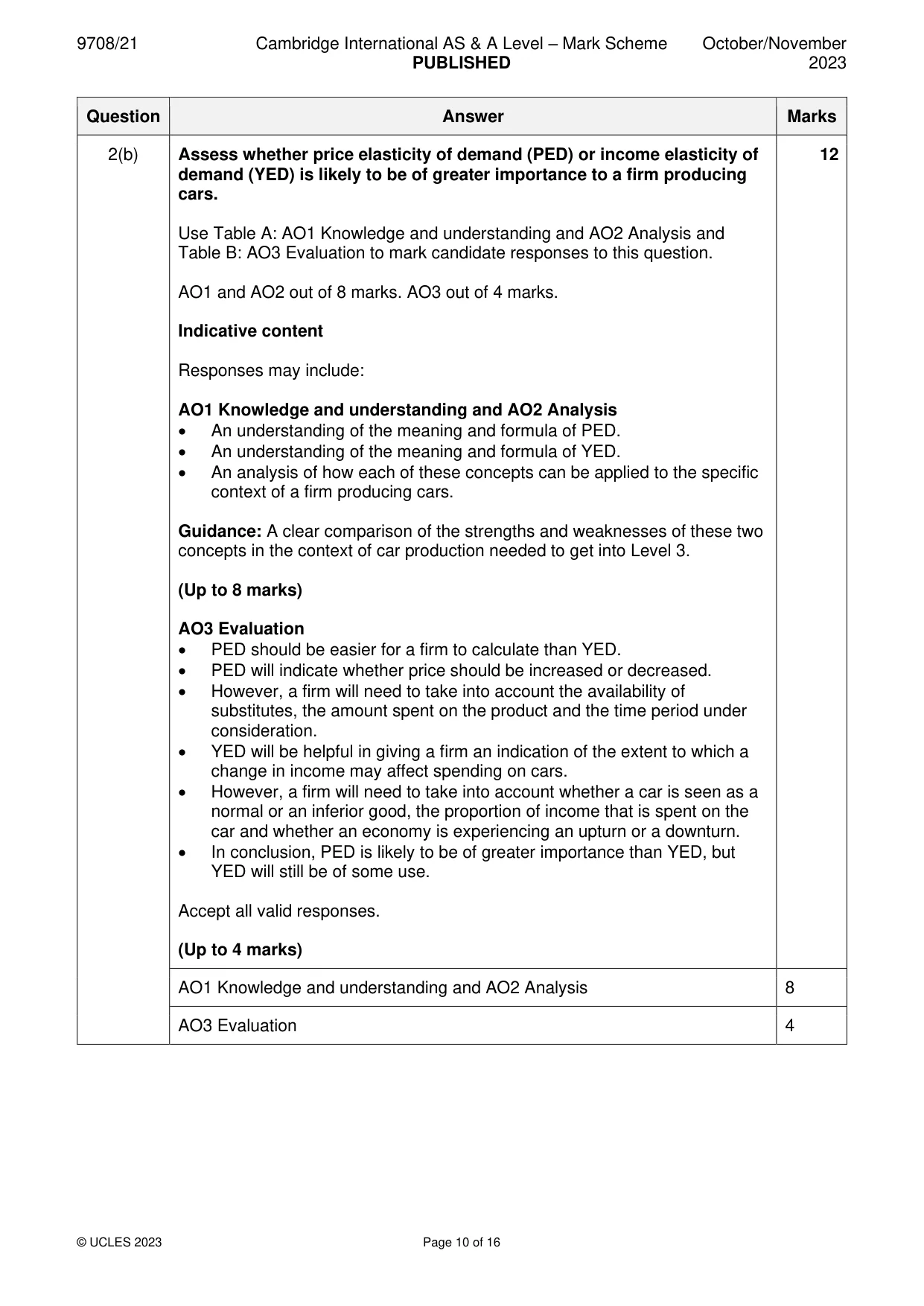
Mark scheme: 2(a) With the help of a diagram, explain what could cause an increase in 8 demand for a product and consider whether the impact of an increase in demand on the price of the product will be the same in the short run and the long run. Follow the point-based marking guidance at the top of this mark scheme and award: up to 3 marks for AO1 Knowledge and understanding up to 3 marks for AO2 Analysis up to 2 marks for AO3 Evaluation. AO1 Knowledge and understanding (max 3 marks) An understanding of the demand for a product, shown through an accurate diagram, with correctly labelled axes (1), correctly labelled demand and supply curves and a correctly labelled shift of the demand curve to the right (1) and with equilibrium positions in terms of both price and quantity clearly shown or a movement from E1 to E2. (1) AO2 Analysis (max 3 marks) Uses the diagram to explain what could cause a shift of the demand curve to the right for a product and analyses the causes of an increase in demand for a product. AO3 Evaluation (max 2 marks) Offers a valid judgement on whether the impact of an increase in demand on the price of the product will be the same in the short run and long run (1) to reach a conclusion. (1) AO1 Knowledge and understanding 3 AO2 Analysis 3 AO3 Evaluation 2 2(b) Assess whether price elasticity of demand (PED) or income elasticity of 12 demand (YED) is likely to be of greater importance to a firm producing cars. Use Table A: AO1 Knowledge and understanding and AO2 Analysis and Table B: AO3 Evaluation to mark candidate responses to this question. AO1 and AO2 out of 8 marks. AO3 out of 4 marks. Indicative content Responses may include: AO1 Knowledge and understanding and AO2 Analysis • An understanding of the meaning and formula of PED. • An understanding of the meaning and formula of YED. • An analysis of how each of these concepts can be applied to the specific context of a firm producing cars. Guidance: A clear comparison of the strengths and weaknesses of these two concepts in the context of car production needed to get into Level 3. (Up to 8 marks) AO3 Evaluation • PED should be easier for a firm to calculate than YED. • PED will indicate whether price should be increased or decreased. • However, a firm will need to take into account the availability of substitutes, the amount spent on the product and the time period under consideration. • YED will be helpful in giving a firm an indication of the extent to which a change in income may affect spending on cars. • However, a firm will need to take into account whether a car is seen as a normal or an inferior good, the proportion of income that is spent on the car and whether an economy is experiencing an upturn or a downturn. • In conclusion, PED is likely to be of greater importance than YED, but YED will still be of some use. Accept all valid responses. (Up to 4 marks) AO1 Knowledge and understanding and AO2 Analysis 8 AO3 Evaluation 4
More questions on Price elasticity, income elasticity and cross elasticity of demand
Q3 · Explain why a government might decide to increase its direct provision of essential goods…
3 (a) Explain why a government might decide to increase its direct provision of essential goods and services and consider whether such a policy is always likely to be successful. [8] (b) Governments sometimes fix maximum prices on goods for different reasons. Assess whether the use of a maximum price is always advantageous. [12] Section C Answer one question. EITHER
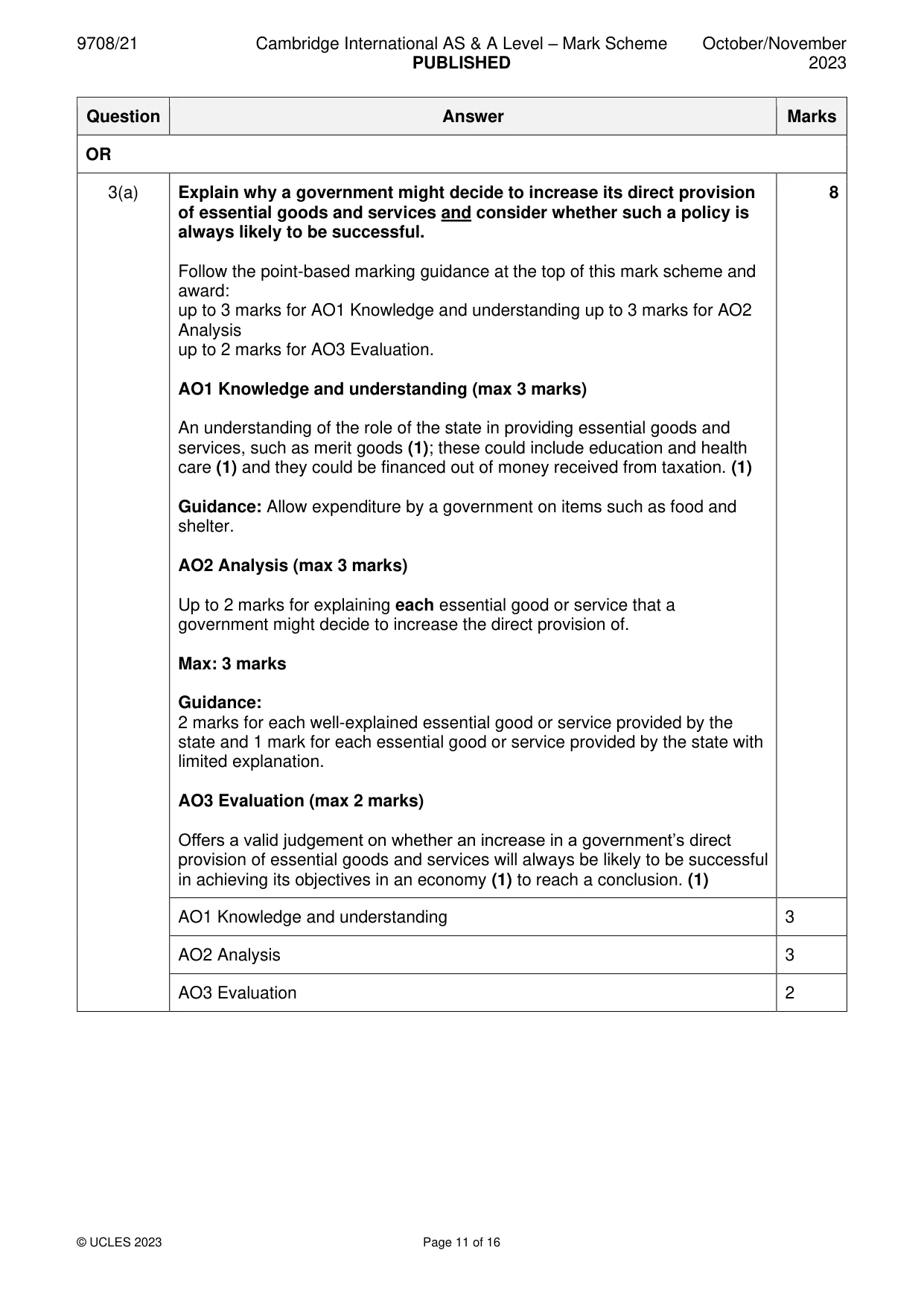
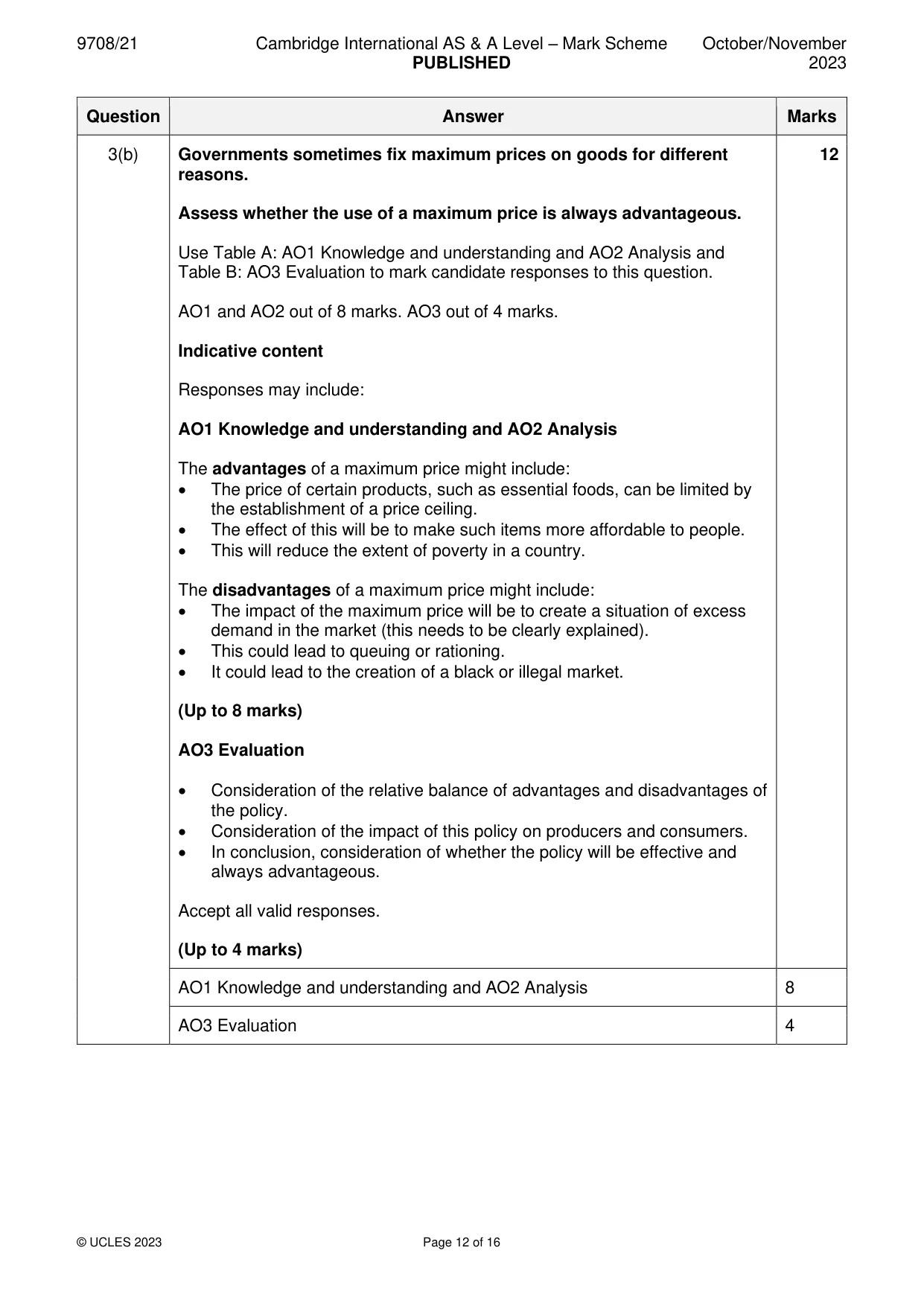
Mark scheme: 3(a) Explain why a government might decide to increase its direct provision 8 of essential goods and services and consider whether such a policy is always likely to be successful. Follow the point-based marking guidance at the top of this mark scheme and award: up to 3 marks for AO1 Knowledge and understanding up to 3 marks for AO2 Analysis up to 2 marks for AO3 Evaluation. AO1 Knowledge and understanding (max 3 marks) An understanding of the role of the state in providing essential goods and services, such as merit goods (1); these could include education and health care (1) and they could be financed out of money received from taxation. (1) Guidance: Allow expenditure by a government on items such as food and shelter. AO2 Analysis (max 3 marks) Up to 2 marks for explaining each essential good or service that a government might decide to increase the direct provision of. Max: 3 marks Guidance: 2 marks for each well-explained essential good or service provided by the state and 1 mark for each essential good or service provided by the state with limited explanation. AO3 Evaluation (max 2 marks) Offers a valid judgement on whether an increase in a government’s direct provision of essential goods and services will always be likely to be successful in achieving its objectives in an economy (1) to reach a conclusion. (1) AO1 Knowledge and understanding 3 AO2 Analysis 3 AO3 Evaluation 2 3(b) Governments sometimes fix maximum prices on goods for different 12 reasons. Assess whether the use of a maximum price is always advantageous. Use Table A: AO1 Knowledge and understanding and AO2 Analysis and Table B: AO3 Evaluation to mark candidate responses to this question. AO1 and AO2 out of 8 marks. AO3 out of 4 marks. Indicative content Responses may include: AO1 Knowledge and understanding and AO2 Analysis The advantages of a maximum price might include: • The price of certain products, such as essential foods, can be limited by the establishment of a price ceiling. • The effect of this will be to make such items more affordable to people. • This will reduce the extent of poverty in a country. The disadvantages of a maximum price might include: • The impact of the maximum price will be to create a situation of excess demand in the market (this needs to be clearly explained). • This could lead to queuing or rationing. • It could lead to the creation of a black or illegal market. (Up to 8 marks) AO3 Evaluation • Consideration of the relative balance of advantages and disadvantages of the policy. • Consideration of the impact of this policy on producers and consumers. • In conclusion, consideration of whether the policy will be effective and always advantageous. Accept all valid responses. (Up to 4 marks) AO1 Knowledge and understanding and AO2 Analysis 8 AO3 Evaluation 4
More questions on Methods and effects of government intervention in markets
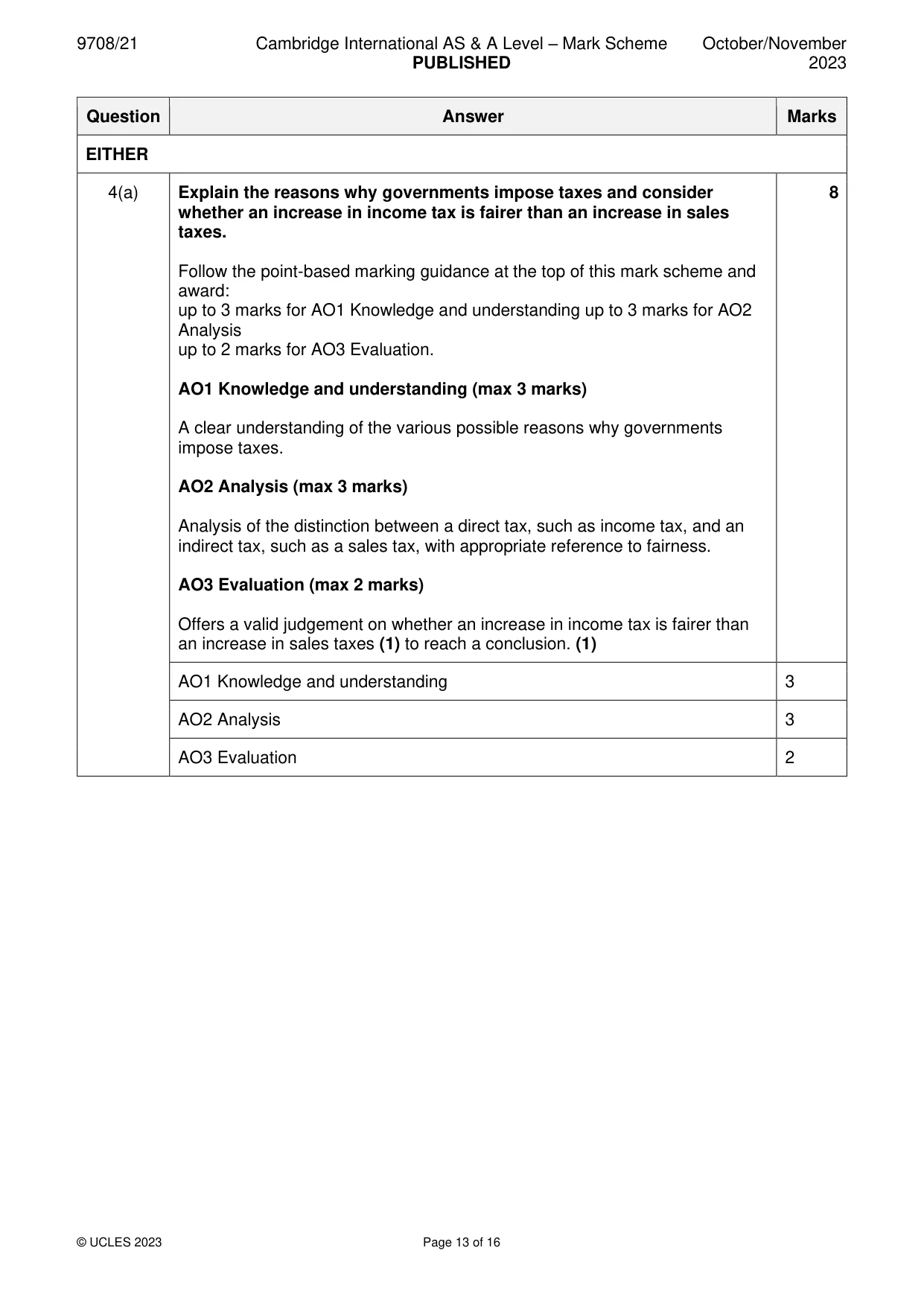
Q4 · Explain the reasons why governments impose taxes and consider whether an increase in…
4 (a) Explain the reasons why governments impose taxes and consider whether an increase in income tax is fairer than an increase in sales taxes. [8] (b) Assess whether a government should always aim to balance its budget rather than have a budget surplus or a budget deficit. [12] OR
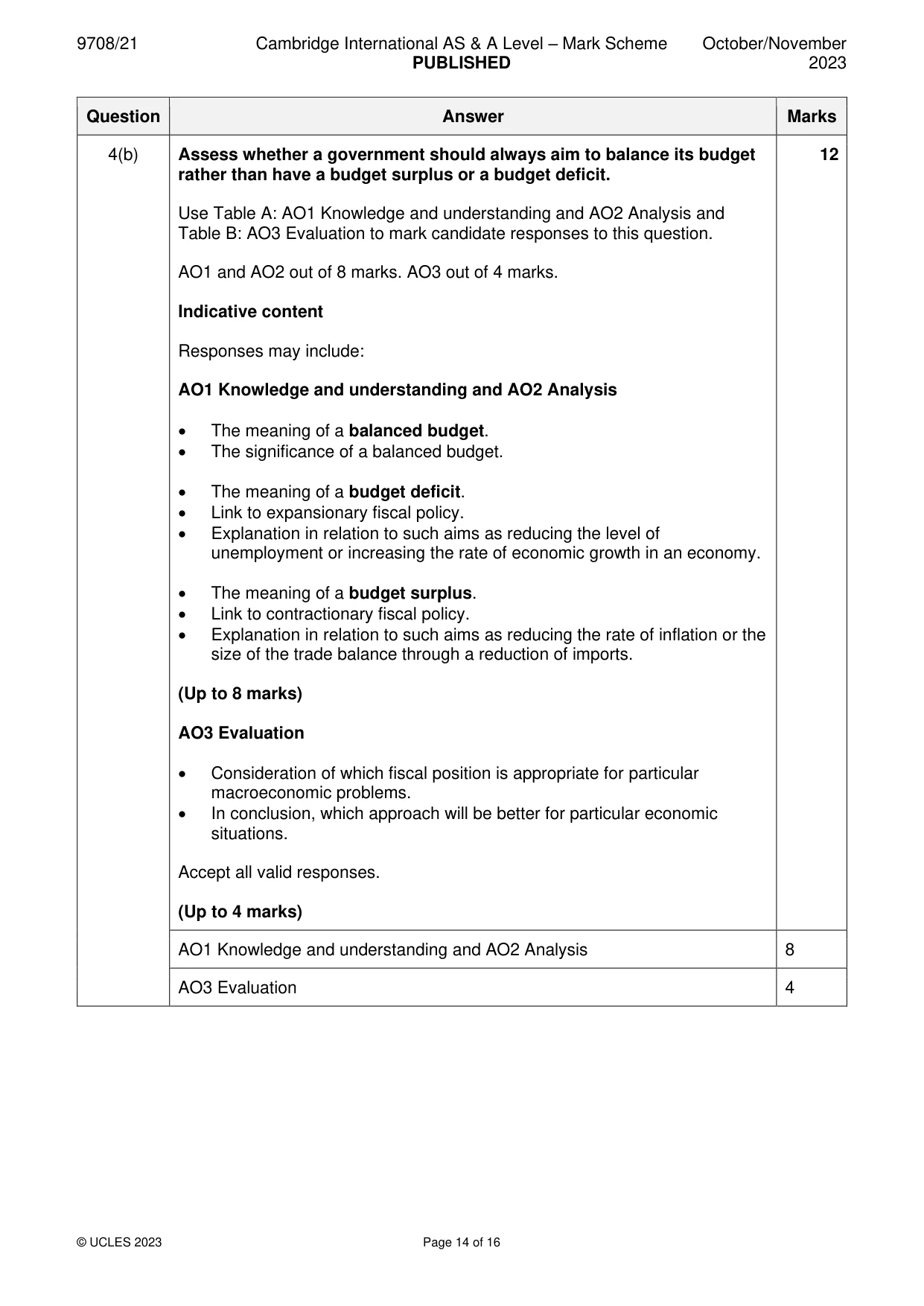
Mark scheme: 4(a) Explain the reasons why governments impose taxes and consider 8 whether an increase in income tax is fairer than an increase in sales taxes. Follow the point-based marking guidance at the top of this mark scheme and award: up to 3 marks for AO1 Knowledge and understanding up to 3 marks for AO2 Analysis up to 2 marks for AO3 Evaluation. AO1 Knowledge and understanding (max 3 marks) A clear understanding of the various possible reasons why governments impose taxes. AO2 Analysis (max 3 marks) Analysis of the distinction between a direct tax, such as income tax, and an indirect tax, such as a sales tax, with appropriate reference to fairness. AO3 Evaluation (max 2 marks) Offers a valid judgement on whether an increase in income tax is fairer than an increase in sales taxes (1) to reach a conclusion. (1) AO1 Knowledge and understanding 3 AO2 Analysis 3 AO3 Evaluation 2 4(b) Assess whether a government should always aim to balance its budget 12 rather than have a budget surplus or a budget deficit. Use Table A: AO1 Knowledge and understanding and AO2 Analysis and Table B: AO3 Evaluation to mark candidate responses to this question. AO1 and AO2 out of 8 marks. AO3 out of 4 marks. Indicative content Responses may include: AO1 Knowledge and understanding and AO2 Analysis • The meaning of a balanced budget. • The significance of a balanced budget. • The meaning of a budget deficit. • Link to expansionary fiscal policy. • Explanation in relation to such aims as reducing the level of unemployment or increasing the rate of economic growth in an economy. • The meaning of a budget surplus. • Link to contractionary fiscal policy. • Explanation in relation to such aims as reducing the rate of inflation or the size of the trade balance through a reduction of imports. (Up to 8 marks) AO3 Evaluation • Consideration of which fiscal position is appropriate for particular macroeconomic problems. • In conclusion, which approach will be better for particular economic situations. Accept all valid responses. (Up to 4 marks) AO1 Knowledge and understanding and AO2 Analysis 8 AO3 Evaluation 4
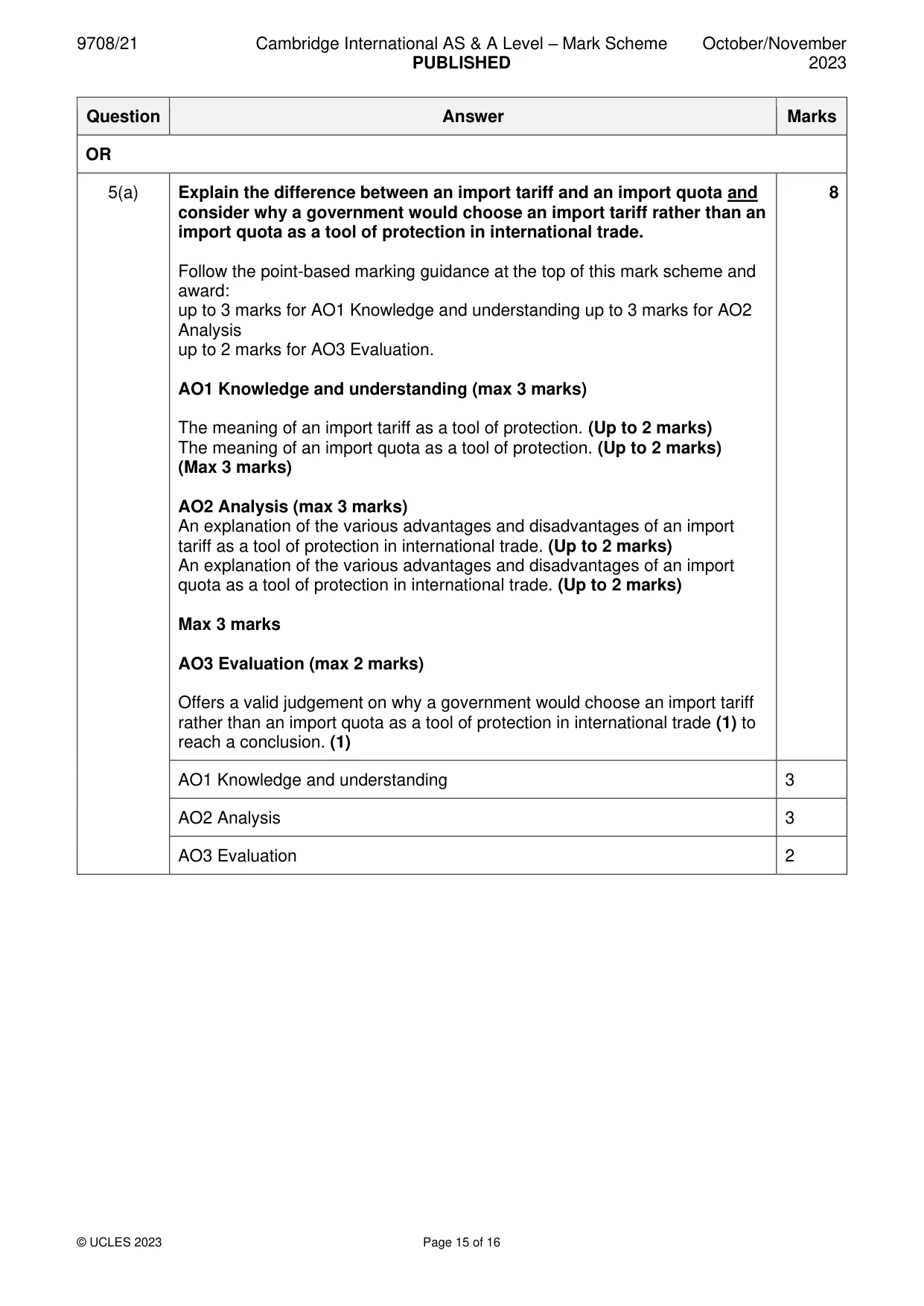
Q5 · Explain the difference between an import tariff and an import quota and consider why a…
5 (a) Explain the difference between an import tariff and an import quota and consider why a government would choose an import tariff rather than an import quota as a tool of protection in international trade. [8] (b) Assess whether the theories of absolute and comparative advantage are substantially undermined by their various limitations. [12]
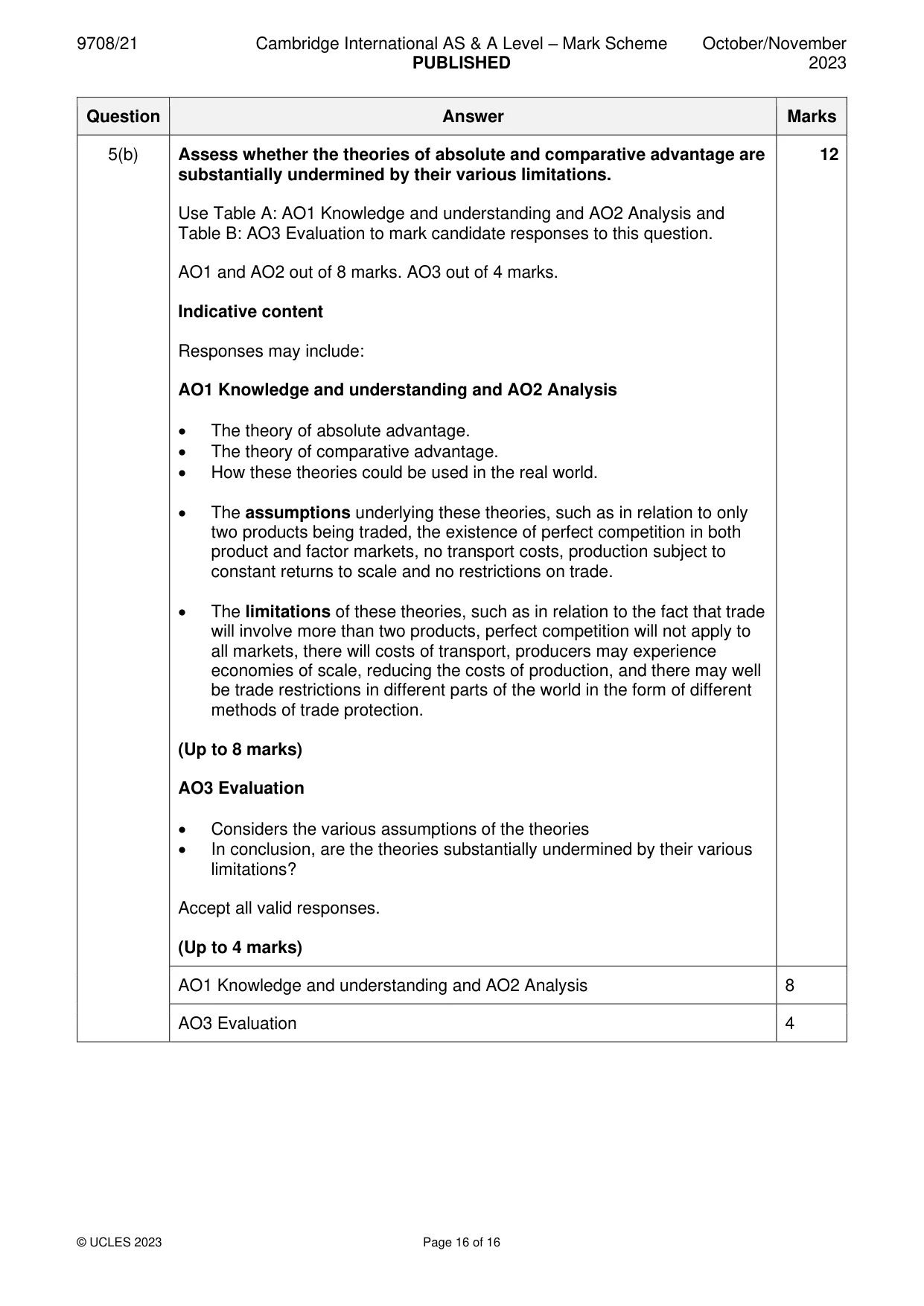
Mark scheme: 5(a) Explain the difference between an import tariff and an import quota and 8 consider why a government would choose an import tariff rather than an import quota as a tool of protection in international trade. Follow the point-based marking guidance at the top of this mark scheme and award: up to 3 marks for AO1 Knowledge and understanding up to 3 marks for AO2 Analysis up to 2 marks for AO3 Evaluation. AO1 Knowledge and understanding (max 3 marks) The meaning of an import tariff as a tool of protection. (Up to 2 marks) The meaning of an import quota as a tool of protection. (Up to 2 marks) (Max 3 marks) AO2 Analysis (max 3 marks) An explanation of the various advantages and disadvantages of an import tariff as a tool of protection in international trade. (Up to 2 marks) An explanation of the various advantages and disadvantages of an import quota as a tool of protection in international trade. (Up to 2 marks) Max 3 marks AO3 Evaluation (max 2 marks) Offers a valid judgement on why a government would choose an import tariff rather than an import quota as a tool of protection in international trade (1) to reach a conclusion. (1) AO1 Knowledge and understanding 3 AO2 Analysis 3 AO3 Evaluation 2 5(b) Assess whether the theories of absolute and comparative advantage are 12 substantially undermined by their various limitations. Use Table A: AO1 Knowledge and understanding and AO2 Analysis and Table B: AO3 Evaluation to mark candidate responses to this question. AO1 and AO2 out of 8 marks. AO3 out of 4 marks. Indicative content Responses may include: AO1 Knowledge and understanding and AO2 Analysis • The theory of absolute advantage. • The theory of comparative advantage. • How these theories could be used in the real world. • The assumptions underlying these theories, such as in relation to only two products being traded, the existence of perfect competition in both product and factor markets, no transport costs, production subject to constant returns to scale and no restrictions on trade. • The limitations of these theories, such as in relation to the fact that trade will involve more than two products, perfect competition will not apply to all markets, there will costs of transport, producers may experience economies of scale, reducing the costs of production, and there may well be trade restrictions in different parts of the world in the form of different methods of trade protection. (Up to 8 marks) AO3 Evaluation • Considers the various assumptions of the theories • In conclusion, are the theories substantially undermined by their various limitations? Accept all valid responses. (Up to 4 marks) AO1 Knowledge and understanding and AO2 Analysis 8 AO3 Evaluation 4
What was in this paper
The subtopics covered by these 5 questions, and how many questions each got. Open one in a new tab to see every Cambridge question on it.
What you needed in this session
Cambridge’s own grade thresholds for 2023 Oct/Nov, Paper 2 · Variant 1. A higher threshold means an easier paper — the bar moves with how the cohort did.